EP2467119B1 - Röntgendichte bioaktive glasmaterialien - Google Patents
Röntgendichte bioaktive glasmaterialien Download PDFInfo
- Publication number
- EP2467119B1 EP2467119B1 EP10745129.6A EP10745129A EP2467119B1 EP 2467119 B1 EP2467119 B1 EP 2467119B1 EP 10745129 A EP10745129 A EP 10745129A EP 2467119 B1 EP2467119 B1 EP 2467119B1
- Authority
- EP
- European Patent Office
- Prior art keywords
- particles
- formulation
- treatment
- bioactive
- dental diseases
- Prior art date
- Legal status (The legal status is an assumption and is not a legal conclusion. Google has not performed a legal analysis and makes no representation as to the accuracy of the status listed.)
- Not-in-force
Links
- 239000000463 material Substances 0.000 title claims description 46
- 239000005313 bioactive glass Substances 0.000 title description 36
- 239000002245 particle Substances 0.000 claims description 134
- 239000000203 mixture Substances 0.000 claims description 105
- 238000009472 formulation Methods 0.000 claims description 66
- 239000000243 solution Substances 0.000 claims description 24
- 208000014151 Stomatognathic disease Diseases 0.000 claims description 23
- 229920000642 polymer Polymers 0.000 claims description 21
- 239000011159 matrix material Substances 0.000 claims description 19
- FAPWRFPIFSIZLT-UHFFFAOYSA-M Sodium chloride Chemical compound [Na+].[Cl-] FAPWRFPIFSIZLT-UHFFFAOYSA-M 0.000 claims description 17
- VYPSYNLAJGMNEJ-UHFFFAOYSA-N Silicium dioxide Chemical compound O=[Si]=O VYPSYNLAJGMNEJ-UHFFFAOYSA-N 0.000 claims description 15
- 238000000576 coating method Methods 0.000 claims description 15
- WMWLMWRWZQELOS-UHFFFAOYSA-N bismuth(iii) oxide Chemical group O=[Bi]O[Bi]=O WMWLMWRWZQELOS-UHFFFAOYSA-N 0.000 claims description 14
- 239000011164 primary particle Substances 0.000 claims description 14
- 239000011248 coating agent Substances 0.000 claims description 13
- 239000000546 pharmaceutical excipient Substances 0.000 claims description 11
- 229920002988 biodegradable polymer Polymers 0.000 claims description 10
- 239000004621 biodegradable polymer Substances 0.000 claims description 10
- 239000011780 sodium chloride Substances 0.000 claims description 10
- 239000007864 aqueous solution Substances 0.000 claims description 8
- KKCBUQHMOMHUOY-UHFFFAOYSA-N Na2O Inorganic materials [O-2].[Na+].[Na+] KKCBUQHMOMHUOY-UHFFFAOYSA-N 0.000 claims description 7
- 239000000377 silicon dioxide Substances 0.000 claims description 7
- 238000011049 filling Methods 0.000 claims description 6
- 229910052681 coesite Inorganic materials 0.000 claims description 5
- 229910052906 cristobalite Inorganic materials 0.000 claims description 5
- 229910052682 stishovite Inorganic materials 0.000 claims description 5
- 229910052905 tridymite Inorganic materials 0.000 claims description 5
- 239000000645 desinfectant Substances 0.000 claims description 4
- 235000012239 silicon dioxide Nutrition 0.000 claims description 4
- XLYOFNOQVPJJNP-UHFFFAOYSA-N water Substances O XLYOFNOQVPJJNP-UHFFFAOYSA-N 0.000 claims description 3
- 239000012891 Ringer solution Substances 0.000 claims description 2
- 230000002421 anti-septic effect Effects 0.000 claims description 2
- 239000010839 body fluid Substances 0.000 claims description 2
- 210000001124 body fluid Anatomy 0.000 claims description 2
- 230000000975 bioactive effect Effects 0.000 description 47
- 229910000416 bismuth oxide Inorganic materials 0.000 description 31
- TYIXMATWDRGMPF-UHFFFAOYSA-N dibismuth;oxygen(2-) Chemical compound [O-2].[O-2].[O-2].[Bi+3].[Bi+3] TYIXMATWDRGMPF-UHFFFAOYSA-N 0.000 description 31
- TZCXTZWJZNENPQ-UHFFFAOYSA-L barium sulfate Chemical compound [Ba+2].[O-]S([O-])(=O)=O TZCXTZWJZNENPQ-UHFFFAOYSA-L 0.000 description 22
- 239000002105 nanoparticle Substances 0.000 description 22
- 238000000034 method Methods 0.000 description 16
- 229910052782 aluminium Inorganic materials 0.000 description 11
- XAGFODPZIPBFFR-UHFFFAOYSA-N aluminium Chemical compound [Al] XAGFODPZIPBFFR-UHFFFAOYSA-N 0.000 description 11
- ODINCKMPIJJUCX-UHFFFAOYSA-N calcium oxide Inorganic materials [Ca]=O ODINCKMPIJJUCX-UHFFFAOYSA-N 0.000 description 11
- 238000004519 manufacturing process Methods 0.000 description 11
- 239000011575 calcium Substances 0.000 description 10
- 210000004262 dental pulp cavity Anatomy 0.000 description 10
- 239000000843 powder Substances 0.000 description 10
- 239000002243 precursor Substances 0.000 description 10
- 239000000320 mechanical mixture Substances 0.000 description 9
- 239000011734 sodium Substances 0.000 description 9
- XLOMVQKBTHCTTD-UHFFFAOYSA-N Zinc monoxide Chemical compound [Zn]=O XLOMVQKBTHCTTD-UHFFFAOYSA-N 0.000 description 8
- QVGXLLKOCUKJST-UHFFFAOYSA-N atomic oxygen Chemical compound [O] QVGXLLKOCUKJST-UHFFFAOYSA-N 0.000 description 8
- 230000015572 biosynthetic process Effects 0.000 description 8
- 229910052797 bismuth Inorganic materials 0.000 description 8
- 229910052791 calcium Inorganic materials 0.000 description 8
- 238000009826 distribution Methods 0.000 description 8
- 229910052588 hydroxylapatite Inorganic materials 0.000 description 8
- VNWKTOKETHGBQD-UHFFFAOYSA-N methane Chemical compound C VNWKTOKETHGBQD-UHFFFAOYSA-N 0.000 description 8
- 239000001301 oxygen Substances 0.000 description 8
- 229910052760 oxygen Inorganic materials 0.000 description 8
- XYJRXVWERLGGKC-UHFFFAOYSA-D pentacalcium;hydroxide;triphosphate Chemical compound [OH-].[Ca+2].[Ca+2].[Ca+2].[Ca+2].[Ca+2].[O-]P([O-])([O-])=O.[O-]P([O-])([O-])=O.[O-]P([O-])([O-])=O XYJRXVWERLGGKC-UHFFFAOYSA-D 0.000 description 8
- 229920001195 polyisoprene Polymers 0.000 description 8
- 239000012890 simulated body fluid Substances 0.000 description 8
- 229910052708 sodium Inorganic materials 0.000 description 8
- AXCZMVOFGPJBDE-UHFFFAOYSA-L calcium dihydroxide Chemical compound [OH-].[OH-].[Ca+2] AXCZMVOFGPJBDE-UHFFFAOYSA-L 0.000 description 7
- 239000000920 calcium hydroxide Substances 0.000 description 7
- 229910001861 calcium hydroxide Inorganic materials 0.000 description 7
- 239000000292 calcium oxide Substances 0.000 description 7
- 239000011521 glass Substances 0.000 description 7
- JCXGWMGPZLAOME-UHFFFAOYSA-N bismuth atom Chemical compound [Bi] JCXGWMGPZLAOME-UHFFFAOYSA-N 0.000 description 6
- LTPCXXMGKDQPAO-UHFFFAOYSA-L calcium;2-ethylhexanoate Chemical compound [Ca+2].CCCCC(CC)C([O-])=O.CCCCC(CC)C([O-])=O LTPCXXMGKDQPAO-UHFFFAOYSA-L 0.000 description 6
- 239000011163 secondary particle Substances 0.000 description 6
- VYPDUQYOLCLEGS-UHFFFAOYSA-M sodium;2-ethylhexanoate Chemical compound [Na+].CCCCC(CC)C([O-])=O VYPDUQYOLCLEGS-UHFFFAOYSA-M 0.000 description 6
- 239000007921 spray Substances 0.000 description 6
- 239000004094 surface-active agent Substances 0.000 description 6
- 239000000725 suspension Substances 0.000 description 6
- 239000000080 wetting agent Substances 0.000 description 6
- 239000002131 composite material Substances 0.000 description 5
- 210000004268 dentin Anatomy 0.000 description 5
- UQEAIHBTYFGYIE-UHFFFAOYSA-N hexamethyldisiloxane Chemical compound C[Si](C)(C)O[Si](C)(C)C UQEAIHBTYFGYIE-UHFFFAOYSA-N 0.000 description 5
- BHEPBYXIRTUNPN-UHFFFAOYSA-N hydridophosphorus(.) (triplet) Chemical compound [PH] BHEPBYXIRTUNPN-UHFFFAOYSA-N 0.000 description 5
- 230000008569 process Effects 0.000 description 5
- 238000004659 sterilization and disinfection Methods 0.000 description 5
- STCOOQWBFONSKY-UHFFFAOYSA-N tributyl phosphate Chemical compound CCCCOP(=O)(OCCCC)OCCCC STCOOQWBFONSKY-UHFFFAOYSA-N 0.000 description 5
- 229940093635 tributyl phosphate Drugs 0.000 description 5
- IJGRMHOSHXDMSA-UHFFFAOYSA-N Atomic nitrogen Chemical compound N#N IJGRMHOSHXDMSA-UHFFFAOYSA-N 0.000 description 4
- VEXZGXHMUGYJMC-UHFFFAOYSA-N Hydrochloric acid Chemical compound Cl VEXZGXHMUGYJMC-UHFFFAOYSA-N 0.000 description 4
- CTQNGGLPUBDAKN-UHFFFAOYSA-N O-Xylene Chemical compound CC1=CC=CC=C1C CTQNGGLPUBDAKN-UHFFFAOYSA-N 0.000 description 4
- 238000002441 X-ray diffraction Methods 0.000 description 4
- 239000001506 calcium phosphate Substances 0.000 description 4
- 239000000835 fiber Substances 0.000 description 4
- 239000007788 liquid Substances 0.000 description 4
- 238000002360 preparation method Methods 0.000 description 4
- 150000003384 small molecules Chemical class 0.000 description 4
- 238000001179 sorption measurement Methods 0.000 description 4
- 238000003786 synthesis reaction Methods 0.000 description 4
- QORWJWZARLRLPR-UHFFFAOYSA-H tricalcium bis(phosphate) Chemical compound [Ca+2].[Ca+2].[Ca+2].[O-]P([O-])([O-])=O.[O-]P([O-])([O-])=O QORWJWZARLRLPR-UHFFFAOYSA-H 0.000 description 4
- 239000008096 xylene Substances 0.000 description 4
- 239000011787 zinc oxide Substances 0.000 description 4
- OYPRJOBELJOOCE-UHFFFAOYSA-N Calcium Chemical compound [Ca] OYPRJOBELJOOCE-UHFFFAOYSA-N 0.000 description 3
- 101000801643 Homo sapiens Retinal-specific phospholipid-transporting ATPase ABCA4 Proteins 0.000 description 3
- DGAQECJNVWCQMB-PUAWFVPOSA-M Ilexoside XXIX Chemical compound C[C@@H]1CC[C@@]2(CC[C@@]3(C(=CC[C@H]4[C@]3(CC[C@@H]5[C@@]4(CC[C@@H](C5(C)C)OS(=O)(=O)[O-])C)C)[C@@H]2[C@]1(C)O)C)C(=O)O[C@H]6[C@@H]([C@H]([C@@H]([C@H](O6)CO)O)O)O.[Na+] DGAQECJNVWCQMB-PUAWFVPOSA-M 0.000 description 3
- 238000001069 Raman spectroscopy Methods 0.000 description 3
- 102100033617 Retinal-specific phospholipid-transporting ATPase ABCA4 Human genes 0.000 description 3
- 239000005708 Sodium hypochlorite Substances 0.000 description 3
- 238000004458 analytical method Methods 0.000 description 3
- NUMHJBONQMZPBW-UHFFFAOYSA-K bis(2-ethylhexanoyloxy)bismuthanyl 2-ethylhexanoate Chemical compound [Bi+3].CCCCC(CC)C([O-])=O.CCCCC(CC)C([O-])=O.CCCCC(CC)C([O-])=O NUMHJBONQMZPBW-UHFFFAOYSA-K 0.000 description 3
- BRPQOXSCLDDYGP-UHFFFAOYSA-N calcium oxide Chemical compound [O-2].[Ca+2] BRPQOXSCLDDYGP-UHFFFAOYSA-N 0.000 description 3
- 235000011010 calcium phosphates Nutrition 0.000 description 3
- PBAYDYUZOSNJGU-UHFFFAOYSA-N chelidonic acid Natural products OC(=O)C1=CC(=O)C=C(C(O)=O)O1 PBAYDYUZOSNJGU-UHFFFAOYSA-N 0.000 description 3
- 150000001875 compounds Chemical class 0.000 description 3
- 239000012530 fluid Substances 0.000 description 3
- 238000003384 imaging method Methods 0.000 description 3
- 238000010348 incorporation Methods 0.000 description 3
- 229910044991 metal oxide Inorganic materials 0.000 description 3
- 150000004706 metal oxides Chemical class 0.000 description 3
- 238000003825 pressing Methods 0.000 description 3
- -1 sodium carboxylate Chemical class 0.000 description 3
- SUKJFIGYRHOWBL-UHFFFAOYSA-N sodium hypochlorite Chemical compound [Na+].Cl[O-] SUKJFIGYRHOWBL-UHFFFAOYSA-N 0.000 description 3
- 239000007858 starting material Substances 0.000 description 3
- 239000000126 substance Substances 0.000 description 3
- 238000004627 transmission electron microscopy Methods 0.000 description 3
- 241000283690 Bos taurus Species 0.000 description 2
- 208000018035 Dental disease Diseases 0.000 description 2
- 230000000845 anti-microbial effect Effects 0.000 description 2
- 210000000988 bone and bone Anatomy 0.000 description 2
- 229910000389 calcium phosphate Inorganic materials 0.000 description 2
- 230000015556 catabolic process Effects 0.000 description 2
- 239000003795 chemical substances by application Substances 0.000 description 2
- 239000000470 constituent Substances 0.000 description 2
- 238000012937 correction Methods 0.000 description 2
- 238000006731 degradation reaction Methods 0.000 description 2
- 230000005670 electromagnetic radiation Effects 0.000 description 2
- JROGBPMEKVAPEH-GXGBFOEMSA-N emetine dihydrochloride Chemical compound Cl.Cl.N1CCC2=CC(OC)=C(OC)C=C2[C@H]1C[C@H]1C[C@H]2C3=CC(OC)=C(OC)C=C3CCN2C[C@@H]1CC JROGBPMEKVAPEH-GXGBFOEMSA-N 0.000 description 2
- PCHJSUWPFVWCPO-UHFFFAOYSA-N gold Chemical compound [Au] PCHJSUWPFVWCPO-UHFFFAOYSA-N 0.000 description 2
- 238000000227 grinding Methods 0.000 description 2
- 238000007654 immersion Methods 0.000 description 2
- 238000000338 in vitro Methods 0.000 description 2
- 239000011234 nano-particulate material Substances 0.000 description 2
- 239000002086 nanomaterial Substances 0.000 description 2
- 229910052757 nitrogen Inorganic materials 0.000 description 2
- 230000003239 periodontal effect Effects 0.000 description 2
- 239000002504 physiological saline solution Substances 0.000 description 2
- BASFCYQUMIYNBI-UHFFFAOYSA-N platinum Chemical compound [Pt] BASFCYQUMIYNBI-UHFFFAOYSA-N 0.000 description 2
- 239000004417 polycarbonate Substances 0.000 description 2
- 229920000515 polycarbonate Polymers 0.000 description 2
- 229920000136 polysorbate Polymers 0.000 description 2
- 230000009467 reduction Effects 0.000 description 2
- 239000012925 reference material Substances 0.000 description 2
- 239000003566 sealing material Substances 0.000 description 2
- 229910052814 silicon oxide Inorganic materials 0.000 description 2
- 229910001948 sodium oxide Inorganic materials 0.000 description 2
- IATRAKWUXMZMIY-UHFFFAOYSA-N strontium oxide Chemical compound [O-2].[Sr+2] IATRAKWUXMZMIY-UHFFFAOYSA-N 0.000 description 2
- 238000006557 surface reaction Methods 0.000 description 2
- 210000001519 tissue Anatomy 0.000 description 2
- 238000004448 titration Methods 0.000 description 2
- 238000000954 titration curve Methods 0.000 description 2
- OBETXYAYXDNJHR-SSDOTTSWSA-M (2r)-2-ethylhexanoate Chemical compound CCCC[C@@H](CC)C([O-])=O OBETXYAYXDNJHR-SSDOTTSWSA-M 0.000 description 1
- WYTZZXDRDKSJID-UHFFFAOYSA-N (3-aminopropyl)triethoxysilane Chemical compound CCO[Si](OCC)(OCC)CCCN WYTZZXDRDKSJID-UHFFFAOYSA-N 0.000 description 1
- 238000004438 BET method Methods 0.000 description 1
- BVKZGUZCCUSVTD-UHFFFAOYSA-L Carbonate Chemical compound [O-]C([O-])=O BVKZGUZCCUSVTD-UHFFFAOYSA-L 0.000 description 1
- 241000968928 Carex brizoides Species 0.000 description 1
- 229920002101 Chitin Polymers 0.000 description 1
- 229920001661 Chitosan Polymers 0.000 description 1
- GHXZTYHSJHQHIJ-UHFFFAOYSA-N Chlorhexidine Chemical compound C=1C=C(Cl)C=CC=1NC(N)=NC(N)=NCCCCCCN=C(N)N=C(N)NC1=CC=C(Cl)C=C1 GHXZTYHSJHQHIJ-UHFFFAOYSA-N 0.000 description 1
- 206010018276 Gingival bleeding Diseases 0.000 description 1
- 229910025794 LaB6 Inorganic materials 0.000 description 1
- 206010031149 Osteitis Diseases 0.000 description 1
- 229910019142 PO4 Inorganic materials 0.000 description 1
- 229920000331 Polyhydroxybutyrate Polymers 0.000 description 1
- 229920001213 Polysorbate 20 Polymers 0.000 description 1
- 208000004550 Postoperative Pain Diseases 0.000 description 1
- 229920001218 Pullulan Polymers 0.000 description 1
- 239000004373 Pullulan Substances 0.000 description 1
- 238000001237 Raman spectrum Methods 0.000 description 1
- DBMJMQXJHONAFJ-UHFFFAOYSA-M Sodium laurylsulphate Chemical compound [Na+].CCCCCCCCCCCCOS([O-])(=O)=O DBMJMQXJHONAFJ-UHFFFAOYSA-M 0.000 description 1
- 238000003917 TEM image Methods 0.000 description 1
- IOYNQIMAUDJVEI-BMVIKAAMSA-N Tepraloxydim Chemical compound C1C(=O)C(C(=N/OC\C=C\Cl)/CC)=C(O)CC1C1CCOCC1 IOYNQIMAUDJVEI-BMVIKAAMSA-N 0.000 description 1
- BOTDANWDWHJENH-UHFFFAOYSA-N Tetraethyl orthosilicate Chemical compound CCO[Si](OCC)(OCC)OCC BOTDANWDWHJENH-UHFFFAOYSA-N 0.000 description 1
- 238000005411 Van der Waals force Methods 0.000 description 1
- 230000009471 action Effects 0.000 description 1
- 150000001343 alkyl silanes Chemical class 0.000 description 1
- OBETXYAYXDNJHR-UHFFFAOYSA-N alpha-ethylcaproic acid Natural products CCCCC(CC)C(O)=O OBETXYAYXDNJHR-UHFFFAOYSA-N 0.000 description 1
- 230000004075 alteration Effects 0.000 description 1
- 229940058344 antitrematodals organophosphorous compound Drugs 0.000 description 1
- 239000013011 aqueous formulation Substances 0.000 description 1
- 229910052788 barium Inorganic materials 0.000 description 1
- VJFFDDQGMMQGTQ-UHFFFAOYSA-L barium(2+);2-ethylhexanoate Chemical compound [Ba+2].CCCCC(CC)C([O-])=O.CCCCC(CC)C([O-])=O VJFFDDQGMMQGTQ-UHFFFAOYSA-L 0.000 description 1
- 238000006065 biodegradation reaction Methods 0.000 description 1
- 239000005312 bioglass Substances 0.000 description 1
- 239000005317 bioglass 45S5 Substances 0.000 description 1
- 239000012620 biological material Substances 0.000 description 1
- 230000005540 biological transmission Effects 0.000 description 1
- 208000018339 bone inflammation disease Diseases 0.000 description 1
- 229910052810 boron oxide Inorganic materials 0.000 description 1
- 230000001413 cellular effect Effects 0.000 description 1
- 238000012512 characterization method Methods 0.000 description 1
- 229960003260 chlorhexidine Drugs 0.000 description 1
- 229910017052 cobalt Inorganic materials 0.000 description 1
- 239000010941 cobalt Substances 0.000 description 1
- GUTLYIVDDKVIGB-UHFFFAOYSA-N cobalt atom Chemical compound [Co] GUTLYIVDDKVIGB-UHFFFAOYSA-N 0.000 description 1
- 238000005056 compaction Methods 0.000 description 1
- 229920001577 copolymer Polymers 0.000 description 1
- 230000007797 corrosion Effects 0.000 description 1
- 238000005260 corrosion Methods 0.000 description 1
- 208000002925 dental caries Diseases 0.000 description 1
- 230000001419 dependent effect Effects 0.000 description 1
- 238000000151 deposition Methods 0.000 description 1
- 230000008021 deposition Effects 0.000 description 1
- 230000000249 desinfective effect Effects 0.000 description 1
- 239000003599 detergent Substances 0.000 description 1
- JKWMSGQKBLHBQQ-UHFFFAOYSA-N diboron trioxide Chemical compound O=BOB=O JKWMSGQKBLHBQQ-UHFFFAOYSA-N 0.000 description 1
- 239000012153 distilled water Substances 0.000 description 1
- 239000003814 drug Substances 0.000 description 1
- 230000009977 dual effect Effects 0.000 description 1
- 230000000694 effects Effects 0.000 description 1
- 239000003822 epoxy resin Substances 0.000 description 1
- 238000002474 experimental method Methods 0.000 description 1
- 238000000605 extraction Methods 0.000 description 1
- 239000002657 fibrous material Substances 0.000 description 1
- 239000000945 filler Substances 0.000 description 1
- 229920002313 fluoropolymer Polymers 0.000 description 1
- XPBBUZJBQWWFFJ-UHFFFAOYSA-N fluorosilane Chemical compound [SiH3]F XPBBUZJBQWWFFJ-UHFFFAOYSA-N 0.000 description 1
- 125000000524 functional group Chemical group 0.000 description 1
- 238000007306 functionalization reaction Methods 0.000 description 1
- 229910052737 gold Inorganic materials 0.000 description 1
- 239000010931 gold Substances 0.000 description 1
- LNEPOXFFQSENCJ-UHFFFAOYSA-N haloperidol Chemical compound C1CC(O)(C=2C=CC(Cl)=CC=2)CCN1CCCC(=O)C1=CC=C(F)C=C1 LNEPOXFFQSENCJ-UHFFFAOYSA-N 0.000 description 1
- 238000010438 heat treatment Methods 0.000 description 1
- 239000008240 homogeneous mixture Substances 0.000 description 1
- 239000007943 implant Substances 0.000 description 1
- 230000003993 interaction Effects 0.000 description 1
- 238000011835 investigation Methods 0.000 description 1
- 150000002500 ions Chemical class 0.000 description 1
- 238000004898 kneading Methods 0.000 description 1
- 239000012669 liquid formulation Substances 0.000 description 1
- 239000007791 liquid phase Substances 0.000 description 1
- 238000011068 loading method Methods 0.000 description 1
- 239000000395 magnesium oxide Substances 0.000 description 1
- CPLXHLVBOLITMK-UHFFFAOYSA-N magnesium oxide Inorganic materials [Mg]=O CPLXHLVBOLITMK-UHFFFAOYSA-N 0.000 description 1
- AXZKOIWUVFPNLO-UHFFFAOYSA-N magnesium;oxygen(2-) Chemical compound [O-2].[Mg+2] AXZKOIWUVFPNLO-UHFFFAOYSA-N 0.000 description 1
- 238000002844 melting Methods 0.000 description 1
- 230000008018 melting Effects 0.000 description 1
- 244000005700 microbiome Species 0.000 description 1
- 238000003801 milling Methods 0.000 description 1
- 238000002156 mixing Methods 0.000 description 1
- 210000003739 neck Anatomy 0.000 description 1
- 230000006911 nucleation Effects 0.000 description 1
- 238000010899 nucleation Methods 0.000 description 1
- 150000002903 organophosphorus compounds Chemical class 0.000 description 1
- 150000003961 organosilicon compounds Chemical class 0.000 description 1
- 230000003647 oxidation Effects 0.000 description 1
- 238000007254 oxidation reaction Methods 0.000 description 1
- TWNQGVIAIRXVLR-UHFFFAOYSA-N oxo(oxoalumanyloxy)alumane Chemical compound O=[Al]O[Al]=O TWNQGVIAIRXVLR-UHFFFAOYSA-N 0.000 description 1
- CJJMLLCUQDSZIZ-UHFFFAOYSA-N oxobismuth Chemical class [Bi]=O CJJMLLCUQDSZIZ-UHFFFAOYSA-N 0.000 description 1
- 238000012856 packing Methods 0.000 description 1
- 239000012071 phase Substances 0.000 description 1
- NBIIXXVUZAFLBC-UHFFFAOYSA-K phosphate Chemical compound [O-]P([O-])([O-])=O NBIIXXVUZAFLBC-UHFFFAOYSA-K 0.000 description 1
- 239000010452 phosphate Substances 0.000 description 1
- 239000006069 physical mixture Substances 0.000 description 1
- 230000007505 plaque formation Effects 0.000 description 1
- 239000004033 plastic Substances 0.000 description 1
- 229920003023 plastic Polymers 0.000 description 1
- 229910052697 platinum Inorganic materials 0.000 description 1
- 239000005015 poly(hydroxybutyrate) Substances 0.000 description 1
- 229920000218 poly(hydroxyvalerate) Polymers 0.000 description 1
- 229920000058 polyacrylate Polymers 0.000 description 1
- 229920001610 polycaprolactone Polymers 0.000 description 1
- 229920000647 polyepoxide Polymers 0.000 description 1
- 229920002792 polyhydroxyhexanoate Polymers 0.000 description 1
- 229920002795 polyhydroxyoctanoate Polymers 0.000 description 1
- 229920000193 polymethacrylate Polymers 0.000 description 1
- 239000000256 polyoxyethylene sorbitan monolaurate Substances 0.000 description 1
- 235000010486 polyoxyethylene sorbitan monolaurate Nutrition 0.000 description 1
- 235000010482 polyoxyethylene sorbitan monooleate Nutrition 0.000 description 1
- 229920001299 polypropylene fumarate Polymers 0.000 description 1
- 229920000053 polysorbate 80 Polymers 0.000 description 1
- 239000004814 polyurethane Substances 0.000 description 1
- CHWRSCGUEQEHOH-UHFFFAOYSA-N potassium oxide Chemical compound [O-2].[K+].[K+] CHWRSCGUEQEHOH-UHFFFAOYSA-N 0.000 description 1
- 229910001950 potassium oxide Inorganic materials 0.000 description 1
- 238000012545 processing Methods 0.000 description 1
- 235000019423 pullulan Nutrition 0.000 description 1
- 230000000395 remineralizing effect Effects 0.000 description 1
- 230000005070 ripening Effects 0.000 description 1
- 239000002630 root canal dressing Substances 0.000 description 1
- 239000002631 root canal filling material Substances 0.000 description 1
- 238000004626 scanning electron microscopy Methods 0.000 description 1
- 238000004621 scanning probe microscopy Methods 0.000 description 1
- 239000002210 silicon-based material Substances 0.000 description 1
- 229920005573 silicon-containing polymer Polymers 0.000 description 1
- 229910052709 silver Inorganic materials 0.000 description 1
- 239000004332 silver Substances 0.000 description 1
- 238000005245 sintering Methods 0.000 description 1
- 238000002791 soaking Methods 0.000 description 1
- 210000004872 soft tissue Anatomy 0.000 description 1
- 239000007787 solid Substances 0.000 description 1
- 238000005118 spray pyrolysis Methods 0.000 description 1
- 238000004544 sputter deposition Methods 0.000 description 1
- 238000001356 surgical procedure Methods 0.000 description 1
- 229920001169 thermoplastic Polymers 0.000 description 1
- 230000000699 topical effect Effects 0.000 description 1
- 230000009466 transformation Effects 0.000 description 1
- 229910000391 tricalcium phosphate Inorganic materials 0.000 description 1
- 235000019731 tricalcium phosphate Nutrition 0.000 description 1
- 229940078499 tricalcium phosphate Drugs 0.000 description 1
- AVYKQOAMZCAHRG-UHFFFAOYSA-N triethoxy(3,3,4,4,5,5,6,6,7,7,8,8,8-tridecafluorooctyl)silane Chemical compound CCO[Si](OCC)(OCC)CCC(F)(F)C(F)(F)C(F)(F)C(F)(F)C(F)(F)C(F)(F)F AVYKQOAMZCAHRG-UHFFFAOYSA-N 0.000 description 1
- ZSDSQXJSNMTJDA-UHFFFAOYSA-N trifluralin Chemical compound CCCN(CCC)C1=C([N+]([O-])=O)C=C(C(F)(F)F)C=C1[N+]([O-])=O ZSDSQXJSNMTJDA-UHFFFAOYSA-N 0.000 description 1
- 229910021642 ultra pure water Inorganic materials 0.000 description 1
- 239000012498 ultrapure water Substances 0.000 description 1
- 238000003826 uniaxial pressing Methods 0.000 description 1
Images

Classifications
-
- A—HUMAN NECESSITIES
- A61—MEDICAL OR VETERINARY SCIENCE; HYGIENE
- A61L—METHODS OR APPARATUS FOR STERILISING MATERIALS OR OBJECTS IN GENERAL; DISINFECTION, STERILISATION OR DEODORISATION OF AIR; CHEMICAL ASPECTS OF BANDAGES, DRESSINGS, ABSORBENT PADS OR SURGICAL ARTICLES; MATERIALS FOR BANDAGES, DRESSINGS, ABSORBENT PADS OR SURGICAL ARTICLES
- A61L27/00—Materials for grafts or prostheses or for coating grafts or prostheses
- A61L27/02—Inorganic materials
- A61L27/10—Ceramics or glasses
-
- A—HUMAN NECESSITIES
- A61—MEDICAL OR VETERINARY SCIENCE; HYGIENE
- A61K—PREPARATIONS FOR MEDICAL, DENTAL OR TOILETRY PURPOSES
- A61K6/00—Preparations for dentistry
- A61K6/15—Compositions characterised by their physical properties
- A61K6/17—Particle size
-
- A—HUMAN NECESSITIES
- A61—MEDICAL OR VETERINARY SCIENCE; HYGIENE
- A61K—PREPARATIONS FOR MEDICAL, DENTAL OR TOILETRY PURPOSES
- A61K6/00—Preparations for dentistry
- A61K6/70—Preparations for dentistry comprising inorganic additives
- A61K6/71—Fillers
-
- A—HUMAN NECESSITIES
- A61—MEDICAL OR VETERINARY SCIENCE; HYGIENE
- A61K—PREPARATIONS FOR MEDICAL, DENTAL OR TOILETRY PURPOSES
- A61K6/00—Preparations for dentistry
- A61K6/80—Preparations for artificial teeth, for filling teeth or for capping teeth
- A61K6/802—Preparations for artificial teeth, for filling teeth or for capping teeth comprising ceramics
- A61K6/818—Preparations for artificial teeth, for filling teeth or for capping teeth comprising ceramics comprising zirconium oxide
-
- A—HUMAN NECESSITIES
- A61—MEDICAL OR VETERINARY SCIENCE; HYGIENE
- A61K—PREPARATIONS FOR MEDICAL, DENTAL OR TOILETRY PURPOSES
- A61K6/00—Preparations for dentistry
- A61K6/80—Preparations for artificial teeth, for filling teeth or for capping teeth
- A61K6/802—Preparations for artificial teeth, for filling teeth or for capping teeth comprising ceramics
- A61K6/82—Preparations for artificial teeth, for filling teeth or for capping teeth comprising ceramics comprising hafnium oxide
-
- A—HUMAN NECESSITIES
- A61—MEDICAL OR VETERINARY SCIENCE; HYGIENE
- A61K—PREPARATIONS FOR MEDICAL, DENTAL OR TOILETRY PURPOSES
- A61K6/00—Preparations for dentistry
- A61K6/80—Preparations for artificial teeth, for filling teeth or for capping teeth
- A61K6/802—Preparations for artificial teeth, for filling teeth or for capping teeth comprising ceramics
- A61K6/822—Preparations for artificial teeth, for filling teeth or for capping teeth comprising ceramics comprising rare earth metal oxides
-
- A—HUMAN NECESSITIES
- A61—MEDICAL OR VETERINARY SCIENCE; HYGIENE
- A61K—PREPARATIONS FOR MEDICAL, DENTAL OR TOILETRY PURPOSES
- A61K6/00—Preparations for dentistry
- A61K6/80—Preparations for artificial teeth, for filling teeth or for capping teeth
- A61K6/802—Preparations for artificial teeth, for filling teeth or for capping teeth comprising ceramics
- A61K6/824—Preparations for artificial teeth, for filling teeth or for capping teeth comprising ceramics comprising transition metal oxides
-
- A—HUMAN NECESSITIES
- A61—MEDICAL OR VETERINARY SCIENCE; HYGIENE
- A61K—PREPARATIONS FOR MEDICAL, DENTAL OR TOILETRY PURPOSES
- A61K6/00—Preparations for dentistry
- A61K6/80—Preparations for artificial teeth, for filling teeth or for capping teeth
- A61K6/831—Preparations for artificial teeth, for filling teeth or for capping teeth comprising non-metallic elements or compounds thereof, e.g. carbon
- A61K6/836—Glass
-
- A—HUMAN NECESSITIES
- A61—MEDICAL OR VETERINARY SCIENCE; HYGIENE
- A61L—METHODS OR APPARATUS FOR STERILISING MATERIALS OR OBJECTS IN GENERAL; DISINFECTION, STERILISATION OR DEODORISATION OF AIR; CHEMICAL ASPECTS OF BANDAGES, DRESSINGS, ABSORBENT PADS OR SURGICAL ARTICLES; MATERIALS FOR BANDAGES, DRESSINGS, ABSORBENT PADS OR SURGICAL ARTICLES
- A61L27/00—Materials for grafts or prostheses or for coating grafts or prostheses
- A61L27/50—Materials characterised by their function or physical properties, e.g. injectable or lubricating compositions, shape-memory materials, surface modified materials
-
- A—HUMAN NECESSITIES
- A61—MEDICAL OR VETERINARY SCIENCE; HYGIENE
- A61P—SPECIFIC THERAPEUTIC ACTIVITY OF CHEMICAL COMPOUNDS OR MEDICINAL PREPARATIONS
- A61P1/00—Drugs for disorders of the alimentary tract or the digestive system
- A61P1/02—Stomatological preparations, e.g. drugs for caries, aphtae, periodontitis
-
- A—HUMAN NECESSITIES
- A61—MEDICAL OR VETERINARY SCIENCE; HYGIENE
- A61P—SPECIFIC THERAPEUTIC ACTIVITY OF CHEMICAL COMPOUNDS OR MEDICINAL PREPARATIONS
- A61P31/00—Antiinfectives, i.e. antibiotics, antiseptics, chemotherapeutics
-
- A—HUMAN NECESSITIES
- A61—MEDICAL OR VETERINARY SCIENCE; HYGIENE
- A61L—METHODS OR APPARATUS FOR STERILISING MATERIALS OR OBJECTS IN GENERAL; DISINFECTION, STERILISATION OR DEODORISATION OF AIR; CHEMICAL ASPECTS OF BANDAGES, DRESSINGS, ABSORBENT PADS OR SURGICAL ARTICLES; MATERIALS FOR BANDAGES, DRESSINGS, ABSORBENT PADS OR SURGICAL ARTICLES
- A61L2400/00—Materials characterised by their function or physical properties
- A61L2400/12—Nanosized materials, e.g. nanofibres, nanoparticles, nanowires, nanotubes; Nanostructured surfaces
-
- Y—GENERAL TAGGING OF NEW TECHNOLOGICAL DEVELOPMENTS; GENERAL TAGGING OF CROSS-SECTIONAL TECHNOLOGIES SPANNING OVER SEVERAL SECTIONS OF THE IPC; TECHNICAL SUBJECTS COVERED BY FORMER USPC CROSS-REFERENCE ART COLLECTIONS [XRACs] AND DIGESTS
- Y10—TECHNICAL SUBJECTS COVERED BY FORMER USPC
- Y10T—TECHNICAL SUBJECTS COVERED BY FORMER US CLASSIFICATION
- Y10T428/00—Stock material or miscellaneous articles
- Y10T428/29—Coated or structually defined flake, particle, cell, strand, strand portion, rod, filament, macroscopic fiber or mass thereof
- Y10T428/2982—Particulate matter [e.g., sphere, flake, etc.]
-
- Y—GENERAL TAGGING OF NEW TECHNOLOGICAL DEVELOPMENTS; GENERAL TAGGING OF CROSS-SECTIONAL TECHNOLOGIES SPANNING OVER SEVERAL SECTIONS OF THE IPC; TECHNICAL SUBJECTS COVERED BY FORMER USPC CROSS-REFERENCE ART COLLECTIONS [XRACs] AND DIGESTS
- Y10—TECHNICAL SUBJECTS COVERED BY FORMER USPC
- Y10T—TECHNICAL SUBJECTS COVERED BY FORMER US CLASSIFICATION
- Y10T428/00—Stock material or miscellaneous articles
- Y10T428/29—Coated or structually defined flake, particle, cell, strand, strand portion, rod, filament, macroscopic fiber or mass thereof
- Y10T428/2982—Particulate matter [e.g., sphere, flake, etc.]
- Y10T428/2991—Coated
Definitions
- the invention relates to uses of a nanoparticulate material containing a matrix and embedded therein a radiopacifier; to uses of compositions and formulations comprising (i.e. containing or consisting of) such material.
- the invention particularly relates to advanced dental applications, such as root canal fillings and / or disinfection.
- the present invention describes materials which are bioactive, show a high alkaline capacity and are radio-opaque.
- Bioactive glass is a known material which is not radio-opaque. Therefore, it was suggested to combine such material with a radiopacifier to identify it on a radiographic image, see e.g. Madanat et al Acta Biomater. 2009, 5(9), 3497-505 . In this document, it is suggested to combine particles of bioactive glass with particles of BaSO4, melting the mixture to obtain shaped implants. However, it was found that the materials produced according to this method show reduced bioactivity.
- Nanoparticulate bismuth and bismuth oxide are known, see e.g. Grass et al., 2006, J. Nanopart. Res., 8, 729-36 . Such materials may be used in thermoelectric applications, but are considered unsuitable for direct use in dental applications.
- WO2008/049242 discloses amorphous tricalciumphosphate nanoparticles and speculates about doping said particles with silver.
- Brunner et al discloses bioglass nanoparticles doped with cobalt or gold.
- inventive formulations relate in a first aspect to (uncoated) nanoparticles / compositions of the bioactive glass-type which are radio-opaque and the manufacturing thereof; in a second aspect to coated nanoparticles / compositions of the bioactive glass-type which are radio-opaque and the manufacturing thereof; in a third aspect to formulations comprising such nanoparticles and the manufacturing thereof; in a fourth aspect to uses of such nanoparticles / compositions and formulations.
- the " diameter " of a particle as described herein is the volume-surface-average diameter of the primary particle. This may be determined by nitrogen adsorption using the BET method (according to: Janssen et al, Journal of Applied Polymer Science 52, 1913, 1994 ).
- Radio-opacity (or “radiopacity”) is known in the field and described e.g. in EN ISO6876. Briefly, the term refers to the relative inability of electromagnetism, such as X-rays, to pass through a given material. Dense materials which prevent the passage of electromagnetic radiation, such as X-rays, are called 'radio-opaque'. Thus, the term refers to the relative opaque white appearance in radiographic imaging, when passing electromagnetic radiation, such as X-rays, through dense matter.
- Bioactivity or "bioactive material” is known in the field. Briefly, the term refers to the ability of a material to induce calcium phosphate deposition on the surface of the object when placed in fluids. These fluids can be but are not limited to simulated body fluid, phosphate buffered or unbuffered physiological sodium chloride solution and the fluid in a living organism.
- Biodegradation or “biodegradability” is known in the field. Briefly, the term is used herein to relate the degradation of materials by humidified atmospheres and/or by liquid at various temperatures and/or cellular action.
- the characteristic parameter for the degradation is the mass loss of the material and/or the reduction in molecular weight of the applied material.
- the present invention relates in a first aspect to formulations for use in the treatment of dental diseases comprising specific nanoparticles of the bioactive glass type as outlined below.
- the invention relates to Primary Particles with a diameter below 200 nm containing a matrix and embedded therein a radiopacifier, wherein said matrix is as defined below and wherein said radiopacifier is Bi2O3.
- Such nanoparticles prove to be bioactive, are radio-opaque and show a high degree of alkaline capacity.
- Nanoparticles are particles between 20 - 200nm, preferably 20 - 50 nm, particularly preferably 20 - 100 nm. Such particle size results in material having a high surface area (e.g. > 30 m 2 /g). This allows a homogeneous distribution in a formulation as defined below and improved quality during X-ray investigations.
- Nanoparticles in the context of this invention, comprise primary particles and secondary particles.
- the term secondary particle includes such particles which are formed by interaction of primary particles. These secondary particles can be significantly larger than primary particles.
- Secondary particles can be formed by primary particles attached to each-other by physical forces, such as Van-der-Waals forces, or by individual primary particles grown together which have solid necks between the individual primary particles and can be formed by Oswald ripening or sintering.
- the 3-D fractal dimension of the secondary particles can vary over a wide range from just above 1 to nearly 3.
- the matrix of the inventive particles contains (or consists of) oxides of Si, Ca, Na and optionally P.
- the matrix is of the bioactive glass type.
- Suitable bioactive glasses comprise a matrix of silicon oxide and additional metal oxides.
- additional oxides include but are not limited to sodium oxide, calcium oxide, phosphorous oxide, aluminum oxide, boron oxide, strontium oxide, potassium oxide, magnesium oxide or combinations and mixtures thereof.
- a bioactive glass suitable as matrix for the inventive particles contains calcium oxide, sodium oxide and phosphorous oxide as additional oxide.
- the matrix typically contains SiO2 in an amount of less than 66wt%, such as 20 - 60 wt%, preferably 30 - 50 wt%.
- the matrix typically contains CaO in an amount of 10 - 50 wt%, preferably 20 - 40 wt%.
- the matrix typically contains Na2O in an amount of 5 - 50 wt%, preferably 15 - 30 wt%.
- the matrix typically contains P2O5 in an amount of 0 - 20 wt%, preferably 3 - 10 wt%. It is believed that P2O5 supports nucleation of calcium phosphate, which deposits on the surface; it is not considered essential.
- Bioactive glasses distinguish from calciumphosphates in that (i) silica is present, (ii) the amount of sodium is higher (aqueous solutions thereof show a high ph value) and (iii) phosphorous is an optional component.
- Radiopacifier As outlined above, the inventive particle contains in addition to the matrix one or more radiopacifiers.
- bisumth oxide may be used in the context of the present invention.
- the inorganic radiopacifier may be present in any stable oxidation state, depending on the specific material, this may be +/-0, +I, +II ... up to +VII. It is believed that the small particle size (nano-scale) of the inventive particle influences stability of the inorganic radiopacifier.
- the radiopacifier is distributed in and/or on the matrix, typically homogeneously distributed.
- the invention relates in an advantageous embodiment to particles, wherein radiopacifier and matrix as defined herein are present as separate phases; the matrix forms a support for the radiopacifier.
- the amount of radiopacifier may be varied in a broad range, and may be determined by routine experiments.
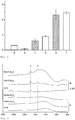
- an effective amount of radiopacifier is 5 - 50 wt%, even an amount as low as 25 - 40 wt% provides a high degree of radiopacity. It was surprisingly found that mixing mechanically 50 wt% of a radiopacifier (such as barium sulphate) into bioactive glass shows less radiopacity than adding 50 wt% of bismuth oxide by the flame spray synthesis. Further, the homogeneity is improved, as the lower standard deviation shows, see fig. 4 . Thus, the present invention provides a method of reducing the amount of radiopacifier by maintaining the radiopacity.
- a radiopacifier such as barium sulphate
- the ratio Ca:P in the inventive particle is in the range of 10:1 to 1:10.
- the ratio Ca:Na is in the range of 2:1 to 0.5:1.
- the invention relates to a composition containing a plurality of particles as described herein.
- a composition containing a plurality of particles as described herein.
- Such material is advantageously produced by flame spray synthesis as described below. It is a material with low-density and snow-like behaviour.
- this material is compacted prior to further processing. Suitable compaction methods are known in the field and include grinding, pressing (preferentially uniaxial pressing) and / or by a dual asymmetric centrifuge. In one embodiment, an uniaxial pressure of about 2.6 MPa is applied to obtain a suitable composition. It was surprisingly found that such compacting does not affect the structure of the particles of the invention, i.e. the particles are stable and particularly do not sinter.
- the bulk density of the composition (mass of the composition divided by its volume) is advantageously in the range of 0.2 - 1.5 g cm-3, preferably 0.3 - 0.7 g cm-3. Consequently, the invention also relates to a composition having a bulk density above 0.2 g cm-3 (preferably above 0.3 g cm-3), and consisting of one or more types of particles as disclosed herein.
- one or more types of other particles may be combined with the inventive particles.
- the amount of such particles may be up to 50 wt%, preferably up to 5 wt%. Consequently, the invention relates to a composition as disclosed herein, consisting of particles as disclosed herein and optionally up to 50 wt% of further nanoparticles.
- Such "other particles” may be selected from the radiopacifiers identified above and further include BaSO4 and Bi2O3, preferably BaSO4.
- the inventive particles are combined with ZnO.
- the invention relates to particles / compositions as disclosed herein that are bioactive.
- bioactive particularly refers to the ability of these particles / compositions to bond bone and / or soft tissue.
- bioactive glass particles undergo a multi-step alteration, which results in a Ca-P rich layer on the glass surface which may lead to partial or complete replacement of the glass by hard tissue.
- Such transformation and the resulting release of glass components into solution are influenced inter alia by glass composition and per-weight surface area.
- Standard bioactive glass compositions exhibit a carbonated hydroxyapatite layer upon immersion in simulated body fluid or physiological sodium chloride solution.
- the invention relates to particles / compositions as disclosed herein having a narrow particle size distribution.
- the distribution of the particle diameter is evaluated by measuring the particle diameters of at least 200 individual, representative particles from transmission electron micrographs.
- the particle size distribution is then fitted by a log-normal distribution (see Grass and Stark, Journal of Materials Chemistry 2006 Vol. 16, P 1825 ff ).
- the distribution is characterized as narrow if the geometric standard deviation of the measured and fitted distribution is below 1.9, more preferably below 1.7 and most preferably below 1.5.
- a narrow size distribution as described above, improves the quality of the material and simplifies the uses disclosed herein.
- the invention relates to particles / compositions as disclosed herein having high alkaline capacity. It is known that bioactive glass is useful for the reduction of oral microorganisms; it is believed that this effect is induced by the alkaline environment and by the ion release of a bioactive glass.
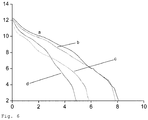
- the radiopacifier By the direct incorporation of the radiopacifier, the alkalinity of the material is not reduced by the same extent, i.e. addition of 50 % does not reduce the alkaline power by half in comparison to a mere mechanical mixture ( Figure 6 ). This demonstrates that the inventive particles / compositions afford a higher alkalinity than a physical mixture (by milling together the constituents) of bioactive glass and a radiopacifier.
- a method of manufacturing particles as described herein comprising the step of subjecting one or more combustible solutions to a flame spray pyrolysis wherein said one or more solutions contain one or more soluble silica precursors, such as hexamethyldisiloxane, tetraethoxysilane or any other organosilicon compounds; one or more soluble sodium precursors, such as sodium 2-ethylhexanoate or any kind of soluble sodium source such as sodium carboxylate; one or more soluble calcium precursors, such as calcium 2-ethylhexanoate or any kind of soluble calcium source such as calcium carboxylate; optionally one or more soluble phosphorous precursors, such as tributyl phosphate or any other soluble phosphorous source such as organophosphorous compounds; one or more soluble bismuth precursors.
- soluble silica precursors such as hexamethyldisiloxane, tetraethoxysilane or any other organosilicon compounds
- Suitable precursors of bismuth include bismuth 2-ethylhexanoate.
- FSP processes are known per se, but not applied to the present combination of starting materials.
- the process may be performed as described in WO 2005/087660 by adding one or more extra precursor containing at least one heavier element at which the corresponding oxide is heavier than calcium oxide.
- the element mass ratio of original bioactive glass compositions for example Bioglass 45S5® (45 wt% SiO2, 24.5 wt% CaO, 24.5 wt% Na2O, 6 wt% P2O5) are kept constant although one or more metal oxides are added.
- a suitable composition according to this invention is, 22.5 wt% SiO2, 12.25 wt% CaO, 12.25 wt% Na2O, 3 wt% P2O5, 50 wt% Bi2O3.
- a method of manufacturing a composition as described herein comprising the step of a) providing one or more types of particles as described herein and optionally one or more further nanoparticles, b) densifying these particles to obtain a composition having a bulk density of at least 0.3g*cm -3 .
- the invention relate to particles and compositions for a use as disclosed herein that are obtainable by or obtained by a FSP process, particularly by a FSP process as disclosed herein.
- the present invention relates in a second aspect to formulation for use in the treatment of dental diseases comprising particles as disclosed herein further comprising a surface functionalization and / or their linkage to other molecules. Such functionalization may improve dispersing properties of the inventive particles.
- the invention relates to a coated particle for use as disclosed herein, said coated particle containing one or more particles as described above (1 st aspect of the invention), additionally containing a coating.
- Such particles may be considered as being of the "core-shell-type", the core being formed of a primary particle as disclosed above, the shell being formed of a coating as described below.
- coated particles further includes such particles wherein a multitude of uncoated particles is coated with a coating as described below.
- the term coated particles covers one or more primary and / or secondary particles coated with a coating as defined below. It is further understood that the term particle excludes fibrous materials.
- Particles may have similar aspect ratios, may be in the form of needles or plates; preferably having a circle and / or sphere shaped form if analyzed by visualizable techniques (such as electron scanning microscopy).
- coatings may be applied to the particles as disclosed herein.
- Such coating may cover the inventive particles partly or fully. Further, such coating may be bound to the inventive particles covalently or by intermolecular forces (e. g. adsorption of a detergent or wetting agent).
- the coating may consist of a) functionalized molecules with a molecular mass below 2000 g/mol and / or b) polymers with a molecular mass above 2000 g/mol.
- Suitable functionalized molecules include small molecules with one or more functional groups, surfactants, wetting agents. Small molecules include compounds having a molecular weight below 2000 g/mol, preferably 500 g/mol.
- small molecules are bound covalently to the surface of the inventive particles.
- Suitable small molecules include functionalized alkylsilanes (such as 3-aminopropyl-triethoxysilane and / or triethoxy (1 H,1 H,2 H,2H- perfluoro 1-octyl)silane). It was found that coating the inventive particles / composites with the above fluorosilane provides good results when combined with fluorinated polymers.
- Suitable surfactants include Polysorbat 20 (Tween 20®), Polysorbat 80 (Tween 80®), Pullulan, Sodium dodecyl sulphate (SDS). It was found that coating the inventive particles / composites with the above surfactants provides good results in dental applications when combined with silicon containing polymers.
- Suitable wetting agents are known in the field and include the compounds identified above as "surfactants". It was found that coating the inventive particles / composites with the above wetting agents provides good dispersability of the inventive particles / composites in dental applications. It is known in the field that many surfactants also have properties as wetting agents and vice versa. Thus, one component may fulfil both requirements, as wetting agent and surfactant; alternatively, two or more components may be included to specifically meet all requirements.
- Suitable polymers include compounds having a molecular weight in the range of 2'000 - 100'000 g/mol. Examples for such polymers are poly-ethylen-glycoles or poly-urethanes.
- such polymers are bound by intermolecular forces, such as adsorption, to the surface of the inventive material.
- the polymers identified above may be crosslinked prior to application. It was found that coating the inventive particles / composites with the above polymers provides good results in terms of incorporation into the backbone of a polymer and / or into the polymeric matrix for dental applications.
- the invention relates to a composition for use as disclosed herein, said composition containing a plurality of particles having a surface functionalization and / or linkage to other molecules as described herein.
- Suitable densities of such compositions correspond to the values given above (1 st aspect), as well as manufacturing methods and combinations with other nanoparticles.
- the present invention relates in a third aspect to formulations for use in the treatment of dental diseases comprising particles / compositions according to the first or second aspect of the invention and one or more excipients.
- inventive formulations combine bioactive properties, radio-opaque properties and high alkaline capacity.
- these formulations by itself are radio-opaque and do not require admixing of additional radiopacifiers. This therefore saves one step in the manufacturing process and further improves quality of the formulations, particularly homogeneity of the material. This helps the dentist to monitor their placement radiographically more precisely.
- the invention relates to an improved bioactive glass formulation which is useful in dental applications.
- the formulations additionally show high alkaline capacity, particularly when compared to radio-opaque formulations of the prior art. This improves the antimicrobial effect of bioactive glass formulation.
- the pH of the inventive formulations, particularly the liquid formulations is equal to or greater than 11.
- Suitable excipients are those known in the field, and may be selected according to the intended use. It was found that the particles / compositions described herein are compatible with the excipients used in the field.
- the amount of excipients in a formulation may vary over a broad range; typically the amount of excipients in a formulation is in the range of 10-90 wt%, typically 20-80 wt%. Correspondingly, the amount of particles / compositions is in the range of 90-10 wt%, preferably 80-20 wt%.
- the invention relates to a formulation for use as in the treatment of dental diseases as defined above, wherein said excipients are selected from the group consisting of aqueous solutions.
- aqueous solutions may be combined with the inventive particles / compositions.
- pharmaceutically acceptable solutions such as water (including distilled water, ultrapure water), physiologically acceptable saline solutions, synthetic body fluid, ringer solution, or other physiologically acceptable antiseptic solutions (including aqueous sodium hypochlorite solutions and aqueous chlorhexidine solutions); preferably physiological sodium chloride solution or sodium hypochlorite and more preferably sodium hypochlorite solutions are used.
- physiological sodium chloride solution or sodium hypochlorite and more preferably sodium hypochlorite solutions are used.
- Such aqueous solutions are known in the field.
- the invention provides a formulation for use as in the treatment of dental diseases, said formulation containing (i.e. comprising or consisting of) (i) particles with a diameter below 200 nm as described herein (1 st aspect of the invention), (ii) an aqueous solution.
- Component (i) may be present in amount from 10 - 60 wt%, preferably 35 - 55 wt%; component (ii) may be present in an amount from 40 - 90, preferably 45 - 65 wt%.
- the invention relates to a formulation for use as in the treatment of dental diseases as defined above, wherein said excipients are selected from the group consisting of polymers.
- a wide variety of polymers may be combined with the inventive particles / compositions.
- pharmaceutically acceptable polymers such as biodegradable and non-biodegradable polymers are used.
- Such polymers are known in the field. Suitable polymers include thermoplastic polymers (such as the biodegradable polymers identified below) or elastomeric polymers (such as polyisoprenes identified below).
- Suitable biodegradable polymers may be selected from the group consisting of poly-lactides, poly-glycolides, polycaprolactones, polyalkanoates (preferably polyhydroxybutyrates, polyhydroxyvalerates, polyhydroxyhexanoates, polyhydroxyoctanoates), polypropylene fumarates, chitin, chitosan, and combinations (copolymers or blends) thereof. Such formulations are particularly suitable for application as root canal sealer.
- Suitable non-biodegradable polymers may be selected from the group consisting of polyisoprenes (PIP) and combinations of polyisoprenes with other polymers.
- suitable non-biodegradable polymers may be selected from the group consisting of polyacrylates and/or poly-methacrylates. Such formulations are particularly suitable for manufacturing of a pin and/or post in dental applications.
- the invention provides a formulation containing (i.e. comprising or consisting of) (i) particles with a diameter below 200 nm as described herein (1 st aspect of the invention), (ii) ZnO particles with a diameter below 200 nm, and (iii) one or more polymers as described herein (preferably non-biodegradable polymers such as PIP).
- Component (i) may be present in amount from 10 - 40 wt%, preferably 15 - 35 wt%; component (ii) may be present in an amount from 40 - 80, preferably 45-65 wt%; component (iii) may be present in an amount from 20-40 wt%, preferably 25-35 wt%.
- Such formulations show advantageous properties with regards to radiopacity and simultaneously with regards to plasticity and usability.
- the invention provides a formulation for use as in the treatment of dental diseases, said formulation containing components (i) (ii) and (iii) as defined above, being free from sealing materials.
- sealers typically selected from the group consisting of epoxy resins and silicon based materials. It was surprisingly found that such sealers are not required when using the inventive formulations. Thus, the invention also provides formulations free of, or essentially free of, sealers.
- a method of manufacturing a formulation as described herein comprising the step of combining primary particles or compositions as described in the first or second aspect of the invention with one or more excipients.
- the present invention relates in a forth aspect to a formulation as disclosed herein as pharmaceutical / for use as pharmaceutical.
- the present invention relates to a formulation as disclosed herein for use in the treatment of dental diseases / for use in the manufacturing of a medicament for the treatment of dental diseases. Consequently, the invention also provides a method of treatment of a dental disease comprising the step of administering / applying an effective amount of a formulation as disclosed to a subject in need thereof.
- dental disease is known in the field and particularly relates to the use as disinfectant (particularly for use in dentine, root canal, and periodontal disinfection) or to the use as filling material (particularly for use as endodontic filling material or periodontal grafting material).
- the present invention provides a formulation which is ideally tailored, and thus useful, for the treatment of infected root canal systems and decayed dentine.
- the present invention provides a formulation comprising a radio-opaque bioactive glass and a liquid and / or a biodegradable polymer and / or a non-biodegradable polymer which forms a filling material.
- inventive formulations may be used as a topical disinfectant, intermediate root canal dressing, root canal filling and re-mineralization agent.
- the present material combines all desired properties, i.e. radio-opacity, antimicrobial action, bioactivity, high alkaline capacity, ease of application.
- the present invention provides a formulation which is ideally tailored, and thus useful, i) as alloplastic bone grafting material; ii) for the treatment of extraction sockets, particularly to reduce postoperative pain and to prevented localized osteitis; iii) for disinfecting and/or remineralizing decayed dentine; iv) as a component in dentrifices, particularly to reduce plaque formation and gingival bleeding; and/or v) as a root canal disinfectant.
- Nanosized bioactive particles were produced in a flame spray setup. Corresponding amounts of calcium 2-ethylhexanoate and sodium 2-ethylhexanoate were mixed with hexamethyldisiloxane and tributyl phosphate and diluted with xylene. This solution was subsequently filtrated. The solution was pumped (5 ml min-1) through a capillary with a diameter of 0.4 mm. The solution was dispersed with oxygen (5 1 min-1) and ignited with a methane / oxygen flame with a gas-flowrate of 1.13 1 min-1 and 2.4 1 min-1, respectively.
- bioactive nanoparticles were collected on a fibre filter (25.7 cm diameter) with the aid of a vacuum pump (For detailed examples see below).
- an organic bismuth precursor ⁇ Grass et al., 2006, J. Nanopart. Res., 8, 729-36 ⁇ was added to the starting material and yielded bioactive nanoparticles with 20 wt% and 50 wt% of bismuth oxide.
- the ratios of all constituents of classical bioactive particles in the radio-opaque bioactive particles were kept constant.
- Calcium hydroxide (puriss.) from Riedel-de Haen (Germany) was used as gold standard for root canal disinfection.
- Bismuth oxide (purum) and barium sulphate (purum) as commercially available radiopacifier were procured from Fluka (Switzerland).
- the specific surface area (SSA) of the as prepared nanomaterials was measured on a Micromeritics Tristar (Gosford, NSW, Australia) by nitrogen adsorption at 77 K using the Brunauer-Emmet-Teller (BET) method after outgasing for 1 hour at 150 °C.
- BET Brunauer-Emmet-Teller
- Radiopacity assessment According to Waltimo et al., 2009, J Dent Res, 88, 235-8 , the amount of bioactive particles per volume plays an important role in the closed environment of a root canal.
- uniaxial pressure of 2.6 MPa was applied for 30 seconds. Grinding of the densified material subsequently resulted in a smooth and dense powder.
- the thus improved filler was compared to classical (flame derived) bioactive particles (no bismuth), to mechanical mixtures of bioactive particles and barium sulphate (50 / 50 wt%) and bismuth oxide (80 / 20 wt%; 50 / 50 wt%).
- Specimens were placed on a radiographic film (Digora, Finland) together with an aluminum step-wedge with a variable thickness from 0.5 mm to 6 mm (0.5 mm and 1 mm increments).
- the paste-samples were prepared immediately prior to use in the X-ray unit and radiographic analysis was done in triplicates.
- Digital radiographic images were imported with a Digora system (Soredex, Finland), using Digora software for Windows without grey scale correction.
- Optimas imaging analysis software (Meyer Instruments Inc., Houston, TX, USA) was used to determine the mean gray value of the samples and convert the mean gray value to millimetres of aluminum equivalent.
- Alkaline capacity The alkaline capacity of dense packed material was investigated by titration ⁇ Waltimo et al., 2009, J Dent Res, 88, 235-8 ⁇ . Samples of 1.25 g of nanoparticles or control materials were suspended in 10 ml unbuffered physiological saline to obtain a five times less concentrated suspension compared to the pastes mentioned before. A calibrated pH electrode (Seven Easy, Mettler-Toledo, Gsammlungsee, Switzerland) recorded the continuous titration curve (1.78 ml/h, tubing pump ecoline VC-MS/CA8-6, Switzerland) of 1 molar HCl (Merck, Germany).
- the radiopacity of the applied pastes differed strongly from each other ( Figure 3 ) depending on the amount of radio-opaque agent and doping of bismuth oxide.
- Pure calcium hydroxide had an aluminum equivalent of 0.6 mm whereas the addition of barium sulphate at a similar ratio to commercially available products (50 wt%) resulted in 2.5 mm.
- Classical nanometric bioactive particles showed an aluminum equivalent of 0.1 mm; the mechanical mixture with barium sulphate increased this value to 2.2 mm.
- a mechanical mixture with 20 and 50 wt% bismuth oxide increased the aluminum equivalent to 1.2 mm and 4.7 mm, respectively.
- Doping the bioactive glass with 20 wt% bismuth oxide in the flame spray process increased the radiopacity to 1.8 mm.
- the glass containing 50 wt% bismuth oxide had a faster pH drop in comparison to the counterpart with 20 wt% bismuth oxide.
- the incorporation of 50 wt% bismuth oxide using flame-spray synthesis into the bioactive glass reduced alkaline capacity less than mechanically adding either 50 wt% barium sulphate or 50 wt% bismuth oxide.
- Table 1 Nominal composition of different nanoparticulate bioactive glasses (BG) in wt-%, specific surface area (SSA) and particle size.
- Example 1 9.71 g hexamethyldisiloxane (ABCR Chemicals), 56.85 g sodium 2-ethylhexanoate (5.11 wt% % Na), 50.22 g calcium 2-ethylhexanoate (5.57 wt% Ca), 3.60 g tributylphosphate (Acros Organics) and 57.91 g barium 2-ethylhexanoate (6.29 wt% Ba) were homogenously mixed and diluted with 154.8 g xylene to a final volume of about 360 ml. The solution was filtrated and used subsequently.
- the solution was pumped (5 ml min-1) through a capillary (0.4 mm diameter), dispersed with oxygen (5 1 min-1) and ignited with a methane (1.13 1 min-1) / oxygen (2.4 1 min-1) flame.
- the as formed particles were collected on a fibre filter (25.7 cm diameter) above the flame with the aid of a vacuum pump. After 60 minutes, 6.5 g of particles were collected.
- XRD analysis confirmed amorphous material.
- BET analysis confirmed a SSA of 64 m2/g.
- Example 2 9.73 g hexamethyldisiloxane (ABCR Chemicals), 61.10 g sodium 2-ethylhexanoate (4.76 wt% Na), 50.30 g calcium 2-ethylhexanoate (5.57 wt% Ca), 3.60 g tributylphosphate (Acros Organics) and 12.81 g bismuth 2-ethylhexanoate (28 wt% Bi) were homogenously mixed and diluted with 256.40 g xylene to a final volume of about 450 ml. The solution was filtrated and used subsequently.
- the solution was pumped (5 ml min-1) through a capillary (0.4 mm diameter), dispersed with oxygen (5 1 min-1) and ignited with a methane (1.13 1 min-1) / oxygen (2.4 1 min-1) flame.
- the as formed particles were collected on a fibre filter (25.7 cm diameter) above the flame with the aid of a vacuum pump. The particles were sieved (0.315 mm) to yield 10.39 g of a homogenous powder.
- XRD analysis confirmed amorphous material; further analytical data are provided in table 1.
- 1 g as prepared powder was uniaxially pressed (2.6 MPa) with the aid of a hydraulic press and grinded subsequently.
- 0.2 g of pressed material was homogenously mixed with 0.265 ml saline (0.9 wt% NaCl, Braun) with the aid of a glass plate and spatula.
- the paste was placed in a polycarbonate mould (1 cm diameter, 0.1 cm high) on a radiographic film (Digora, Finland) together with an aluminum step-wedge with a variable thickness from 0.5 mm to 6 mm (0.5 mm and 1 mm increments).
- a trophy Irix (Trophy, Paris, France) X-ray unit operating at 65 kV, 8 mA and 0.22 s with a focus-film distance of 25 cm was used.
- Example 3 9.51 g hexamethyldisiloxane (ABCR Chemicals), 59.72 g sodium 2-ethylhexanoate (4.76 wt% Na), 60.72 g calcium 2-ethylhexanoate (4.51 wt% Ca), 3.52 g tributylphosphate (Acros Organics) and 46.00 g bismuth 2-ethylhexanoate (28 wt% Bi) were homogenously mixed and diluted with 285.00 g xylene to a final volume of about 480 ml. The solution was filtrated and used subsequently.
- the solution was pumped (5 ml min-1) through a capillary (0.4 mm diameter), dispersed with oxygen (5 1 min-1) and ignited with a methane (1.13 1 min-1) / oxygen (2.4 1 min-1) flame.
- the as formed particles were collected on a fibre filter (25.7 cm diameter) above the flame with the aid of a vacuum pump. After 50 minutes, 7.14 g of particles were collected.
- XRD analysis confirmed amorphous material; further analytical data are provided in table 1. 2 g of the as prepared particles were uniaxially pressed (2.6 MPa) with the aid of a hydraulic press and grinded subsequently.
- Example 4 (Formulation Polymer) A formulation comprising of polyisoprene in an amount of about 30%, zinc oxide in an amount of about 45%, and radio-opaque bioactive glass, according to ex. 2 or 3 respectively, in an amount of about 25% was manufactured. The formulation was manufactured by heating polyisoprene to about 55°C. The other components were then added and mixed by kneading and pressing until a homogenous dough of the formulation is obtained. The dough can be further used on any carrier or as post, tack, pin. Polyisoprene ZnO Radio-opaque BG according to ex. 2 or 3 Amount 50 g 75 g 42 g, according to ex. 2 Amount 50 g 75 g 42 g, according to ex. 3
- Example 5 (Formulation Suspension) A formulation comprising of 50% radio-opaque bioactive glass, according to ex. 2 or 3 respectively, and 50% of a physiologically saline solution was manufactured. The formulation was mixed by a spatula on a glass plate until a homogenous mixture was reached. The paste may be applied by a rotating instrument.
Landscapes
- Health & Medical Sciences (AREA)
- Oral & Maxillofacial Surgery (AREA)
- Chemical & Material Sciences (AREA)
- General Health & Medical Sciences (AREA)
- Animal Behavior & Ethology (AREA)
- Veterinary Medicine (AREA)
- Public Health (AREA)
- Life Sciences & Earth Sciences (AREA)
- Epidemiology (AREA)
- Ceramic Engineering (AREA)
- Engineering & Computer Science (AREA)
- Plastic & Reconstructive Surgery (AREA)
- Medicinal Chemistry (AREA)
- Inorganic Chemistry (AREA)
- Transplantation (AREA)
- Dermatology (AREA)
- Nuclear Medicine, Radiotherapy & Molecular Imaging (AREA)
- Chemical Kinetics & Catalysis (AREA)
- General Chemical & Material Sciences (AREA)
- Crystallography & Structural Chemistry (AREA)
- Organic Chemistry (AREA)
- Pharmacology & Pharmacy (AREA)
- Bioinformatics & Cheminformatics (AREA)
- Communicable Diseases (AREA)
- Oncology (AREA)
- Dental Preparations (AREA)
- Pharmaceuticals Containing Other Organic And Inorganic Compounds (AREA)
Claims (11)
- Eine Formulierung zur Verwendung in der Behandlung von Zahnerkrankungen,
wobei die Formulierung Teilchen und wahlweise einen oder mehrere Hilfsstoffe umfasst,
wobei die Teilchen einen Durchmesser unter 200 nm haben, enthaltend eine Matrix und darin eingebettet ein Röntgenkontrastmittel, wobeia. die Matrix 20 - 60 Gew.% SiO2, 10 - 50 Gew.% CaO; 5 - 50 Gew.% Na2O; 0 - 20 Gew.% P2O5 enthält; das Verhältnis Ca:P im Bereich zwischen 10:1 und 1:10 ist, das Verhältnis Ca:Na im Bereich zwischen 2:1 und 0.5:1 ist, undb. das Röntgenkontrastmittel Bi2O3 ist undc. die Menge von Röntgenkontrastmittel 5 - 50 Gew.% des Primärteilchens ist. - Eine Formulierung zur Verwendung in der Behandlung von Zahnerkrankungen nach Anspruch 1, wobei die Menge von Röntgenkontrastmittel 50 Gew.% des Primärteilchens ist.
- Eine Formulierung zur Verwendung in der Behandlung von Zahnerkrankungen nach einem der Ansprüche 1 bis 2, wobei die Teilchen zusätzlich eine Beschichtung enthalten.
- Eine Formulierung zur Verwendung in der Behandlung von Zahnerkrankungen nach Anspruch 3, wobei die Beschichtung ausa. funktionalisierten Molekülen mit einer Molekularmasse unter 2000 g/Mol oderb. Polymeren mit einer Molekularmasse über 2000 g/Molbesteht.
- Eine Formulierung zur Verwendung in der Behandlung von Zahnerkrankungen nach einem der Ansprüche 1 bis 4, wobei die Formulierung weiter Teilchen mit einem Durchmesser unter 200 nm umfasst.
- Eine Formulierung zur Verwendung in der Behandlung von Zahnerkrankungen nach Anspruch 5, wobei die weiteren Teilchen ZnO Teilchen sind.
- Eine Formulierung zur Verwendung in der Behandlung von Zahnerkrankungen nach einem der Ansprüche 1 bis 6, umfassend einen oder mehrere Hilfsstoffe.
- Eine Formulierung zur Verwendung in der Behandlung von Zahnerkrankungen nach Anspruch 7, wobei die Hilfsstoffe aus der Gruppe bestehend aus wässrigen Lösungen und Polymeren ausgewählt sind.
- Eine Formulierung zur Verwendung in der Behandlung von Zahnerkrankungen nach Anspruch 8, wobei die wässrige Lösung eine pharmazeutisch zulässige Lösung ist, vorzugsweise ausgewählt aus der Gruppe bestehend aus Wasser, physiologisch zulässige Salzlösungen, synthetische Körperflüssigkeiten, Ringerlösungen und/oder einer physiologisch zulässigen antiseptischen Lösung.
- Eine Formulierung zur Verwendung in der Behandlung von Zahnerkrankungen nach Anspruch 8, wobei das Polymer aus der Gruppe bestehend aus biologisch abbaubaren Polymeren und nicht biologisch abbaubaren Polymeren ausgewählt sind.
- Eine Formulierung nach einem der Ansprüche 7 bis 10 zur Verwendung als Desinfektionsmittel oder als Füllmaterial bei der Behandlung von Zahnerkrankungen.
Priority Applications (1)
| Application Number | Priority Date | Filing Date | Title |
|---|---|---|---|
| EP10745129.6A EP2467119B1 (de) | 2009-08-19 | 2010-08-17 | Röntgendichte bioaktive glasmaterialien |
Applications Claiming Priority (3)
| Application Number | Priority Date | Filing Date | Title |
|---|---|---|---|
| EP09010656 | 2009-08-19 | ||
| EP10745129.6A EP2467119B1 (de) | 2009-08-19 | 2010-08-17 | Röntgendichte bioaktive glasmaterialien |
| PCT/CH2010/000200 WO2011020204A1 (en) | 2009-08-19 | 2010-08-17 | Radio-opaque bioactive glass materials |
Publications (2)
| Publication Number | Publication Date |
|---|---|
| EP2467119A1 EP2467119A1 (de) | 2012-06-27 |
| EP2467119B1 true EP2467119B1 (de) | 2017-05-17 |
Family
ID=41319655
Family Applications (1)
| Application Number | Title | Priority Date | Filing Date |
|---|---|---|---|
| EP10745129.6A Not-in-force EP2467119B1 (de) | 2009-08-19 | 2010-08-17 | Röntgendichte bioaktive glasmaterialien |
Country Status (4)
| Country | Link |
|---|---|
| US (1) | US8658188B2 (de) |
| EP (1) | EP2467119B1 (de) |
| BR (1) | BR112012003681B1 (de) |
| WO (1) | WO2011020204A1 (de) |
Cited By (1)
| Publication number | Priority date | Publication date | Assignee | Title |
|---|---|---|---|---|
| CN107376018A (zh) * | 2017-07-28 | 2017-11-24 | 深圳先进技术研究院 | 一种含锶生物材料及其制备方法和应用 |
Families Citing this family (27)
| Publication number | Priority date | Publication date | Assignee | Title |
|---|---|---|---|---|
| FR2999975B1 (fr) | 2012-12-20 | 2015-02-27 | Michelin & Cie | Renfort metallique pret a l'emploi dont la surface est pourvue de nanoparticules de sulfure metallique |
| US20140277505A1 (en) * | 2013-03-15 | 2014-09-18 | Dale Mitchell | Spinal implants with bioactive glass markers |
| WO2015119642A1 (en) * | 2014-02-10 | 2015-08-13 | The Johns Hopkins University | Low oxygen tension enhances endothelial fate of human pluripotent stem cells |
| FR3022491B1 (fr) | 2014-06-18 | 2016-07-01 | Michelin & Cie | Bandage comportant un renfort, metallique ou metallise, graphenise |
| FR3022490B1 (fr) | 2014-06-18 | 2018-05-18 | Compagnie Generale Des Etablissements Michelin | Renfort, metallique ou metallise, graphenise |
| FR3022559B1 (fr) | 2014-06-18 | 2016-07-01 | Michelin & Cie | Graphenisation de surface d'un renfort metallique ou metallise par pyrolyse par projection de flamme |
| EP3053571B1 (de) | 2015-02-05 | 2017-03-22 | Dentsply DeTrey GmbH | Verfahren zur Herstellung einer teilchenförmigen Dentalfüllstoffzusammensetzung |
| CN107098580A (zh) * | 2017-03-09 | 2017-08-29 | 华南理工大学 | 一种铋基光热生物玻璃及其制备方法 |
| JP2021519333A (ja) * | 2018-03-27 | 2021-08-10 | デンツプライ シロナ インコーポレイテッド | 抗炎症洗浄液および充填組成物を用いる歯髄治療および根管充填の方法 |
| RU2714035C2 (ru) * | 2018-05-30 | 2020-02-11 | Федеральное государственное бюджетное учреждение науки Институт химии Дальневосточного отделения Российской академии наук (ИХ ДВО РАН) | Рентгеноконтрастное биоактивное стекло и способ его получения |
| CN111403065A (zh) * | 2018-12-13 | 2020-07-10 | 苏州嘉乐威企业发展有限公司 | 一种辐射防护组合物、辐射防护材料和辐射防护制品 |
| CN109680266B (zh) * | 2019-02-22 | 2020-08-25 | 吉林大学 | 一种在钛合金表面制备钽原子掺杂的生物活性陶瓷涂层及其制备方法 |
| EP4031195A4 (de) | 2019-09-16 | 2023-11-29 | ABK Biomedical Incorporated | Zusammensetzung von radioaktiven und nicht-radioaktiven mikropartikeln |
| EP3834853A1 (de) | 2019-12-13 | 2021-06-16 | EMPA Eidgenössische Materialprüfungs- und Forschungsanstalt | Beschichtungen, beschichtete implantate und herstellungsverfahren dafür |
| FR3105789B1 (fr) | 2019-12-27 | 2024-01-12 | Oreal | Particules d’oxyde de metal enrobees d’oxyde de terre rare et son procede de preparation par pyrolyse par projection de flamme |
| FR3105788B1 (fr) | 2019-12-27 | 2024-07-12 | Oreal | Procede de preparation de particules enrobees d’oxyde de silicium par pyrolyse par projection de flamme |
| FR3105787B1 (fr) | 2019-12-27 | 2022-03-25 | Oreal | Procede de preparation de particules d’oxyde de zinc enrobees par pyrolyse par projection de flamme |
| FR3116434B1 (fr) | 2020-11-24 | 2022-12-02 | Oreal | Utilisation d’un oxyde métallique particulier pour la photoconversion de composés organiques sur les matières kératiniques |
| US20220274866A1 (en) * | 2021-02-26 | 2022-09-01 | Corning Incorporated | Bioactive glass compositions |
| EP4313188B1 (de) | 2021-04-15 | 2025-12-03 | EMPA Eidgenössische Materialprüfungs- und Forschungsanstalt | Nanopartikuläre zusammensetzungen |
| CN113559317B (zh) * | 2021-06-18 | 2022-04-15 | 东华大学 | 磁响应ha纳米棒及其制备和在齿科修复用树脂上的应用 |
| KR20240089397A (ko) | 2021-11-04 | 2024-06-20 | 코닝 인코포레이티드 | 개선된 생체활성을 갖는 유리 조성물 |
| FR3130789A1 (fr) | 2021-12-21 | 2023-06-23 | L'oreal | Particules de sous-oxydes de cerium enrobees et leur preparation par pyrolyse par projection de flamme |
| FR3130566B1 (fr) | 2021-12-21 | 2023-12-29 | Oreal | Particules d’oxydes de metaux et de phosphore enrobees, et leur preparation par pyrolyse par projection de flamme |
| FR3130563B1 (fr) | 2021-12-21 | 2024-11-22 | Oreal | Particules colorantes d’oxydes et de sous-oxydes de metaux enrobees, et leur preparation par pyrolyse par projection de flamme |
| TR2022002642A2 (tr) * | 2022-02-24 | 2022-03-21 | Ersin Yildirim | Dental uygulamalar i̇çi̇n mekani̇k dayanimi i̇yi̇leşti̇ri̇lmi̇ş anti̇bakteri̇yel özelli̇kte poli̇mer esasli malzeme |
| CN117303736B (zh) * | 2023-09-18 | 2024-06-18 | 哈尔滨理工大学 | 一种含有机硅组份的生物活性玻璃及其制备方法 |
Family Cites Families (15)
| Publication number | Priority date | Publication date | Assignee | Title |
|---|---|---|---|---|
| US3911581A (en) | 1970-02-17 | 1975-10-14 | Owens Illinois Inc | Tooth filling and facing composition comprising a radiopaque glass and method of using the same |
| US7204874B2 (en) | 2001-10-24 | 2007-04-17 | Pentron Clinical Technologies, Llc | Root canal filling material |
| GB0228826D0 (en) * | 2002-12-11 | 2003-01-15 | Okpala Joseph | Hair technology in creating particles with improved delivery capabilities |
| EP1626929B1 (de) | 2003-05-20 | 2019-02-20 | ETH Zürich, ETH Transfer | Metallzufuhrsytem zur herstellung von nanopartikeln |
| US7335250B2 (en) | 2004-02-06 | 2008-02-26 | Ivoclar Vivadent Ag | Dental composites based on X-ray-opaque mixed oxides prepared by flame spraying |
| DE102004017125A1 (de) | 2004-02-06 | 2005-09-01 | Ivoclar Vivadent Ag | Dentalkomposite auf der Basis von röntgenopaken Sprühflammensynthese-Mischoxiden |
| JP4988548B2 (ja) | 2004-03-15 | 2012-08-01 | アイトゲネシッシェ テヒニッシェ ホーホシューレ チューリッヒ | 金属塩ナノ粒子、特にナノ粒子を有するカルシウムとホスフェートのフレーム合成 |
| EP1811942B1 (de) * | 2004-11-16 | 2011-10-05 | 3M Innovative Properties Company | Dentale zusammensetzungen mit calziumphosphor-freisetzendem glas |
| GB0612028D0 (en) * | 2006-06-16 | 2006-07-26 | Imp Innovations Ltd | Bioactive glass |
| DE102006045628A1 (de) | 2006-09-27 | 2008-04-03 | Ivoclar Vivadent Ag | Röntgenopaques Dentaladhäsiv |
| US8394488B2 (en) * | 2006-10-06 | 2013-03-12 | Cordis Corporation | Bioabsorbable device having composite structure for accelerating degradation |
| AU2006349544C1 (en) | 2006-10-23 | 2013-11-28 | Eth Zurich | Implant material |
| FR2911494B1 (fr) * | 2007-01-19 | 2009-04-10 | Rech S Tech Dentaires R T D Sa | Element prothetique dentaire radio-opaque |
| WO2008102214A2 (en) | 2007-02-22 | 2008-08-28 | Ghassemian Pour Bavandi, Madjid | Endodontic filling material |
| US11235062B2 (en) * | 2009-03-06 | 2022-02-01 | Metaqor Llc | Dynamic bio-nanoparticle elements |
-
2010
- 2010-08-17 EP EP10745129.6A patent/EP2467119B1/de not_active Not-in-force
- 2010-08-17 WO PCT/CH2010/000200 patent/WO2011020204A1/en not_active Ceased
- 2010-08-17 BR BR112012003681-5A patent/BR112012003681B1/pt not_active IP Right Cessation
- 2010-08-17 US US13/390,945 patent/US8658188B2/en not_active Expired - Fee Related
Cited By (1)
| Publication number | Priority date | Publication date | Assignee | Title |
|---|---|---|---|---|
| CN107376018A (zh) * | 2017-07-28 | 2017-11-24 | 深圳先进技术研究院 | 一种含锶生物材料及其制备方法和应用 |
Also Published As
| Publication number | Publication date |
|---|---|
| US8658188B2 (en) | 2014-02-25 |
| BR112012003681A2 (pt) | 2016-03-29 |
| BR112012003681B1 (pt) | 2017-10-31 |
| US20120148646A1 (en) | 2012-06-14 |
| EP2467119A1 (de) | 2012-06-27 |
| WO2011020204A1 (en) | 2011-02-24 |
Similar Documents
| Publication | Publication Date | Title |
|---|---|---|
| US8658188B2 (en) | Radio-opaque bioactive glass materials | |
| Mohn et al. | Radio‐opaque nanosized bioactive glass for potential root canal application: evaluation of radiopacity, bioactivity and alkaline capacity | |
| Khan et al. | A review of bioceramics-based dental restorative materials | |
| Al-Bakhsh et al. | In-vitro bioactivity evaluation and physical properties of an epoxy-based dental sealer reinforced with synthesized fluorine-substituted hydroxyapatite, hydroxyapatite and bioactive glass nanofillers | |
| Yli-Urpo et al. | Compound changes and tooth mineralization effects of glass ionomer cements containing bioactive glass (S53P4), an in vivo study | |
| Carneiro et al. | Bioactivity and properties of an adhesive system functionalized with an experimental niobium-based glass | |
| Zhao et al. | Advancements in nanohydroxyapatite: synthesis, biomedical applications and composite developments | |
| Al-Eesa et al. | Remineralising fluorine containing bioactive glass composites | |
| Heid et al. | Incorporation of particulate bioactive glasses into a dental root canal sealer | |
| Nguyen et al. | Dental cement's biological and mechanical properties improved by ZnO nanospheres | |
| EP2902006B1 (de) | Härtbare zusammensetzung für die zahnmedizin und verfahren zur herstellung davon | |
| Makanjuola et al. | Chemically activated glass-ionomer cements as bioactive materials in dentistry: a review | |
| No et al. | Development of a bioactive and radiopaque bismuth doped baghdadite ceramic for bone tissue engineering | |
| KR20140132345A (ko) | 골 시멘트 조성물 | |
| Mohn et al. | Composites made of flame‐sprayed bioactive glass 45S5 and polymers: bioactivity and immediate sealing properties | |
| Abd El-Hamid et al. | Effect of modification of glass ionomer cement restorations by low-cost soda-lime-silica glass/tetracalcium phosphate composites | |
| Yu et al. | Developing a novel glass ionomer cement with enhanced mechanical and chemical properties | |
| Kong et al. | Preparation of Ca doped wrinkled porous silica (Ca-WPS) for the improvement of apatite formation and mechanical properties of dental resins | |
| Irshad et al. | Synthesis and analyses of injectable fluoridated-bioactive glass hydrogel for dental root canal sealing | |
| Khaghani et al. | Influence of incorporating fluoroapatite nanobioceramic on the compressive strength and bioactivity of glass ionomer cement | |
| Carreno et al. | YbF3/SiO2 fillers as radiopacifiers in a dental adhesive resin | |
| Saud et al. | Development and Evaluation of Bioactive Glass Ceramic-Based Endodontic Cement: A Comprehensive Study on Bioactivity, Biocompatibility, Mechanical Properties, Radiopacity, and Antimicrobial Activity | |
| Esteban-Tejeda et al. | Antimicrobial activity of submicron glass fibres incorporated as a filler to a dental sealer | |
| CA3144016A1 (en) | Composition for the remineralization of teeth | |
| Kermanian et al. | Enhancement of the mechanical properties of a dental glass ionomer cement by silica/hydroxyapatite/silver nanocomposite |
Legal Events
| Date | Code | Title | Description |
|---|---|---|---|
| PUAI | Public reference made under article 153(3) epc to a published international application that has entered the european phase |
Free format text: ORIGINAL CODE: 0009012 |
|
| 17P | Request for examination filed |
Effective date: 20120203 |
|
| AK | Designated contracting states |
Kind code of ref document: A1 Designated state(s): AL AT BE BG CH CY CZ DE DK EE ES FI FR GB GR HR HU IE IS IT LI LT LU LV MC MK MT NL NO PL PT RO SE SI SK SM TR |
|
| DAX | Request for extension of the european patent (deleted) | ||
| 17Q | First examination report despatched |
Effective date: 20121211 |
|
| GRAP | Despatch of communication of intention to grant a patent |
Free format text: ORIGINAL CODE: EPIDOSNIGR1 |
|
| INTG | Intention to grant announced |
Effective date: 20170125 |
|
| GRAS | Grant fee paid |
Free format text: ORIGINAL CODE: EPIDOSNIGR3 |
|
| GRAA | (expected) grant |
Free format text: ORIGINAL CODE: 0009210 |
|
| AK | Designated contracting states |
Kind code of ref document: B1 Designated state(s): AL AT BE BG CH CY CZ DE DK EE ES FI FR GB GR HR HU IE IS IT LI LT LU LV MC MK MT NL NO PL PT RO SE SI SK SM TR |
|
| REG | Reference to a national code |
Ref country code: GB Ref legal event code: FG4D |
|
| REG | Reference to a national code |
Ref country code: CH Ref legal event code: EP |
|
| REG | Reference to a national code |
Ref country code: IE Ref legal event code: FG4D |
|
| REG | Reference to a national code |
Ref country code: AT Ref legal event code: REF Ref document number: 893799 Country of ref document: AT Kind code of ref document: T Effective date: 20170615 |
|
| REG | Reference to a national code |
Ref country code: DE Ref legal event code: R096 Ref document number: 602010042424 Country of ref document: DE |
|
| REG | Reference to a national code |
Ref country code: FR Ref legal event code: PLFP Year of fee payment: 8 |
|
| REG | Reference to a national code |
Ref country code: NL Ref legal event code: MP Effective date: 20170517 |
|
| REG | Reference to a national code |
Ref country code: LT Ref legal event code: MG4D |
|
| REG | Reference to a national code |
Ref country code: AT Ref legal event code: MK05 Ref document number: 893799 Country of ref document: AT Kind code of ref document: T Effective date: 20170517 |
|
| PG25 | Lapsed in a contracting state [announced via postgrant information from national office to epo] |
Ref country code: ES Free format text: LAPSE BECAUSE OF FAILURE TO SUBMIT A TRANSLATION OF THE DESCRIPTION OR TO PAY THE FEE WITHIN THE PRESCRIBED TIME-LIMIT Effective date: 20170517 Ref country code: NO Free format text: LAPSE BECAUSE OF FAILURE TO SUBMIT A TRANSLATION OF THE DESCRIPTION OR TO PAY THE FEE WITHIN THE PRESCRIBED TIME-LIMIT Effective date: 20170817 Ref country code: AT Free format text: LAPSE BECAUSE OF FAILURE TO SUBMIT A TRANSLATION OF THE DESCRIPTION OR TO PAY THE FEE WITHIN THE PRESCRIBED TIME-LIMIT Effective date: 20170517 Ref country code: LT Free format text: LAPSE BECAUSE OF FAILURE TO SUBMIT A TRANSLATION OF THE DESCRIPTION OR TO PAY THE FEE WITHIN THE PRESCRIBED TIME-LIMIT Effective date: 20170517 Ref country code: FI Free format text: LAPSE BECAUSE OF FAILURE TO SUBMIT A TRANSLATION OF THE DESCRIPTION OR TO PAY THE FEE WITHIN THE PRESCRIBED TIME-LIMIT Effective date: 20170517 Ref country code: GR Free format text: LAPSE BECAUSE OF FAILURE TO SUBMIT A TRANSLATION OF THE DESCRIPTION OR TO PAY THE FEE WITHIN THE PRESCRIBED TIME-LIMIT Effective date: 20170818 Ref country code: HR Free format text: LAPSE BECAUSE OF FAILURE TO SUBMIT A TRANSLATION OF THE DESCRIPTION OR TO PAY THE FEE WITHIN THE PRESCRIBED TIME-LIMIT Effective date: 20170517 |
|
| PG25 | Lapsed in a contracting state [announced via postgrant information from national office to epo] |
Ref country code: BG Free format text: LAPSE BECAUSE OF FAILURE TO SUBMIT A TRANSLATION OF THE DESCRIPTION OR TO PAY THE FEE WITHIN THE PRESCRIBED TIME-LIMIT Effective date: 20170817 Ref country code: LV Free format text: LAPSE BECAUSE OF FAILURE TO SUBMIT A TRANSLATION OF THE DESCRIPTION OR TO PAY THE FEE WITHIN THE PRESCRIBED TIME-LIMIT Effective date: 20170517 Ref country code: NL Free format text: LAPSE BECAUSE OF FAILURE TO SUBMIT A TRANSLATION OF THE DESCRIPTION OR TO PAY THE FEE WITHIN THE PRESCRIBED TIME-LIMIT Effective date: 20170517 Ref country code: SE Free format text: LAPSE BECAUSE OF FAILURE TO SUBMIT A TRANSLATION OF THE DESCRIPTION OR TO PAY THE FEE WITHIN THE PRESCRIBED TIME-LIMIT Effective date: 20170517 Ref country code: PL Free format text: LAPSE BECAUSE OF FAILURE TO SUBMIT A TRANSLATION OF THE DESCRIPTION OR TO PAY THE FEE WITHIN THE PRESCRIBED TIME-LIMIT Effective date: 20170517 Ref country code: IS Free format text: LAPSE BECAUSE OF FAILURE TO SUBMIT A TRANSLATION OF THE DESCRIPTION OR TO PAY THE FEE WITHIN THE PRESCRIBED TIME-LIMIT Effective date: 20170917 |
|
| PG25 | Lapsed in a contracting state [announced via postgrant information from national office to epo] |
Ref country code: DK Free format text: LAPSE BECAUSE OF FAILURE TO SUBMIT A TRANSLATION OF THE DESCRIPTION OR TO PAY THE FEE WITHIN THE PRESCRIBED TIME-LIMIT Effective date: 20170517 Ref country code: CZ Free format text: LAPSE BECAUSE OF FAILURE TO SUBMIT A TRANSLATION OF THE DESCRIPTION OR TO PAY THE FEE WITHIN THE PRESCRIBED TIME-LIMIT Effective date: 20170517 Ref country code: EE Free format text: LAPSE BECAUSE OF FAILURE TO SUBMIT A TRANSLATION OF THE DESCRIPTION OR TO PAY THE FEE WITHIN THE PRESCRIBED TIME-LIMIT Effective date: 20170517 Ref country code: RO Free format text: LAPSE BECAUSE OF FAILURE TO SUBMIT A TRANSLATION OF THE DESCRIPTION OR TO PAY THE FEE WITHIN THE PRESCRIBED TIME-LIMIT Effective date: 20170517 Ref country code: SK Free format text: LAPSE BECAUSE OF FAILURE TO SUBMIT A TRANSLATION OF THE DESCRIPTION OR TO PAY THE FEE WITHIN THE PRESCRIBED TIME-LIMIT Effective date: 20170517 |
|
| REG | Reference to a national code |
Ref country code: DE Ref legal event code: R097 Ref document number: 602010042424 Country of ref document: DE |
|
| PG25 | Lapsed in a contracting state [announced via postgrant information from national office to epo] |
Ref country code: SM Free format text: LAPSE BECAUSE OF FAILURE TO SUBMIT A TRANSLATION OF THE DESCRIPTION OR TO PAY THE FEE WITHIN THE PRESCRIBED TIME-LIMIT Effective date: 20170517 Ref country code: IT Free format text: LAPSE BECAUSE OF FAILURE TO SUBMIT A TRANSLATION OF THE DESCRIPTION OR TO PAY THE FEE WITHIN THE PRESCRIBED TIME-LIMIT Effective date: 20170517 |
|
| PLBE | No opposition filed within time limit |
Free format text: ORIGINAL CODE: 0009261 |
|
| STAA | Information on the status of an ep patent application or granted ep patent |
Free format text: STATUS: NO OPPOSITION FILED WITHIN TIME LIMIT |
|
| PG25 | Lapsed in a contracting state [announced via postgrant information from national office to epo] |
Ref country code: MC Free format text: LAPSE BECAUSE OF FAILURE TO SUBMIT A TRANSLATION OF THE DESCRIPTION OR TO PAY THE FEE WITHIN THE PRESCRIBED TIME-LIMIT Effective date: 20170517 |
|
| 26N | No opposition filed |
Effective date: 20180220 |
|
| REG | Reference to a national code |
Ref country code: IE Ref legal event code: MM4A |
|
| PG25 | Lapsed in a contracting state [announced via postgrant information from national office to epo] |
Ref country code: SI Free format text: LAPSE BECAUSE OF FAILURE TO SUBMIT A TRANSLATION OF THE DESCRIPTION OR TO PAY THE FEE WITHIN THE PRESCRIBED TIME-LIMIT Effective date: 20170517 |
|
| REG | Reference to a national code |
Ref country code: BE Ref legal event code: MM Effective date: 20170831 |
|
| PG25 | Lapsed in a contracting state [announced via postgrant information from national office to epo] |
Ref country code: LU Free format text: LAPSE BECAUSE OF NON-PAYMENT OF DUE FEES Effective date: 20170817 |
|
| PG25 | Lapsed in a contracting state [announced via postgrant information from national office to epo] |
Ref country code: IE Free format text: LAPSE BECAUSE OF NON-PAYMENT OF DUE FEES Effective date: 20170817 |
|
| REG | Reference to a national code |
Ref country code: FR Ref legal event code: PLFP Year of fee payment: 9 |
|
| PG25 | Lapsed in a contracting state [announced via postgrant information from national office to epo] |
Ref country code: BE Free format text: LAPSE BECAUSE OF NON-PAYMENT OF DUE FEES Effective date: 20170831 |
|
| PG25 | Lapsed in a contracting state [announced via postgrant information from national office to epo] |
Ref country code: MT Free format text: LAPSE BECAUSE OF NON-PAYMENT OF DUE FEES Effective date: 20170817 |
|
| PGFP | Annual fee paid to national office [announced via postgrant information from national office to epo] |
Ref country code: DE Payment date: 20180823 Year of fee payment: 9 Ref country code: FR Payment date: 20180827 Year of fee payment: 9 |
|
| PGFP | Annual fee paid to national office [announced via postgrant information from national office to epo] |
Ref country code: CH Payment date: 20180730 Year of fee payment: 9 Ref country code: GB Payment date: 20180822 Year of fee payment: 9 |
|
| PG25 | Lapsed in a contracting state [announced via postgrant information from national office to epo] |
Ref country code: HU Free format text: LAPSE BECAUSE OF FAILURE TO SUBMIT A TRANSLATION OF THE DESCRIPTION OR TO PAY THE FEE WITHIN THE PRESCRIBED TIME-LIMIT; INVALID AB INITIO Effective date: 20100817 |
|
| PG25 | Lapsed in a contracting state [announced via postgrant information from national office to epo] |
Ref country code: CY Free format text: LAPSE BECAUSE OF NON-PAYMENT OF DUE FEES Effective date: 20170517 |
|
| REG | Reference to a national code |
Ref country code: DE Ref legal event code: R079 Ref document number: 602010042424 Country of ref document: DE Free format text: PREVIOUS MAIN CLASS: A61K0006027000 Ipc: A61K0006831000 |
|
| PG25 | Lapsed in a contracting state [announced via postgrant information from national office to epo] |
Ref country code: MK Free format text: LAPSE BECAUSE OF FAILURE TO SUBMIT A TRANSLATION OF THE DESCRIPTION OR TO PAY THE FEE WITHIN THE PRESCRIBED TIME-LIMIT Effective date: 20170517 |
|
| REG | Reference to a national code |
Ref country code: DE Ref legal event code: R119 Ref document number: 602010042424 Country of ref document: DE |
|
| PG25 | Lapsed in a contracting state [announced via postgrant information from national office to epo] |
Ref country code: TR Free format text: LAPSE BECAUSE OF FAILURE TO SUBMIT A TRANSLATION OF THE DESCRIPTION OR TO PAY THE FEE WITHIN THE PRESCRIBED TIME-LIMIT Effective date: 20170517 |
|
| GBPC | Gb: european patent ceased through non-payment of renewal fee |
Effective date: 20190817 |
|
| PG25 | Lapsed in a contracting state [announced via postgrant information from national office to epo] |
Ref country code: LI Free format text: LAPSE BECAUSE OF NON-PAYMENT OF DUE FEES Effective date: 20190831 Ref country code: PT Free format text: LAPSE BECAUSE OF FAILURE TO SUBMIT A TRANSLATION OF THE DESCRIPTION OR TO PAY THE FEE WITHIN THE PRESCRIBED TIME-LIMIT Effective date: 20170517 Ref country code: CH Free format text: LAPSE BECAUSE OF NON-PAYMENT OF DUE FEES Effective date: 20190831 |
|
| PG25 | Lapsed in a contracting state [announced via postgrant information from national office to epo] |
Ref country code: DE Free format text: LAPSE BECAUSE OF NON-PAYMENT OF DUE FEES Effective date: 20200303 Ref country code: FR Free format text: LAPSE BECAUSE OF NON-PAYMENT OF DUE FEES Effective date: 20190831 Ref country code: AL Free format text: LAPSE BECAUSE OF FAILURE TO SUBMIT A TRANSLATION OF THE DESCRIPTION OR TO PAY THE FEE WITHIN THE PRESCRIBED TIME-LIMIT Effective date: 20170517 |
|
| PG25 | Lapsed in a contracting state [announced via postgrant information from national office to epo] |
Ref country code: GB Free format text: LAPSE BECAUSE OF NON-PAYMENT OF DUE FEES Effective date: 20190817 |