EP2461134A1 - Navigation device, server device, navigation system, and program - Google Patents
Navigation device, server device, navigation system, and program Download PDFInfo
- Publication number
- EP2461134A1 EP2461134A1 EP10804433A EP10804433A EP2461134A1 EP 2461134 A1 EP2461134 A1 EP 2461134A1 EP 10804433 A EP10804433 A EP 10804433A EP 10804433 A EP10804433 A EP 10804433A EP 2461134 A1 EP2461134 A1 EP 2461134A1
- Authority
- EP
- European Patent Office
- Prior art keywords
- navigation device
- processing
- information
- unit
- instruction
- Prior art date
- Legal status (The legal status is an assumption and is not a legal conclusion. Google has not performed a legal analysis and makes no representation as to the accuracy of the status listed.)
- Granted
Links
Images



Classifications
-
- G—PHYSICS
- G01—MEASURING; TESTING
- G01C—MEASURING DISTANCES, LEVELS OR BEARINGS; SURVEYING; NAVIGATION; GYROSCOPIC INSTRUMENTS; PHOTOGRAMMETRY OR VIDEOGRAMMETRY
- G01C21/00—Navigation; Navigational instruments not provided for in groups G01C1/00 - G01C19/00
- G01C21/26—Navigation; Navigational instruments not provided for in groups G01C1/00 - G01C19/00 specially adapted for navigation in a road network
-
- G—PHYSICS
- G01—MEASURING; TESTING
- G01C—MEASURING DISTANCES, LEVELS OR BEARINGS; SURVEYING; NAVIGATION; GYROSCOPIC INSTRUMENTS; PHOTOGRAMMETRY OR VIDEOGRAMMETRY
- G01C21/00—Navigation; Navigational instruments not provided for in groups G01C1/00 - G01C19/00
- G01C21/26—Navigation; Navigational instruments not provided for in groups G01C1/00 - G01C19/00 specially adapted for navigation in a road network
- G01C21/34—Route searching; Route guidance
- G01C21/36—Input/output arrangements for on-board computers
- G01C21/3605—Destination input or retrieval
- G01C21/362—Destination input or retrieval received from an external device or application, e.g. PDA, mobile phone or calendar application
Definitions
- the present invention relates to a technology of a navigation device.
- the present invention claims priority of Japanese Patent Application No. 2009-179148 filed on July 31, 2009 , and the contents described in that application are incorporated herein by reference with regard to the countries for which it is permitted.
- a navigation device employs a technique in which route guidance is performed by receiving input from a user whose route is to be guided by the navigation device. That is to say, operation of operating switches on a main unit or switching operation of a remote control is received as input information.
- Patent Document 1 describes a technique relating to such a navigation device.
- Patent Document 1 Japanese Unexamined Patent Application Laid-Open No. 2009-143373
- a navigation device as described above It is difficult, however, for a navigation device as described above to receive, through interactive processing, input information from another user than the user whose route is to be guided.
- an information center to control remotely setting a destination in a navigation device used by a user when the information center receives a request from the user.
- an operation unit is different from the interface of the navigation device in question and processing is not performed as interactive processing.
- An object of the present invention is to provide a navigation technique that allows operation of a navigation device through interactive processing by another person than a user whose route is to be guided.
- a navigation device comprises: an instruction receiving unit adapted to receive, from an external device, a processing instruction; a processing unit, which performs processing according to the instruction received by the instruction receiving unit; and an output unit adapted to output output information obtained as a result of the processing performed by the processing unit.
- a server device comprises: a navigation device communication unit adapted to communicate with a navigation device; a client communication unit adapted to communicate with a client computer; a remote control operation receiving unit adapted to receive a remote control operation from the client computer through the client communication unit; an operation instruction unit adapted to specify an operation instruction corresponding to the remote control operation received by the remote control operation receiving unit, and sends the specified operation instruction to the navigation device through the navigation device communication unit; and an output processing unit adapted to receive output information as a result of the operation instruction through the navigation device communication unit, and sends the output information to the client computer through the client communication unit.
- a navigation system is a navigation system comprising a navigation device, a server device and a client computer
- the navigation device comprises: a communication unit adapted to communicate with the server device through a communication network; an instruction receiving unit adapted to receive a processing instruction from the server device through the communication unit; a processing unit adapted to perform processing according to the instruction received by the instruction receiving unit; and an output sending unit adapted to send output information obtained as a result of the processing performed by the processing unit
- the server device comprises: a navigation device communication unit adapted to communicate with the navigation device through the communication network; a client communication unit adapted to communicate with the client computer; a remote control operation receiving unit adapted to receive a remote control operation from the client computer through the client communication unit; a processing instruction unit adapted to specify a processing instruction corresponding to the remote control operation received by the remote control operation receiving unit, and sends the specified processing instruction to the navigation device through the navigation device communication unit; and an output processing unit adapted to receive the output information through the navigation device communication unit,
- the present invention provides a program for a navigation device, wherein: the navigation device comprises a control unit; and the program makes the control unit carry out: an instruction receiving step, in which a processing instruction is received from an external device; a processing step, in which processing according to the instruction received in the instruction receiving step is performed; and an output step, in which output information obtained as a result of the processing performed in the processing step is outputted.
- Fig. 1 is a diagram showing an entire configuration of a navigation system 1000.
- the navigation system 1000 is a system comprising: a navigation device 100; a telematics server 600 that can connect with the navigation device 100 through a first network 500; and a computer 700 that can connect with the telematics server 600 through a second network 510.
- the first network 500 is a wide-area radio communication network such as a mobile telephone network (hereinafter, the first network 500 is called navigation communication network 500).
- the second network 510 is a wide-area radio communication network or a wide-area communication network that can be connected with an open network such as the Internet, and includes a mobile telephone network and an Internet provider network (hereinafter, the second network 510 is called communication network 510).
- the navigation communication network 500 or the communication network 510 may be a communication network that can be used only by certain people, such as one of various types of Local Area Network (LAN) or Wide Area Network (WAN).
- LAN Local Area Network
- WAN Wide Area Network
- the navigation communication network 500 and the communication network 510 may be networks connected with each other, or may be the same network.
- the navigation device 100 is an ordinary navigation device that can display map information to show a point indicating a present location of the navigation device 100 and information for guidance along a route to a set destination.
- the navigation device 100 can communicate with the telematics server 600 through the navigation communication network 500, and can send information such as a state of use of the navigation device 100 to the telematics server 600. Further, in response to a connection request from the telematics server 600, the navigation device 100 starts connection for remote control, performs processing according to remote control operations, and sends output information including a screen of processing result and the like to the telematics server 600.
- the telematics server 600 intermediates input-output information between the navigation device 100 and the computer 700.
- the telematics server 600 connects with the navigation device 100 through the navigation communication network 500.
- the telematics server 600 obtains output information such as an operation screen from the navigation device 100
- the telematics server 600 sends the output information to the computer 700, to receive a remote control operation directed to the navigation device 100 from the computer 700.
- the telematics server 600 identifies an instruction corresponding to the remote control operation, and sends the instruction to the navigation device 100.
- the telematics server 600 obtains output information as a result of the instruction, and sends the output information to the computer 700. Further, at that time, when information is received from the navigation device 100 to the effect that the remote control operation is impossible, the telematics server 600 sends the information to the computer 700, to interrupt the remote control operation.
- the telematics server 600 comprises a storage part 620, a control part 630, a navigation communication network connection part 640, and a communication network connection part 650.
- the storage part 620 comprises a navigation model information storage area 621, a remote control operation conversion information storage area 622, and an operation history storage area 623.
- the storage part 620 stores a navigation model information table 621 for storing an input-output interface information processing system corresponding to a model of the navigation device 100 as a communication destination, a remote control operation conversion table 622 for identifying specific conversion information for conversion between a remote control operation and an instruction, and an operation history table 623 for storing history information concerning received remote control operations.
- the navigation model information table 621 is constructed as the navigation model information table 400 shown in Fig. 2 .
- the navigation model information table 400 stores: a communication destination 401, which stores information identifying the navigation device 100 with which communication is performed; a model ID 402, which stores information identifying the model of the navigation device 100 as the communication destination; an operation conversion pattern 403, which identifies an operation conversion pattern as a set of rules for converting a remote control operation sent from the computer 700 into instruction information; and a display screen design 404, which specifies information on a display screen for displaying on the computer 700 a screen sent from the navigation device 100.
- the communication destination 401 stores information that specifies an individual number of the navigation device 100 or a unique number (such as a mobile phone number) of a communication device connected to the navigation device 100.
- the model ID 402 stores information such as a model number, i.e. information for identifying the interface of the navigation device 100.
- the operation conversion pattern 403 and the display screen pattern 404 store values that are previously associated with the model ID 402.
- the remote control operation conversion table 622 is constructed as the remote control operation conversion table 410 shown in Fig. 3 .
- the remote control operation conversion table 410 stores: an operation conversion pattern 411, which identifies a pattern of rules for converting a remote control operation sent from the computer 700 into instruction information to the navigation device 100 as the communication destination; and a pair of pieces of information, i.e. a remote control operation ID 412 and an instruction ID 413 associated with the operation conversion pattern 411.
- the pair of pieces of information, the remote control operation ID 412 and the instruction ID 413 are each information that specifies a conversion rule from the remote control operation ID stored in the remote control operation ID 412 into the instruction ID 413.
- Each remote control operation ID 412 stores information for specifying an operation sent from the computer 700
- each instruction ID 413 stores information for specifying an instruction sent to the navigation device 100.
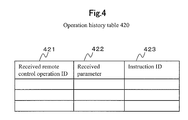
- the operation history table 623 is constructed as the operation history table 420 shown in Fig. 4 .
- the operation history table 420 stores: a received remote control operation ID 421, which specifies a remote control operation ID as information identifying the content of a remote control operation received by the telematics server 600 from the computer 700; a received parameter 422, which specifies parameter information added at the time of the remote control operation in question; and an instruction ID 423, which identifies an instruction directed to the navigation device 100, the instruction being converted from the remote control operation identified by the remote control operation ID 42 1.
- the received remote control operation ID 421 stores a remote control operation ID identifying a remote control operation meaning "to scroll the map up on the screen", and the received parameter 422 stores a parameter (for example, "one page") meaning "a scrolling increment is one screenful area”.
- the instruction ID 423 stores an instruction (for example, "scroll-up") directed to the navigation device 100, the instruction corresponding to the received remote control operation ID 421.
- the control part 630 comprises a navigation connection instruction receiving part 631, a remote control operation receiving part 632, an operation instruction part 633, a navigation output acquisition part 634, an output processing part 635, a navigation monitoring part 636, and a remote control operation inhibiting part 637.
- the navigation connection instruction receiving part 631 When the navigation connection instruction receiving part 631 receives instruction information to start remote control of the navigation device 100 from the computer 700, the navigation connection instruction receiving part 631 sends a connection start request to the navigation device 100.
- the remote control operation receiving part 632 receives a remote control operation and its parameters directed to the navigation device 100 from the computer 700.
- the operation instruction part 633 converts a remote control operation received by the remote control operation receiving part 632 into an instruction that the navigation device 100 can carry out, and sends the converted instruction to the navigation device 100.
- the navigation output acquisition part 634 receives output sent from the navigation device 100.
- the output processing part 635 converts output received by the navigation output acquisition part 634 such that the computer 700 can reproduce it, and sends the converted output information to the computer 700.
- the output processing part 635 generates display information embedded with output information to display on the computer 700, such as information embedded with a screen display of Hyper Text Markup Language (HTML) format or the like, speech display, a script or the like for receiving an operation and its parameters, and the like.
- HTML Hyper Text Markup Language
- the navigation monitoring part 636 monitors the state of the navigation device 100 periodically. For example, during connection with the navigation device 100, the navigation monitoring part 636 periodically sends information to (polls) the navigation device 100 for inquiring whether it is in a condition allowing communication with the navigation device 100, and receives response information to judge whether it is in a condition allowing communication.
- the remote control operation inhibiting part 637 makes the computer 700 interrupt the remote control operation.
- the remote control operation inhibiting part 637 makes the computer 700 display, on its screen, message information to the effect that the remote control is impossible due to communication failure such as one resulting from moving through a tunnel, and inhibits input of a remote control operation.
- the remote control operation inhibiting part 637 makes message information be displayed on the screen of the computer 700 similarly.
- the navigation communication network connection part 640 starts and ends communication with the navigation communication network 500, and performs sending and receiving.
- the communication network connection part 650 starts and ends communication with the communication network 510, and performs sending and receiving.
- Fig. 5 is a diagram showing a hardware configuration of the telematics server 600.
- the telematics server 600 comprises an input unit 611, an output unit 612, a navigation device communication unit 613, a processing unit 614, a main storage unit 615, an external storage unit 616, a communication unit 617, and a bus 618 connecting these units with one another.
- the input unit 611 is a unit for receiving input, such as a keyboard, a mouse, a stylus, or another pointing device, for example.
- the output unit 612 is a unit for displaying, such as a display unit.
- the navigation device communication unit 613 is a unit for communicating with the navigation device 100 through the navigation communication network 500.
- the navigation device communication unit 613 can communicate with not only the navigation device 100 but also another device connected with the navigation communication network 500.
- the processing unit 614 is an operational unit such as a Central Processing Unit (CPU) for example.
- CPU Central Processing Unit
- the main storage unit 615 is a memory unit such as a Random Access Memory (RAM) for example.
- RAM Random Access Memory
- the external storage unit 616 is a nonvolatile storage unit such as a hard disk unit or a flash memory.
- the communication unit 617 is a unit for communicating with the computer 700 through the communication network 510.
- the communication unit 617 can communicate with not only the computer 700 but also another device connected with the communication network 510.
- the navigation connection instruction receiving part 631, the remote control operation receiving part 632, the operation instruction part 633, the navigation output acquisition part 634, the output processing part 635, the navigation monitoring part 636 and the remote control operation inhibiting part 637 are realized by a program that makes the processing unit 614 of the telematics server 600 perform processing.
- This program is stored in the main storage unit 615 or the external storage unit 616, loaded into the main storage unit 615 at the time of execution, and executed by the processing unit 614.
- the storage part 620 of the telematics server 600 is implemented by the main storage unit 615 or the external storage unit 616 of the telematics server 600.
- the navigation communication network connection part 640 of the telematics server 600 is implemented by the navigation device communication unit 613 of the telematics server 600.
- the communication network connection part 650 of the telematics server 600 is implemented by the communication unit 617 of the telematics server 600.
- the computer 700 is an information processing device such as a personal computer for example, and can request the telematics server 600 to establish connection with the navigation device 100. Further, the computer 700 can output on the basis of output information of the navigation device 100. Here, the output information is sent from the telematics server 600. Further, the computer 700 can receive, as input information, a remote control operation to the navigation device 100.
- the computer comprises a storage part 720, a control part 730, a communication network connection part 740, an input part 741, and an output part 742.
- the storage part 720 stores various types of electronic information.
- the control part 730 has a browser part 731.
- the browser part 731 connects with the communication network 510 through the communication network connection part 740 described below, to communicate with another device connected with the communication network 510. Further, the browser part 731 receives an operation input of a user through the input part 741, and requests the output part 742 to output information to be presented to the user. For example, the browser part 731 can receive and then display a Web page or the like having modified display information such as HTML-coded information, and can send information inputted on the Web page from the user to a server of a link destination or the like.
- the communication network connection part 740 connects with another device through the communication network 510, sends information to the connected device, and receives information sent from the connected device.
- the input part 741 receives input of information from the user.
- the output part 742 outputs various types of information to the user.
- the computer 700 also has a hardware configuration similar to that of the telematics server 600. However, it is not necessary for the computer 700 to have a communication unit corresponding to the navigation device communication unit 613.
- the browser part 731 of the computer 700 is realized by a program that makes a processing unit 714 of the computer 700 perform processing.
- This program is stored in a main storage unit 715 or an external storage unit 716, loaded into the main storage unit 715 at the time of execution, and executed by the processing unit 714.
- the storage part 720 is implemented by the main storage unit 715 or the external storage unit 716 of the computer 700.
- the communication part 740 is implemented by the communication unit 717 of the computer 700.
- the input part 741 of the computer 700 is implemented by an input unit 711 of the computer 700.
- the output part 742 of the computer 700 is implemented by an output unit 712 of the computer 700.
- Fig. 6 is a schematic diagram showing the navigation device 100.
- the navigation device 100 comprises a processing part 1, a display 2, a storage unit 3, a voice input-output unit 4 (comprising a microphone 41 as a voice input unit and a speaker 42 as a voice output unit), an input unit 5, a ROM unit 6, a vehicle speed sensor 7, a gyro sensor 8, a Global Positioning System (GPS) receiver 9, an FM multiplex broadcast receiver 10, a beacon receiver 11, and a communication unit 12.
- a processing part 1 a display 2
- a storage unit 3 comprising a microphone 41 as a voice input unit and a speaker 42 as a voice output unit
- an input unit 5 a ROM unit 6
- vehicle speed sensor 7 a vehicle speed sensor 7
- a gyro sensor 8 a Global Positioning System (GPS) receiver 9
- GPS Global Positioning System
- the processing part 1 is a central unit that performs various types of processing. For example, the processing part 1 detects the present location on the basis of information outputted from the various sensors 7, 8, the GPS receiver 9, the FM multiplex broadcast receiver 10 and the like. Further, based on the obtained present location information, the processing part 1 reads out map data required for displaying, from the storage unit 3 or the ROM unit 6.
- the processing part 1 expands the read-out map data into graphics data, and superimposes a mark indicating the present location upon the graphics data to display the result on the display 2. Further, using map data or the like stored in the storage unit 3 or the ROM unit 6, the processing part 1 searches for the optimum route (recommended route) connecting a departure place (the present location) with a destination (or a way point or a stopover point) designated by the user. Further, the processing part 1 guides the user by using the speaker 42 and/or the display 2.
- the processing part 1 when the processing part 1 receives a connection request from the remotely-positioned telematics server 600, the processing part 1 performs processing of starting remote control connection, as described below. Further, when the remote control connection is started, the processing part 1 receives an instruction from the telematics server 600 until the end of the remote control connection. And, the processing part 1 performs processing corresponding to a received instruction, makes the display 2 display output information (for example, screen output information) indicating the processing result, and at the same time sends the output information to the telematics server 600.
- the display 2 for example, screen output information
- the processing part 1 judges that it is not appropriate to receive a remote control operation and controls not to receive a remote control operation, for example, when the navigation device 100 is guiding through a detailed route such as an intersection or when an instruction received from the guided user is under processing.
- the processing part 1 of the navigation device 100 is constructed by connecting its component units with one another through a bus 25.
- the processing part 1 comprises: a Central Processing Unit (CPU) 21 for performing various types of processing such as numerical operation and control of each component unit; a Random Access Memory (RAM) 22 for storing map data, operation data and the like read out from the storage unit 3; a Read-Only Memory (ROM) 23 for storing programs and data; and an interface (I/F) 24 for connecting the processing part 1 with various types of hardware.
- CPU Central Processing Unit
- RAM Random Access Memory
- ROM Read-Only Memory
- I/F interface
- the display 2 is a unit that displays graphics information generated by the processing part 1 or the like.
- the display 2 is constructed as a liquid crystal display, an organic EL display or the like.
- the storage unit 3 comprises a storage medium that can at least read and write, such as a Hard Disk Drive (HDD) or a nonvolatile memory card.
- HDD Hard Disk Drive
- nonvolatile memory card such as a Compact Disk Drive (HDD) or a nonvolatile memory card.
- This storage medium stores a link table 200 and a command conversion table 250.
- the link table 200 is map data (including link data of links constituting the roads on the map) required for an ordinary route search device.
- the command table 200 stores information that associates a remotely-received instruction with a command to perform.
- Fig. 7 is a diagram showing structure of the link table 200.
- the link table 200 For each identification code (a mesh ID) 201 of a mesh as a compartment area on a map, the link table 200 contains link data 202 for each of links constituting the roads included in the mesh area.
- link data 202 For each link ID 211 as an identifier of a link, link data 202 includes: coordinate information 222 of two nodes (a start node and an end node) constituting the link; a road category 223, which indicates a category of the road including the link; a link length 224, which indicates the length of the link; a link travel time 225 stored previously; a start connection link and an end connection link 226, which specify a start connection link as a link connecting to the start node of the link in question and an end connection link as a link connecting to the end node of the link in question; a speed limit 227, which indicates a speed limit of the road including the link in question; and the like.
- the two nodes constituting a link are distinguished as a start node and an end node so that the upbound and downbound directions of the same road are managed as different links respectively.
- Fig. 8 is a diagram showing structure of the command conversion table 250.
- the command conversion table 250 stores an instruction ID 251 and an execution command 252.
- the instruction ID 251 is information specifying an ID of an instruction received from the telematics server 600 or the like through the navigation communication network 500.
- the execution command 252 is information specifying a command that is associated with the information stored in the instruction ID 251 and executed by the processing part 1.
- the instruction ID 251 stores an identifier that identifies information specifying an ID of an instruction received from the telematics server 600 or the like through the navigation communication network 500. Further, the execution command 252 stores information that identifies a command associated with the information stored in the instruction ID 251, the command being executed by the processing part 1. For example, if the instruction ID 251 stores "scroll-up" and the execution command 252 stores "page scroll-up", then "page scroll-up" is designated as the command for performing processing corresponding to the operation ID in question.
- a parameter for example, a detail or degree of the instruction, such as "one page" is sent from the telematics server 600.
- a parameter for example, a detail or degree of the instruction, such as "one page"
- the command conversion table 250 such a parameter has no corresponding information into which the parameter is converted.
- such a parameter is treated directly as a parameter of the execution command.
- the information stored in the command conversion table 250 may be previously-determined information. Or, information may be received from the telematics server 600 through the communication unit 12 or the like, so that the information stored in the command conversion table 250 is updated and maintained on the basis of the received information at an appropriate time.
- the voice input-output unit 4 comprises the microphone 41 as a voice input unit and the speaker 42 as a voice output unit.
- the microphone 41 obtains sound outside the navigation device 100, such as voice coming from the user or another passenger.
- the speaker 42 outputs, as voice, a message that is generated by the processing part 1 for the user.
- the microphone 41 and the speaker 42 are placed separately at predefined positions of a vehicle. However, they may be housed in an integral case.
- the navigation device 100 can be provided with a plurality of microphones 41 and/or a plurality of speakers 42.
- the input unit 5 is a device for receiving an instruction from the user through operation of the user.
- the input unit 5 is implemented by a touch panel 51, a dial switch 52, a scroll key as another hard switch (not shown), a scale change key, and the like.
- the touch panel 51 is mounted on the display surface side of the display 2, and it is possible to see the display screen through the touch panel 51.
- the touch panel 51 specifies a touched position in relation to the X-Y coordinate of an image displayed on the display 2, converts the position into a coordinate, and outputs the obtained coordinate.
- the touch panel 51 is implemented by pressure-sensitive type or electrostatic type input detection elements or the like.
- the dial switch 52 is constructed so as to be rotatable clockwise and counterclockwise, generates a pulse signal for each rotation of a prescribed angle, and outputs the generated pulse signals to the processing part 1.
- the processing part 1 obtains the angle of rotation on the basis of the number of the pulse signals.
- the ROM unit 6 is implemented by a storage medium that is at least readable such as a Read-Only Memory (ROM) (including a CD-ROM or a DVD-ROM) or an Integrated Circuit (IC) card.
- a storage medium stores moving image data or voice data, for example.
- the vehicle speed sensor 7, the gyro sensor 8 and the GPS receiver 9 are used for detecting the present location (i.e. the location of the vehicle itself).
- the vehicle speed sensor 7 is a sensor that outputs a value used for calculating the vehicle speed.
- the gyro sensor 8 is implemented by an optical-fiber gyroscope, a vibrational gyroscope, or the like, and detects an angular velocity due to turning of a moving body.
- the GPS receiver 9 receives signals from GPS satellites and measures distances between a moving body and each GPS satellite and a rate of change of that distance with respect to three or more satellites, in order to measure the present location, the traveling speed and a traveling direction of the moving body.
- the FM multiplex broadcast receiver 10 receives an FM multiplex broadcast signal sent from an FM multiplex broadcast station.
- an FM multiplex broadcast can be mentioned general current-state traffic information, traffic regulation information, Service Area/Parking Area (SA/PA) information, parking lot information, weather information and the like of Vehicle Information Communication System (VICS, a registered trademark) information, and textual information provided as general information by FM multiplex from a radio station.
- SA/PA Service Area/Parking Area
- VICS Vehicle Information Communication System
- the beacon receiver 11 receives general current-state traffic information, traffic regulation information, Service Area/Parking Area (SA/PA) information, parking lot information, weather information, emergency information and the like of, for example, the VICS information.
- SA/PA Service Area/Parking Area
- the beacon receiver can be mentioned an optical beacon receiver using light communication and a radio beacon receiver using radio wave.
- the communication unit 12 connects with the navigation communication network 500.
- a communication unit 12 is a device that connects, for example, with a mobile telephone network in order to communicate with another device through the navigation communication network 500.
- a communication unit may be used one that can communicate when it is fitted with a user's mobile telephone.
- Fig. 9 is a functional block diagram showing the processing part 1.
- the processing part 1 comprises a main control part 101, an input receiving part 102, an output processing part 103, a communication unit control part 104, an instruction receiving part 105, a command conversion part 106, a command execution part 107, an output sending part 108, and a state notification part 109.
- the main control part 101 is a central function part that performs various types of processing.
- the main control part 101 controls other processing part depending on a content of processing. Further, the main control part 101 obtains information of various sensors, the GPS receiver 9 and the like, and performs map matching processing and the like to specify the present location. Further, at an appropriate time, the main control part 101 associates the date and time of traveling with the location, and records a traveling history for each link in the storage unit 3. Further, in response to a request from each processing part, the main control part 101 outputs the current time. Further, the main control part 101 searches for the optimum route (recommended route) connecting a departure place (or the present location) and a destination designated by the user.
- the main control part 101 guides the user by using the speaker 42 and the display 2 so that the user does not deviate from the recommended route. Further, the main control part 101 receives, from each processing part, processing corresponding to an execution command, and performs the received processing.
- the input receiving part 102 receives an instruction inputted through the input unit 5 or the microphone 41 from the user, and controls each part of the processing part 1 so that processing corresponding to the content of the request is performed. For example, in the case where the user requests a search for a recommended route, the input receiving part 102 requests the output processing part 103 to perform processing for displaying a map for setting a destination on the display 2.
- the output processing part 103 receives screen information to display (such as polygon information, for example), converts the received information into a signal for drawing on the display 2, and instructs the display 2 to perform drawing.
- screen information to display such as polygon information, for example
- the communication unit control part 104 controls the communication unit 12.
- the communication unit control part 104 receives a remote control connection request from another device through the communication unit 12, the communication unit control part 104 sends information that identifies the model of the navigation device 100, and performs remote control start processing. Further, when the communication unit control part 104 receives a remote control connection request, then the communication control part 104 requests the output sending part 108 to generate output information in order to obtain information on the screen displayed currently on the display 2 and to send the obtained information to the device that has sent the request. Then, the communication unit control part 104 sends the obtained output information.
- the instruction receiving part 105 receives a remote control operation instruction to the navigation device 100 and a parameter of the remote control operation.
- the command conversion part 106 converts a remote control operation instruction to an execution command that can be executed. At that time, the command conversion part 106 uses the command conversion table 250 to identify the execution command corresponding to the received instruction.
- the command execution part 107 executes the execution command converted by the command conversion part 106, while designating the parameter of the remote control operation.
- the command execution part 107 delivers the execution command converted by the command conversion part 106 to the main control part 101, and instructs the main control part 101 to execute the command.
- the output sending part 108 obtains an output as a result of the command execution by the command execution part 107, by copying from the output processing part 103, and sends the obtained output to the telematics server 600 as the source of the remote control.
- the state notification part 109 monitors the operating state of the navigation device 100 between the start and the end of the remote control. In the state that is not appropriate for receiving a remote control operation, such as during guide at an intersection requiring call of attention of the person under the route guidance or a state where an operation is receiving from the person under the route guidance through the input receiving part 102, the state notification part 109 arouses the telematics server 600 to stop the remote control operation, and makes it interrupt the remote control operation.
- the above-mentioned functional parts of the processing part 1, namely, the main control part 101, the input receiving part 102, the output processing part 103, the communication unit control part 104, the instruction receiving part 105, the command conversion part 106, the command execution part 107, the output sending part 108 and the state notification part 109 are each realized when the CPU 21 reads and execute a prescribed program.
- the RAM 22 stores a program for realizing processing of each functional part.
- the above-described components are results of classification of the configuration elements of the navigation device 100 according to the main content of processing, in order to make it easy to understand the configuration of the navigation device 100.
- the configuration of the navigation device 100 can be classified into a larger number of components according to content of processing. Further, it is possible to define a component such that it performs more types of processing than those defined above.
- each functional part may be realized by hardware (such as ASIC or GPU). Further, processing of each functional part may be performed by one hardware unit or by a plurality of hardware units.
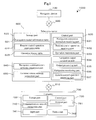
- Fig. 10 is a flowchart showing telematics server processing performed by the telematics server that receives an instruction of remote control from the computer 700 and intercedes with the navigation device 100 for processing, and showing navigation device processing performed by the navigation device 100.
- This flow is started when a prescribed operation is received from the computer 700 in a state that the navigation device 100 and the telematics server 600 are in operation. For example, the flow is started when an instruction to start up a menu of remote control directed to the telematics server 600 is received from the browser part 731.
- the navigation connection instruction receiving part 631 of the telematics server 600 receives designation of a navigation device as the object of remote control, the designation being inputted from a user via the browser part 731 of the computer 700 (Step S001).
- the navigation connection instruction receiving part 631 receives information identifying the navigation device 100 to connect with. For example, information specifying the connection destination in the navigation device 100, or information (such as a mobile telephone number) for connecting with the communication destination in the communication unit 12 attached to the navigation device 100.
- the navigation connection instruction receiving part 631 of the telematics server 600 sends a connection start request to the navigation device 100 whose designation has been received (Step S002).
- the communication unit control part 104 of the navigation device 100 receives the connection start request through the communication unit 12, the communication unit control part 104 sends information specifying the model of the navigation device 100 and information displayed on the screen (the display 2) to the telematics server 600 (Step S101).
- the output processing part 103 of the navigation device 100 makes a message meaning "under remote control" displayed in a prescribed area of the display 2 (Step S102). By this display, the navigation device 100 can notify the guided person that the navigation device 100 is under remote control.
- the navigation connection instruction receiving part 631 identifies the operation conversion pattern and the screen design according to the model.
- the navigation connection instruction receiving part 631 refers to the navigation model information table 400 to identify the operation conversion pattern 403 and the display screen design 404 corresponding to the model ID 402 of the communication destination.
- the output processing part 635 of the telematics server 600 sends a display screen, in which the received navigation screen information is embedded according to the display screen design 404, to the browser part 731 of the computer 700 (Step S004).
- the remote control operation receiving part 632 of the telematics server 600 receives a remote control operation ID and designation of a parameter from the browser part 731 of the computer (Step S005).
- the remote control operation receiving part 632 receives a remote control operation ID corresponding to the content "scroll-up of the map in the screen” and a parameter (such as "one page") meaning "a scrolling increment is one screenful area”.
- the operation instruction part 633 of the telematics server 600 converts the remote control operation ID into an instruction an instruction ID, and sends the instruction ID together with the parameter to the navigation device 100 (Step S006).
- the operation instruction part 632 converts the remote control operation ID 412 into the instruction ID 413 associated with it in the operation conversion pattern 411 corresponding to the operation conversion pattern identified in Step S003 in the remote control operation conversion table 410.
- the operation instruction part 633 sends the converted instruction ID and the parameter to the navigation device 100.
- the operation instruction part 633 stores the remote control operation ID, the parameter and the instruction ID in the operation history table 420, to remain the history.
- the instruction receiving part 105 of the navigation device 100 receives the instruction ID and the parameter (Step S111).
- the command conversion part 106 of the navigation device 100 changes the received instruction ID to a command (Step S112).
- the command conversion part 106 refers to the command conversion table 250 to identify the execution command 252 associated with the instruction ID 251 so as to change the received instruction ID to the identified execution command 252. For example, if the instruction ID is "scroll-up", it is changed to the execution command "page scroll-up".
- the command execution part 107 of the navigation device 100 executes the command obtained by such change (Step S113).
- the command execution part 107 sends the obtained command and the parameter to the main control part 101, to make the main control part 101 perform processing corresponding to the command.
- the main control part 101 is made to perform the command "page scroll-up" with the designated parameter "one page”.
- the output sending part 108 of the navigation device 100 obtains output information, which is a result of the processing by the main control part 101, from the output processing part 103, and sends the output information together with the screen information of the screen displayed on the navigation device 100 to the telematics server 600 (Step S 114).
- the output sending part 108 obtains the map screen as a result of scrolling-up by one screenful area, and sends the map screen to the telematics server 600.
- the output processing part 635 constructs a display screen and makes it displayed on the computer 700 (Step S007).
- the navigation output acquisition part 634 constructs a display screen including the output information from the navigation device 100, according to the display screen design identified in Step S003.
- the output processing part 635 sends the constructed display screen to the browser part 731 of the computer 700.
- the output processing part 635 sends construction information of the screen 800 shown in Fig. 11 .
- Fig. 11 is a view showing an example of the screen 800 constructed by the output processing part 635.
- the screen 800 has a navigation device output screen display area 810, a navigation device operation input area 820, and a navigation device setting input area 830.
- the navigation device output screen display area 810 displays the screen information (for example, circumferential map information including display of the self-location) constructed by the output processing part 103 of the navigation device 100.
- the screen displayed in the navigation device output screen display area 810 displays similar screen information generally interlocking with that change.
- the navigation device operation input area 820 displays software switches and the like for input, which correspond to the hardware input devices (such as the dial switch and the like) provided in the main body of the navigation device 100 and can receive an operation input.
- these are software switches and the like designed to imitate buttons on a remote controller of the navigation device 100.
- These software switches and the like have respective operation units similar to those of the hardware input devices of the navigation device 100. In other words, the user can remotely control the navigation device 100 by similar operation to operation of the hardware input devices.
- the navigation device setting input area 830 displays software switches and the like for issuing commands that can easily change setting information of the navigation device 100. For example, a change switch 831 for changing the map view, a scale change switch 832 for changing the scale of map display, and the like are displayed.
- the remote control operation receiving part 632 of the telematics server 600 judges whether a remote control end instruction has been received via the browser part 731 of the computer 700 (Step S008).
- Step S008 If a remote control end instruction has not been received ("No" in Step S008), the remote control operation receiving part 632 returns the processing to Step S005.
- Step S008 If a remote control end instruction has been received ("Yes" in Step S008), the navigation connection instruction receiving part 631 sends a remote control end request to the navigation device 100, and ends the processing (Step S009).
- the communication unit control part 104 of the navigation device 100 ends the remote control communication with the relematics server 600, and ends the processing.
- the navigation device 100 can receive a remote control operation from another person than the route-guided person.
- the telematics server 600 converts a remote control operation ID into an instruction ID, and sends the instruction ID to the navigation device 100.
- the execution command executed in Step S113 by the navigation device 100 is coincident with the remote control operation ID, so that conversion is not required.
- a command of processing to be executed by the navigation device 100 is sent from the client computer 700 to the telematics server 600 through the navigation communication network, and the command in question is not converted but sent as it is to the navigation device 100.
- the execution command executed by the navigation device 100 in Step S113 may include the parameter.
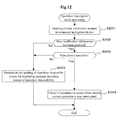
- Fig. 12 is a flowchart showing details of operation interruption check processing performed between the telematics server 600 and the navigation device 100 at prescribed intervals (for example, at intervals of 10 second) between the start of connection and end of the remote control processing.
- the navigation monitoring part 636 of the telematics server 600 sends a state notification request to the connected navigation device (Step S201).
- the navigation monitoring part 636 sends information for requesting to notify the state to the navigation device 100 for which communication by the remote control processing has been started.
- the telematics server 600 is connected with a plurality of navigation devices 100, such requesting information is sent to some or all of the navigation devices.
- the state notification part 109 of the navigation device 100 receives the state notification request information in question through the communication unit 12, the state notification part 109 inquires of the main control part 101 as to the processing state, to judge whether it is in a state that a remote control operation can be received. Then, the state notification part 109 sends information on whether a remote control operation can be received or not and, if not, a reason of the state that cannot receive a remote control operation.
- a reason of the state that cannot receive a remote control operation there is a case where guidance of an intersection is being given to the route-guided person in the neighborhood of the intersection, or a case where the route-guided person is operating the navigation device 100, for example.
- the navigation monitoring part 636 of the telematics server 600 judges whether state notification information has been received or not (Step S202).
- the navigation monitoring part 636 monitors information sent from the navigation device 100 for a prescribed time (for example, 5 seconds), and judges whether state notification information has been received or not, depending on whether state notification information has been received in the prescribed time.
- Step S203 the navigation monitoring part 636 judges whether the navigation device is in a state that allows remote control. In detail, on receiving state notification information, the navigation monitoring part 636 judges that remote control is possible, if the received information notifies a state that allows remote control. If not, the navigation monitoring part 636 judges that the state does not allow remote control.
- Step S203 the navigation monitoring part 636 judges that it is not necessary to interrupt the remote control processing, and ends the operation interruption check processing. Further, if operation is being interrupted, the remote control operation inhibiting part 637 cancels display of an interruption screen, constructs screen information that can receive an ordinary remote control operation, sends the screen to the computer 700, and ends the operation interruption check processing (Step S204).
- the remote control operation inhibiting part 637 In the case where the state does not allow remote control ("No" in Step S203), the remote control operation inhibiting part 637 generates operation-impossible screen information for displaying a message including information on the reason where the received remote control operation cannot be received, and sends the information to the computer 700 that is remotely controlling the navigation device 600 so as to make the computer display the information (Step S205). And, the operation interruption check processing is ended.
- the browser part 731 of the computer 700 makes the operation-impossible screen information displayed, instead of the screen for receiving a remote control operation. As a result, receiving of a remote control operation becomes impossible.
- Step S202 the navigation monitoring part 636 judges that the navigation device is in a state that does not allow a remote control operation, for example, being located at a place where communication is impossible such as a place inside a tunnel, and performs the above-described processing of Step S205.
- the remote control operation inhibiting part 637 displays "communication is impossible” as information on the reason why a remote control operation cannot be received.
- the operation interruption check processing is performed at the prescribed intervals.
- the navigation device 100 sends state information to the telematics server 600 as need arises, to perform the processing of Steps S203 - S205.
- the navigation device 100 sends information to the telematics server 600 to the effect that the remote control operation is interrupted since communication failure may occur in the area.
- it is possible to realize more precise and more delicate management of remote control.
- the navigation device 100 sends state information to the telematics server 600, and the telematics server 600 inhibits remote control from the client computer 700.
- the navigation device 100 may delay start of processing corresponding to the received instruction ID, depending on situations. For example, in the (previously-defined) case where it is not appropriate for the navigation device 100 to respond to a remote control operation such as during guidance at an intersection, the navigation device 100 may start the processing after returning to an appropriate state. By this, it becomes easier to avoid preventing route guidance by the navigation device 100.
- the navigation device 100 it becomes possible for another user in a remote location than a guided person to operate the navigation device 100 remotely.
- another user can operate the navigation device instead of a guided person.
- a taxi company or the like is carrying out dispatch control of vehicles under its operation control, it becomes possible for an operator of the taxi company to set a specific destination or the like, thus improving the convenience of taxi customers.
- the present invention is not limited to the above-described first embodiment, and the first embodiment can be modified variously within the scope and technical spirit of the present invention.
- screens as output of results of the remote control are displayed on the display 2 of the navigation device 100 during Steps S101 - S121.
- the output sending part 108 may instruct the output processing part 103 not to display a screen on the display 2.
- the navigation device 100 receives in Step S111 an instruction ID and a parameter through the navigation communication network 500.
- the present invention is not limited to this.
- a reader (not shown) of an external nonvolatile storage medium may be used so that the navigation device 100 receives an instruction ID and a parameter by reading from the external storage medium that stores the instruction ID and the parameter.
- the instruction receiving part 105 of the navigation device 100 reads out the instruction ID and the parameter from the external storage medium, performs commands according to the read contents, and displays the execution result, i.e. screen display information, on the display 2.
- the parameter stored in the external storage medium may include execution conditions (such as a location, a point of time, occurrence of an event, or the like) of the processing designated by the instruction ID.
- execution conditions such as a location, a point of time, occurrence of an event, or the like.
- the navigation device 100 sends in Step S114 output information, i.e. the result from an executed command, to the telematics server 600.
- the output information may be sent together with control information or the like managed by the navigation device 100.
- the navigation device 100 in the case where the navigation device 100 is mounted on a vehicle, information indicating a state of the vehicle (for example, a control state of a preset temperature of an air conditioner) may be sent as control information.
- the telematics server 600 includes the control information in the information displayed in the screen 800 constructed in Step S007, and displays a software switch for changing setting of the control information, so that a remote control operation ID is received by receiving an operation of that software switch.
- the client computer 700 and the telematics server 600 are different devices.
- the present invention is not limited to this, and for example the client computer 700 may provided with components similar to those of the telematics server 600 so that the client computer 700 can fulfill functions similar to those of the telematics server 600.
- the present invention is not limited to a navigation device, and can be generally applied to devices that perform route guidance of a moving body.
- 1 ...Processing part, 2 ...Display, 3 ...Storage unit, 4 ...Voice input-output unit, 5 ...Input unit, 6 ...Rom unit, 7 ...Vehicle speed sensor, 8 ... Gyro sensor, 9 ... GPS receiver, 10 ...FM multiplex broadcast receiver, 11 ...Beacon receiver, 12 ...
- Communication unit 21 ...CPU, 22 ...RAM, 23 ...ROM, 24 ...I/F, 25 ...BUS, 41 ...Microphone, 42 ...Speaker, 51 ...Touch panel, 52 ...Dial switch, 100 ...Navigation device, 101 ...Main control part, 102 ...Input receiving part, 103 ...Output processing part, 104 ...Communication unit control part, 105 ...Instruction receiving part, 106 ...
- Command conversion part 107 ...Command execution part, 108 ...Output sending part, 109 ...State notification part, 200 ...Link table, 250 ...Command conversion table, 400 ...Navigation model information table, 410 ...Remote control operation conversion table, 420 ...Operation history table, 500 Navigation communication network, 510 ...
- Communication network 600 ...Telematics server, 620 ...Storage part, 630 ...Control part, 631 ...Navigation connection instruction receiving part, 632 ...Remote control operation receiving part, 633 ...Operation instruction part, 634 ...Navigation output acquisition part, 635 ...Output processing part, 636 ...Navigation monitoring part, 637 ...Remote control operation inhibiting part, 640 ...Navigation communication network connection part, 641 ...
- Communication network connection part 700 ...Computer, 720 ...Storage part, 730 ...Control part, 731 ...Browser part, 740 ...Communication network connection part, 741 ...Input part, 742 ...Output part, 1000 ...Navigation system
Landscapes
- Engineering & Computer Science (AREA)
- Radar, Positioning & Navigation (AREA)
- Remote Sensing (AREA)
- Automation & Control Theory (AREA)
- Physics & Mathematics (AREA)
- General Physics & Mathematics (AREA)
- Navigation (AREA)
Abstract
Description
- The present invention relates to a technology of a navigation device. The present invention claims priority of Japanese Patent Application No.
2009-179148 filed on July 31, 2009 - Conventionally, a navigation device employs a technique in which route guidance is performed by receiving input from a user whose route is to be guided by the navigation device. That is to say, operation of operating switches on a main unit or switching operation of a remote control is received as input information.
Patent Document 1 describes a technique relating to such a navigation device. - Patent Document 1: Japanese Unexamined Patent Application Laid-Open No.
2009-143373 - It is difficult, however, for a navigation device as described above to receive, through interactive processing, input information from another user than the user whose route is to be guided. For example, there is a technique for an information center to control remotely setting a destination in a navigation device used by a user when the information center receives a request from the user. In such a technique, an operation unit is different from the interface of the navigation device in question and processing is not performed as interactive processing.
- An object of the present invention is to provide a navigation technique that allows operation of a navigation device through interactive processing by another person than a user whose route is to be guided.
- To solve the above problems, a navigation device according to the present invention comprises: an instruction receiving unit adapted to receive, from an external device, a processing instruction; a processing unit, which performs processing according to the instruction received by the instruction receiving unit; and an output unit adapted to output output information obtained as a result of the processing performed by the processing unit.
- Further, a server device according to the present invention comprises: a navigation device communication unit adapted to communicate with a navigation device; a client communication unit adapted to communicate with a client computer; a remote control operation receiving unit adapted to receive a remote control operation from the client computer through the client communication unit; an operation instruction unit adapted to specify an operation instruction corresponding to the remote control operation received by the remote control operation receiving unit, and sends the specified operation instruction to the navigation device through the navigation device communication unit; and an output processing unit adapted to receive output information as a result of the operation instruction through the navigation device communication unit, and sends the output information to the client computer through the client communication unit.
- Further, a navigation system according to the present invention is a navigation system comprising a navigation device, a server device and a client computer, wherein: the navigation device comprises: a communication unit adapted to communicate with the server device through a communication network; an instruction receiving unit adapted to receive a processing instruction from the server device through the communication unit; a processing unit adapted to perform processing according to the instruction received by the instruction receiving unit; and an output sending unit adapted to send output information obtained as a result of the processing performed by the processing unit; the server device comprises: a navigation device communication unit adapted to communicate with the navigation device through the communication network; a client communication unit adapted to communicate with the client computer; a remote control operation receiving unit adapted to receive a remote control operation from the client computer through the client communication unit; a processing instruction unit adapted to specify a processing instruction corresponding to the remote control operation received by the remote control operation receiving unit, and sends the specified processing instruction to the navigation device through the navigation device communication unit; and an output processing unit adapted to receive the output information through the navigation device communication unit, and sends the output information to the client computer through the client communication unit; the client computer comprises: an input receiving unit adapted to receive input from a user; an output processing unit adapted to output to the user; a server device communication unit adapted to communicate with the server device through the communication network; and a remote control operation sending unit adapted to send input information concerning a remote control operation, the input information being received from the user through the input receiving unit, to the server device through the server device communication unit; and the output processing unit outputs the output information received from the server device through the server device communication unit.
- Further, the present invention provides a program for a navigation device, wherein: the navigation device comprises a control unit; and the program makes the control unit carry out: an instruction receiving step, in which a processing instruction is received from an external device; a processing step, in which processing according to the instruction received in the instruction receiving step is performed; and an output step, in which output information obtained as a result of the processing performed in the processing step is outputted.
-
-
Fig. 1 is a schematic diagram showing a navigation system; -
Fig. 2 is a diagram showing structure of a navigation model information table; -
Fig. 3 is a diagram showing structure of a remote control operation conversion table; -
Fig. 4 is a diagram showing structure of an operation history table; -
Fig. 5 is a diagram showing a hardware configuration of a telematics server; -
Fig. 6 is a schematic diagram showing a navigation device; -
Fig. 7 is a diagram showing structure of a link table; -
Fig. 8 is a diagram showing structure of a command conversion table; -
Fig. 9 is a functional configuration diagram of a processing part; -
Fig. 10 is a flowchart showing remote control processing; -
Fig. 11 shows an example of a screen for remote control processing; and -
Fig. 12 is a flowchart showing operation interruption check processing. - Now, a navigation system to which one embodiment of the present invention is applied is described referring to the drawings.
-
Fig. 1 is a diagram showing an entire configuration of anavigation system 1000. - The
navigation system 1000 is a system comprising: anavigation device 100; atelematics server 600 that can connect with thenavigation device 100 through afirst network 500; and acomputer 700 that can connect with thetelematics server 600 through asecond network 510. - Here, the
first network 500 is a wide-area radio communication network such as a mobile telephone network (hereinafter, thefirst network 500 is called navigation communication network 500). Thesecond network 510 is a wide-area radio communication network or a wide-area communication network that can be connected with an open network such as the Internet, and includes a mobile telephone network and an Internet provider network (hereinafter, thesecond network 510 is called communication network 510). Of course, thenavigation communication network 500 or thecommunication network 510 may be a communication network that can be used only by certain people, such as one of various types of Local Area Network (LAN) or Wide Area Network (WAN). Or thenavigation communication network 500 and thecommunication network 510 may be networks connected with each other, or may be the same network. - The
navigation device 100 is an ordinary navigation device that can display map information to show a point indicating a present location of thenavigation device 100 and information for guidance along a route to a set destination. Thenavigation device 100 can communicate with thetelematics server 600 through thenavigation communication network 500, and can send information such as a state of use of thenavigation device 100 to thetelematics server 600. Further, in response to a connection request from thetelematics server 600, thenavigation device 100 starts connection for remote control, performs processing according to remote control operations, and sends output information including a screen of processing result and the like to thetelematics server 600. - The telematics server 600 intermediates input-output information between the
navigation device 100 and thecomputer 700. In detail, on receiving an instruction from thecomputer 700 through thecommunication network 510 to connect with thenavigation device 100, thetelematics server 600 connects with thenavigation device 100 through thenavigation communication network 500. When thetelematics server 600 obtains output information such as an operation screen from thenavigation device 100, thetelematics server 600 sends the output information to thecomputer 700, to receive a remote control operation directed to thenavigation device 100 from thecomputer 700. Then, thetelematics server 600 identifies an instruction corresponding to the remote control operation, and sends the instruction to thenavigation device 100. Then, from thenavigation device 100, thetelematics server 600 obtains output information as a result of the instruction, and sends the output information to thecomputer 700. Further, at that time, when information is received from thenavigation device 100 to the effect that the remote control operation is impossible, thetelematics server 600 sends the information to thecomputer 700, to interrupt the remote control operation. - The
telematics server 600 comprises astorage part 620, acontrol part 630, a navigation communicationnetwork connection part 640, and a communicationnetwork connection part 650. Thestorage part 620 comprises a navigation modelinformation storage area 621, a remote control operation conversioninformation storage area 622, and an operationhistory storage area 623. - The
storage part 620 stores a navigation model information table 621 for storing an input-output interface information processing system corresponding to a model of thenavigation device 100 as a communication destination, a remote control operation conversion table 622 for identifying specific conversion information for conversion between a remote control operation and an instruction, and an operation history table 623 for storing history information concerning received remote control operations. - The navigation model information table 621 is constructed as the navigation model information table 400 shown in
Fig. 2 . In detail, the navigation model information table 400 stores: acommunication destination 401, which stores information identifying thenavigation device 100 with which communication is performed; amodel ID 402, which stores information identifying the model of thenavigation device 100 as the communication destination; anoperation conversion pattern 403, which identifies an operation conversion pattern as a set of rules for converting a remote control operation sent from thecomputer 700 into instruction information; and adisplay screen design 404, which specifies information on a display screen for displaying on the computer 700 a screen sent from thenavigation device 100. - For example, the
communication destination 401 stores information that specifies an individual number of thenavigation device 100 or a unique number (such as a mobile phone number) of a communication device connected to thenavigation device 100. Further, themodel ID 402 stores information such as a model number, i.e. information for identifying the interface of thenavigation device 100. Usually, theoperation conversion pattern 403 and thedisplay screen pattern 404 store values that are previously associated with themodel ID 402. - The remote control operation conversion table 622 is constructed as the remote control operation conversion table 410 shown in
Fig. 3 . In detail, the remote control operation conversion table 410 stores: anoperation conversion pattern 411, which identifies a pattern of rules for converting a remote control operation sent from thecomputer 700 into instruction information to thenavigation device 100 as the communication destination; and a pair of pieces of information, i.e. a remotecontrol operation ID 412 and aninstruction ID 413 associated with theoperation conversion pattern 411. - The pair of pieces of information, the remote
control operation ID 412 and theinstruction ID 413 are each information that specifies a conversion rule from the remote control operation ID stored in the remotecontrol operation ID 412 into theinstruction ID 413. Each remotecontrol operation ID 412 stores information for specifying an operation sent from thecomputer 700, and eachinstruction ID 413 stores information for specifying an instruction sent to thenavigation device 100. - The operation history table 623 is constructed as the operation history table 420 shown in
Fig. 4 . In detail, the operation history table 420 stores: a received remotecontrol operation ID 421, which specifies a remote control operation ID as information identifying the content of a remote control operation received by thetelematics server 600 from thecomputer 700; a receivedparameter 422, which specifies parameter information added at the time of the remote control operation in question; and aninstruction ID 423, which identifies an instruction directed to thenavigation device 100, the instruction being converted from the remote control operation identified by the remotecontrol operation ID 42 1. - For example, the received remote
control operation ID 421 stores a remote control operation ID identifying a remote control operation meaning "to scroll the map up on the screen", and the receivedparameter 422 stores a parameter (for example, "one page") meaning "a scrolling increment is one screenful area". Theinstruction ID 423 stores an instruction (for example, "scroll-up") directed to thenavigation device 100, the instruction corresponding to the received remotecontrol operation ID 421. - The
control part 630 comprises a navigation connectioninstruction receiving part 631, a remote controloperation receiving part 632, anoperation instruction part 633, a navigationoutput acquisition part 634, anoutput processing part 635, anavigation monitoring part 636, and a remote controloperation inhibiting part 637. - When the navigation connection
instruction receiving part 631 receives instruction information to start remote control of thenavigation device 100 from thecomputer 700, the navigation connectioninstruction receiving part 631 sends a connection start request to thenavigation device 100. The remote controloperation receiving part 632 receives a remote control operation and its parameters directed to thenavigation device 100 from thecomputer 700. Theoperation instruction part 633 converts a remote control operation received by the remote controloperation receiving part 632 into an instruction that thenavigation device 100 can carry out, and sends the converted instruction to thenavigation device 100. - The navigation
output acquisition part 634 receives output sent from thenavigation device 100. Theoutput processing part 635 converts output received by the navigationoutput acquisition part 634 such that thecomputer 700 can reproduce it, and sends the converted output information to thecomputer 700. In this conversion processing, theoutput processing part 635 generates display information embedded with output information to display on thecomputer 700, such as information embedded with a screen display of Hyper Text Markup Language (HTML) format or the like, speech display, a script or the like for receiving an operation and its parameters, and the like. - The
navigation monitoring part 636 monitors the state of thenavigation device 100 periodically. For example, during connection with thenavigation device 100, thenavigation monitoring part 636 periodically sends information to (polls) thenavigation device 100 for inquiring whether it is in a condition allowing communication with thenavigation device 100, and receives response information to judge whether it is in a condition allowing communication. - When the
navigation monitoring part 636 judges that thenavigation device 100 is not in a condition allowing communication, the remote controloperation inhibiting part 637 makes thecomputer 700 interrupt the remote control operation. In detail, when response information cannot be received from thenavigation device 100, the remote controloperation inhibiting part 637 makes thecomputer 700 display, on its screen, message information to the effect that the remote control is impossible due to communication failure such as one resulting from moving through a tunnel, and inhibits input of a remote control operation. Also when a remote control operation by thenavigation device 100 is not appropriate such as in the case where polling response information is "guiding at an intersection" or "user (traveler) is operating", the remote controloperation inhibiting part 637 makes message information be displayed on the screen of thecomputer 700 similarly. - The navigation communication
network connection part 640 starts and ends communication with thenavigation communication network 500, and performs sending and receiving. - The communication
network connection part 650 starts and ends communication with thecommunication network 510, and performs sending and receiving. -
Fig. 5 is a diagram showing a hardware configuration of thetelematics server 600. Thetelematics server 600 comprises aninput unit 611, anoutput unit 612, a navigationdevice communication unit 613, aprocessing unit 614, amain storage unit 615, anexternal storage unit 616, acommunication unit 617, and abus 618 connecting these units with one another. - The
input unit 611 is a unit for receiving input, such as a keyboard, a mouse, a stylus, or another pointing device, for example. - The
output unit 612 is a unit for displaying, such as a display unit. The navigationdevice communication unit 613 is a unit for communicating with thenavigation device 100 through thenavigation communication network 500. The navigationdevice communication unit 613 can communicate with not only thenavigation device 100 but also another device connected with thenavigation communication network 500. - The
processing unit 614 is an operational unit such as a Central Processing Unit (CPU) for example. - The
main storage unit 615 is a memory unit such as a Random Access Memory (RAM) for example. - The
external storage unit 616 is a nonvolatile storage unit such as a hard disk unit or a flash memory. - The
communication unit 617 is a unit for communicating with thecomputer 700 through thecommunication network 510. Thecommunication unit 617 can communicate with not only thecomputer 700 but also another device connected with thecommunication network 510. - In the
telematics server 600, the navigation connectioninstruction receiving part 631, the remote controloperation receiving part 632, theoperation instruction part 633, the navigationoutput acquisition part 634, theoutput processing part 635, thenavigation monitoring part 636 and the remote controloperation inhibiting part 637 are realized by a program that makes theprocessing unit 614 of thetelematics server 600 perform processing. - This program is stored in the
main storage unit 615 or theexternal storage unit 616, loaded into themain storage unit 615 at the time of execution, and executed by theprocessing unit 614. - Further, the
storage part 620 of thetelematics server 600 is implemented by themain storage unit 615 or theexternal storage unit 616 of thetelematics server 600. - The navigation communication
network connection part 640 of thetelematics server 600 is implemented by the navigationdevice communication unit 613 of thetelematics server 600. - The communication
network connection part 650 of thetelematics server 600 is implemented by thecommunication unit 617 of thetelematics server 600. - The
computer 700 is an information processing device such as a personal computer for example, and can request thetelematics server 600 to establish connection with thenavigation device 100. Further, thecomputer 700 can output on the basis of output information of thenavigation device 100. Here, the output information is sent from thetelematics server 600. Further, thecomputer 700 can receive, as input information, a remote control operation to thenavigation device 100. - As shown in
Fig. 1 , the computer comprises astorage part 720, acontrol part 730, a communicationnetwork connection part 740, aninput part 741, and anoutput part 742. - The
storage part 720 stores various types of electronic information. - The
control part 730 has abrowser part 731. Thebrowser part 731 connects with thecommunication network 510 through the communicationnetwork connection part 740 described below, to communicate with another device connected with thecommunication network 510. Further, thebrowser part 731 receives an operation input of a user through theinput part 741, and requests theoutput part 742 to output information to be presented to the user. For example, thebrowser part 731 can receive and then display a Web page or the like having modified display information such as HTML-coded information, and can send information inputted on the Web page from the user to a server of a link destination or the like. - The communication
network connection part 740 connects with another device through thecommunication network 510, sends information to the connected device, and receives information sent from the connected device. Theinput part 741 receives input of information from the user. Theoutput part 742 outputs various types of information to the user. Although not shown in the figure, thecomputer 700 also has a hardware configuration similar to that of thetelematics server 600. However, it is not necessary for thecomputer 700 to have a communication unit corresponding to the navigationdevice communication unit 613. - Further, the
browser part 731 of thecomputer 700 is realized by a program that makes aprocessing unit 714 of thecomputer 700 perform processing. - This program is stored in a
main storage unit 715 or anexternal storage unit 716, loaded into themain storage unit 715 at the time of execution, and executed by theprocessing unit 714. - Further, the
storage part 720 is implemented by themain storage unit 715 or theexternal storage unit 716 of thecomputer 700. Thecommunication part 740 is implemented by thecommunication unit 717 of thecomputer 700. Further, theinput part 741 of thecomputer 700 is implemented by aninput unit 711 of thecomputer 700. Theoutput part 742 of thecomputer 700 is implemented by anoutput unit 712 of thecomputer 700. -
Fig. 6 is a schematic diagram showing thenavigation device 100. Thenavigation device 100 comprises aprocessing part 1, adisplay 2, astorage unit 3, a voice input-output unit 4 (comprising a microphone 41 as a voice input unit and aspeaker 42 as a voice output unit), aninput unit 5, aROM unit 6, avehicle speed sensor 7, agyro sensor 8, a Global Positioning System (GPS)receiver 9, an FMmultiplex broadcast receiver 10, abeacon receiver 11, and acommunication unit 12. - The
processing part 1 is a central unit that performs various types of processing. For example, theprocessing part 1 detects the present location on the basis of information outputted from thevarious sensors GPS receiver 9, the FMmultiplex broadcast receiver 10 and the like. Further, based on the obtained present location information, theprocessing part 1 reads out map data required for displaying, from thestorage unit 3 or theROM unit 6. - Further, the
processing part 1 expands the read-out map data into graphics data, and superimposes a mark indicating the present location upon the graphics data to display the result on thedisplay 2. Further, using map data or the like stored in thestorage unit 3 or theROM unit 6, theprocessing part 1 searches for the optimum route (recommended route) connecting a departure place (the present location) with a destination (or a way point or a stopover point) designated by the user. Further, theprocessing part 1 guides the user by using thespeaker 42 and/or thedisplay 2. - Further, when the
processing part 1 receives a connection request from the remotely-positionedtelematics server 600, theprocessing part 1 performs processing of starting remote control connection, as described below. Further, when the remote control connection is started, theprocessing part 1 receives an instruction from thetelematics server 600 until the end of the remote control connection. And, theprocessing part 1 performs processing corresponding to a received instruction, makes thedisplay 2 display output information (for example, screen output information) indicating the processing result, and at the same time sends the output information to thetelematics server 600. - Even during the remote control connection, the
processing part 1 judges that it is not appropriate to receive a remote control operation and controls not to receive a remote control operation, for example, when thenavigation device 100 is guiding through a detailed route such as an intersection or when an instruction received from the guided user is under processing. - The
processing part 1 of thenavigation device 100 is constructed by connecting its component units with one another through abus 25. Theprocessing part 1 comprises: a Central Processing Unit (CPU) 21 for performing various types of processing such as numerical operation and control of each component unit; a Random Access Memory (RAM) 22 for storing map data, operation data and the like read out from thestorage unit 3; a Read-Only Memory (ROM) 23 for storing programs and data; and an interface (I/F) 24 for connecting theprocessing part 1 with various types of hardware. - The
display 2 is a unit that displays graphics information generated by theprocessing part 1 or the like. Thedisplay 2 is constructed as a liquid crystal display, an organic EL display or the like. - The
storage unit 3 comprises a storage medium that can at least read and write, such as a Hard Disk Drive (HDD) or a nonvolatile memory card. - This storage medium stores a link table 200 and a command conversion table 250. The link table 200 is map data (including link data of links constituting the roads on the map) required for an ordinary route search device. And the command table 200 stores information that associates a remotely-received instruction with a command to perform.
-
Fig. 7 is a diagram showing structure of the link table 200. For each identification code (a mesh ID) 201 of a mesh as a compartment area on a map, the link table 200 containslink data 202 for each of links constituting the roads included in the mesh area. - For each
link ID 211 as an identifier of a link,link data 202 includes: coordinateinformation 222 of two nodes (a start node and an end node) constituting the link; aroad category 223, which indicates a category of the road including the link; alink length 224, which indicates the length of the link; alink travel time 225 stored previously; a start connection link and anend connection link 226, which specify a start connection link as a link connecting to the start node of the link in question and an end connection link as a link connecting to the end node of the link in question; aspeed limit 227, which indicates a speed limit of the road including the link in question; and the like. - Here, the two nodes constituting a link are distinguished as a start node and an end node so that the upbound and downbound directions of the same road are managed as different links respectively.
-
Fig. 8 is a diagram showing structure of the command conversion table 250. The command conversion table 250 stores aninstruction ID 251 and anexecution command 252. Theinstruction ID 251 is information specifying an ID of an instruction received from thetelematics server 600 or the like through thenavigation communication network 500. And theexecution command 252 is information specifying a command that is associated with the information stored in theinstruction ID 251 and executed by theprocessing part 1. - The
instruction ID 251 stores an identifier that identifies information specifying an ID of an instruction received from thetelematics server 600 or the like through thenavigation communication network 500. Further, theexecution command 252 stores information that identifies a command associated with the information stored in theinstruction ID 251, the command being executed by theprocessing part 1. For example, if theinstruction ID 251 stores "scroll-up" and theexecution command 252 stores "page scroll-up", then "page scroll-up" is designated as the command for performing processing corresponding to the operation ID in question. - Sometimes, together with an instruction ID, a parameter (for example, a detail or degree of the instruction, such as "one page") is sent from the
telematics server 600. In the command conversion table 250, such a parameter has no corresponding information into which the parameter is converted. In other words, such a parameter is treated directly as a parameter of the execution command. - The information stored in the command conversion table 250 may be previously-determined information. Or, information may be received from the
telematics server 600 through thecommunication unit 12 or the like, so that the information stored in the command conversion table 250 is updated and maintained on the basis of the received information at an appropriate time. - Returning to
Fig. 6 , description will be given further. The voice input-output unit 4 comprises the microphone 41 as a voice input unit and thespeaker 42 as a voice output unit. The microphone 41 obtains sound outside thenavigation device 100, such as voice coming from the user or another passenger. - The
speaker 42 outputs, as voice, a message that is generated by theprocessing part 1 for the user. The microphone 41 and thespeaker 42 are placed separately at predefined positions of a vehicle. However, they may be housed in an integral case. Thenavigation device 100 can be provided with a plurality of microphones 41 and/or a plurality ofspeakers 42. - The
input unit 5 is a device for receiving an instruction from the user through operation of the user. Theinput unit 5 is implemented by atouch panel 51, adial switch 52, a scroll key as another hard switch (not shown), a scale change key, and the like. - The
touch panel 51 is mounted on the display surface side of thedisplay 2, and it is possible to see the display screen through thetouch panel 51. Thetouch panel 51 specifies a touched position in relation to the X-Y coordinate of an image displayed on thedisplay 2, converts the position into a coordinate, and outputs the obtained coordinate. Thetouch panel 51 is implemented by pressure-sensitive type or electrostatic type input detection elements or the like. - The
dial switch 52 is constructed so as to be rotatable clockwise and counterclockwise, generates a pulse signal for each rotation of a prescribed angle, and outputs the generated pulse signals to theprocessing part 1. Theprocessing part 1 obtains the angle of rotation on the basis of the number of the pulse signals. - The
ROM unit 6 is implemented by a storage medium that is at least readable such as a Read-Only Memory (ROM) (including a CD-ROM or a DVD-ROM) or an Integrated Circuit (IC) card. Such a storage medium stores moving image data or voice data, for example. - The
vehicle speed sensor 7, thegyro sensor 8 and theGPS receiver 9 are used for detecting the present location (i.e. the location of the vehicle itself). - The
vehicle speed sensor 7 is a sensor that outputs a value used for calculating the vehicle speed. - The
gyro sensor 8 is implemented by an optical-fiber gyroscope, a vibrational gyroscope, or the like, and detects an angular velocity due to turning of a moving body. - The
GPS receiver 9 receives signals from GPS satellites and measures distances between a moving body and each GPS satellite and a rate of change of that distance with respect to three or more satellites, in order to measure the present location, the traveling speed and a traveling direction of the moving body. - The FM
multiplex broadcast receiver 10 receives an FM multiplex broadcast signal sent from an FM multiplex broadcast station. As an FM multiplex broadcast, can be mentioned general current-state traffic information, traffic regulation information, Service Area/Parking Area (SA/PA) information, parking lot information, weather information and the like of Vehicle Information Communication System (VICS, a registered trademark) information, and textual information provided as general information by FM multiplex from a radio station. - The
beacon receiver 11 receives general current-state traffic information, traffic regulation information, Service Area/Parking Area (SA/PA) information, parking lot information, weather information, emergency information and the like of, for example, the VICS information. For example, as the beacon receiver, can be mentioned an optical beacon receiver using light communication and a radio beacon receiver using radio wave. - The
communication unit 12 connects with thenavigation communication network 500. Such acommunication unit 12 is a device that connects, for example, with a mobile telephone network in order to communicate with another device through thenavigation communication network 500. For example, as such a communication unit, may be used one that can communicate when it is fitted with a user's mobile telephone. -
Fig. 9 is a functional block diagram showing theprocessing part 1. As shown in the figure, theprocessing part 1 comprises amain control part 101, aninput receiving part 102, anoutput processing part 103, a communication unit control part 104, an instruction receiving part 105, acommand conversion part 106, acommand execution part 107, anoutput sending part 108, and astate notification part 109. - The
main control part 101 is a central function part that performs various types of processing. Themain control part 101 controls other processing part depending on a content of processing. Further, themain control part 101 obtains information of various sensors, theGPS receiver 9 and the like, and performs map matching processing and the like to specify the present location. Further, at an appropriate time, themain control part 101 associates the date and time of traveling with the location, and records a traveling history for each link in thestorage unit 3. Further, in response to a request from each processing part, themain control part 101 outputs the current time. Further, themain control part 101 searches for the optimum route (recommended route) connecting a departure place (or the present location) and a destination designated by the user. Then, themain control part 101 guides the user by using thespeaker 42 and thedisplay 2 so that the user does not deviate from the recommended route. Further, themain control part 101 receives, from each processing part, processing corresponding to an execution command, and performs the received processing. - The
input receiving part 102 receives an instruction inputted through theinput unit 5 or the microphone 41 from the user, and controls each part of theprocessing part 1 so that processing corresponding to the content of the request is performed. For example, in the case where the user requests a search for a recommended route, theinput receiving part 102 requests theoutput processing part 103 to perform processing for displaying a map for setting a destination on thedisplay 2. - The
output processing part 103 receives screen information to display (such as polygon information, for example), converts the received information into a signal for drawing on thedisplay 2, and instructs thedisplay 2 to perform drawing. - The communication unit control part 104 controls the
communication unit 12. In detail, when the communication unit control part 104 receives a remote control connection request from another device through thecommunication unit 12, the communication unit control part 104 sends information that identifies the model of thenavigation device 100, and performs remote control start processing. Further, when the communication unit control part 104 receives a remote control connection request, then the communication control part 104 requests theoutput sending part 108 to generate output information in order to obtain information on the screen displayed currently on thedisplay 2 and to send the obtained information to the device that has sent the request. Then, the communication unit control part 104 sends the obtained output information. - The instruction receiving part 105 receives a remote control operation instruction to the
navigation device 100 and a parameter of the remote control operation. - According to an instruction received by the instruction receiving part 105, the
command conversion part 106 converts a remote control operation instruction to an execution command that can be executed. At that time, thecommand conversion part 106 uses the command conversion table 250 to identify the execution command corresponding to the received instruction. - The
command execution part 107 executes the execution command converted by thecommand conversion part 106, while designating the parameter of the remote control operation. In detail, thecommand execution part 107 delivers the execution command converted by thecommand conversion part 106 to themain control part 101, and instructs themain control part 101 to execute the command. - The
output sending part 108 obtains an output as a result of the command execution by thecommand execution part 107, by copying from theoutput processing part 103, and sends the obtained output to thetelematics server 600 as the source of the remote control. - The
state notification part 109 monitors the operating state of thenavigation device 100 between the start and the end of the remote control. In the state that is not appropriate for receiving a remote control operation, such as during guide at an intersection requiring call of attention of the person under the route guidance or a state where an operation is receiving from the person under the route guidance through theinput receiving part 102, thestate notification part 109 arouses thetelematics server 600 to stop the remote control operation, and makes it interrupt the remote control operation. - The above-mentioned functional parts of the
processing part 1, namely, themain control part 101, theinput receiving part 102, theoutput processing part 103, the communication unit control part 104, the instruction receiving part 105, thecommand conversion part 106, thecommand execution part 107, theoutput sending part 108 and thestate notification part 109 are each realized when theCPU 21 reads and execute a prescribed program. To that end, theRAM 22 stores a program for realizing processing of each functional part. - The above-described components are results of classification of the configuration elements of the
navigation device 100 according to the main content of processing, in order to make it easy to understand the configuration of thenavigation device 100. Thus, the way of classification of the components and their names do not restrict the present invention. The configuration of thenavigation device 100 can be classified into a larger number of components according to content of processing. Further, it is possible to define a component such that it performs more types of processing than those defined above. - Further, each functional part may be realized by hardware (such as ASIC or GPU). Further, processing of each functional part may be performed by one hardware unit or by a plurality of hardware units.
- Next, operation of the
telematics server 600, thenavigation device 100 and thecomputer 700 in a state where remote control is performed will be described. -
Fig. 10 is a flowchart showing telematics server processing performed by the telematics server that receives an instruction of remote control from thecomputer 700 and intercedes with thenavigation device 100 for processing, and showing navigation device processing performed by thenavigation device 100. This flow is started when a prescribed operation is received from thecomputer 700 in a state that thenavigation device 100 and thetelematics server 600 are in operation. For example, the flow is started when an instruction to start up a menu of remote control directed to thetelematics server 600 is received from thebrowser part 731. - First, the navigation connection
instruction receiving part 631 of thetelematics server 600 receives designation of a navigation device as the object of remote control, the designation being inputted from a user via thebrowser part 731 of the computer 700 (Step S001). In detail, the navigation connectioninstruction receiving part 631 receives information identifying thenavigation device 100 to connect with. For example, information specifying the connection destination in thenavigation device 100, or information (such as a mobile telephone number) for connecting with the communication destination in thecommunication unit 12 attached to thenavigation device 100. - Next, the navigation connection
instruction receiving part 631 of thetelematics server 600 sends a connection start request to thenavigation device 100 whose designation has been received (Step S002). - Next, when the communication unit control part 104 of the
navigation device 100 receives the connection start request through thecommunication unit 12, the communication unit control part 104 sends information specifying the model of thenavigation device 100 and information displayed on the screen (the display 2) to the telematics server 600 (Step S101). Successively, theoutput processing part 103 of thenavigation device 100 makes a message meaning "under remote control" displayed in a prescribed area of the display 2 (Step S102). By this display, thenavigation device 100 can notify the guided person that thenavigation device 100 is under remote control. - Receiving the information specifying the model from the
navigation device 100, the navigation connectioninstruction receiving part 631 identifies the operation conversion pattern and the screen design according to the model. In detail, the navigation connectioninstruction receiving part 631 refers to the navigation model information table 400 to identify theoperation conversion pattern 403 and thedisplay screen design 404 corresponding to themodel ID 402 of the communication destination. - Next, the
output processing part 635 of thetelematics server 600 sends a display screen, in which the received navigation screen information is embedded according to thedisplay screen design 404, to thebrowser part 731 of the computer 700 (Step S004). - Next, the remote control
operation receiving part 632 of thetelematics server 600 receives a remote control operation ID and designation of a parameter from thebrowser part 731 of the computer (Step S005). For example, as the remote control operation ID and the parameter, the remote controloperation receiving part 632 receives a remote control operation ID corresponding to the content "scroll-up of the map in the screen" and a parameter (such as "one page") meaning "a scrolling increment is one screenful area". - Next, the
operation instruction part 633 of thetelematics server 600 converts the remote control operation ID into an instruction an instruction ID, and sends the instruction ID together with the parameter to the navigation device 100 (Step S006). In detail, theoperation instruction part 632 converts the remotecontrol operation ID 412 into theinstruction ID 413 associated with it in theoperation conversion pattern 411 corresponding to the operation conversion pattern identified in Step S003 in the remote control operation conversion table 410. Then, theoperation instruction part 633 sends the converted instruction ID and the parameter to thenavigation device 100. Then, theoperation instruction part 633 stores the remote control operation ID, the parameter and the instruction ID in the operation history table 420, to remain the history. - The instruction receiving part 105 of the
navigation device 100 receives the instruction ID and the parameter (Step S111). - Next, the
command conversion part 106 of thenavigation device 100 changes the received instruction ID to a command (Step S112). In detail, thecommand conversion part 106 refers to the command conversion table 250 to identify theexecution command 252 associated with theinstruction ID 251 so as to change the received instruction ID to the identifiedexecution command 252. For example, if the instruction ID is "scroll-up", it is changed to the execution command "page scroll-up". - Next, the
command execution part 107 of thenavigation device 100 executes the command obtained by such change (Step S113). In detail, thecommand execution part 107 sends the obtained command and the parameter to themain control part 101, to make themain control part 101 perform processing corresponding to the command. For example, themain control part 101 is made to perform the command "page scroll-up" with the designated parameter "one page". - Next, the
output sending part 108 of thenavigation device 100 obtains output information, which is a result of the processing by themain control part 101, from theoutput processing part 103, and sends the output information together with the screen information of the screen displayed on thenavigation device 100 to the telematics server 600 (Step S 114). For example, theoutput sending part 108 obtains the map screen as a result of scrolling-up by one screenful area, and sends the map screen to thetelematics server 600. - Next, when the navigation
output acquisition part 634 of thetalematics server 600 receives the output information from the navigation device, theoutput processing part 635 constructs a display screen and makes it displayed on the computer 700 (Step S007). In detail, the navigationoutput acquisition part 634 constructs a display screen including the output information from thenavigation device 100, according to the display screen design identified in Step S003. Then, theoutput processing part 635 sends the constructed display screen to thebrowser part 731 of thecomputer 700. For example, theoutput processing part 635 sends construction information of thescreen 800 shown inFig. 11 . -
Fig. 11 is a view showing an example of thescreen 800 constructed by theoutput processing part 635. Thescreen 800 has a navigation device outputscreen display area 810, a navigation deviceoperation input area 820, and a navigation device settinginput area 830. - The navigation device output
screen display area 810 displays the screen information (for example, circumferential map information including display of the self-location) constructed by theoutput processing part 103 of thenavigation device 100. When the display screen of the navigation device changes, the screen displayed in the navigation device outputscreen display area 810 displays similar screen information generally interlocking with that change. - The navigation device
operation input area 820 displays software switches and the like for input, which correspond to the hardware input devices (such as the dial switch and the like) provided in the main body of thenavigation device 100 and can receive an operation input. For example, these are software switches and the like designed to imitate buttons on a remote controller of thenavigation device 100. These software switches and the like have respective operation units similar to those of the hardware input devices of thenavigation device 100. In other words, the user can remotely control thenavigation device 100 by similar operation to operation of the hardware input devices. - The navigation device setting
input area 830 displays software switches and the like for issuing commands that can easily change setting information of thenavigation device 100. For example, achange switch 831 for changing the map view, ascale change switch 832 for changing the scale of map display, and the like are displayed. - Next, the remote control
operation receiving part 632 of thetelematics server 600 judges whether a remote control end instruction has been received via thebrowser part 731 of the computer 700 (Step S008). - If a remote control end instruction has not been received ("No" in Step S008), the remote control
operation receiving part 632 returns the processing to Step S005. - If a remote control end instruction has been received ("Yes" in Step S008), the navigation connection
instruction receiving part 631 sends a remote control end request to thenavigation device 100, and ends the processing (Step S009). - On receiving the end request, the communication unit control part 104 of the
navigation device 100 ends the remote control communication with therelematics server 600, and ends the processing. - Hereinabove, the content of the remote control processing has been described. By performing the above-described remote control processing, the
navigation device 100 can receive a remote control operation from another person than the route-guided person. - In the above-described remote control processing, the
telematics server 600 converts a remote control operation ID into an instruction ID, and sends the instruction ID to thenavigation device 100. However, it is not restrictive. For example, it is possible to arrange that the execution command executed in Step S113 by thenavigation device 100 is coincident with the remote control operation ID, so that conversion is not required. In other words, it is possible to arrange that a command of processing to be executed by thenavigation device 100 is sent from theclient computer 700 to thetelematics server 600 through the navigation communication network, and the command in question is not converted but sent as it is to thenavigation device 100. Or, the execution command executed by thenavigation device 100 in Step S113 may include the parameter. By such arrangement, it is possible to reduce the processing load required for the processing of converting an execution command. -
Fig. 12 is a flowchart showing details of operation interruption check processing performed between thetelematics server 600 and thenavigation device 100 at prescribed intervals (for example, at intervals of 10 second) between the start of connection and end of the remote control processing. - First, the
navigation monitoring part 636 of thetelematics server 600 sends a state notification request to the connected navigation device (Step S201). In detail, thenavigation monitoring part 636 sends information for requesting to notify the state to thenavigation device 100 for which communication by the remote control processing has been started. In the case where thetelematics server 600 is connected with a plurality ofnavigation devices 100, such requesting information is sent to some or all of the navigation devices. - Next, although not shown, when the
state notification part 109 of thenavigation device 100 receives the state notification request information in question through thecommunication unit 12, thestate notification part 109 inquires of themain control part 101 as to the processing state, to judge whether it is in a state that a remote control operation can be received. Then, thestate notification part 109 sends information on whether a remote control operation can be received or not and, if not, a reason of the state that cannot receive a remote control operation. As a reason of the state that cannot receive a remote control operation, there is a case where guidance of an intersection is being given to the route-guided person in the neighborhood of the intersection, or a case where the route-guided person is operating thenavigation device 100, for example. - Next, the
navigation monitoring part 636 of thetelematics server 600 judges whether state notification information has been received or not (Step S202). In detail, thenavigation monitoring part 636 monitors information sent from thenavigation device 100 for a prescribed time (for example, 5 seconds), and judges whether state notification information has been received or not, depending on whether state notification information has been received in the prescribed time. - In the case where state notification information has been received ("Yes" in Step S202), the
navigation monitoring part 636 judges whether the navigation device is in a state that allows remote control (Step S203). In detail, on receiving state notification information, thenavigation monitoring part 636 judges that remote control is possible, if the received information notifies a state that allows remote control. If not, thenavigation monitoring part 636 judges that the state does not allow remote control. - In the case where the state allows remote control ("Yes" in Step S203), the
navigation monitoring part 636 judges that it is not necessary to interrupt the remote control processing, and ends the operation interruption check processing. Further, if operation is being interrupted, the remote controloperation inhibiting part 637 cancels display of an interruption screen, constructs screen information that can receive an ordinary remote control operation, sends the screen to thecomputer 700, and ends the operation interruption check processing (Step S204). - In the case where the state does not allow remote control ("No" in Step S203), the remote control
operation inhibiting part 637 generates operation-impossible screen information for displaying a message including information on the reason where the received remote control operation cannot be received, and sends the information to thecomputer 700 that is remotely controlling thenavigation device 600 so as to make the computer display the information (Step S205). And, the operation interruption check processing is ended. Here, on receiving the operation-impossible screen information including the message, thebrowser part 731 of thecomputer 700 makes the operation-impossible screen information displayed, instead of the screen for receiving a remote control operation. As a result, receiving of a remote control operation becomes impossible. - In the case where state notification information is not received ("No" in Step S202), the
navigation monitoring part 636 judges that the navigation device is in a state that does not allow a remote control operation, for example, being located at a place where communication is impossible such as a place inside a tunnel, and performs the above-described processing of Step S205. However, in the processing of Step S205, the remote controloperation inhibiting part 637 displays "communication is impossible" as information on the reason why a remote control operation cannot be received. - Hereinabove, the content of the operation interruption check processing has been described. In the above description, the operation interruption check processing is performed at the prescribed intervals. However, it is not restrictive, and it is possible that the
navigation device 100 sends state information to thetelematics server 600 as need arises, to perform the processing of Steps S203 - S205. For example, when it is expected to enter an area, such as a tunnel, where the communication state of thenavigation communication network 500 is bad, it is possible that thenavigation device 100 sends information to thetelematics server 600 to the effect that the remote control operation is interrupted since communication failure may occur in the area. By this, it is possible to realize more precise and more delicate management of remote control. - In the above-described method, the
navigation device 100 sends state information to thetelematics server 600, and thetelematics server 600 inhibits remote control from theclient computer 700. However, without being limited to this method, thenavigation device 100 may delay start of processing corresponding to the received instruction ID, depending on situations. For example, in the (previously-defined) case where it is not appropriate for thenavigation device 100 to respond to a remote control operation such as during guidance at an intersection, thenavigation device 100 may start the processing after returning to an appropriate state. By this, it becomes easier to avoid preventing route guidance by thenavigation device 100. - Hereinabove, the first embodiment of the present invention has been described.
- According to the first embodiment of the present invention, it becomes possible for another user in a remote location than a guided person to operate the
navigation device 100 remotely. In other words, another user can operate the navigation device instead of a guided person. This means, for example in a car-rental system or a car-sharing system, that, for example when a driver who rents a car and is unaccustomed to the navigation device, another user such as a renter or an acquaintance of the driver can operate the navigation device for the driver, and thus route guidance by the navigation device can be enjoyed smoothly. Or, in the case where a taxi company or the like is carrying out dispatch control of vehicles under its operation control, it becomes possible for an operator of the taxi company to set a specific destination or the like, thus improving the convenience of taxi customers. - The present invention is not limited to the above-described first embodiment, and the first embodiment can be modified variously within the scope and technical spirit of the present invention. For example, in the remote control processing of the first embodiment, screens as output of results of the remote control are displayed on the
display 2 of thenavigation device 100 during Steps S101 - S121. However, without being limited to this, it is possible to restrain display of such screens in the case of causing drastic screen transition. In detail, it is possible to restrain change of screen displayed on thedisplay 2 of thenavigation device 100 at the time of execution of specific commands. On the other hand, it is possible to arrange that screen display is changed only at the time of execution of specific commands. For example, at execution of a remote control command for scrolling a map screen, theoutput sending part 108 may instruct theoutput processing part 103 not to display a screen on thedisplay 2. By this arrangement, it is easy to prevent diverting the attention of a guide user being distracted by drastically-transitioning screen owing to remote control. - Further, in the above-described first embodiment, the
navigation device 100 receives in Step S111 an instruction ID and a parameter through thenavigation communication network 500. The present invention is not limited to this. For example, a reader (not shown) of an external nonvolatile storage medium may be used so that thenavigation device 100 receives an instruction ID and a parameter by reading from the external storage medium that stores the instruction ID and the parameter. In that case, the instruction receiving part 105 of thenavigation device 100 reads out the instruction ID and the parameter from the external storage medium, performs commands according to the read contents, and displays the execution result, i.e. screen display information, on thedisplay 2. - Further, the parameter stored in the external storage medium may include execution conditions (such as a location, a point of time, occurrence of an event, or the like) of the processing designated by the instruction ID. By this, it is possible, for example, to carry out a way-point setting instruction under an execution condition that a destination has been already set.
- Further, in the above first embodiment, the
navigation device 100 sends in Step S114 output information, i.e. the result from an executed command, to thetelematics server 600. However, the output information may be sent together with control information or the like managed by thenavigation device 100. For example, in the case where thenavigation device 100 is mounted on a vehicle, information indicating a state of the vehicle (for example, a control state of a preset temperature of an air conditioner) may be sent as control information. And, it is possible to arrange that thetelematics server 600 includes the control information in the information displayed in thescreen 800 constructed in Step S007, and displays a software switch for changing setting of the control information, so that a remote control operation ID is received by receiving an operation of that software switch. By this arrangement, it becomes possible to operate, in the remote control processing, also an object (a device) under the control of thenavigation device 100. - Further, in the first embodiment described above, all or some of the above-mentioned techniques of the invention may be combined with the
navigation device 100. - Further, in the above-described first embodiment, the
client computer 700 and thetelematics server 600 are different devices. However, the present invention is not limited to this, and for example theclient computer 700 may provided with components similar to those of thetelematics server 600 so that theclient computer 700 can fulfill functions similar to those of thetelematics server 600. - Hereinabove, the present invention has been described centering on the embodiments.
- The above embodiments have been described as cases where the present invention is applied to a navigation device. However, the present invention is not limited to a navigation device, and can be generally applied to devices that perform route guidance of a moving body.
- 1 ...Processing part, 2 ...Display, 3 ...Storage unit, 4 ...Voice input-output unit, 5 ...Input unit, 6 ...Rom unit, 7 ...Vehicle speed sensor, 8 ... Gyro sensor, 9 ... GPS receiver, 10 ...FM multiplex broadcast receiver, 11 ...Beacon receiver, 12 ... Communication unit, 21 ...CPU, 22 ...RAM, 23 ...ROM, 24 ...I/F, 25 ...BUS, 41 ...Microphone, 42 ...Speaker, 51 ...Touch panel, 52 ...Dial switch, 100 ...Navigation device, 101 ...Main control part, 102 ...Input receiving part, 103 ...Output processing part, 104 ...Communication unit control part, 105 ...Instruction receiving part, 106 ... Command conversion part, 107 ...Command execution part, 108 ...Output sending part, 109 ...State notification part, 200 ...Link table, 250 ...Command conversion table, 400 ...Navigation model information table, 410 ...Remote control operation conversion table, 420 ...Operation history table, 500 Navigation communication network, 510 ... Communication network, 600 ...Telematics server, 620 ...Storage part, 630 ...Control part, 631 ...Navigation connection instruction receiving part, 632 ...Remote control operation receiving part, 633 ...Operation instruction part, 634 ...Navigation output acquisition part, 635 ...Output processing part, 636 ...Navigation monitoring part, 637 ...Remote control operation inhibiting part, 640 ...Navigation communication network connection part, 641 ... Communication network connection part, 700 ...Computer, 720 ...Storage part, 730 ...Control part, 731 ...Browser part, 740 ...Communication network connection part, 741 ...Input part, 742 ...Output part, 1000 ...Navigation system
Claims (17)
- A navigation device, comprising:an instruction receiving unit adapted to receive, from an external device, a processing instruction;a processing unit adapted to reform processing according to the instruction received by the instruction receiving unit; andan output unit adapted to output output information obtained as a result of the processing performed by the processing unit.
- A navigation device of Claim 1, wherein:the navigation device further comprises a communication unit adapted to communicate with another device through a communication network;the instruction receiving unit receives a processing instruction from the device through the communication unit;the output unit sends output information obtained as a result of the processing performed by the processing unit to the device through the communication unit.
- A navigation device of Claim 2, further comprising:a state notification unit adapted to send, to the device, information specifying whether the navigation device is in a state allowing receipt of a processing instruction from the device.
- A navigation device of Claim 1, wherein:the navigation device further comprises an input receiving unit adapted to receive an input instruction; andthe processing instruction received by the instruction receiving unit is an instruction corresponding to the input instruction received by the input receiving unit.
- A navigation device of Claim 1, wherein:the navigation device further comprises a display unit;the output information sent by the output unit is information on screen display; andthe output unit makes the output information displayed on the display unit if a prescribed condition is satisfied, and inhibits the output information from being displayed on the display unit if the prescribed condition is not satisfied.
- A navigation device of Claim 5, wherein:the prescribed condition is that the screen display does not make drastic transition.
- A navigation device of Claim 1, wherein:when the prescribed condition is not satisfied, the processing unit refrains from performing the processing until the prescribed condition is satisfied; and when the prescribed condition is satisfied, the processing unit performs the processing.
- A navigation device of Claim 2, further comprising:a communication impossibility notification unit adapted to notify the device of information to the effect that communication becomes impossible, at a time of entering an area where communication through the communication unit becomes impossible.
- A server device, comprising:a navigation device communication unit adapted to communicate with a navigation device;a client communication unit adapted to communicate with a client computer;a remote control operation receiving unit adapted to receive a remote control operation from the client computer through the client communication unit;an operation instruction unit adapted to specify an operation instruction corresponding to the remote control operation received by the remote control operation receiving unit, and sends the specified operation instruction to the navigation device through the navigation device communication unit; andan output processing unit adapted to receive output information as a result of the operation instruction through the navigation device communication unit, and sends the output information to the client computer through the client communication unit.
- A server device of Claim 9, wherein:the navigation device communication unit and the client communication unit communicate with the navigation device and the client computer through different communication networks, respectively.
- A server device of Claim 9, wherein:the output processing unit sends, instead of the output information, information for interrupting the remote control operation to the client computer, when information that reception of an operation instruction is impossible is received from the navigation device.
- A server device of Claim 11, wherein:the server device further comprises a monitoring unit adapted to request the navigation device to send state notification, and receives the state notification information; andthe output processing unit sends, instead of the output information, information for interrupting the remote control operation when the monitoring unit does not receive the state notification information from the navigation device.
- A navigation system comprising a navigation device, a server device and a client computer, wherein:the navigation device comprises:a communication unit adapted to communicate with the server device through a communication network;an instruction receiving unit adapted to receive a processing instruction from the server device through the communication unit;a processing unit adapted to perform processing according to the instruction received by the instruction receiving unit; andan output sending unit adapted to send output information obtained as a result of the processing performed by the processing unit;the server device comprises:a navigation device communication unit adapted to communicate with the navigation device through the communication network;a client communication unit adapted to communicate with the client computer;a remote control operation receiving unit adapted to receive a remote control operation from the client computer through the client communication unit;a processing instruction unit adapted to specify a processing instruction corresponding to the remote control operation received by the remote control operation receiving unit, and sends the specified processing instruction to the navigation device through the navigation device communication unit; andan output processing unit adapted to receive the output information through the navigation device communication unit, and sends the output information to the client computer through the client communication unit;the client computer comprises:an input receiving unit adapted to receive input from a user;an output processing unit adapted to output to the user;a server device communication unit adapted to communicate with the server device through the communication network; anda remote control operation sending unit adapted to send input information concerning a remote control operation, the input information being received from the user through the input receiving unit, to the server device through the server device communication unit; andthe output processing unit outputs the output information received from the server device through the server device communication unit.
- A navigation system of Claim 13, wherein:when a prescribed condition is not satisfied, the processing unit of the navigation device refrains from performing the processing until the prescribed condition is satisfied; and when a prescribed condition is satisfied, the processing unit performs the processing.
- A navigation system of Claim 13, wherein:the server device further comprises a monitoring unit adapted to request the navigation device to send state notification information, and receives the state notification information;the navigation device further comprises a state notification unit adapted to send, to the server device, state notification information specifying whether the navigation device is in a state allowing reception of a processing instruction from the server device; andthe output processing unit of the server device sends, instead of the output information, information for interrupting the remote control operation to the client computer, when information that reception of an operation instruction is impossible is received from the navigation device.
- A navigation system of Claim 13, wherein:the output processing unit of the server device sends, instead of the output information, information for interrupting the remote control operation to the client computer, further when the monitoring unit does not receive the state notification information from the navigation device.
- A program for a navigation device, wherein:the navigation device comprises a control unit; andthe program makes the control unit carry out:an instruction receiving step, in which a processing instruction is received from an external device;a processing step, in which processing according to the instruction received in the instruction receiving step is performed; andan output step, in which output information obtained as a result of the processing performed in the processing step is outputted.
Applications Claiming Priority (2)
| Application Number | Priority Date | Filing Date | Title |
|---|---|---|---|
| JP2009179148A JP5448626B2 (en) | 2009-07-31 | 2009-07-31 | Navigation device, server device, and navigation system |
| PCT/JP2010/062660 WO2011013687A1 (en) | 2009-07-31 | 2010-07-28 | Navigation device, server device, navigation system, and program |
Publications (3)
| Publication Number | Publication Date |
|---|---|
| EP2461134A1 true EP2461134A1 (en) | 2012-06-06 |
| EP2461134A4 EP2461134A4 (en) | 2016-02-17 |
| EP2461134B1 EP2461134B1 (en) | 2021-06-23 |
Family
ID=43529340
Family Applications (1)
| Application Number | Title | Priority Date | Filing Date |
|---|---|---|---|
| EP10804433.0A Active EP2461134B1 (en) | 2009-07-31 | 2010-07-28 | Navigation device, server device, navigation system, and program |
Country Status (5)
| Country | Link |
|---|---|
| US (1) | US9080884B2 (en) |
| EP (1) | EP2461134B1 (en) |
| JP (1) | JP5448626B2 (en) |
| CN (1) | CN102483330B (en) |
| WO (1) | WO2011013687A1 (en) |
Families Citing this family (4)
| Publication number | Priority date | Publication date | Assignee | Title |
|---|---|---|---|---|
| JP5545264B2 (en) * | 2011-05-09 | 2014-07-09 | 株式会社日立製作所 | Recommended parking notification system |
| JP5624525B2 (en) * | 2011-08-15 | 2014-11-12 | 株式会社東芝 | Information processing apparatus, resource providing apparatus, and information processing system |
| CN111200578A (en) * | 2018-11-16 | 2020-05-26 | 华为技术有限公司 | Communication method, client device and server device |
| US11940289B2 (en) * | 2020-08-17 | 2024-03-26 | Rivian Ip Holdings, Llc | Weather on route planning |
Family Cites Families (22)
| Publication number | Priority date | Publication date | Assignee | Title |
|---|---|---|---|---|
| US7653744B2 (en) * | 2000-06-12 | 2010-01-26 | At&T Mobility Ii Llc | Method and apparatus for sharing wireless content |
| JP2002144982A (en) * | 2000-11-06 | 2002-05-22 | Mazda Motor Corp | In-vehicle device operation method, in-vehicle device operation system, and in-vehicle device control device |
| JP2003077092A (en) * | 2001-09-03 | 2003-03-14 | Hitachi Ltd | Remote control device, in-vehicle device, and remote control method |
| JP2004258371A (en) * | 2003-02-26 | 2004-09-16 | Canon Inc | Display device and display method of display device |
| KR100568227B1 (en) * | 2003-04-21 | 2006-04-07 | 삼성전자주식회사 | Wireless remote control device providing a navigation function and a navigation function providing method for the wireless remote control device |
| JP3879699B2 (en) * | 2003-05-08 | 2007-02-14 | 株式会社デンソー | Information display device remote control system |
| JP2005147992A (en) * | 2003-11-19 | 2005-06-09 | Alpine Electronics Inc | Navigation apparatus of mobile unit |
| JP2005165733A (en) * | 2003-12-03 | 2005-06-23 | Sony Corp | Information processing system, remote operation device and method, control device and method, program, and recording medium |
| US7546608B2 (en) * | 2004-01-14 | 2009-06-09 | International Business Machines Corporation | Enhanced search expressions for information kit integration architecture |
| DE112005000427B4 (en) * | 2004-04-22 | 2015-02-19 | Aisin Aw Co., Ltd. | Navigation system and navigation device |
| US7176813B2 (en) * | 2004-09-10 | 2007-02-13 | Xanavi Informatics Corporation | System and method for processing and displaying traffic information in an automotive navigation system |
| US8014942B2 (en) * | 2005-06-15 | 2011-09-06 | Airbiquity, Inc. | Remote destination programming for vehicle navigation |
| JP2007205872A (en) * | 2006-02-01 | 2007-08-16 | Nec Access Technica Ltd | Information communication system and information communication method |
| US20070255493A1 (en) * | 2006-05-01 | 2007-11-01 | Ayoub Ramy P | Limited destination navigation system |
| CN100533503C (en) * | 2006-11-23 | 2009-08-26 | 深圳市赛格导航科技股份有限公司 | An interactive driving navigation and vehicle security system |
| US7877204B2 (en) * | 2006-11-24 | 2011-01-25 | Qualcomm Incorporated | System and method for sending destination locations to navigation devices |
| US8412452B2 (en) * | 2007-06-05 | 2013-04-02 | General Motors Llc | System serving a remotely accessible page and method for requesting navigation related information |
| JP5054451B2 (en) * | 2007-07-20 | 2012-10-24 | クラリオン株式会社 | Navigation system, server device, terminal, and navigation method |
| JP5040545B2 (en) * | 2007-09-13 | 2012-10-03 | 株式会社デンソー | Navigation device |
| WO2009073806A2 (en) * | 2007-12-05 | 2009-06-11 | Johnson Controls Technology Company | Vehicle user interface systems and methods |
| JP5126666B2 (en) | 2007-12-13 | 2013-01-23 | 株式会社デンソー | Vehicle operation input device |
| JP5088154B2 (en) | 2008-01-30 | 2012-12-05 | 横浜ゴム株式会社 | Pneumatic tire |
-
2009
- 2009-07-31 JP JP2009179148A patent/JP5448626B2/en not_active Expired - Fee Related
-
2010
- 2010-07-28 US US13/386,071 patent/US9080884B2/en active Active
- 2010-07-28 CN CN201080034107.8A patent/CN102483330B/en active Active
- 2010-07-28 EP EP10804433.0A patent/EP2461134B1/en active Active
- 2010-07-28 WO PCT/JP2010/062660 patent/WO2011013687A1/en not_active Ceased
Non-Patent Citations (1)
| Title |
|---|
| See references of WO2011013687A1 * |
Also Published As
| Publication number | Publication date |
|---|---|
| EP2461134B1 (en) | 2021-06-23 |
| US20120209523A1 (en) | 2012-08-16 |
| EP2461134A4 (en) | 2016-02-17 |
| CN102483330B (en) | 2014-11-19 |
| JP5448626B2 (en) | 2014-03-19 |
| JP2011033446A (en) | 2011-02-17 |
| US9080884B2 (en) | 2015-07-14 |
| WO2011013687A1 (en) | 2011-02-03 |
| CN102483330A (en) | 2012-05-30 |
Similar Documents
| Publication | Publication Date | Title |
|---|---|---|
| EP2252863B1 (en) | Navigation device and method using map data correction files | |
| JP3198883B2 (en) | Travel schedule processing device | |
| EP2291835B1 (en) | Navigation device&method for providing parking place availability | |
| JP4947099B2 (en) | Navigation device and program | |
| KR101772970B1 (en) | Method for providing vehicle information and terminal device applying the same | |
| EP2656007B1 (en) | Mobile device that operates differently in different regions | |
| CN107024205B (en) | In-vehicle device, in-vehicle system, and notification information output method | |
| WO2007114015A1 (en) | Route guidance device, route guidance method, route guiding program | |
| EP2787472A1 (en) | Information display apparatus and information display method | |
| JP2006237735A (en) | Vehicle navigation device | |
| US20090177379A1 (en) | Navigation device and method | |
| WO2009080073A1 (en) | Navigation device and method for reporting traffic incidents by the driver | |
| JP6076027B2 (en) | Navigation system | |
| US9080884B2 (en) | Navigation device, server device, navigation system and program | |
| JP2004294429A (en) | Information presentation apparatus and information presentation method | |
| JP4163741B1 (en) | Navigation system, route search server, portable terminal device, and route search method | |
| WO2011044922A1 (en) | Navigation device with warning about right of way of other users | |
| JP4692264B2 (en) | Arrival time information notification device, navigation device, and program | |
| JP2012037402A (en) | Route output device and output method thereof | |
| JP4097553B2 (en) | Navigation device | |
| JP5607389B2 (en) | Navigation device and map update guidance method thereof | |
| JP2005339514A (en) | Map distribution reservation system | |
| JP2013156216A (en) | Navigation device, software update program, and update method | |
| JP5054431B2 (en) | Navigation system, navigation device | |
| JP4470711B2 (en) | Information service system |
Legal Events
| Date | Code | Title | Description |
|---|---|---|---|
| PUAI | Public reference made under article 153(3) epc to a published international application that has entered the european phase |
Free format text: ORIGINAL CODE: 0009012 |
|
| 17P | Request for examination filed |
Effective date: 20120222 |
|
| AK | Designated contracting states |
Kind code of ref document: A1 Designated state(s): AL AT BE BG CH CY CZ DE DK EE ES FI FR GB GR HR HU IE IS IT LI LT LU LV MC MK MT NL NO PL PT RO SE SI SK SM TR |
|
| DAX | Request for extension of the european patent (deleted) | ||
| RA4 | Supplementary search report drawn up and despatched (corrected) |
Effective date: 20160114 |
|
| RIC1 | Information provided on ipc code assigned before grant |
Ipc: G01C 21/36 20060101ALI20160108BHEP Ipc: G01C 21/00 20060101AFI20160108BHEP |
|
| STAA | Information on the status of an ep patent application or granted ep patent |
Free format text: STATUS: EXAMINATION IS IN PROGRESS |
|
| 17Q | First examination report despatched |
Effective date: 20170612 |
|
| GRAJ | Information related to disapproval of communication of intention to grant by the applicant or resumption of examination proceedings by the epo deleted |
Free format text: ORIGINAL CODE: EPIDOSDIGR1 |
|
| GRAP | Despatch of communication of intention to grant a patent |
Free format text: ORIGINAL CODE: EPIDOSNIGR1 |
|
| GRAP | Despatch of communication of intention to grant a patent |
Free format text: ORIGINAL CODE: EPIDOSNIGR1 |
|
| STAA | Information on the status of an ep patent application or granted ep patent |
Free format text: STATUS: GRANT OF PATENT IS INTENDED |
|
| INTG | Intention to grant announced |
Effective date: 20180516 |
|
| GRAS | Grant fee paid |
Free format text: ORIGINAL CODE: EPIDOSNIGR3 |
|
| GRAJ | Information related to disapproval of communication of intention to grant by the applicant or resumption of examination proceedings by the epo deleted |
Free format text: ORIGINAL CODE: EPIDOSDIGR1 |
|
| GRAL | Information related to payment of fee for publishing/printing deleted |
Free format text: ORIGINAL CODE: EPIDOSDIGR3 |
|
| STAA | Information on the status of an ep patent application or granted ep patent |
Free format text: STATUS: EXAMINATION IS IN PROGRESS |
|
| INTC | Intention to grant announced (deleted) | ||
| GRAJ | Information related to disapproval of communication of intention to grant by the applicant or resumption of examination proceedings by the epo deleted |
Free format text: ORIGINAL CODE: EPIDOSDIGR1 |
|
| GRAP | Despatch of communication of intention to grant a patent |
Free format text: ORIGINAL CODE: EPIDOSNIGR1 |
|
| GRAP | Despatch of communication of intention to grant a patent |
Free format text: ORIGINAL CODE: EPIDOSNIGR1 |
|
| STAA | Information on the status of an ep patent application or granted ep patent |
Free format text: STATUS: GRANT OF PATENT IS INTENDED |
|
| INTG | Intention to grant announced |
Effective date: 20210121 |
|
| RIN1 | Information on inventor provided before grant (corrected) |
Inventor name: NARA, NORIKAZU Inventor name: ABE, NORIYUKI Inventor name: SHIOYA, TAKASHI Inventor name: OKAMOTO, KIMIO Inventor name: TAKATSUKI, HIROAKI Inventor name: ISHII, TAKAAKI |
|
| GRAS | Grant fee paid |
Free format text: ORIGINAL CODE: EPIDOSNIGR3 |
|
| GRAA | (expected) grant |
Free format text: ORIGINAL CODE: 0009210 |
|
| STAA | Information on the status of an ep patent application or granted ep patent |
Free format text: STATUS: THE PATENT HAS BEEN GRANTED |
|
| AK | Designated contracting states |
Kind code of ref document: B1 Designated state(s): AL AT BE BG CH CY CZ DE DK EE ES FI FR GB GR HR HU IE IS IT LI LT LU LV MC MK MT NL NO PL PT RO SE SI SK SM TR |
|
| REG | Reference to a national code |
Ref country code: GB Ref legal event code: FG4D |
|
| REG | Reference to a national code |
Ref country code: CH Ref legal event code: EP |
|
| REG | Reference to a national code |
Ref country code: DE Ref legal event code: R096 Ref document number: 602010067165 Country of ref document: DE Ref country code: AT Ref legal event code: REF Ref document number: 1404671 Country of ref document: AT Kind code of ref document: T Effective date: 20210715 |
|
| REG | Reference to a national code |
Ref country code: IE Ref legal event code: FG4D |
|
| REG | Reference to a national code |
Ref country code: LT Ref legal event code: MG9D |
|
| PG25 | Lapsed in a contracting state [announced via postgrant information from national office to epo] |
Ref country code: HR Free format text: LAPSE BECAUSE OF FAILURE TO SUBMIT A TRANSLATION OF THE DESCRIPTION OR TO PAY THE FEE WITHIN THE PRESCRIBED TIME-LIMIT Effective date: 20210623 Ref country code: BG Free format text: LAPSE BECAUSE OF FAILURE TO SUBMIT A TRANSLATION OF THE DESCRIPTION OR TO PAY THE FEE WITHIN THE PRESCRIBED TIME-LIMIT Effective date: 20210923 Ref country code: LT Free format text: LAPSE BECAUSE OF FAILURE TO SUBMIT A TRANSLATION OF THE DESCRIPTION OR TO PAY THE FEE WITHIN THE PRESCRIBED TIME-LIMIT Effective date: 20210623 Ref country code: FI Free format text: LAPSE BECAUSE OF FAILURE TO SUBMIT A TRANSLATION OF THE DESCRIPTION OR TO PAY THE FEE WITHIN THE PRESCRIBED TIME-LIMIT Effective date: 20210623 |
|
| REG | Reference to a national code |
Ref country code: AT Ref legal event code: MK05 Ref document number: 1404671 Country of ref document: AT Kind code of ref document: T Effective date: 20210623 |
|
| PG25 | Lapsed in a contracting state [announced via postgrant information from national office to epo] |
Ref country code: GR Free format text: LAPSE BECAUSE OF FAILURE TO SUBMIT A TRANSLATION OF THE DESCRIPTION OR TO PAY THE FEE WITHIN THE PRESCRIBED TIME-LIMIT Effective date: 20210924 Ref country code: LV Free format text: LAPSE BECAUSE OF FAILURE TO SUBMIT A TRANSLATION OF THE DESCRIPTION OR TO PAY THE FEE WITHIN THE PRESCRIBED TIME-LIMIT Effective date: 20210623 Ref country code: SE Free format text: LAPSE BECAUSE OF FAILURE TO SUBMIT A TRANSLATION OF THE DESCRIPTION OR TO PAY THE FEE WITHIN THE PRESCRIBED TIME-LIMIT Effective date: 20210623 Ref country code: NO Free format text: LAPSE BECAUSE OF FAILURE TO SUBMIT A TRANSLATION OF THE DESCRIPTION OR TO PAY THE FEE WITHIN THE PRESCRIBED TIME-LIMIT Effective date: 20210923 |
|
| REG | Reference to a national code |
Ref country code: NL Ref legal event code: MP Effective date: 20210623 |
|
| PG25 | Lapsed in a contracting state [announced via postgrant information from national office to epo] |
Ref country code: SM Free format text: LAPSE BECAUSE OF FAILURE TO SUBMIT A TRANSLATION OF THE DESCRIPTION OR TO PAY THE FEE WITHIN THE PRESCRIBED TIME-LIMIT Effective date: 20210623 Ref country code: SK Free format text: LAPSE BECAUSE OF FAILURE TO SUBMIT A TRANSLATION OF THE DESCRIPTION OR TO PAY THE FEE WITHIN THE PRESCRIBED TIME-LIMIT Effective date: 20210623 Ref country code: EE Free format text: LAPSE BECAUSE OF FAILURE TO SUBMIT A TRANSLATION OF THE DESCRIPTION OR TO PAY THE FEE WITHIN THE PRESCRIBED TIME-LIMIT Effective date: 20210623 Ref country code: CZ Free format text: LAPSE BECAUSE OF FAILURE TO SUBMIT A TRANSLATION OF THE DESCRIPTION OR TO PAY THE FEE WITHIN THE PRESCRIBED TIME-LIMIT Effective date: 20210623 Ref country code: ES Free format text: LAPSE BECAUSE OF FAILURE TO SUBMIT A TRANSLATION OF THE DESCRIPTION OR TO PAY THE FEE WITHIN THE PRESCRIBED TIME-LIMIT Effective date: 20210623 Ref country code: RO Free format text: LAPSE BECAUSE OF FAILURE TO SUBMIT A TRANSLATION OF THE DESCRIPTION OR TO PAY THE FEE WITHIN THE PRESCRIBED TIME-LIMIT Effective date: 20210623 Ref country code: PT Free format text: LAPSE BECAUSE OF FAILURE TO SUBMIT A TRANSLATION OF THE DESCRIPTION OR TO PAY THE FEE WITHIN THE PRESCRIBED TIME-LIMIT Effective date: 20211025 Ref country code: NL Free format text: LAPSE BECAUSE OF FAILURE TO SUBMIT A TRANSLATION OF THE DESCRIPTION OR TO PAY THE FEE WITHIN THE PRESCRIBED TIME-LIMIT Effective date: 20210623 Ref country code: AT Free format text: LAPSE BECAUSE OF FAILURE TO SUBMIT A TRANSLATION OF THE DESCRIPTION OR TO PAY THE FEE WITHIN THE PRESCRIBED TIME-LIMIT Effective date: 20210623 |
|
| PG25 | Lapsed in a contracting state [announced via postgrant information from national office to epo] |
Ref country code: PL Free format text: LAPSE BECAUSE OF FAILURE TO SUBMIT A TRANSLATION OF THE DESCRIPTION OR TO PAY THE FEE WITHIN THE PRESCRIBED TIME-LIMIT Effective date: 20210623 |
|
| REG | Reference to a national code |
Ref country code: CH Ref legal event code: PL |
|
| REG | Reference to a national code |
Ref country code: DE Ref legal event code: R097 Ref document number: 602010067165 Country of ref document: DE |
|
| PG25 | Lapsed in a contracting state [announced via postgrant information from national office to epo] |
Ref country code: MC Free format text: LAPSE BECAUSE OF FAILURE TO SUBMIT A TRANSLATION OF THE DESCRIPTION OR TO PAY THE FEE WITHIN THE PRESCRIBED TIME-LIMIT Effective date: 20210623 |
|
| REG | Reference to a national code |
Ref country code: BE Ref legal event code: MM Effective date: 20210731 |
|
| PG25 | Lapsed in a contracting state [announced via postgrant information from national office to epo] |
Ref country code: LI Free format text: LAPSE BECAUSE OF NON-PAYMENT OF DUE FEES Effective date: 20210731 Ref country code: DK Free format text: LAPSE BECAUSE OF FAILURE TO SUBMIT A TRANSLATION OF THE DESCRIPTION OR TO PAY THE FEE WITHIN THE PRESCRIBED TIME-LIMIT Effective date: 20210623 Ref country code: CH Free format text: LAPSE BECAUSE OF NON-PAYMENT OF DUE FEES Effective date: 20210731 |
|
| PLBE | No opposition filed within time limit |
Free format text: ORIGINAL CODE: 0009261 |
|
| STAA | Information on the status of an ep patent application or granted ep patent |
Free format text: STATUS: NO OPPOSITION FILED WITHIN TIME LIMIT |
|
| GBPC | Gb: european patent ceased through non-payment of renewal fee |
Effective date: 20210923 |
|
| 26N | No opposition filed |
Effective date: 20220324 |
|
| PG25 | Lapsed in a contracting state [announced via postgrant information from national office to epo] |
Ref country code: LU Free format text: LAPSE BECAUSE OF NON-PAYMENT OF DUE FEES Effective date: 20210728 Ref country code: AL Free format text: LAPSE BECAUSE OF FAILURE TO SUBMIT A TRANSLATION OF THE DESCRIPTION OR TO PAY THE FEE WITHIN THE PRESCRIBED TIME-LIMIT Effective date: 20210623 |
|
| PG25 | Lapsed in a contracting state [announced via postgrant information from national office to epo] |
Ref country code: IT Free format text: LAPSE BECAUSE OF FAILURE TO SUBMIT A TRANSLATION OF THE DESCRIPTION OR TO PAY THE FEE WITHIN THE PRESCRIBED TIME-LIMIT Effective date: 20210623 Ref country code: IE Free format text: LAPSE BECAUSE OF NON-PAYMENT OF DUE FEES Effective date: 20210728 Ref country code: GB Free format text: LAPSE BECAUSE OF NON-PAYMENT OF DUE FEES Effective date: 20210923 Ref country code: BE Free format text: LAPSE BECAUSE OF NON-PAYMENT OF DUE FEES Effective date: 20210731 |
|
| PG25 | Lapsed in a contracting state [announced via postgrant information from national office to epo] |
Ref country code: HU Free format text: LAPSE BECAUSE OF FAILURE TO SUBMIT A TRANSLATION OF THE DESCRIPTION OR TO PAY THE FEE WITHIN THE PRESCRIBED TIME-LIMIT; INVALID AB INITIO Effective date: 20100728 Ref country code: CY Free format text: LAPSE BECAUSE OF FAILURE TO SUBMIT A TRANSLATION OF THE DESCRIPTION OR TO PAY THE FEE WITHIN THE PRESCRIBED TIME-LIMIT Effective date: 20210623 |
|
| PG25 | Lapsed in a contracting state [announced via postgrant information from national office to epo] |
Ref country code: MK Free format text: LAPSE BECAUSE OF FAILURE TO SUBMIT A TRANSLATION OF THE DESCRIPTION OR TO PAY THE FEE WITHIN THE PRESCRIBED TIME-LIMIT Effective date: 20210623 |
|
| PG25 | Lapsed in a contracting state [announced via postgrant information from national office to epo] |
Ref country code: TR Free format text: LAPSE BECAUSE OF FAILURE TO SUBMIT A TRANSLATION OF THE DESCRIPTION OR TO PAY THE FEE WITHIN THE PRESCRIBED TIME-LIMIT Effective date: 20210623 |
|
| PGFP | Annual fee paid to national office [announced via postgrant information from national office to epo] |
Ref country code: FR Payment date: 20240619 Year of fee payment: 15 |
|
| PG25 | Lapsed in a contracting state [announced via postgrant information from national office to epo] |
Ref country code: MT Free format text: LAPSE BECAUSE OF FAILURE TO SUBMIT A TRANSLATION OF THE DESCRIPTION OR TO PAY THE FEE WITHIN THE PRESCRIBED TIME-LIMIT Effective date: 20210623 |
|
| PGFP | Annual fee paid to national office [announced via postgrant information from national office to epo] |
Ref country code: DE Payment date: 20240619 Year of fee payment: 15 |
|
| REG | Reference to a national code |
Ref country code: DE Ref legal event code: R119 Ref document number: 602010067165 Country of ref document: DE |
|
| PG25 | Lapsed in a contracting state [announced via postgrant information from national office to epo] |
Ref country code: DE Free format text: LAPSE BECAUSE OF NON-PAYMENT OF DUE FEES Effective date: 20260203 |
|
| PG25 | Lapsed in a contracting state [announced via postgrant information from national office to epo] |
Ref country code: FR Free format text: LAPSE BECAUSE OF NON-PAYMENT OF DUE FEES Effective date: 20250731 |