EP2455342A1 - Cobalt cerium compound, alkaline storage battery, and method for producing cobalt cerium compound - Google Patents
Cobalt cerium compound, alkaline storage battery, and method for producing cobalt cerium compound Download PDFInfo
- Publication number
- EP2455342A1 EP2455342A1 EP10799916A EP10799916A EP2455342A1 EP 2455342 A1 EP2455342 A1 EP 2455342A1 EP 10799916 A EP10799916 A EP 10799916A EP 10799916 A EP10799916 A EP 10799916A EP 2455342 A1 EP2455342 A1 EP 2455342A1
- Authority
- EP
- European Patent Office
- Prior art keywords
- cerium
- cobalt
- ions
- aqueous solution
- sum
- Prior art date
- Legal status (The legal status is an assumption and is not a legal conclusion. Google has not performed a legal analysis and makes no representation as to the accuracy of the status listed.)
- Granted
Links
Images



Classifications
-
- H—ELECTRICITY
- H01—ELECTRIC ELEMENTS
- H01M—PROCESSES OR MEANS, e.g. BATTERIES, FOR THE DIRECT CONVERSION OF CHEMICAL ENERGY INTO ELECTRICAL ENERGY
- H01M4/00—Electrodes
- H01M4/02—Electrodes composed of, or comprising, active material
- H01M4/62—Selection of inactive substances as ingredients for active masses, e.g. binders, fillers
- H01M4/624—Electric conductive fillers
-
- C—CHEMISTRY; METALLURGY
- C01—INORGANIC CHEMISTRY
- C01G—COMPOUNDS CONTAINING METALS NOT COVERED BY SUBCLASSES C01D OR C01F
- C01G51/00—Compounds of cobalt
- C01G51/40—Complex oxides containing cobalt and at least one other metal element
-
- C—CHEMISTRY; METALLURGY
- C01—INORGANIC CHEMISTRY
- C01G—COMPOUNDS CONTAINING METALS NOT COVERED BY SUBCLASSES C01D OR C01F
- C01G51/00—Compounds of cobalt
- C01G51/80—Compounds containing cobalt, with or without oxygen or hydrogen, and containing one or more other elements
- C01G51/82—Compounds containing cobalt, with or without oxygen or hydrogen, and containing two or more other elements
-
- C—CHEMISTRY; METALLURGY
- C01—INORGANIC CHEMISTRY
- C01G—COMPOUNDS CONTAINING METALS NOT COVERED BY SUBCLASSES C01D OR C01F
- C01G53/00—Compounds of nickel
- C01G53/80—Compounds containing nickel, with or without oxygen or hydrogen, and containing one or more other elements
- C01G53/82—Compounds containing nickel, with or without oxygen or hydrogen, and containing two or more other elements
-
- H—ELECTRICITY
- H01—ELECTRIC ELEMENTS
- H01M—PROCESSES OR MEANS, e.g. BATTERIES, FOR THE DIRECT CONVERSION OF CHEMICAL ENERGY INTO ELECTRICAL ENERGY
- H01M4/00—Electrodes
- H01M4/02—Electrodes composed of, or comprising, active material
- H01M4/62—Selection of inactive substances as ingredients for active masses, e.g. binders, fillers
- H01M4/624—Electric conductive fillers
- H01M4/626—Metals
-
- C—CHEMISTRY; METALLURGY
- C01—INORGANIC CHEMISTRY
- C01P—INDEXING SCHEME RELATING TO STRUCTURAL AND PHYSICAL ASPECTS OF SOLID INORGANIC COMPOUNDS
- C01P2002/00—Crystal-structural characteristics
- C01P2002/50—Solid solutions
- C01P2002/52—Solid solutions containing elements as dopants
-
- C—CHEMISTRY; METALLURGY
- C01—INORGANIC CHEMISTRY
- C01P—INDEXING SCHEME RELATING TO STRUCTURAL AND PHYSICAL ASPECTS OF SOLID INORGANIC COMPOUNDS
- C01P2002/00—Crystal-structural characteristics
- C01P2002/70—Crystal-structural characteristics defined by measured X-ray, neutron or electron diffraction data
- C01P2002/76—Crystal-structural characteristics defined by measured X-ray, neutron or electron diffraction data by a space-group or by other symmetry indications
-
- C—CHEMISTRY; METALLURGY
- C01—INORGANIC CHEMISTRY
- C01P—INDEXING SCHEME RELATING TO STRUCTURAL AND PHYSICAL ASPECTS OF SOLID INORGANIC COMPOUNDS
- C01P2004/00—Particle morphology
- C01P2004/80—Particles consisting of a mixture of two or more inorganic phases
-
- C—CHEMISTRY; METALLURGY
- C01—INORGANIC CHEMISTRY
- C01P—INDEXING SCHEME RELATING TO STRUCTURAL AND PHYSICAL ASPECTS OF SOLID INORGANIC COMPOUNDS
- C01P2006/00—Physical properties of inorganic compounds
- C01P2006/12—Surface area
-
- C—CHEMISTRY; METALLURGY
- C01—INORGANIC CHEMISTRY
- C01P—INDEXING SCHEME RELATING TO STRUCTURAL AND PHYSICAL ASPECTS OF SOLID INORGANIC COMPOUNDS
- C01P2006/00—Physical properties of inorganic compounds
- C01P2006/40—Electric properties
-
- H—ELECTRICITY
- H01—ELECTRIC ELEMENTS
- H01M—PROCESSES OR MEANS, e.g. BATTERIES, FOR THE DIRECT CONVERSION OF CHEMICAL ENERGY INTO ELECTRICAL ENERGY
- H01M10/00—Secondary cells; Manufacture thereof
- H01M10/24—Alkaline accumulators
-
- Y—GENERAL TAGGING OF NEW TECHNOLOGICAL DEVELOPMENTS; GENERAL TAGGING OF CROSS-SECTIONAL TECHNOLOGIES SPANNING OVER SEVERAL SECTIONS OF THE IPC; TECHNICAL SUBJECTS COVERED BY FORMER USPC CROSS-REFERENCE ART COLLECTIONS [XRACs] AND DIGESTS
- Y02—TECHNOLOGIES OR APPLICATIONS FOR MITIGATION OR ADAPTATION AGAINST CLIMATE CHANGE
- Y02E—REDUCTION OF GREENHOUSE GAS [GHG] EMISSIONS, RELATED TO ENERGY GENERATION, TRANSMISSION OR DISTRIBUTION
- Y02E60/00—Enabling technologies; Technologies with a potential or indirect contribution to GHG emissions mitigation
- Y02E60/10—Energy storage using batteries
-
- Y—GENERAL TAGGING OF NEW TECHNOLOGICAL DEVELOPMENTS; GENERAL TAGGING OF CROSS-SECTIONAL TECHNOLOGIES SPANNING OVER SEVERAL SECTIONS OF THE IPC; TECHNICAL SUBJECTS COVERED BY FORMER USPC CROSS-REFERENCE ART COLLECTIONS [XRACs] AND DIGESTS
- Y02—TECHNOLOGIES OR APPLICATIONS FOR MITIGATION OR ADAPTATION AGAINST CLIMATE CHANGE
- Y02P—CLIMATE CHANGE MITIGATION TECHNOLOGIES IN THE PRODUCTION OR PROCESSING OF GOODS
- Y02P70/00—Climate change mitigation technologies in the production process for final industrial or consumer products
- Y02P70/50—Manufacturing or production processes characterised by the final manufactured product
Definitions
- the present invention relates to a cobalt cerium compound, an alkaline secondary battery using the cobalt cerium compound, and a method for producing a cobalt cerium compound.
- Patent Document 1 proposes a construction of adding antimony or the like to an oxidized compound of cobalt.
- Patent Document 1 Japanese Patent Laid-open Publication No. H10-50308
- Patent Document 1 enumerates a lot of materials to be added to an oxidized compound of cobalt, those that have been actually evaluated on the basis of experiment data are limited to only an extremely small part of magnesium or aluminum. Also, regarding the evaluation thereof, only changes in a battery capacity is measured, so that it is not sufficient as an evaluation. Furthermore, regarding an added material on which an evaluation based on experiment data is not made, it is not possible to conjecture what kind of characteristics the material can have.
- the present invention has been made in view of the above circumstances, and an object thereof is to provide a compound having a high reduction resistance and being capable of sufficiently performing a function as an electronic conductive additive when added to a positive electrode active material as an electronic conductive additive.
- Inventors of the present invention have found out that, when cerium (Ce) is adopted as a material to be added to a cobalt compound constituting an electronic conductive additive, unique characteristics completely different from those in a case in which other materials are added are exhibited.
- the experiment apparatus shown in Fig. 5 is constructed in such a manner that a working electrode 101, a reference electrode 102, and a counter electrode 103 are disposed in an electrolyte solution, and the potential of the working electro 101 can be set by a control apparatus 104 using the reference electrode 102 as a standard.
- the working electrode 101 is one such that foamed nickel is felled with a cobalt cerium compound, and the reference electrode 102 is constructed with Hg/HgO.
- the counter electrode 103 is constructed with a hydrogen absorption alloy electrode similar to the negative electrode of a typical nickel hydrogen battery, and these are disposed in a 6.8 mol/liter aqueous solution of potassium hydroxide constituting the electrolyte solution .
- the control apparatus 104 uses the reference electrode 102 as a standard, a current generated by the reduction reaction is measured. Then, the liability of occurrence of the reduction reaction can be quantitatively evaluated by an accumulated value of the current cased to flow by the reduction reaction .
- the cobalt cerium compound constituting a sample was prepared by the following procedure. First, a cobalt compound and a cerium compound were dissolved to produce an aqueous solution brought into a state of containing cobalt ions and cerium ions, and its pH was adjusted by dropwise adding the aqueous solution little by little into an aqueous solution of sodium hydroxide with adjusted pH. Next, a hydroxide containing cobalt and cerium was deposited in the aqueous solution , and the hydroxide was subjected to an oxidation treatment, that is, a heating treatment in the presence of oxygen, for preparation. The above measurement was carried out on a plurality of cobalt cerium compounds prepared by changing an abundance ratio of the cobalt ions an the cerium ions in the above aqueous solution .
- a foamed nickel base late having a thickness of 1.4 mm and a surface density of 450 g/m 2 was filled with the positive electrode paste and subjected to rolling after being dried to produce an original plate. The original plate was cut to a dimension of 2 cm x 2 cm, and a tab for collecting electricity was attached to produce the working electrode 101.
- An amount of the cobalt cerium compound calculated from the filling amount of the electrode plate was 0.2 g.
- the inventors of the present invention performed a detailed analysis of a crystal structure thereof in order to evaluate the prepared cobalt cerium compound in a more precise manner.
- a measurement result by an X-ray diffraction apparatus was analyzed by the Rietvelt method to analyze the crystal structure.
- the crystal structure in the sample powder was identified, and also an abundance ratio of phases having the identified crystal structure was identified.
- the X-ray diffraction apparatus is manufactured by Bruker AXS Co., Ltd.,(Product number M06XCE) and measurement conditions are 40 kV and 100 mA (Cu tube bulb).
- As an analyzing software of the Rietvelt method RIETAN2000 was used.
- a specific resistance value was obtained by the powder resistance measuring method and was measured in a state of being pressurized at 10 MPa after 50 mg of the sample powder was put into a circular template having a radius of 4 mm. From this measurement result, the specific resistance value (reciprocal of electric conductivity) of the sample powder can be obtained. These measurement results are shown in Table 1.
- the "content ratio of cerium” shows content ratios (% by atom) of the cerium ions with respect to a sum of the cobalt ions and the cerium ions in the aqueous solution containing the cobalt ions and the cerium ions in the process of producing the cobalt cerium compound.
- the "reduction current amount” shows currents as measured by using the experiment apparatus shown in Fig. 5 , and is results of measuring accumulated current mounts for one hour. Therefore, the numerical values represent average current values for one hour.
- the cobalt cerium compound contains a cobalt oxyhydroxide phase having a crystal structure of rhombohedron structure and space group R3m structure (hereafter simply referred to as "cobalt oxyhydroxide phase”) and a cerium dioxide phase having a crystal structure of fluorite structure and space group Fm3m structure (hereafter simply referred to as "cerium dioxide phase”) as major components, and also contains a little amount of tricobalt tetraoxide crystal phase depending on a condition for preparing the cobalt cerium compound.
- cobalt oxyhydroxide phase having a crystal structure of rhombohedron structure and space group R3m structure
- cerium dioxide phase having a crystal structure of fluorite structure and space group Fm3m structure
- the cobalt oxyhydroxide phase has the crystal structure of rhombohedron structure and space group R3m structure, and contains at least cobalt atoms, oxygen atoms, and hydrogen atoms as constituent elements.
- the cobalt oxyhydroxide phase can contain cerium atoms. These atoms are disposed at predetermined sites shown in Fig. 6 .
- Co or Ce is disposed at 3a1 3a2 sites, and oxygen atoms (including oxygen atoms constituting water molecules and hydroxide ions) are disposed at 3a3 and 9b sites.
- Ce is disposed at 3a1 and 3a2 sites.
- an atom may not be disposed at 3a4 site; however, Na is preferably disposed at the site as shown in Fig. 6 .
- the disposal of Na at 3a4 site can be carried out by allowing sodium hydroxide to coexist when a hydroxide containing cobalt and cerium is subjected to a heating treatment as described later. When a is contained in this manner, oxidation can be made to proceed easily in the oxidation treatment in the production process.
- the cerium dioxide phase has a crystal structure of fluorite structure and space group Fm3m structure, and contains at least cerium atoms and oxygen atoms as constituent elements.
- the cerium dioxide phase can contain cobalt atoms. These atoms are disposed at predetermined sites shown in Fig. 7 . Specifically, Co or Ce is disposed at 4a site, and oxygen atoms are disposed at 8c site. In this manner, when cobalt is contained in the above-described cerium dioxide phase, cobalt replaces a part of cerium.
- Table 1 shows content ratios (% by mass) of each phase of the above-described cobalt oxyhydroxide phase, cerium dioxide phase, and tricobalt tetraoxide crystal phase in the cobalt cerium compound. Further, the "abundance ratio of cerium dioxide ase" shown in the right end column of Table 1 shows values obtained by calculating an abundance ratio of the cerium dioxide phase in the cobalt cerium compound as a ratio relative to a sum of the cobalt oxyhydroxide phase and the cerium dioxide phase from the content ratio of each of the above layers.
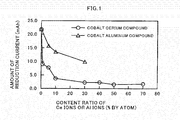
- Fig. 1 shows a graph obtained by plotting a relationship between the "reduction current amount” and the "content ratio of cerium” (the left end column of Table 1) shown in Table 1.
- Fig. 1 includes data of compounds containing aluminum; however, this will be described later. From the graph of Fig. 1 , it can be understood that a reduction current value decreases rapidly when the "content ratio of cerium", that is, the content ratio of cerium ions with respect to the sum of the cobalt ions and the cerium ions, exceeds 5% by atom. In other words, the graph shows that the reduction reaction rapidly becomes less likely to occur when the content ratio of cerium ions with respect to the sum of the cobalt ions and the cerium ions exceeds 5% by atom. Further, the reduction current value keeps a low value until the content ratio of the cerium ions reaches 70% by atom where the data are present.
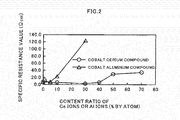
- Fig. 2 shows a graph obtained by plotting a relationship between the "specific resistance value” and the "content ratio of cerium” (the left end column of Table 1) shown in Table 1.
- Fig. 2 also includes data of compounds containing aluminum however, this also will be described later.
- the specific resistance value keeps a low values, which is almost no different from that of a state in which no cerium is added, when the "content ratio of cerium", that is, the content ratio of cerium ions with respect to the sum of the cobalt ions and the cerium ions, is 40% by atom or less.
- the specific resistance value rises once up to 50% by atom, which is a practically sufficiently small value.
- Fig. 3 shows a graph obtained by plotting a relationship between the "redaction current amount” and the "abundance ratio of cerium dioxide phase" (the right end column of Table 1) shown in Table 1.
- the reduction current value decreases rapidly when the abundance ratio of cerium dioxide phase exceeds 6.5% by mass corresponding to the content ratio of cerium ions of 5% by atom.
- the graph shows that a reduction reaction rapidly becomes less likely to occur when the abundance ratio of the aforesaid cerium dioxide phase with respect to a sum of the cobalt oxyhydroxide phase and the cerium dioxide phase exceeds 6.5% by mass.
- the reduction current value keeps a low value until the abundance ratio of the aforesaid cerium dioxide phase reaches 88% by mass where the data are present.
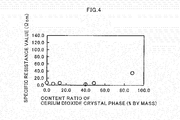
- Fig. 4 shows a graph obtained by plotting a relationship between the "specific resistance value” and the "abundance ratio of cerium dioxide phase" (the right end column of Table 1) shown in Table 1.
- the specific resistance value keeps a low value, which is almost no different from that of a state in which no cerium is added, when the abundance ratio of cerium dioxide is less than or equal to approximately 49% corresponding to the "content ratio of cerium" of 40% by atom.
- the "conte ratio of added element” is a content ratio (% by atom) of ions of each element with respect to a sum of the cobalt ions and the ions of each element in an aqueous solution containing the cobalt ions and the ions of each element in the production process in the same manner as the "content ratio of cesium” in Table 1.
- the "specific resistance value” and the “reduction current amount” are similar to those in Table 1.
- the “content ratio of added element” is changed in three stages, an the other elements were represented by 30% by atom, so as to grasp approximate characteristics.
- a cobalt cerium compound containing a cobalt oxyhydroxide phase and a cerium dioxide phase wherein the abundance ratio of the cerium dioxide phase is 6.5% by mass or more an 88% by mass or less with respect to a sum of the cobalt oxyhydroxide phase and the cerium dioxide phase meets such a demand precisely.
- the cobalt oxyhydroxide phase and the cerium dioxide phase are preferably present as major components. Specifically, a sum of these two phases is preferably 50% by mass or more, more preferably 75% by mass or more, still more preferably 94% by mass or more, and 98% by mass or more.
- a positive electrode of an alkaline secondary battery using an electronic conductive additive having good characteristics in view of both of the reduction resistance and the low specific resistance can be constructed.
- a ratio of the cerium ions contained in the aqueous solution containing the cobalt ions and the cerium ions is preferably set to be 5% by atom or more and 70% by atom or less with respect to the sum of the cobalt ions and the cerium ions before the hydroxide is deposited.
- the cobalt cerium compound according to the present invention is a cobalt compound containing cerium, wherein a first characteristic feature lies in that an abundance ratio of cerium is set to be within a range of 5% by atom or more and 70% by atom or less with respect to a sum of cerium and cobalt.
- the abundance ratio of cerium is preferably set to be a value more than 5% by atom with respect to the sum of cerium and cobalt, and the abundance ratio of cerium is more preferably 10% by atom or more with respect to the sum of cerium and cobalt.
- the abundance ratio of cerium is preferably 40% by atom or less with respect to the sum of cerium and cobalt.
- An alkaline secondary battery according to the present invention has a characteristic feature of having an electrode containing a cobalt cerium compound provided with the above-described first characteristic feature and a positive electrode active material. Further, it is preferable that the positive electrode active material has a particulate shape, and the cobalt cerium compound is present in a state of being laminated on a surface of the particulate positive electrode active material.
- the cobalt cerium compound according to the present invention contains a cobalt oxyhydroxide phase having a crystal structure of rhombohedron structure and space group structure and a cerium dioxide phase having a crystal structure of fluorite structure and space group Fm3m structure, wherein the second characteristic feature lies in that the abundance ratio of the cerium dioxide phase is 6.5% by mass or more and 88% by mass or less with respect to a sum of the cobalt oxyhydroxide phase and the cerium dioxide phase.
- the cobalt cerium compound When a cobalt cerium compound is added as an electronic conductive additive to a positive electrode active material of an alkaline secondary battery, the cobalt cerium compound will be a compound having a high reduction resistance and capable of sufficiently performing a function as an electronic conductive additive.
- the abundance ratio of the cerium dioxide phase is preferably more than 6.5% by mass with respect to the sum of the cobalt oxyhydroxide phase and the cerium dioxide phase, and is more preferably 13.4% by mass or more with respect to the sum of the cobalt oxyhydroxide phase and the cerium dioxide phase. Also, the abundance ratio of the cerium dioxide phase is preferably 49% by mass or less with respect to the sum of the cobalt oxyhydroxide phase and the cerium dioxide phase, whereby an electronic conductive additive having a smaller specific resistance value can be provided.
- the alkaline secondary battery according to the present invention has a characteristic feature of having an electrode containing a cobalt cerium compound provided with the above-described second characteristic feature and a positive electrode active material. Further, it is preferable that the positive electrode active material has a particulate shape, and the cobalt cerium compound is present in a state of being laminated on a surface of the particulate positive electrode active material.
- an electronic conductive additive having a high reduction resistance and a small specific resistance values in the positive electrode, the performance of the alkaline secondary battery can be further improved.
- a method for producing a cobalt cerium compound according to the present invention is a method for producing a cobalt cerium compound including a step of depositing a hydroxide containing cobalt and cerium in an aqueous solution containing cobalt ions and cerium ions by changing the pH of the aqueous solution and thereafter performing a treatment of oxidizing the hydroxide, wherein the characteristic feature lies in that the ratio of the cerium ions contained in the aqueous solution containing the cobalt ions and the cerium ions is set to be 5% by atom or more and 70% by atom or less with respect to the sum of the cobalt ions and the cerium ions before the hydroxide is deposited.
- the cobalt cesium compound When a cobalt cerium compound produced by such a production method is added as an electronic conductive additive to a positive electrode active material of an alkaline secondary attery, the cobalt cesium compound will be a compound having a high reduction resistance and capable of sufficiently performing a function as an electronic conductive additive.
- the ratio of the cerium ions contained in the aqueous solution containing the cobalt ions and the cerium ions is preferably more than 5% by atom with respect to the sum of the cobalt ions and the cerium ions before the hydroxide is deposited.
- the ratio of the cerium ions contained in the aqueous solution containing the cobalt ions and the cerium ions is preferably 10% by atom or more with respect to the sum of the cobalt ions and the cerium ions before the hydroxide is deposited. Further, the ratio of the cerium ions contained in the aqueous solution containing the cobalt ions and the cerium ions is preferably set to be 40% by atom or less with respect to the sum of the cobalt ions and the cerium ions before the hydroxide is deposited, whereby an electronic conductive additive having a smaller specific resistance value can be provided.
- the aqueous solution adjusted to have the predetermined pH preferably contains sodium hydroxide, potassium hydroxide, or lithium hydroxide, and the aqueous solution adjusted to have the predetermined pH more preferably contains a particulate positive electrode active material.
- a compound having a high reduction resistance and being capable of sufficiently performing a function as an electronic conductive additive when added to a positive electrode active material as an electronic conductive additive can be provided.
- a step of producing a cobalt cerium compound will be schematically described.
- the cobalt cerium compound is added as an electronic conductive additive to nickel hydroxide; however, there are a technique of adding a cobalt cerium compound to nickel hydroxide after singly preparing the cobalt cerium compound and a technique of integrating a cobalt cerium compound with nickel hydroxide during a process of producing the cobalt cerium compound (specifically, the cobalt cerium compound is deposited on a surface of nickel hydroxide). The latter technique is preferable because an amount of the cobalt cerium compound can be reduced.
- a technique of singly preparing a cobalt cerium compound will be described.
- a cobalt compound and a cerium compound are dissolved to prepare an aqueous solution containing cobalt ions and cerium ions, and a hydroxide containing cobalt and cerium is deposited in the aqueous solution by adjusting a pH of the aqueous solution.
- a method of adjusting the pH of the aqueous solution containing cobalt ions and cerium ions a method of dropwise adding the aqueous solution containing cobalt ions and cerium ions into an aqueous solution adjusted to have an intended pH.
- a pH value 8 or more, preferably 9 or more and 12 or less can be adopted.
- an aqueous solution with adjusted pH an aqueous solution containing sodium hydroxide, potassium hydroxide, lithium hydroxide, or the like can be used.
- a further specific treatment example will be described. Drops of an aqueous solution into which cobalt sulfate and cerium nitrate were dissolved at predetermined ratios were dropwise added into a violently agitated NaOH aqueous solution controlled to have a temperature of 45°C and a pH value of 9.
- a concentration of the cobalt sulfate and cerium nitrate aqueous solution was set so that sum of Co atoms and Ce atoms would be 1.6 mol/liter by atom.
- the pH control during the dropwise addition is carried out by using a 18 wt% NaOH. Filtration, water-washing, and drying yield cobalt cerium hydroxide.
- the hydroxide containing cobalt and cerium is subjected to a heating treatment in the presence of oxygen to perform an oxidation treatment, thereby to produce a cobalt cerium compound.
- a method of performing an oxidation treatment a method of heating the hydroxide containing cobalt and cerium in an ambient air can be used.
- the hydroxide containing cobalt and cerium is preferably heated in a state of being mixed with an aqueous solution of sodium hydroxide. This is because sodium has a function of promoting oxidation of cobalt in the hydroxide.
- a mixing amount of the aqueous solution of sodium hydroxide is preferably set so that an atomic ratio of Na to (Co + Ce), Na/(Co + Ce), will be 0.5 or more.
- a heating temperature 60°C or more and a boiling point of the aqueous solution of sodium hydroxide or less, preferably 100°C or more, can be used.
- oxidation treatment it is sufficient that 40 g of a 48 wt% NaOH aqueous solution is added to 50 g of cobalt cerium hydroxide, and the mixture is heated in an ambient air at 120°C for one hour.
- the cobalt cerium compound prepared in this manner can be used as an electronic conductive additive in a form of being mixed with a powder of nickel hydroxide, constituting an active material.
- a technique of directly depositing on a surface of nickel hydroxide articles to be used as an active material of an electrode for an alkaline secondary battery will be described.
- a network of the cobalt cerium compound is formed in the inside of the electrode, so that an electrode for an alkaline secondary battery having a low internal resistance can be obtained, and an amount of use thereof can be greatly reduced.
- the amount of use of the cobalt cerium compound an amount of deposition onto the surface of nickel hydroxide particles
- those with 0.1 wt% or more and 10 wt% or less with respect to a sum of the cobalt cesium compound and the nickel hydroxide can be used.
- this range of the amount of use is applied to a case in which a content ratio of a sum of the cobalt oxyhydroxide phase and the cerium dioxide phase contained in the cobalt cerium compound is 94% by mass (wt%) or more.
- the range of the amount of use is preferably changed to a range containing a larger amount so that a combined amount of the cobalt oxyhydroxide phase and the cerium dioxide phase may be contained to the same decree.
- a method of directly depositing a cobalt cerium compound on the surface of nickel hydroxide articles a method of performing an oxidation treatment after performing an operation of mixing nickel hydroxide particles into an aqueous solution with adjusted pH and then dropwise adding an aqueous solution containing cobalt ions and cerium ions thereinto can be used.
- an aqueous solution containing nickel sulfate dissolved is dropwise added into an aqueous solution of ammonium sulfate having a concentration of 1 mol/liter and controlled to have a pH of 12 and a temperature of 45°C while being violently agitated.
- the pH adjustment can be carried out using an 18 wt% NaOH aqueous solution.
- filtration, water-washing, and drying yield spherical nickel hydroxide particles.
- nickel hydroxide particles By dropwise adding an aqueous solution containing cobalt ions and cerium ions into the above-mentioned aqueous solution with adjusted pH and mixed with the nickel hydroxide particles, nickel hydroxide particles being in a state in which the hydroxide containing cobalt and cerium is deposited on the surface can be obtained.
- nickel hydroxide particles prepared in the above-described manner are put into a 0.1 mol/liter aqueous solution of ammonium sulfate, and the resultant is violently agitated while adjusting pH to be 9 and controlling the temperature to be 45°C.
- the pH adjustment is carried out using an 18 wt% NaOH aqueous solution.
- an aqueous solution into which cobalt sulfate and cerium nitrate are dissolved at predetermined ratios is dropwise added.
- a concentration of the cobalt sulfate and cerium nitrate aqueous solution at this time is adjusted so that the sum of Co atoms and Ce atoms will be 1.6 mol/liter by atom.
- an amount of the deposit on the surface of the nickel hydroxide particles is adjusted so that the amount of Co and Ce contained therein (mass as converted to metal) will be about 4 wt% with respect to a sum amount of the nickel hydroxide, Co, Ce.
- Nitration, water-washing, and drying yield spherical nickel hydroxide particles coated with a hydroxide containing cerium and cobalt.
- nickel hydroxide particles in a state in which this hydroxide containing cobalt and cerium is deposited on the surface undergo a subsequent oxidation treatment nickel hydroxide particles provided with the cobalt cerium compound of the present invention on the surface can be obtained.
- the oxidation treatment at this time is preferably carried out bey heating in a state of being mixed with an aqueous solution of podium hydroxide in the same manner, as in the above-described oxidation treatment.
- An amount of the aqueous solution of sodium hydroxide that is put to use is preferably mixed so that (Na/(Co + Ce + Ni)) will be 0.5 or more.
- oxidation treatment 40 g of a 48 wt% NaOH aqueous solution is added to 50 g of the nickel hydroxide particles in a state in which the hydroxide containing cobalt and cerium is deposited on the surface, and the mixture is heated in an ambient air at 120°C for one hour. Subsequently, by filtration, water-washing, and drying, an intended active material articles are prepare. By this step, nickel hydroxide articles provided with the cobalt cerium compound on the surface can be obtained.
- a condition for preparing the above-described cobalt cerium compound will be described in further details.
- the characteristics of the cobalt cerium compound change depending on what content ratio of the cerium ions in the aforementioned aqueous solution containing the cobalt ions and the cerium ions is set. Specifically, in view of obtaining a cobalt cerium compound having a high reduction resistance, from the above Table 1 and Fig.
- the reduction current amount can be decreased and the reduction resistance can be improved when a mixing ratio of each material is set so that the ratio of the cerium ions contained in the aforesaid aqueous solution containing the cobalt ions and the cerium ions will be 5% by atom or more or more than 5% by atom with respect to the sum of the cobalt ions and the cerium ions before the aforementioned hydroxide is deposited. Further, a state with a decreased reduction current amount and a high reduction resistance can be brought about with more certainty when the ratio of the cerium ions contained in the aqueous solution will be 10% by atom or more with respect to the sum of the cobalt ions and the cerium ions.
- an upper limit value of the ratio of cerium ions contained in the aforesaid aqueous solution containing the cobalt ions and the cerium ions it is difficult to define the upper limit value because all of the data on the side at which the content ratio of cerium ions is high are good both in the reduction resistance (the smallness of the reduction current) and in the smallness of the specific resistance values.
- the cobalt cerium compound as a high reduction resistance at least up to the highest content ratio among the obtained data.
- the cobalt cerium compound has a high reduction resistance when the ratio of the cerium ions contained in the aforesaid aqueous solution containing the cobalt ions and the cerium ions is set to be 5% by atom or more or more than 5% by atom and 70% by atom or less with respect to the sum of the cobalt ions and the cerium ions before the aforementioned hydroxide is deposited.
- the value of the specific resistance value is basically a good value in any of the ranges of the ratio of the cerium ions that are set as described above.
- the specific resistance value shows a tendency of increase when the content ratio of the cerium ions with respect to the sum of the cobalt ions and the cerium ions exceeds 40% by atom.
- a cobalt cerium compound having especially good characteristics in view of reducing the specific resistance value as much as possible can be prepared when the ratio of the cerium ions contained in the aforesaid aqueous solution containing the cobalt ions and the cerium ions is set to be more than 5% by atom and 40% by atom or less with respect to the sum of the cobalt ions and the cerium ions before the aforementioned hydroxide is deposited.
- the cobalt cerium compound prepared under the above-described condition contains a cobalt oxyhydroxide phase having a crystal structure of rhombohedron structure and space group R3m structure (abbreviated as "cobalt oxyhydroxide phase” at appropriate times) and a cerium dioxide phase having a crystal structure of fluorite structure and space group Fm3m structure (abbreviated as "cerium dioxide phase” at appropriate times) as major components, and also a little amount of tricobalt tetraoxide crystal phase depending on conditions for preparing the cobalt cerium compound, as described above.
- the ratio of the cerium ions in the aqueous solution containing the cobalt ions and the cerium ions prepared in the step of producing the cobalt cerium compound (strictly speaking, the content ratio of the cerium ions with respect to the sum of the cobalt ions and the cerium ions) and the abundance ratio of the aforesaid cerium dioxide phase (strictly speaking, the abundance ratio of the aforesaid cerium dioxide phase with respect to the sum of the aforesaid cobalt oxyhydroxide phase and the aforesaid cerium dioxide phase) are in a correlative relationship and approximately have a proportional relationship.
- the cobalt cerium compound is prepared by setting a mixing ratio of each material so that the ratio of the cerium ions contained in the aforesaid aqueous solution containing the cobalt ions and the cerium ions will be more than 5% by atom with respect to the sum of the cobalt ions and the cerium ions, the abundance ratio of the aforementioned cerium dioxide phase with respect to the sum of the aforementioned cobalt oxyhydroxide phase and the aforementioned cerium dioxide phase will be 6.5% by mass or more or more than 6.5% by mass.
- the cobalt cerium compound is prepared by setting the ratio of the cerium ions contained in the aforesaid aqueous solution containing the cobalt ions and the cerium ions to be 70% by atom or less with respect to the sum of the cobalt ions and the cerium ions, the abundance ratio of the aforementioned cerium dioxide phase with respect to the sum of the aforementioned cobalt oxyhydroxide phase and the aforementioned cerium dioxide phase will be 88% by mass or less.
- the cobalt cerium compound is prepared by setting the mixing ratio of each material so that the ratio of the cerium ions contained in the aforesaid aqueous solution containing the cobalt ions and the cerium ions will be 10% by atom or more with respect to the sum of the cobalt ions and the cerium ions, the abundance ratio of the aforementioned cerium dioxide phase with respect to the sum of the aforementioned cobalt oxyhydroxide phase and the aforementioned cerium dioxide phase will be 13.4% by mass or morse.
- the cobalt cerium compound is prepared by setting the ratio of the cerium ions contained in the aforesaid aqueous solution containing the cobalt ions and the cerium ions to be more than 5% by atom and 40% by atom or with respect to the sum of the cobalt ions and the cerium ions in view of reducing the specific resistance value of the cobalt cerium compound as much as possible, the abundance ratio of the aforementioned cerium dioxide phase with respect to the sum of the aforementioned cobalt oxyhydroxide phase and the aforementioned cerium dioxide phase will be 6.5% by mass or more or more than 6.5% by mass and 49% by mass or less.
- the ratio of the cerium ions contained in the aforesaid aqueous solution containing the cobalt ions and the cerium ions is set to be 15% by atom or more or 20% by atom or more with respect to the sum of the cobalt ions and the cerium ions.
- CMC carboxymethylcellulose
- An aqueous solution of carboxymethylcellulose (CMC) or the like is added to a mixture of nickel hydroxide and a cobalt cerium compound prepared by any of the above-described two preparation techniques, namely, the technique of singly preparing a cobalt cerium compound and thereafter adding the cobalt cerium compound to a nickel hydroxide powder or the technique of depositing a cobalt cerium compound on a surface of nickel hydroxide, so as to form a paste.
- CMC carboxymethylcellulose
- a substrate having electron conductivity such as a porous nickel substrate (a nickel foamed substrate) is filled with this paste and the resultant is thereafter subjected to a drying treatment and pressed to a predetermined thickness to form a positive electrode for an alkaline secondary battery.
- a paste containing a hydrogen absorption alloy powder as a major component is applied onto a negative electrode base plate made of a punching steel plate in which iron is plated with nickel, and the resultant is dried and thereafter pressed to a predetermined thickness to prepare a negative electrode.
- This negative electrode, a separator made of a non-woven cloth of polypropylene, and the above-described positive electrode are laminated, and the obtained laminate is wound in a roll form.
- a positive electrode electricity-collecting plate and a negative electrode electricity-collecting plate are attached to this, the resultant is inserted into a tubular can body having a bottom, and an electrolyte solution is injected. Thereafter, a disk-shaped lid body having a ring-shaped gasket attached to a perimeter thereof and provided with a cap-shaped terminal or the like is mounted in a state of being in electrical contact with the positive electrode electricity-collecting plate an is fixed by caulking an open end of the aforesaid can body.
- the alkaline secondary battery was prepared by the above-described production method, so a sample for comparison to which the present invention was not applied was prepared, and a discharge recovery capacity after over-discharging was measured with respect to these.
- This measurement examines to what degree a performance as a battery can be maintained when the alkaline secondary battery is brought into an over-discharged state to bring the battery into a state in which the cobalt oxyhydroxide is liable to be reduced.
- Preparation of the cobalt cerium compound was carried out by using the above-described technique of depositing the cobalt cerium compound on the surface of nickel hydroxide.
- Specific conditions for preparation of nickel hydroxide particles, deposition of hydroxide containing cobalt and cerium onto the nickel hydroxide particles, and treatment of oxidation thereof were set to be the same as those described as a specific treatment example for each treatment.
- a ratio of cobalt sulfate and nickel nitrate in the aqueous solution of cobalt sulfate and nickel nitrate in the step of depositing the hydroxide containing cobalt and cerium onto the nickel hydroxide particles was set to be 7 to 3. so ; regarding the amount of the cobalt cerium compound deposited on the nickel hydroxide particles, the amount of Co and Ce (mass as converted to metal) contained in this compound was 4 wt% with respect to a sum of the mass of the nickel hydroxide particles and the mass of Co and (mass as converted to metal).
- the nickel hydroxide particles provided with this cobalt cerium compound on the surface and an aqueous solution containing carboxymethylcellulose (CMC) at a concentration of 1 wt% were added and kneaded, and then polytetrafluoroethylene (PTFE) was mixed thereinto to form a paste.
- a foamed nickel base plate having a thickness of 1.4 mm and a surface density of 450 g/m 2 was filled with the positive electrode paste and subjected to rolling after being dried to prepare an original plate. The original plate was cut to a dimension of 4 cm ⁇ 6 cm.
- the plate was filled with the nickel hydroxide provided with the cobalt cerium compound on the surface so that an electrode capacity of the plate having this dimension would be 500 mAh.
- a separator was allowed to intervene to constitute an open-type cell.
- an electrolyte solution a 6.8 mol/liter of aqueous solution of potassium hydroxide was used.
- nickel hydroxide particles provided with cobalt oxyhydroxide on a surface were prepared as a sample for comparison.
- nickel hydroxide particles were prepared. Into an aqueous solution with adjusted pH and mixed with this, aqueous solution containing cobalt was drop wise added to prepare nickel hydroxide particles having cobalt hydroxide deposited on the surface thereof. Specific conditions were set to be the same as in the case of the measurement sample to which the present invention was applied, except that the aqueous solution did not contain cerium ions. In other words, an aqueous solution of cobalt sulfate was used instead of the aqueous solution of cobalt sulfate and cerium nitrate.
- the cobalt hydroxide deposited on the surface of the nickel hydroxide particles was subjected to an oxidation treatment to obtain nickel hydroxide particles provided with cobalt oxyhydroxide on the surface.
- the method, of oxidation treatment was carried out under the same condition as that of the measurement sample to which the present invention was applied.
- an amount of the cobalt oxyhydroxide an amount of Co (mass as converted to metal) contained in this compound was 4 wt% with respect to a sum of the mass of the nickel hydroxide particles and the amount of Co (mass as converted to metal).
- an open-type cell was prepared in the same manner as the above-described measurement sample to which the present invention was applied.
- a step of charging at a charging current of 1.0 C for 15 hours and, after a rest of one hour, discharging at a discharging current of 1.0 C with a finishing voltage set at 0.0 V was repeated under a temperature environment of 20°C, so as to examine a discharge capacity at a 10th cycle (discharge capacity before connection of a constant resistor).
- the cells were charged at a charging current of 0.1 C for 15 hours and, after a rest of one hour, discharged at a discharging current of 0.2 C with a finishing voltage set at 0.0 V under a temperature environment of 20°C to set the cells to a final period of discharging.
- a constant resistor was connected between the positive and negative electrodes for 3 days under an environment of 60°C.
- these cells were charged at a charging current of 0.1 C for 15 hours and, after a rest of one hour, discharged at a discharging current of 0.2 C with a finishing voltage set at 0.0 V again under a temperature environment of 20°C, so as to examine a discharge recovery capacity after connection of a constant resistor (the discharge recovery capacity ter over-discharging).
- the discharge recovery capacity was 85.4% in the measurement sample to which the present invention was applied, as represented by a relative index in a case in which the discharge capacity before connection of a constant resistor was assumed to be 100, whereas the discharge recovery capacity was 73.3% in the sample for comparison to which the present invention was not applied. Therefore, it will be understood that the nickel hydroxide particles provided with the cobalt cerium compound of the present invention on the surface is an active material excellent in the over-discharge resistance.
- a nickel hydrogen battery was exemplified as an alkaline secondary battery to which the present invention is applied; however, the present invention can be applied to production of various alkaline storage batteries such as a nickel cadmium battery.
Landscapes
- Chemical & Material Sciences (AREA)
- Organic Chemistry (AREA)
- Inorganic Chemistry (AREA)
- Chemical Kinetics & Catalysis (AREA)
- Electrochemistry (AREA)
- General Chemical & Material Sciences (AREA)
- Battery Electrode And Active Subsutance (AREA)
- Inorganic Compounds Of Heavy Metals (AREA)
Abstract
Description
- The present invention relates to a cobalt cerium compound, an alkaline secondary battery using the cobalt cerium compound, and a method for producing a cobalt cerium compound.
- Application of the aforementioned cobalt cerium compound to various uses that need a cobalt compound having a low resistance is considered. Hereafter, in particular, a case of using in a positive electrode for an alkaline secondary battery will be described.
In recent years, a non-sintered type electrode in which a nickel substrate (nickel foamed substrate) is filled with a paste-like active material is used as a nickel electrode that constitutes a positive electrode of an alkaline secondary battery such as a nickel metal hydride battery, a nickel cadmium battery, or a nickel zinc battery.
Also, with the constitution of a non-sintered type electrode in which a nickel foamed substrate is simply filled with an active material, electric conductivity decreases in accordance with discharging of the attery, so that a region that does not function effectively as a positive electrode of the battery will be present in not a small amount within the nickel foamed substrate. For this reason, a technique of using cobalt oxyhydroxide which is a cobalt compound having high electric conductivity as an electric conductive additive is considered. - However, it is now coming to be understood that, when only cobalt oxyhydroxide is used as an electronic conductive additive, there are cases in which an object of improving electric conductivity is not sufficiently fulfilled.
Specifically, in a case such as when an alkaline secondary battery comes into an over-discharged state to let a positive electrode potential come dose to a negative electrode potential or when a state of reverse charging is brought about, the cobalt oxyhydroxide is reduced to decrease a valence number of cobalt and, in accordance therewith, the electric conductivity decreases. Furthermore, when reduced to change into cobalt hydroxide (Co(OH)2), the cobalt oxyhydroxide is dissolved into an electrolyte solution and will no longer function as an electronic conductive additive. - Under such a circumstance, an attempt for restraining a reduction of cobalt oxyhydroxide is also made.
For example, the following Patent Document 1 proposes a construction of adding antimony or the like to an oxidized compound of cobalt. - Patent Document 1: Japanese Patent Laid-open Publication No.
H10-50308 - However, though the above Patent Document 1 enumerates a lot of materials to be added to an oxidized compound of cobalt, those that have been actually evaluated on the basis of experiment data are limited to only an extremely small part of magnesium or aluminum. Also, regarding the evaluation thereof, only changes in a battery capacity is measured, so that it is not sufficient as an evaluation. Furthermore, regarding an added material on which an evaluation based on experiment data is not made, it is not possible to conjecture what kind of characteristics the material can have.
- The present invention has been made in view of the above circumstances, and an object thereof is to provide a compound having a high reduction resistance and being capable of sufficiently performing a function as an electronic conductive additive when added to a positive electrode active material as an electronic conductive additive.
- Inventors of the present invention have found out that, when cerium (Ce) is adopted as a material to be added to a cobalt compound constituting an electronic conductive additive, unique characteristics completely different from those in a case in which other materials are added are exhibited.
- Hereafter, description will be given by way of experiment examples. In the experiments, specific resistance of prepared cobalt cerium compounds was measured by using the powder resistance measuring method, and also the liability of occurrence of the reduction reaction of the cobalt cerium compounds was measured by using an experiment apparatus shown in
Fig. 5 , and usefulness in the case of using the cobalt cerium compounds as an electronic conductive additive was evaluated on the basis of the result thereof. - The experiment apparatus shown in
Fig. 5 is constructed in such a manner that a workingelectrode 101, areference electrode 102, and acounter electrode 103 are disposed in an electrolyte solution, and the potential of the workingelectro 101 can be set by acontrol apparatus 104 using thereference electrode 102 as a standard.
The workingelectrode 101 is one such that foamed nickel is felled with a cobalt cerium compound, and thereference electrode 102 is constructed with Hg/HgO. Also, thecounter electrode 103 is constructed with a hydrogen absorption alloy electrode similar to the negative electrode of a typical nickel hydrogen battery, and these are disposed in a 6.8 mol/liter aqueous solution of potassium hydroxide constituting the electrolyte solution . - When the potential of the working
electrode 101 is set to be -1 V (which is almost equal to the potential of the counter electrode 103), at which the cobalt cerium compound is likely to bring about reduction reaction , by thecontrol apparatus 104 using thereference electrode 102 as a standard, a current generated by the reduction reaction is measured. Then, the liability of occurrence of the reduction reaction can be quantitatively evaluated by an accumulated value of the current cased to flow by the reduction reaction . - The cobalt cerium compound constituting a sample was prepared by the following procedure. First, a cobalt compound and a cerium compound were dissolved to produce an aqueous solution brought into a state of containing cobalt ions and cerium ions, and its pH was adjusted by dropwise adding the aqueous solution little by little into an aqueous solution of sodium hydroxide with adjusted pH. Next, a hydroxide containing cobalt and cerium was deposited in the aqueous solution , and the hydroxide was subjected to an oxidation treatment, that is, a heating treatment in the presence of oxygen, for preparation.
The above measurement was carried out on a plurality of cobalt cerium compounds prepared by changing an abundance ratio of the cobalt ions an the cerium ions in the above aqueous solution . - The working
electrode 101 filled with the cobalt cerium compound prepared in this manner as prepared by the following method. First, the prepared cobalt cerium compound and carboxymethylcellulose (CMC) were added and mixed to produce an aqueous solution having a concentration of 1 wt%, an then 40 wt% of polytetrafluoroethylene (PTFE) was mixed in. A ratio at this time is the cobalt cerium compound to PTFE (solid components) = 97 to 3.
A foamed nickel base late having a thickness of 1.4 mm and a surface density of 450 g/m2 was filled with the positive electrode paste and subjected to rolling after being dried to produce an original plate. The original plate was cut to a dimension of 2 cm x 2 cm, and a tab for collecting electricity was attached to produce the workingelectrode 101. An amount of the cobalt cerium compound calculated from the filling amount of the electrode plate was 0.2 g. - Further, the inventors of the present invention performed a detailed analysis of a crystal structure thereof in order to evaluate the prepared cobalt cerium compound in a more precise manner.
A measurement result by an X-ray diffraction apparatus was analyzed by the Rietvelt method to analyze the crystal structure. The crystal structure in the sample powder was identified, and also an abundance ratio of phases having the identified crystal structure was identified. The X-ray diffraction apparatus is manufactured by Bruker AXS Co., Ltd.,(Product number M06XCE) and measurement conditions are 40 kV and 100 mA (Cu tube bulb). As an analyzing software of the Rietvelt method, RIETAN2000 was used. A specific resistance value was obtained by the powder resistance measuring method and was measured in a state of being pressurized at 10 MPa after 50 mg of the sample powder was put into a circular template having a radius of 4 mm. From this measurement result, the specific resistance value (reciprocal of electric conductivity) of the sample powder can be obtained. These measurement results are shown in Table 1. -
[Table 1] Content ratio of cerium (% by atom) Specific resistance value (Ω cm) Reduction current amount (mAh) Content ratio of crystal phase (% by mass) Abundance ratio of cerium dioxide phase (% by mass) Cobalt oxyhydroxide phase Cerium dioxide phase Tricobalt tetraoxide phase 0 6.6 21.8 100.00 0.00 0.00 0.0 1 11.1 9.0 - - - - 5 4.2 7.7 91.27 6.36 2.37 6.5 10 6.4 3.7 84.96 13.19 1.84 13.4 30 2.8 2.3 56.60 37.74 5.66 40.0 40 6.2 2.3 51.42 48.59 0.00 48.6 50 29.9 1.5 - . - - 70 34.5 1.7 11.76 88.24 0.00 88.2 - In Table 1, the "content ratio of cerium" shows content ratios (% by atom) of the cerium ions with respect to a sum of the cobalt ions and the cerium ions in the aqueous solution containing the cobalt ions and the cerium ions in the process of producing the cobalt cerium compound.
The "reduction current amount" shows currents as measured by using the experiment apparatus shown inFig. 5 , and is results of measuring accumulated current mounts for one hour. Therefore, the numerical values represent average current values for one hour. - As a result of analyzing the crystal structure of the cobalt cerium compound, it has been found out that the cobalt cerium compound contains a cobalt oxyhydroxide phase having a crystal structure of rhombohedron structure and space group R3m structure (hereafter simply referred to as "cobalt oxyhydroxide phase") and a cerium dioxide phase having a crystal structure of fluorite structure and space group Fm3m structure (hereafter simply referred to as "cerium dioxide phase") as major components, and also contains a little amount of tricobalt tetraoxide crystal phase depending on a condition for preparing the cobalt cerium compound.
- Among these crystal phases, an analysis result of analyzing the important crystal structures of the cobalt oxyhydroxide phase and the cerium dioxide phase by the Rietvelt analysis will be described in further details.
As shown by a crystal structure model of Fog. 6, the cobalt oxyhydroxide phase has the crystal structure of rhombohedron structure and space group R3m structure, and contains at least cobalt atoms, oxygen atoms, and hydrogen atoms as constituent elements. Further, in the cobalt cerium compound of the present invention, the cobalt oxyhydroxide phase can contain cerium atoms.
These atoms are disposed at predetermined sites shown inFig. 6 . Specifically, Co or Ce is disposed at 3a1 3a2 sites, and oxygen atoms (including oxygen atoms constituting water molecules and hydroxide ions) are disposed at 3a3 and 9b sites.
When cerium is contained in this manner, Ce is disposed at 3a1 and 3a2 sites. Here, an atom may not be disposed at 3a4 site; however, Na is preferably disposed at the site as shown inFig. 6 . The disposal of Na at 3a4 site can be carried out by allowing sodium hydroxide to coexist when a hydroxide containing cobalt and cerium is subjected to a heating treatment as described later. When a is contained in this manner, oxidation can be made to proceed easily in the oxidation treatment in the production process. - As shown by a crystal structure model of
Fig. 7 , the cerium dioxide phase has a crystal structure of fluorite structure and space group Fm3m structure, and contains at least cerium atoms and oxygen atoms as constituent elements. Further, in the cobalt cerium compound of the present invention, the cerium dioxide phase can contain cobalt atoms. These atoms are disposed at predetermined sites shown inFig. 7 . Specifically, Co or Ce is disposed at 4a site, and oxygen atoms are disposed at 8c site.
In this manner, when cobalt is contained in the above-described cerium dioxide phase, cobalt replaces a part of cerium. - Table 1 shows content ratios (% by mass) of each phase of the above-described cobalt oxyhydroxide phase, cerium dioxide phase, and tricobalt tetraoxide crystal phase in the cobalt cerium compound.
Further, the "abundance ratio of cerium dioxide ase" shown in the right end column of Table 1 shows values obtained by calculating an abundance ratio of the cerium dioxide phase in the cobalt cerium compound as a ratio relative to a sum of the cobalt oxyhydroxide phase and the cerium dioxide phase from the content ratio of each of the above layers. -
Fig. 1 shows a graph obtained by plotting a relationship between the "reduction current amount" and the "content ratio of cerium" (the left end column of Table 1) shown in Table 1.
Fig. 1 includes data of compounds containing aluminum; however, this will be described later.
From the graph ofFig. 1 , it can be understood that a reduction current value decreases rapidly when the "content ratio of cerium", that is, the content ratio of cerium ions with respect to the sum of the cobalt ions and the cerium ions, exceeds 5% by atom. In other words, the graph shows that the reduction reaction rapidly becomes less likely to occur when the content ratio of cerium ions with respect to the sum of the cobalt ions and the cerium ions exceeds 5% by atom. Further, the reduction current value keeps a low value until the content ratio of the cerium ions reaches 70% by atom where the data are present. -
Fig. 2 shows a graph obtained by plotting a relationship between the "specific resistance value" and the "content ratio of cerium" (the left end column of Table 1) shown in Table 1.
Fig. 2 also includes data of compounds containing aluminum however, this also will be described later.
From the graph ofFig. 2 , the specific resistance value keeps a low values, which is almost no different from that of a state in which no cerium is added, when the "content ratio of cerium", that is, the content ratio of cerium ions with respect to the sum of the cobalt ions and the cerium ions, is 40% by atom or less. When the content ratio of cerium ions exceeds 40% by atom, the specific resistance value rises once up to 50% by atom, which is a practically sufficiently small value. - Next,
Fig. 3 shows a graph obtained by plotting a relationship between the "redaction current amount" and the "abundance ratio of cerium dioxide phase" (the right end column of Table 1) shown in Table 1.
In the graph ofFig. 3 also, in correspondence with the graph ofFig. 1 , the reduction current value decreases rapidly when the abundance ratio of cerium dioxide phase exceeds 6.5% by mass corresponding to the content ratio of cerium ions of 5% by atom. In other words, the graph shows that a reduction reaction rapidly becomes less likely to occur when the abundance ratio of the aforesaid cerium dioxide phase with respect to a sum of the cobalt oxyhydroxide phase and the cerium dioxide phase exceeds 6.5% by mass. Further, the reduction current value keeps a low value until the abundance ratio of the aforesaid cerium dioxide phase reaches 88% by mass where the data are present. - Further,
Fig. 4 shows a graph obtained by plotting a relationship between the "specific resistance value" and the "abundance ratio of cerium dioxide phase" (the right end column of Table 1) shown in Table 1.
In the graph of Fug. 4 also, in correspondence with the graph ofFig. 2 , the specific resistance value keeps a low value, which is almost no different from that of a state in which no cerium is added, when the abundance ratio of cerium dioxide is less than or equal to approximately 49% corresponding to the "content ratio of cerium" of 40% by atom. - Next, as a comparative example of the above experiment data, an experiment result with respect to a cobalt compound to which a material other than cerium is added will be shown.
As materials to be added to the cobalt compound, aluminum (Al), manganese (Mn), magnesium (Mg), Yttrium (Y), and iron (Fe) were used.
With respect to each of these materials, a treatment similar to that of the above-described case of cerium was carried out to prepare a compound with cobalt, and measurement of a specific resistance and a reduction current similar to those described above was carried out. A result thereof is shown in Table 2 -
[Table 2] Added element Content ratio of added element (% by atom) Specific resistance value (Ω cm) Reduction current Reduction current amount (mAh) Al 5 8.6 15.8 Al 10 23.6 13.6 Al 30 124.4 10.0 Mn 30 11.2 41.5 Mg 30 260.3 6.8 Y 30 444.4 - Fe 30 - 14.5 - In Table 2, the "conte ratio of added element" is a content ratio (% by atom) of ions of each element with respect to a sum of the cobalt ions and the ions of each element in an aqueous solution containing the cobalt ions and the ions of each element in the production process in the same manner as the "content ratio of cesium" in Table 1. The "specific resistance value" and the "reduction current amount" are similar to those in Table 1.
As shown in Table 2, with respect to aluminium, the "content ratio of added element" is changed in three stages, an the other elements were represented by 30% by atom, so as to grasp approximate characteristics. - Data on the cobalt compound to which aluminum is addled, that is, cobalt aluminium compounds, in Table 2 are shown together with the cobalt cerium compound in the above-described Fugs. 1 an 2.
When the cobalt cerium compound and the cobalt aluminium compound are compared, the reduction current amount shows a certain tendency of decrease relative to the increase of aluminum ions though having a considerably higher value than that of the cobalt cerium compound. Therefore, it is expected that, when a content ratio of the aluminum ions is further increased, the reduction current amount can be further degreased. - However, when the cobalt cerium compound an the cobalt aluminum compound are compared in the graph of the specific resistance value of
Fig. 2 , the specific resistance value increases rapidly in accordance with an increase of the content ratio of the aluminum ions. This means that the function as an electronic conductive additive, which is an original object, is considerably deteriorated. - Further, with respect to the other elements in Table 2, with respect to manganese, it is shown that the reduction current amount is large and the reduction resistance is low though having a small value of the specific resistance value, with respect to magnesium or yttrium, the specific resistance value is extremely large; and with respect to iron, the reduction current value is large.
When the cobalt cerium compound is compared with such cobalt compounds to which various elements are added, it can be said that the cobalt cerium compound is a unique existence in view of exhibiting an extremely good value in both of the reduction current amount and the specific resistance value. - On the basis of the above experiment and evaluation, from the viewpoint as a material to be used that requires both the reduction resistance and the low specific resistance value of an electronic conductive additive or the like used in a positive electrode of an alkaline secondary battery, for example, a cobalt cerium compound containing a cobalt oxyhydroxide phase and a cerium dioxide phase wherein the abundance ratio of the cerium dioxide phase is 6.5% by mass or more an 88% by mass or less with respect to a sum of the cobalt oxyhydroxide phase and the cerium dioxide phase meets such a demand precisely.
- Further, in the cobalt cerium compound, the cobalt oxyhydroxide phase and the cerium dioxide phase are preferably present as major components. Specifically, a sum of these two phases is preferably 50% by mass or more, more preferably 75% by mass or more, still more preferably 94% by mass or more, and 98% by mass or more.
- As described in
Fig. 4 , when the abundance ratio of the aforesaid cerium dioxide phase exceeds 49% by mass, the specific resistance value tends to increase and, by evading such a range, the cobalt cerium compound will have a better specific resistance value. - Also, with an electrode containing the above-described cobalt cerium compound and a positive electrode active material, a positive electrode of an alkaline secondary battery using an electronic conductive additive having good characteristics in view of both of the reduction resistance and the low specific resistance can be constructed.
- Also, in a method for producing a cobalt cerium compound including a step of depositing a hydroxide containing cobalt and cerium in an aqueous solution containing cobalt ions and cerium ions by changing of the aqueous solution and thereafter performing a treatment of oxidizing the hydroxide, a ratio of the cerium ions contained in the aqueous solution containing the cobalt ions and the cerium ions is preferably set to be 5% by atom or more and 70% by atom or less with respect to the sum of the cobalt ions and the cerium ions before the hydroxide is deposited.
- As described in
Fig. 2 , when the content ratio of the cobalt ions exceeds 40% by atom, the specific resistance value tends to increase and, by evading such a range, a cobalt cerium compound will have a better specific resistance value. - Namely, the cobalt cerium compound according to the present invention is a cobalt compound containing cerium, wherein a first characteristic feature lies in that an abundance ratio of cerium is set to be within a range of 5% by atom or more and 70% by atom or less with respect to a sum of cerium and cobalt.
In the cobalt cerium compound, the abundance ratio of cerium is preferably set to be a value more than 5% by atom with respect to the sum of cerium and cobalt, and the abundance ratio of cerium is more preferably 10% by atom or more with respect to the sum of cerium and cobalt.
Also, in the cobalt cerium compound, the abundance ratio of cerium is preferably 40% by atom or less with respect to the sum of cerium and cobalt. - An alkaline secondary battery according to the present invention has a characteristic feature of having an electrode containing a cobalt cerium compound provided with the above-described first characteristic feature and a positive electrode active material.
Further, it is preferable that the positive electrode active material has a particulate shape, and the cobalt cerium compound is present in a state of being laminated on a surface of the particulate positive electrode active material. - The cobalt cerium compound according to the present invention contains a cobalt oxyhydroxide phase having a crystal structure of rhombohedron structure and space group structure and a cerium dioxide phase having a crystal structure of fluorite structure and space group Fm3m structure, wherein the second characteristic feature lies in that the abundance ratio of the cerium dioxide phase is 6.5% by mass or more and 88% by mass or less with respect to a sum of the cobalt oxyhydroxide phase and the cerium dioxide phase.
When a cobalt cerium compound is added as an electronic conductive additive to a positive electrode active material of an alkaline secondary battery, the cobalt cerium compound will be a compound having a high reduction resistance and capable of sufficiently performing a function as an electronic conductive additive. - The abundance ratio of the cerium dioxide phase is preferably more than 6.5% by mass with respect to the sum of the cobalt oxyhydroxide phase and the cerium dioxide phase, and is more preferably 13.4% by mass or more with respect to the sum of the cobalt oxyhydroxide phase and the cerium dioxide phase.
Also, the abundance ratio of the cerium dioxide phase is preferably 49% by mass or less with respect to the sum of the cobalt oxyhydroxide phase and the cerium dioxide phase, whereby an electronic conductive additive having a smaller specific resistance value can be provided. - The alkaline secondary battery according to the present invention has a characteristic feature of having an electrode containing a cobalt cerium compound provided with the above-described second characteristic feature and a positive electrode active material.
Further, it is preferable that the positive electrode active material has a particulate shape, and the cobalt cerium compound is present in a state of being laminated on a surface of the particulate positive electrode active material. By using an electronic conductive additive having a high reduction resistance and a small specific resistance values in the positive electrode, the performance of the alkaline secondary battery can be further improved. - A method for producing a cobalt cerium compound according to the present invention is a method for producing a cobalt cerium compound including a step of depositing a hydroxide containing cobalt and cerium in an aqueous solution containing cobalt ions and cerium ions by changing the pH of the aqueous solution and thereafter performing a treatment of oxidizing the hydroxide, wherein the characteristic feature lies in that the ratio of the cerium ions contained in the aqueous solution containing the cobalt ions and the cerium ions is set to be 5% by atom or more and 70% by atom or less with respect to the sum of the cobalt ions and the cerium ions before the hydroxide is deposited.
When a cobalt cerium compound produced by such a production method is added as an electronic conductive additive to a positive electrode active material of an alkaline secondary attery, the cobalt cesium compound will be a compound having a high reduction resistance and capable of sufficiently performing a function as an electronic conductive additive.
In the method for producing a cobalt cerium compounds, the ratio of the cerium ions contained in the aqueous solution containing the cobalt ions and the cerium ions is preferably more than 5% by atom with respect to the sum of the cobalt ions and the cerium ions before the hydroxide is deposited.
Also, the ratio of the cerium ions contained in the aqueous solution containing the cobalt ions and the cerium ions is preferably 10% by atom or more with respect to the sum of the cobalt ions and the cerium ions before the hydroxide is deposited.
Further, the ratio of the cerium ions contained in the aqueous solution containing the cobalt ions and the cerium ions is preferably set to be 40% by atom or less with respect to the sum of the cobalt ions and the cerium ions before the hydroxide is deposited, whereby an electronic conductive additive having a smaller specific resistance value can be provided.
It is preferable to undergo an oxidation treatment after the hydroxide is deposited, and also it is preferable to undergo a step of mixing the aqueous solution containing the cobalt ions and the cerium ions with an aqueous solution adjusted to have a predetermined pH.
Further, the aqueous solution adjusted to have the predetermined pH preferably contains sodium hydroxide, potassium hydroxide, or lithium hydroxide, and the aqueous solution adjusted to have the predetermined pH more preferably contains a particulate positive electrode active material. - As described above, according to the present invention, a compound having a high reduction resistance and being capable of sufficiently performing a function as an electronic conductive additive when added to a positive electrode active material as an electronic conductive additive can be provided.
-
- [
FIG. 1] Fig. 1 is a view showing a relationship between reduction current amount characteristics of the cobalt cerium compound of the present invention and content ratios of cerium ions. - [
FIG. 2] Fig. 2 is a view showing a relationship between specific resistance values of the cobalt cerium compound of the present invention and content ratios of cerium ions. - [
FIG. 3] Fig. 3 is a view showing a relationship between reduction current characteristics of the cobalt cerium compound of the present invention and abundance ratios of the cerium dioxide phase. - [
FIG. 4] Fig. 4 is a view showing a relationship between specific resistance values of the cobalt cerium compound of the present invention and abundance ratios of the cerium dioxide phase. - [
FIG. 5] Fig. 5 is a view showing an apparatus for evaluating the cobalt cerium compound of the present invention. - [
FIG. 6] Fig. 6 is a view showing a crystal structure model of the cobalt oxyhydroxide phase constituting a part of the cobalt cerium compound of the present invention. - [
FIG. 7] Fig. 7 is a view showing a crystal structure model of the cerium dioxide phase constituting a part of the cobalt cerium compound of the present invention. - Hereafter, embodiments of the present invention will be described.
- A step of producing a cobalt cerium compound will be schematically described.
The cobalt cerium compound is added as an electronic conductive additive to nickel hydroxide; however, there are a technique of adding a cobalt cerium compound to nickel hydroxide after singly preparing the cobalt cerium compound and a technique of integrating a cobalt cerium compound with nickel hydroxide during a process of producing the cobalt cerium compound (specifically, the cobalt cerium compound is deposited on a surface of nickel hydroxide). The latter technique is preferable because an amount of the cobalt cerium compound can be reduced. - First, a technique of singly preparing a cobalt cerium compound will be described.
In this preparation technique, first, a cobalt compound and a cerium compound are dissolved to prepare an aqueous solution containing cobalt ions and cerium ions, and a hydroxide containing cobalt and cerium is deposited in the aqueous solution by adjusting a pH of the aqueous solution.
As a method of adjusting the pH of the aqueous solution containing cobalt ions and cerium ions, a method of dropwise adding the aqueous solution containing cobalt ions and cerium ions into an aqueous solution adjusted to have an intended pH. As a pH value, 8 or more, preferably 9 or more and 12 or less can be adopted. As an aqueous solution with adjusted pH, an aqueous solution containing sodium hydroxide, potassium hydroxide, lithium hydroxide, or the like can be used.
A further specific treatment example will be described. Drops of an aqueous solution into which cobalt sulfate and cerium nitrate were dissolved at predetermined ratios were dropwise added into a violently agitated NaOH aqueous solution controlled to have a temperature of 45°C and a pH value of 9. A concentration of the cobalt sulfate and cerium nitrate aqueous solution was set so that sum of Co atoms and Ce atoms would be 1.6 mol/liter by atom. The pH control during the dropwise addition is carried out by using a 18 wt% NaOH. Filtration, water-washing, and drying yield cobalt cerium hydroxide. - Further, the hydroxide containing cobalt and cerium is subjected to a heating treatment in the presence of oxygen to perform an oxidation treatment, thereby to produce a cobalt cerium compound. As a method of performing an oxidation treatment, a method of heating the hydroxide containing cobalt and cerium in an ambient air can be used.
When this method is used, the hydroxide containing cobalt and cerium is preferably heated in a state of being mixed with an aqueous solution of sodium hydroxide.
This is because sodium has a function of promoting oxidation of cobalt in the hydroxide. Since this function is conspicuously recognized, a mixing amount of the aqueous solution of sodium hydroxide is preferably set so that an atomic ratio of Na to (Co + Ce), Na/(Co + Ce), will be 0.5 or more.
As a heating temperature, 60°C or more and a boiling point of the aqueous solution of sodium hydroxide or less, preferably 100°C or more, can be used.
As a specific example of oxidation treatment, it is sufficient that 40 g of a 48 wt% NaOH aqueous solution is added to 50 g of cobalt cerium hydroxide, and the mixture is heated in an ambient air at 120°C for one hour.
Subsequently, filtration, water-washing, and drying yield an intended cobalt cerium compound.
The cobalt cerium compound prepared in this manner can be used as an electronic conductive additive in a form of being mixed with a powder of nickel hydroxide, constituting an active material. - Next, a technique of directly depositing on a surface of nickel hydroxide articles to be used as an active material of an electrode for an alkaline secondary battery will be described. By depositing using this technique, a network of the cobalt cerium compound is formed in the inside of the electrode, so that an electrode for an alkaline secondary battery having a low internal resistance can be obtained, and an amount of use thereof can be greatly reduced.
As the amount of use of the cobalt cerium compound (an amount of deposition onto the surface of nickel hydroxide particles), those with 0.1 wt% or more and 10 wt% or less with respect to a sum of the cobalt cesium compound and the nickel hydroxide can be used.
By setting the amount of use to be within this range, an electrode for an alkaline secondary battery having a sufficiently low internal resistance can be obtained. However, this range of the amount of use is applied to a case in which a content ratio of a sum of the cobalt oxyhydroxide phase and the cerium dioxide phase contained in the cobalt cerium compound is 94% by mass (wt%) or more.
For this reason, when the content ratio of the two ases is small, the range of the amount of use is preferably changed to a range containing a larger amount so that a combined amount of the cobalt oxyhydroxide phase and the cerium dioxide phase may be contained to the same decree. - As a method of directly depositing a cobalt cerium compound on the surface of nickel hydroxide articles, a method of performing an oxidation treatment after performing an operation of mixing nickel hydroxide particles into an aqueous solution with adjusted pH and then dropwise adding an aqueous solution containing cobalt ions and cerium ions thereinto can be used.
- As a specific preparation example of nickel hydroxide particles serving as an object of depositing the cobalt cerium compound, an aqueous solution containing nickel sulfate dissolved is dropwise added into an aqueous solution of ammonium sulfate having a concentration of 1 mol/liter and controlled to have a pH of 12 and a temperature of 45°C while being violently agitated. The pH adjustment can be carried out using an 18 wt% NaOH aqueous solution. Subsequently, filtration, water-washing, and drying yield spherical nickel hydroxide particles.
- By dropwise adding an aqueous solution containing cobalt ions and cerium ions into the above-mentioned aqueous solution with adjusted pH and mixed with the nickel hydroxide particles, nickel hydroxide particles being in a state in which the hydroxide containing cobalt and cerium is deposited on the surface can be obtained.
As a more specific treatment example, nickel hydroxide particles prepared in the above-described manner are put into a 0.1 mol/liter aqueous solution of ammonium sulfate, and the resultant is violently agitated while adjusting pH to be 9 and controlling the temperature to be 45°C. The pH adjustment is carried out using an 18 wt% NaOH aqueous solution.
Into this solution, an aqueous solution into which cobalt sulfate and cerium nitrate are dissolved at predetermined ratios is dropwise added. A concentration of the cobalt sulfate and cerium nitrate aqueous solution at this time is adjusted so that the sum of Co atoms and Ce atoms will be 1.6 mol/liter by atom.
Also, an amount of the deposit on the surface of the nickel hydroxide particles is adjusted so that the amount of Co and Ce contained therein (mass as converted to metal) will be about 4 wt% with respect to a sum amount of the nickel hydroxide, Co, Ce. Subsequently, Nitration, water-washing, and drying yield spherical nickel hydroxide particles coated with a hydroxide containing cerium and cobalt. - When the nickel hydroxide particles in a state in which this hydroxide containing cobalt and cerium is deposited on the surface undergo a subsequent oxidation treatment, nickel hydroxide particles provided with the cobalt cerium compound of the present invention on the surface can be obtained. The oxidation treatment at this time is preferably carried out bey heating in a state of being mixed with an aqueous solution of podium hydroxide in the same manner, as in the above-described oxidation treatment. An amount of the aqueous solution of sodium hydroxide that is put to use is preferably mixed so that (Na/(Co + Ce + Ni)) will be 0.5 or more.
As a more specific example of the oxidation treatment, 40 g of a 48 wt% NaOH aqueous solution is added to 50 g of the nickel hydroxide particles in a state in which the hydroxide containing cobalt and cerium is deposited on the surface, and the mixture is heated in an ambient air at 120°C for one hour. Subsequently, by filtration, water-washing, and drying, an intended active material articles are prepare. By this step, nickel hydroxide articles provided with the cobalt cerium compound on the surface can be obtained. - A condition for preparing the above-described cobalt cerium compound will be described in further details. In any of the above-described two techniques of preparing a cobalt cerium compound, the characteristics of the cobalt cerium compound change depending on what content ratio of the cerium ions in the aforementioned aqueous solution containing the cobalt ions and the cerium ions is set.
Specifically, in view of obtaining a cobalt cerium compound having a high reduction resistance, from the above Table 1 andFig. 1 , the reduction current amount can be decreased and the reduction resistance can be improved when a mixing ratio of each material is set so that the ratio of the cerium ions contained in the aforesaid aqueous solution containing the cobalt ions and the cerium ions will be 5% by atom or more or more than 5% by atom with respect to the sum of the cobalt ions and the cerium ions before the aforementioned hydroxide is deposited. Further, a state with a decreased reduction current amount and a high reduction resistance can be brought about with more certainty when the ratio of the cerium ions contained in the aqueous solution will be 10% by atom or more with respect to the sum of the cobalt ions and the cerium ions. - Also, as to an upper limit value of the ratio of cerium ions contained in the aforesaid aqueous solution containing the cobalt ions and the cerium ions, it is difficult to define the upper limit value because all of the data on the side at which the content ratio of cerium ions is high are good both in the reduction resistance (the smallness of the reduction current) and in the smallness of the specific resistance values. However, it can be conformed that the cobalt cerium compound as a high reduction resistance at least up to the highest content ratio among the obtained data.
In other words, it has been confirmed that the cobalt cerium compound has a high reduction resistance when the ratio of the cerium ions contained in the aforesaid aqueous solution containing the cobalt ions and the cerium ions is set to be 5% by atom or more or more than 5% by atom and 70% by atom or less with respect to the sum of the cobalt ions and the cerium ions before the aforementioned hydroxide is deposited. - When the ratio of the cerium ions contained in the aforesaid aqueous solution is seen from the viewpoint of the specific resistance value of the prepared cobalt cerium compound, from the above Table 1 and
Fig. 2 , the value of the specific resistance value is basically a good value in any of the ranges of the ratio of the cerium ions that are set as described above.
However, when changes in the specific resistance value ofFig. 2 is seen in further details, the specific resistance value shows a tendency of increase when the content ratio of the cerium ions with respect to the sum of the cobalt ions and the cerium ions exceeds 40% by atom. Therefore, a cobalt cerium compound having especially good characteristics in view of reducing the specific resistance value as much as possible can be prepared when the ratio of the cerium ions contained in the aforesaid aqueous solution containing the cobalt ions and the cerium ions is set to be more than 5% by atom and 40% by atom or less with respect to the sum of the cobalt ions and the cerium ions before the aforementioned hydroxide is deposited. - As a result of analyzing the crystal structure, the cobalt cerium compound prepared under the above-described condition contains a cobalt oxyhydroxide phase having a crystal structure of rhombohedron structure and space group R3m structure (abbreviated as "cobalt oxyhydroxide phase" at appropriate times) and a cerium dioxide phase having a crystal structure of fluorite structure and space group Fm3m structure (abbreviated as "cerium dioxide phase" at appropriate times) as major components, and also a little amount of tricobalt tetraoxide crystal phase depending on conditions for preparing the cobalt cerium compound, as described above.
- The ratio of the cerium ions in the aqueous solution containing the cobalt ions and the cerium ions prepared in the step of producing the cobalt cerium compound (strictly speaking, the content ratio of the cerium ions with respect to the sum of the cobalt ions and the cerium ions) and the abundance ratio of the aforesaid cerium dioxide phase (strictly speaking, the abundance ratio of the aforesaid cerium dioxide phase with respect to the sum of the aforesaid cobalt oxyhydroxide phase and the aforesaid cerium dioxide phase) are in a correlative relationship and approximately have a proportional relationship.
- When the cobalt cerium compound is prepared by setting a mixing ratio of each material so that the ratio of the cerium ions contained in the aforesaid aqueous solution containing the cobalt ions and the cerium ions will be more than 5% by atom with respect to the sum of the cobalt ions and the cerium ions, the abundance ratio of the aforementioned cerium dioxide phase with respect to the sum of the aforementioned cobalt oxyhydroxide phase and the aforementioned cerium dioxide phase will be 6.5% by mass or more or more than 6.5% by mass. When the cobalt cerium compound is prepared by setting the ratio of the cerium ions contained in the aforesaid aqueous solution containing the cobalt ions and the cerium ions to be 70% by atom or less with respect to the sum of the cobalt ions and the cerium ions, the abundance ratio of the aforementioned cerium dioxide phase with respect to the sum of the aforementioned cobalt oxyhydroxide phase and the aforementioned cerium dioxide phase will be 88% by mass or less.
Further, when the cobalt cerium compound is prepared by setting the mixing ratio of each material so that the ratio of the cerium ions contained in the aforesaid aqueous solution containing the cobalt ions and the cerium ions will be 10% by atom or more with respect to the sum of the cobalt ions and the cerium ions, the abundance ratio of the aforementioned cerium dioxide phase with respect to the sum of the aforementioned cobalt oxyhydroxide phase and the aforementioned cerium dioxide phase will be 13.4% by mass or morse. - When the cobalt cerium compound is prepared by setting the ratio of the cerium ions contained in the aforesaid aqueous solution containing the cobalt ions and the cerium ions to be more than 5% by atom and 40% by atom or with respect to the sum of the cobalt ions and the cerium ions in view of reducing the specific resistance value of the cobalt cerium compound as much as possible, the abundance ratio of the aforementioned cerium dioxide phase with respect to the sum of the aforementioned cobalt oxyhydroxide phase and the aforementioned cerium dioxide phase will be 6.5% by mass or more or more than 6.5% by mass and 49% by mass or less.
- Further, in setting the ratio of the cerium ions contained in the aforesaid aqueous solution containing the cobalt ions and the cerium ions, it is referable to pay attention to a material cost for preparing the cobalt cerium compound.
When the prices of cobalt and cerium are compared, cobalt is far more expensive, so that it is desirable to set the ratio of use of cerium to be as large as possible in view of the material cost.
InFig. 2 , in the case of the cobalt aluminum compound, the specific resistance value will be more than the maximum specific resistance value of the cobalt cerium compound when the content ratio of aluminum ions exceeds 12.5% by atom. Therefore, it will be advantageous over the cobalt aluminum compound also in terms of the material cost when the ratio of the cerium ions contained in the aforesaid aqueous solution containing the cobalt ions and the cerium ions is set to be 15% by atom or more or 20% by atom or more with respect to the sum of the cobalt ions and the cerium ions. - Next, a process of preparing a positive electrode for an alkaline secondary battery (more specifically a nickel hydrogen battery) will be schematically described.
An aqueous solution of carboxymethylcellulose (CMC) or the like is added to a mixture of nickel hydroxide and a cobalt cerium compound prepared by any of the above-described two preparation techniques, namely, the technique of singly preparing a cobalt cerium compound and thereafter adding the cobalt cerium compound to a nickel hydroxide powder or the technique of depositing a cobalt cerium compound on a surface of nickel hydroxide, so as to form a paste.
A substrate having electron conductivity such as a porous nickel substrate (a nickel foamed substrate) is filled with this paste and the resultant is thereafter subjected to a drying treatment and pressed to a predetermined thickness to form a positive electrode for an alkaline secondary battery. - Next, a step in a case of producing a nickel hydrogen battery as an alkaline secondary battery will be schematically described. Here, a detailed description of welding or the like of each section will be omitted.
A paste containing a hydrogen absorption alloy powder as a major component is applied onto a negative electrode base plate made of a punching steel plate in which iron is plated with nickel, and the resultant is dried and thereafter pressed to a predetermined thickness to prepare a negative electrode.
This negative electrode, a separator made of a non-woven cloth of polypropylene, and the above-described positive electrode are laminated, and the obtained laminate is wound in a roll form.
After a positive electrode electricity-collecting plate and a negative electrode electricity-collecting plate are attached to this, the resultant is inserted into a tubular can body having a bottom, and an electrolyte solution is injected.
Thereafter, a disk-shaped lid body having a ring-shaped gasket attached to a perimeter thereof and provided with a cap-shaped terminal or the like is mounted in a state of being in electrical contact with the positive electrode electricity-collecting plate an is fixed by caulking an open end of the aforesaid can body. - Next, in order to verify characteristics of an alkaline secondary battery to which the present invention is applied, the alkaline secondary battery was prepared by the above-described production method, so a sample for comparison to which the present invention was not applied was prepared, and a discharge recovery capacity after over-discharging was measured with respect to these. This measurement examines to what degree a performance as a battery can be maintained when the alkaline secondary battery is brought into an over-discharged state to bring the battery into a state in which the cobalt oxyhydroxide is liable to be reduced.
- First, a specific condition for preparing a measurement sample of the alkaline secondary battery to which the present invention is applied will be described.
Preparation of the cobalt cerium compound was carried out by using the above-described technique of depositing the cobalt cerium compound on the surface of nickel hydroxide. Specific conditions for preparation of nickel hydroxide particles, deposition of hydroxide containing cobalt and cerium onto the nickel hydroxide particles, and treatment of oxidation thereof were set to be the same as those described as a specific treatment example for each treatment. However, a ratio of cobalt sulfate and nickel nitrate in the aqueous solution of cobalt sulfate and nickel nitrate in the step of depositing the hydroxide containing cobalt and cerium onto the nickel hydroxide particles was set to be 7 to 3.
so; regarding the amount of the cobalt cerium compound deposited on the nickel hydroxide particles, the amount of Co and Ce (mass as converted to metal) contained in this compound was 4 wt% with respect to a sum of the mass of the nickel hydroxide particles and the mass of Co and (mass as converted to metal). - The nickel hydroxide particles provided with this cobalt cerium compound on the surface and an aqueous solution containing carboxymethylcellulose (CMC) at a concentration of 1 wt% were added and kneaded, and then polytetrafluoroethylene (PTFE) was mixed thereinto to form a paste. A ratio at this time was set to be the nickel hydroxide particles provided with the cobalt cerium compound on the surface to PTFE (solid components) = 97 to 3.
A foamed nickel base plate having a thickness of 1.4 mm and a surface density of 450 g/m2 was filled with the positive electrode paste and subjected to rolling after being dried to prepare an original plate. The original plate was cut to a dimension of 4 cm × 6 cm.
Also, the plate was filled with the nickel hydroxide provided with the cobalt cerium compound on the surface so that an electrode capacity of the plate having this dimension would be 500 mAh. With this plate used as a positive electrode and a hydrogen absorption alloy electrode used as a negative electrode, a separator was allowed to intervene to constitute an open-type cell. As an electrolyte solution, a 6.8 mol/liter of aqueous solution of potassium hydroxide was used. - For comparison with the alkaline secondary battery to which the present invention was applied, nickel hydroxide particles provided with cobalt oxyhydroxide on a surface were prepared as a sample for comparison. First, nickel hydroxide particles were prepared. Into an aqueous solution with adjusted pH and mixed with this, aqueous solution containing cobalt was drop wise added to prepare nickel hydroxide particles having cobalt hydroxide deposited on the surface thereof.
Specific conditions were set to be the same as in the case of the measurement sample to which the present invention was applied, except that the aqueous solution did not contain cerium ions. In other words, an aqueous solution of cobalt sulfate was used instead of the aqueous solution of cobalt sulfate and cerium nitrate.
Subsequently, the cobalt hydroxide deposited on the surface of the nickel hydroxide particles was subjected to an oxidation treatment to obtain nickel hydroxide particles provided with cobalt oxyhydroxide on the surface. The method, of oxidation treatment was carried out under the same condition as that of the measurement sample to which the present invention was applied. Regarding an amount of the cobalt oxyhydroxide, an amount of Co (mass as converted to metal) contained in this compound was 4 wt% with respect to a sum of the mass of the nickel hydroxide particles and the amount of Co (mass as converted to metal).
With respect to this sample for comparison as well, an open-type cell was prepared in the same manner as the above-described measurement sample to which the present invention was applied. - With respect to the measurement sample to which the present invention was applied and the sample for comparison to which the present invention was not applied, a step of charging at a charging current of 1.0 C for 15 hours and, after a rest of one hour, discharging at a discharging current of 1.0 C with a finishing voltage set at 0.0 V was repeated under a temperature environment of 20°C, so as to examine a discharge capacity at a 10th cycle (discharge capacity before connection of a constant resistor). Thereafter, the cells were charged at a charging current of 0.1 C for 15 hours and, after a rest of one hour, discharged at a discharging current of 0.2 C with a finishing voltage set at 0.0 V under a temperature environment of 20°C to set the cells to a final period of discharging. To these cells in this state, a constant resistor was connected between the positive and negative electrodes for 3 days under an environment of 60°C. By this operation, a so-called over-discharged state is reproduced, and a potential of the positive electrode provided with the cobalt cerium compound is set to be approximately the same potential as that of the negative electrode. Thereafter, these cells were charged at a charging current of 0.1 C for 15 hours and, after a rest of one hour, discharged at a discharging current of 0.2 C with a finishing voltage set at 0.0 V again under a temperature environment of 20°C, so as to examine a discharge recovery capacity after connection of a constant resistor (the discharge recovery capacity ter over-discharging).
- As a result of the test under the aforementioned test condition, the discharge recovery capacity was 85.4% in the measurement sample to which the present invention was applied, as represented by a relative index in a case in which the discharge capacity before connection of a constant resistor was assumed to be 100, whereas the discharge recovery capacity was 73.3% in the sample for comparison to which the present invention was not applied.
Therefore, it will be understood that the nickel hydroxide particles provided with the cobalt cerium compound of the present invention on the surface is an active material excellent in the over-discharge resistance. - In the above-described embodiments, a nickel hydrogen battery was exemplified as an alkaline secondary battery to which the present invention is applied; however, the present invention can be applied to production of various alkaline storage batteries such as a nickel cadmium battery.
-
- 101
- working electrode
- 102
- reference electrode
- 103
- counter electrode
- 104
- control device
Claims (20)
- A cobalt cerium compound which is a cobalt compound containing cerium, wherein an abundance ratio of cerium is set to be within a range of 5% by atom or more and 70% by atom or less with respect to a sum of cerium and cobalt.
- The cobalt cerium compound according to claim 1, wherein the abundance ratio of cerium is set to be a value more than 5% by atom with respect to the sum of cerium and cobalt.
- The cobalt cerium compound according to claim 1, wherein the abundance ratio of cerium is 10% by atom or more with respect to the sum of cerium and cobalt.
- The cobalt cerium compound according to claim 1, wherein the abundance ratio of cerium is 40% by atom or less with respect to the sum of cerium an cobalt.
- An alkaline secondary battery having an electrode containing the cobalt cerium compound according to claim 1 and a positive electrode active material.
- The alkaline secondary battery according to claim 5, wherein said positive electrode active material has a particulate shape, and the cobalt cerium compound is present in a state of being laminated on a surface of said particulate positive electrode active material.
- A cobalt cerium compound containing a cobalt oxyhydroxide phase having a crystal structure of rhombohedral structure and space group R3m structure and a cerium dioxide phase having a crystal structure of fluorite structure and space group Fm3m structure, wherein an abundance ratio of said cerium dioxide phase is set to be within a range of 6.5% by mass or more and 88% by mass or less with respect to a sum of said cobalt oxyhydroxide phase and said cerium dioxide phase.
- The cobalt cerium compound according to claim 7, wherein the abundance ratio of said cerium dioxide phase is set to be a value more than 6.5% by mass with respect to the sum of said cobalt oxyhydroxide phase and said cerium dioxide phase.
- The cobalt cerium compound according to claim 7, wherein the abundance ratio of said cerium dioxide phase is 13.4% by mass or more with respect to the sum of said cobalt oxyhydroxide phase and said cerium dioxide phase.
- The cobalt cerium compound according to claim 7, wherein the abundance ratio of said cerium dioxide phase is 49% by mass or less with respect to the sum of said cobalt oxyhydroxide phase and said cerium dioxide phase.
- An alkaline secondary battery having an electrode containing the cobalt cerium compound according to claim 7 and a positive electrode active material.
- The alkaline secondary battery according to claim 11, wherein the positive electrode active material has a particulate shape, and the cobalt cerium compound is present in a state of being laminated on a surface of said particulate positive electrode active material.
- A method for producing a cobalt cerium compound comprising a step of depositing a hydroxide containing cobalt and cerium in an aqueous solution containing cobalt ions and cerium ions by changing a pH of said aqueous solution and thereafter performing a treatment of oxidizing said hydroxide,
wherein the ratio of said cerium ions contained in said aqueous solution containing said cobalt ions and said cerium ions is set to be within a range of 5% by atom or more and 70% by atom or less with respect to the sum of said cobalt ions and said cerium ions before said hydroxide is deposited. - The method for producing a cobalt cerium compound according to claim 13, wherein the ratio of said cerium ions contained in said aqueous solution containing said cobalt ions and said cerium ions is set to be a value more than 5% by atom with respect to the sum of said cobalt ions and said cerium ions before said hydroxide is deposited.
- The method for producing a cobalt cerium compound according to claim 13, wherein the ratio of said cerium ions contained in said aqueous solution containing said cobalt ions and said cerium ions is 10% by atom or more with respect to the sum of said cobalt ions and said cerium ions before said hydroxide is deposited.
- The method for producing a cobalt cerium compound according to claim 13, wherein the ratio of said cerium ions contained in said aqueous solution containing said cobalt ions and said cerium ions is 40% by atom or less with respect to the sum of said cobalt ions and said cerium ions before said hydroxide is deposited.
- The method for producing a cobalt cerium compound according to claim 13, characterized by undergoing an oxidation treatment after said hydroxide is deposited.
- The method for producing a cobalt cerium compound according to claim 13, which undergoes a step of mixing said aqueous solution containing said cobalt ions and said cerium ions with an aqueous solution adjusted to have a predetermined pH.
- The method for producing a cobalt cerium compound according to claim 18, wherein said aqueous solution adjusted to have a predetermined pH contains sodium hydroxide, potassium hydroxide, or lithium hydroxide.
- The method for producing a cobalt cerium compound according to claim 18, wherein said aqueous solution adjusted to have a predetermined pH contains a articulate positive electrode active material.
Applications Claiming Priority (2)
| Application Number | Priority Date | Filing Date | Title |
|---|---|---|---|
| JP2009168655 | 2009-07-17 | ||
| PCT/JP2010/062040 WO2011007858A1 (en) | 2009-07-17 | 2010-07-16 | Cobalt cerium compound, alkaline storage battery, and method for producing cobalt cerium compound |
Publications (3)
| Publication Number | Publication Date |
|---|---|
| EP2455342A1 true EP2455342A1 (en) | 2012-05-23 |
| EP2455342A4 EP2455342A4 (en) | 2015-03-11 |
| EP2455342B1 EP2455342B1 (en) | 2019-09-11 |
Family
ID=43449468
Family Applications (1)
| Application Number | Title | Priority Date | Filing Date |
|---|---|---|---|
| EP10799916.1A Active EP2455342B1 (en) | 2009-07-17 | 2010-07-16 | Cobalt cerium compound, alkaline storage battery, and method for producing cobalt cerium compound |
Country Status (5)
| Country | Link |
|---|---|
| US (1) | US8968932B2 (en) |
| EP (1) | EP2455342B1 (en) |
| JP (2) | JP5742028B2 (en) |
| CN (1) | CN102471091B (en) |
| WO (1) | WO2011007858A1 (en) |
Families Citing this family (5)
| Publication number | Priority date | Publication date | Assignee | Title |
|---|---|---|---|---|
| EP2455342B1 (en) * | 2009-07-17 | 2019-09-11 | GS Yuasa International Ltd. | Cobalt cerium compound, alkaline storage battery, and method for producing cobalt cerium compound |
| CN103053062B (en) | 2010-08-05 | 2015-12-02 | 株式会社杰士汤浅国际 | The manufacture method of alkaline cell and alkaline cell positive electrode |
| JP5700282B2 (en) | 2011-01-11 | 2015-04-15 | 株式会社Gsユアサ | Alkaline storage battery |
| WO2012096294A1 (en) | 2011-01-11 | 2012-07-19 | 株式会社Gsユアサ | Positive electrode active material for alkaline storage battery, manufacturing method for positive electrode active material, and alkaline storage battery |
| CN114171711B (en) * | 2021-11-12 | 2023-10-31 | 西南民族大学 | Electrode preparation method of water-based zinc ion battery, electrode and battery |
Family Cites Families (23)
| Publication number | Priority date | Publication date | Assignee | Title |
|---|---|---|---|---|
| JP2524741B2 (en) * | 1987-03-17 | 1996-08-14 | 日本電池株式会社 | Alkaline battery |
| JP3527594B2 (en) * | 1995-11-16 | 2004-05-17 | 松下電器産業株式会社 | Alkaline storage battery and method of manufacturing the same |
| FR2748607B1 (en) * | 1996-05-07 | 1998-06-05 | Accumulateurs Fixes | PICK-UP NICKEL ELECTRODE FOR AN ALKALINE BATTERY |
| JP3223858B2 (en) * | 1996-12-24 | 2001-10-29 | 松下電器産業株式会社 | Alkaline storage battery, its positive electrode active material, and method for producing the same |
| US6287726B1 (en) | 1997-01-10 | 2001-09-11 | Matsushita Electric Industrial Co., L.T.D. | Method for producing nickel positive electrode for alkaline storage batteries |
| JP3505351B2 (en) * | 1997-06-30 | 2004-03-08 | 三洋電機株式会社 | Nickel positive electrode for alkaline storage batteries |
| US6270535B1 (en) * | 1998-09-04 | 2001-08-07 | Moltech Power Systems, Inc. | Method of forming CoOOH and NiOOH in a NiMH electrochemical cell and an electrochemical cell formed thereby |
| JP2001332257A (en) | 1999-10-08 | 2001-11-30 | Hitachi Maxell Ltd | Non-sintered positive electrode for alkaline storage battery, method for producing the same, and alkaline storage battery using the non-sintered positive electrode |
| JP2001185137A (en) * | 1999-12-27 | 2001-07-06 | Sanyo Electric Co Ltd | Positive active material for alkaline storage batteries, positive electrode for alkaline storage batteries and alkaline storage batteries |
| JP4067759B2 (en) * | 2000-11-17 | 2008-03-26 | 株式会社コーセー | Method for producing zinc oxide solid solution cerium oxide |
| JP4552319B2 (en) * | 2000-12-25 | 2010-09-29 | 株式会社Gsユアサ | Method for producing positive electrode active material for alkaline storage battery |
| JP4432285B2 (en) | 2001-06-29 | 2010-03-17 | 株式会社ジーエス・ユアサコーポレーション | Nickel electrode active material for alkaline storage battery, nickel electrode for alkaline storage battery and alkaline storage battery |
| EP1547973A4 (en) * | 2002-09-05 | 2008-07-30 | Nat Inst Of Advanced Ind Scien | CARBON FINE POWDER COATED WITH METAL OXIDE, METAL NITRIDE OR METALLIC CARBIDE, CORRESPONDING PRODUCTION PROCESS AND SUPERCAPSULATOR AND ACCUMULATOR USING THE CARBON FINE POWDER |
| US7172710B2 (en) | 2003-03-03 | 2007-02-06 | Ovonic Battery Company, Inc. | Performance enhancing additive material for the nickel hydroxide positive electrode in rechargeable alkaline cells |
| JP4412936B2 (en) * | 2003-07-31 | 2010-02-10 | パナソニック株式会社 | Cobalt oxyhydroxide, method for producing the same, and alkaline storage battery using the same |
| JP5016192B2 (en) | 2004-02-18 | 2012-09-05 | 株式会社日本触媒 | Metal oxide particles and uses thereof |
| KR20060122963A (en) | 2004-02-18 | 2006-11-30 | 가부시키가이샤 닛폰 쇼쿠바이 | Metal Oxide Particles and Their Uses |
| JP2007149646A (en) | 2005-10-28 | 2007-06-14 | Sanyo Electric Co Ltd | Nickel metal hydride storage battery |
| JP5134213B2 (en) * | 2006-06-13 | 2013-01-30 | 株式会社田中化学研究所 | Cathode active material for alkaline batteries |
| JP5428103B2 (en) * | 2007-02-21 | 2014-02-26 | 国立大学法人 大分大学 | Catalyst for low-temperature hydrogen production, its production method and hydrogen production method |
| US20090117471A1 (en) * | 2007-10-30 | 2009-05-07 | The Research Foundation Of The State University Of New York | Lithium ion battery electrode and method for manufacture of same |
| JP4760816B2 (en) * | 2007-11-14 | 2011-08-31 | ソニー株式会社 | Positive electrode for lithium ion secondary battery and lithium ion secondary battery |
| EP2455342B1 (en) * | 2009-07-17 | 2019-09-11 | GS Yuasa International Ltd. | Cobalt cerium compound, alkaline storage battery, and method for producing cobalt cerium compound |
-
2010
- 2010-07-16 EP EP10799916.1A patent/EP2455342B1/en active Active
- 2010-07-16 JP JP2011522864A patent/JP5742028B2/en active Active
- 2010-07-16 CN CN201080030960.2A patent/CN102471091B/en active Active
- 2010-07-16 WO PCT/JP2010/062040 patent/WO2011007858A1/en not_active Ceased
- 2010-07-16 US US13/383,824 patent/US8968932B2/en active Active
-
2014
- 2014-10-22 JP JP2014215534A patent/JP5850548B2/en active Active
Non-Patent Citations (3)
| Title |
|---|
| No further relevant documents disclosed * |
| None * |
| See also references of WO2011007858A1 * |
Also Published As
| Publication number | Publication date |
|---|---|
| JPWO2011007858A1 (en) | 2012-12-27 |
| EP2455342B1 (en) | 2019-09-11 |
| US20120115034A1 (en) | 2012-05-10 |
| CN102471091B (en) | 2015-05-20 |
| US8968932B2 (en) | 2015-03-03 |
| CN102471091A (en) | 2012-05-23 |
| EP2455342A4 (en) | 2015-03-11 |
| JP2015061815A (en) | 2015-04-02 |
| JP5742028B2 (en) | 2015-07-01 |
| JP5850548B2 (en) | 2016-02-03 |
| WO2011007858A1 (en) | 2011-01-20 |
Similar Documents
| Publication | Publication Date | Title |
|---|---|---|
| JP4710225B2 (en) | Method for producing nickel electrode material | |
| EP2645457B1 (en) | Nickel hydrogen rechargeable battery | |
| JP4496704B2 (en) | Manufacturing method of nickel metal hydride battery | |
| JPH11147719A (en) | Positive active material for alkaline storage battery and method for producing the same | |
| EP2455342B1 (en) | Cobalt cerium compound, alkaline storage battery, and method for producing cobalt cerium compound | |
| EP2728654B1 (en) | Nickel hydride secondary battery | |
| EP3439080B1 (en) | Negative electrode for alkali secondary battery, alkali secondary battery including negative electrode and method for producing negative electrode | |
| EP2665113B1 (en) | Positive electrode active material for alkaline storage battery, manufacturing method for positive electrode active material, and alkaline storage battery | |
| CN106463786A (en) | Nickel hydrogen secondary battery | |
| EP2602857B1 (en) | Alkali battery and method for manufacturing positive electrode material for alkali battery | |
| EP2645458B1 (en) | Alkaline storage battery | |
| JP5743185B2 (en) | Positive electrode active material for alkaline storage battery and alkaline storage battery | |
| JPH0950805A (en) | Nickel electrode for alkaline storage battery and active material for nickel electrode and its manufacturing method and alkaline storage battery | |
| JP2003045422A (en) | Alkaline storage battery | |
| JP5760353B2 (en) | Cobalt-zirconium compound and active material, method for producing the same, and alkaline storage battery | |
| KR20180063220A (en) | Positive electrode active material and alkaline battery | |
| JPH10172550A (en) | Alkaline battery with nickel positive electrode and method of activating the same | |
| JP3075114B2 (en) | Nickel positive electrode for alkaline storage batteries | |
| JP2010108875A (en) | Positive electrode for alkaline storage battery, and method of manufacturing positive electrode for alkaline storage battery | |
| JP2003017064A (en) | Additive for nickel electrode active material of alkaline storage battery | |
| JPH07153465A (en) | Unsintered positive electrode plate for alkaline storage battery |
Legal Events
| Date | Code | Title | Description |
|---|---|---|---|
| PUAI | Public reference made under article 153(3) epc to a published international application that has entered the european phase |
Free format text: ORIGINAL CODE: 0009012 |
|
| 17P | Request for examination filed |
Effective date: 20120217 |
|
| AK | Designated contracting states |
Kind code of ref document: A1 Designated state(s): AL AT BE BG CH CY CZ DE DK EE ES FI FR GB GR HR HU IE IS IT LI LT LU LV MC MK MT NL NO PL PT RO SE SI SK SM TR |
|
| DAX | Request for extension of the european patent (deleted) | ||
| A4 | Supplementary search report drawn up and despatched |
Effective date: 20150211 |
|
| RIC1 | Information provided on ipc code assigned before grant |
Ipc: H01M 4/62 20060101ALI20150205BHEP Ipc: C01G 51/00 20060101AFI20150205BHEP Ipc: H01M 4/32 20060101ALI20150205BHEP |
|
| STAA | Information on the status of an ep patent application or granted ep patent |
Free format text: STATUS: EXAMINATION IS IN PROGRESS |
|
| 17Q | First examination report despatched |
Effective date: 20170406 |
|
| GRAP | Despatch of communication of intention to grant a patent |
Free format text: ORIGINAL CODE: EPIDOSNIGR1 |
|
| STAA | Information on the status of an ep patent application or granted ep patent |
Free format text: STATUS: GRANT OF PATENT IS INTENDED |
|
| INTG | Intention to grant announced |
Effective date: 20190322 |
|
| GRAS | Grant fee paid |
Free format text: ORIGINAL CODE: EPIDOSNIGR3 |
|
| GRAA | (expected) grant |
Free format text: ORIGINAL CODE: 0009210 |
|
| STAA | Information on the status of an ep patent application or granted ep patent |
Free format text: STATUS: THE PATENT HAS BEEN GRANTED |
|
| AK | Designated contracting states |
Kind code of ref document: B1 Designated state(s): AL AT BE BG CH CY CZ DE DK EE ES FI FR GB GR HR HU IE IS IT LI LT LU LV MC MK MT NL NO PL PT RO SE SI SK SM TR |
|
| REG | Reference to a national code |
Ref country code: GB Ref legal event code: FG4D |
|
| REG | Reference to a national code |
Ref country code: CH Ref legal event code: EP |
|
| REG | Reference to a national code |
Ref country code: AT Ref legal event code: REF Ref document number: 1178254 Country of ref document: AT Kind code of ref document: T Effective date: 20190915 |
|
| REG | Reference to a national code |
Ref country code: DE Ref legal event code: R096 Ref document number: 602010061024 Country of ref document: DE Ref country code: IE Ref legal event code: FG4D |
|
| REG | Reference to a national code |
Ref country code: NL Ref legal event code: MP Effective date: 20190911 |
|
| REG | Reference to a national code |
Ref country code: LT Ref legal event code: MG4D |
|
| PG25 | Lapsed in a contracting state [announced via postgrant information from national office to epo] |
Ref country code: LT Free format text: LAPSE BECAUSE OF FAILURE TO SUBMIT A TRANSLATION OF THE DESCRIPTION OR TO PAY THE FEE WITHIN THE PRESCRIBED TIME-LIMIT Effective date: 20190911 Ref country code: SE Free format text: LAPSE BECAUSE OF FAILURE TO SUBMIT A TRANSLATION OF THE DESCRIPTION OR TO PAY THE FEE WITHIN THE PRESCRIBED TIME-LIMIT Effective date: 20190911 Ref country code: BG Free format text: LAPSE BECAUSE OF FAILURE TO SUBMIT A TRANSLATION OF THE DESCRIPTION OR TO PAY THE FEE WITHIN THE PRESCRIBED TIME-LIMIT Effective date: 20191211 Ref country code: NO Free format text: LAPSE BECAUSE OF FAILURE TO SUBMIT A TRANSLATION OF THE DESCRIPTION OR TO PAY THE FEE WITHIN THE PRESCRIBED TIME-LIMIT Effective date: 20191211 Ref country code: HR Free format text: LAPSE BECAUSE OF FAILURE TO SUBMIT A TRANSLATION OF THE DESCRIPTION OR TO PAY THE FEE WITHIN THE PRESCRIBED TIME-LIMIT Effective date: 20190911 Ref country code: FI Free format text: LAPSE BECAUSE OF FAILURE TO SUBMIT A TRANSLATION OF THE DESCRIPTION OR TO PAY THE FEE WITHIN THE PRESCRIBED TIME-LIMIT Effective date: 20190911 |
|
| PG25 | Lapsed in a contracting state [announced via postgrant information from national office to epo] |
Ref country code: GR Free format text: LAPSE BECAUSE OF FAILURE TO SUBMIT A TRANSLATION OF THE DESCRIPTION OR TO PAY THE FEE WITHIN THE PRESCRIBED TIME-LIMIT Effective date: 20191212 Ref country code: LV Free format text: LAPSE BECAUSE OF FAILURE TO SUBMIT A TRANSLATION OF THE DESCRIPTION OR TO PAY THE FEE WITHIN THE PRESCRIBED TIME-LIMIT Effective date: 20190911 Ref country code: ES Free format text: LAPSE BECAUSE OF FAILURE TO SUBMIT A TRANSLATION OF THE DESCRIPTION OR TO PAY THE FEE WITHIN THE PRESCRIBED TIME-LIMIT Effective date: 20190911 Ref country code: AL Free format text: LAPSE BECAUSE OF FAILURE TO SUBMIT A TRANSLATION OF THE DESCRIPTION OR TO PAY THE FEE WITHIN THE PRESCRIBED TIME-LIMIT Effective date: 20190911 |
|
| REG | Reference to a national code |
Ref country code: AT Ref legal event code: MK05 Ref document number: 1178254 Country of ref document: AT Kind code of ref document: T Effective date: 20190911 |
|
| PG25 | Lapsed in a contracting state [announced via postgrant information from national office to epo] |
Ref country code: RO Free format text: LAPSE BECAUSE OF FAILURE TO SUBMIT A TRANSLATION OF THE DESCRIPTION OR TO PAY THE FEE WITHIN THE PRESCRIBED TIME-LIMIT Effective date: 20190911 Ref country code: AT Free format text: LAPSE BECAUSE OF FAILURE TO SUBMIT A TRANSLATION OF THE DESCRIPTION OR TO PAY THE FEE WITHIN THE PRESCRIBED TIME-LIMIT Effective date: 20190911 Ref country code: EE Free format text: LAPSE BECAUSE OF FAILURE TO SUBMIT A TRANSLATION OF THE DESCRIPTION OR TO PAY THE FEE WITHIN THE PRESCRIBED TIME-LIMIT Effective date: 20190911 Ref country code: IT Free format text: LAPSE BECAUSE OF FAILURE TO SUBMIT A TRANSLATION OF THE DESCRIPTION OR TO PAY THE FEE WITHIN THE PRESCRIBED TIME-LIMIT Effective date: 20190911 Ref country code: NL Free format text: LAPSE BECAUSE OF FAILURE TO SUBMIT A TRANSLATION OF THE DESCRIPTION OR TO PAY THE FEE WITHIN THE PRESCRIBED TIME-LIMIT Effective date: 20190911 Ref country code: PT Free format text: LAPSE BECAUSE OF FAILURE TO SUBMIT A TRANSLATION OF THE DESCRIPTION OR TO PAY THE FEE WITHIN THE PRESCRIBED TIME-LIMIT Effective date: 20200113 Ref country code: PL Free format text: LAPSE BECAUSE OF FAILURE TO SUBMIT A TRANSLATION OF THE DESCRIPTION OR TO PAY THE FEE WITHIN THE PRESCRIBED TIME-LIMIT Effective date: 20190911 |
|
| PG25 | Lapsed in a contracting state [announced via postgrant information from national office to epo] |
Ref country code: SK Free format text: LAPSE BECAUSE OF FAILURE TO SUBMIT A TRANSLATION OF THE DESCRIPTION OR TO PAY THE FEE WITHIN THE PRESCRIBED TIME-LIMIT Effective date: 20190911 Ref country code: CZ Free format text: LAPSE BECAUSE OF FAILURE TO SUBMIT A TRANSLATION OF THE DESCRIPTION OR TO PAY THE FEE WITHIN THE PRESCRIBED TIME-LIMIT Effective date: 20190911 Ref country code: IS Free format text: LAPSE BECAUSE OF FAILURE TO SUBMIT A TRANSLATION OF THE DESCRIPTION OR TO PAY THE FEE WITHIN THE PRESCRIBED TIME-LIMIT Effective date: 20200224 Ref country code: SM Free format text: LAPSE BECAUSE OF FAILURE TO SUBMIT A TRANSLATION OF THE DESCRIPTION OR TO PAY THE FEE WITHIN THE PRESCRIBED TIME-LIMIT Effective date: 20190911 |
|
| REG | Reference to a national code |
Ref country code: DE Ref legal event code: R097 Ref document number: 602010061024 Country of ref document: DE |
|
| PLBE | No opposition filed within time limit |
Free format text: ORIGINAL CODE: 0009261 |
|
| STAA | Information on the status of an ep patent application or granted ep patent |
Free format text: STATUS: NO OPPOSITION FILED WITHIN TIME LIMIT |
|
| PG2D | Information on lapse in contracting state deleted |
Ref country code: IS |
|
| PG25 | Lapsed in a contracting state [announced via postgrant information from national office to epo] |
Ref country code: DK Free format text: LAPSE BECAUSE OF FAILURE TO SUBMIT A TRANSLATION OF THE DESCRIPTION OR TO PAY THE FEE WITHIN THE PRESCRIBED TIME-LIMIT Effective date: 20190911 Ref country code: IS Free format text: LAPSE BECAUSE OF FAILURE TO SUBMIT A TRANSLATION OF THE DESCRIPTION OR TO PAY THE FEE WITHIN THE PRESCRIBED TIME-LIMIT Effective date: 20200112 |
|
| 26N | No opposition filed |
Effective date: 20200615 |
|
| PG25 | Lapsed in a contracting state [announced via postgrant information from national office to epo] |
Ref country code: SI Free format text: LAPSE BECAUSE OF FAILURE TO SUBMIT A TRANSLATION OF THE DESCRIPTION OR TO PAY THE FEE WITHIN THE PRESCRIBED TIME-LIMIT Effective date: 20190911 |
|
| PG25 | Lapsed in a contracting state [announced via postgrant information from national office to epo] |
Ref country code: MC Free format text: LAPSE BECAUSE OF FAILURE TO SUBMIT A TRANSLATION OF THE DESCRIPTION OR TO PAY THE FEE WITHIN THE PRESCRIBED TIME-LIMIT Effective date: 20190911 |
|
| REG | Reference to a national code |
Ref country code: CH Ref legal event code: PL |
|
| GBPC | Gb: european patent ceased through non-payment of renewal fee |
Effective date: 20200716 |
|
| REG | Reference to a national code |
Ref country code: BE Ref legal event code: MM Effective date: 20200731 |
|
| PG25 | Lapsed in a contracting state [announced via postgrant information from national office to epo] |
Ref country code: LI Free format text: LAPSE BECAUSE OF NON-PAYMENT OF DUE FEES Effective date: 20200731 Ref country code: CH Free format text: LAPSE BECAUSE OF NON-PAYMENT OF DUE FEES Effective date: 20200731 Ref country code: LU Free format text: LAPSE BECAUSE OF NON-PAYMENT OF DUE FEES Effective date: 20200716 Ref country code: FR Free format text: LAPSE BECAUSE OF NON-PAYMENT OF DUE FEES Effective date: 20200731 Ref country code: GB Free format text: LAPSE BECAUSE OF NON-PAYMENT OF DUE FEES Effective date: 20200716 |
|
| PG25 | Lapsed in a contracting state [announced via postgrant information from national office to epo] |
Ref country code: BE Free format text: LAPSE BECAUSE OF NON-PAYMENT OF DUE FEES Effective date: 20200731 |
|
| PG25 | Lapsed in a contracting state [announced via postgrant information from national office to epo] |
Ref country code: IE Free format text: LAPSE BECAUSE OF NON-PAYMENT OF DUE FEES Effective date: 20200716 |
|
| PG25 | Lapsed in a contracting state [announced via postgrant information from national office to epo] |
Ref country code: TR Free format text: LAPSE BECAUSE OF FAILURE TO SUBMIT A TRANSLATION OF THE DESCRIPTION OR TO PAY THE FEE WITHIN THE PRESCRIBED TIME-LIMIT Effective date: 20190911 Ref country code: MT Free format text: LAPSE BECAUSE OF FAILURE TO SUBMIT A TRANSLATION OF THE DESCRIPTION OR TO PAY THE FEE WITHIN THE PRESCRIBED TIME-LIMIT Effective date: 20190911 Ref country code: CY Free format text: LAPSE BECAUSE OF FAILURE TO SUBMIT A TRANSLATION OF THE DESCRIPTION OR TO PAY THE FEE WITHIN THE PRESCRIBED TIME-LIMIT Effective date: 20190911 |
|
| PG25 | Lapsed in a contracting state [announced via postgrant information from national office to epo] |
Ref country code: MK Free format text: LAPSE BECAUSE OF FAILURE TO SUBMIT A TRANSLATION OF THE DESCRIPTION OR TO PAY THE FEE WITHIN THE PRESCRIBED TIME-LIMIT Effective date: 20190911 |
|
| P01 | Opt-out of the competence of the unified patent court (upc) registered |
Effective date: 20230522 |
|
| PGFP | Annual fee paid to national office [announced via postgrant information from national office to epo] |
Ref country code: DE Payment date: 20240529 Year of fee payment: 15 |
|
| REG | Reference to a national code |
Ref country code: DE Ref legal event code: R119 Ref document number: 602010061024 Country of ref document: DE |
|
| PG25 | Lapsed in a contracting state [announced via postgrant information from national office to epo] |
Ref country code: DE Free format text: LAPSE BECAUSE OF NON-PAYMENT OF DUE FEES Effective date: 20260203 |