EP2450488A2 - Retractable mast for barriers - Google Patents
Retractable mast for barriers Download PDFInfo
- Publication number
- EP2450488A2 EP2450488A2 EP11405351A EP11405351A EP2450488A2 EP 2450488 A2 EP2450488 A2 EP 2450488A2 EP 11405351 A EP11405351 A EP 11405351A EP 11405351 A EP11405351 A EP 11405351A EP 2450488 A2 EP2450488 A2 EP 2450488A2
- Authority
- EP
- European Patent Office
- Prior art keywords
- fixed element
- sliding element
- sliding
- retractable mast
- fixed
- Prior art date
- Legal status (The legal status is an assumption and is not a legal conclusion. Google has not performed a legal analysis and makes no representation as to the accuracy of the status listed.)
- Granted
Links
Images


Classifications
-
- E—FIXED CONSTRUCTIONS
- E01—CONSTRUCTION OF ROADS, RAILWAYS, OR BRIDGES
- E01F—ADDITIONAL WORK, SUCH AS EQUIPPING ROADS OR THE CONSTRUCTION OF PLATFORMS, HELICOPTER LANDING STAGES, SIGNS, SNOW FENCES, OR THE LIKE
- E01F13/00—Arrangements for obstructing or restricting traffic, e.g. gates, barricades ; Preventing passage of vehicles of selected category or dimensions
- E01F13/04—Arrangements for obstructing or restricting traffic, e.g. gates, barricades ; Preventing passage of vehicles of selected category or dimensions movable to allow or prevent passage
- E01F13/044—Arrangements for obstructing or restricting traffic, e.g. gates, barricades ; Preventing passage of vehicles of selected category or dimensions movable to allow or prevent passage the barrier being formed by obstructing members situated on, flush with, or below the traffic surface, e.g. with inflatable members on the surface
- E01F13/046—Arrangements for obstructing or restricting traffic, e.g. gates, barricades ; Preventing passage of vehicles of selected category or dimensions movable to allow or prevent passage the barrier being formed by obstructing members situated on, flush with, or below the traffic surface, e.g. with inflatable members on the surface the obstructing members moving up in a translatory motion, e.g. telescopic barrier posts
Definitions
- the present invention relates to the field of masts for barriers and in general to retractable masts, able to be used for permitting or preventing the access to public or private places.
- the conventional masts for barriers are made of the most rigid materials, such as cement, steel, stone or wood; their cross-section can be round or cornered, more rarely also of other shapes.
- These masts are rigid, made of a single piece, and, if necessary, they must be completely extracted from the anchorage to the ground.
- Retractable masts are also known, and they solve many barrier problems. They are suitable for roads and squares which are freed from traffic only for limited periods of time, pedestrian areas, market squares, parking areas, garage entrances, arched gates, etc. They can be positioned in indoor or outdoor spaces and they can serve as boundary poles, barrier shafts, or as mast for barriers with ropes, bands or similar.
- the retractable masts comprise two main elongated and hollow elements, the one sliding with respect to the other.
- one of the two elements is anchored to the ground, and the other one slides from a retracted or underground position and an extracted or raised position with respect to the other element.
- a space or gap is present.
- Such devices are for example described in US 6,345,930 B1 and in GB 2210091A .
- US 6,345,930 B1 describes a retractable column with a simple structure, made of stainless steel.
- This column is generally of a cylindrical shape and, when in a lowered position it is housed within a sleeve under the ground level. In an active position, the column can be grasped with a handle and manually drawn until only a lower portion is underground.
- the lower portion of the cylindrical column has a spiral groove, cooperating with spiral grooves present on the upper portion of the sleeve, when the little mast is turned and raised towards a suitable point.
- the column has a safety lock, in order to permit to the little mast to be raised from a lowered position to an active position, and a double block, preventing an easy lowering of the same by malicious people.
- GB 2210091 describes a traffic column made of a base, positioned in a hole in the ground and supporting in a telescopic way a retractable and extendable element.
- the element can be fully retracted in the ground, or raised and positioned in a raised position with respect to the base, by means of a pin and of at least one groove cooperating with the base.
- the two main elements of the mast have a mutual space or gap.
- This aspect from one hand permits an easy and smooth mutual sliding of the two elements, and on the other hand it leads to problems of water infiltration, when such masts are generally positioned in outdoor places and environments, which are exposed to the weather. Such water or moisture infiltrations cause the formation of rust, and facilitate the corrosion, leading to a rapid decay, deterioration and aging of the portions forming the retractable mast. This makes frequent and expensive maintenance and repairing operations necessary. This leads to a reduction of the useful life of the mast, which then must necessarily be substituted at rather regular and short time intervals.
- the Applicant has found that, by adopting a space of small and reduced dimensions among the mutually sliding portions of the mast and by applying at the same time a watertight device, suitably sized and positioned, it is possible to maintain a simple and smooth sliding between the parts, by preventing at the same time the penetration of water and moisture and also of other liquids into the mast.
- the invention relates to a retractable mast for barriers, comprising:
- the retractable mast also has a watertight device and a radial distance less than 5 mm between the fixed element and the sliding element.
- the present invention in the aforesaid aspect, can have at least one of the preferred features later described.
- said average radial distance is less than 2 mm.
- said sliding element has at least one relief valve, in order to permit the exit of air during the sliding of said sliding element from said second position to said first position. This permits a translating movement of the element, which is simple, linear and without interruptions, with a minimum energy consumption.
- said fixed element has a duct, connecting the space with the outside of said fixed element. This permits to obtain a suitable evacuation of the air towards the outside of the mast.
- said relief valve is positioned in the upper part of the sliding element, for more than 50% of its total extension.
- said sealing device has at least two sealing elements, placed in the upper end of said fixed element and spaced apart in the direction of the longitudinal axis. This has the advantage to further increase the sealing of the device.
- said fixed element has at least two housings for said at least two sealing elements.
- said sliding element has at least one widened cross-sectional portion, placed in its lower part. This choice permits to further reduce the space between the sliding element and the fixed element, so assuring a safe blocking of the sliding element in the extracted position.
- said radial distance (R) is less than 1 mm.
- said sliding element has, at its upper part, a first flared portion, able to cooperate with a second flared portion, corresponding to the fixed element in said first position, so that said average distal length is less than 1,5 mm.
- the advantage of this preferred embodiment is to permit a good blocking of the elements in the lowered position, in particular when the sliding element is completely housed inside the fixed element. At the same time a perfect levelling of the mast with the ground is obtained.
- said fixed element has at least one external coating element. This permits to further protect the mast from external agents in order to use the same in any kind of ground.
- said retractable mast has a second device, interposed between said external coating element and said fixed element.
- said sliding element has a handle at its upper part, able to be manually grasped, in order to translate said sliding element with respect to said fixed element.
- a retractable mast for barriers is identified with the numeral reference 1.
- the retractable mast 1 for barriers according to the present invention has:
- the fixed element 2 extends along a longitudinal axis a, for a total extension E.
- the fixed element 2 and the sliding element 3 are coupled in such a way that the sliding element 3 can translate inside the fixed element 2 along the longitudinal axis a, from a first position p1, shown in figure 1 , in which it is housed in the fixed element 2, to a second position p2, shown in figure 1 c , in which it is extracted from the fixed element 2.
- the sliding element 3 is housed in the fixed element 2, for a portion equal to at least 70% of its total extension E. Still more preferably, as shown in Fig.1 a , in the first position p1 the sliding element 3 is completely housed in the fixed element 2 in order not to protrude with respect to the latter.
- the sliding element 3 in the second position p2 the sliding element 3 axially protrudes with respect to the fixed element 2 for a portion equal at least to 80% of its total extension.
- the sliding element 3 has at least one groove 5
- the sliding element 3 has at least a guide pin 7, cooperating with the groove 5.
- the groove 5 has at least two branches D1, D2, one branch D2 of the two branches D1, D2 being shorter than the other branch D1.
- the different extension of the two branches D1 and D2 permits to fix the sliding element in a first position p1 and in a second position p2.
- the sliding element 3 when the guide pin 7 engages with the branch D2 and rests on its bottom as in fig.1a , the sliding element 3 is in the first position p1, and alternatively when the guide pin 7 is rotated and engages with the branch 2 and rests on its bottom, the sliding element 3 is in the second position p2.
- the fixed element 2 as it is better shown in figure 2 , is also placed with respect to the sliding element 3, in order to form a gap between the two elements, substantially for the entire extension E of the fixed element 2.
- the gap I is defined by an average radial distance R between the fixed element 2 and the sliding element 3, in particular between the inner surface of the fixed element 2 and the outer surface of the sliding element 3.
- the arithmetic distance must be understood between the inner surface of the fixed element 2 and the outer surface of the sliding element 3 when varying the extension of the fixed element in a position p1, each distance being measured in a plane orthogonal to the axis a.
- the average radial distance R is less than 5 mm and the retractable mast 1 has at least one sealing device 15 interposed between the fixed element 2 and the sliding element 3.
- the average radial distance R is less to 2 mm.
- the fixed element 2 and the sliding element 3 have a cross-section, transversal to the substantially circumferential axis a and the gap has a cross-section substantially with a circumferential ring.
- the sliding element 3 has at its upper flared part 3s a first flared portion 16, able to cooperate with a second flared portion 17 corresponding to the fixed element 2, at the first position p1.
- a similar choice permits a good blocking of the sliding and fixed elements in the lowered position, in particular when the sliding element is completely housed in the fixed element. At the same time, a perfect levelling of the mast with the ground is obtained.
- the first flared portion 16 can cooperate with the second flared portion 17, so that the average radial distance R of such length is less than 1,5 mm and so consistently reduces the possibility of liquids entering into the gap I.
- the sliding element 3 has at least one portion 18 with a widened lateral portion, at its lower part 3i.
- the portion 18 with the widened lateral portion permits to block the extraction of the sliding element 3 with respect to the fixed one 2, in particular when the first one has reached the first position p1 shown in figure 1 c.
- This choice permits to further reduce the space between the sliding element and the fixed element, so assuring a safe blocking of the sliding element in the extracted position.
- said average radial distance R is less than 1 mm.
- the portion 18 with a widened transversal section is placed at approximately 1/5 of the total extension L of the sliding element 3, starting from its lower end 3i.
- the sliding element 3 has a second portion 19 with a widened transversal portion, spaced from the portion 18 and placed at its lower end 3i.
- the sliding element 3 Apart from the flared portion 16 and the portions 18,19 with a widened transversal section, the sliding element 3 has a substantially constant section.
- the sliding element 3 in order to permit the exit of air during the sliding of the sliding element 3 from the second position p2 to the first position p1, and consequently a smooth mutual sliding of the two elements 2,3 the sliding element 3 has at least one relief valve 20.
- the relief valve 20 is placed in the upper part of the sliding element 3, for up to 50% of its total extension L.
- the relief valve 20 connects the inside of the sliding element 3 with the gap I whereas a duct 21, provided on the fixed element 2 connects the gap I with the outside of the fixed element 2.
- the sealing device 15 is provided at the upper end 3s of the fixed element 2.
- the sealing device 15 has at least two sealing elements 15', 15" placed at the upper end 3s of the fixed element 2 and axially spaced in the direction of the longitudinal axis a.
- the sealing elements 15',15" made of a waterproof material seal the gap I between the fixed element 2 and the sliding element 3, while permitting the sliding of the element 3 with respect to the fixed element 2.
- the sealing elements 15', 15" have an annular extension around the sliding element 3 and are concentrically placed and axially spaced along the axis a of the fixed element 2.
- the fixed element 2 has at least two housings 22', 22" for the two sealing elements 15', 15"
- the two housings 22', 22" are spaced and placed along the axis a.
- the two housings 22', 22" face the gap I between the fixed element 2 and the sliding element 3.
- the fixed element 2 has at least one external coating element 23, made of plastic, able to isolate and protect the fixed element 2 from water or other liquids.
- the external coating element 23 has a cylindrical extension, but preferably it does not extend along the entire fixed element 2, but only of one portion of same, for example approximately 90% of its total extension E.
- the retractable mast 1 has a second sealing device 24 interposed between said external coating element 23 and said fixed element 2.
- the second sealing element 24 is placed at the upper interface between the external coating element 23 and the fixed element 2.
- the sliding element 3 has a handle 25 at its upper portion 3s and in particular at the upper end of the latter.
- the handle can be grasped manually, in order to translate the sliding element 3 with respect to the fixed element 2.
- the handle 25 can rotate between a closed position in which it disappears in a cavity made in the upper portion 3s of the sliding element 3, and an extracted position in which it substantially arises parallel to the axis a.
- the upper portion 3 of the fixed element 3 is made of two bodies 26, 27 mutually bound by means of a thread 28.
- a sealing element 29 is placed between the bodies 26,27.
Landscapes
- Engineering & Computer Science (AREA)
- Architecture (AREA)
- Civil Engineering (AREA)
- Structural Engineering (AREA)
- Refuge Islands, Traffic Blockers, Or Guard Fence (AREA)
- Train Traffic Observation, Control, And Security (AREA)
- Forklifts And Lifting Vehicles (AREA)
- Sliding Valves (AREA)
- Specific Sealing Or Ventilating Devices For Doors And Windows (AREA)
Abstract
- at least one fixed element (2) having an upper end (2s) and a lower end (2i), said fixed element (2) extending along a longitudinal axis (a) for a total extension (E);
- at least one sliding element (3), having an upper part (3s) and a lower part (3i), said sliding element (3) extending along said longitudinal axis (a) for a total extension (L);
- at least one gap (I) between the fixed element (2) and the sliding element (3); said gap (I) being defined from a radial distance (R), measured perpendicular with respect to said longitudinal axis (a),
the fixed element (2) and the sliding element (3) being coupled in such a way that the sliding element (3) can translate inside the fixed element (2) along said longitudinal axis (a), from a first position (p1), in which it is housed in the fixed element (2) of portion of at least 70% of its total extension (E) to a second position (p2), in which it is extracted from the fixed element (2) of a portion of at least 50% of its total extension (E).
The fixed element (2) has at least one groove (5) and said sliding element (3) has at least one guide pin (7) cooperating with said groove (5), wherein the groove (5) has at least two branches (D1, D2), one branch (D2) of the two (D1, D2) being shorter than the other branch (D1).
The retractable mast (1) also has at least one sealing device (15),interposed between the fixed element (2) and the sliding element (3); and the average radial distance (R) is less than 5 mm.


Description
- The present invention relates to the field of masts for barriers and in general to retractable masts, able to be used for permitting or preventing the access to public or private places.
- In general the conventional masts for barriers are made of the most rigid materials, such as cement, steel, stone or wood; their cross-section can be round or cornered, more rarely also of other shapes. These masts are rigid, made of a single piece, and, if necessary, they must be completely extracted from the anchorage to the ground.
- Retractable masts are also known, and they solve many barrier problems. They are suitable for roads and squares which are freed from traffic only for limited periods of time, pedestrian areas, market squares, parking areas, garage entrances, arched gates, etc. They can be positioned in indoor or outdoor spaces and they can serve as boundary poles, barrier shafts, or as mast for barriers with ropes, bands or similar.
- Typically, the retractable masts comprise two main elongated and hollow elements, the one sliding with respect to the other. In general, one of the two elements is anchored to the ground, and the other one slides from a retracted or underground position and an extracted or raised position with respect to the other element. In order to facilitate the mutual sliding of the two elements between the corresponding sliding surfaces, a space or gap is present.
- Such devices are for example described in
US 6,345,930 B1 and inGB 2210091A -
US 6,345,930 B1 describes a retractable column with a simple structure, made of stainless steel. This column is generally of a cylindrical shape and, when in a lowered position it is housed within a sleeve under the ground level. In an active position, the column can be grasped with a handle and manually drawn until only a lower portion is underground. The lower portion of the cylindrical column has a spiral groove, cooperating with spiral grooves present on the upper portion of the sleeve, when the little mast is turned and raised towards a suitable point. The column has a safety lock, in order to permit to the little mast to be raised from a lowered position to an active position, and a double block, preventing an easy lowering of the same by malicious people. -
GB 2210091 - The Applicant has noted that, in general, in order to permit their mutual sliding, the two main elements of the mast have a mutual space or gap. This aspect, from one hand permits an easy and smooth mutual sliding of the two elements, and on the other hand it leads to problems of water infiltration, when such masts are generally positioned in outdoor places and environments, which are exposed to the weather. Such water or moisture infiltrations cause the formation of rust, and facilitate the corrosion, leading to a rapid decay, deterioration and aging of the portions forming the retractable mast. This makes frequent and expensive maintenance and repairing operations necessary. This leads to a reduction of the useful life of the mast, which then must necessarily be substituted at rather regular and short time intervals.
- The Applicant has found that, by adopting a space of small and reduced dimensions among the mutually sliding portions of the mast and by applying at the same time a watertight device, suitably sized and positioned, it is possible to maintain a simple and smooth sliding between the parts, by preventing at the same time the penetration of water and moisture and also of other liquids into the mast.
- Therefore, in its first aspect, the invention relates to a retractable mast for barriers, comprising:
- at least one fixed element, having an upper end and a lower end, said fixed element extending along a longitudinal axis a for a total extension E;
- at least one sliding element having an upper portion and a lower portion, said sliding element extending along said longitudinal axis a for a total extension L;
- at least one gap between the fixed element and the sliding element; said gap being defined by a radial distance R, perpendicularly measured with respect to said longitudinal axis a,
- the retractable mast has at least one watertight device, interposed between the fixed element and the sliding element;
- the radial distance (R) is less than 5 mm.
- The retractable mast also has a watertight device and a radial distance less than 5 mm between the fixed element and the sliding element. These features permit to place the mast in any inner and outer place, so avoiding water and moisture infiltrations and significantly increasing the useful lifetime of the mast and significantly reducing the maintenance costs.
- The present invention, in the aforesaid aspect, can have at least one of the preferred features later described.
- Conveniently, said average radial distance is less than 2 mm.
- Advantageously, said sliding element has at least one relief valve, in order to permit the exit of air during the sliding of said sliding element from said second position to said first position. This permits a translating movement of the element, which is simple, linear and without interruptions, with a minimum energy consumption.
- Preferably said fixed element has a duct, connecting the space with the outside of said fixed element. This permits to obtain a suitable evacuation of the air towards the outside of the mast.
- Advantageously, said relief valve is positioned in the upper part of the sliding element, for more than 50% of its total extension.
- Preferably, said sealing device has at least two sealing elements, placed in the upper end of said fixed element and spaced apart in the direction of the longitudinal axis. This has the advantage to further increase the sealing of the device.
- In a convenient way, said fixed element has at least two housings for said at least two sealing elements.
- In another preferred embodiment, said sliding element has at least one widened cross-sectional portion, placed in its lower part. This choice permits to further reduce the space between the sliding element and the fixed element, so assuring a safe blocking of the sliding element in the extracted position.
- Advantageously, at said at least one widened cross-sectional portion, said radial distance (R) is less than 1 mm.
- Preferably, said sliding element has, at its upper part, a first flared portion, able to cooperate with a second flared portion, corresponding to the fixed element in said first position, so that said average distal length is less than 1,5 mm. The advantage of this preferred embodiment is to permit a good blocking of the elements in the lowered position, in particular when the sliding element is completely housed inside the fixed element. At the same time a perfect levelling of the mast with the ground is obtained.
- In another embodiment, said fixed element has at least one external coating element. This permits to further protect the mast from external agents in order to use the same in any kind of ground.
- Advantageously, said retractable mast has a second device, interposed between said external coating element and said fixed element.
- Preferably, said sliding element has a handle at its upper part, able to be manually grasped, in order to translate said sliding element with respect to said fixed element.
- This permits a safe and simple grasping for translating the sliding element from a lowered to a raised position, and vice versa.
- Further characteristics and advantages of the invention will be clearer from the detailed description of some preferred but non exclusive embodiments, of a retractable mast for barriers according to the present invention.
- Such description is shown below with reference to the annexed drawings, given only in an indicative and therefore non limitative way, in which:
-
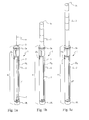
figures 1 a, 1 b, 1 c show an embodiment of the retractable mast according to the present invention, in three different positions; -
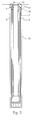
figure 2 is a schematic, sectional view of the embodiment of the retractable mast shown infigures 1 a, 1 b, 1 c ; -
figure 3 is a schematic, enlarged, sectional view of the upper portion of an embodiment of the retractable mast according to the present invention; -
figure 4a is a lateral, schematic view of an embodiment of the sliding element according to the present invention; -
figure 4b is a schematic, sectional view of the sliding element according to the present invention, offigure 4a ; and -
figure 4c is a top, schematic view of the sliding element according to the present invention, offigure 4a . - With reference to
figures 1-4 , a retractable mast for barriers according to the present invention is identified with thenumeral reference 1. - The
retractable mast 1 for barriers according to the present invention has: - at least one
fixed element 2 having anupper end 2s and a lower end 2i, - at least one sliding
element 3, having anupper part 3s and alower part 3i. - The fixed
element 2 extends along a longitudinal axis a, for a total extension E. - The fixed
element 2 and the slidingelement 3 are coupled in such a way that the slidingelement 3 can translate inside the fixedelement 2 along the longitudinal axis a, from a first position p1, shown infigure 1 , in which it is housed in the fixedelement 2, to a second position p2, shown infigure 1 c , in which it is extracted from the fixedelement 2. - Preferably, in the first position p1 the sliding
element 3 is housed in the fixedelement 2, for a portion equal to at least 70% of its total extension E. Still more preferably, as shown inFig.1 a , in the first position p1 the slidingelement 3 is completely housed in the fixedelement 2 in order not to protrude with respect to the latter. - On the contrary, in the second position p2 the sliding element protrudes with respect to the fixed
element 2 for a portion equal at least to 50% of its total extension E. - More preferably, as shown in
Fig.1c , in the second position p2 the slidingelement 3 axially protrudes with respect to the fixedelement 2 for a portion equal at least to 80% of its total extension. - In order to guarantee the sliding of the sliding
element 3 with respect to the fixedelement 2, the latter has at least onegroove 5, and the slidingelement 3 has at least aguide pin 7, cooperating with thegroove 5. - According to an embodiment, the
groove 5 has at least two branches D1, D2, one branch D2 of the two branches D1, D2 being shorter than the other branch D1. - The different extension of the two branches D1 and D2 permits to fix the sliding element in a first position p1 and in a second position p2.
- In detail, when the
guide pin 7 engages with the branch D2 and rests on its bottom as infig.1a , the slidingelement 3 is in the first position p1, and alternatively when theguide pin 7 is rotated and engages with thebranch 2 and rests on its bottom, the slidingelement 3 is in the second position p2. - The fixed
element 2, as it is better shown infigure 2 , is also placed with respect to the slidingelement 3, in order to form a gap between the two elements, substantially for the entire extension E of the fixedelement 2. - The gap I is defined by an average radial distance R between the
fixed element 2 and the slidingelement 3, in particular between the inner surface of the fixedelement 2 and the outer surface of the slidingelement 3. - For the aim of the present invention, as the average radial distance R between the
fixed element 2 and the slidingelement 3, the arithmetic distance must be understood between the inner surface of the fixedelement 2 and the outer surface of the slidingelement 3 when varying the extension of the fixed element in a position p1, each distance being measured in a plane orthogonal to the axis a. - According to an advantageous aspect of the present invention, the average radial distance R is less than 5 mm and the
retractable mast 1 has at least onesealing device 15 interposed between thefixed element 2 and the slidingelement 3. - Preferably, the average radial distance R is less to 2 mm.
- According to a preferred embodiment, the fixed
element 2 and the slidingelement 3 have a cross-section, transversal to the substantially circumferential axis a and the gap has a cross-section substantially with a circumferential ring. - As better shown in
figure 3 , the slidingelement 3 has at its upper flaredpart 3s a first flaredportion 16, able to cooperate with a second flaredportion 17 corresponding to the fixedelement 2, at the first position p1. - A similar choice permits a good blocking of the sliding and fixed elements in the lowered position, in particular when the sliding element is completely housed in the fixed element. At the same time, a perfect levelling of the mast with the ground is obtained.
- In particular, in the aforementioned first position p1 the first flared
portion 16 can cooperate with the second flaredportion 17, so that the average radial distance R of such length is less than 1,5 mm and so consistently reduces the possibility of liquids entering into the gap I. - In the embodiment shown in
figures 2 and4 , the slidingelement 3 has at least oneportion 18 with a widened lateral portion, at itslower part 3i. - The
portion 18 with the widened lateral portion permits to block the extraction of the slidingelement 3 with respect to the fixed one 2, in particular when the first one has reached the first position p1 shown infigure 1 c. - This choice permits to further reduce the space between the sliding element and the fixed element, so assuring a safe blocking of the sliding element in the extracted position.
- Advantageously, at said at least one
portion 18 with a widened transversal section, said average radial distance R is less than 1 mm. - Such a choice permits to reduce the possibility of liquids entering into the gap I, also when the sliding element is in the second position p2.
- Preferably, the
portion 18 with a widened transversal section is placed at approximately 1/5 of the total extension L of the slidingelement 3, starting from itslower end 3i. - In the embodiment shown in the figures, the sliding
element 3 has asecond portion 19 with a widened transversal portion, spaced from theportion 18 and placed at itslower end 3i. - Apart from the flared
portion 16 and theportions element 3 has a substantially constant section. - According to an advantageous aspect of the present invention, in order to permit the exit of air during the sliding of the sliding
element 3 from the second position p2 to the first position p1, and consequently a smooth mutual sliding of the twoelements element 3 has at least onerelief valve 20. - Preferably, the
relief valve 20 is placed in the upper part of the slidingelement 3, for up to 50% of its total extension L. - As can be seen in
figure 3 , therelief valve 20 connects the inside of the slidingelement 3 with the gap I whereas aduct 21, provided on the fixedelement 2 connects the gap I with the outside of the fixedelement 2. - As mentioned above, at the
upper end 3s of the fixedelement 2, the sealingdevice 15 is provided. - According to an embodiment shown in the figures, the sealing
device 15 has at least two sealingelements 15', 15" placed at theupper end 3s of the fixedelement 2 and axially spaced in the direction of the longitudinal axis a. - The sealing
elements 15',15" made of a waterproof material seal the gap I between thefixed element 2 and the slidingelement 3, while permitting the sliding of theelement 3 with respect to the fixedelement 2. - Preferably, the sealing
elements 15', 15" have an annular extension around the slidingelement 3 and are concentrically placed and axially spaced along the axis a of the fixedelement 2. - For such a purpose, the fixed
element 2 has at least twohousings 22', 22" for the two sealingelements 15', 15" - Also the two
housings 22', 22" are spaced and placed along the axis a. - The two
housings 22', 22" face the gap I between thefixed element 2 and the slidingelement 3. - In the embodiment shown in the figures, the fixed
element 2 has at least oneexternal coating element 23, made of plastic, able to isolate and protect the fixedelement 2 from water or other liquids. - This permits to further protect the mast from external agents, and so it can be used for any type of ground.
- The
external coating element 23 has a cylindrical extension, but preferably it does not extend along the entirefixed element 2, but only of one portion of same, for example approximately 90% of its total extension E. - In this case, the
retractable mast 1 has asecond sealing device 24 interposed between saidexternal coating element 23 and saidfixed element 2. - The
second sealing element 24 is placed at the upper interface between theexternal coating element 23 and the fixedelement 2. - According to another advantageous aspect of the present invention, as it is better shown in
figures 4b,4c the slidingelement 3 has ahandle 25 at itsupper portion 3s and in particular at the upper end of the latter. - The handle can be grasped manually, in order to translate the sliding
element 3 with respect to the fixedelement 2. - The
handle 25 can rotate between a closed position in which it disappears in a cavity made in theupper portion 3s of the slidingelement 3, and an extracted position in which it substantially arises parallel to the axis a. - In the embodiment shown in the figures, the
upper portion 3 of the fixedelement 3 is made of twobodies thread 28. - A sealing
element 29 is placed between thebodies - The present invention has been described with reference to some embodiments. Various changes can be made to the embodiments described in detail, while remaining in the protective field of the invention, defined by the following claims.
said fixed element having at least one groove and said sliding element having at least one guide pin cooperating with said groove, wherein said groove has at least two branches, one of the two being shorter than the other one,
characterized in that
Claims (13)
- A retractable mast (1) for barriers comprising:- at least one fixed element (2), having an upper end (2s) and a lower end (2i), said fixed element (2) extending along a longitudinal axis (a) for a total extension (E);- at least one sliding element (3) having an upper portion (3s) and a lower portion (3i), said sliding element (3) extending along said longitudinal axis (a) for a total extension (L);- at least one gap (I) between the fixed element (2) and the sliding element (3); said gap (I) being defined by a radial distance (R), perpendicularly measured with respect to said longitudinal axis (a),
said fixed element (2) and said sliding element (3) being coupled in such a way that the sliding element (3) can be translated in the fixed element (2) along said longitudinal axis (a), from a first position (p1), in which it is housed in the fixed element (2), for a portion of at least 70% of its total extension (E), and a second position (p2), in which it is extracted from the fixed element (2), for a portion of at least 50% of its total extension (E);
said fixed element (2) having at least one groove (5) and said sliding element (3) having at least one guide pin (7) cooperating with said groove (5), wherein said groove (5) has at least two branches (D1, D2), one (D2) of the two branches (D1, D2) being shorter than the other one (D1),
characterized in that- the retractable mast (1) has at least one sealing device (15), interposed between the fixed element (2) and the sliding element (3); and- the average radial distance (R) is less than 5 mm. - The retractable mast (1) for barriers according to claim 1, characterized in that said average radial distance (R) is less than 2 mm.
- The retractable mast (1) for barriers according to claim 1 or 2, characterized in that said sliding element (3) has at least one relief valve (20), permitting the air exit during the sliding of said sliding element (3) from said second position (p2) to said first position (p1).
- The retractable mast according to claim 3, characterized in that said fixed element (2) has a duct (21), connecting the gap (I) with the outside of said fixed element (2).
- The retractable mast according to claim 3 or 4, characterized in that said relief valve (20) is placed in the upper part (3s) of the sliding element (3), more than 50% of its total extension (L).
- The retractable mast according to one of preceding claims, characterized in that said sealing device (15) has at least two sealing elements (15', 15"), substantially placed at the upper end (2s) of said fixed element (2) and axially spaced towards the longitudinal axis (a).
- The retractable mast according to claim 6, characterized in that said fixed element (2) has at least two housings (22', 22") for said at least two sealing elements (15', 15").
- The retractable mast according to any of preceding claims, characterized in that said sliding element (3) has at least one portion (18, 19) with a widened cross-section, placed in its lower part.
- The retractable mast according to claim 8, characterized in that at said at least one portion (18, 19) with a widened cross-section, said radial distance (R) being less than 1 mm.
- The retractable mast according to one of preceding claims, characterized in that said sliding element (3) has, at its upper part (3s), a first flared portion (16), able to cooperate with a second flared portion (16), corresponding to the fixed element (2) in said first position (p1), said radial distance (S) being less than 1,5 mm.
- The retractable mast according to one of preceding claims, characterized in that said fixed element (2) has at least one external coating element (23).
- The retractable mast according to claim 11, characterized in that said retractable mast (1) has a second sealing device (24), interposed between said external coating (23) and said fixed element (2).
- The retractable mast according to one of preceding claims, characterized in that said sliding element (3) has a handle (25) at its upper end (3s), able to be manually grasped, in order to translate said sliding element (3) with respect to said fixed element (2).
Applications Claiming Priority (1)
| Application Number | Priority Date | Filing Date | Title |
|---|---|---|---|
| CH01855/10A CH704056B1 (en) | 2010-11-05 | 2010-11-05 | Palo hideaway for dam. |
Publications (3)
| Publication Number | Publication Date |
|---|---|
| EP2450488A2 true EP2450488A2 (en) | 2012-05-09 |
| EP2450488A3 EP2450488A3 (en) | 2016-08-31 |
| EP2450488B1 EP2450488B1 (en) | 2021-07-07 |
Family
ID=45218613
Family Applications (1)
| Application Number | Title | Priority Date | Filing Date |
|---|---|---|---|
| EP11405351.5A Active EP2450488B1 (en) | 2010-11-05 | 2011-11-03 | Retractable mast for barriers |
Country Status (2)
| Country | Link |
|---|---|
| EP (1) | EP2450488B1 (en) |
| CH (1) | CH704056B1 (en) |
Cited By (2)
| Publication number | Priority date | Publication date | Assignee | Title |
|---|---|---|---|---|
| NL2008940C2 (en) * | 2012-06-05 | 2013-12-09 | Vcp Streetcare B V | SAIL SYSTEM AND PILLAR. |
| JP2015151812A (en) * | 2014-02-18 | 2015-08-24 | 株式会社大畠製作所 | Parking pole |
Citations (2)
| Publication number | Priority date | Publication date | Assignee | Title |
|---|---|---|---|---|
| GB2210091A (en) | 1987-09-21 | 1989-06-01 | Eric Claud Bailey | Traffic bollard |
| US6345930B1 (en) | 2000-03-30 | 2002-02-12 | Parvis Mohassel | Manually operable retractable bollard |
Family Cites Families (16)
| Publication number | Priority date | Publication date | Assignee | Title |
|---|---|---|---|---|
| US3086430A (en) * | 1959-01-28 | 1963-04-23 | David T Emmel | Traffic control equipment |
| FR1335604A (en) * | 1962-07-11 | 1963-08-23 | Telescopic mast | |
| CA2088513C (en) * | 1990-08-06 | 2001-04-03 | David H. Roper | Pop-up traffic control device |
| US5481828A (en) * | 1994-10-03 | 1996-01-09 | Kentrotas; Andreas | Security post for automobiles |
| US5683176A (en) * | 1995-04-07 | 1997-11-04 | Clendenin; Patrick B. | Retractable lighting assembly |
| DE19643815C1 (en) * | 1996-10-30 | 1997-11-20 | Butting H Gmbh & Co Kg | Device for selectively blocking communication surfaces |
| GB2323617A (en) * | 1997-03-04 | 1998-09-30 | Graphic Precision Engineering | Telescopic Post |
| DE29901108U1 (en) * | 1999-01-23 | 1999-10-14 | Schroif, Heinz, Dipl.-Designer, 52076 Aachen | Retractable bollard |
| GB2346640B (en) * | 1999-02-10 | 2003-05-21 | George James Wyers | Extendible posts |
| US6626606B1 (en) * | 2000-08-04 | 2003-09-30 | National Sign & Signal Co. | Retractable pylon arrangement |
| US7101112B2 (en) * | 2004-04-27 | 2006-09-05 | Robert Burns | Security barrier |
| NL1028889C1 (en) * | 2005-04-28 | 2006-10-31 | Producon C V | Track for moving e.g. carts in bakery, has rails held in place by pins which can be twisted to sink them into floor |
| US7244075B2 (en) * | 2005-08-04 | 2007-07-17 | Stadler David M | Telescoping bollard with screw drive |
| US7367746B2 (en) * | 2005-09-28 | 2008-05-06 | Koei Industry Co., Ltd. | Lifting pole apparatus for traffic control |
| US7481599B2 (en) * | 2006-05-04 | 2009-01-27 | Stice David L | Bollard type barrier assembly |
| CH700820B1 (en) * | 2007-06-01 | 2010-10-29 | Luca Rogantini | Retractable post. |
-
2010
- 2010-11-05 CH CH01855/10A patent/CH704056B1/en not_active IP Right Cessation
-
2011
- 2011-11-03 EP EP11405351.5A patent/EP2450488B1/en active Active
Patent Citations (2)
| Publication number | Priority date | Publication date | Assignee | Title |
|---|---|---|---|---|
| GB2210091A (en) | 1987-09-21 | 1989-06-01 | Eric Claud Bailey | Traffic bollard |
| US6345930B1 (en) | 2000-03-30 | 2002-02-12 | Parvis Mohassel | Manually operable retractable bollard |
Cited By (2)
| Publication number | Priority date | Publication date | Assignee | Title |
|---|---|---|---|---|
| NL2008940C2 (en) * | 2012-06-05 | 2013-12-09 | Vcp Streetcare B V | SAIL SYSTEM AND PILLAR. |
| JP2015151812A (en) * | 2014-02-18 | 2015-08-24 | 株式会社大畠製作所 | Parking pole |
Also Published As
| Publication number | Publication date |
|---|---|
| EP2450488B1 (en) | 2021-07-07 |
| CH704056B1 (en) | 2014-07-15 |
| CH704056A1 (en) | 2012-05-15 |
| EP2450488A3 (en) | 2016-08-31 |
Similar Documents
| Publication | Publication Date | Title |
|---|---|---|
| ES2688735T3 (en) | Pile, pile head and associated connector | |
| EP2450488B1 (en) | Retractable mast for barriers | |
| AU2012202022A1 (en) | Modular Pedestrian Tunnel | |
| CA2228729A1 (en) | Extendible safety posts for manhole ladders | |
| KR20060118991A (en) | Stretch street light | |
| ES2266109T3 (en) | DRILL MASTIL WITH SCREW OF MOBILE AND FIXED SCREW BANK. | |
| EP2775057A1 (en) | Barrier section and barrier including the barrier section. | |
| KR100801918B1 (en) | Pagora Facilities | |
| CN109057511B (en) | Outdoor wind-resistant equipment | |
| KR101121054B1 (en) | Round logs within reinforcement pipe | |
| US20090120014A1 (en) | Disappearing Building | |
| US20040134146A1 (en) | Protective sleeve for posts | |
| US6374550B1 (en) | Rigid dwelling house, a swimming pool, and means to move the house atop the pool | |
| KR200392021Y1 (en) | Expantion and contraction type of lamppost | |
| ES2795001T3 (en) | Pool cover system | |
| US20020073486A1 (en) | Below-deck solar blanket roller assembly | |
| CN211421155U (en) | Pile foundation auxiliary table for civil engineering | |
| KR101640347B1 (en) | Reinforcement structure and street light or telephone pole pillar | |
| CN203213703U (en) | Fence rod for overhauling fence of electrical equipment | |
| ES2361082T3 (en) | RETRACTABLE POST. | |
| US1829503A (en) | Hangar for dirigibles | |
| CN207260657U (en) | A kind of construction site Moveable distribution box canopy | |
| US10256617B1 (en) | Handhole assembly | |
| CN204876661U (en) | Combination formula body -building device of integrated sunshade rain facility | |
| CN217735072U (en) | Gardens guardrail with adjustable |
Legal Events
| Date | Code | Title | Description |
|---|---|---|---|
| PUAI | Public reference made under article 153(3) epc to a published international application that has entered the european phase |
Free format text: ORIGINAL CODE: 0009012 |
|
| AK | Designated contracting states |
Kind code of ref document: A2 Designated state(s): AL AT BE BG CH CY CZ DE DK EE ES FI FR GB GR HR HU IE IS IT LI LT LU LV MC MK MT NL NO PL PT RO RS SE SI SK SM TR |
|
| AX | Request for extension of the european patent |
Extension state: BA ME |
|
| PUAL | Search report despatched |
Free format text: ORIGINAL CODE: 0009013 |
|
| AK | Designated contracting states |
Kind code of ref document: A3 Designated state(s): AL AT BE BG CH CY CZ DE DK EE ES FI FR GB GR HR HU IE IS IT LI LT LU LV MC MK MT NL NO PL PT RO RS SE SI SK SM TR |
|
| AX | Request for extension of the european patent |
Extension state: BA ME |
|
| RIC1 | Information provided on ipc code assigned before grant |
Ipc: E01F 13/04 20060101AFI20160728BHEP |
|
| STAA | Information on the status of an ep patent application or granted ep patent |
Free format text: STATUS: REQUEST FOR EXAMINATION WAS MADE |
|
| 17P | Request for examination filed |
Effective date: 20170227 |
|
| RAX | Requested extension states of the european patent have changed |
Extension state: ME Payment date: 20170227 Extension state: BA Payment date: 20170227 |
|
| RBV | Designated contracting states (corrected) |
Designated state(s): AL AT BE BG CH CY CZ DE DK EE ES FI FR GB GR HR HU IE IS IT LI LT LU LV MC MK MT NL NO PL PT RO RS SE SI SK SM TR |
|
| STAA | Information on the status of an ep patent application or granted ep patent |
Free format text: STATUS: EXAMINATION IS IN PROGRESS |
|
| 17Q | First examination report despatched |
Effective date: 20171211 |
|
| GRAP | Despatch of communication of intention to grant a patent |
Free format text: ORIGINAL CODE: EPIDOSNIGR1 |
|
| STAA | Information on the status of an ep patent application or granted ep patent |
Free format text: STATUS: GRANT OF PATENT IS INTENDED |
|
| INTG | Intention to grant announced |
Effective date: 20201022 |
|
| GRAS | Grant fee paid |
Free format text: ORIGINAL CODE: EPIDOSNIGR3 |
|
| GRAA | (expected) grant |
Free format text: ORIGINAL CODE: 0009210 |
|
| STAA | Information on the status of an ep patent application or granted ep patent |
Free format text: STATUS: THE PATENT HAS BEEN GRANTED |
|
| AK | Designated contracting states |
Kind code of ref document: B1 Designated state(s): AL AT BE BG CH CY CZ DE DK EE ES FI FR GB GR HR HU IE IS IT LI LT LU LV MC MK MT NL NO PL PT RO RS SE SI SK SM TR |
|
| REG | Reference to a national code |
Ref country code: GB Ref legal event code: FG4D |
|
| REG | Reference to a national code |
Ref country code: AT Ref legal event code: REF Ref document number: 1408722 Country of ref document: AT Kind code of ref document: T Effective date: 20210715 |
|
| REG | Reference to a national code |
Ref country code: DE Ref legal event code: R096 Ref document number: 602011071320 Country of ref document: DE |
|
| REG | Reference to a national code |
Ref country code: IE Ref legal event code: FG4D |
|
| REG | Reference to a national code |
Ref country code: LT Ref legal event code: MG9D |
|
| REG | Reference to a national code |
Ref country code: NL Ref legal event code: FP |
|
| REG | Reference to a national code |
Ref country code: AT Ref legal event code: MK05 Ref document number: 1408722 Country of ref document: AT Kind code of ref document: T Effective date: 20210707 |
|
| PG25 | Lapsed in a contracting state [announced via postgrant information from national office to epo] |
Ref country code: NO Free format text: LAPSE BECAUSE OF FAILURE TO SUBMIT A TRANSLATION OF THE DESCRIPTION OR TO PAY THE FEE WITHIN THE PRESCRIBED TIME-LIMIT Effective date: 20211007 Ref country code: PT Free format text: LAPSE BECAUSE OF FAILURE TO SUBMIT A TRANSLATION OF THE DESCRIPTION OR TO PAY THE FEE WITHIN THE PRESCRIBED TIME-LIMIT Effective date: 20211108 Ref country code: RS Free format text: LAPSE BECAUSE OF FAILURE TO SUBMIT A TRANSLATION OF THE DESCRIPTION OR TO PAY THE FEE WITHIN THE PRESCRIBED TIME-LIMIT Effective date: 20210707 Ref country code: FI Free format text: LAPSE BECAUSE OF FAILURE TO SUBMIT A TRANSLATION OF THE DESCRIPTION OR TO PAY THE FEE WITHIN THE PRESCRIBED TIME-LIMIT Effective date: 20210707 Ref country code: ES Free format text: LAPSE BECAUSE OF FAILURE TO SUBMIT A TRANSLATION OF THE DESCRIPTION OR TO PAY THE FEE WITHIN THE PRESCRIBED TIME-LIMIT Effective date: 20210707 Ref country code: LT Free format text: LAPSE BECAUSE OF FAILURE TO SUBMIT A TRANSLATION OF THE DESCRIPTION OR TO PAY THE FEE WITHIN THE PRESCRIBED TIME-LIMIT Effective date: 20210707 Ref country code: BG Free format text: LAPSE BECAUSE OF FAILURE TO SUBMIT A TRANSLATION OF THE DESCRIPTION OR TO PAY THE FEE WITHIN THE PRESCRIBED TIME-LIMIT Effective date: 20211007 Ref country code: AT Free format text: LAPSE BECAUSE OF FAILURE TO SUBMIT A TRANSLATION OF THE DESCRIPTION OR TO PAY THE FEE WITHIN THE PRESCRIBED TIME-LIMIT Effective date: 20210707 Ref country code: HR Free format text: LAPSE BECAUSE OF FAILURE TO SUBMIT A TRANSLATION OF THE DESCRIPTION OR TO PAY THE FEE WITHIN THE PRESCRIBED TIME-LIMIT Effective date: 20210707 Ref country code: SE Free format text: LAPSE BECAUSE OF FAILURE TO SUBMIT A TRANSLATION OF THE DESCRIPTION OR TO PAY THE FEE WITHIN THE PRESCRIBED TIME-LIMIT Effective date: 20210707 |
|
| PGFP | Annual fee paid to national office [announced via postgrant information from national office to epo] |
Ref country code: DE Payment date: 20211005 Year of fee payment: 11 |
|
| PG25 | Lapsed in a contracting state [announced via postgrant information from national office to epo] |
Ref country code: PL Free format text: LAPSE BECAUSE OF FAILURE TO SUBMIT A TRANSLATION OF THE DESCRIPTION OR TO PAY THE FEE WITHIN THE PRESCRIBED TIME-LIMIT Effective date: 20210707 Ref country code: LV Free format text: LAPSE BECAUSE OF FAILURE TO SUBMIT A TRANSLATION OF THE DESCRIPTION OR TO PAY THE FEE WITHIN THE PRESCRIBED TIME-LIMIT Effective date: 20210707 Ref country code: GR Free format text: LAPSE BECAUSE OF FAILURE TO SUBMIT A TRANSLATION OF THE DESCRIPTION OR TO PAY THE FEE WITHIN THE PRESCRIBED TIME-LIMIT Effective date: 20211008 |
|
| REG | Reference to a national code |
Ref country code: DE Ref legal event code: R097 Ref document number: 602011071320 Country of ref document: DE |
|
| PG25 | Lapsed in a contracting state [announced via postgrant information from national office to epo] |
Ref country code: DK Free format text: LAPSE BECAUSE OF FAILURE TO SUBMIT A TRANSLATION OF THE DESCRIPTION OR TO PAY THE FEE WITHIN THE PRESCRIBED TIME-LIMIT Effective date: 20210707 |
|
| PLBE | No opposition filed within time limit |
Free format text: ORIGINAL CODE: 0009261 |
|
| STAA | Information on the status of an ep patent application or granted ep patent |
Free format text: STATUS: NO OPPOSITION FILED WITHIN TIME LIMIT |
|
| PG25 | Lapsed in a contracting state [announced via postgrant information from national office to epo] |
Ref country code: SM Free format text: LAPSE BECAUSE OF FAILURE TO SUBMIT A TRANSLATION OF THE DESCRIPTION OR TO PAY THE FEE WITHIN THE PRESCRIBED TIME-LIMIT Effective date: 20210707 Ref country code: SK Free format text: LAPSE BECAUSE OF FAILURE TO SUBMIT A TRANSLATION OF THE DESCRIPTION OR TO PAY THE FEE WITHIN THE PRESCRIBED TIME-LIMIT Effective date: 20210707 Ref country code: RO Free format text: LAPSE BECAUSE OF FAILURE TO SUBMIT A TRANSLATION OF THE DESCRIPTION OR TO PAY THE FEE WITHIN THE PRESCRIBED TIME-LIMIT Effective date: 20210707 Ref country code: EE Free format text: LAPSE BECAUSE OF FAILURE TO SUBMIT A TRANSLATION OF THE DESCRIPTION OR TO PAY THE FEE WITHIN THE PRESCRIBED TIME-LIMIT Effective date: 20210707 Ref country code: CZ Free format text: LAPSE BECAUSE OF FAILURE TO SUBMIT A TRANSLATION OF THE DESCRIPTION OR TO PAY THE FEE WITHIN THE PRESCRIBED TIME-LIMIT Effective date: 20210707 Ref country code: AL Free format text: LAPSE BECAUSE OF FAILURE TO SUBMIT A TRANSLATION OF THE DESCRIPTION OR TO PAY THE FEE WITHIN THE PRESCRIBED TIME-LIMIT Effective date: 20210707 |
|
| 26N | No opposition filed |
Effective date: 20220408 |
|
| PG25 | Lapsed in a contracting state [announced via postgrant information from national office to epo] |
Ref country code: MC Free format text: LAPSE BECAUSE OF FAILURE TO SUBMIT A TRANSLATION OF THE DESCRIPTION OR TO PAY THE FEE WITHIN THE PRESCRIBED TIME-LIMIT Effective date: 20210707 |
|
| REG | Reference to a national code |
Ref country code: CH Ref legal event code: PL |
|
| REG | Reference to a national code |
Ref country code: NL Ref legal event code: MM Effective date: 20211201 |
|
| GBPC | Gb: european patent ceased through non-payment of renewal fee |
Effective date: 20211103 |
|
| PG25 | Lapsed in a contracting state [announced via postgrant information from national office to epo] |
Ref country code: LU Free format text: LAPSE BECAUSE OF NON-PAYMENT OF DUE FEES Effective date: 20211103 Ref country code: BE Free format text: LAPSE BECAUSE OF NON-PAYMENT OF DUE FEES Effective date: 20211130 |
|
| REG | Reference to a national code |
Ref country code: BE Ref legal event code: MM Effective date: 20211130 |
|
| PG25 | Lapsed in a contracting state [announced via postgrant information from national office to epo] |
Ref country code: NL Free format text: LAPSE BECAUSE OF NON-PAYMENT OF DUE FEES Effective date: 20211201 |
|
| PG25 | Lapsed in a contracting state [announced via postgrant information from national office to epo] |
Ref country code: IE Free format text: LAPSE BECAUSE OF NON-PAYMENT OF DUE FEES Effective date: 20211103 Ref country code: GB Free format text: LAPSE BECAUSE OF NON-PAYMENT OF DUE FEES Effective date: 20211103 |
|
| PG25 | Lapsed in a contracting state [announced via postgrant information from national office to epo] |
Ref country code: FR Free format text: LAPSE BECAUSE OF NON-PAYMENT OF DUE FEES Effective date: 20211130 |
|
| PG25 | Lapsed in a contracting state [announced via postgrant information from national office to epo] |
Ref country code: IT Free format text: LAPSE BECAUSE OF NON-PAYMENT OF DUE FEES Effective date: 20211103 |
|
| PG25 | Lapsed in a contracting state [announced via postgrant information from national office to epo] |
Ref country code: HU Free format text: LAPSE BECAUSE OF FAILURE TO SUBMIT A TRANSLATION OF THE DESCRIPTION OR TO PAY THE FEE WITHIN THE PRESCRIBED TIME-LIMIT; INVALID AB INITIO Effective date: 20111103 Ref country code: CY Free format text: LAPSE BECAUSE OF FAILURE TO SUBMIT A TRANSLATION OF THE DESCRIPTION OR TO PAY THE FEE WITHIN THE PRESCRIBED TIME-LIMIT Effective date: 20210707 |
|
| REG | Reference to a national code |
Ref country code: DE Ref legal event code: R119 Ref document number: 602011071320 Country of ref document: DE |
|
| PG25 | Lapsed in a contracting state [announced via postgrant information from national office to epo] |
Ref country code: LI Free format text: LAPSE BECAUSE OF NON-PAYMENT OF DUE FEES Effective date: 20220630 Ref country code: CH Free format text: LAPSE BECAUSE OF NON-PAYMENT OF DUE FEES Effective date: 20220630 |
|
| PG25 | Lapsed in a contracting state [announced via postgrant information from national office to epo] |
Ref country code: DE Free format text: LAPSE BECAUSE OF NON-PAYMENT OF DUE FEES Effective date: 20230601 |
|
| PG25 | Lapsed in a contracting state [announced via postgrant information from national office to epo] |
Ref country code: MK Free format text: LAPSE BECAUSE OF FAILURE TO SUBMIT A TRANSLATION OF THE DESCRIPTION OR TO PAY THE FEE WITHIN THE PRESCRIBED TIME-LIMIT Effective date: 20210707 |
|
| PG25 | Lapsed in a contracting state [announced via postgrant information from national office to epo] |
Ref country code: TR Free format text: LAPSE BECAUSE OF FAILURE TO SUBMIT A TRANSLATION OF THE DESCRIPTION OR TO PAY THE FEE WITHIN THE PRESCRIBED TIME-LIMIT Effective date: 20210707 |
|
| PG25 | Lapsed in a contracting state [announced via postgrant information from national office to epo] |
Ref country code: MT Free format text: LAPSE BECAUSE OF FAILURE TO SUBMIT A TRANSLATION OF THE DESCRIPTION OR TO PAY THE FEE WITHIN THE PRESCRIBED TIME-LIMIT Effective date: 20210707 |