EP2446087B1 - Method of producing a composite material using a mixing system - Google Patents
Method of producing a composite material using a mixing system Download PDFInfo
- Publication number
- EP2446087B1 EP2446087B1 EP10727729.5A EP10727729A EP2446087B1 EP 2446087 B1 EP2446087 B1 EP 2446087B1 EP 10727729 A EP10727729 A EP 10727729A EP 2446087 B1 EP2446087 B1 EP 2446087B1
- Authority
- EP
- European Patent Office
- Prior art keywords
- aggregate
- composite material
- vessel
- component
- channel
- Prior art date
- Legal status (The legal status is an assumption and is not a legal conclusion. Google has not performed a legal analysis and makes no representation as to the accuracy of the status listed.)
- Not-in-force
Links
- 239000002131 composite material Substances 0.000 title claims description 130
- 238000000034 method Methods 0.000 title claims description 56
- 239000000203 mixture Substances 0.000 claims description 88
- 239000011230 binding agent Substances 0.000 claims description 81
- 239000007795 chemical reaction product Substances 0.000 claims description 81
- 238000004891 communication Methods 0.000 claims description 27
- 239000012948 isocyanate Substances 0.000 claims description 20
- 150000002513 isocyanates Chemical group 0.000 claims description 19
- 239000011435 rock Substances 0.000 claims description 17
- 239000011521 glass Substances 0.000 claims description 15
- 239000012530 fluid Substances 0.000 claims description 13
- 150000001412 amines Chemical class 0.000 claims description 12
- 230000001419 dependent effect Effects 0.000 claims description 11
- 150000001298 alcohols Chemical class 0.000 claims description 10
- 229920000647 polyepoxide Polymers 0.000 claims description 7
- 239000003822 epoxy resin Substances 0.000 claims description 5
- 239000004848 polyfunctional curative Substances 0.000 claims description 4
- 229920002209 Crumb rubber Polymers 0.000 claims description 2
- 230000003068 static effect Effects 0.000 claims description 2
- 239000000853 adhesive Substances 0.000 description 21
- 230000001070 adhesive effect Effects 0.000 description 21
- 239000000654 additive Substances 0.000 description 19
- 230000000996 additive effect Effects 0.000 description 18
- -1 i.e. Substances 0.000 description 16
- 229920000768 polyamine Polymers 0.000 description 12
- 238000006243 chemical reaction Methods 0.000 description 11
- 239000000049 pigment Substances 0.000 description 11
- ISWSIDIOOBJBQZ-UHFFFAOYSA-N phenol group Chemical group C1(=CC=CC=C1)O ISWSIDIOOBJBQZ-UHFFFAOYSA-N 0.000 description 10
- 229920005862 polyol Polymers 0.000 description 10
- 150000003077 polyols Chemical class 0.000 description 10
- 239000003086 colorant Substances 0.000 description 9
- GWEVSGVZZGPLCZ-UHFFFAOYSA-N Titan oxide Chemical compound O=[Ti]=O GWEVSGVZZGPLCZ-UHFFFAOYSA-N 0.000 description 8
- LYCAIKOWRPUZTN-UHFFFAOYSA-N Ethylene glycol Chemical compound OCCO LYCAIKOWRPUZTN-UHFFFAOYSA-N 0.000 description 6
- WSFSSNUMVMOOMR-UHFFFAOYSA-N Formaldehyde Chemical compound O=C WSFSSNUMVMOOMR-UHFFFAOYSA-N 0.000 description 6
- PEDCQBHIVMGVHV-UHFFFAOYSA-N Glycerine Chemical compound OCC(O)CO PEDCQBHIVMGVHV-UHFFFAOYSA-N 0.000 description 6
- DNIAPMSPPWPWGF-UHFFFAOYSA-N Propylene glycol Chemical compound CC(O)CO DNIAPMSPPWPWGF-UHFFFAOYSA-N 0.000 description 6
- 239000003054 catalyst Substances 0.000 description 6
- MTHSVFCYNBDYFN-UHFFFAOYSA-N diethylene glycol Chemical compound OCCOCCO MTHSVFCYNBDYFN-UHFFFAOYSA-N 0.000 description 6
- 229920001971 elastomer Polymers 0.000 description 6
- 229920005989 resin Polymers 0.000 description 6
- 239000011347 resin Substances 0.000 description 6
- 239000000463 material Substances 0.000 description 5
- 239000004814 polyurethane Substances 0.000 description 5
- 229920002635 polyurethane Polymers 0.000 description 5
- 239000005060 rubber Substances 0.000 description 5
- HZAXFHJVJLSVMW-UHFFFAOYSA-N 2-Aminoethan-1-ol Chemical compound NCCO HZAXFHJVJLSVMW-UHFFFAOYSA-N 0.000 description 4
- 239000004593 Epoxy Substances 0.000 description 4
- GSEJCLTVZPLZKY-UHFFFAOYSA-N Triethanolamine Chemical compound OCCN(CCO)CCO GSEJCLTVZPLZKY-UHFFFAOYSA-N 0.000 description 4
- 150000001414 amino alcohols Chemical class 0.000 description 4
- 239000006229 carbon black Substances 0.000 description 4
- 238000010276 construction Methods 0.000 description 4
- 150000004985 diamines Chemical class 0.000 description 4
- 150000002009 diols Chemical class 0.000 description 4
- 229920000728 polyester Polymers 0.000 description 4
- 229920001228 polyisocyanate Polymers 0.000 description 4
- 239000005056 polyisocyanate Substances 0.000 description 4
- 229920001187 thermosetting polymer Polymers 0.000 description 4
- 239000004408 titanium dioxide Substances 0.000 description 4
- 229920000265 Polyparaphenylene Polymers 0.000 description 3
- HIFVAOIJYDXIJG-UHFFFAOYSA-N benzylbenzene;isocyanic acid Chemical class N=C=O.N=C=O.C=1C=CC=CC=1CC1=CC=CC=C1 HIFVAOIJYDXIJG-UHFFFAOYSA-N 0.000 description 3
- 239000011248 coating agent Substances 0.000 description 3
- 238000000576 coating method Methods 0.000 description 3
- ZBCBWPMODOFKDW-UHFFFAOYSA-N diethanolamine Chemical compound OCCNCCO ZBCBWPMODOFKDW-UHFFFAOYSA-N 0.000 description 3
- 125000003700 epoxy group Chemical group 0.000 description 3
- 239000000835 fiber Substances 0.000 description 3
- LNEPOXFFQSENCJ-UHFFFAOYSA-N haloperidol Chemical compound C1CC(O)(C=2C=CC(Cl)=CC=2)CCN1CCCC(=O)C1=CC=C(F)C=C1 LNEPOXFFQSENCJ-UHFFFAOYSA-N 0.000 description 3
- 125000002887 hydroxy group Chemical group [H]O* 0.000 description 3
- 238000004519 manufacturing process Methods 0.000 description 3
- 230000007246 mechanism Effects 0.000 description 3
- 239000004576 sand Substances 0.000 description 3
- VILCJCGEZXAXTO-UHFFFAOYSA-N 2,2,2-tetramine Chemical compound NCCNCCNCCN VILCJCGEZXAXTO-UHFFFAOYSA-N 0.000 description 2
- VOZKAJLKRJDJLL-UHFFFAOYSA-N 2,4-diaminotoluene Chemical compound CC1=CC=C(N)C=C1N VOZKAJLKRJDJLL-UHFFFAOYSA-N 0.000 description 2
- FBPFZTCFMRRESA-FSIIMWSLSA-N D-Glucitol Natural products OC[C@H](O)[C@H](O)[C@@H](O)[C@H](O)CO FBPFZTCFMRRESA-FSIIMWSLSA-N 0.000 description 2
- FBPFZTCFMRRESA-JGWLITMVSA-N D-glucitol Chemical compound OC[C@H](O)[C@@H](O)[C@H](O)[C@H](O)CO FBPFZTCFMRRESA-JGWLITMVSA-N 0.000 description 2
- PIICEJLVQHRZGT-UHFFFAOYSA-N Ethylenediamine Chemical compound NCCN PIICEJLVQHRZGT-UHFFFAOYSA-N 0.000 description 2
- XEEYBQQBJWHFJM-UHFFFAOYSA-N Iron Chemical compound [Fe] XEEYBQQBJWHFJM-UHFFFAOYSA-N 0.000 description 2
- 235000019738 Limestone Nutrition 0.000 description 2
- PPBRXRYQALVLMV-UHFFFAOYSA-N Styrene Chemical compound C=CC1=CC=CC=C1 PPBRXRYQALVLMV-UHFFFAOYSA-N 0.000 description 2
- ZJCCRDAZUWHFQH-UHFFFAOYSA-N Trimethylolpropane Chemical compound CCC(CO)(CO)CO ZJCCRDAZUWHFQH-UHFFFAOYSA-N 0.000 description 2
- 125000003277 amino group Chemical group 0.000 description 2
- 238000010923 batch production Methods 0.000 description 2
- KVBYPTUGEKVEIJ-UHFFFAOYSA-N benzene-1,3-diol;formaldehyde Chemical class O=C.OC1=CC=CC(O)=C1 KVBYPTUGEKVEIJ-UHFFFAOYSA-N 0.000 description 2
- CDQSJQSWAWPGKG-UHFFFAOYSA-N butane-1,1-diol Chemical compound CCCC(O)O CDQSJQSWAWPGKG-UHFFFAOYSA-N 0.000 description 2
- 239000004568 cement Substances 0.000 description 2
- 239000004567 concrete Substances 0.000 description 2
- ZZTCPWRAHWXWCH-UHFFFAOYSA-N diphenylmethanediamine Chemical compound C=1C=CC=CC=1C(N)(N)C1=CC=CC=C1 ZZTCPWRAHWXWCH-UHFFFAOYSA-N 0.000 description 2
- SZXQTJUDPRGNJN-UHFFFAOYSA-N dipropylene glycol Chemical compound OCCCOCCCO SZXQTJUDPRGNJN-UHFFFAOYSA-N 0.000 description 2
- 235000019256 formaldehyde Nutrition 0.000 description 2
- 239000010438 granite Substances 0.000 description 2
- 238000010438 heat treatment Methods 0.000 description 2
- 239000006028 limestone Substances 0.000 description 2
- 239000007788 liquid Substances 0.000 description 2
- 239000004579 marble Substances 0.000 description 2
- 238000012986 modification Methods 0.000 description 2
- 230000004048 modification Effects 0.000 description 2
- WXZMFSXDPGVJKK-UHFFFAOYSA-N pentaerythritol Chemical compound OCC(CO)(CO)CO WXZMFSXDPGVJKK-UHFFFAOYSA-N 0.000 description 2
- 150000002978 peroxides Chemical class 0.000 description 2
- 239000013034 phenoxy resin Substances 0.000 description 2
- 229920006287 phenoxy resin Polymers 0.000 description 2
- 230000000704 physical effect Effects 0.000 description 2
- 229920001084 poly(chloroprene) Polymers 0.000 description 2
- 239000000843 powder Substances 0.000 description 2
- 150000003141 primary amines Chemical class 0.000 description 2
- 230000008569 process Effects 0.000 description 2
- 239000002893 slag Substances 0.000 description 2
- 239000000600 sorbitol Substances 0.000 description 2
- DNIAPMSPPWPWGF-GSVOUGTGSA-N (R)-(-)-Propylene glycol Chemical compound C[C@@H](O)CO DNIAPMSPPWPWGF-GSVOUGTGSA-N 0.000 description 1
- SMZOUWXMTYCWNB-UHFFFAOYSA-N 2-(2-methoxy-5-methylphenyl)ethanamine Chemical compound COC1=CC=C(C)C=C1CCN SMZOUWXMTYCWNB-UHFFFAOYSA-N 0.000 description 1
- NIXOWILDQLNWCW-UHFFFAOYSA-M Acrylate Chemical compound [O-]C(=O)C=C NIXOWILDQLNWCW-UHFFFAOYSA-M 0.000 description 1
- 239000004342 Benzoyl peroxide Substances 0.000 description 1
- OMPJBNCRMGITSC-UHFFFAOYSA-N Benzoylperoxide Chemical compound C=1C=CC=CC=1C(=O)OOC(=O)C1=CC=CC=C1 OMPJBNCRMGITSC-UHFFFAOYSA-N 0.000 description 1
- WVDDGKGOMKODPV-UHFFFAOYSA-N Benzyl alcohol Chemical compound OCC1=CC=CC=C1 WVDDGKGOMKODPV-UHFFFAOYSA-N 0.000 description 1
- 239000004970 Chain extender Substances 0.000 description 1
- RYGMFSIKBFXOCR-UHFFFAOYSA-N Copper Chemical compound [Cu] RYGMFSIKBFXOCR-UHFFFAOYSA-N 0.000 description 1
- 239000004971 Cross linker Substances 0.000 description 1
- BRLQWZUYTZBJKN-UHFFFAOYSA-N Epichlorohydrin Chemical compound ClCC1CO1 BRLQWZUYTZBJKN-UHFFFAOYSA-N 0.000 description 1
- LFQSCWFLJHTTHZ-UHFFFAOYSA-N Ethanol Chemical compound CCO LFQSCWFLJHTTHZ-UHFFFAOYSA-N 0.000 description 1
- CERQOIWHTDAKMF-UHFFFAOYSA-N Methacrylic acid Chemical compound CC(=C)C(O)=O CERQOIWHTDAKMF-UHFFFAOYSA-N 0.000 description 1
- WWEXBGFSEVKZNE-UHFFFAOYSA-N N=C=O.N=C=O.C1=CC=CC2=CC=CC=C21 Chemical class N=C=O.N=C=O.C1=CC=CC2=CC=CC=C21 WWEXBGFSEVKZNE-UHFFFAOYSA-N 0.000 description 1
- 239000004698 Polyethylene Substances 0.000 description 1
- 239000004642 Polyimide Substances 0.000 description 1
- 239000004721 Polyphenylene oxide Substances 0.000 description 1
- 229920002396 Polyurea Polymers 0.000 description 1
- 235000019484 Rapeseed oil Nutrition 0.000 description 1
- 108010073771 Soybean Proteins Proteins 0.000 description 1
- RTAQQCXQSZGOHL-UHFFFAOYSA-N Titanium Chemical compound [Ti] RTAQQCXQSZGOHL-UHFFFAOYSA-N 0.000 description 1
- 239000002253 acid Substances 0.000 description 1
- NIXOWILDQLNWCW-UHFFFAOYSA-N acrylic acid group Chemical group C(C=C)(=O)O NIXOWILDQLNWCW-UHFFFAOYSA-N 0.000 description 1
- 238000012644 addition polymerization Methods 0.000 description 1
- 125000001931 aliphatic group Chemical group 0.000 description 1
- 150000004982 aromatic amines Chemical class 0.000 description 1
- 230000004888 barrier function Effects 0.000 description 1
- 235000019400 benzoyl peroxide Nutrition 0.000 description 1
- 230000005540 biological transmission Effects 0.000 description 1
- 230000015572 biosynthetic process Effects 0.000 description 1
- IISBACLAFKSPIT-UHFFFAOYSA-N bisphenol A Chemical compound C=1C=C(O)C=CC=1C(C)(C)C1=CC=C(O)C=C1 IISBACLAFKSPIT-UHFFFAOYSA-N 0.000 description 1
- 235000013877 carbamide Nutrition 0.000 description 1
- 150000001718 carbodiimides Chemical class 0.000 description 1
- 235000019438 castor oil Nutrition 0.000 description 1
- 239000004359 castor oil Substances 0.000 description 1
- 229960001777 castor oil Drugs 0.000 description 1
- 238000007796 conventional method Methods 0.000 description 1
- 229910052802 copper Inorganic materials 0.000 description 1
- 239000010949 copper Substances 0.000 description 1
- 238000004132 cross linking Methods 0.000 description 1
- 230000003247 decreasing effect Effects 0.000 description 1
- 230000003111 delayed effect Effects 0.000 description 1
- 239000000975 dye Substances 0.000 description 1
- 239000000806 elastomer Substances 0.000 description 1
- 238000005516 engineering process Methods 0.000 description 1
- 230000003628 erosive effect Effects 0.000 description 1
- 239000000945 filler Substances 0.000 description 1
- 125000000524 functional group Chemical group 0.000 description 1
- ZEMPKEQAKRGZGQ-XOQCFJPHSA-N glycerol triricinoleate Natural products CCCCCC[C@@H](O)CC=CCCCCCCCC(=O)OC[C@@H](COC(=O)CCCCCCCC=CC[C@@H](O)CCCCCC)OC(=O)CCCCCCCC=CC[C@H](O)CCCCCC ZEMPKEQAKRGZGQ-XOQCFJPHSA-N 0.000 description 1
- RRAMGCGOFNQTLD-UHFFFAOYSA-N hexamethylene diisocyanate Chemical class O=C=NCCCCCCN=C=O RRAMGCGOFNQTLD-UHFFFAOYSA-N 0.000 description 1
- 150000003949 imides Chemical class 0.000 description 1
- 238000009439 industrial construction Methods 0.000 description 1
- 230000003993 interaction Effects 0.000 description 1
- 229910052742 iron Inorganic materials 0.000 description 1
- NIMLQBUJDJZYEJ-UHFFFAOYSA-N isophorone diisocyanate Chemical class CC1(C)CC(N=C=O)CC(C)(CN=C=O)C1 NIMLQBUJDJZYEJ-UHFFFAOYSA-N 0.000 description 1
- 230000000670 limiting effect Effects 0.000 description 1
- 229910052751 metal Inorganic materials 0.000 description 1
- 239000002184 metal Substances 0.000 description 1
- 239000000178 monomer Substances 0.000 description 1
- 238000000465 moulding Methods 0.000 description 1
- 229920001568 phenolic resin Polymers 0.000 description 1
- 239000005011 phenolic resin Substances 0.000 description 1
- 238000012643 polycondensation polymerization Methods 0.000 description 1
- 229920005906 polyester polyol Polymers 0.000 description 1
- 229920000570 polyether Polymers 0.000 description 1
- 229920000573 polyethylene Polymers 0.000 description 1
- 229920001721 polyimide Polymers 0.000 description 1
- 239000011148 porous material Substances 0.000 description 1
- 238000010526 radical polymerization reaction Methods 0.000 description 1
- 230000002829 reductive effect Effects 0.000 description 1
- 230000002787 reinforcement Effects 0.000 description 1
- 230000000717 retained effect Effects 0.000 description 1
- 150000003335 secondary amines Chemical class 0.000 description 1
- 229940001941 soy protein Drugs 0.000 description 1
- 235000012424 soybean oil Nutrition 0.000 description 1
- 239000003549 soybean oil Substances 0.000 description 1
- 241000894007 species Species 0.000 description 1
- 239000004575 stone Substances 0.000 description 1
- 239000000126 substance Substances 0.000 description 1
- 229920001169 thermoplastic Polymers 0.000 description 1
- 239000004416 thermosoftening plastic Substances 0.000 description 1
- 239000010936 titanium Substances 0.000 description 1
- 229910052719 titanium Inorganic materials 0.000 description 1
- DVKJHBMWWAPEIU-UHFFFAOYSA-N toluene 2,4-diisocyanate Chemical class CC1=CC=C(N=C=O)C=C1N=C=O DVKJHBMWWAPEIU-UHFFFAOYSA-N 0.000 description 1
- 239000012745 toughening agent Substances 0.000 description 1
- 230000032258 transport Effects 0.000 description 1
- 238000011144 upstream manufacturing Methods 0.000 description 1
- 150000003672 ureas Chemical class 0.000 description 1
- 125000000391 vinyl group Chemical group [H]C([*])=C([H])[H] 0.000 description 1
- 229920002554 vinyl polymer Polymers 0.000 description 1
- XLYOFNOQVPJJNP-UHFFFAOYSA-N water Substances O XLYOFNOQVPJJNP-UHFFFAOYSA-N 0.000 description 1
- 239000002023 wood Substances 0.000 description 1
Images
Classifications
-
- E—FIXED CONSTRUCTIONS
- E01—CONSTRUCTION OF ROADS, RAILWAYS, OR BRIDGES
- E01C—CONSTRUCTION OF, OR SURFACES FOR, ROADS, SPORTS GROUNDS, OR THE LIKE; MACHINES OR AUXILIARY TOOLS FOR CONSTRUCTION OR REPAIR
- E01C7/00—Coherent pavings made in situ
- E01C7/08—Coherent pavings made in situ made of road-metal and binders
- E01C7/30—Coherent pavings made in situ made of road-metal and binders of road-metal and other binders, e.g. synthetic material, i.e. resin
-
- C—CHEMISTRY; METALLURGY
- C04—CEMENTS; CONCRETE; ARTIFICIAL STONE; CERAMICS; REFRACTORIES
- C04B—LIME, MAGNESIA; SLAG; CEMENTS; COMPOSITIONS THEREOF, e.g. MORTARS, CONCRETE OR LIKE BUILDING MATERIALS; ARTIFICIAL STONE; CERAMICS; REFRACTORIES; TREATMENT OF NATURAL STONE
- C04B26/00—Compositions of mortars, concrete or artificial stone, containing only organic binders, e.g. polymer or resin concrete
- C04B26/02—Macromolecular compounds
- C04B26/10—Macromolecular compounds obtained otherwise than by reactions only involving carbon-to-carbon unsaturated bonds
- C04B26/14—Polyepoxides
-
- C—CHEMISTRY; METALLURGY
- C04—CEMENTS; CONCRETE; ARTIFICIAL STONE; CERAMICS; REFRACTORIES
- C04B—LIME, MAGNESIA; SLAG; CEMENTS; COMPOSITIONS THEREOF, e.g. MORTARS, CONCRETE OR LIKE BUILDING MATERIALS; ARTIFICIAL STONE; CERAMICS; REFRACTORIES; TREATMENT OF NATURAL STONE
- C04B14/00—Use of inorganic materials as fillers, e.g. pigments, for mortars, concrete or artificial stone; Treatment of inorganic materials specially adapted to enhance their filling properties in mortars, concrete or artificial stone
- C04B14/02—Granular materials, e.g. microballoons
- C04B14/04—Silica-rich materials; Silicates
-
- C—CHEMISTRY; METALLURGY
- C04—CEMENTS; CONCRETE; ARTIFICIAL STONE; CERAMICS; REFRACTORIES
- C04B—LIME, MAGNESIA; SLAG; CEMENTS; COMPOSITIONS THEREOF, e.g. MORTARS, CONCRETE OR LIKE BUILDING MATERIALS; ARTIFICIAL STONE; CERAMICS; REFRACTORIES; TREATMENT OF NATURAL STONE
- C04B18/00—Use of agglomerated or waste materials or refuse as fillers for mortars, concrete or artificial stone; Treatment of agglomerated or waste materials or refuse, specially adapted to enhance their filling properties in mortars, concrete or artificial stone
- C04B18/04—Waste materials; Refuse
- C04B18/18—Waste materials; Refuse organic
- C04B18/20—Waste materials; Refuse organic from macromolecular compounds
- C04B18/22—Rubber, e.g. ground waste tires
-
- C—CHEMISTRY; METALLURGY
- C04—CEMENTS; CONCRETE; ARTIFICIAL STONE; CERAMICS; REFRACTORIES
- C04B—LIME, MAGNESIA; SLAG; CEMENTS; COMPOSITIONS THEREOF, e.g. MORTARS, CONCRETE OR LIKE BUILDING MATERIALS; ARTIFICIAL STONE; CERAMICS; REFRACTORIES; TREATMENT OF NATURAL STONE
- C04B26/00—Compositions of mortars, concrete or artificial stone, containing only organic binders, e.g. polymer or resin concrete
- C04B26/02—Macromolecular compounds
- C04B26/10—Macromolecular compounds obtained otherwise than by reactions only involving carbon-to-carbon unsaturated bonds
- C04B26/16—Polyurethanes
-
- C—CHEMISTRY; METALLURGY
- C04—CEMENTS; CONCRETE; ARTIFICIAL STONE; CERAMICS; REFRACTORIES
- C04B—LIME, MAGNESIA; SLAG; CEMENTS; COMPOSITIONS THEREOF, e.g. MORTARS, CONCRETE OR LIKE BUILDING MATERIALS; ARTIFICIAL STONE; CERAMICS; REFRACTORIES; TREATMENT OF NATURAL STONE
- C04B26/00—Compositions of mortars, concrete or artificial stone, containing only organic binders, e.g. polymer or resin concrete
- C04B26/02—Macromolecular compounds
- C04B26/10—Macromolecular compounds obtained otherwise than by reactions only involving carbon-to-carbon unsaturated bonds
- C04B26/20—Polyamides
-
- E—FIXED CONSTRUCTIONS
- E01—CONSTRUCTION OF ROADS, RAILWAYS, OR BRIDGES
- E01C—CONSTRUCTION OF, OR SURFACES FOR, ROADS, SPORTS GROUNDS, OR THE LIKE; MACHINES OR AUXILIARY TOOLS FOR CONSTRUCTION OR REPAIR
- E01C19/00—Machines, tools or auxiliary devices for preparing or distributing paving materials, for working the placed materials, or for forming, consolidating, or finishing the paving
- E01C19/02—Machines, tools or auxiliary devices for preparing or distributing paving materials, for working the placed materials, or for forming, consolidating, or finishing the paving for preparing the materials
- E01C19/10—Apparatus or plants for premixing or precoating aggregate or fillers with non-hydraulic binders, e.g. with bitumen, with resins, i.e. producing mixtures or coating aggregates otherwise than by penetrating or surface dressing; Apparatus for premixing non-hydraulic mixtures prior to placing or for reconditioning salvaged non-hydraulic compositions
-
- E—FIXED CONSTRUCTIONS
- E01—CONSTRUCTION OF ROADS, RAILWAYS, OR BRIDGES
- E01C—CONSTRUCTION OF, OR SURFACES FOR, ROADS, SPORTS GROUNDS, OR THE LIKE; MACHINES OR AUXILIARY TOOLS FOR CONSTRUCTION OR REPAIR
- E01C19/00—Machines, tools or auxiliary devices for preparing or distributing paving materials, for working the placed materials, or for forming, consolidating, or finishing the paving
- E01C19/02—Machines, tools or auxiliary devices for preparing or distributing paving materials, for working the placed materials, or for forming, consolidating, or finishing the paving for preparing the materials
- E01C19/10—Apparatus or plants for premixing or precoating aggregate or fillers with non-hydraulic binders, e.g. with bitumen, with resins, i.e. producing mixtures or coating aggregates otherwise than by penetrating or surface dressing; Apparatus for premixing non-hydraulic mixtures prior to placing or for reconditioning salvaged non-hydraulic compositions
- E01C19/1013—Plant characterised by the mode of operation or the construction of the mixing apparatus; Mixing apparatus
-
- E—FIXED CONSTRUCTIONS
- E01—CONSTRUCTION OF ROADS, RAILWAYS, OR BRIDGES
- E01C—CONSTRUCTION OF, OR SURFACES FOR, ROADS, SPORTS GROUNDS, OR THE LIKE; MACHINES OR AUXILIARY TOOLS FOR CONSTRUCTION OR REPAIR
- E01C19/00—Machines, tools or auxiliary devices for preparing or distributing paving materials, for working the placed materials, or for forming, consolidating, or finishing the paving
- E01C19/02—Machines, tools or auxiliary devices for preparing or distributing paving materials, for working the placed materials, or for forming, consolidating, or finishing the paving for preparing the materials
- E01C19/10—Apparatus or plants for premixing or precoating aggregate or fillers with non-hydraulic binders, e.g. with bitumen, with resins, i.e. producing mixtures or coating aggregates otherwise than by penetrating or surface dressing; Apparatus for premixing non-hydraulic mixtures prior to placing or for reconditioning salvaged non-hydraulic compositions
- E01C19/1013—Plant characterised by the mode of operation or the construction of the mixing apparatus; Mixing apparatus
- E01C19/104—Mixing by means of movable members in a non-rotating mixing enclosure, e.g. stirrers
-
- E—FIXED CONSTRUCTIONS
- E01—CONSTRUCTION OF ROADS, RAILWAYS, OR BRIDGES
- E01C—CONSTRUCTION OF, OR SURFACES FOR, ROADS, SPORTS GROUNDS, OR THE LIKE; MACHINES OR AUXILIARY TOOLS FOR CONSTRUCTION OR REPAIR
- E01C19/00—Machines, tools or auxiliary devices for preparing or distributing paving materials, for working the placed materials, or for forming, consolidating, or finishing the paving
- E01C19/45—Portable apparatus for preparing, or for preparing and applying to the road, compound liquid binders, e.g. emulsified bitumen, fluxed asphalt
-
- E—FIXED CONSTRUCTIONS
- E01—CONSTRUCTION OF ROADS, RAILWAYS, OR BRIDGES
- E01C—CONSTRUCTION OF, OR SURFACES FOR, ROADS, SPORTS GROUNDS, OR THE LIKE; MACHINES OR AUXILIARY TOOLS FOR CONSTRUCTION OR REPAIR
- E01C19/00—Machines, tools or auxiliary devices for preparing or distributing paving materials, for working the placed materials, or for forming, consolidating, or finishing the paving
- E01C19/50—Removable forms or shutterings for road-building purposes; Devices or arrangements for forming individual paving elements, e.g. kerbs, in situ
-
- E—FIXED CONSTRUCTIONS
- E01—CONSTRUCTION OF ROADS, RAILWAYS, OR BRIDGES
- E01C—CONSTRUCTION OF, OR SURFACES FOR, ROADS, SPORTS GROUNDS, OR THE LIKE; MACHINES OR AUXILIARY TOOLS FOR CONSTRUCTION OR REPAIR
- E01C7/00—Coherent pavings made in situ
- E01C7/08—Coherent pavings made in situ made of road-metal and binders
- E01C7/18—Coherent pavings made in situ made of road-metal and binders of road-metal and bituminous binders
- E01C7/26—Coherent pavings made in situ made of road-metal and binders of road-metal and bituminous binders mixed with other materials, e.g. cement, rubber, leather, fibre
- E01C7/265—Coherent pavings made in situ made of road-metal and binders of road-metal and bituminous binders mixed with other materials, e.g. cement, rubber, leather, fibre with rubber or synthetic resin, e.g. with rubber aggregate, with synthetic resin binder
-
- C—CHEMISTRY; METALLURGY
- C04—CEMENTS; CONCRETE; ARTIFICIAL STONE; CERAMICS; REFRACTORIES
- C04B—LIME, MAGNESIA; SLAG; CEMENTS; COMPOSITIONS THEREOF, e.g. MORTARS, CONCRETE OR LIKE BUILDING MATERIALS; ARTIFICIAL STONE; CERAMICS; REFRACTORIES; TREATMENT OF NATURAL STONE
- C04B2111/00—Mortars, concrete or artificial stone or mixtures to prepare them, characterised by specific function, property or use
- C04B2111/00474—Uses not provided for elsewhere in C04B2111/00
- C04B2111/0075—Uses not provided for elsewhere in C04B2111/00 for road construction
-
- C—CHEMISTRY; METALLURGY
- C04—CEMENTS; CONCRETE; ARTIFICIAL STONE; CERAMICS; REFRACTORIES
- C04B—LIME, MAGNESIA; SLAG; CEMENTS; COMPOSITIONS THEREOF, e.g. MORTARS, CONCRETE OR LIKE BUILDING MATERIALS; ARTIFICIAL STONE; CERAMICS; REFRACTORIES; TREATMENT OF NATURAL STONE
- C04B2111/00—Mortars, concrete or artificial stone or mixtures to prepare them, characterised by specific function, property or use
- C04B2111/60—Flooring materials
Definitions
- the present invention generally relates to a method of onsite producing a composite material using a mixing system, specifically to a method of producing a composite material comprising at least one aggregate and the reaction product of a two-component polymeric binder composition.
- composite materials to form a paved structure, such as concrete pavement
- the composite material is produced by mixing at least one aggregate and at least one binder component together.
- the aggregate comprises sand and gravel
- the binder composition comprises cement and water.
- document WO/9500569 discloses the production of composite materials wherein the components of the binder are pre-mixed.
- the composite materials are used for open pore moldings for use in industrial construction.
- the composite materials WO95/00569 are not formed on site.
- Application US3272098 discloses a paving material. It discloses a mixing system for producing a composite material comprising an aggregate. The aggregate is mixed with a first and second component within the mixing system.
- the aggregate and binder composition can be tumbled in a batch mixer for several minutes until the aggregate is uniformly coated with the binder composition before it is set into place.
- a significant drawback of this process, commonly referred to as a batch process is reduced working time since the binder composition is already starting to react/cure while its in the batch mixer being tumbled with the aggregate. Also, producing a composite by the batch process limits the efficiency of installing the composite material to form the paved structure.
- a method as claimed in the appended claims of onsite producing a composite material using a mixing system comprises at least one aggregate and a reaction product of a two-component polymeric binder composition comprising a first component and a second component.
- a mixing system according to claim 17 is also disclosed.
- the mixing system includes an aggregate vessel for holding the aggregate.
- the mixing system also includes a first vessel for holding the first component and a second vessel for holding the second binder component independent from the first component.
- the mixing system further comprises a mixing apparatus in communication with the aggregate vessel and the first and second vessels for mixing the aggregate the first component, and the second component to produce the composite material.
- the method comprises the steps of providing the aggregate into the mixer of the mixing apparatus at a delivery rate and providing the first component and the second component into the mixer of the mixing apparatus.
- the method also comprises the steps of mixing the first and second components within the mixer of the mixing apparatus to produce the reaction product of the two-component polymeric binder composition.
- the method further comprises the step of applying the reaction product of the two-component polymeric binder composition to the aggregate within the mixing apparatus at an application rate to produce the composite material.
- the reaction product of the two-component polymeric binder composition applied to the aggregate within the mixing apparatus results in the aggregate being uniformly and consistently coated with the reaction product of the two-component polymeric binder composition.
- Uniform and consistent coating of the aggregate with the reaction product of the two-component polymeric binder composition imparts the composite material with excellent physical properties, such as increased compressive strength, increased flexural strength, and increased tensile strengths.
- the mixing system 20 comprises at least one aggregate and a reaction product of a two-component polymeric binder composition.
- the composite material is suitable for forming a paved structure, such as roads, sidewalks and patios. It is to be appreciated that the composite material is not limited to any particular use. For example, the composite material may also be used for hydraulic revetments, and any other types of barriers, such as to prevent erosion, and reduce sound transmission.
- the composite material has a compressive strength and a tensile strength.
- both the aggregate and the reaction product of the two-component polymeric binder composition impart compressive strength to the composite material.
- the reaction product of the two-component polymeric binder composition also provides adhesion between the aggregate and generally imparts tensile strength, and flexural strength to the composite material.
- the two-component polymeric binder composition is hereinafter referred to as the binder composition.
- aggregate is to be interpreted as referring to aggregate or aggregates in general and not to a single aggregate, nor is it to be construed to require more than one aggregate.
- aggregate is intended to encompass a broad category of materials that serves as reinforcement to the composite material, such as rock, glass, rubber crumb, etc.
- rock as used herein is intended to encompass all forms of rock, including, but not limited to, gravel, sand, etc. Additionally, the term rock as used herein is intended to encompass all species of rock, such as granite, limestone, marble, etc.
- the aggregate comprises rock.
- the rock is typically selected from the group of granite, limestone, marble, beach stone/river rock, pea gravel, iron slag, copper slag, sand and combinations thereof. However, it is to be appreciated that any type of rock can be used.
- the average diameter of the aggregate is typically of from about 0.001 to about 7, more typically of from about 0.1 to about 5, and most typically of from about 0.125 to about 3, inches.
- the aggregate comprises rubber crumb. It is to be appreciated that any type of rubber crumb can be used.
- the rubber crumb is typically present in an amount of from about 1 to about 100, and more typically of from about 5 to about 100, and most typically of from about 10 to 100 % by weight, based on 100 parts by weight of the aggregate present in the composite material.
- the average diameter of the aggregate is typically of from about 0.1 to about 3, more typically of from about 0.1 to about 2, and most typically of from about 0.1 to about 0.25, inches.
- Suitable grades of rubber crumb, for purposes of the present invention, are commercially available from Entech Inc., Crumb Rubber of White Pigeon, MI.
- the aggregate comprises glass and rock.
- Suitable rock for the purposes of the present invention, includes those described above.
- the glass is typically present in an amount of from about 1 to about 100, more typically from about 25 to about 100, and most typically from about 75 to about 100 % by weight, based on 100 parts by weight of the aggregate present in the composite material.
- the rock is typically present in an amount of from about 1 to about 100, more typically from about 10 to about 100, and most typically from about 10 to 25 % by weight, based on 100 parts by weight of the aggregate present in the composite material.
- the average diameter of the aggregate is typically of from about 0.001 to about 1.0, more typically from about 0.1 to about 0.5, and most typically from about 0.1 to about 0.3, inches.
- the glass may be post-consumer and/or recycled glass. When employed, the glass is typically crushed to meet the average diameter ranges as described above. For safety, the glass is typically tumbled for rounding sharp edges of the glass. Examples of suitable glass, for purposes of the present invention, are commercially available from Glass Plus, Inc. of Tomahawk, WI. It is to be appreciated that any type of glass may be used for purposes of the present invention.
- the binder composition comprises a first component and a second component.
- the binder composition may be referred to in the art as a 2K system.
- the first and second components are mixed to form the reaction product of the binder composition.
- reaction product as used herein is intended to encompass all stages of interaction and/or reaction between the first and second components, including reaction products of the first and second components, even when the reaction product contacts the aggregate to form the composite material. Generally, the reaction product begins to form when the first and second components come into contact with each other.
- the binder composition comprises the first and second components, and optionally, one or more additional components, e.g. an additive component.
- the binder composition can be a thermoset or thermosetting adhesive composition, such as a two-component or 2K adhesive.
- the binder composition is a thermoplastic adhesive composition.
- the reaction product is an elastomer.
- the first and second components when the first and second components are brought into contact with each other, such as by mixing the first and second components together, the first and second components begin to react to form the reaction product.
- the reaction product adheres the aggregate together. It is to be appreciated that the reaction product can begin to form over a period of time prior to introducing the aggregate. Typically, the aggregate is introduced before the reaction product reaches a final reaction (or final cure) state. It is also to be appreciated that the reaction between the first and second components may be delayed for some period of time after the first and second components are brought into contact with each other.
- reaction between the first and second components is commonly referred to in the art as a crosslink or crosslinking reaction, which generally results in build-up of molecular chains, i.e., molecular weight, in the reaction product to produce a crosslinked structure.
- Reaction of the first and second components can occur at various temperatures, such as room or ambient temperature, although heating may be applied to one or more of the components to trigger and/or accelerate reaction between the first and second components.
- application of heat accelerates reaction between the first and second components, and may impart stronger bonds and therefore increased cohesive strength within the reaction product.
- any type of adhesive system more typically any type of thermosetting adhesive system can be used as the binder composition.
- the reaction product can be any type of adhesive, more typically any type of thermosetting adhesive.
- suitable adhesive systems include, but are not limited to, adhesive systems that comprise: alcohols, such as diols and polyols; amines, such as diamines and polyamines; phenolic resins and/or phenolic-based components, such as phenoxy resins, phenolic formaldehyde (PF) resins, phenolic neoprene, and resorcinol formaldehydes (RF); polyester-based components, such as styrene polyesters and/or vinyl polyesters; imide-based components, such as polyimides; epoxy resins and/or epoxy-based components, such as epoxidized diols and polyols; and combinations thereof.
- alcohols such as diols and polyols
- amines such as diamines and polyamines
- the terminology adhesive systems generally includes instances where the first and second components are still separate from each other, as well as instances when the first and second components are in contact with each other but generally prior to reaction. As such, the terminology adhesive generally includes instances when the reaction product is forming or has completely formed.
- suitable adhesives i.e., reaction products
- suitable adhesives include polyurethanes, polyureas, polyurethane/ureas, epoxies, phenolic adhesives, polyesters, and combinations thereof.
- suitable adhesive compositions and adhesives are generally described as "adhesive binders" in U.S. Patent Publication Nos. 2009/0067924 and 2009/0067295, both to Kaul , the disclosures of which, as well as the disclosures of patents and publications referenced therein, are incorporated herein by reference in their entirety. Specific embodiments of the two-component polymeric binder compositions and reaction products thereof are described below.
- the reaction product is a polyurethane.
- the first component is an isocyanate component and the second component is an isocyanate-reactive component.
- the isocyanate component is typically a polyisocyanate having two or more isocyanate functional (NCO) groups.
- the isocyanate component typically has an average functionality of from about 1.5 to about 3, more typically from about 2 to about 2.8.
- Suitable polyisocyanates for purposes of the present invention include, but are not limited to, conventional aliphatic, cycloaliphatic, araliphatic and aromatic isocyanates.
- the isocyanate component is selected from the group of diphenylmethane diisocyanates (MDIs), polymeric diphenylmethane diisocyanates (PMDIs), and combinations thereof.
- MDIs diphenylmethane diisocyanates
- PMDIs polymeric diphenylmethane diisocyanates
- Polymeric diphenylmethane diisocyanates are also referred to in the art as polymethylene polyphenylene polyisocyanates.
- TDIs toluene diisocyanates
- HDIs hexamethylene diisocyanates
- IPDIs isophorone diisocyanates
- NDIs naphthalene diisocyanates
- the isocyanate component is an isocyanate-terminated prepolymer.
- the isocyanate-terminated prepolymer is a reaction product of an isocyanate and a polyol and/or a polyamine, as understood in the polyurethane art.
- the isocyanate may be any type of isocyanate known to those skilled in the polyurethane art, such as one of the polyisocyanates described above.
- the polyol is typically selected from the group of ethylene glycol, diethylene glycol, propylene glycol, dipropylene glycol, butane diol, glycerol, trimethylolpropane, triethanolamine, pentaerythritol, sorbitol, and combinations thereof.
- the polyamine is typically selected from the group of ethylene diamine, toluene diamine, diaminodiphenylmethane and polymethylene polyphenylene polyamines, aminoalcohols, and combinations thereof.
- the isocyanate-terminated prepolymer may be formed from a combination of two or more of the aforementioned polyols and/or polyamines.
- the isocyanate component may also be a modified isocyanate, such as, carbodiimides, allophanates, isocyanurates, and biurets.
- the isocyanate component comprises a blend of polymeric methyldiphenyldiisocyanate and quasi-prepolymers of 4,4'-methyldiphenyldiisocyanate.
- Suitable isocyanate components for purposes of the present invention, are commercially available from BASF Corporation of Florham Park, NJ, under the trademark LUPRANATE®. It is to be appreciated that the first component can include any combination of two or more of the aforementioned isocyanates.
- the isocyanate-reactive component is typically selected from the group of alcohols, amines, crosslinkers, chain extenders, and combinations thereof.
- Suitable alcohols include diols, i.e., alcohols having two hydroxyl functional groups, and polyols, i.e., alcohols having three or more hydroxyl functional groups.
- Suitable amines include diamines, i.e., amines having two amine functional groups, and polyamines, i.e., amines having three of more amine functional groups.
- the isocyanate-reactive component comprises at least one of an aliphatic amine, an aliphatic alcohol, an aromatic amine, and an aromatic alcohol.
- the alcohol can comprise a polyester polyol, a polyether polyol, and combinations thereof.
- suitable alcohols include, but are not limited to, ethylene glycol, diethylene glycol, propylene glycol, dipropylene glycol, butane diol, glycerol, trimethylolpropane, amine-initiated polyols such as triethanolamine, pentaerythritol, sorbitol, biopolyols such as soybean oil, castor-oil, soy-protein, rapeseed oil, etc., and combinations thereof.
- the amine can be selected from the group of ethylene diamine, toluene diamine, diaminodiphenylmethane and polymethylene polyphenylene polyamines, aminoalcohols, and combinations thereof.
- suitable aminoalcohols include ethanolamine, diethanolamine, triethanolamine, and combinations thereof.
- Suitable grades of alcohols, e.g. polyols, and amines, e.g. polyamines, for the purposes of the present invention are commercially available from BASF Corporation. It is to be appreciated that other types of amines, e.g. diamines and polyamines, known in the art can also be used for purposes of the present invention. It is also to be appreciated that other types of alcohols, e.g. diols and polyols, known in the art can also be used for purposes of the present invention.
- the isocyanate-reactive component is typically used in the binder composition in an amount of from about 10 to about 200, and more typically from about 30 to about 120, parts by weight, based on 100 parts by pre-reaction weight of all components in the binder composition except the isocyanate component.
- the isocyanate index of the reaction product of the binder composition is typically about 70 to about 200, and more typically at least about 90 to 165.
- the reaction product is an epoxy.
- the first component is an epoxy resin and the second component is a hardener.
- suitable epoxy resins include resins having one or more epoxy groups, such as epoxy resins formed from a reaction between epichlorohydrin and bisphenol-A.
- suitable epoxies include those described and/or incorporated by reference in the Kaul publications, introduced above.
- the hardener comprises a polyamine, and more typically polyamine monomers.
- Various types of polyamines, including diamines and higher amines, can be employed, such as primary and secondary amines, with primary amines typically being employed.
- An example of a suitable hardener, for purposes of the present invention is triethylenetetramine (TETA).
- TETA triethylenetetramine
- the first and second components can be employed in various amounts to form reaction product of the binder composition.
- the reaction product is a phenolic adhesive.
- the first component typically includes a resin having one or more phenol groups.
- the resin is typically selected from the group of phenoxy resins, phenolic formaldehyde (PF) resins, phenolic neoprene, resorcinol formaldehydes (RF), and combinations thereof.
- the second component typically comprises a catalyst. Suitable catalysts include, but are not limited to, peroxides, such as benzoyl peroxide.
- Other suitable phenolic adhesives include those described in and/or incorporated by reference in the Kaul publications, introduced above. It is to be appreciated that the first component can include additional functional groups in addition to the phenol group(s), such as hydroxyl (OH) groups.
- the first and second components can be employed in various amounts to form the reaction product of the binder composition.
- the first component e.g. the resin
- the second component e.g. the catalyst
- the first component is used in an amount of from about 50 to 99 parts by weight, more typically from about 90 to 99 parts by weight, each based on 100 parts by weight of the binder composition, to form the reaction product with the remaining parts by weight being the second component.
- the reaction product is an acrylic or acrylate adhesive.
- the first component typically comprises acrylic and/or methylacrylic acid and the second component typically comprises a catalyst, such as a peroxide.
- additional components can be used, such as chlorosulphonated polyethylene, which serve as a toughening agent for the reaction product.
- the first component e.g. the acid
- the second component e.g. the catalyst
- the first component is used in an amount of from about 50 to 99 parts by weight, more typically from about 90 to 99 parts by weight, each based on 100 parts by weight of the binder composition, to form the reaction product with the remaining parts by weight being the second component.
- the aforementioned adhesive compositions can react (or cure) thereby forming the adhesives through a variety of mechanisms, such as addition polymerization, condensation polymerization, and/or free radical polymerization. Such mechanisms, as well as others, are generally understood by those skilled in the polymeric art.
- the composite material may further comprise the additive component.
- additives include, but are not limited to, colorants, fibers, catalysts, fillers, etc. If employed, fibers are typically present in the composite material in an amount suitable to impart tensile strength to the composite material.
- the colorant can be selected from the group of pigments, dyes, and combinations thereof.
- the colorant can be in either liquid or powder form.
- the colorant is typically a pigment or a pigment blend of two or more pigments.
- the pigment, or pigment blend is used to impart a desired color to the composite material.
- Different types of pigments can be used for purposes of the present invention.
- titanium dioxide can be used to impart a white color
- carbon black can be used to impart a black color, to the composite material, respectively, while various blends of titanium dioxide and carbon black can be used to impart various shades of gray to the composite material.
- suitable grades of carbon black and titanium dioxide for purposes of the present invention are commercially available from Columbian Chemicals Company of Marietta, GA, and DuPont® Titanium Technologies of Wilmington, DE, respectively.
- Other pigments including, but not limited to, red, green, blue, yellow, green, and brown, and pigment blends thereof, can also be used to impart color to the composite material in addition to or alternative to carbon black and/or titanium dioxide.
- suitable grades of pigments for purposes of the present invention are commercially available from various companies such as BASF Corporation and Penn Color, Inc. of Hatfield, PA. It is to be appreciated that various blends of the aforementioned colorants, e.g. pigments, can be used to impart the composite material with various colors, strengths, and shades.
- the colorant is typically present in the composite material in an amount suitable to impart the composite material with a desired color, strength and shade, while not materially affecting physical properties of the composite material.
- the colorant is typically present in the binder composition in an amount of from about 0.1 to about 10, and more typically of from about 0.1 to about 5, parts by weight, based on 100 parts by weight of the binder composition.
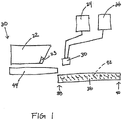
- the mixing system 20 includes at least one aggregate vessel 22 for holding the aggregate. It is to be appreciated that when two or more aggregates are used, such as glass and rock, the aggregates may be premixed prior to disposing the aggregates within the aggregate vessel 22. Alternatively, the aggregate vessel 22 may include at least one dividing wall for holding the aggregates independent from each other within the same aggregate vessel 22. Alternatively, when two or more aggregates are employed independent from each other, the mixing system 20 can include one aggregate vessel 22 for each of the aggregates, respectively. For example, the mixing system 20 can include a first aggregate vessel for glass and a second aggregate vessel for rock.
- the aggregate vessel 22 defines a hole.
- the aggregate vessel 22 also includes a gate, the gate typically being adjacent to the hole.
- the gate is operable between an open and closed position, such that when the gate is in the closed position, the aggregate is retained within the aggregate vessel 22, and when the gate is in the open position, the aggregate exits the aggregate vessel 22 through the hole.
- the aggregate may exit the aggregate vessel 22 by other methods known in the art without departing from the scope of the present invention.
- the mixing system 20 can include an additive vessel for holding the additive component.
- the additive component may be disposed into at least one of the aggregate vessels 22.
- the mixing system 20 further includes a first vessel 24 for holding the first component and a second vessel 26 for holding the second component independent from the first component.
- first component and the second component of the binder composition are provided to the mixing system 20 independent of each other, i.e. prior to mixing. It is to be appreciated that the first and second components may be dispensed from the vessels 24, 26 by any suitable method.
- the vessels 24, 26 each include a pump 27 in fluid communication with the first and second vessels 24, 26, respectively for dispensing the first and second components from the first and second vessels 24, 26.
- the pumps 27 dispense the first and second components in an appropriate ratio as required to form the reaction product of the two-component polymeric binder composition. If the pumps 27 are employed, the mixing system also includes a pump motor for rotating the pumps 27 to control the dispensing of the first and second components from the first and second vessels 24, 26.
- the mixing system 20 further includes a mixing apparatus in communication with the aggregate vessel 22, and the first and second vessels 24, 26 for mixing the aggregate, the first component and the second component to produce the composite material.
- the mixing apparatus includes a mixer 30, also referred to in the art as a mix head, in fluid communication with the first and second vessels 24, 26.
- the mixer 30 intimately mixes the first and second components to produce the reaction product of the binder composition.
- the mixer (30) is a static mixer or ar impingement mixer.
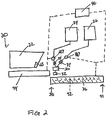
- the mixing apparatus may further includes an applicator 32 in fluid communication with the mixer 30, as shown in Figure 2 .
- the applicator 32 applies the reaction product of the binder composition as described in detail below.
- the mixer 30 may also be the applicator 32.
- the mixer (30) is an impingement mixer, it directs separate streams of the first and second components component together for mixing the first and second components to form the reaction product of the binder composition while simultaneously applying the reaction product of the binder composition.
- the additive vessel is employed, and the additive component is liquid, the additive vessel is in communication with the mixer 30 for allowing the additive component to be mixed with the first and second components.
- the additive component can be disposed within one of the vessels 24, 26.
- the aggregate is provided to the mixing apparatus at a delivery rate and the reaction product of the binder composition is applied to the aggregate within the mixing apparatus at an application rate to produce the composite material.
- the composite material is produced once the reaction product of the binder composition contacts the aggregate.
- the reaction product is formed before contacting the aggregate.
- the delivery rate is dependent, in part, on an amount of the composite material the mixing system 20 is to produce.
- the application rate of the reaction product to the aggregate is generally dependent on the delivery rate of the aggregate to the mixing apparatus. If the pumps 27 are employed, the pumps varying the application rate of the reaction product of the binder composition dependent, in part, on the delivery rate of the aggregate.
- the application rate of the reaction product to the aggregate is typically of from about 1 to about 7, and more typically from about 1.8 to about 5, gallons per cubic feet of the aggregate provided into the channel.
- the mixing apparatus typically includes a valve 34 in fluid communication with the mixer 30, as shown in Figure 2 .
- the valve 34 can be located downstream of the mixer 30 such that the first and second components are mixed by the mixer 30 prior to passing through the valve 34.
- the mixing apparatus 28 may include a second valve 34 with the valves 34 disposed upstream of the mixer 30 such that the first and second components each individually pass through one of the valves 34, respectively, before entering the mixer 30.
- the valve 34 is operable between an open position and closed position for preventing the introduction of air into the mixer 30 when the mixing system 20 is idle.
- the mixing apparatus typically includes a housing 36 defining a channel in communication with the mixer 30 and the aggregate vessel 22.
- the channel is in fluid communication with the mixer 30 for receiving the reaction product of the binder composition. Additionally, the channel is in communication with the aggregate vessel 22 for receiving the aggregate.
- the channel has a first end 38 and a second end 40 spaced from each other with the channel generally defining a U-shaped cross-section therebetween.
- the first end 38 of the channel receives the aggregate and the reaction product of the binder composition.
- the reaction product of the binder composition is applied to the aggregate within the channel.
- the aggregate moves within the channel as the reaction product of the binder composition is applied to the aggregate.
- the aggregate is transported from the aggregate vessel 22 to the channel at the delivery rate and the reaction product of the binder composition is applied to the aggregate within the channel at the application rate.
- the mixing apparatus further includes an auger 42, also referred to in the art as an auger mixer.
- the auger 42 is rotatably disposed within the channel for mixing the composite material and dispensing the composite material from the channel.
- the auger 42 includes a shaft with flighting in a spiral configuration such that the rotation of the auger 42 results in the composite material moving from the first end 38 of the channel to the second end 40 of the channel.
- the shaft can also include one or more pins or fingers for additional mixing.
- the auger 42 mixes the composite material to increase the surface area of the aggregate exposed to the reaction product of the binder composition thereby coating the aggregate with the reaction product of the binder composition.
- the mixing of the composite material by the auger 42 ensures that the composite material produced by the mixing system 20 is uniform and consistent.
- the composite material As the composite material reaches the second end 40 of the channel, the composite material is dispensed from the channel.
- the additive vessel is employed and the additive component comprises a powder and/or fibers
- the additive vessel is in communication with the channel for allowing the additive to be mixed with the reaction product of the binder composition and the aggregate.
- the additive component can also be added to one of the vessels 22, 24, 26 and/or somewhere between the vessels 22, 24, 26 and the mixing apparatus.
- the composite material is pliable as it is dispensed from the channel for allowing the composite material to be shaped into a desired configuration, i.e. the composite material has sufficient working time after dispensing.
- the mixing system 20 is capable of producing and dispensing the composite material in of from about 5 to about 15 seconds. This relatively short production time ensures that the composite material will be pliable for some time after it is dispensed from the channel, typically at least about 10 minutes.
- the composite material starts to cure once the composite material is produced, i.e., once the reaction product of the binder composition contacts the aggregate whereas the reaction product typically starts to cure once the first and second components come into contact with each other.
- the composite material only remains pliable for a limited time until the composite material fully cures, i.e. the reaction product reaches a final cure state such that the composite material is no longer pliable or workable.
- the composite material fully cures, the paved structure is formed.
- a step of curing the composite material refers to the process of fully curing the composite material.
- curing the composite material may be passive, i.e., there is no need for an affirmative step, such as heating, etc. to fully cure the composite material and curing may naturally occur via the respective curing mechanism of the first and second components.
- the mixing apparatus further includes a conveyer 44 disposed between the aggregate vessel 22 and the mixing apparatus for transporting the aggregate from the aggregate vessel 22 to the channel at the delivery rate.
- the delivery rate is controlled by a size of the hole in the aggregate vessel 22 and a speed of the conveyer 44.
- the conveyer 44 can be of any type suitable for transporting the aggregate.
- the conveyer 44 may be a belt that includes a first portion and a second portion with an endless belt disposed therebetween.
- the conveyer 44 is typically disposed below the aggregate vessel 22 such that the particulate component is allowed to move from the aggregate vessel 22 onto the conveyer 44.
- the conveyer 44 then transports the aggregate into the channel at the delivery rate.
- the mixing system 20 further includes a controller 46 in communication with the conveyer 44, the auger 42 and the pumps 27.
- the controller 46 communicates with the conveyer 44 for receiving the delivery rate of the aggregate. Based on the received delivery rate, the controller 46 determines the required application rate.
- the controller 46 may also control the speed of the conveyer 44 for controlling the delivery rate of the aggregate to the channel.
- the controller 46 also communicates with the pumps 27 to control the application rate of the reaction product of the binder composition to the aggregate within the channel dependent on the delivery rate of the aggregate into the channel.
- the controller 46 communicates with the auger 42 for controlling a rate of rotation of the auger 42. It is to be appreciated that the conveyer 44, auger 42 and the pumps 27 may be controlled manually.
- the mixing system 20 may include a power source, such as an engine, a motor, etc., mechanically coupled to the conveyer 44 and the auger 42 for providing power to the conveyer 44 and the auger 42.
- the power source may also be coupled to the controller 46 for powering the controller 46.
- the system may further include a platform. At least one of the aggregate vessel 22, the first vessel 24, the second vessel 26 and the mixing apparatus are typically disposed on the platform.
- the mixing system 20 may include the platform for transporting the mixing system 20 thereby making the mixing system 20 portable between job sites. It is to be appreciated that the mixing system 20 may also be transported to the job site and assembled on the ground or supported by another structure such that the mixing system 20 is generally non-portable.
- the aggregate vessel 22, the first vessel 24, the second vessel 26 and the mixing apparatus are disposed on the platform.
- the platform is portable and can be of various forms, such as a trailer, a flat bed of a truck, etc.
- the method of using the mixing system 20 comprises the steps of providing the aggregate into the mixing apparatus at the delivery rate and providing the first and second components into the mixing apparatus.
- the method also comprises the step of mixing the first and second components with the mixing apparatus to produce the reaction product of the binder composition. It is to be appreciated that the step of mixing the first and second components may be further defined as mixing the first and second components within the mixer 30 to produce the reaction product of the binder composition.
- the method further comprises the step of applying the reaction product of the binder composition to the aggregate within the mixing apparatus at an application rate to produce the composite material.
- the method of using the mixing system 20 comprises the steps of providing the aggregate into the aggregate vessel 22, providing the first component into the first vessel 24, and providing the second component into the second vessel 26.
- the method further comprises the step of transporting the first and second components from the first and second vessels 24, 26 into the mixer 30 of the mixing apparatus and mixing the fist and second components to produce the reaction product of the binder composition.
- the method may further comprise the step of transporting the aggregate with the conveyer 44 from the aggregate vessel 22 into the channel at the delivery rate and operating the pumps 27 with the controller 46 to control an application rate of the binder composition dependent on the delivery rate of the aggregate transported into the channel.
- the method may further comprise the step of applying the reaction product of the binder composition to the aggregate within the channel at the application rate to produce the composite material rotating the auger 42 to mix the composite material and dispense the composite material from the channel, and curing the composite material.
- the method of using the mixing system may further include one or more of the following steps: rotating the auger 42 to mix the composite material and dispense the composite material from the channel and transporting the aggregate from the aggregate vessel 22 into the channel at the delivery rate; controlling the application rate of the reaction product of the binder composition to the aggregate within the channel dependent on the delivery rate of the aggregate into the channel, wherein this step may be further defined as controlling the application rate of the reaction product of the binder composition within the ranges described above; controlling the delivery rate of the aggregate into the channel with the controller 46; and transporting the additive component into the mixer 30 and mixing the additive component with the first and second components.
- the paved structure is typically a sidewalk or a roadway.
- the method comprises the steps of using the mixing system 20, providing the aggregate in the aggregate vessel 22, providing the first component in the first vessel 24, and providing the second component in the second vessel 26.
- the method also comprises the steps of transporting the first and second components from the first and second vessels 24, 26 into the mixer 30 of the mixing apparatus and mixing the first and second components to produce the reaction product of the binder composition.
- the method further comprises the steps of transporting the aggregate with the conveyer 44 from the aggregate vessel 22 into the channel at a delivery rate and operating the pumps 27 with the controller 46 to control an application rate of the binder composition dependent on the delivery rate of the aggregate transported into the channel.
- the method further comprises the steps of applying the reaction product of the binder composition to the aggregate within the channel at the application rate to produce the composite material and rotating the auger 42 to mix the composite material.
- the method further comprises the steps of dispensing the composite material from the channel and curing the composite material to form the paved structure. It is to be appreciated that the step of dispensing the composite material from the channel can be further defined as dispensing the composite material from the channel directly into the defined area and/or dispensing the composite material from the channel into a container. Examples of suitable containers include, but are not limited to, wheelbarrows, cement trucks, etc.
- the method of paving may further comprise the step of positioning forms to define a perimeter of the defined area prior to the step of dispensing the composite material from the channel directly into the defined area.
- the method of paving may further comprise the step of removing the forms after the step of curing the composite material to form the paved structure.
- Suitable forms include conventional forms known to those skilled in the construction art, such as forms formed from metal and/or wood.
- the method of paving may further comprise one or more of the following steps: transporting the composite material within the container to the defined area after the step of dispensing the composite material from the channel into the container and prior to the step of curing the composite material to form the paved structure; dispensing the composite material from the container directly into the defined area after the step of transporting the composite material within the container to the defined area; and positioning the forms to define the perimeter of the defined area prior to the step of transporting the composite material into the defined area and prior to performing the step of curing the composite material to form the paved structure.
Landscapes
- Engineering & Computer Science (AREA)
- Chemical & Material Sciences (AREA)
- Structural Engineering (AREA)
- Ceramic Engineering (AREA)
- Civil Engineering (AREA)
- Architecture (AREA)
- Materials Engineering (AREA)
- Organic Chemistry (AREA)
- Chemical Kinetics & Catalysis (AREA)
- Environmental & Geological Engineering (AREA)
- Compositions Of Macromolecular Compounds (AREA)
- Processes Of Treating Macromolecular Substances (AREA)
- Polyurethanes Or Polyureas (AREA)
- Analytical Chemistry (AREA)
Description
- The present invention generally relates to a method of onsite producing a composite material using a mixing system, specifically to a method of producing a composite material comprising at least one aggregate and the reaction product of a two-component polymeric binder composition.
- The use of composite materials to form a paved structure, such as concrete pavement, is known in the construction art. Generally, the composite material is produced by mixing at least one aggregate and at least one binder component together. For example, in the case of concrete, the aggregate comprises sand and gravel, and the binder composition comprises cement and water.
documentWO/9500569 WO95/00569 - Application
US3272098 discloses a paving material. It discloses a mixing system for producing a composite material comprising an aggregate. The aggregate is mixed with a first and second component within the mixing system. - Recently, there have been advancements in the use of polymeric materials as the binder composition. Generally, once the aggregate and the binder composition are mixed together, the composite material remains pliable for only a short time, e.g. 45 minutes, before the composite material cures and is no longer pliable. Therefore, such composite materials are typically produced onsite as opposed to offsite. Offsite production requires the composite material to be transported to a construction site thereby decreasing a working time of the composite material once onsite.
- Conventional methods of producing the composite material onsite require the aggregate to be placed on the ground before coming into contact with the binder composition. Subsequently, the aggregate is sprayed with the binder composition comprising the polymeric material. A significant drawback of such methods is inconsistent and non-uniform coating of the aggregate, which creates inconsistencies in the composite material. Inconsistencies in the composite material can result in early failure of the composite material thereby requiring the composite material to be replaced at additional cost.
- Alternatively, the aggregate and binder composition can be tumbled in a batch mixer for several minutes until the aggregate is uniformly coated with the binder composition before it is set into place. A significant drawback of this process, commonly referred to as a batch process is reduced working time since the binder composition is already starting to react/cure while its in the batch mixer being tumbled with the aggregate. Also, producing a composite by the batch process limits the efficiency of installing the composite material to form the paved structure.
- Accordingly, there remains an opportunity to develop a mixing system that can be employed at a construction site (i.e., employed onsite) on demand that is capable of utilising recent advancements in polymeric materials as the binder composition thereby providing improved composite materials.
- A method as claimed in the appended claims of onsite producing a composite material using a mixing system is disclosed. The composite material comprises at least one aggregate and a reaction product of a two-component polymeric binder composition comprising a first component and a second component. A mixing system according to claim 17 is also disclosed. The mixing system includes an aggregate vessel for holding the aggregate. The mixing system also includes a first vessel for holding the first component and a second vessel for holding the second binder component independent from the first component. The mixing system further comprises a mixing apparatus in communication with the aggregate vessel and the first and second vessels for mixing the aggregate the first component, and the second component to produce the composite material.
- The method comprises the steps of providing the aggregate into the mixer of the mixing apparatus at a delivery rate and providing the first component and the second component into the mixer of the mixing apparatus. The method also comprises the steps of mixing the first and second components within the mixer of the mixing apparatus to produce the reaction product of the two-component polymeric binder composition. The method further comprises the step of applying the reaction product of the two-component polymeric binder composition to the aggregate within the mixing apparatus at an application rate to produce the composite material.
- Generally, applying the reaction product of the two-component polymeric binder composition to the aggregate within the mixing apparatus results in the aggregate being uniformly and consistently coated with the reaction product of the two-component polymeric binder composition. Uniform and consistent coating of the aggregate with the reaction product of the two-component polymeric binder composition imparts the composite material with excellent physical properties, such as increased compressive strength, increased flexural strength, and increased tensile strengths.
- Other advantages of the present invention will be readily appreciated, as the same becomes better understood by reference to the following detailed description, when considered in connection with the accompanying drawings wherein:
-
Figure 1 is a schematic view of an embodiment of a mixing system.; and -
Figure 2 is a schematic view of another embodiment of the mixing system. - Referring to the Figures, wherein like numerals indicate like or corresponding parts throughout the several views, a mixing system for producing a composite material is shown at 20. The
mixing system 20 is described in further detail below. The composite material comprises at least one aggregate and a reaction product of a two-component polymeric binder composition. Generally, the composite material is suitable for forming a paved structure, such as roads, sidewalks and patios. It is to be appreciated that the composite material is not limited to any particular use. For example, the composite material may also be used for hydraulic revetments, and any other types of barriers, such as to prevent erosion, and reduce sound transmission. - The composite material has a compressive strength and a tensile strength. Generally, both the aggregate and the reaction product of the two-component polymeric binder composition impart compressive strength to the composite material. The reaction product of the two-component polymeric binder composition also provides adhesion between the aggregate and generally imparts tensile strength, and flexural strength to the composite material. The two-component polymeric binder composition is hereinafter referred to as the binder composition.
- As used herein, the term aggregate is to be interpreted as referring to aggregate or aggregates in general and not to a single aggregate, nor is it to be construed to require more than one aggregate. Additionally, the term aggregate, as used herein, is intended to encompass a broad category of materials that serves as reinforcement to the composite material, such as rock, glass, rubber crumb, etc. The term rock as used herein is intended to encompass all forms of rock, including, but not limited to, gravel, sand, etc. Additionally, the term rock as used herein is intended to encompass all species of rock, such as granite, limestone, marble, etc.
- In one embodiment, the aggregate comprises rock. The rock is typically selected from the group of granite, limestone, marble, beach stone/river rock, pea gravel, iron slag, copper slag, sand and combinations thereof. However, it is to be appreciated that any type of rock can be used. The average diameter of the aggregate is typically of from about 0.001 to about 7, more typically of from about 0.1 to about 5, and most typically of from about 0.125 to about 3, inches.
- In other embodiments, the aggregate comprises rubber crumb. It is to be appreciated that any type of rubber crumb can be used. The rubber crumb is typically present in an amount of from about 1 to about 100, and more typically of from about 5 to about 100, and most typically of from about 10 to 100 % by weight, based on 100 parts by weight of the aggregate present in the composite material. The average diameter of the aggregate is typically of from about 0.1 to about 3, more typically of from about 0.1 to about 2, and most typically of from about 0.1 to about 0.25, inches. Suitable grades of rubber crumb, for purposes of the present invention, are commercially available from Entech Inc., Crumb Rubber of White Pigeon, MI.
- In certain embodiments, the aggregate comprises glass and rock. Suitable rock, for the purposes of the present invention, includes those described above. The glass is typically present in an amount of from about 1 to about 100, more typically from about 25 to about 100, and most typically from about 75 to about 100 % by weight, based on 100 parts by weight of the aggregate present in the composite material. The rock is typically present in an amount of from about 1 to about 100, more typically from about 10 to about 100, and most typically from about 10 to 25 % by weight, based on 100 parts by weight of the aggregate present in the composite material. The average diameter of the aggregate is typically of from about 0.001 to about 1.0, more typically from about 0.1 to about 0.5, and most typically from about 0.1 to about 0.3, inches.
- Although not required, the glass may be post-consumer and/or recycled glass. When employed, the glass is typically crushed to meet the average diameter ranges as described above. For safety, the glass is typically tumbled for rounding sharp edges of the glass. Examples of suitable glass, for purposes of the present invention, are commercially available from Glass Plus, Inc. of Tomahawk, WI. It is to be appreciated that any type of glass may be used for purposes of the present invention.
- The binder composition comprises a first component and a second component. As such, it is to be appreciated that the term two-component refers to these components. Other additional components may be used. The binder composition may be referred to in the art as a 2K system. The first and second components are mixed to form the reaction product of the binder composition. The term reaction product as used herein is intended to encompass all stages of interaction and/or reaction between the first and second components, including reaction products of the first and second components, even when the reaction product contacts the aggregate to form the composite material. Generally, the reaction product begins to form when the first and second components come into contact with each other.
- As introduced above, the binder composition comprises the first and second components, and optionally, one or more additional components, e.g. an additive component. The binder composition can be a thermoset or thermosetting adhesive composition, such as a two-component or 2K adhesive. In other embodiments, the binder composition is a thermoplastic adhesive composition. In certain embodiments, the reaction product is an elastomer.
- Generally, when the first and second components are brought into contact with each other, such as by mixing the first and second components together, the first and second components begin to react to form the reaction product. The reaction product, during formation, adheres the aggregate together. It is to be appreciated that the reaction product can begin to form over a period of time prior to introducing the aggregate. Typically, the aggregate is introduced before the reaction product reaches a final reaction (or final cure) state. It is also to be appreciated that the reaction between the first and second components may be delayed for some period of time after the first and second components are brought into contact with each other.
- The reaction between the first and second components is commonly referred to in the art as a crosslink or crosslinking reaction, which generally results in build-up of molecular chains, i.e., molecular weight, in the reaction product to produce a crosslinked structure. Reaction of the first and second components can occur at various temperatures, such as room or ambient temperature, although heating may be applied to one or more of the components to trigger and/or accelerate reaction between the first and second components. In certain embodiments, although dependent in part on the specific components employed, application of heat accelerates reaction between the first and second components, and may impart stronger bonds and therefore increased cohesive strength within the reaction product.
- Generally, for purposes of the present invention, any type of adhesive system, more typically any type of thermosetting adhesive system can be used as the binder composition. As such, the reaction product can be any type of adhesive, more typically any type of thermosetting adhesive. Examples of suitable adhesive systems include, but are not limited to, adhesive systems that comprise: alcohols, such as diols and polyols; amines, such as diamines and polyamines; phenolic resins and/or phenolic-based components, such as phenoxy resins, phenolic formaldehyde (PF) resins, phenolic neoprene, and resorcinol formaldehydes (RF); polyester-based components, such as styrene polyesters and/or vinyl polyesters; imide-based components, such as polyimides; epoxy resins and/or epoxy-based components, such as epoxidized diols and polyols; and combinations thereof. As used herein, the terminology adhesive systems generally includes instances where the first and second components are still separate from each other, as well as instances when the first and second components are in contact with each other but generally prior to reaction. As such, the terminology adhesive generally includes instances when the reaction product is forming or has completely formed.
- Specific examples of suitable adhesives, i.e., reaction products, for purposes of the present invention, include polyurethanes, polyureas, polyurethane/ureas, epoxies, phenolic adhesives, polyesters, and combinations thereof. Further examples of suitable adhesive compositions and adhesives, for purposes of the present invention, are generally described as "adhesive binders" in
U.S. Patent Publication Nos. 2009/0067924 and2009/0067295, both to Kaul , the disclosures of which, as well as the disclosures of patents and publications referenced therein, are incorporated herein by reference in their entirety. Specific embodiments of the two-component polymeric binder compositions and reaction products thereof are described below. - In one embodiment, the reaction product is a polyurethane. In this embodiment, the first component is an isocyanate component and the second component is an isocyanate-reactive component.
- If employed, the isocyanate component is typically a polyisocyanate having two or more isocyanate functional (NCO) groups. The isocyanate component typically has an average functionality of from about 1.5 to about 3, more typically from about 2 to about 2.8.
- Suitable polyisocyanates, for purposes of the present invention include, but are not limited to, conventional aliphatic, cycloaliphatic, araliphatic and aromatic isocyanates. In certain embodiments, the isocyanate component is selected from the group of diphenylmethane diisocyanates (MDIs), polymeric diphenylmethane diisocyanates (PMDIs), and combinations thereof. Polymeric diphenylmethane diisocyanates are also referred to in the art as polymethylene polyphenylene polyisocyanates. Examples of other suitable isocyanates, for purposes of the present invention include, but are not limited to, toluene diisocyanates (TDIs), hexamethylene diisocyanates (HDIs), isophorone diisocyanates (IPDIs), naphthalene diisocyanates (NDIs), and combinations thereof.
- In certain embodiments, the isocyanate component is an isocyanate-terminated prepolymer. The isocyanate-terminated prepolymer is a reaction product of an isocyanate and a polyol and/or a polyamine, as understood in the polyurethane art. The isocyanate may be any type of isocyanate known to those skilled in the polyurethane art, such as one of the polyisocyanates described above. If employed to make the isocyanate-terminated prepolymer, the polyol is typically selected from the group of ethylene glycol, diethylene glycol, propylene glycol, dipropylene glycol, butane diol, glycerol, trimethylolpropane, triethanolamine, pentaerythritol, sorbitol, and combinations thereof. If employed to make the isocyanate-terminated prepolymer, the polyamine is typically selected from the group of ethylene diamine, toluene diamine, diaminodiphenylmethane and polymethylene polyphenylene polyamines, aminoalcohols, and combinations thereof. Examples of suitable aminoalcohols include ethanolamine, diethanolamine, triethanolamine, and combinations thereof. It is to be appreciated that the isocyanate-terminated prepolymer may be formed from a combination of two or more of the aforementioned polyols and/or polyamines. The isocyanate component may also be a modified isocyanate, such as, carbodiimides, allophanates, isocyanurates, and biurets. In one embodiment of the present invention, the isocyanate component comprises a blend of polymeric methyldiphenyldiisocyanate and quasi-prepolymers of 4,4'-methyldiphenyldiisocyanate.
- Specific examples of suitable isocyanate components, for purposes of the present invention, are commercially available from BASF Corporation of Florham Park, NJ, under the trademark LUPRANATE®. It is to be appreciated that the first component can include any combination of two or more of the aforementioned isocyanates.
- If employed, the isocyanate-reactive component is typically selected from the group of alcohols, amines, crosslinkers, chain extenders, and combinations thereof.. Suitable alcohols include diols, i.e., alcohols having two hydroxyl functional groups, and polyols, i.e., alcohols having three or more hydroxyl functional groups. Suitable amines include diamines, i.e., amines having two amine functional groups, and polyamines, i.e., amines having three of more amine functional groups. In certain embodiments, the isocyanate-reactive component comprises at least one of an aliphatic amine, an aliphatic alcohol, an aromatic amine, and an aromatic alcohol.
- If employed, the alcohol (or alcohols) can comprise a polyester polyol, a polyether polyol, and combinations thereof. Other suitable alcohols include, but are not limited to, ethylene glycol, diethylene glycol, propylene glycol, dipropylene glycol, butane diol, glycerol, trimethylolpropane, amine-initiated polyols such as triethanolamine, pentaerythritol, sorbitol, biopolyols such as soybean oil, castor-oil, soy-protein, rapeseed oil, etc., and combinations thereof.
- If employed, the amine (or amines) can be selected from the group of ethylene diamine, toluene diamine, diaminodiphenylmethane and polymethylene polyphenylene polyamines, aminoalcohols, and combinations thereof. Examples of suitable aminoalcohols include ethanolamine, diethanolamine, triethanolamine, and combinations thereof.
- Suitable grades of alcohols, e.g. polyols, and amines, e.g. polyamines, for the purposes of the present invention, are commercially available from BASF Corporation. It is to be appreciated that other types of amines, e.g. diamines and polyamines, known in the art can also be used for purposes of the present invention. It is also to be appreciated that other types of alcohols, e.g. diols and polyols, known in the art can also be used for purposes of the present invention.
- If employed, the isocyanate-reactive component is typically used in the binder composition in an amount of from about 10 to about 200, and more typically from about 30 to about 120, parts by weight, based on 100 parts by pre-reaction weight of all components in the binder composition except the isocyanate component.
- When the reaction product is formed from the isocyanate and isocyanate-reactive components, the isocyanate index of the reaction product of the binder composition is typically about 70 to about 200, and more typically at least about 90 to 165.
- In another embodiment, the reaction product is an epoxy. In this embodiment, the first component is an epoxy resin and the second component is a hardener. Examples of suitable epoxy resins, for purposes of the present invention, include resins having one or more epoxy groups, such as epoxy resins formed from a reaction between epichlorohydrin and bisphenol-A. Other suitable epoxies include those described and/or incorporated by reference in the Kaul publications, introduced above. Typically, the hardener comprises a polyamine, and more typically polyamine monomers. Various types of polyamines, including diamines and higher amines, can be employed, such as primary and secondary amines, with primary amines typically being employed. An example of a suitable hardener, for purposes of the present invention, is triethylenetetramine (TETA). In this embodiment, the first and second components can be employed in various amounts to form reaction product of the binder composition.
- In another embodiment, the reaction product is a phenolic adhesive. In this embodiment, the first component typically includes a resin having one or more phenol groups. The resin is typically selected from the group of phenoxy resins, phenolic formaldehyde (PF) resins, phenolic neoprene, resorcinol formaldehydes (RF), and combinations thereof. The second component typically comprises a catalyst. Suitable catalysts include, but are not limited to, peroxides, such as benzoyl peroxide. Other suitable phenolic adhesives include those described in and/or incorporated by reference in the Kaul publications, introduced above. It is to be appreciated that the first component can include additional functional groups in addition to the phenol group(s), such as hydroxyl (OH) groups.
- In the aforementioned embodiment, the first and second components can be employed in various amounts to form the reaction product of the binder composition. The first component, e.g. the resin, is generally used in an excess relative to the second component, e.g. the catalyst. Typically, the first component is used in an amount of from about 50 to 99 parts by weight, more typically from about 90 to 99 parts by weight, each based on 100 parts by weight of the binder composition, to form the reaction product with the remaining parts by weight being the second component.
- In another embodiment, the reaction product is an acrylic or acrylate adhesive. In this embodiment, the first component typically comprises acrylic and/or methylacrylic acid and the second component typically comprises a catalyst, such as a peroxide. In these embodiments, additional components can be used, such as chlorosulphonated polyethylene, which serve as a toughening agent for the reaction product.
- In the aforementioned embodiment, the first component, e.g. the acid, is generally used in an excess relative to the second component, e.g. the catalyst. Typically, the first component is used in an amount of from about 50 to 99 parts by weight, more typically from about 90 to 99 parts by weight, each based on 100 parts by weight of the binder composition, to form the reaction product with the remaining parts by weight being the second component.
- Depending on the specific components and amounts thereof employed, the aforementioned adhesive compositions can react (or cure) thereby forming the adhesives through a variety of mechanisms, such as addition polymerization, condensation polymerization, and/or free radical polymerization. Such mechanisms, as well as others, are generally understood by those skilled in the polymeric art.
- Although not required, but as introduced above, the composite material may further comprise the additive component. Examples of additives include, but are not limited to, colorants, fibers, catalysts, fillers, etc. If employed, fibers are typically present in the composite material in an amount suitable to impart tensile strength to the composite material.
- If employed, the colorant can be selected from the group of pigments, dyes, and combinations thereof. The colorant can be in either liquid or powder form. If employed, the colorant is typically a pigment or a pigment blend of two or more pigments. The pigment, or pigment blend, is used to impart a desired color to the composite material. Different types of pigments can be used for purposes of the present invention. For example, titanium dioxide can be used to impart a white color and carbon black can be used to impart a black color, to the composite material, respectively, while various blends of titanium dioxide and carbon black can be used to impart various shades of gray to the composite material. Examples of suitable grades of carbon black and titanium dioxide for purposes of the present invention are commercially available from Columbian Chemicals Company of Marietta, GA, and DuPont® Titanium Technologies of Wilmington, DE, respectively. Other pigments including, but not limited to, red, green, blue, yellow, green, and brown, and pigment blends thereof, can also be used to impart color to the composite material in addition to or alternative to carbon black and/or titanium dioxide. Examples of suitable grades of pigments for purposes of the present invention are commercially available from various companies such as BASF Corporation and Penn Color, Inc. of Hatfield, PA. It is to be appreciated that various blends of the aforementioned colorants, e.g. pigments, can be used to impart the composite material with various colors, strengths, and shades.
- If employed in the composite material, the colorant is typically present in the composite material in an amount suitable to impart the composite material with a desired color, strength and shade, while not materially affecting physical properties of the composite material. In certain embodiments employing the colorant, the colorant is typically present in the binder composition in an amount of from about 0.1 to about 10, and more typically of from about 0.1 to about 5, parts by weight, based on 100 parts by weight of the binder composition.
- Referring now to
Figure 1 , the mixingsystem 20 includes at least oneaggregate vessel 22 for holding the aggregate. It is to be appreciated that when two or more aggregates are used, such as glass and rock, the aggregates may be premixed prior to disposing the aggregates within theaggregate vessel 22. Alternatively, theaggregate vessel 22 may include at least one dividing wall for holding the aggregates independent from each other within the sameaggregate vessel 22. Alternatively, when two or more aggregates are employed independent from each other, the mixingsystem 20 can include oneaggregate vessel 22 for each of the aggregates, respectively. For example, the mixingsystem 20 can include a first aggregate vessel for glass and a second aggregate vessel for rock. - It is to be appreciated that any type of
vessel 22 suitable for holding the aggregate can be employed in the present invention. Typically, theaggregate vessel 22 defines a hole. Theaggregate vessel 22 also includes a gate, the gate typically being adjacent to the hole. The gate is operable between an open and closed position, such that when the gate is in the closed position, the aggregate is retained within theaggregate vessel 22, and when the gate is in the open position, the aggregate exits theaggregate vessel 22 through the hole. It is to be appreciated that the aggregate may exit theaggregate vessel 22 by other methods known in the art without departing from the scope of the present invention. If the additive component is employed, the mixingsystem 20 can include an additive vessel for holding the additive component. Alternatively, the additive component may be disposed into at least one of theaggregate vessels 22. - The mixing
system 20 further includes afirst vessel 24 for holding the first component and asecond vessel 26 for holding the second component independent from the first component. Said differently, the first component and the second component of the binder composition are provided to themixing system 20 independent of each other, i.e. prior to mixing. It is to be appreciated that the first and second components may be dispensed from thevessels - In one embodiment, the
vessels second vessels second vessels second vessels - The mixing
system 20 further includes a mixing apparatus in communication with theaggregate vessel 22, and the first andsecond vessels mixer 30, also referred to in the art as a mix head, in fluid communication with the first andsecond vessels mixer 30 intimately mixes the first and second components to produce the reaction product of the binder composition. - According to the invention, the mixer (30) is a static mixer or ar impingement mixer.
- Although not required, the mixing apparatus may further includes an
applicator 32 in fluid communication with themixer 30, as shown inFigure 2 . Theapplicator 32 applies the reaction product of the binder composition as described in detail below. It is to be appreciated that themixer 30 may also be theapplicator 32. In the cases in which the mixer (30) is an impingement mixer, it directs separate streams of the first and second components component together for mixing the first and second components to form the reaction product of the binder composition while simultaneously applying the reaction product of the binder composition. When the additive vessel is employed, and the additive component is liquid, the additive vessel is in communication with themixer 30 for allowing the additive component to be mixed with the first and second components. Alternatively, the additive component can be disposed within one of thevessels - Generally, the aggregate is provided to the mixing apparatus at a delivery rate and the reaction product of the binder composition is applied to the aggregate within the mixing apparatus at an application rate to produce the composite material. It is to be appreciated that the composite material is produced once the reaction product of the binder composition contacts the aggregate. According to the invention, the reaction product is formed before contacting the aggregate. The delivery rate is dependent, in part, on an amount of the composite material the
mixing system 20 is to produce. - The application rate of the reaction product to the aggregate is generally dependent on the delivery rate of the aggregate to the mixing apparatus. If the pumps 27 are employed, the pumps varying the application rate of the reaction product of the binder composition dependent, in part, on the delivery rate of the aggregate.
- The application rate of the reaction product to the aggregate is typically of from about 1 to about 7, and more typically from about 1.8 to about 5, gallons per cubic feet of the aggregate provided into the channel.
- Although not required, the mixing apparatus typically includes a valve 34 in fluid communication with the
mixer 30, as shown inFigure 2 . It is to be appreciated that the valve 34 can be located downstream of themixer 30 such that the first and second components are mixed by themixer 30 prior to passing through the valve 34. Alternatively, the mixing apparatus 28 may include a second valve 34 with the valves 34 disposed upstream of themixer 30 such that the first and second components each individually pass through one of the valves 34, respectively, before entering themixer 30. The valve 34 is operable between an open position and closed position for preventing the introduction of air into themixer 30 when the mixingsystem 20 is idle. - The mixing apparatus typically includes a
housing 36 defining a channel in communication with themixer 30 and theaggregate vessel 22. The channel is in fluid communication with themixer 30 for receiving the reaction product of the binder composition. Additionally, the channel is in communication with theaggregate vessel 22 for receiving the aggregate. The channel has afirst end 38 and asecond end 40 spaced from each other with the channel generally defining a U-shaped cross-section therebetween. Thefirst end 38 of the channel receives the aggregate and the reaction product of the binder composition. As such, the reaction product of the binder composition is applied to the aggregate within the channel. According to the invention, the aggregate moves within the channel as the reaction product of the binder composition is applied to the aggregate. The aggregate is transported from theaggregate vessel 22 to the channel at the delivery rate and the reaction product of the binder composition is applied to the aggregate within the channel at the application rate. - According to the invention, the mixing apparatus further includes an
auger 42, also referred to in the art as an auger mixer. Theauger 42 is rotatably disposed within the channel for mixing the composite material and dispensing the composite material from the channel. Theauger 42 includes a shaft with flighting in a spiral configuration such that the rotation of theauger 42 results in the composite material moving from thefirst end 38 of the channel to thesecond end 40 of the channel. The shaft can also include one or more pins or fingers for additional mixing. As the composite material is moved within the channel, theauger 42 mixes the composite material to increase the surface area of the aggregate exposed to the reaction product of the binder composition thereby coating the aggregate with the reaction product of the binder composition. - The mixing of the composite material by the
auger 42 ensures that the composite material produced by the mixingsystem 20 is uniform and consistent. - As the composite material reaches the
second end 40 of the channel, the composite material is dispensed from the channel. Typically, when the additive vessel is employed and the additive component comprises a powder and/or fibers, the additive vessel is in communication with the channel for allowing the additive to be mixed with the reaction product of the binder composition and the aggregate. As described above, it is to be appreciated that the additive component can also be added to one of thevessels vessels - The composite material is pliable as it is dispensed from the channel for allowing the composite material to be shaped into a desired configuration, i.e. the composite material has sufficient working time after dispensing. The mixing
system 20 is capable of producing and dispensing the composite material in of from about 5 to about 15 seconds. This relatively short production time ensures that the composite material will be pliable for some time after it is dispensed from the channel, typically at least about 10 minutes. - The composite material starts to cure once the composite material is produced, i.e., once the reaction product of the binder composition contacts the aggregate whereas the reaction product typically starts to cure once the first and second components come into contact with each other. After the composite material starts to cure, the composite material only remains pliable for a limited time until the composite material fully cures, i.e. the reaction product reaches a final cure state such that the composite material is no longer pliable or workable. Once the composite material fully cures, the paved structure is formed. It is to be appreciated that a step of curing the composite material refers to the process of fully curing the composite material. It is also to be appreciated that curing the composite material may be passive, i.e., there is no need for an affirmative step, such as heating, etc. to fully cure the composite material and curing may naturally occur via the respective curing mechanism of the first and second components.
- In one embodiment, the mixing apparatus further includes a
conveyer 44 disposed between theaggregate vessel 22 and the mixing apparatus for transporting the aggregate from theaggregate vessel 22 to the channel at the delivery rate. It is to be appreciated that the delivery rate is controlled by a size of the hole in theaggregate vessel 22 and a speed of theconveyer 44. It is also to be appreciated that theconveyer 44 can be of any type suitable for transporting the aggregate. For example, theconveyer 44 may be a belt that includes a first portion and a second portion with an endless belt disposed therebetween. Theconveyer 44 is typically disposed below theaggregate vessel 22 such that the particulate component is allowed to move from theaggregate vessel 22 onto theconveyer 44. Theconveyer 44 then transports the aggregate into the channel at the delivery rate. - Referring to
Figure 2 , in one embodiment, the mixingsystem 20 further includes acontroller 46 in communication with theconveyer 44, theauger 42 and the pumps 27. Thecontroller 46 communicates with theconveyer 44 for receiving the delivery rate of the aggregate. Based on the received delivery rate, thecontroller 46 determines the required application rate. Thecontroller 46 may also control the speed of theconveyer 44 for controlling the delivery rate of the aggregate to the channel. Thecontroller 46 also communicates with the pumps 27 to control the application rate of the reaction product of the binder composition to the aggregate within the channel dependent on the delivery rate of the aggregate into the channel. Thecontroller 46 communicates with theauger 42 for controlling a rate of rotation of theauger 42. It is to be appreciated that theconveyer 44,auger 42 and the pumps 27 may be controlled manually. - The mixing
system 20 may include a power source, such as an engine, a motor, etc., mechanically coupled to theconveyer 44 and theauger 42 for providing power to theconveyer 44 and theauger 42. The power source may also be coupled to thecontroller 46 for powering thecontroller 46. - The system may further include a platform. At least one of the
aggregate vessel 22, thefirst vessel 24, thesecond vessel 26 and the mixing apparatus are typically disposed on the platform. Although not required, the mixingsystem 20 may include the platform for transporting themixing system 20 thereby making themixing system 20 portable between job sites. It is to be appreciated that the mixingsystem 20 may also be transported to the job site and assembled on the ground or supported by another structure such that the mixingsystem 20 is generally non-portable. In one embodiment employing the platform, theaggregate vessel 22, thefirst vessel 24, thesecond vessel 26 and the mixing apparatus are disposed on the platform. The platform is portable and can be of various forms, such as a trailer, a flat bed of a truck, etc. - Typical methods of using the
mixing system 20 will now be described. In one embodiment, the method of using themixing system 20 comprises the steps of providing the aggregate into the mixing apparatus at the delivery rate and providing the first and second components into the mixing apparatus. The method also comprises the step of mixing the first and second components with the mixing apparatus to produce the reaction product of the binder composition. It is to be appreciated that the step of mixing the first and second components may be further defined as mixing the first and second components within themixer 30 to produce the reaction product of the binder composition. The method further comprises the step of applying the reaction product of the binder composition to the aggregate within the mixing apparatus at an application rate to produce the composite material. - According to the invention, the method of using the
mixing system 20 comprises the steps of providing the aggregate into theaggregate vessel 22, providing the first component into thefirst vessel 24, and providing the second component into thesecond vessel 26. The method further comprises the step of transporting the first and second components from the first andsecond vessels mixer 30 of the mixing apparatus and mixing the fist and second components to produce the reaction product of the binder composition. The method may further comprise the step of transporting the aggregate with theconveyer 44 from theaggregate vessel 22 into the channel at the delivery rate and operating the pumps 27 with thecontroller 46 to control an application rate of the binder composition dependent on the delivery rate of the aggregate transported into the channel. The method may further comprise the step of applying the reaction product of the binder composition to the aggregate within the channel at the application rate to produce the composite material rotating theauger 42 to mix the composite material and dispense the composite material from the channel, and curing the composite material. - According to the invention, the method of using the mixing system may further include one or more of the following steps: rotating the
auger 42 to mix the composite material and dispense the composite material from the channel and transporting the aggregate from theaggregate vessel 22 into the channel at the delivery rate; controlling the application rate of the reaction product of the binder composition to the aggregate within the channel dependent on the delivery rate of the aggregate into the channel, wherein this step may be further defined as controlling the application rate of the reaction product of the binder composition within the ranges described above; controlling the delivery rate of the aggregate into the channel with thecontroller 46; and transporting the additive component into themixer 30 and mixing the additive component with the first and second components. - A typical method of paving a defined area with a composite material to form a paved structure within the defined area using a
mixing system 20 will now be described. For this method, the paved structure is typically a sidewalk or a roadway. The method comprises the steps of using themixing system 20, providing the aggregate in theaggregate vessel 22, providing the first component in thefirst vessel 24, and providing the second component in thesecond vessel 26. The method also comprises the steps of transporting the first and second components from the first andsecond vessels mixer 30 of the mixing apparatus and mixing the first and second components to produce the reaction product of the binder composition. The method further comprises the steps of transporting the aggregate with theconveyer 44 from theaggregate vessel 22 into the channel at a delivery rate and operating the pumps 27 with thecontroller 46 to control an application rate of the binder composition dependent on the delivery rate of the aggregate transported into the channel. The method further comprises the steps of applying the reaction product of the binder composition to the aggregate within the channel at the application rate to produce the composite material and rotating theauger 42 to mix the composite material. The method further comprises the steps of dispensing the composite material from the channel and curing the composite material to form the paved structure. It is to be appreciated that the step of dispensing the composite material from the channel can be further defined as dispensing the composite material from the channel directly into the defined area and/or dispensing the composite material from the channel into a container. Examples of suitable containers include, but are not limited to, wheelbarrows, cement trucks, etc. - The method of paving may further comprise the step of positioning forms to define a perimeter of the defined area prior to the step of dispensing the composite material from the channel directly into the defined area. The method of paving may further comprise the step of removing the forms after the step of curing the composite material to form the paved structure. Suitable forms, for purposes of the present invention, include conventional forms known to those skilled in the construction art, such as forms formed from metal and/or wood.
- In addition, the method of paving may further comprise one or more of the following steps: transporting the composite material within the container to the defined area after the step of dispensing the composite material from the channel into the container and prior to the step of curing the composite material to form the paved structure; dispensing the composite material from the container directly into the defined area after the step of transporting the composite material within the container to the defined area; and positioning the forms to define the perimeter of the defined area prior to the step of transporting the composite material into the defined area and prior to performing the step of curing the composite material to form the paved structure.
- Modifications and variations of the present invention are possible in light of the above teachings. The foregoing invention has been described in accordance with the relevant legal standards; thus, the description is exemplary rather than limiting in nature. Variations and modifications to the disclosed embodiment may become apparent to those skilled in the art and do come within the scope of the invention as defined by the appended claims.
Claims (18)
- A method of onsite producing a composite material, the composite material comprising an aggregate and a reaction product of a two-component polymeric binder composition comprising a first component and a second component, the method employing a mixing system (20) including an aggregate vessel (22) comprising the aggregate, a first vessel (24) comprising the first component, a second vessel (26) comprising the second component independent from the first component, and a mixing apparatus comprising a mixer (30) and an auger (42) rotatably disposed within a channel (36), wherein the mixing apparatus is in communication with the aggregate vessel (22), the first vessel (24), and the second vessel, vessel (26), said method comprising the steps of:delivering the aggregate into the channel (36) of the mixing apparatus at a delivery rate;delivering the first and second components into the mixer (30) of the mixing apparatus;mixing the first and second components in the mixer (30) of the mixing apparatus independent of the aggregate to obtain the reaction product of the two-component polymeric binder composition; andcontacting the reaction product of the two-component polymeric binder composition with the aggregate, such that the aggregate directly contacts the reaction product, within the channel (36) of the mixing apparatus at an application rate to obtain the composite material, wherein the method further comprises rotating the auger (42) to mix the composite material and dispense the composite material from the channel (36).
- A method as set forth in claim 1, wherein the mixing apparatus further includes:a housing defining the channel, with the channel in communication with the mixer and the aggregate vessel;a conveyer disposed between the aggregate vessel and the mixing apparatus and said method further comprises the step of transporting the aggregate from the aggregate vessel into the channel at the delivery rate;a first pump in fluid communication with the first vessel and a second pump in fluid communication with the second vessel with each of the pumps also in fluid communication with the mixer;a controller in communication with the pumps, and said method further comprises the step of controlling the application rate of the reaction product of the two-component polymeric binder composition to the aggregate within the channel dependent on the delivery rate of the aggregate into the channel; anda platform with the aggregate vessel, the first vessel, the second vessel and the mixing apparatus disposed on the platform, wherein the platform is portable.
- A method of paving a defined area with a composite material to form a paved structure within the defined area using a mixing system, the method comprising providing the composite material wherein the providing is according to the method of claims 1 or 2 and
dispensing the composite material from the channel; and
curing the composite material to form the paved structure. - A method as set forth in any one of claims 1-3, wherein the first component is an epoxy resin and the second component is a hardener.
- A method as set forth in any one of claims 1-3, wherein the first component is an isocyanate component and the second component is an isocyanate-reactive component.
- A method as set forth in claim 5 wherein the isocyanate-reactive component is selected from the group of alcohols, amines, and combinations thereof.
- A method as set forth in any one of claims 4-6, wherein the aggregate is glass and rock with the glass present in an amount of from about 1 to about 99 % by weight, and the rock present in an amount of from about 99 to 1 % by weight, each based on 100% by weight of the aggregate.
- A method as set forth in claim 7 wherein the aggregate has an average diameter of from about 1/8 to about 1/4 of an inch.
- A method as set forth in any one of claims 4-6, wherein the aggregate comprises crumb rubber.
- A method as set forth in any one of claims 4-6, wherein the aggregate comprises rock.
- A method as set forth in any one of claims 3-10, wherein the step of dispensing the composite material from the channel is further defined as dispensing the composite material from the channel directly into the defined area.
- A method as set forth in claim 11, including a plurality of forms and said method further comprises the step of positioning the forms to define a perimeter of the defined area prior to the step of dispensing the composite material from the channel directly into the defined area.
- A method as set forth in any one of claims 3-10, wherein the step of dispensing the composite material from the channel is further defined as dispensing the composite material from the channel into a container.
- A method as set forth in claim 13, further comprising the steps of:transporting the composite material within the container to the defined area after the step of dispensing the composite material from the channel into the container and prior to the step of curing the composite material to form the paved structure; anddispensing the composite material from the container directly into the defined area after the step of transporting the composite material within the container to the defined area.
- A method as set forth in any one of claims 3-14, including a plurality of forms and said method further comprising the step of positioning the forms to define a perimeter of the defined area prior to the step of transporting the composite material into the defined area and prior to performing the step of curing the composite material to form the paved structure.
- A method as set forth in any one of claims 3-15, wherein the paved structure is a sidewalk or a roadway.
- A mixing system (20) for onsite producing a composite material comprising an aggregate and a reaction product of a two-component polymeric binder composition comprising a first component and a second component, such that the aggregate directly contacts the reaction product, said mixing system comprising:an aggregate vessel (22) for holding the aggregate;a first vessel (24) for holding the first component;a second vessel (26) for holding the second component independent from the first component; anda mixing apparatus comprising a mixer (30) and an auger (42) rotatably disposed within a channel (36) for mixing the composite material and dispensing the composite material from said channel (36), wherein the mixing apparatus is in communication with said aggregate vessel (22) and said first and said second vessels (24,26) for mixing the aggregate, the first component, and the second component to produce the composite material;wherein said mixer (30) includes a static mixer or an impingement mixer and is in fluid communication with the first and second vessels (24,26) to mix the first and second components to produce the reaction product of binder composition, and wherein said channel (36) is in fluid communication with the mixer for receiving the reaction product of the binder composition.
- A system as set forth in claim 17, wherein said mixing apparatus further includes:a housing defining the channel, with the channel in communication with said mixer and said aggregate vessel;a conveyer disposed between said aggregate vessel and said mixing apparatus for transporting the aggregate from said aggregate vessel into said channel at a delivery rate;a first pump in fluid communication with said first vessel and a second pump in fluid communication with said second vessel with each of said pumps also in fluid communication with said mixer for controlling an application rate of the reaction product of the two-component polymeric binder composition to the aggregate within said channel dependent on the delivery rate of the aggregate into said channel;a controller in communication with said pumps for controlling the application rate of the reaction product of the two-component polymeric binder composition to the aggregate within said channel dependent on the delivery rate of the aggregate into said channel, wherein said controller is also in communication with said conveyer for controlling the delivery rate of the aggregate into said channel; anda platform with said aggregate vessel, said first vessel, said second vessel and said mixing apparatus disposed on said platform, wherein said platform is portable.
Applications Claiming Priority (2)
| Application Number | Priority Date | Filing Date | Title |
|---|---|---|---|
| US22011809P | 2009-06-24 | 2009-06-24 | |
| PCT/EP2010/058989 WO2010149737A2 (en) | 2009-06-24 | 2010-06-24 | Method of producing a composite material using a mixing system |
Publications (2)
| Publication Number | Publication Date |
|---|---|
| EP2446087A2 EP2446087A2 (en) | 2012-05-02 |
| EP2446087B1 true EP2446087B1 (en) | 2019-03-13 |
Family
ID=43013614
Family Applications (1)
| Application Number | Title | Priority Date | Filing Date |
|---|---|---|---|
| EP10727729.5A Not-in-force EP2446087B1 (en) | 2009-06-24 | 2010-06-24 | Method of producing a composite material using a mixing system |
Country Status (6)
| Country | Link |
|---|---|
| US (3) | US9464003B2 (en) |
| EP (1) | EP2446087B1 (en) |
| KR (1) | KR101466452B1 (en) |
| CA (1) | CA2765625C (en) |
| MX (2) | MX2011013942A (en) |
| WO (1) | WO2010149737A2 (en) |
Families Citing this family (9)
| Publication number | Priority date | Publication date | Assignee | Title |
|---|---|---|---|---|
| MX2011013942A (en) | 2009-06-24 | 2012-02-21 | Basf Se | Method of producing a composite material using a mixing system. |
| WO2011084274A1 (en) | 2009-12-21 | 2011-07-14 | Reynolds Consumer Products, Inc. | Composite pavement structure |
| JP5940091B2 (en) | 2010-12-29 | 2016-06-29 | ビーエーエスエフ ソシエタス・ヨーロピアBasf Se | Colored composite pavement structure |
| US8950972B2 (en) | 2012-02-20 | 2015-02-10 | Technisoil Industrial Llc | Polyurethane based road forming |
| DE102012012932A1 (en) * | 2012-06-29 | 2014-01-02 | Brillux Gmbh & Co. Kg | floor leveling |
| GB2514847A (en) * | 2013-06-07 | 2014-12-10 | Enviromate Ltd | Construction material |
| US11046860B2 (en) * | 2016-09-02 | 2021-06-29 | The Willamette Valley Company Llc | Polymeric composition comprising spherical aggregate and method of use thereof |
| EP3744702A1 (en) * | 2019-05-28 | 2020-12-02 | Sika Technology Ag | Polymer concrete and grout containing slag |
| CN117567107A (en) * | 2023-11-30 | 2024-02-20 | 山东省路桥集团有限公司 | An environmentally friendly crack-resistant cement-stabilized gravel and its continuous production process |
Family Cites Families (131)
| Publication number | Priority date | Publication date | Assignee | Title |
|---|---|---|---|---|
| DE651167C (en) | 1937-10-08 | Schmid Anton | Road surface with a waterproof layer arranged in frost-free depth | |
| BE638157A (en) | 1961-11-13 | 1900-01-01 | ||
| US3272098A (en) | 1962-07-23 | 1966-09-13 | Minnesota Mining & Mfg | Paving material and paving surfacing |
| US3396644A (en) * | 1967-01-03 | 1968-08-13 | Abert C Litteer | Mobile mixer and paver |
| US3577893A (en) | 1968-09-27 | 1971-05-11 | William B Davison | Insulation method and constructions |
| US3690227A (en) | 1970-07-14 | 1972-09-12 | Lloyd G Welty | Frictional self-draining structure |
| US3711444A (en) | 1970-11-09 | 1973-01-16 | Minnesota Mining & Mfg | Polyol solutions of xanthates as catalysts in making polyisocyanurates |
| US3690021A (en) | 1971-04-20 | 1972-09-12 | Marvin Glass & Associates | Toy clock |
| US3909474A (en) | 1971-09-27 | 1975-09-30 | Atlantic Richfield Co | Road surface stabilization |
| JPS5241424Y2 (en) | 1972-04-19 | 1977-09-19 | ||
| US4097423A (en) | 1972-06-03 | 1978-06-27 | Bayer Aktiengesellschaft | Inorganic-organic compositions |
| FR2188596A5 (en) | 1972-06-12 | 1974-01-18 | Technosport | Soil coverings for sports grounds - contg. polyurethane resin, gives resilient surfaces |
| US3850537A (en) | 1972-10-31 | 1974-11-26 | D Bynum | Pavement construction |
| GB1459273A (en) | 1973-03-12 | 1976-12-22 | Eigenmann Ludwig | Anti-skid and retroreflective components for road surface markings |
| US4139676A (en) | 1974-02-12 | 1979-02-13 | Minnesota Mining And Manufacturing Company | Consolidation of aggregate material |
| GB1489485A (en) | 1974-03-25 | 1977-10-19 | Rohm & Haas | Method for curing polymers |
| US4112176A (en) | 1974-07-08 | 1978-09-05 | U.S. Rubber Reclaiming Co., Inc. | Ground rubber elastomeric composite useful in surfacings and the like, and methods |
| US4114382A (en) | 1974-07-26 | 1978-09-19 | Bayer Aktiengesellschaft | Process for the consolidation of geological formations and loosened rock and earth masses |
| US4021401A (en) | 1974-12-09 | 1977-05-03 | Jeppsen Harvey I | Building material and method for making same |
| US4063839A (en) | 1975-07-28 | 1977-12-20 | The D. S. Brown Company | Expansion joint with elastomer seal |
| US4088633A (en) | 1975-11-26 | 1978-05-09 | H. B. Fuller Company | Method of marking paved surfaces and curable two-part epoxy systems therefor |
| DK142907B (en) | 1976-01-20 | 1981-02-23 | Kroyer K K K | Process for preparing a malleable material by milling an inorganic mineral material in a ball mill together with a plastic binder and optionally other ingredients. |
| JPS53110559A (en) | 1977-03-08 | 1978-09-27 | Citizen Watch Co Ltd | Electronic watch |
| GB1604405A (en) | 1978-05-31 | 1981-12-09 | Univ Cardiff | Articles made from resin compositions containing aggregate materials eg glass |
| US4247933A (en) | 1978-07-20 | 1981-01-27 | Rhythm Watch Company Limited | Time striking device for timepiece |
| DE3122693C2 (en) | 1981-06-06 | 1987-04-23 | Basf Ag, 6700 Ludwigshafen | Process for consolidating rocks and/or coal with themselves or other geological formations |
| US4433701A (en) | 1981-07-20 | 1984-02-28 | Halliburton Company | Polymer flood mixing apparatus and method |
| US4559239A (en) | 1982-02-01 | 1985-12-17 | Cenegy Louis F | Method for repairing cementitious substrate |
| US4441821A (en) * | 1982-07-20 | 1984-04-10 | Barber-Greene Co. | Apparatus for increasing the delivery range of a mixing and delivery auger trough |
| US4797026A (en) | 1984-05-09 | 1989-01-10 | The United States Of America As Represented By The Secretary Of The Army | Expandable sand-grid for stabilizing an undersurface |
| US4630963A (en) | 1984-09-05 | 1986-12-23 | Wyman Ransome J | Polymer concrete by percolation |
| US4550153A (en) | 1984-10-26 | 1985-10-29 | Basf Wyandotte Corporation | Elastomer based on crude diphenylmethane diisocyanate and aniline in the RIM process |
| DE3532387A1 (en) | 1985-09-11 | 1987-04-23 | Bergwerksverband Gmbh | METHOD FOR STRENGTHENING GEOLOGICAL FORMATIONS |
| US4659748A (en) | 1985-12-12 | 1987-04-21 | Industrial Polymers, Inc. | Method and composition for repairing cementitious surfaces |
| DE3610935A1 (en) | 1986-04-02 | 1987-10-08 | Bergwerksverband Gmbh | METHOD FOR STRENGTHENING AND SEALING Loose stone |
| US5001190A (en) | 1986-10-28 | 1991-03-19 | Ashland Oil, Inc. | Process for filling space in a structure with a polyurethane composite in the presence of water |
| US5494741A (en) * | 1986-12-12 | 1996-02-27 | Frank Fekete | Time delayed thickening, slump-resistant polymer concrete compositions, methods of repairing concrete surfaces, concrete structures repaired therewith and articles of construction comprising a formed mass of said compositions in cured condition |
| JPH062592B2 (en) | 1987-06-22 | 1994-01-12 | セントラル硝子株式会社 | Heat treatment method for glass plate articles |
| JPH01174703A (en) | 1987-12-28 | 1989-07-11 | Daiyu Kensetsu Kk | Wear-resistant pavement structure |
| EP0417164B1 (en) | 1988-05-27 | 1994-01-12 | SCHULTZE-KRAFT, Andreas | Process for producing artificial stones, and their use |
| US4922463A (en) | 1988-08-22 | 1990-05-01 | Del Zotto Manufacturing Co. | Portable volumetric concrete mixer/silo |
| US5149192A (en) | 1988-09-30 | 1992-09-22 | Mixer Products, Inc. | System for mixing cementitious construction materials |
| CH676309B5 (en) | 1989-03-30 | 1991-07-15 | Phare Jean D Eve Sa Le | |
| US5106227A (en) | 1989-07-25 | 1992-04-21 | Hifh Technologies, Inc. | Reinforced asphalt concrete and structure for producing same |
| FR2653360B1 (en) | 1989-10-23 | 1992-02-07 | Gerland Sa | AGGREGATE FOR PUBLIC WORKS AND METHOD FOR MANUFACTURING THE SAME. |
| US5044819A (en) * | 1990-02-12 | 1991-09-03 | Scanroad, Inc. | Monitored paving system |
| EP0445578B1 (en) | 1990-03-03 | 1994-10-26 | BASF Aktiengesellschaft | Mouldings |
| JPH041309A (en) | 1990-04-19 | 1992-01-06 | Toa Paint Kk | Formation of marking of road and application device |
| US5250340A (en) | 1990-08-31 | 1993-10-05 | Bohnhoff William W | Mat for stabilizing particulate materials |
| US5123778A (en) | 1990-09-26 | 1992-06-23 | Bohnhoff William W | Method of paving |
| US5298539A (en) | 1990-09-05 | 1994-03-29 | Cytec Industries, Inc. | Additives for improving tire cord adhesion and toughness of vulcanized rubber compositions |
| US5182137A (en) | 1991-02-08 | 1993-01-26 | 501 Amlite Corporation | Method of applying a bound particulate rubber outdoor surface |
| US5225210A (en) * | 1991-10-18 | 1993-07-06 | Sysko Corporation | Colored resin molder |
| US5661213A (en) | 1992-08-06 | 1997-08-26 | Rohm And Haas Company | Curable aqueous composition and use as fiberglass nonwoven binder |
| DE4310725A1 (en) | 1993-04-02 | 1994-10-06 | Henkel Kgaa | filter |
| KR960011358B1 (en) | 1993-06-04 | 1996-08-22 | 주식회사 엘림하우징 | Process for producing lightweight aggregate material |
| EP0711313B1 (en) * | 1993-06-18 | 1998-08-26 | Henkel Kommanditgesellschaft auf Aktien | Isocyanate/polyol reaction resin |
| PL312250A1 (en) | 1993-06-18 | 1996-04-01 | Henkel Kgaa | Porous formpieces with open pores for use in building industry |
| US5447388A (en) * | 1993-09-29 | 1995-09-05 | Rouse; Michael W. | Modular asphaltic paving rubber blending unit and method |
| CA2116418A1 (en) | 1994-02-24 | 1995-08-25 | Larry C. Hesterman | Moldable materials utilizing recyclable substances |
| US5480256A (en) * | 1994-08-31 | 1996-01-02 | Itsekson; Boris | Method and apparatus for the preparation, placement, and compacting of components of fibrous concrete and mixtures thereof |
| AUPM963194A0 (en) * | 1994-11-24 | 1994-12-15 | Cairns, Robert William | Mobile concrete mixer |
| US5788407A (en) | 1995-05-01 | 1998-08-04 | Hwang; Ik Hyun | Paving method of water-permeable concrete |
| US5590976A (en) * | 1995-05-30 | 1997-01-07 | Akzo Nobel Ashpalt Applications, Inc. | Mobile paving system using an aggregate moisture sensor and method of operation |
| US5792805A (en) | 1995-06-07 | 1998-08-11 | Cytec Technology Corp. | Vulcanizable rubber compositions containing self-condensing alkylated triazine resins having high imino and/or methylol functionality for improved tire cord adhesion and reinforcement |
| US5836715A (en) | 1995-11-19 | 1998-11-17 | Clark-Schwebel, Inc. | Structural reinforcement member and method of utilizing the same to reinforce a product |
| JPH10102444A (en) | 1996-09-27 | 1998-04-21 | Toto Ltd | Antifouling road sign and execution method thereof |
| JP3140700B2 (en) | 1996-12-26 | 2001-03-05 | セイコーインスツルメンツ株式会社 | Multifunction clock |
| DE19781501D2 (en) | 1996-12-27 | 2000-01-27 | Quarz Color Steidle Baustoff G | Exterior covering with water-permeable properties |
| US5848856A (en) | 1997-02-07 | 1998-12-15 | Invisible Structures, Inc. | Subsurface fluid drainage and storage systems |
| US6206607B1 (en) | 1997-02-10 | 2001-03-27 | John, J. Medico, Jr. Christine Meoli Medico Family Trust | Environmental porous pavement construction, and method for manufacturing pavement construction |
| JP3940476B2 (en) | 1997-09-11 | 2007-07-04 | 三井化学ポリウレタン株式会社 | Moisture curable binder for paving |
| FR2770213B1 (en) | 1997-10-27 | 1999-11-26 | Screg | TRAFFIC COVERINGS OR RELATED REFLECTIVE ELEMENTS, AND COMPOSITION THEREOF |
| WO1999054791A1 (en) | 1998-04-21 | 1999-10-28 | Seiko Epson Corporation | Clock and time measuring method |
| DE19823393A1 (en) | 1998-05-26 | 1999-12-02 | Basf Ag | Prepolymers containing isocyanate groups and process for their preparation |
| US6350823B1 (en) | 1998-10-05 | 2002-02-26 | 3M Innovative Properties Company | Pavement marking composition |
| US5936015A (en) * | 1998-10-16 | 1999-08-10 | Creanova Inc. | Rubber-modified asphalt paving binder |
| US6235367B1 (en) | 1998-12-31 | 2001-05-22 | Robert D. Holmes | Composite material for construction and method of making same |
| DE10000025A1 (en) | 1999-01-05 | 2000-07-13 | Theelen Joerg | Water system, especially for rain water for collection and intermediate storage, and for reducing and extended time-throttled delivery of water introduced in water system; has at least one drainage pipe |
| FR2791692B1 (en) | 1999-04-02 | 2001-06-22 | Smac Acieroid | COMPOSITION OF CAST ASPHALT AND CORRESPONDING CAST ASPHALT |
| GB9920843D0 (en) | 1999-09-04 | 1999-11-10 | Univ Sheffield Hallam | A glass composite |
| KR100373492B1 (en) * | 2000-03-13 | 2003-02-25 | 주식회사 인텍 | Color granule and method for manufacturing thereof |
| JP2002021011A (en) | 2000-07-10 | 2002-01-23 | Ohtsu Tire & Rubber Co Ltd :The | Elastic paving structure |
| GB2364708B (en) | 2000-07-11 | 2004-11-03 | Sterling Technology Ltd | Rubber particles coated with a polymeric unsaturated hydrocarbon compound |
| AT4686U1 (en) | 2000-07-27 | 2001-10-25 | Vialit Gmbh Oesterr | MIXING DEVICE FOR COLD MATERIAL |
| GB0020399D0 (en) | 2000-08-19 | 2000-10-04 | Hyperlast Ltd | Method of stabilizing particulates |
| DE10115159A1 (en) | 2001-03-27 | 2002-11-28 | Pur Bauchemie Gmbh | Surface-coated glass granulate |
| GB0108701D0 (en) | 2001-04-06 | 2001-05-30 | Formpave Ltd | A reinforced permeable paving structure |
| US6702514B2 (en) | 2001-06-27 | 2004-03-09 | Dainippon Ink And Chemicals, Inc. | Paving material for footways and method of producing the same |
| CH696218A5 (en) | 2001-08-07 | 2007-02-15 | Piguet Frederic Sa | Timepiece in calendar including a running equation of time device. |
| US20030136859A1 (en) | 2002-01-18 | 2003-07-24 | 3M Innovative Properties Company | Method of applying two-component pavement markings and apparatus |
| JP2003267953A (en) | 2002-03-15 | 2003-09-25 | Koma Hiroki | Bis type quaternary ammonium salt compound and antimicrobial agent |
| DE10231858A1 (en) | 2002-07-12 | 2004-01-22 | Andreas Schultze-Kraft | Solvent-free process for the hydrophobic color coating of glass granules |
| JP2004076527A (en) | 2002-08-22 | 2004-03-11 | Daido Tech:Kk | Construction method of pavement |
| CH695798A5 (en) | 2002-08-23 | 2006-08-31 | Franck Muller Watchland Sa | An analog display timepiece. |
| AU2002952194A0 (en) | 2002-10-22 | 2002-11-07 | Silica Pacific Pty. Limited | Composition and method for colouring the surface of a porous substrate |
| US7172145B2 (en) * | 2003-02-15 | 2007-02-06 | Vm Fiber Feeder, Inc. | Concrete delivery truck |
| DE20305149U1 (en) | 2003-03-28 | 2003-08-28 | HÜBNER-LEE Ernst Hübner e.K., 87752 Holzgünz | Drainage structure, especially for parking lots or driveways |
| US6962463B2 (en) | 2003-09-02 | 2005-11-08 | Jui Wen Chen | Construction of environmental and water-permeable paving |
| JP4634025B2 (en) | 2003-10-23 | 2011-02-16 | 東亜道路工業株式会社 | Road pavement composition and pavement using the same |
| US7041221B2 (en) | 2004-04-19 | 2006-05-09 | Brian Arnott | Method for removing oil spills |
| AU2005201779A1 (en) | 2004-05-28 | 2005-12-15 | John Arthur Cummins | Fluid permeable composite material and process for same |
| KR20070020328A (en) | 2004-06-17 | 2007-02-20 | 쓰리엠 이노베이티브 프로퍼티즈 캄파니 | Pavement markings containing modified isocyanates |
| US7342056B2 (en) | 2004-06-17 | 2008-03-11 | 3M Innovative Properties Company | Pavement marking comprising modified isocyanate |
| JP4386022B2 (en) | 2004-11-10 | 2009-12-16 | セイコーエプソン株式会社 | Clock display device, movement, and clock |
| ZA200706161B (en) | 2005-01-13 | 2008-11-26 | Serwin Holding Aps | Ultra high strength asphalt |
| US20070213456A1 (en) | 2005-05-23 | 2007-09-13 | Rina Singh | One-step process for rapid structure repair |
| WO2006127564A2 (en) | 2005-05-23 | 2006-11-30 | Ashland Licensing And Intellectual Property Llc | Two-step process for rapid structure repair |
| EP1777598B1 (en) | 2005-10-21 | 2012-02-15 | Rolex Sa | Timepiece with a mechanism to measure adjustable predetermined times |
| US20070093602A1 (en) | 2005-10-24 | 2007-04-26 | Bayer Materialscience Llc | Solid polyurethane compositions, infrastucture repair and geo-stabilization processes |
| JP2007132020A (en) | 2005-11-08 | 2007-05-31 | Osaki Industry Co Ltd | Road surface marking construction device and road surface marking construction method |
| CN100569690C (en) | 2005-12-26 | 2009-12-16 | 北京仁创科技集团有限公司 | Weather-resistant water-permeable material and application thereof |
| KR100719853B1 (en) * | 2005-12-29 | 2007-05-18 | 한국건설기술연구원 | Room Temperature Moisture Curing Polyurethane Binder Composition, Asphalt Repair Material for Road Repair Using the Same and Manufacturing Method Thereof |
| DE102006003033A1 (en) | 2006-01-20 | 2007-08-02 | Bayer Materialscience Ag | Gravel bodies and method for producing ballast bodies |
| US20070189109A1 (en) | 2006-02-15 | 2007-08-16 | Cemen Tech, Inc. | Improved volumetric cement mixer |
| US20090095820A1 (en) | 2006-03-15 | 2009-04-16 | Basf Se | Method for Fixing Traffic Routes |
| JP4519801B2 (en) | 2006-04-19 | 2010-08-04 | 奥アンツーカ株式会社 | Method of repairing embossed layer in elastic pavement |
| JP4841301B2 (en) | 2006-04-25 | 2011-12-21 | 株式会社ハマダ | Aggregate sand cleaning classification system |
| US7695816B2 (en) * | 2006-09-21 | 2010-04-13 | Basf Corporation | Composite article and method of forming the same |
| ATE460689T1 (en) | 2006-12-13 | 2010-03-15 | Longines Montres Comp D | MECHANISM FOR HANDS POSITIONING AN HOUR INDICATOR |
| US7782717B2 (en) | 2006-12-23 | 2010-08-24 | Franck Müller Watchland S.A. | On-demand display device for a timepiece |
| SG144061A1 (en) | 2006-12-23 | 2008-07-29 | Franck Muller Watchland S A | On-demand display device for a timepiece |
| US20090062432A1 (en) | 2007-06-11 | 2009-03-05 | Doesburg Van I | Novel polyurethane compositions including castor oil |
| US8025456B2 (en) | 2007-09-07 | 2011-09-27 | Reynolds Consumer Products, Inc. | Hydrocarbon-adsorbing porous pavement structure |
| US8142101B2 (en) | 2007-09-07 | 2012-03-27 | Reynolds Presto Products Inc. | Hydrocarbon-adsorbing porous pavement structure |
| US7815728B2 (en) | 2008-05-02 | 2010-10-19 | L. M. Scofield Company | High SRI cementitious systems for colored concrete |
| JP4327227B1 (en) | 2008-06-06 | 2009-09-09 | 奥アンツーカ株式会社 | Heat-shielding granular material, artificial grass, method for producing heat-shielding granular material, and method for producing artificial grass |
| CN101357828B (en) | 2008-09-16 | 2010-12-15 | 北京瑞吉达科技有限公司 | Method for preparing lightweight aggregate and inorganic insulation using product thereon as main insulation source |
| MX2011013942A (en) | 2009-06-24 | 2012-02-21 | Basf Se | Method of producing a composite material using a mixing system. |
| WO2011084274A1 (en) | 2009-12-21 | 2011-07-14 | Reynolds Consumer Products, Inc. | Composite pavement structure |
| JP5940091B2 (en) | 2010-12-29 | 2016-06-29 | ビーエーエスエフ ソシエタス・ヨーロピアBasf Se | Colored composite pavement structure |
-
2010
- 2010-06-24 MX MX2011013942A patent/MX2011013942A/en active IP Right Grant
- 2010-06-24 WO PCT/EP2010/058989 patent/WO2010149737A2/en not_active Ceased
- 2010-06-24 CA CA2765625A patent/CA2765625C/en active Active
- 2010-06-24 KR KR1020127001807A patent/KR101466452B1/en not_active Expired - Fee Related
- 2010-06-24 EP EP10727729.5A patent/EP2446087B1/en not_active Not-in-force
- 2010-06-24 US US13/380,327 patent/US9464003B2/en active Active
- 2010-06-24 MX MX2014009270A patent/MX360680B/en unknown
-
2016
- 2016-09-02 US US15/255,688 patent/US9896381B2/en active Active
-
2017
- 2017-06-02 US US15/612,426 patent/US10040721B2/en active Active
Non-Patent Citations (1)
| Title |
|---|
| None * |
Also Published As
| Publication number | Publication date |
|---|---|
| US20170113968A1 (en) | 2017-04-27 |
| KR101466452B1 (en) | 2014-12-02 |
| US10040721B2 (en) | 2018-08-07 |
| CA2765625A1 (en) | 2010-12-29 |
| US20170267584A1 (en) | 2017-09-21 |
| US9464003B2 (en) | 2016-10-11 |
| MX360680B (en) | 2018-11-13 |
| KR20120049238A (en) | 2012-05-16 |
| WO2010149737A2 (en) | 2010-12-29 |
| US9896381B2 (en) | 2018-02-20 |
| WO2010149737A3 (en) | 2011-10-06 |
| US20120189389A1 (en) | 2012-07-26 |
| EP2446087A2 (en) | 2012-05-02 |
| CA2765625C (en) | 2017-09-12 |
| MX2011013942A (en) | 2012-02-21 |
Similar Documents
| Publication | Publication Date | Title |
|---|---|---|
| US10040721B2 (en) | Method of producing a composite material using a mixing system | |
| EP2658818B1 (en) | Colored composite pavement structure | |
| US8852718B2 (en) | Sprayable waste rubber-based coating | |
| JP6153640B2 (en) | Formation of polyurethane roads | |
| CA2427020A1 (en) | Treated rubber and products made therefrom | |
| KR20060012187A (en) | Urethane Elastic Packaging Method Using Modified Urethane Binder for Elastic Packaging | |
| JP2019529309A (en) | Polymer coated particles for polymer concrete compositions | |
| EP3512818B1 (en) | Adhesion promoter coated particles for polymer concrete compositions | |
| KR100719855B1 (en) | Room Temperature Moisture Curing Polyurethane Binder Composition, Road Repair Color Asphalt Repair Material and Manufacturing Method Thereof | |
| KR101325529B1 (en) | Paint for road painting and manufacturing method thereof | |
| KR100831688B1 (en) | Asphalt or Concrete Pavement Crack Repair | |
| KR101921544B1 (en) | Fast cure type polyurea composition having structural reinforcement and seismic reinforcing performance, anti-neutralization and high tensile performance, and a spraying device for spraying the same | |
| CN118460178A (en) | Road second-order waterborne epoxy asphalt and preparation method thereof | |
| CN121851739A (en) | A high-viscosity, ultra-tough waterborne epoxy composite modified emulsified asphalt, its preparation method and construction process | |
| CA3035729A1 (en) | Polymeric composition comprising spherical aggregate and method of use thereof |
Legal Events
| Date | Code | Title | Description |
|---|---|---|---|
| PUAI | Public reference made under article 153(3) epc to a published international application that has entered the european phase |
Free format text: ORIGINAL CODE: 0009012 |
|
| AK | Designated contracting states |
Kind code of ref document: A2 Designated state(s): AL AT BE BG CH CY CZ DE DK EE ES FI FR GB GR HR HU IE IS IT LI LT LU LV MC MK MT NL NO PL PT RO SE SI SK SM TR |
|
| AX | Request for extension of the european patent |
Extension state: BA ME RS |
|
| 17P | Request for examination filed |
Effective date: 20120410 |
|
| RBV | Designated contracting states (corrected) |
Designated state(s): AL AT BE BG CH CY CZ DE DK EE ES FI FR GB GR HR HU IE IS IT LI LT LU LV MC MK MT NL NO PL PT RO SE SI SK SM TR |
|
| DAX | Request for extension of the european patent (deleted) | ||
| 17Q | First examination report despatched |
Effective date: 20150714 |
|
| STAA | Information on the status of an ep patent application or granted ep patent |
Free format text: STATUS: EXAMINATION IS IN PROGRESS |
|
| REG | Reference to a national code |
Ref country code: DE Ref legal event code: R079 Ref document number: 602010057528 Country of ref document: DE Free format text: PREVIOUS MAIN CLASS: E01C0021000000 Ipc: E01C0007300000 |
|
| GRAP | Despatch of communication of intention to grant a patent |
Free format text: ORIGINAL CODE: EPIDOSNIGR1 |
|
| STAA | Information on the status of an ep patent application or granted ep patent |
Free format text: STATUS: GRANT OF PATENT IS INTENDED |
|
| RIC1 | Information provided on ipc code assigned before grant |
Ipc: C04B 26/20 20060101ALI20180910BHEP Ipc: C04B 14/22 20060101ALI20180910BHEP Ipc: E01C 19/45 20060101ALI20180910BHEP Ipc: C04B 111/60 20060101ALN20180910BHEP Ipc: C04B 26/16 20060101ALI20180910BHEP Ipc: C04B 14/06 20060101ALI20180910BHEP Ipc: C04B 14/04 20060101ALI20180910BHEP Ipc: E01C 7/30 20060101AFI20180910BHEP |
|
| RIC1 | Information provided on ipc code assigned before grant |
Ipc: C04B 14/06 20060101ALI20180920BHEP Ipc: C04B 14/04 20060101ALI20180920BHEP Ipc: C04B 111/60 20060101ALN20180920BHEP Ipc: E01C 7/30 20060101AFI20180920BHEP Ipc: C04B 14/22 20060101ALI20180920BHEP Ipc: C04B 26/20 20060101ALI20180920BHEP Ipc: C04B 26/16 20060101ALI20180920BHEP Ipc: E01C 19/45 20060101ALI20180920BHEP |
|
| INTG | Intention to grant announced |
Effective date: 20181002 |
|
| GRAS | Grant fee paid |
Free format text: ORIGINAL CODE: EPIDOSNIGR3 |
|
| GRAA | (expected) grant |
Free format text: ORIGINAL CODE: 0009210 |
|
| STAA | Information on the status of an ep patent application or granted ep patent |
Free format text: STATUS: THE PATENT HAS BEEN GRANTED |
|
| AK | Designated contracting states |
Kind code of ref document: B1 Designated state(s): AL AT BE BG CH CY CZ DE DK EE ES FI FR GB GR HR HU IE IS IT LI LT LU LV MC MK MT NL NO PL PT RO SE SI SK SM TR |
|
| REG | Reference to a national code |
Ref country code: GB Ref legal event code: FG4D |
|
| REG | Reference to a national code |
Ref country code: CH Ref legal event code: EP Ref country code: AT Ref legal event code: REF Ref document number: 1107822 Country of ref document: AT Kind code of ref document: T Effective date: 20190315 |
|
| REG | Reference to a national code |
Ref country code: IE Ref legal event code: FG4D |
|
| REG | Reference to a national code |
Ref country code: DE Ref legal event code: R096 Ref document number: 602010057528 Country of ref document: DE |
|
| REG | Reference to a national code |
Ref country code: NL Ref legal event code: MP Effective date: 20190313 |
|
| REG | Reference to a national code |
Ref country code: LT Ref legal event code: MG4D |
|
| PG25 | Lapsed in a contracting state [announced via postgrant information from national office to epo] |
Ref country code: FI Free format text: LAPSE BECAUSE OF FAILURE TO SUBMIT A TRANSLATION OF THE DESCRIPTION OR TO PAY THE FEE WITHIN THE PRESCRIBED TIME-LIMIT Effective date: 20190313 Ref country code: LT Free format text: LAPSE BECAUSE OF FAILURE TO SUBMIT A TRANSLATION OF THE DESCRIPTION OR TO PAY THE FEE WITHIN THE PRESCRIBED TIME-LIMIT Effective date: 20190313 Ref country code: NO Free format text: LAPSE BECAUSE OF FAILURE TO SUBMIT A TRANSLATION OF THE DESCRIPTION OR TO PAY THE FEE WITHIN THE PRESCRIBED TIME-LIMIT Effective date: 20190613 Ref country code: SE Free format text: LAPSE BECAUSE OF FAILURE TO SUBMIT A TRANSLATION OF THE DESCRIPTION OR TO PAY THE FEE WITHIN THE PRESCRIBED TIME-LIMIT Effective date: 20190313 |
|
| PGFP | Annual fee paid to national office [announced via postgrant information from national office to epo] |
Ref country code: NL Payment date: 20190626 Year of fee payment: 10 |
|
| PG25 | Lapsed in a contracting state [announced via postgrant information from national office to epo] |
Ref country code: NL Free format text: LAPSE BECAUSE OF FAILURE TO SUBMIT A TRANSLATION OF THE DESCRIPTION OR TO PAY THE FEE WITHIN THE PRESCRIBED TIME-LIMIT Effective date: 20190313 Ref country code: LV Free format text: LAPSE BECAUSE OF FAILURE TO SUBMIT A TRANSLATION OF THE DESCRIPTION OR TO PAY THE FEE WITHIN THE PRESCRIBED TIME-LIMIT Effective date: 20190313 Ref country code: GR Free format text: LAPSE BECAUSE OF FAILURE TO SUBMIT A TRANSLATION OF THE DESCRIPTION OR TO PAY THE FEE WITHIN THE PRESCRIBED TIME-LIMIT Effective date: 20190614 Ref country code: HR Free format text: LAPSE BECAUSE OF FAILURE TO SUBMIT A TRANSLATION OF THE DESCRIPTION OR TO PAY THE FEE WITHIN THE PRESCRIBED TIME-LIMIT Effective date: 20190313 Ref country code: BG Free format text: LAPSE BECAUSE OF FAILURE TO SUBMIT A TRANSLATION OF THE DESCRIPTION OR TO PAY THE FEE WITHIN THE PRESCRIBED TIME-LIMIT Effective date: 20190613 |
|
| PGFP | Annual fee paid to national office [announced via postgrant information from national office to epo] |
Ref country code: FR Payment date: 20190625 Year of fee payment: 10 |
|
| REG | Reference to a national code |
Ref country code: AT Ref legal event code: MK05 Ref document number: 1107822 Country of ref document: AT Kind code of ref document: T Effective date: 20190313 |
|
| PGFP | Annual fee paid to national office [announced via postgrant information from national office to epo] |
Ref country code: CH Payment date: 20190625 Year of fee payment: 10 |
|
| PG25 | Lapsed in a contracting state [announced via postgrant information from national office to epo] |
Ref country code: EE Free format text: LAPSE BECAUSE OF FAILURE TO SUBMIT A TRANSLATION OF THE DESCRIPTION OR TO PAY THE FEE WITHIN THE PRESCRIBED TIME-LIMIT Effective date: 20190313 Ref country code: IT Free format text: LAPSE BECAUSE OF FAILURE TO SUBMIT A TRANSLATION OF THE DESCRIPTION OR TO PAY THE FEE WITHIN THE PRESCRIBED TIME-LIMIT Effective date: 20190313 Ref country code: CZ Free format text: LAPSE BECAUSE OF FAILURE TO SUBMIT A TRANSLATION OF THE DESCRIPTION OR TO PAY THE FEE WITHIN THE PRESCRIBED TIME-LIMIT Effective date: 20190313 Ref country code: RO Free format text: LAPSE BECAUSE OF FAILURE TO SUBMIT A TRANSLATION OF THE DESCRIPTION OR TO PAY THE FEE WITHIN THE PRESCRIBED TIME-LIMIT Effective date: 20190313 Ref country code: PT Free format text: LAPSE BECAUSE OF FAILURE TO SUBMIT A TRANSLATION OF THE DESCRIPTION OR TO PAY THE FEE WITHIN THE PRESCRIBED TIME-LIMIT Effective date: 20190713 Ref country code: ES Free format text: LAPSE BECAUSE OF FAILURE TO SUBMIT A TRANSLATION OF THE DESCRIPTION OR TO PAY THE FEE WITHIN THE PRESCRIBED TIME-LIMIT Effective date: 20190313 Ref country code: SK Free format text: LAPSE BECAUSE OF FAILURE TO SUBMIT A TRANSLATION OF THE DESCRIPTION OR TO PAY THE FEE WITHIN THE PRESCRIBED TIME-LIMIT Effective date: 20190313 Ref country code: AL Free format text: LAPSE BECAUSE OF FAILURE TO SUBMIT A TRANSLATION OF THE DESCRIPTION OR TO PAY THE FEE WITHIN THE PRESCRIBED TIME-LIMIT Effective date: 20190313 |
|
| PGFP | Annual fee paid to national office [announced via postgrant information from national office to epo] |
Ref country code: GB Payment date: 20190627 Year of fee payment: 10 Ref country code: AT Payment date: 20190626 Year of fee payment: 10 Ref country code: DE Payment date: 20190830 Year of fee payment: 10 |
|
| PG25 | Lapsed in a contracting state [announced via postgrant information from national office to epo] |
Ref country code: PL Free format text: LAPSE BECAUSE OF FAILURE TO SUBMIT A TRANSLATION OF THE DESCRIPTION OR TO PAY THE FEE WITHIN THE PRESCRIBED TIME-LIMIT Effective date: 20190313 Ref country code: SM Free format text: LAPSE BECAUSE OF FAILURE TO SUBMIT A TRANSLATION OF THE DESCRIPTION OR TO PAY THE FEE WITHIN THE PRESCRIBED TIME-LIMIT Effective date: 20190313 |
|
| REG | Reference to a national code |
Ref country code: DE Ref legal event code: R097 Ref document number: 602010057528 Country of ref document: DE |
|
| PG25 | Lapsed in a contracting state [announced via postgrant information from national office to epo] |
Ref country code: AT Free format text: LAPSE BECAUSE OF FAILURE TO SUBMIT A TRANSLATION OF THE DESCRIPTION OR TO PAY THE FEE WITHIN THE PRESCRIBED TIME-LIMIT Effective date: 20190313 Ref country code: IS Free format text: LAPSE BECAUSE OF FAILURE TO SUBMIT A TRANSLATION OF THE DESCRIPTION OR TO PAY THE FEE WITHIN THE PRESCRIBED TIME-LIMIT Effective date: 20190713 |
|
| PLBE | No opposition filed within time limit |
Free format text: ORIGINAL CODE: 0009261 |
|
| STAA | Information on the status of an ep patent application or granted ep patent |
Free format text: STATUS: NO OPPOSITION FILED WITHIN TIME LIMIT |
|
| PG25 | Lapsed in a contracting state [announced via postgrant information from national office to epo] |
Ref country code: MC Free format text: LAPSE BECAUSE OF FAILURE TO SUBMIT A TRANSLATION OF THE DESCRIPTION OR TO PAY THE FEE WITHIN THE PRESCRIBED TIME-LIMIT Effective date: 20190313 Ref country code: DK Free format text: LAPSE BECAUSE OF FAILURE TO SUBMIT A TRANSLATION OF THE DESCRIPTION OR TO PAY THE FEE WITHIN THE PRESCRIBED TIME-LIMIT Effective date: 20190313 |
|
| 26N | No opposition filed |
Effective date: 20191216 |
|
| PG25 | Lapsed in a contracting state [announced via postgrant information from national office to epo] |
Ref country code: SI Free format text: LAPSE BECAUSE OF FAILURE TO SUBMIT A TRANSLATION OF THE DESCRIPTION OR TO PAY THE FEE WITHIN THE PRESCRIBED TIME-LIMIT Effective date: 20190313 |
|
| REG | Reference to a national code |
Ref country code: BE Ref legal event code: MM Effective date: 20190630 |
|
| PG25 | Lapsed in a contracting state [announced via postgrant information from national office to epo] |
Ref country code: TR Free format text: LAPSE BECAUSE OF FAILURE TO SUBMIT A TRANSLATION OF THE DESCRIPTION OR TO PAY THE FEE WITHIN THE PRESCRIBED TIME-LIMIT Effective date: 20190313 |
|
| PG25 | Lapsed in a contracting state [announced via postgrant information from national office to epo] |
Ref country code: IE Free format text: LAPSE BECAUSE OF NON-PAYMENT OF DUE FEES Effective date: 20190624 |
|
| PG25 | Lapsed in a contracting state [announced via postgrant information from national office to epo] |
Ref country code: LU Free format text: LAPSE BECAUSE OF NON-PAYMENT OF DUE FEES Effective date: 20190624 Ref country code: BE Free format text: LAPSE BECAUSE OF NON-PAYMENT OF DUE FEES Effective date: 20190630 |
|
| REG | Reference to a national code |
Ref country code: DE Ref legal event code: R119 Ref document number: 602010057528 Country of ref document: DE |
|
| REG | Reference to a national code |
Ref country code: CH Ref legal event code: PL |
|
| GBPC | Gb: european patent ceased through non-payment of renewal fee |
Effective date: 20200624 |
|
| PG25 | Lapsed in a contracting state [announced via postgrant information from national office to epo] |
Ref country code: CH Free format text: LAPSE BECAUSE OF NON-PAYMENT OF DUE FEES Effective date: 20200630 Ref country code: LI Free format text: LAPSE BECAUSE OF NON-PAYMENT OF DUE FEES Effective date: 20200630 Ref country code: GB Free format text: LAPSE BECAUSE OF NON-PAYMENT OF DUE FEES Effective date: 20200624 Ref country code: FR Free format text: LAPSE BECAUSE OF NON-PAYMENT OF DUE FEES Effective date: 20200630 |
|
| PG25 | Lapsed in a contracting state [announced via postgrant information from national office to epo] |
Ref country code: DE Free format text: LAPSE BECAUSE OF NON-PAYMENT OF DUE FEES Effective date: 20210101 Ref country code: CY Free format text: LAPSE BECAUSE OF FAILURE TO SUBMIT A TRANSLATION OF THE DESCRIPTION OR TO PAY THE FEE WITHIN THE PRESCRIBED TIME-LIMIT Effective date: 20190313 |
|
| PG25 | Lapsed in a contracting state [announced via postgrant information from national office to epo] |
Ref country code: HU Free format text: LAPSE BECAUSE OF FAILURE TO SUBMIT A TRANSLATION OF THE DESCRIPTION OR TO PAY THE FEE WITHIN THE PRESCRIBED TIME-LIMIT; INVALID AB INITIO Effective date: 20100624 Ref country code: MT Free format text: LAPSE BECAUSE OF FAILURE TO SUBMIT A TRANSLATION OF THE DESCRIPTION OR TO PAY THE FEE WITHIN THE PRESCRIBED TIME-LIMIT Effective date: 20190313 |
|
| PG25 | Lapsed in a contracting state [announced via postgrant information from national office to epo] |
Ref country code: MK Free format text: LAPSE BECAUSE OF FAILURE TO SUBMIT A TRANSLATION OF THE DESCRIPTION OR TO PAY THE FEE WITHIN THE PRESCRIBED TIME-LIMIT Effective date: 20190313 |