EP2444920B1 - Detection of duplicate document content using two-dimensional visual fingerprinting - Google Patents
Detection of duplicate document content using two-dimensional visual fingerprinting Download PDFInfo
- Publication number
- EP2444920B1 EP2444920B1 EP11184495.7A EP11184495A EP2444920B1 EP 2444920 B1 EP2444920 B1 EP 2444920B1 EP 11184495 A EP11184495 A EP 11184495A EP 2444920 B1 EP2444920 B1 EP 2444920B1
- Authority
- EP
- European Patent Office
- Prior art keywords
- fingerprints
- document
- fingerprint
- page
- query
- Prior art date
- Legal status (The legal status is an assumption and is not a legal conclusion. Google has not performed a legal analysis and makes no representation as to the accuracy of the status listed.)
- Not-in-force
Links
Images





Classifications
-
- G—PHYSICS
- G06—COMPUTING OR CALCULATING; COUNTING
- G06V—IMAGE OR VIDEO RECOGNITION OR UNDERSTANDING
- G06V30/00—Character recognition; Recognising digital ink; Document-oriented image-based pattern recognition
- G06V30/40—Document-oriented image-based pattern recognition
- G06V30/41—Analysis of document content
- G06V30/414—Extracting the geometrical structure, e.g. layout tree; Block segmentation, e.g. bounding boxes for graphics or text
-
- G—PHYSICS
- G06—COMPUTING OR CALCULATING; COUNTING
- G06V—IMAGE OR VIDEO RECOGNITION OR UNDERSTANDING
- G06V30/00—Character recognition; Recognising digital ink; Document-oriented image-based pattern recognition
- G06V30/40—Document-oriented image-based pattern recognition
- G06V30/41—Analysis of document content
- G06V30/418—Document matching, e.g. of document images
Definitions
- This application is directed to document content detection.
- a method of detecting duplicate document content comprises: inputting a query document page to a document detection system; comparing the query document page with pages of documents stored in a document collection by using visual fingerprints of a two-dimensional visual fingerprint detection process, wherein the visual fingerprints are at least one of affine and perspective invariant visual fingerprints each page having a set of visual fingerprints, wherein a visual fingerprint is a region of content of the page; and automatically highlighting duplicate or different document content of the query document page and at least one document page of the stored documentation collection based on the results of using the two-dimensional visual fingerprint detection and characterised in that the automatically highlighting (1014) is accomplished by identifying clusters of unique fingerprints and calculating a mean and standard deviation for two-dimensional locations of each cluster of unique fingerprints of the query document page and one of the document pages of the document collection.
- US5893908 teaches document analysis techniques that use visual descriptors to characterise a document. Descriptor matching facilitates document retrieval and can be used to compare paragraphs and identify and display document changes.
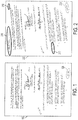
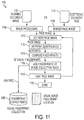
- FIGURES 1 and 2 illustrate a two-dimensional (2D) visual fingerprinting and highlighting method.
- Visual fingerprints of each document pages 100 and 200 are extracted, and the fingerprints are compared in order to identify duplicate document content.
- affine or perspective-invariant fingerprints By using affine or perspective-invariant fingerprints, corresponding document areas of identical content will yield matching visual fingerprints regardless of the page orientation and scale. Differences between the original and modified page are highlighted.
- the reviewer can therefore quickly focus on the key areas of difference (highlighted by the ovals 120, 210, 220).
- FIGURE 3 illustrates scanned original page 300.
- FIGURE 4 shows a query image of scanned modified page 400.
- Query page image 400 contains intentionally added (e.g., time stamp and document identifier) as well as content change modifications (e.g., name change and fax header) text annotations.
- intentionally added e.g., time stamp and document identifier
- content change modifications e.g., name change and fax header
- This application automatically finds any page in the collection that contains some duplicated content of query page image 400, automatically highlights the duplicated content, or the difference, between each such found page and the query page image.
- 2D visual fingerprinting technology is used to address the above. Initially, pages in the document collection are processed to extract visual fingerprints and build a fingerprint index. The collection need only be indexed once, and this can be done in advance.
- FIGURE 5 illustrates image 500 with fingerprint locations found for the scanned original page in FIGURE 3 super-imposed over the scanned original content of that page. Fingerprint locations are shown as node circles 502 (only a sampling are numbered), and a grid mesh of line-segments 504 (only a sampling are numbered) connect the fingerprint locations.
- FIGURE 6 illustrates image 600 with fingerprint locations found for the query image in FIGURE 4 .
- the fingerprint locations are shown as node circles 602 (only a sampling are numbered), and a grid mesh of line-segments 604 (only a sampling are numbered) connect the fingerprint locations.
- Query page image fingerprints are looked up in a document collection fingerprint index to retrieve all pages in the collection that have a certain number of similar fingerprints.
- Matching pages are ranked and sorted by decreasing level of similarity based on the number of matching fingerprints. Resulting pages are presented to a user in ranked similarity order to the query image.
- Fingerprint comparison analysis is carried out on each returned page to determine fingerprint correspondence with the query image fingerprints. Analysis identifies clusters of unique (non-corresponding) fingerprints and computes a 2D visual measure (e.g., an ellipse), for each cluster that is proportional to the cluster distribution and other factors such as the number of corresponding fingerprints occurring inside or in close proximity to a cluster, cluster fingerprint density, etc.
- a 2D visual measure e.g., an ellipse
- the resulting set of ellipses is added or super-imposed on top of the visual image display, to automatically highlight the areas of difference relative to the query page image.
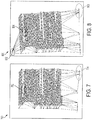
- FIGURES 7 and 8 illustrate results of fingerprint comparison analysis between the query page image in FIGURE 4 and the scanned original page in FIGURE 3 .
- FIGURE 7 shows the document page in FIGURE 3 augmented with two clusters of non-corresponding fingerprints surrounded by ellipses 702, 704. These clusters represent the areas in the scanned original page not common to the query image. Note, that the content of the ellipse 704 surrounding the cluster in the bottom right-hand corner is a document identification label entitled "USW 2159" which is understood not part of the original document. A unique label is stamped on each document as part of the scanning process. The dotted-line in this case indicates the unique identification stamp.
- FIGURE 8 shows result 800 of the fingerprint comparison analysis for the query image in FIGURE 4 with the difference from the document page in FIGURE 3 highlighted by ellipses 802, 804, 806.
- Two solid ellipses 802, 804 in the top of FIGURE 8 highlight the changes: time-stamp and text modification annotations with respect to the original document content.
- Dotted ellipse 806 on the bottom right of FIGURE 8 indicates a unique identification stamp that is added as part of the scanning process. While the circles and grid lines are shown in FIGURES 7 and 8 , they may not be shown in practice, and therefore the output comparison would look more like that shown in FIGURES 1 and 2 .
- FIGURE 4 illustrates an example of scanned/faxed copy of original page shown in FIGURE 3 , where the scanned/faxed image of FIGURE 4 is a rotated modified faxed page.
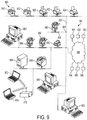
- the system and method described herein may work an environment or network as illustrated in FIGURE 9 .
- the network 900 is comprised of a series of connections such as wires 902, which may branch with third wire 906 at wire junctions 904, may connect a standalone peripheral device or pass through a peripheral to connect to other devices, such as computers 908, 909.
- the network may incorporate color printer 910, or other than color printer 912, color laser printers, 920, 922, or one other than color laser printer 924.
- the network may also incorporate scanner 930, fax machine 940, photocopier 950, color photocopier 952, a combination color printer/scanner/fax machine 954.
- the network may also contain computer terminal 960, or standalone hard drive data storage medium 964.
- the network may also contain wireless network transmitter receiver 970 and interface with laptop computer 972, or a plurality of laptop computers 974.
- the network may interconnect with any form of network 980 including but not limited to Internet, Intranet or other communication network.
- the present system and method may interface with a plurality of peripheral data capturing devices 990 including, digital still camera 991, digital video camera 992, cellular telephone 993, scanner 994, personal data assistant 995, or document indexing system 996.
- the present concepts may be implemented in networks having various combinations of the above components, going from a network having a single device to one which includes thousands or more connected devices. Further, various ones of the above components may have memory storage areas arranged in any of a number of known configurations which may be useful in implementing the concepts to be described.
- the storage areas may be RAM, ROM, Flash Memory, web services, cloud storage facilities or other memory types which can hold software incorporating the concepts of the present application.
- Various ones of the components of FIGURE 9 include processors to process instructions from software loaded on or otherwise accessible by the components. It is to be understood various ones of the components having the processors may have more than one processor whereby processing of the instructions can be divided among the multiple processors. Alternatively, a single processor can operate to divide the instructions, whereby processing can occur in a multi-threaded environment.
- the computers may be other computing devices than those mentioned above and will include electronic/digital processors as well as or in the alternative graphical electronic/digital processors (GPUs).
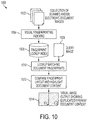
- FIGURE 10 illustrates method 1000 of detecting duplicate document content in a large document collection and automatically highlighting duplicate/different document content using 2D visual fingerprints.
- a document collection 1002 is first indexed and organized in a particular manner (such as by use of a Fan Tree) for fast and efficient fingerprint lookup 1004.
- a document collection in this context is an abstract logical document collection that may be physically located at one location or physically distributed in a set of sub-collections across many folders, drives, systems, networks, remote servers, web services and/or cloud storage facilities, etc.
- Visual fingerprinting and indexing process 1004 is applied to the pages of the documents in the collection.
- the fingerprints of each image and their locations are added to a fingerprint lookup index 1006, found in a memory.
- Fingerprint lookup index 1006 need only be fully constructed once for a given document collection. Once a collection has been indexed in this manner, the fingerprint index can be saved and re-used. The fingerprint index can be incrementally updated when documents are added or removed from the collection by adding the fingerprints of new documents to the index and removing existing fingerprints of deleted documents. The incremental update may be applied as a background process in a separate thread.
- the method of detecting duplicate document content is presented with a query page image 1008.
- the query page image is fingerprinted and the fingerprints are looked up 1010 in the fingerprint lookup index to return a list of collection documents and the number of matching fingerprints corresponding to query page image fingerprints.
- the list of returned collection documents is ordered by the number of corresponding fingerprints (e.g., most to least). Only the top matching pages above a required minimum of corresponding fingerprints may be retained.
- the corresponding fingerprints are retrieved from memory and compared with the query fingerprints 1012.
- This fingerprint comparison analysis is carried out to determine the fingerprint correspondence between the query page image and the matching document.
- the analysis takes into account the fingerprint locations and their corresponding layout.
- Sets of corresponding identical fingerprints represent regions of matching document content, while clusters of unique (non-corresponding) fingerprints in either image represent differences in document content.
- either the duplicate or non-duplicate document content may be automatically highlighted. For applications of duplicate and near duplicate content detection, it is often desirable to highlight the difference in content instead of the duplicate content (which in any case is identical between the two images).
- One method of automatically highlighting differences is by calculating the mean and standard deviation for the 2D locations of each cluster of unique (non-corresponding) fingerprints of the query and matching image collection document.
- An ellipse is computed for each cluster of non-corresponding fingerprints.
- the ellipse location is centered at the cluster mean, and the size of the ellipse is proportional to the estimated second moments of fingerprint location distribution within cluster.
- the ellipse size may be further controlled in proportion to the number and location of any corresponding fingerprints occurring inside or in close proximity to the cluster, and by cluster complexity, shape, and fingerprint density.
- the resulting ellipse is drawn or super-imposed on top of the visual image display in highlight color, or saved in a separate image layer or metadata.
- FIGURE 11 illustrates indexing method 1100 which provides additional details to the indexing of a collection of documents to create fingerprint lookup index 1006 (see FIGURE 10 ).
- Indexing method 1100 is comprised of processing a sequence of page images, computing visual fingerprints and adding the fingerprints and their locations to a specified image fingerprint lookup index.
- Process 1100 is shown in this embodiment to be used in connection with a document collection that contains scanned hardcopy documents 1102 and/or electronically generated documents 1104.
- Scanned hardcopy documents are comprised of scanned page images that may contain less than ideal conditions such as fax or scanner noise, page skew and dark image background, for example.
- An image processing stage 1106 may be included to remedy and further enhance the image prior to fingerprinting.
- Electronic documents 1104, on the other hand, such as Microsoft Word, Excel, PowerPoint, or Adobe PDF, for example, are rendered 1108, by drawing the content to create a sequence of page images for fingerprinting.
- Indexing method 1100 processes page images 1110 from the documents in the collection.
- the order of indexing documents is not significant.
- the system automatically determines the document type, whether a scanned hardcopy or electronic original, and automatically applies appropriate processing 1106 or 1108, respectively.
- Keypoint identification 1112 is responsible for identifying stable and repeatable keypoints in each page image. Previously developed methods of finding keypoints in a document or photo page image have been developed. One embodiment i s based on word-blob centroids, described in U.S. Serial Number 12/147,624 : METHOD AND SYSTEM FOR FINDING A DOCUMENT IMAGE IN A DOCUMENT COLLECTION USING LOCALIZED TWO-DIMENSIONAL VISUAL FINGERPRINTS, Kletter, et al.
- weaker keypoints found below a certain measure of strength threshold may be discarded.
- 2D visual fingerprints are computed 1114 from the resulting keypoints.
- Previously developed methods of computing visual fingerprints from image keypoints, based on geometry or image appearance have been developed.
- a geometry-based method of computing 2D visual fingerprints for document images is described in 20080166-US-NP: METHOD AND SYSTEM FOR FINDING A DOCUMENT IMAGE IN A DOCUMENT COLLECTION USING LOCALIZED TWO-DIMENSIONAL VISUAL FINGERPRINTS, Kletter, et al.
- the resulting fingerprints and their locations are added 1116 to the image collection fingerprint index 1006.
- the image fingerprints are added to the index and hashed in a special manner in order to facilitate fast and efficient fingerprint lookup (e.g., such as by use of a Fan Tree).
- one effective method of organizing the fingerprint in memory for fast lookup is detailed in U.S. Serial Number 12/147,624 : METHOD AND SYSTEM FOR FINDING A DOCUMENT IMAGE IN A DOCUMENT COLLECTION USING LOCALIZED TWO-DIMENSIONAL VISUAL FINGERPRINTS, Kletter, et al.
- Process 1100 repeats for each page of each document in the collection until the last page image 1118 is encountered. At this point, resulting fingerprint lookup index 1006 (see also Figure 10 ) is saved and may be re-used. Fingerprint lookup index 1006 can be incrementally updated when additional pages are added or removed from the collection as outlined in [0037] above.
- FIGURE 12 illustrates query process/method 1200 of detecting duplicate document content using 2D visual fingerprints using a query image; automatically highlighting content difference; and ranking pages by page similarity level.
- Query process 1200 begins with a query page presented at the input.
- the query page itself may be a page of scanned hardcopy document 1202 or a page image of electronic document 1204.
- the system automatically determines (e.g., by reading an accompanying information file) the document type, whether scanned hardcopy or electronic original, and automatically applies the appropriate processing 1206, 1208, respectively, as outlined above.
- the system may apply image processing to clean and enhance a degraded 1202 scanned hardcopy query page to produce an improved query image 1210 prior to fingerprinting.
- the system may render an electronic query page of a Microsoft Word, PowerPoint or PDF document page into a query image 1210. At this time the processing is being applied to the query page image image rather than to document collection page images.
- Resulting fingerprints are looked up as a query 1216 in the collection fingerprint lookup index 1006 to return a list of matching pages 1218 from the collection of documents with matching corresponding fingerprints to the query page image fingerprints.
- the list is ordered by the number of matching corresponding fingerprints, the match rank.
- the process will identify one of the pages from the list (Get Next Page Image) 1220 as a matching page 1222.
- Corresponding fingerprints of matching page 1222 are retrieved from memory index 1006.
- the fingerprints of matching page 1222 and fingerprint layout 1224 of the query page image are subject to a fingerprint comparison analysis 1226.
- the fingerprint comparison analysis is carried out to determine the fingerprint correspondence between the query page image and the present matching document page.
- the analysis compares fingerprint locations and corresponding layout and identifies clusters of unique (non-corresponding) fingerprints in the query and matching document image.
- the analysis calculates the level of matching document page similarity with the query page image based on the matching fingerprint locations.
- an ellipse is computed for each cluster where the size of the ellipse is proportional to the estimated second moments of fingerprint locations within cluster.
- the size of the ellipse may further be adjusted in proportion to the number and location of corresponding fingerprints occurring inside or in close proximity to the cluster, and by cluster complexity, shape, and fingerprint density.
- the ellipses for all returned pages are added or super-imposed on top of the visual image display in highlight color, or saved in a separate image layer or annotated metadata.
- the process checks if the present page image is the last page of the list of matching pages 1230. If not the process obtains a next page image from the list 1220 and repeats for each of the returned pages in the collection until the last matching page image is encountered and the process is completed 1232. At this point, the list of matching corresponding documents is ranked by page similarity level in order to return pages with the most duplicate content first.
- a goal of the keypoint identification (e . g ., 1112 of Figure 11 and 1212 of Figure 12 ) is to repeatedly and reliably find as many of the keypoints even in a degraded version of an image that is subject to at least one of, but not limited to noise, scene lighting variations, and affine transformations such as skew, warp, rotation, translation, scale, change of resolution, and the like.
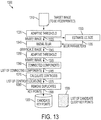
- FIGURE 13 One process of detecting document keypoint locations 1300 of a target image 1310 to be fingerprinted is shown in FIGURE 13 .
- a binary output image 1325 of first Adaptive Threshold module 1320 is sent to Estimate CC Size module 1330.
- the term CC here stands for Connected Component, which is a maximally connected sub-group of binary pixels having the same polarity. Two pixels are in the same connected component if and only if there exists a path of the same polarity pixels between them.
- the purpose of the Estimate CC Size module 1330 is to dynamically estimate, for target image 1310 on an image by image basis, the blur parameters 1335 or blur filter size to be applied in the subsequent Radial Blur module 1340.
- the objective of the blurring process is to provide robust, reliable, and repeatable keypoint identification.
- the blurring also helps to remove noise such salt and pepper noise and eliminate small isolated features on the page.
- the shape of the blurring filter for example but not limited to an approximated Gaussian shape, should be smooth enough to prevent from introducing undesirable artifacts.
- the output of Radial Blurring module 1340 is grayscale image 1345.
- Adaptive Threshold module 1350 converts grayscale Radial Blur 1340 image output 1345 to binary black and white output 1355 by adaptive thresholding 1350.
- Binary output of second Adaptive Threshold module 1350 is a binary image 1355 and is forwarded to Connected Component module 1360.
- Connected component methods are well known in the art, and may be considered a set of maximally connected components of a graph.
- Centroid module 1370 determines the visual center of each connected component at the output of the Connected Component module 1360. For each connected component, the horizontal centroid location is calculated by summing together the horizontal coordinates of each member pixel of the connected component and dividing the outcome by the total number of member pixels. The vertical centroid location is likewise calculated by summing together the vertical coordinates of each member pixel and dividing by the number of member pixels. The summation can be effectively done on-the-fly during the connected component analysis. Note that only the pixel members of a given connected component contribute to its centroid location, ignoring any other non-member pixel "holes". The visual centroid of each connected component is calculated with subpixel precision, since in many languages the connected components tend to be situated in text lines.
- the list of connected component centroid locations 1375 from Calculate Centroid module 1370 is validated by Remove Duplicates module 1380, which produces a list of keypoints 1385.
- the purpose of the validation is to ensure that no two connected component shall have the same centroid locations within a given tolerance level. Duplicated connected components with nearly the same centroid locations are eliminated.
- the list of remaining connected component centroids at the output of the Remove Duplicates module 1380 becomes the final candidate query keypoints list 1395.
- the overall number of candidate keypoints 1390 depends on the Input image content and the type of connected component processing. There can be several hundred keypoints for a typical machine printed page.
- Described is the process of computing fingerprints from local groups of keypoints and packing the fingerprints for efficient storage in a Fingerprint Lookup Index or Database (e.g ., 1006 of FIGURES 10 , 11 , 12 ). Fingerprints are packed to reduce the Fingerprint Lookup Index or Database size and storage requirements.
- a Fingerprint Lookup Index or Database e.g ., 1006 of FIGURES 10 , 11 , 12 .
- Fingerprints are constructed as sequences of quantized, transformation-invariant 2D ratios, called persistent ratios, which are derived from the relative 2D positions of a given keypoint and its (N-1) nearest-neighbor keypoints. Thus each fingerprint is localized to a small image neighborhood around the keypoint of interest. A fingerprint sequence is dependent only on the relative 2D geometry between the keypoint of interest and its (N-1) closest keypoint neighbors. The number of neighbors N is a design parameter that influences the fingerprint strength.
- the present application makes the fingerprints robust to certain image distortions such as, but not limited to skew, warp, rotation, translation, scale, change of resolution, and the like, that commonly occur during the process of scanning or taking a picture of the image with a digital or a cell phone camera.
- image distortions such as, but not limited to skew, warp, rotation, translation, scale, change of resolution, and the like, that commonly occur during the process of scanning or taking a picture of the image with a digital or a cell phone camera.
- a single fingerprint is therefore comprised of a sequence of quantized persistent transformation ratios for a group of N nearest neighbor keypoints sorted in clockwise order.
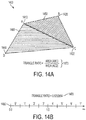
- the transformation ratio is quantized to Q-levels 1480.
- the value of Q can be conveniently chosen to be a binary power of two.
- the interval boundaries are determined empirically to provide approximately uniform distribution of quantization labels over a large set of representative documents.
- the incoming triangle ratio value 1480 is sequentially compared with increasing interval boundaries to determine the first higher or equal interval boundary, upon which the process is terminated and the corresponding label interval is assigned as the quantized result. For example, an incoming triangle ratio of 0.8253694, being less than 1.0 and higher than the previous interval boundary, is assigned a quantized value of '3'.
- a potential issue in using the nearest neighbor method is that nearness is not necessarily preserved under perspective transformation. There can be no guarantee that the N nearest neighbors of a given keypoint will remain exactly the same N keypoints under arbitrary affine or perspective transformation. Still, the closest keypoints are more likely to remain in the list of N nearest neighbors than keypoints that are farther away.
- the present application proposes to allow one or more of the neighbor keypoints to be missing in order to further increase the robustness of a fingerprint to affine or perspective transformation.
- one keypoint is allowed to be excluded under the consideration of limited affine distortions in small localized neighborhoods.
- each given keypoint gives rise to a number of fingerprints N, by leaving out one keypoint at a time.
- a Fingerprinting process 1500 is shown in FIGURE 15 .
- the input to Fingerprinting process 1500 is the list of candidate keypoints 1510 for the input image 1505.
- the first Fingerprinting processing step in FIGURE 15 is the Keypoint Triangulation module 1520.
- Delaunay or Keypoint Triangulation 1520 are used to identify the nearest keypoints to each given keypoint in a local neighborhood. By following the triangulation links, the nearest (N-1) neighbors to any given keypoint can be effectively determined.
- Each candidate keypoint and its (N-1) nearest neighbors is considered as a fingerprint candidate.
- Each current candidate keypoint Kp is selected sequentially from input list 1510 by the Get Next Keypoint module 1530.
- the Find Nearest Neighbors module 1540 identifies the (N-1) nearest keypoints with the closest distance to the given keypoint Kp, where N is a given parameter.
- the Find Nearest Neighbors module uses the Delaunay or Keypoint Triangulation result 1520 to return a list of the closest keypoints to Kp, sorted by increasing distance from Kp. The first element of the returned list is always the current keypoint Kp (with a distance of zero).
- N The value of the parameter N is adjusted to provide a reasonable tradeoff between the fingerprint "strength" or distinctiveness, the overall system performance, quantified as the number of computations per fingerprint, and the resulting database size or fingerprint size.
- Points of the Find Nearest Neighbor module 1540 need to be taken in a consistent order so that sequence of area ratios will be consistent for the same keypoint/neighborhood between database and query images.
- Sort in Clockwise Order module 1550 sorts the list of N nearest neighbor keypoints of a given keypoint in increasing clockwise orientation.
- Sort in Clockwise Order module 1550 includes a method and system to stabilize keypoint ordering with respect to the common case of nearly co-linear keypoints.
- the Sort in Clockwise Order module 1550 uses the first M nearest neighbors, where M ⁇ N, on the list (the closest to the given keypoint) to calculate a subgroup center of origin.
- the farthest (N-M) keypoints are not used in calculation of the subgroup center of origin, in order to ensure that origin will remain stable under affine or perspective transformation.
- the Sort in Clockwise Order module 1550 proceeds to sort the keypoints in increasing clockwise orientation order.
- the sorting is done on both the orientation and distance.
- the order is by increasing clockwise orientation order. If two or more points have roughly the same orientation, where the difference is within a predefined tolerance level, the points are sub-ordered by increasing distance for all the points of a substantially similar orientation.
- Packed Quantized Ratio module 1570 calculates a single persistent ratio and quantizes it using a set of predefined interval boundary thresholds.
- the quantization threshold values are determined empirically by studying the distribution of persistent ratios in a large collection of documents of a particular type.
- the process of calculating and packing the fingerprints continues sequentially, one persistent ratio at a time, until the last combination is detected by the Last Combination module 1580. If the current P subgroup combination is not yet the last combination 1581, the Last Combination module 1580 routes the flow back to the Next Subgroup Combination module 1560, to obtain the next P subgroup and proceed to calculate its quantized persistent ratio and pack it. This process continues until the last P subgroup combination has been processed 1582. At this time, the resulting packed fingerprint data 1583 is written to the Fingerprint Database 1585. Fingerprint data can be written to the Fingerprint Database 1585 sequentially, one fingerprint at a time, as each packed fingerprint data is becoming available.
- Last Keypoint module 1590 continues sequentially for all the remaining keypoints, until the last keypoint is detected by Last Keypoint module 1590. If the current keypoint combination is not yet the last keypoint 1591, Last Keypoint module 1590 routes the flow back to Get Next Keypoint module 1530, to obtain the next keypoint and proceed to repeat the process to calculate its packed fingerprint and adding it to Fingerprint Database 1585. The Fingerprinting process continues in this manner until the last keypoint combination last corresponding fingerprint has been processed 1592 and added to Fingerprint Database 1585. Once the last keypoint has been addressed, the process ends 1595.
- FIGURE 16A illustrates the process with respect to a given example image 1600.
- the processed image is shown with the keypoints or word centroids identified by circles such as circles 1601-1602.
- Other circles in the figures are also word centroids.
- numbers (1-7) also represent word centroids which are near neighbor keypoints to point X.
- FIGURE 16B eliminates the background processed image for better clarity, but is otherwise the same as in FIGURE 16A .
- a fingerprint is computed for the keypoint X, using seven additional keypoints (1-7) in the local neighborhood.
- the three most distant keypoints (4, 6, 7) of the seven (1-7) are not used for the center of origin calculation to stabilize the point 0 location by allowing for up to three (3) points to be shifted by arbitrary affine or perspective transformation.
- the entire set of eight keypoints (X and 1-7) are sorted in clockwise order 1610 with respect to the newly calculated sub-group center of origin (0), resulting in the final output sequence ordering of (1, X, 2, 3, 4, 5, 6, 7) in this case.
- the above-described ordering depends on the point of reference. If “0" is used as the point of reference, the resulting sequence would have been 234X5671 since 1 is above the dotted line from "0".
- the alternative as used here is to continue to use X as reference, but pretend the keypoint mass is moved to "0", which yields the listed sequence.
- the latter has been used, since it keeps the original keypoint location as reference, while the point "0" may move around X and cause the flipping of keypoint sequence order.
- it can be done either way, as what needs to be accomplished, in either case, is to be able to repeat the same sequence in both target and query image.
- the objective of the second step is to sort in clockwise order, not by distance.
- P-subsets of the N keypoints are considered in a systematic and consistent manner. For each, an integer is determined by computing the persistent area ratio for that P-subset, and mapping the area ratio to an integer as described herein. The length of a fingerprint for the given keypoint is the total number of such P-subsets.
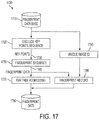
- the fingerprints in the Fingerprint Database 1585 are stored in a packed format to reduce the memory size and loading time, they must first be unpacked and re-organized in a unique manner in accordance with a Fan Tree data structure to facilitate efficient fingerprint matching. It is only necessary to prepare the Fingerprint Database once, upon the first image query.
- the Fan Tree data structure (containing the unpacked fingerprint sequences) can be kept in memory and subsequently reused with any number of image queries.
- the method of preparation of the packed fingerprint database 1710 has previously been illustrated ( FIGURE 15 ).
- the fingerprint information is retrieved the from the fingerprint database 1710.
- Each fingerprint database entry gives rise to multiple candidate fingerprints.
- Exclude Keypoint module 1720 selects multiple candidate fingerprint keypoint combinations by excluding one or more of the fingerprint keypoints 1730. This allows for one or more missing keypoints among the local neighborhood keypoints. In the present implementation, Exclude Keypoint module leaves out one keypoint. With a local neighborhood of N keypoints, this gives rise to N fingerprints for each database entry, or N fingerprints per keypoint since a database entry is made for each keypoint.
- 8 keypoints (current and 7 closest) are generated, and again 8 query fingerprints are computed using the same method, and likewise excluding one keypoint at a time.
- An attempt is made to match the keypoints against the Fan Tree content. Matching is stopped upon the first obtained match. If a single keypoint is missing from the query image (it does not matter which), one of the query fingerprints out of the 8 is bound to have a match (to the one with the 7 other keypoints present). If no keypoint is missing (all 8 present), then there would be 8 matches (because any group of 7 will match), except the process stops after the first positive match since there is no need to continue checking. If, however, two keypoints or more are missing at the same time, there would be no match for this location. If so desired, the system could easily handle more missing keypoints by extending the method to allow more missing keypoints (e.g., 2 out of 8, etc.).
- Fingerprint Data 1760 output from Fingerprint Sequence module 1750, together with unique image ID 1740 that is retrieved from the database for the current image, form fingerprint record 1780.
- Fingerprint record 1780 is stored in a corresponding Fan Tree Leaf node location which is addressed by Fan Tree module 1770.
- Fan Tree Leaf node information is stored as a linked list of fingerprint records 1780 in the corresponding Fingerprint Data structure 1790. Only the actual Fan Tree Leaf nodes corresponding to real fingerprints are populated. The first fingerprint to arrive at a particular leaf node populates that leaf node for the first time. If more than one fingerprint happens to arrive at the same leaf node again (i.e., following the same Fan Tree path), the new fingerprint information is added at the same leaf node by linking the new fingerprint information with the last previous fingerprint information on that leaf node.
Landscapes
- Engineering & Computer Science (AREA)
- Computer Vision & Pattern Recognition (AREA)
- Physics & Mathematics (AREA)
- Multimedia (AREA)
- Theoretical Computer Science (AREA)
- Artificial Intelligence (AREA)
- General Physics & Mathematics (AREA)
- Geometry (AREA)
- Computer Graphics (AREA)
- Editing Of Facsimile Originals (AREA)
- Information Retrieval, Db Structures And Fs Structures Therefor (AREA)
- Document Processing Apparatus (AREA)
- Image Analysis (AREA)
- Image Processing (AREA)
Applications Claiming Priority (1)
| Application Number | Priority Date | Filing Date | Title |
|---|---|---|---|
| US12/907,226 US8750624B2 (en) | 2010-10-19 | 2010-10-19 | Detection of duplicate document content using two-dimensional visual fingerprinting |
Publications (3)
| Publication Number | Publication Date |
|---|---|
| EP2444920A2 EP2444920A2 (en) | 2012-04-25 |
| EP2444920A3 EP2444920A3 (en) | 2013-04-03 |
| EP2444920B1 true EP2444920B1 (en) | 2019-08-21 |
Family
ID=44785568
Family Applications (1)
| Application Number | Title | Priority Date | Filing Date |
|---|---|---|---|
| EP11184495.7A Not-in-force EP2444920B1 (en) | 2010-10-19 | 2011-10-10 | Detection of duplicate document content using two-dimensional visual fingerprinting |
Country Status (3)
| Country | Link |
|---|---|
| US (1) | US8750624B2 (enExample) |
| EP (1) | EP2444920B1 (enExample) |
| JP (1) | JP5753473B2 (enExample) |
Families Citing this family (30)
| Publication number | Priority date | Publication date | Assignee | Title |
|---|---|---|---|---|
| US8943144B2 (en) * | 2009-12-10 | 2015-01-27 | International Business Machines Corporation | Consolidating duplicate messages for a single destination on a computer network |
| US8554021B2 (en) | 2010-10-19 | 2013-10-08 | Palo Alto Research Center Incorporated | Finding similar content in a mixed collection of presentation and rich document content using two-dimensional visual fingerprints |
| US8527516B1 (en) * | 2011-02-25 | 2013-09-03 | Google Inc. | Identifying similar digital text volumes |
| US10685234B2 (en) | 2012-03-31 | 2020-06-16 | Xerox Corporation | Automatic and semi-automatic metadata generation via inheritance in homogeneous and heterogeneous environments |
| US8838657B1 (en) | 2012-09-07 | 2014-09-16 | Amazon Technologies, Inc. | Document fingerprints using block encoding of text |
| US9773039B2 (en) * | 2012-09-14 | 2017-09-26 | Fti Consulting, Inc. | Computer-implemented system and method for identifying near duplicate documents |
| TWI512642B (zh) * | 2013-01-25 | 2015-12-11 | Delta Electronics Inc | 快速圖形比對方法 |
| US8958651B2 (en) * | 2013-05-30 | 2015-02-17 | Seiko Epson Corporation | Tree-model-based stereo matching |
| US10303682B2 (en) * | 2013-09-21 | 2019-05-28 | Oracle International Corporation | Automatic verification and triage of query results |
| JP6232940B2 (ja) * | 2013-11-01 | 2017-11-22 | 富士ゼロックス株式会社 | 画像情報処理装置及びプログラム |
| CN103714345B (zh) * | 2013-12-27 | 2018-04-06 | Tcl集团股份有限公司 | 一种双目立体视觉检测手指指尖空间位置的方法与系统 |
| US9886422B2 (en) * | 2014-08-06 | 2018-02-06 | International Business Machines Corporation | Dynamic highlighting of repetitions in electronic documents |
| US9805099B2 (en) * | 2014-10-30 | 2017-10-31 | The Johns Hopkins University | Apparatus and method for efficient identification of code similarity |
| CN105787415B (zh) * | 2014-12-18 | 2020-04-07 | 富士通株式会社 | 文档图像的处理装置、方法以及扫描仪 |
| US9836435B2 (en) * | 2015-03-19 | 2017-12-05 | International Business Machines Corporation | Embedded content suitability scoring |
| RU2613848C2 (ru) * | 2015-09-16 | 2017-03-21 | Общество с ограниченной ответственностью "Аби Девелопмент" | Выявление "нечетких" дубликатов изображений с помощью троек смежных оцененных признаков |
| US11068546B2 (en) | 2016-06-02 | 2021-07-20 | Nuix North America Inc. | Computer-implemented system and method for analyzing clusters of coded documents |
| US10229315B2 (en) * | 2016-07-27 | 2019-03-12 | Intuit, Inc. | Identification of duplicate copies of a form in a document |
| US20180101540A1 (en) * | 2016-10-10 | 2018-04-12 | Facebook, Inc. | Diversifying Media Search Results on Online Social Networks |
| US10083353B2 (en) | 2016-10-28 | 2018-09-25 | Intuit Inc. | Identifying document forms using digital fingerprints |
| US10372813B2 (en) | 2017-01-17 | 2019-08-06 | International Business Machines Corporation | Selective content dissemination |
| US10318563B2 (en) | 2017-08-23 | 2019-06-11 | Lead Technologies, Inc. | Apparatus, method, and computer-readable medium for recognition of a digital document |
| CN109697231A (zh) * | 2017-10-24 | 2019-04-30 | 北京国双科技有限公司 | 一种案件文书的显示方法、系统、存储介质和处理器 |
| CN108664900B (zh) * | 2018-04-20 | 2022-05-27 | 上海掌门科技有限公司 | 一种用于识别文字作品异同的方法与设备 |
| US20200019583A1 (en) * | 2018-07-11 | 2020-01-16 | University Of Southern California | Systems and methods for automated repair of webpages |
| CN109471921A (zh) * | 2018-11-23 | 2019-03-15 | 深圳市元征科技股份有限公司 | 一种文本查重方法、装置及设备 |
| DE112020006703T5 (de) * | 2020-02-10 | 2022-12-15 | Mitsubishi Electric Corporation | Anzeigebilddaten-Editierprogramm, Anzeigebilddaten-Editiervorrichtung und Anzeigebilddaten-Editierverfahren |
| JP7400543B2 (ja) * | 2020-02-28 | 2023-12-19 | 富士フイルムビジネスイノベーション株式会社 | 情報処理装置及びプログラム |
| CN113297888B (zh) * | 2020-09-18 | 2024-06-07 | 阿里巴巴集团控股有限公司 | 一种图像内容检测结果核查方法及装置 |
| US12620252B2 (en) | 2023-03-07 | 2026-05-05 | EchoMark, Inc. | Information source detection using unique watermarks |
Family Cites Families (35)
| Publication number | Priority date | Publication date | Assignee | Title |
|---|---|---|---|---|
| JPH0589190A (ja) * | 1991-09-27 | 1993-04-09 | Meidensha Corp | 図面情報のチエツク方式 |
| CA2077274C (en) | 1991-11-19 | 1997-07-15 | M. Margaret Withgott | Method and apparatus for summarizing a document without document image decoding |
| US5465303A (en) | 1993-11-12 | 1995-11-07 | Aeroflex Systems Corporation | Automated fingerprint classification/identification system and method |
| US5465353A (en) | 1994-04-01 | 1995-11-07 | Ricoh Company, Ltd. | Image matching and retrieval by multi-access redundant hashing |
| US5613014A (en) | 1994-10-12 | 1997-03-18 | Martin Marietta Corp. | Fingerprint matching system |
| US5987171A (en) * | 1994-11-10 | 1999-11-16 | Canon Kabushiki Kaisha | Page analysis system |
| JP3647075B2 (ja) * | 1995-01-26 | 2005-05-11 | キヤノン株式会社 | 画像検索方法及びその装置 |
| US5850476A (en) | 1995-12-14 | 1998-12-15 | Xerox Corporation | Automatic method of identifying drop words in a document image without performing character recognition |
| US5893908A (en) | 1996-11-21 | 1999-04-13 | Ricoh Company Limited | Document management system |
| US6041133A (en) | 1996-12-13 | 2000-03-21 | International Business Machines Corporation | Method and apparatus for fingerprint matching using transformation parameter clustering based on local feature correspondences |
| US7844594B1 (en) | 1999-06-18 | 2010-11-30 | Surfwax, Inc. | Information search, retrieval and distillation into knowledge objects |
| US20060259524A1 (en) | 2003-03-17 | 2006-11-16 | Horton D T | Systems and methods for document project management, conversion, and filing |
| US7359532B2 (en) | 2003-12-11 | 2008-04-15 | Intel Corporation | Fingerprint minutiae matching using scoring techniques |
| US7702673B2 (en) | 2004-10-01 | 2010-04-20 | Ricoh Co., Ltd. | System and methods for creation and use of a mixed media environment |
| JP4517822B2 (ja) * | 2004-11-05 | 2010-08-04 | 富士ゼロックス株式会社 | 画像処理装置及びプログラム |
| US20060104484A1 (en) | 2004-11-16 | 2006-05-18 | Bolle Rudolf M | Fingerprint biometric machine representations based on triangles |
| US20060120686A1 (en) * | 2004-12-03 | 2006-06-08 | Frank Liebenow | Method, apparatus and system for storage and retrieval of images |
| JP4533187B2 (ja) * | 2005-03-01 | 2010-09-01 | キヤノン株式会社 | 画像処理装置およびその制御方法 |
| US7519200B2 (en) | 2005-05-09 | 2009-04-14 | Like.Com | System and method for enabling the use of captured images through recognition |
| US7403932B2 (en) | 2005-07-01 | 2008-07-22 | The Boeing Company | Text differentiation methods, systems, and computer program products for content analysis |
| US7801392B2 (en) | 2005-07-21 | 2010-09-21 | Fuji Xerox Co., Ltd. | Image search system, image search method, and storage medium |
| US8103050B2 (en) | 2006-01-16 | 2012-01-24 | Thomson Licensing | Method for computing a fingerprint of a video sequence |
| DE602006014803D1 (de) | 2006-04-28 | 2010-07-22 | Eidgenoess Tech Hochschule | Robuster Detektor und Deskriptor für einen Interessenspunkt |
| US8244036B2 (en) | 2007-01-24 | 2012-08-14 | Bluebeam Software, Inc. | Method for emphasizing differences in graphical appearance between an original document and a modified document with annotations |
| US8055079B2 (en) | 2007-03-06 | 2011-11-08 | Sharp Kabushiki Kaisha | Image processing method, image processing apparatus, and image forming apparatus |
| US8972299B2 (en) | 2008-01-07 | 2015-03-03 | Bally Gaming, Inc. | Methods for biometrically identifying a player |
| US8233722B2 (en) * | 2008-06-27 | 2012-07-31 | Palo Alto Research Center Incorporated | Method and system for finding a document image in a document collection using localized two-dimensional visual fingerprints |
| US8233716B2 (en) | 2008-06-27 | 2012-07-31 | Palo Alto Research Center Incorporated | System and method for finding stable keypoints in a picture image using localized scale space properties |
| US8144947B2 (en) | 2008-06-27 | 2012-03-27 | Palo Alto Research Center Incorporated | System and method for finding a picture image in an image collection using localized two-dimensional visual fingerprints |
| US8520941B2 (en) * | 2008-12-09 | 2013-08-27 | Xerox Corporation | Method and system for document image classification |
| US8548193B2 (en) | 2009-09-03 | 2013-10-01 | Palo Alto Research Center Incorporated | Method and apparatus for navigating an electronic magnifier over a target document |
| US8380588B2 (en) | 2010-01-14 | 2013-02-19 | Oracle International Corporation | Side-by-side comparison of associations for multi-level bills of material |
| US9514103B2 (en) | 2010-02-05 | 2016-12-06 | Palo Alto Research Center Incorporated | Effective system and method for visual document comparison using localized two-dimensional visual fingerprints |
| US8086039B2 (en) | 2010-02-05 | 2011-12-27 | Palo Alto Research Center Incorporated | Fine-grained visual document fingerprinting for accurate document comparison and retrieval |
| US8554021B2 (en) | 2010-10-19 | 2013-10-08 | Palo Alto Research Center Incorporated | Finding similar content in a mixed collection of presentation and rich document content using two-dimensional visual fingerprints |
-
2010
- 2010-10-19 US US12/907,226 patent/US8750624B2/en active Active
-
2011
- 2011-10-10 EP EP11184495.7A patent/EP2444920B1/en not_active Not-in-force
- 2011-10-14 JP JP2011227416A patent/JP5753473B2/ja active Active
Non-Patent Citations (1)
| Title |
|---|
| D.G. LOWE: "Object recognition from local scale-invariant features", PROCEEDINGS OF THE SEVENTH IEEE INTERNATIONAL CONFERENCE ON COMPUTER VISION, 1 January 1999 (1999-01-01), pages 1150 - 1157 vol.2, XP055148279, ISBN: 978-0-76-950164-2, DOI: 10.1109/ICCV.1999.790410 * |
Also Published As
| Publication number | Publication date |
|---|---|
| EP2444920A2 (en) | 2012-04-25 |
| US8750624B2 (en) | 2014-06-10 |
| JP5753473B2 (ja) | 2015-07-22 |
| US20120093421A1 (en) | 2012-04-19 |
| EP2444920A3 (en) | 2013-04-03 |
| JP2012089132A (ja) | 2012-05-10 |
Similar Documents
| Publication | Publication Date | Title |
|---|---|---|
| EP2444920A2 (en) | Detection of duplicate document content using two-dimensional visual fingerprinting | |
| EP2138953B1 (en) | Method and system for finding a document image in a document collection using localized two-dimensional visual fingerprints | |
| US8144947B2 (en) | System and method for finding a picture image in an image collection using localized two-dimensional visual fingerprints | |
| EP2444921B1 (en) | Finding Similar Content in a Mixed Collection of Presentation and Rich Document Content using Two-dimensional Visual Fingerprints | |
| US8712156B2 (en) | Comparison of visual information | |
| CN101133429B (zh) | 文档和/或图像检索方法、文档和/或图像存储设备和检索设备 | |
| Mishra et al. | Region duplication forgery detection technique based on SURF and HAC | |
| JP5527555B2 (ja) | 画像データベースの作成方法、作成プログラム及び画像検索方法 | |
| EP2364011B1 (en) | Fine-grained visual document fingerprinting for accurate document comparison and retrieval | |
| US10210427B2 (en) | Systems, methods, and devices for image matching and object recognition in images | |
| KR101548928B1 (ko) | 불변적인 시각적 장면 및 객체 인식 | |
| US8139860B2 (en) | Retrieving and sharing electronic documents using paper | |
| EP2093709A1 (en) | Document image feature value generating device, document image feature value generating method, and document image feature value generating program | |
| do Valle Jr | Local-descriptor matching for image identification systems | |
| Hare et al. | MapSnapper: engineering an efficient algorithm for matching images of maps from mobile phones | |
| Nikolopoulos et al. | Image replica detection using R-trees and linear discriminant analysis | |
| Havasi et al. | Search in WikiImages using mobile phone | |
| Pinjarkar et al. | Novel CBIR System for Color Logo Image Retrieval by Feature Fusion | |
| CN121747126A (zh) | 票据识别方法、装置、设备、存储介质和程序产品 | |
| Jun et al. | Iriw: Image retrieval based image watermarking for large-scale image databases | |
| CN117668336A (zh) | 文档处理方法及装置 | |
| Souraya et al. | Image Retrieval Using Patch-Based Features | |
| HK1165067B (en) | Method and device for compiling image database, and method for retrieving image |
Legal Events
| Date | Code | Title | Description |
|---|---|---|---|
| AK | Designated contracting states |
Kind code of ref document: A2 Designated state(s): AL AT BE BG CH CY CZ DE DK EE ES FI FR GB GR HR HU IE IS IT LI LT LU LV MC MK MT NL NO PL PT RO RS SE SI SK SM TR |
|
| AX | Request for extension of the european patent |
Extension state: BA ME |
|
| PUAI | Public reference made under article 153(3) epc to a published international application that has entered the european phase |
Free format text: ORIGINAL CODE: 0009012 |
|
| PUAL | Search report despatched |
Free format text: ORIGINAL CODE: 0009013 |
|
| AK | Designated contracting states |
Kind code of ref document: A3 Designated state(s): AL AT BE BG CH CY CZ DE DK EE ES FI FR GB GR HR HU IE IS IT LI LT LU LV MC MK MT NL NO PL PT RO RS SE SI SK SM TR |
|
| AX | Request for extension of the european patent |
Extension state: BA ME |
|
| RIC1 | Information provided on ipc code assigned before grant |
Ipc: G06K 9/00 20060101ALI20130225BHEP Ipc: G06K 9/20 20060101AFI20130225BHEP |
|
| 17P | Request for examination filed |
Effective date: 20131004 |
|
| RBV | Designated contracting states (corrected) |
Designated state(s): AL AT BE BG CH CY CZ DE DK EE ES FI FR GB GR HR HU IE IS IT LI LT LU LV MC MK MT NL NO PL PT RO RS SE SI SK SM TR |
|
| STAA | Information on the status of an ep patent application or granted ep patent |
Free format text: STATUS: EXAMINATION IS IN PROGRESS |
|
| 17Q | First examination report despatched |
Effective date: 20170809 |
|
| GRAP | Despatch of communication of intention to grant a patent |
Free format text: ORIGINAL CODE: EPIDOSNIGR1 |
|
| STAA | Information on the status of an ep patent application or granted ep patent |
Free format text: STATUS: GRANT OF PATENT IS INTENDED |
|
| INTG | Intention to grant announced |
Effective date: 20190318 |
|
| GRAS | Grant fee paid |
Free format text: ORIGINAL CODE: EPIDOSNIGR3 |
|
| GRAA | (expected) grant |
Free format text: ORIGINAL CODE: 0009210 |
|
| STAA | Information on the status of an ep patent application or granted ep patent |
Free format text: STATUS: THE PATENT HAS BEEN GRANTED |
|
| AK | Designated contracting states |
Kind code of ref document: B1 Designated state(s): AL AT BE BG CH CY CZ DE DK EE ES FI FR GB GR HR HU IE IS IT LI LT LU LV MC MK MT NL NO PL PT RO RS SE SI SK SM TR |
|
| REG | Reference to a national code |
Ref country code: GB Ref legal event code: FG4D |
|
| REG | Reference to a national code |
Ref country code: CH Ref legal event code: EP |
|
| REG | Reference to a national code |
Ref country code: DE Ref legal event code: R096 Ref document number: 602011061394 Country of ref document: DE |
|
| REG | Reference to a national code |
Ref country code: AT Ref legal event code: REF Ref document number: 1170593 Country of ref document: AT Kind code of ref document: T Effective date: 20190915 |
|
| REG | Reference to a national code |
Ref country code: IE Ref legal event code: FG4D |
|
| REG | Reference to a national code |
Ref country code: LT Ref legal event code: MG4D |
|
| REG | Reference to a national code |
Ref country code: NL Ref legal event code: MP Effective date: 20190821 |
|
| PG25 | Lapsed in a contracting state [announced via postgrant information from national office to epo] |
Ref country code: LT Free format text: LAPSE BECAUSE OF FAILURE TO SUBMIT A TRANSLATION OF THE DESCRIPTION OR TO PAY THE FEE WITHIN THE PRESCRIBED TIME-LIMIT Effective date: 20190821 Ref country code: HR Free format text: LAPSE BECAUSE OF FAILURE TO SUBMIT A TRANSLATION OF THE DESCRIPTION OR TO PAY THE FEE WITHIN THE PRESCRIBED TIME-LIMIT Effective date: 20190821 Ref country code: NO Free format text: LAPSE BECAUSE OF FAILURE TO SUBMIT A TRANSLATION OF THE DESCRIPTION OR TO PAY THE FEE WITHIN THE PRESCRIBED TIME-LIMIT Effective date: 20191121 Ref country code: FI Free format text: LAPSE BECAUSE OF FAILURE TO SUBMIT A TRANSLATION OF THE DESCRIPTION OR TO PAY THE FEE WITHIN THE PRESCRIBED TIME-LIMIT Effective date: 20190821 Ref country code: SE Free format text: LAPSE BECAUSE OF FAILURE TO SUBMIT A TRANSLATION OF THE DESCRIPTION OR TO PAY THE FEE WITHIN THE PRESCRIBED TIME-LIMIT Effective date: 20190821 Ref country code: PT Free format text: LAPSE BECAUSE OF FAILURE TO SUBMIT A TRANSLATION OF THE DESCRIPTION OR TO PAY THE FEE WITHIN THE PRESCRIBED TIME-LIMIT Effective date: 20191223 Ref country code: BG Free format text: LAPSE BECAUSE OF FAILURE TO SUBMIT A TRANSLATION OF THE DESCRIPTION OR TO PAY THE FEE WITHIN THE PRESCRIBED TIME-LIMIT Effective date: 20191121 Ref country code: NL Free format text: LAPSE BECAUSE OF FAILURE TO SUBMIT A TRANSLATION OF THE DESCRIPTION OR TO PAY THE FEE WITHIN THE PRESCRIBED TIME-LIMIT Effective date: 20190821 |
|
| PG25 | Lapsed in a contracting state [announced via postgrant information from national office to epo] |
Ref country code: IS Free format text: LAPSE BECAUSE OF FAILURE TO SUBMIT A TRANSLATION OF THE DESCRIPTION OR TO PAY THE FEE WITHIN THE PRESCRIBED TIME-LIMIT Effective date: 20191221 Ref country code: RS Free format text: LAPSE BECAUSE OF FAILURE TO SUBMIT A TRANSLATION OF THE DESCRIPTION OR TO PAY THE FEE WITHIN THE PRESCRIBED TIME-LIMIT Effective date: 20190821 Ref country code: ES Free format text: LAPSE BECAUSE OF FAILURE TO SUBMIT A TRANSLATION OF THE DESCRIPTION OR TO PAY THE FEE WITHIN THE PRESCRIBED TIME-LIMIT Effective date: 20190821 Ref country code: AL Free format text: LAPSE BECAUSE OF FAILURE TO SUBMIT A TRANSLATION OF THE DESCRIPTION OR TO PAY THE FEE WITHIN THE PRESCRIBED TIME-LIMIT Effective date: 20190821 Ref country code: LV Free format text: LAPSE BECAUSE OF FAILURE TO SUBMIT A TRANSLATION OF THE DESCRIPTION OR TO PAY THE FEE WITHIN THE PRESCRIBED TIME-LIMIT Effective date: 20190821 Ref country code: GR Free format text: LAPSE BECAUSE OF FAILURE TO SUBMIT A TRANSLATION OF THE DESCRIPTION OR TO PAY THE FEE WITHIN THE PRESCRIBED TIME-LIMIT Effective date: 20191122 |
|
| REG | Reference to a national code |
Ref country code: AT Ref legal event code: MK05 Ref document number: 1170593 Country of ref document: AT Kind code of ref document: T Effective date: 20190821 |
|
| PG25 | Lapsed in a contracting state [announced via postgrant information from national office to epo] |
Ref country code: TR Free format text: LAPSE BECAUSE OF FAILURE TO SUBMIT A TRANSLATION OF THE DESCRIPTION OR TO PAY THE FEE WITHIN THE PRESCRIBED TIME-LIMIT Effective date: 20190821 |
|
| PG25 | Lapsed in a contracting state [announced via postgrant information from national office to epo] |
Ref country code: AT Free format text: LAPSE BECAUSE OF FAILURE TO SUBMIT A TRANSLATION OF THE DESCRIPTION OR TO PAY THE FEE WITHIN THE PRESCRIBED TIME-LIMIT Effective date: 20190821 Ref country code: PL Free format text: LAPSE BECAUSE OF FAILURE TO SUBMIT A TRANSLATION OF THE DESCRIPTION OR TO PAY THE FEE WITHIN THE PRESCRIBED TIME-LIMIT Effective date: 20190821 Ref country code: RO Free format text: LAPSE BECAUSE OF FAILURE TO SUBMIT A TRANSLATION OF THE DESCRIPTION OR TO PAY THE FEE WITHIN THE PRESCRIBED TIME-LIMIT Effective date: 20190821 Ref country code: IT Free format text: LAPSE BECAUSE OF FAILURE TO SUBMIT A TRANSLATION OF THE DESCRIPTION OR TO PAY THE FEE WITHIN THE PRESCRIBED TIME-LIMIT Effective date: 20190821 Ref country code: EE Free format text: LAPSE BECAUSE OF FAILURE TO SUBMIT A TRANSLATION OF THE DESCRIPTION OR TO PAY THE FEE WITHIN THE PRESCRIBED TIME-LIMIT Effective date: 20190821 Ref country code: DK Free format text: LAPSE BECAUSE OF FAILURE TO SUBMIT A TRANSLATION OF THE DESCRIPTION OR TO PAY THE FEE WITHIN THE PRESCRIBED TIME-LIMIT Effective date: 20190821 |
|
| PG25 | Lapsed in a contracting state [announced via postgrant information from national office to epo] |
Ref country code: SM Free format text: LAPSE BECAUSE OF FAILURE TO SUBMIT A TRANSLATION OF THE DESCRIPTION OR TO PAY THE FEE WITHIN THE PRESCRIBED TIME-LIMIT Effective date: 20190821 Ref country code: CZ Free format text: LAPSE BECAUSE OF FAILURE TO SUBMIT A TRANSLATION OF THE DESCRIPTION OR TO PAY THE FEE WITHIN THE PRESCRIBED TIME-LIMIT Effective date: 20190821 Ref country code: SK Free format text: LAPSE BECAUSE OF FAILURE TO SUBMIT A TRANSLATION OF THE DESCRIPTION OR TO PAY THE FEE WITHIN THE PRESCRIBED TIME-LIMIT Effective date: 20190821 Ref country code: MC Free format text: LAPSE BECAUSE OF FAILURE TO SUBMIT A TRANSLATION OF THE DESCRIPTION OR TO PAY THE FEE WITHIN THE PRESCRIBED TIME-LIMIT Effective date: 20190821 Ref country code: IS Free format text: LAPSE BECAUSE OF FAILURE TO SUBMIT A TRANSLATION OF THE DESCRIPTION OR TO PAY THE FEE WITHIN THE PRESCRIBED TIME-LIMIT Effective date: 20200224 |
|
| REG | Reference to a national code |
Ref country code: CH Ref legal event code: PL |
|
| REG | Reference to a national code |
Ref country code: DE Ref legal event code: R097 Ref document number: 602011061394 Country of ref document: DE |
|
| PLBE | No opposition filed within time limit |
Free format text: ORIGINAL CODE: 0009261 |
|
| STAA | Information on the status of an ep patent application or granted ep patent |
Free format text: STATUS: NO OPPOSITION FILED WITHIN TIME LIMIT |
|
| PG2D | Information on lapse in contracting state deleted |
Ref country code: IS |
|
| PG25 | Lapsed in a contracting state [announced via postgrant information from national office to epo] |
Ref country code: CH Free format text: LAPSE BECAUSE OF NON-PAYMENT OF DUE FEES Effective date: 20191031 Ref country code: LU Free format text: LAPSE BECAUSE OF NON-PAYMENT OF DUE FEES Effective date: 20191010 Ref country code: LI Free format text: LAPSE BECAUSE OF NON-PAYMENT OF DUE FEES Effective date: 20191031 |
|
| 26N | No opposition filed |
Effective date: 20200603 |
|
| REG | Reference to a national code |
Ref country code: BE Ref legal event code: MM Effective date: 20191031 |
|
| PG25 | Lapsed in a contracting state [announced via postgrant information from national office to epo] |
Ref country code: BE Free format text: LAPSE BECAUSE OF NON-PAYMENT OF DUE FEES Effective date: 20191031 Ref country code: SI Free format text: LAPSE BECAUSE OF FAILURE TO SUBMIT A TRANSLATION OF THE DESCRIPTION OR TO PAY THE FEE WITHIN THE PRESCRIBED TIME-LIMIT Effective date: 20190821 |
|
| PG25 | Lapsed in a contracting state [announced via postgrant information from national office to epo] |
Ref country code: IE Free format text: LAPSE BECAUSE OF NON-PAYMENT OF DUE FEES Effective date: 20191010 |
|
| PGFP | Annual fee paid to national office [announced via postgrant information from national office to epo] |
Ref country code: GB Payment date: 20200921 Year of fee payment: 10 Ref country code: FR Payment date: 20200917 Year of fee payment: 10 |
|
| PG25 | Lapsed in a contracting state [announced via postgrant information from national office to epo] |
Ref country code: CY Free format text: LAPSE BECAUSE OF FAILURE TO SUBMIT A TRANSLATION OF THE DESCRIPTION OR TO PAY THE FEE WITHIN THE PRESCRIBED TIME-LIMIT Effective date: 20190821 |
|
| PG25 | Lapsed in a contracting state [announced via postgrant information from national office to epo] |
Ref country code: HU Free format text: LAPSE BECAUSE OF FAILURE TO SUBMIT A TRANSLATION OF THE DESCRIPTION OR TO PAY THE FEE WITHIN THE PRESCRIBED TIME-LIMIT; INVALID AB INITIO Effective date: 20111010 Ref country code: MT Free format text: LAPSE BECAUSE OF FAILURE TO SUBMIT A TRANSLATION OF THE DESCRIPTION OR TO PAY THE FEE WITHIN THE PRESCRIBED TIME-LIMIT Effective date: 20190821 |
|
| REG | Reference to a national code |
Ref country code: DE Ref legal event code: R079 Ref document number: 602011061394 Country of ref document: DE Free format text: PREVIOUS MAIN CLASS: G06K0009200000 Ipc: G06V0030140000 |
|
| GBPC | Gb: european patent ceased through non-payment of renewal fee |
Effective date: 20211010 |
|
| PG25 | Lapsed in a contracting state [announced via postgrant information from national office to epo] |
Ref country code: MK Free format text: LAPSE BECAUSE OF FAILURE TO SUBMIT A TRANSLATION OF THE DESCRIPTION OR TO PAY THE FEE WITHIN THE PRESCRIBED TIME-LIMIT Effective date: 20190821 |
|
| PG25 | Lapsed in a contracting state [announced via postgrant information from national office to epo] |
Ref country code: GB Free format text: LAPSE BECAUSE OF NON-PAYMENT OF DUE FEES Effective date: 20211010 |
|
| PG25 | Lapsed in a contracting state [announced via postgrant information from national office to epo] |
Ref country code: FR Free format text: LAPSE BECAUSE OF NON-PAYMENT OF DUE FEES Effective date: 20211031 |
|
| PGFP | Annual fee paid to national office [announced via postgrant information from national office to epo] |
Ref country code: DE Payment date: 20220920 Year of fee payment: 12 |
|
| REG | Reference to a national code |
Ref country code: DE Ref legal event code: R119 Ref document number: 602011061394 Country of ref document: DE |
|
| PG25 | Lapsed in a contracting state [announced via postgrant information from national office to epo] |
Ref country code: DE Free format text: LAPSE BECAUSE OF NON-PAYMENT OF DUE FEES Effective date: 20240501 |