EP2441904A1 - Electromagnetic coupling device, and door handle and vehicle door both having electromagnetic coupling device - Google Patents
Electromagnetic coupling device, and door handle and vehicle door both having electromagnetic coupling device Download PDFInfo
- Publication number
- EP2441904A1 EP2441904A1 EP09845817A EP09845817A EP2441904A1 EP 2441904 A1 EP2441904 A1 EP 2441904A1 EP 09845817 A EP09845817 A EP 09845817A EP 09845817 A EP09845817 A EP 09845817A EP 2441904 A1 EP2441904 A1 EP 2441904A1
- Authority
- EP
- European Patent Office
- Prior art keywords
- door
- main body
- coupling unit
- handle
- door handle
- Prior art date
- Legal status (The legal status is an assumption and is not a legal conclusion. Google has not performed a legal analysis and makes no representation as to the accuracy of the status listed.)
- Granted
Links
- 230000008878 coupling Effects 0.000 title claims abstract description 197
- 238000010168 coupling process Methods 0.000 title claims abstract description 197
- 238000005859 coupling reaction Methods 0.000 title claims abstract description 197
- 239000011521 glass Substances 0.000 claims description 39
- 230000005540 biological transmission Effects 0.000 abstract description 30
- 238000000034 method Methods 0.000 abstract description 11
- 230000003287 optical effect Effects 0.000 description 63
- 238000001514 detection method Methods 0.000 description 16
- 238000004891 communication Methods 0.000 description 15
- 230000005674 electromagnetic induction Effects 0.000 description 14
- 230000007246 mechanism Effects 0.000 description 13
- 230000001939 inductive effect Effects 0.000 description 12
- 230000008901 benefit Effects 0.000 description 10
- 230000037361 pathway Effects 0.000 description 9
- 239000013307 optical fiber Substances 0.000 description 8
- 238000013519 translation Methods 0.000 description 8
- 238000013461 design Methods 0.000 description 6
- 230000006698 induction Effects 0.000 description 6
- 230000000694 effects Effects 0.000 description 5
- 230000001965 increasing effect Effects 0.000 description 5
- 238000000465 moulding Methods 0.000 description 5
- 239000012858 resilient material Substances 0.000 description 5
- 230000008054 signal transmission Effects 0.000 description 5
- 238000004519 manufacturing process Methods 0.000 description 4
- 238000012795 verification Methods 0.000 description 3
- 230000008859 change Effects 0.000 description 2
- 238000010586 diagram Methods 0.000 description 2
- 230000008569 process Effects 0.000 description 2
- 238000004078 waterproofing Methods 0.000 description 2
- 239000004743 Polypropylene Substances 0.000 description 1
- 230000002159 abnormal effect Effects 0.000 description 1
- 238000013459 approach Methods 0.000 description 1
- 238000005452 bending Methods 0.000 description 1
- 230000008867 communication pathway Effects 0.000 description 1
- 230000009351 contact transmission Effects 0.000 description 1
- 238000003745 diagnosis Methods 0.000 description 1
- 230000003292 diminished effect Effects 0.000 description 1
- 229920001971 elastomer Polymers 0.000 description 1
- 239000000806 elastomer Substances 0.000 description 1
- 238000009429 electrical wiring Methods 0.000 description 1
- 238000005516 engineering process Methods 0.000 description 1
- 230000014509 gene expression Effects 0.000 description 1
- 230000012447 hatching Effects 0.000 description 1
- 230000010365 information processing Effects 0.000 description 1
- 239000002184 metal Substances 0.000 description 1
- 238000012986 modification Methods 0.000 description 1
- 230000004048 modification Effects 0.000 description 1
- -1 polypropylene Polymers 0.000 description 1
- 229920001155 polypropylene Polymers 0.000 description 1
- 230000001737 promoting effect Effects 0.000 description 1
- 239000011347 resin Substances 0.000 description 1
- 229920005989 resin Polymers 0.000 description 1
- 238000000926 separation method Methods 0.000 description 1
- 239000012780 transparent material Substances 0.000 description 1
Images


Classifications
-
- E—FIXED CONSTRUCTIONS
- E05—LOCKS; KEYS; WINDOW OR DOOR FITTINGS; SAFES
- E05B—LOCKS; ACCESSORIES THEREFOR; HANDCUFFS
- E05B81/00—Power-actuated vehicle locks
- E05B81/54—Electrical circuits
- E05B81/64—Monitoring or sensing, e.g. by using switches or sensors
- E05B81/76—Detection of handle operation; Detection of a user approaching a handle; Electrical switching actions performed by door handles
- E05B81/78—Detection of handle operation; Detection of a user approaching a handle; Electrical switching actions performed by door handles as part of a hands-free locking or unlocking operation
-
- B—PERFORMING OPERATIONS; TRANSPORTING
- B60—VEHICLES IN GENERAL
- B60Q—ARRANGEMENT OF SIGNALLING OR LIGHTING DEVICES, THE MOUNTING OR SUPPORTING THEREOF OR CIRCUITS THEREFOR, FOR VEHICLES IN GENERAL
- B60Q1/00—Arrangement of optical signalling or lighting devices, the mounting or supporting thereof or circuits therefor
- B60Q1/26—Arrangement of optical signalling or lighting devices, the mounting or supporting thereof or circuits therefor the devices being primarily intended to indicate the vehicle, or parts thereof, or to give signals, to other traffic
- B60Q1/2661—Arrangement of optical signalling or lighting devices, the mounting or supporting thereof or circuits therefor the devices being primarily intended to indicate the vehicle, or parts thereof, or to give signals, to other traffic mounted on parts having other functions
- B60Q1/2669—Arrangement of optical signalling or lighting devices, the mounting or supporting thereof or circuits therefor the devices being primarily intended to indicate the vehicle, or parts thereof, or to give signals, to other traffic mounted on parts having other functions on door or boot handles
-
- B—PERFORMING OPERATIONS; TRANSPORTING
- B60—VEHICLES IN GENERAL
- B60Q—ARRANGEMENT OF SIGNALLING OR LIGHTING DEVICES, THE MOUNTING OR SUPPORTING THEREOF OR CIRCUITS THEREFOR, FOR VEHICLES IN GENERAL
- B60Q2900/00—Features of lamps not covered by other groups in B60Q
- B60Q2900/30—Lamps commanded by wireless transmissions
-
- E—FIXED CONSTRUCTIONS
- E05—LOCKS; KEYS; WINDOW OR DOOR FITTINGS; SAFES
- E05B—LOCKS; ACCESSORIES THEREFOR; HANDCUFFS
- E05B47/00—Operating or controlling locks or other fastening devices by electric or magnetic means
- E05B2047/0048—Circuits, feeding, monitoring
- E05B2047/005—Opening, closing of the circuit
- E05B2047/0056—Opening, closing of the circuit by sensing the presence of a person, e.g. body heat sensor
-
- E—FIXED CONSTRUCTIONS
- E05—LOCKS; KEYS; WINDOW OR DOOR FITTINGS; SAFES
- E05B—LOCKS; ACCESSORIES THEREFOR; HANDCUFFS
- E05B47/00—Operating or controlling locks or other fastening devices by electric or magnetic means
- E05B2047/0048—Circuits, feeding, monitoring
- E05B2047/0071—Connecting lockparts by electronic communication means only, e.g. bus systems, time multiplexing
-
- E—FIXED CONSTRUCTIONS
- E05—LOCKS; KEYS; WINDOW OR DOOR FITTINGS; SAFES
- E05B—LOCKS; ACCESSORIES THEREFOR; HANDCUFFS
- E05B85/00—Details of vehicle locks not provided for in groups E05B77/00 - E05B83/00
- E05B85/10—Handles
- E05B85/14—Handles pivoted about an axis parallel to the wing
- E05B85/16—Handles pivoted about an axis parallel to the wing a longitudinal grip part being pivoted at one end about an axis perpendicular to the longitudinal axis of the grip part
Definitions
- the present invention relates to a vehicle door.
- the present invention relates to a vehicle door having wiring that electromagnetically couples an electrical circuit disposed in a door handle and an electrical circuit disposed in a vehicle.
- Electromagnetic coupling includes at least one of electrical coupling and optical coupling.
- Patent Document 1 A vehicle door smart key system (registered trademark) has become widespread in recent years.
- Patent Document 1 the following technique (Patent Document 1) has been proposed as this type of system.
- a light-emitting diode is lit for a predetermined period, informing a driver of the door lock status.
- a red light-emitting diode embedded in a door handle having a transparent body is lit for a fixed period
- a green light-emitting diode embedded in the door handle having the transparent body is lit for a fixed period.
- power supply to the two-color light-emitting diodes is performed by magnetic coupling. Consequently the handle, does not become unsightly even if it consists of transparent material, and the waterproofing treatment needed when wiring is mounted becomes unnecessary.
- an antenna and sensor which are part of a circuit
- a control circuit is usually mounted in a vehicle.
- signal transmission is needed between the door handle side circuit and a main circuit.
- insufficient study has been performed on realizing non-contact transmission of the signal between the door handle side circuit and the main circuit in the vehicle.
- this type of problem is not restricted to the vehicle door smart key system, but is a widespread problem in signal transmission.
- the present invention has been created to solve the above problem, and aims to teach a technique that realizes effective transmission beween a door handle and a vehicle door.
- a first configuration example teaches an electromagnetic coupling device electromagnetically connecting a door handle side circuit of a door handle mounted so as to be capable of rotating with respect to a vehicle door main body, and a door main body side circuit of the door main body.
- This electromagnetic coupling device comprises a door handle side coupling unit, a door main body side coupling unit, a handle side support unit, and a door side support unit.
- the door handle side coupling unit is electromagnetically connected with the door handle side circuit.
- the door main body side coupling unit is electromagnetically coupled with the door handle side coupling unit without making contact therewith, and is electromagnetically connected with the door main body side circuit.
- the handle side support unit supports the door handle side coupling unit in the door handle.
- the door side support unit supports the door main body side coupling unit in the door main body. At least one of the handle side support unit and the door side support unit restrict the relative movement, caused by rotation of the door handle, of the door handle side coupling unit and the door main body side coupling unit.
- the door handle side circuit of the door handle and the door main body side circuit of the door main body are connected by non-contact electromagnetic coupling between the door handle side coupling unit and the door main body side coupling unit.
- this electromagnetic coupling at least one of the handle side support unit and the door side support unit restricts the relative movement, caused by rotation of the door handle, of the door handle side coupling unit and the door main body side coupling unit, and consequently a worsening of electromagnetic coupling caused by rotation of the door handle can be reduced.
- stable electromagnetic coupling using a small amount of power can thereby be realized.
- electromagnetic coupling is used in a broad sense, including coupling realized using electromagnetic waves, such as light or the mutual induction of coils.
- the term "connect” above may be construed so as to include at least one of non-contact coupling, and contact coupling using wiring.
- the door handle side circuit and door main body side circuit include not only electronic circuits, but also optical circuits for transmitting light for light emission or light for communication.
- the restriction of relative movement may be realized by configuring, e.g., a support unit having a moving mechanism such as a hinge to deform, or by resilient deformation (to be described).
- the door main body side circuit is understood in a broad sense and, in the case where a circuit is mounted in a vehicle main body, also includes wiring connected with the circuit in the vehicle main body.
- a standardized technique e.g. International Standard ISO/ IEC 18092 (Information technology--Telecommunications and information exchange between systems--Near Field Communication--Interface and Protocol (NFCIP-1)) can be utilized as a non-contact communication system.
- ISO/ IEC 18092 Information technology--Telecommunications and information exchange between systems--Near Field Communication--Interface and Protocol (NFCIP-1)
- the door side support unit and the handle side support unit fit mutually together.
- relative movement is restricted by resilient deformation of at least one of the door side support unit and the handle side support unit. If this is done, relatively complex movement of the door handle side coupling unit and the door main body side coupling unit, including translation movement and rotary movement, can easily be followed, and assembly at the time of manufacturing can also be made easier.
- the door main body comprises a door glass which can be raised and lowered with respect to the door main body.
- the electromagnetic coupling device further comprises a window outer side coupling unit and a window inner side coupling unit.
- the window outer side coupling unit is disposed at the same side as the door handle of the door glass, and is electromagnetically connected with the door main body side coupling unit.
- the window inner side coupling unit is disposed at the opposite side from the door handle of the door glass, and is electromagnetically connected with the door main body side circuit.
- the window outer side coupling unit and the window inner side coupling unit are disposed at opposing positions with the door glass interposed therebetween, and are electromagnetically coupled.
- the routing (cable layout) of a signal transmission pathway between the door handle side circuit and the door main body side circuit no longer needs to avoid a movement range of the door glass. Long routing which avoids the movement range of the door glass can thereby be made unnecessary. Since the door glass typically has a dielectric constant significantly greater than that of air, the window outer side coupling unit and window inner side coupling unit, which are disposed at opposing positions with the door glass interposed therebetween, can realize stable electromagnetic coupling using a small amount of power.
- the present invention can be realized in various forms, e.g., as a door handle or vehicle door having an electromagnetic coupling device.
- the present invention can teach a technique that realizes effective transmission beween a door handle and a vehicle door.
- Preferred features of the present invention can be realized, e.g., by providing the following characteristics either singly or in combination.
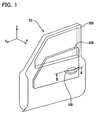
- Fig. 1 is a perspective view showing a vehicle door 10 of an embodiment of the present invention.
- the vehicle door 10 comprises a door handle 100 and a vehicle door main body 200 having a door glass 230.
- the door glass 230 is mounted such that it can move up and down (Z axis direction) with respect to the vehicle door 10.
- the door handle 100 is mounted so as to rotate around the Z axis with a hinge unit 121 (see Figs. 2 and 4 ), which is located to its anterior, as its center of rotation.
- Fig. 2 is an enlarged cross-sectional view showing a cross-section in a location of the door handle 100 of the vehicle door 10 of the embodiment of the present invention.
- Fig. 2 is an enlarged cross-sectional view viewed along the line II-II of Fig. 1 .
- the door handle 100 comprises an outer handle member 120 and an inner handle member 130.
- the outer handle member 120 has the hinge unit 121 which is attached rotatably with respect to the vehicle door main body 200, and a door opening and closing mechanism operation unit 122 which operates a door opening and closing mechanism lever 240 in a Y axis direction.
- a grip unit 131, for a driver to hold on to, and a protruding handle side support unit 139, are formed on the inner handle member 130.
- the inner handle member 130 is screwed to the outer handle member 120 by three screws 135, 136, 137.
- a mounted state of electronic components, etc. (including an optical circuit) on the door handle 100 is as follows.
- the outer handle member 120 comprises an antenna 111, a door unlocking detection device 112, a door locking detection device 113, an optical device 151, and an optical fiber 152.
- the antenna 111, the door unlocking detection device 112, and the door locking detection device 113 are connected by wiring (not shown) in an interface circuit (to be described).
- the door handle side coupling unit 119 which is an inductive coupling coil, and an optical transmission device 153, are attached to the handle side support unit 139 of the inner handle member 130.
- the optical transmission device 153 is attached to the handle side support unit 139 via a resilient member 159.
- a cross-section of the antenna 111 is shown, but hatching is omitted so as not to complicate the figure.
- the inductive coupling coils are coils for performing communication or supply of power using an electromagnetic induction system utilizing mutual induction of the coils by means of an AC magnetic field.
- non-contact communication has not just the electromagnetic induction system but also the radio wave system
- the electromagnetic induction system has the advantages of strong magnetic coupling and excellent noise resistance and information confidentiality.
- this type of electromagnetic induction system since coupling strength is determined by how much lines of magnetic force generated by one of the inductive coupling coils are interlinked with the other of the inductive coupling coils, the smaller the deviation in angle of the two inductive coupling coils in an axial direction, and the smaller the distance between the two inductive coils, the stronger the coupling, and the greater the ability to realize a connection with excellent noise resistance and confidentiality with low power consumption.
- the vehicle door main body 200 comprises a metal outer panel 201, a support member 202, and the door opening and closing mechanism lever 240.
- the outer panel 201 is screwed to the support member 202 by a screw 203.
- the support member 202 further, is fixed so that the hinge unit 121 of the door handle 100 can rotate around the Z axis, and is fixed so that the door glass 230 can move up and down in the Z axis direction.
- the vehicle door main body 200 comprises an intermediate connector 160 located further to the vehicle outer side (a positive direction of the Y axis) than the door glass 230, a main body side connector 260 located further to the vehicle inner side (a negative direction of the Y axis) than the door glass 230, and a harness 252.
- the main body side connector 260 has a window inner side coupling unit 261, which is an inductive coupling coil, and an optical transmission device 262.
- the harness 252 has optical fiber and electrical wiring (not shown).
- the main body side connector 260 has flocking on its tip at the door glass 230 side.
- the configuration of the intermediate connector 160 is as follows.
- the intermediate connector 160 is a connector manufactured by molding (integrally molding), from a resilient material, a door main body side coupling unit 161 and a window outer side coupling unit 162, these being inductive coupling coils, an optical transmission device 163, and wiring (not shown).
- the molding is performed utilizing the resilient materials elastomer or polypropylene resin, thereby forming a connector body 169.
- the door main body side coupling unit 161 and the window outer side coupling unit 162 are both inductive coupling coils for performing communication and supply of power utilizing mutual induction of the coils by means of an AC magnetic field.
- the door main body side coupling unit 161 and the window outer side coupling unit 162 are formed as inductive coupling coils by being wound in the same direction around the Y axis in the intermediate connector 160, and have virtually identical (co-axial or common) central axes.
- the door main body side coupling unit 161 and the window outer side coupling unit 162 are electrically connected by wires.
- the two electromagnetic induction coils are thereby integrated and can function as a connector that couples on both contact and non-contact pathways.
- the intermediate connector 160 further comprises the optical transmission device 163, which is located at a central axis side shaded by the connector body 169. In the present embodiment, the intermediate connector 160 has flocking on its tip at the door glass 230 side.
- the mounted state of the intermediate connector 160 is as follows.
- the intermediate connector 160 is fixed to the support member 202 of the vehicle door main body 200.
- the intermediate connector 160 can realize electromagnetic induction coupling of the door handle side coupling unit 119 and the door main body side coupling unit 161, and optical coupling of the optical transmission device 153 and the optical transmission device 163.
- a manual operation such as a mechanical connection utilizing a fitting mechanism (screw or latch) of a contact type connector thereby becomes unnecessary, and electromagnetic coupling can be realized easily.
- the above concave-convex relationship may be reversed.
- non-contact type coupling between the door handle side coupling unit 119 and the door main body side coupling unit 161 can be realized by fitting the handle side support unit 139 with the intermediate connector 160. It thereby becomes possible to connect a wire harness without performing a high precision operation that requires a connector connection or a rotation operation, and consequently this also has the advantage of promoting manufacturing automation, allowing productivity to be increased. Further, since the wired connector assembly is replaced by the simple intermediate connector 160, the component count is reduced and weight is also reduced. Moreover, in the present embodiment, the handle side support unit 139 and the connector body 169 are equivalent respectively to the "handle side support unit" and the "door side support unit” in the claims.
- the intermediate connector 160 is electromagnetically coupled with the main body side connector 260, without making contact, in the following manner.
- the intermediate connector 160 has the window outer side coupling unit 162 that is an inductive coupling coil that is disposed virtually co-axially with the main body side connector 260, in a position facing the main body side connector 260 with the door glass 230 interposed therebetween.
- the window outer side coupling unit 162 and the window inner side coupling unit 261 can thereby perform communication and supply of power utilizing mutual induction of the coils. Since the optical transmission device 262 and the optical transmission device 163 are disposed virtually co-axially at facing positions with the door glass 230 interposed therebetween, optical coupling is realized.
- the wiring path and optical path thereby no longer need long routing to avoid the movement range of the door glass 230. Since the optical transmission device 262 and the optical transmission device 163 can realize optical coupling with the door glass 230 therebetween, crack detection of the door glass 230 can also be performed. Further, in the vehicle door 10 of the driver's seat in which the smart key system is mounted, the door glass 230 requires high visible light transmittivity. Consequently, the problem of light attenuation caused by shading the door glass does not occur in optical coupling between the optical transmission device 262 and the optical transmission device 163. Since the door glass 230 typically has a dielectric constant significantly greater than that of air, this also has the advantage that stable electromagnetic coupling can be realized without making contact using a small amount of power.
- Fig. 3 shows a block diagram of optical equipment and electrical equipment mounted in the vehicle door 10 of the embodiment of the present invention.
- the optical equipment comprises the optical device 151, two optical fibers 152, 155, the three optical transmission devices 153, 163, 262, and a light-emitting device 156.
- the light-emitting device 156 changes emission color or flashing state in accordance with a door state (locked or unlocked, abnormal, etc.).
- the light of the light-emitting device 156 reaches the optical device 151 via, in sequence, the optical fiber 155, the optical transmission device 262, the optical transmission device 163, the optical transmission device 153, and the optical fiber 152.
- the optical device 151 diffuses the light which has reached it, emitting it to the exterior. The driver can thus ascertain the door state (e.g., the locked or unlocked state of the lock).
- the connecting state of the optical equipment and electrical equipment in the vehicle door 10 is as follows.
- a door handle side circuit 110 is connected by wiring to the door handle side coupling unit 119.
- the door handle side coupling unit 119 is connected (coupled) by electromagnetic induction coupling with the door main body side coupling unit 161 of the intermediate connector 160.
- the window outer side coupling unit 162 of the intermediate connector 160 faces the window inner side coupling unit 261 with the door glass 230 interposed therebetween, and is connected (coupled) by electromagnetic induction coupling with the window inner side coupling unit 261.
- the window inner side coupling unit 261 is connected by wiring to a door main body side circuit 210.
- the optical device 151 is connected by the optical fiber 152 with the optical transmission device 153.
- the optical transmission device 153 is connected (coupled) by optical coupling with the optical transmission device 163 of the intermediate connector 160.
- the optical transmission device 163 is connected (coupled) by optical coupling with the optical transmission device 262 via the door glass 230.
- the optical transmission device 262 is connected by the optical fiber 155 with the light-emitting device 156.
- the door handle side circuit 110 comprises the antenna 111, the door unlocking detection device 112, the door locking detection device 113, and an interface circuit 118.
- the antenna 111 is capable of receiving and sending encrypted signals in the smart entry system.
- the door unlocking detection device 112 is capable of detecting electrostatic capacity between the door unlocking detection device 112 and the outer panel 201 near the grip unit 131.
- the door locking detection device 113 is capable of detecting electrostatic capacity between the door locking detection device 113 and the outer panel 201 at the front of the door handle 100 away from the grip unit 131.
- the interface circuit 118 of the door handle side circuit 110 is electrically connected with an interface circuit 218 of the door main body side circuit 210 utilizing the aformementioned electromagnetic induction coupling.
- the two interface circuits 118, 218 function as a modulation circuit and a demodulation circuit, and are connected by electromagnetic induction coupling utilizing the mutual induction of coils by means of an AC magnetic field. Communication between the door handle side circuit 110 and the door main body side circuit 210, and power supply from the door main body side circuit 210 to the door handle side circuit 110 thereby becomes possible, and the vehicle door 10 can thus perform the following operations.
- the vehicle door 10 can realize the following operations.
- Fig. 4 is an enlarged cross-sectional view showing a cross-section of the door handle 100, in a rotated state, of the vehicle door 10 of the embodiment of the present invention.
- the door handle 100 rotates around the Z axis with respect to the vehicle door main body 200, with the hinge unit 121 attached to the vehicle door main body 200 as its center.
- the door handle 100 moves the door opening and closing mechanism operation unit 122 in the Y axis direction with respect to the vehicle door main body 200, operating the door opening and closing mechanism lever 240.
- the door opening and closing mechanism lever 240 can manually open and close the vehicle door 10 while it is in the unlocked state.
- the door handle side coupling unit 119 Assuming no resilient deformation of the connector body 169, the door handle side coupling unit 119 generates relative translation movement and relative rotary movement in a direction of mutual separation with respect to the door main body side coupling unit 161 of the vehicle door main body 200. This is because, in accordance with the aforementioned rotation operation, the door handle side coupling unit 119 performs the rotation operation around the Z axis and the translation movement operation in the Y axis direction. Of these types of relative movement, the rotary movement is minute since there is typically a long distance between the hinge unit 121 and the grip unit 131 of the door handle 100. Since the location of the door main body side coupling unit 161 is closer to the hinge unit 121 than to the grip unit 131, the translation movement can also be made smaller than the operation amount of the grip unit 131.
- this type of minute relative movement between the door handle side coupling unit 119 and the door main body side coupling unit 161 can be absorbed adequately by the intermediate connector 160 following the movement of the door handle side coupling unit 119, wherein the connector body 169 of the intermediate connector 160 deforms resiliently. I.e., despite the rotation of the door handle 100, a positional relationship of the door handle side coupling unit 119 and the door main body side coupling unit 161 sufficient for electromagnetic coupling can be maintained by the connector body 169 deforming resiliently.
- non-contact communication and optical coupling between the door handle side circuit 110 and the door main body side circuit 210 can be maintained despite the rotation operation of the door handle 100.
- the connection of the wire harness between movable components causes the following problems: bending or movement of the wire harness accompanying movability of the components, friction, chatter during vibration, resonance, and the load of a waterproofing process.
- the mutual induction of coils is utilized in the present embodiment for electromagnetic induction coupling to perform communication and supply of power between movable components which have complex and minute relative movement that includes rotary movement and translation movement. This successfully creates a notable effect which could not be foreseen by persons skilled in the field at the time of application.
- this type of non-contact communication can provide design flexibility whereby electrically contacting parts can be completely eliminated, the decrease in reliablity or increase in manufacturing cost that accompanies poor contact in connecting conventional contact type electrical connectors can be suppressed. This is a notable effect particularly because, as described above, the operation of movable parts readily creates poor contact.
- the amount of wiring does not need to be increased even if the type of signals received and transmitted increase, thus realizing a communication-energy supply pathway having a high degree of design flexibility and design compatibility. Further, since the production process can be simplified, as described above, this paves the way for automating the assembly process of the door handle 100.
- the door handle side circuit 110 is typically an electronic circuit for locking.
- the door main body side circuit 210 is a main circuit that, in conjuction with the door handle side circuit 110, controls the locking of the door.
- the door main body side circuit 210 may be mounted within the vehicle body. In that sense, the door main body side circuit 210 may be termed, in other words, a "main circuit within the vehicle body.”
- the door handle side coupling unit 119 and the door main body side coupling unit 161 are both devices that have coils and that transmit electrical signals while remaining electrically insulated.
- the door handle side coupling unit 119 and the door main body side coupling unit 161 may, in other words, together be termed "a pair of magnetic couplers.” If one of the door handle side coupling unit 119 and the door main body side coupling unit 161 represents a first coil and the other thereof represents a second coil, the pair of magnetic couplers consist of the first coil and the second coil, and may be termed, in other words, a device that transmits signals between the door handle side circuit and the main circuit within the vehicle body. Further, the first coil and the second coil are disposed opposite one another.
- the connector body 169 is formed by the resilient member. One end of the connector body 169 joins with the door handle 100, and the other end thereof joins with the door main body 200.
- the vehicle door 10 comprises the door main body 200, the door handle 100, the pair of magnetic couplers, and the resilient member 169.
- the door handle 100 is supported rotatably with respect to the door main body 200, and is attached to the door handle side circuit 110 used for electronic locking.
- the pair of magnetic couplers consist of the first coil 119 and the second coil 161, and transmit signals between the door handle side circuit 110 and the main circuit 210 within the vehicle body.
- One end of the resilient member (the connector body 169) joins with the door handle 100, the other end thereof joins with the door main body 200, and the resilient member deforms as the door handle 100 rotates.
- At least one of the first coil 119 and the second coil 161 is attached to the resilient member, and the other of the first coil 119 and the second coil 161 is attached so as to be opposite that coil.
- the second coil 161 is attached to the resilient member, and the first coil 119 is attached to the door handle 100 at a position opposite the second coil.
- the resilient member restricts relative positional divergence, caused by rotation of the door handle, of the pair of magnetic couplers.
- the door handle side circuit and the main circuit can be connected by a cable.
- the cable repeatedly deforms as the door handle is rotated, and consequently deteriorates over time.
- Mounting a radio wave transceiver in the door handle and the door main body increases costs.
- Magnetic couplers utilizing coils are low cost and, since they are non-contact, do not undergo the repeated deformation that the cable undergoes due to rotation.
- magnetic couplers are able to transmit electrical signals even if their relative positions diverge slightly. However, signal transmission efficiency falls if the pair of magnetic couplers have a large positional divergence.
- the vehicle door 10 utilizes magnetic couplers capable of transmitting signals without their relative position being fixed, and restricts the relative positional divergence, caused by rotation of the door handle, of the pair of magnetic couplers. Consequently, low output magnetic couplers can be adopted in the configuration of the vehicle door of the embodiment.
- the door handle 100 of the embodiment comprises the handle side support unit 139 that supports the first coil 119.
- the handle side support unit 139 is equivalent to a protrusion extending in the rotation direction of the door handle 100.
- the protrusion fits together with the resilient member (the connector body 169), such that it can slide in the rotation direction.
- the first coil 119 and the second coil 161 of the pair of magnetic couplers are disposed in opposing positions co-axially with the protrusion and the resilient member respectively.
- the protrusion and the resilient member fit together simultaneously with attaching the door handle 100.
- the vehicle door 10 of the embodiment further comprises a third coil (the window outer side coupling unit 162) and a fourth coil (the window inner side coupling unit 261), and comprises a pair of second magnetic couplers that are directly connected with the aforementioned pair of magnetic couplers and that transmit signals, together with the aforementioned pair of magnetic couplers, between the door handle side circuit and the main circuit.
- the third coil and the fourth coil are disposed at opposing positions with the door glass 230 interposed therebetween.
- the advantage of the second magnetic couplers is the same as that described above.
- the door handle 100 comprises the optical device 151 that radiates light to the exterior.
- the vehicle door 10 of the embodiment comprises the pair of optocouplers 153, 160 that transmit, to the optical device 151, the light emitted by the light-emitting device 156 provided in the vehicle body.
- the pair of optocouplers are disposed co-axially with the protrusion (the handle side support unit 139) at the inner side of the magnetic couplers and the resilient member (the connector body 169) respectively.
- both electrical coupling and optical coupling between the door handle and the vehicle door main body are realized.
- only electrical coupling may be realized, only optical coupling may be realized or, as in the embodiment, both couplings may be realized.
- the coupling that can be utilized in the present invention may be general non-contact electromagnetic coupling.
- optical communication using optical coupling in communication between the antenna 111 and the circuit in the vehicle is applied, this has the advantage of preventing interception by a third party, increasing confidentiality.
- all the coupling is configured using optical circuits, it is possible to e.g., send indicator light for notifying the driver about the door lock state along the same pathway as the light for communication. Consequently, simple mounting can be realized.
- C-2 In the above embodiment and variant, two electromagnetic couplings are provided: coupling between the door handle and the vehicle door main body, and coupling across the door glass at the interior of the vehicle door main body. However, e.g., only one of these couplings, or 3 or more couplings may be provided. However, in the case where the connection between the door handle and the vehicle door main body is realized by a single electromagnetic coupling, it is preferred that this coupling is across the door glass. This has the advantages of making long routing to avoid the movement range of the door glass unnecessary, and allowing crack detection of the door glass utilizing optical coupling.
- the intermediate connector is utilized that is manufactured by molding resilient material into the door main body side coupling unit, window outer side coupling unit, optical transmission device, and wiring
- the intermediate connector need not necessarily be used.
- using the intermediate connector has the advantage of providing a communication pathway, from the door handle at a vehicle inner side of the door glass, this being configured such that wiring and optical circuits are not at all exposed in the pathway from the door handle to the door glass.
- the intermediate connector is molded from resilient material, a configuration can easily be realized that follows complex movement, including translation movement and rotary movement, of the door handle side coupling unit, this being caused by rotation of the door handle.
- the door handle side circuit is a circuit for realizing the function of a smart key system.
- the door handle side circuit may, e.g., also simultaneously realize other functions, or may realize a function other than the smart key system.
- the door handle side circuit may exchange at least one of signals or energy (electrical or optical energy) with the door main body side circuit of the door main body.
- the door main body side coupling unit moves following other movement, restricting the relative movement of the door main body side coupling unit and the door handle side coupling unit.
- a configuration may be adopted in which e.g., resilient deformation occurs at the side of the handle side support unit 139 that supports the door handle side coupling unit, or in which resilient deformation occurs at both sides.
- deformation may be not only resilient deformation, but may be realized by e.g., providing a mechanism such as a link mechanism. Further, it is not necessary to diminish both relative rotary movement and relative translation movement, as described above, but instead only one thereof may be diminished.
- the support configuration that can be used in the present invention may generally thus be configured such that at least one of the handle side support unit and the door side support unit restricts relative movement, caused by rotation of the door handle, of the door handle side coupling unit and the door main body side coupling unit.
Landscapes
- Engineering & Computer Science (AREA)
- Mechanical Engineering (AREA)
- Lock And Its Accessories (AREA)
Abstract
Description
- The present invention relates to a vehicle door. In particular, the present invention relates to a vehicle door having wiring that electromagnetically couples an electrical circuit disposed in a door handle and an electrical circuit disposed in a vehicle. Electromagnetic coupling includes at least one of electrical coupling and optical coupling.
- A vehicle door smart key system (registered trademark) has become widespread in recent years. E.g., the following technique (Patent Document 1) has been proposed as this type of system. In this technique, when a door lock is released or locked by a door lock releasing signal or door lock locking signal emitted by a portable device (smart key), a light-emitting diode is lit for a predetermined period, informing a driver of the door lock status. Specifically, when the door lock is released, a red light-emitting diode embedded in a door handle having a transparent body is lit for a fixed period, and when the door lock is locked, a green light-emitting diode embedded in the door handle having the transparent body is lit for a fixed period. In this technique, power supply to the two-color light-emitting diodes is performed by magnetic coupling. Consequently the handle, does not become unsightly even if it consists of transparent material, and the waterproofing treatment needed when wiring is mounted becomes unnecessary.
-
- [Patent Document 1]
JP2007-254993A - In a vehicle door smart key system, an antenna and sensor, which are part of a circuit, are usually mounted in a door handle, and a control circuit is usually mounted in a vehicle. In this type of configuration, signal transmission is needed between the door handle side circuit and a main circuit. However, insufficient study has been performed on realizing non-contact transmission of the signal between the door handle side circuit and the main circuit in the vehicle. Further, this type of problem is not restricted to the vehicle door smart key system, but is a widespread problem in signal transmission.
- The present invention has been created to solve the above problem, and aims to teach a technique that realizes effective transmission beween a door handle and a vehicle door.
- The present invention can present a technique exemplified as the following configurations and aspects.
A first configuration example teaches an electromagnetic coupling device electromagnetically connecting a door handle side circuit of a door handle mounted so as to be capable of rotating with respect to a vehicle door main body, and a door main body side circuit of the door main body. This electromagnetic coupling device comprises a door handle side coupling unit, a door main body side coupling unit, a handle side support unit, and a door side support unit. The door handle side coupling unit is electromagnetically connected with the door handle side circuit. The door main body side coupling unit is electromagnetically coupled with the door handle side coupling unit without making contact therewith, and is electromagnetically connected with the door main body side circuit. The handle side support unit supports the door handle side coupling unit in the door handle. The door side support unit supports the door main body side coupling unit in the door main body. At least one of the handle side support unit and the door side support unit restrict the relative movement, caused by rotation of the door handle, of the door handle side coupling unit and the door main body side coupling unit. - In the first configuration example, the door handle side circuit of the door handle and the door main body side circuit of the door main body are connected by non-contact electromagnetic coupling between the door handle side coupling unit and the door main body side coupling unit. In this electromagnetic coupling, at least one of the handle side support unit and the door side support unit restricts the relative movement, caused by rotation of the door handle, of the door handle side coupling unit and the door main body side coupling unit, and consequently a worsening of electromagnetic coupling caused by rotation of the door handle can be reduced. E.g., stable electromagnetic coupling using a small amount of power can thereby be realized.
- Moreover, in the present specification, electromagnetic coupling is used in a broad sense, including coupling realized using electromagnetic waves, such as light or the mutual induction of coils. Further, the term "connect" above may be construed so as to include at least one of non-contact coupling, and contact coupling using wiring. The door handle side circuit and door main body side circuit include not only electronic circuits, but also optical circuits for transmitting light for light emission or light for communication. Further, the restriction of relative movement may be realized by configuring, e.g., a support unit having a moving mechanism such as a hinge to deform, or by resilient deformation (to be described). Further, the door main body side circuit is understood in a broad sense and, in the case where a circuit is mounted in a vehicle main body, also includes wiring connected with the circuit in the vehicle main body.
- Further, a standardized technique, e.g. International Standard ISO/ IEC 18092 (Information technology--Telecommunications and information exchange between systems--Near Field Communication--Interface and Protocol (NFCIP-1)) can be utilized as a non-contact communication system.
- As a second configuration example, in the electromagnetic coupling device of the first configuration example, the door side support unit and the handle side support unit fit mutually together. In the present configuration, relative movement is restricted by resilient deformation of at least one of the door side support unit and the handle side support unit. If this is done, relatively complex movement of the door handle side coupling unit and the door main body side coupling unit, including translation movement and rotary movement, can easily be followed, and assembly at the time of manufacturing can also be made easier.
- As a third configuration example, in the electromagnetic coupling device of the first or second configuration examples, the door main body comprises a door glass which can be raised and lowered with respect to the door main body. The electromagnetic coupling device further comprises a window outer side coupling unit and a window inner side coupling unit. The window outer side coupling unit is disposed at the same side as the door handle of the door glass, and is electromagnetically connected with the door main body side coupling unit. The window inner side coupling unit is disposed at the opposite side from the door handle of the door glass, and is electromagnetically connected with the door main body side circuit. The window outer side coupling unit and the window inner side coupling unit are disposed at opposing positions with the door glass interposed therebetween, and are electromagnetically coupled.
- In the third configuration example, since non-contact electromagnetic coupling is performed by the window outer side coupling unit and the window inner side coupling unit which are disposed at opposing positions with the door glass which can be raised and lowered with respect to the door main body interposed therebetween, the routing (cable layout) of a signal transmission pathway between the door handle side circuit and the door main body side circuit no longer needs to avoid a movement range of the door glass. Long routing which avoids the movement range of the door glass can thereby be made unnecessary. Since the door glass typically has a dielectric constant significantly greater than that of air, the window outer side coupling unit and window inner side coupling unit, which are disposed at opposing positions with the door glass interposed therebetween, can realize stable electromagnetic coupling using a small amount of power.
- Moreover, the present invention can be realized in various forms, e.g., as a door handle or vehicle door having an electromagnetic coupling device.
- The present invention can teach a technique that realizes effective transmission beween a door handle and a vehicle door.
-
-
Fig. 1 is a perspective view showing avehicle door 10 of an embodiment of the present invention. -
Fig. 2 is an enlarged cross-sectional view showing a cross-section in a location of adoor handle 100 of thevehicle door 10 of the embodiment of the present invention. -
Fig. 3 shows a block diagram of optical equipment and electrical equipment mounted in thevehicle door 10 of the embodiment of the present invention. -
Fig. 4 is an enlarged cross-sectional view showing a cross-section of thedoor handle 100 of thevehicle door 10 of the embodiment of the present invention in a rotated state. - Preferred features of the present invention can be realized, e.g., by providing the following characteristics either singly or in combination.
- (Feature 1) An intermediate connector manufactured by molding utilizes the door main body side coupling unit, window outer side coupling unit, optical transmission device, and wiring. Consequently, a configuration can be realized in which wiring and optical circuits in a pathway from the door handle to the door glass are not at all exposed, thus increasing reliability.
- (Feature 2) The intermediate connector is molded from resilient material. A configuration can thereby easily be realized that follows complex movement, including translation movement and rotary movement, that is caused by rotation of the door handle.
- (Feature 3) The intermediate connector is formed by using wiring to couple the door main body side coupling unit and window outer side coupling unit, which are electromagnetic induction coils, these being wound in the same direction and having virtually identical (co-axial or common) central axes. The two electromagnetic induction coils are thereby integrated and can function as a connector that couples using both contact and non-contact pathways.
- (Feature 4) Optical communication utilizing optical coupling to transmit information between antennas is applied. Interception by a third party is thereby prevented, and confidentiality can be increased.
- (Feature 5) Information processing of the smart key system, and light for light emission and light for communication, are realized using an optical circuit that utilizes the same pathway. A highly reliable mounting can thereby be realized easily, and fault diagnosis also becomes easier.
- Below, in order to clearly explain the operation and effects of the present invention based on the above characteristics, the features of the embodiments of the present invention will be described in the following sequence.
- A. Configuration of a vehicle door of the embodiment of the present invention.
- B. Supplementary items to the configuration of the vehicle door of the embodiment of the present invention.
- C. Variants.
-
Fig. 1 is a perspective view showing avehicle door 10 of an embodiment of the present invention. Thevehicle door 10 comprises adoor handle 100 and a vehicle doormain body 200 having adoor glass 230. Thedoor glass 230 is mounted such that it can move up and down (Z axis direction) with respect to thevehicle door 10. As will be described, thedoor handle 100 is mounted so as to rotate around the Z axis with a hinge unit 121 (seeFigs. 2 and4 ), which is located to its anterior, as its center of rotation. -
Fig. 2 is an enlarged cross-sectional view showing a cross-section in a location of thedoor handle 100 of thevehicle door 10 of the embodiment of the present invention.Fig. 2 is an enlarged cross-sectional view viewed along the line II-II ofFig. 1 . Thedoor handle 100 comprises anouter handle member 120 and aninner handle member 130. Theouter handle member 120 has thehinge unit 121 which is attached rotatably with respect to the vehicle doormain body 200, and a door opening and closingmechanism operation unit 122 which operates a door opening andclosing mechanism lever 240 in a Y axis direction. Agrip unit 131, for a driver to hold on to, and a protruding handleside support unit 139, are formed on theinner handle member 130. Theinner handle member 130 is screwed to theouter handle member 120 by threescrews - A mounted state of electronic components, etc. (including an optical circuit) on the
door handle 100 is as follows. Theouter handle member 120 comprises anantenna 111, a door unlockingdetection device 112, a door lockingdetection device 113, anoptical device 151, and anoptical fiber 152. Theantenna 111, the door unlockingdetection device 112, and the door lockingdetection device 113 are connected by wiring (not shown) in an interface circuit (to be described). The door handleside coupling unit 119, which is an inductive coupling coil, and anoptical transmission device 153, are attached to the handleside support unit 139 of theinner handle member 130. Theoptical transmission device 153 is attached to the handleside support unit 139 via aresilient member 159. Moreover, in the present figure, a cross-section of theantenna 111 is shown, but hatching is omitted so as not to complicate the figure. - The inductive coupling coils are coils for performing communication or supply of power using an electromagnetic induction system utilizing mutual induction of the coils by means of an AC magnetic field. Although non-contact communication has not just the electromagnetic induction system but also the radio wave system, the electromagnetic induction system has the advantages of strong magnetic coupling and excellent noise resistance and information confidentiality. In this type of electromagnetic induction system, since coupling strength is determined by how much lines of magnetic force generated by one of the inductive coupling coils are interlinked with the other of the inductive coupling coils, the smaller the deviation in angle of the two inductive coupling coils in an axial direction, and the smaller the distance between the two inductive coils, the stronger the coupling, and the greater the ability to realize a connection with excellent noise resistance and confidentiality with low power consumption.
- The vehicle door
main body 200 comprises a metalouter panel 201, asupport member 202, and the door opening andclosing mechanism lever 240. Theouter panel 201 is screwed to thesupport member 202 by ascrew 203. Thesupport member 202, further, is fixed so that thehinge unit 121 of thedoor handle 100 can rotate around the Z axis, and is fixed so that thedoor glass 230 can move up and down in the Z axis direction. - A mounted state of electronic components, etc. on the vehicle door
main body 200 is as follows. The vehicle doormain body 200 comprises anintermediate connector 160 located further to the vehicle outer side (a positive direction of the Y axis) than thedoor glass 230, a mainbody side connector 260 located further to the vehicle inner side (a negative direction of the Y axis) than thedoor glass 230, and aharness 252. The mainbody side connector 260 has a window innerside coupling unit 261, which is an inductive coupling coil, and anoptical transmission device 262. Theharness 252 has optical fiber and electrical wiring (not shown). The mainbody side connector 260 has flocking on its tip at thedoor glass 230 side. - The configuration of the
intermediate connector 160 is as follows. Theintermediate connector 160 is a connector manufactured by molding (integrally molding), from a resilient material, a door main bodyside coupling unit 161 and a window outerside coupling unit 162, these being inductive coupling coils, anoptical transmission device 163, and wiring (not shown). The molding is performed utilizing the resilient materials elastomer or polypropylene resin, thereby forming aconnector body 169. The door main bodyside coupling unit 161 and the window outerside coupling unit 162 are both inductive coupling coils for performing communication and supply of power utilizing mutual induction of the coils by means of an AC magnetic field. - The door main body
side coupling unit 161 and the window outerside coupling unit 162 are formed as inductive coupling coils by being wound in the same direction around the Y axis in theintermediate connector 160, and have virtually identical (co-axial or common) central axes. The door main bodyside coupling unit 161 and the window outerside coupling unit 162 are electrically connected by wires. The two electromagnetic induction coils are thereby integrated and can function as a connector that couples on both contact and non-contact pathways. Theintermediate connector 160 further comprises theoptical transmission device 163, which is located at a central axis side shaded by theconnector body 169. In the present embodiment, theintermediate connector 160 has flocking on its tip at thedoor glass 230 side. - The mounted state of the
intermediate connector 160 is as follows. Theintermediate connector 160 is fixed to thesupport member 202 of the vehicle doormain body 200. By fitting the protruding (a convex unit) handleside support unit 139 with a concave unit embedded in the door main bodyside coupling unit 161, theintermediate connector 160 can realize electromagnetic induction coupling of the door handleside coupling unit 119 and the door main bodyside coupling unit 161, and optical coupling of theoptical transmission device 153 and theoptical transmission device 163. In the operation of incorporating thedoor handle 100 into the vehicle doormain body 200, a manual operation such as a mechanical connection utilizing a fitting mechanism (screw or latch) of a contact type connector thereby becomes unnecessary, and electromagnetic coupling can be realized easily. Moreover, the above concave-convex relationship may be reversed. - Thus, in the present embodiment, non-contact type coupling between the door handle
side coupling unit 119 and the door main bodyside coupling unit 161 can be realized by fitting the handleside support unit 139 with theintermediate connector 160. It thereby becomes possible to connect a wire harness without performing a high precision operation that requires a connector connection or a rotation operation, and consequently this also has the advantage of promoting manufacturing automation, allowing productivity to be increased. Further, since the wired connector assembly is replaced by the simpleintermediate connector 160, the component count is reduced and weight is also reduced. Moreover, in the present embodiment, the handleside support unit 139 and theconnector body 169 are equivalent respectively to the "handle side support unit" and the "door side support unit" in the claims. - The
intermediate connector 160 is electromagnetically coupled with the mainbody side connector 260, without making contact, in the following manner. Theintermediate connector 160 has the window outerside coupling unit 162 that is an inductive coupling coil that is disposed virtually co-axially with the mainbody side connector 260, in a position facing the mainbody side connector 260 with thedoor glass 230 interposed therebetween. The window outerside coupling unit 162 and the window innerside coupling unit 261 can thereby perform communication and supply of power utilizing mutual induction of the coils. Since theoptical transmission device 262 and theoptical transmission device 163 are disposed virtually co-axially at facing positions with thedoor glass 230 interposed therebetween, optical coupling is realized. - The wiring path and optical path thereby no longer need long routing to avoid the movement range of the
door glass 230. Since theoptical transmission device 262 and theoptical transmission device 163 can realize optical coupling with thedoor glass 230 therebetween, crack detection of thedoor glass 230 can also be performed. Further, in thevehicle door 10 of the driver's seat in which the smart key system is mounted, thedoor glass 230 requires high visible light transmittivity. Consequently, the problem of light attenuation caused by shading the door glass does not occur in optical coupling between theoptical transmission device 262 and theoptical transmission device 163. Since thedoor glass 230 typically has a dielectric constant significantly greater than that of air, this also has the advantage that stable electromagnetic coupling can be realized without making contact using a small amount of power. -
Fig. 3 shows a block diagram of optical equipment and electrical equipment mounted in thevehicle door 10 of the embodiment of the present invention. The optical equipment comprises theoptical device 151, twooptical fibers optical transmission devices device 156. The light-emittingdevice 156 changes emission color or flashing state in accordance with a door state (locked or unlocked, abnormal, etc.). The light of the light-emittingdevice 156 reaches theoptical device 151 via, in sequence, theoptical fiber 155, theoptical transmission device 262, theoptical transmission device 163, theoptical transmission device 153, and theoptical fiber 152. Theoptical device 151 diffuses the light which has reached it, emitting it to the exterior. The driver can thus ascertain the door state (e.g., the locked or unlocked state of the lock). - The connecting state of the optical equipment and electrical equipment in the
vehicle door 10 is as follows. A doorhandle side circuit 110 is connected by wiring to the door handleside coupling unit 119. The door handleside coupling unit 119 is connected (coupled) by electromagnetic induction coupling with the door main bodyside coupling unit 161 of theintermediate connector 160. The window outerside coupling unit 162 of theintermediate connector 160 faces the window innerside coupling unit 261 with thedoor glass 230 interposed therebetween, and is connected (coupled) by electromagnetic induction coupling with the window innerside coupling unit 261. The window innerside coupling unit 261 is connected by wiring to a door mainbody side circuit 210. - The
optical device 151 is connected by theoptical fiber 152 with theoptical transmission device 153. Theoptical transmission device 153 is connected (coupled) by optical coupling with theoptical transmission device 163 of theintermediate connector 160. Theoptical transmission device 163 is connected (coupled) by optical coupling with theoptical transmission device 262 via thedoor glass 230. Theoptical transmission device 262 is connected by theoptical fiber 155 with the light-emittingdevice 156. - The door
handle side circuit 110 comprises theantenna 111, the door unlockingdetection device 112, the door lockingdetection device 113, and aninterface circuit 118. Theantenna 111 is capable of receiving and sending encrypted signals in the smart entry system. The door unlockingdetection device 112 is capable of detecting electrostatic capacity between the door unlockingdetection device 112 and theouter panel 201 near thegrip unit 131. The door lockingdetection device 113 is capable of detecting electrostatic capacity between the door lockingdetection device 113 and theouter panel 201 at the front of thedoor handle 100 away from thegrip unit 131. - The
interface circuit 118 of the doorhandle side circuit 110 is electrically connected with aninterface circuit 218 of the door mainbody side circuit 210 utilizing the aformementioned electromagnetic induction coupling. In the present embodiment, the twointerface circuits handle side circuit 110 and the door mainbody side circuit 210, and power supply from the door mainbody side circuit 210 to the doorhandle side circuit 110 thereby becomes possible, and thevehicle door 10 can thus perform the following operations. - Utilizing the above connection, the
vehicle door 10 can realize the following operations. - (1) A
control circuit 211 automatically starts wireless verification as a driver having a smart key (not shown) approaches thedoor handle 100, and allows the door lock to be released upon ending verification. This wireless verification is performed using theantenna 111 of thedoor handle 100. - (2) In the case where the release of the door lock is allowed, the
control circuit 211 releases the door lock in accordance with change in electrostatic capacity between the door unlockingdetection device 112 and theouter panel 201 upon the driver making contact with thegrip unit 131. - (3) The
control circuit 211 locks the door lock in accordance with change in electrostatic capacity between the door lockingdetection device 113 and theouter panel 201 upon the driver making contact with the front part of thedoor handle 100. - (4) In accordance with the aforementioned states, the
control circuit 211 operates a drivingcircuit 212 to operate an outputting state of the light-emittingdevice 156, and controls a light-emitting state of theoptical device 151. -
Fig. 4 is an enlarged cross-sectional view showing a cross-section of thedoor handle 100, in a rotated state, of thevehicle door 10 of the embodiment of the present invention. In accordance with a manual operation by the driver, thedoor handle 100 rotates around the Z axis with respect to the vehicle doormain body 200, with thehinge unit 121 attached to the vehicle doormain body 200 as its center. As thedoor handle 100 rotates around the Z axis, thedoor handle 100 moves the door opening and closingmechanism operation unit 122 in the Y axis direction with respect to the vehicle doormain body 200, operating the door opening andclosing mechanism lever 240. In accordance with this operation, the door opening andclosing mechanism lever 240 can manually open and close thevehicle door 10 while it is in the unlocked state. - Assuming no resilient deformation of the
connector body 169, the door handleside coupling unit 119 generates relative translation movement and relative rotary movement in a direction of mutual separation with respect to the door main bodyside coupling unit 161 of the vehicle doormain body 200. This is because, in accordance with the aforementioned rotation operation, the door handleside coupling unit 119 performs the rotation operation around the Z axis and the translation movement operation in the Y axis direction. Of these types of relative movement, the rotary movement is minute since there is typically a long distance between thehinge unit 121 and thegrip unit 131 of thedoor handle 100. Since the location of the door main bodyside coupling unit 161 is closer to thehinge unit 121 than to thegrip unit 131, the translation movement can also be made smaller than the operation amount of thegrip unit 131. - As is clear from
Fig. 4 , this type of minute relative movement between the door handleside coupling unit 119 and the door main bodyside coupling unit 161 can be absorbed adequately by theintermediate connector 160 following the movement of the door handleside coupling unit 119, wherein theconnector body 169 of theintermediate connector 160 deforms resiliently. I.e., despite the rotation of thedoor handle 100, a positional relationship of the door handleside coupling unit 119 and the door main bodyside coupling unit 161 sufficient for electromagnetic coupling can be maintained by theconnector body 169 deforming resiliently. In particular, in the present embodiment, since the amount of deviation (angle) in the axial direction and the distance of the two inductive coupling coils 119, 161 can both be kept small, diminishment of the mutually interlinking lines of magnetic force can be reduced significantly. The notable effect is thereby achieved of being able to maintain strong electromagnetic induction coupling. - Thus, in the present embodiment, non-contact communication and optical coupling between the door
handle side circuit 110 and the door mainbody side circuit 210 can be maintained despite the rotation operation of thedoor handle 100. By contrast, in the case of a wired connection, the connection of the wire harness between movable components causes the following problems: bending or movement of the wire harness accompanying movability of the components, friction, chatter during vibration, resonance, and the load of a waterproofing process. - Thus, as in the case of the
door handle 100 and the vehicle doormain body 200, the mutual induction of coils is utilized in the present embodiment for electromagnetic induction coupling to perform communication and supply of power between movable components which have complex and minute relative movement that includes rotary movement and translation movement. This successfully creates a notable effect which could not be foreseen by persons skilled in the field at the time of application. - Further, since this type of non-contact communication can provide design flexibility whereby electrically contacting parts can be completely eliminated, the decrease in reliablity or increase in manufacturing cost that accompanies poor contact in connecting conventional contact type electrical connectors can be suppressed. This is a notable effect particularly because, as described above, the operation of movable parts readily creates poor contact.
- Further, in the present embodiment, since a plurality of signals can be conveyed using a single carrier, the amount of wiring does not need to be increased even if the type of signals received and transmitted increase, thus realizing a communication-energy supply pathway having a high degree of design flexibility and design compatibility. Further, since the production process can be simplified, as described above, this paves the way for automating the assembly process of the
door handle 100. - Below, a supplementary description is given for the
vehicle door 10 of the embodiment. As shown in the embodiment, the doorhandle side circuit 110 is typically an electronic circuit for locking. The door mainbody side circuit 210 is a main circuit that, in conjuction with the doorhandle side circuit 110, controls the locking of the door. The door mainbody side circuit 210 may be mounted within the vehicle body. In that sense, the door mainbody side circuit 210 may be termed, in other words, a "main circuit within the vehicle body." - The door handle
side coupling unit 119 and the door main bodyside coupling unit 161 are both devices that have coils and that transmit electrical signals while remaining electrically insulated. The door handleside coupling unit 119 and the door main bodyside coupling unit 161 may, in other words, together be termed "a pair of magnetic couplers." If one of the door handleside coupling unit 119 and the door main bodyside coupling unit 161 represents a first coil and the other thereof represents a second coil, the pair of magnetic couplers consist of the first coil and the second coil, and may be termed, in other words, a device that transmits signals between the door handle side circuit and the main circuit within the vehicle body. Further, the first coil and the second coil are disposed opposite one another. - The
connector body 169 is formed by the resilient member. One end of theconnector body 169 joins with thedoor handle 100, and the other end thereof joins with the doormain body 200. - Using the different expressions above, the characteristics of the
vehicle door 10 of the embodiment can be expressed as follows. Thevehicle door 10 comprises the doormain body 200, thedoor handle 100, the pair of magnetic couplers, and theresilient member 169. Thedoor handle 100 is supported rotatably with respect to the doormain body 200, and is attached to the doorhandle side circuit 110 used for electronic locking. The pair of magnetic couplers consist of thefirst coil 119 and thesecond coil 161, and transmit signals between the doorhandle side circuit 110 and themain circuit 210 within the vehicle body. One end of the resilient member (the connector body 169) joins with thedoor handle 100, the other end thereof joins with the doormain body 200, and the resilient member deforms as thedoor handle 100 rotates. At least one of thefirst coil 119 and thesecond coil 161 is attached to the resilient member, and the other of thefirst coil 119 and thesecond coil 161 is attached so as to be opposite that coil. Specifically, thesecond coil 161 is attached to the resilient member, and thefirst coil 119 is attached to thedoor handle 100 at a position opposite the second coil. According to the above configuration, the resilient member restricts relative positional divergence, caused by rotation of the door handle, of the pair of magnetic couplers. - The advantages of the
vehicle door 10 of the embodiment will be reiterated. The door handle side circuit and the main circuit can be connected by a cable. However, with a flexible cable, the cable repeatedly deforms as the door handle is rotated, and consequently deteriorates over time. Mounting a radio wave transceiver in the door handle and the door main body increases costs. Magnetic couplers utilizing coils are low cost and, since they are non-contact, do not undergo the repeated deformation that the cable undergoes due to rotation. Unlike connectors that make physical contact between terminals, magnetic couplers are able to transmit electrical signals even if their relative positions diverge slightly. However, signal transmission efficiency falls if the pair of magnetic couplers have a large positional divergence. Thevehicle door 10 utilizes magnetic couplers capable of transmitting signals without their relative position being fixed, and restricts the relative positional divergence, caused by rotation of the door handle, of the pair of magnetic couplers. Consequently, low output magnetic couplers can be adopted in the configuration of the vehicle door of the embodiment. - The
door handle 100 of the embodiment comprises the handleside support unit 139 that supports thefirst coil 119. The handleside support unit 139 is equivalent to a protrusion extending in the rotation direction of thedoor handle 100. The protrusion fits together with the resilient member (the connector body 169), such that it can slide in the rotation direction. Thefirst coil 119 and thesecond coil 161 of the pair of magnetic couplers are disposed in opposing positions co-axially with the protrusion and the resilient member respectively. - By providing a configuration where the protrusion (the handle side support unit 139) and the resilient member (the connector body 169) fit together along the rotation direction of the
door handle 100, the protrusion and the resilient member fit together simultaneously with attaching thedoor handle 100. By providing the above configuration, the assembly of thedoor handle 100, this including the establishment of the signal transmission pathway, can be performed easily. - The
vehicle door 10 of the embodiment further comprises a third coil (the window outer side coupling unit 162) and a fourth coil (the window inner side coupling unit 261), and comprises a pair of second magnetic couplers that are directly connected with the aforementioned pair of magnetic couplers and that transmit signals, together with the aforementioned pair of magnetic couplers, between the door handle side circuit and the main circuit. The third coil and the fourth coil are disposed at opposing positions with thedoor glass 230 interposed therebetween. The advantage of the second magnetic couplers is the same as that described above. - The
door handle 100 comprises theoptical device 151 that radiates light to the exterior. Thevehicle door 10 of the embodiment comprises the pair ofoptocouplers optical device 151, the light emitted by the light-emittingdevice 156 provided in the vehicle body. The pair of optocouplers are disposed co-axially with the protrusion (the handle side support unit 139) at the inner side of the magnetic couplers and the resilient member (the connector body 169) respectively. - A specific example of the present invention is described above in detail, but this example is merely illustrative and places no limitation on the scope of the patent claims. The technology described in the patent claims also encompasses various changes and modifications to the specific example described above. The technical elements explained in the present specification and drawings provide technical utility either independently or through various combinations. The present invention is not limited to the combinations described at the time the claims are filed. Further, the purpose of the examples illustrated by the present specification and drawings is to satisfy multiple objectives simultaneously, and satisfying any one of those objectives gives technical utility to the present invention. Specifically, e.g., the following type of variants can also be embodied. Moreover, the novel technique taught in the present specification can also be utilized in connection of vehicle components other than a vehicle door.
- C-1: In the above embodiment, both electrical coupling and optical coupling between the door handle and the vehicle door main body are realized. However, only electrical coupling may be realized, only optical coupling may be realized or, as in the embodiment, both couplings may be realized. The coupling that can be utilized in the present invention may be general non-contact electromagnetic coupling. However, if optical communication using optical coupling in communication between the
antenna 111 and the circuit in the vehicle is applied, this has the advantage of preventing interception by a third party, increasing confidentiality. Further, if all the coupling is configured using optical circuits, it is possible to e.g., send indicator light for notifying the driver about the door lock state along the same pathway as the light for communication. Consequently, simple mounting can be realized. - C-2: In the above embodiment and variant, two electromagnetic couplings are provided: coupling between the door handle and the vehicle door main body, and coupling across the door glass at the interior of the vehicle door main body. However, e.g., only one of these couplings, or 3 or more couplings may be provided. However, in the case where the connection between the door handle and the vehicle door main body is realized by a single electromagnetic coupling, it is preferred that this coupling is across the door glass. This has the advantages of making long routing to avoid the movement range of the door glass unnecessary, and allowing crack detection of the door glass utilizing optical coupling.
- C-3: In the above embodiment and variants, although the intermediate connector is utilized that is manufactured by molding resilient material into the door main body side coupling unit, window outer side coupling unit, optical transmission device, and wiring, the intermediate connector need not necessarily be used. However, using the intermediate connector has the advantage of providing a communication pathway, from the door handle at a vehicle inner side of the door glass, this being configured such that wiring and optical circuits are not at all exposed in the pathway from the door handle to the door glass. Further, since the intermediate connector is molded from resilient material, a configuration can easily be realized that follows complex movement, including translation movement and rotary movement, of the door handle side coupling unit, this being caused by rotation of the door handle.
- Further, there is also the advantage that, even if the wiring route changes due to design changes of the door main body side, corresponding design changes of the intermediate connector can be made without performing design changes of the door handle. This has the advantage of also being easily applicable to other types of vehicle.
- C-4: In the above embodiment and variants, the door handle side circuit is a circuit for realizing the function of a smart key system. However, the door handle side circuit may, e.g., also simultaneously realize other functions, or may realize a function other than the smart key system. The door handle side circuit may exchange at least one of signals or energy (electrical or optical energy) with the door main body side circuit of the door main body.
- C-5: In the above embodiment and variants, the door main body side coupling unit (the
connector body 169 in the embodiment) moves following other movement, restricting the relative movement of the door main body side coupling unit and the door handle side coupling unit. However, a configuration may be adopted in which e.g., resilient deformation occurs at the side of the handleside support unit 139 that supports the door handle side coupling unit, or in which resilient deformation occurs at both sides. Further, deformation may be not only resilient deformation, but may be realized by e.g., providing a mechanism such as a link mechanism. Further, it is not necessary to diminish both relative rotary movement and relative translation movement, as described above, but instead only one thereof may be diminished. The support configuration that can be used in the present invention may generally thus be configured such that at least one of the handle side support unit and the door side support unit restricts relative movement, caused by rotation of the door handle, of the door handle side coupling unit and the door main body side coupling unit. -
- 10
- vehicle door
- 24
- door opening and closing mechanism lever
- 100
- door handle
- 110
- door handle side circuit
- 111
- antenna
- 112
- door unlocking detection device
- 113
- door locking detection device
- 118
- interface circuit
- 119
- door handle side coupling unit
- 120
- outer handle member
- 121
- hinge unit
- 122
- door opening and closing mechanism operation unit
- 130
- inner handle member
- 131
- grip unit
- 135
- screw
- 139
- handle side support unit
- 151
- optical device
- 152, 155
- optical fiber
- 153, 163
- optical transmission device
- 156
- light-emitting device
- 159
- resilient member
- 160
- intermediate connector
- 161
- door main body side coupling unit
- 162
- window outer side coupling unit
- 169
- connector body
- 200
- vehicle door main body
- 201
- outer panel
- 202
- support member
- 203
- screw
- 210
- door main body side circuit
- 211
- control circuit
- 212
- driving circuit
- 218
- interface circuit
- 230
- door glass
- 240
- door opening and closing mechanism lever
- 252
- harness
- 260
- main body side connector
- 261
- window inner side coupling unit
- 262
- optical transmission device
Claims (6)
- An electromagnetic coupling device electromagnetically connecting a door handle side circuit of a door handle which is mounted to a vehicle door main body so as to be capable of rotating with respect to the vehicle door main body, and a door main body side circuit of the door main body, the electromagnetic coupling device comprising:a door handle side coupling unit electromagnetically connected with the door handle side circuit;a door main body side coupling unit electromagnetically coupled with the door handle side coupling unit without making contact therewith, and electromagnetically connected with the door main body side circuit;a handle side support unit that supports the door handle side coupling unit in the door handle; anda door side support unit that supports the door main body side coupling unit in the door main body;whereinat least one of the handle side support unit and the door side support unit restricts the relative movement, caused by rotation of the door handle, of the door handle side coupling unit and the door main body side coupling unit.
- The electromagnetic coupling device according to claim 1, wherein
the door side support unit and the handle side support unit fit mutually together, and
the relative movement is restricted by resilient deformation of at least one of the door side support unit and the handle side support unit. - The electromagnetic coupling device according to claims 1 or 2, wherein,
the door main body comprises a door glass which can be raised and lowered with respect to the door main body,
the electromagnetic coupling device further comprises:a window outer side coupling unit disposed at the same side of the door glass as the door handle, and electromagnetically connected with the door main body side coupling unit; anda window inner side coupling unit disposed at the opposite side of the door glass from the door handle, and electromagnetically connected with the door main body side circuit;whereinthe window outer side coupling unit and the window inner side coupling unit are disposed at opposing positions with the door glass interposed therebetween, and are electromagnetically coupled. - The electromagnetic coupling device according to any of claims 1 to 3, wherein,
the electromagnetic coupling includes coupling by means of radio waves and coupling by means of light. - A door handle mounted so as to be capable of rotating with respect to a vehicle door main body,
the vehicle door main body comprising:a door main body side circuit;a door main body side coupling unit electromagnetically connected with the door main body side circuit; anda door side support unit that supports the door main body side coupling unit;the door handle comprising:a door handle side circuit;a door handle side coupling unit electromagnetically connected with the door main body side coupling unit without making contact therewith, and electromagnetically connected with the door handle side circuit; anda handle side support unit that supports the door handle side coupling unit; whereinat least one of the door side support unit and the handle side support unit restricts, by means of deformation, the relative movement, caused by rotation of the door handle, of the door handle side coupling unit and the door main body side coupling unit. - A vehicle door comprising:the door handle according to claim 5 and the vehicle door main body;whereinthe vehicle door main body comprises:the door main body side circuit,the door main body side coupling unit electromagnetically connected with the door main body side circuit, andthe door side support unit that supports the door main body side coupling unit.
Applications Claiming Priority (1)
| Application Number | Priority Date | Filing Date | Title |
|---|---|---|---|
| PCT/JP2009/060702 WO2010143292A1 (en) | 2009-06-11 | 2009-06-11 | Electromagnetic coupling device, and door handle and vehicle door both having electromagnetic coupling device |
Publications (4)
| Publication Number | Publication Date |
|---|---|
| EP2441904A1 true EP2441904A1 (en) | 2012-04-18 |
| EP2441904A4 EP2441904A4 (en) | 2014-09-17 |
| EP2441904B1 EP2441904B1 (en) | 2015-10-07 |
| EP2441904B8 EP2441904B8 (en) | 2015-11-25 |
Family
ID=43308560
Family Applications (1)
| Application Number | Title | Priority Date | Filing Date |
|---|---|---|---|
| EP09845817.7A Not-in-force EP2441904B8 (en) | 2009-06-11 | 2009-06-11 | Electromagnetic coupling device, door handle and vehicle door having electromagnetic coupling device |
Country Status (5)
| Country | Link |
|---|---|
| US (1) | US8946936B2 (en) |
| EP (1) | EP2441904B8 (en) |
| JP (1) | JP5107458B2 (en) |
| CN (1) | CN102177302B (en) |
| WO (1) | WO2010143292A1 (en) |
Cited By (1)
| Publication number | Priority date | Publication date | Assignee | Title |
|---|---|---|---|---|
| FR3106843A1 (en) * | 2020-01-31 | 2021-08-06 | Vitesco Technologies | INTENT TO LOCK OR UNLOCK A VEHICLE DOOR DETECTION DEVICE AND ASSOCIATED DETECTION PROCEDURE |
Families Citing this family (18)
| Publication number | Priority date | Publication date | Assignee | Title |
|---|---|---|---|---|
| JP5513538B2 (en) * | 2012-02-17 | 2014-06-04 | 株式会社東海理化電機製作所 | Non-contact charger |
| US9240276B2 (en) * | 2012-11-27 | 2016-01-19 | GM Global Technology Operations LLC | Induction powered panels |
| US9452722B2 (en) | 2012-11-27 | 2016-09-27 | GM Global Technology Operations LLC | Induction powered panels |
| DE102013012489A1 (en) * | 2013-07-26 | 2015-01-29 | Brose Fahrzeugteile Gmbh & Co. Kommanditgesellschaft, Hallstadt | Door handle system for a vehicle door |
| CN104779706A (en) * | 2014-01-10 | 2015-07-15 | 鸿富锦精密工业(深圳)有限公司 | Vehicle-used movable part assisting system and vehicle |
| JP6211506B2 (en) * | 2014-12-03 | 2017-10-11 | アイシン精機株式会社 | Open / close detection device for vehicle opening / closing body |
| DE102015101733A1 (en) * | 2015-02-06 | 2016-08-11 | Huf Hülsbeck & Fürst GmbH & Co KG | Door handle assembly for a motor vehicle |
| US10840740B2 (en) * | 2015-04-14 | 2020-11-17 | Hanchett Entry Systems, Inc. | Compact power transfer mechanism using induced EMF |
| DE102015119476A1 (en) * | 2015-11-11 | 2017-05-11 | Huf Hülsbeck & Fürst Gmbh & Co. Kg | Vehicle door handle with antenna arrangement |
| DE102015225840A1 (en) * | 2015-12-18 | 2017-06-22 | Robert Bosch Gmbh | Electric actuator for a motor vehicle |
| JP2017141645A (en) * | 2016-02-12 | 2017-08-17 | 株式会社東海理化電機製作所 | Door handle device |
| JP6700585B2 (en) * | 2016-02-29 | 2020-05-27 | アイシン精機株式会社 | Antenna module |
| JP6512149B2 (en) * | 2016-03-28 | 2019-05-15 | 豊田合成株式会社 | Lighting device |
| FR3067528B1 (en) * | 2017-06-13 | 2020-10-09 | Continental Automotive France | REMOTE POWER SUPPLY, POSITION SENSOR AND WIRELESS COMMUNICATION DEVICE FOR DOOR DEPLOYING HANDLES |
| FR3067529B1 (en) * | 2017-06-13 | 2019-06-28 | Continental Automotive France | TELE-POWER, POSITION SENSOR AND WIRELESS COMMUNICATION DEVICE FOR A MOTOR VEHICLE DEPLOYING DOOR HANDLE |
| FR3071001B1 (en) * | 2017-09-14 | 2021-01-01 | Continental Automotive France | CONTACTLESS COMMUNICATION REPEATER REMOTE POWER SUPPLY DEVICE FOR A MOTOR VEHICLE DOOR HANDLE |
| DE102019124217A1 (en) * | 2019-06-11 | 2020-12-17 | Huf Hülsbeck & Fürst Gmbh & Co. Kg | arrangement |
| JP7415609B2 (en) | 2020-01-30 | 2024-01-17 | 株式会社アイシン | Lock/unlock module and door handle module |
Family Cites Families (12)
| Publication number | Priority date | Publication date | Assignee | Title |
|---|---|---|---|---|
| JPH07100786A (en) * | 1993-10-01 | 1995-04-18 | Yaskawa Electric Corp | Unwired robot |
| FR2789433B1 (en) * | 1999-02-05 | 2001-04-13 | Valeo Securite Habitacle | SECURITY SYSTEM FOR A MOTOR VEHICLE OPENING ELEMENT |
| JP2002096657A (en) | 2000-09-22 | 2002-04-02 | Denso Corp | Assembly structure of electrical equipment |
| JP2004216981A (en) | 2003-01-10 | 2004-08-05 | Yazaki Corp | Non-contact short-range communication device |
| JP2004239008A (en) | 2003-02-07 | 2004-08-26 | Furukawa Electric Co Ltd:The | Outside handle device and connector used therefor |
| JP4342207B2 (en) * | 2003-04-22 | 2009-10-14 | アイシン精機株式会社 | Vehicle door handle device |
| JP2006019215A (en) * | 2004-07-05 | 2006-01-19 | Fci Asia Technology Pte Ltd | Electric connector |
| JP4384070B2 (en) | 2005-02-28 | 2009-12-16 | 株式会社アルファ | Door handle device |
| JP4535014B2 (en) | 2006-03-22 | 2010-09-01 | アイシン精機株式会社 | Vehicle door handle |
| DE602007000993D1 (en) * | 2006-03-16 | 2009-06-10 | Aisin Seiki | Door handle device for vehicles |
| JP2007254993A (en) * | 2006-03-22 | 2007-10-04 | Toyoda Gosei Co Ltd | Door handle for vehicle exterior |
| JP4656579B2 (en) | 2006-03-29 | 2011-03-23 | 住友電装株式会社 | Connector connection structure and clamp member |
-
2009
- 2009-06-11 JP JP2011501051A patent/JP5107458B2/en not_active Expired - Fee Related
- 2009-06-11 WO PCT/JP2009/060702 patent/WO2010143292A1/en not_active Ceased
- 2009-06-11 CN CN200980140415.6A patent/CN102177302B/en not_active Expired - Fee Related
- 2009-06-11 EP EP09845817.7A patent/EP2441904B8/en not_active Not-in-force
- 2009-06-11 US US13/054,879 patent/US8946936B2/en not_active Expired - Fee Related
Non-Patent Citations (2)
| Title |
|---|
| No further relevant documents disclosed * |
| See also references of WO2010143292A1 * |
Cited By (1)
| Publication number | Priority date | Publication date | Assignee | Title |
|---|---|---|---|---|
| FR3106843A1 (en) * | 2020-01-31 | 2021-08-06 | Vitesco Technologies | INTENT TO LOCK OR UNLOCK A VEHICLE DOOR DETECTION DEVICE AND ASSOCIATED DETECTION PROCEDURE |
Also Published As
| Publication number | Publication date |
|---|---|
| CN102177302B (en) | 2013-08-14 |
| EP2441904A4 (en) | 2014-09-17 |
| CN102177302A (en) | 2011-09-07 |
| EP2441904B1 (en) | 2015-10-07 |
| WO2010143292A1 (en) | 2010-12-16 |
| EP2441904B8 (en) | 2015-11-25 |
| US20110140479A1 (en) | 2011-06-16 |
| US8946936B2 (en) | 2015-02-03 |
| JPWO2010143292A1 (en) | 2012-11-22 |
| JP5107458B2 (en) | 2012-12-26 |
Similar Documents
| Publication | Publication Date | Title |
|---|---|---|
| US8946936B2 (en) | Electromagnetic coupling device, and door handle and vehicle door having electromagnetic coupling device | |
| US20170040827A1 (en) | Closure member wireless power system for a closable opening | |
| CN107154306B (en) | Flexible extended type inductor and extended type flexibility low-frequency antenna | |
| US20180334117A1 (en) | Vehicular wire harness structure | |
| US6976726B2 (en) | Outside handle device for a vehicle door | |
| US20220297554A1 (en) | Charging Connector for an Electric Vehicle | |
| EP3852235A1 (en) | Contactless power supply and data communication device, and system having rotation-drive unit, using same | |
| CN101863200B (en) | Signal transmitting device with air tap tire pressure meter | |
| CN205502775U (en) | Passive electronic lock through smart mobile phone power supply | |
| CN102844512A (en) | Door handle with passive access control and lighting components | |
| KR20150076071A (en) | Male connector, female connector and, connection structure of male connector and female connector | |
| CN109017626A (en) | A kind of vehicle-mounted Local Network System | |
| EP3447994A1 (en) | Wireless coupling for coupling a vehicle with an electronic device disposed in an interior part of the vehicle | |
| JP2025060594A (en) | Coupling device for wireless data transmission and wireless energy transmission, and coupling system for wireless data transmission and wireless power transmission | |
| EP4366086A2 (en) | Device for providing wireless energy transfer | |
| CN216741102U (en) | Infrared type carriage door locking and identifying device | |
| CN208978780U (en) | A kind of vehicle-mounted Local Network System | |
| KR20050091134A (en) | Remote control system for controlling a vehicle with can network | |
| CN214038539U (en) | Microwave oven | |
| CN107143219B (en) | Automatic unlocking device for bicycle | |
| CN112282508A (en) | Intelligent handrail | |
| CN214505990U (en) | Switching value receiving and transmitting device and switching value collector | |
| CN217681061U (en) | Safety lock for access control system | |
| CN103953234A (en) | Vehicle keyless door lock system with connecting line shared by switching circuit and resonance circuit | |
| CN219365713U (en) | Padlock |
Legal Events
| Date | Code | Title | Description |
|---|---|---|---|
| PUAI | Public reference made under article 153(3) epc to a published international application that has entered the european phase |
Free format text: ORIGINAL CODE: 0009012 |
|
| 17P | Request for examination filed |
Effective date: 20120111 |
|
| AK | Designated contracting states |
Kind code of ref document: A1 Designated state(s): AT BE BG CH CY CZ DE DK EE ES FI FR GB GR HR HU IE IS IT LI LT LU LV MC MK MT NL NO PL PT RO SE SI SK TR |
|
| DAX | Request for extension of the european patent (deleted) | ||
| RAP1 | Party data changed (applicant data changed or rights of an application transferred) |
Owner name: TOYOTA JIDOSHA KABUSHIKI KAISHA Owner name: AISIN SEIKI KABUSHIKI KAISHA |
|
| RIN1 | Information on inventor provided before grant (corrected) |
Inventor name: MURAKAMI YUICHI Inventor name: OKADA HIROKI Inventor name: IEDA KIYOKAZU |
|
| A4 | Supplementary search report drawn up and despatched |
Effective date: 20140820 |
|
| RIC1 | Information provided on ipc code assigned before grant |
Ipc: B60R 16/023 20060101ALN20140813BHEP Ipc: B60J 5/04 20060101ALN20140813BHEP Ipc: E05B 81/78 20140101AFI20140813BHEP Ipc: E05B 85/16 20140101ALN20140813BHEP |
|
| REG | Reference to a national code |
Ref country code: DE Ref legal event code: R079 Ref document number: 602009034104 Country of ref document: DE Free format text: PREVIOUS MAIN CLASS: E05B0001000000 Ipc: E05B0081780000 |
|
| RIC1 | Information provided on ipc code assigned before grant |
Ipc: B60J 5/04 20060101ALN20150129BHEP Ipc: B60R 16/023 20060101ALN20150129BHEP Ipc: E05B 85/16 20140101ALN20150129BHEP Ipc: E05B 81/78 20140101AFI20150129BHEP |
|
| GRAP | Despatch of communication of intention to grant a patent |
Free format text: ORIGINAL CODE: EPIDOSNIGR1 |
|
| RIC1 | Information provided on ipc code assigned before grant |
Ipc: E05B 81/78 20140101AFI20150304BHEP Ipc: E05B 85/16 20140101ALN20150304BHEP Ipc: B60J 5/04 20060101ALN20150304BHEP Ipc: B60R 16/023 20060101ALN20150304BHEP |
|
| INTG | Intention to grant announced |
Effective date: 20150401 |
|
| GRAS | Grant fee paid |
Free format text: ORIGINAL CODE: EPIDOSNIGR3 |
|
| GRAA | (expected) grant |
Free format text: ORIGINAL CODE: 0009210 |
|
| RIN1 | Information on inventor provided before grant (corrected) |
Inventor name: IEDA KIYOKAZU Inventor name: MURAKAMI YUICHI Inventor name: OKADA HIROKI |
|
| AK | Designated contracting states |
Kind code of ref document: B1 Designated state(s): AT BE BG CH CY CZ DE DK EE ES FI FR GB GR HR HU IE IS IT LI LT LU LV MC MK MT NL NO PL PT RO SE SI SK TR |
|
| REG | Reference to a national code |
Ref country code: GB Ref legal event code: FG4D |
|
| REG | Reference to a national code |
Ref country code: AT Ref legal event code: REF Ref document number: 753870 Country of ref document: AT Kind code of ref document: T Effective date: 20151015 Ref country code: CH Ref legal event code: EP |
|
| RIN2 | Information on inventor provided after grant (corrected) |
Inventor name: MURAKAMI YUICHI Inventor name: OKADA HIROKI Inventor name: IEDA KIYOKAZU |
|
| REG | Reference to a national code |
Ref country code: IE Ref legal event code: FG4D |
|
| REG | Reference to a national code |
Ref country code: DE Ref legal event code: R096 Ref document number: 602009034104 Country of ref document: DE |
|
| REG | Reference to a national code |
Ref country code: NL Ref legal event code: MP Effective date: 20151007 |
|
| REG | Reference to a national code |
Ref country code: AT Ref legal event code: MK05 Ref document number: 753870 Country of ref document: AT Kind code of ref document: T Effective date: 20151007 |
|
| REG | Reference to a national code |
Ref country code: LT Ref legal event code: MG4D |
|
| REG | Reference to a national code |
Ref country code: DE Ref legal event code: R084 Ref document number: 602009034104 Country of ref document: DE |
|
| PG25 | Lapsed in a contracting state [announced via postgrant information from national office to epo] |
Ref country code: IS Free format text: LAPSE BECAUSE OF FAILURE TO SUBMIT A TRANSLATION OF THE DESCRIPTION OR TO PAY THE FEE WITHIN THE PRESCRIBED TIME-LIMIT Effective date: 20160207 Ref country code: NO Free format text: LAPSE BECAUSE OF FAILURE TO SUBMIT A TRANSLATION OF THE DESCRIPTION OR TO PAY THE FEE WITHIN THE PRESCRIBED TIME-LIMIT Effective date: 20160107 Ref country code: NL Free format text: LAPSE BECAUSE OF FAILURE TO SUBMIT A TRANSLATION OF THE DESCRIPTION OR TO PAY THE FEE WITHIN THE PRESCRIBED TIME-LIMIT Effective date: 20151007 Ref country code: HR Free format text: LAPSE BECAUSE OF FAILURE TO SUBMIT A TRANSLATION OF THE DESCRIPTION OR TO PAY THE FEE WITHIN THE PRESCRIBED TIME-LIMIT Effective date: 20151007 Ref country code: ES Free format text: LAPSE BECAUSE OF FAILURE TO SUBMIT A TRANSLATION OF THE DESCRIPTION OR TO PAY THE FEE WITHIN THE PRESCRIBED TIME-LIMIT Effective date: 20151007 Ref country code: IT Free format text: LAPSE BECAUSE OF FAILURE TO SUBMIT A TRANSLATION OF THE DESCRIPTION OR TO PAY THE FEE WITHIN THE PRESCRIBED TIME-LIMIT Effective date: 20151007 Ref country code: LT Free format text: LAPSE BECAUSE OF FAILURE TO SUBMIT A TRANSLATION OF THE DESCRIPTION OR TO PAY THE FEE WITHIN THE PRESCRIBED TIME-LIMIT Effective date: 20151007 |
|
| REG | Reference to a national code |
Ref country code: FR Ref legal event code: PLFP Year of fee payment: 8 |
|
| PG25 | Lapsed in a contracting state [announced via postgrant information from national office to epo] |
Ref country code: PL Free format text: LAPSE BECAUSE OF FAILURE TO SUBMIT A TRANSLATION OF THE DESCRIPTION OR TO PAY THE FEE WITHIN THE PRESCRIBED TIME-LIMIT Effective date: 20151007 Ref country code: GR Free format text: LAPSE BECAUSE OF FAILURE TO SUBMIT A TRANSLATION OF THE DESCRIPTION OR TO PAY THE FEE WITHIN THE PRESCRIBED TIME-LIMIT Effective date: 20160108 Ref country code: SE Free format text: LAPSE BECAUSE OF FAILURE TO SUBMIT A TRANSLATION OF THE DESCRIPTION OR TO PAY THE FEE WITHIN THE PRESCRIBED TIME-LIMIT Effective date: 20151007 Ref country code: FI Free format text: LAPSE BECAUSE OF FAILURE TO SUBMIT A TRANSLATION OF THE DESCRIPTION OR TO PAY THE FEE WITHIN THE PRESCRIBED TIME-LIMIT Effective date: 20151007 Ref country code: LV Free format text: LAPSE BECAUSE OF FAILURE TO SUBMIT A TRANSLATION OF THE DESCRIPTION OR TO PAY THE FEE WITHIN THE PRESCRIBED TIME-LIMIT Effective date: 20151007 Ref country code: AT Free format text: LAPSE BECAUSE OF FAILURE TO SUBMIT A TRANSLATION OF THE DESCRIPTION OR TO PAY THE FEE WITHIN THE PRESCRIBED TIME-LIMIT Effective date: 20151007 Ref country code: PT Free format text: LAPSE BECAUSE OF FAILURE TO SUBMIT A TRANSLATION OF THE DESCRIPTION OR TO PAY THE FEE WITHIN THE PRESCRIBED TIME-LIMIT Effective date: 20160208 |
|
| REG | Reference to a national code |
Ref country code: DE Ref legal event code: R097 Ref document number: 602009034104 Country of ref document: DE |
|
| PG25 | Lapsed in a contracting state [announced via postgrant information from national office to epo] |
Ref country code: CZ Free format text: LAPSE BECAUSE OF FAILURE TO SUBMIT A TRANSLATION OF THE DESCRIPTION OR TO PAY THE FEE WITHIN THE PRESCRIBED TIME-LIMIT Effective date: 20151007 |
|
| PLBE | No opposition filed within time limit |
Free format text: ORIGINAL CODE: 0009261 |
|
| STAA | Information on the status of an ep patent application or granted ep patent |
Free format text: STATUS: NO OPPOSITION FILED WITHIN TIME LIMIT |
|
| PG25 | Lapsed in a contracting state [announced via postgrant information from national office to epo] |
Ref country code: SK Free format text: LAPSE BECAUSE OF FAILURE TO SUBMIT A TRANSLATION OF THE DESCRIPTION OR TO PAY THE FEE WITHIN THE PRESCRIBED TIME-LIMIT Effective date: 20151007 Ref country code: EE Free format text: LAPSE BECAUSE OF FAILURE TO SUBMIT A TRANSLATION OF THE DESCRIPTION OR TO PAY THE FEE WITHIN THE PRESCRIBED TIME-LIMIT Effective date: 20151007 Ref country code: DK Free format text: LAPSE BECAUSE OF FAILURE TO SUBMIT A TRANSLATION OF THE DESCRIPTION OR TO PAY THE FEE WITHIN THE PRESCRIBED TIME-LIMIT Effective date: 20151007 Ref country code: RO Free format text: LAPSE BECAUSE OF FAILURE TO SUBMIT A TRANSLATION OF THE DESCRIPTION OR TO PAY THE FEE WITHIN THE PRESCRIBED TIME-LIMIT Effective date: 20151007 |
|
| 26N | No opposition filed |
Effective date: 20160708 |
|
| PG25 | Lapsed in a contracting state [announced via postgrant information from national office to epo] |
Ref country code: SI Free format text: LAPSE BECAUSE OF FAILURE TO SUBMIT A TRANSLATION OF THE DESCRIPTION OR TO PAY THE FEE WITHIN THE PRESCRIBED TIME-LIMIT Effective date: 20151007 |
|
| PG25 | Lapsed in a contracting state [announced via postgrant information from national office to epo] |
Ref country code: BE Free format text: LAPSE BECAUSE OF FAILURE TO SUBMIT A TRANSLATION OF THE DESCRIPTION OR TO PAY THE FEE WITHIN THE PRESCRIBED TIME-LIMIT Effective date: 20151007 |
|
| PG25 | Lapsed in a contracting state [announced via postgrant information from national office to epo] |
Ref country code: MC Free format text: LAPSE BECAUSE OF FAILURE TO SUBMIT A TRANSLATION OF THE DESCRIPTION OR TO PAY THE FEE WITHIN THE PRESCRIBED TIME-LIMIT Effective date: 20151007 |
|
| REG | Reference to a national code |
Ref country code: CH Ref legal event code: PL |
|
| GBPC | Gb: european patent ceased through non-payment of renewal fee |
Effective date: 20160611 |
|
| REG | Reference to a national code |
Ref country code: IE Ref legal event code: MM4A |
|
| PG25 | Lapsed in a contracting state [announced via postgrant information from national office to epo] |
Ref country code: LI Free format text: LAPSE BECAUSE OF NON-PAYMENT OF DUE FEES Effective date: 20160630 Ref country code: CH Free format text: LAPSE BECAUSE OF NON-PAYMENT OF DUE FEES Effective date: 20160630 |
|
| REG | Reference to a national code |
Ref country code: FR Ref legal event code: PLFP Year of fee payment: 9 |
|
| PG25 | Lapsed in a contracting state [announced via postgrant information from national office to epo] |
Ref country code: IE Free format text: LAPSE BECAUSE OF NON-PAYMENT OF DUE FEES Effective date: 20160611 Ref country code: GB Free format text: LAPSE BECAUSE OF NON-PAYMENT OF DUE FEES Effective date: 20160611 |
|
| REG | Reference to a national code |
Ref country code: FR Ref legal event code: PLFP Year of fee payment: 10 |
|
| PG25 | Lapsed in a contracting state [announced via postgrant information from national office to epo] |
Ref country code: CY Free format text: LAPSE BECAUSE OF FAILURE TO SUBMIT A TRANSLATION OF THE DESCRIPTION OR TO PAY THE FEE WITHIN THE PRESCRIBED TIME-LIMIT Effective date: 20151007 Ref country code: HU Free format text: LAPSE BECAUSE OF FAILURE TO SUBMIT A TRANSLATION OF THE DESCRIPTION OR TO PAY THE FEE WITHIN THE PRESCRIBED TIME-LIMIT; INVALID AB INITIO Effective date: 20090611 |
|
| PG25 | Lapsed in a contracting state [announced via postgrant information from national office to epo] |
Ref country code: LU Free format text: LAPSE BECAUSE OF NON-PAYMENT OF DUE FEES Effective date: 20160611 Ref country code: MT Free format text: LAPSE BECAUSE OF NON-PAYMENT OF DUE FEES Effective date: 20160630 Ref country code: MK Free format text: LAPSE BECAUSE OF FAILURE TO SUBMIT A TRANSLATION OF THE DESCRIPTION OR TO PAY THE FEE WITHIN THE PRESCRIBED TIME-LIMIT Effective date: 20151007 Ref country code: TR Free format text: LAPSE BECAUSE OF FAILURE TO SUBMIT A TRANSLATION OF THE DESCRIPTION OR TO PAY THE FEE WITHIN THE PRESCRIBED TIME-LIMIT Effective date: 20151007 |
|
| PG25 | Lapsed in a contracting state [announced via postgrant information from national office to epo] |
Ref country code: BG Free format text: LAPSE BECAUSE OF FAILURE TO SUBMIT A TRANSLATION OF THE DESCRIPTION OR TO PAY THE FEE WITHIN THE PRESCRIBED TIME-LIMIT Effective date: 20151007 |
|
| PGFP | Annual fee paid to national office [announced via postgrant information from national office to epo] |
Ref country code: DE Payment date: 20190528 Year of fee payment: 11 |
|
| PGFP | Annual fee paid to national office [announced via postgrant information from national office to epo] |
Ref country code: FR Payment date: 20190510 Year of fee payment: 11 |
|
| REG | Reference to a national code |
Ref country code: DE Ref legal event code: R119 Ref document number: 602009034104 Country of ref document: DE |
|
| PG25 | Lapsed in a contracting state [announced via postgrant information from national office to epo] |
Ref country code: FR Free format text: LAPSE BECAUSE OF NON-PAYMENT OF DUE FEES Effective date: 20200630 |
|
| PG25 | Lapsed in a contracting state [announced via postgrant information from national office to epo] |
Ref country code: DE Free format text: LAPSE BECAUSE OF NON-PAYMENT OF DUE FEES Effective date: 20210101 |