EP2441854A1 - High strength steel pipe and method for producing same - Google Patents
High strength steel pipe and method for producing same Download PDFInfo
- Publication number
- EP2441854A1 EP2441854A1 EP10785965A EP10785965A EP2441854A1 EP 2441854 A1 EP2441854 A1 EP 2441854A1 EP 10785965 A EP10785965 A EP 10785965A EP 10785965 A EP10785965 A EP 10785965A EP 2441854 A1 EP2441854 A1 EP 2441854A1
- Authority
- EP
- European Patent Office
- Prior art keywords
- bainite
- steel
- less
- microstructure
- strength
- Prior art date
- Legal status (The legal status is an assumption and is not a legal conclusion. Google has not performed a legal analysis and makes no representation as to the accuracy of the status listed.)
- Granted
Links
Images


Classifications
-
- C—CHEMISTRY; METALLURGY
- C22—METALLURGY; FERROUS OR NON-FERROUS ALLOYS; TREATMENT OF ALLOYS OR NON-FERROUS METALS
- C22C—ALLOYS
- C22C38/00—Ferrous alloys, e.g. steel alloys
- C22C38/04—Ferrous alloys, e.g. steel alloys containing manganese
-
- C—CHEMISTRY; METALLURGY
- C21—METALLURGY OF IRON
- C21D—MODIFYING THE PHYSICAL STRUCTURE OF FERROUS METALS; GENERAL DEVICES FOR HEAT TREATMENT OF FERROUS OR NON-FERROUS METALS OR ALLOYS; MAKING METAL MALLEABLE, e.g. BY DECARBURISATION OR TEMPERING
- C21D8/00—Modifying the physical properties of ferrous metals or ferrous alloys by deformation combined with, or followed by, heat treatment
- C21D8/02—Modifying the physical properties of ferrous metals or ferrous alloys by deformation combined with, or followed by, heat treatment during manufacturing of plates or strips
-
- C—CHEMISTRY; METALLURGY
- C21—METALLURGY OF IRON
- C21D—MODIFYING THE PHYSICAL STRUCTURE OF FERROUS METALS; GENERAL DEVICES FOR HEAT TREATMENT OF FERROUS OR NON-FERROUS METALS OR ALLOYS; MAKING METAL MALLEABLE, e.g. BY DECARBURISATION OR TEMPERING
- C21D9/00—Heat treatment, e.g. annealing, hardening, quenching or tempering, adapted for particular articles; Furnaces therefor
- C21D9/08—Heat treatment, e.g. annealing, hardening, quenching or tempering, adapted for particular articles; Furnaces therefor for tubular bodies or pipes
-
- C—CHEMISTRY; METALLURGY
- C22—METALLURGY; FERROUS OR NON-FERROUS ALLOYS; TREATMENT OF ALLOYS OR NON-FERROUS METALS
- C22C—ALLOYS
- C22C38/00—Ferrous alloys, e.g. steel alloys
- C22C38/001—Ferrous alloys, e.g. steel alloys containing N
-
- C—CHEMISTRY; METALLURGY
- C22—METALLURGY; FERROUS OR NON-FERROUS ALLOYS; TREATMENT OF ALLOYS OR NON-FERROUS METALS
- C22C—ALLOYS
- C22C38/00—Ferrous alloys, e.g. steel alloys
- C22C38/06—Ferrous alloys, e.g. steel alloys containing aluminium
-
- C—CHEMISTRY; METALLURGY
- C22—METALLURGY; FERROUS OR NON-FERROUS ALLOYS; TREATMENT OF ALLOYS OR NON-FERROUS METALS
- C22C—ALLOYS
- C22C38/00—Ferrous alloys, e.g. steel alloys
- C22C38/18—Ferrous alloys, e.g. steel alloys containing chromium
- C22C38/26—Ferrous alloys, e.g. steel alloys containing chromium with niobium or tantalum
-
- C—CHEMISTRY; METALLURGY
- C22—METALLURGY; FERROUS OR NON-FERROUS ALLOYS; TREATMENT OF ALLOYS OR NON-FERROUS METALS
- C22C—ALLOYS
- C22C38/00—Ferrous alloys, e.g. steel alloys
- C22C38/18—Ferrous alloys, e.g. steel alloys containing chromium
- C22C38/28—Ferrous alloys, e.g. steel alloys containing chromium with titanium or zirconium
-
- C—CHEMISTRY; METALLURGY
- C22—METALLURGY; FERROUS OR NON-FERROUS ALLOYS; TREATMENT OF ALLOYS OR NON-FERROUS METALS
- C22C—ALLOYS
- C22C38/00—Ferrous alloys, e.g. steel alloys
- C22C38/18—Ferrous alloys, e.g. steel alloys containing chromium
- C22C38/40—Ferrous alloys, e.g. steel alloys containing chromium with nickel
- C22C38/42—Ferrous alloys, e.g. steel alloys containing chromium with nickel with copper
-
- C—CHEMISTRY; METALLURGY
- C22—METALLURGY; FERROUS OR NON-FERROUS ALLOYS; TREATMENT OF ALLOYS OR NON-FERROUS METALS
- C22C—ALLOYS
- C22C38/00—Ferrous alloys, e.g. steel alloys
- C22C38/18—Ferrous alloys, e.g. steel alloys containing chromium
- C22C38/40—Ferrous alloys, e.g. steel alloys containing chromium with nickel
- C22C38/44—Ferrous alloys, e.g. steel alloys containing chromium with nickel with molybdenum or tungsten
-
- C—CHEMISTRY; METALLURGY
- C22—METALLURGY; FERROUS OR NON-FERROUS ALLOYS; TREATMENT OF ALLOYS OR NON-FERROUS METALS
- C22C—ALLOYS
- C22C38/00—Ferrous alloys, e.g. steel alloys
- C22C38/18—Ferrous alloys, e.g. steel alloys containing chromium
- C22C38/40—Ferrous alloys, e.g. steel alloys containing chromium with nickel
- C22C38/48—Ferrous alloys, e.g. steel alloys containing chromium with nickel with niobium or tantalum
-
- C—CHEMISTRY; METALLURGY
- C22—METALLURGY; FERROUS OR NON-FERROUS ALLOYS; TREATMENT OF ALLOYS OR NON-FERROUS METALS
- C22C—ALLOYS
- C22C38/00—Ferrous alloys, e.g. steel alloys
- C22C38/18—Ferrous alloys, e.g. steel alloys containing chromium
- C22C38/40—Ferrous alloys, e.g. steel alloys containing chromium with nickel
- C22C38/50—Ferrous alloys, e.g. steel alloys containing chromium with nickel with titanium or zirconium
-
- C—CHEMISTRY; METALLURGY
- C22—METALLURGY; FERROUS OR NON-FERROUS ALLOYS; TREATMENT OF ALLOYS OR NON-FERROUS METALS
- C22C—ALLOYS
- C22C38/00—Ferrous alloys, e.g. steel alloys
- C22C38/18—Ferrous alloys, e.g. steel alloys containing chromium
- C22C38/40—Ferrous alloys, e.g. steel alloys containing chromium with nickel
- C22C38/58—Ferrous alloys, e.g. steel alloys containing chromium with nickel with more than 1.5% by weight of manganese
-
- C—CHEMISTRY; METALLURGY
- C21—METALLURGY OF IRON
- C21D—MODIFYING THE PHYSICAL STRUCTURE OF FERROUS METALS; GENERAL DEVICES FOR HEAT TREATMENT OF FERROUS OR NON-FERROUS METALS OR ALLOYS; MAKING METAL MALLEABLE, e.g. BY DECARBURISATION OR TEMPERING
- C21D2211/00—Microstructure comprising significant phases
- C21D2211/002—Bainite
Definitions
- the present invention relates to a high-strength steel pipe that is excellent in terms of the deformation characteristics immediately after the production (as-produced, before aging) and after aging, and a producing method thereof.
- Priority its claimed on Japanese Patent Application No. 2009-140280. filed June 11, 2009 . the content of which is incorporated herein by reference.
- a high-deformabitity steel pipe in which ferrite is dispersed in bainite is suggested (for example, refer to Patent Citation 1).
- coating is carried out on a line pipe from the viewpoint of corrosion prevention.
- a cold-formed steel pipe is heated up to about 300°C, which ages the steel pipe. Therefore, the stress-strain curve is significantly altered, for example, yield elongation is observed, in comparison to a moment when the steel pipe is manufactured (before coating).
- Patent Citations 2 and 3 In order to suppress such strain aging caused by forming and heating, a steel pipe in which Ni, Cu, and Mo are used is suggested (for example, refer to Patent Citations 2 and 3).
- the strength is increased by hard bainite, and the deformability is improved by soft ferrite. Therefore, it was necessary to control the amount of ferrite by the start temperature and the cooling rate of the controlled cooling after hot rolling.
- a high-strength steel pipe having a predetermined single bainite microstructure that is advantageous for productivity and having a sufficient deformability even after the steel pipe is aged due to heating, for example, in coating and the like, and a producing method thereof are provided in consideration of the above circumstances.
- the remaining austenite transforms into bainite even after the stop of the accelerated cooling (during slow cooling, for example, during air cooling), and the bainite transformation is completed in a range from the strop temperature of the accelerated cooling to a temperature about 50°C lower than this strop temperature. Since strain in the bainite is recovered by the stop of the accelerated cooling at a high temperature, bainite generated during the accelerated cooling is relatively soft. In addition, bainite generated after the strop of the accelerated cooling is harder than bainite generated during the accelerated cooling since the transformation is completed at a relatively low temperature. As such, when the stop temperature of the accelerated cooling increases, two kinds of bainite are generated, and the heterogeneity of the microstructure increases.
- the present invention it is possible to provide a high-strength steel pipe having a predetermined single bainite microstructure that is advantageous for productivity and having a sufficient deformability even after the steel pipe is aged due to heating, for example, in coating, and the like, and a producing method thereof, and therefore the industrial contribution is extremely significant.
- the inventors firstly studied the relationship between the stop temperature of the accelerated cooling and the mechanical properties for a steel whose chemical composition was controlled so that the microstructure of the steel becomes bainite.
- the product [TS ⁇ n] of the tensile strength TS and the n value was used as an index representing the balance between the strength and the ductility for the mechanical properties.
- the n value is an ordinary index that evaluates work-hardening, and is obtained from the relationship between the true stress ⁇ and the true strain ⁇ in the equation (1) below (the stress-strain curve).
- the n value is obtained in a range of 1 % to 5% of the strain amount in the present invention. That is, the relationship between the true stress ⁇ and the true strain ⁇ is obtained by a tensile test, and the exponential (the n value) in the equation (1) is obtained from the relationship between the true stress ⁇ and the true strain ⁇ in a range of 1% to 5% of the strain amount. Meanwhile, the parameter K in the equation (1) is a constant determined by materials.
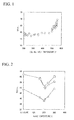
- FIG. 1 The relationship between the stomp temperature of the accelerated cooling (cooling stop temperature) and the strength-ductihty balance [TS ⁇ n] is shown in FIG. 1 .
- the strength-ductihty balance [TS ⁇ n] increases. That is, the balance between the strength and the ductility of a steel having a single bainite microstructure is improved by an increase in the cooping stop temperature.
- the balance between the strength and the ductility of the steel is considered to be improved due to the following reason.
- austenite remains as a balance of bainite.
- the remaining austenite transforms into bainite even after the stop of the accelerated cooling (for example, during air coling), and the bainite transformation is completed in a range from the strop temperature of the accelerated cooling to a temperature about 50°C lower than this stop temperature. Since strain generated by the accelerated cooling and the bainite transformation is recovered when the accelerated cooling is stopped at a high temperature, bainite generated during the accelerated cooling is relatively soft. In addition, bainite generated after the stop of the accelerated cooling is harder than bainite generated during the accelerated cooing since the transformation is completed at a relatively low temperature. As such, when the stop temperature of the accelerated cooling increases, two kinds of bainite are generated, and the heterogeneity of the microstructure increases.
- a steel pipe at a high temperature for a relatively long time recovers strain across the entire microstructure.
- a steel having a high strength-ductifity balance (deformability) can be manufactured by both of the heterogeneity of the microstructure and the recovery of strain.
- the inventors carried out studies regarding the influence of aging when corrosion preventive coating is carried out on a steel pipe.
- the temperature range of coating heating is about 150°C to 300°C.
- the inventors carried out studies regarding the variation of the strength-ductihty balance [TS ⁇ n] with respect to aging temperatures using three kinds of steel pipes having a single bainite microstructure.
- the results are shown in FIG. 2 .
- the aging temperature at which the strength-ductihty balance [TS ⁇ n] becomes the smallest is 200°C for the three kinds of steel pipes represented by the open circle " ⁇ ," the open triangle " ⁇ ,” and the open rectangle " ⁇ ".
- the degradation of the strength-ductility balance by the aging shows the same tendency in a variety of steel pipes.
- a steel pipe having an excellent strensth-ductility balance immediately after the production (before aging) has an excellent strength-ductility balance even after aging. It is considered that, since the deformability of a steel pipe immediatety after the production (before aging) is improved by the recovery of strain introduced by the accelerated cooling and the bainite transformation, an excellent strength-ductihty balance can be obtained even after aging. Therefore, in the present intention, the dislocation density in the microstructure of the steel pipe is reduces, and the deformabitity of the steel pipe after aging is excellent.
- C is an extremely effective clement for improving the strength of steel. 0.02% or more of C is added to steel in order to obtain a sufficient strength.
- the upper limit of the amount of C is 0.09,% As a result, the amount of C is 0.02% to 0.09%.
- Mn is an extremely important element for improving the balance between the strength and the low-temperature toughness. Therefore, 0.4% or more of Mn is added to steel. On the ether hand, when the amount of Mn is larger then 2.4%, segregation at the center of the plate thickness (center segregation) which is parallel to the surface of the steel plate becomes significant.
- the upper limit of the amount of Mn is set to 2.4% in order to suppress degradation of the low-temperature toughness caused by the center segregation. As a result, the amount of Mn is 0.4% to 2.5%.
- the amount of Cr increases the strength of the base metal nd the weld. Therefore, 0.1% or more of Cr is added to steel. However, when the amount of Cr is larger than 1.0%, the HAZ toughness and the on-site weldability are significantly degraded, and therefore the upper limit of the amount of Cr is set to 1.0% or lower. As a result, the amount of Cr is 0.1% to 1.0%.
- Ti forms fine TiN, and refines the microstructure of the base metal and the heat affected zones, thereby contributing to toughness improvement. Those effects are exhibited extremely significantly by the combined addition with Nb. It is necessary so add 0.005% or more of Ti to steel in order to sufficiently devetop these effects.
- the amount of Ti is larger than 0.03%;, coarsening of TiN and precipitation hardening by TiC occur, and wherefore the low-temperature toughness is degraded. Therefore, the upper limit of the amount of Ti is limited to 0.03%. As a result, the amount of Ti is 0.005% to 0.03%.
- Nb not only suppresses recrystallization of austenite during controlled roiling so as to refine the microstructure, but also increased hardenability so as two improve the toughness of steel. It is necessary to add 0.005% or more of Nb to steel in order to obtain these effects.
- the amount of Nb is larger than 0.3%, the toughness of the heat affected zones is degraded, and therefore the upper limit of the amount of Nb is set to 0.3% or lower. As a result, the amount of Nb is 0.005% to 0.3%.
- Si 0.6% or less (including 0%)
- Si is an element that acts as a deoxidizing agent and contributes to strength improvement. When more than 0.6% of Si is added to steel, the on-site weldability is degraded, and therefore the upper limit of the amount of Si is limited to 0.6%. In addition, it is preferable to add 0.001 % or more of Si for deoxidizing. Furthermore, it is more preferable to add 0.1% or morse of Si in order to increase the strength.
- Al 0.1% or less (not including 0%)
- Al is an element that is normally used a; a deoxidizing agent and refines the microstructure.
- the amount of Al exceeds 0.1%, Al-based nonmetallic inclusions increase such that the clearness of steel is impaired. Therefore, the upper limit of the amount of Al is limited to 0.1%.
- P is an impurity.
- the upper limit of the amount of P is limited to 0.02% or tests in order to improve the iow-temperature toughness of the base metal and the heat affected zones.
- the amount of P is reduces, grain boundary fracture is prevented, and the tow-temperature toughness is improved.
- S is an impurity.
- the upper limit of the amount of S is set to 0.005% or less in order to improve the low-temperature toughness of the base metal and the heat effected zones.
- the amount of S is reduces, the amount of MnS, which is elongate by hot rolling, is reduces, and it is possibly to improve ductility and toughness.
- N is an impurity.
- the upper limit of the amount of N is limited to 0.008% or less since the tow-temperature toughness is degraded due to coarsening of TiN.
- N forms TiN, and suppresses coarsening of crystal grains in the base metal and the heat affected zones. It is preferable to include 0.001%; or more of N in steel in order to improve the low-temperature toughness.
- Bainite transformation index BT 650°C or tower
- the bainite transformation index BT which is obtained by the equation (1) as descried above, to 650°C or lower by controlling the amounts of C, Mn, Mo, Ni, and Cr in steel.
- the bainite transformation is completed even when the accelerated cooling is stopped at 500°C or higher as tong as the bainite transformation index BT is set to 650°C or lower.
- dislocation density is lowered by the recovery during air cooling after the stop of the accelerated cooling, and deformability immediately after the production (before aging) and deformability after aging, that is, deformation properties, are increased.
- the BT is obtained by considering the amounts of Mo and Ni as '0',
- the upper limit of the BT is not limited, but may be 780.3°C or lower in consideration of the lower limits of the amounts of C, Mn, and Cr.
- at least one of Ni, Cu, Mo, and V may be added to steel in order to improve strength.
- Ni 0.65% or less (including 0%)
- Ni is an element that improves strength without degrading the low-temperature toughness.
- the upper limit of the of Ni is preferably 0.65% or less.
- Cu is an element that improves the strength of the base and the heat affected zone.
- the upper limit of the amount of Cu is preferably 1.5% or less.
- Mo is an element that improves hardenability so us to increase strength.
- the upper limit of the amount of Mo is preferably 0.3% or less.
- V 0.2% or less (including 0%')
- V contributed to the refining of the microstructure and an increase in hardenability, and increases the toughness of steel.
- the effect of adding V is small in comparison to Nb.
- V is effective in suppressing the softening of the weld.
- the upper limit of the amount of V is preferably 0.2% or less in terms of securing the toughness of the weld.
- FIG. 3 is an example of a mixed microstructure of ferrite and bainite
- FIG. 4 is an example of a single bainite microstructure.
- the 'ferrite' is defined as a ferrite crystal grain (ferrite phase) including no lath grain boundary and carbide therein as shown by the arrow in FIG. 3 .
- the ferrite is, for example, pro-eutectoid ferrite.
- the microstructure of steel is, for example, a single bainite microstructure as shown in FIG. 4 .
- the chemical composition of steel are controlled in order to increase the strength and the toughness of heat effected zones.
- ferrite as shown by the arrow in FIG. 3 is not easily generated in a continuous cooling profess with this chemical composition of steel.
- variation in the strength properties by aging can be ignored even when ferrite is unexpectedly generated in steel as long as ferrite included in the single bainite microstructure (ferrite fraction.) is limited to 5% or less with respect to the entire microstructure. Therefore, 5% or less of ferrite may be included in steel.
- these ferrite and bainite can be identified using, an optical microscope.
- martensite-austenite mixture that is, martensite-austenite constituent (MA) is included in the single bainite microstructure.
- the first bainite (high-temperature bainite) 10 is a microstructure in which mainly thin bainitic ferrites 2a grown from the prior-austenite grain boundaries 1 are gathered. For example, retained austenite 3 may be present between the bainitic ferrites 2a. Since the first bainite 10 contains a small amount of C and easily allows strain to be recovered by holding at a high temperature, the first bainite rarely includes carbides and is relatively soft.
- the deformability of a steel pipe can be increased by the first bainite 10.
- the second bainite (middle-temperature bainite) 11 is a mixed microstructure of the thin bainitic ferrites 2a and cementites 4 between the bainitic ferrites 2a.
- the second bainite I is hard in comparison to the first bainite 10. Therefore, the first bainite 10 and the second bainite 11 is included in the microstructure of steel, the heterogeneity of the microstructure increases and the deformability of a steel is further improved.
- the bainitic ferrite 2a included in the first bainite 10 and the second bainite 11 includes no carbide.
- the single bainite microstructure contains the bainitic ferrite 2a having no carbide.
- the third bainite (low-temperature bainite) 12 is a mixed microstructure of thin bainitic ferrites 2b having carbides 5 generated in the grains and cementites 4 between the bainitic ferrites 2b.
- the third bainite 12 is preferably as little as possible.
- the cementite 4 may include carbides such as niobium carbide as impurities. Therefore, in the present invention, the single bainite microstructure mainly includes the bainite and the bainite. The total amount of the first bainite and the second bainite is preferably 95% or more of the entire microstructure. Meanwhile, there are cases in which the third bainite is unexpectedly generated in the single bainite microstructure. Therefore, the single bainite microstructure may include 1 % or less of the third bainite. A transmission electron microscope (TEM) can be used in order to identify the three kinds of bainites.
- TEM transmission electron microscope
- a steel pipe having the above chemical composition and microstructure is excellent in terms of deformation properties, particularly the strength-ductility balance after aging.
- a steel pipe for line pipes which is manufactured by controlled rolling and accelerated cooling, is heated, to 150°C to 300°C when resin coating is carried out.
- the aging temperature at which the strength-ductitity balance is most degraded is 200°C.
- it is possible to provide a steel pipe for which the product, of the tensile strength in the pipe axial direction TS and an n value in a tensile strain of 1% to 5% (work-hardening coefficient) is 60 or higher when an aging treatment is carried out at 200°C.
- This steel pipe is excellent in terms of deformation propertied after aging even when a thermal treatment is carried out aft the aging temperature at which the strength-ductility balance is most degraded.
- a producing method of the steel pipe according to an embodiment of the present invention will be describes.
- a steel is melted and then cast so as to make a slab (steel), the slab is heated, hot-rolled, and cooled so as to make steel plate, the steel plate is cold-formed into a pipe shape, and the edge portions of the formed steel plate are wielded with mach other, thereby manufacturing a steel pipe.
- the manufactured steel pipe is heated to a temperature of 150°C to 350°C when the surface of the steel pipe is coasted witch a film, such as a resin, for corrosion prevention.
- the heating temperature of the hot-rolled slab is not limited, but is preferably 1000°C or higher in order to decease the deformation resistance, In addition, it is more preferable to heat the slab to 1050°C or higher in order to dissolve carbides of Nb and Cr in steel as salutes in steels. On the other hand, when the heating temperature exceeds 1300°C, there are cases in which the size of crystal grains increases, and the toughness is degrades. Therefore, the heating temperature is preferably 1300°C or lower.
- finishing rotting in hot rolling is carried out at tower than 750°C, ferrite is generated before the rotting, and ferrite is generated in the middle of rotting.
- the finishing rotting in hot rotting is carried out at 750°C or higher.
- the finishing rolling is carried out at 870°C or lower.
- the start temperature of the finishing rotting is 870°C or lower
- the stop temperature of the finishing rolling is 750°C or higher in order to carry out the finishing rolling several times.
- Accelerated cooling begins immediately after the hot rotting. Particularly, when the start temperature of the accelerated cooling is significantly towered below 750°C lamellar ferrite is generated in steel, and the strength and the toughness are degraded. In addition, when the start of the accelerated cooling is delayed, dislocations introduced bv rolling in a non-recrystatiization temperature range are recovered such that the strength is degrades.
- the stop temperature of the accelerated cooling is extremely important in order to obtain a steel pipe that is excellent in terms of deformation propertied.
- FIG. 1 generally, when the cooling strop temperature increases, the strength-ductility balance [TS ⁇ n] increases.
- FIG. 1 shows that, when the cooling stop temperature is set to 500°C or higher, the strength-ductility balance [TS ⁇ n] abruptly increases.
- the tower limit of the stop temperature of the accelerated cooling is set to 500°C or higher in order to lower the dislocation density in the steel. After the accelerated cooling is stopped, air cooling (for example, lower than 5 °C/s) is carried out, thereby manufacturing a steel plate.
- the density of dislocations introduced curing bainite transformation is lowered, and the dislocations (strain) are recovered during the air cooling so that the deformation properties of a steel pipe that has a single bainite microstructure can be improved.
- the upper limit of the stop temperature of the accelerated cooling exceeds 600°C, lamellar ferrite is generated in the steels, and the strength and the toughness are degraded.
- the stop temperature of the accelerated cooling is 500°C to 600°C.
- the cooling rate of the accelerated cooling is 5 °C/s to 50 °C/s.
- the cooling, rate of the accelerates coot ing is preferably 10 °C/s to 50 °C/s in order to secure a certain degree of hardenability.
- the first bainite is mainly generated during the accelerated cooling, and the second bainite is mainly generated immediately before the stop of the accelerated cooling and after the stomp of the accelerated cooling. Therefore, a mixed microstructure of the first bainite and the second bainite can be obtained as describes above by controlling the cooling rate and the cooling stop temperature in this manner. Meanwhile the third bainite is barely generated in this case since the third bainite is generated at, for example. 450°C or slower.
- the manufactured steel plate is cold-formed into a pipe shape, and the abutting edges are welded, thereby manufacturing a steel pipe.
- the UOE process or the bend prowess is preferable from the viewpoint of productivity.
- use of the submerged arc welding is preferable for the welding of the abutting edges.
- corrosion preventive coating such as resin coating
- the temperature range of the coating heating of the steel pipe is 150°C to 300°C.
- Steals including the chemical elements shown in Table I were melted and prepared, and stabs obtained by casting the prepared steels were hot-roiied sunder the conditions shown in Table 2, thereby manufacturing steel plates.
- the manufactured steel plates were formed into a pipe shape bey the UOE process.
- the inner and outer faces oaf the steel plate formed into a pipe shape were welded by one layer of submerged are wielding, thereby manufacturing a steel pipe having a plate thickness of 14 mm to 22 mm.
- the presence and absence of the generation of ferrite was confirmed by observing the microstructure of the manufactured steel pipe using an optical microscope.
- the kind of the bainite was confirmed using a scanning electron microscope (SEM) or a transmission electron microscope (TEM).
- SEM scanning electron microscope
- TEM transmission electron microscope
- an arcuate overall thickness tensile test specimen API standard was sampled, and a tensile test was carried out in the pipe axial direction. A stress-strain curve was obtained by this tensile test, and the 0.2% proof stress YS, the tensile strength TS, and the work-hardening coefficient (n value) were evaluated.
- the work-hardening coefficient (n value) was calculated from the relationship between the true stress ⁇ and the true strain ⁇ in a tensile strain of 1% to 5% (the stress-strain curve) using the equation (1) as described above.
- the strength-ductihty balance [TS ⁇ n] was calculated from the product of the tensile strength TS and the work-hardening coefficient (n value).
- Table 3 shows the chemical elements of the steels
- Table 2 shows the producing methods of the steel pipes.
- the steel pipes of Examples 1 to 10 were a single bainite microstructure having the first bainite (B1) and the second bainite (B2).
- ferrite (F) and the third bainite (B3) were not observed in the single bainite microstructure.
- the steel pipes (Examples I to 10) manufactured under the producing conditions according to the present invention (Production Nos.
- the strength-ductility balance [TS ⁇ n] was lower than 60.
- Comparative Example 1 not only the first bainite (B1) and the second bainite (B2) but also the third bainite (B3) were generated in the microstructure.
- Comparative Example 2 ferrite (F) as well as the three kinds of bainite (B1, B2, and B3) were generated.
- Comparative Examples 3 to 5 for which the steels (M, N, and O) were used, the bainite transformation index BT exceeded 650°C. In these Comparative Examples 3 to 5, the strength-ductility balances [TS ⁇ n] were lower than 60, and ferrite (F) and the third bainite (B3) were generated in the microstructure.
- the bainite transformation index BT being 650°C or lower and limiting the amounts of ferrite (F) and the third bainite (B3) are important for securing the strength-ductility balance [TS ⁇ n].
- these steel pipes of Comparative Examples 3 to 5 satisfy the chemical composition according to the present invention witch the conditions regarding the chemical composition excluding the bainite transformation index BT.
- the steel pipes of Comparative Examples 6 to 9 were steel pipes manufactured using the steels (A, E, and B) that satisfy the chemical composition according to the present invention shown in Table 1 under the producing conditions (Production Nos. 16 to 19) in which the stop temperature of the accelerated cooling is lower than 500°C as shown in Table 2.
- the present invention it is possible to provide a high-strength steel pipe having a single bainite microstructure that is advantageous for productivity and having a sufficient deformability even after the steel pipe is aged due to heating, for example, in coating and the like, and a producing method thereof, and therefore the industrial contribution is extremely significant.
Landscapes
- Chemical & Material Sciences (AREA)
- Engineering & Computer Science (AREA)
- Materials Engineering (AREA)
- Mechanical Engineering (AREA)
- Metallurgy (AREA)
- Organic Chemistry (AREA)
- Physics & Mathematics (AREA)
- Thermal Sciences (AREA)
- Crystallography & Structural Chemistry (AREA)
- Heat Treatment Of Steel (AREA)
Abstract
Description
- The present invention relates to a high-strength steel pipe that is excellent in terms of the deformation characteristics immediately after the production (as-produced, before aging) and after aging, and a producing method thereof.
Priority its claimed on Japanese Patent Application No.2009-140280. filed June 11, 2009 - Recently, the environments for laying pipe lines, which are extremely important as a long-distance transportation system of petroleum and natural gas have, become more severe. For example, the influence of periodic melting and freezing of frozen soils in discontinuous permafrost regions, the influence of landslides in earthquake regions, and the influence of oceanic currents at the sea bottom have made it impossible to ignore the bending deformation of pipe lines. Therefore, there is demand for a steel pipe for line pipes to be excellent in terms of the internal pressure resistance, not to easily allow buckling to occur with respect to bending deformation, and to be excellent in terms of strength and deformability.
- With respect to such demand, a high-deformabitity steel pipe in which ferrite is dispersed in bainite is suggested (for example, refer to Patent Citation 1). In addition, coating is carried out on a line pipe from the viewpoint of corrosion prevention. At this time, a cold-formed steel pipe is heated up to about 300°C, which ages the steel pipe. Therefore, the stress-strain curve is significantly altered, for example, yield elongation is observed, in comparison to a moment when the steel pipe is manufactured (before coating).
- In order to suppress such strain aging caused by forming and heating, a steel pipe in which Ni, Cu, and Mo are used is suggested (for example, refer to Patent Citations 2 and 3). In the steel pipes as disclosed in Patent Citations 1 to 3, the strength is increased by hard bainite, and the deformability is improved by soft ferrite. Therefore, it was necessary to control the amount of ferrite by the start temperature and the cooling rate of the controlled cooling after hot rolling.
-
- [Patent Citation 1] Japanese Unexamined Patent Application, First Publication No,
2003-293089 - [Patent Citation 2] Japanese Unexamined Patent Application, First Publication No.
2006-144037 - [Patent Citation 3] Japanese Unexamined Patent. Application, First Publication No.
2006-283147 - However, when the strength of a steel pipe is improved by bainite, it is necessary to control the composition of the steel so as to increase the hardenability. As a result, it becomes difficult to generate granular ferrite (pro-eutectoid ferrite) during cooling, and, for example, lamellar ferrite is generated so that the toughness is impaired, In the present invention, a high-strength steel pipe having a predetermined single bainite microstructure that is advantageous for productivity and having a sufficient deformability even after the steel pipe is aged due to heating, for example, in coating and the like, and a producing method thereof are provided in consideration of the above circumstances.
- The inventors found that it is affective to stop accelerated cooling at a high temperature before bainite transformation is finished in order to improve the deformability of a steel pipe having bainite. Furthermore, the inventors found that the recovery of strain induced by accelerated cooling and bainite transformation, that is, a decrease of the dislocation density in steel improves the deformability of a steel pipe and also allows the excellent deformability even after aging. When accelerated cooling is stopped at a high temperature, bainite transformation is not completed, and therefore austenite remains as a balance of bainite. The remaining austenite transforms into bainite even after the stop of the accelerated cooling (during slow cooling, for example, during air cooling), and the bainite transformation is completed in a range from the strop temperature of the accelerated cooling to a temperature about 50°C lower than this strop temperature. Since strain in the bainite is recovered by the stop of the accelerated cooling at a high temperature, bainite generated during the accelerated cooling is relatively soft. In addition, bainite generated after the strop of the accelerated cooling is harder than bainite generated during the accelerated cooling since the transformation is completed at a relatively low temperature. As such, when the stop temperature of the accelerated cooling increases, two kinds of bainite are generated, and the heterogeneity of the microstructure increases. Furthermore, maintaining a steel pipe at a high temperature for a relatively long time (that is, slow cooling after accelerated cooling) recovers strain across the entire microstructure. As such, a steel having a high deformability can be manufactured by both of the heterogeneity of the microstructure and the recovery of strain.
- The present invention has been made based on such findings, and the summery is as fellows:
-
- (1) A high-strength steel pipe according to an aspect of the present invention includes, by mass%, C: 0.02% to 0.09%, Mn: 0.4% to 2.5%, Cr: 0.1%; to 1.0%, Ti: 0.005% to 0.03%, Nb: 0.005% to 0.3%, and a balance consisting of Fe and inevitable impurities, in which Si. A1, P, S, and N are limited to 0.6% or less, 0.1% or less, 0.02% or less, 0.005% or less, 0.008% or less, respectively, the bainite transformation index BT obtained by the equation (2) below is 650°C or lower, and the microstructure thereof is a single bainite microstructure including first bainite and second bainite, the first bainite being a gathered microstructure of bainitic ferrite including no carbide, and the second bainite being a mixed microstructure of bainitic ferrite including no carbide and cementite between the bainitic ferrites.
-
- (2) The high-strength steel pipe according to (1) may further include, by mass%, at least one of Ni: 0.65% or less, Cu: 1.5% or less, Mo: 0.3% or less, and V: 0.2% or less.
-
- (3) In the high-strength steel pipe according to (1), the total amount of the first bainite and the second bainite may be 95% or more of the entire microstructure.
-
- (4) In the high-strength steel pipe according to (1), the product of the tensile strength in the pipe axial direction and an n value in a tensile strain of 1% to 5% may be 60 or higher when an aging treatment is carried out at 200°C.
-
- (5) A producing method of the high-strength steel pipe according to an aspect of the present invention includes: heating a steel satisfying the chemical composition according to (1) or (2); performing a hot rolling of the steel in which a finishing rolling in a range of 750°C to 870°C is performed; starting an accelerated cooling of the steel having a cooling rate of 5 °C/s to 50 °C/s at 750°C or higher, stopping the accelerated cooling of the steel in a range of 500°C to 600°C, and performing an air-cooling of the steel so as to make a steel plate; and cold-forming the steel plate into a pipe shape, and welding abutting edges of the steel plate.
- According, to the present invention, it is possible to provide a high-strength steel pipe having a predetermined single bainite microstructure that is advantageous for productivity and having a sufficient deformability even after the steel pipe is aged due to heating, for example, in coating, and the like, and a producing method thereof, and therefore the industrial contribution is extremely significant.
-
-
FIG. 1 is a diagram showing the relationship between the strop temperature of the accelerated cooling and the strength-ductility balance. -
FIG. 2 is a diagram showing the relationship between the gaging temperature and the strength-ductility balance after aging. -
FIG. 3 is an example of a microstructure having ferrite and bainite. -
FIG. 4 is an example of a microstructure having a single bainite microstructure. -
FIG. 5A is a schematic view showing an example of the first bainite. -
FIG. 5B is a schematic view showing an example of the second bainite. -
FIG. 5C is a schematic view showing an example of the third bainite. - The inventors firstly studied the relationship between the stop temperature of the accelerated cooling and the mechanical properties for a steel whose chemical composition was controlled so that the microstructure of the steel becomes bainite. The product [TS × n] of the tensile strength TS and the n value was used as an index representing the balance between the strength and the ductility for the mechanical properties. Here, the n value is an ordinary index that evaluates work-hardening, and is obtained from the relationship between the true stress σ and the true strain ε in the equation (1) below (the stress-strain curve).

Since the correlationship between the n value obtained in a range of 1%, to 5% of the strain amount bey a tensile test and the buckling characteristics of a steels pipe is significant, the n value is obtained in a range of 1 % to 5% of the strain amount in the present invention. That is, the relationship between the true stress σ and the true strain ε is obtained by a tensile test, and the exponential (the n value) in the equation (1) is obtained from the relationship between the true stress σ and the true strain ε in a range of 1% to 5% of the strain amount. Meanwhile, the parameter K in the equation (1) is a constant determined by materials. - The relationship between the stomp temperature of the accelerated cooling (cooling stop temperature) and the strength-ductihty balance [TS × n] is shown in
FIG. 1 . As shown inFIG. 1 . when the cooling stop temperature increases, the strength-ductihty balance [TS × n] increases. That is, the balance between the strength and the ductility of a steel having a single bainite microstructure is improved by an increase in the cooping stop temperature. The balance between the strength and the ductility of the steel is considered to be improved due to the following reason. When accelerated cooling is stopped at a relatively high temperature, since the bainite transformation is not completed, austenite remains as a balance of bainite. The remaining austenite transforms into bainite even after the stop of the accelerated cooling (for example, during air coling), and the bainite transformation is completed in a range from the strop temperature of the accelerated cooling to a temperature about 50°C lower than this stop temperature. Since strain generated by the accelerated cooling and the bainite transformation is recovered when the accelerated cooling is stopped at a high temperature, bainite generated during the accelerated cooling is relatively soft. In addition, bainite generated after the stop of the accelerated cooling is harder than bainite generated during the accelerated cooing since the transformation is completed at a relatively low temperature. As such, when the stop temperature of the accelerated cooling increases, two kinds of bainite are generated, and the heterogeneity of the microstructure increases. Furthermore, maintaining a steel pipe at a high temperature for a relatively long time (for example, air-cooling after accelerated cooling) recovers strain across the entire microstructure. As such, a steel having a high strength-ductifity balance (deformability) can be manufactured by both of the heterogeneity of the microstructure and the recovery of strain. - Next, the inventors carried out studies regarding the influence of aging when corrosion preventive coating is carried out on a steel pipe. The temperature range of coating heating is about 150°C to 300°C. The inventors carried out studies regarding the variation of the strength-ductihty balance [TS × n] with respect to aging temperatures using three kinds of steel pipes having a single bainite microstructure. The results are shown in
FIG. 2 . As shown inFIG. 2 , it was found that the aging temperature at which the strength-ductihty balance [TS × n] becomes the smallest is 200°C for the three kinds of steel pipes represented by the open circle "○," the open triangle "△," and the open rectangle "□". - The degradation of the strength-ductility balance by the aging shows the same tendency in a variety of steel pipes. In addition, it was found that a steel pipe having an excellent strensth-ductility balance immediately after the production (before aging) has an excellent strength-ductility balance even after aging. It is considered that, since the deformability of a steel pipe immediatety after the production (before aging) is improved by the recovery of strain introduced by the accelerated cooling and the bainite transformation, an excellent strength-ductihty balance can be obtained even after aging. Therefore, in the present intention, the dislocation density in the microstructure of the steel pipe is reduces, and the deformabitity of the steel pipe after aging is excellent.
- In addition, even when the stop temperature of the accelerated cooling increase to 500°C or higher, it is necessary to control the chemical composition of the steel in an appropriate range in order to complete the bainite transformation. The inventory carried out studies regarding influence of the chemical composition on the bainite transformation. As a result, it was found that the bainite transformation was completed even when the accelerated cooling was stopped at 500°C or higher as long as the bainite transformation index BT obtained by the equation (2) below was 650°C or lower.

Here, the [C], [Mn], [Mo], [Ni], and [Cr] are the amounts of C, Mn, Mo, Ni, and Cr, respectively. - Hereinafter, the present invention will be describes in detail.
Firstly, the chemical elements in the steel pipe will be described. Meanwhile, the amounts (%) of the chemical elements are all represented by mass%. - C is an extremely effective clement for improving the strength of steel. 0.02% or more of C is added to steel in order to obtain a sufficient strength. On the other hand, when the amount of C is larger than 0.09%, the tow-temperature toughness of the base metal (parent material) and the heat affected zones is degraded, and the on-site weldability is deteriorated. Therefore, the upper limit of the amount of C is 0.09,%
As a result, the amount of C is 0.02% to 0.09%. - Mn is an extremely important element for improving the balance between the strength and the low-temperature toughness. Therefore, 0.4% or more of Mn is added to steel. On the ether hand, when the amount of Mn is larger then 2.4%, segregation at the center of the plate thickness (center segregation) which is parallel to the surface of the steel plate becomes significant. The upper limit of the amount of Mn is set to 2.4% in order to suppress degradation of the low-temperature toughness caused by the center segregation. As a result, the amount of Mn is 0.4% to 2.5%.
- Cr increases the strength of the base metal nd the weld. Therefore, 0.1% or more of Cr is added to steel. However, when the amount of Cr is larger than 1.0%, the HAZ toughness and the on-site weldability are significantly degraded, and therefore the upper limit of the amount of Cr is set to 1.0% or lower. As a result, the amount of Cr is 0.1% to 1.0%.
- Ti forms fine TiN, and refines the microstructure of the base metal and the heat affected zones, thereby contributing to toughness improvement. Those effects are exhibited extremely significantly by the combined addition with Nb. It is necessary so add 0.005% or more of Ti to steel in order to sufficiently devetop these effects. On the other hand, when the amount of Ti is larger than 0.03%;, coarsening of TiN and precipitation hardening by TiC occur, and wherefore the low-temperature toughness is degraded. Therefore, the upper limit of the amount of Ti is limited to 0.03%. As a result, the amount of Ti is 0.005% to 0.03%.
- Nb not only suppresses recrystallization of austenite during controlled roiling so as to refine the microstructure, but also increased hardenability so as two improve the toughness of steel. It is necessary to add 0.005% or more of Nb to steel in order to obtain these effects. On the other hand, when the amount of Nb is larger than 0.3%, the toughness of the heat affected zones is degraded, and therefore the upper limit of the amount of Nb is set to 0.3% or lower. As a result, the amount of Nb is 0.005% to 0.3%.
- Si is an element that acts as a deoxidizing agent and contributes to strength improvement. When more than 0.6% of Si is added to steel, the on-site weldability is degraded, and therefore the upper limit of the amount of Si is limited to 0.6%. In addition, it is preferable to add 0.001 % or more of Si for deoxidizing. Furthermore, it is more preferable to add 0.1% or morse of Si in order to increase the strength.
- Al is an element that is normally used a; a deoxidizing agent and refines the microstructure. However, when the amount of Al exceeds 0.1%, Al-based nonmetallic inclusions increase such that the clearness of steel is impaired. Therefore, the upper limit of the amount of Al is limited to 0.1%. In addition, it is preferable to add 0.001% or more of Al in order to fix the salute N in steel, which affects aging hardening, by the precipitation of AIN.
- P is an impurity. The upper limit of the amount of P is limited to 0.02% or tests in order to improve the iow-temperature toughness of the base metal and the heat affected zones. When the amount of P is reduces, grain boundary fracture is prevented, and the tow-temperature toughness is improved. Meanwhile, the smaller the amount of P is, the better; however, 0.001% or more of P may generally be included in steel from the standpoint of the balance between the performance and the cost.
- S is an impurity. The upper limit of the amount of S is set to 0.005% or less in order to improve the low-temperature toughness of the base metal and the heat effected zones. When the amount of S is reduces, the amount of MnS, which is elongate by hot rolling, is reduces, and it is possibly to improve ductility and toughness. The smaller the amount of S is, the better; however 0.0001 % or more of S may generally be included in steel from the standpoint of the balance between the performance and the cost.
- N is an impurity. The upper limit of the amount of N is limited to 0.008% or less since the tow-temperature toughness is degraded due to coarsening of TiN. In addition, N forms TiN, and suppresses coarsening of crystal grains in the base metal and the heat affected zones. It is preferable to include 0.001%; or more of N in steel in order to improve the low-temperature toughness.
- In the present invention, it is extremely important to set the bainite transformation index BT, which is obtained by the equation (1) as descried above, to 650°C or lower by controlling the amounts of C, Mn, Mo, Ni, and Cr in steel. As descried abode, the bainite transformation is completed even when the accelerated cooling is stopped at 500°C or higher as tong as the bainite transformation index BT is set to 650°C or lower. As a result, dislocation density is lowered by the recovery during air cooling after the stop of the accelerated cooling, and deformability immediately after the production (before aging) and deformability after aging, that is, deformation properties, are increased. Meanwhile, when Mo and Ni are not included, the BT is obtained by considering the amounts of Mo and Ni as '0', The upper limit of the BT is not limited, but may be 780.3°C or lower in consideration of the lower limits of the amounts of C, Mn, and Cr.
Furthermore, at least one of Ni, Cu, Mo, and V may be added to steel in order to improve strength. - Ni is an element that improves strength without degrading the low-temperature toughness. When the amount of added Ni exceeds 0.65%, the HAZ toughness is degraded. Therefore, the upper limit of the of Ni is preferably 0.65% or less.
- Cu is an element that improves the strength of the base and the heat affected zone. When the amount of added Cu exceeds 1.5%, the on-site weldability is degraded. Therefore, the upper limit of the amount of Cu is preferably 1.5% or less.
- Mo is an element that improves hardenability so us to increase strength. When the amount of added Mo exceeds 0.3%, the HAZ toughness is degraded. Therefore, the upper limit of the amount of Mo is preferably 0.3% or less.
- Similarly to Nb, V contributed to the refining of the microstructure and an increase in hardenability, and increases the toughness of steel. However, the effect of adding V is small in comparison to Nb. In addition, V is effective in suppressing the softening of the weld. The upper limit of the amount of V is preferably 0.2% or less in terms of securing the toughness of the weld.
- Next, the morphology of the microstructure of steel will be describes.
FIG. 3 is an example of a mixed microstructure of ferrite and bainite, andFIG. 4 is an example of a single bainite microstructure. In the present specification, the 'ferrite' is defined as a ferrite crystal grain (ferrite phase) including no lath grain boundary and carbide therein as shown by the arrow inFIG. 3 . The ferrite is, for example, pro-eutectoid ferrite. In the present invention, the microstructure of steel is, for example, a single bainite microstructure as shown inFIG. 4 . In the present intention, the chemical composition of steel are controlled in order to increase the strength and the toughness of heat effected zones. Therefore, ferrite as shown by the arrow inFIG. 3 is not easily generated in a continuous cooling profess with this chemical composition of steel. In addition, variation in the strength properties by aging can be ignored even when ferrite is unexpectedly generated in steel as long as ferrite included in the single bainite microstructure (ferrite fraction.) is limited to 5% or less with respect to the entire microstructure. Therefore, 5% or less of ferrite may be included in steel. Meanwhile, these ferrite and bainite can be identified using, an optical microscope. Furthermore, there are cases in which 3% or less of a martensite-austenite mixture, that is, martensite-austenite constituent (MA) is included in the single bainite microstructure. However, when the MA is 3% or less, the influence on mechanical properties can be ignored, and therefore 3% or less of the MA may be included in steel. The single bainite microstructure mainly the first bainite and the second bainite among the following three kinds of bainite. As shown inFIG. 5A , the first bainite (high-temperature bainite) 10 is a microstructure in which mainly thinbainitic ferrites 2a grown from the prior-austenite grain boundaries 1 are gathered. For example, retainedaustenite 3 may be present between thebainitic ferrites 2a. Since thefirst bainite 10 contains a small amount of C and easily allows strain to be recovered by holding at a high temperature, the first bainite rarely includes carbides and is relatively soft. Therefore, the deformability of a steel pipe can be increased by thefirst bainite 10. As shown in FIC. 5B, the second bainite (middle-temperature bainite) 11 is a mixed microstructure of the thinbainitic ferrites 2a andcementites 4 between thebainitic ferrites 2a. The second bainite I is hard in comparison to thefirst bainite 10. Therefore, thefirst bainite 10 and thesecond bainite 11 is included in the microstructure of steel, the heterogeneity of the microstructure increases and the deformability of a steel is further improved. Thebainitic ferrite 2a included in thefirst bainite 10 and thesecond bainite 11 includes no carbide. That is, the single bainite microstructure contains thebainitic ferrite 2a having no carbide. Furthermore, as shown inFIG. 5C , the third bainite (low-temperature bainite) 12 is a mixed microstructure of thinbainitic ferrites 2b having carbides 5 generated in the grains andcementites 4 between thebainitic ferrites 2b. When thethird bainite 12 is present, the recovery of strain in thefirst bainite 10 is not sufficient, and therefore the heterogeneity of the microstructure is not easily generated in strength, and the deformability of a steel pipe is not easily improved. Therefore, thethird bainite 12 is preferably as little as possible. It is necessary to control thethird bainite 12 or thebainitic ferrite 2b including carbides to be 1% or less in order for strain in thefirst bainite 10 to be sufficiently recovered. Meanwhile, thecementite 4 may include carbides such as niobium carbide as impurities.
Therefore, in the present invention, the single bainite microstructure mainly includes the bainite and the bainite. The total amount of the first bainite and the second bainite is preferably 95% or more of the entire microstructure. Meanwhile, there are cases in which the third bainite is unexpectedly generated in the single bainite microstructure. Therefore, the single bainite microstructure may include 1 % or less of the third bainite. A transmission electron microscope (TEM) can be used in order to identify the three kinds of bainites. - A steel pipe having the above chemical composition and microstructure is excellent in terms of deformation properties, particularly the strength-ductility balance after aging. Generally, a steel pipe for line pipes, which is manufactured by controlled rolling and accelerated cooling, is heated, to 150°C to 300°C when resin coating is carried out. As shown in
FIG. 2 . the aging temperature at which the strength-ductitity balance is most degraded is 200°C. In the present invention, it is possible to provide a steel pipe for which the product, of the tensile strength in the pipe axial direction TS and an n value in a tensile strain of 1% to 5% (work-hardening coefficient) is 60 or higher when an aging treatment is carried out at 200°C. This steel pipe is excellent in terms of deformation propertied after aging even when a thermal treatment is carried out aft the aging temperature at which the strength-ductility balance is most degraded. - Newt, a producing method of the steel pipe according to an embodiment of the present invention will be describes.
In the producing method of the steel pipe according to the embodiment, a steel is melted and then cast so as to make a slab (steel), the slab is heated, hot-rolled, and cooled so as to make steel plate, the steel plate is cold-formed into a pipe shape, and the edge portions of the formed steel plate are wielded with mach other, thereby manufacturing a steel pipe. The manufactured steel pipe is heated to a temperature of 150°C to 350°C when the surface of the steel pipe is coasted witch a film, such as a resin, for corrosion prevention. - The heating temperature of the hot-rolled slab (steel) is not limited, but is preferably 1000°C or higher in order to decease the deformation resistance, In addition, it is more preferable to heat the slab to 1050°C or higher in order to dissolve carbides of Nb and Cr in steel as salutes in steels. On the other hand, when the heating temperature exceeds 1300°C, there are cases in which the size of crystal grains increases, and the toughness is degrades. Therefore, the heating temperature is preferably 1300°C or lower.
- When finishing rotting in hot rolling is carried out at tower than 750°C, ferrite is generated before the rotting, and ferrite is generated in the middle of rotting. When worked ferrite is generated, the deformability of the steel pipe is impaired, and therefor the finishing rotting in hot rotting is carried out at 750°C or higher. On the other hand, it is necessary to complete the hot rotting (the finishing rotting in hot rotting) in a non-recrystaitization temperature range in order to improve the strength and the toughness. Therefore, the finishing rolling is carried out at 870°C or lower. Generally, the start temperature of the finishing rotting is 870°C or lower, and the stop temperature of the finishing rolling is 750°C or higher in order to carry out the finishing rolling several times.
- Accelerated cooling begins immediately after the hot rotting. Particularly, when the start temperature of the accelerated cooling is significantly towered below 750°C lamellar ferrite is generated in steel, and the strength and the toughness are degraded. In addition, when the start of the accelerated cooling is delayed, dislocations introduced bv rolling in a non-recrystatiization temperature range are recovered such that the strength is degrades.
- The stop temperature of the accelerated cooling is extremely important in order to obtain a steel pipe that is excellent in terms of deformation propertied. As shown in
FIG. 1 , generally, when the cooling strop temperature increases, the strength-ductility balance [TS × n] increases.FIG. 1 shows that, when the cooling stop temperature is set to 500°C or higher, the strength-ductility balance [TS × n] abruptly increases, In the embodiment, the tower limit of the stop temperature of the accelerated cooling is set to 500°C or higher in order to lower the dislocation density in the steel. After the accelerated cooling is stopped, air cooling (for example, lower than 5 °C/s) is carried out, thereby manufacturing a steel plate. As a result, the density of dislocations introduced curing bainite transformation is lowered, and the dislocations (strain) are recovered during the air cooling so that the deformation properties of a steel pipe that has a single bainite microstructure can be improved. On the other hand, when the upper limit of the stop temperature of the accelerated cooling exceeds 600°C, lamellar ferrite is generated in the steels, and the strength and the toughness are degraded. Wherefore, the stop temperature of the accelerated cooling is 500°C to 600°C. Hers, the cooling rate of the accelerated cooling is 5 °C/s to 50 °C/s. In audition, the cooling, rate of the accelerates coot ing is preferably 10 °C/s to 50 °C/s in order to secure a certain degree of hardenability. The first bainite is mainly generated during the accelerated cooling, and the second bainite is mainly generated immediately before the stop of the accelerated cooling and after the stomp of the accelerated cooling. Therefore, a mixed microstructure of the first bainite and the second bainite can be obtained as describes above by controlling the cooling rate and the cooling stop temperature in this manner. Meanwhile the third bainite is barely generated in this case since the third bainite is generated at, for example. 450°C or slower. - The manufactured steel plate is cold-formed into a pipe shape, and the abutting edges are welded, thereby manufacturing a steel pipe. The UOE process or the bend prowess is preferable from the viewpoint of productivity. In addition, use of the submerged arc welding is preferable for the welding of the abutting edges.
- Generally, corrosion preventive coating, such as resin coating, is carried out own steel pipes. In this case, the temperature range of the coating heating of the steel pipe is 150°C to 300°C.
- Steals including the chemical elements shown in Table I were melted and prepared, and stabs obtained by casting the prepared steels were hot-roiied sunder the conditions shown in Table 2, thereby manufacturing steel plates. Next, the manufactured steel plates were formed into a pipe shape bey the UOE process. Furthermore, the inner and outer faces oaf the steel plate formed into a pipe shape were welded by one layer of submerged are wielding, thereby manufacturing a steel pipe having a plate thickness of 14 mm to 22 mm.
-
[Table 1] Steel No Chemical elements (mass%) BT Note C Si Mn P S Ti Nb N N Cr Ni Cu Mo V °C A 0.090 0.25 230 0.007 0.0020 0.01 0.030 0.022 0.001 0.23 0.05 580 B 0.070 0.20 1.80 0.006 0.0020 0.01 0.031 0.043 0.004 0.24 0.100 625 C 0.060 0.23 1.82 0.006 0.0016 0.01 0.028 0.032 0.002 0.52 0.30 607 D 0.070 0.22 1.99 0.007 0.0020 0.01 0.031 0.063 0.007 0.17 0.40 0.03 590 E 0.060 0.2 2.12 0.006 0.0020 0.01 0.028 0.006 0.008 0.55 0.03 577 F 0.055 0.29 1.90 0.006 0.0016 0.01 0.034 0.004 0.003 0.17 0.25 0.26 613 Example G 0.060 0.20 1.93 0.007 0.0020 0.01 0.030 0.053 0.005 0.60 0.40 0.40 0.100 559 H 0.060 0.23 1.89 0.007 0.0020 0.01 0.030 0.042 0.003 0.11 0.17 0.19 0.220 615 1 0.040 0.05 2.30 0.007 0.0016 0.01 0.150 0.026 0.005 0.11 0.35 1.20 0.015 578 J 0.080 0.20 1.10 0.007 0.0016 0.01 0.030 0.038 0.002 0.90 0.32 0.50 0.150 607 K 0.010 0.20 2.40 0.007 0.0016 0.01 0.030 0.058 0.006 0.16 0.32 0.50 576 L 0.070 0.20 0.30 0.007 0.0016 0.01 0.030 0.028 0.005 0.12 0.32 0.150 746 M 0.060 0.20 1.30 0.006 0.0013 0.01 0.030 0.022 0.005 0.34 669 Comparative N 0.030 0.30 1.80 0.007 0.0016 0.01 0.030 0.028 0.004 0.10 652 Example O 0.050 0.30 1.18 0.007 0.0016 0.01 0.030 0.028 0.004 0.10 0.30 0.10 0.10 677 Underlined columns do not satisfy the range according to the present invention. -
[Table 2] Production No. Steel No. Finishing rolling Accelerated cooling Note Start temperature Stop temperature Start temperature Stop temperature Cooling rate °C °C °C °C °C/s 1 A 845 791 758 512 25 Example 2 B 851 790 789 536 36 3 C 863 788 795 514 48 4 D 765 795 771 528 15 5 E 863 784 781 537 26 6 F 855 792 765 518 16 7 G 851 803 771 519 53 8 H 856 791 781 565 52 9 I 842 812 759 515 26 10 J 854 814 761 523 25 11 K 856 792 780 519 48 Example Comparative 12 L 842 814 771 536 25 13 M 842 803 771 510 20 14 N 842 790 760 530 27 15 O 863 788 780 560 16 16 E 854 814 761 440 25 17 A 765 790 768 400 25 18 B 845 797 780 240 35 19 B 863 789 752 212 21 Underlined columns do not satisfy the range according to the present invention. - The presence and absence of the generation of ferrite was confirmed by observing the microstructure of the manufactured steel pipe using an optical microscope. In addition, the kind of the bainite was confirmed using a scanning electron microscope (SEM) or a transmission electron microscope (TEM). Furthermore, after part of the steel pipe was cut out, and an aging treatment was carried out at 200°C using a salt bath, an arcuate overall thickness tensile test specimen (API standard) was sampled, and a tensile test was carried out in the pipe axial direction. A stress-strain curve was obtained by this tensile test, and the 0.2% proof stress YS, the tensile strength TS, and the work-hardening coefficient (n value) were evaluated. Meanwhile, the work-hardening coefficient (n value) was calculated from the relationship between the true stress σ and the true strain ε in a tensile strain of 1% to 5% (the stress-strain curve) using the equation (1) as described above. In addition, the strength-ductihty balance [TS × n] was calculated from the product of the tensile strength TS and the work-hardening coefficient (n value).
- The results are shown in Table 3. Table 1 shows the chemical elements of the steels, and Table 2 shows the producing methods of the steel pipes. As shown in Table 3, the steel pipes of Examples 1 to 10 were a single bainite microstructure having the first bainite (B1) and the second bainite (B2). In addition, ferrite (F) and the third bainite (B3) were not observed in the single bainite microstructure. Moreover, it was found that the steel pipes (Examples I to 10) manufactured under the producing conditions according to the present invention (Production Nos. 1 to 10) shown in Table 2 using steels (A to J) that satisfy the chemical composition according to the present intention shown in Table 1 had an excellent strength (a 0.2% proof stress YS of 550 MPa or higher, and a tensile strength TS of 650 MPa or higher) and a strength-ductility balance [TS × n] of 60 or higher. Therefore, all of the steel pipes of Examples 1 to 10 are excellent in terms of uniform elongation uEl. Furthermore, the steel pipes of Examples 1 to 10 had a strength-ductility balance [TS × n] of 60 or higher even when an aging treatment was carried out at 200°C.
-
[Table 3] Production No. Steel No. Microstructure Properties before aging Properties after aging note 0.2% proof stress TS n value TS×n 0.2% proof stress TS n value TS×n MPa MPa - MPa MPa MPa - MPa Example 1 1 A B1+B2 582 688 0.097 66.7 612 719 0.092 66.1 Example 2 2 B B1+B2 619 719 0.086 61.8 650 750 0.083 62.3 Example 3 3 C B1+B2 654 723 0.093 67.2 680 746 0.089 66.4 Example 4 4 D B1+B2 576 692 0.089 61.6 599 723 0.085 61.5 Example 5 5 E B1+B2 578 731 0.092 67.3 601 754 0.089 67.1 Example Example 6 6 F B1+B2 567 662 0.096 63.6 590 685 0.092 63.0 Example 7 7 G B1+B2 592 747 0.085 63.5 611 770 0.081 62.4 Example 8 8 H B1+B2 592 696 0.092 64.0 616 718 0.087 62.5 Example 9 9 I B1+B2 647 717 0.090 64.5 670 740 0.085 62.9 Example 10 10 J B1+B2 679 758 0.089 67.5 701 781 0.085 66.4 Comparative Example 1 11 K B 455 582 0.093 54.1 478 605 0.089 53.8 Comparative Example 2 12 L F+B 462 599 0.095 56.9 485 622 0.092 57.2 Comparative Example 3 13 M F+B 540 650 0.083 54.0 680 680 0.080 54.4 Comparative Example 4 14 N F+B 560 640 0.082 52.5 675 675 0.079 53.3 Comparative Example 5 15 O F+B 555 628 0.089 55.9 653 650 0.083 54.0 Comparative Example Comparative Example 6 16 E B 646 700 0.065 45.5 668 723 0.062 44.8 Comparative Example 7 17 A B 621 696 0.074 51.5 640 719 0.069 49.6 Comparative Example 8 18 B B 581 654 0.076 49.7 612 685 0.072 49.3 Comparative Example 9 19 B B 662 700 0.068 47.6 692 723 0.063 45.5 Underlined columns do not satisfy the range according the present invention
B is a mixed microstructure of B1, B2, and B3. - In contrast to the abode, the steel pipes of Comparative Examples 1 to 5, for which the steels (K, L, M, N, and O) were used, shewed a strength-ductitity balance [TS × n] of lower than 60 since the steel pipes did not satisfy the chemical composition according to the present invention. Therefore, it was found that favorable properties (deformability) cannot be obtained in the steel pipes of Comparative Examples 1 to 5. In Comparative Examples 1 and 2, for which the steels (K and L) were used, the strengths (a 0.2% proof stress YS of lower than 500 MPa or higher, and a tensile strength TS of lower than 600 MPa) were lowered since the amounts of C and Mn were small. Therefore, the strength-ductility balance [TS × n] was lower than 60. In Comparative Example 1, not only the first bainite (B1) and the second bainite (B2) but also the third bainite (B3) were generated in the microstructure. In addiction, in Comparative Example 2, ferrite (F) as well as the three kinds of bainite (B1, B2, and B3) were generated. In Comparative Examples 3 to 5, for which the steels (M, N, and O) were used, the bainite transformation index BT exceeded 650°C. In these Comparative Examples 3 to 5, the strength-ductility balances [TS × n] were lower than 60, and ferrite (F) and the third bainite (B3) were generated in the microstructure. Therefore, it was found that the bainite transformation index BT being 650°C or lower and limiting the amounts of ferrite (F) and the third bainite (B3) are important for securing the strength-ductility balance [TS × n]. Meanwhile, these steel pipes of Comparative Examples 3 to 5 satisfy the chemical composition according to the present invention witch the conditions regarding the chemical composition excluding the bainite transformation index BT. In addition, the steel pipes of Comparative Examples 6 to 9 were steel pipes manufactured using the steels (A, E, and B) that satisfy the chemical composition according to the present invention shown in Table 1 under the producing conditions (Production Nos. 16 to 19) in which the stop temperature of the accelerated cooling is lower than 500°C as shown in Table 2. In these Comparative Examples 6 to 9, the strength-ductility balances [TS × n] were lower than 60, and the third bainite (B3) was generated in the microstructure. Therefore, it was found that favorable properties (deformabitity) cannot be obtained in these Comparative Examples 6 to 9. Accordingly, it is found that limiting the amount of the third bainite (B3) is important in order to sufficiently secure the deformability. Furthermore, in the steel pipes of Comparative Examples 1 to 9, the strength-ductility balances [TS × n] were lower than 60 when the aging treatment was carried out at 200°C. Meanwhile, the "B" in Table 3 is a microstructure including the first bainite (B1), the second bainite (B2), and the third bainite (B3).
- According to the present invention, it is possible to provide a high-strength steel pipe having a single bainite microstructure that is advantageous for productivity and having a sufficient deformability even after the steel pipe is aged due to heating, for example, in coating and the like, and a producing method thereof, and therefore the industrial contribution is extremely significant.
Claims (5)
- A high-strength steel pipe comprising, by mass%:C: 0.02% to 0.09%,Mn: 0.4% to 2.5%,Cr: 0.1% to 1.0%,Ti: 0.005% to 0.03%,Nb: 0.005% to 0.3%, anda balance consisting of Fe and inevitable impurities,wherein Si is limited to 0.6% or less,Al is limited to 0.1% or less,P is limited to 0.02% or less,S is limited to 0.005% or less,N is limited to 0.008% or less,a bainite transformation index BT obtained by the following equation (3) is 650°C or lower, anda microstructure thereof is a single bainite microstructure including a first bainite and a second bainite, the first bainite being a gathered microstructure of a bainitic ferrite including no carbide, and the second bainite being a mixed microstructure of a bainitic ferrite including no carbide and cementite between the bainitic ferrites.
 where the [C], [Mn], [Mo], [Ni], and [Cr] are the amounts of C, Mn, Mo, Ni, and Cr, respectively.
 - The high-strength steel pipe according to claim 1, further comprising, by mass%, at least one of:Ni: 0.65% or less,Cu: 1.51% or less,Mo: 0.3% or less, andV: 0.2% or less.
- The high-strength steel pipe according to claim 1 or 2,
wherein the total amount of the first bainite and the second bainite is 95% or more of the entire microstructure. - The high-strength steel pipe to claim 1 or 2,
wherein the product oaf a strength in a pipe axial direction and an n value in a tensile strain of 1% to 5% is 60 or higher when an aging treatment is carried out at 200°C. - A producing method of a high-strength steel pipe, the method comprising:heating a steel satisfying the chemical composition according to claim 1 or 2;performing a hot rolling of the steel in which a finishing rolling in a range of 750°C to 870°C is performed;starting an accelerated cooling of the steel having, a cooling rate of °C/s to 50 °C/s at 750°C or higher, stopping the accelerated cooling of the steel in a of 500°C to 600°C. and performing an air-cooling of the steel so as to a a steel plate; andcold-forming the steel plate into a pipe shape, and welding abutting edges of the steel plate.
Applications Claiming Priority (2)
| Application Number | Priority Date | Filing Date | Title |
|---|---|---|---|
| JP2009140280 | 2009-06-11 | ||
| PCT/JP2010/003866 WO2010143433A1 (en) | 2009-06-11 | 2010-06-10 | High strength steel pipe and method for producing same |
Publications (3)
| Publication Number | Publication Date |
|---|---|
| EP2441854A1 true EP2441854A1 (en) | 2012-04-18 |
| EP2441854A4 EP2441854A4 (en) | 2013-01-16 |
| EP2441854B1 EP2441854B1 (en) | 2017-09-27 |
Family
ID=43308695
Family Applications (1)
| Application Number | Title | Priority Date | Filing Date |
|---|---|---|---|
| EP10785965.4A Not-in-force EP2441854B1 (en) | 2009-06-11 | 2010-06-10 | High strength steel pipe and method for producing same |
Country Status (8)
| Country | Link |
|---|---|
| US (1) | US8685182B2 (en) |
| EP (1) | EP2441854B1 (en) |
| JP (1) | JP4741715B2 (en) |
| KR (1) | KR101364392B1 (en) |
| CN (1) | CN102803535A (en) |
| BR (1) | BRPI1012964A2 (en) |
| CA (1) | CA2764650C (en) |
| WO (1) | WO2010143433A1 (en) |
Cited By (3)
| Publication number | Priority date | Publication date | Assignee | Title |
|---|---|---|---|---|
| CN109312437A (en) * | 2016-06-22 | 2019-02-05 | 杰富意钢铁株式会社 | Hot-rolled steel sheet for thick-walled and high-strength line pipe, and welded steel pipe for thick-walled and high-strength line pipe, and method for producing the same |
| EP3385399A4 (en) * | 2015-12-04 | 2019-05-22 | Kabushiki Kaisha Kobe Seiko Sho (Kobe Steel, Ltd.) | Non-heat-treated steel sheet having high yield strength in which hardness of a welding-heat-affected zone and degradation of low-temperature toughness of the welding-heat-affected zone are suppressed |
| EP3901306A4 (en) * | 2018-12-19 | 2021-10-27 | Posco | CONSTRUCTION STEEL WITH EXCELLENT RESISTANCE TO FRAGILE RUPTURE AND ITS MANUFACTURING PROCESS |
Families Citing this family (1)
| Publication number | Priority date | Publication date | Assignee | Title |
|---|---|---|---|---|
| WO2007069339A1 (en) * | 2005-12-15 | 2007-06-21 | Jfe Steel Corporation | Method for evaluating local buckling capability of steel pipe, method for designing steel pipe, process for producing steel pipe, and steel pipe |
Family Cites Families (13)
| Publication number | Priority date | Publication date | Assignee | Title |
|---|---|---|---|---|
| JP4116762B2 (en) | 2000-09-25 | 2008-07-09 | 新日本製鐵株式会社 | High strength spring steel excellent in hydrogen fatigue resistance and method for producing the same |
| JP3772696B2 (en) * | 2001-06-12 | 2006-05-10 | Jfeスチール株式会社 | Steel sheet for high-strength steel pipe and manufacturing method thereof |
| JP3869747B2 (en) | 2002-04-09 | 2007-01-17 | 新日本製鐵株式会社 | High-strength steel plate, high-strength steel pipe and manufacturing method excellent in deformation performance |
| JP4336294B2 (en) | 2004-11-16 | 2009-09-30 | 新日本製鐵株式会社 | Manufacturing method of high strength steel pipe for pipelines with excellent deformation characteristics after aging |
| JP4684002B2 (en) | 2004-12-28 | 2011-05-18 | 株式会社神戸製鋼所 | Ultra high strength thin steel sheet with excellent hydrogen embrittlement resistance |
| JP4696615B2 (en) * | 2005-03-17 | 2011-06-08 | 住友金属工業株式会社 | High-tensile steel plate, welded steel pipe and manufacturing method thereof |
| JP5011773B2 (en) * | 2005-03-24 | 2012-08-29 | Jfeスチール株式会社 | Manufacturing method of low yield ratio ERW steel pipe with excellent low temperature toughness |
| JP2006299414A (en) | 2005-03-24 | 2006-11-02 | Jfe Steel Kk | Manufacturing method of low yield ratio ERW steel pipe with excellent low temperature toughness |
| JP3889769B2 (en) | 2005-03-31 | 2007-03-07 | 株式会社神戸製鋼所 | High-strength cold-rolled steel sheet and automotive steel parts with excellent coating film adhesion, workability, and hydrogen embrittlement resistance |
| JP4510680B2 (en) | 2005-04-01 | 2010-07-28 | 新日本製鐵株式会社 | High-strength steel pipe for pipelines with excellent deformation characteristics after aging and method for producing the same |
| JP4751224B2 (en) | 2006-03-28 | 2011-08-17 | 新日本製鐵株式会社 | High strength seamless steel pipe for machine structure with excellent toughness and weldability and method for producing the same |
| JP4977876B2 (en) * | 2007-03-30 | 2012-07-18 | Jfeスチール株式会社 | Method for producing ultra-high-strength, high-deformability welded steel pipe with excellent base metal and weld toughness |
| JP4700765B2 (en) * | 2008-05-26 | 2011-06-15 | 新日本製鐵株式会社 | High-strength hot-rolled steel sheet for line pipes with excellent low-temperature toughness and ductile fracture stopping performance and method for producing the same |
-
2010
- 2010-06-10 KR KR1020117030056A patent/KR101364392B1/en not_active Expired - Fee Related
- 2010-06-10 CN CN2010800252074A patent/CN102803535A/en active Pending
- 2010-06-10 BR BRPI1012964A patent/BRPI1012964A2/en not_active Application Discontinuation
- 2010-06-10 US US13/261,070 patent/US8685182B2/en not_active Expired - Fee Related
- 2010-06-10 CA CA2764650A patent/CA2764650C/en not_active Expired - Fee Related
- 2010-06-10 JP JP2010541624A patent/JP4741715B2/en not_active Expired - Fee Related
- 2010-06-10 EP EP10785965.4A patent/EP2441854B1/en not_active Not-in-force
- 2010-06-10 WO PCT/JP2010/003866 patent/WO2010143433A1/en not_active Ceased
Cited By (5)
| Publication number | Priority date | Publication date | Assignee | Title |
|---|---|---|---|---|
| EP3385399A4 (en) * | 2015-12-04 | 2019-05-22 | Kabushiki Kaisha Kobe Seiko Sho (Kobe Steel, Ltd.) | Non-heat-treated steel sheet having high yield strength in which hardness of a welding-heat-affected zone and degradation of low-temperature toughness of the welding-heat-affected zone are suppressed |
| CN109312437A (en) * | 2016-06-22 | 2019-02-05 | 杰富意钢铁株式会社 | Hot-rolled steel sheet for thick-walled and high-strength line pipe, and welded steel pipe for thick-walled and high-strength line pipe, and method for producing the same |
| CN109312437B (en) * | 2016-06-22 | 2021-03-09 | 杰富意钢铁株式会社 | Hot-rolled steel sheet for thick-walled high-strength line pipe, welded steel pipe for thick-walled high-strength line pipe, and method for producing same |
| US11377719B2 (en) | 2016-06-22 | 2022-07-05 | Jfe Steel Corporation | Hot-rolled steel sheet for heavy-wall, high-strength line pipe, welded steel pipe for heavy-wall, high-strength line pipe, and method for producing the welded steel pipe |
| EP3901306A4 (en) * | 2018-12-19 | 2021-10-27 | Posco | CONSTRUCTION STEEL WITH EXCELLENT RESISTANCE TO FRAGILE RUPTURE AND ITS MANUFACTURING PROCESS |
Also Published As
| Publication number | Publication date |
|---|---|
| WO2010143433A1 (en) | 2010-12-16 |
| US8685182B2 (en) | 2014-04-01 |
| EP2441854A4 (en) | 2013-01-16 |
| CA2764650C (en) | 2014-07-15 |
| JPWO2010143433A1 (en) | 2012-11-22 |
| CN102803535A (en) | 2012-11-28 |
| EP2441854B1 (en) | 2017-09-27 |
| JP4741715B2 (en) | 2011-08-10 |
| BRPI1012964A2 (en) | 2018-01-16 |
| KR20120012835A (en) | 2012-02-10 |
| US20120118425A1 (en) | 2012-05-17 |
| KR101364392B1 (en) | 2014-02-17 |
| CA2764650A1 (en) | 2010-12-16 |
Similar Documents
| Publication | Publication Date | Title |
|---|---|---|
| CN103635600B (en) | Thick-walled high-strength seamless steel pipe for line pipe excellent in acid resistance and manufacturing method thereof | |
| EP1375681B1 (en) | High-strength high-toughness steel , method for producing the same and method for producing high-strength high-toughness steel pipe | |
| US11628512B2 (en) | Clad steel plate and method of producing the same | |
| EP1473376B1 (en) | High strength steel plate and method for production thereof | |
| EP2735622B1 (en) | Low-yield-ratio high-strength hot-rolled steel plate with excellent low-temperature toughness and process for producing same | |
| CN101163807B (en) | High tension steel plate, welded steel pipe and method for production thereof | |
| RU2442839C2 (en) | Steel with high expanding endurance and acceptable resistance against delayed fracture and method for its production | |
| JP5900303B2 (en) | High-strength steel sheet for sour-resistant pipes with excellent material uniformity in the steel sheet and its manufacturing method | |
| EP1918400A1 (en) | Seamless steel pipe for line pipe and method for producing same | |
| CN104220624A (en) | Low-yield-ratio high-strength steel sheet excellent in strain aging resistance, method for producing same, and high-strength welded steel pipe using the same | |
| EP2927338B1 (en) | HOT-ROLLED STEEL PLATE FOR HIGH-STRENGTH LINE PIPE AND HAVING TENSILE STRENGTH OF AT LEAST 540 MPa | |
| EP3889304B1 (en) | High strength thick steel plate for linepipe having excellent low temperature toughness and ductility as well as low yield ratio, and method thereof | |
| EP2990498A1 (en) | H-shaped steel and method for producing same | |
| EP3889305A1 (en) | High-strength steel plate having excellent low-temperature fracture toughness and elongation ratio, and manufacturing method therefor | |
| JP5035199B2 (en) | Structural high-strength thick steel plate with excellent brittle crack propagation stopping characteristics and method for producing the same | |
| JP3817887B2 (en) | High toughness high strength steel and method for producing the same | |
| EP3730658A1 (en) | Steel material for low yield ratio, high-strength steel pipe having excellent low-temperature toughness, and manufacturing method therefor | |
| EP2441854A1 (en) | High strength steel pipe and method for producing same | |
| JP5151034B2 (en) | Manufacturing method of steel plate for high tension line pipe and steel plate for high tension line pipe | |
| KR101289192B1 (en) | Steel plate for pipeline with excellent fracture arrestability and inhibitory activity of dwtt inverse fracture and manufacturing metod of the same | |
| EP4450671A1 (en) | Steel product and method of manufacturing the same | |
| EP3943621A1 (en) | Base material for clad steel, clad steel, and method for manufacturing clad steel | |
| JP6519025B2 (en) | Low alloy high strength seamless steel pipe for oil well | |
| JP2002285280A (en) | Welded structural steel with excellent weld fatigue properties and method of manufacturing the same |
Legal Events
| Date | Code | Title | Description |
|---|---|---|---|
| PUAI | Public reference made under article 153(3) epc to a published international application that has entered the european phase |
Free format text: ORIGINAL CODE: 0009012 |
|
| 17P | Request for examination filed |
Effective date: 20111213 |
|
| AK | Designated contracting states |
Kind code of ref document: A1 Designated state(s): AL AT BE BG CH CY CZ DE DK EE ES FI FR GB GR HR HU IE IS IT LI LT LU LV MC MK MT NL NO PL PT RO SE SI SK SM TR |
|
| DAX | Request for extension of the european patent (deleted) | ||
| A4 | Supplementary search report drawn up and despatched |
Effective date: 20121218 |
|
| RIC1 | Information provided on ipc code assigned before grant |
Ipc: C22C 38/38 20060101ALI20121212BHEP Ipc: C22C 38/58 20060101ALI20121212BHEP Ipc: C21D 8/02 20060101ALI20121212BHEP Ipc: C22C 38/00 20060101AFI20121212BHEP |
|
| RAP1 | Party data changed (applicant data changed or rights of an application transferred) |
Owner name: NIPPON STEEL & SUMITOMO METAL CORPORATION |
|
| 17Q | First examination report despatched |
Effective date: 20140704 |
|
| GRAP | Despatch of communication of intention to grant a patent |
Free format text: ORIGINAL CODE: EPIDOSNIGR1 |
|
| INTG | Intention to grant announced |
Effective date: 20170504 |
|
| GRAS | Grant fee paid |
Free format text: ORIGINAL CODE: EPIDOSNIGR3 |
|
| GRAA | (expected) grant |
Free format text: ORIGINAL CODE: 0009210 |
|
| AK | Designated contracting states |
Kind code of ref document: B1 Designated state(s): AL AT BE BG CH CY CZ DE DK EE ES FI FR GB GR HR HU IE IS IT LI LT LU LV MC MK MT NL NO PL PT RO SE SI SK SM TR |
|
| REG | Reference to a national code |
Ref country code: GB Ref legal event code: FG4D |
|
| REG | Reference to a national code |
Ref country code: CH Ref legal event code: EP |
|
| REG | Reference to a national code |
Ref country code: AT Ref legal event code: REF Ref document number: 932032 Country of ref document: AT Kind code of ref document: T Effective date: 20171015 |
|
| REG | Reference to a national code |
Ref country code: IE Ref legal event code: FG4D |
|
| REG | Reference to a national code |
Ref country code: DE Ref legal event code: R096 Ref document number: 602010045587 Country of ref document: DE |
|
| PG25 | Lapsed in a contracting state [announced via postgrant information from national office to epo] |
Ref country code: LT Free format text: LAPSE BECAUSE OF FAILURE TO SUBMIT A TRANSLATION OF THE DESCRIPTION OR TO PAY THE FEE WITHIN THE PRESCRIBED TIME-LIMIT Effective date: 20170927 Ref country code: NO Free format text: LAPSE BECAUSE OF FAILURE TO SUBMIT A TRANSLATION OF THE DESCRIPTION OR TO PAY THE FEE WITHIN THE PRESCRIBED TIME-LIMIT Effective date: 20171227 Ref country code: HR Free format text: LAPSE BECAUSE OF FAILURE TO SUBMIT A TRANSLATION OF THE DESCRIPTION OR TO PAY THE FEE WITHIN THE PRESCRIBED TIME-LIMIT Effective date: 20170927 Ref country code: SE Free format text: LAPSE BECAUSE OF FAILURE TO SUBMIT A TRANSLATION OF THE DESCRIPTION OR TO PAY THE FEE WITHIN THE PRESCRIBED TIME-LIMIT Effective date: 20170927 Ref country code: FI Free format text: LAPSE BECAUSE OF FAILURE TO SUBMIT A TRANSLATION OF THE DESCRIPTION OR TO PAY THE FEE WITHIN THE PRESCRIBED TIME-LIMIT Effective date: 20170927 |
|
| REG | Reference to a national code |
Ref country code: NL Ref legal event code: MP Effective date: 20170927 |
|
| REG | Reference to a national code |
Ref country code: LT Ref legal event code: MG4D |
|
| REG | Reference to a national code |
Ref country code: AT Ref legal event code: MK05 Ref document number: 932032 Country of ref document: AT Kind code of ref document: T Effective date: 20170927 |
|
| PG25 | Lapsed in a contracting state [announced via postgrant information from national office to epo] |
Ref country code: LV Free format text: LAPSE BECAUSE OF FAILURE TO SUBMIT A TRANSLATION OF THE DESCRIPTION OR TO PAY THE FEE WITHIN THE PRESCRIBED TIME-LIMIT Effective date: 20170927 Ref country code: GR Free format text: LAPSE BECAUSE OF FAILURE TO SUBMIT A TRANSLATION OF THE DESCRIPTION OR TO PAY THE FEE WITHIN THE PRESCRIBED TIME-LIMIT Effective date: 20171228 Ref country code: BG Free format text: LAPSE BECAUSE OF FAILURE TO SUBMIT A TRANSLATION OF THE DESCRIPTION OR TO PAY THE FEE WITHIN THE PRESCRIBED TIME-LIMIT Effective date: 20171227 |
|
| PG25 | Lapsed in a contracting state [announced via postgrant information from national office to epo] |
Ref country code: NL Free format text: LAPSE BECAUSE OF FAILURE TO SUBMIT A TRANSLATION OF THE DESCRIPTION OR TO PAY THE FEE WITHIN THE PRESCRIBED TIME-LIMIT Effective date: 20170927 |
|
| PG25 | Lapsed in a contracting state [announced via postgrant information from national office to epo] |
Ref country code: ES Free format text: LAPSE BECAUSE OF FAILURE TO SUBMIT A TRANSLATION OF THE DESCRIPTION OR TO PAY THE FEE WITHIN THE PRESCRIBED TIME-LIMIT Effective date: 20170927 Ref country code: CZ Free format text: LAPSE BECAUSE OF FAILURE TO SUBMIT A TRANSLATION OF THE DESCRIPTION OR TO PAY THE FEE WITHIN THE PRESCRIBED TIME-LIMIT Effective date: 20170927 Ref country code: RO Free format text: LAPSE BECAUSE OF FAILURE TO SUBMIT A TRANSLATION OF THE DESCRIPTION OR TO PAY THE FEE WITHIN THE PRESCRIBED TIME-LIMIT Effective date: 20170927 |
|
| REG | Reference to a national code |
Ref country code: FR Ref legal event code: PLFP Year of fee payment: 9 |
|
| PG25 | Lapsed in a contracting state [announced via postgrant information from national office to epo] |
Ref country code: AT Free format text: LAPSE BECAUSE OF FAILURE TO SUBMIT A TRANSLATION OF THE DESCRIPTION OR TO PAY THE FEE WITHIN THE PRESCRIBED TIME-LIMIT Effective date: 20170927 Ref country code: IS Free format text: LAPSE BECAUSE OF FAILURE TO SUBMIT A TRANSLATION OF THE DESCRIPTION OR TO PAY THE FEE WITHIN THE PRESCRIBED TIME-LIMIT Effective date: 20180127 Ref country code: SM Free format text: LAPSE BECAUSE OF FAILURE TO SUBMIT A TRANSLATION OF THE DESCRIPTION OR TO PAY THE FEE WITHIN THE PRESCRIBED TIME-LIMIT Effective date: 20170927 Ref country code: EE Free format text: LAPSE BECAUSE OF FAILURE TO SUBMIT A TRANSLATION OF THE DESCRIPTION OR TO PAY THE FEE WITHIN THE PRESCRIBED TIME-LIMIT Effective date: 20170927 Ref country code: SK Free format text: LAPSE BECAUSE OF FAILURE TO SUBMIT A TRANSLATION OF THE DESCRIPTION OR TO PAY THE FEE WITHIN THE PRESCRIBED TIME-LIMIT Effective date: 20170927 |
|
| REG | Reference to a national code |
Ref country code: DE Ref legal event code: R097 Ref document number: 602010045587 Country of ref document: DE |
|
| PG25 | Lapsed in a contracting state [announced via postgrant information from national office to epo] |
Ref country code: DK Free format text: LAPSE BECAUSE OF FAILURE TO SUBMIT A TRANSLATION OF THE DESCRIPTION OR TO PAY THE FEE WITHIN THE PRESCRIBED TIME-LIMIT Effective date: 20170927 |
|
| PLBE | No opposition filed within time limit |
Free format text: ORIGINAL CODE: 0009261 |
|
| STAA | Information on the status of an ep patent application or granted ep patent |
Free format text: STATUS: NO OPPOSITION FILED WITHIN TIME LIMIT |
|
| PG25 | Lapsed in a contracting state [announced via postgrant information from national office to epo] |
Ref country code: PL Free format text: LAPSE BECAUSE OF FAILURE TO SUBMIT A TRANSLATION OF THE DESCRIPTION OR TO PAY THE FEE WITHIN THE PRESCRIBED TIME-LIMIT Effective date: 20170927 |
|
| 26N | No opposition filed |
Effective date: 20180628 |
|
| PG25 | Lapsed in a contracting state [announced via postgrant information from national office to epo] |
Ref country code: SI Free format text: LAPSE BECAUSE OF FAILURE TO SUBMIT A TRANSLATION OF THE DESCRIPTION OR TO PAY THE FEE WITHIN THE PRESCRIBED TIME-LIMIT Effective date: 20170927 |
|
| REG | Reference to a national code |
Ref country code: CH Ref legal event code: PL |
|
| REG | Reference to a national code |
Ref country code: BE Ref legal event code: MM Effective date: 20180630 |
|
| REG | Reference to a national code |
Ref country code: IE Ref legal event code: MM4A |
|
| PG25 | Lapsed in a contracting state [announced via postgrant information from national office to epo] |
Ref country code: MC Free format text: LAPSE BECAUSE OF FAILURE TO SUBMIT A TRANSLATION OF THE DESCRIPTION OR TO PAY THE FEE WITHIN THE PRESCRIBED TIME-LIMIT Effective date: 20170927 Ref country code: LU Free format text: LAPSE BECAUSE OF NON-PAYMENT OF DUE FEES Effective date: 20180610 |
|
| PG25 | Lapsed in a contracting state [announced via postgrant information from national office to epo] |
Ref country code: LI Free format text: LAPSE BECAUSE OF NON-PAYMENT OF DUE FEES Effective date: 20180630 Ref country code: IE Free format text: LAPSE BECAUSE OF NON-PAYMENT OF DUE FEES Effective date: 20180610 Ref country code: CH Free format text: LAPSE BECAUSE OF NON-PAYMENT OF DUE FEES Effective date: 20180630 |
|
| PG25 | Lapsed in a contracting state [announced via postgrant information from national office to epo] |
Ref country code: BE Free format text: LAPSE BECAUSE OF NON-PAYMENT OF DUE FEES Effective date: 20180630 |
|
| REG | Reference to a national code |
Ref country code: DE Ref legal event code: R082 Ref document number: 602010045587 Country of ref document: DE Representative=s name: VOSSIUS & PARTNER PATENTANWAELTE RECHTSANWAELT, DE Ref country code: DE Ref legal event code: R081 Ref document number: 602010045587 Country of ref document: DE Owner name: NIPPON STEEL CORPORATION, JP Free format text: FORMER OWNER: NIPPON STEEL & SUMITOMO METAL CORPORATION, TOKYO, JP |
|
| PG25 | Lapsed in a contracting state [announced via postgrant information from national office to epo] |
Ref country code: MT Free format text: LAPSE BECAUSE OF NON-PAYMENT OF DUE FEES Effective date: 20180610 |
|
| PG25 | Lapsed in a contracting state [announced via postgrant information from national office to epo] |
Ref country code: TR Free format text: LAPSE BECAUSE OF FAILURE TO SUBMIT A TRANSLATION OF THE DESCRIPTION OR TO PAY THE FEE WITHIN THE PRESCRIBED TIME-LIMIT Effective date: 20170927 |
|
| PG25 | Lapsed in a contracting state [announced via postgrant information from national office to epo] |
Ref country code: PT Free format text: LAPSE BECAUSE OF FAILURE TO SUBMIT A TRANSLATION OF THE DESCRIPTION OR TO PAY THE FEE WITHIN THE PRESCRIBED TIME-LIMIT Effective date: 20170927 Ref country code: HU Free format text: LAPSE BECAUSE OF FAILURE TO SUBMIT A TRANSLATION OF THE DESCRIPTION OR TO PAY THE FEE WITHIN THE PRESCRIBED TIME-LIMIT; INVALID AB INITIO Effective date: 20100610 |
|
| PG25 | Lapsed in a contracting state [announced via postgrant information from national office to epo] |
Ref country code: MK Free format text: LAPSE BECAUSE OF NON-PAYMENT OF DUE FEES Effective date: 20170927 Ref country code: CY Free format text: LAPSE BECAUSE OF FAILURE TO SUBMIT A TRANSLATION OF THE DESCRIPTION OR TO PAY THE FEE WITHIN THE PRESCRIBED TIME-LIMIT Effective date: 20170927 |
|
| PG25 | Lapsed in a contracting state [announced via postgrant information from national office to epo] |
Ref country code: AL Free format text: LAPSE BECAUSE OF FAILURE TO SUBMIT A TRANSLATION OF THE DESCRIPTION OR TO PAY THE FEE WITHIN THE PRESCRIBED TIME-LIMIT Effective date: 20170927 |
|
| PGFP | Annual fee paid to national office [announced via postgrant information from national office to epo] |
Ref country code: FR Payment date: 20200512 Year of fee payment: 11 |
|
| PGFP | Annual fee paid to national office [announced via postgrant information from national office to epo] |
Ref country code: IT Payment date: 20200512 Year of fee payment: 11 |
|
| PGFP | Annual fee paid to national office [announced via postgrant information from national office to epo] |
Ref country code: DE Payment date: 20210511 Year of fee payment: 12 |
|
| PGFP | Annual fee paid to national office [announced via postgrant information from national office to epo] |
Ref country code: GB Payment date: 20210519 Year of fee payment: 12 |
|
| PG25 | Lapsed in a contracting state [announced via postgrant information from national office to epo] |
Ref country code: FR Free format text: LAPSE BECAUSE OF NON-PAYMENT OF DUE FEES Effective date: 20210630 |
|
| PG25 | Lapsed in a contracting state [announced via postgrant information from national office to epo] |
Ref country code: IT Free format text: LAPSE BECAUSE OF NON-PAYMENT OF DUE FEES Effective date: 20210610 |
|
| REG | Reference to a national code |
Ref country code: DE Ref legal event code: R119 Ref document number: 602010045587 Country of ref document: DE |
|
| GBPC | Gb: european patent ceased through non-payment of renewal fee |
Effective date: 20220610 |
|
| PG25 | Lapsed in a contracting state [announced via postgrant information from national office to epo] |
Ref country code: GB Free format text: LAPSE BECAUSE OF NON-PAYMENT OF DUE FEES Effective date: 20220610 Ref country code: DE Free format text: LAPSE BECAUSE OF NON-PAYMENT OF DUE FEES Effective date: 20230103 |