EP2439243A1 - Ink, inkjet printer, and method for printing - Google Patents
Ink, inkjet printer, and method for printing Download PDFInfo
- Publication number
- EP2439243A1 EP2439243A1 EP10783082A EP10783082A EP2439243A1 EP 2439243 A1 EP2439243 A1 EP 2439243A1 EP 10783082 A EP10783082 A EP 10783082A EP 10783082 A EP10783082 A EP 10783082A EP 2439243 A1 EP2439243 A1 EP 2439243A1
- Authority
- EP
- European Patent Office
- Prior art keywords
- ink
- ink droplets
- printing medium
- organic solvent
- volatile organic
- Prior art date
- Legal status (The legal status is an assumption and is not a legal conclusion. Google has not performed a legal analysis and makes no representation as to the accuracy of the status listed.)
- Granted
Links
Images

Classifications
-
- B—PERFORMING OPERATIONS; TRANSPORTING
- B41—PRINTING; LINING MACHINES; TYPEWRITERS; STAMPS
- B41M—PRINTING, DUPLICATING, MARKING, OR COPYING PROCESSES; COLOUR PRINTING
- B41M5/00—Duplicating or marking methods; Sheet materials for use therein
- B41M5/0023—Digital printing methods characterised by the inks used
-
- B—PERFORMING OPERATIONS; TRANSPORTING
- B41—PRINTING; LINING MACHINES; TYPEWRITERS; STAMPS
- B41J—TYPEWRITERS; SELECTIVE PRINTING MECHANISMS, i.e. MECHANISMS PRINTING OTHERWISE THAN FROM A FORME; CORRECTION OF TYPOGRAPHICAL ERRORS
- B41J11/00—Devices or arrangements of selective printing mechanisms, e.g. ink-jet printers or thermal printers, for supporting or handling copy material in sheet or web form
- B41J11/0015—Devices or arrangements of selective printing mechanisms, e.g. ink-jet printers or thermal printers, for supporting or handling copy material in sheet or web form for treating before, during or after printing or for uniform coating or laminating the copy material before or after printing
- B41J11/002—Curing or drying the ink on the copy materials, e.g. by heating or irradiating
-
- B—PERFORMING OPERATIONS; TRANSPORTING
- B41—PRINTING; LINING MACHINES; TYPEWRITERS; STAMPS
- B41J—TYPEWRITERS; SELECTIVE PRINTING MECHANISMS, i.e. MECHANISMS PRINTING OTHERWISE THAN FROM A FORME; CORRECTION OF TYPOGRAPHICAL ERRORS
- B41J11/00—Devices or arrangements of selective printing mechanisms, e.g. ink-jet printers or thermal printers, for supporting or handling copy material in sheet or web form
- B41J11/0015—Devices or arrangements of selective printing mechanisms, e.g. ink-jet printers or thermal printers, for supporting or handling copy material in sheet or web form for treating before, during or after printing or for uniform coating or laminating the copy material before or after printing
- B41J11/002—Curing or drying the ink on the copy materials, e.g. by heating or irradiating
- B41J11/0021—Curing or drying the ink on the copy materials, e.g. by heating or irradiating using irradiation
- B41J11/00214—Curing or drying the ink on the copy materials, e.g. by heating or irradiating using irradiation using UV radiation
-
- B—PERFORMING OPERATIONS; TRANSPORTING
- B41—PRINTING; LINING MACHINES; TYPEWRITERS; STAMPS
- B41J—TYPEWRITERS; SELECTIVE PRINTING MECHANISMS, i.e. MECHANISMS PRINTING OTHERWISE THAN FROM A FORME; CORRECTION OF TYPOGRAPHICAL ERRORS
- B41J2/00—Typewriters or selective printing mechanisms characterised by the printing or marking process for which they are designed
- B41J2/005—Typewriters or selective printing mechanisms characterised by the printing or marking process for which they are designed characterised by bringing liquid or particles selectively into contact with a printing material
- B41J2/01—Ink jet
-
- B—PERFORMING OPERATIONS; TRANSPORTING
- B41—PRINTING; LINING MACHINES; TYPEWRITERS; STAMPS
- B41M—PRINTING, DUPLICATING, MARKING, OR COPYING PROCESSES; COLOUR PRINTING
- B41M5/00—Duplicating or marking methods; Sheet materials for use therein
-
- C—CHEMISTRY; METALLURGY
- C09—DYES; PAINTS; POLISHES; NATURAL RESINS; ADHESIVES; COMPOSITIONS NOT OTHERWISE PROVIDED FOR; APPLICATIONS OF MATERIALS NOT OTHERWISE PROVIDED FOR
- C09D—COATING COMPOSITIONS, e.g. PAINTS, VARNISHES OR LACQUERS; FILLING PASTES; CHEMICAL PAINT OR INK REMOVERS; INKS; CORRECTING FLUIDS; WOODSTAINS; PASTES OR SOLIDS FOR COLOURING OR PRINTING; USE OF MATERIALS THEREFOR
- C09D11/00—Inks
- C09D11/02—Printing inks
- C09D11/10—Printing inks based on artificial resins
- C09D11/101—Inks specially adapted for printing processes involving curing by wave energy or particle radiation, e.g. with UV-curing following the printing
-
- C—CHEMISTRY; METALLURGY
- C09—DYES; PAINTS; POLISHES; NATURAL RESINS; ADHESIVES; COMPOSITIONS NOT OTHERWISE PROVIDED FOR; APPLICATIONS OF MATERIALS NOT OTHERWISE PROVIDED FOR
- C09D—COATING COMPOSITIONS, e.g. PAINTS, VARNISHES OR LACQUERS; FILLING PASTES; CHEMICAL PAINT OR INK REMOVERS; INKS; CORRECTING FLUIDS; WOODSTAINS; PASTES OR SOLIDS FOR COLOURING OR PRINTING; USE OF MATERIALS THEREFOR
- C09D11/00—Inks
- C09D11/30—Inkjet printing inks
- C09D11/32—Inkjet printing inks characterised by colouring agents
- C09D11/322—Pigment inks
Definitions
- the present invention relates to an ink that is used in an inkjet printer, the inkjet printer, and a method for printing by which an image comprising an array of a plurality of ink droplets is printed by spraying the ink droplets from an inkjet head.
- Solvent inks and UV (ultraviolet) curable inks are examples of inks that are typically used in inkjet printers.
- the solvent ink is primarily an ink in which a pigment and a binder resin are dispersed in a volatile solvent.
- the ink is sprayed from an inkjet head on the surface of a medium (printing medium), and then the volatile solvent in the ink is volatilized by using a heater that is arranged beneath the printing medium. Consequently, the ink is fixed on the surface of the printing medium leading to printing of an image.
- the UV (ultraviolet) curable ink contains a pigment, an ultraviolet curable resin (monomer or/and oligomer), polymerization initiator, etc.
- the UV ink is sprayed from the inkjet head on the printing medium, and then an ultraviolet light is irradiated by using an ultraviolet irradiation unit to cure the resin. Consequently, the ink is fixed on the surface of the printing medium leading to printing of an image.
- Patent Document 1 International Publication No. 2004/094150
- the solvent ink is advantages in that, because the viscosity of the ink is low the ink spreads thinly on the surface of the medium and the surface of the ink is also flat, high-quality glossiness is obtained in the printed image.
- the volatile organic solvent content is higher than 80 wt% (percent by weight)
- the ink runs the moment it is deposited on the printing medium, and therefore, a fine image cannot be produced.
- vinyl chloride, rubber, or a special paper as a printing medium so that the choice of the material of the printing medium is limited.
- the applicant has disclosed a technique for preventing running of the ink in Patent Document 1.
- the inkjet printer disclosed in this document includes a pre-heater that preheats a supporting body, and a heater that quickly heats the ink deposited on a platen (recording medium) arranged on the supporting body.
- a pre-heater that preheats a supporting body
- a heater that quickly heats the ink deposited on a platen (recording medium) arranged on the supporting body.
- VOC volatile organic compound
- the inkjet head is heated to reduce the viscosity of the ink being discharged.
- the temperature of the ink drops steeply leading to a sudden increase in the viscosity of the ink. Therefore, the ink sprayed from the inkjet head does not spread easily, leading to formation of unevenness on the surface of the ink.
- a UV lamp that is arranged integrally with the inkjet head immediately irradiates a UV light to cure the ink.
- the unevenness is fixed as it is formed, an image with a mat-finish is likely to form, and hard strips are likely to form in a scanning direction of the head.
- Reducing the viscosity of the ink by adding an organic solvent to the UV curable ink, and thereby reducing the unevenness of the surface of ink droplets can be considered.
- the ink droplets are likely to become thin and the UV sensitivity of the droplets is likely to be lowered.
- the present invention is made in view of the above discussion and it is an object of the present invention to provide an ink, an inkjet printer, and a method for printing by which a glossy and high-definition image having enhanced flatness without any unevenness can be printed.
- the present invention has following configuration.
- a content of the volatile organic solvent is greater than or equal to 30 wt% and less than or equal to 90 wt%.
- the volatile organic solvent is n-hexane.
- An inkjet printer including a supporting body that supports a printing medium; an inkjet head that sprays from a plurality of discharge ports an ink according to any one of Configuration 1 to 3 causing ink droplets to be deposited on a surface of the printing medium; a heating unit that is arranged on at least one of a back side and a font side of the printing medium, and that applies heat to the ink droplets deposited on the surface of the printing medium to remove the volatile organic solvent present in the ink droplets by volatilization; and a UV irradiation unit that irradiates the ink droplets on the surface of the printing medium from which the volatile organic solvent has been removed by volatilization with a UV light to cure the ink droplets.
- a method for printing an image comprising an array of a plurality of ink droplets on a surface of a printing medium includes spraying an ink according to any one of Claims 1 to 3 from a plurality of discharge ports of an inkjet head and causing the ink droplets to be deposited on the surface of the printing medium; applying heat to the ink droplets deposited on the surface of the printing medium with a heating unit arranged on at least one of a back side and a front side of the printing medium to remove the volatile organic solvent present in the ink by volatilization; and irradiating the ink droplets with an ultraviolet light by a UV irradiation unit to cure and fix the ink droplets on the surface of the printing medium.
- a viscosity of an ink according to the present invention is greater than or equal to 3 mPa ⁇ sec and less than or equal to 18 mPa ⁇ sec, when used in an inkjet printer the ink is sprayed smoothly from an inkjet head without any clogging of the inkjet head. Furthermore, gentle unevenness of a surface of a plurality of ink droplets deposited on a printing medium is flattened due to removal of a volatile organic solvent by volatilization, and a high-quality image with a high gloss can be obtained by curing and fixing the ink with an ultraviolet light.
- a solvent ink which is similar to the ink according to the present invention in a viscosity thereof and presence of an organic solvent, can be used for only printing on printing mediums, such as, vinyl chloride, rubber, and special papers meant for the solvent ink.
- the ink according to the present invention can be used for printing on a wide range of printing mediums, namely plastics, such as, PET, PP, PC, acryl, metal, glass, etc.
- the heating unit is arranged on at least one of a back side and a front side of the printing medium. Consequently, the volatile organic solvent present in the ink droplets of the ink according to the present invention mentioned above is removed by volatilization immediately upon their deposition on the printing medium, and thereby the ink can be prevented from running. Furthermore, the surface of the ink droplets can be flattened by removing the unevenness. The flattened ink droplets are cured and fixed by a UV irradiation unit to obtain a glossy, high-definition image.
- the volatile organic solvent present in the ink droplets is removed by volatilization by applying heat to the ink droplets with the heating unit. Thereafter, the ink droplets are irradiated with the ultraviolet light by the UV irradiation unit to cure and fix them on a surface of the printing medium. Consequently, the surfaces of the ink droplets can be flattened, and a glossy, high-definition image can be obtained.
- An ink according to an embodiment has a viscosity of 10 mPa ⁇ sec at 25°C and it is prepared by adding n-hexane of 60 wt% to 85 wt% having a viscosity of 0.32 (at 20°C) and a boiling point of 69°C to a UV curable ink that contains monomer (55 wt% to 88 wt%) and oligomer (0 wt% to 15 wt%), a photopolymerization initiator (6 wt% to 13 wt%), a sensitizer (3 wt% to 30 wt%), a coloring matter (pigment) (3 wt% to 6 wit%), and an additive (1 wt% to 8 wt%; a dispersant, a leveling agent, and a polymerization inhibitor), and that has a high viscosity of 30 mPa ⁇ sec to 300 mPa ⁇ sec (at 25°C).
- the ink having a viscosity of 8 mPa ⁇ sec can be prepared by adding n-hexane to the UV curable ink having a viscosity of approximately 30 mPa ⁇ sec (at 25°C) such that a content of n-hexane in the whole ink is 75 wt%.
- the monomer and oligomer are ultraviolet curable resins that are cured by an ultraviolet light.
- the ink is formed by using the UV curable ink that contains monomer and/or oligomer, the photopolymerization initiator, the sensitizer, the coloring matter, and the additive, and that has a viscosity greater than or equal to 20 mPa ⁇ sec (at 25°C, which is the room temperature).
- the viscosity of the ink is adjusted to greater than or equal to 3 mPa ⁇ sec and less than or equal to 18 mPa ⁇ sec by suitably adjusting a content of the volatile organic solvent. It is preferable that the viscosity of the UV curable ink be greater than or equal to 20 mPa ⁇ sec (at 25°C).
- the viscosity of the UV curable ink be 50 mPa ⁇ sec (at 25°C). If the viscosity is less than 20 mPa ⁇ sec (at 25°C, the ink runs heavily and quickly. If the viscosity is greater than or equal to 20 mPa ⁇ sec (at 25°C) and less than 50 mPa ⁇ sec (at 25°C), the ink still runs; however, the running of the ink is slower, and therefore, the fineness of the image is not affected in the time it takes for the ink to be irradiated with the ultraviolet light and cured. Furthermore, a high-definition image can be obtained by controlling the duration of irradiation with the ultraviolet light.
- the running of the ink is not noticeable. If the viscosity is 100 mPa ⁇ sec (at 25°C), the running of the ink is almost absent and if the viscosity is 1000 mPa ⁇ sec (at 25°C), the running of the ink is totally absent.
- the content of the volatile organic solvent be greater than or equal to 30 wt% and less than or equal to 90 wt%. Furthermore, it is more preferable that the content of the volatile organic solvent be greater than or equal to 50 wt% and less than or equal to 70 wt%.
- Volatile organic solvents other than n-hexane can be used.
- a volatile organic solvent, which has a contact angle smaller than that of the UV curable ink, a viscosity of less than or equal to 5 mPa ⁇ sec, more preferably, less than or equal to 2 mPa ⁇ sec, and a boiling point of less than or equal to 200°C, more preferably, less than or equal to 160°C, can be suitably selected.
- isoparaffin hydrocarbons (Idemitsu Kosan Co., Ltd: IP solvent 1016, IP solvent 1620, etc.), ketone, such as, cyclohexanone, aromatic hydrocarbons, such as, toluene and xylene, and esters, such as, dipropylene glycol and mono-methyl ether acetate.
- the volatile organic solvent need not be limited to one type, i.e., a combination of a plurality of the volatile organic solvents can be used.
- the pigment, monomer and/or oligomer, and photopolymerization initiator are not particularly limited. Known pigments, monomers and/or oligomers, and photopolymerization initiators can be suitably selected and used. Furthermore, common sensitizers, and various additives, such as, dispersants, leveling agents, and polymerization inhibitors can be suitably selected and used.
- the ink contains the volatile organic solvent, and therefore, the viscosity of the ink at the room temperature can be reduced.
- the volatile organic solvent can be quickly removed by volatilization before UV curing is performed. Therefore, an image with a high gloss and a high-quality having enhanced flatness of the surface of the ink droplets can be printed.
- FIG. 1 is a schematic top view of relevant parts of an inkjet printer according to an embodiment of the present invention
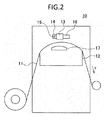
- FIG. 2 is a schematic side view of the inkjet printer.
- An inkjet printer 10 includes a platen (supporting body) 12 that supports a medium (recording medium) 11; an inkjet head 13 that sprays ink from a plurality of discharge ports and causes ink droplets to be deposited on a surface of the recording medium 11 while moving in an X direction (in a horizontal direction of a sheet surface); a print heater (heating unit) 17 that is positioned on the back side of the recording medium 11, that applies heat to the ink droplets deposited on the surface of the recording medium 11, and removes by volatilization the volatile organic solvent present in the ink droplets; and a UV irradiation unit 16 that is arranged frontward in a moving direction (Y direction) of the recording medium 11, that irradiates the ultraviolet light on the ink droplets on the surface of the recording medium 11 from which the volatile organic solvent is removed by volatilization, and cures the ink droplets.
- the inkjet head 13 sprays the ink droplets from not shown nozzles that are arranged in a line at the bottom thereof using a piezo method, etc.
- the inkjet head 13 is fixed to a unit mount 14, and is movable over a guide rail 15 in the X direction by action of a not shown moving unit.
- the moving unit includes an electric motor, an electronic circuit for controlling the electric motor, etc.
- the ink explained above is used in the inkjet printer 10. That is, the ink having a viscosity of greater than or equal to 3 mPa ⁇ sec and less than or equal to 18 mPa ⁇ sec, and prepared by adding the volatile organic solvent to the UV curable ink that contains the pigment, the ultraviolet curable resin curable by the ultraviolet light, and the photopolymerization initiator, and that has a viscosity of 20 mPa ⁇ sec (at 25°C) is used in the inkjet printer 10.
- the recording medium 11 is supported by the platen 12, and sandwiched between not shown pinch rollers and not shown feed rollers. As the inkjet head 13 finishes scanning of the recording medium 11 from one end to the other end in the X direction while spraying the ink, the recording medium 11 is conveyed in the Y direction by rotation of the rollers.
- the recording medium 11 can be of almost any material, for example, plastic, such as, PET, PP, PC, and acrylic, metal, glass, vinyl chloride, rubber, or a special paper meant for a solvent ink.
- the print heater (heating unit) 17 is arranged inside the platen and on the back side of the recording medium 11.
- the print heater 17 applies heat to the ink droplets deposited on the surface of the recording medium 11 and removes by volatilization the volatile organic solvent present in the ink droplets.
- An electrothermal heater, an infrared heater, or an electromagnetic induction heater (IH) can be used as the print heater 17.
- the platen is maintained at a constant temperature so that the volatile organic solvent present in the ink is removed by volatilization as the ink is sprayed and deposited on the surface of the recording medium.
- a lower limit of a heating temperature of the print heater it is preferable to set a lower limit of a heating temperature of the print heater to a temperature at which the volatile organic solvent is sufficiently removed by volatilization before the recording medium 11 is transferred to a position of the UV irradiation unit.
- the lower limit of the heating temperature of the print heater is approximately 35°C.
- an upper limit of the temperature from the perspective of safety towards the human body based on an upper temperature limit of the recording medium and increasing temperature of the heater.
- the upper limit is approximately 80°C.
- the heating unit need not necessarily be arranged on the back side of the recording medium.
- the heating unit can be positioned on the front side or on both front and back sides of the recording medium.
- the heating unit When the heating unit is to be arranged on the front side of the recording medium, it can be positioned over the guide rail 15 similarly as the inkjet head. Alternatively, the heating unit can be fixedly set up frontward in the Y direction (in a platen conveying direction) in a state of being separated from the guide rail 15. In an alternative structure, when the heating unit is to be arranged over the guide rail similarly as the inkjet head and unidirectional printing is to be performed, the heating unit needs to be arranged backward in the moving direction of the inkjet head. In greater detail, the heating unit is arranged on the left side of the sheet surface of the inkjet head when the inkjet head discharges the ink while moving on the right side in the X direction.
- the heating unit is arranged on the right side of the sheet surface of the inkjet head when the inkjet head discharges the ink while moving on the left side in the X direction.
- the heating unit is arranged frontward and backward in a moving direction of the inkjet head, that is, on the right and left sides of the sheet surface of the inkjet head.
- the UV irradiation unit 16 has an inbuilt UVLED (Ultra Violet Light Emitting Diode).
- the UV irradiation unit 16 is arranged on the unit mount 14 along with the inkjet head 13, and frontward in the moving direction (Y direction) of the recording medium 11 relative to the inkjet head 13, and is movable in the X direction by the action of the not shown moving unit.
- a conveyance roller conveys the recording medium 11 after the ink droplets are deposited thereon from the inkjet head 13
- the UV irradiation unit 16 irradiates the surface of the recording medium 11 with the ultraviolet light to cure and fix the ink droplets thereon.
- a UVLED lamp can be most suitably used as the UV irradiation unit 16, although not particularly limited thereto.
- the UVLED lamp is advantageous in that an amount of irradiation light can be freely adjusted by changing an electric current or a light emission pulse width and ON/OFF control is enabled; therefore, less power is consumed.
- other lamps such as, metal halide lamp, xenon lamp, and high-pressure mercury can be used as an amount of the ultraviolet light emitted from these lamps can be varied by providing a shutter mechanism.
- the inkjet head 13 sprays the ink according to the present invention on the surface of the recording medium 11 that is supported on the platen (supporting body) 12, the print heater, which is arranged on the back side of the recording medium, removes by volatilization the volatile organic solvent present in the ink droplets, thereafter, the UV irradiation unit 16 irradiates the ultraviolet light to cure the UV ink droplets and fixes them on the surface of the recording medium 11, and as a result, an image that is formed of an array of the UV ink droplets is printed on the surface of the recording medium 11.
- the inkjet printer of the present embodiment because the surfaces of the ink droplets formed on the recording medium 11 are flat, a glossy image can be obtained, and because the ink according to the present invention is used, no running of the ink droplets occurs and a high-definition image can be obtained.
- the present invention is not to be thus limited.
- the UV irradiation unit can be separated from the inkjet head and fixed onto a separate guide rail that is positioned frontward in the Y direction so as to be movable in the X direction.
- the UV lamp can be fixedly set up across the entire width of the platen in the X direction.
- a black light, or a discharge tube, such as, a sterilization lamp can be used as the UV lamp.
- FIGS. 1 and 2 An embodiment of a method for printing in which the ink and the inkjet printer 10 according to the above embodiments are used is explained below with reference to FIGS. 1 and 2 .
- printing is performed using the ink and the inkjet printer according to the above embodiments.
- the ink is sprayed from the discharge ports of the inkjet head 13 and the ink droplets are deposited on the surface of the recording medium 11.
- the deposited ink droplets are then heated by the heating unit, which is positioned on the back side of the recording medium, to remove the volatile organic solvent present in the ink droplets by volatilization.
- the ink droplets are irradiated with the ultraviolet light by the UV irradiation unit 16 and cured and fixed on the surface of the recording medium 11. Consequently, the image formed of an array of the ink droplets is printed on the surface of the recording medium 11.
- the ink according to the above embodiments having a viscosity of approximately 4 mPa ⁇ sec is filled in an inkjet head unit and the ink droplets are sprayed on the recording medium while the inkjet head moves in the X direction.
- a heating unit such as, a heater
- the viscosity of the ink when discharged can be reduced by heating the inkjet head or the ink with hot water.
- the ink droplets sprayed on the recording medium 11 are immediately heated by the print heater that is positioned on the back side of the recording medium, and that maintains the surface of the recording medium at 40°C to 80°C, and removes the volatile organic solvent by vaporization. Consequently, because the ink droplets of the UV curable ink having a high viscosity of 30 mPa ⁇ sec are formed, running of the ink droplets is prevented.
- the recording medium 11 is conveyed in the Y direction by the platen 12.
- the ink droplets on the surface of the recording medium from which the volatile organic solvent is removed by volatilization are irradiated with the ultraviolet light by the UV irradiation unit 16, which is arranged frontward in the Y direction of the recording medium, and cured and fixed on the recording medium 11. Consequently, an image formed of an array of the ink droplets is printed on the surface of the recording medium 11.
Landscapes
- Chemical & Material Sciences (AREA)
- Life Sciences & Earth Sciences (AREA)
- Engineering & Computer Science (AREA)
- Materials Engineering (AREA)
- Wood Science & Technology (AREA)
- Organic Chemistry (AREA)
- Health & Medical Sciences (AREA)
- General Health & Medical Sciences (AREA)
- Toxicology (AREA)
- Ink Jet Recording Methods And Recording Media Thereof (AREA)
- Ink Jet (AREA)
- Inks, Pencil-Leads, Or Crayons (AREA)
Abstract
Description
- The present invention relates to an ink that is used in an inkjet printer, the inkjet printer, and a method for printing by which an image comprising an array of a plurality of ink droplets is printed by spraying the ink droplets from an inkjet head.
- Solvent inks and UV (ultraviolet) curable inks are examples of inks that are typically used in inkjet printers. The solvent ink is primarily an ink in which a pigment and a binder resin are dispersed in a volatile solvent. The ink is sprayed from an inkjet head on the surface of a medium (printing medium), and then the volatile solvent in the ink is volatilized by using a heater that is arranged beneath the printing medium. Consequently, the ink is fixed on the surface of the printing medium leading to printing of an image.
On the other hand, the UV (ultraviolet) curable ink contains a pigment, an ultraviolet curable resin (monomer or/and oligomer), polymerization initiator, etc. The UV ink is sprayed from the inkjet head on the printing medium, and then an ultraviolet light is irradiated by using an ultraviolet irradiation unit to cure the resin. Consequently, the ink is fixed on the surface of the printing medium leading to printing of an image. - Patent Document 1: International Publication No.
2004/094150 - The solvent ink is advantages in that, because the viscosity of the ink is low the ink spreads thinly on the surface of the medium and the surface of the ink is also flat, high-quality glossiness is obtained in the printed image. However, there are disadvantages that because the volatile organic solvent content is higher than 80 wt% (percent by weight), the ink runs the moment it is deposited on the printing medium, and therefore, a fine image cannot be produced. Furthermore, it is necessary to use vinyl chloride, rubber, or a special paper as a printing medium so that the choice of the material of the printing medium is limited.
The applicant has disclosed a technique for preventing running of the ink in Patent Document 1. The inkjet printer disclosed in this document includes a pre-heater that preheats a supporting body, and a heater that quickly heats the ink deposited on a platen (recording medium) arranged on the supporting body.
On the other hand, because the UV curable ink does not contain VOC (volatile organic compound), it is echo-friendly. Furthermore, the viscosity of the ink is high; therefore, the ink does not spread easily so that a high-definition image can be obtained. However, the high viscosity of the ink causes a problem of clogging of the inkjet head. As a measure to enable a stable discharge of the ink from the inkjet head, the inkjet head is heated to reduce the viscosity of the ink being discharged. However, upon deposition of the ink on the surface of the printing medium, the temperature of the ink drops steeply leading to a sudden increase in the viscosity of the ink. Therefore, the ink sprayed from the inkjet head does not spread easily, leading to formation of unevenness on the surface of the ink. Furthermore, a UV lamp that is arranged integrally with the inkjet head immediately irradiates a UV light to cure the ink. Therefore, the unevenness is fixed as it is formed, an image with a mat-finish is likely to form, and hard strips are likely to form in a scanning direction of the head. Reducing the viscosity of the ink by adding an organic solvent to the UV curable ink, and thereby reducing the unevenness of the surface of ink droplets can be considered. However, there is a problem that the ink droplets are likely to become thin and the UV sensitivity of the droplets is likely to be lowered.
The present invention is made in view of the above discussion and it is an object of the present invention to provide an ink, an inkjet printer, and a method for printing by which a glossy and high-definition image having enhanced flatness without any unevenness can be printed. - To solve the above problems, the present invention has following configuration.
- An ink having a viscosity greater than or equal to 3 mPa·sec and less than or equal to 18 mPa·sec (at 25°C, which is the room temperature), and prepared by adding a volatile organic solvent to a UV curable ink that includes at least a pigment, an ultraviolet curable resin curable by an ultraviolet light, and a photopolymerization initiator, and has a viscosity of greater than or equal to 20 mPa·sec (at 25°C).
- In the ink according to Configuration 1, a content of the volatile organic solvent is greater than or equal to 30 wt% and less than or equal to 90 wt%.
- In the ink according to Configuration 1, the volatile organic solvent is n-hexane.
- An inkjet printer including a supporting body that supports a printing medium; an inkjet head that sprays from a plurality of discharge ports an ink according to any one of Configuration 1 to 3 causing ink droplets to be deposited on a surface of the printing medium; a heating unit that is arranged on at least one of a back side and a font side of the printing medium, and that applies heat to the ink droplets deposited on the surface of the printing medium to remove the volatile organic solvent present in the ink droplets by volatilization; and a UV irradiation unit that irradiates the ink droplets on the surface of the printing medium from which the volatile organic solvent has been removed by volatilization with a UV light to cure the ink droplets.
- A method for printing an image comprising an array of a plurality of ink droplets on a surface of a printing medium includes spraying an ink according to any one of Claims 1 to 3 from a plurality of discharge ports of an inkjet head and causing the ink droplets to be deposited on the surface of the printing medium; applying heat to the ink droplets deposited on the surface of the printing medium with a heating unit arranged on at least one of a back side and a front side of the printing medium to remove the volatile organic solvent present in the ink by volatilization; and irradiating the ink droplets with an ultraviolet light by a UV irradiation unit to cure and fix the ink droplets on the surface of the printing medium.
- Because a viscosity of an ink according to the present invention is greater than or equal to 3 mPa·sec and less than or equal to 18 mPa·sec, when used in an inkjet printer the ink is sprayed smoothly from an inkjet head without any clogging of the inkjet head. Furthermore, gentle unevenness of a surface of a plurality of ink droplets deposited on a printing medium is flattened due to removal of a volatile organic solvent by volatilization, and a high-quality image with a high gloss can be obtained by curing and fixing the ink with an ultraviolet light. Furthermore, because an ultraviolet curable resin of high viscosity of greater than or equal to 20 mPa·sec is used, running of the ink is prevented by removing the volatile organic solvent by volatilization with a heating unit, and a high-definition image can be obtained. Moreover, because a thickness of the ink droplets that are deposited is large, there is an advantage that the ink droplets exhibit an excellent ultraviolet sensitivity.
A solvent ink, which is similar to the ink according to the present invention in a viscosity thereof and presence of an organic solvent, can be used for only printing on printing mediums, such as, vinyl chloride, rubber, and special papers meant for the solvent ink. However, the ink according to the present invention can be used for printing on a wide range of printing mediums, namely plastics, such as, PET, PP, PC, acryl, metal, glass, etc. - In an inkjet printer according to the present invention, the heating unit is arranged on at least one of a back side and a front side of the printing medium. Consequently, the volatile organic solvent present in the ink droplets of the ink according to the present invention mentioned above is removed by volatilization immediately upon their deposition on the printing medium, and thereby the ink can be prevented from running. Furthermore, the surface of the ink droplets can be flattened by removing the unevenness. The flattened ink droplets are cured and fixed by a UV irradiation unit to obtain a glossy, high-definition image.
- In a method for printing according to the present invention, the volatile organic solvent present in the ink droplets is removed by volatilization by applying heat to the ink droplets with the heating unit. Thereafter, the ink droplets are irradiated with the ultraviolet light by the UV irradiation unit to cure and fix them on a surface of the printing medium. Consequently, the surfaces of the ink droplets can be flattened, and a glossy, high-definition image can be obtained.
-
-
FIG. 1 is a schematic top view of relevant parts of an inkjet printer according to an embodiment of the present invention. -
FIG. 2 is a schematic side view of the inkjet printer according to the embodiment of the present invention. - Exemplary embodiments of an ink, an inkjet printer, and a method for printing according to the present invention are explained in detail below with reference to the accompanying drawings.
Embodiments of the ink according to the present invention are explained first. - An ink according to an embodiment has a viscosity of 10 mPa·sec at 25°C and it is prepared by adding n-hexane of 60 wt% to 85 wt% having a viscosity of 0.32 (at 20°C) and a boiling point of 69°C to a UV curable ink that contains monomer (55 wt% to 88 wt%) and oligomer (0 wt% to 15 wt%), a photopolymerization initiator (6 wt% to 13 wt%), a sensitizer (3 wt% to 30 wt%), a coloring matter (pigment) (3 wt% to 6 wit%), and an additive (1 wt% to 8 wt%; a dispersant, a leveling agent, and a polymerization inhibitor), and that has a high viscosity of 30 mPa·sec to 300 mPa·sec (at 25°C).
For example, the ink having a viscosity of 8 mPa·sec can be prepared by adding n-hexane to the UV curable ink having a viscosity of approximately 30 mPa·sec (at 25°C) such that a content of n-hexane in the whole ink is 75 wt%.
The monomer and oligomer are ultraviolet curable resins that are cured by an ultraviolet light. - The ink is formed by using the UV curable ink that contains monomer and/or oligomer, the photopolymerization initiator, the sensitizer, the coloring matter, and the additive, and that has a viscosity greater than or equal to 20 mPa·sec (at 25°C, which is the room temperature). The viscosity of the ink is adjusted to greater than or equal to 3 mPa·sec and less than or equal to 18 mPa·sec by suitably adjusting a content of the volatile organic solvent. It is preferable that the viscosity of the UV curable ink be greater than or equal to 20 mPa·sec (at 25°C). However, it is more preferable that the viscosity of the UV curable ink be 50 mPa·sec (at 25°C). If the viscosity is less than 20 mPa·sec (at 25°C, the ink runs heavily and quickly. If the viscosity is greater than or equal to 20 mPa·sec (at 25°C) and less than 50 mPa·sec (at 25°C), the ink still runs; however, the running of the ink is slower, and therefore, the fineness of the image is not affected in the time it takes for the ink to be irradiated with the ultraviolet light and cured. Furthermore, a high-definition image can be obtained by controlling the duration of irradiation with the ultraviolet light. If the viscosity is 50 mPa·sec (at 25°C), the running of the ink is not noticeable. If the viscosity is 100 mPa·sec (at 25°C), the running of the ink is almost absent and if the viscosity is 1000 mPa·sec (at 25°C), the running of the ink is totally absent.
- It is preferable that the content of the volatile organic solvent be greater than or equal to 30 wt% and less than or equal to 90 wt%. Furthermore, it is more preferable that the content of the volatile organic solvent be greater than or equal to 50 wt% and less than or equal to 70 wt%.
Volatile organic solvents other than n-hexane can be used. A volatile organic solvent, which has a contact angle smaller than that of the UV curable ink, a viscosity of less than or equal to 5 mPa·sec, more preferably, less than or equal to 2 mPa·sec, and a boiling point of less than or equal to 200°C, more preferably, less than or equal to 160°C, can be suitably selected. Some of the examples are isoparaffin hydrocarbons (Idemitsu Kosan Co., Ltd: IP solvent 1016, IP solvent 1620, etc.), ketone, such as, cyclohexanone, aromatic hydrocarbons, such as, toluene and xylene, and esters, such as, dipropylene glycol and mono-methyl ether acetate. Furthermore, the volatile organic solvent need not be limited to one type, i.e., a combination of a plurality of the volatile organic solvents can be used. - The pigment, monomer and/or oligomer, and photopolymerization initiator are not particularly limited. Known pigments, monomers and/or oligomers, and photopolymerization initiators can be suitably selected and used. Furthermore, common sensitizers, and various additives, such as, dispersants, leveling agents, and polymerization inhibitors can be suitably selected and used.
- The ink contains the volatile organic solvent, and therefore, the viscosity of the ink at the room temperature can be reduced. The volatile organic solvent can be quickly removed by volatilization before UV curing is performed. Therefore, an image with a high gloss and a high-quality having enhanced flatness of the surface of the ink droplets can be printed.
- Embodiments of the inkjet printer and the method for printing according to the present invention are explained below.
FIG. 1 is a schematic top view of relevant parts of an inkjet printer according to an embodiment of the present invention, andFIG. 2 is a schematic side view of the inkjet printer. - An
inkjet printer 10 according to an embodiment includes a platen (supporting body) 12 that supports a medium (recording medium) 11; aninkjet head 13 that sprays ink from a plurality of discharge ports and causes ink droplets to be deposited on a surface of therecording medium 11 while moving in an X direction (in a horizontal direction of a sheet surface); a print heater (heating unit) 17 that is positioned on the back side of therecording medium 11, that applies heat to the ink droplets deposited on the surface of therecording medium 11, and removes by volatilization the volatile organic solvent present in the ink droplets; and aUV irradiation unit 16 that is arranged frontward in a moving direction (Y direction) of therecording medium 11, that irradiates the ultraviolet light on the ink droplets on the surface of therecording medium 11 from which the volatile organic solvent is removed by volatilization, and cures the ink droplets. - The
inkjet head 13 sprays the ink droplets from not shown nozzles that are arranged in a line at the bottom thereof using a piezo method, etc. Theinkjet head 13 is fixed to aunit mount 14, and is movable over aguide rail 15 in the X direction by action of a not shown moving unit. The moving unit includes an electric motor, an electronic circuit for controlling the electric motor, etc. - The ink explained above is used in the
inkjet printer 10. That is, the ink having a viscosity of greater than or equal to 3 mPa·sec and less than or equal to 18 mPa·sec, and prepared by adding the volatile organic solvent to the UV curable ink that contains the pigment, the ultraviolet curable resin curable by the ultraviolet light, and the photopolymerization initiator, and that has a viscosity of 20 mPa·sec (at 25°C) is used in theinkjet printer 10. - The
recording medium 11 is supported by theplaten 12, and sandwiched between not shown pinch rollers and not shown feed rollers. As theinkjet head 13 finishes scanning of therecording medium 11 from one end to the other end in the X direction while spraying the ink, therecording medium 11 is conveyed in the Y direction by rotation of the rollers. Therecording medium 11 can be of almost any material, for example, plastic, such as, PET, PP, PC, and acrylic, metal, glass, vinyl chloride, rubber, or a special paper meant for a solvent ink. - The print heater (heating unit) 17 is arranged inside the platen and on the back side of the
recording medium 11. Theprint heater 17 applies heat to the ink droplets deposited on the surface of therecording medium 11 and removes by volatilization the volatile organic solvent present in the ink droplets. An electrothermal heater, an infrared heater, or an electromagnetic induction heater (IH) can be used as theprint heater 17.
The platen is maintained at a constant temperature so that the volatile organic solvent present in the ink is removed by volatilization as the ink is sprayed and deposited on the surface of the recording medium. It is preferable to set a lower limit of a heating temperature of the print heater to a temperature at which the volatile organic solvent is sufficiently removed by volatilization before therecording medium 11 is transferred to a position of the UV irradiation unit. For example, the lower limit of the heating temperature of the print heater is approximately 35°C. It is preferable to determine an upper limit of the temperature from the perspective of safety towards the human body based on an upper temperature limit of the recording medium and increasing temperature of the heater. For example, the upper limit is approximately 80°C.
The heating unit need not necessarily be arranged on the back side of the recording medium. The heating unit can be positioned on the front side or on both front and back sides of the recording medium. When the heating unit is to be arranged on the front side of the recording medium, it can be positioned over theguide rail 15 similarly as the inkjet head. Alternatively, the heating unit can be fixedly set up frontward in the Y direction (in a platen conveying direction) in a state of being separated from theguide rail 15. In an alternative structure, when the heating unit is to be arranged over the guide rail similarly as the inkjet head and unidirectional printing is to be performed, the heating unit needs to be arranged backward in the moving direction of the inkjet head. In greater detail, the heating unit is arranged on the left side of the sheet surface of the inkjet head when the inkjet head discharges the ink while moving on the right side in the X direction. Furthermore, the heating unit is arranged on the right side of the sheet surface of the inkjet head when the inkjet head discharges the ink while moving on the left side in the X direction. When bidirectional printing is to be performed, the heating unit is arranged frontward and backward in a moving direction of the inkjet head, that is, on the right and left sides of the sheet surface of the inkjet head. - The
UV irradiation unit 16 has an inbuilt UVLED (Ultra Violet Light Emitting Diode). TheUV irradiation unit 16 is arranged on theunit mount 14 along with theinkjet head 13, and frontward in the moving direction (Y direction) of therecording medium 11 relative to theinkjet head 13, and is movable in the X direction by the action of the not shown moving unit. When a conveyance roller conveys therecording medium 11 after the ink droplets are deposited thereon from theinkjet head 13, theUV irradiation unit 16 irradiates the surface of therecording medium 11 with the ultraviolet light to cure and fix the ink droplets thereon.
A UVLED lamp can be most suitably used as theUV irradiation unit 16, although not particularly limited thereto. The UVLED lamp is advantageous in that an amount of irradiation light can be freely adjusted by changing an electric current or a light emission pulse width and ON/OFF control is enabled; therefore, less power is consumed. However, other lamps, such as, metal halide lamp, xenon lamp, and high-pressure mercury can be used as an amount of the ultraviolet light emitted from these lamps can be varied by providing a shutter mechanism. - As described above, in the
inkjet printer 10 according to the present invention, theinkjet head 13 sprays the ink according to the present invention on the surface of therecording medium 11 that is supported on the platen (supporting body) 12, the print heater, which is arranged on the back side of the recording medium, removes by volatilization the volatile organic solvent present in the ink droplets, thereafter, theUV irradiation unit 16 irradiates the ultraviolet light to cure the UV ink droplets and fixes them on the surface of therecording medium 11, and as a result, an image that is formed of an array of the UV ink droplets is printed on the surface of therecording medium 11. According to the inkjet printer of the present embodiment, because the surfaces of the ink droplets formed on therecording medium 11 are flat, a glossy image can be obtained, and because the ink according to the present invention is used, no running of the ink droplets occurs and a high-definition image can be obtained. - In the inkjet printer according to the embodiment, as an example, a case is explained in which the
inkjet head 13 and theUV irradiation unit 16 are fixed together onto the unit mount. However, the present invention is not to be thus limited. The UV irradiation unit can be separated from the inkjet head and fixed onto a separate guide rail that is positioned frontward in the Y direction so as to be movable in the X direction. Alternatively, by positioning the UV irradiation unit frontward in the Y direction, the UV lamp can be fixedly set up across the entire width of the platen in the X direction. A black light, or a discharge tube, such as, a sterilization lamp can be used as the UV lamp. - An embodiment of a method for printing in which the ink and the
inkjet printer 10 according to the above embodiments are used is explained below with reference toFIGS. 1 and2 .
In the method for printing according to the present embodiment, printing is performed using the ink and the inkjet printer according to the above embodiments. The ink is sprayed from the discharge ports of theinkjet head 13 and the ink droplets are deposited on the surface of therecording medium 11. The deposited ink droplets are then heated by the heating unit, which is positioned on the back side of the recording medium, to remove the volatile organic solvent present in the ink droplets by volatilization. Thereafter, the ink droplets are irradiated with the ultraviolet light by theUV irradiation unit 16 and cured and fixed on the surface of therecording medium 11. Consequently, the image formed of an array of the ink droplets is printed on the surface of therecording medium 11. - The ink according to the above embodiments having a viscosity of approximately 4 mPa·sec is filled in an inkjet head unit and the ink droplets are sprayed on the recording medium while the inkjet head moves in the X direction. In this case, because there is no risk of the ink clogging the inkjet head, there is no need to specifically arrange a heating unit, such as, a heater, in the inkjet head. Meanwhile, the viscosity of the ink when discharged can be reduced by heating the inkjet head or the ink with hot water.
- The ink droplets sprayed on the
recording medium 11 are immediately heated by the print heater that is positioned on the back side of the recording medium, and that maintains the surface of the recording medium at 40°C to 80°C, and removes the volatile organic solvent by vaporization. Consequently, because the ink droplets of the UV curable ink having a high viscosity of 30 mPa·sec are formed, running of the ink droplets is prevented. - The
recording medium 11 is conveyed in the Y direction by theplaten 12. The ink droplets on the surface of the recording medium from which the volatile organic solvent is removed by volatilization are irradiated with the ultraviolet light by theUV irradiation unit 16, which is arranged frontward in the Y direction of the recording medium, and cured and fixed on therecording medium 11. Consequently, an image formed of an array of the ink droplets is printed on the surface of therecording medium 11. - The ink, the inkjet printer, and the method for printing according to the present invention are explained so far. However, the present invention is not limited to these examples. Various modifications may be made without departing from the spirit or scope of the general inventive concept as defined by the accompanying claims and their equivalents.
-
- 10
- Inkjet printer
- 11
- Recording medium
- 12
- Platen
- 13
- Inkjet head
- 14
- Unit mount
- 15
- Guide rail
- 16
- UV irradiation unit
- 17
- Print heater
Claims (5)
- An ink having a viscosity greater than or equal to 3 mPa·sec and less than or equal to 18 mPa·sec (at 25°C, which is the room temperature), and prepared by adding a volatile organic solvent to a UV curable ink that
includes at least a pigment, an ultraviolet curable resin curable by an ultraviolet light, and a photopolymerization initiator, and
has a viscosity of greater than or equal to 20 mPa·sec (at 25°C). - The ink according to Claim 1, wherein a content of the volatile organic solvent is greater than or equal to 30 wt% and less than or equal to 90 wt%.
- The ink according to Claim 1 or 2, wherein the volatile organic solvent is n-hexane.
- An inkjet printer comprising:a supporting body that supports a printing medium;an inkjet head that sprays from a plurality of discharge ports the ink according to any one of Claims 1 to 3 causing ink droplets to be deposited on a surface of the printing medium;a heating unit that is arranged on at least one of a back side and a font side of the printing medium, and that applies heat to the ink droplets deposited on the surface of the printing medium to remove the volatile organic solvent present in the ink droplets by volatilization; anda UV irradiation unit that irradiates the ink droplets on the surface of the printing medium from which the volatile organic solvent has been removed by volatilization with a UV light to cure the ink droplets.
- A method for printing an image comprising an array of a plurality of ink droplets on a surface of a printing medium, the method comprising:spraying the ink according to any one of Claims 1 to 3 from a plurality of discharge ports of an inkjet head and causing the ink droplets to be deposited on the surface of the printing medium;applying heat to the ink droplets deposited on the surface of the printing medium with a heating unit arranged on at least one of a back side and a front side of the printing medium to remove the volatile organic solvent present in the ink by volatilization; andirradiating the ink droplets with an ultraviolet light by a UV irradiation unit to cure and fix the ink droplets on the surface of the printing medium.
Applications Claiming Priority (2)
| Application Number | Priority Date | Filing Date | Title |
|---|---|---|---|
| JP2009135558A JP5114454B2 (en) | 2009-06-04 | 2009-06-04 | Ink, inkjet printer and printing method |
| PCT/JP2010/002863 WO2010140294A1 (en) | 2009-06-04 | 2010-04-21 | Ink, inkjet printer, and method for printing |
Publications (3)
| Publication Number | Publication Date |
|---|---|
| EP2439243A1 true EP2439243A1 (en) | 2012-04-11 |
| EP2439243A4 EP2439243A4 (en) | 2014-10-29 |
| EP2439243B1 EP2439243B1 (en) | 2018-05-30 |
Family
ID=43297437
Family Applications (1)
| Application Number | Title | Priority Date | Filing Date |
|---|---|---|---|
| EP10783082.0A Active EP2439243B1 (en) | 2009-06-04 | 2010-04-21 | Ink, inkjet printer, and method for printing |
Country Status (6)
| Country | Link |
|---|---|
| US (1) | US8529054B2 (en) |
| EP (1) | EP2439243B1 (en) |
| JP (1) | JP5114454B2 (en) |
| KR (1) | KR101331567B1 (en) |
| CN (1) | CN102459480B (en) |
| WO (1) | WO2010140294A1 (en) |
Cited By (1)
| Publication number | Priority date | Publication date | Assignee | Title |
|---|---|---|---|---|
| EP3312013A1 (en) * | 2016-10-20 | 2018-04-25 | Mimaki Engineering Co., Ltd. | Printer and printing method |
Families Citing this family (39)
| Publication number | Priority date | Publication date | Assignee | Title |
|---|---|---|---|---|
| JP5954552B2 (en) * | 2010-03-30 | 2016-07-20 | セイコーエプソン株式会社 | Inkjet recording apparatus and inkjet recording method |
| JP5682750B2 (en) * | 2010-03-30 | 2015-03-11 | セイコーエプソン株式会社 | Inkjet recording apparatus and inkjet recording method |
| US9056986B2 (en) | 2010-11-09 | 2015-06-16 | Seiko Epson Corporation | Ultraviolet curable type ink-jet ink composition, recording method and recording apparatus using same |
| JP5656168B2 (en) * | 2011-05-31 | 2015-01-21 | 株式会社ミマキエンジニアリング | Printing method, transfer material, and inkjet discharge apparatus |
| US8646877B2 (en) * | 2011-09-29 | 2014-02-11 | Xerox Corporation | Pre-treatment methods, apparatus, and systems for contact leveling radiation curable gel inks |
| JP6047282B2 (en) * | 2011-12-07 | 2016-12-21 | 株式会社ミマキエンジニアリング | Inkjet device |
| JP6305675B2 (en) * | 2012-03-19 | 2018-04-04 | 株式会社ミマキエンジニアリング | Transfer film and transfer method |
| JP5929410B2 (en) * | 2012-03-28 | 2016-06-08 | セイコーエプソン株式会社 | Ink jet recording method and ink jet recording apparatus |
| CN107379803A (en) | 2012-03-28 | 2017-11-24 | 精工爱普生株式会社 | Ink jet recording method, ultraviolet curable ink, ink-jet recording apparatus |
| JP6191120B2 (en) | 2012-03-29 | 2017-09-06 | セイコーエプソン株式会社 | Ink jet recording method and ink jet recording apparatus |
| US10029483B2 (en) | 2012-04-25 | 2018-07-24 | Seiko Epson Corporation | Ink jet recording method, ultraviolet-ray curable ink, and ink jet recording apparatus |
| JP6236768B2 (en) | 2012-04-27 | 2017-11-29 | セイコーエプソン株式会社 | Ink jet recording method and ink jet recording apparatus |
| CN102729648A (en) * | 2012-07-04 | 2012-10-17 | 武汉深蓝恒业数码科技有限公司 | LED UV light source time-delay exposure apparatus of UV ink jet printer |
| JP6065535B2 (en) | 2012-11-15 | 2017-01-25 | セイコーエプソン株式会社 | UV-curable ink composition for ink jet recording, ink container, and ink jet recording apparatus |
| JP6117526B2 (en) * | 2012-11-22 | 2017-04-19 | 株式会社ミマキエンジニアリング | Printing method |
| JP6117525B2 (en) | 2012-11-22 | 2017-04-19 | 株式会社ミマキエンジニアリング | Transfer film, transfer film manufacturing method, and transfer method |
| JP2014172224A (en) * | 2013-03-06 | 2014-09-22 | Mimaki Engineering Co Ltd | Inkjet printer, print method and ink |
| JP6102385B2 (en) | 2013-03-19 | 2017-03-29 | セイコーエプソン株式会社 | Recording device |
| JP2014181102A (en) | 2013-03-19 | 2014-09-29 | Seiko Epson Corp | Recording apparatus |
| EP2821240B1 (en) * | 2013-07-02 | 2016-06-01 | Hewlett-Packard Industrial Printing Ltd. | Printing methods |
| JP6226136B2 (en) * | 2014-05-27 | 2017-11-08 | ブラザー工業株式会社 | Adhesive tape printer, adhesive tape roll, and adhesive tape printing method |
| JP6256762B2 (en) * | 2014-05-27 | 2018-01-10 | ブラザー工業株式会社 | Adhesive tape printer |
| JP6278194B2 (en) * | 2014-05-27 | 2018-02-14 | ブラザー工業株式会社 | Adhesive tape printing method and adhesive tape roll |
| WO2015182235A1 (en) * | 2014-05-27 | 2015-12-03 | ブラザー工業株式会社 | Adhesive tape printing device, adhesive tape printing method, adhesive tape roll, and ink ribbon |
| JP6399823B2 (en) | 2014-06-25 | 2018-10-03 | 株式会社ミマキエンジニアリング | Inkjet printer, printing method, and printing system |
| JP6866077B2 (en) * | 2015-08-07 | 2021-04-28 | キヤノン株式会社 | Photocurable inks, ink cartridges, and image forming methods |
| EP3335896B1 (en) | 2015-09-30 | 2020-01-29 | FUJIFILM Corporation | Ink jet recording method and ink jet recording device |
| JP2017095577A (en) * | 2015-11-24 | 2017-06-01 | 株式会社リコー | Active energy ray curable composition, active energy ray curable ink, composition container, image forming method and forming apparatus, two-dimensional or three-dimensional image, and molded product |
| WO2017104318A1 (en) | 2015-12-18 | 2017-06-22 | 富士フイルム株式会社 | Liquid composition for inkjet printer |
| EP3392051B1 (en) | 2015-12-18 | 2020-01-29 | FUJIFILM Corporation | Ink jet recording method and ink jet recording device |
| JP2019072914A (en) * | 2017-10-16 | 2019-05-16 | 株式会社ミマキエンジニアリング | Method for manufacturing three-dimensional pattern printed matter |
| JP6976655B2 (en) * | 2017-11-16 | 2021-12-08 | 株式会社ミマキエンジニアリング | Printing equipment and printing method |
| JP2019199045A (en) | 2018-05-17 | 2019-11-21 | 株式会社ミマキエンジニアリング | Printer and printing method |
| JP2020044757A (en) * | 2018-09-20 | 2020-03-26 | 株式会社ミマキエンジニアリング | Printer, printing method, and ink |
| CN110395045B (en) * | 2019-07-11 | 2024-10-25 | 广东乐佳印刷有限公司 | Post-treatment device for printing of photo-curing ink printed matter |
| CN110435142A (en) * | 2019-09-09 | 2019-11-12 | 安徽卓锐三维科技有限公司 | Three-dimensional printing method for low-temperature dissolution formed high polymer plastic |
| JP2021109391A (en) * | 2020-01-12 | 2021-08-02 | 株式会社ミマキエンジニアリング | Inkjet printing equipment |
| CN120693257A (en) | 2023-03-30 | 2025-09-23 | 三菱化学株式会社 | Inkjet recording method |
| JPWO2024204588A1 (en) | 2023-03-30 | 2024-10-03 |
Family Cites Families (29)
| Publication number | Priority date | Publication date | Assignee | Title |
|---|---|---|---|---|
| JPS6457145A (en) * | 1987-08-27 | 1989-03-03 | Mitaka Instr Co Ltd | Apparatus for analyzing co2 in exhalation |
| JPH07170054A (en) * | 1993-12-14 | 1995-07-04 | Canon Inc | Ultraviolet curable composition, pattern forming method using the same, and wiring board manufacturing method |
| US6608119B2 (en) | 2000-02-01 | 2003-08-19 | Seiko Epson Corporation | Water-base ink, method of manufacturing the ink, and method of printing using the ink |
| JP2002137375A (en) * | 2000-10-31 | 2002-05-14 | Riso Kagaku Corp | Ink jet printer and ink curing method for the printer |
| US6554414B2 (en) * | 2001-01-02 | 2003-04-29 | 3M Innovative Properties Company | Rotatable drum inkjet printing apparatus for radiation curable ink |
| CA2437853A1 (en) * | 2001-02-14 | 2002-08-22 | Solutia Inc. | Waterfast ink jet inks containing a uv curable resin |
| JP4872157B2 (en) | 2001-02-16 | 2012-02-08 | Dic株式会社 | Ultraviolet curable ink composition for inkjet recording and method for forming color image using the same |
| JP2004018716A (en) * | 2002-06-18 | 2004-01-22 | Sii Printek Inc | Ultraviolet-curing ink composition |
| JP2004082709A (en) * | 2002-06-24 | 2004-03-18 | Ricoh Co Ltd | Ink jet recording apparatus and ink jet recording method |
| GB0215854D0 (en) * | 2002-07-09 | 2002-08-14 | Sericol Ltd | A printing ink |
| EP1533347B1 (en) * | 2002-08-27 | 2006-12-27 | Kiwa Chemical Industry Co., Ltd. | Inkjet recording ink for sublimation transfer and method of dyeing |
| US7429103B2 (en) | 2002-12-19 | 2008-09-30 | Konica Minolts Holdings, Inc. | Method of inkjet recording |
| CN1652939A (en) | 2003-04-18 | 2005-08-10 | 御牧高科技股份有限公司 | Inkjet Printers |
| JP4456833B2 (en) * | 2003-07-24 | 2010-04-28 | 太陽インキ製造株式会社 | One-component resist composition for inkjet and method for forming resist pattern using the same |
| US20050173680A1 (en) | 2004-02-10 | 2005-08-11 | Haixin Yang | Ink jet printable thick film ink compositions and processes |
| JP2005298757A (en) * | 2004-04-15 | 2005-10-27 | Iwatsu Electric Co Ltd | UV curable white ink composition for inkjet recording |
| JP4006416B2 (en) * | 2004-06-03 | 2007-11-14 | キヤノン株式会社 | Inkjet recording method and inkjet recording apparatus |
| US20060021537A1 (en) * | 2004-07-29 | 2006-02-02 | Kazuhiko Ohtsu | Curing method of cure type liquid composition and inkjet recording apparatus |
| US7810919B2 (en) * | 2004-09-17 | 2010-10-12 | Ricoh Company, Ltd. | Recording ink, ink cartridge, ink record, inkjet recording apparatus, and inkjet recording method |
| TWI391424B (en) | 2005-01-12 | 2013-04-01 | 太陽控股股份有限公司 | A hardened resin composition for inkjet and a hardened product thereof, and a printed circuit board using the same |
| US20060257632A1 (en) * | 2005-05-12 | 2006-11-16 | Fuji Photo Film Co., Ltd. | Ink composition |
| KR20090008380A (en) * | 2006-04-24 | 2009-01-21 | 도요 잉키 세이조 가부시끼가이샤 | Non-aqueous inkjet inks, ink compositions for inkjet recording, and color filter substrates |
| JP2007310315A (en) * | 2006-05-22 | 2007-11-29 | Fujifilm Corp | Ink-jet ink for color filter, color filter, method for producing the same, and display device |
| GB0622034D0 (en) * | 2006-11-04 | 2006-12-13 | Xennia Technology Ltd | Inkjet printing |
| GB0624894D0 (en) * | 2006-12-14 | 2007-01-24 | Xennia Technology Ltd | Inkjet printing |
| JP4301289B2 (en) * | 2006-12-25 | 2009-07-22 | セイコーエプソン株式会社 | Inkjet recording method |
| JP2008194827A (en) * | 2007-02-08 | 2008-08-28 | Konica Minolta Holdings Inc | Inkjet recording method |
| JP4960143B2 (en) * | 2007-05-08 | 2012-06-27 | キヤノンファインテック株式会社 | Recording method, recording apparatus, and recorded matter |
| JP2009083272A (en) * | 2007-09-28 | 2009-04-23 | Fujifilm Corp | Undercoat liquid, ink set for ink jet recording, and ink jet recording method |
-
2009
- 2009-06-04 JP JP2009135558A patent/JP5114454B2/en active Active
-
2010
- 2010-04-21 WO PCT/JP2010/002863 patent/WO2010140294A1/en not_active Ceased
- 2010-04-21 KR KR1020117028797A patent/KR101331567B1/en not_active Expired - Fee Related
- 2010-04-21 CN CN201080034778.4A patent/CN102459480B/en active Active
- 2010-04-21 EP EP10783082.0A patent/EP2439243B1/en active Active
-
2011
- 2011-12-02 US US13/309,565 patent/US8529054B2/en active Active
Cited By (2)
| Publication number | Priority date | Publication date | Assignee | Title |
|---|---|---|---|---|
| EP3312013A1 (en) * | 2016-10-20 | 2018-04-25 | Mimaki Engineering Co., Ltd. | Printer and printing method |
| US10343416B2 (en) | 2016-10-20 | 2019-07-09 | Mimaki Engineering Co., Ltd. | Printer and printing method |
Also Published As
| Publication number | Publication date |
|---|---|
| CN102459480B (en) | 2014-02-19 |
| US20120075394A1 (en) | 2012-03-29 |
| EP2439243B1 (en) | 2018-05-30 |
| US8529054B2 (en) | 2013-09-10 |
| CN102459480A (en) | 2012-05-16 |
| KR20120026522A (en) | 2012-03-19 |
| JP2010280828A (en) | 2010-12-16 |
| WO2010140294A1 (en) | 2010-12-09 |
| EP2439243A4 (en) | 2014-10-29 |
| JP5114454B2 (en) | 2013-01-09 |
| KR101331567B1 (en) | 2013-11-21 |
Similar Documents
| Publication | Publication Date | Title |
|---|---|---|
| EP2439243B1 (en) | Ink, inkjet printer, and method for printing | |
| JP5139843B2 (en) | Inkjet printer and printing method | |
| EP2675627B1 (en) | Ink- jet printing method | |
| JP4051928B2 (en) | Image forming method and image forming apparatus | |
| KR101782167B1 (en) | Method and apparatus for forming an image on a substrate in printing | |
| US20100033545A1 (en) | Ink Jet Printer and a Process of Ink Jet Printing | |
| JP7077567B2 (en) | Liquid discharge device, image formation method | |
| JP2006137185A (en) | Printing of radiation-curable ink into radiation-curable liquid layer | |
| US10220639B2 (en) | Printer, printing method, and ink | |
| US7891801B2 (en) | Ultraviolet ray curable ink-jet ink, ink-jet recording method and ink-jet recording apparatus | |
| EP1627746B1 (en) | Printing device with radiation source | |
| US9004668B2 (en) | Inkjet recording apparatus and inkjet recording method | |
| WO2014136684A1 (en) | Inkjet printer, printing method, and ink | |
| JP5970874B2 (en) | Printing apparatus and printing method | |
| JP5552110B2 (en) | Inkjet printer and printing method | |
| JP2020044757A (en) | Printer, printing method, and ink | |
| JP2005096277A (en) | Inkjet printer | |
| JP2004209976A (en) | Inkjet recording method | |
| JP2018069550A (en) | Inkjet printer and printing method | |
| JP2008105268A (en) | Inkjet image forming apparatus for photocurable ink and inkjet image forming method | |
| EP3569417A1 (en) | Printing apparatus and print method | |
| JP2004090303A (en) | Inkjet recorder and image forming method employing it | |
| US7290873B2 (en) | Ink jet recording method | |
| JP2010241145A (en) | Inkjet image forming apparatus for photocurable ink and inkjet image forming method | |
| JP2019018451A (en) | Printing device and printing method |
Legal Events
| Date | Code | Title | Description |
|---|---|---|---|
| PUAI | Public reference made under article 153(3) epc to a published international application that has entered the european phase |
Free format text: ORIGINAL CODE: 0009012 |
|
| 17P | Request for examination filed |
Effective date: 20111130 |
|
| AK | Designated contracting states |
Kind code of ref document: A1 Designated state(s): AT BE BG CH CY CZ DE DK EE ES FI FR GB GR HR HU IE IS IT LI LT LU LV MC MK MT NL NO PL PT RO SE SI SK SM TR |
|
| DAX | Request for extension of the european patent (deleted) | ||
| A4 | Supplementary search report drawn up and despatched |
Effective date: 20141001 |
|
| RIC1 | Information provided on ipc code assigned before grant |
Ipc: B41M 5/00 20060101ALI20140926BHEP Ipc: B41J 2/01 20060101ALI20140926BHEP Ipc: C09D 11/00 20140101AFI20140926BHEP |
|
| STAA | Information on the status of an ep patent application or granted ep patent |
Free format text: STATUS: EXAMINATION IS IN PROGRESS |
|
| 17Q | First examination report despatched |
Effective date: 20170227 |
|
| GRAP | Despatch of communication of intention to grant a patent |
Free format text: ORIGINAL CODE: EPIDOSNIGR1 |
|
| STAA | Information on the status of an ep patent application or granted ep patent |
Free format text: STATUS: GRANT OF PATENT IS INTENDED |
|
| INTG | Intention to grant announced |
Effective date: 20180104 |
|
| GRAS | Grant fee paid |
Free format text: ORIGINAL CODE: EPIDOSNIGR3 |
|
| GRAA | (expected) grant |
Free format text: ORIGINAL CODE: 0009210 |
|
| STAA | Information on the status of an ep patent application or granted ep patent |
Free format text: STATUS: THE PATENT HAS BEEN GRANTED |
|
| AK | Designated contracting states |
Kind code of ref document: B1 Designated state(s): AT BE BG CH CY CZ DE DK EE ES FI FR GB GR HR HU IE IS IT LI LT LU LV MC MK MT NL NO PL PT RO SE SI SK SM TR |
|
| REG | Reference to a national code |
Ref country code: GB Ref legal event code: FG4D |
|
| REG | Reference to a national code |
Ref country code: CH Ref legal event code: EP |
|
| REG | Reference to a national code |
Ref country code: AT Ref legal event code: REF Ref document number: 1003576 Country of ref document: AT Kind code of ref document: T Effective date: 20180615 |
|
| REG | Reference to a national code |
Ref country code: IE Ref legal event code: FG4D |
|
| REG | Reference to a national code |
Ref country code: DE Ref legal event code: R096 Ref document number: 602010050984 Country of ref document: DE |
|
| REG | Reference to a national code |
Ref country code: NL Ref legal event code: MP Effective date: 20180530 |
|
| REG | Reference to a national code |
Ref country code: LT Ref legal event code: MG4D |
|
| PG25 | Lapsed in a contracting state [announced via postgrant information from national office to epo] |
Ref country code: CY Free format text: LAPSE BECAUSE OF FAILURE TO SUBMIT A TRANSLATION OF THE DESCRIPTION OR TO PAY THE FEE WITHIN THE PRESCRIBED TIME-LIMIT Effective date: 20180530 Ref country code: LT Free format text: LAPSE BECAUSE OF FAILURE TO SUBMIT A TRANSLATION OF THE DESCRIPTION OR TO PAY THE FEE WITHIN THE PRESCRIBED TIME-LIMIT Effective date: 20180530 Ref country code: NO Free format text: LAPSE BECAUSE OF FAILURE TO SUBMIT A TRANSLATION OF THE DESCRIPTION OR TO PAY THE FEE WITHIN THE PRESCRIBED TIME-LIMIT Effective date: 20180830 Ref country code: SE Free format text: LAPSE BECAUSE OF FAILURE TO SUBMIT A TRANSLATION OF THE DESCRIPTION OR TO PAY THE FEE WITHIN THE PRESCRIBED TIME-LIMIT Effective date: 20180530 Ref country code: BG Free format text: LAPSE BECAUSE OF FAILURE TO SUBMIT A TRANSLATION OF THE DESCRIPTION OR TO PAY THE FEE WITHIN THE PRESCRIBED TIME-LIMIT Effective date: 20180830 Ref country code: FI Free format text: LAPSE BECAUSE OF FAILURE TO SUBMIT A TRANSLATION OF THE DESCRIPTION OR TO PAY THE FEE WITHIN THE PRESCRIBED TIME-LIMIT Effective date: 20180530 Ref country code: ES Free format text: LAPSE BECAUSE OF FAILURE TO SUBMIT A TRANSLATION OF THE DESCRIPTION OR TO PAY THE FEE WITHIN THE PRESCRIBED TIME-LIMIT Effective date: 20180530 |
|
| PG25 | Lapsed in a contracting state [announced via postgrant information from national office to epo] |
Ref country code: LV Free format text: LAPSE BECAUSE OF FAILURE TO SUBMIT A TRANSLATION OF THE DESCRIPTION OR TO PAY THE FEE WITHIN THE PRESCRIBED TIME-LIMIT Effective date: 20180530 Ref country code: HR Free format text: LAPSE BECAUSE OF FAILURE TO SUBMIT A TRANSLATION OF THE DESCRIPTION OR TO PAY THE FEE WITHIN THE PRESCRIBED TIME-LIMIT Effective date: 20180530 Ref country code: GR Free format text: LAPSE BECAUSE OF FAILURE TO SUBMIT A TRANSLATION OF THE DESCRIPTION OR TO PAY THE FEE WITHIN THE PRESCRIBED TIME-LIMIT Effective date: 20180831 |
|
| REG | Reference to a national code |
Ref country code: AT Ref legal event code: MK05 Ref document number: 1003576 Country of ref document: AT Kind code of ref document: T Effective date: 20180530 |
|
| PG25 | Lapsed in a contracting state [announced via postgrant information from national office to epo] |
Ref country code: NL Free format text: LAPSE BECAUSE OF FAILURE TO SUBMIT A TRANSLATION OF THE DESCRIPTION OR TO PAY THE FEE WITHIN THE PRESCRIBED TIME-LIMIT Effective date: 20180530 |
|
| PG25 | Lapsed in a contracting state [announced via postgrant information from national office to epo] |
Ref country code: DK Free format text: LAPSE BECAUSE OF FAILURE TO SUBMIT A TRANSLATION OF THE DESCRIPTION OR TO PAY THE FEE WITHIN THE PRESCRIBED TIME-LIMIT Effective date: 20180530 Ref country code: AT Free format text: LAPSE BECAUSE OF FAILURE TO SUBMIT A TRANSLATION OF THE DESCRIPTION OR TO PAY THE FEE WITHIN THE PRESCRIBED TIME-LIMIT Effective date: 20180530 Ref country code: PL Free format text: LAPSE BECAUSE OF FAILURE TO SUBMIT A TRANSLATION OF THE DESCRIPTION OR TO PAY THE FEE WITHIN THE PRESCRIBED TIME-LIMIT Effective date: 20180530 Ref country code: EE Free format text: LAPSE BECAUSE OF FAILURE TO SUBMIT A TRANSLATION OF THE DESCRIPTION OR TO PAY THE FEE WITHIN THE PRESCRIBED TIME-LIMIT Effective date: 20180530 Ref country code: CZ Free format text: LAPSE BECAUSE OF FAILURE TO SUBMIT A TRANSLATION OF THE DESCRIPTION OR TO PAY THE FEE WITHIN THE PRESCRIBED TIME-LIMIT Effective date: 20180530 Ref country code: SK Free format text: LAPSE BECAUSE OF FAILURE TO SUBMIT A TRANSLATION OF THE DESCRIPTION OR TO PAY THE FEE WITHIN THE PRESCRIBED TIME-LIMIT Effective date: 20180530 Ref country code: RO Free format text: LAPSE BECAUSE OF FAILURE TO SUBMIT A TRANSLATION OF THE DESCRIPTION OR TO PAY THE FEE WITHIN THE PRESCRIBED TIME-LIMIT Effective date: 20180530 |
|
| PG25 | Lapsed in a contracting state [announced via postgrant information from national office to epo] |
Ref country code: SM Free format text: LAPSE BECAUSE OF FAILURE TO SUBMIT A TRANSLATION OF THE DESCRIPTION OR TO PAY THE FEE WITHIN THE PRESCRIBED TIME-LIMIT Effective date: 20180530 Ref country code: IT Free format text: LAPSE BECAUSE OF FAILURE TO SUBMIT A TRANSLATION OF THE DESCRIPTION OR TO PAY THE FEE WITHIN THE PRESCRIBED TIME-LIMIT Effective date: 20180530 |
|
| REG | Reference to a national code |
Ref country code: DE Ref legal event code: R097 Ref document number: 602010050984 Country of ref document: DE |
|
| PLBE | No opposition filed within time limit |
Free format text: ORIGINAL CODE: 0009261 |
|
| STAA | Information on the status of an ep patent application or granted ep patent |
Free format text: STATUS: NO OPPOSITION FILED WITHIN TIME LIMIT |
|
| 26N | No opposition filed |
Effective date: 20190301 |
|
| PG25 | Lapsed in a contracting state [announced via postgrant information from national office to epo] |
Ref country code: SI Free format text: LAPSE BECAUSE OF FAILURE TO SUBMIT A TRANSLATION OF THE DESCRIPTION OR TO PAY THE FEE WITHIN THE PRESCRIBED TIME-LIMIT Effective date: 20180530 |
|
| REG | Reference to a national code |
Ref country code: CH Ref legal event code: PL |
|
| REG | Reference to a national code |
Ref country code: BE Ref legal event code: MM Effective date: 20190430 |
|
| PG25 | Lapsed in a contracting state [announced via postgrant information from national office to epo] |
Ref country code: MC Free format text: LAPSE BECAUSE OF FAILURE TO SUBMIT A TRANSLATION OF THE DESCRIPTION OR TO PAY THE FEE WITHIN THE PRESCRIBED TIME-LIMIT Effective date: 20180530 Ref country code: LU Free format text: LAPSE BECAUSE OF NON-PAYMENT OF DUE FEES Effective date: 20190421 |
|
| PG25 | Lapsed in a contracting state [announced via postgrant information from national office to epo] |
Ref country code: CH Free format text: LAPSE BECAUSE OF NON-PAYMENT OF DUE FEES Effective date: 20190430 Ref country code: LI Free format text: LAPSE BECAUSE OF NON-PAYMENT OF DUE FEES Effective date: 20190430 |
|
| PG25 | Lapsed in a contracting state [announced via postgrant information from national office to epo] |
Ref country code: BE Free format text: LAPSE BECAUSE OF NON-PAYMENT OF DUE FEES Effective date: 20190430 |
|
| PG25 | Lapsed in a contracting state [announced via postgrant information from national office to epo] |
Ref country code: TR Free format text: LAPSE BECAUSE OF FAILURE TO SUBMIT A TRANSLATION OF THE DESCRIPTION OR TO PAY THE FEE WITHIN THE PRESCRIBED TIME-LIMIT Effective date: 20180530 |
|
| PG25 | Lapsed in a contracting state [announced via postgrant information from national office to epo] |
Ref country code: IE Free format text: LAPSE BECAUSE OF NON-PAYMENT OF DUE FEES Effective date: 20190421 |
|
| PG25 | Lapsed in a contracting state [announced via postgrant information from national office to epo] |
Ref country code: PT Free format text: LAPSE BECAUSE OF FAILURE TO SUBMIT A TRANSLATION OF THE DESCRIPTION OR TO PAY THE FEE WITHIN THE PRESCRIBED TIME-LIMIT Effective date: 20181001 |
|
| PG25 | Lapsed in a contracting state [announced via postgrant information from national office to epo] |
Ref country code: IS Free format text: LAPSE BECAUSE OF FAILURE TO SUBMIT A TRANSLATION OF THE DESCRIPTION OR TO PAY THE FEE WITHIN THE PRESCRIBED TIME-LIMIT Effective date: 20180930 |
|
| PG25 | Lapsed in a contracting state [announced via postgrant information from national office to epo] |
Ref country code: HU Free format text: LAPSE BECAUSE OF FAILURE TO SUBMIT A TRANSLATION OF THE DESCRIPTION OR TO PAY THE FEE WITHIN THE PRESCRIBED TIME-LIMIT; INVALID AB INITIO Effective date: 20100421 Ref country code: MT Free format text: LAPSE BECAUSE OF FAILURE TO SUBMIT A TRANSLATION OF THE DESCRIPTION OR TO PAY THE FEE WITHIN THE PRESCRIBED TIME-LIMIT Effective date: 20180530 |
|
| PG25 | Lapsed in a contracting state [announced via postgrant information from national office to epo] |
Ref country code: MK Free format text: LAPSE BECAUSE OF FAILURE TO SUBMIT A TRANSLATION OF THE DESCRIPTION OR TO PAY THE FEE WITHIN THE PRESCRIBED TIME-LIMIT Effective date: 20180530 |
|
| PGFP | Annual fee paid to national office [announced via postgrant information from national office to epo] |
Ref country code: GB Payment date: 20240229 Year of fee payment: 15 |
|
| PGFP | Annual fee paid to national office [announced via postgrant information from national office to epo] |
Ref country code: DE Payment date: 20250305 Year of fee payment: 16 |
|
| GBPC | Gb: european patent ceased through non-payment of renewal fee |
Effective date: 20250421 |
|
| PG25 | Lapsed in a contracting state [announced via postgrant information from national office to epo] |
Ref country code: GB Free format text: LAPSE BECAUSE OF NON-PAYMENT OF DUE FEES Effective date: 20250421 |
|
| PGFP | Annual fee paid to national office [announced via postgrant information from national office to epo] |
Ref country code: FR Payment date: 20260309 Year of fee payment: 17 |