EP2439190A1 - Amine derivative and organic electroluminescent elements - Google Patents
Amine derivative and organic electroluminescent elements Download PDFInfo
- Publication number
- EP2439190A1 EP2439190A1 EP10783399A EP10783399A EP2439190A1 EP 2439190 A1 EP2439190 A1 EP 2439190A1 EP 10783399 A EP10783399 A EP 10783399A EP 10783399 A EP10783399 A EP 10783399A EP 2439190 A1 EP2439190 A1 EP 2439190A1
- Authority
- EP
- European Patent Office
- Prior art keywords
- carbon atoms
- group
- amine derivative
- substituted
- layer
- Prior art date
- Legal status (The legal status is an assumption and is not a legal conclusion. Google has not performed a legal analysis and makes no representation as to the accuracy of the status listed.)
- Granted
Links
- 0 **(c1c2)c3c(cccc4)c4ccc3-c1ccc2N(*)* Chemical compound **(c1c2)c3c(cccc4)c4ccc3-c1ccc2N(*)* 0.000 description 2
Classifications
-
- C—CHEMISTRY; METALLURGY
- C07—ORGANIC CHEMISTRY
- C07C—ACYCLIC OR CARBOCYCLIC COMPOUNDS
- C07C211/00—Compounds containing amino groups bound to a carbon skeleton
- C07C211/43—Compounds containing amino groups bound to a carbon skeleton having amino groups bound to carbon atoms of six-membered aromatic rings of the carbon skeleton
- C07C211/57—Compounds containing amino groups bound to a carbon skeleton having amino groups bound to carbon atoms of six-membered aromatic rings of the carbon skeleton having amino groups bound to carbon atoms of six-membered aromatic rings being part of condensed ring systems of the carbon skeleton
- C07C211/61—Compounds containing amino groups bound to a carbon skeleton having amino groups bound to carbon atoms of six-membered aromatic rings of the carbon skeleton having amino groups bound to carbon atoms of six-membered aromatic rings being part of condensed ring systems of the carbon skeleton with at least one of the condensed ring systems formed by three or more rings
-
- C—CHEMISTRY; METALLURGY
- C07—ORGANIC CHEMISTRY
- C07C—ACYCLIC OR CARBOCYCLIC COMPOUNDS
- C07C217/00—Compounds containing amino and etherified hydroxy groups bound to the same carbon skeleton
- C07C217/78—Compounds containing amino and etherified hydroxy groups bound to the same carbon skeleton having amino groups and etherified hydroxy groups bound to carbon atoms of six-membered aromatic rings of the same carbon skeleton
- C07C217/80—Compounds containing amino and etherified hydroxy groups bound to the same carbon skeleton having amino groups and etherified hydroxy groups bound to carbon atoms of six-membered aromatic rings of the same carbon skeleton having amino groups and etherified hydroxy groups bound to carbon atoms of non-condensed six-membered aromatic rings
- C07C217/82—Compounds containing amino and etherified hydroxy groups bound to the same carbon skeleton having amino groups and etherified hydroxy groups bound to carbon atoms of six-membered aromatic rings of the same carbon skeleton having amino groups and etherified hydroxy groups bound to carbon atoms of non-condensed six-membered aromatic rings of the same non-condensed six-membered aromatic ring
- C07C217/92—Compounds containing amino and etherified hydroxy groups bound to the same carbon skeleton having amino groups and etherified hydroxy groups bound to carbon atoms of six-membered aromatic rings of the same carbon skeleton having amino groups and etherified hydroxy groups bound to carbon atoms of non-condensed six-membered aromatic rings of the same non-condensed six-membered aromatic ring the nitrogen atom of at least one of the amino groups being further bound to a carbon atom of a six-membered aromatic ring
-
- C—CHEMISTRY; METALLURGY
- C07—ORGANIC CHEMISTRY
- C07D—HETEROCYCLIC COMPOUNDS
- C07D213/00—Heterocyclic compounds containing six-membered rings, not condensed with other rings, with one nitrogen atom as the only ring hetero atom and three or more double bonds between ring members or between ring members and non-ring members
- C07D213/02—Heterocyclic compounds containing six-membered rings, not condensed with other rings, with one nitrogen atom as the only ring hetero atom and three or more double bonds between ring members or between ring members and non-ring members having three double bonds between ring members or between ring members and non-ring members
- C07D213/04—Heterocyclic compounds containing six-membered rings, not condensed with other rings, with one nitrogen atom as the only ring hetero atom and three or more double bonds between ring members or between ring members and non-ring members having three double bonds between ring members or between ring members and non-ring members having no bond between the ring nitrogen atom and a non-ring member or having only hydrogen or carbon atoms directly attached to the ring nitrogen atom
- C07D213/60—Heterocyclic compounds containing six-membered rings, not condensed with other rings, with one nitrogen atom as the only ring hetero atom and three or more double bonds between ring members or between ring members and non-ring members having three double bonds between ring members or between ring members and non-ring members having no bond between the ring nitrogen atom and a non-ring member or having only hydrogen or carbon atoms directly attached to the ring nitrogen atom with hetero atoms or with carbon atoms having three bonds to hetero atoms with at the most one bond to halogen, e.g. ester or nitrile radicals, directly attached to ring carbon atoms
- C07D213/72—Nitrogen atoms
- C07D213/74—Amino or imino radicals substituted by hydrocarbon or substituted hydrocarbon radicals
-
- C—CHEMISTRY; METALLURGY
- C07—ORGANIC CHEMISTRY
- C07D—HETEROCYCLIC COMPOUNDS
- C07D333/00—Heterocyclic compounds containing five-membered rings having one sulfur atom as the only ring hetero atom
- C07D333/02—Heterocyclic compounds containing five-membered rings having one sulfur atom as the only ring hetero atom not condensed with other rings
- C07D333/04—Heterocyclic compounds containing five-membered rings having one sulfur atom as the only ring hetero atom not condensed with other rings not substituted on the ring sulphur atom
- C07D333/26—Heterocyclic compounds containing five-membered rings having one sulfur atom as the only ring hetero atom not condensed with other rings not substituted on the ring sulphur atom with hetero atoms or with carbon atoms having three bonds to hetero atoms with at the most one bond to halogen, e.g. ester or nitrile radicals, directly attached to ring carbon atoms
- C07D333/30—Hetero atoms other than halogen
- C07D333/36—Nitrogen atoms
-
- C—CHEMISTRY; METALLURGY
- C09—DYES; PAINTS; POLISHES; NATURAL RESINS; ADHESIVES; COMPOSITIONS NOT OTHERWISE PROVIDED FOR; APPLICATIONS OF MATERIALS NOT OTHERWISE PROVIDED FOR
- C09K—MATERIALS FOR MISCELLANEOUS APPLICATIONS, NOT PROVIDED FOR ELSEWHERE
- C09K11/00—Luminescent materials, e.g. electroluminescent or chemiluminescent
- C09K11/06—Luminescent materials, e.g. electroluminescent or chemiluminescent containing organic luminescent materials
-
- H—ELECTRICITY
- H05—ELECTRIC TECHNIQUES NOT OTHERWISE PROVIDED FOR
- H05B—ELECTRIC HEATING; ELECTRIC LIGHT SOURCES NOT OTHERWISE PROVIDED FOR; CIRCUIT ARRANGEMENTS FOR ELECTRIC LIGHT SOURCES, IN GENERAL
- H05B33/00—Electroluminescent light sources
- H05B33/10—Apparatus or processes specially adapted to the manufacture of electroluminescent light sources
-
- H—ELECTRICITY
- H05—ELECTRIC TECHNIQUES NOT OTHERWISE PROVIDED FOR
- H05B—ELECTRIC HEATING; ELECTRIC LIGHT SOURCES NOT OTHERWISE PROVIDED FOR; CIRCUIT ARRANGEMENTS FOR ELECTRIC LIGHT SOURCES, IN GENERAL
- H05B33/00—Electroluminescent light sources
- H05B33/12—Light sources with substantially two-dimensional [2D] radiating surfaces
- H05B33/14—Light sources with substantially two-dimensional [2D] radiating surfaces characterised by the chemical or physical composition or the arrangement of the electroluminescent material, or by the simultaneous addition of the electroluminescent material in or onto the light source
-
- H—ELECTRICITY
- H05—ELECTRIC TECHNIQUES NOT OTHERWISE PROVIDED FOR
- H05B—ELECTRIC HEATING; ELECTRIC LIGHT SOURCES NOT OTHERWISE PROVIDED FOR; CIRCUIT ARRANGEMENTS FOR ELECTRIC LIGHT SOURCES, IN GENERAL
- H05B33/00—Electroluminescent light sources
- H05B33/12—Light sources with substantially two-dimensional [2D] radiating surfaces
- H05B33/20—Light sources with substantially two-dimensional [2D] radiating surfaces characterised by the chemical or physical composition or the arrangement of the material in which the electroluminescent material is embedded
-
- H—ELECTRICITY
- H10—SEMICONDUCTOR DEVICES; ELECTRIC SOLID-STATE DEVICES NOT OTHERWISE PROVIDED FOR
- H10K—ORGANIC ELECTRIC SOLID-STATE DEVICES
- H10K50/00—Organic light-emitting devices
- H10K50/10—OLEDs or polymer light-emitting diodes [PLED]
- H10K50/11—OLEDs or polymer light-emitting diodes [PLED] characterised by the electroluminescent [EL] layers
-
- H—ELECTRICITY
- H10—SEMICONDUCTOR DEVICES; ELECTRIC SOLID-STATE DEVICES NOT OTHERWISE PROVIDED FOR
- H10K—ORGANIC ELECTRIC SOLID-STATE DEVICES
- H10K50/00—Organic light-emitting devices
- H10K50/10—OLEDs or polymer light-emitting diodes [PLED]
- H10K50/14—Carrier transporting layers
- H10K50/15—Hole transporting layers
-
- H—ELECTRICITY
- H10—SEMICONDUCTOR DEVICES; ELECTRIC SOLID-STATE DEVICES NOT OTHERWISE PROVIDED FOR
- H10K—ORGANIC ELECTRIC SOLID-STATE DEVICES
- H10K50/00—Organic light-emitting devices
- H10K50/10—OLEDs or polymer light-emitting diodes [PLED]
- H10K50/17—Carrier injection layers
-
- H—ELECTRICITY
- H10—SEMICONDUCTOR DEVICES; ELECTRIC SOLID-STATE DEVICES NOT OTHERWISE PROVIDED FOR
- H10K—ORGANIC ELECTRIC SOLID-STATE DEVICES
- H10K71/00—Manufacture or treatment specially adapted for the organic devices covered by this subclass
- H10K71/10—Deposition of organic active material
- H10K71/16—Deposition of organic active material using physical vapour deposition [PVD], e.g. vacuum deposition or sputtering
- H10K71/164—Deposition of organic active material using physical vapour deposition [PVD], e.g. vacuum deposition or sputtering using vacuum deposition
-
- H—ELECTRICITY
- H10—SEMICONDUCTOR DEVICES; ELECTRIC SOLID-STATE DEVICES NOT OTHERWISE PROVIDED FOR
- H10K—ORGANIC ELECTRIC SOLID-STATE DEVICES
- H10K85/00—Organic materials used in the body or electrodes of devices covered by this subclass
- H10K85/60—Organic compounds having low molecular weight
- H10K85/615—Polycyclic condensed aromatic hydrocarbons, e.g. anthracene
- H10K85/622—Polycyclic condensed aromatic hydrocarbons, e.g. anthracene containing four rings, e.g. pyrene
-
- H—ELECTRICITY
- H10—SEMICONDUCTOR DEVICES; ELECTRIC SOLID-STATE DEVICES NOT OTHERWISE PROVIDED FOR
- H10K—ORGANIC ELECTRIC SOLID-STATE DEVICES
- H10K85/00—Organic materials used in the body or electrodes of devices covered by this subclass
- H10K85/60—Organic compounds having low molecular weight
- H10K85/615—Polycyclic condensed aromatic hydrocarbons, e.g. anthracene
- H10K85/623—Polycyclic condensed aromatic hydrocarbons, e.g. anthracene containing five rings, e.g. pentacene
-
- H—ELECTRICITY
- H10—SEMICONDUCTOR DEVICES; ELECTRIC SOLID-STATE DEVICES NOT OTHERWISE PROVIDED FOR
- H10K—ORGANIC ELECTRIC SOLID-STATE DEVICES
- H10K85/00—Organic materials used in the body or electrodes of devices covered by this subclass
- H10K85/60—Organic compounds having low molecular weight
- H10K85/615—Polycyclic condensed aromatic hydrocarbons, e.g. anthracene
- H10K85/626—Polycyclic condensed aromatic hydrocarbons, e.g. anthracene containing more than one polycyclic condensed aromatic rings, e.g. bis-anthracene
-
- H—ELECTRICITY
- H10—SEMICONDUCTOR DEVICES; ELECTRIC SOLID-STATE DEVICES NOT OTHERWISE PROVIDED FOR
- H10K—ORGANIC ELECTRIC SOLID-STATE DEVICES
- H10K85/00—Organic materials used in the body or electrodes of devices covered by this subclass
- H10K85/60—Organic compounds having low molecular weight
- H10K85/631—Amine compounds having at least two aryl rest on at least one amine-nitrogen atom, e.g. triphenylamine
- H10K85/633—Amine compounds having at least two aryl rest on at least one amine-nitrogen atom, e.g. triphenylamine comprising polycyclic condensed aromatic hydrocarbons as substituents on the nitrogen atom
-
- H—ELECTRICITY
- H10—SEMICONDUCTOR DEVICES; ELECTRIC SOLID-STATE DEVICES NOT OTHERWISE PROVIDED FOR
- H10K—ORGANIC ELECTRIC SOLID-STATE DEVICES
- H10K85/00—Organic materials used in the body or electrodes of devices covered by this subclass
- H10K85/60—Organic compounds having low molecular weight
- H10K85/631—Amine compounds having at least two aryl rest on at least one amine-nitrogen atom, e.g. triphenylamine
- H10K85/636—Amine compounds having at least two aryl rest on at least one amine-nitrogen atom, e.g. triphenylamine comprising heteroaromatic hydrocarbons as substituents on the nitrogen atom
-
- H—ELECTRICITY
- H10—SEMICONDUCTOR DEVICES; ELECTRIC SOLID-STATE DEVICES NOT OTHERWISE PROVIDED FOR
- H10K—ORGANIC ELECTRIC SOLID-STATE DEVICES
- H10K85/00—Organic materials used in the body or electrodes of devices covered by this subclass
- H10K85/60—Organic compounds having low molecular weight
- H10K85/649—Aromatic compounds comprising a hetero atom
- H10K85/654—Aromatic compounds comprising a hetero atom comprising only nitrogen as heteroatom
-
- H—ELECTRICITY
- H10—SEMICONDUCTOR DEVICES; ELECTRIC SOLID-STATE DEVICES NOT OTHERWISE PROVIDED FOR
- H10K—ORGANIC ELECTRIC SOLID-STATE DEVICES
- H10K85/00—Organic materials used in the body or electrodes of devices covered by this subclass
- H10K85/60—Organic compounds having low molecular weight
- H10K85/649—Aromatic compounds comprising a hetero atom
- H10K85/655—Aromatic compounds comprising a hetero atom comprising only sulfur as heteroatom
-
- C—CHEMISTRY; METALLURGY
- C07—ORGANIC CHEMISTRY
- C07C—ACYCLIC OR CARBOCYCLIC COMPOUNDS
- C07C2603/00—Systems containing at least three condensed rings
- C07C2603/02—Ortho- or ortho- and peri-condensed systems
- C07C2603/40—Ortho- or ortho- and peri-condensed systems containing four condensed rings
-
- C—CHEMISTRY; METALLURGY
- C07—ORGANIC CHEMISTRY
- C07C—ACYCLIC OR CARBOCYCLIC COMPOUNDS
- C07C2603/00—Systems containing at least three condensed rings
- C07C2603/93—Spiro compounds
- C07C2603/94—Spiro compounds containing "free" spiro atoms
-
- C—CHEMISTRY; METALLURGY
- C09—DYES; PAINTS; POLISHES; NATURAL RESINS; ADHESIVES; COMPOSITIONS NOT OTHERWISE PROVIDED FOR; APPLICATIONS OF MATERIALS NOT OTHERWISE PROVIDED FOR
- C09K—MATERIALS FOR MISCELLANEOUS APPLICATIONS, NOT PROVIDED FOR ELSEWHERE
- C09K2211/00—Chemical nature of organic luminescent or tenebrescent compounds
- C09K2211/10—Non-macromolecular compounds
- C09K2211/1003—Carbocyclic compounds
- C09K2211/1007—Non-condensed systems
-
- C—CHEMISTRY; METALLURGY
- C09—DYES; PAINTS; POLISHES; NATURAL RESINS; ADHESIVES; COMPOSITIONS NOT OTHERWISE PROVIDED FOR; APPLICATIONS OF MATERIALS NOT OTHERWISE PROVIDED FOR
- C09K—MATERIALS FOR MISCELLANEOUS APPLICATIONS, NOT PROVIDED FOR ELSEWHERE
- C09K2211/00—Chemical nature of organic luminescent or tenebrescent compounds
- C09K2211/10—Non-macromolecular compounds
- C09K2211/1003—Carbocyclic compounds
- C09K2211/1011—Condensed systems
-
- C—CHEMISTRY; METALLURGY
- C09—DYES; PAINTS; POLISHES; NATURAL RESINS; ADHESIVES; COMPOSITIONS NOT OTHERWISE PROVIDED FOR; APPLICATIONS OF MATERIALS NOT OTHERWISE PROVIDED FOR
- C09K—MATERIALS FOR MISCELLANEOUS APPLICATIONS, NOT PROVIDED FOR ELSEWHERE
- C09K2211/00—Chemical nature of organic luminescent or tenebrescent compounds
- C09K2211/10—Non-macromolecular compounds
- C09K2211/1003—Carbocyclic compounds
- C09K2211/1014—Carbocyclic compounds bridged by heteroatoms, e.g. N, P, Si or B
-
- H—ELECTRICITY
- H10—SEMICONDUCTOR DEVICES; ELECTRIC SOLID-STATE DEVICES NOT OTHERWISE PROVIDED FOR
- H10K—ORGANIC ELECTRIC SOLID-STATE DEVICES
- H10K2101/00—Properties of the organic materials covered by group H10K85/00
- H10K2101/30—Highest occupied molecular orbital [HOMO], lowest unoccupied molecular orbital [LUMO] or Fermi energy values
-
- H—ELECTRICITY
- H10—SEMICONDUCTOR DEVICES; ELECTRIC SOLID-STATE DEVICES NOT OTHERWISE PROVIDED FOR
- H10K—ORGANIC ELECTRIC SOLID-STATE DEVICES
- H10K50/00—Organic light-emitting devices
- H10K50/10—OLEDs or polymer light-emitting diodes [PLED]
- H10K50/14—Carrier transporting layers
-
- Y—GENERAL TAGGING OF NEW TECHNOLOGICAL DEVELOPMENTS; GENERAL TAGGING OF CROSS-SECTIONAL TECHNOLOGIES SPANNING OVER SEVERAL SECTIONS OF THE IPC; TECHNICAL SUBJECTS COVERED BY FORMER USPC CROSS-REFERENCE ART COLLECTIONS [XRACs] AND DIGESTS
- Y10—TECHNICAL SUBJECTS COVERED BY FORMER USPC
- Y10S—TECHNICAL SUBJECTS COVERED BY FORMER USPC CROSS-REFERENCE ART COLLECTIONS [XRACs] AND DIGESTS
- Y10S428/00—Stock material or miscellaneous articles
- Y10S428/917—Electroluminescent
Definitions
- This invention relates to a novel amine derivative having a benzofluorene group, and a organic electroluminescent (EL) device utilizing the amine derivative.
- the novel amine derivative according to the present invention can be used as a photosensitive material and an organic photoconductive material and, more specifically, as a hole transport material, a hole injection material and an emitting material in an organic electroluminescent device for use in a flat panel light source or display, and in an electrophotographic photoreceptor and other devices.
- organic electroluminescent device for next-generation flat panel displays, and such organic electroluminescent device is now being utilized for a sub-display of cell phones and others.
- An organic electroluminescent device (which is hereinafter referred to "organic EL device" when appropriate) has a multilayer structure comprising a hole transport layer, an emitting layer and an electron transport layer, which are sandwiched between a cathode and an anode.
- organic EL device has a multilayer structure comprising a hole transport layer, an emitting layer and an electron transport layer, which are sandwiched between a cathode and an anode.
- a multilayer having a similar arrangement but additionally having a hole injection layer between the cathode and the hole transport layer, and an electron injection layer between the anode and the electron transport layer is widely adopted to reduce power consumption of the organic EL device and prolong life time thereof.
- triarylamine derivatives having a diamine structure such as, for example, 4,4'-bis[N-(1-naphthyl)-N-phenylamino]biphenyl ( ⁇ -NPD) and N,N,N',N'-tetra[(1,1'-biphenyl)-4-yl]benzidine (TBDB) were reported (see, for example, Advanced Materials, Germany, 1998, Vol. 10, No. 14, p1108-1112 , Fig. 1 and Table 1; and Journal of Luminescence, Netherland, 1997, 72-74, p985-991 , Fig. 1). In recent years, development of new organic emitting materials is eagerly desired for more enhancing the efficiency and life time of an organic EL device.
- An object of the present invention is to provide an organic electroluminescent material which gives an organic EL device exhibiting an enhanced power efficiency and a long life time as compared with heretofore known organic electroluminescent materials, and which is suitable for forming by a vacuum deposition method or other methods. More specifically, an object of the present invention is to provide a novel amine derivative having a specific benzofluorene substituent which is useful as a hole injection material, a hole transport material and an emitting material which are used in an organic electroluminescent device and others. Another object of the present invention is to provide an organic electroluminescent device having at least one layer selected from an emitting layer, a hole transport layer and a hole injection layer, which layers are made of the above-mentioned amine derivative.
- the present inventors made an extensive research and found that a specific amine derivative represented by the formula (1) gives an organic EL device exhibiting high power efficiency and long life time as compared with those made of the heretofore known organic electroluminescent materials, and exhibits enhanced durability at processing for producing an organic EL device. Based on these findings, the present invention has been completed.
- an amine derivative represented by the following general formula (1) and exhibiting a temperature difference of 30°C or more as defined by the difference of [decomposition temperature (°C) minus sublimation temperature (°C)]:
- R 1 and R 2 may be the same or different and represent a substituted or unsubstituted aryl group having 6 to 40 carbon atoms or a substituted or unsubstituted heteroaryl group having 5 to 40 carbon atoms; and R 3 and R 4 may be the same or different and represent a hydrogen atom, a straight-chain, branched or cyclic alkyl group having 1 to 18 carbon atoms, a straight-chain, branched or cyclic alkoxy group having 1 to 18 carbon atoms, a substituted or unsubstituted aryl group having 6 to 40 carbon atoms or a substituted or unsubstituted heteroaryl group having 5 to 40 carbon atoms, provided that R 3 and R 4 may form a cyclic hydrocarbon group having 3 to 8 carbon atoms together with the carbon atom in the benzofluorene structure to which R 3 and R 4 are bonded.
- an organic electroluminescent device characterized by having at least one layer selected from an emitting layer, a hole transport layer and a hole injection layer, which layers are made of the above-mentioned amine derivative.
- a process for producing an organic electroluminescent device characterized by making at least one layer selected from an emitting layer, a hole transport layer and a hole injection layer, wherein said at least one layer is made by forming a thin film by a vacuum deposition method from the above-mentioned amine derivative.
- the amine derivative of the present invention represented by the general formula (1) gives an organic electroluminescent device which can be operated with a low voltage and a high power efficiency. Therefore, the amine derivative is suitable for a hole injection material, a hole transport material and an emitting material, which are used in an organic EL device and an electrophotographic photoreceptor and other devices.
- R 1 and R 2 may be the same or different and independently represent a substituted or unsubstituted aryl group having 6 to 40 carbon atoms or a substituted or unsubstituted heteroaryl group having 5 to 40 carbon atoms.
- the aryl group having 6 to 40 carbon atoms there can be mentioned a phenyl group, a naphthyl group, a biphenylyl group, an anthryl group, a fluorenyl group, a phenathryl, a pyrenyl group, a chrysenyl group, a perylenyl group, a picenyl group, a benzo[a]fluorenyl group, a benzo[b]fluorenyl group and a benzo[c]fluorenyl group.
- the aryl group having 6 to 40 carbon atoms is not particularly limited to these aryl groups. These aryl groups may have a substituent or substituents. In view of high stability for forming the amine derivative by a vacuum deposition method, a substituted or unsubstituted aryl group having 6 to 18 carbon atoms is preferable.
- the heteroaryl group having 5 to 40 carbon atoms is a group of an aromatic ring containing at least one hetero atom selected from an oxygen atom, a nitrogen atom and a sulfur atom, and, as specific examples thereof, there can be mentioned a quinolyl group, a pyridyl group, a furyl group, a thienyl group, an oxazolyl group, a thiazolyl group, a benzo-oxazolyl group and a benzo-imidazolyl group.
- the heteroaryl group having 5 to 40 carbon atoms is not particularly limited to these heteroaryl groups. These heteroaryl groups may have a substituent or substituents, similarly to the above-mentioned aryl groups. In view of high stability for forming the amine derivative by a vacuum deposition method, a substituted or unsubstituted heteroaryl group having 5 to 18 carbon atoms is preferable.
- R 3 and R 4 independently represent a hydrogen atom, a straight-chain, branched or cyclic alkyl group having 1 to 18 carbon atoms, a straight-chain, branched or cyclic alkoxy group having 1 to 18 carbon atoms, a substituted or unsubstituted aryl group having 6 to 40 carbon atoms or a substituted or unsubstituted heteroaryl group having 5 to 40 carbon atoms, provided that R 3 and R 4 may form a cyclic hydrocarbon group having 3 to 8 carbon atoms together with the carbon atom in the benzofluorene structure to which R 3 and R 4 are bonded.
- the straight-chain, branched or cyclic alkyl group having 1 to 18 carbon atoms there can be mentioned a methyl group, an ethyl group, a propyl group, an isopropyl group, a butyl group, a sec-butyl group, a tert-butyl group, a pentyl group, a hexyl group, a heptyl group, an octyl group, a stearyl group, a trichloromethyl group, a trifluoromethyl group, a cyclopropyl group, a cyclohexyl group, a 1,3-cyclohexadienyl group and a 2-cyclopenten-1-yl group.
- a substituted or unsubstituted alkyl group having 1 to 6 carbon atoms is preferable.
- the straight-chain, branched or cyclic alkoxy group having 1 to 18 carbon atoms there can be mentioned a methoxy group, an ethoxy group, a propoxy group, an isopropoxy group, a n-butoxy group, a sec-butoxy group, a tert-butoxy group, a pentyloxy group, a hexyloxy group, a stearyloxy group and a trifluoromethoxy group.
- a substituted or unsubstituted alkoxy group having 1 to 6 carbon atoms is preferable.
- aryl group having 6 to 40 carbon atoms and the heteroaryl group having 5 to 40 carbon atoms for R 3 and R 4 there can be mentioned those which are recited for the above-mentioned R 1 and R 2 .
- a substituted or unsubstituted aryl group having 6 to 18 carbon atoms and a substituted or unsubstituted heteroaryl group having 5 to 18 carbon atoms are preferable.
- R 3 and R 4 may form a cyclic hydrocarbon group having 3 to 8 carbon atoms together with the carbon atom in the benzofluorene structure to which R 3 and R 4 are bonded.
- the cyclic hydrocarbon group preferably includes a cycloalkyl group having 3 to 8 carbon atoms such as, for example, cyclopentyl group and a cyclohexyl group.
- R 1 , R 2 , R 3 and R 4 may have, there can be mentioned a halogen atom, a straight-chain, branched or cyclic alkyl group having 1 to 10 carbon atoms and a straight-chain, branched or cyclic alkoxy group having 1 to 10 carbon atoms.
- amine derivative As specific examples of the amine derivative according to the present invention, those which are expressed by the following chemical structures can be mentioned.
- the amine derivative is not limited thereto.
- the amine derivative according to the present invention can be synthesized by, for example, the known methods, which include an amination method as described in, for example, non-patent document 3: Tetrahedron Letters, 1998, vol. 39, P2367 .
- a representative method for synthesis includes, for example, an amination method represented by the following reaction scheme wherein a benzofluorene derivative represented by the following general formula (2) (where X represents a halogen atom) is reacted with a secondary amine represented by the following formula (3) to give the amine derivative represented by the formula (1).
- the synthesized amine derivative can be obtained with a purity of at least 99.9% by adopting a purifying method such as, for example, chromatography, recrystallization or sublimation.
- a purifying method such as, for example, chromatography, recrystallization or sublimation.
- purification by sublimation is preferable.
- an amine derivative having a sublimation temperature and a decomposition temperature, which are in close proximity to each other is difficult to purify by sublimation into a high purity because the sublimation procedure is accompanied by decomposition to some extent.
- the amine derivative must have a sublimation temperature and a decomposition temperature, which are apart from each other to some extent.
- the amine derivative exhibits a temperature difference of 30°C or more as defined by the difference of [decomposition temperature (°C) minus sublimation temperature (°C)].
- the temperature difference as defined by the difference of [decomposition temperature (°C) minus sublimation temperature (°C)] is at least 50°C.
- the amine derivative according to the present invention preferably exhibits an energy level difference of at least 3.0 (eV) as defined by the energy level difference of [LUMO(eV) minus HOMO(eV)].
- the HOMO highest occupied molecular orbital
- the LUMO lowest unoccupied molecular orbital
- the performance of an organic electroluminescent device varies depending upon not only the energy level difference of [LUMO minus HOMO], but also other factors. It is to be noted, however, that, when the energy level difference of [LUMO minus HOMO] is larger, adaptabilities of the amine derivative to devices of various different colors, and as a fluorescent material and a phosphorescent material are more enhanced.
- the device In the case when an organic electroluminescent device made from the amine derivative is used for panels provided in an automobile, the device is required to have a high heat resistance in consideration of the temperature elevation in an automobile at daytime in summer.
- the amine derivative preferably has a glass transition temperature of at least 120°C.
- a 300 ml eggplant flask was charged with 18. 6 g (100 mmol) of 2'-hydroxy-1'-acetonaphthone (available from Wako Pure Chemical Industries Ltd.), 100 ml of dichloromethane (available from Kanto Chemical Co., Inc.) and 39. 6 g (500 mmol) of pyridine (available from Kishida Chemical Co., Ltd.).
- the liquid reaction mixture was cooled to below 5°C.
- 31.0 g (110 mmol) of trifluoromethanesulfonic anhydride available from Wako Pure Chemical Industries Ltd. was dropwise added while the reaction temperature was controlled so as not to exceed 5°C. The reaction mixture was stirred at room temperature overnight.
- a 500 ml eggplant flask was charged with 15.1 g (47.5 mmol) of the obtained 1'-acetonaphthone--2'-trifluoromethanesulfonate, 7.8 g (50.0 mmol) of 4-chlorophenylboronic acid (available from Tokyo Chemical Industry Co., Ltd.), 549 mg (0.475 mmol) of tetrakis(triphenylphosphine)palladium (available from Aldrich Chemical Co., Inc.), 100.7 g of an aqueous 20 wt.% sodium carbonate solution and 250 ml of tetrahydrofuran (available from Kanto Chemical Co., Inc.). The liquid mixture was heated and stirred at 60°C overnight.
- a 300 ml eggplant flask was charged with 9.8 g (35 mmol) of the obtained 2'-(4-chlorophenyl)-1'-acetonaphthone, 70 ml of tetrahydrofuran (available from Kanto Chemical Co., Inc.) and 70 ml of ethanol (available from Kanto Chemical Co. , Inc.).
- the liquid mixture was dissolved, and then, 6.6 g (175 mmol) of sodium boron hydride (available from Kishida Chemical Co. , Ltd.) was added to the solution. The solution was stirred at room temperature for 8 hours.
- a 100 ml eggplant flask was charged with 2.8 g (10 mmol) of the obtained 1-(1-hydroxy)ethyl--2-(4-chlorophenyl)naphthalene and 20 ml of chloroform (available from Kanto Chemical Co., Inc.).
- the reaction mixture was cooled to 0°C, and then, 1.85 g (13 mmol) of trifluoroboron diethyletherate (available from Kanto Chemical Co., Inc.) was dropwise added to the reaction mixture.
- the reaction mixture was stirred at room temperature for 1 hour.
- reaction mixture was stirred at room temperature for 1 hour, and then 50 ml of toluene (available from Kanto Chemical Co., Inc.) was added thereto to effect phase separation.
- An organic phase obtained by the phase separation, was washed with water and then dried over anhydrous magnesium sulfate.
- a liquid extract obtained from the dried product was concentrated to give a light yellow crystal.
- the light yellow crystal was subjected to silica gel column chromatography using hexane as eluent to give 2.0 g of a white crystal of target 9-chloro-11,11-dimethyl-11H- benzo[a]fluorine (compound A) (yield: 72%).
- the charged mixture was stirred at 140°C for 10 hours. After completion of the reaction, 50 ml of distilled water was added to the reaction mixture, and the reaction mixture was stirred at room temperature for 0.5 hour and allowed to leave to effect phase separation. An aqueous phase was removed. Then an obtained organic layer was washed with an aqueous saturated sodium chloride solution, and an aqueous phase was removed. Then the organic layer was concentrated under a reduced pressure and o-xylene as solvent was distilled off. The obtained residue was subjected to silica gel column chromatography to give 21.7 g of a light yellow solid with a purity of 99.9% in a yield of 89%.
- Example 2 The procedures described in Example 2 were repeated wherein 2.1 g (20 mmol) of p-aminotoluene (available from Wako Pure Chemical Industries Ltd.) was used instead of 1.9 g (20 mmol) of aniline (available from Wako Pure Chemical Industries Ltd.) with all other procedures remaining the same. Thus 10.1 g of a light yellow solid with a purity of 99.9% was obtained in a yield of 85%.
- Example 2 The procedures described in Example 2 were repeated wherein 1.9 g (20 mmol) of 4-aminopyridine (available from Wako Pure Chemical Industries Ltd.) was used instead of 1.9 g (20 mmol) of aniline (available from Wako Pure Chemical Industries Ltd.) with all other procedures remaining the same. Thus 10.0 g of a light yellow solid with a purity of 99.9% was obtained in a yield of 87%.
- Example 2 The procedures described in Example 2 were repeated wherein 6.7 g (20 mmol) of N,N'-diphenylbenzidine (available from Aldrich Chemical Co., Inc.) was used instead of 1. 9 g (20 mmol) of aniline (available from Wako Pure Chemical Industries Ltd.) with all other procedures remaining the same. Thus 14.0 g of a light yellow solid with a purity of 99.9% was obtained in a yield of 85%.
- N,N'-diphenylbenzidine available from Aldrich Chemical Co., Inc.
- aniline available from Wako Pure Chemical Industries Ltd.
- HOMO (eV), LUMO (eV), glass transition temperature (°C), sublimation temperature (°C) and decomposition temperature (°C) of the compounds 1-4, 1-14, 1-16 and 1-18, obtained in Examples 1 to 4, and comparative compound M1 obtained in Comparative Example 1 were measured.
- the results are shown in Table 1.
- HOMO (eV), LUMO (eV), glass transition temperature (°C) and sublimation temperature (°C) of ⁇ -NPD (4,4'-bis[N-(1-naphthyl)--N-phenylamino]biphenyl), which is well known as an organic electroluminescent material were also measured.
- the results are also shown in Table 1.
- a glass substrate with an indium-tin oxide (ITO) transparent electrode having a stripe pattern comprised of ITO film strips each having a 2 mm width was prepared.
- the substrate was washed with acetone and then with isopropyl alcohol, while being irradiated with ultrasonic wave.
- the substrate was further washed with boiling isopropyl alcohol, and then dried.
- the dried substrate was surface-treated with by irradiation of ultraviolet rays and generation of ozone to prepare a transparent electrically conductive glass substrate.
- the thus-treated glass substrate was placed in a vacuum deposition chamber, and the inner pressure was reduced to 1.0 x 10 -4 Pa.
- Phthalocyanine copper was vacuum-deposited on the transparent ITO electrode to form a hole injection layer with a thickness of 25 nm.
- the compound 1-14 synthesized in Example 2 was vacuum-deposited on the hole injection layer to form a hole transport layer with a thickness of 45 nm.
- aluminum trisquinolinol complex was vacuum-deposited on the hole transport layer to form a luminous-and-electron-transport layer with a thickness of 60 nm.
- LiF and Al were deposited into film thicknesses of 0.5 nm and 100 nm, respectively, to form a LiF-Al metal electrode.
- the film thicknesses were measured by a stylus profile measuring instrument DEKTAK.
- the thus-obtained substrate assembly with multi-layers was placed in a globe box filled with a nitrogen gas having an oxygen-and-moisture content of below 1 ppm, wherein the assembly was encapsulated with a glass cap and a ultraviolet ray-curable epoxy resin available from Nagase Chemtex Corporation.
- Luminous properties of the thus-manufactured organic electroluminescent device were evaluated by using a luminance meter BM-9 available from Topcon Corporation while direct current was applied to the device with the ITO electrode as cathode and the LiF-Al metal electrode as anode.
- the evaluation of the luminous properties was conducted at a current density of 20 mA/cm 2 by measuring working voltage (V), luminance (cd/m 2 ), current efficiency (cd/A) and power efficiency (lm/W). The evaluation results are shown in Table 2, below.
- Example 5 By the same procedures as described in Example 5, an organic electroluminescent device was manufactured wherein the compound 1-16, synthesized in Example 3, was used instead of the compound 1-14, synthesized in Example 2, for the formation of a hole transport layer. All other procedures remained the same.
- the luminous properties of the device were evaluated by the same methods as adopted in Example 5. The working voltage, luminance, current efficiency and power efficiency, as measured at a current density of 20 mA/cm 2 , are shown in Table 2, below.
- Example 5 By the same procedures as described in Example 5, an organic electroluminescent device was manufactured wherein ⁇ -NPD was used instead of the compound 1-14, synthesized in Example 2, for the formation of a hole transport layer. All other procedures remained the same.
- the luminous properties of the device were evaluated by the same methods as adopted in Example 5. The working voltage, luminance, current efficiency and power efficiency, as measured at a current density of 20 mA/cm 2 , are shown in Table 2, below.
- Example 5 By the same procedures as described in Example 5, an organic electroluminescent device was manufactured wherein the comparative compound M1, synthesized in Reference Example 1, was used instead of the compound 1-14, synthesized in Example 2, for the formation of a hole transport layer. All other procedures remained the same.
- the luminous properties of the device were evaluated by the same methods as adopted in Example 5.
- the working voltage, luminance, current efficiency and power efficiency, as measured at a current density of 20 mA/cm 2 are shown in Table 2, below.
- the amine derivative according to the present invention can be operated with a low working voltage and exhibits high power efficiency as compared with the conventional materials. Therefore, the amine derivative is suitable for a hole injection material, a hole transport material and a luminous material, which are used in an organic electroluminescent device and an electrophotographic photoreceptor and other devices. Especially, when the amine derivative is used as a hole transport material, it is expected to be operated with a low working voltage and an enhanced power efficiency as compared with the conventional materials. Further the amine derivative can be used as organic photoconducting materials for opto electronic devices, solar cells and image sensors.
Landscapes
- Chemical & Material Sciences (AREA)
- Organic Chemistry (AREA)
- Engineering & Computer Science (AREA)
- Materials Engineering (AREA)
- Physics & Mathematics (AREA)
- Spectroscopy & Molecular Physics (AREA)
- Manufacturing & Machinery (AREA)
- Optics & Photonics (AREA)
- Organic Low-Molecular-Weight Compounds And Preparation Thereof (AREA)
- Electroluminescent Light Sources (AREA)
- Pyridine Compounds (AREA)
Abstract

Description
- This invention relates to a novel amine derivative having a benzofluorene group, and a organic electroluminescent (EL) device utilizing the amine derivative.
The novel amine derivative according to the present invention can be used as a photosensitive material and an organic photoconductive material and, more specifically, as a hole transport material, a hole injection material and an emitting material in an organic electroluminescent device for use in a flat panel light source or display, and in an electrophotographic photoreceptor and other devices. - At present, a wide spread attention is attracted to an organic electroluminescent device for next-generation flat panel displays, and such organic electroluminescent device is now being utilized for a sub-display of cell phones and others. An organic electroluminescent device (which is hereinafter referred to "organic EL device" when appropriate) has a multilayer structure comprising a hole transport layer, an emitting layer and an electron transport layer, which are sandwiched between a cathode and an anode. At present, a multilayer having a similar arrangement but additionally having a hole injection layer between the cathode and the hole transport layer, and an electron injection layer between the anode and the electron transport layer is widely adopted to reduce power consumption of the organic EL device and prolong life time thereof.
- As a hole transport material, triarylamine derivatives having a diamine structure such as, for example, 4,4'-bis[N-(1-naphthyl)-N-phenylamino]biphenyl (α-NPD) and N,N,N',N'-tetra[(1,1'-biphenyl)-4-yl]benzidine (TBDB) were reported (see, for example, Advanced Materials, Germany, 1998, Vol. 10, No. 14, p1108-1112, Fig. 1 and Table 1; and Journal of Luminescence, Netherland, 1997, 72-74, p985-991, Fig. 1).
In recent years, development of new organic emitting materials is eagerly desired for more enhancing the efficiency and life time of an organic EL device. - An organic electroluminescent material having a benzofluorene structure has been proposed in, for example,
WO 2004/61048 - Various structures are known for amine compounds having a benzofluorene structure (see, for example,
JP 2008-50337 A JP 2008-201769 -
- Patent document 1:
WO 2004/61048 - Patent document 2:
JP 2008/50337 A - Patent document 3:
JP 2008-201769 A -
- Non-patent Document 1: Advanced Materials, Germany, 1998, Vol. 10, No. 14, p1108-1112, Fig. 1 and Table 1
- Non-patent Document 2: Journal of Luminescence, Netherland, 1997, 72-74, p985-991, Fig. 1
- An object of the present invention is to provide an organic electroluminescent material which gives an organic EL device exhibiting an enhanced power efficiency and a long life time as compared with heretofore known organic electroluminescent materials, and which is suitable for forming by a vacuum deposition method or other methods. More specifically, an object of the present invention is to provide a novel amine derivative having a specific benzofluorene substituent which is useful as a hole injection material, a hole transport material and an emitting material which are used in an organic electroluminescent device and others.
Another object of the present invention is to provide an organic electroluminescent device having at least one layer selected from an emitting layer, a hole transport layer and a hole injection layer, which layers are made of the above-mentioned amine derivative. - The present inventors made an extensive research and found that a specific amine derivative represented by the formula (1) gives an organic EL device exhibiting high power efficiency and long life time as compared with those made of the heretofore known organic electroluminescent materials, and exhibits enhanced durability at processing for producing an organic EL device. Based on these findings, the present invention has been completed.
- In one aspect of the present invention, there is provided an amine derivative represented by the following general formula (1) and exhibiting a temperature difference of 30°C or more as defined by the difference of [decomposition temperature (°C) minus sublimation temperature (°C)]:

- wherein R1 and R2 may be the same or different and represent a substituted or unsubstituted aryl group having 6 to 40 carbon atoms or a substituted or unsubstituted heteroaryl group having 5 to 40 carbon atoms; and R3 and R4 may be the same or different and represent a hydrogen atom, a straight-chain, branched or cyclic alkyl group having 1 to 18 carbon atoms, a straight-chain, branched or cyclic alkoxy group having 1 to 18 carbon atoms, a substituted or unsubstituted aryl group having 6 to 40 carbon atoms or a substituted or unsubstituted heteroaryl group having 5 to 40 carbon atoms, provided that R3 and R4 may form a cyclic hydrocarbon group having 3 to 8 carbon atoms together with the carbon atom in the benzofluorene structure to which R3 and R4 are bonded.
- In another aspect of the present invention, there is provided an organic electroluminescent device characterized by having at least one layer selected from an emitting layer, a hole transport layer and a hole injection layer, which layers are made of the above-mentioned amine derivative.
In still another aspect of the present invention, there is a process for producing an organic electroluminescent device characterized by making at least one layer selected from an emitting layer, a hole transport layer and a hole injection layer, wherein said at least one layer is made by forming a thin film by a vacuum deposition method from the above-mentioned amine derivative. - The amine derivative of the present invention represented by the general formula (1) gives an organic electroluminescent device which can be operated with a low voltage and a high power efficiency. Therefore, the amine derivative is suitable for a hole injection material, a hole transport material and an emitting material, which are used in an organic EL device and an electrophotographic photoreceptor and other devices.
- The invention will now be described in detail.
In the general formula (1) representing the amine derivative according to the present invention, R1 and R2 may be the same or different and independently represent a substituted or unsubstituted aryl group having 6 to 40 carbon atoms or a substituted or unsubstituted heteroaryl group having 5 to 40 carbon atoms. - As specific examples of the aryl group having 6 to 40 carbon atoms, there can be mentioned a phenyl group, a naphthyl group, a biphenylyl group, an anthryl group, a fluorenyl group, a phenathryl, a pyrenyl group, a chrysenyl group, a perylenyl group, a picenyl group, a benzo[a]fluorenyl group, a benzo[b]fluorenyl group and a benzo[c]fluorenyl group. The aryl group having 6 to 40 carbon atoms is not particularly limited to these aryl groups. These aryl groups may have a substituent or substituents. In view of high stability for forming the amine derivative by a vacuum deposition method, a substituted or unsubstituted aryl group having 6 to 18 carbon atoms is preferable.
- The heteroaryl group having 5 to 40 carbon atoms is a group of an aromatic ring containing at least one hetero atom selected from an oxygen atom, a nitrogen atom and a sulfur atom, and, as specific examples thereof, there can be mentioned a quinolyl group, a pyridyl group, a furyl group, a thienyl group, an oxazolyl group, a thiazolyl group, a benzo-oxazolyl group and a benzo-imidazolyl group. The heteroaryl group having 5 to 40 carbon atoms is not particularly limited to these heteroaryl groups. These heteroaryl groups may have a substituent or substituents, similarly to the above-mentioned aryl groups. In view of high stability for forming the amine derivative by a vacuum deposition method, a substituted or unsubstituted heteroaryl group having 5 to 18 carbon atoms is preferable.
- In the general formula (1) representing the amine derivative according to the present invention, R3 and R4 independently represent a hydrogen atom, a straight-chain, branched or cyclic alkyl group having 1 to 18 carbon atoms, a straight-chain, branched or cyclic alkoxy group having 1 to 18 carbon atoms, a substituted or unsubstituted aryl group having 6 to 40 carbon atoms or a substituted or unsubstituted heteroaryl group having 5 to 40 carbon atoms, provided that R3 and R4 may form a cyclic hydrocarbon group having 3 to 8 carbon atoms together with the carbon atom in the benzofluorene structure to which R3 and R4 are bonded.
- As specific examples of the straight-chain, branched or cyclic alkyl group having 1 to 18 carbon atoms, there can be mentioned a methyl group, an ethyl group, a propyl group, an isopropyl group, a butyl group, a sec-butyl group, a tert-butyl group, a pentyl group, a hexyl group, a heptyl group, an octyl group, a stearyl group, a trichloromethyl group, a trifluoromethyl group, a cyclopropyl group, a cyclohexyl group, a 1,3-cyclohexadienyl group and a 2-cyclopenten-1-yl group. In view of high stability for forming the amine derivative by a vacuum deposition method, a substituted or unsubstituted alkyl group having 1 to 6 carbon atoms is preferable.
- As specific examples of the straight-chain, branched or cyclic alkoxy group having 1 to 18 carbon atoms, there can be mentioned a methoxy group, an ethoxy group, a propoxy group, an isopropoxy group, a n-butoxy group, a sec-butoxy group, a tert-butoxy group, a pentyloxy group, a hexyloxy group, a stearyloxy group and a trifluoromethoxy group. In view of high stability for forming the amine derivative by a vacuum deposition method, a substituted or unsubstituted alkoxy group having 1 to 6 carbon atoms is preferable.
- As specific examples of the aryl group having 6 to 40 carbon atoms and the heteroaryl group having 5 to 40 carbon atoms for R3 and R4, there can be mentioned those which are recited for the above-mentioned R1 and R2. In view of high stability for forming the amine derivative by a vacuum deposition method, a substituted or unsubstituted aryl group having 6 to 18 carbon atoms and a substituted or unsubstituted heteroaryl group having 5 to 18 carbon atoms are preferable.
- R3 and R4 may form a cyclic hydrocarbon group having 3 to 8 carbon atoms together with the carbon atom in the benzofluorene structure to which R3 and R4 are bonded. The cyclic hydrocarbon group preferably includes a cycloalkyl group having 3 to 8 carbon atoms such as, for example, cyclopentyl group and a cyclohexyl group.
- As preferable specific examples of the substituent or substituents, which R1, R2, R3 and R4 may have, there can be mentioned a halogen atom, a straight-chain, branched or cyclic alkyl group having 1 to 10 carbon atoms and a straight-chain, branched or cyclic alkoxy group having 1 to 10 carbon atoms.
- As specific examples of the amine derivative according to the present invention, those which are expressed by the following chemical structures can be mentioned. The amine derivative is not limited thereto.


-


- The amine derivative according to the present invention can be synthesized by, for example, the known methods, which include an amination method as described in, for example, non-patent document 3: Tetrahedron Letters, 1998, vol. 39, P2367.
- A representative method for synthesis includes, for example, an amination method represented by the following reaction scheme wherein a benzofluorene derivative represented by the following general formula (2) (where X represents a halogen atom) is reacted with a secondary amine represented by the following formula (3) to give the amine derivative represented by the formula (1).

- The synthesized amine derivative can be obtained with a purity of at least 99.9% by adopting a purifying method such as, for example, chromatography, recrystallization or sublimation. When an amine derivative having an especially high purity is required, purification by sublimation is preferable. However, an amine derivative having a sublimation temperature and a decomposition temperature, which are in close proximity to each other, is difficult to purify by sublimation into a high purity because the sublimation procedure is accompanied by decomposition to some extent. To minimize undesirable decomposition of the amine derivative which occurs in the process of making a thin film layer from the amine derivative, the amine derivative must have a sublimation temperature and a decomposition temperature, which are apart from each other to some extent. More specifically the amine derivative exhibits a temperature difference of 30°C or more as defined by the difference of [decomposition temperature (°C) minus sublimation temperature (°C)]. Preferably the temperature difference as defined by the difference of [decomposition temperature (°C) minus sublimation temperature (°C)] is at least 50°C.
- The amine derivative according to the present invention preferably exhibits an energy level difference of at least 3.0 (eV) as defined by the energy level difference of [LUMO(eV) minus HOMO(eV)]. In the frontier orbital theory, the HOMO (highest occupied molecular orbital) refers to a molecular orbital exhibiting a highest energy level among the molecular orbitals occupied by electrons, and the LUMO (lowest unoccupied molecular orbital) refers to a molecular orbital exhibiting a lowest energy level among the molecular orbitals unoccupied by electrons. The performance of an organic electroluminescent device varies depending upon not only the energy level difference of [LUMO minus HOMO], but also other factors. It is to be noted, however, that, when the energy level difference of [LUMO minus HOMO] is larger, adaptabilities of the amine derivative to devices of various different colors, and as a fluorescent material and a phosphorescent material are more enhanced.
- In the case when an organic electroluminescent device made from the amine derivative is used for panels provided in an automobile, the device is required to have a high heat resistance in consideration of the temperature elevation in an automobile at daytime in summer. Thus, the amine derivative preferably has a glass transition temperature of at least 120°C.
- The invention will now be described in more detail by the following examples, but it is by no means limited to these examples.
- The following analytical instruments and measuring methods were adopted in the examples.
-
- Elemental analyzer: PerkinElmer fully automatic elemental analyzer 2400 II
- Oxygen flask burning - IC measurement method: ion chromatograph IC-2001 available from Tosoh Corporation
-
- Mass spectrometer: M-80B available from Hitachi Ltd.
- Measurement method: Field desorption mass spectrometry (FD-MS)
-
- Measurement of HOMO according to cyclic voltammetry was carried out by the following method and instrument.
- Measurement instrument: HA-501 and HB-104, available from Hokuto Denko Corporation.
- Measurement method:
- Working electrode: Glassy carbon electrode
- Counter electrode: Platinum electrode
- Reference electrode: Ag/Ag+
- Supporting electrolyte: Tetra-n-butylammonium perchlorate
- Solvent: Dichloromethane
-
- Measurement of LUMO was carried out by the following method and instrument.
- Measurement instrument: Ultraviolet and visible spectrophotometer U-2010 available from Hitachi Ltd.
- Measurement method:
- Solvent: tetrahydrofuran
- Solution concentration 10-5 mol/l
-
- Measurement instrument:
- DSC-3100 available from McScience Inc.
- Measurement method: Reference sample: Al2O3 5.0 mg
- Temperature elevation rate:
- 10°C/min in nitrogen atmosphere
-
- Measurement instrument: Multi-station LC-8020 available from Tosoh Corporation
- Measurement method: Column:
- Inertsil ODS-3V, 4.6 mmΦ x 250 mm
- Detector: UV detection, wavelength 254 nm
- Eluent: Methanol/tetrahydrofuran 9/1 (v/v) mixed liquid
- Measurement method: Reference sample:
- Al2O3 5.0 mg
- Temperature elevation rate: 10°C/min in nitrogen atmosphere
- Measurement instrument:
- Organic material sublimation purifying apparatus P-150 available from ALS Technology Co., Ltd. Measurement method:
- Sublimation pressure: <10-3 Pa,
- Sublimation temperature was measured by visual inspection
-
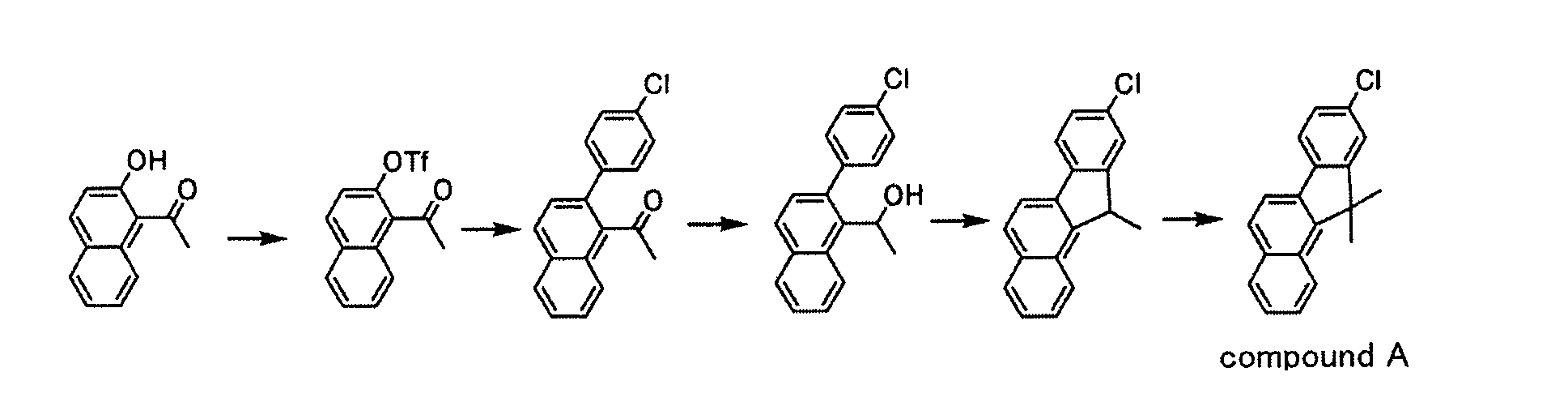
- A 300 ml eggplant flask was charged with 18. 6 g (100 mmol) of 2'-hydroxy-1'-acetonaphthone (available from Wako Pure Chemical Industries Ltd.), 100 ml of dichloromethane (available from Kanto Chemical Co., Inc.) and 39. 6 g (500 mmol) of pyridine (available from Kishida Chemical Co., Ltd.). The liquid reaction mixture was cooled to below 5°C. 31.0 g (110 mmol) of trifluoromethanesulfonic anhydride (available from Wako Pure Chemical Industries Ltd.) was dropwise added while the reaction temperature was controlled so as not to exceed 5°C. The reaction mixture was stirred at room temperature overnight. Water was added to the liquid reaction mixture to quench the reaction and effect phase separation. An obtained organic phase was washed with an aqueous 3. 5% hydrochloric acid solution and then with water, and then, dried over anhydrous magnesium sulfate and concentrated. The thus-obtained 32.7 g of 1'-acetonaphthone-2'-trifluoromethanesulfonate was isolated as slightly yellow oily material. This product was used as it was without purification for the succeeding reaction.
- A 500 ml eggplant flask was charged with 15.1 g (47.5 mmol) of the obtained 1'-acetonaphthone--2'-trifluoromethanesulfonate, 7.8 g (50.0 mmol) of 4-chlorophenylboronic acid (available from Tokyo Chemical Industry Co., Ltd.), 549 mg (0.475 mmol) of tetrakis(triphenylphosphine)palladium (available from Aldrich Chemical Co., Inc.), 100.7 g of an aqueous 20 wt.% sodium carbonate solution and 250 ml of tetrahydrofuran (available from Kanto Chemical Co., Inc.). The liquid mixture was heated and stirred at 60°C overnight. The thus-obtained liquid reaction mixture was cooled to room temperature to effect phase separation. An obtained organic phase was washed with water, and then, dried over anhydrous magnesium sulfate and concentrated. Thus 12.4 g of a light yellow crystal was obtained. 1H-NMR analysis revealed that the light yellow crystal was target 2'-(4-chlorophenyl)-1'-acetonaphthone. This product was used as it was without purification for the succeeding reaction.
- 1H-NMR (200MHz, CDCl3):2.12(3H,s), 7.33-7.65(7H,m), 7.78-8.01(3H,m)
13C-NMR(50MHz, CDCl3):32.9, 124.7, 126.5, 127.1, 127.6, 128.3, 128.8, 128.9,129.5, 130.6, 132.6, 134.3, 134.4, 138.4, 138.7, 207.1 - A 300 ml eggplant flask was charged with 9.8 g (35 mmol) of the obtained 2'-(4-chlorophenyl)-1'-acetonaphthone, 70 ml of tetrahydrofuran (available from Kanto Chemical Co., Inc.) and 70 ml of ethanol (available from Kanto Chemical Co. , Inc.). The liquid mixture was dissolved, and then, 6.6 g (175 mmol) of sodium boron hydride (available from Kishida Chemical Co. , Ltd.) was added to the solution. The solution was stirred at room temperature for 8 hours.
- Then 100 g of an aqueous 10% ammonium chloride solution was added to the solution while care was taken so as not to form foam. The liquid reaction mixture was concentrated under a reduced pressure. The obtained residue was subjected to extraction with 200 ml of toluene. The extracted material was washed with water, and then dried over anhydrous magnesium sulfate and concentrated to give 9.4 g of a light yellow crystal. 1H-NMR analysis revealed that the light yellow crystal was target 1-(1-hydroxy)ethyl-2-(4-chlorophenyl)naphthalene. This product was used as it was without purification for the succeeding reaction.
- 1H-NMR(200MHz,CDCl3):1.71(3H,d,J=7.0Hz),2.05(1H,br-s), 5.35(1H,q,J=7.0Hz), 7.16-7.63(7H,m), 7.69-7.95(2H,m), 8.76-8.93(1H,br-d)
13C-NMR(50MHz,CDCl3):23.9, 68.9, 125.8, 125.9, 127.0, 127.8, 127.9, 128.4, 128.8, 130.4, 130.8, 133.2, 134.2, 136.9, 137.1, 140.6 - A 100 ml eggplant flask was charged with 2.8 g (10 mmol) of the obtained 1-(1-hydroxy)ethyl--2-(4-chlorophenyl)naphthalene and 20 ml of chloroform (available from Kanto Chemical Co., Inc.). The reaction mixture was cooled to 0°C, and then, 1.85 g (13 mmol) of trifluoroboron diethyletherate (available from Kanto Chemical Co., Inc.) was dropwise added to the reaction mixture. The reaction mixture was stirred at room temperature for 1 hour.
- Then 20 g of water was added to the reaction mixture to quench the reaction and effect phase separation. Then an organic phase, obtained by the phase separation, was washed with water and then dried over anhydrous magnesium sulfate and concentrated to give 2.7 g of a light yellow solid. 1H-NMR analysis revealed that the light yellow solid was target 9-chloro-11-methyl-11H- -benzo[a]fluorine. This product was used as it was without purification for the succeeding reaction.
- 1H-NMR(200MHz,CDCl3):1.66(3H,d,J=7.2Hz), 4.33(1H,q,J= 7.2Hz), 7.32-7.65(5H,m), 7.70(1H,d,J=8.1Hz), 7.80-8.01(3H,m), 8.06(1H,d,J=8.0Hz)
- Then 2. 7 g (10 mmol) of the obtained 9-chloro-11-methyl--11H-benzo[a]fluorine, 2.3 g (10 mmol) of benzyltriethylammonium chloride (available from Kishida Chemical Co., Ltd.) and 4.3 g (30 mmol) of methyl iodide (available from Kanto Chemical Co., Inc.) were dissolved in 20 ml of dimethylsulfoxide (available from Wako Pure Chemical Industries Ltd.). The obtained solution was cooled to 0°C, and then, an aqueous 48% solution of sodium hydroxide 1.2 g (30 mmol) was dropwise added while being stirred. The obtained reaction mixture was stirred at room temperature for 1 hour, and then 50 ml of toluene (available from Kanto Chemical Co., Inc.) was added thereto to effect phase separation. An organic phase, obtained by the phase separation, was washed with water and then dried over anhydrous magnesium sulfate. A liquid extract obtained from the dried product was concentrated to give a light yellow crystal. The light yellow crystal was subjected to silica gel column chromatography using hexane as eluent to give 2.0 g of a white crystal of target 9-chloro-11,11-dimethyl-11H- benzo[a]fluorine (compound A) (yield: 72%).
- 1H-NMR(200MHz,CDCl3):1.73(6H,s), 7.21-7.66(5H,m), 7.69(1H,d,J=7.8Hz), 7.80-7.99(3H,m), 8.19(1H,d,J=8.3Hz)
13C-NMR(50MHz,CDCl3):26.3, 48.8, 118.6, 120.6, 122.8, 124.0, 125.0, 126.2, 127.2, 128.7, 130.0, 132.7, 134.0, 135.6, 137.8, 147.1, 157.0 - In a nitrogen atmosphere, a 500 ml flask equipped with a stirrer was charged with 27.9 g (0.30 mol) of aniline (available from Kishida Chemical Co., Ltd.), 23.3 g (0.10 mol) of 4-bromobiphenyl (available from Wako Pure Chemical Industries Ltd.), 14.4 g (0.15 mol) of sodium-tert-butoxide (available from Kanto Chemical Co., Inc.), 450 mg (2.0 mmol) of palladium acetate (available from Kishida Chemical Co., Ltd.), 1.6g (8. 0 mmol) of tri-tert-butylphosphine (available from Aldrich Chemical Co., Inc.) and 300.0 g of o-xylene (available from Kishida Chemical Co., Ltd.). The charged mixture was stirred at 130°C for 10 hours. After completion of the reaction, 50 ml of distilled water was added to the reaction mixture, and the reaction mixture was stirred at room temperature for 0.5 hour and allowed to leave to effect phase separation. An aqueous phase was removed. Then an obtained organic layer was washed with an aqueous saturated sodium chloride solution, and phase separation was effected and an aqueous phase was removed. Then the organic layer was concentrated under a reduced pressure, and o-xylene as solvent was distilled off. The thus-obtained residue was subjected to silica gel column chromatography to give 23.1 g of a white solid with a purity of 99.9% in a yield of 94%.
- Mass analysis and elemental analysis revealed that the obtained white solid was N-phenyl-N-4-biphenylylamine.
Mass analysis (FDMS): 245 (M+)
Elemental analysis (calculated): C=88.1, H=6.2 and N=5.7
Elemental analysis (found): C=88.0, H=6.2 and N=5.8 - In a nitrogen atmosphere, a 500 ml flask equipped with a stirrer was charged with 12.2 g (50 mmol) of the obtained N-phenyl-N-4-biphenylylamine, 14.0 g (50 mmol) of the compound A synthesized in Synthesis Example 1, 5.8 g (60 mmol) of sodium-tert-butoxide (available from Kanto Chemical Co., Inc.), 225 mg (1.0 mmol) of palladium acetate (available from Kishida Chemical Co., Ltd.), 0.8 g (4.0 mmol) of tri-tert-butylphosphine (available from Aldrich Chemical Co., Inc.) and 100.0 g of o-xylene (available from Kishida Chemical Co., Ltd.). The charged mixture was stirred at 140°C for 10 hours. After completion of the reaction, 50 ml of distilled water was added to the reaction mixture, and the reaction mixture was stirred at room temperature for 0.5 hour and allowed to leave to effect phase separation. An aqueous phase was removed. Then an obtained organic layer was washed with an aqueous saturated sodium chloride solution, and an aqueous phase was removed. Then the organic layer was concentrated under a reduced pressure and o-xylene as solvent was distilled off. The obtained residue was subjected to silica gel column chromatography to give 21.7 g of a light yellow solid with a purity of 99.9% in a yield of 89%.
- Mass analysis and elemental analysis revealed that the obtained light yellow solid was target compound 1-4.
Mass analysis (FDMS): 487 (M+)
Elemental analysis (calculated): C=91.1, H=6.0 and N=2.9
Elemental analysis (found): C=81.1, H=6.1 and N=2.8 - In a nitrogen atmosphere, a 300 ml flask equipped with a stirrer was charged with 11.1 g (40 mmol) of the compound A, obtained in Synthesis Example 1, 1.9 g (20 mmol) of aniline (available from Wako Pure Chemical Industries Ltd.), 4.8 g (50 mmol) of sodium-tert-butoxide (available from Kishida Chemical Co., Ltd.), 225 mg (1.0 mmol) of palladium acetate (available from Kishida Chemical Co., Ltd.), 0. 8 g (4.0 mmol) of tri-tert-butylphosphine (available from Aldrich Chemical Co., Inc.) and 100.0 g of o-xylene (available from Kishida Chemical Co. , Ltd.). The charged mixture was stirred at 140°C for 15 hours. After completion of the reaction, 30 ml of distilled water was added to the reaction solution, and the reaction mixture was stirred at room temperature for 0.5 hour and allowed to leave to effect phase separation. An aqueous phase was removed. Then an obtained organic layer was washed with an aqueous saturated sodium chloride solution, and an aqueous phase was removed. Then an obtained organic layer was concentrated under a reduced pressure and o-xylene as solvent was distilled off. The thus-obtained residue was subjected to silica gel column chromatography to give 10.2 g of a light yellow solid with a purity of 99.9% in a yield of 88%.
- Mass analysis and elemental analysis revealed that the obtained light yellow solid was target compound 1-14.
Mass analysis (FDMS): 577 (M+)
Elemental analysis (calculated): C=91.5, H=6.1 and N=2.4
Elemental analysis (found): C=91.5, H=6.0 and N=2.5 - The procedures described in Example 2 were repeated wherein 2.1 g (20 mmol) of p-aminotoluene (available from Wako Pure Chemical Industries Ltd.) was used instead of 1.9 g (20 mmol) of aniline (available from Wako Pure Chemical Industries Ltd.) with all other procedures remaining the same. Thus 10.1 g of a light yellow solid with a purity of 99.9% was obtained in a yield of 85%.
- Mass analysis and elemental analysis revealed that the obtained light yellow solid was target compound 1-16.
Mass analysis (FDMS): 591 (M+)
Elemental analysis (calculated): C=91.3, H=6.3 and N=2.4
Elemental analysis (found): C=91.4, H=6.2 and N=2.4 - The procedures described in Example 2 were repeated wherein 1.9 g (20 mmol) of 4-aminopyridine (available from Wako Pure Chemical Industries Ltd.) was used instead of 1.9 g (20 mmol) of aniline (available from Wako Pure Chemical Industries Ltd.) with all other procedures remaining the same. Thus 10.0 g of a light yellow solid with a purity of 99.9% was obtained in a yield of 87%.
- Mass analysis and elemental analysis revealed that the obtained light yellow solid was target compound 1-18.
Mass analysis (FDMS): 578 (M+)
Elemental analysis (calculated): C=89.2, H=5.9 and N=4.8
Elemental analysis (found): C=89.0, H=6.0 and N=4.9 - The procedures described in Example 2 were repeated wherein 6.7 g (20 mmol) of N,N'-diphenylbenzidine (available from Aldrich Chemical Co., Inc.) was used instead of 1. 9 g (20 mmol) of aniline (available from Wako Pure Chemical Industries Ltd.) with all other procedures remaining the same. Thus 14.0 g of a light yellow solid with a purity of 99.9% was obtained in a yield of 85%.
- Mass analysis and elemental analysis revealed that the obtained light yellow solid was the comparative compound M1.
Mass analysis (FDMS): 820 (M+)
Elemental analysis (calculated): C=90.7, H=5.9 and N=3.4
Elemental analysis (found): C=90.7, H=6.0 and N=3.3 -

- HOMO (eV), LUMO (eV), glass transition temperature (°C), sublimation temperature (°C) and decomposition temperature (°C) of the compounds 1-4, 1-14, 1-16 and 1-18, obtained in Examples 1 to 4, and comparative compound M1 obtained in Comparative Example 1 were measured. The results are shown in Table 1.
For comparison, HOMO (eV), LUMO (eV), glass transition temperature (°C) and sublimation temperature (°C) of α-NPD (4,4'-bis[N-(1-naphthyl)--N-phenylamino]biphenyl), which is well known as an organic electroluminescent material, were also measured. The results are also shown in Table 1. -
Table 1 Compound HOMO (eV) LUMO (eV) Glass Transition temp. (°C) Sublimation temp. (°C) Decomposition temp. (°C) 1-4 -5.5 -2.4 88 210 340 1-14 -5.5 -2.4 130 240 340 1-16 -5.4 -2.4 130 280 340 1-18 -5.7 -2.5 135 260 340 α-NPD -5.5 -2.4 96 300 - M1 -5.4 -2.5 154 330 340 - Manufacture of Organic Electroluminescent Device and Evaluation Thereof
A glass substrate with an indium-tin oxide (ITO) transparent electrode having a stripe pattern comprised of ITO film strips each having a 2 mm width was prepared. The substrate was washed with acetone and then with isopropyl alcohol, while being irradiated with ultrasonic wave. The substrate was further washed with boiling isopropyl alcohol, and then dried. The dried substrate was surface-treated with by irradiation of ultraviolet rays and generation of ozone to prepare a transparent electrically conductive glass substrate.
The thus-treated glass substrate was placed in a vacuum deposition chamber, and the inner pressure was reduced to 1.0 x 10⁻⁴ Pa. Phthalocyanine copper was vacuum-deposited on the transparent ITO electrode to form a hole injection layer with a thickness of 25 nm. - Then the compound 1-14, synthesized in Example 2, was vacuum-deposited on the hole injection layer to form a hole transport layer with a thickness of 45 nm. Then aluminum trisquinolinol complex was vacuum-deposited on the hole transport layer to form a luminous-and-electron-transport layer with a thickness of 60 nm. Thereafter LiF and Al were deposited into film thicknesses of 0.5 nm and 100 nm, respectively, to form a LiF-Al metal electrode. The film thicknesses were measured by a stylus profile measuring instrument DEKTAK. Then the thus-obtained substrate assembly with multi-layers was placed in a globe box filled with a nitrogen gas having an oxygen-and-moisture content of below 1 ppm, wherein the assembly was encapsulated with a glass cap and a ultraviolet ray-curable epoxy resin available from Nagase Chemtex Corporation.
- Luminous properties of the thus-manufactured organic electroluminescent device were evaluated by using a luminance meter BM-9 available from Topcon Corporation while direct current was applied to the device with the ITO electrode as cathode and the LiF-Al metal electrode as anode. The evaluation of the luminous properties was conducted at a current density of 20 mA/cm2 by measuring working voltage (V), luminance (cd/m2), current efficiency (cd/A) and power efficiency (lm/W). The evaluation results are shown in Table 2, below.
- By the same procedures as described in Example 5, an organic electroluminescent device was manufactured wherein the compound 1-16, synthesized in Example 3, was used instead of the compound 1-14, synthesized in Example 2, for the formation of a hole transport layer. All other procedures remained the same.
The luminous properties of the device were evaluated by the same methods as adopted in Example 5. The working voltage, luminance, current efficiency and power efficiency, as measured at a current density of 20 mA/cm2, are shown in Table 2, below. - By the same procedures as described in Example 5, an organic electroluminescent device was manufactured wherein α-NPD was used instead of the compound 1-14, synthesized in Example 2, for the formation of a hole transport layer. All other procedures remained the same.
The luminous properties of the device were evaluated by the same methods as adopted in Example 5. The working voltage, luminance, current efficiency and power efficiency, as measured at a current density of 20 mA/cm2, are shown in Table 2, below. - By the same procedures as described in Example 5, an organic electroluminescent device was manufactured wherein the comparative compound M1, synthesized in Reference Example 1, was used instead of the compound 1-14, synthesized in Example 2, for the formation of a hole transport layer. All other procedures remained the same.
The luminous properties of the device were evaluated by the same methods as adopted in Example 5. The working voltage, luminance, current efficiency and power efficiency, as measured at a current density of 20 mA/cm2, are shown in Table 2, below. -
Table 2 Examples Compound for hole transport layer Working Voltage Luminance Current efficiency Power efficiency (V) (cd/m2) (cd/A) (lm/W) Example 5 1-14 4.8 1050 4.6 2.9 Example 6 1-16 5.0 1035 4.7 2.9 Comp. Ex. 1 α-NPD 5.0 978 4.0 2.5 Comp. Ex. 2 M1 4.8 858 4.0 2.6 - The amine derivative according to the present invention can be operated with a low working voltage and exhibits high power efficiency as compared with the conventional materials. Therefore, the amine derivative is suitable for a hole injection material, a hole transport material and a luminous material, which are used in an organic electroluminescent device and an electrophotographic photoreceptor and other devices. Especially, when the amine derivative is used as a hole transport material, it is expected to be operated with a low working voltage and an enhanced power efficiency as compared with the conventional materials.
Further the amine derivative can be used as organic photoconducting materials for opto electronic devices, solar cells and image sensors.
Claims (7)
- An amine derivative characterized as represented by the following general formula (1) and exhibiting a temperature difference of 30°C or more as defined by the difference of [decomposition temperature (°C) minus sublimation temperature (°C)]:

- The amine derivative according to claim 1, wherein R1 and R2 in the general formula (1) represent a substituted or unsubstituted aryl group having 6 to 18 carbon atoms or a substituted or unsubstituted heteroaryl group having 5 to 18 carbon atoms.
- The amine derivative according to claim 1 or 2, wherein R3 and R4 in the general formula (1) represent a hydrogen atom, a straight-chain, branched or cyclic alkyl group having 1 to 6 carbon atoms, a straight-chain, branched or cyclic alkoxy group having 1 to 6 carbon atoms, a substituted or unsubstituted aryl group having 6 to 18 carbon atoms or a substituted or unsubstituted heteroaryl group having 5 to 18 carbon atoms, provided that R3 and R4 may form a cycloalkyl group having 3 to 8 carbon atoms together with the carbon atom in the benzofluorene structure to which R3 and R4 are bonded.
- The amine derivative according to any one of claims 1 to 3, which exhibits an energy level difference of at least 3.0 (eV) as defined by the energy level difference of [LUMO (eV) minus HOMO(eV)].
- The amine derivative according to any one of claims 1 to 4, which has a glass transition temperature (°C) of at least 120°C.
- An organic electroluminescent device characterized by having at least one layer selected from an emitting layer, a hole transport layer and a hole injection layer, which layers are made of the amine derivative as claimed in any one of claims 1 to 5.
- A process for producing an organic electroluminescent device characterized by making at least one layer selected from an emitting layer, a hole transport layer and a hole injection layer, wherein said at least one layer is made by forming a thin film by a vacuum deposition method from the amine derivative as claimed in any one of claims 1 to 5.
Applications Claiming Priority (3)
| Application Number | Priority Date | Filing Date | Title |
|---|---|---|---|
| JP2009136192 | 2009-06-05 | ||
| JP2009266680A JP2011012047A (en) | 2009-06-05 | 2009-11-24 | Amine derivative and organic electroluminescent element |
| PCT/JP2010/059341 WO2010140617A1 (en) | 2009-06-05 | 2010-06-02 | Amine derivative and organic electroluminescent elements |
Publications (3)
| Publication Number | Publication Date |
|---|---|
| EP2439190A1 true EP2439190A1 (en) | 2012-04-11 |
| EP2439190A4 EP2439190A4 (en) | 2013-10-23 |
| EP2439190B1 EP2439190B1 (en) | 2015-04-15 |
Family
ID=43297750
Family Applications (1)
| Application Number | Title | Priority Date | Filing Date |
|---|---|---|---|
| EP10783399.8A Active EP2439190B1 (en) | 2009-06-05 | 2010-06-02 | Amine derivative and organic electroluminescent elements |
Country Status (7)
| Country | Link |
|---|---|
| US (1) | US8846214B2 (en) |
| EP (1) | EP2439190B1 (en) |
| JP (1) | JP2011012047A (en) |
| KR (1) | KR101652096B1 (en) |
| CN (1) | CN102459149B (en) |
| TW (1) | TWI490188B (en) |
| WO (1) | WO2010140617A1 (en) |
Families Citing this family (13)
| Publication number | Priority date | Publication date | Assignee | Title |
|---|---|---|---|---|
| JP6024259B2 (en) * | 2011-07-25 | 2016-11-16 | 東ソー株式会社 | Novel naphthalaldehyde compound, process for producing the same, and process for producing triarylamine compounds from the compound |
| US9748492B2 (en) | 2012-11-02 | 2017-08-29 | Idemitsu Kosan Co., Ltd. | Organic electroluminescent device |
| JP6278894B2 (en) * | 2012-11-02 | 2018-02-14 | 出光興産株式会社 | Organic electroluminescence device |
| KR102081627B1 (en) | 2012-12-17 | 2020-02-27 | 에스에프씨주식회사 | Aromatic amine derivatives having fluorenyl moiety and organic light-emitting diode including the same |
| WO2014106522A1 (en) * | 2013-01-03 | 2014-07-10 | Merck Patent Gmbh | Materials for electronic devices |
| JP6261908B2 (en) * | 2013-08-21 | 2018-01-17 | 東ソー株式会社 | 1-acyl-2- (substituted phenyl) naphthalene and process for producing the same |
| KR101939552B1 (en) | 2013-12-06 | 2019-01-17 | 롬엔드하스전자재료코리아유한회사 | Organic Electroluminescent Compound and Organic Electroluminescent Device Comprising the Same |
| CN109400487A (en) * | 2018-11-12 | 2019-03-01 | 长春海谱润斯科技有限公司 | A kind of fluorene kind derivative and its organic electroluminescence device |
| KR20190007506A (en) | 2019-01-09 | 2019-01-22 | 롬엔드하스전자재료코리아유한회사 | Organic Electroluminescent Compound and Organic Electroluminescent Device Comprising the Same |
| KR102321559B1 (en) | 2019-10-21 | 2021-11-05 | 롬엔드하스전자재료코리아유한회사 | Organic Electroluminescent Compound and Organic Electroluminescent Device Comprising the Same |
| KR102192497B1 (en) | 2019-10-21 | 2020-12-17 | 롬엔드하스전자재료코리아유한회사 | Organic Electroluminescent Compound and Organic Electroluminescent Device Comprising the Same |
| KR20240111689A (en) | 2023-01-10 | 2024-07-17 | 듀폰스페셜티머터리얼스코리아 유한회사 | Organic electroluminescent compound and organic electroluminescent device comprising the same |
| KR20250149603A (en) | 2024-04-08 | 2025-10-16 | 이데미쓰 고산 가부시키가이샤 | Compound, material for organic electroluminescent element, organic electroluminescent element, and electronic device |
Family Cites Families (12)
| Publication number | Priority date | Publication date | Assignee | Title |
|---|---|---|---|---|
| US6849348B2 (en) * | 2002-12-31 | 2005-02-01 | Eastman Kodak Company | Complex fluorene-containing compounds |
| EP1930329B1 (en) | 2005-08-26 | 2012-10-24 | Tosoh Corporation | 1,3,5-triazine derivative, method for producing same, and organic electroluminescent device containing same as component |
| KR101166809B1 (en) * | 2006-04-13 | 2012-07-26 | 토소가부시키가이샤 | Benzofluorene compound and use thereof |
| JP5145717B2 (en) * | 2006-04-13 | 2013-02-20 | 東ソー株式会社 | Benzofluorene compounds and uses thereof |
| JP5030534B2 (en) | 2006-11-01 | 2012-09-19 | 出光興産株式会社 | Aminodibenzofluorene derivative and organic electroluminescence device using the same |
| JP5439711B2 (en) * | 2007-01-26 | 2014-03-12 | 東ソー株式会社 | Benzofluorene compounds and uses thereof |
| EP2141158B1 (en) | 2007-04-12 | 2014-05-07 | Tosoh Corporation | Phenyl-substituted 1,3,5-triazine compound, process for producing the same, and organic electroluminescent device containing the same as component |
| JP5428253B2 (en) * | 2008-09-09 | 2014-02-26 | 東ソー株式会社 | Amine derivatives and uses thereof |
| JP5428263B2 (en) * | 2008-09-18 | 2014-02-26 | 東ソー株式会社 | Amine derivatives and uses thereof |
| JP5748948B2 (en) | 2008-10-03 | 2015-07-15 | 東ソー株式会社 | 1,3,5-triazine derivative, method for producing the same, and organic electroluminescent device comprising the same |
| TWI475011B (en) | 2008-12-01 | 2015-03-01 | Tosoh Corp | 1,3,5-triazine derivatives and method for producing thereof, and organic electroluminescent elements using them as components |
| JP5439807B2 (en) * | 2008-12-24 | 2014-03-12 | 東ソー株式会社 | Amine derivatives and uses thereof |
-
2009
- 2009-11-24 JP JP2009266680A patent/JP2011012047A/en active Pending
-
2010
- 2010-06-02 US US13/375,997 patent/US8846214B2/en active Active - Reinstated
- 2010-06-02 WO PCT/JP2010/059341 patent/WO2010140617A1/en not_active Ceased
- 2010-06-02 EP EP10783399.8A patent/EP2439190B1/en active Active
- 2010-06-02 KR KR1020117031595A patent/KR101652096B1/en active Active
- 2010-06-02 CN CN201080024748.5A patent/CN102459149B/en active Active
- 2010-06-04 TW TW099118169A patent/TWI490188B/en active
Also Published As
| Publication number | Publication date |
|---|---|
| JP2011012047A (en) | 2011-01-20 |
| CN102459149A (en) | 2012-05-16 |
| TWI490188B (en) | 2015-07-01 |
| US20120112177A1 (en) | 2012-05-10 |
| TW201105616A (en) | 2011-02-16 |
| KR20120029446A (en) | 2012-03-26 |
| CN102459149B (en) | 2014-10-29 |
| EP2439190B1 (en) | 2015-04-15 |
| WO2010140617A1 (en) | 2010-12-09 |
| KR101652096B1 (en) | 2016-08-29 |
| EP2439190A4 (en) | 2013-10-23 |
| US8846214B2 (en) | 2014-09-30 |
Similar Documents
| Publication | Publication Date | Title |
|---|---|---|
| EP2439190B1 (en) | Amine derivative and organic electroluminescent elements | |
| KR102138351B1 (en) | Biscarbazole derivative and organic electroluminescence element using same | |
| EP2635561B1 (en) | Xanthone compound and organic light-emitting device including the same | |
| Wang et al. | Realizing efficient red thermally activated delayed fluorescence organic light-emitting diodes using phenoxazine/phenothiazine-phenanthrene hybrids | |
| EP2940096A1 (en) | Compound for organic optoelectronic element, organic light-emitting element comprising same, and display device comprising the organic light-emitting element | |
| EP2388842A1 (en) | Organic electroluminescent element | |
| EP2053051A1 (en) | Compound having pyridoindole ring structure having substituted pyridyl group attached thereto, and organic electroluminescence element | |
| EP2409974B1 (en) | Compound having benzotriazole ring structure and organic electroluminescent element | |
| CN112038494B (en) | Electroluminescent device based on chiral thermal activation delayed fluorescent material and preparation method thereof | |
| EP2828273B1 (en) | Green luminescent materials | |
| EP2757607A1 (en) | Organic electroluminescent element | |
| EP2463288B1 (en) | Compound having substituted pyridyl group and pyridoindole ring structure linked through phenylene group, and organic electroluminescent device | |
| WO2013187896A1 (en) | Biscarbazole derivative host materials and green emitter for oled emissive region | |
| US20250388612A1 (en) | Metal iridium complex and application thereof | |
| JP5783749B2 (en) | 1,8-aryl substituted naphthalene derivative having excimer characteristics and organic EL device using the same | |
| CN111116505A (en) | Amine compound and organic light-emitting device thereof | |
| KR20170105574A (en) | Heteroleptic iridium complexes, and light emitting materials and organic light emitting devices using the compounds | |
| JP5727237B2 (en) | Novel bicarbazolyl derivative, host material comprising the same, and organic electroluminescence device using the same | |
| EP2513996B1 (en) | Organic light emitting device | |
| CN115433120B (en) | Spirofluorene derivative containing seven-membered ring, electron transport material, and organic electroluminescent element | |
| WO2022052135A1 (en) | Chiral thermally activated delayed fluorescence material and preparation method therefor | |
| KR20140070360A (en) | Hole transport material for organic electroluminescence device and organic electroluminescence device using the same | |
| JP2014047197A (en) | Benzofluorenylamine compound and organic electroluminescent element | |
| EP2679587A1 (en) | Compounds having bipyridyl group and carbazole ring, and organic electroluminescent element | |
| US20130299811A1 (en) | Dibenzothiophene dioxide compound and organic light-emitting device using the same |
Legal Events
| Date | Code | Title | Description |
|---|---|---|---|
| PUAI | Public reference made under article 153(3) epc to a published international application that has entered the european phase |
Free format text: ORIGINAL CODE: 0009012 |
|
| 17P | Request for examination filed |
Effective date: 20111219 |
|
| AK | Designated contracting states |
Kind code of ref document: A1 Designated state(s): AL AT BE BG CH CY CZ DE DK EE ES FI FR GB GR HR HU IE IS IT LI LT LU LV MC MK MT NL NO PL PT RO SE SI SK SM TR |
|
| DAX | Request for extension of the european patent (deleted) | ||
| A4 | Supplementary search report drawn up and despatched |
Effective date: 20130923 |
|
| RIC1 | Information provided on ipc code assigned before grant |
Ipc: H01L 51/50 20060101ALI20130917BHEP Ipc: C07C 211/61 20060101AFI20130917BHEP Ipc: C09K 11/06 20060101ALI20130917BHEP Ipc: C07D 213/74 20060101ALI20130917BHEP |
|
| 17Q | First examination report despatched |
Effective date: 20140530 |
|
| GRAP | Despatch of communication of intention to grant a patent |
Free format text: ORIGINAL CODE: EPIDOSNIGR1 |
|
| INTG | Intention to grant announced |
Effective date: 20141107 |
|
| GRAS | Grant fee paid |
Free format text: ORIGINAL CODE: EPIDOSNIGR3 |
|
| GRAA | (expected) grant |
Free format text: ORIGINAL CODE: 0009210 |
|
| AK | Designated contracting states |
Kind code of ref document: B1 Designated state(s): AL AT BE BG CH CY CZ DE DK EE ES FI FR GB GR HR HU IE IS IT LI LT LU LV MC MK MT NL NO PL PT RO SE SI SK SM TR |
|
| REG | Reference to a national code |
Ref country code: GB Ref legal event code: FG4D Ref country code: CH Ref legal event code: EP |
|
| REG | Reference to a national code |
Ref country code: IE Ref legal event code: FG4D |
|
| REG | Reference to a national code |
Ref country code: AT Ref legal event code: REF Ref document number: 721866 Country of ref document: AT Kind code of ref document: T Effective date: 20150515 |
|
| REG | Reference to a national code |
Ref country code: DE Ref legal event code: R096 Ref document number: 602010024003 Country of ref document: DE Effective date: 20150528 |
|
| REG | Reference to a national code |
Ref country code: NL Ref legal event code: T3 |
|
| REG | Reference to a national code |
Ref country code: AT Ref legal event code: MK05 Ref document number: 721866 Country of ref document: AT Kind code of ref document: T Effective date: 20150415 |
|
| REG | Reference to a national code |
Ref country code: LT Ref legal event code: MG4D |
|
| PG25 | Lapsed in a contracting state [announced via postgrant information from national office to epo] |
Ref country code: NO Free format text: LAPSE BECAUSE OF FAILURE TO SUBMIT A TRANSLATION OF THE DESCRIPTION OR TO PAY THE FEE WITHIN THE PRESCRIBED TIME-LIMIT Effective date: 20150715 Ref country code: HR Free format text: LAPSE BECAUSE OF FAILURE TO SUBMIT A TRANSLATION OF THE DESCRIPTION OR TO PAY THE FEE WITHIN THE PRESCRIBED TIME-LIMIT Effective date: 20150415 Ref country code: LT Free format text: LAPSE BECAUSE OF FAILURE TO SUBMIT A TRANSLATION OF THE DESCRIPTION OR TO PAY THE FEE WITHIN THE PRESCRIBED TIME-LIMIT Effective date: 20150415 Ref country code: PT Free format text: LAPSE BECAUSE OF FAILURE TO SUBMIT A TRANSLATION OF THE DESCRIPTION OR TO PAY THE FEE WITHIN THE PRESCRIBED TIME-LIMIT Effective date: 20150817 Ref country code: ES Free format text: LAPSE BECAUSE OF FAILURE TO SUBMIT A TRANSLATION OF THE DESCRIPTION OR TO PAY THE FEE WITHIN THE PRESCRIBED TIME-LIMIT Effective date: 20150415 Ref country code: FI Free format text: LAPSE BECAUSE OF FAILURE TO SUBMIT A TRANSLATION OF THE DESCRIPTION OR TO PAY THE FEE WITHIN THE PRESCRIBED TIME-LIMIT Effective date: 20150415 |
|
| PG25 | Lapsed in a contracting state [announced via postgrant information from national office to epo] |
Ref country code: IS Free format text: LAPSE BECAUSE OF FAILURE TO SUBMIT A TRANSLATION OF THE DESCRIPTION OR TO PAY THE FEE WITHIN THE PRESCRIBED TIME-LIMIT Effective date: 20150815 Ref country code: AT Free format text: LAPSE BECAUSE OF FAILURE TO SUBMIT A TRANSLATION OF THE DESCRIPTION OR TO PAY THE FEE WITHIN THE PRESCRIBED TIME-LIMIT Effective date: 20150415 Ref country code: LV Free format text: LAPSE BECAUSE OF FAILURE TO SUBMIT A TRANSLATION OF THE DESCRIPTION OR TO PAY THE FEE WITHIN THE PRESCRIBED TIME-LIMIT Effective date: 20150415 Ref country code: GR Free format text: LAPSE BECAUSE OF FAILURE TO SUBMIT A TRANSLATION OF THE DESCRIPTION OR TO PAY THE FEE WITHIN THE PRESCRIBED TIME-LIMIT Effective date: 20150716 |
|
| REG | Reference to a national code |
Ref country code: DE Ref legal event code: R097 Ref document number: 602010024003 Country of ref document: DE |
|
| PG25 | Lapsed in a contracting state [announced via postgrant information from national office to epo] |
Ref country code: IT Free format text: LAPSE BECAUSE OF FAILURE TO SUBMIT A TRANSLATION OF THE DESCRIPTION OR TO PAY THE FEE WITHIN THE PRESCRIBED TIME-LIMIT Effective date: 20150415 Ref country code: EE Free format text: LAPSE BECAUSE OF FAILURE TO SUBMIT A TRANSLATION OF THE DESCRIPTION OR TO PAY THE FEE WITHIN THE PRESCRIBED TIME-LIMIT Effective date: 20150415 Ref country code: MC Free format text: LAPSE BECAUSE OF FAILURE TO SUBMIT A TRANSLATION OF THE DESCRIPTION OR TO PAY THE FEE WITHIN THE PRESCRIBED TIME-LIMIT Effective date: 20150415 Ref country code: DK Free format text: LAPSE BECAUSE OF FAILURE TO SUBMIT A TRANSLATION OF THE DESCRIPTION OR TO PAY THE FEE WITHIN THE PRESCRIBED TIME-LIMIT Effective date: 20150415 |
|
| REG | Reference to a national code |
Ref country code: CH Ref legal event code: PL |
|
| PLBE | No opposition filed within time limit |
Free format text: ORIGINAL CODE: 0009261 |
|
| STAA | Information on the status of an ep patent application or granted ep patent |
Free format text: STATUS: NO OPPOSITION FILED WITHIN TIME LIMIT |
|
| PG25 | Lapsed in a contracting state [announced via postgrant information from national office to epo] |
Ref country code: RO Free format text: LAPSE BECAUSE OF NON-PAYMENT OF DUE FEES Effective date: 20150415 Ref country code: LU Free format text: LAPSE BECAUSE OF FAILURE TO SUBMIT A TRANSLATION OF THE DESCRIPTION OR TO PAY THE FEE WITHIN THE PRESCRIBED TIME-LIMIT Effective date: 20150602 Ref country code: SK Free format text: LAPSE BECAUSE OF FAILURE TO SUBMIT A TRANSLATION OF THE DESCRIPTION OR TO PAY THE FEE WITHIN THE PRESCRIBED TIME-LIMIT Effective date: 20150415 Ref country code: PL Free format text: LAPSE BECAUSE OF FAILURE TO SUBMIT A TRANSLATION OF THE DESCRIPTION OR TO PAY THE FEE WITHIN THE PRESCRIBED TIME-LIMIT Effective date: 20150415 Ref country code: CZ Free format text: LAPSE BECAUSE OF FAILURE TO SUBMIT A TRANSLATION OF THE DESCRIPTION OR TO PAY THE FEE WITHIN THE PRESCRIBED TIME-LIMIT Effective date: 20150415 |
|
| 26N | No opposition filed |
Effective date: 20160118 |
|
| REG | Reference to a national code |
Ref country code: IE Ref legal event code: MM4A |
|
| PG25 | Lapsed in a contracting state [announced via postgrant information from national office to epo] |
Ref country code: CH Free format text: LAPSE BECAUSE OF NON-PAYMENT OF DUE FEES Effective date: 20150630 Ref country code: LI Free format text: LAPSE BECAUSE OF NON-PAYMENT OF DUE FEES Effective date: 20150630 Ref country code: IE Free format text: LAPSE BECAUSE OF NON-PAYMENT OF DUE FEES Effective date: 20150602 |
|
| REG | Reference to a national code |
Ref country code: FR Ref legal event code: PLFP Year of fee payment: 7 |
|
| PG25 | Lapsed in a contracting state [announced via postgrant information from national office to epo] |
Ref country code: SI Free format text: LAPSE BECAUSE OF FAILURE TO SUBMIT A TRANSLATION OF THE DESCRIPTION OR TO PAY THE FEE WITHIN THE PRESCRIBED TIME-LIMIT Effective date: 20150415 |
|
| PG25 | Lapsed in a contracting state [announced via postgrant information from national office to epo] |
Ref country code: BE Free format text: LAPSE BECAUSE OF FAILURE TO SUBMIT A TRANSLATION OF THE DESCRIPTION OR TO PAY THE FEE WITHIN THE PRESCRIBED TIME-LIMIT Effective date: 20150415 |
|
| PG25 | Lapsed in a contracting state [announced via postgrant information from national office to epo] |
Ref country code: MT Free format text: LAPSE BECAUSE OF FAILURE TO SUBMIT A TRANSLATION OF THE DESCRIPTION OR TO PAY THE FEE WITHIN THE PRESCRIBED TIME-LIMIT Effective date: 20150415 |
|
| REG | Reference to a national code |
Ref country code: FR Ref legal event code: PLFP Year of fee payment: 8 |
|
| PG25 | Lapsed in a contracting state [announced via postgrant information from national office to epo] |
Ref country code: HU Free format text: LAPSE BECAUSE OF FAILURE TO SUBMIT A TRANSLATION OF THE DESCRIPTION OR TO PAY THE FEE WITHIN THE PRESCRIBED TIME-LIMIT; INVALID AB INITIO Effective date: 20100602 Ref country code: SM Free format text: LAPSE BECAUSE OF FAILURE TO SUBMIT A TRANSLATION OF THE DESCRIPTION OR TO PAY THE FEE WITHIN THE PRESCRIBED TIME-LIMIT Effective date: 20150415 Ref country code: BG Free format text: LAPSE BECAUSE OF FAILURE TO SUBMIT A TRANSLATION OF THE DESCRIPTION OR TO PAY THE FEE WITHIN THE PRESCRIBED TIME-LIMIT Effective date: 20150415 |
|
| PG25 | Lapsed in a contracting state [announced via postgrant information from national office to epo] |
Ref country code: CY Free format text: LAPSE BECAUSE OF FAILURE TO SUBMIT A TRANSLATION OF THE DESCRIPTION OR TO PAY THE FEE WITHIN THE PRESCRIBED TIME-LIMIT Effective date: 20150415 Ref country code: SE Free format text: LAPSE BECAUSE OF FAILURE TO SUBMIT A TRANSLATION OF THE DESCRIPTION OR TO PAY THE FEE WITHIN THE PRESCRIBED TIME-LIMIT Effective date: 20150415 |
|
| PG25 | Lapsed in a contracting state [announced via postgrant information from national office to epo] |
Ref country code: TR Free format text: LAPSE BECAUSE OF FAILURE TO SUBMIT A TRANSLATION OF THE DESCRIPTION OR TO PAY THE FEE WITHIN THE PRESCRIBED TIME-LIMIT Effective date: 20150415 |
|
| REG | Reference to a national code |
Ref country code: FR Ref legal event code: PLFP Year of fee payment: 9 |
|
| PG25 | Lapsed in a contracting state [announced via postgrant information from national office to epo] |
Ref country code: MK Free format text: LAPSE BECAUSE OF FAILURE TO SUBMIT A TRANSLATION OF THE DESCRIPTION OR TO PAY THE FEE WITHIN THE PRESCRIBED TIME-LIMIT Effective date: 20150415 |
|
| PG25 | Lapsed in a contracting state [announced via postgrant information from national office to epo] |
Ref country code: AL Free format text: LAPSE BECAUSE OF FAILURE TO SUBMIT A TRANSLATION OF THE DESCRIPTION OR TO PAY THE FEE WITHIN THE PRESCRIBED TIME-LIMIT Effective date: 20150415 |
|
| PGFP | Annual fee paid to national office [announced via postgrant information from national office to epo] |
Ref country code: NL Payment date: 20210512 Year of fee payment: 12 Ref country code: FR Payment date: 20210513 Year of fee payment: 12 |
|
| PGFP | Annual fee paid to national office [announced via postgrant information from national office to epo] |
Ref country code: GB Payment date: 20210505 Year of fee payment: 12 |
|
| REG | Reference to a national code |
Ref country code: NL Ref legal event code: MM Effective date: 20220701 |
|
| GBPC | Gb: european patent ceased through non-payment of renewal fee |
Effective date: 20220602 |
|
| PG25 | Lapsed in a contracting state [announced via postgrant information from national office to epo] |
Ref country code: NL Free format text: LAPSE BECAUSE OF NON-PAYMENT OF DUE FEES Effective date: 20220701 |
|
| PG25 | Lapsed in a contracting state [announced via postgrant information from national office to epo] |
Ref country code: FR Free format text: LAPSE BECAUSE OF NON-PAYMENT OF DUE FEES Effective date: 20220630 |
|
| PG25 | Lapsed in a contracting state [announced via postgrant information from national office to epo] |
Ref country code: GB Free format text: LAPSE BECAUSE OF NON-PAYMENT OF DUE FEES Effective date: 20220602 |
|
| P01 | Opt-out of the competence of the unified patent court (upc) registered |
Effective date: 20230523 |
|
| PGFP | Annual fee paid to national office [announced via postgrant information from national office to epo] |
Ref country code: DE Payment date: 20250429 Year of fee payment: 16 |