EP2433938A1 - Therapeutic agent for motor disorders - Google Patents
Therapeutic agent for motor disorders Download PDFInfo
- Publication number
- EP2433938A1 EP2433938A1 EP10769780A EP10769780A EP2433938A1 EP 2433938 A1 EP2433938 A1 EP 2433938A1 EP 10769780 A EP10769780 A EP 10769780A EP 10769780 A EP10769780 A EP 10769780A EP 2433938 A1 EP2433938 A1 EP 2433938A1
- Authority
- EP
- European Patent Office
- Prior art keywords
- pyridyl
- optionally substituted
- tetrahydropyranyl
- pharmaceutically acceptable
- thiazole derivative
- Prior art date
- Legal status (The legal status is an assumption and is not a legal conclusion. Google has not performed a legal analysis and makes no representation as to the accuracy of the status listed.)
- Granted
Links
- 0 *=C(C1CC*CC1)c1c(-c2ccc[o]2)nc(NC(c2ccc[n]2)=O)[s]1 Chemical compound *=C(C1CC*CC1)c1c(-c2ccc[o]2)nc(NC(c2ccc[n]2)=O)[s]1 0.000 description 12
- KNFWOPZXKYAOIV-UHFFFAOYSA-N C=Cc(nc1)ccc1C(Nc1nc(-c2ccc[o]2)c(C(C2CCOCC2)=O)[s]1)=O Chemical compound C=Cc(nc1)ccc1C(Nc1nc(-c2ccc[o]2)c(C(C2CCOCC2)=O)[s]1)=O KNFWOPZXKYAOIV-UHFFFAOYSA-N 0.000 description 3
- VBOITCGFSGDEBS-UHFFFAOYSA-N Cc(nc1)ncc1C(Nc1nc(-c2ccc[o]2)c(C(C2CCOCC2)=O)[s]1)=O Chemical compound Cc(nc1)ncc1C(Nc1nc(-c2ccc[o]2)c(C(C2CCOCC2)=O)[s]1)=O VBOITCGFSGDEBS-UHFFFAOYSA-N 0.000 description 3
- SHHAMXCVJQIHNZ-UHFFFAOYSA-N O=C(Cc1cccnc1)Nc1nc(-c2ccc[o]2)c(C(C2CCOCC2)=O)[s]1 Chemical compound O=C(Cc1cccnc1)Nc1nc(-c2ccc[o]2)c(C(C2CCOCC2)=O)[s]1 SHHAMXCVJQIHNZ-UHFFFAOYSA-N 0.000 description 3
- KMFLQPJJHQNKKF-UHFFFAOYSA-N Cc(cc1)ncc1C(Nc1nc(-c2ccc[o]2)c(C(C2CCOCC2)=O)[s]1)=O Chemical compound Cc(cc1)ncc1C(Nc1nc(-c2ccc[o]2)c(C(C2CCOCC2)=O)[s]1)=O KMFLQPJJHQNKKF-UHFFFAOYSA-N 0.000 description 2
- FOQGCFLVZJZMSM-UHFFFAOYSA-N CCc1cncc(C(Nc2nc(-c3c[o]cc3)c(C(C3CCOCC3)=O)[s]2)=O)c1 Chemical compound CCc1cncc(C(Nc2nc(-c3c[o]cc3)c(C(C3CCOCC3)=O)[s]2)=O)c1 FOQGCFLVZJZMSM-UHFFFAOYSA-N 0.000 description 1
- AKUJFIAVXRRQDA-PGSNLPAFSA-N O/C=C\C=C\c1c(C(C2CCOCC2)=O)[s]c(NC(C2=CCNC(CN3CCOCC3)=C2)=O)n1 Chemical compound O/C=C\C=C\c1c(C(C2CCOCC2)=O)[s]c(NC(C2=CCNC(CN3CCOCC3)=C2)=O)n1 AKUJFIAVXRRQDA-PGSNLPAFSA-N 0.000 description 1
- QAPADOOPYQRCTD-UHFFFAOYSA-N O=C(C1CCOCC1)c1c(-c2c[o]cc2)nc(NC(c2cc(CCC3)c3nc2)=O)[s]1 Chemical compound O=C(C1CCOCC1)c1c(-c2c[o]cc2)nc(NC(c2cc(CCC3)c3nc2)=O)[s]1 QAPADOOPYQRCTD-UHFFFAOYSA-N 0.000 description 1
- MDDHLGRUNHQBEI-UHFFFAOYSA-N O=C(C1CCOCC1)c1c(-c2ccc[o]2)nc(NC(c2c(cc[nH]3)c3ccc2)=O)[s]1 Chemical compound O=C(C1CCOCC1)c1c(-c2ccc[o]2)nc(NC(c2c(cc[nH]3)c3ccc2)=O)[s]1 MDDHLGRUNHQBEI-UHFFFAOYSA-N 0.000 description 1
- RXTFWVBAVRFLNK-UHFFFAOYSA-N O=C(C1CCOCC1)c1c(-c2ccc[o]2)nc(NC(c2cc(cccc3)c3nc2)=O)[s]1 Chemical compound O=C(C1CCOCC1)c1c(-c2ccc[o]2)nc(NC(c2cc(cccc3)c3nc2)=O)[s]1 RXTFWVBAVRFLNK-UHFFFAOYSA-N 0.000 description 1
- FEQFUXHNKPHIBQ-UHFFFAOYSA-N O=C(C1CCOCC1)c1c(-c2ccc[o]2)nc(NC(c2ccc[nH]2)=O)[s]1 Chemical compound O=C(C1CCOCC1)c1c(-c2ccc[o]2)nc(NC(c2ccc[nH]2)=O)[s]1 FEQFUXHNKPHIBQ-UHFFFAOYSA-N 0.000 description 1
- KZGWPAQWRWFXKF-UHFFFAOYSA-N O=C(Cc1ccccn1)Nc1nc(-c2ccc[o]2)c(C(C2CCOCC2)=O)[s]1 Chemical compound O=C(Cc1ccccn1)Nc1nc(-c2ccc[o]2)c(C(C2CCOCC2)=O)[s]1 KZGWPAQWRWFXKF-UHFFFAOYSA-N 0.000 description 1
Images

Classifications
-
- C—CHEMISTRY; METALLURGY
- C07—ORGANIC CHEMISTRY
- C07D—HETEROCYCLIC COMPOUNDS
- C07D417/00—Heterocyclic compounds containing two or more hetero rings, at least one ring having nitrogen and sulfur atoms as the only ring hetero atoms, not provided for by group C07D415/00
- C07D417/14—Heterocyclic compounds containing two or more hetero rings, at least one ring having nitrogen and sulfur atoms as the only ring hetero atoms, not provided for by group C07D415/00 containing three or more hetero rings
-
- A—HUMAN NECESSITIES
- A61—MEDICAL OR VETERINARY SCIENCE; HYGIENE
- A61K—PREPARATIONS FOR MEDICAL, DENTAL OR TOILETRY PURPOSES
- A61K31/00—Medicinal preparations containing organic active ingredients
- A61K31/185—Acids; Anhydrides, halides or salts thereof, e.g. sulfur acids, imidic, hydrazonic or hydroximic acids
- A61K31/19—Carboxylic acids, e.g. valproic acid
- A61K31/195—Carboxylic acids, e.g. valproic acid having an amino group
- A61K31/197—Carboxylic acids, e.g. valproic acid having an amino group the amino and the carboxyl groups being attached to the same acyclic carbon chain, e.g. gamma-aminobutyric acid [GABA], beta-alanine, epsilon-aminocaproic acid or pantothenic acid
- A61K31/198—Alpha-amino acids, e.g. alanine or edetic acid [EDTA]
-
- A—HUMAN NECESSITIES
- A61—MEDICAL OR VETERINARY SCIENCE; HYGIENE
- A61K—PREPARATIONS FOR MEDICAL, DENTAL OR TOILETRY PURPOSES
- A61K31/00—Medicinal preparations containing organic active ingredients
- A61K31/33—Heterocyclic compounds
- A61K31/395—Heterocyclic compounds having nitrogen as a ring hetero atom, e.g. guanethidine or rifamycins
- A61K31/41—Heterocyclic compounds having nitrogen as a ring hetero atom, e.g. guanethidine or rifamycins having five-membered rings with two or more ring hetero atoms, at least one of which being nitrogen, e.g. tetrazole
- A61K31/425—Thiazoles
- A61K31/427—Thiazoles not condensed and containing further heterocyclic rings
-
- A—HUMAN NECESSITIES
- A61—MEDICAL OR VETERINARY SCIENCE; HYGIENE
- A61K—PREPARATIONS FOR MEDICAL, DENTAL OR TOILETRY PURPOSES
- A61K31/00—Medicinal preparations containing organic active ingredients
- A61K31/33—Heterocyclic compounds
- A61K31/395—Heterocyclic compounds having nitrogen as a ring hetero atom, e.g. guanethidine or rifamycins
- A61K31/435—Heterocyclic compounds having nitrogen as a ring hetero atom, e.g. guanethidine or rifamycins having six-membered rings with one nitrogen as the only ring hetero atom
-
- A—HUMAN NECESSITIES
- A61—MEDICAL OR VETERINARY SCIENCE; HYGIENE
- A61K—PREPARATIONS FOR MEDICAL, DENTAL OR TOILETRY PURPOSES
- A61K31/00—Medicinal preparations containing organic active ingredients
- A61K31/33—Heterocyclic compounds
- A61K31/395—Heterocyclic compounds having nitrogen as a ring hetero atom, e.g. guanethidine or rifamycins
- A61K31/435—Heterocyclic compounds having nitrogen as a ring hetero atom, e.g. guanethidine or rifamycins having six-membered rings with one nitrogen as the only ring hetero atom
- A61K31/4353—Heterocyclic compounds having nitrogen as a ring hetero atom, e.g. guanethidine or rifamycins having six-membered rings with one nitrogen as the only ring hetero atom ortho- or peri-condensed with heterocyclic ring systems
- A61K31/4355—Heterocyclic compounds having nitrogen as a ring hetero atom, e.g. guanethidine or rifamycins having six-membered rings with one nitrogen as the only ring hetero atom ortho- or peri-condensed with heterocyclic ring systems the heterocyclic ring system containing a five-membered ring having oxygen as a ring hetero atom
-
- A—HUMAN NECESSITIES
- A61—MEDICAL OR VETERINARY SCIENCE; HYGIENE
- A61K—PREPARATIONS FOR MEDICAL, DENTAL OR TOILETRY PURPOSES
- A61K31/00—Medicinal preparations containing organic active ingredients
- A61K31/33—Heterocyclic compounds
- A61K31/395—Heterocyclic compounds having nitrogen as a ring hetero atom, e.g. guanethidine or rifamycins
- A61K31/435—Heterocyclic compounds having nitrogen as a ring hetero atom, e.g. guanethidine or rifamycins having six-membered rings with one nitrogen as the only ring hetero atom
- A61K31/4353—Heterocyclic compounds having nitrogen as a ring hetero atom, e.g. guanethidine or rifamycins having six-membered rings with one nitrogen as the only ring hetero atom ortho- or peri-condensed with heterocyclic ring systems
- A61K31/436—Heterocyclic compounds having nitrogen as a ring hetero atom, e.g. guanethidine or rifamycins having six-membered rings with one nitrogen as the only ring hetero atom ortho- or peri-condensed with heterocyclic ring systems the heterocyclic ring system containing a six-membered ring having oxygen as a ring hetero atom, e.g. rapamycin
-
- A—HUMAN NECESSITIES
- A61—MEDICAL OR VETERINARY SCIENCE; HYGIENE
- A61K—PREPARATIONS FOR MEDICAL, DENTAL OR TOILETRY PURPOSES
- A61K31/00—Medicinal preparations containing organic active ingredients
- A61K31/33—Heterocyclic compounds
- A61K31/395—Heterocyclic compounds having nitrogen as a ring hetero atom, e.g. guanethidine or rifamycins
- A61K31/435—Heterocyclic compounds having nitrogen as a ring hetero atom, e.g. guanethidine or rifamycins having six-membered rings with one nitrogen as the only ring hetero atom
- A61K31/4353—Heterocyclic compounds having nitrogen as a ring hetero atom, e.g. guanethidine or rifamycins having six-membered rings with one nitrogen as the only ring hetero atom ortho- or peri-condensed with heterocyclic ring systems
- A61K31/4365—Heterocyclic compounds having nitrogen as a ring hetero atom, e.g. guanethidine or rifamycins having six-membered rings with one nitrogen as the only ring hetero atom ortho- or peri-condensed with heterocyclic ring systems the heterocyclic ring system having sulfur as a ring hetero atom, e.g. ticlopidine
-
- A—HUMAN NECESSITIES
- A61—MEDICAL OR VETERINARY SCIENCE; HYGIENE
- A61K—PREPARATIONS FOR MEDICAL, DENTAL OR TOILETRY PURPOSES
- A61K31/00—Medicinal preparations containing organic active ingredients
- A61K31/33—Heterocyclic compounds
- A61K31/395—Heterocyclic compounds having nitrogen as a ring hetero atom, e.g. guanethidine or rifamycins
- A61K31/435—Heterocyclic compounds having nitrogen as a ring hetero atom, e.g. guanethidine or rifamycins having six-membered rings with one nitrogen as the only ring hetero atom
- A61K31/44—Non condensed pyridines; Hydrogenated derivatives thereof
- A61K31/4427—Non condensed pyridines; Hydrogenated derivatives thereof containing further heterocyclic ring systems
- A61K31/4439—Non condensed pyridines; Hydrogenated derivatives thereof containing further heterocyclic ring systems containing a five-membered ring with nitrogen as a ring hetero atom, e.g. omeprazole
-
- A—HUMAN NECESSITIES
- A61—MEDICAL OR VETERINARY SCIENCE; HYGIENE
- A61K—PREPARATIONS FOR MEDICAL, DENTAL OR TOILETRY PURPOSES
- A61K31/00—Medicinal preparations containing organic active ingredients
- A61K31/33—Heterocyclic compounds
- A61K31/395—Heterocyclic compounds having nitrogen as a ring hetero atom, e.g. guanethidine or rifamycins
- A61K31/435—Heterocyclic compounds having nitrogen as a ring hetero atom, e.g. guanethidine or rifamycins having six-membered rings with one nitrogen as the only ring hetero atom
- A61K31/47—Quinolines; Isoquinolines
- A61K31/4709—Non-condensed quinolines and containing further heterocyclic rings
-
- A—HUMAN NECESSITIES
- A61—MEDICAL OR VETERINARY SCIENCE; HYGIENE
- A61K—PREPARATIONS FOR MEDICAL, DENTAL OR TOILETRY PURPOSES
- A61K31/00—Medicinal preparations containing organic active ingredients
- A61K31/33—Heterocyclic compounds
- A61K31/395—Heterocyclic compounds having nitrogen as a ring hetero atom, e.g. guanethidine or rifamycins
- A61K31/495—Heterocyclic compounds having nitrogen as a ring hetero atom, e.g. guanethidine or rifamycins having six-membered rings with two or more nitrogen atoms as the only ring heteroatoms, e.g. piperazine or tetrazines
- A61K31/505—Pyrimidines; Hydrogenated pyrimidines, e.g. trimethoprim
- A61K31/506—Pyrimidines; Hydrogenated pyrimidines, e.g. trimethoprim not condensed and containing further heterocyclic rings
-
- A—HUMAN NECESSITIES
- A61—MEDICAL OR VETERINARY SCIENCE; HYGIENE
- A61K—PREPARATIONS FOR MEDICAL, DENTAL OR TOILETRY PURPOSES
- A61K31/00—Medicinal preparations containing organic active ingredients
- A61K31/33—Heterocyclic compounds
- A61K31/395—Heterocyclic compounds having nitrogen as a ring hetero atom, e.g. guanethidine or rifamycins
- A61K31/535—Heterocyclic compounds having nitrogen as a ring hetero atom, e.g. guanethidine or rifamycins having six-membered rings with at least one nitrogen and one oxygen as the ring hetero atoms, e.g. 1,2-oxazines
- A61K31/5375—1,4-Oxazines, e.g. morpholine
- A61K31/5377—1,4-Oxazines, e.g. morpholine not condensed and containing further heterocyclic rings, e.g. timolol
-
- A—HUMAN NECESSITIES
- A61—MEDICAL OR VETERINARY SCIENCE; HYGIENE
- A61P—SPECIFIC THERAPEUTIC ACTIVITY OF CHEMICAL COMPOUNDS OR MEDICINAL PREPARATIONS
- A61P21/00—Drugs for disorders of the muscular or neuromuscular system
-
- A—HUMAN NECESSITIES
- A61—MEDICAL OR VETERINARY SCIENCE; HYGIENE
- A61P—SPECIFIC THERAPEUTIC ACTIVITY OF CHEMICAL COMPOUNDS OR MEDICINAL PREPARATIONS
- A61P25/00—Drugs for disorders of the nervous system
-
- A—HUMAN NECESSITIES
- A61—MEDICAL OR VETERINARY SCIENCE; HYGIENE
- A61P—SPECIFIC THERAPEUTIC ACTIVITY OF CHEMICAL COMPOUNDS OR MEDICINAL PREPARATIONS
- A61P25/00—Drugs for disorders of the nervous system
- A61P25/14—Drugs for disorders of the nervous system for treating abnormal movements, e.g. chorea, dyskinesia
-
- A—HUMAN NECESSITIES
- A61—MEDICAL OR VETERINARY SCIENCE; HYGIENE
- A61P—SPECIFIC THERAPEUTIC ACTIVITY OF CHEMICAL COMPOUNDS OR MEDICINAL PREPARATIONS
- A61P25/00—Drugs for disorders of the nervous system
- A61P25/14—Drugs for disorders of the nervous system for treating abnormal movements, e.g. chorea, dyskinesia
- A61P25/16—Anti-Parkinson drugs
-
- A—HUMAN NECESSITIES
- A61—MEDICAL OR VETERINARY SCIENCE; HYGIENE
- A61P—SPECIFIC THERAPEUTIC ACTIVITY OF CHEMICAL COMPOUNDS OR MEDICINAL PREPARATIONS
- A61P43/00—Drugs for specific purposes, not provided for in groups A61P1/00-A61P41/00
-
- C—CHEMISTRY; METALLURGY
- C07—ORGANIC CHEMISTRY
- C07D—HETEROCYCLIC COMPOUNDS
- C07D491/00—Heterocyclic compounds containing in the condensed ring system both one or more rings having oxygen atoms as the only ring hetero atoms and one or more rings having nitrogen atoms as the only ring hetero atoms, not provided for by groups C07D451/00 - C07D459/00, C07D463/00, C07D477/00 or C07D489/00
- C07D491/02—Heterocyclic compounds containing in the condensed ring system both one or more rings having oxygen atoms as the only ring hetero atoms and one or more rings having nitrogen atoms as the only ring hetero atoms, not provided for by groups C07D451/00 - C07D459/00, C07D463/00, C07D477/00 or C07D489/00 in which the condensed system contains two hetero rings
- C07D491/04—Ortho-condensed systems
- C07D491/044—Ortho-condensed systems with only one oxygen atom as ring hetero atom in the oxygen-containing ring
- C07D491/048—Ortho-condensed systems with only one oxygen atom as ring hetero atom in the oxygen-containing ring the oxygen-containing ring being five-membered
-
- C—CHEMISTRY; METALLURGY
- C07—ORGANIC CHEMISTRY
- C07D—HETEROCYCLIC COMPOUNDS
- C07D491/00—Heterocyclic compounds containing in the condensed ring system both one or more rings having oxygen atoms as the only ring hetero atoms and one or more rings having nitrogen atoms as the only ring hetero atoms, not provided for by groups C07D451/00 - C07D459/00, C07D463/00, C07D477/00 or C07D489/00
- C07D491/02—Heterocyclic compounds containing in the condensed ring system both one or more rings having oxygen atoms as the only ring hetero atoms and one or more rings having nitrogen atoms as the only ring hetero atoms, not provided for by groups C07D451/00 - C07D459/00, C07D463/00, C07D477/00 or C07D489/00 in which the condensed system contains two hetero rings
- C07D491/04—Ortho-condensed systems
- C07D491/044—Ortho-condensed systems with only one oxygen atom as ring hetero atom in the oxygen-containing ring
- C07D491/052—Ortho-condensed systems with only one oxygen atom as ring hetero atom in the oxygen-containing ring the oxygen-containing ring being six-membered
-
- C—CHEMISTRY; METALLURGY
- C07—ORGANIC CHEMISTRY
- C07D—HETEROCYCLIC COMPOUNDS
- C07D495/00—Heterocyclic compounds containing in the condensed system at least one hetero ring having sulfur atoms as the only ring hetero atoms
- C07D495/02—Heterocyclic compounds containing in the condensed system at least one hetero ring having sulfur atoms as the only ring hetero atoms in which the condensed system contains two hetero rings
- C07D495/04—Ortho-condensed systems
Definitions
- the present invention relates to an agent for the treatment and/or prophylaxis of a movement disorder, an agent for the treatment and/or prophylaxis of Parkinson's disease and the like.
- Parkinson's disease is a brain disease characterized by tremor, bradykinesia, difficulty in gait and coordinated movement and the like. This disease is associated with damage of a part of brain which governs muscle movements.
- the first symptom of Parkinson's disease is a limb tremor (shaking or trembling) particularly when the body is at rest. Tremor often begins in the hemibody, and frequently occurs in one of the hands.
- Other common symptoms include slow movement (bradykinesia), an inability to move (akinesia), a rigidity of trunk and limbs, a shuffling gait, and a stooped posture and the like.
- Patients with Parkinson's disease are poor in facial expression, and tend to speak in a soft voice.
- Parkinson's disease can cause secondary symptoms such as depression, anxiety, personality change, cognitive impairment, dementia, sleep disturbances, speech impairments or sexual dysfunction.
- the drug therapy of Parkinson's disease currently employed clinically mainly controls the parkinsonian symptoms by controlling the imbalance among neurotransmitters.
- Early stage patients of Parkinson's disease mostly respond well to a symptomatic therapy by a dopamine replacement therapy; however, the disability increases with progression of the disease.
- the "on-off fluctuations" is an event wherein therapeutic benefit of a medication ("on" state, during which the patients are relatively free from the symptoms of Parkinson's disease) is suddenly and unacceptably lost, and the parkinsonian state ("off” state) appears.
- Such condition occurs when patients with Parkinson's disease are under L-DOPA therapy and exposed to L-DOPA in an amount sufficient to express the efficacy.
- the treatment effect may recover all of a sudden.
- the “wearing-off phenomenon” is a phenomenon wherein the duration of L-DOPA action is decreased in patients with Parkinson's disease, even though they are under L-DOPA therapy and exposed to L-DOPA in an amount sufficient to express the efficacy.
- the phenomenon is characterized by the gradual reappearance of the "off” state, and shortening of the "on” state. That is, it refers to a phenomenon where the duration of the treatment effect of L-DOPA gradually becomes shorter (duration of the treatment effect after administration of L-DOPA becomes shorter), which is remarkably seen in an advanced stage of the disease in patients with Parkinson's disease under L-DOPA therapy.
- Dyskinesia can be broadly classified into chorea-like symptoms (hyperactive, purposeless dance-like movement) and dystonia (sustained, abnormal muscle contraction).
- Duvoisin first focused on these abnormal involuntary movements, and found that half or more of patients with Parkinson's disease develop dyskinesia within 6 months of the treatment. With increasing period of treatment, both the frequency and severity of dyskinesia increase.
- L-DOPA induced dyskinesia was observed in 20 - 30% of patients who received L-DOPA treatment for a mean of 20.5 months.
- dyskinesia occurs when L-DOPA or other dopamine receptor agonists have a concentration in the brain that is sufficient to hypersensitive dopamine receptors in the putamen (peak dose dyskinesia).
- dyskinesia also occurs when the dopamine concentration is low (off-dystonia), or in a stage wherein the concentration of dopamine rises or falls (biphasic dyskinesia).
- adenosine is widely distributed in the whole body, and exhibits a variety of physiological actions on the central nervous system, the cardiac muscle, the kidneys, the smooth muscle, and the like through its receptors (see non-patent document 1), and that an antagonist thereof is useful for the treatment and/or prophylaxis of various diseases.
- adenosine A 1 antagonists are known to facilitate defecation ( The Japanese Journal of Pharmacology (Jpn. J. Pharmacol.), Vo1.68, p.119 (1995 )).
- adenosine A 2A receptors are known to be involved particularly in the central nervous system, and the antagonists of the adenosine A 2A receptors are known to be useful as, for example, therapeutic drugs for Parkinson's disease etc. (see non-patent document 2), therapeutic drugs for sleep disturbance (see Nature Neuroscience, p. 858 (2005 ); patent document 1) and the like. There are many reports concerning the relationship between adenosine receptors and Parkinson's disease (see, for example, non-patent documents 3 and 4).
- a method of reducing or suppressing side effects of L-DOPA therapy (i) a treatment method by reducing the dose of L-DOPA in L-DOPA therapy, (iii) a method of prolonging the duration of effectiveness of the treatment of Parkinson's disease in L-DOPA therapy, (iv) a method of treating a movement disorder and the like, each using an adenosine A 2A receptor antagonist, are known (see patent document 2).
- movement disorders such as tremor, bradykinesia, gait disturbance, akinesia and the like can be suppressed by administering an adenosine A 2A receptor antagonist represented by the formula (A) and L-DOPA to patients with Parkinson's disease, and adenosine A 2A receptor antagonist represented by the formula (A) suppresses dyskinesia developed by administration of L-DOPA, and the like.
- an adenosine A 2A receptor antagonist represented by the formula (A) shows an antiparkinson effect in MPTP-treated common marmoset (see non-patent document 5), does not provoke dyskinesia (see non-patent document 6), and does not provoke dyskinesia but potentiates an antiparkinson effect when used in combination with L-DOPA and/or a dopamine agonist (see non-patent document 7).
- An object of the present invention is to provide an agent for the treatment and/or prophylaxis of a movement disorder such as a motor control disorder (e.g., extrapyramidal syndrome or the like), hypermobility (e.g., dystonia, dyskinesia, tardive dyskinesia, tremor, chorea, ballism, akathisia, athetosis, bradykinesia, gait disturbance, freezing, rigidity, postural instability, myoclonus, tics or Tourette syndrome, postural reflex disorder or the like), side effects of L-DOPA and/or dopamine agonist therapy (e.g., wearing-off phenomenon, dyskinesia or the like), or the like, an agent for the treatment and/or prophylaxis of Parkinson's disease and the like.
- Another object is to provide a thiazole derivative or a pharmaceutically acceptable salt thereof having a selective adenosine A 2A antagonist, and useful as the above-mentioned agent for the
- the present invention relates to the following (1) - (100).
- R 1 represents aryl, aralkyl, an aromatic heterocyclic group, aromatic heterocycle-alkyl, aliphatic heterocycle-alkyl or tetrahydropyranyloxy, each of which is optionally substituted by 1 to 3 substituents selected from the group consisting of halogen; lower alkyl optionally substituted by lower alkoxy or morpholino; lower alkoxy; lower alkanoyl; and vinyl, and R 2 represents pyridyl or tetrahydropyranyl, or a pharmaceutically acceptable salt thereof as an active ingredient.
- R 1 represents aryl, aralkyl, an aromatic heterocyclic group, aromatic heterocycle-alkyl, aliphatic heterocycle-alkyl or tetrahydropyranyloxy, each of which is optionally substituted by 1 to 3 substituents selected from the group consisting of halogen; lower alkyl optionally substituted by lower alkoxy or morpholino; lower alkoxy; lower alkanoyl; and vinyl, and R 2 represents pyridyl or tetrahydropyranyl, or a pharmaceutically acceptable salt thereof, and (b) L-DOPA and/or a dopamine agonist.
- R 1 represents aryl, aralkyl, an aromatic heterocyclic group, aromatic heterocycle-alkyl, aliphatic heterocycle-alkyl or tetrahydropyranyloxy, each of which is optionally substituted by 1 to 3 substituents selected from the group consisting of halogen; lower alkyl optionally substituted by lower alkoxy or morpholino; lower alkoxy; lower alkanoyl; and vinyl, and R 2 represents pyridyl or tetrahydropyranyl, or a pharmaceutically acceptable salt thereof, and (b) L-DOPA and/or a dopamine agonist in combination.
- R 1 represents aryl, aralkyl, an aromatic heterocyclic group, aromatic heterocycle-alkyl, aliphatic heterocycle-alkyl or tetrahydropyranyloxy, each of which is optionally substituted by 1 to 3 substituents selected from the group consisting of halogen; lower alkyl optionally substituted by lower alkoxy or morpholino; lower alkoxy; lower alkanoyl; and vinyl
- R 2 represents pyridyl or tetrahydropyranyl, or a pharmaceutically acceptable salt thereof
- a second component comprising L-DOPA and/or a dopamine agonist.
- R 1 represents aryl, aralkyl, an aromatic heterocyclic group, aromatic heterocycle-alkyl, aliphatic heterocycle-alkyl or tetrahydropyranyloxy, each of which is optionally substituted by 1 to 3 substituents selected from the group consisting of halogen; lower alkyl optionally substituted by lower alkoxy or morpholino; lower alkoxy; lower alkanoyl; and vinyl, and R 2 represents pyridyl or tetrahydropyranyl, or a pharmaceutically acceptable salt thereof.
- R 1 represents aryl, aralkyl, an aromatic heterocyclic group, aromatic heterocycle-alkyl, aliphatic heterocycle-alkyl or tetrahydropyranyloxy, each of which is optionally substituted by 1 to 3 substituents selected from the group consisting of halogen; lower alkyl optionally substituted by lower alkoxy or morpholino; lower alkoxy; lower alkanoyl; and vinyl
- R 2 represents pyridyl or tetrahydropyranyl, or a pharmaceutically acceptable salt thereof, and (b) an effective amount of L-DOPA and/or a dopamine agonist, simultaneously or separately at an interval.
- R 1 represents aryl, aralkyl, an aromatic heterocyclic group, aromatic heterocycle-alkyl, aliphatic heterocycle-alkyl or tetrahydropyranyloxy, each of which is optionally substituted by 1 to 3 substituents selected from the group consisting of halogen; lower alkyl optionally substituted by lower alkoxy or morpholino; lower alkoxy; lower alkanoyl; and vinyl
- R 2 represents pyridyl or tetrahydropyranyl, or a pharmaceutically acceptable salt thereof, for use in the treatment and/or prophylaxis of a movement disorder.
- R 1 represents aryl, aralkyl, an aromatic heterocyclic group, aromatic heterocycle-alkyl, aliphatic heterocycle-alkyl or tetrahydropyranyloxy, each of which is optionally substituted by 1 to 3 substituents selected from the group consisting of halogen; lower alkyl optionally substituted by lower alkoxy or morpholino; lower alkoxy; lower alkanoyl; and vinyl, and R 2 represents pyridyl or tetrahydropyranyl, or a pharmaceutically acceptable salt thereof, and (b) L-DOPA and/or a dopamine agonist, for use in the treatment and/or prophylaxis of Parkinson's disease.
- R 1 represents aryl, aralkyl, an aromatic heterocyclic group, aromatic heterocycle-alkyl, aliphatic heterocycle-alkyl or tetrahydropyranyloxy, each of which is optionally substituted by 1 to 3 substituents selected from the group consisting of halogen; lower alkyl optionally substituted by lower alkoxy or morpholino; lower alkoxy; lower alkanoyl; and vinyl
- R 2 represents pyridyl or tetrahydropyranyl, or a pharmaceutically acceptable salt thereof, for the manufacture of an agent for the treatment and/or prophylaxis of a movement disorder.
- R 1 represents aryl, aralkyl, an aromatic heterocyclic group, aromatic heterocycle-alkyl, aliphatic heterocycle-alkyl or tetrahydropyranyloxy, each of which is optionally substituted by 1 to 3 substituents selected from the group consisting of halogen; lower alkyl optionally substituted by lower alkoxy or morpholino; lower alkoxy; lower alkanoyl; and vinyl, and R 2 represents pyridyl or tetrahydropyranyl, or a pharmaceutically acceptable salt thereof, and (b) L-DOPA and/or a dopamine agonist for the manufacture of an agent for the treatment and/or prophylaxis of Parkinson's disease.
- the present invention provides an agent for the treatment and/or prophylaxis of a movement disorder, comprising a thiazole derivative or a pharmaceutically acceptable salt thereof as an active ingredient; a pharmaceutical composition comprising (a) a thiazole derivative or a pharmaceutically acceptable salt thereof and (b) L-DOPA and/or a dopamine agonist; an agent for the treatment and/or prophylaxis of Parkinson's disease comprising (a) a thiazole derivative or a pharmaceutically acceptable salt thereof and (b) L-DOPA and/or a dopamine agonist in combination; a kit comprising (a) a first component comprising a thiazole derivative or a pharmaceutically acceptable salt thereof and (b) a second component comprising L-DOPA and/or a dopamine agonist; a thiazole derivative or a pharmaceutically acceptable salt thereof, which has a selective adenosine A 2A antagonistic activity and is useful for the treatment of a movement disorder, and the like.
- the movement disorder is a neurological condition characterized by motor control disorder such as paucity or lack of movement, extrapyramidal syndrome or the like, hypermobilities (e.g., dystonia, dyskinesia, tardive dyskinesia, tremor, chorea, ballism, akathisia, athetosis, bradykinesia, gait disturbance, freezing, rigidity, postural instability, myoclonus, tics or Tourette syndrome, postural reflex disorder or the like) or the like.
- motor control disorder such as paucity or lack of movement, extrapyramidal syndrome or the like, hypermobilities (e.g., dystonia, dyskinesia, tardive dyskinesia, tremor, chorea, ballism, akathisia, athetosis, bradykinesia, gait disturbance, freezing, rigidity, postural instability, myoclonus, tics or Tourette syndrome, postural reflex disorder or the like) or the like.
- the movement disorder in the agent for the treatment and/or prophylaxis of a movement disorder of the present invention means the above-mentioned movement disorder, and preferably means, for example, motor control disorder such as extrapyramidal syndrome or the like, tremor, chorea, athetosis, bradykinesia, gait disturbance, dystonia, dyskinesia, tardive dyskinesia, postural reflex disorder or the like.
- motor control disorder such as extrapyramidal syndrome or the like, tremor, chorea, athetosis, bradykinesia, gait disturbance, dystonia, dyskinesia, tardive dyskinesia, postural reflex disorder or the like.
- the agent for the treatment and/or prophylaxis of a movement disorder of the present invention can treat and/or prevent or reduce or suppress these diseases and/or symptoms (e.g., motor control disorder such as extrapyramidal syndrome or the like, tremor, chorea, athetosis, bradykinesia, gait disturbance, dystonia, dyskinesia, tardive dyskinesia, postural reflex disorder or the like, preferably, for example, extrapyramidal syndrome, bradykinesia, gait disturbance, dystonia, dyskinesia, tardive dyskinesia, postural reflex disorder or the like, and more preferably, extrapyramidal syndrome, bradykinesia, gait disturbance, dystonia, dyskinesia, tardive dyskinesia or the like).
- motor control disorder such as extrapyramidal syndrome or the like, tremor, chorea, athetosis, bradykinesia, gait disturbance, dystonia, dysk
- the movement disorder in the agent for the treatment and/or prophylaxis of a movement disorder of the present invention also encompasses side effects of L-DOPA and/or dopamine agonist therapy (e.g., motor complications such as wearing-off phenomenon, on-off fluctuation, dyskinesia or the like).
- side effects of L-DOPA and/or dopamine agonist therapy e.g., motor complications such as wearing-off phenomenon, on-off fluctuation, dyskinesia or the like.
- motor complications such as wearing-off phenomenon, on-off fluctuation, dyskinesia and the like appear( Marsden et al., "Fluctuat ionsind is ability in Parkinson's disease: clinical aspects" In: Marsden, CD, Fahn S., eds. Movement disorders. New York: Butterworth Scientific, p. 96-122 (1982 )).
- an administration of L-DOPA alone causes side effects such as nausea, vomiting, anorexia and the like.
- a dopamine agonist can also induce dyskinesia.
- Use of a dopamine agonist is often limited due to neuropsychiatric side effects, particularly, hallucination and psychosis.
- a dopamine agonist provides advantages when used as the adjunct in the treatment with L-DOPA, control thereby of motor complication caused by L-DOPA is extremely difficult or even impossible, as mentioned above ( Olanow, Watts and Kollereds., An Algorithm (Decision Tree) for the Management of Parkinson's Disease: Treatment Guidelines, Neurology 56, Suppl. 5 (2001 )).
- L-DOPA Long adopril
- a dopamine agonist Neurology, vol. 67, p. 853 (2006 )
- the side effects in the L-DOPA and/or dopamine agonist therapy in the present invention refer to the above-mentioned side effects that occur in the treatment and/or prophylaxis of Parkinson's disease and the like using L-DOPA and/or a dopamine agonist.
- they include motor complications such as wearing-off phenomenon, on-off fluctuation, dyskinesia and the like, nausea, vomiting, anorexia, hallucination and psychological symptom, excessive daytime sleepiness, preferably, motor complications such as wearing-off phenomenon, on-off fluctuation, dyskinesia and the like, and the like.
- the agent for the treatment and/or prophylaxis of a movement disorder of the present invention can reduce or suppress a side effect that appears on administration of L-DOPA and/or a dopamine agonist, specifically, a motor complication such as wearing-off phenomenon, on-off fluctuation, dyskinesia or the like, nausea, vomiting, anorexia, hallucination and psychological symptom, or excessive daytime sleepiness, preferably, a motor complication such as wearing-off phenomenon, on-off fluctuation, dyskinesia or the like, more preferably, a symptom such as wearing-off phenomenon, dyskinesia or the like.
- a motor complication such as wearing-off phenomenon, on-off fluctuation, dyskinesia or the like, nausea, vomiting, anorexia, hallucination and psychological symptom, or excessive daytime sleepiness
- a motor complication such as wearing-off phenomenon, on-off fluctuation, dyskinesia or the like, more preferably, a symptom such as
- the agent for the treatment and/or prophylaxis of a movement disorder of the present invention can extend the effective time of the treatment with L-DOPA and/or a dopamine agonist by reducing or suppressing the above-mentioned side effects.
- the agent for the treatment and/or prophylaxis of a movement disorder of the present invention can effectively suppress the wearing-off phenomenon or the like, which are problematic in L-DOPA therapy of patients with Parkinson's disease in an advanced stage.
- L-DOPA used for the above-mentioned L-DOPA and/or dopamine agonist therapy may contain L-DOPA or a salt, hydrate, prodrug or the like thereof as an active ingredient, and examples thereof include preparations containing these as an active ingredient and the like.
- examples of the commercially available product include Menesit (registered trade mark), EC Doparl (registered trade mark), Doparl (registered trade mark), Madopar (registered trade mark) and the like.
- the dopamine agonist may contain a dopamine agonist or a salt, hydrate, prodrug or the like thereof as an active ingredient, and examples thereof include preparations containing pramipexole, talipexole, ropinirole, cabergoline, pergolide or the like, or a hydrochloride, mesylate or prodrug thereof or the like as an active ingredient, and the like.
- Examples of the commercially available product include Domin (registered trade mark), Permax (registered trade mark), Cabaser (registered trade mark) and the like.
- the agent for the treatment and/or prophylaxis of Parkinson's disease of the present invention characteristically comprises a thiazole derivative or a pharmaceutically acceptable salt thereof and L-DOPA and/or a dopamine agonist in combination, and not only can reduce or suppress each symptom of Parkinson's disease, but also can delay the onset of the side effect caused by the administration of the aforementioned L-DOPA and/or a dopamine agonist (e.g., wearing-off phenomenon, on-off fluctuation, dyskinesia or the like) or suppress the symptoms.
- each group in the formula (I) is as follows.
- Examples of the lower alkyl moiety of the lower alkyl, the lower alkoxy and the lower alkanoyl include straight or branched alkyl having 1 to 10 carbon atoms, and more specific examples thereof include methyl, ethyl, propyl, isopropyl, butyl, isobutyl, sec-butyl, tert-butyl, pentyl, isopentyl, neopentyl, hexyl, heptyl, octyl, nonyl, decyl and the like.
- aralkyl examples include aralkyl having 7 to 16 carbon atoms, and more specific examples thereof include benzyl, phenethyl, phenylpropyl, phenylbutyl, phenylpentyl, phenylhexyl, phenylheptyl, phenyloctyl, phenylnonyl, phenyldecyl, naphthylmethyl, naphthylethyl, naphthylpropyl, naphthylbutyl, naphthylpentyl, naphthylhexyl, anthrylmethyl, anthrylethyl and the like.
- aryl examples include aryl having 6 to 14 carbon atoms, and more specific examples thereof include phenyl, naphthyl, azulenyl, anthryl and the like.
- aromatic heterocyclic group examples include a 5-membered or 6-membered monocyclic aromatic heterocyclic group containing at least one atom selected from a nitrogen atom, an oxygen atom and a sulfur atom, a bicyclic or tricyclic fused aromatic heterocyclic group in which 3 to 8-membered rings are fused, having at least one atom selected from a nitrogen atom, an oxygen atom, and a sulfur atom, and the like.
- More specific examples thereof include furyl, thienyl, pyrrolyl, imidazolyl, pyrazolyl, oxazolyl, isoxazolyl, oxadiazolyl, thiazolyl, isothiazolyl, thiadiazolyl, triazolyl, tetrazolyl, pyridyl, pyridazinyl, pyrimidinyl, pyrazinyl, triazinyl, benzofuranyl, benzothiophenyl, benzoxazolyl, benzothiazolyl, isoindolyl, indolyl, indazolyl, benzimidazolyl, benzotriazolyl, oxazolopyrimidinyl, thiazolopyrimidinyl, pyrrolopyridinyl, pyrrolopyrimidinyl, imidazopyridinyl, purinyl, quinolinyl, isoquinolin
- aromatic heterocycle-alkyl examples include a group wherein an aromatic heterocyclic group is bonded to alkylene.
- the aromatic heterocyclic group include those exemplified in the above-mentioned aromatic heterocyclic group
- the alkylene include an alkylene having 1 to 10 carbon atoms, and specific examples thereof include methylene, ethylene, trimethylene, propylene, tetramethylene, pentamethylene, hexamethylene, heptamethylene, octamethylene, nonamethylene, decamethylene and the like.
- aromatic heterocycle-alkyl examples include pyrrolylmethyl, pyrrolylethyl, thiazolylmethyl, pyridylmethyl, pyridylethyl, pyrimidinylmethyl, pyrimidinylethyl, indolylmethyl, benzimidazolylmethyl and the like.
- Examples of the aliphatic heterocycle-alkyl include a group wherein the aliphatic heterocyclic group is bonded to alkylene.
- Examples of the aliphatic heterocyclic group include a 5-membered or 6-membered monocyclic aliphatic heterocyclic group containing at least one atom selected from a nitrogen atom, an oxygen atom and a sulfur atom, a bicyclic or tricyclic fused aliphatic heterocyclic group in which 3 to 8-membered rings are fused, having at least one atom selected from a nitrogen atom, an oxygen atom, and a sulfur atom, and the like.
- More specific examples thereof include aziridinyl, azetidinyl, pyrrolidinyl, piperidino, piperidinyl, azepanyl, 1,2,5,6-tetrahydropyridyl, imidazolidinyl, pyrazolidinyl, piperazinyl, homopiperazinyl, pyrazolinyl, oxiranyl, tetrahydrofuranyl, tetrahydro-2H-pyranyl, 5,6-dihydro-2H-pyranyl, 5,6-dihydro-2H-pyridyl, oxazolidinyl, morpholino, morpholinyl, thioxazolidinyl, thiomorpholinyl, 2H-oxazolyl, 2H-thioxazolyl, dihydroindolyl, dihydroisoindolyl, dihydrobenzofuranyl, benzimidazolidinyl,
- alkylene examples include alkylene having 1 to 10 carbon atoms, and specific examples thereof include methylene, ethylene, trimethylene, propylene, tetramethylene, pentamethylene, hexamethylene, heptamethylene, octamethylene, nonamethylene, decamethylene and the like.
- aliphatic heterocycle-alkyl examples include 5,6-dihydro-2H-pyridylmethyl, 5,6-dihydro-2H-pyridylethyl, tetrahydro-2H-pyranylmethyl, 5,6-dihydro-2H-pyranylmethyl, 5,6-dihydro-2H-pyranylethyl, morpholinomethyl, morpholinoethyl, piperazinylmethyl, oxazolidinylmethyl and the like.
- the halogen means each atom of fluorine, chlorine, bromine and iodine.
- Compound (I) or a pharmaceutically acceptable salt thereof of the present invention or used in the present invention is preferably a compound having a potent antagonistic activity against adenosine A 2A receptors from among various subtypes of adenosine receptors (e.g., adenosine A 1 , A 2A , A 2B and A 3 receptors). Accordingly, Compound (I) or a pharmaceutically acceptable salt thereof of the present invention or used in the present invention is preferably a compound having a strong affinity for the adenosine A 2A receptors.
- the compound is preferably one having an inhibitory activity of 50% or more at a test compound concentration of 3 ⁇ 10 -8 mol/L, more preferably one having an inhibitory activity of 50% or more at a test compound concentration of 1 ⁇ 10 -8 mol/L, still more preferably one having an inhibitory activity of 50% or more at a test compound concentration of 3 ⁇ 10 -9 mol/L, further preferably one having an inhibitory activity of 50% or more at a test compound concentration of 1 ⁇ 10 -9 mol/L, in the adenosine A 2A receptor binding test shown in the below-mentioned Test Example 1.
- the compound is preferably one having an inhibitory activity of 30 nmol/L or less in an inhibitory constant (Ki value), more preferably one having an inhibitory activity of 10 nmol/L or less, still more preferably one having an inhibitory activity of 3 nmol/L or less, further preferably one having an inhibitory activity of 1 nmol/L or less.
- Ki value inhibitory constant
- Compound (I) or a pharmaceutically acceptable salt thereof of the present invention or used in the present invention is preferably a compound having selective affinity for the adenosine A 2A receptors from among various subtypes of the adenosine receptors.
- a compound having a higher affinity for the adenosine A 2A receptors than that for the adenosine A 1 receptors is preferable.
- the compound is preferably a compound having 5 times or more affinity, more preferably 10 times or more affinity, further preferably 50 times or more affinity, even more preferably 100 times or more affinity, most preferably 500 times or more affinity for the adenosine A 2A receptors than that for the adenosine A 1 receptors.
- the affinity for adenosine receptors can be determined according to a conventional method, for example, according to the method of Test Example 1 to be mentioned below, or the methods described in, for example, a document [for example, Naunyn Schmiedebergs Arch Pharmacol., 355(1), p. 59 (1987); Naunyn Schmiedebergs Arch Pharmacol. 355(2), p. 204 (1987); Br. J. Pharmacol. 117(8), p. 1645 (1996) and the like].
- Compound (I) is preferably a compound wherein R 1 is phenyl optionally substituted by 1 to 3 substituents selected from halogen, C 1-6 alkyl optionally substituted by C 1-6 alkoxy or morpholino, C 1-6 alkanoyl, vinyl and C 1-6 alkoxy; pyridyl optionally substituted by 1 to 3 substituents selected from halogen, C 1-6 alkyl optionally substituted by C 1-6 alkoxy or morpholino, C 1-6 alkanoyl, vinyl and C 1-6 alkoxy; pyrimidinyl optionally substituted by 1 to 3 substituents selected from halogen, C 1-6 alkyl optionally substituted by C 1-6 alkoxy or morpholino, C 1-6 alkanoyl, vinyl and C 1-6 alkoxy; 5,6-dihydro-2H-pyridylmethyl optionally substituted by 1 to 3 substituents selected from halogen, C 1-6 alkyl and C 1-6 alkoxy;
- the pharmaceutically acceptable salts of Compound (I) include, for example, pharmaceutically acceptable acid addition salts, metal salts, ammonium salts, organic amine addition salts, amino acid addition salts, and the like.
- the pharmaceutically acceptable acid addition salts of Compound (I) include, for example, inorganic acid salts such as hydrochloride, hydrobromate, nitrate, sulfate, and phosphate; organic acid salts such as acetate, oxalate, maleate, fumarate, citrate, benzoate, and methane sulfonate, and the like.
- Examples of the pharmaceutically acceptable metal salts include alkali metal salts such as a sodium salt, and a potassium salt; alkaline earth metal salts such as a magnesium salt, and a calcium salt; an aluminum salt; a zinc salt, and the like.
- Examples of the pharmaceutically acceptable ammonium salts include salts of ammonium, tetramethylammonium, and the like.
- Examples of the pharmaceutically acceptable organic amine addition salts include addition salts of morpholine, piperidine, or the like.
- Examples of the pharmaceutically acceptable amino acid addition salts include addition salts of lysine, glycine, phenylalanine, aspartic acid, glutamic acid, or the like.
- Compound (I) can be produced according to a known method, for example, the method described in WO 2005/063743 and the like.
- Compound (I) can be produced, for example, by reacting compound (Ia) described in WO 2005/063743 with preferably 0.5 to 5 equivalents of compound (Ib) in a solvent such as methanol, dichloromethane, chloroform, toluene, ethyl acetate, acetonitrile, tetrahydrofuran (THF), N,N-dimethylformamide (DMF), N,N-dimethylacetamide (DMA), pyridine, water, or a mixed solvent thereof and the like, preferably in the presence of 1 to 5 equivalents of a condensing agent such as 1,3-dicyclohexanecarbodiimide (DCC), 1-ethyl-3-(3-dimethylaminopropyl)carbodiimide (EDCC), 1,3-dicyclohexanecarbodiimide (DCC), 1-ethyl-3-(3-dimethylaminopropyl)carbodiimide
- Compound (I) can also be produced, for example, by reacting compound (Ia) described in WO 2005/063743 with preferably 1 to 10 equivalents of compound (Ic) without solvent or in a solvent such as dichloromethane, chloroform, 1,2-dichloroethane, toluene, ethyl acetate, acetonitrile, THF, DMF, DMA, pyridine and the like, if necessary, in the presence of preferably 1 to 10 equivalents of a base such as potassium carbonate, triethylamine, 4-dimethylaminopyridine (DMAP) and the like, at a temperature between -20°C and 150°C, for 5 min to 72 hr.
- a solvent such as dichloromethane, chloroform, 1,2-dichloroethane, toluene, ethyl acetate, acetonitrile, THF, DMF, DMA, pyridine and the like, if necessary, in the
- Compound (I) may exist as stereoisomers such as geometrical isomers or optical isomers, or tautomers.
- the thiazole derivative or a pharmaceutically acceptable salt thereof of the present invention encompasses all possible isomers including those and mixtures thereof.
- All possible isomers including those and mixtures thereof can be used for an agent for the treatment and/or prophylaxis of a movement disorder, a pharmaceutical composition, an agent for the treatment and/or prophylaxis of Parkinson's disease, a kit, a method for the treatment and/or prophylaxis of a movement disorder, a method for the treatment and/or prophylaxis of Parkinson's disease, a combination, use for the manufacture of an agent for the treatment and/or prophylaxis of a movement disorder and use for the manufacture of an agent for the treatment and/or prophylaxis of Parkinson's disease, of the present invention.
- a salt of Compound (I) when the Compound (I) is obtained in the form of a salt, it may be purified as it is. Further, when the compound is obtained in a free form, the compound may be dissolved or suspended in a suitable solvent, followed by addition of an acid or a base to form a salt. Then, the resulting salt may be isolated and purified.
- the Compound (I) or a pharmaceutically acceptable salt thereof may exist in the form of an adduct with water or various solvents.
- Such adduct is also encompassed in the thiazole derivative or a pharmaceutically acceptable salt thereof of the present invention, and can be used for an agent for the treatment and/or prophylaxis of a movement disorder, a pharmaceutical composition, an agent for the treatment and/or prophylaxis of Parkinson's disease, a kit, a method for the treatment and/or prophylaxis of a movement disorder, a method for the treatment and/or prophylaxis of Parkinson's disease, a combination, use for the manufacture of an agent for the treatment and/or prophylaxis of a movement disorder and use for the manufacture of an agent for the treatment and/or prophylaxis of Parkinson's disease, of the present invention.
- L-DOPA used for a pharmaceutical composition, an agent for the treatment and/or prophylaxis of Parkinson's disease, a kit, a method for the treatment and/or prophylaxis of Parkinson's disease, a combination and use for the manufacture of an agent for the treatment and/or prophylaxis of Parkinson's disease, of the present invention may contain, as an active ingredient, L-DOPA or a salt, hydrate, prodrug or the like thereof and, for example, a preparation and the like containing these as active ingredients can be used.
- Such L-DOPA can be obtained, for example, as a commercially available product, or can be produced by a known method. Specific examples of the commercially available product include Menesit (registered trade mark), EC Doparl (registered trade mark), Doparl (registered trade mark), Madopar (registered trade mark) and the like.
- the dopamine agonist used for a pharmaceutical composition, an agent for the treatment and/or prophylaxis of Parkinson's disease, a kit, a method for the treatment and/or prophylaxis of Parkinson's disease, a combination and use for the manufacture of an agent for the treatment and/or prophylaxis of Parkinson's disease, of the present invention may contain, as an active ingredient, a dopamine agonist or a salt, hydrate, prodrug or the like thereof and, for example, a preparation and the like containing these as active ingredients can be used.
- Such dopamine agonist can be obtained, for example, as a commercially available product, or can be produced by a known method.
- Specific examples of the commercially available product include Domin (registered trade mark), Permax (registered trade mark), Cabaser (registered trade mark) and the like.
- the pharmaceutical preparation according to an agent for the treatment and/or prophylaxis of a movement disorder, a method for the treatment and/or prophylaxis of a movement disorder and use for the manufacture of an agent for the treatment and/or prophylaxis of a movement disorder, of the present invention may contain, as the active ingredient, Compound (I) or a pharmaceutically acceptable salt thereof either alone or as a mixture with any other therapeutic active ingredient.
- these pharmaceutical preparations are prepared by mixing the active ingredient with one or more pharmaceutically acceptable carriers (for example, diluents, solvents, excipients, or the like), and then subjecting the mixture to any method well-known in the technical field of pharmaceutics.
- the administration route it is preferable to select the most effective route of administration for treatment.
- the administration route include oral administration, and parenteral administration, for example, such as intravenous or transdermal administration and the like.
- the dosage form include tablets, injections, external preparations, and the like. Suitable dosage forms for the oral administration, for example, tablets, can be prepared by using excipients such as lactose, disintegrators such as starch, lubricants such as magnesium stearate, or binders such as hydroxypropylcellulose, or the like.
- Suitable dosage forms for the parenteral administration can be prepared by using diluents or solvents such as a saline solution, a glucose solution, or a mixture of brine and glucose solution, or the like.
- a dosage form suitable for external preparation is not particularly limited and, for example, ointment, cream, liniment, lotion, cataplasm, plaster, tape and the like can be included.
- ointment, cream and the like can be produced by, for example, dissolving or mixing-dispersing the active ingredient in a base such as white petrolatum and the like.
- the dose and administration frequency of Compound (I) or a pharmaceutically acceptable salt thereof varies depending on the efficacy, dose and/or administration form, age and body weight of patients, properties or severity of the symptoms to be treated and the like.
- 0.001 - 1000 mg preferably 0.05 - 100 mg
- parenteral administration such as intravenous administration and the like
- 0.001 - 1000 mg preferably 0.01 - 100 mg
- transdermal administration an external preparation containing 0.001 - 10% of Compound (I) or a pharmaceutically acceptable salt thereof is generally applied once to several times a day.
- these doses and administration frequencies vary depending on the aforementioned various conditions.
- the agent for the treatment and/or prophylaxis of a movement disorder shows a superior therapeutic and/or prophylactic, or reducing and/or suppressive effect on a movement disorder such as extrapyramidal syndrome, bradykinesia, gait disturbance, dystonia, dyskinesia, tardive dyskinesia or the like; and a side effect of L-DOPA and/or dopamine agonist therapy such as wearing-off phenomenon, on-off fluctuation, dyskinesia or the like.
- a superior therapeutic and/or prophylactic, or reducing and/or suppressive effect on the above-mentioned disease developed in Parkinson's disease in an advanced stage e.g., a movement disorder such as extrapyramidal syndrome, bradykinesia, gait disturbance, dystonia, dyskinesia, tardive dyskinesia or the like; and a side effect of L-DOPA and/or dopamine agonist therapy such as wearing-off phenomenon, on-off fluctuation, dyskinesia or the like).
- Compound (I) or a pharmaceutically acceptable salt thereof may be used in combination with one or more other pharmaceutical components.
- the other pharmaceutical components used in combination include known drugs useful as therapeutic and/or prophylactic drug for Parkinson's disease and the like, and the like, and the like ( Iyaku (Medicine and Drug) Journal, vol. 44, p. 91 (2008 )).
- COMT inhibitors e.g., entacapone, tolcapone and the like
- MAO inhibitors e.g., selegiline, rasagiline and the like
- Compound (I) or a pharmaceutically acceptable salt thereof When Compound (I) or a pharmaceutically acceptable salt thereof is used in combination with other pharmaceutical component(s), Compound (I) or a pharmaceutically acceptable salt thereof, and other pharmaceutical component(s) may be administered simultaneously or separately at an interval.
- the doses vary depending on the administration subject, the administration route, the disease, and the combinations of pharmaceutical component, and the like, and should be decided according to the doses used in the clinic.
- the dose ratio (weight/weight) of (a) Compound (I) or a pharmaceutically acceptable salt thereof and (b) L-DOPA and/or a dopamine agonist can be appropriately adjusted according to a combination of (a) Compound (I) or a pharmaceutically acceptable salt thereof and (b) L-DOPA and/or a dopamine agonist used, efficacy of each of (a) Compound (I) or a pharmaceutically acceptable salt thereof and (b) L-DOPA and/or a dopamine agonist and the like.
- it is 1/100000 ((a) Compound (I) or a pharmaceutically acceptable salt thereof/(b) L-DOPA and/or a dopamine agonist) - 1000/1, preferably 1/50000 - 500/1, more preferably 1/6000 - 100/1, further more preferably 1/4000 - 15/1, still further more preferably 1/1000 - 10/1, most preferably 1/100 - 10/1.
- preparations are prepared by mixing the active ingredient with one or more pharmaceutically acceptable carriers (for example, diluents, solvents, excipients, or the like), and then subjecting the mixture to any method well known in the technical field of pharmaceutics.
- suitable dosage forms for the oral administration for example, tablets, can be prepared by using excipients such as lactose, disintegrators such as starch, lubricants such as magnesium stearate, binders such as hydroxypropylcellulose, or the like.
- Suitable dosage forms for the parenteral administration can be prepared by using diluents or solvents such as a saline solution, a glucose solution, or a mixture of brine and glucose solution, or the like.
- a dosage form suitable for external preparation is not particularly limited to and, for example, ointment, cream, liniment, lotion, cataplasm, plaster, tape and the like can be included.
- ointment, cream and the like can be produced by, for example, dissolving or mixing-dispersing the active ingredient in a base such as white petrolatum and the like.
- a first component comprising Compound (I) or a pharmaceutically acceptable salt thereof, and (b) a second component comprising L-DOPA and/or a dopamine agonist may be separately prepared into a kit, and may be administered to the same subject in the same route or in different routes simultaneously or separately at an interval, using the kit.
- kits for example, a kit comprising contents and two or more containers (for example, vials, bags, etc.) whose material, shape, and so on are not particularly limited as long as the containers do not cause degeneration of the components which are the contents due to external temperature or light nor cause elution of chemical components from the containers during storage, and having a form which enables the administration of the above first and second components which are the contents through separate routes (for example, tubes, etc.) or the same route is used.
- Specific examples thereof include tablet kits, injection kits, and the like.
- the dose and administration frequency vary depending on the efficacy of each active ingredient, dosage form, age and body weight of a patient, symptom, and the like. It is preferable to administer each of (a) Compound (I) or a pharmaceutically acceptable salt thereof and (b) L-DOPA and/or a dopamine agonist usually at the following dose per day.
- Compound (I) or a pharmaceutically acceptable salt thereof and (b) L-DOPA and/or a dopamine agonist are administered at 0.1 - 1000 mg and 0.1 - 10000 mg, preferably 0.1 - 500 mg and 0.1 - 5000 mg, more preferably 0.5 - 500 mg and 1 - 3000 mg, still more preferably 0.5 - 300 mg and 1 - 2000 mg, respectively, per one adult simultaneously or separately at an interval in one to several portions a day usually.
- (a) Compound (I) or a pharmaceutically acceptable salt thereof and (b) L-DOPA and/or a dopamine agonist are administered at 0.1 - 1000 mg and 0.1 - 10000 mg, preferably 0.1 - 500 mg and 0.1 - 5000 mg, more preferably 0.5 - 500 mg and 1 - 3000 mg, still more preferably 0.5 - 300 mg and 1 - 2000 mg, respectively, per one adult simultaneously or separately at an interval in one to several portions a day usually.
- the dose and administration frequency vary depending on the efficacy of each active ingredient, dosage form, age and body weight of a patient, symptom, and the like. It is preferable to prepare one preparation containing each dose in the use or administration of a combination of the above-mentioned plural preparations, and use or administer same.
- a pharmaceutical composition, an agent for the treatment and/or prophylaxis of Parkinson's disease, a kit, a method for the treatment and/or prophylaxis of Parkinson's disease, and a combination of the present invention can be used for, for example, the treatment and/or prophylaxis of Parkinson's disease, more specifically, for patients, for example, patients with Parkinson's disease in an advanced stage, patients with Parkinson's disease who developed symptoms of on-off fluctuation, wearing-off phenomenon, dyskinesia or the like due to L-DOPA therapy or the like, and the like, and can effectively treat these diseases.
- the test can be performed according to, for example, the method of Varani et al. (British Journal of Pharmacology, 1996, 117, p. 1693 ).
- human recombinant receptors are expressed in HEK-293 cells.
- the cell membranes of the receptor-expressing cells are collected, and a cell membrane suspension is prepared.
- Tris HCl tris(hydroxymethyl)-aminomethane hydrochloride
- tritium-labeled CGS-21680 3 H-2-[ p -(2-carboxyethyl)phenethylamino]-5'-( N -ethylcarboxamido)adenosine: 50 mmol/L
- a test compound solution dimethyl sulfoxide solution of the test compound
- the mixture is subjected to rapid suction filtration using glass-fiber filter paper, and the radioactivity of the glass-fiber filter paper is measured.
- the inhibitory rate of the test compound for the human adenosine A 2A receptor binding 3 H-CGS21680 binding
- the test can also be performed according to the method of Bruns et al. (Molecular Pharmacology, Vol. 29, p. 331, 1986 ). Specifically, for example, rat striatum is suspended in 50 mL of ice-cooled Tris HCl buffer (50 mmol/L, pH 7.7) using a Polytron homogenizer and the suspension is centrifuged. The resulting precipitate is resuspended by adding Tris HCl buffer (50 mmol/L) thereto, followed by centrifugation in the same manner.
- Tris HCl buffer 50 mmol/L, pH 7.7
- Tris HCl buffer 50 mmol/L [containing magnesium chloride (10 mmol/L), and adenosine deaminase (0.02 units/mg tissue)] to prepare the suspension at the tissue concentration of 5 mg (wet weight)/mL.
- Tritium-labeled CGS-21680 final concentration of 6.0 mmol/L
- test compound solution dimethylsulfoxide solution of test compound diluted with Tris HCl buffer
- the glass-fiber filter paper is then placed in a vial, and MicroScinti (PKI) is added. Then, the radioactivity is measured with a TopCount (PerkinElmer), whereby the inhibitory rate for rat adenosine A 2A receptor binding ( 3 H-CGS21680 binding) of the test compound can be determined.
- PKI MicroScinti
- the inhibitory rate can be calculated by the following equation.
- Inhibition rate % 1 - Amount of binding in the presence of drug - amount of non - specific binding Total amount of binding - amount of non - specific binding ⁇ 100
- the total amount of binding refers to the bound radioactivity of 3 H-CGS21680 in the absence of the test compound.
- the amount of non-specific binding refers to the bound radioactivity of 3 H-CGS21680 in the presence of 50 ⁇ mol/L of 5'-N-ethylcarboxamideadenosine (NECA) or 100 ⁇ mol/L of cyclopentyladenosine (CPA).
- the amount of binding in the presence of drug refers to the bound radioactivity of 3 H-CGS21680 in the presence of the test compound.
- the inhibitory rate for the adenosine A 2A receptor at different concentrations of the test compound or a pharmaceutically acceptable salt thereof, and the test compound concentration at which the test compound inhibits binding by 50% (IC 50 ) can be calculated by appropriately adjusting the concentration of the test compound.
- the inhibition constant (Ki value) of the test compound for the adenosine A 2A receptor binding can be calculated according to the following equation.
- Ki IC 50 / 1 + L / Kd
- L denotes the concentration of the 3 H-CGS21680 used in the test
- Kd is the dissociation constant of the 3 H-CGS21680 used in the test.
- 3 H-SCH58261 3 H-5-amino-7-(2-phenylethyl)-2-(2-furyl)pyrazolo[4,3-e]-1,2,4-triazolo[1,5-c]pyrimidine
- 3 H-SCH58261 3 H-5-amino-7-(2-phenylethyl)-2-(2-furyl)pyrazolo[4,3-e]-1,2,4-triazolo[1,5-c]pyrimidine
- the inhibition constant (Ki value) of the test compound for the adenosine A 1 receptor can be calculated in the same manner as in (1), using the materials below.
- human A 1 receptor-expressing CHO cell membranes are used, and, as the labeled compound, for example, tritium-labeled DPCPX (1,3-dipropyl-8-cyclopentylxanthine) is used.
- the amount of non-specific binding can be determined by measuring the 3 H-DPCPX bound radioactivity in the presence of, for example, 100 ⁇ mol/L of R(-)-PIA((-)-N 6 -2-phenylisopropyl adenosine). The affinity of the test compound for the human adenosine A 1 receptors can be confirmed in this manner.
- rat A 1 receptor-expressing cell membrane PerkinElmer
- labeled compound for example, tritium-labeled CHA (N 6 -cyclohexyladenosine) is used.
- 3 H-CHA bound radioactivity is measured in the presence of, for example, 10 ⁇ mol/L of DPCPX, and the affinity of the test compound for the rat adenosine A 1 receptor can be confirmed.
- Table 1 The affinities for adenosine receptors compound No. Inhibitory rate for human adenosine A 2A receptor binding ( 3 H-CGS21680 binding)* Inhibitory rate for human adenosine A 1 receptor binding ( 3 H-DPCPX binding)* (IA) 92% 14% (IB) 98% 4% (IC) 88% 29% (ID) 100% 28% * Inhibitory rate at compound of 100 nmol/L
- Table 2 The affinities for adenosine receptors compound No. Inhibitory rate for human adenosine A 2A receptor binding ( 3 H-CGS21680 binding)* Inhibitory rate for human adenosine A 1 receptor binding ( 3 H-DPCPX binding)* compound No.
- a treatment with MPTP which is a dopamine neurotoxin, causes selective degeneration and loss of dopaminergic neuron in substantia nigra-striatum and induces symptoms of akinesia, muscle rigidity and the like.
- the primates treated with MPTP are known as the model of Parkinson's disease [Proceedings of the National Academy of Science USA, vol. 80, p.4546 (1983 )].
- common marmoset belongs to Haplorhini and is known to show the symptoms of Parkinson's disease by MPTP, like other Haplorhini [Neuroscience Letter, vol. 57, p.37 (1985 )]. 2 mg/kg of MPTP (Sigma-Aldrich Co.
- All compounds were used as a suspension in 0.5% MC400, 10% aqueous sucrose solution.
- the subject animal was placed in an observation cage (with locomotor activity measuring apparatus) one day before the test compound administration for preconditioning to the environment.
- the symptoms of Parkinson's disease were continuously monitored through one-way mirror and disability score was scored each 10 min for 6 hr.
- Table 3 Table 3 Disability Rating Scale Used in Common Marmoset Items score 0 1 2 3 4 Alertness Normal Reduced Sleepy - - Checking Movement Present Reduced Absent - - Attention Blinking Normal Abnormal - - - Posture Normal abnormality of trunk, upper limb, lower limb, tail: each 1 point Grossly Abnormal Balance/Coordi nation Normal Impaired Unstable Falls - Reaction to stimuli Normal Reduced Slow Absent - Vocalization Normal Reduced Absent - -
- the locomotor activity was automatically measured using a computer by a measuring apparatus with a photocell.
- L-DOPA dopa decarboxylase inhibitor (benserazide hydrochloride)
- IC dopa decarboxylase inhibitor
- Compound (I) is considered to have effects of enhancing the therapeutic effect of L-DOPA on Parkinson's disease and prolonging the duration of therapeutic effect of L-DOPA on Parkinson's disease.
- Test Example 4 Therapeutic effect of combination of L-DOPA and the thiazole derivative or a pharmaceutically acceptable salt thereof of the present invention in MPTP-treated common marmoset that developed motor complication 10 mg/kg of L-DOPA (containing 2.5 mg/kg of benserazide hydrochloride) was administered by gavage to common marmoset that developed chronic parkinsonian symptoms by treatment with MPTP by the method described in Test Example 3 (MPTP-treated marmoset) twice a day at about 6 hr intervals.
- L-DOPA was repeatedly administered for more than 3 weeks to induction of motor complication (dyskinesia symptom, wearing-off phenomenon, on-off fluctuation and the like) in MPTP-treated marmoset in addition to parkinsonian symptoms, and the marmoset was used for the test.
- the parkinsonian symptoms were judged using rating scale described in a previous report [ Annales of Neurology, vol. 43, p.507 (1998 )] as in Test Example 2.
- the locomotor activity was automatically measured using a computer by a measuring apparatus with a photocell. All compounds were used as a suspension in 0.5% MC400, 10% aqueous sucrose solution.
- the subject animal was placed in an observation cage (with locomotor activity measuring apparatus) one day before the test compound administration for preconditioning to the environment.
- the symptoms of Parkinson's disease were continuously monitored through one-way mirror and disability score was scored each 10 min for 6 hr.
- 2.5 mg/kg or 10 mg/kg of L-DOPA containing 2.5 or 0.625 mg/kg of benserazide hydrochloride
- the parkinsonian symptoms in MPTP-treated marmoset decreased with the increasement of dosage.
- 1 mg/kg of compound (IC) and 2.5 mg/kg of L-DOPA were simultaneously administered in combination by gavage.
- Test Example 5 Influence of combination of L-DOPA and the thiazole derivative or a pharmaceutically acceptable salt thereof of the present invention on dyskinesia in MPTP-treated common marmoset that developed motor complication 10 mg/kg of L-DOPA (containing 2.5 mg/kg of benserazide hydrochloride) was administered to common marmoset that developed chronic parkinsonian symptoms by treatment with MPTP by the method described in Test Example 3 (MPTP-treated marmoset) twice a day at about 6 hr intervals.
- L-DOPA was repeatedly administered for more than 3 weeks to induction of motor complication (dyskinesia symptom, wearing-off phenomenon, on-off fluctuation and the like) in MPTP-treated marmoset in addition to parkinsonian symptoms, and the marmoset was used for the test.
- the dyskinesia severity was rating using the rating scale described in a previous report [ Annales of Neurology, vol. 43, p.507 (1998 )] as in Test Example 2.
- the evaluation items and scores are shown in Table 3. All compounds were used as a suspension of 0.5% MC400, 10% aqueous sucrose solution.
- the subject animal was placed in an observation cage (with locomotor activity measuring apparatus) one day before the test compound administration for preconditioning to the environment.
- the dyskinesia symptoms were observed through one-way mirror and scored each 20 min for 6 hr.
- Table 4 Dyskinesia Rating Scale Used in Common Marmoset evaluation item score Dyskinesia absent 0 Fleeting and rare dyskinetic postures mild 1 More prominent abnormal movements, but not interfering significantly with normal behavior moderate 2 Continuous appearance of abnormal behavior to influence normal movement marked 3 Usually occupied by abnormal behavior, and no normal animal movement severe 4
- the locomotor activity was automatically measured using a computer by a measuring apparatus with a photocell.
- L-DOPA each containing 0.3125, 0.625, 1.25, 1.875 and 2.5 mg/kg of benserazide hydrochloride, respectively
- dyskinesia was induced in MPTP-treated marmoset with increasing dose of L-DOPA.
- a combination of 1 mg/kg of compound (IC) and L-DOPA was simultaneously administered orally.
- Compound (I) or a pharmaceutically acceptable salt thereof is considered to suppress or reduce side effects (e.g., wearing-off phenomenon, on-off fluctuation, dyskinesia or the like) of L-DOPA and/or dopamine agonist therapy for Parkinson's disease or the like.
- side effects e.g., wearing-off phenomenon, on-off fluctuation, dyskinesia or the like
- Compound (I) or a pharmaceutically acceptable salt thereof is considered to be effective for the reducing wearing-off phenomenon in L-DOPA and/or dopamine agonist therapy.
- a combined use of Compound (I) or a pharmaceutically acceptable salt thereof and L-DOPA is considered to effectively treat parkinsonian symptoms (movement disorders relating to bradykinesia, gait, akinesia, or the like).
- parkinsonian symptoms movement disorders relating to bradykinesia, gait, akinesia, or the like.
- Compound (I) or a pharmaceutically acceptable salt thereof is used in combination with L-DOPA, an improving effect on parkinsonian symptoms and locomotor activity becomes stronger than that by the use of L-DOPA alone.
- a combined use of Compound (I) or a pharmaceutically acceptable salt thereof and L-DOPA can reduce the dose of L-DOPA necessary for achieving the same improvement level as a treatment with L-DOPA alone, and can suppress or delay expression of side effects in the circulatory and gastrointestinal systems, as well as the onset of dyskinesia and motor complication due to L-DOPA.
- Tablets having the following formulations are prepared according to the conventional manner.
- Compound (IA) 40 g
- potato starch 60 g
- a 10% aqueous solution of hydroxypropylcellulose 120 g
- the resulting mixture is kneaded according to the conventional manner, granulated, and dried to form granules for tableting.
- magnesium stearate After adding thereto 1.2 g of magnesium stearate followed by mixing, the mixture is punched with a tableting machine having a punch measuring 8 mm in diameter (Model RT-15; Kikusui) to obtain tablets (containing 20 mg of an active ingredient per tablet).
- Tablets having the following formulation are prepared according to the conventional manner.
- Compound (IA) 40 g
- L-DOPA 40 g
- lactose (246.8 g)
- potato starch 60 g
- a 10% aqueous solution of hydroxypropylcellulose 120 g
- the resulting mixture is kneaded according to the conventional manner, granulated, and dried to form granules for tableting.
- Injections having the following formulation are prepared according to the conventional manner.
- Compound (IA) (1 g) is added to distilled water for injection followed by mixing.
- the total volume is adjusted to 1,000 mL with distilled water for injection.
- the resulting mixture is aseptically charged into glass vials in 2-mL portions to obtain injections (containing 2 mg of an active ingredient per vial).
- Injections having the following formulation are prepared according to the conventional manner.
- Compound IA (1 g) and L-DOPA (1 g) are added to distilled water for injection followed by mixing.
- the resulting mixture is aseptically charged into glass vials in 2-mL portions to obtain injections (containing compound (IA) (2 mg) and L-DOPA (2 mg) per vial).
- Injections having the following formulation are prepared in the same manner as in Example 10.
- an aqueous piperidine - acettic acid solution prepared by dissolving acetic acid (1.5 mL) in water (3.5 mL) and adding piperidine (2.6 mL) thereto, and 2-cyanoacetamide (4.62 g, 54.9 mmol) were added to the above-mentioned aqueous solution A, and the mixture was stirred with heating under reflux for 4 hr. To the mixture was added acetic acid (3.6 mL) and, after cooling 0°C, the precipitated solid was collected by filtration to give 2-oxo-1,5,7,8-tetrahydro-2H-pyrano[4,3-b]pyridine-3-carbonitrile (1.72 g, 20%) as a white solid.
- the present invention can be utilized for the treatment and/or prophylaxis of, for example, movement disorders (specifically, for example, extrapyramidal syndrome, side effects of L-DOPA and/or dopamine agonist therapy and the like), or the treatment and/or prophylaxis of Parkinson's disease.
- movement disorders specifically, for example, extrapyramidal syndrome, side effects of L-DOPA and/or dopamine agonist therapy and the like
- prophylaxis of Parkinson's disease for example, movement disorders (specifically, for example, extrapyramidal syndrome, side effects of L-DOPA and/or dopamine agonist therapy and the like), or the treatment and/or prophylaxis of Parkinson's disease.
Landscapes
- Health & Medical Sciences (AREA)
- Chemical & Material Sciences (AREA)
- Organic Chemistry (AREA)
- Life Sciences & Earth Sciences (AREA)
- Veterinary Medicine (AREA)
- Public Health (AREA)
- General Health & Medical Sciences (AREA)
- Medicinal Chemistry (AREA)
- Animal Behavior & Ethology (AREA)
- Pharmacology & Pharmacy (AREA)
- Epidemiology (AREA)
- Engineering & Computer Science (AREA)
- Bioinformatics & Cheminformatics (AREA)
- General Chemical & Material Sciences (AREA)
- Chemical Kinetics & Catalysis (AREA)
- Neurology (AREA)
- Nuclear Medicine, Radiotherapy & Molecular Imaging (AREA)
- Biomedical Technology (AREA)
- Neurosurgery (AREA)
- Psychology (AREA)
- Orthopedic Medicine & Surgery (AREA)
- Physical Education & Sports Medicine (AREA)
- Pharmaceuticals Containing Other Organic And Inorganic Compounds (AREA)
- Medicines That Contain Protein Lipid Enzymes And Other Medicines (AREA)
- Heterocyclic Carbon Compounds Containing A Hetero Ring Having Oxygen Or Sulfur (AREA)
- Acyclic And Carbocyclic Compounds In Medicinal Compositions (AREA)
- Nitrogen Condensed Heterocyclic Rings (AREA)
- Plural Heterocyclic Compounds (AREA)
Abstract
Description
- The present invention relates to an agent for the treatment and/or prophylaxis of a movement disorder, an agent for the treatment and/or prophylaxis of Parkinson's disease and the like.
- Parkinson's disease is a brain disease characterized by tremor, bradykinesia, difficulty in gait and coordinated movement and the like. This disease is associated with damage of a part of brain which governs muscle movements. Generally, the first symptom of Parkinson's disease is a limb tremor (shaking or trembling) particularly when the body is at rest. Tremor often begins in the hemibody, and frequently occurs in one of the hands. Other common symptoms include slow movement (bradykinesia), an inability to move (akinesia), a rigidity of trunk and limbs, a shuffling gait, and a stooped posture and the like. Patients with Parkinson's disease are poor in facial expression, and tend to speak in a soft voice. Parkinson's disease can cause secondary symptoms such as depression, anxiety, personality change, cognitive impairment, dementia, sleep disturbances, speech impairments or sexual dysfunction. The drug therapy of Parkinson's disease currently employed clinically mainly controls the parkinsonian symptoms by controlling the imbalance among neurotransmitters. Early stage patients of Parkinson's disease mostly respond well to a symptomatic therapy by a dopamine replacement therapy; however, the disability increases with progression of the disease.
- Although currently available medications for Parkinson's disease generally provide adequate symptomatic control for several years, however, many patients develop motor fluctuations and dyskinesias that compromise clinical response (The New England Journal of Medicine (N. Eng. J. Med.), vol. 342, p.1484 (2000) and the like).
Although more than thirty years have passed since discovering L-DOPA, it is still the best agent for treatment of Parkinson's disease. In the early stages of Parkinson's disease, patients usually enjoy a good response to L-DOPA. As the disease progresses, however, L-DOPA tends to become less helpful. This is not due to the loss of efficacy of L-DOPA, but rather, for example, to development of motor complications such as end-of-dose deterioration or adverse fluctuation in motor response including "wearing-off phenomenon", "on-off fluctuations", and dyskinesias. - The "on-off fluctuations" is an event wherein therapeutic benefit of a medication ("on" state, during which the patients are relatively free from the symptoms of Parkinson's disease) is suddenly and unacceptably lost, and the parkinsonian state ("off" state) appears. Such condition occurs when patients with Parkinson's disease are under L-DOPA therapy and exposed to L-DOPA in an amount sufficient to express the efficacy. However, even if such symptoms are expressed, the treatment effect may recover all of a sudden.
- The "wearing-off phenomenon" is a phenomenon wherein the duration of L-DOPA action is decreased in patients with Parkinson's disease, even though they are under L-DOPA therapy and exposed to L-DOPA in an amount sufficient to express the efficacy. The phenomenon is characterized by the gradual reappearance of the "off" state, and shortening of the "on" state. That is, it refers to a phenomenon where the duration of the treatment effect of L-DOPA gradually becomes shorter (duration of the treatment effect after administration of L-DOPA becomes shorter), which is remarkably seen in an advanced stage of the disease in patients with Parkinson's disease under L-DOPA therapy.
- Dyskinesia can be broadly classified into chorea-like symptoms (hyperactive, purposeless dance-like movement) and dystonia (sustained, abnormal muscle contraction). In 1974, Duvoisin first focused on these abnormal involuntary movements, and found that half or more of patients with Parkinson's disease develop dyskinesia within 6 months of the treatment. With increasing period of treatment, both the frequency and severity of dyskinesia increase. In a study of the potential benefits of possible neuroprotectants in Parkinson's disease - DATATOP trial-, L-DOPA induced dyskinesia was observed in 20 - 30% of patients who received L-DOPA treatment for a mean of 20.5 months. Ultimately, most L-DOPA treated patients experienced dyskinesia; up to 80% of the patients developed dyskinesia within 5 years. (Annals of Neurology (Ann. Neurol.), vol. 39, p. 37 (1966); The New England Journal of Medicine (N. Eng. J. Med.), vol. 342, p. 1484 (2000)). Most dyskinesias occur when L-DOPA or other dopamine receptor agonists have a concentration in the brain that is sufficient to hypersensitive dopamine receptors in the putamen (peak dose dyskinesia). However, dyskinesia also occurs when the dopamine concentration is low (off-dystonia), or in a stage wherein the concentration of dopamine rises or falls (biphasic dyskinesia).
- On the other hand, it is known that adenosine is widely distributed in the whole body, and exhibits a variety of physiological actions on the central nervous system, the cardiac muscle, the kidneys, the smooth muscle, and the like through its receptors (see non-patent document 1), and that an antagonist thereof is useful for the treatment and/or prophylaxis of various diseases.
For example, adenosine A1 antagonists are known to facilitate defecation (The Japanese Journal of Pharmacology (Jpn. J. Pharmacol.), Vo1.68, p.119 (1995)). Further, the adenosine A2A receptors are known to be involved particularly in the central nervous system, and the antagonists of the adenosine A2A receptors are known to be useful as, for example, therapeutic drugs for Parkinson's disease etc. (see non-patent document 2), therapeutic drugs for sleep disturbance (see Nature Neuroscience, p. 858 (2005); patent document 1) and the like. There are many reports concerning the relationship between adenosine receptors and Parkinson's disease (see, for example, non-patent documents 3 and 4). - In addition, (i) a method of reducing or suppressing side effects of L-DOPA therapy, (ii) a treatment method by reducing the dose of L-DOPA in L-DOPA therapy, (iii) a method of prolonging the duration of effectiveness of the treatment of Parkinson's disease in L-DOPA therapy, (iv) a method of treating a movement disorder and the like, each using an adenosine A2A receptor antagonist, are known (see patent document 2). To be specific, it is known that movement disorders such as tremor, bradykinesia, gait disturbance, akinesia and the like can be suppressed by administering an adenosine A2A receptor antagonist represented by the formula (A) and L-DOPA to patients with Parkinson's disease, and adenosine A2A receptor antagonist represented by the formula (A) suppresses dyskinesia developed by administration of L-DOPA, and the like. Furthermore, it is known that an adenosine A2A receptor antagonist represented by the formula (A) shows an antiparkinson effect in MPTP-treated common marmoset (see non-patent document 5), does not provoke dyskinesia (see non-patent document 6), and does not provoke dyskinesia but potentiates an antiparkinson effect when used in combination with L-DOPA and/or a dopamine agonist (see non-patent document 7).
-

- On the other hand, for example, compounds represented by the formulas (IA), (IB), (IC), (ID) and the like are known to have affinity to adenosine A2A receptors and have a therapeutic effect for Parkinson's disease (see patent document 3). Moreover, thiazole derivatives having an adenosine A2A receptor antagonistic activity are known (see patent document 4). It is also known that these compounds are useful as an agent for the treatment and/or prophylaxis of sleep disturbance (see patent document 1), an agent for the treatment and/or prophylaxis of migraine (see patent document 5), an analgesic tolerance inhibitor (see patent document 6) and the like.
-


-
- [patent document 1]
WO2007/015528 - [patent document 2]
W02003/063876 - [patent document 3]
W02005/063743 - [patent document 4]
W02006/137527 - [patent document 5]
WO2010/010908 - [patent document 6]
W02009/145289 -
- [non-patent document 1] Nature Reviews Drug Discovery, 2006, vol. 5, p. 247
- [non-patent document 2] Progress in Neurobiology, 2007, vol. 83, p. 332
- [non-patent document 3]Nature Reviews Drug Discovery, 2006, vol. 5, p.845
- [non-patent document 4]Current Pharmaceutical Design, 2008, vol. 14, p.1475
- [non-patent document 5]Neurology, 1999, vol. 52, p.1673
- [non-patent document 6]Annals of Neurology, 1998, vol. 43, p.507
- [non-patent document 7]EXPERIMENTAL NEUROLOGY, 1999, vol. 162, p.321
- An object of the present invention is to provide an agent for the treatment and/or prophylaxis of a movement disorder such as a motor control disorder (e.g., extrapyramidal syndrome or the like), hypermobility (e.g., dystonia, dyskinesia, tardive dyskinesia, tremor, chorea, ballism, akathisia, athetosis, bradykinesia, gait disturbance, freezing, rigidity, postural instability, myoclonus, tics or Tourette syndrome, postural reflex disorder or the like), side effects of L-DOPA and/or dopamine agonist therapy (e.g., wearing-off phenomenon, dyskinesia or the like), or the like, an agent for the treatment and/or prophylaxis of Parkinson's disease and the like. Another object is to provide a thiazole derivative or a pharmaceutically acceptable salt thereof having a selective adenosine A2A antagonist, and useful as the above-mentioned agent for the treatment and/or prevention, or a pharmaceutically acceptable salt thereof.
- The present invention relates to the following (1) - (100).
- (1) An agent for the treatment and/or prophylaxis of a movement disorder, comprising a thiazole derivative represented by the formula (I)
-

- wherein R1 represents aryl, aralkyl, an aromatic heterocyclic group, aromatic heterocycle-alkyl, aliphatic heterocycle-alkyl or tetrahydropyranyloxy, each of which is optionally substituted by 1 to 3 substituents selected from the group consisting of halogen; lower alkyl optionally substituted by lower alkoxy or morpholino; lower alkoxy; lower alkanoyl; and vinyl, and R2 represents pyridyl or tetrahydropyranyl, or a pharmaceutically acceptable salt thereof as an active ingredient.
- (2) The agent of (1), wherein R1 is phenyl, pyridyl, pyrimidinyl, 5,6-dihydro-2H-pyridylmethyl or tetrahydropyranyloxy, each of which is optionally substituted by 1 to 3 substituents selected from a fluorine atom, a chlorine atom, a bromine atom, methyl, ethyl, methoxy and ethoxy, and R2 is pyridyl or tetrahydropyranyl.
- (3) The agent of (1), wherein R1 is pyridyl or pyrimidinyl, each of which is optionally substituted by 1 to 3 substituents selected from the group consisting of halogen; lower alkyl optionally substituted by lower alkoxy or morpholino; lower alkoxy; lower alkanoyl; and vinyl.
- (4) The agent of any one of (1) - (3), wherein R2 is pyridyl.
- (5) The agent of any one of (1) - (3), wherein R2 is tetrahydropyranyl.
- (6) The agent of (1), wherein the thiazole derivative represented by the formula (I) is a compound represented by any one of the following formulas (IA) - (IAA).
-


-
- (7) The agent of any one of (1) - (6), wherein the movement disorder is an extrapyramidal syndrome.
- (8) The agent of any one of (1) - (6), wherein the movement disorder is bradykinesia, gait disturbance, dystonia, dyskinesia or tardive dyskinesia.
- (9) The agent of any one of (1) - (6), wherein the movement disorder is a side effect of L-DOPA and/or dopamine agonist therapy.
- (10) The agent of (9), wherein the side effect is a motor complication.
- (11) The agent of (10), wherein the motor complication is wearing-off phenomenon.
- (12) The agent of (10), wherein the motor complication is on-off fluctuation.
- (13) The agent of (10), wherein the motor complication is dyskinesia.
- (14) The agent of any one of (1) - (13), wherein the movement disorder is that developed in an advanced stage of Parkinson's disease.
- (15) A pharmaceutical composition comprising (a) a thiazole derivative represented by the formula (I)
-

- wherein R1 represents aryl, aralkyl, an aromatic heterocyclic group, aromatic heterocycle-alkyl, aliphatic heterocycle-alkyl or tetrahydropyranyloxy, each of which is optionally substituted by 1 to 3 substituents selected from the group consisting of halogen; lower alkyl optionally substituted by lower alkoxy or morpholino; lower alkoxy; lower alkanoyl; and vinyl, and R2 represents pyridyl or tetrahydropyranyl, or a pharmaceutically acceptable salt thereof, and (b) L-DOPA and/or a dopamine agonist.
- (16) The pharmaceutical composition of (15), wherein R1 is phenyl, pyridyl, pyrimidinyl, 5,6-dihydro-2H-pyridylmethyl or tetrahydropyranyloxy, each of which is optionally substituted by 1 to 3 substituents selected from a fluorine atom, a chlorine atom, a bromine atom, methyl, ethyl, methoxy and ethoxy, and R2 is pyridyl or tetrahydropyranyl.
- (17) The pharmaceutical composition of (15), wherein R1 is pyridyl or pyrimidinyl, each of which is optionally substituted by 1 to 3 substituents selected from the group consisting of halogen; lower alkyl optionally substituted by lower alkoxy or morpholino; lower alkoxy; lower alkanoyl; and vinyl.
- (18) The pharmaceutical composition of any one of (15) - (17), wherein R2 is pyridyl.
- (19) The pharmaceutical composition of any one of (15) - (17), wherein R2 is tetrahydropyranyl.
- (20) The pharmaceutical composition of (15), wherein the thiazole derivative represented by the formula (I) is a compound represented by any one of the following formulas (IA) - (IAA).
-


-
- (21) An agent for the treatment and/or prophylaxis of Parkinson's disease, comprising (a) a thiazole derivative represented by the formula (I)
-

- wherein R1 represents aryl, aralkyl, an aromatic heterocyclic group, aromatic heterocycle-alkyl, aliphatic heterocycle-alkyl or tetrahydropyranyloxy, each of which is optionally substituted by 1 to 3 substituents selected from the group consisting of halogen; lower alkyl optionally substituted by lower alkoxy or morpholino; lower alkoxy; lower alkanoyl; and vinyl, and R2 represents pyridyl or tetrahydropyranyl, or a pharmaceutically acceptable salt thereof, and (b) L-DOPA and/or a dopamine agonist in combination.
- (22) The agent of (21), wherein R1 is phenyl, pyridyl, pyrimidinyl, 5,6-dihydro-2H-pyridylmethyl or tetrahydropyranyloxy, each of which is optionally substituted by 1 to 3 substituents selected from a fluorine atom, a chlorine atom, a bromine atom, methyl, ethyl, methoxy and ethoxy, and R2 is pyridyl or tetrahydropyranyl.
- (23) The agent of (21), wherein R1 is pyridyl or pyrimidinyl, each of which is optionally substituted by 1 to 3 substituents selected from the group consisting of halogen; lower alkyl optionally substituted by lower alkoxy or morpholino; lower alkoxy; lower alkanoyl; and vinyl.
- (24) The agent of any one of (21) - (23), wherein R2 is pyridyl.
- (25) The agent of any one of (21) - (23), wherein R2 is tetrahydropyranyl.
- (26) The agent of (21), wherein the thiazole derivative represented by the formula (I) is a compound represented by any one of the following formulas (IA) - (IAA).
-


-
- (27) The agent of any one of (21) - (26), for administering (a) and (b) simultaneously or separately at an interval.
- (28) The agent of any one of (21) - (27), wherein the Parkinson's disease is that in an advanced stage.
- (29) A kit comprising (a) a first component comprising a thiazole derivative represented by the formula (I)
-

- wherein R1 represents aryl, aralkyl, an aromatic heterocyclic group, aromatic heterocycle-alkyl, aliphatic heterocycle-alkyl or tetrahydropyranyloxy, each of which is optionally substituted by 1 to 3 substituents selected from the group consisting of halogen; lower alkyl optionally substituted by lower alkoxy or morpholino; lower alkoxy; lower alkanoyl; and vinyl, and R2 represents pyridyl or tetrahydropyranyl, or a pharmaceutically acceptable salt thereof, and (b) a second component comprising L-DOPA and/or a dopamine agonist.
- (30) The kit of (29), wherein R1 is phenyl, pyridyl, pyrimidinyl, 5,6-dihydro-2H-pyridylmethyl or tetrahydropyranyloxy, each of which is optionally substituted by 1 to 3 substituents selected from a fluorine atom, a chlorine atom, a bromine atom, methyl, ethyl, methoxy and ethoxy, and R2 is pyridyl or tetrahydropyranyl.
- (31) The kit of (29), wherein R1 is pyridyl or pyrimidinyl, each of which is optionally substituted by 1 to 3 substituents selected from the group consisting of halogen; lower alkyl optionally substituted by lower alkoxy or morpholino; lower alkoxy; lower alkanoyl; and vinyl.
- (32) The kit of any one of (29) - (31), wherein R2 is pyridyl.
- (33) The kit of any one of (29) - (31), wherein R2 is tetrahydropyranyl.
- (34) The kit of (29), wherein the thiazole derivative represented by the formula (I) is a compound represented by any one of the following formulas (IA) - (IAA).
-


-
- (35) A method of treating and/or preventing a movement disorder, comprising administering an effective amount of a thiazole derivative represented by the formula (I)
-
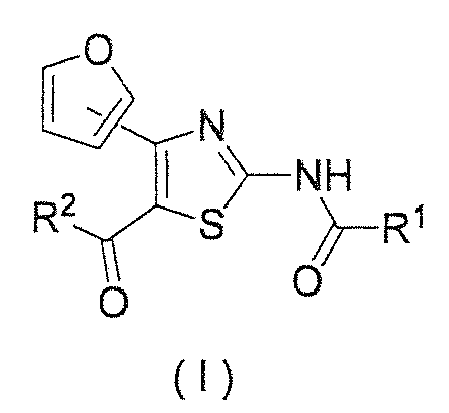
- wherein R1 represents aryl, aralkyl, an aromatic heterocyclic group, aromatic heterocycle-alkyl, aliphatic heterocycle-alkyl or tetrahydropyranyloxy, each of which is optionally substituted by 1 to 3 substituents selected from the group consisting of halogen; lower alkyl optionally substituted by lower alkoxy or morpholino; lower alkoxy; lower alkanoyl; and vinyl, and R2 represents pyridyl or tetrahydropyranyl, or a pharmaceutically acceptable salt thereof.
- (36) The method of (35), wherein. R1 is phenyl, pyridyl, pyrimidinyl, 5,6-dihydro-2H-pyridylmethyl or tetrahydropyranyloxy, each of which is optionally substituted by 1 to 3 substituents selected from a fluorine atom, a chlorine atom, a bromine atom, methyl, ethyl, methoxy and ethoxy, and R2 is pyridyl or tetrahydropyranyl.
- (37) The method of (35), wherein R1 is pyridyl or pyrimidinyl, each of which is optionally substituted by 1 to 3 substituents selected from the group consisting of halogen; lower alkyl optionally substituted by lower alkoxy or morpholino; lower alkoxy; lower alkanoyl; and vinyl.
- (38) The method of any one of (35) - (37), wherein R2 is pyridyl.
- (39) The method of any one of (35) - (37), wherein R2 is tetrahydropyranyl.
- (40) The method of (35), wherein the thiazole derivative represented by the formula (I) is a compound represented by any one of the following formulas (IA) - (IAA).
-


-
- (41) The method of any one of (35) - (40), wherein the movement disorder is extrapyramidal syndrome.
- (42) The method of any one of (35) - (40), wherein the movement disorder is bradykinesia, gait disturbance, dystonia, dyskinesia or tardive dyskinesia.
- (43) The method of any one of (35) - (40), wherein the movement disorder is a side effect of L--DOPA and/or dopamine agonist therapy.
- (44) The method of (43), wherein the side effect is a motor complication.
- (45) The method of (44), wherein the motor complication is wearing-off phenomenon.
- (46) The method of (44), wherein the motor complication is on-off fluctuation.
- (47) The method of (44), wherein the motor complication is dyskinesia.
- (48) The method of any one of (35) - (47), wherein the movement disorder is that developed in an advanced stage of Parkinson's disease.
- (49) A method of treating and/or preventing Parkinson's disease, comprising administering (a) an effective amount of a thiazole derivative represented by the formula (I)
-

- wherein R1 represents aryl, aralkyl, an aromatic heterocyclic group, aromatic heterocycle-alkyl, aliphatic heterocycle-alkyl or tetrahydropyranyloxy, each of which is optionally substituted by 1 to 3 substituents selected from the group consisting of halogen; lower alkyl optionally substituted by lower alkoxy or morpholino; lower alkoxy; lower alkanoyl; and vinyl, and R2 represents pyridyl or tetrahydropyranyl, or a pharmaceutically acceptable salt thereof, and (b) an effective amount of L-DOPA and/or a dopamine agonist, simultaneously or separately at an interval.
- (50) The method of (49), wherein R1 is phenyl, pyridyl, pyrimidinyl, 5,6-dihydro-2H-pyridylmethyl or tetrahydropyranyloxy, each of which is optionally substituted by 1 to 3 substituents selected from a fluorine atom, a chlorine atom, a bromine atom, methyl, ethyl, methoxy and ethoxy, and R2 is pyridyl or tetrahydropyranyl.
- (51) The method of (49), wherein R1 is pyridyl or pyrimidinyl, each of which is optionally substituted by 1 to 3 substituents selected from the group consisting of halogen; lower alkyl optionally substituted by lower alkoxy or morpholino; lower alkoxy; lower alkanoyl; and vinyl.
- (52) The method of any one of (49) - (51), wherein R2 is pyridyl.
- (53) The method of any one of (49) - (51), wherein R2 is tetrahydropyranyl.
- (54) The method of (49), wherein the thiazole derivative represented by the formula (I) is a compound represented by any one of the following formulas (IA) - (IAA).
-





-
- (55) The method of any one of (49) - (54), wherein the Parkinson's disease is that in an advanced stage.
- (56) A thiazole derivative represented by the formula (I)
-

- wherein R1 represents aryl, aralkyl, an aromatic heterocyclic group, aromatic heterocycle-alkyl, aliphatic heterocycle-alkyl or tetrahydropyranyloxy, each of which is optionally substituted by 1 to 3 substituents selected from the group consisting of halogen; lower alkyl optionally substituted by lower alkoxy or morpholino; lower alkoxy; lower alkanoyl; and vinyl, and R2 represents pyridyl or tetrahydropyranyl, or a pharmaceutically acceptable salt thereof, for use in the treatment and/or prophylaxis of a movement disorder.
- (57) The thiazole derivative or a pharmaceutically acceptable salt thereof of (56), wherein R1 is phenyl, pyridyl, pyrimidinyl, 5,6-dihydro-2H-pyridylmethyl or tetrahydropyranyloxy, each of which is optionally substituted by 1 to 3 substituents selected from a fluorine atom, a chlorine atom, a bromine atom, methyl, ethyl, methoxy and ethoxy, and R2 is pyridyl or tetrahydropyranyl.
- (58) The thiazole derivative or a pharmaceutically acceptable salt thereof of (56), wherein R1 is pyridyl or pyrimidinyl, each of which is optionally substituted by 1 to 3 substituents selected from the group consisting of halogen; lower alkyl optionally substituted by lower alkoxy or morpholino; lower alkoxy; lower alkanoyl; and vinyl.
- (59) The thiazole derivative or a pharmaceutically acceptable salt thereof of any one of (56) - (58), wherein R2 is pyridyl.
- (60) The thiazole derivative or a pharmaceutically acceptable salt thereof of any one of (56) - (58), wherein R2 is tetrahydropyranyl.
- (61) The thiazole derivative or a pharmaceutically acceptable salt thereof of (56), wherein the thiazole derivative represented by the formula (I) is a compound represented by any one of the following formulas (IA) - (IAA).
-





-
- (62) The thiazole derivative or a pharmaceutically acceptable salt thereof of any one of (56) - (61), wherein the movement disorder is extrapyramidal syndrome.
- (63) The thiazole derivative or a pharmaceutically acceptable salt thereof of any one of (56) - (61), wherein the movement disorder is bradykinesia, gait disturbance, dystonia, dyskinesia or tardive dyskinesia.
- (64) The thiazole derivative or a pharmaceutically acceptable salt thereof of any one of (56) - (61), wherein the movement disorder is a side effect of L-DOPA and/or dopamine agonist therapy.
- (65) The thiazole derivative or a pharmaceutically acceptable salt thereof of (64), wherein the side effect is a motor complication.
- (66) The thiazole derivative or a pharmaceutically acceptable salt thereof of (65), wherein the motor complication is wearing-off phenomenon.
- (67) The thiazole derivative or a pharmaceutically acceptable salt thereof of (65), wherein the motor complication is on-off fluctuation.
- (68) The thiazole derivative or a pharmaceutically acceptable salt thereof of (65), wherein the motor complication is dyskinesia.
- (69) The thiazole derivative or a pharmaceutically acceptable salt thereof of any one of (56) - (68), wherein the movement disorder is that developed in an advanced stage of Parkinson's disease.
- (70) A compound represented by any one of the following formulas (IE) - (IAA), or a pharmaceutically acceptable salt thereof.
-


-
- (71) A combination of (a) a thiazole derivative represented by the formula (I)
-

- wherein R1 represents aryl, aralkyl, an aromatic heterocyclic group, aromatic heterocycle-alkyl, aliphatic heterocycle-alkyl or tetrahydropyranyloxy, each of which is optionally substituted by 1 to 3 substituents selected from the group consisting of halogen; lower alkyl optionally substituted by lower alkoxy or morpholino; lower alkoxy; lower alkanoyl; and vinyl, and R2 represents pyridyl or tetrahydropyranyl, or a pharmaceutically acceptable salt thereof, and (b) L-DOPA and/or a dopamine agonist, for use in the treatment and/or prophylaxis of Parkinson's disease.
- (72) The combination of (71), wherein the use is for administering (a) and (b) simultaneously or separately at an interval.
- (73) The combination of (71) or (72), wherein R1 is phenyl, pyridyl, pyrimidinyl, 5,6-dihydro-2H-pyridylmethyl or tetrahydropyranyloxy, each of which is optionally substituted by 1 to 3 substituents selected from a fluorine atom, a chlorine atom, a bromine atom, methyl, ethyl, methoxy and ethoxy, and R2 is pyridyl or tetrahydropyranyl.
- (74) The combination of (71) or (72), wherein R1 is pyridyl or pyrimidinyl, each of which is optionally substituted by 1 to 3 substituents selected from the group consisting of halogen; lower alkyl optionally substituted by lower alkoxy or morpholino; lower alkoxy; lower alkanoyl; and vinyl.
- (75) The combination of any one of (71) - (74), wherein R2 is pyridyl.
- (76) The combination of any one of (71) - (74), wherein R2 is tetrahydropyranyl.
- (77) The combination of (71) or (72), wherein the thiazole derivative represented by the formula (I) is a compound represented by any one of the following formulas (IA) - (IAA).
-


-
- (78) The combination of any one of (71) - (77), wherein the Parkinson's disease is that in an advanced stage.
- (79) Use of a thiazole derivative represented by the formula (I)
-

- wherein R1 represents aryl, aralkyl, an aromatic heterocyclic group, aromatic heterocycle-alkyl, aliphatic heterocycle-alkyl or tetrahydropyranyloxy, each of which is optionally substituted by 1 to 3 substituents selected from the group consisting of halogen; lower alkyl optionally substituted by lower alkoxy or morpholino; lower alkoxy; lower alkanoyl; and vinyl, and R2 represents pyridyl or tetrahydropyranyl, or a pharmaceutically acceptable salt thereof, for the manufacture of an agent for the treatment and/or prophylaxis of a movement disorder.
- (80) The use of (79), wherein R1 is phenyl, pyridyl, pyrimidinyl, 5,6-dihydro-2H-pyridylmethyl or tetrahydropyranyloxy, each of which is optionally substituted by 1 to 3 substituents selected from a fluorine atom, a chlorine atom, a bromine atom, methyl, ethyl, methoxy and ethoxy, and R2 is pyridyl or tetrahydropyranyl.
- (81) The use of (79), wherein R1 is pyridyl or pyrimidinyl, each of which is optionally substituted by 1 to 3 substituents selected from the group consisting of halogen; lower alkyl optionally substituted by lower alkoxy or morpholino; lower alkoxy; lower alkanoyl; and vinyl.
- (82) The use of any one of (79) - (81), wherein R2 is pyridyl.
- (83) The use of any one of (79) - (81), wherein R2 is tetrahydropyranyl.
- (84) The use of (79), wherein the thiazole derivative represented by the formula (I) is a compound represented by any one of the following formulas (IA) - (IAA).
-


-
- (85) The use of any one of (79) - (84), wherein the movement disorder is extrapyramidal syndrome.
- (86) The use of any one of (79) - (84), wherein the movement disorder is bradykinesia, gait disturbance, dystonia, dyskinesia or tardive dyskinesia.
- (87) The use of any one of (79) - (84), wherein the movement disorder is a side effect of L-DOPA and/or dopamine agonist therapy.
- (88) The use of (87), wherein the side effect is a motor complication.
- (89) The use of (88), wherein the motor complication is wearing-off phenomenon.
- (90) The use of (88), wherein the motor complication is on-off fluctuation.
- (91) The use of (88), wherein the motor complication is dyskinesia.
- (92) The use of any one of (79) - (91), wherein the movement disorder is that developed in an advanced stage of Parkinson's disease.
- (93) Use of (a) a thiazole derivative represented by the formula (I)
-

- wherein R1 represents aryl, aralkyl, an aromatic heterocyclic group, aromatic heterocycle-alkyl, aliphatic heterocycle-alkyl or tetrahydropyranyloxy, each of which is optionally substituted by 1 to 3 substituents selected from the group consisting of halogen; lower alkyl optionally substituted by lower alkoxy or morpholino; lower alkoxy; lower alkanoyl; and vinyl, and R2 represents pyridyl or tetrahydropyranyl, or a pharmaceutically acceptable salt thereof, and (b) L-DOPA and/or a dopamine agonist for the manufacture of an agent for the treatment and/or prophylaxis of Parkinson's disease.
- (94) The use of (93), wherein the agent for the treatment and/or prophylaxis of Parkinson's disease is that for administering (a) and (b) simultaneously or separately at an interval.
- (95) The use of (93) or (94), wherein R1 is phenyl, pyridyl, pyrimidinyl, 5,6-dihydro-2H-pyridylmethyl or tetrahydropyranyloxy, each of which is optionally substituted by 1 to 3 substituents selected from a fluorine atom, a chlorine atom, a bromine atom, methyl, ethyl, methoxy and ethoxy, and R2 is pyridyl or tetrahydropyranyl.
- (96) The agent of (93) or (94), wherein R1 is pyridyl or pyrimidinyl, each of which is optionally substituted by .1 to 3 substituents selected from the group consisting of halogen; lower alkyl optionally substituted by lower alkoxy or morpholino; lower alkoxy; lower alkanoyl; and vinyl.
- (97) The use of any one of (93) - (96), wherein R2 is pyridyl.
- (98) The use of any one of (93) - (96), wherein R2 is tetrahydropyranyl.
- (99) The use of (93) or (94), wherein the thiazole derivative represented by the formula (I) is a compound represented by any one of the following formulas (IA) - (IAA).
-





-
- (100) The use of any one of (93) - (99), wherein the Parkinson's disease is that in an advanced stage.
- The present invention provides an agent for the treatment and/or prophylaxis of a movement disorder, comprising a thiazole derivative or a pharmaceutically acceptable salt thereof as an active ingredient; a pharmaceutical composition comprising (a) a thiazole derivative or a pharmaceutically acceptable salt thereof and (b) L-DOPA and/or a dopamine agonist; an agent for the treatment and/or prophylaxis of Parkinson's disease comprising (a) a thiazole derivative or a pharmaceutically acceptable salt thereof and (b) L-DOPA and/or a dopamine agonist in combination; a kit comprising (a) a first component comprising a thiazole derivative or a pharmaceutically acceptable salt thereof and (b) a second component comprising L-DOPA and/or a dopamine agonist; a thiazole derivative or a pharmaceutically acceptable salt thereof, which has a selective adenosine A2A antagonistic activity and is useful for the treatment of a movement disorder, and the like.
-
-
Fig. 1 shows the effect of compound (IC) on the motor disability score in the Test Example 3. The vertical axis shows the motor disability score, and the horizontal axis shows time (min) after administration. O shows a combination of solvent and L-DOPA, and • shows a combination of compound (IC) and L-DOPA. -
Fig. 2 shows the effect of compound (IC) on the maximum action (minimum motor disability score) in the Test Example 3. The vertical axis shows the minimum motor disability score, and the horizontal axis shows the L-DOPA dasage. O shows a combination of solvent and L-DOPA, and ● shows a combination of compound (IC) and L-DOPA. - The movement disorder is a neurological condition characterized by motor control disorder such as paucity or lack of movement, extrapyramidal syndrome or the like, hypermobilities (e.g., dystonia, dyskinesia, tardive dyskinesia, tremor, chorea, ballism, akathisia, athetosis, bradykinesia, gait disturbance, freezing, rigidity, postural instability, myoclonus, tics or Tourette syndrome, postural reflex disorder or the like) or the like.
- The movement disorder in the agent for the treatment and/or prophylaxis of a movement disorder of the present invention means the above-mentioned movement disorder, and preferably means, for example, motor control disorder such as extrapyramidal syndrome or the like, tremor, chorea, athetosis, bradykinesia, gait disturbance, dystonia, dyskinesia, tardive dyskinesia, postural reflex disorder or the like. Therefore, the agent for the treatment and/or prophylaxis of a movement disorder of the present invention can treat and/or prevent or reduce or suppress these diseases and/or symptoms (e.g., motor control disorder such as extrapyramidal syndrome or the like, tremor, chorea, athetosis, bradykinesia, gait disturbance, dystonia, dyskinesia, tardive dyskinesia, postural reflex disorder or the like, preferably, for example, extrapyramidal syndrome, bradykinesia, gait disturbance, dystonia, dyskinesia, tardive dyskinesia, postural reflex disorder or the like, and more preferably, extrapyramidal syndrome, bradykinesia, gait disturbance, dystonia, dyskinesia, tardive dyskinesia or the like).
- The movement disorder in the agent for the treatment and/or prophylaxis of a movement disorder of the present invention also encompasses side effects of L-DOPA and/or dopamine agonist therapy (e.g., motor complications such as wearing-off phenomenon, on-off fluctuation, dyskinesia or the like).
It is known that although L-DOPA provides robust and rapid therapeutic benefits in Parkinson's disease, eventually, severe and uncomfortable adverse reactions including motor complications such as wearing-off phenomenon, on-off fluctuation, dyskinesia and the like appear(Marsden et al., "Fluctuat ionsind is ability in Parkinson's disease: clinical aspects" In: Marsden, CD, Fahn S., eds. Movement disorders. New York: Butterworth Scientific, p. 96-122 (1982)). It is also known that an administration of L-DOPA alone causes side effects such as nausea, vomiting, anorexia and the like. - A dopamine agonist can also induce dyskinesia. Use of a dopamine agonist is often limited due to neuropsychiatric side effects, particularly, hallucination and psychosis. Although a dopamine agonist provides advantages when used as the adjunct in the treatment with L-DOPA, control thereby of motor complication caused by L-DOPA is extremely difficult or even impossible, as mentioned above (Olanow, Watts and Kollereds., An Algorithm (Decision Tree) for the Management of Parkinson's Disease: Treatment Guidelines, Neurology 56, Suppl. 5 (2001)). Furthermore, it is reported that excessive daytime sleepiness associated with Parkinson's disease may be aggravated by L-DOPA and/or a dopamine agonist (Neurology, vol. 67, p. 853 (2006)).
- The side effects in the L-DOPA and/or dopamine agonist therapy in the present invention refer to the above-mentioned side effects that occur in the treatment and/or prophylaxis of Parkinson's disease and the like using L-DOPA and/or a dopamine agonist. For example, they include motor complications such as wearing-off phenomenon, on-off fluctuation, dyskinesia and the like, nausea, vomiting, anorexia, hallucination and psychological symptom, excessive daytime sleepiness, preferably, motor complications such as wearing-off phenomenon, on-off fluctuation, dyskinesia and the like, and the like. That is, the agent for the treatment and/or prophylaxis of a movement disorder of the present invention can reduce or suppress a side effect that appears on administration of L-DOPA and/or a dopamine agonist, specifically, a motor complication such as wearing-off phenomenon, on-off fluctuation, dyskinesia or the like, nausea, vomiting, anorexia, hallucination and psychological symptom, or excessive daytime sleepiness, preferably, a motor complication such as wearing-off phenomenon, on-off fluctuation, dyskinesia or the like, more preferably, a symptom such as wearing-off phenomenon, dyskinesia or the like.
- As Parkinson's disease progresses, more dopamine cellss die and the remaining cells cannot store sufficient dopamine to maintain its benefits in the L-DOPA and/or dopamine agonist therapy. As a result, the duration of action at each dose decreases and patients need higher or more frequent doses-After 2 - 5 years, as many as 50 - 75% of the patients experience fluctuations in their response to L-DOPA, for example, in length of on-time and the like. Along with the fluctuations, the patients develop wearing-off phenomenon, on-off fluctuation, dyskinesia (involuntary movement) or the like which accompany the fluctuations in the duration of action. Thus, continuation of the L-DOPA and/or dopamine agonist therapy may be difficult due to the onset of such side effects and the like. Therefore, the agent for the treatment and/or prophylaxis of a movement disorder of the present invention can extend the effective time of the treatment with L-DOPA and/or a dopamine agonist by reducing or suppressing the above-mentioned side effects. Particularly, the agent for the treatment and/or prophylaxis of a movement disorder of the present invention can effectively suppress the wearing-off phenomenon or the like, which are problematic in L-DOPA therapy of patients with Parkinson's disease in an advanced stage.
- L-DOPA used for the above-mentioned L-DOPA and/or dopamine agonist therapy may contain L-DOPA or a salt, hydrate, prodrug or the like thereof as an active ingredient, and examples thereof include preparations containing these as an active ingredient and the like. Examples of the commercially available product include Menesit (registered trade mark), EC Doparl (registered trade mark), Doparl (registered trade mark), Madopar (registered trade mark) and the like. The dopamine agonist may contain a dopamine agonist or a salt, hydrate, prodrug or the like thereof as an active ingredient, and examples thereof include preparations containing pramipexole, talipexole, ropinirole, cabergoline, pergolide or the like, or a hydrochloride, mesylate or prodrug thereof or the like as an active ingredient, and the like. Examples of the commercially available product include Domin (registered trade mark), Permax (registered trade mark), Cabaser (registered trade mark) and the like.
- The agent for the treatment and/or prophylaxis of Parkinson's disease of the present invention characteristically comprises a thiazole derivative or a pharmaceutically acceptable salt thereof and L-DOPA and/or a dopamine agonist in combination, and not only can reduce or suppress each symptom of Parkinson's disease, but also can delay the onset of the side effect caused by the administration of the aforementioned L-DOPA and/or a dopamine agonist (e.g., wearing-off phenomenon, on-off fluctuation, dyskinesia or the like) or suppress the symptoms.
- In the following, the compound represented by the formula (I) is referred to as Compound (I). The compounds having other formula numbers are also referred to in the same manner.
The definition of each group in the formula (I) is as follows.
Examples of the lower alkyl moiety of the lower alkyl, the lower alkoxy and the lower alkanoyl include straight or branched alkyl having 1 to 10 carbon atoms, and more specific examples thereof include methyl, ethyl, propyl, isopropyl, butyl, isobutyl, sec-butyl, tert-butyl, pentyl, isopentyl, neopentyl, hexyl, heptyl, octyl, nonyl, decyl and the like. - Examples of the aralkyl include aralkyl having 7 to 16 carbon atoms, and more specific examples thereof include benzyl, phenethyl, phenylpropyl, phenylbutyl, phenylpentyl, phenylhexyl, phenylheptyl, phenyloctyl, phenylnonyl, phenyldecyl, naphthylmethyl, naphthylethyl, naphthylpropyl, naphthylbutyl, naphthylpentyl, naphthylhexyl, anthrylmethyl, anthrylethyl and the like.
- Examples of the aryl include aryl having 6 to 14 carbon atoms, and more specific examples thereof include phenyl, naphthyl, azulenyl, anthryl and the like.
Examples of the aromatic heterocyclic group include a 5-membered or 6-membered monocyclic aromatic heterocyclic group containing at least one atom selected from a nitrogen atom, an oxygen atom and a sulfur atom, a bicyclic or tricyclic fused aromatic heterocyclic group in which 3 to 8-membered rings are fused, having at least one atom selected from a nitrogen atom, an oxygen atom, and a sulfur atom, and the like. More specific examples thereof include furyl, thienyl, pyrrolyl, imidazolyl, pyrazolyl, oxazolyl, isoxazolyl, oxadiazolyl, thiazolyl, isothiazolyl, thiadiazolyl, triazolyl, tetrazolyl, pyridyl, pyridazinyl, pyrimidinyl, pyrazinyl, triazinyl, benzofuranyl, benzothiophenyl, benzoxazolyl, benzothiazolyl, isoindolyl, indolyl, indazolyl, benzimidazolyl, benzotriazolyl, oxazolopyrimidinyl, thiazolopyrimidinyl, pyrrolopyridinyl, pyrrolopyrimidinyl, imidazopyridinyl, purinyl, quinolinyl, isoquinolinyl, cinnolinyl, phthalazinyl, quinazolinyl, quinoxalinyl, naphthyridinyl, furo[2,3-b]pyridyl, 6,7-dihydro-5H-cyclopenta[b]pyridyl, 7,8-dihydro-5H-pyrano[4,3-b]pyridyl, 7,8-dihydro-5H-thiopyrano[4,3-b]pyridyl and the like. - Examples of the aromatic heterocycle-alkyl include a group wherein an aromatic heterocyclic group is bonded to alkylene. The aromatic heterocyclic group include those exemplified in the above-mentioned aromatic heterocyclic group, and the alkylene include an alkylene having 1 to 10 carbon atoms, and specific examples thereof include methylene, ethylene, trimethylene, propylene, tetramethylene, pentamethylene, hexamethylene, heptamethylene, octamethylene, nonamethylene, decamethylene and the like. Specific examples of the aromatic heterocycle-alkyl include pyrrolylmethyl, pyrrolylethyl, thiazolylmethyl, pyridylmethyl, pyridylethyl, pyrimidinylmethyl, pyrimidinylethyl, indolylmethyl, benzimidazolylmethyl and the like.
- Examples of the aliphatic heterocycle-alkyl include a group wherein the aliphatic heterocyclic group is bonded to alkylene. Examples of the aliphatic heterocyclic group include a 5-membered or 6-membered monocyclic aliphatic heterocyclic group containing at least one atom selected from a nitrogen atom, an oxygen atom and a sulfur atom, a bicyclic or tricyclic fused aliphatic heterocyclic group in which 3 to 8-membered rings are fused, having at least one atom selected from a nitrogen atom, an oxygen atom, and a sulfur atom, and the like. More specific examples thereof include aziridinyl, azetidinyl, pyrrolidinyl, piperidino, piperidinyl, azepanyl, 1,2,5,6-tetrahydropyridyl, imidazolidinyl, pyrazolidinyl, piperazinyl, homopiperazinyl, pyrazolinyl, oxiranyl, tetrahydrofuranyl, tetrahydro-2H-pyranyl, 5,6-dihydro-2H-pyranyl, 5,6-dihydro-2H-pyridyl, oxazolidinyl, morpholino, morpholinyl, thioxazolidinyl, thiomorpholinyl, 2H-oxazolyl, 2H-thioxazolyl, dihydroindolyl, dihydroisoindolyl, dihydrobenzofuranyl, benzimidazolidinyl, dihydrobenzoxazolyl, dihydrobenzothioxazolyl, benzodioxolinyl, tetrahydroquinolyl, tetrahydroisoquinolyl, dihydro-2H-chromanyl, dihydro-1H-chromanyl, dihydro-2H-thiochromanyl, dihydro-1H-thiochromanyl, tetrahydroquinoxalinyl, tetrahydroquinazolinyl, dihydrobenzodioxanyl and the like. Examples of the alkylene include alkylene having 1 to 10 carbon atoms, and specific examples thereof include methylene, ethylene, trimethylene, propylene, tetramethylene, pentamethylene, hexamethylene, heptamethylene, octamethylene, nonamethylene, decamethylene and the like. Specific examples of the aliphatic heterocycle-alkyl include 5,6-dihydro-2H-pyridylmethyl, 5,6-dihydro-2H-pyridylethyl, tetrahydro-2H-pyranylmethyl, 5,6-dihydro-2H-pyranylmethyl, 5,6-dihydro-2H-pyranylethyl, morpholinomethyl, morpholinoethyl, piperazinylmethyl, oxazolidinylmethyl and the like.
- The halogen means each atom of fluorine, chlorine, bromine and iodine.
Compound (I) or a pharmaceutically acceptable salt thereof of the present invention or used in the present invention is preferably a compound having a potent antagonistic activity against adenosine A2A receptors from among various subtypes of adenosine receptors (e.g., adenosine A1, A2A, A2B and A3 receptors).
Accordingly, Compound (I) or a pharmaceutically acceptable salt thereof of the present invention or used in the present invention is preferably a compound having a strong affinity for the adenosine A2A receptors. For example, the compound is preferably one having an inhibitory activity of 50% or more at a test compound concentration of 3×10⁻⁸ mol/L, more preferably one having an inhibitory activity of 50% or more at a test compound concentration of 1×10⁻⁸ mol/L, still more preferably one having an inhibitory activity of 50% or more at a test compound concentration of 3×10⁻⁹ mol/L, further preferably one having an inhibitory activity of 50% or more at a test compound concentration of 1×10⁻⁹ mol/L, in the adenosine A2A receptor binding test shown in the below-mentioned Test Example 1. In addition, the compound is preferably one having an inhibitory activity of 30 nmol/L or less in an inhibitory constant (Ki value), more preferably one having an inhibitory activity of 10 nmol/L or less, still more preferably one having an inhibitory activity of 3 nmol/L or less, further preferably one having an inhibitory activity of 1 nmol/L or less. - Further, Compound (I) or a pharmaceutically acceptable salt thereof of the present invention or used in the present invention is preferably a compound having selective affinity for the adenosine A2A receptors from among various subtypes of the adenosine receptors. For example, a compound having a higher affinity for the adenosine A2A receptors than that for the adenosine A1 receptors is preferable. Specifically, for example, the compound is preferably a compound having 5 times or more affinity, more preferably 10 times or more affinity, further preferably 50 times or more affinity, even more preferably 100 times or more affinity, most preferably 500 times or more affinity for the adenosine A2A receptors than that for the adenosine A1 receptors.
- The affinity for adenosine receptors can be determined according to a conventional method, for example, according to the method of Test Example 1 to be mentioned below, or the methods described in, for example, a document [for example, Naunyn Schmiedebergs Arch Pharmacol., 355(1), p. 59 (1987); Naunyn Schmiedebergs Arch Pharmacol. 355(2), p. 204 (1987); Br. J. Pharmacol. 117(8), p. 1645 (1996) and the like].
- More specifically, Compound (I) is preferably a compound wherein R1 is phenyl optionally substituted by 1 to 3 substituents selected from halogen, C1-6 alkyl optionally substituted by C1-6 alkoxy or morpholino, C1-6 alkanoyl, vinyl and C1-6 alkoxy; pyridyl optionally substituted by 1 to 3 substituents selected from halogen, C1-6 alkyl optionally substituted by C1-6 alkoxy or morpholino, C1-6 alkanoyl, vinyl and C1-6 alkoxy; pyrimidinyl optionally substituted by 1 to 3 substituents selected from halogen, C1-6 alkyl optionally substituted by C1-6 alkoxy or morpholino, C1-6 alkanoyl, vinyl and C1-6 alkoxy; 5,6-dihydro-2H-pyridylmethyl optionally substituted by 1 to 3 substituents selected from halogen, C1-6 alkyl and C1-6 alkoxy; 2,3,4,5-tetrahydropyranyloxy; pyrrolyl; indolyl; oxazolopyridyl; quinolyl; 1H-3,4-dihydropyranopyridinyl; 1H-3,4-dihydrothiopyranopyridinyl; cyclopentapyridyl; or pyridylmethyl, more preferably a compound wherein R1 is phenyl optionally substituted by 1 to 3 substituents selected from a fluorine atom, a chlorine atom, methyl and methoxy; pyridyl optionally substituted by 1 to 3 substituents selected from a fluorine atom, a chlorine atom, methyl and methoxy; pyrimidinyl optionally substituted by 1 to 3 substituents selected from a fluorine atom, a chlorine atom, methyl and methoxy; 5,6-dihydro-2H-pyridylmethyl optionally substituted by 1 to 3 substituents selected from a fluorine atom, a chlorine atom, methyl and methoxy; or 2,3,4,5-tetrahydropyranyloxy, still more preferably a compound wherein R1 is pyridyl substituted by 1 to 3 substituents selected from a chlorine atom, methyl and methoxy; pyrimidinyl substituted by 1 to 3 substituents selected from chlorine atom, methyl and methoxy; 5,6-dihydro-2H-pyridylmethyl; or 2,3,4,5-tetrahydropyranyloxy. More specifically, Compound (I) is preferably, for example, compounds of the following formulas (IA) - (IAA), and the like.
-






- The pharmaceutically acceptable salts of Compound (I) include, for example, pharmaceutically acceptable acid addition salts, metal salts, ammonium salts, organic amine addition salts, amino acid addition salts, and the like. The pharmaceutically acceptable acid addition salts of Compound (I) include, for example, inorganic acid salts such as hydrochloride, hydrobromate, nitrate, sulfate, and phosphate; organic acid salts such as acetate, oxalate, maleate, fumarate, citrate, benzoate, and methane sulfonate, and the like. Examples of the pharmaceutically acceptable metal salts include alkali metal salts such as a sodium salt, and a potassium salt; alkaline earth metal salts such as a magnesium salt, and a calcium salt; an aluminum salt; a zinc salt, and the like. Examples of the pharmaceutically acceptable ammonium salts include salts of ammonium, tetramethylammonium, and the like. Examples of the pharmaceutically acceptable organic amine addition salts include addition salts of morpholine, piperidine, or the like. Examples of the pharmaceutically acceptable amino acid addition salts include addition salts of lysine, glycine, phenylalanine, aspartic acid, glutamic acid, or the like.
- Compound (I) can be produced according to a known method, for example, the method described in
WO 2005/063743 and the like. -

- wherein R1 and R2 are as defined above, and X is a chlorine atom, a bromine atom or the like.
Specifically, as shown in the above-mentioned formula, Compound (I) can be produced, for example, by reacting compound (Ia) described inWO 2005/063743 with preferably 0.5 to 5 equivalents of compound (Ib) in a solvent such as methanol, dichloromethane, chloroform, toluene, ethyl acetate, acetonitrile, tetrahydrofuran (THF), N,N-dimethylformamide (DMF), N,N-dimethylacetamide (DMA), pyridine, water, or a mixed solvent thereof and the like, preferably in the presence of 1 to 5 equivalents of a condensing agent such as 1,3-dicyclohexanecarbodiimide (DCC), 1-ethyl-3-(3-dimethylaminopropyl)carbodiimide (EDC) hydrochloride and the like, if necessary, in the presence of preferably 1 to 5 equivalents of 1-hydroxybenzotriazole (HOBt) monohydrate, 4-dimethylaminopyridine (DMAP) and the like, at a temperature between -20°C and the boiling point of the solvent used, for 5 min to 72 hr. - Alternatively, Compound (I) can also be produced, for example, by reacting compound (Ia) described in
WO 2005/063743 with preferably 1 to 10 equivalents of compound (Ic) without solvent or in a solvent such as dichloromethane, chloroform, 1,2-dichloroethane, toluene, ethyl acetate, acetonitrile, THF, DMF, DMA, pyridine and the like, if necessary, in the presence of preferably 1 to 10 equivalents of a base such as potassium carbonate, triethylamine, 4-dimethylaminopyridine (DMAP) and the like, at a temperature between -20°C and 150°C, for 5 min to 72 hr. - Compound (I) may exist as stereoisomers such as geometrical isomers or optical isomers, or tautomers. The thiazole derivative or a pharmaceutically acceptable salt thereof of the present invention encompasses all possible isomers including those and mixtures thereof. All possible isomers including those and mixtures thereof can be used for an agent for the treatment and/or prophylaxis of a movement disorder, a pharmaceutical composition, an agent for the treatment and/or prophylaxis of Parkinson's disease, a kit, a method for the treatment and/or prophylaxis of a movement disorder, a method for the treatment and/or prophylaxis of Parkinson's disease, a combination, use for the manufacture of an agent for the treatment and/or prophylaxis of a movement disorder and use for the manufacture of an agent for the treatment and/or prophylaxis of Parkinson's disease, of the present invention.
- To obtain a salt of Compound (I), when the Compound (I) is obtained in the form of a salt, it may be purified as it is. Further, when the compound is obtained in a free form, the compound may be dissolved or suspended in a suitable solvent, followed by addition of an acid or a base to form a salt. Then, the resulting salt may be isolated and purified.
The Compound (I) or a pharmaceutically acceptable salt thereof may exist in the form of an adduct with water or various solvents. Such adduct is also encompassed in the thiazole derivative or a pharmaceutically acceptable salt thereof of the present invention, and can be used for an agent for the treatment and/or prophylaxis of a movement disorder, a pharmaceutical composition, an agent for the treatment and/or prophylaxis of Parkinson's disease, a kit, a method for the treatment and/or prophylaxis of a movement disorder, a method for the treatment and/or prophylaxis of Parkinson's disease, a combination, use for the manufacture of an agent for the treatment and/or prophylaxis of a movement disorder and use for the manufacture of an agent for the treatment and/or prophylaxis of Parkinson's disease, of the present invention. - L-DOPA used for a pharmaceutical composition, an agent for the treatment and/or prophylaxis of Parkinson's disease, a kit, a method for the treatment and/or prophylaxis of Parkinson's disease, a combination and use for the manufacture of an agent for the treatment and/or prophylaxis of Parkinson's disease, of the present invention may contain, as an active ingredient, L-DOPA or a salt, hydrate, prodrug or the like thereof and, for example, a preparation and the like containing these as active ingredients can be used. Such L-DOPA can be obtained, for example, as a commercially available product, or can be produced by a known method. Specific examples of the commercially available product include Menesit (registered trade mark), EC Doparl (registered trade mark), Doparl (registered trade mark), Madopar (registered trade mark) and the like.
- The dopamine agonist used for a pharmaceutical composition, an agent for the treatment and/or prophylaxis of Parkinson's disease, a kit, a method for the treatment and/or prophylaxis of Parkinson's disease, a combination and use for the manufacture of an agent for the treatment and/or prophylaxis of Parkinson's disease, of the present invention may contain, as an active ingredient, a dopamine agonist or a salt, hydrate, prodrug or the like thereof and, for example, a preparation and the like containing these as active ingredients can be used. Specific examples thereof include pramipexole, talipexole, ropinirole, cabergoline, pergolide and the like, or a hydrochloride, mesylate, prodrug thereof and the like, and a preparation and the like containing these as active ingredients can also be used. Such dopamine agonist can be obtained, for example, as a commercially available product, or can be produced by a known method. Specific examples of the commercially available product include Domin (registered trade mark), Permax (registered trade mark), Cabaser (registered trade mark) and the like.
- The pharmaceutical preparation according to an agent for the treatment and/or prophylaxis of a movement disorder, a method for the treatment and/or prophylaxis of a movement disorder and use for the manufacture of an agent for the treatment and/or prophylaxis of a movement disorder, of the present invention may contain, as the active ingredient, Compound (I) or a pharmaceutically acceptable salt thereof either alone or as a mixture with any other therapeutic active ingredient. Furthermore, these pharmaceutical preparations are prepared by mixing the active ingredient with one or more pharmaceutically acceptable carriers (for example, diluents, solvents, excipients, or the like), and then subjecting the mixture to any method well-known in the technical field of pharmaceutics.
- As for the administration route, it is preferable to select the most effective route of administration for treatment. Examples of the administration route include oral administration, and parenteral administration, for example, such as intravenous or transdermal administration and the like.
Examples of the dosage form include tablets, injections, external preparations, and the like.
Suitable dosage forms for the oral administration, for example, tablets, can be prepared by using excipients such as lactose, disintegrators such as starch, lubricants such as magnesium stearate, or binders such as hydroxypropylcellulose, or the like. - Suitable dosage forms for the parenteral administration, for example, injections, can be prepared by using diluents or solvents such as a saline solution, a glucose solution, or a mixture of brine and glucose solution, or the like. A dosage form suitable for external preparation is not particularly limited and, for example, ointment, cream, liniment, lotion, cataplasm, plaster, tape and the like can be included. For example, ointment, cream and the like can be produced by, for example, dissolving or mixing-dispersing the active ingredient in a base such as white petrolatum and the like.
- The dose and administration frequency of Compound (I) or a pharmaceutically acceptable salt thereof varies depending on the efficacy, dose and/or administration form, age and body weight of patients, properties or severity of the symptoms to be treated and the like. For general oral administration, 0.001 - 1000 mg, preferably 0.05 - 100 mg, is administered to one adult in one to several portions a day. For parenteral administration such as intravenous administration and the like, 0.001 - 1000 mg, preferably 0.01 - 100 mg, is generally administered to one adult in one to several portions a day.
For transdermal administration, an external preparation containing 0.001 - 10% of Compound (I) or a pharmaceutically acceptable salt thereof is generally applied once to several times a day. However, these doses and administration frequencies vary depending on the aforementioned various conditions. - The agent for the treatment and/or prophylaxis of a movement disorder, the method of treating and/or preventing a movement disorder and the thiazole derivative or a pharmaceutically acceptable salt thereof for use in the treatment and/or prophylaxis of a movement disorder of the present invention shows a superior therapeutic and/or prophylactic, or reducing and/or suppressive effect on a movement disorder such as extrapyramidal syndrome, bradykinesia, gait disturbance, dystonia, dyskinesia, tardive dyskinesia or the like; and a side effect of L-DOPA and/or dopamine agonist therapy such as wearing-off phenomenon, on-off fluctuation, dyskinesia or the like. Particularly, it shows a superior therapeutic and/or prophylactic, or reducing and/or suppressive effect on the above-mentioned disease developed in Parkinson's disease in an advanced stage (e.g., a movement disorder such as extrapyramidal syndrome, bradykinesia, gait disturbance, dystonia, dyskinesia, tardive dyskinesia or the like; and a side effect of L-DOPA and/or dopamine agonist therapy such as wearing-off phenomenon, on-off fluctuation, dyskinesia or the like).
- As mentioned above, Compound (I) or a pharmaceutically acceptable salt thereof may be used in combination with one or more other pharmaceutical components.
Examples of the other pharmaceutical components used in combination include known drugs useful as therapeutic and/or prophylactic drug for Parkinson's disease and the like, and the like, and the like (Iyaku (Medicine and Drug) Journal, vol. 44, p. 91 (2008)). Specifically, for example, COMT inhibitors (e.g., entacapone, tolcapone and the like), MAO inhibitors (e.g., selegiline, rasagiline and the like) and the like can be included. - When Compound (I) or a pharmaceutically acceptable salt thereof is used in combination with other pharmaceutical component(s), Compound (I) or a pharmaceutically acceptable salt thereof, and other pharmaceutical component(s) may be administered simultaneously or separately at an interval. The doses vary depending on the administration subject, the administration route, the disease, and the combinations of pharmaceutical component, and the like, and should be decided according to the doses used in the clinic.
-
- (a) Compound (I) or a pharmaceutically acceptable salt thereof and (b) L-DOPA and/or a dopamine agonist used for the pharmaceutical composition, the agent for the treatment and/or prophylaxis of Parkinson's disease, the kit, the method for the treatment and/or prophylaxis of Parkinson's disease, the combination and the use for the manufacture of an agent for the treatment and/or prophylaxis of Parkinson's disease, of the present invention may be used or administered as a single preparation (combination agent) or as a combination of more than one preparation, provided that these preparations are formulated together with, for example, a pharmaceutically acceptable carrier to contain these active ingredients. In particular, a combination of two or more preparations is preferred. When used or administered as a combination of more than one preparation, the preparations may be used or administered simultaneously or separately at an interval. Preferably, these preparations are used in the form of, for example, tablets, injections, external preparations or the like.
- The dose ratio (weight/weight) of (a) Compound (I) or a pharmaceutically acceptable salt thereof and (b) L-DOPA and/or a dopamine agonist can be appropriately adjusted according to a combination of (a) Compound (I) or a pharmaceutically acceptable salt thereof and (b) L-DOPA and/or a dopamine agonist used, efficacy of each of (a) Compound (I) or a pharmaceutically acceptable salt thereof and (b) L-DOPA and/or a dopamine agonist and the like. Specifically for example, it is 1/100000 ((a) Compound (I) or a pharmaceutically acceptable salt thereof/(b) L-DOPA and/or a dopamine agonist) - 1000/1, preferably 1/50000 - 500/1, more preferably 1/6000 - 100/1, further more preferably 1/4000 - 15/1, still further more preferably 1/1000 - 10/1, most preferably 1/100 - 10/1.
- These preparations are prepared by mixing the active ingredient with one or more pharmaceutically acceptable carriers (for example, diluents, solvents, excipients, or the like), and then subjecting the mixture to any method well known in the technical field of pharmaceutics.
Suitable dosage forms for the oral administration, for example, tablets, can be prepared by using excipients such as lactose, disintegrators such as starch, lubricants such as magnesium stearate, binders such as hydroxypropylcellulose, or the like. - Suitable dosage forms for the parenteral administration, for example, injections, can be prepared by using diluents or solvents such as a saline solution, a glucose solution, or a mixture of brine and glucose solution, or the like. A dosage form suitable for external preparation is not particularly limited to and, for example, ointment, cream, liniment, lotion, cataplasm, plaster, tape and the like can be included. For example, ointment, cream and the like can be produced by, for example, dissolving or mixing-dispersing the active ingredient in a base such as white petrolatum and the like.
- When administered as a combination of more than one preparation, for example, (a) a first component comprising Compound (I) or a pharmaceutically acceptable salt thereof, and (b) a second component comprising L-DOPA and/or a dopamine agonist may be separately prepared into a kit, and may be administered to the same subject in the same route or in different routes simultaneously or separately at an interval, using the kit.
- As the kit, for example, a kit comprising contents and two or more containers (for example, vials, bags, etc.) whose material, shape, and so on are not particularly limited as long as the containers do not cause degeneration of the components which are the contents due to external temperature or light nor cause elution of chemical components from the containers during storage, and having a form which enables the administration of the above first and second components which are the contents through separate routes (for example, tubes, etc.) or the same route is used. Specific examples thereof include tablet kits, injection kits, and the like.
- When (a) Compound (I) or a pharmaceutically acceptable salt thereof and (b) L-DOPA and/or a dopamine agonist are used or administered as a combination of plural preparations for the above-mentioned objects, the dose and administration frequency vary depending on the efficacy of each active ingredient, dosage form, age and body weight of a patient, symptom, and the like. It is preferable to administer each of (a) Compound (I) or a pharmaceutically acceptable salt thereof and (b) L-DOPA and/or a dopamine agonist usually at the following dose per day.
- For oral administration as, for example, tablet, (a) Compound (I) or a pharmaceutically acceptable salt thereof and (b) L-DOPA and/or a dopamine agonist are administered at 0.1 - 1000 mg and 0.1 - 10000 mg, preferably 0.1 - 500 mg and 0.1 - 5000 mg, more preferably 0.5 - 500 mg and 1 - 3000 mg, still more preferably 0.5 - 300 mg and 1 - 2000 mg, respectively, per one adult simultaneously or separately at an interval in one to several portions a day usually.
- For parenteral administration as, for example, injection and the like, (a) Compound (I) or a pharmaceutically acceptable salt thereof and (b) L-DOPA and/or a dopamine agonist are administered at 0.1 - 1000 mg and 0.1 - 10000 mg, preferably 0.1 - 500 mg and 0.1 - 5000 mg, more preferably 0.5 - 500 mg and 1 - 3000 mg, still more preferably 0.5 - 300 mg and 1 - 2000 mg, respectively, per one adult simultaneously or separately at an interval in one to several portions a day usually.
- When (a) Compound (I) or a pharmaceutically acceptable salt thereof and (b) L-DOPA and/or a dopamine agonist are used or administered as a single preparation for the above-mentioned objects, the dose and administration frequency vary depending on the efficacy of each active ingredient, dosage form, age and body weight of a patient, symptom, and the like. It is preferable to prepare one preparation containing each dose in the use or administration of a combination of the above-mentioned plural preparations, and use or administer same.
- However, such dose and administration frequency vary depending on the aforementioned various conditions.
A pharmaceutical composition, an agent for the treatment and/or prophylaxis of Parkinson's disease, a kit, a method for the treatment and/or prophylaxis of Parkinson's disease, and a combination of the present invention can be used for, for example, the treatment and/or prophylaxis of Parkinson's disease, more specifically, for patients, for example, patients with Parkinson's disease in an advanced stage, patients with Parkinson's disease who developed symptoms of on-off fluctuation, wearing-off phenomenon, dyskinesia or the like due to L-DOPA therapy or the like, and the like, and can effectively treat these diseases. - Next, the therapeutic effect of Compound (I) or a pharmaceutically acceptable salt thereof on movement disorders, the effect of combined administration of (a) Compound (I) or a pharmaceutically acceptable salt thereof and (b) L-DOPA and/or a dopamine agonist and the like are specifically explained in the following Test Examples.
- The test can be performed according to, for example, the method of Varani et al. (British Journal of Pharmacology, 1996, 117, p. 1693).
- Specifically, for example, human recombinant receptors are expressed in HEK-293 cells. The cell membranes of the receptor-expressing cells are collected, and a cell membrane suspension is prepared. After dilution with tris(hydroxymethyl)-aminomethane hydrochloride (Tris HCl) buffer, tritium-labeled CGS-21680 (3H-2-[p-(2-carboxyethyl)phenethylamino]-5'-(N-ethylcarboxamido)adenosine: 50 mmol/L) and a test compound solution (dimethyl sulfoxide solution of the test compound) are added to the cell membrane suspension for binding to the receptors. After the reaction, the mixture is subjected to rapid suction filtration using glass-fiber filter paper, and the radioactivity of the glass-fiber filter paper is measured. In this way, the inhibitory rate of the test compound for the human adenosine A2A receptor binding (3H-CGS21680 binding) can be determined.
- The test can also be performed according to the method of Bruns et al. (Molecular Pharmacology, Vol. 29, p. 331, 1986).
Specifically, for example, rat striatum is suspended in 50 mL of ice-cooled Tris HCl buffer (50 mmol/L, pH 7.7) using a Polytron homogenizer and the suspension is centrifuged. The resulting precipitate is resuspended by adding Tris HCl buffer (50 mmol/L) thereto, followed by centrifugation in the same manner. The resulting final precipitate is suspended in Tris HCl buffer (50 mmol/L) [containing magnesium chloride (10 mmol/L), and adenosine deaminase (0.02 units/mg tissue)] to prepare the suspension at the tissue concentration of 5 mg (wet weight)/mL. Tritium-labeled CGS-21680 (final concentration of 6.0 mmol/L), and the test compound solution (dimethylsulfoxide solution of test compound diluted with Tris HCl buffer) are added. The mixture is allowed to stand at 25°C for 120 minutes, followed by rapid suction filtration using glass-fiber filter paper, and then immediately washed with ice-cooled Tris HCl buffer (50 mmol/L). The glass-fiber filter paper is then placed in a vial, and MicroScinti (PKI) is added. Then, the radioactivity is measured with a TopCount (PerkinElmer), whereby the inhibitory rate for rat adenosine A2A receptor binding (3H-CGS21680 binding) of the test compound can be determined. - The inhibitory rate can be calculated by the following equation.
-

- In the equation, the total amount of binding refers to the bound radioactivity of 3H-CGS21680 in the absence of the test compound. The amount of non-specific binding refers to the bound radioactivity of 3H-CGS21680 in the presence of 50 µmol/L of 5'-N-ethylcarboxamideadenosine (NECA) or 100 µmol/L of cyclopentyladenosine (CPA). The amount of binding in the presence of drug refers to the bound radioactivity of 3H-CGS21680 in the presence of the test compound.
In the above test, the inhibitory rate for the adenosine A2A receptor at different concentrations of the test compound or a pharmaceutically acceptable salt thereof, and the test compound concentration at which the test compound inhibits binding by 50% (IC50) can be calculated by appropriately adjusting the concentration of the test compound. - The inhibition constant (Ki value) of the test compound for the adenosine A2A receptor binding can be calculated according to the following equation.
-

- In the equation, L denotes the concentration of the 3H-CGS21680 used in the test, and Kd is the dissociation constant of the 3H-CGS21680 used in the test.
Instead of 3H-CGS21680, 3H-SCH58261 (3H-5-amino-7-(2-phenylethyl)-2-(2-furyl)pyrazolo[4,3-e]-1,2,4-triazolo[1,5-c]pyrimidine) and the like may be used. - The inhibition constant (Ki value) of the test compound for the adenosine A1 receptor can be calculated in the same manner as in (1), using the materials below.
- Specifically, for example, human A1 receptor-expressing CHO cell membranes are used, and, as the labeled compound, for example, tritium-labeled DPCPX (1,3-dipropyl-8-cyclopentylxanthine) is used. The amount of non-specific binding can be determined by measuring the 3H-DPCPX bound radioactivity in the presence of, for example, 100 µmol/L of R(-)-PIA((-)-N6-2-phenylisopropyl adenosine). The affinity of the test compound for the human adenosine A1 receptors can be confirmed in this manner.
- Alternatively, for example, rat A1 receptor-expressing cell membrane (PerkinElmer) is used, and as the labeled compound, for example, tritium-labeled CHA (N6-cyclohexyladenosine) is used. For the measurement of the amount of non-specific binding, 3H-CHA bound radioactivity is measured in the presence of, for example, 10 µmol/L of DPCPX, and the affinity of the test compound for the rat adenosine A1 receptor can be confirmed.
- By the foregoing tests (1) and (2), the selective affinities of the thiazole derivative or a pharmaceutically acceptable salt thereof used in the present invention for the adenosine A2A receptor can be confirmed.
- Some of the examples of the affinities of Compound (I) or a pharmaceutically acceptable salt thereof for the adenosine A1 receptor and the adenosine A2A receptor are presented below. Note that the test results below are those measured by MDS Pharma Services Inc. according to the foregoing methods.
-
[Table 1] Table 1 The affinities for adenosine receptors compound No. Inhibitory rate for human adenosine A2A receptor binding (3H-CGS21680 binding)* Inhibitory rate for human adenosine A1 receptor binding (3H-DPCPX binding)* (IA) 92% 14% (IB) 98% 4% (IC) 88% 29% (ID) 100% 28% * Inhibitory rate at compound of 100 nmol/L - In the same manner as in the above-mentioned Test Example 1, the affinity of compound (IE) - (IAA) for adenosine receptor was confirmed (test results were those measured by Ricerca Biosciences, LLC according to the foregoing methods).
-
[Table 2] Table 2 The affinities for adenosine receptors compound No. Inhibitory rate for human adenosine A2A receptor binding (3H-CGS21680 binding)* Inhibitory rate for human adenosine A1 receptor binding (3H-DPCPX binding)* compound No. Inhibitory rate for human adenosine A2A receptor binding (3H-CGS21680 binding)* Inhibitory rate for human adenosine A1 receptor binding (3H-DPCPX binding)* (IE) 93% 33% (IF) 107% 50% (IG) 102% 91% (IH) 98% 67% (II) 85% 19% (IJ) 93% 21% (IK) 92% 24% (IL) 85% 20% (IM) 98% 47% (IN) 93% 21% (IO) 97% 56% (IP) 98% 18% (IQ) 100% 18% (IR) 107% 30% (IS) 90% 10% (IT) 91% 37% (IU) 110% 36% (IV) 98% 23% (IW) 98% 23% (IX) 101% 18% (IY) 97% 8% (IZ) 102% 21% (IAA) 98% 9% * Inhibitory rate at compound of 100 nmol/L - From the above tests, it is comfirmed that Compound (I) shows selective affinity for the adenosine A2A receptor. Test Example 3 Therapeutic effect of combination of L-DOPA and the thiazole derivative of the present invention or a pharmaceutically acceptable salt thereof on common marmoset that developed Parkinson's disease symptom by treatment with 1-methyl-4-phenyl-1,2,3,6-tetrahydropyridine (MPTP)
Parkinson's disease is a disease based on the progressive degeneration and loss of dopaminergic neuron in substantia nigra-striatum. In primates, a treatment with MPTP, which is a dopamine neurotoxin, causes selective degeneration and loss of dopaminergic neuron in substantia nigra-striatum and induces symptoms of akinesia, muscle rigidity and the like. The primates treated with MPTP are known as the model of Parkinson's disease [Proceedings of the National Academy of Science USA, vol. 80, p.4546 (1983)]. In addition, common marmoset belongs to Haplorhini and is known to show the symptoms of Parkinson's disease by MPTP, like other Haplorhini [Neuroscience Letter, vol. 57, p.37 (1985)]. 2 mg/kg of MPTP (Sigma-Aldrich Co. Ltd.) was subcutaneously administered to the back of common marmoset (CLEA Japan, Inc.) once a day for 5 days, and 1-2 mg/kg of MPTP was additionally administered subcutaneously once or twice to the back about 3 weeks after first administration to prepare common marmoset exhibited chronic parkinsonian symptoms (lower locomotor activity, bradykinesia, gait disturbance, abnormal postures, aless coordinated movements, decreased vocalization and the like) (MPTP-treated marmoset), and the marmoset was used for the test. The parkinsonian symptoms were judged using the index described in a previous report [Annales of Neurology, vol. 43, p.507 (1998)]. The observation items and scores are shown in Table 2. All compounds were used as a suspension in 0.5% MC400, 10% aqueous sucrose solution. The subject animal was placed in an observation cage (with locomotor activity measuring apparatus) one day before the test compound administration for preconditioning to the environment. The symptoms of Parkinson's disease were continuously monitored through one-way mirror and disability score was scored each 10 min for 6 hr. -
[Table 3] Table 3 Disability Rating Scale Used in Common Marmoset Items score 0 1 2 3 4 Alertness Normal Reduced Sleepy - - Checking Movement Present Reduced Absent - - Attention Blinking Normal Abnormal - - - Posture Normal abnormality of trunk, upper limb, lower limb, tail: each 1 point Grossly Abnormal Balance/Coordi nation Normal Impaired Unstable Falls - Reaction to stimuli Normal Reduced Slow Absent - Vocalization Normal Reduced Absent - - - The locomotor activity was automatically measured using a computer by a measuring apparatus with a photocell. When 2.5, 5.0, 7.5 and 10.0 mg/kg of L-DOPA (each containing 1/4 amount of dopa decarboxylase inhibitor (benserazide hydrochloride)) were each administered, the parkinsonian symptoms in MPTP-treated marmoset decreased within increasement of the dosage. 1 mg/kg of compound (IC) and L-DOPA were simultaneously administered orally. Co-administration of compound (IC) (1 mg/kg) with the various doses of L-DOPA(2.5, 5.0, 7.5 and 10.0 mg/kg: each containing 1/4 amount of benserazide hydrochloride) prolonged the anti-parkinsonian activity of L-DOPA, and slso enhanced maximum effects of L-DOPA alone. The time course of influence on motor disability score when 1 mg/kg of compound (IC) and 10 mg/kg of L-DOPA were simultaneously administered orally in combination is shown in
Fig. 1 . When 1 mg/kg of compound (IC) and 10 mg/kg of L-DOPA were simultaneously administered orally in combination, the action expression time (on-time) increased as compared to the treatment with 10 mg/kg of L-DOPA alone. In addition, the maximum improvement values of motor disability score when 1 mg/kg of compound (IC) and each dose of L-DOPA (2.5, 5.0, 7.5 and 10.0 mg/kg: each containing 1/4 amount of benserazide hydrochloride) were simultaneously administered orally in combination, and when treated with L-DOPA alone are shown inFig. 2 . When 1 mg/kg of compound (IC) and each dose of L-DOPA were simultaneously administered orally in combination, the intensity of the maximum improving maximum effects by each dose of L-DOPA was enhanced. - From the above-mentioned test, Compound (I) is considered to have effects of enhancing the therapeutic effect of L-DOPA on Parkinson's disease and prolonging the duration of therapeutic effect of L-DOPA on Parkinson's disease. Test Example 4 Therapeutic effect of combination of L-DOPA and the thiazole derivative or a pharmaceutically acceptable salt thereof of the present invention in MPTP-treated common marmoset that developed motor complication
10 mg/kg of L-DOPA (containing 2.5 mg/kg of benserazide hydrochloride) was administered by gavage to common marmoset that developed chronic parkinsonian symptoms by treatment with MPTP by the method described in Test Example 3 (MPTP-treated marmoset) twice a day at about 6 hr intervals. L-DOPA was repeatedly administered for more than 3 weeks to induction of motor complication (dyskinesia symptom, wearing-off phenomenon, on-off fluctuation and the like) in MPTP-treated marmoset in addition to parkinsonian symptoms, and the marmoset was used for the test. The parkinsonian symptoms were judged using rating scale described in a previous report [Annales of Neurology, vol. 43, p.507 (1998)] as in Test Example 2. The locomotor activity was automatically measured using a computer by a measuring apparatus with a photocell. All compounds were used as a suspension in 0.5% MC400, 10% aqueous sucrose solution. The subject animal was placed in an observation cage (with locomotor activity measuring apparatus) one day before the test compound administration for preconditioning to the environment. The symptoms of Parkinson's disease were continuously monitored through one-way mirror and disability score was scored each 10 min for 6 hr. When 2.5 mg/kg or 10 mg/kg of L-DOPA (containing 2.5 or 0.625 mg/kg of benserazide hydrochloride) was administered, the parkinsonian symptoms in MPTP-treated marmoset decreased with the increasement of dosage. 1 mg/kg of compound (IC) and 2.5 mg/kg of L-DOPA were simultaneously administered in combination by gavage. As a result, extension of duration (on-time) of an anti-parkinsonian activities of L-DOPA (about 50 min by treatment with L-DOPA 2.5 mg/kg alone, about 150 min by combined administration of 1 mg/kg of compound (IC)), and enhanced the potency (minimum disability score 5.33±0.80 by treatment with L-DOPA 2.5 mg/kg alone, 3.83±0.17 by combined administration of 1 mg/kg of compound (IC)) were observed. - From the results of the above-mentioned Test Example 4, Compound (I) is considered to have an effect of suppressing wearing-off phenomenon, which is the side effect of L-DOPA. Test Example 5 Influence of combination of L-DOPA and the thiazole derivative or a pharmaceutically acceptable salt thereof of the present invention on dyskinesia in MPTP-treated common marmoset that developed motor complication
10 mg/kg of L-DOPA (containing 2.5 mg/kg of benserazide hydrochloride) was administered to common marmoset that developed chronic parkinsonian symptoms by treatment with MPTP by the method described in Test Example 3 (MPTP-treated marmoset) twice a day at about 6 hr intervals. L-DOPA was repeatedly administered for more than 3 weeks to induction of motor complication (dyskinesia symptom, wearing-off phenomenon, on-off fluctuation and the like) in MPTP-treated marmoset in addition to parkinsonian symptoms, and the marmoset was used for the test. The dyskinesia severity was rating using the rating scale described in a previous report [Annales of Neurology, vol. 43, p.507 (1998)] as in Test Example 2. The evaluation items and scores are shown in Table 3. All compounds were used as a suspension of 0.5% MC400, 10% aqueous sucrose solution. The subject animal was placed in an observation cage (with locomotor activity measuring apparatus) one day before the test compound administration for preconditioning to the environment. The dyskinesia symptoms were observed through one-way mirror and scored each 20 min for 6 hr. -
[Table 4] Table 4 Dyskinesia Rating Scale Used in Common Marmoset evaluation item score Dyskinesia absent 0 Fleeting and rare dyskinetic postures mild 1 More prominent abnormal movements, but not interfering significantly with normal behavior moderate 2 Continuous appearance of abnormal behavior to influence normal movement marked 3 Mostly occupied by abnormal behavior, and no normal animal movement severe 4 - The locomotor activity was automatically measured using a computer by a measuring apparatus with a photocell. When 1.25, 2.5, 5.0, 7.5 and 10 mg/kg of L-DOPA (each containing 0.3125, 0.625, 1.25, 1.875 and 2.5 mg/kg of benserazide hydrochloride, respectively) were each administered, dyskinesia was induced in MPTP-treated marmoset with increasing dose of L-DOPA. A combination of 1 mg/kg of compound (IC) and L-DOPA was simultaneously administered orally. Combined administration of 1 mg/kg of compound (IC) with the each doses of L-DOPA (1.25, 2.5, 5.0, 7.5 and 10.0 mg/kg: each containing 1/4 amount of benserazide hydrochloride) did not exacerbate dyskinesia severity problematic for administration of each dose of L-DOPA alone. When compound (IC) alone was administered from 0.1 to 10 mg/kg, dyskinesia was not induced.
- From the above-mentioned test, it was considered that Compound (I) does not exacerbate dyskinesia which is a side effect of L-DOPA. From the results of Test Examples 3 - 5, it was considered that a combined use of L-DOPA and a thiazole derivative such as Compound (I) and the like does not exacerbate dyskinesia which is a side effect of L-DOPA, but enhance a therapeutic effect of L-DOPA on Parkinson's disease (enhancement and prolongation of effect of L-DOPA).
- From the aforementioned Test Examples 3 - 5, administration of Compound (I) or a pharmaceutically acceptable salt thereof is considered to suppress or reduce side effects (e.g., wearing-off phenomenon, on-off fluctuation, dyskinesia or the like) of L-DOPA and/or dopamine agonist therapy for Parkinson's disease or the like. Particularly, Compound (I) or a pharmaceutically acceptable salt thereof is considered to be effective for the reducing wearing-off phenomenon in L-DOPA and/or dopamine agonist therapy.
- Moreover, a combined use of Compound (I) or a pharmaceutically acceptable salt thereof and L-DOPA is considered to effectively treat parkinsonian symptoms (movement disorders relating to bradykinesia, gait, akinesia, or the like). Moreover, when Compound (I) or a pharmaceutically acceptable salt thereof is used in combination with L-DOPA, an improving effect on parkinsonian symptoms and locomotor activity becomes stronger than that by the use of L-DOPA alone. Thus, a combined use of Compound (I) or a pharmaceutically acceptable salt thereof and L-DOPA can reduce the dose of L-DOPA necessary for achieving the same improvement level as a treatment with L-DOPA alone, and can suppress or delay expression of side effects in the circulatory and gastrointestinal systems, as well as the onset of dyskinesia and motor complication due to L-DOPA.
- The following more specifically describes the present invention by way of Examples. It should be noted, however, that the scope of the present invention is not limited by the following Examples.
- Tablets having the following formulations are prepared according to the conventional manner. Compound (IA) (40 g), lactose (286.8 g), and potato starch (60 g) are mixed, and then a 10% aqueous solution of hydroxypropylcellulose (120 g) is added thereto. The resulting mixture is kneaded according to the conventional manner, granulated, and dried to form granules for tableting. After adding thereto 1.2 g of magnesium stearate followed by mixing, the mixture is punched with a tableting machine having a punch measuring 8 mm in diameter (Model RT-15; Kikusui) to obtain tablets (containing 20 mg of an active ingredient per tablet).
-
[Table 5] Formulation Compound (IA) 20 mg lactose 143.4 mg potato starch 30 mg hydroxypropylcellulose 6 mg magnesium stearate 0.6 mg 200 mg - Tablets having the following formulation are prepared in the same manner as in Example 1.
-
[Table 6] Formulation Compound (IB) 20 mg lactose 143.4 mg potato starch 30 mg hydroxypropylcellulose 6 mg magnesium stearate 0.6 mg 200 mg - Tablets having the following formulation are prepared in the same manner as in Example 1.
-
[Table 7] Formulation Compound (IC) 20 mg lactose 143.4 mg potato starch 30 mg hydroxypropylcellulose 6 mg magnesium stearate 0.6 mg 200 mg - Tablets having the following formulation are prepared according to the conventional manner. Compound (IA) (40 g), L-DOPA (40 g), lactose (246.8 g), and potato starch (60 g) are mixed, and then a 10% aqueous solution of hydroxypropylcellulose (120 g) is added thereto. The resulting mixture is kneaded according to the conventional manner, granulated, and dried to form granules for tableting. After adding thereto 1.2 g of magnesium stearate followed by mixing, the mixture is punched with a tableting machine having a punch measuring 8 mm in diameter (Model RT-15; Kikusui) to obtain tablets (containing compound (IA) (20 mg) and L-DOPA (20 mg) per tablet).
-
[Table 8] Formulation Compound (IA) 20 mg L- DOPA 20 mg lactose 123.4 mg potato starch 30 mg hydroxypropylcellulose 6 mg magnesium stearate 0.6 mg 200 mg - Tablets having the following formulation are prepared in the same manner as in Example 4.
-
[Table 9] Formulation Compound (IB) 20 mg L- DOPA 20 mg lactose 123.4 mg potato starch 30 mg hydroxypropylcellulose 6 mg magnesium stearate 0.6 mg 200 mg - Tablets having the following formulation are prepared in the same manner as in Example 4.
-
[Table 10] Formulation Compound (IC) 20 mg L- DOPA 20 mg lactose 123.4 mg potato starch 30 mg hydroxypropylcellulose 6 mg magnesium stearate 0.6 mg 200 mg - Injections having the following formulation are prepared according to the conventional manner. Compound (IA) (1 g) is added to distilled water for injection followed by mixing. After adjusting the pH of the mixture to 7 by adding hydrochloric acid and a sodium hydroxide aqueous solution thereto, the total volume is adjusted to 1,000 mL with distilled water for injection. The resulting mixture is aseptically charged into glass vials in 2-mL portions to obtain injections (containing 2 mg of an active ingredient per vial).
-
[Table 11] Formulation Compound (IA) 2 mg hydrochloric acid Appropriate amount aqueous sodium hydroxide solution Appropriate amount distilled water for injection Appropriate amount 2.00 mL - Injections having the following formulation are prepared in the same manner as in Example 7.
-
[Table 12] Formulation Compound (IB) 2 mg hydrochloric acid Appropriate amount aqueous sodium hydroxide solution Appropriate amount distilled water for injection Appropriate amount 2.00 mL - Injections having the following formulation are prepared in the same manner as in Example 7.
-
[Table 13] Formulation L- DOPA 2 mg hydrochloric acid Appropriate amount aqueous sodium hydroxide solution Appropriate amount distilled water for injection Appropriate amount 2.00 mL - Injections having the following formulation are prepared according to the conventional manner. Compound IA (1 g) and L-DOPA (1 g) are added to distilled water for injection followed by mixing. After adjusting the pH of the mixture to 7 by adding hydrochloric acid and a sodium hydroxide aqueous solution thereto, the total volume is adjusted to 1,000 mL with distilled water for injection. The resulting mixture is aseptically charged into glass vials in 2-mL portions to obtain injections (containing compound (IA) (2 mg) and L-DOPA (2 mg) per vial).
-
[Table 14] Formulation Compound (IA) 2 mg L- DOPA 2 mg hydrochloric acid Appropriate amount aqueous sodium hydroxide solution Appropriate amount distilled water for injection Appropriate amount 2.00 mL - Injections having the following formulation are prepared in the same manner as in Example 10.
-
[Table 15] Formulation Compound (IC) 2 mg L- DOPA 2 mg hydrochloric acid Appropriate amount aqueous sodium hydroxide solution Appropriate amount distilled water for injection Appropriate amount 2.00 mL -
- step 1 Methyl 6-chloronicotinate (1.51 g, 8.79 mmol) was dissolved in DMF (35 mL), vinyltributyltin (3.32 mL, 11.4 mmol), dichlorobis(tri-o-tolylphosphine)palladium (206 mg, 0.262 mmol) and lithium chloride (554 mg, 13.1 mmol) were added and the mixture was stirred at 100°C for 2 hr. The mixture was allowed to cool to room temperature, and an aqueous potassium fluoride solution was added thereto. The mixture was filtered through celite and the residue was washed with ethyl acetate. To the obtained filtrate was added a saturated aqueous sodium hydrogen carbonate solution, and the mixture was extracted with ethyl acetate. The organic layer was washed with saturated brine, dried over anhydrous magnesium sulfate, and concentrated under reduced pressure. The obtained residue was purified by silica gel column chromatography (hexane:ethyl acetate=70:30) to give methyl 6-vinylnicotinate (1.22 g, 85%) as a colorless transparent oil. 1H NMR (CDCl3, δppm): 3.95 (s, 3H), 5.63 (dd, J = 1.1, 10.8 Hz, 1H), 6.35 (dd, J = 1.1, 17.4 Hz, 1H), 6.87 (dd, J = 10.8, 17.4 Hz, 1H), 7.40 (d, J = 8.2 Hz, 1H), 8.25 (dd, J = 2.1, 8.2 Hz, 1H), 9.15-9.18(m, 1H).
-
step 2 Methyl 6-vinylnicotinate (491 mg, 2.97 mmol) obtained above was dissolved in a 50% methanol aqueous solution (8 mL). Lithium hydroxide monohydrate (276 mg, 6.57 mmol) was added thereto and the mixture was stirred at room temperature for 1 hr. The mixture was cooled to 0°C, then 3 mol/L hydrochloric acid (3 mL) was added, and the precipitated solid was collected by filtration to give 6-vinylnicotinic acid (309 mg, 70%) as a white solid.
1H NMR (DMSO-d6, δppm): 5.61 (dd, J = 1.5, 10.8 Hz, 1H), 6.37 (dd, J = 1.5, 17.4 Hz, 1H), 6.89 (dd, J = 10.8, 17.4 Hz, 1H), 7.62 (d, J = 8.2 Hz, 1H), 8.22 (dd, J = 2.2, 8.2 Hz, 1H), 9.01 (d, J = 2.2 Hz, 1H), 13.35 (brs, 1H). - step 3 2-Amino-4-(2-furyl)thiazol-5-yl=tetrahydropyran-4-yl=ketone (301 mg, 1.08 mmol) described in
WO2005/063743 was dissolved in DMF (1.5 mL), EDC hydrochloride (412 mg, 2.15 mmol), DMAP (66 mg, 0.54 mmol) and 6-vinylnicotinic acid (306 mg, 1.65 mmol) were added thereto, and the mixture was stirred at 50°C for 5 hr. The mixture was allowed to cool to room temperature, water and a saturated aqueous sodium hydrogen carbonate solution were added thereto and the mixture was extracted with ethyl acetate. The organic layer was washed with saturated brine, dried over anhydrous magnesium sulfate, and concentrated under reduced pressure. The obtained residue was purified by silica gel column chromatography (hexane:ethyl acetate=50:50), and recrystallized from ethanol-water to give Compound IE (1.22 g, 85%) as white crystals.
1H NMR (CDCl3, δppm): 1.80-2.01 (m, 4H), 3.11-3.25 (m, 1H), 3.51 (ddd, J = 3.1, 11.4, 11.4 Hz, 2H), 4.02-4.11 (m, 2H), 5.71 (dd, J = 0.8, 10.7 Hz, 1H), 6.43 (dd, J = 0.8, 17.5 Hz, 1H), 6.57 (dd, J = 1.7, 3.8 Hz, 1H), 6.90 (dd, J = 10.7, 17.5 Hz, 1H), 7.51 (d, J = 8.2 Hz, 1H), 7.58 (dd, J = 0.5, 1.7 Hz, 1H), 7.84 (d, J = 3.8 Hz, 1H), 8.21 (dd, J = 2.4, 8.2 Hz, 1H), 9.13 (d, J = 2.4 Hz, 1H), 9.84 (brs, 1H). ESIMS m/z: [M+H]+ 410. - 2-Amino-4-(2-furyl)thiazol-5-yl=tetrahydropyran-4-yl=ketone (105 mg, 0.377 mmol) described in
WO2005/063743 was dissolved in DMF (2.0 mL), EDC hydrochloride (421 mg, 2.20 mmol), HOBt monohydrate (340 mg, 2.21 mmol) and 3-pyridylacetic acid hydrochloride (370 mg, 2.14mmol) were added thereto, and the mixture was stirred at 80°C overnight. The mixture was allowed to cool to room temperature, and water and a saturated aqueous sodium hydrogen carbonate solution were added thereto. The precipitated solid was collected by filtration, and dried under reduced pressure. The obtained solid was purified by silica gel column chromatography (hexane:ethyl acetate=50:50), and recrystallized from ethanol-water to give Compound IF (112 mg, 75%) as white crystals.
1H NMR (CDCl3, δppm): 1.80-2.01 (m, 4H), 3.05-3.16 (m, 1H), 3.45 (ddd, J = 2.8, 11.4, 11.4 Hz, 2H), 3.81 (s, 2H), 3.97-4.06 (m, 2H), 6.54 (dd, J = 1.8, 3.6 Hz, 1H), 7.32 (dd, J = 7.8, 4.8 Hz, 1H), 7.52-7.54 (m, 1H), 7.62-7.68 (m, 2H), 8.55-8.64 (m, 2H), 9.21 (s, 1H). APCIMS m/z: [M+H]+ 398. - In the same manner as in Example 13, Compound IG (86.0 mg, 65%) was obtained as pale-brown crystals from 2-amino-4-(2-furyl)thiazol-5-yl=tetrahydropyran-4-yl=ketone (100 mg, 0.360 mmol) described in
WO2005/063743 and pyrrole-2-carboxylic acid (240 mg, 2.18 mmol).
1H NMR (CDCl3, δppm): 1.80-2.01(m, 4H), 3.08-3.24 (m, 1H), 3.47 (ddd, J = 2.7, 11.5, 11.5 Hz, 2H), 4.00-4.09 (m, 2H), 6.34-6.36 (m, 1H), 6.56 (dd, J = 1.8, 3.6 Hz, 1H), 6.86-6.88 (m, 1H), 7.06-7.10 (m, 1H), 7.55-7.57 (m, 1H), 7.71 (dd, J = 0.7, 3.7 Hz, 1H), 9.49 (brs, 1H), 9.65 (brs, 1H). APCIMS m/z: [M+H]+ 372. - In the same manner as in Example 13, Compound IH (97.6 mg, 63%) was obtained as milky white crystals from 2-amino-4-(2-furyl)thiazol-5-yl=tetrahydropyran-4-yl=ketone (102 mg, 0.367 mmol) described in
WO2005/063743 and indole-4-carboxylic acid (331 mg, 2.05 mmol).
1H NMR (CDCl3, δppm): 1.80-2.01 (m, 4H), 3.17-3.28 (m, 1H), 3.50 (ddd, J = 3.0, 11.2, 11.2 Hz, 2H), 4.02-4.11 (m, 2H), 6.58 (dd, J = 1.7, 3.5 Hz, 1H), 7.23-7.36 (m, 2H), 7.43-7.48 (m, 1H), 7.58-7.60 (m, 1H), 7.67 (dd, J = 4.2, 7.7 Hz, 2H), 7.76 (dd, J = 0.7, 3.5 Hz, 1H), 8.46 (brs, 1H), 9.70 (brs, 1H). APCIMS m/z: [M+H]+ 422. -
- step 1 2-Amino-4-(2-furyl)thiazol-5-yl=tetrahydropyran-4-yl=ketone (2.00 g, 7.19 mmol)described in WOf2005/063743 was dissolved in DMF (35 mL), EDC hydrochloride (5.50 g, 28.6 mmol), HOBt monohydrate (4.40 g, 28.8 mmol) and 2-(chloromethyl)isonicotinic acid (4.93 g, 28.7 mmol) obtained by the method described in
WO03/043636
1H NMR (CDCl3, δppm): 1.84-1.97 (m, 4H), 3.12-3.23 (m, 1H), 3.46-3.57 (m, 2H), 4.02-4.11 (m, 2H), 4.75 (s, 2H), 6.52 (dd, J = 3.6, 1.7 Hz, 1H), 7.50 (dd, J = 1.7, 0.7 Hz, 1H), 7.70 (dd, J = 5.1, 1.7 Hz, 1H), 7.79 (dd, J = 3.6, 0.7 Hz, 1H), 7.92-7.95 (m, 1H), 8.79 (dd, J = 5.1, 0.7 Hz, 1H). -
step 2 2-(Chloromethyl)-N-[4-(2-furyl)-5-(tetrahydropyran-4-carbonyl)thiazol-2-yl]pyridine-4-carboxamide (70.0 mg, 0.162 mmol) obtained in step 1 was dissolved in acetonitrile (2.0 mL), then morpholine (70.0 µL, 2.15 mmol) was added thereto, and the mixture was stirred with heating under reflux for 1 hr. The mixture was allowed to cool to room temperature, water and a saturated aqueous sodium hydrogen carbonate solution were added thereto. The mixture was extracted with ethyl acetate, and the organic layer was washed with saturated brine, dried over anhydrous magnesium sulfate, and concentrated under reduced pressure. The obtained residue was purified by silica gel column chromatography (chloroform:methanol=95:5), and reslurried with hexane-ethyl acetate to give Compound II (54.6 mg, 71%) as a pale-brown solid.
1H NMR (CDCl3, δppm): 1.80-2.01 (m, 4H), 2.51-2.59 (m, 4H), 3.10-3.24 (m, 1H), 3.51 (ddd, J = 3.0, 11.3, 11.3 Hz, 2H), 3.75-3.82 (m, 6H), 4.01-4.13 (m, 2H), 6.59 (dd, J = 1.8, 3.6 Hz, 1H), 7.60 (dd, J = 0.7, 1.8 Hz, 1H), 7.69 (dd, J = 1.8, 5.1 Hz, 1H), 7.84 (dd, J = 0.7, 3.6 Hz, 1H), 7.93-7.95 (m, 1H), 8.82 (dd, J = 0.7, 5.1 Hz, 1H). ESIMS m/z: [M+H]+ 483. - Under ice-cooling, 60% sodium hydride (10.0 mg, 0.250 mmol) was dissolved in DMF (1.0 mL), methanol (110 µL, 2.72 mmol) was slowly added dropwise thereto, and the mixture was stirred at 0°C for 10 min. Then, 2-(chloromethyl)-N-[4-(2-furyl)-5-(tetrahydropyran-4-carbonyl}thiazol-2-yl]pyridine-4-carboxamide (81.0 mg, 0.189 mmol) obtained in step 1 of Example 16, which was dissolved in DMF (1.0 mL), was slowly added dropwise thereto, and the mixture was stirred at room temperature for 5 hr. To the mixture were added water and a saturated aqueous sodium hydrogen carbonate solution, and the mixture was extracted with ethyl acetate. The organic layer was washed with saturated brine, dried over anhydrous magnesium sulfate, and concentrated under reduced pressure.
The obtained residue was purified by silica gel column chromatography (hexane:ethyl acetate=50:50), and recrystallized from ethanol-water to give Compound IJ (45.0 mg, 56%) as white crystals.
1H NMR (CDCl3, µppm): 1.80-2.01 (m, 4H), 3.14-3.23 (m, 1H), 3.52 (ddd, J = 3.0, 11.2, 11.2 Hz, 2H), 3.53 (s, 3H), 4.02-4.18 (m, 2H), 4.65 (s, 2H), 6.52 (dd, J = 1.8, 3.6 Hz, 1H), 7.50 (d, J = 1.1 Hz, 1H), 7.71 (dd, J = 1.3, 5.1 Hz, 1H), 7.79 (d, J = 3.6 Hz, 1H), 7.85 (s, 1H), 8.77 (d, J = 5.1 Hz, 1H), 10.41 (brs, 1H). APCIMS m/z: [M+H]+ 428. - In the same manner as in Example 17, Compound IK (47.0 mg, 57%) was obtained as white crystals from 2-(chloromethyl)-N-[4-(2-furyl)-5-(tetrahydropyran-4-carbonyl)thiazol-2-yl]pyridine-4-carboxamide (80.0 mg, 0.185 mmol) and ethanol (200 µL, 3.54 mmol).
1H NMR (CDCl3, δppm): 1.36 (t, J = 7.1 Hz, 3H), 1.80-2.01 (m, 4H), 3.11-3.28 (m, 1H), 3.51 (ddd, J = 3.2, 11.4, 11.4 Hz, 2H), 3.72 (q, J = 7.1 Hz, 2H), 4.00-4.12 (m, 2H), 4.73 (s, 2H), 6.58 (dd, J = 1.7, 3.6 Hz, 1H), 7.58 (dd, J = 0.7, 1.7 Hz, 1H), 7.72 (dd, J = 1.7, 5.0Hz, 1H), 7.84 (dd, J =0.7, 3.6 Hz, 1H), 7.92 (dd, J = 0.7, 1.7Hz, 1H), 8.80 (d, J = 5.0 Hz, 1H), 9.95 (brs, 1H). APCIMS m/z: [M+H]+ 442. - In the same manner as in Example 17, Compound IL (30.2 mg, 36%) was obtained as white crystals from 2-(chloromethyl)-N-[4-(2-furyl)-5-(tetrahydropyran-4-carbonyl)thiazol-2-yl]pyridine-4-carboxamide (80.1 mg, 0.185 mmol) and 2-propanol (350 µL, 4.60 mmol).
1H NMR (CDCl3, δppm): 1.31 (d, J = 6.0 Hz, 6H), 1.80-2.01 (m, 4H), 3.15-3.22 (m, 1H), 3.51 (ddd, J = 2.8, 11.4, 11.4 Hz, 2H), 3.78-3.86 (qq, J = 6.0, 6.0 Hz, 1H), 4.01-4.11 (m, 2H), 4.73 (s, 2H), 6.58 (dd, J = 1.8, 3.6 Hz, 1H), 7.59 (dd, J = 0.6, 1.8 Hz, 1H), 7.71 (dd, J = 1.5, 5.1 Hz, 1H), 7.85 (dd, J = 0.4, 3.5 Hz, 1H), 7.93 (d, J = 0.6 Hz, 1H), 8.79 (dd, J =0.4, 5.1 Hz, 1H), 9.91 (brs, 1H). APCIMS m/z: [M+H]+ 456. - 2-Amino-4-(2-furyl)thiazol-5-yl=tetrahydropyran-4-yl=ketone (125 mg, 0.450 mmol) described in
WO2005/063743 was dissolved in DMF (2.2 mL), EDC hydrochloride (173 mg, 0.900 mmol), HOBt monohydrate (138 mg, 0.900 mmol) and furo[2,3-b]pyridine-5-carboxylic acid (147 mg, 0.900 mmol) obtained in the method described in Tetrahedron Letters, vol. 35, p.9355 (1994) were added thereto, and the mixture was stirred at 50°C for 2 hr, then at 70°C for 1 hr. To the mixture were added EDC hydrochloride (173 mg, 0.900 mmol), HOBt monohydrate (138 mg, 0.900 mmol) and furo[2,3-b]pyridine-5-carboxylic acid (147 mg, 0.900 mmol), and the mixture was stirred at 70°C for 1.5 hr. The mixture was added to water- a saturated aqueous sodium hydrogen carbonate solution (1:1) and the precipitated solid was collected by filtration and dried. The obtained solid was purified by silica gel column chromatography (hexane:ethyl acetate=50:50), and recrystallized from ethanol-water to give Compound IM (81.2 mg, 43%).
1H NMR (DMSO-d6, δppm): 1.56-1.77 (m, 4H), 3.16-3.26 (m, 1H), 3.37-3.47 (m, 2H), 3.87-3.92 (m, 2H), 6.71 (dd, J = 1.9, 3.5 Hz, 1H), 7.21 (d, J = 2.4 Hz, 1H), 7.45 (dd, J = 0.9, 3.5 Hz, 1H), 7.91 (dd, J = 0.9, 1.9 Hz, 1H), 8.27 (d, J = 2.4 Hz, 1H), 8.86 (d, J = 2.4 Hz, 1H), 9.04 (d, J = 2.4 Hz, 1H). ESIMS m/z: [M+H]+ 424. - In the same manner as in step 3 of Example 12, Compound IN (125 mg, 58%) was obtained as white crystals from 2-amino-4-(2-furyl)thiazol-5-yl=tetrahydropyran-4-yl=ketone (154 mg, 0.553 mmol) described in
WO2005/063743 and 2-pyridylacetic acid hydrochloride (196 mg, 1.13 mmol).
1H NMR (CDCl3, δppm): 1.78-1.95 (m, 4H), 3.01-3.21 (m, 1H), 3.47 (ddd, J = 2.6,11.4, 11.4 Hz, 2H), 3.98-4.09 (m, 2H), 4.03 (s, 2H), 6.57 (dd, J = 1.8, 3.6 Hz, 1H), 7.25-7.34 (m, 2H), 7.59 (dd, J = 0.7, 1.8 Hz, 1H), 7.70 (dd, J = 0.7, 3.5 Hz, 1H), 7.74 (ddd, J = 1.8, 7.7, 7.7 Hz, 1H), 8.69-8.73 (m, 1H), 12.09 (brs, 1H). APCIMS m/z: [M+H]+ 398. - In the same manner as in step 3 of Example 12, Compound IO (121 mg, 54%) was obtained as white crystals from 2-amino-4-(2-furyl)thiazol-5-yl=tetrahydropyran-4-yl=ketone (150 mg, 0.539 mmol) described in
WO2005/063743 and 6-methoxynicotinic acid (101 mg, 0.659 mmol).
1H NMR (CDCl3, δppm): 1.80-2.01 (m, 4H), 3.10-3.25 (m, 1H), 3.51 (ddd, J = 2.9, 11.4, 11.4 Hz, 2H), 4.02-4.11 (m, 2H), 4.04 (s, 3H), 6.55 (dd, J = 1.7, 3.5 Hz, 1H), 6.87 (d, J = 8.8 Hz, 1H), 7.53-7.57 (m, 1H), 7.83 (dd, J = 0.6, 3.5 Hz, 1H), 8.10 (dd, J = 2.6, 8.8 Hz, 1H), 8.77 (dd, J = 0.6, 2.6 Hz, 1H), 9.93 (brs, 1H). APCIMS m/z: [M+H]+ 414. - In the same manner as in step 3 of Example 12, Compound IP (178 mg, 76%) was obtained as pale-yellow crystals from 2-amino-4-(2-furyl)thiazol-5-yl=tetrahydropyran-4-yl=ketone (151 mg, 0.543 mmol) described in
WO2005/063743 and quinoline-3-carboxylic acid (142 mg, 0.820 mmol). 1H NMR (CDCl3, δppm): 1.80-2.01 (m, 4H), 3.15-3.25 (m, 1H), 3.52 (ddd, J = 2.9, 11.4, 11.4 Hz, 2H), 4.06-4.10 (m, 2H),
6.47 (dd, J = 1.7, 3.5 Hz, 1H), 7.47 (dd, J = 0.7, 1.6 Hz, 1H), 7.66-7.74 (m, 2H), 7.87-7.95 (m, 2H), 8.20 (dd, J = 0.9, 8.4 Hz, 1H), 8.71 (d, J = 1.8 Hz, 1H), 9.43 (d, J = 2.4 Hz, 1H), 10.55 (s, 1H). APCIMS m/z: [M+H]+434. -
- step 1 5,6-Dimethylpyridine-3-carbonitrile (502 mg, 3.79 mmol) obtained by the method described in J. Heterocyclic Chem., vol. 24, p. 351 (1987) was suspended in 70% aqueous ethanol (4.5 mL), sodium hydroxide (444 mg, 11.1 mmol) was added thereto, and the mixture was stirred with heating under reflux for 3 hr. The mixture was ice-cooled to 0°C, and 6 mol/L hydrochloric acid (1.9 mL) was added thereto. The mixture was concentrated under reduced pressure and the obtained residue was suspended in chloroform-methanol. The inorganic salt was removed by filtration, and the obtained filtrate was concentrated under reduced pressure to give 5,6-dimethylpyridine-3-carboxylic acid (569 mg, 99%) as a pale-pink crude solid.
1H NMR (DMSO-d6, δppm): 2.23 (s, 3H), 2.39 (s, 3H), 7.83 (d, J = 1.7 Hz, 1H), 8.64 (d, J = 1.7 Hz, 1H). -
step 2 In the same manner as in step 3 of Example 12, Compound IQ (112 mg, 49%) was obtained as white crystals from 2-amino-4-(2-furyl)thiazol-5-yl=tetrahydropyran-4-yl=ketone (151 mg, 0.550 mmol) described inWO2005/063743 and 5,6-dimethylpyridine-3-carboxylic acid (166 mg, 1.10 mmol) obtained above.
1H NMR (CDCl3, δppm): 1.80-2.01 (m, 4H), 2.34 (s, 3H), 2.59 (s, 3H), 3.12-3.23 (m, 1H), 3.51 (ddd, J = 2.9, 11.3, 11.3 Hz, 2H), 4.04-4.09 (m, 2H), 6.49 (dd, J = 2.0, 3.6 Hz, 1H), 7.47 (d, J = 1.7 Hz, 1H), 7.79 (dd, J = 0.5, 3.5 Hz, 1H), 7.89 (d, J = 1.7 Hz, 1H), 8.86 (d, J = 2.0 Hz, 1H). ESIMS m/z: [M+H]+ 412. - In the same manner as in step 3 of Example 12, Compound IR (145 mg, 65%) was obtained as white crystals from 2-amino-4-(2-furyl)thiazol-5-yl=tetrahydropyran-4-yl=ketone (151 mg, 0.543 mmol) described in
WO2005/063743 and 5-ethylnicotinic acid (128 mg, 0.814 mmol).
1H NMR (CDCl3, δppm): 1.32 (t, J = 7.6 Hz, 3H), 1.83-2.01 (m, 4H), 2.77 (q, J = 7.6 Hz, 2H), 3.11-3.26 (m, 1H), 3.51 (ddd, J = 2.9, 11.4, 11.4 Hz, 2H), 4.01-4.11 (m, 2H), 6.54 (dd, J = 1.8, 3.6 Hz, 1H), 7.51-7.53 (m, 1H), 7.80 (dd, J = 0.7, 3.6 Hz, 1H), 8.03-8.06 (m, 1H), 8.70 (d, J = 2.0 Hz, 1H), 8.99 (d, J = 2.0 Hz, 1H), 10.24 (brs, 1H). ESIMS m/z: [M+H]+ 412. -
- step 1 Sodium hydride (2.06 g, 51.5 mmol) was suspended in diethyl ether (40 mL), and methanol (2.1 mL, 51.8 mmol) was added slowly at -5°C thereto. To the mixture was added ethanol (6 mL), and the mixture was stirred at room temperature for 5 min, and cooled to 0°C. A mixture of tetrahydro-4H-pyran-4-one (4.61 mL, 49.9 mmol) and ethyl formate (4.11 mL, 51.1 mmol) was slowly added thereto. The mixture was stirred at room temperature for 2 hr, and the resultant product was extracted with water (30 mL) (aqueous solution A).
- Then, an aqueous piperidine - acettic acid solution prepared by dissolving acetic acid (1.5 mL) in water (3.5 mL) and adding piperidine (2.6 mL) thereto, and 2-cyanoacetamide (4.62 g, 54.9 mmol) were added to the above-mentioned aqueous solution A, and the mixture was stirred with heating under reflux for 4 hr. To the mixture was added acetic acid (3.6 mL) and, after cooling 0°C, the precipitated solid was collected by filtration to give 2-oxo-1,5,7,8-tetrahydro-2H-pyrano[4,3-b]pyridine-3-carbonitrile (1.72 g, 20%) as a white solid.
1H NMR (CDCl3, δppm): 2.89 (t, J = 5.6 Hz, 2H), 3.99 (t, J = 5.6 Hz, 2H), 4.54 (s, 2H), 7.59 (s, 1H). APCIMS m/z: [M-H]- 175. -
step 2 2-Oxo-1,5,7,8-tetrahydro-2H-pyrano[4,3-b]pyridine-3-carbonitrile (2.50 g, 14.4 mmol) obtained in step 1 was dissolved in phosphoryl chloride (20 mL), and the mixture was stirred with heating under reflux for 4 hr. The mixture was allowed to cool to room temperature, and slowly added to a saturated aqueous sodium hydrogen carbonate solution at 0°C, then the mixture was extracted with chloroform. The organic layer was washed with saturated brine, dried over anhydrous magnesium sulfate, and concentrated under reduced pressure. The obtained residue was purified by silica gel column chromatography (hexane:ethyl acetate=50:50) to give 2-chloro-7,8-dihydro-5H-pyrano[4,3-b]pyridine-3-carbonitrile (1.85 g, 66%) as a white solid.
1H NMR (CDCl3, δppm): 3.07 (t, J = 5.8 Hz, 2H), 4.07 (t, J = 5.8 Hz, 2H), 4.75-4.76 (m, 2H), 7.63 (s, 1H). - step 3 2-Chloro-7,8-dihydro-5H-pyrano[4,3-b]pyridine-3-carbonitrile (1.77 g, 9.09 mmol) obtained in
step 2 was dissolved in ethanol (30 mL), acetic acid (9 mL) and zinc (2.60 g) were added thereto, and the mixture was stirred with heating under reflux for 4 hr. The mixture was allowed to cool to room temperature, then filtered through celite, and the filtrate was concentrated under reduced pressure. To the obtained residue was added a saturated aqueous sodium hydrogen carbonate solution and the mixture was extracted with chloroform. The organic layer was washed with saturated brine, dried over anhydrous magnesium sulfate, and concentrated under reduced pressure. The obtained residue was purified by silica gel column chromatography (hexane:ethyl acetate=50:50) to give 7,8-dihydro-5H-pyrano[4,3-b]pyridine-3-carbonitrile (1.06 g, 73%) as a white solid.
1H NMR (CDCl3, δppm): 3.10 (t, J = 5.8 Hz, 2H), 4.10 (t, J = 5.8 Hz, 2H), 4.79 (s, 2H), 7.59 (d, J = 1.7 Hz, 1H), 8.71 (d, J = 1.7 Hz, 1H). APCIMS m/z: [M+H]+ 161. -
step 4 In the same manner as in step 1 of Example 24, 7,8-dihydro-5H-pyrano[4,3-b]pyridine-3-carboxylic acid (318 mg, 47%) was obtained as a white solid from 7,8-dihydro-5H-pyrano[4,3-b]pyridine-3-carbonitrile (609 mg, 3.80 mmol) obtained above.
1H NMR (DMSO-d6, δppm): 2.86 (t, J = 5.8 Hz, 2H), 3.95 (t, J = 5.8 Hz, 2H), 4.70 (s, 2H), 7.80 (d, J = 1.7 Hz, 1H), 8.76(d, J = 1.7 Hz, 1H). ESIMS m/z: [M-H]- 178. -
step 5 In the same manner as in step 3 of Example 12, Compound IS (178 mg, 74%) was obtained as white crystals from 2-amino-4-(2-furyl)thiazol-5-yl=tetrahydropyran-4-yl=ketone (152 mg, 0.546 mmol) described inWO2005/063743 and 7,8-dihydro-5H-pyrano[4,3-b]pyridine-3-carboxylic acid (432 mg, 2.00 mmol) obtained above.
1H NMR (CDCl3, δppm): 1.80-2.01 (m, 4H), 3.10 (t, J = 5.6 Hz, 2H), 3.13-3.24 (m, 1H), 3.51 (ddd, J = 2.8, 11.4, 11.4 Hz, 2H), 4.03-4.14 (m, 4H), 4.79 (s, 2H), 6.50 (dd, J = 1.7, 3.6 Hz, 1H), 7.46 (dd, J = 0.6, 1.7 Hz, 1H), 7.78 (dd, J = 0.6, 3.6 Hz, 1H), 7.82 (d, J = 2.2 Hz, 1H), 8.94 (d, J = 2.2 Hz, 1H), 10.58 (s, 1H). ESIMS m/z: [M+H]+ 440. -
- step 1 6,7-Dihydro-5H-cyclopenta[b]pyridine-3-carbonitrile (901 mg, 6.25 mmol) obtained by the method described in J. Heterocyclic Chem., vol. 24, p. 351 (1987) was suspended in 6 mol/L hydrochloric acid (9 mL), and the mixture was stirred with heating under reflux for 5 hr. The mixture was ice-cooled to 0°C, and the precipitated solid was collected by filtration to give 6,7-dihydro-5H-cyclopenta[b]pyridine-3-carboxylic acid hydrochloride (543 mg, 44%) as a pale-brown solid.
1H NMR (DMSO-d6, δppm): 2.16 (tt, J = 7.4, 7.8 Hz, 2H), 3.02 (t, J = 7.4 Hz, 2H), 3.10 (t, J = 7.8 Hz, 2H), 8.34 (s, 1H), 8.92 (s, 1H). -
step 2 In the same manner as in step 3 of Example 12, Compound IT (134 mg, 58%) was obtained as white crystals from 2-amino-4-(2-furyl)thiazol-5-yl=tetrahydropyran-4-yl=ketone (152 mg, 0.546 mmol) described inWO2005/063743 and 6,7-dihydro-5H-cyclopenta[b]pyridine-3-carboxylic acid hydrochloride (165 mg, 0.827 mmol) obtained above.
1H NMR (CDCl3, δppm): 1.78-2.01 (m, 4H), 2.16-2.28 (m, 2H), 3.01 (t, J = 7.6 Hz, 2H), 3.10 (t, J = 7.7 Hz, 2H), 3.11-3.25 (m, 1H), 3.51 (ddd, J = 3.0, 11.4, 11.4 Hz, 2H), 4.00-4.10 (m, 2H), 6.52 (dd, J = 1.8, 3.6 Hz, 1H), 7.51 (dd, J = 0.7, 1.7 Hz, 1H), 7.80 (dd, J = 0.7, 3.6 Hz, 1H), 7.95-8.00 (m, 1H), 8.87-8.91 (m, 1H), 10.20 (brs, 1H). ESIMS m/z: [M+H]+ 424. - In the same manner as in Example 13, Compound IU (97.5 mg, 63%) was obtained as pale-brown crystals from 2-amino-4-(2-furyl)thiazol-5-yl=tetrahydropyran-4-yl=ketone (102 mg, 0.366 mmol) described in
WO2005/063743 and indole-2-carboxylic acid (350 mg, 2.17 mmol).
1H NMR (CDCl3, δppm): 1.80-2.01 (m, 4H), 3.10-3.24 (m, 1H), 3.50 (ddd, J = 2.7, 11.5, 11.5 Hz, 2H), 4.01-4.11 (m, 2H), 6.59 (dd, J = 1.7, 3.5 Hz, 1H), 7.14 (dd, J = 0.9, 2.2 Hz, 1H), 7.19-7.25 (m, 1H), 7.36-7.43 (m, 1H), 7.46-7.52 (m, 1H), 7.60 (dd, J = 0.7, 1.7 Hz, 1H), 7.72-7.77 (m, 1H), 7.83 (dd, J = 0.7, 3.5 Hz, 1H), 9.21 (brs, 1H), 9.66 (brs, 1H). APCIMS m/z: [M+H]+ 422. - Compound IE (90.0 mg, 0.220 mmol) obtained in Example 12 was dissolved in ethanol (10 mL) under an argon atmosphere, 10% palladium carbon (10%-Pd/C; containing water) (88.9 mg) was added thereto, and mixture was stirred at room temperature overnight under a hydrogen atmosphere. The mixture was filtered through celite, and the filtrate was concentrated under reduced pressure. The obtained residue was purified by preparative thin layer chromatography (hexane:ethyl acetate=30:70), and recrystallized from ethanol-water to give Compound IV (70.0 mg, 77%) as white crystals.
1H NMR (CDCl3, δppm): 1.36 (t, J = 7.6 Hz, 3H), 1.80-2.01 (m, 4H), 2.94 (q, J = 7.6 Hz, 2H), 3.11-3.27 (m, 1H), 3.51 (ddd, J = 3.0, 11.3, 11.3 Hz, 2H), 3.99-4.13 (m, 2H), 6.54 (dd, J = 1.7, 3.5 Hz, 1H), 7.35 (d, J = 8.1 Hz, 1H), 7.52 (dd, J = 0.7, 1.7 Hz, 1H), 7.81 (dd, J = 0.7, 3.6 Hz, 1H), 8.15 (dd, J = 2.2, 8.2 Hz, 1H), 9.08 (d, J = 2.2 Hz, 1H), 10.13 (brs, 1H). ESIMS m/z: [M+H]+ 412. -
- step 1 In the same manner as in step 1 of Example 12, methyl 6-(1-propenyl)nicotinate (327 mg, 37%) was obtained as a colorless transparent oil from methyl 6-chloronicotinate (862 mg, 6.48 mmol) and allyltributyltin (2.20 mL, 7.09 mmol).
1H NMR (CDCl3, δppm): 1.97 (dd, J = 1.7, 6.8 Hz, 3H), 3.95 (s, 3H), 6.55 (dq, J = 1.7, 15.7 Hz, 1H), 6.92 (dq, J = 6.8, 15.7 Hz, 1H), 7.25-7.30 (m, 1H), 8.19 (dd, J = 2.2, 8.2 Hz, 1H), 9.11 (dd, J = 0.5, 2.2 Hz, 1H). -
step 2 In the same manner as instep 2 of Example 12, 6-(1-propenyl)nicotinic acid (251 mg, 84%) was obtained as milk-white crystals from methyl 6-(1-propenyl)nicotinate (326 mg, 1.84 mmol) obtained above.
1H NMR (DMSO-d6, δppm): 1.91 (dd, J = 1.8, 6.8 Hz, 3H), 6.58 (dq, J = 1.8, 15.5 Hz, 1H), 6.91 (dq, J = 6.8, 15.5 Hz, 1H), 7.48 (dd, J = 0.5, 8.3 Hz, 1H), 8.15 (dd, J = 2.2, 8.3 Hz, 1H), 8.95 (dd, J = 0.5, 2.2 Hz, 1H), 13.24 (brs, 1H). ESIMS m/z:
[M+H]+ 164. - step 3 In the same manner as in step 3 of Example 12, N-[4-(2-furyl)-5-(tetrahydropyran-4-carbonyl)thiazol-2-yl]-6-(1-propenyl)pyridine-3-carboxamide (125 mg, 33%) was obtained as white crystals from 2-amino-4-(2-furyl)thiazol-5-yl=tetrahydropyran-4-yl=ketone (257 mg, 0.908 mmol) described in
WO2005/063743 and 6-(1-propenyl)nicotinic acid (251 mg, 1.26 mmol) obtained above.
1H NMR (CDCl3, δppm): 1.82-1.96 (m, 4H), 2.01 (dd, J = 1.4, 6.8 Hz, 3H), 3.12-3.23 (m, 1H), 3.52 (ddd, J = 3.0, 11.2, 11.2 Hz, 2H), 4.02-4.11 (m, 2H), 6.54-6.62 (m, 2H), 7.00 (dd, J = 6.8, 15.5 Hz, 1H), 7.37 (d, J = 8.4 Hz, 1H), 7.55 (dd, J = 0.8, 1.6 Hz, 1H), 7.82 (d, J = 3.6 Hz, 1H), 8.15 (dd, J = 2.4, 8.3 Hz, 1H), 9.08 (d, J = 2.4 Hz, 1H), 10.00 (brs, 1H). ESIMS m/z: [M+H]+ 424. -
step 4 In the same manner as in Example 29, the title Compound IW (96.0 mg, 76%) was obtained as white crystals from N-[4-(2-furyl)-5-(tetrahydropyran-4-carbonyl)thiazol-2-yl]-6-(1-propenyl)pyridine-3-carboxamide (125 mg, 0.296 mmol) obtained above.
1H NMR (CDCl3, δppm): 1.00 (t, J = 7.3 Hz, 3H), 1.75-1.97 (m, 6H), 2.88 (t, J = 7.6 Hz, 2H), 3.13-3.24 (m, 1H), 3.51 (ddd, J = 3.1, 11.4, 11.4 Hz, 2H), 4.02-4.11 (m, 2H), 6.55 (dd, J = 1.8, 3.6 Hz, 1H), 7.33 (d, J = 8.2 Hz, 1H), 7.53-7.55 (m, 1H), 7.81 (d, J = 3.6 Hz, 1H), 8.15 (dd, J = 2.5, 8.2 Hz, 1H), 9.09 (d, J = 2.1 Hz, 1H), 10.14 (s, 1H). ESIMS m/z: [M+H]+ 426. -
- step 1 In the same manner as in step 1 of Example 26, 2-oxo-1,5,7,8-tetrahydro-5H-thiopyrano[4,3-b]pyridine-3-carbonitrile (3.06 g, 37%) was obtained as a pale-yellow solid from tetrahydro-4H-thiopyran-4-one (5.00 g, 43.0 mmol).
1H NMR (CDCl3, δppm): 2.93 (t, J = 6.0 Hz, 2H), 3.11 (t, J = 6.0 Hz, 2H), 3.58 (s, 2H), 7.67 (s, 1H), 13.4 (brs, 1H). -
step 2 In the same manner as instep 2 of Example 26, 2-chloro-7,8-dihydro-5H-thiopyrano[4,3-b]pyridine-3-carbonitrile (1.75 g, 58%) was obtained from 2-oxo-1,5,7,8-tetrahydro-5H-thiopyrano[4,3-b]pyridine-3-carbonitrile (2.78 g, 14.4 mmol) obtained above.
1H NMR (CDCl3, δppm): 3.01 (t, J = 6.1 Hz, 2H), 3.27 (t, J = 6.1 Hz, 2H), 3.78 (s, 2H), 7.71 (s, 1H). - step 3 In the same manner as in step 3 of Example 26, 7,8-dihydro-5H-thiopyrano[4,3-b]pyridine-3-carbonitrile (804 mg, 55%) was obtained from 2-chloro-7,8-dihydro-5H-thiopyrano[4,3-b]pyridine-3-carbonitrile (1.75 g, 8.31 mmol) obtained above. 1H NMR (CDCl3, δppm): 3.04 (t, J = 6.2 Hz, 2H), 3.30 (t, J = 6.2 Hz, 2H), 3.81 (s, 2H), 7.68 (d, J = 2.0 Hz, 1H), 8.69 (d, J = 2.0 Hz, 1H).
-
step 4 In the same manner as in step 1 of Example 27, 7,8-dihydro-5H-thiopyrano[4,3-b]pyridine-3-carboxylic acid hydrochloride (901 mg, 78%) was obtained from 7,8-dihydro-5H-thiopyrano[4,3-b]pyridine-3-carbonitrile (874 mg, 4.96 mmol) obtained above.
1H NMR (DMSO-d6, δppm): 3.01 (t, J = 6.2 Hz, 2H), 3.24 (t, J = 6.2 Hz, 2H), 3.96 (s, 2H), 8.27-8.36(m, 1H), 8.92 (d, J = 1.8 Hz, 1H). ESIMS m/z: [M-H]- 194. -
step 5 In the same manner as in step 3 of Example 12, Compound IX (79.0 mg, 68%) was obtained as pale-brown crystals from 2-amino-4-(2-furyl)thiazol-5-yl=tetrahydropyran-4-yl=ketone (70.7 mg, 0.254 mmol) described inWO2005/063743 and 7,8-dihydro-5H-thiopyrano[4,3-b]pyridine-3-carboxylic acid hydrochloride (90.9 mg, 0.392 mmol) obtained above.
1H NMR (CDCl3, δppm): 1.81-2.01 (m, 4H), 3.05 (t, J = 6.2 Hz, 2H), 3.15-3.22 (m, 1H), 3.33 (t, J = 6.0 Hz, 2H), 3.51 (ddd, J = 2.9, 11.4, 11.4 Hz, 2H), 3.83 (s, 2H), 4.03-4.10 (m, 2H), 6.53 (dd, J = 1.8, 3.5 Hz, 1H), 7.51 (dd, J = 0.7, 1.8 Hz, 1H), 7.81 (dd, J = 0.7, 3.5 Hz, 1H), 7.94-7.96 (m, 1H), 8.95 (d, J = 2.2 Hz, 1H). ESIMS m/z: [M+H]+ 456. -
- step 1 In the same manner as in
step 2 of Example 12, 5-acetyl-6-methylpyridine-3-carboxylic acid (462 mg, quantitative) was obtained as a yellow solid from ethyl 5-acetyl-6-methylpyridine-3-carboxylate (561 mg, 2.71 mmol) obtained by the method described in Synthesis, vol. 5, p.400 (1986).
1H NMR (DMSO-d6, δppm): 2.63 (s, 3H), 2.66 (s, 3H), 8.54 (d, J = 2.0 Hz, 1H), 9.01 (d, J = 2.0 Hz, 1H). -
step 2 2-Amino-4-(2-furyl)thiazol-5-yl=tetrahydropyran-4-yl=ketone (71.2 mg, 0.256 mmol) described inWO2005/063743 was dissolved in DMF (0.5 mL), (benzotriazol-1-yloxy)tripyrrolidinophosphonium hexafluorophosphate (PyBOP) (262 mg, 0.510 mmol), diisopropylethylamine (DIPEA) (150 µL, 0.860 mmol) and 5-acetyl-6-methylpyridine-3-carboxylic acid (93.2 mg, 0.520 mmol) obtained above were added thereto, and the mixture was stirred at 80°C overnight. The mixture was allowed to cool to room temperature, water and a saturated aqueous sodium hydrogen carbonate solution were added thereto and the mixture was extracted with ethyl acetate. The organic layer was washed with saturated brine, and dried over anhydrous magnesium sulfate. The solvent was evaporated under reduced pressure and the obtained residue was purified by silica gel column chromatography (hexane:ethyl acetate=50:50), and reslurried with ethanol-water to give Compound IY (87.4 mg, 77%) as a pale-yellow solid.
1H NMR (CDCl3, δppm): 1.81-2.01 (m, 4H), 2.67 (s, 3H), 2.86 (s, 3H), 3.13-3.23 (m, 1H), 3.51 (ddd, J = 2.9, 11.4, 11.4 Hz, 2H), 4.03-4.10 (m, 2H), 6.56 (dd, J = 1.7, 3.5 Hz, 1H), 7.55 (dd, J = 0.6, 1.7 Hz, 1H), 7.82 (d, J = 0.6, 3.5 Hz, 1H), 8.54 (d, J = 2.4 Hz, 1H), 9.11 (d, J = 2.4 Hz, 1H). ESIMS m/z: [M+H]+ 440. - In the same manner as in step 3 of Example 12, Compound IZ (177 mg, 79%) was obtained as white crystals from 2-amino-4-(3-furyl)thiazol-5-yl=tetrahydropyran-4-yl=ketone (151 mg, 0.541 mmol) obtained by the method described in
WO2005/063743 and 5-ethylnicotinic acid (249 mg, 1.64 mmol).
1H NMR (CDCl3, δppm): 1.34 (t, J = 7.6 Hz, 3H), 1.80-2.01 (m, 4H), 2.80 (q, J = 7.6 Hz, 2H), 3.11-3.18 (m, 1H), 3.51 (ddd, J = 2.8, 11.4, 11.4 Hz, 2H), 4.01-4.10 (m, 2H), 7.01 (dd, J = 0.7, 1.8 Hz, 1H), 7.45-7.48 (m, 1H), 8.10-8.13 (m, 1H), 8.63 (dd, J = 0.7, 1.5 Hz, 1H), 8.71-8.76 (m, 1H), 9.02-9.05 (m, 1H). ESIMS m/z: [M+H]+ 412. - In the same manner as in step 3 of Example 12, Compound IAA (71.1 mg, 39%) was obtained as white crystals from 2-amino-4-(3-furyl)thiazol-5-yl=tetrahydropyran-4-yl=ketone (120 mg, 0.432 mmol) and 6,7-dihydro-5H-cyclopenta[b]pyridine-3-carboxylic acid hydrochloride (172 mg, 0.870 mmol).
1H NMR (CDCl3, δppm): 1.80-2.01 (m, 4H), 2.18-2.30 (m, 2H), 3.03-3.20 (m, 5H), 3.52 (ddd, J = 2.9, 11.3, 11.3 Hz, 2H), 4.01-4.10 (m, 2H), 7.03 (dd, J = 0.6, 2.0 Hz, 1H), 7.48 (dd, J = 1.7, 1.7 Hz, 1H), 8.08-8.10 (m, 1H), 8.68-8.70 (m, 1H), 8.95-8.97 (m, 1H). ESIMS m/z: [M+H]+ 424. - Compounds (IA) - (ID) were obtained according to the method described in
WO2005/063743 . - The present invention can be utilized for the treatment and/or prophylaxis of, for example, movement disorders (specifically, for example, extrapyramidal syndrome, side effects of L-DOPA and/or dopamine agonist therapy and the like), or the treatment and/or prophylaxis of Parkinson's disease.
-
- ○ combination of solvent and L-DOPA
- ● combination of compound (IC) and L-DOPA
Claims (78)
- An agent for the treatment and/or prophylaxis of a movement disorder, comprising a thiazole derivative represented by the formula (I)

or a pharmaceutically acceptable salt thereof as an active ingredient. - The agent according to claim 1, wherein R1 is phenyl, pyridyl, pyrimidinyl, 5,6-dihydro-2H-pyridylmethyl or tetrahydropyranyloxy, each of which is optionally substituted by 1 to 3 substituents selected from a fluorine atom, a chlorine atom, a bromine atom, methyl, ethyl, methoxy and ethoxy, and R2 is pyridyl or tetrahydropyranyl.
- The agent according to claim 1 or 2, wherein R2 is pyridyl.
- The agent according to claim 1 or 2, wherein R2 is tetrahydropyranyl.
- The agent according to claim 1, wherein the thiazole derivative represented by the formula (I) is a compound represented by any one of the following formulas (IA) - (IAA).







- The agent according to any one of claims 1 to 5, wherein the movement disorder is extrapyramidal syndrome.
- The agent according to any one of claims 1 to 5, wherein the movement disorder is bradykinesia, gait disturbance, dystonia, dyskinesia or tardive dyskinesia.
- The agent according to any one of claims 1 to 5, wherein the movement disorder is a side effect of L-DOPA and/or dopamine agonist therapy.
- The agent according to claim 8, wherein the side effect is a motor complication.
- The agent according to claim 9, wherein the motor complication is wearing-off phenomenon.
- The agent according to claim 9, wherein the motor complication is on-off fluctuation.
- A pharmaceutical composition comprising (a) a thiazole derivative represented by the formula (I)

- The pharmaceutical composition according to claim 12, wherein R1 is phenyl, pyridyl, pyrimidinyl, 5,6-dihydro-2H-pyridylmethyl or tetrahydropyranyloxy, each of which is optionally substituted by 1 to 3 substituents selected from a fluorine atom, a chlorine atom, a bromine atom, methyl, ethyl, methoxy and ethoxy, and R2 is pyridyl or tetrahydropyranyl.
- The pharmaceutical composition according to claim 12 or 13, wherein R2 is pyridyl.
- The pharmaceutical composition according to claim 12 or 13, wherein R2 is tetrahydropyranyl.
- The pharmaceutical composition according to claim 12, wherein the thiazole derivative represented by the formula (I) is a compound represented by any one of the following formulas (IA) - (IAA).





- An agent for the treatment and/or prophylaxis of Parkinson's disease, comprising (a) a thiazole derivative represented by the formula (I)

- The agent according to claim 17, wherein R1 is phenyl, pyridyl, pyrimidinyl, 5,6-dihydro-2H-pyridylmethyl or tetrahydropyranyloxy, each of which is optionally substituted by 1 to 3 substituents selected from a fluorine atom, a chlorine atom, a bromine atom, methyl, ethyl, methoxy and ethoxy, and R2 is pyridyl or tetrahydropyranyl.
- The agent according to claim 17 or 18, wherein R2 is pyridyl.
- The agent according to claim 17 or 18, wherein R2 is tetrahydropyranyl.
- The agent according to claim 17, wherein the thiazole derivative represented by the formula (I) is a compound represented by any one of the following formulas (IA) - (IAA).


- The agent according to any one of claims 17 to 21, for administering (a) and (b) simultaneously or separately at an interval.
- A kit comprising (a) a first component comprising a thiazole derivative represented by the formula (I)

or a pharmaceutically acceptable salt thereof, and (b) a second component comprising L-DOPA and/or a dopamine agonist. - The kit according to claim 23, wherein R1 is phenyl, pyridyl, pyrimidinyl, 5,6-dihydro-2H-pyridylmethyl or tetrahydropyranyloxy, each of which is optionally substituted by 1 to 3 substituents selected from a fluorine atom, a chlorine atom, a bromine atom, methyl, ethyl, methoxy and ethoxy, and R2 is pyridyl or tetrahydropyranyl.
- The kit according to claim 23 or 24, wherein R2 is pyridyl.
- The kit according to claim 23 or 24, wherein R2 is tetrahydropyranyl.
- The kit according to claim 23 wherein the thiazole derivative represented by the formula (I) is a compound represented by any one of the following formulas (IA) - (IAA).


- A method of treating and/or preventing a movement disorder, comprising administering an effective amount of a thiazole derivative represented by the formula (I)

or a pharmaceutically acceptable salt thereof. - The method according to claim 28, wherein R1 is phenyl, pyridyl, pyrimidinyl, 5,6-dihydro-2H-pyridylmethyl or tetrahydropyranyloxy, each of which is optionally substituted by 1 to 3 substituents selected from a fluorine atom, a chlorine atom, a bromine atom, methyl, ethyl, methoxy and ethoxy, and R2 is pyridyl or tetrahydropyranyl.
- The method according to claim 28 or 29, wherein R2 is pyridyl.
- The method according to claim 28 or 29, wherein R2 is tetrahydropyranyl.
- The method according to claim 28, wherein the thiazole derivative represented by the formula (I) is a compound represented by any one of the following formulas (IA) - (IAA).


- The method according to any one of claims 28 to 32, wherein the movement disorder is extrapyramidal syndrome.
- The method according to any one of claims 28 to 32, wherein the movement disorder is bradykinesia, gait disturbance, dystonia, dyskinesia or tardive dyskinesia.
- The method according to any one of claims 28 to 32, wherein the movement disorder is a side effect of L-DOPA and/or dopamine agonist therapy.
- The method according to claim 35, wherein the side effect is a motor complication.
- The method according to claim 36, wherein the motor complication is wearing-off phenomenon.
- The method according to claim 36, wherein the motor complication is on-off fluctuation.
- A method of treating and/or preventing Parkinson's disease, comprising administering (a) an effective amount of a thiazole derivative represented by the formula (I)

or a pharmaceutically acceptable salt thereof, and (b) an effective amount of L-DOPA and/or a dopamine agonist, simultaneously or separately at an interval. - The method according to claim 39, wherein R1 is phenyl, pyridyl, pyrimidinyl, 5,6-dihydro-2H-pyridylmethyl or tetrahydropyranyloxy, each of which is optionally substituted by 1 to 3 substituents selected from a fluorine atom, a chlorine atom, a bromine atom, methyl, ethyl, methoxy and ethoxy, and R2 is pyridyl or tetrahydropyranyl.
- The method according to claim 39 or 40, wherein R2 is pyridyl.
- The method according to claim 39 or 40, wherein R2 is tetrahydropyranyl.
- The method according to claim 39, wherein the thiazole derivative represented by the formula (I) is a compound represented by any one of the following formulas (IA) - (IAA).





- A thiazole derivative represented by the formula (I)

or a pharmaceutically acceptable salt thereof, for use in the treatment and/or prophylaxis of a movement disorder. - The thiazole derivative or a pharmaceutically acceptable salt thereof according to claim 44, wherein R1 is phenyl, pyridyl, pyrimidinyl, 5,6-dihydro-2H-pyridylmethyl or tetrahydropyranyloxy, each of which is optionally substituted by 1 to 3 substituents selected from a fluorine atom, a chlorine atom, a bromine atom, methyl, ethyl, methoxy and ethoxy, and R2 is pyridyl or tetrahydropyranyl.
- The thiazole derivative or a pharmaceutically acceptable salt thereof according to claim 44 or 45, wherein R2 is pyridyl.
- The thiazole derivative or a pharmaceutically acceptable salt thereof according to claim 44 or 45, wherein R2 is tetrahydropyranyl.
- The thiazole derivative or a pharmaceutically acceptable salt thereof according to claim 44, wherein the thiazole derivative represented by the formula (I) is a compound represented by any one of the following formulas (IA) - (IAA).


- The thiazole derivative or a pharmaceutically acceptable salt thereof according to any one of claims 44 to 48, wherein the movement disorder is extrapyramidal syndrome.
- The thiazole derivative or a pharmaceutically acceptable salt thereof according to any one of claims 44 to 48, wherein the movement disorder is bradykinesia, gait disturbance, dystonia, dyskinesia or tardive dyskinesia.
- The thiazole derivative or a pharmaceutically acceptable salt thereof according to any one of claims 44 to 48, wherein the movement disorder is a side effect of L-DOPA and/or dopamine agonist therapy.
- The thiazole derivative or a pharmaceutically acceptable salt thereof according to claim 51, wherein the side effect is a motor complication.
- The thiazole derivative or a pharmaceutically acceptable salt thereof according to claim 52, wherein the motor complication is wearing-off phenomenon.
- The thiazole derivative or a pharmaceutically acceptable salt thereof according to claim 52, wherein the motor complication is on-off fluctuation.
- A compound represented by any one of the following formulas (IE) - (IAA), or a pharmaceutically acceptable salt thereof.


- A combination of (a) a thiazole derivative represented by the formula (I)

or a pharmaceutically acceptable salt thereof, and (b) L-DOPA and/or a dopamine agonist, for use in the treatment and/or prophylaxis of Parkinson's disease. - The combination according to claim 56, wherein the use is for administering (a) and (b) simultaneously or separately at an interval.
- The combination according to claim 56 or 57, wherein R1 is phenyl, pyridyl, pyrimidinyl, 5,6-dihydro-2H-pyridylmethyl or tetrahydropyranyloxy, each of which is optionally substituted by 1 to 3 substituents selected from a fluorine atom, a chlorine atom, a bromine atom, methyl, ethyl, methoxy and ethoxy, and R2 is pyridyl or tetrahydropyranyl.
- The combination according to any one of claims 56 to 58, wherein R2 is pyridyl.
- The combination according to any one of claims 56 to 58, wherein R2 is tetrahydropyranyl.
- The combination according to claim 56 or 57, wherein the thiazole derivative represented by the formula (I) is a compound represented by any one of the following formulas (IA) - (IAA).


- Use of a thiazole derivative represented by the formula (I)

or a pharmaceutically acceptable salt thereof, for the manufacture of an agent for the treatment and/or prophylaxis of a movement disorder. - The use according to claim 62, wherein R1 is phenyl, pyridyl, pyrimidinyl, 5,6-dihydro-2H-pyridylmethyl or tetrahydropyranyloxy, each of which is optionally substituted by 1 to 3 substituents selected from a fluorine atom, a chlorine atom, a bromine atom, methyl, ethyl, methoxy and ethoxy, and R2 is pyridyl or tetrahydropyranyl.
- The use according to claim 62 or 63, wherein R2 is pyridyl.
- The use according to claim 62 or 63, wherein R2 is tetrahydropyranyl.
- The use according to claim 62, wherein the thiazole derivative represented by the formula (I) is a compound represented by any one of the following formulas (IA) - (IAA).




- The use according to any one of claims 62 to 66, wherein the movement disorder is extrapyramidal syndrome.
- The use according to any one of claims 62 to 66, wherein the movement disorder is bradykinesia, gait disturbance, dystonia, dyskinesia or tardive dyskinesia.
- The use according to any one of claims 62 to 66, wherein the movement disorder is a side effect of L-DOPA and/or dopamine agonist therapy.
- The use according to claim 69, wherein the side effect is a motor complication.
- The use according to claim 70, wherein the motor complication is wearing-off phenomenon.
- The use according to claim 70, wherein the motor complication is on-off fluctuation.
- Use of (a) a thiazole derivative represented by the formula (I)
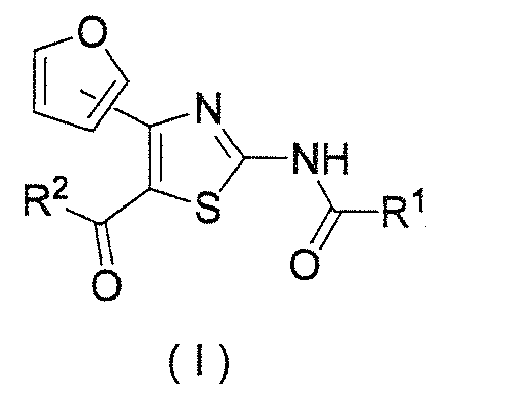
or a pharmaceutically acceptable salt thereof, and (b) L-DOPA and/or a dopamine agonist for the manufacture of an agent for the treatment and/or prophylaxis of Parkinson's disease. - The use according to claim 73, wherein the agent for the treatment and/or prophylaxis of Parkinson's disease is that for administering (a) and (b) simultaneously or separately at an interval.
- The use according to claim 73 or 74, wherein R1 is phenyl, pyridyl, pyrimidinyl, 5,6-dihydro-2H-pyridylmethyl or tetrahydropyranyloxy, each of which is optionally substituted by 1 to 3 substituents selected from a fluorine atom, a chlorine atom, a bromine atom, methyl, ethyl, methoxy and ethoxy, and R2 is pyridyl or tetrahydropyranyl.
- The use according to any one of claims 73 to 75, wherein R2 is pyridyl.
- The use according to any one of claims 73 to 75, wherein R2 is tetrahydropyranyl.
- The use according to claim 73 or 74, wherein the thiazole derivative represented by the formula (I) is a compound represented by any one of the following formulas (IA) - (IAA).



Priority Applications (2)
| Application Number | Priority Date | Filing Date | Title |
|---|---|---|---|
| PL10769780T PL2433938T3 (en) | 2009-04-28 | 2010-04-28 | Therapeutic agent for motor disorders |
| EP18167805.3A EP3378860A1 (en) | 2009-04-28 | 2010-04-28 | Therapeutic agent for motor disorders |
Applications Claiming Priority (2)
| Application Number | Priority Date | Filing Date | Title |
|---|---|---|---|
| JP2009109434 | 2009-04-28 | ||
| PCT/JP2010/057563 WO2010126082A1 (en) | 2009-04-28 | 2010-04-28 | Therapeutic agent for motor disorders |
Related Child Applications (1)
| Application Number | Title | Priority Date | Filing Date |
|---|---|---|---|
| EP18167805.3A Division EP3378860A1 (en) | 2009-04-28 | 2010-04-28 | Therapeutic agent for motor disorders |
Publications (3)
| Publication Number | Publication Date |
|---|---|
| EP2433938A1 true EP2433938A1 (en) | 2012-03-28 |
| EP2433938A4 EP2433938A4 (en) | 2013-03-27 |
| EP2433938B1 EP2433938B1 (en) | 2018-04-18 |
Family
ID=43032226
Family Applications (2)
| Application Number | Title | Priority Date | Filing Date |
|---|---|---|---|
| EP18167805.3A Withdrawn EP3378860A1 (en) | 2009-04-28 | 2010-04-28 | Therapeutic agent for motor disorders |
| EP10769780.7A Active EP2433938B1 (en) | 2009-04-28 | 2010-04-28 | Therapeutic agent for motor disorders |
Family Applications Before (1)
| Application Number | Title | Priority Date | Filing Date |
|---|---|---|---|
| EP18167805.3A Withdrawn EP3378860A1 (en) | 2009-04-28 | 2010-04-28 | Therapeutic agent for motor disorders |
Country Status (24)
| Country | Link |
|---|---|
| US (4) | US20120101101A1 (en) |
| EP (2) | EP3378860A1 (en) |
| JP (1) | JP5687617B2 (en) |
| KR (2) | KR101692091B1 (en) |
| CN (3) | CN102414209B (en) |
| AU (1) | AU2010242375B2 (en) |
| BR (1) | BRPI1011768A8 (en) |
| CA (1) | CA2760048C (en) |
| CL (1) | CL2011002650A1 (en) |
| EA (1) | EA027308B1 (en) |
| ES (1) | ES2678119T3 (en) |
| HU (1) | HUE038319T2 (en) |
| IL (1) | IL215963A (en) |
| MX (1) | MX345169B (en) |
| MY (1) | MY166649A (en) |
| NZ (1) | NZ596362A (en) |
| PL (1) | PL2433938T3 (en) |
| PT (1) | PT2433938T (en) |
| SG (2) | SG10201401698QA (en) |
| TR (1) | TR201809003T4 (en) |
| TW (1) | TWI548411B (en) |
| UA (1) | UA112957C2 (en) |
| WO (1) | WO2010126082A1 (en) |
| ZA (1) | ZA201108665B (en) |
Cited By (7)
| Publication number | Priority date | Publication date | Assignee | Title |
|---|---|---|---|---|
| WO2016087429A1 (en) * | 2014-12-03 | 2016-06-09 | H. Lundbeck A/S | Low dosage a2a antagonist for the treatment of adhd and parkinsons |
| WO2016148308A1 (en) * | 2015-03-19 | 2016-09-22 | Kyowa Hakko Kirin Co., Ltd. | Therapeutic agent for frontal lobe dysfunction |
| US10975057B2 (en) | 2018-06-18 | 2021-04-13 | Janssen Pharmaceutica Nv | 6-aminopyridin-3-yl pyrazoles as modulators of RORgT |
| US10975037B2 (en) | 2018-06-18 | 2021-04-13 | Janssen Pharmaceutica Nv | Phenyl substituted pyrazoles as modulators of RORγt |
| US10975068B2 (en) | 2016-04-27 | 2021-04-13 | Janssen Pharmaceutica Nv | 6-aminopyridin-3-yl thiazoles as modulators of RORγT |
| US11034658B2 (en) | 2018-06-18 | 2021-06-15 | Janssen Pharmaceutica Nv | Pyridinyl pyrazoles as modulators of RORγT |
| US11345666B2 (en) | 2018-06-18 | 2022-05-31 | Janssen Pharmaceutica Nv | Phenyl and pyridinyl substituted imidazoles as modulators of RORγT |
Families Citing this family (3)
| Publication number | Priority date | Publication date | Assignee | Title |
|---|---|---|---|---|
| JP4638355B2 (en) * | 2003-12-26 | 2011-02-23 | 協和発酵キリン株式会社 | Thiazole derivative |
| JO3546B1 (en) | 2015-01-09 | 2020-07-05 | Kyowa Kirin Co Ltd | Method for the production of a thiazole derivative |
| CN109293652B (en) * | 2017-07-24 | 2021-10-22 | 四川科伦博泰生物医药股份有限公司 | A kind of substituted thiazole derivative and use thereof |
Family Cites Families (13)
| Publication number | Priority date | Publication date | Assignee | Title |
|---|---|---|---|---|
| DE60231386D1 (en) * | 2001-04-09 | 2009-04-16 | Neurosearch As | ADENOSINE A2A RECEPTOR ANTAGONISTS IN COMBINATION WITH COMPOUNDS WITH NEUROTROPHIC ACTIVITY IN THE TREATMENT OF MORBUS PARKINSON |
| US6620811B2 (en) | 2001-11-19 | 2003-09-16 | Hoffmann-La Roche Inc. | Isonicotin- and nicotinamide derivatives of benzothiazoles |
| ES2686123T3 (en) * | 2002-01-28 | 2018-10-16 | Kyowa Hakko Kogyo Co., Ltd | A2A receptor antagonists for use in the treatment of movement disorders |
| JP4638355B2 (en) | 2003-12-26 | 2011-02-23 | 協和発酵キリン株式会社 | Thiazole derivative |
| US7910613B2 (en) | 2004-09-22 | 2011-03-22 | H. Lundbeck A/S | 2-acylaminothiazole derivatives |
| JPWO2006109876A1 (en) * | 2005-04-08 | 2008-11-20 | エーザイ・アール・アンド・ディー・マネジメント株式会社 | Involuntary movement therapy |
| EP1902716A4 (en) * | 2005-06-07 | 2009-05-13 | Kyowa Hakko Kirin Co Ltd | Prophylactic and/or therapeutic agent for motor disorder |
| US20100280023A1 (en) | 2005-06-23 | 2010-11-04 | Kyowa Hakko Kogyo Co., Ltd. | Thiazole derivatives |
| CA2617817C (en) | 2005-08-02 | 2014-05-27 | Kyowa Kirin Co., Ltd. | Thiazole derivatives for treating or preventing sleep disorders |
| US20090005568A1 (en) | 2005-08-18 | 2009-01-01 | Pharmacopeia Drug Discovery, Inc. | Substituted 2-aminothiazoles for treating neurodegenerative diseases |
| ATE457988T1 (en) * | 2006-06-26 | 2010-03-15 | Schering Corp | A2A ADENOSINE RECEPTOR ANTAGONISTS |
| TWI473614B (en) * | 2008-05-29 | 2015-02-21 | Kyowa Hakko Kirin Co Ltd | Anti-analgesic inhibitors |
| JP5599311B2 (en) | 2008-07-23 | 2014-10-01 | 協和発酵キリン株式会社 | Migraine treatment |
-
2010
- 2010-04-23 TW TW099112986A patent/TWI548411B/en not_active IP Right Cessation
- 2010-04-28 EA EA201171305A patent/EA027308B1/en unknown
- 2010-04-28 TR TR2018/09003T patent/TR201809003T4/en unknown
- 2010-04-28 PL PL10769780T patent/PL2433938T3/en unknown
- 2010-04-28 EP EP18167805.3A patent/EP3378860A1/en not_active Withdrawn
- 2010-04-28 US US13/266,152 patent/US20120101101A1/en not_active Abandoned
- 2010-04-28 AU AU2010242375A patent/AU2010242375B2/en not_active Ceased
- 2010-04-28 MY MYPI2011005177A patent/MY166649A/en unknown
- 2010-04-28 KR KR1020117028114A patent/KR101692091B1/en not_active Expired - Fee Related
- 2010-04-28 BR BRPI1011768A patent/BRPI1011768A8/en not_active IP Right Cessation
- 2010-04-28 MX MX2011011269A patent/MX345169B/en active IP Right Grant
- 2010-04-28 CN CN201080018324.8A patent/CN102414209B/en not_active Expired - Fee Related
- 2010-04-28 CA CA2760048A patent/CA2760048C/en active Active
- 2010-04-28 CN CN201510012798.6A patent/CN104557904A/en active Pending
- 2010-04-28 PT PT107697807T patent/PT2433938T/en unknown
- 2010-04-28 ES ES10769780.7T patent/ES2678119T3/en active Active
- 2010-04-28 SG SG10201401698QA patent/SG10201401698QA/en unknown
- 2010-04-28 CN CN201510012808.6A patent/CN104606190B/en not_active Expired - Fee Related
- 2010-04-28 UA UAA201113934A patent/UA112957C2/en unknown
- 2010-04-28 KR KR1020167018990A patent/KR20160087926A/en not_active Ceased
- 2010-04-28 JP JP2011511435A patent/JP5687617B2/en not_active Expired - Fee Related
- 2010-04-28 EP EP10769780.7A patent/EP2433938B1/en active Active
- 2010-04-28 HU HUE10769780A patent/HUE038319T2/en unknown
- 2010-04-28 WO PCT/JP2010/057563 patent/WO2010126082A1/en not_active Ceased
- 2010-04-28 SG SG2011078821A patent/SG175368A1/en unknown
- 2010-04-28 NZ NZ596362A patent/NZ596362A/en not_active IP Right Cessation
-
2011
- 2011-10-25 CL CL2011002650A patent/CL2011002650A1/en unknown
- 2011-10-26 IL IL215963A patent/IL215963A/en active IP Right Grant
- 2011-11-24 ZA ZA2011/08665A patent/ZA201108665B/en unknown
-
2015
- 2015-04-21 US US14/691,982 patent/US9714257B2/en not_active Expired - Fee Related
-
2017
- 2017-06-14 US US15/622,265 patent/US10407440B2/en not_active Expired - Fee Related
-
2019
- 2019-08-07 US US16/534,167 patent/US20190359631A1/en not_active Abandoned
Cited By (11)
| Publication number | Priority date | Publication date | Assignee | Title |
|---|---|---|---|---|
| WO2016087429A1 (en) * | 2014-12-03 | 2016-06-09 | H. Lundbeck A/S | Low dosage a2a antagonist for the treatment of adhd and parkinsons |
| WO2016148308A1 (en) * | 2015-03-19 | 2016-09-22 | Kyowa Hakko Kirin Co., Ltd. | Therapeutic agent for frontal lobe dysfunction |
| EP3270923A4 (en) * | 2015-03-19 | 2018-11-07 | Kyowa Hakko Kirin Co., Ltd. | Therapeutic agent for frontal lobe dysfunction |
| EA032511B1 (en) * | 2015-03-19 | 2019-06-28 | Киова Хакко Кирин Ко., Лтд. | Therapeutic agent for frontal lobe dysfunction |
| AU2016234211B2 (en) * | 2015-03-19 | 2020-08-27 | Kyowa Kirin Co., Ltd. | Therapeutic agent for frontal lobe dysfunction |
| TWI723012B (en) * | 2015-03-19 | 2021-04-01 | 日商協和麒麟股份有限公司 | Therapeutic agent for frontal lobe dysfunction |
| US10975068B2 (en) | 2016-04-27 | 2021-04-13 | Janssen Pharmaceutica Nv | 6-aminopyridin-3-yl thiazoles as modulators of RORγT |
| US10975057B2 (en) | 2018-06-18 | 2021-04-13 | Janssen Pharmaceutica Nv | 6-aminopyridin-3-yl pyrazoles as modulators of RORgT |
| US10975037B2 (en) | 2018-06-18 | 2021-04-13 | Janssen Pharmaceutica Nv | Phenyl substituted pyrazoles as modulators of RORγt |
| US11034658B2 (en) | 2018-06-18 | 2021-06-15 | Janssen Pharmaceutica Nv | Pyridinyl pyrazoles as modulators of RORγT |
| US11345666B2 (en) | 2018-06-18 | 2022-05-31 | Janssen Pharmaceutica Nv | Phenyl and pyridinyl substituted imidazoles as modulators of RORγT |
Also Published As
Similar Documents
| Publication | Publication Date | Title |
|---|---|---|
| US10407440B2 (en) | Therapeutic agent for motor disorders | |
| EP2474543B1 (en) | Therapeutic agent for mood disorders | |
| CA2772922A1 (en) | Thiazoles derivatives for treating or preventing anxiety disorders | |
| HK1261314A1 (en) | Therapeutic agent for motor disorders | |
| HK1168848A (en) | Therapeutic agent for motor disorders | |
| HK1168848B (en) | Therapeutic agent for motor disorders | |
| HK1169115B (en) | Therapeutic agent for motor disorders | |
| HK1173144A (en) | Therapeutic agent for mood disorders | |
| HK1173144B (en) | Therapeutic agent for mood disorders |
Legal Events
| Date | Code | Title | Description |
|---|---|---|---|
| PUAI | Public reference made under article 153(3) epc to a published international application that has entered the european phase |
Free format text: ORIGINAL CODE: 0009012 |
|
| 17P | Request for examination filed |
Effective date: 20111115 |
|
| AK | Designated contracting states |
Kind code of ref document: A1 Designated state(s): AT BE BG CH CY CZ DE DK EE ES FI FR GB GR HR HU IE IS IT LI LT LU LV MC MK MT NL NO PL PT RO SE SI SK SM TR |
|
| AX | Request for extension of the european patent |
Extension state: AL BA ME RS |
|
| RIN1 | Information on inventor provided before grant (corrected) |
Inventor name: SAWADA, TAKASHI Inventor name: UESAKA NORIAKI Inventor name: KANDA, TOMOYUKI |
|
| REG | Reference to a national code |
Ref country code: HK Ref legal event code: DE Ref document number: 1168848 Country of ref document: HK |
|
| A4 | Supplementary search report drawn up and despatched |
Effective date: 20130226 |
|
| RIC1 | Information provided on ipc code assigned before grant |
Ipc: A61P 25/14 20060101ALI20130220BHEP Ipc: C07D 491/052 20060101ALI20130220BHEP Ipc: C07D 417/14 20060101AFI20130220BHEP Ipc: C07D 495/04 20060101ALI20130220BHEP Ipc: A61K 31/4355 20060101ALI20130220BHEP Ipc: C07D 491/048 20060101ALI20130220BHEP Ipc: A61K 31/4709 20060101ALI20130220BHEP Ipc: A61P 43/00 20060101ALI20130220BHEP Ipc: A61K 31/436 20060101ALI20130220BHEP Ipc: A61K 31/435 20060101ALI20130220BHEP Ipc: A61P 25/16 20060101ALI20130220BHEP Ipc: A61K 31/506 20060101ALI20130220BHEP Ipc: A61K 31/4439 20060101ALI20130220BHEP Ipc: A61K 31/4365 20060101ALI20130220BHEP Ipc: A61K 31/5377 20060101ALI20130220BHEP |
|
| 17Q | First examination report despatched |
Effective date: 20131206 |
|
| RIC1 | Information provided on ipc code assigned before grant |
Ipc: A61K 31/427 20060101ALI20170719BHEP Ipc: C07D 491/048 20060101ALI20170719BHEP Ipc: A61K 31/5377 20060101ALI20170719BHEP Ipc: C07D 417/14 20060101AFI20170719BHEP Ipc: A61P 43/00 20060101ALI20170719BHEP Ipc: A61P 25/14 20060101ALI20170719BHEP Ipc: A61K 31/4365 20060101ALI20170719BHEP Ipc: A61K 31/4355 20060101ALI20170719BHEP Ipc: C07D 491/052 20060101ALI20170719BHEP Ipc: A61K 31/4709 20060101ALI20170719BHEP Ipc: C07D 495/04 20060101ALI20170719BHEP Ipc: A61K 31/198 20060101ALI20170719BHEP Ipc: A61K 31/506 20060101ALI20170719BHEP Ipc: A61K 31/435 20060101ALI20170719BHEP Ipc: A61K 31/436 20060101ALI20170719BHEP Ipc: A61K 31/4439 20060101ALI20170719BHEP Ipc: A61P 25/16 20060101ALI20170719BHEP |
|
| GRAP | Despatch of communication of intention to grant a patent |
Free format text: ORIGINAL CODE: EPIDOSNIGR1 |
|
| INTG | Intention to grant announced |
Effective date: 20171025 |
|
| RIN1 | Information on inventor provided before grant (corrected) |
Inventor name: KANDA, TOMOYUKI Inventor name: SAWADA, TAKASHI Inventor name: UESAKA NORIAKI |
|
| GRAS | Grant fee paid |
Free format text: ORIGINAL CODE: EPIDOSNIGR3 |
|
| GRAA | (expected) grant |
Free format text: ORIGINAL CODE: 0009210 |
|
| AK | Designated contracting states |
Kind code of ref document: B1 Designated state(s): AT BE BG CH CY CZ DE DK EE ES FI FR GB GR HR HU IE IS IT LI LT LU LV MC MK MT NL NO PL PT RO SE SI SK SM TR |
|
| AX | Request for extension of the european patent |
Extension state: AL BA ME RS |
|
| REG | Reference to a national code |
Ref country code: GB Ref legal event code: FG4D |
|
| RIN1 | Information on inventor provided before grant (corrected) |
Inventor name: SAWADA, TAKASHI Inventor name: KANDA, TOMOYUKI Inventor name: UESAKA NORIAKI |
|
| REG | Reference to a national code |
Ref country code: CH Ref legal event code: EP |
|
| REG | Reference to a national code |
Ref country code: AT Ref legal event code: REF Ref document number: 990321 Country of ref document: AT Kind code of ref document: T Effective date: 20180515 |
|
| REG | Reference to a national code |
Ref country code: IE Ref legal event code: FG4D |
|
| REG | Reference to a national code |
Ref country code: DE Ref legal event code: R096 Ref document number: 602010050032 Country of ref document: DE |
|
| REG | Reference to a national code |
Ref country code: RO Ref legal event code: EPE |
|
| REG | Reference to a national code |
Ref country code: FR Ref legal event code: PLFP Year of fee payment: 9 |
|
| REG | Reference to a national code |
Ref country code: PT Ref legal event code: SC4A Ref document number: 2433938 Country of ref document: PT Date of ref document: 20180713 Kind code of ref document: T Free format text: AVAILABILITY OF NATIONAL TRANSLATION Effective date: 20180706 Ref country code: CH Ref legal event code: NV Representative=s name: BOHEST AG, CH |
|
| REG | Reference to a national code |
Ref country code: NL Ref legal event code: FP |
|
| REG | Reference to a national code |
Ref country code: SE Ref legal event code: TRGR |
|
| REG | Reference to a national code |
Ref country code: ES Ref legal event code: FG2A Ref document number: 2678119 Country of ref document: ES Kind code of ref document: T3 Effective date: 20180809 |
|
| REG | Reference to a national code |
Ref country code: LT Ref legal event code: MG4D |
|
| REG | Reference to a national code |
Ref country code: HU Ref legal event code: AG4A Ref document number: E038319 Country of ref document: HU |
|
| PG25 | Lapsed in a contracting state [announced via postgrant information from national office to epo] |
Ref country code: BG Free format text: LAPSE BECAUSE OF FAILURE TO SUBMIT A TRANSLATION OF THE DESCRIPTION OR TO PAY THE FEE WITHIN THE PRESCRIBED TIME-LIMIT Effective date: 20180718 Ref country code: FI Free format text: LAPSE BECAUSE OF FAILURE TO SUBMIT A TRANSLATION OF THE DESCRIPTION OR TO PAY THE FEE WITHIN THE PRESCRIBED TIME-LIMIT Effective date: 20180418 Ref country code: NO Free format text: LAPSE BECAUSE OF FAILURE TO SUBMIT A TRANSLATION OF THE DESCRIPTION OR TO PAY THE FEE WITHIN THE PRESCRIBED TIME-LIMIT Effective date: 20180718 Ref country code: LT Free format text: LAPSE BECAUSE OF FAILURE TO SUBMIT A TRANSLATION OF THE DESCRIPTION OR TO PAY THE FEE WITHIN THE PRESCRIBED TIME-LIMIT Effective date: 20180418 |
|
| PG25 | Lapsed in a contracting state [announced via postgrant information from national office to epo] |
Ref country code: LV Free format text: LAPSE BECAUSE OF FAILURE TO SUBMIT A TRANSLATION OF THE DESCRIPTION OR TO PAY THE FEE WITHIN THE PRESCRIBED TIME-LIMIT Effective date: 20180418 Ref country code: HR Free format text: LAPSE BECAUSE OF FAILURE TO SUBMIT A TRANSLATION OF THE DESCRIPTION OR TO PAY THE FEE WITHIN THE PRESCRIBED TIME-LIMIT Effective date: 20180418 |
|
| REG | Reference to a national code |
Ref country code: DE Ref legal event code: R097 Ref document number: 602010050032 Country of ref document: DE |
|
| REG | Reference to a national code |
Ref country code: IE Ref legal event code: MM4A |
|
| REG | Reference to a national code |
Ref country code: GR Ref legal event code: EP Ref document number: 20180401897 Country of ref document: GR Effective date: 20190109 |
|
| PG25 | Lapsed in a contracting state [announced via postgrant information from national office to epo] |
Ref country code: EE Free format text: LAPSE BECAUSE OF FAILURE TO SUBMIT A TRANSLATION OF THE DESCRIPTION OR TO PAY THE FEE WITHIN THE PRESCRIBED TIME-LIMIT Effective date: 20180418 Ref country code: SK Free format text: LAPSE BECAUSE OF FAILURE TO SUBMIT A TRANSLATION OF THE DESCRIPTION OR TO PAY THE FEE WITHIN THE PRESCRIBED TIME-LIMIT Effective date: 20180418 Ref country code: DK Free format text: LAPSE BECAUSE OF FAILURE TO SUBMIT A TRANSLATION OF THE DESCRIPTION OR TO PAY THE FEE WITHIN THE PRESCRIBED TIME-LIMIT Effective date: 20180418 Ref country code: LU Free format text: LAPSE BECAUSE OF NON-PAYMENT OF DUE FEES Effective date: 20180428 Ref country code: CZ Free format text: LAPSE BECAUSE OF FAILURE TO SUBMIT A TRANSLATION OF THE DESCRIPTION OR TO PAY THE FEE WITHIN THE PRESCRIBED TIME-LIMIT Effective date: 20180418 |
|
| PLBE | No opposition filed within time limit |
Free format text: ORIGINAL CODE: 0009261 |
|
| STAA | Information on the status of an ep patent application or granted ep patent |
Free format text: STATUS: NO OPPOSITION FILED WITHIN TIME LIMIT |
|
| PG25 | Lapsed in a contracting state [announced via postgrant information from national office to epo] |
Ref country code: SM Free format text: LAPSE BECAUSE OF FAILURE TO SUBMIT A TRANSLATION OF THE DESCRIPTION OR TO PAY THE FEE WITHIN THE PRESCRIBED TIME-LIMIT Effective date: 20180418 |
|
| 26N | No opposition filed |
Effective date: 20190121 |
|
| PG25 | Lapsed in a contracting state [announced via postgrant information from national office to epo] |
Ref country code: IE Free format text: LAPSE BECAUSE OF NON-PAYMENT OF DUE FEES Effective date: 20180428 |
|
| PG25 | Lapsed in a contracting state [announced via postgrant information from national office to epo] |
Ref country code: SI Free format text: LAPSE BECAUSE OF FAILURE TO SUBMIT A TRANSLATION OF THE DESCRIPTION OR TO PAY THE FEE WITHIN THE PRESCRIBED TIME-LIMIT Effective date: 20180418 |
|
| REG | Reference to a national code |
Ref country code: CH Ref legal event code: PFA Owner name: KYOWA KIRIN CO., LTD., JP Free format text: FORMER OWNER: KYOWA HAKKO KIRIN CO., LTD., JP |
|
| REG | Reference to a national code |
Ref country code: AT Ref legal event code: UEP Ref document number: 990321 Country of ref document: AT Kind code of ref document: T Effective date: 20180418 |
|
| REG | Reference to a national code |
Ref country code: DE Ref legal event code: R082 Ref document number: 602010050032 Country of ref document: DE Representative=s name: VOSSIUS & PARTNER PATENTANWAELTE RECHTSANWAELT, DE Ref country code: DE Ref legal event code: R081 Ref document number: 602010050032 Country of ref document: DE Owner name: KYOWA KIRIN CO., LTD., JP Free format text: FORMER OWNER: KYOWA HAKKO KIRIN CO.LTD., TOKYO, CHIYODA-KU, JP |
|
| PG25 | Lapsed in a contracting state [announced via postgrant information from national office to epo] |
Ref country code: MT Free format text: LAPSE BECAUSE OF NON-PAYMENT OF DUE FEES Effective date: 20180428 |
|
| REG | Reference to a national code |
Ref country code: ES Ref legal event code: PC2A Owner name: KYOWA KIRIN CO., LTD. Effective date: 20200212 |
|
| REG | Reference to a national code |
Ref country code: NL Ref legal event code: HC Owner name: KYOWA KIRIN CO., LTD.; JP Free format text: DETAILS ASSIGNMENT: CHANGE OF OWNER(S), CHANGE OF OWNER(S) NAME; FORMER OWNER NAME: KYOWA HAKKO KIRIN CO., LTD. Effective date: 20200218 |
|
| REG | Reference to a national code |
Ref country code: HU Ref legal event code: HC9C Owner name: KYOWA KIRIN CO., LTD., JP Free format text: FORMER OWNER(S): KYOWA HAKKO KIRIN CO., LTD., JP |
|
| REG | Reference to a national code |
Ref country code: BE Ref legal event code: HC Owner name: KYOWA KIRIN CO., LTD.; JP Free format text: DETAILS ASSIGNMENT: CHANGE OF OWNER(S), CHANGEMENT DE NOM DU PROPRIETAIRE; FORMER OWNER NAME: KYOWA HAKKO KIRIN CO., LTD. Effective date: 20191223 |
|
| PG25 | Lapsed in a contracting state [announced via postgrant information from national office to epo] |
Ref country code: CY Free format text: LAPSE BECAUSE OF FAILURE TO SUBMIT A TRANSLATION OF THE DESCRIPTION OR TO PAY THE FEE WITHIN THE PRESCRIBED TIME-LIMIT Effective date: 20180418 Ref country code: MK Free format text: LAPSE BECAUSE OF NON-PAYMENT OF DUE FEES Effective date: 20180418 |
|
| PG25 | Lapsed in a contracting state [announced via postgrant information from national office to epo] |
Ref country code: IS Free format text: LAPSE BECAUSE OF FAILURE TO SUBMIT A TRANSLATION OF THE DESCRIPTION OR TO PAY THE FEE WITHIN THE PRESCRIBED TIME-LIMIT Effective date: 20180818 |
|
| REG | Reference to a national code |
Ref country code: AT Ref legal event code: HC Ref document number: 990321 Country of ref document: AT Kind code of ref document: T Owner name: KYOWA KIRIN CO., LTD., JP Effective date: 20200727 |
|
| PGFP | Annual fee paid to national office [announced via postgrant information from national office to epo] |
Ref country code: GB Payment date: 20220310 Year of fee payment: 13 |
|
| PGFP | Annual fee paid to national office [announced via postgrant information from national office to epo] |
Ref country code: TR Payment date: 20220303 Year of fee payment: 13 Ref country code: PT Payment date: 20220302 Year of fee payment: 13 Ref country code: PL Payment date: 20220301 Year of fee payment: 13 Ref country code: MC Payment date: 20220318 Year of fee payment: 13 Ref country code: GR Payment date: 20220301 Year of fee payment: 13 Ref country code: FR Payment date: 20220309 Year of fee payment: 13 Ref country code: BE Payment date: 20220316 Year of fee payment: 13 |
|
| PGFP | Annual fee paid to national office [announced via postgrant information from national office to epo] |
Ref country code: NL Payment date: 20220422 Year of fee payment: 13 |
|
| PGFP | Annual fee paid to national office [announced via postgrant information from national office to epo] |
Ref country code: SE Payment date: 20220420 Year of fee payment: 13 Ref country code: RO Payment date: 20220401 Year of fee payment: 13 Ref country code: IT Payment date: 20220414 Year of fee payment: 13 Ref country code: HU Payment date: 20220320 Year of fee payment: 13 Ref country code: ES Payment date: 20220511 Year of fee payment: 13 Ref country code: DE Payment date: 20220427 Year of fee payment: 13 |
|
| PGFP | Annual fee paid to national office [announced via postgrant information from national office to epo] |
Ref country code: CH Payment date: 20220425 Year of fee payment: 13 Ref country code: AT Payment date: 20220307 Year of fee payment: 13 |
|
| REG | Reference to a national code |
Ref country code: DE Ref legal event code: R119 Ref document number: 602010050032 Country of ref document: DE |
|
| REG | Reference to a national code |
Ref country code: SE Ref legal event code: EUG |
|
| REG | Reference to a national code |
Ref country code: CH Ref legal event code: PL |
|
| REG | Reference to a national code |
Ref country code: NL Ref legal event code: MM Effective date: 20230501 |
|
| REG | Reference to a national code |
Ref country code: AT Ref legal event code: MM01 Ref document number: 990321 Country of ref document: AT Kind code of ref document: T Effective date: 20230428 |
|
| GBPC | Gb: european patent ceased through non-payment of renewal fee |
Effective date: 20230428 |
|
| REG | Reference to a national code |
Ref country code: BE Ref legal event code: MM Effective date: 20230430 |
|
| PG25 | Lapsed in a contracting state [announced via postgrant information from national office to epo] |
Ref country code: MC Free format text: LAPSE BECAUSE OF NON-PAYMENT OF DUE FEES Effective date: 20230502 |
|
| PG25 | Lapsed in a contracting state [announced via postgrant information from national office to epo] |
Ref country code: GR Free format text: LAPSE BECAUSE OF NON-PAYMENT OF DUE FEES Effective date: 20231110 Ref country code: GB Free format text: LAPSE BECAUSE OF NON-PAYMENT OF DUE FEES Effective date: 20230428 |
|
| PG25 | Lapsed in a contracting state [announced via postgrant information from national office to epo] |
Ref country code: SE Free format text: LAPSE BECAUSE OF NON-PAYMENT OF DUE FEES Effective date: 20230429 Ref country code: RO Free format text: LAPSE BECAUSE OF NON-PAYMENT OF DUE FEES Effective date: 20230428 Ref country code: PT Free format text: LAPSE BECAUSE OF NON-PAYMENT OF DUE FEES Effective date: 20231030 Ref country code: NL Free format text: LAPSE BECAUSE OF NON-PAYMENT OF DUE FEES Effective date: 20230501 Ref country code: MC Free format text: LAPSE BECAUSE OF NON-PAYMENT OF DUE FEES Effective date: 20230502 Ref country code: LI Free format text: LAPSE BECAUSE OF NON-PAYMENT OF DUE FEES Effective date: 20230430 Ref country code: HU Free format text: LAPSE BECAUSE OF NON-PAYMENT OF DUE FEES Effective date: 20230429 Ref country code: GR Free format text: LAPSE BECAUSE OF NON-PAYMENT OF DUE FEES Effective date: 20231110 Ref country code: GB Free format text: LAPSE BECAUSE OF NON-PAYMENT OF DUE FEES Effective date: 20230428 Ref country code: FR Free format text: LAPSE BECAUSE OF NON-PAYMENT OF DUE FEES Effective date: 20230430 Ref country code: DE Free format text: LAPSE BECAUSE OF NON-PAYMENT OF DUE FEES Effective date: 20231103 Ref country code: CH Free format text: LAPSE BECAUSE OF NON-PAYMENT OF DUE FEES Effective date: 20230430 Ref country code: AT Free format text: LAPSE BECAUSE OF NON-PAYMENT OF DUE FEES Effective date: 20230428 |
|
| PG25 | Lapsed in a contracting state [announced via postgrant information from national office to epo] |
Ref country code: BE Free format text: LAPSE BECAUSE OF NON-PAYMENT OF DUE FEES Effective date: 20230430 |
|
| PG25 | Lapsed in a contracting state [announced via postgrant information from national office to epo] |
Ref country code: IT Free format text: LAPSE BECAUSE OF NON-PAYMENT OF DUE FEES Effective date: 20230428 |
|
| REG | Reference to a national code |
Ref country code: ES Ref legal event code: FD2A Effective date: 20240531 |
|
| PG25 | Lapsed in a contracting state [announced via postgrant information from national office to epo] |
Ref country code: ES Free format text: LAPSE BECAUSE OF NON-PAYMENT OF DUE FEES Effective date: 20230429 |
|
| PG25 | Lapsed in a contracting state [announced via postgrant information from national office to epo] |
Ref country code: ES Free format text: LAPSE BECAUSE OF NON-PAYMENT OF DUE FEES Effective date: 20230429 |
|
| PG25 | Lapsed in a contracting state [announced via postgrant information from national office to epo] |
Ref country code: PL Free format text: LAPSE BECAUSE OF NON-PAYMENT OF DUE FEES Effective date: 20230428 |
|
| PG25 | Lapsed in a contracting state [announced via postgrant information from national office to epo] |
Ref country code: PL Free format text: LAPSE BECAUSE OF NON-PAYMENT OF DUE FEES Effective date: 20230428 |