EP2433840A1 - Motion control unit for vehicle based on jerk information - Google Patents
Motion control unit for vehicle based on jerk information Download PDFInfo
- Publication number
- EP2433840A1 EP2433840A1 EP11184288A EP11184288A EP2433840A1 EP 2433840 A1 EP2433840 A1 EP 2433840A1 EP 11184288 A EP11184288 A EP 11184288A EP 11184288 A EP11184288 A EP 11184288A EP 2433840 A1 EP2433840 A1 EP 2433840A1
- Authority
- EP
- European Patent Office
- Prior art keywords
- vehicle
- yaw moment
- acceleration
- lateral
- dot
- Prior art date
- Legal status (The legal status is an assumption and is not a legal conclusion. Google has not performed a legal analysis and makes no representation as to the accuracy of the status listed.)
- Granted
Links
Images








Classifications
-
- B—PERFORMING OPERATIONS; TRANSPORTING
- B60—VEHICLES IN GENERAL
- B60W—CONJOINT CONTROL OF VEHICLE SUB-UNITS OF DIFFERENT TYPE OR DIFFERENT FUNCTION; CONTROL SYSTEMS SPECIALLY ADAPTED FOR HYBRID VEHICLES; ROAD VEHICLE DRIVE CONTROL SYSTEMS FOR PURPOSES NOT RELATED TO THE CONTROL OF A PARTICULAR SUB-UNIT
- B60W40/00—Estimation or calculation of non-directly measurable driving parameters for road vehicle drive control systems not related to the control of a particular sub unit, e.g. by using mathematical models
- B60W40/02—Estimation or calculation of non-directly measurable driving parameters for road vehicle drive control systems not related to the control of a particular sub unit, e.g. by using mathematical models related to ambient conditions
- B60W40/06—Road conditions
- B60W40/064—Degree of grip
-
- B—PERFORMING OPERATIONS; TRANSPORTING
- B60—VEHICLES IN GENERAL
- B60W—CONJOINT CONTROL OF VEHICLE SUB-UNITS OF DIFFERENT TYPE OR DIFFERENT FUNCTION; CONTROL SYSTEMS SPECIALLY ADAPTED FOR HYBRID VEHICLES; ROAD VEHICLE DRIVE CONTROL SYSTEMS FOR PURPOSES NOT RELATED TO THE CONTROL OF A PARTICULAR SUB-UNIT
- B60W30/00—Purposes of road vehicle drive control systems not related to the control of a particular sub-unit, e.g. of systems using conjoint control of vehicle sub-units
- B60W30/02—Control of vehicle driving stability
-
- B—PERFORMING OPERATIONS; TRANSPORTING
- B60—VEHICLES IN GENERAL
- B60T—VEHICLE BRAKE CONTROL SYSTEMS OR PARTS THEREOF; BRAKE CONTROL SYSTEMS OR PARTS THEREOF, IN GENERAL; ARRANGEMENT OF BRAKING ELEMENTS ON VEHICLES IN GENERAL; PORTABLE DEVICES FOR PREVENTING UNWANTED MOVEMENT OF VEHICLES; VEHICLE MODIFICATIONS TO FACILITATE COOLING OF BRAKES
- B60T8/00—Arrangements for adjusting wheel-braking force to meet varying vehicular or ground-surface conditions, e.g. limiting or varying distribution of braking force
- B60T8/17—Using electrical or electronic regulation means to control braking
- B60T8/1755—Brake regulation specially adapted to control the stability of the vehicle, e.g. taking into account yaw rate or transverse acceleration in a curve
-
- B—PERFORMING OPERATIONS; TRANSPORTING
- B60—VEHICLES IN GENERAL
- B60W—CONJOINT CONTROL OF VEHICLE SUB-UNITS OF DIFFERENT TYPE OR DIFFERENT FUNCTION; CONTROL SYSTEMS SPECIALLY ADAPTED FOR HYBRID VEHICLES; ROAD VEHICLE DRIVE CONTROL SYSTEMS FOR PURPOSES NOT RELATED TO THE CONTROL OF A PARTICULAR SUB-UNIT
- B60W30/00—Purposes of road vehicle drive control systems not related to the control of a particular sub-unit, e.g. of systems using conjoint control of vehicle sub-units
- B60W30/02—Control of vehicle driving stability
- B60W30/045—Improving turning performance
-
- B—PERFORMING OPERATIONS; TRANSPORTING
- B60—VEHICLES IN GENERAL
- B60W—CONJOINT CONTROL OF VEHICLE SUB-UNITS OF DIFFERENT TYPE OR DIFFERENT FUNCTION; CONTROL SYSTEMS SPECIALLY ADAPTED FOR HYBRID VEHICLES; ROAD VEHICLE DRIVE CONTROL SYSTEMS FOR PURPOSES NOT RELATED TO THE CONTROL OF A PARTICULAR SUB-UNIT
- B60W30/00—Purposes of road vehicle drive control systems not related to the control of a particular sub-unit, e.g. of systems using conjoint control of vehicle sub-units
- B60W30/18—Propelling the vehicle
- B60W30/18009—Propelling the vehicle related to particular drive situations
- B60W30/18145—Cornering
-
- B—PERFORMING OPERATIONS; TRANSPORTING
- B60—VEHICLES IN GENERAL
- B60W—CONJOINT CONTROL OF VEHICLE SUB-UNITS OF DIFFERENT TYPE OR DIFFERENT FUNCTION; CONTROL SYSTEMS SPECIALLY ADAPTED FOR HYBRID VEHICLES; ROAD VEHICLE DRIVE CONTROL SYSTEMS FOR PURPOSES NOT RELATED TO THE CONTROL OF A PARTICULAR SUB-UNIT
- B60W40/00—Estimation or calculation of non-directly measurable driving parameters for road vehicle drive control systems not related to the control of a particular sub unit, e.g. by using mathematical models
- B60W40/10—Estimation or calculation of non-directly measurable driving parameters for road vehicle drive control systems not related to the control of a particular sub unit, e.g. by using mathematical models related to vehicle motion
- B60W40/103—Side slip angle of vehicle body
-
- B—PERFORMING OPERATIONS; TRANSPORTING
- B60—VEHICLES IN GENERAL
- B60W—CONJOINT CONTROL OF VEHICLE SUB-UNITS OF DIFFERENT TYPE OR DIFFERENT FUNCTION; CONTROL SYSTEMS SPECIALLY ADAPTED FOR HYBRID VEHICLES; ROAD VEHICLE DRIVE CONTROL SYSTEMS FOR PURPOSES NOT RELATED TO THE CONTROL OF A PARTICULAR SUB-UNIT
- B60W40/00—Estimation or calculation of non-directly measurable driving parameters for road vehicle drive control systems not related to the control of a particular sub unit, e.g. by using mathematical models
- B60W40/10—Estimation or calculation of non-directly measurable driving parameters for road vehicle drive control systems not related to the control of a particular sub unit, e.g. by using mathematical models related to vehicle motion
- B60W40/114—Yaw movement
-
- B—PERFORMING OPERATIONS; TRANSPORTING
- B60—VEHICLES IN GENERAL
- B60T—VEHICLE BRAKE CONTROL SYSTEMS OR PARTS THEREOF; BRAKE CONTROL SYSTEMS OR PARTS THEREOF, IN GENERAL; ARRANGEMENT OF BRAKING ELEMENTS ON VEHICLES IN GENERAL; PORTABLE DEVICES FOR PREVENTING UNWANTED MOVEMENT OF VEHICLES; VEHICLE MODIFICATIONS TO FACILITATE COOLING OF BRAKES
- B60T2230/00—Monitoring, detecting special vehicle behaviour; Counteracting thereof
- B60T2230/02—Side slip angle, attitude angle, floating angle, drift angle
-
- B—PERFORMING OPERATIONS; TRANSPORTING
- B60—VEHICLES IN GENERAL
- B60T—VEHICLE BRAKE CONTROL SYSTEMS OR PARTS THEREOF; BRAKE CONTROL SYSTEMS OR PARTS THEREOF, IN GENERAL; ARRANGEMENT OF BRAKING ELEMENTS ON VEHICLES IN GENERAL; PORTABLE DEVICES FOR PREVENTING UNWANTED MOVEMENT OF VEHICLES; VEHICLE MODIFICATIONS TO FACILITATE COOLING OF BRAKES
- B60T2230/00—Monitoring, detecting special vehicle behaviour; Counteracting thereof
- B60T2230/04—Jerk, soft-stop; Anti-jerk, reduction of pitch or nose-dive when braking
-
- B—PERFORMING OPERATIONS; TRANSPORTING
- B60—VEHICLES IN GENERAL
- B60W—CONJOINT CONTROL OF VEHICLE SUB-UNITS OF DIFFERENT TYPE OR DIFFERENT FUNCTION; CONTROL SYSTEMS SPECIALLY ADAPTED FOR HYBRID VEHICLES; ROAD VEHICLE DRIVE CONTROL SYSTEMS FOR PURPOSES NOT RELATED TO THE CONTROL OF A PARTICULAR SUB-UNIT
- B60W2520/00—Input parameters relating to overall vehicle dynamics
- B60W2520/10—Longitudinal speed
-
- B—PERFORMING OPERATIONS; TRANSPORTING
- B60—VEHICLES IN GENERAL
- B60W—CONJOINT CONTROL OF VEHICLE SUB-UNITS OF DIFFERENT TYPE OR DIFFERENT FUNCTION; CONTROL SYSTEMS SPECIALLY ADAPTED FOR HYBRID VEHICLES; ROAD VEHICLE DRIVE CONTROL SYSTEMS FOR PURPOSES NOT RELATED TO THE CONTROL OF A PARTICULAR SUB-UNIT
- B60W2520/00—Input parameters relating to overall vehicle dynamics
- B60W2520/12—Lateral speed
- B60W2520/125—Lateral acceleration
-
- B—PERFORMING OPERATIONS; TRANSPORTING
- B60—VEHICLES IN GENERAL
- B60W—CONJOINT CONTROL OF VEHICLE SUB-UNITS OF DIFFERENT TYPE OR DIFFERENT FUNCTION; CONTROL SYSTEMS SPECIALLY ADAPTED FOR HYBRID VEHICLES; ROAD VEHICLE DRIVE CONTROL SYSTEMS FOR PURPOSES NOT RELATED TO THE CONTROL OF A PARTICULAR SUB-UNIT
- B60W2520/00—Input parameters relating to overall vehicle dynamics
- B60W2520/14—Yaw
-
- B—PERFORMING OPERATIONS; TRANSPORTING
- B60—VEHICLES IN GENERAL
- B60W—CONJOINT CONTROL OF VEHICLE SUB-UNITS OF DIFFERENT TYPE OR DIFFERENT FUNCTION; CONTROL SYSTEMS SPECIALLY ADAPTED FOR HYBRID VEHICLES; ROAD VEHICLE DRIVE CONTROL SYSTEMS FOR PURPOSES NOT RELATED TO THE CONTROL OF A PARTICULAR SUB-UNIT
- B60W2520/00—Input parameters relating to overall vehicle dynamics
- B60W2520/28—Wheel speed
-
- B—PERFORMING OPERATIONS; TRANSPORTING
- B60—VEHICLES IN GENERAL
- B60W—CONJOINT CONTROL OF VEHICLE SUB-UNITS OF DIFFERENT TYPE OR DIFFERENT FUNCTION; CONTROL SYSTEMS SPECIALLY ADAPTED FOR HYBRID VEHICLES; ROAD VEHICLE DRIVE CONTROL SYSTEMS FOR PURPOSES NOT RELATED TO THE CONTROL OF A PARTICULAR SUB-UNIT
- B60W2720/00—Output or target parameters relating to overall vehicle dynamics
- B60W2720/14—Yaw
Definitions
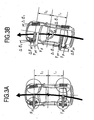
- Figs. 2A to 2D are schematic views illustrating a state where three types of positive yaw moment inputs are carried out when a vehicle turns in a counterclockwise direction.
- Figs. 3A to 3D are schematic views illustrating a state where three types of negative yaw moment inputs are carried out when a vehicle turns in a counterclockwise direction.
- Figs. 2A to 2D are views illustrating three methods upon inputting the positive yaw moment from the standard state shown in Fig. 2A .
- a lateral motion equation and a yawing (rotation) motion equation of the vehicle 0 in the standard state shown in Fig. 2A are expressed.
- m a mass of the vehicle
- Gy a lateral acceleration applied to the vehicle
- Fyf a lateral force of the two front wheels
- Fyr a lateral force of the two rear wheels
- M a yaw moment
- Iz a yawing inertia moment of the vehicle
- r_dot a yaw angular acceleration of the vehicle 0 (r denotes a yaw rate)
- Fig. 2B is a state where 'Yaw Moment Addition in terms of Steering Operation' is carried out from the standard state shown in Fig. 2A . Since the front wheel steering angle increases by ⁇ f and the rear wheel steering angle increases by ⁇ r compared with the steady state cornering shown in Fig. 2A , the lateral force of the two front wheels increases from Fyf to Fysf and the lateral force of the two rear wheels decreases from Fyr to Fyrf, and according to Equation 2, the positive moment (Ms) is generated as the following Equation 3.
- the positive moment can be generated from a general front wheel steering vehicle.
- Fig. 2C is a state where 'Yaw Moment Addition in terms of Left and Right Differential Brake and Drive Input' is carried out from the standard state shown in Fig. 2A , in which a brake force -Fdrl is applied to the left rear wheel 63, a drive force Fdrr is applied to the right rear wheel 64, and a brake force -Fdf is applied to the left front wheel 61.
- M d F yf ⁇ l f - F yr ⁇ l r + d 2 ⁇ F drl + F drr + F df > 0
- d denotes a tread (distance between the left and right vehicle wheels as shown in the drawing).
- F drl + F drr + F df 0
- the yaw moment can be generated without generating the longitudinal acceleration or deceleration other than the front wheel driven vehicle (in this example, without driving the right front wheel 62). That is, the yaw moment can be added without giving an unpleasant feeling to the driver.
- Fig. 2D is a method in which a vertical load transfer is positively generated from the rear wheel to the front wheel by applying the brake force and an original restoration yaw moment of the vehicle reduces, thereby generating the yaw moment.
- the phenomenon of the yaw moment addition in terms of the vertical load transfer is such that the yaw moment due to the acceleration or deceleration during a steady state cornering action is proportional to a value obtained by multiplying the lateral force by the longitudinal acceleration within a range in which the lateral force of the tire is proportional to the vertical load as disclosed in p.54 to 60 of 'Improvement of Vehicle Motion Performance in terms of Yaw Moment Control' written by SHIBAHATA et al.
- Figs. 3A to 3D are methods in which the negative yaw moment is input in the same way as those shown in Figs. 2A to 2D .
- the detailed description is omitted because the method is the same as that of the positive yaw moment input method shown in Figs. 2A to 2D , the moment in the restoration direction (clockwise direction shown in Figs.
- 3B , 3C, and 3D is obtained in such a manner that the steering operation is carried out so that the steering angle decreases or the steering operation is carried out so that a phase of the rear wheel becomes the same as that of the front wheel, the brake or drive operation is carried out so that an inverse brake or drive force is applied, the load movement is carried out so that an acceleration is performed to increase a load of the rear wheel, the lateral force of the rear wheel comparatively increases, and the lateral force of the front wheel decreases.
- the vehicle according to this embodiment can generate both the positive and negative yaw moment on the basis of the command of the central controller 40.
- this corresponds to a state where the vehicle turns along a certain curve.
- C(s) (X(s), Y(s)) of the coordinate system (X, Y) fixed to a ground
- s denotes a distance along the curve.
- ⁇ 1/ ⁇ (p: turning radius)
- ⁇ is shown by using an arc length parameter (s) along the locus as shown in Equation 8.
- a locus of the vehicle when a handle is steered at a stable angular velocity during a stable vehicle velocity is called a clothoid curve which is often used for designing a road.
- a time variation of the curvature of the vehicle becomes stable (which may be supposed that the arc length parameter changes to the time parameter t).
- ⁇ (s) is expressed by Equation 12.
- the state without a variation in sideslip indicates a state where a difference between a vector (V) in a direction perpendicular to the curve (bold black curve indicating C(s)) and a vehicle velocity direction (direction indicated by the dashed line) is zero ( Fig. 5A ) or a state where an angle ( ⁇ ) called a sideslip angle is stable ( Fig. 5B ), which is considered as an ideal state where a revolution and a rotation of the vehicle cooperatively correspond to each other.
- the yaw angle generated in the ideal state is determined geometrically and is not directly involved with the vehicle dynamics.
- the details shown in Figs. 5A to 5B are described in, for example, 'Vehicle dynamics and control' written by ABE Masato and published by Sankaido, First edition, July 10, 1992, Third chapter .
- Gy_dot denotes the lateral jerk of the vehicle.
- Equation 20 shows the yaw angular acceleration necessary for the vehicle moving in the ideal state.
- the reference moment indicates a moment necessary for moving along the path in a state where the revolution and the rotation of the vehicle are cooperatively correspond to each other as shown in Figs. 5A to 5B .
- the moment is large, the vehicle to obtain the yaw moment acting on the current vehicle.
- k denotes a proportional gain.
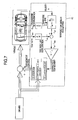
- Fig. 7 is a schematic view illustrating the configuration of the control logic according to this embodiment.
- the yaw moment of the vehicle is configured to be controlled on the basis of a value (Gy_dot/V) obtained by dividing the lateral jerk Gy_dot of the vehicle by the longitudinal velocity (V) of the vehicle.
- the yaw moment of the vehicle is configured to be controlled so that a difference between (Gy_dot/V) and (r_dot) becomes small by detecting the yaw angular acceleration (r_dot) of the vehicle.
- an open loop control particularly, the yaw moment control in terms of the vertical load transfer is adopted.
- the yaw moment (Mzls) due to the acceleration or deceleration during a steady state cornering action is proportional to a value obtained by the lateral acceleration by the longitudinal acceleration as shown in Equation 22.
- m denotes a vehicle mass
- h denotes a height of gravity center point
- g denotes a gravity acceleration.
- M zls - mh g ⁇ G x ⁇ G y
- the longitudinal acceleration realizing the control moment having the same profile as that of the necessary yaw moment is obtained.
- This may be regarded as an overall control of longitudinal motion and lateral motion which determines the lateral acceleration generated by the steering operation and the longitudinal acceleration by the brake and accelerator operation in accordance with the lateral acceleration.
- a command longitudinal acceleration Gxc is expressed as the following Equation 23.
- the lateral acceleration becomes a small value and the command longitudinal acceleration Gxc becomes a large value.
- Equation 24 it is sufficiently effective in practical engineering even when the command longitudinal acceleration Gxc is determined in such a manner that main information is obtained from the lateral jerk (Gy_dot) of the vehicle and other information is obtained from the velocity, the lateral acceleration or the function f(Gy, V) thereof, or dependent information and a gain KGyV stored in a map etc.
- means for detecting the longitudinal velocity (V) of the vehicle and the lateral jerk (Gy_dot) of the vehicle and the longitudinal acceleration of the vehicle is controlled on the basis of the value (Gy_dot/V) obtained by dividing the lateral jerk (Gy_dot) of the vehicle by the longitudinal velocity (V) of the vehicle so that the yaw moment of the vehicle is controlled in terms of the vertical load transfer. More specifically, the
Landscapes
- Engineering & Computer Science (AREA)
- Transportation (AREA)
- Mechanical Engineering (AREA)
- Automation & Control Theory (AREA)
- Physics & Mathematics (AREA)
- Mathematical Physics (AREA)
- Control Of Driving Devices And Active Controlling Of Vehicle (AREA)
- Regulating Braking Force (AREA)
- Steering Control In Accordance With Driving Conditions (AREA)
- Electric Propulsion And Braking For Vehicles (AREA)
Abstract
Description
- Next, the yaw moment control in terms of a drive force distribution to the left and right vehicle wheels will be described with reference to
Figs. 2A to 2D andFigs. 3A to 3D . In this embodiment, the yaw moment applied to thevehicle 0 is controlled by using three methods of 'Yaw Moment Addition in terms of Steering Operation', 'Yaw Moment Addition in terms of Left and Right Differential Brake and Drive Input', and 'Yaw Moment Addition in terms of Vertical Load Transfer from Front Wheel to Rear Wheel'.Figs. 2A to 2D are schematic views illustrating a state where three types of positive yaw moment inputs are carried out when a vehicle turns in a counterclockwise direction.Figs. 3A to 3D are schematic views illustrating a state where three types of negative yaw moment inputs are carried out when a vehicle turns in a counterclockwise direction. -
Figs. 2A to 2D are views illustrating three methods upon inputting the positive yaw moment from the standard state shown inFig. 2A . First, a lateral motion equation and a yawing (rotation) motion equation of thevehicle 0 in the standard state shown inFig. 2A are expressed.

- Here, m: a mass of the
vehicle 0, Gy: a lateral acceleration applied to thevehicle 0, Fyf: a lateral force of the two front wheels, Fyr: a lateral force of the two rear wheels, M: a yaw moment, Iz: a yawing inertia moment of thevehicle 0, r_dot: a yaw angular acceleration of the vehicle 0 (r denotes a yaw rate), If: a distance between the gravity center point of thevehicle 0 and a front axle, and lr: a distance between the gravity center point of thevehicle 0 and a rear axle. In the standard state, the yawing motion is balanced (yaw moment is zero), and the angular acceleration is zero. -
Fig. 2B is a state where 'Yaw Moment Addition in terms of Steering Operation' is carried out from the standard state shown inFig. 2A . Since the front wheel steering angle increases by Δδf and the rear wheel steering angle increases by Δδr compared with the steady state cornering shown inFig. 2A , the lateral force of the two front wheels increases from Fyf to Fysf and the lateral force of the two rear wheels decreases from Fyr to Fyrf, and according toEquation 2, the positive moment (Ms) is generated as the followingEquation 3.
- In addition, in this embodiment, although the four wheel steering vehicle capable of steering the rear wheel is supposed, the positive moment can be generated from a general front wheel steering vehicle.
- Next,
Fig. 2C is a state where 'Yaw Moment Addition in terms of Left and Right Differential Brake and Drive Input' is carried out from the standard state shown inFig. 2A , in which a brake force -Fdrl is applied to the leftrear wheel 63, a drive force Fdrr is applied to the rightrear wheel 64, and a brake force -Fdf is applied to theleft front wheel 61. In this case,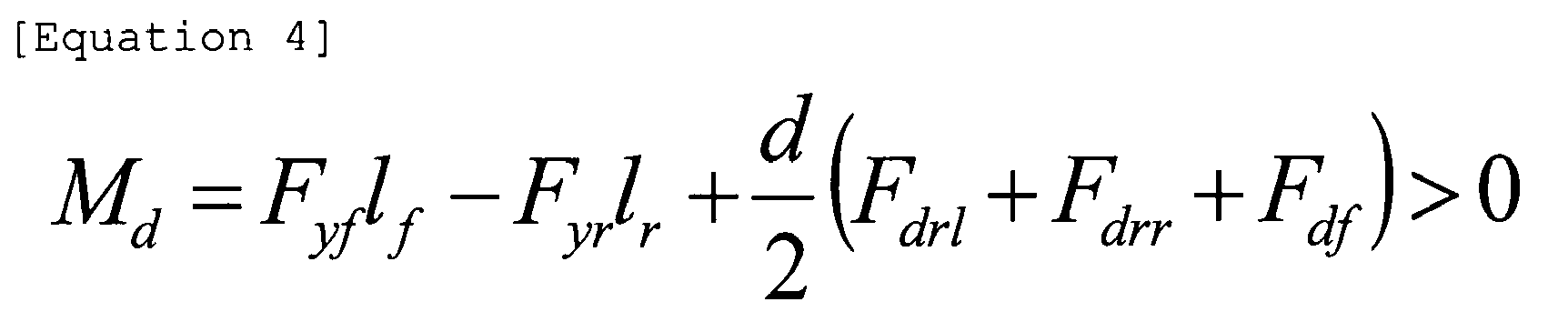
- Here, d denotes a tread (distance between the left and right vehicle wheels as shown in the drawing). In addition,

- When the control is carried out in this way, the yaw moment can be generated without generating the longitudinal acceleration or deceleration other than the front wheel driven vehicle (in this example, without driving the right front wheel 62). That is, the yaw moment can be added without giving an unpleasant feeling to the driver.
- Next,
Fig. 2D is a method in which a vertical load transfer is positively generated from the rear wheel to the front wheel by applying the brake force and an original restoration yaw moment of the vehicle reduces, thereby generating the yaw moment. - The phenomenon of the yaw moment addition in terms of the vertical load transfer is such that the yaw moment due to the acceleration or deceleration during a steady state cornering action is proportional to a value obtained by multiplying the lateral force by the longitudinal acceleration within a range in which the lateral force of the tire is proportional to the vertical load as disclosed in p.54 to 60 of 'Improvement of Vehicle Motion Performance in terms of Yaw Moment Control' written by SHIBAHATA et al. and published by 'SOCIETY OF AUTOMOTIVE ENGINEERS OF JAPAN, INC., Vol.47, No.12, 1993.' The phenomenon occurs when a friction circle of the front wheel increases in accordance with the deceleration -GX and a friction circle of the rear wheel decreases in accordance with the deceleration -GX from the state shown in
Fig. 2A . Here, -Gx is
- Although the deformation of Equations is omitted until the input yaw moment becomes a value obtained by multiplying the lateral force by the longitudinal acceleration,

is obtained, and the positive yaw moment can be input. - Meanwhile,
Figs. 3A to 3D are methods in which the negative yaw moment is input in the same way as those shown inFigs. 2A to 2D . Although the detailed description is omitted because the method is the same as that of the positive yaw moment input method shown inFigs. 2A to 2D , the moment in the restoration direction (clockwise direction shown inFigs. 3B ,3C, and 3D ) is obtained in such a manner that the steering operation is carried out so that the steering angle decreases or the steering operation is carried out so that a phase of the rear wheel becomes the same as that of the front wheel, the brake or drive operation is carried out so that an inverse brake or drive force is applied, the load movement is carried out so that an acceleration is performed to increase a load of the rear wheel, the lateral force of the rear wheel comparatively increases, and the lateral force of the front wheel decreases. - As described above, the vehicle according to this embodiment can generate both the positive and negative yaw moment on the basis of the command of the
central controller 40. - Next, a yaw moment calculation method for a specific yaw moment command will be described in detail. In addition, an outline of the above-described yaw moment generation method is introduced in various documents.
- As shown in
Fig. 4 , this corresponds to a state where the vehicle turns along a certain curve. In a curve of C(s) = (X(s), Y(s)) of the coordinate system (X, Y) fixed to a ground, s denotes a distance along the curve. When a curvature of a locus is denoted by κ(=1/ρ (p: turning radius)), generally κ is shown by using an arc length parameter (s) along the locus as shown inEquation 8.
- That is, when a variation in angle (dθ) occurs upon moving along the curve by a certain distance (ds), the variation is called a curvature κ(dθ/ds) .
- As it is well known, a locus of the vehicle when a handle is steered at a stable angular velocity during a stable vehicle velocity is called a clothoid curve which is often used for designing a road. This curve is

- A variation rate of this curve is uniform with respect to the movement distance. Accordingly, when the vehicle travels along the clothoid curve at a uniform velocity (u),

- A time variation of the curvature of the vehicle becomes stable (which may be supposed that the arc length parameter changes to the time parameter t).

- Meanwhile, from the definition of the curvature κ, κ(s) is expressed by Equation 12.

- This means that the vehicle yaw angle ψ is generated when the vehicle moves along the curve of the curvature κ(s) from s1 to s2 without a variation in sideslip.
- As shown in
Figs. 5A to 5B , the state without a variation in sideslip indicates a state where a difference between a vector (V) in a direction perpendicular to the curve (bold black curve indicating C(s)) and a vehicle velocity direction (direction indicated by the dashed line) is zero (Fig. 5A ) or a state where an angle (β) called a sideslip angle is stable (Fig. 5B ), which is considered as an ideal state where a revolution and a rotation of the vehicle cooperatively correspond to each other. In addition, the yaw angle generated in the ideal state is determined geometrically and is not directly involved with the vehicle dynamics. The details shown inFigs. 5A to 5B are described in, for example, 'Vehicle dynamics and control' written by ABE Masato and published by Sankaido, First edition, July 10, 1992, Third chapter. - When time t1 to t2 is taken to move from s1 to s2 as shown in
Fig. 4 , the yaw rate r_ref of the vehicle in such a motion state is
- In addition, when the yaw angular acceleration (r_ref_dot) is obtained,

- Here, a velocity in a direction where the vehicle moves is as below

- When the longitudinal acceleration of the vehicle is denoted by Gx,

- In addition, when the lateral acceleration of the vehicle is denoted by Gy, as shown in
Figs. 5A to 5B , the vehicle moving in a state where a variation in sideslip does not occur has a relationship
and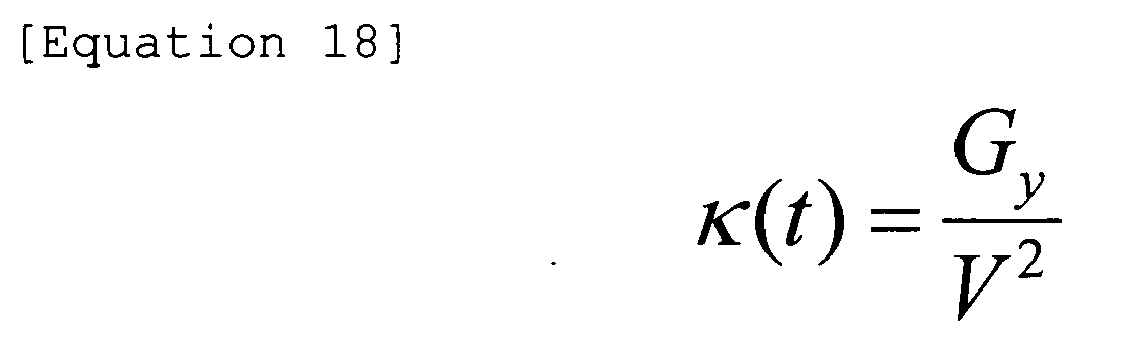
- When the time variation of the curvature is obtained by differentiating both sides,

- Here, Gy_dot denotes the lateral jerk of the vehicle. When
Equations 16, 18, and 19 are applied to Equation 14,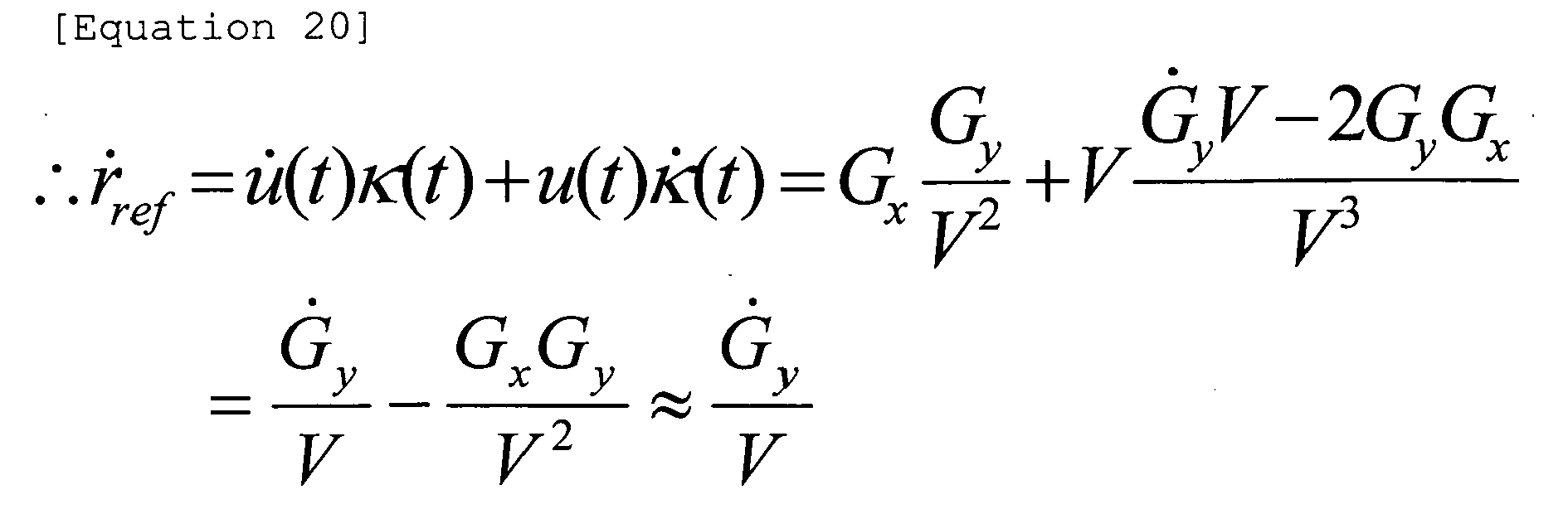
- Here, since a value obtained by dividing a value, obtained by multiplying the longitudinal acceleration by the lateral acceleration, by a square of the velocity in a second term is smaller than that of a first term, this is not considered in this embodiment. This may be considered when higher precise value is required.
- Then,
Equation 20 shows the yaw angular acceleration necessary for the vehicle moving in the ideal state. When the value of the yaw angular acceleration is multiplied by the yawing inertia moment Iz of the vehicle, the reference yaw moment is obtained (which generally corresponds to a relationship of a force f = m x acceleration α) . - Next, a method for controlling the yaw moment of the vehicle being in a running state using the above-described reference yaw moment will be described. Here, the reference moment indicates a moment necessary for moving along the path in a state where the revolution and the rotation of the vehicle are cooperatively correspond to each other as shown in
Figs. 5A to 5B . When the moment is large, the vehicle to obtain the yaw moment acting on the current vehicle. - Consequently, a difference between the action yaw moment (Iz•r_real_dot) and the reference yaw moment (Iz•r_ref_dot) corresponds to a different yaw moment as a cause of the separation of the revolution and the rotation. Accordingly,

- This is the yaw moment to be corrected. Here, k denotes a proportional gain. The reason why the proportional gain is necessary is that the reference yaw moment does not include the dynamics, and when a direct feedback (k=1) is applied thereto, there exists a divergence area. Accordingly, k needs to be adjusted necessarily so as to be 1 or less.
-
Fig. 7 is a schematic view illustrating the configuration of the control logic according to this embodiment. The yaw moment of the vehicle is configured to be controlled on the basis of a value (Gy_dot/V) obtained by dividing the lateral jerk Gy_dot of the vehicle by the longitudinal velocity (V) of the vehicle. The yaw moment of the vehicle is configured to be controlled so that a difference between (Gy_dot/V) and (r_dot) becomes small by detecting the yaw angular acceleration (r_dot) of the vehicle. - In addition, a selection or a combination of described herebelow. As shown in
Fig. 7 , in the motion control system according to the above-described embodiment, the feedback control and the closed loop control based on the difference between the reference yaw angular acceleration and the real yaw angular acceleration of the vehicle are adopted. - On the contrary, in another embodiment, an open loop control, particularly, the yaw moment control in terms of the vertical load transfer is adopted. As described above, as disclosed in p.54 to 60 of 'Improvement of Vehicle Motion Performance in terms of Yaw Moment Control' published by 'SOCIETY OF AUTOMOTIVE ENGINEERS OF JAPAN, INC., Vol.47, No.12, 1993, within a range in which the lateral force of the tire is proportional to the load, the yaw moment (Mzls) due to the acceleration or deceleration during a steady state cornering action is proportional to a value obtained by the lateral acceleration by the longitudinal acceleration as shown in
Equation 22. Here, m denotes a vehicle mass, h denotes a height of gravity center point, and g denotes a gravity acceleration.
- Accordingly, when a necessary yaw moment is set to a value obtained by multiplying a value (Gy_dot/V=r_ref_dot), obtained by dividing the lateral jerk (Gy_dot) of the vehicle by the longitudinal velocity (V) of the vehicle, by an inertia moment aground a Z axis, the longitudinal acceleration realizing the control moment having the same profile as that of the necessary yaw moment is obtained. This may be regarded as an overall control of longitudinal motion and lateral motion which determines the lateral acceleration generated by the steering operation and the longitudinal acceleration by the brake and accelerator operation in accordance with the lateral acceleration.
- That is, this is a method for obtaining a value as an index for enabling the system to automatically operate the brake and accelerator in accordance with the driver's steering operation. When a proportional constant is denoted by c, a command longitudinal acceleration Gxc is expressed as the following
Equation 23.
- When the brake and accelerator is controlled on the basis of the Gxc value, since the moment in terms of the load movement is generated to be close to the reference yaw moment, the correspondence between the rotation and the revolution is more improved, thereby improving operability and stabilizing the vehicle.
- Upon being mounted to the vehicle and divided by the lateral acceleration (Gy) of the vehicle, in an initial turning state, in some cases, the lateral acceleration becomes a small value and the command longitudinal acceleration Gxc becomes a large value.
- In addition, the same case may occur upon decreasing the speed. In order to avoid such cases, as shown in
Equation 24, it is sufficiently effective in practical engineering even when the command longitudinal acceleration Gxc is determined in such a manner that main information is obtained from the lateral jerk (Gy_dot) of the vehicle and other information is obtained from the velocity, the lateral acceleration or the function f(Gy, V) thereof, or dependent information and a gain KGyV stored in a map etc.
- Specifically, there are provided means for detecting the longitudinal velocity (V) of the vehicle and the lateral jerk (Gy_dot) of the vehicle, and the longitudinal acceleration of the vehicle is controlled on the basis of the value (Gy_dot/V) obtained by dividing the lateral jerk (Gy_dot) of the vehicle by the longitudinal velocity (V) of the vehicle so that the yaw moment of the vehicle is controlled in terms of the vertical load transfer. More specifically, the
Claims (2)
- A motion control system for a vehicle comprising:control means (40) for controlling a longitudinal acceleration of the vehicle,characterized in that the control means (40) controls longitudinal acceleration of the vehicle based on a value obtained by multiplying a lateral jerk (Gy_dot) of the vehicle by a prestored gain (KGyV) determined by a longitudinal velocity (V) and a lateral acceleration(Gy) of the vehicle.
- A method for controlling a vehicle, said method comprising:generating a control command for longitudinal acceleration of the vehicle based on a value obtained by multiplying a lateral jerk (Gy_dot) of the vehicle by a prestored gain (KGyV) determined by a longitudinal velocity (V) and a lateral acceleration(Gy) of the vehicle;outputting the generated control command; andcontrolling motion of the vehicle based on the generated control command.
Priority Applications (1)
| Application Number | Priority Date | Filing Date | Title |
|---|---|---|---|
| EP13161910.8A EP2626264B1 (en) | 2007-05-18 | 2008-05-15 | Motion control system for vehicle based on jerk information |
Applications Claiming Priority (2)
| Application Number | Priority Date | Filing Date | Title |
|---|---|---|---|
| JP2007132987A JP4568302B2 (en) | 2007-05-18 | 2007-05-18 | Vehicle longitudinal acceleration control apparatus using jerk information |
| EP08009005A EP1992537B1 (en) | 2007-05-18 | 2008-05-15 | Motion control unit for vehicle based on jerk information |
Related Parent Applications (1)
| Application Number | Title | Priority Date | Filing Date |
|---|---|---|---|
| EP08009005.3 Division | 2008-05-15 |
Related Child Applications (2)
| Application Number | Title | Priority Date | Filing Date |
|---|---|---|---|
| EP13161910.8A Division EP2626264B1 (en) | 2007-05-18 | 2008-05-15 | Motion control system for vehicle based on jerk information |
| EP13161910.8 Division-Into | 2013-04-02 |
Publications (2)
| Publication Number | Publication Date |
|---|---|
| EP2433840A1 true EP2433840A1 (en) | 2012-03-28 |
| EP2433840B1 EP2433840B1 (en) | 2013-06-05 |
Family
ID=39730727
Family Applications (3)
| Application Number | Title | Priority Date | Filing Date |
|---|---|---|---|
| EP13161910.8A Active EP2626264B1 (en) | 2007-05-18 | 2008-05-15 | Motion control system for vehicle based on jerk information |
| EP08009005A Active EP1992537B1 (en) | 2007-05-18 | 2008-05-15 | Motion control unit for vehicle based on jerk information |
| EP11184288.6A Active EP2433840B1 (en) | 2007-05-18 | 2008-05-15 | Motion control unit for vehicle based on jerk information |
Family Applications Before (2)
| Application Number | Title | Priority Date | Filing Date |
|---|---|---|---|
| EP13161910.8A Active EP2626264B1 (en) | 2007-05-18 | 2008-05-15 | Motion control system for vehicle based on jerk information |
| EP08009005A Active EP1992537B1 (en) | 2007-05-18 | 2008-05-15 | Motion control unit for vehicle based on jerk information |
Country Status (5)
| Country | Link |
|---|---|
| US (4) | US7979180B2 (en) |
| EP (3) | EP2626264B1 (en) |
| JP (1) | JP4568302B2 (en) |
| KR (1) | KR100903665B1 (en) |
| CN (2) | CN102107660B (en) |
Cited By (1)
| Publication number | Priority date | Publication date | Assignee | Title |
|---|---|---|---|---|
| US9598077B2 (en) | 2013-10-10 | 2017-03-21 | Hitachi Automotive Systems, Ltd. | Vehicle movement control system |
Families Citing this family (60)
| Publication number | Priority date | Publication date | Assignee | Title |
|---|---|---|---|---|
| US8744689B2 (en) * | 2007-07-26 | 2014-06-03 | Hitachi, Ltd. | Drive controlling apparatus for a vehicle |
| JP5193885B2 (en) * | 2009-01-13 | 2013-05-08 | 日立オートモティブシステムズ株式会社 | Vehicle motion control device |
| JP5152345B2 (en) * | 2009-01-28 | 2013-02-27 | トヨタ自動車株式会社 | Pedal reaction force control device |
| JP4920054B2 (en) | 2009-03-30 | 2012-04-18 | 株式会社日立製作所 | Vehicle motion control device |
| JP5143103B2 (en) * | 2009-09-30 | 2013-02-13 | 日立オートモティブシステムズ株式会社 | Vehicle motion control device |
| JP5414454B2 (en) * | 2009-10-23 | 2014-02-12 | 日立オートモティブシステムズ株式会社 | Vehicle motion control device |
| FR2955943B1 (en) * | 2010-01-29 | 2012-06-15 | Renault Sa | SYSTEM AND METHOD FOR MONITORING THE TRACK OF A VEHICLE |
| JP5273416B2 (en) * | 2010-02-02 | 2013-08-28 | トヨタ自動車株式会社 | Vehicle behavior control device |
| EP2578471B1 (en) * | 2010-06-04 | 2016-03-16 | Mitsubishi Electric Corporation | Automatic steering device |
| JP5378318B2 (en) | 2010-07-30 | 2013-12-25 | 日立オートモティブシステムズ株式会社 | Vehicle motion control device |
| US8676464B2 (en) | 2010-09-29 | 2014-03-18 | Toyota Jidosha Kabushiki Kaisha | Vehicle control system |
| CN102730000B (en) * | 2011-03-31 | 2016-06-01 | 比亚迪股份有限公司 | The computational methods of vehicle dynamic barycenter, the computational methods of yaw moment and system |
| JP5764656B2 (en) * | 2011-05-11 | 2015-08-19 | 日立オートモティブシステムズ株式会社 | Vehicle motion control device |
| JP5417386B2 (en) | 2011-07-01 | 2014-02-12 | 日立オートモティブシステムズ株式会社 | Vehicle motion control device |
| US8700282B2 (en) * | 2011-07-28 | 2014-04-15 | Advics Co., Ltd. | Method and apparatus for vehicle sway detection and reduction |
| JP5809506B2 (en) * | 2011-09-27 | 2015-11-11 | 日立オートモティブシステムズ株式会社 | Vehicle motion control device and suspension control device |
| DE102011122535B4 (en) * | 2011-12-27 | 2017-06-01 | Audi Ag | Device for a vehicle having a rear axle steering system and method for operating a motor vehicle |
| JP5927054B2 (en) * | 2012-06-11 | 2016-05-25 | 日立オートモティブシステムズ株式会社 | Vehicle travel control device |
| EP2712782B1 (en) | 2012-09-28 | 2018-01-31 | Hitachi, Ltd. | Method and apparatus for performing driving assistance |
| EP2712780B1 (en) | 2012-09-28 | 2018-04-04 | Hitachi, Ltd. | Method and apparatus for performing driving assistance |
| JP5970322B2 (en) * | 2012-10-01 | 2016-08-17 | 日立オートモティブシステムズ株式会社 | Vehicle motion control device |
| KR101355620B1 (en) | 2012-11-09 | 2014-01-27 | 기아자동차주식회사 | Touch point searching method for clutch |
| JP5452696B2 (en) * | 2012-11-12 | 2014-03-26 | 日立オートモティブシステムズ株式会社 | Vehicle motion control device |
| JP2014148182A (en) | 2013-01-31 | 2014-08-21 | Hitachi Automotive Systems Ltd | Travel control unit of vehicle |
| WO2015045502A1 (en) | 2013-09-30 | 2015-04-02 | 日立オートモティブシステムズ株式会社 | Vehicle travel control device |
| EP2853458B1 (en) | 2013-09-30 | 2019-12-18 | Hitachi, Ltd. | Method and apparatus for performing driving assistance |
| EP2853457B1 (en) | 2013-09-30 | 2019-11-27 | Hitachi, Ltd. | Method and apparatus for performing driving assistance |
| KR101480652B1 (en) * | 2013-12-11 | 2015-01-09 | 현대자동차주식회사 | Lane change control apparatus and control method of the same |
| JP5993843B2 (en) * | 2013-12-25 | 2016-09-14 | 日立オートモティブシステムズ株式会社 | Vehicle motion control device |
| JP5918303B2 (en) * | 2014-06-06 | 2016-05-18 | 株式会社日立製作所 | Vehicle whose motion is controlled using jerk information |
| JP6416574B2 (en) | 2014-09-29 | 2018-10-31 | 日立オートモティブシステムズ株式会社 | VEHICLE CONTROL METHOD, VEHICLE CONTROL SYSTEM, VEHICLE CONTROL DEVICE, AND CONTROL PROGRAM |
| JP2016088436A (en) * | 2014-11-10 | 2016-05-23 | 株式会社デンソー | Motor control device |
| CN104890675A (en) * | 2015-06-10 | 2015-09-09 | 山东理工大学 | Automobile transverse-speed measurement device and automobile transverse-speed calculation method |
| CN104925054B (en) * | 2015-07-23 | 2017-04-19 | 吉林大学 | Vehicle stable steering integrated control method based on differential flatness |
| CN106467111B (en) | 2015-08-20 | 2019-06-07 | 比亚迪股份有限公司 | Vehicle body stable control method, system and automobile |
| WO2017145555A1 (en) | 2016-02-26 | 2017-08-31 | 日立オートモティブシステムズ株式会社 | Cruise control apparatus and cruise control system |
| CN109311462B (en) | 2016-06-15 | 2021-03-05 | 日立汽车系统株式会社 | Vehicle control device |
| US11286765B2 (en) | 2016-12-07 | 2022-03-29 | Halliburton Energy Services, Inc. | Measuring invisible lost time in drilling operations |
| JP6547780B2 (en) * | 2017-02-16 | 2019-07-24 | トヨタ自動車株式会社 | Vehicle turning control device |
| US11761320B2 (en) | 2017-05-15 | 2023-09-19 | Landmark Graphics Corporation | Method and system to drill a wellbore and identify drill bit failure by deconvoluting sensor data |
| DE112018002154T5 (en) | 2017-06-15 | 2020-01-09 | Hitachi Automotive Systems, Ltd. | Vehicle control device |
| JP6814710B2 (en) | 2017-08-10 | 2021-01-20 | 日立オートモティブシステムズ株式会社 | Vehicle motion control device and its method, and target trajectory generator and its method |
| JP6506812B2 (en) * | 2017-10-06 | 2019-04-24 | 日立オートモティブシステムズ株式会社 | Vehicle motion control device and motion control program |
| JP6976142B2 (en) * | 2017-11-09 | 2021-12-08 | 日立Astemo株式会社 | Vehicle motion control device, method, program, and system, and target trajectory generator, method, program, and system. |
| JP6607532B2 (en) * | 2017-12-27 | 2019-11-20 | マツダ株式会社 | Vehicle behavior control device |
| US11400927B2 (en) * | 2018-01-29 | 2022-08-02 | Ford Global Technologies, Llc | Collision avoidance and mitigation |
| CN111267853B (en) * | 2018-12-03 | 2021-06-18 | 广州汽车集团股份有限公司 | A kind of adaptive vehicle curve assist control method, device, computer equipment and storage medium |
| JP6771610B2 (en) * | 2019-03-25 | 2020-10-21 | 日立オートモティブシステムズ株式会社 | Vehicle motion control device |
| CN111731315B (en) * | 2019-03-25 | 2021-12-31 | 博世华域转向系统有限公司 | Deviation compensation method in automobile rapid acceleration process |
| KR102149762B1 (en) * | 2019-04-04 | 2020-08-31 | 한국항공우주연구원 | Detection device for aerial vehicle's collision- crash and operation system thereof |
| DE102019208525B4 (en) * | 2019-06-12 | 2026-03-26 | Hitachi, Ltd. | Vehicle driving control procedure, vehicle driving control device and computer program product |
| JP7458184B2 (en) * | 2019-12-27 | 2024-03-29 | ニデック株式会社 | Control device |
| CN111308125B (en) * | 2020-02-24 | 2021-08-20 | 北京大学 | A jerk detection method and accelerometer based on optical fiber Sagnac interferometer |
| JP7414647B2 (en) * | 2020-06-03 | 2024-01-16 | 日産自動車株式会社 | Driving support method and driving support device |
| JP7414646B2 (en) * | 2020-06-03 | 2024-01-16 | 日産自動車株式会社 | Driving support method and driving support device |
| JP7613964B2 (en) * | 2021-03-19 | 2025-01-15 | トヨタ自動車株式会社 | Driving assistance device and method, and computer program |
| CN114572014B (en) * | 2022-02-07 | 2023-12-22 | 达闼机器人股份有限公司 | Equipment control method, device, electronic equipment and storage medium |
| CN114932910B (en) * | 2022-06-15 | 2025-09-23 | 杭州鸿泉物联网技术股份有限公司 | Vehicle turning detection method, device, equipment and storage medium |
| JP7694494B2 (en) * | 2022-07-22 | 2025-06-18 | トヨタ自動車株式会社 | Steering system |
| WO2024116390A1 (en) * | 2022-12-01 | 2024-06-06 | 日産自動車株式会社 | Vehicle control method and vehicle control device |
Citations (6)
| Publication number | Priority date | Publication date | Assignee | Title |
|---|---|---|---|---|
| JPH0516789A (en) | 1991-07-08 | 1993-01-26 | Hitachi Ltd | Anti-skid brake control method and device |
| JPH1016599A (en) | 1996-07-05 | 1998-01-20 | Mitsubishi Motors Corp | Power transmission control device for left and right wheels for vehicles |
| DE10011779A1 (en) * | 1999-09-10 | 2001-06-21 | Continental Teves Ag & Co Ohg | Yaw moment regulation involves estimating actual yaw angular rate by taking into account actual forces on tyres, steering angle in integrating angular acceleration |
| US20020161505A1 (en) * | 2001-03-14 | 2002-10-31 | Thomas Reich | Method and device for controlling the cornering speed of a vehicle |
| JP2002340925A (en) | 1992-02-17 | 2002-11-27 | Hitachi Ltd | Jerk sensor |
| US20040119335A1 (en) * | 2000-09-18 | 2004-06-24 | Gergely Szabo | Method for estimating the overturn risk of a vehicle |
Family Cites Families (20)
| Publication number | Priority date | Publication date | Assignee | Title |
|---|---|---|---|---|
| JPS61238571A (en) * | 1985-04-15 | 1986-10-23 | Nissan Motor Co Ltd | Control device for vehicle steering system |
| US4674327A (en) * | 1986-03-17 | 1987-06-23 | Highway Products International Inc. | Grade and cross fall reference device for highway survey vehicles |
| DE4201146C2 (en) * | 1991-01-18 | 2003-01-30 | Hitachi Ltd | Device for controlling motor vehicle behavior |
| JP2885125B2 (en) * | 1995-03-30 | 1999-04-19 | トヨタ自動車株式会社 | Estimation method of motion state quantity changing with turning of vehicle |
| TW330182B (en) | 1995-09-26 | 1998-04-21 | Honda Motor Co Ltd | Process for controlling yaw moment in a vehicle |
| CN1156248A (en) * | 1996-01-31 | 1997-08-06 | 美国控制设备有限公司 | Lateral motion detection and control device |
| DE19655388B4 (en) | 1996-08-16 | 2008-08-14 | Daimler Ag | Vehicle dynamics control system and method |
| DE19708508A1 (en) | 1996-09-24 | 1998-03-26 | Bosch Gmbh Robert | Method and device for regulating a movement quantity representing the movement of the vehicle |
| JP3853907B2 (en) * | 1997-03-21 | 2006-12-06 | トヨタ自動車株式会社 | Drive control device for electric vehicles |
| JPH11198783A (en) * | 1998-01-20 | 1999-07-27 | Nissan Motor Co Ltd | Vehicle behavior control device |
| JP3873588B2 (en) * | 2000-07-13 | 2007-01-24 | 日産自動車株式会社 | Vehicle autopilot control device |
| WO2002015722A2 (en) * | 2000-08-21 | 2002-02-28 | Fahey Jed W | Treatment of helicobacter with isothiocyanates |
| JP4223205B2 (en) | 2001-08-27 | 2009-02-12 | 本田技研工業株式会社 | Driving force distribution device for hybrid vehicle |
| US20040024504A1 (en) * | 2002-08-05 | 2004-02-05 | Salib Albert Chenouda | System and method for operating a rollover control system during an elevated condition |
| US6963797B2 (en) * | 2002-08-05 | 2005-11-08 | Ford Global Technologies, Llc | System and method for determining an amount of control for operating a rollover control system |
| JPWO2006013645A1 (en) * | 2004-08-06 | 2008-05-01 | 株式会社日立製作所 | Vehicle attitude control device and method |
| JP4293092B2 (en) * | 2004-09-01 | 2009-07-08 | 株式会社アドヴィックス | Vehicle motion control device |
| JP2006298209A (en) * | 2005-04-21 | 2006-11-02 | Advics:Kk | Vehicle roll increase trend determination device and vehicle motion stabilization controller using the same |
| CN1775601A (en) * | 2005-11-18 | 2006-05-24 | 吉林大学 | Vehicle driving trace predicating and lane deviation evaluating method |
| JP4724593B2 (en) | 2006-04-27 | 2011-07-13 | 日立オートモティブシステムズ株式会社 | Vehicle motion control device |
-
2007
- 2007-05-18 JP JP2007132987A patent/JP4568302B2/en active Active
-
2008
- 2008-05-15 US US12/121,323 patent/US7979180B2/en active Active
- 2008-05-15 EP EP13161910.8A patent/EP2626264B1/en active Active
- 2008-05-15 KR KR1020080045070A patent/KR100903665B1/en active Active
- 2008-05-15 EP EP08009005A patent/EP1992537B1/en active Active
- 2008-05-15 EP EP11184288.6A patent/EP2433840B1/en active Active
- 2008-05-16 CN CN201110035102.3A patent/CN102107660B/en active Active
- 2008-05-16 CN CN200810100706XA patent/CN101311050B/en active Active
-
2011
- 2011-06-02 US US13/151,904 patent/US8112200B2/en active Active
- 2011-12-29 US US13/339,997 patent/US8239096B2/en active Active
-
2012
- 2012-07-02 US US13/540,405 patent/US8515619B2/en active Active
Patent Citations (6)
| Publication number | Priority date | Publication date | Assignee | Title |
|---|---|---|---|---|
| JPH0516789A (en) | 1991-07-08 | 1993-01-26 | Hitachi Ltd | Anti-skid brake control method and device |
| JP2002340925A (en) | 1992-02-17 | 2002-11-27 | Hitachi Ltd | Jerk sensor |
| JPH1016599A (en) | 1996-07-05 | 1998-01-20 | Mitsubishi Motors Corp | Power transmission control device for left and right wheels for vehicles |
| DE10011779A1 (en) * | 1999-09-10 | 2001-06-21 | Continental Teves Ag & Co Ohg | Yaw moment regulation involves estimating actual yaw angular rate by taking into account actual forces on tyres, steering angle in integrating angular acceleration |
| US20040119335A1 (en) * | 2000-09-18 | 2004-06-24 | Gergely Szabo | Method for estimating the overturn risk of a vehicle |
| US20020161505A1 (en) * | 2001-03-14 | 2002-10-31 | Thomas Reich | Method and device for controlling the cornering speed of a vehicle |
Non-Patent Citations (3)
| Title |
|---|
| "ABE Masato", 10 July 1992, SANKAIDO, FIRST EDITION,, article "Vehicle dynamics and control" |
| "Improvement of Vehicle Motion Performance in terms of Yaw Moment Control", vol. 47, 1993, SOCIETY OF AUTOMOTIVE ENGINEERS OF JAPAN, INC., pages: 54 - 60 |
| SHIBAHATA ET AL.: "Improvement of Vehicle Motion Performance in terms of Yaw Moment Control", vol. 47, 1993, SOCIETY OF AUTOMOTIVE ENGINEERS OF JAPAN, INC., pages: 54 - 60 |
Cited By (1)
| Publication number | Priority date | Publication date | Assignee | Title |
|---|---|---|---|---|
| US9598077B2 (en) | 2013-10-10 | 2017-03-21 | Hitachi Automotive Systems, Ltd. | Vehicle movement control system |
Also Published As
| Publication number | Publication date |
|---|---|
| CN101311050A (en) | 2008-11-26 |
| US8112200B2 (en) | 2012-02-07 |
| KR100903665B1 (en) | 2009-06-18 |
| US20090192675A1 (en) | 2009-07-30 |
| US8515619B2 (en) | 2013-08-20 |
| US20110231033A1 (en) | 2011-09-22 |
| CN102107660A (en) | 2011-06-29 |
| EP1992537A2 (en) | 2008-11-19 |
| CN102107660B (en) | 2014-01-08 |
| EP2433840B1 (en) | 2013-06-05 |
| US8239096B2 (en) | 2012-08-07 |
| EP1992537A3 (en) | 2010-08-25 |
| KR20080101738A (en) | 2008-11-21 |
| CN101311050B (en) | 2011-07-06 |
| US20120323445A1 (en) | 2012-12-20 |
| JP4568302B2 (en) | 2010-10-27 |
| EP2626264B1 (en) | 2016-09-21 |
| EP1992537B1 (en) | 2011-11-16 |
| EP2626264A1 (en) | 2013-08-14 |
| US7979180B2 (en) | 2011-07-12 |
| JP2008285066A (en) | 2008-11-27 |
| US20120101657A1 (en) | 2012-04-26 |
Similar Documents
| Publication | Publication Date | Title |
|---|---|---|
| EP2433840A1 (en) | Motion control unit for vehicle based on jerk information | |
| US11891048B2 (en) | Method for generating a setpoint for the combined control of a wheel-steering system and of a differential braking system of a motor vehicle | |
| US8483926B2 (en) | Device and method for estimating frictional condition of ground contact surface of wheel | |
| US11318924B1 (en) | Torque distribution system for redistributing torque between axles of a vehicle | |
| CN104703854A (en) | Vehicle motion control device | |
| JP5211995B2 (en) | Vehicle deceleration control apparatus and method | |
| JP2019155970A (en) | Control device of vehicle and control method of vehicle | |
| JP5559833B2 (en) | Vehicle motion control apparatus and method using jerk information | |
| US10752285B2 (en) | Apparatus and method for controlling rotation of vehicle in consideration of slip | |
| US8442736B2 (en) | System for enhancing cornering performance of a vehicle controlled by a safety system | |
| JP4990384B2 (en) | Vehicle motion control method using jerk information | |
| JP4263043B2 (en) | Left-right wheel load difference relation calculation method, load difference control device, and vehicle control device | |
| US8660750B2 (en) | System for enhancing cornering performance of a vehicle equipped with a stability control system | |
| JP5918303B2 (en) | Vehicle whose motion is controlled using jerk information | |
| Palmieri et al. | Robust vehicle lateral stabilization via set-based methods for uncertain piecewise affine systems: Experimental results | |
| Li et al. | Understanding agile-maneuver driving strategies using coupled longitudinal/lateral vehicle dynamics | |
| Regolin | Vehicle Dynamics Control in MAGV: Forces Estimation and Motion Planning Methods | |
| Ferrara et al. | Vehicle Dynamics Control in MAGV: Forces Estimation and Motion Planning Methods | |
| Bissonnette | Adaptive vehicle control by combined DYC and FWS | |
| JP2005206114A (en) | Steering control device for vehicle |
Legal Events
| Date | Code | Title | Description |
|---|---|---|---|
| PUAI | Public reference made under article 153(3) epc to a published international application that has entered the european phase |
Free format text: ORIGINAL CODE: 0009012 |
|
| AC | Divisional application: reference to earlier application |
Ref document number: 1992537 Country of ref document: EP Kind code of ref document: P |
|
| AK | Designated contracting states |
Kind code of ref document: A1 Designated state(s): DE FR GB IT |
|
| 17P | Request for examination filed |
Effective date: 20120420 |
|
| GRAP | Despatch of communication of intention to grant a patent |
Free format text: ORIGINAL CODE: EPIDOSNIGR1 |
|
| RIC1 | Information provided on ipc code assigned before grant |
Ipc: B60W 10/06 20060101AFI20121109BHEP Ipc: B60T 8/1755 20060101ALI20121109BHEP Ipc: B60W 10/12 20120101ALI20121109BHEP Ipc: B60W 30/02 20120101ALI20121109BHEP Ipc: B60W 10/18 20120101ALI20121109BHEP |
|
| RIN1 | Information on inventor provided before grant (corrected) |
Inventor name: YAMAKADO, MAKOTO C/O HITACHI, LTD. Inventor name: ABE, MASATO Inventor name: IMURA, SHINYA C/O HITACHI, LTD. |
|
| GRAS | Grant fee paid |
Free format text: ORIGINAL CODE: EPIDOSNIGR3 |
|
| GRAA | (expected) grant |
Free format text: ORIGINAL CODE: 0009210 |
|
| AC | Divisional application: reference to earlier application |
Ref document number: 1992537 Country of ref document: EP Kind code of ref document: P |
|
| AK | Designated contracting states |
Kind code of ref document: B1 Designated state(s): DE FR GB IT |
|
| REG | Reference to a national code |
Ref country code: GB Ref legal event code: FG4D |
|
| REG | Reference to a national code |
Ref country code: DE Ref legal event code: R096 Ref document number: 602008025233 Country of ref document: DE Effective date: 20130801 |
|
| PLBE | No opposition filed within time limit |
Free format text: ORIGINAL CODE: 0009261 |
|
| STAA | Information on the status of an ep patent application or granted ep patent |
Free format text: STATUS: NO OPPOSITION FILED WITHIN TIME LIMIT |
|
| 26N | No opposition filed |
Effective date: 20140306 |
|
| REG | Reference to a national code |
Ref country code: DE Ref legal event code: R097 Ref document number: 602008025233 Country of ref document: DE Effective date: 20140306 |
|
| REG | Reference to a national code |
Ref country code: FR Ref legal event code: PLFP Year of fee payment: 9 |
|
| REG | Reference to a national code |
Ref country code: FR Ref legal event code: PLFP Year of fee payment: 10 |
|
| REG | Reference to a national code |
Ref country code: FR Ref legal event code: PLFP Year of fee payment: 11 |
|
| REG | Reference to a national code |
Ref country code: DE Ref legal event code: R081 Ref document number: 602008025233 Country of ref document: DE Owner name: HITACHI ASTEMO, LTD., HITACHINAKA-SHI, JP Free format text: FORMER OWNER: HITACHI, LTD., TOKYO, JP Ref country code: DE Ref legal event code: R082 Ref document number: 602008025233 Country of ref document: DE Representative=s name: MERH-IP MATIAS ERNY REICHL HOFFMANN PATENTANWA, DE Ref country code: DE Ref legal event code: R081 Ref document number: 602008025233 Country of ref document: DE Owner name: HITACHI AUTOMOTIVE SYSTEMS, LTD., HITACHINAKA-, JP Free format text: FORMER OWNER: HITACHI, LTD., TOKYO, JP |
|
| REG | Reference to a national code |
Ref country code: GB Ref legal event code: 732E Free format text: REGISTERED BETWEEN 20181011 AND 20181017 |
|
| REG | Reference to a national code |
Ref country code: DE Ref legal event code: R082 Ref document number: 602008025233 Country of ref document: DE Representative=s name: MERH-IP MATIAS ERNY REICHL HOFFMANN PATENTANWA, DE Ref country code: DE Ref legal event code: R081 Ref document number: 602008025233 Country of ref document: DE Owner name: HITACHI ASTEMO, LTD., HITACHINAKA-SHI, JP Free format text: FORMER OWNER: HITACHI AUTOMOTIVE SYSTEMS, LTD., HITACHINAKA-SHI, IBARAKI, JP |
|
| REG | Reference to a national code |
Ref country code: FR Ref legal event code: PLFP Year of fee payment: 16 |
|
| PGFP | Annual fee paid to national office [announced via postgrant information from national office to epo] |
Ref country code: GB Payment date: 20250327 Year of fee payment: 18 |
|
| PGFP | Annual fee paid to national office [announced via postgrant information from national office to epo] |
Ref country code: DE Payment date: 20250402 Year of fee payment: 18 |
|
| PGFP | Annual fee paid to national office [announced via postgrant information from national office to epo] |
Ref country code: IT Payment date: 20250422 Year of fee payment: 18 |
|
| PGFP | Annual fee paid to national office [announced via postgrant information from national office to epo] |
Ref country code: FR Payment date: 20250401 Year of fee payment: 18 |