EP2433625A1 - Anti-obesity agent comprising compound containing benzotropolone ring - Google Patents
Anti-obesity agent comprising compound containing benzotropolone ring Download PDFInfo
- Publication number
- EP2433625A1 EP2433625A1 EP10777827A EP10777827A EP2433625A1 EP 2433625 A1 EP2433625 A1 EP 2433625A1 EP 10777827 A EP10777827 A EP 10777827A EP 10777827 A EP10777827 A EP 10777827A EP 2433625 A1 EP2433625 A1 EP 2433625A1
- Authority
- EP
- European Patent Office
- Prior art keywords
- formula
- compound
- obesity agent
- gallate
- lipase
- Prior art date
- Legal status (The legal status is an assumption and is not a legal conclusion. Google has not performed a legal analysis and makes no representation as to the accuracy of the status listed.)
- Granted
Links
- 0 CC([C@](C1)OCc(cc2O)cc(*)c2O)(C(C=C(C(c2c3O)=O)O)=Cc2ccc3O)Oc2c1c(O)cc(O)c2 Chemical compound CC([C@](C1)OCc(cc2O)cc(*)c2O)(C(C=C(C(c2c3O)=O)O)=Cc2ccc3O)Oc2c1c(O)cc(O)c2 0.000 description 4
- NJDBUIWQZVNVNW-UHFFFAOYSA-N COC(c(cc1O)cc([N+]([O-])=O)c1O)=O Chemical compound COC(c(cc1O)cc([N+]([O-])=O)c1O)=O NJDBUIWQZVNVNW-UHFFFAOYSA-N 0.000 description 1
- HENSMBPZGXYVPM-BVGRYSDNSA-N COc(c([O]=C)cc(C=C(C=C1[O](C)(C)=C)C(O[C@H]2[C@@H](c(cc3)cc([O]=C)c3[O]=C)Oc3cc([O]=C)cc([O](C)=C)c3C2)=O)c2C1=O)c2O Chemical compound COc(c([O]=C)cc(C=C(C=C1[O](C)(C)=C)C(O[C@H]2[C@@H](c(cc3)cc([O]=C)c3[O]=C)Oc3cc([O]=C)cc([O](C)=C)c3C2)=O)c2C1=O)c2O HENSMBPZGXYVPM-BVGRYSDNSA-N 0.000 description 1
- MEFOFGIOFAAGNX-QFQXNSOFSA-N Oc1cc(O)c(C[C@H]([C@@H](c(cc2O)ccc2O)O2)OC(C(C=C3O)=Cc(cc(c(O)c4O)O)c4C3=O)=O)c2c1 Chemical compound Oc1cc(O)c(C[C@H]([C@@H](c(cc2O)ccc2O)O2)OC(C(C=C3O)=Cc(cc(c(O)c4O)O)c4C3=O)=O)c2c1 MEFOFGIOFAAGNX-QFQXNSOFSA-N 0.000 description 1
Images

Classifications
-
- C—CHEMISTRY; METALLURGY
- C07—ORGANIC CHEMISTRY
- C07D—HETEROCYCLIC COMPOUNDS
- C07D311/00—Heterocyclic compounds containing six-membered rings having one oxygen atom as the only hetero atom, condensed with other rings
- C07D311/02—Heterocyclic compounds containing six-membered rings having one oxygen atom as the only hetero atom, condensed with other rings ortho- or peri-condensed with carbocyclic rings or ring systems
- C07D311/04—Benzo[b]pyrans, not hydrogenated in the carbocyclic ring
- C07D311/58—Benzo[b]pyrans, not hydrogenated in the carbocyclic ring other than with oxygen or sulphur atoms in position 2 or 4
- C07D311/64—Benzo[b]pyrans, not hydrogenated in the carbocyclic ring other than with oxygen or sulphur atoms in position 2 or 4 with oxygen atoms directly attached in position 8
-
- A—HUMAN NECESSITIES
- A23—FOODS OR FOODSTUFFS; TREATMENT THEREOF, NOT COVERED BY OTHER CLASSES
- A23F—COFFEE; TEA; THEIR SUBSTITUTES; MANUFACTURE, PREPARATION, OR INFUSION THEREOF
- A23F3/00—Tea; Tea substitutes; Preparations thereof
- A23F3/16—Tea extraction; Tea extracts; Treating tea extract; Making instant tea
-
- A—HUMAN NECESSITIES
- A23—FOODS OR FOODSTUFFS; TREATMENT THEREOF, NOT COVERED BY OTHER CLASSES
- A23L—FOODS, FOODSTUFFS OR NON-ALCOHOLIC BEVERAGES, NOT OTHERWISE PROVIDED FOR; PREPARATION OR TREATMENT THEREOF
- A23L2/00—Non-alcoholic beverages; Dry compositions or concentrates therefor; Preparation or treatment thereof
- A23L2/52—Adding ingredients
-
- A—HUMAN NECESSITIES
- A23—FOODS OR FOODSTUFFS; TREATMENT THEREOF, NOT COVERED BY OTHER CLASSES
- A23L—FOODS, FOODSTUFFS OR NON-ALCOHOLIC BEVERAGES, NOT OTHERWISE PROVIDED FOR; PREPARATION OR TREATMENT THEREOF
- A23L33/00—Modifying nutritive qualities of foods; Dietetic products; Preparation or treatment thereof
- A23L33/10—Modifying nutritive qualities of foods; Dietetic products; Preparation or treatment thereof using additives
- A23L33/105—Plant extracts, their artificial duplicates or their derivatives
-
- A—HUMAN NECESSITIES
- A61—MEDICAL OR VETERINARY SCIENCE; HYGIENE
- A61K—PREPARATIONS FOR MEDICAL, DENTAL OR TOILETRY PURPOSES
- A61K31/00—Medicinal preparations containing organic active ingredients
- A61K31/12—Ketones
- A61K31/122—Ketones having the oxygen directly attached to a ring, e.g. quinones, vitamin K1, anthralin
-
- A—HUMAN NECESSITIES
- A61—MEDICAL OR VETERINARY SCIENCE; HYGIENE
- A61K—PREPARATIONS FOR MEDICAL, DENTAL OR TOILETRY PURPOSES
- A61K31/00—Medicinal preparations containing organic active ingredients
- A61K31/33—Heterocyclic compounds
- A61K31/335—Heterocyclic compounds having oxygen as the only ring hetero atom, e.g. fungichromin
- A61K31/35—Heterocyclic compounds having oxygen as the only ring hetero atom, e.g. fungichromin having six-membered rings with one oxygen as the only ring hetero atom
- A61K31/352—Heterocyclic compounds having oxygen as the only ring hetero atom, e.g. fungichromin having six-membered rings with one oxygen as the only ring hetero atom condensed with carbocyclic rings, e.g. methantheline
- A61K31/353—3,4-Dihydrobenzopyrans, e.g. chroman, catechin
-
- A—HUMAN NECESSITIES
- A61—MEDICAL OR VETERINARY SCIENCE; HYGIENE
- A61P—SPECIFIC THERAPEUTIC ACTIVITY OF CHEMICAL COMPOUNDS OR MEDICINAL PREPARATIONS
- A61P3/00—Drugs for disorders of the metabolism
- A61P3/04—Anorexiants; Antiobesity agents
-
- A—HUMAN NECESSITIES
- A61—MEDICAL OR VETERINARY SCIENCE; HYGIENE
- A61P—SPECIFIC THERAPEUTIC ACTIVITY OF CHEMICAL COMPOUNDS OR MEDICINAL PREPARATIONS
- A61P3/00—Drugs for disorders of the metabolism
- A61P3/06—Antihyperlipidemics
-
- A—HUMAN NECESSITIES
- A61—MEDICAL OR VETERINARY SCIENCE; HYGIENE
- A61P—SPECIFIC THERAPEUTIC ACTIVITY OF CHEMICAL COMPOUNDS OR MEDICINAL PREPARATIONS
- A61P43/00—Drugs for specific purposes, not provided for in groups A61P1/00-A61P41/00
-
- C—CHEMISTRY; METALLURGY
- C07—ORGANIC CHEMISTRY
- C07C—ACYCLIC OR CARBOCYCLIC COMPOUNDS
- C07C62/00—Compounds having carboxyl groups bound to carbon atoms of rings other than six—membered aromatic rings and containing any of the groups OH, O—metal, —CHO, keto, ether, groups, groups, or groups
- C07C62/30—Unsaturated compounds
- C07C62/38—Unsaturated compounds containing keto groups
-
- C—CHEMISTRY; METALLURGY
- C07—ORGANIC CHEMISTRY
- C07D—HETEROCYCLIC COMPOUNDS
- C07D311/00—Heterocyclic compounds containing six-membered rings having one oxygen atom as the only hetero atom, condensed with other rings
- C07D311/02—Heterocyclic compounds containing six-membered rings having one oxygen atom as the only hetero atom, condensed with other rings ortho- or peri-condensed with carbocyclic rings or ring systems
- C07D311/04—Benzo[b]pyrans, not hydrogenated in the carbocyclic ring
-
- C—CHEMISTRY; METALLURGY
- C07—ORGANIC CHEMISTRY
- C07D—HETEROCYCLIC COMPOUNDS
- C07D311/00—Heterocyclic compounds containing six-membered rings having one oxygen atom as the only hetero atom, condensed with other rings
- C07D311/02—Heterocyclic compounds containing six-membered rings having one oxygen atom as the only hetero atom, condensed with other rings ortho- or peri-condensed with carbocyclic rings or ring systems
- C07D311/04—Benzo[b]pyrans, not hydrogenated in the carbocyclic ring
- C07D311/58—Benzo[b]pyrans, not hydrogenated in the carbocyclic ring other than with oxygen or sulphur atoms in position 2 or 4
- C07D311/60—Benzo[b]pyrans, not hydrogenated in the carbocyclic ring other than with oxygen or sulphur atoms in position 2 or 4 with aryl radicals attached in position 2
- C07D311/62—Benzo[b]pyrans, not hydrogenated in the carbocyclic ring other than with oxygen or sulphur atoms in position 2 or 4 with aryl radicals attached in position 2 with oxygen atoms directly attached in position 3, e.g. anthocyanidins
-
- A—HUMAN NECESSITIES
- A23—FOODS OR FOODSTUFFS; TREATMENT THEREOF, NOT COVERED BY OTHER CLASSES
- A23V—INDEXING SCHEME RELATING TO FOODS, FOODSTUFFS OR NON-ALCOHOLIC BEVERAGES AND LACTIC OR PROPIONIC ACID BACTERIA USED IN FOODSTUFFS OR FOOD PREPARATION
- A23V2002/00—Food compositions, function of food ingredients or processes for food or foodstuffs
Definitions
- the present invention relates to an anti-obesity agent containing a benzotropolone ring-containing compound.
- Obesity is one of the most significant diseases in modern society and the main factor of obesity is excessive intake of fat. Excessive intake of fat is known to cause not only obesity but also diabetes, hyperlipidemia, hypertension, arteriosclerosis, and the like that are attributable to obesity.
- the condition in which two or more of hyperglycemia, hypertension, and hyperlipidemia develop with visceral fat obesity is called metabolic syndrome (visceral fat syndrome), which is at high risk of causing cardiac diseases and stroke and thus has been regarded as a problem in recent years.
- Non-Patent Document 1 Xenical (R) , which has a suppressive action on fat absorption from the gastrointestinal tract due to its lipase inhibitory activity, is commercially available as an anti-obesity agent; however, its side effects such as steatorrhea, increased frequency of defecation, loose stool, diarrhea, and stomachache have been reported and the agent thus cannot be necessarily safe (Non-Patent Document 1).
- globin digest which suppresses fat absorption by its pancreatic lipase inhibition
- diacylglycerol which has digestive and absorptive properties different from triacylglycerol
- EPA eicosapentaenoic acid
- DHA docosahexaenoic acid
- plant-derived lipase inhibiting active substances include plant bark-derived tannin; tannins and flavonoids and glycosides thereof in the legume Cassia nomame; lipid absorption-inhibiting foods containing epigallocatechin gallate and epicatechin gallate, which are main components in green tea; lipase inhibitors comprising water extracts from pepper, shimeji mushroom, pumpkin, maitake mushroom, seaweed Hizikia fusiformis, green tea, oolong tea, and the like; flavones and flavonols; hydroxybenzoic acids (gallic acid), triterpene compounds and derivatives thereof; anti-obesity agents containing, as an active ingredient, procyanidin from tamarind; and the like.
- Non-Patent Document 2 lipase inhibitory action of grape seed extract
- Non-Patent Document 3 lipase inhibitory action from Salacia reticulate-derived polyphenol, and anti-obesity action in rats
- Non-Patent Document 4 oolong tea extract-derived anti-obesity action in mice
- teas contain a lot of catechins, many components of which have been separated and identified (Non-Patent Document 5), and there are reports on lipase inhibitors containing tea-derived components (Patent Documents 1 and 2).
- theaflavins known as pigments of black tea and oolong tea, exhibit strong lipase inhibitory activity in proportion to the number of gallate groups in a molecule (Patent Document 2, Non-Patent Document 6).
- Patent Document 2 Non-Patent Document 6
- the content and proportion of these theaflavins are not constant among teas.
- Alfa-glucosidase inhibiting substances have an inhibitory action on the elevation of blood glucose level by inhibiting alfa-glucosidase, which is localized on small intestinal epithelium, and by suppressing or delaying the decomposition and absorption of sugar. Accordingly, alfa-glucosidase-inhibiting substances are useful in various diseases such as diabetes and obesity, which are derived from the chronicity of high blood sugar symptoms.
- Diacylated pelargonidin, cyanidin, and peonidin 3-sophoroside-5-glucosides are reported to have maltase inhibitory activity as an anthocyanin compound isolated from morning glories or the root of purple sweet potato (Non-Patent Document 7).
- the maltase inhibitory activity has also been confirmed in the components contained in tea leaves, such as theasinensin A, theaflavin derivatives having a galloyl group, and proanthocyanidins having epiafzelechingallate as a constitutional unit.
- theaflavin derivatives having a galloyl group have maltase inhibitory activity, they are contained in tea leaves in only a small proportion, 0.1 to 0.2% (Patent Document 5, Non-Patent Document 8).
- Non-Patent Document 8 Black tea theaflavins and green tea catechins are reported to have alfa-glucosidase inhibitory activity
- the activity has been confirmed in catechins having a galloyl group at their 3 position including epigallocatechin-3-O-gallate (hereinafter referred to as "EGCG") and epicatechin-3-O-gallate, and theaflavins including theaflavin-3-O-gallate and theaflavin-3,3'-di-O-gallate.
- EGCG epigallocatechin-3-O-gallate
- the fractions and the like of black tea have also been examined for their alfa-glucosidase inhibitory activity; polymeric fractions formed by fermentation are also known to have the activity (Non-Patent Document 9).
- Non-Patent Document 10 it is known that in fermentation process in production of black tea or oolong tea, polyphenols such as catechins or gallic acid are condensed into a compound having a benzotropolone ring through the activity of enzymes such as polyphenol oxidase in tea leaves.
- Non-Patent Document 12 The anti-inflammatory actions of various benzotropolone ring-containing compounds (Non-Patent Document 12) are also known.
- a more palatable, tea-derived anti-obesity agent can possibly be an effective material candidate; however, for example, even when we drink palatable black tea or oolong tea in order to lower lipid, we cannot obtain its effect without drinking the tea in large amounts, and thus to practice it in daily life is thus not realistic.
- Simply condensed black tea or oolong tea is also not appropriate to drink as a realistic measure because of its strong bitterness and astringency and increased caffein.
- an object of the present invention is to provide an anti-obesity agent which is of natural product origin and effective.
- Still another object of the present invention is to provide foods and beverages which are palatable and intended to lower blood triglyceride and which enhance health.
- Still another object of the present invention is to provide a pharmaceutical composition which suppresses absorption of diet-derived fat and elevation of blood triglyceride.
- the present inventors have found a component from tea leaves which potently inhibits pancreatic lipase, essential for fat absorption, and which has high alfa-glucosidase inhibitory activity. Specifically, the inventors have assayed the inhibitory activities of various polyphenols present in tea leaves against lipase and alfa-glucosidase, and found out that the benzotropolone ring-containing compounds of Formula (1) have strong lipase inhibitory activity and strong alfa-glucosidase inhibitory activity. These compounds are oxides of catechins and polyphenols which are contained in black tea, and thus are superior in flavor and safety and can be taken for long periods of time.
- the inventors have found that it is possible to provide foods and beverages, to which a lipase inhibitor and an alfa-glucosidase inhibitor are added, which are intended to suppress absorption of diet-derived fat and sugar and elevation of blood triglyceride and to prevent and/or treat diabetes resulting from the chronicity of high blood sugar symptoms is in the long run.
- the present invention has been thus accomplished.
- the present invention is defined by [1] to [9] below.
- An anti-obesity agent comprising one or more compounds of Formula (1) (except epitheaflagallin, epitheaflagallin-3-O-gallate, theaflavin, theaflavin-3-O-gallate, theaflavin-3'-O-gallate, and theaflavin-3,3'-O-digallate): (wherein R 1 is H or OH;
- R 2 is H or a group of Formula (2): wherein R 4 is OH or a group of Formula (3): or a group of Formula (4):
- R 3 is H, COOH, a group of Formula (5): or a group of Formula (6): wherein R 5 is OH, a group of Formula (7): or a group of Formula (8): wherein R 6 is a group of Formula (9): or a group of Formula (10): wherein R 1 ' is the same group as R 1 above and R 2 ' is a group of Formula (11): wherein R 4 ' is the same group as R 4 above).
- the anti-obesity agent according to any one of [1] to [3], which is a lipase inhibitor and/or an alfa-glucosidase inhibitor.
- [5] The anti-obesity agent according to any one of [1] to [4], which is for suppressing absorption of diet-derived fat and sugar.
- the lipase inhibitor that serves as the anti-obesity agent of the present invention contains a tea-derived benzotropolone ring-containing compound and thus exhibits superior lipase inhibitory activity.
- the lipase inhibitor of the present invention does not compromise the flavor of foods and beverages, has palatability, and can be used in various use applications including foods and beverages intended for reduction in triglycerides and health enhancement. It is desirable to take this inhibitor together with meals for suppression of dietary fat absorption, and therefore, beverages containing tea-derived, enhanced active ingredients are of great significance. Particularly, enhancing these ingredients enabled us to provide a beverage intended for anti-obesity action and health enhancement.
- the alfa-glucosidase inhibitor that serves as the anti-obesity agent of the present invention can suppress decomposition of sugar derived from diet-derived starch and polysaccharides and absorption of the sugar, in less amount than conventionally known, natural product-derived alfa-glucosidase inhibitor. Further, all of the compounds are oxides of catechins and polyphenols contained in teas and are thus superior in flavor and safety, which enables long-term intake of the compounds.
- the anti-obesity agent of the present invention contains a benzotropolone ring-containing compound, a component derived from teas, which are widely used in diet, and are thus safe and can be also used as a pharmaceutical composition with reduced side effects.
- the present invention is an anti-obesity agent containing a benzotropolone ring-containing compound of Formula (1) as an active ingredient: Particularly, the following is preferred as the active ingredient: purprogallin of Formula (12) below:
- the above benzotropolone ring-containing compounds which are active ingredients of the anti-obesity agent of the present invention, can be obtained by solvent extraction from natural materials such as green tea, black tea, and oolong tea or also by chemical synthesis or enzymatic synthesis of the materials.
- tea leaves may be used as is or in ground form.
- the solvent for use in extraction may be water, an oraganic solvent, mixtures of these solvents, or the like, and preferably, hot water.
- the extract obtained can be separated and purified by using an adequate carrier for separation. Any carrier can be used if the carrier can absorb the above benzotropolone ring-containing compound and separate it with an adequate solvent for separation.
- styrene- or dextran-based synthetic adsorbents can be used for the separation and purification. After loading of the above extract on such a carrier, an adequate solvent is used to separate the above benzotropolone ring-containing compound.
- the above benzotropolone ring-containing compound for use in the anti-obesity agent of the present invention can be obtained in accordance with the descriptions in Example 1 of the present specification.
- the thus obtained benzotropolone ring-containing compound above may be used in condensed form or as a powder obtained by methods such as lyophilization.
- the above benzotropolone ring-containing compounds can be synthesized with enzymes such as polyphenol oxidase (PPO) and peroxidase (POD), or with oxidants such as potassium ferricyanide (K 3 [Fe(CN) 6 ]) as a catalyst by using, as raw materials, catechins (epigallocatechin-3-O-gallate, epicatechin-3-O-gallate , epicatechin , epigallocatechin, and the like) and gallic acid.
- PPO polyphenol oxidase
- POD peroxidase
- K 3 [Fe(CN) 6 ] potassium ferricyanide
- the synthesis can be performed in accordance with the descriptions in, for example, Examples 2 and 7 of the present specification.
- the anti-obesity agent of the present invention has strong inhibitory action against lipase, especially, pancreatic lipase.
- the lipase inhibitory activity can be measured by any method of the lipase activity assays described in the related applications shown in the Background Art section.
- the assay can be achieved by using the oleate ester of fluorescent 4-methylumbelliferone as a substrate to measure the fluorescence of 4-methylumbelliferone produced by reaction with lipase.
- Exemplary is the method described in Example 6, which allows a measurement of lipase inhibitory activity.
- Lipase inhibitory activity can be expressed, for example, as IC 50 , a sample volume which produces 50% inhibition.
- the anti-obesity agent of the present invention have potent alfa-glucosidase inhibitory activity.
- the activity can be measured by any method of the activity assays described in the related applications shown in the Background Art section. Exemplary is the method described in Example 11, which allows a measurement of alfa-glucosidase inhibitory activity.
- Alfa-glucosidase inhibitory activity can be expressed, for example, as IC 50 , a sample volume which produces 50% inhibition.
- the purified products or partially purified products of the above benzotropolone ring-containing compounds can be used alone as an anti-obesity agent, or can be combined with a solvent or a carrier so as to be used as an anti-obesity agent. It is preferred that the solvent or the carrier can be used safely as a food or a pharmaceutical product, in prospect of use as the foods and beverages below and/or pharmaceutical products.
- the anti-obesity agent of the present invention has various use applications; exemplary is use of the agent as foods and beverages or pharmaceutical compositions which are used for an experimental study and intended for prevention of triglyceride accumulation.
- the anti-obesity agent of the present invention may be in the form of food and beverage that suppresses undesirable elevation of blood triglyceride associated with fat intake from meals.
- Preferred examples of the food and beverage include those taken on a daily basis; for example, green tea, barley tea, oolong tea, black tea, coffee, sports drinks, drinking water, seasoning, and dressing.
- the foods and beverages also may be those that are commonly consumed: soft drinks, cocktails, beer, whiskey, distilled spirit (shochu), wine, sake, seasoning, dressing, flavored rice, processed foods, instant foods, retort foods, chocolate, fresh cream, Western confectionery, dairy products, health foods, supplements, and the like.
- the benzotropolone ring-containing compound of Formula (1) is contained so that the intake of the compound is 0.1 mg to 10g per meal, preferably, 0.5 mg to 5g.
- the compound of Formula (1) used in the anti-obesity agent of the present invention is highly safe because it is derived from food, and thus there is no substantial upper limit on the amount of addition to foods and beverages.
- the anti-obesity agent of the present invention which serves as a lipase inhibitor can also be used as a pharmaceutical composition intended to suppress diet-derived fat absorption and to prevent undesirable increase of blood triglyceride and/or to lower increased blood triglyceride.
- the anti-obesity agent which serves as an alfa-glucosidase inhibitor can also be used as a pharmaceutical composition intended to suppress diet-derived fat absorption and to prevent undesirable increase of blood triglyceride and/or to lower increased blood triglyceride.
- the agents contain a benzotropolone ring-containing compound of Formula (1) in amounts of 0.1 mg to 10g per dose, preferably, 0.5 mg to 5g.
- the pharmaceutical composition of the present invention is safe for long-term dosage due to high safety of lipase and alfa-glucosidase activity of the inhibitory components. Accordingly, the composition can also be taken on a daily basis to prevent or resolve obesity as a lifestyle-related disease.
- the present invention provides a compound shown below as a novel compound present in black tea.
- This compound is useful as an anti-obesity material.
- Table 1 Location of Activity in LH20 Fractions Fra No. Fraction Abundance Ratio of Activity (%) Abundance Ratio of Yield (%) 1 20% acetone_1 0.0005 5.0 30.6 54.3 2 20% acetone_2 5.01 23.7 3 30% acetone_1 4.72 20.1 3.7 16.3 4 30% acetone_2 6.30 4.7 5 30% acetone_3 5.63 5.1 6 30% acetone_4 3.48 2.8 7 50% acetone_1 14.12 70.9 4.8 23.6 8 50% acetone_2 33.59 11.2 9 50% acetone_3 17.08 5.1 10 50% acetone 4 6.15 2.5 11 60% acetone_1 2.53 3.9 1.3 5.8 12 60% acetone_2 1.05 1.8 13 60% acetone_3 0.20 1.2 14 60% acetone_4 0.13 1.5
- reaction solution was loaded on 20 ml volume of Sep-pak C18 (Waters Corp.), and after washing with 60 ml of water and the subsequent washing with 5% acetonitrile/water, 50% acetonitrile/water containing 0.1% formic acid was used to elute a reaction product.
- the eluted product was lyophilized and purified by preparative HPLC shown below.
- the reaction product of EGC and pyrogallol was loaded on YMC Pak Polymer C-18 (20 x 300 mm, YMC Co., Ltd.) and an elution with a linear gradient of 30-50% acetonitrile (6 ml/min, 60 minutes) was performed in the presence of 0.1% formic acid.
- the component eluted at between 48 and 50 minutes was lyophilized to obtain 4 mg of a brown solid (epitheaflagallin (3)).
- the component eluted at between 68 and 70 minutes in this chromatogram was lyophilized to obtain 2 mg of a brown solid (purpurogallin (1)).
- the reaction product of EGCG and pyrogallol was loaded on Develosil C30-UG-5 (20 mm x 250 mm, Nomura Chemical Co., Ltd.) and an elution with a linear gradient of 15-50% acetonitrile (6 ml/min, 60 minutes) was performed in the presence of 0.1% formic acid.
- the component eluted at between 44 and 46 minutes was lyophilized to obtain 6 mg of a brown solid (epitheaflagallin-3-O-gallate (4)).
- the component eluted at between 48 and 50 minutes in this chromatogram was lyophilized to obtain 3 mg of a brown solid (purpurogallin (1)).
- epitheaflavic acid 9 obtained by reaction of 330 mg of gallic acid and 101 mg of EC
- 12 mg of theaflavanin (10) obtained by reaction of 869 mg of pyrogallol and 400 mg of EC
- MS and NMR measurements of the compounds obtained in Example 2 were performed. Their mass spectra were determined with Q-TOF Premier (Micromass Co., Ltd., UK) using Z-Spray ESI ion source, in negative, V mode. Cone voltage: 45V, Capillary voltage: 3KV, Source Temp.: 80oC, Desolvation Temp.: 180oC. Mass correction was performed with LockSpray, and leucine enkepharine (m/z 554.2615 [M-H] - ) was used as a reference.
- Table 2 Mass Spectrometric Results of Compounds Compound No. Compound m/z Actual Meas. Value Molecular Formula ma/z Calc. Value 1 Purprogallin 219.0285 C11H8O5 219.0293 2 purprogallin carboxylic acid 263.0183 C12H8O7 263.0192 3 epitheaflagallin 399.0701 C20H16O9 399.0716 4 epitheaflagallin-3-O-gellate 551.0818 C27H20O13 551.0826 5 theaflavateA 851.1471 C43H32O19 851.1460 6 theadibenzotropoloneA 973.1832 C50H38O21 973.1827 7 TFdiGA-tri1 1279.2185 C64H46O29 1279.2203 8 TFdiGA-tri2 1279.2218 C64H46O29 1279.2203 9 epitheaflavic acid 427.0666 C21H16O
- LC-MS/MS measurements were performed with 4000 Q TRAP (Applied Biosystems Inc.) using TurboIonSpray in negative mode under the following conditions: Collision energy: 46 eV(nega.); Ionspray voltage: 4500V; Temperature: 450oC.
- Table 3 LC-MSMS Quantitative P arameters Compound Compound R.T. Q1/Q3 1 purprogallin 10.99 219.0/191.0 2 purprogallin carboxylic acid 8.01 263.0/190.9 3 epitiheaflagallin 8.64 399.1/233.0 4 epitheaflagailin-3-O-gallate 11.54 551.1/233.1 5 theaflavateA 14.46 851.2/579.1 6 theadibenzotropoloneA 11.49 973.2/227.1 7 TFdiGA-tril 15.01 1277.2/579.1 8 TFdiGA-tri2 17.37 1277.2/697.1
- Table 4 Quantitative Values of Black Tea Components Compound Compoun ⁇ g/g extract 1 purprogallin 0.15 2 purprogallin carboxylic acid 166.00 3 epitheaflagallin 224.00 4 epitheaflagallin-3-O-gallate 369.0 5 theaflavateA 165.5 6 theadibenzotropoloneA 35.95 7 TFdiGA-tri1 67.20 8 TFdiGA-tri2 61.55
- LC-MS/MS measurements were performed with Q-TOF Premier (Micromass Co., Ltd., UK) using Z-Spray ESI ion source, in negative, V mode.
- Mass correction was performed with LockSpray, and leucine enkepharine (m/z 554.2615 [M-H] - ) was used as a reference.
- the measurement of lipase activity was performed by using as a substrate the oleate ester of fluorescent 4-methylumbelliferone (4-MUO; Sigma-Aldrich Corp.) to measure the fluorescence of 4-methylumbelliferone produced by a reaction.
- 4-MUO fluorescent 4-methylumbelliferone
- 13 mM Tris-HCl (pH8.0) containing 150 mM NaCl and 1.36 mM CaCl 2 was used as a buffer.
- the substrate 4-MUO which was dissolved into a 0.1M DMSO solution followed by dilution of the solution 4000-fold with the above buffer
- porcine pancreatic lipase porcine pancreatic lipase (Sigma-Aldrich Corp.) which was prepared as a 400U/ml solution by using the above buffer likewise.
- An enzymatic reaction was initiated by the following steps under 25oC condition: adding to a 96-well microplate 50 ⁇ l of a 4-MUO buffer solution and 25 ⁇ l of distilled water (or an aqueous sample solution) for each well; mixing them; and then adding 25 ⁇ l of a lipase buffer solution to each well. After a 30-minute reaction, 100 ⁇ l of a 0.1M citric acid buffer (pH4.2) was added to terminate the reaction, and the fluorescence of 4-methylumbelliferone (excitation wavelength: 355 nm, fluorescence wavelength: 460 nm) produced by the reaction was measured with a fluorescence plate reader (Fluoroskan Asent CF from Labsystems, Inc.)
- test samples were determined as IC 50 ( ⁇ M), a sample volume which produces 50% inhibition, relative to the activity of a control (distilled water).
- the lipase inhibitory activity of Compounds 1, 2, and 5 to 14 is shown in Table 5.
- Table 5 Lipase Inhibitory Activity per mole Compound No. Compound IC50 ⁇ M - pyrogallol 17.273 1 purprogallin 0.413 2 purprogallin carboxylic acid 4.165 5 theaflavateA 0.202 6 theadibenzotropoloneA 0.178 7 TFdiGA-tri1 0.135 8 TFdiGA-tri2 0.138 9 epitheaflavic acid 4.626 10 theaflavanin 0.984 11 epitheaflavic acid 3-O-gallate 0.266 12 (2R,3R)-2-(3,4-dihydroxyphenyl)-5,7-dihydroxychroman-3-yl 2,3,4,6-tetrahydroxy-5-oxo-5H-benzo[7]annulene-8-carboxylate 0.207 13 EGCG 0.349
- R 3 is preferably a group other than COOH.
- ECG epicatechin 3-O-gallate
- reaction solution was loaded on a reversed-phase stationary phase (Waters Corp., Sep-Pak, C18-Vac 20 cc (5g)) followed by washing with 40 ml of distilled water. Consecutive elutions were then performed with 20 ml of a 20% (v/v) aqueous acetonitrile solution and then with 40 ml of a 70% (v/v) aqueous acetonitrile solution. The 70% acetonitrile eluate was concentrated and lyophilized to obtain 68.0 mg of a fraction containing Compounds 12 and 14 (theaflavanin 3-O-gallate).
- a reversed-phase stationary phase Waters Corp., Sep-Pak, C18-Vac 20 cc (5g)
- the mixture containing Compounds 12 and 14 was purified by HPLC under the conditions below.
- the mixture was loaded on YMC-Pak Polymer C-18 (20 x 300 mm, YMC Co., Ltd.), and in the presence of 0.1% formic acid, a 30-minute isocratic elution with 30% acetonitrile and then an elution with a linear gradient of 30-45% acetonitrile (6 ml/min, 150 minutes) were performed.
- the component eluted at between 144 and 148 minutes and that eluted at between 158 and 162 minutes were lyophilized to obtain 3.9 mg of the compound identical to Compound 12 shown in Example 2 and 3.0 mg of Compound 14 (theaflavanin 3-O-gallate). Further, the component eluted at between 108 and 113 minutes in this chromatogram was lyophilized to obtain 36 mg of a brown solid (Compound 1 in Example 2: purprogallin).
- Compounds 12 and 14 produced molecular ions of m/z 535.0883 and 535.0871 [M-H]-, respectively, and their molecular formula was determined as C 27 H 20 O 12 (theoretical value: 535.0877).
- collision energy was set at 22eV
- fragment ions of 263.07 and 219.07 were detected in Compound 12 and those of 383.08 and 169.01 were in Compound 14.
- Compound 14 was found to be a known compound, theaflavanin 3-O-gallate.
- the reaction solution was loaded on 300 mL of Sephadex LH-20 (GE Healthcare Biosciences, Ltd.) and elutions were performed with 1L of 40% acetone/water, 1.2L of 45% acetone/water, and 900 mL of 50% acetone/water, consecutively, followed by lyophilization. Consequently, 77 mg of a 45% fraction containing EGCG-catechol was obtained.
- the fraction was purified by preparative HPLC shown below.
- the fraction containing EGCG-catechol was loaded on YMC-Pak Polymer C-18 (20 x 300 mm, YMC Co., Ltd.), and at a flow rate of 6 ml/min in the presence of 0.1% formic acid, an elution with a linear gradient of 25-45% acetonitrile (75 minutes) was performed, and then a 30-minute isocratic elution was maintained with 45% acetonitrile.
- the component eluted at between 92 and 95 minutes was lyophilized to obtain 24 mg of a brown solid (Compound 15: EGCG-catechol).
- the structure of Compound 15 is shown below.
- the measurement of lipase activity was performed by using as a substrate the oleate ester of fluorescent 4-methylumbelliferone (4-MUO; Sigma-Aldrich Corp.) to measure the fluorescence of 4-methylumbelliferone produced by a reaction.
- 4-MUO fluorescent 4-methylumbelliferone
- 13 mM Tris-HCl (pH8.0) containing 150 mM NaCl and 1.36 mM CaCl 2 was used as a buffer.
- the substrate 4-MUO which was dissolved into a 0.01M DMSO solution followed by dilution of the solution 667-fold with the above buffer; and as a lipase, porcine pancreatic lipase (Sigma-Aldrich Corp.: i Type VI-S) which was prepared as a 400U/ml solution by using the above buffer likewise.
- An enzymatic reaction was initiated by the following steps under 25oC condition: adding to a 96-well microplate 50 ⁇ l of 4-MUO buffer solution and 25 ⁇ l of distilled water (or aqueous sample solution) for each well; mixing them; and then adding 25 ⁇ l of a lipase buffer solution to each well.
- This measurement was designed to increase the solubility of the substrate to enable inhibitory activity to be measured more accurately, because the concentration of the substrate was 7.5 ⁇ M at the time of the reaction, which showed its dilution as compared with the concentration 12.5 ⁇ M achieved in Example 6 and the DMSO concentration was increased.
- test samples were determined as IC 50 ( ⁇ M), a sample volume which produces 50% inhibition, relative to the activity of a control (distilled water).
- Table 7 Lipase Inhibitory Activity per Mole Compound Compound IC50 ⁇ M 3 epitheaflagalin 0.956 4 epitheaflagalin 3-O-gallate 0.125 12 (2R,3R)-2-(3,4-dihydroxyphenyl)-5,7-dihydroxychroman-3-yl 2,3,4,6-tetrahydroxy-5-oxo-5H-benzo [7] annulene-8-carboxylate 0.096 13 EGCG 0.349 14 theaflavanin 3-O-gallate 0.168 15 EGCG-catechol 0.104
- Compounds 12, 14, and 15 all had stronger activity than a positive control, EGCG, and exhibited activity equivalent to or stronger than Compound 4 ( Japanese Patent Public Disclosure 2009-114079 ), which is known as a lipase inhibitor.
- Compounds 14 and 15 are shown as antioxidants and anti-inflammatory pharmaceutical agents in Japanese Patent Public Disclosure 2007-504168 , but their lipase and alfa-glucosidase inhibitions were not known.
- Compounds 12 and 14 can be synthesized by using polyphenol oxidase (PPO) or oxidants such as potassium ferricyanide besides the enzyme shown in Examples. Also, the compounds can be synthesized not only by a combination of ECG and pyrogallol but also by reaction with gallic acid.
- PPO polyphenol oxidase
- oxidants such as potassium ferricyanide
- a 1M sodium phosphate buffer was prepared by mixing a 0.1M NaH 2 PO 4 -2H 2 O and a 0.1M Na 2 HPO 4 -12H 2 O and adjusting the mixture to pH7.0, and thereto 2g/L of bovine serum albumin (Nacalai Tesque, Inc., F-V, pH5.2, 96% purity) and 0.2 g/L of NaN 3 (Nacalai Tesque, Inc., a special grade reagent) were added.
- bovine serum albumin Nacalai Tesque, Inc., F-V, pH5.2, 96% purity
- NaN 3 NaN 3
- alfa-glucosidase (Wako Pure Chemical Industries, Ltd., yeast-derived, 100 units/mg) was dissolved in the above buffer so as to achieve 0.5 units/mg protein/ml (100 ⁇ g/20 ml).
- p-nitrophenyl-alfa-D-glucopyranoside (Nacalai Tesque, Inc., a special grade reagent) was dissolved in the above buffer so as to achieve 5 mM concentration (7.525 mg/5 ml).
- epigallocatechin-3-O-gallate (Compound 13: EGCG), a positive control, was a product from Wako Pure Chemical Industries, Ltd., and Compounds 1, 3, 4, 5, 11, 12, 14, and 15 were products that were synthesized and purified in Example 1, 2, or 7.
- Table 8 alfa-glucosidase inhibitory activity
- Compound Compound IC50 (mM) 1 purpurogallin 1.237 3 epitheaflagallin No 4 epitheaflagallin 3-O-gallate 0.180 5 theaflavate A 0.116 11 epitheaflavic acid-GA 0.287 12 (2R,3R)-2-(3,4-dihydroxyphenyl)-5,7-dihydroxychroman-3-yl 2,3,4,6-tetrahydroxy-5-oxo-5H-benzo [7]annulene-8-carboxylate 0.159 13 EGCG 0.485 14 theaflavanin 3-O-gallate 0.196 15 EGCG-catechol 0.103
- the anti-obesity agent of the present invention contains a tea-derived benzotropolone ring-containing compound and thus exhibits superior inhibitory activities against lipase and alfa-glucosidase.
- the agent does not compromise the flavor of foods and beverages, has palatability, and can be used in various use applications including foods and beverages intended for health enhancement such as reduction in triglycerides.
Landscapes
- Chemical & Material Sciences (AREA)
- Health & Medical Sciences (AREA)
- Organic Chemistry (AREA)
- Life Sciences & Earth Sciences (AREA)
- Medicinal Chemistry (AREA)
- Veterinary Medicine (AREA)
- Public Health (AREA)
- Animal Behavior & Ethology (AREA)
- General Health & Medical Sciences (AREA)
- Pharmacology & Pharmacy (AREA)
- Engineering & Computer Science (AREA)
- Epidemiology (AREA)
- Food Science & Technology (AREA)
- Polymers & Plastics (AREA)
- Nutrition Science (AREA)
- Nuclear Medicine, Radiotherapy & Molecular Imaging (AREA)
- General Chemical & Material Sciences (AREA)
- Chemical Kinetics & Catalysis (AREA)
- Bioinformatics & Cheminformatics (AREA)
- Obesity (AREA)
- Mycology (AREA)
- Botany (AREA)
- Hematology (AREA)
- Diabetes (AREA)
- Child & Adolescent Psychology (AREA)
- Pharmaceuticals Containing Other Organic And Inorganic Compounds (AREA)
- Acyclic And Carbocyclic Compounds In Medicinal Compositions (AREA)
- Medicines Containing Plant Substances (AREA)
Abstract
Description
- The present invention relates to an anti-obesity agent containing a benzotropolone ring-containing compound.
- Obesity is one of the most significant diseases in modern society and the main factor of obesity is excessive intake of fat. Excessive intake of fat is known to cause not only obesity but also diabetes, hyperlipidemia, hypertension, arteriosclerosis, and the like that are attributable to obesity. The condition in which two or more of hyperglycemia, hypertension, and hyperlipidemia develop with visceral fat obesity is called metabolic syndrome (visceral fat syndrome), which is at high risk of causing cardiac diseases and stroke and thus has been regarded as a problem in recent years. As a therapeutic agent for obesity, for example, Xenical(R), which has a suppressive action on fat absorption from the gastrointestinal tract due to its lipase inhibitory activity, is commercially available as an anti-obesity agent; however, its side effects such as steatorrhea, increased frequency of defecation, loose stool, diarrhea, and stomachache have been reported and the agent thus cannot be necessarily safe (Non-Patent Document 1).
- In order to prevent obesity, cutting calories on a restrictive diet is an effective way. Nevertheless, it is often hard to practice it in daily life because substantial nutritional guidance has to be received. Accordingly, suppressing in a safe and healthy manner the absorption of diet-derived fat into the body is expected to be a realistic and effective measure for treatment of obesity and obesity-related diseases or health enhancement.
- Under these circumstances, the development of specified health foods that are safe and proven effective in humans is attracting attention. To date, the following food materials which suppress the elevation of serum triglyceride level after meals are commercially marketed as specified health foods: globin digest which suppresses fat absorption by its pancreatic lipase inhibition; diacylglycerol, which has digestive and absorptive properties different from triacylglycerol; eicosapentaenoic acid (EPA) and docosahexaenoic acid (DHA), which are purified from fish oil; and the like.
- Also, recent interest is focusing on plant-derived lipase inhibiting active substances, and particularly, the following polyphenols which have lipase inhibitory activity have been reported: plant bark-derived tannin; tannins and flavonoids and glycosides thereof in the legume Cassia nomame; lipid absorption-inhibiting foods containing epigallocatechin gallate and epicatechin gallate, which are main components in green tea; lipase inhibitors comprising water extracts from pepper, shimeji mushroom, pumpkin, maitake mushroom, seaweed Hizikia fusiformis, green tea, oolong tea, and the like; flavones and flavonols; hydroxybenzoic acids (gallic acid), triterpene compounds and derivatives thereof; anti-obesity agents containing, as an active ingredient, procyanidin from tamarind; and the like. Further known are lipase inhibitory action of grape seed extract (Non-Patent Document 2); lipase inhibitory action from Salacia reticulate-derived polyphenol, and anti-obesity action in rats (Non-Patent Document 3); oolong tea extract-derived anti-obesity action in mice (Non-Patent Document 4); and the like. In addition, teas contain a lot of catechins, many components of which have been separated and identified (Non-Patent Document 5), and there are reports on lipase inhibitors containing tea-derived components (Patent Documents 1 and 2). Above all, theaflavins, known as pigments of black tea and oolong tea, exhibit strong lipase inhibitory activity in proportion to the number of gallate groups in a molecule (
Patent Document 2, Non-Patent Document 6). However, the content and proportion of these theaflavins are not constant among teas. - Alfa-glucosidase inhibiting substances have an inhibitory action on the elevation of blood glucose level by inhibiting alfa-glucosidase, which is localized on small intestinal epithelium, and by suppressing or delaying the decomposition and absorption of sugar. Accordingly, alfa-glucosidase-inhibiting substances are useful in various diseases such as diabetes and obesity, which are derived from the chronicity of high blood sugar symptoms.
- Since alfa-glucosidase inhibitory activity was discovered in malt component in 1933, many alfa-glucosidase-inhibiting substances that are derived from wheat and pulse have been discovered. In 1966, nojirimycin, which has alfa-glucosidase inhibitory activity, was isolated from a microbial metabolite and its structure was determined. From mulberry leaf extract, a related compound of nojirimycin, 1-deoxynojirimycin, was obtained, which is known to have alfa-glucosidase inhibitory activity, and a method of extraction for keeping the activity from decreasing is disclosed (Patent Document 3).
- A compound that contains a 13-membered ring cyclitol structure having a sulfoxide, which is isolated from the extract of the root of Salacia reticulate, is reported to have maltase inhibitory activity (Patent Document 4). Diacylated pelargonidin, cyanidin, and peonidin 3-sophoroside-5-glucosides are reported to have maltase inhibitory activity as an anthocyanin compound isolated from morning glories or the root of purple sweet potato (Non-Patent Document 7). The maltase inhibitory activity has also been confirmed in the components contained in tea leaves, such as theasinensin A, theaflavin derivatives having a galloyl group, and proanthocyanidins having epiafzelechingallate as a constitutional unit. Although theaflavin derivatives having a galloyl group have maltase inhibitory activity, they are contained in tea leaves in only a small proportion, 0.1 to 0.2% (Patent Document 5, Non-Patent Document 8).
- Black tea theaflavins and green tea catechins are reported to have alfa-glucosidase inhibitory activity (Non-Patent Document 8); the activity has been confirmed in catechins having a galloyl group at their 3 position including epigallocatechin-3-O-gallate (hereinafter referred to as "EGCG") and epicatechin-3-O-gallate, and theaflavins including theaflavin-3-O-gallate and theaflavin-3,3'-di-O-gallate. The fractions and the like of black tea have also been examined for their alfa-glucosidase inhibitory activity; polymeric fractions formed by fermentation are also known to have the activity (Non-Patent Document 9).
- On the other hand, it is known that in fermentation process in production of black tea or oolong tea, polyphenols such as catechins or gallic acid are condensed into a compound having a benzotropolone ring through the activity of enzymes such as polyphenol oxidase in tea leaves (Non-Patent Document 10).
- It is reported that aside from theaflavins, many benzotropolone ring-containing compounds are present in teas. Reported are, for example, apoptosis induction caused by purpurogallin derivatives (Patent Document 6) and a method of manufacturing epitheaflagallins for use in foods (Patent Document 7), an enzymatic method of manufacturing a theaflavin type trimer, theadibenzotropolone A, and presence thereof in black tea (Non-Patent Document 11), and the like. The anti-inflammatory actions of various benzotropolone ring-containing compounds (Non-Patent Document 12) are also known. Nevertheless, for benzotropolone ring-containing compounds other than theaflavins and epitheaflagallins, nothing is known about their lipase inhibitory action relating to fat absorption and their alfa-glucosidase inhibitory action relating to their inhibitory action on the elevation of blood glucose level.
-
- Patent Document 1:
WO2005/077384 - Patent Document 2:
WO 2006/004110 - Patent Document 3: Japanese Patent Public Disclosure
2007-60908 - Patent Document 4: Japanese Patent Public Disclosure
2008-137925 - Patent Document 5: Japanese Patent Public Disclosure
2007-231009 - Patent Document 6: Japanese Patent Public Disclosure
2004-359576 - Patent Document 7:
WO 2007-141945 -
- Non-Patent Document 1: Lancet 1998; 352: 167-172
- Non-Patent Document 2: Nutrition 2003; 19(10): 876-879
- Non-Patent Document 3: J. Nutr. 2002; 132: 1819-1824
- Non-Patent Document 4: Int. J. Obes. 1999; 23: 98-105
- Non-Patent Document 5: Journal of the Japanese Society for Food Science and Technology, Vol. 46, No. 3, pp. 138-147, March 1999
- Non-Patent Document 6: Chem. Pharm. Bull. 2008; 56: 266-272
- Non-Patent Document 7: J. Agric. Food Chem.2001, 49, 1952-1956
- Non-Patent Document 8: J. Agric. Food. Chem., 55, 99-105, 2007
- Non-Patent Document 9: Chem. Pharm. Bull. 56(3), 266-272, 2008
- Non-Patent Document 10: Tetrahedron 1973; 29: 125-142
- Non-Patent Document 11: Tetrahedron Letters 2002; 43: 7129-7133
- Non-Patent Document 12: Bioorganic & Medicinal Chemistry 2004; 12: 459-467
- Even if some effect is found to be obtained from a plant extract, unless the quantity of the active components contained in the extract is determined, it is difficult to ensure stable maintenance of its anti-obesity activity because the extract is of natural product origin. Further, some of the reported lipase inhibitors and alfa-glucosidase inhibitors as shown above are not sufficiently effective.
- A less palatable, vegetable-derived anti-obesity agent, when used as foods or beverages, is expected to make a negative influence on their flavor. On the other hand, a more palatable, tea-derived anti-obesity agent can possibly be an effective material candidate; however, for example, even when we drink palatable black tea or oolong tea in order to lower lipid, we cannot obtain its effect without drinking the tea in large amounts, and thus to practice it in daily life is thus not realistic. Simply condensed black tea or oolong tea is also not appropriate to drink as a realistic measure because of its strong bitterness and astringency and increased caffein.
- Accordingly, an object of the present invention is to provide an anti-obesity agent which is of natural product origin and effective.
- Another object of the present invention is to provide a tea-derived, palatable inhibitor of lipase activity which shows a highly inhibitory activity against pancreatic lipase and suppresses absorption of diet-derived fat, and/or contributes to suppression and prevention of obesity. Still another object is to provide an alfa-glucosidase inhibitor which suppresses absorption of diet-derived sugar and contributes to long-term prevention and/or treatment of diabetes resulting from the chronicity of high blood sugar symptoms.
- Still another object of the present invention is to provide foods and beverages which are palatable and intended to lower blood triglyceride and which enhance health.
- Still another object of the present invention is to provide a pharmaceutical composition which suppresses absorption of diet-derived fat and elevation of blood triglyceride.
- As a result of intensive studies to solve the above problems, the present inventors have found a component from tea leaves which potently inhibits pancreatic lipase, essential for fat absorption, and which has high alfa-glucosidase inhibitory activity. Specifically, the inventors have assayed the inhibitory activities of various polyphenols present in tea leaves against lipase and alfa-glucosidase, and found out that the benzotropolone ring-containing compounds of Formula (1) have strong lipase inhibitory activity and strong alfa-glucosidase inhibitory activity. These compounds are oxides of catechins and polyphenols which are contained in black tea, and thus are superior in flavor and safety and can be taken for long periods of time. From these findings, the inventors have found that it is possible to provide foods and beverages, to which a lipase inhibitor and an alfa-glucosidase inhibitor are added, which are intended to suppress absorption of diet-derived fat and sugar and elevation of blood triglyceride and to prevent and/or treat diabetes resulting from the chronicity of high blood sugar symptoms is in the long run. The present invention has been thus accomplished.
- More specifically, the present invention is defined by [1] to [9] below.
- [1] An anti-obesity agent comprising one or more compounds of Formula (1) (except epitheaflagallin, epitheaflagallin-3-O-gallate, theaflavin, theaflavin-3-O-gallate, theaflavin-3'-O-gallate, and theaflavin-3,3'-O-digallate):

- R2 is H or a group of Formula (2):


- wherein R3 is H, COOH, a group of Formula (5):


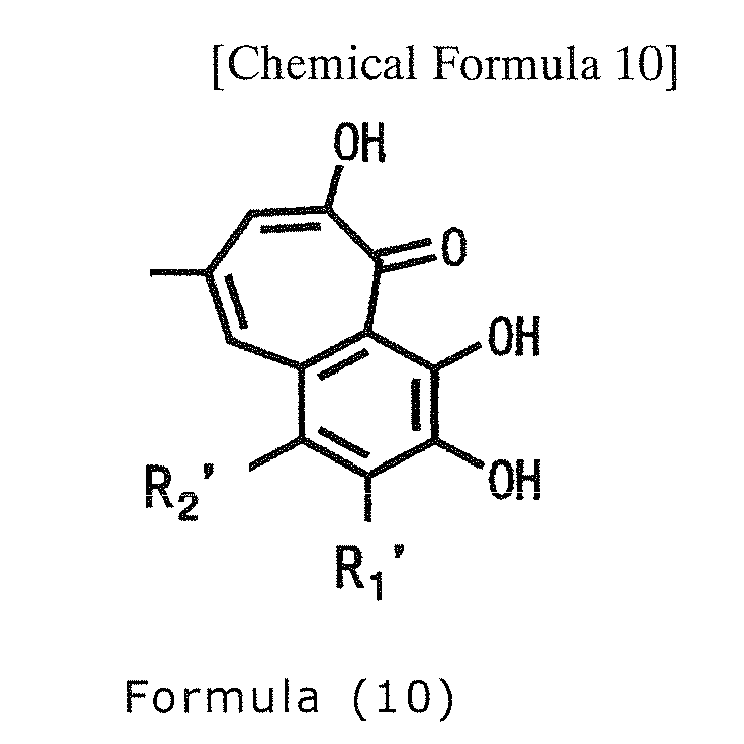

- [2] The anti-obesity agent according to [1], comprising one or more compounds in which R1 is H.
- [3] The anti-obesity agent according to [1], wherein the compound is a compound of Formula (12):

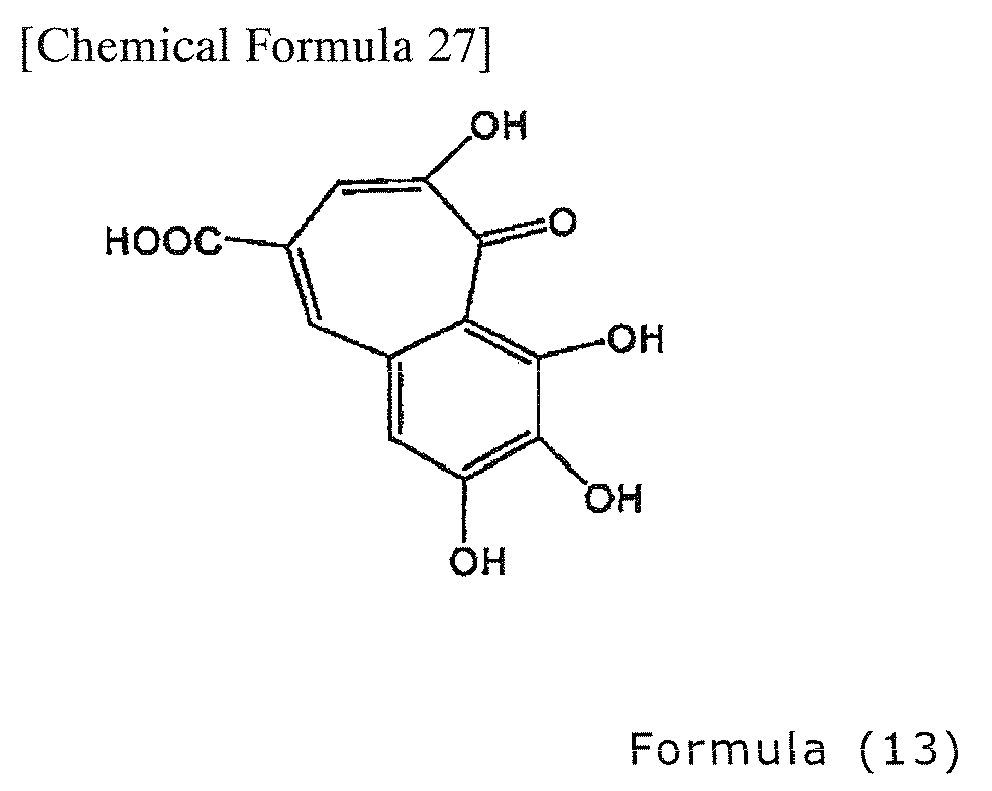
- Formula (13):

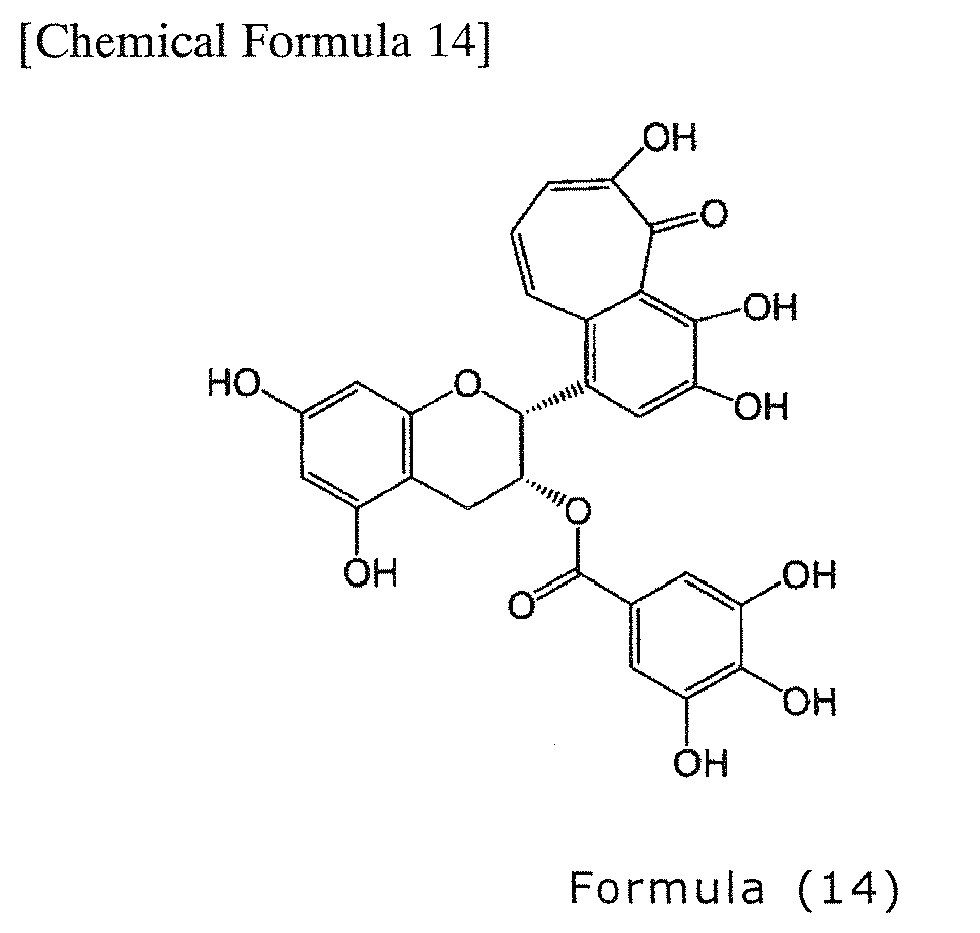
- Formula (14):
- Formula (15):

- Formula (16):

- Formula (17):

- Formula (18):

- Formula (19):

- Formula (20):

- Formula (21):

- Formula (22):

- or Formula (23):

- [4] The anti-obesity agent according to any one of [1] to [3], which is a lipase inhibitor and/or an alfa-glucosidase inhibitor.
- [5] The anti-obesity agent according to any one of [1] to [4], which is for suppressing absorption of diet-derived fat and sugar.
- [6] The anti-obesity agent according to any one of [1] to [5], which is in the form of a food or a beverage.
- [7] The anti-obesity agent according to [6], wherein the food or beverage is selected from the group consisting of a tea beverage, a soft drink, and a health food.
- [8] The anti-obesity agent according to any one of [1] to [5], which is in the form of a pharmaceutical composition.
- [9] A compound of Formula (24):

- The lipase inhibitor that serves as the anti-obesity agent of the present invention contains a tea-derived benzotropolone ring-containing compound and thus exhibits superior lipase inhibitory activity. The lipase inhibitor of the present invention does not compromise the flavor of foods and beverages, has palatability, and can be used in various use applications including foods and beverages intended for reduction in triglycerides and health enhancement. It is desirable to take this inhibitor together with meals for suppression of dietary fat absorption, and therefore, beverages containing tea-derived, enhanced active ingredients are of great significance. Particularly, enhancing these ingredients enabled us to provide a beverage intended for anti-obesity action and health enhancement.
- The alfa-glucosidase inhibitor that serves as the anti-obesity agent of the present invention can suppress decomposition of sugar derived from diet-derived starch and polysaccharides and absorption of the sugar, in less amount than conventionally known, natural product-derived alfa-glucosidase inhibitor. Further, all of the compounds are oxides of catechins and polyphenols contained in teas and are thus superior in flavor and safety, which enables long-term intake of the compounds.
- In addition, the anti-obesity agent of the present invention contains a benzotropolone ring-containing compound, a component derived from teas, which are widely used in diet, and are thus safe and can be also used as a pharmaceutical composition with reduced side effects.
-
- [
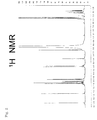
Fig. 1] Fig. 1 shows the 13C NMR spectrum of Compound 12. - [
Fig. 2] Fig. 2 shows the 1H NMR spectrum of Compound 12. - The embodiments of the present invention are described in detail below.
- The present invention is an anti-obesity agent containing a benzotropolone ring-containing compound of Formula (1) as an active ingredient:


- purprogallin carboxylic acid of Formula (13):
- theaflavanin 3-O-gallate of Formula (14):

- EGCG-catechol of Formula (15):

- theaflavate A of Formula (16):

- theadibenzotropolone A of Formula (17):

- theaflavin digallate trimer 1 (TFdiGA-tri1) of Formula (18):

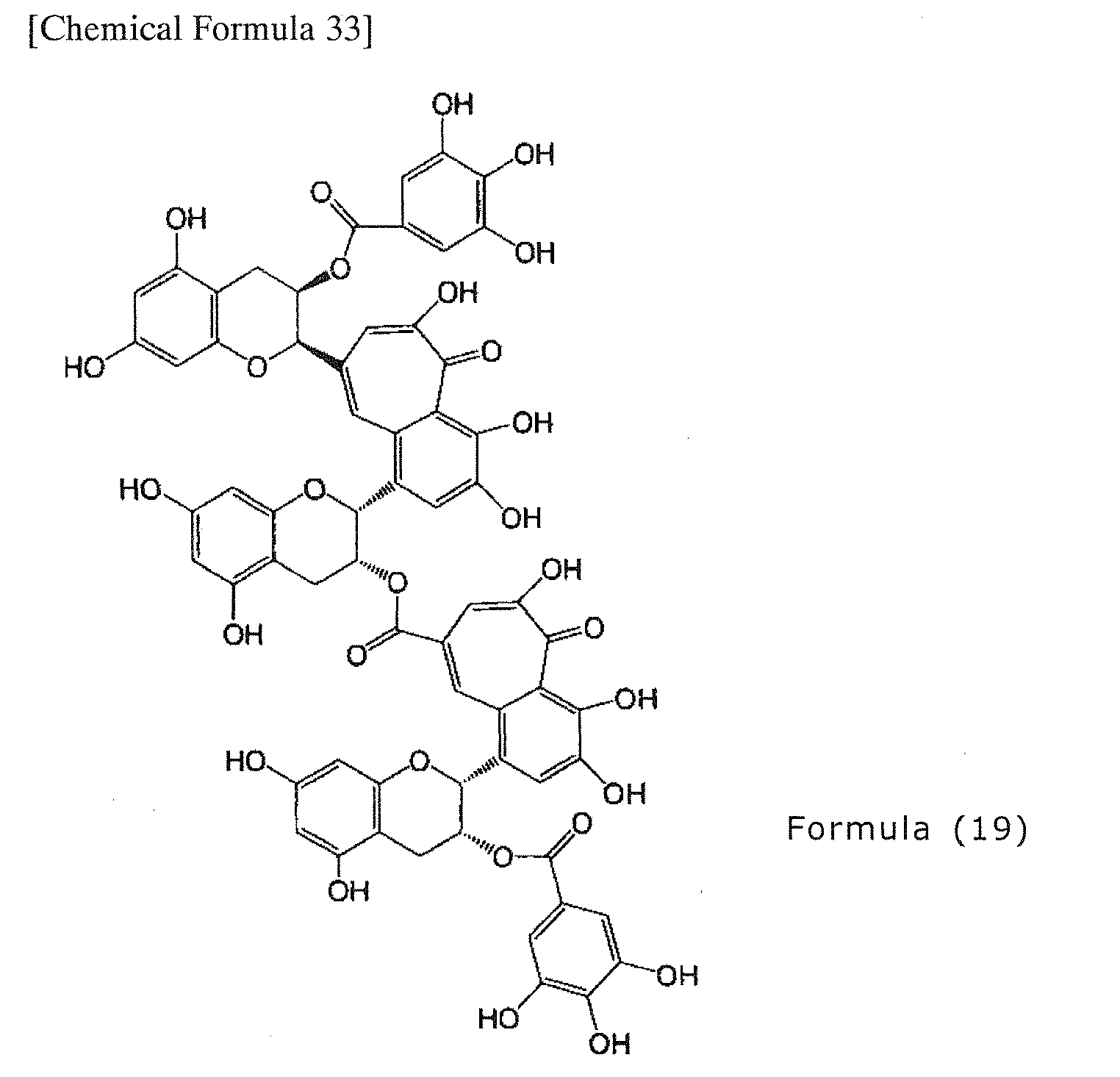
- theaflavin digallate trimer 2 (TFdiGA-tri2) of Formula (19):
- epitheaflavic acid of Formula (20):

- 3,4,6-trihydroxy-1-((2R, 3R)-3,5,7-trihydroxychroman-2-yl)-5H-benzo[7]annulen-5-one of Formula (21):

- epitheaflavic acid-3-O-gallate of Formula (22):

- or (2R,3R)-2-(3,4-dihydroxyphenyl)-5,7-dihydroxychroman-3-yl2,3,4,6-tetrahydroxy-5-oxo-5H-benzo[7]annulen-8-carboxylate of Formula (23):
-

- The above benzotropolone ring-containing compounds, which are active ingredients of the anti-obesity agent of the present invention, can be obtained by solvent extraction from natural materials such as green tea, black tea, and oolong tea or also by chemical synthesis or enzymatic synthesis of the materials.
- With respect to the natural materials which are extraction raw materials, tea leaves may be used as is or in ground form. The solvent for use in extraction may be water, an oraganic solvent, mixtures of these solvents, or the like, and preferably, hot water. The extract obtained can be separated and purified by using an adequate carrier for separation. Any carrier can be used if the carrier can absorb the above benzotropolone ring-containing compound and separate it with an adequate solvent for separation. For example, styrene- or dextran-based synthetic adsorbents can be used for the separation and purification. After loading of the above extract on such a carrier, an adequate solvent is used to separate the above benzotropolone ring-containing compound. More specifically, the above benzotropolone ring-containing compound for use in the anti-obesity agent of the present invention can be obtained in accordance with the descriptions in Example 1 of the present specification. The thus obtained benzotropolone ring-containing compound above may be used in condensed form or as a powder obtained by methods such as lyophilization.
- The above benzotropolone ring-containing compounds can be synthesized with enzymes such as polyphenol oxidase (PPO) and peroxidase (POD), or with oxidants such as potassium ferricyanide (K3[Fe(CN)6]) as a catalyst by using, as raw materials, catechins (epigallocatechin-3-O-gallate, epicatechin-3-O-gallate , epicatechin , epigallocatechin, and the like) and gallic acid. Specifically, the synthesis can be performed in accordance with the descriptions in, for example, Examples 2 and 7 of the present specification.
- The anti-obesity agent of the present invention has strong inhibitory action against lipase, especially, pancreatic lipase. The lipase inhibitory activity can be measured by any method of the lipase activity assays described in the related applications shown in the Background Art section. For example, the assay can be achieved by using the oleate ester of fluorescent 4-methylumbelliferone as a substrate to measure the fluorescence of 4-methylumbelliferone produced by reaction with lipase. Exemplary is the method described in Example 6, which allows a measurement of lipase inhibitory activity. Lipase inhibitory activity can be expressed, for example, as IC50, a sample volume which produces 50% inhibition.
- The anti-obesity agent of the present invention have potent alfa-glucosidase inhibitory activity. The activity can be measured by any method of the activity assays described in the related applications shown in the Background Art section. Exemplary is the method described in Example 11, which allows a measurement of alfa-glucosidase inhibitory activity. Alfa-glucosidase inhibitory activity can be expressed, for example, as IC50, a sample volume which produces 50% inhibition.
- The purified products or partially purified products of the above benzotropolone ring-containing compounds can be used alone as an anti-obesity agent, or can be combined with a solvent or a carrier so as to be used as an anti-obesity agent. It is preferred that the solvent or the carrier can be used safely as a food or a pharmaceutical product, in prospect of use as the foods and beverages below and/or pharmaceutical products. The anti-obesity agent of the present invention has various use applications; exemplary is use of the agent as foods and beverages or pharmaceutical compositions which are used for an experimental study and intended for prevention of triglyceride accumulation.
- The anti-obesity agent of the present invention may be in the form of food and beverage that suppresses undesirable elevation of blood triglyceride associated with fat intake from meals. Preferred examples of the food and beverage include those taken on a daily basis; for example, green tea, barley tea, oolong tea, black tea, coffee, sports drinks, drinking water, seasoning, and dressing. However, the foods and beverages also may be those that are commonly consumed: soft drinks, cocktails, beer, whiskey, distilled spirit (shochu), wine, sake, seasoning, dressing, flavored rice, processed foods, instant foods, retort foods, chocolate, fresh cream, Western confectionery, dairy products, health foods, supplements, and the like.
- In the anti-obesity agent of the present invention which is in the form of food and beverage, the benzotropolone ring-containing compound of Formula (1) is contained so that the intake of the compound is 0.1 mg to 10g per meal, preferably, 0.5 mg to 5g. However, the compound of Formula (1) used in the anti-obesity agent of the present invention is highly safe because it is derived from food, and thus there is no substantial upper limit on the amount of addition to foods and beverages.
- The anti-obesity agent of the present invention which serves as a lipase inhibitor can also be used as a pharmaceutical composition intended to suppress diet-derived fat absorption and to prevent undesirable increase of blood triglyceride and/or to lower increased blood triglyceride. The anti-obesity agent which serves as an alfa-glucosidase inhibitor can also be used as a pharmaceutical composition intended to suppress diet-derived fat absorption and to prevent undesirable increase of blood triglyceride and/or to lower increased blood triglyceride. Preferred are agents intended for oral administration; examples of the agent include drinks, tablets, capsules, granules, powders, candies, drops, and the like. The agents contain a benzotropolone ring-containing compound of Formula (1) in amounts of 0.1 mg to 10g per dose, preferably, 0.5 mg to 5g.
- The pharmaceutical composition of the present invention is safe for long-term dosage due to high safety of lipase and alfa-glucosidase activity of the inhibitory components. Accordingly, the composition can also be taken on a daily basis to prevent or resolve obesity as a lifestyle-related disease.
- Further, the present invention provides a compound shown below as a novel compound present in black tea.

- This compound is useful as an anti-obesity material.
- The present invention is more specifically described in Examples below, but is not limited thereto.
- Black tea leaves originated in Assam, India were extracted with hot water at 90ºC and lyophilized, and distilled water was added to the resulting product followed by warming and dissolution to obtain a solution of
concentration 10 mg/ml. While heating the solution to 60 to 70ºC in a hot-water bath, 15 ml of the same was loaded on 60 ml of Sephadex LH-20 (GE Healthcare Biosciences, Ltd.) After washing with 45 ml of 20% acetone (acetone:distilled water=2:8, v/v) and subsequent washing with 60 ml (1 column volume) of the same, elution was conducted with 4 column volumes each of the following solvents: 30% acetone (acetone:distilled water=3:7, v/v); 50% acetone (acetone:distilled water=1:1, v/v); and 60% acetone (acetone:distilled water=6:4, v/v), and the resulting solution was fractionated into 1 column volume for each fraction. Two milliliters each taken from a total of fourteen 60 ml fractions was concentrated under vacuum and then 0.1 ml of a 50% aqueous dimethylsulfoxide solution (dimethylsulfoxide:distilled water=1:1, v/v) was prepared, and the solution was subjected to a measurement of lipase inhibitory activity. In addition, each fraction was concentrated under vacuum and lyophilized, and the recovery volume was calculated from the resulting solids; the calculations were used for the component analysis conducted in Example 5. The weights and the recovery rates of lipase inhibitory activity are shown in Table 1. - [Table 1]
Table 1: Location of Activity in LH20 Fractions Fra No. Fraction Abundance Ratio of Activity (%) Abundance Ratio of Yield (%) 1 20% acetone_1 0.0005 5.0 30.6 54.3 2 20% acetone_2 5.01 23.7 3 30% acetone_1 4.72 20.1 3.7 16.3 4 30% acetone_2 6.30 4.7 5 30% acetone_3 5.63 5.1 6 30% acetone_4 3.48 2.8 7 50% acetone_1 14.12 70.9 4.8 23.6 8 50% acetone_2 33.59 11.2 9 50% acetone_3 17.08 5.1 10 50% acetone 4 6.15 2.5 11 60% acetone_1 2.53 3.9 1.3 5.8 12 60% acetone_2 1.05 1.8 13 60% acetone_3 0.20 1.2 14 60% acetone_4 0.13 1.5 - As a result of the measurement of lipase inhibitory activity in accordance with the method described in Example 6, 20% acetone_1 and 20% acetone_2 fractions, which exhibited high yield, were each found to have contained polysaccharides and caffeins and have had almost no activity. On the other hand, in 50% acetone_2 fraction, which exhibited the next highest yield (11.2% by weight), activity of 33.6% was eluted; in the subsequent entry, 50% acetone_3 fraction, activity of 17.1% was eluted. In the 50% acetone elution portions including these fractions, it was found that 70.9% of the activity was eluted. In the assay described in Example 5, many of active benzotropolone ring-containing compounds were eluted with 50% acetone, which is well consistent with the high activity found in 50% acetone elution portions.
-
- 1. purprogallin
- 2. purprogallin carboxylic acid
- 3. epitheaflagallin
- 4. epitheaflagallin-3-O-gallate
- 5. theaflavate A
- 6. theadibenzotropolone A
- 7. theaflavin digallate trimer 1 (TFdiGA-tril)
- 8. theaflavin digallate trimer 2 (TFdiGA-tri2)
- 9. epitheaflavic acid
- 10. theaflavanin
- 11. epitheaflavic acid-3-O-gallate
- 12. (2R,3R)-2-(3,4-dihydroxyphenyl)-5,7-dihydroxychroman-3-yl2,3,4,6-tetrahydroxy-5-oxo-5H-benzo[7]annulen-8-carboxylate
- To epigallocatechin (0.2 mmol) (EGC; Wako Pure Chemical Industries, Ltd.) or epigallocatechin-3-O-gallate (0.2 mmol) (EGCG; Wako Pure Chemical Industries, Ltd.), potassium ferricyanide (0.8 mmol) and NaHCO3 (0.8 mmol) were added to prepare 150 ml of an aqueous solution, and the solution was chilled on ice. Fifty milliliters of an aqueous pyrogallol solution (0.2 mmol) was dripped into the solution and stirring the mixture were continued for one hour. The reaction solution was loaded on 20 ml volume of Sep-pak C18 (Waters Corp.), and after washing with 60 ml of water and the subsequent washing with 5% acetonitrile/water, 50% acetonitrile/water containing 0.1% formic acid was used to elute a reaction product. The eluted product was lyophilized and purified by preparative HPLC shown below.
- The reaction product of EGC and pyrogallol was loaded on YMC Pak Polymer C-18 (20 x 300 mm, YMC Co., Ltd.) and an elution with a linear gradient of 30-50% acetonitrile (6 ml/min, 60 minutes) was performed in the presence of 0.1% formic acid. The component eluted at between 48 and 50 minutes was lyophilized to obtain 4 mg of a brown solid (epitheaflagallin (3)). Also, the component eluted at between 68 and 70 minutes in this chromatogram was lyophilized to obtain 2 mg of a brown solid (purpurogallin (1)).
- The reaction product of EGCG and pyrogallol was loaded on Develosil C30-UG-5 (20 mm x 250 mm, Nomura Chemical Co., Ltd.) and an elution with a linear gradient of 15-50% acetonitrile (6 ml/min, 60 minutes) was performed in the presence of 0.1% formic acid. The component eluted at between 44 and 46 minutes was lyophilized to obtain 6 mg of a brown solid (epitheaflagallin-3-O-gallate (4)). Also, the component eluted at between 48 and 50 minutes in this chromatogram was lyophilized to obtain 3 mg of a brown solid (purpurogallin (1)).
- In the same manner as the above reactions, 800 mg of gallic acid was subjected to a reaction to obtain 65 mg of purprogallin carboxylic acid (2), which is produced by polymerization of two gallic acid molecules. In addition, 100 mg of epicatechin-3-O-gallate (ECG) was subjected to a reaction to obtain 3 mg of theaflavate A (5), which is produced by polymerization of two ECG molecules. Further, 400 mg each of epicatechin (EC) and EGCG were subjected to a reaction to obtain a main product, theaflavin-3-O-gallate as well as 2 mg of a by-product, theadibenzotropolone A (6). In the same manner as the above reaction, 200 mg each of epicatechin-3-O-gallate (ECG) and EGCG were subjected to a reaction, and 12 mg of the resulting theaflavin-3,3'-digallate and 20 mg of ECG were subjected to a reaction to obtain 1.7 mg of TFdiGA-tril (7) and 0.6 mg of TFdiGA-tri2 (8). The following compounds were also obtained: 48 mg of epitheaflavic acid (9) obtained by reaction of 330 mg of gallic acid and 101 mg of EC; 12 mg of theaflavanin (10) obtained by reaction of 869 mg of pyrogallol and 400 mg of EC; and 37 mg of epitheaflavic acid-3-O-gallate (11) and 3.3 mg of (2R,3R)-2-(3,4-dihydroxyphenyl)-5,7-dihydroxychroman-3-yl2,3,4,6-tetrahydroxy-5-oxo-5H-benzo[7]annulen-8-carboxylate (12) which were simultaneously obtained by reaction of 470 mg of gallic acid and 221 mg of ECG.
- MS and NMR measurements of the compounds obtained in Example 2 were performed. Their mass spectra were determined with Q-TOF Premier (Micromass Co., Ltd., UK) using Z-Spray ESI ion source, in negative, V mode. Cone voltage: 45V, Capillary voltage: 3KV, Source Temp.: 80ºC, Desolvation Temp.: 180ºC. Mass correction was performed with LockSpray, and leucine enkepharine (m/z 554.2615 [M-H]-) was used as a reference.
- The accurate mass, molecular formula, and theoretical mass value of each compound are shown in Table 2.
- [Table 2]
Table 2: Mass Spectrometric Results of Compounds Compound No. Compound m/z Actual Meas. Value Molecular Formula ma/z Calc. Value 1 Purprogallin 219.0285 C11H8O5 219.0293 2 purprogallin carboxylic acid 263.0183 C12H8O7 263.0192 3 epitheaflagallin 399.0701 C20H16O9 399.0716 4 epitheaflagallin-3-O-gellate 551.0818 C27H20O13 551.0826 5 theaflavateA 851.1471 C43H32O19 851.1460 6 theadibenzotropoloneA 973.1832 C50H38O21 973.1827 7 TFdiGA-tri1 1279.2185 C64H46O29 1279.2203 8 TFdiGA-tri2 1279.2218 C64H46O29 1279.2203 9 epitheaflavic acid 427.0666 C21H16O10 427.0665 10 theaflavanin 383.0764 C20H16O8 383.0767 11 epitheaflavic acid-3-0-gallate 579.0778 C28H20O14 579.0775 12 (2R,3R)-2-(3,4-dihydroxyphenyl)-5,7-dihydroxychroman-3- yl 2,3,4,6-tetrahydroxy-5-oxo-5H-benzo[7]annulene-8-carboxylate535.0883 C27H20O12 535.0877 14 theaflavanin-3-O-gallate 535.0871 C27H20O12 535.0877 15 EGCG-catechol 535.0885 C27H20O12 535.0877 - The LC-MS/MS measurements were performed with 4000 Q TRAP (Applied Biosystems Inc.) using TurboIonSpray in negative mode under the following conditions: Collision energy: 46 eV(nega.); Ionspray voltage: 4500V; Temperature: 450ºC.
- The elution time and measurement channels of each compound in MRM (multiple reaction monitoring) mode are as shown in Table 3.
- [Table 3]
Table 3: LC-MSMS Quantitative P arameters Compound Compound R.T. Q1/Q3 1 purprogallin 10.99 219.0/191.0 2 purprogallin carboxylic acid 8.01 263.0/190.9 3 epitiheaflagallin 8.64 399.1/233.0 4 epitheaflagailin-3-O-gallate 11.54 551.1/233.1 5 theaflavateA 14.46 851.2/579.1 6 theadibenzotropoloneA 11.49 973.2/227.1 7 TFdiGA-tril 15.01 1277.2/579.1 8 TFdiGA-tri2 17.37 1277.2/697.1 - Column: YMC-Polymer C18, S-6 µm (YMC Co., Ltd., 2 mmφ x 150 mm)
Flow Rate: 0.2 mL/min
Column Temp.: 40ºC
Mobile Phase A: 0.1V/V%HCOOH/H2O
Mobile Phase B: 0.1V/V%HCOOH/CH3CN
Gradient Program: A/B=91/9 (0 min) ---> A/B=40/60 (17 min) ---> A/B=15/85 (17.1 min) ---> A/B=15/85 (17.1 to 19 min) - The above conditions were used to assay a hot water extract of Indian Assam CTC tea.
Compounds 2 to 8 were found to have been present in the tea leaves. The quantitative values are shown in Table 4. - [Table 4]
Table 4: Quantitative Values of Black Tea Components Compound Compoun µ g/g extract 1 purprogallin 0.15 2 purprogallin carboxylic acid 166.00 3 epitheaflagallin 224.00 4 epitheaflagallin-3-O-gallate 369.0 5 theaflavateA 165.5 6 theadibenzotropoloneA 35.95 7 TFdiGA-tri1 67.20 8 TFdiGA-tri2 61.55 - LC-MS/MS measurements were performed with Q-TOF Premier (Micromass Co., Ltd., UK) using Z-Spray ESI ion source, in negative, V mode. Cone voltage: 33V, Capillary voltage: 3KV, Source Temp.: 150ºC, Desolvation Temp.: 250ºC. Mass correction was performed with LockSpray, and leucine enkepharine (m/z 554.2615 [M-H]-) was used as a reference.
Column: YMC-Polymer C18, S-6 µm (YMC Co., Ltd., 2 mmφ x150 mm)
Flow Rate: 0.2 mL/min
Column Temp.: 40ºC
Mobile Phase A: 0.1V/V% HCOOH/H2O
Mobile Phase B: 0.1V/V% HCOOH/CH3CN
Gradient Program: A/B=70/30 ---> A/B=50/50 (20 min) ---> A/B=50/50 (25 min) - The above conditions were used to analyze each of the fractions of tea leaves originated in Assam, India, which were obtained by fractionation in Example 1. Compound 2 (m/z 263.02, R.T.=9.29 min) was detected in 30% acetone_1 fraction, Compound 3 (m/z 399.07, R.T.=9.83 min) was in 50% acetone_2 and 50% acetone_3 fractions, Compound 4 (m/z 551.08, R.T.=13.48 min) was in 50% acetone_3 and 50% acetone_4 fractions, Compound 5 (m/z 851.15, R.T.=17.50 min) was in 50% acetone_4 fraction, Compound 9 (m/z 427.07, R.T.=8.60 min) was in 50% acetone_3 fraction, Compound 10 (m/z 383.08, R.T.=9.65 min) was in 30% acetone_3 and 30% acetone_4 fractions, Compound 11 (m/z 579.08, R.T.=13.86 min) was in 50% acetone_2 fraction, and Compound 12 (m/z 535.09, R.T.=13.90 min) was in 50% acetone_2 fraction.
- Measurement samples were synthesized and purified in accordance with the method in Example 2.
- 1. purprogallin
- 2. purprogallin carboxylic acid
- 5. theaflavate A
- 6. theadibenzotropolone A
- 7. theaflavin digallate trimer 1 (TFdiGA-tri1)
- 8. theaflavin digallate trimer 2 (TFdiGA-tri2)
- 9. epitheaflavic acid
- 10. theaflavanin
- 11. epitheaflavic acid-3-O-gallate
- 12. (2R,3R)-2-(3,4-dihydroxyphenyl)-5,7-dihydroxychroman-3-yl2,3,4,6-tetrahydroxy-5-oxo-5H-benzo[7]annulen-8-carboxylate
- 13. EGCG (Wako Pure Chemical Industries, Ltd.)
- The measurement of lipase activity was performed by using as a substrate the oleate ester of fluorescent 4-methylumbelliferone (4-MUO; Sigma-Aldrich Corp.) to measure the fluorescence of 4-methylumbelliferone produced by a reaction. In the measurement, 13 mM Tris-HCl (pH8.0) containing 150 mM NaCl and 1.36 mM CaCl2 was used as a buffer. The following were subjected to an enzymatic measurement: the substrate 4-MUO which was dissolved into a 0.1M DMSO solution followed by dilution of the solution 4000-fold with the above buffer; and as a lipase, porcine pancreatic lipase (Sigma-Aldrich Corp.) which was prepared as a 400U/ml solution by using the above buffer likewise.
- An enzymatic reaction was initiated by the following steps under 25ºC condition: adding to a 96-
well microplate 50 µl of a 4-MUO buffer solution and 25 µl of distilled water (or an aqueous sample solution) for each well; mixing them; and then adding 25 µl of a lipase buffer solution to each well. After a 30-minute reaction, 100 µl of a 0.1M citric acid buffer (pH4.2) was added to terminate the reaction, and the fluorescence of 4-methylumbelliferone (excitation wavelength: 355 nm, fluorescence wavelength: 460 nm) produced by the reaction was measured with a fluorescence plate reader (Fluoroskan Asent CF from Labsystems, Inc.) - The inhibitory activity of test samples were determined as IC50 (µM), a sample volume which produces 50% inhibition, relative to the activity of a control (distilled water).
- The lipase inhibitory activity of
Compounds 1, 2, and 5 to 14 is shown in Table 5. - [Table 5]
Table 5: Lipase Inhibitory Activity per mole Compound No. Compound IC50 µM - pyrogallol 17.273 1 purprogallin 0.413 2 purprogallin carboxylic acid 4.165 5 theaflavateA 0.202 6 theadibenzotropoloneA 0.178 7 TFdiGA-tri1 0.135 8 TFdiGA-tri2 0.138 9 epitheaflavic acid 4.626 10 theaflavanin 0.984 11 epitheaflavic acid 3-O-gallate 0.266 12 (2R,3R)-2-(3,4-dihydroxyphenyl)-5,7-dihydroxychroman-3- yl 2,3,4,6-tetrahydroxy-5-oxo-5H-benzo[7]annulene-8-carboxylate0.207 13 EGCG 0.349 - All of the benzotropolone ring-containing compounds exhibited lipase inhibitory activity. In (-)-epigallocatechin-3-O-gallate (EGCG; Compound 13), which is known to exhibit strong lipase inhibition, its IC50 was 0.349 µM. The compounds other than purprogallin carboxylic acid (2) and epitheaflavic acid (9) which have a free carboxylic acid residue exhibited activity equivalent to or stronger than EGCG, which showed that their benzotropolone ring contributes to their lipase inhibitory activity. A carboxylic acid residue was found to serve to reduce the activity. Accordingly, in Formula (1), R3 is preferably a group other than COOH.
- Used were horseradish peroxidase from Zymed Laboratories, Inc. as a peroxidase, epicatechin 3-O-gallate (ECG) of 90% purity or higher, which was purified by reversed-phase HPLC from tea extract, and pyrogallol from Nacalai Tesque, Inc. (99.0% purity).
- In 10 ml of a 0.058 M acetic acid buffer, 4.3 mg of the horseradish peroxidase was dissolved, and to this solution, 250 mg of ECG (0.566 mmol) dissolved in 500 µl of acetone and 192.8 mg of pyrogallol (1.53 mmol) dissolved in 500 µl of acetone were added followed by stirring. Under 30ºC condition, 450 µl of a 3% (w/v) hydrogen peroxide solution was added to initiate a reaction. For improvement of reaction efficiency, 450 µl of a 3% (w/v) hydrogen peroxide solution was added twice, i.e., after 10 and 20 minutes of the reaction initiation. Added were 192.8 mg of pyrogallol (1.53 mmol) and 450 µl of a 3% hydrogen peroxide solution after 30 minutes of the reaction initiation, and then reacted for another 30 minutes.
- After 60 minutes of the reaction initiation, the reaction solution was loaded on a reversed-phase stationary phase (Waters Corp., Sep-Pak, C18-
Vac 20 cc (5g)) followed by washing with 40 ml of distilled water. Consecutive elutions were then performed with 20 ml of a 20% (v/v) aqueous acetonitrile solution and then with 40 ml of a 70% (v/v) aqueous acetonitrile solution. The 70% acetonitrile eluate was concentrated and lyophilized to obtain 68.0 mg of a fraction containing Compounds 12 and 14 (theaflavanin 3-O-gallate). - The mixture containing Compounds 12 and 14 (theaflavanin 3-O-gallate) was purified by HPLC under the conditions below.
- The mixture was loaded on YMC-Pak Polymer C-18 (20 x 300 mm, YMC Co., Ltd.), and in the presence of 0.1% formic acid, a 30-minute isocratic elution with 30% acetonitrile and then an elution with a linear gradient of 30-45% acetonitrile (6 ml/min, 150 minutes) were performed. The component eluted at between 144 and 148 minutes and that eluted at between 158 and 162 minutes were lyophilized to obtain 3.9 mg of the compound identical to Compound 12 shown in Example 2 and 3.0 mg of Compound 14 (theaflavanin 3-O-gallate). Further, the component eluted at between 108 and 113 minutes in this chromatogram was lyophilized to obtain 36 mg of a brown solid (Compound 1 in Example 2: purprogallin).
- Compounds 12 and 14, which were obtained in Example 7, were subjected to MS and NMR measurements.
- Their mass spectra were determined with Q-TOF Premier (Micromass Co., Ltd., UK) using Z-Spray ESI ion source, in negative, V mode. Cone volt.: 33 V, Capillary voltage: 2.7kV, Source Temp.: 80ºC, Desolvation Temp.: 180ºC. Mass correction was performed with LockSpray, and leucine enkepharine (m/z 554.2615 [M-H]-) was used as a reference. The collision energy was set at 4eV at the time of MS measurement and at 22eV at the time of MS/MS measurement.
- Compounds 12 and 14 produced molecular ions of m/z 535.0883 and 535.0871 [M-H]-, respectively, and their molecular formula was determined as C27H20O12 (theoretical value: 535.0877). As a result of the MS/MS measurement in which collision energy was set at 22eV, fragment ions of 263.07 and 219.07 were detected in Compound 12 and those of 383.08 and 169.01 were in Compound 14. Compound 14 was found to be a known compound, theaflavanin 3-O-gallate.
- An NMR measurement was performed to confirm the structure of Compound 12. The 13C NMR and 1H NMR spectra of Compound 12 are shown in
Figs. 1 and2 , respectively. The NMR measurement was performed under the conditions below. In CD3OH, 3 mg of Compound 12 obtained in Example 7 was dissolved, and the residual peaks of protons and 13C of CD3OH, δ3.30 and δ48.97, were set as internal standards. Measurements in accordance with the following methods were performed with a DMX-750 spectrometer (BRUKER BIOSPIN, Germany): 1H NMR, 13C NMR, 1H{13C}-HSQC, 1H{13C}-HMBC, TOCSY, DQF-COSY, NOESY, and ROESY. As a result, Compound 12, which was obtained in Example 7, was confirmed to have the structure shown below.
- The numbering of each atom is shown in the above structural formula.
- The NMR measurement results and the signal assignments are shown below.
-
[Table 6] 1H 13C J (Hz) δ A(C)-ring C-2 5.09 brs 78.23 C-3 5.58 dd 71.75 C-4 2.94 dd 17.4, 1.9 26.48 A-5 3.04 dd 17.4, 4.5 157.07 A-6 6.02 d 2 96.75 A-7 OH 157.91 A-8 5.97 d 2 95.8 A-8a 158.07 C-4a 99.07 B-ring B-1 131.25 B-2 6.95 d 1.4 114.76 B-3 OH 146.25 B-4 OH 146.11 B-5 6.72 d 8 116.04 B-6 6.83 dd 8, 1.4 118.87 benzotropolon a C=O 184.35 b OH 154.63 c 7.51 d 1 114.45 d 125.12 e 8.03 brs 139.62 f 6.91 s 114.76 g OH 152.62 h OH 138.44 OH 153.73 116.29 131.96 - The structure of Compound 14 is also shown below.
-

- To 229.2 mg of epigallocatechin-3-O-gallate (0.5 mmol) (EGCG; Wako Pure Chemical Industries, Ltd.), 3.293g of potassium ferricyanide (10 mmol) (Nacalai Tesque, Inc.) and 0.84g of NaHCO3 (10 mmol) were added to prepare 400 ml of an aqueous solution, and the solution was chilled on ice. Into the solution, 100 ml of an aqueous solution of 275.3 mg of catechol (2.5 mmol) was dripped over one hour, and the mixture was kept stirred. The reaction solution was loaded on 300 mL of Sephadex LH-20 (GE Healthcare Biosciences, Ltd.) and elutions were performed with 1L of 40% acetone/water, 1.2L of 45% acetone/water, and 900 mL of 50% acetone/water, consecutively, followed by lyophilization. Consequently, 77 mg of a 45% fraction containing EGCG-catechol was obtained. The fraction was purified by preparative HPLC shown below.
- The fraction containing EGCG-catechol was loaded on YMC-Pak Polymer C-18 (20 x 300 mm, YMC Co., Ltd.), and at a flow rate of 6 ml/min in the presence of 0.1% formic acid, an elution with a linear gradient of 25-45% acetonitrile (75 minutes) was performed, and then a 30-minute isocratic elution was maintained with 45% acetonitrile. The component eluted at between 92 and 95 minutes was lyophilized to obtain 24 mg of a brown solid (Compound 15: EGCG-catechol). The structure of Compound 15 is shown below.

- The measurement of lipase activity was performed by using as a substrate the oleate ester of fluorescent 4-methylumbelliferone (4-MUO; Sigma-Aldrich Corp.) to measure the fluorescence of 4-methylumbelliferone produced by a reaction. In the measurement, 13 mM Tris-HCl (pH8.0) containing 150 mM NaCl and 1.36 mM CaCl2 was used as a buffer. The following were subjected to an enzymatic measurement: the substrate 4-MUO which was dissolved into a 0.01M DMSO solution followed by dilution of the solution 667-fold with the above buffer; and as a lipase, porcine pancreatic lipase (Sigma-Aldrich Corp.: i Type VI-S) which was prepared as a 400U/ml solution by using the above buffer likewise.
- An enzymatic reaction was initiated by the following steps under 25ºC condition: adding to a 96-
well microplate 50 µl of 4-MUO buffer solution and 25 µl of distilled water (or aqueous sample solution) for each well; mixing them; and then adding 25 µl of a lipase buffer solution to each well. This measurement was designed to increase the solubility of the substrate to enable inhibitory activity to be measured more accurately, because the concentration of the substrate was 7.5 µM at the time of the reaction, which showed its dilution as compared with the concentration 12.5 µM achieved in Example 6 and the DMSO concentration was increased. After a 30-minute reaction, 100 µl of 0.1M citric acid buffer (pH4.2) was added to terminate the reaction, and the fluorescence of 4-methylumbelliferone (excitation wavelength: 355 nm, fluorescence wavelength: 460 nm) produced by the reaction was measured with a fluorescence plate reader (Fluoroskan Asent CF from Labsystems, Inc.). - The inhibitory activities of test samples were determined as IC50(µM), a sample volume which produces 50% inhibition, relative to the activity of a control (distilled water).
- The lipase inhibitory activity of Compounds 3, 4, 12, 13, 14, and 15 was measured. The results are shown in Table 7.
- [Table 7]
Table 7: Lipase Inhibitory Activity per Mole Compound Compound IC50 µM 3 epitheaflagalin 0.956 4 epitheaflagalin 3-O-gallate 0.125 12 (2R,3R)-2-(3,4-dihydroxyphenyl)-5,7-dihydroxychroman-3- yl 2,3,4,6-tetrahydroxy-5-oxo-5H-benzo [7] annulene-8-carboxylate0.096 13 EGCG 0.349 14 theaflavanin 3-O-gallate 0.168 15 EGCG-catechol 0.104 - Compounds 12, 14, and 15 all had stronger activity than a positive control, EGCG, and exhibited activity equivalent to or stronger than Compound 4 ( Japanese Patent Public Disclosure
2009-114079 - The structures of Compounds 14 and 15 are shown as antioxidants and anti-inflammatory pharmaceutical agents in Japanese Patent Public Disclosure
2007-504168 - Compounds 12 and 14 can be synthesized by using polyphenol oxidase (PPO) or oxidants such as potassium ferricyanide besides the enzyme shown in Examples. Also, the compounds can be synthesized not only by a combination of ECG and pyrogallol but also by reaction with gallic acid.
- A 1M sodium phosphate buffer was prepared by mixing a 0.1M NaH2PO4-2H2O and a 0.1M Na2HPO4-12H2O and adjusting the mixture to pH7.0, and thereto 2g/L of bovine serum albumin (Nacalai Tesque, Inc., F-V, pH5.2, 96% purity) and 0.2 g/L of NaN3 (Nacalai Tesque, Inc., a special grade reagent) were added. To prepare an enzyme solution, alfa-glucosidase (Wako Pure Chemical Industries, Ltd., yeast-derived, 100 units/mg) was dissolved in the above buffer so as to achieve 0.5 units/mg protein/ml (100 µg/20 ml). To prepare a substrate solution, p-nitrophenyl-alfa-D-glucopyranoside (Nacalai Tesque, Inc., a special grade reagent) was dissolved in the above buffer so as to achieve 5 mM concentration (7.525 mg/5 ml).
- Among the samples used for the assays, epigallocatechin-3-O-gallate (Compound 13: EGCG), a positive control, was a product from Wako Pure Chemical Industries, Ltd., and Compounds 1, 3, 4, 5, 11, 12, 14, and 15 were products that were synthesized and purified in Example 1, 2, or 7.
- These samples were adjusted so as to obtain 10 mg/ml of DMSO and the solution was diluted 2-fold in 6 steps. Using a 96-well microplate, 45 µL of the enzyme solution was added to 10 µL of the sample solution. After preincubation at 37ºC for 5 minutes, 45 µL of the substrate solution was added and absorbance at 405 nm (A405 nm) was measured. After incubation at 37ºC for 5 minutes, the absorbance A405 nm was measured. Percent inhibition was calculated as a difference in A405 nm from a solution in which only DMSO was added as a control instead of a sample, and two consecutive measurements were performed for activity of each compound.
- As a result, the alfa-glucosidase inhibitory activity of each Compound, when indicated by IC50 value, is as shown in Table 8; Compounds 12 and 14 exhibited particularly strong activity.
- [Table 8]
Table 8: alfa-glucosidase inhibitory activity Compound Compound IC50 (mM) 1 purpurogallin 1.237 3 epitheaflagallin No 4 epitheaflagallin 3-O-gallate 0.180 5 theaflavate A 0.116 11 epitheaflavic acid-GA 0.287 12 (2R,3R)-2-(3,4-dihydroxyphenyl)-5,7-dihydroxychroman-3- yl 2,3,4,6-tetrahydroxy-5-oxo-5H-benzo [7]annulene-8-carboxylate0.159 13 EGCG 0.485 14 theaflavanin 3-O-gallate 0.196 15 EGCG-catechol 0.103 - From these results, together with the results on lipase inhibitory activity, these benzotropolone ring-containing compounds were found to have strong inhibitory activities against digestive enzymes. Among all, Compound 12, which exhibited its strong inhibitory activities against both the two enzymes, was confirmed to be present also in black tea; to date, the compound has not been known, but was found to be useful as an anti-obesity material.
- The anti-obesity agent of the present invention contains a tea-derived benzotropolone ring-containing compound and thus exhibits superior inhibitory activities against lipase and alfa-glucosidase. The agent does not compromise the flavor of foods and beverages, has palatability, and can be used in various use applications including foods and beverages intended for health enhancement such as reduction in triglycerides.
Claims (9)
- An anti-obesity agent comprising one or more compounds of Formula (1) (except epitheaflagallin, epitheaflagallin-3-O-gallate, theaflavin, theaflavin-3-O-gallate, theaflavin-3'-O-gallate, and theaflavin-3,3'-O-digallate):

R2 is H or a group of Formula (2):


- The anti-obesity agent according to Claim 1, comprising one or more compounds in which R1 is H.
- The anti-obesity agent according to Claim 1, wherein the compound is a compound of Formula (12):


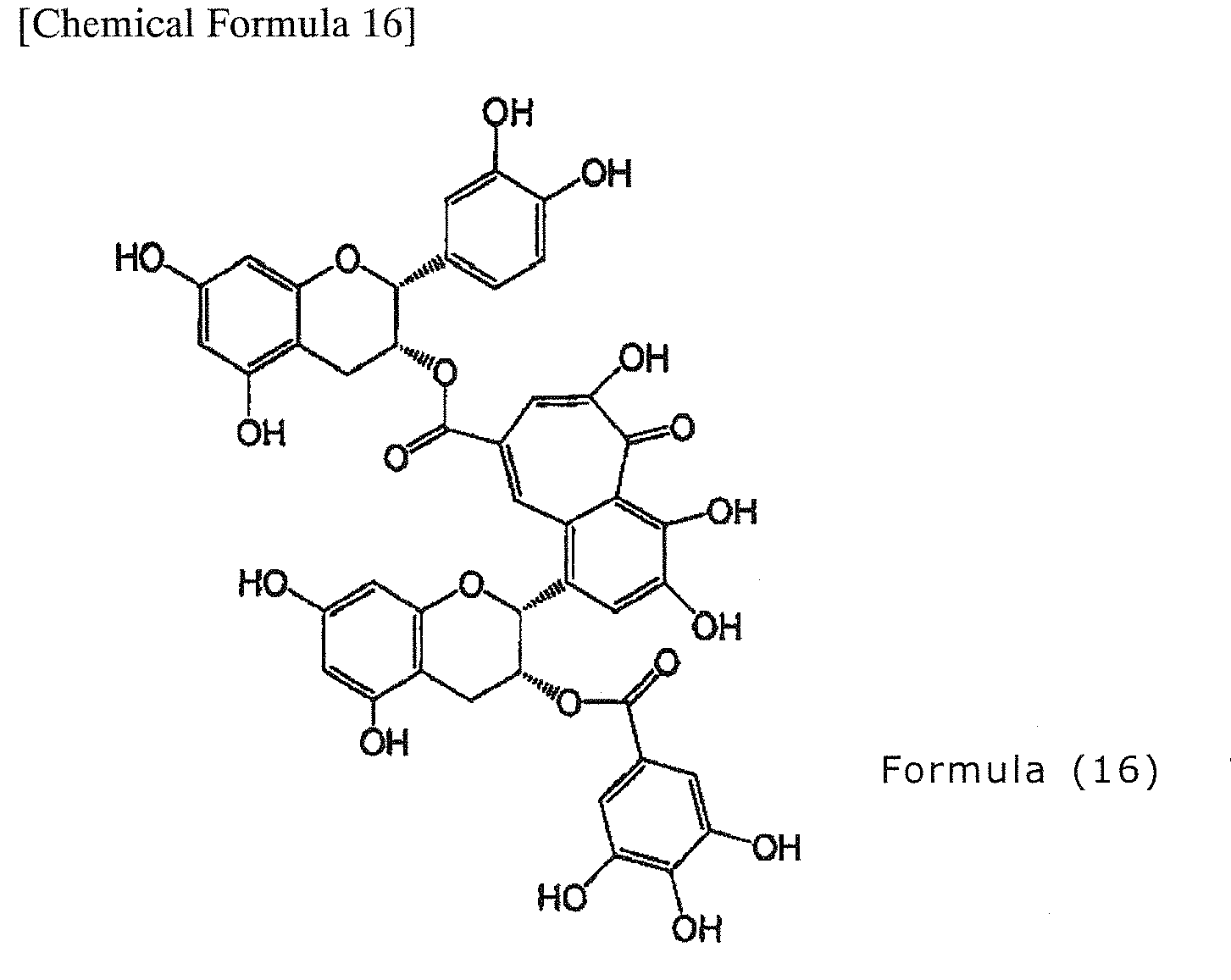


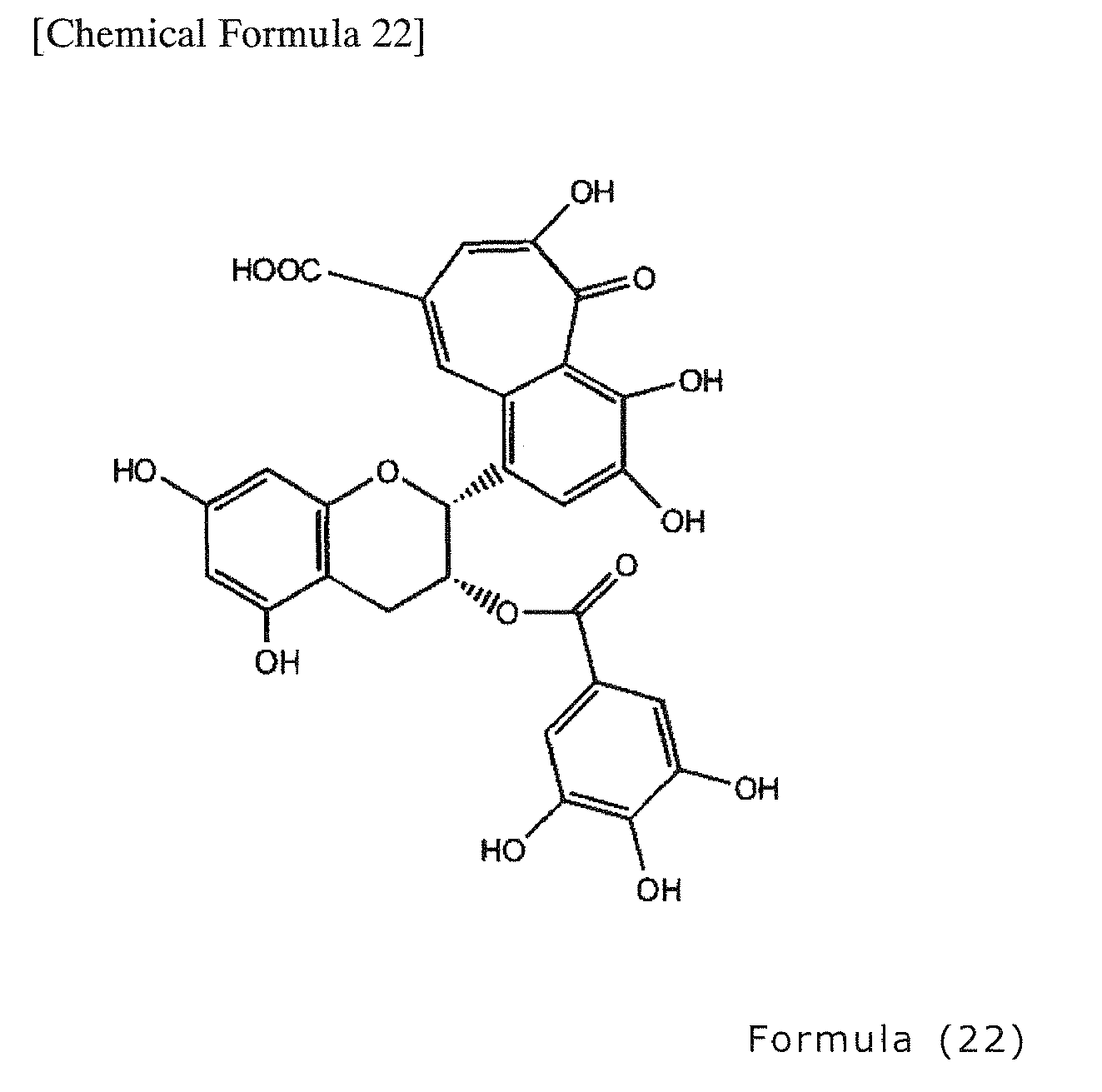

- The anti-obesity agent according to any one of Claims 1 to 3, which is a lipase inhibitor and/or an alfa-glucosidase inhibitor.
- The anti-obesity agent according to any one of Claims 1 to 4, which is for suppressing absorption of diet-derived fat and sugar.
- The anti-obesity agent according to any one of Claims 1 to 5, which is in the form of a food or a beverage.
- The anti-obesity agent according to Claim 6, wherein the food or beverage is selected from the group consisting of a tea beverage, a soft drink, and a health food.
- The anti-obesity agent according to any one of Claims 1 to 5, which is in the form of a pharmaceutical composition.
- A compound of Formula (24):

Applications Claiming Priority (2)
| Application Number | Priority Date | Filing Date | Title |
|---|---|---|---|
| JP2009123585 | 2009-05-21 | ||
| PCT/JP2010/058624 WO2010134595A1 (en) | 2009-05-21 | 2010-05-21 | Anti-obesity agent comprising compound containing benzotropolone ring |
Publications (3)
| Publication Number | Publication Date |
|---|---|
| EP2433625A1 true EP2433625A1 (en) | 2012-03-28 |
| EP2433625A4 EP2433625A4 (en) | 2012-10-31 |
| EP2433625B1 EP2433625B1 (en) | 2017-09-27 |
Family
ID=43126272
Family Applications (1)
| Application Number | Title | Priority Date | Filing Date |
|---|---|---|---|
| EP10777827.6A Not-in-force EP2433625B1 (en) | 2009-05-21 | 2010-05-21 | Anti-obesity agent comprising compound containing benzotropolone ring |
Country Status (10)
| Country | Link |
|---|---|
| US (3) | US8658237B2 (en) |
| EP (1) | EP2433625B1 (en) |
| JP (2) | JP5694149B2 (en) |
| KR (1) | KR101624006B1 (en) |
| CN (1) | CN102427807B (en) |
| AU (1) | AU2010250330B2 (en) |
| ES (1) | ES2643463T3 (en) |
| NZ (1) | NZ596387A (en) |
| TW (1) | TWI483722B (en) |
| WO (1) | WO2010134595A1 (en) |
Families Citing this family (12)
| Publication number | Priority date | Publication date | Assignee | Title |
|---|---|---|---|---|
| JP5744507B2 (en) * | 2010-12-24 | 2015-07-08 | 三井農林株式会社 | α-Amylase inhibitor |
| JP2012184208A (en) * | 2011-03-08 | 2012-09-27 | Mitsui Norin Co Ltd | Schuclase inhibitor |
| CN105712997A (en) * | 2014-12-02 | 2016-06-29 | 重庆宁牧生态农业有限公司 | Compound taken as anti-obesity agent |
| CN105713000A (en) * | 2014-12-02 | 2016-06-29 | 重庆宁牧生态农业有限公司 | Compound taken as anti-obesity agent |
| CN105646510A (en) * | 2014-12-02 | 2016-06-08 | 重庆宁牧生态农业有限公司 | Compound used as anti-obesity agent |
| JP6628970B2 (en) * | 2015-03-09 | 2020-01-15 | サントリーホールディングス株式会社 | Method for quantifying a benzotropolone ring-containing compound |
| EP3370523A4 (en) | 2015-11-04 | 2019-12-18 | The Penn State Research Foundation | Compounds, compositions and methods for coloring edible materials |
| CN109422787A (en) * | 2017-08-22 | 2019-03-05 | 苏州凯祥生物科技有限公司 | Benzo Tropolones are like object and preparation method thereof and purposes |
| CN109422786A (en) * | 2017-08-22 | 2019-03-05 | 苏州凯祥生物科技有限公司 | Benzo Zhuo phenol ketone derivatives and preparation method thereof and purposes |
| CN109422785A (en) * | 2017-08-22 | 2019-03-05 | 苏州凯祥生物科技有限公司 | Benzo Tropolones and preparation method thereof and purposes |
| CN109422714A (en) * | 2017-08-22 | 2019-03-05 | 苏州禾研生物技术有限公司 | Benzo Tropolones compound and preparation method thereof and purposes |
| WO2020018474A2 (en) | 2018-07-16 | 2020-01-23 | Ziegler Gregory Ray | Compounds, compositions, and methods for coloring edible materials |
Family Cites Families (19)
| Publication number | Priority date | Publication date | Assignee | Title |
|---|---|---|---|---|
| KR20010031501A (en) * | 1997-10-31 | 2001-04-16 | 추후제출 | Methods and compositions for regulation of 5-alpha reductase activity |
| US20040097432A1 (en) * | 2002-11-04 | 2004-05-20 | Access Business Group International Llc. | Method of reducing cholesterol |
| JP2004359576A (en) | 2003-06-03 | 2004-12-24 | Fumio Hashimoto | Apoptosis-inducing agent |
| US7087790B2 (en) * | 2003-08-29 | 2006-08-08 | Rutgers, The State University Of New Jersey | Benzotropolone derivatives and modulation of inflammatory response |
| WO2005077384A1 (en) | 2004-02-17 | 2005-08-25 | Suntory Limited | Lipase activity inhibitor containing high-molecular weight polyphenol fraction, tea extract and process for producing the same |
| JP5159108B2 (en) * | 2004-07-05 | 2013-03-06 | サントリーホールディングス株式会社 | Lipase inhibitor |
| ES2641759T3 (en) | 2004-07-05 | 2017-11-13 | Suntory Holdings Limited | Lipase inhibitors |
| JP2006052191A (en) * | 2004-08-16 | 2006-02-23 | Taiyo Kagaku Co Ltd | Composition for preventing, improving or treating diabetes |
| JP2007060908A (en) | 2005-08-29 | 2007-03-15 | Hoshizaki Electric Co Ltd | Method for pulverizing mulberry leaf extract |
| US8367121B2 (en) * | 2005-11-23 | 2013-02-05 | Florida A & M University | Nutraceutical agent for attenuating the neurodegenerative process associated with Parkinson's disease |
| JP2007231009A (en) | 2006-02-02 | 2007-09-13 | Nagasaki Prefecture | Composition for inhibiting increase in blood glucose level and food and drink containing the same |
| JP4026723B2 (en) | 2006-06-05 | 2007-12-26 | クラシエ製薬株式会社 | Method for producing epithea fragalins and method for producing beverages containing epithea fragalins |
| JP4125768B2 (en) | 2006-11-30 | 2008-07-30 | 富士産業株式会社 | α-Glucosidase inhibitor |
| JP4583417B2 (en) * | 2007-07-30 | 2010-11-17 | 日本サプリメント株式会社 | Method for producing fermented tea |
| JP4815421B2 (en) | 2007-11-02 | 2011-11-16 | 富山県 | Postprandial blood neutral fat concentration inhibitor and food and drink |
| JP2009221158A (en) * | 2008-03-17 | 2009-10-01 | Nagasaki Prefecture | Neutral fat reducing agent and body fat increase inhibitor |
| JP2009268420A (en) * | 2008-05-09 | 2009-11-19 | Kataoka & Co Ltd | Functional food composition |
| JP2010095478A (en) * | 2008-10-17 | 2010-04-30 | Ito En Ltd | Body fat accumulation inhibitor and food and drink |
| JP2010095477A (en) * | 2008-10-17 | 2010-04-30 | Ito En Ltd | Lipase inhibitor |
-
2010
- 2010-05-21 ES ES10777827.6T patent/ES2643463T3/en active Active
- 2010-05-21 KR KR1020117030449A patent/KR101624006B1/en not_active Expired - Fee Related
- 2010-05-21 JP JP2011514458A patent/JP5694149B2/en active Active
- 2010-05-21 TW TW099116299A patent/TWI483722B/en not_active IP Right Cessation
- 2010-05-21 US US13/321,299 patent/US8658237B2/en not_active Expired - Fee Related
- 2010-05-21 AU AU2010250330A patent/AU2010250330B2/en not_active Ceased
- 2010-05-21 CN CN2010800219199A patent/CN102427807B/en not_active Expired - Fee Related
- 2010-05-21 NZ NZ596387A patent/NZ596387A/en not_active IP Right Cessation
- 2010-05-21 EP EP10777827.6A patent/EP2433625B1/en not_active Not-in-force
- 2010-05-21 WO PCT/JP2010/058624 patent/WO2010134595A1/en not_active Ceased
-
2014
- 2014-01-08 US US14/150,461 patent/US20140121388A1/en not_active Abandoned
- 2014-06-26 JP JP2014130963A patent/JP5881780B2/en active Active
- 2014-10-20 US US14/517,956 patent/US9169231B2/en not_active Expired - Fee Related
Also Published As
| Publication number | Publication date |
|---|---|
| WO2010134595A1 (en) | 2010-11-25 |
| JPWO2010134595A1 (en) | 2012-11-12 |
| EP2433625A4 (en) | 2012-10-31 |
| US20150038573A1 (en) | 2015-02-05 |
| CN102427807A (en) | 2012-04-25 |
| JP5881780B2 (en) | 2016-03-09 |
| ES2643463T3 (en) | 2017-11-23 |
| US9169231B2 (en) | 2015-10-27 |
| JP5694149B2 (en) | 2015-04-01 |
| JP2014237649A (en) | 2014-12-18 |
| AU2010250330A1 (en) | 2011-12-22 |
| KR101624006B1 (en) | 2016-05-24 |
| AU2010250330B2 (en) | 2014-03-06 |
| NZ596387A (en) | 2013-07-26 |
| US8658237B2 (en) | 2014-02-25 |
| TWI483722B (en) | 2015-05-11 |
| CN102427807B (en) | 2013-12-04 |
| KR20120023814A (en) | 2012-03-13 |
| TW201109018A (en) | 2011-03-16 |
| US20140121388A1 (en) | 2014-05-01 |
| EP2433625B1 (en) | 2017-09-27 |
| US20120065410A1 (en) | 2012-03-15 |
Similar Documents
| Publication | Publication Date | Title |
|---|---|---|
| EP2433625B1 (en) | Anti-obesity agent comprising compound containing benzotropolone ring | |
| Jochmann et al. | The efficacy of black tea in ameliorating endothelial function is equivalent to that of green tea | |
| EP2438923A1 (en) | Composition for preventing or treating obesity-related diseases mediated by the activation of ampk and including 2,5-bis-aryl-3,4-dimethyltetrahydrofuran lignans as active ingredients | |
| JP2012072164A (en) | Lipase inhibitor | |
| WO2010092941A1 (en) | Composition having vasodilation activity, process for producing same, and use of same | |
| CN102137662B (en) | Novel epigallocatechin gallate trimer, and alpha-glucosidase inhibitor comprising epigallocatechin gallate polymer | |
| JP5009619B2 (en) | Lipase inhibitor | |
| CN1980656B (en) | New pharmaceutical use of lipase inhibitor | |
| CN101094851B (en) | Novel compound having lipase inhibitory activity | |
| JP2010043023A (en) | Polyphenol and method for producing the same | |
| CN101006095A (en) | Lipase inhibitor | |
| KR100824615B1 (en) | Pharmaceutical composition for preventing and treating arteriosclerosis and hypertension containing turmeric extract | |
| JP2010143832A (en) | Lipase inhibitor | |
| KR20050060460A (en) | Composition comprising pheophorbide a methyl ester as porphyrin compounds for prevention and treatment of cardiac circuit disease |
Legal Events
| Date | Code | Title | Description |
|---|---|---|---|
| PUAI | Public reference made under article 153(3) epc to a published international application that has entered the european phase |
Free format text: ORIGINAL CODE: 0009012 |
|
| 17P | Request for examination filed |
Effective date: 20111214 |
|
| AK | Designated contracting states |
Kind code of ref document: A1 Designated state(s): AL AT BE BG CH CY CZ DE DK EE ES FI FR GB GR HR HU IE IS IT LI LT LU LV MC MK MT NL NO PL PT RO SE SI SK SM TR |
|
| DAX | Request for extension of the european patent (deleted) | ||
| A4 | Supplementary search report drawn up and despatched |
Effective date: 20121001 |
|
| RIC1 | Information provided on ipc code assigned before grant |
Ipc: C07D 311/74 20060101ALI20120925BHEP Ipc: A61P 3/04 20060101ALI20120925BHEP Ipc: A61K 31/122 20060101AFI20120925BHEP Ipc: A61K 31/353 20060101ALI20120925BHEP Ipc: A61P 3/06 20060101ALI20120925BHEP Ipc: A61P 43/00 20060101ALI20120925BHEP |
|
| 17Q | First examination report despatched |
Effective date: 20130703 |
|
| GRAP | Despatch of communication of intention to grant a patent |
Free format text: ORIGINAL CODE: EPIDOSNIGR1 |
|
| INTG | Intention to grant announced |
Effective date: 20170316 |
|
| GRAS | Grant fee paid |
Free format text: ORIGINAL CODE: EPIDOSNIGR3 |
|
| GRAA | (expected) grant |
Free format text: ORIGINAL CODE: 0009210 |
|
| AK | Designated contracting states |
Kind code of ref document: B1 Designated state(s): AL AT BE BG CH CY CZ DE DK EE ES FI FR GB GR HR HU IE IS IT LI LT LU LV MC MK MT NL NO PL PT RO SE SI SK SM TR |
|
| REG | Reference to a national code |
Ref country code: GB Ref legal event code: FG4D |
|
| REG | Reference to a national code |
Ref country code: CH Ref legal event code: EP |
|
| REG | Reference to a national code |
Ref country code: AT Ref legal event code: REF Ref document number: 931350 Country of ref document: AT Kind code of ref document: T Effective date: 20171015 |
|
| REG | Reference to a national code |
Ref country code: IE Ref legal event code: FG4D |
|
| REG | Reference to a national code |
Ref country code: DE Ref legal event code: R096 Ref document number: 602010045580 Country of ref document: DE |
|
| REG | Reference to a national code |
Ref country code: ES Ref legal event code: FG2A Ref document number: 2643463 Country of ref document: ES Kind code of ref document: T3 Effective date: 20171123 |
|
| PG25 | Lapsed in a contracting state [announced via postgrant information from national office to epo] |
Ref country code: FI Free format text: LAPSE BECAUSE OF FAILURE TO SUBMIT A TRANSLATION OF THE DESCRIPTION OR TO PAY THE FEE WITHIN THE PRESCRIBED TIME-LIMIT Effective date: 20170927 Ref country code: LT Free format text: LAPSE BECAUSE OF FAILURE TO SUBMIT A TRANSLATION OF THE DESCRIPTION OR TO PAY THE FEE WITHIN THE PRESCRIBED TIME-LIMIT Effective date: 20170927 Ref country code: HR Free format text: LAPSE BECAUSE OF FAILURE TO SUBMIT A TRANSLATION OF THE DESCRIPTION OR TO PAY THE FEE WITHIN THE PRESCRIBED TIME-LIMIT Effective date: 20170927 Ref country code: SE Free format text: LAPSE BECAUSE OF FAILURE TO SUBMIT A TRANSLATION OF THE DESCRIPTION OR TO PAY THE FEE WITHIN THE PRESCRIBED TIME-LIMIT Effective date: 20170927 Ref country code: NO Free format text: LAPSE BECAUSE OF FAILURE TO SUBMIT A TRANSLATION OF THE DESCRIPTION OR TO PAY THE FEE WITHIN THE PRESCRIBED TIME-LIMIT Effective date: 20171227 |
|
| REG | Reference to a national code |
Ref country code: NL Ref legal event code: MP Effective date: 20170927 |
|
| REG | Reference to a national code |
Ref country code: LT Ref legal event code: MG4D |
|
| REG | Reference to a national code |
Ref country code: AT Ref legal event code: MK05 Ref document number: 931350 Country of ref document: AT Kind code of ref document: T Effective date: 20170927 |
|
| PG25 | Lapsed in a contracting state [announced via postgrant information from national office to epo] |
Ref country code: GR Free format text: LAPSE BECAUSE OF FAILURE TO SUBMIT A TRANSLATION OF THE DESCRIPTION OR TO PAY THE FEE WITHIN THE PRESCRIBED TIME-LIMIT Effective date: 20171228 Ref country code: LV Free format text: LAPSE BECAUSE OF FAILURE TO SUBMIT A TRANSLATION OF THE DESCRIPTION OR TO PAY THE FEE WITHIN THE PRESCRIBED TIME-LIMIT Effective date: 20170927 Ref country code: BG Free format text: LAPSE BECAUSE OF FAILURE TO SUBMIT A TRANSLATION OF THE DESCRIPTION OR TO PAY THE FEE WITHIN THE PRESCRIBED TIME-LIMIT Effective date: 20171227 |
|
| PG25 | Lapsed in a contracting state [announced via postgrant information from national office to epo] |
Ref country code: NL Free format text: LAPSE BECAUSE OF FAILURE TO SUBMIT A TRANSLATION OF THE DESCRIPTION OR TO PAY THE FEE WITHIN THE PRESCRIBED TIME-LIMIT Effective date: 20170927 |
|
| REG | Reference to a national code |
Ref country code: FR Ref legal event code: PLFP Year of fee payment: 9 |
|
| PG25 | Lapsed in a contracting state [announced via postgrant information from national office to epo] |
Ref country code: CZ Free format text: LAPSE BECAUSE OF FAILURE TO SUBMIT A TRANSLATION OF THE DESCRIPTION OR TO PAY THE FEE WITHIN THE PRESCRIBED TIME-LIMIT Effective date: 20170927 Ref country code: RO Free format text: LAPSE BECAUSE OF FAILURE TO SUBMIT A TRANSLATION OF THE DESCRIPTION OR TO PAY THE FEE WITHIN THE PRESCRIBED TIME-LIMIT Effective date: 20170927 |
|
| PG25 | Lapsed in a contracting state [announced via postgrant information from national office to epo] |
Ref country code: SM Free format text: LAPSE BECAUSE OF FAILURE TO SUBMIT A TRANSLATION OF THE DESCRIPTION OR TO PAY THE FEE WITHIN THE PRESCRIBED TIME-LIMIT Effective date: 20170927 Ref country code: IS Free format text: LAPSE BECAUSE OF FAILURE TO SUBMIT A TRANSLATION OF THE DESCRIPTION OR TO PAY THE FEE WITHIN THE PRESCRIBED TIME-LIMIT Effective date: 20180127 Ref country code: SK Free format text: LAPSE BECAUSE OF FAILURE TO SUBMIT A TRANSLATION OF THE DESCRIPTION OR TO PAY THE FEE WITHIN THE PRESCRIBED TIME-LIMIT Effective date: 20170927 Ref country code: IT Free format text: LAPSE BECAUSE OF FAILURE TO SUBMIT A TRANSLATION OF THE DESCRIPTION OR TO PAY THE FEE WITHIN THE PRESCRIBED TIME-LIMIT Effective date: 20170927 Ref country code: EE Free format text: LAPSE BECAUSE OF FAILURE TO SUBMIT A TRANSLATION OF THE DESCRIPTION OR TO PAY THE FEE WITHIN THE PRESCRIBED TIME-LIMIT Effective date: 20170927 Ref country code: AT Free format text: LAPSE BECAUSE OF FAILURE TO SUBMIT A TRANSLATION OF THE DESCRIPTION OR TO PAY THE FEE WITHIN THE PRESCRIBED TIME-LIMIT Effective date: 20170927 |
|
| REG | Reference to a national code |
Ref country code: DE Ref legal event code: R097 Ref document number: 602010045580 Country of ref document: DE |
|
| PG25 | Lapsed in a contracting state [announced via postgrant information from national office to epo] |
Ref country code: DK Free format text: LAPSE BECAUSE OF FAILURE TO SUBMIT A TRANSLATION OF THE DESCRIPTION OR TO PAY THE FEE WITHIN THE PRESCRIBED TIME-LIMIT Effective date: 20170927 |
|
| PLBE | No opposition filed within time limit |
Free format text: ORIGINAL CODE: 0009261 |
|
| STAA | Information on the status of an ep patent application or granted ep patent |
Free format text: STATUS: NO OPPOSITION FILED WITHIN TIME LIMIT |
|
| PG25 | Lapsed in a contracting state [announced via postgrant information from national office to epo] |
Ref country code: PL Free format text: LAPSE BECAUSE OF FAILURE TO SUBMIT A TRANSLATION OF THE DESCRIPTION OR TO PAY THE FEE WITHIN THE PRESCRIBED TIME-LIMIT Effective date: 20170927 |
|
| 26N | No opposition filed |
Effective date: 20180628 |
|
| PG25 | Lapsed in a contracting state [announced via postgrant information from national office to epo] |
Ref country code: SI Free format text: LAPSE BECAUSE OF FAILURE TO SUBMIT A TRANSLATION OF THE DESCRIPTION OR TO PAY THE FEE WITHIN THE PRESCRIBED TIME-LIMIT Effective date: 20170927 |
|
| REG | Reference to a national code |
Ref country code: DE Ref legal event code: R119 Ref document number: 602010045580 Country of ref document: DE |
|
| REG | Reference to a national code |
Ref country code: CH Ref legal event code: PL |
|
| REG | Reference to a national code |
Ref country code: BE Ref legal event code: MM Effective date: 20180531 |
|
| PG25 | Lapsed in a contracting state [announced via postgrant information from national office to epo] |
Ref country code: MC Free format text: LAPSE BECAUSE OF FAILURE TO SUBMIT A TRANSLATION OF THE DESCRIPTION OR TO PAY THE FEE WITHIN THE PRESCRIBED TIME-LIMIT Effective date: 20170927 |
|
| REG | Reference to a national code |
Ref country code: IE Ref legal event code: MM4A |
|
| PG25 | Lapsed in a contracting state [announced via postgrant information from national office to epo] |
Ref country code: CH Free format text: LAPSE BECAUSE OF NON-PAYMENT OF DUE FEES Effective date: 20180531 Ref country code: LI Free format text: LAPSE BECAUSE OF NON-PAYMENT OF DUE FEES Effective date: 20180531 |
|
| PG25 | Lapsed in a contracting state [announced via postgrant information from national office to epo] |
Ref country code: LU Free format text: LAPSE BECAUSE OF NON-PAYMENT OF DUE FEES Effective date: 20180521 |
|
| PG25 | Lapsed in a contracting state [announced via postgrant information from national office to epo] |
Ref country code: IE Free format text: LAPSE BECAUSE OF NON-PAYMENT OF DUE FEES Effective date: 20180521 Ref country code: DE Free format text: LAPSE BECAUSE OF NON-PAYMENT OF DUE FEES Effective date: 20181201 |
|
| PG25 | Lapsed in a contracting state [announced via postgrant information from national office to epo] |
Ref country code: BE Free format text: LAPSE BECAUSE OF NON-PAYMENT OF DUE FEES Effective date: 20180531 |
|
| PG25 | Lapsed in a contracting state [announced via postgrant information from national office to epo] |
Ref country code: MT Free format text: LAPSE BECAUSE OF NON-PAYMENT OF DUE FEES Effective date: 20180521 |
|
| PG25 | Lapsed in a contracting state [announced via postgrant information from national office to epo] |
Ref country code: TR Free format text: LAPSE BECAUSE OF FAILURE TO SUBMIT A TRANSLATION OF THE DESCRIPTION OR TO PAY THE FEE WITHIN THE PRESCRIBED TIME-LIMIT Effective date: 20170927 |
|
| PG25 | Lapsed in a contracting state [announced via postgrant information from national office to epo] |
Ref country code: HU Free format text: LAPSE BECAUSE OF FAILURE TO SUBMIT A TRANSLATION OF THE DESCRIPTION OR TO PAY THE FEE WITHIN THE PRESCRIBED TIME-LIMIT; INVALID AB INITIO Effective date: 20100521 Ref country code: PT Free format text: LAPSE BECAUSE OF FAILURE TO SUBMIT A TRANSLATION OF THE DESCRIPTION OR TO PAY THE FEE WITHIN THE PRESCRIBED TIME-LIMIT Effective date: 20170927 |
|
| PG25 | Lapsed in a contracting state [announced via postgrant information from national office to epo] |
Ref country code: MK Free format text: LAPSE BECAUSE OF NON-PAYMENT OF DUE FEES Effective date: 20170927 Ref country code: CY Free format text: LAPSE BECAUSE OF FAILURE TO SUBMIT A TRANSLATION OF THE DESCRIPTION OR TO PAY THE FEE WITHIN THE PRESCRIBED TIME-LIMIT Effective date: 20170927 |
|
| PG25 | Lapsed in a contracting state [announced via postgrant information from national office to epo] |
Ref country code: AL Free format text: LAPSE BECAUSE OF FAILURE TO SUBMIT A TRANSLATION OF THE DESCRIPTION OR TO PAY THE FEE WITHIN THE PRESCRIBED TIME-LIMIT Effective date: 20170927 |
|
| REG | Reference to a national code |
Ref country code: FR Ref legal event code: PLFP Year of fee payment: 14 |
|
| PGFP | Annual fee paid to national office [announced via postgrant information from national office to epo] |
Ref country code: GB Payment date: 20230330 Year of fee payment: 14 |
|
| P01 | Opt-out of the competence of the unified patent court (upc) registered |
Effective date: 20230509 |
|
| PGFP | Annual fee paid to national office [announced via postgrant information from national office to epo] |
Ref country code: FR Payment date: 20230411 Year of fee payment: 14 Ref country code: ES Payment date: 20230601 Year of fee payment: 14 |
|
| GBPC | Gb: european patent ceased through non-payment of renewal fee |
Effective date: 20240521 |
|
| PG25 | Lapsed in a contracting state [announced via postgrant information from national office to epo] |
Ref country code: FR Free format text: LAPSE BECAUSE OF NON-PAYMENT OF DUE FEES Effective date: 20240531 |
|
| PG25 | Lapsed in a contracting state [announced via postgrant information from national office to epo] |
Ref country code: GB Free format text: LAPSE BECAUSE OF NON-PAYMENT OF DUE FEES Effective date: 20240521 |
|
| REG | Reference to a national code |
Ref country code: ES Ref legal event code: FD2A Effective date: 20250701 |
|
| PG25 | Lapsed in a contracting state [announced via postgrant information from national office to epo] |
Ref country code: ES Free format text: LAPSE BECAUSE OF NON-PAYMENT OF DUE FEES Effective date: 20240522 |