EP2430007B1 - Verfahren zur chemischen synthese von diaminophenothiaziniumverbindungen unter einsatz von persulfatoxidationsmitteln - Google Patents
Verfahren zur chemischen synthese von diaminophenothiaziniumverbindungen unter einsatz von persulfatoxidationsmitteln Download PDFInfo
- Publication number
- EP2430007B1 EP2430007B1 EP10718268.5A EP10718268A EP2430007B1 EP 2430007 B1 EP2430007 B1 EP 2430007B1 EP 10718268 A EP10718268 A EP 10718268A EP 2430007 B1 EP2430007 B1 EP 2430007B1
- Authority
- EP
- European Patent Office
- Prior art keywords
- aryl
- compound
- halogenated
- formula
- alkyl
- Prior art date
- Legal status (The legal status is an assumption and is not a legal conclusion. Google has not performed a legal analysis and makes no representation as to the accuracy of the status listed.)
- Active
Links
- 0 *N(*)c(cc1)cc2c1nc(ccc(N(*)*)c1)c1s2 Chemical compound *N(*)c(cc1)cc2c1nc(ccc(N(*)*)c1)c1s2 0.000 description 8
- BZORFPDSXLZWJF-UHFFFAOYSA-N CN(C)c(cc1)ccc1N Chemical compound CN(C)c(cc1)ccc1N BZORFPDSXLZWJF-UHFFFAOYSA-N 0.000 description 2
- WPHGSKGZRAQSGP-PKPIPKONSA-N C1C2[C@H]1CCCC2 Chemical compound C1C2[C@H]1CCCC2 WPHGSKGZRAQSGP-PKPIPKONSA-N 0.000 description 1
- SJQLJCWRMLHEKD-UHFFFAOYSA-N CCN(CC)c(cc1)cc2c1nc(ccc(N(CC)CC)c1)c1s2 Chemical compound CCN(CC)c(cc1)cc2c1nc(ccc(N(CC)CC)c1)c1s2 SJQLJCWRMLHEKD-UHFFFAOYSA-N 0.000 description 1
- QHIKUKKIMYZYBU-UHFFFAOYSA-N CCc1cc(N(C)C)ccc1N=O Chemical compound CCc1cc(N(C)C)ccc1N=O QHIKUKKIMYZYBU-UHFFFAOYSA-N 0.000 description 1
- POAYVWFHRAXGFC-UHFFFAOYSA-N CCc1cccc(N(C)C)c1 Chemical compound CCc1cccc(N(C)C)c1 POAYVWFHRAXGFC-UHFFFAOYSA-N 0.000 description 1
- CMEWLCATCRTSGF-UHFFFAOYSA-N CN(C)c(cc1)ccc1N=O Chemical compound CN(C)c(cc1)ccc1N=O CMEWLCATCRTSGF-UHFFFAOYSA-N 0.000 description 1
Classifications
-
- C—CHEMISTRY; METALLURGY
- C07—ORGANIC CHEMISTRY
- C07D—HETEROCYCLIC COMPOUNDS
- C07D279/00—Heterocyclic compounds containing six-membered rings having one nitrogen atom and one sulfur atom as the only ring hetero atoms
- C07D279/10—1,4-Thiazines; Hydrogenated 1,4-thiazines
- C07D279/14—1,4-Thiazines; Hydrogenated 1,4-thiazines condensed with carbocyclic rings or ring systems
- C07D279/18—[b, e]-condensed with two six-membered rings
-
- A—HUMAN NECESSITIES
- A61—MEDICAL OR VETERINARY SCIENCE; HYGIENE
- A61P—SPECIFIC THERAPEUTIC ACTIVITY OF CHEMICAL COMPOUNDS OR MEDICINAL PREPARATIONS
- A61P25/00—Drugs for disorders of the nervous system
-
- A—HUMAN NECESSITIES
- A61—MEDICAL OR VETERINARY SCIENCE; HYGIENE
- A61P—SPECIFIC THERAPEUTIC ACTIVITY OF CHEMICAL COMPOUNDS OR MEDICINAL PREPARATIONS
- A61P25/00—Drugs for disorders of the nervous system
- A61P25/28—Drugs for disorders of the nervous system for treating neurodegenerative disorders of the central nervous system, e.g. nootropic agents, cognition enhancers, drugs for treating Alzheimer's disease or other forms of dementia
-
- A—HUMAN NECESSITIES
- A61—MEDICAL OR VETERINARY SCIENCE; HYGIENE
- A61P—SPECIFIC THERAPEUTIC ACTIVITY OF CHEMICAL COMPOUNDS OR MEDICINAL PREPARATIONS
- A61P31/00—Antiinfectives, i.e. antibiotics, antiseptics, chemotherapeutics
- A61P31/04—Antibacterial agents
-
- A—HUMAN NECESSITIES
- A61—MEDICAL OR VETERINARY SCIENCE; HYGIENE
- A61P—SPECIFIC THERAPEUTIC ACTIVITY OF CHEMICAL COMPOUNDS OR MEDICINAL PREPARATIONS
- A61P31/00—Antiinfectives, i.e. antibiotics, antiseptics, chemotherapeutics
- A61P31/12—Antivirals
-
- A—HUMAN NECESSITIES
- A61—MEDICAL OR VETERINARY SCIENCE; HYGIENE
- A61P—SPECIFIC THERAPEUTIC ACTIVITY OF CHEMICAL COMPOUNDS OR MEDICINAL PREPARATIONS
- A61P33/00—Antiparasitic agents
- A61P33/02—Antiprotozoals, e.g. for leishmaniasis, trichomoniasis, toxoplasmosis
-
- A—HUMAN NECESSITIES
- A61—MEDICAL OR VETERINARY SCIENCE; HYGIENE
- A61P—SPECIFIC THERAPEUTIC ACTIVITY OF CHEMICAL COMPOUNDS OR MEDICINAL PREPARATIONS
- A61P35/00—Antineoplastic agents
-
- C—CHEMISTRY; METALLURGY
- C07—ORGANIC CHEMISTRY
- C07C—ACYCLIC OR CARBOCYCLIC COMPOUNDS
- C07C381/00—Compounds containing carbon and sulfur and having functional groups not covered by groups C07C301/00 - C07C337/00
- C07C381/02—Thiosulfates
Definitions
- This invention pertains generally to the field of chemical synthesis and purification, and more specifically to methods of synthesizing and purifying certain 3,7-diamino-phenothiazin-5-ium compounds (referred to herein as “diaminophenothiazinium compounds”) including Methylthioninium Chloride (MTC) (also known as Methylene Blue).
- MTC Methylthioninium Chloride
- the present invention also pertains to the resulting compounds, and compositions comprising them (e.g., tablets, capsules).
- Such compounds and compositions find use in methods of inactivating pathogens, and methods of medical treatment and diagnosis, etc., for example, for tauopathies, Alzheimer's disease (AD), skin cancer, melanoma, viral diseases, bacterial diseases and protozoal diseases.
- Ranges are often expressed herein as from “about” one particular value, and/or to “about” another particular value. When such a range is expressed, another embodiment includes from the one particular value and/or to the other particular value. Similarly, when values are expressed as approximations, by the use of the antecedent "about,” it will be understood that the particular value forms another embodiment.
- Methylthioninium Chloride (also known as Methylene Blue)
- Methylthioninium Chloride (also known as Methylene blue (MB); methylthionine chloride; tetramethylthionine chloride; 3,7-bis(dimethylamino) phenothiazin-5-ium chloride; C.I. Basic Blue 9; tetramethylthionine chloride; 3,7-bis(dimethylamino) phenazathionium chloride; Swiss blue; C.I. 52015; C.I. Solvent Blue 8; aniline violet; and Urolene Blue® is a low molecular weight (319.86), water soluble, tricyclic organic compound of the following formula:
- Methylthioninium Chloride perhaps the most well known phenothiazine dye and redox indicator, has also been used as an optical probe of biophysical systems, as an intercalator in nanoporous materials, as a redox mediator, and in photoelectrochomic imaging.
- MTC was first described in a German Patent in 1877 (Badische Anilin- und Soda-Fabrik, 1877). In that patent, MTC was synthesized by nitrosylation of dimethylaniline, subsequent reduction to form N,N-dimethyl-1,4-diaminobenzene, and subsequent oxidative coupling in the presence of hydrogen sulphide (H 2 S) and iron(III) chloride (FeCl 3 ).
- H 2 S hydrogen sulphide
- FeCl 3 iron(III) chloride
- Bernthsen described subsequent studies of MTC and methods for its synthesis (see Bernthsen, 1885a, 1885b, 1889).
- nitrosodimethylaniline is prepared from dimethylaniline by treatment with nitrite (NaNO 2 ) in aqueous acid (HCl) solution.
- the nitroso compound is reduced to form p-aminodimethylaniline in aqueous acid (HCl) solution using zinc dust.
- steps (c), (d), and (e) the p-aminodimethylaniline is oxidized in aqueous acid solution with another molecule of dimethylaniline, and simultaneously a thiosulfonic acid group is introduced; the ring is then closed using manganese dioxide or copper sulfate.
- a clear neutral solution of p-aminodimethylaniline is acidified (H 2 SO 4 ), and a non-reducing zinc chloride solution is added (ZnCl 2 with Na 2 Cr 2 O 7 ).
- Aluminium thiosulfate (Al 2 (S 2 O 3 ) 3 ) and sodium thiosulfate (Na 2 S 2 O 3 ) are added.
- Sodium dichromate (Na 2 Cr 2 O 7 ) is added. The mixture is heated and aerated. Dimethylaniline is added.
- Sodium dichromate (Na 2 Cr 2 O 7 ) is added. The mixture is heated, and becomes dark greenish-blue in colour due to the formation of the thiosulfonic acid of Bindschedler green.
- Manganese dioxide or copper sulfate is added, and the mixture heated, and the dye precipitates from the concentrated zinc chloride solution.
- MTC is synthesized commercially by oxidation of N,N-dimethyl-p-phenylene diamine with Na 2 Cr 2 O 7 in the presence of Na 2 S 2 O 3 , followed by further oxidation in the presence of N,N-dimethylamine.
- WO 2006/032879 describes the synthesis of MTC, and other diaminophenothiazinium compounds, by a number of methods, including an adaptation of the Fierz-David and Blangley procedure described above. The methods described provide diaminophenothiazinium products having reduced levels of metals and contaminating organics.
- WO 2006/032879 addresses the issue of residual Cr levels in a diaminophenothiazinium synthesis by reducing residual Cr(VI) to Cr(III), which is a much less toxic form, so that pharmaceutical standards can more easily be satisfied. This reduction was also found to greatly increase the yield of the final diaminophenothiazinium compound. Experimentally, it was also established that chromium can more easily be removed from a product when in the form of Cr(III) than when in the form of Cr(VI).
- MTC and derivatives thereof have been found to be useful in the treatment of tauopathies (such as, for example, Alzheimer's disease) (see, for example, Wischik, C.M., et al., 1996, 2002).
- MTC MTC
- Urolene Blue® Oral and parenteral formulations of MTC are commercially available in the United States, usually under the name Urolene Blue®. However, these formulations contain substantial amounts of metal impurities. These impurities are highly undesirable, and many (e.g., including Al, Cr, Fe, Cu) exceed the safety limits set by European health agencies.
- diaminophenothiazinium compounds including MTC.
- One aspect of the present invention pertains to a method of synthesis of diaminophenothiazinium compounds, including high purity diaminophenothiazinium compounds.
- Also described herein is a method of purification of diaminophenothiazinium compounds.
- diaminophenothiazinium compounds obtained or obtainable by the methods of the invention for use in therapy.
- diaminophenothiazinium compounds wherein:
- diaminophenothiazinium compounds are themselves salts, they may also be provided in the form of a mixed salt (i.e., the diaminophenothiazinium compound in combination with another salt).
- a mixed salt i.e., the diaminophenothiazinium compound in combination with another salt.
- Such mixed salts are intended to be encompassed by the term "and pharmaceutically acceptable salts thereof".
- a reference to a particular compound also includes salts thereof.
- the diaminophenothiazinium compound is also referred to as compound VI, and in certain embodiments, where X - is Cl - , compound VII.
- the present invention pertains to methods for the preparation of certain 3,7-diamino-phenothiazin-5-ium compounds of the following formula:
- thiosulfonic acid compounds wherein each of -R 10NA and -R 10NB is independently -H.
- the groups -R 9 , -R 7NA and -R 7NB are as defined for the diaminophenothiazinium compounds.
- the C 1-4 alkyl groups are selected from: linear C 1-4 alkyl groups, such as -Me, -Et, -nPr, -iPr, and -nBu; branched C 3-4 alkyl groups, such as -iPr, -iBu, -sBu, and -tBu; and cyclic C 3-4 alkyl groups, such as -cPr and -cBu.
- the halogenated C 1-4 alkyl groups are selected from: -CF 3 , -CH 2 CF 3 , and -CF 2 CF 3 .
- the C 5-10 aryl groups are selected from C 6-10 carboaryl groups, such as phenyl or napthyl, and C 5-10 heteroaryl groups, such as thienyl, imidazolyl, pyrazolyl, triazolyl, oxazolyl, isoxazolyl, thiazolyl, isothiazolyl, pyridyl, pyrimidinyl or quinolinyl.
- the halogenated C 5-10 aryl groups are selected from halogenated C 6-10 carboaryl groups, such as -4-fluoro-phenyl, -3-fluoro-phenyl, and -2-fluoro-phenyl, and halogenated C 5-10 heteroaryl groups.
- the C 1-4 alkylene-C 5-10 aryl group is benzyl.
- the halogenated C 1-4 alkylene-C 5-10 aryl groups are selected from halogenated C 1-4 alkylene-C 6-10 carboaryl groups, such as -4-fluoro-benzyl, -3-fluorobenzyl, and -2-fluoro-benzyl, and halogenated C 1-4 alkylene-C 5-10 heteroaryl groups.
- each of -R 1 and -R 9 is independently -H or -R A . In one embodiment, each -R 1 is independently -H. In one embodiment, each -R 9 is independently -H. In one embodiment, at least one -R 1 is independently -R A . In one embodiment, at least one -R 9 is independently -R A .
- -R 1 and -R 9 are the same. In one embodiment, -R 1 and -R 9 , where present, are different.
- only one -R 9 is other than -H. In one embodiment, only one -R 1 is other than -H.
- each -R A is independently selected from C 1-4 alkyl; C 2-4 alkenyl; halogenated C 1-4 alkyl; C 5-10 aryl; halogenated C 5-10 aryl; C 1-4 alkylene-C 5-10 aryl and halogenated C 1-4 alkylene-C 5-10 aryl;
- each -R A is independently selected from C 1-4 alkyl; C 2-4 alkenyl; and halogenated C 1-4 alkyl. In one embodiment, each -R A , where present, is independently -Me, -Et, or -CF 3 .
- each -R A is independently C 1-4 alkyl. In one embodiment, each -R A , where present, is independently -Me. In one embodiment, each -R A , where present, is independently -Et.
- each -R A is independently C 2-4 alkenyl.
- each -R A is independently halogenated C 1-4 alkyl. In one embodiment, each -R A , where present, is independently -CF 3 .
- each -R A is independently C 5-10 aryl. In one embodiment, each -R A , where present, is independently C 6-10 carboaryl. In one embodiment, each -R A , where present, is independently phenyl.
- each -R A is independently C 1-4 alkylene-C 5-10 aryl. In one embodiment, each -R A , where present, is independently benzyl.
- each -R A is independently halogenated C 5-10 aryl. In one embodiment, each -R A , where present, is independently halogenated C 6-10 carboaryl. In one embodiment, each -R A , where present, is independently -4-fluoro-phenyl, -3-fluoro-phenyl or -2-fluoro-phenyl.
- each of -R 3NA and -R 3NB is independently selected from: C 1-4 alkyl; C 2-4 alkenyl; halogenated C 1-4 alkyl; C 5-10 aryl; halogenated C 5-10 aryl; C 1-4 alkylene-C 5-10 aryl and halogenated C 1-4 alkylene-C 5-10 aryl.
- each of -R 3NA and -R 3NB is independently selected from: C 1-4 alkyl; C 2-4 alkenyl; and halogenated C 1-4 alkyl.
- each of -R 3NA and -R 3NB is independently C 1-4 alkyl.
- each of -R 3NA and -R 3NB is independently -Me or -Et.
- each of -R 3NA and -R 3NB is independently -Me.
- each of -R 3NA and -R 3NB is independently -Et.
- -R 3NA and -R 3NB are the same. In one embodiment, -R 3NA and -R 3NB are different.
- each of -R 7NA and -R 7NB is independently selected from C 1-4 alkyl; C 2-4 alkenyl; halogenated C 1-4 alkyl; C 5-10 aryl; halogenated C 5-10 aryl; C 1-4 alkylene-C 5-10 aryl and halogenated C 1-4 alkylene-C 5-10 aryl.
- each of -R 7NA and -R 7NB is independently selected from C 1-4 alkyl; C 2-4 alkenyl; and halogenated C 1-4 alkyl.
- each of -R 7NA and -R 7NB is independently C 1-4 alkyl.
- each of -R 7NA and -R 7NB is independently -Me or -Et.
- each of -R 7NA and -R 7NB is independently -Me.
- each of -R 7NA and -R 7NB is independently -Et.
- -R 7NA and -R 7NB are the same. In one embodiment, -R 7NA and -R 7NB are different.
- -R 3NA and -R 7NA are the same. In one embodiment, -R 3NB and -R 7NB , where present, are the same.
- the groups -N(R 3NA )(R 3NB ) and -N(R 7NA )(R 7NB ), where present, are the same.
- the groups -N(R 3NA )(R 3NB ) and -N(R 7NA )(R 7NB ), where present, are the same, and are selected from: -NMe 2 and -NEt 2 .
- the groups -N(R 3NA )(R 3NB ) and -N(R 7NA )(R 7NB ), where present, are each -NMe 2 .
- the groups -N(R 3NA )(R 3NB ) and -N(R 7NA )(R 7NB ), where present, are each -NEt 2 .
- the groups -N(R 3NA )(R 3NB ) and -N(R 7NA )(R 7NB ), where present, are other than -NMe 2 .
- each of -R 10NA and -R 10NB is independently -H.
- one or more of the carbon atoms is 11 C or 13 C. In one embodiment, one or more of the carbon atoms is 11 C. In one embodiment, one or more of the carbon atoms is 13 C. In one embodiment, one or more of the nitrogen atoms is 15 N.
- one or more or all of the carbon atoms of one or more or all of the groups R 3NA , R 3NB , R 7NA and R 7NB is 13 C.
- each of the groups -N(R 3NA )(R 3NB ) and -N(R 7NA )(R 7NB ), where present, is -N( 13 CH 3 ) 2 .
- each of R 1 and R 9 where present, is -H
- each of R 1 and R 9 where present, is -H; each of the groups -N(R 3NA )(R 3NB ) and -N(R 7NA )(R 7NB ), where present, is -N( 13 CH 3 ) 2 ; and X - is Cl - .
- X - is a counter anion to achieve electrical neutrality. In one embodiment, X - is one or more counter anions to achieve electrical neutrality. In one embodiment, X - is a counter anion shared with other cations to achieve electrical neutrality.
- X - is independently a halogen anion (i.e., halide). In one embodiment, X - is independently F - , Cl - , Br - , or I - . In one embodiment, X - is independently Cl - , Br - , or I - . In one embodiment, X - is independently Cl - .
- X - is independently NO 3 - (nitrate).
- X - is independently ClO 3 - (perchlorate).
- X - is independently selected from formate, propionate, benzoate and 4-hydroxybenzenesulfonate.
- X - is independently S 2 O 8 - .
- X - is S 2 O 3 -2 . In one embodiment, X - is SO 4 -2 (sulfate).
- X - is succinate.
- the counter ion achieves electrical neutrality by combination with two of the recited cations.
- X - is citrate.
- the counter ion achieves electrical neutrality by combination with three of the recited cations.
- the compound is in the form of a mixed salt, for example, a ZnCl 2 mixed salt.
- Example diaminophenothiazinium compounds include the following: Cl ⁇ MTC (Methylene Blue) Cl ⁇ ETC Cl ⁇ PTC Cl ⁇ BTC Cl ⁇ ATC Cl ⁇ EMTC Cl ⁇ PMTC Cl ⁇ 1,9-DMMTC Cl ⁇ 1,9-DMETC Cl ⁇ 1,9-DEETC Cl ⁇ 1,9-D(TFM)MTC Cl ⁇ 1,9-DM 13C MTC Cl ⁇ 13C MTC
- Example thiosulfonic acid compounds include the following: 2-Amino-5-dimethylaminophenylthiosulfonic acid (1,4-dimethyl-p-phenylenediamine-5-thiosulfonic acid)
- Example imino compounds include the following: Thiosulfonic acid derivative of Bindschedler's Green
- the present method avoids the use of a dichromate salt in the oxidative coupling step of a diaminophenothiazinium synthesis, such as those steps described by Fierz-David and Blangley and WO 2006/032879 , amongst others.
- the present method avoids the use of a dichromate salt in the thiosulfonic acid forming step of a diaminophenothiazinium synthesis, such as those steps described by Fierz-David and Blangley and WO 2006/032879 , amongst others.
- the present invention provides a method of preparing MTC that minimises the amount of dichromate salt required in the overall synthesis. In one embodiment, the present invention provides a method of preparing MTC that does not require a dichromate salt.
- Sodium dichromate the preferred dichromate salt in the Fierz-David and Blangley and WO 2006/032879 syntheses, is registered under the International Maritime Dangerous Goods (IMDG) Code under Class 6.1: Toxic substances.
- IMDG International Maritime Dangerous Goods
- Sodium dichromate is expensive to purchase and ship, and its disposal is likewise costly. Owing to the toxicity and carcinogenicity of sodium dichromate, specialist safety precautions are required to be put in place for its large scale use. The chromium-containing by-products from a chromate oxidation are likewise highly hazardous and must be dealt with appropriately.
- the present inventors have established that an alternative range of oxidants may be used in a diaminophenothiazinium synthesis.
- a persulfate salt may be used as an oxidant in a diaminophenothiazinium synthesis.
- WO 2006/032879 addresses the issue of residual Cr levels in a diaminophenothiazinium synthesis.
- the solution is to reduce residual Cr(VI) to Cr(III), which can more easily be removed from a product compared to Cr(VI).
- Cr(VI) residual Cr(VI)
- Cr(III) residual Cr(III)
- chromium should not be used in a diaminophenothiazinium synthesis.
- a reference herein to a TSAF step is also a reference to an activated thio ether (diaminoaryl sulphide) formation step, as described herein.
- a reference herein to a Cr-TSAF step is also a reference to a Cr-mediated activated thio ether (diaminoaryl sulphide) formation step, as described herein.
- the method of synthesis comprises an oxidative coupling (OC).
- the method of synthesis comprises a thiosulfonic acid formation (TSAF).
- TSAF thiosulfonic acid formation
- the method of synthesis comprises, in order, an oxidative coupling (OC) and a ring closure (RC).
- OC oxidative coupling
- RC ring closure
- the method of synthesis comprises, in order: a thiosulfonic acid formation (TSAF); an oxidative coupling (OC); and a ring closure (RC).
- TSAF thiosulfonic acid formation
- OC oxidative coupling
- RC ring closure
- the method of synthesis comprises, in order: a nitrosyl reduction (NR); a thiosulfonic acid formation (TSAF); an oxidative coupling (OC); and a ring closure (RC).
- NR nitrosyl reduction
- TSAF thiosulfonic acid formation
- OC oxidative coupling
- RC ring closure
- the method of synthesis comprises, in order: a nitrosylation (NOS); a nitrosyl reduction (NR); a thiosulfonic acid formation (TSAF); an oxidative coupling (OC); and a ring closure (RC).
- NOS nitrosylation
- NR nitrosyl reduction
- TSAF thiosulfonic acid formation
- OC oxidative coupling
- RC ring closure
- the method of synthesis comprises, in order: an N,N -disubstitution (NNDS); a nitrosylation (NOS); a nitrosyl reduction (NR); a thiosulfonic acid formation (TSAF); an oxidative coupling (OC); and a ring closure (RC).
- NDS N,N -disubstitution
- NOS nitrosylation
- NR nitrosyl reduction
- TSAF thiosulfonic acid formation
- OC oxidative coupling
- RC ring closure
- the method of synthesis comprises, in order: a Cr-mediated thiosulfonic acid formation (Cr-TSAF); an oxidative coupling (OC); and a ring closure (RC).
- Cr-TSAF Cr-mediated thiosulfonic acid formation
- OC oxidative coupling
- RC ring closure
- the method of synthesis comprises, in order: a nitrosyl reduction (NR); a Cr-mediated thiosulfonic acid formation (Cr-TSAF); an oxidative coupling (OC); and a ring closure (RC).
- NR nitrosyl reduction
- Cr-TSAF Cr-mediated thiosulfonic acid formation
- OC oxidative coupling
- RC ring closure
- the method of synthesis comprises, in order: a nitrosylation (NOS); a nitrosyl reduction (NR); a Cr-mediated thiosulfonic acid formation (Cr-TSAF); an oxidative coupling (OC); and a ring closure (RC).
- NOS nitrosylation
- NR nitrosyl reduction
- Cr-TSAF Cr-mediated thiosulfonic acid formation
- OC oxidative coupling
- RC ring closure
- the method of synthesis comprises, in order: an N,N -disubstitution (NNDS); a nitrosylation (NOS); a nitrosyl reduction (NR); a Cr-mediated thiosulfonic acid formation (Cr-TSAF); an oxidative coupling (OC); and a ring closure (RC).
- NDS N,N -disubstitution
- NOS nitrosylation
- NR nitrosyl reduction
- Cr-TSAF Cr-mediated thiosulfonic acid formation
- OC oxidative coupling
- RC ring closure
- the method of synthesis comprises, in order: a thiosulfonic acid formation (TSAF); a Cr-mediated oxidative coupling (Cr-OC); and a ring closure (RC).
- TSAF thiosulfonic acid formation
- Cr-OC Cr-mediated oxidative coupling
- RC ring closure
- the method of synthesis comprises, in order: a nitrosyl reduction (NR); a thiosulfonic acid formation (TSAF); a Cr-mediated oxidative coupling (Cr-OC); and a ring closure (RC).
- NR nitrosyl reduction
- TSAF thiosulfonic acid formation
- Cr-OC Cr-mediated oxidative coupling
- RC ring closure
- the method of synthesis comprises, in order: a nitrosylation (NOS); a nitrosyl reduction (NR); a thiosulfonic acid formation (TSAF); a Cr-mediated oxidative coupling (Cr-OC); and a ring closure (RC).
- NOS nitrosylation
- NR nitrosyl reduction
- TSAF thiosulfonic acid formation
- Cr-OC Cr-mediated oxidative coupling
- RC ring closure
- the method of synthesis comprises, in order: an N,N -disubstitution (NNDS); a nitrosylation (NOS); a nitrosyl reduction (NR); a thiosulfonic acid formation (TSAF); a Cr-mediated oxidative coupling (Cr-OC); and a ring closure (RC).
- NDS N,N -disubstitution
- NOS nitrosylation
- NR nitrosyl reduction
- TSAF thiosulfonic acid formation
- Cr-OC Cr-mediated oxidative coupling
- RC ring closure
- the method of synthesis further includes the step of chloride salt formation (CSF) after a ring closure (RC) step.
- CSF chloride salt formation
- RC ring closure
- the methods of the invention include at least one activated thio ether (diaminoaryl sulphide) activation step, which is a thiosulfonic acid formation (TSAF) step, and preferably at least one oxidative coupling (OC) step, as described below.
- activated thio ether (diaminoaryl sulphide) activation step which is a thiosulfonic acid formation (TSAF) step, and preferably at least one oxidative coupling (OC) step, as described below.
- TSAF thiosulfonic acid formation
- OC oxidative coupling
- Compound I (shown below) is oxidised in the presence of an activating group reagent.
- the activating group reagent is or comprises the anion [S-SO 3 ] 2- (thiosulfate).
- the activating group reagent additionally comprises a counter cation.
- the counter cation is a sodium, potassium, or ammonium cation. In one embodiment, the counter cation is a sodium cation.
- the activating group reagent is or comprises thiosulfate.
- an N,N-disubstituted-diamino-substituted benzene, I is oxidized in the presence of a thiosulfate and an oxidizing agent that is or comprises persulfate to give an amino-( N,N -disubstituted-amino)phenylthiosulfonic acid (a thiosulfonic acid S-( N,N -disubstituted-diamino-phenyl) ester)), II, as illustrated in the following scheme:
- This activated thio ether (S-activated diaminoaryl sulphide) formation reaction may be referred to as a thiosulfonic acid formation (TSAF) step.
- TSAF thiosulfonic acid formation
- the phenyl ring in compound I is substituted with an amino group, -NR 10NA R 10NB , at any one of the 2-, 3-, 4-, 5-, or 6-positions, and is substituted with three substituents -R 9 , at any three of the four remaining positions.
- the final position is substituted with -H.
- the phenyl ring in compound II is substituted with an amino group, -NR 10NA R 10NB , at any of the 2-, 3-, 4-, 5-, or 6-positions, and is substituted with three substituents -R 9 , at any three of the four remaining positions.
- the final position is substituted with thiosulfonic acid, -S-SO 3 H.
- compounds I and II are compounds of formula Ia and IIa respectively as shown below:
- compounds I and II are compounds of formula Ib and IIb respectively as shown below:
- an N,N -disubstituted-1,4-diamino-5-optionally substituted benzene, A is oxidized in the presence of a thiosulfate to give a thiosulfonic acid S- ⁇ 2-(amino)-3-(optionally substituted)-5-( N,N -disubstituted-amino)-phenyl ⁇ ester (an amino-(N,N-disubstituted)aminophenylthiosulfonic acid), B, as illustrated in the following scheme:
- an N,N-dimethyl-1,4-diamino-benzene, 1 is oxidized in the presence of a thiosulfate to give a thiosulfonic acid S- ⁇ 2-(amino)-5-(dimethylamino)-phenyl ⁇ ester (an amino-(N,N-disubstituted-amino)phenylthiosulfonic acid), 2, as illustrated in the following scheme:
- Compound 1 may be obtained from commercial sources, or may be prepared directly or indirectly from the corresponding nitrosyl compound, as described below.
- the thiosulfate is or comprises S 2 O 3 -2 . In one embodiment, the thiosulfate is or comprises Na 2 S 2 O 3 . In one embodiment, the thiosulfate is or comprises Na 2 S 2 O 3 or a hydrate thereof.
- Na 2 S 2 O 3 may be obtained commercially, for example, as the anhydrous salt or as the pentahydrate.
- the molar ratio of thiosulfate to diamine, I is 0.8 to 1.5. In one embodiment, the molar ratio is 0.8 to 1.3. In one embodiment, the molar ratio is about 1.0
- the oxidizing agent is or comprises persulfate. In one embodiment, the persulfate is or comprises S 2 O 8 2- . In one embodiment, the persulfate is or comprises sodium persulfate, potassium persulfate, or ammonium persulfate. In one embodiment, the persulfate is or comprises sodium persulfate. In one embodiment, the persulfate is sodium persulfate, or a hydrate thereof.
- the molar ratio of persulfate to diamine, I is 0.5 to 1.5. In one embodiment, the range is 0.8 to 1.3. In one embodiment, the range is about 1.0.
- the amine, I is added first, before the activating group reagent is added. In one embodiment, the activating group reagent is added before the persulfate is added. In one embodiment, the amine, I , is added first, before the thiosulfate is added. In one embodiment, the thiosulfate is added before the persulfate is added.
- the reaction is performed in an aqueous medium.
- the pH of the aqueous medium is adjusted after the amine, I , is added.
- the pH of the aqueous medium is adjusted after the amine, I , is added, and before the thiosulfate is added.
- the pH of the aqueous medium is adjusted after the amine, I, is added, and before the thiosulfate and the persulfate are added.
- the pH of the aqueous medium is adjusted to a pH of 2 to 7. In one embodiment, the pH of the aqueous medium is adjusted to a pH of 3 to 5. In one embodiment, the pH of the aqueous medium is adjusted to a pH of about 4.
- the acidic conditions are adjusted using a strong acid. In one embodiment, the acidic conditions are adjusted using HCl.
- the acidic conditions are adjusted using a strong base. In one embodiment, the acidic conditions are adjusted using a hydroxide base. In one embodiment, the hydroxide base is, or comprises, sodium hydroxide, potassium hydroxide, or lithium hydroxide.
- the reaction is performed in an aqueous medium comprising an organic solvent.
- the organic solvent is present at about 1 to 50 % v/v. In one embodiment, the organic solvent is present at about 5 to 40 % v/v. In one embodiment, the organic solvent is present at about 20 % v/v.
- the organic solvent is miscible with water.
- the organic solvent is THF, DMF, acetonitrile or saturated aliphatic C 1-6 alkyl alcohol.
- the organic solvent is THF, acetonitrile or saturated aliphatic C 1-6 alkyl alcohol.
- the saturated aliphatic C 1-6 alkyl alcohol is methanol.
- the reaction is performed in an aqueous medium comprising a surfactant.
- the surfactant is an anionic surfactant.
- the anionic surfactant is a sulfonic acid surfactant.
- the anionic surfactant is a dodecylbenzenesulfonic acid salt.
- the anionic surfactant is an alkyl sulfate salt.
- the anionic surfactant is selected from alkyl benzene sulfonate, sodium laureth sulfate, sodium dodecyl sulfate (SDS), ammonium lauryl sulfate, perfluorooctanesulfonate (PFOS) and perfluorooctanoate (PFOA or PFO).
- the surfactant is a cationic surfactant.
- the cationic surfactant is selected from benzethonium chloride (BZT), benzalkonium chloride (BAC), polyethoxylated tallow amine (POEA), cetylpyridinium chloride (CPC) and cetyl trimethylammonium bromide.
- the surfactant is a nonionic surfactant.
- the nonionic surfactant is a polysorbate.
- the nonionic surfactant is a fatty alcohol.
- the nonionic surfactant is selected from dodecyl dimethylamine oxide, Tween 20, Tween 80, cetyl alcohol, oleyl alcohol, decyl maltoside, octyl glucoside, cocamide MEA, cocamide DEA, alkylphenol poly(ethylene oxide) and alkyl poly(ethylene oxide).
- the surfactant is a zwitterionic surfactant.
- the zwitterionic surfactant is selected from coco ampho glycinate, dodecyl betaine and cocamidopropyl betaine.
- the reaction is performed under acidic conditions. In one embodiment, the reaction is performed at a pH of less than 7. In one embodiment, the reaction is performed at a pH of 3 to 5. In one embodiment, the reaction is performed at a pH of about 4.
- the thiosulfate is added in one portion. In one embodiment, the persulfate is added in one portion. In one embodiment, the persulfate is added portionwise.
- the reaction temperature is 2 to 25°C. In one embodiment, the reaction temperature is 2 to 15°C. In one embodiment, the reaction temperature is 2 to 10°C. In one embodiment, the reaction temperature is about 5°C.
- the reaction time is 10 to 240 minutes. In one embodiment, the reaction time is 30 to 120 minutes. In one embodiment, the reaction time is about 60 minutes.
- reaction mixture is stirred during the reaction step.
- isolation and purification is by filtration.
- the S-activated diaminoaryl sulphide II is isolated and purified.
- the isolation and purification is by filtration followed by washing. In one embodiment, the isolation and purification is by filtration followed by drying.
- the drying is air-drying. In one embodiment, the drying is air-drying for 10 min to 6 hours. In one embodiment, the drying is air-drying for 10 min to 2 hours. In one embodiment, the drying is air-drying for about 30 min. In one embodiment, the drying is air-drying on the filter.
- the drying is oven-drying. In one embodiment, the drying is oven-drying for 2 to 48 hours. In one embodiment, the drying is oven-drying for 2 to 24 hours. In one embodiment, the drying is oven-drying for about 12 hours. In one embodiment, the drying is oven-drying at 30 to 60°C for 2 to 24 hours. In one embodiment, the oven-drying is under vacuum.
- the drying is air-drying followed by oven-drying. In one embodiment, after reaction, the reaction mixture is filtered and the filtrate collected.
- isolation of the S-activated diaminoaryl sulphide is by filtration.
- the purification comprises re-dissolving in an organic solvent and filtering. In one embodiment, the purification comprises re-dissolving in an organic solvent, heating at reflux, cooling and filtering. In one embodiment, the purification comprises re-dissolving in ethyl acetate, heating at reflux, cooling and then filtering. In one embodiment the purification comprises re-dissolving in an organic solvent, heating at reflux, filtering and washing with an organic solvent.
- heating at reflux is for a period of between 30 minutes and 120 minutes, preferably between 45 and 90 minutes. In one embodiment heating at reflux for a period of about 1 hour.
- a thiosulfonic acid S-(amino-substituted-(N,N-disubstituted-amino)-phenyl) ester (an amino-( N,N -disubstituted-amino)phenylthiosulfonic acid), IIa, is oxidatively coupled to an N,N -disubstituted-substituted-aniline, III, using an oxidizing agent that is or comprises persulfate, to give a ⁇ (thiosulfate)-(disubstituted amino)-(substituted)-phenyl-imino ⁇ -substituted cyclohexa-2,5-dienylidene-N,N-disubstituted ammonium, IV, as illustrated in the following scheme:
- the phenyl ring in compound II is substituted with an amino group, -NH 2 , at any one of the 2-, 3-, 4-, 5-, or 6-positions, and is substituted with three substituents -R 9 , at any three of the four remaining positions.
- the final position is substituted with thiosulfonic acid, -S-SO 3 H.
- the phenyl ring in compound III is substituted with -H at the 4-position, and is substituted with four substituents -R 1 , at the 2-, 3-, 5-, and 6-positions.
- the final position is substituted with thiosulfonic acid, -S-SO 3 H.
- IIa and IV are compounds IIb and IVa respectively:
- IIa, III and IV are compounds IIb, IIIa and V respectively:
- a thiosulfonic acid S- ⁇ 2-(amino)-3-(optionally substituted)-5-( N,N- disubstituted amino)-phenyl ⁇ ester (amino-( N,N -disubstituted-amino)phenylthiosulfonic acid), B, is oxidatively coupled to an N,N-disubstituted-3-optionally substituted-aniline, C, using an oxidizing agent that is or comprises persulfate, to give a [4- ⁇ 2-(thiosulfate)-4-(N,N-disubstituted amino)-6-(optionally substituted)-phenyl-imino ⁇ -3-(optionally substituted)-cyclohexa-2,5-dienylidene]- N,N- disubstituted ammonium, D, as illustrated in the following scheme:
- a thiosulfonic acid S- ⁇ 2-(amino)-5-(dimethylamino)-phenyl ⁇ ester (an amino-(disubstituted-amino)phenylthiosulfonic acid), 2 is oxidatively coupled to an N,N-dimethyl-aniline, 3 , using an oxidizing agent that is or comprises persulfate, to give a [4- ⁇ 2-(thiosulfate)-4-(dimethylamino)-phenyl-imino ⁇ -cyclohexa-2,5-dienylidene]-N,N-dimethyl ammonium, 4 , as illustrated in the following scheme:
- the amino-( N,N -disubstituted-amino)phenylthiosulfonic acid , IIa is added first, before the aniline, III, is added.
- the reaction is performed in an aqueous medium.
- the aniline, III is added before the persulfate is added. In one embodiment, the aniline, III, is added in a mixture with aqueous acid. In one embodiment, the aqueous acid is an aqueous mineral acid. In one embodiment, the aqueous acid is aqueous H 2 SO 4 . In one embodiment, the aqueous acid is aqueous HCl.
- the oxidizing agent is or comprises a persulfate. In one embodiment, the oxidizing agent is or comprises a persulfate salt. In one embodiment, the oxidizing agent is or comprises sodium persulfate, potassium persulfate, or ammonium persulfate. In one embodiment, the oxidizing agent is or comprises sodium persulfate. In one embodiment, the oxidizing agent is sodium persulfate, or a hydrate thereof.
- the molar ratio of amino-( N,N -disubstituted-amino)phenylthiosulfonic acid, IIa, to aniline, III is 0.5 to 1.5. In one embodiment, the range is 0.8 to 1.2. In one embodiment, the range is about 1.0.
- the molar ratio of aniline, III, to persulfate is 0.5 to 2.0. In one embodiment, the range is 0.8 to 1.5. In one embodiment, the range is 0.8 to 1.2. In one embodiment, the range is about 1.0.
- the reaction is performed under basic conditions.
- the basic conditions are obtained after the aniline has been added.
- the reaction is performed at a pH of 7 or more. In one embodiment, the reaction is performed at a pH of more than 7. In one embodiment, the reaction is performed at a pH of 7.1 to 10.0. In one embodiment, the reaction is performed at a pH of 7.1 to 8.0. In one embodiment, the reaction is performed at a pH of about 7.5.
- the basic conditions are obtained using a strong base. In one embodiment, the basic conditions are obtained using LiOH, NaOH, KOH, or CsOH. In one embodiment, the basic conditions are obtained using NaOH.
- the reaction temperature is 2 to 20°C. In one embodiment, the reaction temperature is 2 to 15°C. In one embodiment, the reaction temperature is about 5°C.
- the reaction time is 30 minutes to 12 hours. In one embodiment, the reaction time is 60 minutes to 5 hours. In one embodiment, the reaction time is 60 minutes to 4 hours. In one embodiment, the reaction time is about 3 hours.
- reaction mixture is stirred during the reaction step.
- aniline, III is the same as aniline, IX.
- the zwitterionic intermediate IV is isolated and purified.
- the isolation and purification is by filtration.
- the isolation and purification is by filtration followed by washing.
- the washing is washing with H 2 O.
- the washing is washing with H 2 O and tetrahydrofuran (THF).
- the isolation and purification is by filtration followed by washing and drying. In one embodiment, the isolation and purification is by filtration followed by drying.
- the drying is air-drying. In one embodiment, the drying is air-drying for 2 to 72 hours. In one embodiment, the drying is air-drying for 2 to 48 hours. In one embodiment, the drying is air-drying for 2 to 24 hours. In one embodiment, the drying is air-drying on the filter.
- the drying is oven-drying. In one embodiment, the drying is oven-drying for 2 to 72 hours. In one embodiment, the drying is oven-drying for 2 to 48 hours. In one embodiment, the drying is oven-drying for 2 to 24 hours. In one embodiment, the drying is oven-drying at 30 to 60°C for 2 to 48 hours. In one embodiment, the oven-drying is under vacuum.
- the drying is air-drying followed by oven-drying.
- the reaction mixture is filtered, and the residue (e.g., ⁇ 100 mmol crude product) is washed with H 2 O (e.g., 4 x 250 cm 3 ) and THF (e.g., 100 cm 3 ), and then air-dried overnight.
- H 2 O e.g., 4 x 250 cm 3
- THF e.g., 100 cm 3
- the reaction mixture is filtered (e.g., through a Buchner filter under vacuum), the solid removed, added to another vessel with fresh water, the mixture stirred vigorously, and filtered again.
- the "filter-recover-resuspend" process may be repeated a number of times.
- the finally obtained solid may be used in subsequent steps.
- a ⁇ (thiosulfate)-( N,N -disubstituted amino)-(substituted)-phenyl-imino ⁇ -substituted cyclohexa-2,5-dienylidene- N,N -disubstituted ammonium, V is subjected to ring closure to give a bis( N,N -disubstituted-amino)-(substituted)-phenothiazin-5-ium salt, VI, as illustrated in the following scheme:
- the 5-position is substituted with -H, as shown.
- the left-hand ring in compound VI is linked to the right-hand ring through a sulphur atom at the 1-position and the N atom at the 2-position.
- the left-hand ring is substituted with an amino group, -NR 7NA R 7NB , at any one of the 3-, 4-, 5-, or 6-positions, and is substituted with three substituents -R 9 , at the three remaining positions.
- the right-hand ring in compound VI, as drawn is linked to the left-hand ring through the sulphur atom at the 1-position and the N atom at the 2-position.
- the right-hand ring is substituted with an amino group, -NR 3NA R 3NB , at the 5-position, and is substituted with three substituents -R 1 , at the three remaining positions.
- compounds V and VI are compounds of formula Va and VIa respectively:
- a [4- ⁇ 2-(thiosulfate)-4-( N,N -disubstituted amino)-6-(optionally substituted)-phenyl-imino ⁇ -3-(optionally substituted)-cyclohexa-2,5-dienylidene]-N,N-disubstituted ammonium, D is subjected to ring closure to give a 3,7-bis( N,N- disubstituted-amino)-1,9-(optionally substituted)-phenothiazin-5-ium salt, E, as illustrated in the following scheme:
- a [ ⁇ 2-(thiosulfate)-4-(dimethylamino)-phenyl-imino ⁇ cyclohexa-2,5-dienylidene]- N,N -dimethyl ammonium, 4, is subjected to ring closure to give a 3,7-bis(dimethylamino)-phenothiazin-5-ium salt, 5, as illustrated in the following scheme:
- ring closure is achieved by treatment with an oxidizing agent.
- the reaction is performed at reflux.
- the reaction temperature is 30 to 95°C. In one embodiment, the reaction temperature is 50 to 90°C. In one embodiment, the reaction temperature is 60 to 90°C. In one embodiment, the reaction temperature is about 85°C.
- the reaction time is 10 to 120 minutes. In one embodiment, the reaction time is 20 to 90 minutes. In one embodiment, the reaction time is about 60 minutes.
- the reaction is performed in an aqueous medium.
- the reaction is performed until the reaction mixture changes colour, e.g., becomes a deep blue colour.
- reaction mixture is stirred during the reaction step.
- the reaction mixture is filtered and the filtrate collected.
- the reaction mixture is first cooled, and the filtration is performed at about room temperature, to give a "cool" filtrate.
- the filtration is performed at a temperature near to the reaction temperature, to give a "hot” filtrate.
- a salt is added to the reaction mixture.
- the salt is an alkali metal salt.
- the salt comprises the counter ion X - .
- the product of the reaction is a salt, wherein X - is S 2 O 8 - . In one embodiment, the product of the reaction is a salt, wherein X - is 0.5 S 2 O 3 -2 . In one embodiment, the product of the reaction is a salt, wherein X - does not comprise a halogen ion. In one embodiment, the product of the reaction is a salt, wherein X - does not comprise a chloride ion. In one embodiment, the product of the reaction is reacted with a chloride salt as a source of chloride to form a product where X - is a chloride ion, as described below in the Chloride Salt Formation (CSF) step.
- CSF Chloride Salt Formation
- the oxidizing agent is or comprises Cu(II). In one embodiment, the oxidizing agent is or comprises Cu(II) sulfate. In one embodiment, the oxidizing agent is Cu(II) sulfate or a hydrate thereof.
- the oxidizing agent is or comprises Cu(II).
- ring closure is performed under acidic conditions. In one embodiment, ring closure is performed at a pH of 1 to 5. In one embodiment, ring closure is performed at a pH of 2 to 5. In one embodiment, ring closure is performed at a pH of 3 to 4.5. In one embodiment, ring closure is performed at a pH of 3.5 to 4.1. In one embodiment, ring closure is performed at a pH of about 2.0.
- the desired pH is obtained by the addition of strong acid. In one embodiment, the desired pH is obtained by the addition of HCl.
- the molar ratio of Cu(II) to ammonium, V is 0.02 to 0.2. In one embodiment, the range is 0.05 to 0.15 In one embodiment, the range is about 0.1.
- the oxidizing agent is or comprises activated manganese dioxide (MnO 2 ). In one embodiment, the oxidizing agent is activated manganese dioxide (MnO 2 ).
- the molar ratio of MnO 2 to ammonium, V is 1.0 to 3.0. In one embodiment, the molar ratio is 1.5 to 2.5. In one embodiment, the molar ratio is about 2.0.
- strong acid e.g., concentrated H 2 SO 4 .
- the strong acid dissolves the manganese salts (and other salts, if present).
- a bis( N,N -disubstituted-amino)-(substituted)-phenothiazin-5-ium salt, VI is reacted with chloride, to give a bis( N,N -disubstituted-amino)-(substituted)-phenothiazin-5-ium chloride salt, VII, as illustrated in the following scheme:
- a 3,7-bis(N,N-disubstituted-amino)-1,9-(optionally substituted)-phenothiazin-5-ium salt, E is reacted with chloride, to give a 3,7-bis( N,N- disubstituted-amino)-1,9-(optionally substituted)-phenothiazin-5-ium chloride salt, F, as illustrated in the following scheme:
- a 3,7-bis(dimethylamino)-phenothiazin-5-ium salt is reacted with chloride, to give a 3,7-bis(dimethylamino)-phenothiazin-5-ium chloride salt, 5 (i.e., MTC), as illustrated in the following scheme:
- VI is reacted with a chloride salt as a source of chloride.
- the chloride is chloride salt.
- the chloride is an alkali metal chloride.
- the chloride is sodium chloride.
- the molar ratio of chloride to salt, VI is 5 to 100. In one embodiment, the molar ratio is 5 to 80. In one embodiment, the molar ratio is 5 to 50. In one embodiment, the molar ratio is about 8.
- the reaction is performed in an aqueous medium.
- the reaction temperature is 0 to 95°C.
- the reaction temperature is 0 to 50°C.
- the reaction temperature is 0 to 30°C.
- the reaction temperature is 2 to 30°C. In one embodiment, the reaction temperature is 2 to 20°C.
- the reaction temperature is about 5°C.
- the reaction time is 10 to 120 minutes. In one embodiment, the reaction time is about 60 minutes.
- the reaction is performed until the reaction mixture (initially, e.g., a deep blue colour) becomes light blue to colourless.
- reaction mixture is stirred during the reaction step.
- reaction mixture is allowed to cool following addition of the chloride to salt VI at the reaction temperature, to yield the product as a precipitate. In one embodiment, the reaction mixture is allowed to cool to 0 to 30°C.
- the reaction mixture is allowed to cool to 0 to 20°C. In one embodiment, the reaction mixture is allowed to cool to about 5°C.
- reaction mixture is filtered hot following addition of the chloride to salt VI at the reaction temperature, and the collected filtrate allowed to cool, to yield the product as a precipitate.
- VI is reacted with hydrochloric acid as a source of chloride.
- the Chloride salt formation is performed according to the methods described in WO 2006/032879 .
- the sections relating to Chloride salt formation (CAF) at pages 32-33 and Chloride salt formation (CSF-2) at pages 58-59 are noted.
- one or more additional steps may be performed, as discussed at pages 33 and 34, including the sulphide treatment described at pages 34-36, the dimethyldithiocarbamate treatment (DT) at pages 36-37, the carbonate treatment (CT) at pages 37-38, the ethylenediaminetetraacetic acid treatment (EDTAT) at pages 39-40, and the organic extraction (OE) at pages 40-41.
- DT dimethyldithiocarbamate treatment
- CT carbonate treatment
- ETAT ethylenediaminetetraacetic acid treatment
- OE organic extraction
- Compound Ia is oxidised in the presence of an activating group reagent.
- the activating group reagent is thiosulfate.
- an N,N -disubstituted-diamino-substituted benzene, Ia is oxidized in the presence of a thiosulfate and an oxidizing agent that is or comprises Cr(VI) to give a thiosulfonic acid S(-amino-substituted-( N,N -disubstituted-amino)-phenyl) ester (an amino-( N,N -disubstituted-amino)phenylthiosulfonic acid), IIa, as illustrated in the following scheme:
- compounds I and II are compounds of formula Ib and IIb respectively as shown below:
- an N,N -disubstituted-1,4-diamino-5-optionally substituted benzene, A is oxidized in the presence of a thiosulfate and an oxidizing agent that is or comprises Cr(VI) to give a thiosulfonic acid S- ⁇ 2-(amino)-3-(optionally substituted)-5-( N,N -disubstituted-amino)-phenyl ⁇ ester (an amino-( N,N -disubstituted-amino)phenylthiosulfonic acid), B, as illustrated in the following scheme:
- an N,N -dimethyl-1,4-diamino-benzene, 1 is oxidized in the presence of a thiosulfate and an oxidizing agent that is or comprises Cr(VI) to give a thiosulfonic acid S- ⁇ 2-(amino)-5-(dimethylamino)-phenyl ⁇ ester, (a 2-amino-5-dimethyl-aminophenylthiosulfonic acid), 2, as illustrated in the following scheme:
- the Cr-mediated thiosulfonic acid formation is performed according to the methods described in WO 2006/032879 .
- TSAF Thiosulfonic acid formation
- TSAF-3 Thiosulfonic acid formation
- Examples 1-8 and 17 relating to the synthesis of thiosulfonic acid S- ⁇ 2-(amino)-5-(dimethylamino)-phenyl ⁇ ester, (2-amino-5-(dimethylaminophenylthiosulfonic acid) and Example 20, relating to the synthesis of thiosulfonic acid S- ⁇ 2-(amino)-3-ethyl-5-(dimethylamino)-phenyl ⁇ ester (2-amino-3-methyl-5-dimethylaminophenylthiosulfonic acid).
- the thiosulfate is or comprises S 2 O 3 -2 . In one embodiment, the thiosulfate is or comprises Na 2 S 2 O 3 . In one embodiment, the thiosulfate is Na 2 S 2 O 3 or a hydrate thereof.
- the oxidation is by reaction with an oxidizing agent.
- the oxidizing agent is or comprises Cr(VI).
- the oxidizing agent is or comprises Cr 2 O 7 -2 .
- the oxidizing agent is or comprises Na 2 Cr 2 O 7 .
- the oxidizing agent is Na 2 Cr 2 O 7 or a hydrate thereof.
- the molar ratio of Cr(VI) to diamine, I is 0.2 to 2.0.
- the reaction is performed in an aqueous medium.
- the reaction temperature is 2 to 25°C.
- the oxidizing agent additionally comprises Al(III). In one embodiment, the molar ratio of Al(III) to diamine, I, is 0.2 to 2.0.
- the oxidizing agent further comprises a strong acid.
- the molar ratio of acid protons to diamine, I is 1.0 to 4.0.
- a thiosulfonic acid S-(amino-substituted-( N,N -disubstituted-amino)-phenyl) ester (an amino-( N,N -disubstituted-amino)phenylthiosulfonic acid), IIa, is oxidatively coupled to an N,N-disubstituted-substituted-aniline, III, using an oxidizing agent that is or comprises Cr(VI), to give a ⁇ (thiosulfate)-(N,N-disubstituted amino)-(substituted)-phenyl-imino ⁇ -substituted cyclohexa-2,5-dienylidene-N,N-disubstituted ammonium, IV, as illustrated in the following scheme:
- IIa and IV are compounds IIb and IVa respectively:
- IIa, III and IV are compounds IIb, IIIa and V respectively:
- a thiosulfonic acid S- ⁇ 2-(amino)-5-(dimethylamino)-phenyl) ester (a 2-amino-5-dimethylaminophenylthiosulfonic acid), 2, is oxidatively coupled to an N,N -dimethyl-aniline, 3, using an oxidizing agent that is or comprises Cr(VI), to give a [4-(2-(thiosulfate)-4-(dimethylamino)-phenyl-imino)-cyclohexa-2,5-dienylidene]- N,N- dimethyl ammonium, 4 , as illustrated in the following scheme:
- the Cr-mediated oxidative coupling is performed according to the methods described in WO 2006/032879 .
- the sections relating to Oxidative coupling (OC) at pages 23-25 and Oxidative coupling (OC-3) at pages 55-56 are noted.
- the use of a Cr oxidising agent as described in Examples 1 to 8, 17 and 20, with or without isolation of the intermediate, is also noted.
- the oxidative coupling may be used in combination with any one of the Cr(VI) reduction (CR) and/or isolation and purification of zwitterinoic intermediate (IAPOZI) steps described in WO 2006/032879 . See, in particular, pages 25-30.
- the oxidizing agent is or comprises Cr 2 O 7 -2 . In one embodiment, the oxidizing agent is or comprises Na 2 Cr 2 O 7 . In one embodiment, the oxidizing agent is Na 2 Cr 2 O 7 .
- the molar ratio of ester, IIa, to aniline, III is 0.5 to 1.5.
- the molar ratio of Cr(VI) to aniline, III is 1.0 to 4.0.
- the reaction is performed under acidic conditions.
- the reaction is performed in an aqueous medium.
- the reaction temperature is 2 to 20°C.
- an N,N -disubstituted-substituted-nitrosyl aniline, VIII is reduced to form an N,N -disubstituted-diamino-substituted benzene, Ia, as illustrated in the following scheme:
- an N,N -disubstituted-3-optionally substituted-4-nitrosyl aniline, G is reduced to form a N,N -disubstituted-1,4-diamino-5-optionally substituted benzene, A, as illustrated in the following scheme:
- an N,N-dimethyl-4-nitrosyl aniline, 6, is reduced to form a N,N-dimethyl-1,4-diamino-benzene, 1, as illustrated in the following scheme:
- the nitrosylation is performed according to the methods described in WO 2006/032879 .
- the sections relating to Nitrosylation (NOS) at pages 19-20 and Nitrosylation (NOS-2) at pages 46-48 are noted, along with Examples 1-8 and 17 relating to the synthesis of N,N-dimethyl-1,4-diamino-benzene, and Example 19 relating to the synthesis of N,N-dimethyl-1,4-diamino-3-ethyl-benzene.
- nitrosyl analine VIII is reduced with a reducing agent such as metallic iron under acidic conditions.
- an N,N-disubstituted-substituted aniline, IX is nitrosylated to give an N,N-disubstituted-substituted-nitrosyl aniline, VIII, as illustrated in the following scheme:
- an N,N -disubstituted-3-optionally substituted aniline H is 4-nitrosylated to give an N,N -disubstituted-3-optionally substituted-4-nitrosyl aniline, G, as illustrated in the following scheme:
- an N,N-dimethyl aniline, 3, is 4-nitrosylated to give an N,N-dimethyl-4-nitrosyl aniline, 6, as illustrated in the following scheme:
- an N,N -dimethyl-3-ethyl-aniline, 8 is 4-nitrosylated to form the corresponding N,N-dimethyl-3-ethyl-4-nitrosyl aniline, 7, as illustrated in the following scheme:
- the nitrosylation is performed according to the methods described in WO 2006/032879 .
- the sections relating to Nitrosylation (NOS-1) at pages 19-20 and Nitrosylation (NOS-2) at pages 46-48 are noted, along with Examples 1-8, and 17 relating to the preparation of N,N -dimethyl-4-nitrosyl aniline, and Example 19 relating to the preparation of N,N -dimethyl-3-ethyl-4-nitrosyl aniline.
- the aniline IX is treated with a nitrite such as an alkali metal nitrite under acidic conditions to give the nitrosyl aniline VIII.
- a nitrite such as an alkali metal nitrite under acidic conditions
- a substituted-aniline, X is N,N -disubstituted using an alkyl halide, an alkenyl halide, a haloalkyl halide, a C 1-4 alkylene-C 5-10 aryl halide or a halogenated C 1-4 alkylene-C 5-10 aryl halide, to give a N,N -disubstituted-substituted aniline, IXa, as illustrated in the following scheme: wherein each of -R 7NC and -R 7ND is independently selected from C 1-4 alkyl; C 2-4 alkenyl; halogenated C 1-4 alkyl; C 1-4 alkylene-C 5-10 aryl and halogenated C 1-4 alkylene-C 5-10 aryl; and -R 9 is as defined previously.
- a 3-optionally substituted-aniline, J is N,N -disubstituted using a alkyl halide, an alkenyl halide, a haloalkyl halide, a C 1-4 alkylene-C 5-10 aryl halide or a halogenated C 1-4 alkylene-C 5-10 aryl halide, to give a N,N -disubstituted-3-optionally substituted-aniline, H, as illustrated in the following scheme:
- each of -R 7NC and -R 7ND is independently selected from: C 1-4 alkyl; C 2-4 alkenyl; and halogenated C 1-4 alkyl.
- each of -R 7NC and -R 7ND is independently C 1-4 alkyl.
- each of -R 7NC and -R 7ND is independently -Me or -Et.
- each of -R 7NC and -R 7ND is independently -Me.
- each of -R 7NC and -R 7ND is independently -Et.
- -R 7NC and -R 7ND are the same. In one embodiment, -R 7NC and -R 7ND are different.
- a 3-ethyl-aniline, 8 is N,N -dimethylated using a methyl halide, to give a N,N-dimethyl-3-ethyl-aniline, 9, as illustrated in the following scheme:
- N.N -Disubstitution N.N -Disubstitution
- Example 19 relating to the preparation of N,N -dimethyl- m -ethyl-aniline.
- aniline X is treated with an alkyl halide, an alkenyl halide, or a haloalkyl halide under basic conditions to give substituted aniline IXa.
- One aspect of the present invention pertains to compounds, as described herein, in substantially purified form and/or in a form substantially free from contaminants.
- the substantially purified form is at least 50% by weight, e.g., at least 60% by weight, e.g., at least 70% by weight, e.g., at least 80% by weight, e.g., at least 90% by weight, e.g., at least 95% by weight, e.g., at least 97% by weight, e.g., at least 98% by weight, e.g., at least 99% by weight.
- the contaminants represent no more than 50% by weight, e.g., no more than 40% by weight, e.g., no more than 30% by weight, e.g., no more than 20% by weight, e.g., no more than 10% by weight, e.g., no more than 5% by weight, e.g., no more than 3% by weight, e.g., no more than 2% by weight, e.g., no more than 1% by weight.
- a salt may be formed with a suitable cation.
- suitable inorganic cations include, but are not limited to, alkali metal ions such as Na + and K + , alkaline earth cations such as Ca 2+ and Mg 2+ , and other cations such as Al +3 .
- Suitable organic cations include, but are not limited to, ammonium ion (i.e., NH 4 + ) and substituted ammonium ions (e.g., NH 3 R + , NH 2 R 2 + , NHR 3 + , NR 4 + ).
- suitable substituted ammonium ions are those derived from: ethylamine, diethylamine, dicyclohexylamine, triethylamine, butylamine, ethylenediamine, ethanolamine, diethanolamine, piperazine, benzylamine, phenylbenzylamine, choline, meglumine, and tromethamine, as well as amino acids, such as lysine and arginine.
- An example of a common quaternary ammonium ion is N(CH 3 ) 4 + .
- a salt may be formed with a suitable anion.
- suitable inorganic anions include, but are not limited to, those derived from the following inorganic acids: hydrochloric, hydrobromic, hydroiodic, sulfuric, sulfurous, nitric, nitrous, phosphoric, and phosphorous.
- Suitable organic anions include, but are not limited to, those derived from the following organic acids: 2-acetoxybenzoic, acetic, ascorbic, aspartic, benzoic, camphorsulfonic, cinnamic, citric, edetic, ethanedisulfonic, ethanesulfonic, fumaric, glucheptonic, gluconic, glutamic, glycolic, hydroxymaleic, hydroxynaphthalene carboxylic, isethionic, lactic, lactobionic, lauric, maleic, malic, methanesulfonic, mucic, oleic, oxalic, palmitic, pamoic, pantothenic, phenylacetic, phenylsulfonic, propionic, pyruvic, salicylic, stearic, succinic, sulfanilic, tartaric, toluenesulfonic, trifluoroacetic, and valeric.
- a reference to a particular compound also includes salt forms thereof.
- a reference to a salt also includes mixed salt forms thereof.
- solvate is used herein in the conventional sense to refer to a complex of solute (e.g., compound, salt of compound) and solvent. If the solvent is water, the solvate may be conveniently referred to as a hydrate, for example, a mono-hydrate, a di-hydrate, a tri-hydrate, etc.
- a reference to a particular compound also includes solvate and hydrate forms thereof.
- the diaminophenothiazinium compounds may be provided in a composition or formulation for administration to a subject, for example a subject having AD. While it is possible for the compound to be used (e.g., administered) alone, it is often preferable to present it as a composition or formulation.
- a method of preparing a composition or formulation comprising a diaminophenothiazinium compound includes the synthesis of a diaminophenothiazinium compound comprising one or more of the steps described herein, and further comprises the step of admixing at least one diaminophenothiazinium compound, as defined herein, together with one or more other pharmaceutically acceptable ingredients well known to those skilled in the art, e.g., carriers, diluents, excipients, etc. If formulated as discrete units (e.g., tablets, etc.), each unit contains a predetermined amount (dosage) of the active compound.
- the composition is a pharmaceutical composition (e.g., formulation, preparation, medicament) comprising a diaminophenothiazinium compound, as described herein, and a pharmaceutically acceptable carrier, diluent, or excipient.
- a pharmaceutical composition e.g., formulation, preparation, medicament
- a pharmaceutically acceptable carrier e.g., diluent, or excipient.
- the composition is a pharmaceutical composition comprising at least one diaminophenothiazinium compound, as described herein, together with one or more other pharmaceutically acceptable ingredients well known to those skilled in the art, including, but not limited to, pharmaceutically acceptable carriers, diluents, excipients, adjuvants, fillers, buffers, preservatives, anti-oxidants, lubricants, stabilisers, solubilisers, surfactants (e.g., wetting agents), masking agents, colouring agents, flavouring agents, and sweetening agents.
- pharmaceutically acceptable carriers diluents, excipients, adjuvants, fillers, buffers, preservatives, anti-oxidants, lubricants, stabilisers, solubilisers, surfactants (e.g., wetting agents), masking agents, colouring agents, flavouring agents, and sweetening agents.
- the composition further comprises other active agents, for example, other therapeutic or prophylactic agents.
- Suitable carriers, diluents, excipients, etc. can be found in standard pharmaceutical texts. See, for example, Handbook of Pharmaceutical Additives, 2nd Edition (eds. M. Ash and I. Ash), 2001 (Synapse Information Resources, Inc., Endicott, New York, USA ); Remington: The Science and Practice of Pharmacy, 20th Edition (ed. Gennaro et al.), 2000, Lippincott, Williams & Wilkins, Baltimore ; and Handbook of Pharmaceutical Excipients, 2nd Edition (eds A. Wade and P.J. Weller), 1994, American Pharmaceutical Association, Washington and The Pharmaceutical Press, Lond on.
- pharmaceutically acceptable pertains to compounds, ingredients, materials, compositions, dosage forms, etc., which are, within the scope of sound medical judgment, suitable for use in contact with the tissues of the subject in question (e.g., human) without excessive toxicity, irritation, allergic response, or other problem or complication, commensurate with a reasonable benefit/risk ratio.
- Each carrier, diluent, excipient, etc. must also be “acceptable” in the sense of being compatible with the other ingredients of the formulation.
- the formulations may be prepared by any methods well known in the art of pharmacy. Such methods include the step of bringing into association the active compound with a carrier which constitutes one or more accessory ingredients. In general, the formulations are prepared by uniformly and intimately bringing into association the active compound with carriers (e.g., liquid carriers, finely divided solid carrier, etc.), and then shaping the product, if necessary.
- carriers e.g., liquid carriers, finely divided solid carrier, etc.
- the formulation may be prepared to provide for rapid or slow release; immediate, delayed, timed, or sustained release; or a combination thereof.
- Formulations suitable for parenteral administration include aqueous or non-aqueous, isotonic, pyrogen-free, sterile liquids (e.g., solutions, suspensions), in which the active ingredient is dissolved, suspended, or otherwise provided (e.g., in a liposome or other microparticulate).
- Such liquids may additional contain other pharmaceutically acceptable ingredients, such as anti-oxidants, buffers, preservatives, stabilisers, bacteriostats, suspending agents, thickening agents, and solutes which render the formulation isotonic with the blood (or other relevant bodily fluid) of the intended recipient.
- excipients include, for example, water, alcohols, polyols, glycerol, vegetable oils, and the like.
- suitable isotonic carriers for use in such formulations include Sodium Chloride Injection, Ringer's Solution, or Lactated Ringer's Injection.
- concentration of the active ingredient in the liquid is from about 1 ng/ml to about 10 ⁇ g/ml, for example from about 10 ng/ml to about 1 ⁇ g/ml.
- the formulations may be presented in unit-dose or multidose sealed containers, for example, ampoules and vials, and may be stored in a freeze-dried (lyophilised) condition requiring only the addition of the sterile liquid carrier, for example water for injections, immediately prior to use.
- sterile liquid carrier for example water for injections, immediately prior to use.
- Extemporaneous injection solutions and suspensions may be prepared from sterile powders, granules, and tablets.
- diaminophenothiazinium compounds and formulations comprising diaminophenothiazinium compounds as described herein for use in therapy are also described herein.
- the compound is a compound obtained by the methods described herein.
- the compounds and compositions described herein may reverse or inhibit the aggregation of tau protein (e.g. in the form of paired helical filaments (PHFs), optionally in neurofibrillary tangles (NFTs)) in the brain of a mammal.
- tau protein e.g. in the form of paired helical filaments (PHFs), optionally in neurofibrillary tangles (NFTs)
- PHFs paired helical filaments
- NFTs neurofibrillary tangles
- a diaminophenothiazinium compound for example, obtained by the methods described herein
- This aggregation may be in vitro, or in vivo, and may be associated with a tauopathy disease state as discussed herein.
- methods of reversing or inhibiting the aggregation of tau protein comprising contacting the aggregate or protein with a compound as described herein.
- tauopathy disorders that have been recognized which feature prominent tau pathology in neurons and/or glia and this term has been used in the art for several years.
- the similarities between these pathological inclusions and the characteristic tau inclusions in diseases such as AD indicate that the structural features are shared and that it is the topographic distribution of the pathology that is responsible for the different clinical phenotypes observed.
- those skilled in the art can identify tauopathies by combinations of cognitive or behavioural symptoms, plus additionally through the use of appropriate ligands for aggregated tau as visualised using PET or MRI, such as those described in WO02/075318 .
- Also described herein is a method of treatment or prophylaxis of a tauopathy condition in a patient, comprising administering to said patient a therapeutically-effective amount of a compound of formula (I), as described herein.
- the compound of formula (I) is obtained by the methods described herein.
- tauopathies As well as Alzheimer's disease (AD), the pathogenesis of neurodegenerative disorders such as Pick's disease and Progressive Supranuclear Palsy (PSP) appears to correlate with an accumulation of pathological truncated tau aggregates in the dentate gyrus and stellate pyramidal cells of the neocortex, respectively.
- AD Alzheimer's disease
- PSP Progressive Supranuclear Palsy
- AD fronto-temporal dementia
- FTDP-17 FTD with parkinsonism linked to chromosome 17
- DDPAC disinhibition-dementia-parkinsonism-amyotrophy complex
- PPND pallido-ponto-nigral degeneration
- ALS Guam-amyotrophic lateral sclerosis
- PNLD pallido-nigro-luysian degeneration
- CBD cortico-basal degeneration
- Dementia with Argyrophilic grains AgD
- DP Dementia pugilistica
- Senile dementia of Lewy body type and Alzheimer type are biochemically distinct in terms of paired helical filaments and hyperphosphorylated tau protein. Dementia 5, 215-228 ).
- Tau-positive NFTs are also found in Postencephalitic parkinsonism (PEP) ( Hof P.R., Charpiot, A., Delacourte A., Buee, L., Purohit, D., Perl D.P. and Bouras, C. (1992) Distribution of neurofibrillary tangles and senile plaques in the cerebral cortex in postencephalitic parkinsonism. Neurosci. Lett. 139, 10-14 ).
- Glial tau tangles are observed in Subacute sclerosing panencephalitis (SSPE) ( Ikeda K., Akiyama H., Kondo H., Arai T., Arai N. and Yagishita S. (1995) Numerous glial fibrillary tangles in oligodendroglia in cases of subacute sclerosing panencephalitis with neurofibrillary tangles. Neurosci. Lett., 194, 133-135 ).
- SSPE Subacute sclerosing panencephalitis
- tau pathology may also contribute more generally to cognitive deficits and decline, including in mild cognitive impairment (MCI) (see e.g. Braak, H., Del Tredici, K, Braak, E. (2003) Spectrum of pathology. In Mild cognitive impairment: Aging to Alzheimer's disease edited by Petersen, R.C.; pp. 149-189 ).
- MCI mild cognitive impairment
- the tauopathy is selected from the list consisting of the indications above, i.e., AD, Pick's disease, PSP, FTD, FTDP-17, DDPAC, PPND, Guam-ALS syndrome, PNLD, and CBD and AgD, DS, SSPE, DP, PEP, DLB and MCI.
- the tauopathy is Alzheimer's disease (AD).
- the compound of formula (I) is obtained by the methods described herein.
- Also described herein is a compound of formula (I), as described herein, in the manufacture of a medicament for use in the treatment or prophylaxis of a tauopathy condition.
- the compound of formula (I) is obtained by the methods described herein.
- a further case described herein is a method of treatment or prophylaxis of a disease of tau protein aggregation as described herein, which method comprises administering to a subject a diaminophenothiazinium compounds, or therapeutic composition comprising the same, such as to inhibit the aggregation of the tau protein associated with said disease state.
- N',N' -dimethyl- p -phenylene diamine (10 g, 0.0735 mols) was added to a round bottom flask. To this was added de-ionised water (160 ml) and methanol (40 ml) and the solution was then cooled to 5 °C. Sodium thiosulfate (20 g, 0.0808 mols) in water (20 ml) was added to the solution in one aliquot. Sodium persulfate (17.5 g, 0.0735 mols) in water (40 ml) was added drop-wise over a 15 minute period. The reaction mixture was stirred for 3 hours at 5 °C and then warmed to 22 °C over a period of 1 hour. The dark solid which precipitated was collected via filtration. The black solid was washed with water (50 ml) then dried at 40 °C for 16 hours, 7.88 g (43 %).
- 2-amino-5-dimethylaminophenylthiosulfonic acid (2.16 g, 0.0087 mols) was added to a round bottom flask and ethyl acetate (108 ml) was added. The slurry was heated to reflux for one hour and then cooled to a temperature between 18-22 °C. Once the slurry had cooled to the desired temperature the purple solid was collected via filtration. The purple solid was washed with ethyl acetate (100 ml) and the solid was dried under vacuum (1000 mbar) at 40 °C for 16 hours, 1.82 g (84 %).
- N',N' -dimethyl- p -phenylene diamine (5 g, 0.036 mols) was added to a round bottom flask. To this was added de-ionised water (80 ml) and tetrahydrofuran (20 ml) and the solution was then cooled to 5 °C. Sodium thiosulfate (10.03 g, 0.040 mols) in water (20 ml) was added to the solution in one aliquot. Sodium persulfate (8.75 g, 0.036 mols) in water (40 ml) was added drop-wise over a 15 minute period.
- the reaction mixture was stirred for 3 hours at 5 °C and then warmed to 22 °C over a period of 1 hour.
- the black solid which precipitated was collected via filtration.
- the black solid was washed with water (50 ml) then dried under vacuum (1000 mbar) at 40 °C for 16 hours.
- N',N' -dimethyl-p-phenylene diamine-5-thiosulfonic acid was added to a round bottom flask and ethyl acetate (100 ml) was added.
- the slurry was heated to reflux for one hour and then cooled to a temperature between 18-22 °C. Once the slurry had cooled to the desired temperature the purple solid was collected via filtration.
- N',N'-dimethyl- p -phenylene diamine (5 g, 0.036 mols) was added to a round bottom flask. To this was added de-ionised water (80 ml) and acetonitrile (20 ml) and the solution was then cooled to 5 °C. Sodium thiosulfate (10.03 g, 0.040 mols) in water (20 ml) was added to the solution in one aliquot. Sodium persulfate (8.75 g, 0.036 mols) in water (40 ml) was added drop-wise over a 15 minute period.
- the reaction mixture was stirred for 3 hours at 5 °C and then warmed to 22 °C over a period of 1 hour.
- the black solid which precipitated was collected via filtration.
- the black solid was washed with water (50 ml) then dried under vacuum (1000 mbar) at 40 °C for 16 hours.
- N',N' -dimethyl- p -phenylene diamine-5-thiosulfonic acid was added to a round bottom flask and ethyl acetate (100 ml) was added.
- the slurry was heated to reflux for one hour and then cooled to a temperature between 18-22 °C. Once the slurry had cooled to the desired temperature the purple solid was collected via filtration.
- N',N' -dimethyl- p -phenylene diamine (5 g, 0.036 mols) was added to a round bottom flask. To this was added de-ionised water (80 ml) and N, N-dimethylformamide (20 ml) and the solution was then cooled to 5 °C. Sodium thiosulfate (10.03 g, 0.040 mols) in water (20 ml) was added to the solution in one aliquot. Sodium persulfate (8.75 g, 0.036 mols) in water (40 ml) was added drop-wise over a 15 minute period.
- the reaction mixture was stirred for 3 hours at 5 °C and then warmed to 22 °C over a period of 1 hour.
- the black solid which precipitated was collected via filtration.
- the black solid was washed with water (50 ml) then dried under vacuum (1000 mbar) at 40 °C for 16 hours.
- N',N' -dimethyl- p -phenylene diamine-5-thiosulfonic acid was added to a round bottom flask and ethyl acetate (100 ml) was added.
- the slurry was heated to reflux for one hour and then cooled to a temperature between 18-22 °C. Once the slurry had cooled to the desired temperature the purple solid was collected via filtration.
- N',N' -dimethyl- p -phenylene diamine (5 g, 0.036 mols) and dodecylbenzenesulfonic acid, sodium salt (0.13 g, 0.00036 mols) were added to a round bottom flask.
- De-ionised water 100 ml was added and the solution was then cooled to 5 °C.
- Sodium thiosulfate (10.03 g, 0.040 mols) in water (20 ml) was added to the solution in one aliquot.
- Sodium persulfate (8.75 g, 0.036 mols) in water (40 ml) was added dropwise over a 15 minute period.
- the reaction mixture was stirred for 3 hours at 5 °C and then warmed to 22 °C over a period of 1 hour.
- the black solid which precipitated was collected via filtration.
- the black solid was washed with water (50 ml) then dried under vacuum (1000 mbar) at 40 °C for 16 hours.
- N',N' -dimethyl- p -phenylene diamine-5-thiosulfonic acid was added to a round bottom flask and ethyl acetate (100 ml) was added.
- the slurry was heated to reflux for one hour and then cooled to a temperature between 18-22 °C. Once the slurry had cooled to the desired temperature the purple solid was collected via filtration.
- N',N'-dimethyl-p-phenylenediamine (5 g, 0.036 mols) was added to a round bottom flask. To this was added de-ionised water (100 ml) and the solution was then cooled to 5 °C. Sodium thiosulfate (10.03 g, 0.040 mols) in water (20 ml) was added to the solution in one aliquot. Sodium persulfate (8.75 g, 0.036 mols) in water (40 ml) was added drop-wise over a 15 minute period. The reaction mixture was stirred for 3 hours at 5 °C and then warmed to 22 °C over a period of 1 hour. The black solid which precipitated was collected via filtration.
- the black solid was washed with water (50 ml) then dried under vacuum (1000 mbar) at 40 °C for 16 hours.
- N',N' -dimethyl- p -phenylene diamine-5-thiosulfonic acid was added to a round bottom flask and ethyl acetate (100 ml) was added.
- the slurry was heated to reflux for one hour and then cooled to a temperature between 18-22 °C. Once the slurry had cooled to the desired temperature the purple solid was collected via filtration.
- the purple solid was washed with ethyl acetate (50 ml) and dried under vacuum (1000 mbar) at 40 °C for 16 hours, 5.1 g (56 %).
- 2-amino-5-dimethylaminophenylthiosulfonic acid (15 g, 0.0605 mols) was added to a round bottom flask and de-ionised water (300 ml) was added. The solution was cooled to ⁇ 5 °C and a pre-cooled mixture of N,N -dimethylaniline (7.32 g, 0.0605 mols), sulphuric acid (5.93 g, 0.0605 mols) and de-ionised water (7.32 ml) was added in one aliquot. The pH of the mixture was adjusted to pH ⁇ 7.5 using 6 M sodium hydroxide ( ⁇ 30 ml).
- De-ionised water (455 ml) was adjusted to pH 2 with hydrochloric acid and copper sulfate (2.06 g 0.0825 mols) was added. 3 was added to a round bottom flask and the copper sulfate solution was added. The reaction mixture was heated to ⁇ 85 °C and stirred for 1 hour. The deep blue solution was allowed to cool to 22 °C and then filtered away from insolubles. The filtrate was added to a round bottom flask and sodium chloride (100 g, 1.73mols) was added. The solution was stirred until precipitate was seen ( ⁇ 1 hour). The solid which precipitated was collected via filtration and dissolved in water (20 ml) and the solution was acidified to pH 1 using hydrochloric acid.
- N',N' -diethyl- p -phenylenediamine (5 g, 0.030 mols) was added to a round bottom flask. To this was added de-ionised water (80 ml) and methanol (20 ml) and the solution was then cooled to 5 °C. Sodium thiosulfate (8.31 g, 0.033 mols) in water (20 ml) was added to the solution in one aliquot. Sodium persulfate (7.25 g, 0.030 mols) in water (40 ml) was added drop-wise over a 15 minute period. The reaction mixture was stirred for 3 hours at 5 °C and then warmed to 22°C over a period of 1 hour.
- N -ethyl- N -methyl- p -phenylene diamine (2 g, 13.31 mmol, MW 150.23 g/mol)
- water 32 ml
- methanol 8 ml
- sodium thiosulfate pentahydrate (3.63 g, 14.64 mmol, MW 248.18 g/mol, dissolved in 5 ml of water).
- the mixture was cooled over ice water to between 2-5 °C.
- the pH of the mixture was then adjusted to pH ⁇ 7.5 with sodium hydroxide (6 M, ⁇ 1 ml) to give a black slurry.
- Sodium persulfate (1.36g, 5.72 mmol, MW 238.10 g/mol, dissolved in 2 ml of water) was added drop-wise to the cooled near neutral slurry and the reaction was allowed to react for two hours.
- the mixture was then allowed to increase in temperature to 24 °C before being filtered.
- the black solid was washed with water (3 x 10 ml) and air dried for two hours to give the crude product (0.42 g, 56 %, MW 392.52 g/mol) as a black solid.
- N -ethyl- N -methylthiosulfonic acid of Bindschedlers green 0.4 g, 1.02 mmol, MW 392.52 g/mol
- aqueous hydrochloric acid 5 ml, pH 2
- copper sulphate pentahydrate 0.04 g, 0.14 mmol, MW 249.69 g/mol
- N , N -di(prop-2-en-1-yl)benzene-1,4-diamine (1.00 g, 5.31 mmol) was added to a stirring solution of aluminium sulfate hexadecahydrate (3.73 g, 5.68 mmol) in distilled water (10 mL).
- aluminium sulfate hexadecahydrate 3.73 g, 5.68 mmol
- distilled water (10 mL) distilled water
- To the reaction mixture was added sequentially a solution of sodium thiosulfate (3.03 g, 12.21 mmol) in distilled water (5 ml) and a solution of zinc chloride (0.77 g, 5.57 mmol) in distilled water (1 ml).
- reaction mixture was then extracted with DCM (4 x 30 ml) and the combined organics were dried (Na 2 SO 4 ) and the solvent was removed under reduced pressure to give a blue oil that was purified by column chromatography (10 % MeOH in DCM) to give 13 as a dark blue solid.
- N 4 , N 4 -Dimethyl-2-methyl-1,4-phenylene diamine monohydrochloride (6.0 g, 27.9 mmol, 1.0 eq.) was dissolved in water (80 cm 3 ), and methanol (20 cm 3 ) added. The solution was stirred by overhead stirrer and cooled to an internal temperature of ⁇ 2 °C.
- Sodium thiosulfate (7.6 g, 30.1 mmol, 1.1 eq.) was dissolved in H 2 O (10 cm 3 ) and added to the reaction in one portion.
- Sodium persulfate (6.65 g, 27.9 mmol, 1.0 eq.) was dissolved in water (20 cm 3 ) and added to the reaction drop-wise over 18 minutes. During the addition the internal temperature was held between 1.7 and 2.7 °C. The solution was allowed to warm to 21 °C over ⁇ 1 hour, and stirred at this temperature for a further 3 hours.
- the pH of the medium was increased from 1.75 to 7.00 by addition of a saturated sodium carbonate solution, and volatiles were removed in vacuo.
- the solution was extracted with ethyl acetate (3 x 100 cm 3 ).
- the solution was extracted with dichloromethane (100 cm 3 ), the extract dried with magnesium sulfate and solvent removed in-vacuo to yield an intensely blue oil.
Landscapes
- Organic Chemistry (AREA)
- Health & Medical Sciences (AREA)
- Chemical & Material Sciences (AREA)
- Veterinary Medicine (AREA)
- Life Sciences & Earth Sciences (AREA)
- General Health & Medical Sciences (AREA)
- Public Health (AREA)
- Nuclear Medicine, Radiotherapy & Molecular Imaging (AREA)
- General Chemical & Material Sciences (AREA)
- Pharmacology & Pharmacy (AREA)
- Chemical Kinetics & Catalysis (AREA)
- Animal Behavior & Ethology (AREA)
- Medicinal Chemistry (AREA)
- Neurology (AREA)
- Engineering & Computer Science (AREA)
- Bioinformatics & Cheminformatics (AREA)
- Biomedical Technology (AREA)
- Neurosurgery (AREA)
- Communicable Diseases (AREA)
- Oncology (AREA)
- Virology (AREA)
- Hospice & Palliative Care (AREA)
- Tropical Medicine & Parasitology (AREA)
- Psychiatry (AREA)
- Pharmaceuticals Containing Other Organic And Inorganic Compounds (AREA)
- Organic Low-Molecular-Weight Compounds And Preparation Thereof (AREA)
Claims (17)
- Verfahren zur Herstellung einer Diaminophenothiazinium-Verbindung, wobei das Verfahren als Schritt (i) Thiosulfonsäurebildung umfasst;
worin die Diaminophenothiazinium-Verbindung die folgende Formel aufweist: -R1 und -R9 jeweils unabhängig -H oder RA sind;und jeder Rest -RA jeweils unabhängig aus C1-4-Alkyl; C2-4-Alkenyl; halogeniertem C1-4-Alkyl; C5-10-Aryl; halogeniertem C5-10-Aryl; C1-4-Alkylen-C5-10-aryl und halogeniertem C1-4-Alkylen-C5-10-aryl ausgewählt ist;-R3NA und -R3NB jeweils unabhängig aus C1-4-Alkyl; C2-4-Alkenyl; halogeniertem C1-4-Alkyl; C5-10-Aryl; halogeniertem C5-10-Aryl; C1-4-Alkylen-C5-10-aryl und halogeniertem C1-4-Alkylen-C5-10-aryl ausgewählt sind;-R7NA und -R7NB jeweils unabhängig aus C1-4-Alkyl; C2-4-Alkenyl; halogeniertem C1-4-Alkyl; C5-10-Aryl; halogeniertem C5-10-Aryl; C1-4-Alkylen-C5-10-aryl und halogeniertem C1-4-Alkylen-C5-10-aryl ausgewählt sind; undX- ein anionisches Gegenion ist;worin Schritt (i), die Thiosulfonsäurebildung, einen Schritt umfasst, worin eine Verbindung der Formel I in Gegenwart eines Thiosulfats und eines Oxidationsmittels, das Persulfat ist oder umfasst, oxidiert wird, um eine Verbindung der Formel II zu ergeben:
 worin -R9, -R7NA und -R7NB wie oben definiert sind; und-R10NA und -R10NB jeweils unabhängig aus -H ausgewählt sind.
 - Verfahren nach Anspruch 1, worin -R7NA und -R7NB jeweils unabhängig C1-4-Alkyl sind.
- Verfahren nach Anspruch 1 oder Anspruch 2, worin jeder Rest -R9 -H ist.
- Verfahren nach einem der vorangegangenen Ansprüche, worin das Thiosulfat Na2S2O3 oder ein Hydrat davon ist oder umfasst.
- Verfahren nach einem der vorangegangenen Ansprüche, worin das in dem Schritt der Thiosulfonsäurebildung verwendete Persulfat Natriumpersulfat, Kaliumpersulfat oder Ammoniumpersulfat ist oder umfasst.
- Verfahren nach einem der vorangegangenen Ansprüche, worin I und II Verbindungen der Formeln Ib bzw. IIb sind:

- Verfahren nach einem der vorangegangenen Ansprüche, das als weiteren Schritt (ii) oxidative Kupplung umfasst, die einen Schritt umfasst, worin eine Verbindung der Formel IIa an eine Verbindung der Formel III unter Verwendung eines Oxidationsmittels, das Persulfat ist oder umfasst, oxidativ gekuppelt wird, um eine Verbindung der Formel IV zu ergeben:
 -R1 und -R9 jeweils unabhängig -H oder -RA sind;-RA, -R3NA, -R3NB, -R7NA und -R7NB wie oben definiert sind.
 - Verfahren nach Anspruch 7, worin das in dem Schritt der oxidativen Kupplung verwendete Persulfat Natriumpersulfat, Kaliumpersulfat oder Ammoniumpersulfat ist oder umfasst.
- Verfahren nach Anspruch 7 oder Anspruch 8, worin II und IV Verbindungen der Formeln IIb bzw. IVa sind:

- Verfahren nach einem der Ansprüche 1 bis 9, worin das Verfahren den Schritt (i) der Thiosulfonsäurebildung und den Schritt der durch Cr vermittelten oxidativen Kupplung umfasst, worin eine Verbindung der Formel IIa an eine Verbindung der Formel III unter Verwendung eines Oxidationsmittels, das Cr(VI) ist oder umfasst, oxidativ gekuppelt wird, um eine Verbindung der Formel IV zu ergeben, worin die Verbindungen IIa, III und IV wie oben definiert sind.
- Verfahren nach einem der Ansprüche 7 bis 9, worin das Verfahren den Schritt (ii) der oxidativen Kupplung und einen diesem vorausgehenden Schritt der durch Cr vermittelten Thiosulfonsäurebildung umfasst, worin eine Verbindung der Formel I in Gegenwart eines Thiosulfats und eines Oxidationsmittels, das Cr(VI) ist oder umfasst, oxidiert wird, um eine Verbindung der Formel II zu ergeben, worin die Verbindungen I und II wie oben definiert sind.
- Verfahren nach einem der Ansprüche 9 bis 11, das weiters einen Schritt des Ringschließens umfasst, worin eine Verbindung der Formel V Ringschluss unterzogen wird, um eine Verbindung der Formel VI zu ergeben:

- Verfahren nach Anspruch 12, worin der Ringschluss durch Behandlung mit einem Oxidationsmittel erzielt wird.
- Verfahren nach einem der Ansprüche 9 bis 13, das weiters einen Schritt der Chloridsalzbildung umfasst, worin eine Verbindung der Formel VI mit Chlorid umgesetzt wird, um eine Verbindung der Formel VII zu ergeben:
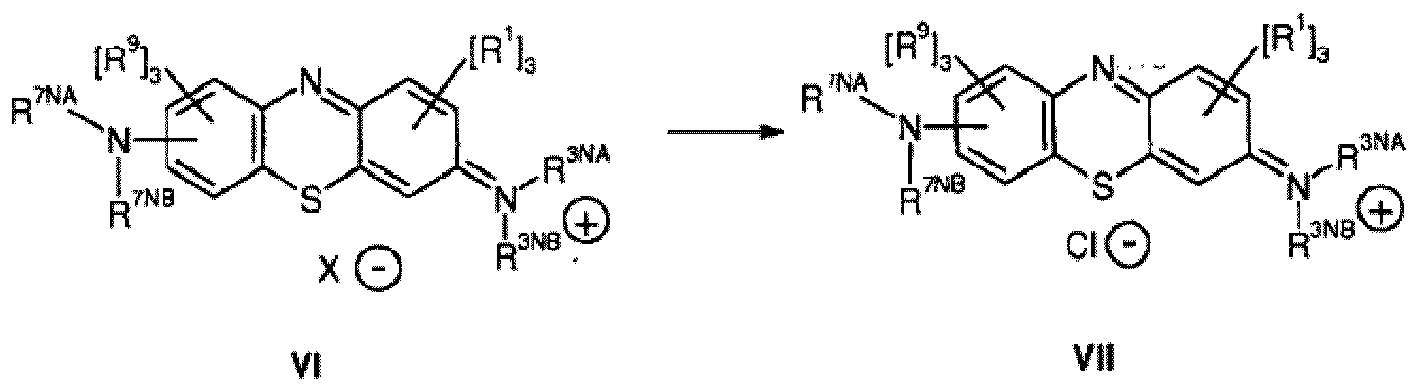
- Verfahren nach einem der vorangegangenen Ansprüche, das weiters einen Schritt der Nitrosylreduktion umfasst, worin eine Verbindung der Formel VIII reduziert wird, um eine Verbindung der Formel la zu ergeben:
 jeder Rest -R9 jeweils unabhängig -H oder -RA ist;und jeder Rest -RA jeweils unabhängig aus C1-4-Alkyl; C2-4-Alkenyl; halogeniertem C1-4-Alkyl; C5-10-Aryl; halogeniertem C5-10-Aryl; C1-4-Alkylen-C5-10-aryl und halogeniertem C1-4-Alkylen-C5-10-aryl ausgewählt ist; und-R7NA und -R7NB jeweils unabhängig aus C1-4-Alkyl; C2-4-Alkenyl; halogeniertem C1-4-Alkyl; C5-10-Aryl; halogeniertem C5-10-Aryl; C1-4-Alkylen-C5-10-aryl und halogeniertem C1-4-Alkylen-C5-10-aryl ausgewählt sind.
 - Verfahren nach einem der vorangegangenen Ansprüche, das weiters einen Schritt der Nitrosylierung umfasst, worin eine Verbindung der Formel IX nitrosyliert wird, um eine Verbindung der Formel VIII zu ergeben:
 jeder Rest -R9 jeweils unabhängig -H oder -RA ist;und jeder Rest -RA jeweils unabhängig aus C1-4-Alkyl; C2-4-Alkenyl; halogeniertem C1-4-Alkyl; C5-10-Aryl; halogeniertem C5-10-Aryl; C1-4-Alkylen-C5-10-aryl und halogeniertem C1-4-Alkylen-C5-10-aryl ausgewählt ist; und-R7NA und -R7NB jeweils unabhängig aus C1-4-Alkyl; C2-4-Alkenyl; halogeniertem C1-4-Alkyl; C5-10-Aryl; halogeniertem C5-10-Aryl; C1-4-Alkylen-C5-10-aryl und halogeniertem C1-4-Alkylen-C5-10-aryl ausgewählt sind.
 - Verfahren zur Herstellung einer pharmazeutischen Zusammensetzung, wobei das Verfahren ein Verfahren nach einem der vorangegangenen Ansprüche umfasst und außerdem einen Schritt des Mischens einer Diaminophenothiazinium-Verbindung wie in Anspruch 1 definiert mit einem oder mehreren pharmazeutisch annehmbaren Bestandteilen umfasst.
Priority Applications (2)
| Application Number | Priority Date | Filing Date | Title |
|---|---|---|---|
| PL10718268T PL2430007T3 (pl) | 2009-05-12 | 2010-05-11 | Sposoby chemicznej syntezy związków diaminofenotiazyniowych z zastosowaniem nadsiarczanowych środków utleniających |
| SI201030572T SI2430007T1 (sl) | 2009-05-12 | 2010-05-11 | Postopki kemijske sinteze diaminofenotiazinijevih spojin, ki vključujejo uporabo persulfatnih oksidantov |
Applications Claiming Priority (2)
| Application Number | Priority Date | Filing Date | Title |
|---|---|---|---|
| US17744609P | 2009-05-12 | 2009-05-12 | |
| PCT/GB2010/000927 WO2010130977A1 (en) | 2009-05-12 | 2010-05-11 | Methods of chemical synthesis of diaminophenothiazinium compounds involving the use of persulfate oxidants |
Publications (2)
| Publication Number | Publication Date |
|---|---|
| EP2430007A1 EP2430007A1 (de) | 2012-03-21 |
| EP2430007B1 true EP2430007B1 (de) | 2014-02-12 |
Family
ID=42238536
Family Applications (1)
| Application Number | Title | Priority Date | Filing Date |
|---|---|---|---|
| EP10718268.5A Active EP2430007B1 (de) | 2009-05-12 | 2010-05-11 | Verfahren zur chemischen synthese von diaminophenothiaziniumverbindungen unter einsatz von persulfatoxidationsmitteln |
Country Status (8)
| Country | Link |
|---|---|
| US (1) | US8691979B2 (de) |
| EP (1) | EP2430007B1 (de) |
| DK (1) | DK2430007T3 (de) |
| ES (1) | ES2457227T3 (de) |
| PL (1) | PL2430007T3 (de) |
| PT (1) | PT2430007E (de) |
| SI (1) | SI2430007T1 (de) |
| WO (1) | WO2010130977A1 (de) |
Cited By (1)
| Publication number | Priority date | Publication date | Assignee | Title |
|---|---|---|---|---|
| US10968174B2 (en) | 2016-12-21 | 2021-04-06 | Wista Laboratories Ltd. | Synthesis of a thiosulfonic acid by a step of periodate mediated oxidative coupling of a thiosulfonic acid with an aniline |
Families Citing this family (4)
| Publication number | Priority date | Publication date | Assignee | Title |
|---|---|---|---|---|
| CN102634015B (zh) * | 2012-05-04 | 2013-06-19 | 中南大学 | 一种聚间苯二胺纳米粒子合成方法 |
| GB201317702D0 (en) | 2013-10-07 | 2013-11-20 | Wista Lab Ltd | Methods of chemical synthesis of diaminophenothiazinium compounds including methylthioninium chloride (MTC) |
| EP3375777A1 (de) | 2017-03-15 | 2018-09-19 | MIKROCHEM spol. s.r.o. | Verfahren zur herstellung von 3,7-bis-(dimethylamino)-phenothiazin-5-ium chlorid oder -bromid |
| CN118359560B (zh) * | 2024-06-18 | 2024-09-24 | 珠海前列药业有限公司 | 一种亚甲蓝的制备方法 |
Family Cites Families (6)
| Publication number | Priority date | Publication date | Assignee | Title |
|---|---|---|---|---|
| DE1886C (de) | 1877-12-15 | 1877-12-15 | Basf Ag | Verfahren zur darstellung blauer farbstoffe aus dimethylanilin und anderen tertiaeren aromatischen monaminen |
| US5344928A (en) | 1991-04-26 | 1994-09-06 | Takeda Chemical Industries, Ltd. | Phenothiazine derivatives, their production and use |
| GB9506197D0 (en) | 1995-03-27 | 1995-05-17 | Hoffmann La Roche | Inhibition of tau-tau association. |
| GB0101049D0 (en) | 2001-01-15 | 2001-02-28 | Univ Aberdeen | Materials and methods relating to protein aggregation in neurodegenerative disease |
| GB0106953D0 (en) | 2001-03-20 | 2001-05-09 | Univ Aberdeen | Neufofibrillary labels |
| ES2409683T3 (es) | 2004-09-23 | 2013-06-27 | Wista Laboratories Ltd. | Procedimientos de síntesis química y purificación de compuestos de diaminofenotiazinio que incluyen cloruro de metiltioninio (CMT) |
-
2010
- 2010-05-11 ES ES10718268.5T patent/ES2457227T3/es active Active
- 2010-05-11 US US13/318,907 patent/US8691979B2/en not_active Expired - Fee Related
- 2010-05-11 PL PL10718268T patent/PL2430007T3/pl unknown
- 2010-05-11 DK DK10718268.5T patent/DK2430007T3/da active
- 2010-05-11 SI SI201030572T patent/SI2430007T1/sl unknown
- 2010-05-11 PT PT107182685T patent/PT2430007E/pt unknown
- 2010-05-11 EP EP10718268.5A patent/EP2430007B1/de active Active
- 2010-05-11 WO PCT/GB2010/000927 patent/WO2010130977A1/en not_active Ceased
Cited By (1)
| Publication number | Priority date | Publication date | Assignee | Title |
|---|---|---|---|---|
| US10968174B2 (en) | 2016-12-21 | 2021-04-06 | Wista Laboratories Ltd. | Synthesis of a thiosulfonic acid by a step of periodate mediated oxidative coupling of a thiosulfonic acid with an aniline |
Also Published As
| Publication number | Publication date |
|---|---|
| WO2010130977A1 (en) | 2010-11-18 |
| US20120058995A1 (en) | 2012-03-08 |
| ES2457227T3 (es) | 2014-04-25 |
| PT2430007E (pt) | 2014-04-14 |
| SI2430007T1 (sl) | 2014-05-30 |
| US8691979B2 (en) | 2014-04-08 |
| DK2430007T3 (da) | 2014-05-12 |
| EP2430007A1 (de) | 2012-03-21 |
| PL2430007T3 (pl) | 2014-07-31 |
Similar Documents
| Publication | Publication Date | Title |
|---|---|---|
| AU2005286235C1 (en) | Methods of chemical synthesis and purification of diaminophenothiazinium compounds including Methylthioninium Chloride (MTC) | |
| US8691979B2 (en) | Methods of chemical synthesis of diaminophenothiazinium compounds involving the use of persulfate oxidants | |
| AU2019203490B2 (en) | Methods of Chemical Synthesis of Diaminophenothiazinium Compounds including Methylthioninium Chloride (MTC) | |
| EP3982974A1 (de) | Neuartiges verbessertes verfahren zur synthese von diaminophenothiazinverbindungen | |
| US8703952B2 (en) | Synthesis of 9-(arylalkyl)-1,2,3,4-tetrahydro-γ-carboline and analogues and intermediates | |
| HK40075811A (en) | Methods of chemical synthesis of diaminophenothiazinium compounds including methylthioninium chloride (mtc) | |
| HK1261429A1 (en) | Methods of chemical synthesis of diaminophenothiazinium compounds including methylthioninium chloride (mtc) | |
| HK1261429B (en) | Methods of chemical synthesis of diaminophenothiazinium compounds including methylthioninium chloride (mtc) | |
| HK40014432A (en) | Methods of chemical synthesis and purification of diaminophenothiazinium compounds including methylthioninium chloride (mtc) | |
| HK1222175B (en) | Methods of chemical synthesis of diaminophenothiazinium compounds including methylthioninium chloride (mtc) | |
| HK1100001B (en) | Methods of chemical synthesis and purification of diaminophenothiazinium compounds including methylthioninium chloride (mtc) | |
| HK1156316A (en) | Methods of chemical synthesis and purification of diaminophenothiazinium compounds including methylthioninium chloride (mtc) | |
| AU2014280990A1 (en) | 3,6-disubstituted xanthylium salts as medicaments | |
| HK1156316B (en) | Methods of chemical synthesis and purification of diaminophenothiazinium compounds including methylthioninium chloride (mtc) | |
| BR112016007618B1 (pt) | Métodos de síntese química de compostos de diaminofenotiazínio incluindo cloreto de metiltionínio (mtc) | |
| BR122023024801B1 (pt) | Métodos para síntese química de compostos de diaminofenotiazínio incluindo cloreto de metiltionínio (mtc) |
Legal Events
| Date | Code | Title | Description |
|---|---|---|---|
| PUAI | Public reference made under article 153(3) epc to a published international application that has entered the european phase |
Free format text: ORIGINAL CODE: 0009012 |
|
| 17P | Request for examination filed |
Effective date: 20111124 |
|
| AK | Designated contracting states |
Kind code of ref document: A1 Designated state(s): AL AT BE BG CH CY CZ DE DK EE ES FI FR GB GR HR HU IE IS IT LI LT LU LV MC MK MT NL NO PL PT RO SE SI SK SM TR |
|
| DAX | Request for extension of the european patent (deleted) | ||
| 17Q | First examination report despatched |
Effective date: 20130411 |
|
| GRAP | Despatch of communication of intention to grant a patent |
Free format text: ORIGINAL CODE: EPIDOSNIGR1 |
|
| INTG | Intention to grant announced |
Effective date: 20130916 |
|
| GRAS | Grant fee paid |
Free format text: ORIGINAL CODE: EPIDOSNIGR3 |
|
| GRAA | (expected) grant |
Free format text: ORIGINAL CODE: 0009210 |
|
| AK | Designated contracting states |
Kind code of ref document: B1 Designated state(s): AL AT BE BG CH CY CZ DE DK EE ES FI FR GB GR HR HU IE IS IT LI LT LU LV MC MK MT NL NO PL PT RO SE SI SK SM TR |
|
| REG | Reference to a national code |
Ref country code: GB Ref legal event code: FG4D |
|
| REG | Reference to a national code |
Ref country code: CH Ref legal event code: EP |
|
| REG | Reference to a national code |
Ref country code: AT Ref legal event code: REF Ref document number: 652106 Country of ref document: AT Kind code of ref document: T Effective date: 20140215 |
|
| REG | Reference to a national code |
Ref country code: IE Ref legal event code: FG4D |
|
| REG | Reference to a national code |
Ref country code: DE Ref legal event code: R096 Ref document number: 602010013513 Country of ref document: DE Effective date: 20140327 |
|
| REG | Reference to a national code |
Ref country code: NL Ref legal event code: T3 |
|
| REG | Reference to a national code |
Ref country code: PT Ref legal event code: SC4A Free format text: AVAILABILITY OF NATIONAL TRANSLATION Effective date: 20140407 |
|
| REG | Reference to a national code |
Ref country code: ES Ref legal event code: FG2A Ref document number: 2457227 Country of ref document: ES Kind code of ref document: T3 Effective date: 20140425 |
|
| REG | Reference to a national code |
Ref country code: SE Ref legal event code: TRGR |
|
| REG | Reference to a national code |
Ref country code: DK Ref legal event code: T3 Effective date: 20140505 |
|
| REG | Reference to a national code |
Ref country code: GR Ref legal event code: EP Ref document number: 20140400720 Country of ref document: GR Effective date: 20140515 |
|
| REG | Reference to a national code |
Ref country code: LT Ref legal event code: MG4D |
|
| PG25 | Lapsed in a contracting state [announced via postgrant information from national office to epo] |
Ref country code: NO Free format text: LAPSE BECAUSE OF FAILURE TO SUBMIT A TRANSLATION OF THE DESCRIPTION OR TO PAY THE FEE WITHIN THE PRESCRIBED TIME-LIMIT Effective date: 20140512 Ref country code: IS Free format text: LAPSE BECAUSE OF FAILURE TO SUBMIT A TRANSLATION OF THE DESCRIPTION OR TO PAY THE FEE WITHIN THE PRESCRIBED TIME-LIMIT Effective date: 20140612 Ref country code: LT Free format text: LAPSE BECAUSE OF FAILURE TO SUBMIT A TRANSLATION OF THE DESCRIPTION OR TO PAY THE FEE WITHIN THE PRESCRIBED TIME-LIMIT Effective date: 20140212 |
|
| REG | Reference to a national code |
Ref country code: PL Ref legal event code: T3 |
|
| REG | Reference to a national code |
Ref country code: SK Ref legal event code: T3 Ref document number: E 16222 Country of ref document: SK |
|
| PG25 | Lapsed in a contracting state [announced via postgrant information from national office to epo] |
Ref country code: CY Free format text: LAPSE BECAUSE OF FAILURE TO SUBMIT A TRANSLATION OF THE DESCRIPTION OR TO PAY THE FEE WITHIN THE PRESCRIBED TIME-LIMIT Effective date: 20140212 |
|
| PG25 | Lapsed in a contracting state [announced via postgrant information from national office to epo] |
Ref country code: HR Free format text: LAPSE BECAUSE OF FAILURE TO SUBMIT A TRANSLATION OF THE DESCRIPTION OR TO PAY THE FEE WITHIN THE PRESCRIBED TIME-LIMIT Effective date: 20140212 Ref country code: LV Free format text: LAPSE BECAUSE OF FAILURE TO SUBMIT A TRANSLATION OF THE DESCRIPTION OR TO PAY THE FEE WITHIN THE PRESCRIBED TIME-LIMIT Effective date: 20140212 |
|
| PG25 | Lapsed in a contracting state [announced via postgrant information from national office to epo] |
Ref country code: RO Free format text: LAPSE BECAUSE OF FAILURE TO SUBMIT A TRANSLATION OF THE DESCRIPTION OR TO PAY THE FEE WITHIN THE PRESCRIBED TIME-LIMIT Effective date: 20140212 Ref country code: EE Free format text: LAPSE BECAUSE OF FAILURE TO SUBMIT A TRANSLATION OF THE DESCRIPTION OR TO PAY THE FEE WITHIN THE PRESCRIBED TIME-LIMIT Effective date: 20140212 |
|
| REG | Reference to a national code |
Ref country code: DE Ref legal event code: R097 Ref document number: 602010013513 Country of ref document: DE |
|
| REG | Reference to a national code |
Ref country code: CH Ref legal event code: PCOW Free format text: NEW ADDRESS: 25 BUKIT BATOK CRESCENT THE ELITIST , 06-13, SINGAPORE 658066 (SG) |
|
| PLBE | No opposition filed within time limit |
Free format text: ORIGINAL CODE: 0009261 |
|
| STAA | Information on the status of an ep patent application or granted ep patent |
Free format text: STATUS: NO OPPOSITION FILED WITHIN TIME LIMIT |
|
| 26N | No opposition filed |
Effective date: 20141113 |
|
| PG25 | Lapsed in a contracting state [announced via postgrant information from national office to epo] |
Ref country code: MC Free format text: LAPSE BECAUSE OF FAILURE TO SUBMIT A TRANSLATION OF THE DESCRIPTION OR TO PAY THE FEE WITHIN THE PRESCRIBED TIME-LIMIT Effective date: 20140212 |
|
| REG | Reference to a national code |
Ref country code: FR Ref legal event code: CA Effective date: 20150109 |
|
| REG | Reference to a national code |
Ref country code: DE Ref legal event code: R097 Ref document number: 602010013513 Country of ref document: DE Effective date: 20141113 |
|
| REG | Reference to a national code |
Ref country code: SI Ref legal event code: SP73 Owner name: WISTA LABORATORIES LTD.; SG Effective date: 20151002 |
|
| REG | Reference to a national code |
Ref country code: FR Ref legal event code: PLFP Year of fee payment: 7 |
|
| PG25 | Lapsed in a contracting state [announced via postgrant information from national office to epo] |
Ref country code: MT Free format text: LAPSE BECAUSE OF FAILURE TO SUBMIT A TRANSLATION OF THE DESCRIPTION OR TO PAY THE FEE WITHIN THE PRESCRIBED TIME-LIMIT Effective date: 20140212 |
|
| PG25 | Lapsed in a contracting state [announced via postgrant information from national office to epo] |
Ref country code: SM Free format text: LAPSE BECAUSE OF FAILURE TO SUBMIT A TRANSLATION OF THE DESCRIPTION OR TO PAY THE FEE WITHIN THE PRESCRIBED TIME-LIMIT Effective date: 20140212 |
|
| PG25 | Lapsed in a contracting state [announced via postgrant information from national office to epo] |
Ref country code: BG Free format text: LAPSE BECAUSE OF FAILURE TO SUBMIT A TRANSLATION OF THE DESCRIPTION OR TO PAY THE FEE WITHIN THE PRESCRIBED TIME-LIMIT Effective date: 20140212 |
|
| PG25 | Lapsed in a contracting state [announced via postgrant information from national office to epo] |
Ref country code: HU Free format text: LAPSE BECAUSE OF FAILURE TO SUBMIT A TRANSLATION OF THE DESCRIPTION OR TO PAY THE FEE WITHIN THE PRESCRIBED TIME-LIMIT; INVALID AB INITIO Effective date: 20100511 |
|
| REG | Reference to a national code |
Ref country code: FR Ref legal event code: PLFP Year of fee payment: 8 |
|
| REG | Reference to a national code |
Ref country code: FR Ref legal event code: PLFP Year of fee payment: 9 |
|
| PG25 | Lapsed in a contracting state [announced via postgrant information from national office to epo] |
Ref country code: MK Free format text: LAPSE BECAUSE OF FAILURE TO SUBMIT A TRANSLATION OF THE DESCRIPTION OR TO PAY THE FEE WITHIN THE PRESCRIBED TIME-LIMIT Effective date: 20140212 |
|
| PG25 | Lapsed in a contracting state [announced via postgrant information from national office to epo] |
Ref country code: AL Free format text: LAPSE BECAUSE OF FAILURE TO SUBMIT A TRANSLATION OF THE DESCRIPTION OR TO PAY THE FEE WITHIN THE PRESCRIBED TIME-LIMIT Effective date: 20140212 |
|
| P01 | Opt-out of the competence of the unified patent court (upc) registered |
Effective date: 20230427 |
|
| PGFP | Annual fee paid to national office [announced via postgrant information from national office to epo] |
Ref country code: NL Payment date: 20250423 Year of fee payment: 16 |
|
| PGFP | Annual fee paid to national office [announced via postgrant information from national office to epo] |
Ref country code: LU Payment date: 20250424 Year of fee payment: 16 |
|
| PGFP | Annual fee paid to national office [announced via postgrant information from national office to epo] |
Ref country code: FI Payment date: 20250429 Year of fee payment: 16 |
|
| PGFP | Annual fee paid to national office [announced via postgrant information from national office to epo] |
Ref country code: PL Payment date: 20250411 Year of fee payment: 16 Ref country code: DE Payment date: 20250423 Year of fee payment: 16 |
|
| PGFP | Annual fee paid to national office [announced via postgrant information from national office to epo] |
Ref country code: GB Payment date: 20250423 Year of fee payment: 16 Ref country code: ES Payment date: 20250602 Year of fee payment: 16 Ref country code: DK Payment date: 20250423 Year of fee payment: 16 |
|
| PGFP | Annual fee paid to national office [announced via postgrant information from national office to epo] |
Ref country code: BE Payment date: 20250430 Year of fee payment: 16 Ref country code: IT Payment date: 20250526 Year of fee payment: 16 |
|
| PGFP | Annual fee paid to national office [announced via postgrant information from national office to epo] |
Ref country code: PT Payment date: 20250410 Year of fee payment: 16 |
|
| PGFP | Annual fee paid to national office [announced via postgrant information from national office to epo] |
Ref country code: FR Payment date: 20250523 Year of fee payment: 16 |
|
| PGFP | Annual fee paid to national office [announced via postgrant information from national office to epo] |
Ref country code: GR Payment date: 20250411 Year of fee payment: 16 |
|
| PGFP | Annual fee paid to national office [announced via postgrant information from national office to epo] |
Ref country code: CH Payment date: 20250601 Year of fee payment: 16 |
|
| PGFP | Annual fee paid to national office [announced via postgrant information from national office to epo] |
Ref country code: AT Payment date: 20250429 Year of fee payment: 16 |
|
| PGFP | Annual fee paid to national office [announced via postgrant information from national office to epo] |
Ref country code: TR Payment date: 20250410 Year of fee payment: 16 Ref country code: SK Payment date: 20250410 Year of fee payment: 16 |
|
| PGFP | Annual fee paid to national office [announced via postgrant information from national office to epo] |
Ref country code: CZ Payment date: 20250411 Year of fee payment: 16 |
|
| PGFP | Annual fee paid to national office [announced via postgrant information from national office to epo] |
Ref country code: IE Payment date: 20250424 Year of fee payment: 16 |
|
| PGFP | Annual fee paid to national office [announced via postgrant information from national office to epo] |
Ref country code: SE Payment date: 20250423 Year of fee payment: 16 Ref country code: SI Payment date: 20250416 Year of fee payment: 16 |