EP2429305B1 - Dairy product and process - Google Patents
Dairy product and process Download PDFInfo
- Publication number
- EP2429305B1 EP2429305B1 EP10764718.2A EP10764718A EP2429305B1 EP 2429305 B1 EP2429305 B1 EP 2429305B1 EP 10764718 A EP10764718 A EP 10764718A EP 2429305 B1 EP2429305 B1 EP 2429305B1
- Authority
- EP
- European Patent Office
- Prior art keywords
- wpc
- protein
- wpi
- heat
- preparing
- Prior art date
- Legal status (The legal status is an assumption and is not a legal conclusion. Google has not performed a legal analysis and makes no representation as to the accuracy of the status listed.)
- Revoked
Links
Images


Classifications
-
- A—HUMAN NECESSITIES
- A23—FOODS OR FOODSTUFFS; TREATMENT THEREOF, NOT COVERED BY OTHER CLASSES
- A23C—DAIRY PRODUCTS, e.g. MILK, BUTTER OR CHEESE; MILK OR CHEESE SUBSTITUTES; PREPARATION THEREOF
- A23C1/00—Concentration, evaporation or drying
- A23C1/04—Concentration, evaporation or drying by spraying into a gas stream
- A23C1/05—Concentration, evaporation or drying by spraying into a gas stream combined with agglomeration granulation or coating
-
- A—HUMAN NECESSITIES
- A23—FOODS OR FOODSTUFFS; TREATMENT THEREOF, NOT COVERED BY OTHER CLASSES
- A23C—DAIRY PRODUCTS, e.g. MILK, BUTTER OR CHEESE; MILK OR CHEESE SUBSTITUTES; PREPARATION THEREOF
- A23C9/00—Milk preparations; Milk powder or milk powder preparations
- A23C9/12—Fermented milk preparations; Treatment using microorganisms or enzymes
- A23C9/13—Fermented milk preparations; Treatment using microorganisms or enzymes using additives
- A23C9/1307—Milk products or derivatives; Fruit or vegetable juices; Sugars, sugar alcohols, sweeteners; Oligosaccharides; Organic acids or salts thereof or acidifying agents; Flavours, dyes or pigments; Inert or aerosol gases; Carbonation methods
-
- A—HUMAN NECESSITIES
- A23—FOODS OR FOODSTUFFS; TREATMENT THEREOF, NOT COVERED BY OTHER CLASSES
- A23C—DAIRY PRODUCTS, e.g. MILK, BUTTER OR CHEESE; MILK OR CHEESE SUBSTITUTES; PREPARATION THEREOF
- A23C19/00—Cheese; Cheese preparations; Making thereof
- A23C19/06—Treating cheese curd after whey separation; Products obtained thereby
- A23C19/068—Particular types of cheese
- A23C19/08—Process cheese preparations; Making thereof, e.g. melting, emulsifying, sterilizing
- A23C19/082—Adding substances to the curd before or during melting; Melting salts
-
- A—HUMAN NECESSITIES
- A23—FOODS OR FOODSTUFFS; TREATMENT THEREOF, NOT COVERED BY OTHER CLASSES
- A23C—DAIRY PRODUCTS, e.g. MILK, BUTTER OR CHEESE; MILK OR CHEESE SUBSTITUTES; PREPARATION THEREOF
- A23C1/00—Concentration, evaporation or drying
-
- A—HUMAN NECESSITIES
- A23—FOODS OR FOODSTUFFS; TREATMENT THEREOF, NOT COVERED BY OTHER CLASSES
- A23C—DAIRY PRODUCTS, e.g. MILK, BUTTER OR CHEESE; MILK OR CHEESE SUBSTITUTES; PREPARATION THEREOF
- A23C1/00—Concentration, evaporation or drying
- A23C1/14—Concentration, evaporation or drying combined with other treatment
-
- A—HUMAN NECESSITIES
- A23—FOODS OR FOODSTUFFS; TREATMENT THEREOF, NOT COVERED BY OTHER CLASSES
- A23C—DAIRY PRODUCTS, e.g. MILK, BUTTER OR CHEESE; MILK OR CHEESE SUBSTITUTES; PREPARATION THEREOF
- A23C21/00—Whey; Whey preparations
-
- A—HUMAN NECESSITIES
- A23—FOODS OR FOODSTUFFS; TREATMENT THEREOF, NOT COVERED BY OTHER CLASSES
- A23C—DAIRY PRODUCTS, e.g. MILK, BUTTER OR CHEESE; MILK OR CHEESE SUBSTITUTES; PREPARATION THEREOF
- A23C21/00—Whey; Whey preparations
- A23C21/04—Whey; Whey preparations containing non-milk components as source of fats or proteins
-
- A—HUMAN NECESSITIES
- A23—FOODS OR FOODSTUFFS; TREATMENT THEREOF, NOT COVERED BY OTHER CLASSES
- A23C—DAIRY PRODUCTS, e.g. MILK, BUTTER OR CHEESE; MILK OR CHEESE SUBSTITUTES; PREPARATION THEREOF
- A23C9/00—Milk preparations; Milk powder or milk powder preparations
- A23C9/14—Milk preparations; Milk powder or milk powder preparations in which the chemical composition of the milk is modified by non-chemical treatment
-
- A—HUMAN NECESSITIES
- A23—FOODS OR FOODSTUFFS; TREATMENT THEREOF, NOT COVERED BY OTHER CLASSES
- A23J—PROTEIN COMPOSITIONS FOR FOODSTUFFS; WORKING-UP PROTEINS FOR FOODSTUFFS; PHOSPHATIDE COMPOSITIONS FOR FOODSTUFFS
- A23J1/00—Obtaining protein compositions for foodstuffs; Bulk opening of eggs and separation of yolks from whites
- A23J1/20—Obtaining protein compositions for foodstuffs; Bulk opening of eggs and separation of yolks from whites from milk, e.g. casein; from whey
-
- A—HUMAN NECESSITIES
- A23—FOODS OR FOODSTUFFS; TREATMENT THEREOF, NOT COVERED BY OTHER CLASSES
- A23J—PROTEIN COMPOSITIONS FOR FOODSTUFFS; WORKING-UP PROTEINS FOR FOODSTUFFS; PHOSPHATIDE COMPOSITIONS FOR FOODSTUFFS
- A23J1/00—Obtaining protein compositions for foodstuffs; Bulk opening of eggs and separation of yolks from whites
- A23J1/20—Obtaining protein compositions for foodstuffs; Bulk opening of eggs and separation of yolks from whites from milk, e.g. casein; from whey
- A23J1/205—Obtaining protein compositions for foodstuffs; Bulk opening of eggs and separation of yolks from whites from milk, e.g. casein; from whey from whey, e.g. lactalbumine
-
- A—HUMAN NECESSITIES
- A23—FOODS OR FOODSTUFFS; TREATMENT THEREOF, NOT COVERED BY OTHER CLASSES
- A23J—PROTEIN COMPOSITIONS FOR FOODSTUFFS; WORKING-UP PROTEINS FOR FOODSTUFFS; PHOSPHATIDE COMPOSITIONS FOR FOODSTUFFS
- A23J3/00—Working-up of proteins for foodstuffs
- A23J3/04—Animal proteins
- A23J3/08—Dairy proteins
Definitions
- This invention relates to a process of making a whey protein concentrate (WPC) comprising denatured whey proteins.
- WPC whey protein concentrate
- Lactalbumin is long known as a commercial product prepared by heating whey until the protein coagulates and is rendered insoluble. The insoluble material is filtered off, washed and dried. Lactalbumin has found many uses ranging from stock food to enhancing the protein content of bread and bakery products. The protein depleted whey stream resulting from the recovery of the lactalbumin may also be used as a stock food, but is otherwise expensive to dispose of.
- Heat-denatured (or modified) whey protein products have become a more recent category of products in the market. A number of methods for the manufacture of this category have been invented in recent years.
- Whey protein will form a gel when heated under appropriate conditions (> 75 °C, ⁇ pH 6-8, > 6 g TS/100 g) ( Havea, P., Singh, H., Creamer, L. K. & Campanella, O. H., Electrophoretic characterization of the protein products formed during heat treatment of whey protein concentrate solutions. Journal of Dairy Research, 65, 79-91, 1998 ).
- WO/2001/005247 disclose a process for preparing whey protein gels that include denatured particles. Initially the whey protein is treated to hydrolyse it using either acid or enzymes. After a heat treatment, the resulting turbid, particulate gels have an opaque milky-white appearance due to large aggregates scattering light. Mixed gels, the final subset, possess physical and functional properties of both fine-stranded and particulate, and are produced with intermediate salt concentrations (E. Foegeding et al., (1998)). The condensing of linear strands into larger aggregates is thought to be the causal mechanism for mixed gel formatiol.
- the gelled material may be dried to yield particles in the range 1 ⁇ m to 100 ⁇ m.
- Hudson et al teach little about their heating process (home manufacture is contemplated) beyond heating the dispersions in aluminum freeze-drier pans (13.5 cm x 13,5 cm) at 80°C for 45 minutes or 3 hours ....
- Huss and Spiegel in US6,767,575 disclose a process for producing micro-particulated whey protein using relatively dilute protein streams ( ⁇ 3% w/v protein), after heating and in contrast to the processes known to those skilled in the art, no further shearing operations are carried out, to the extent that the inventive process is carried out under essentially non-shearing conditions.
- the shear rates occurring due to the unavoidable pumping and stirring operations mentioned are generally not greater than 2000 s -1 to 1000 s -1 , preferably not greater than 500 s -1 .
- the hot-holding of the raw material can also take place in complete absence of agitation.
- WO/2007/039296 A1 disclose a proprietary mechanical device to affect the denaturing of protein solutions while applying heat.
- Oudeman teaches a process for preparing a synthetic milk product using denatured whey proteins, wherein calcium ions are added to a whey protein concentrate having a protein content of 25-50%, relative to the solids, and a pH value of 5.9-6.7, the concentrate is subsequently subjected to a heat treatment and homogenization, whereafter the product is optionally evaporated and dried.
- Holst et al declare: It is surprising that the new, partially denatured whey protein product with a denaturation level of preferably about 80% and a mean particle diameter in the range of preferably 40 to 50 ⁇ m has such good organoleptic properties and is free of any sandy or gritty aftertaste, whereas denatured whey proteins with similar particle sizes, as known, because of their bad organoleptic properties, particularly their sandy sensation in the mouth, are unsuitable of use as an additive to mayonnaise which is produced cold.
- US 2006/0204643 disclose a heat denaturation process for whey protein concentrates where: the initial slurry containing native whey protein is heated to denature at least some of the protein. As noted above, the slurry may be heated to a temperature of about 140°F to about 300°F, for a period of about 10 to about 60 seconds. The slurry may be mixed during at least a portion of the heating period to reduce, and / or prevent, denatured whey protein from coagulating around the heating elements in cooker.
- One exemplary device for performing this operation is a single or twin-screw mixer or a twin-screw extruder, either fitted for steam injection or having a heated jacket, or a combination of both.
- the screws i.e., augers
- the slurry is subjected to high shear conditions, which reduces the coagulants that may have formed as the whey protein denatures.
- High shear conditions as used herein generally refer to conditions in which 10,000 to 500,000 s -1 of shear is applied.
- the slurry is typically sheared by a high-shear mixer or colloid mill, at a temperature of about 90 to 300°F for about 0.01 to 0.5 seconds.
- WO 2008/063115 A1 [Tetra Laval Holdings & Finance SA] disclosed a process where a protein solution is heated using a tubular heater under pressure (40 to 80 bar) followed by mechanical shearing in a homogenizer to break down the protein aggregates to form fine particles (3 to 10 ⁇ m diameter).
- WO2006057968 (Wolfschoon-Pombo [Wolfschoon-Pompo] et al ) discloses a cream cheese process where a whey protein concentrate stream of 11 to 12% protein is heat treated in a tubular heater using turbulent conditions to yield a stream of particles of which 90% (d90) are less than 95 ⁇ m and half the particles (d50) are less than 12 ⁇ m. Further shear may then be applied (homogenization) to achieve considerably finer particles with d90 ⁇ 9 ⁇ m.
- Borgwardt et al disclose that whey protein concentrate solutions with a protein content of 8-11%, a solids content of 16-22% and a pH of 4.2-5.2, can be treated by heating at 85-95°C for 5 to 20 minutes under turbulent flow conditions to yield thermally stable non-agglomerating colloidal whey protein suspensions. The suspension is stabilised by instantaneous cooling. The suspension of protein particles may be dried. Borgwardt also teach that although the Reynolds number must exceed 2000, the wall shear stress must also exceed 12kg/ms 2 . The art teaches that heat treated protein slurries are shear thinning (pseudoplastic liquid). For a person skilled in hydrodynamics, it is unclear how to interpret (hence implement) Borgwardt et al's shear stress condition without more detailed information of their fluid's flow characteristics.
- the invention provides a method for preparing a heat treated whey protein concentrate (WPC) or whey protein isolate (WPI) as defined in the claims.
- WPC heat treated whey protein concentrate
- WPI whey protein isolate
- the invention provides a method for preparing a heat treated whey protein concentrate (WPC) or whey protein isolate (WPI), comprising:
- the heat treated material is a liquid whey protein concentrate (WPC) or whey protein isolate (WPI) and the ingredients include at least one of the group consisting of milk, skim milk, fat, a carbohydrate, milk retentate, or skim milk retentate.
- WPC liquid whey protein concentrate
- WPI whey protein isolate
- the pH of the WPC concentrate prior to heating is adjusted to between 5.0 and 8.5, more preferably between 5.5 and 8.5 and most preferably 6.0 and 8.0, most preferably 6.5-7.5.
- the protein concentration of the WPC concentrate prior to heating is 16-40%, more preferably 17-30%,
- the WPC concentrate prior to heating may be adjusted for its calcium concentration.
- the calcium adjustment may include depletion by any convenient process i.e. ion exchange, or may be increased by the addition of a calcium salt e.g. calcium chloride.
- the heating medium is preferably steam or heated water.
- the heat treating occurs as the WPC or WPI solution passes along a heated flow path, preferably a tube with an inside diameter greater than 5mm and less than 150mm.
- the solution passes through a long tubular reactor and exits at a temperature between 60 °C and 110 °C.
- a long tubular thermal reactor is used.
- the thermal reactor has a length based on its nominal hold up time of between 1 second and 1000 seconds.
- the temperature of the solution at the end of reactor may be between 45°C and 150°C, preferably between 50°C and 130°C and more preferably between 60°C and 110°C.
- the thermal reactor may be fed using a pump with a pressure rating of between 3 Bar and 1000 Bar, preferably between 5 Bar and 500 Bar and more preferably between 10 Bar and 350 Bar.
- a supplementary pump may be useful to feed the high pressure pump.
- the product exiting the flow path is used as an ingredient in preparing a food product.
- the flow path supplies a drier to convert the solution containing denatured whey protein complexes into a dried product.
- the heat treatment zone is coupled directly to the inlet of the drier.
- a "WPC” is a fraction of whey from which lactose has been at least partially removed to increase the protein content to at least 20% (w/w).
- the WPC has at least 40%, more preferably at least 55% (w/w), even more preferably at least 65% and most preferably at least 75% of the TS as whey protein.
- the proportions of the whey proteins are substantially unaltered relative to those of the whey from which the WPC is derived.
- the WPC is an evaporated whey protein retentate.
- WPC includes WPIs when the context allows.
- a "WPI” is a WPC having at least 90% of the TS as whey protein.
- retentate means the retained fraction after ultrafiltration of whey or a source or whey, milk or skim milk. Such fractions have increased percentage protein and lower percentage lactose as total solids than does the starting material.
- promptly means in less than 2 minutes, preferably less than 1 minute, more preferably less than 30 seconds, most preferably less than 10 seconds.
- the WPC starting material in (a) may be prepared by ultrafiltration of a raw whey at a pH of about 4.0-6.4, preferably pH 4.0-6.2, more preferably pH 4.0-6.2 and most preferably pH 4.6-6.0. Using ultrafiltration, water, lactose and minerals are removed, resulting in a retentate stream. Diafiltration may be applied during ultrafiltration to further reduce the level of dialyzable components. The ultrafiltration is typically carried out at 10-50°C. Ion exchange may be used to manipulate the ionic content of the proteinaceous stream. The level of calcium ions may be manipulated in some embodiments by ion exchange arid replaced with monovalent cations.
- the level of calcium may be increased by the addition of a soluble food approved calcium salt e.g, calcium chloride.
- the protein concentration of the WPC is preferably further increased by evaporation.
- the starting material may be a reconstituted whey protein prepared from a dried WPC or WPI.
- the whey for the preparation of the WPC is preferably acid whey or cheese whey.
- Acid whey has a pH of about 4.6
- cheese whey has a pH of about 5.6-6.4.
- the pH of the concentrate at heating can be varied depending on the desired functional properties of the final modified whey protein concentrate or powder. Those who are skilled in the art would know that heat treatment of whey protein under different pHs would result in modifying the protein-protein interactions in the heated system, giving rise to final products with varied functional properties. ( Hudson et al in WO/2001/005247 discuss some of the art of manipulating the properties of whey protein streams relating to their denaturation/gelation characteristics.)
- the protein concentration of the whey or WPC for the purposes of this specification are determined using the Kjeldahl nitrogen analysis method and the application of a Kjeldahl factor of 6.38.
- the use of a high pressure tubular heater is preferred as a flow conduit, mainly because of its simplicity.
- the heating time varies according to the temperature used. At higher temperatures, for example 100°C, only a few seconds may be required. At 70°C, heating for a longer period may be required. It is also important to note that the degree of heating is a way of modifying the functional properties of the final powder. In different food applications, a wide range of modified WPCs with varied levels of protein denaturation may be required, and this invention provides a simple means of making these, just by modifying the protein concentration, pH, ionic environment, heating time and/or heating temperature.
- High pressure heater refers to a shell and tube heater in which the product is fed through a tube that is enclosed in a heating chamber (shell).
- the heating medium which is preferably steam or water, is fed into the heating chamber.
- the WPC is fed into the heating tube using a high pressure pump.
- the dried modified WPC or WPI has 50-95% of the total solids as whey protein, most preferably 52-90%, the heat treatment is carried out at more than 70°C and step (b) uses a high pressure pump to feed the protein concentrate at a pressure of between 3 to 1000 bar, preferably 5 to 500 bar, most preferably 10 to 350 bar into a high pressure heater, the flow of the product is such that a turbulent flow is effected and
- the heating medium e.g. steam
- the heating medium may be pressurized to achieve higher heating temperatures.
- Other heating methods may include ohmic and microwave etc.
- Direct steam injection is a preferred heating method.
- the heat treatment zone is coupled directly to a spray drier fitted with a nozzle or a cluster of nozzles or a rotary atomiser or an ultrasonic atomiser for the purpose of producing a stream of droplets.
- the heat treatment is usually to be of sufficient duration to denature a proportion of the whey proteins into insoluble aggregates.
- the heat treatment is at least 60°C and more preferably at least 70°C. 70°C-150°C is a preferred range.
- the solution is heated at 75-90°C. However, lower temperatures may be used (for example, 50-70°C and preferably 60-70°C). The heating times vary according not only to the temperature but also to the protein content and the ion and lactose content.
- the heating time is from 30 s to 15 min for temperatures in the range 70-80°C, from 10 s to 10 min for temperatures in the range 80-90°C and from 1 s to 5 min for temperatures in the range 90-100°C.
- the times may be reduced to, for example, 1-10 s.
- the denaturation percentage in the context of this specification means the percentage as determined by HPLC and calculation of the reduction of the peak area for undenatured whey proteins relative to that for unheated controls. This method is described in US Patent 6,767,575 .
- a feature of the current invention is that the whey protein concentrate, at high total solids (e.g. > 20%), is heated under turbulent flow. Because of the turbulent flow, the heat transfer coefficient is very high, resulting in fast heating. Effectively, the process of this invention offers a very efficient way of manufacture of micro-particulated whey protein products.
- Turbulent flow is defined as having sufficient mass flow rate in the heating tubes to provide a Reynolds, number in excess of 500, more preferably in excess of 1000, even more preferably in excess of 1500, and most preferably in excess of 2000.
- Reynolds numbers are a characteristic of turbulent flow and are known in the art of hydrodynamics.
- the determination of the Reynolds number depends on the mass velocity of the fluid and its viscosity, which is defined as the nominal viscosity determined using the Hagen-Poiseuille equation from a measurement of the pressure drop along a known length of horizontal pipe of known uniform circular cross section at a known flowrate of the heat treated fluid at a uniform temperature before it is dried.
- a Reynolds number in the range 2,000-50,000 is preferred for use in the invention, preferably 5,000-30,000.
- not subjected to a mechanical shear process means that the material is not subject to a process in which a mechanical device such as a homogeniser, colloid mill, high pressure pump, scraped surface heat exchanger, high shear mixer or the like is used to mix the solution or break up particles within it.
- a mechanical device such as a homogeniser, colloid mill, high pressure pump, scraped surface heat exchanger, high shear mixer or the like is used to mix the solution or break up particles within it.
- the products of the invention have a wide range of utilities. They can be used in applications where a high protein content is required but without incurring undesirable changes in the texture of the product to which they are added.
- the WPCs of the invention are suitable for use in processed cheese, yoghurt and whey crisps ( WO/2006/019320 ).
- the WPCs of the invention are useful in applications in which the addition of high whey protein levels without undesirable alteration of the final product qualities may be required.
- the present WPC allows the incorporation of whey protein into snacking and convenience foodstuffs without producing undesirable textures or flavours.
- the WPC may be used to add protein to the ingredients for a snack bar that also comprises a carbohydrate source and fat. Such snack bars may be prepared by melting fat, if melting is required, and mixing fat or oil with carbohydrate and WPC and then allowing the mixture to set.
- the advantage of the process of this invention is that it has only a simple heating step in addition to the standard processing of methods for dairy protein streams. Those who are skilled in the art would understand that the ability to heat treat whey protein at high TS is highly desirable for economic reasons.
- the invention comprises including the dried modified WPC or WPI as an ingredient in yoghurt.
- the process preferably comprises preparing a bigh protein yoghurt milk having at least 7% (w/v), preferably 8-20% (w/v), more preferably 10- 16% (w/v) protein by mixing a dried WPC or WPI of the invention with a milk comprising casein, and acidifying the high protein yoghurt milk to a pH of 3.8 - 5.5, preferably 4.0 - 5.0, most preferably 4,2-4.7.
- processes for preparing high protein yoghurt drinks where the yoghurt milk has a protein content of 1.5-15% (w/v), but with 30-90%, preferably 40- 80% of the protein being whey protein of the invention.
- the yoghurt milk may include dried or liquid milk, milk retentate, milk protein concentrate (MPC), cream, or milk fat that are combined (with water if required) to form a reconstituted milk or a standardised milk composition.
- Skim milk is a preferred ingredient.
- Milk streams may be pasteurised as required by local regulations.
- the high protein yoghurt milk is generally heat treated prior to acidification, preferably at 70-100°C, more preferably 80-90°C, most preferably 85-95°C, preferably for 5-20 minutes.
- the acidification is most preferably carried out by fermentation using mixed cultures of Streptococcus thermophilus and Lactobacillus delbrueckii subsp. bulgaricus. Cultures of Streptococcus thermophilus and any Lactobacillus species are also preferred as are cultures of Lactobacillus delbrueckii subsp, bulgaricus. Where acidification is by chemical acidification, addition of glucono-delta-lactone is preferred.
- the invention comprises mixing the dried modified WPC or WPI with a milk comprising casein, and acidifying to a pH of 3.8-5.5, to prepare a yoghurt drink comprising 1.5-15% (w/v) protein.
- yoghurt refers to an acidic or fermented food or beverage product prepared from a dairy resource,and either viable micro-organisms or chemical acidulants or both.
- yoghurt also refers to yoghurt-like products that may include non-dairy derived lipids, flavourings and food-approved stabilisers, acids and texturizers. Heat treated yoghurt and yoghurt-like products are also included by the term yoghurt.
- the term "yoghurt” includes yoghurts (either set or stirred), yoghurt drinks and Petit Malawi.
- the products of the invention are good substrates for producing, whey protein hydrolysates with minimal content of particles with molecular weight greater than 20kD.
- a heat-treated WPC or WPI is prepared by the method of the invention and contacted with a protease to produce a whey protein hydrosylate.
- Such hydrolysates have applications in nutritional compositions, including infant formulas.
- the invention comprises mixing the WPC or WPI or whey protein hydrolysate with other ingredients including cheese and water, cooking to form a molten processed cheese, and allowing to cool to form a processed cheese.
- the WPCs and WPIs produced by methods of this invention are also useful for preparing nutritional products, including nutritional beverages, and specialist nutritional products including meal replacement products.
- a preferred use of the invention comprises adding a heat-treated WPC or WPI prepared by the method of the invention or a hydrolysate prepared by the method of the invention as an ingredient in a mixture to form a nutritional product also comprising water and soluble carbohydrate, preferably also comprising oil or fat.
- the mixture further comprises sodium and potassium salts and a source of lipids and vitamins.
- the mixture is heated to a temperature above 70°C, preferably above 100°C, more preferably under at least commercial sterilising conditions.
- the mixture also includes a magnesium salt.
- Commercial sterilising conditions are conditions achieved using the application of heat or high pressure to render a product free of microorganisms capable of growing in the product at non refrigerated conditions (over 10°C at which the product will be held during distribution and storage.
- the inventive ingredient has been found to be surprisingly advantageous in the preparation of processed cheese and processed cheese foods and processed cheese-like foods.
- a processed cheese may be prepared by a method comprising preparing a whey protein ingredient by the method of the invention, mixing the ingredient with other ingredients including cheese and water, cooking to form a molten processed cheese, and allowing to cool.
- Fresh cheese whey was prepared using standard commercial ultrafiltration/diafiltration techniques to produce a retentate of about 20% total solids, of which 83% was protein. This concentrate stream was then adjusted to pH 6.9 using dilute NaOH and then further concentrated to about 33% solids using a falling film evaporator to produce a concentrate with an exit temperature of 45°C.
- the warm concentrate (27% w/w protein) was fed at a flow rate of 6.3 m 3 /h to two high pressure steam heated shell and tube heat exchangers in series using a high pressure pump with a delivery pressure of 250 - 300 bar.
- the concentrate exits the first high pressure heater (length 60m) at ⁇ 70°C and exits the second high pressure heater at 80°C.
- the heater exchangers have a combined length of 120 m with an internal pipe diameter of 18.85 mm.
- the steam pressure supplied to the first heater was 0.6 bar (g) and the second heater pressure was 0.96 bar (g).
- the high pressure tubing was Schedule 80 rated, 316 alloy stainless steel pipe.
- the heat treated concentrate After emerging from the second heater, the heat treated concentrate passed through an experimental holding period of either 0 s (no tube section), 45 s (54.8 m), or 90 s (107.3 m) of 24 mm diameter pipe. Following the variable duration holding section, the heat treated concentrate was transported to the nozzle bank at the top of the spray drier; this section of pipe was about 56 m in length with an internal diameter of about 24 mm and provided a further residence time of about 23 s.
- the high pressure pump delivered the protein concentrate stream through the heaters and holding tube (if present) to the drier without the additional need for a mechanical shear inducing device post the heater-reactor system and prior to spray drying.
- the heat-treated concentrate was delivered to a bank of 8 nozzles and was atomised into a droplet spray at a pressure greater than 200 bar.
- An inlet air temperature of 210°C and a chamber outlet temperature of about 83°C was used.
- the powder was further dried and then cooled in a vibrating fluidised bed prior to sifting and packaging of the material to produce a powder of about 3.5% moisture with a bulk density of about 0.57 g/mL.
- Figure 1 shows a schematic layout of the whey protein heater-reactor system. The points at which the system pressures were monitored are shown (DP1, DP2 & DP3).
- Samples of nutrition bars (batches of 1-2 kg) were prepared and evaluated for hardness using a model recipe.
- the recipe comprised 37.3% heat treated WPC of this invention (or a control using undenatured WPC392, Fonterra), 34.4% glucose syrup Penford A2150, 17.2% glycerine (Bronson & Jacobs Australia and supplied by Bronson & Jacobs NZ), 2.9% Maltodextrin, MALTRIN M180, DE 23-27, (GPC Grain Processing Co.
- Figure 2 reveals the relationship between apparent viscosity and combinations of holding time and treatment temperature for 27% whey protein feedstock. It is known in the art that the denaturation of whey proteins by heat progresses sequentially via a chain of processes to ultimately yield insoluble aggregates that if allowed to reach a few tens of micrometre in size have a gritty texture in the mouth. Figure 2 reveals that when the heat denaturation was conducted at very high protein concentrations (%), the process could be surprisingly controlled to reveal a novel set of products at temperatures in the range 65°-80°C with holding time of order 1 minute or less, and a further set of novel products at temperatures in excess of 80°C and holding times less than about 120 s.
- the higher temperature (second) set of products are likely to be associated with the formation of insoluble aggregates or colloidal particles of increasing size as the heat treatment conditions progress further. (Note that an additional holding time of about 23 s occurs after the experimental holding time in Figure 2 , to convey the fluid into the drier.)
- Figure 3 shows the relationship between bar hardness (model nutrition bar samples, after one week, prepared using samples of dried ingredient from the inventive process) and the volume weighted mean particle size of the ingredient samples D[4,3] ( ⁇ m).
- the points plotted on the figure represent the sensory texture (graininess score) of the bar samples as given by the size of the circles. (The graininess score was determined by informal sensory using a scale 1-9, where 1- smooth, 3-powdery, 6-sandy & 8-grainy.)
- Texture analysis was performed using a TA.HDplus Texture Analyser from Stable Micro Systems, Godalming, England.
- the texture measurements were performed by compression. Forces were measured against a set distance (mm). A 5 mm stainless steel cylindrical probe was pushed into the bar at a constant rate of 1 mm/s to a compression depth of 12 mm, and was then withdrawn at a rate of 10 mm/s.
- Figure 3 reveals that there were a set of process conditions wherein it was possible to produce coarse heat aggregated whey protein particles e.g. >100 ⁇ m that were not gritty in the mouth in a nutrition bar application without homogenization following or during the heat treatment and before drying. The process conditions required to prepare this advantageous ingredient were then examined more closely.
- Figure 4 shows the relationship between model nutrition bar hardness (as measured by penetration force) and the particle size distribution of the slurry stream prior to drying as represented by D[4,3].
- the secondary variable plotted in Figure 4 is the grittiness score of the bar samples as indicated by the size of the circle.
- Figure 4 shows that softer bars result from larger colloidal particles which might generally be expected to be the result of more extensive heat treatments.
- Figure 4 indicates that there exists a novel set of conditions where an ingredient can be prepared (after drying) from coarse particles that do not result in grittiness in the mouth as expected from prior art whey protein aggregates of similar size.
- the control was a bar sample prepared using an unheat-treated (native) whey protein powder, WPC392 (Control 392), Fonterra Co-operative Group Limited, Auckland.
- the inventive protein ingredient was prepared using the method previously disclosed using a whey protein feed stream containing approximately 80% protein on a solids basis and a solids concentration of 32%, a processing flow rate of 6.4 m 3 /h, a high pressure preheater outlet temperature of 58°C, a final high pressure heater outlet temperature of 80°C and a residence time from the heater exit to the dryer of 23 seconds i.e. 0 s holding tube plant configuration.
- Table 2 details the formulations and top-up ingredients for the high protein yoghurts. These are compared with a standard 4.5% protein yoghurt (0% fat) sensory control yoghurt. Table 2 Experimental plan Sample Fat content (%) Protein content (%) Protein from top-up ingredient Top-up ingredient Addition point of top-up ingredient 11 0 15 11.5 Inventive protein ingredient At recombining 12 0 12 8.5 Inventive protein ingredient At recombining 13 0 15 10.5/1.0 Inventive protein ingredient/SMP At recombining 14 0 12 7.5/1.0 WPC392 At recombining 15 0 15 11.5 WPC392 After heat treatment 16 0 12 8.5 WPC392 After heat treatment "0% fat 4.5% "protein control" 0 4.5 1.0 SMP At recombining
- the ingredients (other than the culture) were dispersed in warm water and allowed to stand for a period to allow proper hydration.
- the solutions were heated to about 55°C and then homogenised 150/50 Bar.
- the samples were then batch heat treated in a water-bath at 90°C for 10 minutes.
- the samples were cooled to incubation temperature and the culture added and dispersed.
- the syneresis values of the 12% protein yoghurt (3.5% protein SMP base) and the 2 two yoghurts containing WPC392 were very high (>90%).
- the inventive 15% protein yoghurt and 12% protein yoghurts (4.5% protein SMP base) were lower or similar to a standard 4.5% protein yoghurt.
- the samples were evaluated informally by 5 members of the cultured foods team.
- the flavour of the inventive high protein yoghurts were perceived to have less "protein" flavour than the samples containing WPC392.
- the inventive protein ingredient was prepared using the method of Example 1 using a whey protein feed stream containing approximately 80% protein on a solids basis and a solids concentration of 32%, a processing flow rate of 6.4 m 3 /h, a high pressure preheater outlet temperature of 58°C, a final high pressure heater outlet temperature of 80°C and a residence time from the heater exit to the dryer of 23 seconds i.e. 0 s holding tube plant configuration.
- Trials were carried out to manufacture high protein drinking yoghurt with viscosity low enough for the final product to be consumed as a beverage.
- the ingredients (other than the culture) were dispersed in warm water and allowed to stand for a period to allow proper hydration.
- the milk was heated to about 55°C and 2-stage homogenised 150/50 Bar.
- the homogenised milk was heated to 95°C for 8 minutes by circulating in a plate heat exchanger (PHE) then cooled to incubation temperature in a further PHE and finally discharged into small vat.
- Culture was added and dispersed and the milk was incubated at 42°C until pH of about 4.6 was reached.
- the incubation time was around 5.5 hours. Despite the high protein content, the fermentation time was surprisingly typical of much lower protein (e.g. 4.6%) yoghurts.
- the high protein drinking yoghurt was cooled to approximately 20°C by pumping it through a PHE, then sheared (smoothed) by passing it through a back pressure valve (BPV) or orifice with a pressure drop of 3 Bar.
- BPV back pressure valve
- Table 6 Summary of trial results Trial Number High Protein Drinking Yoghurt Reference control (0% fat, 4.5% protein, as above) pH at end of fermentation 4.56 4.66 pH at 7 days 4.46 Protein (TN*6.38) 6.1 4.5 Apparent viscosity at 50 s -1 205 504
- the viscosity of the high protein drinking yoghurt was less than half that of a 4.5% (low fat) skim milk yoghurt control making the product surprisingly suitable as a yoghurt beverage.
- Lactalbumin 8254 (control 2), available Fonterra Co-operative Group Limited, Auckland. Lactalbumin 8254 is 100% denatured.
- WPC80 (WPC392) available from Fonterra Co-operative Group Limited, Auckland.
- WPC392 is essentially native whey protein i.e. 0% denatured.
- WPC392 and lactalbumin 8254 A range of inventive denatured WPC powders (denaturation > 95%) were reacted with Alcalase and Thermoase (together) using the same recipe (1% Alcalase and 1% Thermoase) and known art control whey protein ingredients used for comparison were WPC392 and lactalbumin 8254.
- the molecular weight profile was analysed using size-exclusion chromatography using the method disclosed at ANZSMS22 (Australia and New Zealand Society for Mass Spectrometry 22nd annual conference) in Sydney, Jan 2009.
- the ingredient of this invention advantageously gave a desired MWP, which is ⁇ 1% of material in the >20kDa region.
- the same recipe (enzyme combination) for hydrolysis of the T13, T14 and T21 powders was used.
- the ingredients of this invention were prepared according to the heat treatment procedures specified below.
- a variety of enzymes including proteolytic enzymes, are used in the preparation of human nutrition products. Different nations have differing regulations. The European Union appears to be evolving regulations towards lists of specifically approved enzymes. http://www.amfep.org/documents/Amfep%2009%2001%20-%20Amfep%20Statement%20on%20Food%20Enzymes%20Regulation%20-%20FIAP%20-JAN09.pdf
- Table 10 summarises the MWP resulting from the hydrolysates prepared using the Alcalase and Thermoase combination detailed in Table 7.
- Table 10 Comparison of denaturation levels and resulting hydrolysed MWPs of reacted samples Ingredient Level of denaturation (%) MWP >20kDa 5 - 20kDa 1 - 5kDa ⁇ 1kDa WPC392 (Control WPC) 0 2.96 3.61 25.62 67.81 T13 96 0.92 1.37 17.56 80.15 T14 94 0.89 1.14 18.49 79.47 T21 99 0.82 1.26 18.11 79.81 Lactalbumin 8254 (Control) 100 1.21 2.95 30.23 65.62
- the ingredient of this invention when treated with TSP gave a more preferred MWP that avoided the need for ultrafiltration to remove excess >20kDa material.
- the un-dried ingredient version of this invention (liquid stream) again gave a preferred MWP that avoided the cost of drying and the need for subsequent treatment to remove unwanted content >20kDa.
- the following two examples illustrate the use of the inventive whey protein ingredient to prepare model beverages with the special properties useful in a variety of nutritional and medical foods.
- the beverage had a calorific value of 1 kcal/g.
- the beverage had a calorific value of 1.5 kcal/g.
- Formulation (a) differed from formulation (b) in that a replicate batch of inventive ingredient was prepared for use.
- Formulation (c) used the ingredient from the second batch.
- the formulations are detailed in Table 16.
- Table 16 Model formulation and recipes for 1 kcal/g beverage examples.
- Percentage Based Formulations Formulation (a) Formulation (b) Formulation (c) Ingredients Water 75.8% 75.9% 75.9% Heat denatured whey protein ingredient 4.6% 4.5% 4.7% Sodium caseinate 180 0.2% 0.2% 0.0% Sucrose 4.4% 4.4% 4.4% Maltrin M180 maltodextrin 11.1% 11.1% 11.1% 11.1% 11.1% Tri-sodium citrate di-hydrate 0.6% 0.6% 0.6% Potassium chloride 0.2% 0.2% 0.2% 0.2% 0.2% Tri-potassium citrate monohydrate 0.1% 0.1% 0.1% 0.1% 0.1% Magnesium chloride 0.2% 0.2% 0.2% Tri-calcium phosphate 0.3% 0.3% 0.3% Canola oil 2.3% 2.3% 2.3% Lecithin 0.1% 0.1%
- a protein concentrate solution was obtained by reconstituting a 25 kg cheese WPC 392 powder in 70 litres of chlorinated water.
- the WPC powder had 81% protein, 5.7% fat, 3.4% ash, 4% lactose, and 4% moisture. After reconstitution the whey protein solution was continuously mixed at 50°C for 2 hours to allow complete hydration of the protein.
- the whey protein solution (pH 6.8) was pumped through a pilot plant product line at 152.5 kg/h ( ⁇ 137.4 L/h, product density of 1.11 kg/L) where it was heated by direct injection of steam at ⁇ 170°C and ⁇ 7 bar gauge via a steam injection valve.
- the product line was a 5 m long, 10 mm i.d. stainless steel tube.
- the steam pressure was adjusted to between 5 - 7 bar gauge so that the product temperature was maintained at about 90°C.
- the product flow through the DSI unit had a calculated Reynolds number of 599.
- the heated liquid was collected via product valve ⁇ 5m after the DSI point. It took ⁇ 3 s for the product to travel from the steam injection point to the collection point.
- the heated stream was 89.1°C at the exit of the DSI.
- the preparation of the nutritional formulations involved reconstitution of the protein ingredient with water at 55°C for 30 min using an overhead stirrer.
- the sucrose, maltrin, and minerals were added while mixing and then the mixing continued for further 10 minutes.
- the mixture was heated to 70°C then the oil (with lecithin already dissolved in it by mixing at ⁇ 70°C) was added then mixing continued for further 10 min.
- the mixture was then two-stage homogenised (200/50 bars) using a bench-top homogeniser (NIRO-SOAVI, Panda No 2638, Niro Group, Parma-Italy).
- the homogenised formulation was then placed in 10 ml retortable glass bottles then heated at 121°C for 10 min in an oil bath.
- the heated samples were cooled immediately to ⁇ 20°C in cold water.
- the viscosities of the homogenised formulations before and after heating were measured using a Paar Physica rheometer (model UDS200, Anton Paar GmbH, Graz, Austria) with a cone and plate geometry, shear sweep 0.1 to 500 s-1, at 20°C.
- Figure 8 shows the effect of the modified WPC on the viscosity of the model nutritional food formulation before and after heating (121°C, 10 min).
- the viscosities of both formulations before heating were similar.
- the viscosity of the formulation containing modified WPC increased to about 84 cP.
- the inventive product remained a smooth free flowing drinkable product.
- the control formulation containing standard WPC had formed a gel making the viscosity measurement impossible.
- Figure 9 shows photographs of the formulations before and after heating. It is clear that the formulation containing modified WPC remained a smooth free flowing liquid while that containing standard WPC formed a gel.
- Nutritional formulations are used as meal replacers for a wide range of consumers to meet various nutritional and/or lifestyle requirements. These foods are aimed to provide the full nutritional requirements in small packs of drink. As such they often contain high fat, carbohydrate, and protein such as those in the model formulation given in Table 19 above. Their processing always involved severe heat treatment (e.g. 121°C for 10 min) because of the need to be microbiologically safe. In such heat treatment it is important to have robust ingredients that are able to withstand the severe heat treatment conditions without gelling or forming solid lumps. This example demonstrated that using the inventive heat modified WPC of this invention allowed addition of whey protein at high level (> 9%) in a nutritional formulation that remained smooth liquid (low viscosity) after its final product heat treatment.
- Rennet casein, WPC, trisodium citrate, salt and water were mixed together and allowed to hydrate for 40 minutes in an aluminium RVA canister. Grated cheese, salted butter, lactose, citric acid and potassium sorbate were added and mixed in.
- the cheese blends were cooked in the RVA for 10 min.
- the temperature was increased from 25°C to 87°C over the first 4 minutes and held for the remaining 6 minutes at 87°C.
- the stirring speed was increased from 0 to 800 rpm over the first 4 min and held at 800 rpm for the remaining 6 min.
- the hot processed cheese sample was poured onto a polypropylene sheet, covered with another polypropylene sheet, and rolled into a slice. The slice was sealed in a zip-lock plastic bag and quickly cooled on an aluminium tray in a fridge. 6 slices were made for each run. The viscosity was recorded on the RVA immediately prior to forming each slice.
- the slices were held at 5°C for 3 days prior to testing.
- 4 slices were stacked together, cut in half, and the two halves stacked.
- the test stack was 8 slices thick.
- the moisture and pH data is shown in Table 21.
- the moisture and pH of the samples are very consistent. This means that differences in texture and melt properties are likely to be due to differences in ingredient performance rather than compositional variation.
- the final viscosity is clearly different with the processed cheese containing WPC392 higher than that containing inventive heat denatured whey protein ingredient.
- the firmness results are recorded in Table 21.
- the firmness of the IWS made from standard WPC392 appears to be lower than the IWS made from the inventive heat denatured whey protein ingredient. As the moisture and pH of the samples are almost identical (and the protein and fat content by inference) then the difference in firmness is due to the WPC ingredients.
- the Vane stress results are tabulated in Table 21.
- the pattern of the stress data matches the firmness data with the stress of the processed cheese made from WPC392 being lower than the inventive ingredient.
- the Vane strain results are tabulated in Table 21.
- the strain data from the IWS made from standard WPC392 is lower than that made from the inventive ingredient.
- Figure 10 shows that very fine particle dispersions can be prepared ex the tubular reactor of this invention.
- Figure 11 shows that the extent of denaturation can be finely controlled in the liquid stream emerging from the tubular reactor by adjusting the combinations of the temperature and holding times.
Landscapes
- Life Sciences & Earth Sciences (AREA)
- Chemical & Material Sciences (AREA)
- Engineering & Computer Science (AREA)
- Food Science & Technology (AREA)
- Polymers & Plastics (AREA)
- Biochemistry (AREA)
- Microbiology (AREA)
- Zoology (AREA)
- Health & Medical Sciences (AREA)
- Nutrition Science (AREA)
- Dairy Products (AREA)
- Confectionery (AREA)
- Coloring Foods And Improving Nutritive Qualities (AREA)
Description
- This invention relates to a process of making a whey protein concentrate (WPC) comprising denatured whey proteins.
- Aggregates of heat denatured whey protein have been produced for many years. Lactalbumin is long known as a commercial product prepared by heating whey until the protein coagulates and is rendered insoluble. The insoluble material is filtered off, washed and dried. Lactalbumin has found many uses ranging from stock food to enhancing the protein content of bread and bakery products. The protein depleted whey stream resulting from the recovery of the lactalbumin may also be used as a stock food, but is otherwise expensive to dispose of.
- Many attempts have been made to make the production of denatured whey protein both more economic and more commercially useful. Much of the effort has been directed towards increasing the protein content of the whey by selectively removing the lactose content. The achievement of high protein contents is made possible by the application of established technologies such as ultrafiltration, diafiltration and ion exchange. As proteins with good nutritional value, these products are useful as food ingredients.
- For many nutritional applications, the effect of whey protein on the texture or rheology of the final product is useful. These applications frequently rely on the ability of WPCs to form heat-induced gels. In other applications, these gelling properties are undesirable.
- Heat-denatured (or modified) whey protein products have become a more recent category of products in the market. A number of methods for the manufacture of this category have been invented in recent years.
- Whey protein will form a gel when heated under appropriate conditions (> 75 °C, ≈ pH 6-8, > 6 g TS/100 g) (Havea, P., Singh, H., Creamer, L. K. & Campanella, O. H., Electrophoretic characterization of the protein products formed during heat treatment of whey protein concentrate solutions. Journal of Dairy Research, 65, 79-91, 1998).
- In
US 4,734,287 (Singer et al. ) there is a review of the art of heat denatured whey protein that is particularly directed towards the production of insoluble aggregates and the problems associated with the same. A process is taught to produce micro-particulate whey protein aggregates using a combination of heat arid mechanical action. The document in full is included by reference. -
WO/2001/005247 [Hudson et al ] disclose a process for preparing whey protein gels that include denatured particles. Initially the whey protein is treated to hydrolyse it using either acid or enzymes. After a heat treatment, the resulting turbid, particulate gels have an opaque milky-white appearance due to large aggregates scattering light. Mixed gels, the final subset, possess physical and functional properties of both fine-stranded and particulate, and are produced with intermediate salt concentrations (E. Foegeding et al., (1998)). The condensing of linear strands into larger aggregates is thought to be the causal mechanism for mixed gel formatiol. The gelled material may be dried to yield particles in the range 1µm to 100µm. Hudson et al teach little about their heating process (home manufacture is contemplated) beyond heating the dispersions in aluminum freeze-drier pans (13.5 cm x 13,5 cm) at 80°C for 45 minutes or 3 hours .... -
Huss and Spiegel in US6,767,575 disclose a process for producing micro-particulated whey protein using relatively dilute protein streams (<3% w/v protein), after heating and in contrast to the processes known to those skilled in the art, no further shearing operations are carried out, to the extent that the inventive process is carried out under essentially non-shearing conditions. The shear rates occurring due to the unavoidable pumping and stirring operations mentioned are generally not greater than 2000 s-1 to 1000 s-1, preferably not greater than 500 s-1. The hot-holding of the raw material can also take place in complete absence of agitation. -
WO/2007/039296 A1 [Thorsen and Koeningsfeldt ] disclose a proprietary mechanical device to affect the denaturing of protein solutions while applying heat. - In
EP 0520581, Oudeman teaches a process for preparing a synthetic milk product using denatured whey proteins, wherein calcium ions are added to a whey protein concentrate having a protein content of 25-50%, relative to the solids, and a pH value of 5.9-6.7, the concentrate is subsequently subjected to a heat treatment and homogenization, whereafter the product is optionally evaporated and dried. -
US 5,494,696 [Holst et al ] disclose a whey protein denaturation process where diluted whey retentate (10-20% solids and 65-95% of the solids is protein) is recycled through a homogenizer while it is heated directly by steam injection. It is noted that: The flow rate of the product through the pipe must be kept sufficiently high in order to avoid deposits on the pipe walls and to ensure a sufficiently low viscosity of the pseudoplastic liquid. Generally, this is ensured when the flow rate is at least 2m/s. Directly after the heat treatment, the liquid stream is dried. The resulting powder is said to have particle sizes of around 30 to 60 µm. Holst et al declare: It is surprising that the new, partially denatured whey protein product with a denaturation level of preferably about 80% and a mean particle diameter in the range of preferably 40 to 50µm has such good organoleptic properties and is free of any sandy or gritty aftertaste, whereas denatured whey proteins with similar particle sizes, as known, because of their bad organoleptic properties, particularly their sandy sensation in the mouth, are unsuitable of use as an additive to mayonnaise which is produced cold. -
US 2006/0204643 [Merrill et al ] disclose a heat denaturation process for whey protein concentrates where: the initial slurry containing native whey protein is heated to denature at least some of the protein. As noted above, the slurry may be heated to a temperature of about 140°F to about 300°F, for a period of about 10 to about 60 seconds. The slurry may be mixed during at least a portion of the heating period to reduce, and/or prevent, denatured whey protein from coagulating around the heating elements in cooker. One exemplary device for performing this operation is a single or twin-screw mixer or a twin-screw extruder, either fitted for steam injection or having a heated jacket, or a combination of both. When using a twin-screw mixer or extruder to perform the heating and mixing, the screws (i.e., augers) are typically arranged so they overlap, to insure thorough mixing. During or after heating, the slurry is subjected to high shear conditions, which reduces the coagulants that may have formed as the whey protein denatures. High shear conditions as used herein generally refer to conditions in which 10,000 to 500,000 s-1 of shear is applied. In some methods, the slurry is typically sheared by a high-shear mixer or colloid mill, at a temperature of about 90 to 300°F for about 0.01 to 0.5 seconds. - In another invention,
WO 2008/063115 A1 [Tetra Laval Holdings & Finance SA] disclosed a process where a protein solution is heated using a tubular heater under pressure (40 to 80 bar) followed by mechanical shearing in a homogenizer to break down the protein aggregates to form fine particles (3 to 10 µm diameter). - In another two publications (
EP0412590 &EP0347237 ) [both assigned to Unilever] processes are disclosed for preparing micro-particulate whey protein dispersions. In both publications, little or no shear is used but the protein concentration is limited to relatively dilute solutions (less than 15% but preferably around 7% protein). -
WO2006057968 (Wolfschoon-Pombo [Wolfschoon-Pompo] et al ) discloses a cream cheese process where a whey protein concentrate stream of 11 to 12% protein is heat treated in a tubular heater using turbulent conditions to yield a stream of particles of which 90% (d90) are less than 95µm and half the particles (d50) are less than 12µm. Further shear may then be applied (homogenization) to achieve considerably finer particles with d90 < 9µm. - In
DD236449, Borgwardt et al - It is an object of the present invention to provide a simple process for preparing denatured whey protein at high protein concentration; and/or to provide a method for the manufacture of denatured whey protein products at high concentrations without the need for homogenisers or scrape surface heat exchangers; and/or to offer the public a useful choice.
- The invention provides a method for preparing a heat treated whey protein concentrate (WPC) or whey protein isolate (WPI) as defined in the claims.
- Specifically, the invention provides a method for preparing a heat treated whey protein concentrate (WPC) or whey protein isolate (WPI), comprising:
- (a) providing an aqueous WPC or WPI solution having a protein concentration of 15-50% (w/v), at a pH of 4.7-8.5;
- (b) heat treating the solution to a temperature of from 50°C to 150°C, for a time that allows protein denaturation to occur; the heat treating comprising heating the solution in a heating tube while under conditions of turbulent flow, wherein turbulent flow is defined as having sufficient mass flow rate in the heating tube to provide a Reynolds number in excess of 500;
- (c) at the end of the heat treatment, either
- (d1) transferring the heat treated material directly to a drier; and
drying the heat-treated WPC or WPI to produce a dried modified WPC or WPI, wherein the heat-treated WPC or WPI is not subjected to a mechanical shear process to break up particles within the solution prior to drying other than where liquid is converted into droplets to facilitate drying; or - (d2) directly transferring the heat treated material to a mixer to be mixed with other ingredients; and wherein the heat treated WPC or WPI is not subjected to particle size reduction prior to step (c).
- (d1) transferring the heat treated material directly to a drier; and
- Preferably, the heat treated material is a liquid whey protein concentrate (WPC) or whey protein isolate (WPI) and the ingredients include at least one of the group consisting of milk, skim milk, fat, a carbohydrate, milk retentate, or skim milk retentate.
- Preferably the pH of the WPC concentrate prior to heating is adjusted to between 5.0 and 8.5, more preferably between 5.5 and 8.5 and most preferably 6.0 and 8.0, most preferably 6.5-7.5.
- Preferably the protein concentration of the WPC concentrate prior to heating is 16-40%, more preferably 17-30%,
- The WPC concentrate prior to heating may be adjusted for its calcium concentration. The calcium adjustment may include depletion by any convenient process i.e. ion exchange, or may be increased by the addition of a calcium salt e.g. calcium chloride.
- The heating medium is preferably steam or heated water.
- In preferred embodiments of the invention, the heat treating occurs as the WPC or WPI solution passes along a heated flow path, preferably a tube with an inside diameter greater than 5mm and less than 150mm. Preferably, the solution passes through a long tubular reactor and exits at a temperature between 60 °C and 110 °C.
- In preferred embodiments a long tubular thermal reactor is used. Typically, the thermal reactor has a length based on its nominal hold up time of between 1 second and 1000 seconds.
- The temperature of the solution at the end of reactor may be between 45°C and 150°C, preferably between 50°C and 130°C and more preferably between 60°C and 110°C.
- The thermal reactor may be fed using a pump with a pressure rating of between 3 Bar and 1000 Bar, preferably between 5 Bar and 500 Bar and more preferably between 10 Bar and 350 Bar. A supplementary pump may be useful to feed the high pressure pump.
- In some embodiments the product exiting the flow path is used as an ingredient in preparing a food product.
- In other embodiments the flow path supplies a drier to convert the solution containing denatured whey protein complexes into a dried product.
- Preferably, the heat treatment zone is coupled directly to the inlet of the drier.
- A "WPC" is a fraction of whey from which lactose has been at least partially removed to increase the protein content to at least 20% (w/w). Preferably the WPC has at least 40%, more preferably at least 55% (w/w), even more preferably at least 65% and most preferably at least 75% of the TS as whey protein. Preferably, the proportions of the whey proteins are substantially unaltered relative to those of the whey from which the WPC is derived. Preferably, the WPC is an evaporated whey protein retentate. For the purposes of this specification, the term "WPC" includes WPIs when the context allows.
- A "WPI" is a WPC having at least 90% of the TS as whey protein.
- In this specification the term "retentate" means the retained fraction after ultrafiltration of whey or a source or whey, milk or skim milk. Such fractions have increased percentage protein and lower percentage lactose as total solids than does the starting material.
- The term "directly" in the context of material being transferred directly means that the material is transferred from the heater to the next named step without any intervening processing.
- The term "promptly" means in less than 2 minutes, preferably less than 1 minute, more preferably less than 30 seconds, most preferably less than 10 seconds.
- The term "comprising" as used in this specification means "consisting at least in part of". When interpreting each statement in this specification that includes the term "comprising", features other than that or those prefaced by the term may also be present. Related terms such as "comprise" and "comprises" are to be interpreted in the same manner.
- Various methods can be used to estimate the denaturation level (%) or determine the denatured protein (%) depending on the context of the experimentation. For the production of insoluble whey protein colloidal particles, the simplest method is to measure the proportion of the starting protein which has been rendered insoluble (settles out as a precipitate) at pH 4.6. More detailed information on denaturation can be obtained by HPLC methods - see Huss and Spiegel in
US 6,767,575 , hereby incorporated by reference in its entirety. - The WPC starting material in (a) may be prepared by ultrafiltration of a raw whey at a pH of about 4.0-6.4, preferably pH 4.0-6.2, more preferably pH 4.0-6.2 and most preferably pH 4.6-6.0. Using ultrafiltration, water, lactose and minerals are removed, resulting in a retentate stream. Diafiltration may be applied during ultrafiltration to further reduce the level of dialyzable components. The ultrafiltration is typically carried out at 10-50°C. Ion exchange may be used to manipulate the ionic content of the proteinaceous stream. The level of calcium ions may be manipulated in some embodiments by ion exchange arid replaced with monovalent cations. In other embodiments, the level of calcium may be increased by the addition of a soluble food approved calcium salt e.g, calcium chloride. The protein concentration of the WPC is preferably further increased by evaporation. Alternatively, the starting material may be a reconstituted whey protein prepared from a dried WPC or WPI.
- The whey for the preparation of the WPC is preferably acid whey or cheese whey. Acid whey has a pH of about 4.6, whereas cheese whey has a pH of about 5.6-6.4. The pH of the concentrate at heating can be varied depending on the desired functional properties of the final modified whey protein concentrate or powder. Those who are skilled in the art would know that heat treatment of whey protein under different pHs would result in modifying the protein-protein interactions in the heated system, giving rise to final products with varied functional properties. (
Hudson et al in WO/2001/005247 discuss some of the art of manipulating the properties of whey protein streams relating to their denaturation/gelation characteristics.) - The protein concentration of the whey or WPC for the purposes of this specification are determined using the Kjeldahl nitrogen analysis method and the application of a Kjeldahl factor of 6.38.
- The use of a high pressure tubular heater is preferred as a flow conduit, mainly because of its simplicity. The heating time varies according to the temperature used. At higher temperatures, for example 100°C, only a few seconds may be required. At 70°C, heating for a longer period may be required. It is also important to note that the degree of heating is a way of modifying the functional properties of the final powder. In different food applications, a wide range of modified WPCs with varied levels of protein denaturation may be required, and this invention provides a simple means of making these, just by modifying the protein concentration, pH, ionic environment, heating time and/or heating temperature.
- "High pressure heater" refers to a shell and tube heater in which the product is fed through a tube that is enclosed in a heating chamber (shell). As the product is fed through the tube, the heating medium, which is preferably steam or water, is fed into the heating chamber. Preferably, the WPC is fed into the heating tube using a high pressure pump.
- In some embodiments, the dried modified WPC or WPI has 50-95% of the total solids as whey protein, most preferably 52-90%, the heat treatment is carried out at more than 70°C and step (b) uses a high pressure pump to feed the protein concentrate at a pressure of between 3 to 1000 bar, preferably 5 to 500 bar, most preferably 10 to 350 bar into a high pressure heater, the flow of the product is such that a turbulent flow is effected and
- (d) at the end of the heat treatment, promptly transferring the heat-treated material directly to a drier, preferably a spray drier; and
- (d) drying the heat-treated WPC or WPI,
- Depending on the severity of heating required, the heating medium (e.g. steam) may be pressurized to achieve higher heating temperatures. Those who are skilled in the art would appreciate that there are other forms of heating systems that can be used to achieve the-same-end results. Other heating methods may include ohmic and microwave etc. Direct steam injection is a preferred heating method.
- Spray drying is currently preferred. Preferably, the heat treatment zone is coupled directly to a spray drier fitted with a nozzle or a cluster of nozzles or a rotary atomiser or an ultrasonic atomiser for the purpose of producing a stream of droplets.
- The heat treatment is usually to be of sufficient duration to denature a proportion of the whey proteins into insoluble aggregates. Preferably, the heat treatment is at least 60°C and more preferably at least 70°C. 70°C-150°C is a preferred range. Most preferably, the solution is heated at 75-90°C. However, lower temperatures may be used (for example, 50-70°C and preferably 60-70°C). The heating times vary according not only to the temperature but also to the protein content and the ion and lactose content. Typically, the heating time is from 30 s to 15 min for temperatures in the range 70-80°C, from 10 s to 10 min for temperatures in the range 80-90°C and from 1 s to 5 min for temperatures in the range 90-100°C. At higher temperatures, for example, with steam injection, the times may be reduced to, for example, 1-10 s. Preferably at least 30% (w/w), more preferably at least 50%, even more preferably at least 70%, most preferably at least 80% of the denaturable proteins is denatured. The denaturation percentage in the context of this specification means the percentage as determined by HPLC and calculation of the reduction of the peak area for undenatured whey proteins relative to that for unheated controls. This method is described in
US Patent 6,767,575 . - A feature of the current invention is that the whey protein concentrate, at high total solids (e.g. > 20%), is heated under turbulent flow. Because of the turbulent flow, the heat transfer coefficient is very high, resulting in fast heating. Effectively, the process of this invention offers a very efficient way of manufacture of micro-particulated whey protein products.
- Turbulent flow is defined as having sufficient mass flow rate in the heating tubes to provide a Reynolds, number in excess of 500, more preferably in excess of 1000, even more preferably in excess of 1500, and most preferably in excess of 2000. Such Reynolds numbers are a characteristic of turbulent flow and are known in the art of hydrodynamics. The determination of the Reynolds number depends on the mass velocity of the fluid and its viscosity, which is defined as the nominal viscosity determined using the Hagen-Poiseuille equation from a measurement of the pressure drop along a known length of horizontal pipe of known uniform circular cross section at a known flowrate of the heat treated fluid at a uniform temperature before it is dried. A Reynolds number in the range 2,000-50,000 is preferred for use in the invention, preferably 5,000-30,000.
- The term "not subjected to a mechanical shear process" means that the material is not subject to a process in which a mechanical device such as a homogeniser, colloid mill, high pressure pump, scraped surface heat exchanger, high shear mixer or the like is used to mix the solution or break up particles within it.
- The products of the invention have a wide range of utilities. They can be used in applications where a high protein content is required but without incurring undesirable changes in the texture of the product to which they are added. The WPCs of the invention are suitable for use in processed cheese, yoghurt and whey crisps (
WO/2006/019320 ). The WPCs of the invention are useful in applications in which the addition of high whey protein levels without undesirable alteration of the final product qualities may be required. The present WPC allows the incorporation of whey protein into snacking and convenience foodstuffs without producing undesirable textures or flavours. For example the WPC may be used to add protein to the ingredients for a snack bar that also comprises a carbohydrate source and fat. Such snack bars may be prepared by melting fat, if melting is required, and mixing fat or oil with carbohydrate and WPC and then allowing the mixture to set. - The advantage of the process of this invention is that it has only a simple heating step in addition to the standard processing of methods for dairy protein streams. Those who are skilled in the art would understand that the ability to heat treat whey protein at high TS is highly desirable for economic reasons.
- One use of the invention is for making high protein yoghurts. To this end, in some embodiments the invention comprises including the dried modified WPC or WPI as an ingredient in yoghurt. The process preferably comprises
preparing a bigh protein yoghurt milk having at least 7% (w/v), preferably 8-20% (w/v), more preferably 10- 16% (w/v) protein by mixing a dried WPC or WPI of the invention with a milk comprising casein, and acidifying the high protein yoghurt milk to a pH of 3.8 - 5.5, preferably 4.0 - 5.0, most preferably 4,2-4.7. Also included are processes for preparing high protein yoghurt drinks where the yoghurt milk has a protein content of 1.5-15% (w/v), but with 30-90%, preferably 40- 80% of the protein being whey protein of the invention. - The yoghurt milk may include dried or liquid milk, milk retentate, milk protein concentrate (MPC), cream, or milk fat that are combined (with water if required) to form a reconstituted milk or a standardised milk composition. Skim milk is a preferred ingredient. Milk streams may be pasteurised as required by local regulations.
- The high protein yoghurt milk is generally heat treated prior to acidification, preferably at 70-100°C, more preferably 80-90°C, most preferably 85-95°C, preferably for 5-20 minutes.
- The acidification is most preferably carried out by fermentation using mixed cultures of Streptococcus thermophilus and Lactobacillus delbrueckii subsp. bulgaricus. Cultures of Streptococcus thermophilus and any Lactobacillus species are also preferred as are cultures of Lactobacillus delbrueckii subsp, bulgaricus. Where acidification is by chemical acidification, addition of glucono-delta-lactone is preferred.
In some embodiments, the invention comprises mixing the dried modified WPC or WPI with a milk comprising casein, and acidifying to a pH of 3.8-5.5, to prepare a yoghurt drink comprising 1.5-15% (w/v) protein. - "Yoghurt (yogurt)" refers to an acidic or fermented food or beverage product prepared from a dairy resource,and either viable micro-organisms or chemical acidulants or both. For the purposes of this invention yoghurt also refers to yoghurt-like products that may include non-dairy derived lipids, flavourings and food-approved stabilisers, acids and texturizers. Heat treated yoghurt and yoghurt-like products are also included by the term yoghurt. The term "yoghurt" includes yoghurts (either set or stirred), yoghurt drinks and Petit Suisse.
- The products of the invention are good substrates for producing, whey protein hydrolysates with minimal content of particles with molecular weight greater than 20kD. Thus, in some embodiments a heat-treated WPC or WPI is prepared by the method of the invention and contacted with a protease to produce a whey protein hydrosylate.
Such hydrolysates have applications in nutritional compositions, including infant formulas. In some embodiments, the invention comprises mixing the WPC or WPI or whey protein hydrolysate with other ingredients including cheese and water, cooking to form a molten processed cheese, and allowing to cool to form a processed cheese. - The WPCs and WPIs produced by methods of this invention are also useful for preparing nutritional products, including nutritional beverages, and specialist nutritional products including meal replacement products.
- Specialist nutritional products (sometimes known as medical foods and enteral foods) can be prepared for patients and the elderly and administered in liquid form. One of the challenges to be overcome in the preparation of such foods is attaining sufficient calorific density i.e. kcal/mL or kcal/g. In the art, calorific densities for such foods can vary from below 0.5 kcal/mL to at least 3 kcal/mL.
- A preferred use of the invention comprises adding a heat-treated WPC or WPI prepared by the method of the invention or a hydrolysate prepared by the method of the invention as an ingredient in a mixture to form a nutritional product also comprising water and soluble carbohydrate, preferably also comprising oil or fat. Preferably the mixture further comprises sodium and potassium salts and a source of lipids and vitamins. Preferably the mixture is heated to a temperature above 70°C, preferably above 100°C, more preferably under at least commercial sterilising conditions. Preferably the mixture also includes a magnesium salt. Commercial sterilising conditions are conditions achieved using the application of heat or high pressure to render a product free of microorganisms capable of growing in the product at non refrigerated conditions (over 10°C at which the product will be held during distribution and storage.
- The inventive ingredient has been found to be surprisingly advantageous in the preparation of processed cheese and processed cheese foods and processed cheese-like foods.
- A processed cheese may be prepared by a method comprising preparing a whey protein ingredient by the method of the invention, mixing the ingredient with other ingredients including cheese and water, cooking to form a molten processed cheese, and allowing to cool.
- The invention consists in the foregoing and also envisages constructions of which the following gives examples only.
-
-
Figure 1 shows a schematic layout of the whey protein heater-reactor system -
Figure 2 reveals the relationship between apparent viscosity and combinations of holding time and treatment temperature for 27% whey protein feedstock -
Figure 3 shows the relationship between bar hardness (model nutrition bar samples prepared using samples of dried ingredient from the inventive process and the particle size of the ingredient samples D[4,3] (µm). -
Figure 4 shows the relationship between model nutrition bar hardness (as measured by penetration force) and the particle size distribution of the slurry stream prior to drying as represented by D[4,3] (µm). -
Figure 5 shows bar texture expressed as penetration force versus heating temperature and holding tube time (s) and perceived grittiness in informal sensory (proportional to bubble size). -
Figure 6 shows a scheme for the process for making yoghurts. -
Figure 7 shows a schematic diagram of the High Protein Drinking Yoghurt Manufacture Process. -
Figure 8 shows the viscosity in cP @ 100s-1 for the Modified WPC before heating, Modified WPC after heating, Control WPC before heating and Control WPC after heating (from left to right). -
Figure 9 shows photos of a nutritional food formulation before (I) or after (II) heating. A = formulation containing standard WPC; B = formulation containing modified WPC; H = heated. -
Figure 10 shows particle sizes prepared ex the tubular reactor. -
Figure 11 shows a graph of percentage denaturation versus exit temperature at different holding times - The following experiments further illustrate the practice of the invention.
- Fresh cheese whey was prepared using standard commercial ultrafiltration/diafiltration techniques to produce a retentate of about 20% total solids, of which 83% was protein. This concentrate stream was then adjusted to pH 6.9 using dilute NaOH and then further concentrated to about 33% solids using a falling film evaporator to produce a concentrate with an exit temperature of 45°C.
- The warm concentrate (27% w/w protein) was fed at a flow rate of 6.3 m3/h to two high pressure steam heated shell and tube heat exchangers in series using a high pressure pump with a delivery pressure of 250 - 300 bar. The concentrate exits the first high pressure heater (length 60m) at ∼ 70°C and exits the second high pressure heater at 80°C. The heater exchangers have a combined length of 120 m with an internal pipe diameter of 18.85 mm. The steam pressure supplied to the first heater was 0.6 bar (g) and the second heater pressure was 0.96 bar (g). The high pressure tubing was
Schedule 80 rated, 316 alloy stainless steel pipe. - After emerging from the second heater, the heat treated concentrate passed through an experimental holding period of either 0 s (no tube section), 45 s (54.8 m), or 90 s (107.3 m) of 24 mm diameter pipe. Following the variable duration holding section, the heat treated concentrate was transported to the nozzle bank at the top of the spray drier; this section of pipe was about 56 m in length with an internal diameter of about 24 mm and provided a further residence time of about 23 s. Thus the high pressure pump delivered the protein concentrate stream through the heaters and holding tube (if present) to the drier without the additional need for a mechanical shear inducing device post the heater-reactor system and prior to spray drying.
- At the spray drier, the heat-treated concentrate was delivered to a bank of 8 nozzles and was atomised into a droplet spray at a pressure greater than 200 bar. An inlet air temperature of 210°C and a chamber outlet temperature of about 83°C was used. The powder was further dried and then cooled in a vibrating fluidised bed prior to sifting and packaging of the material to produce a powder of about 3.5% moisture with a bulk density of about 0.57 g/mL.
-
Figure 1 shows a schematic layout of the whey protein heater-reactor system. The points at which the system pressures were monitored are shown (DP1, DP2 & DP3). - Wet and dry stream (product) particle sizes and particle size distributions (PSD) were determined using standard techniques and were conducted using a laser diffraction particle size analyser, Mastersizer 2000, Malvern Instruments Ltd, Malvern, United Kingdom.
- Samples of nutrition bars (batches of 1-2 kg) were prepared and evaluated for hardness using a model recipe. The recipe comprised 37.3% heat treated WPC of this invention (or a control using undenatured WPC392, Fonterra), 34.4% glucose syrup Penford A2150, 17.2% glycerine (Bronson & Jacobs Australia and supplied by Bronson & Jacobs NZ), 2.9% Maltodextrin, MALTRIN M180, DE 23-27, (GPC Grain Processing Co. USA and supplied by Salkat NZ) 5.1% palm kernel oil hydrogenated (Premium Vegetable Oils, Malaysia and supplied by Kauri NZ, Wellington), 0.5% lecithin (Cargill International and supplied by Bronson & Jacobs NZ), 2.6% water (w/w). The fat was weighed into a saucepan and melted on a hot plate at a temperature <40°C. The glucose syrup, glycerine, water and lecithin were weighed into a pot and heated to 55°C on the hot plate.
- The protein powder and the corn syrup solids were weighed and dry-blended together.
- The liquids and the melted fat were then added to the powders and mixed at 50 rpm using a BEAR mixer (Varimixer, 17584 BMS, Baker Perkins NZ) for 1 min. The mixer was stopped and the sides of the bowl were scraped down. The mixture was mixed for a further 30 s until well combined.
- The dough that was formed was then placed in a bar frame (
dimension 600 mm x 330 mm x 16 mm), covered with plastic film and rolled into shape; to fit the frame. It was then left to set overnight at ambient temperature. - The set dough was then cut into bars of approximately 100 mm x 30 mm x 16 mm for the storage trial, to give 66 bars in total. The bars were placed in foil bags, heat sealed, labelled and stored for one week at 20°C before evaluation.
-
Figure 2 reveals the relationship between apparent viscosity and combinations of holding time and treatment temperature for 27% whey protein feedstock. It is known in the art that the denaturation of whey proteins by heat progresses sequentially via a chain of processes to ultimately yield insoluble aggregates that if allowed to reach a few tens of micrometre in size have a gritty texture in the mouth.Figure 2 reveals that when the heat denaturation was conducted at very high protein concentrations (%), the process could be surprisingly controlled to reveal a novel set of products at temperatures in therange 65°-80°C with holding time oforder 1 minute or less, and a further set of novel products at temperatures in excess of 80°C and holding times less than about 120 s. Without being bound by theory, the higher temperature (second) set of products are likely to be associated with the formation of insoluble aggregates or colloidal particles of increasing size as the heat treatment conditions progress further. (Note that an additional holding time of about 23 s occurs after the experimental holding time inFigure 2 , to convey the fluid into the drier.) -
Figure 3 shows the relationship between bar hardness (model nutrition bar samples, after one week, prepared using samples of dried ingredient from the inventive process) and the volume weighted mean particle size of the ingredient samples D[4,3] (µm). As a separate variable, the points plotted on the figure represent the sensory texture (graininess score) of the bar samples as given by the size of the circles. (The graininess score was determined by informal sensory using a scale 1-9, where 1- smooth, 3-powdery, 6-sandy & 8-grainy.) - Texture analysis was performed using a TA.HDplus Texture Analyser from Stable Micro Systems, Godalming, England.
- The texture measurements were performed by compression. Forces were measured against a set distance (mm). A 5 mm stainless steel cylindrical probe was pushed into the bar at a constant rate of 1 mm/s to a compression depth of 12 mm, and was then withdrawn at a rate of 10 mm/s.
- Where possible, three compressions were made over the surface of each bar sample. Two bars were evaluated for each dairy protein powder. The samples were removed from 20°C storage and texture measurements were made at room temperature.
- Surprisingly and considering the art of products prepared using homogenisation,
Figure 3 reveals that there were a set of process conditions wherein it was possible to produce coarse heat aggregated whey protein particles e.g. >100 µm that were not gritty in the mouth in a nutrition bar application without homogenization following or during the heat treatment and before drying. The process conditions required to prepare this advantageous ingredient were then examined more closely. -
Figure 4 shows the relationship between model nutrition bar hardness (as measured by penetration force) and the particle size distribution of the slurry stream prior to drying as represented by D[4,3]. The secondary variable plotted inFigure 4 is the grittiness score of the bar samples as indicated by the size of the circle. Generally,Figure 4 shows that softer bars result from larger colloidal particles which might generally be expected to be the result of more extensive heat treatments. However,Figure 4 indicates that there exists a novel set of conditions where an ingredient can be prepared (after drying) from coarse particles that do not result in grittiness in the mouth as expected from prior art whey protein aggregates of similar size. - Bar texture expressed as penetration force versus heating temperature and holding tube time (s) and perceived grittiness in informal sensory (proportional to bubble size). The control was a bar sample prepared using an unheat-treated (native) whey protein powder, WPC392 (Control 392), Fonterra Co-operative Group Limited, Auckland.
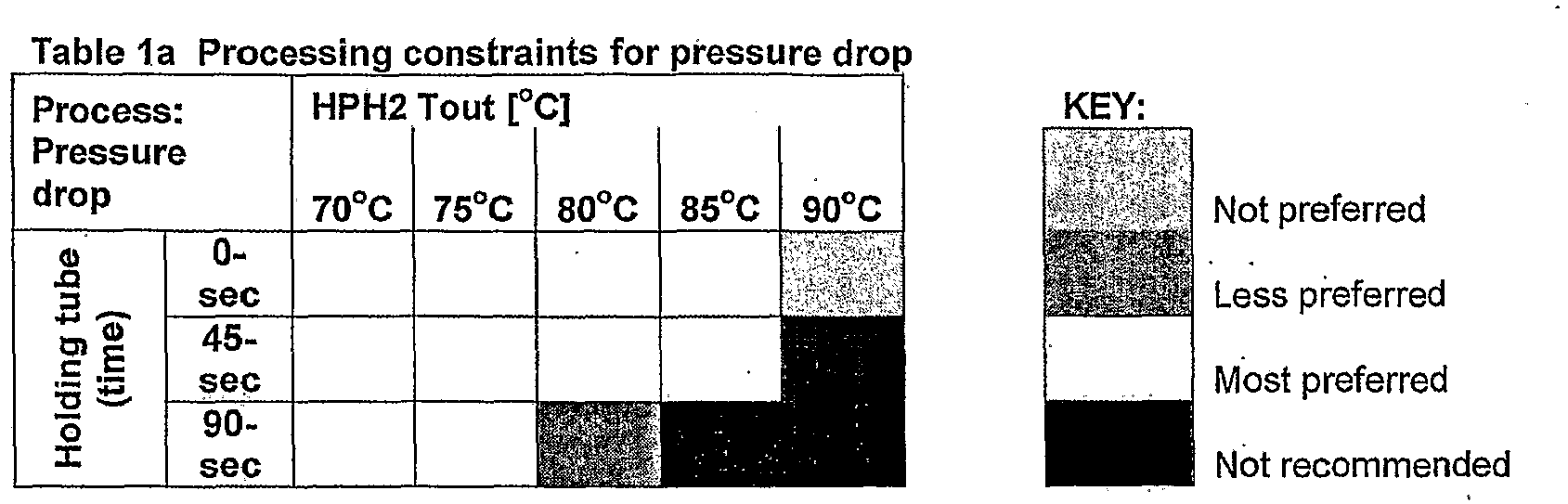


- The inventive protein ingredient was prepared using the method previously disclosed using a whey protein feed stream containing approximately 80% protein on a solids basis and a solids concentration of 32%, a processing flow rate of 6.4 m3/h, a high pressure preheater outlet temperature of 58°C, a final high pressure heater outlet temperature of 80°C and a residence time from the heater exit to the dryer of 23 seconds i.e. 0 s holding tube plant configuration.
- Trials were carried out to establish the texture and sensory properties of high protein yoghurt using either the inventive heat denatured whey protein ingredient or a commercial native cheese whey WPC392 (Fonterra Co-operative Group Limited, Auckland, New Zealand) as alternative sources of protein fortification. These yoghurts will be compared to a standard 4.5% protein yoghurt (3.5% protein from skim milk, 1.0% protein from SMP top-up).
- Initial yoghurt trials were carried out using the ingredient of this invention and WPC392 at high levels of addition (10-15% protein yoghurts) to determine baseline textural properties. When the yoghurt milks were heated using the standard heat treatment (95°C/8 min), the milks containing WPC392 curdled and formed weak gels, and could not be further processed. Surprisingly, the protein ingredient of this invention did not gel and was able to be used to prepare a high protein yoghurt.
- In other trials where WPC392 was used, it was added after the heat treatment step to reduce the potential for the added whey protein to gel.
- Table 2 details the formulations and top-up ingredients for the high protein yoghurts. These are compared with a standard 4.5% protein yoghurt (0% fat) sensory control yoghurt.
Table 2 Experimental plan Sample Fat content (%) Protein content (%) Protein from top-up ingredient Top-up ingredient Addition point of top-up ingredient 11 0 15 11.5 Inventive protein ingredient At recombining 12 0 12 8.5 Inventive protein ingredient At recombining 13 0 15 10.5/1.0 Inventive protein ingredient/SMP At recombining 14 0 12 7.5/1.0 WPC392 At recombining 15 0 15 11.5 WPC392 After heat treatment 16 0 12 8.5 WPC392 After heat treatment "0% fat 4.5% "protein control" 0 4.5 1.0 SMP At recombining - The formulations used are given in Table 3a and the recipes in Table 3b.

Table 3b Recipes used to prepare the samples Trial Number 11 12 13 14 15 16 Reference control Trial condition 15% protein using inventive ingredient 12% protein using inventive ingredient 15% protein using inventive ingredient and SMP 12% protein using inventive ingredient 15% protein WPC392 (not heat treated) 12% protein WPC392 (not heat treated) 0% fat 4.5% protein Inventive ingredient (g) 934.7 691 852.8 609.1 0 0 0 WPC392 (g) 0 0 0 0 934.7 691 0 Potassium sorbate (g) 1.3 1.3 1.3 1.3 1.3 1.3 1.3 SMP (g) 681.2 681.2 876.2 876.2 681.2 681.2 876.2 Chr. Hansen YF-L702 lactic culture (g) 1.3 1.3 1.3 1.3 1.3 1.3 1.3 Water (g) 4882 5125 4768 5012 4882 5125 5621 Total (g) 6500 6500 6500 6500 6500 6500 6500 - The ingredients (other than the culture) were dispersed in warm water and allowed to stand for a period to allow proper hydration. The solutions were heated to about 55°C and then homogenised 150/50 Bar. The samples were then batch heat treated in a water-bath at 90°C for 10 minutes. The samples were cooled to incubation temperature and the culture added and dispersed.
- Fermentation times were considerably longer for the high protein yoghurts. Incubation was at 38°C for 15-16 hours. The samples of stirred yoghurt were sheared (smoothed) by pumping through a back pressure valve (BPV) or orifice with a pressure drop of 1.7Bar and at a temperature of 17°C.
- See Yoghurt Process Diagram
Figure 6 . - A summary of all the trial data is given in Table 4.
Table 4 Summary of trial results Trial Number 11 12 13 14 15 16 Reference control Final fermentation pH 4.65 4.51 4.67 4.57 4.65 4.59 4.66 Protein (TN*6.38) 15.3 11.7 14.8 11.7 14.9 11:9 4.5 Apparent viscosity at 50 s-1 594 274 579 532 370 376 504 Drained syneresis (%) at day 7 51 96 12 28 98 97 38 - The viscosity of both 15% protein yoghurts (3.5% SMP with 11.5% protein of the inventive protein ingredient and 4.5% SMP with 10.5% of the inventive protein ingredient) were around 590 mPa.s. Surprisingly, the viscosity was similar to a 4.5% protein yoghurt (Table 4). The viscosity of the 12% protein yoghurt (with 3.5% protein SMP base) was also lower than the non-inventive controls.
- The syneresis values of the stirred yoghurts are shown in Table 4.
- The syneresis values of the 12% protein yoghurt (3.5% protein SMP base) and the 2 two yoghurts containing WPC392 were very high (>90%). The inventive 15% protein yoghurt and 12% protein yoghurts (4.5% protein SMP base) were lower or similar to a standard 4.5% protein yoghurt.
- The samples were evaluated informally by 5 members of the cultured foods team. The flavour of the inventive high protein yoghurts were perceived to have less "protein" flavour than the samples containing WPC392.
- The inventive protein ingredient was prepared using the method of Example 1 using a whey protein feed stream containing approximately 80% protein on a solids basis and a solids concentration of 32%, a processing flow rate of 6.4 m3/h, a high pressure preheater outlet temperature of 58°C, a final high pressure heater outlet temperature of 80°C and a residence time from the heater exit to the dryer of 23 seconds i.e. 0 s holding tube plant configuration.
- Trials were carried out to manufacture high protein drinking yoghurt with viscosity low enough for the final product to be consumed as a beverage.
- The recipes are given in Table 1.
Table 5 Recipes for the preparation of the fermented beverage Component Quantity (g) High protein Inventive beverage 4.5% low fat yoghurt (control) Dried denatured whey protein ingredient of this invention 847 0 Skim milk powder 2239.6 876.2 Sugar 660 0 Cream (40% fat) 660 0 Potassium sorbate 4.4 1.3 Chr Hansen culture YF-L702 0.4 1.3 Water 17589 5621 Total 22,000 6500 Composition % Total protein 6.50 4.5 Fat 1.47 Nil Carbohydrate 8.8 - Casein:whey protein (ratio) 43:57 80:20 - The ingredients (other than the culture) were dispersed in warm water and allowed to stand for a period to allow proper hydration. The milk was heated to about 55°C and 2-stage homogenised 150/50 Bar. The homogenised milk was heated to 95°C for 8 minutes by circulating in a plate heat exchanger (PHE) then cooled to incubation temperature in a further PHE and finally discharged into small vat. Culture was added and dispersed and the milk was incubated at 42°C until pH of about 4.6 was reached.
- The incubation time was around 5.5 hours. Despite the high protein content, the fermentation time was surprisingly typical of much lower protein (e.g. 4.6%) yoghurts.
- The high protein drinking yoghurt was cooled to approximately 20°C by pumping it through a PHE, then sheared (smoothed) by passing it through a back pressure valve (BPV) or orifice with a pressure drop of 3 Bar.
- See diagram of the high protein drinking yoghurt manufacturing process
Figure 2 . - A summary of the trial results is given in Table 6.
Table 6 Summary of trial results Trial Number High Protein Drinking Yoghurt Reference control (0% fat, 4.5% protein, as above) pH at end of fermentation 4.56 4.66 pH at 7 days 4.46 Protein (TN*6.38) 6.1 4.5 Apparent viscosity at 50 s-1 205 504 - The viscosity of the high protein drinking yoghurt was less than half that of a 4.5% (low fat) skim milk yoghurt control making the product surprisingly suitable as a yoghurt beverage.
- A common recipe was used to screen five protein samples: undenatured 80% whey protein concentrate (WPC) [control 1], and three inventive denatured whey proteinates, T13, T14 and T21 and a fully denatured lactalbumin powder [control 2] - see below for details.
- Other protein ingredients used were:
Lactalbumin 8254 (control 2), available Fonterra Co-operative Group Limited, Auckland. Lactalbumin 8254 is 100% denatured. -
Sodium caseinate 180 available from Fonterra Co-operative Group Limited, Auckland. - Cheese WPC80 (WPC392) available from Fonterra Co-operative Group Limited, Auckland. WPC392 is essentially native whey protein i.e. 0% denatured.
- A range of inventive denatured WPC powders (denaturation > 95%) were reacted with Alcalase and Thermoase (together) using the same recipe (1% Alcalase and 1% Thermoase) and known art control whey protein ingredients used for comparison were WPC392 and lactalbumin 8254.
- Details of the hydrolysis recipe are given in Table 7.
Table 7 Recipe used for the enzymatic hydrolysis of the protein ingredient Trial Basis 1000g Protein ingredient (Total Solids 6%) 60g Mass Water 940g Total Enzyme 0.60g Alcalase 0.60g Thermoase Subsequently added for pH adjustment: NaOH (diluted 10% w/w) 3.06g KOH (diluted 10% w/w) 14.57g 940g of RO water was heated to 65°C in a waterbath
60g of the protein ingredient was added to the water over 5min with continuous stirring. The pH was adjusted to pH 7.5 using NaOH and KOH if required
At T = 0min both Alcalase and Thermoase enzymes were added to the solution (pH 7.5 thermostat at 65°C)
The hydrolysis was for 5hrs total reaction time.
The reacted solution was heated at 85°C for 20min to inactivate the enzymes. - The molecular weight profile (MWP) was analysed using size-exclusion chromatography using the method disclosed at ANZSMS22 (Australia and New Zealand Society for Mass Spectrometry 22nd annual conference) in Sydney, Jan 2009.
- The following are trial hydrolysate batches prepared using the dried denatured WPC ingredient of this invention (and a control WPC392). The ingredient of this invention advantageously gave a desired MWP, which is <1% of material in the >20kDa region. The same recipe (enzyme combination) for hydrolysis of the T13, T14 and T21 powders was used.
The ingredients of this invention were prepared according to the heat treatment procedures specified below. - T13 = 85°C 0s no supplementary tube holding time
- T14 = 90°C 0s supplementary tube holding time
- T21 = 85°C 45s supplementary tube holding time
- Details of the recipes are given in Table 8.
Table 8 Recipe used in further hydrolysis trials Trial Basis 1000g Total Solids 6% 60g Mass Water 940g Total Enzyme (2%) 1.2g NaOH @ 10 % w/w 3.06g KOH @ 10 % w/w 14.57g - A variety of enzymes, including proteolytic enzymes, are used in the preparation of human nutrition products. Different nations have differing regulations. The European Union appears to be evolving regulations towards lists of specifically approved enzymes. http://www.amfep.org/documents/Amfep%2009%2001%20-%20Amfep%20Statement%20on%20Food%20Enzymes%20Regulation%20-%20FIAP%20-JAN09.pdf
- For the purposes of demonstrating the beneficial and versatile outcomes of the ingredient of this invention when used as a substrate for proteolysis, a selection of enzymes were selected for screening of proteolytic efficacy.
The enzymes used were supplied by: - Alcalase 2.4L - Novozymes Australia Pty. Ltd (www.novozymes.com),
- Enzidase TSP Concentrate (TSP) - Zymus International Ltd (www.zymus.net),
- Pancreatin - American Laboratories Inc (www. americanlaboratories.com),
- Thermoase PC10F - Daiwa Kasei K.K (Shiga, Japan).
- Table 10 summarises the MWP resulting from the hydrolysates prepared using the Alcalase and Thermoase combination detailed in Table 7.
Table 10 Comparison of denaturation levels and resulting hydrolysed MWPs of reacted samples Ingredient Level of denaturation (%) MWP >20kDa 5 - 20kDa 1 - 5kDa <1kDa WPC392 (Control WPC) 0 2.96 3.61 25.62 67.81 T13 96 0.92 1.37 17.56 80.15 T14 94 0.89 1.14 18.49 79.47 T21 99 0.82 1.26 18.11 79.81 Lactalbumin 8254 (Control) 100 1.21 2.95 30.23 65.62 - It is generally desirable that less than 1% of the peptide has a molecular weight >20kDa in hydrolysates designed for infant formulates where reduced antigenicity claims are made. The ingredient of this invention surprisingly was able to meet this limit without the need for extra treatment steps, thus avoiding the expense and yield loss of subsequent ultrafiltration. Tables 11 and 12 summarise the yield and processing problems typically presented by preparing hydrolysates using known art processes and compares these to the benefits arising from the invention.
Table 11 Comparison of yield advantage of inventive ingredient with commercial lactalbumin Lactalbumin 8254 Denatured WPC of this invention Yield loss in substrate manufacture There is a significant protein (as TN∗6.38) yield loss when making conventional lactalbumin. There was negligible yield loss when making denatured ingredient of this invention. Table 12 Comparison of yield advantages of inventive ingredient with existing commercial hydrolysates Hydrolysate made from Lactalbumin Potential hydrolysate from WPC of this invention Yield loss in hydrolysate manufacture Hydrolysis of Lactalbumin 8254 under typical hydrolysis conditions produces a hydrolysate with >1 % in the >20kDa fraction. Hydrolysis of the denatured ingredient of this invention allowed the desired MWP profile to be prepared without ultrafiltration. Further purification can obtain <1% material in the >20kDa fraction and this step will involve a yield loss. - A further series of hydrolysis reactions using the inventive T13 ingredient (96% denatured) and two different recipes (enzymes Pancreatin and TSP) were conducted with the results given in Tables 13 and 14.
Table 13 Results of hydrolysis using Pancreatin enzyme Enzyme (2% dose) Substrate >20kDa 5 - 20kDa 1 - 5kDa <1kDa Pancreatin T13 0.47 1.85 29.70 67.98 Pancreatin Lactalbumin 8254 3.82 2.36 30.42 63.39 Pancreatin WPC392 1.02 1.60 29.49 67.89 - The ingredient of this invention when treated with Pancreatin gave a more preferred MWP that avoided the need for ultrafiltration to remove excess >20kDa material.
Table 14 Results of hydrolysis using TSP enzyme Enzyme (2% dose) Substrate >20kDa 5 - 20kDa 1 - 5kDa <1kDa TSP T13 0.49 2.03 35.17 62.31 TSP Lactalbumin 8254 2.40 3.01 32.20 62.39 TSP WPC392 1.58 1.37 30.09 66.96 - The ingredient of this invention when treated with TSP gave a more preferred MWP that avoided the need for ultrafiltration to remove excess >20kDa material.
- Two further hydrolysis reactions were conducted using the inventive protein ingredient but modified to the extent that the protein ingredient was obtained directly following the thermal denaturation procedure of the invention as a liquid inert stream (-90% denatured) and before drying, using different recipes (enzymes) and shown in Table 15. Table 15 also summarises the results of hydrolysing the liquid stream ingredient of this invention.
Table 15 Results of hydrolysing the inventive liquid protein stream Enzyme (dose) >20kDa 5 - 20kDa 1 - 5kDa <1kDa Pancreatin (2%) 0.58 2.00 30.46 66.96 Alcalase 2.4L (2%) 0.22 1.29 32.71 65.79 - The un-dried ingredient version of this invention (liquid stream) again gave a preferred MWP that avoided the cost of drying and the need for subsequent treatment to remove unwanted content >20kDa.
- The following two examples illustrate the use of the inventive whey protein ingredient to prepare model beverages with the special properties useful in a variety of nutritional and medical foods. In one series the beverage had a calorific value of 1 kcal/g. In the second series, the beverage had a calorific value of 1.5 kcal/g.
- For each of the calorific values, three formulations were examined:
- a) 95% of the protein heat denatured whey protein powder of this invention and 5% comes from sodium caseinate'
- b) A replicate of (a) above,
- c) A control of 100% heat denatured whey protein powder of this invention and no sodium caseinate.
- 28 kg of 55°C demineralised water was weighed into the Cowles Dissolver
Protein added and mixed for 60 minutes
Maltodextrin and sucrose was added and mixed for 5 minutes
The minerals were pre-dissolved in 50°C in a small amount of water and mixed for 5 min
The mineral solution was added to the ingredients into the Cowles Dissolver and mixed for 5 min
The solution was warmed further
The oil and lecithin was warmed to aid dispersion and mixed in a separate container
The oil-lecithin mixture was added to the Cowles Dissolver solution and thoroughly dispersed
The dispersed and still warm solution was two-stage homogenised
The homogenised solution was cooled to 25°C and the pH adjusted to target pH 6.8 with KOH
Water was added to the solution to top up as required to give a final weight of 40 kg
The solution was transferred to the UHT plant and UHT processed at 140°C for 4 sec using direct steam injection heating packed aseptically into 250mL glass bottles and capped.
Various tests were conducted before and after the UHT heat treatment. - Formulation (a) differed from formulation (b) in that a replicate batch of inventive ingredient was prepared for use. Formulation (c) used the ingredient from the second batch. The formulations are detailed in Table 16.
Table 16 Model formulation and recipes for 1 kcal/g beverage examples Percentage Based Formulations Formulation (a) Formulation (b) Formulation (c) Ingredients Water 75.8% 75.9% 75.9% Heat denatured whey protein ingredient 4.6% 4.5% 4.7 % Sodium caseinate 180 0.2% 0.2% 0.0% Sucrose 4.4% 4.4% 4.4% Maltrin M180 maltodextrin 11.1% 11.1% 11.1% Tri-sodium citrate di-hydrate 0.6% 0.6% 0.6% Potassium chloride 0.2% 0.2% 0.2% Tri-potassium citrate monohydrate 0.1% 0.1% 0.1% Magnesium chloride 0.2% 0.2% 0.2% Tri-calcium phosphate 0.3% 0.3% 0.3% Canola oil 2.3% 2.3% 2.3% Lecithin 0.1% 0.1% 0.1% Pilot Plant Trials 40L beverage Ingredients g g g Water 30336.5 30348.5 30344.9 Heat denatured whey protein ingredient 1839.4 1811.2 1894.9 Sodium caseinate 18078.9 77.5 0.0 Sucrose 1752.8 1762.8 1756.1 Maltrin M180 maltodextrin 4452.7 4452.2 4454.9 Tri-sodium citrate di-hydrate 251.6 251.7 256.3 Potassium chloride 83.9 83.9 84.0 Tri-potassium citrate monohydrate 44.9 44.9 44.8 Magnesium chloride 74.9 74.9 74.9 Tri-calcium phosphate 123.8 123.8 123.9 Canola oil 906.7 916.9 913.6 Lecithin 53.9 51.7 51.7 Solids sum 9663.5 9651.5 9655.1 %Total Solids 24.2% 24.1% 24.1% - The formulations used for the 1.5 kcal/g evalutions are shown in Table 17.
Table 17 Formulation and recipes for 1.5 kcal/g beverage examples Percentage Based Formulations Formulation (a) Formulation (b) Formulation (c) Ingredients Water 68.80% 68.79% 68.76% Heat denatured whey protein ingredient 6.56% 6.51% 6.85 % Sodium caseinate 180 0.29% 0.30% 0.0% Sucrose 5.64% 5.60% 5.62% Maltrin M180 maltodextrin 14.19% 14.28% 14.24% Tri-sodium citrate di-hydrate 0.25% 0.24% 0.26% Sodium chloride 0.22% 0.22% 0.22% Potassium chloride 0.13% 0.11% 0.11% Tri-potassium citrate monohydrate 0.12% 0.14% 0.14% Magnesium chloride 0.20% 0.19% 0.19% Tri-calcium phosphate 0.21% 0.21% 0.21% Canola oil 3.23% 3.25% 3.23% Lecithin 0.16% 0.16% 0.16% Pilot Pilot Trials 40L beverage Ingredients Water 27518.9 27514.5 27503.7 Heat denatured whey protein ingredient 2623.0 2605.2 2739.7 Sodium caseinate 180117.4 118.4 0.0 Sucrose 2257.2 2239.5 2246.7 Maltrin M180 maltodextrin 5678.0 5711.9 5697.2 Tri-sodium citrate di-hydrate 98.6 97.0 103.1 Sodium chloride 88.1 88.9 89.4 Potassium chloride 54.0 45.6 45.0 Tri-potassium citrate monohydrate 48.1 56.1 56.7 Magnesium chloride 78.0 77.7 77.7 Tri-calcium phosphate 83.6 83.5 83.6 Canola oil 1292.3 1299.1 1293.0 Lecithin 62.7 62.7 64.3 Solids sum 12481.1 12485.5 12496.3 %Total Solids 31.2% 31.2% 31.2% - The results of the evaluation of the samples prepared according to the formulations of Tables 16 and 17 are shown in Table 18.

- A protein concentrate solution was obtained by reconstituting a 25
kg cheese WPC 392 powder in 70 litres of chlorinated water. The WPC powder had 81% protein, 5.7% fat, 3.4% ash, 4% lactose, and 4% moisture. After reconstitution the whey protein solution was continuously mixed at 50°C for 2 hours to allow complete hydration of the protein. - The whey protein solution (pH 6.8) was pumped through a pilot plant product line at 152.5 kg/h (∼ 137.4 L/h, product density of 1.11 kg/L) where it was heated by direct injection of steam at ∼170°C and ∼7 bar gauge via a steam injection valve. The product line was a 5 m long, 10 mm i.d. stainless steel tube. The steam pressure was adjusted to between 5 - 7 bar gauge so that the product temperature was maintained at about 90°C. The product flow through the DSI unit had a calculated Reynolds number of 599. The heated liquid was collected via product valve ∼ 5m after the DSI point. It took ∼ 3 s for the product to travel from the steam injection point to the collection point. The heated stream was 89.1°C at the exit of the DSI.
- The heated stream was collected into a container and it became a semisolid paste upon cooling to room temperature. This heated stream was used as a protein and water source in making the model nutritional food formulation shown in the Table 19 below. A sample of the original WPC powder was used in preparation of another sample of the nutritional food formulation as a control.
Table 19. Recipe of a model nutritional formulation Ingredients g Water 197.84 Liquid protein ingredient of this invention 48.53 Sucrose 80.82 Maltrin maltodextrin 37.33 Tri-potassium citrate monohydrate 0.80 Potassium chloride 0.49 Lecithin 0.60 Canola oil 33.60 Total (g) 400.00 - The preparation of the nutritional formulations involved reconstitution of the protein ingredient with water at 55°C for 30 min using an overhead stirrer. The sucrose, maltrin, and minerals were added while mixing and then the mixing continued for further 10 minutes. The mixture was heated to 70°C then the oil (with lecithin already dissolved in it by mixing at ∼ 70°C) was added then mixing continued for further 10 min. The mixture was then two-stage homogenised (200/50 bars) using a bench-top homogeniser (NIRO-SOAVI, Panda No 2638, Niro Group, Parma-Italy). The homogenised formulation was then placed in 10 ml retortable glass bottles then heated at 121°C for 10 min in an oil bath. The heated samples were cooled immediately to ∼ 20°C in cold water. The viscosities of the homogenised formulations before and after heating were measured using a Paar Physica rheometer (model UDS200, Anton Paar GmbH, Graz, Austria) with a cone and plate geometry, shear sweep 0.1 to 500 s-1, at 20°C.
-
Figure 8 shows the effect of the modified WPC on the viscosity of the model nutritional food formulation before and after heating (121°C, 10 min). The viscosities of both formulations before heating were similar. After heating, the viscosity of the formulation containing modified WPC increased to about 84 cP. The inventive product remained a smooth free flowing drinkable product. However, after heating the control formulation containing standard WPC had formed a gel making the viscosity measurement impossible. -
Figure 9 shows photographs of the formulations before and after heating. It is clear that the formulation containing modified WPC remained a smooth free flowing liquid while that containing standard WPC formed a gel. - Nutritional formulations are used as meal replacers for a wide range of consumers to meet various nutritional and/or lifestyle requirements. These foods are aimed to provide the full nutritional requirements in small packs of drink. As such they often contain high fat, carbohydrate, and protein such as those in the model formulation given in Table 19 above. Their processing always involved severe heat treatment (e.g. 121°C for 10 min) because of the need to be microbiologically safe. In such heat treatment it is important to have robust ingredients that are able to withstand the severe heat treatment conditions without gelling or forming solid lumps. This example demonstrated that using the inventive heat modified WPC of this invention allowed addition of whey protein at high level (> 9%) in a nutritional formulation that remained smooth liquid (low viscosity) after its final product heat treatment.
- This study was carried out using a Rapid Visco Analyser (RVA 4). A model individually wrapped slice (IWS) processed cheese formulation containing ∼4% of either cheese whey derived WPC 392 (80% protein) or inventive heat denatured whey protein ingredient was used for the comparison. The firmness and melt of the resulting products were measured along with their composition and microstructure.
-
- To compare the performance of standard whey protein concentrate (WPC) 392 and inventive heat denatured whey protein ingredient by:
- 1. Making IWS processed cheese in an RVA using the two whey protein concentrates.
- 2. Comparing the properties of the resulting processed cheese samples.
- Two processed cheese slice formulations were manufactured in a Rapid Visco Analyser (RVA). A simple model IWS processed cheese formulation was used which contains ∼4% WPC392 or inventive heat denatured whey protein ingredient.
Run 1 contained the standard WPC392 andRun 2, the inventive heat denatured whey protein ingredient. The actual formulations are tabulated in Table 20.Table 20 Formulations used to prepare samples Ingredient Control with WPC392 (g) Sample with inventive ingredient (g) Rennet casein 3.34 3.34 Added water 10.78 10.78 Tri-sodium citrate 0.72 0.72 Salt 0.33 0.33 High solids cheese (Cheddar) 5.97 5.97 Salted butter 6.83 6.83 WPC392 1.32 NA Inventive ingredient NA 1.32 Lactose 0.47 0.47 Citric acid 0.21 0.21 Potassium sorbate 0.03 0.03 Total weight 30.00 30.00 Analysis % % Moisture 47.3 47.3 Fat 52.7 52.7 Protein 18.3 18.3 Salt 1.8 1.8 - The methods used in this work were taken directly from published
PCT patent application WO 2007/108708 A1 (Wiles, Lee, Anema and Havea ) - Rennet casein, WPC, trisodium citrate, salt and water were mixed together and allowed to hydrate for 40 minutes in an aluminium RVA canister. Grated cheese, salted butter, lactose, citric acid and potassium sorbate were added and mixed in.
- The cheese blends were cooked in the RVA for 10 min. The temperature was increased from 25°C to 87°C over the first 4 minutes and held for the remaining 6 minutes at 87°C. The stirring speed was increased from 0 to 800 rpm over the first 4 min and held at 800 rpm for the remaining 6 min. On completion of cooking, the hot processed cheese sample was poured onto a polypropylene sheet, covered with another polypropylene sheet, and rolled into a slice. The slice was sealed in a zip-lock plastic bag and quickly cooled on an aluminium tray in a fridge. 6 slices were made for each run. The viscosity was recorded on the RVA immediately prior to forming each slice.
- Moisture was analysed using a conventional oven method (16 hours at 105°C). pH was measured using a Radiometer PHM82 Standard pH meter and N48 EE probe.
- The slices were held at 5°C for 3 days prior to testing. For the texture testing, 4 slices were stacked together, cut in half, and the two halves stacked. Thus the test stack was 8 slices thick.
- Firmness was measured using penetrometry (1/4 " cylinder [6.4 mm]) on a TA-HD Texture Analyser (aka Cylinder Test) at 13°C. The cylinder was inserted 10 mm into the stack of slices, at a speed of 1 mm s-1 and the peak force was recorded. 4 measurements were taken.
- Stress and strain were measured at 13°C using a Vane Test (Brookfield 5XHBTDV-II viscometer). A 6 mm, 4-bladed Vane was inserted to a depth of 10 mm, and rotated at 0.5 rpm until the yield point was reached. 4 measurements were recorded.
- Melts were measured using a Schreiber Melt Test (232°C for 5 min, Zehren and Nusbaum 1992) Process Cheese. Cheese Reporter Publishing Company.
- The moisture and pH data is shown in Table 21. The moisture and pH of the samples are very consistent. This means that differences in texture and melt properties are likely to be due to differences in ingredient performance rather than compositional variation.
- Evaporation of moisture occurs during the cheese manufacture in the RVA. The moisture was not adjusted for evaporation during processing as this is assumed to be constant between batches. The consistent moisture data in Table 21 confirms this approach.
Table 21 Summary of results Runs Standard WPC392 Inventive ingredient Viscosity Ex-RVA (cP) 1795 ± 1483 ± Cylinder Force (N) 5.86 ± 6.75 ± Vane Stress (Pa) 12505 ± 15020 ± Strain (rad) 0.797 ± 0.866 ± Melt test Schreiber 2.3 ± 7.0 ± Composition Final pH 5.61 ± 5.60 ± Moisture (%) 46.3 ± 46.6 ± Results are indicated ±1 standard deviation. - The average final viscosities are tabulated in Table 21.
- The final viscosity is clearly different with the processed cheese containing WPC392 higher than that containing inventive heat denatured whey protein ingredient.
- The firmness results are recorded in Table 21. The firmness of the IWS made from standard WPC392 appears to be lower than the IWS made from the inventive heat denatured whey protein ingredient. As the moisture and pH of the samples are almost identical (and the protein and fat content by inference) then the difference in firmness is due to the WPC ingredients.
- The Vane stress results are tabulated in Table 21. The pattern of the stress data matches the firmness data with the stress of the processed cheese made from WPC392 being lower than the inventive ingredient.
- The Vane strain results are tabulated in Table 21. The strain data from the IWS made from standard WPC392 is lower than that made from the inventive ingredient.
- The melt results are presented in Table 21. The IWS made from standard WPC392 melts significantly less than that made from the inventive ingredient.
-
- IWS made with the inventive ingredient melted more than cheese made with WPC392
- IWS made with the inventive ingredient was firmer than cheese made with WPC392
- IWS made with the inventive ingredient had lower in-process viscosity than cheese made with WPC392
- The composition of the slices was relatively uniform (moisture and pH) as was the microstructure. This suggests that any textural differences are not due to compositional variation.
-
Figure 10 shows that very fine particle dispersions can be prepared ex the tubular reactor of this invention. -
Figure 11 shows that the extent of denaturation can be finely controlled in the liquid stream emerging from the tubular reactor by adjusting the combinations of the temperature and holding times.
| Enzyme | Dose (% wrt Total Solids) | Target pH | |
| TSP | |||
| 2 | 7.5 | 55° | |
| Pancreatin | |||
| 2 | 8.0 | 50°C |
Claims (14)
- A method for preparing a heat treated whey protein concentrate (WPC) or whey protein isolate (WPI), comprising:(a) providing an aqueous WPC or WPI solution having a protein concentration of 15-50% (w/v), at a pH of 4.7-8.5;(b) heat treating the solution to a temperature of from 50°C to 150°C, for a time that allows protein denaturation to occur; the heat treating comprising heating the solution in a heating tube while under conditions of turbulent flow, wherein turbulent flow is defined as having a sufficient mass flow rate in the heating tube to provide a Reynolds number in excess of 500;(c) at the end of the heat treatment, either(d1) transferring the heat treated material directly to a drier; and
drying the heat-treated WPC or WPI to produce a dried modified WPC or WPI, wherein the heat-treated WPC or WPI is not subjected to a mechanical shear process to break up particles within the solution prior to drying other than where liquid is converted into droplets to facilitate drying; or(d2) directly transferring the heat treated material to a mixer to be mixed with other ingredients; and wherein the heat treated WPC or WPI is not subjected to particle size reduction prior to step (c). - A method according to claim 1, wherein the heat treated material is a liquid whey protein concentrate (WPC) or whey protein isolate (WPI) and wherein the other ingredients in step (d2) include at least one of the group consisting of milk, skim milk, fat, a carbohydrate, milk retentate, or skim milk retentate.
- A method as claimed in any one of claims 1-2 wherein the pH of the WPC concentrate prior to heating is adjusted to between 5.0 and 8.5, more preferably between 5.5 and 8.5 and most preferably 6.0 and 8.0, most preferably 6.5-7.5.
- A method as claimed in any one of claims 1-3 wherein the heat treating occurs as the WPC or WPI solution passes along a heated flow path with an inside diameter greater than 5mm and less than 150mm, preferably the solution passes through a long tubular reactor and exits at a temperature between 60°C and 110°C.
- A method according to claim 1, wherein the dried modified WPC or WPI has 50-95% of the total solids as whey protein, most preferably 52-90%, wherein the heat treatment is carried out at more than 70°C and step (b) uses a high pressure pump to feed the protein concentrate at a pressure of between 3 to 1000 bar, preferably 5 to 500 bar, most preferably 10 to 350 bar into a high pressure heater, the flow of the product is such that a turbulent flow is effected and(d) at the end of the heat treatment, promptly transferring the heat-treated material directly to a drier, preferably a spray drier; and(d) drying the heat-treated WPC or WPI,wherein the treated WPC stream from the heat treatment arrangement (c) is not subject to a particle size reduction procedure prior to drying, and wherein preferably the heat treatment zone is coupled directly to the inlet of the drier.
- A method as claimed in any one of claims 1-5 wherein the turbulent flow has a Reynolds number in excess of 1000, preferably in excess of 1500, more preferably in the range 2,000-50,000.
- A method as claimed in any one of claims 1 to 6 wherein in step (b) the solution is heat treated to a temperature of from 70°C to 150°C.
- A method of increasing the protein content of a foodstuff comprising preparing a heat treated WPC or WPI by a method according to claims 1-7 and including the WPC or WPI in the ingredients of the foodstuff.
- A method as claimed in claim 8 wherein the foodstuff is a snack bar prepared by a method comprising melting fat, if melting is required, and mixing fat or oil with carbohydrate and WPC and allowing the mixture to set.
- A method of preparing a yoghurt comprising preparing a dried WPC or WPI by a method according to claim 1 and including the dried WPC or WPI as an ingredient in yoghurt.
- A method as claimed in claim 10 comprising preparing a yoghurt milk having at least 7% (w/v) preferably 8-20% (w/v), more preferably 10-16% (w/v) protein by mixing the dried modified WPC or WPI with a milk comprising casein, and acidifying the yoghurt milk to a pH of 3.8-5.5, preferably 4.0-5.0.
- A method of preparing a yoghurt drink comprising preparing a dried WPC or WPI by a method according to claim 1, mixing the dried WPC or WPI with a milk comprising casein, and acidifying to a pH of 3.8-5.5, to prepare a yoghurt drink comprising 1.5-15% (w/v) protein.
- A method of preparing a whey protein hydrolysate comprising preparing a heat-treated WPC or WPI by a method as claimed in any one of claims 1 to 7 and contacting the heat-treated WPC or WPI with a protease.
- A method of preparing a processed cheese comprising preparing a WPC or WPI by a method as claimed in any one of claims 1 to 7, mixing the WPC or WPI with other ingredients including cheese and water, cooking to form a molten processed cheese, and allowing to cool.
Priority Applications (1)
| Application Number | Priority Date | Filing Date | Title |
|---|---|---|---|
| PL10764718T PL2429305T3 (en) | 2009-04-15 | 2010-04-15 | Dairy product and process |
Applications Claiming Priority (3)
| Application Number | Priority Date | Filing Date | Title |
|---|---|---|---|
| US16943709P | 2009-04-15 | 2009-04-15 | |
| NZ58332010 | 2010-02-15 | ||
| PCT/NZ2010/000072 WO2010120199A1 (en) | 2009-04-15 | 2010-04-15 | Dairy product and process |
Publications (3)
| Publication Number | Publication Date |
|---|---|
| EP2429305A1 EP2429305A1 (en) | 2012-03-21 |
| EP2429305A4 EP2429305A4 (en) | 2015-06-24 |
| EP2429305B1 true EP2429305B1 (en) | 2020-05-27 |
Family
ID=42982698
Family Applications (1)
| Application Number | Title | Priority Date | Filing Date |
|---|---|---|---|
| EP10764718.2A Revoked EP2429305B1 (en) | 2009-04-15 | 2010-04-15 | Dairy product and process |
Country Status (14)
| Country | Link |
|---|---|
| US (3) | US20120114795A1 (en) |
| EP (1) | EP2429305B1 (en) |
| JP (2) | JP5848237B2 (en) |
| KR (1) | KR20120052191A (en) |
| CN (3) | CN105123989A (en) |
| AU (1) | AU2010237074A1 (en) |
| BR (1) | BRPI1016104B8 (en) |
| CA (1) | CA2758458A1 (en) |
| HK (1) | HK1217411A1 (en) |
| MX (1) | MX2011010813A (en) |
| NZ (1) | NZ596439A (en) |
| PL (1) | PL2429305T3 (en) |
| RU (1) | RU2011146143A (en) |
| WO (1) | WO2010120199A1 (en) |
Families Citing this family (77)
| Publication number | Priority date | Publication date | Assignee | Title |
|---|---|---|---|---|
| JP2013534133A (en) | 2010-07-18 | 2013-09-02 | グランビア ニュートリショナルズ (アイルランド) リミテッド | High protein beverage with whey protein |
| WO2012075570A1 (en) * | 2010-12-09 | 2012-06-14 | Mcgill University | Bioactive peptides and proteins containing bioactive peptides, their uses and processes for making the same |
| NL2006182C2 (en) * | 2011-02-11 | 2012-08-14 | Friesland Brands Bv | Liquid, heat gellable food. |
| ES2696079T3 (en) * | 2012-03-02 | 2019-01-14 | Pepsico Inc | Procedure for the manufacture of protein beverages and apparatus and denaturing system in a loop |
| NZ703211A (en) * | 2012-09-28 | 2016-04-29 | Morinaga Milk Industry Co Ltd | Method for manufacturing denatured whey protein |
| PL3071047T5 (en) * | 2013-10-23 | 2023-05-15 | Arla Foods Amba | Caseinomacropeptide-containing, high protein denatured whey protein compositions, products containing them, and uses thereof |
| WO2015059245A1 (en) * | 2013-10-23 | 2015-04-30 | Arla Foods Amba | Low alpha-lactalbumin, high protein, denatured whey protein compositions, products containing them, and uses thereof |
| AU2014338893B2 (en) * | 2013-10-23 | 2018-02-08 | Arla Foods Amba | High protein denatured whey protein composition, related products, method of production and uses thereof |
| BR112016009050B1 (en) | 2013-10-23 | 2022-05-31 | Arla Foods Amba | DRINK WITH FRUIT FLAVOR RICH IN PROTEIN, AND PRODUCTION METHOD OF DRINK WITH FRUIT FLAVOR RICH IN PROTEIN |
| USD732899S1 (en) | 2014-02-07 | 2015-06-30 | Yeti Coolers, Llc | Insulating device |
| USD732348S1 (en) | 2014-02-07 | 2015-06-23 | Yeti Coolers, Llc | Insulating device |
| US10384855B2 (en) | 2014-02-07 | 2019-08-20 | Yeti Coolers, Llc | Insulating device and method for forming insulating device |
| US10781028B2 (en) | 2014-02-07 | 2020-09-22 | Yeti Coolers, Llc | Insulating device backpack |
| USD732350S1 (en) | 2014-02-07 | 2015-06-23 | Yeti Coolers, Llc | Insulating device |
| US9139352B2 (en) | 2014-02-07 | 2015-09-22 | Yeti Coolers, Llc | Insulating container |
| USD732349S1 (en) | 2014-02-07 | 2015-06-23 | Yeti Coolers, Llc | Insulating device |
| US10143282B2 (en) | 2014-02-07 | 2018-12-04 | Yeti Coolers, Llc | Insulating device |
| US10029842B2 (en) | 2014-02-07 | 2018-07-24 | Yeti Coolers, Llc | Insulating device |
| KR101656570B1 (en) * | 2014-09-04 | 2016-09-12 | 주식회사 엘지생활건강 | Milk protein-enhanced drinks and a method for preparing the same |
| USD948954S1 (en) | 2014-09-08 | 2022-04-19 | Yeti Coolers, Llc | Insulating device |
| USD934636S1 (en) | 2014-09-08 | 2021-11-02 | Yeti Coolers, Llc | Insulating device |
| USD787187S1 (en) | 2014-09-23 | 2017-05-23 | Yeti Coolers, Llc | Insulating device |
| AU2015344999C1 (en) | 2014-11-14 | 2023-02-16 | Arla Foods Amba | Whey protein-based, high protein, yoghurt-like product, ingredient suitable for its production, and method of production |
| JP6621592B2 (en) * | 2015-03-31 | 2019-12-18 | 森永乳業株式会社 | Fermented food production method and fermented food |
| AU2016244755B2 (en) * | 2015-04-06 | 2020-11-26 | International N&H Denmark Aps | Proteases for high protein fermented milk products |
| WO2017079315A1 (en) | 2015-11-02 | 2017-05-11 | Yeti Coolers, Llc | Closure systems and insulating devices having closure systems |
| CN105341150A (en) * | 2015-11-03 | 2016-02-24 | 内蒙古蒙牛乳业(集团)股份有限公司 | Yoghourt and preparation method thereof |
| RU2608151C1 (en) * | 2015-12-07 | 2017-01-16 | Дмитрий Геннадьевич Бурцев | Method for production of milk product |
| USD802373S1 (en) | 2016-02-05 | 2017-11-14 | Yeti Coolers, Llc | Insulating device |
| US10981716B2 (en) | 2016-02-05 | 2021-04-20 | Yeti Coolers, Llc | Insulating device |
| USD798670S1 (en) | 2016-02-05 | 2017-10-03 | Yeti Coolers, Llc | Insulating device |
| USD801123S1 (en) | 2016-02-05 | 2017-10-31 | Yeti Coolers, Llc | Insulating device |
| USD799277S1 (en) | 2016-02-05 | 2017-10-10 | Yeti Coolers, Llc | Insulating device |
| USD799276S1 (en) | 2016-02-05 | 2017-10-10 | Yeti Coolers, Llc | Insulating device |
| USD809869S1 (en) | 2016-02-05 | 2018-02-13 | Yeti Coolers, Llc | Insulating device |
| US12012274B2 (en) | 2016-02-05 | 2024-06-18 | Yeti Coolers, Llc | Insulating device backpack |
| USD799905S1 (en) | 2016-02-05 | 2017-10-17 | Yeti Coolers, Llc | Insulating device |
| JP6639043B2 (en) * | 2016-03-23 | 2020-02-05 | 森永乳業株式会社 | Method for producing high-protein yogurt-like fermented milk |
| USD824731S1 (en) | 2016-06-01 | 2018-08-07 | Yeti Coolers, Llc | Cooler |
| USD830134S1 (en) | 2016-06-01 | 2018-10-09 | Yeti Coolers, Llc | Cooler |
| USD830133S1 (en) | 2016-06-01 | 2018-10-09 | Yeti Coolers, Llc | Cooler |
| USD805851S1 (en) | 2016-06-01 | 2017-12-26 | Yeti Coolers, Llc | Cooler |
| USD808730S1 (en) | 2016-06-01 | 2018-01-30 | Yeti Coolers, Llc | Cooler |
| USD821825S1 (en) | 2016-06-01 | 2018-07-03 | Yeti Coolers, Llc | Cooler |
| USD815496S1 (en) | 2016-10-14 | 2018-04-17 | Yeti Coolers, Llc | Insulating device |
| USD814879S1 (en) | 2016-10-14 | 2018-04-10 | Yeti Coolers, Llc | Insulating device |
| USD817107S1 (en) | 2016-10-14 | 2018-05-08 | Yeti Coolers, Llc | Insulating device |
| USD817106S1 (en) | 2016-10-14 | 2018-05-08 | Yeti Coolers, Llc | Insulating device |
| EP3582622B1 (en) | 2017-02-17 | 2023-10-18 | Arla Foods Amba | High-protein, acidified, liquid dairy product having a reduced viscosity, method of producing it, and related ingredients |
| USD829244S1 (en) | 2017-04-25 | 2018-09-25 | Yeti Coolers, Llc | Insulating device |
| CN107744023A (en) * | 2017-10-09 | 2018-03-02 | 内蒙古蒙牛乳业(集团)股份有限公司 | Protein drink and preparation method thereof |
| USD848219S1 (en) | 2017-10-30 | 2019-05-14 | Yeti Coolers, Llc | Backpack cooler |
| USD849486S1 (en) | 2017-10-30 | 2019-05-28 | Yeti Coolers, Llc | Backpack cooler |
| USD848220S1 (en) | 2017-10-30 | 2019-05-14 | Yeti Coolers, Llc | Backpack cooler |
| USD848798S1 (en) | 2017-10-30 | 2019-05-21 | Yeti Coolers, Llc | Backpack cooler |
| USD848222S1 (en) | 2017-10-30 | 2019-05-14 | Yeti Coolers, Llc | Backpack cooler |
| USD848221S1 (en) | 2017-10-30 | 2019-05-14 | Yeti Coolers, Llc | Backpack cooler |
| USD848223S1 (en) | 2017-10-30 | 2019-05-14 | Yeti Coolers, Llc | Backpack cooler |
| CN109769938A (en) * | 2017-11-15 | 2019-05-21 | 内蒙古伊利实业集团股份有限公司 | A method of Yoghourt is made using Ohmic heating |
| JP7249737B2 (en) * | 2018-03-30 | 2023-03-31 | 株式会社明治 | Method for producing fermented milk |
| FR3080004B1 (en) * | 2018-04-17 | 2021-07-30 | Groupe Lactalis | DESSERT-TYPE NUTRITIONAL COMPOSITION, ACID, WITH HIGH PROTEIN CONTENT, STERILIZED, AND LONG STORAGE |
| CN113038836A (en) * | 2018-10-26 | 2021-06-25 | 株式会社明治 | Method for producing high-protein milk material |
| EP4696147A3 (en) * | 2018-11-20 | 2026-04-22 | Fonterra Co-Operative Group Ltd | Dairy product and process |
| EP3662755A1 (en) | 2018-12-07 | 2020-06-10 | Agriculture and Food Development Authority (TEAGASC) | A microparticulated whey protein concentrate |
| US11758915B2 (en) | 2018-12-21 | 2023-09-19 | Kraft Foods Group Brands Llc | Method of producing a simplified cheese spread and products therefrom |
| FI3937648T3 (en) | 2019-03-15 | 2024-01-24 | Arla Foods Amba | Novel high protein, acidified, dairy product, method of producing it, protein powder and use thereof |
| US11242189B2 (en) | 2019-11-15 | 2022-02-08 | Yeti Coolers, Llc | Insulating device |
| USD929191S1 (en) | 2019-11-15 | 2021-08-31 | Yeti Coolers, Llc | Insulating device |
| USD929192S1 (en) | 2019-11-15 | 2021-08-31 | Yeti Coolers, Llc | Insulating device |
| CN115087354A (en) * | 2019-12-11 | 2022-09-20 | 格兰比亚营养物有限公司 | Shelf-stable high protein yogurt products |
| FR3108234B1 (en) | 2020-03-19 | 2022-04-08 | Groupe Lactalis | Shelf stable liquid nutritional composition with high protein content |
| JP7590135B2 (en) * | 2020-09-01 | 2024-11-26 | チチヤス株式会社 | Fermented milk and method for producing fermented milk |
| JP2024524300A (en) * | 2021-06-29 | 2024-07-05 | フリースランドカンピーナ ネーデルランド ベスローテン フェンノートシャップ | Process for producing a shelf-stable, high-protein fermented dairy product and the resulting product |
| CN119867157A (en) * | 2022-04-29 | 2025-04-25 | 方塔拉合作集团有限公司 | Dairy products and methods |
| CN115029204A (en) * | 2022-07-15 | 2022-09-09 | 曾会明 | Wine with SOD activity and preparation method thereof |
| AR131343A1 (en) | 2022-12-20 | 2025-03-12 | Frieslandcampina Nederland Bv | WHEY PROTEIN COMPOSITION WITH HIGH HEAT STABILITY |
| WO2025257125A1 (en) | 2024-06-11 | 2025-12-18 | Frieslandcampina Nederland B.V. | Whey protein composition with high heat stability |
Citations (15)
| Publication number | Priority date | Publication date | Assignee | Title |
|---|---|---|---|---|
| DD236449A1 (en) | 1985-04-29 | 1986-06-11 | Wissenschaftl Techn Oek Zentru | METHOD FOR THE PRODUCTION OF WHEY PROTEIN SUSPENSIONS |
| US4734287A (en) | 1986-06-20 | 1988-03-29 | John Labatt Limited | Protein product base |
| US4828396A (en) | 1987-12-02 | 1989-05-09 | The Nutrasweet Company | Fluid processor apparatus |
| WO1991017665A1 (en) | 1990-05-17 | 1991-11-28 | The Nutrasweet Company | Proteinaceous fat substitute |
| WO1993007761A1 (en) | 1991-10-25 | 1993-04-29 | The Nutrasweet Company | Dry microparticulated protein product |
| US5494696A (en) | 1992-06-10 | 1996-02-27 | Danmark Protein A/S | Partially denatured whey protein product |
| WO2001097629A2 (en) | 2000-06-22 | 2001-12-27 | The Procter & Gamble Company | Insoluble protein particles |
| WO2006058538A1 (en) | 2004-11-30 | 2006-06-08 | Cp Kelco Aps | Method for producing a denatured protein material |
| WO2007108709A1 (en) | 2006-03-23 | 2007-09-27 | Fonterra Co-Operative Group Limited | Method for preparing a dried modified whey protein |
| WO2007108708A1 (en) | 2006-03-23 | 2007-09-27 | Fonterra Co-Operative Group Limited | Processed cheese comprising non-denatured and denatured whey protein |
| WO2007110421A2 (en) | 2006-03-27 | 2007-10-04 | Nestec S.A. | Whey protein micelles |
| EP1854362A1 (en) | 2006-05-12 | 2007-11-14 | Kraft Foods Holdings, Inc. | Modified Whey Protein for Low Casein Processed Cheese |
| WO2008032039A2 (en) | 2006-09-13 | 2008-03-20 | Nandi Proteins Limited | Denaturation control |
| WO2008063115A1 (en) | 2006-11-22 | 2008-05-29 | Tetra Laval Holdings & Finance Sa | A method of treating a whey protein concentrate by microparticulation |
| WO2009110218A1 (en) | 2008-03-04 | 2009-09-11 | 森永乳業株式会社 | Method of denaturing whey protein |
Family Cites Families (22)
| Publication number | Priority date | Publication date | Assignee | Title |
|---|---|---|---|---|
| DE236449C (en) | ||||
| US236449A (en) * | 1881-01-11 | Isaac c | ||
| US3252961A (en) * | 1961-04-03 | 1966-05-24 | Foremost Dairies Inc | Whey process and product |
| US4110476A (en) * | 1977-01-10 | 1978-08-29 | Johnson/Rhodes Cultured Foods, Inc. | Preparation of liquid and frozen yogurt products |
| US4985270A (en) | 1988-01-26 | 1991-01-15 | The Nutrasweet Company | Cream substitute ingredient and food products |
| EP0321603A1 (en) * | 1987-12-23 | 1989-06-28 | Societe Des Produits Nestle S.A. | Process for preparing a whey protein hydrolyzate and a hypoallergenic foodstuff |
| EP0485663B1 (en) | 1990-11-12 | 1993-10-20 | Quest International B.V. | Edible composition of denatured whey proteins |
| JP2683492B2 (en) | 1993-09-07 | 1997-11-26 | 雪印乳業株式会社 | Micellar whey protein, solution thereof, powder thereof, and method for producing micellar whey protein |
| JPH08256686A (en) * | 1995-03-27 | 1996-10-08 | Snow Brand Milk Prod Co Ltd | Processed cheese |
| JP2966330B2 (en) * | 1995-09-29 | 1999-10-25 | 雪印乳業株式会社 | Fermented milk and method for producing the same |
| DE19906379B4 (en) | 1999-02-16 | 2006-05-18 | Huss, Manfred | Preparation of an aggregated whey protein product |
| US6551636B2 (en) * | 1999-07-23 | 2003-04-22 | Novozymes A/S | Modification of foaming properties of proteins |
| JP3435460B2 (en) * | 2000-12-01 | 2003-08-11 | 独立行政法人農業技術研究機構 | Manufacturing method of cheese whey drink yogurt |
| EP1228707A1 (en) * | 2001-02-01 | 2002-08-07 | Campina Melkunie B.V. | Use of alpha-lactalbumin as prebiotic agent |
| US7118774B2 (en) * | 2002-12-30 | 2006-10-10 | Kraft Foods Holdings, Inc. | Cereal bars and methods of their manufacture |
| US20050220978A1 (en) * | 2004-03-31 | 2005-10-06 | Cargill, Incorporated | Dispersible protein composition |
| JP4650416B2 (en) | 2004-05-10 | 2011-03-16 | 味の素株式会社 | Yogurt manufacturing method |
| CA2576956A1 (en) * | 2004-08-20 | 2006-02-23 | Fonterra Ip Limited | Extrusion apparatus and method for extruding high protein foodstuffs |
| US7811620B2 (en) * | 2005-03-14 | 2010-10-12 | Leprino Foods Company | Method of making whey protein compounds |
| CN100456938C (en) * | 2005-03-16 | 2009-02-04 | 石家庄三鹿集团股份有限公司 | Hypolipidemic milk powder and its prepn process |
| EP1925207B1 (en) | 2005-09-16 | 2016-11-02 | Meiji Co., Ltd. | Method of improving the texture of fermented milk |
| JP2009515929A (en) * | 2005-11-14 | 2009-04-16 | ネステク ソシエテ アノニム | Promotion of oral tolerance using glycated protein |
-
2010
- 2010-04-15 KR KR1020117027075A patent/KR20120052191A/en not_active Withdrawn
- 2010-04-15 EP EP10764718.2A patent/EP2429305B1/en not_active Revoked
- 2010-04-15 WO PCT/NZ2010/000072 patent/WO2010120199A1/en not_active Ceased
- 2010-04-15 US US13/264,564 patent/US20120114795A1/en not_active Abandoned
- 2010-04-15 AU AU2010237074A patent/AU2010237074A1/en not_active Abandoned
- 2010-04-15 CN CN201510441693.2A patent/CN105123989A/en active Pending
- 2010-04-15 NZ NZ596439A patent/NZ596439A/en unknown
- 2010-04-15 PL PL10764718T patent/PL2429305T3/en unknown
- 2010-04-15 CN CN2010800214509A patent/CN102665430A/en active Pending
- 2010-04-15 CA CA2758458A patent/CA2758458A1/en not_active Abandoned
- 2010-04-15 JP JP2012505846A patent/JP5848237B2/en active Active
- 2010-04-15 RU RU2011146143/10A patent/RU2011146143A/en not_active Application Discontinuation
- 2010-04-15 CN CN201710497164.3A patent/CN107836519A/en active Pending
- 2010-04-15 BR BRPI1016104A patent/BRPI1016104B8/en active IP Right Grant
- 2010-04-15 MX MX2011010813A patent/MX2011010813A/en not_active Application Discontinuation
-
2015
- 2015-06-03 JP JP2015113130A patent/JP2015171373A/en not_active Withdrawn
-
2016
- 2016-05-10 HK HK16105336.4A patent/HK1217411A1/en unknown
- 2016-11-28 US US15/362,216 patent/US20170164633A1/en not_active Abandoned
-
2018
- 2018-12-10 US US16/214,548 patent/US10888100B2/en active Active
Patent Citations (15)
| Publication number | Priority date | Publication date | Assignee | Title |
|---|---|---|---|---|
| DD236449A1 (en) | 1985-04-29 | 1986-06-11 | Wissenschaftl Techn Oek Zentru | METHOD FOR THE PRODUCTION OF WHEY PROTEIN SUSPENSIONS |
| US4734287A (en) | 1986-06-20 | 1988-03-29 | John Labatt Limited | Protein product base |
| US4828396A (en) | 1987-12-02 | 1989-05-09 | The Nutrasweet Company | Fluid processor apparatus |
| WO1991017665A1 (en) | 1990-05-17 | 1991-11-28 | The Nutrasweet Company | Proteinaceous fat substitute |
| WO1993007761A1 (en) | 1991-10-25 | 1993-04-29 | The Nutrasweet Company | Dry microparticulated protein product |
| US5494696A (en) | 1992-06-10 | 1996-02-27 | Danmark Protein A/S | Partially denatured whey protein product |
| WO2001097629A2 (en) | 2000-06-22 | 2001-12-27 | The Procter & Gamble Company | Insoluble protein particles |
| WO2006058538A1 (en) | 2004-11-30 | 2006-06-08 | Cp Kelco Aps | Method for producing a denatured protein material |
| WO2007108709A1 (en) | 2006-03-23 | 2007-09-27 | Fonterra Co-Operative Group Limited | Method for preparing a dried modified whey protein |
| WO2007108708A1 (en) | 2006-03-23 | 2007-09-27 | Fonterra Co-Operative Group Limited | Processed cheese comprising non-denatured and denatured whey protein |
| WO2007110421A2 (en) | 2006-03-27 | 2007-10-04 | Nestec S.A. | Whey protein micelles |
| EP1854362A1 (en) | 2006-05-12 | 2007-11-14 | Kraft Foods Holdings, Inc. | Modified Whey Protein for Low Casein Processed Cheese |
| WO2008032039A2 (en) | 2006-09-13 | 2008-03-20 | Nandi Proteins Limited | Denaturation control |
| WO2008063115A1 (en) | 2006-11-22 | 2008-05-29 | Tetra Laval Holdings & Finance Sa | A method of treating a whey protein concentrate by microparticulation |
| WO2009110218A1 (en) | 2008-03-04 | 2009-09-11 | 森永乳業株式会社 | Method of denaturing whey protein |
Non-Patent Citations (11)
| Title |
|---|
| "Dairy processing Handbook", 1 January 2003, article "Building-Blocks of Dairy Processing (Chapter 6)", pages: 81 - 98, XP055367004 |
| "Dairy processing handbook", 1 January 2003, ISBN: 978-91-6-313427-2, article "Milk and Whey Powder (Chapter 17)", pages: 375 - 387, XP055244872 |
| A.Y. TAMIME, R.K. ROBINSON: "Tamime and Robinson's Yoghurt (Third Edition)", 1 January 2007, WOODHEAD PUBLISHING LIMITED, ISBN: 978-1-84569-213-1, article TAMIME A Y, R.K. ROBINSON: "Traditional and recent developments in yoghurt production and related products", pages: 1 - 29, XP093105069 |
| AZIZNIA SOMAYEH, KHOSROWSHAHI ASGHAR, MADADLOU ASHKAN, RAHIMI JAMSHID, ABBASI HABIB: "Texture of nonfat yoghurt as influenced by whey protein concentrate and Gum Tragacanth as fat replacers", INTERNATIONAL JOURNAL OF DAIRY TECHNOLOGY, vol. 62, no. 3, 1 August 2009 (2009-08-01), GB , pages 405 - 410, XP055982768, ISSN: 1364-727X, DOI: 10.1111/j.1471-0307.2009.00507.x |
| BANSAL BIPAN, CHEN XIAO DONG: "A Critical Review of Milk Fouling in Heat Exchangers", COMPREHENSIVE REVIEWS IN FOOD SCIENCE AND FOOD SAFETY, vol. 5, no. 2, 1 April 2006 (2006-04-01), US , pages 27 - 33, XP055982773, ISSN: 1541-4337, DOI: 10.1111/j.1541-4337.2006.tb00080.x |
| BELMAR-BEINY M.T., GOTHAM S.M., PATERSON W.R., FRYER P.J., PRITCHARD A.M.: "The effect of Reynolds number and fluid temperature in whey protein fouling", JOURNAL OF FOOD ENGINEERING, vol. 19, no. 2, 1 January 1993 (1993-01-01), AMSTERDAM, NL, pages 119 - 139, XP055982766, ISSN: 0260-8774, DOI: 10.1016/0260-8774(93)90038-L |
| COULSON J M: "Chemical Engineering Vol. 1 Fluid Flow, Heat Transfer and Mass Transfer. Excerpt", vol. 1, 1 January 1999 (1999-01-01), pages 118 - 119, XP093100217 |
| DEWIT ET AL.: "Effects of Various Heat Treatments on Structure and Solubility of Whey Proteins", JOURNAL OF DAIRY SCIENCE, vol. 67, no. 11, 1984, pages 2701 - 2710, XP009149433, DOI: 10.3168/jds.S0022-0302(84)81628-8 |
| MOHAMMAD R. ALIZADEHFARD ET AL.: "Non-Newtonian behaviour of whey protein solutions", JOURNAL OF DAIRY RESEARCH, May 1996 (1996-05-01), pages 1 - 7, XP055740527, DOI: 10.1017/S0022029900031812 |
| TAMINE A.Y., ROBINSON R.K.: "Yoghurt: Science and Technology, 2nd ed.", 1 January 1999, pages: 359 - 363, XP055982780 |
| ZUMAETA, N. BYRNE, E.P. FITZPATRICK, J.J.: "Predicting precipitate breakage during turbulent flow through different flow geometries", COLLOIDS AND SURFACES A : PHYSIOCHEMICAL AND ENGINEERINGS ASPECTS, vol. 292, no. 2-3, 19 December 2006 (2006-12-19), AMSTERDAM, NL , pages 251 - 263, XP005808236, ISSN: 0927-7757, DOI: 10.1016/j.colsurfa.2006.06.032 |
Also Published As
| Publication number | Publication date |
|---|---|
| NZ596439A (en) | 2013-10-25 |
| EP2429305A1 (en) | 2012-03-21 |
| CN105123989A (en) | 2015-12-09 |
| EP2429305A4 (en) | 2015-06-24 |
| AU2010237074A1 (en) | 2011-12-01 |
| JP2015171373A (en) | 2015-10-01 |
| WO2010120199A1 (en) | 2010-10-21 |
| RU2011146143A (en) | 2013-05-20 |
| BRPI1016104B1 (en) | 2023-09-26 |
| US20190116827A1 (en) | 2019-04-25 |
| KR20120052191A (en) | 2012-05-23 |
| US20170164633A1 (en) | 2017-06-15 |
| CA2758458A1 (en) | 2010-10-21 |
| CN107836519A (en) | 2018-03-27 |
| BRPI1016104B8 (en) | 2023-10-17 |
| CN102665430A (en) | 2012-09-12 |
| HK1217411A1 (en) | 2017-01-13 |
| BRPI1016104A8 (en) | 2021-11-09 |
| JP5848237B2 (en) | 2016-01-27 |
| MX2011010813A (en) | 2012-03-26 |
| US20120114795A1 (en) | 2012-05-10 |
| US10888100B2 (en) | 2021-01-12 |
| JP2012523835A (en) | 2012-10-11 |
| BRPI1016104A2 (en) | 2017-06-13 |
| PL2429305T3 (en) | 2020-10-19 |
Similar Documents
| Publication | Publication Date | Title |
|---|---|---|
| US10888100B2 (en) | Dairy product and process | |
| JP5275992B2 (en) | Decalcified milk protein concentrate for food stabilization | |
| CA2629023C (en) | Fine textured dairy product and process for its preparation | |
| EP3484304B1 (en) | Method of producing concentrated or dried acid-gellable whey protein aggregates, and related compositions and food products | |
| EP2437614B1 (en) | Calcium fortified processed cheese without emulsifying salts, and process for preparing same | |
| SK280482B6 (en) | METHOD OF MANUFACTURE OF MILK CONSISTENCY REAGENT | |
| KR0178013B1 (en) | Method of manufacturing natural skim cheese | |
| CA2588473C (en) | Cream cheese product and its method of preparation | |
| Patel et al. | Milk protein concentrates: Manufacturing and applications | |
| TW202400030A (en) | Dairy product and process | |
| WO2011099876A1 (en) | Dairy product and process | |
| CN101301010A (en) | Modified whey protein for low casein processed cheese | |
| EP0603981B1 (en) | Method for preparing an emulsion of adjustable viscosity; the emulsion thus prepared and foodstuff obtained using such emulsion | |
| JP2011244735A (en) | Oil-in-water emulsified oil and fat composition ineaded into pudding | |
| NZ572470A (en) | Increasing the firmness of process cheese to above 3000Pa by utilizing ingredient synergism | |
| MX2007007806A (en) | Dairy ingredient - preparation and use. | |
| HK1253024A1 (en) | Dairy product and process | |
| JP5228020B2 (en) | Cheese, gelled food and method for producing the same | |
| JP7736440B2 (en) | Fermented milk and its manufacturing method | |
| CN104186699B (en) | A kind of milk surum pudding and preparation method thereof | |
| CN120052447A (en) | Ice cream and preparation method | |
| CN110313522A (en) | A kind of reproduced cheese and preparation method thereof | |
| NZ556070A (en) | Dairy ingredient - preparation and use |
Legal Events
| Date | Code | Title | Description |
|---|---|---|---|
| PUAI | Public reference made under article 153(3) epc to a published international application that has entered the european phase |
Free format text: ORIGINAL CODE: 0009012 |
|
| 17P | Request for examination filed |
Effective date: 20111114 |
|
| AK | Designated contracting states |
Kind code of ref document: A1 Designated state(s): AT BE BG CH CY CZ DE DK EE ES FI FR GB GR HR HU IE IS IT LI LT LU LV MC MK MT NL NO PL PT RO SE SI SK SM TR |
|
| DAX | Request for extension of the european patent (deleted) | ||
| RA4 | Supplementary search report drawn up and despatched (corrected) |
Effective date: 20150522 |
|
| RIC1 | Information provided on ipc code assigned before grant |
Ipc: A23J 1/20 20060101ALI20150518BHEP Ipc: A23C 1/05 20060101ALI20150518BHEP Ipc: A23C 1/14 20060101ALI20150518BHEP Ipc: A23C 21/04 20060101AFI20150518BHEP Ipc: A23J 3/08 20060101ALI20150518BHEP |
|
| RAP1 | Party data changed (applicant data changed or rights of an application transferred) |
Owner name: HII, MICHAEL JIU WAI Owner name: FONTERRA CO-OPERATIVE GROUP LIMITED Owner name: GRANT, JOHN EDWARD Owner name: HAVEA, PALATASA Owner name: WILES, PETER GILBERT |
|
| STAA | Information on the status of an ep patent application or granted ep patent |
Free format text: STATUS: EXAMINATION IS IN PROGRESS |
|
| 17Q | First examination report despatched |
Effective date: 20170714 |
|
| GRAP | Despatch of communication of intention to grant a patent |
Free format text: ORIGINAL CODE: EPIDOSNIGR1 |
|
| STAA | Information on the status of an ep patent application or granted ep patent |
Free format text: STATUS: GRANT OF PATENT IS INTENDED |
|
| INTG | Intention to grant announced |
Effective date: 20200103 |
|
| GRAS | Grant fee paid |
Free format text: ORIGINAL CODE: EPIDOSNIGR3 |
|
| GRAA | (expected) grant |
Free format text: ORIGINAL CODE: 0009210 |
|
| STAA | Information on the status of an ep patent application or granted ep patent |
Free format text: STATUS: THE PATENT HAS BEEN GRANTED |
|
| RAP1 | Party data changed (applicant data changed or rights of an application transferred) |
Owner name: FONTERRA CO-OPERATIVE GROUP LIMITED |
|
| AK | Designated contracting states |
Kind code of ref document: B1 Designated state(s): AT BE BG CH CY CZ DE DK EE ES FI FR GB GR HR HU IE IS IT LI LT LU LV MC MK MT NL NO PL PT RO SE SI SK SM TR |
|
| REG | Reference to a national code |
Ref country code: GB Ref legal event code: FG4D |
|
| REG | Reference to a national code |
Ref country code: CH Ref legal event code: EP |
|
| REG | Reference to a national code |
Ref country code: DE Ref legal event code: R096 Ref document number: 602010064459 Country of ref document: DE |
|
| REG | Reference to a national code |
Ref country code: AT Ref legal event code: REF Ref document number: 1273562 Country of ref document: AT Kind code of ref document: T Effective date: 20200615 |
|
| REG | Reference to a national code |
Ref country code: DK Ref legal event code: T3 Effective date: 20200629 |
|
| REG | Reference to a national code |
Ref country code: FI Ref legal event code: FGE |
|
| REG | Reference to a national code |
Ref country code: CH Ref legal event code: NV Representative=s name: NOVAGRAAF INTERNATIONAL SA, CH |
|
| REG | Reference to a national code |
Ref country code: NL Ref legal event code: FP |
|
| REG | Reference to a national code |
Ref country code: SE Ref legal event code: TRGR |
|
| REG | Reference to a national code |
Ref country code: NO Ref legal event code: T2 Effective date: 20200527 |
|
| REG | Reference to a national code |
Ref country code: SK Ref legal event code: T3 Ref document number: E 34762 Country of ref document: SK |
|
| PG25 | Lapsed in a contracting state [announced via postgrant information from national office to epo] |
Ref country code: IS Free format text: LAPSE BECAUSE OF FAILURE TO SUBMIT A TRANSLATION OF THE DESCRIPTION OR TO PAY THE FEE WITHIN THE PRESCRIBED TIME-LIMIT Effective date: 20200927 Ref country code: PT Free format text: LAPSE BECAUSE OF FAILURE TO SUBMIT A TRANSLATION OF THE DESCRIPTION OR TO PAY THE FEE WITHIN THE PRESCRIBED TIME-LIMIT Effective date: 20200928 Ref country code: GR Free format text: LAPSE BECAUSE OF FAILURE TO SUBMIT A TRANSLATION OF THE DESCRIPTION OR TO PAY THE FEE WITHIN THE PRESCRIBED TIME-LIMIT Effective date: 20200828 |
|
| PG25 | Lapsed in a contracting state [announced via postgrant information from national office to epo] |
Ref country code: LV Free format text: LAPSE BECAUSE OF FAILURE TO SUBMIT A TRANSLATION OF THE DESCRIPTION OR TO PAY THE FEE WITHIN THE PRESCRIBED TIME-LIMIT Effective date: 20200527 Ref country code: HR Free format text: LAPSE BECAUSE OF FAILURE TO SUBMIT A TRANSLATION OF THE DESCRIPTION OR TO PAY THE FEE WITHIN THE PRESCRIBED TIME-LIMIT Effective date: 20200527 |
|
| PG25 | Lapsed in a contracting state [announced via postgrant information from national office to epo] |
Ref country code: RO Free format text: LAPSE BECAUSE OF FAILURE TO SUBMIT A TRANSLATION OF THE DESCRIPTION OR TO PAY THE FEE WITHIN THE PRESCRIBED TIME-LIMIT Effective date: 20200527 Ref country code: EE Free format text: LAPSE BECAUSE OF FAILURE TO SUBMIT A TRANSLATION OF THE DESCRIPTION OR TO PAY THE FEE WITHIN THE PRESCRIBED TIME-LIMIT Effective date: 20200527 Ref country code: SM Free format text: LAPSE BECAUSE OF FAILURE TO SUBMIT A TRANSLATION OF THE DESCRIPTION OR TO PAY THE FEE WITHIN THE PRESCRIBED TIME-LIMIT Effective date: 20200527 |
|
| REG | Reference to a national code |
Ref country code: ES Ref legal event code: FG2A Ref document number: 2804249 Country of ref document: ES Kind code of ref document: T3 Effective date: 20210205 |
|
| REG | Reference to a national code |
Ref country code: DE Ref legal event code: R026 Ref document number: 602010064459 Country of ref document: DE |
|
| PLBI | Opposition filed |
Free format text: ORIGINAL CODE: 0009260 |
|
| PLAX | Notice of opposition and request to file observation + time limit sent |
Free format text: ORIGINAL CODE: EPIDOSNOBS2 |
|
| REG | Reference to a national code |
Ref country code: FI Ref legal event code: MDE Opponent name: N.V. NUTRICIA Ref country code: FI Ref legal event code: MDE Opponent name: ARLA FOODS AMBA |
|
| 26 | Opposition filed |
Opponent name: N.V. NUTRICIA Effective date: 20210227 Opponent name: ARLA FOODS AMBA Effective date: 20210301 |
|
| PG25 | Lapsed in a contracting state [announced via postgrant information from national office to epo] |
Ref country code: SI Free format text: LAPSE BECAUSE OF FAILURE TO SUBMIT A TRANSLATION OF THE DESCRIPTION OR TO PAY THE FEE WITHIN THE PRESCRIBED TIME-LIMIT Effective date: 20200527 |
|
| PLBB | Reply of patent proprietor to notice(s) of opposition received |
Free format text: ORIGINAL CODE: EPIDOSNOBS3 |
|
| PG25 | Lapsed in a contracting state [announced via postgrant information from national office to epo] |
Ref country code: MC Free format text: LAPSE BECAUSE OF FAILURE TO SUBMIT A TRANSLATION OF THE DESCRIPTION OR TO PAY THE FEE WITHIN THE PRESCRIBED TIME-LIMIT Effective date: 20200527 |
|
| PG25 | Lapsed in a contracting state [announced via postgrant information from national office to epo] |
Ref country code: LU Free format text: LAPSE BECAUSE OF NON-PAYMENT OF DUE FEES Effective date: 20210415 |
|
| TPAC | Observations filed by third parties |
Free format text: ORIGINAL CODE: EPIDOSNTIPA |
|
| REG | Reference to a national code |
Ref country code: AT Ref legal event code: UEP Ref document number: 1273562 Country of ref document: AT Kind code of ref document: T Effective date: 20200527 |
|
| REG | Reference to a national code |
Ref country code: FR Ref legal event code: PLFP Year of fee payment: 14 |
|
| PLAB | Opposition data, opponent's data or that of the opponent's representative modified |
Free format text: ORIGINAL CODE: 0009299OPPO |
|
| R26 | Opposition filed (corrected) |
Opponent name: N.V. NUTRICIA Effective date: 20210227 |
|
| PG25 | Lapsed in a contracting state [announced via postgrant information from national office to epo] |
Ref country code: HU Free format text: LAPSE BECAUSE OF FAILURE TO SUBMIT A TRANSLATION OF THE DESCRIPTION OR TO PAY THE FEE WITHIN THE PRESCRIBED TIME-LIMIT; INVALID AB INITIO Effective date: 20100415 Ref country code: CY Free format text: LAPSE BECAUSE OF FAILURE TO SUBMIT A TRANSLATION OF THE DESCRIPTION OR TO PAY THE FEE WITHIN THE PRESCRIBED TIME-LIMIT Effective date: 20200527 |
|
| P01 | Opt-out of the competence of the unified patent court (upc) registered |
Effective date: 20230530 |
|
| REG | Reference to a national code |
Ref country code: CH Ref legal event code: PK Free format text: BERICHTIGUNGEN |
|
| RIC2 | Information provided on ipc code assigned after grant |
Ipc: A23C 21/00 20060101ALI20231023BHEP Ipc: A23C 19/082 20060101ALI20231023BHEP Ipc: A23C 9/13 20060101ALI20231023BHEP Ipc: A23J 1/20 20060101ALI20231023BHEP Ipc: A23C 1/05 20060101ALI20231023BHEP Ipc: A23J 3/08 20060101ALI20231023BHEP Ipc: A23C 1/14 20060101ALI20231023BHEP Ipc: A23C 21/04 20060101AFI20231023BHEP |
|
| APAH | Appeal reference modified |
Free format text: ORIGINAL CODE: EPIDOSCREFNO |
|
| APAW | Appeal reference deleted |
Free format text: ORIGINAL CODE: EPIDOSDREFNO |
|
| APBM | Appeal reference recorded |
Free format text: ORIGINAL CODE: EPIDOSNREFNO |
|
| APBP | Date of receipt of notice of appeal recorded |
Free format text: ORIGINAL CODE: EPIDOSNNOA2O |
|
| APBQ | Date of receipt of statement of grounds of appeal recorded |
Free format text: ORIGINAL CODE: EPIDOSNNOA3O |
|
| PG25 | Lapsed in a contracting state [announced via postgrant information from national office to epo] |
Ref country code: MK Free format text: LAPSE BECAUSE OF FAILURE TO SUBMIT A TRANSLATION OF THE DESCRIPTION OR TO PAY THE FEE WITHIN THE PRESCRIBED TIME-LIMIT Effective date: 20200527 |
|
| PG25 | Lapsed in a contracting state [announced via postgrant information from national office to epo] |
Ref country code: MT Free format text: LAPSE BECAUSE OF FAILURE TO SUBMIT A TRANSLATION OF THE DESCRIPTION OR TO PAY THE FEE WITHIN THE PRESCRIBED TIME-LIMIT Effective date: 20200527 |
|
| PGFP | Annual fee paid to national office [announced via postgrant information from national office to epo] |
Ref country code: SE Payment date: 20250319 Year of fee payment: 16 |
|
| PGFP | Annual fee paid to national office [announced via postgrant information from national office to epo] |
Ref country code: DK Payment date: 20250319 Year of fee payment: 16 Ref country code: FI Payment date: 20250319 Year of fee payment: 16 Ref country code: NL Payment date: 20250319 Year of fee payment: 16 Ref country code: LT Payment date: 20250319 Year of fee payment: 16 |
|
| PGFP | Annual fee paid to national office [announced via postgrant information from national office to epo] |
Ref country code: BG Payment date: 20250321 Year of fee payment: 16 |
|
| PGFP | Annual fee paid to national office [announced via postgrant information from national office to epo] |
Ref country code: IE Payment date: 20250321 Year of fee payment: 16 |
|
| PGFP | Annual fee paid to national office [announced via postgrant information from national office to epo] |
Ref country code: NO Payment date: 20250321 Year of fee payment: 16 |
|
| PGFP | Annual fee paid to national office [announced via postgrant information from national office to epo] |
Ref country code: BE Payment date: 20250319 Year of fee payment: 16 |
|
| PGFP | Annual fee paid to national office [announced via postgrant information from national office to epo] |
Ref country code: CZ Payment date: 20250327 Year of fee payment: 16 Ref country code: FR Payment date: 20250319 Year of fee payment: 16 Ref country code: PL Payment date: 20250319 Year of fee payment: 16 |
|
| PGFP | Annual fee paid to national office [announced via postgrant information from national office to epo] |
Ref country code: IT Payment date: 20250319 Year of fee payment: 16 Ref country code: GB Payment date: 20250319 Year of fee payment: 16 Ref country code: SK Payment date: 20250324 Year of fee payment: 16 |
|
| PGFP | Annual fee paid to national office [announced via postgrant information from national office to epo] |
Ref country code: TR Payment date: 20250324 Year of fee payment: 16 |
|
| PGFP | Annual fee paid to national office [announced via postgrant information from national office to epo] |
Ref country code: DE Payment date: 20250319 Year of fee payment: 16 |
|
| PGFP | Annual fee paid to national office [announced via postgrant information from national office to epo] |
Ref country code: ES Payment date: 20250502 Year of fee payment: 16 |
|
| PGFP | Annual fee paid to national office [announced via postgrant information from national office to epo] |
Ref country code: CH Payment date: 20250501 Year of fee payment: 16 |
|
| PGFP | Annual fee paid to national office [announced via postgrant information from national office to epo] |
Ref country code: AT Payment date: 20250321 Year of fee payment: 16 |
|
| REG | Reference to a national code |
Ref country code: DE Ref legal event code: R064 Ref document number: 602010064459 Country of ref document: DE Ref country code: DE Ref legal event code: R103 Ref document number: 602010064459 Country of ref document: DE |
|
| APBU | Appeal procedure closed |
Free format text: ORIGINAL CODE: EPIDOSNNOA9O |
|
| RDAF | Communication despatched that patent is revoked |
Free format text: ORIGINAL CODE: EPIDOSNREV1 |
|
| STAA | Information on the status of an ep patent application or granted ep patent |
Free format text: STATUS: PATENT REVOKED |
|
| RDAG | Patent revoked |
Free format text: ORIGINAL CODE: 0009271 |
|
| REG | Reference to a national code |
Ref country code: CH Ref legal event code: N12 Free format text: ST27 STATUS EVENT CODE: U-0-0-N10-N12 (AS PROVIDED BY THE NATIONAL OFFICE) Effective date: 20260121 |
|
| REG | Reference to a national code |
Ref country code: LT Ref legal event code: MM9A Effective date: 20300415 |
|
| 27W | Patent revoked |
Effective date: 20260107 |
|
| GBPR | Gb: patent revoked under art. 102 of the ep convention designating the uk as contracting state |
Effective date: 20260107 |
|
| REG | Reference to a national code |
Ref country code: SK Ref legal event code: MC4A Ref document number: E 34762 Country of ref document: SK Effective date: 20260107 |
|
| PG25 | Lapsed in a contracting state [announced via postgrant information from national office to epo] |
Ref country code: FR Free format text: LAPSE BECAUSE OF NON-PAYMENT OF DUE FEES Effective date: 20260430 |