EP2425992B1 - Pneumatic tire - Google Patents
Pneumatic tire Download PDFInfo
- Publication number
- EP2425992B1 EP2425992B1 EP10769789.8A EP10769789A EP2425992B1 EP 2425992 B1 EP2425992 B1 EP 2425992B1 EP 10769789 A EP10769789 A EP 10769789A EP 2425992 B1 EP2425992 B1 EP 2425992B1
- Authority
- EP
- European Patent Office
- Prior art keywords
- projection
- tire
- pneumatic tire
- flow generation
- turbulent flow
- Prior art date
- Legal status (The legal status is an assumption and is not a legal conclusion. Google has not performed a legal analysis and makes no representation as to the accuracy of the status listed.)
- Not-in-force
Links
- 238000010276 construction Methods 0.000 claims description 9
- 239000011324 bead Substances 0.000 claims description 6
- 239000000463 material Substances 0.000 claims description 3
- 230000000694 effects Effects 0.000 description 22
- 230000017525 heat dissipation Effects 0.000 description 20
- 230000000052 comparative effect Effects 0.000 description 10
- 238000011156 evaluation Methods 0.000 description 8
- 238000005452 bending Methods 0.000 description 6
- 230000009194 climbing Effects 0.000 description 4
- 238000010835 comparative analysis Methods 0.000 description 4
- 239000006096 absorbing agent Substances 0.000 description 3
- 230000035939 shock Effects 0.000 description 3
- IJGRMHOSHXDMSA-UHFFFAOYSA-N Atomic nitrogen Chemical compound N#N IJGRMHOSHXDMSA-UHFFFAOYSA-N 0.000 description 2
- 239000011261 inert gas Substances 0.000 description 2
- 230000001788 irregular Effects 0.000 description 2
- 238000005516 engineering process Methods 0.000 description 1
- 239000000835 fiber Substances 0.000 description 1
- 238000005259 measurement Methods 0.000 description 1
- 229910052757 nitrogen Inorganic materials 0.000 description 1
- 239000007787 solid Substances 0.000 description 1
Images


Classifications
-
- B—PERFORMING OPERATIONS; TRANSPORTING
- B60—VEHICLES IN GENERAL
- B60C—VEHICLE TYRES; TYRE INFLATION; TYRE CHANGING; CONNECTING VALVES TO INFLATABLE ELASTIC BODIES IN GENERAL; DEVICES OR ARRANGEMENTS RELATED TO TYRES
- B60C13/00—Tyre sidewalls; Protecting, decorating, marking, or the like, thereof
- B60C13/02—Arrangement of grooves or ribs
Definitions
- the present invention relates to a pneumatic tire having projections for turbulent flow generation extending along a tire radial direction, on a tire side portion.
- Patent Document 1 a structure in which fin-shaped projections for turbulent flow generation extending along the tire radial direction are provided on the tire side portion is used.
- the air flowing along the tire side portion climbs over the projections for turbulent flow generation, and when the air whose flow has been disturbed adheres again to the tire side portion, the heat dissipation of the tire side portion is promoted.
- Patent Document 1 WO 2007-032405 (Pages 6 to 7, Fig. 2 )
- the length of the projections for turbulent flow generation extending along the tire radial direction also becomes long in correspondence to the vast tire side portion.
- the oil content oozing out from the strut-type shock absorbers that repeat an intense reciprocating motion, and the oil content on the road get dispersed and may adhere to the tire side portion. If the oil content thus adheres to the projections for turbulent flow generation, then the projections for turbulent flow generation which are formed from rubber swell up, and get deformed into a wavy shape thereby posing a problem.
- the projections for turbulent flow generation get deformed into a wavy shape, the heat dissipation effect of the tire side portion declines, and at the same time, the quality of external appearance also declines.
- an object of the present invention is to provide a pneumatic tire that prevents the deformation of the projections for turbulent flow generation due to the oil content dispersed from outside while maintaining the heat dissipation effect of the tire side portion in cases where projections for turbulent flow generation are provided on the tire side portion.
- a first feature of the present invention is summarized as a pneumatic tire for construction vehicles, comprising a turbulent generating projection extending along a tire radial direction, on a tire side portion positioned between a tread and a bead, characterized in that when L in metres denotes a length of the turbulent generating projection along the tire radial direction, E denotes a Young's modulus in Pascals of a forming material that forms the turbulent generating projection, and I denotes a second moment of area in metres to fourth power of a cross section of the turbulent generating projection perpendicularly intersecting in the direction in which the turbulent generating projection is extending, taken with respect to an axis passing through the centroid of the cross section of the turbulent generating projection, the turbulent generating projection satisfies the relationship of L 2 ⁇ 3.5 ⁇ E ⁇ I, wherein in a state when the pneumatic tire is assembled in a rim wheel, a distance from an upper end of a
- the length L along the tire radial direction of the projections for turbulent flow generation becomes the length in which deformation due to bending of the projections for turbulent flow generation becomes the length in which deformation due to bending of the projections for turbulent flow generation does not occur. That is, when the oil content adheres to the projections for turbulent flow generation, the amount of deformation of the projections for turbulent flow generation along the tire radial direction becomes small as compared to the conventional projections for turbulent flow generation, which have a vast length in the tire radial direction.
- a pneumatic tire that prevents the deformation of the projections for turbulent flow generation due to the oil content dispersed from outside while maintaining the heat dissipation effect of the tire side portion in cases where projections for turbulent flow generation are provided on the tire side portion can be provided.
- a second feature of the present invention according to the first feature of the present invention is summarized as that the turbulent generating projection includes at least a first projection (first projection 110) and a second projection (second projection 120) separated from the first projection, the second projection is provided at a different position from the first projection in a tire circumferential direction, and the end portion (inside end portion 110a) inside of the tire radial direction of the first projection overlaps the end portion (outside end portion 120b) outside of the tire radial direction of the second projection in the tire radial direction.
- a third feature of the present invention according to the second feature of the present invention is summarized as that the second projection is adjacent to the first projection in the tire circumferential direction, and a predetermined gap (width G) is formed between the first projection and the second projection.
- a fourth feature of the present invention according to the third feature of the present invention is summarized as that the predetermined gap is equal to or less than a width (width W) of the turbulent generating projection along the tire circumferential direction.
- a fifth feature of the present invention according to any one of the first to the first to fourth features of the present invention is summarized as that a width (width W) of the turbulent generating projection along the tire circumferential direction is 2 mm or more and 10 mm or less.
- a sixth feature of the present invention according to any one of the first to the first to fifth features of the present invention is summarized as that a height (height h) of the turbulent generating projection is 3 mm or more and 25 mm or less.
- An eighth feature of the present invention according to the sixth feature of the present invention is summarized as that the height of the turbulent generating projection is 10 mm or more and 25 mm or less.
- a pneumatic tire that prevents the deformation of the projections for turbulent flow generation due to the oil content dispersed from outside while maintaining the heat dissipation effect of the tire side portion in cases where projections for turbulent flow generation are provided on the tire side portion.
- the pneumatic tire according to the present invention will be explained. Specifically, (1) Configuration of pneumatic tire, (2) Shape of turbulent generating projection, (3) Comparative evaluation, (4) Operation and effect, and (5) Other embodiments will be explained.
- a pneumatic tire 10 according to the present invention is a pneumatic tire for heavy loads, which is installed in construction vehicles such as a dump truck.
- the configuration of the pneumatic tire 10 is explained with reference to drawings.
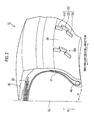
- Fig. 1 is a view of a sidewall surface at the side of a tire side portion 30 in the pneumatic tire 10 according to the embodiment of the present invention.
- Fig. 2 is a partial exploded perspective view showing the pneumatic tire 10 according to the embodiment of the present invention.
- Fig. 3 is a cross-sectional view showing the pneumatic tire 10 according to the embodiment of the present invention.
- the pneumatic tire 10 has projections 100 for turbulent flow generation extending along the tire radial direction on the tire side portion 30 positioned between a tread 20 grounded on a road surface during running and a bead. It is noted that although the pneumatic tire 10 is filled with air at a predetermined pressure, an inert gas such as nitrogen may also be filled in place of air.
- a projection 100 for turbulent flow generation includes at least a first projection 110 and a second projection 120 separate from the first projection 110. Furthermore, the projection 100 for turbulent flow generation includes a third projection 130 separate from the first projection 110 and the second projection 120.
- the pneumatic tire 10 has a carcass 21 that forms the framework of the pneumatic tire 10, a bead 40 that fits the carcass 21 into a rim flange 210 (described later), and a belt layer 22 arranged outside of the tire radial direction of the carcass 21.
- the carcass 21 is configured by a carcass cord, and a layer made from rubber covering the carcass cord.
- the belt layer 22 is configured such that an organic fiber cord is impregnated with a rubber component. Furthermore, the belt layer 22 is configured by a plurality of layers, and each layer is aligned along a tire radial direction D.
- a bead 40 is arranged along a tire circumferential direction, and is provided on both sides of the tread widthwise direction W via a tire equatorial line CL.
- the second projection 120 is provided at a different position from the first projection 110 in the tire circumferential direction.
- the third projection 130 is provided at the same position as the first projection 110 in the tire circumferential direction. Specifically, the second projection 120 is adjacent to the first projection 110 and the third projection 130 in the tire circumferential direction, and a predetermined gap is formed between the first projection 110 and the second projection 120. Similarly, a predetermined gap is formed between the third projection 130 and the second projection 120.
- a distance d from an upper end 210a of a rim flange 210 of the rim wheel 200 up to the lower end 100a of the projection 100 for turbulent flow generation is 50 mm or more and 250 mm or less.
- the state when the pneumatic tire 10 is assembled in the rim wheel 200 refers to the state when the pneumatic tire 10 is assembled in a standard rim described in ETRTO at an air pressure corresponding to the maximum load described in ETRTO.
- the upper end 210a of the rim flange 210 indicates an end portion outside of the tire radial direction of the rim flange 210.
- the lower end 100a of the projection 100 for turbulent flow generation indicates an end portion inside of the tire radial direction of the turbulent generating projection configuring the projection 100 for turbulent flow generation. That is, in the present embodiment, the lower end 100a of the projection 100 for turbulent flow generation indicates the end portion inside of the tire radial direction of the third projection 130.
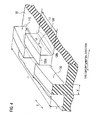
- Fig. 4 is a partial exploded perspective view showing the projection 100 for turbulent flow generation of the pneumatic tire 10 according to the embodiment of the present invention.
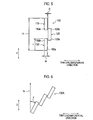
- Fig. 5 is a front view showing the projection 100 for turbulent flow generation of the pneumatic tire 10 according to the embodiment of the present invention.
- the inside end portion 110a which is the end portion inside of the tire radial direction of the first projection 110 overlaps the outside end portion 120b, which is the end portion outside of the tire radial direction of the second projection 120, in the tire radial direction D.
- the outside end portion 130b which is the end portion outside of the tire radial direction of the third projection 130 overlaps the inside end portion 120a, which is the end portion inside of the tire radial direction of the second projection 120, in the tire radial direction D.
- the projection 100 for turbulent flow generation has a width W along the tire circumferential direction, and a length L and height h along the tire radial direction D.
- each of the first projection 110, the second projection 120, and the third projection 130 included in the projection 100 for turbulent flow generation has the width W, length L, and height h. Therefore, the details of the width W, length L, and height h of the projection 100 for turbulent flow generation that are described below are common for the first projection 110, the second projection 120, and the third projection 130.
- the width W along the tire circumferential direction of the projection 100 for turbulent flow generation is 2 mm or more and 10 mm or less.
- the height h of the projection 100 for turbulent flow generation is 3 mm or more and 25 mm or less.
- the length of a region along the tire radial direction D in which the projection 100 for turbulent flow generation is positioned is set to length L1.
- the length L1 indicates the length from the end portion inside of the tire radial direction of the third projection 130 up to the end portion outside of the tire radial direction of the first projection 110.
- the height h of the projection 100 for turbulent flow generation can be set to 10 mm or more and 25 mm or less. Furthermore, more preferably, the height h of the projection 100 for turbulent flow generation is 15 mm or more and 25 mm or less.
- the length L becomes the length in which deformation due to bending does not occur to the projection 100 for turbulent flow generation.
- P EI ⁇ ⁇ / L 2
- the shape of the cross section of the projection 100 for turbulent flow generation perpendicularly intersecting in the direction in which the projection 100 for turbulent flow generation according to the present embodiment is extending is rectangular, and therefore, the second moment of area for the rectangular cross section with respect to an axis passing through the centroid of the rectangle is calculated according to Equation 3.
- I w ⁇ h 3 / 12
- the length L of the projection 100 for turbulent flow generation is explained in further detail by using the second projection 120 as an example. Note that this point is also common to the first projection 110 and the third projection 130, and therefore, the description concerning the length L of the first projection 110 and the third projection 130 is omitted.
- the length L along the tire radial direction D of the end portion 120c, which is the end portion at the side of the tire side portion 30 of the second projection 120 and is a fixed end is length L2
- the length L along the tire radial direction D of the end portion 120d which is the end portion at the apex side of the second projection 120 and is a free end is length L3.
- the length L3' (corresponding to L3 of the present invention) at the apex side of a turbulent generating projection
- the turbulent generating projection did not swell up even when the oil content adhered to it, and the length remained as length L2'. That is, due to the occurrence of a difference between the length L2' and the length L3", the turbulent generating projection got deformed into a wavy shape.
- the length L3 satisfies the relationship of the Equation 1 although the end portion 120d of the second projection 120 is a free end at the apex side of the second projection 120, no deformation occurs in the end portion 120d of the second projection 120 even when the oil content oozing out from the strut-type shock absorbers that repeat an intense reciprocating motion, and the oil content on the road gets dispersed and adheres to the turbulent generating projection.
- the width G along the tire circumferential direction of the predetermined gap formed between the first projection 110 and the second projection 120 is equal to or less than the width W along the tire circumferential direction of the projection 100 for turbulent flow generation.
- the projection 100 for turbulent flow generation satisfies the relationships of 1.0 ⁇ p/h ⁇ 50.0 and 1.0 ⁇ (p-w)/w ⁇ 100.0.
- p indicates the pitch of projections 100 for turbulent flow generation, which are adjacent in the tire circumferential direction.
- p indicates the distance between the center lines of projections 100 for turbulent flow generation that are adjacent in the tire circumferential direction.
- a slant angle ⁇ a with respect to a radial direction of the projection 100 for turbulent flow generation satisfies the relationship of -30° ⁇ ⁇ a ⁇ 30°.
- the pneumatic tires according to comparative examples 1 to 3 and examples 1 to 6 were used and (3.1.1) heat dissipation effect evaluation was conducted.
- the pneumatic tires according to comparative examples 1 to 3 and examples 1 to 6 used in the comparative evaluation are explained specifically. Data items relating to the pneumatic tire were measured under the following condition:
- Each pneumatic tire differs in the shape and arrangement of the projections for turbulent flow generation, and the other configurations are similar to those of the pneumatic tire 10 of the present embodiment. Hereinafter, the characteristics of each pneumatic tire will be explained.
- the pneumatic tire according to comparative example 1 differs from the pneumatic tire 10 in that it does not have a turbulent generating projection.
- the pneumatic tire according to comparative example 2 has a turbulent generating projection with a vast length in the tire radial direction, and does not have a plurality of projections for turbulent flow generation in the tire radial direction as in the case of the pneumatic tire 10.
- the pneumatic tire according to comparative example 3 has one turbulent generating projection in the tire radial direction such that it satisfies L 2 ⁇ 3.5 ⁇ E ⁇ I as in the pneumatic tire 10.
- the first projection 110 and the second projection 120 of the pneumatic tire 10 are provided alternately along the tire radial direction.
- the Young's modulus E of each of the projections for turbulent flow generation of the pneumatic tire according to examples 1 to 6 is 3.43 MPa (0.35 kg/mm 2 ), and the projections for turbulent flow generation satisfy L 2 ⁇ 3.5 ⁇ E ⁇ I of the pneumatic tire 10.
- the length L1 (length of the region in which the projections for turbulent flow generation are positioned along the tire radial direction) of the pneumatic tire according to the examples is 240 mm.
- Pinholes positioned at an interval of 10 mm along the tire radial direction of each pneumatic tire are formed at six locations along the tire circumferential direction. Furthermore, in the tread widthwise direction, a pinhole was formed outside of the tread widthwise direction at approximately 5 mm from the carcass.
- Each pneumatic tire was installed in the front wheel of the vehicle, was made to run on a dry road surface at 15 km/h for 24 hours, the temperature of the pneumatic tire after running was measured with a thermocouple, and the average value was calculated.
- the heat dissipation effect improved as compared to the pneumatic tire according to comparative examples 1 and 3. Furthermore, in the pneumatic tire according to the examples, it was possible to secure the same heat dissipation effect as the pneumatic tire according to comparative example 2.
- the length L of the projection 100 for turbulent flow generation along the tire radial direction D satisfies the Equation 1. That is, the length L becomes the length in which deformation due to bending of the projection 100 for turbulent flow generation does not occur.
- a pneumatic tire 10 that prevents the deformation of the projection 100 for turbulent flow generation due to the oil content dispersed from outside while maintaining the heat dissipation effect of the tire side portion 30 in cases where projections for turbulent flow generation are provided on the tire side portion 30 can be provided.
- the size of the pneumatic tire is extremely large as compared to a general pneumatic tire, the deformation of the projections 100 for turbulent flow generation can be controlled, and the heat dissipation effect of a vast tire side portion 30 can be secured.
- the projection 100 for turbulent flow generation includes at least the first projection 110 and the second projection 120 separate from the first projection 110, and the second projection 120 is provided at a position different from the first projection 110 in the tire circumferential direction. That is, because the projection 100 for turbulent flow generation includes a plurality of projections, the amount of deformation of the projection 100 for turbulent flow generation along the tire radial direction D becomes further less as compared to the conventional turbulent generating projection having a vast length in the tire radial direction D.
- the second projection 120 is provided at a different position from the first projection 110 in the tire circumferential direction, a contact between the second projection 120 and the first projection 110 can be prevented in spite of a deformation in the tire radial direction D, and therefore, the deformation of each projection can be controlled further.
- the end portion inside of the tire radial direction of the first projection 110 overlaps the end portion outside of the tire radial direction of the second projection 120, in the tire radial direction D. Therefore, the flow of the air flowing along the tire side portion 30 is disturbed when the air climbs over the first projection 110 or the second projection 120. When the air whose flow has been disturbed adheres again to the tire side portion 30, the heat dissipation effect of the tire side portion 30 can be achieved.
- the second projection 120 is adjacent to the first projection 110 in the tire circumferential direction, and a predetermined gap (width G) is formed between the first projection 110 and the second projection 120. Therefore, the probability of the air flowing along the tire side portion 30 climbing over the first projection 110 or the second projection 120 becomes higher. That is, by climbing over the first projection 110 or the second projection 120, the heat dissipation effect of the tire side portion 30 can be improved further.
- a predetermined gap (width G) is formed between the first projection 110 and the second projection 120, a contact between the second projection 120 and the first projection 110 can be prevented even when the second projection 120 and the first projection 110 get deformed in the tire radial direction D.
- the pneumatic tire 10 can further improve the heat dissipation effect of the tire side portion 30 while preventing the deformation of the projection 100 for turbulent flow generation.
- the air flowing along the tire side portion 30 has a high probability of climbing over the first projection 110 or the second projection 120. That is, by climbing over the first projection 110 or the second projection 120, the heat dissipation effect of the tire side portion 30 can be improved further.
- the width W of the projection 100 for turbulent flow generation along the tire circumferential direction is 2 mm or more and 10 mm or less, it can further improve the heat dissipation effect of the tire side portion 30 while maintaining the function as a projection that disturbs the flow of the air flowing along the tire side portion 30. It is noted that if the width W is less than 2 mm, the projection 100 for turbulent flow generation might vibrate as a result of the air flowing along the tire side portion 30. Furthermore, if the width W is more than 10 mm, the storage of heat accumulated in the projection 100 for turbulent flow generation is feared to become large.
- the height h of the projection 100 for turbulent flow generation is 3 mm or more and 25 mm or less, when the projection 100 for turbulent flow generation is installed as a tire for a construction vehicle, the heat dissipation effect of the tire side portion 30 can certainly be secured in the practical velocity range of the tire for construction vehicle.
- the distance d from the upper end 210a of the rim flange 210 of the rim wheel 200 up to the lower end 100a of the projection 100 for turbulent flow generation is 50 mm or more and 250 mm or less.
- the projection 100 for turbulent flow generation is feared to get deformed. Furthermore, if an inclination occurs due to a load on the pneumatic tire 10, the projection 100 for turbulent flow generation is feared to get deformed by the rim flange 210. By contrast, when the distance d is 50 mm or more, the deformation of the projection 100 for turbulent flow generation can certainly be prevented. Thus, the occurrence of cracks in the projection 100 for turbulent flow generation as a result of deformation of the projection 100 for turbulent flow generation can also be prevented certainly.
- the projection 100 for turbulent flow generation can sufficiently secure the function as a projection that disturbs the flow of the air flowing along the tire side portion 30.
- the projection 100 for turbulent flow generation satisfies the relationships of 1.0 ⁇ p/h ⁇ 50.0 and 1.0 ⁇ (p-w)/w ⁇ 100.0, it can sufficiently secure the function as a projection that disturbs the flow of the air flowing along the tire side portion 30.
- the projection 100 for turbulent flow generation can sufficiently secure the function as a projection that disturbs the flow of the air flowing along the tire side portion 30.
- the embodiment of the present invention can be modified as follows.
- the projection 100 for the turbulent flow generation in the aforementioned embodiment includes the first projection 110, the second projection 120, and the third projection 130.
- the third projection 130 is provided at the same position as the first projection 110 in the tire circumferential direction.
- the present invention is not limited thereto, for example, a turbulent generating projection as shown in Fig. 6 may also be provided.
- Fig. 6 is a front view showing a projection 100A for turbulent flow generation of a pneumatic tire according to another embodiment of the present invention.
- the projection 100A for turbulent flow generation may be provided such that a slant angle ⁇ is formed with respect to a straight line SL along the tire radial direction D.
- the second projection 120 in the aforementioned embodiment is adjacent to the first projection 110 in the tire circumferential direction, and a predetermined gap including width G is formed between the first projection 110 and the second projection 120.
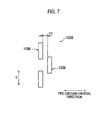
- a turbulent generating projection as shown in Fig. 7 may also be provided.
- Fig. 7 is a front view showing a projection 100B for turbulent flow generation of a pneumatic tire according to another embodiment of the present invention.
- the projection 100B for turbulent flow generation includes a first projection 110B and a second projection 120B, and a predetermined gap including a width G1 equivalent to the width of the first projection 110B may be formed between the first projection 110B and the second projection 120B.
- the pneumatic tire 10 in the aforementioned embodiment is a tire filled with air or an inert gas, but it is not limited thereto, and for example, it may be a solid tire formed entirely with rubber.
- the shape of the cross section of the projection 100 for turbulent flow generation perpendicularly intersecting in the direction in which the projection 100 for turbulent flow generation in the aforementioned embodiment is extending is rectangular, but it is not limited thereto, and for example, the shape may be triangular.
- the length L of the turbulent generating projection along the tire radial direction D can be set.
- the present invention it is possible to prevent the deformation of the projections for turbulent flow generation due to the oil content dispersed from outside while maintaining the heat dissipation effect of the tire side portion, and therefore, the present invention can be applied to a tire for construction vehicle that runs on an irregular ground and dirty road surface on many occasions.
Landscapes
- Engineering & Computer Science (AREA)
- Mechanical Engineering (AREA)
- Tires In General (AREA)
Description
- The present invention relates to a pneumatic tire having projections for turbulent flow generation extending along a tire radial direction, on a tire side portion.
- Conventionally, ia pneumatic tire installed in a vehicle, particularly, a pneumatic tire for heavy loads installed in a construction vehicle as a dump truck, in order to prevent a rise in temperature of the tire side portion due to the running of the construction vehicle, a structure in which fin-shaped projections for turbulent flow generation extending along the tire radial direction are provided on the tire side portion is used (for example, Patent Document 1).
- The air flowing along the tire side portion climbs over the projections for turbulent flow generation, and when the air whose flow has been disturbed adheres again to the tire side portion, the heat dissipation of the tire side portion is promoted.
- Patent Document 1:
WO 2007-032405 (Pages 6 to 7,Fig. 2 ) -
- Because the size of the pneumatic tire for heavy load is extremely large as compared to a general pneumatic tire, the length of the projections for turbulent flow generation extending along the tire radial direction also becomes long in correspondence to the vast tire side portion.
- Furthermore, in the case of a construction vehicle that runs on an irregular ground and dirty road surface on many occasions, the oil content oozing out from the strut-type shock absorbers that repeat an intense reciprocating motion, and the oil content on the road get dispersed and may adhere to the tire side portion. If the oil content thus adheres to the projections for turbulent flow generation, then the projections for turbulent flow generation which are formed from rubber swell up, and get deformed into a wavy shape thereby posing a problem. When the projections for turbulent flow generation get deformed into a wavy shape, the heat dissipation effect of the tire side portion declines, and at the same time, the quality of external appearance also declines.
- Thus, an object of the present invention is to provide a pneumatic tire that prevents the deformation of the projections for turbulent flow generation due to the oil content dispersed from outside while maintaining the heat dissipation effect of the tire side portion in cases where projections for turbulent flow generation are provided on the tire side portion.
- The present invention has following feature to solve the above problem. A first feature of the present invention is summarized as a pneumatic tire for construction vehicles, comprising a turbulent generating projection extending along a tire radial direction, on a tire side portion positioned between a tread and a bead, characterized in that when L in metres denotes a length of the turbulent generating projection along the tire radial direction, E denotes a Young's modulus in Pascals of a forming material that forms the turbulent generating projection, and I denotes a second moment of area in metres to fourth power of a cross section of the turbulent generating projection perpendicularly intersecting in the direction in which the turbulent generating projection is extending, taken with respect to an axis passing through the centroid of the cross section of the turbulent generating projection, the turbulent generating projection satisfies the relationship of L2 ≤ 3.5 × E × I, wherein in a state when the pneumatic tire is assembled in a rim wheel, a distance from an upper end of a rim flange of the rim wheel up to a lower end of the turbulent projection is 50 mm or more and 250 mm or less.
- According to such a characteristic, the length L along the tire radial direction of the projections for turbulent flow generation becomes the length in which deformation due to bending of the projections for turbulent flow generation becomes the length in which deformation due to bending of the projections for turbulent flow generation does not occur. That is, when the oil content adheres to the projections for turbulent flow generation, the amount of deformation of the projections for turbulent flow generation along the tire radial direction becomes small as compared to the conventional projections for turbulent flow generation, which have a vast length in the tire radial direction. Thus, a pneumatic tire that prevents the deformation of the projections for turbulent flow generation due to the oil content dispersed from outside while maintaining the heat dissipation effect of the tire side portion in cases where projections for turbulent flow generation are provided on the tire side portion can be provided.
- A second feature of the present invention according to the first feature of the present invention is summarized as that the turbulent generating projection includes at least a first projection (first projection 110) and a second projection (second projection 120) separated from the first projection, the second projection is provided at a different position from the first projection in a tire circumferential direction, and the end portion (inside
end portion 110a) inside of the tire radial direction of the first projection overlaps the end portion (outside end portion 120b) outside of the tire radial direction of the second projection in the tire radial direction. - A third feature of the present invention according to the second feature of the present invention is summarized as that the second projection is adjacent to the first projection in the tire circumferential direction, and a predetermined gap (width G) is formed between the first projection and the second projection.
- A fourth feature of the present invention according to the third feature of the present invention is summarized as that the predetermined gap is equal to or less than a width (width W) of the turbulent generating projection along the tire circumferential direction.
- A fifth feature of the present invention according to any one of the first to the first to fourth features of the present invention is summarized as that a width (width W) of the turbulent generating projection along the tire circumferential direction is 2 mm or more and 10 mm or less.
- A sixth feature of the present invention according to any one of the first to the first to fifth features of the present invention is summarized as that a height (height h) of the turbulent generating projection is 3 mm or more and 25 mm or less.
- deleted
- An eighth feature of the present invention according to the sixth feature of the present invention is summarized as that the height of the turbulent generating projection is 10 mm or more and 25 mm or less.
- According to a characteristic of the present invention, it is possible to provide a pneumatic tire that prevents the deformation of the projections for turbulent flow generation due to the oil content dispersed from outside while maintaining the heat dissipation effect of the tire side portion in cases where projections for turbulent flow generation are provided on the tire side portion.
-
- [
Fig. 1] Fig. 1 is a view of a sidewall surface at the side of the tire side portion in a pneumatic tire according to an embodiment of the present invention. - [
Fig. 2] Fig. 2 is a partial exploded perspective view showing the pneumatic tire according to the embodiment of the present invention. - [
Fig. 3] Fig. 3 is a cross-sectional view showing the pneumatic tire according to the embodiment of the present invention. - [
Fig. 4] Fig. 4 is a partial exploded perspective view showing a turbulent generating projection of the pneumatic tire according to the embodiment of the present invention. - [
Fig. 5] Fig. 5 is a front view showing the turbulent generating projection of the pneumatic tire according to the embodiment of the present invention. - [
Fig. 6] Fig. 6 is a front view showing a turbulent generating projection of a pneumatic tire according to another embodiment of the present invention. - [
Fig. 7] Fig. 7 is a front view showing the turbulent generating projection of the pneumatic tire according to another embodiment of the present invention. - Next, an embodiment of a pneumatic tire according to the present invention is explained with reference to drawings. In the following description of the drawings, the same or similar reference numerals are used to designate the same or similar parts. It will be appreciated that the drawings are schematically shown and the ratio and the like of each dimension are different from the real ones.
- Therefore, detailed dimension and the like should be determined considering the following description. Of course, among the drawings, the dimensional relationship and the ratio are different.
- The pneumatic tire according to the present invention will be explained. Specifically, (1) Configuration of pneumatic tire, (2) Shape of turbulent generating projection, (3) Comparative evaluation, (4) Operation and effect, and (5) Other embodiments will be explained.
- A
pneumatic tire 10 according to the present invention is a pneumatic tire for heavy loads, which is installed in construction vehicles such as a dump truck. The configuration of thepneumatic tire 10 is explained with reference to drawings.Fig. 1 is a view of a sidewall surface at the side of atire side portion 30 in thepneumatic tire 10 according to the embodiment of the present invention.Fig. 2 is a partial exploded perspective view showing thepneumatic tire 10 according to the embodiment of the present invention.Fig. 3 is a cross-sectional view showing thepneumatic tire 10 according to the embodiment of the present invention. - As shown in
Fig. 1 , thepneumatic tire 10 hasprojections 100 for turbulent flow generation extending along the tire radial direction on thetire side portion 30 positioned between atread 20 grounded on a road surface during running and a bead. It is noted that although thepneumatic tire 10 is filled with air at a predetermined pressure, an inert gas such as nitrogen may also be filled in place of air. - A
projection 100 for turbulent flow generation includes at least afirst projection 110 and asecond projection 120 separate from thefirst projection 110. Furthermore, theprojection 100 for turbulent flow generation includes athird projection 130 separate from thefirst projection 110 and thesecond projection 120. - As shown in
Fig. 2 , thepneumatic tire 10 has acarcass 21 that forms the framework of thepneumatic tire 10, abead 40 that fits thecarcass 21 into a rim flange 210 (described later), and abelt layer 22 arranged outside of the tire radial direction of thecarcass 21. - The
carcass 21 is configured by a carcass cord, and a layer made from rubber covering the carcass cord. Thebelt layer 22 is configured such that an organic fiber cord is impregnated with a rubber component. Furthermore, thebelt layer 22 is configured by a plurality of layers, and each layer is aligned along a tire radial directionD. A bead 40 is arranged along a tire circumferential direction, and is provided on both sides of the tread widthwise direction W via a tire equatorial line CL. - The
second projection 120 is provided at a different position from thefirst projection 110 in the tire circumferential direction. Thethird projection 130 is provided at the same position as thefirst projection 110 in the tire circumferential direction. Specifically, thesecond projection 120 is adjacent to thefirst projection 110 and thethird projection 130 in the tire circumferential direction, and a predetermined gap is formed between thefirst projection 110 and thesecond projection 120. Similarly, a predetermined gap is formed between thethird projection 130 and thesecond projection 120. - As shown in
Fig. 3 , in a state when thepneumatic tire 10 is assembled in arim wheel 200, a distance d from anupper end 210a of arim flange 210 of therim wheel 200 up to thelower end 100a of theprojection 100 for turbulent flow generation is 50 mm or more and 250 mm or less. It is noted that the state when thepneumatic tire 10 is assembled in therim wheel 200 refers to the state when thepneumatic tire 10 is assembled in a standard rim described in ETRTO at an air pressure corresponding to the maximum load described in ETRTO. Furthermore, theupper end 210a of therim flange 210 indicates an end portion outside of the tire radial direction of therim flange 210. Furthermore, thelower end 100a of theprojection 100 for turbulent flow generation indicates an end portion inside of the tire radial direction of the turbulent generating projection configuring theprojection 100 for turbulent flow generation. That is, in the present embodiment, thelower end 100a of theprojection 100 for turbulent flow generation indicates the end portion inside of the tire radial direction of thethird projection 130. - The shape of the
projection 100 for turbulent flow generation of thepneumatic tire 10 according to the present embodiment is explained with reference to drawings.Fig. 4 is a partial exploded perspective view showing theprojection 100 for turbulent flow generation of thepneumatic tire 10 according to the embodiment of the present invention.Fig. 5 is a front view showing theprojection 100 for turbulent flow generation of thepneumatic tire 10 according to the embodiment of the present invention. - As shown in
Figs. 4 and5 , theinside end portion 110a, which is the end portion inside of the tire radial direction of thefirst projection 110 overlaps theoutside end portion 120b, which is the end portion outside of the tire radial direction of thesecond projection 120, in the tire radial direction D. Similarly, theoutside end portion 130b, which is the end portion outside of the tire radial direction of thethird projection 130 overlaps theinside end portion 120a, which is the end portion inside of the tire radial direction of thesecond projection 120, in the tire radial direction D. - The
projection 100 for turbulent flow generation has a width W along the tire circumferential direction, and a length L and height h along the tire radial direction D. Specifically, each of thefirst projection 110, thesecond projection 120, and thethird projection 130 included in theprojection 100 for turbulent flow generation has the width W, length L, and height h. Therefore, the details of the width W, length L, and height h of theprojection 100 for turbulent flow generation that are described below are common for thefirst projection 110, thesecond projection 120, and thethird projection 130. The width W along the tire circumferential direction of theprojection 100 for turbulent flow generation is 2 mm or more and 10 mm or less. The height h of theprojection 100 for turbulent flow generation is 3 mm or more and 25 mm or less. Furthermore, the length of a region along the tire radial direction D in which theprojection 100 for turbulent flow generation is positioned is set to length L1. Specifically, the length L1 indicates the length from the end portion inside of the tire radial direction of thethird projection 130 up to the end portion outside of the tire radial direction of thefirst projection 110. - The height h of the
projection 100 for turbulent flow generation can be set to 10 mm or more and 25 mm or less. Furthermore, more preferably, the height h of theprojection 100 for turbulent flow generation is 15 mm or more and 25 mm or less. - When a length L denotes the length in metres along the tire radial direction D of the
projection 100 for turbulent flow generation, E denotes the Young's modulus in Pascals of a forming material that forms theprojection 100 for turbulent flow generation, and I denotes the second moment of area in metres to fourth power of the cross section of theprojection 100 for turbulent flow generation perpendicularly intersecting in the direction in which theprojection 100 for turbulent flow generation is extending, theprojection 100 for turbulent flow generation satisfies the relationship of Equation 1.
projection 100 for turbulent flow generation.
Furthermore, the shape of the cross section of theprojection 100 for turbulent flow generation perpendicularly intersecting in the direction in which theprojection 100 for turbulent flow generation according to the present embodiment is extending is rectangular, and therefore, the second moment of area for the rectangular cross section with respect to an axis passing through the centroid of the rectangle is calculated according to Equation 3.
projection 100 for turbulent flow generation is calculated by the relational expression between the width W and height h of theprojection 100 for turbulent flow generation. - Hereinafter, the length L of the
projection 100 for turbulent flow generation is explained in further detail by using thesecond projection 120 as an example. Note that this point is also common to thefirst projection 110 and thethird projection 130, and therefore, the description concerning the length L of thefirst projection 110 and thethird projection 130 is omitted. The length L along the tire radial direction D of theend portion 120c, which is the end portion at the side of thetire side portion 30 of thesecond projection 120 and is a fixed end is length L2, and the length L along the tire radial direction D of theend portion 120d which is the end portion at the apex side of thesecond projection 120 and is a free end is length L3. - Conventionally, as for the length L3' (corresponding to L3 of the present invention) at the apex side of a turbulent generating projection, when the oil content oozing out from the strut-type shock absorbers that repeat an intense reciprocating motion, and the oil content on the road got dispersed and adhered to the turbulent generating projection, it swelled up, and the length L3' extended up to length L3" (not shown in the figure). On the other hand, because the length L2' (corresponding to L2 of the present invention) at the side of the tire side portion of the turbulent generating projection is the length at the fixed end, the turbulent generating projection did not swell up even when the oil content adhered to it, and the length remained as length L2'. That is, due to the occurrence of a difference between the length L2' and the length L3", the turbulent generating projection got deformed into a wavy shape.
- According to the present invention, because the length L3 satisfies the relationship of the Equation 1 although the
end portion 120d of thesecond projection 120 is a free end at the apex side of thesecond projection 120, no deformation occurs in theend portion 120d of thesecond projection 120 even when the oil content oozing out from the strut-type shock absorbers that repeat an intense reciprocating motion, and the oil content on the road gets dispersed and adheres to the turbulent generating projection. - The width G along the tire circumferential direction of the predetermined gap formed between the
first projection 110 and thesecond projection 120 is equal to or less than the width W along the tire circumferential direction of theprojection 100 for turbulent flow generation. - The
projection 100 for turbulent flow generation satisfies the relationships of 1.0 ≤ p/h ≤ 50.0 and 1.0 ≤ (p-w)/w ≤ 100.0. Note that p indicates the pitch ofprojections 100 for turbulent flow generation, which are adjacent in the tire circumferential direction. Specifically, as for the center line of theprojections 100 for turbulent flow generation along the tire circumferential direction, p indicates the distance between the center lines ofprojections 100 for turbulent flow generation that are adjacent in the tire circumferential direction. - A slant angle θa with respect to a radial direction of the
projection 100 for turbulent flow generation satisfies the relationship of -30° ≤ θa ≤ 30°. - Subsequently, in order to further clarify the effect of the present invention, a comparative evaluation will be described in which pneumatic tires according to comparative examples and examples below were used. Specifically, (3.1) Evaluation method and (3.2) Evaluation result will be described. It is noted that the present invention is not limited to these examples in any way.
- The pneumatic tires according to comparative examples 1 to 3 and examples 1 to 6 were used and (3.1.1) heat dissipation effect evaluation was conducted. The pneumatic tires according to comparative examples 1 to 3 and examples 1 to 6 used in the comparative evaluation are explained specifically. Data items relating to the pneumatic tire were measured under the following condition:
-
- Tire size: 55/80R63
- Rim size: Standard rim described in ETRTO
- Inner pressure condition: Air pressure corresponding to the maximum load described in ETRTO
- Load condition: Maximum load described in ETRTO (maximum load capability)
- Vehicle type: Dump track (320 ton class)
- Each pneumatic tire differs in the shape and arrangement of the projections for turbulent flow generation, and the other configurations are similar to those of the
pneumatic tire 10 of the present embodiment. Hereinafter, the characteristics of each pneumatic tire will be explained. - The pneumatic tire according to comparative example 1 differs from the
pneumatic tire 10 in that it does not have a turbulent generating projection. - As compared to the
pneumatic tire 10, the pneumatic tire according to comparative example 2 has a turbulent generating projection with a vast length in the tire radial direction, and does not have a plurality of projections for turbulent flow generation in the tire radial direction as in the case of thepneumatic tire 10. - The pneumatic tire according to comparative example 3 has one turbulent generating projection in the tire radial direction such that it satisfies L2 ≤ 3.5 × E × I as in the
pneumatic tire 10. - In the pneumatic tire according to examples 1 to 6, the
first projection 110 and thesecond projection 120 of thepneumatic tire 10 are provided alternately along the tire radial direction. The Young's modulus E of each of the projections for turbulent flow generation of the pneumatic tire according to examples 1 to 6 is 3.43 MPa (0.35 kg/mm2), and the projections for turbulent flow generation satisfy L2≤ 3.5 × E × I of thepneumatic tire 10. Furthermore, the length L1 (length of the region in which the projections for turbulent flow generation are positioned along the tire radial direction) of the pneumatic tire according to the examples is 240 mm. - Evaluation method: Pinholes positioned at an interval of 10 mm along the tire radial direction of each pneumatic tire are formed at six locations along the tire circumferential direction. Furthermore, in the tread widthwise direction, a pinhole was formed outside of the tread widthwise direction at approximately 5 mm from the carcass. Each pneumatic tire was installed in the front wheel of the vehicle, was made to run on a dry road surface at 15 km/h for 24 hours, the temperature of the pneumatic tire after running was measured with a thermocouple, and the average value was calculated.
- It is noted that with reference to the temperature of the pneumatic tire according to the comparative example 1, it was determined from the measurement results that the heat dissipation effect existed when the temperature of the pinholes at the same position in each pneumatic tire declined.
- The evaluation results of the pneumatic tire according to the comparative examples and examples will be described with reference to Table 1.
[Table 1] Com. Ex. 1 Com. Ex. 2 Com. Ex. 3 Ex. 1 Ex. 2 Ex. 3 Ex. 4 Ex. 5 Ex. 6 Shape of turbulent generating projection Projection height (h) - 15mm 15mm 15mm 10mm 25mm 16mm 16mm 20mm Projection width (W) - 5mm 5mm 5mm 2.5mm 7mm 5mm 10mm 5mm Slant angle with respect to radial direction - 0° 0° 0° 0° 0° 0° 0° 0° Projection length (L) - 200mm 37mm 37mm 15mm 100mm 45mm 60mm 40mm p/h - - 6 6 9 3.6 9 9 6 Range of tire radial direction where heat dissipation effect existed in tire side portion - 240mm 80mm 240mm 240mm 240mm 240mm 240mm 240mm - As for the pneumatic tire according to examples 1 to 6, the heat dissipation effect improved as compared to the pneumatic tire according to comparative examples 1 and 3. Furthermore, in the pneumatic tire according to the examples, it was possible to secure the same heat dissipation effect as the pneumatic tire according to comparative example 2.
- As described above, according to the
pneumatic tire 10 of the present embodiment, the length L of theprojection 100 for turbulent flow generation along the tire radial direction D satisfies the Equation 1. That is, the length L becomes the length in which deformation due to bending of theprojection 100 for turbulent flow generation does not occur. - Conventionally, when the oil content adheres to the projections for turbulent flow generation, the amount of deformation of the projections for turbulent flow generation having a vast length along the tire radial direction D was large, and the projections got deformed into a wavy shape thereby posing a problem. By contrast, according to the
pneumatic tire 10 of the present embodiment, even when the oil content adheres to theprojection 100 for turbulent flow generation, the deformation due to the bending of theprojection 100 for turbulent flow generation is controlled below the predetermined amount. - Thus, a
pneumatic tire 10 that prevents the deformation of theprojection 100 for turbulent flow generation due to the oil content dispersed from outside while maintaining the heat dissipation effect of thetire side portion 30 in cases where projections for turbulent flow generation are provided on thetire side portion 30 can be provided. - Furthermore, according to the present embodiment, although the size of the pneumatic tire is extremely large as compared to a general pneumatic tire, the deformation of the
projections 100 for turbulent flow generation can be controlled, and the heat dissipation effect of a vasttire side portion 30 can be secured. - According to the present embodiment, the
projection 100 for turbulent flow generation includes at least thefirst projection 110 and thesecond projection 120 separate from thefirst projection 110, and thesecond projection 120 is provided at a position different from thefirst projection 110 in the tire circumferential direction. That is, because theprojection 100 for turbulent flow generation includes a plurality of projections, the amount of deformation of theprojection 100 for turbulent flow generation along the tire radial direction D becomes further less as compared to the conventional turbulent generating projection having a vast length in the tire radial direction D. Furthermore, because thesecond projection 120 is provided at a different position from thefirst projection 110 in the tire circumferential direction, a contact between thesecond projection 120 and thefirst projection 110 can be prevented in spite of a deformation in the tire radial direction D, and therefore, the deformation of each projection can be controlled further. - Furthermore, the end portion inside of the tire radial direction of the
first projection 110 overlaps the end portion outside of the tire radial direction of thesecond projection 120, in the tire radial direction D. Therefore, the flow of the air flowing along thetire side portion 30 is disturbed when the air climbs over thefirst projection 110 or thesecond projection 120. When the air whose flow has been disturbed adheres again to thetire side portion 30, the heat dissipation effect of thetire side portion 30 can be achieved. - According to the present embodiment, the
second projection 120 is adjacent to thefirst projection 110 in the tire circumferential direction, and a predetermined gap (width G) is formed between thefirst projection 110 and thesecond projection 120. Therefore, the probability of the air flowing along thetire side portion 30 climbing over thefirst projection 110 or thesecond projection 120 becomes higher. That is, by climbing over thefirst projection 110 or thesecond projection 120, the heat dissipation effect of thetire side portion 30 can be improved further. - Furthermore, because a predetermined gap (width G) is formed between the
first projection 110 and thesecond projection 120, a contact between thesecond projection 120 and thefirst projection 110 can be prevented even when thesecond projection 120 and thefirst projection 110 get deformed in the tire radial direction D. - Therefore, the
pneumatic tire 10 can further improve the heat dissipation effect of thetire side portion 30 while preventing the deformation of theprojection 100 for turbulent flow generation. - According to the present embodiment, because the predetermined gap (width G) is equal to or less than the width W along the tire circumferential direction of the
projection 100 for turbulent flow generation, the air flowing along thetire side portion 30 has a high probability of climbing over thefirst projection 110 or thesecond projection 120. That is, by climbing over thefirst projection 110 or thesecond projection 120, the heat dissipation effect of thetire side portion 30 can be improved further. - According to the present embodiment, because the width W of the
projection 100 for turbulent flow generation along the tire circumferential direction is 2 mm or more and 10 mm or less, it can further improve the heat dissipation effect of thetire side portion 30 while maintaining the function as a projection that disturbs the flow of the air flowing along thetire side portion 30. It is noted that if the width W is less than 2 mm, theprojection 100 for turbulent flow generation might vibrate as a result of the air flowing along thetire side portion 30. Furthermore, if the width W is more than 10 mm, the storage of heat accumulated in theprojection 100 for turbulent flow generation is feared to become large. - According to the present embodiment, because the height h of the
projection 100 for turbulent flow generation is 3 mm or more and 25 mm or less, when theprojection 100 for turbulent flow generation is installed as a tire for a construction vehicle, the heat dissipation effect of thetire side portion 30 can certainly be secured in the practical velocity range of the tire for construction vehicle. - According to the present embodiment, in a state when the
pneumatic tire 10 is assembled in therim wheel 200, the distance d from theupper end 210a of therim flange 210 of therim wheel 200 up to thelower end 100a of theprojection 100 for turbulent flow generation is 50 mm or more and 250 mm or less. - When the
pneumatic tire 10 is assembled in therim wheel 200, theprojection 100 for turbulent flow generation is feared to get deformed. Furthermore, if an inclination occurs due to a load on thepneumatic tire 10, theprojection 100 for turbulent flow generation is feared to get deformed by therim flange 210. By contrast, when the distance d is 50 mm or more, the deformation of theprojection 100 for turbulent flow generation can certainly be prevented. Thus, the occurrence of cracks in theprojection 100 for turbulent flow generation as a result of deformation of theprojection 100 for turbulent flow generation can also be prevented certainly. - Furthermore, by setting the distance d to 250 mm or less, the
projection 100 for turbulent flow generation can sufficiently secure the function as a projection that disturbs the flow of the air flowing along thetire side portion 30. - According to the present embodiment, because the
projection 100 for turbulent flow generation satisfies the relationships of 1.0 ≤ p/h ≤ 50.0 and 1.0 ≤ (p-w)/w ≤ 100.0, it can sufficiently secure the function as a projection that disturbs the flow of the air flowing along thetire side portion 30. - According to the present embodiment, because the slant angle θa with respect to the radial direction of the
projection 100 for turbulent flow generation satisfies the relationship of -30° ≤ θa ≤ 30°, theprojection 100 for turbulent flow generation can sufficiently secure the function as a projection that disturbs the flow of the air flowing along thetire side portion 30. - So far, the present invention is disclosed through the above embodiments. However, it should not be interpreted that the statements and drawings constituting a part of the present disclosure limit the present invention. From the present disclosure, various alternative embodiments, examples, and operational technologies will become apparent to those skilled in the art.
- For example, the embodiment of the present invention can be modified as follows. The
projection 100 for the turbulent flow generation in the aforementioned embodiment includes thefirst projection 110, thesecond projection 120, and thethird projection 130. Here, thethird projection 130 is provided at the same position as thefirst projection 110 in the tire circumferential direction. However, the present invention is not limited thereto, for example, a turbulent generating projection as shown inFig. 6 may also be provided.Fig. 6 is a front view showing aprojection 100A for turbulent flow generation of a pneumatic tire according to another embodiment of the present invention. - As shown in
Fig. 6 , theprojection 100A for turbulent flow generation may be provided such that a slant angle θ is formed with respect to a straight line SL along the tire radial direction D. - The
second projection 120 in the aforementioned embodiment is adjacent to thefirst projection 110 in the tire circumferential direction, and a predetermined gap including width G is formed between thefirst projection 110 and thesecond projection 120. However, the present invention is not limited thereto, for example, a turbulent generating projection as shown inFig. 7 may also be provided.Fig. 7 is a front view showing aprojection 100B for turbulent flow generation of a pneumatic tire according to another embodiment of the present invention. - As shown in
Fig. 7 , theprojection 100B for turbulent flow generation includes afirst projection 110B and asecond projection 120B, and a predetermined gap including a width G1 equivalent to the width of thefirst projection 110B may be formed between thefirst projection 110B and thesecond projection 120B. - The
pneumatic tire 10 in the aforementioned embodiment is a tire filled with air or an inert gas, but it is not limited thereto, and for example, it may be a solid tire formed entirely with rubber. - The shape of the cross section of the
projection 100 for turbulent flow generation perpendicularly intersecting in the direction in which theprojection 100 for turbulent flow generation in the aforementioned embodiment is extending is rectangular, but it is not limited thereto, and for example, the shape may be triangular. In such a case, the second moment of area for the triangular cross section with respect to an axis passing through the centroid of the triangle is calculated by the Equation I = w × h3/36. Therefore, it may be appropriate to set a length L along the tire radial direction D for the turbulent generating projection such that the relationship of L2 ≤ 3.5 × E × I is satisfied. - Thus, even when the shape of the cross section of the turbulent generating projection is set to other than rectangular, by calculating the second moment of area corresponding to the shape of the cross section, the length L of the turbulent generating projection along the tire radial direction D can be set.
- As described above, it is of course that the present invention includes various embodiments and the like not described here. Therefore, the technical range of the present invention is to be defined only by the inventive specific matter according to the adequate claims from the above description.
- According to the present invention, it is possible to prevent the deformation of the projections for turbulent flow generation due to the oil content dispersed from outside while maintaining the heat dissipation effect of the tire side portion, and therefore, the present invention can be applied to a tire for construction vehicle that runs on an irregular ground and dirty road surface on many occasions.
- D···tire radial direction, θ···slat angle, θa···slant angle, CL··· equatorial line, D···tire radial direction, G···width, G1···width, W···treat widthwise direction, 10···pneumatic tire, 20···tread, 21···carcass, 22··· belt layer, 30···tire side portion, 40···bead, 100,100A,100B···turbulent generating projection, 100a···lower end, 110,110B···first projection, 110a ···end portion, 120,120B···second projection, 120a···inside end portion, 120b···outside end portion, 130···third projection, 130b···outside end portion, 200···rim wheel, 210···rim flange, 210a···upper end
Claims (7)
- A pneumatic tire (10) for construction vehicles, comprising a turbulent generating projection (100) extending along a tire radial direction (D), on a tire side portion (30) positioned between a tread (20) and a bead (40), characterized in that
when L in metres denotes a length of the turbulent generating projection (100) along the tire radial direction (D), E denotes a Young's modulus in Pascals of a forming material that forms the turbulent generating projection (100), and I denotes a second moment of area in metres to fourth power of a cross section of the turbulent generating projection (100) perpendicularly intersecting in the direction in which the turbulent generating projection (100) is extending, taken with respect to an axis passing through the centroid of the cross section of the turbulent generating projection (100),
the turbulent generating projection (100) satisfies the relationship of L2 ≤ 3.5 × E × I,
wherein in a state when the pneumatic tire is assembled in a rim wheel (200), a distance from an upper end (210a) of a rim flange of the rim wheel up to a lower end (100a) of the turbulent projection (100) is 50 mm or more and 250 mm or less. - The pneumatic tire (10) according to claim 1, wherein
the turbulent generating projection (100) includes at least a first projection (110) and a second projection (120) separated from the first projection (110),
the second projection (120) is provided at a different position from the first projection (110) in a tire circumferential direction, and
the end portion (110a) inside of the tire radial direction (D) of the first projection (110) overlaps the end portion (120b) outside of the tire radial direction (D) of the second projection (120) in the tire radial direction. - The pneumatic tire (10) according to claim 2, wherein
the second projection (120) is adjacent to the first projection (110) in the tire circumferential direction, and
a predetermined gap (G) is formed between the first projection (110) and the second projection (120). - The pneumatic tire (10) according to claim 3, wherein the predetermined gap (G) is equal to or less than a width (W) of the turbulent generating projection (100) along the tire circumferential direction.
- The pneumatic tire (10) according to any one of claims 1 to 4, wherein a width of the turbulent generating projection (100) along the tire circumferential direction is 2 mm or more and 10 mm or less.
- The pneumatic tire (10) according to any one of claims 1 to 5, wherein a height (h) of the turbulent generating projection (100) is 3 mm or more and 25 mm or less.
- The pneumatic tire (10) according to claim 6, wherein the height of the turbulent generating projection (100) is 10 mm or more and 25 mm or less.
Priority Applications (1)
| Application Number | Priority Date | Filing Date | Title |
|---|---|---|---|
| EP13197717.5A EP2711203B1 (en) | 2009-04-28 | 2010-04-28 | Pneumatic tire |
Applications Claiming Priority (2)
| Application Number | Priority Date | Filing Date | Title |
|---|---|---|---|
| JP2009109150 | 2009-04-28 | ||
| PCT/JP2010/057595 WO2010126091A1 (en) | 2009-04-28 | 2010-04-28 | Pneumatic tire |
Related Child Applications (2)
| Application Number | Title | Priority Date | Filing Date |
|---|---|---|---|
| EP13197717.5A Division EP2711203B1 (en) | 2009-04-28 | 2010-04-28 | Pneumatic tire |
| EP13197717.5A Division-Into EP2711203B1 (en) | 2009-04-28 | 2010-04-28 | Pneumatic tire |
Publications (3)
| Publication Number | Publication Date |
|---|---|
| EP2425992A1 EP2425992A1 (en) | 2012-03-07 |
| EP2425992A4 EP2425992A4 (en) | 2013-04-03 |
| EP2425992B1 true EP2425992B1 (en) | 2015-11-25 |
Family
ID=43032235
Family Applications (2)
| Application Number | Title | Priority Date | Filing Date |
|---|---|---|---|
| EP13197717.5A Not-in-force EP2711203B1 (en) | 2009-04-28 | 2010-04-28 | Pneumatic tire |
| EP10769789.8A Not-in-force EP2425992B1 (en) | 2009-04-28 | 2010-04-28 | Pneumatic tire |
Family Applications Before (1)
| Application Number | Title | Priority Date | Filing Date |
|---|---|---|---|
| EP13197717.5A Not-in-force EP2711203B1 (en) | 2009-04-28 | 2010-04-28 | Pneumatic tire |
Country Status (8)
| Country | Link |
|---|---|
| US (2) | US20120097305A1 (en) |
| EP (2) | EP2711203B1 (en) |
| JP (2) | JP5451753B2 (en) |
| CN (2) | CN102458885B (en) |
| BR (1) | BRPI1014613A8 (en) |
| ES (2) | ES2561101T3 (en) |
| RU (2) | RU2499682C2 (en) |
| WO (1) | WO2010126091A1 (en) |
Families Citing this family (12)
| Publication number | Priority date | Publication date | Assignee | Title |
|---|---|---|---|---|
| JP5781852B2 (en) * | 2011-07-13 | 2015-09-24 | 株式会社ブリヂストン | tire |
| JP5695543B2 (en) * | 2011-10-31 | 2015-04-08 | 住友ゴム工業株式会社 | Pneumatic tire |
| US10189315B2 (en) | 2012-07-11 | 2019-01-29 | The Yokohama Rubber Co., Ltd. | Pneumatic tire |
| JP5246370B1 (en) * | 2012-08-20 | 2013-07-24 | 横浜ゴム株式会社 | Pneumatic tire |
| JP5956942B2 (en) | 2013-02-22 | 2016-07-27 | 株式会社ブリヂストン | tire |
| JP2015034004A (en) * | 2013-08-08 | 2015-02-19 | クムホ タイヤ カンパニー インコーポレーテッド | Cooling fin pitch deciding method and pneumatic tire using the same |
| JP6257438B2 (en) * | 2014-05-08 | 2018-01-10 | 東洋ゴム工業株式会社 | Pneumatic tire |
| JP6349199B2 (en) * | 2014-08-08 | 2018-06-27 | 株式会社ブリヂストン | Pneumatic tire |
| JP6699192B2 (en) * | 2016-01-21 | 2020-05-27 | 住友ゴム工業株式会社 | Pneumatic tire |
| JP6720044B2 (en) * | 2016-10-06 | 2020-07-08 | 株式会社ブリヂストン | tire |
| FR3060458A1 (en) * | 2016-12-20 | 2018-06-22 | Compagnie Generale Des Etablissements Michelin | PNEUMATIC REINFORCED FLANKS RESISTANT TO CHEMICAL ATTACKS |
| JP6969279B2 (en) * | 2017-10-24 | 2021-11-24 | 住友ゴム工業株式会社 | tire |
Citations (2)
| Publication number | Priority date | Publication date | Assignee | Title |
|---|---|---|---|---|
| GB178496A (en) * | 1920-12-16 | 1922-04-18 | Wood Milne Ltd | Improvements in pneumatic tyre covers for motor and other vehicles |
| JPH11321243A (en) * | 1998-05-18 | 1999-11-24 | Bridgestone Corp | Pneumatic tire provided with an annular decorative body composed of a large number of hemispherical projections |
Family Cites Families (16)
| Publication number | Priority date | Publication date | Assignee | Title |
|---|---|---|---|---|
| JPS5424762B2 (en) * | 1974-09-18 | 1979-08-23 | ||
| US4328850A (en) * | 1978-08-07 | 1982-05-11 | The Toyo Rubber Industry Co., Ltd. | Radial tire for truck and bus having specified tread to tire width ratio |
| JPS62155108A (en) * | 1985-12-27 | 1987-07-10 | Bridgestone Corp | Pneumatic radial tire |
| US5253690A (en) * | 1989-12-28 | 1993-10-19 | Sumitomo Rubber Industries, Ltd. | High speed heavy duty tire including bead part with side packing rubber |
| EP1201414B2 (en) * | 2000-10-30 | 2019-12-04 | Sumitomo Rubber Industries, Ltd. | Method of manufacturing the sidewall of a pneumatic tire |
| JP4234468B2 (en) * | 2003-03-11 | 2009-03-04 | 横浜ゴム株式会社 | Pneumatic tire |
| JP4510545B2 (en) * | 2004-08-04 | 2010-07-28 | 東洋ゴム工業株式会社 | Vehicle tires with rotating auxiliary wings |
| US8522844B2 (en) * | 2005-09-13 | 2013-09-03 | Bridgestone Corporation | Pneumatic tire with heat dissipating side portion |
| CN101605666B (en) * | 2007-02-09 | 2011-05-18 | 株式会社普利司通 | Pneumatic tire |
| JP5081476B2 (en) * | 2007-03-12 | 2012-11-28 | 株式会社ブリヂストン | Pneumatic tire |
| KR101108289B1 (en) * | 2007-03-12 | 2012-01-25 | 가부시키가이샤 브리지스톤 | Pneumatic tire |
| JP5081477B2 (en) * | 2007-03-12 | 2012-11-28 | 株式会社ブリヂストン | Pneumatic tire |
| WO2009029088A1 (en) * | 2007-08-24 | 2009-03-05 | Societe De Technologie Michelin | Tire having sidewall protection |
| JP5109595B2 (en) | 2007-10-31 | 2012-12-26 | ダイキン工業株式会社 | Humidity control device |
| JP5222551B2 (en) * | 2007-12-28 | 2013-06-26 | 株式会社ブリヂストン | Pneumatic tire |
| CN101909907B (en) * | 2007-12-28 | 2014-03-12 | 株式会社普利司通 | Pneumatic tire |
-
2010
- 2010-04-28 CN CN201080026786.4A patent/CN102458885B/en not_active Expired - Fee Related
- 2010-04-28 EP EP13197717.5A patent/EP2711203B1/en not_active Not-in-force
- 2010-04-28 ES ES13197717.5T patent/ES2561101T3/en active Active
- 2010-04-28 JP JP2011511442A patent/JP5451753B2/en not_active Expired - Fee Related
- 2010-04-28 CN CN201310367333.3A patent/CN103419572B/en not_active Expired - Fee Related
- 2010-04-28 RU RU2011148145/11A patent/RU2499682C2/en active
- 2010-04-28 EP EP10769789.8A patent/EP2425992B1/en not_active Not-in-force
- 2010-04-28 BR BRPI1014613A patent/BRPI1014613A8/en active Search and Examination
- 2010-04-28 ES ES10769789.8T patent/ES2562638T3/en active Active
- 2010-04-28 RU RU2013138225A patent/RU2630878C2/en active
- 2010-04-28 WO PCT/JP2010/057595 patent/WO2010126091A1/en not_active Ceased
- 2010-04-28 US US13/266,704 patent/US20120097305A1/en not_active Abandoned
-
2013
- 2013-07-08 US US13/936,700 patent/US20130292025A1/en not_active Abandoned
- 2013-09-12 JP JP2013189301A patent/JP5837907B2/en not_active Expired - Fee Related
Patent Citations (2)
| Publication number | Priority date | Publication date | Assignee | Title |
|---|---|---|---|---|
| GB178496A (en) * | 1920-12-16 | 1922-04-18 | Wood Milne Ltd | Improvements in pneumatic tyre covers for motor and other vehicles |
| JPH11321243A (en) * | 1998-05-18 | 1999-11-24 | Bridgestone Corp | Pneumatic tire provided with an annular decorative body composed of a large number of hemispherical projections |
Also Published As
| Publication number | Publication date |
|---|---|
| CN102458885B (en) | 2016-01-06 |
| BRPI1014613A8 (en) | 2019-10-22 |
| EP2425992A4 (en) | 2013-04-03 |
| US20130292025A1 (en) | 2013-11-07 |
| BRPI1014613A2 (en) | 2018-06-19 |
| RU2499682C2 (en) | 2013-11-27 |
| ES2562638T3 (en) | 2016-03-07 |
| RU2630878C2 (en) | 2017-09-13 |
| EP2711203B1 (en) | 2015-12-09 |
| RU2013138225A (en) | 2015-02-20 |
| JP5837907B2 (en) | 2015-12-24 |
| RU2011148145A (en) | 2013-06-10 |
| US20120097305A1 (en) | 2012-04-26 |
| WO2010126091A1 (en) | 2010-11-04 |
| EP2425992A1 (en) | 2012-03-07 |
| CN102458885A (en) | 2012-05-16 |
| JPWO2010126091A1 (en) | 2012-11-01 |
| JP5451753B2 (en) | 2014-03-26 |
| ES2561101T3 (en) | 2016-02-24 |
| CN103419572A (en) | 2013-12-04 |
| JP2013241184A (en) | 2013-12-05 |
| EP2711203A1 (en) | 2014-03-26 |
| CN103419572B (en) | 2016-01-06 |
Similar Documents
| Publication | Publication Date | Title |
|---|---|---|
| EP2711203B1 (en) | Pneumatic tire | |
| EP2602128B1 (en) | Tire | |
| KR101677304B1 (en) | Pneumatic tire | |
| EP3501858B1 (en) | Pneumatic tyre and pneumatic tyre and rim assembly | |
| US10226969B2 (en) | Heavy load tire with curved sidewall recess | |
| EP2474427A1 (en) | Tire | |
| CN100439129C (en) | Pneumatic tire | |
| WO2009084633A1 (en) | Pneumatic tire | |
| EP2610079B1 (en) | Tire | |
| AU2016336312B2 (en) | Pneumatic tire | |
| EP4046827B1 (en) | Tire | |
| AU2016334764A1 (en) | Pneumatic tire | |
| JP2000225810A (en) | Radial tires for heavy loads | |
| JPH08183309A (en) | Pneumatic tire | |
| JP3075487B2 (en) | Radial tires for construction vehicles | |
| US20200009921A1 (en) | Tire | |
| US20200189329A1 (en) | Tire | |
| JP2003146026A (en) | Pneumatic tire | |
| JP2022006591A (en) | tire | |
| JP2000177314A (en) | Pneumatic radial tire for heavy loads | |
| JP6660251B2 (en) | Run flat radial tire | |
| JP6785104B2 (en) | Tires for construction vehicles | |
| JPH08290706A (en) | Pneumatic tire for heavy load | |
| JP2007118903A (en) | Pneumatic tire | |
| JP4316324B2 (en) | Pneumatic tire |
Legal Events
| Date | Code | Title | Description |
|---|---|---|---|
| PUAI | Public reference made under article 153(3) epc to a published international application that has entered the european phase |
Free format text: ORIGINAL CODE: 0009012 |
|
| 17P | Request for examination filed |
Effective date: 20111117 |
|
| AK | Designated contracting states |
Kind code of ref document: A1 Designated state(s): AT BE BG CH CY CZ DE DK EE ES FI FR GB GR HR HU IE IS IT LI LT LU LV MC MK MT NL NO PL PT RO SE SI SK SM TR |
|
| DAX | Request for extension of the european patent (deleted) | ||
| A4 | Supplementary search report drawn up and despatched |
Effective date: 20130305 |
|
| RIC1 | Information provided on ipc code assigned before grant |
Ipc: B60C 13/02 20060101ALI20130227BHEP Ipc: B60C 13/00 20060101AFI20130227BHEP |
|
| 17Q | First examination report despatched |
Effective date: 20141112 |
|
| GRAP | Despatch of communication of intention to grant a patent |
Free format text: ORIGINAL CODE: EPIDOSNIGR1 |
|
| INTG | Intention to grant announced |
Effective date: 20150603 |
|
| GRAS | Grant fee paid |
Free format text: ORIGINAL CODE: EPIDOSNIGR3 |
|
| GRAA | (expected) grant |
Free format text: ORIGINAL CODE: 0009210 |
|
| AK | Designated contracting states |
Kind code of ref document: B1 Designated state(s): AT BE BG CH CY CZ DE DK EE ES FI FR GB GR HR HU IE IS IT LI LT LU LV MC MK MT NL NO PL PT RO SE SI SK SM TR |
|
| REG | Reference to a national code |
Ref country code: GB Ref legal event code: FG4D |
|
| REG | Reference to a national code |
Ref country code: CH Ref legal event code: EP |
|
| REG | Reference to a national code |
Ref country code: AT Ref legal event code: REF Ref document number: 762395 Country of ref document: AT Kind code of ref document: T Effective date: 20151215 |
|
| REG | Reference to a national code |
Ref country code: IE Ref legal event code: FG4D |
|
| REG | Reference to a national code |
Ref country code: DE Ref legal event code: R096 Ref document number: 602010029225 Country of ref document: DE |
|
| REG | Reference to a national code |
Ref country code: ES Ref legal event code: FG2A Ref document number: 2562638 Country of ref document: ES Kind code of ref document: T3 Effective date: 20160307 |
|
| REG | Reference to a national code |
Ref country code: LT Ref legal event code: MG4D |
|
| REG | Reference to a national code |
Ref country code: NL Ref legal event code: MP Effective date: 20160225 |
|
| REG | Reference to a national code |
Ref country code: AT Ref legal event code: MK05 Ref document number: 762395 Country of ref document: AT Kind code of ref document: T Effective date: 20151125 |
|
| REG | Reference to a national code |
Ref country code: FR Ref legal event code: PLFP Year of fee payment: 7 |
|
| PG25 | Lapsed in a contracting state [announced via postgrant information from national office to epo] |
Ref country code: IS Free format text: LAPSE BECAUSE OF FAILURE TO SUBMIT A TRANSLATION OF THE DESCRIPTION OR TO PAY THE FEE WITHIN THE PRESCRIBED TIME-LIMIT Effective date: 20160325 Ref country code: LT Free format text: LAPSE BECAUSE OF FAILURE TO SUBMIT A TRANSLATION OF THE DESCRIPTION OR TO PAY THE FEE WITHIN THE PRESCRIBED TIME-LIMIT Effective date: 20151125 Ref country code: NO Free format text: LAPSE BECAUSE OF FAILURE TO SUBMIT A TRANSLATION OF THE DESCRIPTION OR TO PAY THE FEE WITHIN THE PRESCRIBED TIME-LIMIT Effective date: 20160225 Ref country code: NL Free format text: LAPSE BECAUSE OF FAILURE TO SUBMIT A TRANSLATION OF THE DESCRIPTION OR TO PAY THE FEE WITHIN THE PRESCRIBED TIME-LIMIT Effective date: 20151125 Ref country code: HR Free format text: LAPSE BECAUSE OF FAILURE TO SUBMIT A TRANSLATION OF THE DESCRIPTION OR TO PAY THE FEE WITHIN THE PRESCRIBED TIME-LIMIT Effective date: 20151125 |
|
| PG25 | Lapsed in a contracting state [announced via postgrant information from national office to epo] |
Ref country code: PT Free format text: LAPSE BECAUSE OF FAILURE TO SUBMIT A TRANSLATION OF THE DESCRIPTION OR TO PAY THE FEE WITHIN THE PRESCRIBED TIME-LIMIT Effective date: 20160325 Ref country code: PL Free format text: LAPSE BECAUSE OF FAILURE TO SUBMIT A TRANSLATION OF THE DESCRIPTION OR TO PAY THE FEE WITHIN THE PRESCRIBED TIME-LIMIT Effective date: 20151125 Ref country code: FI Free format text: LAPSE BECAUSE OF FAILURE TO SUBMIT A TRANSLATION OF THE DESCRIPTION OR TO PAY THE FEE WITHIN THE PRESCRIBED TIME-LIMIT Effective date: 20151125 Ref country code: AT Free format text: LAPSE BECAUSE OF FAILURE TO SUBMIT A TRANSLATION OF THE DESCRIPTION OR TO PAY THE FEE WITHIN THE PRESCRIBED TIME-LIMIT Effective date: 20151125 Ref country code: SE Free format text: LAPSE BECAUSE OF FAILURE TO SUBMIT A TRANSLATION OF THE DESCRIPTION OR TO PAY THE FEE WITHIN THE PRESCRIBED TIME-LIMIT Effective date: 20151125 Ref country code: LV Free format text: LAPSE BECAUSE OF FAILURE TO SUBMIT A TRANSLATION OF THE DESCRIPTION OR TO PAY THE FEE WITHIN THE PRESCRIBED TIME-LIMIT Effective date: 20151125 Ref country code: GR Free format text: LAPSE BECAUSE OF FAILURE TO SUBMIT A TRANSLATION OF THE DESCRIPTION OR TO PAY THE FEE WITHIN THE PRESCRIBED TIME-LIMIT Effective date: 20160226 |
|
| PG25 | Lapsed in a contracting state [announced via postgrant information from national office to epo] |
Ref country code: CZ Free format text: LAPSE BECAUSE OF FAILURE TO SUBMIT A TRANSLATION OF THE DESCRIPTION OR TO PAY THE FEE WITHIN THE PRESCRIBED TIME-LIMIT Effective date: 20151125 Ref country code: IT Free format text: LAPSE BECAUSE OF FAILURE TO SUBMIT A TRANSLATION OF THE DESCRIPTION OR TO PAY THE FEE WITHIN THE PRESCRIBED TIME-LIMIT Effective date: 20151125 |
|
| REG | Reference to a national code |
Ref country code: DE Ref legal event code: R097 Ref document number: 602010029225 Country of ref document: DE |
|
| PG25 | Lapsed in a contracting state [announced via postgrant information from national office to epo] |
Ref country code: SK Free format text: LAPSE BECAUSE OF FAILURE TO SUBMIT A TRANSLATION OF THE DESCRIPTION OR TO PAY THE FEE WITHIN THE PRESCRIBED TIME-LIMIT Effective date: 20151125 Ref country code: SM Free format text: LAPSE BECAUSE OF FAILURE TO SUBMIT A TRANSLATION OF THE DESCRIPTION OR TO PAY THE FEE WITHIN THE PRESCRIBED TIME-LIMIT Effective date: 20151125 Ref country code: EE Free format text: LAPSE BECAUSE OF FAILURE TO SUBMIT A TRANSLATION OF THE DESCRIPTION OR TO PAY THE FEE WITHIN THE PRESCRIBED TIME-LIMIT Effective date: 20151125 Ref country code: DK Free format text: LAPSE BECAUSE OF FAILURE TO SUBMIT A TRANSLATION OF THE DESCRIPTION OR TO PAY THE FEE WITHIN THE PRESCRIBED TIME-LIMIT Effective date: 20151125 Ref country code: BE Free format text: LAPSE BECAUSE OF NON-PAYMENT OF DUE FEES Effective date: 20160430 Ref country code: RO Free format text: LAPSE BECAUSE OF FAILURE TO SUBMIT A TRANSLATION OF THE DESCRIPTION OR TO PAY THE FEE WITHIN THE PRESCRIBED TIME-LIMIT Effective date: 20151125 |
|
| PLBE | No opposition filed within time limit |
Free format text: ORIGINAL CODE: 0009261 |
|
| STAA | Information on the status of an ep patent application or granted ep patent |
Free format text: STATUS: NO OPPOSITION FILED WITHIN TIME LIMIT |
|
| REG | Reference to a national code |
Ref country code: DE Ref legal event code: R119 Ref document number: 602010029225 Country of ref document: DE |
|
| 26N | No opposition filed |
Effective date: 20160826 |
|
| PG25 | Lapsed in a contracting state [announced via postgrant information from national office to epo] |
Ref country code: SI Free format text: LAPSE BECAUSE OF FAILURE TO SUBMIT A TRANSLATION OF THE DESCRIPTION OR TO PAY THE FEE WITHIN THE PRESCRIBED TIME-LIMIT Effective date: 20151125 |
|
| REG | Reference to a national code |
Ref country code: CH Ref legal event code: PL |
|
| GBPC | Gb: european patent ceased through non-payment of renewal fee |
Effective date: 20160428 |
|
| PG25 | Lapsed in a contracting state [announced via postgrant information from national office to epo] |
Ref country code: BE Free format text: LAPSE BECAUSE OF FAILURE TO SUBMIT A TRANSLATION OF THE DESCRIPTION OR TO PAY THE FEE WITHIN THE PRESCRIBED TIME-LIMIT Effective date: 20151125 |
|
| REG | Reference to a national code |
Ref country code: IE Ref legal event code: MM4A |
|
| PG25 | Lapsed in a contracting state [announced via postgrant information from national office to epo] |
Ref country code: GB Free format text: LAPSE BECAUSE OF NON-PAYMENT OF DUE FEES Effective date: 20160428 Ref country code: CH Free format text: LAPSE BECAUSE OF NON-PAYMENT OF DUE FEES Effective date: 20160430 Ref country code: LI Free format text: LAPSE BECAUSE OF NON-PAYMENT OF DUE FEES Effective date: 20160430 Ref country code: DE Free format text: LAPSE BECAUSE OF NON-PAYMENT OF DUE FEES Effective date: 20161101 |
|
| REG | Reference to a national code |
Ref country code: FR Ref legal event code: PLFP Year of fee payment: 8 |
|
| PG25 | Lapsed in a contracting state [announced via postgrant information from national office to epo] |
Ref country code: IE Free format text: LAPSE BECAUSE OF NON-PAYMENT OF DUE FEES Effective date: 20160428 |
|
| REG | Reference to a national code |
Ref country code: FR Ref legal event code: PLFP Year of fee payment: 9 |
|
| PG25 | Lapsed in a contracting state [announced via postgrant information from national office to epo] |
Ref country code: HU Free format text: LAPSE BECAUSE OF FAILURE TO SUBMIT A TRANSLATION OF THE DESCRIPTION OR TO PAY THE FEE WITHIN THE PRESCRIBED TIME-LIMIT; INVALID AB INITIO Effective date: 20100428 Ref country code: CY Free format text: LAPSE BECAUSE OF FAILURE TO SUBMIT A TRANSLATION OF THE DESCRIPTION OR TO PAY THE FEE WITHIN THE PRESCRIBED TIME-LIMIT Effective date: 20151125 |
|
| PG25 | Lapsed in a contracting state [announced via postgrant information from national office to epo] |
Ref country code: MC Free format text: LAPSE BECAUSE OF FAILURE TO SUBMIT A TRANSLATION OF THE DESCRIPTION OR TO PAY THE FEE WITHIN THE PRESCRIBED TIME-LIMIT Effective date: 20151125 Ref country code: TR Free format text: LAPSE BECAUSE OF FAILURE TO SUBMIT A TRANSLATION OF THE DESCRIPTION OR TO PAY THE FEE WITHIN THE PRESCRIBED TIME-LIMIT Effective date: 20151125 Ref country code: MK Free format text: LAPSE BECAUSE OF FAILURE TO SUBMIT A TRANSLATION OF THE DESCRIPTION OR TO PAY THE FEE WITHIN THE PRESCRIBED TIME-LIMIT Effective date: 20151125 Ref country code: MT Free format text: LAPSE BECAUSE OF NON-PAYMENT OF DUE FEES Effective date: 20160430 |
|
| PG25 | Lapsed in a contracting state [announced via postgrant information from national office to epo] |
Ref country code: BG Free format text: LAPSE BECAUSE OF FAILURE TO SUBMIT A TRANSLATION OF THE DESCRIPTION OR TO PAY THE FEE WITHIN THE PRESCRIBED TIME-LIMIT Effective date: 20151125 |
|
| PGFP | Annual fee paid to national office [announced via postgrant information from national office to epo] |
Ref country code: FR Payment date: 20200420 Year of fee payment: 11 Ref country code: LU Payment date: 20200420 Year of fee payment: 11 Ref country code: ES Payment date: 20200629 Year of fee payment: 11 |
|
| PG25 | Lapsed in a contracting state [announced via postgrant information from national office to epo] |
Ref country code: LU Free format text: LAPSE BECAUSE OF NON-PAYMENT OF DUE FEES Effective date: 20210428 |
|
| PG25 | Lapsed in a contracting state [announced via postgrant information from national office to epo] |
Ref country code: FR Free format text: LAPSE BECAUSE OF NON-PAYMENT OF DUE FEES Effective date: 20210430 |
|
| REG | Reference to a national code |
Ref country code: ES Ref legal event code: FD2A Effective date: 20220727 |
|
| PG25 | Lapsed in a contracting state [announced via postgrant information from national office to epo] |
Ref country code: ES Free format text: LAPSE BECAUSE OF NON-PAYMENT OF DUE FEES Effective date: 20210429 |