EP2425589B1 - Verfahren zum senden von periodischen nachrichten - Google Patents
Verfahren zum senden von periodischen nachrichten Download PDFInfo
- Publication number
- EP2425589B1 EP2425589B1 EP10727026.6A EP10727026A EP2425589B1 EP 2425589 B1 EP2425589 B1 EP 2425589B1 EP 10727026 A EP10727026 A EP 10727026A EP 2425589 B1 EP2425589 B1 EP 2425589B1
- Authority
- EP
- European Patent Office
- Prior art keywords
- messages
- window
- tested
- message
- tick
- Prior art date
- Legal status (The legal status is an assumption and is not a legal conclusion. Google has not performed a legal analysis and makes no representation as to the accuracy of the status listed.)
- Not-in-force
Links
- 238000000034 method Methods 0.000 title claims description 49
- 230000000737 periodic effect Effects 0.000 title description 4
- 230000005540 biological transmission Effects 0.000 claims description 60
- 238000004590 computer program Methods 0.000 claims description 14
- 230000003247 decreasing effect Effects 0.000 claims description 8
- 241000238876 Acari Species 0.000 description 45
- 230000007704 transition Effects 0.000 description 39
- 238000012360 testing method Methods 0.000 description 15
- 230000009471 action Effects 0.000 description 13
- 230000008569 process Effects 0.000 description 13
- 238000012545 processing Methods 0.000 description 7
- 230000001143 conditioned effect Effects 0.000 description 4
- 230000004913 activation Effects 0.000 description 3
- 230000008901 benefit Effects 0.000 description 3
- 238000013459 approach Methods 0.000 description 2
- 230000001174 ascending effect Effects 0.000 description 2
- 238000004891 communication Methods 0.000 description 2
- 229940082150 encore Drugs 0.000 description 2
- 230000007246 mechanism Effects 0.000 description 2
- 230000000717 retained effect Effects 0.000 description 2
- 241001080024 Telles Species 0.000 description 1
- 230000015572 biosynthetic process Effects 0.000 description 1
- 230000007423 decrease Effects 0.000 description 1
- 230000003111 delayed effect Effects 0.000 description 1
- 230000010363 phase shift Effects 0.000 description 1
- 238000012163 sequencing technique Methods 0.000 description 1
- 230000001360 synchronised effect Effects 0.000 description 1
- 238000003786 synthesis reaction Methods 0.000 description 1
- 230000002123 temporal effect Effects 0.000 description 1
- 210000001550 testis Anatomy 0.000 description 1
Images



Classifications
-
- H—ELECTRICITY
- H04—ELECTRIC COMMUNICATION TECHNIQUE
- H04L—TRANSMISSION OF DIGITAL INFORMATION, e.g. TELEGRAPHIC COMMUNICATION
- H04L12/00—Data switching networks
- H04L12/28—Data switching networks characterised by path configuration, e.g. LAN [Local Area Networks] or WAN [Wide Area Networks]
- H04L12/40—Bus networks
- H04L12/403—Bus networks with centralised control, e.g. polling
- H04L12/4035—Bus networks with centralised control, e.g. polling in which slots of a TDMA packet structure are assigned based on a contention resolution carried out at a master unit
Definitions
- the invention relates to a method for sending periodic messages over a network, particularly on a network operating a serial communication bus, used to communicate different computers that control and control the bodies of a vehicle, including a motor vehicle.
- the method uses time windows of constant length that allow a computer connected to the network to issue periodic and non-periodic messages by distributing the messages to be transmitted in the windows.
- the document US4,855,966 discloses a multiplexed data bus interconnecting several communicating devices.
- the document also discloses a method for allocating time slots to each of the communicating devices.
- the subject of the invention is a method for transmitting messages from a computer to each of which is associated with a transmission period, by distributing the messages in time slots to predetermined periodicity such that each emission period is expressible by an integer multiple of said periodicity.
- the messages are placed in windows that are selected with offsets from an initial window so as to avoid or reduce collisions with messages transmitted by another computer or with messages present on the network.
- This method also reduces collisions with other messages on the network.
- the selected window is the one previously tested.
- the method comprises an initial step executed before the other steps and in which the messages to be sent are classified in order of increasing transmission periods and the messages with which are associated identical transmission periods, are ranked in order of decreasing priorities .
- the current message selected for a first execution of the first step is the message to which the associated transmission period is the lowest and among the messages of the lowest transmission period, the highest priority message .
- the messages to be transmitted are selected in order of increasing transmission periods and for identical transmission periods, in order of decreasing priorities.
- the method includes a third step that is performed after selecting the appropriate time window for the current message, so as to find a time slot position that starts a sequence of maximum lengths of successive empty time windows.
- the tested window is positioned at middle of said sequence and the length of said sequence is reduced by half.
- the ordinal value of the tested window is reset to zero when said ordinal value reaches said lower number of a unit to the integer multiple which expresses the transmission period associated with the current message.
- the invention also relates to a computer program product that can be loaded directly into the internal memory of a digital computer, including portions of software code for executing the steps of the method according to the invention when said program is executed on a computer.
- the offsets associated with the messages lead to a distribution of the messages in the time windows which generates a minimum load of windows occupancy by the messages.
- the messages are classified in the associative table in order of increasing transmission periods and the messages with which the same transmission period is associated, are ranked in order of decreasing priorities.
- tick is called a time window of constant length which is repeated in time with a periodicity equal to its length to allow a computer to send one or more messages.
- Each calculator on the network manages its own tick in transmission, and this in a totally asynchronous way with the management by the other computers of their own ticks.
- Each computer comprises in its memory (not shown) an associative table which lists the messages to be transmitted cyclically with a fixed period, expressed for example in milliseconds by means of a variable V9 associated with each message.
- CAN Controller Area Network
- a message for this type of network comprises, in known manner, an identifier field which makes it possible to distinguish one message from another.
- the value of the identifier gives the priority of the message on the network. The lower the value, the higher the priority.
- Each calculator issues its messages in descending order of priority.
- an arbitration phase gives the hand to the computer that sends a message with the highest priority, that is to say with a lowest value identifier .
- the message with a lower priority is delayed with respect to its transmission request so as to be sent following the higher priority message.
- Each message includes a useful data field that serves to transmit information. This field consists of zero to eight bytes.
- the figure 1 shows an example of such an associative table where all messages are to be transmitted with the same period of 25 ms.
- Each line of the table 23 is assigned to a message with a serial number which, according to frequent use in automation, starts at zero.
- the first column of the table 23 includes the identifiers of the messages coded for example in hexadecimal.
- the value identifier 0xA on the first line indicates, for example, a message of lower priority than the message to which the second line is assigned and which includes a value identifier 0x9.
- the second column of table 23 includes the length of the payload field of each message associated with its identifier.
- the length is expressed in bytes by means of a variable V10. It is recalled that a byte corresponds to eight bits.
- Table 23 shows that the variables V10 associated with the identifiers 0x4 and 0x0 is 8. These identifiers refer to messages that include eight-byte payload fields.
- the variable V10 associated with the identifier 0x3 is 2 and the variable V10 associated with the identifier 0x2 is 1.
- These identifiers respectively designate a message comprising a two-byte payload field and a message comprising a payload field of one byte.
- Each box in the third column of table 23 contains a value of variable V9 that is associated with the identifier of the first column on the same line to indicate the period to which the identified message is to be sent.
- V9 a value of variable that is associated with the identifier of the first column on the same line to indicate the period to which the identified message is to be sent.
- the ten messages listed must be issued with a period of 25 ms.
- the figure 2 shows an example of an associative table where the messages are to be sent with different periods.
- each row of the table 24 is assigned to a message containing its identifier in the first column, its length in the second column and its period in the third column.
- the identified messages 0xA, 0x9 and 0x8 have a period of 10 ms and that the identified messages 0x4 and 0x6 have a period of 25 ms, indicated by the variable V10.
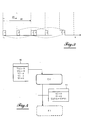
- the figure 3 allows to explain how a computer manages its ticks, or more generally its time windows in the context of the invention.
- the horizontal axis represents time t.
- Each vertical hyphen represents the beginning of a tick.
- the interval between two vertical lines represents both the temporal length and the periodicity of renewal of the ticks.
- the calculator tries to send the messages it has to send at a given moment, at the beginning of the tick so that it can hope to have sent the messages before the end of the tick in case of arbitration because of the simultaneous transmission of messages from other computers.
- the computer From a time t 0 defined by the first vertical line, the computer sends a message 1.
- the transmission period of the message 1 is equal to twice the periodicity of the ticks.
- the message 1 is re-issued from the third vertical line and then the fifth vertical line and so on.
- the computer sends a message 2 with an offset D1 with respect to t 0 .
- the shift D1 expressed in number of ticks, is here of a tick.
- Message 2 is issued from the second vertical line.
- the transmission period of the message 2 is twice the periodicity of the ticks.
- Message 2 is re-issued from the fourth vertical line and so on.
- the computer sends a message 3 with an offset D2 with respect to t 0 .
- the shift D2 expressed in number of ticks, is here two ticks.
- the message 3 is issued from the third vertical line, following the message 1 which has higher priority. In the case illustrated by the figure 3 , the transmission period of the message 3 is equal to twice the periodicity of the ticks.
- the message 3 is re-issued from the fifth vertical line and so on.
- the periodicity of the ticks must be an integer divisor of each message period so as to respect the period of each message in number of ticks.
- a tick period of 5 ms is appropriate when the messages have periods of 10 ms and 25 ms.
- an activation point 10 of a step E0 is activated for example by starting the process.
- the entry point 10 is represented by a stack of two blocks.
- the upper block is a premise or conditional part for performing actions that are contained in the lower block.
- the conditional part is empty and the action part is described now.
- An array of integers T1 (), named for example tabSommeNbBitMsgOnNetwork () in a computer program, in which each box is associated with a tick to hold a number of bits occupied by the messages in the tick, is initialized to zero.
- an array of integers T2 (), named for example tabSommeId () in a computer program, in which each box is associated with a tick to contain a sum of the identifiers of the messages present in the tick, is initialized to zero.
- An integer variable V1 is set with the value of the periodicity of the ticks which is predetermined according to the transmission periods of the messages.
- the periodicity of the ticks may be equal to the greatest common divisor of the message periods but not necessarily.
- the periodicity of the ticks may be equal to any common divisor of the message transmission periods.
- the greatest common divisor has the advantage of allowing a maximum of transmission silence following the grouped messages to be sent at the beginning of ticks.
- a smaller divider has the advantage of being able to space the transmission of messages better to immunize them against collisions.
- a value of 5 ms for the variable V1 is well adapted to the example of the figure 2 .
- An integer variable V2 named for example CptButton in a computer program, for counting process iterations by the method, and an integer variable V5 named for example Msg in a computer program, for counting the number of messages processed by the process, are initialized to zero.
- the step E0 begins by classifying the table 23, 24 in ascending order of the identifiers. So as we see on the figure 5 which has the rank of table 24, the smallest value identifier 0x4 is on the first line and the largest value identifier 0xA is on the last row of the table. A scan of the table represented in figure 5 from the zero line processes messages in decreasing order of priority.
- a scan of the table represented in figure 6 from the zero line, processes the messages in order of period and for identical period values, in order of decreasing priority.
- each transition is represented by a stack of two blocks.
- the upper block is a premise or conditional part for performing actions that are contained in the lower block.
- the conditional part of the transition 11 is empty insofar as the transition 11 simply follows the classifications, in the step E0, of the table which lists the messages. The action part is described now.
- a variable V3 named for example Pos in a computer program, for indicating an ordinal value of tick tested for placing a message
- an integer variable V4 named for example PosPrec in a computer program, for storing a ordinal value of tick selected previously to place the message, are set to zero.
- Variable V5 was initialized to zero according to the fact that at this preliminary stage of processing, no message has been processed yet.
- a step E1 consists of selecting a tick to place a current message.
- the selected tick gives the value of the first row of table T3 (V5).
- the first common message that is considered is therefore the one listed on the first line of Table 23.
- a transition 12 is conditioned by the following propositional formula: P ⁇ 1 ⁇ P ⁇ 2 ⁇ P ⁇ 4 ⁇ P ⁇ 5
- the sign ⁇ designates a logical conjunction and the sign ⁇ denotes a logical disjunction.
- Proposition P1 is defined to have the same truth values as: T ⁇ 1 V ⁇ 3 + T ⁇ 1 ⁇ V ⁇ 3 + V ⁇ 9 > T ⁇ 1 V ⁇ 4 + T ⁇ 1 ⁇ V ⁇ 4 + V ⁇ 9
- the member on the left represents the total quantity of bits of the messages that occupy the tick tested and the tick whose distance to the tested tick is equal to a transmission period of the current message.
- the right-hand side represents the total amount of message bits that occupy the previously selected tick and the tick whose distance to the previously selected tick is equal to a transmission period of the current message.
- Proposition P1 is valid when the member on the left is strictly superior to the member on the right. In other words, the proposition P1 is valid when placing the message in the tick tested leads to a number of bits greater than the placement of the message in the tick previously selected.
- the member on the left represents the total quantity of bits of the messages which occupy the tested tick and the tick whose distance to the tested tick is equal to a transmission period of the current message in a way identical to the proposal P1.
- the right-hand member represents the total amount of bits of the messages that occupy the previously selected tick and the tick whose distance to the tick previously selected is equal to a transmission period of the current message in the same way as the proposal P1.
- the P2 proposal is valid when the member on the left is equal to the member on the right. In other words, the proposition P2 is valid when a placement of the current message in the tick tested leads to a number of bits of the same value as that obtained by placing the current message in the tick previously selected.
- Proposition P4 is defined to have the same truth values as: T ⁇ 2 V ⁇ 3 + T ⁇ 2 ⁇ V ⁇ 3 + V ⁇ 9 • T ⁇ 2 V ⁇ 4 + T ⁇ 2 ⁇ V ⁇ 4 + V ⁇ 9
- the member on the left represents the sum of the identifiers of the messages which occupy the tested tick and the tick whose distance to the tested tick is equal to a transmission period of the current message.
- the right-hand side represents the sum of the message identifiers that occupy the previously selected tick and the tick whose distance to the tick previously selected is equal to a transmission period of the current message.
- Proposition P4 is valid when the member on the left is less than or equal to the member on the right. In other words, the proposition P4 is valid when a placement of the current message in the tick tested leads to a sum of the message identifiers less than or equal to the sum of the message identifiers which is obtained by placing the current message in the message. tick previously selected. In other words again, the proposition P4 is valid when a placement of the current message in the tick tested decreases the priority of the messages of the tested tick with respect to the tick previously selected.
- Proposition P5 is defined to have the same truth values as: V ⁇ 2 • V ⁇ 9 / V ⁇ 1 - 1
- Proposition P5 is valid when adding 1 to the loop counter gives a value less than or equal to the ratio of the period of the current message by the periodicity of the ticks. In other words, the Proposition P5 is valid as long as the content of the loop counter is less than or equal to the amount of ticks in the time interval between two successive transmissions of the current message, minus one unit. In other words again, the proposition P5 is valid as long as the processing iterations by the method have not reached the number corresponding to the quantity of ticks contained in a transmission period of the current message.
- conditional part of the transition 12 is valid as long as the number of processing iterations is less than the period associated with the current message expressed in number of ticks and when the placement of the current message in the tick tested leads to a congestion greater than that obtained by placing the current message in the tick previously selected or equal congestion, when the placement of the current message in the tick tested leads to a higher overall priority than that obtained by placing the current message in the tick previously selected.
- the loop counter is incremented to indicate a next iteration of the method. If the number of ticks in the period of the current message minus the ordinal value V3 of tick that has just been tested is equal to unity, the ordinal value of the tick to be tested is reduced to zero. If not, the ordinal value V3 of tick tested, is incremented so as to test the tick that succeeds the tick that has just been tested.
- the transition 12 is looped the E1 step on itself so that the ticks are tested following each other as the E1 step loops back on itself.
- a transition 13 is conditioned by the following propositional formula: P ⁇ 2 ⁇ ⁇ P ⁇ 4 ⁇ P ⁇ 5 ⁇ P ⁇ 3 ⁇ P ⁇ 5
- Proposition P3 is defined to have the same truth values as: T ⁇ 1 V ⁇ 3 + T ⁇ 1 ⁇ V ⁇ 3 + V ⁇ 9 ⁇ T ⁇ 1 V ⁇ 4 + T ⁇ 1 ⁇ V ⁇ 4 + V ⁇ 9
- the member on the left represents the total quantity of bits of the messages which occupy the tick tested and the tick whose distance to the tested tick is equal to a transmission period of the current message.
- the right-hand side represents the total amount of message bits that occupy the previously selected tick and the tick whose distance to the previously selected tick is equal to a transmission period of the current message.
- Proposition P3 is valid when the member on the left is strictly lower than the member on the right. In other words, the proposition P3 is valid when a placement of the message in the tick tested leads to a number of bits lower than the placement of the message in the tick previously selected.
- conditional part of the transition 13 is valid as long as the number of iterations of processing is less than the period associated with the current message expressed in number of ticks and when the placement of the current message in the tick tested leads to a smaller footprint than obtained by placing the current message in the previously selected tick or equal congestion, when the placement of the current message in the tick tested does not lead to a higher overall priority than that obtained by placing the current message in the tick previously selected.
- the integer variable V4 for storing the previously selected tick ordinal value is set to the ordinal value V3 of tick tested.
- Offset value T3 (V5) associated with the current message is set to the value of the product of the ordinal value of tick tested by the periodicity of the tick, simply so as to express the offset in ms rather than in number of ticks. Alternatively, the offset can also be expressed in number of ticks.
- the loop counter is incremented to indicate a next iteration of the method. If the number of ticks in the period of the current message minus the ordinal value V3 of tick that has just been tested is equal to unity, the ordinal value of the tick to be tested is reduced to zero. Otherwise the ordinal value V3 tick tested, is incremented so as to point to the next tick to succeed the tick that has just been tested.
- the transition 13 activates from the step E1, a step E2 described later with reference to the figure 8 .
- a transition 14 is conditioned by the following propositional formula: ⁇ P ⁇ 5
- conditional part of the transition 14 is valid as soon as the content of the loop counter is greater than the amount of ticks included in the time interval that separates two successive transmissions from the current message, minus one unit. In other words, the conditional part of the transition 14 is valid as soon as the processing iterations have reached the number corresponding to the quantity of ticks contained in a transmission period of the current message.
- the action part of the transition 14 updates the tables T1 () and T2 (). More precisely, the number of bits of the current message is added to the value T1 (V4) referenced in the table by the ordinal value of the selected tick and the value of the identifier of the current message is added to the referenced value T2 (V4). in the table by the ordinal value of the selected tick. Variable V3 which indicates the ordinal value of the tested tick is reset. The variable V2 for counting the processing iterations within the process, is reset so that subsequent iterations can be counted within another loopback on steps E1 and E2.
- the transition 14 activates from the step E1, a step E3 described later with reference to the figure 8 .
- step E2 With reference to the figure 8 we begin by describing step E2.
- a transition 15 is conditioned by the following unary propositional formula: P ⁇ 5
- conditional part of the transition 16 is valid as long as the processing iterations by the method have not reached the number corresponding to the amount of ticks contained in a transmission period of the current message.
- the active part of the transition increments the variable V3 which indicates the ordinal value of the tick tested.
- Transition 15 reactivates step E1 from step E2.
- Step E1 is then reactivated with a unit ordinal value of tick tested if the variable V3 was reset by entering step E2 and with an ordinal value equal to the old ordinal value of tick tested increased by one. unit in the opposite case.
- a transition 16 is identical to the transition 14 to activate the step E3 from the step E2.
- Step E3 is to find the location where there is a maximum of empty ticks.
- An integer variable V6 named for example IndexDebutTickVide in a computer program, is provided for storing a first tick position after which a number of successive empty ticks is maximum.
- An integer variable V7 named for example IndexFinTickVide in a computer program, is provided for storing a last tick position preceded by a number of successive empty ticks which is maximal.
- An integer variable V8 named for example NbTickVide in a computer program, is provided for storing a number of successive empty ticks between the values of V6 and V7.
- step E3 Upon activation of step E3, the variables V6, V7 and V8 are initialized to zero. Those skilled in the art can easily develop other mechanisms without departing from the scope of the present invention.
- a first test is to check if the tick indexed by the value of variable V6 is empty.
- variables V6 and V7 are incremented and the first test is reiterated as long as the variable V6 has not reached the value of the transmission period which is associated with the current message.
- variable V8 is set to a unit value and the variable V7 is incremented so as to execute a second test.
- the second test is to check if the tick indexed by the value of variable V7 is empty.
- variable V8 and variable V7 are incremented so as to repeat the second test.
- the third test is to check if the tick indexed by the value of variable V7 is empty.
- variable V7 is incremented and the third test is reiterated.
- variable V'8 of the same type as the variable V8 is set to a value of unit value and variable V7 is incremented to execute a fourth test.
- the fourth test is to check if the tick indexed by the value of variable V7 is empty.
- variable V'8 and variable V7 are incremented so as to repeat the fourth test.
- V8 and V'8 are compared. If V8 is greater than V'8, the values of V6 and V8 are retained. Otherwise the value of V8 is set to the value of V'8 and the value of V6 is set to V7-V'8. Variable V7 is incremented to re execute the third test.
- the transition 17 activates from step E3, a step E4 which is now described with reference to the figure 9 .
- Step E4 is provided to check whether there are still messages to be processed by means of a Boolean variable B1, named for example MessageAprocessor in a computer program.
- a state for example at 1, indicates that there are still messages to be processed.
- Another state for example at 0, indicates that there are no more messages to be processed, this is the case especially when the end of the table of the figure 1 or 2 is reached.
- the conditional part of a transition 18 is validated when the Boolean variable B1 indicates that there still exists at least one message to be processed.
- the part action of the transition 18 points to the next message by incrementing the variable V5. From step E4, the transition 18 activates a step E5.
- step E5 the current message that is considered is the message pointed by V5 whose period is given by the variable V9.
- the purpose of step E5 is to check the presence of a message in the tick distant from a period with respect to the tick indexed by the variable V3.
- the conditional part of a transition 20 is validated when the sum of the bits contained in the tick indexed by the variable V3 and in the tick indexed by the sum of the variables V3 and V9, is zero, or when the variable V3 is equal to the variable V6, in other words, when the tested tick is the start tick of the empty ticks sequence of maximum length.
- the action part of the transition 20 is empty.
- transition 20 reactivates step E1.
- the conditional part of a transition 21 is validated when the sum of the bits contained in the tick indexed by the variable V3 and in the tick indexed by the sum of the variables V3 and V9, is not zero, and when the variable V3 n is not equal to variable V6, in other words, when the tested tick is not the start tick of the empty ticks sequence of maximum length.
- the action part of the transition 20 sets the variable V7 which indicates the end of the list of empty ticks, to the value of the variable V3 which indicates the tested tick.
- step E5 the transition 21 activates a step E6 in which there is a message in the tick distant from a period with respect to the tick tested.
- the action part we also divide by 2 the length of the list of empty ticks.
- transition 22 reactivates step E5.
- a transition 19 is valid when there is no more message to process. From the fourth step E4, the transition 19 activates a seventh step E7 which marks the end of the process.
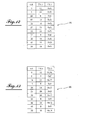
- the figure 10 shows the state of the table 23 when the process arrives in step E7.
- the right column contains a zero offset for the identified messages 0x0 and 0xA whose length for each is eight bytes, or sixty four bits.
- the associative table 25 shown on the figure 12 associates tables T1 () and T2 () with each tick of 5 ms in which is placed a message listed in the table 23.
- the right column of table 23 contains an offset of two ticks, ie 10 ms for the identified messages 0x2 and 0x6.
- the figure 11 shows the state of the table 24 when the process arrives in step E7.
- the right column contains a zero offset for the identified 0x0, 0xA, and 0x4 messages whose length is six bytes, eight bytes, and two bytes, respectively.
- the associative table 26 represented on the figure 13 associates tables T1 () and T2 () with each tick of 5 ms in which is placed a message listed in the table 24.
- the right column of the table 24 contains an offset of one tick, ie 5 ms for the identified messages 0x9 and 0x6 of length respectively eight bytes and one byte.
- the message 0x9 is found in the distant ordinal value tick 3 of 15 ms, in the remote ordinal value tick 5 at 25 ms, in the ordinal value tick 7 at a distance of 35 ms, and in the remote ordinal value tick 9 45 ms, in which the cumulation of its length leads to a congestion respectively of eight, ten, eight and eight bytes.
- the message 0x6 is found in the ordinal value tick 3 30 ms apart, in which the cumulation of its length leads to a congestion of fourteen bytes.
Landscapes
- Engineering & Computer Science (AREA)
- Computer Networks & Wireless Communication (AREA)
- Signal Processing (AREA)
- Computer And Data Communications (AREA)
- Information Transfer Between Computers (AREA)
Claims (15)
- Verfahren zum Senden von einem Rechner von Nachrichten, mit welchen jeweils eine Sendeperiode (V9) assoziiert ist,
indem die Nachrichten in Zeitfenstern mit vorbestimmter Periodizität (V1) derart verteilt werden, dass jede Sendeperiode ein ganzzahliges Vielfaches der Periodizität ist,
wobei die Nachrichten in Fenstern platziert werden, die mit Verschiebungen in Bezug auf ein anfängliches Fenster derart ausgewählt werden, dass Kollisionen mit Nachrichten, die von einem anderen Rechner gesendet werden, oder mit Nachrichten, die auf dem Netzwerk vorhanden sind, vermieden oder verringert werden, und bei dem zum Auswählen jedes Fensters das Verfahren dadurch gekennzeichnet ist, dass es Folgendes umfasst:- einen ersten Schritt (E1), ab welchem für eine aktuelle Nachricht, die aus den Nachrichten ausgewählt ist, aufeinanderfolgende Zeitfenster in einer Anzahl kleiner um eine Einheit als das ganzzahlige Vielfache, das die Sendeperiode ausdrückt, die mit der aktuellen Nachricht assoziiert ist, getestet werden, indem für jedes getestete Fenster mindestens die Bitmenge berechnet wird, die in dem getesteten Fenster und in einem Fenster, das auf das getestete Fenster nach einer Sendeperiode folgt, wenn die aktuelle Nachricht in das getestete Fenster platziert wird, enthalten ist, und- einen zweiten Schritt (E2), bei dem das zum Platzieren der Nachricht ausgewählte Fenster dasjenige ist, für das mindestens die berechnete Bitmenge minimal ist. - Verfahren nach Anspruch 1, dadurch gekennzeichnet, dass- bei dem ersten Schritt (E1) für jedes getestete Fenster eine mittlere Priorität der Nachrichten berechnet wird, die in dem getesteten Fenster und dem Fenster, das auf das getestete Fenster nach einer Sendeperiode folgt, nachdem die aktuelle Nachricht in das getestete Fenster platziert wurde, enthalten sind, und- bei dem zweiten Schritt (E2) aus den zwei getesteten Fenstern, für die die berechnete Bitmenge minimal ist, das ausgewählte Fenster dasjenige ist, für das die mittlere Priorität die niedrigste ist.
- Verfahren nach Anspruch 2, dadurch gekennzeichnet, dass bei dem zweiten Schritt (E2) unter zwei getesteten Fenstern, für die die berechnete Bitmenge minimal ist und die mittlere Priorität identisches Niveau hat, das ausgewählte Fenster das zuvor getestete ist.
- Verfahren nach einem der Ansprüche 1 bis 3, dadurch gekennzeichnet, dass es einen anfänglichen Schritt (E0) umfasst, der vor den anderen Schritten ausgeführt wird und bei dem die zu sendenden Nachrichten in der Reihenfolge zunehmender Sendeperioden eingestuft sind, und die Nachrichten, mit welchen identische Sendeperioden assoziiert sind, in der Reihenfolge sinkender Prioritäten eingestuft sind.
- Verfahren nach einem der Ansprüche 1 bis 4, dadurch gekennzeichnet, dass die aktuelle Nachricht, die für eine erste Ausführung des ersten Schritts (E1) ausgewählt ist, die Nachricht ist, bei der die assoziierte Sendeperiode die niedrigste ist und unter den Nachrichten mit niedrigster Sendeperiode die Nachricht mit höchster Priorität ist.
- Verfahren nach einem der Ansprüche 1 bis 5, dadurch gekennzeichnet, dass die zu sendenden Nachrichten zum Ausführen des ersten Schritts (E1) und des zweiten Schritts (E2) in der Reihenfolge zunehmender Sendeperioden und für identische Sendeperioden in der Reihenfolge abnehmender Prioritäten ausgewählt werden.
- Verfahren nach Anspruch 6, dadurch gekennzeichnet, dass es einen dritten Schritt (E3) umfasst, der ausgeführt wird, nachdem das Zeitfenster ausgewählt wurde, das für die aktuelle Nachricht geeignet ist, so dass eine Position (V6) des Zeitfensters gefunden wird, die eine Folge mit maximaler Länge aufeinanderfolgender leerer Zeitfenster beginnt.
- Verfahren nach Anspruch 7, dadurch gekennzeichnet, dass nach Ausführung des dritten Schritt (E3) das getestete Fenster in der Mitte der Folge positioniert wird und die Länge der Folge um die Hälfte verringert wird.
- Verfahren nach Anspruch 8, dadurch gekennzeichnet, dass es Folgendes umfasst:- einen vierten Schritt (E4), bei dem beobachtet wird, ob noch eine zu verarbeitende Nachricht existiert, und- einen fünften Schritt (E5), der ausgeführt wird, falls noch eine zu verarbeitende Nachricht existiert, indem die beobachtete Nachricht als neue aktuelle Nachricht derart genommen wird, dass der erste Schritt (E1) erneut für die neue aktuelle Nachricht ausgeführt wird, wenn die Bitmenge, die in dem getesteten Fenster und in dem Fenster, das auf das getestete Fenster nach einer Sendeperiode enthalten ist, null ist, oder wenn ein Ordinalwert (V3) des getesteten Fensters gleich der Position (V6) des Zeitfensters ist, das eine Folge mit maximaler Länge aufeinanderfolgender leerer Zeitfenster beginnt.
- Verfahren nach Anspruch 9, dadurch gekennzeichnet, dass es einen sechsten Schritt (E6) umfasst, der nach dem fünften Schritt (E5) ausgeführt wird, wenn die Bitmenge, die in dem getesteten Fenster und in dem auf das getestete Fenster nach einer Sendeperiode folgenden Fenster enthalten ist, nicht null ist, und wenn der Ordinalwert (V3) des getesteten Fensters nicht gleich der Position (V6) des Zeitfensters ist, das eine Folge aufeinanderfolgender leerer Zeitfenster mit maximaler Länge beginnt, so dass der fünfte Schritt (E5) erneut ausgeführt wird, nachdem das getestete Fenster in der Mitte der um die maximale Länge aufeinanderfolgender leerer Zeitfenster verringerten Folge positioniert und die verringerte Folge erneut um die Hälfte verringert wurde.
- Verfahren nach einem der Ansprüche 1 bis 10, dadurch gekennzeichnet, dass, solange der erste Schritt (E1) oder der zweite Schritt (E2) ausgeführt wird, der Ordinalwert (V3) des getesteten Fensters auf null gestellt wird, wenn der Ordinalwert die Anzahl erreicht, die niedriger als eine Einheit des ganzzahligen Vielfachen, das die Sendeperiode ausdrückt, die mit der aktuellen Nachricht assoziiert ist, ist.
- Computerprogrammprodukt, das direkt in den internen Speicher eines digitalen Rechners geladen wird, das Softwarecodeabschnitte für die Ausführung der Verfahrensschritte nach einem der Ansprüche 1 bis 10 umfasst, wenn das Programm auf einem Rechner ausgeführt wird.
- Rechner, der eingerichtet ist, um Nachrichten zu senden, mit welchen jeweils eine Sendeperiode (V9) assoziiert ist, der Folgendes im Speicher enthält:- eine erste Variable (V1) zum Angeben einer Periodizität von Zeitfenstern, die derart vorbestimmt ist, dass jede Sendeperiode durch ein ganzzahliges Vielfaches der Periodizität ausgedrückt werden kann,- eine Assoziationstabelle (23, 24), in der die Nachrichten jeweils mit einer Fensterverschiebung in Bezug auf ein anfängliches Verschiebungsfenster gleich null derart assoziiert werden, dass Kollisionen mit Nachrichten, die von einem anderen Rechner gesendet werden, oder mit Nachrichten, die auf dem Netzwerk vorhanden sind, vermieden oder verringert werden, dadurch gekennzeichnet, dass das Senden der Nachrichten durch den Rechner mit dem Verfahren nach einem der Ansprüche 1 bis 11 bestimmt wird.
- Rechner nach Anspruch 13, dadurch gekennzeichnet, dass die mit den Nachrichten assoziierten Verschiebungen zu einer Verteilung der Nachrichten in den Zeitfenstern führen, die eine minimale Belegungslast der Fenster durch die Nachrichten ergibt.
- Rechner nach Anspruch 13 oder 14, dadurch gekennzeichnet, dass die Nachrichten in der Assoziationstabelle (23, 24) in der Reihenfolge zunehmender Sendeperioden eingestuft sind, und dass die Nachrichten, mit welchen ein und dieselbe Sendeperiode assoziiert ist, in der Reihenfolge sinkender Prioritäten eingestuft sind.
Applications Claiming Priority (2)
| Application Number | Priority Date | Filing Date | Title |
|---|---|---|---|
| FR0952861A FR2945170B1 (fr) | 2009-04-30 | 2009-04-30 | Procede pour emettre des messages periodiques |
| PCT/FR2010/050777 WO2010125284A1 (fr) | 2009-04-30 | 2010-04-23 | Procédé pour émettre des messages périodiques |
Publications (2)
| Publication Number | Publication Date |
|---|---|
| EP2425589A1 EP2425589A1 (de) | 2012-03-07 |
| EP2425589B1 true EP2425589B1 (de) | 2015-06-10 |
Family
ID=41449863
Family Applications (1)
| Application Number | Title | Priority Date | Filing Date |
|---|---|---|---|
| EP10727026.6A Not-in-force EP2425589B1 (de) | 2009-04-30 | 2010-04-23 | Verfahren zum senden von periodischen nachrichten |
Country Status (5)
| Country | Link |
|---|---|
| EP (1) | EP2425589B1 (de) |
| CN (1) | CN102461084B (de) |
| FR (1) | FR2945170B1 (de) |
| RU (1) | RU2553082C2 (de) |
| WO (1) | WO2010125284A1 (de) |
Families Citing this family (3)
| Publication number | Priority date | Publication date | Assignee | Title |
|---|---|---|---|---|
| CN102546332B (zh) * | 2010-12-14 | 2015-06-17 | 黄越杰 | 上位机与下位机的组网通讯方法 |
| FR3007143B1 (fr) * | 2013-06-17 | 2015-07-17 | Schneider Electric Ind Sas | Systeme de calcul d'une grandeur electrique, poste de transformation comprenant un tel systeme et procede de calcul d'une grandeur electrique avec un tel systeme |
| CN121711316A (zh) * | 2024-09-18 | 2026-03-20 | 上海汽车集团股份有限公司 | 报文的发送方法和装置、存储介质及计算机程序产品 |
Family Cites Families (5)
| Publication number | Priority date | Publication date | Assignee | Title |
|---|---|---|---|---|
| US4855996A (en) * | 1988-08-03 | 1989-08-08 | American Telephone And Telegraph Company | Time division multiplex arrangement |
| ZA957816B (en) * | 1994-09-30 | 1996-05-31 | Qualcomm Inc | Method and apparatus for providing broadcast messages in a communications network |
| US6456191B1 (en) * | 1999-03-23 | 2002-09-24 | Exi Wireless Systems Inc. | Tag system with anti-collision features |
| DE10200201A1 (de) | 2002-01-04 | 2003-07-24 | Daimler Chrysler Ag | Zyklusbasiertes zeitgesteuertes Kommunikationssystem |
| DE112004002562A5 (de) * | 2004-02-25 | 2007-07-19 | Siemens Ag | Verfahren und Anordnung zur Zusammenfassung von Zeitmultiplex-Signalen |
-
2009
- 2009-04-30 FR FR0952861A patent/FR2945170B1/fr not_active Expired - Fee Related
-
2010
- 2010-04-23 WO PCT/FR2010/050777 patent/WO2010125284A1/fr not_active Ceased
- 2010-04-23 CN CN201080029377.XA patent/CN102461084B/zh not_active Expired - Fee Related
- 2010-04-23 EP EP10727026.6A patent/EP2425589B1/de not_active Not-in-force
- 2010-04-23 RU RU2011148588/08A patent/RU2553082C2/ru active
Also Published As
| Publication number | Publication date |
|---|---|
| CN102461084A (zh) | 2012-05-16 |
| CN102461084B (zh) | 2014-07-02 |
| FR2945170B1 (fr) | 2012-02-24 |
| RU2553082C2 (ru) | 2015-06-10 |
| EP2425589A1 (de) | 2012-03-07 |
| WO2010125284A1 (fr) | 2010-11-04 |
| RU2011148588A (ru) | 2013-06-10 |
| FR2945170A1 (fr) | 2010-11-05 |
Similar Documents
| Publication | Publication Date | Title |
|---|---|---|
| EP1805611B1 (de) | Task-verarbeitungs-einteilungsverfahren und einrichtung zu seiner implementierung | |
| EP2466981B1 (de) | Ressourcen-Zuordnungsverfahren in einem vermaschten Mobilfunknetz mit Begrenzung der Inter-Cluster-Interferenzen, sowie System zur Umsetzung dieses Verfahrens | |
| WO2007048987A1 (fr) | Routeur et reseau de routage | |
| FR2758681A1 (fr) | Allocation a une pluralite d'elements d'autorisations d'acces a une ressource partagee | |
| FR2998748A1 (fr) | Dispositif et procede de retransmission de donnees dans un commutateur reseau | |
| EP2248386B1 (de) | Verfahren und vorrichtung zur zugangskontrolle in einem drahtlosen telekommunikationsnetz | |
| EP2314018A1 (de) | Technik zum kommunizieren zwischen mehreren knoten | |
| EP2425589A1 (de) | Verfahren zum senden von periodischen nachrichten | |
| CN108521382B (zh) | 一种消息发送方法、装置及系统 | |
| EP2815624B1 (de) | Ressourcen-zuordnung | |
| FR3069326A1 (fr) | Procede de releve d'informations d'un ensemble de compteurs electriques | |
| US20170010943A1 (en) | Ordering device, data processing device, ordering method, computer program product, and multiplex system | |
| EP3205175A1 (de) | Verfahren zur autorisierung von übertragungsanfragen | |
| EP1841151A1 (de) | Übertragungsschaltungssystem | |
| WO2012149775A1 (zh) | 数据处理的方法和装置 | |
| EP3776946A1 (de) | Drahtloskommunikationsvorrichtungen, -systeme und -verfahren zur decodierung von datenpaketen zur einrichtung latenzkritischer dienste | |
| EP3162155B1 (de) | Übertragungssteuerungsverfahren zur implementierung durch eine station in einem telekommunikationsnetz | |
| CN113839879A (zh) | 流量管理芯片控制方法、芯片及存储介质 | |
| EP3437406B1 (de) | Verfahren zur verwaltung der zuweisung von trägerfrequenzen | |
| EP2890200A1 (de) | Verfahren zur Übertragung von Nachrichten unterschiedlicher Prioritätsstufen zwischen Sender-Empfänger-Knoten eines Ad-Hoc-Netzes | |
| CN120499175A (zh) | 基于BitTorrent协议的数据传输方法、设备及存储介质 | |
| WO2006117448A1 (fr) | Procede d'ordonnancement de paquets appartenant à des flots et equipement associé | |
| EP2901627A2 (de) | Verfahren und vorrichtung zum regeln einer übertragung in einem telekommunikationsnetz | |
| FR2765429A1 (fr) | Allocation a une pluralite d'elements d'autorisations d'acces a une ressource partagee | |
| FR3017507A1 (fr) | Procede d'analyse de flux de paquets de donnees |
Legal Events
| Date | Code | Title | Description |
|---|---|---|---|
| PUAI | Public reference made under article 153(3) epc to a published international application that has entered the european phase |
Free format text: ORIGINAL CODE: 0009012 |
|
| 17P | Request for examination filed |
Effective date: 20111109 |
|
| AK | Designated contracting states |
Kind code of ref document: A1 Designated state(s): AT BE BG CH CY CZ DE DK EE ES FI FR GB GR HR HU IE IS IT LI LT LU LV MC MK MT NL NO PL PT RO SE SI SK SM TR |
|
| DAX | Request for extension of the european patent (deleted) | ||
| 17Q | First examination report despatched |
Effective date: 20120803 |
|
| GRAP | Despatch of communication of intention to grant a patent |
Free format text: ORIGINAL CODE: EPIDOSNIGR1 |
|
| INTG | Intention to grant announced |
Effective date: 20150317 |
|
| GRAS | Grant fee paid |
Free format text: ORIGINAL CODE: EPIDOSNIGR3 |
|
| GRAA | (expected) grant |
Free format text: ORIGINAL CODE: 0009210 |
|
| AK | Designated contracting states |
Kind code of ref document: B1 Designated state(s): AT BE BG CH CY CZ DE DK EE ES FI FR GB GR HR HU IE IS IT LI LT LU LV MC MK MT NL NO PL PT RO SE SI SK SM TR |
|
| REG | Reference to a national code |
Ref country code: GB Ref legal event code: FG4D Free format text: NOT ENGLISH |
|
| REG | Reference to a national code |
Ref country code: CH Ref legal event code: EP |
|
| REG | Reference to a national code |
Ref country code: AT Ref legal event code: REF Ref document number: 731303 Country of ref document: AT Kind code of ref document: T Effective date: 20150715 |
|
| REG | Reference to a national code |
Ref country code: DE Ref legal event code: R096 Ref document number: 602010025157 Country of ref document: DE |
|
| REG | Reference to a national code |
Ref country code: IE Ref legal event code: FG4D Free format text: LANGUAGE OF EP DOCUMENT: FRENCH |
|
| PG25 | Lapsed in a contracting state [announced via postgrant information from national office to epo] |
Ref country code: NO Free format text: LAPSE BECAUSE OF FAILURE TO SUBMIT A TRANSLATION OF THE DESCRIPTION OR TO PAY THE FEE WITHIN THE PRESCRIBED TIME-LIMIT Effective date: 20150910 Ref country code: FI Free format text: LAPSE BECAUSE OF FAILURE TO SUBMIT A TRANSLATION OF THE DESCRIPTION OR TO PAY THE FEE WITHIN THE PRESCRIBED TIME-LIMIT Effective date: 20150610 Ref country code: ES Free format text: LAPSE BECAUSE OF FAILURE TO SUBMIT A TRANSLATION OF THE DESCRIPTION OR TO PAY THE FEE WITHIN THE PRESCRIBED TIME-LIMIT Effective date: 20150610 Ref country code: LT Free format text: LAPSE BECAUSE OF FAILURE TO SUBMIT A TRANSLATION OF THE DESCRIPTION OR TO PAY THE FEE WITHIN THE PRESCRIBED TIME-LIMIT Effective date: 20150610 |
|
| REG | Reference to a national code |
Ref country code: AT Ref legal event code: MK05 Ref document number: 731303 Country of ref document: AT Kind code of ref document: T Effective date: 20150610 |
|
| REG | Reference to a national code |
Ref country code: NL Ref legal event code: MP Effective date: 20150610 |
|
| PG25 | Lapsed in a contracting state [announced via postgrant information from national office to epo] |
Ref country code: GR Free format text: LAPSE BECAUSE OF FAILURE TO SUBMIT A TRANSLATION OF THE DESCRIPTION OR TO PAY THE FEE WITHIN THE PRESCRIBED TIME-LIMIT Effective date: 20150911 Ref country code: BG Free format text: LAPSE BECAUSE OF FAILURE TO SUBMIT A TRANSLATION OF THE DESCRIPTION OR TO PAY THE FEE WITHIN THE PRESCRIBED TIME-LIMIT Effective date: 20150910 Ref country code: LV Free format text: LAPSE BECAUSE OF FAILURE TO SUBMIT A TRANSLATION OF THE DESCRIPTION OR TO PAY THE FEE WITHIN THE PRESCRIBED TIME-LIMIT Effective date: 20150610 |
|
| REG | Reference to a national code |
Ref country code: DE Ref legal event code: R084 Ref document number: 602010025157 Country of ref document: DE |
|
| PG25 | Lapsed in a contracting state [announced via postgrant information from national office to epo] |
Ref country code: EE Free format text: LAPSE BECAUSE OF FAILURE TO SUBMIT A TRANSLATION OF THE DESCRIPTION OR TO PAY THE FEE WITHIN THE PRESCRIBED TIME-LIMIT Effective date: 20150610 |
|
| REG | Reference to a national code |
Ref country code: GB Ref legal event code: 746 Effective date: 20160119 |
|
| PG25 | Lapsed in a contracting state [announced via postgrant information from national office to epo] |
Ref country code: PL Free format text: LAPSE BECAUSE OF FAILURE TO SUBMIT A TRANSLATION OF THE DESCRIPTION OR TO PAY THE FEE WITHIN THE PRESCRIBED TIME-LIMIT Effective date: 20150610 Ref country code: CZ Free format text: LAPSE BECAUSE OF FAILURE TO SUBMIT A TRANSLATION OF THE DESCRIPTION OR TO PAY THE FEE WITHIN THE PRESCRIBED TIME-LIMIT Effective date: 20150610 Ref country code: RO Free format text: LAPSE BECAUSE OF NON-PAYMENT OF DUE FEES Effective date: 20150610 Ref country code: SK Free format text: LAPSE BECAUSE OF FAILURE TO SUBMIT A TRANSLATION OF THE DESCRIPTION OR TO PAY THE FEE WITHIN THE PRESCRIBED TIME-LIMIT Effective date: 20150610 Ref country code: AT Free format text: LAPSE BECAUSE OF FAILURE TO SUBMIT A TRANSLATION OF THE DESCRIPTION OR TO PAY THE FEE WITHIN THE PRESCRIBED TIME-LIMIT Effective date: 20150610 Ref country code: PT Free format text: LAPSE BECAUSE OF FAILURE TO SUBMIT A TRANSLATION OF THE DESCRIPTION OR TO PAY THE FEE WITHIN THE PRESCRIBED TIME-LIMIT Effective date: 20151012 Ref country code: IS Free format text: LAPSE BECAUSE OF FAILURE TO SUBMIT A TRANSLATION OF THE DESCRIPTION OR TO PAY THE FEE WITHIN THE PRESCRIBED TIME-LIMIT Effective date: 20151010 |
|
| REG | Reference to a national code |
Ref country code: DE Ref legal event code: R097 Ref document number: 602010025157 Country of ref document: DE |
|
| REG | Reference to a national code |
Ref country code: FR Ref legal event code: PLFP Year of fee payment: 7 |
|
| PLBE | No opposition filed within time limit |
Free format text: ORIGINAL CODE: 0009261 |
|
| STAA | Information on the status of an ep patent application or granted ep patent |
Free format text: STATUS: NO OPPOSITION FILED WITHIN TIME LIMIT |
|
| PG25 | Lapsed in a contracting state [announced via postgrant information from national office to epo] |
Ref country code: DK Free format text: LAPSE BECAUSE OF FAILURE TO SUBMIT A TRANSLATION OF THE DESCRIPTION OR TO PAY THE FEE WITHIN THE PRESCRIBED TIME-LIMIT Effective date: 20150610 Ref country code: IT Free format text: LAPSE BECAUSE OF FAILURE TO SUBMIT A TRANSLATION OF THE DESCRIPTION OR TO PAY THE FEE WITHIN THE PRESCRIBED TIME-LIMIT Effective date: 20150610 |
|
| 26N | No opposition filed |
Effective date: 20160311 |
|
| PG25 | Lapsed in a contracting state [announced via postgrant information from national office to epo] |
Ref country code: SI Free format text: LAPSE BECAUSE OF FAILURE TO SUBMIT A TRANSLATION OF THE DESCRIPTION OR TO PAY THE FEE WITHIN THE PRESCRIBED TIME-LIMIT Effective date: 20150610 |
|
| PG25 | Lapsed in a contracting state [announced via postgrant information from national office to epo] |
Ref country code: BE Free format text: LAPSE BECAUSE OF NON-PAYMENT OF DUE FEES Effective date: 20160430 |
|
| REG | Reference to a national code |
Ref country code: CH Ref legal event code: PL |
|
| PG25 | Lapsed in a contracting state [announced via postgrant information from national office to epo] |
Ref country code: LU Free format text: LAPSE BECAUSE OF FAILURE TO SUBMIT A TRANSLATION OF THE DESCRIPTION OR TO PAY THE FEE WITHIN THE PRESCRIBED TIME-LIMIT Effective date: 20160423 |
|
| REG | Reference to a national code |
Ref country code: IE Ref legal event code: MM4A |
|
| PG25 | Lapsed in a contracting state [announced via postgrant information from national office to epo] |
Ref country code: LI Free format text: LAPSE BECAUSE OF NON-PAYMENT OF DUE FEES Effective date: 20160430 Ref country code: CH Free format text: LAPSE BECAUSE OF NON-PAYMENT OF DUE FEES Effective date: 20160430 |
|
| REG | Reference to a national code |
Ref country code: FR Ref legal event code: PLFP Year of fee payment: 8 |
|
| PG25 | Lapsed in a contracting state [announced via postgrant information from national office to epo] |
Ref country code: IE Free format text: LAPSE BECAUSE OF NON-PAYMENT OF DUE FEES Effective date: 20160423 |
|
| PG25 | Lapsed in a contracting state [announced via postgrant information from national office to epo] |
Ref country code: NL Free format text: LAPSE BECAUSE OF FAILURE TO SUBMIT A TRANSLATION OF THE DESCRIPTION OR TO PAY THE FEE WITHIN THE PRESCRIBED TIME-LIMIT Effective date: 20150610 Ref country code: SE Free format text: LAPSE BECAUSE OF FAILURE TO SUBMIT A TRANSLATION OF THE DESCRIPTION OR TO PAY THE FEE WITHIN THE PRESCRIBED TIME-LIMIT Effective date: 20150610 |
|
| REG | Reference to a national code |
Ref country code: FR Ref legal event code: PLFP Year of fee payment: 9 |
|
| PG25 | Lapsed in a contracting state [announced via postgrant information from national office to epo] |
Ref country code: CY Free format text: LAPSE BECAUSE OF FAILURE TO SUBMIT A TRANSLATION OF THE DESCRIPTION OR TO PAY THE FEE WITHIN THE PRESCRIBED TIME-LIMIT Effective date: 20150610 Ref country code: HU Free format text: LAPSE BECAUSE OF FAILURE TO SUBMIT A TRANSLATION OF THE DESCRIPTION OR TO PAY THE FEE WITHIN THE PRESCRIBED TIME-LIMIT; INVALID AB INITIO Effective date: 20100423 Ref country code: SM Free format text: LAPSE BECAUSE OF FAILURE TO SUBMIT A TRANSLATION OF THE DESCRIPTION OR TO PAY THE FEE WITHIN THE PRESCRIBED TIME-LIMIT Effective date: 20150610 |
|
| PG25 | Lapsed in a contracting state [announced via postgrant information from national office to epo] |
Ref country code: MT Free format text: LAPSE BECAUSE OF FAILURE TO SUBMIT A TRANSLATION OF THE DESCRIPTION OR TO PAY THE FEE WITHIN THE PRESCRIBED TIME-LIMIT Effective date: 20150610 Ref country code: TR Free format text: LAPSE BECAUSE OF FAILURE TO SUBMIT A TRANSLATION OF THE DESCRIPTION OR TO PAY THE FEE WITHIN THE PRESCRIBED TIME-LIMIT Effective date: 20150610 Ref country code: MK Free format text: LAPSE BECAUSE OF FAILURE TO SUBMIT A TRANSLATION OF THE DESCRIPTION OR TO PAY THE FEE WITHIN THE PRESCRIBED TIME-LIMIT Effective date: 20150610 Ref country code: HR Free format text: LAPSE BECAUSE OF FAILURE TO SUBMIT A TRANSLATION OF THE DESCRIPTION OR TO PAY THE FEE WITHIN THE PRESCRIBED TIME-LIMIT Effective date: 20150610 Ref country code: MC Free format text: LAPSE BECAUSE OF FAILURE TO SUBMIT A TRANSLATION OF THE DESCRIPTION OR TO PAY THE FEE WITHIN THE PRESCRIBED TIME-LIMIT Effective date: 20150610 |
|
| REG | Reference to a national code |
Ref country code: FR Ref legal event code: CA Effective date: 20180312 Ref country code: FR Ref legal event code: CD Owner name: PEUGEOT CITROEN AUTOMOBILES SA, FR Effective date: 20180312 |
|
| PGFP | Annual fee paid to national office [announced via postgrant information from national office to epo] |
Ref country code: FR Payment date: 20230321 Year of fee payment: 14 |
|
| PGFP | Annual fee paid to national office [announced via postgrant information from national office to epo] |
Ref country code: GB Payment date: 20230321 Year of fee payment: 14 |
|
| PGFP | Annual fee paid to national office [announced via postgrant information from national office to epo] |
Ref country code: DE Payment date: 20230321 Year of fee payment: 14 |
|
| REG | Reference to a national code |
Ref country code: DE Ref legal event code: R119 Ref document number: 602010025157 Country of ref document: DE |
|
| GBPC | Gb: european patent ceased through non-payment of renewal fee |
Effective date: 20240423 |
|
| PG25 | Lapsed in a contracting state [announced via postgrant information from national office to epo] |
Ref country code: DE Free format text: LAPSE BECAUSE OF NON-PAYMENT OF DUE FEES Effective date: 20241105 |
|
| PG25 | Lapsed in a contracting state [announced via postgrant information from national office to epo] |
Ref country code: GB Free format text: LAPSE BECAUSE OF NON-PAYMENT OF DUE FEES Effective date: 20240423 |
|
| PG25 | Lapsed in a contracting state [announced via postgrant information from national office to epo] |
Ref country code: FR Free format text: LAPSE BECAUSE OF NON-PAYMENT OF DUE FEES Effective date: 20240430 |
|
| PG25 | Lapsed in a contracting state [announced via postgrant information from national office to epo] |
Ref country code: GB Free format text: LAPSE BECAUSE OF NON-PAYMENT OF DUE FEES Effective date: 20240423 Ref country code: FR Free format text: LAPSE BECAUSE OF NON-PAYMENT OF DUE FEES Effective date: 20240430 Ref country code: DE Free format text: LAPSE BECAUSE OF NON-PAYMENT OF DUE FEES Effective date: 20241105 |