EP2425502B1 - Connector arrangement - Google Patents
Connector arrangement Download PDFInfo
- Publication number
- EP2425502B1 EP2425502B1 EP09753024.0A EP09753024A EP2425502B1 EP 2425502 B1 EP2425502 B1 EP 2425502B1 EP 09753024 A EP09753024 A EP 09753024A EP 2425502 B1 EP2425502 B1 EP 2425502B1
- Authority
- EP
- European Patent Office
- Prior art keywords
- ring
- contact
- connector arrangement
- audio connector
- area
- Prior art date
- Legal status (The legal status is an assumption and is not a legal conclusion. Google has not performed a legal analysis and makes no representation as to the accuracy of the status listed.)
- Not-in-force
Links
- 239000012212 insulator Substances 0.000 claims description 33
- 238000009413 insulation Methods 0.000 claims description 17
- 239000011810 insulating material Substances 0.000 claims description 7
- 238000000034 method Methods 0.000 claims description 7
- 238000004519 manufacturing process Methods 0.000 claims description 5
- 238000003780 insertion Methods 0.000 claims description 4
- 230000037431 insertion Effects 0.000 claims description 4
- 238000000465 moulding Methods 0.000 claims description 4
- 230000008878 coupling Effects 0.000 claims description 2
- 238000010168 coupling process Methods 0.000 claims description 2
- 238000005859 coupling reaction Methods 0.000 claims description 2
- 239000002184 metal Substances 0.000 description 5
- 238000001746 injection moulding Methods 0.000 description 4
- 239000000463 material Substances 0.000 description 4
- 239000004020 conductor Substances 0.000 description 2
- 230000004048 modification Effects 0.000 description 2
- 238000012986 modification Methods 0.000 description 2
- 238000000638 solvent extraction Methods 0.000 description 2
- 230000001419 dependent effect Effects 0.000 description 1
- 230000003287 optical effect Effects 0.000 description 1
- 230000002093 peripheral effect Effects 0.000 description 1
- 230000004044 response Effects 0.000 description 1
- 230000008054 signal transmission Effects 0.000 description 1
- 230000005236 sound signal Effects 0.000 description 1
Images
Classifications
-
- H—ELECTRICITY
- H01—ELECTRIC ELEMENTS
- H01R—ELECTRICALLY-CONDUCTIVE CONNECTIONS; STRUCTURAL ASSOCIATIONS OF A PLURALITY OF MUTUALLY-INSULATED ELECTRICAL CONNECTING ELEMENTS; COUPLING DEVICES; CURRENT COLLECTORS
- H01R24/00—Two-part coupling devices, or either of their cooperating parts, characterised by their overall structure
- H01R24/58—Contacts spaced along longitudinal axis of engagement
-
- H—ELECTRICITY
- H01—ELECTRIC ELEMENTS
- H01R—ELECTRICALLY-CONDUCTIVE CONNECTIONS; STRUCTURAL ASSOCIATIONS OF A PLURALITY OF MUTUALLY-INSULATED ELECTRICAL CONNECTING ELEMENTS; COUPLING DEVICES; CURRENT COLLECTORS
- H01R2105/00—Three poles
-
- H—ELECTRICITY
- H01—ELECTRIC ELEMENTS
- H01R—ELECTRICALLY-CONDUCTIVE CONNECTIONS; STRUCTURAL ASSOCIATIONS OF A PLURALITY OF MUTUALLY-INSULATED ELECTRICAL CONNECTING ELEMENTS; COUPLING DEVICES; CURRENT COLLECTORS
- H01R2107/00—Four or more poles
Definitions
- the present invention relates to connector arrangements.
- Connectors and connector arrangement are commonly used to electrically connect two devices with each other.
- One type of connectors are audio connectors which are for example used to connect headphones or loudspeakers to audio equipment, for example portable or non-portable audio equipment, cell phones, personal computers, and the like.
- Commonly used audio connectors include 6.35 mm, 3.5 mm or 2.5 mm audio connectors.
- the male form of such audio connectors usually comprise a generally elongate member with different areas of the circumferential surface being electrically insulated from each other to provide a plurality of contacts.
- TS Tip Sleeve
- TRS Tip Ring Sleeve
- TRRS Tip Ring Ring Sleeve
- a tip contact is insulated from a sleeve contact which is generally adjacent to the head, with no, one or two so-called ring contacts in between.
- a TS connector may be used for mono audio
- TRS connector may be used for stereo audio
- TRRS connector may be used for stereo audio with an additional signal, for example a video signal.
- Corresponding female connectors to the above-described male audio connectors may have an elongate hole with contact elements arranged therein corresponding to the positions of the insulated areas mentioned above.
- These audio connectors have a basically standardized shape, such that for example headphones manufactured by one manufacturer may be used with portable audio equipment like a MP3 player from another manufacturer.
- audio devices Besides female audio connectors, many audio devices have further connectors for further purposes, for example an antenna connector, a power connector, a data connector and the like. Such a plurality of connectors sometimes makes it difficult for a user to use the device since each device, cable or the like has to be plugged into the right connector.
- a device like loudspeakers or headphones are provided with additional functions, such a device may have more than one connector, for example to receive audio signals and power from the audio device, which makes connecting the device with the audio device somewhat inconvenient.
- US 2004/0132344 A1 provides a holder for a plurality of diodes comprising a plug and a socket, wherein the socket has an elongated longitudinally formed cavity formed therein as the inner surface of a shell and includes a plurality of longitudinally spaced mutually insulated first contact elements.
- the plug includes a longitudinally extending tubular shank having a tapered frusto-conical leading end, and a set of longitudinally spaced and longitudinally aligned arcuate metal contact elements are embedded in the shank along one of the arcuate peripheral surfaces thereof.
- Another set of longitudinally spaced, longitudinally aligned arcuate contact elements is provided, laterally aligned with the first set, the outer surface of the contact elements being coplanar with the arcuate surface of the shank.
- Connected to each set of contact elements is an insulator covered conductor.
- EP-A2-1898499A2 describes a fire-pole jack plug.
- the present invention provides an audio connector arrangement as defined in claim 1, a receptacle as defined in claim 10 an a method as defined in claim 14.
- the dependent claims define preferred embodiments of the invention.
- an audio connector arrangement comprising:
- the standard audio connector may be selected from the group consisting of a 3.5 mm audio connector, a 2.5 mm audio connector and a 6.35 mm audio connector.
- said at least one ring area may comprise a plurality of ring areas.
- said plurality of ring areas may comprise a first ring area, a second ring area and a third ring area, said third ring area being arranged at said sleeve end of said connector to form a sleeve area, each of said first ring area, second ring area and third ring area comprising a first contact element and a second contact element.
- the connector may further comprise a tip contact at said tip end.
- said elongate member may comprise a first conducting element defining said first contact element, a second conducting element defining said second contact element, and an insulating material filling gaps between said first conducting element and said second conducting element.
- Said first conducting element and said second conducting element may each comprise at least one ring-shaped portion.
- the connector may further comprise a guiding element configured to aid an insertion of the connector arrangement into a receptacle with a defined orientation.
- the guiding element may comprise at least one element selected from the group consisting of a protrusion, a ridge, a slit and a groove.
- a receptacle for an audio connector arrangement comprising:
- the receptacle may further comprise a guiding element configured to provide a defined orientation for the insertion of the connector arrangement into the receptacle.
- Said guiding element of said receptacle may comprise at least one element selected from the group consisting of a cut-out, a ridge, a groove, a slit and a protrusion.
- the receptacle may further comprise a sensor configured to detect coupling of a further guiding element of a connector arrangement with said guiding element.
- a method for manufacturing an audio connector comprising:
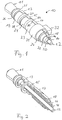
- FIG. 1 a connector arrangement 10 according to an embodiment of the present invention is shown.
- Figs. 2 and 3 show portions of the embodiment of Fig. 1
- Fig. 4 shows the connector arrangement 10 incorporated in a connector 40 according to an embodiment.
- the connector arrangement shown in Fig. 1 apart from portions 31, 32 which will be described later has the form of a standard TRRS (tip ring ring sleeve) connector, for example the form of a 3.5 mm connector, a 2.5 mm connector or a 6.35 mm connector.
- TRRS tip ring ring sleeve
- the connector arrangement of Fig. 1 has more individual contact elements, i.e. elements which may individually serve for transmission of signals, than conventional TRRS connectors.
- Connector arrangement 10 of the embodiment of Fig. 1 comprises a tip portion or tip contact 11.
- Tip contact 11 may be electrically contacted via a rod-like portion 12 which is electrically coupled with tip contact 11.
- tip contact 11 and rod-like portion 12 may be made of a metal or other conducting material.
- Tip contact 11 is insulated via an insulating portion 25 from a first ring area which comprises a contact element 13, a contact element 19 and an insulator 26 electrically insulating contact elements 13 and 19 from each other.
- Contact element 13 may be electrically contacted via a contact portion 14, and contact element 19 may be electrically contacted via a contact portion 20.
- Contact elements 13 and 19 as well as portions 14 and 20 may be made of a metal, while insulator 26 may be made of a plastic material.
- portions of insulator 26 run parallel to insulator 25, i.e. parallel to a boundary of the first ring area, but other portions of insulator 26 run perpendicular to the direction of insulator 25, i.e.
- First ring portion is insulated by a ring-shaped insulator 27 which may again be made of a plastic material from a second ring portion, the second ring portion comprising a contact element 15 which may be electrically contacted via a contact portion 16, a contact element 21 which may be electrically contacted via a contact portion 22 and an insulator 28 electrically insulating contact element 15 from contact element 21.
- the configuration of the second ring area comprising contact elements 15, 21 and insulator 28 is similar to the configuration of first ring area comprising contact elements 13, 19 and insulator 26 and will therefore not be described again in detail.
- the second ring area is separated by an insulator 29 from a sleeve area (which also has a ring form and therefore may also be regarded as a ring area) comprising a contact element 17, a contact element 23 and an insulator 30.
- Ring-shaped insulator 29 and insulator 30 may be made of plastic and may be formed jointly, and contact elements 17 and 23 may be made of a metal.
- Contact element 17 may be electrically contacted via a contact portion 18, and contact element 23 may be electrically contacted via a contact portion 24.
- insulator 30 (which is also provided on the opposite side of connector arrangement 10 which is not visible in Fig. 1 in order to provide a complete insulation between contact elements 17 and 23) runs perpendicular to insulator 29, i.e. insulator 29 runs in a circumferential direction, and insulator 30 runs in a longitudinal direction of connector arrangement 10.
- connector arrangement 10 of the embodiment of Fig. 1 comprises a ring portion 31 with a protrusion 32 which both may be made of an insulating material, for example a plastic material.
- Protrusion 32 facilitates orientating connector arrangement 10 correctly when connector arrangement 10 is inserted in a corresponding receptacle, an example for which will be described further below with respect to Fig. 5 .
- tip contact 11, contact element 13 of the first ring area, contact element 15 of the second ring area and contact element 17 of the sleeve area may be used for the same purpose as a conventional TRRS connector, i.e. for stereo audio with an additional signal, for example a video signal.
- Contact elements 19, 21, and 23 may be used to transmit additional signals, for example to provide an additional power supply, to provide a contact for an antenna and/or to transmit data.
- the use of connector arrangement 10 of the embodiment of Fig. 1 or of other embodiments of the present invention is not limited to these signals, and the contact elements 13, 15, 17, 19, 21 and 23 and tip contact 11 may be used to establish an electrical connection for any desired kinds of signals.
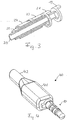
- FIG. 2 The arrangement of the conducting portions of connector arrangement 10, which may for example be made of metal, are depicted in Figs. 2 and 3 without the insulating portions.
- Fig. 2 the portions defining tip connector 11, contact elements 13, 15, 17 and portions 12, 14, 16 and 18 are shown.
- the contact elements and contact portions for contacting them are arranged in a shell-like manner with the rod portion 12 in the center and portions 14, 16 and 18 surrounding rod portion 12 in a shell-like manner with an almost semicircular cross section (semicircular apart from spacing needed to be distanced from portions 20, 22 and 24) in this embodiment.
- Contact elements 13 and 15 in the embodiments shown comprise ring-shaped portions.
- rod portion 12 is connected to tip portion 11 by extending the rod portion throughout the connector, and contact portions 14, 16 and 18 are connected with contact elements 13, 15 and 17 by extending the respective contact portions 14, 16 and 18 through the connector up to the respective contact elements 13, 15 and 17.
- contact elements 19, 21 and 23 as well as of contact portions 20, 22 and 24 are shown.
- contact elements 19 and 21 comprise ring portions.
- Contact portions 20, 22 and 24 are arranged in a shell-like manner with an almost semicircular cross section and extend to the respective contact elements 19, 21 and 23 for electrically contacting the same.
- connector arrangement 10 of Fig. 1 for manufacturing connector arrangement 10 of Fig. 1 , the portions shown in Fig. 2 and Fig. 3 are placed together in an injection molding form and are then overmolded with a plastic material for forming the insulating portions 25, 26, 27, 28, 29 and 30 and/or portions 31, 32.
- the ring portions of contact elements 13, 15, 19 and 21 shown in Figs. 2 and 3 facilitate the placement of the conducting elements in such an injection molding form.
- insulating material is also filled in between contact portions 12, 14, 16, 18, 10, 22 and 24 in order to surely insulate them from each other.
- all insulating portions of the connector arrangement may be molded as one piece. Also, in other embodiments, all insulating portions may be provided as one single piece.
- some or all of the insulating portions may be provided as separate pieces.
- the above-explained method of injection molding serves only as an example, and other manufacturing methods, for example a separate manufacturing of an insulation part and the combination with conducting parts thereafter, is equally possible.
- Plug 40 incorporating connector arrangement 10 explained with reference to Figs. 1-3 is shown.
- Plug 40 comprises a housing 41 at an end of which connector arrangement 10 is mounted, and a cable 42 comprising a plurality of wires (not shown since they are within cable 42) for electrically contacting connector arrangement 10.
- the wires may be soldered or otherwise electrically connected with contact portions 12, 14, 16, 18, 20, 22 and 24.
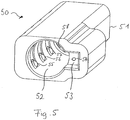
- a receptacle 50 for receiving a connector arrangement according to an embodiment of the present invention, for example connector arrangement 10 shown in Fig. 1 , for example incorporated in plug 40 shown in Fig. 4 , is shown.
- Receptacle 50 shown in Fig. 5 comprises a housing 51.
- Housing 51 may be part of a housing of an electronic device, for example a portable music player, a mobile phone, a laptop computer or a personal digital assistant (PDA).
- Housing 51 comprises an elongate hole 52 for receiving the connector arrangement and a cut-out 53 for receiving a protrusion of the connector arrangement, for example protrusion 32 of the embodiment of Fig. 1 , to ensure the correct orientation of the connector arrangement.
- contacts are provided corresponding to the contact elements of the connector arrangement.
- four contacts 55, 56, 57 and 58 are at least partially visible.
- contacts 55, 56 and 57 contact contact elements 23, 21 and 19, respectively, to establish an electrical connection and contact 58 may contact tip contact 11 to establish an electrical connection.
- Further contacts which in the perspective view of Fig. 5 are not visible and may for example be arranged opposed to contacts 55, 56, 57 in elongate hole 52 serve for contacting contact elements 17, 15 and 13 to establish electrical contact therewith.
- the connector arrangement has the form of a standard audio connector, for example a standard 3.5 mm audio connector.
- a corresponding receptacle like receptacle 50 of Fig. 5 may comprise some sensor 54, for example a mechanical sensor or an optical sensor, to detect the presence of protrusion 32 or a similar protrusion within cut out 53.
- sensor 54 does not detect the presence of a protrusion, and for example only those contacts of contacts 55, 56, 57, 58 and possibly other contacts provided with elongated hole 52 may be activated which serve for establishing a standard audio or video connection as described in the introductory portion are activated. If, on the other hand, the presence of a protrusion is detected, all contacts may be activated to make use of all the contact elements provided on the contact arrangement.
- the type of audio connector i.e. conventional audio connector or audio connector according to an embodiment, may be detected by sending specific signals on specific contacts and receiving a corresponding response from the connected device, for example ear phone or loudspeaker, coupled to the connector arrangement.
- a tip portion, a first ring portion, a second ring portion and a sleeve portion are provided for responding to the form of a TRRS-connector, in other embodiments only a single ring portion or no ring portion may be provided.
- insulators 26, 28 and 30 run either parallel to the insulating portions 25, 27, 29, i.e. parallel to the boundaries of the ring areas, or perpendicular thereto
- portions of the insulators separating the contact elements within a ring area or within the sleeve area may comprise portions forming any other non-zero angle with the boundary of the ring portions and sleeve portions, respectively.
- more than two contact elements may be provided within a ring area or within a sleeve area by providing corresponding insulations.
- first ring area and the second ring area are designed in a similar manner regarding the positioning of the insulating portion and the partitioning in contact elements, in other embodiments different partitionings and positions and form of the insulating portions may be used.
- tip contact 11 may be partitioned in two or more contact elements using an insulator. While in the embodiment of Fig.1 connector arrangement 10 has the form of a standard audio connector, in other embodiments other forms corresponding to an elongate member having a ring area may be used. For orientating connector arrangement 10, in Fig. 1 a protrusion 32 is shown. In other embodiments, the protrusion may have another form, more than one protrusion or other ridge or wedge-like members may be provided, or also a slit or groove matching with a corresponding protrusion in a receptacle may be provided. The electrical contact to the contact elements of the connector arrangement may be ensured in a different way than explained with reference to Figs. 2 and 3 , for example via wires soldered to the contact elements.
- protrusion 32 may be removable in order to be able to insert connector arrangement 10 in a standard audio connector socket.
- a receptacle like receptacle 50 may be modified corresponding to the modification discussed above for the connector arrangement in order to match with the connector arrangement and be able to receive and electrically contact the same.
Landscapes
- Details Of Connecting Devices For Male And Female Coupling (AREA)
- Coupling Device And Connection With Printed Circuit (AREA)
Description
- The present invention relates to connector arrangements.
- Connectors and connector arrangement are commonly used to electrically connect two devices with each other. One type of connectors are audio connectors which are for example used to connect headphones or loudspeakers to audio equipment, for example portable or non-portable audio equipment, cell phones, personal computers, and the like. Commonly used audio connectors include 6.35 mm, 3.5 mm or 2.5 mm audio connectors. The male form of such audio connectors usually comprise a generally elongate member with different areas of the circumferential surface being electrically insulated from each other to provide a plurality of contacts. Conventional arrangements of such contacts are referred to as TS (Tip Sleeve), TRS (Tip Ring Sleeve) or TRRS (Tip Ring Ring Sleeve) connectors, indicated that a tip contact is insulated from a sleeve contact which is generally adjacent to the head, with no, one or two so-called ring contacts in between. For example, a TS connector may be used for mono audio, a TRS connector may be used for stereo audio and a TRRS connector may be used for stereo audio with an additional signal, for example a video signal.
- Corresponding female connectors to the above-described male audio connectors may have an elongate hole with contact elements arranged therein corresponding to the positions of the insulated areas mentioned above.
- These audio connectors have a basically standardized shape, such that for example headphones manufactured by one manufacturer may be used with portable audio equipment like a MP3 player from another manufacturer.
- Besides female audio connectors, many audio devices have further connectors for further purposes, for example an antenna connector, a power connector, a data connector and the like. Such a plurality of connectors sometimes makes it difficult for a user to use the device since each device, cable or the like has to be plugged into the right connector. In case a device like loudspeakers or headphones are provided with additional functions, such a device may have more than one connector, for example to receive audio signals and power from the audio device, which makes connecting the device with the audio device somewhat inconvenient.
- Therefore, there is a general need for improved connector arrangements offering more flexibility.
-
US 2004/0132344 A1 provides a holder for a plurality of diodes comprising a plug and a socket, wherein the socket has an elongated longitudinally formed cavity formed therein as the inner surface of a shell and includes a plurality of longitudinally spaced mutually insulated first contact elements. The plug includes a longitudinally extending tubular shank having a tapered frusto-conical leading end, and a set of longitudinally spaced and longitudinally aligned arcuate metal contact elements are embedded in the shank along one of the arcuate peripheral surfaces thereof. Another set of longitudinally spaced, longitudinally aligned arcuate contact elements is provided, laterally aligned with the first set, the outer surface of the contact elements being coplanar with the arcuate surface of the shank. Connected to each set of contact elements is an insulator covered conductor. -
EP-A2-1898499A2 - The present invention provides an audio connector arrangement as defined in claim 1, a receptacle as defined in
claim 10 an a method as defined inclaim 14. The dependent claims define preferred embodiments of the invention. - According to an embodiment, an audio connector arrangement is provided, comprising:
- an elongate member with a tip end and a sleeve end, said elongate member comprising:
- at least one ring area electrically insulated from the remaining surface of the elongate member, said at least one ring area comprising at least a first contact element and a second contact element electrically insulated from each other, wherein at least a portion of an insulation between the first contact element and the second contact element runs in a direction forming a non-zero angle with a direction of a boundary of the at least one ring area. The elongate member has the form of a standard audio connector.
- The standard audio connector may be selected from the group consisting of a 3.5 mm audio connector, a 2.5 mm audio connector and a 6.35 mm audio connector.
- According to an embodiment, said at least one ring area may comprise a plurality of ring areas.
- According to an embodiment, said plurality of ring areas may comprise a first ring area, a second ring area and a third ring area, said third ring area being arranged at said sleeve end of said connector to form a sleeve area, each of said first ring area, second ring area and third ring area comprising a first contact element and a second contact element.
- According to an embodiment, the connector may further comprise a tip contact at said tip end.
- According to an embodiment, said elongate member may comprise a first conducting element defining said first contact element,
a second conducting element defining said second contact element, and
an insulating material filling gaps between said first conducting element and said second conducting element. - Said first conducting element and said second conducting element may each comprise at least one ring-shaped portion.
- According to an embodiment, the connector may further comprise a guiding element configured to aid an insertion of the connector arrangement into a receptacle with a defined orientation.
- The guiding element may comprise at least one element selected from the group consisting of a protrusion, a ridge, a slit and a groove.
- According to another embodiment, a receptacle for an audio connector arrangement is provided, comprising:
- an elongate hole,
- at least two contacts arranged within a ring section of said elongate hole to connect first and second contact elements of a matching connector arrangement, said first and second contact element being arranged within a ring section of said connector.
- According to an embodiment, the receptacle may further comprise a guiding element configured to provide a defined orientation for the insertion of the connector arrangement into the receptacle.
- Said guiding element of said receptacle may comprise at least one element selected from the group consisting of a cut-out, a ridge, a groove, a slit and a protrusion.
- According to an embodiment, the receptacle may further comprise a sensor configured to detect coupling of a further guiding element of a connector arrangement with said guiding element.
- According to a further embodiment, a method for manufacturing an audio connector is provided, comprising:
- providing a first conducting element defining a first contact element,
- providing a second conducting element defining a second contact element,
- placing said first conducting element and said second conducting element in a molding form such that said first contact area and said second contact area are positioned within a ring area, wherein a portion of a boundary between the first contact area and the second contact area runs in a direction forming a non-zero angle with a boundary of the ring area, and
- filing an insulating material between said first conducting element and said second conducting element using a molding technique.
- It is to be noted that the above-mentioned embodiments and features may be combined with each other unless specifically noted to the contrary. Furthermore, it should be noted that other embodiments may comprise fewer, alternative and/or additional features compared to the ones described above.
-
-
Fig. 1 is a perspective view of a connector arrangement according to an embodiment of the present invention. -
Fig. 2 is a perspective view of conducting portions of the embodiment ofFig. 1 . -
Fig. 3 is a perspective view of further conducting portions of the embodiment ofFig. 1 . -
Fig. 4 shows the connector arrangement ofFig. 1 with a housing and a cable attached thereto according to an embodiment. -
Fig. 5 shows a receptacle for a connector arrangement according to an embodiment. - In the following, various embodiments of the present invention will be described in detail with reference to the accompanying drawings. It is to be understood that the following description and drawings are given only for the purpose of illustration and are not to be taken in a limiting sense.
- It is to be understood that in the drawings various elements are depicted in a manner to give a clear understanding of the respective embodiment to a person skilled in the art and are not necessarily drawn to scale. Also, different figures, although showing the same elements, are not necessarily to scale with each other. Moreover, any directional terminal like "left", "right", "top", "bottom", "up" or "down" is merely used to indicate certain elements in the drawings and is not to be construed as indicating any preferential orientation of the actual embodiments of connector arrangements described hereinafter, since these may be orientated in any desired direction.
- It should be noted that describing an embodiment comprising a plurality of specific elements is not to be construed as indicating that all these elements are necessary for practicing the present invention. Instead, in other embodiments fewer elements may be provided.
- The scope of the invention is not intended to be limited by the embodiments described hereinafter, but is intended to be limited only by the appended claims and equivalents thereof.
- In
Fig. 1 , aconnector arrangement 10 according to an embodiment of the present invention is shown.Figs. 2 and3 show portions of the embodiment ofFig. 1 , andFig. 4 shows theconnector arrangement 10 incorporated in aconnector 40 according to an embodiment. - The connector arrangement shown in
Fig. 1 apart fromportions Fig. 1 has more individual contact elements, i.e. elements which may individually serve for transmission of signals, than conventional TRRS connectors. -
Connector arrangement 10 of the embodiment ofFig. 1 comprises a tip portion ortip contact 11.Tip contact 11 may be electrically contacted via a rod-like portion 12 which is electrically coupled withtip contact 11. For example,tip contact 11 and rod-like portion 12 may be made of a metal or other conducting material. -
Tip contact 11 is insulated via an insulatingportion 25 from a first ring area which comprises acontact element 13, acontact element 19 and an insulator 26 electrically insulatingcontact elements Contact element 13 may be electrically contacted via acontact portion 14, andcontact element 19 may be electrically contacted via acontact portion 20. Contactelements portions connector arrangement 10, as can be seen, portions of insulator 26 run parallel toinsulator 25, i.e. parallel to a boundary of the first ring area, but other portions of insulator 26 run perpendicular to the direction ofinsulator 25, i.e. run parallel to a longitudinal axis ofconnector arrangement 10. First ring portion is insulated by a ring-shapedinsulator 27 which may again be made of a plastic material from a second ring portion, the second ring portion comprising acontact element 15 which may be electrically contacted via acontact portion 16, acontact element 21 which may be electrically contacted via acontact portion 22 and an insulator 28 electrically insulatingcontact element 15 fromcontact element 21. Generally, the configuration of the second ring area comprisingcontact elements contact elements - The second ring area is separated by an
insulator 29 from a sleeve area (which also has a ring form and therefore may also be regarded as a ring area) comprising acontact element 17, acontact element 23 and aninsulator 30. Ring-shapedinsulator 29 andinsulator 30 may be made of plastic and may be formed jointly, and contactelements Contact element 17 may be electrically contacted via acontact portion 18, andcontact element 23 may be electrically contacted via acontact portion 24. In the embodiment ofFig. 1 , insulator 30 (which is also provided on the opposite side ofconnector arrangement 10 which is not visible inFig. 1 in order to provide a complete insulation betweencontact elements 17 and 23) runs perpendicular toinsulator 29, i.e. insulator 29 runs in a circumferential direction, andinsulator 30 runs in a longitudinal direction ofconnector arrangement 10. - Furthermore,
connector arrangement 10 of the embodiment ofFig. 1 comprises aring portion 31 with aprotrusion 32 which both may be made of an insulating material, for example a plastic material.Protrusion 32 facilitates orientatingconnector arrangement 10 correctly whenconnector arrangement 10 is inserted in a corresponding receptacle, an example for which will be described further below with respect toFig. 5 . - In an embodiment,
tip contact 11,contact element 13 of the first ring area,contact element 15 of the second ring area andcontact element 17 of the sleeve area may be used for the same purpose as a conventional TRRS connector, i.e. for stereo audio with an additional signal, for example a video signal. Contactelements connector arrangement 10 of the embodiment ofFig. 1 or of other embodiments of the present invention is not limited to these signals, and thecontact elements tip contact 11 may be used to establish an electrical connection for any desired kinds of signals. - The arrangement of the conducting portions of
connector arrangement 10, which may for example be made of metal, are depicted inFigs. 2 and3 without the insulating portions. InFig. 2 , the portions definingtip connector 11,contact elements portions rod portion 12 in the center andportions rod portion 12 in a shell-like manner with an almost semicircular cross section (semicircular apart from spacing needed to be distanced fromportions elements rod portion 12 is connected to tipportion 11 by extending the rod portion throughout the connector, andcontact portions contact elements respective contact portions respective contact elements - In a similar manner, in
Fig. 3 a perspective view ofcontact elements contact portions contact elements portions respective contact elements - In an embodiment, for
manufacturing connector arrangement 10 ofFig. 1 , the portions shown inFig. 2 andFig. 3 are placed together in an injection molding form and are then overmolded with a plastic material for forming the insulatingportions portions contact elements Figs. 2 and3 facilitate the placement of the conducting elements in such an injection molding form. In such an injection molding process, insulating material is also filled in betweencontact portions - In
Fig. 4 , a, plug 40 incorporatingconnector arrangement 10 explained with reference toFigs. 1-3 is shown.Plug 40 comprises ahousing 41 at an end of whichconnector arrangement 10 is mounted, and acable 42 comprising a plurality of wires (not shown since they are within cable 42) for electrically contactingconnector arrangement 10. For example, the wires may be soldered or otherwise electrically connected withcontact portions - In
Fig. 5 , areceptacle 50 according to an embodiment of the present invention for receiving a connector arrangement according to an embodiment of the present invention, forexample connector arrangement 10 shown inFig. 1 , for example incorporated inplug 40 shown inFig. 4 , is shown.Receptacle 50 shown inFig. 5 comprises ahousing 51.Housing 51 may be part of a housing of an electronic device, for example a portable music player, a mobile phone, a laptop computer or a personal digital assistant (PDA).Housing 51 comprises anelongate hole 52 for receiving the connector arrangement and a cut-out 53 for receiving a protrusion of the connector arrangement, forexample protrusion 32 of the embodiment ofFig. 1 , to ensure the correct orientation of the connector arrangement. Withinelongate hole 52, contacts are provided corresponding to the contact elements of the connector arrangement. For example, in the embodiment ofFig. 5 fourcontacts connector arrangement 10 shown inFig. 1 is inserted inreceptacle 50,contacts contact contact elements tip contact 11 to establish an electrical connection. Further contacts which in the perspective view ofFig. 5 are not visible and may for example be arranged opposed tocontacts elongate hole 52 serve for contactingcontact elements - In an embodiment, as explained above and is shown in
Fig. 1 the connector arrangement has the form of a standard audio connector, for example a standard 3.5 mm audio connector. In such a case, a corresponding receptacle likereceptacle 50 ofFig. 5 may comprise somesensor 54, for example a mechanical sensor or an optical sensor, to detect the presence ofprotrusion 32 or a similar protrusion within cut out 53. In case a conventional audio connector is inserted in the receptacle,sensor 54 does not detect the presence of a protrusion, and for example only those contacts ofcontacts elongated hole 52 may be activated which serve for establishing a standard audio or video connection as described in the introductory portion are activated. If, on the other hand, the presence of a protrusion is detected, all contacts may be activated to make use of all the contact elements provided on the contact arrangement. - It should be noted that instead of providing a sensor like
sensor 54, the type of audio connector, i.e. conventional audio connector or audio connector according to an embodiment, may be detected by sending specific signals on specific contacts and receiving a corresponding response from the connected device, for example ear phone or loudspeaker, coupled to the connector arrangement. - The above-described embodiments serve only as examples, and a plurality of variations are possible without departing from the scope of the present invention. For example, while in the embodiment of Fig. 10 a tip portion, a first ring portion, a second ring portion and a sleeve portion are provided for responding to the form of a TRRS-connector, in other embodiments only a single ring portion or no ring portion may be provided.
- Furthermore, while in the embodiment of
Fig. 1 insulators 26, 28 and 30 run either parallel to the insulatingportions - While in the embodiment of
Fig. 1 the first ring area and the second ring area are designed in a similar manner regarding the positioning of the insulating portion and the partitioning in contact elements, in other embodiments different partitionings and positions and form of the insulating portions may be used. - In an embodiment, also tip
contact 11 may be partitioned in two or more contact elements using an insulator. While in the embodiment ofFig.1 connector arrangement 10 has the form of a standard audio connector, in other embodiments other forms corresponding to an elongate member having a ring area may be used. For orientatingconnector arrangement 10, inFig. 1 aprotrusion 32 is shown. In other embodiments, the protrusion may have another form, more than one protrusion or other ridge or wedge-like members may be provided, or also a slit or groove matching with a corresponding protrusion in a receptacle may be provided. The electrical contact to the contact elements of the connector arrangement may be ensured in a different way than explained with reference toFigs. 2 and3 , for example via wires soldered to the contact elements. - In an embodiment,
protrusion 32 may be removable in order to be able to insertconnector arrangement 10 in a standard audio connector socket. - A receptacle like
receptacle 50 may be modified corresponding to the modification discussed above for the connector arrangement in order to match with the connector arrangement and be able to receive and electrically contact the same. - As can be seen, numerous modifications are possible, and therefore the present invention is not limited to any specific embodiment, but is intended to be limited only by the appended claims and equivalents thereof.
Claims (18)
- An audio connector arrangement (10), comprising:an elongate member with a tip end and a sleeve end, the elongate member comprising:at least one ring area electrically insulated from the remaining surface of the elongate member via one or more ring-shaped insulators (25, 27, 29), said at least one ring area comprising at least a first contact element (13, 15, 17) and a second contact element (19, 21, 23) electrically insulated from each other via an insulation (26, 28, 30), wherein at least a portion of [[an]] the insulation (26, 28, 30) between the first contact element (13, 15, 17) and the second contact element (19, 21, 23) runs in a direction forming a non-zero angle with a direction of a boundary of the at least one ring area, the ring-shaped insulator and the insulation being unconnected and spaced from each other.
- The audio connector arrangement of claim 1, wherein the audio connector is selected from the group consisting of a 3.5 mm audio connector, a 2.5 mm audio connector and a 6.35 mm audio connector.
- The audio connector arrangement of any one of claims 1 or 2, wherein said at least one ring area comprises a plurality of ring areas.
- The audio connector arrangement of claim 3, wherein said plurality of ring areas comprises a first ring area, a second ring area and a third ring area, said third ring area being arranged at said sleeve end of said connector to form a sleeve area, each of said first ring area, second ring area and third ring area comprising a first contact element (13, 15, 17) and a second contact element (19, 21, 23).
- The audio connector arrangement of any one of claims 1-4, further comprising a tip contact (11) at said tip end.
- The audio connector arrangement of any one of claims 1-5, wherein said elongate member comprises a first conducting element defining said first contact element (13, 15, 17),
a second conducting element defining said second contact element (19, 21, 23), and
an insulating material filling gaps between said first conducting element and said second conducting element. - The audio connector arrangement of claim 6, wherein said first conducting element and said second conducting element each comprises at least one ring-shaped portion.
- The audio connector arrangement of any one of claims 1-7, further comprising a guiding element configured to aid an insertion of the connector arrangement (10) into a receptacle with a defined orientation.
- The audio connector arrangement (10) of claim 8, wherein the guiding element comprises at least one element selected from the group consisting of a protrusion (32), a ridge, a slit and a groove.
- A receptacle (41; 51) for an audio connector arrangement (10), comprising:an elongate hole (52) configured to receive an elongate member having the form of an audio connector,at least two contacts arranged within a ring section of said elongate hole (52) to connect first and second contact elements (19, 21, 23, 55, 56, 57) of a matching connector arrangement, said first and second contact elements (19, 21, 23) being arranged within a ring section of said connector,the connector arrangement comprising:an elongate member with a tip end and a sleeve end, the elongate member comprising:at least one ring area electrically insulated from the remaining surface of the elongate-member via one or more ring-shaped insulators (25, 27, 29), said at least one ring area comprising at least a first contact element (13, 15, 17) and a second contact element (19, 21, 23) electrically insulated from each other via an insulation (26, 28, 30), wherein at least a portion of the insulation (26, 28, 30) between the first contact element (13, 15, 17) and the second contact element (19, 21, 23) runs in a direction forming a non-zero angle with a direction of a boundary of the at least one ring area, the ring-shaped insulator and the insulation being unconnected and spaced from each other.
- The receptacle (41; 51) of claim 10, further comprising a guiding element configured to provide a defined orientation for the insertion of the connector arrangement (10) into the receptacle (41; 51).
- The receptacle (41; 51) of claim 11, wherein said guiding element comprises at least one element selected from the group consisting of a cut-out, a ridge, a groove, a slit and a protrusion (32).
- The receptacle (41; 51) of claim 11 or 12, further comprising a sensor (54) configured to detect coupling of a further guiding element of a connector arrangement (10) with said guiding element.
- A method for manufacturing an audio connector having an elongate member with a tip end and a sleeve end, the method comprising:providing a first conducting element defining a first contact element (13, 15, 17) on a surface of said elongate member,providing a second conducting element defining a second contact element (19, 21, 23) on the surface of said elongate member,placing said first conducting element and said second conducting element in a molding form such that said first contact area and said second contact area are positioned within a ring area on the surface of said elongate member, wherein a portion of a boundary between the first contact area and the second contact area runs in a direction forming a non-zero angle with a boundary of the ring area, [[and]]filling an insulating material at the ring area such that the ring area is electrically insulated from the remaining surface of the elongate member via one or more ring-shaped insulators (25, 27, 29), andfilling an insulating material (26, 28, 30) between said first conducting element and said second conducting element using a molding technique such that the first conducting element and the second conducting element are electrically insulated from each other via an insulation, wherein the ring-shaped insulator and the insulation are unconnected and spaced from each other.
- The audio connector arrangement (10) of claim 1, wherein the at least a portion of the insulation (26, 28, 30) runs perpendicular to the circumference of the one or more ring-shaped insulators (25, 27, 29).
- The audio connector arrangement (10) of claim 15, wherein at least another portion of the insulation (26, 28, 30) different from the at least a portion of the insulation runs parallel to the circumference of the one or more ring-shaped insulators (25, 27, 29).
- The audio connector arrangement (10) of claim 1, wherein the insulation (26, 28, 30) is interposed between the one or more ring-shaped insulators (25, 27, 29).
- The audio connector arrangement (10) of claim 1, wherein the ring-shaped insulator (25, 27, 29) and the insulation (26, 28, 30) are separate insulators.
Applications Claiming Priority (2)
| Application Number | Priority Date | Filing Date | Title |
|---|---|---|---|
| US12/431,798 US8206181B2 (en) | 2009-04-29 | 2009-04-29 | Connector arrangement |
| PCT/EP2009/007750 WO2010124711A1 (en) | 2009-04-29 | 2009-10-29 | Connector arrangement |
Publications (2)
| Publication Number | Publication Date |
|---|---|
| EP2425502A1 EP2425502A1 (en) | 2012-03-07 |
| EP2425502B1 true EP2425502B1 (en) | 2017-01-11 |
Family
ID=41508177
Family Applications (1)
| Application Number | Title | Priority Date | Filing Date |
|---|---|---|---|
| EP09753024.0A Not-in-force EP2425502B1 (en) | 2009-04-29 | 2009-10-29 | Connector arrangement |
Country Status (4)
| Country | Link |
|---|---|
| US (1) | US8206181B2 (en) |
| EP (1) | EP2425502B1 (en) |
| CN (1) | CN102414938A (en) |
| WO (1) | WO2010124711A1 (en) |
Cited By (15)
| Publication number | Priority date | Publication date | Assignee | Title |
|---|---|---|---|---|
| US10492010B2 (en) | 2015-12-30 | 2019-11-26 | Earlens Corporations | Damping in contact hearing systems |
| US10511913B2 (en) | 2008-09-22 | 2019-12-17 | Earlens Corporation | Devices and methods for hearing |
| US10516951B2 (en) | 2014-11-26 | 2019-12-24 | Earlens Corporation | Adjustable venting for hearing instruments |
| US10516950B2 (en) | 2007-10-12 | 2019-12-24 | Earlens Corporation | Multifunction system and method for integrated hearing and communication with noise cancellation and feedback management |
| US10516949B2 (en) | 2008-06-17 | 2019-12-24 | Earlens Corporation | Optical electro-mechanical hearing devices with separate power and signal components |
| US10531206B2 (en) | 2014-07-14 | 2020-01-07 | Earlens Corporation | Sliding bias and peak limiting for optical hearing devices |
| US10609492B2 (en) | 2010-12-20 | 2020-03-31 | Earlens Corporation | Anatomically customized ear canal hearing apparatus |
| US10779094B2 (en) | 2015-12-30 | 2020-09-15 | Earlens Corporation | Damping in contact hearing systems |
| US11058305B2 (en) | 2015-10-02 | 2021-07-13 | Earlens Corporation | Wearable customized ear canal apparatus |
| US11102594B2 (en) | 2016-09-09 | 2021-08-24 | Earlens Corporation | Contact hearing systems, apparatus and methods |
| US11166114B2 (en) | 2016-11-15 | 2021-11-02 | Earlens Corporation | Impression procedure |
| US11212626B2 (en) | 2018-04-09 | 2021-12-28 | Earlens Corporation | Dynamic filter |
| US11317224B2 (en) | 2014-03-18 | 2022-04-26 | Earlens Corporation | High fidelity and reduced feedback contact hearing apparatus and methods |
| US11350226B2 (en) | 2015-12-30 | 2022-05-31 | Earlens Corporation | Charging protocol for rechargeable hearing systems |
| US11516603B2 (en) | 2018-03-07 | 2022-11-29 | Earlens Corporation | Contact hearing device and retention structure materials |
Families Citing this family (22)
| Publication number | Priority date | Publication date | Assignee | Title |
|---|---|---|---|---|
| US7182738B2 (en) | 2003-04-23 | 2007-02-27 | Marctec, Llc | Patient monitoring apparatus and method for orthosis and other devices |
| US7589536B2 (en) | 2007-01-05 | 2009-09-15 | Apple Inc. | Systems and methods for determining the configuration of electronic connections |
| US8655006B2 (en) | 2010-01-25 | 2014-02-18 | Apple Inc. | Multi-segment cable structures |
| US8435081B2 (en) * | 2010-03-31 | 2013-05-07 | Apple Inc. | Thin plug assembly and methods for making the same |
| EP2577813B1 (en) | 2010-05-28 | 2020-01-22 | Apple Inc. | Dual orientation connector with external contacts |
| DE202010009766U1 (en) * | 2010-07-02 | 2010-09-16 | Rosenberger Hochfrequenztechnik Gmbh & Co. Kg | Rotatable connector |
| US8446275B2 (en) | 2011-06-10 | 2013-05-21 | Aliphcom | General health and wellness management method and apparatus for a wellness application using data from a data-capable band |
| US9069380B2 (en) | 2011-06-10 | 2015-06-30 | Aliphcom | Media device, application, and content management using sensory input |
| US9258670B2 (en) | 2011-06-10 | 2016-02-09 | Aliphcom | Wireless enabled cap for a data-capable device |
| US20120315382A1 (en) * | 2011-06-10 | 2012-12-13 | Aliphcom | Component protective overmolding using protective external coatings |
| US9293876B2 (en) | 2011-11-07 | 2016-03-22 | Apple Inc. | Techniques for configuring contacts of a connector |
| US8799527B2 (en) | 2012-09-07 | 2014-08-05 | Apple Inc. | Data structures for facilitating communication between a host device and an accessory |
| US8891216B2 (en) | 2012-04-25 | 2014-11-18 | Apple Inc. | Techniques for detecting removal of a connector |
| US8724281B2 (en) | 2012-04-25 | 2014-05-13 | Apple Inc. | Techniques for detecting removal of a connector |
| US10043535B2 (en) | 2013-01-15 | 2018-08-07 | Staton Techiya, Llc | Method and device for spectral expansion for an audio signal |
| US9205905B2 (en) * | 2013-03-15 | 2015-12-08 | Jlip, Llc | Waterproof rotary contact assembly |
| US9307312B2 (en) | 2013-03-15 | 2016-04-05 | Apple Inc. | Audio accessory with internal clock |
| US10045135B2 (en) | 2013-10-24 | 2018-08-07 | Staton Techiya, Llc | Method and device for recognition and arbitration of an input connection |
| JP6580991B2 (en) * | 2013-11-22 | 2019-09-25 | ソニーセミコンダクタソリューションズ株式会社 | Connecting device and receiving device |
| US10043534B2 (en) | 2013-12-23 | 2018-08-07 | Staton Techiya, Llc | Method and device for spectral expansion for an audio signal |
| CN205752715U (en) * | 2016-03-31 | 2016-11-30 | 深圳贝尔创意科教有限公司 | Connection structure and electronic device using the connection structure |
| EP3285339B1 (en) * | 2016-06-16 | 2019-07-24 | Nippon Dics Co., Ltd. | Multipole plug |
Citations (1)
| Publication number | Priority date | Publication date | Assignee | Title |
|---|---|---|---|---|
| EP1898499A2 (en) * | 2006-09-08 | 2008-03-12 | Sony Corporation | Plug |
Family Cites Families (15)
| Publication number | Priority date | Publication date | Assignee | Title |
|---|---|---|---|---|
| JPS5736790A (en) * | 1980-08-13 | 1982-02-27 | Olympus Optical Co | |
| US5550755A (en) | 1994-07-14 | 1996-08-27 | Martin; B. Morgan | Apparatus and method for patch recording and recall |
| US6981895B2 (en) * | 1999-08-23 | 2006-01-03 | Patrick Potega | Interface apparatus for selectively connecting electrical devices |
| US6461199B1 (en) * | 2001-06-12 | 2002-10-08 | Nobutaka Koga | Multiple electrode connecting apparatus |
| US6869316B2 (en) * | 2002-06-27 | 2005-03-22 | Dell Products L.P. | Three contact barrel power connector assembly |
| TWI256755B (en) * | 2002-11-29 | 2006-06-11 | Hon Hai Prec Ind Co Ltd | Method for assembling electrical connector |
| US6764347B1 (en) * | 2003-01-06 | 2004-07-20 | Paul J. Plishner | Plug and socket holder for replaceably holding diode-based light sources and other radiation sources and receivers |
| DE202004006906U1 (en) | 2004-04-29 | 2004-10-21 | Schmitz, Martin | Mains plug e.g. for domestic equipment, furniture etc, has two electric poles arranged on single plug pin |
| US7641520B2 (en) * | 2004-08-27 | 2010-01-05 | Pmi Industries, Inc. | Flexible connector assembly |
| US7950967B2 (en) * | 2008-01-18 | 2011-05-31 | Apple Inc. | Low profile plugs |
| JP4690842B2 (en) * | 2005-10-03 | 2011-06-01 | ルネサスエレクトロニクス株式会社 | Communication cable connector and communication cable |
| JP4971857B2 (en) * | 2007-03-29 | 2012-07-11 | 富士通コンポーネント株式会社 | Connector device |
| JP4389984B2 (en) * | 2007-08-31 | 2009-12-24 | 株式会社カシオ日立モバイルコミュニケーションズ | Waterproof connector structure, jack parts, electronic equipment and plug parts |
| US7699665B1 (en) * | 2008-10-31 | 2010-04-20 | Cheng Uei Precision Industry Co., Ltd. | Audio plug connector |
| CN101800375B (en) * | 2009-02-07 | 2012-06-20 | 富士康(昆山)电脑接插件有限公司 | Socket connector and plug connector matched with same |
-
2009
- 2009-04-29 US US12/431,798 patent/US8206181B2/en not_active Expired - Fee Related
- 2009-10-29 CN CN2009801590111A patent/CN102414938A/en active Pending
- 2009-10-29 WO PCT/EP2009/007750 patent/WO2010124711A1/en not_active Ceased
- 2009-10-29 EP EP09753024.0A patent/EP2425502B1/en not_active Not-in-force
Patent Citations (1)
| Publication number | Priority date | Publication date | Assignee | Title |
|---|---|---|---|---|
| EP1898499A2 (en) * | 2006-09-08 | 2008-03-12 | Sony Corporation | Plug |
Cited By (32)
| Publication number | Priority date | Publication date | Assignee | Title |
|---|---|---|---|---|
| US11483665B2 (en) | 2007-10-12 | 2022-10-25 | Earlens Corporation | Multifunction system and method for integrated hearing and communication with noise cancellation and feedback management |
| US10863286B2 (en) | 2007-10-12 | 2020-12-08 | Earlens Corporation | Multifunction system and method for integrated hearing and communication with noise cancellation and feedback management |
| US10516950B2 (en) | 2007-10-12 | 2019-12-24 | Earlens Corporation | Multifunction system and method for integrated hearing and communication with noise cancellation and feedback management |
| US10516949B2 (en) | 2008-06-17 | 2019-12-24 | Earlens Corporation | Optical electro-mechanical hearing devices with separate power and signal components |
| US11310605B2 (en) | 2008-06-17 | 2022-04-19 | Earlens Corporation | Optical electro-mechanical hearing devices with separate power and signal components |
| US10743110B2 (en) | 2008-09-22 | 2020-08-11 | Earlens Corporation | Devices and methods for hearing |
| US10516946B2 (en) | 2008-09-22 | 2019-12-24 | Earlens Corporation | Devices and methods for hearing |
| US11057714B2 (en) | 2008-09-22 | 2021-07-06 | Earlens Corporation | Devices and methods for hearing |
| US10511913B2 (en) | 2008-09-22 | 2019-12-17 | Earlens Corporation | Devices and methods for hearing |
| US10609492B2 (en) | 2010-12-20 | 2020-03-31 | Earlens Corporation | Anatomically customized ear canal hearing apparatus |
| US11743663B2 (en) | 2010-12-20 | 2023-08-29 | Earlens Corporation | Anatomically customized ear canal hearing apparatus |
| US11153697B2 (en) | 2010-12-20 | 2021-10-19 | Earlens Corporation | Anatomically customized ear canal hearing apparatus |
| US11317224B2 (en) | 2014-03-18 | 2022-04-26 | Earlens Corporation | High fidelity and reduced feedback contact hearing apparatus and methods |
| US10531206B2 (en) | 2014-07-14 | 2020-01-07 | Earlens Corporation | Sliding bias and peak limiting for optical hearing devices |
| US11800303B2 (en) | 2014-07-14 | 2023-10-24 | Earlens Corporation | Sliding bias and peak limiting for optical hearing devices |
| US11259129B2 (en) | 2014-07-14 | 2022-02-22 | Earlens Corporation | Sliding bias and peak limiting for optical hearing devices |
| US11252516B2 (en) | 2014-11-26 | 2022-02-15 | Earlens Corporation | Adjustable venting for hearing instruments |
| US10516951B2 (en) | 2014-11-26 | 2019-12-24 | Earlens Corporation | Adjustable venting for hearing instruments |
| US11058305B2 (en) | 2015-10-02 | 2021-07-13 | Earlens Corporation | Wearable customized ear canal apparatus |
| US11350226B2 (en) | 2015-12-30 | 2022-05-31 | Earlens Corporation | Charging protocol for rechargeable hearing systems |
| US11070927B2 (en) | 2015-12-30 | 2021-07-20 | Earlens Corporation | Damping in contact hearing systems |
| US11337012B2 (en) | 2015-12-30 | 2022-05-17 | Earlens Corporation | Battery coating for rechargable hearing systems |
| US11516602B2 (en) | 2015-12-30 | 2022-11-29 | Earlens Corporation | Damping in contact hearing systems |
| US10779094B2 (en) | 2015-12-30 | 2020-09-15 | Earlens Corporation | Damping in contact hearing systems |
| US10492010B2 (en) | 2015-12-30 | 2019-11-26 | Earlens Corporations | Damping in contact hearing systems |
| US11102594B2 (en) | 2016-09-09 | 2021-08-24 | Earlens Corporation | Contact hearing systems, apparatus and methods |
| US11540065B2 (en) | 2016-09-09 | 2022-12-27 | Earlens Corporation | Contact hearing systems, apparatus and methods |
| US11166114B2 (en) | 2016-11-15 | 2021-11-02 | Earlens Corporation | Impression procedure |
| US11671774B2 (en) | 2016-11-15 | 2023-06-06 | Earlens Corporation | Impression procedure |
| US11516603B2 (en) | 2018-03-07 | 2022-11-29 | Earlens Corporation | Contact hearing device and retention structure materials |
| US11212626B2 (en) | 2018-04-09 | 2021-12-28 | Earlens Corporation | Dynamic filter |
| US11564044B2 (en) | 2018-04-09 | 2023-01-24 | Earlens Corporation | Dynamic filter |
Also Published As
| Publication number | Publication date |
|---|---|
| US8206181B2 (en) | 2012-06-26 |
| CN102414938A (en) | 2012-04-11 |
| US20100279554A1 (en) | 2010-11-04 |
| WO2010124711A1 (en) | 2010-11-04 |
| EP2425502A1 (en) | 2012-03-07 |
Similar Documents
| Publication | Publication Date | Title |
|---|---|---|
| EP2425502B1 (en) | Connector arrangement | |
| EP2301118B1 (en) | Connector arrangement | |
| US6126465A (en) | Electrical connector system having dual purpose jack | |
| CN106229725B (en) | Modular radio frequency connector system | |
| US8911260B2 (en) | External contact plug connector | |
| CN103081253B (en) | Plug-in connector and socket connector | |
| US8235756B2 (en) | Low profile plugs | |
| KR101536888B1 (en) | Portable terminal charging apparatus attached by magnetic force | |
| US20150333458A1 (en) | Releasable plug connector system | |
| US20130244485A1 (en) | Serial electrical connector | |
| TW201725813A (en) | Adapter | |
| US8430690B2 (en) | USB application device and method for assembling USB application device | |
| US10103505B1 (en) | Cable with connectors | |
| EP2595464A2 (en) | USB application device and method for assembling USB application device | |
| CN106299822A (en) | The processing method of the molded rubber core of the interface | |
| KR102821144B1 (en) | Power connector with asymmetric insertion-to-extraction force ratio | |
| CN202308687U (en) | Electric connector socket, electric connector plug and electric connector assembly | |
| US8698699B2 (en) | Connector | |
| CN217468973U (en) | Connector set with guiding structure and its plug connector and socket connector | |
| TWI415347B (en) | Low profile plugs and method for assembling the same | |
| US20180151971A1 (en) | Internal and External Connector and Receptacle | |
| CN205376845U (en) | Connector with novel contact pilotage subassembly | |
| CN101107754A (en) | loop plug | |
| JP3097615U (en) | Mobile phone adapter | |
| TWM560132U (en) | Composite adapter |
Legal Events
| Date | Code | Title | Description |
|---|---|---|---|
| PUAI | Public reference made under article 153(3) epc to a published international application that has entered the european phase |
Free format text: ORIGINAL CODE: 0009012 |
|
| 17P | Request for examination filed |
Effective date: 20111027 |
|
| AK | Designated contracting states |
Kind code of ref document: A1 Designated state(s): AT BE BG CH CY CZ DE DK EE ES FI FR GB GR HR HU IE IS IT LI LT LU LV MC MK MT NL NO PL PT RO SE SI SK SM TR |
|
| DAX | Request for extension of the european patent (deleted) | ||
| 17Q | First examination report despatched |
Effective date: 20120817 |
|
| RAP1 | Party data changed (applicant data changed or rights of an application transferred) |
Owner name: SONY MOBILE COMMUNICATIONS AB |
|
| RAP1 | Party data changed (applicant data changed or rights of an application transferred) |
Owner name: SNAPTRACK, INC. |
|
| REG | Reference to a national code |
Ref country code: DE Ref legal event code: R079 Ref document number: 602009043711 Country of ref document: DE Free format text: PREVIOUS MAIN CLASS: H01R0024020000 Ipc: H01R0024580000 |
|
| GRAP | Despatch of communication of intention to grant a patent |
Free format text: ORIGINAL CODE: EPIDOSNIGR1 |
|
| RIC1 | Information provided on ipc code assigned before grant |
Ipc: H01R 24/58 20110101AFI20160706BHEP |
|
| INTG | Intention to grant announced |
Effective date: 20160729 |
|
| GRAS | Grant fee paid |
Free format text: ORIGINAL CODE: EPIDOSNIGR3 |
|
| GRAA | (expected) grant |
Free format text: ORIGINAL CODE: 0009210 |
|
| AK | Designated contracting states |
Kind code of ref document: B1 Designated state(s): AT BE BG CH CY CZ DE DK EE ES FI FR GB GR HR HU IE IS IT LI LT LU LV MC MK MT NL NO PL PT RO SE SI SK SM TR |
|
| REG | Reference to a national code |
Ref country code: GB Ref legal event code: FG4D |
|
| REG | Reference to a national code |
Ref country code: CH Ref legal event code: EP |
|
| REG | Reference to a national code |
Ref country code: AT Ref legal event code: REF Ref document number: 862074 Country of ref document: AT Kind code of ref document: T Effective date: 20170115 |
|
| REG | Reference to a national code |
Ref country code: IE Ref legal event code: FG4D |
|
| REG | Reference to a national code |
Ref country code: DE Ref legal event code: R096 Ref document number: 602009043711 Country of ref document: DE |
|
| REG | Reference to a national code |
Ref country code: LT Ref legal event code: MG4D |
|
| REG | Reference to a national code |
Ref country code: NL Ref legal event code: MP Effective date: 20170111 |
|
| REG | Reference to a national code |
Ref country code: AT Ref legal event code: MK05 Ref document number: 862074 Country of ref document: AT Kind code of ref document: T Effective date: 20170111 |
|
| PG25 | Lapsed in a contracting state [announced via postgrant information from national office to epo] |
Ref country code: NL Free format text: LAPSE BECAUSE OF FAILURE TO SUBMIT A TRANSLATION OF THE DESCRIPTION OR TO PAY THE FEE WITHIN THE PRESCRIBED TIME-LIMIT Effective date: 20170111 |
|
| PG25 | Lapsed in a contracting state [announced via postgrant information from national office to epo] |
Ref country code: GR Free format text: LAPSE BECAUSE OF FAILURE TO SUBMIT A TRANSLATION OF THE DESCRIPTION OR TO PAY THE FEE WITHIN THE PRESCRIBED TIME-LIMIT Effective date: 20170412 Ref country code: NO Free format text: LAPSE BECAUSE OF FAILURE TO SUBMIT A TRANSLATION OF THE DESCRIPTION OR TO PAY THE FEE WITHIN THE PRESCRIBED TIME-LIMIT Effective date: 20170411 Ref country code: HR Free format text: LAPSE BECAUSE OF FAILURE TO SUBMIT A TRANSLATION OF THE DESCRIPTION OR TO PAY THE FEE WITHIN THE PRESCRIBED TIME-LIMIT Effective date: 20170111 Ref country code: FI Free format text: LAPSE BECAUSE OF FAILURE TO SUBMIT A TRANSLATION OF THE DESCRIPTION OR TO PAY THE FEE WITHIN THE PRESCRIBED TIME-LIMIT Effective date: 20170111 Ref country code: LT Free format text: LAPSE BECAUSE OF FAILURE TO SUBMIT A TRANSLATION OF THE DESCRIPTION OR TO PAY THE FEE WITHIN THE PRESCRIBED TIME-LIMIT Effective date: 20170111 Ref country code: IS Free format text: LAPSE BECAUSE OF FAILURE TO SUBMIT A TRANSLATION OF THE DESCRIPTION OR TO PAY THE FEE WITHIN THE PRESCRIBED TIME-LIMIT Effective date: 20170511 |
|
| PG25 | Lapsed in a contracting state [announced via postgrant information from national office to epo] |
Ref country code: AT Free format text: LAPSE BECAUSE OF FAILURE TO SUBMIT A TRANSLATION OF THE DESCRIPTION OR TO PAY THE FEE WITHIN THE PRESCRIBED TIME-LIMIT Effective date: 20170111 Ref country code: PT Free format text: LAPSE BECAUSE OF FAILURE TO SUBMIT A TRANSLATION OF THE DESCRIPTION OR TO PAY THE FEE WITHIN THE PRESCRIBED TIME-LIMIT Effective date: 20170511 Ref country code: PL Free format text: LAPSE BECAUSE OF FAILURE TO SUBMIT A TRANSLATION OF THE DESCRIPTION OR TO PAY THE FEE WITHIN THE PRESCRIBED TIME-LIMIT Effective date: 20170111 Ref country code: BG Free format text: LAPSE BECAUSE OF FAILURE TO SUBMIT A TRANSLATION OF THE DESCRIPTION OR TO PAY THE FEE WITHIN THE PRESCRIBED TIME-LIMIT Effective date: 20170411 Ref country code: ES Free format text: LAPSE BECAUSE OF FAILURE TO SUBMIT A TRANSLATION OF THE DESCRIPTION OR TO PAY THE FEE WITHIN THE PRESCRIBED TIME-LIMIT Effective date: 20170111 Ref country code: SE Free format text: LAPSE BECAUSE OF FAILURE TO SUBMIT A TRANSLATION OF THE DESCRIPTION OR TO PAY THE FEE WITHIN THE PRESCRIBED TIME-LIMIT Effective date: 20170111 Ref country code: LV Free format text: LAPSE BECAUSE OF FAILURE TO SUBMIT A TRANSLATION OF THE DESCRIPTION OR TO PAY THE FEE WITHIN THE PRESCRIBED TIME-LIMIT Effective date: 20170111 |
|
| REG | Reference to a national code |
Ref country code: FR Ref legal event code: PLFP Year of fee payment: 9 |
|
| REG | Reference to a national code |
Ref country code: DE Ref legal event code: R097 Ref document number: 602009043711 Country of ref document: DE |
|
| PG25 | Lapsed in a contracting state [announced via postgrant information from national office to epo] |
Ref country code: CZ Free format text: LAPSE BECAUSE OF FAILURE TO SUBMIT A TRANSLATION OF THE DESCRIPTION OR TO PAY THE FEE WITHIN THE PRESCRIBED TIME-LIMIT Effective date: 20170111 Ref country code: SK Free format text: LAPSE BECAUSE OF FAILURE TO SUBMIT A TRANSLATION OF THE DESCRIPTION OR TO PAY THE FEE WITHIN THE PRESCRIBED TIME-LIMIT Effective date: 20170111 Ref country code: EE Free format text: LAPSE BECAUSE OF FAILURE TO SUBMIT A TRANSLATION OF THE DESCRIPTION OR TO PAY THE FEE WITHIN THE PRESCRIBED TIME-LIMIT Effective date: 20170111 Ref country code: IT Free format text: LAPSE BECAUSE OF FAILURE TO SUBMIT A TRANSLATION OF THE DESCRIPTION OR TO PAY THE FEE WITHIN THE PRESCRIBED TIME-LIMIT Effective date: 20170111 Ref country code: RO Free format text: LAPSE BECAUSE OF FAILURE TO SUBMIT A TRANSLATION OF THE DESCRIPTION OR TO PAY THE FEE WITHIN THE PRESCRIBED TIME-LIMIT Effective date: 20170111 |
|
| PLBE | No opposition filed within time limit |
Free format text: ORIGINAL CODE: 0009261 |
|
| STAA | Information on the status of an ep patent application or granted ep patent |
Free format text: STATUS: NO OPPOSITION FILED WITHIN TIME LIMIT |
|
| PG25 | Lapsed in a contracting state [announced via postgrant information from national office to epo] |
Ref country code: SM Free format text: LAPSE BECAUSE OF FAILURE TO SUBMIT A TRANSLATION OF THE DESCRIPTION OR TO PAY THE FEE WITHIN THE PRESCRIBED TIME-LIMIT Effective date: 20170111 Ref country code: DK Free format text: LAPSE BECAUSE OF FAILURE TO SUBMIT A TRANSLATION OF THE DESCRIPTION OR TO PAY THE FEE WITHIN THE PRESCRIBED TIME-LIMIT Effective date: 20170111 |
|
| 26N | No opposition filed |
Effective date: 20171012 |
|
| PG25 | Lapsed in a contracting state [announced via postgrant information from national office to epo] |
Ref country code: SI Free format text: LAPSE BECAUSE OF FAILURE TO SUBMIT A TRANSLATION OF THE DESCRIPTION OR TO PAY THE FEE WITHIN THE PRESCRIBED TIME-LIMIT Effective date: 20170111 |
|
| PG25 | Lapsed in a contracting state [announced via postgrant information from national office to epo] |
Ref country code: MC Free format text: LAPSE BECAUSE OF FAILURE TO SUBMIT A TRANSLATION OF THE DESCRIPTION OR TO PAY THE FEE WITHIN THE PRESCRIBED TIME-LIMIT Effective date: 20170111 |
|
| REG | Reference to a national code |
Ref country code: CH Ref legal event code: PL |
|
| REG | Reference to a national code |
Ref country code: IE Ref legal event code: MM4A |
|
| PG25 | Lapsed in a contracting state [announced via postgrant information from national office to epo] |
Ref country code: LI Free format text: LAPSE BECAUSE OF NON-PAYMENT OF DUE FEES Effective date: 20171031 Ref country code: CH Free format text: LAPSE BECAUSE OF NON-PAYMENT OF DUE FEES Effective date: 20171031 Ref country code: LU Free format text: LAPSE BECAUSE OF NON-PAYMENT OF DUE FEES Effective date: 20171029 |
|
| REG | Reference to a national code |
Ref country code: BE Ref legal event code: MM Effective date: 20171031 |
|
| PG25 | Lapsed in a contracting state [announced via postgrant information from national office to epo] |
Ref country code: BE Free format text: LAPSE BECAUSE OF NON-PAYMENT OF DUE FEES Effective date: 20171031 |
|
| REG | Reference to a national code |
Ref country code: FR Ref legal event code: PLFP Year of fee payment: 10 |
|
| PG25 | Lapsed in a contracting state [announced via postgrant information from national office to epo] |
Ref country code: MT Free format text: LAPSE BECAUSE OF NON-PAYMENT OF DUE FEES Effective date: 20171029 |
|
| PG25 | Lapsed in a contracting state [announced via postgrant information from national office to epo] |
Ref country code: IE Free format text: LAPSE BECAUSE OF NON-PAYMENT OF DUE FEES Effective date: 20171029 |
|
| PG25 | Lapsed in a contracting state [announced via postgrant information from national office to epo] |
Ref country code: HU Free format text: LAPSE BECAUSE OF FAILURE TO SUBMIT A TRANSLATION OF THE DESCRIPTION OR TO PAY THE FEE WITHIN THE PRESCRIBED TIME-LIMIT; INVALID AB INITIO Effective date: 20091029 |
|
| PG25 | Lapsed in a contracting state [announced via postgrant information from national office to epo] |
Ref country code: CY Free format text: LAPSE BECAUSE OF NON-PAYMENT OF DUE FEES Effective date: 20170111 |
|
| PGFP | Annual fee paid to national office [announced via postgrant information from national office to epo] |
Ref country code: FR Payment date: 20190924 Year of fee payment: 11 |
|
| PG25 | Lapsed in a contracting state [announced via postgrant information from national office to epo] |
Ref country code: MK Free format text: LAPSE BECAUSE OF FAILURE TO SUBMIT A TRANSLATION OF THE DESCRIPTION OR TO PAY THE FEE WITHIN THE PRESCRIBED TIME-LIMIT Effective date: 20170111 |
|
| PGFP | Annual fee paid to national office [announced via postgrant information from national office to epo] |
Ref country code: GB Payment date: 20190925 Year of fee payment: 11 |
|
| PGFP | Annual fee paid to national office [announced via postgrant information from national office to epo] |
Ref country code: DE Payment date: 20190917 Year of fee payment: 11 |
|
| PG25 | Lapsed in a contracting state [announced via postgrant information from national office to epo] |
Ref country code: TR Free format text: LAPSE BECAUSE OF FAILURE TO SUBMIT A TRANSLATION OF THE DESCRIPTION OR TO PAY THE FEE WITHIN THE PRESCRIBED TIME-LIMIT Effective date: 20170111 |
|
| REG | Reference to a national code |
Ref country code: DE Ref legal event code: R119 Ref document number: 602009043711 Country of ref document: DE |
|
| GBPC | Gb: european patent ceased through non-payment of renewal fee |
Effective date: 20201029 |
|
| PG25 | Lapsed in a contracting state [announced via postgrant information from national office to epo] |
Ref country code: FR Free format text: LAPSE BECAUSE OF NON-PAYMENT OF DUE FEES Effective date: 20201031 Ref country code: DE Free format text: LAPSE BECAUSE OF NON-PAYMENT OF DUE FEES Effective date: 20210501 |
|
| PG25 | Lapsed in a contracting state [announced via postgrant information from national office to epo] |
Ref country code: GB Free format text: LAPSE BECAUSE OF NON-PAYMENT OF DUE FEES Effective date: 20201029 |