EP2424515B1 - Derivate von n omega-hydroxy-l-arginin zur behandlung von krankheiten - Google Patents
Derivate von n omega-hydroxy-l-arginin zur behandlung von krankheiten Download PDFInfo
- Publication number
- EP2424515B1 EP2424515B1 EP10706475.0A EP10706475A EP2424515B1 EP 2424515 B1 EP2424515 B1 EP 2424515B1 EP 10706475 A EP10706475 A EP 10706475A EP 2424515 B1 EP2424515 B1 EP 2424515B1
- Authority
- EP
- European Patent Office
- Prior art keywords
- treatment
- use according
- arginine
- hydrogen
- diseases
- Prior art date
- Legal status (The legal status is an assumption and is not a legal conclusion. Google has not performed a legal analysis and makes no representation as to the accuracy of the status listed.)
- Not-in-force
Links
- 208000037265 diseases, disorders, signs and symptoms Diseases 0.000 title claims description 12
- 238000011282 treatment Methods 0.000 title claims description 12
- FQWRAVYMZULPNK-BYPYZUCNSA-N N(5)-[(hydroxyamino)(imino)methyl]-L-ornithine Chemical class OC(=O)[C@@H](N)CCCNC(=N)NO FQWRAVYMZULPNK-BYPYZUCNSA-N 0.000 title claims description 9
- 201000010099 disease Diseases 0.000 title claims description 9
- MWUXSHHQAYIFBG-UHFFFAOYSA-N Nitric oxide Chemical compound O=[N] MWUXSHHQAYIFBG-UHFFFAOYSA-N 0.000 claims description 60
- 229910052739 hydrogen Inorganic materials 0.000 claims description 16
- 239000000126 substance Substances 0.000 claims description 13
- 239000001257 hydrogen Substances 0.000 claims description 12
- 125000000217 alkyl group Chemical group 0.000 claims description 9
- 125000004435 hydrogen atom Chemical group [H]* 0.000 claims description 7
- IJGRMHOSHXDMSA-UHFFFAOYSA-N Atomic nitrogen Chemical compound N#N IJGRMHOSHXDMSA-UHFFFAOYSA-N 0.000 claims description 4
- 206010020772 Hypertension Diseases 0.000 claims description 4
- QVGXLLKOCUKJST-UHFFFAOYSA-N atomic oxygen Chemical compound [O] QVGXLLKOCUKJST-UHFFFAOYSA-N 0.000 claims description 4
- 150000001733 carboxylic acid esters Chemical class 0.000 claims description 4
- 239000003814 drug Substances 0.000 claims description 4
- 239000001301 oxygen Substances 0.000 claims description 4
- 229910052760 oxygen Inorganic materials 0.000 claims description 4
- 125000004453 alkoxycarbonyl group Chemical group 0.000 claims description 3
- 201000001881 impotence Diseases 0.000 claims description 3
- 150000002772 monosaccharides Chemical group 0.000 claims description 3
- 229910052757 nitrogen Inorganic materials 0.000 claims description 3
- 238000002560 therapeutic procedure Methods 0.000 claims description 3
- 201000001320 Atherosclerosis Diseases 0.000 claims description 2
- 208000024172 Cardiovascular disease Diseases 0.000 claims description 2
- 208000010228 Erectile Dysfunction Diseases 0.000 claims description 2
- 206010019280 Heart failures Diseases 0.000 claims description 2
- 206010028980 Neoplasm Diseases 0.000 claims description 2
- 125000004122 cyclic group Chemical group 0.000 claims description 2
- 159000000000 sodium salts Chemical class 0.000 claims description 2
- UFHFLCQGNIYNRP-UHFFFAOYSA-N Hydrogen Chemical compound [H][H] UFHFLCQGNIYNRP-UHFFFAOYSA-N 0.000 claims 4
- 125000003118 aryl group Chemical group 0.000 claims 4
- 238000011321 prophylaxis Methods 0.000 claims 4
- 208000035475 disorder Diseases 0.000 claims 3
- 210000003169 central nervous system Anatomy 0.000 claims 2
- 150000002431 hydrogen Chemical group 0.000 claims 2
- 125000001483 monosaccharide substituent group Chemical group 0.000 claims 2
- 230000002093 peripheral effect Effects 0.000 claims 2
- 230000001105 regulatory effect Effects 0.000 claims 2
- ZOOGRGPOEVQQDX-UUOKFMHZSA-N 3',5'-cyclic GMP Chemical compound C([C@H]1O2)OP(O)(=O)O[C@H]1[C@@H](O)[C@@H]2N1C(N=C(NC2=O)N)=C2N=C1 ZOOGRGPOEVQQDX-UUOKFMHZSA-N 0.000 claims 1
- 208000024827 Alzheimer disease Diseases 0.000 claims 1
- 206010002383 Angina Pectoris Diseases 0.000 claims 1
- 206010057671 Female sexual dysfunction Diseases 0.000 claims 1
- 206010019233 Headaches Diseases 0.000 claims 1
- 206010021639 Incontinence Diseases 0.000 claims 1
- 208000019695 Migraine disease Diseases 0.000 claims 1
- 201000001880 Sexual dysfunction Diseases 0.000 claims 1
- 208000007718 Stable Angina Diseases 0.000 claims 1
- 208000001435 Thromboembolism Diseases 0.000 claims 1
- 208000007814 Unstable Angina Diseases 0.000 claims 1
- 238000002399 angioplasty Methods 0.000 claims 1
- 239000003146 anticoagulant agent Substances 0.000 claims 1
- 206010003119 arrhythmia Diseases 0.000 claims 1
- 230000006793 arrhythmia Effects 0.000 claims 1
- 125000005161 aryl oxy carbonyl group Chemical group 0.000 claims 1
- 230000003788 cerebral perfusion Effects 0.000 claims 1
- 230000007278 cognition impairment Effects 0.000 claims 1
- 238000007887 coronary angioplasty Methods 0.000 claims 1
- 230000007812 deficiency Effects 0.000 claims 1
- 231100000869 headache Toxicity 0.000 claims 1
- 230000002452 interceptive effect Effects 0.000 claims 1
- 208000028867 ischemia Diseases 0.000 claims 1
- 230000000302 ischemic effect Effects 0.000 claims 1
- 206010027599 migraine Diseases 0.000 claims 1
- 230000002107 myocardial effect Effects 0.000 claims 1
- 229960003753 nitric oxide Drugs 0.000 claims 1
- 230000001575 pathological effect Effects 0.000 claims 1
- 230000002265 prevention Effects 0.000 claims 1
- 231100000872 sexual dysfunction Toxicity 0.000 claims 1
- 125000001424 substituent group Chemical group 0.000 claims 1
- 230000002537 thrombolytic effect Effects 0.000 claims 1
- 230000001052 transient effect Effects 0.000 claims 1
- 210000002229 urogenital system Anatomy 0.000 claims 1
- YMWUJEATGCHHMB-UHFFFAOYSA-N Dichloromethane Chemical compound ClCCl YMWUJEATGCHHMB-UHFFFAOYSA-N 0.000 description 57
- OKKJLVBELUTLKV-UHFFFAOYSA-N Methanol Chemical compound OC OKKJLVBELUTLKV-UHFFFAOYSA-N 0.000 description 30
- XEKOWRVHYACXOJ-UHFFFAOYSA-N Ethyl acetate Chemical compound CCOC(C)=O XEKOWRVHYACXOJ-UHFFFAOYSA-N 0.000 description 21
- UMGDCJDMYOKAJW-UHFFFAOYSA-N thiourea Chemical compound NC(N)=S UMGDCJDMYOKAJW-UHFFFAOYSA-N 0.000 description 18
- FEMOMIGRRWSMCU-UHFFFAOYSA-N ninhydrin Chemical compound C1=CC=C2C(=O)C(O)(O)C(=O)C2=C1 FEMOMIGRRWSMCU-UHFFFAOYSA-N 0.000 description 17
- XLYOFNOQVPJJNP-UHFFFAOYSA-N water Substances O XLYOFNOQVPJJNP-UHFFFAOYSA-N 0.000 description 16
- 238000005160 1H NMR spectroscopy Methods 0.000 description 15
- 239000011734 sodium Substances 0.000 description 15
- 238000001644 13C nuclear magnetic resonance spectroscopy Methods 0.000 description 14
- VYMCYRPQICLHKC-WCCKRBBISA-N acetic acid;(2s)-2-amino-5-[[amino-(hydroxyamino)methylidene]amino]pentanoic acid Chemical compound CC(O)=O.OC(=O)[C@@H](N)CCCN=C(N)NO VYMCYRPQICLHKC-WCCKRBBISA-N 0.000 description 14
- -1 aromatic hydroxyguanidines Chemical class 0.000 description 14
- QTBSBXVTEAMEQO-UHFFFAOYSA-N Acetic acid Chemical compound CC(O)=O QTBSBXVTEAMEQO-UHFFFAOYSA-N 0.000 description 12
- WFBHRSAKANVBKH-UHFFFAOYSA-N N-hydroxyguanidine Chemical class NC(=N)NO WFBHRSAKANVBKH-UHFFFAOYSA-N 0.000 description 12
- HEDRZPFGACZZDS-MICDWDOJSA-N Trichloro(2H)methane Chemical compound [2H]C(Cl)(Cl)Cl HEDRZPFGACZZDS-MICDWDOJSA-N 0.000 description 12
- 239000012230 colorless oil Substances 0.000 description 10
- 239000000203 mixture Substances 0.000 description 10
- RTZKZFJDLAIYFH-UHFFFAOYSA-N Diethyl ether Chemical compound CCOCC RTZKZFJDLAIYFH-UHFFFAOYSA-N 0.000 description 9
- JGFZNNIVVJXRND-UHFFFAOYSA-N N,N-Diisopropylethylamine (DIPEA) Chemical compound CCN(C(C)C)C(C)C JGFZNNIVVJXRND-UHFFFAOYSA-N 0.000 description 8
- 238000000034 method Methods 0.000 description 8
- XDTMQSROBMDMFD-UHFFFAOYSA-N Cyclohexane Chemical compound C1CCCCC1 XDTMQSROBMDMFD-UHFFFAOYSA-N 0.000 description 7
- ODKSFYDXXFIFQN-BYPYZUCNSA-N L-arginine Chemical compound OC(=O)[C@@H](N)CCCN=C(N)N ODKSFYDXXFIFQN-BYPYZUCNSA-N 0.000 description 7
- VYPSYNLAJGMNEJ-UHFFFAOYSA-N Silicium dioxide Chemical compound O=[Si]=O VYPSYNLAJGMNEJ-UHFFFAOYSA-N 0.000 description 7
- XSQUKJJJFZCRTK-UHFFFAOYSA-N Urea Natural products NC(N)=O XSQUKJJJFZCRTK-UHFFFAOYSA-N 0.000 description 7
- 238000003818 flash chromatography Methods 0.000 description 7
- 239000012074 organic phase Substances 0.000 description 7
- 230000008569 process Effects 0.000 description 7
- 239000000741 silica gel Substances 0.000 description 7
- 229910002027 silica gel Inorganic materials 0.000 description 7
- FAPWRFPIFSIZLT-UHFFFAOYSA-M Sodium chloride Chemical class [Na+].[Cl-] FAPWRFPIFSIZLT-UHFFFAOYSA-M 0.000 description 6
- 229960000583 acetic acid Drugs 0.000 description 6
- PQLVXDKIJBQVDF-UHFFFAOYSA-N acetic acid;hydrate Chemical compound O.CC(O)=O PQLVXDKIJBQVDF-UHFFFAOYSA-N 0.000 description 6
- 125000003754 ethoxycarbonyl group Chemical group C(=O)(OCC)* 0.000 description 6
- 239000012362 glacial acetic acid Substances 0.000 description 6
- 230000003647 oxidation Effects 0.000 description 6
- 238000007254 oxidation reaction Methods 0.000 description 6
- 239000007787 solid Substances 0.000 description 6
- 238000006467 substitution reaction Methods 0.000 description 6
- 150000005840 aryl radicals Chemical class 0.000 description 5
- 238000001727 in vivo Methods 0.000 description 5
- 239000003921 oil Substances 0.000 description 5
- 239000000047 product Substances 0.000 description 5
- FPQQSJJWHUJYPU-UHFFFAOYSA-N 3-(dimethylamino)propyliminomethylidene-ethylazanium;chloride Chemical compound Cl.CCN=C=NCCCN(C)C FPQQSJJWHUJYPU-UHFFFAOYSA-N 0.000 description 4
- XKRFYHLGVUSROY-UHFFFAOYSA-N Argon Chemical compound [Ar] XKRFYHLGVUSROY-UHFFFAOYSA-N 0.000 description 4
- 206010048554 Endothelial dysfunction Diseases 0.000 description 4
- 108090000790 Enzymes Proteins 0.000 description 4
- 102000004190 Enzymes Human genes 0.000 description 4
- 229930064664 L-arginine Natural products 0.000 description 4
- 235000014852 L-arginine Nutrition 0.000 description 4
- 238000004440 column chromatography Methods 0.000 description 4
- 230000000694 effects Effects 0.000 description 4
- 230000008694 endothelial dysfunction Effects 0.000 description 4
- 239000007789 gas Substances 0.000 description 4
- 230000002503 metabolic effect Effects 0.000 description 4
- LMDZBCPBFSXMTL-UHFFFAOYSA-N 1-Ethyl-3-(3-dimethylaminopropyl)carbodiimide Substances CCN=C=NCCCN(C)C LMDZBCPBFSXMTL-UHFFFAOYSA-N 0.000 description 3
- 102000004452 Arginase Human genes 0.000 description 3
- 108700024123 Arginases Proteins 0.000 description 3
- 0 CNC(N*)=NC Chemical compound CNC(N*)=NC 0.000 description 3
- LFQSCWFLJHTTHZ-UHFFFAOYSA-N Ethanol Chemical compound CCO LFQSCWFLJHTTHZ-UHFFFAOYSA-N 0.000 description 3
- CWYNVVGOOAEACU-UHFFFAOYSA-N Fe2+ Chemical compound [Fe+2] CWYNVVGOOAEACU-UHFFFAOYSA-N 0.000 description 3
- XEEYBQQBJWHFJM-UHFFFAOYSA-N Iron Chemical compound [Fe] XEEYBQQBJWHFJM-UHFFFAOYSA-N 0.000 description 3
- DTQVDTLACAAQTR-UHFFFAOYSA-M Trifluoroacetate Chemical compound [O-]C(=O)C(F)(F)F DTQVDTLACAAQTR-UHFFFAOYSA-M 0.000 description 3
- 235000001014 amino acid Nutrition 0.000 description 3
- 150000001413 amino acids Chemical class 0.000 description 3
- 239000012300 argon atmosphere Substances 0.000 description 3
- 230000015572 biosynthetic process Effects 0.000 description 3
- 150000001875 compounds Chemical class 0.000 description 3
- 239000012043 crude product Substances 0.000 description 3
- 229940079593 drug Drugs 0.000 description 3
- 239000003480 eluent Substances 0.000 description 3
- 230000032050 esterification Effects 0.000 description 3
- 238000005886 esterification reaction Methods 0.000 description 3
- 125000000896 monocarboxylic acid group Chemical group 0.000 description 3
- 230000001590 oxidative effect Effects 0.000 description 3
- 238000002360 preparation method Methods 0.000 description 3
- FRTXFDDNHUEGNE-YFKPBYRVSA-N (2s)-2-amino-5-[[amino-(methoxyamino)methylidene]amino]pentanoic acid Chemical compound CONC(=N)NCCC[C@H](N)C(O)=O FRTXFDDNHUEGNE-YFKPBYRVSA-N 0.000 description 2
- 241000894006 Bacteria Species 0.000 description 2
- 102100033149 Cytochrome b5 reductase 4 Human genes 0.000 description 2
- 108030005700 Cytochrome-b5 reductases Proteins 0.000 description 2
- 102000007605 Cytochromes b5 Human genes 0.000 description 2
- 108010007167 Cytochromes b5 Proteins 0.000 description 2
- RHGKLRLOHDJJDR-BYPYZUCNSA-N L-citrulline Chemical compound NC(=O)NCCC[C@H]([NH3+])C([O-])=O RHGKLRLOHDJJDR-BYPYZUCNSA-N 0.000 description 2
- 239000002253 acid Substances 0.000 description 2
- 239000008346 aqueous phase Substances 0.000 description 2
- 229910052786 argon Inorganic materials 0.000 description 2
- 125000001584 benzyloxycarbonyl group Chemical group C(=O)(OCC1=CC=CC=C1)* 0.000 description 2
- 150000001768 cations Chemical class 0.000 description 2
- 210000004027 cell Anatomy 0.000 description 2
- 238000006243 chemical reaction Methods 0.000 description 2
- 238000000354 decomposition reaction Methods 0.000 description 2
- 230000001419 dependent effect Effects 0.000 description 2
- 238000006073 displacement reaction Methods 0.000 description 2
- 239000012154 double-distilled water Substances 0.000 description 2
- 238000010828 elution Methods 0.000 description 2
- 230000007062 hydrolysis Effects 0.000 description 2
- 238000006460 hydrolysis reaction Methods 0.000 description 2
- 239000003112 inhibitor Substances 0.000 description 2
- 210000002540 macrophage Anatomy 0.000 description 2
- 229910052751 metal Inorganic materials 0.000 description 2
- 239000002184 metal Substances 0.000 description 2
- 125000001160 methoxycarbonyl group Chemical group [H]C([H])([H])OC(*)=O 0.000 description 2
- SYSQUGFVNFXIIT-UHFFFAOYSA-N n-[4-(1,3-benzoxazol-2-yl)phenyl]-4-nitrobenzenesulfonamide Chemical class C1=CC([N+](=O)[O-])=CC=C1S(=O)(=O)NC1=CC=C(C=2OC3=CC=CC=C3N=2)C=C1 SYSQUGFVNFXIIT-UHFFFAOYSA-N 0.000 description 2
- 239000002840 nitric oxide donor Substances 0.000 description 2
- 210000000056 organ Anatomy 0.000 description 2
- 229960003104 ornithine Drugs 0.000 description 2
- 239000007800 oxidant agent Substances 0.000 description 2
- 230000003389 potentiating effect Effects 0.000 description 2
- 239000002243 precursor Substances 0.000 description 2
- 238000000746 purification Methods 0.000 description 2
- 239000011541 reaction mixture Substances 0.000 description 2
- 230000009467 reduction Effects 0.000 description 2
- 230000002829 reductive effect Effects 0.000 description 2
- 239000002904 solvent Substances 0.000 description 2
- 238000003786 synthesis reaction Methods 0.000 description 2
- 238000010626 work up procedure Methods 0.000 description 2
- NQRKYASMKDDGHT-UHFFFAOYSA-M (aminooxy)acetate Chemical compound NOCC([O-])=O NQRKYASMKDDGHT-UHFFFAOYSA-M 0.000 description 1
- 229940080328 Arginase inhibitor Drugs 0.000 description 1
- 206010003178 Arterial thrombosis Diseases 0.000 description 1
- KGYBCZMLYIJVBW-HNNXBMFYSA-N CCOC(CO/N=C(/NCCC[C@@H](C(OC(C)(C)C)=O)NC(OC(C)(C)C)=O)\NC(OCC)=O)=O Chemical compound CCOC(CO/N=C(/NCCC[C@@H](C(OC(C)(C)C)=O)NC(OC(C)(C)C)=O)\NC(OCC)=O)=O KGYBCZMLYIJVBW-HNNXBMFYSA-N 0.000 description 1
- CLONKAPGJRKABE-LBPRGKRZSA-N CCOC(NC(NCCC[C@@H](C(OC(C)(C)C)=O)NC(OC(C)(C)C)=O)=S)=O Chemical compound CCOC(NC(NCCC[C@@H](C(OC(C)(C)C)=O)NC(OC(C)(C)C)=O)=S)=O CLONKAPGJRKABE-LBPRGKRZSA-N 0.000 description 1
- RYGMFSIKBFXOCR-UHFFFAOYSA-N Copper Chemical compound [Cu] RYGMFSIKBFXOCR-UHFFFAOYSA-N 0.000 description 1
- JPVYNHNXODAKFH-UHFFFAOYSA-N Cu2+ Chemical compound [Cu+2] JPVYNHNXODAKFH-UHFFFAOYSA-N 0.000 description 1
- 206010016352 Feeling of relaxation Diseases 0.000 description 1
- WTDHULULXKLSOZ-UHFFFAOYSA-N Hydroxylamine hydrochloride Chemical compound Cl.ON WTDHULULXKLSOZ-UHFFFAOYSA-N 0.000 description 1
- 208000035150 Hypercholesterolemia Diseases 0.000 description 1
- HEFNNWSXXWATRW-UHFFFAOYSA-N Ibuprofen Chemical compound CC(C)CC1=CC=C(C(C)C(O)=O)C=C1 HEFNNWSXXWATRW-UHFFFAOYSA-N 0.000 description 1
- HDAJUGGARUFROU-JSUDGWJLSA-L MoO2-molybdopterin cofactor Chemical compound O([C@H]1NC=2N=C(NC(=O)C=2N[C@H]11)N)[C@H](COP(O)(O)=O)C2=C1S[Mo](=O)(=O)S2 HDAJUGGARUFROU-JSUDGWJLSA-L 0.000 description 1
- NHNBFGGVMKEFGY-UHFFFAOYSA-N Nitrate Chemical compound [O-][N+]([O-])=O NHNBFGGVMKEFGY-UHFFFAOYSA-N 0.000 description 1
- 102000008299 Nitric Oxide Synthase Human genes 0.000 description 1
- 108010021487 Nitric Oxide Synthase Proteins 0.000 description 1
- IOVCWXUNBOPUCH-UHFFFAOYSA-M Nitrite anion Chemical compound [O-]N=O IOVCWXUNBOPUCH-UHFFFAOYSA-M 0.000 description 1
- 241000700159 Rattus Species 0.000 description 1
- BNRNXUUZRGQAQC-UHFFFAOYSA-N Sildenafil Natural products CCCC1=NN(C)C(C(N2)=O)=C1N=C2C(C(=CC=1)OCC)=CC=1S(=O)(=O)N1CCN(C)CC1 BNRNXUUZRGQAQC-UHFFFAOYSA-N 0.000 description 1
- 208000007536 Thrombosis Diseases 0.000 description 1
- JEQKHMUIZLEQLQ-HTOAHKCRSA-N [(2r,3s,4s,5r,6s)-3,4,5-triacetyloxy-6-aminooxy-6-hydroxyoxan-2-yl]methyl acetate Chemical compound CC(=O)OC[C@H]1O[C@](O)(ON)[C@H](OC(C)=O)[C@@H](OC(C)=O)[C@H]1OC(C)=O JEQKHMUIZLEQLQ-HTOAHKCRSA-N 0.000 description 1
- 150000007513 acids Chemical class 0.000 description 1
- 230000009471 action Effects 0.000 description 1
- 230000002411 adverse Effects 0.000 description 1
- 125000001931 aliphatic group Chemical group 0.000 description 1
- 230000003143 atherosclerotic effect Effects 0.000 description 1
- 230000001580 bacterial effect Effects 0.000 description 1
- XBNBAQHNOPTJOR-UHFFFAOYSA-N benzyl n-(sulfanylidenemethylidene)carbamate Chemical compound S=C=NC(=O)OCC1=CC=CC=C1 XBNBAQHNOPTJOR-UHFFFAOYSA-N 0.000 description 1
- 230000036983 biotransformation Effects 0.000 description 1
- 230000036770 blood supply Effects 0.000 description 1
- 210000004556 brain Anatomy 0.000 description 1
- 230000003925 brain function Effects 0.000 description 1
- 235000013877 carbamide Nutrition 0.000 description 1
- 150000001732 carboxylic acid derivatives Chemical group 0.000 description 1
- 239000003610 charcoal Substances 0.000 description 1
- 239000003795 chemical substances by application Substances 0.000 description 1
- 238000004587 chromatography analysis Methods 0.000 description 1
- 229960002173 citrulline Drugs 0.000 description 1
- 239000000470 constituent Substances 0.000 description 1
- 208000029078 coronary artery disease Diseases 0.000 description 1
- 150000001912 cyanamides Chemical class 0.000 description 1
- 230000003247 decreasing effect Effects 0.000 description 1
- 230000007123 defense Effects 0.000 description 1
- 230000002950 deficient Effects 0.000 description 1
- 206010012601 diabetes mellitus Diseases 0.000 description 1
- 230000010339 dilation Effects 0.000 description 1
- 230000009977 dual effect Effects 0.000 description 1
- 230000008482 dysregulation Effects 0.000 description 1
- 210000002889 endothelial cell Anatomy 0.000 description 1
- 239000002158 endotoxin Substances 0.000 description 1
- 230000002255 enzymatic effect Effects 0.000 description 1
- 239000003797 essential amino acid Substances 0.000 description 1
- BDTDECDAHYOJRO-UHFFFAOYSA-N ethyl n-(sulfanylidenemethylidene)carbamate Chemical compound CCOC(=O)N=C=S BDTDECDAHYOJRO-UHFFFAOYSA-N 0.000 description 1
- 238000010579 first pass effect Methods 0.000 description 1
- 239000006260 foam Substances 0.000 description 1
- 238000004108 freeze drying Methods 0.000 description 1
- 230000006870 function Effects 0.000 description 1
- 230000007661 gastrointestinal function Effects 0.000 description 1
- 150000002357 guanidines Chemical class 0.000 description 1
- 230000001435 haemodynamic effect Effects 0.000 description 1
- 230000003301 hydrolyzing effect Effects 0.000 description 1
- XNXVOSBNFZWHBV-UHFFFAOYSA-N hydron;o-methylhydroxylamine;chloride Chemical compound Cl.CON XNXVOSBNFZWHBV-UHFFFAOYSA-N 0.000 description 1
- 125000002887 hydroxy group Chemical group [H]O* 0.000 description 1
- 230000000968 intestinal effect Effects 0.000 description 1
- 229910052742 iron Inorganic materials 0.000 description 1
- 210000000265 leukocyte Anatomy 0.000 description 1
- 229920006008 lipopolysaccharide Polymers 0.000 description 1
- 238000011866 long-term treatment Methods 0.000 description 1
- 239000000463 material Substances 0.000 description 1
- 235000013372 meat Nutrition 0.000 description 1
- 230000007246 mechanism Effects 0.000 description 1
- 230000010534 mechanism of action Effects 0.000 description 1
- 125000000325 methylidene group Chemical group [H]C([H])=* 0.000 description 1
- 230000003228 microsomal effect Effects 0.000 description 1
- 230000002438 mitochondrial effect Effects 0.000 description 1
- 108010046778 molybdenum cofactor Proteins 0.000 description 1
- 208000010125 myocardial infarction Diseases 0.000 description 1
- 210000001640 nerve ending Anatomy 0.000 description 1
- 210000000653 nervous system Anatomy 0.000 description 1
- 150000002823 nitrates Chemical class 0.000 description 1
- 125000004433 nitrogen atom Chemical group N* 0.000 description 1
- 238000005457 optimization Methods 0.000 description 1
- 229940082615 organic nitrates used in cardiac disease Drugs 0.000 description 1
- 230000036961 partial effect Effects 0.000 description 1
- 210000003899 penis Anatomy 0.000 description 1
- 239000012071 phase Substances 0.000 description 1
- UYWQUFXKFGHYNT-UHFFFAOYSA-N phenylmethyl ester of formic acid Natural products O=COCC1=CC=CC=C1 UYWQUFXKFGHYNT-UHFFFAOYSA-N 0.000 description 1
- 239000000843 powder Substances 0.000 description 1
- 238000004321 preservation Methods 0.000 description 1
- 230000000207 pro-atherogenic effect Effects 0.000 description 1
- 229940002612 prodrug Drugs 0.000 description 1
- 239000000651 prodrug Substances 0.000 description 1
- 239000012264 purified product Substances 0.000 description 1
- 239000003642 reactive oxygen metabolite Substances 0.000 description 1
- 230000002040 relaxant effect Effects 0.000 description 1
- 208000023504 respiratory system disease Diseases 0.000 description 1
- 230000000979 retarding effect Effects 0.000 description 1
- 150000003839 salts Chemical class 0.000 description 1
- 230000035945 sensitivity Effects 0.000 description 1
- 230000011664 signaling Effects 0.000 description 1
- DEIYFTQMQPDXOT-UHFFFAOYSA-N sildenafil citrate Chemical compound OC(=O)CC(O)(C(O)=O)CC(O)=O.CCCC1=NN(C)C(C(N2)=O)=C1N=C2C(C(=CC=1)OCC)=CC=1S(=O)(=O)N1CCN(C)CC1 DEIYFTQMQPDXOT-UHFFFAOYSA-N 0.000 description 1
- 208000010110 spontaneous platelet aggregation Diseases 0.000 description 1
- 239000007858 starting material Substances 0.000 description 1
- 230000001225 therapeutic effect Effects 0.000 description 1
- HNKJADCVZUBCPG-UHFFFAOYSA-N thioanisole Chemical compound CSC1=CC=CC=C1 HNKJADCVZUBCPG-UHFFFAOYSA-N 0.000 description 1
- 150000003672 ureas Chemical class 0.000 description 1
- 230000024883 vasodilation Effects 0.000 description 1
- 229940094720 viagra Drugs 0.000 description 1
- 238000010792 warming Methods 0.000 description 1
Images
Classifications
-
- A—HUMAN NECESSITIES
- A61—MEDICAL OR VETERINARY SCIENCE; HYGIENE
- A61K—PREPARATIONS FOR MEDICAL, DENTAL OR TOILETRY PURPOSES
- A61K31/00—Medicinal preparations containing organic active ingredients
- A61K31/13—Amines
- A61K31/155—Amidines (), e.g. guanidine (H2N—C(=NH)—NH2), isourea (N=C(OH)—NH2), isothiourea (—N=C(SH)—NH2)
-
- A—HUMAN NECESSITIES
- A61—MEDICAL OR VETERINARY SCIENCE; HYGIENE
- A61K—PREPARATIONS FOR MEDICAL, DENTAL OR TOILETRY PURPOSES
- A61K31/00—Medicinal preparations containing organic active ingredients
- A61K31/70—Carbohydrates; Sugars; Derivatives thereof
- A61K31/7028—Compounds having saccharide radicals attached to non-saccharide compounds by glycosidic linkages
-
- A—HUMAN NECESSITIES
- A61—MEDICAL OR VETERINARY SCIENCE; HYGIENE
- A61P—SPECIFIC THERAPEUTIC ACTIVITY OF CHEMICAL COMPOUNDS OR MEDICINAL PREPARATIONS
- A61P9/00—Drugs for disorders of the cardiovascular system
-
- C—CHEMISTRY; METALLURGY
- C07—ORGANIC CHEMISTRY
- C07C—ACYCLIC OR CARBOCYCLIC COMPOUNDS
- C07C279/00—Derivatives of guanidine, i.e. compounds containing the group, the singly-bound nitrogen atoms not being part of nitro or nitroso groups
- C07C279/04—Derivatives of guanidine, i.e. compounds containing the group, the singly-bound nitrogen atoms not being part of nitro or nitroso groups having nitrogen atoms of guanidine groups bound to acyclic carbon atoms of a carbon skeleton
-
- C—CHEMISTRY; METALLURGY
- C07—ORGANIC CHEMISTRY
- C07H—SUGARS; DERIVATIVES THEREOF; NUCLEOSIDES; NUCLEOTIDES; NUCLEIC ACIDS
- C07H15/00—Compounds containing hydrocarbon or substituted hydrocarbon radicals directly attached to hetero atoms of saccharide radicals
- C07H15/02—Acyclic radicals, not substituted by cyclic structures
- C07H15/04—Acyclic radicals, not substituted by cyclic structures attached to an oxygen atom of the saccharide radical
Definitions
- the present invention relates to physico-chemically and pharmacokinetically improved derivatives of N ⁇ -hydroxy-L-arginine (NOHA), and to a process for the preparation of the NOHA derivatives improved according to the invention in their physicochemical and pharmacokinetic properties.
- NOHA N ⁇ -hydroxy-L-arginine
- N ⁇ -hydroxy-L-arginine is the physiologically occurring intermediate of the NO synthase-catalyzed oxidation of L-arginine.
- NOHA is oxidized by NO synthase in a further step to release nitric oxide and form L-citrulline.
- the semi-essential amino acid L-arginine is the natural source of nitric oxide (NO).
- Dysregulation or decreased NO availability is thus associated with various cardiovascular diseases. Limited NO availability is therefore associated with so-called endothelial dysfunction - a condition of multifactorial genesis - associated with hypertension, atherosclerosis, arterial thrombosis, coronary heart disease, heart failure, myocardial infarction, hypercholesterolemia and diabetes.
- NO which is produced by white blood cells, can make harmless not only bacteria, but also cells.
- NO nitrite
- NO 3 - nitrate
- NOHA represents a potent inhibitor of arginase I with a K i value between 30-42 ⁇ M.
- iv-NOHA therapy has been shown to induce desired effects in the treatment of erectile dysfunction, endothelial dysfunction and hypertension.
- NOHA is one of the most potent arginase inhibitors. Especially an increased arginase activity is discussed as a mechanism of reduced NO availability and thus as an involved factor in the development of endothelial dysfunction. Thus, a dual mechanism of action with NOHA is exploited.
- thermo-and oxidation-stable derivatives of NOHA were obtained.
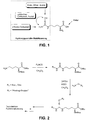
- the illustration 1 shows a schematic overview of the substitution of NOHA derivatives of the invention.
- substitutions according to the invention are marked with an X. Both a substitution on the oxygen of the hydroxyl group X 2 leads to surprisingly stable derivatives, as well as a substitution on the nitrogen X 1 and also a combination of the two substitutions according to the invention.
- the carboxylic acid function may be esterified in the usual way with an alkyl or aryl radical or present as acid (R 1 ).
- Y may correspond to a hydrogen, alkoxycarbonyl or aryloxycarbonyl radical.
- n can be 2 or 3.
- the center of chirality m can be R- or S- configured.
- R 1 may correspond to a hydrogen, alkyl or aryl radical
- X 1 and X 2 can be identical or different and correspond to the structures (i-vii) (exception is (i) in which X 1 and X 2 must be different, except N ⁇ -hydroxy-L-arginine itself and its Carboxylic esters), wherein R 2 , R 3 and R 4 may correspond to hydrogen, alkyl or aryl radicals or are designed so that they correspond in structure to a monosaccharide (derivative) and R 5-12 may correspond to a hydrogen, alkyl or aryl radical; n corresponds to a number of methylene (CH 2 ) groups of 2-3; the chiral center may be m R - or S -configured; Y may correspond to a hydrogen, alkoxycarbonyl or aryloxycarbonyl radical; Z corresponds to an oxygen or a nitrogen atom; X 1,2 are designed to be part of ring systems of structure (viii) or (ix), wherein R
- illustration 1 is a clear view of the optimization of the drug properties of N ⁇ -hydroxy-L-arginine (NOHA) according to the invention shown as NO donor and arginase inhibitor for the treatment of diseases.
- NOHA N ⁇ -hydroxy-L-arginine
- the thiourea 2 is usually already> 96% pure (DC) at this point.
- the product is dissolved in the elution agent, treated with charcoal and purified by flash chromatography on a short silica gel column. A column with about 20 g of silica gel and as eluent cyclohexane / ethyl acetate (4: 1) is used.
- the protected L-arginine 3 (0.4 mmol) is stirred in 8 mL TFA and 2.4 mL thioanisole for 30 min at room temperature. Then the majority of TFA i. Vak. distilled off and 5 mL of water and 15 mL of diethyl ether are added. The organic phase is extracted twice more with 5 ml of water and the combined aqueous phases are finally washed with 5 ml of diethyl ether. The aqueous phase is on a rotary evaporator Concentrated (at about 35 ° C) and with little 0.1% TFA (in double-distilled water ) recorded.
- Flash chromatography follows on an RP-18 column (eluant: 0.1% TFA (aq) ) to combine ninhydrin-positive fractions. The combined fractions are concentrated to a volume of about 10 mL on a rotary evaporator and then lyophilized in the freeze-drying.
- thiourea 2 0.5 mmol
- 261 ⁇ L of DIPEA 1.5 mmol
- 62.6 mg of methoxylamine hydrochloride 0.75 mmol
- the solution is brought to 0 ° C. for about 30 minutes and 143.5 mg EDCI (0.75 mmol) are added.
- the mixture is stirred overnight at room temperature.
- the solution is diluted with approx. 10 mL dichloromethane and washed in each case with 5 mL 1% HCl, water and saturated NaCl solution.
- the organic phase is dried over Na 2 SO 4 and i. Vak. concentrated.
- DMSO-d 6 as a solvent, the substance is present as a mixture of isomers in front of, in the ratio of about 8.6: 1.4 (at 300 K, relative to the singlet of the CH2 ethoxycarbonylmethoxy residue).
- the displacements given refer to the major isomer.
- the crude product is further purified by column chromatography on silica gel (dichloromethane / methanol, 97: 3).
- the combined fractions of the purified product are i. Vak. concentrated to a clear oil. Repeated addition and removal of dry dichloromethane provides a solid white foam which liquefies upon contact with air.
- the substance is present as a mixture of isomers, in the ratio of about 6: 4 (at 300 K, based on the triplet of CH 3 of the ethoxycarbonyl function).
- the displacements given refer to the major isomer.
Landscapes
- Health & Medical Sciences (AREA)
- Chemical & Material Sciences (AREA)
- Life Sciences & Earth Sciences (AREA)
- Veterinary Medicine (AREA)
- Public Health (AREA)
- General Health & Medical Sciences (AREA)
- Medicinal Chemistry (AREA)
- Animal Behavior & Ethology (AREA)
- Pharmacology & Pharmacy (AREA)
- Organic Chemistry (AREA)
- Epidemiology (AREA)
- Molecular Biology (AREA)
- Cardiology (AREA)
- Nuclear Medicine, Radiotherapy & Molecular Imaging (AREA)
- General Chemical & Material Sciences (AREA)
- Chemical Kinetics & Catalysis (AREA)
- Heart & Thoracic Surgery (AREA)
- Bioinformatics & Cheminformatics (AREA)
- Engineering & Computer Science (AREA)
- Acyclic And Carbocyclic Compounds In Medicinal Compositions (AREA)
- Pharmaceuticals Containing Other Organic And Inorganic Compounds (AREA)
- Medicines That Contain Protein Lipid Enzymes And Other Medicines (AREA)
Description
- Die vorliegende Erfindung betrifft physikalisch-chemisch und pharmakokinetisch verbesserte Derivate von N ω-Hydroxy-L-arginin (NOHA), sowie ein Verfahren zur Herstellung der erfindungsgemäß in ihren physikalisch-chemischen und pharmakokinetischen Eigenschaften verbesserten NOHA-Derivate.
- N ω-Hydroxy-L-arginin stellt das physiologisch vorkommende Intermediat der NO-Synthasekatalysierten Oxidation von L-Arginin dar. NOHA wird in einem weiteren Schritt durch die NO-Synthase oxidiert, wobei Stickstoffmonoxid freigesetzt und L-Citrullin gebildet wird. Somit ist die semi-essenzielle Aminosäure L-Arginin die natürliche Quelle für das Stickstoffmonoxid (NO).
- Stickstoffmonoxid (NO) ist u.a. für die Blutversorgung der Organe von entscheidender Bedeutung. NO führt indirekt zu einer Vergrößerung der Gefäße. Das Ausmaß der Gefäßerweiterung hat dann in den einzelnen Organen unterschiedliche Wirkungen haben. Im Herzen kommt es beispielsweise zu einer besseren Durchblutung. Neben der Weitstellung der Gefäße hat NO auch noch andere Eigenschaften:
- Die erschlaffende Wirkung betrifft nicht nur die Muskulatur der Gefäße, sondern auch die des Bronchialbaums.
- NO, das von den Endothelzellen in das Gefäßlumen abgegeben wird, kann die Zusammenlagerung von Blutplättchen verhindern (= Thrombusbildung).
- Im Nervensystem dient es als wichtiger Signalstoff (Transmitter), der Einfluss auf Gehirn- und Magen-Darm-Funktionen nimmt. So rufen in der Darmwand gelegene Nervenendigungen durch die NO-Ausschüttung eine Relaxierung (Entspannung) der Ringmuskulatur hervor.
- In Abwehrzellen (Makrophagen) wird NO gebildet, das in der Lage ist, Bakterien zu zerstören. Angeregt von Bakterienbestandteilen (z.B. Lipopolysacchariden) produzieren Makrophagen NO in hohen Konzentrationen, so dass lebenswichtige z.B. eisenhaltige Enzyme blockiert werden. Die Konservierung von Fleisch durch Pökeln beruht genau auf diesem Vorgang.
- Eine Dysregulation oder verminderte NO-Verfügbarkeit steht somit in Zusammenhang mit diversen kardiovaskulären Erkrankungen. Eine eingeschränkte NO-Verfügbarkeit wird daher mit der sog. endothelialen Dysfunktion assoziiert - ein Zustand multifaktorieller Genese - die mit Bluthochdruck, Atherosklerose, arterieller Thrombose, koronarer Herzkrankheit, Herzinsuffizienz, Herzinfarkt, Hypercholesterolämie und Diabetes in Verbindung gebracht wird.
- Alte, starre, atherosklerotisch veränderte Gefäße können sich mit NO wieder verformen. Die Durchblutung wird dadurch verbessert, und u.a. Bluthochdruck kann sich normalisieren. Bei Kindern, die mit schweren Atemstörungen auf die Welt kommen, wird heute schon erfolgreich die Einatmung (Inhalation) von NO angewandt. NO fördert die Erektion des Penis, was zu der Entwicklung von Medikamenten gegen die Impotenz geführt hat (Viagra®).
- Auch bei der Tumorbekämpfung verspricht man sich, neue Wege mit NO gehen zu können, da NO, das von weißen Blutzellen produziert wird, nicht nur Bakterien, sondern auch Zellen unschädlich machen kann.
- Die Lebensdauer von NO ist allerdings nicht sehr lange. Innerhalb kurzer Zeit reagiert es mit Sauerstoff-Molekülen zu Nitrit (NO2 -) und Nitrat (NO3 -). Die Kurzlebigkeit erklärt auch, warum NO immer nur unmittelbar an seinem Wirkort gebildet werden kann.
- Des Weiteren ist bekannt, dass NOHA einen potenten Inhibitor der Arginase I darstellt mit einem K i-Wert zwischen 30-42 µM.
- In kleineren in vivo-Studien mit Ratten konnten mit einer i.v.-NOHA-Therapie gewünschte Effekte zur Behandlung der erektilen Dysfunktion, endothelialen Dysfunktion und Hypertension bereits demonstriert werden.
- Die Behandlung von Erkrankungen, die mit endothelialer Dysfunktion assoziiert sind, mit den konventionellen NO-Donoren bringt einige Nachteile mit sich. Bei den Nitraten wären in diesem Zusammenhang z.B. die kurze therapeutische Halbwertszeit, die geringe orale Bioverfügbarkeit, teilweise adverse hämodynamische Effekte und Toleranzerscheinungen zu nennen. Tatsächlich wird eine proatherogene Wirkung bei langfristiger Behandlung mit organischen Nitraten in jüngster Zeit diskutiert.
- Um eine nebenwirkungsarme Therapie von NO-defizienten Erkrankungen zu ermöglichen, muss die physiologische Situation möglichst gut imitiert werden, d.h. NO nur für eine kurze Zeit, in den richtigen Mengen und am richtigen Ort freigesetzt werden. All diese Voraussetzungen sind mit NOHA als NO-Donor erfüllt, bzw. um den Faktor Zeit zu berücksichtigen, mit einem retardierenden Prodrug von NOHA. Neben der Tatsache, dass über diese Strategie Stickstoffmonoxid ausschließlich dort freigesetzt wird, wo es benötigt und in zu geringem Ausmaß gebildet wird, kann ausgenutzt werden, dass NOHA einen der potentesten Arginase-Hemmstoffe darstellt. Gerade eine erhöhte Arginase-Aktivität wird als Mechanismus der verminderten NO-Verfügbarkeit und damit als beteiligter Faktor bei der Entstehung der endothelialen Dysfunktion diskutiert. Es wird also ein dualer Wirkungsmechanismus mit NOHA ausgenutzt.
- Die Verwendung von L-Arginin oder N ω-Hydroxy-L-arginin sowie deren einfache Carbonsäureester, als auch analoge N-Hydroxyguanidine zur Behandlung einer Vielzahl von Erkrankungen sind beschrieben und patentrechtlich geschützt (eine Auswahl:
WO03045369 US6277884 ,WO0132167 CA02386938 - In der Praxis wird der Einsatz derartiger Verbindungen aber durch ihr schlechtes pharmakokinetisches Profil limitiert. Die unzureichenden Arzneistoffqualitäten dieser Substanz sind vor allem durch das Vorhandensein einer unsubstituierten N-Hydroxyguanidin-Funktion zu erklären. Im einzelnen sind folgende Effekte bei der physikalisch-chemischen Instabilität von N-Hydroxyguanidinen zu betrachten:
- N-Hydroxyguanidine zersetzen sich bei Raumtemperatur und sollten bei 4-8 °C, besser -20 °C gelagert werden. Am stabilsten sind sie in Form ihrer Salze starker Säuren. Die folgenden Zersetzungsprozesse sind bekannt:
- (1) Hydrolyseempfindlichkeit: Besonders bei höheren pH-Werten (> pH 7) erfolgt Umsetzung zu Cyanamiden und Hydrolyse zu Harnstoffen, was unter Berücksichtigung des physiologischen pH-Wertes von 7,4 in vivo relevant ist.
- (2) Oxidationsempfindlichkeit: Die Oxidationsanfälligkeit stellt das wohl größte Problem dieser Stoffklasse dar, da mit vielen sehr unterschiedlichen Oxidationsmitteln gezeigt werden konnte, dass Zwei- und Dreielektronen-Oxidationen möglich sind. Mit einfach-substituierten aliphatischen und aromatischen Hydroxyguanidinen wurden Oxidationspotentiale von Eox1 = +0,51-0,62 V und Eox2 = +1,14-1,81 V ermittelt. Die Zersetzungsprodukte können in Abhängigkeit vom Oxidationsmittel unterschiedlich sein. Auch Metallkationen wie beispielsweise Eisen(II)(III) oder Kupfer(II) begünstigen derartige Prozesse, bzw. sind daran beteiligt. Diese Vorgänge sind von physiologischer Relevanz, da bekannt ist, dass in vivo oxidative Prozesse dominieren und eine ganze Reihe physiologischer Substanzen (reaktive Sauerstoffspezies, Metallkationen) diese Oxidationen begünstigen.
- Metabolische Instabilität von N-Hydroxyguanidinen:
- N-Hydroxyguanidine werden im Körper enzymatisch-katalysiert effektiv zu den korrespondierenden Guanidinen reduziert. Die dafür verantwortlichen Enzymsysteme wurden schon teilweise identifiziert. So ist die mitochondriale N-Reduktion von Cytochrom b5, Cytochrom b5-Reduktase und einem Molybdän-Cofaktor-abhängigen Enzym (mARC) abhängig. Die mikrosomale N-Reduktion wird durch Cytochrom b5, Cytochrom b5-Reduktase und einer dritten bislang unbekannten Komponente katalysiert. Zusätzlich ist bekannt, dass Hydroxyguanidine im Rahmen einer metabolischen Phase-II-Biotransformation O-glucuronidiert werden können, um in eine besser ausscheidbare Form überführt zu werden.
- Dieses führt zu einer starken Limitierung der biologischen Halbwertszeit durch thermische, hydrolytische, oxidative und enzymatische Prozesse. Auch ein hoher first-pass-Effekt ist zu erwarten, unter Berücksichtigung der angesprochenen metabolischen Instabilität.
- Daher ist es Aufgabe der Erfindung die physikalisch-chemische und metabolische Stabilität und damit die pharmakokinetischen Eigenschaften von N ω-Hydroxy-L-arginin sowie deren einfache Carbonsäureester, als auch analoge N-Hydroxyguanidine zu verbessern.
- Die Aufgabe wird gelöst durch die Verwendung mit den Merkmalen von Anspruch 1. Die Unteransprüche geben vorteilhafte Ausgestaltungen der Erfindung wieder.
- Durch die erfindungsgemäße Substitution der Hydroxyguanidin-Funktion wurden überraschenderweise erstmals thermo- und oxidationsstabile Derivate des NOHA erhalten. Die
Abbildung 1 zeigt eine schematische Übersicht über die erfindungsgemäße Substitution der NOHA-Derivate. - Im Folgenden ist die chemische Formel der erfindungsgemäßen Derivate gezeigt.
- Die erfindungsgemäßen Substitutionen sind mit einem X gekennzeichnet. Sowohl eine Substitution am Sauerstoff der Hydroxylgruppe X2 führt zu überraschend stabilen Derivaten, wie auch eine Substitution am Stickstoff X1 sowie auch eine Kombination der beiden erfindungsgemäßen Substitutionen. Die Carbonsäurefunktion kann dabei in üblicher Weise mit einem Alkyl- oder Arylrest verestert sein oder als Säure vorliegen (R1). Y kann einem Wasserstoff, Alkoxycarbonyl- oder Aryloxycarbonylrest entsprechen. n kann 2 oder 3 betragen. Das Chiralitätszentrum m kann R- oder S-konfiguriert sein.

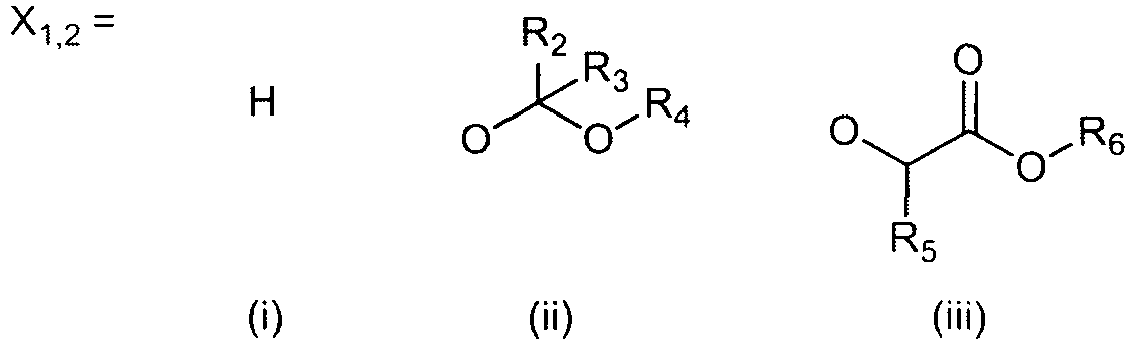


R1 einem Wasserstoff, Alkyl- oder Arylrest entsprechen kann; X1 und X2 identisch oder unterschiedlich sein können und den Strukturen (i-vii) entsprechen (Ausnahme ist (i) bei dem X1 und X2 unterschiedlich sein müssen; auch ausgenommen ist N ω-Hydroxy-L-arginin selbst und seine Carbonsäureester), wobei R2, R3 und R4 Wasserstoff, Alkyl- oder Arylresten entsprechen können oder so gestaltet sind, dass sie in ihrer Struktur einem Monosaccharid(derivat) entsprechen und R5-12 einem Wasserstoff, Alkyl- oder Arylrest entsprechen können; n einer Anzahl an Methylen (CH2)-Gruppen von 2-3 entspricht; das Chiralitätszentrum m R- oder S-konfiguriert sein kann; Y einem Wasserstoff, Alkoxycarbonyl- oder Aryloxycarbonylrest entsprechen kann; Z einem Sauerstoff- oder einem Stickstoff-Atom entsprechen; X1,2 so gestaltet sind, dass sie Teil von Ringsystemen der Struktur (viii) oder (ix) werden, wobei R13 und R14 Wasserstoff, Alkyl- oder Arylresten entsprechen können - In
Abbildung 1 ist eine übersichtliche Darstellung der erfindungsgemäßen Optimierung der Arzneistoffeigenschaften von N ω-Hydroxy-L-arginin (NOHA) als NO-Donor und Arginase-Hemmstoff zur Behandlung von Krankheiten gezeigt. - Für die Synthese der erfindungsgemäßen Derivate des N ω-Hydroxy-L-arginins wurde ein Konzept entwickelt, welches die Darstellung sehr unterschiedlich substituierter Verbindungen ermöglicht (siehe
Abbildung 2 ). Exemplarisch, die Allgemeinheit der Lehre nicht einschränkend, ist die Synthese unterschiedlich gearteter NOHA-Derivate in den Ausführungsbeispielen beschrieben. -

- Allgemeine Vorschrift in Anlehnung an Linton et al. [J. Org. Chem. 2000, 65, 1566]: 7,0 mmol N α-(t-Butyloxycarbonyl)-L-ornithin-t-butylester werden in 250 mL trockenem Dichlormethan gelöst. Die Lösung wird auf 0 °C gekühlt und 14 mL einer 0,5 M Lösung (in Dichlormethan) Benzyloxycarbonylisothiocyanat (7,0 mmol) tropfenweise über einen Zeitraum von 30 min zugegeben. Das Reaktionsgemisch wird zwei Stunden gerührt, wobei die Lösung auf Raumtemperatur aufwärmt. Anschließend wird das Gemisch am Rotationsverdampfer auf ca. ein Drittel des ursprünglichen Volumens i. Vak. eingeengt und mit jeweils 25 mL 1 %-iger HCl, Wasser und gesättigter NaCl-Lösung gewaschen. Die organische Phase wird über Na2SO4 getrocknet und am Rotationsverdampfer entfernt. Der Thioharnstoff 1 ist an dieser Stelle meist schon zu > 96 % rein (DC) und wird mittels Säulenchromatographie weiter aufgereinigt.
- Nach Säulenchromatographie über Kieselgel (Cyclohexan/Ethylacetat, 4:1) wird ein hellgelbes Öl erhalten, welches im Kühlschrank fest wird.
Ausbeute: 3,13 g (93 %) DC: Rf = 0,31 (Cyclohexan/Ethylacetat, 4:1; Ninhydrin)
δ/ppm = 1.44, 1.46 (s, 9H, 2 × C(CH3)3), 1.64-1.75 (m, 4H, β,γ-CH2), 3.66 (m, 2H, N-CH2), 4.20 (m, 1H, α-CH), 5.08 (m, 1H, NH), 5.10 (s, 2H, CH2-Cbz), 7.36 (m, 5H, ArH), 8.15 (br s, 1H, NH), 9.65 (br s, 1H, NH).
13C-NMR (CDCl3):
δ/ppm = 24.8 (γ-CH2), 28.7, 29.0 (2 × C(CH3)3), 30.9 (β-CH2), 45.8 (N-CH2), 54.2 (α-CH), 68.8 (CH2-Cbz), 80.4, 82.8 (2 × C(CH3)3), 129.0, 129.4, 129.5 (ArCH), 135.2 (ArC), 153.2 (CO-Cbz), 156.0 (CO-Boc), 172.2 (COO t Bu), 179.8 (C=S).
MS (ESI):
m/z = 482 [M + H]+, 426 [M - C4H8 + H]+, 370 [M - 2 × C4H8 + H]+, 326 [M - 2 × C4H8 - CO2 + H]+.
C23H35N3O6S (481.61)
Ber. C 57.36 H 7.33 N 8.73
Gef. C 57.55 H 7.60 N 8.68 -

- 8,0 mmol N α-(t-Butyloxycarbonyl)-L-omithin-t-butylester werden in 250 mL trockenem Dichlormethan gelöst. Die Lösung wird auf 0 °C gekühlt und 927 mg Ethoxycarbonylisothiocyanat (7,0 mmol), gelöst in 15 mL trockenem Dichlormethan, tropfenweise über einen Zeitraum von 30 min zugegeben. Das Reaktionsgemisch wird zwei Stunden bei Raumtemperatur gerührt. Anschließend wird das Gemisch am Rotationsverdampfer auf ca. ein Drittel des ursprünglichen Volumens eingeengt und mit jeweils 25 mL 1 %-iger HCl, Wasser und gesättigter NaCl-Lösung gewaschen. Die organische Phase wird über Na2SO4 getrocknet und i. Vak. eingeengt. Der Thioharnstoff 2 ist an dieser Stelle meist schon zu > 96 % rein (DC). Das Produkt wird im Fließmittel angelöst, mit Aktivkohle versetzt und mittels Flashchromatographie über eine kurze Kieselgel-Säule gereinigt. Es wird eine Säule mit etwa 20 g Kieselgel und als Elutionsmittel Cyclohexan/Ethylacetat (4:1) verwendet.
Ausbeute: 2,76 g eines farblosen Öls (94 %) DC: Rf = 0,31 (Cyclohexan/Ethylacetat, 4: 1;Ninhydrin) Schmp.: 81 °C
δ/ppm = 1.31 (t, 3H, 3 J = 7.1 Hz, CH2-CH 3), 1.45, 1.47 (2 × s, 9H, C(CH3)3), 1.61-1.90 (m, 4H, β,γ-CH2), 3.66 (pseudo q, 2H, N-CH2), 4.22 (q, 2H, 3 J = 7.1 Hz, CH 2-CH3), 5.08 (m, 1H, α-CH), 8.06, 9.70 (2 × br s, 1H, NH).
13C-NMR (CDCl3): δ/ppm = 14.9 (CH2-CH3), 24.9 (γ-CH2), 28.7, 29.0 (2 × C(CH3)3), 31.0 (β-CH2), 45.8 (N-CH2), 54.3 (α-CH), 63.4 (O-CH2), 82.8 (C(CH3)3), 153.4 (CO-Eoc), 156.2 (CO-Boc), 172.5 (COO'Bu), 180.1 (C=S).
MS (ESI):
m/z = 442 [M + Na]+, 420 [M + H]+, 308 [M - 2 × C4H8 + H]+, 264 [M - 2 × C4H8 - CO2 + H]+.
C18H33N3O6S (419.54)
Ber. C 51.53 H 7.93 N 10.02 S 7.64
Gef. C 51.68 H 7.97 N 10.06 S 7.62 -

- Es werden 0,5 mmol des Thioharnstoffs 1 in 5 mL trockenem Dichlormethan gelöst und 522 µL DIPEA (3 mmol) sowie 1,5 mmol Hydroxylammonium Hydrochlorid zugegeben. Die Lösung wird für ca. 30 min auf 0 °C gebracht und 287 mg N-Ethyl-N'-(3-dimethylaminopropyl)carbodiimid Hydrochlorid (1,5 mmol) zugegeben. Sofern nicht anders angemerkt, wird das Gemisch über Nacht bei Raumtemperatur gerührt. Die Lösung wird mit ca. 10 mL Dichlormethan verdünnt und jeweils mit 5 mL 1 %-iger HCl, Wasser und gesättigter NaCl-Lösung gewaschen. Die organische Phase wird über Na2SO4 getrocknet und am Rotationsverdampfer eingeengt. Es resultieren meist Öle, die mittels Flashchromatographie über Kieselgel weiter aufgereinigt werden. Die verwendeten Elutionsmittel und erzielten Ausbeuten sind bei den jeweiligen Substanzen angegeben.
- Als Elutionsmittel wird Dichlormethan/Methanol (99:1) verwendet.
Ausbeute: 235 mg eines farblosen Öls (95 %) DC: Rf = 0,30 (Dichlormethan/Methanol, 99:1;Ninhydrin)
δ/ppm = 1.44, 1.46 (2 × s, 9H, C(CH3)3), 1.58-2.02 (m, 4H, β,γ-CH2), 3.11 (m, 2H, N-CH2), 3.66 (s, 3H, O-CH3), 4.18 (m, 1H, α-CH), 5.11 (m, 1H, NH), 5.13 (s, 2H, CH2-Cbz), 6.25 (m, 1H, NH), 7.36 (m, 5H, ArH), 7.91 (br s, 1H, NH).
13C-NMR (CDCl3):
δ/ppm = 25.6 (γ-CH2), 28.7, 29.0 (2 × C(CH3)3), 30.9 (β-CH2), 41.2 (N-CH2), 54.5 (α-CH), 62.0 (O-CH3), 68.3 (CH2-Cbz), 80.3, 82.5 (2 × C(CH3)3), 129.0, 129.3, 129.4 (ArCH), 135.8 (ArC), 148.8 (C=N), 153.6 (CO-Cbz), 156.0 (CO-Boc), 172.5 (COO t Bu).
MS (ESI): m/z = 517 [M + Na]+, 495 [M + H]+, 439 [M - C4H8 + H]+.
C24H38N4O7 (494.58)
Ber. C 58.28 H 7.74 N 11.33
Gef. C 58.72 H 7.99 N 11.22 -

- Das geschützte L-Arginin 3 (0,4 mmol) wird in 8 mL TFA und 2,4 mL Thioanisol für 30 min bei Raumtemperatur gerührt. Anschließend wird der Großteil an TFA i. Vak. abdestilliert und 5 mL Wasser sowie 15 mL Diethylether werden zugegeben. Die organische Phase wird noch zweimal mit 5 mL Wasser extrahiert und die vereinigten wässrigen Phasen abschließend mit 5 mL Diethylether gewaschen. Die wässrige Phase wird am Rotationsverdampfer einkonzentriert (bei ca. 35 °C) und mit wenig 0,1 %-iger TFA (in Aqua bidest.) aufgenommen. Es folgt die Flashchromatographie über eine RP-18-Säule (Elutionsmittel: 0,1 % TFA(aq)), wobei Ninhydrin-positive Fraktionen vereinigt werden. Die vereinigten Fraktionen werden bis zu einem Volumen von ca. 10 mL am Rotationsverdampfer eingeengt und dann in der Gefriertrocknung lyophilisiert.
- Ausbeute: 171 mg eines farblosen Öls (99 %), Rf = 0,56 (i-Propanol/Wasser/Eisessig, 6:3:1; Ninhydrin)
1H-NMR (D2O):
δ/ppm = 1.78 (m, 2H, γ-CH2), 1.99 (m, 2H, β-CH2), 3.31 (t, 2H, 3 J = 6.8 Hz, N-CH2), 3.75 (s, 3H, O-CH3), 4.06 (t, 3 J = 6.2 Hz, 1H, α-CH).
13C-NMR (D2O, TPS):
δ/ppm = 26.4 (γ-CH2), 29.7 (β-CH2), 43.0 (N-CH2), 55.5 (α-CH), 67.3 (O-CH3), 160.1 (C=N), 174.8 (CO).
HRMS (m/z):
berechnet für C7H17N4O3 [M + H]+ = 205.12952, gefunden: 205.12951. -

- Zur Veresterung werden 238 mg der freien Aminosäure 3 (0,55 mmol) in 5 mL absolutem Ethanol unter Argon-Atmosphäre gelöst. Die Lösung wird 30 min bei -10 °C gerührt, bevor für ca. 5-10 min HCl-Gas in die Lösung eingeleitet wird. Anschließend wird der Ansatz für eine Stunde bei 0 °C weitergerührt und 36 Stunden in den Kühlschrank gestellt. Die Lösung wird vorsichtig i. Vak. bei Raumtemperatur einkonzentriert und lyophilisiert. Das so erhaltene Produkt fällt als sehr hygroskopischer, amorpher Feststoff an, welcher bei Luftkontakt verflüssigt.
Ausbeute: 168 mg eines klaren Öls (99 %) DC: Rf = 0,18 (i-Propanol/Wasser/Eisessig, 8:1:1;Ninhydrin)
δ/ppm = 1.24 (t, 3 J = 7.2 Hz, 3H, CH2-CH 3), 1.47-1.90 (m, 4H, β,γ-CH2), 3.22 (m, 2H, N-CH2), 3.64 (s, 3H, O-CH3), 3.99 (m, 1H, α-CH), 4.21 (q, 3 J = 7.2 Hz, 2H, CH 2-CH3), 8.04 (br s, 2H, NH2), 8.31 (br t, 1H, NH), 8.72 (br s, 3H, NH3 +), 11.33 (br s, 1H, NH+). 13C-NMR (DMSO-d 6):
δ/ppm = 13.9 (CH2-CH3), 24.0 (γ-CH2), 27.0 (β-CH2), 40.0 (N-CH2), 51.4 (α-CH), 61.7 (CH2-CH3), 64.4 (O-CH3), 157.2 (C=N), 169.2 (CO).
HRMS (m/z):
berechnet für C9H21N4O3 [M + H]+ = 233.16082, gefunden: 233.16064.
C9H20N4O3·2,0 HCl·0,7 H2O (317.82)
Ber. C 34.01 H 7.42 N 17.63
Gef. C 33.65 H 7.66 N 18.20 -

- 210 mg des Thioharnstoffs 2 (0,5 mmol) werden in 5 mL trockenem Dichlormethan gelöst und 261 µL DIPEA (1,5 mmol) sowie 62,6 mg Methoxylamin Hydrochlorid (0,75 mmol) zugegeben. Die Lösung wird für ca. 30 min auf 0 °C gebracht und 143,5 mg EDCI (0,75 mmol) zugegeben. Das Gemisch wird über Nacht bei Raumtemperatur gerührt. Die Lösung wird mit ca. 10 mL Dichlormethan verdünnt und jeweils mit 5 mL 1 %-iger HCl, Wasser und gesättigter NaCl-Lösung gewaschen. Die organische Phase wird über Na2SO4 getrocknet und i. Vak. eingeengt. Das Rohprodukt wird mittels Säulenchromatographie über Kieselgel weiter aufgereinigt (Dichlormethan/Methanol, 98:2).
Ausbeute: 203 mg eines farblosen Öls (94 %) DC: Rf = 0,26 (Dichlormethan/Methanol, 98:2;Ninhydrin)
δ/ppm = 1.27 (t, 3 J = 7.1 Hz, 3H, CH2-CH 3), 1.43, 1.45 (2 × s, 9H, C(CH3)3), 1.56-1.89 (m, 4H, β,γ-CH2), 3.09 (m, 2H, N-CH2), 3.66 (s, 3H, O-CH3), 4.16 (br q, 3 J = 7.1 Hz, 3H, CH 2-CH3, α-CH), 5.10, 6.26 (2 × br m, 1H, NH), 7.80 (br s, 1H, NH).
13C-NMR (CDCl3):
δ/ppm = 14.9 (CH2-CH3), 25.6 (γ-CH2), 29.7 (β-CH2), 29.0, 30.9 (2 × C(CH3)3), 41.2 (N-CH2), 54.5 (α-CH), 62.0 (CH2-CH3), 62.6 (O-CH3), 80.2, 82.5, (2 × C(CH3)3), 149.0 (C=N), 153.8 (CO-Eoc), 156.0 (CO-Boc), 172.4 (COO t Bu).
MS (ESI):
m/z = 455 [M + Na]+, 433 [M + H]+, 377 [M - C4H8 + H]+.
C19H36N4O7 (432.52)
Ber. C 52.76 H 8.39 N 12.95
Gef. C 53.65 H 8.57 N 13.24 -

- 200 mg des vollständig geschützten N ω-Methoxy-L-arginins 5 (0,46 mmol) werden in 5 mL TFA zuerst 30 min bei 0 °C und anschließend drei Stunden bei Raumtemperatur gerührt. TFA wird vorsichtig bei möglichst niedriger Temperatur i. Vak. abdestilliert und der Rückstand mit wenig Aqua bidest. aufgenommen. Es folgt die weitere Aufreinigung mittels Flashchromatographie auf einer RP-18-Säule (0,1 % TFA in Aqua bidest.). Die Ninhydrin-positiven Fraktionen werden vereinigt, am Rotationsverdampfer bei etwa 30 °C auf ein Restvolumen von ca. 10 mL eingeengt und lyophilisiert.
Ausbeute: 225 mg eines farblosen Öls (97 %) DC: Rf = 0,44 (i-Propanol/Wasser/Eisessig, 8:1:1,Ninhydrin)
δ/ppm = 1.22 (t, 3 J = 7.1 Hz, 3H, CH2-CH 3), 1.50-1.87 (m, 4H, β,γ-CH2), 3.12 (br t, 2H, N-CH2), 3.62 (s, 3H, O-CH3), 3.90 (m, 1H, α-CH), 4.13 (q, 3 J = 7.1 Hz, 2H, CH 2-CH3), 7.35 (br s, 1H, NH), 8.28 (br s, 3H, NH3 +).
13C-NMR (DMSO-d 6):
δ/ppm = 14.1 (CH2-CH3), 24.6 (γ-CH2), 27.3 (β-CH2), 40.6 (N-CH2), 51.7 (α-CH), 61.6 (CH2-CH3), 62.1 (O-CH3), 149.0 (C=N), 153.5 (CO-Eoc), 170.9 (CO).
HRMS (m/z):
berechnet für C10H21N4O5 [M + H]+ = 277.15065, gefunden: 277.15049.
C10H20N4O5·2,0 CF3COOH·0.4 H2O (513.56)
Ber. C 32.74 H 4.87 N 10.91
Gef. C 32.44 H 4.69 N 10.53 -

- Zur Veresterung werden 200 mg der freien Aminosäure 6 (0,397 mmol) in 5 mL absolutem Ethanol unter Argon-Atmosphäre gelöst. Die Lösung wird 30 min bei -10 °C gerührt, bevor für ca. 5-10 min HCl-Gas in die Lösung eingeleitet wird. Anschließend wird der Ansatz für eine Stunde bei 0 °C weitergerührt und 36 Stunden in den Kühlschrank gestellt. Die Lösung wird vorsichtig i. Vak. bei Raumtemperatur einkonzentriert und lyophilisiert. Das so erhaltene Produkt fällt als sehr hygroskopischer, amorpher Feststoff an, welcher bei Luftkontakt verflüssigt.
- Ausbeute: 150 mg eines farblosen Öls (99 %)
1H-NMR (DMSO-d 6):
δ/ppm = 1.23, 1.25 (2 × t, 3J = 7.0 Hz, 3H, CH2-CH 3), 1.55-1.88 (m, 4H, β,γ-CH2), 3.32 (br t, 2H, N-CH2), 3.71 (s, 3H, O-CH3), 3.95 (m, 1H, α-CH), 4.19 (m, 4H, 2 × CH 2-CH3), 8.80 (br s, 4H, NH3 +, NH).
13C-NMR (DMSO-d 6):
δ/ppm = 13.9, 14.0 (2 × CH2-CH3), 24.0 (γ-CH2), 26.9 (β-CH2), 41.1 (N-CH2), 51.4 (α-CH2), 61.7, 62.5 (2 × CH2-CH3), 63.9 (O-CH3), 150.7 (C=N), 152.6 (CO-Eoc), 169.2 (COOEt).
HRMS (m/z):
berechnet für C12H25N4O5 [M + H]+ = 305.18195, gefunden: 305.18176.
C12H24N4O5·2,0 HCl·0,6 H2O (388.08)
Ber. C 37.14 H 7.06 N 14.44
Gef. C 36.67 H 7.59 N 15.00 -

- 241 mg des Thioharnstoffs 1 (0,5 mmol) werden in 5 mL trockenem Dichlormethan gelöst und 261 µL DIPEA (0,75 mmol) sowie 79 mg Aminooxyessigsäuremethylester (0,75 mmol) zugegeben. Die Lösung wird für ca. 30 min auf 0 °C gebracht und 143,5 mg EDCI (0,75 mmol) werden zugegeben. Das Gemisch wird über Nacht bei Raumtemperatur gerührt. Die Lösung wird mit ca. 10 mL Dichlormethan verdünnt und jeweils mit 5 mL 1 %-iger HCl, Wasser und gesättigter NaCl-Lösung gewaschen. Die organische Phase wird über Na2SO4 getrocknet und i. Vak. eingeengt. Das Rohprodukt wird mittels Chromatographie über Kieselgel weiter aufgereinigt (Cyclohexan/Ethylacetat, 3:2).
Ausbeute: 254 mg eines farblosen Öls (92 %) DC: Rf = 0,48 (Cyclohexan/Ethylacetat, 3:2;Ninhydrin)
δ/ppm = 1.44, 1.46 (2 × s, 9H, C(CH3)3), 1.50-1.87 (m, 4H, β,γ-CH2), 3.07 (m, 2H, N-CH2), 3.73 (s, 3H, O-CH3), 4.16 (m, 1H, α-CH), 4.41 (s, 2H, O-CH2), 5.08 (m, 1H, NH), 5.15 (s, 2H, CH2-Cbz), 6.37 (br t, 3 J = 5.3 Hz, 1H, NH), 7.30-7.39 (m, 5H, ArH), 8.23 (br s, 1H, NH).
13C-NMR (CDCl3):
δ/ppm = 25.5 (γ-CH2), 28.7 (β-CH2), 29.0, 30.9 (2 × C(CH3)3), 41.2 (N-CH2), 52.4 (O-CH3), 54.5 (α-CH), 68.3 (CH2-Cbz), 71.2 (O-CH2), 80.3, 82.5 (2 × C(CH3)3), 129.0, 129.28, 129.34
(ArCH), 135.9 (ArC), 150.8 (C=N), 153.7 (CO-Cbz), 156.0 (CO-Boc), 171.7, 172.4 (COO t Bu, COOMe).
MS (ESI):
m/z = 575 [M + Na]+, 553 [M + H]+, 497 [M - C4H8 + H]+. -

- Es werden 270 mg des vollständig geschützten N ω-Carboxymethoxy-L-arginins 8 (0,489 mmol) in 5 mL 6 N HCl für vier Stunden bei 50-60 °C gerührt. Der Ansatz wird i. Vak. eingeengt, mit ca. 1-2 mL Aqua bidest. versetzt und anschließend mittels Flashchromatographie auf einer RP-18-Säule gereinigt (0,1 % TFA in Aqua bidest.). Ninhydrin-positive Fraktionen werden vereinigt, bis auf wenige Milliliter am Rotationsverdampfer bei 30 °C eingeengt und im Anschluss lyophilisiert.
Ausbeute: 150 mg eines weißen, amorphen Feststoffes (96 %) DC: Rf = 0,53 (i-Propanol/Wasser/Eisessig, 6:3:1; Ninhydrin)
δ/ppm = 1.76-2.18 (m, 4H, β,γ-CH2), 3.41 (br t, 3 J = 6.7 Hz, 2H, N-CH2), 4.17 (br t, 3 J = 6.2 Hz, α-CH), 4.63 (s, 2H, O-CH2).
13C-NMR (D2O, TPS):
δ/ppm = 26.3 (γ-CH2), 29.6 (β-CH2), 43.2 (N-CH2), 55.3 (α-CH), 75.5 (O-CH2), 161.0 (C=N), 174.6, 175.3 (2 × CO).
MS (ESI):
m/z = 249 [M + H]+.
C8H16N4O5·2,0 HCl·0,5 H2O (330.17)
Ber. C 29.10 H 5.80 N 16.97
Gef. C 29.00 H 5.99 N 17.16 -

- Die Darstellung und Aufarbeitung erfolgt unter denselben Bedingungen wie sie für die analoge Verbindung 8 beschrieben sind, mit dem Thioharnstoff 2 und Aminooxyessigsäureethylester als Ausgangssubstanzen (Ansatzgröße: 1,0 mmol).
Ausbeute: 500 mg eines farblosen Öls (99 %) DC: Rf = 0,51 (Cyclohexan/Ethylacetat, 3:2; Ninhydrin)
δ/ppm = 1.26 (t, 3 J = 7.1 Hz, 3H, CH2-CH 3), 1.27 (t, 3 J = 7.1 Hz, 3H, CH2-CH 3), 1.42, 1.44 (2 × s, 9H, C(CH3)3), 1.51-1.85 (m, 4H, β,γ-CH2), 3.06 (m, 2H, N-CH2), 4.16 (q, 3 J = 7.11 Hz, 2H, CH 2-CH3), 4.19 (q, 3 J = 7.17 Hz, 2H, CH 2-CH3), 4.39 (s, 2H, O-CH2), 5.08 (m, 1H, NH), 6.40 (br t, 1 H, NH), 8.19 (br s, 1 H, NH).
13C-NMR (CDCl3):
δ/ppm = 14.1, 14.2 (2 × CH2-CH3), 24.8 (γ-CH2), 27.9, 28.3 (2 × C(CH3)3), 30.2 (β-CH2), 40.5 (N-CH2), 53.7 (α-CH), 60.8, 61.9 (2 × CH2-CH3), 70.7 (O-CH2), 79.5, 81.8 (2 × C(CH3)3), 150.4 (C=N), 153.2 (CO-Eoc), 155.3 (CO-Boc), 170.7, 171.7 (COOEt, COO t Bu).
MS (ESI):
m/z = 527 [M + Na]+, 505 [M + H]+, 449 [M - C4H8]+.
C22H40N4O9 (504.59)
Ber. C 52.37 H 7.99 N 11.10
Gef. C 53.09 H 7.90 N 11.44 -

- Es werden 252 mg der vollständig geschützten Vorstufe 10 (0,5 mmol) in 5 mL TFA zuerst 30 min bei 0 °C und anschließend drei Stunden bei Raumtemperatur gerührt. TFA wird vorsichtig bei möglichst niedriger Temperatur i. Vak. abdestilliert und der Rückstand mit wenig Aqua bidest. aufgenommen. Es folgt die weitere Aufreinigung mittels Flashchromatographie auf einer RP-18-Säule (0,1 % TFA(aq)/Methanol-Stufengradient, 5-30 %). Die Ninhydrin-positiven Fraktionen werden vereinigt, am Rotationsverdampfer bei ca. 30 °C auf ein Restvolumen von ca. 10 mL eingeengt und lyophilisiert.
Ausbeute: 277 mg eines klaren Öls (96 %) DC: Rf = 0,62 (i-Propanol/Wasser/Eisessig, 8:1:1; Ninhydrin) - In DMSO-d 6 als Lösungsmittel liegt die Substanz als Isomerengemisch vor, im Verhältnis von ca. 8.6:1.4 (bei 300 K, bezogen auf das Singulett von CH2 des Ethoxycarbonylmethoxy-Rests). Die angegebenen Verschiebungen beziehen sich auf das Hauptisomer.
1H-NMR (DMSO-d 6):
δ/ppm = 1.19 (t, 3 J = 7.10 Hz, 3H, CH2-CH 3), 1.21 (t, 3 J = 7.08 Hz, 3H, CH2-CH3), 1.48-1.87 (m, 4H, β,γ-CH2), 3.02 (m, 2H, N-CH2), 3.89 (m, 1H, α-CH), 4.10 (q, 3 J = 7.04 Hz, 2H, CH 2-CH3), 4.12 (q, 3 J = 7.13 Hz, 2H, CH 2-CH3), 4.37 (s, 2H, O-CH2), 6.54 (br s, 1H, NH), 8.24 (br s, 3H, NH3 +), 10.64 (br s, COOH).
13C-NMR (DMSO-d 6):
δ/ppm = 14.0, 14.2 (2 × CH2-CH3), 27.4 (CH2), 40.3 (N-CH2), 51.8 (α-CH), 60.2, 61.3 (2 × CH2-CH3), 70.3 (O-CH2), 169.9, 171.0 (3 × CO).
HRMS (m/z):
berechnet für C13H25N4O7 [M + H]+ = 349.17178, gefunden: 349.17155.
C13H24N4O7·3,2 CF3COOH·1,5 H2O (740.26)
Ber. C 31.48 H 4.11 N 7.57
Gef. C 31.52 H 4.24 N 7.40 -

- Zur Veresterung werden 288 mg der freien Aminosäure 11 (0,5 mmol) in 5 mL absolutem Ethanol unter Argon-Atmosphäre gelöst. Die Lösung wird 30 min bei -10 °C gerührt, bevor für ca. 5-10 min HCl-Gas in die Lösung geleitet wird. Anschließend wird der Ansatz für eine Stunde bei 0 °C weitergerührt und über Nacht in den Kühlschrank gestellt. Die Lösung wird vorsichtig i. Vak. bei Raumtemperatur einkonzentriert, lyophilisiert und liefert einen stark hygroskopischen, amorphen Feststoff, der bei Luftkontakt verflüssigt.
Ausbeute: 222 mg eines farblosen Öls (99 %) DC: Rf = 0,57 (i-Propanol/Wasser/Eisessig, 8:1:1; Ninhydrin)
δ/ppm = 1.20 (t, 3 J = 7.16 Hz, 3H, CH2-CH 3), 1.23 (t, 3 J = 7.13 Hz, 3H, CH2-CH 3), 1.26 (t, 3 J = 7.10 Hz, 3H, CH2-CH 3), 1.51-1.87 (m, 4H, β,γ-CH2), 3.17 (m, 2H, N-CH2), 3.95 (m, 1H, α-CH), 4.14 (q, 3 J = 7.12 Hz, 2H, CH 2-CH3), 4.15 (q, 3 J = 7.10 Hz, 2H, CH 2-CH3), 4.17-4.25 (m, 2H, CH 2-CH3), 4.51 (s, 2H, O-CH2), 7.80 (br s, 1H, NH), 8.55 (br s, 1H, NH), 8.72 (br s, 3H, NH3 +).
13C-NMR (DMSO-d 6):
δ/ppm = 13.9, 14.0, 14.1 (3 × CH2-CH3), 24.2 (γ-CH2), 27.2 (β-CH2), 40.8 (N-CH2), 51.5 (α-CH), 60.5, 61.7, 61.9 (3 × CH2-CH3), 71.1 (O-CH2), 150.3 (C=N), 153.0 (CO-Eoc), 169.1, 169.3 (2 × CO).
HRMS (m/z):
berechnet für C15H29N4O7 [M + H]+ = 377.20308, gefunden: 377.20287. -

- Es werden 210 mg des Thioharnstoffs 2 (0,5 mmol), 218 mg 1-Aminooxy-2,3,4,6-tetra-O-acetyl-β-D-galactopyranose (0,6 mmol) und 104,5 ul DIPEA (0,6 mmol) in 5 mL trockenem Dichlormethan gelöst. Der Ansatz wird auf 0 °C gekühlt, 115 mg EDCI (0,6 mmol) werden zugegeben und 48 Stunden bei Raumtemperatur gerührt. Die Lösung wird mit ca. 10 mL Dichlormethan verdünnt und jeweils mit 5 mL 1 %-iger HCl, Wasser und gesättigter NaCl-Lösung gewaschen. Die organische Phase wird über Na2SO4 getrocknet und i. Vak. eingeengt. Das Rohprodukt wird mittels Säulenchromatographie über Kieselgel weiter aufgereinigt (Dichlormethan/Methanol, 97:3). Die vereinigten Fraktionen des gereinigten Produkts werden i. Vak. zu einem klaren Öl einkonzentriert. Wiederholte Zugabe und Entfernung von trockenem Dichlormethan liefert einen festen weißen Schaum, der bei Luftkontakt verflüssigt.
Ausbeute: 262 mg eines farblosen Öls (70 %) DC: Rf = 0,35 (Dichlormethan/Methanol, 97:3; Ninhydrin)
δ/ppm = 1.29 (t, 3 J = 7.1 Hz, 3H, CH2-CH 3), 1.43, 1.45 (2 × s, 9H, C(CH3)3), 1.52-1.86 (m, 4H, β,γ-CH2), 1.98, 2.02, 2.05, 2.13 (4 × COCH3), 3.08 (m, 2H, N-CH2), 3.96 (br t, 3 J = 6.8 Hz, 1H, 5'-CH), 4.11-4.21 (m, 5H, α-CH, CH 2-CH3, 3'-CH, NH), 4.85 (d, 3 J = 8.3 Hz, 1H, 1'-CH), 5.06 (m, 2H, 6'-CH2), 5.25 (dd, 3 J = 10.4, 8.3 Hz, 1H, 2'-CH), 5.39 (dd, 3 J = 3.5, 1.0 Hz, 1H, 4'-CH), 6.47 (br t, 1H, NH), 7.65 (br s, 1H, NH).
MS (ESI):
m/z = 772 [M + Na]+, 750 [M + H]+, 707 [M - C2H2O + H]+. -

- In einem Schlenk-Kolben werden 120 mg (0,16 mmol) der vollständig geschützten und sorgfältig getrockneten Vorstufe 13 unter Argon-Begasung in ca. 10 mL trockenem Diethylether gelöst. Die Lösung wird für ca. 30 min bei -15 °C gerührt und anschließend wird unter gleichzeitiger Argon-Begasung für ca. 5 min HCl-Gas vorsichtig in die Lösung geleitet. Das Reaktionsgemisch wird über Nacht in den Kühlschrank gestellt und am folgenden Tag zur Aufarbeitung i. Vak. eingeengt. Der weiß-gelbe Feststoff wird dann mit ca. 1-2 mL 0,5 M NaHCO3-Lösung aufgenommen und mittels Flashchromatographie über eine RP-18-Säule aufgereinigt (Fließmittel: Aqua bidest./Methanol), wobei ein Stufengradient für die Elution verwendet wird. Es wird mit 10 % Methanol-Anteil begonnen, dann auf 25 % und abschließend auf 50 % Methanol erhöht. Die produkthaltigen Fraktionen werden vereinigt, bei 30 °C auf ein Restvolumen von ca. 50 mL i. Vak. einkonzentriert und anschließend lyophilisiert.
- Ausbeute: 74 mg eines feinen weißen Pulvers (75 %)
- In D2O als Lösungsmittel liegt die Substanz als Isomerengemisch vor, im Verhältnis von ca. 6:4 (bei 300 K, bezogen auf das Triplett von CH3 der Ethoxycarbonyl-Funktion). Die angegebenen Verschiebungen beziehen sich auf das Hauptisomer.
- 1H-NMR (D2O, TPS): δ/ppm = 1.28 (t, 3 J = 7.1 Hz, 3H, CH2-CH 3), 1.52-1.97 (m, 4H, β,γ-CH2), 2.02, 2.08, 2.12, 2.23 (4 × s, 3H, COCH3), 3.16 (br t, 3 J = 6.8 Hz, 2H, 6'-CH2), 3.75 (t, 3 J = 6.3 Hz, 1H, 5'-CH), 4.15-4.30 (m, 5H, CH 2-CH3, α-CH, N-CH2), 5.07 (d, 3 J = 8.0 Hz, 1H, 1'-CH), 5.21-5.33 (m, 2H, 2',3'-CH), 5.47 (m, 1H, 4'-CH).
13C-NMR (D2O, TPS):
δ/ppm = 16.2 (CH2-CH3), 22.7, 22.8, 22.9, (4 × COCH3), 26.6 (γ-CH2), 30.6 (β-CH2), 42.7 (N-CH2), 57.2 (α-CH), 64.6 (6'-CH2), 65.8 (CH2-CH3), 70.6, 70.7, 73.4, 74.1 (2',3',4',5'-CH), 104.1 (1'-CH), 155.6 (C=N), 156.8 (CO-Eoc), 175.4, 175.8, 176.2, 177.1 (4 × COCH3). MS (ESI):
m/z = 615 [M + Na]+, 593 [M + H]+, 551 [M - C2H2O + H]+, 331 [C14H19O9]+.
HRMS (m/z):
berechnet für C23H33N4O14Na [M + Na]+ = 615.21202, gefunden: 615.21164
C23H35N4NaO14 (614.53)
Ber. C 44.95 H 5.74 N 9.12
Gef. C 45.08 H 6.21 N 8.77
Claims (8)
- Verwendung eines Stoffs mit der allgemeinen Formel (I)

wobeiX1, X2 ausgewählt sind aus der Gruppe von Substituenten bestehend aus

 R1 Wasserstoff, ein Alkyl- oder ein Arylrest ist;R2, R3 und R4 Wasserstoff, Alkyl- oder Arylrest sind oder R2, R3 und/oder R4 ein Monosaccharid oder ein Monosaccharidderivat ist,R5-R12 ein Wasserstoff, Alkyl- oder Arylrest ist;Y Wasserstoff, ein Alkoxycarbonyl- oder ein Aryloxycarbonylrest ist;Z Sauerstoff (O) oder Stickstoff (N) ist;n 2 oder 3 ist;und wobei X1 nicht (i) ist, wenn X2 =(vii) und R12=H sind und wobei N ω-Hydroxy-L-arginin und dessen Carbonsäureester ausgenommen sind oder
X1 und X2 ein Ringsystem der Struktur (viii) oder (ix) ausbilden:
- Verwendung nach Anspruch 1, dadurch gekennzeichnet, dass R2, R3 und/oder R4 ein Monosaccharid oder ein Monosaccharidderivat ist.
- Verwendung nach Anspruch 2, wobei der Stoff Nα-(t-Butyloxycarbonyl)-Nω-ethoxycarbonyl-Nω'-(2,3,4,6-tetra-O-acetyl-β-D-galactopyranos-1-yl)oxy-L-arginin-t-butylester oder Natriumsalz des Nω-Ethoxycarbonyl-Nω'(2,3,4,6-tetra-O-acetyl-β-D-galactopyranos-1-yl)oxy-L-arginins ist.
- Verwendung nach einem der vorhergehenden Ansprüche zur Prophylaxe und/oder Behandlung von kardiovaskulären Erkrankungen wie Bluthochdruck, Herzinsuffizienz, stabiler und instabiler Angina pectoris, peripheren und kardialen Gefäßerkrankungen, Arrhythmien, thromboembolischer Erkrankungen und Ischämien wie Myokardinfarkt, Hirnschlag, transistorischen und ischämischen Attacken, peripheren Durchblutungsstörungen oder zur Verhinderung von Restenosen nach Thrombolysetherapien, percutan transluminalen Angioplastien, percutan transluminalen Koronarangioplastien, Bypass, oder zur Behandlung von Atherosklerose.
- Verwendung nach einem der Ansprüche 1 bis 4 zur Prophylaxe und/oder Behandlung von Krankheiten des Urogenitalsystems, erektiler Dysfunktion, weiblicher sexueller Dysfunktion oder Inkontinenz.
- Verwendung nach einem der Ansprüche 1 bis 3 zur Prophylaxe und/oder Behandlung von malignen Tumoren.
- Verwendung nach einem der Ansprüche 1 bis 3 zur Prophylaxe und/oder Behandlung von das NO/cGMP-System im Zentralnervensystem störenden Krankheiten.
- Verwendung nach Anspruch 7 zur Verbesserung kognitiver Defizite, Lern- und Gedächtnisleistungen, zur Behandlung der Alzheimerschen Krankheit, zur Behandlung von Angst-, Spannungs- und Depressionszuständen, zentralnervös bedingten Sexualdysfunktionen und Schlafstörungen, zur Regulierung krankhafter Störungen der Nahrungs-, Genuss- und Suchtmittelaufnahme, oder zur Regulation der cerebralen Durchblutung als Mittel zur Bekämpfung der Migräne oder anderer Formen des Kopfschmerzes.
Applications Claiming Priority (2)
| Application Number | Priority Date | Filing Date | Title |
|---|---|---|---|
| DE102009004203 | 2009-01-09 | ||
| PCT/DE2010/000001 WO2010078865A1 (de) | 2009-01-09 | 2010-01-04 | DERIVATE VON N ω-HYDROXY-L-ARGININ ZUR BEHANDLUNG VON KRANKHEITEN |
Publications (2)
| Publication Number | Publication Date |
|---|---|
| EP2424515A1 EP2424515A1 (de) | 2012-03-07 |
| EP2424515B1 true EP2424515B1 (de) | 2017-03-22 |
Family
ID=42104483
Family Applications (1)
| Application Number | Title | Priority Date | Filing Date |
|---|---|---|---|
| EP10706475.0A Not-in-force EP2424515B1 (de) | 2009-01-09 | 2010-01-04 | Derivate von n omega-hydroxy-l-arginin zur behandlung von krankheiten |
Country Status (3)
| Country | Link |
|---|---|
| US (1) | US9387185B2 (de) |
| EP (1) | EP2424515B1 (de) |
| WO (1) | WO2010078865A1 (de) |
Families Citing this family (1)
| Publication number | Priority date | Publication date | Assignee | Title |
|---|---|---|---|---|
| CN117247339B (zh) * | 2023-11-16 | 2024-03-12 | 潍坊富邦药业有限公司 | 一种烷基胺衍生物的制备方法 |
Family Cites Families (6)
| Publication number | Priority date | Publication date | Assignee | Title |
|---|---|---|---|---|
| CA386938A (en) | 1940-02-20 | Q. Sherman John | Manifold material feeding means | |
| US6277884B1 (en) | 1998-06-01 | 2001-08-21 | Nitromed, Inc. | Treatment of sexual dysfunction with N-hydroxyguanidine compounds |
| US6436997B1 (en) | 1998-06-01 | 2002-08-20 | Nitromed, Inc. | Endogenous nitric oxide synthesis under conditions of low oxygen tension |
| FR2832634A1 (fr) | 2001-11-29 | 2003-05-30 | Univ Pasteur | Utilisation des isomeres l de derives aminoacides de l'hydroxyguanidine pour la production de no, compositions pharmaceutiques les contenant et utilisations pharmaceutiques |
| EP1596854A4 (de) * | 2003-02-14 | 2007-06-06 | Childrens Hosp & Res Ct Oak | Behandlung von erkrankungen im zusammenhang mit verringerter stickoxid-bioverfügbarkeit, einschliesslich erhöhte arginase |
| EP1915143A4 (de) * | 2005-07-01 | 2009-11-11 | Univ Johns Hopkins | Arginase ii: zielbehandlung für das alternde herz und herzinsuffizienz |
-
2010
- 2010-01-04 EP EP10706475.0A patent/EP2424515B1/de not_active Not-in-force
- 2010-01-04 WO PCT/DE2010/000001 patent/WO2010078865A1/de not_active Ceased
- 2010-01-04 US US13/143,156 patent/US9387185B2/en not_active Expired - Fee Related
Non-Patent Citations (3)
| Title |
|---|
| DENNIS SCHADE ET AL: "Efficient Synthesis of Optically Pure N[omega]-Alkylated l-Arginines", SYNTHESIS, vol. 2008, no. 15, 1 August 2008 (2008-08-01), pages 2391 - 2397, XP055194359, ISSN: 0039-7881, DOI: 10.1055/s-2008-1067165 * |
| DENNIS SCHADE ET AL: "Prodrug design for the potent cardiovascular agent N[omega]-hydroxy-l-arginine (NOHA): Synthetic approaches and physicochemical characterization", ORGANIC & BIOMOLECULAR CHEMISTRY, vol. 9, no. 14, 5249, 1 January 2011 (2011-01-01), pages 5249 - 5259, XP055194373, ISSN: 1477-0520, DOI: 10.1039/c0ob01117g * |
| KRISTIN JANSEN LABBY ET AL: "METHYLATED NOMEGA HYDROXY-L-ARGININE ANALOGUES AS MECHANISTIC PROBES FOR THE SECOND STEP OF THE NITRIC OXIDE SYNTHASE-CATALYZED REACTION", BIOCHEMISTRY, vol. 52, no. 18, 7 May 2013 (2013-05-07), pages 3062 - 3073, XP055194376, ISSN: 0006-2960, DOI: 10.1021/bi301571v * |
Also Published As
| Publication number | Publication date |
|---|---|
| US20120123111A1 (en) | 2012-05-17 |
| WO2010078865A1 (de) | 2010-07-15 |
| US9387185B2 (en) | 2016-07-12 |
| EP2424515A1 (de) | 2012-03-07 |
Similar Documents
| Publication | Publication Date | Title |
|---|---|---|
| DE69227512T2 (de) | N6-(hydrazinoiminomethyl)lysin und verfahren zur hemmung der stickstoffbildung im körper | |
| EP1390365B1 (de) | Neue sulfonat-substituierte pyrazolopyridinderivate | |
| LU82386A1 (fr) | Amides d'acyl-carnitines,leur procede de preparation et compositions pharmaceutiques contenant ces amides | |
| DE10232571A1 (de) | 4-Aminosubstituierte Pyrimidinderivate | |
| WO2005034940A2 (de) | Duale alanyl-aminopeptidase- und dipeptidylpeptidase iv-inhibitoren zur funktionellen beeinflussung unterschiedlicher zellen und zur behandlung immunologischer, entzündlicher, neuronaler und anderer erkrankungen | |
| EP1339717A1 (de) | Neue carbamat-substituierte pyrazolopyridinderivate | |
| EP1073631A1 (de) | Neue substituierte amide, deren herstellung und anwendung | |
| DE4321306A1 (de) | Disulfide | |
| WO2003086407A1 (de) | Verwendung von stimulatoren der löslichen guanylatcyclase zur behandlung von glaukom | |
| EP2550963B1 (de) | Pentamidin-Amidoximsäureesters als Prodrugs und ihre Verwendung als Arzneimittel | |
| DE10244810A1 (de) | Neue Morpholin-überbrückte Indazolderivate | |
| FR2776660A1 (fr) | Diazepino-indoles de phosphodiesterases iv | |
| EP0362575B1 (de) | Neue organische Nitrate und Verfahren zu deren Herstellung | |
| AU2008323683B2 (en) | Anti-inflammatory quinic acid derivatives for oral administration | |
| DE102004035808A1 (de) | Ammoniumsalze und Ammoniumsalz-Mineralsalzchlatrate als Transport- und Wirkform für pharmazeutische-medizinische und als Phasentransfermittel für chemische Anwendungen | |
| EP1613571B1 (de) | Deuterierte catecholaminderivate sowie diese verbindungen enthaltende arzneimittel | |
| EP0451760B1 (de) | Nitratoalkancarbonsäure-Derivate und Verfahren zu ihrer Herstellung | |
| EP2424515A1 (de) | Derivate von n omega-hydroxy-l-arginin zur behandlung von krankheiten | |
| DE10061542A1 (de) | Alkanoylamino-pyrimidine | |
| EP2497765B1 (de) | Verfahren zur herstellung von kreatinamiden | |
| EP2853533A1 (de) | 6-Fluor-9-methyl-ß-carbolin | |
| EP1185510B1 (de) | S-nitroso- und s-nitro-n-acyl-l-cystein-ester-derivate als pharmakologische wirkstoffe und diese verbindungen enthaltende arzneimittel | |
| KR20070114197A (ko) | 씨피티를 억제하는 아미노부탄산의 유도체 | |
| CN107056780B (zh) | 硫辛酸-他克林类似基团异二联体及其治疗阿尔兹海默症的应用 | |
| EP2355807B1 (de) | Inhibitoren der dimethylarginin dimethylaminohydrolase |
Legal Events
| Date | Code | Title | Description |
|---|---|---|---|
| PUAI | Public reference made under article 153(3) epc to a published international application that has entered the european phase |
Free format text: ORIGINAL CODE: 0009012 |
|
| 17P | Request for examination filed |
Effective date: 20110505 |
|
| AK | Designated contracting states |
Kind code of ref document: A1 Designated state(s): AT BE BG CH CY CZ DE DK EE ES FI FR GB GR HR HU IE IS IT LI LT LU LV MC MK MT NL NO PL PT RO SE SI SK SM TR |
|
| DAX | Request for extension of the european patent (deleted) | ||
| RIN1 | Information on inventor provided before grant (corrected) |
Inventor name: CLEMENT, BERND Inventor name: KOTTHAUS, JUERKE Inventor name: SCHADE, DENNIS |
|
| 17Q | First examination report despatched |
Effective date: 20150615 |
|
| GRAP | Despatch of communication of intention to grant a patent |
Free format text: ORIGINAL CODE: EPIDOSNIGR1 |
|
| INTG | Intention to grant announced |
Effective date: 20161004 |
|
| GRAS | Grant fee paid |
Free format text: ORIGINAL CODE: EPIDOSNIGR3 |
|
| GRAA | (expected) grant |
Free format text: ORIGINAL CODE: 0009210 |
|
| AK | Designated contracting states |
Kind code of ref document: B1 Designated state(s): AT BE BG CH CY CZ DE DK EE ES FI FR GB GR HR HU IE IS IT LI LT LU LV MC MK MT NL NO PL PT RO SE SI SK SM TR |
|
| REG | Reference to a national code |
Ref country code: GB Ref legal event code: FG4D Free format text: NOT ENGLISH |
|
| REG | Reference to a national code |
Ref country code: CH Ref legal event code: EP |
|
| REG | Reference to a national code |
Ref country code: AT Ref legal event code: REF Ref document number: 877028 Country of ref document: AT Kind code of ref document: T Effective date: 20170415 |
|
| REG | Reference to a national code |
Ref country code: IE Ref legal event code: FG4D Free format text: LANGUAGE OF EP DOCUMENT: GERMAN |
|
| REG | Reference to a national code |
Ref country code: DE Ref legal event code: R096 Ref document number: 502010013337 Country of ref document: DE |
|
| REG | Reference to a national code |
Ref country code: NL Ref legal event code: MP Effective date: 20170322 |
|
| PG25 | Lapsed in a contracting state [announced via postgrant information from national office to epo] |
Ref country code: NO Free format text: LAPSE BECAUSE OF FAILURE TO SUBMIT A TRANSLATION OF THE DESCRIPTION OR TO PAY THE FEE WITHIN THE PRESCRIBED TIME-LIMIT Effective date: 20170622 Ref country code: FI Free format text: LAPSE BECAUSE OF FAILURE TO SUBMIT A TRANSLATION OF THE DESCRIPTION OR TO PAY THE FEE WITHIN THE PRESCRIBED TIME-LIMIT Effective date: 20170322 Ref country code: GR Free format text: LAPSE BECAUSE OF FAILURE TO SUBMIT A TRANSLATION OF THE DESCRIPTION OR TO PAY THE FEE WITHIN THE PRESCRIBED TIME-LIMIT Effective date: 20170623 Ref country code: HR Free format text: LAPSE BECAUSE OF FAILURE TO SUBMIT A TRANSLATION OF THE DESCRIPTION OR TO PAY THE FEE WITHIN THE PRESCRIBED TIME-LIMIT Effective date: 20170322 Ref country code: LT Free format text: LAPSE BECAUSE OF FAILURE TO SUBMIT A TRANSLATION OF THE DESCRIPTION OR TO PAY THE FEE WITHIN THE PRESCRIBED TIME-LIMIT Effective date: 20170322 |
|
| REG | Reference to a national code |
Ref country code: LT Ref legal event code: MG4D |
|
| PG25 | Lapsed in a contracting state [announced via postgrant information from national office to epo] |
Ref country code: LV Free format text: LAPSE BECAUSE OF FAILURE TO SUBMIT A TRANSLATION OF THE DESCRIPTION OR TO PAY THE FEE WITHIN THE PRESCRIBED TIME-LIMIT Effective date: 20170322 Ref country code: SE Free format text: LAPSE BECAUSE OF FAILURE TO SUBMIT A TRANSLATION OF THE DESCRIPTION OR TO PAY THE FEE WITHIN THE PRESCRIBED TIME-LIMIT Effective date: 20170322 Ref country code: BG Free format text: LAPSE BECAUSE OF FAILURE TO SUBMIT A TRANSLATION OF THE DESCRIPTION OR TO PAY THE FEE WITHIN THE PRESCRIBED TIME-LIMIT Effective date: 20170622 |
|
| PG25 | Lapsed in a contracting state [announced via postgrant information from national office to epo] |
Ref country code: NL Free format text: LAPSE BECAUSE OF FAILURE TO SUBMIT A TRANSLATION OF THE DESCRIPTION OR TO PAY THE FEE WITHIN THE PRESCRIBED TIME-LIMIT Effective date: 20170322 |
|
| PG25 | Lapsed in a contracting state [announced via postgrant information from national office to epo] |
Ref country code: CZ Free format text: LAPSE BECAUSE OF FAILURE TO SUBMIT A TRANSLATION OF THE DESCRIPTION OR TO PAY THE FEE WITHIN THE PRESCRIBED TIME-LIMIT Effective date: 20170322 Ref country code: RO Free format text: LAPSE BECAUSE OF FAILURE TO SUBMIT A TRANSLATION OF THE DESCRIPTION OR TO PAY THE FEE WITHIN THE PRESCRIBED TIME-LIMIT Effective date: 20170322 Ref country code: SK Free format text: LAPSE BECAUSE OF FAILURE TO SUBMIT A TRANSLATION OF THE DESCRIPTION OR TO PAY THE FEE WITHIN THE PRESCRIBED TIME-LIMIT Effective date: 20170322 Ref country code: ES Free format text: LAPSE BECAUSE OF FAILURE TO SUBMIT A TRANSLATION OF THE DESCRIPTION OR TO PAY THE FEE WITHIN THE PRESCRIBED TIME-LIMIT Effective date: 20170322 Ref country code: EE Free format text: LAPSE BECAUSE OF FAILURE TO SUBMIT A TRANSLATION OF THE DESCRIPTION OR TO PAY THE FEE WITHIN THE PRESCRIBED TIME-LIMIT Effective date: 20170322 |
|
| PG25 | Lapsed in a contracting state [announced via postgrant information from national office to epo] |
Ref country code: IS Free format text: LAPSE BECAUSE OF FAILURE TO SUBMIT A TRANSLATION OF THE DESCRIPTION OR TO PAY THE FEE WITHIN THE PRESCRIBED TIME-LIMIT Effective date: 20170722 Ref country code: SM Free format text: LAPSE BECAUSE OF FAILURE TO SUBMIT A TRANSLATION OF THE DESCRIPTION OR TO PAY THE FEE WITHIN THE PRESCRIBED TIME-LIMIT Effective date: 20170322 Ref country code: PL Free format text: LAPSE BECAUSE OF FAILURE TO SUBMIT A TRANSLATION OF THE DESCRIPTION OR TO PAY THE FEE WITHIN THE PRESCRIBED TIME-LIMIT Effective date: 20170322 Ref country code: PT Free format text: LAPSE BECAUSE OF FAILURE TO SUBMIT A TRANSLATION OF THE DESCRIPTION OR TO PAY THE FEE WITHIN THE PRESCRIBED TIME-LIMIT Effective date: 20170724 |
|
| REG | Reference to a national code |
Ref country code: DE Ref legal event code: R097 Ref document number: 502010013337 Country of ref document: DE |
|
| REG | Reference to a national code |
Ref country code: FR Ref legal event code: PLFP Year of fee payment: 9 |
|
| PLBE | No opposition filed within time limit |
Free format text: ORIGINAL CODE: 0009261 |
|
| STAA | Information on the status of an ep patent application or granted ep patent |
Free format text: STATUS: NO OPPOSITION FILED WITHIN TIME LIMIT |
|
| PG25 | Lapsed in a contracting state [announced via postgrant information from national office to epo] |
Ref country code: DK Free format text: LAPSE BECAUSE OF FAILURE TO SUBMIT A TRANSLATION OF THE DESCRIPTION OR TO PAY THE FEE WITHIN THE PRESCRIBED TIME-LIMIT Effective date: 20170322 |
|
| 26N | No opposition filed |
Effective date: 20180102 |
|
| PG25 | Lapsed in a contracting state [announced via postgrant information from national office to epo] |
Ref country code: IT Free format text: LAPSE BECAUSE OF FAILURE TO SUBMIT A TRANSLATION OF THE DESCRIPTION OR TO PAY THE FEE WITHIN THE PRESCRIBED TIME-LIMIT Effective date: 20170322 Ref country code: SI Free format text: LAPSE BECAUSE OF FAILURE TO SUBMIT A TRANSLATION OF THE DESCRIPTION OR TO PAY THE FEE WITHIN THE PRESCRIBED TIME-LIMIT Effective date: 20170322 |
|
| REG | Reference to a national code |
Ref country code: CH Ref legal event code: PL |
|
| PG25 | Lapsed in a contracting state [announced via postgrant information from national office to epo] |
Ref country code: MT Free format text: LAPSE BECAUSE OF FAILURE TO SUBMIT A TRANSLATION OF THE DESCRIPTION OR TO PAY THE FEE WITHIN THE PRESCRIBED TIME-LIMIT Effective date: 20170322 |
|
| PG25 | Lapsed in a contracting state [announced via postgrant information from national office to epo] |
Ref country code: LU Free format text: LAPSE BECAUSE OF NON-PAYMENT OF DUE FEES Effective date: 20180104 |
|
| REG | Reference to a national code |
Ref country code: IE Ref legal event code: MM4A |
|
| REG | Reference to a national code |
Ref country code: BE Ref legal event code: MM Effective date: 20180131 |
|
| PG25 | Lapsed in a contracting state [announced via postgrant information from national office to epo] |
Ref country code: BE Free format text: LAPSE BECAUSE OF NON-PAYMENT OF DUE FEES Effective date: 20180131 Ref country code: CH Free format text: LAPSE BECAUSE OF NON-PAYMENT OF DUE FEES Effective date: 20180131 Ref country code: LI Free format text: LAPSE BECAUSE OF NON-PAYMENT OF DUE FEES Effective date: 20180131 |
|
| PG25 | Lapsed in a contracting state [announced via postgrant information from national office to epo] |
Ref country code: IE Free format text: LAPSE BECAUSE OF NON-PAYMENT OF DUE FEES Effective date: 20180104 |
|
| REG | Reference to a national code |
Ref country code: AT Ref legal event code: MM01 Ref document number: 877028 Country of ref document: AT Kind code of ref document: T Effective date: 20180104 |
|
| PG25 | Lapsed in a contracting state [announced via postgrant information from national office to epo] |
Ref country code: AT Free format text: LAPSE BECAUSE OF NON-PAYMENT OF DUE FEES Effective date: 20180104 |
|
| PG25 | Lapsed in a contracting state [announced via postgrant information from national office to epo] |
Ref country code: MC Free format text: LAPSE BECAUSE OF FAILURE TO SUBMIT A TRANSLATION OF THE DESCRIPTION OR TO PAY THE FEE WITHIN THE PRESCRIBED TIME-LIMIT Effective date: 20170322 |
|
| REG | Reference to a national code |
Ref country code: DE Ref legal event code: R082 Ref document number: 502010013337 Country of ref document: DE Representative=s name: MUELLER FOTTNER STEINECKE RECHTSANWALTS- UND P, DE Ref country code: DE Ref legal event code: R082 Ref document number: 502010013337 Country of ref document: DE Representative=s name: WITTHOFF JAEKEL STEINECKE PATENTANWAELTE PARTG, DE |
|
| REG | Reference to a national code |
Ref country code: DE Ref legal event code: R082 Ref document number: 502010013337 Country of ref document: DE Representative=s name: WITTHOFF JAEKEL STEINECKE PATENTANWAELTE PARTG, DE |
|
| PG25 | Lapsed in a contracting state [announced via postgrant information from national office to epo] |
Ref country code: TR Free format text: LAPSE BECAUSE OF FAILURE TO SUBMIT A TRANSLATION OF THE DESCRIPTION OR TO PAY THE FEE WITHIN THE PRESCRIBED TIME-LIMIT Effective date: 20170322 |
|
| PG25 | Lapsed in a contracting state [announced via postgrant information from national office to epo] |
Ref country code: HU Free format text: LAPSE BECAUSE OF FAILURE TO SUBMIT A TRANSLATION OF THE DESCRIPTION OR TO PAY THE FEE WITHIN THE PRESCRIBED TIME-LIMIT; INVALID AB INITIO Effective date: 20100104 |
|
| PG25 | Lapsed in a contracting state [announced via postgrant information from national office to epo] |
Ref country code: CY Free format text: LAPSE BECAUSE OF FAILURE TO SUBMIT A TRANSLATION OF THE DESCRIPTION OR TO PAY THE FEE WITHIN THE PRESCRIBED TIME-LIMIT Effective date: 20170322 Ref country code: MK Free format text: LAPSE BECAUSE OF NON-PAYMENT OF DUE FEES Effective date: 20170322 |
|
| PGFP | Annual fee paid to national office [announced via postgrant information from national office to epo] |
Ref country code: FR Payment date: 20210120 Year of fee payment: 12 |
|
| PGFP | Annual fee paid to national office [announced via postgrant information from national office to epo] |
Ref country code: DE Payment date: 20210120 Year of fee payment: 12 Ref country code: GB Payment date: 20210122 Year of fee payment: 12 |
|
| REG | Reference to a national code |
Ref country code: DE Ref legal event code: R119 Ref document number: 502010013337 Country of ref document: DE |
|
| GBPC | Gb: european patent ceased through non-payment of renewal fee |
Effective date: 20220104 |
|
| PG25 | Lapsed in a contracting state [announced via postgrant information from national office to epo] |
Ref country code: GB Free format text: LAPSE BECAUSE OF NON-PAYMENT OF DUE FEES Effective date: 20220104 Ref country code: DE Free format text: LAPSE BECAUSE OF NON-PAYMENT OF DUE FEES Effective date: 20220802 |
|
| PG25 | Lapsed in a contracting state [announced via postgrant information from national office to epo] |
Ref country code: FR Free format text: LAPSE BECAUSE OF NON-PAYMENT OF DUE FEES Effective date: 20220131 |