EP2424473B1 - Manufacturing method for percutaneous implant - Google Patents
Manufacturing method for percutaneous implant Download PDFInfo
- Publication number
- EP2424473B1 EP2424473B1 EP10717731.3A EP10717731A EP2424473B1 EP 2424473 B1 EP2424473 B1 EP 2424473B1 EP 10717731 A EP10717731 A EP 10717731A EP 2424473 B1 EP2424473 B1 EP 2424473B1
- Authority
- EP
- European Patent Office
- Prior art keywords
- implant
- ingrowth
- mesh
- cylindrical part
- ingrowth mesh
- Prior art date
- Legal status (The legal status is an assumption and is not a legal conclusion. Google has not performed a legal analysis and makes no representation as to the accuracy of the status listed.)
- Not-in-force
Links
- 239000007943 implant Substances 0.000 title claims description 122
- 238000004519 manufacturing process Methods 0.000 title claims description 7
- 210000001519 tissue Anatomy 0.000 claims description 42
- 238000000034 method Methods 0.000 claims description 37
- 210000003815 abdominal wall Anatomy 0.000 claims description 23
- 210000003491 skin Anatomy 0.000 claims description 19
- 238000004873 anchoring Methods 0.000 claims description 15
- 210000002615 epidermis Anatomy 0.000 claims description 15
- RTAQQCXQSZGOHL-UHFFFAOYSA-N Titanium Chemical compound [Ti] RTAQQCXQSZGOHL-UHFFFAOYSA-N 0.000 claims description 14
- 210000003205 muscle Anatomy 0.000 claims description 13
- 239000010936 titanium Substances 0.000 claims description 13
- 229910052719 titanium Inorganic materials 0.000 claims description 13
- 230000004323 axial length Effects 0.000 claims description 7
- 239000004411 aluminium Substances 0.000 claims description 2
- XAGFODPZIPBFFR-UHFFFAOYSA-N aluminium Chemical compound [Al] XAGFODPZIPBFFR-UHFFFAOYSA-N 0.000 claims description 2
- 229910052782 aluminium Inorganic materials 0.000 claims description 2
- 230000035876 healing Effects 0.000 description 23
- 210000003405 ileum Anatomy 0.000 description 11
- 238000007455 ileostomy Methods 0.000 description 10
- 210000002445 nipple Anatomy 0.000 description 8
- PNEYBMLMFCGWSK-UHFFFAOYSA-N Alumina Chemical compound [O-2].[O-2].[O-2].[Al+3].[Al+3] PNEYBMLMFCGWSK-UHFFFAOYSA-N 0.000 description 6
- 238000003780 insertion Methods 0.000 description 6
- 230000037431 insertion Effects 0.000 description 6
- 210000002808 connective tissue Anatomy 0.000 description 5
- 241001465754 Metazoa Species 0.000 description 4
- 238000002474 experimental method Methods 0.000 description 4
- 210000003195 fascia Anatomy 0.000 description 4
- 210000000936 intestine Anatomy 0.000 description 4
- 239000000463 material Substances 0.000 description 4
- 238000001356 surgical procedure Methods 0.000 description 4
- 230000003187 abdominal effect Effects 0.000 description 3
- 230000003872 anastomosis Effects 0.000 description 3
- 210000001072 colon Anatomy 0.000 description 3
- 238000002513 implantation Methods 0.000 description 3
- 208000015181 infectious disease Diseases 0.000 description 3
- 206010033675 panniculitis Diseases 0.000 description 3
- 238000004659 sterilization and disinfection Methods 0.000 description 3
- 210000000626 ureter Anatomy 0.000 description 3
- 238000003466 welding Methods 0.000 description 3
- 208000035143 Bacterial infection Diseases 0.000 description 2
- LFQSCWFLJHTTHZ-UHFFFAOYSA-N Ethanol Chemical compound CCO LFQSCWFLJHTTHZ-UHFFFAOYSA-N 0.000 description 2
- FAPWRFPIFSIZLT-UHFFFAOYSA-M Sodium chloride Chemical compound [Na+].[Cl-] FAPWRFPIFSIZLT-UHFFFAOYSA-M 0.000 description 2
- 210000001015 abdomen Anatomy 0.000 description 2
- 208000022362 bacterial infectious disease Diseases 0.000 description 2
- 238000006243 chemical reaction Methods 0.000 description 2
- 239000003599 detergent Substances 0.000 description 2
- 238000011161 development Methods 0.000 description 2
- 230000018109 developmental process Effects 0.000 description 2
- 230000004064 dysfunction Effects 0.000 description 2
- 230000010354 integration Effects 0.000 description 2
- 238000001000 micrograph Methods 0.000 description 2
- 210000004303 peritoneum Anatomy 0.000 description 2
- 239000004033 plastic Substances 0.000 description 2
- 229920003023 plastic Polymers 0.000 description 2
- 230000002980 postoperative effect Effects 0.000 description 2
- 210000000664 rectum Anatomy 0.000 description 2
- 210000004872 soft tissue Anatomy 0.000 description 2
- 230000001954 sterilising effect Effects 0.000 description 2
- 238000007920 subcutaneous administration Methods 0.000 description 2
- 238000011282 treatment Methods 0.000 description 2
- 238000004506 ultrasonic cleaning Methods 0.000 description 2
- LCSKNASZPVZHEG-UHFFFAOYSA-N 3,6-dimethyl-1,4-dioxane-2,5-dione;1,4-dioxane-2,5-dione Chemical group O=C1COC(=O)CO1.CC1OC(=O)C(C)OC1=O LCSKNASZPVZHEG-UHFFFAOYSA-N 0.000 description 1
- 241000282465 Canis Species 0.000 description 1
- 241000282472 Canis lupus familiaris Species 0.000 description 1
- CEAZRRDELHUEMR-URQXQFDESA-N Gentamicin Chemical compound O1[C@H](C(C)NC)CC[C@@H](N)[C@H]1O[C@H]1[C@H](O)[C@@H](O[C@@H]2[C@@H]([C@@H](NC)[C@@](C)(O)CO2)O)[C@H](N)C[C@@H]1N CEAZRRDELHUEMR-URQXQFDESA-N 0.000 description 1
- 241000282412 Homo Species 0.000 description 1
- 206010028980 Neoplasm Diseases 0.000 description 1
- 210000003484 anatomy Anatomy 0.000 description 1
- 238000010171 animal model Methods 0.000 description 1
- 239000003242 anti bacterial agent Substances 0.000 description 1
- 230000001580 bacterial effect Effects 0.000 description 1
- 238000001574 biopsy Methods 0.000 description 1
- 230000008993 bowel inflammation Effects 0.000 description 1
- 201000011510 cancer Diseases 0.000 description 1
- 230000001684 chronic effect Effects 0.000 description 1
- 230000000295 complement effect Effects 0.000 description 1
- 238000010276 construction Methods 0.000 description 1
- 230000008878 coupling Effects 0.000 description 1
- 238000010168 coupling process Methods 0.000 description 1
- 238000005859 coupling reaction Methods 0.000 description 1
- 230000001419 dependent effect Effects 0.000 description 1
- 210000004207 dermis Anatomy 0.000 description 1
- 238000013461 design Methods 0.000 description 1
- 238000002224 dissection Methods 0.000 description 1
- -1 e.g. Substances 0.000 description 1
- 239000012530 fluid Substances 0.000 description 1
- 238000011010 flushing procedure Methods 0.000 description 1
- 229940072360 garamycin Drugs 0.000 description 1
- PCHJSUWPFVWCPO-UHFFFAOYSA-N gold Chemical compound [Au] PCHJSUWPFVWCPO-UHFFFAOYSA-N 0.000 description 1
- 238000010562 histological examination Methods 0.000 description 1
- 230000000968 intestinal effect Effects 0.000 description 1
- 238000003698 laser cutting Methods 0.000 description 1
- 230000007774 longterm Effects 0.000 description 1
- 238000003754 machining Methods 0.000 description 1
- 230000036210 malignancy Effects 0.000 description 1
- 238000013508 migration Methods 0.000 description 1
- 230000005012 migration Effects 0.000 description 1
- 230000000474 nursing effect Effects 0.000 description 1
- 230000037368 penetrate the skin Effects 0.000 description 1
- 230000008569 process Effects 0.000 description 1
- 208000012802 recumbency Diseases 0.000 description 1
- 238000007789 sealing Methods 0.000 description 1
- 210000000813 small intestine Anatomy 0.000 description 1
- 239000011780 sodium chloride Substances 0.000 description 1
- 230000006641 stabilisation Effects 0.000 description 1
- 230000003019 stabilising effect Effects 0.000 description 1
- 238000011105 stabilization Methods 0.000 description 1
- 210000004304 subcutaneous tissue Anatomy 0.000 description 1
- 239000000126 substance Substances 0.000 description 1
- 230000003746 surface roughness Effects 0.000 description 1
- 238000004381 surface treatment Methods 0.000 description 1
- 238000012360 testing method Methods 0.000 description 1
- 230000000451 tissue damage Effects 0.000 description 1
- 231100000827 tissue damage Toxicity 0.000 description 1
- 230000002485 urinary effect Effects 0.000 description 1
- 238000005303 weighing Methods 0.000 description 1
Images




Classifications
-
- A—HUMAN NECESSITIES
- A61—MEDICAL OR VETERINARY SCIENCE; HYGIENE
- A61F—FILTERS IMPLANTABLE INTO BLOOD VESSELS; PROSTHESES; DEVICES PROVIDING PATENCY TO, OR PREVENTING COLLAPSING OF, TUBULAR STRUCTURES OF THE BODY, e.g. STENTS; ORTHOPAEDIC, NURSING OR CONTRACEPTIVE DEVICES; FOMENTATION; TREATMENT OR PROTECTION OF EYES OR EARS; BANDAGES, DRESSINGS OR ABSORBENT PADS; FIRST-AID KITS
- A61F5/00—Orthopaedic methods or devices for non-surgical treatment of bones or joints; Nursing devices ; Anti-rape devices
- A61F5/44—Devices worn by the patient for reception of urine, faeces, catamenial or other discharge; Colostomy devices
- A61F5/445—Colostomy, ileostomy or urethrostomy devices
-
- Y—GENERAL TAGGING OF NEW TECHNOLOGICAL DEVELOPMENTS; GENERAL TAGGING OF CROSS-SECTIONAL TECHNOLOGIES SPANNING OVER SEVERAL SECTIONS OF THE IPC; TECHNICAL SUBJECTS COVERED BY FORMER USPC CROSS-REFERENCE ART COLLECTIONS [XRACs] AND DIGESTS
- Y10—TECHNICAL SUBJECTS COVERED BY FORMER USPC
- Y10T—TECHNICAL SUBJECTS COVERED BY FORMER US CLASSIFICATION
- Y10T29/00—Metal working
- Y10T29/49—Method of mechanical manufacture
- Y10T29/49826—Assembling or joining
Definitions
- the present invention relates to a method of manufacturing a percutaneous ostomy implant for a given patient or class of patients.
- Ileostomy and colostomy are common operations which may be necessitated, for example, by malignancy or chronic bowel inflammation.
- the surgery is called an ileostomy if the colon and rectum are removed and a colostomy if the rectum alone is removed.
- a stoma is formed in the abdominal wall to which the ileum or colon respectively is connected. The stoma in most cases has to be connected to a bag.
- a reservoir known as a "Kock pouch" from the distal part of the ileum. It is formed in such a way that a nipple valve is created which serves to close the reservoir, whilst allowing it to be drained intermittently by means of a catheter.
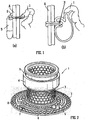
- Figure 1 illustrates (a) a conventional ileostomy and (b) a Kock's pouch ileostomy.
- IPAA ileopouch anal anastomosis
- a percutaneous ostomy implant comprising a solid-walled cylindrical body and an anchoring section in the form of a circular flange.
- the device was designed to be implanted through the abdominal wall and secured by the anchoring section which was located below the muscle layer.
- This section comprised inner and outer concentric rings interconnected by S-shaped members in order to provide an axially resilient structure which could absorb shear stresses and consequently reduce the risk of tissue damage. Spaces around the S-shaped members and provision of numerous apertures in the rings allowed for tissue ingrowth and vascularisation. It was proposed to connect the device to the side of the vessel (colon etc.) wall and by providing a removable lid a continent ostomy could be provided.
- this implant was disclosed in WO 2007/099500 in which the single solid-walled cylindrical body of EP 1632201-A1 was replaced by an outer skin-penetrating ring-like part spaced from the anchoring section by circumferentially-spaced legs.
- This implant was designed to receive a vessel drawn up through it; the spaces between the legs allowed the generation of a tissue bond between the inner part of the abdominal wall and the serosal tissue of the bowel in order to provide a more secure, stable, leak-proof and well-vascularised skin-implant junction.
- a circumferential ingrowth mesh was additionally provided. This extended along most of the length of the cylindrical body with an annular gap being provided between it and the outer ring-like part to allow tissue to grow through the mesh within the outer ring-like part.
- a cylindrical body formed of two axially-spaced tubular parts.
- the outer tubular part penetrated the skin and was provided with means for connection to a bag or lid.
- the inner tubular part was attached to an anchoring flange of the type previously described.
- the two parts were connected together by a "distance means" comprising either radially-spaced legs or a rigid cylindrical ingrowth mesh which allowed for the generation of a tissue bond between the abdominal wall and the bowel.
- a break was provided in the possible infection path along the implant from the skin.
- the outer tubular part penetrated the skin surface thereby isolating the skin surface - where sources of infection may be present - from the bowel tissue.
- US 4183357A and US 4217664A also disclose ostomy implants.
- a percutaneous ostomy implant for implantation into the abdominal wall of a patient, the implant comprising: a cylindrical part for mounting an external detachable device thereto; a preferably cylindrical ingrowth mesh; and a circular flange for anchoring the implant; the cylindrical part and circular flange being attached to opposite ends of the ingrowth mesh; characterised in that the ingrowth mesh comprises a skin-penetrating portion having an axial length that is greater than the thickness of tissue layers above the muscle layer such that when the implant is implanted in the abdominal wall of a patient, the cylindrical part remains above the surface of the patient's skin and the epidermis meets the ingrowth mesh and is able to attach therethrough directly to serosal tissue of a bowel segment inside the implant.
- the present invention is based on the hypothesis that by allowing the epidermis to attach directly to the serosal tissue, bacterial infection (i.e. bacterial attachment to implant surface and subsequent migration) can be prevented. This is in marked contrast to the previously-described implant configurations which have prevented this attachment by means of a solid-walled skin-penetrating parts, which , were arranged to isolate the epidermis from the serosal tissue. Provided that the attachment of the serosal tissue above the epidermis-serosal junction to the mesh structure is stable and does not retract down to the level of the junction, a stable system can be achieved.
- the implant may be formed with the cylindrical part in the form of a ring or squat cylinder, which is configured to be entirely exposed outside the abdominal wall.
- the exterior surface of the mesh is exposed and unobstructed to allow direct and unbroken contact with the abdominal wall in the region adjacent to the circular flange as well as adjacent to the epidermis; this permits tissue ingrowth through the mesh from its connection to the circular anchoring flange to the skin surface.
- the cylindrical part must be sufficient for the cylindrical part to remain above the surface of the patient's skin.
- the ingrowth mesh comprises a skin-penetrating portion having an axial length that is greater than the thickness of the tissue layers above the muscle layer. Typically, it will be greater than the axial extent of the cylindrical part.
- the circular flange is preferably penetrated by multiple small holes to allow ingrowth of connective tissue.
- the circular flange preferably comprises inner and outer concentric rings, the inner ring being attached to one end of the cylindrical mesh and the outer ring being connected to the inner ring by a plurality of S-shaped connecting members.
- the ingrowth mesh may be a laser-cut titanium ingrowth structure and it may be laser-welded to the cylindrical part and circular flange.
- the cylindrical part is radially outwardly spaced from the mesh, which extends inside it, in the manner known from WO 2007/099500 , so that an annular gap is provided.
- the annular gap allows for the ingrowth of serosal tissue from the vessel. This forms the above-mentioned attachment above the epidermis-serosa junction.
- this tissue will be contiguous with, not isolated from, the epidermis surrounding the implant.
- a percutaneous ostomy implant may comprise a preferably cylindrical ingrowth mesh structure configured in use to surround a vessel (e.g. a bowel segment) having serosal tissue and to allow epidermis to attach directly to the serosal tissue through the ingrowth mesh.
- a vessel e.g. a bowel segment
- the mesh extends above (i.e. outwardly of) the epidermis-serosa junction, so that serosal tissue may attach to the mesh so as to form a stable structure in which the attachment will not retract down to the level of the epidermis-serosa junction.
- the implant may be made of any biologically-acceptable material, e.g. plastics, it is preferably formed of commercially pure titanium, preferably ASTM Grade 2 titanium, which may have a surface treatment, such as a grit or an aluminium oxide-blasted surface and/or an electrochemical treatment to achieve optimum topographical properties, physical and chemical surface characteristics (e.g. surface roughness) etc.
- a surface treatment such as a grit or an aluminium oxide-blasted surface and/or an electrochemical treatment to achieve optimum topographical properties, physical and chemical surface characteristics (e.g. surface roughness) etc.
- the implant is preferably used in combination with an external detachable device mounted to the cylindrical part of the implant. In the context of a continent system, this is preferably a lid. However, the implant could be used with a bag. Furthermore, as will be discussed more fully below, the implant may be used in conjunction with a so-called healing device which stabilises the implant and prevents relative movement between the tissue and implant as it heals.
- the most preferred form of the implant is made of commercially pure titanium (grade 2) machined to the desired shape and blasted with aluminium oxide. It consists of a cylindrical part and a circular flange. The circular flange is penetrated with multiple small holes to allow ingrowth of connective tissue. The two parts are connected to a cylindrical mesh.
- the cylindrical mesh is a laser-cut titanium ingrowth structure attached to the cylinder and flange by means of laser welding.
- the implant is preferably decontaminated with ultrasonic cleaning in detergent and alcohol followed by sterilisation by means of autoclaving.
- a method of making an implant comprising providing the components set out above (preferably the preferred forms of the components set out above) and assembling them, preferably by means of laser welding.
- the method includes the step of dimensioning the skin-penetrating portion of the ingrowth mesh such that it has an axial length that is greater than the thickness of the tissue layers above the muscle layer for a given patient or class of patients into which it may be implanted.
- a method of manufacturing a percutaneous ostomy implant for a patient or class of patients comprising the steps of: providing: a cylindrical part for mounting an external detachable device thereto; a preferably cylindrical ingrowth mesh; and a circular flange for anchoring the implant; assembling the cylindrical part, the circular flange and the ingrowth mesh such that the cylindrical part and circular flange are at opposite ends of the ingrowth mesh; characterised in that the ingrowth mesh comprises a skin-penetrating portion having an axial length that is greater than the thickness of tissue layers above the muscle layer such that if the implant is implanted immediately above the muscle layer in the abdominal wall of the patient or a member of the class of patients respectively, the cylindrical part remains above the surface of the patient's skin and the epidermis would meet the ingrowth mesh and be able to attach therethrough directly to serosal tissue of a bowel segment inside the implant.
- an example of a method of implanting an ostomy implant into the abdominal wall of a patient comprises: providing implant having: a cylindrical part for mounting an external detachable device thereto; a preferably cylindrical ingrowth mesh; and a circular flange for anchoring the implant; the cylindrical part and circular flange being attached to opposite ends of the ingrowth mesh; and implanting the implant into the abdominal wall of a patient such that the epidermis meets the ingrowth mesh and is able to attach therethrough directly to serosal tissue of a bowel segment inside the implant.
- the method typically will further comprise drawing a bowel segment through the implant such that the serosal tissue of the bowel contacts the epidermis through the ingrowth mesh, whereby an ostomy is formed.
- the method may include the step of selecting an implant for the patient such that the ingrowth mesh has a skin-penetrating portion having an axial length that is greater than the thickness of the tissue layers above the muscle layer.
- the preferred forms of the implant allow attachment of serosal tissue to an axially extending cylindrical mesh surface within the cylindrical part.
- an example of a method of performing an ostomy comprising providing a cylindrical ingrowth mesh structure, surrounding a vessel (e.g. a bowel segment) having serosal tissue with said mesh structure (e.g. by drawing the vessel therethrough) and allowing epidermis to attach directly to the serosal tissue through the ingrowth mesh.
- a vessel e.g. a bowel segment
- the mesh structure is arranged such that attachment of serosal tissue to the mesh structure extends above (i.e. outwardly of) the epidermis-serosa junction, so as to form a stable structure in which the attachment will not retract down to the level of the epidermis-serosa junction.
- the implant of the invention allows a continent ostomy to be provided because the natural resilience of the vessel tissue (which is constricted to some extent where it is drawn into the implant) occludes the aperture through the implant and results in a valve being formed.
- a reservoir is formed so that fluid pressure is restricted, the valve enables the ostomy to be continent. It may be drained using a catheter in the known manner.
- a lid is preferably provided to provide further protection against leakage and to protect the exposed vessel.
- a method of performing a continent ostomy comprising: implanting a percutaneous ostomy implant in the abdomen; drawing a section of vessel (e.g. bowel) into the implant; and securing it to form a stoma; wherein the internal diameter of the implant is selected to constrict the vessel such that the natural resilience of the vessel tissue resiliently occludes the stoma, thereby forming a valve.
- vessel e.g. bowel
- the implant and/or method are preferably as set out herein.
- An ostomy implant may be dimensioned to form a continent ostomy by means of the above method.
- a method of manufacturing such an implant comprises the step of dimensioning the implant for a given patient or class of patients such that a valve will be formed when the implant is used in such method. Again, the method of manufacture is preferably as set out herein.
- the implant is preferably used or provided in combination with a lid to prevent leakage and/or to protect the stoma.
- a healing device may be used after surgery and so the method preferably further comprises mounting a healing device to the cylindrical part of the implant during the healing phase in order to protect the implant and/or prevent it from being retracted below skin level.
- a lid may be mounted to the cylindrical part of the implant.
- the method preferably uses an implant having the preferred features described above.
- FIG. 1(a) there is illustrated a conventional ostomy where a stoma S is formed in the abdominal wall A through which the intestine I may be connected to a bag B.
- Figure 1(b) illustrates the alternative Kock pouch surgical technique in which a nipple valve N is formed from a part of the intestine I in order to create a continent ostomy.
- Figures 2 and 3 illustrate an implant. It comprises a circular anchoring flange 2, a cylindrical mesh cylinder 3 and a cylindrical end part 4.
- the implant is formed from machined titanium, with the various components laser-welded together.
- annular gap G ( Figure 3 ) is formed between the inner face of the cylindrical end part 4 and the outer face of the mesh cylinder 3.
- the anchoring flange 2 is as described in the applicant's earlier patent applications referred to in the introduction. It has inner 5 and outer 6 concentric rings connected by S-shaped members 7 to form an axially resilient structure. A multitude of holes 8 are provided to allow ingrowth of tissue through the rings.
- the mesh cylinder 3 is formed from a machining and laser cutting process.
- the end part 4 is in the form of a connection ring. It has a circumferential groove 9 to allow for the connection of detachable devices such as lids, bags and healing devices (see below).
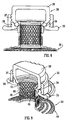
- Figures 4 and 5 illustrate the implant 1 in use after it has been implanted in a patient.
- the circular anchoring flange 2 is located immediately above the muscle layer M and that the length L of the skin-penetrating part of the mesh cylinder 3 is sufficient that the end part 4 is entirely clear of the surface of the epidermis 10 of the abdominal wall.
- the implant may, for example, have any of the dimensions set out in Tables 1 and 2 below.
- a section of bowel 11 is externalised through the internal diameter of the mesh cylinder 3.
- the epidermis 10 meets the ingrowth mesh 3, and is therefore able to contact the serosal surface 12 of the bowel 11.
- the tissues grow through the mesh cylinder 3 to provide attachment between abdominal wall tissue, including the epidermis and bowel.
- the serosal tissue is able to grow into the annular gap G.
- tissue ingrowth occurs through the anchoring flange 2 and through other parts of the ingrowth mesh, in the known manner.
- Figure 5 illustrates the relationship between the implant 1 and a pouch 13 formed in the bowel in the known manner. Because the resilient tissue that forms the bowel is constricted as it passes through the implant to form a valve, this provides a continent system such that the pouch may be emptied at intervals using a catheter in a similar manner to the Kock pouch. A removable lid (not shown) may additionally be provided to prevent leakage and to protect the stoma. Thus, there is no need for a bag.
- the implant may be that of the embodiment described above.
- the implant is e.g. made of commercially pure titanium Gr. 2, machined to desired shape, and blasted with aluminium oxide.
- Other biological acceptable materials e.g., plastics, can also be used.
- the preferred materials are dimensionally stable materials that can resist sterilization and use in medial treatments.
- the implant 20 may consist of a cylinder 21 ending with a circular flange 22.
- the cylindrical portion closest to the flange is formed by ribs 24 allowing ingrowth of connective tissue to prevent epithelial downgrowth and promote connective tissue interdigitation.
- the ribs 24 have numerous holes 25.
- the rest of the cylindrical portion is solid-walled.
- the previously-mentioned applications can be referred to for further details of this implant.
- the circular flange 22 is penetrated with multiple small holes 23 to allow ingrowth of connective tissue.
- a laser cut titanium ingrowth mesh 26 is integrated by means of laser welding on the inside of the cylinder.
- the first stage of the method is for the implant and the instrumentation to be decontaminated with ultrasonic cleaning in detergent and alcohol followed by sterilization by means of autoclaving.
- a specially designed insertion instrument an insertion cone 31, is used for facilitated positioning of the implant 20 in the abdominal wall.
- the insertion cone 31 has a lower cylindrical part 32 that fits snugly inside the implant and a generally conical upper part 33 which is designed to be pushed through a resilient opening in the abdominal wall.
- the cone 31 is fitted to the implant 20 and then they are pushed through the skin.
- a biopsy skin punch is preferably used (e.g., Steifel, Germany), though a scalpel may be used.
- a healing device 39 is provided for attachment to the free protruding circular end of the implant 20 during the healing phase.
- the healing device 39 protects the implant and prevents the implant from being retracted below the skin level.
- the healing device 39 comprises a healing plate 35 which is designed to rest on the skin surface.
- the healing plate is provided with an external screw thread 36 for coupling with a complementary internal screw thread 37 of an optional cap 38 which can be used to surround and sealingly close the protruding part of the implant 20 at least during healing, and optionally also subsequently. It may also include an O-ring 34 serving for sealing against the exterior circumferential wall of the implant 20.
- the healing device is shown attached to a further design of implant 50.
- the interior section of it comprises an intermediate section 40 emerging from the exterior ring 41 that is axially divided into a first intermediate section part and a second intermediate section part emerging from the first intermediate section part, with the interior section extending into an anchoring section 44.
- the second intermediate section part or intermediate section comprises circumferentially spaced apart first connection members 45 connecting the second intermediate section part or the intermediate section with the anchoring section 44.
- Integrated ingrowth mesh 46 is provided along the internal circumference of the second intermediate section part or the intermediate section.
- mice Female Labrador dogs, weighing approximately 25 kg at implantation, are used as experimental animals. The animals are prepared, anaesthetized and monitored according to the local ethics committee application.
- One device is implanted in each animal.
- the experiment is a two-stage procedure. In the first procedure, the device is implanted and an isolated ileal reservoir is constructed and connected to the implant. In the second procedure, one ureter is connected to the reservoir creating a urostomy.
- the implant 50 is placed in the abdominal wall 49 as illustrated in Figure 10 . (Note that this implant is not implanted in the same manner as implant 1 discussed above.)
- the subcutaneous flange 44 is placed on the external fascia 51 and the cylindrical portion 52 protrudes through the skin 54.
- An ileal reservoir 55 is constructed and the terminal ileum 56 of the reservoir is pulled through the abdominal wall 49 and the implant 50.
- the ileal reservoir 55 is kept isolated from the bowel.
- the implant 50 and reservoir 55 are left to heal for three weeks with the implant positioned above the muscle and the ileal reservoir attached to the implant.
- Surgical stage one may include the following steps for construction of the isolated ileum reservoir 55 and application of implant 50:
- Stage two is performed 3-4 weeks after implantation.
- the left ureter was identified and removed from the bladder. The distal end was attached to the reservoir.
- a Ch 4 feeding tube (Unomedical, Denmark) is introduced, passing the anastomosis with the free end on the outside.
- the tube is secured with Vicryl Rapis 4-0 suture in the ureter and to the healing plate outside the abdomen.
- the tube was flushed with NaCl.
- the two stages described above are preferably combined into a single stage.
- Fig. 13 shows a light micrograph demonstrating soft tissue integration and attachment of the serosa of ileum 60 with the titanium implant 61 illustrating that the serosal side of the intestine was adequately attached to this tissue. Histological examination of the ten samples demonstrated that the mesh structure inside the implant was in close contact with regenerated and well-vascularised collagenous tissue, with moderate signs of infection. Thus histology showed soft tissue integration and attachment of the serosa of ileum with titanium.
- the histological results demonstrate that skin and subcutaneous tissue integrate well with the outer face of the implant and that also the serosal surface of the intestine integrates and merge with the inner face of the implant.
- the present technique replaces the problematic nipple valve and offers a reliable continence valve for the Kock pouch and might imply a revival of interest and a renaissance for the procedure in humans. Conversion of a failed IPAA is just another indication for the Kock pouch.
Landscapes
- Health & Medical Sciences (AREA)
- Epidemiology (AREA)
- Nursing (AREA)
- Orthopedic Medicine & Surgery (AREA)
- Engineering & Computer Science (AREA)
- Biomedical Technology (AREA)
- Heart & Thoracic Surgery (AREA)
- Vascular Medicine (AREA)
- Life Sciences & Earth Sciences (AREA)
- Animal Behavior & Ethology (AREA)
- General Health & Medical Sciences (AREA)
- Public Health (AREA)
- Veterinary Medicine (AREA)
- Prostheses (AREA)
- Orthopedics, Nursing, And Contraception (AREA)
Priority Applications (2)
| Application Number | Priority Date | Filing Date | Title |
|---|---|---|---|
| SI201031513T SI2424473T1 (sl) | 2009-04-28 | 2010-04-28 | Proizvodna metoda za perkutani vsadek |
| PL10717731T PL2424473T3 (pl) | 2009-04-28 | 2010-04-28 | Sposób wytwarzania przezskórnego implantu |
Applications Claiming Priority (2)
| Application Number | Priority Date | Filing Date | Title |
|---|---|---|---|
| US17349409P | 2009-04-28 | 2009-04-28 | |
| PCT/GB2010/000851 WO2010125346A1 (en) | 2009-04-28 | 2010-04-28 | Percutaneious implant and ostomy method |
Publications (2)
| Publication Number | Publication Date |
|---|---|
| EP2424473A1 EP2424473A1 (en) | 2012-03-07 |
| EP2424473B1 true EP2424473B1 (en) | 2017-05-31 |
Family
ID=42289440
Family Applications (1)
| Application Number | Title | Priority Date | Filing Date |
|---|---|---|---|
| EP10717731.3A Not-in-force EP2424473B1 (en) | 2009-04-28 | 2010-04-28 | Manufacturing method for percutaneous implant |
Country Status (10)
| Country | Link |
|---|---|
| US (1) | US9226848B2 (cg-RX-API-DMAC7.html) |
| EP (1) | EP2424473B1 (cg-RX-API-DMAC7.html) |
| JP (1) | JP5628295B2 (cg-RX-API-DMAC7.html) |
| CN (1) | CN102421395B (cg-RX-API-DMAC7.html) |
| DK (1) | DK2424473T3 (cg-RX-API-DMAC7.html) |
| ES (1) | ES2635217T3 (cg-RX-API-DMAC7.html) |
| PL (1) | PL2424473T3 (cg-RX-API-DMAC7.html) |
| PT (1) | PT2424473T (cg-RX-API-DMAC7.html) |
| SI (1) | SI2424473T1 (cg-RX-API-DMAC7.html) |
| WO (1) | WO2010125346A1 (cg-RX-API-DMAC7.html) |
Cited By (1)
| Publication number | Priority date | Publication date | Assignee | Title |
|---|---|---|---|---|
| EP3508179A2 (en) * | 2016-06-16 | 2019-07-10 | Ostomycure AS | Lid for a medical implant |
Families Citing this family (25)
| Publication number | Priority date | Publication date | Assignee | Title |
|---|---|---|---|---|
| EP1825839B1 (en) * | 2006-02-28 | 2011-09-21 | Ostomycure AS | Implant |
| DK2027835T3 (da) * | 2007-08-21 | 2011-03-07 | Ostomycure As | Implantat |
| BR112012007304B8 (pt) * | 2009-10-01 | 2021-06-22 | Ostomycure As | dispositivo de fechamento médico e método para aplicação de um dispositivo de fechamento médico |
| GB201105126D0 (en) | 2011-03-25 | 2011-05-11 | Ostomycure As | Percutaneous implant and ostomy method |
| GB2511825A (en) | 2013-03-14 | 2014-09-17 | Ostomycure As | Implant |
| USD827824S1 (en) | 2013-04-30 | 2018-09-04 | Ostomycure As | Implant with internal porous surface structure |
| USD752750S1 (en) * | 2013-04-30 | 2016-03-29 | Ostomycure As | Implants |
| BR302013005473S1 (pt) | 2013-04-30 | 2014-12-23 | Ostomycure As | Configuração aplicada em dispositivo médico |
| USD829327S1 (en) | 2013-04-30 | 2018-09-25 | Ostomycure As | Implant having porous surface structure |
| CN109069265B (zh) * | 2016-04-08 | 2021-08-10 | 马萨诸塞眼科耳科诊所 | 人工角膜装置、系统及方法 |
| ES2588951B2 (es) * | 2016-09-19 | 2017-09-21 | Universitat Politècnica De València | Dispositivo para exo-protetización de extremedidades y otras aplicaciones percutáneas |
| US10758398B2 (en) * | 2016-11-01 | 2020-09-01 | Covidien Lp | Apparatus and associated methodologies for creating a stoma |
| US10449081B2 (en) | 2017-02-18 | 2019-10-22 | Choon Kee Lee | Ostomy apparatus |
| US11771585B2 (en) | 2018-01-19 | 2023-10-03 | Ostovalve, Llc | Devices, systems and methods for regulating flow from a stoma on a patient |
| US12178738B2 (en) | 2018-01-19 | 2024-12-31 | Ostovalve Llc | Regulating flow from a stoma on a patient |
| GB201806045D0 (en) | 2018-04-12 | 2018-05-30 | Ostomycure As | Lid |
| WO2020028847A1 (en) * | 2018-08-02 | 2020-02-06 | Bard Peripheral Vascular, Inc. | Implantable port placement system including low-scarring exterior |
| US20200155338A1 (en) * | 2018-11-19 | 2020-05-21 | Karla K. Meteer | Prosthetic stoma device and method of application |
| CN111467115B (zh) * | 2020-05-28 | 2024-12-31 | 四川省肿瘤医院 | 一种永久植入式造瘘底盘及造口袋套件 |
| US20220008706A1 (en) * | 2020-07-08 | 2022-01-13 | Portal Access, Inc. | Minimally invasive port implantation |
| EP4294337A4 (en) | 2021-02-17 | 2025-04-23 | John Vella | Stoma implant arrangement |
| US20230157859A1 (en) * | 2021-11-23 | 2023-05-25 | Tarek Hassab | Fecal diversion tube system |
| US12310879B2 (en) * | 2022-04-22 | 2025-05-27 | Ostomycure As | Emptying device |
| CN115462945B (zh) * | 2022-09-19 | 2025-09-05 | 中日友好医院(中日友好临床医学研究所) | 肠造口辅助环 |
| WO2025213227A1 (en) * | 2024-04-10 | 2025-10-16 | John Vella | Stoma implant assembly |
Family Cites Families (8)
| Publication number | Priority date | Publication date | Assignee | Title |
|---|---|---|---|---|
| US4183357A (en) * | 1976-08-02 | 1980-01-15 | Bentley Laboratories, Inc. | Chronic transcutaneous implant assembly for enterostomies |
| US4217664A (en) | 1979-02-02 | 1980-08-19 | Faso Joseph M | Prosthesis and method for creating a stoma |
| US5139497A (en) * | 1991-11-25 | 1992-08-18 | Timesh, Inc. | Orbital repair implant |
| WO2005046516A2 (en) * | 2003-11-10 | 2005-05-26 | Angiotech International Ag | Medical implants and anti-scarring agents |
| JP4686743B2 (ja) * | 2004-05-07 | 2011-05-25 | 独立行政法人科学技術振興機構 | 経皮端子および医療用チューブ |
| DK1632201T3 (da) | 2004-09-06 | 2010-05-25 | Ostomycure As | Implantat |
| EP1825839B1 (en) | 2006-02-28 | 2011-09-21 | Ostomycure AS | Implant |
| DK2027835T3 (da) | 2007-08-21 | 2011-03-07 | Ostomycure As | Implantat |
-
2010
- 2010-04-28 PL PL10717731T patent/PL2424473T3/pl unknown
- 2010-04-28 SI SI201031513T patent/SI2424473T1/sl unknown
- 2010-04-28 US US13/266,876 patent/US9226848B2/en active Active
- 2010-04-28 ES ES10717731.3T patent/ES2635217T3/es active Active
- 2010-04-28 CN CN201080018525.8A patent/CN102421395B/zh not_active Expired - Fee Related
- 2010-04-28 JP JP2012507811A patent/JP5628295B2/ja not_active Expired - Fee Related
- 2010-04-28 PT PT107177313T patent/PT2424473T/pt unknown
- 2010-04-28 EP EP10717731.3A patent/EP2424473B1/en not_active Not-in-force
- 2010-04-28 WO PCT/GB2010/000851 patent/WO2010125346A1/en not_active Ceased
- 2010-04-28 DK DK10717731.3T patent/DK2424473T3/en active
Cited By (7)
| Publication number | Priority date | Publication date | Assignee | Title |
|---|---|---|---|---|
| EP3508179A2 (en) * | 2016-06-16 | 2019-07-10 | Ostomycure AS | Lid for a medical implant |
| US11357658B2 (en) | 2016-06-16 | 2022-06-14 | Ostomycure As | Lid for medical implant |
| US11877946B2 (en) | 2016-06-16 | 2024-01-23 | Ostomycure As | Lid for medical implant |
| EP3471668B1 (en) * | 2016-06-16 | 2024-07-24 | Ostomycure AS | Lid |
| EP3513772B1 (en) * | 2016-06-16 | 2025-04-30 | Ostomycure AS | Lid |
| US12324766B2 (en) | 2016-06-16 | 2025-06-10 | Ostomycure As | Lid for medical implant |
| EP3508179B1 (en) * | 2016-06-16 | 2025-10-29 | Ostomycure AS | Lid for a medical implant |
Also Published As
| Publication number | Publication date |
|---|---|
| JP5628295B2 (ja) | 2014-11-19 |
| CN102421395A (zh) | 2012-04-18 |
| US9226848B2 (en) | 2016-01-05 |
| DK2424473T3 (en) | 2017-08-21 |
| SI2424473T1 (sl) | 2017-11-30 |
| CN102421395B (zh) | 2015-06-10 |
| US20120123361A1 (en) | 2012-05-17 |
| PT2424473T (pt) | 2017-08-04 |
| PL2424473T3 (pl) | 2017-10-31 |
| WO2010125346A1 (en) | 2010-11-04 |
| JP2012525183A (ja) | 2012-10-22 |
| EP2424473A1 (en) | 2012-03-07 |
| ES2635217T3 (es) | 2017-10-02 |
Similar Documents
| Publication | Publication Date | Title |
|---|---|---|
| EP2424473B1 (en) | Manufacturing method for percutaneous implant | |
| US9615961B2 (en) | Percutaneous implant and ostomy method | |
| US8647304B2 (en) | Implant and method for its manufacture | |
| US7935096B2 (en) | Percutaneous implant | |
| EP2027835A1 (en) | Implant | |
| BR122017001723A2 (pt) | implante, método de realizar uma ostomia, e método de fabricar um implante | |
| US8790322B2 (en) | Stoma coat | |
| EP1632201B1 (en) | Implant | |
| US20250134693A1 (en) | Ostomy bag and related connection mechanism | |
| US20250134695A1 (en) | Ostomy bag and method for ostomy management | |
| WO2011089579A1 (en) | Colostomy device |
Legal Events
| Date | Code | Title | Description |
|---|---|---|---|
| PUAI | Public reference made under article 153(3) epc to a published international application that has entered the european phase |
Free format text: ORIGINAL CODE: 0009012 |
|
| 17P | Request for examination filed |
Effective date: 20111025 |
|
| AK | Designated contracting states |
Kind code of ref document: A1 Designated state(s): AT BE BG CH CY CZ DE DK EE ES FI FR GB GR HR HU IE IS IT LI LT LU LV MC MK MT NL NO PL PT RO SE SI SK SM TR |
|
| DAX | Request for extension of the european patent (deleted) | ||
| 17Q | First examination report despatched |
Effective date: 20140715 |
|
| GRAP | Despatch of communication of intention to grant a patent |
Free format text: ORIGINAL CODE: EPIDOSNIGR1 |
|
| GRAJ | Information related to disapproval of communication of intention to grant by the applicant or resumption of examination proceedings by the epo deleted |
Free format text: ORIGINAL CODE: EPIDOSDIGR1 |
|
| GRAP | Despatch of communication of intention to grant a patent |
Free format text: ORIGINAL CODE: EPIDOSNIGR1 |
|
| INTG | Intention to grant announced |
Effective date: 20160530 |
|
| INTG | Intention to grant announced |
Effective date: 20160621 |
|
| GRAJ | Information related to disapproval of communication of intention to grant by the applicant or resumption of examination proceedings by the epo deleted |
Free format text: ORIGINAL CODE: EPIDOSDIGR1 |
|
| INTC | Intention to grant announced (deleted) | ||
| GRAP | Despatch of communication of intention to grant a patent |
Free format text: ORIGINAL CODE: EPIDOSNIGR1 |
|
| INTG | Intention to grant announced |
Effective date: 20161220 |
|
| GRAS | Grant fee paid |
Free format text: ORIGINAL CODE: EPIDOSNIGR3 |
|
| GRAA | (expected) grant |
Free format text: ORIGINAL CODE: 0009210 |
|
| AK | Designated contracting states |
Kind code of ref document: B1 Designated state(s): AT BE BG CH CY CZ DE DK EE ES FI FR GB GR HR HU IE IS IT LI LT LU LV MC MK MT NL NO PL PT RO SE SI SK SM TR |
|
| REG | Reference to a national code |
Ref country code: CH Ref legal event code: EP Ref country code: GB Ref legal event code: FG4D |
|
| REG | Reference to a national code |
Ref country code: AT Ref legal event code: REF Ref document number: 896761 Country of ref document: AT Kind code of ref document: T Effective date: 20170615 |
|
| REG | Reference to a national code |
Ref country code: IE Ref legal event code: FG4D |
|
| REG | Reference to a national code |
Ref country code: DE Ref legal event code: R096 Ref document number: 602010042657 Country of ref document: DE |
|
| REG | Reference to a national code |
Ref country code: RO Ref legal event code: EPE |
|
| REG | Reference to a national code |
Ref country code: PT Ref legal event code: SC4A Ref document number: 2424473 Country of ref document: PT Date of ref document: 20170804 Kind code of ref document: T Free format text: AVAILABILITY OF NATIONAL TRANSLATION Effective date: 20170728 |
|
| REG | Reference to a national code |
Ref country code: SE Ref legal event code: TRGR |
|
| REG | Reference to a national code |
Ref country code: NL Ref legal event code: FP |
|
| REG | Reference to a national code |
Ref country code: DK Ref legal event code: T3 Effective date: 20170817 |
|
| REG | Reference to a national code |
Ref country code: ES Ref legal event code: FG2A Ref document number: 2635217 Country of ref document: ES Kind code of ref document: T3 Effective date: 20171002 |
|
| REG | Reference to a national code |
Ref country code: NO Ref legal event code: T2 Effective date: 20170531 |
|
| REG | Reference to a national code |
Ref country code: LT Ref legal event code: MG4D |
|
| PG25 | Lapsed in a contracting state [announced via postgrant information from national office to epo] |
Ref country code: LT Free format text: LAPSE BECAUSE OF FAILURE TO SUBMIT A TRANSLATION OF THE DESCRIPTION OR TO PAY THE FEE WITHIN THE PRESCRIBED TIME-LIMIT Effective date: 20170531 Ref country code: HR Free format text: LAPSE BECAUSE OF FAILURE TO SUBMIT A TRANSLATION OF THE DESCRIPTION OR TO PAY THE FEE WITHIN THE PRESCRIBED TIME-LIMIT Effective date: 20170531 |
|
| PG25 | Lapsed in a contracting state [announced via postgrant information from national office to epo] |
Ref country code: IS Free format text: LAPSE BECAUSE OF FAILURE TO SUBMIT A TRANSLATION OF THE DESCRIPTION OR TO PAY THE FEE WITHIN THE PRESCRIBED TIME-LIMIT Effective date: 20170930 Ref country code: LV Free format text: LAPSE BECAUSE OF FAILURE TO SUBMIT A TRANSLATION OF THE DESCRIPTION OR TO PAY THE FEE WITHIN THE PRESCRIBED TIME-LIMIT Effective date: 20170531 |
|
| REG | Reference to a national code |
Ref country code: SK Ref legal event code: T3 Ref document number: E 24907 Country of ref document: SK |
|
| REG | Reference to a national code |
Ref country code: HU Ref legal event code: AG4A Ref document number: E034013 Country of ref document: HU |
|
| PG25 | Lapsed in a contracting state [announced via postgrant information from national office to epo] |
Ref country code: EE Free format text: LAPSE BECAUSE OF FAILURE TO SUBMIT A TRANSLATION OF THE DESCRIPTION OR TO PAY THE FEE WITHIN THE PRESCRIBED TIME-LIMIT Effective date: 20170531 |
|
| REG | Reference to a national code |
Ref country code: GR Ref legal event code: EP Ref document number: 20170402048 Country of ref document: GR Effective date: 20180119 |
|
| PG25 | Lapsed in a contracting state [announced via postgrant information from national office to epo] |
Ref country code: SM Free format text: LAPSE BECAUSE OF FAILURE TO SUBMIT A TRANSLATION OF THE DESCRIPTION OR TO PAY THE FEE WITHIN THE PRESCRIBED TIME-LIMIT Effective date: 20170531 |
|
| REG | Reference to a national code |
Ref country code: DE Ref legal event code: R097 Ref document number: 602010042657 Country of ref document: DE |
|
| PLBE | No opposition filed within time limit |
Free format text: ORIGINAL CODE: 0009261 |
|
| STAA | Information on the status of an ep patent application or granted ep patent |
Free format text: STATUS: NO OPPOSITION FILED WITHIN TIME LIMIT |
|
| REG | Reference to a national code |
Ref country code: FR Ref legal event code: PLFP Year of fee payment: 9 |
|
| 26N | No opposition filed |
Effective date: 20180301 |
|
| PG25 | Lapsed in a contracting state [announced via postgrant information from national office to epo] |
Ref country code: MC Free format text: LAPSE BECAUSE OF FAILURE TO SUBMIT A TRANSLATION OF THE DESCRIPTION OR TO PAY THE FEE WITHIN THE PRESCRIBED TIME-LIMIT Effective date: 20170531 |
|
| PG25 | Lapsed in a contracting state [announced via postgrant information from national office to epo] |
Ref country code: LU Free format text: LAPSE BECAUSE OF NON-PAYMENT OF DUE FEES Effective date: 20180428 |
|
| REG | Reference to a national code |
Ref country code: AT Ref legal event code: UEP Ref document number: 896761 Country of ref document: AT Kind code of ref document: T Effective date: 20170531 |
|
| PGFP | Annual fee paid to national office [announced via postgrant information from national office to epo] |
Ref country code: NL Payment date: 20190416 Year of fee payment: 10 |
|
| PGFP | Annual fee paid to national office [announced via postgrant information from national office to epo] |
Ref country code: IT Payment date: 20190418 Year of fee payment: 10 Ref country code: CZ Payment date: 20190418 Year of fee payment: 10 Ref country code: FI Payment date: 20190425 Year of fee payment: 10 Ref country code: NO Payment date: 20190417 Year of fee payment: 10 |
|
| PGFP | Annual fee paid to national office [announced via postgrant information from national office to epo] |
Ref country code: TR Payment date: 20190614 Year of fee payment: 10 Ref country code: HU Payment date: 20190507 Year of fee payment: 10 Ref country code: RO Payment date: 20190425 Year of fee payment: 10 Ref country code: TR Payment date: 20190424 Year of fee payment: 10 Ref country code: BG Payment date: 20190425 Year of fee payment: 10 |
|
| PGFP | Annual fee paid to national office [announced via postgrant information from national office to epo] |
Ref country code: CH Payment date: 20190416 Year of fee payment: 10 Ref country code: SK Payment date: 20190417 Year of fee payment: 10 |
|
| PG25 | Lapsed in a contracting state [announced via postgrant information from national office to epo] |
Ref country code: MT Free format text: LAPSE BECAUSE OF NON-PAYMENT OF DUE FEES Effective date: 20180428 |
|
| PG25 | Lapsed in a contracting state [announced via postgrant information from national office to epo] |
Ref country code: CY Free format text: LAPSE BECAUSE OF FAILURE TO SUBMIT A TRANSLATION OF THE DESCRIPTION OR TO PAY THE FEE WITHIN THE PRESCRIBED TIME-LIMIT Effective date: 20170531 Ref country code: MK Free format text: LAPSE BECAUSE OF NON-PAYMENT OF DUE FEES Effective date: 20170531 |
|
| PGFP | Annual fee paid to national office [announced via postgrant information from national office to epo] |
Ref country code: DK Payment date: 20200423 Year of fee payment: 11 Ref country code: DE Payment date: 20200420 Year of fee payment: 11 |
|
| PGFP | Annual fee paid to national office [announced via postgrant information from national office to epo] |
Ref country code: SE Payment date: 20200423 Year of fee payment: 11 Ref country code: BE Payment date: 20200417 Year of fee payment: 11 Ref country code: PL Payment date: 20200420 Year of fee payment: 11 |
|
| REG | Reference to a national code |
Ref country code: FI Ref legal event code: MAE |
|
| REG | Reference to a national code |
Ref country code: NO Ref legal event code: MMEP |
|
| REG | Reference to a national code |
Ref country code: CH Ref legal event code: PL |
|
| REG | Reference to a national code |
Ref country code: NL Ref legal event code: MM Effective date: 20200501 |
|
| REG | Reference to a national code |
Ref country code: AT Ref legal event code: MM01 Ref document number: 896761 Country of ref document: AT Kind code of ref document: T Effective date: 20200428 |
|
| REG | Reference to a national code |
Ref country code: SK Ref legal event code: MM4A Ref document number: E 24907 Country of ref document: SK Effective date: 20200428 |
|
| PG25 | Lapsed in a contracting state [announced via postgrant information from national office to epo] |
Ref country code: CH Free format text: LAPSE BECAUSE OF NON-PAYMENT OF DUE FEES Effective date: 20200430 Ref country code: RO Free format text: LAPSE BECAUSE OF NON-PAYMENT OF DUE FEES Effective date: 20200428 Ref country code: LI Free format text: LAPSE BECAUSE OF NON-PAYMENT OF DUE FEES Effective date: 20200430 Ref country code: HU Free format text: LAPSE BECAUSE OF NON-PAYMENT OF DUE FEES Effective date: 20200429 Ref country code: FI Free format text: LAPSE BECAUSE OF NON-PAYMENT OF DUE FEES Effective date: 20200428 Ref country code: BG Free format text: LAPSE BECAUSE OF NON-PAYMENT OF DUE FEES Effective date: 20201130 Ref country code: AT Free format text: LAPSE BECAUSE OF NON-PAYMENT OF DUE FEES Effective date: 20200428 Ref country code: NO Free format text: LAPSE BECAUSE OF NON-PAYMENT OF DUE FEES Effective date: 20200430 Ref country code: PT Free format text: LAPSE BECAUSE OF NON-PAYMENT OF DUE FEES Effective date: 20201028 Ref country code: CZ Free format text: LAPSE BECAUSE OF NON-PAYMENT OF DUE FEES Effective date: 20200428 Ref country code: GR Free format text: LAPSE BECAUSE OF NON-PAYMENT OF DUE FEES Effective date: 20201109 |
|
| REG | Reference to a national code |
Ref country code: DE Ref legal event code: R082 Ref document number: 602010042657 Country of ref document: DE |
|
| PG25 | Lapsed in a contracting state [announced via postgrant information from national office to epo] |
Ref country code: SK Free format text: LAPSE BECAUSE OF NON-PAYMENT OF DUE FEES Effective date: 20200428 |
|
| PG25 | Lapsed in a contracting state [announced via postgrant information from national office to epo] |
Ref country code: NL Free format text: LAPSE BECAUSE OF NON-PAYMENT OF DUE FEES Effective date: 20200501 |
|
| PG25 | Lapsed in a contracting state [announced via postgrant information from national office to epo] |
Ref country code: IE Free format text: LAPSE BECAUSE OF NON-PAYMENT OF DUE FEES Effective date: 20200428 |
|
| PG25 | Lapsed in a contracting state [announced via postgrant information from national office to epo] |
Ref country code: SI Free format text: LAPSE BECAUSE OF NON-PAYMENT OF DUE FEES Effective date: 20200429 |
|
| REG | Reference to a national code |
Ref country code: ES Ref legal event code: FD2A Effective date: 20210906 |
|
| REG | Reference to a national code |
Ref country code: SI Ref legal event code: KO00 Effective date: 20210811 |
|
| PG25 | Lapsed in a contracting state [announced via postgrant information from national office to epo] |
Ref country code: IT Free format text: LAPSE BECAUSE OF NON-PAYMENT OF DUE FEES Effective date: 20200428 |
|
| REG | Reference to a national code |
Ref country code: DE Ref legal event code: R119 Ref document number: 602010042657 Country of ref document: DE |
|
| REG | Reference to a national code |
Ref country code: DK Ref legal event code: EBP Effective date: 20210430 |
|
| PG25 | Lapsed in a contracting state [announced via postgrant information from national office to epo] |
Ref country code: ES Free format text: LAPSE BECAUSE OF NON-PAYMENT OF DUE FEES Effective date: 20200429 |
|
| REG | Reference to a national code |
Ref country code: SE Ref legal event code: EUG |
|
| REG | Reference to a national code |
Ref country code: BE Ref legal event code: MM Effective date: 20210430 |
|
| PG25 | Lapsed in a contracting state [announced via postgrant information from national office to epo] |
Ref country code: SE Free format text: LAPSE BECAUSE OF NON-PAYMENT OF DUE FEES Effective date: 20210429 Ref country code: DE Free format text: LAPSE BECAUSE OF NON-PAYMENT OF DUE FEES Effective date: 20211103 |
|
| PG25 | Lapsed in a contracting state [announced via postgrant information from national office to epo] |
Ref country code: DK Free format text: LAPSE BECAUSE OF NON-PAYMENT OF DUE FEES Effective date: 20210430 |
|
| PG25 | Lapsed in a contracting state [announced via postgrant information from national office to epo] |
Ref country code: TR Free format text: LAPSE BECAUSE OF NON-PAYMENT OF DUE FEES Effective date: 20200428 |
|
| PG25 | Lapsed in a contracting state [announced via postgrant information from national office to epo] |
Ref country code: BE Free format text: LAPSE BECAUSE OF NON-PAYMENT OF DUE FEES Effective date: 20210430 |
|
| PG25 | Lapsed in a contracting state [announced via postgrant information from national office to epo] |
Ref country code: PL Free format text: LAPSE BECAUSE OF NON-PAYMENT OF DUE FEES Effective date: 20210428 |
|
| REG | Reference to a national code |
Ref country code: FR Ref legal event code: PLFP Year of fee payment: 14 |
|
| P01 | Opt-out of the competence of the unified patent court (upc) registered |
Effective date: 20230517 |
|
| PGFP | Annual fee paid to national office [announced via postgrant information from national office to epo] |
Ref country code: FR Payment date: 20230412 Year of fee payment: 14 |
|
| PGFP | Annual fee paid to national office [announced via postgrant information from national office to epo] |
Ref country code: GB Payment date: 20230412 Year of fee payment: 14 |
|
| GBPC | Gb: european patent ceased through non-payment of renewal fee |
Effective date: 20240428 |
|
| PG25 | Lapsed in a contracting state [announced via postgrant information from national office to epo] |
Ref country code: GB Free format text: LAPSE BECAUSE OF NON-PAYMENT OF DUE FEES Effective date: 20240428 |
|
| PG25 | Lapsed in a contracting state [announced via postgrant information from national office to epo] |
Ref country code: FR Free format text: LAPSE BECAUSE OF NON-PAYMENT OF DUE FEES Effective date: 20240430 |
|
| PG25 | Lapsed in a contracting state [announced via postgrant information from national office to epo] |
Ref country code: GB Free format text: LAPSE BECAUSE OF NON-PAYMENT OF DUE FEES Effective date: 20240428 Ref country code: FR Free format text: LAPSE BECAUSE OF NON-PAYMENT OF DUE FEES Effective date: 20240430 |