EP2419796B1 - Apparatus and method for model quality estimation and model adaptation in multivariable process control - Google Patents
Apparatus and method for model quality estimation and model adaptation in multivariable process control Download PDFInfo
- Publication number
- EP2419796B1 EP2419796B1 EP10731850.3A EP10731850A EP2419796B1 EP 2419796 B1 EP2419796 B1 EP 2419796B1 EP 10731850 A EP10731850 A EP 10731850A EP 2419796 B1 EP2419796 B1 EP 2419796B1
- Authority
- EP
- European Patent Office
- Prior art keywords
- model
- data
- submodels
- submodel
- controller
- Prior art date
- Legal status (The legal status is an assumption and is not a legal conclusion. Google has not performed a legal analysis and makes no representation as to the accuracy of the status listed.)
- Active
Links
Images




Classifications
-
- G—PHYSICS
- G05—CONTROLLING; REGULATING
- G05B—CONTROL OR REGULATING SYSTEMS IN GENERAL; FUNCTIONAL ELEMENTS OF SUCH SYSTEMS; MONITORING OR TESTING ARRANGEMENTS FOR SUCH SYSTEMS OR ELEMENTS
- G05B13/00—Adaptive control systems, i.e. systems automatically adjusting themselves to have a performance which is optimum according to some preassigned criterion
- G05B13/02—Adaptive control systems, i.e. systems automatically adjusting themselves to have a performance which is optimum according to some preassigned criterion electric
- G05B13/04—Adaptive control systems, i.e. systems automatically adjusting themselves to have a performance which is optimum according to some preassigned criterion electric involving the use of models or simulators
- G05B13/048—Adaptive control systems, i.e. systems automatically adjusting themselves to have a performance which is optimum according to some preassigned criterion electric involving the use of models or simulators using a predictor
Definitions
- Model Predictive Control is the most widely used advanced process control technology in process industries, with more than 5,000 worldwide applications currently in service.
- MPC which is sometimes also referred to as Multivariable Control (MVC)
- MVC Multivariable Control
- MPC control performance will degrade with time due to inevitable changes in the underlying subject process, such as equipment modifications, changes in operating strategy, feed rate and quality changes, de-bottlenecking, instrumentation degradation, etc.
- Such degradation of control performance results in loss of benefits.
- the model's predictive quality is the primary factor in most cases. To sustain good control performance, the model's predictive quality needs be monitored, and the model needs be periodically audited and updated if necessary.
- WO 2008/119008 A1 describes a model maintenance approach for a MPC.
- the invention provides an apparatus and a method to address the foregoing problems by monitoring, auditing, re-testing, re-identifying and updating a control model in an MPC application as defined in claims 1 and 14.
- Embodiments provide expansion and integrated use of automated closed loop step testing techniques described for example in U.S Patent No. 7,209,793 to Harmuse, et al . (by assignee). Embodiments can be configured and executed to generate and collect required data for model predictive quality assessment while minimizing negative impact to the underlying process operation.
- Embodiments provide an innovative model quality evaluation module which can help to identify subsets of a model that cause the control performance deterioration.
- Embodiments provide an new automated data technique to select data suitable for model assessment and model re-identification.
- the existing model in the online controller is used as an initial model to configure a tester such as described in U.S. Patent No. 7,209,793 by assignee for the model auditing purpose.
- the tester may include the manipulated variables (MVs) that will be perturbed and controlled variables (CVs), the control limits and constraints imposed on MVs and CVs for process safety and normal operation, the profiles of testing signals on MVs , and the durations of testing time , etc.
- the process may be automatically perturbed, e.g., using a generalized binary noise signal (GBNS) while the process CVs are under control with an online MPC controller.
- GBNS generalized binary noise signal
- An embodiment is an apparatus and method for collecting, validating, preprocessing and selecting the collected process data for model quality assessment and model identification.
- the method may further include using calculated status in each MV and CV available in the online controller or tester for automated data validation and slicing in model quality assessment and identification.
- the method may further include automated data validation and slicing by creating a custom calculation formula in the database where the process data is stored.
- the method may further include screening the collected data from the process.
- the result of data screening may indicate the data's sufficiency for model quality assessment or model re-identification.
- Data screening may be performed automatically at a specified time period and at a specified execution frequency.
- the method may further include automatically slicing the process data based on one or more data selection criterion to mark out invalid data segments corresponding to data gaps, bad or missing data, "none or less moving" data, highly cross-correlated MVs' data, etc. that may generate negative impacts to model assessment and identification if being used.
- the data slicer may further comprise a status converter configured to download operational status data of MVs and CVs and operational status of the controller and convert the status data into data flags associated with subsets of the at least one MV and the at least one CV.
- a status converter configured to download operational status data of MVs and CVs and operational status of the controller and convert the status data into data flags associated with subsets of the at least one MV and the at least one CV.
- the data slicer may further comprise a preprocessing module to select data segments by generating good or bad slices to prepare required data for model quality auditing and identification.
- the data slicer may further comprise a configurable event-driven data slice generator to automatically exclude "unwanted” data during an event period for model auditing and identification.
- the data slicer may further comprise an automatic data slice generator to automatically exclude those variables without enough sensible variations for model auditing and identification.
- the data slicer may further comprise an automatic data slice generator to automatically exclude those independent variables with significant cross-correlation.
- the data slicer may further comprise a data slice generator to automatically exclude bad data during an event period for model auditing and identification.
- Estimating model quality may further include dividing the MIMO model into a group of multiple input and single output (MISO) submodels, factoring each MISO submodel into multiple single input and single output (SISO) dynamic model outputs and a set of associated gain multipliers, and assessing quality of the submodel using a fuzzy logic rule based on the factored submodels.
- MISO multiple input and single output
- SISO single input and single output
- the method includes estimating gain multipliers for each MISO submodel instead of estimating a full MISO dynamical model.
- the gain multipliers may be steady state gain multipliers with lower dimension.
- the estimated gain multipliers are unbiased estimates.
- Estimating model quality may further include calculating the dynamic uncertainty of each SISO submodel, with lower data requirement than re-identifying the submodel.
- the dynamic model uncertainty is defined as a value measure of predictive objective function that represents the dynamic deviation between a controller's FIR (Finite Impose Reponse) submodel curve and a re-estimated SISO model curve.
- Estimating model quality may further include calculating frequency domain model uncertainty for each submodel, with lower data requirements than re-identifying the model.
- the at least one uncertainty measure may be calculated online from measurements of MVs and at least one of CVs of the process.
- Identifying poor-performing / problematic submodels may further include assessing the overall quality of each submodel by use of a fuzzy logic rule that will draw a conclusion for each submodel based on four calculated scores of the model quality:
- Identifying poor-performing / problematic submodels may further include using a discrete grading system for each of the four model quality measures as well as the final conclusive quality measure, i.e. Good (G), Fair(F), Poor(P) and Bad(B). Identifying poor-performing / problematic submodels may further include using an "Unknown" category in the conclusive assessment of a submodel when either one or more quality measures of a submodel are significantly inconsistent or the validated data segments are insufficient to calculate at least one type of model quality scores.
- the method may further include displaying the quality of the model in a carpet plot.
- a carpet plot may be a M by N two dimension map with grids corresponding to the M process inputs (i.e. MVs and FFs or Feed Forward Variables) and N outputs (CVs). Different colors may be used to display different levels of quality.
- Embodiments provide a new apparatus and method for monitoring and estimating a model's degradation of predictive quality, diagnosis of poorly performing submodels, automated process perturbation (testing), model re-identification and adaptation.
- Different modes of operation are provided in embodiments, namely: Configuration mode, Audition mode, Test mode, Identification mode, and Model adaptation mode.
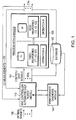
- Fig. 1 is a system diagram of an embodiment of the invention.
- An MPC controller 110 controls a subject dynamical process 120 based on optimal targets 130.
- the controller 110 includes an automated tester to perturb the process 120 in an embodiment. While Fig. 1 shows the controller and the tester together as 110, it should be understood by one of ordinary skill in the art that in another embodiment, a separate controller and tester may be provided.
- the controller 110 sends control/test signals 101 that set the values of manipulated variables (MVs) of the process.
- the MVs are independent variables in the sense that they can be set as desired to perturb the process and to control the controlled variables (CVs) within their constraints set and operation limits. Measurements of control variables (CVs) 150 resulting after perturbation are fed back to the controller 110.
- Control variables are so named because they are controlled through the manipulated variables; thus, the CVs are dependent variables that depend on the MVs.
- a real-time database 102 is used to store historical data regarding the MVs and the corresponding CVs. Although multiple optimal targets 130, MVs, and CVs are shown in Fig. 1 , it should be understood that there may be a single optimal target, MV, and/or CV.
- a performance diagnosis module 140 diagnoses performance of the model, based on inputs and outputs from the process 120 and the database 102, and updates (adapts) the model to improve performance.
- the MPC controller/step-tester 110 can be setup with scheduled safe testing on selected MVs (control/test signals 101) by use of the automated closed loop step testing techniques described in Magiel J. Harmse and Qingsheng Zheng, "Automated closed loop step testing of process units," US Patent No. 7,209,793 B2 (April 24, 2007 ), by assignee.
- the controller's output i.e. data related to MVs 101 and measurements of CVs 150
- the controller's output are collected and stored into the database 102 at a specified sampling frequency, usually the same as used by the MPC controller 110.
- the apparatus automatically or manually (on-demand) audits the model at specified time periods and then reports and stores the results of auditing the model. If the collected process MVs and CVs data for auditing are evaluated and found not sufficient to make conclusive judgments on model predictive quality, the apparatus will automatically switch or suggest to the user to switch onto Test mode.
- the MPC controller/step-tester 110 uses known techniques (e.g., those of U.S. Patent No. 7,209,793 cited above) to generate General Binary Noise (GBN) signals and perturb the process 120 under control with certain MVs.
- GBN General Binary Noise
- Identification mode data from the database 102 corresponding to MVs and CVs are preprocessed, and model identification is performed automatically or manually (on-demand) at a specified time period, with the results reported and stored. Subspace identification techniques for model identification are utilized.
- Model Adaptation mode identified model results from the Identification mode are reviewed and validated against selected historical data and compared with the model currently used by the MPC controller 110. Validated and confirmed submodels (or the full model) are uploaded into the controller 110 to replace problematic models for model adaptation. Below, an overview of model adaptation is provided, followed by mathematical details in separate sections on gain multipliers and model uncertainty.
- Model quality evaluation as disclosed herein is a novel technique that takes advantage of existing models in calculating a model quality index with a lower requirement on data than conventional techniques (e.g., commonly used model identification algorithms).
- regular operating data is used for model quality evaluation.
- Embodiments use the following techniques:
- the multi-input, multi-output (MIMO) model can be divided into multiple multi-inputs, single output (MISO) submodels.
- the corresponding submodel is said to be valid. If any gain multiplier is found with a value that is substantially larger or smaller than unity (see Table 1 below for examples of "substantially larger or smaller than unity"), the corresponding input-output submodel is marked as a possible "bad" submodel, subject to further detection from other methods (e.g., model uncertainty calculation as described below).
- Another model uncertainty measure in the frequency domain is calculated from online measurements and is used to further check each SISO submodel's predictive preformance (details presented below in “Frequency-domain Model Uncertainty Calculation”).
- a combined score for each SISO submodel's performance is calculated by combining the gain multiplier estimation (steady-state performance evaluation) results, Submodel's dynamic uncertainty and the frequency-domain model uncertainty.
- the preferred embodiment uses a fuzzy logic rule (details presented below in "Overall Model Predictive Quality Assessment Using Fuzzy Logic”) to calculate this combined score.
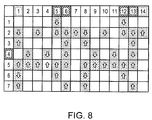
- the conclusive model quality assesment is then presented and reported in a carpet-plot format (e.g., using color to display different levels at each cell of a two-dimensional or higher-dimensional plot) as one of the model's key performance indicators (KPIs). See Fig. 8 discussed later.
- Fig. 3 is a flow diagram depicting data validation and model adaptation according to an embodiment of the invention.
- model auditing schedules are configured (310) in either automatic mode or user specified mode based on the user's preference.
- the measurements data of MVs and CVs based on the online MPC controller 110 are collected at a fixed or specified sampling rate (320).
- Accumulated MVs and CVs data are pre-processed (scanned or screened) and evaluated (330) according to the magnitudes of MVs' accumulated moves and their corresponding CVs' responses.
- a special criterion for process excitation measure and a MVs' cross-correlation analysis are used in selecting valid data slices and determining the data sufficiency for model assessment and identification.
- the process will move (340) to step 350 and starts the model assessment part of the process.
- Problematic sub-models are diagnosed (350) based on model assessment. If bad sub-models are detected (360), special process perturbation (370) is initiated to perturb relevant MVs and to subsequently collect resulting MVs and CVs data measurements.
- a new sub-model is identified/re-identified (380) using the subspace identification algorithm. The full model or conditioned submodel(s) are uploaded (390) into the controller 110 to replace problematic submodels.
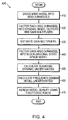
- Fig. 4 is a flow diagram depicting model quality assessment according to an embodiment of the invention.
- the MIMO model is divided (410) into MISO submodels, each of which is factored (420) into dynamic model outputs and gain multipliers.
- the gain multipliers are estimated (430) from the collected and validated data of MVs and CVs.
- a MISO submodel is further factored (440) into a MISO state space dynamical sub-model and a model dynamic uncertainty is defined and calculated (450) for each SISO submodel.
- a frequency-domain model uncertainty for each SISO submodel is further calculated (460).
- the model quality assessment is then determined (470) by using fuzzy logic rules for combining scores as further detailed later.
- Some embodiments include an automated data slicing device that includes a status converter that downloads all specified operational status information regarding the MVs, CVs and the MPC controller's 110 operational status and converts such status information into "data flags" associated with each MV, CV, or a group of MVs and/or CVs.
- the data slicing device selects data segments by generating "good” or “bad” slices to prepare the required data for model auditing and identification.
- the data slicing device also includes a data-conditioner that scans data gaps with continuous "missing” or “bad” data pieces and automatically fills in such gaps with interpolated values to enhance the efficient usage of auditing data.
- the data slicing device also includes a configurable "event-driven” data slice generator, which automatically generates "bad-data” slices based on a configured “data-slicing” rule to exclude those bad data during a specified event period for model auditing and model identification.
- a configurable "event-driven” data slice generator which automatically generates "bad-data” slices based on configured “data-slicing” rule to exclude those data during a "event-period” for model auditing and model identification.
- a process excitation examiner is a part of the automatic data slice generator, which further validates the data sufficiency in order to ensure a reliable and successful sub-model auditing and re-identification.
- a special method to evaluate the process excitation condition and data validity for model auditing includes calculating a special key performance indicator (KPI) of MVs' moves and their corresponding responses, as well as the cross-correlations among the data of MVs during certain time periods.
- KPI key performance indicator
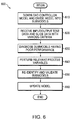
- Fig. 6 is a flow diagram of submodel diagnosis and re-identification according to one embodiment.
- the process 600 begins by downloading the MPC controller model 110 and dividing the model into submodels (step 610).
- Step 620 receives input and output test data including MV's and CV measurements. Using this data, Step 620 automates data slicing based on various criteria, such as those discussed above.
- Step 630 determines prediction performance of submodels and diagnoses the poorly performing submodels. For example, the above mentioned fuzzy logic techniques and rules (further detailed below) are used.
- step 640 perturbs the relevant process variables, and step 650 re-identifies and validates submodels.
- Step 660 updates the controller 110 model accordingly.
- a method for structured multi-input multi-output (MIMO) subspace model identification is configured flexibly and run online.
- the MIMO subspace identification module includes optimal CV grouping and the use of structured prior information for the best efficiency of data usage. Data are pre-processed for the best signal/noise ratio.
- a MIMO identification problem is solved for each sub-model. A model's predictive performance is evaluated against identification data.
- the MIMO model is automatically assembled via model adaptation.
- Fig. 2A is a block diagram of a multiple input multiple output (MIMO) process model 210.
- v i (t) represents process disturbance and measurement noise on the i th output
- Fig. 2B is a block diagram of a multiple input single output (MISO) model with gain multipliers.
- a diagonal matrix K consisting of m gain multipliers is defined.
- the process disturbance v i is not white noise and the LS estimation (5) may be biased.
- the following two strategies are used:
- Strategy-1 employs conditions (1) and (2) a).
- Strategy-2 described here will satisfy conditions (1) and (2) b) by preprocessing input data with simple differencing.
- test data are generated in a Test Mode
- the process input signals are generated with a magnitude Modulated Generalized Binary Noise (MGBN) generator by use of automated closed loop step testing techniques described in Magiel J. Harmse and Qingsheng Zheng, "Automated closed loop step testing of process units," U.S. Pat. No. 7,209,793 , by assignee, the contents of which are incorporated herein by reference in their entirety.
- MGBN Generalized Binary Noise
- Figs. 5A-B show an example of the MGBN signal over 3 hrs.
- the MGBN test signal sequence 510 is plotted.
- the sequence 510 consists of a number of random up and down step moves, some held for a short time while others are held for a longer time.
- the sequence is a kind of "pseudo" white noise sequence.
- ⁇ x ⁇ ij ( t ) ⁇ is solely dependent on the input sequence ⁇ ⁇ j ( t ) ⁇ .
- the ⁇ x ⁇ ij ( t ) ⁇ is one kind of "Instrumental Variable", which can be used in parameter estimation to lead to an unbiased estimation if the input sequence ⁇ ⁇ j ( t ) ⁇ is close to white noise and the ⁇ x ⁇ ij ( t ) ⁇ is an ideal instrumental variable.
- Fig. 5B shows the plot of ⁇ ⁇ j ( t ) ⁇ , i.e. the "preprocessed" input test signal of ⁇ u j (t) ⁇ with "differencing" 520.
- the plot 520 in Fig. 5B is closer to a white noise than its "original” signal because the differenced signal is a sequence of random impulses.
- ARIMA autoregressive integrated moving average
- some of the MVs may not be perturbed during auditing or a testing period; applying "differencing" allows automatic exclusion of those MVs in model auditing and model re-identification and as a result, the negative impacts from those "missing inputs" can be minimized.
- the Gain Multiplier Estimation method described above is effective in detecting the changes/degradation of a submodel's steady-state gain. However, if the underneath process change/degradation involves significant shift in its dynamics, such as a significant change in the dead time and response time, using Gain Multiplier Estimation alone may not be able to capture all the information one needs for a conclusive model auditing.
- An embodiment of the invention includes the following algorithm with the model representation (11) and (12):
- model's predictive quality in addition to a check on the model's steady-state gain via the gain multiplier estimation and the Dynamic Uncertainty described above, the model's overall properties are further assessed by calculating its frequency-domain asymptotic variance and the model's relative uncertainty.
- the model's dynamic predictive quality is then assessed by a comparison between the magnitude of the model and the model errors.
- Fuzzy Logic is a problem-solving methodology that provides a simply way to arrive at a definite conclusion based on vague, ambiguous, imprecise, noisy, or missing input information. Fuzzy logic's approach mimics how a person would make decisions based on his experiences and inference. As the model's gain multipliers, a measure of dynamic uncertainty and model's frequency-domain model errors have been calculated independently, an overall model predictive quality can be assessed with the following fuzzy logic table and rules.
- a submodel's dynamic predictive quality assessment may be obtained. For example:
- the Fuzzy Logic Rule Matrix may be editable according to the operator and engineer's knowledge, as a Fuzzy-Logic system is a simple implementation of an expert system.
- Fig. 8 is illustrative.
- the presented Model Quality KPI (key performance indicator) carpet plot displays an example Model Quality assessment result.
- each row represents a MV and each column represents a CV, and each cell represents a SISO submodel corresponding to the respective MV-CV pair.
- each cell's color is determined by the associated model quality assesement results (Good, Fair, Poor, Bad, and Unknown).
- the arrows represent the gain directions of each SISO submodel. For instance, a submodel with positive gain has an upward arrow; a submodel with negative gain has a downward arrow.
- the major advantage of the invention/Applicant's presented new apparatus and method lies in its lower requirement on the data quality. Unlike in a full-blown system identificantion as discussed in the cited publications and patents, where a systematic process perturbantion is needed to meet the data requirement, the present invention system/algorithm may use less perturbing and some existing operation data with a carefully designed data slicing mechanism employed.
- Embodiments include an automated data slicing and selection module that maximally converts historical operation information of an underlying MPC controller 110 into data selection rules and logistics and applies those rules to support automatic data segment selection. In such a way, the selected process data will be qualified to be used for model assessment and model re-identification.
- This kind of task normally must be performed manually by MPC practitioners according to conventional techniques. Such manual operation is costly and very time-cosuming. It is usually difficult to fully and optimally use all the historical information by such manual operations.
- Embodiments include a structured model performance assesment engine and submodel identification that take full advantage of the existing model from the underlying MPC controller 110 and othe prior knowledge to reduce the uncertainty of the model and hence generate high fidelity models with less data. Using conventional techniques, a re-test on all related process MVs is typically performed, and a full MISO or MIMO model is re-identified. Embodiments provide a "shortcut" through use of the model from the on-line MPC controller as a "blueprinting" initial model.
- An embodiment of the invention include an automated workflow and provides a systematic and integrated so-called "Best Advanced Process Control Practice” solution to serve the process industry for easy monitoring and optimal MPC sustained economic performance.
- Fig. 7 illustrates a computer network and client-server environment in which the present invention may be implemented.
- Client computer(s)/devices (710) and server computer(s) (720) provide processing, storage, and input/output devices executing application programs and the like.
- the present invention is installed as an apparatus in server computer (720).
- the server computer (720) and client computer(s)/devices( 710) can be linked through communications network (750) to other computing devices, including other client devices/processes (710-i) and Distributed Control System (DCS) 730.
- Communications network (750) can be part of a remote access network, a global network (e.g., the Internet), a worldwide collection of computers, Local area or Wide area networks, and gateways that currently use respective protocols (TCP/IP, Bluetooth, etc.) to communicate with one another.
- Other electronic device/computer network architectures are suitable.
- An example of implementation of the present invention may be as shown in Fig.7 where the DCS system 730 controls one or more process units 740.
- An apparatus and method e.g., process/modules 300, 400, 600
- An apparatus and method is installed to run in the server computer 720.
- a user may access the server application from one or more client computers 710 that allow a remote connection through security and firewall in the network (750).
- a user may view, manage, change operations of one or more process units 740 through the DCS system 730.
- the described application may be configured by user from one or more client computers (710) and run in the server computer (720).
- the present invention may be implemented in a variety of computer architectures.
- the computer network system 700 of Fig. 7 is for purposes of illustration and not limitation of the present invention.
- Server computer 720 includes memory, a CPU (central processing unit) and the like.
- Memory provides volatile storage for computer software instructions and data used to implement an embodiment of the present invention (e.g., the controller 110, data validation and model adaptation 300, model assessment 400, and submodel diagnosis and re-identification process 600 as described above).
- Disk storage provides non-volatile storage for computer software instructions and data used to implement an embodiment of the present invention.
- the central processor unit provides for the execution of computer instructions.
- the processor routines and data are a computer program product, including a computer readable medium (e.g., a removable storage medium such as one or more DVD-ROM's, CD-ROM's, diskettes, tapes, etc.) that provides at least a portion of the software instructions for the invention system.
- the computer program product can be installed by any suitable software installation procedure, as is well known in the art.
- at least a portion of the invention software instructions may also be downloaded over a cable, communication and/or wireless connection or operable through a network portal.
Landscapes
- Engineering & Computer Science (AREA)
- Health & Medical Sciences (AREA)
- Artificial Intelligence (AREA)
- Computer Vision & Pattern Recognition (AREA)
- Evolutionary Computation (AREA)
- Medical Informatics (AREA)
- Software Systems (AREA)
- Physics & Mathematics (AREA)
- General Physics & Mathematics (AREA)
- Automation & Control Theory (AREA)
- Feedback Control In General (AREA)
- Testing And Monitoring For Control Systems (AREA)
Applications Claiming Priority (2)
| Application Number | Priority Date | Filing Date | Title |
|---|---|---|---|
| US21737009P | 2009-05-29 | 2009-05-29 | |
| PCT/US2010/035960 WO2010138452A1 (en) | 2009-05-29 | 2010-05-24 | Apparatus and method for model quality estimation and model adaptation in multivariable process control |
Publications (2)
| Publication Number | Publication Date |
|---|---|
| EP2419796A1 EP2419796A1 (en) | 2012-02-22 |
| EP2419796B1 true EP2419796B1 (en) | 2016-09-07 |
Family
ID=42359455
Family Applications (1)
| Application Number | Title | Priority Date | Filing Date |
|---|---|---|---|
| EP10731850.3A Active EP2419796B1 (en) | 2009-05-29 | 2010-05-24 | Apparatus and method for model quality estimation and model adaptation in multivariable process control |
Country Status (5)
| Country | Link |
|---|---|
| US (1) | US8560092B2 (cg-RX-API-DMAC7.html) |
| EP (1) | EP2419796B1 (cg-RX-API-DMAC7.html) |
| JP (1) | JP5734961B2 (cg-RX-API-DMAC7.html) |
| CA (1) | CA2762484A1 (cg-RX-API-DMAC7.html) |
| WO (1) | WO2010138452A1 (cg-RX-API-DMAC7.html) |
Cited By (1)
| Publication number | Priority date | Publication date | Assignee | Title |
|---|---|---|---|---|
| CN109725526A (zh) * | 2017-10-31 | 2019-05-07 | 中国科学院沈阳自动化研究所 | 一种多变量半自适应预测控制方法 |
Families Citing this family (56)
| Publication number | Priority date | Publication date | Assignee | Title |
|---|---|---|---|---|
| KR20100005058A (ko) * | 2007-03-30 | 2010-01-13 | 캐논 아네르바 가부시키가이샤 | 자성소자 제조방법 |
| US9141911B2 (en) | 2009-05-29 | 2015-09-22 | Aspen Technology, Inc. | Apparatus and method for automated data selection in model identification and adaptation in multivariable process control |
| JP6193891B2 (ja) | 2012-02-08 | 2017-09-06 | アスペン テクノロジー インコーポレイテッド | 調整可能なトレードオフ係数を用いて非干渉性の閉ループステップ試験を行う装置および方法 |
| US9923787B2 (en) * | 2012-04-27 | 2018-03-20 | International Business Machines Corporation | Network configuration predictive analytics engine |
| JP6359524B2 (ja) * | 2012-05-11 | 2018-07-18 | アスペン テクノロジー インコーポレイテッド | 多変数プロセス制御でのモデル同定・適応のためにデータを自動的に選択する装置および方法 |
| US9727035B2 (en) * | 2013-05-02 | 2017-08-08 | Aspen Technology, Inc. | Computer apparatus and method using model structure information of model predictive control |
| EP2735924A1 (en) * | 2013-05-03 | 2014-05-28 | ABB Technology Ltd | Providing improvements in relation to a model of a process |
| CN106133521A (zh) * | 2013-10-02 | 2016-11-16 | 苏瑞科技有限公司 | 用于治疗异质肿瘤的病患特异性的免疫疗法 |
| WO2015065437A1 (en) * | 2013-10-31 | 2015-05-07 | Hewlett-Packard Development Company, L.P. | Determining model quality |
| US20150268645A1 (en) | 2014-03-18 | 2015-09-24 | Honeywell Asca Inc. | Method and apparatus for specifying and visualizing robust tuning of model-based controllers |
| US9733627B2 (en) * | 2014-08-13 | 2017-08-15 | Honeywell International Inc. | Cloud computing system and method for advanced process control |
| US9733628B2 (en) * | 2014-08-13 | 2017-08-15 | Honeywell International Inc. | System and method for advanced process control |
| WO2016191849A1 (en) * | 2015-06-03 | 2016-12-08 | HONEYWELL LIMITED/HONEYWELL LlMITEE | Method and apparatus for robust tuning of model-based process controllers used with uncertain multiple-input, multiple-output (mimo) processes |
| EP3304218B1 (en) * | 2015-06-05 | 2022-09-07 | Shell Internationale Research Maatschappij B.V. | System and method for background element switching for models in model predictive estimation and control applications |
| JP6579163B2 (ja) * | 2016-07-06 | 2019-09-25 | Jfeスチール株式会社 | プロセスの状態診断方法及び状態診断装置 |
| US10643167B2 (en) * | 2016-07-28 | 2020-05-05 | Honeywell International Inc. | MPC with unconstrained dependent variables for KPI performance analysis |
| US10809674B2 (en) | 2016-09-16 | 2020-10-20 | Honeywell Limited | Model-plant mismatch detection using model parameter data clustering for paper machines or other systems |
| US11449046B2 (en) | 2016-09-16 | 2022-09-20 | Honeywell Limited | Model-plant mismatch detection with support vector machine for cross-directional process behavior monitoring |
| US10761522B2 (en) | 2016-09-16 | 2020-09-01 | Honeywell Limited | Closed-loop model parameter identification techniques for industrial model-based process controllers |
| US10461533B2 (en) | 2016-09-29 | 2019-10-29 | Enel X North America, Inc. | Apparatus and method for automated validation, estimation, and editing configuration |
| US10170910B2 (en) | 2016-09-29 | 2019-01-01 | Enel X North America, Inc. | Energy baselining system including automated validation, estimation, and editing rules configuration engine |
| US10423186B2 (en) | 2016-09-29 | 2019-09-24 | Enel X North America, Inc. | Building control system including automated validation, estimation, and editing rules configuration engine |
| US10298012B2 (en) | 2016-09-29 | 2019-05-21 | Enel X North America, Inc. | Network operations center including automated validation, estimation, and editing configuration engine |
| US10203714B2 (en) | 2016-09-29 | 2019-02-12 | Enel X North America, Inc. | Brown out prediction system including automated validation, estimation, and editing rules configuration engine |
| US10566791B2 (en) | 2016-09-29 | 2020-02-18 | Enel X North America, Inc. | Automated validation, estimation, and editing processor |
| US10191506B2 (en) * | 2016-09-29 | 2019-01-29 | Enel X North America, Inc. | Demand response dispatch prediction system including automated validation, estimation, and editing rules configuration engine |
| US10291022B2 (en) | 2016-09-29 | 2019-05-14 | Enel X North America, Inc. | Apparatus and method for automated configuration of estimation rules in a network operations center |
| US10281902B2 (en) | 2016-11-01 | 2019-05-07 | Xometry, Inc. | Methods and apparatus for machine learning predictions of manufacture processes |
| WO2018139276A1 (ja) * | 2017-01-24 | 2018-08-02 | 国立大学法人東北大学 | トンネル磁気抵抗素子の製造方法 |
| WO2018223000A1 (en) | 2017-06-02 | 2018-12-06 | Aspen Technology, Inc. | Computer system and method for building and deploying predictive inferential models online |
| US10678194B2 (en) | 2017-06-12 | 2020-06-09 | Honeywell International Inc. | Apparatus and method for estimating impacts of operational problems in advanced control operations for industrial control systems |
| US10061300B1 (en) | 2017-09-29 | 2018-08-28 | Xometry, Inc. | Methods and apparatus for machine learning predictions and multi-objective optimization of manufacturing processes |
| CN108828941B (zh) * | 2018-06-15 | 2021-11-12 | 北京空天技术研究所 | 基于参数辨识的分离控制方法 |
| US11934159B2 (en) | 2018-10-30 | 2024-03-19 | Aspentech Corporation | Apparatus and methods for non-invasive closed loop step testing with controllable optimization relaxation |
| US11853032B2 (en) | 2019-05-09 | 2023-12-26 | Aspentech Corporation | Combining machine learning with domain knowledge and first principles for modeling in the process industries |
| US11782401B2 (en) | 2019-08-02 | 2023-10-10 | Aspentech Corporation | Apparatus and methods to build deep learning controller using non-invasive closed loop exploration |
| WO2021076760A1 (en) | 2019-10-18 | 2021-04-22 | Aspen Technology, Inc. | System and methods for automated model development from plant historical data for advanced process control |
| US11455561B2 (en) | 2019-11-14 | 2022-09-27 | International Business Machines Corporation | Alerting to model degradation based on distribution analysis using risk tolerance ratings |
| US11768917B2 (en) | 2019-11-14 | 2023-09-26 | International Business Machines Corporation | Systems and methods for alerting to model degradation based on distribution analysis |
| US11810013B2 (en) | 2019-11-14 | 2023-11-07 | International Business Machines Corporation | Systems and methods for alerting to model degradation based on survival analysis |
| US11256597B2 (en) | 2019-11-14 | 2022-02-22 | International Business Machines Corporation | Ensemble approach to alerting to model degradation |
| CN110985216B (zh) * | 2019-11-19 | 2022-06-28 | 南京航空航天大学 | 一种含在线修正的航空发动机智能多变量控制方法 |
| JP7288868B2 (ja) * | 2020-01-31 | 2023-06-08 | 株式会社日立製作所 | モデル更新装置及び方法並びにプロセス制御システム |
| US11676039B2 (en) | 2020-02-21 | 2023-06-13 | International Business Machines Corporation | Optimal interpretable decision trees using integer linear programming techniques |
| US20230060325A1 (en) * | 2020-02-28 | 2023-03-02 | 3M Innovative Properties Company | Deep causal learning for advanced model predictive control |
| US11948347B2 (en) | 2020-04-10 | 2024-04-02 | Samsung Display Co., Ltd. | Fusion model training using distance metrics |
| EP3974919B1 (en) * | 2020-09-28 | 2024-12-18 | ABB Schweiz AG | Control loop performance monitoring in variable frequency drive |
| US12210939B2 (en) * | 2020-10-30 | 2025-01-28 | International Business Machines Corporation | Explaining machine learning based time series models |
| CN112925201B (zh) * | 2021-01-20 | 2022-01-28 | 北京大学 | 一种基于模型预测控制的船舶推进系统燃油控制方法 |
| US11630446B2 (en) | 2021-02-16 | 2023-04-18 | Aspentech Corporation | Reluctant first principles models |
| CN113741200B (zh) * | 2021-09-30 | 2024-04-12 | 新疆宝信智能技术有限公司 | 一种石灰套筒窑智能优化煅烧控制系统 |
| CN114036832B (zh) * | 2021-11-04 | 2025-01-03 | 奥星制药设备(石家庄)有限公司 | 一种基于大数据的批次过程建模与最终产品质量预测方法 |
| US12523970B2 (en) | 2022-06-30 | 2026-01-13 | Aspentech Corporation | System and method for building and deploying a sustainable dynamic reduced-order model (SDROM) for an industrial process |
| CN117389237B (zh) * | 2023-12-13 | 2024-02-13 | 无锡雪浪数制科技有限公司 | 一种实现mvc的工业流程控制平台 |
| CN119004033B (zh) * | 2024-08-22 | 2025-09-19 | 合肥工业大学 | 基于物理信息和证据学习的动态测量不确定度量化方法 |
| CN121115584A (zh) * | 2025-08-26 | 2025-12-12 | 南京永泰饮啤机械配件有限公司 | 一种灌装高度自动调节的智能升降控制系统及方法 |
Family Cites Families (14)
| Publication number | Priority date | Publication date | Assignee | Title |
|---|---|---|---|---|
| JP3214636B2 (ja) * | 1992-12-16 | 2001-10-02 | 横河電機株式会社 | 多変数制御調節計 |
| US6947876B1 (en) * | 1999-11-11 | 2005-09-20 | Tokyo Electron Limited | Method for automated system identification |
| US6826521B1 (en) * | 2000-04-06 | 2004-11-30 | Abb Automation Inc. | System and methodology and adaptive, linear model predictive control based on rigorous, nonlinear process model |
| US6937966B1 (en) * | 2000-06-09 | 2005-08-30 | International Business Machines Corporation | System and method for on-line adaptive prediction using dynamic management of multiple sub-models |
| DE60102242T2 (de) * | 2000-06-29 | 2005-01-27 | Aspen Technology, Inc., Cambridge | Rechnerverfahren und gerät zur beschränkung einer nicht-linearen gleichungsnäherung eines empirischen prozesses |
| US7209793B2 (en) * | 2000-07-12 | 2007-04-24 | Aspen Technology, Inc. | Automated closed loop step testing of process units |
| WO2002005042A2 (en) * | 2000-07-12 | 2002-01-17 | Aspen Technology, Inc. | Automated closed loop step testing of process units |
| SE522691C3 (sv) * | 2002-06-12 | 2004-04-07 | Abb Ab | Dynamisk on-line-optimering av produktionsprocesser |
| US7213007B2 (en) * | 2002-12-24 | 2007-05-01 | Caterpillar Inc | Method for forecasting using a genetic algorithm |
| DE102004058238B4 (de) * | 2003-12-03 | 2016-02-04 | Fisher-Rosemount Systems, Inc. | Adaptive, multivariable Prozesssteuerung, die Modellschaltung und Attribut-Interpolation nutzt |
| US20060111858A1 (en) * | 2004-11-22 | 2006-05-25 | Yucai Zhu | Computer method and apparatus for online process identification |
| US7421374B2 (en) * | 2005-11-17 | 2008-09-02 | Honeywell International Inc. | Apparatus and method for analyzing model quality in a process control environment |
| US20070225835A1 (en) * | 2006-03-23 | 2007-09-27 | Yucai Zhu | Computer method and apparatus for adaptive model predictive control |
| US20080243289A1 (en) * | 2007-03-28 | 2008-10-02 | Honeywell International, Inc. | Model maintenance architecture for advanced process control |
-
2010
- 2010-05-24 JP JP2012513153A patent/JP5734961B2/ja active Active
- 2010-05-24 US US12/786,052 patent/US8560092B2/en active Active
- 2010-05-24 EP EP10731850.3A patent/EP2419796B1/en active Active
- 2010-05-24 WO PCT/US2010/035960 patent/WO2010138452A1/en not_active Ceased
- 2010-05-24 CA CA2762484A patent/CA2762484A1/en not_active Abandoned
Cited By (1)
| Publication number | Priority date | Publication date | Assignee | Title |
|---|---|---|---|---|
| CN109725526A (zh) * | 2017-10-31 | 2019-05-07 | 中国科学院沈阳自动化研究所 | 一种多变量半自适应预测控制方法 |
Also Published As
| Publication number | Publication date |
|---|---|
| JP2012528392A (ja) | 2012-11-12 |
| CA2762484A1 (en) | 2010-12-02 |
| US20110130850A1 (en) | 2011-06-02 |
| WO2010138452A1 (en) | 2010-12-02 |
| WO2010138452A8 (en) | 2011-08-11 |
| EP2419796A1 (en) | 2012-02-22 |
| US8560092B2 (en) | 2013-10-15 |
| JP5734961B2 (ja) | 2015-06-17 |
Similar Documents
| Publication | Publication Date | Title |
|---|---|---|
| EP2419796B1 (en) | Apparatus and method for model quality estimation and model adaptation in multivariable process control | |
| EP3289420B1 (en) | Computer system and method for causality analysis using hybrid first-principles and inferential model | |
| EP3635493B1 (en) | Computer system and method for building and deploying predictive inferential models online | |
| Kaiser et al. | Predictive maintenance management using sensor-based degradation models | |
| Kundu et al. | Weibull accelerated failure time regression model for remaining useful life prediction of bearing working under multiple operating conditions | |
| US11754998B2 (en) | System and methods for automated model development from plant historical data for advanced process control | |
| Schäfer et al. | Multivariable MPC system performance assessment, monitoring, and diagnosis | |
| US10628292B2 (en) | Methods and systems for predicting estimation of project factors in software development | |
| US11042128B2 (en) | Method and system for predicting equipment failure | |
| JP5096358B2 (ja) | プロセス工場向け自己診断プロセス制御ループ | |
| JP2012528392A5 (cg-RX-API-DMAC7.html) | ||
| US20040064202A1 (en) | Fast plant test for model-based control | |
| DE102011102034A1 (de) | Online-Abbgleich eines prozessanalytischen Modells mit effektivem Prozessbetrieb | |
| EP2825920B1 (en) | Apparatus and method for automated data selection in model identification and adaptation in multivariable process control | |
| US20210325837A1 (en) | Information processing apparatus, information processing method and computer program product | |
| US12523970B2 (en) | System and method for building and deploying a sustainable dynamic reduced-order model (SDROM) for an industrial process | |
| Yuan et al. | Control performance assessment for multivariable systems based on a modified relative variance technique | |
| Mohril et al. | Residual life prediction in the presence of human error using machine learning | |
| CN105069529A (zh) | 预安排停电时间预测方法及系统 | |
| Serpas | Soft sensors for process monitoring of complex processes | |
| Greipel | Grouping of inspection characteristics to reduce costs of adaptive inspection planning in variant production | |
| Cinar et al. | Automated monitoring and assessment of controller performance | |
| Pannocchia et al. | Application of a method to diagnose the source of performance degradation in MPC systems | |
| RU2628474C1 (ru) | Способ оценки информации о системе с настройкой на основе адаптивной модели и устройство для его реализации | |
| Arandia-Perez et al. | Preliminary spatial-temporal statistical analysis of hourly water demand at household level |
Legal Events
| Date | Code | Title | Description |
|---|---|---|---|
| PUAI | Public reference made under article 153(3) epc to a published international application that has entered the european phase |
Free format text: ORIGINAL CODE: 0009012 |
|
| 17P | Request for examination filed |
Effective date: 20111118 |
|
| AK | Designated contracting states |
Kind code of ref document: A1 Designated state(s): AL AT BE BG CH CY CZ DE DK EE ES FI FR GB GR HR HU IE IS IT LI LT LU LV MC MK MT NL NO PL PT RO SE SI SK SM TR |
|
| DAX | Request for extension of the european patent (deleted) | ||
| GRAP | Despatch of communication of intention to grant a patent |
Free format text: ORIGINAL CODE: EPIDOSNIGR1 |
|
| INTG | Intention to grant announced |
Effective date: 20160322 |
|
| GRAS | Grant fee paid |
Free format text: ORIGINAL CODE: EPIDOSNIGR3 |
|
| GRAA | (expected) grant |
Free format text: ORIGINAL CODE: 0009210 |
|
| AK | Designated contracting states |
Kind code of ref document: B1 Designated state(s): AL AT BE BG CH CY CZ DE DK EE ES FI FR GB GR HR HU IE IS IT LI LT LU LV MC MK MT NL NO PL PT RO SE SI SK SM TR |
|
| REG | Reference to a national code |
Ref country code: GB Ref legal event code: FG4D |
|
| REG | Reference to a national code |
Ref country code: CH Ref legal event code: EP |
|
| REG | Reference to a national code |
Ref country code: IE Ref legal event code: FG4D |
|
| REG | Reference to a national code |
Ref country code: AT Ref legal event code: REF Ref document number: 827386 Country of ref document: AT Kind code of ref document: T Effective date: 20161015 |
|
| REG | Reference to a national code |
Ref country code: DE Ref legal event code: R096 Ref document number: 602010036200 Country of ref document: DE |
|
| REG | Reference to a national code |
Ref country code: LT Ref legal event code: MG4D |
|
| REG | Reference to a national code |
Ref country code: NL Ref legal event code: MP Effective date: 20160907 |
|
| PG25 | Lapsed in a contracting state [announced via postgrant information from national office to epo] |
Ref country code: NO Free format text: LAPSE BECAUSE OF FAILURE TO SUBMIT A TRANSLATION OF THE DESCRIPTION OR TO PAY THE FEE WITHIN THE PRESCRIBED TIME-LIMIT Effective date: 20161207 Ref country code: FI Free format text: LAPSE BECAUSE OF FAILURE TO SUBMIT A TRANSLATION OF THE DESCRIPTION OR TO PAY THE FEE WITHIN THE PRESCRIBED TIME-LIMIT Effective date: 20160907 Ref country code: HR Free format text: LAPSE BECAUSE OF FAILURE TO SUBMIT A TRANSLATION OF THE DESCRIPTION OR TO PAY THE FEE WITHIN THE PRESCRIBED TIME-LIMIT Effective date: 20160907 Ref country code: LT Free format text: LAPSE BECAUSE OF FAILURE TO SUBMIT A TRANSLATION OF THE DESCRIPTION OR TO PAY THE FEE WITHIN THE PRESCRIBED TIME-LIMIT Effective date: 20160907 |
|
| REG | Reference to a national code |
Ref country code: AT Ref legal event code: MK05 Ref document number: 827386 Country of ref document: AT Kind code of ref document: T Effective date: 20160907 |
|
| PG25 | Lapsed in a contracting state [announced via postgrant information from national office to epo] |
Ref country code: NL Free format text: LAPSE BECAUSE OF FAILURE TO SUBMIT A TRANSLATION OF THE DESCRIPTION OR TO PAY THE FEE WITHIN THE PRESCRIBED TIME-LIMIT Effective date: 20160907 Ref country code: ES Free format text: LAPSE BECAUSE OF FAILURE TO SUBMIT A TRANSLATION OF THE DESCRIPTION OR TO PAY THE FEE WITHIN THE PRESCRIBED TIME-LIMIT Effective date: 20160907 Ref country code: GR Free format text: LAPSE BECAUSE OF FAILURE TO SUBMIT A TRANSLATION OF THE DESCRIPTION OR TO PAY THE FEE WITHIN THE PRESCRIBED TIME-LIMIT Effective date: 20161208 Ref country code: SE Free format text: LAPSE BECAUSE OF FAILURE TO SUBMIT A TRANSLATION OF THE DESCRIPTION OR TO PAY THE FEE WITHIN THE PRESCRIBED TIME-LIMIT Effective date: 20160907 Ref country code: LV Free format text: LAPSE BECAUSE OF FAILURE TO SUBMIT A TRANSLATION OF THE DESCRIPTION OR TO PAY THE FEE WITHIN THE PRESCRIBED TIME-LIMIT Effective date: 20160907 |
|
| PG25 | Lapsed in a contracting state [announced via postgrant information from national office to epo] |
Ref country code: RO Free format text: LAPSE BECAUSE OF FAILURE TO SUBMIT A TRANSLATION OF THE DESCRIPTION OR TO PAY THE FEE WITHIN THE PRESCRIBED TIME-LIMIT Effective date: 20160907 Ref country code: EE Free format text: LAPSE BECAUSE OF FAILURE TO SUBMIT A TRANSLATION OF THE DESCRIPTION OR TO PAY THE FEE WITHIN THE PRESCRIBED TIME-LIMIT Effective date: 20160907 |
|
| REG | Reference to a national code |
Ref country code: FR Ref legal event code: PLFP Year of fee payment: 8 |
|
| PG25 | Lapsed in a contracting state [announced via postgrant information from national office to epo] |
Ref country code: PT Free format text: LAPSE BECAUSE OF FAILURE TO SUBMIT A TRANSLATION OF THE DESCRIPTION OR TO PAY THE FEE WITHIN THE PRESCRIBED TIME-LIMIT Effective date: 20170109 Ref country code: AT Free format text: LAPSE BECAUSE OF FAILURE TO SUBMIT A TRANSLATION OF THE DESCRIPTION OR TO PAY THE FEE WITHIN THE PRESCRIBED TIME-LIMIT Effective date: 20160907 Ref country code: BE Free format text: LAPSE BECAUSE OF FAILURE TO SUBMIT A TRANSLATION OF THE DESCRIPTION OR TO PAY THE FEE WITHIN THE PRESCRIBED TIME-LIMIT Effective date: 20160907 Ref country code: PL Free format text: LAPSE BECAUSE OF FAILURE TO SUBMIT A TRANSLATION OF THE DESCRIPTION OR TO PAY THE FEE WITHIN THE PRESCRIBED TIME-LIMIT Effective date: 20160907 Ref country code: SM Free format text: LAPSE BECAUSE OF FAILURE TO SUBMIT A TRANSLATION OF THE DESCRIPTION OR TO PAY THE FEE WITHIN THE PRESCRIBED TIME-LIMIT Effective date: 20160907 Ref country code: BG Free format text: LAPSE BECAUSE OF FAILURE TO SUBMIT A TRANSLATION OF THE DESCRIPTION OR TO PAY THE FEE WITHIN THE PRESCRIBED TIME-LIMIT Effective date: 20161207 Ref country code: SK Free format text: LAPSE BECAUSE OF FAILURE TO SUBMIT A TRANSLATION OF THE DESCRIPTION OR TO PAY THE FEE WITHIN THE PRESCRIBED TIME-LIMIT Effective date: 20160907 Ref country code: IS Free format text: LAPSE BECAUSE OF FAILURE TO SUBMIT A TRANSLATION OF THE DESCRIPTION OR TO PAY THE FEE WITHIN THE PRESCRIBED TIME-LIMIT Effective date: 20170107 Ref country code: CZ Free format text: LAPSE BECAUSE OF FAILURE TO SUBMIT A TRANSLATION OF THE DESCRIPTION OR TO PAY THE FEE WITHIN THE PRESCRIBED TIME-LIMIT Effective date: 20160907 |
|
| REG | Reference to a national code |
Ref country code: DE Ref legal event code: R097 Ref document number: 602010036200 Country of ref document: DE |
|
| PG25 | Lapsed in a contracting state [announced via postgrant information from national office to epo] |
Ref country code: IT Free format text: LAPSE BECAUSE OF FAILURE TO SUBMIT A TRANSLATION OF THE DESCRIPTION OR TO PAY THE FEE WITHIN THE PRESCRIBED TIME-LIMIT Effective date: 20160907 |
|
| PLBE | No opposition filed within time limit |
Free format text: ORIGINAL CODE: 0009261 |
|
| STAA | Information on the status of an ep patent application or granted ep patent |
Free format text: STATUS: NO OPPOSITION FILED WITHIN TIME LIMIT |
|
| PG25 | Lapsed in a contracting state [announced via postgrant information from national office to epo] |
Ref country code: DK Free format text: LAPSE BECAUSE OF FAILURE TO SUBMIT A TRANSLATION OF THE DESCRIPTION OR TO PAY THE FEE WITHIN THE PRESCRIBED TIME-LIMIT Effective date: 20160907 |
|
| 26N | No opposition filed |
Effective date: 20170608 |
|
| PG25 | Lapsed in a contracting state [announced via postgrant information from national office to epo] |
Ref country code: SI Free format text: LAPSE BECAUSE OF FAILURE TO SUBMIT A TRANSLATION OF THE DESCRIPTION OR TO PAY THE FEE WITHIN THE PRESCRIBED TIME-LIMIT Effective date: 20160907 Ref country code: LU Free format text: LAPSE BECAUSE OF NON-PAYMENT OF DUE FEES Effective date: 20170531 |
|
| REG | Reference to a national code |
Ref country code: CH Ref legal event code: PL |
|
| PG25 | Lapsed in a contracting state [announced via postgrant information from national office to epo] |
Ref country code: MC Free format text: LAPSE BECAUSE OF FAILURE TO SUBMIT A TRANSLATION OF THE DESCRIPTION OR TO PAY THE FEE WITHIN THE PRESCRIBED TIME-LIMIT Effective date: 20160907 |
|
| REG | Reference to a national code |
Ref country code: IE Ref legal event code: MM4A |
|
| PG25 | Lapsed in a contracting state [announced via postgrant information from national office to epo] |
Ref country code: LI Free format text: LAPSE BECAUSE OF NON-PAYMENT OF DUE FEES Effective date: 20170531 Ref country code: CH Free format text: LAPSE BECAUSE OF NON-PAYMENT OF DUE FEES Effective date: 20170531 |
|
| PG25 | Lapsed in a contracting state [announced via postgrant information from national office to epo] |
Ref country code: LU Free format text: LAPSE BECAUSE OF NON-PAYMENT OF DUE FEES Effective date: 20170524 |
|
| PG25 | Lapsed in a contracting state [announced via postgrant information from national office to epo] |
Ref country code: IE Free format text: LAPSE BECAUSE OF NON-PAYMENT OF DUE FEES Effective date: 20170524 |
|
| REG | Reference to a national code |
Ref country code: FR Ref legal event code: PLFP Year of fee payment: 9 |
|
| PG25 | Lapsed in a contracting state [announced via postgrant information from national office to epo] |
Ref country code: MT Free format text: LAPSE BECAUSE OF NON-PAYMENT OF DUE FEES Effective date: 20170524 |
|
| PG25 | Lapsed in a contracting state [announced via postgrant information from national office to epo] |
Ref country code: AL Free format text: LAPSE BECAUSE OF FAILURE TO SUBMIT A TRANSLATION OF THE DESCRIPTION OR TO PAY THE FEE WITHIN THE PRESCRIBED TIME-LIMIT Effective date: 20160907 |
|
| REG | Reference to a national code |
Ref country code: DE Ref legal event code: R082 Ref document number: 602010036200 Country of ref document: DE Representative=s name: PAGE, WHITE & FARRER GERMANY LLP, DE |
|
| PG25 | Lapsed in a contracting state [announced via postgrant information from national office to epo] |
Ref country code: HU Free format text: LAPSE BECAUSE OF FAILURE TO SUBMIT A TRANSLATION OF THE DESCRIPTION OR TO PAY THE FEE WITHIN THE PRESCRIBED TIME-LIMIT; INVALID AB INITIO Effective date: 20100524 |
|
| PG25 | Lapsed in a contracting state [announced via postgrant information from national office to epo] |
Ref country code: CY Free format text: LAPSE BECAUSE OF NON-PAYMENT OF DUE FEES Effective date: 20160907 |
|
| PG25 | Lapsed in a contracting state [announced via postgrant information from national office to epo] |
Ref country code: MK Free format text: LAPSE BECAUSE OF FAILURE TO SUBMIT A TRANSLATION OF THE DESCRIPTION OR TO PAY THE FEE WITHIN THE PRESCRIBED TIME-LIMIT Effective date: 20160907 |
|
| PG25 | Lapsed in a contracting state [announced via postgrant information from national office to epo] |
Ref country code: TR Free format text: LAPSE BECAUSE OF FAILURE TO SUBMIT A TRANSLATION OF THE DESCRIPTION OR TO PAY THE FEE WITHIN THE PRESCRIBED TIME-LIMIT Effective date: 20160907 |
|
| REG | Reference to a national code |
Ref country code: GB Ref legal event code: 732E Free format text: REGISTERED BETWEEN 20220922 AND 20220928 |
|
| REG | Reference to a national code |
Ref country code: DE Ref legal event code: R081 Ref document number: 602010036200 Country of ref document: DE Owner name: ASPENTECH CORP., BREDFORD, US Free format text: FORMER OWNER: ASPEN TECHNOLOGY, INC., BURLINGTON, MASS., US |
|
| P01 | Opt-out of the competence of the unified patent court (upc) registered |
Effective date: 20230528 |
|
| PGFP | Annual fee paid to national office [announced via postgrant information from national office to epo] |
Ref country code: DE Payment date: 20250423 Year of fee payment: 16 |
|
| PGFP | Annual fee paid to national office [announced via postgrant information from national office to epo] |
Ref country code: GB Payment date: 20250423 Year of fee payment: 16 |
|
| PGFP | Annual fee paid to national office [announced via postgrant information from national office to epo] |
Ref country code: FR Payment date: 20250423 Year of fee payment: 16 |
|
| REG | Reference to a national code |
Ref country code: DE Ref legal event code: R082 Ref document number: 602010036200 Country of ref document: DE Representative=s name: WESTPHAL, MUSSGNUG & PARTNER PATENTANWAELTE MI, DE |