EP2418719A2 - Positive electrode active material and lithium battery including the same - Google Patents
Positive electrode active material and lithium battery including the same Download PDFInfo
- Publication number
- EP2418719A2 EP2418719A2 EP20110174701 EP11174701A EP2418719A2 EP 2418719 A2 EP2418719 A2 EP 2418719A2 EP 20110174701 EP20110174701 EP 20110174701 EP 11174701 A EP11174701 A EP 11174701A EP 2418719 A2 EP2418719 A2 EP 2418719A2
- Authority
- EP
- European Patent Office
- Prior art keywords
- transition metal
- active material
- metal oxide
- positive active
- oxide
- Prior art date
- Legal status (The legal status is an assumption and is not a legal conclusion. Google has not performed a legal analysis and makes no representation as to the accuracy of the status listed.)
- Withdrawn
Links
Images

Classifications
-
- H—ELECTRICITY
- H01—ELECTRIC ELEMENTS
- H01M—PROCESSES OR MEANS, e.g. BATTERIES, FOR THE DIRECT CONVERSION OF CHEMICAL ENERGY INTO ELECTRICAL ENERGY
- H01M4/00—Electrodes
- H01M4/02—Electrodes composed of, or comprising, active material
- H01M4/13—Electrodes for accumulators with non-aqueous electrolyte, e.g. for lithium-accumulators; Processes of manufacture thereof
- H01M4/131—Electrodes based on mixed oxides or hydroxides, or on mixtures of oxides or hydroxides, e.g. LiCoOx
-
- C—CHEMISTRY; METALLURGY
- C01—INORGANIC CHEMISTRY
- C01G—COMPOUNDS CONTAINING METALS NOT COVERED BY SUBCLASSES C01D OR C01F
- C01G39/00—Compounds of molybdenum
- C01G39/02—Oxides; Hydroxides
-
- C—CHEMISTRY; METALLURGY
- C01—INORGANIC CHEMISTRY
- C01G—COMPOUNDS CONTAINING METALS NOT COVERED BY SUBCLASSES C01D OR C01F
- C01G41/00—Compounds of tungsten
- C01G41/02—Oxides; Hydroxides
-
- C—CHEMISTRY; METALLURGY
- C01—INORGANIC CHEMISTRY
- C01G—COMPOUNDS CONTAINING METALS NOT COVERED BY SUBCLASSES C01D OR C01F
- C01G51/00—Compounds of cobalt
- C01G51/04—Oxides
-
- C—CHEMISTRY; METALLURGY
- C01—INORGANIC CHEMISTRY
- C01G—COMPOUNDS CONTAINING METALS NOT COVERED BY SUBCLASSES C01D OR C01F
- C01G51/00—Compounds of cobalt
- C01G51/40—Complex oxides containing cobalt and at least one other metal element
- C01G51/42—Complex oxides containing cobalt and at least one other metal element containing alkali metals, e.g. LiCoO2
-
- C—CHEMISTRY; METALLURGY
- C01—INORGANIC CHEMISTRY
- C01G—COMPOUNDS CONTAINING METALS NOT COVERED BY SUBCLASSES C01D OR C01F
- C01G53/00—Compounds of nickel
- C01G53/40—Complex oxides containing nickel and at least one other metal element
- C01G53/42—Complex oxides containing nickel and at least one other metal element containing alkali metals, e.g. LiNiO2
-
- H—ELECTRICITY
- H01—ELECTRIC ELEMENTS
- H01M—PROCESSES OR MEANS, e.g. BATTERIES, FOR THE DIRECT CONVERSION OF CHEMICAL ENERGY INTO ELECTRICAL ENERGY
- H01M4/00—Electrodes
- H01M4/02—Electrodes composed of, or comprising, active material
- H01M4/36—Selection of substances as active materials, active masses, active liquids
- H01M4/362—Composites
-
- H—ELECTRICITY
- H01—ELECTRIC ELEMENTS
- H01M—PROCESSES OR MEANS, e.g. BATTERIES, FOR THE DIRECT CONVERSION OF CHEMICAL ENERGY INTO ELECTRICAL ENERGY
- H01M4/00—Electrodes
- H01M4/02—Electrodes composed of, or comprising, active material
- H01M4/36—Selection of substances as active materials, active masses, active liquids
- H01M4/362—Composites
- H01M4/364—Composites as mixtures
-
- H—ELECTRICITY
- H01—ELECTRIC ELEMENTS
- H01M—PROCESSES OR MEANS, e.g. BATTERIES, FOR THE DIRECT CONVERSION OF CHEMICAL ENERGY INTO ELECTRICAL ENERGY
- H01M4/00—Electrodes
- H01M4/02—Electrodes composed of, or comprising, active material
- H01M4/36—Selection of substances as active materials, active masses, active liquids
- H01M4/362—Composites
- H01M4/366—Composites as layered products
-
- H—ELECTRICITY
- H01—ELECTRIC ELEMENTS
- H01M—PROCESSES OR MEANS, e.g. BATTERIES, FOR THE DIRECT CONVERSION OF CHEMICAL ENERGY INTO ELECTRICAL ENERGY
- H01M4/00—Electrodes
- H01M4/02—Electrodes composed of, or comprising, active material
- H01M4/36—Selection of substances as active materials, active masses, active liquids
- H01M4/48—Selection of substances as active materials, active masses, active liquids of inorganic oxides or hydroxides
-
- H—ELECTRICITY
- H01—ELECTRIC ELEMENTS
- H01M—PROCESSES OR MEANS, e.g. BATTERIES, FOR THE DIRECT CONVERSION OF CHEMICAL ENERGY INTO ELECTRICAL ENERGY
- H01M4/00—Electrodes
- H01M4/02—Electrodes composed of, or comprising, active material
- H01M4/36—Selection of substances as active materials, active masses, active liquids
- H01M4/48—Selection of substances as active materials, active masses, active liquids of inorganic oxides or hydroxides
- H01M4/485—Selection of substances as active materials, active masses, active liquids of inorganic oxides or hydroxides of mixed oxides or hydroxides for inserting or intercalating light metals, e.g. LiTi2O4 or LiTi2OxFy
-
- H—ELECTRICITY
- H01—ELECTRIC ELEMENTS
- H01M—PROCESSES OR MEANS, e.g. BATTERIES, FOR THE DIRECT CONVERSION OF CHEMICAL ENERGY INTO ELECTRICAL ENERGY
- H01M4/00—Electrodes
- H01M4/02—Electrodes composed of, or comprising, active material
- H01M4/36—Selection of substances as active materials, active masses, active liquids
- H01M4/48—Selection of substances as active materials, active masses, active liquids of inorganic oxides or hydroxides
- H01M4/52—Selection of substances as active materials, active masses, active liquids of inorganic oxides or hydroxides of nickel, cobalt or iron
- H01M4/525—Selection of substances as active materials, active masses, active liquids of inorganic oxides or hydroxides of nickel, cobalt or iron of mixed oxides or hydroxides containing iron, cobalt or nickel for inserting or intercalating light metals, e.g. LiNiO2, LiCoO2 or LiCoOxFy
-
- H—ELECTRICITY
- H01—ELECTRIC ELEMENTS
- H01M—PROCESSES OR MEANS, e.g. BATTERIES, FOR THE DIRECT CONVERSION OF CHEMICAL ENERGY INTO ELECTRICAL ENERGY
- H01M4/00—Electrodes
- H01M4/02—Electrodes composed of, or comprising, active material
- H01M4/62—Selection of inactive substances as ingredients for active masses, e.g. binders, fillers
- H01M4/628—Inhibitors, e.g. gassing inhibitors, corrosion inhibitors
-
- C—CHEMISTRY; METALLURGY
- C01—INORGANIC CHEMISTRY
- C01P—INDEXING SCHEME RELATING TO STRUCTURAL AND PHYSICAL ASPECTS OF SOLID INORGANIC COMPOUNDS
- C01P2002/00—Crystal-structural characteristics
- C01P2002/70—Crystal-structural characteristics defined by measured X-ray, neutron or electron diffraction data
- C01P2002/72—Crystal-structural characteristics defined by measured X-ray, neutron or electron diffraction data by d-values or two theta-values, e.g. as X-ray diagram
-
- C—CHEMISTRY; METALLURGY
- C01—INORGANIC CHEMISTRY
- C01P—INDEXING SCHEME RELATING TO STRUCTURAL AND PHYSICAL ASPECTS OF SOLID INORGANIC COMPOUNDS
- C01P2002/00—Crystal-structural characteristics
- C01P2002/80—Crystal-structural characteristics defined by measured data other than those specified in group C01P2002/70
- C01P2002/88—Crystal-structural characteristics defined by measured data other than those specified in group C01P2002/70 by thermal analysis data, e.g. TGA, DTA, DSC
-
- C—CHEMISTRY; METALLURGY
- C01—INORGANIC CHEMISTRY
- C01P—INDEXING SCHEME RELATING TO STRUCTURAL AND PHYSICAL ASPECTS OF SOLID INORGANIC COMPOUNDS
- C01P2004/00—Particle morphology
- C01P2004/80—Particles consisting of a mixture of two or more inorganic phases
-
- H—ELECTRICITY
- H01—ELECTRIC ELEMENTS
- H01M—PROCESSES OR MEANS, e.g. BATTERIES, FOR THE DIRECT CONVERSION OF CHEMICAL ENERGY INTO ELECTRICAL ENERGY
- H01M10/00—Secondary cells; Manufacture thereof
- H01M10/05—Accumulators with non-aqueous electrolyte
- H01M10/052—Li-accumulators
-
- Y—GENERAL TAGGING OF NEW TECHNOLOGICAL DEVELOPMENTS; GENERAL TAGGING OF CROSS-SECTIONAL TECHNOLOGIES SPANNING OVER SEVERAL SECTIONS OF THE IPC; TECHNICAL SUBJECTS COVERED BY FORMER USPC CROSS-REFERENCE ART COLLECTIONS [XRACs] AND DIGESTS
- Y02—TECHNOLOGIES OR APPLICATIONS FOR MITIGATION OR ADAPTATION AGAINST CLIMATE CHANGE
- Y02E—REDUCTION OF GREENHOUSE GAS [GHG] EMISSIONS, RELATED TO ENERGY GENERATION, TRANSMISSION OR DISTRIBUTION
- Y02E60/00—Enabling technologies; Technologies with a potential or indirect contribution to GHG emissions mitigation
- Y02E60/10—Energy storage using batteries
Definitions
- the present invention relates to a positive active material for a lithium battery and a lithium battery including the same.
- a typical lithium battery includes a positive electrode, a negative electrode, each of which includes an active material enabling intercalation and deintercalation of lithium ions, and an organic electrolytic solution or a polymer electrolytic solution which fills a space between the positive electrode and the negative electrode, and generates an electrical energy due to an oxidation-reduction reaction occurring when lithium ions are intercalated into and/or deintercalated from the positive electrode and the negative electrode.
- Lithium batteries have higher voltage and higher energy density than conventional batteries.
- currently available lithium batteries including lithium cobalt oxide (LiCoO 2 ), lithium nickel oxide (LiNiO 2 ), or lithium nickel cobalt manganese oxide (Li[NiCoMn]O 2 , Li[Ni 1-x-y Co x M y ]O 2 ) as a positive active material are unstable because the positive active materials generate a great amount of heat during charging and discharging.
- a positive active material for a lithium battery including a lithium composite oxide and a transition metal oxide, wherein the transition metal oxide includes a transition metal in a lower oxidation state than the most stable oxidation state of the transition metal.
- the oxidation state of the transition metal may be from 2+ to 5+.
- the transition metal oxide may be present in admixture with the lithium composite oxide.
- At least a portion of the lithium composite oxide may be coated with the transition metal oxide.
- the transition metal oxide may include an oxide of at least one metal selected from the group consisting of Ti, V, Mn, Fe, Co, Mo, W, and Ni.
- the transition metal oxide may include at least one oxide selected from the group consisting of Ti 2 O 3 , TiO, VO 2 , V 2 O 3 , VO, Mn 2 O 3 , MnO, FeO, Co 2 O 3 , CoO, Co 3 O 4 , Mo 2 O 5 , MoO 2 , Mo 2 O 3 , MoO, W 2 O 5 , WO 2 , W 2 O 3 , and NiO.
- the transition metal oxide may be selected from the group consisting of MoO 2 , WO 2 , Co 3 O 4 , and mixtures thereof.
- the amount of the transition metal oxide may be from about 0.05 to about 15 parts by weight based on 100 parts by weight of the lithium composite oxide.
- the amount of the transition metal oxide may be from about 0.1 to about 10 parts by weight based on 100 parts by weight of the lithium composite oxide.
- a lithium battery including a positive electrode including a positive active material according to the present invention in its first aspect; a negative electrode; and an electrolytic solution.
- a method of preparing a positive active material for a lithium battery according to the present invention in its second aspect which comprises providing a lithium composite oxide and a transition metal oxide, wherein the transition metal oxide includes a transition metal in a lower oxidation state than the most stable oxidation state of the transition metal.
- the method of preparing the positive active material may further include the step of heat treating a precursor metal oxide that includes the transition metal under a reducing atmosphere, to form the transition metal oxide.
- the precursor metal oxide may be heat treated under a reducing atmosphere comprising H 2 gas, H 2 /N 2 gas or NH 3 gas, and/or at a temperature of about 1000 to 1500°C, and/or for about 10 to 20 hours.
- a lithium composite oxide and a transition metal oxide wherein the transition metal oxide includes a transition metal in a lower oxidation state than the most stable oxidation state of the transition metal, as a positive active material in a lithium battery.
- the positive active material according to the present invention in its first aspect, for example, wherein at least a portion of the lithium composite oxide is coated with the transition metal oxide hinders generation of oxygen occurring during charging and provides a lithium battery with high-temperature preservation characteristics and high stability.
- a positive active material according to the present invention includes a lithium composite oxide and a transition metal oxide including a transition metal in a lower oxidation state than the most stable oxidation state of the transition metal.
- the oxidation state of the transition metal may be from about 2+ through 5+.
- most stable state means a state having a stoichiometric ratio of y/x of an oxide of the corresponding transition metal with the lowest standard enthalpy of formation ( ⁇ H° f ) at a temperature of 25 °C under 1 atm among corresponding transition metal binary oxides represented by the formula of M x O y , where the ratio of y/x is a positive value.
- the transition metal oxide is an oxygen-deficient transition metal oxide having an oxygen vacancy formed by removing one or less oxygen therefrom, for example, an oxide having a stoichiometric ratio of y/x smaller than that of an oxide having the lowest standard enthalpy of formation ( ⁇ H° f ) at a temperature of 25 °C under 1 atm among corresponding transition metal binary oxides represented by the formula of M x O y , where the ratio of y/x is a positive value.
- the most stable states of oxides of the respective transition metals may be TiO 2 , V 2 O 5 , MnO 2 , Fe 2 O 3 , CoO 2 , MoO 3 , WO 3 , and Ni 2 O 3
- the oxidation states of the transition metals contained in the transition metal oxides may be Ti(4+), V(5+), Mn(4+), Fe(3+), Co(4+), Mo(6+), W(6+), and Ni(3+).
- the transition metal oxide may be prepared by heat treating the corresponding transition metal oxide in the most stable state under a reducing atmosphere to remove oxygen.
- the transition metal oxide may be prepared by heat treating the corresponding transition metal oxide in the most stable state under a reducing atmosphere including H 2 gas, H 2 /N 2 gas (a mixed gas including 5 volume% of H 2 gas and 95 volume% of N 2 ), or NH 3 gas for 10 through 20 hours at a temperature of 1000 through 1500 °C.
- the transition metal oxide may be prepared by heat treating the corresponding transition metal oxide in the most stable state by using a reducing agent such as a borohydride, hydrazine, or NaPH 2 O 2 .
- the positive active material adsorbs oxygen generated from the transition metal oxide and prevents generation of oxygen in a positive electrode including the positive active material.
- a battery including the positive active material including the transition metal may have excellent thermal stability and cycle characteristics even when the battery is thermally exposed or over-charged, or during combustion.
- At least a portion of a surface of the lithium composite oxide may be coated with the transition metal oxide.
- the coating may be performed by dipping the lithium composite oxide in a coating solution of the transition metal oxide.
- the coating may not be limited thereto.
- the coating may also be performed by solvent evaporation, co-precipitation, sol-gel method, filtering after adsorption, sputtering, or chemical vapor deposition (CVD).
- the transition metal oxide may include an oxide of at least one metal selected from the group consisting of Ti, V, Mn, Fe, Co, Mo, W, and Ni.
- transition metal oxide may also include mixtures or alloys of at least two kinds of the metals described above.
- the oxidation state of the transition metal may be Ti(3+, 2+), V(4+, 3+, 2+), Mn(3+, 2+), Fe(2+), Co(3+, 2+), Mo(5+, 4+, 3+, 2+), W(5+, 4+, 3+), or Ni (2+).
- the transition metal oxide may include at least one oxide selected from the group consisting of Ti 2 O 3 , TiO, VO 2 , V 2 O 3 , VO, MnZO 3 , MnO, FeO, Co 2 O 3 , CoO, Co 3 O 4 , Mo 2 O 5 , MoO 2 , Mo 2 O 3 , MoO, W 2 O 5 , WO 2 , W 2 O 3 , and NiO.
- the transition metal oxide may be TiO, V 2 O 3 , MnO, FeO, Co 3 O 4 , MoO 2 , WO 2 , or NiO.
- the transition metal oxide may be MoO 2 , WO 2 , or Co 3 O 4 .
- the oxidation state of the transition metal in the transition metal oxide may easily be in a lower oxidation state than the most stable oxidation state of the transition metal.
- the amount of the transition metal oxide may be from about 0.05 to about 15 parts by weight, or 0.1 to about 10 parts by weight, or 0.1 to about 5 parts by weight, based on 100 parts by weight of the lithium composite oxide.
- the amount of the transition metal oxide is within the ranges described above, even when a Li intercalation potential is increased, a battery including the transition metal oxide has an optimal capacity and thus has high thermal stability and high capacity without a decrease in charge and discharge characteristics.
- a positive electrode of a lithium battery according to the present invention includes a positive active material including a lithium composite oxide and a transition metal oxide including a transition metal in an oxidation state lower than the most stable oxidation state of the transition metal.
- the positive electrode may include a current collector and a positive active material layer.
- the positive active material layer may include the positive active material including the lithium composite oxide and the transition metal oxide including a transition metal in an oxidation state lower than the most stable oxidation state of the transition metal.
- the positive active material layer may further include, in addition to the positive active material including the lithium composite oxide and the transition metal oxide, a first compound (lithiated intercalation compound) enabling reversible intercalation and deintercalation of lithium ions.
- a first compound lithiumated intercalation compound
- Examples of the first compound are as follows:
- the first compound may also be lithium titanate.
- A is selected from the group consisting of Ni, Co, Mn, and a combination thereof, but is not limited thereto;
- X is selected from the group consisting of Al, Ni, Co, Mn, Cr, Fe, Mg, Sr, V, a rare-earth element, and a combination thereof, but is not limited thereto;
- D is selected from the group consisting of O, F, S, P, and a combination thereof, but is not limited thereto;
- E is selected from the group consisting of Co, Mn, and a combination thereof, but is not limited thereto;
- M is selected from the group consisting of F, S, P, and a combination thereof, but is not limited thereto;
- G is selected from the group consisting of Al, Cr, Mn, Fe, Mg, La, Ce, Sr, V, and a combination thereof, but is not limited thereto;
- Q is selected from the group consisting of Ti, Mo, Mn, and a combination thereof, but is not limited thereto;
- Z is
- the positive active material layer may further include a binder.
- the binder included in the positive active material layer allows positive active material particles to attach to each other and attaches the positive active material to the current collector.
- the binder include polyvinylalcohol, carboxymethylcellulose, hydroxypropylcellulose, diacetylcellulose, polyvinylchloride, carboxylated polyvinylchloride, polyvinylfluoride, an ethylene oxide-containing polymer, polyvinylpyrrolidone, polyurethane, polytetrafluoroethylene, polyvinylidene fluoride, polyethylene, polypropylene, styrene butadiene rubber, acrylated styrene-butadiene rubber, epoxy resin, and nylon.
- the binder is not limited thereto.
- the current collector may be formed of Al or Cu, but is not limited thereto.
- the positive active material, the binder, and a conducting agent, of which use is optional, are mixed in a solvent to prepare a composition for forming the positive active material layer and then, the composition is coated on the current collector to form the positive active material layer.
- This positive electrode preparation method is well known in the art and will not be described in detail herein.
- the solvent may be N-methylpyrrolidone, but is not limited thereto.
- a negative electrode may include a negative active material layer and a current collector.
- the transition metal oxide may also be used in a negative active material.
- the negative active material may be natural graphite, silicon/carbon composite (SiO x ), silicon metal, a silicon thin film, lithium metal, lithium alloy, a carbonaceous material, or graphite.
- An example of the lithium alloy may be lithium titanate.
- the lithium titanate can be categorized into a spinel-type lithium titanate, an anatase-type lithium titanate, and a ramsdellite-type lithium titanate, according to a crystal structure.
- the negative active material may be represented by Li 4-x Ti 5 O 12 (0 ⁇ x ⁇ 3).
- the negative active material may be Li 4 Ti 5 O 12 , but is not limited thereto.
- a composition for forming the negative active material layer may include a binder and a solvent.
- the binder and the solvent may be the same as those used in the positive electrode above.
- the composition for forming the negative active material layer may selectively include a conducting agent including at least one selected from the group consisting of carbon black, ketjen black, acetylene black, artificial graphite, natural graphite, copper powder, nickel powder, aluminium powder, silver powder, and polyphenylene.
- the example of the conducting agent is not limited thereto.
- a plasticizer may be further added to the composition for forming the positive active material layer and the composition for forming the negative active material composition layer to form pores in electrode plates.
- An electrolytic solution may include a non-aqueous organic solvent and a lithium salt.
- the non-aqueous organic solvent may function as a medium in which ions participating in an electrochemical reaction in a battery migrate.
- non-aqueous organic solvent examples include a carbonate-based solvent, an ester-based solvent, an ether-based solvent, a ketone-based solvent, an alcohol-based solvent, and a non-proton type solvent.
- a carbonate-based solvent examples include dimethyl carbonate (DMC), diethyl carbonate (DEC), dipropyl carbonate (DPC), methylpropyl carbonate (MPC), ethylpropyl carbonate (EPC), ethylmethyl carbonate (EMC), ethylene carbonate (EC), propylene carbonate (PC), and butylene carbonate (BC).
- Examples of an ester-based solvent include methyl acetate, ethyl acetate, n-propyl acetate, dimethylacetate, methylpropionate, ethylpropionate, ⁇ -butyrolactone, decanolide, valerolactone, mevalonolactone, and caprolactone.
- Examples of an ether-based solvent include dibutyl ether, tetraglyme, diglyme, dimethoxyethane, 2-methyltetrahydrofurane, and tetrahydrofurane.
- Examples of a ketone-based solvent include cyclohexanone.
- Examples of an alcohol-based solvent include ethyl alcohol and isopropyl alcohol.
- non proton-type solvent examples include nitriles such as R-CN (R is a linear, branched, or cyclic C2 to C20 hydrocarbonate group and has a double bond-direction cyclic or ether bond), amides such as dimethylformamide, dioxolanes such as 1,3-dioxolane, and sulfolanes.
- the non-aqueous organic solvent may be a single solvent or a mixture of two or more solvents.
- a mixture ratio of the solvents may be appropriately controlled according to battery performance, which is well known in the art.
- the lithium salt is dissolved in an organic solvent, and functions as a lithium ion supplier in a battery, enables a basic operation of a battery, and facilitates migration of lithium ions between the positive electrode and the negative electrode.
- the lithium salt may include at least one supporting electrolytic salt selected from the group consisting of LiPF 6 , LiBF 4 , LiSbF 6 , LiAsF 6 , LiN(SO 2 C 2 F 5 ) 2 , Li(CF 3 SO 2 ) 2 N, LiC 4 F 9 SO 3 , LiClO 4 , LiAlO 2 , LiAlCl 4 , LiN(C x F 2x+1 SO 2 )(C y F 2y+1 SO 2 ) where x and y are natural numbers, LiCl, LiI, and LiB(C 2 O 4 ) 2 (lithium bis(oxalato) borate; LiBOB).
- the concentration of the lithium salt may be from about 0.1 M to about 2.0 M. When the concentration of the lithium salt
- a separator may be present between the positive electrode and the negative electrode.
- the separator may be a monolayer or two or more-layer of polyethylene, polypropylene, or polyvinylidene fluoride, and may also be a mixed multi-layer, such as a two-layer separator of polyethylene/polypropylene, a three-layer separator of polyethylene/polypropylene/polyethylene, or a three-layer separator of polypropylene/polyethylene/polypropylene.
- lithium batteries can be categorized into a lithium ion battery, a lithium ion polymer battery, and a lithium polymer battery; according to a battery shape, lithium batteries can be categorized into a cylindrical battery, a rectangular battery, a coin-shape batter, or a pouch-shape batter; and according to a battery size, lithium batteries can be categorized into bulk-type batteries and thin-film type batteries.
- the lithium battery may also be a primary battery or a secondary battery.
- MoO 3 transition metal oxide was heat treated at a temperature of 1000 to 1500°C under a reducing atmosphere including a mixed gas of H 2 /N 2 including 5 volume% of H 2 gas and 95 volume% of N 2 gas for 10 hours to prepare MoO 2 transition metal oxide.
- a positive active material was prepared by mixing 1 part by weight of the MoO 2 transition metal oxide prepared according to Synthesis Example 1 with 100 parts by weight of LiCoO 2 . 94 wt.(weight) % of the prepared positive active material was mixed with 3 wt.% of Super P carbon black and 3 wt.% of PVDF to prepare a positive active material slurry composition, and then the slurry composition was coated on a current collector formed of an aluminium foil and dried to manufacture a positive electrode.
- a separator formed of polypropylene was interposed between the positive electrode and the negative electrode, and a non-aqueous electrolyte prepared by dissolving 1.50 mol/L of LiPF 6 in a mixed solvent including ethylenecarbonate and diethylcarbonate in a ratio of 3:7 was injected into the resultant structure, thereby completing manufacturing of a coin-shaped lithium battery.
- a lithium battery was manufactured in the same manner as in Example 1, except that 5 parts by weight of the MoO 2 transition metal oxide prepared according to Synthesis Example 1 was mixed with 100 parts by weight of LiCoO 2 .
- a lithium battery was manufactured in the same manner as in Example 1, except that 10 parts by weight of the MoO 2 transition metal oxide prepared according to Synthesis Example 1 was mixed with 100 parts by weight of LiCoO 2 .
- LiCoO 2 positive active material having an average particle diameter of 20 ⁇ m and 1 part by weight of an acetic acid were added to the coating solution so that LiCoO 2 positive active material particles were coated with MoO 2 .
- the coated LiCoO 2 was dried at room temperature for 24 hours and heat treated at a temperature of 400 °C for 10 hours to prepare a positive active material. Then the same process as in Example 2 was performed to complete manufacturing a lithium battery.
- a lithium battery was manufactured in the same manner as in Example 1, except that 5 parts by weight of the MoO 2 transition metal oxide prepared according to Synthesis Example 1 was mixed with 100 parts by weight of a mixture including LiCoO 2 and Li 2 NiO 2 in a weight ratio of 70: 30 of LiCoO 2 and Li 2 NiO 2 .
- Comparative Example 1 Manufacturing of Lithium Battery including Positive
- a lithium battery was manufactured in the same manner as in Example 1, except that as the positive active material, only the LiCoO 2 positive active material was used and the transition metal oxide was not used.
- Comparative Example 2 Manufacturing of Lithium Battery including Positive
- a lithium battery was manufactured in the same manner as in Example 5, except that as the positive active material, only 100 parts by weight of a mixture including LiCoO 2 and Li 2 NiO 2 in a weight ratio of 70: 30 of LiCoO 2 and Li 2 NiO 2 was used and the transition metal oxide was not used.
- the coin-shaped lithium batteries manufactured according to Examples 1, 2, 3, and 4 were charged until a voltage reached 4.4 V, and then the charged batteries were dissembled to separate the positive active materials.
- Each of the obtained positive active materials was sampled together with a non-aqueous electrolyte in which 1.50 mol/L of LiPF 6 was dissolved with a mixed solvent including ethylenecarbonate and diethylcarbonate in a ratio of 3:7.
- a heat dissipation change of each sampled positive active material was evaluated using DSC (produced by TA Instruments Inc.) at a temperature of 50 °C to 375 °C under an N 2 atmosphere at a temperature increase rate of 10 °C/min.
- the corresponding lithium battery was charged until a voltage reached 4.4 V and then preserved at a temperature of 60 °C for 100 hours to measure the amount of gas generated in the lithium battery.
- the lithium batteries of Examples 1 through 5 were charged with a constant current of 160 mA/1C until a voltage reached 4.4 V, and then charged with a constant voltage of 4.4 V until a current reached 1/20 C. Then, a charge capacity for each case was measured. Next, the batteries were discharged with a constant current of 160 mA/1C until a voltage reached 4.4 V and a discharge capacity for each case was measured.
- a heat flow change of Comparative Example 1 was three to sixteen times greater than those of Examples 1, 3, and 4 at a high temperature of 250 °C or more.
- Example 5 using the Li 2 NiO 2 -containing lithium composite oxide, the amount of generated O 2 gas was measured instead of the heat dissipation change.
- the results show that a lithium battery including a positive electrode for a lithium battery according to the present invention has excellent high-temperature preservation characteristics and thermal stability.
Landscapes
- Chemical & Material Sciences (AREA)
- Organic Chemistry (AREA)
- Chemical Kinetics & Catalysis (AREA)
- Electrochemistry (AREA)
- General Chemical & Material Sciences (AREA)
- Inorganic Chemistry (AREA)
- Composite Materials (AREA)
- Engineering & Computer Science (AREA)
- Materials Engineering (AREA)
- Manufacturing & Machinery (AREA)
- Battery Electrode And Active Subsutance (AREA)
- Secondary Cells (AREA)
Abstract
Description
- The present invention relates to a positive active material for a lithium battery and a lithium battery including the same.
- Demand for lithium secondary batteries for use in portable electronic devices for information communications such as personal digital assistants (PDAs), mobile phones, or notebook computers, electrical bicycles, and electrical vehicles is increasing, and development of small and lightweight electrical devices has lead to commercialization of small lithium batteries that can be charged and discharged with high capacity.
- A typical lithium battery includes a positive electrode, a negative electrode, each of which includes an active material enabling intercalation and deintercalation of lithium ions, and an organic electrolytic solution or a polymer electrolytic solution which fills a space between the positive electrode and the negative electrode, and generates an electrical energy due to an oxidation-reduction reaction occurring when lithium ions are intercalated into and/or deintercalated from the positive electrode and the negative electrode.
- Lithium batteries have higher voltage and higher energy density than conventional batteries. However, currently available lithium batteries including lithium cobalt oxide (LiCoO2), lithium nickel oxide (LiNiO2), or lithium nickel cobalt manganese oxide (Li[NiCoMn]O2, Li[Ni1-x-yCoxMy]O2) as a positive active material are unstable because the positive active materials generate a great amount of heat during charging and discharging.
- Accordingly, there were efforts to improve battery stability by adding an additive such as TiO2 and a benzene compound to LiCoO2 that constitutes a positive active material to prevent overcharging current and a thermal runaway phenomenon due to overcharging current, or by using a small amount of an aromatic compound.
- However, such methods are inappropriate for preventing lifetime deterioration and gas formation that occurs by decomposition of an electrolyte during charging and discharging, and ultimately cannot prevent a decrease in stability such as ignition and exploration of batteries although battery stability may be improved in a limited temperature or voltage range.
- In a first aspect of the present invention, there is provided a positive active material for a lithium battery including a lithium composite oxide and a transition metal oxide, wherein the transition metal oxide includes a transition metal in a lower oxidation state than the most stable oxidation state of the transition metal.
- In the positive active material, the oxidation state of the transition metal may be from 2+ to 5+.
- The transition metal oxide may be present in admixture with the lithium composite oxide.
- At least a portion of the lithium composite oxide may be coated with the transition metal oxide.
- The transition metal oxide may include an oxide of at least one metal selected from the group consisting of Ti, V, Mn, Fe, Co, Mo, W, and Ni.
- The transition metal oxide may include at least one oxide selected from the group consisting of Ti2O3, TiO, VO2, V2O3, VO, Mn2O3, MnO, FeO, Co2O3, CoO, Co3O4, Mo2O5, MoO2, Mo2O3, MoO, W2O5, WO2, W2O3, and NiO.
- The transition metal oxide may be selected from the group consisting of MoO2, WO2, Co3O4, and mixtures thereof.
- The amount of the transition metal oxide may be from about 0.05 to about 15 parts by weight based on 100 parts by weight of the lithium composite oxide.
- The amount of the transition metal oxide may be from about 0.1 to about 10 parts by weight based on 100 parts by weight of the lithium composite oxide.
- In a second aspect of the present invention, there is provided a lithium battery including a positive electrode including a positive active material according to the present invention in its first aspect; a negative electrode; and an electrolytic solution.
- In a third aspect of the present invention, there is provided a method of preparing a positive active material for a lithium battery according to the present invention in its second aspect, which comprises providing a lithium composite oxide and a transition metal oxide, wherein the transition metal oxide includes a transition metal in a lower oxidation state than the most stable oxidation state of the transition metal.
- The method of preparing the positive active material may further include the step of heat treating a precursor metal oxide that includes the transition metal under a reducing atmosphere, to form the transition metal oxide.
- The precursor metal oxide may be heat treated under a reducing atmosphere comprising H2 gas, H2/N2 gas or NH3 gas, and/or at a temperature of about 1000 to 1500°C, and/or for about 10 to 20 hours.
- In a fourth aspect of the present invention, there is provided the use of a lithium composite oxide and a transition metal oxide, wherein the transition metal oxide includes a transition metal in a lower oxidation state than the most stable oxidation state of the transition metal, as a positive active material in a lithium battery.
- In an embodiment, the positive active material according to the present invention in its first aspect, for example, wherein at least a portion of the lithium composite oxide is coated with the transition metal oxide hinders generation of oxygen occurring during charging and provides a lithium battery with high-temperature preservation characteristics and high stability.
- Further embodiments of the present invention in any of its various aspects are as described below or as defined in the dependent claims.
- A more complete appreciation of the present invention, and many of the attendant advantages thereof, will be readily apparent as the same becomes better understood by reference to the following detailed description when considered in conjunction with the accompanying drawings, wherein:
-
FIGURE 1 is a graph showing XRD results of MoO3 and MoO2 transition metal oxides. -
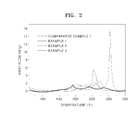
FIGURE 2 is a graph showing DSC results of lithium batteries manufactured according to Examples 1, 3, 4 and Comparative Example 1 after charging. - A positive active material according to the present invention includes a lithium composite oxide and a transition metal oxide including a transition metal in a lower oxidation state than the most stable oxidation state of the transition metal.
- In the transition metal oxide, the oxidation state of the transition metal may be from about 2+ through 5+.
- The wording "most stable state" means a state having a stoichiometric ratio of y/x of an oxide of the corresponding transition metal with the lowest standard enthalpy of formation (ΔH°f) at a temperature of 25 °C under 1 atm among corresponding transition metal binary oxides represented by the formula of MxOy, where the ratio of y/x is a positive value.
- According to an embodiment, in the positive active material, the transition metal oxide is an oxygen-deficient transition metal oxide having an oxygen vacancy formed by removing one or less oxygen therefrom, for example, an oxide having a stoichiometric ratio of y/x smaller than that of an oxide having the lowest standard enthalpy of formation (ΔH°f) at a temperature of 25 °C under 1 atm among corresponding transition metal binary oxides represented by the formula of MxOy, where the ratio of y/x is a positive value.
- For example, in regard to Ti, V, Mn, Fe, Co, Mo, W, and Ni, the most stable states of oxides of the respective transition metals may be TiO2, V2O5, MnO2, Fe2O3, CoO2, MoO3, WO3, and Ni2O3, and the oxidation states of the transition metals contained in the transition metal oxides may be Ti(4+), V(5+), Mn(4+), Fe(3+), Co(4+), Mo(6+), W(6+), and Ni(3+).
- The transition metal oxide may be prepared by heat treating the corresponding transition metal oxide in the most stable state under a reducing atmosphere to remove oxygen.
- For example, the transition metal oxide may be prepared by heat treating the corresponding transition metal oxide in the most stable state under a reducing atmosphere including H2 gas, H2/N2 gas (a mixed gas including 5 volume% of H2 gas and 95 volume% of N2), or NH3 gas for 10 through 20 hours at a temperature of 1000 through 1500 °C. Alternatively, the transition metal oxide may be prepared by heat treating the corresponding transition metal oxide in the most stable state by using a reducing agent such as a borohydride, hydrazine, or NaPH2O2.
- The positive active material adsorbs oxygen generated from the transition metal oxide and prevents generation of oxygen in a positive electrode including the positive active material.
- Accordingly, a battery including the positive active material including the transition metal may have excellent thermal stability and cycle characteristics even when the battery is thermally exposed or over-charged, or during combustion.
- In the positive active material, at least a portion of a surface of the lithium composite oxide may be coated with the transition metal oxide.
- The coating may be performed by dipping the lithium composite oxide in a coating solution of the transition metal oxide. However, the coating may not be limited thereto. For example, the coating may also be performed by solvent evaporation, co-precipitation, sol-gel method, filtering after adsorption, sputtering, or chemical vapor deposition (CVD).
- The transition metal oxide may include an oxide of at least one metal selected from the group consisting of Ti, V, Mn, Fe, Co, Mo, W, and Ni.
- Examples of the transition metal oxide may also include mixtures or alloys of at least two kinds of the metals described above.
- In the transition metal oxide, for example, the oxidation state of the transition metal may be Ti(3+, 2+), V(4+, 3+, 2+), Mn(3+, 2+), Fe(2+), Co(3+, 2+), Mo(5+, 4+, 3+, 2+), W(5+, 4+, 3+), or Ni (2+).
- The transition metal oxide may include at least one oxide selected from the group consisting of Ti2O3, TiO, VO2, V2O3, VO, MnZO3, MnO, FeO, Co2O3, CoO, Co3O4, Mo2O5, MoO2, Mo2O3, MoO, W2O5, WO2, W2O3, and NiO.
- For example, the transition metal oxide may be TiO, V2O3, MnO, FeO, Co3O4, MoO2, WO2, or NiO. For example, the transition metal oxide may be MoO2, WO2, or Co3O4.
- The oxidation state of the transition metal in the transition metal oxide may easily be in a lower oxidation state than the most stable oxidation state of the transition metal.
- The amount of the transition metal oxide may be from about 0.05 to about 15 parts by weight, or 0.1 to about 10 parts by weight, or 0.1 to about 5 parts by weight, based on 100 parts by weight of the lithium composite oxide.
- If the amount of the transition metal oxide is within the ranges described above, even when a Li intercalation potential is increased, a battery including the transition metal oxide has an optimal capacity and thus has high thermal stability and high capacity without a decrease in charge and discharge characteristics.
- A positive electrode of a lithium battery according to the present invention includes a positive active material including a lithium composite oxide and a transition metal oxide including a transition metal in an oxidation state lower than the most stable oxidation state of the transition metal.
- The positive electrode may include a current collector and a positive active material layer.
- The positive active material layer may include the positive active material including the lithium composite oxide and the transition metal oxide including a transition metal in an oxidation state lower than the most stable oxidation state of the transition metal.
- A detailed description of the positive active material is presented above.
- Meanwhile, the positive active material layer may further include, in addition to the positive active material including the lithium composite oxide and the transition metal oxide, a first compound (lithiated intercalation compound) enabling reversible intercalation and deintercalation of lithium ions. Examples of the first compound are as follows:
- LiaA1-bXbD2 where 0.95 ≤ a ≤ 1.1, and 0 ≤ b ≤ 0.5; LiaE1-bXbO2-cDc where 0.95 ≤ a ≤ 1.1, 0 ≤ b ≤ 0.5, and 0 ≤ c ≤ 0.05; LiE2-bXbO4-cDc where 0 ≤ b ≤ 0.5, and 0 ≤ c ≤ 0.05; LiaNi1-b-cCobBcDα where 0.95 ≤ a ≤1.1, 0 ≤ b ≤ 0.5, 0 ≤ c ≤ 0.05, and 0 < α ≤ 2; LiaNi1-b-cCobXcO2-αMα where 0.95 ≤ a ≤ 1.1, 0 ≤ b ≤ 0.5, 0 ≤ c ≤ 0.05, and 0 < α < 2; LiaNi1-b-cCobXcO2-αM2 where 0.95 ≤ a ≤ 1.1, 0 ≤ b ≤ 0.5, 0 ≤ c ≤ 0.05, and 0 < α < 2; LiaNi1-b-cMnbXcDα where 0.95 ≤ a ≤ 1.1, 0 ≤ b ≤ 0.5, 0 ≤ c ≤ 0.05, and 0 < α ≤ 2; LiaNi1-b-cMnbXcO2-αMα where 0.95 ≤ a ≤ 1.1, 0 ≤ b ≤ 0.5, 0 ≤ c ≤ 0.05, and 0 ≤ α < 2; LiaNi1-b-cMnbXcO2-αM2 where 0.95 ≤ a ≤ 1.1, 0 ≤ b ≤ 0.5, 0 ≤ c ≤ 0.05, and 0 < α < 2; LiaNibEcGdO2 where 0.90 ≤ a ≤ 1.1, 0 ≤ b ≤ 0.9, 0 ≤ c ≤ 0.5, and 0.001 ≤ d ≤ 0.1; LiaNibCocMndGeO2 where 0.90 ≤ a ≤ 1.1, 0 ≤ b ≤ 0.9, 0 ≤ c ≤ 0.5, 0 ≤ d ≤ 0.5, and 0 ≤ e ≤ 0.1; LiaNiGbO2 where 0.90 ≤ a ≤ 1.1, and 0.001 ≤ b ≤ 0.1; LiaCoGbO2 where 0.90 ≤ a ≤ 1.1, and 0.001 ≤ b ≤ 0.1; LiaMnGbO2 where 0.90 ≤ a ≤ 1.1, and 0.001 ≤ b ≤ 0.1; LiaMn2GbO4 where 0.90 ≤ a ≤ 1.1, and 0 ≤ b ≤ 0.1; QO2; QS2; LiQS2; V2O5; LiV2O5; LiZO2; LiNiVO4; Li(3-f)J2(PO4)3(0 ≤ f ≤ 2); Li(3-f)Fe2(PO4)3(0 ≤ f ≤ 2); and LiFePO4.
- The first compound may also be lithium titanate.
- In the chemical structures of the first compounds shown above, A is selected from the group consisting of Ni, Co, Mn, and a combination thereof, but is not limited thereto; X is selected from the group consisting of Al, Ni, Co, Mn, Cr, Fe, Mg, Sr, V, a rare-earth element, and a combination thereof, but is not limited thereto; D is selected from the group consisting of O, F, S, P, and a combination thereof, but is not limited thereto; E is selected from the group consisting of Co, Mn, and a combination thereof, but is not limited thereto; M is selected from the group consisting of F, S, P, and a combination thereof, but is not limited thereto; G is selected from the group consisting of Al, Cr, Mn, Fe, Mg, La, Ce, Sr, V, and a combination thereof, but is not limited thereto; Q is selected from the group consisting of Ti, Mo, Mn, and a combination thereof, but is not limited thereto; Z is selected from the group consisting of Cr, V, Fe, Sc, Y, and a combination thereof, but is not limited thereto; and J is selected from the group consisting of V, Cr, Mn, Co, Ni, Cu, and a combination thereof, but is not limited thereto.
- The positive active material layer may further include a binder.
- The binder included in the positive active material layer allows positive active material particles to attach to each other and attaches the positive active material to the current collector. Examples of the binder include polyvinylalcohol, carboxymethylcellulose, hydroxypropylcellulose, diacetylcellulose, polyvinylchloride, carboxylated polyvinylchloride, polyvinylfluoride, an ethylene oxide-containing polymer, polyvinylpyrrolidone, polyurethane, polytetrafluoroethylene, polyvinylidene fluoride, polyethylene, polypropylene, styrene butadiene rubber, acrylated styrene-butadiene rubber, epoxy resin, and nylon. However, the binder is not limited thereto.
- The current collector may be formed of Al or Cu, but is not limited thereto.
- The positive active material, the binder, and a conducting agent, of which use is optional, are mixed in a solvent to prepare a composition for forming the positive active material layer and then, the composition is coated on the current collector to form the positive active material layer. This positive electrode preparation method is well known in the art and will not be described in detail herein. The solvent may be N-methylpyrrolidone, but is not limited thereto.
- A negative electrode may include a negative active material layer and a current collector.
- The transition metal oxide may also be used in a negative active material.
- The negative active material may be natural graphite, silicon/carbon composite (SiOx), silicon metal, a silicon thin film, lithium metal, lithium alloy, a carbonaceous material, or graphite. An example of the lithium alloy may be lithium titanate. The lithium titanate can be categorized into a spinel-type lithium titanate, an anatase-type lithium titanate, and a ramsdellite-type lithium titanate, according to a crystal structure. For example, the negative active material may be represented by Li4-xTi5O12 (0≤x≤3). For example, the negative active material may be Li4Ti5O12, but is not limited thereto.
- A composition for forming the negative active material layer may include a binder and a solvent. The binder and the solvent may be the same as those used in the positive electrode above. The composition for forming the negative active material layer may selectively include a conducting agent including at least one selected from the group consisting of carbon black, ketjen black, acetylene black, artificial graphite, natural graphite, copper powder, nickel powder, aluminium powder, silver powder, and polyphenylene. However, the example of the conducting agent is not limited thereto.
- A plasticizer may be further added to the composition for forming the positive active material layer and the composition for forming the negative active material composition layer to form pores in electrode plates.
- An electrolytic solution may include a non-aqueous organic solvent and a lithium salt.
- The non-aqueous organic solvent may function as a medium in which ions participating in an electrochemical reaction in a battery migrate.
- Examples of the non-aqueous organic solvent include a carbonate-based solvent, an ester-based solvent, an ether-based solvent, a ketone-based solvent, an alcohol-based solvent, and a non-proton type solvent. Examples of a carbonate-based solvent include dimethyl carbonate (DMC), diethyl carbonate (DEC), dipropyl carbonate (DPC), methylpropyl carbonate (MPC), ethylpropyl carbonate (EPC), ethylmethyl carbonate (EMC), ethylene carbonate (EC), propylene carbonate (PC), and butylene carbonate (BC). Examples of an ester-based solvent include methyl acetate, ethyl acetate, n-propyl acetate, dimethylacetate, methylpropionate, ethylpropionate, γ-butyrolactone, decanolide, valerolactone, mevalonolactone, and caprolactone. Examples of an ether-based solvent include dibutyl ether, tetraglyme, diglyme, dimethoxyethane, 2-methyltetrahydrofurane, and tetrahydrofurane. Examples of a ketone-based solvent include cyclohexanone. Examples of an alcohol-based solvent include ethyl alcohol and isopropyl alcohol. Examples of a non proton-type solvent include nitriles such as R-CN (R is a linear, branched, or cyclic C2 to C20 hydrocarbonate group and has a double bond-direction cyclic or ether bond), amides such as dimethylformamide, dioxolanes such as 1,3-dioxolane, and sulfolanes.
- The non-aqueous organic solvent may be a single solvent or a mixture of two or more solvents. When the non-aqueous organic solvent is a mixture of two or more solvents, a mixture ratio of the solvents may be appropriately controlled according to battery performance, which is well known in the art.
- The lithium salt is dissolved in an organic solvent, and functions as a lithium ion supplier in a battery, enables a basic operation of a battery, and facilitates migration of lithium ions between the positive electrode and the negative electrode. The lithium salt may include at least one supporting electrolytic salt selected from the group consisting of LiPF6, LiBF4, LiSbF6, LiAsF6, LiN(SO2C2F5)2, Li(CF3SO2)2N, LiC4F9SO3, LiClO4, LiAlO2, LiAlCl4, LiN(CxF2x+1SO2)(CyF2y+1SO2) where x and y are natural numbers, LiCl, LiI, and LiB(C2O4)2(lithium bis(oxalato) borate; LiBOB). The concentration of the lithium salt may be from about 0.1 M to about 2.0 M. When the concentration of the lithium salt is within the ranges described above, the electrolytic solution obtains appropriate conductivity and viscosity and lithium ions may effectively migrate.
- Depending upon the kind of lithium battery, a separator may be present between the positive electrode and the negative electrode. The separator may be a monolayer or two or more-layer of polyethylene, polypropylene, or polyvinylidene fluoride, and may also be a mixed multi-layer, such as a two-layer separator of polyethylene/polypropylene, a three-layer separator of polyethylene/polypropylene/polyethylene, or a three-layer separator of polypropylene/polyethylene/polypropylene.
- Depending upon the kinds of separator and electrolyte used, lithium batteries can be categorized into a lithium ion battery, a lithium ion polymer battery, and a lithium polymer battery; according to a battery shape, lithium batteries can be categorized into a cylindrical battery, a rectangular battery, a coin-shape batter, or a pouch-shape batter; and according to a battery size, lithium batteries can be categorized into bulk-type batteries and thin-film type batteries. The lithium battery may also be a primary battery or a secondary battery. Methods of manufacturing the batteries described above are well known in the art and thus will not be described in detail herein.
- The present invention will be described in further detail with reference to examples and comparative examples. The following examples are for illustrative purposes only and are not intended to limit the scope of the invention.
- MoO3 transition metal oxide was heat treated at a temperature of 1000 to 1500°C under a reducing atmosphere including a mixed gas of H2/N2 including 5 volume% of H2 gas and 95 volume% of N2 gas for 10 hours to prepare MoO2 transition metal oxide.
- The formation of the MoO2 transition metal oxide having an oxidation number of four by reducing the MoO3 transition metal oxide having an oxidation number of six was identified by X-ray diffraction analysis, and the results are shown in
FIGURE 1 . - A positive active material was prepared by mixing 1 part by weight of the MoO2 transition metal oxide prepared according to Synthesis Example 1 with 100 parts by weight of LiCoO2. 94 wt.(weight) % of the prepared positive active material was mixed with 3 wt.% of Super P carbon black and 3 wt.% of PVDF to prepare a positive active material slurry composition, and then the slurry composition was coated on a current collector formed of an aluminium foil and dried to manufacture a positive electrode. Separately, about 3 wt.% of graphite powder, 3 wt.% of polyvinylidenefluoride (PVdF) as a binder, and N-methyl-2-pyrrolidone were mixed to prepare a negative active material slurry, and the prepared negative active material slurry was coated on a copper foil as a current collector to manufacture a negative electrode. A separator formed of polypropylene was interposed between the positive electrode and the negative electrode, and a non-aqueous electrolyte prepared by dissolving 1.50 mol/L of LiPF6 in a mixed solvent including ethylenecarbonate and diethylcarbonate in a ratio of 3:7 was injected into the resultant structure, thereby completing manufacturing of a coin-shaped lithium battery.
- A lithium battery was manufactured in the same manner as in Example 1, except that 5 parts by weight of the MoO2 transition metal oxide prepared according to Synthesis Example 1 was mixed with 100 parts by weight of LiCoO2.
- A lithium battery was manufactured in the same manner as in Example 1, except that 10 parts by weight of the MoO2 transition metal oxide prepared according to Synthesis Example 1 was mixed with 100 parts by weight of LiCoO2.
- 1 part by weight of MoO2 was dissolved in 100 ml of water to prepare a coating solution. 100 parts by weight of LiCoO2 positive active material having an average particle diameter of 20 µm and 1 part by weight of an acetic acid were added to the coating solution so that LiCoO2 positive active material particles were coated with MoO2. The coated LiCoO2 was dried at room temperature for 24 hours and heat treated at a temperature of 400 °C for 10 hours to prepare a positive active material. Then the same process as in Example 2 was performed to complete manufacturing a lithium battery.
- A lithium battery was manufactured in the same manner as in Example 1, except that 5 parts by weight of the MoO2 transition metal oxide prepared according to Synthesis Example 1 was mixed with 100 parts by weight of a mixture including LiCoO2 and Li2NiO2 in a weight ratio of 70: 30 of LiCoO2 and Li2NiO2.
- A lithium battery was manufactured in the same manner as in Example 1, except that as the positive active material, only the LiCoO2 positive active material was used and the transition metal oxide was not used.
- A lithium battery was manufactured in the same manner as in Example 5, except that as the positive active material, only 100 parts by weight of a mixture including LiCoO2 and Li2NiO2 in a weight ratio of 70: 30 of LiCoO2 and Li2NiO2 was used and the transition metal oxide was not used.
- The coin-shaped lithium batteries manufactured according to Examples 1, 2, 3, and 4 were charged until a voltage reached 4.4 V, and then the charged batteries were dissembled to separate the positive active materials. Each of the obtained positive active materials was sampled together with a non-aqueous electrolyte in which 1.50 mol/L of LiPF6 was dissolved with a mixed solvent including ethylenecarbonate and diethylcarbonate in a ratio of 3:7. A heat dissipation change of each sampled positive active material was evaluated using DSC (produced by TA Instruments Inc.) at a temperature of 50 °C to 375 °C under an N2 atmosphere at a temperature increase rate of 10 °C/min.
- The results are shown in Table 1, and also shown in
FIGURE 2 in which the results of the coin-type lithium battery of Example 2 are not included. - In regard to the positive active material of Example 5, the corresponding lithium battery was charged until a voltage reached 4.4 V and then preserved at a temperature of 60 °C for 100 hours to measure the amount of gas generated in the lithium battery.
- The results are shown in Table 1.
- The lithium batteries of Examples 1 through 5 were charged with a constant current of 160 mA/1C until a voltage reached 4.4 V, and then charged with a constant voltage of 4.4 V until a current reached 1/20 C. Then, a charge capacity for each case was measured. Next, the batteries were discharged with a constant current of 160 mA/1C until a voltage reached 4.4 V and a discharge capacity for each case was measured.
- The results are shown in Table 1.
Table 1 Heat dissipation change (J/g) Amount of generated O2 gas (cc/g) Charge capacity (mAh/g) Efficiency (%) Example 1 480 - 173 95 Example 2 350 - 167 96 Example 3 305 - 160 95 Example 4 380 - 174 96 Example 5 - 0.16 210 74 Comparative Example 1 890 - 174 95 Comparative Example 2 - 5.8 215 72 - Referring to Table 1, heat dissipation changes of Examples 1 through 4 are reduced twice or more compared to that of Comparative Example 1.
- In addition, referring to
FIGURE 2 , a heat flow change of Comparative Example 1 was three to sixteen times greater than those of Examples 1, 3, and 4 at a high temperature of 250 °C or more. - Meanwhile, in regard to Example 5 using the Li2NiO2-containing lithium composite oxide, the amount of generated O2 gas was measured instead of the heat dissipation change.
- As a result, it can be seen that the amount of generated O2 gas of Example 5 was about 30 times smaller than that of generated O2 gas of Comparative Example 2.
- The results show that a lithium battery including a positive electrode for a lithium battery according to the present invention has excellent high-temperature preservation characteristics and thermal stability.
- Whilst the present invention has been described in connection with certain exemplary embodiments thereof, it is to be understood that the invention is not limited to the disclosed embodiments, but, on the contrary, is intended to cover various modifications and equivalent arrangements included within the scope of the appended claims.
Claims (15)
- A positive active material for a lithium battery including a lithium composite oxide and a transition metal oxide, wherein the transition metal oxide includes a transition metal in a lower oxidation state than the most stable oxidation state of the transition metal.
- A positive active material as claimed in claim 1, wherein the transition metal in the transition metal oxide has an oxidation state of from about 2+ to about 5+.
- A positive active material as claimed in claims 1 or 2, wherein the transition metal oxide is present in admixture with the lithium composite oxide.
- A positive active material as claimed in claims 1, 2 or 3, wherein at least a portion of the lithium composite oxide is coated with the transition metal oxide.
- A positive active material as claimed in any one of the preceding claims, wherein the transition metal oxide includes an oxide of at least one metal selected from the group consisting of Ti, V, Mn, Fe, Co, Mo, W, and Ni.
- A positive active material as claimed in any one of the preceding claims, wherein the transition metal oxide includes at least one oxide selected from the group consisting of Ti2O2, TiO, VO2, V2O3, VO, Mn2O3, MnO, FeO, Co2O3, CoO, Co3O4, Mo2O5, MoO2, Mo2O3, MoO, W2O5, WO2, W2O3, and NiO.
- A positive active material as claimed in any one of the preceding claims, wherein the transition metal oxide is selected from the group consisting of MoO2, WO2, Co3O4 and mixtures thereof.
- A positive active material as claimed in any one of the preceding claims, wherein the amount of the transition metal oxide is from 0.05 to 15 parts by weight based on 100 parts by weight of the lithium composite oxide.
- A positive active material as claimed in claim 8, wherein the amount of the transition metal oxide is from 0.1 to 10 parts by weight based on 100 parts by weight of the lithium composite oxide.
- A positive active material as claimed in any one of the preceding claims, wherein the transition metal oxide is MoO2 and the lithium composite oxide is at least one selected from LiCoO2 and Li2NiO2.
- A lithium battery including a positive electrode including a positive active material as claimed in any one of claims 1 to 10; a negative electrode; and an electrolytic solution.
- A method of preparing a positive active material for a lithium battery as claimed in any one of claims 1 to 10, which comprises providing a lithium composite oxide and a transition metal oxide, wherein the transition metal oxide includes a transition metal in a lower oxidation state than the most stable oxidation state of the transition metal.
- A method as claimed in claim 12, which further includes the step of heat treating a precursor metal oxide that includes the transition metal in its most stable oxidation state under a reducing atmosphere, to form the transition metal oxide.
- A method as claimed in claim 13, wherein the precursor metal oxide is heat treated under a reducing atmosphere comprising H2 gas, H2/N2 gas or NH3 gas, at a temperature of about 1000 to 1500°C for about 10 to 20 hours.
- Use of a lithium composite oxide and a transition metal oxide, wherein the transition metal oxide includes a transition metal in a lower oxidation state than the most stable oxidation state of the transition metal, as a positive active material in a lithium battery.
Applications Claiming Priority (2)
| Application Number | Priority Date | Filing Date | Title |
|---|---|---|---|
| US37369110P | 2010-08-13 | 2010-08-13 | |
| US13/184,294 US9368786B2 (en) | 2010-08-13 | 2011-07-15 | Positive active material and lithium battery including the same |
Publications (2)
| Publication Number | Publication Date |
|---|---|
| EP2418719A2 true EP2418719A2 (en) | 2012-02-15 |
| EP2418719A3 EP2418719A3 (en) | 2013-01-09 |
Family
ID=45795189
Family Applications (1)
| Application Number | Title | Priority Date | Filing Date |
|---|---|---|---|
| EP20110174701 Withdrawn EP2418719A3 (en) | 2010-08-13 | 2011-07-20 | Positive electrode active material and lithium battery including the same |
Country Status (5)
| Country | Link |
|---|---|
| US (1) | US9368786B2 (en) |
| EP (1) | EP2418719A3 (en) |
| JP (1) | JP5367777B2 (en) |
| KR (1) | KR101264337B1 (en) |
| CN (1) | CN102376946A (en) |
Cited By (1)
| Publication number | Priority date | Publication date | Assignee | Title |
|---|---|---|---|---|
| EP2757616A1 (en) * | 2013-01-16 | 2014-07-23 | Samsung SDI Co., Ltd. | Positive electrode for rechargable lithium battery and rechargable lithium battery including the same |
Families Citing this family (34)
| Publication number | Priority date | Publication date | Assignee | Title |
|---|---|---|---|---|
| JP5735111B2 (en) * | 2010-09-16 | 2015-06-17 | エルジー・ケム・リミテッド | Novel electrode active material and lithium secondary battery including the same |
| JP6226412B2 (en) * | 2012-03-14 | 2017-11-08 | セイコーインスツル株式会社 | Positive electrode for non-aqueous electrolyte secondary battery and non-aqueous electrolyte secondary battery using the same |
| JP2013206616A (en) * | 2012-03-27 | 2013-10-07 | Tanaka Chemical Corp | Cathode active material for lithium-ion secondary battery and method for producing the same |
| US8647943B2 (en) * | 2012-06-12 | 2014-02-11 | Intermolecular, Inc. | Enhanced non-noble electrode layers for DRAM capacitor cell |
| JP5962429B2 (en) * | 2012-10-22 | 2016-08-03 | ソニー株式会社 | Batteries, battery packs, electronic devices, electric vehicles, power storage devices, and power systems |
| WO2015011884A1 (en) * | 2013-07-25 | 2015-01-29 | 株式会社豊田自動織機 | Positive electrode for non-aqueous secondary battery, and non-aqueous secondary battery |
| KR101594780B1 (en) * | 2013-10-04 | 2016-03-02 | 주식회사 엘지화학 | Secondary Battery |
| WO2015107832A1 (en) * | 2014-01-16 | 2015-07-23 | 株式会社カネカ | Nonaqueous electrolyte secondary battery and battery pack of same |
| KR20150106203A (en) * | 2014-03-11 | 2015-09-21 | 경북대학교 산학협력단 | electrode active material comprising reduced titanium oxide and electrochemical device using the same |
| WO2016006935A1 (en) * | 2014-07-11 | 2016-01-14 | 주식회사 엘지화학 | Cathode material of secondary battery, and production method therefor |
| KR101737207B1 (en) * | 2014-07-11 | 2017-05-29 | 주식회사 엘지화학 | Positive polar meterials and its maufacturing method of secondary battery |
| US10283776B2 (en) * | 2014-09-11 | 2019-05-07 | Kabushiki Kaisha Toshiba | Electrode material, and electrode layer, battery, and electrochromic device using the electrode material |
| CN105789609A (en) * | 2014-12-15 | 2016-07-20 | 上海兆维科技发展有限公司 | Cathode material, preparation method and application thereof |
| KR102402389B1 (en) * | 2015-08-25 | 2022-05-26 | 삼성에스디아이 주식회사 | Composite positive active material, positive electrode including the same, and lithium battery including the positive electrode |
| WO2017163317A1 (en) * | 2016-03-22 | 2017-09-28 | 国立研究開発法人産業技術総合研究所 | Positive electrode material for non-aqueous electrolyte secondary batteries and method for producing same |
| CN107204425A (en) * | 2017-06-08 | 2017-09-26 | 上海汇平新能源有限公司 | The preparation method and lithium ion battery of anode slice of lithium ion battery |
| CN107093701A (en) * | 2017-06-12 | 2017-08-25 | 上海汇平新能源有限公司 | A kind of thick electrode preparation method and lithium ion battery with excellent electrochemical performance |
| CN107068982A (en) * | 2017-06-12 | 2017-08-18 | 上海汇平新能源有限公司 | The preparation method of high compacted density lithium ion battery with high energy density anode pole piece |
| KR20190044450A (en) | 2017-10-20 | 2019-04-30 | 주식회사 엘지화학 | Lithium secondary battery with improved cycle life and ultra-high energy density |
| JP7180066B2 (en) * | 2017-11-06 | 2022-11-30 | トヨタ自動車株式会社 | sulfide solid state battery |
| US11870070B2 (en) * | 2018-01-24 | 2024-01-09 | Lg Energy Solution, Ltd. | Positive electrode active material for secondary battery, method of preparing the same, and lithium secondary battery including the positive electrode active material |
| US20190305289A1 (en) * | 2018-03-29 | 2019-10-03 | Robert Bosch Gmbh | Battery With a Stabilized Cathode Active Material |
| GB2572610B (en) * | 2018-04-03 | 2021-06-23 | Ilika Tech Limited | Composition, methods for its production, and its use |
| JP7164803B2 (en) * | 2018-06-14 | 2022-11-02 | 日亜化学工業株式会社 | Positive electrode active material for non-aqueous electrolyte secondary battery and method for producing the same |
| KR102378651B1 (en) * | 2019-03-29 | 2022-03-25 | 한양대학교 에리카산학협력단 | Material film for secondary battery and manufacturing method therefor |
| KR102859981B1 (en) * | 2019-04-08 | 2025-09-15 | 주식회사 엘지에너지솔루션 | Positive electrode for secondary battery and lithium secondary battery comprising the same |
| CN110212182A (en) * | 2019-05-27 | 2019-09-06 | 珠海格力电器股份有限公司 | Battery positive electrode material, positive plate comprising battery positive electrode material, battery negative electrode material, negative plate comprising battery negative electrode material, lithium ion battery and electrode slurry |
| CN110176596A (en) * | 2019-06-17 | 2019-08-27 | 启东启澳新材料科技发展有限公司 | A method of improving lithium battery anode coating material chemical property |
| CN112242519B (en) * | 2019-07-17 | 2023-01-06 | 比亚迪股份有限公司 | Positive electrode material, preparation method thereof and solid-state lithium battery |
| CN113363492B (en) * | 2021-06-24 | 2022-11-01 | 巴斯夫杉杉电池材料有限公司 | Composite coating modified high-nickel NCA positive electrode material and preparation method thereof |
| KR102873758B1 (en) * | 2021-11-26 | 2025-10-17 | 삼성에스디아이 주식회사 | Composite cathode active material, Cathode and Lithium battery containing composite cathode active material, and Preparation method of composite cathode active material |
| KR102873757B1 (en) * | 2021-11-26 | 2025-10-17 | 삼성에스디아이 주식회사 | Composite cathode active material, Cathode and Lithium battery containing composite cathode active material and Preparation method thereof |
| JP2023115769A (en) * | 2022-02-08 | 2023-08-21 | 堺化学工業株式会社 | Method for producing positive electrode active material |
| CN121507049A (en) * | 2024-08-08 | 2026-02-10 | 宁德时代新能源科技股份有限公司 | A battery cell, a battery device, and an electrical device. |
Citations (5)
| Publication number | Priority date | Publication date | Assignee | Title |
|---|---|---|---|---|
| JPH11144734A (en) * | 1997-11-04 | 1999-05-28 | Hitachi Ltd | Lithium secondary battery and manufacture of lithium secondary battery |
| US20030082453A1 (en) * | 2001-10-31 | 2003-05-01 | Tatsuji Numata | Secondary battery positive electrode and secondary battery using the same |
| JP2009135084A (en) * | 2007-11-02 | 2009-06-18 | Panasonic Corp | Lithium ion secondary battery |
| US20090286157A1 (en) * | 2008-05-16 | 2009-11-19 | Zonghai Chen | Surface modification agents for lithium batteries |
| EP2471133A2 (en) * | 2009-08-27 | 2012-07-04 | Envia Systems, Inc. | Metal oxide coated positive electrode materials for lithium-based batteries |
Family Cites Families (25)
| Publication number | Priority date | Publication date | Assignee | Title |
|---|---|---|---|---|
| US5958254A (en) | 1992-11-24 | 1999-09-28 | Commonwealth Scientific And Industrial Research Organization | Oxygen scavengers independent of transition metal catalysts |
| JP3203867B2 (en) | 1993-04-02 | 2001-08-27 | 三菱電機株式会社 | Lithium secondary battery |
| JPH1116566A (en) | 1997-06-20 | 1999-01-22 | Hitachi Ltd | Battery |
| US6416560B1 (en) | 1999-09-24 | 2002-07-09 | 3M Innovative Properties Company | Fused abrasive bodies comprising an oxygen scavenger metal |
| EP1170816A2 (en) * | 2000-07-06 | 2002-01-09 | Japan Storage Battery Company Limited | Non-aqueous electrolyte secondary battery and process for the preparation thereof |
| EP2144314B1 (en) | 2001-04-20 | 2015-01-28 | GS Yuasa International Ltd. | Positive active materials and process for producing the same, positive electrode for non-aqueous electrolyte secondary battery, and non-aqueous electrolyte secondary battery |
| KR100424637B1 (en) | 2001-10-25 | 2004-03-24 | 삼성에스디아이 주식회사 | A thin film for lithium secondary battery and a method of preparing the same |
| US7049031B2 (en) | 2002-01-29 | 2006-05-23 | The University Of Chicago | Protective coating on positive lithium-metal-oxide electrodes for lithium batteries |
| US7566479B2 (en) | 2003-06-23 | 2009-07-28 | Lg Chem, Ltd. | Method for the synthesis of surface-modified materials |
| KR100797173B1 (en) | 2004-08-19 | 2008-01-23 | 도꾸리쯔교세이호징 가가꾸 기쥬쯔 신꼬 기꼬 | Metal Oxide Electrocatalyst |
| US7919215B2 (en) | 2004-08-19 | 2011-04-05 | Japan Science And Technology Agency | Corrosion resistant metal oxide electrode catalyst for oxygen reduction |
| JP2006066330A (en) | 2004-08-30 | 2006-03-09 | Shin Kobe Electric Mach Co Ltd | Non-aqueous electrolyte secondary battery positive electrode active material, non-aqueous electrolyte secondary battery and method for producing positive electrode active material |
| US7662509B2 (en) * | 2004-10-29 | 2010-02-16 | Medtronic, Inc. | Lithium-ion battery |
| US7337010B2 (en) * | 2004-10-29 | 2008-02-26 | Medtronic, Inc. | Medical device having lithium-ion battery |
| US7582387B2 (en) | 2004-10-29 | 2009-09-01 | Medtronic, Inc. | Lithium-ion battery |
| WO2006068143A1 (en) * | 2004-12-24 | 2006-06-29 | Matsushita Electric Industrial Co., Ltd. | Rechargeable battery with nonaqueous electrolyte |
| KR20070008115A (en) | 2005-07-13 | 2007-01-17 | 주식회사 엘지화학 | Cathode active material for lithium secondary battery with excellent cycle characteristics and safety |
| KR100874560B1 (en) * | 2005-12-20 | 2008-12-16 | 파나소닉 주식회사 | Nonaqueous Electrolyte Secondary Battery |
| US20090117463A1 (en) | 2007-11-02 | 2009-05-07 | Hideharu Takezawa | Lithium ion secondary battery |
| JP2009146811A (en) | 2007-12-17 | 2009-07-02 | Toyota Motor Corp | Positive electrode body for lithium ion secondary battery and lithium ion secondary battery |
| CN102150305B (en) | 2008-09-10 | 2014-01-08 | 株式会社Lg化学 | Cathode active material for lithium secondary battery |
| JP5277984B2 (en) | 2009-01-20 | 2013-08-28 | トヨタ自動車株式会社 | Cathode active material |
| CN101707252B (en) * | 2009-11-09 | 2012-01-25 | 深圳市振华新材料股份有限公司 | Polycrystal Co-Ni-Mn ternary anode material and preparation method thereof as well as secondary lithium-ion battery |
| FR2972442B1 (en) * | 2011-03-08 | 2013-03-29 | Accumulateurs Fixes | POSITIVE ELECTRODE MATERIAL FOR LITHIUM ION BATTERY |
| US8404001B2 (en) * | 2011-04-15 | 2013-03-26 | Semiconductor Energy Laboratory Co., Ltd. | Method for manufacturing positive electrode and power storage device |
-
2011
- 2011-07-11 KR KR1020110068548A patent/KR101264337B1/en active Active
- 2011-07-15 US US13/184,294 patent/US9368786B2/en active Active
- 2011-07-20 EP EP20110174701 patent/EP2418719A3/en not_active Withdrawn
- 2011-08-04 CN CN2011102223388A patent/CN102376946A/en active Pending
- 2011-08-10 JP JP2011174545A patent/JP5367777B2/en active Active
Patent Citations (5)
| Publication number | Priority date | Publication date | Assignee | Title |
|---|---|---|---|---|
| JPH11144734A (en) * | 1997-11-04 | 1999-05-28 | Hitachi Ltd | Lithium secondary battery and manufacture of lithium secondary battery |
| US20030082453A1 (en) * | 2001-10-31 | 2003-05-01 | Tatsuji Numata | Secondary battery positive electrode and secondary battery using the same |
| JP2009135084A (en) * | 2007-11-02 | 2009-06-18 | Panasonic Corp | Lithium ion secondary battery |
| US20090286157A1 (en) * | 2008-05-16 | 2009-11-19 | Zonghai Chen | Surface modification agents for lithium batteries |
| EP2471133A2 (en) * | 2009-08-27 | 2012-07-04 | Envia Systems, Inc. | Metal oxide coated positive electrode materials for lithium-based batteries |
Non-Patent Citations (2)
| Title |
|---|
| MYUNG S T ET AL: "Improvement of cycling performance of Li1.1Mn1.9O4 at 60<o>C by NiO addition for Li-ion secondary batteries", ELECTROCHIMICA ACTA, ELSEVIER SCIENCE PUBLISHERS, BARKING, GB, vol. 51, no. 26, 15 August 2006 (2006-08-15), pages 5912 - 5919, XP028027574, ISSN: 0013-4686, [retrieved on 20060815], DOI: 10.1016/J.ELECTACTA.2006.03.029 * |
| REDDY M V ET AL: "Cathodic behaviour of NiO-coated Li(Ni1/2Mn1/2)O2", ELECTROCHIMICA ACTA, ELSEVIER SCIENCE PUBLISHERS, BARKING, GB, vol. 50, no. 16-17, 30 May 2005 (2005-05-30), pages 3375 - 3382, XP004894551, ISSN: 0013-4686, DOI: 10.1016/J.ELECTACTA.2004.12.011 * |
Cited By (2)
| Publication number | Priority date | Publication date | Assignee | Title |
|---|---|---|---|---|
| EP2757616A1 (en) * | 2013-01-16 | 2014-07-23 | Samsung SDI Co., Ltd. | Positive electrode for rechargable lithium battery and rechargable lithium battery including the same |
| US10224538B2 (en) | 2013-01-16 | 2019-03-05 | Samsung Sdi Co., Ltd. | Positive electrode for rechargeable lithium battery and rechargeable lithium battery including the same |
Also Published As
| Publication number | Publication date |
|---|---|
| US9368786B2 (en) | 2016-06-14 |
| KR20120022554A (en) | 2012-03-12 |
| EP2418719A3 (en) | 2013-01-09 |
| CN102376946A (en) | 2012-03-14 |
| KR101264337B1 (en) | 2013-05-14 |
| JP2012043787A (en) | 2012-03-01 |
| JP5367777B2 (en) | 2013-12-11 |
| US20120037846A1 (en) | 2012-02-16 |
Similar Documents
| Publication | Publication Date | Title |
|---|---|---|
| US9368786B2 (en) | Positive active material and lithium battery including the same | |
| EP2405521B1 (en) | Nickel-based positive electrode active material, method of preparing the same, and lithium battery using the nickel-based positive electrode active material | |
| KR101135503B1 (en) | Electrolyte for rechargeable lithium battery and rechargeable lithium battery including the same | |
| EP1936731B1 (en) | Rechargeable lithium battery | |
| EP2302725B1 (en) | Lithium battery containing a non-aqueous electrolyte and an additive | |
| EP2624340B1 (en) | Negative active material, method of preparing the same, negative electrode for lithium secondary battery including negative active material, and lithium secondary battery including negative electrode | |
| EP2139059A1 (en) | Rechargeable lithium battery | |
| KR20080031151A (en) | Non-aqueous electrolyte secondary battery and manufacturing method thereof | |
| KR101297173B1 (en) | Lithium rechargeable battery | |
| KR101312271B1 (en) | Lithium titanate, negative electrode comprising the same and lithium secondary battery containing the electrode | |
| KR20120030774A (en) | Positive active material, method for preparing the same and lithium battery comprising the same | |
| CN113677624A (en) | Lithium-manganese-based cathode active material with octahedral structure and cathode and lithium secondary battery comprising the same | |
| EP3442069B1 (en) | Lithium-ion secondary battery | |
| JP2003203625A (en) | Lithium ion secondary battery | |
| US10218001B2 (en) | Olivine oxide-containing positive active material for rechargeable lithium battery with improved electro-conductivity, rate characteristics and capacity characteristics, method for manufacturing the same, and rechargeable lithium battery including the same | |
| US20150155562A1 (en) | Negative active material for rechargeable lithium battery, method of preparing same, and rechargeable lithium battery including same | |
| CN103210532B (en) | Active material for anode of secondary cell and the secondary cell using it | |
| KR101602419B1 (en) | A positive electrode active material, a positive electrode containing the positive electrode active material, and a lithium battery employing the positive electrode | |
| JP2003162997A (en) | Negative electrode for secondary battery and secondary battery using the same | |
| CN115119526A (en) | Lithium transition metal oxide, positive electrode additive for lithium secondary battery, and lithium secondary battery comprising same | |
| US9246171B2 (en) | Cathode active material, and cathode and lithium battery including the material | |
| US20250337012A1 (en) | Electrolytes for rechargeable lithium batteries and rechargeable lithium batteries including the same | |
| EP4704184A1 (en) | Method for charging rechargeable lithium battery | |
| EP4525087A1 (en) | Additive, electrolyte for rechargeable lithium battery, and rechargeable lithium battery | |
| EP4475226A2 (en) | Rechargeable lithium battery |
Legal Events
| Date | Code | Title | Description |
|---|---|---|---|
| AK | Designated contracting states |
Kind code of ref document: A2 Designated state(s): AL AT BE BG CH CY CZ DE DK EE ES FI FR GB GR HR HU IE IS IT LI LT LU LV MC MK MT NL NO PL PT RO RS SE SI SK SM TR |
|
| AX | Request for extension of the european patent |
Extension state: BA ME |
|
| PUAI | Public reference made under article 153(3) epc to a published international application that has entered the european phase |
Free format text: ORIGINAL CODE: 0009012 |
|
| 17P | Request for examination filed |
Effective date: 20120326 |
|
| PUAL | Search report despatched |
Free format text: ORIGINAL CODE: 0009013 |
|
| AK | Designated contracting states |
Kind code of ref document: A3 Designated state(s): AL AT BE BG CH CY CZ DE DK EE ES FI FR GB GR HR HU IE IS IT LI LT LU LV MC MK MT NL NO PL PT RO RS SE SI SK SM TR |
|
| AX | Request for extension of the european patent |
Extension state: BA ME |
|
| RIC1 | Information provided on ipc code assigned before grant |
Ipc: C01G 51/04 20060101ALI20121130BHEP Ipc: H01M 4/485 20100101AFI20121130BHEP Ipc: H01M 10/052 20100101ALN20121130BHEP Ipc: H01M 4/525 20100101ALI20121130BHEP Ipc: C01G 41/02 20060101ALI20121130BHEP Ipc: H01M 4/36 20060101ALN20121130BHEP Ipc: H01M 4/62 20060101ALI20121130BHEP Ipc: H01M 4/131 20100101ALI20121130BHEP Ipc: C01G 39/02 20060101ALI20121130BHEP |
|
| 17Q | First examination report despatched |
Effective date: 20131104 |
|
| RIC1 | Information provided on ipc code assigned before grant |
Ipc: H01M 4/485 20100101AFI20150415BHEP Ipc: C01G 51/04 20060101ALI20150415BHEP Ipc: H01M 4/62 20060101ALI20150415BHEP Ipc: C01G 51/00 20060101ALI20150415BHEP Ipc: H01M 10/052 20100101ALN20150415BHEP Ipc: H01M 4/525 20100101ALI20150415BHEP Ipc: H01M 4/131 20100101ALI20150415BHEP Ipc: C01G 53/00 20060101ALI20150415BHEP Ipc: H01M 4/36 20060101ALI20150415BHEP Ipc: C01G 39/02 20060101ALI20150415BHEP Ipc: C01G 41/02 20060101ALI20150415BHEP |
|
| STAA | Information on the status of an ep patent application or granted ep patent |
Free format text: STATUS: EXAMINATION IS IN PROGRESS |
|
| STAA | Information on the status of an ep patent application or granted ep patent |
Free format text: STATUS: THE APPLICATION IS DEEMED TO BE WITHDRAWN |
|
| 18D | Application deemed to be withdrawn |
Effective date: 20210722 |