EP2415617A1 - Polymer sheet for inner liner, polymer laminate for inner liner, and pneumatic tire - Google Patents
Polymer sheet for inner liner, polymer laminate for inner liner, and pneumatic tire Download PDFInfo
- Publication number
- EP2415617A1 EP2415617A1 EP20110004002 EP11004002A EP2415617A1 EP 2415617 A1 EP2415617 A1 EP 2415617A1 EP 20110004002 EP20110004002 EP 20110004002 EP 11004002 A EP11004002 A EP 11004002A EP 2415617 A1 EP2415617 A1 EP 2415617A1
- Authority
- EP
- European Patent Office
- Prior art keywords
- equal
- mass
- less
- styrene
- polymer
- Prior art date
- Legal status (The legal status is an assumption and is not a legal conclusion. Google has not performed a legal analysis and makes no representation as to the accuracy of the status listed.)
- Granted
Links
- 229920000642 polymer Polymers 0.000 title claims abstract description 228
- 238000004073 vulcanization Methods 0.000 claims abstract description 131
- 239000000203 mixture Substances 0.000 claims abstract description 112
- 229920001971 elastomer Polymers 0.000 claims abstract description 86
- 239000005060 rubber Substances 0.000 claims abstract description 86
- NINIDFKCEFEMDL-UHFFFAOYSA-N Sulfur Chemical compound [S] NINIDFKCEFEMDL-UHFFFAOYSA-N 0.000 claims abstract description 56
- 229910052717 sulfur Inorganic materials 0.000 claims abstract description 54
- 239000011593 sulfur Substances 0.000 claims abstract description 54
- 229920000428 triblock copolymer Polymers 0.000 claims abstract description 25
- 229920005549 butyl rubber Polymers 0.000 claims abstract description 20
- 244000043261 Hevea brasiliensis Species 0.000 claims abstract description 17
- 229920003052 natural elastomer Polymers 0.000 claims abstract description 17
- 229920001194 natural rubber Polymers 0.000 claims abstract description 17
- UHKPXKGJFOKCGG-UHFFFAOYSA-N 2-methylprop-1-ene;styrene Chemical compound CC(C)=C.C=CC1=CC=CC=C1.C=CC1=CC=CC=C1 UHKPXKGJFOKCGG-UHFFFAOYSA-N 0.000 claims abstract description 13
- 229920003049 isoprene rubber Polymers 0.000 claims abstract description 11
- 229920002725 thermoplastic elastomer Polymers 0.000 claims description 96
- XLOMVQKBTHCTTD-UHFFFAOYSA-N Zinc monoxide Chemical compound [Zn]=O XLOMVQKBTHCTTD-UHFFFAOYSA-N 0.000 claims description 45
- 229920000346 polystyrene-polyisoprene block-polystyrene Polymers 0.000 claims description 37
- 239000003963 antioxidant agent Substances 0.000 claims description 29
- 230000003078 antioxidant effect Effects 0.000 claims description 29
- QIQXTHQIDYTFRH-UHFFFAOYSA-N octadecanoic acid Chemical compound CCCCCCCCCCCCCCCCCC(O)=O QIQXTHQIDYTFRH-UHFFFAOYSA-N 0.000 claims description 25
- 239000011787 zinc oxide Substances 0.000 claims description 24
- 235000021355 Stearic acid Nutrition 0.000 claims description 23
- OQCDKBAXFALNLD-UHFFFAOYSA-N octadecanoic acid Natural products CCCCCCCC(C)CCCCCCCCC(O)=O OQCDKBAXFALNLD-UHFFFAOYSA-N 0.000 claims description 23
- 239000008117 stearic acid Substances 0.000 claims description 23
- 125000003011 styrenyl group Chemical group [H]\C(*)=C(/[H])C1=C([H])C([H])=C([H])C([H])=C1[H] 0.000 claims description 22
- 229920006000 epoxidized styrene-butadiene-styrene block copolymer Polymers 0.000 claims description 17
- 229920005995 polystyrene-polyisobutylene Polymers 0.000 claims description 15
- 229920000468 styrene butadiene styrene block copolymer Polymers 0.000 claims description 13
- MTAZNLWOLGHBHU-UHFFFAOYSA-N butadiene-styrene rubber Chemical compound C=CC=C.C=CC1=CC=CC=C1 MTAZNLWOLGHBHU-UHFFFAOYSA-N 0.000 claims description 6
- BXOUVIIITJXIKB-UHFFFAOYSA-N ethene;styrene Chemical group C=C.C=CC1=CC=CC=C1 BXOUVIIITJXIKB-UHFFFAOYSA-N 0.000 claims description 6
- 229920003048 styrene butadiene rubber Polymers 0.000 claims description 4
- RLRINNKRRPQIGW-UHFFFAOYSA-N 1-ethenyl-2-[4-(2-ethenylphenyl)butyl]benzene Chemical compound C=CC1=CC=CC=C1CCCCC1=CC=CC=C1C=C RLRINNKRRPQIGW-UHFFFAOYSA-N 0.000 claims description 3
- ROGIWVXWXZRRMZ-UHFFFAOYSA-N 2-methylbuta-1,3-diene;styrene Chemical compound CC(=C)C=C.C=CC1=CC=CC=C1 ROGIWVXWXZRRMZ-UHFFFAOYSA-N 0.000 claims description 3
- 239000004593 Epoxy Substances 0.000 claims description 3
- 239000002174 Styrene-butadiene Substances 0.000 claims description 3
- XRERONKQLIQWGW-UHFFFAOYSA-N but-1-ene;styrene Chemical compound CCC=C.C=CC1=CC=CC=C1 XRERONKQLIQWGW-UHFFFAOYSA-N 0.000 claims description 3
- 229920005999 epoxy modified thermoplastic elastomer Polymers 0.000 claims description 3
- 239000011115 styrene butadiene Substances 0.000 claims description 3
- VGGSQFUCUMXWEO-UHFFFAOYSA-N Ethene Chemical compound C=C VGGSQFUCUMXWEO-UHFFFAOYSA-N 0.000 claims 1
- 239000005977 Ethylene Substances 0.000 claims 1
- 230000000052 comparative effect Effects 0.000 description 33
- 238000004519 manufacturing process Methods 0.000 description 25
- 238000009472 formulation Methods 0.000 description 23
- 238000005096 rolling process Methods 0.000 description 22
- 235000014692 zinc oxide Nutrition 0.000 description 21
- 238000000034 method Methods 0.000 description 20
- 238000001816 cooling Methods 0.000 description 19
- PPBRXRYQALVLMV-UHFFFAOYSA-N Styrene Chemical group C=CC1=CC=CC=C1 PPBRXRYQALVLMV-UHFFFAOYSA-N 0.000 description 18
- 239000000654 additive Substances 0.000 description 18
- 230000000694 effects Effects 0.000 description 17
- 238000006243 chemical reaction Methods 0.000 description 13
- 238000011156 evaluation Methods 0.000 description 12
- 238000009413 insulation Methods 0.000 description 12
- 239000008188 pellet Substances 0.000 description 12
- VQTUBCCKSQIDNK-UHFFFAOYSA-N Isobutene Chemical group CC(C)=C VQTUBCCKSQIDNK-UHFFFAOYSA-N 0.000 description 11
- 238000001125 extrusion Methods 0.000 description 11
- 239000011324 bead Substances 0.000 description 10
- RRHGJUQNOFWUDK-UHFFFAOYSA-N Isoprene Chemical compound CC(=C)C=C RRHGJUQNOFWUDK-UHFFFAOYSA-N 0.000 description 9
- OKKJLVBELUTLKV-UHFFFAOYSA-N Methanol Chemical compound OC OKKJLVBELUTLKV-UHFFFAOYSA-N 0.000 description 9
- KAKZBPTYRLMSJV-UHFFFAOYSA-N butadiene group Chemical group C=CC=C KAKZBPTYRLMSJV-UHFFFAOYSA-N 0.000 description 9
- 238000006116 polymerization reaction Methods 0.000 description 9
- 230000003068 static effect Effects 0.000 description 9
- 238000000465 moulding Methods 0.000 description 7
- 239000000126 substance Substances 0.000 description 7
- 125000000484 butyl group Chemical group [H]C([*])([H])C([H])([H])C([H])([H])C([H])([H])[H] 0.000 description 6
- 238000010438 heat treatment Methods 0.000 description 6
- 238000002156 mixing Methods 0.000 description 6
- 238000012360 testing method Methods 0.000 description 6
- YXFVVABEGXRONW-UHFFFAOYSA-N Toluene Chemical compound CC1=CC=CC=C1 YXFVVABEGXRONW-UHFFFAOYSA-N 0.000 description 5
- 230000015556 catabolic process Effects 0.000 description 5
- 238000006731 degradation reaction Methods 0.000 description 5
- 239000000446 fuel Substances 0.000 description 5
- 239000004615 ingredient Substances 0.000 description 5
- 238000010552 living cationic polymerization reaction Methods 0.000 description 5
- 239000011159 matrix material Substances 0.000 description 5
- -1 vinyl compound Chemical class 0.000 description 5
- 229920002554 vinyl polymer Polymers 0.000 description 5
- ZZMVLMVFYMGSMY-UHFFFAOYSA-N 4-n-(4-methylpentan-2-yl)-1-n-phenylbenzene-1,4-diamine Chemical compound C1=CC(NC(C)CC(C)C)=CC=C1NC1=CC=CC=C1 ZZMVLMVFYMGSMY-UHFFFAOYSA-N 0.000 description 4
- 150000001875 compounds Chemical class 0.000 description 4
- 238000004132 cross linking Methods 0.000 description 4
- AFZSMODLJJCVPP-UHFFFAOYSA-N dibenzothiazol-2-yl disulfide Chemical compound C1=CC=C2SC(SSC=3SC4=CC=CC=C4N=3)=NC2=C1 AFZSMODLJJCVPP-UHFFFAOYSA-N 0.000 description 4
- 238000005259 measurement Methods 0.000 description 4
- UAEPNZWRGJTJPN-UHFFFAOYSA-N methylcyclohexane Chemical compound CC1CCCCC1 UAEPNZWRGJTJPN-UHFFFAOYSA-N 0.000 description 4
- 150000003585 thioureas Chemical class 0.000 description 4
- 125000000391 vinyl group Chemical group [H]C([*])=C([H])[H] 0.000 description 4
- 230000000996 additive effect Effects 0.000 description 3
- 150000001412 amines Chemical class 0.000 description 3
- 239000006229 carbon black Substances 0.000 description 3
- 238000007796 conventional method Methods 0.000 description 3
- 239000002826 coolant Substances 0.000 description 3
- 150000002989 phenols Chemical class 0.000 description 3
- 238000003825 pressing Methods 0.000 description 3
- 239000000243 solution Substances 0.000 description 3
- 229920005992 thermoplastic resin Polymers 0.000 description 3
- XLYOFNOQVPJJNP-UHFFFAOYSA-N water Substances O XLYOFNOQVPJJNP-UHFFFAOYSA-N 0.000 description 3
- OPNUROKCUBTKLF-UHFFFAOYSA-N 1,2-bis(2-methylphenyl)guanidine Chemical compound CC1=CC=CC=C1N\C(N)=N\C1=CC=CC=C1C OPNUROKCUBTKLF-UHFFFAOYSA-N 0.000 description 2
- YXIWHUQXZSMYRE-UHFFFAOYSA-N 1,3-benzothiazole-2-thiol Chemical compound C1=CC=C2SC(S)=NC2=C1 YXIWHUQXZSMYRE-UHFFFAOYSA-N 0.000 description 2
- YHMYGUUIMTVXNW-UHFFFAOYSA-N 1,3-dihydrobenzimidazole-2-thione Chemical compound C1=CC=C2NC(S)=NC2=C1 YHMYGUUIMTVXNW-UHFFFAOYSA-N 0.000 description 2
- VFWCMGCRMGJXDK-UHFFFAOYSA-N 1-chlorobutane Chemical compound CCCCCl VFWCMGCRMGJXDK-UHFFFAOYSA-N 0.000 description 2
- ZNRLMGFXSPUZNR-UHFFFAOYSA-N 2,2,4-trimethyl-1h-quinoline Chemical compound C1=CC=C2C(C)=CC(C)(C)NC2=C1 ZNRLMGFXSPUZNR-UHFFFAOYSA-N 0.000 description 2
- KPJKMUJJFXZGAX-UHFFFAOYSA-N 2-chloropropan-2-ylbenzene Chemical compound CC(C)(Cl)C1=CC=CC=C1 KPJKMUJJFXZGAX-UHFFFAOYSA-N 0.000 description 2
- IJGRMHOSHXDMSA-UHFFFAOYSA-N Atomic nitrogen Chemical compound N#N IJGRMHOSHXDMSA-UHFFFAOYSA-N 0.000 description 2
- NLZUEZXRPGMBCV-UHFFFAOYSA-N Butylhydroxytoluene Chemical compound CC1=CC(C(C)(C)C)=C(O)C(C(C)(C)C)=C1 NLZUEZXRPGMBCV-UHFFFAOYSA-N 0.000 description 2
- 239000004677 Nylon Substances 0.000 description 2
- 229910000831 Steel Inorganic materials 0.000 description 2
- 230000001133 acceleration Effects 0.000 description 2
- 235000010354 butylated hydroxytoluene Nutrition 0.000 description 2
- 229920005556 chlorobutyl Polymers 0.000 description 2
- 229920001577 copolymer Polymers 0.000 description 2
- 229920006037 cross link polymer Polymers 0.000 description 2
- LMBWSYZSUOEYSN-UHFFFAOYSA-N diethyldithiocarbamic acid Chemical compound CCN(CC)C(S)=S LMBWSYZSUOEYSN-UHFFFAOYSA-N 0.000 description 2
- AUZONCFQVSMFAP-UHFFFAOYSA-N disulfiram Chemical compound CCN(CC)C(=S)SSC(=S)N(CC)CC AUZONCFQVSMFAP-UHFFFAOYSA-N 0.000 description 2
- 239000012990 dithiocarbamate Substances 0.000 description 2
- 150000004659 dithiocarbamates Chemical class 0.000 description 2
- 150000002357 guanidines Chemical class 0.000 description 2
- 150000002460 imidazoles Chemical class 0.000 description 2
- GYNNXHKOJHMOHS-UHFFFAOYSA-N methyl-cycloheptane Natural products CC1CCCCCC1 GYNNXHKOJHMOHS-UHFFFAOYSA-N 0.000 description 2
- 238000005065 mining Methods 0.000 description 2
- 239000002808 molecular sieve Substances 0.000 description 2
- IUJLOAKJZQBENM-UHFFFAOYSA-N n-(1,3-benzothiazol-2-ylsulfanyl)-2-methylpropan-2-amine Chemical compound C1=CC=C2SC(SNC(C)(C)C)=NC2=C1 IUJLOAKJZQBENM-UHFFFAOYSA-N 0.000 description 2
- DEQZTKGFXNUBJL-UHFFFAOYSA-N n-(1,3-benzothiazol-2-ylsulfanyl)cyclohexanamine Chemical compound C1CCCCC1NSC1=NC2=CC=CC=C2S1 DEQZTKGFXNUBJL-UHFFFAOYSA-N 0.000 description 2
- 229920001778 nylon Polymers 0.000 description 2
- 229920006284 nylon film Polymers 0.000 description 2
- 229920002743 polystyrene-poly(ethylene-ethylene/propylene) block-polystyrene Polymers 0.000 description 2
- 238000002360 preparation method Methods 0.000 description 2
- 239000002994 raw material Substances 0.000 description 2
- URGAHOPLAPQHLN-UHFFFAOYSA-N sodium aluminosilicate Chemical compound [Na+].[Al+3].[O-][Si]([O-])=O.[O-][Si]([O-])=O URGAHOPLAPQHLN-UHFFFAOYSA-N 0.000 description 2
- 239000010959 steel Substances 0.000 description 2
- 150000003557 thiazoles Chemical class 0.000 description 2
- BOXSVZNGTQTENJ-UHFFFAOYSA-L zinc dibutyldithiocarbamate Chemical compound [Zn+2].CCCCN(C([S-])=S)CCCC.CCCCN(C([S-])=S)CCCC BOXSVZNGTQTENJ-UHFFFAOYSA-L 0.000 description 2
- UDYXMTORTDACTG-UHFFFAOYSA-N 1,1,3-tributylthiourea Chemical compound CCCCNC(=S)N(CCCC)CCCC UDYXMTORTDACTG-UHFFFAOYSA-N 0.000 description 1
- JAEZSIYNWDWMMN-UHFFFAOYSA-N 1,1,3-trimethylthiourea Chemical compound CNC(=S)N(C)C JAEZSIYNWDWMMN-UHFFFAOYSA-N 0.000 description 1
- YLMXNQPOOVZIHK-UHFFFAOYSA-N 1,3-bis[3-(dimethylamino)propyl]thiourea Chemical compound CN(C)CCCNC(=S)NCCCN(C)C YLMXNQPOOVZIHK-UHFFFAOYSA-N 0.000 description 1
- OWRCNXZUPFZXOS-UHFFFAOYSA-N 1,3-diphenylguanidine Chemical compound C=1C=CC=CC=1NC(=N)NC1=CC=CC=C1 OWRCNXZUPFZXOS-UHFFFAOYSA-N 0.000 description 1
- SQZCAOHYQSOZCE-UHFFFAOYSA-N 1-(diaminomethylidene)-2-(2-methylphenyl)guanidine Chemical compound CC1=CC=CC=C1N=C(N)N=C(N)N SQZCAOHYQSOZCE-UHFFFAOYSA-N 0.000 description 1
- VETPHHXZEJAYOB-UHFFFAOYSA-N 1-n,4-n-dinaphthalen-2-ylbenzene-1,4-diamine Chemical compound C1=CC=CC2=CC(NC=3C=CC(NC=4C=C5C=CC=CC5=CC=4)=CC=3)=CC=C21 VETPHHXZEJAYOB-UHFFFAOYSA-N 0.000 description 1
- KGRVJHAUYBGFFP-UHFFFAOYSA-N 2,2'-Methylenebis(4-methyl-6-tert-butylphenol) Chemical compound CC(C)(C)C1=CC(C)=CC(CC=2C(=C(C=C(C)C=2)C(C)(C)C)O)=C1O KGRVJHAUYBGFFP-UHFFFAOYSA-N 0.000 description 1
- CZNRFEXEPBITDS-UHFFFAOYSA-N 2,5-bis(2-methylbutan-2-yl)benzene-1,4-diol Chemical compound CCC(C)(C)C1=CC(O)=C(C(C)(C)CC)C=C1O CZNRFEXEPBITDS-UHFFFAOYSA-N 0.000 description 1
- JZODKRWQWUWGCD-UHFFFAOYSA-N 2,5-di-tert-butylbenzene-1,4-diol Chemical compound CC(C)(C)C1=CC(O)=C(C(C)(C)C)C=C1O JZODKRWQWUWGCD-UHFFFAOYSA-N 0.000 description 1
- GSFSVEDCYBDIGW-UHFFFAOYSA-N 2-(1,3-benzothiazol-2-yl)-6-chlorophenol Chemical compound OC1=C(Cl)C=CC=C1C1=NC2=CC=CC=C2S1 GSFSVEDCYBDIGW-UHFFFAOYSA-N 0.000 description 1
- NMWDYLYNWRFEMR-UHFFFAOYSA-N 2-methylpyridine Chemical compound CC1=CC=CC=N1.CC1=CC=CC=N1 NMWDYLYNWRFEMR-UHFFFAOYSA-N 0.000 description 1
- HXIQYSLFEXIOAV-UHFFFAOYSA-N 2-tert-butyl-4-(5-tert-butyl-4-hydroxy-2-methylphenyl)sulfanyl-5-methylphenol Chemical compound CC1=CC(O)=C(C(C)(C)C)C=C1SC1=CC(C(C)(C)C)=C(O)C=C1C HXIQYSLFEXIOAV-UHFFFAOYSA-N 0.000 description 1
- PFANXOISJYKQRP-UHFFFAOYSA-N 2-tert-butyl-4-[1-(5-tert-butyl-4-hydroxy-2-methylphenyl)butyl]-5-methylphenol Chemical compound C=1C(C(C)(C)C)=C(O)C=C(C)C=1C(CCC)C1=CC(C(C)(C)C)=C(O)C=C1C PFANXOISJYKQRP-UHFFFAOYSA-N 0.000 description 1
- GPNYZBKIGXGYNU-UHFFFAOYSA-N 2-tert-butyl-6-[(3-tert-butyl-5-ethyl-2-hydroxyphenyl)methyl]-4-ethylphenol Chemical compound CC(C)(C)C1=CC(CC)=CC(CC=2C(=C(C=C(CC)C=2)C(C)(C)C)O)=C1O GPNYZBKIGXGYNU-UHFFFAOYSA-N 0.000 description 1
- CPGFMWPQXUXQRX-UHFFFAOYSA-N 3-amino-3-(4-fluorophenyl)propanoic acid Chemical compound OC(=O)CC(N)C1=CC=C(F)C=C1 CPGFMWPQXUXQRX-UHFFFAOYSA-N 0.000 description 1
- BUZICZZQJDLXJN-UHFFFAOYSA-N 3-azaniumyl-4-hydroxybutanoate Chemical compound OCC(N)CC(O)=O BUZICZZQJDLXJN-UHFFFAOYSA-N 0.000 description 1
- KLEUYJCQHIYGMQ-UHFFFAOYSA-N 3-cyclohexyl-2h-1,3-benzothiazole Chemical compound C1SC2=CC=CC=C2N1C1CCCCC1 KLEUYJCQHIYGMQ-UHFFFAOYSA-N 0.000 description 1
- MHKLKWCYGIBEQF-UHFFFAOYSA-N 4-(1,3-benzothiazol-2-ylsulfanyl)morpholine Chemical compound C1COCCN1SC1=NC2=CC=CC=C2S1 MHKLKWCYGIBEQF-UHFFFAOYSA-N 0.000 description 1
- LFQSCWFLJHTTHZ-UHFFFAOYSA-N Ethanol Chemical compound CCO LFQSCWFLJHTTHZ-UHFFFAOYSA-N 0.000 description 1
- PDQAZBWRQCGBEV-UHFFFAOYSA-N Ethylenethiourea Chemical compound S=C1NCCN1 PDQAZBWRQCGBEV-UHFFFAOYSA-N 0.000 description 1
- UFHFLCQGNIYNRP-UHFFFAOYSA-N Hydrogen Chemical compound [H][H] UFHFLCQGNIYNRP-UHFFFAOYSA-N 0.000 description 1
- 229920002633 Kraton (polymer) Polymers 0.000 description 1
- 241000357292 Monodactylus Species 0.000 description 1
- FLVIGYVXZHLUHP-UHFFFAOYSA-N N,N'-diethylthiourea Chemical compound CCNC(=S)NCC FLVIGYVXZHLUHP-UHFFFAOYSA-N 0.000 description 1
- UTGQNNCQYDRXCH-UHFFFAOYSA-N N,N'-diphenyl-1,4-phenylenediamine Chemical compound C=1C=C(NC=2C=CC=CC=2)C=CC=1NC1=CC=CC=C1 UTGQNNCQYDRXCH-UHFFFAOYSA-N 0.000 description 1
- XQVWYOYUZDUNRW-UHFFFAOYSA-N N-Phenyl-1-naphthylamine Chemical compound C=1C=CC2=CC=CC=C2C=1NC1=CC=CC=C1 XQVWYOYUZDUNRW-UHFFFAOYSA-N 0.000 description 1
- OUBMGJOQLXMSNT-UHFFFAOYSA-N N-isopropyl-N'-phenyl-p-phenylenediamine Chemical compound C1=CC(NC(C)C)=CC=C1NC1=CC=CC=C1 OUBMGJOQLXMSNT-UHFFFAOYSA-N 0.000 description 1
- RSPISYXLHRIGJD-UHFFFAOYSA-N OOOO Chemical compound OOOO RSPISYXLHRIGJD-UHFFFAOYSA-N 0.000 description 1
- CBENFWSGALASAD-UHFFFAOYSA-N Ozone Chemical compound [O-][O+]=O CBENFWSGALASAD-UHFFFAOYSA-N 0.000 description 1
- QAPVYZRWKDXNDK-UHFFFAOYSA-N P,P-Dioctyldiphenylamine Chemical compound C1=CC(CCCCCCCC)=CC=C1NC1=CC=C(CCCCCCCC)C=C1 QAPVYZRWKDXNDK-UHFFFAOYSA-N 0.000 description 1
- 239000005062 Polybutadiene Substances 0.000 description 1
- 229920002367 Polyisobutene Polymers 0.000 description 1
- 239000004793 Polystyrene Substances 0.000 description 1
- 239000000853 adhesive Substances 0.000 description 1
- 230000001070 adhesive effect Effects 0.000 description 1
- 230000032683 aging Effects 0.000 description 1
- 239000004760 aramid Substances 0.000 description 1
- 229920006231 aramid fiber Polymers 0.000 description 1
- 229920003235 aromatic polyamide Polymers 0.000 description 1
- 125000003118 aryl group Chemical group 0.000 description 1
- 229920001400 block copolymer Polymers 0.000 description 1
- 229910052799 carbon Inorganic materials 0.000 description 1
- 239000004568 cement Substances 0.000 description 1
- 239000007795 chemical reaction product Substances 0.000 description 1
- 239000003795 chemical substances by application Substances 0.000 description 1
- ZOUQIAGHKFLHIA-UHFFFAOYSA-L copper;n,n-dimethylcarbamodithioate Chemical compound [Cu+2].CN(C)C([S-])=S.CN(C)C([S-])=S ZOUQIAGHKFLHIA-UHFFFAOYSA-L 0.000 description 1
- 230000003247 decreasing effect Effects 0.000 description 1
- 230000006866 deterioration Effects 0.000 description 1
- PGAXJQVAHDTGBB-UHFFFAOYSA-N dibutylcarbamothioylsulfanyl n,n-dibutylcarbamodithioate Chemical compound CCCCN(CCCC)C(=S)SSC(=S)N(CCCC)CCCC PGAXJQVAHDTGBB-UHFFFAOYSA-N 0.000 description 1
- RLULIUSIDLLCSW-UHFFFAOYSA-N diethylcarbamothioylsulfanylselanyl n,n-diethylcarbamodithioate Chemical compound CCN(CC)C(=S)S[Se]SC(=S)N(CC)CC RLULIUSIDLLCSW-UHFFFAOYSA-N 0.000 description 1
- 229940116901 diethyldithiocarbamate Drugs 0.000 description 1
- 229950004394 ditiocarb Drugs 0.000 description 1
- 125000003700 epoxy group Chemical group 0.000 description 1
- DECIPOUIJURFOJ-UHFFFAOYSA-N ethoxyquin Chemical compound N1C(C)(C)C=C(C)C2=CC(OCC)=CC=C21 DECIPOUIJURFOJ-UHFFFAOYSA-N 0.000 description 1
- 235000019285 ethoxyquin Nutrition 0.000 description 1
- 239000000835 fiber Substances 0.000 description 1
- 230000005484 gravity Effects 0.000 description 1
- 229920005555 halobutyl Polymers 0.000 description 1
- 229910052739 hydrogen Inorganic materials 0.000 description 1
- 239000001257 hydrogen Substances 0.000 description 1
- 230000006872 improvement Effects 0.000 description 1
- 238000003475 lamination Methods 0.000 description 1
- 239000007788 liquid Substances 0.000 description 1
- WGPCJVLKOFIRMS-UHFFFAOYSA-K n,n-diethylcarbamodithioate;iron(3+) Chemical compound [Fe+3].CCN(CC)C([S-])=S.CCN(CC)C([S-])=S.CCN(CC)C([S-])=S WGPCJVLKOFIRMS-UHFFFAOYSA-K 0.000 description 1
- CMAUJSNXENPPOF-UHFFFAOYSA-N n-(1,3-benzothiazol-2-ylsulfanyl)-n-cyclohexylcyclohexanamine Chemical compound C1CCCCC1N(C1CCCCC1)SC1=NC2=CC=CC=C2S1 CMAUJSNXENPPOF-UHFFFAOYSA-N 0.000 description 1
- 229940032017 n-oxydiethylene-2-benzothiazole sulfenamide Drugs 0.000 description 1
- 229910052757 nitrogen Inorganic materials 0.000 description 1
- QWVGKYWNOKOFNN-UHFFFAOYSA-N o-cresol Chemical class CC1=CC=CC=C1O QWVGKYWNOKOFNN-UHFFFAOYSA-N 0.000 description 1
- 230000003647 oxidation Effects 0.000 description 1
- 238000007254 oxidation reaction Methods 0.000 description 1
- 230000000149 penetrating effect Effects 0.000 description 1
- 230000035699 permeability Effects 0.000 description 1
- 239000012466 permeate Substances 0.000 description 1
- AQSJGOWTSHOLKH-UHFFFAOYSA-N phosphite(3-) Chemical class [O-]P([O-])[O-] AQSJGOWTSHOLKH-UHFFFAOYSA-N 0.000 description 1
- 229920002857 polybutadiene Polymers 0.000 description 1
- 229920000728 polyester Polymers 0.000 description 1
- 230000000379 polymerizing effect Effects 0.000 description 1
- 229920002223 polystyrene Polymers 0.000 description 1
- 229920002742 polystyrene-block-poly(ethylene/propylene) -block-polystyrene Polymers 0.000 description 1
- 230000001376 precipitating effect Effects 0.000 description 1
- 238000010791 quenching Methods 0.000 description 1
- 230000000171 quenching effect Effects 0.000 description 1
- 230000009257 reactivity Effects 0.000 description 1
- 230000003014 reinforcing effect Effects 0.000 description 1
- 238000013040 rubber vulcanization Methods 0.000 description 1
- 229920006395 saturated elastomer Polymers 0.000 description 1
- 239000007787 solid Substances 0.000 description 1
- 239000002904 solvent Substances 0.000 description 1
- 238000001179 sorption measurement Methods 0.000 description 1
- 230000000087 stabilizing effect Effects 0.000 description 1
- 150000003464 sulfur compounds Chemical class 0.000 description 1
- 229910052714 tellurium Inorganic materials 0.000 description 1
- PORWMNRCUJJQNO-UHFFFAOYSA-N tellurium atom Chemical compound [Te] PORWMNRCUJJQNO-UHFFFAOYSA-N 0.000 description 1
- 238000010998 test method Methods 0.000 description 1
- 125000000383 tetramethylene group Chemical group [H]C([H])([*:1])C([H])([H])C([H])([H])C([H])([H])[*:2] 0.000 description 1
- KUAZQDVKQLNFPE-UHFFFAOYSA-N thiram Chemical compound CN(C)C(=S)SSC(=S)N(C)C KUAZQDVKQLNFPE-UHFFFAOYSA-N 0.000 description 1
- 229960002447 thiram Drugs 0.000 description 1
- XJDNKRIXUMDJCW-UHFFFAOYSA-J titanium tetrachloride Chemical compound Cl[Ti](Cl)(Cl)Cl XJDNKRIXUMDJCW-UHFFFAOYSA-J 0.000 description 1
- 150000003613 toluenes Chemical class 0.000 description 1
- WGKLOLBTFWFKOD-UHFFFAOYSA-N tris(2-nonylphenyl) phosphite Chemical compound CCCCCCCCCC1=CC=CC=C1OP(OC=1C(=CC=CC=1)CCCCCCCCC)OC1=CC=CC=C1CCCCCCCCC WGKLOLBTFWFKOD-UHFFFAOYSA-N 0.000 description 1
- 150000003751 zinc Chemical class 0.000 description 1
- RKQOSDAEEGPRER-UHFFFAOYSA-L zinc diethyldithiocarbamate Chemical compound [Zn+2].CCN(CC)C([S-])=S.CCN(CC)C([S-])=S RKQOSDAEEGPRER-UHFFFAOYSA-L 0.000 description 1
- RNWHGQJWIACOKP-UHFFFAOYSA-N zinc;oxygen(2-) Chemical group [O-2].[Zn+2] RNWHGQJWIACOKP-UHFFFAOYSA-N 0.000 description 1
- DUBNHZYBDBBJHD-UHFFFAOYSA-L ziram Chemical compound [Zn+2].CN(C)C([S-])=S.CN(C)C([S-])=S DUBNHZYBDBBJHD-UHFFFAOYSA-L 0.000 description 1
Images

Classifications
-
- C—CHEMISTRY; METALLURGY
- C08—ORGANIC MACROMOLECULAR COMPOUNDS; THEIR PREPARATION OR CHEMICAL WORKING-UP; COMPOSITIONS BASED THEREON
- C08J—WORKING-UP; GENERAL PROCESSES OF COMPOUNDING; AFTER-TREATMENT NOT COVERED BY SUBCLASSES C08B, C08C, C08F, C08G or C08H
- C08J5/00—Manufacture of articles or shaped materials containing macromolecular substances
- C08J5/18—Manufacture of films or sheets
-
- B—PERFORMING OPERATIONS; TRANSPORTING
- B32—LAYERED PRODUCTS
- B32B—LAYERED PRODUCTS, i.e. PRODUCTS BUILT-UP OF STRATA OF FLAT OR NON-FLAT, e.g. CELLULAR OR HONEYCOMB, FORM
- B32B25/00—Layered products comprising a layer of natural or synthetic rubber
- B32B25/04—Layered products comprising a layer of natural or synthetic rubber comprising rubber as the main or only constituent of a layer, which is next to another layer of the same or of a different material
- B32B25/042—Layered products comprising a layer of natural or synthetic rubber comprising rubber as the main or only constituent of a layer, which is next to another layer of the same or of a different material of natural rubber or synthetic rubber
-
- B—PERFORMING OPERATIONS; TRANSPORTING
- B32—LAYERED PRODUCTS
- B32B—LAYERED PRODUCTS, i.e. PRODUCTS BUILT-UP OF STRATA OF FLAT OR NON-FLAT, e.g. CELLULAR OR HONEYCOMB, FORM
- B32B25/00—Layered products comprising a layer of natural or synthetic rubber
- B32B25/04—Layered products comprising a layer of natural or synthetic rubber comprising rubber as the main or only constituent of a layer, which is next to another layer of the same or of a different material
- B32B25/08—Layered products comprising a layer of natural or synthetic rubber comprising rubber as the main or only constituent of a layer, which is next to another layer of the same or of a different material of synthetic resin
-
- B—PERFORMING OPERATIONS; TRANSPORTING
- B32—LAYERED PRODUCTS
- B32B—LAYERED PRODUCTS, i.e. PRODUCTS BUILT-UP OF STRATA OF FLAT OR NON-FLAT, e.g. CELLULAR OR HONEYCOMB, FORM
- B32B25/00—Layered products comprising a layer of natural or synthetic rubber
- B32B25/12—Layered products comprising a layer of natural or synthetic rubber comprising natural rubber
-
- B—PERFORMING OPERATIONS; TRANSPORTING
- B32—LAYERED PRODUCTS
- B32B—LAYERED PRODUCTS, i.e. PRODUCTS BUILT-UP OF STRATA OF FLAT OR NON-FLAT, e.g. CELLULAR OR HONEYCOMB, FORM
- B32B25/00—Layered products comprising a layer of natural or synthetic rubber
- B32B25/16—Layered products comprising a layer of natural or synthetic rubber comprising polydienes homopolymers or poly-halodienes homopolymers
-
- B—PERFORMING OPERATIONS; TRANSPORTING
- B32—LAYERED PRODUCTS
- B32B—LAYERED PRODUCTS, i.e. PRODUCTS BUILT-UP OF STRATA OF FLAT OR NON-FLAT, e.g. CELLULAR OR HONEYCOMB, FORM
- B32B25/00—Layered products comprising a layer of natural or synthetic rubber
- B32B25/18—Layered products comprising a layer of natural or synthetic rubber comprising butyl or halobutyl rubber
-
- B—PERFORMING OPERATIONS; TRANSPORTING
- B32—LAYERED PRODUCTS
- B32B—LAYERED PRODUCTS, i.e. PRODUCTS BUILT-UP OF STRATA OF FLAT OR NON-FLAT, e.g. CELLULAR OR HONEYCOMB, FORM
- B32B27/00—Layered products comprising a layer of synthetic resin
- B32B27/06—Layered products comprising a layer of synthetic resin as the main or only constituent of a layer, which is next to another layer of the same or of a different material
- B32B27/08—Layered products comprising a layer of synthetic resin as the main or only constituent of a layer, which is next to another layer of the same or of a different material of synthetic resin
-
- B—PERFORMING OPERATIONS; TRANSPORTING
- B32—LAYERED PRODUCTS
- B32B—LAYERED PRODUCTS, i.e. PRODUCTS BUILT-UP OF STRATA OF FLAT OR NON-FLAT, e.g. CELLULAR OR HONEYCOMB, FORM
- B32B27/00—Layered products comprising a layer of synthetic resin
- B32B27/18—Layered products comprising a layer of synthetic resin characterised by the use of special additives
- B32B27/26—Layered products comprising a layer of synthetic resin characterised by the use of special additives using curing agents
-
- B—PERFORMING OPERATIONS; TRANSPORTING
- B32—LAYERED PRODUCTS
- B32B—LAYERED PRODUCTS, i.e. PRODUCTS BUILT-UP OF STRATA OF FLAT OR NON-FLAT, e.g. CELLULAR OR HONEYCOMB, FORM
- B32B27/00—Layered products comprising a layer of synthetic resin
- B32B27/30—Layered products comprising a layer of synthetic resin comprising vinyl (co)polymers; comprising acrylic (co)polymers
- B32B27/302—Layered products comprising a layer of synthetic resin comprising vinyl (co)polymers; comprising acrylic (co)polymers comprising aromatic vinyl (co)polymers, e.g. styrenic (co)polymers
-
- B—PERFORMING OPERATIONS; TRANSPORTING
- B60—VEHICLES IN GENERAL
- B60C—VEHICLE TYRES; TYRE INFLATION; TYRE CHANGING; CONNECTING VALVES TO INFLATABLE ELASTIC BODIES IN GENERAL; DEVICES OR ARRANGEMENTS RELATED TO TYRES
- B60C1/00—Tyres characterised by the chemical composition or the physical arrangement or mixture of the composition
- B60C1/0008—Compositions of the inner liner
-
- B—PERFORMING OPERATIONS; TRANSPORTING
- B60—VEHICLES IN GENERAL
- B60C—VEHICLE TYRES; TYRE INFLATION; TYRE CHANGING; CONNECTING VALVES TO INFLATABLE ELASTIC BODIES IN GENERAL; DEVICES OR ARRANGEMENTS RELATED TO TYRES
- B60C5/00—Inflatable pneumatic tyres or inner tubes
- B60C5/12—Inflatable pneumatic tyres or inner tubes without separate inflatable inserts, e.g. tubeless tyres with transverse section open to the rim
- B60C5/14—Inflatable pneumatic tyres or inner tubes without separate inflatable inserts, e.g. tubeless tyres with transverse section open to the rim with impervious liner or coating on the inner wall of the tyre
-
- C—CHEMISTRY; METALLURGY
- C08—ORGANIC MACROMOLECULAR COMPOUNDS; THEIR PREPARATION OR CHEMICAL WORKING-UP; COMPOSITIONS BASED THEREON
- C08K—Use of inorganic or non-macromolecular organic substances as compounding ingredients
- C08K3/00—Use of inorganic substances as compounding ingredients
- C08K3/30—Sulfur-, selenium- or tellurium-containing compounds
-
- C—CHEMISTRY; METALLURGY
- C08—ORGANIC MACROMOLECULAR COMPOUNDS; THEIR PREPARATION OR CHEMICAL WORKING-UP; COMPOSITIONS BASED THEREON
- C08L—COMPOSITIONS OF MACROMOLECULAR COMPOUNDS
- C08L53/00—Compositions of block copolymers containing at least one sequence of a polymer obtained by reactions only involving carbon-to-carbon unsaturated bonds; Compositions of derivatives of such polymers
-
- B—PERFORMING OPERATIONS; TRANSPORTING
- B32—LAYERED PRODUCTS
- B32B—LAYERED PRODUCTS, i.e. PRODUCTS BUILT-UP OF STRATA OF FLAT OR NON-FLAT, e.g. CELLULAR OR HONEYCOMB, FORM
- B32B2270/00—Resin or rubber layer containing a blend of at least two different polymers
-
- B—PERFORMING OPERATIONS; TRANSPORTING
- B32—LAYERED PRODUCTS
- B32B—LAYERED PRODUCTS, i.e. PRODUCTS BUILT-UP OF STRATA OF FLAT OR NON-FLAT, e.g. CELLULAR OR HONEYCOMB, FORM
- B32B2274/00—Thermoplastic elastomer material
-
- B—PERFORMING OPERATIONS; TRANSPORTING
- B32—LAYERED PRODUCTS
- B32B—LAYERED PRODUCTS, i.e. PRODUCTS BUILT-UP OF STRATA OF FLAT OR NON-FLAT, e.g. CELLULAR OR HONEYCOMB, FORM
- B32B2307/00—Properties of the layers or laminate
- B32B2307/70—Other properties
- B32B2307/724—Permeability to gases, adsorption
- B32B2307/7242—Non-permeable
-
- B—PERFORMING OPERATIONS; TRANSPORTING
- B32—LAYERED PRODUCTS
- B32B—LAYERED PRODUCTS, i.e. PRODUCTS BUILT-UP OF STRATA OF FLAT OR NON-FLAT, e.g. CELLULAR OR HONEYCOMB, FORM
- B32B25/00—Layered products comprising a layer of natural or synthetic rubber
- B32B25/02—Layered products comprising a layer of natural or synthetic rubber with fibres or particles being present as additives in the layer
-
- B—PERFORMING OPERATIONS; TRANSPORTING
- B32—LAYERED PRODUCTS
- B32B—LAYERED PRODUCTS, i.e. PRODUCTS BUILT-UP OF STRATA OF FLAT OR NON-FLAT, e.g. CELLULAR OR HONEYCOMB, FORM
- B32B2605/00—Vehicles
-
- B—PERFORMING OPERATIONS; TRANSPORTING
- B32—LAYERED PRODUCTS
- B32B—LAYERED PRODUCTS, i.e. PRODUCTS BUILT-UP OF STRATA OF FLAT OR NON-FLAT, e.g. CELLULAR OR HONEYCOMB, FORM
- B32B2605/00—Vehicles
- B32B2605/08—Cars
-
- B—PERFORMING OPERATIONS; TRANSPORTING
- B60—VEHICLES IN GENERAL
- B60C—VEHICLE TYRES; TYRE INFLATION; TYRE CHANGING; CONNECTING VALVES TO INFLATABLE ELASTIC BODIES IN GENERAL; DEVICES OR ARRANGEMENTS RELATED TO TYRES
- B60C5/00—Inflatable pneumatic tyres or inner tubes
- B60C5/12—Inflatable pneumatic tyres or inner tubes without separate inflatable inserts, e.g. tubeless tyres with transverse section open to the rim
- B60C5/14—Inflatable pneumatic tyres or inner tubes without separate inflatable inserts, e.g. tubeless tyres with transverse section open to the rim with impervious liner or coating on the inner wall of the tyre
- B60C2005/145—Inflatable pneumatic tyres or inner tubes without separate inflatable inserts, e.g. tubeless tyres with transverse section open to the rim with impervious liner or coating on the inner wall of the tyre made of laminated layers
-
- C—CHEMISTRY; METALLURGY
- C03—GLASS; MINERAL OR SLAG WOOL
- C03C—CHEMICAL COMPOSITION OF GLASSES, GLAZES OR VITREOUS ENAMELS; SURFACE TREATMENT OF GLASS; SURFACE TREATMENT OF FIBRES OR FILAMENTS MADE FROM GLASS, MINERALS OR SLAGS; JOINING GLASS TO GLASS OR OTHER MATERIALS
- C03C27/00—Joining pieces of glass to pieces of other inorganic material; Joining glass to glass other than by fusing
- C03C27/06—Joining glass to glass by processes other than fusing
- C03C27/10—Joining glass to glass by processes other than fusing with the aid of adhesive specially adapted for that purpose
-
- C—CHEMISTRY; METALLURGY
- C08—ORGANIC MACROMOLECULAR COMPOUNDS; THEIR PREPARATION OR CHEMICAL WORKING-UP; COMPOSITIONS BASED THEREON
- C08K—Use of inorganic or non-macromolecular organic substances as compounding ingredients
- C08K3/00—Use of inorganic substances as compounding ingredients
- C08K3/02—Elements
- C08K3/06—Sulfur
-
- C—CHEMISTRY; METALLURGY
- C08—ORGANIC MACROMOLECULAR COMPOUNDS; THEIR PREPARATION OR CHEMICAL WORKING-UP; COMPOSITIONS BASED THEREON
- C08L—COMPOSITIONS OF MACROMOLECULAR COMPOUNDS
- C08L23/00—Compositions of homopolymers or copolymers of unsaturated aliphatic hydrocarbons having only one carbon-to-carbon double bond; Compositions of derivatives of such polymers
- C08L23/02—Compositions of homopolymers or copolymers of unsaturated aliphatic hydrocarbons having only one carbon-to-carbon double bond; Compositions of derivatives of such polymers not modified by chemical after-treatment
- C08L23/18—Homopolymers or copolymers of hydrocarbons having four or more carbon atoms
- C08L23/20—Homopolymers or copolymers of hydrocarbons having four or more carbon atoms having four to nine carbon atoms
- C08L23/22—Copolymers of isobutene; Butyl rubber; Homopolymers or copolymers of other iso-olefins
-
- C—CHEMISTRY; METALLURGY
- C08—ORGANIC MACROMOLECULAR COMPOUNDS; THEIR PREPARATION OR CHEMICAL WORKING-UP; COMPOSITIONS BASED THEREON
- C08L—COMPOSITIONS OF MACROMOLECULAR COMPOUNDS
- C08L23/00—Compositions of homopolymers or copolymers of unsaturated aliphatic hydrocarbons having only one carbon-to-carbon double bond; Compositions of derivatives of such polymers
- C08L23/26—Compositions of homopolymers or copolymers of unsaturated aliphatic hydrocarbons having only one carbon-to-carbon double bond; Compositions of derivatives of such polymers modified by chemical after-treatment
- C08L23/28—Compositions of homopolymers or copolymers of unsaturated aliphatic hydrocarbons having only one carbon-to-carbon double bond; Compositions of derivatives of such polymers modified by chemical after-treatment by reaction with halogens or halogen-containing compounds
- C08L23/283—Iso-olefin halogenated homopolymers or copolymers
-
- C—CHEMISTRY; METALLURGY
- C08—ORGANIC MACROMOLECULAR COMPOUNDS; THEIR PREPARATION OR CHEMICAL WORKING-UP; COMPOSITIONS BASED THEREON
- C08L—COMPOSITIONS OF MACROMOLECULAR COMPOUNDS
- C08L53/00—Compositions of block copolymers containing at least one sequence of a polymer obtained by reactions only involving carbon-to-carbon unsaturated bonds; Compositions of derivatives of such polymers
- C08L53/02—Compositions of block copolymers containing at least one sequence of a polymer obtained by reactions only involving carbon-to-carbon unsaturated bonds; Compositions of derivatives of such polymers of vinyl-aromatic monomers and conjugated dienes
-
- C—CHEMISTRY; METALLURGY
- C08—ORGANIC MACROMOLECULAR COMPOUNDS; THEIR PREPARATION OR CHEMICAL WORKING-UP; COMPOSITIONS BASED THEREON
- C08L—COMPOSITIONS OF MACROMOLECULAR COMPOUNDS
- C08L7/00—Compositions of natural rubber
-
- C—CHEMISTRY; METALLURGY
- C08—ORGANIC MACROMOLECULAR COMPOUNDS; THEIR PREPARATION OR CHEMICAL WORKING-UP; COMPOSITIONS BASED THEREON
- C08L—COMPOSITIONS OF MACROMOLECULAR COMPOUNDS
- C08L9/00—Compositions of homopolymers or copolymers of conjugated diene hydrocarbons
-
- Y—GENERAL TAGGING OF NEW TECHNOLOGICAL DEVELOPMENTS; GENERAL TAGGING OF CROSS-SECTIONAL TECHNOLOGIES SPANNING OVER SEVERAL SECTIONS OF THE IPC; TECHNICAL SUBJECTS COVERED BY FORMER USPC CROSS-REFERENCE ART COLLECTIONS [XRACs] AND DIGESTS
- Y10—TECHNICAL SUBJECTS COVERED BY FORMER USPC
- Y10T—TECHNICAL SUBJECTS COVERED BY FORMER US CLASSIFICATION
- Y10T428/00—Stock material or miscellaneous articles
- Y10T428/31504—Composite [nonstructural laminate]
-
- Y—GENERAL TAGGING OF NEW TECHNOLOGICAL DEVELOPMENTS; GENERAL TAGGING OF CROSS-SECTIONAL TECHNOLOGIES SPANNING OVER SEVERAL SECTIONS OF THE IPC; TECHNICAL SUBJECTS COVERED BY FORMER USPC CROSS-REFERENCE ART COLLECTIONS [XRACs] AND DIGESTS
- Y10—TECHNICAL SUBJECTS COVERED BY FORMER USPC
- Y10T—TECHNICAL SUBJECTS COVERED BY FORMER US CLASSIFICATION
- Y10T428/00—Stock material or miscellaneous articles
- Y10T428/31504—Composite [nonstructural laminate]
- Y10T428/31826—Of natural rubber
-
- Y—GENERAL TAGGING OF NEW TECHNOLOGICAL DEVELOPMENTS; GENERAL TAGGING OF CROSS-SECTIONAL TECHNOLOGIES SPANNING OVER SEVERAL SECTIONS OF THE IPC; TECHNICAL SUBJECTS COVERED BY FORMER USPC CROSS-REFERENCE ART COLLECTIONS [XRACs] AND DIGESTS
- Y10—TECHNICAL SUBJECTS COVERED BY FORMER USPC
- Y10T—TECHNICAL SUBJECTS COVERED BY FORMER US CLASSIFICATION
- Y10T428/00—Stock material or miscellaneous articles
- Y10T428/31504—Composite [nonstructural laminate]
- Y10T428/31855—Of addition polymer from unsaturated monomers
- Y10T428/31909—Next to second addition polymer from unsaturated monomers
Definitions
- the present invention relates to a polymer sheet for inner liner, a polymer laminate for inner liner, and a pneumatic tire using them.
- a butyl-based rubber containing 70 to 100% by mass of a butyl rubber and 30 to 0% by mass of a natural rubber.
- the butyl-based rubber contains, in addition to butylene, about 1% by mass of isoprene that enables co-crosslinking with an adjacent rubber along with sulfur, a vulcanization accelerator and zinc white.
- the butyl-based rubber requires a thickness of 0.6 to 1.0 mm for tires for passenger cars, or a thickness of about 1.0 to 2.0 mm for tires for trucks and buses.
- thermoplastic elastomer that has excellent air permeation resistance as compared with the butyl-based rubber and can decrease the thickness of an inner liner layer.
- thermoplastic elastomer that shows high air permeation resistance with a smaller thickness than that of the butyl-based rubber is inferior in vulcanization adhesiveness with an insulation or carcass rubber adjacent to the inner liner as compared with the butyl-based rubber.
- Patent Document 1 proposes a pneumatic tire capable of improving adhesiveness between an inner liner and a rubber composition that forms the inner surface of the tire or the carcass layer by forming an inner liner layer using nylon having low air permeability.
- Patent Document 1 there is a problem that a rubber cement composed of a rubber composition must be bonded to a nylon film having been subjected to an RFL treatment so as to form a nylon film layer, resulting in complicated steps.
- An object of the present invention is to provide a polymer sheet for an inner liner and a polymer laminate for an inner liner both having sufficient tackiness and vulcanization adhesiveness with a member adjacent to the inner liner and excellent air permeation resistance, as well as a pneumatic tire using them.
- the present invention is directed to a polymer sheet for an inner liner composed of a polymer composition including: a polymer component containing more than or equal to 5% by mass and less than or equal to 40% by mass of a styrene-isobutylene-styrene triblock copolymer and more than or equal to 60% by mass and less than or equal to 95% by mass of a rubber component of at least one kind selected from the group consisting of natural rubber, isoprene rubber, and butyl rubber; and more than or equal to 0.1 part by mass and less than or equal to 5 parts by mass of sulfur with respect to 100 parts by mass of the polymer component.
- the polymer sheet for an inner liner of the present invention further contains, with respect to 100 parts by mass of the polymer component, more than or equal to 1 part by mass and less than or equal to 5 parts by mass of stearic acid, more than or equal to 0.1 part by mass and less than or equal to 8 parts by mass of zinc oxide, more than or equal to 0.1 part by mass and less than or equal to 5 parts by mass of an antioxidant, and more than or equal to 0.1 part by mass and less than or equal to 5 parts by mass of a vulcanization accelerator.
- the styrene-isobutylene-styrene triblock copolymer has a weight-average molecular weight more than or equal to 50,000 and less than or equal to 400,000 and a styrene unit content more than or equal to 10% by mass and less than or equal to 30% by mass.
- the present invention is also directed to a polymer laminate for an inner liner including: a first layer composed of a polymer composition including a polymer component containing more than or equal to 5% by mass and less than or equal to 40% by mass of a styrene-isobutylene-styrene triblock copolymer and more than or equal to 60% by mass and less than or equal to 95% by mass of a rubber component of at least one kind selected from the group consisting of natural rubber, isoprene rubber, and butyl rubber, and more than or equal to 0.1 part by mass and less than or equal to 5 parts by mass of sulfur with respect to 100 parts by mass of the polymer component; and a second layer composed of a thermoplastic elastomer composition containing a thermoplastic elastomer, and more than or equal to 0.1 part by mass and less than or equal to 5 parts by mass of sulfur with respect to 100 parts by mass of the thermoplastic elastomer.
- the polymer composition further contains, with respect to 100 parts by mass of the polymer component, more than or equal to 1 part by mass and less than or equal to 5 parts by mass of stearic acid, more than or equal to 0.1 part by mass and less than or equal to 8 parts by mass of zinc oxide, more than or equal to 0.1 part by mass and less than or equal to 5 parts by mass of an antioxidant, and more than or equal to 0.1 part by mass and less than or equal to 5 parts by mass of a vulcanization accelerator.
- the thermoplastic elastomer is of at least one kind selected from the group consisting of: a styrene-isoprene-styrene triblock copolymer; a styrene-isobutylene diblock copolymer; a styrene-butadiene-styrene triblock copolymer; a styrene-isoprene ⁇ butadiene-styrene triblock copolymer; a styrene-ethylene ⁇ butene-styrene triblock copolymer; a styrene-ethylene•propylene-styrene triblock copolymer; a styrene-ethylene•ethylene•propylene-styrene triblock copolymer; a styrene-butadiene ⁇ butylene-styrene triblock copolymer; a styrene-butadiene
- the second layer includes at least one of an SIS layer with the thermoplastic elastomer composed of a styrene-isoprene-styrene triblock copolymer, an SIB layer with the thermoplastic elastomer composed of a styrene-isobutylene diblock copolymer, and an epoxidized SBS layer with the thermoplastic elastomer composed of an epoxidized styrene-butadiene-styrene triblock copolymer.
- the thermoplastic elastomer composition further contains, with respect to 100 parts by mass of the thermoplastic elastomer, more than or equal to 1 part by mass and less than or equal to 5 parts by mass of stearic acid, more than or equal to 0.1 part by mass and less than or equal to 8 parts by mass of zinc oxide, more than or equal to 0.1 part by mass and less than or equal to 5 parts by mass of an antioxidant, and more than or equal to 0.1 part by mass and less than or equal to 5 parts by mass of a vulcanization accelerator.
- the styrene-isobutylene-styrene triblock copolymer has a weight-average molecular weight more than or equal to 50,000 and less than or equal to 400,000 and a styrene unit content more than or equal to 10% by mass and less than or equal to 30% by mass.
- the styrene-isoprene-styrene triblock copolymer has a weight-average molecular weight more than or equal to 100,000 and less than or equal to 290,000 and a styrene unit content more than or equal to 10% by mass and less than or equal to 30% by mass.
- the styrene-isobutylene diblock copolymer is linear and has a weight-average molecular weight more than or equal to 40,000 and less than or equal to 120,000 and a styrene unit content more than or equal to 10% by mass and less than or equal to 35% by mass.
- the epoxidized styrene-butadiene-styrene triblock copolymer has a weight-average molecular weight more than or equal to 10,000 and less than or equal to 400,000, a styrene unit content more than or equal to 10% by mass and less than or equal to 30% by mass, and an epoxy equivalent more than or equal to 50 and less than or equal to 1,000.
- the second layer further contains a rubber component of at least one kind selected from the group consisting of natural rubber, isoprene rubber, and butyl rubber, in addition to the thermoplastic elastomer composition, the rubber component being more than or equal to 20% by mass and less than or equal to 90% by mass with respect to a total of the thermoplastic elastomer composition and the rubber component.
- a rubber component of at least one kind selected from the group consisting of natural rubber, isoprene rubber, and butyl rubber, in addition to the thermoplastic elastomer composition, the rubber component being more than or equal to 20% by mass and less than or equal to 90% by mass with respect to a total of the thermoplastic elastomer composition and the rubber component.
- the present invention is also directed to a pneumatic tire, wherein the polymer sheet for an inner liner is used for an inner liner part.
- the present invention is also directed to a pneumatic tire, wherein the polymer laminate for an inner liner is used for an inner liner part.
- the present invention can provide a polymer sheet for an inner liner and a polymer laminate for an inner liner both having sufficient tackiness and vulcanization adhesiveness with a member adjacent to the inner liner and excellent air permeation resistance, as well as a pneumatic tire using them.
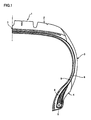
- FIG. 1 A structure of a pneumatic tire of one embodiment of the present invention will be described with reference to Fig. 1 .
- a pneumatic tire 1 can be used as tires for passenger cars, trucks and buses, and heavy-duty equipment.
- Pneumatic tire 1 includes a tread part 2, a sidewall part 3 and a bead part 4. Further, a bead core 5 is embedded in bead part 4. Also provided are a carcass 6 arranged to extend from one bead part 4 to the other bead part with each of opposite ends being folded back to latch bead core 5, and a belt layer 7 composed of two plies outside a crown part of carcass 6. An inner liner 9 extending from one bead part 4 to the other bead part 4 is disposed on the tire radial inner side of carcass 6.
- organic fiber cords made of polyester, nylon, aramid or the like are arranged at an angle of about 90° with respect to the tire circumferential direction, and a bead apex 8 extending from the top of bead core 5 toward the sidewall is disposed in a region surrounded by the carcass and the folded part thereof. It is to be noted that an insulation may be disposed between inner liner 9 and carcass 6.
- inner liner 9 is made of a polymer sheet for an inner liner.
- a structure of a polymer sheet for an inner liner of a first embodiment will be described with reference to Fig. 2 .
- a polymer sheet 20 for an inner liner is composed of a polymer composition including: a polymer component containing more than or equal to 5% by mass and less than or equal to 40% by mass of a styrene-isobutylene-styrene triblock copolymer (hereinafter also referred to as SIBS) and more than or equal to 60% by mass and less than or equal to 95% by mass of a rubber component of at least one kind selected from the group consisting of natural rubber, isoprene rubber, and butyl rubber; and more than or equal to 0.1 part by mass and less than or equal to 5 parts by mass of sulfur with respect to 100 parts by mass of the polymer component.
- SIBS styrene-isobutylene-styrene triblock copolymer
- the thickness of polymer sheet 20 for an inner liner is preferably more than or equal to 0.05 mm and less than or equal to 0.6 mm.
- the thickness of the polymer sheet for an inner liner is less than 0.05 mm, the polymer sheet may be broken by a pressing pressure during vulcanization of a green tire in which the polymer sheet is used as the inner liner, and thus an air leak phenomenon may occur in the resultant tire.
- the thickness of the polymer sheet for an inner liner is more than 0.6 mm, tire weight increases and fuel efficiency deteriorates.
- the thickness of the polymer sheet for an inner liner is more preferably more than or equal to 0.05 mm and less than or equal to 0.4 mm.
- the polymer composition contains an SIBS, a rubber component, and sulfur.
- a rubber component and sulfur are added to the SIBS and mixed by heating, the rubber component and sulfur produce a vulcanization reaction during mixing by heating to form a sea-island structure in which the SIBS serves as a matrix (sea), and the rubber component serves as an island.
- the polymer composition having the sea-island structure has air permeation resistance originating in the matrix phase composed of the SIBS. Further, the rubber component constituting the island phase has tackiness before vulcanization with an adjacent member containing a rubber component and vulcanization adhesiveness with the adjacent member because of the vulcanization reaction produced with the rubber component of the adjacent member during mixing by heating. Therefore, the polymer sheet composed of the polymer composition can have excellent air permeation resistance, and have tackiness before vulcanization and vulcanization adhesiveness with the adjacent member.
- a polymer sheet containing the SIBS Because of an isobutylene block of an SIBS, a polymer sheet containing the SIBS has excellent air permeation resistance. Therefore, when a polymer sheet containing an SIBS is used as an inner liner, a pneumatic tire having excellent air permeation resistance can be obtained.
- the SIBS has excellent durability since a molecular structure other than those of aromatic molecules is completely saturated and therefore deterioration and hardening are suppressed. Therefore, when a polymer sheet containing the SIBS is used as the inner liner, a pneumatic tire having excellent durability can be obtained.
- a halogenated rubber having high specific gravity which has hitherto been used so as to impart air permeation resistance, such as a halogenated butyl rubber, is not used since air permeation resistance is ensured by the addition of the SIBS. Even if the halogenated rubber is used, the amount of use can be reduced. This enables weight saving of the tire and achieves the effect of improving fuel efficiency.
- the weight-average molecular weight obtained by a GPC measurement is preferably more than or equal to 50,000 and less than or equal to 400,000 in view of fluidity, the molding step and rubber elasticity.
- the weight-average molecular weight is less than 50,000, tensile strength and tensile elongation may decrease.
- the weight-average molecular weight is more than 400,000, extrusion moldability may deteriorate. Therefore, both the cases are not preferred.
- the SIBS usually contains more than or equal to 10% by mass and less than or equal to 40% by mass of a styrene unit. Since air permeation resistance and durability become more satisfactory, the content of the styrene unit in the SIBS is preferably more than or equal to 10% by mass and less than or equal to 30% by mass.
- a molar ratio of an isobutylene unit to a styrene unit is preferably from 40/60 to 95/5 in view of the rubber elasticity of the copolymer.
- the polymerization degree of each block is preferably from about 10,000 to 150,000 for an isobutylene block, and preferably from about 5,000 to 30,000 for a styrene block, in view of the rubber elasticity and handling (a polymer of a polymerization degree less than 10,000 is a liquid).
- the SIBS can be obtained by a conventional polymerization method of a vinyl-based compound and, for example, can be obtained by a living cationic polymerization method.
- Japanese Patent Laying-Open No. 62-048704 and Japanese Patent Laying-Open No. 64-062308 disclose that living cationic polymerization of isobutylene with other vinyl compounds can be performed and a polyisobutylene-based block copolymer can be produced by using isobutylene and other compounds as the vinyl compound.
- the method for production of a vinyl compound polymer by a living cationic polymerization method is described, for example, in U.S. Patent No. 4,946,899 , U.S. Patent No. 5,219,948 and Japanese Patent Laying-Open No. 03-174403 .
- the SIBS does not have a double bond other than an aromatic double bond in the molecule and therefore has higher stability to ultraviolet rays than a polymer having a double bond in the molecule, such as polybutadiene, resulting in satisfactory weatherability.
- the SIBS content is more than or equal to 5% by mass and less than or equal to 40% by mass of a polymer component in the polymer composition.
- the SIBS content is less than 5% by mass, air permeation resistance of the polymer sheet may be reduced.
- the SIBS content is more than 40% by mass, vulcanization adhesiveness with an adjacent member may be insufficient.
- the SIBS content is preferably more than or equal to 10% by mass and less than or equal to 30% by mass from the viewpoint of ensuring air permeation resistance.
- the polymer composition constituting the polymer sheet for an inner liner contains a rubber component.
- the rubber component can provide the polymer composition with tackiness before vulcanization with an adjacent member containing a rubber component. Further, because of the vulcanization reaction with sulfur, the rubber component can provide the polymer composition with vulcanization adhesiveness with an adjacent member such as a carcass or an insulation.
- the rubber component contains at least one kind selected from the group consisting of natural rubber, isoprene rubber, and butyl rubber, and it is particularly preferable to contain natural rubber from the viewpoint of breaking strength and adhesiveness.
- the content of the rubber component is more than or equal to 60% by mass and less than or equal to 95% by mass of the polymer component in the polymer composition.
- the content of the rubber component is less than 60% by mass, the viscosity of the polymer composition increases to cause extrusion moldability to deteriorate, so that when producing a polymer sheet, the polymer sheet cannot be made thin.
- the content of the rubber component is more than 95% by mass, air permeation resistance of the polymer sheet may be reduced.
- the content of the rubber component is preferably more than or equal to 70% by mass and less than or equal to 90% by mass of the polymer component from the viewpoint of tackiness before vulcanization and vulcanization adhesiveness.
- the polymer composition constituting the polymer sheet for an inner liner contains sulfur.
- sulfur sulfur generally used in the rubber industry for vulcanization can be used. It is particularly preferable to use insoluble sulfur.
- the sulfur content is more than or equal to 0.1 part by mass and less than or equal to 5 parts by mass with respect to 100 parts by mass of the polymer component.
- the sulfur content is more than 0.1 part by mass and less than or equal to 5 parts by mass with respect to 100 parts by mass of the polymer component.
- the sulfur content is more than 0.1 part by mass, the vulcanization effect of the rubber component cannot be achieved.
- the sulfur content is more than 5 parts by mass, the hardness of the polymer composition increases, and when the polymer sheet is used as an inner liner, the durability of a pneumatic tire may deteriorate.
- the sulfur content is preferably more than or equal to 0.3 part by mass and less than or equal to 3.0 parts by mass.
- the polymer composition constituting the polymer sheet for an inner liner can contain additives such as stearic acid, zinc oxide, an antioxidant, and a vulcanization accelerator.
- Stearic acid functions as a vulcanization assistant for the rubber component.
- the content of stearic acid is preferably more than or equal to 1 part by mass and less than or equal to 5 parts by mass with respect to 100 parts by mass of the polymer component.
- the content of stearic acid is less than 1 part by mass, the effect as a vulcanization assistant cannot be achieved.
- the content of stearic acid is more than 5 parts by mass, the viscosity of the polymer composition may be reduced, and the breaking strength may be reduced, which is not preferable. Therefore, both the cases are not preferred.
- the content of stearic acid is more preferably more than or equal to 1 part by mass and less than or equal to 4 parts by mass.
- Zinc oxide functions as a vulcanization assistant of the rubber component.
- the content of zinc oxide is preferably more than or equal to 0.1 part by mass and less than or equal to 8 parts by mass with respect to 100 parts by mass of the polymer component. When the content of zinc oxide is less than 0.1 part by mass, the effect as a vulcanization assistant cannot be achieved. When the content of zinc oxide is more than 8 parts by mass, the hardness of the polymer composition increases, and when the polymer sheet is used as the inner liner, the durability of a pneumatic tire may deteriorate.
- the content of zinc oxide is preferably more than or equal to 0.5 part by mass and less than or equal to 6 parts by mass.
- An antioxidant has the function of preventing a series of degradations called aging, such as oxidation degradation, thermal degradation, ozone degradation, and fatigue degradation.
- Antioxidants are classified into a primary antioxidant composed of amines or phenols and a secondary antioxidant composed of sulfur compounds or phosphites.
- the primary antioxidant has the function of supplying hydrogen to various polymer radicals to stop a chain reaction of autooxidation, and the secondary antioxidant exhibits a stabilizing effect by turning hydroxyperoxide into stable alcohol.
- the antioxidant includes amines, phenols, imidazoles, phosphors, thioureas, and the like.
- Amines include phenyl- ⁇ -naphthylamine, 2,2,4-trimethyl-1,2-dihydroquinoline polymer, 6-ethoxy-2,2,4-trimethyl-1,2-dihydroquinoline, p, p'-dioctyldiphenylamine, p,p'- dicumyldiphenylamine, N,N'-di-2-naphthyl-p-phenylenediamine, N,N'-diphenyl-p-phenylenediamine, N-phenyl-N'-isopropyl-p-phenylenediamine, N-phenyl-N'-1,3-dimethylbutyl-p-phenylenediamine, N-(1,3-dimethylbutyl)-N'-phenyl-p-phenylenediamine, and the like.
- Phenols include 2,6-di-tert-butyl-4-methylphenol, 2,6-di-tert-butyl-4-methylphenol, styrenated methylphenol, 2,2'-methylene bis (4-ethyl-6-tert-butylphenol), 2,2'-methylene bis (4-methyl-6-tert-butylphenol), 4,4'-butylidenebis (3-methyl-6-tert-butylphenol), 4,4'-thiobis (3-methyl-6-tert-butylphenol), 2,5-di-tert-butyl-hydroquinone, 2,5-di-tert-amyl hydroquinone, and the like.
- Imidazoles include 2-mercaptobenzimidazole, zinc salt of 2-mercaptobenzimidazole, nickel dibutyldithiocarbamate, and the like.
- phosphors such as tris (nonylphenyl) phosphite, thioureas such as 1,3-bis (dimethylaminopropyl)-2-thiourea and tributyl thiourea, an antiozonant wax, and the like may be used.
- One kind of the above-mentioned antioxidants may be used solely, or two or more kinds may be used in combination. Particularly, it is preferable to use N-(1,3-dimethylbutyl)-N'-phenyl-p-phenylenediamine.
- the antioxidant content is preferably more than or equal to 0.1 part by mass and less than or equal to 5 parts by mass with respect to 100 parts by mass of the polymer component. When the antioxidant content is less than 0.1 part by mass, the antioxidant effect cannot be achieved. When the antioxidant content is more than 5 parts by mass, the blooming phenomenon will occur in the polymer composition.
- the antioxidant content is more preferably more than or equal to 0.3 part by mass and less than or equal to 4 parts by mass.
- thiurams thiazoles, thioureas, dithiocarbamates, guanidines, sulfenamides, and the like can be used.
- Thiurams include tetramethylthiuram monosulfide, tetramethylthiuram disulfide, tetraethylthiuram disulfide, tetrabutylthiuram disulfide, dipentamethylenethiuram tetrasulfide, and the like.
- Thiazoles include 2-mercaptobenzothiazole, dibenzothiazyl disulfide, N-cyclohexylbenzothiazole, N-cyclohexyl-2-benzothiazole sulfenamide, N-oxydiethylene-2-benzothiazole sulfenamide, N-tert-butyl-2-benzothiazole sulfenamide, N,N-dicyclohexyl-2-benzothiazole sulfenamide, N-tert-butyl-2-benzothiazolylsulfenamide, and the like.
- Thioureas include N,N'-diethylthiourea, ethylenethiourea, trimethylthiourea, and the like.
- Dithiocarbamates include zinc dimethyldithiocarbamate, zinc diethyldithiocarbamate, zinc dibutyldithiocarbamate, sodium dimethyldithiocarbamate, sodium diethyldithiocarbamate, copper dimethyldithiocarbamate, iron (III) diethyldithiocarbamate, selenium diethyldithiocarbamate, tellurium diethyldithiocarbamate, and the like.
- Guanidines include di-o-tolylguanidine, 1,3-diphenylguanidine, 1-o-tolylbiguanide, di-o-tolylguanidine salt of dicatecholborate, and the like.
- Sulfenamides include N-cyclohexyl-2-benzothiazyl sulfenamide, and the like.
- One kind of the above-mentioned vulcanization accelerators may be used solely, or two or more kinds may be used in combination. Particularly, it is preferable to use dibenzothiazyl disulfide.
- the content of the vulcanization accelerator is preferably more than or equal to 0.1 part by mass and less than or equal to 5 parts by mass with respect to 100 parts by mass of the polymer component.
- the content of the vulcanization accelerator is less than 0.1 part by mass, the vulcanization acceleration effect cannot be achieved.
- the content of the vulcanization accelerator is more than 5 parts by mass, the hardness of the polymer composition increases, and when the polymer sheet is used as an inner liner, the durability of a pneumatic tire may deteriorate. In addition, the raw material cost increases.
- the content of the vulcanization accelerator is more preferably more than or equal to 0.3 part by mass and less than or equal to 4 parts by mass.
- the polymer sheet for an inner liner can be produced by the following method, for example.
- the respective ingredients are charged into a twin-screw extruder and kneaded under the conditions of about 150 to 280°C and 50 to 300 rpm, thereby obtaining a pellet of a polymer composition in which the SIBS, the rubber component, sulfur, and various additives according to necessity being dynamically crosslinked.
- the obtained pellet is charged into a T-die extruder to obtain a polymer sheet of desired thickness.
- the SIBS which is a thermoplastic elastomer
- the rubber component serves as the island phase and is dispersed.
- the rubber component reacts with the additive component, and the rubber component serving as the island phase produces a crosslinking reaction. Since the rubber component is dynamically crosslinked in the twin-screw extruder, it is called dynamic crosslinking. Even if the rubber component is dynamically crosslinked in the twin-screw extruder, the shear viscosity of the whole system is low and extrusion molding is possible since the matrix phase of the system is composed of the thermoplastic elastomer component.
- the rubber component is crosslinked, however, the thermoplastic elastomer component of the matrix phase holds plasticity, and serves to produce plasticity of the polymer composition. Therefore, the polymer composition also exhibits plasticity in the T-die extruder, and thus can be molded into a sheet shape.
- the polymer composition of the inner liner can be prevented from penetrating into the carcass layer even when a pneumatic tire is heated while manufacturing the pneumatic tire by using the polymer sheet produced from this pellet as the inner liner.
- a structure of a polymer laminate for an inner liner of a second embodiment will be described with reference to Fig. 3 .
- a polymer laminate 30 for an inner liner includes a first layer 31 composed of a polymer composition including a polymer component containing more than or equal to 5% by mass and less than or equal to 40% by mass of a styrene-isobutylene-styrene triblock copolymer and more than or equal to 60% by mass and less than or equal to 95% by mass of a rubber component of at least one kind selected from the group consisting of natural rubber, isoprene rubber, and butyl rubber, and more than or equal to 0.1 part by mass and less than or equal to 5 parts by mass of sulfur with respect to 100 parts by mass of the polymer component, and a second layer 32 composed of a thermoplastic elastomer composition containing a thermoplastic elastomer and more than or equal to 0.1 part by mass and less than or equal to 5 parts by mass of sulfur with respect to 100 parts by mass of the thermoplastic elastomer.
- the thickness of polymer laminate 30 for an inner liner is preferably more than or equal to 0.05 mm and less than or equal to 0.6 mm.
- the thickness of the polymer laminate for an inner liner is less than 0.05 mm, the polymer laminate may be broken by a pressing pressure during vulcanization of a green tire in which the polymer laminate is used as the inner liner, and thus an air leak phenomenon may occur in the resultant tire.
- the thickness of the polymer laminate for an inner liner is more than 0.6 mm, tire weight increases and fuel efficiency deteriorates.
- the thickness of the polymer laminate for an inner liner is more preferably more than or equal to 0.05 mm and less than or equal to 0.4 mm.
- the thickness of the first layer is preferably more than or equal to 0.1 mm and less than or equal to 0.59 mm
- the thickness of the second layer is preferably more than or equal to 0.01 mm and less than or equal to 0.2 mm.
- the first layer of the polymer laminate for an inner liner can be embodied by one similar to the polymer sheet for an inner liner of the first embodiment.
- the second layer is composed of the thermoplastic elastomer composition containing a thermoplastic elastomer and sulfur.
- such second layer may further contain a rubber component of at least one kind selected from the group consisting of natural rubber, isoprene rubber, and butyl rubber. Such rubber component will be described later in detail.
- thermoplastic elastomer composition (Thermoplastic elastomer composition)
- thermoplastic elastomer composition contains a thermoplastic elastomer and sulfur.
- sulfur By adding sulfur to the thermoplastic elastomer, tackiness before vulcanization and vulcanization adhesiveness with the first layer is improved. Further, tackiness before vulcanization and vulcanization adhesiveness with an adjacent member, such as a carcass or an insulation, is also improved.
- thermoplastic elastomer (Thermoplastic elastomer)
- thermoplastic elastomer at least one kind selected from the group consisting of: a styrene-isoprene-styrene triblock copolymer; a styrene-isobutylene diblock copolymer; a styrene-butadiene-styrene triblock copolymer; a styrene-isoprene ⁇ butadiene-styrene triblock copolymer; a styrene-ethylene ⁇ butene-styrene triblock copolymer; a styrene-ethylene ⁇ propylene-styrene triblock copolymer; a styrene-ethylene•ethylene•propylene-styrene triblock copolymer; and a styrene-butadiene ⁇ butylene-styrene triblock copolymer can be used.
- thermoplastic elastomers may be epoxy-modified thermoplastic elastomers having an epoxy group.
- thermoplastic elastomers may be epoxy-modified thermoplastic elastomers having an epoxy group.
- thermoplastic elastomer composition containing the SIS is easily vulcanization-bonded with a rubber component. Therefore, when the thermoplastic elastomer composition containing the SIS is used for the polymer laminate for an inner liner, the polymer laminate is excellent in adhesiveness with an adjacent rubber constituting a carcass or an insulation, for example, and thus a pneumatic tire that can avoid the air-in phenomenon and present excellent durability can be obtained.
- the weight-average molecular weight obtained by the GPC measurement is preferably more than or equal to 100,000 and less than or equal to 290,000 in view of rubber elasticity and moldability.
- the weight-average molecular weight is less than 100,000, tensile strength may decrease.
- the weight-average molecular weight is more than 290,000, extrusion moldability may deteriorate. Therefore, both the cases are not preferred.
- the content of a styrene unit in the SIS is preferably more than or equal to 10% by mass and less than or equal to 30% by mass in view of tackiness, adhesiveness and rubber elasticity.
- a molar ratio of an isoprene unit to a styrene unit is preferably from 90/10 to 70/30.
- the polymerization degree of each block is preferably from about 500 to 5,000 for an isoprene block, and preferably from about 50 to 1,500 for a styrene block, in view of the rubber elasticity and handling.
- the SIS can be obtained by a conventional polymerization method of a vinyl-based compound and, for example, can be obtained by a living cationic polymerization method.
- the second layer containing the SIS can be obtained by mixing the SIS, sulfur and other additives by a Banbury mixer, and then forming the mixture into a sheet by a conventional method of forming a thermoplastic resin or a thermoplastic elastomer into a sheet, such as extrusion molding or calender molding.
- thermoplastic elastomer composition containing the SIB is easily vulcanization-bonded with a rubber component. Therefore, when the thermoplastic elastomer composition containing the SIB is used for the polymer laminate for an inner liner, the inner liner is excellent in adhesiveness with an adjacent rubber constituting a carcass or an insulation, for example, and thus a pneumatic tire that can avoid the air-in phenomenon and present excellent durability can be obtained.
- the weight-average molecular weight obtained by the GPC measurement is preferably more than or equal to 40,000 and less than or equal to 120,000 in view of rubber elasticity and moldability.
- the weight-average molecular weight is less than 40,000, tensile strength may decrease.
- the weight-average molecular weight is more than 120,000, extrusion moldability may deteriorate. Therefore, both the cases are not preferred.
- the content of a styrene unit in the SIB is preferably more than or equal to 10% by mass and less than or equal to 35% by mass in view of tackiness, adhesiveness and rubber elasticity.
- a molar ratio of an isobutylene unit to a styrene unit is preferably from 90/10 to 65/35.
- the polymerization degree of each block is preferably from about 300 to 3,000 for an isobutylene block, and preferably from about 10 to 1,500 for a styrene block, in view of rubber elasticity and handling.
- the SIB can be obtained by a conventional polymerization method of a vinyl-based compound and, for example, can be obtained by a living cationic polymerization method.
- WO 2005/033035 discloses a production method in which methylcyclohexane, n-butyl chloride and cumyl chloride are charged into a stirrer, cooled to -70°C and reacted for 2 hours, and then the reaction is terminated by adding a large amount of methanol and the reaction product is vacuum-dried at 60°C to obtain an SIB.
- the second layer containing the SIS can be obtained by mixing the SIS, sulfur and other additives by a Banbury mixer, and then forming the mixture into a sheet by a conventional method of forming a thermoplastic resin or a thermoplastic elastomer into a sheet, such as extrusion molding or calender molding.
- epoxidized styrene-butadiene-styrene triblock copolymer (hereinafter also referred to as epoxidized SBS) is a thermoplastic elastomer in which a hard segment is a polystyrene block, a soft segment is a butadiene block, and an unsaturated double bond portion contained in the butadiene block has been epoxidized. Since the epoxidized SBS has the soft segment, a thermoplastic elastomer composition containing the epoxidized SBS is easily vulcanization-bonded with a rubber component.
- the thermoplastic elastomer composition containing the epoxidized SBS is used for the polymer laminate for an inner liner, the polymer laminate is excellent in adhesiveness with an adjacent rubber constituting a carcass or an insulation, for example, and thus a pneumatic tire that can avoid the air-in phenomenon and present excellent durability can be obtained.
- the weight-average molecular weight obtained by the GPC measurement is preferably more than or equal to 10,000 and less than or equal to 400,000 in view of rubber elasticity and moldability.
- the weight-average molecular weight is less than 10,000, the reinforcing effect may be lessened.
- the weight-average molecular weight is more than 400,000, the thermoplastic elastomer composition may be increased in viscosity. Therefore, both the cases are not preferred.
- the content of a styrene unit in the epoxidized SBS is preferably more than or equal to 10% by mass and less than or equal to 30% by mass in view of tackiness, adhesiveness and rubber elasticity.
- a molar ratio of a butadiene unit to a styrene unit is preferably from 90/10 to 70/30.
- the polymerization degree of each block is preferably from about 500 to 5,000 for a butadiene block, and preferably from about 500 to 1,500 for a styrene block, in view of rubber elasticity and handling.
- the second layer containing the SIS can be obtained by mixing the SIS, sulfur and other additives by a Banbury mixer, and then forming the mixture into a sheet by a conventional method of forming a thermoplastic resin or a thermoplastic elastomer into a sheet, such as extrusion molding or calender molding.
- the rubber component is preferably more than or equal to 20% by mass and less than or equal to 90% by mass with respect to the total of the thermoplastic elastomer and the rubber component, and more preferably more than or equal to 30% by mass and less than or equal to 80% by mass.
- the rubber component is less than 20% by mass, the second layer may be unlikely to be vulcanization-bonded with the carcass layer, and when the rubber component is more than 90% by mass, the second layer and the carcass layer may be vulcanization-bonded excessively.
- Sulfur can be embodied by one similar to that of the first embodiment.
- the sulfur content is preferably more than or equal to 0.1 part by mass and less than or equal to 5 parts by mass with respect to 100 parts by mass of the thermoplastic elastomer.
- the sulfur content is less than 0.1 part by mass, the vulcanization reaction may not be produced.
- the sulfur content is more than 5 parts by mass, the crosslinking density of the thermoplastic elastomer composition may be increased, which may increase viscosity.
- the sulfur content is more preferably more than or equal to 0.3 part by mass and less than or equal to 3 parts by mass.
- thermoplastic elastomer composition (Additives in thermoplastic elastomer composition)
- the thermoplastic elastomer composition constituting the polymer laminate for an inner liner can contain additives such as stearic acid, zinc oxide, an antioxidant, and a vulcanization accelerator. These additives can be embodied by ones similar to those of the first embodiment.
- the content of stearic acid is preferably more than or equal to 1 part by mass and less than or equal to 5 parts by mass with respect to 100 parts by mass of the thermoplastic elastomer.
- the content of stearic acid is more than or equal to 1 part by mass and less than or equal to 4 parts by mass.
- the content of zinc oxide is preferably more than or equal to 0.1 part by mass and less than or equal to 8 parts by mass with respect to 100 parts by mass of the thermoplastic elastomer. When the content of zinc oxide is less than 0.1 part by mass, vulcanization may not occur. When the content of zinc oxide is more than 8 parts by mass, the hardness of the thermoplastic elastomer composition may increase, and the durability may deteriorate.
- the content of zinc oxide is more preferably more than or equal to 0.5 part by mass and less than or equal to 6 parts by mass.
- the antioxidant content is preferably more than or equal to 0.1 part by mass and less than or equal to 5 parts by mass with respect to 100 parts by mass of the thermoplastic elastomer. When the antioxidant content is less than 0.1 part by mass, the antioxidant effect cannot be achieved. When the antioxidant content is more than 5 parts by mass, the blooming phenomenon may occur.
- the antioxidant content is more preferably more than or equal to 0.3 part by mass and less than or equal to 4 parts by mass.
- the content of the vulcanization accelerator is preferably more than or equal to 0.1 part by mass and less than or equal to 5 parts by mass with respect to 100 parts by mass of the thermoplastic elastomer.
- the content of the vulcanization accelerator is less than 0.1 part by mass, the vulcanization acceleration effect may not be achieved.
- the content of the vulcanization accelerator is more than 5 parts by mass, the hardness of the thermoplastic elastomer composition may increase, and the durability may deteriorate. In addition, the raw material cost increases.
- the content of the vulcanization accelerator is more preferably more than or equal to 0.3 part by mass and less than or equal to 4 parts by mass.
- the polymer laminate for an inner liner can be produced by the following method, for example.
- the first layer is produced similarly to the method of production of the polymer sheet for an inner liner of the first embodiment.
- the second layer is produced by forming the thermoplastic elastomer composition into a sheet by extrusion molding, calender molding or the like. The first layer and the second layer are bonded together to produce a polymer laminate.
- the respective pellets of the polymer composition and the thermoplastic elastomer composition can be subjected to lamination extrusion such as laminate extrusion or coextrusion to obtain a polymer laminate.
- a structure of a polymer laminate for an inner liner of a third embodiment will be described with reference to Fig. 4 .
- a polymer laminate 40 for an inner liner includes a first layer 41 composed of a polymer composition containing a polymer component and sulfur, and a second layer 42 composed of a thermoplastic elastomer composition containing a thermoplastic elastomer and sulfur.
- Second layer 42 includes a second A layer 42a and a second B layer 42b composed of different kinds of thermoplastic elastomer compositions, respectively.
- the thickness of polymer laminate 40 for an inner liner is preferably more than or equal to 0.05 mm and less than or equal to 0.6 mm.
- the thickness of the polymer laminate for an inner liner is less than 0.05 mm, the polymer laminate may be broken by a pressing pressure during vulcanization of a green tire in which the polymer laminate is used as the inner liner, and thus an air leak phenomenon may occur in the resultant tire.
- the thickness of the polymer laminate for an inner liner is more than 0.6 mm, tire weight increases and fuel efficiency deteriorates.
- the thickness of the polymer laminate for an inner liner is more preferably more than or equal to 0.05 mm and less than or equal to 0.4 mm.
- the thickness of the first layer is preferably more than or equal to 0.1 mm and less than or equal to 0.59 mm
- the thickness of the second A layer is preferably more than or equal to 0.01 mm and less than or equal to 0.2 mm
- the thickness of the second B layer is preferably more than or equal to 0.01 mm and less than or equal to 0.2 mm.
- second layer 42 includes two layers of second A layer 42a and second B layer 42b, however, second layer 42 may include three or more layers composed of thermoplastic elastomer compositions.
- the first layer of the polymer laminate for an inner liner can be embodied by one similar to the polymer sheet for an inner liner of the first embodiment.
- second A layer 42a and second B layer 42b constituting second layer 42 are respectively selected from among an SIS layer with a thermoplastic elastomer composed of a styrene-isoprene-styrene triblock copolymer, an SIB layer with a thermoplastic elastomer composed of a styrene-isobutylene diblock copolymer, and an epoxidized SBS layer with a thermoplastic elastomer composed of an epoxidized styrene-butadiene-styrene triblock copolymer. It is particularly preferable to use the SIS layer as second A layer 42a and the epoxidized SBS layer as second B layer 42b.
- the styrene-isoprene-styrene triblock copolymer, the styrene-isobutylene diblock copolymer, the epoxidized styrene-butadiene-styrene triblock copolymer, and sulfur can be embodied by ones similar to those of the second embodiment.
- the thermoplastic elastomer composition can contain additives such as stearic acid, zinc oxide, an antioxidant, and a vulcanization accelerator. These additives can be embodied by ones similar to those of the first embodiment. These additives can have contents similar to those of the second embodiment.
- the polymer laminate for an inner liner can be produced by a method similar to that of the second embodiment.
- a pneumatic tire of one embodiment of the present invention can be produced by the following method, for example.
- a green tire in which the polymer sheet for an inner liner or the polymer laminate for an inner liner of the present invention is used for the inner liner part is prepared.
- the polymer laminate for an inner liner the polymer laminate is arranged toward the tire radial outer side such that the second layer contacts the carcass or the insulation.
- the second layer can be vulcanization-bonded with an adjacent member such as the carcass or the insulation in a tire vulcanization step. Therefore, the resultant pneumatic tire can have excellent air permeation resistance and durability since the inner liner is satisfactorily bonded with the adjacent member.
- the green tire is mounted in a mold for heating with pressurization at 150 to 180°C for 3 to 50 minutes by a bladder to obtain a vulcanized tire.
- the obtained vulcanized tire is preferably cooled at 50 to 120°C for 10 to 300 seconds.
- the inner liner is implemented by the polymer sheet for an inner liner or the polymer laminate for an inner liner of the present invention.
- the SIBS, the SIS, the SIB or the epoxidized SBS constituting the polymer sheet or the polymer laminate, which are thermoplastic elastomers, is softened in the mold when heated to 150 to 180°C, for example, in the step of obtaining the vulcanized tire.
- the softened thermoplastic elastomer has higher reactivity than in the solid state, and is thus fused with an adjacent member. That is, the inner liner in contact with the outside surface of the expanded bladder is softened by heating to be fused with the bladder.
- the inner liner peels off the insulation or the carcass adjacent thereto, causing the air-in phenomenon. Further, the tire may be deformed in shape.
- thermoplastic elastomer used for the inner liner can be solidified.
- the thermoplastic elastomer is solidified, fusing of the inner liner with the bladder is eliminated, and thus the releasability when removing the vulcanized tire from the mold is improved.
- the cooling temperature is preferably from 50 to 120°C. When the cooling temperature is lower than 50°C, it is necessary to prepare a particular cooling medium, which may degrade productivity. When the cooling temperature is higher than 120°C, the thermoplastic elastomer may not be sufficiently cooled, which causes the inner liner to be still fused with the bladder upon opening of the mold, giving rise to the air-in phenomenon.
- the cooling temperature is more preferably from 70 to 100°C.
- the cooling time is preferably from 10 to 300 seconds.
- the cooling time is less than 10 seconds, the thermoplastic elastomer may not be sufficiently cooled, which causes the inner liner to be still fused with the bladder upon opening of the mold, giving rise to the air-in phenomenon.
- the cooling time is more than 300 seconds, productivity deteriorates.
- the cooling time is more preferably from 30 to 180 seconds.
- the step of cooling the vulcanized tire is preferably performed by cooling inside the bladder. Since a cavity exists inside the bladder, it is possible to introduce a cooling medium controlled to the cooling temperature into the bladder after completion of the vulcanization step.
- cooling medium at least one selected from the group consisting of air, steam, water and oil. Of these, water having excellent cooling efficiency is preferably used.
- the resultant polymer sheet was used for the inner liner part of a tire to prepare a green tire.
- the green tire was subjected to press molding in a mold at 170°C for 20 minutes to obtain a vulcanized tire of 195/65R15 size. After cooling the vulcanized tire at 100°C for 3 minutes, the vulcanized tire was removed from the mold to obtain a pneumatic tire.
- a sheet of a carcass layer (formulation: 100 parts by mass of a styrene-butadiene rubber, 50 parts by mass of carbon black, 2 parts by mass of sulfur, thickness: 2.0 mm) was prepared.
- the polymer sheet and the sheet of the carcass layer were bonded together and held at 100 gf for 30 seconds, and the force by which they were separated was measured as tackiness before vulcanization.
- the tackiness before vulcanization of each formulation was expressed as an index by the following equation using Comparative Example 1 as a reference value 100. It shows that the greater the index of tackiness before vulcanization, the greater the tackiness before vulcanization, which is preferable.
- index of tackiness before vulcanization tackiness before vulcanization of each formulation / tackiness before vulcanization of Comparative Example 1 ⁇ 100.
- the first layer and the sheet of the carcass layer were bonded together, and were heated at 170°C for 20 minutes to obtain a sample for measuring vulcanization adhesiveness (adhesive strength). Peel force was measured in a tensile peel test as vulcanization adhesiveness.
- the vulcanization adhesiveness of each formulation was expressed as an index by the following equation using Comparative Example 1 as a reference value 100. It shows that the greater the index of vulcanization adhesiveness, the greater the vulcanization adhesiveness, which is preferable.
- index of vulcanization adhesiveness vulcanization adhesiveness of each formulation / vulcanization adhesiveness of Comparative Example 1 ⁇ 100
- the weight of a pneumatic tire with each formulation used was expressed as an index by the following equation using Comparative Example 1 as a reference value 100. It shows that the greater the index of weight saving effect, the lighter the tire weight, which is preferable.
- index of weight saving effect tire weight of Comparative Example 1 / tire weight of each formulation ⁇ 100.
- the produced tire of 195/65R15 size was mounted on a JIS standard rim 15x6JJ and an initial air pressure of 300 kPa was applied. The tire was left at room temperatures for 90 days, following which an air pressure drop rate (%/month) was calculated.
- Examples 1 to 4 are polymer sheets each being composed of a polymer composition containing 60 to 95 parts by mass of IIR or NR and 40 to 5 parts by mass of SIBS and further containing additives such as sulfur, and pneumatic tires.
- the polymer sheets were sufficient in tackiness before vulcanization and vulcanization adhesiveness with the carcass layer.
- the tires were improved in weight saving effect, rolling resistance, and static air pressure drop rate as compared to Comparative Example 1 of a conventional example.
- Comparative Examples 2 to 5 are polymer sheets each being composed of a polymer composition containing 0 to 50 parts by mass of IIR or NR and 10 to 50 parts by mass of SIBS, and pneumatic tires.
- the polymer composition of Comparative Examples 3 to 5 further contain additives such as sulfur.
- the polymer sheets were insufficient in tackiness before vulcanization and vulcanization adhesiveness with the carcass layer.
- Comparative Examples 6 and 7 are polymer sheets each being composed of a polymer composition containing 98 parts by mass of IIR or NR and 2 parts by mass of SIBS and further containing additives such as sulfur, and pneumatic tires.
- the polymer sheets were sufficient in tackiness before vulcanization and vulcanization adhesiveness with the carcass layer, however, the tires were similar to Comparative Example 1 of a conventional example in static air pressure drop rate, which was insufficient.
- thermoplastic elastomer sheet (Production of thermoplastic elastomer sheet)
- thermoplastic elastomer sheet was produced by a method similar to that of Example 1.
- the obtained thermoplastic elastomer sheet was subjected to the following evaluations.
- Tackiness before vulcanization was measured by a method similar to that of Example 1, and tackiness before vulcanization of each formulation was expressed as an index by the following equation using Comparative Example 1 as a reference value 100. The obtained index was evaluated on the following criterion.
- Vulcanization adhesiveness was measured by a method similar to that of Example 1, and vulcanization adhesiveness of each formulation was expressed as an index by the following equation using Comparative Example 1 as a reference value 100. The obtained index was evaluated on the following criterion.
- SIB SIB prepared by the above-described (Preparation of SIB) (a styrene-isobutylene diblock copolymer, weight-average molecular weight of 70,000, styrene unit content of 15% by mass)
- Epoxidized SBS "Epofriend A1020" manufactured by Daicel Chemical Industries, Ltd.
- Antioxidant "Noclac 6C” (N-(1,3-dimethylbutyl)-N'-phenyl-p-phenylenediamine) manufactured by Ouchi Shinko Chemical Industrial Co., Ltd.
- Vulcanization accelerator "Nocceler DM” (di-2-benzothiazolyldisulfide) manufactured by Ouchi Shinko Chemical Industrial Co., Ltd.
- Sulfur "Sulfur Powder” manufactured by Tsurumi Chemical Industry Co., Ltd.
- thermoplastic elastomer sheets each being composed of a thermoplastic elastomer composition containing the SIS, the SIB or the epoxidized SBS and additives such as sulfur.
- the thermoplastic elastomer sheets were sufficient in tackiness before vulcanization and vulcanization adhesiveness with the carcass layer.
- thermoplastic elastomer sheets each being composed of a thermoplastic elastomer composition containing the SIS, the SIB or the epoxidized SBS and not containing any additive.
- the thermoplastic elastomer sheets were insufficient in vulcanization adhesiveness with the carcass layer.
- thermoplastic elastomer sheets each containing natural rubber as a rubber component in the second layer.
- the thermoplastic elastomer sheets were sufficient in tackiness before vulcanization and vulcanization adhesiveness with the carcass layer.
- thermoplastic elastomer sheets each containing butyl rubber as a rubber component in the second layer.
- the thermoplastic elastomer sheets were sufficient in tackiness before vulcanization and vulcanization adhesiveness with the carcass layer.
- Polymer compositions were produced with formulations and a method similar to those of Examples 1 to 4 and Comparative Examples 1 to 7.
- the resultant polymer laminate was used for the inner liner part of a tire to prepare a green tire. It is to be noted that the polymer laminate was arranged so that the first layer was located at the tire radial innermost side and the second layer contacted the carcass layer of the green tire.
- the green tire was subjected to press molding in a mold at 170°C for 20 minutes to obtain a vulcanized tire of 195/65R15 size. After cooling the vulcanized tire at 100°C for 3 minutes, the vulcanized tire was removed from the mold to obtain a pneumatic tire.
- the Mooney viscosity of the polymer composition was measured by a method similar to that of Example 1.
- the polymer laminate was held at 100 gf for 30 seconds, and peel force was measured as tackiness before vulcanization.
- the tackiness before vulcanization of each polymer laminate was expressed as an index by the following equation using Comparative Example 8 as a reference value 100. It shows that the greater the index of tackiness before vulcanization, the greater the tackiness before vulcanization, which is preferable.
- index of tackiness before vulcanization tackiness before vulcanization of each formulation / tackiness before vulcanization of Comparative Example 8 ⁇ 100.
- the polymer laminate was heated at 170°C for 20 minutes to obtain a sample for measuring vulcanization adhesiveness. Peel force was measured in a tensile peel test as vulcanization adhesiveness.
- the vulcanization adhesiveness of each polymer laminate was expressed as an index by the following equation using Comparative Example 8 as a reference value 100. It shows that the greater the index of vulcanization adhesiveness, the greater the vulcanization adhesiveness, which is preferable.
- index of vulcanization adhesiveness vulcanization adhesiveness of each formulation / vulcanization adhesiveness of Comparative Example 8 ⁇ 100
- the weight of a pneumatic tire with each polymer laminate used was expressed as an index by the following equation using Comparative Example 8 as a reference value 100. It shows that the greater the index of weight saving effect, the lighter the tire weight, which is preferable.
- index of weight saving effect tire weight of Comparative Example 8 / tire weight of each formulation ⁇ 100.
- the rolling resistance of a pneumatic tire was measured by a method similar to that of Example 1.
- the rolling resistance of a pneumatic tire with each polymer laminate used was expressed as an index by the following equation using Comparative Example 8 as a reference value 100. It shows that the greater the rolling resistance index, the smaller the rolling resistance, which is preferable.
- rolling resistance index rolling resistance of Comparative Example 8 / rolling resistance of each formulation ⁇ 100
- the tire air pressure drop rate (%/month) was measured by a method similar to that of Example 1.
- Examples 5 to 8 are polymer laminates containing the polymer sheets of Examples 1 to 4, respectively, as the first layer and the thermoplastic elastomer sheet of Manufacturing Example 2 as the second layer, and pneumatic tires.
- the polymer laminates were sufficient in tackiness before vulcanization and vulcanization adhesiveness between the first and second layers.
- the tires were improved in weight saving effect, rolling resistance, and static air pressure drop rate as compared to Comparative Example 8.
- Comparative Examples 9 to 18 are polymer laminates containing the polymer sheets of Examples 1 to 4, respectively, as the first layer and the thermoplastic elastomer sheets of Manufacturing Examples 7, 10, 13, and 14, respectively, as the second layer, and pneumatic tires.
- the polymer laminates were sufficient in tackiness before vulcanization and vulcanization adhesiveness between the first and second layers.
- Comparative Examples 9 to 12 are polymer laminates containing the polymer sheets of Examples 1 to 4, respectively, as the first layer and the thermoplastic elastomer sheet of Manufacturing Example 2 as the second layer, and pneumatic tires.
- the polymer laminates were insufficient in tackiness before vulcanization and vulcanization adhesiveness between the first and second layers.
- Comparative Examples 13 and 14 are polymer laminates containing the polymer sheets of Comparative Examples 6 and 7, respectively, as the first layer and the thermoplastic elastomer sheet of Manufacturing Example 2 as the second layer, and pneumatic tires.
- the polymer laminates were sufficient in tackiness before vulcanization and vulcanization adhesiveness between the first and second layers, however, the pneumatic tires were similar to Comparative Example 8 in static air pressure drop rate, which was insufficient.
Landscapes
- Chemical & Material Sciences (AREA)
- Engineering & Computer Science (AREA)
- Mechanical Engineering (AREA)
- Polymers & Plastics (AREA)
- Chemical Kinetics & Catalysis (AREA)
- Medicinal Chemistry (AREA)
- Health & Medical Sciences (AREA)
- Organic Chemistry (AREA)
- Manufacturing & Machinery (AREA)
- Materials Engineering (AREA)
- Compositions Of Macromolecular Compounds (AREA)
- Tires In General (AREA)
- Laminated Bodies (AREA)
Abstract
Description
- This nonprovisional application is based on Japanese Patent Application No.
2010-172394 filed on July 30, 2010 2010-254501 filed on November 15, 2010 - The present invention relates to a polymer sheet for inner liner, a polymer laminate for inner liner, and a pneumatic tire using them.
- Recently, an attempt has been made to perform weight saving of tires because of strong social demands for fuel economy of automobiles. An attempt has also been made to perform weight saving of inner liners, among tire members, that are disposed at a tire radial inner side and have the function of improving air permeation resistance by decreasing the amount of air leaked to the outside from the inside of pneumatic tires (air permeation amount).
- In a rubber composition for an inner liner, an improvement in air permeation resistance of tires is performed by using a butyl-based rubber containing 70 to 100% by mass of a butyl rubber and 30 to 0% by mass of a natural rubber. The butyl-based rubber contains, in addition to butylene, about 1% by mass of isoprene that enables co-crosslinking with an adjacent rubber along with sulfur, a vulcanization accelerator and zinc white. In the case of a conventional formulation, the butyl-based rubber requires a thickness of 0.6 to 1.0 mm for tires for passenger cars, or a thickness of about 1.0 to 2.0 mm for tires for trucks and buses.
- In order to perform weight saving of tires, it has been proposed to use, as an inner liner, a thermoplastic elastomer that has excellent air permeation resistance as compared with the butyl-based rubber and can decrease the thickness of an inner liner layer. However, the thermoplastic elastomer that shows high air permeation resistance with a smaller thickness than that of the butyl-based rubber is inferior in vulcanization adhesiveness with an insulation or carcass rubber adjacent to the inner liner as compared with the butyl-based rubber. When the inner liner has low vulcanization adhesiveness, an air-in phenomenon occurs in which air permeates into the space between the inner liner and the insulation or the carcass, and thus a number of small air bubbles appear. This phenomenon raises a problem that a small spot pattern formed inside tires gives an impression of poor appearance to users. Further, air bubbles may cause the inner liner to peel off the insulation or carcass during driving, resulting in cracks in the inner liner to decrease a tire internal pressure. In the worst case, tires may burst.
- Japanese Patent Laying-Open No.
09-165469 - An object of the present invention is to provide a polymer sheet for an inner liner and a polymer laminate for an inner liner both having sufficient tackiness and vulcanization adhesiveness with a member adjacent to the inner liner and excellent air permeation resistance, as well as a pneumatic tire using them.
- The present invention is directed to a polymer sheet for an inner liner composed of a polymer composition including: a polymer component containing more than or equal to 5% by mass and less than or equal to 40% by mass of a styrene-isobutylene-styrene triblock copolymer and more than or equal to 60% by mass and less than or equal to 95% by mass of a rubber component of at least one kind selected from the group consisting of natural rubber, isoprene rubber, and butyl rubber; and more than or equal to 0.1 part by mass and less than or equal to 5 parts by mass of sulfur with respect to 100 parts by mass of the polymer component.
- Preferably, the polymer sheet for an inner liner of the present invention further contains, with respect to 100 parts by mass of the polymer component, more than or equal to 1 part by mass and less than or equal to 5 parts by mass of stearic acid, more than or equal to 0.1 part by mass and less than or equal to 8 parts by mass of zinc oxide, more than or equal to 0.1 part by mass and less than or equal to 5 parts by mass of an antioxidant, and more than or equal to 0.1 part by mass and less than or equal to 5 parts by mass of a vulcanization accelerator.
- Preferably, in the polymer sheet for an inner liner of the present invention, the styrene-isobutylene-styrene triblock copolymer has a weight-average molecular weight more than or equal to 50,000 and less than or equal to 400,000 and a styrene unit content more than or equal to 10% by mass and less than or equal to 30% by mass.
- The present invention is also directed to a polymer laminate for an inner liner including: a first layer composed of a polymer composition including a polymer component containing more than or equal to 5% by mass and less than or equal to 40% by mass of a styrene-isobutylene-styrene triblock copolymer and more than or equal to 60% by mass and less than or equal to 95% by mass of a rubber component of at least one kind selected from the group consisting of natural rubber, isoprene rubber, and butyl rubber, and more than or equal to 0.1 part by mass and less than or equal to 5 parts by mass of sulfur with respect to 100 parts by mass of the polymer component; and a second layer composed of a thermoplastic elastomer composition containing a thermoplastic elastomer, and more than or equal to 0.1 part by mass and less than or equal to 5 parts by mass of sulfur with respect to 100 parts by mass of the thermoplastic elastomer.
- Preferably, in the polymer sheet for an inner liner of the present invention, the polymer composition further contains, with respect to 100 parts by mass of the polymer component, more than or equal to 1 part by mass and less than or equal to 5 parts by mass of stearic acid, more than or equal to 0.1 part by mass and less than or equal to 8 parts by mass of zinc oxide, more than or equal to 0.1 part by mass and less than or equal to 5 parts by mass of an antioxidant, and more than or equal to 0.1 part by mass and less than or equal to 5 parts by mass of a vulcanization accelerator.
- Preferably, in the polymer sheet for an inner liner of the present invention, the thermoplastic elastomer is of at least one kind selected from the group consisting of: a styrene-isoprene-styrene triblock copolymer; a styrene-isobutylene diblock copolymer; a styrene-butadiene-styrene triblock copolymer; a styrene-isoprene·butadiene-styrene triblock copolymer; a styrene-ethylene·butene-styrene triblock copolymer; a styrene-ethylene•propylene-styrene triblock copolymer; a styrene-ethylene•ethylene•propylene-styrene triblock copolymer; a styrene-butadiene·butylene-styrene triblock copolymer; and their epoxy-modified thermoplastic elastomers.
- Preferably, in the polymer sheet for an inner liner of the present invention, the second layer includes at least one of an SIS layer with the thermoplastic elastomer composed of a styrene-isoprene-styrene triblock copolymer, an SIB layer with the thermoplastic elastomer composed of a styrene-isobutylene diblock copolymer, and an epoxidized SBS layer with the thermoplastic elastomer composed of an epoxidized styrene-butadiene-styrene triblock copolymer.
- Preferably, in the polymer sheet for an inner liner of the present invention, the thermoplastic elastomer composition further contains, with respect to 100 parts by mass of the thermoplastic elastomer, more than or equal to 1 part by mass and less than or equal to 5 parts by mass of stearic acid, more than or equal to 0.1 part by mass and less than or equal to 8 parts by mass of zinc oxide, more than or equal to 0.1 part by mass and less than or equal to 5 parts by mass of an antioxidant, and more than or equal to 0.1 part by mass and less than or equal to 5 parts by mass of a vulcanization accelerator.
- Preferably, in the polymer sheet for an inner liner of the present invention, the styrene-isobutylene-styrene triblock copolymer has a weight-average molecular weight more than or equal to 50,000 and less than or equal to 400,000 and a styrene unit content more than or equal to 10% by mass and less than or equal to 30% by mass.
- Preferably, in the polymer sheet for an inner liner of the present invention, the styrene-isoprene-styrene triblock copolymer has a weight-average molecular weight more than or equal to 100,000 and less than or equal to 290,000 and a styrene unit content more than or equal to 10% by mass and less than or equal to 30% by mass.
- Preferably, in the polymer sheet for an inner liner of the present invention, the styrene-isobutylene diblock copolymer is linear and has a weight-average molecular weight more than or equal to 40,000 and less than or equal to 120,000 and a styrene unit content more than or equal to 10% by mass and less than or equal to 35% by mass.
- Preferably, in the polymer sheet for an inner liner of the present invention, the epoxidized styrene-butadiene-styrene triblock copolymer has a weight-average molecular weight more than or equal to 10,000 and less than or equal to 400,000, a styrene unit content more than or equal to 10% by mass and less than or equal to 30% by mass, and an epoxy equivalent more than or equal to 50 and less than or equal to 1,000.
- Preferably, in the polymer sheet for an inner liner of the present invention, the second layer further contains a rubber component of at least one kind selected from the group consisting of natural rubber, isoprene rubber, and butyl rubber, in addition to the thermoplastic elastomer composition, the rubber component being more than or equal to 20% by mass and less than or equal to 90% by mass with respect to a total of the thermoplastic elastomer composition and the rubber component.
- The present invention is also directed to a pneumatic tire, wherein the polymer sheet for an inner liner is used for an inner liner part.
- The present invention is also directed to a pneumatic tire, wherein the polymer laminate for an inner liner is used for an inner liner part.
- The present invention can provide a polymer sheet for an inner liner and a polymer laminate for an inner liner both having sufficient tackiness and vulcanization adhesiveness with a member adjacent to the inner liner and excellent air permeation resistance, as well as a pneumatic tire using them.
- The foregoing and other objects, features, aspects and advantages of the present invention will become more apparent from the following detailed description of the present invention when taken in conjunction with the accompanying drawings.
-
-
Fig. 1 is a schematic sectional view showing the right half of a pneumatic tire in accordance with one embodiment of the present invention. -
Fig. 2 is a schematic sectional view showing a polymer sheet for an inner liner in accordance with one embodiment of the present invention. -
Figs. 3 and 4 are schematic sectional views each showing a polymer laminate for an inner liner in accordance with one embodiment of the present invention. - A structure of a pneumatic tire of one embodiment of the present invention will be described with reference to
Fig. 1 . - A pneumatic tire 1 can be used as tires for passenger cars, trucks and buses, and heavy-duty equipment. Pneumatic tire 1 includes a
tread part 2, a sidewall part 3 and a bead part 4. Further, a bead core 5 is embedded in bead part 4. Also provided are a carcass 6 arranged to extend from one bead part 4 to the other bead part with each of opposite ends being folded back to latch bead core 5, and a belt layer 7 composed of two plies outside a crown part of carcass 6. Aninner liner 9 extending from one bead part 4 to the other bead part 4 is disposed on the tire radial inner side of carcass 6. The two plies of belt layer 7, each being made of a steel cord or a cord of aramid fiber or the like, are arranged so that the cords intersect with each other and each form an angle of usually 5 to 30° with respect to a tire circumferential direction. Regarding the carcass, organic fiber cords made of polyester, nylon, aramid or the like are arranged at an angle of about 90° with respect to the tire circumferential direction, and a bead apex 8 extending from the top of bead core 5 toward the sidewall is disposed in a region surrounded by the carcass and the folded part thereof. It is to be noted that an insulation may be disposed betweeninner liner 9 and carcass 6. - In one embodiment of the present invention,
inner liner 9 is made of a polymer sheet for an inner liner. - A structure of a polymer sheet for an inner liner of a first embodiment will be described with reference to
Fig. 2 . - A
polymer sheet 20 for an inner liner is composed of a polymer composition including: a polymer component containing more than or equal to 5% by mass and less than or equal to 40% by mass of a styrene-isobutylene-styrene triblock copolymer (hereinafter also referred to as SIBS) and more than or equal to 60% by mass and less than or equal to 95% by mass of a rubber component of at least one kind selected from the group consisting of natural rubber, isoprene rubber, and butyl rubber; and more than or equal to 0.1 part by mass and less than or equal to 5 parts by mass of sulfur with respect to 100 parts by mass of the polymer component. - The thickness of
polymer sheet 20 for an inner liner is preferably more than or equal to 0.05 mm and less than or equal to 0.6 mm. When the thickness of the polymer sheet for an inner liner is less than 0.05 mm, the polymer sheet may be broken by a pressing pressure during vulcanization of a green tire in which the polymer sheet is used as the inner liner, and thus an air leak phenomenon may occur in the resultant tire. In contrast, when the thickness of the polymer sheet for an inner liner is more than 0.6 mm, tire weight increases and fuel efficiency deteriorates. The thickness of the polymer sheet for an inner liner is more preferably more than or equal to 0.05 mm and less than or equal to 0.4 mm. - The polymer composition contains an SIBS, a rubber component, and sulfur. When a rubber component and sulfur are added to the SIBS and mixed by heating, the rubber component and sulfur produce a vulcanization reaction during mixing by heating to form a sea-island structure in which the SIBS serves as a matrix (sea), and the rubber component serves as an island.
- The polymer composition having the sea-island structure has air permeation resistance originating in the matrix phase composed of the SIBS. Further, the rubber component constituting the island phase has tackiness before vulcanization with an adjacent member containing a rubber component and vulcanization adhesiveness with the adjacent member because of the vulcanization reaction produced with the rubber component of the adjacent member during mixing by heating. Therefore, the polymer sheet composed of the polymer composition can have excellent air permeation resistance, and have tackiness before vulcanization and vulcanization adhesiveness with the adjacent member.
- Because of an isobutylene block of an SIBS, a polymer sheet containing the SIBS has excellent air permeation resistance. Therefore, when a polymer sheet containing an SIBS is used as an inner liner, a pneumatic tire having excellent air permeation resistance can be obtained.
- Further, the SIBS has excellent durability since a molecular structure other than those of aromatic molecules is completely saturated and therefore deterioration and hardening are suppressed. Therefore, when a polymer sheet containing the SIBS is used as the inner liner, a pneumatic tire having excellent durability can be obtained.
- When a pneumatic tire is produced by using a polymer sheet containing the SIBS as the inner liner, a halogenated rubber having high specific gravity, which has hitherto been used so as to impart air permeation resistance, such as a halogenated butyl rubber, is not used since air permeation resistance is ensured by the addition of the SIBS. Even if the halogenated rubber is used, the amount of use can be reduced.
This enables weight saving of the tire and achieves the effect of improving fuel efficiency. - Although there is no particular limitation on the molecular weight of the SIBS, the weight-average molecular weight obtained by a GPC measurement is preferably more than or equal to 50,000 and less than or equal to 400,000 in view of fluidity, the molding step and rubber elasticity. When the weight-average molecular weight is less than 50,000, tensile strength and tensile elongation may decrease. When the weight-average molecular weight is more than 400,000, extrusion moldability may deteriorate. Therefore, both the cases are not preferred.
- The SIBS usually contains more than or equal to 10% by mass and less than or equal to 40% by mass of a styrene unit. Since air permeation resistance and durability become more satisfactory, the content of the styrene unit in the SIBS is preferably more than or equal to 10% by mass and less than or equal to 30% by mass.
- In the SIBS, a molar ratio of an isobutylene unit to a styrene unit (isobutylene unit/styrene unit) is preferably from 40/60 to 95/5 in view of the rubber elasticity of the copolymer. In the SIBS, the polymerization degree of each block is preferably from about 10,000 to 150,000 for an isobutylene block, and preferably from about 5,000 to 30,000 for a styrene block, in view of the rubber elasticity and handling (a polymer of a polymerization degree less than 10,000 is a liquid).
- The SIBS can be obtained by a conventional polymerization method of a vinyl-based compound and, for example, can be obtained by a living cationic polymerization method.
- Japanese Patent Laying-Open No.
62-048704 64-062308 U.S. Patent No. 4,946,899 ,U.S. Patent No. 5,219,948 and Japanese Patent Laying-Open No.03-174403 - The SIBS does not have a double bond other than an aromatic double bond in the molecule and therefore has higher stability to ultraviolet rays than a polymer having a double bond in the molecule, such as polybutadiene, resulting in satisfactory weatherability.
- The SIBS content is more than or equal to 5% by mass and less than or equal to 40% by mass of a polymer component in the polymer composition. When the SIBS content is less than 5% by mass, air permeation resistance of the polymer sheet may be reduced. When the SIBS content is more than 40% by mass, vulcanization adhesiveness with an adjacent member may be insufficient. The SIBS content is preferably more than or equal to 10% by mass and less than or equal to 30% by mass from the viewpoint of ensuring air permeation resistance.
- In the first embodiment, the polymer composition constituting the polymer sheet for an inner liner contains a rubber component. The rubber component can provide the polymer composition with tackiness before vulcanization with an adjacent member containing a rubber component. Further, because of the vulcanization reaction with sulfur, the rubber component can provide the polymer composition with vulcanization adhesiveness with an adjacent member such as a carcass or an insulation.
- The rubber component contains at least one kind selected from the group consisting of natural rubber, isoprene rubber, and butyl rubber, and it is particularly preferable to contain natural rubber from the viewpoint of breaking strength and adhesiveness.
- The content of the rubber component is more than or equal to 60% by mass and less than or equal to 95% by mass of the polymer component in the polymer composition. When the content of the rubber component is less than 60% by mass, the viscosity of the polymer composition increases to cause extrusion moldability to deteriorate, so that when producing a polymer sheet, the polymer sheet cannot be made thin. When the content of the rubber component is more than 95% by mass, air permeation resistance of the polymer sheet may be reduced. The content of the rubber component is preferably more than or equal to 70% by mass and less than or equal to 90% by mass of the polymer component from the viewpoint of tackiness before vulcanization and vulcanization adhesiveness.
- In the first embodiment, the polymer composition constituting the polymer sheet for an inner liner contains sulfur.
- As sulfur, sulfur generally used in the rubber industry for vulcanization can be used. It is particularly preferable to use insoluble sulfur. As used herein, insoluble sulfur refers to sulfur obtained by heating and rapidly cooling natural sulfur S8, and polymerizing it so as to become Sx (x = 100,000 to 300,000). The use of insoluble sulfur can prevent blooming that would usually occur when sulfur is used as a rubber vulcanization agent.
- The sulfur content is more than or equal to 0.1 part by mass and less than or equal to 5 parts by mass with respect to 100 parts by mass of the polymer component. When the sulfur content is less than 0.1 part by mass, the vulcanization effect of the rubber component cannot be achieved. When the sulfur content is more than 5 parts by mass, the hardness of the polymer composition increases, and when the polymer sheet is used as an inner liner, the durability of a pneumatic tire may deteriorate. The sulfur content is preferably more than or equal to 0.3 part by mass and less than or equal to 3.0 parts by mass.
- In the first embodiment, the polymer composition constituting the polymer sheet for an inner liner can contain additives such as stearic acid, zinc oxide, an antioxidant, and a vulcanization accelerator.
- Stearic acid functions as a vulcanization assistant for the rubber component. The content of stearic acid is preferably more than or equal to 1 part by mass and less than or equal to 5 parts by mass with respect to 100 parts by mass of the polymer component. When the content of stearic acid is less than 1 part by mass, the effect as a vulcanization assistant cannot be achieved. When the content of stearic acid is more than 5 parts by mass, the viscosity of the polymer composition may be reduced, and the breaking strength may be reduced, which is not preferable. Therefore, both the cases are not preferred. The content of stearic acid is more preferably more than or equal to 1 part by mass and less than or equal to 4 parts by mass.
- Zinc oxide functions as a vulcanization assistant of the rubber component. The content of zinc oxide is preferably more than or equal to 0.1 part by mass and less than or equal to 8 parts by mass with respect to 100 parts by mass of the polymer component. When the content of zinc oxide is less than 0.1 part by mass, the effect as a vulcanization assistant cannot be achieved. When the content of zinc oxide is more than 8 parts by mass, the hardness of the polymer composition increases, and when the polymer sheet is used as the inner liner, the durability of a pneumatic tire may deteriorate. The content of zinc oxide is preferably more than or equal to 0.5 part by mass and less than or equal to 6 parts by mass.
- An antioxidant has the function of preventing a series of degradations called aging, such as oxidation degradation, thermal degradation, ozone degradation, and fatigue degradation. Antioxidants are classified into a primary antioxidant composed of amines or phenols and a secondary antioxidant composed of sulfur compounds or phosphites. The primary antioxidant has the function of supplying hydrogen to various polymer radicals to stop a chain reaction of autooxidation, and the secondary antioxidant exhibits a stabilizing effect by turning hydroxyperoxide into stable alcohol.
- The antioxidant includes amines, phenols, imidazoles, phosphors, thioureas, and the like.
- Amines include phenyl-α-naphthylamine, 2,2,4-trimethyl-1,2-dihydroquinoline polymer, 6-ethoxy-2,2,4-trimethyl-1,2-dihydroquinoline, p, p'-dioctyldiphenylamine, p,p'- dicumyldiphenylamine, N,N'-di-2-naphthyl-p-phenylenediamine, N,N'-diphenyl-p-phenylenediamine, N-phenyl-N'-isopropyl-p-phenylenediamine, N-phenyl-N'-1,3-dimethylbutyl-p-phenylenediamine, N-(1,3-dimethylbutyl)-N'-phenyl-p-phenylenediamine, and the like.
- Phenols include 2,6-di-tert-butyl-4-methylphenol, 2,6-di-tert-butyl-4-methylphenol, styrenated methylphenol, 2,2'-methylene bis (4-ethyl-6-tert-butylphenol), 2,2'-methylene bis (4-methyl-6-tert-butylphenol), 4,4'-butylidenebis (3-methyl-6-tert-butylphenol), 4,4'-thiobis (3-methyl-6-tert-butylphenol), 2,5-di-tert-butyl-hydroquinone, 2,5-di-tert-amyl hydroquinone, and the like.
- Imidazoles include 2-mercaptobenzimidazole, zinc salt of 2-mercaptobenzimidazole, nickel dibutyldithiocarbamate, and the like.
- In addition, phosphors such as tris (nonylphenyl) phosphite, thioureas such as 1,3-bis (dimethylaminopropyl)-2-thiourea and tributyl thiourea, an antiozonant wax, and the like may be used.
- One kind of the above-mentioned antioxidants may be used solely, or two or more kinds may be used in combination. Particularly, it is preferable to use N-(1,3-dimethylbutyl)-N'-phenyl-p-phenylenediamine.
- The antioxidant content is preferably more than or equal to 0.1 part by mass and less than or equal to 5 parts by mass with respect to 100 parts by mass of the polymer component. When the antioxidant content is less than 0.1 part by mass, the antioxidant effect cannot be achieved. When the antioxidant content is more than 5 parts by mass, the blooming phenomenon will occur in the polymer composition. The antioxidant content is more preferably more than or equal to 0.3 part by mass and less than or equal to 4 parts by mass.
- As the vulcanization accelerator, thiurams, thiazoles, thioureas, dithiocarbamates, guanidines, sulfenamides, and the like can be used.
- Thiurams include tetramethylthiuram monosulfide, tetramethylthiuram disulfide, tetraethylthiuram disulfide, tetrabutylthiuram disulfide, dipentamethylenethiuram tetrasulfide, and the like.
- Thiazoles include 2-mercaptobenzothiazole, dibenzothiazyl disulfide, N-cyclohexylbenzothiazole, N-cyclohexyl-2-benzothiazole sulfenamide, N-oxydiethylene-2-benzothiazole sulfenamide, N-tert-butyl-2-benzothiazole sulfenamide, N,N-dicyclohexyl-2-benzothiazole sulfenamide, N-tert-butyl-2-benzothiazolylsulfenamide, and the like.
- Thioureas include N,N'-diethylthiourea, ethylenethiourea, trimethylthiourea, and the like.
- Dithiocarbamates include zinc dimethyldithiocarbamate, zinc diethyldithiocarbamate, zinc dibutyldithiocarbamate, sodium dimethyldithiocarbamate, sodium diethyldithiocarbamate, copper dimethyldithiocarbamate, iron (III) diethyldithiocarbamate, selenium diethyldithiocarbamate, tellurium diethyldithiocarbamate, and the like.
- Guanidines include di-o-tolylguanidine, 1,3-diphenylguanidine, 1-o-tolylbiguanide, di-o-tolylguanidine salt of dicatecholborate, and the like.
- Sulfenamides include N-cyclohexyl-2-benzothiazyl sulfenamide, and the like.
- One kind of the above-mentioned vulcanization accelerators may be used solely, or two or more kinds may be used in combination. Particularly, it is preferable to use dibenzothiazyl disulfide.
- The content of the vulcanization accelerator is preferably more than or equal to 0.1 part by mass and less than or equal to 5 parts by mass with respect to 100 parts by mass of the polymer component. When the content of the vulcanization accelerator is less than 0.1 part by mass, the vulcanization acceleration effect cannot be achieved. When the content of the vulcanization accelerator is more than 5 parts by mass, the hardness of the polymer composition increases, and when the polymer sheet is used as an inner liner, the durability of a pneumatic tire may deteriorate. In addition, the raw material cost increases. The content of the vulcanization accelerator is more preferably more than or equal to 0.3 part by mass and less than or equal to 4 parts by mass.
- In the first embodiment, the polymer sheet for an inner liner can be produced by the following method, for example. The respective ingredients are charged into a twin-screw extruder and kneaded under the conditions of about 150 to 280°C and 50 to 300 rpm, thereby obtaining a pellet of a polymer composition in which the SIBS, the rubber component, sulfur, and various additives according to necessity being dynamically crosslinked. The obtained pellet is charged into a T-die extruder to obtain a polymer sheet of desired thickness.
- In the twin-screw extruder, the SIBS, which is a thermoplastic elastomer, serves as the matrix phase, and the rubber component serves as the island phase and is dispersed. Further, in the twin-screw extruder, the rubber component reacts with the additive component, and the rubber component serving as the island phase produces a crosslinking reaction. Since the rubber component is dynamically crosslinked in the twin-screw extruder, it is called dynamic crosslinking. Even if the rubber component is dynamically crosslinked in the twin-screw extruder, the shear viscosity of the whole system is low and extrusion molding is possible since the matrix phase of the system is composed of the thermoplastic elastomer component.
- In the pellet of the dynamically-crosslinked polymer composition obtained with the twin-screw extruder, the rubber component is crosslinked, however, the thermoplastic elastomer component of the matrix phase holds plasticity, and serves to produce plasticity of the polymer composition. Therefore, the polymer composition also exhibits plasticity in the T-die extruder, and thus can be molded into a sheet shape.
- Further, since the rubber component is crosslinked in the pellet of the dynamically-crosslinked polymer composition, the polymer composition of the inner liner can be prevented from penetrating into the carcass layer even when a pneumatic tire is heated while manufacturing the pneumatic tire by using the polymer sheet produced from this pellet as the inner liner.
- A structure of a polymer laminate for an inner liner of a second embodiment will be described with reference to
Fig. 3 . - A
polymer laminate 30 for an inner liner includes afirst layer 31 composed of a polymer composition including a polymer component containing more than or equal to 5% by mass and less than or equal to 40% by mass of a styrene-isobutylene-styrene triblock copolymer and more than or equal to 60% by mass and less than or equal to 95% by mass of a rubber component of at least one kind selected from the group consisting of natural rubber, isoprene rubber, and butyl rubber, and more than or equal to 0.1 part by mass and less than or equal to 5 parts by mass of sulfur with respect to 100 parts by mass of the polymer component, and asecond layer 32 composed of a thermoplastic elastomer composition containing a thermoplastic elastomer and more than or equal to 0.1 part by mass and less than or equal to 5 parts by mass of sulfur with respect to 100 parts by mass of the thermoplastic elastomer. - The thickness of
polymer laminate 30 for an inner liner is preferably more than or equal to 0.05 mm and less than or equal to 0.6 mm. When the thickness of the polymer laminate for an inner liner is less than 0.05 mm, the polymer laminate may be broken by a pressing pressure during vulcanization of a green tire in which the polymer laminate is used as the inner liner, and thus an air leak phenomenon may occur in the resultant tire. In contrast, when the thickness of the polymer laminate for an inner liner is more than 0.6 mm, tire weight increases and fuel efficiency deteriorates. The thickness of the polymer laminate for an inner liner is more preferably more than or equal to 0.05 mm and less than or equal to 0.4 mm. Further, the thickness of the first layer is preferably more than or equal to 0.1 mm and less than or equal to 0.59 mm, and the thickness of the second layer is preferably more than or equal to 0.01 mm and less than or equal to 0.2 mm. - In the second embodiment, the first layer of the polymer laminate for an inner liner can be embodied by one similar to the polymer sheet for an inner liner of the first embodiment.
- In the second embodiment, the second layer is composed of the thermoplastic elastomer composition containing a thermoplastic elastomer and sulfur. In addition to the thermoplastic elastomer composition, such second layer may further contain a rubber component of at least one kind selected from the group consisting of natural rubber, isoprene rubber, and butyl rubber. Such rubber component will be described later in detail.
- The thermoplastic elastomer composition contains a thermoplastic elastomer and sulfur. By adding sulfur to the thermoplastic elastomer, tackiness before vulcanization and vulcanization adhesiveness with the first layer is improved. Further, tackiness before vulcanization and vulcanization adhesiveness with an adjacent member, such as a carcass or an insulation, is also improved.
- As the thermoplastic elastomer, at least one kind selected from the group consisting of: a styrene-isoprene-styrene triblock copolymer; a styrene-isobutylene diblock copolymer; a styrene-butadiene-styrene triblock copolymer; a styrene-isoprene·butadiene-styrene triblock copolymer; a styrene-ethylene·butene-styrene triblock copolymer; a styrene-ethylene·propylene-styrene triblock copolymer; a styrene-ethylene•ethylene•propylene-styrene triblock copolymer; and a styrene-butadiene·butylene-styrene triblock copolymer can be used. It is to be noted that these thermoplastic elastomers may be epoxy-modified thermoplastic elastomers having an epoxy group. Particularly, it is preferable to use a styrene-isoprene-styrene triblock copolymer, styrene-isobutylene diblock copolymer, or an epoxidized styrene-butadiene-styrene triblock copolymer. Hereinafter, the styrene-isoprene-styrene triblock copolymer, the styrene-isobutylene diblock copolymer, and the epoxidized styrene-butadiene-styrene triblock copolymer will be described.
- Since an isoprene block of a styrene-isoprene-styrene triblock copolymer (hereinafter also referred to as SIS) is a soft segment, a thermoplastic elastomer composition containing the SIS is easily vulcanization-bonded with a rubber component. Therefore, when the thermoplastic elastomer composition containing the SIS is used for the polymer laminate for an inner liner, the polymer laminate is excellent in adhesiveness with an adjacent rubber constituting a carcass or an insulation, for example, and thus a pneumatic tire that can avoid the air-in phenomenon and present excellent durability can be obtained.
- Although there is no particular limitation on the molecular weight of the SIS, the weight-average molecular weight obtained by the GPC measurement is preferably more than or equal to 100,000 and less than or equal to 290,000 in view of rubber elasticity and moldability. When the weight-average molecular weight is less than 100,000, tensile strength may decrease. When the weight-average molecular weight is more than 290,000, extrusion moldability may deteriorate. Therefore, both the cases are not preferred.
- The content of a styrene unit in the SIS is preferably more than or equal to 10% by mass and less than or equal to 30% by mass in view of tackiness, adhesiveness and rubber elasticity.
- In the SIS, a molar ratio of an isoprene unit to a styrene unit (isoprene unit/styrene unit) is preferably from 90/10 to 70/30. In the SIS, the polymerization degree of each block is preferably from about 500 to 5,000 for an isoprene block, and preferably from about 50 to 1,500 for a styrene block, in view of the rubber elasticity and handling.
- The SIS can be obtained by a conventional polymerization method of a vinyl-based compound and, for example, can be obtained by a living cationic polymerization method.
- The second layer containing the SIS can be obtained by mixing the SIS, sulfur and other additives by a Banbury mixer, and then forming the mixture into a sheet by a conventional method of forming a thermoplastic resin or a thermoplastic elastomer into a sheet, such as extrusion molding or calender molding.
- Since an isobutylene block of a styrene-isobutylene diblock copolymer (hereinafter also referred to as SIB) is a soft segment, a thermoplastic elastomer composition containing the SIB is easily vulcanization-bonded with a rubber component. Therefore, when the thermoplastic elastomer composition containing the SIB is used for the polymer laminate for an inner liner, the inner liner is excellent in adhesiveness with an adjacent rubber constituting a carcass or an insulation, for example, and thus a pneumatic tire that can avoid the air-in phenomenon and present excellent durability can be obtained.
- It is preferred to use one having a linear molecular chain as the SIB in view of rubber elasticity and adhesiveness.
- Although there is no particular limitation on the molecular weight of the SIB, the weight-average molecular weight obtained by the GPC measurement is preferably more than or equal to 40,000 and less than or equal to 120,000 in view of rubber elasticity and moldability. When the weight-average molecular weight is less than 40,000, tensile strength may decrease. When the weight-average molecular weight is more than 120,000, extrusion moldability may deteriorate. Therefore, both the cases are not preferred.
- The content of a styrene unit in the SIB is preferably more than or equal to 10% by mass and less than or equal to 35% by mass in view of tackiness, adhesiveness and rubber elasticity.
- In the SIB, a molar ratio of an isobutylene unit to a styrene unit (isobutylene unit/styrene unit) is preferably from 90/10 to 65/35. In the SIB, the polymerization degree of each block is preferably from about 300 to 3,000 for an isobutylene block, and preferably from about 10 to 1,500 for a styrene block, in view of rubber elasticity and handling.
- The SIB can be obtained by a conventional polymerization method of a vinyl-based compound and, for example, can be obtained by a living cationic polymerization method.
- International Publication No.
WO 2005/033035 discloses a production method in which methylcyclohexane, n-butyl chloride and cumyl chloride are charged into a stirrer, cooled to -70°C and reacted for 2 hours, and then the reaction is terminated by adding a large amount of methanol and the reaction product is vacuum-dried at 60°C to obtain an SIB. - The second layer containing the SIS can be obtained by mixing the SIS, sulfur and other additives by a Banbury mixer, and then forming the mixture into a sheet by a conventional method of forming a thermoplastic resin or a thermoplastic elastomer into a sheet, such as extrusion molding or calender molding.
- An epoxidized styrene-butadiene-styrene triblock copolymer (hereinafter also referred to as epoxidized SBS) is a thermoplastic elastomer in which a hard segment is a polystyrene block, a soft segment is a butadiene block, and an unsaturated double bond portion contained in the butadiene block has been epoxidized. Since the epoxidized SBS has the soft segment, a thermoplastic elastomer composition containing the epoxidized SBS is easily vulcanization-bonded with a rubber component. Therefore, when the thermoplastic elastomer composition containing the epoxidized SBS is used for the polymer laminate for an inner liner, the polymer laminate is excellent in adhesiveness with an adjacent rubber constituting a carcass or an insulation, for example, and thus a pneumatic tire that can avoid the air-in phenomenon and present excellent durability can be obtained.
- Although there is no particular limitation on the molecular weight of the epoxidized SBS, the weight-average molecular weight obtained by the GPC measurement is preferably more than or equal to 10,000 and less than or equal to 400,000 in view of rubber elasticity and moldability. When the weight-average molecular weight is less than 10,000, the reinforcing effect may be lessened. When the weight-average molecular weight is more than 400,000, the thermoplastic elastomer composition may be increased in viscosity. Therefore, both the cases are not preferred.
- The content of a styrene unit in the epoxidized SBS is preferably more than or equal to 10% by mass and less than or equal to 30% by mass in view of tackiness, adhesiveness and rubber elasticity.
- In the epoxidized SBS, a molar ratio of a butadiene unit to a styrene unit (butadiene unit/styrene unit) is preferably from 90/10 to 70/30. In the epoxidized SBS, the polymerization degree of each block is preferably from about 500 to 5,000 for a butadiene block, and preferably from about 500 to 1,500 for a styrene block, in view of rubber elasticity and handling.
- The second layer containing the SIS can be obtained by mixing the SIS, sulfur and other additives by a Banbury mixer, and then forming the mixture into a sheet by a conventional method of forming a thermoplastic resin or a thermoplastic elastomer into a sheet, such as extrusion molding or calender molding.
- When the above-mentioned second layer contains a rubber component, the rubber component is preferably more than or equal to 20% by mass and less than or equal to 90% by mass with respect to the total of the thermoplastic elastomer and the rubber component, and more preferably more than or equal to 30% by mass and less than or equal to 80% by mass. When the rubber component is less than 20% by mass, the second layer may be unlikely to be vulcanization-bonded with the carcass layer, and when the rubber component is more than 90% by mass, the second layer and the carcass layer may be vulcanization-bonded excessively.
- Sulfur can be embodied by one similar to that of the first embodiment.
- The sulfur content is preferably more than or equal to 0.1 part by mass and less than or equal to 5 parts by mass with respect to 100 parts by mass of the thermoplastic elastomer. When the sulfur content is less than 0.1 part by mass, the vulcanization reaction may not be produced. When the sulfur content is more than 5 parts by mass, the crosslinking density of the thermoplastic elastomer composition may be increased, which may increase viscosity. The sulfur content is more preferably more than or equal to 0.3 part by mass and less than or equal to 3 parts by mass.
- In the second embodiment, the thermoplastic elastomer composition constituting the polymer laminate for an inner liner can contain additives such as stearic acid, zinc oxide, an antioxidant, and a vulcanization accelerator. These additives can be embodied by ones similar to those of the first embodiment.
- The content of stearic acid is preferably more than or equal to 1 part by mass and less than or equal to 5 parts by mass with respect to 100 parts by mass of the thermoplastic elastomer. When the content of stearic acid is less than 1 part by mass, vulcanization may not occur. When the content of stearic acid is more than 5 parts by mass, the breaking strength of the thermoplastic elastomer composition may deteriorate. The content of stearic acid is more preferably more than or equal to 1 part by mass and less than or equal to 4 parts by mass.
- The content of zinc oxide is preferably more than or equal to 0.1 part by mass and less than or equal to 8 parts by mass with respect to 100 parts by mass of the thermoplastic elastomer. When the content of zinc oxide is less than 0.1 part by mass, vulcanization may not occur. When the content of zinc oxide is more than 8 parts by mass, the hardness of the thermoplastic elastomer composition may increase, and the durability may deteriorate. The content of zinc oxide is more preferably more than or equal to 0.5 part by mass and less than or equal to 6 parts by mass.
- The antioxidant content is preferably more than or equal to 0.1 part by mass and less than or equal to 5 parts by mass with respect to 100 parts by mass of the thermoplastic elastomer. When the antioxidant content is less than 0.1 part by mass, the antioxidant effect cannot be achieved. When the antioxidant content is more than 5 parts by mass, the blooming phenomenon may occur. The antioxidant content is more preferably more than or equal to 0.3 part by mass and less than or equal to 4 parts by mass.
- The content of the vulcanization accelerator is preferably more than or equal to 0.1 part by mass and less than or equal to 5 parts by mass with respect to 100 parts by mass of the thermoplastic elastomer. When the content of the vulcanization accelerator is less than 0.1 part by mass, the vulcanization acceleration effect may not be achieved. When the content of the vulcanization accelerator is more than 5 parts by mass, the hardness of the thermoplastic elastomer composition may increase, and the durability may deteriorate. In addition, the raw material cost increases. The content of the vulcanization accelerator is more preferably more than or equal to 0.3 part by mass and less than or equal to 4 parts by mass.
- In the second embodiment, the polymer laminate for an inner liner can be produced by the following method, for example. The first layer is produced similarly to the method of production of the polymer sheet for an inner liner of the first embodiment. The second layer is produced by forming the thermoplastic elastomer composition into a sheet by extrusion molding, calender molding or the like. The first layer and the second layer are bonded together to produce a polymer laminate. Alternatively, the respective pellets of the polymer composition and the thermoplastic elastomer composition can be subjected to lamination extrusion such as laminate extrusion or coextrusion to obtain a polymer laminate.
- A structure of a polymer laminate for an inner liner of a third embodiment will be described with reference to
Fig. 4 . - A
polymer laminate 40 for an inner liner includes afirst layer 41 composed of a polymer composition containing a polymer component and sulfur, and asecond layer 42 composed of a thermoplastic elastomer composition containing a thermoplastic elastomer and sulfur.Second layer 42 includes asecond A layer 42a and asecond B layer 42b composed of different kinds of thermoplastic elastomer compositions, respectively. - The thickness of
polymer laminate 40 for an inner liner is preferably more than or equal to 0.05 mm and less than or equal to 0.6 mm. When the thickness of the polymer laminate for an inner liner is less than 0.05 mm, the polymer laminate may be broken by a pressing pressure during vulcanization of a green tire in which the polymer laminate is used as the inner liner, and thus an air leak phenomenon may occur in the resultant tire. In contrast, when the thickness of the polymer laminate for an inner liner is more than 0.6 mm, tire weight increases and fuel efficiency deteriorates. The thickness of the polymer laminate for an inner liner is more preferably more than or equal to 0.05 mm and less than or equal to 0.4 mm. Further, the thickness of the first layer is preferably more than or equal to 0.1 mm and less than or equal to 0.59 mm, the thickness of the second A layer is preferably more than or equal to 0.01 mm and less than or equal to 0.2 mm, and the thickness of the second B layer is preferably more than or equal to 0.01 mm and less than or equal to 0.2 mm. - It is to be noted that, in the third embodiment,
second layer 42 includes two layers of second Alayer 42a andsecond B layer 42b, however,second layer 42 may include three or more layers composed of thermoplastic elastomer compositions. - In the second embodiment, the first layer of the polymer laminate for an inner liner can be embodied by one similar to the polymer sheet for an inner liner of the first embodiment.
- In the third embodiment, second A
layer 42a andsecond B layer 42b constitutingsecond layer 42 are respectively selected from among an SIS layer with a thermoplastic elastomer composed of a styrene-isoprene-styrene triblock copolymer, an SIB layer with a thermoplastic elastomer composed of a styrene-isobutylene diblock copolymer, and an epoxidized SBS layer with a thermoplastic elastomer composed of an epoxidized styrene-butadiene-styrene triblock copolymer. It is particularly preferable to use the SIS layer as second Alayer 42a and the epoxidized SBS layer assecond B layer 42b. - The styrene-isoprene-styrene triblock copolymer, the styrene-isobutylene diblock copolymer, the epoxidized styrene-butadiene-styrene triblock copolymer, and sulfur can be embodied by ones similar to those of the second embodiment.
- The thermoplastic elastomer composition can contain additives such as stearic acid, zinc oxide, an antioxidant, and a vulcanization accelerator. These additives can be embodied by ones similar to those of the first embodiment. These additives can have contents similar to those of the second embodiment.
- In the third embodiment, the polymer laminate for an inner liner can be produced by a method similar to that of the second embodiment.
- A pneumatic tire of one embodiment of the present invention can be produced by the following method, for example.
- A green tire in which the polymer sheet for an inner liner or the polymer laminate for an inner liner of the present invention is used for the inner liner part is prepared. In the case of using the polymer laminate for an inner liner, the polymer laminate is arranged toward the tire radial outer side such that the second layer contacts the carcass or the insulation. With such an arrangement, the second layer can be vulcanization-bonded with an adjacent member such as the carcass or the insulation in a tire vulcanization step. Therefore, the resultant pneumatic tire can have excellent air permeation resistance and durability since the inner liner is satisfactorily bonded with the adjacent member.
- Then, the green tire is mounted in a mold for heating with pressurization at 150 to 180°C for 3 to 50 minutes by a bladder to obtain a vulcanized tire. The obtained vulcanized tire is preferably cooled at 50 to 120°C for 10 to 300 seconds.
- In the pneumatic tire, the inner liner is implemented by the polymer sheet for an inner liner or the polymer laminate for an inner liner of the present invention. The SIBS, the SIS, the SIB or the epoxidized SBS constituting the polymer sheet or the polymer laminate, which are thermoplastic elastomers, is softened in the mold when heated to 150 to 180°C, for example, in the step of obtaining the vulcanized tire. The softened thermoplastic elastomer has higher reactivity than in the solid state, and is thus fused with an adjacent member. That is, the inner liner in contact with the outside surface of the expanded bladder is softened by heating to be fused with the bladder. When an attempt is made to remove the vulcanized tire from the mold in a state where the inner liner is fused with the outside surface of the bladder, the inner liner peels off the insulation or the carcass adjacent thereto, causing the air-in phenomenon. Further, the tire may be deformed in shape.
- Therefore, by quenching the resultant vulcanized tire immediately at 120°C or lower for 10 or more seconds, the thermoplastic elastomer used for the inner liner can be solidified. When the thermoplastic elastomer is solidified, fusing of the inner liner with the bladder is eliminated, and thus the releasability when removing the vulcanized tire from the mold is improved.
- The cooling temperature is preferably from 50 to 120°C. When the cooling temperature is lower than 50°C, it is necessary to prepare a particular cooling medium, which may degrade productivity. When the cooling temperature is higher than 120°C, the thermoplastic elastomer may not be sufficiently cooled, which causes the inner liner to be still fused with the bladder upon opening of the mold, giving rise to the air-in phenomenon. The cooling temperature is more preferably from 70 to 100°C.
- The cooling time is preferably from 10 to 300 seconds. When the cooling time is less than 10 seconds, the thermoplastic elastomer may not be sufficiently cooled, which causes the inner liner to be still fused with the bladder upon opening of the mold, giving rise to the air-in phenomenon. When the cooling time is more than 300 seconds, productivity deteriorates. The cooling time is more preferably from 30 to 180 seconds.
- The step of cooling the vulcanized tire is preferably performed by cooling inside the bladder. Since a cavity exists inside the bladder, it is possible to introduce a cooling medium controlled to the cooling temperature into the bladder after completion of the vulcanization step.
- It is also possible to carry out the step of cooling the vulcanized tire by cooling inside the bladder and also disposing a cooling structure in the mold.
- It is preferred to use, as a cooling medium, at least one selected from the group consisting of air, steam, water and oil. Of these, water having excellent cooling efficiency is preferably used.
- The respective ingredients in accordance with formulations shown in Table 2 were charged into a twin-screw extruder (screw diameter: φ 50 mm; L/D: 30; cylinder temperature: 200°C), and kneaded at 200 rpm to obtain a pellet. The obtained pellet was subjected to sheeting by an open roll to produce a polymer composition sample having a thickness of 4.0 mm.
- The respective ingredients in accordance with formulations shown in Table 2 were charged into a twin-screw extruder (screw diameter: φ 50 mm; L/D: 30; cylinder temperature: 200°C), and kneaded at 200 rpm to obtain a pellet. The obtained pellet was charged into a T-die extruder (screw diameter: φ 80 mm; L/D: 50; die grip width: 500 mm; cylinder temperature: 220°C, film gauge: 0.3 mm) to produce a polymer sheet having a thickness of 0.3 mm.
- The resultant polymer sheet was used for the inner liner part of a tire to prepare a green tire. The green tire was subjected to press molding in a mold at 170°C for 20 minutes to obtain a vulcanized tire of 195/65R15 size. After cooling the vulcanized tire at 100°C for 3 minutes, the vulcanized tire was removed from the mold to obtain a pneumatic tire.
- Using the obtained polymer composition, the polymer sheet and the pneumatic tire, the following evaluations were performed.
- In conformity to JIS K 6300 "Test Method of Unvulcanized Rubber", a Mooney viscosity testing machine "Moony Viscometer SMV-202" available from Shimadzu Corporation was used, and a small rotor was rotated under the temperature condition of 130°C preheated for 1 minute, then, the Mooney viscosity (ML1+4, 130°C) of the polymer composition after the lapse of 4 minutes was measured. It shows that the smaller the Mooney viscosity, the more excellent the workability.
- A sheet of a carcass layer (formulation: 100 parts by mass of a styrene-butadiene rubber, 50 parts by mass of carbon black, 2 parts by mass of sulfur, thickness: 2.0 mm) was prepared.
- The polymer sheet and the sheet of the carcass layer were bonded together and held at 100 gf for 30 seconds, and the force by which they were separated was measured as tackiness before vulcanization. The tackiness before vulcanization of each formulation was expressed as an index by the following equation using Comparative Example 1 as a reference value 100. It shows that the greater the index of tackiness before vulcanization, the greater the tackiness before vulcanization, which is preferable.

- The first layer and the sheet of the carcass layer were bonded together, and were heated at 170°C for 20 minutes to obtain a sample for measuring vulcanization adhesiveness (adhesive strength). Peel force was measured in a tensile peel test as vulcanization adhesiveness. The vulcanization adhesiveness of each formulation was expressed as an index by the following equation using Comparative Example 1 as a reference value 100. It shows that the greater the index of vulcanization adhesiveness, the greater the vulcanization adhesiveness, which is preferable.

- The weight of a pneumatic tire with each formulation used was expressed as an index by the following equation using Comparative Example 1 as a reference value 100. It shows that the greater the index of weight saving effect, the lighter the tire weight, which is preferable.

- Using a rolling resistance tester manufactured by KOBE STEEL, LTD., the produced pneumatic tire of 195/65R15 size was mounted on a JIS standard rim 15x6JJ, and rolling resistance was measured while driving the tire at room temperatures (38°C) under the conditions of a load of 3.4 kN, an air pressure of 230 kPa, and a speed of 80 km/hour. The rolling resistance of each formulation was expressed as an index by the following equation using Comparative Example 1 as a reference value 100. It shows that the greater the rolling resistance index, the smaller the rolling resistance, which is preferable.

- The produced tire of 195/65R15 size was mounted on a JIS standard rim 15x6JJ and an initial air pressure of 300 kPa was applied. The tire was left at room temperatures for 90 days, following which an air pressure drop rate (%/month) was calculated.
- Criteria for overall judgment are as shown in Table 1.
[Table 1] Overall judgment Judgment criteria (a) Mooney viscosity (b) Index of tackiness with carcass layer before vulcanization (c) Index of vulcanization adhesiveness with carcass layer (e) Index of weight saving effect (d) Rolling resistance index (f) Static air pressure drop rate (%/month) A All of (a) to (f) satisfy conditions on the right. 45 or less 60 or more 80 or more 110 or more 100 or more 2.5 or less B Any one of (a) to (f) satisfies a corresponding condition on the right. A lower evaluation is adopted in the case of corresponding to plural judgments. 46 to 50 40 to 59 60 to 79 100 to 109 90 to 99 2.6 to 3.9 C Any one of (a) to (f) satisfies a corresponding condition on the right. A lower evaluation is adopted in the case of corresponding to plural judgments. 51 or more 39 or less 59 or less 99 or less 89 or less 4.0 or more - The test results are shown in Table 2.
[Table 2] Examples Comparative Examples 1 2 3 4 1 2 3 4 5 6 7 Formulation
(parts by mass)IIR (*1) 60 - 95 - 100 - - 50 - 98 - NR (*2) - 60 - 95 - - - - 50 - 98 SIBS (*3) 40 40 5 5 - 100 100 50 50 2 2 Carbon black (*4) - - - - 50 - - - - - - Stearic acid (*5) 3 3 3 3 3 - 3 3 3 3 3 Zinc oxide (*6) 5 5 5 5 5 - 5 5 5 5 5 Antioxidant (*7) 1 1 1 1 1 - 1 1 1 1 1 Vulcanization accelerator (*8) 1 1 1 1 1 - 1 1 1 1 1 Sulfur (*9) 0.5 0.5 0.5 0.5 0.5 - 0.5 0.5 0.5 0.5 0.5 Evaluation Mooney viscosity (ML1+4, 130°C) 28 29 44 45 50 10 15 25 26 48 49 Index of tackiness with carcass layer before vulcanization 60 66 96 102 100 10 10 50 56 99 105 Index of vulcanization adhesiveness with carcass 80 86 99 101 100 10 10 50 56 100 102 Index of weight saving effect 140 140 110 110 100 200 200 150 150 100 100 Rolling resistance index 104 103 103 102 100 110 110 105 105 101 101 Static air pressure drop rate (%/month) 2.2 2.2 2.5 2.5 4.0 2.0 2.0 3.0 3.0 3.9 3.9 Overall judgment A A A A C C C C C B B (*1) IIR: "Exxon chlorobutyl 1066" manufactured by Exxon Mobil Corporation (*2) NR: natural rubber TSR20
(*3) SIBS: "SIBSTAR 102T" manufactured by Kaneka Corporation (a styrene-isobutylene-styrene triblock copolymer, weight-average molecular weight of 100,000, styrene unit content of 25% by mass, Shore A hardness of 25)
(*4) Carbon black: "Seast V" manufactured by Tokai Carbon Co., Ltd. (N660, nitrogen adsorption specific surface area: 27m2/g)
(*5) Stearic acid: "Stearic Acid Lunac S30" manufactured by Kao Corporation
(*6) Zinc oxide : "Zinc White No.1" manufactured by Mitsui Mining & Smelting Co., Ltd.
(*7) Antioxidant: "Noclac 6C" (N-(1,3-dimethylbutyl)-N'-phenyl-p-phenylenediamine) manufactured by Ouchi Shinko Chemical Industrial Co., Ltd.
(*8) Vulcanization accelerator: "Nocceler DM" (di-2-benzothiazolyldisulfide) manufactured by Ouchi Shinko Chemical Industrial Co., Ltd.
(*9) Sulfur: "Sulfur Powder" manufactured by Tsurumi Chemical Industry Co., Ltd. - Examples 1 to 4 are polymer sheets each being composed of a polymer composition containing 60 to 95 parts by mass of IIR or NR and 40 to 5 parts by mass of SIBS and further containing additives such as sulfur, and pneumatic tires. The polymer sheets were sufficient in tackiness before vulcanization and vulcanization adhesiveness with the carcass layer. The tires were improved in weight saving effect, rolling resistance, and static air pressure drop rate as compared to Comparative Example 1 of a conventional example.
- Comparative Examples 2 to 5 are polymer sheets each being composed of a polymer composition containing 0 to 50 parts by mass of IIR or NR and 10 to 50 parts by mass of SIBS, and pneumatic tires. The polymer composition of Comparative Examples 3 to 5 further contain additives such as sulfur. The polymer sheets were insufficient in tackiness before vulcanization and vulcanization adhesiveness with the carcass layer.
- Comparative Examples 6 and 7 are polymer sheets each being composed of a polymer composition containing 98 parts by mass of IIR or NR and 2 parts by mass of SIBS and further containing additives such as sulfur, and pneumatic tires. The polymer sheets were sufficient in tackiness before vulcanization and vulcanization adhesiveness with the carcass layer, however, the tires were similar to Comparative Example 1 of a conventional example in static air pressure drop rate, which was insufficient.
- In a 2L reaction vessel equipped with a stirrer, 589 mL of methylcyclohexane (dried over molecular sieves), 613 mL of n-butyl chloride (dried over molecular sieves) and 0.550 g of cumyl chloride were charged. After cooling the reaction vessel to -70°C, 0.35 mL of α-picoline (2-methylpyridine) and 179 mL of isobutylene were added. Further, 9.4 mL of titanium tetrachloride was added to start polymerization, and then the solution was reacted for 2.0 hours while being stirred at -70°C. Next, 59 mL of styrene was added into the reaction vessel and the reaction was continued for 60 minutes, and then the reaction was terminated by adding a large amount of methanol. After removing the solvent and the like from the reaction solution, a polymer was dissolved in toluene and washed twice with water. This toluene solution was added to the methanol mixture, thereby precipitating a polymer, and the resultant polymer was dried at 60°C for 24 hours to obtain a styrene-isobutylene diblock copolymer.
- After mixing the respective ingredients in accordance with formulations shown in Table 3, a thermoplastic elastomer sheet was produced by a method similar to that of Example 1. The obtained thermoplastic elastomer sheet was subjected to the following evaluations.
- Tackiness before vulcanization was measured by a method similar to that of Example 1, and tackiness before vulcanization of each formulation was expressed as an index by the following equation using Comparative Example 1 as a reference value 100. The obtained index was evaluated on the following criterion.
- A: 60 or more
- B: 40 to 59
- C: 39 or less
- Vulcanization adhesiveness was measured by a method similar to that of Example 1, and vulcanization adhesiveness of each formulation was expressed as an index by the following equation using Comparative Example 1 as a reference value 100. The obtained index was evaluated on the following criterion.
- A: 80 or more
- B: 60 to 79
- C: 59 or less
- The test results are shown in Table 3.
[Table 3] Manufacturing Examples 1 2 3 4 5 6 7 8 9 10 11 12 13 14 15 16 Formulation
(parts by mass)SIS (*10) 100 100 - - - - 10 - - 10 - - 80 80 5 85 SIB (*11) - - 100 100 - - - 10 - - 10 - - - - - Epoxidized SBS (*12) - - - - 100 100 - - 10 - - 10 - - - - Natural rubber (*13) - - - - - - 90 90 90 - - - 20 - 95 - Butyl rubber (*14) - - - - - - - - - 90 90 90 - 20 - 15 Stearic acid (*5) - 3 - 3 - 3 3 3 3 3 3 3 3 3 3 3 Zinc oxide (*6) - 5 - 5 - 5 5 5 5 5 5 5 5 5 5 5 Antioxidant (*7) - 1 - 1 - 1 1 1 1 1 1 1 1 1 1 1 Vulcanization accelerator (*8) - 1 - 1 - 1 1 1 1 1 1 1 1 1 1 1 Sulfur (*9) - 0.5 - 0.5 - 0.5 0.5 0.5 0.5 0.5 0.5 0.5 0.5 0.5 0.5 0.5 Evaluation Index of tackiness with carcass layer before vulcanization A A A A A A A A A A A A A A A A Index of vulcanization adhesiveness with carcass layer B A B A B A A A A A A A A A B B (*10) SIS: "D1161JP" manufactured by Kraton Performance Polymers Inc. (a styrene-isoprene-styrene triblock copolymer, weight-average molecular weight of 150,000, styrene unit content of 15 % by mass)
(*11) SIB: SIB prepared by the above-described (Preparation of SIB) (a styrene-isobutylene diblock copolymer, weight-average molecular weight of 70,000, styrene unit content of 15% by mass)
(*12) Epoxidized SBS: "Epofriend A1020" manufactured by Daicel Chemical Industries, Ltd. (an epoxy-modified styrene-butadiene-styrene copolymer, weight-average molecular weight of 10,000, epoxy equivalent of 500)
(*13) Natural rubber: TSR20
(*14) Butyl rubber: "Exxon chlorobutyl 1066" manufactured by Exxon Mobil Corporation
(*5) Stearic acid: "Stearic Acid Lunac S30" manufactured by Kao Corporation
(*6) Zinc oxide : "Zinc White No.1" manufactured by Mitsui Mining & Smelting Co., Ltd.
(*7) Antioxidant: "Noclac 6C" (N-(1,3-dimethylbutyl)-N'-phenyl-p-phenylenediamine) manufactured by Ouchi Shinko Chemical Industrial Co., Ltd.
(*8) Vulcanization accelerator: "Nocceler DM" (di-2-benzothiazolyldisulfide) manufactured by Ouchi Shinko Chemical Industrial Co., Ltd.
(*9) Sulfur: "Sulfur Powder" manufactured by Tsurumi Chemical Industry Co., Ltd. - Manufacturing Examples 2, 4 and 6 are thermoplastic elastomer sheets each being composed of a thermoplastic elastomer composition containing the SIS, the SIB or the epoxidized SBS and additives such as sulfur. The thermoplastic elastomer sheets were sufficient in tackiness before vulcanization and vulcanization adhesiveness with the carcass layer.
- Manufacturing Examples 1, 3 and 5 are thermoplastic elastomer sheets each being composed of a thermoplastic elastomer composition containing the SIS, the SIB or the epoxidized SBS and not containing any additive. The thermoplastic elastomer sheets were insufficient in vulcanization adhesiveness with the carcass layer.
- Manufacturing Examples 7 to 9, 13 and 15 are thermoplastic elastomer sheets each containing natural rubber as a rubber component in the second layer. The thermoplastic elastomer sheets were sufficient in tackiness before vulcanization and vulcanization adhesiveness with the carcass layer.
- Manufacturing Examples 10 to 12, 14, and 16 are thermoplastic elastomer sheets each containing butyl rubber as a rubber component in the second layer. The thermoplastic elastomer sheets were sufficient in tackiness before vulcanization and vulcanization adhesiveness with the carcass layer.
- Polymer compositions were produced with formulations and a method similar to those of Examples 1 to 4 and Comparative Examples 1 to 7.
- The respective ingredients in accordance with formulations shown in Tables 2 and 3 were charged into a twin-screw extruder (screw diameter: φ 50 mm; L/D: 30; cylinder temperature: 200°C), and kneaded at 200 rpm to obtain a pellet. The obtained pellet was charged into a co-extruder (cylinder temperature: 200°C) to produce a polymer laminate having a thickness of 0.3 mm composed of two layers.
- The resultant polymer laminate was used for the inner liner part of a tire to prepare a green tire. It is to be noted that the polymer laminate was arranged so that the first layer was located at the tire radial innermost side and the second layer contacted the carcass layer of the green tire. The green tire was subjected to press molding in a mold at 170°C for 20 minutes to obtain a vulcanized tire of 195/65R15 size. After cooling the vulcanized tire at 100°C for 3 minutes, the vulcanized tire was removed from the mold to obtain a pneumatic tire.
- Using the obtained polymer composition, the polymer laminate and the pneumatic tire, the following evaluations were performed.
- The Mooney viscosity of the polymer composition was measured by a method similar to that of Example 1.
- The polymer laminate was held at 100 gf for 30 seconds, and peel force was measured as tackiness before vulcanization. The tackiness before vulcanization of each polymer laminate was expressed as an index by the following equation using Comparative Example 8 as a reference value 100. It shows that the greater the index of tackiness before vulcanization, the greater the tackiness before vulcanization, which is preferable.

- The polymer laminate was heated at 170°C for 20 minutes to obtain a sample for measuring vulcanization adhesiveness. Peel force was measured in a tensile peel test as vulcanization adhesiveness. The vulcanization adhesiveness of each polymer laminate was expressed as an index by the following equation using Comparative Example 8 as a reference value 100. It shows that the greater the index of vulcanization adhesiveness, the greater the vulcanization adhesiveness, which is preferable.

- The weight of a pneumatic tire with each polymer laminate used was expressed as an index by the following equation using Comparative Example 8 as a reference value 100. It shows that the greater the index of weight saving effect, the lighter the tire weight, which is preferable.

- The rolling resistance of a pneumatic tire was measured by a method similar to that of Example 1. The rolling resistance of a pneumatic tire with each polymer laminate used was expressed as an index by the following equation using Comparative Example 8 as a reference value 100. It shows that the greater the rolling resistance index, the smaller the rolling resistance, which is preferable.

- The tire air pressure drop rate (%/month) was measured by a method similar to that of Example 1.
- Criteria for overall judgment are as shown in Table 4.
[Table 4] Overall judgment Judgment criteria (a) Mooney viscosity of first layer (b) Index of tackiness between first and second layers before vulcanization (c) Index of vulcanization adhesiveness between first and second layers (e) Index of weight saving effect (d) Rolling resistance index (f) Static air pressure drop rate (%/month) A All of (a) to (f) satisfy conditions on the right. 45 or less 60 or more 80 or more 110 or more 100 or more 2.5 or less B Any one of (a) to (f) satisfies a corresponding condition on the right. A lower evaluation is adopted in the case of corresponding to plural judgments. 46 to 50 40 to 59 60 to 79 100 to 109 90 to 99 2.6 to 3.9 C Any one of (a) to (f) satisfies a corresponding condition on the right. A lower evaluation is adopted in the case of corresponding to plural judgments. 51 or more 39 or less 59 or less 99 or less 89 or less 4.0 or more - The test results are shown in Tables 5 and 6.

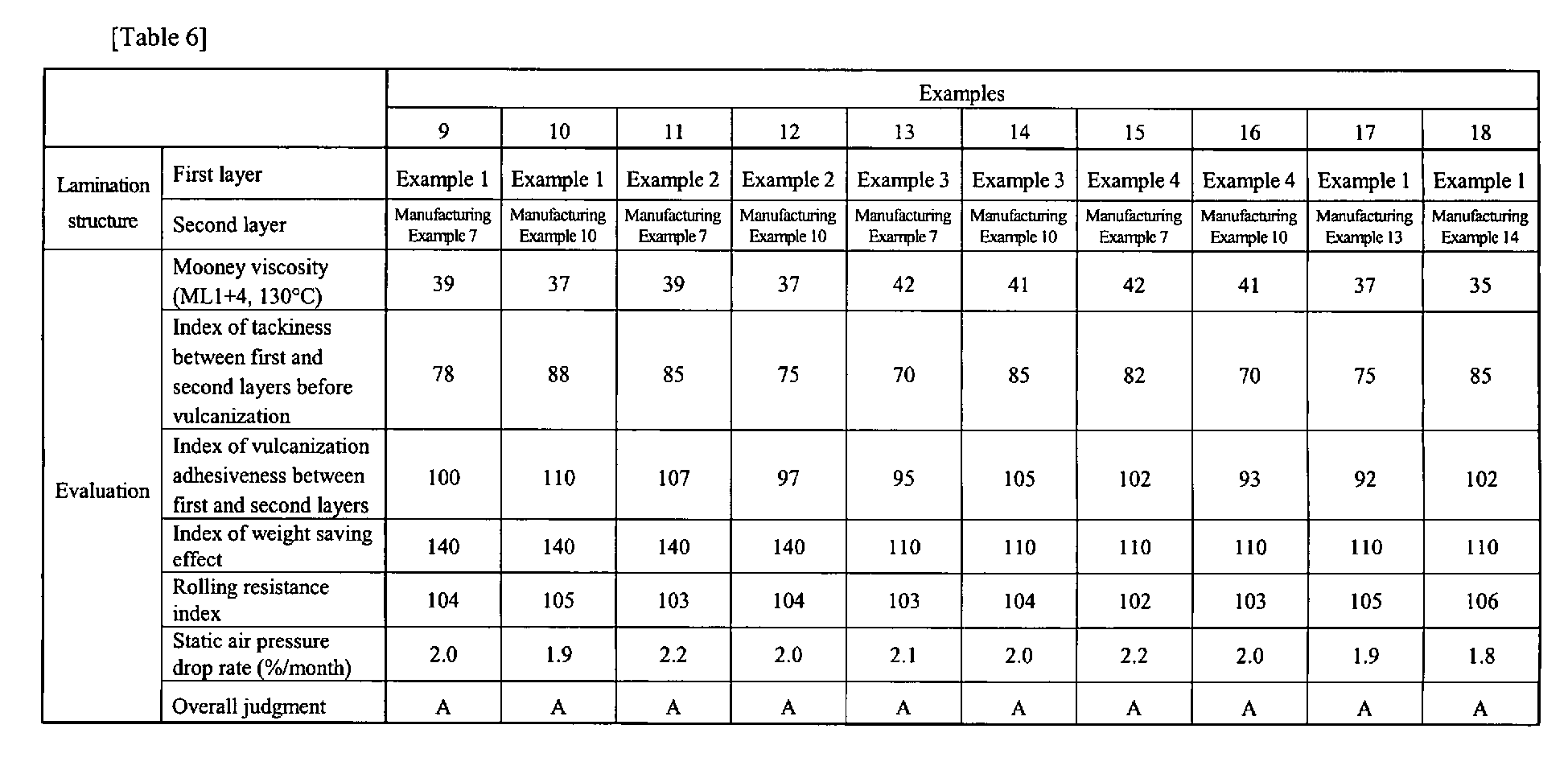
- Examples 5 to 8 are polymer laminates containing the polymer sheets of Examples 1 to 4, respectively, as the first layer and the thermoplastic elastomer sheet of Manufacturing Example 2 as the second layer, and pneumatic tires. The polymer laminates were sufficient in tackiness before vulcanization and vulcanization adhesiveness between the first and second layers. The tires were improved in weight saving effect, rolling resistance, and static air pressure drop rate as compared to Comparative Example 8.
- Comparative Examples 9 to 18 are polymer laminates containing the polymer sheets of Examples 1 to 4, respectively, as the first layer and the thermoplastic elastomer sheets of Manufacturing Examples 7, 10, 13, and 14, respectively, as the second layer, and pneumatic tires. The polymer laminates were sufficient in tackiness before vulcanization and vulcanization adhesiveness between the first and second layers.
- Comparative Examples 9 to 12 are polymer laminates containing the polymer sheets of Examples 1 to 4, respectively, as the first layer and the thermoplastic elastomer sheet of Manufacturing Example 2 as the second layer, and pneumatic tires. The polymer laminates were insufficient in tackiness before vulcanization and vulcanization adhesiveness between the first and second layers.
- Comparative Examples 13 and 14 are polymer laminates containing the polymer sheets of Comparative Examples 6 and 7, respectively, as the first layer and the thermoplastic elastomer sheet of Manufacturing Example 2 as the second layer, and pneumatic tires. The polymer laminates were sufficient in tackiness before vulcanization and vulcanization adhesiveness between the first and second layers, however, the pneumatic tires were similar to Comparative Example 8 in static air pressure drop rate, which was insufficient.
- Although the present invention has been described and illustrated in detail, it is clearly understood that the same is by way of illustration and example only and is not to be taken by way of limitation, the scope of the present invention being interpreted by the terms of the appended claims.
Claims (15)
- A polymer sheet for an inner liner composed of a polymer composition comprising:a polymer component containing more than or equal to 5% by mass and less than or equal to 40% by mass of a styrene-isobutylene-styrene triblock copolymer and more than or equal to 60% by mass and less than or equal to 95% by mass of a rubber component of at least one kind selected from the group consisting of natural rubber, isoprene rubber, and butyl rubber; andmore than or equal to 0.1 part by mass and less than or equal to 5 parts by mass of sulfur with respect to 100 parts by mass of said polymer component.
- The polymer sheet for an inner liner in accordance with claim 1, further containing, with respect to 100 parts by mass of said polymer component, more than or equal to 1 part by mass and less than or equal to 5 parts by mass of stearic acid, more than or equal to 0.1 part by mass and less than or equal to 8 parts by mass of zinc oxide, more than or equal to 0.1 part by mass and less than or equal to 5 parts by mass of an antioxidant, and more than or equal to 0.1 part by mass and less than or equal to 5 parts by mass of a vulcanization accelerator.
- The polymer sheet for an inner liner in accordance with claim 1 or 2,
wherein said styrene-isobutylene-styrene triblock copolymer has a weight-average molecular weight more than or equal to 50,000 and less than or equal to 400,000 and a styrene unit content more than or equal to 10% by mass and less than or equal to 30% by mass. - A polymer laminate for an inner liner comprising:a first layer composed of a polymer composition includinga polymer component containing more than or equal to 5% by mass and less than or equal to 40% by mass of a styrene-isobutylene-styrene triblock copolymer and more than or equal to 60% by mass and less than or equal to 95% by mass of a rubber component of at least one kind selected from the group consisting of natural rubber, isoprene rubber, and butyl rubber, andmore than or equal to 0.1 part by mass and less than or equal to 5 parts by mass of sulfur with respect to 100 parts by mass of said polymer component; anda second layer composed of a thermoplastic elastomer composition containinga thermoplastic elastomer, andmore than or equal to 0.1 part by mass and less than or equal to 5 parts by mass of sulfur with respect to 100 parts by mass of said thermoplastic elastomer.
- The polymer laminate for an inner liner in accordance with claim 4,
wherein said polymer composition further contains, with respect to 100 parts by mass of said polymer component, more than or equal to 1 part by mass and less than or equal to 5 parts by mass of stearic acid, more than or equal to 0.1 part by mass and less than or equal to 8 parts by mass of zinc oxide, more than or equal to 0.1 part by mass and less than or equal to 5 parts by mass of an antioxidant, and more than or equal to 0.1 part by mass and less than or equal to 5 parts by mass of a vulcanization accelerator. - The polymer laminate for an inner liner in accordance with claim 4 or 5,
wherein said thermoplastic elastomer is of at least one kind selected from the group consisting of: a styrene-isoprene-styrene triblock copolymer; a styrene-isobutylene diblock copolymer; a styrene-butadiene-styrene triblock copolymer; a styrene-isoprene·butadiene-styrene triblock copolymer; a styrene-ethylene·butene-styrene triblock copolymer; a styrene-ethylene·propylene-styrene triblock copolymer; a styrene-ethylene·ethylene·propylene-styrene triblock copolymer; a styrene-butadiene·butylene-styrene triblock copolymer; and their epoxy-modified thermoplastic elastomers. - The polymer laminate for an inner liner in accordance with any of claims 4 to 6, wherein said second layer includes at least one of an SIS layer with said thermoplastic elastomer composed of a styrene-isoprene-styrene triblock copolymer, an SIB layer with said thermoplastic elastomer composed of a styrene-isobutylene diblock copolymer, and an epoxidized SBS layer with said thermoplastic elastomer composed of an epoxidized styrene-butadiene-styrene triblock copolymer.
- The polymer laminate for an inner liner in accordance with any of claims 4 to 7, wherein said thermoplastic elastomer composition further contains, with respect to 100 parts by mass of said thermoplastic elastomer, more than or equal to 1 part by mass and less than or equal to 5 parts by mass of stearic acid, more than or equal to 0.1 part by mass and less than or equal to 8 parts by mass of zinc oxide, more than or equal to 0.1 part by mass and less than or equal to 5 parts by mass of an antioxidant, and more than or equal to 0.1 part by mass and less than or equal to 5 parts by mass of a vulcanization accelerator.
- The polymer laminate for an inner liner in accordance with any of claims 4 to 8, wherein said styrene-isobutylene-styrene triblock copolymer has a weight-average molecular weight more than or equal to 50,000 and less than or equal to 400,000 and a styrene unit content more than or equal to 10% by mass and less than or equal to 30% by mass.
- The polymer laminate for an inner liner in accordance with any of claims 6 to 9, wherein said styrene-isoprene-styrene triblock copolymer has a weight-average molecular weight more than or equal to 100,000 and less than or equal to 290,000 and a styrene unit content more than or equal to 10% by mass and less than or equal to 30% by mass.
- The polymer laminate for an inner liner in accordance with any of claims 6 to 10, wherein said styrene-isobutylene diblock copolymer is linear and has a weight-average molecular weight more than or equal to 40,000 and less than or equal to 120,000 and a styrene unit content more than or equal to 10% by mass and less than or equal to 35% by mass.
- The polymer laminate for an inner liner in accordance with any of claims 6 to 11, wherein said epoxidized styrene-butadiene-styrene triblock copolymer has a weight-average molecular weight more than or equal to 10,000 and less than or equal to 400,000, a styrene unit content more than or equal to 10% by mass and less than or equal to 30% by mass, and an epoxy equivalent more than or equal to 50 and less than or equal to 1,000.
- The polymer laminate for an inner liner in accordance with any of claims 4 to 12, wherein said second layer further contains a rubber component of at least one kind selected from the group consisting of natural rubber, isoprene rubber, and butyl rubber, in addition to said thermoplastic elastomer composition, said rubber component being more than or equal to 20% by mass and less than or equal to 90% by mass with respect to a total of said thermoplastic elastomer composition and said rubber component.
- A pneumatic tire, wherein the polymer sheet for an inner liner as defined in any of claims 1 to 3 is used for an inner liner part.
- A pneumatic tire, wherein the polymer laminate for an inner liner as defined in any of claims 4 to 13 is used for an inner liner part.
Applications Claiming Priority (2)
| Application Number | Priority Date | Filing Date | Title |
|---|---|---|---|
| JP2010172394 | 2010-07-30 | ||
| JP2010254501 | 2010-11-15 |
Publications (2)
| Publication Number | Publication Date |
|---|---|
| EP2415617A1 true EP2415617A1 (en) | 2012-02-08 |
| EP2415617B1 EP2415617B1 (en) | 2014-05-14 |
Family
ID=44785080
Family Applications (1)
| Application Number | Title | Priority Date | Filing Date |
|---|---|---|---|
| EP20110004002 Not-in-force EP2415617B1 (en) | 2010-07-30 | 2011-05-13 | Polymer sheet for inner liner, polymer laminate for inner liner, and pneumatic tire |
Country Status (7)
| Country | Link |
|---|---|
| US (1) | US8656973B2 (en) |
| EP (1) | EP2415617B1 (en) |
| JP (1) | JP5508347B2 (en) |
| KR (1) | KR20120022542A (en) |
| CN (1) | CN102399380A (en) |
| BR (1) | BRPI1103898A2 (en) |
| RU (1) | RU2011131499A (en) |
Cited By (11)
| Publication number | Priority date | Publication date | Assignee | Title |
|---|---|---|---|---|
| WO2014146909A1 (en) * | 2013-03-22 | 2014-09-25 | Compagnie Generale Des Etablissements Michelin | Multilayer laminate for tyres |
| FR3003506A1 (en) * | 2013-03-22 | 2014-09-26 | Michelin & Cie | MULTILAYER LAMINATE FOR PNEUMATIC |
| EP2684661A4 (en) * | 2011-05-13 | 2014-10-08 | Sumitomo Rubber Ind | PROCESS FOR PRODUCING TIRE |
| CN104582979A (en) * | 2012-09-11 | 2015-04-29 | 住友橡胶工业株式会社 | Pneumatic tire provided with inner liner |
| EP2848642A4 (en) * | 2012-05-08 | 2016-01-27 | Bridgestone Corp | RUBBER SHEET, TIRE USING THE SAME, AND PROCESS FOR PRODUCING RUBBER SHEET |
| EP2875968A4 (en) * | 2012-08-01 | 2016-03-09 | Sumitomo Rubber Ind | Pneumatic tire provided with inner liner |
| EP2921321A4 (en) * | 2012-12-04 | 2016-08-03 | Sumitomo Rubber Ind | PNEUMATIC |
| US9855798B2 (en) | 2011-07-28 | 2018-01-02 | Sumitomo Rubber Industries, Ltd. | Pneumatic tire |
| EP2791236B1 (en) * | 2011-12-16 | 2018-05-02 | Compagnie Générale des Etablissements Michelin | Tyre provided with an inner layer comprising a mixture of a diene elastomer and a thermoplastic elastomer |
| EP3184325A4 (en) * | 2014-08-22 | 2018-05-09 | The Yokohama Rubber Co., Ltd. | Pneumatic tire for heavy load |
| CN115038595A (en) * | 2020-02-19 | 2022-09-09 | 住友橡胶工业株式会社 | tire |
Families Citing this family (20)
| Publication number | Priority date | Publication date | Assignee | Title |
|---|---|---|---|---|
| JP5004196B2 (en) * | 2009-09-18 | 2012-08-22 | 住友ゴム工業株式会社 | Pneumatic tire manufacturing method |
| EP2708379A4 (en) * | 2011-05-13 | 2015-10-28 | Sumitomo Rubber Ind | TIRE |
| IN2014CN01049A (en) * | 2011-09-16 | 2015-04-10 | Sumitomo Rubber Ind | |
| FR2984340B1 (en) * | 2011-12-16 | 2018-01-12 | Soc Tech Michelin | TIRE HAVING AN EXTERNAL FLAN BASED ON A MIXTURE OF DIENE ELASTOMER AND THERMOPLASTIC ELASTOMER |
| JP5349630B2 (en) * | 2012-02-06 | 2013-11-20 | 住友ゴム工業株式会社 | Pneumatic tire |
| CN102673055A (en) * | 2012-04-27 | 2012-09-19 | 北京市射线应用研究中心 | Thinned lining airtight layer component for radial tire |
| CN102816404B (en) * | 2012-05-19 | 2015-08-12 | 青岛科技大学 | A kind of pre-dispersed rubber accelerator master batch and preparation method thereof |
| FR2993817B1 (en) * | 2012-07-30 | 2014-08-08 | Michelin & Cie | MULTILAYER LAMINATE FOR PNEUMATIC |
| FR2993816B1 (en) * | 2012-07-30 | 2014-08-08 | Michelin & Cie | MULTILAYER LAMINATE FOR PNEUMATIC |
| JP5809118B2 (en) * | 2012-08-15 | 2015-11-10 | 住友ゴム工業株式会社 | Pneumatic tire |
| JP2014040217A (en) * | 2012-08-23 | 2014-03-06 | Sumitomo Rubber Ind Ltd | Pneumatic tire |
| JP6267419B2 (en) * | 2012-11-28 | 2018-01-24 | 住友ゴム工業株式会社 | Rubber composition for tire and pneumatic tire |
| JP6267420B2 (en) * | 2012-11-28 | 2018-01-24 | 住友ゴム工業株式会社 | Rubber composition for tire and pneumatic tire |
| CN105026176B (en) * | 2013-03-05 | 2017-03-15 | 米其林集团总公司 | Elastomeric laminating thing for tire |
| FR3002879B1 (en) * | 2013-03-05 | 2015-04-03 | Michelin & Cie | MULTILAYER LAMINATE FOR PNEUMATIC |
| CN105209666B (en) * | 2013-03-13 | 2017-11-10 | 流体公司 | Concertedness additive for the electrochemical cell with electro-deposition fuel |
| FR3016829B1 (en) * | 2014-01-28 | 2016-01-29 | Michelin & Cie | MULTILAYER LAMINATE FOR PNEUMATIC |
| CN108017728B (en) * | 2016-11-01 | 2021-04-13 | 中国石油化工股份有限公司 | Rubber composition, modified rubber with self-healing function and preparation method and application thereof |
| JP6844371B2 (en) * | 2017-03-28 | 2021-03-17 | 住友ゴム工業株式会社 | Pneumatic tires |
| EP4644481A1 (en) * | 2024-04-30 | 2025-11-05 | Kraton Polymers Nederland B.V. | Polymer compositions and methods of preparation thereof |
Citations (14)
| Publication number | Priority date | Publication date | Assignee | Title |
|---|---|---|---|---|
| JPS6248704A (en) | 1985-06-20 | 1987-03-03 | ザ・ユニバ−シテイ・オブ・アクロン | Complex and its production |
| JPS6462308A (en) | 1986-08-25 | 1989-03-08 | Pii Kenedeii Jiyosefu | Complex and its production |
| US4946899A (en) | 1988-12-16 | 1990-08-07 | The University Of Akron | Thermoplastic elastomers of isobutylene and process of preparation |
| JPH03174403A (en) | 1989-05-08 | 1991-07-29 | Nippon Zeon Co Ltd | Production of polymer |
| US5219948A (en) | 1992-02-21 | 1993-06-15 | University Of Southern Mississippi | Process for cationic polymerizations |
| JPH09165469A (en) | 1995-10-13 | 1997-06-24 | Sumitomo Rubber Ind Ltd | Pneumatic tire |
| JP2001279051A (en) * | 2000-03-31 | 2001-10-10 | Kanegafuchi Chem Ind Co Ltd | Vulcanized rubber |
| WO2005033035A1 (en) | 2003-10-02 | 2005-04-14 | Kaneka Corporation | Sealing material for double-glazing pane comprising resin composition with excellent gas-barrier property and hot-melt tackiness |
| US20060229402A1 (en) * | 2001-02-13 | 2006-10-12 | Varma Rajesh K | Essentially gas-impermeable thermoplastic sealant |
| FR2916679A1 (en) * | 2007-05-29 | 2008-12-05 | Michelin Soc Tech | PNEUMATIC OBJECT COMPRISING A GAS SEALED LAYER BASED ON A THERMOPLASTIC ELASTOMER |
| FR2917010A1 (en) * | 2007-06-08 | 2008-12-12 | Michelin Soc Tech | MULTILAYER LAMINATE GAS TIGHT AND ANTI-CURVING AND PNEUMATIC OBJECT COMPRISING SAME |
| WO2009119232A1 (en) * | 2008-03-26 | 2009-10-01 | 住友ゴム工業株式会社 | Polymer mixture, polymer composition and pneumatic tire |
| JP2010172394A (en) | 2009-01-27 | 2010-08-12 | Panasonic Electric Works Co Ltd | Walking state display |
| JP2010254501A (en) | 2009-04-23 | 2010-11-11 | Mitsui Mining & Smelting Co Ltd | A processing method for obtaining a niobium raw material or a tantalum raw material, a method for separating and purifying niobium or tantalum, and a method for producing niobium oxide or tantalum oxide. |
Family Cites Families (14)
| Publication number | Priority date | Publication date | Assignee | Title |
|---|---|---|---|---|
| US4569382A (en) * | 1981-05-11 | 1986-02-11 | The Goodyear Tire & Rubber Company | Composite of rubber and metal reinforcement therefor |
| US4910321A (en) | 1985-06-20 | 1990-03-20 | University Of Akron | Living catalysts, complexes and polymers therefrom |
| IL106891A (en) * | 1992-09-04 | 1997-07-13 | Moore Co | ENR-NR composition |
| US6079465A (en) * | 1995-01-23 | 2000-06-27 | The Yokohama Rubber Co., Ltd. | Polymer composition for tire and pneumatic tire using same |
| US20040030036A1 (en) * | 2001-10-16 | 2004-02-12 | Waddell Walter H. | Elastomeric composition |
| JP2004090589A (en) * | 2002-09-04 | 2004-03-25 | Yokohama Rubber Co Ltd:The | Steel cord topping method |
| US7927695B2 (en) * | 2006-05-31 | 2011-04-19 | Exxonmobil Chemical Patents Inc. | Composite roofing and methods of producing composite roofing |
| JP2007326909A (en) * | 2006-06-06 | 2007-12-20 | Toyo Tire & Rubber Co Ltd | Pneumatic tire |
| JP5132133B2 (en) * | 2006-11-20 | 2013-01-30 | 東洋ゴム工業株式会社 | Rubber composition for inner liner and pneumatic tire |
| JP2010013647A (en) * | 2008-03-26 | 2010-01-21 | Sumitomo Rubber Ind Ltd | Sidewall-protective film and pneumatic tire |
| JP2010100675A (en) * | 2008-10-21 | 2010-05-06 | Kaneka Corp | Composition for inner liner of pneumatic tire, and the inner liner of pneumatic tire |
| FR2939076B1 (en) * | 2008-12-03 | 2011-10-21 | Michelin Soc Tech | AIR-LAYERED MULTILAYER LAMINATE FOR PNEUMATIC OBJECT |
| KR101604874B1 (en) | 2009-03-05 | 2016-03-18 | 엘지전자 주식회사 | Method and apparatus of updating for system information in a broadband wireless communication system |
| JP4831706B2 (en) * | 2009-09-04 | 2011-12-07 | 住友ゴム工業株式会社 | Polymer laminate and pneumatic tire using the same for inner liner |
-
2011
- 2011-05-13 EP EP20110004002 patent/EP2415617B1/en not_active Not-in-force
- 2011-06-17 CN CN2011101756845A patent/CN102399380A/en active Pending
- 2011-06-22 KR KR20110060753A patent/KR20120022542A/en not_active Withdrawn
- 2011-06-24 JP JP2011140540A patent/JP5508347B2/en not_active Expired - Fee Related
- 2011-07-14 US US13/182,537 patent/US8656973B2/en not_active Expired - Fee Related
- 2011-07-28 RU RU2011131499/05A patent/RU2011131499A/en not_active Application Discontinuation
- 2011-08-01 BR BRPI1103898A patent/BRPI1103898A2/en not_active IP Right Cessation
Patent Citations (14)
| Publication number | Priority date | Publication date | Assignee | Title |
|---|---|---|---|---|
| JPS6248704A (en) | 1985-06-20 | 1987-03-03 | ザ・ユニバ−シテイ・オブ・アクロン | Complex and its production |
| JPS6462308A (en) | 1986-08-25 | 1989-03-08 | Pii Kenedeii Jiyosefu | Complex and its production |
| US4946899A (en) | 1988-12-16 | 1990-08-07 | The University Of Akron | Thermoplastic elastomers of isobutylene and process of preparation |
| JPH03174403A (en) | 1989-05-08 | 1991-07-29 | Nippon Zeon Co Ltd | Production of polymer |
| US5219948A (en) | 1992-02-21 | 1993-06-15 | University Of Southern Mississippi | Process for cationic polymerizations |
| JPH09165469A (en) | 1995-10-13 | 1997-06-24 | Sumitomo Rubber Ind Ltd | Pneumatic tire |
| JP2001279051A (en) * | 2000-03-31 | 2001-10-10 | Kanegafuchi Chem Ind Co Ltd | Vulcanized rubber |
| US20060229402A1 (en) * | 2001-02-13 | 2006-10-12 | Varma Rajesh K | Essentially gas-impermeable thermoplastic sealant |
| WO2005033035A1 (en) | 2003-10-02 | 2005-04-14 | Kaneka Corporation | Sealing material for double-glazing pane comprising resin composition with excellent gas-barrier property and hot-melt tackiness |
| FR2916679A1 (en) * | 2007-05-29 | 2008-12-05 | Michelin Soc Tech | PNEUMATIC OBJECT COMPRISING A GAS SEALED LAYER BASED ON A THERMOPLASTIC ELASTOMER |
| FR2917010A1 (en) * | 2007-06-08 | 2008-12-12 | Michelin Soc Tech | MULTILAYER LAMINATE GAS TIGHT AND ANTI-CURVING AND PNEUMATIC OBJECT COMPRISING SAME |
| WO2009119232A1 (en) * | 2008-03-26 | 2009-10-01 | 住友ゴム工業株式会社 | Polymer mixture, polymer composition and pneumatic tire |
| JP2010172394A (en) | 2009-01-27 | 2010-08-12 | Panasonic Electric Works Co Ltd | Walking state display |
| JP2010254501A (en) | 2009-04-23 | 2010-11-11 | Mitsui Mining & Smelting Co Ltd | A processing method for obtaining a niobium raw material or a tantalum raw material, a method for separating and purifying niobium or tantalum, and a method for producing niobium oxide or tantalum oxide. |
Non-Patent Citations (2)
| Title |
|---|
| DATABASE WPI Week 200209, Derwent World Patents Index; AN 2002-064488, XP002662209 * |
| DATABASE WPI Week 200967, Derwent World Patents Index; AN 2009-P20457, XP002662210 * |
Cited By (15)
| Publication number | Priority date | Publication date | Assignee | Title |
|---|---|---|---|---|
| EP2684661A4 (en) * | 2011-05-13 | 2014-10-08 | Sumitomo Rubber Ind | PROCESS FOR PRODUCING TIRE |
| US9855798B2 (en) | 2011-07-28 | 2018-01-02 | Sumitomo Rubber Industries, Ltd. | Pneumatic tire |
| EP2791236B1 (en) * | 2011-12-16 | 2018-05-02 | Compagnie Générale des Etablissements Michelin | Tyre provided with an inner layer comprising a mixture of a diene elastomer and a thermoplastic elastomer |
| EP2848642A4 (en) * | 2012-05-08 | 2016-01-27 | Bridgestone Corp | RUBBER SHEET, TIRE USING THE SAME, AND PROCESS FOR PRODUCING RUBBER SHEET |
| EP2875968A4 (en) * | 2012-08-01 | 2016-03-09 | Sumitomo Rubber Ind | Pneumatic tire provided with inner liner |
| US10272721B2 (en) | 2012-08-01 | 2019-04-30 | Sumitomo Rubber Industries, Ltd. | Pneumatic tire including inner liner |
| CN104582979B (en) * | 2012-09-11 | 2017-08-01 | 住友橡胶工业株式会社 | Possesses the pneumatic tire of inner liner |
| CN104582979A (en) * | 2012-09-11 | 2015-04-29 | 住友橡胶工业株式会社 | Pneumatic tire provided with inner liner |
| EP2921321A4 (en) * | 2012-12-04 | 2016-08-03 | Sumitomo Rubber Ind | PNEUMATIC |
| FR3003506A1 (en) * | 2013-03-22 | 2014-09-26 | Michelin & Cie | MULTILAYER LAMINATE FOR PNEUMATIC |
| WO2014146909A1 (en) * | 2013-03-22 | 2014-09-25 | Compagnie Generale Des Etablissements Michelin | Multilayer laminate for tyres |
| FR3003507A1 (en) * | 2013-03-22 | 2014-09-26 | Michelin & Cie | MULTILAYER LAMINATE FOR PNEUMATIC |
| EP3184325A4 (en) * | 2014-08-22 | 2018-05-09 | The Yokohama Rubber Co., Ltd. | Pneumatic tire for heavy load |
| CN115038595A (en) * | 2020-02-19 | 2022-09-09 | 住友橡胶工业株式会社 | tire |
| EP4082774A4 (en) * | 2020-02-19 | 2024-01-24 | Sumitomo Rubber Industries, Ltd. | PNEUMATIC |
Also Published As
| Publication number | Publication date |
|---|---|
| JP5508347B2 (en) | 2014-05-28 |
| EP2415617B1 (en) | 2014-05-14 |
| US20120024447A1 (en) | 2012-02-02 |
| JP2012122050A (en) | 2012-06-28 |
| BRPI1103898A2 (en) | 2015-11-17 |
| RU2011131499A (en) | 2013-02-10 |
| CN102399380A (en) | 2012-04-04 |
| KR20120022542A (en) | 2012-03-12 |
| US8656973B2 (en) | 2014-02-25 |
Similar Documents
| Publication | Publication Date | Title |
|---|---|---|
| EP2415617B1 (en) | Polymer sheet for inner liner, polymer laminate for inner liner, and pneumatic tire | |
| EP2298577B1 (en) | Polymer laminate and pneumatic tire using the same as inner liner | |
| EP2404766B1 (en) | Polymer sheet for inner liner and pneumatic tire using the same | |
| EP2636542A1 (en) | Pneumatic tire | |
| EP2402175B1 (en) | Method for producing pneumatic tire and pneumatic tire | |
| US20180186111A1 (en) | Pneumatic tire and method for manufacturing the same, and tire vulcanizing bladder | |
| BRPI1103578A2 (en) | Interior coating polymer sheet, pneumatic interior coating polymer laminate | |
| EP2623304B1 (en) | Production method for pneumatic tires | |
| WO2012070265A1 (en) | Pneumatic tire and production method thereof | |
| EP2803500B1 (en) | Pneumatic tire | |
| WO2014020956A1 (en) | Pneumatic tire provided with inner liner | |
| JP2012045779A (en) | Bladder for vulcanizing tire and pneumatic tire manufactured using this same | |
| JP5053452B1 (en) | Pneumatic tire | |
| JP6262646B2 (en) | Pneumatic tire | |
| EP2684661A1 (en) | Method for producing pneumatic tire | |
| JP2015013616A (en) | Tire for truck or bus |
Legal Events
| Date | Code | Title | Description |
|---|---|---|---|
| AK | Designated contracting states |
Kind code of ref document: A1 Designated state(s): AL AT BE BG CH CY CZ DE DK EE ES FI FR GB GR HR HU IE IS IT LI LT LU LV MC MK MT NL NO PL PT RO RS SE SI SK SM TR |
|
| AX | Request for extension of the european patent |
Extension state: BA ME |
|
| PUAI | Public reference made under article 153(3) epc to a published international application that has entered the european phase |
Free format text: ORIGINAL CODE: 0009012 |
|
| 17P | Request for examination filed |
Effective date: 20120807 |
|
| 17Q | First examination report despatched |
Effective date: 20130109 |
|
| GRAP | Despatch of communication of intention to grant a patent |
Free format text: ORIGINAL CODE: EPIDOSNIGR1 |
|
| RIC1 | Information provided on ipc code assigned before grant |
Ipc: C08L 23/22 20060101ALN20131024BHEP Ipc: B32B 27/26 20060101ALI20131024BHEP Ipc: B32B 25/08 20060101ALI20131024BHEP Ipc: C08L 23/28 20060101ALN20131024BHEP Ipc: B60C 5/14 20060101ALI20131024BHEP Ipc: C08L 7/00 20060101ALN20131024BHEP Ipc: C08L 9/00 20060101ALN20131024BHEP Ipc: B32B 25/12 20060101ALI20131024BHEP Ipc: B60C 1/00 20060101AFI20131024BHEP Ipc: B32B 25/18 20060101ALI20131024BHEP Ipc: C08L 53/02 20060101ALI20131024BHEP |
|
| RIC1 | Information provided on ipc code assigned before grant |
Ipc: B32B 27/26 20060101ALI20131028BHEP Ipc: B32B 25/12 20060101ALI20131028BHEP Ipc: C08L 7/00 20060101ALN20131028BHEP Ipc: C08L 9/00 20060101ALN20131028BHEP Ipc: B60C 5/14 20060101ALI20131028BHEP Ipc: C08L 23/28 20060101ALN20131028BHEP Ipc: C08L 23/22 20060101ALN20131028BHEP Ipc: B60C 1/00 20060101AFI20131028BHEP Ipc: B32B 25/08 20060101ALI20131028BHEP Ipc: C08L 53/02 20060101ALI20131028BHEP Ipc: B32B 25/18 20060101ALI20131028BHEP |
|
| INTG | Intention to grant announced |
Effective date: 20131122 |
|
| GRAS | Grant fee paid |
Free format text: ORIGINAL CODE: EPIDOSNIGR3 |
|
| GRAA | (expected) grant |
Free format text: ORIGINAL CODE: 0009210 |
|
| AK | Designated contracting states |
Kind code of ref document: B1 Designated state(s): AL AT BE BG CH CY CZ DE DK EE ES FI FR GB GR HR HU IE IS IT LI LT LU LV MC MK MT NL NO PL PT RO RS SE SI SK SM TR |
|
| REG | Reference to a national code |
Ref country code: GB Ref legal event code: FG4D |
|
| REG | Reference to a national code |
Ref country code: AT Ref legal event code: REF Ref document number: 667963 Country of ref document: AT Kind code of ref document: T Effective date: 20140615 |
|
| REG | Reference to a national code |
Ref country code: IE Ref legal event code: FG4D |
|
| REG | Reference to a national code |
Ref country code: DE Ref legal event code: R096 Ref document number: 602011006832 Country of ref document: DE Effective date: 20140703 |
|
| REG | Reference to a national code |
Ref country code: NL Ref legal event code: VDEP Effective date: 20140514 Ref country code: AT Ref legal event code: MK05 Ref document number: 667963 Country of ref document: AT Kind code of ref document: T Effective date: 20140514 |
|
| REG | Reference to a national code |
Ref country code: LT Ref legal event code: MG4D |
|
| PG25 | Lapsed in a contracting state [announced via postgrant information from national office to epo] |
Ref country code: GR Free format text: LAPSE BECAUSE OF FAILURE TO SUBMIT A TRANSLATION OF THE DESCRIPTION OR TO PAY THE FEE WITHIN THE PRESCRIBED TIME-LIMIT Effective date: 20140815 Ref country code: FI Free format text: LAPSE BECAUSE OF FAILURE TO SUBMIT A TRANSLATION OF THE DESCRIPTION OR TO PAY THE FEE WITHIN THE PRESCRIBED TIME-LIMIT Effective date: 20140514 Ref country code: NO Free format text: LAPSE BECAUSE OF FAILURE TO SUBMIT A TRANSLATION OF THE DESCRIPTION OR TO PAY THE FEE WITHIN THE PRESCRIBED TIME-LIMIT Effective date: 20140814 Ref country code: CY Free format text: LAPSE BECAUSE OF FAILURE TO SUBMIT A TRANSLATION OF THE DESCRIPTION OR TO PAY THE FEE WITHIN THE PRESCRIBED TIME-LIMIT Effective date: 20140514 Ref country code: LT Free format text: LAPSE BECAUSE OF FAILURE TO SUBMIT A TRANSLATION OF THE DESCRIPTION OR TO PAY THE FEE WITHIN THE PRESCRIBED TIME-LIMIT Effective date: 20140514 Ref country code: IS Free format text: LAPSE BECAUSE OF FAILURE TO SUBMIT A TRANSLATION OF THE DESCRIPTION OR TO PAY THE FEE WITHIN THE PRESCRIBED TIME-LIMIT Effective date: 20140914 |
|
| PG25 | Lapsed in a contracting state [announced via postgrant information from national office to epo] |
Ref country code: PL Free format text: LAPSE BECAUSE OF FAILURE TO SUBMIT A TRANSLATION OF THE DESCRIPTION OR TO PAY THE FEE WITHIN THE PRESCRIBED TIME-LIMIT Effective date: 20140514 Ref country code: LV Free format text: LAPSE BECAUSE OF FAILURE TO SUBMIT A TRANSLATION OF THE DESCRIPTION OR TO PAY THE FEE WITHIN THE PRESCRIBED TIME-LIMIT Effective date: 20140514 Ref country code: AT Free format text: LAPSE BECAUSE OF FAILURE TO SUBMIT A TRANSLATION OF THE DESCRIPTION OR TO PAY THE FEE WITHIN THE PRESCRIBED TIME-LIMIT Effective date: 20140514 Ref country code: ES Free format text: LAPSE BECAUSE OF FAILURE TO SUBMIT A TRANSLATION OF THE DESCRIPTION OR TO PAY THE FEE WITHIN THE PRESCRIBED TIME-LIMIT Effective date: 20140514 Ref country code: HR Free format text: LAPSE BECAUSE OF FAILURE TO SUBMIT A TRANSLATION OF THE DESCRIPTION OR TO PAY THE FEE WITHIN THE PRESCRIBED TIME-LIMIT Effective date: 20140514 Ref country code: SE Free format text: LAPSE BECAUSE OF FAILURE TO SUBMIT A TRANSLATION OF THE DESCRIPTION OR TO PAY THE FEE WITHIN THE PRESCRIBED TIME-LIMIT Effective date: 20140514 Ref country code: RS Free format text: LAPSE BECAUSE OF FAILURE TO SUBMIT A TRANSLATION OF THE DESCRIPTION OR TO PAY THE FEE WITHIN THE PRESCRIBED TIME-LIMIT Effective date: 20140514 |
|
| PG25 | Lapsed in a contracting state [announced via postgrant information from national office to epo] |
Ref country code: PT Free format text: LAPSE BECAUSE OF FAILURE TO SUBMIT A TRANSLATION OF THE DESCRIPTION OR TO PAY THE FEE WITHIN THE PRESCRIBED TIME-LIMIT Effective date: 20140915 |
|
| PG25 | Lapsed in a contracting state [announced via postgrant information from national office to epo] |
Ref country code: RO Free format text: LAPSE BECAUSE OF FAILURE TO SUBMIT A TRANSLATION OF THE DESCRIPTION OR TO PAY THE FEE WITHIN THE PRESCRIBED TIME-LIMIT Effective date: 20140514 Ref country code: BE Free format text: LAPSE BECAUSE OF FAILURE TO SUBMIT A TRANSLATION OF THE DESCRIPTION OR TO PAY THE FEE WITHIN THE PRESCRIBED TIME-LIMIT Effective date: 20140514 Ref country code: EE Free format text: LAPSE BECAUSE OF FAILURE TO SUBMIT A TRANSLATION OF THE DESCRIPTION OR TO PAY THE FEE WITHIN THE PRESCRIBED TIME-LIMIT Effective date: 20140514 Ref country code: DK Free format text: LAPSE BECAUSE OF FAILURE TO SUBMIT A TRANSLATION OF THE DESCRIPTION OR TO PAY THE FEE WITHIN THE PRESCRIBED TIME-LIMIT Effective date: 20140514 Ref country code: SK Free format text: LAPSE BECAUSE OF FAILURE TO SUBMIT A TRANSLATION OF THE DESCRIPTION OR TO PAY THE FEE WITHIN THE PRESCRIBED TIME-LIMIT Effective date: 20140514 Ref country code: CZ Free format text: LAPSE BECAUSE OF FAILURE TO SUBMIT A TRANSLATION OF THE DESCRIPTION OR TO PAY THE FEE WITHIN THE PRESCRIBED TIME-LIMIT Effective date: 20140514 |
|
| REG | Reference to a national code |
Ref country code: DE Ref legal event code: R097 Ref document number: 602011006832 Country of ref document: DE |
|
| PG25 | Lapsed in a contracting state [announced via postgrant information from national office to epo] |
Ref country code: NL Free format text: LAPSE BECAUSE OF FAILURE TO SUBMIT A TRANSLATION OF THE DESCRIPTION OR TO PAY THE FEE WITHIN THE PRESCRIBED TIME-LIMIT Effective date: 20140514 |
|
| PLBE | No opposition filed within time limit |
Free format text: ORIGINAL CODE: 0009261 |
|
| STAA | Information on the status of an ep patent application or granted ep patent |
Free format text: STATUS: NO OPPOSITION FILED WITHIN TIME LIMIT |
|
| 26N | No opposition filed |
Effective date: 20150217 |
|
| PG25 | Lapsed in a contracting state [announced via postgrant information from national office to epo] |
Ref country code: IT Free format text: LAPSE BECAUSE OF FAILURE TO SUBMIT A TRANSLATION OF THE DESCRIPTION OR TO PAY THE FEE WITHIN THE PRESCRIBED TIME-LIMIT Effective date: 20140514 |
|
| REG | Reference to a national code |
Ref country code: DE Ref legal event code: R097 Ref document number: 602011006832 Country of ref document: DE Effective date: 20150217 |
|
| PG25 | Lapsed in a contracting state [announced via postgrant information from national office to epo] |
Ref country code: SI Free format text: LAPSE BECAUSE OF FAILURE TO SUBMIT A TRANSLATION OF THE DESCRIPTION OR TO PAY THE FEE WITHIN THE PRESCRIBED TIME-LIMIT Effective date: 20140514 |
|
| REG | Reference to a national code |
Ref country code: DE Ref legal event code: R119 Ref document number: 602011006832 Country of ref document: DE |
|
| REG | Reference to a national code |
Ref country code: CH Ref legal event code: PL |
|
| GBPC | Gb: european patent ceased through non-payment of renewal fee |
Effective date: 20150513 |
|
| PG25 | Lapsed in a contracting state [announced via postgrant information from national office to epo] |
Ref country code: LI Free format text: LAPSE BECAUSE OF NON-PAYMENT OF DUE FEES Effective date: 20150531 Ref country code: CH Free format text: LAPSE BECAUSE OF NON-PAYMENT OF DUE FEES Effective date: 20150531 Ref country code: LU Free format text: LAPSE BECAUSE OF FAILURE TO SUBMIT A TRANSLATION OF THE DESCRIPTION OR TO PAY THE FEE WITHIN THE PRESCRIBED TIME-LIMIT Effective date: 20150513 Ref country code: MC Free format text: LAPSE BECAUSE OF FAILURE TO SUBMIT A TRANSLATION OF THE DESCRIPTION OR TO PAY THE FEE WITHIN THE PRESCRIBED TIME-LIMIT Effective date: 20140514 |
|
| REG | Reference to a national code |
Ref country code: IE Ref legal event code: MM4A |
|
| REG | Reference to a national code |
Ref country code: FR Ref legal event code: ST Effective date: 20160129 |
|
| PG25 | Lapsed in a contracting state [announced via postgrant information from national office to epo] |
Ref country code: GB Free format text: LAPSE BECAUSE OF NON-PAYMENT OF DUE FEES Effective date: 20150513 Ref country code: IE Free format text: LAPSE BECAUSE OF NON-PAYMENT OF DUE FEES Effective date: 20150513 Ref country code: DE Free format text: LAPSE BECAUSE OF NON-PAYMENT OF DUE FEES Effective date: 20151201 |
|
| PG25 | Lapsed in a contracting state [announced via postgrant information from national office to epo] |
Ref country code: FR Free format text: LAPSE BECAUSE OF NON-PAYMENT OF DUE FEES Effective date: 20150601 |
|
| PG25 | Lapsed in a contracting state [announced via postgrant information from national office to epo] |
Ref country code: MT Free format text: LAPSE BECAUSE OF FAILURE TO SUBMIT A TRANSLATION OF THE DESCRIPTION OR TO PAY THE FEE WITHIN THE PRESCRIBED TIME-LIMIT Effective date: 20140514 |
|
| PG25 | Lapsed in a contracting state [announced via postgrant information from national office to epo] |
Ref country code: HU Free format text: LAPSE BECAUSE OF FAILURE TO SUBMIT A TRANSLATION OF THE DESCRIPTION OR TO PAY THE FEE WITHIN THE PRESCRIBED TIME-LIMIT; INVALID AB INITIO Effective date: 20110513 |
|
| PG25 | Lapsed in a contracting state [announced via postgrant information from national office to epo] |
Ref country code: BG Free format text: LAPSE BECAUSE OF THE APPLICANT RENOUNCES Effective date: 20150531 |
|
| PG25 | Lapsed in a contracting state [announced via postgrant information from national office to epo] |
Ref country code: SM Free format text: LAPSE BECAUSE OF FAILURE TO SUBMIT A TRANSLATION OF THE DESCRIPTION OR TO PAY THE FEE WITHIN THE PRESCRIBED TIME-LIMIT Effective date: 20140514 |
|
| PG25 | Lapsed in a contracting state [announced via postgrant information from national office to epo] |
Ref country code: TR Free format text: LAPSE BECAUSE OF FAILURE TO SUBMIT A TRANSLATION OF THE DESCRIPTION OR TO PAY THE FEE WITHIN THE PRESCRIBED TIME-LIMIT Effective date: 20140514 |
|
| PG25 | Lapsed in a contracting state [announced via postgrant information from national office to epo] |
Ref country code: MK Free format text: LAPSE BECAUSE OF FAILURE TO SUBMIT A TRANSLATION OF THE DESCRIPTION OR TO PAY THE FEE WITHIN THE PRESCRIBED TIME-LIMIT Effective date: 20140514 |
|
| PG25 | Lapsed in a contracting state [announced via postgrant information from national office to epo] |
Ref country code: AL Free format text: LAPSE BECAUSE OF FAILURE TO SUBMIT A TRANSLATION OF THE DESCRIPTION OR TO PAY THE FEE WITHIN THE PRESCRIBED TIME-LIMIT Effective date: 20140514 |