EP2412701A1 - Novel amide derivative and skin whitening agent - Google Patents
Novel amide derivative and skin whitening agent Download PDFInfo
- Publication number
- EP2412701A1 EP2412701A1 EP10756149A EP10756149A EP2412701A1 EP 2412701 A1 EP2412701 A1 EP 2412701A1 EP 10756149 A EP10756149 A EP 10756149A EP 10756149 A EP10756149 A EP 10756149A EP 2412701 A1 EP2412701 A1 EP 2412701A1
- Authority
- EP
- European Patent Office
- Prior art keywords
- group
- hydrogen atom
- carbon number
- compound
- hydroxyl
- Prior art date
- Legal status (The legal status is an assumption and is not a legal conclusion. Google has not performed a legal analysis and makes no representation as to the accuracy of the status listed.)
- Granted
Links
- 150000001408 amides Chemical class 0.000 title description 2
- 239000007854 depigmenting agent Substances 0.000 title 1
- 150000001875 compounds Chemical class 0.000 claims abstract description 91
- 150000003839 salts Chemical class 0.000 claims abstract description 28
- 230000002087 whitening effect Effects 0.000 claims abstract description 26
- 125000004435 hydrogen atom Chemical group [H]* 0.000 claims description 122
- 125000002887 hydroxy group Chemical group [H]O* 0.000 claims description 96
- 229910052799 carbon Inorganic materials 0.000 claims description 70
- OKTJSMMVPCPJKN-UHFFFAOYSA-N Carbon Chemical compound [C] OKTJSMMVPCPJKN-UHFFFAOYSA-N 0.000 claims description 60
- 125000000956 methoxy group Chemical group [H]C([H])([H])O* 0.000 claims description 43
- 125000000816 ethylene group Chemical group [H]C([H])([*:1])C([H])([H])[*:2] 0.000 claims description 30
- -1 methylenedioxy group Chemical group 0.000 claims description 30
- 125000003545 alkoxy group Chemical group 0.000 claims description 27
- 125000005678 ethenylene group Chemical group [H]C([*:1])=C([H])[*:2] 0.000 claims description 25
- 125000001424 substituent group Chemical group 0.000 claims description 22
- 125000000217 alkyl group Chemical group 0.000 claims description 21
- 239000003795 chemical substances by application Substances 0.000 claims description 15
- 125000004453 alkoxycarbonyl group Chemical group 0.000 claims description 12
- 150000001721 carbon Chemical group 0.000 claims description 10
- 125000001570 methylene group Chemical group [H]C([H])([*:1])[*:2] 0.000 claims description 9
- 230000000694 effects Effects 0.000 abstract description 12
- 230000008099 melanin synthesis Effects 0.000 abstract description 9
- IAZDPXIOMUYVGZ-UHFFFAOYSA-N Dimethylsulphoxide Chemical compound CS(C)=O IAZDPXIOMUYVGZ-UHFFFAOYSA-N 0.000 description 80
- XEKOWRVHYACXOJ-UHFFFAOYSA-N Ethyl acetate Chemical compound CCOC(C)=O XEKOWRVHYACXOJ-UHFFFAOYSA-N 0.000 description 42
- 238000005160 1H NMR spectroscopy Methods 0.000 description 39
- 238000002330 electrospray ionisation mass spectrometry Methods 0.000 description 37
- 239000000243 solution Substances 0.000 description 28
- ZMXDDKWLCZADIW-UHFFFAOYSA-N N,N-Dimethylformamide Chemical compound CN(C)C=O ZMXDDKWLCZADIW-UHFFFAOYSA-N 0.000 description 26
- YMWUJEATGCHHMB-UHFFFAOYSA-N Dichloromethane Chemical compound ClCCl YMWUJEATGCHHMB-UHFFFAOYSA-N 0.000 description 24
- ZMANZCXQSJIPKH-UHFFFAOYSA-N Triethylamine Chemical compound CCN(CC)CC ZMANZCXQSJIPKH-UHFFFAOYSA-N 0.000 description 24
- CSNNHWWHGAXBCP-UHFFFAOYSA-L Magnesium sulfate Chemical compound [Mg+2].[O-][S+2]([O-])([O-])[O-] CSNNHWWHGAXBCP-UHFFFAOYSA-L 0.000 description 18
- 239000000203 mixture Substances 0.000 description 16
- 150000001412 amines Chemical class 0.000 description 15
- KRKNYBCHXYNGOX-UHFFFAOYSA-N citric acid Chemical compound OC(=O)CC(O)(C(O)=O)CC(O)=O KRKNYBCHXYNGOX-UHFFFAOYSA-N 0.000 description 15
- OKKJLVBELUTLKV-UHFFFAOYSA-N Methanol Chemical compound OC OKKJLVBELUTLKV-UHFFFAOYSA-N 0.000 description 12
- 239000011734 sodium Substances 0.000 description 12
- 239000002904 solvent Substances 0.000 description 12
- NPZTUJOABDZTLV-UHFFFAOYSA-N hydroxybenzotriazole Substances O=C1C=CC=C2NNN=C12 NPZTUJOABDZTLV-UHFFFAOYSA-N 0.000 description 11
- 239000000523 sample Substances 0.000 description 11
- FPQQSJJWHUJYPU-UHFFFAOYSA-N 3-(dimethylamino)propyliminomethylidene-ethylazanium;chloride Chemical compound Cl.CCN=C=NCCCN(C)C FPQQSJJWHUJYPU-UHFFFAOYSA-N 0.000 description 10
- XUMBMVFBXHLACL-UHFFFAOYSA-N Melanin Chemical compound O=C1C(=O)C(C2=CNC3=C(C(C(=O)C4=C32)=O)C)=C2C4=CNC2=C1C XUMBMVFBXHLACL-UHFFFAOYSA-N 0.000 description 10
- UIIMBOGNXHQVGW-UHFFFAOYSA-M Sodium bicarbonate Chemical compound [Na+].OC([O-])=O UIIMBOGNXHQVGW-UHFFFAOYSA-M 0.000 description 10
- 238000012746 preparative thin layer chromatography Methods 0.000 description 10
- HPALAKNZSZLMCH-UHFFFAOYSA-M sodium;chloride;hydrate Chemical class O.[Na+].[Cl-] HPALAKNZSZLMCH-UHFFFAOYSA-M 0.000 description 10
- LMDZBCPBFSXMTL-UHFFFAOYSA-N 1-Ethyl-3-(3-dimethylaminopropyl)carbodiimide Substances CCN=C=NCCCN(C)C LMDZBCPBFSXMTL-UHFFFAOYSA-N 0.000 description 9
- NGNBDVOYPDDBFK-UHFFFAOYSA-N 2-[2,4-di(pentan-2-yl)phenoxy]acetyl chloride Chemical compound CCCC(C)C1=CC=C(OCC(Cl)=O)C(C(C)CCC)=C1 NGNBDVOYPDDBFK-UHFFFAOYSA-N 0.000 description 9
- 239000002537 cosmetic Substances 0.000 description 9
- 238000004519 manufacturing process Methods 0.000 description 9
- HEDRZPFGACZZDS-UHFFFAOYSA-N Chloroform Chemical compound ClC(Cl)Cl HEDRZPFGACZZDS-UHFFFAOYSA-N 0.000 description 8
- 150000001732 carboxylic acid derivatives Chemical class 0.000 description 8
- 239000012046 mixed solvent Substances 0.000 description 8
- XLYOFNOQVPJJNP-UHFFFAOYSA-N water Substances O XLYOFNOQVPJJNP-UHFFFAOYSA-N 0.000 description 8
- VEXZGXHMUGYJMC-UHFFFAOYSA-N Hydrochloric acid Chemical compound Cl VEXZGXHMUGYJMC-UHFFFAOYSA-N 0.000 description 7
- 238000002835 absorbance Methods 0.000 description 7
- 239000000706 filtrate Substances 0.000 description 7
- 238000001914 filtration Methods 0.000 description 7
- PGSADBUBUOPOJS-UHFFFAOYSA-N neutral red Chemical compound Cl.C1=C(C)C(N)=CC2=NC3=CC(N(C)C)=CC=C3N=C21 PGSADBUBUOPOJS-UHFFFAOYSA-N 0.000 description 7
- ASOKPJOREAFHNY-UHFFFAOYSA-N 1-Hydroxybenzotriazole Chemical compound C1=CC=C2N(O)N=NC2=C1 ASOKPJOREAFHNY-UHFFFAOYSA-N 0.000 description 6
- LFQSCWFLJHTTHZ-UHFFFAOYSA-N Ethanol Chemical compound CCO LFQSCWFLJHTTHZ-UHFFFAOYSA-N 0.000 description 6
- HEMHJVSKTPXQMS-UHFFFAOYSA-M Sodium hydroxide Chemical compound [OH-].[Na+] HEMHJVSKTPXQMS-UHFFFAOYSA-M 0.000 description 6
- 239000003480 eluent Substances 0.000 description 6
- BEJNERDRQOWKJM-UHFFFAOYSA-N kojic acid Chemical compound OCC1=CC(=O)C(O)=CO1 BEJNERDRQOWKJM-UHFFFAOYSA-N 0.000 description 6
- 229960004705 kojic acid Drugs 0.000 description 6
- WZNJWVWKTVETCG-UHFFFAOYSA-N kojic acid Natural products OC(=O)C(N)CN1C=CC(=O)C(O)=C1 WZNJWVWKTVETCG-UHFFFAOYSA-N 0.000 description 6
- 229910052943 magnesium sulfate Inorganic materials 0.000 description 6
- 235000019341 magnesium sulphate Nutrition 0.000 description 6
- PJUPKRYGDFTMTM-UHFFFAOYSA-N 1-hydroxybenzotriazole;hydrate Chemical compound O.C1=CC=C2N(O)N=NC2=C1 PJUPKRYGDFTMTM-UHFFFAOYSA-N 0.000 description 5
- RTZKZFJDLAIYFH-UHFFFAOYSA-N Diethyl ether Chemical compound CCOCC RTZKZFJDLAIYFH-UHFFFAOYSA-N 0.000 description 5
- 238000006243 chemical reaction Methods 0.000 description 5
- 239000000284 extract Substances 0.000 description 5
- 239000010410 layer Substances 0.000 description 5
- VLKZOEOYAKHREP-UHFFFAOYSA-N n-Hexane Chemical compound CCCCCC VLKZOEOYAKHREP-UHFFFAOYSA-N 0.000 description 5
- 235000017557 sodium bicarbonate Nutrition 0.000 description 5
- 229910000030 sodium bicarbonate Inorganic materials 0.000 description 5
- 0 *c1c(*)cc(*NC(*c2c(*)c(*)c(*)c(*)c2*)=O)cc1 Chemical compound *c1c(*)cc(*NC(*c2c(*)c(*)c(*)c(*)c2*)=O)cc1 0.000 description 4
- QOSSAOTZNIDXMA-UHFFFAOYSA-N Dicylcohexylcarbodiimide Chemical compound C1CCCCC1N=C=NC1CCCCC1 QOSSAOTZNIDXMA-UHFFFAOYSA-N 0.000 description 4
- 239000006144 Dulbecco’s modified Eagle's medium Substances 0.000 description 4
- WLZPAFGVOWCVMG-FPYGCLRLSA-N N6-cis-p-Coumaroylserotonin Chemical compound C1=CC(O)=CC=C1\C=C\C(=O)NCCC1=CNC2=CC=C(O)C=C12 WLZPAFGVOWCVMG-FPYGCLRLSA-N 0.000 description 4
- JUJWROOIHBZHMG-UHFFFAOYSA-N Pyridine Chemical compound C1=CC=NC=C1 JUJWROOIHBZHMG-UHFFFAOYSA-N 0.000 description 4
- MDIGAZPGKJFIAH-UHFFFAOYSA-N Serotonin hydrochloride Chemical compound Cl.C1=C(O)C=C2C(CCN)=CNC2=C1 MDIGAZPGKJFIAH-UHFFFAOYSA-N 0.000 description 4
- 102000003425 Tyrosinase Human genes 0.000 description 4
- 108060008724 Tyrosinase Proteins 0.000 description 4
- 238000006482 condensation reaction Methods 0.000 description 4
- 238000011156 evaluation Methods 0.000 description 4
- 230000002401 inhibitory effect Effects 0.000 description 4
- 239000002609 medium Substances 0.000 description 4
- 229940026197 serotonin hydrochloride Drugs 0.000 description 4
- 230000001629 suppression Effects 0.000 description 4
- FYSNRJHAOHDILO-UHFFFAOYSA-N thionyl chloride Chemical compound ClS(Cl)=O FYSNRJHAOHDILO-UHFFFAOYSA-N 0.000 description 4
- WFJIVOKAWHGMBH-UHFFFAOYSA-N 4-hexylbenzene-1,3-diol Chemical compound CCCCCCC1=CC=C(O)C=C1O WFJIVOKAWHGMBH-UHFFFAOYSA-N 0.000 description 3
- CSHZYWUPJWVTMQ-UHFFFAOYSA-N 4-n-Butylresorcinol Chemical compound CCCCC1=CC=C(O)C=C1O CSHZYWUPJWVTMQ-UHFFFAOYSA-N 0.000 description 3
- 239000013078 crystal Substances 0.000 description 3
- 231100000135 cytotoxicity Toxicity 0.000 description 3
- 230000003013 cytotoxicity Effects 0.000 description 3
- 238000005259 measurement Methods 0.000 description 3
- 201000001441 melanoma Diseases 0.000 description 3
- 125000001160 methoxycarbonyl group Chemical group [H]C([H])([H])OC(*)=O 0.000 description 3
- GRRAMKXEZLMNOK-PPHPATTJSA-N methyl (2s)-2-amino-3-(5-hydroxy-1h-indol-3-yl)propanoate;hydrochloride Chemical compound Cl.C1=C(O)C=C2C(C[C@H](N)C(=O)OC)=CNC2=C1 GRRAMKXEZLMNOK-PPHPATTJSA-N 0.000 description 3
- 239000000843 powder Substances 0.000 description 3
- 239000007787 solid Substances 0.000 description 3
- 239000007858 starting material Substances 0.000 description 3
- 238000012360 testing method Methods 0.000 description 3
- AKEUNCKRJATALU-UHFFFAOYSA-N 2,6-dihydroxybenzoic acid Chemical compound OC(=O)C1=C(O)C=CC=C1O AKEUNCKRJATALU-UHFFFAOYSA-N 0.000 description 2
- HZAXFHJVJLSVMW-UHFFFAOYSA-N 2-Aminoethan-1-ol Chemical compound NCCO HZAXFHJVJLSVMW-UHFFFAOYSA-N 0.000 description 2
- NBGWMNZWLGXONC-UHFFFAOYSA-N 3-(4-hydroxy-3-methylphenyl)prop-2-enoic acid Chemical compound CC1=CC(C=CC(O)=O)=CC=C1O NBGWMNZWLGXONC-UHFFFAOYSA-N 0.000 description 2
- ASNHGEVAWNWCRQ-UHFFFAOYSA-N 4-(hydroxymethyl)oxolane-2,3,4-triol Chemical compound OCC1(O)COC(O)C1O ASNHGEVAWNWCRQ-UHFFFAOYSA-N 0.000 description 2
- 239000004101 4-Hexylresorcinol Substances 0.000 description 2
- 235000019360 4-hexylresorcinol Nutrition 0.000 description 2
- LDCYZAJDBXYCGN-VIFPVBQESA-N 5-hydroxy-L-tryptophan Chemical compound C1=C(O)C=C2C(C[C@H](N)C(O)=O)=CNC2=C1 LDCYZAJDBXYCGN-VIFPVBQESA-N 0.000 description 2
- XBPCUCUWBYBCDP-UHFFFAOYSA-N Dicyclohexylamine Chemical compound C1CCCCC1NC1CCCCC1 XBPCUCUWBYBCDP-UHFFFAOYSA-N 0.000 description 2
- WSFSSNUMVMOOMR-UHFFFAOYSA-N Formaldehyde Chemical compound O=C WSFSSNUMVMOOMR-UHFFFAOYSA-N 0.000 description 2
- WQZGKKKJIJFFOK-GASJEMHNSA-N Glucose Natural products OC[C@H]1OC(O)[C@H](O)[C@@H](O)[C@@H]1O WQZGKKKJIJFFOK-GASJEMHNSA-N 0.000 description 2
- OFOBLEOULBTSOW-UHFFFAOYSA-N Malonic acid Chemical compound OC(=O)CC(O)=O OFOBLEOULBTSOW-UHFFFAOYSA-N 0.000 description 2
- SECXISVLQFMRJM-UHFFFAOYSA-N N-Methylpyrrolidone Chemical compound CN1CCCC1=O SECXISVLQFMRJM-UHFFFAOYSA-N 0.000 description 2
- NQRYJNQNLNOLGT-UHFFFAOYSA-N Piperidine Chemical compound C1CCNCC1 NQRYJNQNLNOLGT-UHFFFAOYSA-N 0.000 description 2
- 239000012300 argon atmosphere Substances 0.000 description 2
- 238000009833 condensation Methods 0.000 description 2
- 230000005494 condensation Effects 0.000 description 2
- 238000007796 conventional method Methods 0.000 description 2
- 238000002425 crystallisation Methods 0.000 description 2
- 230000008025 crystallization Effects 0.000 description 2
- 125000001301 ethoxy group Chemical group [H]C([H])([H])C([H])([H])O* 0.000 description 2
- 125000001495 ethyl group Chemical group [H]C([H])([H])C([H])([H])* 0.000 description 2
- 239000000834 fixative Substances 0.000 description 2
- 239000008103 glucose Substances 0.000 description 2
- 229960003258 hexylresorcinol Drugs 0.000 description 2
- BJRNKVDFDLYUGJ-RMPHRYRLSA-N hydroquinone O-beta-D-glucopyranoside Chemical compound O[C@@H]1[C@@H](O)[C@H](O)[C@@H](CO)O[C@H]1OC1=CC=C(O)C=C1 BJRNKVDFDLYUGJ-RMPHRYRLSA-N 0.000 description 2
- 229910052751 metal Inorganic materials 0.000 description 2
- 239000002184 metal Substances 0.000 description 2
- BDAGIHXWWSANSR-UHFFFAOYSA-N methanoic acid Natural products OC=O BDAGIHXWWSANSR-UHFFFAOYSA-N 0.000 description 2
- 238000000034 method Methods 0.000 description 2
- KWOYEDAWRSANHC-UHFFFAOYSA-N methyl 3-(5-hydroxy-1h-indol-3-yl)-2-[3-(4-hydroxy-3-methoxyphenyl)prop-2-enoylamino]propanoate Chemical compound C=1NC2=CC=C(O)C=C2C=1CC(C(=O)OC)NC(=O)C=CC1=CC=C(O)C(OC)=C1 KWOYEDAWRSANHC-UHFFFAOYSA-N 0.000 description 2
- 125000002496 methyl group Chemical group [H]C([H])([H])* 0.000 description 2
- CTSLXHKWHWQRSH-UHFFFAOYSA-N oxalyl chloride Chemical compound ClC(=O)C(Cl)=O CTSLXHKWHWQRSH-UHFFFAOYSA-N 0.000 description 2
- 125000006239 protecting group Chemical group 0.000 description 2
- 238000000746 purification Methods 0.000 description 2
- UMJSCPRVCHMLSP-UHFFFAOYSA-N pyridine Natural products COC1=CC=CN=C1 UMJSCPRVCHMLSP-UHFFFAOYSA-N 0.000 description 2
- 239000011541 reaction mixture Substances 0.000 description 2
- 230000035484 reaction time Effects 0.000 description 2
- 210000002966 serum Anatomy 0.000 description 2
- 238000010898 silica gel chromatography Methods 0.000 description 2
- JOXIMZWYDAKGHI-UHFFFAOYSA-N toluene-4-sulfonic acid Chemical compound CC1=CC=C(S(O)(=O)=O)C=C1 JOXIMZWYDAKGHI-UHFFFAOYSA-N 0.000 description 2
- VZCYOOQTPOCHFL-UHFFFAOYSA-N trans-butenedioic acid Natural products OC(=O)C=CC(O)=O VZCYOOQTPOCHFL-UHFFFAOYSA-N 0.000 description 2
- GETQZCLCWQTVFV-UHFFFAOYSA-N trimethylamine Chemical compound CN(C)C GETQZCLCWQTVFV-UHFFFAOYSA-N 0.000 description 2
- 238000005406 washing Methods 0.000 description 2
- KSEBMYQBYZTDHS-HWKANZROSA-M (E)-Ferulic acid Natural products COC1=CC(\C=C\C([O-])=O)=CC=C1O KSEBMYQBYZTDHS-HWKANZROSA-M 0.000 description 1
- WBYWAXJHAXSJNI-VOTSOKGWSA-M .beta-Phenylacrylic acid Natural products [O-]C(=O)\C=C\C1=CC=CC=C1 WBYWAXJHAXSJNI-VOTSOKGWSA-M 0.000 description 1
- QIGBRXMKCJKVMJ-UHFFFAOYSA-N 1,4-Benzenediol Natural products OC1=CC=C(O)C=C1 QIGBRXMKCJKVMJ-UHFFFAOYSA-N 0.000 description 1
- HGEFWFBFQKWVMY-DUXPYHPUSA-N 2,4-dihydroxy-trans cinnamic acid Chemical compound OC(=O)\C=C\C1=CC=C(O)C=C1O HGEFWFBFQKWVMY-DUXPYHPUSA-N 0.000 description 1
- GVMQRGKBDZJONN-UHFFFAOYSA-N 2,6-dihydroxy-n-[2-(5-hydroxy-1h-indol-3-yl)ethyl]benzamide Chemical compound C12=CC(O)=CC=C2NC=C1CCNC(=O)C1=C(O)C=CC=C1O GVMQRGKBDZJONN-UHFFFAOYSA-N 0.000 description 1
- BSKHPKMHTQYZBB-UHFFFAOYSA-N 2-methylpyridine Chemical compound CC1=CC=CC=N1 BSKHPKMHTQYZBB-UHFFFAOYSA-N 0.000 description 1
- BTNQKSRWTYKHHN-UHFFFAOYSA-N 3-(2,4-dihydroxyphenyl)-n-[2-(5-hydroxy-1h-indol-3-yl)ethyl]prop-2-enamide Chemical compound OC1=CC(O)=CC=C1C=CC(=O)NCCC1=CNC2=CC=C(O)C=C12 BTNQKSRWTYKHHN-UHFFFAOYSA-N 0.000 description 1
- NAMYXKGVGGIHNN-UHFFFAOYSA-N 3-(5-hydroxy-1h-indol-3-yl)-2-[3-(4-hydroxy-3-methoxyphenyl)prop-2-enoylamino]propanoic acid Chemical compound C1=C(O)C(OC)=CC(C=CC(=O)NC(CC=2C3=CC(O)=CC=C3NC=2)C(O)=O)=C1 NAMYXKGVGGIHNN-UHFFFAOYSA-N 0.000 description 1
- OSWFIVFLDKOXQC-UHFFFAOYSA-N 4-(3-methoxyphenyl)aniline Chemical compound COC1=CC=CC(C=2C=CC(N)=CC=2)=C1 OSWFIVFLDKOXQC-UHFFFAOYSA-N 0.000 description 1
- BAKYASSDAXQKKY-UHFFFAOYSA-N 4-Hydroxy-3-methylbenzaldehyde Chemical compound CC1=CC(C=O)=CC=C1O BAKYASSDAXQKKY-UHFFFAOYSA-N 0.000 description 1
- QTBSBXVTEAMEQO-UHFFFAOYSA-M Acetate Chemical compound CC([O-])=O QTBSBXVTEAMEQO-UHFFFAOYSA-M 0.000 description 1
- 235000001674 Agaricus brunnescens Nutrition 0.000 description 1
- 239000004475 Arginine Substances 0.000 description 1
- TYQOWIPTGVJASQ-ZZXKWVIFSA-N CC(C(/C=C/C(NCCc1c[nH]c(cc2)c1cc2O)=O)C=C1C)C=C1O Chemical compound CC(C(/C=C/C(NCCc1c[nH]c(cc2)c1cc2O)=O)C=C1C)C=C1O TYQOWIPTGVJASQ-ZZXKWVIFSA-N 0.000 description 1
- OYPRJOBELJOOCE-UHFFFAOYSA-N Calcium Chemical compound [Ca] OYPRJOBELJOOCE-UHFFFAOYSA-N 0.000 description 1
- UXVMQQNJUSDDNG-UHFFFAOYSA-L Calcium chloride Chemical compound [Cl-].[Cl-].[Ca+2] UXVMQQNJUSDDNG-UHFFFAOYSA-L 0.000 description 1
- KRKNYBCHXYNGOX-UHFFFAOYSA-K Citrate Chemical compound [O-]C(=O)CC(O)(CC([O-])=O)C([O-])=O KRKNYBCHXYNGOX-UHFFFAOYSA-K 0.000 description 1
- FEWJPZIEWOKRBE-JCYAYHJZSA-N Dextrotartaric acid Chemical compound OC(=O)[C@H](O)[C@@H](O)C(O)=O FEWJPZIEWOKRBE-JCYAYHJZSA-N 0.000 description 1
- BDAGIHXWWSANSR-UHFFFAOYSA-M Formate Chemical compound [O-]C=O BDAGIHXWWSANSR-UHFFFAOYSA-M 0.000 description 1
- VZCYOOQTPOCHFL-OWOJBTEDSA-N Fumaric acid Chemical compound OC(=O)\C=C\C(O)=O VZCYOOQTPOCHFL-OWOJBTEDSA-N 0.000 description 1
- WHUUTDBJXJRKMK-UHFFFAOYSA-N Glutamic acid Natural products OC(=O)C(N)CCC(O)=O WHUUTDBJXJRKMK-UHFFFAOYSA-N 0.000 description 1
- CPELXLSAUQHCOX-UHFFFAOYSA-N Hydrogen bromide Chemical compound Br CPELXLSAUQHCOX-UHFFFAOYSA-N 0.000 description 1
- DGAQECJNVWCQMB-PUAWFVPOSA-M Ilexoside XXIX Chemical compound C[C@@H]1CC[C@@]2(CC[C@@]3(C(=CC[C@H]4[C@]3(CC[C@@H]5[C@@]4(CC[C@@H](C5(C)C)OS(=O)(=O)[O-])C)C)[C@@H]2[C@]1(C)O)C)C(=O)O[C@H]6[C@@H]([C@H]([C@@H]([C@H](O6)CO)O)O)O.[Na+] DGAQECJNVWCQMB-PUAWFVPOSA-M 0.000 description 1
- AHLPHDHHMVZTML-BYPYZUCNSA-N L-Ornithine Chemical compound NCCC[C@H](N)C(O)=O AHLPHDHHMVZTML-BYPYZUCNSA-N 0.000 description 1
- ODKSFYDXXFIFQN-BYPYZUCNSA-P L-argininium(2+) Chemical compound NC(=[NH2+])NCCC[C@H]([NH3+])C(O)=O ODKSFYDXXFIFQN-BYPYZUCNSA-P 0.000 description 1
- CKLJMWTZIZZHCS-REOHCLBHSA-N L-aspartic acid Chemical compound OC(=O)[C@@H](N)CC(O)=O CKLJMWTZIZZHCS-REOHCLBHSA-N 0.000 description 1
- WHUUTDBJXJRKMK-VKHMYHEASA-N L-glutamic acid Chemical compound OC(=O)[C@@H](N)CCC(O)=O WHUUTDBJXJRKMK-VKHMYHEASA-N 0.000 description 1
- KDXKERNSBIXSRK-YFKPBYRVSA-N L-lysine Chemical compound NCCCC[C@H](N)C(O)=O KDXKERNSBIXSRK-YFKPBYRVSA-N 0.000 description 1
- KDXKERNSBIXSRK-UHFFFAOYSA-N Lysine Natural products NCCCCC(N)C(O)=O KDXKERNSBIXSRK-UHFFFAOYSA-N 0.000 description 1
- 239000004472 Lysine Substances 0.000 description 1
- FYYHWMGAXLPEAU-UHFFFAOYSA-N Magnesium Chemical compound [Mg] FYYHWMGAXLPEAU-UHFFFAOYSA-N 0.000 description 1
- AFVFQIVMOAPDHO-UHFFFAOYSA-N Methanesulfonic acid Chemical compound CS(O)(=O)=O AFVFQIVMOAPDHO-UHFFFAOYSA-N 0.000 description 1
- 229910002651 NO3 Inorganic materials 0.000 description 1
- NHNBFGGVMKEFGY-UHFFFAOYSA-N Nitrate Chemical compound [O-][N+]([O-])=O NHNBFGGVMKEFGY-UHFFFAOYSA-N 0.000 description 1
- YXKFALZVRFVXFA-QHHAFSJGSA-N Oc(cc1)cc2c1[nH]cc2CCNC(/C=C/c(cc1)cc(O)c1O)=O Chemical compound Oc(cc1)cc2c1[nH]cc2CCNC(/C=C/c(cc1)cc(O)c1O)=O YXKFALZVRFVXFA-QHHAFSJGSA-N 0.000 description 1
- UMUWGEXTOUMFQQ-QHHAFSJGSA-N Oc(cc1)cc2c1[nH]cc2CCNC(/C=C/c(ccc(O)c1O)c1O)=O Chemical compound Oc(cc1)cc2c1[nH]cc2CCNC(/C=C/c(ccc(O)c1O)c1O)=O UMUWGEXTOUMFQQ-QHHAFSJGSA-N 0.000 description 1
- LHYBYZZZDQQWQH-UHFFFAOYSA-N Oc(cc1)cc2c1[nH]cc2CCNC(c(ccc(O)c1)c1O)=O Chemical compound Oc(cc1)cc2c1[nH]cc2CCNC(c(ccc(O)c1)c1O)=O LHYBYZZZDQQWQH-UHFFFAOYSA-N 0.000 description 1
- KXFCBXMLQQWYFR-SOFGYWHQSA-N Oc1cc(O)c(/C=C/C(NCCc2c[nH]c3c2cccc3)=O)cc1 Chemical compound Oc1cc(O)c(/C=C/C(NCCc2c[nH]c3c2cccc3)=O)cc1 KXFCBXMLQQWYFR-SOFGYWHQSA-N 0.000 description 1
- QDXGYTLWWZYIRT-UHFFFAOYSA-N Oc1ccc(CCC(NCCc2c[nH]c(cc3)c2cc3O)=O)cc1 Chemical compound Oc1ccc(CCC(NCCc2c[nH]c(cc3)c2cc3O)=O)cc1 QDXGYTLWWZYIRT-UHFFFAOYSA-N 0.000 description 1
- WUXVLUVMDBYYLH-DAFODLJHSA-N Oc1ccc2[nH]cc(CCNC(/C=C/c3cc(O)cc(O)c3)=O)c2c1 Chemical compound Oc1ccc2[nH]cc(CCNC(/C=C/c3cc(O)cc(O)c3)=O)c2c1 WUXVLUVMDBYYLH-DAFODLJHSA-N 0.000 description 1
- AHLPHDHHMVZTML-UHFFFAOYSA-N Orn-delta-NH2 Natural products NCCCC(N)C(O)=O AHLPHDHHMVZTML-UHFFFAOYSA-N 0.000 description 1
- UTJLXEIPEHZYQJ-UHFFFAOYSA-N Ornithine Natural products OC(=O)C(C)CCCN UTJLXEIPEHZYQJ-UHFFFAOYSA-N 0.000 description 1
- 229910019142 PO4 Inorganic materials 0.000 description 1
- ZLMJMSJWJFRBEC-UHFFFAOYSA-N Potassium Chemical compound [K] ZLMJMSJWJFRBEC-UHFFFAOYSA-N 0.000 description 1
- QAOWNCQODCNURD-UHFFFAOYSA-L Sulfate Chemical compound [O-]S([O-])(=O)=O QAOWNCQODCNURD-UHFFFAOYSA-L 0.000 description 1
- 206010042496 Sunburn Diseases 0.000 description 1
- OUUQCZGPVNCOIJ-UHFFFAOYSA-M Superoxide Chemical compound [O-][O] OUUQCZGPVNCOIJ-UHFFFAOYSA-M 0.000 description 1
- GSEJCLTVZPLZKY-UHFFFAOYSA-N Triethanolamine Chemical compound OCCN(CCO)CCO GSEJCLTVZPLZKY-UHFFFAOYSA-N 0.000 description 1
- DTQVDTLACAAQTR-UHFFFAOYSA-M Trifluoroacetate Chemical compound [O-]C(=O)C(F)(F)F DTQVDTLACAAQTR-UHFFFAOYSA-M 0.000 description 1
- CDXSJGDDABYYJV-UHFFFAOYSA-N acetic acid;ethanol Chemical compound CCO.CC(O)=O CDXSJGDDABYYJV-UHFFFAOYSA-N 0.000 description 1
- 230000002378 acidificating effect Effects 0.000 description 1
- 229910052784 alkaline earth metal Inorganic materials 0.000 description 1
- 150000001342 alkaline earth metals Chemical class 0.000 description 1
- 238000005904 alkaline hydrolysis reaction Methods 0.000 description 1
- 229910052782 aluminium Inorganic materials 0.000 description 1
- XAGFODPZIPBFFR-UHFFFAOYSA-N aluminium Chemical compound [Al] XAGFODPZIPBFFR-UHFFFAOYSA-N 0.000 description 1
- 235000001014 amino acid Nutrition 0.000 description 1
- 150000001413 amino acids Chemical class 0.000 description 1
- 150000003863 ammonium salts Chemical class 0.000 description 1
- 230000003110 anti-inflammatory effect Effects 0.000 description 1
- 230000003078 antioxidant effect Effects 0.000 description 1
- 239000007864 aqueous solution Substances 0.000 description 1
- 229960000271 arbutin Drugs 0.000 description 1
- ODKSFYDXXFIFQN-UHFFFAOYSA-N arginine Natural products OC(=O)C(N)CCCNC(N)=N ODKSFYDXXFIFQN-UHFFFAOYSA-N 0.000 description 1
- 235000009697 arginine Nutrition 0.000 description 1
- 229910052786 argon Inorganic materials 0.000 description 1
- 235000003704 aspartic acid Nutrition 0.000 description 1
- QVGXLLKOCUKJST-UHFFFAOYSA-N atomic oxygen Chemical compound [O] QVGXLLKOCUKJST-UHFFFAOYSA-N 0.000 description 1
- JUHORIMYRDESRB-UHFFFAOYSA-N benzathine Chemical compound C=1C=CC=CC=1CNCCNCC1=CC=CC=C1 JUHORIMYRDESRB-UHFFFAOYSA-N 0.000 description 1
- SRSXLGNVWSONIS-UHFFFAOYSA-M benzenesulfonate Chemical compound [O-]S(=O)(=O)C1=CC=CC=C1 SRSXLGNVWSONIS-UHFFFAOYSA-M 0.000 description 1
- 229940077388 benzenesulfonate Drugs 0.000 description 1
- OQFSQFPPLPISGP-UHFFFAOYSA-N beta-carboxyaspartic acid Natural products OC(=O)C(N)C(C(O)=O)C(O)=O OQFSQFPPLPISGP-UHFFFAOYSA-N 0.000 description 1
- 244000309464 bull Species 0.000 description 1
- 229910052791 calcium Inorganic materials 0.000 description 1
- 239000011575 calcium Substances 0.000 description 1
- 125000003178 carboxy group Chemical group [H]OC(*)=O 0.000 description 1
- 239000013522 chelant Substances 0.000 description 1
- 239000007810 chemical reaction solvent Substances 0.000 description 1
- XFKWBMYVKWXMCO-UHFFFAOYSA-N chloroform;ethanol;ethyl acetate Chemical compound CCO.ClC(Cl)Cl.CCOC(C)=O XFKWBMYVKWXMCO-UHFFFAOYSA-N 0.000 description 1
- 238000004587 chromatography analysis Methods 0.000 description 1
- WGHKJYWENWLOMY-CLTKARDFSA-N cis-Moschamine Natural products C1=C(O)C(OC)=CC(\C=C/C(=O)NCCC=2C3=CC(O)=CC=C3NC=2)=C1 WGHKJYWENWLOMY-CLTKARDFSA-N 0.000 description 1
- 230000000052 comparative effect Effects 0.000 description 1
- 231100000263 cytotoxicity test Toxicity 0.000 description 1
- 238000011161 development Methods 0.000 description 1
- ZBCBWPMODOFKDW-UHFFFAOYSA-N diethanolamine Chemical compound OCCNCCO ZBCBWPMODOFKDW-UHFFFAOYSA-N 0.000 description 1
- 229960004132 diethyl ether Drugs 0.000 description 1
- 125000003754 ethoxycarbonyl group Chemical group C(=O)(OCC)* 0.000 description 1
- ZKQFHRVKCYFVCN-UHFFFAOYSA-N ethoxyethane;hexane Chemical compound CCOCC.CCCCCC ZKQFHRVKCYFVCN-UHFFFAOYSA-N 0.000 description 1
- OAYLNYINCPYISS-UHFFFAOYSA-N ethyl acetate;hexane Chemical compound CCCCCC.CCOC(C)=O OAYLNYINCPYISS-UHFFFAOYSA-N 0.000 description 1
- KSEBMYQBYZTDHS-HWKANZROSA-N ferulic acid Chemical compound COC1=CC(\C=C\C(O)=O)=CC=C1O KSEBMYQBYZTDHS-HWKANZROSA-N 0.000 description 1
- 235000001785 ferulic acid Nutrition 0.000 description 1
- 229940114124 ferulic acid Drugs 0.000 description 1
- KSEBMYQBYZTDHS-UHFFFAOYSA-N ferulic acid Natural products COC1=CC(C=CC(O)=O)=CC=C1O KSEBMYQBYZTDHS-UHFFFAOYSA-N 0.000 description 1
- 239000000796 flavoring agent Substances 0.000 description 1
- 235000019634 flavors Nutrition 0.000 description 1
- 235000019253 formic acid Nutrition 0.000 description 1
- 235000013922 glutamic acid Nutrition 0.000 description 1
- 239000004220 glutamic acid Substances 0.000 description 1
- 229930182470 glycoside Natural products 0.000 description 1
- 239000004615 ingredient Substances 0.000 description 1
- 239000003112 inhibitor Substances 0.000 description 1
- 150000007529 inorganic bases Chemical class 0.000 description 1
- 125000003253 isopropoxy group Chemical group [H]C([H])([H])C([H])(O*)C([H])([H])[H] 0.000 description 1
- 125000001449 isopropyl group Chemical group [H]C([H])([H])C([H])(*)C([H])([H])[H] 0.000 description 1
- 125000005928 isopropyloxycarbonyl group Chemical group [H]C([H])([H])C([H])(OC(*)=O)C([H])([H])[H] 0.000 description 1
- 235000018977 lysine Nutrition 0.000 description 1
- 229910052749 magnesium Inorganic materials 0.000 description 1
- 239000011777 magnesium Substances 0.000 description 1
- VZCYOOQTPOCHFL-UPHRSURJSA-N maleic acid Chemical compound OC(=O)\C=C/C(O)=O VZCYOOQTPOCHFL-UPHRSURJSA-N 0.000 description 1
- 230000003101 melanogenic effect Effects 0.000 description 1
- 150000007522 mineralic acids Chemical class 0.000 description 1
- LRPSFFFYCCGNIN-UHFFFAOYSA-N n-[2-(5-hydroxy-1h-indol-3-yl)ethyl]-3-(4-hydroxy-3-methylphenyl)prop-2-enamide Chemical compound C1=C(O)C(C)=CC(C=CC(=O)NCCC=2C3=CC(O)=CC=C3NC=2)=C1 LRPSFFFYCCGNIN-UHFFFAOYSA-N 0.000 description 1
- FRAFXYQJEIADQB-UHFFFAOYSA-N n-[2-(5-hydroxy-1h-indol-3-yl)ethyl]-3-phenylprop-2-enamide Chemical compound C12=CC(O)=CC=C2NC=C1CCNC(=O)C=CC1=CC=CC=C1 FRAFXYQJEIADQB-UHFFFAOYSA-N 0.000 description 1
- 231100000587 neutral red assay Toxicity 0.000 description 1
- 238000000655 nuclear magnetic resonance spectrum Methods 0.000 description 1
- 150000007524 organic acids Chemical class 0.000 description 1
- 235000005985 organic acids Nutrition 0.000 description 1
- 150000007530 organic bases Chemical class 0.000 description 1
- 239000012044 organic layer Substances 0.000 description 1
- 229960003104 ornithine Drugs 0.000 description 1
- LDCYZAJDBXYCGN-UHFFFAOYSA-N oxitriptan Natural products C1=C(O)C=C2C(CC(N)C(O)=O)=CNC2=C1 LDCYZAJDBXYCGN-UHFFFAOYSA-N 0.000 description 1
- 239000001301 oxygen Substances 0.000 description 1
- 229910052760 oxygen Inorganic materials 0.000 description 1
- BJRNKVDFDLYUGJ-UHFFFAOYSA-N p-hydroxyphenyl beta-D-alloside Natural products OC1C(O)C(O)C(CO)OC1OC1=CC=C(O)C=C1 BJRNKVDFDLYUGJ-UHFFFAOYSA-N 0.000 description 1
- 238000010647 peptide synthesis reaction Methods 0.000 description 1
- NBIIXXVUZAFLBC-UHFFFAOYSA-K phosphate Chemical compound [O-]P([O-])([O-])=O NBIIXXVUZAFLBC-UHFFFAOYSA-K 0.000 description 1
- 239000010452 phosphate Substances 0.000 description 1
- 239000000419 plant extract Substances 0.000 description 1
- 229920005862 polyol Polymers 0.000 description 1
- 150000003077 polyols Chemical class 0.000 description 1
- 239000011591 potassium Substances 0.000 description 1
- 229910052700 potassium Inorganic materials 0.000 description 1
- 238000001556 precipitation Methods 0.000 description 1
- 239000003755 preservative agent Substances 0.000 description 1
- 230000002335 preservative effect Effects 0.000 description 1
- 230000002265 prevention Effects 0.000 description 1
- 125000002572 propoxy group Chemical group [*]OC([H])([H])C(C([H])([H])[H])([H])[H] 0.000 description 1
- 125000001436 propyl group Chemical group [H]C([*])([H])C([H])([H])C([H])([H])[H] 0.000 description 1
- 125000004742 propyloxycarbonyl group Chemical group 0.000 description 1
- 239000012488 sample solution Substances 0.000 description 1
- 229920006395 saturated elastomer Polymers 0.000 description 1
- 229910052708 sodium Inorganic materials 0.000 description 1
- 239000000126 substance Substances 0.000 description 1
- 229940095064 tartrate Drugs 0.000 description 1
- WBYWAXJHAXSJNI-VOTSOKGWSA-N trans-cinnamic acid Chemical compound OC(=O)\C=C\C1=CC=CC=C1 WBYWAXJHAXSJNI-VOTSOKGWSA-N 0.000 description 1
- QURCVMIEKCOAJU-UHFFFAOYSA-N trans-isoferulic acid Natural products COC1=CC=C(C=CC(O)=O)C=C1O QURCVMIEKCOAJU-UHFFFAOYSA-N 0.000 description 1
Images


Classifications
-
- A—HUMAN NECESSITIES
- A61—MEDICAL OR VETERINARY SCIENCE; HYGIENE
- A61K—PREPARATIONS FOR MEDICAL, DENTAL OR TOILETRY PURPOSES
- A61K8/00—Cosmetics or similar toiletry preparations
- A61K8/18—Cosmetics or similar toiletry preparations characterised by the composition
- A61K8/30—Cosmetics or similar toiletry preparations characterised by the composition containing organic compounds
- A61K8/49—Cosmetics or similar toiletry preparations characterised by the composition containing organic compounds containing heterocyclic compounds
- A61K8/4906—Cosmetics or similar toiletry preparations characterised by the composition containing organic compounds containing heterocyclic compounds with one nitrogen as the only hetero atom
- A61K8/4913—Cosmetics or similar toiletry preparations characterised by the composition containing organic compounds containing heterocyclic compounds with one nitrogen as the only hetero atom having five membered rings, e.g. pyrrolidone carboxylic acid
- A61K8/492—Cosmetics or similar toiletry preparations characterised by the composition containing organic compounds containing heterocyclic compounds with one nitrogen as the only hetero atom having five membered rings, e.g. pyrrolidone carboxylic acid having condensed rings, e.g. indol
-
- A—HUMAN NECESSITIES
- A61—MEDICAL OR VETERINARY SCIENCE; HYGIENE
- A61K—PREPARATIONS FOR MEDICAL, DENTAL OR TOILETRY PURPOSES
- A61K31/00—Medicinal preparations containing organic active ingredients
- A61K31/33—Heterocyclic compounds
- A61K31/395—Heterocyclic compounds having nitrogen as a ring hetero atom, e.g. guanethidine or rifamycins
- A61K31/40—Heterocyclic compounds having nitrogen as a ring hetero atom, e.g. guanethidine or rifamycins having five-membered rings with one nitrogen as the only ring hetero atom, e.g. sulpiride, succinimide, tolmetin, buflomedil
- A61K31/403—Heterocyclic compounds having nitrogen as a ring hetero atom, e.g. guanethidine or rifamycins having five-membered rings with one nitrogen as the only ring hetero atom, e.g. sulpiride, succinimide, tolmetin, buflomedil condensed with carbocyclic rings, e.g. carbazole
- A61K31/404—Indoles, e.g. pindolol
- A61K31/4045—Indole-alkylamines; Amides thereof, e.g. serotonin, melatonin
-
- A—HUMAN NECESSITIES
- A61—MEDICAL OR VETERINARY SCIENCE; HYGIENE
- A61K—PREPARATIONS FOR MEDICAL, DENTAL OR TOILETRY PURPOSES
- A61K8/00—Cosmetics or similar toiletry preparations
- A61K8/18—Cosmetics or similar toiletry preparations characterised by the composition
- A61K8/30—Cosmetics or similar toiletry preparations characterised by the composition containing organic compounds
- A61K8/40—Cosmetics or similar toiletry preparations characterised by the composition containing organic compounds containing nitrogen
- A61K8/42—Amides
-
- A—HUMAN NECESSITIES
- A61—MEDICAL OR VETERINARY SCIENCE; HYGIENE
- A61K—PREPARATIONS FOR MEDICAL, DENTAL OR TOILETRY PURPOSES
- A61K8/00—Cosmetics or similar toiletry preparations
- A61K8/18—Cosmetics or similar toiletry preparations characterised by the composition
- A61K8/30—Cosmetics or similar toiletry preparations characterised by the composition containing organic compounds
- A61K8/49—Cosmetics or similar toiletry preparations characterised by the composition containing organic compounds containing heterocyclic compounds
-
- A—HUMAN NECESSITIES
- A61—MEDICAL OR VETERINARY SCIENCE; HYGIENE
- A61P—SPECIFIC THERAPEUTIC ACTIVITY OF CHEMICAL COMPOUNDS OR MEDICINAL PREPARATIONS
- A61P43/00—Drugs for specific purposes, not provided for in groups A61P1/00-A61P41/00
-
- A—HUMAN NECESSITIES
- A61—MEDICAL OR VETERINARY SCIENCE; HYGIENE
- A61Q—SPECIFIC USE OF COSMETICS OR SIMILAR TOILETRY PREPARATIONS
- A61Q19/00—Preparations for care of the skin
- A61Q19/02—Preparations for care of the skin for chemically bleaching or whitening the skin
-
- C—CHEMISTRY; METALLURGY
- C07—ORGANIC CHEMISTRY
- C07C—ACYCLIC OR CARBOCYCLIC COMPOUNDS
- C07C235/00—Carboxylic acid amides, the carbon skeleton of the acid part being further substituted by oxygen atoms
- C07C235/02—Carboxylic acid amides, the carbon skeleton of the acid part being further substituted by oxygen atoms having carbon atoms of carboxamide groups bound to acyclic carbon atoms and singly-bound oxygen atoms bound to the same carbon skeleton
- C07C235/32—Carboxylic acid amides, the carbon skeleton of the acid part being further substituted by oxygen atoms having carbon atoms of carboxamide groups bound to acyclic carbon atoms and singly-bound oxygen atoms bound to the same carbon skeleton the carbon skeleton containing six-membered aromatic rings
- C07C235/34—Carboxylic acid amides, the carbon skeleton of the acid part being further substituted by oxygen atoms having carbon atoms of carboxamide groups bound to acyclic carbon atoms and singly-bound oxygen atoms bound to the same carbon skeleton the carbon skeleton containing six-membered aromatic rings having the nitrogen atoms of the carboxamide groups bound to hydrogen atoms or to acyclic carbon atoms
-
- C—CHEMISTRY; METALLURGY
- C07—ORGANIC CHEMISTRY
- C07D—HETEROCYCLIC COMPOUNDS
- C07D209/00—Heterocyclic compounds containing five-membered rings, condensed with other rings, with one nitrogen atom as the only ring hetero atom
- C07D209/02—Heterocyclic compounds containing five-membered rings, condensed with other rings, with one nitrogen atom as the only ring hetero atom condensed with one carbocyclic ring
- C07D209/04—Indoles; Hydrogenated indoles
- C07D209/10—Indoles; Hydrogenated indoles with substituted hydrocarbon radicals attached to carbon atoms of the hetero ring
- C07D209/14—Radicals substituted by nitrogen atoms, not forming part of a nitro radical
-
- C—CHEMISTRY; METALLURGY
- C07—ORGANIC CHEMISTRY
- C07D—HETEROCYCLIC COMPOUNDS
- C07D209/00—Heterocyclic compounds containing five-membered rings, condensed with other rings, with one nitrogen atom as the only ring hetero atom
- C07D209/02—Heterocyclic compounds containing five-membered rings, condensed with other rings, with one nitrogen atom as the only ring hetero atom condensed with one carbocyclic ring
- C07D209/04—Indoles; Hydrogenated indoles
- C07D209/10—Indoles; Hydrogenated indoles with substituted hydrocarbon radicals attached to carbon atoms of the hetero ring
- C07D209/18—Radicals substituted by carbon atoms having three bonds to hetero atoms with at the most one bond to halogen, e.g. ester or nitrile radicals
- C07D209/20—Radicals substituted by carbon atoms having three bonds to hetero atoms with at the most one bond to halogen, e.g. ester or nitrile radicals substituted additionally by nitrogen atoms, e.g. tryptophane
-
- C—CHEMISTRY; METALLURGY
- C07—ORGANIC CHEMISTRY
- C07D—HETEROCYCLIC COMPOUNDS
- C07D209/00—Heterocyclic compounds containing five-membered rings, condensed with other rings, with one nitrogen atom as the only ring hetero atom
- C07D209/02—Heterocyclic compounds containing five-membered rings, condensed with other rings, with one nitrogen atom as the only ring hetero atom condensed with one carbocyclic ring
- C07D209/04—Indoles; Hydrogenated indoles
- C07D209/30—Indoles; Hydrogenated indoles with hetero atoms or with carbon atoms having three bonds to hetero atoms with at the most one bond to halogen, directly attached to carbon atoms of the hetero ring
- C07D209/32—Oxygen atoms
-
- C—CHEMISTRY; METALLURGY
- C07—ORGANIC CHEMISTRY
- C07D—HETEROCYCLIC COMPOUNDS
- C07D405/00—Heterocyclic compounds containing both one or more hetero rings having oxygen atoms as the only ring hetero atoms, and one or more rings having nitrogen as the only ring hetero atom
- C07D405/02—Heterocyclic compounds containing both one or more hetero rings having oxygen atoms as the only ring hetero atoms, and one or more rings having nitrogen as the only ring hetero atom containing two hetero rings
- C07D405/12—Heterocyclic compounds containing both one or more hetero rings having oxygen atoms as the only ring hetero atoms, and one or more rings having nitrogen as the only ring hetero atom containing two hetero rings linked by a chain containing hetero atoms as chain links
Definitions
- the present invention relates to a novel compound having a melanin production suppressive activity, and relates to the field of cosmetics.
- Hydroquinone glycoside (arbutin) is known to have various effects such as whitening effect, tyrosinase inhibitory activity, suppression of active oxygen and the like (non-patent document 1), and is used as an ingredient for whitening cosmetics.
- kojic acid or a derivative thereof and 4-n-butylresorcinol (Rucinol (registered trade mark)) are also known as whitening components (non-patent documents 2 - 4), and whitening cosmetics containing such components are commercially available.
- prevention of sunburn due to ultraviolet rays to keep the skin white and beautiful is receiving increasing attention, and the development of a further whitening component is desired.
- the problem to be solved by the present invention is provision of a novel compound having a melanin production suppressive activity, and the like.
- the present inventors have conducted intensive studies in an attempt to solve the above-mentioned problem, and found that a compound having the following structure has a melanin production suppressive activity, which resulted in the completion of the present invention.
- the present invention provides the following.
- R 1 , R 2 , R 3 , R 4 and R 5 are each independently a hydrogen atom, an alkyl group having a carbon number of 1 - 3, a hydroxyl group or an alkoxy group having a carbon number of 1 - 3, or R 1 and R 2 , or R 2 and R 3 in combination optionally form a methylenedioxy group;
- X is a covalent bond, a methylene group, an ethylene group or a vinylene group;
- Y is a covalent bond or a divalent group represented by the formula
- Z is a hydrogen atom, a hydroxycarbonyl group or an alkoxycarbonyl group having a carbon number of 1 - 3, and when Z is other than a hydrogen atom and a carbon atom bonded to Z contains an asymmetric center, the stereochemistry thereof may be any of (S), (R) and (SR); Ar is a substituent represented by the following formula (II)
- R 6 and R 7 are each independently a hydrogen atom, an alkyl group having a carbon number of 1 - 3, a hydroxyl group or an alkoxy group having a carbon number of 1 - 3, and * is a moiety bonded to Y, or the following formula (III)
- R 8 and R 9 are each independently a hydrogen atom, an alkyl group having a carbon number of 1 - 3, a hydroxyl group or an alkoxy group having a carbon number of 1 - 3, or R 8 and R 9 in combination optionally form a methylenedioxy group, and * is a moiety bonded to Y; provided that the following compounds are excluded: (1) a compound wherein, when Ar is a substituent represented by the formula (II), X is a vinylene group, Y is an ethylene group, R 1 , R 2 , R 5 and R 7 are hydrogen atoms, and R 6 is a hydroxyl group, then R 3 is a hydroxyl group and R 4 is a hydrogen atom, or R 3 is a hydroxyl group and R 4 is a methoxy group, or R 3 and R 4 are hydroxyl groups, or R 3 is a methoxy group and R 4 is a hydroxyl group, or R 3 is a methoxy group and R 4 is a hydroxy
- R 1 , R 2 , R 3 , R 4 , R 5 , R 6 and R 7 are each independently a hydrogen atom, an alkyl group having a carbon number of 1 - 3, a hydroxyl group or an alkoxy group having a carbon number of 1 - 3, or R 1 and R 2 , or R 2 and R 3 in combination optionally form a methylenedioxy group;
- X is a methylene group, an ethylene group or a vinylene group;
- Z is a hydrogen atom, a hydroxycarbonyl group or an alkoxycarbonyl group having a carbon number of 1 - 3; and when Z is other than a hydrogen atom, the stereochemistry of a carbon atom bonded to Z may be any of (S), (R) and (SR); provided that the following compounds are excluded: (1) a compound wherein, when X is a vinylene group, Z is a hydrogen atom, R 1 , R 2 , R 5 and R 7 are hydrogen atoms, and
- R 1 , R 2 , R 3 , R 4 , R 5 , R 6 and R 7 are each independently a hydrogen atom, an alkyl group having a carbon number of 1 - 3, a hydroxyl group or an alkoxy group having a carbon number of 1 - 3, or R 1 and R 2 , or R 2 and R 3 in combination optionally form a methylenedioxy group;
- Z is a hydrogen atom, a hydroxycarbonyl group or an alkoxycarbonyl group having a carbon number of 1 - 3, and when Z is other than a hydrogen atom, the stereochemistry of a carbon atom bonded to Z may be any of (S), (R) and (SR), provided that the following compound is excluded: a compound wherein, when Z is a hydrogen atom, R 1 , R 2 , R 5 and R 7 are hydrogen atoms, and R 6 is a hydroxyl group, then R 3 and R 4 are hydroxyl groups, or R 3 is a hydroxyl group and R 4 is
- R 1 , R 2 , R 3 , R 4 and R 5 are each independently a hydrogen atom, an alkyl group having a carbon number of 1 - 3, a hydroxyl group or an alkoxy group having a carbon number of 1 - 3, or R 1 and R 2 , or R 2 and R 3 in combination optionally form a methylenedioxy group;
- X is a covalent bond, a methylene group, an ethylene group or a vinylene group;
- Y is a covalent bond or a divalent group represented by the formula
- Z is a hydrogen atom, a hydroxycarbonyl group or an alkoxycarbonyl group having a carbon number of 1 - 3, and when Z is other than a hydrogen atom and a carbon atom bonded to Z contains an asymmetric center, the stereochemistry thereof may be any of (S), (R) and (SR); R 8 and R 9 are each independently a hydrogen atom, an alkyl group having a carbon number of 1 - 3, a hydroxyl group or an alkoxy group having a carbon number of 1 - 3, or R 8 and R 9 in combination optionally form a methylenedioxy group, provided that the following compound is excluded: a compound wherein Y is an ethylene group, and one or both of R 8 and R 9 is/are a hydrogen atom(s); or a salt thereof.
- a whitening agent comprising a compound represented by the following formula (I')
- R 1 , R 2 , R 3 , R 4 and R 5 are each independently a hydrogen atom, an alkyl group having a carbon number of 1 - 3, a hydroxyl group or an alkoxy group having a carbon number of 1 - 3, or R 1 and R 2 , or R 2 and R 3 in combination optionally form a methylenedioxy group;
- X is a covalent bond, a methylene group, an ethylene group or a vinylene group;
- Y is a covalent bond or a divalent group represented by the formula
- Z is a hydrogen atom, a hydroxycarbonyl group or an alkoxycarbonyl group having a carbon number of 1 - 3, and when Z is other than a hydrogen atom and a carbon atom bonded to Z contains an asymmetric center, the stereochemistry thereof may be any of (S), (R) and (SR); Ar is a substituent represented by the following formula (II)
- R 6 and R 7 are each independently a hydrogen atom, an alkyl group having a carbon number of 1 - 3, a hydroxyl group or an alkoxy group having a carbon number of 1 - 3, and * is a moiety bonded to Y, or the following formula (III)
- R 8 and R 9 are each independently a hydrogen atom, an alkyl group having a carbon number of 1 - 3, a hydroxyl group or an alkoxy group having a carbon number of 1 - 3, or R 8 and R 9 in combination optionally form a methylenedioxy group, and * is a moiety bonded to Y; provided that the following compounds are excluded: (1) a compound wherein, when Ar is a substituent represented by the formula (II), X is a vinylene group, Y is an ethylene group, R 1 , R 2 , R 5 and R 7 are hydrogen atoms, and R 6 is a hydroxyl group, then R 3 is a hydroxyl group and R 4 is a hydrogen atom, or R 3 is a hydroxyl group and R 4 is a methoxy group, or R 3 and R 4 are hydroxyl groups, (2) a compound wherein, when Ar is a substituent represented by the formula (II), X is a vinylene group, Y is an ethylene group
- a whitening agent comprising the compound of any of the aforementioned [1] - [4] or a salt thereof.
- the compound of the present invention is expected to exhibit a whitening action through a melanin production suppressive activity, and can be utilized as a whitening agent by itself or in combination with other whitening components.
- Examples of the alkyl group having a carbon number of 1 - 3 for R 1 , R 2 , R 3 , R 4 , R 5 , R 6 , R 7 , R 8 or R 9 include a methyl group, an ethyl group, a propyl group and an isopropyl group. Of these, a methyl group is preferable.
- Examples of the alkoxy group having a carbon number of 1 - 3 for R 1 , R 2 , R 3 , R 4 , R 5 , R 6 , R 7 , R 8 or R 9 include a methoxy group, an ethoxy group, a propoxy group and an isopropoxy group. Of these, a methoxy group or an ethoxy group is preferable, and a methoxy group is more preferable.
- the alkoxycarbonyl group having a carbon number of 1 - 3 means that wherein the alkoxy moiety has a carbon number of 1 - 3.
- Examples of the alkoxycarbonyl group having a carbon number of 1 - 3 for Z include a methoxycarbonyl group, an ethoxycarbonyl group, a propoxycarbonyl group and an isopropoxycarbonyl group. Of these, a methoxycarbonyl group is preferable.
- stereochemistry may be any of (S), (R) and (SR)" means it may be any of (S) form, (R) form and a racemate which is a mixture of equivalent amounts of (S) form and (R) form.
- X is preferably a covalent bond, an ethylene group or a vinylene group.
- Y is preferably a divalent group represented by the formula
- Z is as described above, and still more preferably an ethylene group.
- R 1 , R 2 , R 3 , R 4 and R 5 are each independently a hydrogen atom, a hydroxyl group or an alkoxy group having a carbon number of 1 - 3, or R 1 and R 2 , or R 2 and R 3 in combination optionally form a methylenedioxy group.
- At least one (preferably 1 - 3, more preferably 1 or 2) of R 1 , R 2 , R 3 , R 4 and R 5 is preferably a hydroxyl group, and R 3 is more preferably a hydroxyl group.
- R 1 and R 5 are preferably hydroxyl groups.
- R 6 and R 7 are each independently a hydrogen atom, a hydroxyl group or an alkoxy group having a carbon number of 1 - 3. More preferably, R 6 is a hydrogen atom, a hydroxyl group or an alkoxy group having a carbon number of 1 - 3, and R 7 is a hydrogen atom. Still more preferably, R 6 is a hydroxyl group and R 7 is a hydrogen atom.
- R 8 and R 9 are each independently a hydrogen atom, a hydroxyl group or an alkoxy group having a carbon number of 1 - 3. More preferably, R 8 and R 9 are each independently a hydroxyl group or an alkoxy group having a carbon number of 1 - 3.
- Preferable examples of the compound represented by the formula (I') include the compounds of Examples 1 - 36 to be mentioned below.
- preferable examples of the compound represented by the formula (I) include the compounds of Examples 1, 4, 5, 6 - 10, 14 - 23 and 25 - 36 to be mentioned below.
- Examples of the salt of the compound represented by the formula (I), (I'), (IV), (V) or (VI) include salts with inorganic acids (e.g., hydrochloride, hydrobromide, sulfate, nitrate, phosphate and the like); salts with organic acids (e.g., formate, acetate, trifluoroacetate, maleate, tartrate, citrate, fumarate, methanesulfonate, benzenesulfonate, p-toluenesulfonate and the like); salts with acidic or basic amino acids (e.g., aspartic acid, glutamic acid, arginine, lysine, ornithine and the like); salts with inorganic bases [for example, salts with metal (alkaline metal such as potassium, sodium and the like; alkaline earth metal such as calcium, magnesium and the like; aluminum), ammonium salt and the like]; and salts with organic bases (e.g.,
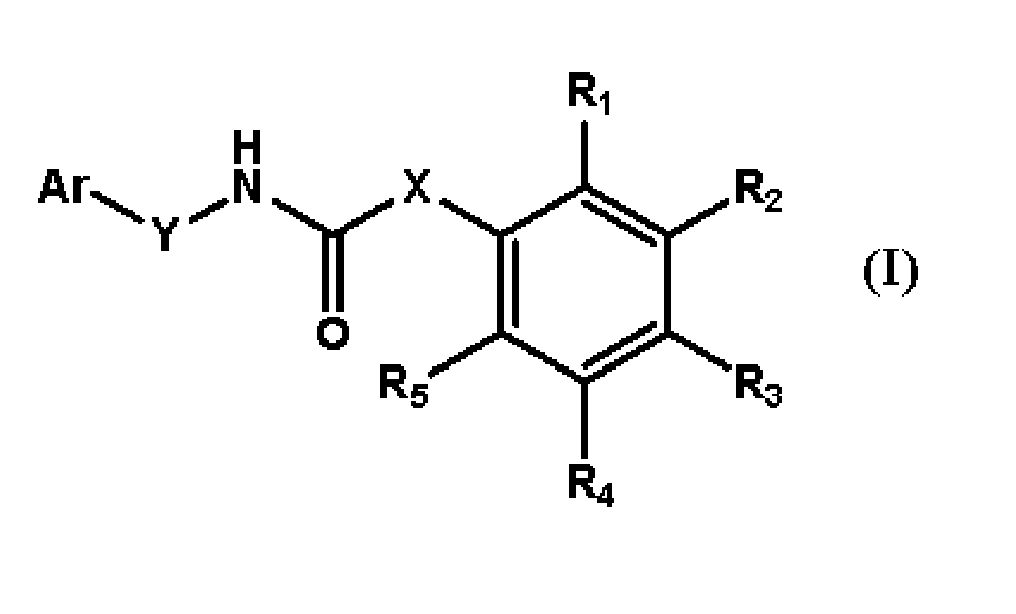
- the compound of the present invention represented by the following formula (I) is obtained by reacting an amine component with a carboxylic acid component or an acid chloride thereof.
- a production method of a compound represented by the formula (I) (hereinafter to be also referred to as compound (I)) is explained.
- R 1 - R 5 , Ar, X and Y are as described above.
- a compound represented by the formula (I) can be produced by (i) subjecting amine component (VII) and carboxylic acid component (VIII) to a condensation reaction using a dehydrating-condensing agent, or (ii) once converting carboxylic acid component (VIII) to acid chloride (IX), and subjecting the compound and amine component (VII) to a condensation reaction in the presence of a base.
- compound (I) can be obtained by protecting a hydroxyl group and the like with a protecting group, and removing the protecting group after the condensation reaction, where necessary.
- Amine component (VII) may be a salt such as hydrochloride, p-toluenesulfonate and the like
- carboxylic acid component (VIII) may be a salt such as dicyclohexylamine salt and the like.
- amine component (VII) is a salt
- the reaction can be carried out by adding a base such as triethylamine and the like during the condensation reaction.
- amine component (VII) and carboxylic acid component (VIII) are not limited, 0.8 - 1.2 equivalents of carboxylic acid component (VIII) may be used relative to 1 equivalent of amine component (VII) to achieve a reaction in a good yield.
- the solvent to be used is not particularly limited as long as it does not react with amine component (VII) and carboxylic acid component (VIII) and, for example, dichloromethane (DCM), N,N-dimethylformamide (DMF), chloroform, dimethyl sulfoxide (DMSO), N-methylpyrrolidone (NMP), and a mixed solvent thereof can be used. Of these, dichloromethane and N,N-dimethylformamide are preferable.
- the amount of the solvent is 10- to 500-fold weight, preferably 15- to 100-fold weight, relative to amine component (VII).
- a dehydrating-condensing agent a general condensing agent used for peptide synthesis and the like may be used and, for example, N,N'-dicyclohexylcarbodiimide (DCC), 1-ethyl-3-(3-dimethylaminopropyl)carbodiimide hydrochloride (EDCI ⁇ HCl), 2-(1H-benzotriazol-1-yl)-1,1,3,3-tetramethyluronium hexafluorophosphate (HBTU) and the like are used.
- DCC N,N'-dicyclohexylcarbodiimide
- EDCI ⁇ HCl 1-ethyl-3-(3-dimethylaminopropyl)carbodiimide hydrochloride
- HBTU 2-(1H-benzotriazol-1-yl)-1,1,3,3-tetramethyluronium hexafluorophosphate
- a condensation accelerator such as 1-hydroxybenzotri
- the amount of the dehydrating-condensing agent to be used is 1.0 - 2.0 equivalents, preferably 1.05 - 1.20 equivalents, relative to amine component (VII).
- the amount of the condensation accelerator to be used is 0.5 - 3.0 equivalents, preferably 1.0 - 1.5 equivalents, relative to amine component (VII).
- the reaction time is preferably about 3 - 24 hr, depending on the reaction temperature, which is preferably 5 - 35°C.
- the obtained compound (I) can be isolated and purified according to a conventional method.
- ethyl acetate, ethanol, methanol, diethyl ether, chloroform, dichloromethane, n-hexane and a mixed solvent thereof can be used as a solvent.
- a purification method by chromatography preparative thin-layer chromatography (PTLC) or silica gel column chromatography can be used.
- PTLC thin-layer chromatography
- silica gel column chromatography silica gel column chromatography
- Acid chloride (IX) to be used in the production method of (ii) can be obtained by reacting carboxylic acid component (VIII) with oxalyl chloride or thionyl chloride according to a conventional method. Acid chloride (IX) can be reacted with amine component (VII) in the presence of a base such as triethylamine, sodium hydroxide and the like. While the ratio of amine component (VII) and acid chloride (IX) is not limited, 0.8 - 1.2 equivalents of acid chloride (IX) may be used relative to 1 equivalent of amine component (VII) to achieve a reaction in a good yield.
- the amount of the base to be used is 0.8 - 3.0 equivalents, preferably 1.0 - 1.5 equivalents, relative to amine component (VII).
- the solvent to be used those recited as the solvents to be used in the aforementioned production method of (i) can be used.
- the reaction time and the reaction temperature are the same as those in the production method of (i).
- the thus-obtained compound of the present invention or a salt thereof can be provided as a whitening agent.
- the whitening agent of the present invention contains the compound of the present invention or a salt thereof, and can be added to whitening cosmetics singly or in combination with other whitening components.
- Other whitening components permitting combination with the whitening agent of the present invention are not particularly limited, and those having at least any of the tyrosinase activity inhibitory action, anti-inflammatory action, antioxidant action (including superoxide dismutase-like action), and excitometabolic action, which are said to be related to a whitening action, can be mentioned.
- the whitening agent of the present invention When the whitening agent of the present invention is added to whitening cosmetics, it can be used in combination with components generally used as starting materials for cosmetics, for example, flavor, preservative, chelate compound, polyol, plant extract (herbal medicinaln extract) and the like.
- components generally used as starting materials for cosmetics for example, flavor, preservative, chelate compound, polyol, plant extract (herbal medicinaln extract) and the like.
- Serotonin hydrochloride 300 mg, 1.41 mmol
- trans-cinnamic acid 208 mg, 1.41 mmol
- a mixed solvent of dichloromethane (6 ml) and N,N-dimethylformamide (6 ml)
- the solution was maintained at 0°C.
- the ethyl acetate layer was washed twice with 5% aqueous citric acid solution (5 ml), once with saturated brine (5 ml), twice with 5% aqueous sodium hydrogen carbonate solution (5 ml), and once with saturated brine (5 ml), and dried over anhydrous magnesium sulfate.
- Serotonin hydrochloride 300 mg, 1.41 mmol
- trans-2,4-dihydroxycinnamic acid 253 mg, 1.41 mmol
- the ethyl acetate layer was washed twice with 5% aqueous citric acid solution (5 ml), once with saturated brine (5 ml), twice with 5% aqueous sodium hydrogen carbonate solution (5 ml), and once with saturated brine (5 ml), and dried over anhydrous magnesium sulfate.
- Serotonin hydrochloride (300 mg, 1.41 mmol) and 3-methyl-4-hydroxycinnamic acid (251 mg, 1.41 mmol) obtained above were dissolved in a mixed solvent of dichloromethane (10 ml) and N,N-dimethylformamide (5 ml), and the solution was maintained at 0°C.
- the ethyl acetate layer was washed twice with 5% aqueous citric acid solution (5 ml), once with saturated brine (5 ml), twice with 5% aqueous sodium hydrogen carbonate solution (5 ml), and once with saturated brine (5 ml), and dried over anhydrous magnesium sulfate. Magnesium sulfate was removed by filtration, and the filtrate was concentrated under reduced pressure. The residue was recrystallized from ethyl acetate - ethanol - chloroform to give N-[2-(5-hydroxy-1H-indol-3-yl)ethyl]-3-(3-methyl-4-hydroxyphenyl)-2-propenamide (307 mg, yield 65.0%) as crystals.
- 5-hydroxy-L-tryptophan methyl ester hydrochloride 350 mg, 1.29 mmol
- ferulic acid 251 mg, 1.29 mmol
- the ethyl acetate layer was washed twice with 5% aqueous citric acid solution (5 ml), once with saturated brine (5 ml), twice with 5% aqueous sodium hydrogen carbonate solution (5 ml), and once with saturated brine (5 ml), and dried over anhydrous magnesium sulfate.
- Serotonin hydrochloride (430 mg, 2 mmol) and 2,6-dihydroxybenzoic acid (312 mg, 2 mmol) were dissolved in N,N-dimethylformamide (25 ml), and the solution temperature was maintained at 0°C.
- To this solution were added triethylamine (310 ⁇ l, 2.1 mmol), 1-hydroxybenzotriazole hydrate (HOBt H 2 O, 346 mg, 2.1 mmol) and 1-ethyl-3-(3-dimethylaminopropyl)carbodiimide (EDCI HCl, 429 mg, 2.1 mmol), the solution temperature was gradually warmed from 0°C to room temperature, and the mixture was stirred at room temperature for 16 hr.
- B16 melanom (purchased from Dainippon Sumitomo Pharma Co., Ltd.) was cultured in DMEM (Dulbecco's Modified Eagle Medium, high glucose, containing 10% serum). After confluent, the cells were trypsinized and seeded in a 96-well plate. On the following day, after adhesion of the cells to the plate, the medium was replaced with DMEM containing each evaluation sample (control (no sample addition), sample of each Production Example) at a given evaluation concentration (diluted from 100 ⁇ m according to sample), and the cells were incubated for 3 days.
- DMEM Dulbecco's Modified Eagle Medium, high glucose, containing 10% serum
- the 96-well plate was shaken in a plateshaker for 5 min, the absorbance at 450 nm was measured by a microplatereader (Benchmark microplatereader, manufactured by BIORAD), and the amount of melanin in the medium in each well was compared.
- the absorbance at 3 days after addition of a given concentration of each sample was shown in relative percentage based on the measurement value (absorbance) of control (no sample addition) as 100%.
- IC 50 50% melanin production-suppressive concentration
- Table 2 The results are shown in Table 2.
- 4-n-hexylresorcinol used was purchased from TOKYO CHEMICAL INDUSTRY CO., LTD.
- CS and FS used were synthesized by Ajinomoto Co., Inc.
- NR extract acetic acid-ethanol, 200 ⁇ l/well
- NR uptake by viable cells was examined by measuring the absorbance of the NR extract at 540 nm by a microplatereader (Benchmark microplatereader, manufactured by BIORAD).
- the cytotoxicity of each sample was calculated as a relative percentage of the absorbance of NR extract of the cells added with a given concentration of each sample to the measurement value (absorbance) of a control NR extract (no sample) as 100%.
- the compounds of Example 32 and Example 33 showed cytotoxicity; however, the compounds of other Examples did not show cytotoxicity. Therefore, it has been demonstrated that the compound of the present invention is promising as a starting material for whitening cosmetics.
- the present invention provides a compound having a melanin production suppressive activity, which is useful as a starting material for whitening cosmetics.
Landscapes
- Chemical & Material Sciences (AREA)
- Organic Chemistry (AREA)
- Health & Medical Sciences (AREA)
- Life Sciences & Earth Sciences (AREA)
- Veterinary Medicine (AREA)
- Public Health (AREA)
- General Health & Medical Sciences (AREA)
- Animal Behavior & Ethology (AREA)
- Epidemiology (AREA)
- Birds (AREA)
- Medicinal Chemistry (AREA)
- Pharmacology & Pharmacy (AREA)
- Dermatology (AREA)
- General Chemical & Material Sciences (AREA)
- Engineering & Computer Science (AREA)
- Chemical Kinetics & Catalysis (AREA)
- Bioinformatics & Cheminformatics (AREA)
- Nuclear Medicine, Radiotherapy & Molecular Imaging (AREA)
- Pharmaceuticals Containing Other Organic And Inorganic Compounds (AREA)
- Cosmetics (AREA)
- Organic Low-Molecular-Weight Compounds And Preparation Thereof (AREA)
- Plural Heterocyclic Compounds (AREA)
- Indole Compounds (AREA)
- Acyclic And Carbocyclic Compounds In Medicinal Compositions (AREA)
Abstract
Description
- The present invention relates to a novel compound having a melanin production suppressive activity, and relates to the field of cosmetics.
- Hydroquinone glycoside (arbutin) is known to have various effects such as whitening effect, tyrosinase inhibitory activity, suppression of active oxygen and the like (non-patent document 1), and is used as an ingredient for whitening cosmetics. In addition, kojic acid or a derivative thereof and 4-n-butylresorcinol (Rucinol (registered trade mark)) are also known as whitening components (non-patent documents 2 - 4), and whitening cosmetics containing such components are commercially available. In recent years, prevention of sunburn due to ultraviolet rays to keep the skin white and beautiful is receiving increasing attention, and the development of a further whitening component is desired.
-
- non-patent document 1: Funayama, M., Arakawa, H., Yamamoto, R., Nishino, T., Shin, T. and Murao, S.: Effect of α- and β-arubutin on activity of tyrosinases from mushroom, and mouse melanoma. Biosci. Biotech. Biochem., 59, 143-144 (1995).
- non-patent document 2: Kouji Miyazaki, Yumiko Nishida, Minoru Itioka, "Inhibitory Effects of Melanogenic Inhibitors on Dendricity of Cultured B16 Mouse Melanoma Cells", Journal of Japanese Cosmetic Science Society Vol.22, No.3, 182-186 (1998).
- non-patent document 3: Kiyoharu Sugiyama, "Evaluation of novel whitening agent - Rucinol (Shinki bihakuzai no hyouka - Rucinol ni tsuite)", The Journal of Japan Hair Science Association, Vol.30, No.3, 2-6 (1998).
- non-patent document 4: Dong-Seok KIM, So-Young KIM, Seo-Hyoung PARK, Yeong-Gon CHOI, Sun-Bang KWON, Myo-Kyoung KIM, Jung-Im Na, Sang-Woong YOUN, and Kyoung-Chan PARK,: Inhibitory Effects of 4-n-Butylresorcinol on Tyrosinase Activity and Melanin Synthesis. Biol. Pharm. Bull., 28(12), 2216-2219 (2005).
- The problem to be solved by the present invention is provision of a novel compound having a melanin production suppressive activity, and the like.
- The present inventors have conducted intensive studies in an attempt to solve the above-mentioned problem, and found that a compound having the following structure has a melanin production suppressive activity, which resulted in the completion of the present invention.
- Accordingly, the present invention provides the following.
-

- wherein R1, R2, R3, R4 and R5 are each independently a hydrogen atom, an alkyl group having a carbon number of 1 - 3, a hydroxyl group or an alkoxy group having a carbon number of 1 - 3, or R1 and R2, or R2 and R3 in combination optionally form a methylenedioxy group;
X is a covalent bond, a methylene group, an ethylene group or a vinylene group;
Y is a covalent bond or a divalent group represented by the formula -

- Z is a hydrogen atom, a hydroxycarbonyl group or an alkoxycarbonyl group having a carbon number of 1 - 3, and when Z is other than a hydrogen atom and a carbon atom bonded to Z contains an asymmetric center, the stereochemistry thereof may be any of (S), (R) and (SR);
Ar is a substituent represented by the following formula (II) -

- wherein R6 and R7 are each independently a hydrogen atom, an alkyl group having a carbon number of 1 - 3, a hydroxyl group or an alkoxy group having a carbon number of 1 - 3, and * is a moiety bonded to Y, or
the following formula (III) -

- wherein R8 and R9 are each independently a hydrogen atom, an alkyl group having a carbon number of 1 - 3, a hydroxyl group or an alkoxy group having a carbon number of 1 - 3, or R8 and R9 in combination optionally form a methylenedioxy group, and * is a moiety bonded to Y;
provided that the following compounds are excluded: (1) a compound wherein, when Ar is a substituent represented by the formula (II), X is a vinylene group, Y is an ethylene group, R1, R2, R5 and R7 are hydrogen atoms, and R6 is a hydroxyl group, then R3 is a hydroxyl group and R4 is a hydrogen atom, or R3 is a hydroxyl group and R4 is a methoxy group, or R3 and R4 are hydroxyl groups, or R3 is a methoxy group and R4 is a hydroxyl group, or R3 is a methoxy group and R4 is a hydrogen atom, (2)
a compound wherein, when Ar is a substituent represented by the formula (II), X is a vinylene group, Y is an ethylene group, and R1, R2, R5, R6 and R7 are hydrogen atoms, then R3 is a hydroxyl group and R4 is a hydrogen atom, or R3 is a methoxy group and R4 is a hydrogen atom, or R3 and R4 are hydroxyl groups, or R3 is a hydroxyl group and R4 is a methoxy group, (3) a compound wherein, when Ar is a substituent represented by the formula (II), X is a vinylene group, Y is an ethylene group, R1, R2, R5 and R7 are hydrogen atoms, and R6 is a methoxy group, then R3 is a hydroxyl group and R4 is a hydrogen atom,
or R3 is a methoxy group and R4 is a hydrogen atom, or R3 and R4 are hydrogen atoms, (4) a compound wherein, when Ar is a substituent represented by the formula (II), X is a covalent bond, Y is an ethylene group, R1, R2, R5 and R7 are hydrogen atoms, and R6 is a hydroxyl group, then R3 and R4 are hydroxyl groups, or R3 is a hydroxyl group and R4 is a methoxy group, or R3 and R4 are hydrogen atoms, or R3 is a methoxy group and R4 is a hydrogen atom, and (5) a compound wherein Ar is a substituent represented by the formula (III), Y is an ethylene group, and one or both of R8 and R9 is/are a hydrogen atom(s); or a salt thereof. -

- wherein R1, R2, R3, R4, R5, R6 and R7 are each independently a hydrogen atom, an alkyl group having a carbon number of 1 - 3, a hydroxyl group or an alkoxy group having a carbon number of 1 - 3, or R1 and R2, or R2 and R3 in combination optionally form a methylenedioxy group;
X is a methylene group, an ethylene group or a vinylene group; Z is a hydrogen atom, a hydroxycarbonyl group or an alkoxycarbonyl group having a carbon number of 1 - 3; and when Z is other than a hydrogen atom, the stereochemistry of a carbon atom bonded to Z may be any of (S), (R) and (SR); provided that the following compounds are excluded: (1) a compound wherein, when X is a vinylene group, Z is a hydrogen atom, R1, R2, R5 and R7 are hydrogen atoms, and R6 is a hydroxyl group, then R3 is a hydroxyl group and R4 is a hydrogen atom, or R3 is a hydroxyl group and R4 is a methoxy group, or R3 and R4 are hydroxyl groups, or R3 is a methoxy group and R4 is a hydroxyl group, or R3 is a methoxy group and R4 is a hydrogen atom, (2) a compound wherein, when X is a vinylene group, Z is a hydrogen atom, and R1, R2, R5, R6 and R7 are hydrogen atoms, then R3 is a hydroxyl group and R4 is a hydrogen atom, or R3 is a methoxy group and R4 is a hydrogen atom, or R3 and R4 are hydroxyl groups, or R3 is a hydroxyl group and R4 is a methoxy group, and (3) a compound wherein, when X is a vinylene group, Z is a hydrogen atom, R1, R2, R5 and R7 are hydrogen atoms, and R6 is a methoxy group, then R3 is a hydroxyl group and R4 is a hydrogen atom, or R3 is a methoxy group and R4 is a hydrogen atom, or R3 and R4 are hydrogen atoms; or a salt thereof. -

- wherein R1, R2, R3, R4, R5, R6 and R7 are each independently a hydrogen atom, an alkyl group having a carbon number of 1 - 3, a hydroxyl group or an alkoxy group having a carbon number of 1 - 3, or R1 and R2, or R2 and R3 in combination optionally form a methylenedioxy group;
Z is a hydrogen atom, a hydroxycarbonyl group or an alkoxycarbonyl group having a carbon number of 1 - 3, and when Z is other than a hydrogen atom, the stereochemistry of a carbon atom bonded to Z may be any of (S), (R) and (SR), provided that the following compound is excluded: a compound wherein, when Z is a hydrogen atom, R1, R2, R5 and R7 are hydrogen atoms, and R6 is a hydroxyl group, then R3 and R4 are hydroxyl groups, or R3 is a hydroxyl group and R4 is a methoxy group, or R3 and R4 are hydrogen atoms, or R3 is a methoxy group and R4 is a hydrogen atom; or a salt thereof. -

- wherein R1, R2, R3, R4 and R5 are each independently a hydrogen atom, an alkyl group having a carbon number of 1 - 3, a hydroxyl group or an alkoxy group having a carbon number of 1 - 3, or R1 and R2, or R2 and R3 in combination optionally form a methylenedioxy group;
X is a covalent bond, a methylene group, an ethylene group or a vinylene group;
Y is a covalent bond or a divalent group represented by the formula -

- Z is a hydrogen atom, a hydroxycarbonyl group or an alkoxycarbonyl group having a carbon number of 1 - 3, and when Z is other than a hydrogen atom and a carbon atom bonded to Z contains an asymmetric center, the stereochemistry thereof may be any of (S), (R) and (SR);
R8 and R9 are each independently a hydrogen atom, an alkyl group having a carbon number of 1 - 3, a hydroxyl group or an alkoxy group having a carbon number of 1 - 3, or R8 and R9 in combination optionally form a methylenedioxy group,
provided that the following compound is excluded: a compound wherein Y is an ethylene group, and one or both of R8 and R9 is/are a hydrogen atom(s); or a salt thereof. -

- wherein R1, R2, R3, R4 and R5 are each independently a hydrogen atom, an alkyl group having a carbon number of 1 - 3, a hydroxyl group or an alkoxy group having a carbon number of 1 - 3, or R1 and R2, or R2 and R3 in combination optionally form a methylenedioxy group;
X is a covalent bond, a methylene group, an ethylene group or a vinylene group;
Y is a covalent bond or a divalent group represented by the formula -

- Z is a hydrogen atom, a hydroxycarbonyl group or an alkoxycarbonyl group having a carbon number of 1 - 3, and when Z is other than a hydrogen atom and a carbon atom bonded to Z contains an asymmetric center, the stereochemistry thereof may be any of (S), (R) and (SR);
Ar is a substituent represented by the following formula (II) -

- wherein R6 and R7 are each independently a hydrogen atom, an alkyl group having a carbon number of 1 - 3, a hydroxyl group or an alkoxy group having a carbon number of 1 - 3, and * is a moiety bonded to Y, or
the following formula (III) -

- wherein R8 and R9 are each independently a hydrogen atom, an alkyl group having a carbon number of 1 - 3, a hydroxyl group or an alkoxy group having a carbon number of 1 - 3, or R8 and R9 in combination optionally form a methylenedioxy group, and * is a moiety bonded to Y;
provided that the following compounds are excluded: (1) a compound wherein, when Ar is a substituent represented by the formula (II), X is a vinylene group, Y is an ethylene group, R1, R2, R5 and R7 are hydrogen atoms, and R6 is a hydroxyl group, then R3 is a hydroxyl group and R4 is a hydrogen atom, or R3 is a hydroxyl group and R4 is a methoxy group, or R3 and R4 are hydroxyl groups, (2) a compound wherein, when Ar is a substituent represented by the formula (II), X is a vinylene group, Y is an ethylene group, and R1, R2, R5, R6 and R7 are hydrogen atoms, then R3 and R4 are hydroxyl groups, (3) a compound wherein, when Ar is a substituent represented by the formula (II), X is a covalent bond, Y is an ethylene group, R1, R2, R5 and R7 are hydrogen atoms, and R6 is a hydroxyl group, then R3 and R4 are hydroxyl groups, or R3 is a hydroxyl group and R4 is a methoxy group, or R3 and R4 are hydrogen atoms, and (4) a compound wherein Ar is a substituent represented by the formula (III), Y is an ethylene group, R1, R2, R5 and R8 are hydrogen atoms, and R3, R4 and R9 are hydroxyl groups; or a salt thereof. - The compound of the present invention is expected to exhibit a whitening action through a melanin production suppressive activity, and can be utilized as a whitening agent by itself or in combination with other whitening components.
-
-
Fig. 1 is a graph showing the results of Experimental example 1. In the graph, the unit of the values on the horizontal axis is µM. -
Fig. 2 is a graph showing the results of Experimental example 1. In the graph, the unit of the values on the horizontal axis is µM. -
Fig. 3 is a graph showing the results of Experimental example 1. In the graph, the unit of the values on the horizontal axis is µM. -
Fig. 4 is a graph showing the results of Experimental example 1. In the graph, the unit of the values on the horizontal axis is µM. -
Fig. 5 is a graph showing the results of Experimental example 1. In the graph, the unit of the values on the horizontal axis is µM. - The definitions of the symbols in each formula used in the present specification are explained.
Examples of the alkyl group having a carbon number of 1 - 3 for R1, R2, R3, R4, R5, R6, R7, R8 or R9 include a methyl group, an ethyl group, a propyl group and an isopropyl group. Of these, a methyl group is preferable. - Examples of the alkoxy group having a carbon number of 1 - 3 for R1, R2, R3, R4, R5, R6, R7, R8 or R9 include a methoxy group, an ethoxy group, a propoxy group and an isopropoxy group. Of these, a methoxy group or an ethoxy group is preferable, and a methoxy group is more preferable.
- The alkoxycarbonyl group having a carbon number of 1 - 3 means that wherein the alkoxy moiety has a carbon number of 1 - 3. Examples of the alkoxycarbonyl group having a carbon number of 1 - 3 for Z include a methoxycarbonyl group, an ethoxycarbonyl group, a propoxycarbonyl group and an isopropoxycarbonyl group. Of these, a methoxycarbonyl group is preferable.
- That the "stereochemistry may be any of (S), (R) and (SR)" means it may be any of (S) form, (R) form and a racemate which is a mixture of equivalent amounts of (S) form and (R) form.
- X is preferably a covalent bond, an ethylene group or a vinylene group.
Y is preferably a divalent group represented by the formula -

- wherein Z is as described above, more preferably a divalent group represented by the formula
-

- wherein Z is as described above, and still more preferably an ethylene group.
- Preferably, R1, R2, R3, R4 and R5 are each independently a hydrogen atom, a hydroxyl group or an alkoxy group having a carbon number of 1 - 3, or R1 and R2, or R2 and R3 in combination optionally form a methylenedioxy group.
- At least one (preferably 1 - 3, more preferably 1 or 2) of R1, R2, R3, R4 and R5 is preferably a hydroxyl group, and R3 is more preferably a hydroxyl group. On the other hand, when X is a covalent bond, R1 and R5 are preferably hydroxyl groups.
- Preferably, R6 and R7 are each independently a hydrogen atom, a hydroxyl group or an alkoxy group having a carbon number of 1 - 3. More preferably, R6 is a hydrogen atom, a hydroxyl group or an alkoxy group having a carbon number of 1 - 3, and R7 is a hydrogen atom. Still more preferably, R6 is a hydroxyl group and R7 is a hydrogen atom.
- Preferably, R8 and R9 are each independently a hydrogen atom, a hydroxyl group or an alkoxy group having a carbon number of 1 - 3. More preferably, R8 and R9 are each independently a hydroxyl group or an alkoxy group having a carbon number of 1 - 3.
- Preferable examples of the compound represented by the formula (I') include the compounds of Examples 1 - 36 to be mentioned below. In addition, preferable examples of the compound represented by the formula (I) include the compounds of Examples 1, 4, 5, 6 - 10, 14 - 23 and 25 - 36 to be mentioned below.
- Examples of the salt of the compound represented by the formula (I), (I'), (IV), (V) or (VI) include salts with inorganic acids (e.g., hydrochloride, hydrobromide, sulfate, nitrate, phosphate and the like); salts with organic acids (e.g., formate, acetate, trifluoroacetate, maleate, tartrate, citrate, fumarate, methanesulfonate, benzenesulfonate, p-toluenesulfonate and the like); salts with acidic or basic amino acids (e.g., aspartic acid, glutamic acid, arginine, lysine, ornithine and the like); salts with inorganic bases [for example, salts with metal (alkaline metal such as potassium, sodium and the like; alkaline earth metal such as calcium, magnesium and the like; aluminum), ammonium salt and the like]; and salts with organic bases (e.g., trimethylamine, triethylamine, pyridine, picoline, ethanolamine, diethanolamine, triethanolamine, dicyclohexylamine, N,N'-dibenzylethylenediamine and the like). As the above-mentioned salt, pharmacologically acceptable salts are preferably used.
- The compound of the present invention represented by the following formula (I) is obtained by reacting an amine component with a carboxylic acid component or an acid chloride thereof. In the following, a production method of a compound represented by the formula (I) (hereinafter to be also referred to as compound (I)) is explained.
-
- wherein R1 - R5, Ar, X and Y are as described above.
- A compound represented by the formula (I) can be produced by (i) subjecting amine component (VII) and carboxylic acid component (VIII) to a condensation reaction using a dehydrating-condensing agent, or (ii) once converting carboxylic acid component (VIII) to acid chloride (IX), and subjecting the compound and amine component (VII) to a condensation reaction in the presence of a base. In this case, compound (I) can be obtained by protecting a hydroxyl group and the like with a protecting group, and removing the protecting group after the condensation reaction, where necessary.
-

- wherein Ar and Y are as described above.
-

- wherein R1 - R5 and X are as described above.
-

- wherein R1 - R5 and X are as described above.
- While a production method of (i) is explained in detail in the following, the method is not limited thereto.
Amine component (VII) may be a salt such as hydrochloride, p-toluenesulfonate and the like, and carboxylic acid component (VIII) may be a salt such as dicyclohexylamine salt and the like. When amine component (VII) is a salt, the reaction can be carried out by adding a base such as triethylamine and the like during the condensation reaction. While the ratio of amine component (VII) and carboxylic acid component (VIII) to be used is not limited, 0.8 - 1.2 equivalents of carboxylic acid component (VIII) may be used relative to 1 equivalent of amine component (VII) to achieve a reaction in a good yield. - The solvent to be used is not particularly limited as long as it does not react with amine component (VII) and carboxylic acid component (VIII) and, for example, dichloromethane (DCM), N,N-dimethylformamide (DMF), chloroform, dimethyl sulfoxide (DMSO), N-methylpyrrolidone (NMP), and a mixed solvent thereof can be used. Of these, dichloromethane and N,N-dimethylformamide are preferable. The amount of the solvent is 10- to 500-fold weight, preferably 15- to 100-fold weight, relative to amine component (VII).
- As a dehydrating-condensing agent, a general condensing agent used for peptide synthesis and the like may be used and, for example, N,N'-dicyclohexylcarbodiimide (DCC), 1-ethyl-3-(3-dimethylaminopropyl)carbodiimide hydrochloride (EDCI·HCl), 2-(1H-benzotriazol-1-yl)-1,1,3,3-tetramethyluronium hexafluorophosphate (HBTU) and the like are used. In this case, a condensation accelerator such as 1-hydroxybenzotriazole (HOBt) and the like are used. The amount of the dehydrating-condensing agent to be used is 1.0 - 2.0 equivalents, preferably 1.05 - 1.20 equivalents, relative to amine component (VII). The amount of the condensation accelerator to be used is 0.5 - 3.0 equivalents, preferably 1.0 - 1.5 equivalents, relative to amine component (VII).
- The reaction time is preferably about 3 - 24 hr, depending on the reaction temperature, which is preferably 5 - 35°C.
- The obtained compound (I) can be isolated and purified according to a conventional method. For example, when compound (I) is purified by crystallization, ethyl acetate, ethanol, methanol, diethyl ether, chloroform, dichloromethane, n-hexane and a mixed solvent thereof can be used as a solvent. As a purification method by chromatography, preparative thin-layer chromatography (PTLC) or silica gel column chromatography can be used. As an eluent therefor, the solvents recited earlier as the crystallization solvent can be used.
- Acid chloride (IX) to be used in the production method of (ii) can be obtained by reacting carboxylic acid component (VIII) with oxalyl chloride or thionyl chloride according to a conventional method. Acid chloride (IX) can be reacted with amine component (VII) in the presence of a base such as triethylamine, sodium hydroxide and the like. While the ratio of amine component (VII) and acid chloride (IX) is not limited, 0.8 - 1.2 equivalents of acid chloride (IX) may be used relative to 1 equivalent of amine component (VII) to achieve a reaction in a good yield. The amount of the base to be used is 0.8 - 3.0 equivalents, preferably 1.0 - 1.5 equivalents, relative to amine component (VII). As the solvent to be used, those recited as the solvents to be used in the aforementioned production method of (i) can be used. The reaction time and the reaction temperature are the same as those in the production method of (i).
- The thus-obtained compound of the present invention or a salt thereof can be provided as a whitening agent. The whitening agent of the present invention contains the compound of the present invention or a salt thereof, and can be added to whitening cosmetics singly or in combination with other whitening components. Other whitening components permitting combination with the whitening agent of the present invention are not particularly limited, and those having at least any of the tyrosinase activity inhibitory action, anti-inflammatory action, antioxidant action (including superoxide dismutase-like action), and excitometabolic action, which are said to be related to a whitening action, can be mentioned.
- When the whitening agent of the present invention is added to whitening cosmetics, it can be used in combination with components generally used as starting materials for cosmetics, for example, flavor, preservative, chelate compound, polyol, plant extract (herbal medicin extract) and the like. Examples
- The usefulness of the present invention is specifically explained in the following by referring to Examples and the like. However, the present invention is not limited thereto.
In the following Production Examples, the structures of the synthesized compounds were identified by nuclear magnetic resonance spectrum (Bruker AVANCE 400). - Serotonin hydrochloride (300 mg, 1.41 mmol) and trans-cinnamic acid (208 mg, 1.41 mmol) were dissolved in a mixed solvent of dichloromethane (6 ml) and N,N-dimethylformamide (6 ml), and the solution was maintained at 0°C. To this solution were added triethylamine (216 µl, 1.55 mmol), 1-hydroxybenzotriazole hydrate (HOBt H2O, 237 mg, 1.55 mmol) and 1-ethyl-3-(3-dimethylaminopropyl)carbodiimide hydrochloride (EDCI HCl, 297 mg, 1.55 mmol), and the mixture was gradually warmed to room temperature and stirred at room temperature for 16 hr. The solvent was removed under reduced pressure, water (10 ml) was added to the residue, and the mixture was extracted twice with ethyl acetate (10 ml). The ethyl acetate layer was washed twice with 5% aqueous citric acid solution (5 ml), once with saturated brine (5 ml), twice with 5% aqueous sodium hydrogen carbonate solution (5 ml), and once with saturated brine (5 ml), and dried over anhydrous magnesium sulfate. Magnesium sulfate was removed by filtration, and the filtrate was concentrated under reduced pressure, and purified by preparative thin-layer chromatography (PTLC, eluent: ethyl acetate) to give N-[2-(5-hydroxy-1H-indol-3-yl)ethyl]-3-phenyl-2-propenamide (217 mg, yield 50.0%) as a viscous oil.
- Serotonin hydrochloride (300 mg, 1.41 mmol) and trans-2,4-dihydroxycinnamic acid (253 mg, 1.41 mmol) were dissolved in a mixed solvent of dichloromethane (6 ml) and N,N-dimethylformamide (6 ml), and the solution was maintained at 0°C. To this solution were added triethylamine (216 µl, 1.55 mmol), 1-hydroxybenzotriazole hydrate (HOBt H2O 237 mg, 1.55 mmol) and 1-ethyl-3-(3-dimethylaminopropyl)carbodiimide hydrochloride (EDCI HCl, 297 mg, 1.55 mmol), and the mixture was gradually warmed to room temperature and stirred at room temperature for 16 hr. The solvent was removed under reduced pressure, water (10 ml) was added to the residue, and the mixture was extracted twice with ethyl acetate (10 ml). The ethyl acetate layer was washed twice with 5% aqueous citric acid solution (5 ml), once with saturated brine (5 ml), twice with 5% aqueous sodium hydrogen carbonate solution (5 ml), and once with saturated brine (5 ml), and dried over anhydrous magnesium sulfate. Magnesium sulfate was removed by filtration, and the filtrate was concentrated under reduced pressure, and purified by preparative thin-layer chromatography (PTLC, eluent: ethyl acetate - n-hexane = 2:1, 0.01% formic acid) to give N-[2-(5-hydroxy-1H-indol-3-yl)ethyl]-3-(2,4-dihydroxyphenyl)-2-propenamide (243 mg, yield 51.0%) as a viscous oil.
- 3-Methyl-4-hydroxybenzaldehyde (794 mg, 5.83 mmol), malonic acid (911 mg, 8.75 mmol) and piperidine (144 µl) were added to pyridine (5 ml), and the mixture was stirred at 60°C for 22 hr under an argon atmosphere. The reaction mixture was allowed to cool to room temperature, and water (20 ml) was added. 6N Hydrochloric acid was added to allow precipitation of a solid. The precipitated solid was collected by filtration, and the filtrate was washed with water and dried under reduced pressure. The obtained solid was recrystallized from diethylether - n-hexane to give 3-methyl-4-hydroxycinnamic acid (872 mg, yield 84.0%) as crystals.
1H NMR (DMSO, 400MHz) δ 9.95 (OH), 7.45 (d, J=15.9Hz, 1H), 7.42 (s, 1H), 7.32 (d, J=8.3Hz, 1H), 6.79 (d, J=8.3Hz, 1H), 6.26 (d, J=15.9Hz, 1H), 2.13 (s, 3H). - Serotonin hydrochloride (300 mg, 1.41 mmol) and 3-methyl-4-hydroxycinnamic acid (251 mg, 1.41 mmol) obtained above were dissolved in a mixed solvent of dichloromethane (10 ml) and N,N-dimethylformamide (5 ml), and the solution was maintained at 0°C. To this solution were added triethylamine (216 µl, 1.55 mmol), 1-hydroxybenzotriazole hydrate (HOBt H2O, 237 mg, 1.55 mmol) and 1-ethyl-3-(3-dimethylaminopropyl)carbodiimide hydrochloride (EDCI HCl, 297 mg, 1.55 mmol), and the mixture was gradually warmed to room temperature and stirred at room temperature for 16 hr. The solvent was removed under reduced pressure, water (10 ml) was added to the residue, and the mixture was extracted twice with ethyl acetate (10 ml). The ethyl acetate layer was washed twice with 5% aqueous citric acid solution (5 ml), once with saturated brine (5 ml), twice with 5% aqueous sodium hydrogen carbonate solution (5 ml), and once with saturated brine (5 ml), and dried over anhydrous magnesium sulfate. Magnesium sulfate was removed by filtration, and the filtrate was concentrated under reduced pressure. The residue was recrystallized from ethyl acetate - ethanol - chloroform to give N-[2-(5-hydroxy-1H-indol-3-yl)ethyl]-3-(3-methyl-4-hydroxyphenyl)-2-propenamide (307 mg, yield 65.0%) as crystals.
- Methanol (5 ml) was maintained at 0°C, and thionyl chloride (2.4 ml) was added dropwise under an argon atmosphere. To this solution was added 5-hydroxy-L-tryptophan (2.0 g), and the mixture was gradually warmed from 0°C to room temperature, and stirred at room temperature overnight. The reaction mixture was concentrated under reduced pressure, and the residue was crystallized from a mixed solvent of ethanol and ether to give 5-hydroxy-L-tryptophan methyl ester hydrochloride (1.8 g, yield 74%) as crystals.
As mentioned above, 5-hydroxy-L-tryptophan methyl ester hydrochloride (350 mg, 1.29 mmol) and ferulic acid (251 mg, 1.29 mmol) were dissolved in a mixed solvent of dichloromethane (6 ml) and N,N-dimethylformamide (6 ml), and the solution was maintained at 0°C. To this solution were added triethylamine (198 µl, 1.4 mmol), 1-hydroxybenzotriazole hydrate (HOBt H2O 217 mg, 1.4 mmol) and 1-ethyl-3-(3-dimethylaminopropyl)carbodiimide (EDCI HCl, 217 mg, 1.4 mmol), the solution temperature was gradually raised from 0°C, and the mixture was stirred at room temperature for 16 hr. The solvent was removed under reduced pressure, water (20 ml) was added to the residue, and the mixture was extracted twice with ethyl acetate (20 ml). The ethyl acetate layer was washed twice with 5% aqueous citric acid solution (5 ml), once with saturated brine (5 ml), twice with 5% aqueous sodium hydrogen carbonate solution (5 ml), and once with saturated brine (5 ml), and dried over anhydrous magnesium sulfate. Magnesium sulfate was removed by filtration, and the filtrate was concentrated under reduced pressure, and purified by silica gel column chromatography (eluent: chloroform:methanol =3:1) to give 3-(3-methoxy-4-hydroxyphenyl)-N-[2-(5-hydroxy-1H-indol-3-yl)-1-methoxycarbonylethyl]-2-propenamide (413 mg, yield 78.0%) as a powder. - 3-(3-Methoxy-4-hydroxyphenyl)-N-[2-(5-hydroxy-1H-indol-3-yl)-1-methoxycarbonylethyl]-2-propenamide synthesized from 5-hydroxy-L-tryptophan methyl ester hydrochloride (704 mg, 2.6 mmol) in the same manner as in Example 18 was dissolved in a mixed solvent of water (11.8 ml), 2.5N NaOH aqueous solution (11.8 ml) and N,N-dimethylformamide (23.6 ml) without purification, and the mixture was stirred at room temperature overnight. The reaction solvent was concentrated under reduced pressure, cooled to 0°C, and adjusted with 6N aqueous HCl solution to pH 1 - 2. The solution was extracted three times with ethyl acetate (30 ml), and the organic layer was washed with 3N HCl (20 ml) and dried over anhydrous magnesium sulfate. Magnesium sulfate was removed by filtration, and the filtrate was concentrated under reduced pressure, and purified by preparative thin-layer chromatography (PTLC, eluent: chloroform:methanol = 3:1) to give 3-(3-methoxy-4-hydroxyphenyl)-N-[2-(5-hydroxy-1H-indol-3-yl)-1-hydroxycarbonylethyl]-2-propenamide (147 mg, yield 15.4%) as a powder.
- Serotonin hydrochloride (430 mg, 2 mmol) and 2,6-dihydroxybenzoic acid (312 mg, 2 mmol) were dissolved in N,N-dimethylformamide (25 ml), and the solution temperature was maintained at 0°C. To this solution were added triethylamine (310 µl, 2.1 mmol), 1-hydroxybenzotriazole hydrate (HOBt H2O, 346 mg, 2.1 mmol) and 1-ethyl-3-(3-dimethylaminopropyl)carbodiimide (EDCI HCl, 429 mg, 2.1 mmol), the solution temperature was gradually warmed from 0°C to room temperature, and the mixture was stirred at room temperature for 16 hr. The solvent was removed under reduced pressure, water (20 ml) was added to the residue, and the mixture was extracted twice with ethyl acetate (20 ml). The ethyl acetate layer was washed twice with 5% aqueous citric acid solution (5 ml), once with saturated brine (5 ml), twice with 5% aqueous sodium hydrogen carbonate solution (5 ml), and once with saturated brine (5 ml), and dried over anhydrous magnesium sulfate. Magnesium sulfate was removed by filtration, and the filtrate was concentrated under reduced pressure, purified by preparative thin-layer chromatography (PTLC, eluent: ethyl acetate:hexane=3:1) to give 2,6-dihydroxy-N-[2-(5-hydroxy-1H-indol-3-yl)ethyl]-benzamide (93 mg, yield 14.9%) as a powder.
- The compounds of other Examples, which are shown in the following Table 1, were also synthesized in the same manner as in Examples 1, 4, 17, 18, 20 and 35. In addition, compounds having a carboxyl group were obtained by alkaline hydrolysis of the ester bond of the corresponding methoxycarbonyl group. The compounds of Reference Examples 1 and 2, which are shown in the following Table 1, were also synthesized in the same manner as in Examples 1, 4, 17, 18, 20 and 35.
-
[Table 1-1] Prod. Ex. structural formula property, yield Ex. 1 
1H NMR (DMSO, 400MHz) δ 10.49 (NH), 8.59 (OH), 8.20 (NH), 7.56 (d, J=6.9, 2H), 7.4 (m, 4H), 7.12 (d, J=8.6Hz, 1H), 7.06 (d, J=2.1Hz, 1H), 6.85 (d, J=2.1Hz, 1H), 6.64 (d, J=15.8Hz, 1H), 6.59 (dd, J=8.6, 2.2Hz, 1H), 3.44 (m, 2H), 7.42 (t, J=7.4Hz, 2H). ESI-MS: [M-H]-=305.0. yield: 50.0%. Ex. 2 
1H NMR (DMSO, 400MHz) δ 10.48 (NH), 8.11 (NH), 7.50 (d, J=8.8Hz, 2H) 7.36 (d, J=15.7Hz, 1H), 7.12 (d, J=8.8Hz, 1H), 7.06 (s, 1H), 6.97 (d, J=8.8Hz, 1H), 6.85 (d, J=2.3Hz, 1H), 6.60 (dd, J=2.3, 8.8Hz, 1H), 6.48 (d, J=2.3Hz, 1H), 3.79 (s, 3H), 3.43 (m, 2H), 2.79 (t, J=7.6Hz, 2H). ESI-MS: [M-H]-=335.3. yield: 88.0%. Ex. 3 
1H NMR (DMSO, 400MHz) δ 10.50 (NH), 8.12 (NH), 7.24 (d, J=15.6Hz, 1H), 7.13 (d, J=8.8Hz, 1H), 7.05 (s, 1H), 6.94 (s, 1H), 6.85 (s, 1H), 6.83 (d, J=8Hz, 1H), 6.74 (d, J=8Hz, 1H), 6.59 (dd, J=2.3, 8.8Hz, 1H), 6.33 (d, J=15.6Hz, 1H), 3.30 (s, 3H), 3.25 (m, 2H), 2.78 (t, J=7.6Hz, 2H). ESI-MS: [M-H]-=351.2. yield: 27.0%. [Table 1-2] Ex. 4 
1H NMR (DMSO, 400MHz) δ 10.48 (NH), 9.88 (OH), 9.65 (OH), 8.58 (OH), 8.00 (NH), 7.54 (d, J=15.8Hz, 1H), 7.22 (d, J=8.6Hz, 1H), 7.12 (d, J=8.6Hz, 1H), 7.05 (d, J=2.3Hz, 1H), 6.85 (d, J=2.3Hz, 1H), 6.59 (dd, J=2.3, 8.6Hz, 1H), 6.45 (d, J=15.8Hz, 1H), 6.34 (d, J=2.3Hz, 1H), 6.25 (dd, J=2.3, 6.8Hz, 1H), 3.43 (m, 2H), 2.78 (t, J=7.4Hz, 2H). ESI-MS: [M-H]-=351.2. yield: 51.0%. Ex. 5 
1H NMR (DMSO, 400MHz) δ 10.48 (d, J=2.1Hz, 1H, NH), 8.59 (OH), 8.07 (NH), 7.34 (d, J=15.7Hz, 1H), 7.14 (d, J=1.6Hz, 1H), 7.12 (d, J=8.7Hz, 1H), 7.07 (m, 2H) [7.07 (dd, J=8.0, 1.6Hz, 1H), 7.05 (s, 1H)], 6.94 (d, J=8.0Hz, 1H), 6.84 (d, J=2.3Hz, 1H), 6.59 (dd, J=8.6, 2.3Hz, 1H), 6.47 (d, J=15.7Hz, 1H), 6.07 (s, 2H), 3.43 (m, 2H), 2.77 (t, J=7.4Hz, 2H). ESI MS: [M-H]-=337.3. (methylene moiety was dissociated, observed as 3.4-OH.) yield: 68.0%. [Table 1-3] Ref. Ex. 1 
1H NMR (DMSO, 400MHz) δ 10.48 (NH), 8.07 (NH, amide), 7.24 (d, J=15.6Hz, 1H), 7.12 (d, J=8.6Hz, 1H), 7.05 (s, 1H), 6.94 (d, J=2.0Hz, 1H), 6.84 (d, J=2.0Hz, 1H), 6.82 (d, J=2.0Hz, 1H), 6.74 (d, J=8.1Hz, 1H), 6.59 (dd, J=8.6, 2.3Hz, 1H), 6.33 (d, J=15.6Hz, 1H), 3.44 (m, 2H), 2.78 (m, 2H). ESI-MS: [M+H]+=339.1, [M+Na]+=361.0, [M-H]-=337.2, [2M-H]-=675.2. yield: 54.0%. Ex. 6 
1H NMR (DMSO, 400MHz) δ 10.46 (NH), 9.00 (OH), 8.61 (OH), 7.88 (t, J=5.6Hz, 1H, NH), 7.11 (d, J=8.6Hz, 1H), 7.00 (d, J=2.3Hz, 1H), 6.98 (m, 2H), 6.82 (d, J=2.3Hz, 1H), 6.65 (m, 1H), 6.58 (dd, J=8.6, 2.3Hz, 1H), 3.25 (m, 2H), 2.69 (m, 4H), 2.32 (m, 2H). ESI-MS: [M+H]+=325.1, [M+Na]+=347.2, [M-H]-=323.2. yield: 63.0%. Ex. 7 
1H NMR (DMSO, 400MHz) δ 10.46 (NH), 8.59 (OH, 2H), 7.89 (NH), 7.11 (d, J=8.6Hz, 1H), 7.01 (d, J=2.3Hz, 1H), 6.82 (d, J=2.3Hz, 1H), 6.76 (d, J=1.9Hz, 1H), 6.65 (d, J=8.0Hz, 1H), 6.58 (dd, J=8.6, 2.3Hz, 1H), 6.57 (dd, J=8.0, 2.3Hz, 1H), 3.74 (s, 3H), 3.28 (m, 2H), 2.32 (m, 2H), 2.69 (m, 4H). ESI-MS: [M+Na]+=377.1, [M-H]- =353.3. yield: 80.0%. [Table 1-4] Ex. 8 
1H NMR (DMSO, 400MHz) δ 10.48 (NH), 8.76 (OH), 8.59 (OH), 8.02 (NH), 7.34 (d, J=15.6Hz, 1H), 7.12 (d, J=8.6Hz, 1H), 7.06 (d, J=2.3Hz, 1H), 6.85 (s, 3H), 6.59 (dd, J=8.6, 2.3Hz, 1H), 6.48 (d, J=15.6Hz, 1H), 3.80 (s, 3H), 3.43 (td, J=7.4, 7.4Hz, 2H), 3.32 (s, 3H), 2.78 (t, J=7.4Hz, 2H). ESI-MS: [M+Na]+=405.1, [M-H]- =381.2. yield: 77.0%. Ex. 9 
1H NMR (DMSO, 400MHz) δ 10.47 (NH), 8.74 (OH), 8.57 (OH), 7.97 (NH), 7.11 (d, J=8.6Hz, 1H), 7.00 (d, J=2.2Hz, 1H), 6.82 (m, 2H), 6.68 (d, J=8Hz, 1H), 6.62 (dd, J=8, 1.8Hz, 1H), 6.58 (dd, J=8.6. 2.2Hz, 1H), 3.73 (s, 3H), 3.28 (m, 4H), 2.71 (t, J=7.4Hz, 2H). ESI-1VIS: [M+H]+=341.2, [M+Na]+= 363.1, [2M-H]-=339.2, [2M-H]-=679.3. yield: 56.0%. [Table 1-5] Ex. 10 
1H NMR (DMSO, 400MHz) δ 10.64 (NH), 9.41 (OH), 8.05 (NH), 7.34 (d, J=15.7Hz, 1H), 7.22 (d, J=8.7Hz, 1H), 7.13 (m, 2H), 7.05 (d, J=2.3Hz, 1H), 7.00 (dd, J=1.8, 2.3Hz, 1H), 6.79 (d, J=8.1Hz, 1H), 6.71 (dd, J=2.4, 8.2Hz, 1H), 6.46 (d, J=15.7Hz, 1H), 3.81 (s, 3H), 3.76 (s, 3H), 3.46 (m, 2H), 2.85 (t, J=7.2Hz, 2H). ESI-MS: [M+Na]+=389.2, [M-H]- =365.2. yield: 80.0%. Ex. 11 
1H NMR (DMSO, 400MHz) δ 10.46 (1H), 8.07 (1H), 7.38 (d, J=8.6Hz, 2H), 7.32 (d, J=15.7Hz, 2H), 7.22 (d, J=8.7Hz, 1H), 7.11 (d, J=2.4Hz, 1H), 7.04 (d, J=2.4Hz, 1H), 6.78 (d, J=8.6Hz, 2H), 6.71 (dd, J=8.7, 2.4Hz, 2H), 6.40 (d, J=15.7Hz, 2H), 3.75 (s, 3H), 3.43 (m, 2H), 2.84 (t J=7.3Hz, 2H). ESI-MS: [M+Na]+=359.2, [M-H]- =335.3, [2M-H]-=671.4. yield: 90.0%. [Table 1-6] Ex. 12 
1H NMR (DMSO, 400MHz) δ 10.81 (1H), 8.05 (1H), 7.55 (d, J=7.9Hz, 1H), 7.34 (d, J=7.9Hz, 1H), 7.33 (d, J=15.8Hz, 1H), 7.17 (d, J=2.3Hz, 1H), 7.11 (d, J=1.9 Hz, 1H), 7.08 (m, 1H), 7.00 (m, 2H), 6.78 (d, J=8.1Hz, 1H), 6.43 (d, J=15.7Hz, 1H), 3.82 (s, 3H), 3.45 (m, 2H), 2.87 (t, J=7.4Hz, 2H). ESI-MS: [M+Na]+=359.2, [M-H]-=335.3. yield: 64.0%. Ex. 13 
1H NMR (DMSO, 400MHz) δ 10.81 (NH), 9.82 (OH), 8.01 (NH), 7.55 (d, J=7.8Hz, 1H), 7.38 (d, J=8,6Hz, 2H), 7.33 (d, J=15.7Hz, 1H), 7.34 (d, J=7.1Hz, 1H), 7.16 (d, J=2.2Hz, 1H), 7.06 (t, J=7.1Hz, 1H), 6.98 (t, J=7.1Hz, 1H), 6.79 (d, J=8.6Hz, 1H), 6.41 (d, J=15.7Hz, 1H), 3.45 (m, 2H), 2.88 (t, J=7.3Hz, 2H). ESI-MS: [M+Na]+=329.2, [M-H]- =305.2, [2M-H]-=611.3. yield: 73.0%. [Table 1-7] Ex. 14 
1H NMR (DMSO, 400MHz) δ 10.48 (NH), 9.32 (NH), 8.58 (OH), 8.02 (OH), 7.30 (d, J=15.7Hz, 1H), 7.12 (d, J=8.6Hz, 1H), 7.10 (d, J=1.8Hz, 1H), 7.06 (d, J=2.2Hz, 1H), 6.98 (dd, J=1.8, 8.2Hz, 1H), 6.85 (d, J=2.2Hz, 1H), 6.80 (d, J=8.2Hz, 1H), 6.59 (dd, J=8.6, 2.2Hz, 1H), 6.43 (d, J=15.7Hz, 1H), 4.05 (q, J=7.0Hz, 2H), 3.43 (m, 1H), 2.78 (m, 1H), 1.35 (t, J=7.0Hz, 3H). ESI-MS: [M+Na]+=389.2, [M-H]-=365.2. yield: 79.0%. Ex. 15 
1H NMR (DMSO, 400MHz) δ 10.5 (NH), 8.08 (NH), 7.15 (d, J=15.6Hz, 1H), 7.12 (d, J=8.5Hz, 1H), 7.05 (s, 1H), 6.85 (d, J=2.1Hz, 1H), 6.59 (dd, J=2.3, 8.5Hz, 1H), 6.48 (s, 2H), 6.28 (d, J=15.6Hz, 1H), 3.35 (m, 2H), 2.77 (m, 2H). ESI-MS: [M-H]-=353.3. yield: 43.0%. Ex. 16 
1H NMR (DMSO, 400MHz) δ 10.49 (NH), 9.39 (OH, 2H), 8.65 (OH), 8.19 (NH), 7.21 (d, J=15.7Hz, 1H), 7.12 (d, J=8.7Hz, 1H), 7.05 (d, J=2.3Hz, 1H), 6.85 (d, J=2.3Hz, 1H), 6.60 (dd, J=2.3, 8.7Hz, 1H), 6.45 (d, J=15.7Hz, 1H), 6.38 (d, J=2.1Hz, 2H), 6.23 (t, J=2.12Hz, 1H), 3.43 (m, 2H), 2.78 (t, J=7.5Hz, 2H). ESI-MS: [M-H]-=337.2. yield: 72.0%. [Table 1-8] Ex. 17 
1H NMR (DMSO, 400MHz) δ 10.48 (NH), 8.61 (OH), 8.02 (NH), 7.29 (d, J=15.7Hz, 1H), 7.27 (s, 1H), 7.20 (dd, J=2.0, 8.3Hz, 1H), 7.12 (d, J=8.6Hz, 1H), 7.05 (d, J=2.3Hz, 1H), 6.85 (d, J=2.2Hz, 1H), 6.79 (d, J=8.3Hz, 1H), 6.59 (dd, J=2.3, 8.6Hz, 1H), 6.40 (d, J=15.7Hz, 1H), 3.43 (m, 2H), 2.75 (t, J=7.6Hz, 2H). ESI-MS: [M-H]-=335.0. yield: 65.0%. Ex. 18 
1H NMR (DMSO, 400MHz) δ 10.54, 9.48, 8.62, 8.30 (NH, OH, 4H), 7.29 (d, J=15.6Hz, 1H), 7.12 (d, J=8.12, 1H), 7.11 (s, 1H), 7.06 (d, J=2.4Hz, 1H), 6.98 (d, J=8.16Hz, 1H), 6.81 (d, J=2.2Hz, 1H), 6.78 (d, J=8.12Hz, 1H), 6.58 (dd, J=2.2, 8.16Hz, 1H), 6.53 (d, J=15.6Hz, 1H), 4.16 (m, 1H), 3.81 (s, 3H), 3.62 (s, 3H), 3.05 (m, 1H). ESI-MS: [M+Na]+=433.3, [M-H]-=409.2. yield: 78.0%. Ex. 19 
1H NMR (DMSO, 400MHz) δ 10.54 (s, NH), 9.8 (brs, OH), 8.62 (brs, OH), 8.34 (d, J=7.5Hz, NH), 7.38 (d, J=8.6Hz, 2H), 7.30 (d, J=15.7Hz, 1H), 7.12 (d, J=8.6Hz, 1H), 7.05 (d, J=2.4Hz, 1H), 6.81 (d, J=2.4Hz, 1H), 6.78 (d, J=8.6Hz, 2H), 6.59 (dd, J=2.3, 8.6Hz, 1H), 6.48 (d, J=15.7Hz, 1H), 4.60 (m, 1H), 3.62 (s, 3H), 3.00 (m, 2H). ESI-MS: [M-H]-=379.2. yield: 74.0%. [Table 1-9] Ex. 20 
1H NMR (DMSO, 400MHz) δ 10.51 (NH), 9.44 (OH), 8.63 (OH), 8.17 (NH), 7.29 (d, J=15.7Hz, 1H), 7.12 (d, J=8.6Hz, 1H), 7.11 (d, J=1.9Hz, 1H), 7.06 (d, J=2.3Hz, 1H), 6.98 (dd, J=8.2, 1.9Hz, 2H), 6.87 (d, J=2.2Hz, 1H), 6.79 (d, J=8.2Hz, 1H), 6.59 (dd, J=8.6, 2.3Hz, 1H), 6.55 (d, J=15.7Hz, 1H), 4.58 (m, 1H), 3.00 (m, 2H). ESI-MS: [M+H]+=397.0, [M-H]- =395.0. yield: 15.0%. Ex. 21 
1H NMR (DMSO, 400MHz) δ 10.50 (NH), 9.83 (OH), 8.60 (OH), 8.17 (NH), 7.37 (d, J=8.7Hz, 2H), 7.28 (d, J=15.7Hz, 1H), 7.11 (d, J=8.6Hz, 1H), 7.04 (d, J=2.2Hz, 1H), 6.86 (d, J=2.2Hz, 1H), 6.78 (d, J=8.7Hz, 2H), 6.58 (dd, J=8.7, 2.2Hz, 1H), 6.50 (d, J=15.7Hz, 1H), 4.55 (m, 1H), 2.99 (m, 2H). ESI-MS: [M-H]-=365.0. yield: 22.0%. Ex. 22 
1H NMR (DMSO, 400MHz) 6 7.91, 7.87 (d, 1H), 7.79, 7.76 (d, 1H), 7.19-6.36 (m, 6H), 3.60, 3.58, 3.56 (t, 2H), 2.96, 2.94, 2.92 (t, 2H). ESI-MS: [M-H]-=353.0. yield: 8.7%. [Table 1-10] Ex. 23 
1H NMR (MeOH-d, 400MHz) δ 7.84, 7.80 (d, J=16Hz, 1H), 7.19, 7.17 (d, J=9Hz 1H), 7.05 (s, 1H), 6.98 (s, 1H), 6.91 (s, 1H), 6.69 (s, 2H), 6.65, 6.61 (d, J=16Hz, 1H), 3.59 (t, 1H), 2.95 (t, 1H). ESI-MS: [M+H]+=339.2, [M-H]- =337.8. yield: 18.3%. Ex. 24 
1H NMR (DMSO, 400MHz) δ 6 9.83 (s, 1H), 8.04, 8.02, 8.01 (t, 1H), 7.39, 7.37 (d, 2H), 7.33, 7.29 (d, 1H), 7.15, 7.13 (d, 2H), 6.87, 6.85 (d, 2H), 6.80, 6.78 (d, 2H), 6.41, 6.37 (d, 1H), 3.72 (s, 3H), 2.72, 2.70, 2.68 (2H, t). ESI-MS [M+H]+=298.2, [M-H]- =296.0. yield: 82.4%.Ex. 25 
1H NMR (DMSO, 400MHz) δ 9.83 (s, 1H), 8.03, 8.01, 8.00 (t, 1H), 7.39, 7.37 (d, 2H), 7.34, 7.30 (d, 1H), 6.87, 6.85 (d, 1H), 6.83, 6.82 (d, 1H), 6.80, 6.78 (d, 2H), 6.74, 6.72 (d, 1H), 6.42, 6.39 (d, 1H), 3.74 (s, 3H), 3.71 (s, 3H), 2.72,2.70,2.68 (t, 2H). ESI-MS: [M+H]+=328.2, [M-H]- =325.9. yield: 82.1%. [Table 1-11] Ex. 26 
1H NMR (DMSO, 400MHz) δ 9.82 (s, 1H), 8.70 (s, 1H), 8.01, 8.00, 7.98 (t, 1H), 7.39, 7.37 (d, 2H), 7.33, 7.29 (d, 1H), 6.80, 6.78 (d, 3H), 6.69, 6.67 (d, 1H), 6.61, 6.59 (d, 1H), 6.43, 6.39 (d, 1H), 3.75 (s, 3H), 2.68, 2.66, 2.64 (t, 2H). ESI-MS: [M+H]+=314.0, [M-H]- =312.0. yield: 85.9%. Ex. 27 
1H NMR (DMSO, 400MHz) δ 9.81 (s, 1H), 9.17 (s, 1H), 8.02, 8.00, 7.99 (t, 1H), 7.39, 7.37 (d, 2H), 7.33, 7.29 (d, 1H), 7.02, 7.00 (d, 2H), 6.80, 6.76 (d, 2H), 6.69, 6.67 (d, 2H), 6.41, 6.37 (d, 1H), 2.66, 2.64, 2.62 (t, 2H). ESI-MS: [M+H]+=284.0, [M-H]- =282.1. yield: 83.1%. Ex. 28 
1H NMR (DMSO, 400MHz) δ 9.82 (s, 1H), 8.84 (s, 1H), 8.35, 8.34, 8.33 (t, 1H), 7.40, 7.38 (d, 2H), 6.86 (s, 1H), 6.80, 6.78 (d, 2H), 6.71 (s, 1H), 6.69 (s, 1H), 6.48, 6.44 (d, 1H), 4.28, 4.26 (d, 2H), 3.75 (s, 3H). ESI-MS: [M+H]+=300.0, [M-H]- =298.0. yield: 61.7%. [Table 1-12] Ex. 29 
1H NMR (DMSO, 400MHz) δ 9.83 (s, 1H), 8.92 (s, 1H), 8.37, 8.36, 8.34 (t, 1H), 7.40, 7.38 (d, 2H), 6.86, 6.84 (d, 1H), 6.80, 6.78 (d, 2H), 6.72 (s, 1H), 6.67, 6.65 (d, 1H), 6.48, 6.44 (d, 1H), 4.24, 4.23 (d, 2H), 3.73 (s, 3H). ESI-MS: [M+H]+=300.0, [M-H]- =298.3. yield: 81.8%. Ex. 30 
1H NMR (DMSO, 400MHz) δ 10.80 (s, 1H), 9.88 (s, 1H), 9.65 (s, 1H), 8.03, 8.02, 8.00 (t, 1H), 7.57 (s, 1H), 7.55, 7.53 (d, 1H), 7.35, 7.33 (d, 1H), 7.24, 7.22 (d, 1H), 7.16, 7.15 (d, 1H), 7.09-7.05 (m, 1H), 7.00-6.96 (m, 1H), 6.47, 6.43 (d, 1H), 6.35 (s, 1H), 6.27, 6.25 (d, 1H), 3.47, 3.46, 3.44, 3.42 (q, 2H), 2.89, 2.87, 2.85 (t, 2H). ESI-MS: [M+H]+=323.2, [M-H]- =320.9. yield: 12.7%. Ex. 31 
1H NMR (DMSO, 400MHz) δ 10.81 (s, 1H), 9.73 (s, 1H), 8.06, 8.05, 8.04 (t, 1H), 7.57, 7.55 (d, 1H), 7.33, 7.32 (d, 2H), 7.28 (s, 1H), 7.21, 7.19 (d, 1H), 7.17, 7.16 (d, 1H), 7.09, 7.07, 7.05 (t, 1H), 7.00, 6.98, 6.96 (t, 1H), 6.92, 6.88 (d, 1H), 6.42, 6.38 (d, 1H), 3.48, 3.47, 3.45, 3.43 (q, 2H), 2.89, 2.88, 2.86 (t, 2H). ESI-MS: [M+H]+=321.2, [M-H]- =319.0 yield: 47.5%. [Table 1-13] Ex. 32 
1H NMR (DMSO, 400MHz) δ 10.51 (s, 1H), 9.14 (s, 1H), 8.94, 8.93, 8.92 (t, 1H), 8.61 (s, 1H), 7.30, 7.28 (d, 1H), 7.14, 7.12 (d, 1H), 7.08 (s, 1H), 6.92 (s, 1H), 6.90, 6.89 (d, 1H), 6.71, 6.69, 6.68 (t, 1H), 6.61, 6.59 (d, 1H), 3.55, 3.54, 3.52, 3.50 (q, 2H), 2.89, 2.87, 2.85 (t, 2H). ESI-MS: [M+H]+=313.1, [M-H]- =310.9. yield: 23.0%. Ex. 33 
1H NMR (DMSO, 400MHz) δ 10.50 (s, 1H), 10.06 (s, 1H), 8.69, 8.68, 8.66 (t, 1H), 8.62 (s, 1H), 7.69, 7.67 (d, 1H), 7.14, 7.12 (d, 1H), 7.07 (s, 1H), 6.88 (s, 1H), 6.61, 6.59 (d, 1H), 6.30, 6.27 (d, 1H), 6.23 (d, 1H), 3.53, 3.51, 3.49, 3.47 (q, 2H), 2.87, 2.85, 2.83 (t, 2H). ESI-MS: [M+H]+=313.1. [M-H] =310.9. yield: 34.3%. Ex. 34 
1H NMR (DMSO, 400MHz) δ 10.51 (s, 1H), 9.00 (s, 1H), 8.82 (s, 1H), 8.62 (s, 1H), 7.24, 7.23 (d, 1H), 7.13, 7.12 (d, 1H), 7.08, 7.07 (d, 1H), 6.86, 6.84 (d, 1H), 6.74, 6.71 (d, 1H), 6.61, 6.59 (d, 1H), 3.55, 3.53, 3.51, 3.50 (q, 2H), 2.87, 2.86, 2.84 (t, 2H). ESI-MS: [M+H]+=313.1, [M-H]- =310.8. yield: 30.1%. [Table 1-14] Ex. 35 
1H NMR (DMSO, 400MHz) δ 10.54 (s, 1H), 9.01 (s, 1H), 8.62 (s, 1H), 7.16 (s, 1H), 7.14, 7.12 (d, 1H), 7.10, 7.09 (d, 1H), 6.90 (s, 1H), 6.62, 6.59 (d, 1H), 6.35, 6.33 (d, 2H), 3.64, 3.62, 3.61, 3.59 (q, 2H), 2.90, 2.88, 2.87 (t, 2H). ESI-MS: [M+H]+=313.1, [M-H]- =310.9. yield: 14.9%. Ref. Ex. 2 
1H NMR (DMSO, 400MHz) δ 10.47 (s, 1H), 9.43 (s, 1H), 9.09 (s, 1H), 8.61 (s, 1H), 8.27, 8.25, 8.24 (t, 1H), 7.29 (s, 1H), 7.20, 7.18 (d, 1H), 7.13, 7.11 (s, 1H), 7.05 (s, 1H), 6.88 (s, 1H), 6.76, 6.74 (d, 1H), 6.60, 6.58 (d, 1H), 3.48, 3.46, 3.44, 3.42 (q, 2H), 2.83, 2.81, 2.79 (t, 2H). ESI-MS: [M+H]+=313.1, [M-H]-=310.9. yield: 32.6%. Ex. 36 
1H NMR (DMSO, 400MHz) δ 10.48 (s, 1H), 9.44, 9.43 (s, 1H), 8.60 (s, 1H), 8.36, 8.35, 3.34 (t, 1H), 7.13, 7.11 (d, 1H), 7.05 (s, 1H), 6.87 (s, 1H), 6.68 (s, 2H), 6.60, 6.58 (d, 1H), 6.35 (s, 1H), 3.47, 3.45, 3.43, 3.42 (q, 2H), 2.82, 2.81, 2.79 (t, 2H). ESI-MS: [M+H]+=313.1, [M-H]-=310.8. yield: 60.5%. - B16 melanom (purchased from Dainippon Sumitomo Pharma Co., Ltd.) was cultured in DMEM (Dulbecco's Modified Eagle Medium, high glucose, containing 10% serum). After confluent, the cells were trypsinized and seeded in a 96-well plate. On the following day, after adhesion of the cells to the plate, the medium was replaced with DMEM containing each evaluation sample (control (no sample addition), sample of each Production Example) at a given evaluation concentration (diluted from 100 µm according to sample), and the cells were incubated for 3 days. The 96-well plate was shaken in a plateshaker for 5 min, the absorbance at 450 nm was measured by a microplatereader (Benchmark microplatereader, manufactured by BIORAD), and the amount of melanin in the medium in each well was compared. The absorbance at 3 days after addition of a given concentration of each sample was shown in relative percentage based on the measurement value (absorbance) of control (no sample addition) as 100%. As Comparative Example, a similar test was performed using kojic acid (KoA), 4-hexylresorcinol, CS (N-(p-coumaroyl)serotonin or N-[2-(5-hydroxy-1H-indol-3-yl)ethyl]-3-(4-hydroxyphenyl)-2-propenamide) and FS (N-feruloylcoumaroylserotonin or N-[2-(5-hydroxy-1H-indol-3-yl)ethyl]-3-(4-hydroxy-3-methoxyphenyl-2-propenamide). The results are shown in
Figs. 1 - 5 . The concentration necessary for suppressing production of melanin in each sample by 50%, based on the amount of melanin in the control as 100%, was calculated as 50% melanin production-suppressive concentration IC50 (µM). The results are shown in Table 2. As a result, all the compounds of the present invention showed a tendency toward suppression of the amount of melanin. Hence, the compound of the present invention was shown to be useful as a whitening agent.
Kojic acid (KoA) used was purchased from Sigma-Aldrich Japan K.K., 4-n-hexylresorcinol used was purchased from TOKYO CHEMICAL INDUSTRY CO., LTD., and CS and FS used were synthesized by Ajinomoto Co., Inc. -
Table 2 sample IC50 (µM) kojic acid 315.0 CS 28.5 FS 42.4 4-hexylresorcinol 23.5 compound of Example 4 10.7 compound of Example 13 21.5 compound of Example 17 14.6 compound of Example 24 33.3 compound of Example 30 17.1 compound of Reference Example 2 1.9 compound of Example 36 22.4 - After measurement of the absorbance in the melanin production suppression test of Experimental Example 1, the evaluation sample solution was removed from the plate, and each well was rinsed with DMEM (200 µl, high glucose, containing 10% serum). A medium containing NR (neutral red) was added to each well at 200 µl/well, and the plate was left standing for 2 hr at 37°C, 5% CO2 under a saturated vapor. The medium was removed, and a washing fixative solution (mixture of equal amounts of 2 wt% calcium chloride solution and 2 wt% formalin solution) was added at 200 µl/well. After 1 min, the washing fixative solution was removed. An NR extract (acetic acid-ethanol, 200 µl/well) was added, and the mixture was shaken in a plateshaker for 15 min. NR uptake by viable cells was examined by measuring the absorbance of the NR extract at 540 nm by a microplatereader (Benchmark microplatereader, manufactured by BIORAD). The cytotoxicity of each sample was calculated as a relative percentage of the absorbance of NR extract of the cells added with a given concentration of each sample to the measurement value (absorbance) of a control NR extract (no sample) as 100%.
As a result, the compounds of Example 32 and Example 33 showed cytotoxicity; however, the compounds of other Examples did not show cytotoxicity. Therefore, it has been demonstrated that the compound of the present invention is promising as a starting material for whitening cosmetics. - The present invention provides a compound having a melanin production suppressive activity, which is useful as a starting material for whitening cosmetics.
- This application is based on patent application No.
2009-075006
Claims (6)
- A compound represented by the following formula (I)
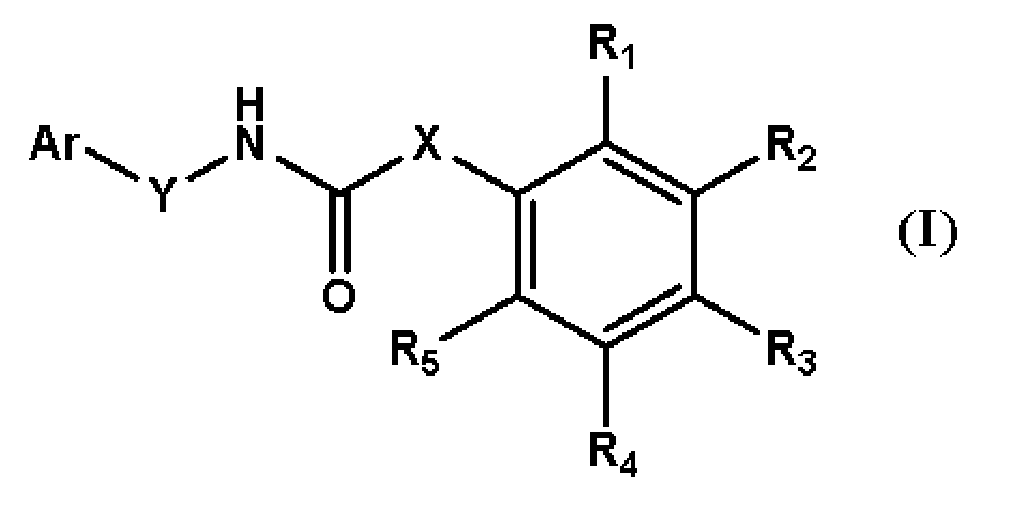
X is a covalent bond, a methylene group, an ethylene group or a vinylene group;
Y is a covalent bond or a divalent group represented by the formula
Ar is a substituent represented by the following formula (II)
the following formula (III)
R9 in combination optionally form a methylenedioxy group, and * is a moiety bonded to Y;
provided that the following compounds are excluded: (1) a compound wherein, when Ar is a substituent represented by the formula (II), X is a vinylene group, Y is an ethylene group, R1, R2, R5 and R7 are hydrogen atoms, and R6 is a hydroxyl group, then R3 is a hydroxyl group and R4 is a hydrogen atom, or R3 is a hydroxyl group and R4 is a methoxy group, or R3 and R4 are hydroxyl groups, or R3 is a methoxy group and R4 is a hydroxyl group, or R3 is a methoxy group and R4 is a hydrogen atom, (2) a compound wherein, when Ar is a substituent represented by the formula (II), X is a vinylene group, Y is an ethylene group, and R1, R2, R5, R6 and R7 are hydrogen atoms, then R3 is a hydroxyl group and R4 is a hydrogen atom, or R3 is a methoxy group and R4 is a hydrogen atom, or R3 and R4 are hydroxyl groups, or R3 is a hydroxyl group and R4 is a methoxy group, (3) a compound wherein, when Ar is a substituent represented by the formula (II), X is a vinylene group, Y is an ethylene group, R1, R2, R5 and R7 are hydrogen atoms, and R6 is a methoxy group, then R3 is a hydroxyl group and R4 is a hydrogen atom,
or R3 is a methoxy group and R4 is a hydrogen atom, or R3 and R4 are hydrogen atoms, (4) a compound wherein, when Ar is a substituent represented by the formula (II), X is a covalent bond, Y is an ethylene group, R1, R2, R5 and R7 are hydrogen atoms, and R6 is a hydroxyl group, then R3 and R4 are hydroxyl groups, or R3 is a hydroxyl group and R4 is a methoxy group, or R3 and R4 are hydrogen atoms, or R3 is a methoxy group and R4 is a hydrogen atom, and (5) a compound wherein Ar is a substituent represented by the formula (III), Y is an ethylene group, and one or both of R8 and R9 is/are a hydrogen atom(s); or a salt thereof. - A compound represented by the following formula (IV)

X is a methylene group, an ethylene group or a vinylene group; Z is a hydrogen atom, a hydroxycarbonyl group or an alkoxycarbonyl group having a carbon number of 1 - 3, and when Z is other than a hydrogen atom, the stereochemistry of a carbon atom bonded to Z may be any of (S), (R) and (SR); provided that the following compounds are excluded: (1) a compound wherein, when X is a vinylene group, Z is a hydrogen atom, R1, R2, R5 and R7 are hydrogen atoms, and R6 is a hydroxyl group, then R3 is a hydroxyl group and R4 is a hydrogen atom, or R3 is a hydroxyl group and R4 is a methoxy group, or R3 and R4 are hydroxyl groups, or R3 is a methoxy group and R4 is a hydroxyl group, or R3 is a methoxy group and R4 is a hydrogen atom, (2) a compound wherein, when X is a vinylene group, Z is a hydrogen atom, and R1, R2, R5, R6 and R7 are hydrogen atoms, then R3 is a hydroxyl group and R4 is a hydrogen atom, or R3 is a methoxy group and R4 is a hydrogen atom, or R3 and R4 are hydroxyl groups, or R3 is a hydroxyl group and R4 is a methoxy group, and (3) a compound wherein, when X is a vinylene group, Z is a hydrogen atom, R1, R2, R5 and R7 are hydrogen atoms, and R6 is a methoxy group, then R3 is a hydroxyl group and R4 is a hydrogen atom, or R3 is a methoxy group and R4 is a hydrogen atom, or R3 and R4 are hydrogen atoms; or a salt thereof. - A compound represented by the following formula (V)

Z is a hydrogen atom, a hydroxycarbonyl group or an alkoxycarbonyl group having a carbon number of 1 - 3, and when Z is other than a hydrogen atom, the stereochemistry of a carbon atom bonded to Z may be any of (S), (R) and (SR); provided that the following compound is excluded: a compound wherein, when Z is a hydrogen atom, R1, R2, R5 and R7 are hydrogen atoms, and R6 is a hydroxyl group, then R3 and R4 are hydroxyl groups, or R3 is a hydroxyl group and R4 is a methoxy group, or R3 and R4 are hydrogen atoms, or R3 is a methoxy group and R4 is a hydrogen atom; or a salt thereof. - A compound represented by the following formula (VI)

X is a covalent bond, a methylene group, an ethylene group or a vinylene group;
Y is a covalent bond or a divalent group represented by the formula
R8 and R9 are each independently a hydrogen atom, an alkyl group having a carbon number of 1 - 3, a hydroxyl group or an alkoxy group having a carbon number of 1 - 3, or R8 and R9 in combination optionally form a methylenedioxy group;
provided that the following compound is excluded: a compound wherein Y is an ethylene group, and one or both of R8 and R9 is/are a hydrogen atom(s); or a salt thereof. - A whitening agent comprising a compound represented by the following formula (I')

X is a covalent bond, a methylene group, an ethylene group or a vinylene group;
Y is a covalent bond or a divalent group represented by the formula
Ar is a substituent represented by the following formula (II)
the following formula (III)
R9 in combination optionally form a methylenedioxy group, and * is a moiety bonded to Y;
provided that the following compounds are excluded: (1) a compound wherein, when Ar is a substituent represented by the formula (II), X is a vinylene group, Y is an ethylene group, R1, R2, R5 and R7 are hydrogen atoms, and R6 is a hydroxyl group, then R3 is a hydroxyl group and R4 is a hydrogen atom, or R3 is a hydroxyl group and R4 is a methoxy group, or R3 and R4 are hydroxyl groups, (2) a compound wherein, when Ar is a substituent represented by the formula (II), X is a vinylene group, Y is an ethylene group, and R1, R2, R5, R6 and R7 are hydrogen atoms, then R3 and R4 are hydroxyl groups, (3) a compound wherein, when Ar is a substituent represented by the formula (II), X is a covalent bond, Y is an ethylene group, R1, R2, R5 and R7 are hydrogen atoms, and R6 is a hydroxyl group, then R3 and R4 are hydroxyl groups, or R3 is a hydroxyl group and R4 is a methoxy group, or R3 and R4 are hydrogen atoms, and (4) a compound wherein Ar is a substituent represented by the formula (III), Y is an ethylene group, R1, R2, R5 and R8 are hydrogen atoms, and R3, R4 and R9 are hydroxyl groups; or a salt thereof. - A whitening agent comprising the compound of any of claims 1 to 4, or a salt thereof.
Applications Claiming Priority (2)
| Application Number | Priority Date | Filing Date | Title |
|---|---|---|---|
| JP2009075006 | 2009-03-25 | ||
| PCT/JP2010/055162 WO2010110353A1 (en) | 2009-03-25 | 2010-03-25 | Novel amide derivative and skin whitening agent |
Publications (3)
| Publication Number | Publication Date |
|---|---|
| EP2412701A1 true EP2412701A1 (en) | 2012-02-01 |
| EP2412701A4 EP2412701A4 (en) | 2013-02-13 |
| EP2412701B1 EP2412701B1 (en) | 2015-08-12 |
Family
ID=42781046
Family Applications (1)
| Application Number | Title | Priority Date | Filing Date |
|---|---|---|---|
| EP10756149.0A Not-in-force EP2412701B1 (en) | 2009-03-25 | 2010-03-25 | Novel amide derivative and skin whitening agent |
Country Status (4)
| Country | Link |
|---|---|
| US (2) | US20120070395A1 (en) |
| EP (1) | EP2412701B1 (en) |
| JP (1) | JP5737176B2 (en) |
| WO (1) | WO2010110353A1 (en) |
Cited By (6)
| Publication number | Priority date | Publication date | Assignee | Title |
|---|---|---|---|---|
| WO2013022236A3 (en) * | 2011-08-05 | 2013-04-04 | (주)아모레퍼시픽 | Novel benzoic acid amide compound |
| FR2984122A1 (en) * | 2011-12-16 | 2013-06-21 | Syntivia | COSMETIC COMPOSITION FOR STIMULATING SKIN ANTI-AGING SKIN FUNCTIONS |
| WO2016107697A1 (en) * | 2014-12-30 | 2016-07-07 | Unilever N.V. | A skin lightening composition comprising 4-hexylresorcinol and ilomastat |
| WO2016107720A1 (en) * | 2014-12-30 | 2016-07-07 | Unilever N.V. | A skin lightening composition comprising niacinamide and ilomastat |
| WO2018046243A1 (en) * | 2016-09-06 | 2018-03-15 | Unilever N.V. | Compounds for reducing cellular melanin content |
| CN108602837A (en) * | 2015-09-04 | 2018-09-28 | 新丰制药株式会社 | With the compound and its salt for inhibiting platelet aggregation effect and include its composition for preventing or treating thrombotic diseases |
Families Citing this family (8)
| Publication number | Priority date | Publication date | Assignee | Title |
|---|---|---|---|---|
| WO2012042621A1 (en) * | 2010-09-29 | 2012-04-05 | 味の素株式会社 | Salty taste enhancer |
| GB201021104D0 (en) | 2010-12-13 | 2011-01-26 | Univ Leuven Kath | Novel compounds for the treatment of neurodegenerative diseases |
| SG10202009963PA (en) * | 2011-01-07 | 2020-11-27 | Allergan Inc | Melanin modification compositions and methods of use |
| JP5916348B2 (en) * | 2011-11-02 | 2016-05-11 | 学校法人近畿大学 | Novel serotonin compound, tyrosinase inhibitor, and discoloration inhibitor |
| CN102584672A (en) * | 2012-01-11 | 2012-07-18 | 合肥工业大学 | 5-methoxytryptamine derivative, and preparation method and application thereof |
| JP2014080406A (en) * | 2012-10-18 | 2014-05-08 | Yukijirushi Shubyo Kk | Plant growth regulator |
| EP2997013A4 (en) * | 2013-05-14 | 2017-03-22 | 3M Innovative Properties Company | Pyridine- or pyrazine-containing compounds |
| CN110339079B (en) * | 2019-07-03 | 2022-05-24 | 广州双慧化妆品有限公司 | Composition comprising amide derivatives and use thereof in cosmetics |
Family Cites Families (6)
| Publication number | Priority date | Publication date | Assignee | Title |
|---|---|---|---|---|
| JPH0853332A (en) * | 1994-08-11 | 1996-02-27 | Kao Corp | Whitening cosmetics |
| JPH08175959A (en) * | 1994-12-27 | 1996-07-09 | Kao Corp | Skin cosmetics |
| JP4341501B2 (en) * | 2004-08-10 | 2009-10-07 | 東亞合成株式会社 | Tyrosinase activity inhibitor |
| JP5677717B2 (en) * | 2005-09-14 | 2015-02-25 | 味の素株式会社 | Hemodynamic improver |
| FR2892923B1 (en) * | 2005-11-08 | 2009-01-16 | Engelhard Lyon Sa | USE OF PARA-COUMARIC OR PARA-HYDROXYCINNAMIC ACID DERIVATIVES IN COSMETIC OR DERMATOLOGICAL COMPOSITIONS. |
| JP2009040688A (en) | 2007-08-06 | 2009-02-26 | Tsuchida Yuzo | Melanogenesis inhibitor |
-
2010
- 2010-03-25 JP JP2011506106A patent/JP5737176B2/en not_active Expired - Fee Related
- 2010-03-25 EP EP10756149.0A patent/EP2412701B1/en not_active Not-in-force
- 2010-03-25 WO PCT/JP2010/055162 patent/WO2010110353A1/en not_active Ceased
-
2011
- 2011-09-22 US US13/240,358 patent/US20120070395A1/en not_active Abandoned
-
2014
- 2014-05-27 US US14/287,899 patent/US9295624B2/en not_active Expired - Fee Related
Non-Patent Citations (4)
| Title |
|---|
| DATABASE CA [Online] CHEMICAL ABSTRACTS SERVICE, COLUMBUS, OHIO, US; PROTIVA, M. ET AL: "Synthetic experiments with hypotensive alkaloids. XXV. 3-(2-Benzylaminoethyl)indole and 3-[2-(2-phenoxyethylamino)ethyl]indole derivatives", XP002689552, retrieved from STN Database accession no. 1963:435473 & PROTIVA, M. ET AL: "Synthetic experiments with hypotensive alkaloids. XXV. 3-(2-Benzylaminoethyl)indole and 3-[2-(2-phenoxyethylamino)ethyl]indole derivatives", COLLECTION OF CZECHOSLOVAK CHEMICAL COMMUNICATIONS , 28, 629-36 CODEN: CCCCAK; ISSN: 0010-0765, 1963, * |
| GUTIERREZ S J C ET AL: "N<b>-benzoyltryptamine derivatives with relaxant activity in guinea-pig ileum", IL FARMACO, ELSEVIER FRANCE * EDITIONS SCIENTIFIQUES ET MEDICALES, IT, vol. 60, no. 6-7, 1 June 2005 (2005-06-01) , pages 475-477, XP027697570, ISSN: 0014-827X [retrieved on 2005-06-01] * |
| KANG K ET AL: "Production of phenylpropanoid amides in recombinant Escherichia coli", METABOLIC ENGINEERING, ACADEMIC PRESS, US, vol. 11, no. 1, 1 January 2009 (2009-01-01), pages 64-68, XP025656321, ISSN: 1096-7176, DOI: 10.1016/J.YMBEN.2008.08.004 [retrieved on 2008-08-28] * |
| See also references of WO2010110353A1 * |
Cited By (19)
| Publication number | Priority date | Publication date | Assignee | Title |
|---|---|---|---|---|
| WO2013022236A3 (en) * | 2011-08-05 | 2013-04-04 | (주)아모레퍼시픽 | Novel benzoic acid amide compound |
| US9254251B2 (en) | 2011-08-05 | 2016-02-09 | Amorepacific Corporation | Benzoic acid amide compound |
| FR2984122A1 (en) * | 2011-12-16 | 2013-06-21 | Syntivia | COSMETIC COMPOSITION FOR STIMULATING SKIN ANTI-AGING SKIN FUNCTIONS |
| WO2013087834A3 (en) * | 2011-12-16 | 2013-10-24 | Syntivia | Cosmetic composition for stimulating the cellular anti-aging functions of the skin |
| EA032573B1 (en) * | 2014-12-30 | 2019-06-28 | Юнилевер Н.В. | COMPOSITION FOR LIGHTING THE SKIN, CONTAINING 4-HEXILRESORCIN AND ILOMASTAT |
| CN107106454B (en) * | 2014-12-30 | 2019-12-20 | 荷兰联合利华有限公司 | Skin lightening compositions comprising 4-hexylresorcinol and ilomastat |
| CN107106454A (en) * | 2014-12-30 | 2017-08-29 | 荷兰联合利华有限公司 | Skin lightening composition comprising 4 hexyl resorcins and Ilomastat |
| WO2016107720A1 (en) * | 2014-12-30 | 2016-07-07 | Unilever N.V. | A skin lightening composition comprising niacinamide and ilomastat |
| WO2016107697A1 (en) * | 2014-12-30 | 2016-07-07 | Unilever N.V. | A skin lightening composition comprising 4-hexylresorcinol and ilomastat |
| US10166412B2 (en) | 2014-12-30 | 2019-01-01 | Conopco, Inc. | Skin lightening composition comprising 4-hexylresorcinol and ilomastat |
| EA032574B1 (en) * | 2014-12-30 | 2019-06-28 | Юнилевер Н.В. | Skin lightening composition comprising niacinamide and ilomastat |
| CN108602837A (en) * | 2015-09-04 | 2018-09-28 | 新丰制药株式会社 | With the compound and its salt for inhibiting platelet aggregation effect and include its composition for preventing or treating thrombotic diseases |
| EP3345910A4 (en) * | 2015-09-04 | 2019-09-11 | Shin Poong Pharmaceutical Co., Ltd. | COMPOUND HAVING THE EFFECT OF INHIBITING PLAQUETTATIVE AGGREGATION, SALT THEREOF, AND COMPOSITION FOR PREVENTING OR TREATING THROMBOTIC DISEASES CONTAINING THE SAME |
| US10730886B2 (en) | 2015-09-04 | 2020-08-04 | Shin Poong Pharmaceutical Co., Ltd. | Compound having effect of inhibiting platelet aggregation and salt thereof, and composition for preventing or treating thrombotic diseases, containing same |
| RU2739915C2 (en) * | 2015-09-04 | 2020-12-29 | Син Поонг Фармасьютикал Ко., Лтд. | Compound having thrombocyte aggregation inhibition action, and a salt thereof, and a composition comprising such compounds for preventing or treating thrombotic diseases |
| AU2016317968B2 (en) * | 2015-09-04 | 2021-03-25 | Shin Poong Pharmaceutical Co., Ltd. | Compound having effect of inhibiting platelet aggregation and salt thereof, and composition for preventing or treating thrombotic diseases, containing same |
| CN109661224A (en) * | 2016-09-06 | 2019-04-19 | 荷兰联合利华有限公司 | For reducing the compound of cell melanin content |
| WO2018046243A1 (en) * | 2016-09-06 | 2018-03-15 | Unilever N.V. | Compounds for reducing cellular melanin content |
| CN109661224B (en) * | 2016-09-06 | 2022-05-24 | 联合利华知识产权控股有限公司 | Compounds for reducing melanin content in cells |
Also Published As
| Publication number | Publication date |
|---|---|
| JP5737176B2 (en) | 2015-06-17 |
| EP2412701A4 (en) | 2013-02-13 |
| US9295624B2 (en) | 2016-03-29 |
| WO2010110353A1 (en) | 2010-09-30 |
| JPWO2010110353A1 (en) | 2012-10-04 |
| EP2412701B1 (en) | 2015-08-12 |
| US20120070395A1 (en) | 2012-03-22 |
| US20140255327A1 (en) | 2014-09-11 |
Similar Documents
| Publication | Publication Date | Title |
|---|---|---|
| EP2412701B1 (en) | Novel amide derivative and skin whitening agent | |
| EP1529776B1 (en) | Amino acid derivatives and sweetening agent | |
| JP6393754B2 (en) | Carotenoid derivatives, pharmaceutically acceptable salts thereof or pharmaceutically acceptable esters or amides thereof | |
| CN115260091B (en) | Ceramide compounds containing cyclic carboxylic acid and preparation method and application thereof | |
| WO2002076935A1 (en) | Novel a-lipoic acid derivative and use thereof | |
| US8927499B2 (en) | Glycine derivative capable of inhibiting melanin formation and composition using the same | |
| JP4341501B2 (en) | Tyrosinase activity inhibitor | |
| CN116554122A (en) | α-keto acid amide or substituted oxalic acid amido ester compound and composition thereof | |
| KR20180045728A (en) | 3,4,5-Trimethoxy cinnamic acid derivatives, preparation method thereof, and skin whithening composition comprising the same | |
| JP2007186445A (en) | Melanin production inhibitor containing resorcinol derivative | |
| CN108047105B (en) | 3-/4-ester-group-substituted benzaldehyde thiosemicarbazone derivative and preparation and application thereof | |
| Zhao et al. | Facile syntheses of (2R, 3R)-(−)-and (2S, 3S)-(+)-chicoric acids | |
| CN111440068B (en) | Cinnamate derivative and application thereof as tyrosinase inhibitor and gel | |
| JP2000239245A (en) | Hydroxymandelic acid amide of phenolamine | |
| CN118812406A (en) | A kind of amide alkylresorcinol derivative and its use as antioxidant | |
| JP6698100B2 (en) | Novel benzoic acid amide compound | |
| JP3093280B2 (en) | Phenylacetamide derivative | |
| JP2005314240A (en) | Coumarin derivative and maillard reaction inhibitor containing the derivative | |
| WO2021105261A1 (en) | Trpm8 modulators | |
| KR101491728B1 (en) | Conjugate of vitamin C with vitamin B3 and antioxidant comprising the same | |
| KR102846574B1 (en) | Novel coumarin-based thiophenyl-pyrazolylthiazole derivatives and potent tyrosinase inhibitor comprising the same | |
| JP2006232686A (en) | New carnosine ester compound | |
| KR101154233B1 (en) | Cosmetic whitening composition containing tyrosine derivatives | |
| JP2006232685A (en) | Maillard reaction inhibitor | |
| KR101574561B1 (en) | Novel derivatives of cyclohexanediamine compound and cosmetic composition comprising the same |
Legal Events
| Date | Code | Title | Description |
|---|---|---|---|
| PUAI | Public reference made under article 153(3) epc to a published international application that has entered the european phase |
Free format text: ORIGINAL CODE: 0009012 |
|
| 17P | Request for examination filed |
Effective date: 20111025 |
|
| AK | Designated contracting states |
Kind code of ref document: A1 Designated state(s): AT BE BG CH CY CZ DE DK EE ES FI FR GB GR HR HU IE IS IT LI LT LU LV MC MK MT NL NO PL PT RO SE SI SK SM TR |
|
| DAX | Request for extension of the european patent (deleted) | ||
| RIC1 | Information provided on ipc code assigned before grant |
Ipc: C07C 235/34 20060101AFI20121221BHEP Ipc: A61K 31/4045 20060101ALI20121221BHEP Ipc: A61K 31/165 20060101ALI20121221BHEP Ipc: A61K 8/49 20060101ALI20121221BHEP Ipc: C07D 405/12 20060101ALI20121221BHEP Ipc: C07D 209/20 20060101ALI20121221BHEP Ipc: A61K 8/42 20060101ALI20121221BHEP Ipc: A61Q 19/02 20060101ALI20121221BHEP Ipc: C07D 209/14 20060101ALI20121221BHEP Ipc: A61K 31/405 20060101ALI20121221BHEP Ipc: A61P 43/00 20060101ALI20121221BHEP |
|
| A4 | Supplementary search report drawn up and despatched |
Effective date: 20130114 |
|
| 17Q | First examination report despatched |
Effective date: 20131002 |
|
| GRAP | Despatch of communication of intention to grant a patent |
Free format text: ORIGINAL CODE: EPIDOSNIGR1 |
|
| INTG | Intention to grant announced |
Effective date: 20141124 |
|
| GRAP | Despatch of communication of intention to grant a patent |
Free format text: ORIGINAL CODE: EPIDOSNIGR1 |
|
| INTG | Intention to grant announced |
Effective date: 20150303 |
|
| GRAS | Grant fee paid |
Free format text: ORIGINAL CODE: EPIDOSNIGR3 |
|
| GRAA | (expected) grant |
Free format text: ORIGINAL CODE: 0009210 |
|
| AK | Designated contracting states |
Kind code of ref document: B1 Designated state(s): AT BE BG CH CY CZ DE DK EE ES FI FR GB GR HR HU IE IS IT LI LT LU LV MC MK MT NL NO PL PT RO SE SI SK SM TR |
|
| REG | Reference to a national code |
Ref country code: GB Ref legal event code: FG4D |
|
| REG | Reference to a national code |
Ref country code: CH Ref legal event code: EP |
|
| REG | Reference to a national code |
Ref country code: AT Ref legal event code: REF Ref document number: 742006 Country of ref document: AT Kind code of ref document: T Effective date: 20150815 |
|
| REG | Reference to a national code |
Ref country code: IE Ref legal event code: FG4D |
|
| REG | Reference to a national code |
Ref country code: DE Ref legal event code: R096 Ref document number: 602010026636 Country of ref document: DE |
|
| REG | Reference to a national code |
Ref country code: LT Ref legal event code: MG4D |
|
| REG | Reference to a national code |
Ref country code: AT Ref legal event code: MK05 Ref document number: 742006 Country of ref document: AT Kind code of ref document: T Effective date: 20150812 |
|
| REG | Reference to a national code |
Ref country code: NL Ref legal event code: MP Effective date: 20150812 |
|
| PG25 | Lapsed in a contracting state [announced via postgrant information from national office to epo] |
Ref country code: LT Free format text: LAPSE BECAUSE OF FAILURE TO SUBMIT A TRANSLATION OF THE DESCRIPTION OR TO PAY THE FEE WITHIN THE PRESCRIBED TIME-LIMIT Effective date: 20150812 Ref country code: NO Free format text: LAPSE BECAUSE OF FAILURE TO SUBMIT A TRANSLATION OF THE DESCRIPTION OR TO PAY THE FEE WITHIN THE PRESCRIBED TIME-LIMIT Effective date: 20151112 Ref country code: FI Free format text: LAPSE BECAUSE OF FAILURE TO SUBMIT A TRANSLATION OF THE DESCRIPTION OR TO PAY THE FEE WITHIN THE PRESCRIBED TIME-LIMIT Effective date: 20150812 Ref country code: LV Free format text: LAPSE BECAUSE OF FAILURE TO SUBMIT A TRANSLATION OF THE DESCRIPTION OR TO PAY THE FEE WITHIN THE PRESCRIBED TIME-LIMIT Effective date: 20150812 Ref country code: GR Free format text: LAPSE BECAUSE OF FAILURE TO SUBMIT A TRANSLATION OF THE DESCRIPTION OR TO PAY THE FEE WITHIN THE PRESCRIBED TIME-LIMIT Effective date: 20151113 |
|
| REG | Reference to a national code |
Ref country code: FR Ref legal event code: PLFP Year of fee payment: 7 |
|
| PG25 | Lapsed in a contracting state [announced via postgrant information from national office to epo] |
Ref country code: IS Free format text: LAPSE BECAUSE OF FAILURE TO SUBMIT A TRANSLATION OF THE DESCRIPTION OR TO PAY THE FEE WITHIN THE PRESCRIBED TIME-LIMIT Effective date: 20151212 Ref country code: PL Free format text: LAPSE BECAUSE OF FAILURE TO SUBMIT A TRANSLATION OF THE DESCRIPTION OR TO PAY THE FEE WITHIN THE PRESCRIBED TIME-LIMIT Effective date: 20150812 Ref country code: PT Free format text: LAPSE BECAUSE OF FAILURE TO SUBMIT A TRANSLATION OF THE DESCRIPTION OR TO PAY THE FEE WITHIN THE PRESCRIBED TIME-LIMIT Effective date: 20151214 Ref country code: SE Free format text: LAPSE BECAUSE OF FAILURE TO SUBMIT A TRANSLATION OF THE DESCRIPTION OR TO PAY THE FEE WITHIN THE PRESCRIBED TIME-LIMIT Effective date: 20150812 Ref country code: HR Free format text: LAPSE BECAUSE OF FAILURE TO SUBMIT A TRANSLATION OF THE DESCRIPTION OR TO PAY THE FEE WITHIN THE PRESCRIBED TIME-LIMIT Effective date: 20150812 Ref country code: ES Free format text: LAPSE BECAUSE OF FAILURE TO SUBMIT A TRANSLATION OF THE DESCRIPTION OR TO PAY THE FEE WITHIN THE PRESCRIBED TIME-LIMIT Effective date: 20150812 Ref country code: AT Free format text: LAPSE BECAUSE OF FAILURE TO SUBMIT A TRANSLATION OF THE DESCRIPTION OR TO PAY THE FEE WITHIN THE PRESCRIBED TIME-LIMIT Effective date: 20150812 |
|
| PG25 | Lapsed in a contracting state [announced via postgrant information from national office to epo] |
Ref country code: NL Free format text: LAPSE BECAUSE OF FAILURE TO SUBMIT A TRANSLATION OF THE DESCRIPTION OR TO PAY THE FEE WITHIN THE PRESCRIBED TIME-LIMIT Effective date: 20150812 |
|
| PG25 | Lapsed in a contracting state [announced via postgrant information from national office to epo] |
Ref country code: EE Free format text: LAPSE BECAUSE OF FAILURE TO SUBMIT A TRANSLATION OF THE DESCRIPTION OR TO PAY THE FEE WITHIN THE PRESCRIBED TIME-LIMIT Effective date: 20150812 Ref country code: DK Free format text: LAPSE BECAUSE OF FAILURE TO SUBMIT A TRANSLATION OF THE DESCRIPTION OR TO PAY THE FEE WITHIN THE PRESCRIBED TIME-LIMIT Effective date: 20150812 Ref country code: IT Free format text: LAPSE BECAUSE OF FAILURE TO SUBMIT A TRANSLATION OF THE DESCRIPTION OR TO PAY THE FEE WITHIN THE PRESCRIBED TIME-LIMIT Effective date: 20150812 Ref country code: CZ Free format text: LAPSE BECAUSE OF FAILURE TO SUBMIT A TRANSLATION OF THE DESCRIPTION OR TO PAY THE FEE WITHIN THE PRESCRIBED TIME-LIMIT Effective date: 20150812 Ref country code: SK Free format text: LAPSE BECAUSE OF FAILURE TO SUBMIT A TRANSLATION OF THE DESCRIPTION OR TO PAY THE FEE WITHIN THE PRESCRIBED TIME-LIMIT Effective date: 20150812 |
|
| REG | Reference to a national code |
Ref country code: DE Ref legal event code: R097 Ref document number: 602010026636 Country of ref document: DE |
|
| PG25 | Lapsed in a contracting state [announced via postgrant information from national office to epo] |
Ref country code: RO Free format text: LAPSE BECAUSE OF FAILURE TO SUBMIT A TRANSLATION OF THE DESCRIPTION OR TO PAY THE FEE WITHIN THE PRESCRIBED TIME-LIMIT Effective date: 20150812 |
|
| PLBE | No opposition filed within time limit |
Free format text: ORIGINAL CODE: 0009261 |
|
| STAA | Information on the status of an ep patent application or granted ep patent |
Free format text: STATUS: NO OPPOSITION FILED WITHIN TIME LIMIT |
|
| 26N | No opposition filed |
Effective date: 20160513 |
|
| PG25 | Lapsed in a contracting state [announced via postgrant information from national office to epo] |
Ref country code: SI Free format text: LAPSE BECAUSE OF FAILURE TO SUBMIT A TRANSLATION OF THE DESCRIPTION OR TO PAY THE FEE WITHIN THE PRESCRIBED TIME-LIMIT Effective date: 20150812 Ref country code: BE Free format text: LAPSE BECAUSE OF NON-PAYMENT OF DUE FEES Effective date: 20160331 |
|
| PG25 | Lapsed in a contracting state [announced via postgrant information from national office to epo] |
Ref country code: LU Free format text: LAPSE BECAUSE OF FAILURE TO SUBMIT A TRANSLATION OF THE DESCRIPTION OR TO PAY THE FEE WITHIN THE PRESCRIBED TIME-LIMIT Effective date: 20160325 Ref country code: MC Free format text: LAPSE BECAUSE OF FAILURE TO SUBMIT A TRANSLATION OF THE DESCRIPTION OR TO PAY THE FEE WITHIN THE PRESCRIBED TIME-LIMIT Effective date: 20150812 |
|
| REG | Reference to a national code |
Ref country code: CH Ref legal event code: PL |
|
| GBPC | Gb: european patent ceased through non-payment of renewal fee |
Effective date: 20160325 |
|
| REG | Reference to a national code |
Ref country code: IE Ref legal event code: MM4A |
|
| PG25 | Lapsed in a contracting state [announced via postgrant information from national office to epo] |
Ref country code: BE Free format text: LAPSE BECAUSE OF FAILURE TO SUBMIT A TRANSLATION OF THE DESCRIPTION OR TO PAY THE FEE WITHIN THE PRESCRIBED TIME-LIMIT Effective date: 20150812 |
|
| PG25 | Lapsed in a contracting state [announced via postgrant information from national office to epo] |
Ref country code: LI Free format text: LAPSE BECAUSE OF NON-PAYMENT OF DUE FEES Effective date: 20160331 Ref country code: CH Free format text: LAPSE BECAUSE OF NON-PAYMENT OF DUE FEES Effective date: 20160331 Ref country code: GB Free format text: LAPSE BECAUSE OF NON-PAYMENT OF DUE FEES Effective date: 20160325 Ref country code: IE Free format text: LAPSE BECAUSE OF NON-PAYMENT OF DUE FEES Effective date: 20160325 |
|
| REG | Reference to a national code |
Ref country code: FR Ref legal event code: PLFP Year of fee payment: 8 |
|
| PG25 | Lapsed in a contracting state [announced via postgrant information from national office to epo] |
Ref country code: MT Free format text: LAPSE BECAUSE OF FAILURE TO SUBMIT A TRANSLATION OF THE DESCRIPTION OR TO PAY THE FEE WITHIN THE PRESCRIBED TIME-LIMIT Effective date: 20150812 |
|
| REG | Reference to a national code |
Ref country code: FR Ref legal event code: PLFP Year of fee payment: 9 |
|
| PGFP | Annual fee paid to national office [announced via postgrant information from national office to epo] |
Ref country code: DE Payment date: 20180313 Year of fee payment: 9 |
|
| PG25 | Lapsed in a contracting state [announced via postgrant information from national office to epo] |
Ref country code: SM Free format text: LAPSE BECAUSE OF FAILURE TO SUBMIT A TRANSLATION OF THE DESCRIPTION OR TO PAY THE FEE WITHIN THE PRESCRIBED TIME-LIMIT Effective date: 20150812 Ref country code: HU Free format text: LAPSE BECAUSE OF FAILURE TO SUBMIT A TRANSLATION OF THE DESCRIPTION OR TO PAY THE FEE WITHIN THE PRESCRIBED TIME-LIMIT; INVALID AB INITIO Effective date: 20100325 Ref country code: CY Free format text: LAPSE BECAUSE OF FAILURE TO SUBMIT A TRANSLATION OF THE DESCRIPTION OR TO PAY THE FEE WITHIN THE PRESCRIBED TIME-LIMIT Effective date: 20150812 |
|
| PGFP | Annual fee paid to national office [announced via postgrant information from national office to epo] |
Ref country code: FR Payment date: 20180223 Year of fee payment: 9 |
|
| PG25 | Lapsed in a contracting state [announced via postgrant information from national office to epo] |
Ref country code: TR Free format text: LAPSE BECAUSE OF FAILURE TO SUBMIT A TRANSLATION OF THE DESCRIPTION OR TO PAY THE FEE WITHIN THE PRESCRIBED TIME-LIMIT Effective date: 20150812 Ref country code: MK Free format text: LAPSE BECAUSE OF FAILURE TO SUBMIT A TRANSLATION OF THE DESCRIPTION OR TO PAY THE FEE WITHIN THE PRESCRIBED TIME-LIMIT Effective date: 20150812 Ref country code: MT Free format text: LAPSE BECAUSE OF FAILURE TO SUBMIT A TRANSLATION OF THE DESCRIPTION OR TO PAY THE FEE WITHIN THE PRESCRIBED TIME-LIMIT Effective date: 20160331 |
|
| PG25 | Lapsed in a contracting state [announced via postgrant information from national office to epo] |
Ref country code: BG Free format text: LAPSE BECAUSE OF FAILURE TO SUBMIT A TRANSLATION OF THE DESCRIPTION OR TO PAY THE FEE WITHIN THE PRESCRIBED TIME-LIMIT Effective date: 20150812 |
|
| REG | Reference to a national code |
Ref country code: DE Ref legal event code: R119 Ref document number: 602010026636 Country of ref document: DE |
|
| PG25 | Lapsed in a contracting state [announced via postgrant information from national office to epo] |
Ref country code: DE Free format text: LAPSE BECAUSE OF NON-PAYMENT OF DUE FEES Effective date: 20191001 |
|
| PG25 | Lapsed in a contracting state [announced via postgrant information from national office to epo] |
Ref country code: FR Free format text: LAPSE BECAUSE OF NON-PAYMENT OF DUE FEES Effective date: 20190331 |