EP2411137B1 - Spray-drying process - Google Patents
Spray-drying process Download PDFInfo
- Publication number
- EP2411137B1 EP2411137B1 EP10712212.9A EP10712212A EP2411137B1 EP 2411137 B1 EP2411137 B1 EP 2411137B1 EP 10712212 A EP10712212 A EP 10712212A EP 2411137 B1 EP2411137 B1 EP 2411137B1
- Authority
- EP
- European Patent Office
- Prior art keywords
- temperature
- spray
- active agent
- matrix material
- spray solution
- Prior art date
- Legal status (The legal status is an assumption and is not a legal conclusion. Google has not performed a legal analysis and makes no representation as to the accuracy of the status listed.)
- Active
Links
Images

Classifications
-
- B—PERFORMING OPERATIONS; TRANSPORTING
- B01—PHYSICAL OR CHEMICAL PROCESSES OR APPARATUS IN GENERAL
- B01J—CHEMICAL OR PHYSICAL PROCESSES, e.g. CATALYSIS OR COLLOID CHEMISTRY; THEIR RELEVANT APPARATUS
- B01J2/00—Processes or devices for granulating materials, e.g. fertilisers in general; Rendering particulate materials free flowing in general, e.g. making them hydrophobic
- B01J2/02—Processes or devices for granulating materials, e.g. fertilisers in general; Rendering particulate materials free flowing in general, e.g. making them hydrophobic by dividing the liquid material into drops, e.g. by spraying, and solidifying the drops
- B01J2/04—Processes or devices for granulating materials, e.g. fertilisers in general; Rendering particulate materials free flowing in general, e.g. making them hydrophobic by dividing the liquid material into drops, e.g. by spraying, and solidifying the drops in a gaseous medium
Definitions
- a novel spray-drying process is disclosed.
- the process can lead to spray-dried products with improved properties, as well as increased throughput relative to conventional spray-drying processes.
- the active agent When it is desired to form a spray-dried product in which the drug or active agent is amorphous, it is desirable to have the active agent fully dissolved in the spray solution when it is atomized into droplets.
- the amorphous active agent when it is desired to form a spray-dried product in which the amorphous active agent is dispersed in one or more other materials, termed matrix material, it is generally desired to have at least a part and often all of the matrix material also dissolved in the spray solution.
- the throughput of a conventional spray-drying process is often limited by the amount of active agent and matrix material that can be dissolved in the spray solution. It is generally known that the solubility of many substances, such as active agents and matrix materials, often increases as the temperature of the solvent is increased.
- U.S. Patent Application Publication No. 2008/0248114A1 describes the production of solid solutions containing poorly-soluble active substances using a spray-drying process utilizing short-term heating and rapid drying.
- the process avoids organic solvents by utilizing a feed stream that is an aqueous suspension of the active.
- the aqueous suspension is heated to allow dissolution of the active in the spray solution.
- this process is limited to actives that have a high solubility in water at elevated temperature.
- WO2008/092057A2 describes a method for preparing solid materials including the steps of providing a feedstock comprising an organic material in a solvent system containing a non-solvent for the organic material at an elevated temperature and/or pressure above ambient conditions.
- What is needed is a spray-drying process that results in improved properties of the spray-dried product, such as a more uniform particle size, and that improves the throughput of spray-drying equipment while spraying solutions of an active agent and the matrix material, and provides a safe, reproducible process to produce high-quality product.
- Such a process promises to increase the quality and decrease manufacturing costs for spray-dried products.
- the invention relates to a process according to and as defined in Claim 1.
- temperature T 2 is greater than the ambient-pressure boiling point of the organic solvent.
- the nozzle used for atomization of the spray solution is a pressure nozzle.
- the nozzle used for atomization of the spray solution in the spray-drying apparatus is a flash nozzle.
- a flash nozzle utilizes a pressure drop that induces cavitation in the spray solution prior to exiting the nozzle orifice to induce droplet formation.
- a sweep gas around the orifice is used to eliminate or reduce solids build-up during operation.
- the matrix material comprises a polymer.
- the particles comprise a solid amorphous dispersion of the active agent and a polymer.
- the disclosed processes provide one or more advantages over a conventional spray-drying process. Certain embodiments of the disclosed processes can increase the throughput of a spray dryer by forming a spray solution that has a higher concentration at a higher temperature than conventional processes. Additionally, certain embodiments of the disclosed processes allow spray-drying solutions wherein ratio of the concentration of active agent in the spray solution to the solubility of the active agent in the organic solvent at the atomization temperature is significantly less than one, preferably less than 0.5, and even more preferably less than 0.3. Operating in this regime generally leads to spray-dried products that are more homogeneous and more uniform. In addition, the disclosed processes result in rapid evaporation of the organic solvent, and shorter times to solidification than conventional processes. Furthermore, in some embodiments, the process results in improved atomization of the spray solution relative to conventional processes due to the temperature of the spray solution when it is atomized being above the boiling point of the solvent at the pressure of the drying chamber.
- a spray-drying process for producing a composition comprising an active agent and a matrix material is described.
- the spray-drying process, suitable apparatus for carrying out the process, and suitable active agents and matrix materials are described in detail below.
- spray drying is used conventionally and broadly refers to processes involving breaking up liquid mixtures into small droplets (atomization) and rapidly removing solvent from the mixture in a container (drying chamber) where there is a strong driving force for evaporation of solvent from the droplets.
- the strong driving force for solvent evaporation is generally provided by maintaining the partial pressure of solvent in the spray-drying apparatus well below the vapor pressure of the solvent at the temperature of the drying droplets. This is accomplished by (1) mixing the liquid droplets with a warm drying gas, (2) maintaining the pressure in the spray-drying apparatus at a partial vacuum (e.g., 0.01 atm to 0.50 atm), or (3) both.
- the temperature and flow rate of the drying gas is chosen so that the droplets of spray solution are dry enough by the time they reach the wall of the apparatus that they are essentially solid, form a fine powder, and do not stick to the apparatus wall.
- the actual length of time to achieve this level of dryness depends on the size of the droplets and the conditions at which the process is operated. Droplet sizes may range from 1 ⁇ m to 500 ⁇ m in diameter, the size being dependent on the desired particle size of the spray dried powder.
- the large surface-to-volume ratio of the droplets and the large driving force for evaporation of solvent lead to actual drying times of a few seconds or less, and often less than 0.1 second. Solidification times should be less than 100 seconds, and often less than a few seconds.
- FIG. 1 an apparatus 10 suitable for performing embodiments of the disclosed processes.
- the spray-drying apparatus is cylindrical.
- the dryer may take any other cross-sectional shape suitable for spray drying a spray solution, including square, rectangular, and octagonal, among others.
- the spray-drying apparatus is also depicted as having one nozzle. However, multiple nozzles can be included in the spray-drying apparatus to achieve higher throughput of the spray solution.
- the apparatus shown in FIG. 1 includes a feed suspension tank 20, a heat exchanger 30, a drying chamber 40, a nozzle 50, and a particle-collection means 60.
- the process is performed as follows.
- An active agent and a matrix material are combined with an organic solvent in the feed suspension tank 20 to form a feed suspension.
- the feed suspension is at a temperature T 1 , which is below the ambient-pressure boiling point of the organic solvent.
- Temperature T 1 is also below either T A , the temperature at which the active agent solubility equals the active agent concentration in the organic solvent, or T M , the temperature at which the matrix material solubility equals the matrix material concentration in the organic solvent.
- At least a portion of the active agent, a portion of the matrix material, or a portion of both the active agent and the matrix material are suspended, that is not dissolved, in the organic solvent.
- An optional mixing means 22 may be used to keep the feed suspension homogeneous while processing.
- oxygen is normally excluded from all parts of the drying apparatus.
- an inert gas such as nitrogen, helium, argon, and the like, is often used to fill the void space in the feed suspension tank for safety reasons.
- the term "feed suspension” means a composition comprising an active agent, a matrix material, and an organic solvent, wherein at least a portion of the active agent, a portion of the matrix material, or a portion of both active agent and matrix material are suspended or not dissolved in the organic solvent.
- the feed suspension consists essentially of an active agent, a matrix material, and an organic solvent.
- the feed suspension consists of an active agent, a matrix material, and an organic solvent.
- the feed suspension consists of particles of active agent suspended in a solution of matrix material dissolved in the organic solvent. It will be recognized that in such feed suspensions, a portion of the active agent and the matrix material may dissolve up to their solubility limits at the temperature of the feed suspension.
- organic solvent means an organic compound that can be used to dissolve the active agent and the matrix material at elevated temperature.
- the solvent is volatile, having an ambient-pressure boiling point of 150°C or less. In another embodiment, the solvent has an ambient-pressure boiling point of 100°C or less.
- Suitable solvents include alcohols such as methanol, ethanol, n-propanol, isopropanol, and butanol; ketones such as acetone, methyl ethyl ketone and methyl isobutyl ketone; esters such as ethyl acetate and propyl acetate; and various other solvents, such as tetrahydrofuran, acetonitrile, methylene chloride, toluene, and 1,1,1-trichloroethane.
- Lower volatility solvents such as dimethylacetamide or dimethylsulfoxide can also be used, generally in combination with a volatile solvent.
- the organic solvent contains less than 50 wt% water. In another embodiment, the organic solvent contains less than 25 wt% water. In still another embodiment, the organic solvent contains less than 10 wt% water. In yet another embodiment, the organic solvent contains less than 5 wt% water. In another embodiment, the organic solvent contains essentially no water.
- the feed suspension is often maintained at near-ambient temperatures; however, this is not a limitation of the disclosed processes.
- the temperature of the feed suspension, T 1 can range from 0°C to 50°C or even higher. Temperatures of less than 0°C may also be utilized, especially when there are stability concerns about the active agent.
- the feed suspension in the feed suspension tank 20 is delivered to a pump 24, which directs the feed suspension to a heat exchanger 30.
- the heat exchanger has a feed suspension inlet 26, a spray solution outlet 36, a heating fluid inlet 32, and a heating fluid outlet 34.
- the feed suspension enters through the feed suspension inlet 26 at temperature T 1 , and exits as the spray solution through the spray solution outlet 36 at temperature T 2 .
- Spray solution temperature T 2 is greater than feed suspension temperature T 1 .
- pump 24 increases the pressure of the spray solution such that the pressure of the spray solution at spray solution outlet 36 is greater than the vapor pressure of the organic solvent at temperature T 2 .
- T 2 is greater than or equal to the lesser of T A and T M . In one embodiment, T 2 is greater than or equal to the greater of T A and T M . When it is the object of the process to form a solid amorphous dispersion of the active agent and the matrix material, T 2 is greater than or equal to T A . Preferably, T 2 is at least 10°C greater than T A . In one embodiment, the spray solution temperature T 2 is greater than the ambient-pressure boiling point of the organic solvent.
- the spray solution exiting the heat exchanger may be at any temperature, T 2 , which is greater than T 1 , as long as T 2 is greater than or equal to the lesser of T A and T M .
- Temperature T 2 may be at least 10°C greater than T 1 , at least 20°C greater than T 1 , at least 30°C greater than T 1 , at least 40°C greater than T 1 , or even at least 50°C greater than T 1 .
- temperature T 2 is at least 50°C.
- temperature T 2 is at least 70°C.
- temperature T 2 is at least 80°C.
- temperature T 2 is at least 90°C.
- T 2 is at least 100°C.
- T 2 is at least 120°C.
- the active agent and the matrix material are both soluble in the organic solvent at temperature T 2 .
- soluble is meant that essentially all of the active agent and matrix material are dissolved in the organic solvent at temperature T 2 .
- the term “dissolved” has the conventional meaning, indicating that the active agent has gone into solution.
- matrix materials the term “dissolved” can take a broader definition.
- the term dissolved can mean the polymer has gone into solution, or it can mean the polymer is dispersed or highly swollen with the organic solvent such that it acts as if it were in solution.
- at temperature T 1 at temperature at temperature T 1 , at least one of the active agent and the matrix material are present as a suspension in the organic solvent.
- the spray solution comprises the active agent and the matrix material dissolved in the organic solvent at temperature T 2 .
- temperature T 2 is greater than the temperature at which the active agent and matrix material are soluble in the organic solvent. That is, T 2 is greater than or equal to the greater of T A and T M . It may be desirable that temperature T 2 be much greater than the greater of T A and T M . Thus, temperature T 2 may be at least 10°C greater than the greater of T A and T M , at least 20°C greater than the greater of T A and T M , or even at least 30°C greater than the greater of T A and T M .
- Spray-dried products made by embodiments of the disclosed processes are typically more uniform and homogeneous when temperature T 2 is greater than the greater of T A and T M .
- the pump 24 increases the pressure of the spray solution to a pressure ranging from 2 atm to 400 atm. In another embodiment, the pressure of the spray solution as it exits the heat exchanger 30 is greater than 10 atm.
- the heat exchanger 30 may be of any design wherein heat is transferred to the feed suspension resulting in an increase in temperature.
- the heat exchanger 30 is an indirect heat exchanger, wherein a heating fluid is in contact with the feed suspension through a heat-transfer surface.
- Exemplary indirect heat exchangers include tube-in-tube devices and tube-in-shell devices, both well-known in the art.
- the heat exchanger 30 may also be a direct heat exchanger, in which a heating fluid, such as steam, is injected directly into the feed suspension, resulting in an increase in the temperature of the feed suspension.
- the feed suspension flows over a hot surface, such as a resistance heating element, resulting in an increase in temperature of the feed suspension.
- Other heating sources may also be used, such as microwaves and ultrasonic devices that can increase the temperature of the feed suspension.
- the concentration of active agent and matrix material in the spray solution can be virtually any value.
- the concentration of total solids (that is, active agent and matrix material) in the organic solvent is at least 0.5 wt%.
- the concentration of total solids in the organic solvent may be at least 1 wt%, at least 5 wt%, or even at least 10 wt% or more.
- the concentration of active agent in the organic solvent is at least 1.25-fold the solubility of the active agent in the organic solvent at temperature T 1 .
- the concentration of active agent in the organic solvent may be at least 1.5-fold, at least 2.0-fold, or even 2.5-fold or more the solubility of the active agent in the organic solvent at temperature T 1 .
- the residence time of the feed suspension in the heat exchanger 30 is minimized so as to limit the time the suspension/solution is exposed to elevated temperatures.
- the residence time of the suspension/solution in the heat exchanger is less than 1 minute.
- the spray solution at the spray solution outlet 36 is directed to a drying chamber 40, where it enters a nozzle 50 for atomizing the spray solution into droplets 44.
- the temperature of the spray solution when it enters the nozzle 50 is the spray temperature, designated as T 3 .
- T 3 is sufficiently low that the active agent, or the matrix material, are not soluble in the solvent. In such cases, the solution may be below the point at which the solutes are soluble for a sufficiently short time such that all the solutes remain in solution until the solution is atomized.
- the solution may be below the point at which the solutes are soluble for a sufficiently long time that one or more of the matrix material or the active agent may precipitate or crystallize from solution.
- temperature T 3 is less than 5°C less than T 2 .
- temperature T 3 is less than 20°C less than T 2 .
- temperature T 3 is less than 50°C less than T 2 .
- both temperatures T 2 and T 3 are greater than the greater of T A and T M .
- temperatures T 2 and T 3 are at least 5°C greater than the greater of T A and T M .
- temperatures T 2 and T 3 are at least 20°C greater than the greater of T A and T M .
- temperatures T 2 and T 3 are at least 50°C greater than the greater of T A and T M .
- any nozzle can be used to atomize the spray solution into droplets.
- the inventors have found that pressure nozzles are effective in embodiments of the disclosed processes.
- a flash nozzle is used, as described below.
- the drying chamber 40 also has a source of heated drying gas 42 which is combined with the droplets 44 in the drying chamber 40.
- a source of heated drying gas 42 which is combined with the droplets 44 in the drying chamber 40.
- at least a portion of the solvent is removed from the droplets to form a plurality of particles comprising the active agent and the matrix material.
- the droplets are sufficiently dry by the time they come in contact with the drying chamber surface that they do not stick or coat the chamber surfaces.
- Suitable particle-collection means include cyclones, filters, electrostatic particle collectors, and the like.
- the evaporated solvent and drying gas 62 are separated from the plurality of particles 66, allowing for collection of the particles.
- the particles may be of any desired size.
- the particles have an average diameter ranging from 0.5 ⁇ m to 500 ⁇ m.
- the particles have a diameter ranging from 0.5 ⁇ m to 100 ⁇ m.
- the particles have an average diameter of greater than 10 ⁇ m.
- the particles have an average diameter of greater than 20 ⁇ m.
- the particles have an average diameter of greater than 30 ⁇ m.
- the particles have a mass median aerodynamic diameter ranging from 0.5 ⁇ m to 10 ⁇ m.
- the particles have a mass median aerodynamic diameter ranging from 1 ⁇ m to 5 ⁇ m.
- the concentration of solvent remaining in the particles when they are collected is less than 10 wt% based on the total weight of the particles. In another embodiment, the concentration of residual solvent in the particles when they are collected is less than 5 wt%. In yet another embodiment, the concentration of residual solvent in the particles is less than 3 wt%.
- a drying process subsequent to the spray-drying process may be used to remove residual solvent from the particles. Exemplary processes include tray drying, fluid-bed drying, vacuum drying, and the drying processes described in WO2006/079921 and WO2008/012617 .
- nozzle 50 is a flash nozzle 50a.
- FIG. 2 a cross-sectional schematic of a flash nozzle 50a.
- Flash nozzle 50a consists of a central tube 51 and an outer tube 53.
- Central tube 51 is in fluid communication with the inflowing spray solution 55, while outer tube 53 is in fluid communication with a sweep gas 52.
- the flash nozzle 50a has an inlet end, represented by A, and an outlet end, represented by B.
- the spray solution 55 from the heat exchanger 30 (not shown in FIG. 2 ) enters central tube 51 at A.
- a sweep gas 52 enters outer tube 53 at A.
- spray solution 55 travels through the central tube 51 from inlet A to outlet B, the pressure decreases due to pressure drop.
- the pressure of the spray solution 55 decreases to a value that is less than the vapor pressure of the solvent in the spray solution, leading to the formation of vapor bubbles of the solvent (a process known as cavitation).
- the spray solution 55 reaches outlet B of the central tube 51, it is a fluid 56 comprising droplets of spray solution and vapor-phase solvent.
- the central tube 51 is coated with a non-stick coating.
- the outer tube 53 is coated with a non-stick coating.
- the central tube 51 and the outer tube 53 are coated with a non-stick coating.
- Non-stick coatings include, for example, polytetrafluoroethylene (PTFE) or other suitable non-stick coatings.
- the sweep gas 52 exiting through the outer tube outlet 58 is in fluid communication with the fluid 56 exiting through the central tube 51.
- the sweep gas 52 decreases the likelihood that solid material will form at the exit from the central tube 51 or the outer tube 53.
- the process of the present invention is used to form a composition comprising an active agent.
- active agent is meant a drug, medicament, pharmaceutical, therapeutic agent, nutraceutical, agrochemical, fertilizer, pesticide, herbicide, nutrient, or other compound that may be desired to be formulated with a matrix material.
- the active agent may be a "small molecule,” generally having a molecular weight of 2000 Daltons or less.
- the active agent may also be a “biological active.” Biological actives include proteins, antibodies, antibody fragments, peptides, oligoneucleotides, vaccines, and various derivatives, of such materials.
- the active agent is a small molecule.
- the active agent is a biological active.
- the active agent is a mixture of a small molecule and a biological active.
- the compositions made by certain of the disclosed processes comprise two or more active agents.
- the active agent may be highly water soluble, sparingly water soluble, or poorly water soluble.
- the active agent is "poorly water soluble," meaning that the active agent has a solubility in water (over the pH range of 6.5 to 7.5 at 25°C) of less than 5 mg/mL.
- the active agent may have an even lower aqueous solubility, such as less than about 1 mg/mL, less than about 0.1 mg/mL, and even less than about 0.01 mg/mL.
- compositions comprising a matrix material.
- Matrix materials suitable for use in the compositions formed by the disclosed methods should be inert, in the sense that they do not chemically react with the active agent in an adverse manner.
- the matrix material can be neutral or ionizable.
- the composition includes two or more matrix materials.
- Exemplary matrix materials include polysaccharides.
- Polysaccharides can be underivatized, such as cellulose, starch, dextran, pullulan, dextrin, maltodextrin, glycogen, insulin, fructan, mannan, chitin, polydextrose, fleximer (a ring-opened form of dextran), and oligosaccharides.
- derivatives and substituted versions of the polysaccharides are preferred.
- Examples of such polysaccharide derivatives include ester- and ether-linked derivatives. Included in this class are cellulose ethers, cellulose esters, and cellulose derivatives that have both ester and ether substituents.
- Starch derivatives include starch acetate and carboxymethyl starch.
- synthetic matrix materials such as polyacrylates and polymethacrylates, vinyl matrix materials, polyethylenes, polyoxyethylenes, polypropylenes, polyamides, polyesters, polycarbonates, and derivatives and substituted versions thereof; copolymers of various types, including random and block copolymers; other matrix materials such as lactose, trehalose, sucrose, fructose, maltose, dextrose, xylitol, sorbitol, glycine, amino acids, citric acid, phospholipids, bile salts; and mixtures thereof
- the matrix material is amphiphilic, meaning that the matrix material has hydrophobic and hydrophilic portions. In another embodiment, the matrix material is ionizable.
- the matrix material comprises a polymer.
- Appropriate matrix polymers include polyvinylpyrrolidone, vinyl acetate/vinylpyrrolidone copolymers, vinyl alcohol, vinyl acetate/vinyl alcohol copolymers, hydroxyethyl cellulose, hydroxypropyl methylcellulose, hydroxypropyl methylcellulose phthalate, carboxymethyl cellulose, carboxymethyl ethylcellulose, hydroxypropyl methylcellulose acetate succinate, cellulose acetate phthalate and cellulose acetate trimellitate.
- the matrix material comprises an ionizable cellulosic polymer.
- the matrix material comprises an amphiphilic, ionizable polymer.
- the matrix material is biodegradable, meaning that the matrix material will degrade over time.
- degradation is meant that in a use environment, the matrix material is broken down into smaller species that can be absorbed, metabolized, or otherwise eliminated or removed from the environment of use. This degradation can occur through enzymatic, hydrolytic, oxidative, or other reaction, as is well known in the art, or by degrading the matrix material into aqueous soluble species that can readily be removed from the environment of use.
- the composition made by the disclosed processes is in the form of a solid amorphous dispersion of the active agent and the matrix material.
- the particles comprise a solid amorphous dispersion of the active agent and matrix material consisting essentially of amorphous active agent molecularly dispersed throughout the matrix material.
- the solid dispersion may be considered a "solid solution" of active agent and matrix material.
- solid solution includes both thermodynamically stable solid solutions in which the active agent is completely dissolved in the matrix material, as well as homogeneous materials consisting of amorphous active agent molecularly dispersed throughout the matrix material in amounts greater than the solubility of the active agent in the matrix material.
- a dispersion is considered a "solid solution” when it displays a single glass-transition temperature when analyzed by differential scanning calorimetry (DSC).
- the particles have at least one Tg due to the amorphous character of the matrix material.
- at least 90 wt% of the active agent in the particles is amorphous.
- the active agent is amorphous and molecularly dispersed in a portion of one or more of the matrix materials, while the remaining portion of the matrix materials is present as a separate phase.
- This separate phase matrix material may be amorphous, crystalline, or a mixture of both amorphous and crystalline.
- the particles comprise the active agent in crystalline form, which is homogeneously or substantially homogeneously distributed in the matrix material.
- the particles comprise the active agent in amorphous or non-crystalline form, which is homogeneously distributed in the matrix material matrix.
- the particles comprise a mixture of active agent in crystalline and amorphous forms homogeneously distributed in the matrix material.
- the particles comprise a mixture of active-agent-rich domains and matrix material-rich domains.
- the active agent in the domains may be amorphous, crystalline, or a mixture of amorphous and crystalline.
- compositions comprise a third component in addition to the active agent and the matrix material.
- This third component may be any compound or mixture of compounds that facilitates the intended use of the disclosed compositions.
- Exemplary third components include, but are not limited to, matrix materials, surface active agents, wetting agents, diluents, fillers, bulking agents, disintegrants, flavors, fragrances, buffering agents, and/or other components known in the art.
- Active Agent 1 was S-(fluoromethyl) 6a,9-difluoro-11 ⁇ ,17-dihydroxy-16 ⁇ -methyl-3-oxoandrosta-1,4-diene-17 ⁇ -carbothioate, 17-propionate, also known as fluticasone propionate, having the structure:
- Active Agent 1 has a solubility of 0.4 ⁇ g/mL in pH 7.4 buffer, and a Log P value of 3.7.
- the Tg of amorphous Active Agent 1 was determined by DSC to be 84°C.
- the room temperature (20°C to 30°C) solubility of Active Agent 1 in methanol is 0.3 wt%.
- a spray-dried dispersion was made using an apparatus similar to that shown in FIG. 1 .
- a feed suspension was prepared by mixing 3 gm of Active Agent 1 and 9 gm of the MG grade of hydroxypropyl methylcellulose acetate succinate (HPMCAS-MG, AQOAT-MG available from Shin Etsu, Tokyo, Japan) with 88 gm of a methanol solvent.
- the HPMCAS-MG dissolved in the solvent, while the active agent remained in suspension.
- the feed suspension was maintained at ambient temperature, 20°C to 30°C, with stirring in a pressure pot to prevent settling of the particles of Active Agent 1.
- the total solids content of the feed suspension was 12 wt%.
- the feed suspension in the pressure pot was pressurized to 245 psig and directed at a rate of 26 gm/min to a tube-in-shell heat exchanger. Heating fluid at 160°C was circulated in a countercurrent manner through the heat exchanger.
- the spray solution exiting the heat exchanger was at a temperature, T 2 , of 120°C, and all of the active agent and matrix material were dissolved in the spray solution.
- the average residence time of the spray solution in the heat exchanger was less than 60 seconds.
- the total time the spray solution was at a temperature of 120°C was less than 80 seconds.
- the elapsed time from the time the spray solution exited the heat exchanger to the time it exited the pressure nozzle was 20 seconds.
- the temperature of the nozzle was 120°C.
- the spray solution was delivered to the spray-drying chamber where it was atomized using a Schlick 2.0 pressure nozzle (Düsen-Schlick GmbH of Untersiemau, Germany).
- the spray solution was atomized into droplets within the spray-drying chamber, while simultaneously mixing the droplets with a nitrogen drying gas which was introduced to the drying chamber at a temperature of 140°C and at a flow rate of 520 gm/min, resulting in the formation of solid particles.
- the resulting particles had 25 wt% Active Agent 1 in HPMCAS-MG.
- a 25 wt% Active Agent 1 in HPMCAS-MG composition was made using a conventional ambient-temperature spray-drying process.
- a feed solution was formed by dissolving 0.45 gm of Active Agent 1 and 1.35 gm of HPMCAS-MG in 179.7 gm methanol. Both the active agent and the matrix material completely dissolved in the methanol at ambient temperature. The total solids content of this solution was 1.0 wt%.
- Example 2 As a second control, a feed suspension similar to that formed for Example 1 was prepared and then spray dried without heating the spray solution.
- the feed suspension consisted of 2.25 gm of Active Agent 1, 6.75 gm of HPMCAS-MG, and 66 gm of methanol, resulting in a feed suspension containing 12 wt% solids. Because the feed was a suspension rather than a solution, a two-fluid nozzle was used (manufactured by Spray Systems, Wheaton, Illinois) to avoid clogging.
- the feed suspension was spray dried using the same apparatus as described for Example 1, except that the heat exchanger was bypassed, such that the spray solution was not heated prior to atomization, and a two-fluid nozzle was used for atomization of the feed. All other operating variables were nominally the same as described in Example 1.
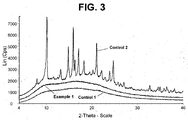
- FIG. 3 shows the results of this analysis.
- the composition of Example 1 made using a concentrated feed suspension and a heat exchanger to increase the feed temperature according to the disclosed processes, showed an amorphous halo, indicating the active agent in the composition was amorphous.
- the composition of Control 1 made using a conventional spray-drying process using a dilute spray solution of active agent and matrix material dissolved in a solvent at ambient temperature, also showed only an amorphous halo.
- the composition of Control 2 made using a concentrated feed suspension but not heated, showed a large number of well-defined peaks, indicating the presence of crystalline active agent in the composition.
- Example 1 This analysis shows that the compositions of Example 1 and Control 1 had similar properties. However, because the spray solution for Example 1 contained 12 wt% solids, while the spray solution for Control 1 only contained 1 wt% solids, certain embodiments of the disclosed processes (Example 1) had a throughput that was 12-fold greater than that of the conventional spray-drying process.
- a spray-dried dispersion is made using an apparatus similar to that shown in FIG. 1 using the procedures outlined in Example 1, except that the flash nozzle of FIG.2 is used.
- the resulting particles consist of 25 wt% Active Agent 1 in HPMCAS.
- An embodiment of the disclosed spray-drying processes comprises delivering a spray solution comprising an active agent and a matrix material in an organic solvent to a spray-drying apparatus, atomizing said spray solution into droplets within said spray-drying apparatus via a nozzle to remove at least a portion of the organic solvent from said droplets to form a plurality of particles, wherein said spray solution is delivered to said nozzle at a temperature T 3 , and collecting said particles, wherein said particles comprise said active agent and said matrix material, and wherein said spray solution is formed by forming a feed suspension comprising said active agent, said matrix material and said organic solvent, wherein said feed suspension is at a temperature T 1 , and directing said feed suspension to a heat exchanger, thereby increasing the temperature of said feed suspension to a temperature T 2 , wherein temperature T 2 is greater than temperature T 1 , and said spray solution is at a pressure that is greater than the vapor pressure of said solvent at temperature T 2 , such that said active agent and said matrix material are soluble in said solvent at temperature T 2
- said spray solution may be atomized using a flash nozzle.
- said temperature T 2 may be at least 100°C. In any or all of the above embodiments, said spray solution may be at temperature T 2 for less than 10 minutes. Alternatively, said spray solution may be at temperature T 2 for less than 5 minutes.
- said organic solvent is selected from methanol, ethanol, n-propanol, isopropanol, butanol acetone, methyl ethyl ketone, methyl isobutyl ketone, ethyl acetate, propyl acetate, tetrahydrofuran, acetonitrile, methylene chloride, toluene, 1,1,1-trichloroethane, and mixtures thereof.
- said organic solvent is selected from the group consisting of methanol, ethanol, n-propanol, isopropanol, butanol acetone, methyl ethyl ketone, methyl isobutyl ketone, ethyl acetate, propyl acetate, tetrahydrofuran, acetonitrile, methylene chloride, toluene, 1,1,1-trichloroethane, and mixtures thereof.
- said organic solvent may contain less than 50 wt% water.
- said particles may have a mass median aerodynamic diameter ranging from 0.5 ⁇ m to 10 ⁇ m. In any or all of the above embodiments, said particles may have an average diameter of greater than 10 ⁇ m.
- said matrix material may comprise a polymer.
- said particles comprise a solid amorphous dispersion of said active agent in said polymer.
- the product comprises a solid amorphous dispersion of said active agent and said polymer.
- An embodiment of a process for producing a composition comprises forming a feed suspension comprising an active agent, a matrix material and an organic solvent, wherein said feed suspension is at a temperature T 1 , forming a spray solution by directing said feed suspension to a heat exchanger, thereby increasing the temperature of said feed suspension to a temperature T 2 , wherein temperature T 2 is greater than temperature T 1 , said spray solution is at a pressure that is greater than the vapor pressure of said solvent at temperature T 2 , and said active agent and said matrix material are soluble in said solvent at temperature T 2 , directing said spray solution to a spray-drying apparatus, said spray-drying apparatus comprising a drying chamber, a nozzle for atomizing said spray solution into droplets, and a source of heated drying gas for removing at least a portion of said organic solvent from said droplets, atomizing said spray solution into droplets in said drying chamber by said nozzle, wherein the spray solution is delivered to said nozzle at a temperature T 3 , contacting said droplets with said heated drying
- Said active agent or said matrix material may not be soluble in said solvent at temperature T 3 .
Landscapes
- Chemical & Material Sciences (AREA)
- Organic Chemistry (AREA)
- Chemical Kinetics & Catalysis (AREA)
- Medicinal Preparation (AREA)
- Glanulating (AREA)
- Drying Of Solid Materials (AREA)
- Pharmaceuticals Containing Other Organic And Inorganic Compounds (AREA)
- Nozzles (AREA)
- Vaporization, Distillation, Condensation, Sublimation, And Cold Traps (AREA)
Description
- A novel spray-drying process is disclosed. The process can lead to spray-dried products with improved properties, as well as increased throughput relative to conventional spray-drying processes.
- The use of spray drying to produce powders from fluid feed stocks is well known, with applications ranging from powdered milk to bulk chemicals and pharmaceuticals. See
U.S. Patent No. 4,187,617 and Mujumbar et al., Drying 91, pages 56-73 (1991). See also Masters, Spray Drying Handbook, pages 263-268 (4th edition, 1985). The use of spray drying to form solid amorphous dispersions of drugs or active agents and concentration-enhancing polymers is also known. See commonly ownedU.S. Patent Nos. 6,763,607 and6,973,741 . - When it is desired to form a spray-dried product in which the drug or active agent is amorphous, it is desirable to have the active agent fully dissolved in the spray solution when it is atomized into droplets. Specifically, when it is desired to form a spray-dried product in which the amorphous active agent is dispersed in one or more other materials, termed matrix material, it is generally desired to have at least a part and often all of the matrix material also dissolved in the spray solution. In such cases, the throughput of a conventional spray-drying process is often limited by the amount of active agent and matrix material that can be dissolved in the spray solution. It is generally known that the solubility of many substances, such as active agents and matrix materials, often increases as the temperature of the solvent is increased. However, industry avoids using elevated temperatures when using organic solvents, due to the inherent dangers and safety concerns when processing organic solvents, which are often flammable at high temperatures. In addition, conventional spray-drying processes avoid use of elevated temperatures out of concern for the thermal stability of the active agent and matrix material-degradation of the active agent and/or the matrix material can lead to unwanted breakdown products in the particles produced.
- Because of this, conventional spray-drying solutions are generally kept at or near room temperature when entering the spray nozzle. This limits the throughput of the process due to the often low solubility of active agents and matrix materials in the solvents used. In addition, when the solubility of the active agent in the spray solution is low, the active agent is often dissolved to near its solubility limit to achieve as high a throughput as possible. The spray-dried products obtained from such solutions are often not homogeneous. Finally, conventional spray-dried processes often produce products that suffer from not being homogeneous because the rate of solvent removal is not sufficiently fast, and broad ranges of particle sizes are produced because the atomization means produces a wide range of droplet sizes.
-
U.S. Patent Application Publication No. 2008/0248114A1 describes the production of solid solutions containing poorly-soluble active substances using a spray-drying process utilizing short-term heating and rapid drying. The process avoids organic solvents by utilizing a feed stream that is an aqueous suspension of the active. The aqueous suspension is heated to allow dissolution of the active in the spray solution. However, this process is limited to actives that have a high solubility in water at elevated temperature. -
WO2008/092057A2 describes a method for preparing solid materials including the steps of providing a feedstock comprising an organic material in a solvent system containing a non-solvent for the organic material at an elevated temperature and/or pressure above ambient conditions. - What is needed is a spray-drying process that results in improved properties of the spray-dried product, such as a more uniform particle size, and that improves the throughput of spray-drying equipment while spraying solutions of an active agent and the matrix material, and provides a safe, reproducible process to produce high-quality product. Such a process promises to increase the quality and decrease manufacturing costs for spray-dried products.
- The invention relates to a process according to and as defined in
Claim 1. - In one embodiment, temperature T2 is greater than the ambient-pressure boiling point of the organic solvent.
- In another embodiment, the nozzle used for atomization of the spray solution is a pressure nozzle. In another embodiment, the nozzle used for atomization of the spray solution in the spray-drying apparatus is a flash nozzle. A flash nozzle utilizes a pressure drop that induces cavitation in the spray solution prior to exiting the nozzle orifice to induce droplet formation. A sweep gas around the orifice is used to eliminate or reduce solids build-up during operation.
- In another aspect, the matrix material comprises a polymer.
- In still another aspect, the particles comprise a solid amorphous dispersion of the active agent and a polymer.
- The disclosed processes provide one or more advantages over a conventional spray-drying process. Certain embodiments of the disclosed processes can increase the throughput of a spray dryer by forming a spray solution that has a higher concentration at a higher temperature than conventional processes. Additionally, certain embodiments of the disclosed processes allow spray-drying solutions wherein ratio of the concentration of active agent in the spray solution to the solubility of the active agent in the organic solvent at the atomization temperature is significantly less than one, preferably less than 0.5, and even more preferably less than 0.3. Operating in this regime generally leads to spray-dried products that are more homogeneous and more uniform. In addition, the disclosed processes result in rapid evaporation of the organic solvent, and shorter times to solidification than conventional processes. Furthermore, in some embodiments, the process results in improved atomization of the spray solution relative to conventional processes due to the temperature of the spray solution when it is atomized being above the boiling point of the solvent at the pressure of the drying chamber.
-
-
FIG. 1 is a schematic of a spray-drying apparatus suitable for use in performing the process of the invention. -
FIG. 2 is a schematic of a flash nozzle, suitable for use in performing the process of the invention. -
FIG.3 is a figure showing the results of powder X-ray diffraction of the samples of Example 1,Control 1, andControl 2. - A spray-drying process for producing a composition comprising an active agent and a matrix material is described. The spray-drying process, suitable apparatus for carrying out the process, and suitable active agents and matrix materials are described in detail below.
- Unless otherwise indicated, all numbers expressing quantities of components, molecular weights, percentages, temperatures, times, and so forth, as used in the specification or claims are to be understood as being modified by the term "about." Accordingly, unless otherwise indicated, implicitly or explicitly, the numerical parameters set forth are approximations that may depend on the desired properties sought and/or limits of detection under standard test conditions/methods. When directly and explicitly distinguishing embodiments from discussed prior art, the embodiment numbers are not approximates unless the word "about" is recited.
- The term spray drying is used conventionally and broadly refers to processes involving breaking up liquid mixtures into small droplets (atomization) and rapidly removing solvent from the mixture in a container (drying chamber) where there is a strong driving force for evaporation of solvent from the droplets. The strong driving force for solvent evaporation is generally provided by maintaining the partial pressure of solvent in the spray-drying apparatus well below the vapor pressure of the solvent at the temperature of the drying droplets. This is accomplished by (1) mixing the liquid droplets with a warm drying gas, (2) maintaining the pressure in the spray-drying apparatus at a partial vacuum (e.g., 0.01 atm to 0.50 atm), or (3) both.
- Generally, the temperature and flow rate of the drying gas is chosen so that the droplets of spray solution are dry enough by the time they reach the wall of the apparatus that they are essentially solid, form a fine powder, and do not stick to the apparatus wall. The actual length of time to achieve this level of dryness depends on the size of the droplets and the conditions at which the process is operated. Droplet sizes may range from 1 µm to 500 µm in diameter, the size being dependent on the desired particle size of the spray dried powder. The large surface-to-volume ratio of the droplets and the large driving force for evaporation of solvent lead to actual drying times of a few seconds or less, and often less than 0.1 second. Solidification times should be less than 100 seconds, and often less than a few seconds.
- Turning to the drawings, wherein the same numerals refer to like elements, there is shown in
FIG. 1 anapparatus 10 suitable for performing embodiments of the disclosed processes. In the following discussion it is assumed that the spray-drying apparatus is cylindrical. However, the dryer may take any other cross-sectional shape suitable for spray drying a spray solution, including square, rectangular, and octagonal, among others. The spray-drying apparatus is also depicted as having one nozzle. However, multiple nozzles can be included in the spray-drying apparatus to achieve higher throughput of the spray solution. - The apparatus shown in
FIG. 1 includes afeed suspension tank 20, aheat exchanger 30, a dryingchamber 40, anozzle 50, and a particle-collection means 60. In one embodiment, the process is performed as follows. An active agent and a matrix material are combined with an organic solvent in thefeed suspension tank 20 to form a feed suspension. The feed suspension is at a temperature T1, which is below the ambient-pressure boiling point of the organic solvent. Temperature T1 is also below either TA, the temperature at which the active agent solubility equals the active agent concentration in the organic solvent, or TM, the temperature at which the matrix material solubility equals the matrix material concentration in the organic solvent. At least a portion of the active agent, a portion of the matrix material, or a portion of both the active agent and the matrix material are suspended, that is not dissolved, in the organic solvent. An optional mixing means 22 may be used to keep the feed suspension homogeneous while processing. When the organic solvent is flammable, oxygen is normally excluded from all parts of the drying apparatus. In particular, an inert gas, such as nitrogen, helium, argon, and the like, is often used to fill the void space in the feed suspension tank for safety reasons. - As used herein, the term "feed suspension" means a composition comprising an active agent, a matrix material, and an organic solvent, wherein at least a portion of the active agent, a portion of the matrix material, or a portion of both active agent and matrix material are suspended or not dissolved in the organic solvent. In one embodiment, the feed suspension consists essentially of an active agent, a matrix material, and an organic solvent. In still another embodiment, the feed suspension consists of an active agent, a matrix material, and an organic solvent. In yet another embodiment, the feed suspension consists of particles of active agent suspended in a solution of matrix material dissolved in the organic solvent. It will be recognized that in such feed suspensions, a portion of the active agent and the matrix material may dissolve up to their solubility limits at the temperature of the feed suspension.
- As used herein, the term "organic solvent" means an organic compound that can be used to dissolve the active agent and the matrix material at elevated temperature. In one embodiment, the solvent is volatile, having an ambient-pressure boiling point of 150°C or less. In another embodiment, the solvent has an ambient-pressure boiling point of 100°C or less. Suitable solvents include alcohols such as methanol, ethanol, n-propanol, isopropanol, and butanol; ketones such as acetone, methyl ethyl ketone and methyl isobutyl ketone; esters such as ethyl acetate and propyl acetate; and various other solvents, such as tetrahydrofuran, acetonitrile, methylene chloride, toluene, and 1,1,1-trichloroethane. Lower volatility solvents such as dimethylacetamide or dimethylsulfoxide can also be used, generally in combination with a volatile solvent. Mixtures of solvents, such as 50% methanol and 50% acetone, can also be used, as can mixtures with water. In one embodiment, the organic solvent contains less than 50 wt% water. In another embodiment, the organic solvent contains less than 25 wt% water. In still another embodiment, the organic solvent contains less than 10 wt% water. In yet another embodiment, the organic solvent contains less than 5 wt% water. In another embodiment, the organic solvent contains essentially no water.
- For convenience, the feed suspension is often maintained at near-ambient temperatures; however, this is not a limitation of the disclosed processes. Generally, the temperature of the feed suspension, T1, can range from 0°C to 50°C or even higher. Temperatures of less than 0°C may also be utilized, especially when there are stability concerns about the active agent.
- The feed suspension in the
feed suspension tank 20 is delivered to apump 24, which directs the feed suspension to aheat exchanger 30. The heat exchanger has afeed suspension inlet 26, aspray solution outlet 36, aheating fluid inlet 32, and aheating fluid outlet 34. In theheat exchanger 30, the feed suspension enters through thefeed suspension inlet 26 at temperature T1, and exits as the spray solution through thespray solution outlet 36 at temperature T2. Spray solution temperature T2 is greater than feed suspension temperature T1. To prevent unwanted vaporization/boiling of the organic solvent in the spray solution, pump 24 increases the pressure of the spray solution such that the pressure of the spray solution atspray solution outlet 36 is greater than the vapor pressure of the organic solvent at temperature T2. In addition, T2 is greater than or equal to the lesser of TA and TM. In one embodiment, T2 is greater than or equal to the greater of TA and TM. When it is the object of the process to form a solid amorphous dispersion of the active agent and the matrix material, T2 is greater than or equal to TA. Preferably, T2 is at least 10°C greater than TA. In one embodiment, the spray solution temperature T2 is greater than the ambient-pressure boiling point of the organic solvent. - The spray solution exiting the heat exchanger may be at any temperature, T2, which is greater than T1, as long as T2 is greater than or equal to the lesser of TA and TM. Temperature T2 may be at least 10°C greater than T1, at least 20°C greater than T1, at least 30°C greater than T1, at least 40°C greater than T1, or even at least 50°C greater than T1. In one embodiment, temperature T2 is at least 50°C. In another embodiment, temperature T2 is at least 70°C. In another embodiment, temperature T2 is at least 80°C. In another embodiment, temperature T2 is at least 90°C. In another embodiment, T2 is at least 100°C. In still another embodiment; T2 is at least 120°C.
- The active agent and the matrix material are both soluble in the organic solvent at temperature T2. By "soluble" is meant that essentially all of the active agent and matrix material are dissolved in the organic solvent at temperature T2. In the case of the active agent, the term "dissolved" has the conventional meaning, indicating that the active agent has gone into solution. In the case of matrix materials, the term "dissolved" can take a broader definition. For some matrix materials, such as polymers, the term dissolved can mean the polymer has gone into solution, or it can mean the polymer is dispersed or highly swollen with the organic solvent such that it acts as if it were in solution. In contrast, at temperature T1, at least one of the active agent and the matrix material are present as a suspension in the organic solvent. Any suitable technique may be used to determine if the active agent and matrix material are soluble in the organic solvent at temperature T2. Examples include dynamic or static light scattering analysis, turbidity analysis, and visual observations. In one embodiment, the spray solution comprises the active agent and the matrix material dissolved in the organic solvent at temperature T2.
- In one embodiment, temperature T2 is greater than the temperature at which the active agent and matrix material are soluble in the organic solvent. That is, T2 is greater than or equal to the greater of TA and TM. It may be desirable that temperature T2 be much greater than the greater of TA and TM. Thus, temperature T2 may be at least 10°C greater than the greater of TA and TM, at least 20°C greater than the greater of TA and TM, or even at least 30°C greater than the greater of TA and TM. Spray-dried products made by embodiments of the disclosed processes are typically more uniform and homogeneous when temperature T2 is greater than the greater of TA and TM.
- In one embodiment, the
pump 24 increases the pressure of the spray solution to a pressure ranging from 2 atm to 400 atm. In another embodiment, the pressure of the spray solution as it exits theheat exchanger 30 is greater than 10 atm. - The
heat exchanger 30 may be of any design wherein heat is transferred to the feed suspension resulting in an increase in temperature. In one embodiment, theheat exchanger 30 is an indirect heat exchanger, wherein a heating fluid is in contact with the feed suspension through a heat-transfer surface. Exemplary indirect heat exchangers include tube-in-tube devices and tube-in-shell devices, both well-known in the art. Theheat exchanger 30 may also be a direct heat exchanger, in which a heating fluid, such as steam, is injected directly into the feed suspension, resulting in an increase in the temperature of the feed suspension. In yet another embodiment, the feed suspension flows over a hot surface, such as a resistance heating element, resulting in an increase in temperature of the feed suspension. Other heating sources may also be used, such as microwaves and ultrasonic devices that can increase the temperature of the feed suspension. - The concentration of active agent and matrix material in the spray solution can be virtually any value. In one embodiment, the concentration of total solids (that is, active agent and matrix material) in the organic solvent is at least 0.5 wt%. The concentration of total solids in the organic solvent may be at least 1 wt%, at least 5 wt%, or even at least 10 wt% or more. In another embodiment, the concentration of active agent in the organic solvent is at least 1.25-fold the solubility of the active agent in the organic solvent at temperature T1. The concentration of active agent in the organic solvent may be at least 1.5-fold, at least 2.0-fold, or even 2.5-fold or more the solubility of the active agent in the organic solvent at temperature T1.
- In one embodiment, the residence time of the feed suspension in the
heat exchanger 30 is minimized so as to limit the time the suspension/solution is exposed to elevated temperatures. The residence time of the suspension/solution in the heat exchanger is less than 1 minute. - The spray solution at the
spray solution outlet 36 is directed to a dryingchamber 40, where it enters anozzle 50 for atomizing the spray solution intodroplets 44. The temperature of the spray solution when it enters thenozzle 50 is the spray temperature, designated as T3. There are sometimes advantages to having T3 significantly less than T2. For example, degradation of the active agent may be reduced or atomization in certain nozzles may be more effective when T3 is significantly less than T2. According to the present invention T3 is sufficiently low that the active agent, or the matrix material, are not soluble in the solvent. In such cases, the solution may be below the point at which the solutes are soluble for a sufficiently short time such that all the solutes remain in solution until the solution is atomized. Alternatively, the solution may be below the point at which the solutes are soluble for a sufficiently long time that one or more of the matrix material or the active agent may precipitate or crystallize from solution. In one embodiment, temperature T3 is less than 5°C less than T2. In another embodiment, temperature T3 is less than 20°C less than T2. In another embodiment, temperature T3 is less than 50°C less than T2. In still another embodiment, both temperatures T2 and T3 are greater than the greater of TA and TM. In one embodiment, temperatures T2 and T3 are at least 5°C greater than the greater of TA and TM. In another embodiment, temperatures T2 and T3 are at least 20°C greater than the greater of TA and TM. In yet another embodiment, temperatures T2 and T3 are at least 50°C greater than the greater of TA and TM. - Virtually any nozzle can be used to atomize the spray solution into droplets. The inventors have found that pressure nozzles are effective in embodiments of the disclosed processes. In another embodiment, a flash nozzle is used, as described below.
- The drying
chamber 40 also has a source of heated dryinggas 42 which is combined with thedroplets 44 in the dryingchamber 40. In the dryingchamber 40, at least a portion of the solvent is removed from the droplets to form a plurality of particles comprising the active agent and the matrix material. Generally, it is desired that the droplets are sufficiently dry by the time they come in contact with the drying chamber surface that they do not stick or coat the chamber surfaces. - The particles, along with the evaporated solvent and drying gas, exit the drying chamber at
outlet 46, and are directed to a particle-collection means 60. Suitable particle-collection means include cyclones, filters, electrostatic particle collectors, and the like. In the particle-collection means 60, the evaporated solvent and dryinggas 62 are separated from the plurality ofparticles 66, allowing for collection of the particles. - The particles may be of any desired size. In one embodiment, the particles have an average diameter ranging from 0.5 µm to 500 µm. In another embodiment, the particles have a diameter ranging from 0.5 µm to 100 µm. In another embodiment, the particles have an average diameter of greater than 10 µm. In still another embodiment, the particles have an average diameter of greater than 20 µm. In still another embodiment, the particles have an average diameter of greater than 30 µm. In yet another embodiment, the particles have a mass median aerodynamic diameter ranging from 0.5 µm to 10 µm. In still another embodiment, the particles have a mass median aerodynamic diameter ranging from 1 µm to 5 µm.
- In one embodiment, the concentration of solvent remaining in the particles when they are collected (that is, the concentration of residual solvent) is less than 10 wt% based on the total weight of the particles. In another embodiment, the concentration of residual solvent in the particles when they are collected is less than 5 wt%. In yet another embodiment, the concentration of residual solvent in the particles is less than 3 wt%. In another embodiment, a drying process subsequent to the spray-drying process may be used to remove residual solvent from the particles. Exemplary processes include tray drying, fluid-bed drying, vacuum drying, and the drying processes described in
WO2006/079921 andWO2008/012617 . - In one embodiment,
nozzle 50 is aflash nozzle 50a. There is shown inFIG. 2 a cross-sectional schematic of aflash nozzle 50a.Flash nozzle 50a consists of acentral tube 51 and anouter tube 53.Central tube 51 is in fluid communication with theinflowing spray solution 55, whileouter tube 53 is in fluid communication with asweep gas 52. Theflash nozzle 50a has an inlet end, represented by A, and an outlet end, represented by B. Thespray solution 55 from the heat exchanger 30 (not shown inFIG. 2 ) enterscentral tube 51 at A. Asweep gas 52 entersouter tube 53 at A. Asspray solution 55 travels through thecentral tube 51 from inlet A to outlet B, the pressure decreases due to pressure drop. Between the inlet A and outlet B, the pressure of thespray solution 55 decreases to a value that is less than the vapor pressure of the solvent in the spray solution, leading to the formation of vapor bubbles of the solvent (a process known as cavitation). By the time thespray solution 55 reaches outlet B of thecentral tube 51, it is a fluid 56 comprising droplets of spray solution and vapor-phase solvent. In one embodiment, thecentral tube 51 is coated with a non-stick coating. In another embodiment, theouter tube 53 is coated with a non-stick coating. In still another embodiment, thecentral tube 51 and theouter tube 53 are coated with a non-stick coating. Non-stick coatings include, for example, polytetrafluoroethylene (PTFE) or other suitable non-stick coatings. - The
sweep gas 52 exiting through theouter tube outlet 58 is in fluid communication with the fluid 56 exiting through thecentral tube 51. Thesweep gas 52 decreases the likelihood that solid material will form at the exit from thecentral tube 51 or theouter tube 53. - The process of the present invention is used to form a composition comprising an active agent. By "active agent" is meant a drug, medicament, pharmaceutical, therapeutic agent, nutraceutical, agrochemical, fertilizer, pesticide, herbicide, nutrient, or other compound that may be desired to be formulated with a matrix material. The active agent may be a "small molecule," generally having a molecular weight of 2000 Daltons or less. The active agent may also be a "biological active." Biological actives include proteins, antibodies, antibody fragments, peptides, oligoneucleotides, vaccines, and various derivatives, of such materials. In one embodiment, the active agent is a small molecule. In another embodiment, the active agent is a biological active. In still another embodiment, the active agent is a mixture of a small molecule and a biological active. In yet another embodiment, the compositions made by certain of the disclosed processes comprise two or more active agents.
- The active agent may be highly water soluble, sparingly water soluble, or poorly water soluble. In one embodiment, the active agent is "poorly water soluble," meaning that the active agent has a solubility in water (over the pH range of 6.5 to 7.5 at 25°C) of less than 5 mg/mL. The active agent may have an even lower aqueous solubility, such as less than about 1 mg/mL, less than about 0.1 mg/mL, and even less than about 0.01 mg/mL.
- The disclosed processes are used to form compositions comprising a matrix material. Matrix materials suitable for use in the compositions formed by the disclosed methods should be inert, in the sense that they do not chemically react with the active agent in an adverse manner. The matrix material can be neutral or ionizable. In one embodiment, the composition includes two or more matrix materials.
- Exemplary matrix materials include polysaccharides. Polysaccharides can be underivatized, such as cellulose, starch, dextran, pullulan, dextrin, maltodextrin, glycogen, insulin, fructan, mannan, chitin, polydextrose, fleximer (a ring-opened form of dextran), and oligosaccharides. Often, derivatives and substituted versions of the polysaccharides are preferred. Examples of such polysaccharide derivatives include ester- and ether-linked derivatives. Included in this class are cellulose ethers, cellulose esters, and cellulose derivatives that have both ester and ether substituents. Specific examples include cellulose acetate, ethyl cellulose, hydroxypropyl methyl cellulose and hydroxyethyl cellulose. Starch derivatives include starch acetate and carboxymethyl starch. Also included are synthetic matrix materials, such as polyacrylates and polymethacrylates, vinyl matrix materials, polyethylenes, polyoxyethylenes, polypropylenes, polyamides, polyesters, polycarbonates, and derivatives and substituted versions thereof; copolymers of various types, including random and block copolymers; other matrix materials such as lactose, trehalose, sucrose, fructose, maltose, dextrose, xylitol, sorbitol, glycine, amino acids, citric acid, phospholipids, bile salts; and mixtures thereof
- In one embodiment, the matrix material is amphiphilic, meaning that the matrix material has hydrophobic and hydrophilic portions. In another embodiment, the matrix material is ionizable.
- In yet another embodiment, the matrix material comprises a polymer. Appropriate matrix polymers include polyvinylpyrrolidone, vinyl acetate/vinylpyrrolidone copolymers, vinyl alcohol, vinyl acetate/vinyl alcohol copolymers, hydroxyethyl cellulose, hydroxypropyl methylcellulose, hydroxypropyl methylcellulose phthalate, carboxymethyl cellulose, carboxymethyl ethylcellulose, hydroxypropyl methylcellulose acetate succinate, cellulose acetate phthalate and cellulose acetate trimellitate. In still another embodiment, the matrix material comprises an ionizable cellulosic polymer. In yet another embodiment, the matrix material comprises an amphiphilic, ionizable polymer.
- In one embodiment, the matrix material is biodegradable, meaning that the matrix material will degrade over time. By "degrade" is meant that in a use environment, the matrix material is broken down into smaller species that can be absorbed, metabolized, or otherwise eliminated or removed from the environment of use. This degradation can occur through enzymatic, hydrolytic, oxidative, or other reaction, as is well known in the art, or by degrading the matrix material into aqueous soluble species that can readily be removed from the environment of use.
- In one embodiment, the composition made by the disclosed processes is in the form of a solid amorphous dispersion of the active agent and the matrix material.
- In another embodiment, the particles comprise a solid amorphous dispersion of the active agent and matrix material consisting essentially of amorphous active agent molecularly dispersed throughout the matrix material. In this embodiment, the solid dispersion may be considered a "solid solution" of active agent and matrix material. The term "solid solution" includes both thermodynamically stable solid solutions in which the active agent is completely dissolved in the matrix material, as well as homogeneous materials consisting of amorphous active agent molecularly dispersed throughout the matrix material in amounts greater than the solubility of the active agent in the matrix material. A dispersion is considered a "solid solution" when it displays a single glass-transition temperature when analyzed by differential scanning calorimetry (DSC). In one embodiment, the particles have at least one Tg due to the amorphous character of the matrix material. In another embodiment, at least 90 wt% of the active agent in the particles is amorphous. In yet another embodiment, the active agent is amorphous and molecularly dispersed in a portion of one or more of the matrix materials, while the remaining portion of the matrix materials is present as a separate phase. This separate phase matrix material may be amorphous, crystalline, or a mixture of both amorphous and crystalline.
- In another embodiment the particles comprise the active agent in crystalline form, which is homogeneously or substantially homogeneously distributed in the matrix material. In still another embodiment, the particles comprise the active agent in amorphous or non-crystalline form, which is homogeneously distributed in the matrix material matrix. In yet another embodiment, the particles comprise a mixture of active agent in crystalline and amorphous forms homogeneously distributed in the matrix material.
- In still another embodiment, the particles comprise a mixture of active-agent-rich domains and matrix material-rich domains. The active agent in the domains may be amorphous, crystalline, or a mixture of amorphous and crystalline.
- In yet another embodiment, the compositions comprise a third component in addition to the active agent and the matrix material. This third component may be any compound or mixture of compounds that facilitates the intended use of the disclosed compositions. Exemplary third components include, but are not limited to, matrix materials, surface active agents, wetting agents, diluents, fillers, bulking agents, disintegrants, flavors, fragrances, buffering agents, and/or other components known in the art.
- Without further elaboration, it is believed that one of ordinary skill in the art can, using the foregoing description, utilize the present invention to its fullest extent. Therefore, the following specific embodiments are to be construed as merely illustrative and not restrictive of the scope of the invention. Those of ordinary skill in the art will understand that variations of the conditions and processes of the following examples can be used.
-
Active Agent 1 was S-(fluoromethyl) 6a,9-difluoro-11β,17-dihydroxy-16α-methyl-3-oxoandrosta-1,4-diene-17β-carbothioate, 17-propionate, also known as fluticasone propionate, having the structure:
-
Active Agent 1 has a solubility of 0.4 µg/mL in pH 7.4 buffer, and a Log P value of 3.7. The Tg of amorphousActive Agent 1 was determined by DSC to be 84°C. The room temperature (20°C to 30°C) solubility ofActive Agent 1 in methanol is 0.3 wt%.
The following Examples are of an illustrative nature only, albeit not falling within the scope of the subject matter claimed. - A spray-dried dispersion was made using an apparatus similar to that shown in
FIG. 1 . A feed suspension was prepared by mixing 3 gm ofActive Agent 1 and 9 gm of the MG grade of hydroxypropyl methylcellulose acetate succinate (HPMCAS-MG, AQOAT-MG available from Shin Etsu, Tokyo, Japan) with 88 gm of a methanol solvent. The HPMCAS-MG dissolved in the solvent, while the active agent remained in suspension. The feed suspension was maintained at ambient temperature, 20°C to 30°C, with stirring in a pressure pot to prevent settling of the particles ofActive Agent 1. The total solids content of the feed suspension was 12 wt%. - The feed suspension in the pressure pot was pressurized to 245 psig and directed at a rate of 26 gm/min to a tube-in-shell heat exchanger. Heating fluid at 160°C was circulated in a countercurrent manner through the heat exchanger. The spray solution exiting the heat exchanger was at a temperature, T2, of 120°C, and all of the active agent and matrix material were dissolved in the spray solution. The average residence time of the spray solution in the heat exchanger was less than 60 seconds. The total time the spray solution was at a temperature of 120°C was less than 80 seconds. Thus, the elapsed time from the time the spray solution exited the heat exchanger to the time it exited the pressure nozzle was 20 seconds. The temperature of the nozzle was 120°C.
- The spray solution was delivered to the spray-drying chamber where it was atomized using a Schlick 2.0 pressure nozzle (Düsen-Schlick GmbH of Untersiemau, Germany). The spray solution was atomized into droplets within the spray-drying chamber, while simultaneously mixing the droplets with a nitrogen drying gas which was introduced to the drying chamber at a temperature of 140°C and at a flow rate of 520 gm/min, resulting in the formation of solid particles.
- The solid particles, along with the evaporated solvent and the drying gas, were directed to a cyclone separator, where the solid particles were collected. The particles were subsequently dried in a vacuum chamber at 0.15 atm for 2 to 3 hours to remove residual methanol from the particles.
- The resulting particles had 25 wt%
Active Agent 1 in HPMCAS-MG. - As a control, a 25 wt%
Active Agent 1 in HPMCAS-MG composition was made using a conventional ambient-temperature spray-drying process. ForControl 1, a feed solution was formed by dissolving 0.45 gm ofActive Agent 1 and 1.35 gm of HPMCAS-MG in 179.7 gm methanol. Both the active agent and the matrix material completely dissolved in the methanol at ambient temperature. The total solids content of this solution was 1.0 wt%. - This solution was spray dried using the same apparatus as described for Example 1, except that the heat exchanger was bypassed, such that the spray solution was not heated prior to atomization. All other operating variables were nominally the same as described in Example 1.
- As a second control, a feed suspension similar to that formed for Example 1 was prepared and then spray dried without heating the spray solution. The feed suspension consisted of 2.25 gm of
Active Agent 1, 6.75 gm of HPMCAS-MG, and 66 gm of methanol, resulting in a feed suspension containing 12 wt% solids. Because the feed was a suspension rather than a solution, a two-fluid nozzle was used (manufactured by Spray Systems, Wheaton, Illinois) to avoid clogging. - The feed suspension was spray dried using the same apparatus as described for Example 1, except that the heat exchanger was bypassed, such that the spray solution was not heated prior to atomization, and a two-fluid nozzle was used for atomization of the feed. All other operating variables were nominally the same as described in Example 1.
- Samples of the compositions of Example 1,
Control 1, andControl 2 were analyzed by powder X-ray diffraction using an AXS D8 Advance PXRD measuring device (Bruker, Inc. of Madison, Wisconsin). Samples (approximately 100 mg) were packed in Lucite sample cups fitted with Si(511) plates as the bottom of the cup to give no background signal. Samples were spun in the (p plane at a rate of 30 rpm to minimize crystal orientation effects. The x-ray source (KCuα, λ = 1.54 Å) was operated at a voltage of 45 kV and a current of 40 mA. Data for each sample were collected over a period of 27 minutes in continuous detector scan mode at a scan speed of 1.8 seconds/step and a step size of 0.04°/step. Diffractograms were collected over the 2θ range of 4° to 40°. -
FIG. 3 shows the results of this analysis. The composition of Example 1, made using a concentrated feed suspension and a heat exchanger to increase the feed temperature according to the disclosed processes, showed an amorphous halo, indicating the active agent in the composition was amorphous. Likewise, the composition ofControl 1, made using a conventional spray-drying process using a dilute spray solution of active agent and matrix material dissolved in a solvent at ambient temperature, also showed only an amorphous halo. However, the composition ofControl 2, made using a concentrated feed suspension but not heated, showed a large number of well-defined peaks, indicating the presence of crystalline active agent in the composition. - This analysis shows that the compositions of Example 1 and
Control 1 had similar properties. However, because the spray solution for Example 1 contained 12 wt% solids, while the spray solution forControl 1 only contained 1 wt% solids, certain embodiments of the disclosed processes (Example 1) had a throughput that was 12-fold greater than that of the conventional spray-drying process. - A spray-dried dispersion is made using an apparatus similar to that shown in
FIG. 1 using the procedures outlined in Example 1, except that the flash nozzle ofFIG.2 is used. The resulting particles consist of 25 wt%Active Agent 1 in HPMCAS. - An embodiment of the disclosed spray-drying processes comprises delivering a spray solution comprising an active agent and a matrix material in an organic solvent to a spray-drying apparatus, atomizing said spray solution into droplets within said spray-drying apparatus via a nozzle to remove at least a portion of the organic solvent from said droplets to form a plurality of particles, wherein said spray solution is delivered to said nozzle at a temperature T3, and collecting said particles, wherein said particles comprise said active agent and said matrix material, and wherein said spray solution is formed by forming a feed suspension comprising said active agent, said matrix material and said organic solvent, wherein said feed suspension is at a temperature T1, and directing said feed suspension to a heat exchanger, thereby increasing the temperature of said feed suspension to a temperature T2, wherein temperature T2 is greater than temperature T1, and said spray solution is at a pressure that is greater than the vapor pressure of said solvent at temperature T2, such that said active agent and said matrix material are soluble in said solvent at temperature T2. In one embodiment, said temperature T2 is greater than the ambient-pressure boiling point of said solvent.
- In any or all of the above embodiments, said spray solution may be atomized using a flash nozzle.
- In any or all of the above embodiments, said temperature T2 may be at least 100°C. In any or all of the above embodiments, said spray solution may be at temperature T2 for less than 10 minutes. Alternatively, said spray solution may be at temperature T2 for less than 5 minutes.
- In any or all of the above embodiments, said organic solvent is selected from methanol, ethanol, n-propanol, isopropanol, butanol acetone, methyl ethyl ketone, methyl isobutyl ketone, ethyl acetate, propyl acetate, tetrahydrofuran, acetonitrile, methylene chloride, toluene, 1,1,1-trichloroethane, and mixtures thereof. In certain embodiments, said organic solvent is selected from the group consisting of methanol, ethanol, n-propanol, isopropanol, butanol acetone, methyl ethyl ketone, methyl isobutyl ketone, ethyl acetate, propyl acetate, tetrahydrofuran, acetonitrile, methylene chloride, toluene, 1,1,1-trichloroethane, and mixtures thereof. In any or all of the above embodiments, said organic solvent may contain less than 50 wt% water.
- In any or all of the above embodiments, said particles may have a mass median aerodynamic diameter ranging from 0.5 µm to 10 µm. In any or all of the above embodiments, said particles may have an average diameter of greater than 10 µm.
- In any or all of the above embodiments, said matrix material may comprise a polymer. In some embodiments, said particles comprise a solid amorphous dispersion of said active agent in said polymer.
- Also disclosed are embodiments of products made by any or all of the above processes. In some embodiments, the product comprises a solid amorphous dispersion of said active agent and said polymer.
- An embodiment of a process for producing a composition comprises forming a feed suspension comprising an active agent, a matrix material and an organic solvent, wherein said feed suspension is at a temperature T1, forming a spray solution by directing said feed suspension to a heat exchanger, thereby increasing the temperature of said feed suspension to a temperature T2, wherein temperature T2 is greater than temperature T1, said spray solution is at a pressure that is greater than the vapor pressure of said solvent at temperature T2, and said active agent and said matrix material are soluble in said solvent at temperature T2, directing said spray solution to a spray-drying apparatus, said spray-drying apparatus comprising a drying chamber, a nozzle for atomizing said spray solution into droplets, and a source of heated drying gas for removing at least a portion of said organic solvent from said droplets, atomizing said spray solution into droplets in said drying chamber by said nozzle, wherein the spray solution is delivered to said nozzle at a temperature T3, contacting said droplets with said heated drying gas to remove at least a portion of said organic solvent from said droplets to form a plurality of particles comprising said active agent and said matrix material, and collecting said particles. In some embodiments, said temperature T2 is greater than the ambient-pressure boiling point of said solvent.
- Said active agent or said matrix material may not be soluble in said solvent at temperature T3.
- The terms and expressions which have been employed in the foregoing specification are used therein as terms of description and not of limitation, and there is no intention in the use of such terms and expressions of excluding equivalents of the features shown and described or portions thereof, it being recognized that the scope of the invention is defined and limited only by the claims which follow.
Claims (8)
- A spray-drying process, comprising:(a) delivering a spray solution comprising an active agent and a matrix material in an organic solvent to a spray-drying apparatus, wherein said spray solution is formed byforming a feed suspension comprising said active agent, said matrix material and said organic solvent, wherein said feed suspension is at a temperature T1, anddirecting said feed suspension to a heat exchanger, thereby increasing the temperature of said feed suspension to a temperature T2, wherein (i) temperature T2 is greater than temperature T1; and (ii) said spray solution is at a pressure that is greater than the vapor pressure of said solvent at temperature T2 such that said active agent and said matrix material are soluble in said solvent at temperature T2, and wherein the residence time of the feed suspension through said heat exchanger is less than 1 minute;(b) atomizing said spray solution into droplets within said spray-drying apparatus via a nozzle to remove at least a portion of the organic solvent from said droplets to form a plurality of particles, wherein said spray solution is delivered to said nozzle at a temperature T3, wherein temperature T3 is such that said active agent or said matrix material are not soluble in said solvent at temperature T3; and(c) collecting said particles, wherein said particles comprise said active agent and said matrix material.
- The process of claim 1 wherein said temperature T2 is greater than the ambient-pressure boiling point of said solvent.
- The process of any one of claims 1-2 wherein said spray solution is atomized using a flash nozzle.
- The process of any one of claims 1-3 wherein said temperature T2 is at least 100°C.
- The process of any one of claims 1-4 wherein said organic solvent is selected from methanol, ethanol, n-propanol, isopropanol, butanol acetone, methyl ethyl ketone, methyl isobutyl ketone, ethyl acetate, propyl acetate, tetrahydrofuran, acetonitrile, methylene chloride, toluene, 1,1,1-trichloroethane, and mixtures thereof.
- The process of any one of claims 1-5 wherein said organic solvent contains less than 50 wt% water.
- The process of any one of claims 1-6 wherein said matrix material comprises a polymer.
- The process of any one of claims 1-7, wherein said spray-drying apparatus comprises (i) a drying chamber, (ii) a nozzle for atomizing said spray solution into droplets, and (iii) a source of heated drying gas for removing at least a portion of said organic solvent from said droplets, and wherein the step of atomizing said spray solution into droplets further comprises contacting said droplets with said heated drying gas, in said drying chamber, to remove at least a portion of said organic solvent from said droplets to form the plurality of particles.
Priority Applications (1)
| Application Number | Priority Date | Filing Date | Title |
|---|---|---|---|
| EP16167114.4A EP3130396B1 (en) | 2009-03-27 | 2010-03-19 | Spray-drying process |
Applications Claiming Priority (2)
| Application Number | Priority Date | Filing Date | Title |
|---|---|---|---|
| US16435309P | 2009-03-27 | 2009-03-27 | |
| PCT/US2010/027930 WO2010111132A2 (en) | 2009-03-27 | 2010-03-19 | Spray-drying process |
Related Child Applications (2)
| Application Number | Title | Priority Date | Filing Date |
|---|---|---|---|
| EP16167114.4A Division-Into EP3130396B1 (en) | 2009-03-27 | 2010-03-19 | Spray-drying process |
| EP16167114.4A Division EP3130396B1 (en) | 2009-03-27 | 2010-03-19 | Spray-drying process |
Publications (2)
| Publication Number | Publication Date |
|---|---|
| EP2411137A2 EP2411137A2 (en) | 2012-02-01 |
| EP2411137B1 true EP2411137B1 (en) | 2016-09-07 |
Family
ID=42320878
Family Applications (2)
| Application Number | Title | Priority Date | Filing Date |
|---|---|---|---|
| EP16167114.4A Active EP3130396B1 (en) | 2009-03-27 | 2010-03-19 | Spray-drying process |
| EP10712212.9A Active EP2411137B1 (en) | 2009-03-27 | 2010-03-19 | Spray-drying process |
Family Applications Before (1)
| Application Number | Title | Priority Date | Filing Date |
|---|---|---|---|
| EP16167114.4A Active EP3130396B1 (en) | 2009-03-27 | 2010-03-19 | Spray-drying process |
Country Status (5)
| Country | Link |
|---|---|
| US (3) | US9724664B2 (en) |
| EP (2) | EP3130396B1 (en) |
| ES (1) | ES2873502T3 (en) |
| PT (1) | PT3130396T (en) |
| WO (1) | WO2010111132A2 (en) |
Families Citing this family (45)
| Publication number | Priority date | Publication date | Assignee | Title |
|---|---|---|---|---|
| US20100048524A1 (en) | 2008-03-14 | 2010-02-25 | Angela Brodie | Novel C-17-Heteroaryl Steroidal CYP17 Inhibitors/Antiandrogens;Synthesis In Vitro Biological Activities, Pharmacokinetics and Antitumor Activity |
| WO2010091306A1 (en) | 2009-02-05 | 2010-08-12 | Tokai Pharmaceuticals | Novel prodrugs of steroidal cyp17 inhibitors/antiandrogens |
| MX2011010633A (en) | 2009-04-09 | 2012-01-20 | Entegrion Inc | Spray-dried blood products and methods of making same. |
| US20110142885A1 (en) | 2009-09-16 | 2011-06-16 | Velico Medical, Inc. | Spray-dried human plasma |
| PT2611530T (en) * | 2010-09-03 | 2019-05-09 | Bend Res Inc | Spray-drying apparatus and methods of using the same |
| EP2611529B1 (en) * | 2010-09-03 | 2019-01-23 | Bend Research, Inc. | Spray-drying method |
| EP2618924A1 (en) * | 2010-09-24 | 2013-07-31 | Bend Research, Inc. | High-temperature spray drying process and apparatus |
| US20140083628A1 (en) * | 2012-09-27 | 2014-03-27 | Velico Medical, Inc. | Spray drier assembly for automated spray drying |
| RU2768492C2 (en) | 2011-11-18 | 2022-03-24 | Ридженерон Фармасьютикалз, Инк. | Polymer protein microparticles |
| EP2950797B1 (en) | 2013-02-01 | 2019-09-11 | Glialogix, Inc. | Compositions and methods for the treatment of neurodegenerative and other diseases |
| EP2968370A4 (en) | 2013-03-14 | 2016-09-21 | Univ Maryland | ANDROGEN RECEPTOR DECREASING AGENTS AND USES THEREOF |
| EP3033088A4 (en) | 2013-08-12 | 2017-03-08 | Tokai Pharmaceuticals, Inc. | Biomarkers for treatment of neoplastic disorders using androgen-targeted therapies |
| RU2661399C1 (en) * | 2013-11-22 | 2018-07-16 | Мерк Шарп И Доум Корп. | Composition of the non-nucleoside reverse transcriptase inhibitor |
| US9561184B2 (en) | 2014-09-19 | 2017-02-07 | Velico Medical, Inc. | Methods and systems for multi-stage drying of plasma |
| EP3212169B1 (en) | 2014-10-31 | 2021-01-13 | Bend Research, Inc. | Process for forming active domains dispersed in a matrix |
| JP2018518568A (en) * | 2015-06-05 | 2018-07-12 | ダウ グローバル テクノロジーズ エルエルシー | Cellulose ether powder |
| US12133911B2 (en) | 2015-06-09 | 2024-11-05 | Capsugel Belgium Nv | Formulations to achieve rapid dissolution of drug from spray-dried dispersions in capsules |
| GB2542384A (en) * | 2015-09-17 | 2017-03-22 | The James Hutton Inst | Atomiser assembly |
| US10423437B2 (en) * | 2016-08-17 | 2019-09-24 | Red Hat Israel, Ltd. | Hot-plugging of virtual functions in a virtualized environment |
| JP2019532068A (en) * | 2016-10-13 | 2019-11-07 | カプスゲル・ベルギウム・ナムローゼ・フェンノートシャップCapsugel Belgium NV | Method for producing spray-dried composition and spray-drying apparatus |
| WO2018075865A1 (en) | 2016-10-21 | 2018-04-26 | Glialogix, Inc. | Compositions for the treatment of neurodegenerative diseases |
| EP3746059B1 (en) | 2018-01-31 | 2026-03-04 | Deciphera Pharmaceuticals, LLC | Combination therapy for the treatment of gastrointestinal stromal tumors |
| AU2019216351B2 (en) | 2018-01-31 | 2024-07-25 | Deciphera Pharmaceuticals, Llc | Combination therapy for the treatment of mastocytosis |
| CN108444274B (en) * | 2018-02-12 | 2019-11-15 | 中国农业科学院蜜蜂研究所 | A kind of bee pollen continuous drying device and drying method thereof |
| PT110585B (en) | 2018-02-22 | 2021-04-22 | Hovione Farmaciencia Sa | PROCESS OF CONTINUOUS PARTICLE PRODUCTION UNDERSTANDING ATOMIZATION DRYING WITH CONTINUOUS PREPARATION OF THE ATOMIZATION SOLUTION |
| WO2020185812A1 (en) | 2019-03-11 | 2020-09-17 | Teva Pharmaceuticals International Gmbh | Solid state forms of ripretinib |
| TWI878335B (en) | 2019-08-12 | 2025-04-01 | 美商迪賽孚爾製藥有限公司 | Methods of treating gastrointestinal stromal tumors |
| FI4013412T3 (en) | 2019-08-12 | 2026-03-24 | Deciphera Pharmaceuticals Llc | Ripretinib for treating gastrointestinal stromal tumors |
| JP7590409B2 (en) | 2019-08-15 | 2024-11-26 | キャプシュゲル・ベルジウム・エヌ・ヴィ | Ammonia as a processing aid for atomized solid dispersions |
| PL4084779T3 (en) | 2019-12-30 | 2025-02-24 | Deciphera Pharmaceuticals, Llc | 1-(4-BROMO-5-(1-ETHYL-7-(METHYLAMINE)-2-OXO-1,2-DIHYDRO-1,6-NAPHTHYRIDIN-3-YL)-2-FLUOROPHENYL)-3-PHENYLUREA COMPOSITIONS |
| AU2020419197B2 (en) | 2019-12-30 | 2023-08-31 | Deciphera Pharmaceuticals, Llc | Amorphous kinase inhibitor formulations and methods of use thereof |
| CA3199647A1 (en) * | 2020-11-24 | 2022-06-02 | Goran MACONI | System, apparatuses, devices, and methods for producing particles |
| US12188688B1 (en) | 2021-06-02 | 2025-01-07 | Dahmes Stainless, Inc. | Center firing indirect heat exchanger for spray drying and controls for same |
| US11779572B1 (en) | 2022-09-02 | 2023-10-10 | Deciphera Pharmaceuticals, Llc | Methods of treating gastrointestinal stromal tumors |
| US12571587B2 (en) | 2022-09-15 | 2026-03-10 | Velico Medical, Inc. | Finishing apparatus for a spray drying system |
| US11998861B2 (en) | 2022-09-15 | 2024-06-04 | Velico Medical, Inc. | Usability of a disposable for a spray drying plasma system |
| US11841189B1 (en) | 2022-09-15 | 2023-12-12 | Velico Medical, Inc. | Disposable for a spray drying system |
| WO2024059770A1 (en) | 2022-09-15 | 2024-03-21 | Velico Medical, Inc. | Rapid spray drying system |
| US12083447B2 (en) | 2022-09-15 | 2024-09-10 | Velico Medical, Inc. | Alignment of a disposable for a spray drying plasma system |
| US11975274B2 (en) | 2022-09-15 | 2024-05-07 | Velico Medical, Inc. | Blood plasma product |
| US12246093B2 (en) | 2022-09-15 | 2025-03-11 | Velico Medical, Inc. | Methods for making spray dried plasma |
| US12246266B2 (en) | 2022-09-15 | 2025-03-11 | Velico Medical, Inc. | Disposable for a spray drying system |
| US12539355B2 (en) | 2022-09-15 | 2026-02-03 | Velico Medical, Inc. | Dryer for a spray drying system |
| WO2026013055A1 (en) | 2024-07-09 | 2026-01-15 | Hovione Farmaciência S.A., | Methods and systems for preparing feed solutions for spray drying |
| DE102024122336A1 (en) * | 2024-08-06 | 2026-02-12 | Dorst Technologies Gmbh & Co. Kg | Spray dryers and spray drying processes |
Citations (4)
| Publication number | Priority date | Publication date | Assignee | Title |
|---|---|---|---|---|
| US3990938A (en) * | 1971-07-16 | 1976-11-09 | General Electric Company | Recovery of polymer from solution |
| WO1991012074A1 (en) * | 1990-02-15 | 1991-08-22 | Apv Pasilac Anhydro A/S | Process and apparatus for producing a granulate by spray drying |
| US20040145069A1 (en) * | 2003-01-21 | 2004-07-29 | Low David Nicholson | Nozzle valve type spray dryer |
| US20080248117A1 (en) * | 2005-06-09 | 2008-10-09 | Basf Aktiengesellschaft | Production of Solid Solutions Based on Poorly-Soluble Active Substances by a Short-Term Heating and Rapid Drying |
Family Cites Families (141)
| Publication number | Priority date | Publication date | Assignee | Title |
|---|---|---|---|---|
| US2460546A (en) | 1942-10-01 | 1949-02-01 | C H Wheeler Mfg Co | Method and apparatus for treating materials |
| NL251508A (en) | 1953-07-02 | 1900-01-01 | ||
| GB918168A (en) | 1960-05-11 | 1963-02-13 | Commercial Solvents Corp | Improvements in feed supplements |
| DE1729232B1 (en) | 1967-12-20 | 1971-07-15 | Knapsack Ag | Process and device for the production of salts from thin solutions or suspensions containing the latter |
| SE364170B (en) | 1969-02-01 | 1974-02-18 | Morinaga Milk Industry Co Ltd | |
| US3673106A (en) | 1969-06-18 | 1972-06-27 | Kraftco Corp | Emulsifier system |
| GB1305598A (en) | 1970-07-02 | 1973-02-07 | ||
| US3922189A (en) | 1971-09-13 | 1975-11-25 | Hubertus Carolus Marie Penders | Drying of liqueform materials |
| US4201756A (en) | 1972-07-31 | 1980-05-06 | Olin Corporation | Granular calcium hypochlorite coated with an inorganic salt |
| DE2512746C3 (en) | 1975-03-22 | 1980-04-24 | Kali-Chemie Pharma Gmbh, 3000 Hannover | Process for the production of low-germ, fiber-free pancreatin |
| US4147766A (en) | 1976-06-09 | 1979-04-03 | Armour Pharmaceutical Company | Macrospherical particles of anti-perspirants |
| US4209912A (en) | 1978-01-16 | 1980-07-01 | General Electric Company | Process and apparatus for the drying of resinous materials |
| US4187617A (en) | 1978-12-18 | 1980-02-12 | Becker James J Jr | Spray dryer |
| US4380491A (en) | 1981-08-26 | 1983-04-19 | Combustion Engineering, Inc. | Spray nozzle assembly for spray dryer |
| GB2132495B (en) * | 1982-12-16 | 1986-09-24 | Cpc International Inc | Spray drying |
| ZA839116B (en) | 1982-12-16 | 1984-07-25 | Cpc International Inc | Heat-pressure-expansion process for drying pure sugars or starch hydrolysates to prepare a free-flowing powder |
| EP0321603A1 (en) | 1987-12-23 | 1989-06-28 | Societe Des Produits Nestle S.A. | Process for preparing a whey protein hydrolyzate and a hypoallergenic foodstuff |
| DE69022861T2 (en) | 1989-01-24 | 1996-04-04 | Spi Polyols Inc | Cryoprotective crystalline sorbitol beads. |
| EP0405598A2 (en) | 1989-06-30 | 1991-01-02 | Dow Corning Corporation | Process to control polymer distribution in antiperspirant salts |
| EP0421582A1 (en) | 1989-10-03 | 1991-04-10 | Warner-Lambert Company | Chewable spray dried spheroidal microcapsules and polymer coated microcapsules and method for preparing same |
| EP0421581A1 (en) | 1989-10-03 | 1991-04-10 | Warner-Lambert Company | Chewable spray dried spheroidal microcapsules and wax coated microcapsules and methods for preparing same |
| US5013557A (en) | 1989-10-03 | 1991-05-07 | Warner-Lambert Company | Taste masking compositions comprising spray dried microcapsules containing sucralfate and methods for preparing same |
| US5135611A (en) | 1990-05-25 | 1992-08-04 | Cameron Gordon M | Method and apparatus for combined spray drying and gas cleaning |
| ATE220327T1 (en) | 1992-09-29 | 2002-07-15 | Inhale Therapeutic Syst | PULMONARY RELEASE OF ACTIVE FRAGMENTS OF THE PARATHORMONE |
| ES2218543T3 (en) | 1994-03-07 | 2004-11-16 | Nektar Therapeutics | PROCEDURE AND PREPARATION FOR THE ADMINISTRATION OF INSULIN BY PULMONARY ROUTE. |
| NO300692B1 (en) | 1994-04-29 | 1997-07-07 | Biotec Mackzymal As | Solubilized branched β-1,3-glucan and its use, as well as the use of unsolubilized branched β-1,3-glucan |
| EP2251412A3 (en) | 1996-03-28 | 2011-09-28 | DSM IP Assets B.V. | Preparation of microbial polyunsaturated fatty acid containing oil from pasteurised biomass |
| DE69728206T2 (en) | 1996-05-14 | 2005-03-10 | Dsm Ip Assets B.V. | Production process for carotenoid compositions |
| US6254854B1 (en) | 1996-05-24 | 2001-07-03 | The Penn Research Foundation | Porous particles for deep lung delivery |
| USRE37053E1 (en) | 1996-05-24 | 2001-02-13 | Massachusetts Institute Of Technology | Particles incorporating surfactants for pulmonary drug delivery |
| US6503480B1 (en) | 1997-05-23 | 2003-01-07 | Massachusetts Institute Of Technology | Aerodynamically light particles for pulmonary drug delivery |
| US5874064A (en) | 1996-05-24 | 1999-02-23 | Massachusetts Institute Of Technology | Aerodynamically light particles for pulmonary drug delivery |
| US6497903B1 (en) | 1996-07-01 | 2002-12-24 | Wilhelmus Everhardus Hennink | Hydrolysable hydrogels for controlled release |
| EP0842657A1 (en) | 1996-11-19 | 1998-05-20 | OctoPlus B.V. | Microspheres for controlled release and processes to prepare these microspheres |
| US6395302B1 (en) | 1996-11-19 | 2002-05-28 | Octoplus B.V. | Method for the preparation of microspheres which contain colloidal systems |
| TW486370B (en) * | 1996-12-25 | 2002-05-11 | Yamanouchi Pharma Co Ltd | Rapidly disintegrable pharmaceutical composition |
| US20030203036A1 (en) | 2000-03-17 | 2003-10-30 | Gordon Marc S. | Systems and processes for spray drying hydrophobic drugs with hydrophilic excipients |
| ES2236832T3 (en) | 1997-01-16 | 2005-07-16 | Massachusetts Institute Of Technology | PREPARATION OF PARTICLES FOR INHALATION. |
| US6171640B1 (en) | 1997-04-04 | 2001-01-09 | Monsanto Company | High beta-conglycinin products and their use |
| EP1745774A3 (en) | 1997-08-11 | 2007-04-11 | Pfizer Products Inc. | Solid pharmaceutical dispersions with enhanced bioavailability |
| CA2261456A1 (en) * | 1998-02-23 | 1999-08-23 | F. Hoffmann-La Roche Ag | Preparation of a finely divided pulverous carotenoid preparation |
| EP1108423B1 (en) | 1998-08-26 | 2005-03-30 | Teijin Limited | Powdery pernasal compositions |
| US6165506A (en) | 1998-09-04 | 2000-12-26 | Elan Pharma International Ltd. | Solid dose form of nanoparticulate naproxen |
| US6223455B1 (en) * | 1999-05-03 | 2001-05-01 | Acusphere, Inc. | Spray drying apparatus and methods of use |
| US7919119B2 (en) | 1999-05-27 | 2011-04-05 | Acusphere, Inc. | Porous drug matrices and methods of manufacture thereof |
| US6395300B1 (en) | 1999-05-27 | 2002-05-28 | Acusphere, Inc. | Porous drug matrices and methods of manufacture thereof |
| US6610317B2 (en) | 1999-05-27 | 2003-08-26 | Acusphere, Inc. | Porous paclitaxel matrices and methods of manufacture thereof |
| WO2000072827A2 (en) | 1999-05-27 | 2000-12-07 | Acusphere, Inc. | Porous drug matrices and methods of manufacture thereof |
| CA2280925A1 (en) | 1999-07-29 | 2001-01-29 | Bernard Charles Sherman | Stabilized cefuroxime axetil |
| GB9927011D0 (en) | 1999-11-16 | 2000-01-12 | Advanced Phytonics Ltd | Method for the production of particles |
| JP2003518038A (en) | 1999-12-20 | 2003-06-03 | ニコラス, ジェイ カークホフ, | Method for producing nanoparticles by fluidized bed spray drying |
| US8771740B2 (en) | 1999-12-20 | 2014-07-08 | Nicholas J. Kerkhof | Process for producing nanoparticles by spray drying |
| BR0108730A (en) | 2000-02-28 | 2002-11-05 | Vectura Ltd | System, device and method for administering a drug, mouthpiece of a drug delivery device, device for administering multiple unit doses of a drug, methods for preparing a drug delivery system and a drug formulation and for treatment of a patient who needs multiple doses of a drug, drug formulation and multiparticulates |
| GB0009773D0 (en) | 2000-04-19 | 2000-06-07 | Univ Cardiff | Particulate composition |
| US8404217B2 (en) | 2000-05-10 | 2013-03-26 | Novartis Ag | Formulation for pulmonary administration of antifungal agents, and associated methods of manufacture and use |
| US6589557B2 (en) | 2000-06-15 | 2003-07-08 | Acusphere, Inc. | Porous celecoxib matrices and methods of manufacture thereof |
| US6800297B2 (en) | 2000-06-15 | 2004-10-05 | Acusphere, Inc. | Porous COX-2 inhibitor matrices and methods of manufacture thereof |
| US6998393B2 (en) | 2000-06-23 | 2006-02-14 | Biopharm Solutions, Inc. | Aquespheres, their preparation and uses thereof |
| EP1322289B1 (en) | 2000-09-20 | 2007-07-25 | Jagotec AG | Spray drying process of compositions containing fenofibrate |
| US8586094B2 (en) | 2000-09-20 | 2013-11-19 | Jagotec Ag | Coated tablets |
| US6589562B1 (en) | 2000-10-25 | 2003-07-08 | Salvona L.L.C. | Multicomponent biodegradable bioadhesive controlled release system for oral care products |
| US6887493B2 (en) | 2000-10-25 | 2005-05-03 | Adi Shefer | Multi component controlled release system for oral care, food products, nutraceutical, and beverages |
| US20020146509A1 (en) * | 2001-02-06 | 2002-10-10 | Kodokian George K. | Micronization process and polymer particles produced therefrom |
| GB0107106D0 (en) | 2001-03-21 | 2001-05-09 | Boehringer Ingelheim Pharma | Powder inhaler formulations |
| FI20010764A0 (en) | 2001-04-11 | 2001-04-11 | Map Medical Technologies Oy | Cationic dextran derivatives for use in renal protection |
| JP4547148B2 (en) | 2001-06-22 | 2010-09-22 | ベンド・リサーチ・インコーポレーテッド | Pharmaceutical composition of adsorbate of amorphous drug |
| TW200300696A (en) * | 2001-11-01 | 2003-06-16 | Inhale Therapeutic Syst | Spray drying methods and related compositions |
| US6753017B2 (en) | 2001-11-07 | 2004-06-22 | Jrs Pharma Lp | Process for preparing dry extracts |
| US20030166509A1 (en) | 2001-11-20 | 2003-09-04 | Advanced Inhalation Research, Inc. | Compositions for sustained action product delivery and methods of use thereof |
| DE10158046A1 (en) | 2001-11-27 | 2003-06-05 | Basf Ag | Formulation for use in food, food supplements, animal feed, feed additives, pharmaceutical and cosmetic preparations and processes for their preparation |
| JP2005523260A (en) * | 2002-02-01 | 2005-08-04 | ファイザー・プロダクツ・インク | Method for producing homogeneous spray-dried solid amorphous drug dispersion using pressure nozzle |
| KR100664822B1 (en) * | 2002-02-01 | 2007-01-04 | 화이자 프로덕츠 인코포레이티드 | Process for preparing homogeneous spray-dried solid amorphous drug dispersions using a modified spray-drying apparatus |
| US7008644B2 (en) | 2002-03-20 | 2006-03-07 | Advanced Inhalation Research, Inc. | Method and apparatus for producing dry particles |
| JP2006512102A (en) * | 2002-04-11 | 2006-04-13 | メディミューン・ヴァクシンズ・インコーポレーテッド | Preservation of bioactive materials by spray drying |
| US7067152B2 (en) | 2002-04-17 | 2006-06-27 | Salvona Llc | Multi component moisture triggered controlled release system that imparts long lasting cooling sensation on the target site and/or provides high impact fragrance or flavor burst |
| US6825161B2 (en) | 2002-04-26 | 2004-11-30 | Salvona Llc | Multi component controlled delivery system for soap bars |
| US6740631B2 (en) | 2002-04-26 | 2004-05-25 | Adi Shefer | Multi component controlled delivery system for fabric care products |
| US7208460B2 (en) | 2002-04-26 | 2007-04-24 | Salvona Ip, Llc | Multi component controlled delivery system for soap bars |
| EP1517676A1 (en) | 2002-05-03 | 2005-03-30 | Skyepharma Canada Inc. | Oral dosage forms comprising fenofibrate |
| WO2003099290A1 (en) | 2002-05-21 | 2003-12-04 | Glaxo Group Limited | Pharmaceutical products and methods of manufacture |
| US20040092470A1 (en) | 2002-06-18 | 2004-05-13 | Leonard Sherry A. | Dry powder oligonucleotide formualtion, preparation and its uses |
| US7257437B2 (en) | 2002-07-05 | 2007-08-14 | The Regents Of The University Of California | Autofluorescence detection and imaging of bladder cancer realized through a cystoscope |
| FR2842106B1 (en) | 2002-07-11 | 2006-07-14 | Centre Nat Rech Scient | AQUEOUS DISPERSIONS OF NANOMETRIC OR MICROMETRIC PARTICLES FOR THE ENCAPSULATION OF CHEMICAL COMPOUNDS |
| JP2005535448A (en) | 2002-08-14 | 2005-11-24 | イー・アイ・デュポン・ドウ・ヌムール・アンド・カンパニー | Coated polyunsaturated fatty acid containing particles and coated liquid drug containing particles |
| DE10244397A1 (en) | 2002-09-24 | 2004-04-01 | Basf Ag | Choline formulations |
| US20040062778A1 (en) | 2002-09-26 | 2004-04-01 | Adi Shefer | Surface dissolution and/or bulk erosion controlled release compositions and devices |
| CA2500065A1 (en) | 2002-09-30 | 2004-04-15 | Acusphere, Inc. | Sustained release porous microparticles for inhalation |
| WO2004032901A1 (en) | 2002-10-11 | 2004-04-22 | Vectura Limited | Pharmaceutical excipients comprising inorganic particles in association with an organic polymeric material and forming a solid reticulated matrix, compositions, manufacturing and use thereof |
| DE10248619A1 (en) | 2002-10-18 | 2004-04-29 | Bayer Ag | Process for the preparation of powdered active substance formulations with compressible fluids |
| US7534459B2 (en) | 2002-10-30 | 2009-05-19 | Mgp Ingredients, Inc. | Process for preparing hybrid proteins |
| US7670627B2 (en) | 2002-12-09 | 2010-03-02 | Salvona Ip Llc | pH triggered targeted controlled release systems for the delivery of pharmaceutical active ingredients |
| KR20100107083A (en) | 2002-12-17 | 2010-10-04 | 메디뮨 엘엘씨 | High pressure spray-dry of bioactive materials |
| CN1741789A (en) | 2002-12-31 | 2006-03-01 | 尼克塔治疗公司 | Pharmaceutical preparations with insoluble active substances |
| EP1581182A2 (en) | 2002-12-31 | 2005-10-05 | Nektar Therapeutics | Aerosolizable pharmaceutical formulation for fungal infection therapy |
| ITMI20030237A1 (en) | 2003-02-11 | 2004-08-12 | Indena Spa | USE OF LUPINE CONGLUTIN FOR THE TREATMENT OF |
| US20040184995A1 (en) | 2003-03-17 | 2004-09-23 | Yamanouchi Pharmaceutical Co., Ltd. | Novel dry powder inhalation for lung-delivery and manufacturing method thereof |
| US20060141029A1 (en) | 2003-05-20 | 2006-06-29 | Erimos Pharmaceuticals Llc | Methods and compositions for delivery of catecholic butanes for treatment of diseases |
| EP1631269A4 (en) | 2003-05-20 | 2007-09-12 | Erimos Pharmaceutical Llp | METHODS AND COMPOSITIONS FOR THE ADMINISTRATION OF CATECHOLIC BUTANAS FOR THE TREATMENT OF OBESITY |
| US7964568B2 (en) | 2003-05-30 | 2011-06-21 | Chromaceutical Advanced Technologies, Inc. | Synthesis of high molecular weight iron-saccharidic complexes |
| CA2435632A1 (en) | 2003-07-21 | 2005-01-21 | Warren Hugh Finlay | Formulation of powder containing nanoparticles for aerosol delivery to the lung |
| CL2004001884A1 (en) | 2003-08-04 | 2005-06-03 | Pfizer Prod Inc | DRYING PROCEDURE FOR SPRAYING FOR THE FORMATION OF SOLID DISPERSIONS AMORPHES OF A PHARMACO AND POLYMERS. |
| US20060292081A1 (en) | 2003-09-15 | 2006-12-28 | Vectura Limited | Methods for preparing pharmaceutical compositions |
| NZ545484A (en) | 2003-09-15 | 2009-09-25 | Vectura Ltd | Pharmaceutical compositions for treating premature ejaculation by pulmonary inhalation |
| GB0321607D0 (en) | 2003-09-15 | 2003-10-15 | Vectura Ltd | Manufacture of pharmaceutical compositions |
| GB0327723D0 (en) | 2003-09-15 | 2003-12-31 | Vectura Ltd | Pharmaceutical compositions |
| CA2576410A1 (en) | 2003-09-18 | 2006-03-31 | Norton Healthcare Ltd. | Particles |
| WO2005039318A1 (en) | 2003-10-16 | 2005-05-06 | Nestec S.A. | Nutritional composition against side effects of chemotherapy of radiotherapy |
| SE0303571D0 (en) | 2003-12-03 | 2003-12-22 | Microdrug Ag | Medical product for moisture-sensitive drugs |
| DE10358387A1 (en) | 2003-12-13 | 2005-07-07 | Boehringer Ingelheim Pharma Gmbh & Co. Kg | Powder containing low molecular weight dextran and process for their preparation |
| US20050191246A1 (en) | 2003-12-13 | 2005-09-01 | Boehringer Ingelheim Pharma Gmbh & Co. Kg | Powders comprising low molecular dextran and methods of producing those powders |
| EP1552815A1 (en) | 2004-01-12 | 2005-07-13 | JOHNSON & JOHNSON GmbH | Cleansing bar comprising a wax |
| EP1552817A1 (en) | 2004-01-12 | 2005-07-13 | JOHNSON & JOHNSON GmbH | Cleasing bar comprising a wax composition |
| US20040224019A1 (en) | 2004-03-03 | 2004-11-11 | Adi Shefer | Oral controlled release system for targeted drug delivery into the cell and its nucleus for gene therapy, DNA vaccination, and administration of gene based drugs |
| EP1753759A2 (en) | 2004-03-31 | 2007-02-21 | Sandoz AG | Novel co-precipitate of amorphous rosiglitazone |
| WO2005117836A2 (en) | 2004-05-28 | 2005-12-15 | Therics, Inc. | Polymeric microbeads having characteristics favorable for bone growth, and process including three dimensional printing upon such microbeads |
| MXPA06013891A (en) | 2004-05-28 | 2007-01-26 | Pfizer Prod Inc | Pharmaceutical compositions with enhanced performance. |
| EP2567708A3 (en) | 2004-06-02 | 2013-10-16 | Victor Bronshtein | Preservation by vaporization |
| WO2006003504A1 (en) | 2004-07-01 | 2006-01-12 | Warner-Lambert Company Llc | Preparation of pharmaceutical compositions containing nanoparticles |
| US20060165785A1 (en) | 2005-01-10 | 2006-07-27 | Brian Noga | Method of chemically stabilizing pharmaceutical formulations with cholesterol |
| WO2006079921A2 (en) | 2005-01-28 | 2006-08-03 | Pfizer Products Inc. | Drying of drug-containing particles |
| JP4694974B2 (en) | 2005-05-20 | 2011-06-08 | 花王株式会社 | Method for producing purified green tea extract |
| US20060280691A1 (en) | 2005-06-13 | 2006-12-14 | University Of Alberta | Spray freeze dried liposomal ciprofloxacin powder aerosol drug delivery |
| US20080003296A1 (en) * | 2005-07-11 | 2008-01-03 | Ketner Rodney J | Amorphous Cyclodextrin Compositions |
| US7947308B2 (en) * | 2005-07-20 | 2011-05-24 | Raimar Loebenberg | Effervescent powders for inhalation |
| US7357849B2 (en) | 2005-09-01 | 2008-04-15 | Watervap, Llc | Method and system for separating solids from liquids |
| DE102005042054A1 (en) | 2005-09-02 | 2007-03-08 | Henkel Kgaa | Perfume-containing particles with improved fragrance properties |
| WO2007059515A2 (en) | 2005-11-15 | 2007-05-24 | Baxter International, Inc. | Compositions of lipoxygenase inhibitors |
| US20070128282A1 (en) | 2005-12-02 | 2007-06-07 | Patel Hasmukh B | Oral osmotic drug delivery system |
| DE102005062270A1 (en) | 2005-12-24 | 2007-06-28 | Bayer Technology Services Gmbh | Coated solid material, useful e.g. as powder-inhalant or oral dosage form, comprises a powdery solid material and a coating from a hydrophobic enveloping material |
| US20070166386A1 (en) | 2006-01-13 | 2007-07-19 | Chinea Vanessa I | Nanoparticle formation of pharmaceutical ingredients |
| ES2348963T3 (en) | 2006-03-27 | 2010-12-17 | Nestec S.A. | COSMETIC USE OF WHEY PROTEIN MICELLES. |
| US20080020094A1 (en) | 2006-07-19 | 2008-01-24 | Lager Bernard G | Activated cranberry powder |
| PT2043610E (en) | 2006-07-21 | 2015-10-22 | Bend Res Inc | Drying of drug-containing particles |
| DE602006015242D1 (en) | 2006-12-22 | 2010-08-12 | Gea Process Engineering As | METHOD FOR CONTROLLING A SPRAY DRYING DEVICE BY REGULATING THE INTAKE AIR RATE AND SPRAY DRYING DEVICE |
| US10189957B2 (en) | 2007-01-26 | 2019-01-29 | Isp Investments Llc | Formulation process method to produce spray dried products |
| WO2008101173A2 (en) | 2007-02-16 | 2008-08-21 | Cornell University | Biodegradable compositions and materials |
| US8071119B2 (en) | 2007-05-14 | 2011-12-06 | Sustained Nano Systems Llc | Controlled release implantable dispensing device and method |
| EP2200587A1 (en) | 2007-10-05 | 2010-06-30 | President And Fellows of Harvard College | Dry powders of cellular material |
| WO2010102066A1 (en) | 2009-03-05 | 2010-09-10 | Bend Research, Inc. | Dextran polymer powder for inhalation administration of pharmaceuticals |
| WO2010132827A1 (en) | 2009-05-15 | 2010-11-18 | Bend Research, Inc. | Low-molecular dextran for powder inhalations |
| EP2611529B1 (en) | 2010-09-03 | 2019-01-23 | Bend Research, Inc. | Spray-drying method |
-
2010
- 2010-03-19 WO PCT/US2010/027930 patent/WO2010111132A2/en not_active Ceased
- 2010-03-19 US US13/259,082 patent/US9724664B2/en active Active
- 2010-03-19 ES ES16167114T patent/ES2873502T3/en active Active
- 2010-03-19 EP EP16167114.4A patent/EP3130396B1/en active Active
- 2010-03-19 PT PT161671144T patent/PT3130396T/en unknown
- 2010-03-19 EP EP10712212.9A patent/EP2411137B1/en active Active
-
2017
- 2017-08-07 US US15/670,757 patent/US10300443B2/en active Active
-
2019
- 2019-05-07 US US16/405,777 patent/US10675602B2/en active Active
Patent Citations (4)
| Publication number | Priority date | Publication date | Assignee | Title |
|---|---|---|---|---|
| US3990938A (en) * | 1971-07-16 | 1976-11-09 | General Electric Company | Recovery of polymer from solution |
| WO1991012074A1 (en) * | 1990-02-15 | 1991-08-22 | Apv Pasilac Anhydro A/S | Process and apparatus for producing a granulate by spray drying |
| US20040145069A1 (en) * | 2003-01-21 | 2004-07-29 | Low David Nicholson | Nozzle valve type spray dryer |
| US20080248117A1 (en) * | 2005-06-09 | 2008-10-09 | Basf Aktiengesellschaft | Production of Solid Solutions Based on Poorly-Soluble Active Substances by a Short-Term Heating and Rapid Drying |
Also Published As
| Publication number | Publication date |
|---|---|
| ES2873502T3 (en) | 2021-11-03 |
| US9724664B2 (en) | 2017-08-08 |
| US20170333861A1 (en) | 2017-11-23 |
| US10300443B2 (en) | 2019-05-28 |
| PT3130396T (en) | 2021-05-12 |
| US10675602B2 (en) | 2020-06-09 |
| US20120015924A1 (en) | 2012-01-19 |
| EP2411137A2 (en) | 2012-02-01 |
| WO2010111132A2 (en) | 2010-09-30 |
| WO2010111132A3 (en) | 2011-04-07 |
| EP3130396B1 (en) | 2021-03-17 |
| WO2010111132A4 (en) | 2011-07-07 |
| EP3130396A1 (en) | 2017-02-15 |
| US20190262791A1 (en) | 2019-08-29 |
Similar Documents
| Publication | Publication Date | Title |
|---|---|---|
| US10675602B2 (en) | Spray-drying process | |
| US9248584B2 (en) | High-temperature spray drying process and apparatus | |
| EP2611529B1 (en) | Spray-drying method | |
| Maschke et al. | Development of a spray congealing process for the preparation of insulin-loaded lipid microparticles and characterization thereof | |
| Broadhead et al. | The spray drying of pharmaceuticals | |
| Sharma | Solubility enhancement strategies for poorly water-soluble drugs in solid dispersions: a review | |
| EP1173263B1 (en) | A method of spray drying and a plant therefore as well as a partic ulate material obtained by the method | |
| HUT73733A (en) | Salmeterol xinafoate with controlled particle size | |
| DK161743B (en) | PROCEDURE AND APPARATUS FOR AGGLOMERATION OF A POWDER-SHAPED MATERIAL | |
| Kalpana et al. | Solid Dispersion: Approaches, Technology involved, Unmet need & Challenges. | |
| US11925954B2 (en) | Flash nozzle assembly | |
| JP5358948B2 (en) | Powder coating method | |
| Chaturvedi et al. | Solubility enhancement of poorly water soluble drugs by solid dispersion | |
| Xie et al. | Recent progress of supercritical carbon dioxide in producing natural nanomaterials | |
| Tan et al. | Unveiling the mechanism of antisolvent vapour precipitation in producing ultrafine spherical particles | |
| EP2419088B1 (en) | Method for preparing pharmaceutical compositions comprising fine particles of active substance | |
| Solanki | Solid dispersion a promising tool for drug solubility improvement | |
| Shirodkar et al. | A REVIEW ON SUPERCRITICAL FLUID TECHNOLOGY AND ITS APPLICATIONS IN PHARMACEUTICAL INDUSTRY | |
| Zhu et al. | Advances in Spray Drying Technology in the Scope of Bioactive Encapsulation | |
| Bhusare et al. | A QBD APPROACH IN SPRAY DRIED SOLID DISPERSION TECHNOLOGY | |
| Siraj et al. | International Journal of Modern Pharmaceutical Research | |
| MXPA98007095A (en) | Methods and apparatus for the precipitation of particles and coatings that use antidisolvents almost criticos and supercriti |
Legal Events
| Date | Code | Title | Description |
|---|---|---|---|
| PUAI | Public reference made under article 153(3) epc to a published international application that has entered the european phase |
Free format text: ORIGINAL CODE: 0009012 |
|
| 17P | Request for examination filed |
Effective date: 20111013 |
|
| AK | Designated contracting states |
Kind code of ref document: A2 Designated state(s): AT BE BG CH CY CZ DE DK EE ES FI FR GB GR HR HU IE IS IT LI LT LU LV MC MK MT NL NO PL PT RO SE SI SK SM TR |
|
| DAX | Request for extension of the european patent (deleted) | ||
| 17Q | First examination report despatched |
Effective date: 20150219 |
|
| GRAP | Despatch of communication of intention to grant a patent |
Free format text: ORIGINAL CODE: EPIDOSNIGR1 |
|
| INTG | Intention to grant announced |
Effective date: 20160613 |
|
| GRAS | Grant fee paid |
Free format text: ORIGINAL CODE: EPIDOSNIGR3 |
|
| GRAA | (expected) grant |
Free format text: ORIGINAL CODE: 0009210 |
|
| AK | Designated contracting states |
Kind code of ref document: B1 Designated state(s): AT BE BG CH CY CZ DE DK EE ES FI FR GB GR HR HU IE IS IT LI LT LU LV MC MK MT NL NO PL PT RO SE SI SK SM TR |
|
| REG | Reference to a national code |
Ref country code: GB Ref legal event code: FG4D |
|
| REG | Reference to a national code |
Ref country code: CH Ref legal event code: EP |
|
| REG | Reference to a national code |
Ref country code: IE Ref legal event code: FG4D |
|
| REG | Reference to a national code |
Ref country code: AT Ref legal event code: REF Ref document number: 826333 Country of ref document: AT Kind code of ref document: T Effective date: 20161015 |
|
| REG | Reference to a national code |
Ref country code: DE Ref legal event code: R096 Ref document number: 602010036172 Country of ref document: DE |
|
| REG | Reference to a national code |
Ref country code: LT Ref legal event code: MG4D |
|
| REG | Reference to a national code |
Ref country code: NL Ref legal event code: MP Effective date: 20160907 |
|
| PG25 | Lapsed in a contracting state [announced via postgrant information from national office to epo] |
Ref country code: NO Free format text: LAPSE BECAUSE OF FAILURE TO SUBMIT A TRANSLATION OF THE DESCRIPTION OR TO PAY THE FEE WITHIN THE PRESCRIBED TIME-LIMIT Effective date: 20161207 Ref country code: FI Free format text: LAPSE BECAUSE OF FAILURE TO SUBMIT A TRANSLATION OF THE DESCRIPTION OR TO PAY THE FEE WITHIN THE PRESCRIBED TIME-LIMIT Effective date: 20160907 Ref country code: HR Free format text: LAPSE BECAUSE OF FAILURE TO SUBMIT A TRANSLATION OF THE DESCRIPTION OR TO PAY THE FEE WITHIN THE PRESCRIBED TIME-LIMIT Effective date: 20160907 Ref country code: LT Free format text: LAPSE BECAUSE OF FAILURE TO SUBMIT A TRANSLATION OF THE DESCRIPTION OR TO PAY THE FEE WITHIN THE PRESCRIBED TIME-LIMIT Effective date: 20160907 |
|
| REG | Reference to a national code |
Ref country code: AT Ref legal event code: MK05 Ref document number: 826333 Country of ref document: AT Kind code of ref document: T Effective date: 20160907 |
|
| REG | Reference to a national code |
Ref country code: FR Ref legal event code: PLFP Year of fee payment: 8 |
|
| PG25 | Lapsed in a contracting state [announced via postgrant information from national office to epo] |
Ref country code: ES Free format text: LAPSE BECAUSE OF FAILURE TO SUBMIT A TRANSLATION OF THE DESCRIPTION OR TO PAY THE FEE WITHIN THE PRESCRIBED TIME-LIMIT Effective date: 20160907 Ref country code: SE Free format text: LAPSE BECAUSE OF FAILURE TO SUBMIT A TRANSLATION OF THE DESCRIPTION OR TO PAY THE FEE WITHIN THE PRESCRIBED TIME-LIMIT Effective date: 20160907 Ref country code: NL Free format text: LAPSE BECAUSE OF FAILURE TO SUBMIT A TRANSLATION OF THE DESCRIPTION OR TO PAY THE FEE WITHIN THE PRESCRIBED TIME-LIMIT Effective date: 20160907 Ref country code: GR Free format text: LAPSE BECAUSE OF FAILURE TO SUBMIT A TRANSLATION OF THE DESCRIPTION OR TO PAY THE FEE WITHIN THE PRESCRIBED TIME-LIMIT Effective date: 20161208 Ref country code: LV Free format text: LAPSE BECAUSE OF FAILURE TO SUBMIT A TRANSLATION OF THE DESCRIPTION OR TO PAY THE FEE WITHIN THE PRESCRIBED TIME-LIMIT Effective date: 20160907 |
|
| PG25 | Lapsed in a contracting state [announced via postgrant information from national office to epo] |
Ref country code: EE Free format text: LAPSE BECAUSE OF FAILURE TO SUBMIT A TRANSLATION OF THE DESCRIPTION OR TO PAY THE FEE WITHIN THE PRESCRIBED TIME-LIMIT Effective date: 20160907 Ref country code: RO Free format text: LAPSE BECAUSE OF FAILURE TO SUBMIT A TRANSLATION OF THE DESCRIPTION OR TO PAY THE FEE WITHIN THE PRESCRIBED TIME-LIMIT Effective date: 20160907 |
|
| PG25 | Lapsed in a contracting state [announced via postgrant information from national office to epo] |
Ref country code: PL Free format text: LAPSE BECAUSE OF FAILURE TO SUBMIT A TRANSLATION OF THE DESCRIPTION OR TO PAY THE FEE WITHIN THE PRESCRIBED TIME-LIMIT Effective date: 20160907 Ref country code: SM Free format text: LAPSE BECAUSE OF FAILURE TO SUBMIT A TRANSLATION OF THE DESCRIPTION OR TO PAY THE FEE WITHIN THE PRESCRIBED TIME-LIMIT Effective date: 20160907 Ref country code: SK Free format text: LAPSE BECAUSE OF FAILURE TO SUBMIT A TRANSLATION OF THE DESCRIPTION OR TO PAY THE FEE WITHIN THE PRESCRIBED TIME-LIMIT Effective date: 20160907 Ref country code: AT Free format text: LAPSE BECAUSE OF FAILURE TO SUBMIT A TRANSLATION OF THE DESCRIPTION OR TO PAY THE FEE WITHIN THE PRESCRIBED TIME-LIMIT Effective date: 20160907 Ref country code: IS Free format text: LAPSE BECAUSE OF FAILURE TO SUBMIT A TRANSLATION OF THE DESCRIPTION OR TO PAY THE FEE WITHIN THE PRESCRIBED TIME-LIMIT Effective date: 20170107 Ref country code: PT Free format text: LAPSE BECAUSE OF FAILURE TO SUBMIT A TRANSLATION OF THE DESCRIPTION OR TO PAY THE FEE WITHIN THE PRESCRIBED TIME-LIMIT Effective date: 20170109 Ref country code: CZ Free format text: LAPSE BECAUSE OF FAILURE TO SUBMIT A TRANSLATION OF THE DESCRIPTION OR TO PAY THE FEE WITHIN THE PRESCRIBED TIME-LIMIT Effective date: 20160907 Ref country code: BE Free format text: LAPSE BECAUSE OF FAILURE TO SUBMIT A TRANSLATION OF THE DESCRIPTION OR TO PAY THE FEE WITHIN THE PRESCRIBED TIME-LIMIT Effective date: 20160907 Ref country code: BG Free format text: LAPSE BECAUSE OF FAILURE TO SUBMIT A TRANSLATION OF THE DESCRIPTION OR TO PAY THE FEE WITHIN THE PRESCRIBED TIME-LIMIT Effective date: 20161207 |
|
| REG | Reference to a national code |
Ref country code: DE Ref legal event code: R097 Ref document number: 602010036172 Country of ref document: DE |
|
| PG25 | Lapsed in a contracting state [announced via postgrant information from national office to epo] |
Ref country code: IT Free format text: LAPSE BECAUSE OF FAILURE TO SUBMIT A TRANSLATION OF THE DESCRIPTION OR TO PAY THE FEE WITHIN THE PRESCRIBED TIME-LIMIT Effective date: 20160907 |
|
| PLBE | No opposition filed within time limit |
Free format text: ORIGINAL CODE: 0009261 |
|
| STAA | Information on the status of an ep patent application or granted ep patent |
Free format text: STATUS: NO OPPOSITION FILED WITHIN TIME LIMIT |
|
| PG25 | Lapsed in a contracting state [announced via postgrant information from national office to epo] |
Ref country code: DK Free format text: LAPSE BECAUSE OF FAILURE TO SUBMIT A TRANSLATION OF THE DESCRIPTION OR TO PAY THE FEE WITHIN THE PRESCRIBED TIME-LIMIT Effective date: 20160907 |
|
| 26N | No opposition filed |
Effective date: 20170608 |
|
| PG25 | Lapsed in a contracting state [announced via postgrant information from national office to epo] |
Ref country code: SI Free format text: LAPSE BECAUSE OF FAILURE TO SUBMIT A TRANSLATION OF THE DESCRIPTION OR TO PAY THE FEE WITHIN THE PRESCRIBED TIME-LIMIT Effective date: 20160907 |
|
| REG | Reference to a national code |
Ref country code: CH Ref legal event code: PL |
|
| PG25 | Lapsed in a contracting state [announced via postgrant information from national office to epo] |
Ref country code: MC Free format text: LAPSE BECAUSE OF FAILURE TO SUBMIT A TRANSLATION OF THE DESCRIPTION OR TO PAY THE FEE WITHIN THE PRESCRIBED TIME-LIMIT Effective date: 20160907 |
|
| REG | Reference to a national code |
Ref country code: IE Ref legal event code: MM4A |
|
| PG25 | Lapsed in a contracting state [announced via postgrant information from national office to epo] |
Ref country code: LU Free format text: LAPSE BECAUSE OF NON-PAYMENT OF DUE FEES Effective date: 20170319 |
|
| REG | Reference to a national code |
Ref country code: FR Ref legal event code: PLFP Year of fee payment: 9 |
|
| PG25 | Lapsed in a contracting state [announced via postgrant information from national office to epo] |
Ref country code: IE Free format text: LAPSE BECAUSE OF NON-PAYMENT OF DUE FEES Effective date: 20170319 Ref country code: CH Free format text: LAPSE BECAUSE OF NON-PAYMENT OF DUE FEES Effective date: 20170331 Ref country code: LI Free format text: LAPSE BECAUSE OF NON-PAYMENT OF DUE FEES Effective date: 20170331 |
|
| PG25 | Lapsed in a contracting state [announced via postgrant information from national office to epo] |
Ref country code: MT Free format text: LAPSE BECAUSE OF NON-PAYMENT OF DUE FEES Effective date: 20170319 |
|
| PG25 | Lapsed in a contracting state [announced via postgrant information from national office to epo] |
Ref country code: HU Free format text: LAPSE BECAUSE OF FAILURE TO SUBMIT A TRANSLATION OF THE DESCRIPTION OR TO PAY THE FEE WITHIN THE PRESCRIBED TIME-LIMIT; INVALID AB INITIO Effective date: 20100319 |
|
| PG25 | Lapsed in a contracting state [announced via postgrant information from national office to epo] |
Ref country code: CY Free format text: LAPSE BECAUSE OF NON-PAYMENT OF DUE FEES Effective date: 20160907 |
|
| PG25 | Lapsed in a contracting state [announced via postgrant information from national office to epo] |
Ref country code: MK Free format text: LAPSE BECAUSE OF FAILURE TO SUBMIT A TRANSLATION OF THE DESCRIPTION OR TO PAY THE FEE WITHIN THE PRESCRIBED TIME-LIMIT Effective date: 20160907 |
|
| PG25 | Lapsed in a contracting state [announced via postgrant information from national office to epo] |
Ref country code: TR Free format text: LAPSE BECAUSE OF FAILURE TO SUBMIT A TRANSLATION OF THE DESCRIPTION OR TO PAY THE FEE WITHIN THE PRESCRIBED TIME-LIMIT Effective date: 20160907 |
|
| REG | Reference to a national code |
Ref country code: DE Ref legal event code: R081 Ref document number: 602010036172 Country of ref document: DE Owner name: LONZA BEND INC., BEND, US Free format text: FORMER OWNER: BEND RESEARCH, INC., BEND, OREG., US |
|
| PGFP | Annual fee paid to national office [announced via postgrant information from national office to epo] |
Ref country code: GB Payment date: 20260319 Year of fee payment: 17 |
|
| PGFP | Annual fee paid to national office [announced via postgrant information from national office to epo] |
Ref country code: DE Payment date: 20260320 Year of fee payment: 17 |
|
| PGFP | Annual fee paid to national office [announced via postgrant information from national office to epo] |
Ref country code: FR Payment date: 20260323 Year of fee payment: 17 |