EP2410164A2 - Structure of cylinder head of air cooling engine - Google Patents
Structure of cylinder head of air cooling engine Download PDFInfo
- Publication number
- EP2410164A2 EP2410164A2 EP11168040A EP11168040A EP2410164A2 EP 2410164 A2 EP2410164 A2 EP 2410164A2 EP 11168040 A EP11168040 A EP 11168040A EP 11168040 A EP11168040 A EP 11168040A EP 2410164 A2 EP2410164 A2 EP 2410164A2
- Authority
- EP
- European Patent Office
- Prior art keywords
- cylinder head
- exhaust port
- engine
- heat dissipation
- longitudinal channel
- Prior art date
- Legal status (The legal status is an assumption and is not a legal conclusion. Google has not performed a legal analysis and makes no representation as to the accuracy of the status listed.)
- Withdrawn
Links
- 238000001816 cooling Methods 0.000 title claims abstract description 83
- 238000002485 combustion reaction Methods 0.000 claims abstract description 11
- 230000017525 heat dissipation Effects 0.000 claims description 49
- 230000033228 biological regulation Effects 0.000 claims description 8
- 238000004891 communication Methods 0.000 claims description 4
- 230000004308 accommodation Effects 0.000 description 5
- 238000009828 non-uniform distribution Methods 0.000 description 5
- 230000000694 effects Effects 0.000 description 4
- 230000001105 regulatory effect Effects 0.000 description 4
- 239000004020 conductor Substances 0.000 description 3
- 239000000446 fuel Substances 0.000 description 2
- 230000033001 locomotion Effects 0.000 description 2
- 239000000203 mixture Substances 0.000 description 2
- 238000007599 discharging Methods 0.000 description 1
- 230000009545 invasion Effects 0.000 description 1
- 238000000034 method Methods 0.000 description 1
- 238000012986 modification Methods 0.000 description 1
- 230000004048 modification Effects 0.000 description 1
- 239000000779 smoke Substances 0.000 description 1
- 238000006467 substitution reaction Methods 0.000 description 1
- XLYOFNOQVPJJNP-UHFFFAOYSA-N water Substances O XLYOFNOQVPJJNP-UHFFFAOYSA-N 0.000 description 1
Images




Classifications
-
- F—MECHANICAL ENGINEERING; LIGHTING; HEATING; WEAPONS; BLASTING
- F02—COMBUSTION ENGINES; HOT-GAS OR COMBUSTION-PRODUCT ENGINE PLANTS
- F02F—CYLINDERS, PISTONS OR CASINGS, FOR COMBUSTION ENGINES; ARRANGEMENTS OF SEALINGS IN COMBUSTION ENGINES
- F02F1/00—Cylinders; Cylinder heads
- F02F1/02—Cylinders; Cylinder heads having cooling means
- F02F1/04—Cylinders; Cylinder heads having cooling means for air cooling
- F02F1/06—Shape or arrangement of cooling fins; Finned cylinders
- F02F1/065—Shape or arrangement of cooling fins; Finned cylinders with means for directing or distributing cooling medium
-
- F—MECHANICAL ENGINEERING; LIGHTING; HEATING; WEAPONS; BLASTING
- F02—COMBUSTION ENGINES; HOT-GAS OR COMBUSTION-PRODUCT ENGINE PLANTS
- F02F—CYLINDERS, PISTONS OR CASINGS, FOR COMBUSTION ENGINES; ARRANGEMENTS OF SEALINGS IN COMBUSTION ENGINES
- F02F1/00—Cylinders; Cylinder heads
- F02F1/24—Cylinder heads
- F02F1/26—Cylinder heads having cooling means
- F02F1/28—Cylinder heads having cooling means for air cooling
- F02F1/30—Finned cylinder heads
- F02F1/32—Finned cylinder heads the cylinder heads being of overhead valve type
-
- F—MECHANICAL ENGINEERING; LIGHTING; HEATING; WEAPONS; BLASTING
- F02—COMBUSTION ENGINES; HOT-GAS OR COMBUSTION-PRODUCT ENGINE PLANTS
- F02B—INTERNAL-COMBUSTION PISTON ENGINES; COMBUSTION ENGINES IN GENERAL
- F02B61/00—Adaptations of engines for driving vehicles or for driving propellers; Combinations of engines with gearing
- F02B61/02—Adaptations of engines for driving vehicles or for driving propellers; Combinations of engines with gearing for driving cycles
Definitions
- the present invention generally relates to a structure of cylinder head of air cooling engine, and more particularly to a cylinder head structure that facilitates engine cooling for heat dissipation so as to realize overall heat dissipation of the cylinder head.
- a vehicle such as a motorcycle and an all-terrain vehicle, is operated by mixing air with fuel to form an air-fuel mixture that is fed into an engine where combustion of the mixture takes place to generate power for driving reciprocal motion of a piston.
- the reciprocal motion of the piston is then converted by a crankshaft to drive a chain or a belt-based speed-varying mechanism for moving the vehicle forward.
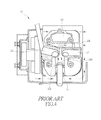
- FIGS. 1 and 2 To control the high temperature induced by the operation of an engine, several ways of heat dissipation may be taken, based on which engines are generally classified as air cooling engines and water cooling engines. Examples of conventional air cooling engine are as shown in FIGS. 1 and 2 , wherein an engine power system 1 comprises at least a crankcase 11, a cylinder block 12, and a cylinder head 13 mounted on the cylinder block 12. Heat dissipation fins are mounted to the cylinder block 12 and the cylinder head 13 to increase the surface area for heat dissipation.
- a cooling air stream flows towards the engine power system 1 in a direction from a front end of the vehicle to a rear end in order to remove heat for cooling purposes, so that the engine power system 1 can maintains a normal temperature for operation.
- the hottest location of the engine power system 1 is the cylinder head 13, and the hottest spot of the cylinder head 13 is an exhaust port 131 and a spark plug seat 132 of the cylinder head 13.
- various ways have been developed to remove heat from the exhaust port 131 and the spark plug seat 132.
- the air passage 2 comprises a lateral channel 21 and a longitudinal channel 22.
- the lateral channel 21 is located between a part accommodation compartment 134 and the exhaust port 131 and the intake port 133.
- the longitudinal channel 22 is located between the exhaust port 131 and the intake port 133 and has an end communicating the lateral channel 21 and an opposite end connected to the spark plug seat 132.
- a plurality of airflow guide members 23 is arranged at the connection between the lateral channel 21 and the longitudinal channel 22, so as to guide a cooling air stream (indicated by small arrows in the drawing) that enters from the exhaust port 131 side into the lateral channel 22 to remove heat first from the exhaust port 131 that is of the highest temperature of the engine power system 1, and then the air stream is guided by the airflow guide members 23 to flow toward the spark plug seat 132 for removing heat from the spark plug seat 132.
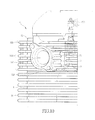
- the air passage 2a is of an L-shape comprising a longitudinal channel 21a and a lateral channel 22a.
- the longitudinal channel 21a is formed to extend from the spark plug seat 132 toward the part accommodation compartment 134, while the lateral channel 22a is located between the exhaust port 131 and the part accommodation compartment 134 and has an end forming an outlet and an opposite end communicating the longitudinal channel 21a.
- a plurality of airflow guide members 23a is provided in the longitudinal channel 21a in order to guide a cooling air stream (indicated by small arrows in the drawing) that is received from the spark plug seat 132 side into the longitudinal channel 21a toward the exhaust port 131, whereby the cooling air stream removes heat from the spark plug seat 132 side first and then removes heat from the exhaust port 131 side.
- this way of heat dissipation is effective in removing heat from the spark plug seat 132, yet after air stream enters the longitudinal channel 21a and removes heat from the spark plug seat 132, the air stream is heated and becomes a hot air stream rather than a cold air stream.
- the air stream When the hot air stream reaches the exhaust port 131, the air stream is of no effect in removing heat from the exhaust port 131 and may undesirably transfer heat to the exhaust port 131 that is of the highest temperature of the engine power system 1. Consequently, such an arrangement will cause non-uniform distribution of temperature in the cylinder head 13, eventually leading to reduction of the life span of the engine power system 1.
- the air passage 2b is of a T-shape, comprising a longitudinal channel 21b and a lateral channel 22b.
- the longitudinal channel 21b is formed to extend from the spark plug seat 132 toward the part accommodation compartment 134, while the lateral channel 22b is located between the exhaust port 131 and the intake port 133 and the part accommodation compartment 134 and has a middle section communicating the longitudinal channel 21b, so that a cooling air stream (indicated by small arrows in the drawing) that is received from the spark plug seat 132 side into the longitudinal channel 21b is discharged through the lateral channel 22b in order to allow the cooling air stream to first remove heat from the spark plug seat 132 side and then remove heat from the exhaust port 131 and the intake port 133.
- Such a way of heat dissipation is effective in removing heat from the spark plug seat 132 side, but after the air stream enters the longitudinal channel 21b and removes heat from the spark plug seat 132, the air stream becomes a hot air stream rather than a cold air stream.
- the air stream is of no effect in removing heat from the exhaust port 131 and may undesirably transfer heat to the exhaust port 131 that is of the highest temperature of the engine power system 1.
- such an arrangement will cause non-uniform distribution of temperature in the cylinder head 13, eventually leading to reduction of the life span of the engine power system 1.
- the present invention aims to provide an improved heat dissipation structure for air cooling engines.
- the primary objective of the present invention is to provide a structure of cylinder head of air cooling engine.
- the cylinder head of the engine comprises a valve driving member, a combustion chamber, an intake port, an exhaust port, a spark plug seat, a front heat dissipation fin assembly, and a rear heat dissipation fin assembly
- the cylinder head forms a longitudinal channel between the valve driving member and the combustion chamber and extending completely therethrough in a direction of the intake port and the exhaust port, whereby the intake port and the exhaust port are located between the spark plug seat and the longitudinal channel.
- the cylinder head also forms a lateral channel that is located between the exhaust port and the intake port and opening toward the spark plug seat. The lateral channel is in communication with the longitudinal channel.
- the engine is structured by arranging the exhaust port of the cylinder head toward a vehicle front side and arranging the intake port toward a vehicle rear side.
- an external cooling air stream flows from the exhaust port through the longitudinal channel to reach and discharge through the intake port side.
- An external opening section of the lateral channel comprises an airflow conduction wall through connecting at least two heat dissipation fins of the rear heat dissipation fin assembly for guiding an external cooling air stream through the lateral channel into the longitudinal channel to improve heat dissipation of the engine, realize overall heat dissipation of the cylinder head, avoid part deformation caused by non-uniform distribution of temperature of heat dissipation, and extend life span of the engine.
- the secondary objective of the present invention is to provide a structure of cylinder head of air cooling engine, wherein the longitudinal channel comprises a plurality of pegs formed therein and the pegs serve as conductor for conducting heat, so that the heat generated by the operation of the cylinder head can be transferred to the pegs. Since the pegs are arranged inside the longitudinal channel, the heat generated by the operation of the cylinder head can be effectively and efficiently removed by an external cooling air stream from the longitudinal channel, thereby improving heat dissipation of the engine, realizing overall heat dissipation of the cylinder head, avoiding part deformation caused by non-uniform distribution of temperature of heat dissipation, and extending life span of the engine.
- the present invention provides an air cooling engine heat dissipation structure.
- the air cooling engine 3 comprise at least a crankcase 4 and a cylinder 5.
- the cylinder 5 comprises a cylinder block 51 and a cylinder head 52.
- the cylinder block 51 and the cylinder head 52 respectively form a plurality of heat dissipation fins 511, 521 projecting therefrom.
- the cylinder head 52 forms a valve driving member 522, a combustion chamber 523, an intake port 524, an exhaust port 525, a spark plug seat 526, and a chain compartment 527.
- the engine 3 is structured by arranging the exhaust port 525 of the cylinder head 52 toward a vehicle front side and arranging the intake port 524 toward a vehicle rear side.
- a longitudinal channel 7 is formed in the cylinder head 52 between the valve driving member 522 and the combustion chamber 523 and extending completely therethrough in a direction of the intake port 524 and the exhaust port 525, whereby the intake port 524 and the exhaust port 525 are located between the spark plug seat 526 and the longitudinal channel 7.
- the cylinder head 52 forms a lateral channel 6 located between the exhaust port 525 and the intake port 524 and opening toward the spark plug seat 526.
- the lateral channel 6 is in communication with the longitudinal channel 7.
- the lateral channel 6 has an external opening section 61 that comprises a wide opening 611 and a narrow opening 612.
- the wide opening 611 is defined by a rear wall 5212 that is formed by connecting heat dissipation fins of a rear heat dissipation fin assembly 521a at a location between the spark plug seat 526 and the intake port 524, and the wide opening 611 is also defined by a front wall 5213 that is formed by connecting heat dissipation fins of a front heat dissipation fin assembly 521b at a location between the spark plug seat 526 and the exhaust port 525.
- the rear wall 5212 has an area greater than an area of the front wall 5213, whereby the external cooling air stream can be effectively guided into the lateral channel 6.
- the narrow opening 612 is of a converging configuration.
- the narrow opening 612 is located on the intake port 524 side close to the spark plug seat 526.
- Two of the heat dissipation fins of the rear heat dissipation fin assembly 521a are connected to each other to form an airflow conduction wall 5211, which has an upper end 5211a that is located closer to the intake port 524 than a lower end 5211b of the airflow conduction wall, and the lower end 5211b is connected to a bottom of the opening section 61 to make the airflow conduction wall 5211a slope.
- the narrow opening 612 has an opening direction that is shifted toward the vehicle front side, so that the external cooling air stream can be smoothly guided by the airflow conduction wall 5211 toward the opening section 61 of the lateral channel 6 and entering the lateral channel 6.
- Formed inside the lateral channel 6 is one or more airflow guide wall 8 (one such airflow guide wall being adopted in the embodiment illustrated for explanation purposes), which has an internal end section 81 and an external end section 82 that are arranged to point in opposite directions, thereby forming a double-curved configuration.
- the airflow guide wall 8 is connected to top 6a and bottom 6b of the lateral channel 6.
- the internal end section 81 of the airflow guide wall 8 is located closer to the intake port 524 than the external end section 82, whereby a cooling air stream within the longitudinal channel 7 is prevented from flowing into the lateral channel 6, interference with smooth flow of the cooling air within the longitudinal channel 7 is eliminated, and introduction of cooling air from the lateral channel 6 into the longitudinal channel 7 is enhanced by the airflow guide wall 8.
- the longitudinal channel 7 comprises a plurality of airflow regulation fins 72 on the exhaust port 525 side of the opening section 71.
- the airflow regulation fins 72 are formed by protruding from a wall of the exhaust port 525 and extending in a direction toward the lateral channel 6. The arrangement of the airflow regulation fins 72 helps regulating the cooling air flowing into the longitudinal channel 7 and smoothly guiding the cooling air to flow toward an outlet end 73 for discharging to effectively remove heat from the exhaust port 525.
- the cooling air stream entering the lateral channel 6 is guided by the airflow conduction wall 5211 to smoothly flow through the spark plug seat 526, and then guided by the airflow guide wall 8 to discharge through the outlet end 73 of the longitudinal channel 7; and on the other hand, the cooling air stream entering the longitudinal channel 7 is regulated and guided by the airflow regulation fins 72 to then flow toward and discharge through the outlet 73 of the longitudinal channel 7, whereby two temperature-raised air streams that are respectively formed of the cooling air stream entering the longitudinal channel 7 and removing heat from the exhaust port 525 and the cooling air stream entering the lateral channel 6 and removing heat from the spark plug seat 526 are combined within the longitudinal channel 7 and are then discharged through the outlet end 73 of the longitudinal channel 7.
- the chain compartment 527 forms, in a side thereof facing the longitudinal channel 7, an arc wall 527a in a direction along which the external cooling air stream advances.
- the longitudinal channel 7 comprises a plurality of pegs 7a within a lengthwise range of the arc wall 527a.
- the pegs 7a are arranged as an array inside the longitudinal channel 7 within the lengthwise range of the arc wall 527a.
- the cooling air stream entering the lateral channel 6 is guided by the airflow conduction wall 5211 to flow through the spark plug seat 526 and then guided by the airflow guide wall 8 to discharge through the outlet end 73 of the longitudinal channel 7; and on the other hand, the cooling air stream entering the longitudinal channel 7 is first regulated and guided by the airflow regulation fins 72 and then guided by the pegs 7a located inside the longitudinal channel 7 to move toward and discharge through the outlet end 73.
- the pegs 7a serve as conductors for conducting heat, so that the heat generated by the operation of the cylinder head 52 is transmitted to the pegs 7a.
- the heat generated by the operation of the cylinder head 52 can be effectively and efficiently removed by the external cooling air stream flowing through the longitudinal channel 7.
- the two temperature-raised air streams that are respectively formed of the cooling air stream entering the longitudinal channel 7 and removing heat from the exhaust port 525 and the cooling air stream entering the lateral channel 6 and removing heat from the spark plug seat 526 are combined within the longitudinal channel 7 and then discharged through the outlet end 73 of the longitudinal channel 7.
- the narrow opening 612 of the lateral channel 6 has an opening direction that is shifted toward the vehicle front side, whereby one side of an inlet end of the narrow opening 612 is shifted toward the vehicle front side for wider opening so that the inlet end of the narrow opening 612 is made in a wider opening fashion by being set closer to the vehicle front side than the spark plug seat 526 side.
- the external cooling air can be easily received into the narrow opening 612, and then guided by the airflow conduction wall 5211 toward the opening section 61 outside the lateral channel 6 to enter the lateral channel 6.
- An efficacy of the present invention is that external cooling air streams are respectively received through the lateral channel 6 and the longitudinal channel 7 into the cylinder head 52 for cooling and heat removal.
- the cooling air stream entering the longitudinal channel 7 is received from the vehicle front side and thus possesses a fast flowing speed, while the cooling air stream entering the lateral channel 6 is received from a lateral side of the vehicle and has a slow flowing speed, whereby Venturi tube effect is induced inside the longitudinal channel 7, making the lateral channel 6 drawing in a greater amount of external cooling air to provide an excellent heat dissipation result of the spark plug seat 526.
- the spark plug seat 526 and the exhaust port 525 are separately cooled by different external cooling air streams. Further, the external cooling air streams, after removing heats from the spark plug seat 526 and the exhaust port 525, are guided toward the intake port 524 to be efficiently discharged rearward of the engine 3, whereby localized heat concentration on the cylinder head 52 can be avoided and non-uniform heat dissipation, thermal deformation, and leakage occurring in the cylinder head 52 are eliminated to thereby extend life span of the engine 3.
- pegs 7a are arranged inside the longitudinal channel 7 so that an external cooling air stream can be guided by the airflow guide wall 8 to discharge through the outlet end 73 of the longitudinal channel 7.
- a cooling air stream that enters the longitudinal channel 7 is first regulated and guided by the airflow regulation fins 72 and then guided by the pegs 7a located inside the longitudinal channel 7 to discharge through the outlet end 73.
- the pegs 7a serve as conductors for conducting heat, so that the heat generated by the operation of the cylinder head 52 is transmitted to the pegs 7a. Since the pegs 7a are located inside the longitudinal channel 7, the heat generated by the operation of the cylinder head 52 can be effectively and efficiently removed by the external cooling air stream flowing through the longitudinal channel 7.
- the two temperature-raised air streams that are respectively formed of the cooling air stream entering the longitudinal channel 7 and removing heat from the exhaust port 525 and the cooling air stream entering the lateral channel 6 and removing heat from the spark plug seat 526 are combined within the longitudinal channel 7 and then discharged through the outlet end 73 of the longitudinal channel 7.
- non-uniform heat dissipation, thermal deformation, and leakage occurring in the cylinder head 52 are eliminated, thereby extending life span of the engine 3.
- the effect of cooling and heat dissipation of engine 3 can be improved to realize overall heat dissipation for cylinder head 52 and eliminate the potential risk of parts deformation caused by non-uniform heat dissipation.
Landscapes
- Engineering & Computer Science (AREA)
- Chemical & Material Sciences (AREA)
- Combustion & Propulsion (AREA)
- Mechanical Engineering (AREA)
- General Engineering & Computer Science (AREA)
- Cylinder Crankcases Of Internal Combustion Engines (AREA)
Abstract
Description
- The present invention generally relates to a structure of cylinder head of air cooling engine, and more particularly to a cylinder head structure that facilitates engine cooling for heat dissipation so as to realize overall heat dissipation of the cylinder head.
- A vehicle, such as a motorcycle and an all-terrain vehicle, is operated by mixing air with fuel to form an air-fuel mixture that is fed into an engine where combustion of the mixture takes place to generate power for driving reciprocal motion of a piston. The reciprocal motion of the piston is then converted by a crankshaft to drive a chain or a belt-based speed-varying mechanism for moving the vehicle forward.
- To control the high temperature induced by the operation of an engine, several ways of heat dissipation may be taken, based on which engines are generally classified as air cooling engines and water cooling engines. Examples of conventional air cooling engine are as shown in
FIGS. 1 and2 , wherein an engine power system 1 comprises at least acrankcase 11, acylinder block 12, and acylinder head 13 mounted on thecylinder block 12. Heat dissipation fins are mounted to thecylinder block 12 and thecylinder head 13 to increase the surface area for heat dissipation. When a vehicle is traveling, a cooling air stream flows towards the engine power system 1 in a direction from a front end of the vehicle to a rear end in order to remove heat for cooling purposes, so that the engine power system 1 can maintains a normal temperature for operation. However, it is well known that the hottest location of the engine power system 1 is thecylinder head 13, and the hottest spot of thecylinder head 13 is anexhaust port 131 and aspark plug seat 132 of thecylinder head 13. To improve the life span of the engine power system 1, various ways have been developed to remove heat from theexhaust port 131 and thespark plug seat 132. - As shown in
FIG 2 (in which the large arrow indicates the direction toward vehicle front end), a solution is to provide anair passage 2 on thecylinder head 13. Theair passage 2 comprises alateral channel 21 and alongitudinal channel 22. Thelateral channel 21 is located between apart accommodation compartment 134 and theexhaust port 131 and theintake port 133. Thelongitudinal channel 22 is located between theexhaust port 131 and theintake port 133 and has an end communicating thelateral channel 21 and an opposite end connected to thespark plug seat 132. Further, a plurality ofairflow guide members 23 is arranged at the connection between thelateral channel 21 and thelongitudinal channel 22, so as to guide a cooling air stream (indicated by small arrows in the drawing) that enters from theexhaust port 131 side into thelateral channel 22 to remove heat first from theexhaust port 131 that is of the highest temperature of the engine power system 1, and then the air stream is guided by theairflow guide members 23 to flow toward thespark plug seat 132 for removing heat from thespark plug seat 132. This way of heat dissipation is effective to remove heat from theexhaust port 131, but when the air stream is guided into thelateral channel 21 for removing heat from theexhaust port 131, since it has already being heated and becomes a hot air stream rather than a cooling air stream, at the time when the hot air stream reaches thespark plug seat 132, it removes no heat from thespark plug seat 132 and may instead transfer heat to thespark plug seat 132, making the temperature of the spark plug seat undesirably raised. Apparently, such an arrangement will cause non-uniform distribution of temperature in thecylinder head 13, eventually leading to reduction of the life span of the engine power system 1. - As shown in
FIG 3 , another solution of heat dissipation is to provide adifferent air passage 2a on thecylinder head 13. Theair passage 2a is of an L-shape comprising alongitudinal channel 21a and alateral channel 22a. Thelongitudinal channel 21a is formed to extend from thespark plug seat 132 toward thepart accommodation compartment 134, while thelateral channel 22a is located between theexhaust port 131 and thepart accommodation compartment 134 and has an end forming an outlet and an opposite end communicating thelongitudinal channel 21a. A plurality ofairflow guide members 23a is provided in thelongitudinal channel 21a in order to guide a cooling air stream (indicated by small arrows in the drawing) that is received from thespark plug seat 132 side into thelongitudinal channel 21a toward theexhaust port 131, whereby the cooling air stream removes heat from thespark plug seat 132 side first and then removes heat from theexhaust port 131 side. However, this way of heat dissipation is effective in removing heat from thespark plug seat 132, yet after air stream enters thelongitudinal channel 21a and removes heat from thespark plug seat 132, the air stream is heated and becomes a hot air stream rather than a cold air stream. When the hot air stream reaches theexhaust port 131, the air stream is of no effect in removing heat from theexhaust port 131 and may undesirably transfer heat to theexhaust port 131 that is of the highest temperature of the engine power system 1. Apparently, such an arrangement will cause non-uniform distribution of temperature in thecylinder head 13, eventually leading to reduction of the life span of the engine power system 1. - Referring to
FIG 4 , a further solution of heat dissipation is to provide adifferent air passage 2b on thecylinder head 13. Theair passage 2b is of a T-shape, comprising alongitudinal channel 21b and alateral channel 22b. Thelongitudinal channel 21b is formed to extend from thespark plug seat 132 toward thepart accommodation compartment 134, while thelateral channel 22b is located between theexhaust port 131 and theintake port 133 and thepart accommodation compartment 134 and has a middle section communicating thelongitudinal channel 21b, so that a cooling air stream (indicated by small arrows in the drawing) that is received from thespark plug seat 132 side into thelongitudinal channel 21b is discharged through thelateral channel 22b in order to allow the cooling air stream to first remove heat from thespark plug seat 132 side and then remove heat from theexhaust port 131 and theintake port 133. Such a way of heat dissipation is effective in removing heat from thespark plug seat 132 side, but after the air stream enters thelongitudinal channel 21b and removes heat from thespark plug seat 132, the air stream becomes a hot air stream rather than a cold air stream. Thus, when the hot air stream reaches theexhaust port 131, the air stream is of no effect in removing heat from theexhaust port 131 and may undesirably transfer heat to theexhaust port 131 that is of the highest temperature of the engine power system 1. Apparently, such an arrangement will cause non-uniform distribution of temperature in thecylinder head 13, eventually leading to reduction of the life span of the engine power system 1. - All these conventional air cooling engine heat dissipation structures will cause an excessive difference of temperature and non-uniform heat dissipation of the
cylinder head 13. The excessive difference of temperature will lead to the following disadvantages: - The
cylinder head 13 may have localized high temperature, which leads to localized thermal deformation that in turn causes undesired part deformation and/or wear. In the worst case, such a situation may result in un-tight closure of valve and thus reduction of internal pressure of the engine or even invasion of oil from a rocker arm chamber into the combustion chamber to be combusted there, causing exhaust of smoke and pollution of the environment. - In views of the above discussed drawbacks of the conventional cylinder head heat dissipation structures for air cooling engines, the present invention aims to provide an improved heat dissipation structure for air cooling engines.
- The primary objective of the present invention is to provide a structure of cylinder head of air cooling engine. The cylinder head of the engine comprises a valve driving member, a combustion chamber, an intake port, an exhaust port, a spark plug seat, a front heat dissipation fin assembly, and a rear heat dissipation fin assembly The cylinder head forms a longitudinal channel between the valve driving member and the combustion chamber and extending completely therethrough in a direction of the intake port and the exhaust port, whereby the intake port and the exhaust port are located between the spark plug seat and the longitudinal channel. The cylinder head also forms a lateral channel that is located between the exhaust port and the intake port and opening toward the spark plug seat. The lateral channel is in communication with the longitudinal channel. The engine is structured by arranging the exhaust port of the cylinder head toward a vehicle front side and arranging the intake port toward a vehicle rear side. When a vehicle is moving, an external cooling air stream flows from the exhaust port through the longitudinal channel to reach and discharge through the intake port side. An external opening section of the lateral channel comprises an airflow conduction wall through connecting at least two heat dissipation fins of the rear heat dissipation fin assembly for guiding an external cooling air stream through the lateral channel into the longitudinal channel to improve heat dissipation of the engine, realize overall heat dissipation of the cylinder head, avoid part deformation caused by non-uniform distribution of temperature of heat dissipation, and extend life span of the engine.
- The secondary objective of the present invention is to provide a structure of cylinder head of air cooling engine, wherein the longitudinal channel comprises a plurality of pegs formed therein and the pegs serve as conductor for conducting heat, so that the heat generated by the operation of the cylinder head can be transferred to the pegs. Since the pegs are arranged inside the longitudinal channel, the heat generated by the operation of the cylinder head can be effectively and efficiently removed by an external cooling air stream from the longitudinal channel, thereby improving heat dissipation of the engine, realizing overall heat dissipation of the cylinder head, avoiding part deformation caused by non-uniform distribution of temperature of heat dissipation, and extending life span of the engine.
- The foregoing objectives and summary provide only a brief introduction to the present invention. To fully appreciate these and other objects of the present invention as well as the invention itself, all of which will become apparent to those skilled in the art, the following detailed description of the invention and the claims should be read in conjunction with the accompanying drawings. Throughout the specification and drawings identical reference numerals refer to identical or similar parts.
- Many other advantages and features of the present invention will become manifest to those versed in the art upon making reference to the detailed description and the accompanying sheets of drawings in which a preferred structural embodiment incorporating the principles of the present invention is shown by way of illustrative example.
-
-
FIG 1 is a schematic view illustrating arrangement of an air cooling engine. -
FIG 2 is a cross-sectional view of a conventional air cooling engine. -
FIG 3 is a cross-sectional view of another conventional air cooling engine. -
FIG 4 is a cross-sectional view of a further conventional air cooling engine. -
FIG 5 is a schematic view illustrating an air cooling engine according to the present invention. -
FIG 6 is an enlarged view of a lateral channel and a spark plug seat according to the present invention. -
FIG 7 is a cross-sectional view of the air cooling engine according to the present invention. -
FIG 8 is an enlarged view of an exhaust port and a longitudinal channel according to the present invention. -
FIG 9 is a cross-sectional view of the longitudinal channel according to the present invention. -
FIG 10 is a cross-sectional view of the air cooling engine according to the present invention. - The following descriptions are exemplary embodiments only, and are not intended to limit the scope, applicability or configuration of the invention in any way Rather, the following description provides a convenient illustration for implementing exemplary embodiments of the invention. Various changes to the described embodiments may be made in the function and arrangement of the elements described without departing from the scope of the invention as set forth in the appended claims.
- Referring to
FIGS. 5 and7 (in which the large arrow indicating the direction toward vehicle front end), the present invention provides an air cooling engine heat dissipation structure. Theair cooling engine 3 comprise at least acrankcase 4 and acylinder 5. Thecylinder 5 comprises acylinder block 51 and acylinder head 52. Thecylinder block 51 and thecylinder head 52 respectively form a plurality ofheat dissipation fins - The
cylinder head 52 forms avalve driving member 522, acombustion chamber 523, anintake port 524, anexhaust port 525, aspark plug seat 526, and achain compartment 527. Referring toFIGS. 5 ,6 , and7 (in which the large arrow indicating the direction toward vehicle front end), theengine 3 is structured by arranging theexhaust port 525 of thecylinder head 52 toward a vehicle front side and arranging theintake port 524 toward a vehicle rear side. Alongitudinal channel 7 is formed in thecylinder head 52 between thevalve driving member 522 and thecombustion chamber 523 and extending completely therethrough in a direction of theintake port 524 and theexhaust port 525, whereby theintake port 524 and theexhaust port 525 are located between thespark plug seat 526 and thelongitudinal channel 7. When the vehicle is traveling, an external cooling air stream flows from theexhaust port 525 through thelongitudinal channel 7 to reach theintake port 524 side to be discharged there. - Further, the
cylinder head 52 forms alateral channel 6 located between theexhaust port 525 and theintake port 524 and opening toward thespark plug seat 526. Thelateral channel 6 is in communication with thelongitudinal channel 7. - The
lateral channel 6 has anexternal opening section 61 that comprises awide opening 611 and anarrow opening 612. Thewide opening 611 is defined by arear wall 5212 that is formed by connecting heat dissipation fins of a rear heatdissipation fin assembly 521a at a location between thespark plug seat 526 and theintake port 524, and thewide opening 611 is also defined by afront wall 5213 that is formed by connecting heat dissipation fins of a front heatdissipation fin assembly 521b at a location between thespark plug seat 526 and theexhaust port 525. Therear wall 5212 has an area greater than an area of thefront wall 5213, whereby the external cooling air stream can be effectively guided into thelateral channel 6. - The
narrow opening 612 is of a converging configuration. Thenarrow opening 612 is located on theintake port 524 side close to thespark plug seat 526. Two of the heat dissipation fins of the rear heatdissipation fin assembly 521a are connected to each other to form anairflow conduction wall 5211, which has anupper end 5211a that is located closer to theintake port 524 than alower end 5211b of the airflow conduction wall, and thelower end 5211b is connected to a bottom of theopening section 61 to make theairflow conduction wall 5211a slope. Further, thenarrow opening 612 has an opening direction that is shifted toward the vehicle front side, so that the external cooling air stream can be smoothly guided by theairflow conduction wall 5211 toward theopening section 61 of thelateral channel 6 and entering thelateral channel 6. Formed inside thelateral channel 6 is one or more airflow guide wall 8 (one such airflow guide wall being adopted in the embodiment illustrated for explanation purposes), which has aninternal end section 81 and anexternal end section 82 that are arranged to point in opposite directions, thereby forming a double-curved configuration. Theairflow guide wall 8 is connected to top 6a and bottom 6b of thelateral channel 6. Theinternal end section 81 of theairflow guide wall 8 is located closer to theintake port 524 than theexternal end section 82, whereby a cooling air stream within thelongitudinal channel 7 is prevented from flowing into thelateral channel 6, interference with smooth flow of the cooling air within thelongitudinal channel 7 is eliminated, and introduction of cooling air from thelateral channel 6 into thelongitudinal channel 7 is enhanced by theairflow guide wall 8. Further, referring toFIG 8 , thelongitudinal channel 7 comprises a plurality ofairflow regulation fins 72 on theexhaust port 525 side of theopening section 71. Theairflow regulation fins 72 are formed by protruding from a wall of theexhaust port 525 and extending in a direction toward thelateral channel 6. The arrangement of theairflow regulation fins 72 helps regulating the cooling air flowing into thelongitudinal channel 7 and smoothly guiding the cooling air to flow toward anoutlet end 73 for discharging to effectively remove heat from theexhaust port 525. - To practice the present invention, referring to
FIGS. 6 and7 (in which the large arrow indicating the direction toward vehicle front end), external cooling air streams (indicated by small arrows in the drawing) are respectively received through thelateral channel 6 and thelongitudinal channel 7 into thecylinder head 52. The cooling air stream entering thelateral channel 6 is guided by theairflow conduction wall 5211 to smoothly flow through thespark plug seat 526, and then guided by theairflow guide wall 8 to discharge through the outlet end 73 of thelongitudinal channel 7; and on the other hand, the cooling air stream entering thelongitudinal channel 7 is regulated and guided by theairflow regulation fins 72 to then flow toward and discharge through theoutlet 73 of thelongitudinal channel 7, whereby two temperature-raised air streams that are respectively formed of the cooling air stream entering thelongitudinal channel 7 and removing heat from theexhaust port 525 and the cooling air stream entering thelateral channel 6 and removing heat from thespark plug seat 526 are combined within thelongitudinal channel 7 and are then discharged through the outlet end 73 of thelongitudinal channel 7. - Referring to
FIGS. 9 and10 , to practice the present invention, thechain compartment 527 forms, in a side thereof facing thelongitudinal channel 7, anarc wall 527a in a direction along which the external cooling air stream advances. Thelongitudinal channel 7 comprises a plurality ofpegs 7a within a lengthwise range of thearc wall 527a. Thepegs 7a are arranged as an array inside thelongitudinal channel 7 within the lengthwise range of thearc wall 527a. As such, when external cooling air streams (indicated by small arrows in the drawing) are respectively received through thelateral channel 6 and thelongitudinal channel 7 into thecylinder head 52, the cooling air stream entering thelateral channel 6 is guided by theairflow conduction wall 5211 to flow through thespark plug seat 526 and then guided by theairflow guide wall 8 to discharge through the outlet end 73 of thelongitudinal channel 7; and on the other hand, the cooling air stream entering thelongitudinal channel 7 is first regulated and guided by theairflow regulation fins 72 and then guided by thepegs 7a located inside thelongitudinal channel 7 to move toward and discharge through theoutlet end 73. Thepegs 7a serve as conductors for conducting heat, so that the heat generated by the operation of thecylinder head 52 is transmitted to thepegs 7a. Since thepegs 7a are located inside thelongitudinal channel 7, the heat generated by the operation of thecylinder head 52 can be effectively and efficiently removed by the external cooling air stream flowing through thelongitudinal channel 7. As such, the two temperature-raised air streams that are respectively formed of the cooling air stream entering thelongitudinal channel 7 and removing heat from theexhaust port 525 and the cooling air stream entering thelateral channel 6 and removing heat from thespark plug seat 526 are combined within thelongitudinal channel 7 and then discharged through the outlet end 73 of thelongitudinal channel 7. - Further, as shown in
FIG 10 , thenarrow opening 612 of thelateral channel 6 has an opening direction that is shifted toward the vehicle front side, whereby one side of an inlet end of thenarrow opening 612 is shifted toward the vehicle front side for wider opening so that the inlet end of thenarrow opening 612 is made in a wider opening fashion by being set closer to the vehicle front side than thespark plug seat 526 side. As such, the external cooling air can be easily received into thenarrow opening 612, and then guided by theairflow conduction wall 5211 toward theopening section 61 outside thelateral channel 6 to enter thelateral channel 6. - An efficacy of the present invention is that external cooling air streams are respectively received through the
lateral channel 6 and thelongitudinal channel 7 into thecylinder head 52 for cooling and heat removal. The cooling air stream entering thelongitudinal channel 7 is received from the vehicle front side and thus possesses a fast flowing speed, while the cooling air stream entering thelateral channel 6 is received from a lateral side of the vehicle and has a slow flowing speed, whereby Venturi tube effect is induced inside thelongitudinal channel 7, making thelateral channel 6 drawing in a greater amount of external cooling air to provide an excellent heat dissipation result of thespark plug seat 526. Further, since the cooling air streams are respectively received into thecylinder head 52 through thelateral channel 6 and thelongitudinal channel 7, thespark plug seat 526 and theexhaust port 525 are separately cooled by different external cooling air streams. Further, the external cooling air streams, after removing heats from thespark plug seat 526 and theexhaust port 525, are guided toward theintake port 524 to be efficiently discharged rearward of theengine 3, whereby localized heat concentration on thecylinder head 52 can be avoided and non-uniform heat dissipation, thermal deformation, and leakage occurring in thecylinder head 52 are eliminated to thereby extend life span of theengine 3. - Another efficacy of the present invention is that pegs 7a are arranged inside the
longitudinal channel 7 so that an external cooling air stream can be guided by theairflow guide wall 8 to discharge through the outlet end 73 of thelongitudinal channel 7. A cooling air stream that enters thelongitudinal channel 7 is first regulated and guided by theairflow regulation fins 72 and then guided by thepegs 7a located inside thelongitudinal channel 7 to discharge through theoutlet end 73. Thepegs 7a serve as conductors for conducting heat, so that the heat generated by the operation of thecylinder head 52 is transmitted to thepegs 7a. Since thepegs 7a are located inside thelongitudinal channel 7, the heat generated by the operation of thecylinder head 52 can be effectively and efficiently removed by the external cooling air stream flowing through thelongitudinal channel 7. As such, the two temperature-raised air streams that are respectively formed of the cooling air stream entering thelongitudinal channel 7 and removing heat from theexhaust port 525 and the cooling air stream entering thelateral channel 6 and removing heat from thespark plug seat 526 are combined within thelongitudinal channel 7 and then discharged through the outlet end 73 of thelongitudinal channel 7. Thus, non-uniform heat dissipation, thermal deformation, and leakage occurring in thecylinder head 52 are eliminated, thereby extending life span of theengine 3. - In summary, with the above described structure of the present invention, the effect of cooling and heat dissipation of
engine 3 can be improved to realize overall heat dissipation forcylinder head 52 and eliminate the potential risk of parts deformation caused by non-uniform heat dissipation. - It will be understood that each of the elements described above, or two or more together may also find a useful application in other types of methods differing from the type described above.
- While certain novel features of this invention have been shown and described and are pointed out in the annexed claim, it is not intended to be limited to the details above, since it will be understood that various omissions, modifications, substitutions and changes in the forms and details of the device illustrated and in its operation can be made by those skilled in the art without departing in any way from the spirit of the present invention.
Claims (15)
- A structure of cylinder head (52) of air cooling engine (3), the cylinder head (52) of the engine (3) comprising a valve driving member (522), a combustion chamber (523), an intake port (524), an exhaust port (525), a spark plug seat (526), a front heat dissipation fin assembly (521b), and a rear heat dissipation fin assembly (521a);
the cylinder head (52) forming a longitudinal channel (7) between the valve driving member (522) and the combustion chamber (523) and extending completely therethrough in a direction of the intake port (524) and the exhaust port (525), whereby the intake port (524) and the exhaust port (525) are located between the spark plug seat (526) and the longitudinal channel (7);
the cylinder head (52) forming a lateral channel (6) that is located between the exhaust port (525) and the intake port (524) and opening toward the spark plug seat (526), the lateral channel (6) being in communication with the longitudinal channel (7); and
the engine (3) being structured by arranging the exhaust port (525) of the cylinder head (52) toward a vehicle front side and arranging the intake port (524) toward a vehicle rear side, characterized in that when a vehicle is moving, an external cooling air stream flows from the exhaust port (525) through the longitudinal channel (7) to reach and discharge through the intake port (524) side, an external opening section (61) of the lateral channel (6) comprising an airflow conduction wall (5211) through connecting at least two heat dissipation fins of the rear heat dissipation fin assembly (521a). - A structure of cylinder head (52) of air cooling engine (3), the cylinder head (52) of the engine (3) comprising a valve driving member (522), a combustion chamber (523), an intake port (524), an exhaust port (525), a spark plug seat (526), and a chain compartment (527), the cylinder head (52) forming a longitudinal channel (7) between the valve driving member (522) and the combustion chamber (523) and extending in a direction from the intake port (524) to the exhaust port (525) along the chain compartment (527), the cylinder head (52) forming a lateral channel (6) that is located between the exhaust port (525) and the intake port (524) and opening toward the spark plug seat (526), the lateral channel (6) being in communication with the longitudinal channel (7);
the engine (3) being structured by arranging the exhaust port (525) of the cylinder head (52) toward a vehicle front side and arranging the intake port (524) toward a vehicle rear side, characterized in that the longitudinal channel (7) comprises a plurality of pegs (7a) formed therein. - The structure of cylinder head (52) of air cooling engine (3) according to claim 1 or 2, wherein the opening section (61) outside the lateral channel (6) comprises a wide opening (611) and a narrow opening (612).
- The structure of cylinder head (52) of air cooling engine (3) according to claim 1 or 2, wherein the narrow opening (612) is located below the wide opening (611) and close to the spark plug seat (526), the airflow conduction wall (5211) being located in the narrow opening (612), heat dissipation fins located on one side of the narrow opening (612) opposite to the airflow conduction wall (5211) being in an open condition.
- The structure of cylinder head (52) of air cooling engine (3) according to claim 3, wherein heat dissipation fins of the rear heat dissipation fin assembly (521a) in the wide opening (611) are connected to form a rear wall (5212), and heat dissipation fins of the front heat dissipation fin assembly (521b) being connected to each other to form a front wall (5213), the rear wall (5212) having an area greater than an area of the front wall (5213).
- The structure of cylinder head (52) of air cooling engine (3) according to claim 4, wherein the airflow conduction wall (5211) is arranged to have an upper end (5211a) thereof closer to the intake port (524) than the lower end (5211b) thereby forming a slope, the lower end (5211b) being connected to a bottom of the opening section (61).
- The heat dissipation structure of engine (3) according to claim 3, wherein the narrow opening (612) has an opening direction shifted toward the vehicle front side.
- The structure of cylinder head (52) of air cooling engine (3) according to claim 1 or 2, wherein the longitudinal channel (7) comprises airflow regulation fins (72) at the exhaust port (525) side, the airflow regulation fins (72) protruding from a wall of the exhaust port (525) and extending in a direction toward the lateral channel (6).
- The structure of cylinder head (52) of air cooling engine (3) according to claim 2, wherein the chain compartment (527) forms, in a side thereof facing the longitudinal channel (7), an arc wall (527a) in a direction along which a cooling air stream flows.
- The structure of cylinder head (52) of air cooling engine (3) according to claim 9, wherein a plurality of pegs (7a) is formed in a lengthwise range of the arc wall (527a).
- The structure of cylinder head (52) of air cooling engine (3) according to claim 2 or 9, wherein the plurality of pegs (7a) is arranged as an array.
- The structure of cylinder head (52) of air cooling engine (3) according to claim 1 or 2, wherein the lateral channel (6) comprises an airflow guide wall (8), the airflow guide wall (8) being connected to top (6a) and bottom (6b) of the lateral channel (6).
- The structure of cylinder head (52) of air cooling engine (3) according to claim 12, wherein the airflow guide wall (8) has an internal end section (81) that is located closer to the intake port (524) than an external end section (82), and the external end section (82) is located closer to the exhaust port (525) than the internal end section (81).
- The structure of cylinder head (52) of air cooling engine (3) according to claim 12, wherein the internal end section (81) and the external end section (82) of the airflow guide wall (8) arranged to point in opposite directions and forming a double-curved configuration.
- The heat dissipation structure of engine (3) according to claim 3, wherein the narrow opening (612) has an inlet end that is arranged toward vehicle front side for wider opening.
Applications Claiming Priority (2)
| Application Number | Priority Date | Filing Date | Title |
|---|---|---|---|
| TW99123658A TW201204920A (en) | 2010-07-19 | 2010-07-19 | Cylinder head structure of air-cooled engine |
| TW100105604A TWI381093B (en) | 2011-02-21 | 2011-02-21 | Air Cooling Engine 's Cylinder Head Heat Dissipation |
Publications (2)
| Publication Number | Publication Date |
|---|---|
| EP2410164A2 true EP2410164A2 (en) | 2012-01-25 |
| EP2410164A3 EP2410164A3 (en) | 2012-10-10 |
Family
ID=45093291
Family Applications (1)
| Application Number | Title | Priority Date | Filing Date |
|---|---|---|---|
| EP11168040A Withdrawn EP2410164A3 (en) | 2010-07-19 | 2011-05-30 | Structure of cylinder head of air cooling engine |
Country Status (1)
| Country | Link |
|---|---|
| EP (1) | EP2410164A3 (en) |
Cited By (4)
| Publication number | Priority date | Publication date | Assignee | Title |
|---|---|---|---|---|
| EP2713033A1 (en) * | 2012-10-01 | 2014-04-02 | Yamaha Hatsudoki Kabushiki Kaisha | Air-cooling type internal combustion engine and saddled vehicle having the same |
| CN111608817A (en) * | 2019-02-26 | 2020-09-01 | 本田技研工业株式会社 | Internal combustion engine for saddle-riding vehicles |
| JP2020165413A (en) * | 2019-03-29 | 2020-10-08 | 本田技研工業株式会社 | Internal combustion engine |
| CN112648102A (en) * | 2020-12-28 | 2021-04-13 | 安徽竞道动力科技有限公司 | Engine cylinder head of portable electronic fuel injection pedal motorcycle |
Family Cites Families (3)
| Publication number | Priority date | Publication date | Assignee | Title |
|---|---|---|---|---|
| KR100569164B1 (en) * | 2002-09-24 | 2006-04-07 | 혼다 기켄 고교 가부시키가이샤 | Air-cooled internal combustion engine |
| JP4244178B2 (en) * | 2003-09-26 | 2009-03-25 | 本田技研工業株式会社 | Cylinder head cooling air passage structure |
| WO2007080653A1 (en) * | 2006-01-13 | 2007-07-19 | Honda Motor Co., Ltd. | Internal combustion engine for vehicle |
-
2011
- 2011-05-30 EP EP11168040A patent/EP2410164A3/en not_active Withdrawn
Non-Patent Citations (1)
| Title |
|---|
| None |
Cited By (7)
| Publication number | Priority date | Publication date | Assignee | Title |
|---|---|---|---|---|
| EP2713033A1 (en) * | 2012-10-01 | 2014-04-02 | Yamaha Hatsudoki Kabushiki Kaisha | Air-cooling type internal combustion engine and saddled vehicle having the same |
| CN103711560A (en) * | 2012-10-01 | 2014-04-09 | 雅马哈发动机株式会社 | Air-cooling type internal combustion engine and saddled vehicle having the same |
| CN103711560B (en) * | 2012-10-01 | 2017-09-22 | 雅马哈发动机株式会社 | Air-cooled internal combustion engine and the Straddle-type vehicle for possessing the air-cooled internal combustion engine |
| CN111608817A (en) * | 2019-02-26 | 2020-09-01 | 本田技研工业株式会社 | Internal combustion engine for saddle-riding vehicles |
| CN111608817B (en) * | 2019-02-26 | 2022-02-22 | 本田技研工业株式会社 | Saddle-ride type internal combustion engine for vehicle |
| JP2020165413A (en) * | 2019-03-29 | 2020-10-08 | 本田技研工業株式会社 | Internal combustion engine |
| CN112648102A (en) * | 2020-12-28 | 2021-04-13 | 安徽竞道动力科技有限公司 | Engine cylinder head of portable electronic fuel injection pedal motorcycle |
Also Published As
| Publication number | Publication date |
|---|---|
| EP2410164A3 (en) | 2012-10-10 |
Similar Documents
| Publication | Publication Date | Title |
|---|---|---|
| RU2704525C2 (en) | Engine with exhaust gas recirculation | |
| KR101637293B1 (en) | Cylinder head that exhaust manifold is integrally formed having coolant jajcket | |
| EP2410164A2 (en) | Structure of cylinder head of air cooling engine | |
| JPS6232264A (en) | Cooling water passage structure in cylinder head of internal-combustion engine | |
| KR101826549B1 (en) | Water jacket for cylinder block | |
| US4660527A (en) | Cylinder head for combustion engine | |
| EP1403496B1 (en) | Air-cooled internal combustion engine | |
| WO2018143861A1 (en) | A compression ignited combustion engine | |
| CN106661995B (en) | Internal combustion engine | |
| CN102678372A (en) | Cylinder head heat dissipation structure of air-cooled engine | |
| ITTO940970A1 (en) | COOLING SYSTEM FOR A TWO-STROKE ENGINE WITH SPARK IGNITION. | |
| US20200049059A1 (en) | Thermally insulated insert member and engine having same | |
| CN201753638U (en) | Cylinder head construction of an air-cooled engine | |
| TWI374219B (en) | ||
| JP4410964B2 (en) | Piston cooling system | |
| US11549460B2 (en) | Water cooled engine | |
| CN101235762B (en) | Engine Cooling Structure | |
| CN101122255B (en) | engine cooling mechanism | |
| TWI381093B (en) | Air Cooling Engine 's Cylinder Head Heat Dissipation | |
| JP2008057360A (en) | Engine exhaust gas recirculation system | |
| CN104685181B (en) | engine cooling structure | |
| JP2004332656A (en) | Secondary combustion chamber diesel engine | |
| JP6926965B2 (en) | cylinder head | |
| CN209925112U (en) | Engine cylinder heads and engines and vehicles | |
| JP2025154004A (en) | Engine exhaust port structure |
Legal Events
| Date | Code | Title | Description |
|---|---|---|---|
| AK | Designated contracting states |
Kind code of ref document: A2 Designated state(s): AL AT BE BG CH CY CZ DE DK EE ES FI FR GB GR HR HU IE IS IT LI LT LU LV MC MK MT NL NO PL PT RO RS SE SI SK SM TR |
|
| AX | Request for extension of the european patent |
Extension state: BA ME |
|
| PUAI | Public reference made under article 153(3) epc to a published international application that has entered the european phase |
Free format text: ORIGINAL CODE: 0009012 |
|
| PUAL | Search report despatched |
Free format text: ORIGINAL CODE: 0009013 |
|
| AK | Designated contracting states |
Kind code of ref document: A3 Designated state(s): AL AT BE BG CH CY CZ DE DK EE ES FI FR GB GR HR HU IE IS IT LI LT LU LV MC MK MT NL NO PL PT RO RS SE SI SK SM TR |
|
| AX | Request for extension of the european patent |
Extension state: BA ME |
|
| RIC1 | Information provided on ipc code assigned before grant |
Ipc: F02B 61/02 20060101ALN20120905BHEP Ipc: F02F 1/06 20060101AFI20120905BHEP Ipc: F02F 1/32 20060101ALI20120905BHEP |
|
| 17P | Request for examination filed |
Effective date: 20130401 |
|
| 17Q | First examination report despatched |
Effective date: 20151001 |
|
| STAA | Information on the status of an ep patent application or granted ep patent |
Free format text: STATUS: EXAMINATION IS IN PROGRESS |
|
| STAA | Information on the status of an ep patent application or granted ep patent |
Free format text: STATUS: THE APPLICATION IS DEEMED TO BE WITHDRAWN |
|
| 18D | Application deemed to be withdrawn |
Effective date: 20161201 |