EP2402424A1 - Particulate fabric softening composition and method of making it - Google Patents
Particulate fabric softening composition and method of making it Download PDFInfo
- Publication number
- EP2402424A1 EP2402424A1 EP20110171604 EP11171604A EP2402424A1 EP 2402424 A1 EP2402424 A1 EP 2402424A1 EP 20110171604 EP20110171604 EP 20110171604 EP 11171604 A EP11171604 A EP 11171604A EP 2402424 A1 EP2402424 A1 EP 2402424A1
- Authority
- EP
- European Patent Office
- Prior art keywords
- fatty acid
- quaternary ammonium
- ammonium salt
- fabric softening
- acid diamides
- Prior art date
- Legal status (The legal status is an assumption and is not a legal conclusion. Google has not performed a legal analysis and makes no representation as to the accuracy of the status listed.)
- Granted
Links
Images

Classifications
-
- C—CHEMISTRY; METALLURGY
- C11—ANIMAL OR VEGETABLE OILS, FATS, FATTY SUBSTANCES OR WAXES; FATTY ACIDS THEREFROM; DETERGENTS; CANDLES
- C11D—DETERGENT COMPOSITIONS; USE OF SINGLE SUBSTANCES AS DETERGENTS; SOAP OR SOAP-MAKING; RESIN SOAPS; RECOVERY OF GLYCEROL
- C11D3/00—Other compounding ingredients of detergent compositions covered in group C11D1/00
- C11D3/0005—Other compounding ingredients characterised by their effect
- C11D3/001—Softening compositions
-
- C—CHEMISTRY; METALLURGY
- C11—ANIMAL OR VEGETABLE OILS, FATS, FATTY SUBSTANCES OR WAXES; FATTY ACIDS THEREFROM; DETERGENTS; CANDLES
- C11D—DETERGENT COMPOSITIONS; USE OF SINGLE SUBSTANCES AS DETERGENTS; SOAP OR SOAP-MAKING; RESIN SOAPS; RECOVERY OF GLYCEROL
- C11D1/00—Detergent compositions based essentially on surface-active compounds; Use of these compounds as a detergent
- C11D1/38—Cationic compounds
- C11D1/62—Quaternary ammonium compounds
-
- C—CHEMISTRY; METALLURGY
- C11—ANIMAL OR VEGETABLE OILS, FATS, FATTY SUBSTANCES OR WAXES; FATTY ACIDS THEREFROM; DETERGENTS; CANDLES
- C11D—DETERGENT COMPOSITIONS; USE OF SINGLE SUBSTANCES AS DETERGENTS; SOAP OR SOAP-MAKING; RESIN SOAPS; RECOVERY OF GLYCEROL
- C11D1/00—Detergent compositions based essentially on surface-active compounds; Use of these compounds as a detergent
- C11D1/38—Cationic compounds
- C11D1/645—Mixtures of compounds all of which are cationic
-
- C—CHEMISTRY; METALLURGY
- C11—ANIMAL OR VEGETABLE OILS, FATS, FATTY SUBSTANCES OR WAXES; FATTY ACIDS THEREFROM; DETERGENTS; CANDLES
- C11D—DETERGENT COMPOSITIONS; USE OF SINGLE SUBSTANCES AS DETERGENTS; SOAP OR SOAP-MAKING; RESIN SOAPS; RECOVERY OF GLYCEROL
- C11D3/00—Other compounding ingredients of detergent compositions covered in group C11D1/00
- C11D3/16—Organic compounds
- C11D3/26—Organic compounds containing nitrogen
- C11D3/32—Amides; Substituted amides
-
- C—CHEMISTRY; METALLURGY
- C11—ANIMAL OR VEGETABLE OILS, FATS, FATTY SUBSTANCES OR WAXES; FATTY ACIDS THEREFROM; DETERGENTS; CANDLES
- C11D—DETERGENT COMPOSITIONS; USE OF SINGLE SUBSTANCES AS DETERGENTS; SOAP OR SOAP-MAKING; RESIN SOAPS; RECOVERY OF GLYCEROL
- C11D1/00—Detergent compositions based essentially on surface-active compounds; Use of these compounds as a detergent
- C11D1/38—Cationic compounds
- C11D1/52—Carboxylic amides, alkylolamides or imides or their condensation products with alkylene oxides
- C11D1/521—Carboxylic amides (R1-CO-NR2R3), where R1, R2 and R3 are alkyl or alkenyl groups
Definitions
- the invention relates to a particulate fabric softening composition which can be press shaped to multiple use, dryer added fabric softening articles having high initial surface hardness, and to a method of making such fabric softening composition.
- Dryer added fabric softening articles are a convenient way of softening fabrics. More convenient than single use articles, such as fabric softening dryer sheets, are multiple use articles, which are placed and kept inside the dryer for a multitude of drying cycles, releasing fabric softener to successive loads of the dryer.
- dryer added fabric softening articles comprising a quaternary ammonium salt fabric softener and a high melting carrier, such as an ethylenediamine fatty acid diamide, are known from US 2003/0195130 , US 2004/0167056 and US 2006/0277689 .
- the dryer added fabric softening articles disclosed in these documents are made by melting and mixing the fabric softener and the carrier and solidifying the melt in the desired shape by methods such as injection molding or casting, as described in US 2004/0167056 paragraph [0062].
- US 2006/0277689 proposes to add from 5 to 30 % by weight of an elasticity, shrinkage or surface hardness additive, but provides no teaching on which additive could provide an improved surface hardness.
- the only related example 3 shows a lowering of the surface hardness by the additive of sample 1.
- US 2007/0066510 teaches to use a fabric softener active consisting essentially of an ester quaternary ammonium compound free of any other quaternary ammonium compound to reduce the staining of dark fabrics. However, nothing is taught on how to obtain a high initial surface hardness for a dryer added fabric softening article comprising such an ester quaternary ammonium compound.
- the inventors of the present invention have now found that cooling a molten mixture comprising one or more ethylenediamine fatty acid diamides and one or more quaternary ammonium salt fabric softeners to a temperature of 40 °C or less at a high cooling rate surprisingly leads to a solid composition having an exothermal transition at a temperature between 60 and 90 °C with an exothermal transition enthalpy of more than 5 J/g measured by DSC (differential scanning calorimetry) with a heating rate of 2 °C/min. Heating such a composition to a temperature which effects the exothermal transition unexpectedly leads to an increase in the surface hardness of the composition. This allows producing dryer added fabric softening articles having a high initial surface hardness by press shaping the particulate composition at a temperature sufficiently high to effect the exothermal transition.
- the particulate fabric softening composition of the invention comprises one or more ethylenediamine fatty acid diamides and one or more quaternary ammonium salt fabric softeners and has an exothermal transition at a temperature between 60 and 90 °C with an exothermal transition enthalpy of more than 5 J/g measured by differential scanning calorimetry (DSC) at a heating rate of 2 °C/min.
- DSC differential scanning calorimetry
- particulate fabric softening composition denotes a fabric softening composition in the form of a multitude of individual particles and excludes fabric softening articles in the form of individual pieces or blocks.
- the particulate fabric softening composition may be composed of particles having any shape, such as spherical particles, irregular granules, elongated rods or flat or curved flakes.
- the particulate fabric softening composition is preferably composed of flakes, most preferably flat flakes.
- the particulate fabric softening composition is preferrably composed of particles having an average thickness of at most 5 mm, more preferably in the range from 0.05 to 4 mm and most preferably in the range from 0.2 to 1.5 mm.
- thickness denotes the dimension of a particle along the smallest principle axis of inertia, i.e. for a spherical particle the term thickness denotes the particle diameter, for a rod-like particle the term thickness denotes the diameter of the rod and for a flake the term thickness denotes the thickness of the flake.
- Ethylenediamine fatty acid diamides are compounds of formula RC(O)NHCH 2 CH 2 NHC(O)R where RCOOH is a fatty acid.
- the ethylenediamine fatty acid diamides are preferably derived from fatty acids having from 14 to 22 carbon atoms and more preferably from fatty acids having from 14 to 18 carbon atoms.
- the ethylenediamine fatty acid diamides are derived from fatty acids having an average chain length of from 16 to 18 carbon atoms, more preferably from fatty acids having an average chain length of from 16.5 to 17.8 carbon atoms.
- the ethylenediamine fatty acid diamides are preferably derived from fatty acids having an iodine value of less than 20 and more preferably from fatty acids having an iodine value of less than 5. Most preferred are mixtures of ethylenediamine bisstearamide and ethylenediamine bispalmitamide which are commercially available from Lonza under the trade name Acrawax® C.
- the selection of the fatty acid chain length and iodine value of the ethylenediamine fatty acid diamide allows to adjust the melting point of the fabric softening composition as required for a dryer added fabric softening article and to adjust the temperature of the exothermal transition of the composition to the process of press shaping the composition to a dryer added fabric softening article.
- the particulate fabric softening composition of the invention preferably comprises 30 to 75 % by weight ethylenediamine fatty acid diamides and 20 to 70 % by weight quaternary ammonium salt fabric softeners. More preferably, the composition comprises 40 to 60 % by weight ethylenediamine fatty acid diamides and 40 to 60 % by weight quaternary ammonium salt fabric softeners and most preferably 45 to 53 % by weight ethylenediamine fatty acid diamides and 45 to 53 % by weight quaternary ammonium salt fabric softeners. Compositions having such contents of ethylenediamine fatty acid diamides and quaternary ammonium salt fabric softeners can be processed to dryer added fabric softening articles having an optimum combination of high softening efficiency and high surface hardness.
- the fabric softening composition comprises quaternary ammonium salt fabric softeners of formula (I) R 1 4-m N + [(CH 2 ) n -Q-R 2 ] m X - (I) wherein each R1 is independently C1-C6 alkyl, C1-C6 hydroxyalkyl or benzyl; R 2 is independently hydrogen, C 11 -C 21 linear alkyl, C 11 -C 21 branched alkyl, C 11 -C 21 linear alkenyl or C 11 -C 21 branched alkenyl, with the proviso that at least one of R 2 is not hydrogen; Q is independently selected from the units having the formula -O-C(O)-, -C(O)O-, -NR 3 -C(O)-, -C(O)-NR 3 -, -O-C(O)-O-, -CHR 4 -O-C(O)- or -CH(OCOR 2
- the fabric softening composition comprises fabric softeners of formulae (II) to (VII) R 1 N + [CH 2 CHR 4 OH][CH 2 CHR 4 OC(O)R 2 ] 2 X - (II) R 1 2 N + [CH 2 CHR 4 OC(O)R 2 ] 2 X - (III) R 1 N + [CH 2 CHR 4 OH][CH 2 CH 2 NHC(O)R 2 ] 2 X - (IV) R 1 2 (R 2 CH 2 ) 2 N + X - (V) [R 2 -C(O)NHCH 2 CH 2 ] 2 N + R 1 [CH 2 CH 2 OH] X - (VI) wherein each R 1 is independently C 1 -C 6 alkyl, C 1 -C 6 hydroxyalkyl or benzyl; R 2 is independently C 11 -C 21 linear alkyl, C 11 -C 21 branched alkyl, C 11 -C 21
- quaternary ammonium salt fabric softeners of formulae (II) and (III), where R 1 is methyl; R 2 is C 15 -C 17 linear alkyl or alkenyl with an iodine value of the corresponding fatty acid R 2 COOH of less than 20; Q is -O-C(O)-; and X - is chloride or methyl sulfate.
- Such quaternary ammonium salt fabric softeners are the chloride or methyl sulfate salts of bis-(2-hydroxyethyl)-dimethylammonium fatty acid esters and tris-(2-hydroxyethyl)-methylammonium fatty acid esters having a molar ratio of fatty acid moieties to amine moieties of from 1.5 to 2.0.
- Such quaternary ammonium salt fabric softeners provide compositions having high softening efficiency and good biodegradability.
- R 4 is methyl, as they provide compositions with reduced hydrolysis of the fatty acid ester at the conditions of use of a dryer added fabric softening article.
- Such quaternary ammonium salt fabric softeners are the chloride or methyl sulfate salts of bis-(2-hydroxypropyl)-dimethylammonium fatty acid esters having a molar ratio of fatty acid moieties to amine moieties of from 1.5 to 1.99.
- the particulate fabric softening composition of the invention may further comprise up to 10 % by weight perfume and preferably comprise from 2 to 5 % by weight perfume.
- Suitable are all perfumes known from the prior art for use in dryer added fabric softening articles and in particular the low volatile perfume compositions, cyclodextrin-perfume-complexes and microencapsulated perfumes disclosed in WO 2005/085404 page 5, line 26 to page 13, line 26, which is hereby incorporated by reference.
- the particulate fabric softening composition of the invention may further comprise up to 10 % by weight of an alcohol solvent, preferably a C 3 -C 9 diol or polyol solvent.
- an alcohol solvent preferably a C 3 -C 9 diol or polyol solvent.
- Preferred diol or polyol solvents are 1,2-propanediol, 1,3-propanediol, glycerol, dipropylene glycol, diglycerol, triglycerol and mixtures thereof.
- the most preferred solvent is dipropylene glycol.
- the addition of such solvents provides compositions that can be press shaped to dryer added fabric softening articles which show reduced shape deformation and cracking caused by temperature changes.
- the particulate fabric softening composition of the invention undergoes an exothermal transition at a temperature between 60 and 90 °C measured by differential scanning calorimetry (DSC) at a heating rate of 2 °C/min.
- the exothermal transition enthalpy of the composition measured at this heating rate is more than 5 J/g, preferably more than 7 J/g and most preferably more than 10 J/g.
- the exothermal transition enthalpy of the composition is usually less than 50 J/g and preferably not more than 30 J/g.
- compositions having such an exothermal transition can be made by rapidly cooling a molten mixture comprising ethylenediamine fatty acid diamides and quaternary ammonium salt fabric softeners to a temperature of 40 °C or less, preferably at a cooling rate of more than 10 °C/min.
- Applicants have also found that slow cooling of the same molten mixture leads to a solid composition which does not undergo an exothermal transition in the solid state.
- Applicants have further found that heating a composition having an exothermal transition at a temperature between 60 and 90 °C to a temperature, which effects the exothermal transition but is lower than the temperature of the first endothermal transition of the composition at higher temperatures, unexpectedly leads to an increase in the surface hardness of the composition. Similar heating of a mixture obtained by slow cooling of a melt and not showing an exothermal transition does not lead to an increase in surface hardness.
- the formation of the solid phase rich in fatty acid diamides having high ordering of the fatty acid chains can be inferred from DSC measurements showing an endothermal solid phase transition at a temperature similar to the ordered to disordered solid phase transitions reported in R. H. Pryce-Jones et al., J. Am. Oil Chem. Soc. 73 (1996) 311 to 319 for pure fatty acid diamides.
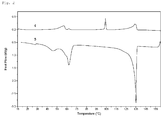
- Fig. 1 shows DSC curves of a particulate fabric softening composition made by rapid cooling of a molten mixture of Acrawax® C, tris-(2-hydroxyethyl)-methylammonium tallow fatty acid diester and perfume.
- DSC curves 1, 2 and 3 were measured subsequently by heating, cooling and reheating at heating and cooling rates of 2 °C/min.
- the first heating curve 1 shows an exothermal transition, which is characteristic for the particulate fabric softening compositions of the invention, in the temperature range of 75 to 90 °C.
- Curve 1 also shows endothermal transitions at 45 to 70 °C due to partial melting of the quaternary ammonium salt, at 100 to 105 °C due to the ordered to disordered transition of the fatty acid diamide solid phase and at 125 to 135 °C due to melting of the fatty acid diamide, which leads to melting of the composition.
- the cooling curve 2 shows only transitions for the solidification of the fatty acid diamide and the quaternary ammonium salt, but no disordered to ordered transition of the fatty acid diamide solid phase. Cooling in the DSC apparatus provides a solid fabric softening composition made by slow cooling at a cooling rate of 2 °C/min.
- the second heating curve 3 obtained with this composition shows only the endothermal transitions at 60 to 65 °C due to partial melting of the quaternary ammonium salt and at 125 to 135 °C due to melting of the fatty acid diamide, but no exothermal transition and no endothermal ordered to disordered transition of the fatty acid diamide solid phase.
- Fig. 2 shows DSC curves of the same particulate fabric softening composition as in Fig. 1 , but after tempering the composition for 2 h at a temperature of 70 °C.
- the heating curve 4 of the tempered composition no longer shows an exothermal transition, but it shows the ordered to disordered transition of the fatty acid diamide solid phase at 102 to 105 °C.
- the cooling curve 5 again shows only transitions for the solidification of the fatty acid diamide and the quaternary ammonium salt, but no disordered to ordered transition of the fatty acid diamide solid phase.
- the invention is therefore also directed to a method for making a particulate fabric softening composition according to the invention, comprising cooling a molten mixture comprising one or more ethylenediamine fatty acid diamides and one or more quaternary ammonium salt fabric softeners to a temperature of 40 °C or less at a high cooling rate.
- the cooling rate is more than 10 °C/min, preferably more than 20 °C/min and most preferably more than 50 °C/min.
- the molten mixture is preferably cooled to a temperature below the solidification temperature of said mixture at a cooling rate of at least 50 °C/min, more preferably at a cooling rate of more than 100 °C/min and most preferably at a cooling rate of more than 200 °C/min. Rapid cooling is essential for obtaining a solid fabric softening composition having an exothermal transition at a temperature between 60 and 90 °C.
- Cooling the molten mixture at a cooling rate of more than 10 °C/min can be achieved by cooling with a gas, for example by introducing molten mixture into a fluidized bed operated with a cooling gas, such as cold air or cold nitrogen gas, as the fluidizing medium.
- a cooling gas such as cold air or cold nitrogen gas
- cooling can be achieved by cooling with a liquid, for example by introducing molten mixture in a prilling process into a liquid, in which the fatty acid diamides and the quaternary ammonium salt fabric softeners are insoluble or poorly soluble.
- cooling is performed by contact with a cooled surface, more preferably by contact with a cooled metal surface.
- the molten mixture is cooled on a continuous belt flaker.
- the molten mixture is preferably applied to the belt of the belt flaker at a rate so as to provide a layer of a thickness of less than 4 mm, preferably less than 1 mm. Cooling on a continuous belt flaker allows reproducible cooling of the molten mixture at high throughput and provides a flaked product that can be processed by press shaping to multiple use dryer added fabric softening articles without requiring any intermediate treatment.
- the same ethylenediamine fatty acid diamides, quaternary ammonium salt fabric softeners, perfumes and solvents as disclosed above for the particulate fabric softening composition of the invention are preferred as starting materials for providing the molten mixture.
- the molten mixture may be provided by melting a mixture of ethylenediamine fatty acid diamides and quaternary ammonium salt fabric softeners, optionally comprising perfumes and/or solvents.
- it is preferred to provide the molten mixture by combining a melt of ethylenediamine fatty acid diamides with a melt of quaternary ammonium salt fabric softeners heated to a temperature above the melting point of said ethylenediamine fatty acid diamides, optionally adding a perfume and/or a solvent to the starting melts or preferably to the resulting mixture.
- the liquid resulting from combining a melt of ethylenediamine fatty acid diamides, a melt of quaternary ammonium salt fabric softeners heated to a temperature above the melting point of said ethylenediamine fatty acid diamides, and optionally a perfume and/or a solvent is preferably passed through a mixer, which is most preferably a static mixer, to obtain a homogenous molten mixture before cooling is carried out.
- the molten mixture is preferably provided by combining a melt of ethylenediamine fatty acid diamides, a melt of quaternary ammonium salt fabric softeners heated to a temperature above the melting point of said ethylenediamine fatty acid diamides, and optionally a perfume and/or solvent, and the melt of quaternary ammonium salt fabric softeners is provided by melting the quaternary ammonium salt fabric softeners at a temperature of no more than 90 °C and heating the resulting melt less than 10 min, preferably less than 1 min, before combining it with the melt of ethylenediamine fatty acid diamides to a temperature high enough to provide a temperature of the combined melts that is higher than the melting temperature of the ethylenediamine fatty acid diamides.
- This embodiment prevents the formation of byproducts by thermal degradation
- a melt of tris-(2-hydroxyethyl)-methylammonium tallow fatty acid diester was provided in a first stirred tank at 82 °C and a melt of Acrawax® C (mixture of ethylenediamine bisstearamide and ethylenediamine bispalmitamide) was provided in a second stirred tank at 186 °C.
- Fig. 1 shows the DSC curves of the flakes as prepared in curves 1, 2 and 3 for heating, cooling and reheating. Curves 1, 2 and 3 have been offset by 0.325, -0.1 and 0.075 W/g for clarity.
- Fig. 2 shows the DSC curves of the heat treated flakes in curves 4 and 5 for heating and cooling. Curve 5 has been offset by -0.5 W/g for clarity. Integration of the exothermal peak in curve 1 of Fig. 1 gives an exothermal transition enthalpy of 14 J/g.
- the surface hardness of the flakes was analyzed by scratching flakes on both sides with a Taber® 710 Multi-Finger Scratch Tester with a scratch tip (hemisphere with 1 mm diameter), a load of 2 N and a velocity of 100 mm/s and determining scratch width and depth with a confocal laser scanning microscope.
- Table 1 shows the results obtained for flakes before and after heat treatment.
Landscapes
- Chemical & Material Sciences (AREA)
- Life Sciences & Earth Sciences (AREA)
- Engineering & Computer Science (AREA)
- Chemical Kinetics & Catalysis (AREA)
- Oil, Petroleum & Natural Gas (AREA)
- Wood Science & Technology (AREA)
- Organic Chemistry (AREA)
- Treatments For Attaching Organic Compounds To Fibrous Goods (AREA)
- Chemical Or Physical Treatment Of Fibers (AREA)
Abstract
Description
- The invention relates to a particulate fabric softening composition which can be press shaped to multiple use, dryer added fabric softening articles having high initial surface hardness, and to a method of making such fabric softening composition.
- Dryer added fabric softening articles are a convenient way of softening fabrics. More convenient than single use articles, such as fabric softening dryer sheets, are multiple use articles, which are placed and kept inside the dryer for a multitude of drying cycles, releasing fabric softener to successive loads of the dryer.
- Multiple use dryer added fabric softening articles comprising a quaternary ammonium salt fabric softener and a high melting carrier, such as an ethylenediamine fatty acid diamide, are known from
US 2003/0195130 ,US 2004/0167056 andUS 2006/0277689 . The dryer added fabric softening articles disclosed in these documents are made by melting and mixing the fabric softener and the carrier and solidifying the melt in the desired shape by methods such as injection molding or casting, as described inUS 2004/0167056 paragraph [0062]. One problem associated with dryer added fabric softening articles made this way is the staining of dark fabrics in the first cycles of using the article by excessive amounts of fabric softener, which can be traced back to an insufficient initial surface hardness of the article as discussed inUS 2006/0277689 paragraph [0028] and demonstrated inUS 2004/0167056 figure 6. -
US 2006/0277689 proposes to add from 5 to 30 % by weight of an elasticity, shrinkage or surface hardness additive, but provides no teaching on which additive could provide an improved surface hardness. The only related example 3 shows a lowering of the surface hardness by the additive ofsample 1. -
US 2007/0066510 teaches to use a fabric softener active consisting essentially of an ester quaternary ammonium compound free of any other quaternary ammonium compound to reduce the staining of dark fabrics. However, nothing is taught on how to obtain a high initial surface hardness for a dryer added fabric softening article comprising such an ester quaternary ammonium compound. - R. H. Pryce-Jones et al., J. Am. Oil Chem. Soc. 73 (1996) 311 to 319 discloses the results of DSC measurements on ethylenediamine fatty acid diamides. Materials crystallized from solution showed an endothermal solid phase transition at temperatures of 98 to 127 °C with a transition enthalpy of more than 30 J/g, but no exothermal solid phase transition. Endothermal solid phase transitions with a similar transition enthalpy were not observed for materials obtained by solidifying the melt during DSC at a rate of 10 °C/min. The document contains no teachings on mixtures containing ethylenediamine fatty acid diamides and a fabric softener and the surface hardness of such mixtures.
- There remains a need of providing a fabric softening composition that can be shaped to a dryer added fabric softening article having a high initial surface hardness.
- The inventors of the present invention have now found that cooling a molten mixture comprising one or more ethylenediamine fatty acid diamides and one or more quaternary ammonium salt fabric softeners to a temperature of 40 °C or less at a high cooling rate surprisingly leads to a solid composition having an exothermal transition at a temperature between 60 and 90 °C with an exothermal transition enthalpy of more than 5 J/g measured by DSC (differential scanning calorimetry) with a heating rate of 2 °C/min. Heating such a composition to a temperature which effects the exothermal transition unexpectedly leads to an increase in the surface hardness of the composition. This allows producing dryer added fabric softening articles having a high initial surface hardness by press shaping the particulate composition at a temperature sufficiently high to effect the exothermal transition.
-
-
Fig. 1 shows DSC curves of the particulate fabric softening composition made in the examples by rapid cooling of the melt.DSC curves -
Fig. 2 shows DSC curves of the same particulate fabric softening composition after tempering for 2 h at 70 °C. DSC curves - The particulate fabric softening composition of the invention comprises one or more ethylenediamine fatty acid diamides and one or more quaternary ammonium salt fabric softeners and has an exothermal transition at a temperature between 60 and 90 °C with an exothermal transition enthalpy of more than 5 J/g measured by differential scanning calorimetry (DSC) at a heating rate of 2 °C/min.
- The term particulate fabric softening composition as used in the context of this invention denotes a fabric softening composition in the form of a multitude of individual particles and excludes fabric softening articles in the form of individual pieces or blocks.
- The particulate fabric softening composition may be composed of particles having any shape, such as spherical particles, irregular granules, elongated rods or flat or curved flakes. The particulate fabric softening composition is preferably composed of flakes, most preferably flat flakes.
- The particulate fabric softening composition is preferrably composed of particles having an average thickness of at most 5 mm, more preferably in the range from 0.05 to 4 mm and most preferably in the range from 0.2 to 1.5 mm. The term thickness denotes the dimension of a particle along the smallest principle axis of inertia, i.e. for a spherical particle the term thickness denotes the particle diameter, for a rod-like particle the term thickness denotes the diameter of the rod and for a flake the term thickness denotes the thickness of the flake.
- Ethylenediamine fatty acid diamides are compounds of formula RC(O)NHCH2CH2NHC(O)R where RCOOH is a fatty acid. The ethylenediamine fatty acid diamides are preferably derived from fatty acids having from 14 to 22 carbon atoms and more preferably from fatty acids having from 14 to 18 carbon atoms. Preferably, the ethylenediamine fatty acid diamides are derived from fatty acids having an average chain length of from 16 to 18 carbon atoms, more preferably from fatty acids having an average chain length of from 16.5 to 17.8 carbon atoms. The ethylenediamine fatty acid diamides are preferably derived from fatty acids having an iodine value of less than 20 and more preferably from fatty acids having an iodine value of less than 5. Most preferred are mixtures of ethylenediamine bisstearamide and ethylenediamine bispalmitamide which are commercially available from Lonza under the trade name Acrawax® C. The selection of the fatty acid chain length and iodine value of the ethylenediamine fatty acid diamide allows to adjust the melting point of the fabric softening composition as required for a dryer added fabric softening article and to adjust the temperature of the exothermal transition of the composition to the process of press shaping the composition to a dryer added fabric softening article.
- The particulate fabric softening composition of the invention preferably comprises 30 to 75 % by weight ethylenediamine fatty acid diamides and 20 to 70 % by weight quaternary ammonium salt fabric softeners. More preferably, the composition comprises 40 to 60 % by weight ethylenediamine fatty acid diamides and 40 to 60 % by weight quaternary ammonium salt fabric softeners and most preferably 45 to 53 % by weight ethylenediamine fatty acid diamides and 45 to 53 % by weight quaternary ammonium salt fabric softeners. Compositions having such contents of ethylenediamine fatty acid diamides and quaternary ammonium salt fabric softeners can be processed to dryer added fabric softening articles having an optimum combination of high softening efficiency and high surface hardness.
- In a preferred embodiment of the invention, the fabric softening composition comprises quaternary ammonium salt fabric softeners of formula (I)
R1 4-mN+[(CH2)n-Q-R2]m X- (I)
wherein each R1 is independently C1-C6 alkyl, C1-C6 hydroxyalkyl or benzyl;
R2 is independently hydrogen, C11-C21 linear alkyl, C11-C21 branched alkyl, C11-C21 linear alkenyl or C11-C21 branched alkenyl, with the proviso that at least one of R2 is not hydrogen;
Q is independently selected from the units having the formula -O-C(O)-, -C(O)O-, -NR3-C(O)-, -C(O)-NR3-, -O-C(O)-O-, -CHR4-O-C(O)- or -CH(OCOR2)-CH2-O-C(O)-, wherein R3 is hydrogen, methyl, ethyl, propyl or butyl and R4 is hydrogen or methyl;
m is from 1 to 4;
n is from 1 to 4; and
X- is a softener compatible anion. - More preferred are quaternary ammonium salt fabric softeners of formula (I), where R1 is methyl; Q is -O-C(O)-or -NH-C(O)-; m is 2 or 3; n is 2; and X- is chloride or methyl sulfate.
- In another preferred embodiment of the invention, the fabric softening composition comprises fabric softeners of formulae (II) to (VII)
R1N+[CH2CHR4OH][CH2CHR4OC(O)R2]2 X- (II)
R1 2N+[CH2CHR4OC(O)R2]2 X- (III)
R1N+[CH2CHR4OH][CH2CH2NHC(O)R2]2 X- (IV)
R1 2(R2CH2)2N+ X- (V)
[R2-C(O)NHCH2CH2]2N+R1[CH2CH2OH] X- (VI)

R2 is independently C11-C21 linear alkyl, C11-C21 branched alkyl, C11-C21 linear alkenyl or C11-C21 branched alkenyl; R4 is hydrogen or methyl;
Q is -O-C(O)- or -NH-C(O)-; and
X- is a softener compatible anion. - More preferred are quaternary ammonium salt fabric softeners of formulae (II) and (III), where R1 is methyl; R2 is C15-C17 linear alkyl or alkenyl with an iodine value of the corresponding fatty acid R2COOH of less than 20; Q is -O-C(O)-; and X- is chloride or methyl sulfate. Particularly preferred examples of such quaternary ammonium salt fabric softeners are the chloride or methyl sulfate salts of bis-(2-hydroxyethyl)-dimethylammonium fatty acid esters and tris-(2-hydroxyethyl)-methylammonium fatty acid esters having a molar ratio of fatty acid moieties to amine moieties of from 1.5 to 2.0. Such quaternary ammonium salt fabric softeners provide compositions having high softening efficiency and good biodegradability. Also preferred are such quaternary ammonium salt fabric softeners where R4 is methyl, as they provide compositions with reduced hydrolysis of the fatty acid ester at the conditions of use of a dryer added fabric softening article. Particularly preferred examples of such quaternary ammonium salt fabric softeners are the chloride or methyl sulfate salts of bis-(2-hydroxypropyl)-dimethylammonium fatty acid esters having a molar ratio of fatty acid moieties to amine moieties of from 1.5 to 1.99.
- The particulate fabric softening composition of the invention may further comprise up to 10 % by weight perfume and preferably comprise from 2 to 5 % by weight perfume. Suitable are all perfumes known from the prior art for use in dryer added fabric softening articles and in particular the low volatile perfume compositions, cyclodextrin-perfume-complexes and microencapsulated perfumes disclosed in
WO 2005/085404 page 5, line 26 to page 13, line 26, which is hereby incorporated by reference. - The particulate fabric softening composition of the invention may further comprise up to 10 % by weight of an alcohol solvent, preferably a C3-C9 diol or polyol solvent. Preferred diol or polyol solvents are 1,2-propanediol, 1,3-propanediol, glycerol, dipropylene glycol, diglycerol, triglycerol and mixtures thereof. The most preferred solvent is dipropylene glycol. The addition of such solvents provides compositions that can be press shaped to dryer added fabric softening articles which show reduced shape deformation and cracking caused by temperature changes.
- The particulate fabric softening composition of the invention undergoes an exothermal transition at a temperature between 60 and 90 °C measured by differential scanning calorimetry (DSC) at a heating rate of 2 °C/min. The exothermal transition enthalpy of the composition measured at this heating rate is more than 5 J/g, preferably more than 7 J/g and most preferably more than 10 J/g. The exothermal transition enthalpy of the composition is usually less than 50 J/g and preferably not more than 30 J/g. Applicants have found that compositions having such an exothermal transition can be made by rapidly cooling a molten mixture comprising ethylenediamine fatty acid diamides and quaternary ammonium salt fabric softeners to a temperature of 40 °C or less, preferably at a cooling rate of more than 10 °C/min. Applicants have also found that slow cooling of the same molten mixture leads to a solid composition which does not undergo an exothermal transition in the solid state.
- Applicants have further found that heating a composition having an exothermal transition at a temperature between 60 and 90 °C to a temperature, which effects the exothermal transition but is lower than the temperature of the first endothermal transition of the composition at higher temperatures, unexpectedly leads to an increase in the surface hardness of the composition. Similar heating of a mixture obtained by slow cooling of a melt and not showing an exothermal transition does not lead to an increase in surface hardness.
- Not wishing to be bound by theory, applicants believe that rapid cooling of the molten mixture leads to a metastable solid mixture, which by heating to a temperature which effects the exothermal transition leads to the formation of a solid phase rich in fatty acid diamides having high ordering of the fatty acid chains and providing high surface hardness to the solid composition. Surprisingly, slow cooling of the molten mixture does not lead to the highly ordered phase, which is contrary to general knowledge that slow cooling of melts leads to the thermodynamically more stable highly ordered phases and rapid cooling leads to less ordered solid phases. The formation of the solid phase rich in fatty acid diamides having high ordering of the fatty acid chains can be inferred from DSC measurements showing an endothermal solid phase transition at a temperature similar to the ordered to disordered solid phase transitions reported in R. H. Pryce-Jones et al., J. Am. Oil Chem. Soc. 73 (1996) 311 to 319 for pure fatty acid diamides.
-
Fig. 1 shows DSC curves of a particulate fabric softening composition made by rapid cooling of a molten mixture of Acrawax® C, tris-(2-hydroxyethyl)-methylammonium tallow fatty acid diester and perfume. DSC curves 1, 2 and 3 were measured subsequently by heating, cooling and reheating at heating and cooling rates of 2 °C/min. Thefirst heating curve 1 shows an exothermal transition, which is characteristic for the particulate fabric softening compositions of the invention, in the temperature range of 75 to 90 °C. Curve 1 also shows endothermal transitions at 45 to 70 °C due to partial melting of the quaternary ammonium salt, at 100 to 105 °C due to the ordered to disordered transition of the fatty acid diamide solid phase and at 125 to 135 °C due to melting of the fatty acid diamide, which leads to melting of the composition. Thecooling curve 2 shows only transitions for the solidification of the fatty acid diamide and the quaternary ammonium salt, but no disordered to ordered transition of the fatty acid diamide solid phase. Cooling in the DSC apparatus provides a solid fabric softening composition made by slow cooling at a cooling rate of 2 °C/min. Thesecond heating curve 3 obtained with this composition shows only the endothermal transitions at 60 to 65 °C due to partial melting of the quaternary ammonium salt and at 125 to 135 °C due to melting of the fatty acid diamide, but no exothermal transition and no endothermal ordered to disordered transition of the fatty acid diamide solid phase. -
Fig. 2 shows DSC curves of the same particulate fabric softening composition as inFig. 1 , but after tempering the composition for 2 h at a temperature of 70 °C. Theheating curve 4 of the tempered composition no longer shows an exothermal transition, but it shows the ordered to disordered transition of the fatty acid diamide solid phase at 102 to 105 °C. Thecooling curve 5 again shows only transitions for the solidification of the fatty acid diamide and the quaternary ammonium salt, but no disordered to ordered transition of the fatty acid diamide solid phase. - The invention is therefore also directed to a method for making a particulate fabric softening composition according to the invention, comprising cooling a molten mixture comprising one or more ethylenediamine fatty acid diamides and one or more quaternary ammonium salt fabric softeners to a temperature of 40 °C or less at a high cooling rate. The cooling rate is more than 10 °C/min, preferably more than 20 °C/min and most preferably more than 50 °C/min. The molten mixture is preferably cooled to a temperature below the solidification temperature of said mixture at a cooling rate of at least 50 °C/min, more preferably at a cooling rate of more than 100 °C/min and most preferably at a cooling rate of more than 200 °C/min. Rapid cooling is essential for obtaining a solid fabric softening composition having an exothermal transition at a temperature between 60 and 90 °C.
- Cooling the molten mixture at a cooling rate of more than 10 °C/min can be achieved by cooling with a gas, for example by introducing molten mixture into a fluidized bed operated with a cooling gas, such as cold air or cold nitrogen gas, as the fluidizing medium. Alternatively, cooling can be achieved by cooling with a liquid, for example by introducing molten mixture in a prilling process into a liquid, in which the fatty acid diamides and the quaternary ammonium salt fabric softeners are insoluble or poorly soluble. Preferably, cooling is performed by contact with a cooled surface, more preferably by contact with a cooled metal surface. In a particularly preferred embodiment, the molten mixture is cooled on a continuous belt flaker. The molten mixture is preferably applied to the belt of the belt flaker at a rate so as to provide a layer of a thickness of less than 4 mm, preferably less than 1 mm. Cooling on a continuous belt flaker allows reproducible cooling of the molten mixture at high throughput and provides a flaked product that can be processed by press shaping to multiple use dryer added fabric softening articles without requiring any intermediate treatment.
- In the method of the invention, the same ethylenediamine fatty acid diamides, quaternary ammonium salt fabric softeners, perfumes and solvents as disclosed above for the particulate fabric softening composition of the invention are preferred as starting materials for providing the molten mixture.
- In the method of the invention, the molten mixture may be provided by melting a mixture of ethylenediamine fatty acid diamides and quaternary ammonium salt fabric softeners, optionally comprising perfumes and/or solvents. However, it is preferred to provide the molten mixture by combining a melt of ethylenediamine fatty acid diamides with a melt of quaternary ammonium salt fabric softeners heated to a temperature above the melting point of said ethylenediamine fatty acid diamides, optionally adding a perfume and/or a solvent to the starting melts or preferably to the resulting mixture. The liquid resulting from combining a melt of ethylenediamine fatty acid diamides, a melt of quaternary ammonium salt fabric softeners heated to a temperature above the melting point of said ethylenediamine fatty acid diamides, and optionally a perfume and/or a solvent is preferably passed through a mixer, which is most preferably a static mixer, to obtain a homogenous molten mixture before cooling is carried out.
- When the quaternary ammonium salt fabric softeners are selected from the group of compounds of formulae (II) and (III) where Q is -O-C(O)-, the molten mixture is preferably provided by combining a melt of ethylenediamine fatty acid diamides, a melt of quaternary ammonium salt fabric softeners heated to a temperature above the melting point of said ethylenediamine fatty acid diamides, and optionally a perfume and/or solvent, and the melt of quaternary ammonium salt fabric softeners is provided by melting the quaternary ammonium salt fabric softeners at a temperature of no more than 90 °C and heating the resulting melt less than 10 min, preferably less than 1 min, before combining it with the melt of ethylenediamine fatty acid diamides to a temperature high enough to provide a temperature of the combined melts that is higher than the melting temperature of the ethylenediamine fatty acid diamides. This embodiment prevents the formation of byproducts by thermal degradation of the quaternary ammonium salt fabric softeners and provides fabric softening compositions of the invention with highly reproducible composition, no discoloration and low byproduct content.
- The invention is illustrated by the following examples, which are however not intended to limit the scope of the invention in any way.
- A melt of tris-(2-hydroxyethyl)-methylammonium tallow fatty acid diester was provided in a first stirred tank at 82 °C and a melt of Acrawax® C (mixture of ethylenediamine bisstearamide and ethylenediamine bispalmitamide) was provided in a second stirred tank at 186 °C. Melt taken from the first tank was heated to 110 °C by passing it through a steam heated Kenics® static mixer, the resulting stream of heated melt was combined with a stream of melt from the second stirred tank and a stream of liquid perfume in a weight ratio of 47:50:3 and thereafter passed to a steam heated Kenics® static mixer to provide a molten composition at a temperature of 152 °C. This molten composition was flaked on a Sandvik continuous belt flaker, equipped with a water cooled steel belt and a flake breaker, cooling the mixture to below 40 °C in less than 25 s, to provide flakes with a thickness of 0.25 to 1 mm and a diameter of 0.5 to 2 cm.
- A sample of the flakes was heat treated for 2 h at 70 °C.
- DSC measurements were carried out on a TA Instruments Q1000 DSC instrument with the flakes as prepared and the heat treated flakes, using samples of approximately 4 mg in aluminum cups and heating and cooling rates of 2 °C/min.
Fig. 1 shows the DSC curves of the flakes as prepared incurves Curves Fig. 2 shows the DSC curves of the heat treated flakes incurves Curve 5 has been offset by -0.5 W/g for clarity. Integration of the exothermal peak incurve 1 ofFig. 1 gives an exothermal transition enthalpy of 14 J/g. - The surface hardness of the flakes was analyzed by scratching flakes on both sides with a Taber® 710 Multi-Finger Scratch Tester with a scratch tip (hemisphere with 1 mm diameter), a load of 2 N and a velocity of 100 mm/s and determining scratch width and depth with a confocal laser scanning microscope. Table 1 shows the results obtained for flakes before and after heat treatment.
- For comparison, a sample of the flakes was melted in a petri dish on a hot plate, allowed to cool to ambient temperature over 4 h on the switched off hot plate and then analyzed for surface hardness before and after a heat treatment for 16 h at 70 °C. The results are also shown in Table 1.
- The results of table 1 demonstrate that the particulate fabric softening composition of the invention, made by rapid cooling of the molten mixture, will provide high initial surface hardness for a dryer added fabric softening article, made by shaping such a composition, at the conditions of use of such article in a dryer, such conditions being similar to the heat treatment step of the example. This is in contrast to the prior art dryer added fabric softening articles made by slow cooling of the molten mixture in a casting process, which have much lower initial surface hardness at the conditions of use, as demonstrated by the comparative example.
Table 1 Results of scratch tests Sample Scratch width in mm Scratch depth in µm Flakes from rapid cooling, before heat treatment upper side 0.6 90 lower side 0.4 50 Flakes from rapid cooling, after heat treatment upper side 0.3 20 lower side 0.2 20 Sample from slowly cooled melt*, before heat treatment 0.4 35 Sample from slowly cooled melt*, after heat treatment 0.6 100 *Not according to the invention
Claims (29)
- A particulate fabric softening composition, comprising one or more ethylenediamine fatty acid diamides and one or more quaternary ammonium salt fabric softeners, the composition having an exothermal transition at a temperature between 60 and 90 °C with an exothermal transition enthalpy of more than 5 J/g measured by DSC at a heating rate of 2 °C/min.
- The particulate fabric softening composition of claim 1, comprising 30 to 75 % by weight ethylenediamine fatty acid diamides and 20 to 70 % by weight quaternary ammonium salt fabric softeners.
- The particulate fabric softening composition of claim 1 or 2, further comprising up to 10 % by weight perfume.
- The particulate fabric softening composition of any one of claims 1 to 3, further comprising up to 10 % by weight of a C3-C9 diol or polyol solvent.
- The particulate fabric softening composition of claim 4, wherein the diol or polyol solvent is selected from the group consisting of 1,2-propanediol, 1,3-propanediol, glycerol, dipropylene glycol, diglycerol, triglycerol and mixtures thereof.
- The particulate fabric softening composition of any one of claims 1 to 5, wherein the ethylenediamine fatty acid diamides are derived from fatty acids having from 14 to 22 carbon atoms.
- The particulate fabric softening composition of any one of claims 1 to 6, wherein the ethylenediamine fatty acid diamides are derived from fatty acids having an average chain length of from 16 to 18 carbon atoms.
- The particulate fabric softening composition of any one of claims 1 to 7, wherein the ethylenediamine fatty acid diamides are derived from fatty acids having an iodine value of less than 20.
- The particulate fabric softening composition of any one of claims 1 to 8, wherein the quaternary ammonium salt fabric softeners are selected from the group of compounds of formula (I)
R1 4-mN+[(CH2)n-Q-R2]m X- (I)
wherein each R1 is independently C1-C6 alkyl, C1-C6 hydroxyalkyl or benzyl;
R2 is independently hydrogen, C11-C21 linear alkyl, C11-C21 branched alkyl, C11-C21 linear alkenyl or C11-C21 branched alkenyl, with the proviso that at least one of R2 is not hydrogen;
Q is independently selected from the units having the formula -O-C(O)-, -C(O)O-, -NR3-C(O)-, -C(O)-NR3-, -O-C(O)-O-, -CHR4-O-C(O)- or -CH(OCOR2)-CH2-O-C(O)-,
wherein R3 is hydrogen, methyl, ethyl, propyl or butyl and R4 is hydrogen or methyl;
m is from 1 to 4;
n is from 1 to 4; and
X- is a softener compatible anion. - The particulate fabric softening composition of claim 9, wherein in formula (I)
R1 is methyl; Q is -O-C(O)- or -NH-C(O)-; m is 2 or 3;
n is 2; and X- is chloride or methyl sulfate. - The particulate fabric softening composition of any one of claims 1 to 8, wherein the quaternary ammonium salt fabric softeners are selected from the group of compounds of formulae (II) to (VII)
R1N+[CH2CHR4OH][CH2CHR4OC(O)R2]2 X- (II)
R1 2N+[CH2CHR4OC(O)R2]2 X- (III)
R1N+[CH2CHR4OH][CH2CH2NHC(O)R2]2 X- (IV)
R1 2(R2CH2)2N+ X- (V)
[R2-C(O)NHCH2CH2]2N+R1[CH2CH2OH] X- (VI)

R2 is independently C11-C21 linear alkyl, C11-C21 branched alkyl, C11-C21 linear alkenyl or C11-C21 branched alkenyl;
R4 is hydrogen or methyl;
Q is -O-C(O)- or -NH-C(O)-; and
X- is a softener compatible anion. - The particulate fabric softening composition of claim 11, wherein the quaternary ammonium salt fabric softeners are selected from the group of compounds of formulae (II) and (III); R1 is methyl; R2 is C15-C17 linear alkyl or alkenyl with an iodine value of the corresponding fatty acid R2COOH of less than 20; Q is - O-C(O)-; and X- is chloride or methyl sulfate.
- A method for making a particulate fabric softening composition according to claim 1, comprising cooling a molten mixture comprising one or more ethylenediamine fatty acid diamides and one or more quaternary ammonium salt fabric softeners to a temperature of 40 °C or less at a cooling rate of more than 10 °C/min.
- The method of claim 13, wherein the molten mixture is cooled to a temperature below the solidification temperature of said mixture at a cooling rate of at least 50 °C/min.
- The method of claim 13 or 14, wherein the molten mixture is cooled by contact with a cooled surface.
- The method of any one of claims 13 to 15, wherein the molten mixture is cooled on a continuous belt flaker.
- The method of any one of claims 13 to 16, wherein the molten mixture comprises 30 to 75 % by weight ethylenediamine fatty acid diamides and 20 to 70 % by weight quaternary ammonium salt fabric softeners.
- The method of claim 17, wherein the molten mixture further comprises up to 10 % by weight perfume.
- The method of claim 17 or 18, wherein the molten mixture further comprises up to 10 % by weight of a C3-C9 diol or polyol solvent.
- The method of claim 19, wherein the diol or polyol solvent is selected from the group consisting of 1,2-propanediol, 1,3-propanediol, glycerol, dipropylene glycol, diglycerol, triglycerol and mixtures thereof.
- The method of any one of claims 13 to 18, wherein the molten mixture is made by combining a melt of ethylenediamine fatty acid diamides, a melt of quaternary ammonium salt fabric softeners heated to a temperature above the melting point of said ethylenediamine fatty acid diamides, and optionally a perfume, and passing the resulting liquid mixture through a mixer.
- The method of claim 21, wherein the mixer is a static mixer.
- The method of any one of claims 13 to 22, wherein the ethylenediamine fatty acid diamides are derived from fatty acids having from 14 to 22 carbon atoms.
- The method of any one of claims 13 to 23, wherein the ethylenediamine fatty acid diamides are derived from fatty acids having an average chain length of from 16 to 18 carbon atoms.
- The method of any one of claims 13 to 24, wherein the ethylenediamine fatty acid diamides are derived from fatty acids having an iodine value of less than 20.
- The method of any one of claims 13 to 25, wherein the quaternary ammonium salt fabric softeners are selected from the group of compounds of formula (I)
R1 4-mN+[(CH2)n-Q-R2]m X- (I)
wherein each R1 is independently C1-C6 alkyl, C1-C6 hydroxyalkyl or benzyl;
R2 is independently hydrogen, C11-C21 linear alkyl, C11-C21 branched alkyl, C11-C21 linear alkenyl or C11-C21 branched alkenyl, with the proviso that at least one of R2 is not hydrogen;
Q is independently selected from the units having the formula -O-C(O)-, -C(O)O-, -NR3-C(O)-, -C(O)-NR3-, -O-C(O)-O-, -CHR4-O-C(O)- or -CH(OCOR2)-CH2-O-C(O)-,
wherein R3 is hydrogen, methyl, ethyl, propyl or butyl and R4 is hydrogen or methyl;
m is from 1 to 4;
n is from 1 to 4; and
X- is a softener compatible anion. - The method of any one of claims 13 to 25, wherein the quaternary ammonium salt fabric softeners are selected from the group of compounds of formulae (II) to (VII)
R1N+[CH2CHR4OH][CH2CHR4OC(O)R2]2 X (II)
) R1 2N+[CH2CHR4OC(O)R2]2 X- (III
R1N+[CH2CHR4OH][CH2CH2NHC(O)R2]2 X- (IV)
R1 2(R2CH2)2N+ X- (V)
[R2-C(O)NHCH2CH2]2N+R1[CH2CH2OH] X- (VI)

R2 is independently C11-C21 linear alkyl, C11-C21 branched alkyl, C11-C21 linear alkenyl or C11-C21 branched alkenyl;
R4 is hydrogen or methyl;
Q is -O-C(O)- or -NH-C(O)-; and
X- is a softener compatible anion. - The method of claim 27, wherein the quaternary ammonium salt fabric softeners are selected from the group of compounds of formulae (II) and (III); R1 is methyl; R2 is C15-C17 linear alkyl or alkenyl with an iodine value of the corresponding fatty acid R2COOH of less than 20; Q is -O-C(O)-; and X- is chloride or methyl sulfate.
- The method of claim 27 or 28, wherein the quaternary ammonium salt fabric softeners are selected from the group of compounds of formulae (II) and (III) where Q is -O-C(O)-; the molten mixture is made by combining a melt of ethylenediamine fatty acid diamides, a melt of quaternary ammonium salt fabric softeners and optionally a perfume; and said melt of quaternary ammonium salt fabric softeners is provided by melting said quaternary ammonium salt fabric softeners at a temperature of no more than 90 °C and heating the resulting melt less than 10 min before combining it with said melt of ethylenediamine fatty acid diamides to a temperature high enough to provide a temperature of the combined melts that is higher than the melting temperature of the ethylenediamine fatty acid diamides.
Applications Claiming Priority (1)
| Application Number | Priority Date | Filing Date | Title |
|---|---|---|---|
| US35966010P | 2010-06-29 | 2010-06-29 |
Publications (2)
| Publication Number | Publication Date |
|---|---|
| EP2402424A1 true EP2402424A1 (en) | 2012-01-04 |
| EP2402424B1 EP2402424B1 (en) | 2015-10-21 |
Family
ID=44652118
Family Applications (1)
| Application Number | Title | Priority Date | Filing Date |
|---|---|---|---|
| EP11171604.9A Not-in-force EP2402424B1 (en) | 2010-06-29 | 2011-06-28 | Particulate fabric softening composition and method of making it |
Country Status (4)
| Country | Link |
|---|---|
| US (1) | US8507425B2 (en) |
| EP (1) | EP2402424B1 (en) |
| CA (1) | CA2744735A1 (en) |
| ES (1) | ES2558082T3 (en) |
Cited By (1)
| Publication number | Priority date | Publication date | Assignee | Title |
|---|---|---|---|---|
| US20180155604A1 (en) * | 2016-12-06 | 2018-06-07 | Evonik Corporation | Organophilic clays and drilling fluids containing them |
Families Citing this family (8)
| Publication number | Priority date | Publication date | Assignee | Title |
|---|---|---|---|---|
| US8361953B2 (en) * | 2008-02-08 | 2013-01-29 | Evonik Goldschmidt Corporation | Rinse aid compositions with improved characteristics |
| BR112012024811B1 (en) | 2010-04-01 | 2021-08-31 | Evonik Operations Gmbh | Active fabric softener composition, and its method of preparation |
| PL2553067T3 (en) | 2010-04-01 | 2015-07-31 | Evonik Degussa Gmbh | Fabric softener active composition |
| EP2563889B1 (en) | 2010-04-28 | 2017-03-15 | Evonik Degussa GmbH | Textile softening composition |
| WO2013113453A1 (en) | 2012-01-30 | 2013-08-08 | Evonik Industries Ag | Fabric softener active composition |
| ES2580031T3 (en) | 2012-05-07 | 2016-08-18 | Evonik Industries Ag | Active fabric softener composition and method for manufacturing |
| BR102014025172B1 (en) | 2013-11-05 | 2020-03-03 | Evonik Degussa Gmbh | METHOD FOR MANUFACTURING A TRIS- (2-HYDROXYETHYL) -METHYLMETHYL ESTER OF FATTY ACID AND ACTIVE COMPOSITION OF SOFTENING CLOTHES |
| UA119182C2 (en) | 2014-10-08 | 2019-05-10 | Евонік Дегусса Гмбх | ACTIVE FABRIC SOFTWARE |
Citations (6)
| Publication number | Priority date | Publication date | Assignee | Title |
|---|---|---|---|---|
| US5480567A (en) * | 1994-01-14 | 1996-01-02 | Lever Brothers Company, Division Of Conopco, Inc. | Surfactant mixtures for fabric conditioning compositions |
| US20030195130A1 (en) | 2002-04-10 | 2003-10-16 | Lentsch Steven E. | Fabric softener composition and methods for manufacturing and using |
| US20040167056A1 (en) | 2002-04-10 | 2004-08-26 | Lentsch Steven E. | Fabric treatment compositions and methods for treating fabric in a dryer |
| WO2005085404A1 (en) | 2004-02-27 | 2005-09-15 | The Procter & Gamble Company | Multiple use fabric conditioning composition with improved perfume |
| US20060277689A1 (en) | 2002-04-10 | 2006-12-14 | Hubig Stephan M | Fabric treatment article and methods for using in a dryer |
| US20070066510A1 (en) | 2005-09-22 | 2007-03-22 | The Procter & Gamble Company | Multiple use fabric softening composition with reduced fabric staining |
Family Cites Families (85)
| Publication number | Priority date | Publication date | Assignee | Title |
|---|---|---|---|---|
| DE2430140C3 (en) | 1974-06-24 | 1979-10-04 | Rewo Chemische Werke Gmbh, 6497 Steinau | Cation-active bis (2-acyloxypropyl) ammonium salts, processes for their preparation and agents based on them |
| US4234627A (en) | 1977-02-04 | 1980-11-18 | The Procter & Gamble Company | Fabric conditioning compositions |
| GB2007734B (en) | 1977-10-22 | 1983-04-07 | Cargo Fleet Chemical Co | Fabric softeners |
| DE2943606A1 (en) | 1978-11-03 | 1980-05-14 | Unilever Nv | TEXTILE SOFTENER AND METHOD FOR THEIR PRODUCTION |
| USRE32713E (en) | 1980-03-17 | 1988-07-12 | Capsule impregnated fabric | |
| US4514461A (en) | 1981-08-10 | 1985-04-30 | Woo Yen Kong | Fragrance impregnated fabric |
| DE3402146A1 (en) | 1984-01-23 | 1985-07-25 | Henkel KGaA, 4000 Düsseldorf | Novel quaternary ammonium compounds, their preparation and use as textile softeners |
| CS246532B1 (en) | 1984-08-01 | 1986-10-16 | Dagmar Mikulcova | Livening agnet with antistatic and softening effect |
| US4747880A (en) | 1984-12-12 | 1988-05-31 | S. C. Johnson & Son, Inc. | Dry, granular maintenance product reconstitutable to an aqueous clean and shine product |
| DE3608093A1 (en) | 1986-03-12 | 1987-09-17 | Henkel Kgaa | MADE-UP TEXTILE SOFTENER CONCENTRATE |
| DE3710064A1 (en) | 1987-03-27 | 1988-10-06 | Hoechst Ag | METHOD FOR THE PRODUCTION OF QUATERNAUS ESTERAMINES AND THEIR USE |
| EP0293955B1 (en) | 1987-05-01 | 1993-01-13 | The Procter & Gamble Company | Quaternary isopropyl ester ammonium compounds as fiber and fabric treatment compositions |
| US4789491A (en) | 1987-08-07 | 1988-12-06 | The Procter & Gamble Company | Method for preparing biodegradable fabric softening compositions |
| US4882220A (en) | 1988-02-02 | 1989-11-21 | Kanebo, Ltd. | Fibrous structures having a durable fragrance |
| US4954285A (en) * | 1988-03-07 | 1990-09-04 | The Procter & Gamble Company | Perfume, particles, especially for use in dryer released fabric softening/antistatic agents |
| US5002681A (en) * | 1989-03-03 | 1991-03-26 | The Procter & Gamble Company | Jumbo particulate fabric softner composition |
| US5137646A (en) | 1989-05-11 | 1992-08-11 | The Procter & Gamble Company | Coated perfume particles in fabric softener or antistatic agents |
| ES2021900A6 (en) | 1989-07-17 | 1991-11-16 | Pulcra Sa | Process for preparing quaternary ammonium compounds. |
| DE3932004A1 (en) | 1989-09-26 | 1991-04-04 | Dursol Fabrik Otto Durst Gmbh | DRYING AGENT FOR PAINT SURFACES |
| US5185088A (en) | 1991-04-22 | 1993-02-09 | The Procter & Gamble Company | Granular fabric softener compositions which form aqueous emulsion concentrates |
| WO1994007979A1 (en) | 1992-09-28 | 1994-04-14 | The Procter & Gamble Company | Method for using solid particulate fabric softener in automatic dosing dispenser |
| DE4243701A1 (en) | 1992-12-23 | 1994-06-30 | Henkel Kgaa | Aqueous textile softener dispersions |
| WO1994019439A1 (en) | 1993-02-25 | 1994-09-01 | Unilever Plc | Use of fabric softening composition |
| US5827451A (en) | 1993-03-17 | 1998-10-27 | Witco Corporation | Microemulsion useful as rinse aid |
| US5391325A (en) | 1993-09-29 | 1995-02-21 | Exxon Chemical Patents Inc. | Non-toxic biodegradable emulsion compositions for use in automatic car washes |
| DE4430721A1 (en) | 1994-08-30 | 1996-03-07 | Hoechst Ag | Car gloss desiccant |
| US5759990A (en) | 1996-10-21 | 1998-06-02 | The Procter & Gamble Company | Concentrated fabric softening composition with good freeze/thaw recovery and highly unsaturated fabric softener compound therefor |
| US5916863A (en) | 1996-05-03 | 1999-06-29 | Akzo Nobel Nv | High di(alkyl fatty ester) quaternary ammonium compound from triethanol amine |
| GB9617612D0 (en) | 1996-08-22 | 1996-10-02 | Unilever Plc | Fabric conditioning composition |
| DE69728778D1 (en) | 1996-09-19 | 2004-05-27 | Procter & Gamble | SOFTENER WITH IMPROVED PERFORMANCE |
| DE19708133C1 (en) | 1997-02-28 | 1997-12-11 | Henkel Kgaa | Conditioner for textile and keratin fibres useful as e.g. laundry or hair conditioner |
| US5874396A (en) | 1997-02-28 | 1999-02-23 | The Procter & Gamble Company | Rinse added laundry additive compositions having color care agents |
| US6645479B1 (en) | 1997-09-18 | 2003-11-11 | International Flavors & Fragrances Inc. | Targeted delivery of active/bioactive and perfuming compositions |
| WO1999035120A1 (en) | 1998-01-09 | 1999-07-15 | Witco Corporation | Novel quaternary ammonium compounds, compositions containing them, and uses thereof |
| ZA991635B (en) | 1998-03-02 | 1999-09-02 | Procter & Gamble | Concentrated, stable, translucent or clear, fabric softening compositions. |
| GB9816659D0 (en) | 1998-07-30 | 1998-09-30 | Dow Europ Sa | Composition useful for softening, cleaning, and personal care applications and processes for the preparation thereof |
| EP0990695A1 (en) | 1998-09-30 | 2000-04-05 | Witco Surfactants GmbH | Fabric softener with dye transfer inhibiting properties |
| EP1018541A1 (en) | 1999-01-07 | 2000-07-12 | Goldschmidt Rewo GmbH & Co. KG | Clear fabric softener compositions |
| DE19906367A1 (en) | 1999-02-16 | 2000-08-17 | Clariant Gmbh | Use of comb polymers as protective release polymers |
| US6916781B2 (en) | 1999-03-02 | 2005-07-12 | The Procter & Gamble Company | Concentrated, stable, translucent or clear, fabric softening compositions |
| US6458343B1 (en) | 1999-05-07 | 2002-10-01 | Goldschmidt Chemical Corporation | Quaternary compounds, compositions containing them, and uses thereof |
| US6235914B1 (en) | 1999-08-24 | 2001-05-22 | Goldschmidt Chemical Company | Amine and quaternary ammonium compounds made from ketones and aldehydes, and compositions containing them |
| MXPA02003207A (en) | 1999-10-05 | 2002-09-30 | Ciba Sc Holding Ag | Fabric softener compositions. |
| US6200949B1 (en) | 1999-12-21 | 2001-03-13 | International Flavors And Fragrances Inc. | Process for forming solid phase controllably releasable fragrance-containing consumable articles |
| GB0002877D0 (en) | 2000-02-08 | 2000-03-29 | Unilever Plc | Fabric conditioning composition |
| FR2806307B1 (en) | 2000-03-20 | 2002-11-15 | Mane Fils V | SOLID SCENTED PREPARATION IN THE FORM OF MICROBALLS AND USE OF SAID PREPARATION |
| DE60109247T2 (en) | 2000-10-19 | 2005-07-28 | Soft 99 Corp. | Coating composition for painting and coated fabric |
| US20030060390A1 (en) | 2001-03-07 | 2003-03-27 | The Procter & Gamble Company | Rinse-added fabric conditioning composition for use where residual detergent is present |
| GB0106560D0 (en) | 2001-03-16 | 2001-05-02 | Quest Int | Perfume encapsulates |
| DE50109370D1 (en) | 2001-12-24 | 2006-05-18 | Cognis Ip Man Gmbh | Cationic preparations for the cleaning of hard surfaces |
| WO2003061817A1 (en) | 2002-01-24 | 2003-07-31 | Bayer Aktiengesellschaft | Coagulates containing microcapsules |
| US20030158344A1 (en) | 2002-02-08 | 2003-08-21 | Rodriques Klein A. | Hydrophobe-amine graft copolymer |
| US7053034B2 (en) | 2002-04-10 | 2006-05-30 | Salvona, Llc | Targeted controlled delivery compositions activated by changes in pH or salt concentration |
| US20030215417A1 (en) | 2002-04-18 | 2003-11-20 | The Procter & Gamble Company | Malodor-controlling compositions comprising odor control agents and microcapsules containing an active material |
| US20030216488A1 (en) | 2002-04-18 | 2003-11-20 | The Procter & Gamble Company | Compositions comprising a dispersant and microcapsules containing an active material |
| US6740631B2 (en) | 2002-04-26 | 2004-05-25 | Adi Shefer | Multi component controlled delivery system for fabric care products |
| AU2003230410A1 (en) | 2002-05-16 | 2003-12-02 | The Procter And Gamble Company | Rinse-added fabric treatment composition and methods and uses thereof |
| EP1393706A1 (en) | 2002-08-14 | 2004-03-03 | Quest International B.V. | Fragranced compositions comprising encapsulated material |
| US7125835B2 (en) | 2002-10-10 | 2006-10-24 | International Flavors & Fragrances Inc | Encapsulated fragrance chemicals |
| US20040071742A1 (en) | 2002-10-10 | 2004-04-15 | Popplewell Lewis Michael | Encapsulated fragrance chemicals |
| US7585824B2 (en) | 2002-10-10 | 2009-09-08 | International Flavors & Fragrances Inc. | Encapsulated fragrance chemicals |
| MX259645B (en) | 2002-11-29 | 2008-08-15 | Ciba Sc Holding Ag | Fabric softener compositions comprising homo- and/or copolymers. |
| BRPI0407182A (en) | 2003-02-03 | 2006-02-07 | Ciba Sc Holding Ag | Washing Agent and Fabric Softener Formulations |
| US7135451B2 (en) | 2003-03-25 | 2006-11-14 | The Procter & Gamble Company | Fabric care compositions comprising cationic starch |
| US20050014672A1 (en) | 2003-07-18 | 2005-01-20 | Shoaib Arif | Rinse aid additive and composition containing same |
| WO2005097962A1 (en) | 2004-04-09 | 2005-10-20 | Unilever N.V. | Granulate for use in a cleaning product and process for its manufacture |
| KR20070054726A (en) | 2004-10-18 | 2007-05-29 | 더 프록터 앤드 갬블 캄파니 | Concentrated Fiber Softener Active Composition |
| DE102005020551A1 (en) | 2005-05-03 | 2006-11-09 | Degussa Ag | Solid, redispersible emulsion |
| US20070054835A1 (en) | 2005-08-31 | 2007-03-08 | The Procter & Gamble Company | Concentrated fabric softener active compositions |
| US7572761B2 (en) | 2005-11-14 | 2009-08-11 | Evonik Degussa Gmbh | Process for cleaning and softening fabrics |
| ES2441247T3 (en) | 2006-02-28 | 2014-02-03 | The Procter & Gamble Company | Tissue care compositions comprising cationic starch |
| ES2294923B1 (en) | 2006-03-31 | 2009-02-16 | Kao Corporation, S.A. | COMPOSITION FOR RINSING AND DRYING OF VEHICLES. |
| EP1849855A1 (en) | 2006-04-27 | 2007-10-31 | Degussa GmbH | thixotropic softening compositions |
| EP2049640A2 (en) | 2006-08-08 | 2009-04-22 | The Procter and Gamble Company | Clear and/or translucent fabric enhancers comprising nano-sized particles |
| ES2479116T3 (en) | 2007-02-28 | 2014-07-23 | Unilever N.V. | Fabric treatment compositions, their manufacture and use |
| CN101657530A (en) | 2007-04-02 | 2010-02-24 | 宝洁公司 | Fabric care composition |
| EP2187864A2 (en) | 2007-08-06 | 2010-05-26 | Clariant Finance (BVI) Limited | Compositions containing diethanol amine esterquats |
| US8080513B2 (en) | 2008-01-11 | 2011-12-20 | The Procter & Gamble Company | Method of shipping and preparing laundry actives |
| US8361953B2 (en) | 2008-02-08 | 2013-01-29 | Evonik Goldschmidt Corporation | Rinse aid compositions with improved characteristics |
| EP3255135B1 (en) | 2009-11-06 | 2019-01-02 | The Procter & Gamble Company | High-efficiency perfume capsules |
| BR112012024811B1 (en) | 2010-04-01 | 2021-08-31 | Evonik Operations Gmbh | Active fabric softener composition, and its method of preparation |
| US8183199B2 (en) | 2010-04-01 | 2012-05-22 | The Procter & Gamble Company | Heat stable fabric softener |
| MX2012011473A (en) | 2010-04-01 | 2012-11-16 | Procter & Gamble | Fabric softener. |
| PL2553067T3 (en) | 2010-04-01 | 2015-07-31 | Evonik Degussa Gmbh | Fabric softener active composition |
| US20110239377A1 (en) | 2010-04-01 | 2011-10-06 | Renae Dianna Fossum | Heat Stable Fabric Softener |
-
2011
- 2011-06-25 US US13/168,958 patent/US8507425B2/en active Active
- 2011-06-28 ES ES11171604.9T patent/ES2558082T3/en active Active
- 2011-06-28 EP EP11171604.9A patent/EP2402424B1/en not_active Not-in-force
- 2011-06-29 CA CA2744735A patent/CA2744735A1/en not_active Abandoned
Patent Citations (6)
| Publication number | Priority date | Publication date | Assignee | Title |
|---|---|---|---|---|
| US5480567A (en) * | 1994-01-14 | 1996-01-02 | Lever Brothers Company, Division Of Conopco, Inc. | Surfactant mixtures for fabric conditioning compositions |
| US20030195130A1 (en) | 2002-04-10 | 2003-10-16 | Lentsch Steven E. | Fabric softener composition and methods for manufacturing and using |
| US20040167056A1 (en) | 2002-04-10 | 2004-08-26 | Lentsch Steven E. | Fabric treatment compositions and methods for treating fabric in a dryer |
| US20060277689A1 (en) | 2002-04-10 | 2006-12-14 | Hubig Stephan M | Fabric treatment article and methods for using in a dryer |
| WO2005085404A1 (en) | 2004-02-27 | 2005-09-15 | The Procter & Gamble Company | Multiple use fabric conditioning composition with improved perfume |
| US20070066510A1 (en) | 2005-09-22 | 2007-03-22 | The Procter & Gamble Company | Multiple use fabric softening composition with reduced fabric staining |
Non-Patent Citations (1)
| Title |
|---|
| R. H. PRYCE-JONES ET AL., J. AM. OIL CHEM. SOC., vol. 73, 1996, pages 311 - 319 |
Cited By (5)
| Publication number | Priority date | Publication date | Assignee | Title |
|---|---|---|---|---|
| US20180155604A1 (en) * | 2016-12-06 | 2018-06-07 | Evonik Corporation | Organophilic clays and drilling fluids containing them |
| EP3333239A1 (en) * | 2016-12-06 | 2018-06-13 | Evonik Corporation | Organophilic clays and drilling fluids containing them |
| US10865338B2 (en) | 2016-12-06 | 2020-12-15 | Evonik Corporation | Organophilic clays and drilling fluids containing them |
| US11634621B2 (en) | 2016-12-06 | 2023-04-25 | Evonik Corporation | Organophilic clays and drilling fluids containing them |
| US12466985B2 (en) | 2016-12-06 | 2025-11-11 | Evonik Corporation | Organophilic clays and drilling fluids containing them |
Also Published As
| Publication number | Publication date |
|---|---|
| ES2558082T3 (en) | 2016-02-01 |
| CA2744735A1 (en) | 2011-12-29 |
| US8507425B2 (en) | 2013-08-13 |
| EP2402424B1 (en) | 2015-10-21 |
| US20120088712A1 (en) | 2012-04-12 |
Similar Documents
| Publication | Publication Date | Title |
|---|---|---|
| EP2402424B1 (en) | Particulate fabric softening composition and method of making it | |
| JP5460919B2 (en) | Fabric softener active composition | |
| CA2134640C (en) | Concentrated fabric softener compositions containing biodegradable fabric softeners | |
| JP3902783B2 (en) | Concentrated biodegradable quaternary ammonium fabric softener composition and compound containing intermediate iodine-unsaturated fatty acid chain | |
| EP0409504B1 (en) | Fabric softening composition | |
| CN104169410B (en) | Fabric softener composition | |
| JPH10500456A (en) | Cellulase fabric conditioning composition | |
| JPH09501198A (en) | Dryer activated fabric conditioning and antistatic compositions containing biodegradable compounds having unsaturation | |
| JPH06501473A (en) | Process for producing N-alkyl polyhydroxyamines and fatty acid amides therefrom in amines and amine/aqueous solvents | |
| US5804547A (en) | Dryer-activated laundry additive compositions with color care agents | |
| WO2013167376A1 (en) | Fabric softener active composition and method for making it | |
| EP0550651B1 (en) | Improved catalyzed process for glucamide detergents | |
| US6080714A (en) | Solid composition comprising an amphoteric surfactant, a process for its preparation, and the use thereof | |
| JP2009542923A (en) | Liquid softener composition | |
| US5811385A (en) | High-concentration aqueous ester quat solutions | |
| KR950012692B1 (en) | Method for preparing textile treatment compositions | |
| JPH07505189A (en) | Concentrated fabric softening composition | |
| EP0906387B1 (en) | Process for making solid compositions comprising quaternary ester ammonium compounds and fatty acids | |
| EP0643038A2 (en) | Novel polyfunctional cationic surface active agents, compositions comprised thereof, process for the preparation thereof and uses | |
| JP6671503B2 (en) | Fabric softener active composition | |
| EP1969108B1 (en) | Concentrated fabric conditioner compositions | |
| JP3822413B2 (en) | Transparent liquid softener | |
| PL190329B1 (en) | Stabilised quaternary ammonium composition, method for stabilization of quartenary ammonium material, method for reduction of decolourization of quartenary ammonium material and application of the stabilized compound | |
| WO1995022519A1 (en) | Synthesis of polyhydroxy fatty acid amides from triglycerides | |
| GB2197666A (en) | Method of preparing fabric softening compositions |
Legal Events
| Date | Code | Title | Description |
|---|---|---|---|
| AK | Designated contracting states |
Kind code of ref document: A1 Designated state(s): AL AT BE BG CH CY CZ DE DK EE ES FI FR GB GR HR HU IE IS IT LI LT LU LV MC MK MT NL NO PL PT RO RS SE SI SK SM TR |
|
| AX | Request for extension of the european patent |
Extension state: BA ME |
|
| PUAI | Public reference made under article 153(3) epc to a published international application that has entered the european phase |
Free format text: ORIGINAL CODE: 0009012 |
|
| 17P | Request for examination filed |
Effective date: 20110628 |
|
| GRAP | Despatch of communication of intention to grant a patent |
Free format text: ORIGINAL CODE: EPIDOSNIGR1 |
|
| INTG | Intention to grant announced |
Effective date: 20150515 |
|
| GRAS | Grant fee paid |
Free format text: ORIGINAL CODE: EPIDOSNIGR3 |
|
| GRAA | (expected) grant |
Free format text: ORIGINAL CODE: 0009210 |
|
| AK | Designated contracting states |
Kind code of ref document: B1 Designated state(s): AL AT BE BG CH CY CZ DE DK EE ES FI FR GB GR HR HU IE IS IT LI LT LU LV MC MK MT NL NO PL PT RO RS SE SI SK SM TR |
|
| REG | Reference to a national code |
Ref country code: GB Ref legal event code: FG4D Ref country code: NL Ref legal event code: MP Effective date: 20151021 |
|
| REG | Reference to a national code |
Ref country code: CH Ref legal event code: EP |
|
| REG | Reference to a national code |
Ref country code: AT Ref legal event code: REF Ref document number: 756618 Country of ref document: AT Kind code of ref document: T Effective date: 20151115 |
|
| REG | Reference to a national code |
Ref country code: IE Ref legal event code: FG4D |
|
| REG | Reference to a national code |
Ref country code: DE Ref legal event code: R096 Ref document number: 602011020734 Country of ref document: DE |
|
| REG | Reference to a national code |
Ref country code: ES Ref legal event code: FG2A Ref document number: 2558082 Country of ref document: ES Kind code of ref document: T3 Effective date: 20160201 |
|
| REG | Reference to a national code |
Ref country code: LT Ref legal event code: MG4D |
|
| REG | Reference to a national code |
Ref country code: AT Ref legal event code: MK05 Ref document number: 756618 Country of ref document: AT Kind code of ref document: T Effective date: 20151021 |
|
| PG25 | Lapsed in a contracting state [announced via postgrant information from national office to epo] |
Ref country code: HR Free format text: LAPSE BECAUSE OF FAILURE TO SUBMIT A TRANSLATION OF THE DESCRIPTION OR TO PAY THE FEE WITHIN THE PRESCRIBED TIME-LIMIT Effective date: 20151021 Ref country code: NL Free format text: LAPSE BECAUSE OF FAILURE TO SUBMIT A TRANSLATION OF THE DESCRIPTION OR TO PAY THE FEE WITHIN THE PRESCRIBED TIME-LIMIT Effective date: 20151021 Ref country code: IS Free format text: LAPSE BECAUSE OF FAILURE TO SUBMIT A TRANSLATION OF THE DESCRIPTION OR TO PAY THE FEE WITHIN THE PRESCRIBED TIME-LIMIT Effective date: 20160221 Ref country code: LT Free format text: LAPSE BECAUSE OF FAILURE TO SUBMIT A TRANSLATION OF THE DESCRIPTION OR TO PAY THE FEE WITHIN THE PRESCRIBED TIME-LIMIT Effective date: 20151021 Ref country code: NO Free format text: LAPSE BECAUSE OF FAILURE TO SUBMIT A TRANSLATION OF THE DESCRIPTION OR TO PAY THE FEE WITHIN THE PRESCRIBED TIME-LIMIT Effective date: 20160121 |
|
| PG25 | Lapsed in a contracting state [announced via postgrant information from national office to epo] |
Ref country code: PL Free format text: LAPSE BECAUSE OF FAILURE TO SUBMIT A TRANSLATION OF THE DESCRIPTION OR TO PAY THE FEE WITHIN THE PRESCRIBED TIME-LIMIT Effective date: 20151021 Ref country code: FI Free format text: LAPSE BECAUSE OF FAILURE TO SUBMIT A TRANSLATION OF THE DESCRIPTION OR TO PAY THE FEE WITHIN THE PRESCRIBED TIME-LIMIT Effective date: 20151021 Ref country code: SE Free format text: LAPSE BECAUSE OF FAILURE TO SUBMIT A TRANSLATION OF THE DESCRIPTION OR TO PAY THE FEE WITHIN THE PRESCRIBED TIME-LIMIT Effective date: 20151021 Ref country code: GR Free format text: LAPSE BECAUSE OF FAILURE TO SUBMIT A TRANSLATION OF THE DESCRIPTION OR TO PAY THE FEE WITHIN THE PRESCRIBED TIME-LIMIT Effective date: 20160122 Ref country code: RS Free format text: LAPSE BECAUSE OF FAILURE TO SUBMIT A TRANSLATION OF THE DESCRIPTION OR TO PAY THE FEE WITHIN THE PRESCRIBED TIME-LIMIT Effective date: 20151021 Ref country code: LV Free format text: LAPSE BECAUSE OF FAILURE TO SUBMIT A TRANSLATION OF THE DESCRIPTION OR TO PAY THE FEE WITHIN THE PRESCRIBED TIME-LIMIT Effective date: 20151021 Ref country code: PT Free format text: LAPSE BECAUSE OF FAILURE TO SUBMIT A TRANSLATION OF THE DESCRIPTION OR TO PAY THE FEE WITHIN THE PRESCRIBED TIME-LIMIT Effective date: 20160222 Ref country code: AT Free format text: LAPSE BECAUSE OF FAILURE TO SUBMIT A TRANSLATION OF THE DESCRIPTION OR TO PAY THE FEE WITHIN THE PRESCRIBED TIME-LIMIT Effective date: 20151021 |
|
| REG | Reference to a national code |
Ref country code: FR Ref legal event code: PLFP Year of fee payment: 6 |
|
| REG | Reference to a national code |
Ref country code: DE Ref legal event code: R097 Ref document number: 602011020734 Country of ref document: DE |
|
| PG25 | Lapsed in a contracting state [announced via postgrant information from national office to epo] |
Ref country code: CZ Free format text: LAPSE BECAUSE OF FAILURE TO SUBMIT A TRANSLATION OF THE DESCRIPTION OR TO PAY THE FEE WITHIN THE PRESCRIBED TIME-LIMIT Effective date: 20151021 |
|
| PGFP | Annual fee paid to national office [announced via postgrant information from national office to epo] |
Ref country code: DE Payment date: 20160621 Year of fee payment: 6 Ref country code: GB Payment date: 20160621 Year of fee payment: 6 Ref country code: ES Payment date: 20160614 Year of fee payment: 6 |
|
| PLBE | No opposition filed within time limit |
Free format text: ORIGINAL CODE: 0009261 |
|
| STAA | Information on the status of an ep patent application or granted ep patent |
Free format text: STATUS: NO OPPOSITION FILED WITHIN TIME LIMIT |
|
| PG25 | Lapsed in a contracting state [announced via postgrant information from national office to epo] |
Ref country code: SK Free format text: LAPSE BECAUSE OF FAILURE TO SUBMIT A TRANSLATION OF THE DESCRIPTION OR TO PAY THE FEE WITHIN THE PRESCRIBED TIME-LIMIT Effective date: 20151021 Ref country code: RO Free format text: LAPSE BECAUSE OF FAILURE TO SUBMIT A TRANSLATION OF THE DESCRIPTION OR TO PAY THE FEE WITHIN THE PRESCRIBED TIME-LIMIT Effective date: 20151021 Ref country code: SM Free format text: LAPSE BECAUSE OF FAILURE TO SUBMIT A TRANSLATION OF THE DESCRIPTION OR TO PAY THE FEE WITHIN THE PRESCRIBED TIME-LIMIT Effective date: 20151021 Ref country code: DK Free format text: LAPSE BECAUSE OF FAILURE TO SUBMIT A TRANSLATION OF THE DESCRIPTION OR TO PAY THE FEE WITHIN THE PRESCRIBED TIME-LIMIT Effective date: 20151021 Ref country code: EE Free format text: LAPSE BECAUSE OF FAILURE TO SUBMIT A TRANSLATION OF THE DESCRIPTION OR TO PAY THE FEE WITHIN THE PRESCRIBED TIME-LIMIT Effective date: 20151021 |
|
| PGFP | Annual fee paid to national office [announced via postgrant information from national office to epo] |
Ref country code: BE Payment date: 20160620 Year of fee payment: 6 Ref country code: FR Payment date: 20160627 Year of fee payment: 6 |
|
| 26N | No opposition filed |
Effective date: 20160722 |
|
| PGFP | Annual fee paid to national office [announced via postgrant information from national office to epo] |
Ref country code: IT Payment date: 20160628 Year of fee payment: 6 |
|
| PG25 | Lapsed in a contracting state [announced via postgrant information from national office to epo] |
Ref country code: SI Free format text: LAPSE BECAUSE OF FAILURE TO SUBMIT A TRANSLATION OF THE DESCRIPTION OR TO PAY THE FEE WITHIN THE PRESCRIBED TIME-LIMIT Effective date: 20151021 |
|
| PG25 | Lapsed in a contracting state [announced via postgrant information from national office to epo] |
Ref country code: MC Free format text: LAPSE BECAUSE OF FAILURE TO SUBMIT A TRANSLATION OF THE DESCRIPTION OR TO PAY THE FEE WITHIN THE PRESCRIBED TIME-LIMIT Effective date: 20151021 |
|
| REG | Reference to a national code |
Ref country code: CH Ref legal event code: PL |
|
| REG | Reference to a national code |
Ref country code: IE Ref legal event code: MM4A |
|
| PG25 | Lapsed in a contracting state [announced via postgrant information from national office to epo] |
Ref country code: CH Free format text: LAPSE BECAUSE OF NON-PAYMENT OF DUE FEES Effective date: 20160630 Ref country code: LI Free format text: LAPSE BECAUSE OF NON-PAYMENT OF DUE FEES Effective date: 20160630 |
|
| PG25 | Lapsed in a contracting state [announced via postgrant information from national office to epo] |
Ref country code: IE Free format text: LAPSE BECAUSE OF NON-PAYMENT OF DUE FEES Effective date: 20160628 |
|
| REG | Reference to a national code |
Ref country code: DE Ref legal event code: R119 Ref document number: 602011020734 Country of ref document: DE |
|
| GBPC | Gb: european patent ceased through non-payment of renewal fee |
Effective date: 20170628 |
|
| REG | Reference to a national code |
Ref country code: FR Ref legal event code: ST Effective date: 20180228 |
|
| PG25 | Lapsed in a contracting state [announced via postgrant information from national office to epo] |
Ref country code: GB Free format text: LAPSE BECAUSE OF NON-PAYMENT OF DUE FEES Effective date: 20170628 Ref country code: DE Free format text: LAPSE BECAUSE OF NON-PAYMENT OF DUE FEES Effective date: 20180103 |
|
| PG25 | Lapsed in a contracting state [announced via postgrant information from national office to epo] |
Ref country code: FR Free format text: LAPSE BECAUSE OF NON-PAYMENT OF DUE FEES Effective date: 20170630 Ref country code: IT Free format text: LAPSE BECAUSE OF NON-PAYMENT OF DUE FEES Effective date: 20170628 Ref country code: HU Free format text: LAPSE BECAUSE OF FAILURE TO SUBMIT A TRANSLATION OF THE DESCRIPTION OR TO PAY THE FEE WITHIN THE PRESCRIBED TIME-LIMIT; INVALID AB INITIO Effective date: 20110628 Ref country code: CY Free format text: LAPSE BECAUSE OF FAILURE TO SUBMIT A TRANSLATION OF THE DESCRIPTION OR TO PAY THE FEE WITHIN THE PRESCRIBED TIME-LIMIT Effective date: 20151021 |
|
| REG | Reference to a national code |
Ref country code: BE Ref legal event code: FP Effective date: 20151222 Ref country code: BE Ref legal event code: MM Effective date: 20170630 |
|
| PG25 | Lapsed in a contracting state [announced via postgrant information from national office to epo] |
Ref country code: LU Free format text: LAPSE BECAUSE OF NON-PAYMENT OF DUE FEES Effective date: 20160628 Ref country code: MT Free format text: LAPSE BECAUSE OF NON-PAYMENT OF DUE FEES Effective date: 20160630 Ref country code: TR Free format text: LAPSE BECAUSE OF FAILURE TO SUBMIT A TRANSLATION OF THE DESCRIPTION OR TO PAY THE FEE WITHIN THE PRESCRIBED TIME-LIMIT Effective date: 20151021 Ref country code: MK Free format text: LAPSE BECAUSE OF FAILURE TO SUBMIT A TRANSLATION OF THE DESCRIPTION OR TO PAY THE FEE WITHIN THE PRESCRIBED TIME-LIMIT Effective date: 20151021 |
|
| PG25 | Lapsed in a contracting state [announced via postgrant information from national office to epo] |
Ref country code: BG Free format text: LAPSE BECAUSE OF FAILURE TO SUBMIT A TRANSLATION OF THE DESCRIPTION OR TO PAY THE FEE WITHIN THE PRESCRIBED TIME-LIMIT Effective date: 20151021 |
|
| PG25 | Lapsed in a contracting state [announced via postgrant information from national office to epo] |
Ref country code: BE Free format text: LAPSE BECAUSE OF NON-PAYMENT OF DUE FEES Effective date: 20170630 |
|
| REG | Reference to a national code |
Ref country code: ES Ref legal event code: FD2A Effective date: 20181030 |
|
| PG25 | Lapsed in a contracting state [announced via postgrant information from national office to epo] |
Ref country code: AL Free format text: LAPSE BECAUSE OF FAILURE TO SUBMIT A TRANSLATION OF THE DESCRIPTION OR TO PAY THE FEE WITHIN THE PRESCRIBED TIME-LIMIT Effective date: 20151021 |
|
| PG25 | Lapsed in a contracting state [announced via postgrant information from national office to epo] |
Ref country code: ES Free format text: LAPSE BECAUSE OF NON-PAYMENT OF DUE FEES Effective date: 20170629 |