EP2397943B1 - Einheitliche Speichervorrichtung durch Teilvirtualisierungsmaschine - Google Patents
Einheitliche Speichervorrichtung durch Teilvirtualisierungsmaschine Download PDFInfo
- Publication number
- EP2397943B1 EP2397943B1 EP11250554.0A EP11250554A EP2397943B1 EP 2397943 B1 EP2397943 B1 EP 2397943B1 EP 11250554 A EP11250554 A EP 11250554A EP 2397943 B1 EP2397943 B1 EP 2397943B1
- Authority
- EP
- European Patent Office
- Prior art keywords
- virtual
- controller
- request
- virtual machine
- partial
- Prior art date
- Legal status (The legal status is an assumption and is not a legal conclusion. Google has not performed a legal analysis and makes no representation as to the accuracy of the status listed.)
- Active
Links
Images



Classifications
-
- G—PHYSICS
- G06—COMPUTING OR CALCULATING; COUNTING
- G06F—ELECTRIC DIGITAL DATA PROCESSING
- G06F9/00—Arrangements for program control, e.g. control units
- G06F9/06—Arrangements for program control, e.g. control units using stored programs, i.e. using an internal store of processing equipment to receive or retain programs
- G06F9/44—Arrangements for executing specific programs
- G06F9/455—Emulation; Interpretation; Software simulation, e.g. virtualisation or emulation of application or operating system execution engines
- G06F9/45533—Hypervisors; Virtual machine monitors
- G06F9/45558—Hypervisor-specific management and integration aspects
-
- G—PHYSICS
- G06—COMPUTING OR CALCULATING; COUNTING
- G06F—ELECTRIC DIGITAL DATA PROCESSING
- G06F12/00—Accessing, addressing or allocating within memory systems or architectures
- G06F12/14—Protection against unauthorised use of memory or access to memory
- G06F12/1416—Protection against unauthorised use of memory or access to memory by checking the object accessibility, e.g. type of access defined by the memory independently of subject rights
- G06F12/1425—Protection against unauthorised use of memory or access to memory by checking the object accessibility, e.g. type of access defined by the memory independently of subject rights the protection being physical, e.g. cell, word, block
- G06F12/1433—Protection against unauthorised use of memory or access to memory by checking the object accessibility, e.g. type of access defined by the memory independently of subject rights the protection being physical, e.g. cell, word, block for a module or a part of a module
-
- G—PHYSICS
- G06—COMPUTING OR CALCULATING; COUNTING
- G06F—ELECTRIC DIGITAL DATA PROCESSING
- G06F9/00—Arrangements for program control, e.g. control units
- G06F9/06—Arrangements for program control, e.g. control units using stored programs, i.e. using an internal store of processing equipment to receive or retain programs
- G06F9/22—Microcontrol or microprogram arrangements
-
- G—PHYSICS
- G06—COMPUTING OR CALCULATING; COUNTING
- G06F—ELECTRIC DIGITAL DATA PROCESSING
- G06F9/00—Arrangements for program control, e.g. control units
- G06F9/06—Arrangements for program control, e.g. control units using stored programs, i.e. using an internal store of processing equipment to receive or retain programs
- G06F9/22—Microcontrol or microprogram arrangements
- G06F9/223—Execution means for microinstructions irrespective of the microinstruction function, e.g. decoding of microinstructions and nanoinstructions; timing of microinstructions; programmable logic arrays; delays and fan-out problems
-
- G—PHYSICS
- G06—COMPUTING OR CALCULATING; COUNTING
- G06F—ELECTRIC DIGITAL DATA PROCESSING
- G06F9/00—Arrangements for program control, e.g. control units
- G06F9/06—Arrangements for program control, e.g. control units using stored programs, i.e. using an internal store of processing equipment to receive or retain programs
- G06F9/44—Arrangements for executing specific programs
- G06F9/455—Emulation; Interpretation; Software simulation, e.g. virtualisation or emulation of application or operating system execution engines
- G06F9/45504—Abstract machines for programme code execution, e.g. Java virtual machine [JVM], interpreters, emulators
-
- G—PHYSICS
- G06—COMPUTING OR CALCULATING; COUNTING
- G06F—ELECTRIC DIGITAL DATA PROCESSING
- G06F9/00—Arrangements for program control, e.g. control units
- G06F9/06—Arrangements for program control, e.g. control units using stored programs, i.e. using an internal store of processing equipment to receive or retain programs
- G06F9/44—Arrangements for executing specific programs
- G06F9/455—Emulation; Interpretation; Software simulation, e.g. virtualisation or emulation of application or operating system execution engines
- G06F9/45533—Hypervisors; Virtual machine monitors
- G06F9/45558—Hypervisor-specific management and integration aspects
- G06F2009/45579—I/O management, e.g. providing access to device drivers or storage
Definitions
- Embodiments of the present invention relate generally to computer systems and, more specifically, to system firmware and virtualization.
- I/O input/output
- a hybrid VMM operates on a platform with hardware virtualization support.
- the hybrid VMM utilizes features from both hypervisor-based and host-based VMM architectures.
- the functionality of a traditional VMM is partitioned into a small platform-dependent part called a microhypervisor (MH) and one or more platform-independent parts called service virtual machines (SVMs).
- MH microhypervisor
- SVMs service virtual machines
- the micro-hypervisor operates at a higher virtual machine (VM) privilege level than any SVM, while the SVM and other VMs may still have access to any instruction set architecture (ISA) privilege level.
- VM virtual machine
- ISA instruction set architecture
- Embodiments of the present invention comprise a system and method for providing a uniform storage device by implementing a partial virtualization machine (PVM).
- PVM may be used to generate at least one virtual storage device above the various physical storage devices coupled to a computing system.
- the OS may access an interface to the uniform storage device.
- the PVM may be executed within a Secure Enclave session, thereby providing improved security over existing storage device interfaces.
- the uniform storage device may be available during boot time, as well as runtime, and may be OS-independent.
- a standard I/O interface is defined for the storage device by the manufacturer of the device.
- I/O interfaces that have been in use over the years, such as Parallel PC/AT Attachment/AT Attachment Packet Interface (ATAPI) (commonly referred to as ATA) (ATAPI was adopted as part of ATA in INCITS 317-1998, AT Attachment with Packet Interface Extension (ATAlATAPI-4)) available at www.t13.org/. Small Computer System Interface (SCSI) available at ansi.org, Universal Serial Bus (USB), Serial ATA (SATA), and others.
- the ATA interface may be used.
- the PVM enumerates a virtual ATA device for access by the OS for each different physical storage device coupled to the computing system. These storage devices may be coupled to the computing system at boot time, or at any time thereafter, or may be removed from the system.
- a USB thumb drive may be enumerated as an Integrated Drive Electronics (IDE) hard disk by the PVM either at boot time or during runtime.
- IDE Integrated Drive Electronics
- the PVM may be executed within a Secure Enclave (SE) session within the processor package of the computing system.
- SE Secure Enclave
- Figure 1 is a diagram of a Secure Enclave session in a computing system according to an embodiment of the present invention. For purposes of explanation, portions of computing system 100 are shown in Figure 1 in simplified form.
- Processor package 102 comprises one or more processing cores within a security perimeter.
- the security perimeter may be the processor package boundary (shown as a thick line in Figure 1 ).
- the processor package interfaces with memory 104 and platform control hub (PCH) 106.
- the PCH interfaces with one or more I/O devices 108.
- Implementation of a Secure Enclave capability involves providing several processor instructions which create the secure enclave and enforce isolation and provide protection of instruction execution and data access.
- Data and code outside of the processor package may be encrypted and integrity checked.
- Data and code inside of the processor package may be unencrypted and protected by a mode and cache protection mechanism. In an embodiment, data does not "leak" from the secure enclave.
- Microcode within the processor package saves the enclave state information inside the enclave for interrupts, exceptions, traps and Virtual Machine Manager (VMM) exits.
- VMM Virtual Machine Manager
- FIG. 2 is a diagram of a computing system according to an embodiment of the present invention.
- computing system 200 one or more applications programs 202 are being executed on the computing system.
- the computing system comprises conventional components such as operating system (OS) 204 and computing platform 206.
- Computing platform comprises processor package 208, memory 210, and firmware 212, as well as other conventional components that are not shown.
- Computing system 200 also comprises one or more I/O devices 214 (e.g., hard disk drives, CD-ROM drives, DVD drives, USB thumb drives, Blu-Ray players, solid state drives, network interface controllers (NICs), etc.).
- I/O devices 214 e.g., hard disk drives, CD-ROM drives, DVD drives, USB thumb drives, Blu-Ray players, solid state drives, network interface controllers (NICs), etc.
- I/O driver component 216 to handle the I/O request.
- I/O driver 216 translates the OS requests and forwards the requests to the partial virtual machine (PVM) 218.
- PVM partial virtual
- the I/O driver calls PVM 218 to further handle the I/O request and communicate with a selected I/O device 214.
- partial virtualization as used herein means that only some of the hardware components of the computing system are virtualized, while others are not. Virtualized components may be directly accessed by the OS (through its I/O driver component) via the PVM.
- the PVM comprises a light-weight virtual machine (LVMM) and may be included as a code component in system firmware 212.
- LVMM light-weight virtual machine
- the PVM in embodiments of the present invention does not include a Service OS.
- the PVM provides better performance than previous virtualization schemes, allowing the PVM to be used in lower performing computing systems.
- VMM Virtual Machine Manager
- the PVM is intended to be a very light-weight solution (could easily also be called a microhypervisor) where a very small subset of the platform is actually virtualized such that trapping of I/O cycles are limited to a certain range (e.g. associated with access to a certain controller), but may not offer other "protection" against invalid memory accesses, or other things which otherwise might be more intrusive, require more system resources, or slow platform operations.
- the PVM may generate an instance of a uniform storage device called a virtual I/O device 217, for the OS, similar to other devices that the computing system has, and the OS will detect and use them without limitation.
- the instantiated virtual I/O device 217 is a virtual ATA device.
- the number of virtual I/O devices that may be instantiated may be implementation dependent.
- the PVM operates as a translator between the OS and the underlying hardware, and the communication "language" may be the ATA interface specification (when the virtual I/O device is a virtual ATA device). In other embodiments, virtual I/O devices may be instantiated for other interface specifications.
- the OS needs to read data from or write data to the uniform storage device (the virtual ATA device in this example)
- PVM 218 then converts these requests to read or write operations to those commands understood by the underlying physical I/O device (e.g., a USB thumb drive, CD-ROM drive, etc.).
- VT Virtual Technology supported by the processor package may be used to implement the PVM.
- VT is well known in the art and will not be further described herein.
- VMCS Virtual Machine Control Structure
- the PVM is able to capture those related I/O port accesses, hence there is no need to modify the OS kernel when using embodiments of the present invention.
- the PVM is OS-independent, which means that all OSs compatible with the computing system may be run on a PVM-enabled computing system.
- the PVM may be started by the system firmware during computing system initialization processing (i.e., during boot time), and before loading of the OS.
- the PVM performs at least several initialization steps.
- FIG. 3 is a diagram of a memory map according to an embodiment of the present invention.
- the physical memory space of the computing system may be partitioned as shown.
- the OS may have access to an OS range 302. In one embodiment this range may start at the beginning of the memory.
- a shared memory space 304 may be reserved for data exchanges between the OS and the PVM. In one embodiment the shared memory space may be in the memory higher contiguously than the OS range.
- a PVM memory space 306 may be reserved at the top of memory in one embodiment. In other embodiments, other allocations and arrangements of memory may also be used.
- PVM memory is hidden from the OS. The OS cannot access PVM memory 306.
- the PVM enumerates at least one virtual I/O controller and reports an I/O device when the OS scans for information about the virtual I/O controller during startup.
- the virtual I/O controller is a virtual ATA controller and the I/O device is an ATA device.
- the software model for an I/O controller Prior to the launching of the OS, the software model for an I/O controller is established such that the 'discovery'/configuration'/interaction' of the device would happen as normal due to it being virtualized, but in reality the OS (without knowing it) is interacting with the software emulation of the real I/O hardware.
- the PVM takes control of the timer interrupt in the OS so that when performing I/O request translation tasks the PVM is able to "steal" processor execution cycles from the OS. Once these initialization steps have been performed, the PVM waits for I/O requests from the OS.
- the PVM comprises several functional components to handle the translation of I/O requests from the virtual I/O device to the underlying physical I/O device.
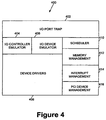
- Figure 4 is a diagram of a partial virtualization machine 400 according to an embodiment of the present invention.
- I/O port trap component 402 captures read or write operations to I/O ports that are issued by thy OS. The I/O requests may then be delivered to the emulators.
- the I/O controller emulator component 404 handles I/O requests that are I/O control requests to the instantiated virtual I/O controller.
- the virtual I/O controller comprises a virtual ATA controller
- the I/O controller emulator component comprises an ATA controller emulator.
- the I/O device emulator component 406 emulates the specific physical I/O device being accessed and handles I/O requests that are I/O access requests.
- the I/O device emulator comprises an ATA device emulator, and the device being emulated may be any device supporting the ATA interface such as a virtual hard disk, a virtual CDROM, etc. Both emulators comprise event driving state machines and I/O access is the trigger source for action by the emulators.
- different device drivers 408 may be included in the PVM. for example, if the user wants to instantiate a virtual hard disk on a USB thumb drive, the device drivers of the USB thumb drive and the corresponding USB controller may be included in the PVM. Device drivers communicate with the physical I/O device based at least in part on the I/O control requests and the I/O access requests.
- the other PVM components shown in Figure 4 comprise complementary modules which assist in the translation of I/O requests and access to the physical I/O devices.
- Other components include a scheduler 410 to schedule events which might occur during several visits to the virtualized domain. For example, there may be an I/O request which takes four times as long as one normally remains in the context of the PVM. If only a portion of the I/O transaction has been completed, the scheduler would track and manage that, along with other transactions which are pending.
- These PVM components may be similar to corresponding modules within the OS, but smaller, faster, and simpler.
- the I/O interface being handled may be the ATA interface.
- Implementation of a uniform storage device as a virtual ATA controller within the PVM may be useful for several reasons.
- Most available operating systems include an ATA device driver and store either system or user data on an ATA storage device (e.g., a hard disk).
- the ATA device driver is a basic device driver and will be a part of most operating systems for the long term.
- the ATA interface defines an asynchronous method to read and write data which comprises direct memory access (DMA). Benefitting from this DMA mode, the PVM handles the read/write requests asynchronously, which means when accessing large amounts of data the PVM will not block the OS from running.
- DMA direct memory access
- the PVM When an ATA read/write command is captured by the PVM, the PVM calls the appropriate device driver to start the read/write process. The PVM does not wait until the data is ready for transfer. Instead, the PVM immediately returns control to the OS. In the next timer slice, the PVM steals processor cycles to perform the read/write of data. After the data is ready for the OS, the PVM creates an interrupt to notify the OS.
- the ATA specification supports the plug & play feature. When the underlying physical I/O device is removed from the computing platfonn, the PVM has the capability to notify the OS of this event by changing the virtual ATA controllers status register.
- FIG. 5 is a flow diagram of system processing according to an embodiment of the present invention.
- OS 204 writes to a selected I/O port via I/O driver 216, indicating that a read or write request needs to be performed.
- I/O port trap 402 of PVM 218 detects the writing of the I/O port and "hooks" the write operation at 504.
- the PVM also starts a Secure Enclave session at 504 to protect the subsequent I/O processing. While the PVM is operating within the Secure Enclave, the PVM's processing is protected, and the OS and application programs cannot see what the PVM is doing (i.e., the PVMs activity cannot be traced).
- Typical requests may include ReadBlock, WriteBlock, and ConfigureDevice. The requests may vary depending on the type of controller. Other, less frequently used requests may include reset and flush, and may vary depending on I/O hardware.
- I/O controller emulator 404 handles the I/O request.
- PVM updates its internal PVM state machine to reflect the handling of the I/O request.
- states may be as follows:
- the I/O request references the I/O command block port (one of the available I/O ports), then processing continues with block 516. If the I/O request does not reference the I/O command block port, then at 512 the PVM stops the current Secure Enclave session and returns control back to the OS.
- I/O device emulator 406 handles the I/O request.
- the I/O device emulator determines if the I/O request is to read or write a large amount of data (what is "large" is implementation dependent).
- PVM scheduler 410 steals CPU cycles from the OS. This means that an implementation of the PVM would schedule the PVM to be revisited due to a periodic timer in a somewhat frequent basis so that it can process the requested transaction. Since normally the PVM is largely passive, when a transaction is in the pending state, the PVM would ensure it gets more attention so that it can process the transactions by having the system switch to its context frequently. It cannot remain in the context throughout the entire time since most OSs cannot sustain stability when the computer platform is "stolen" from it for an extended period of time. Therefore the PVM will obtain sufficient processor cycles to accomplish its job, but not enough to cause resource allocation problems within the OS context.
- the PVM at 522 starts the appropriate one of device drivers 408 to read or write the data. If the amount of data to be read or written is not large at 518, then blocks 520 and 522 are skipped.
- a PVM has a priori knowledge of how long the system is allowed to remain in context of the PVM before having to relinquish control back to the OS. Since the PVM will interact directly with the real I/O hardware, the PVM will know whether or not a particular transaction has been completed by the I/O hardware. In either case, at 510, the PVM updates its internal PVM state machine to reflect the handling of the I/O request. Finally, processing continues at 512, with the PVM stopping the current Secure Enclave session and returning control back to the OS.
- the PVM may be configured to have the PVM generate a virtual CDROM drive based at least in part on the image file in the USB thumb drive, thereby allowing the OS to be installed in the traditional manner.
- Many installation programs for OSs have presumptions about where they get installed from.
- OSs are loaded from a hard disk drive at a specified location, and the OS assumes this to be the case. However, in some situations it may be desirable to load the OS from another storage device (e.g., from a USB thumb drive).
- This usage case is popular among support engineers for some computing systems. Once the OS of a computing system becomes corrupted and fails to start, the support engineer may start a clean version of the OS in order to diagnose the computing system's hardware and software.
- this diagnostics environment needs to be developed or customized by the manufacturer of the computing system because of the assumption about the OS load location (e.g., on a hard disk drive). However, in embodiments of the present invention, the support engineer may configure the PVM to generate a virtual hard disk drive based on a USB thumb drive, and the clean OS may be started directly from the USB thumb drive, without further development efforts by the manufacturer.
- the PVM may also be used to protect the intellectual property of a storage device vendor.
- the Linux kernel has a General Public License (GPL), hence any kernel module developed for Linux should open source the kernel module's code as well.
- GPL General Public License
- the vendor has to develop a device driver, which usually is a kernel module. This kernel module's source code may then become public, which may be undesirable for the vendor.
- the vendor may develop a device driver included in the PVM for the vendor's storage device, and the PVM may be configured to generate a virtual ATA device above the vendors physical storage device.
- the vendor's device driver Since the vendor's device driver is in the PVM, and the PVM's operations are protected via the Secure Enclave, the vendor's device driver is protected. Thus, the vendor protects its intellectual property by avoiding developing a device driver specifically for the GPL OS. Extending this usage model, the vendor may develop only one device driver for the PVM, and various OSs may be able to access the vendor's storage device via the PVM, instead of the vendor developing a separate device driver for each supported OS.
- the PVM may be used to preserve an area of memory in the hard disk drive, and hide this area for specific uses, such as system recovery or data protection.
- the techniques described herein are not limited to any particular hardware or software configuration; they may find applicability in any computing or processing environment.
- the techniques may be implemented in logic embodied in hardware, software, or firmware components, or a combination of the above.
- the techniques may be implemented in programs executing on programmable machines such as mobile or stationary computers, personal digital assistants, set top boxes, cellular telephones and pagers, and other electronic devices, that each include a processor, a storage medium readable by the processor (including volatile and non-volatile memory and/or storage elements), at least one input device, and one or more output devices.
- Program code is applied to the data entered using the input device to perform the functions described and to generate output information.
- the output information may be applied to one or more output devices.
- the invention can be practiced with various computer system configurations, including mutti-core processors, multiprocessor systems, minicomputers, mainframe computers, and the like.
- the invention can also be practiced in distributed computing environments where tasks may be performed by remote processing devices that are linked through a communications network.
- Each program may be implemented in a high level procedural or object oriented programming language to communicate with a processing system.
- programs may be implemented in assembly or machine language, if desired. In any case, the language may be compiled or interpreted.
- Program instructions may be used to cause a general-purpose or special-purpose processing system that is programmed with the instructions to perform the operations described herein. Alternatively, the operations may be performed by specific hardware components that contain hardwired logic for performing the operations, or by any combination of programmed computer components and custom hardware components.
- the methods described herein may be provided as a computer program product that may include a machine readable medium having stored thereon instructions that may be used to program a processing system or other electronic device to perform the methods.
- the term "machine readable medium” used herein shall include any medium that is capable of storing or encoding a sequence of instructions for execution by the machine and that cause the machine to perform any one of the methods described herein.
- machine readable medium shall accordingly include, but not be limited to, solid-state memories, optical and magnetic disks.
- software in one form or another (e.g., program, procedure, process, application, module, logic, and so on) as taking an action or causing a result.
- Such expressions are merely a shorthand way of stating the execution of the software by a processing system to cause the processor to perform an action or produce a result.
Landscapes
- Engineering & Computer Science (AREA)
- Software Systems (AREA)
- Theoretical Computer Science (AREA)
- Physics & Mathematics (AREA)
- General Engineering & Computer Science (AREA)
- General Physics & Mathematics (AREA)
- Computer Security & Cryptography (AREA)
- Storage Device Security (AREA)
- Memory System Of A Hierarchy Structure (AREA)
- Debugging And Monitoring (AREA)
Claims (15)
- Computersystem (100, 200), das ein Prozessorpaket (102, 208) enthält, das Folgendes umfasst:ein Betriebssystem (204);eine physische I/O-Vorrichtung (108, 214); undeine partielle virtuelle Maschine (218, 400), die weniger als alle Hardwarekomponenten des Computersystems virtualisiert, um eine virtuelle I/O-Vorrichtung (217), die der physischen I/O-Vorrichtung (108, 214) entspricht, zu instanziieren, wobei die virtuelle I/O-Vorrichtung (217) einen virtuellen 1/0-Controller besitzt, wobei die partielle virtuelle Maschine (218) Folgendes umfasst:eine I/O-Port-Fallen-Komponente (402) zum (i) Erfassen einer I/O-Anfrage an die virtuelle I/O-Vorrichtung (217) durch das Betriebssystem (204) und zum (ii) Starten einer sicheren Enklave-Sitzung innerhalb des Prozessorpakets (102, 208) nach der Erfassung der I/O-Anfrage,dadurch gekennzeichnet, dass die sichere Enklave-Sitzung zu Folgendem ausgelegt ist, während die sichere Enklave-Sitzung aktiv ist:(a) Verschlüsseln und Durchführen einer Integritätsprüfung der Daten und des Codes der partiellen virtuellen Maschine (218, 400), während sie sich außerhalb des Prozessorpakets (102, 208) befindet, und(b) Schützen der Daten und des Codes der partiellen virtuellen Maschine (218, 400) vor einem Zugriff durch das Betriebssystem (204), während sie sich innerhalb des Prozessorpakets (102, 208) befindet;eine I/O-Controller-Emulator-Komponente (404), die an die I/O-Port-Fallen-Komponente (402) gekoppelt ist, um eine I/O-Steueranfrage an den virtuellen 1/0-Controller innerhalb der sicheren Enklave-Sitzung zu bearbeiten, wenn die I/O-Anfrage eine I/O-Steueranfrage umfasst;eine I/O-Vorrichtungs-Emulator-Komponente (406), die an die I/O-Port-Fallen-Komponente (402) gekoppelt ist, um eine I/O-Zugangsanfrage innerhalb der sicheren Enklave-Sitzung zu bearbeiten, um mit der virtuellen I/O-Vorrichtung (217) zu kommunizieren, wenn die I/O-Anfrage eine I/O-Zugangsanfrage umfasst; undeine Vorrichtungs-Treiber-Komponente (408), die an die I/O-Controller-Emulator-Komponente (404) und die I/O-Vorrichtungs-Emulator-Komponente (406) gekoppelt ist, um innerhalb der sicheren Enklave-Sitzung mit der physischen I/O-Vorrichtung (108, 214) mindestens teilweise basierend auf der I/O-Steueranfrage und der I/O-Zugangsanfrage zu kommunizieren;wobei die partielle virtuelle Maschine (218, 400) ferner die sichere Enklave-Sitzung vor der Rückgabe der Steuerung an das Betriebssystem (204) nach einer Bearbeitung der I/O-Anfrage stoppen soll.
- Computersystem (100, 200) nach Anspruch 1, wobei die virtuelle I/O-Vorrichtung (217) eine virtuelle ATA-Vorrichtung umfasst, der virtuelle I/O-Controller einen virtuellen ATA-Controller umfasst und die physische I/O-Vorrichtung (108, 214) eine ATA-Vorrichtung umfasst.
- Computersystem (100, 200) nach Anspruch 1, wobei die virtuelle I/O-Vorrichtung (217) eine virtuelle SCSI-Vorrichtung umfasst, der virtuelle I/O-Controller einen virtuellen SCSI-Controller umfasst und die physische I/O-Vorrichtung (108, 214) eine SCSI-Vorrichtung umfasst.
- Computersystem (100, 200) nach Anspruch 1, wobei die virtuelle I/O-Vorrichtung (217) eine virtuelle USB-Vorrichtung umfasst, der virtuelle I/O-Controller einen virtuellen USB-Controller umfasst und die physische I/O-Vorrichtung (108, 214) eine USB-Vorrichtung umfasst.
- Computersystem (100, 200) nach Anspruch 1, das ferner einen Speicher umfasst, der in einen ersten Abschnitt zur Verwendung durch das Betriebssystem (204), einen zweiten Abschnitt zum Teilen von Daten zwischen dem Betriebssystem (204) und der partiellen virtuellen Maschine (218, 400) und einen dritten Abschnitt zur Verwendung durch die partielle virtuelle Maschine (218, 400) partitioniert ist, wobei der dritte Abschnitt vor dem Betriebssystem (204) versteckt ist.
- Computersystem (100, 200) nach Anspruch 1, wobei die physische I/O-Vorrichtung (108, 214) vor dem Betriebssystem (204) versteckt ist.
- Computersystem (100, 200) nach Anspruch 1, wobei die partielle virtuelle Maschine (218, 400) OS-unabhängig ist.
- Verfahren in einem Computersystem (100, 200), das ein Betriebssystem (204) und ein Prozessorpaket (102, 208) besitzt, zum Bereitstellen einer virtuellen I/O-Vorrichtung (217), die einer physischen I/O-Vorrichtung (108,214) entspricht, das Folgendes umfasst:Instanziieren der virtuellen I/O-Vorrichtung (217) durch eine partielle virtuelle Maschine (218, 400), die weniger als alle Hardwarekomponenten des Computersystems virtualisiert, wobei die virtuelle I/O-Vorrichtung (217) einen virtuellen I/O-Controller besitzt;Erfassen einer I/O-Anfrage von dem Betriebssystem (204) an die virtuelle I/O-Vorrichtung (217) durch eine I/O-Port-Fallen-Komponente (402) der partiellen virtuellen Maschine (218, 400);gekennzeichnet durch das Starten einer sicheren Enklave-Sitzung innerhalb des Prozessorpakets (102, 208) durch die partielle virtuelle Maschine (218, 400), nach dem Erfassen der I/O-Anfrage, wobei die sichere Enklave-Sitzung, während sie aktiv ist, Daten und Code der partiellen virtuellen Maschine (218, 400) verschlüsselt und eine Integritätsprüfung durchführt, während sie sich außerhalb des Prozessorpakets (102, 208) befindet, und Daten und Code der partiellen virtuellen Maschine (218, 400) vor einem Zugriff durch das Betriebssystem (204) schützt, während sie sich innerhalb des Prozessorpakets (102, 208) befindet;Bearbeiten der I/O-Steueranfrage durch eine 1/0-Controller-Emulator-Komponente (404) der partiellen virtuellen Maschine (218, 400) innerhalb der sicheren Enklave-Sitzung, wenn die I/O-Anfrage eine I/O-Steueranfrage an den virtuellen I/O-Controller umfasst;Bearbeiten der I/O-Zugangsanfrage durch eine I/O-Vorrichtungs-Emulator-Komponente (406) der partiellen virtuellen Maschine (218, 400) innerhalb der sicheren Enklave-Sitzung, wenn die I/O-Anfrage eine I/O-Zugangsanfrage umfasst, wobei der I/O-Vorrichtungs-Emulator (406) mit einem Vorrichtungstreiber (408) der partiellen virtuellen Maschine (218, 400), die der physischen I/O-Vorrichtung (108, 214) zugeordnet ist, kommuniziert, um die I/O-Zugangsanfrage auszuführen; undStoppen der sicheren Enklave-Sitzung durch die partielle virtuelle Maschine (218) nach dem Bearbeiten der I/O-Anfrage und vor der Rückgabe der Steuerung an das Betriebssystem (204).
- Verfahren nach Anspruch 8, wobei die virtuelle I/O-Vorrichtung (217) eine virtuelle ATA-Vorrichtung umfasst, der virtuelle I/O-Controller einen virtuellen ATA-Controller umfasst und die physische 1/0-Vorrichtung (108, 214) eine ATA-Vorrichtung umfasst.
- Verfahren nach Anspruch 8, wobei die virtuelle I/O-Vorrichtung (217) eine virtuelle SCSI-Vorrichtung umfasst, der virtuelle I/O-Controller einen virtuellen SCSI-Controller umfasst und die physische I/O-Vorrichtung (108, 214) eine SCSI-Vorrichtung umfasst.
- Verfahren nach Anspruch 8, wobei die virtuelle I/O-Vorrichtung (217) eine virtuelle USB-Vorrichtung umfasst, der virtuelle I/O-Controller einen virtuellen USB-Controller umfasst und die physische I/O-Vorrichtung (108, 214) eine USB-Vorrichtung umfasst.
- Verfahren nach Anspruch 8, wobei das Computersystem (100, 200) einen Speicher umfasst, der in einen ersten Abschnitt zur Verwendung durch das Betriebssystem (204), einen zweiten Abschnitt zum Teilen von Daten zwischen dem Betriebssystem (204) und der partiellen virtuellen Maschine (218, 400) und einen dritten Abschnitt zur Verwendung durch die partielle virtuelle Maschine (218) partitioniert ist, wobei der dritte Abschnitt vor dem Betriebssystem (204) versteckt ist.
- Verfahren nach Anspruch 8, das ferner das Verstecken der physischen I/O-Vorrichtung (108, 214) vor dem Betriebssystem (204) durch die partielle virtuelle Maschine (218, 400) umfasst.
- Verfahren nach Anspruch 8, wobei die partielle virtuelle Maschine (218, 400) OS-unabhängig ist.
- Maschinenlesbares Medium, das ausführbare Anweisungen speichert, um zu bewirken, dass ein Verarbeitungssystem für allgemeine Zwecke oder für spezielle Zwecke, das damit programmiert ist, die in einem der Ansprüche 8-14 beschriebenen Vorgänge ausführt.
Applications Claiming Priority (1)
| Application Number | Priority Date | Filing Date | Title |
|---|---|---|---|
| US12/819,943 US8181176B2 (en) | 2010-06-21 | 2010-06-21 | Uniform storage device access using partial virtual machine executing within a secure enclave session |
Publications (3)
| Publication Number | Publication Date |
|---|---|
| EP2397943A2 EP2397943A2 (de) | 2011-12-21 |
| EP2397943A3 EP2397943A3 (de) | 2013-01-02 |
| EP2397943B1 true EP2397943B1 (de) | 2016-03-23 |
Family
ID=44503643
Family Applications (1)
| Application Number | Title | Priority Date | Filing Date |
|---|---|---|---|
| EP11250554.0A Active EP2397943B1 (de) | 2010-06-21 | 2011-05-26 | Einheitliche Speichervorrichtung durch Teilvirtualisierungsmaschine |
Country Status (6)
| Country | Link |
|---|---|
| US (1) | US8181176B2 (de) |
| EP (1) | EP2397943B1 (de) |
| JP (1) | JP5345652B2 (de) |
| KR (1) | KR101331311B1 (de) |
| CN (1) | CN102289386B (de) |
| WO (1) | WO2011162914A2 (de) |
Families Citing this family (35)
| Publication number | Priority date | Publication date | Assignee | Title |
|---|---|---|---|---|
| US9087200B2 (en) * | 2009-12-22 | 2015-07-21 | Intel Corporation | Method and apparatus to provide secure application execution |
| US9164924B2 (en) | 2011-09-13 | 2015-10-20 | Facebook, Inc. | Software cryptoprocessor |
| US8959623B2 (en) * | 2012-05-25 | 2015-02-17 | Ca, Inc. | Protecting virtual machine console from misuse, hijacking or eavesdropping in cloud environments |
| US8756689B2 (en) | 2012-06-29 | 2014-06-17 | Intel Corporation | Method, system, and device for securely handling virtual function driver communications with a physical function driver |
| US9519803B2 (en) * | 2012-11-30 | 2016-12-13 | Intel Corporation | Secure environment for graphics processing units |
| US9396011B2 (en) | 2013-03-12 | 2016-07-19 | Qualcomm Incorporated | Algorithm and apparatus to deploy virtual machine monitor on demand |
| US9430384B2 (en) * | 2013-03-31 | 2016-08-30 | Intel Corporation | Instructions and logic to provide advanced paging capabilities for secure enclave page caches |
| US9684805B2 (en) * | 2013-08-20 | 2017-06-20 | Janus Technologies, Inc. | Method and apparatus for securing computer interfaces |
| US9477603B2 (en) | 2013-09-05 | 2016-10-25 | Facebook, Inc. | System and method for partitioning of memory units into non-conflicting sets |
| US9983894B2 (en) | 2013-09-25 | 2018-05-29 | Facebook, Inc. | Method and system for providing secure system execution on hardware supporting secure application execution |
| US10049048B1 (en) | 2013-10-01 | 2018-08-14 | Facebook, Inc. | Method and system for using processor enclaves and cache partitioning to assist a software cryptoprocessor |
| US9537932B2 (en) * | 2013-10-23 | 2017-01-03 | Microsoft Technology Licensing, Llc | Emulating test distributed application on server |
| WO2015094176A1 (en) * | 2013-12-17 | 2015-06-25 | Intel Corporation | Secure enclaves for use by kernel mode applications |
| US9747450B2 (en) | 2014-02-10 | 2017-08-29 | Facebook, Inc. | Attestation using a combined measurement and its constituent measurements |
| US9686077B2 (en) * | 2014-03-06 | 2017-06-20 | Microsoft Technology Licensing, Llc | Secure hardware for cross-device trusted applications |
| US9734092B2 (en) | 2014-03-19 | 2017-08-15 | Facebook, Inc. | Secure support for I/O in software cryptoprocessor |
| US9417801B2 (en) * | 2014-03-27 | 2016-08-16 | Intel Corporation | Virtual general-purpose I/O controller |
| CN105094942B (zh) * | 2014-04-23 | 2018-09-21 | 华为技术有限公司 | Hsm会话管理方法、管理虚拟机和服务器 |
| US9684546B2 (en) * | 2014-12-16 | 2017-06-20 | Microsoft Technology Licensing, Llc | Job scheduling and monitoring in a distributed computing environment |
| US9710170B2 (en) * | 2015-03-05 | 2017-07-18 | Western Digital Technologies, Inc. | Processing data storage commands for enclosure services |
| US9904803B2 (en) * | 2015-03-25 | 2018-02-27 | Intel Corporation | Technologies for hardening data encryption with secure enclaves |
| US9716710B2 (en) * | 2015-06-26 | 2017-07-25 | Intel Corporation | Technologies for virtualized access to security services provided by a converged manageability and security engine |
| US9838367B2 (en) * | 2015-06-26 | 2017-12-05 | Intel Corporation | Binding a trusted input session to a trusted output session |
| US10140457B2 (en) * | 2015-07-31 | 2018-11-27 | Intel Corporation | Secure input/output device management |
| US20170153852A1 (en) * | 2015-11-30 | 2017-06-01 | Mediatek Inc. | Multi-port memory controller capable of serving multiple access requests by accessing different memory banks of multi-bank packet buffer and associated packet storage design |
| US10261748B2 (en) * | 2015-12-18 | 2019-04-16 | Intel Corporation | Technologies for protecting audio data with trusted I/O |
| FR3061323B1 (fr) * | 2016-12-28 | 2019-12-20 | Bull Sas | Procede de stockage de donnees dans un systeme de stockage virtualise |
| US10587412B2 (en) | 2017-11-07 | 2020-03-10 | International Business Machines Corporation | Virtual machine structure |
| US10970390B2 (en) * | 2018-02-15 | 2021-04-06 | Intel Corporation | Mechanism to prevent software side channels |
| IL258368B2 (en) * | 2018-03-26 | 2024-04-01 | Kazuar Advanced Tech Ltd | Secure computer system |
| CN110661869B (zh) * | 2019-09-26 | 2022-08-12 | 苏州浪潮智能科技有限公司 | 一种节点上线方法、系统、装置、设备及计算机存储介质 |
| KR102325428B1 (ko) * | 2019-12-09 | 2021-11-12 | 한국전자기술연구원 | 가상 하드웨어를 이용한 i/o 포트 에뮬레이팅 시스템 및 방법 |
| US11537705B2 (en) * | 2020-10-27 | 2022-12-27 | Dell Products L.P. | Device access control system |
| US11829493B2 (en) * | 2020-10-27 | 2023-11-28 | Dell Products L.P. | Device access control system |
| CN112506818B (zh) * | 2020-12-08 | 2022-05-31 | 中国电子科技集团公司第三十研究所 | 一种基于软件模拟的usb硬件虚拟化方法 |
Family Cites Families (14)
| Publication number | Priority date | Publication date | Assignee | Title |
|---|---|---|---|---|
| US5062042A (en) | 1986-04-28 | 1991-10-29 | Xerox Corporation | System for managing data which is accessible by file address or disk address via a disk track map |
| US7260820B1 (en) | 2001-04-26 | 2007-08-21 | Vm Ware, Inc. | Undefeatable transformation for virtual machine I/O operations |
| US6757778B1 (en) | 2002-05-07 | 2004-06-29 | Veritas Operating Corporation | Storage management system |
| US7793287B2 (en) * | 2003-10-01 | 2010-09-07 | Hewlett-Packard Development Company, L.P. | Runtime virtualization and devirtualization of I/O devices by a virtual machine monitor |
| US7203808B2 (en) * | 2004-03-19 | 2007-04-10 | Intel Corporation | Isolation and protection of disk areas controlled and for use by virtual machine manager in firmware |
| GB0425181D0 (en) | 2004-11-15 | 2004-12-15 | Unilever Plc | Fabric treatment composition |
| US7757231B2 (en) * | 2004-12-10 | 2010-07-13 | Intel Corporation | System and method to deprivilege components of a virtual machine monitor |
| US7392172B2 (en) * | 2005-04-28 | 2008-06-24 | Hewlett-Packard Development Company, L.P. | Providing virtual device access via firmware |
| US7845005B2 (en) * | 2006-02-07 | 2010-11-30 | International Business Machines Corporation | Method for preventing malicious software installation on an internet-connected computer |
| US7725305B2 (en) * | 2006-06-08 | 2010-05-25 | Microsoft Corporation | Partial virtualization on computing device |
| CN101154130B (zh) * | 2006-09-30 | 2012-07-04 | 联想(北京)有限公司 | 一种虚拟机系统及其电源管理方法 |
| JP2012508938A (ja) * | 2008-11-14 | 2012-04-12 | インテル・コーポレーション | セキュアなアプリケーション実行方法および装置 |
| JP4410294B1 (ja) * | 2008-12-25 | 2010-02-03 | 株式会社東芝 | 情報処理装置およびエミュレーション方法 |
| US8949565B2 (en) * | 2009-12-27 | 2015-02-03 | Intel Corporation | Virtual and hidden service partition and dynamic enhanced third party data store |
-
2010
- 2010-06-21 US US12/819,943 patent/US8181176B2/en active Active
-
2011
- 2011-05-13 JP JP2011108146A patent/JP5345652B2/ja active Active
- 2011-05-26 EP EP11250554.0A patent/EP2397943B1/de active Active
- 2011-05-31 WO PCT/US2011/038504 patent/WO2011162914A2/en not_active Ceased
- 2011-06-20 CN CN201110179065.3A patent/CN102289386B/zh active Active
- 2011-06-20 KR KR1020110059845A patent/KR101331311B1/ko active Active
Also Published As
| Publication number | Publication date |
|---|---|
| WO2011162914A2 (en) | 2011-12-29 |
| JP2012009013A (ja) | 2012-01-12 |
| CN102289386B (zh) | 2015-04-08 |
| EP2397943A2 (de) | 2011-12-21 |
| US8181176B2 (en) | 2012-05-15 |
| KR20110139130A (ko) | 2011-12-28 |
| WO2011162914A3 (en) | 2012-04-05 |
| CN102289386A (zh) | 2011-12-21 |
| KR101331311B1 (ko) | 2013-11-20 |
| US20110314468A1 (en) | 2011-12-22 |
| EP2397943A3 (de) | 2013-01-02 |
| JP5345652B2 (ja) | 2013-11-20 |
Similar Documents
| Publication | Publication Date | Title |
|---|---|---|
| EP2397943B1 (de) | Einheitliche Speichervorrichtung durch Teilvirtualisierungsmaschine | |
| JP5042848B2 (ja) | 仮想マシン・モニタの構成部分を特権化解除するためのシステム及び方法 | |
| CN102207886B (zh) | 虚拟机快速仿真辅助 | |
| RU2412468C2 (ru) | Системы и способы многоуровневой обработки перехватов в виртуальной машинной среде | |
| EP3557424B1 (de) | Transparente hostseitige zwischenspeicherung von virtuellen festplatten auf einem gemeinsamen speicher | |
| US8671405B2 (en) | Virtual machine crash file generation techniques | |
| KR102047558B1 (ko) | 가상 디스크 저장 기술 | |
| KR101521778B1 (ko) | 가상화 환경에서 i/o 동작을 처리하는 방법 및 장치 | |
| JP6530723B2 (ja) | コンピュータシステム内における複数のハイパーバイザーの共同運用を容易にするためのシステムおよび方法 | |
| CN102214277B (zh) | 创建多核处理器虚拟机系统可信环境的方法及装置 | |
| US7539986B2 (en) | Method for guest operating system integrity validation | |
| CN109074321B (zh) | 用于保护虚拟计算实例的存储器的方法和系统 | |
| KR101433644B1 (ko) | Arm 기반 운영체제의 가상화를 위한 정책 제공 시스템 및 방법 | |
| JP5468490B2 (ja) | 仮想化環境が実現されているコンピュータにおいてディスク・ドライブにアクセスする方法およびコンピュータ | |
| US20200218459A1 (en) | Memory-mapped storage i/o | |
| Ribeiro | VirtIo Infrastructure for a Static Partition Hypervisor: Virtio-Blk and Virtio-Console | |
| OMOTE | Computer Systems Management with a Para Pass-through Virtual Machine Monitor | |
| 表祐志 et al. | Computer Systems Management with a Para Pass-through Virtual Machine Monitor | |
| HK1097927A (en) | Systems and methods for multi-level intercept processing in a virtual machine environment |
Legal Events
| Date | Code | Title | Description |
|---|---|---|---|
| 17P | Request for examination filed |
Effective date: 20110606 |
|
| AK | Designated contracting states |
Kind code of ref document: A2 Designated state(s): AL AT BE BG CH CY CZ DE DK EE ES FI FR GB GR HR HU IE IS IT LI LT LU LV MC MK MT NL NO PL PT RO RS SE SI SK SM TR |
|
| AX | Request for extension of the european patent |
Extension state: BA ME |
|
| PUAI | Public reference made under article 153(3) epc to a published international application that has entered the european phase |
Free format text: ORIGINAL CODE: 0009012 |
|
| PUAL | Search report despatched |
Free format text: ORIGINAL CODE: 0009013 |
|
| AK | Designated contracting states |
Kind code of ref document: A3 Designated state(s): AL AT BE BG CH CY CZ DE DK EE ES FI FR GB GR HR HU IE IS IT LI LT LU LV MC MK MT NL NO PL PT RO RS SE SI SK SM TR |
|
| AX | Request for extension of the european patent |
Extension state: BA ME |
|
| RIC1 | Information provided on ipc code assigned before grant |
Ipc: G06F 9/455 20060101AFI20121126BHEP |
|
| 17Q | First examination report despatched |
Effective date: 20121214 |
|
| GRAP | Despatch of communication of intention to grant a patent |
Free format text: ORIGINAL CODE: EPIDOSNIGR1 |
|
| INTG | Intention to grant announced |
Effective date: 20150715 |
|
| GRAP | Despatch of communication of intention to grant a patent |
Free format text: ORIGINAL CODE: EPIDOSNIGR1 |
|
| GRAJ | Information related to disapproval of communication of intention to grant by the applicant or resumption of examination proceedings by the epo deleted |
Free format text: ORIGINAL CODE: EPIDOSDIGR1 |
|
| GRAP | Despatch of communication of intention to grant a patent |
Free format text: ORIGINAL CODE: EPIDOSNIGR1 |
|
| GRAJ | Information related to disapproval of communication of intention to grant by the applicant or resumption of examination proceedings by the epo deleted |
Free format text: ORIGINAL CODE: EPIDOSDIGR1 |
|
| INTG | Intention to grant announced |
Effective date: 20150915 |
|
| RIN1 | Information on inventor provided before grant (corrected) |
Inventor name: CHEN, JUNWEI STANLEY Inventor name: ZHOU, HUA Inventor name: ROTHMAN, MICHAEL A. Inventor name: HUANG, FUJIN Inventor name: ZIMMER, VINCENT Inventor name: QIAN, YI |
|
| GRAP | Despatch of communication of intention to grant a patent |
Free format text: ORIGINAL CODE: EPIDOSNIGR1 |
|
| INTG | Intention to grant announced |
Effective date: 20151009 |
|
| INTG | Intention to grant announced |
Effective date: 20151019 |
|
| GRAS | Grant fee paid |
Free format text: ORIGINAL CODE: EPIDOSNIGR3 |
|
| GRAA | (expected) grant |
Free format text: ORIGINAL CODE: 0009210 |
|
| AK | Designated contracting states |
Kind code of ref document: B1 Designated state(s): AL AT BE BG CH CY CZ DE DK EE ES FI FR GB GR HR HU IE IS IT LI LT LU LV MC MK MT NL NO PL PT RO RS SE SI SK SM TR |
|
| REG | Reference to a national code |
Ref country code: GB Ref legal event code: FG4D |
|
| REG | Reference to a national code |
Ref country code: CH Ref legal event code: EP |
|
| REG | Reference to a national code |
Ref country code: AT Ref legal event code: REF Ref document number: 783762 Country of ref document: AT Kind code of ref document: T Effective date: 20160415 |
|
| REG | Reference to a national code |
Ref country code: IE Ref legal event code: FG4D |
|
| REG | Reference to a national code |
Ref country code: DE Ref legal event code: R096 Ref document number: 602011024271 Country of ref document: DE |
|
| REG | Reference to a national code |
Ref country code: LT Ref legal event code: MG4D |
|
| REG | Reference to a national code |
Ref country code: NL Ref legal event code: MP Effective date: 20160323 |
|
| PG25 | Lapsed in a contracting state [announced via postgrant information from national office to epo] |
Ref country code: FI Free format text: LAPSE BECAUSE OF FAILURE TO SUBMIT A TRANSLATION OF THE DESCRIPTION OR TO PAY THE FEE WITHIN THE PRESCRIBED TIME-LIMIT Effective date: 20160323 Ref country code: GR Free format text: LAPSE BECAUSE OF FAILURE TO SUBMIT A TRANSLATION OF THE DESCRIPTION OR TO PAY THE FEE WITHIN THE PRESCRIBED TIME-LIMIT Effective date: 20160624 Ref country code: HR Free format text: LAPSE BECAUSE OF FAILURE TO SUBMIT A TRANSLATION OF THE DESCRIPTION OR TO PAY THE FEE WITHIN THE PRESCRIBED TIME-LIMIT Effective date: 20160323 Ref country code: NO Free format text: LAPSE BECAUSE OF FAILURE TO SUBMIT A TRANSLATION OF THE DESCRIPTION OR TO PAY THE FEE WITHIN THE PRESCRIBED TIME-LIMIT Effective date: 20160623 |
|
| REG | Reference to a national code |
Ref country code: AT Ref legal event code: MK05 Ref document number: 783762 Country of ref document: AT Kind code of ref document: T Effective date: 20160323 |
|
| PG25 | Lapsed in a contracting state [announced via postgrant information from national office to epo] |
Ref country code: NL Free format text: LAPSE BECAUSE OF FAILURE TO SUBMIT A TRANSLATION OF THE DESCRIPTION OR TO PAY THE FEE WITHIN THE PRESCRIBED TIME-LIMIT Effective date: 20160323 Ref country code: LT Free format text: LAPSE BECAUSE OF FAILURE TO SUBMIT A TRANSLATION OF THE DESCRIPTION OR TO PAY THE FEE WITHIN THE PRESCRIBED TIME-LIMIT Effective date: 20160323 Ref country code: SE Free format text: LAPSE BECAUSE OF FAILURE TO SUBMIT A TRANSLATION OF THE DESCRIPTION OR TO PAY THE FEE WITHIN THE PRESCRIBED TIME-LIMIT Effective date: 20160323 Ref country code: RS Free format text: LAPSE BECAUSE OF FAILURE TO SUBMIT A TRANSLATION OF THE DESCRIPTION OR TO PAY THE FEE WITHIN THE PRESCRIBED TIME-LIMIT Effective date: 20160323 Ref country code: BE Free format text: LAPSE BECAUSE OF NON-PAYMENT OF DUE FEES Effective date: 20160531 Ref country code: LV Free format text: LAPSE BECAUSE OF FAILURE TO SUBMIT A TRANSLATION OF THE DESCRIPTION OR TO PAY THE FEE WITHIN THE PRESCRIBED TIME-LIMIT Effective date: 20160323 |
|
| PG25 | Lapsed in a contracting state [announced via postgrant information from national office to epo] |
Ref country code: PL Free format text: LAPSE BECAUSE OF FAILURE TO SUBMIT A TRANSLATION OF THE DESCRIPTION OR TO PAY THE FEE WITHIN THE PRESCRIBED TIME-LIMIT Effective date: 20160323 Ref country code: EE Free format text: LAPSE BECAUSE OF FAILURE TO SUBMIT A TRANSLATION OF THE DESCRIPTION OR TO PAY THE FEE WITHIN THE PRESCRIBED TIME-LIMIT Effective date: 20160323 Ref country code: IS Free format text: LAPSE BECAUSE OF FAILURE TO SUBMIT A TRANSLATION OF THE DESCRIPTION OR TO PAY THE FEE WITHIN THE PRESCRIBED TIME-LIMIT Effective date: 20160723 |
|
| PG25 | Lapsed in a contracting state [announced via postgrant information from national office to epo] |
Ref country code: ES Free format text: LAPSE BECAUSE OF FAILURE TO SUBMIT A TRANSLATION OF THE DESCRIPTION OR TO PAY THE FEE WITHIN THE PRESCRIBED TIME-LIMIT Effective date: 20160323 Ref country code: PT Free format text: LAPSE BECAUSE OF FAILURE TO SUBMIT A TRANSLATION OF THE DESCRIPTION OR TO PAY THE FEE WITHIN THE PRESCRIBED TIME-LIMIT Effective date: 20160725 Ref country code: CZ Free format text: LAPSE BECAUSE OF FAILURE TO SUBMIT A TRANSLATION OF THE DESCRIPTION OR TO PAY THE FEE WITHIN THE PRESCRIBED TIME-LIMIT Effective date: 20160323 Ref country code: AT Free format text: LAPSE BECAUSE OF FAILURE TO SUBMIT A TRANSLATION OF THE DESCRIPTION OR TO PAY THE FEE WITHIN THE PRESCRIBED TIME-LIMIT Effective date: 20160323 Ref country code: RO Free format text: LAPSE BECAUSE OF FAILURE TO SUBMIT A TRANSLATION OF THE DESCRIPTION OR TO PAY THE FEE WITHIN THE PRESCRIBED TIME-LIMIT Effective date: 20160323 Ref country code: SM Free format text: LAPSE BECAUSE OF FAILURE TO SUBMIT A TRANSLATION OF THE DESCRIPTION OR TO PAY THE FEE WITHIN THE PRESCRIBED TIME-LIMIT Effective date: 20160323 Ref country code: SK Free format text: LAPSE BECAUSE OF FAILURE TO SUBMIT A TRANSLATION OF THE DESCRIPTION OR TO PAY THE FEE WITHIN THE PRESCRIBED TIME-LIMIT Effective date: 20160323 |
|
| PG25 | Lapsed in a contracting state [announced via postgrant information from national office to epo] |
Ref country code: BE Free format text: LAPSE BECAUSE OF FAILURE TO SUBMIT A TRANSLATION OF THE DESCRIPTION OR TO PAY THE FEE WITHIN THE PRESCRIBED TIME-LIMIT Effective date: 20160323 Ref country code: IT Free format text: LAPSE BECAUSE OF FAILURE TO SUBMIT A TRANSLATION OF THE DESCRIPTION OR TO PAY THE FEE WITHIN THE PRESCRIBED TIME-LIMIT Effective date: 20160323 Ref country code: LU Free format text: LAPSE BECAUSE OF FAILURE TO SUBMIT A TRANSLATION OF THE DESCRIPTION OR TO PAY THE FEE WITHIN THE PRESCRIBED TIME-LIMIT Effective date: 20160526 |
|
| REG | Reference to a national code |
Ref country code: CH Ref legal event code: PL |
|
| REG | Reference to a national code |
Ref country code: DE Ref legal event code: R097 Ref document number: 602011024271 Country of ref document: DE |
|
| PLBE | No opposition filed within time limit |
Free format text: ORIGINAL CODE: 0009261 |
|
| STAA | Information on the status of an ep patent application or granted ep patent |
Free format text: STATUS: NO OPPOSITION FILED WITHIN TIME LIMIT |
|
| PG25 | Lapsed in a contracting state [announced via postgrant information from national office to epo] |
Ref country code: DK Free format text: LAPSE BECAUSE OF FAILURE TO SUBMIT A TRANSLATION OF THE DESCRIPTION OR TO PAY THE FEE WITHIN THE PRESCRIBED TIME-LIMIT Effective date: 20160323 Ref country code: LI Free format text: LAPSE BECAUSE OF NON-PAYMENT OF DUE FEES Effective date: 20160531 Ref country code: CH Free format text: LAPSE BECAUSE OF NON-PAYMENT OF DUE FEES Effective date: 20160531 |
|
| REG | Reference to a national code |
Ref country code: IE Ref legal event code: MM4A |
|
| PG25 | Lapsed in a contracting state [announced via postgrant information from national office to epo] |
Ref country code: BG Free format text: LAPSE BECAUSE OF FAILURE TO SUBMIT A TRANSLATION OF THE DESCRIPTION OR TO PAY THE FEE WITHIN THE PRESCRIBED TIME-LIMIT Effective date: 20160623 |
|
| 26N | No opposition filed |
Effective date: 20170102 |
|
| REG | Reference to a national code |
Ref country code: FR Ref legal event code: ST Effective date: 20170131 |
|
| PG25 | Lapsed in a contracting state [announced via postgrant information from national office to epo] |
Ref country code: FR Free format text: LAPSE BECAUSE OF NON-PAYMENT OF DUE FEES Effective date: 20160531 |
|
| PG25 | Lapsed in a contracting state [announced via postgrant information from national office to epo] |
Ref country code: IE Free format text: LAPSE BECAUSE OF NON-PAYMENT OF DUE FEES Effective date: 20160526 Ref country code: SI Free format text: LAPSE BECAUSE OF FAILURE TO SUBMIT A TRANSLATION OF THE DESCRIPTION OR TO PAY THE FEE WITHIN THE PRESCRIBED TIME-LIMIT Effective date: 20160323 |
|
| PG25 | Lapsed in a contracting state [announced via postgrant information from national office to epo] |
Ref country code: HU Free format text: LAPSE BECAUSE OF FAILURE TO SUBMIT A TRANSLATION OF THE DESCRIPTION OR TO PAY THE FEE WITHIN THE PRESCRIBED TIME-LIMIT; INVALID AB INITIO Effective date: 20110526 Ref country code: CY Free format text: LAPSE BECAUSE OF FAILURE TO SUBMIT A TRANSLATION OF THE DESCRIPTION OR TO PAY THE FEE WITHIN THE PRESCRIBED TIME-LIMIT Effective date: 20160323 |
|
| PG25 | Lapsed in a contracting state [announced via postgrant information from national office to epo] |
Ref country code: MC Free format text: LAPSE BECAUSE OF FAILURE TO SUBMIT A TRANSLATION OF THE DESCRIPTION OR TO PAY THE FEE WITHIN THE PRESCRIBED TIME-LIMIT Effective date: 20160323 Ref country code: TR Free format text: LAPSE BECAUSE OF FAILURE TO SUBMIT A TRANSLATION OF THE DESCRIPTION OR TO PAY THE FEE WITHIN THE PRESCRIBED TIME-LIMIT Effective date: 20160323 Ref country code: MK Free format text: LAPSE BECAUSE OF FAILURE TO SUBMIT A TRANSLATION OF THE DESCRIPTION OR TO PAY THE FEE WITHIN THE PRESCRIBED TIME-LIMIT Effective date: 20160323 Ref country code: MT Free format text: LAPSE BECAUSE OF NON-PAYMENT OF DUE FEES Effective date: 20160531 |
|
| PG25 | Lapsed in a contracting state [announced via postgrant information from national office to epo] |
Ref country code: AL Free format text: LAPSE BECAUSE OF FAILURE TO SUBMIT A TRANSLATION OF THE DESCRIPTION OR TO PAY THE FEE WITHIN THE PRESCRIBED TIME-LIMIT Effective date: 20160323 |
|
| P01 | Opt-out of the competence of the unified patent court (upc) registered |
Effective date: 20230518 |
|
| PGFP | Annual fee paid to national office [announced via postgrant information from national office to epo] |
Ref country code: DE Payment date: 20250325 Year of fee payment: 15 |
|
| PGFP | Annual fee paid to national office [announced via postgrant information from national office to epo] |
Ref country code: GB Payment date: 20260323 Year of fee payment: 16 |