EP2394890A1 - Vehicle trailer equipped with an additional traction system, vehicle with said trailer, and method for managing the additional traction system - Google Patents
Vehicle trailer equipped with an additional traction system, vehicle with said trailer, and method for managing the additional traction system Download PDFInfo
- Publication number
- EP2394890A1 EP2394890A1 EP10425195A EP10425195A EP2394890A1 EP 2394890 A1 EP2394890 A1 EP 2394890A1 EP 10425195 A EP10425195 A EP 10425195A EP 10425195 A EP10425195 A EP 10425195A EP 2394890 A1 EP2394890 A1 EP 2394890A1
- Authority
- EP
- European Patent Office
- Prior art keywords
- batteries
- vehicle
- motors
- trailer
- traction
- Prior art date
- Legal status (The legal status is an assumption and is not a legal conclusion. Google has not performed a legal analysis and makes no representation as to the accuracy of the status listed.)
- Granted
Links
- 238000000034 method Methods 0.000 title claims description 19
- 230000004913 activation Effects 0.000 claims abstract description 13
- 230000001276 controlling effect Effects 0.000 claims description 14
- 230000001105 regulatory effect Effects 0.000 claims description 11
- 230000001133 acceleration Effects 0.000 claims description 5
- 238000007726 management method Methods 0.000 claims description 4
- 238000004590 computer program Methods 0.000 claims description 3
- 230000033001 locomotion Effects 0.000 description 4
- 230000009471 action Effects 0.000 description 2
- 230000005540 biological transmission Effects 0.000 description 2
- 230000000903 blocking effect Effects 0.000 description 2
- 238000005516 engineering process Methods 0.000 description 2
- 239000000446 fuel Substances 0.000 description 2
- 229910052493 LiFePO4 Inorganic materials 0.000 description 1
- 238000010276 construction Methods 0.000 description 1
- 238000011217 control strategy Methods 0.000 description 1
- 230000008878 coupling Effects 0.000 description 1
- 238000010168 coupling process Methods 0.000 description 1
- 238000005859 coupling reaction Methods 0.000 description 1
- 238000010586 diagram Methods 0.000 description 1
- 238000007599 discharging Methods 0.000 description 1
- 230000000694 effects Effects 0.000 description 1
- 230000006872 improvement Effects 0.000 description 1
- GELKBWJHTRAYNV-UHFFFAOYSA-K lithium iron phosphate Chemical compound [Li+].[Fe+2].[O-]P([O-])([O-])=O GELKBWJHTRAYNV-UHFFFAOYSA-K 0.000 description 1
- 238000005259 measurement Methods 0.000 description 1
- 229910021421 monocrystalline silicon Inorganic materials 0.000 description 1
- 229910021420 polycrystalline silicon Inorganic materials 0.000 description 1
- 230000006641 stabilisation Effects 0.000 description 1
- 238000011105 stabilization Methods 0.000 description 1
- 230000007704 transition Effects 0.000 description 1
Images



Classifications
-
- B—PERFORMING OPERATIONS; TRANSPORTING
- B60—VEHICLES IN GENERAL
- B60T—VEHICLE BRAKE CONTROL SYSTEMS OR PARTS THEREOF; BRAKE CONTROL SYSTEMS OR PARTS THEREOF, IN GENERAL; ARRANGEMENT OF BRAKING ELEMENTS ON VEHICLES IN GENERAL; PORTABLE DEVICES FOR PREVENTING UNWANTED MOVEMENT OF VEHICLES; VEHICLE MODIFICATIONS TO FACILITATE COOLING OF BRAKES
- B60T1/00—Arrangements of braking elements, i.e. of those parts where braking effect occurs specially for vehicles
- B60T1/02—Arrangements of braking elements, i.e. of those parts where braking effect occurs specially for vehicles acting by retarding wheels
- B60T1/10—Arrangements of braking elements, i.e. of those parts where braking effect occurs specially for vehicles acting by retarding wheels by utilising wheel movement for accumulating energy, e.g. driving air compressors
-
- B—PERFORMING OPERATIONS; TRANSPORTING
- B60—VEHICLES IN GENERAL
- B60L—PROPULSION OF ELECTRICALLY-PROPELLED VEHICLES; SUPPLYING ELECTRIC POWER FOR AUXILIARY EQUIPMENT OF ELECTRICALLY-PROPELLED VEHICLES; ELECTRODYNAMIC BRAKE SYSTEMS FOR VEHICLES IN GENERAL; MAGNETIC SUSPENSION OR LEVITATION FOR VEHICLES; MONITORING OPERATING VARIABLES OF ELECTRICALLY-PROPELLED VEHICLES; ELECTRIC SAFETY DEVICES FOR ELECTRICALLY-PROPELLED VEHICLES
- B60L50/00—Electric propulsion with power supplied within the vehicle
- B60L50/50—Electric propulsion with power supplied within the vehicle using propulsion power supplied by batteries or fuel cells
-
- B—PERFORMING OPERATIONS; TRANSPORTING
- B60—VEHICLES IN GENERAL
- B60T—VEHICLE BRAKE CONTROL SYSTEMS OR PARTS THEREOF; BRAKE CONTROL SYSTEMS OR PARTS THEREOF, IN GENERAL; ARRANGEMENT OF BRAKING ELEMENTS ON VEHICLES IN GENERAL; PORTABLE DEVICES FOR PREVENTING UNWANTED MOVEMENT OF VEHICLES; VEHICLE MODIFICATIONS TO FACILITATE COOLING OF BRAKES
- B60T7/00—Brake-action initiating means
- B60T7/12—Brake-action initiating means for automatic initiation; for initiation not subject to will of driver or passenger
- B60T7/20—Brake-action initiating means for automatic initiation; for initiation not subject to will of driver or passenger specially for trailers, e.g. in case of uncoupling of or overrunning by trailer
-
- B—PERFORMING OPERATIONS; TRANSPORTING
- B60—VEHICLES IN GENERAL
- B60L—PROPULSION OF ELECTRICALLY-PROPELLED VEHICLES; SUPPLYING ELECTRIC POWER FOR AUXILIARY EQUIPMENT OF ELECTRICALLY-PROPELLED VEHICLES; ELECTRODYNAMIC BRAKE SYSTEMS FOR VEHICLES IN GENERAL; MAGNETIC SUSPENSION OR LEVITATION FOR VEHICLES; MONITORING OPERATING VARIABLES OF ELECTRICALLY-PROPELLED VEHICLES; ELECTRIC SAFETY DEVICES FOR ELECTRICALLY-PROPELLED VEHICLES
- B60L2200/00—Type of vehicles
- B60L2200/28—Trailers
-
- B—PERFORMING OPERATIONS; TRANSPORTING
- B60—VEHICLES IN GENERAL
- B60W—CONJOINT CONTROL OF VEHICLE SUB-UNITS OF DIFFERENT TYPE OR DIFFERENT FUNCTION; CONTROL SYSTEMS SPECIALLY ADAPTED FOR HYBRID VEHICLES; ROAD VEHICLE DRIVE CONTROL SYSTEMS FOR PURPOSES NOT RELATED TO THE CONTROL OF A PARTICULAR SUB-UNIT
- B60W2300/00—Indexing codes relating to the type of vehicle
- B60W2300/14—Tractor-trailers, i.e. combinations of a towing vehicle and one or more towed vehicles, e.g. caravans; Road trains
-
- B—PERFORMING OPERATIONS; TRANSPORTING
- B60—VEHICLES IN GENERAL
- B60W—CONJOINT CONTROL OF VEHICLE SUB-UNITS OF DIFFERENT TYPE OR DIFFERENT FUNCTION; CONTROL SYSTEMS SPECIALLY ADAPTED FOR HYBRID VEHICLES; ROAD VEHICLE DRIVE CONTROL SYSTEMS FOR PURPOSES NOT RELATED TO THE CONTROL OF A PARTICULAR SUB-UNIT
- B60W2530/00—Input parameters relating to vehicle conditions or values, not covered by groups B60W2510/00 or B60W2520/00
- B60W2530/203—Presence of trailer
- B60W2530/207—Towing force
-
- B—PERFORMING OPERATIONS; TRANSPORTING
- B60—VEHICLES IN GENERAL
- B60W—CONJOINT CONTROL OF VEHICLE SUB-UNITS OF DIFFERENT TYPE OR DIFFERENT FUNCTION; CONTROL SYSTEMS SPECIALLY ADAPTED FOR HYBRID VEHICLES; ROAD VEHICLE DRIVE CONTROL SYSTEMS FOR PURPOSES NOT RELATED TO THE CONTROL OF A PARTICULAR SUB-UNIT
- B60W30/00—Purposes of road vehicle drive control systems not related to the control of a particular sub-unit, e.g. of systems using conjoint control of vehicle sub-units
- B60W30/18—Propelling the vehicle
-
- B—PERFORMING OPERATIONS; TRANSPORTING
- B60—VEHICLES IN GENERAL
- B60W—CONJOINT CONTROL OF VEHICLE SUB-UNITS OF DIFFERENT TYPE OR DIFFERENT FUNCTION; CONTROL SYSTEMS SPECIALLY ADAPTED FOR HYBRID VEHICLES; ROAD VEHICLE DRIVE CONTROL SYSTEMS FOR PURPOSES NOT RELATED TO THE CONTROL OF A PARTICULAR SUB-UNIT
- B60W30/00—Purposes of road vehicle drive control systems not related to the control of a particular sub-unit, e.g. of systems using conjoint control of vehicle sub-units
- B60W30/18—Propelling the vehicle
- B60W30/18009—Propelling the vehicle related to particular drive situations
- B60W30/18109—Braking
- B60W30/18127—Regenerative braking
-
- Y—GENERAL TAGGING OF NEW TECHNOLOGICAL DEVELOPMENTS; GENERAL TAGGING OF CROSS-SECTIONAL TECHNOLOGIES SPANNING OVER SEVERAL SECTIONS OF THE IPC; TECHNICAL SUBJECTS COVERED BY FORMER USPC CROSS-REFERENCE ART COLLECTIONS [XRACs] AND DIGESTS
- Y02—TECHNOLOGIES OR APPLICATIONS FOR MITIGATION OR ADAPTATION AGAINST CLIMATE CHANGE
- Y02T—CLIMATE CHANGE MITIGATION TECHNOLOGIES RELATED TO TRANSPORTATION
- Y02T10/00—Road transport of goods or passengers
- Y02T10/60—Other road transportation technologies with climate change mitigation effect
- Y02T10/70—Energy storage systems for electromobility, e.g. batteries
Definitions
- the present invention relates to the field of auxiliary traction systems for vehicles, and more in particular to a vehicle trailer equipped with an additional traction system, and a vehicle with said trailer, and a method for managing the additional traction system.
- trailer refers to any kind of towed element, such as a trailer or a semi-trailer provided with at least one axle with wheels equipped with tyres, towed by a motor vehicle such as an automobile, an industrial or commercial vehicle.
- a towed element is a passive element which does not contribute to the motion changes of the towing vehicle.
- Such towed element worsens the performance of the towing vehicle, the fuel consumption, the wear of the traction elements (engine and transmission) and of the braking elements (brakes, decelerators) as well as of the tyres which are forced to discharge more energy to the ground.
- the aim of the present invention is to overcome the drawbacks mentioned above and to provide a vehicle trailer equipped with its own additional traction system which actively contributes to the motion variations of towing vehicle and towed element as a whole, so that the whole system has the same performance as the vehicle without the towed element.
- a motor vehicle with trailer comprising an additional traction system comprising: electric motors applied to the wheels of at least one axle of the trailer; at least a CAN vehicle data line; at least a loading cell suitable to measure the tractive or the thrust force exerted on the trailer by the vehicle; at least a group of traction batteries; an electronic regulator suitable to regulate the charge of said group of traction batteries and the power they supply and suitable to regulate the power supply to said motors; said electronic regulator receiving control signals from said vehicle data line and from said loading cell, and comprising means for controlling the independent activation of the motors providing traction or braking torque in order to minimize said tractive or thrust force, so that the vehicle's performance would be approximately the same as in the case wherein the trailer is absent, in case of traction torque by regulating the power supplied to said motors by at least said batteries, in case of braking torque by regulating the recharging of said batteries by means of said motors.
- a further object of the present invention is a method for managing the traction and/or braking of the electric engines applied to the wheels of at least one axle of the trailer, in a vehicle or trailer according to claim 1, comprising a sequence of steps for:
- the object of this invention is in particular a trailer of a vehicle equipped with said additional traction system, a vehicle with said trailer, and a method for managing the additional traction system as described more fully in the claims, which are an integral part of this description.
- the trailer is equipped with at least one axle whose normal wheels are replaced by the so-called "wheel motors" 1 and 2, of the type known in the art, for example of the type already available and used in a lot of electric and hybrid applications in the motor vehicle field.
- wheel motors usually there is a pair of wheel motors, symmetrically applied on the two sides of the axle.
- the wheel motor is formed by a wheel onto which an electric motor is keyed, the electric motor being of a three phase brushless outrunner type, characterized by a high efficiency, since it coverts the electric energy with very low losses.
- the brushless outrunner electric motor (in the following called motor) is of the type with external rotor, whose larger diameter allows the development of more torque, since it is equipped with a lot of external magnets with a large number of poles. It can develop a maximum torque of even 50 kw/h, already available at very low rpm, and it may function both as a motor and as an electrical generator recovering braking energy.
- the control of the engine 1 and 2 is actuated by an electronic regulator 3, which regulates rpm and torque in an independent way, substantially regulating the power supplied by a group of high-tension traction batteries 4, by means of inverters 7, 8 of the type known in the art.
- the group of batteries may advantageously be inserted in the trailer, but it may also be placed on the towing vehicle.
- the electronic regulator 3 regulates also the charging of the group of batteries, which may advantageously be charged by means of one or more solar panels 5, for example placed on the roof of the trailer, or it may be charged by an external power supply by means of an appropriate connector 6.
- the group of traction batteries 4 may for example be advantageously realized by means of the LiFeP04 technology (lithium-iron phosphate) of the type known in the art, which provides a high power density, high safety, long life, and high power capacity. Such batteries are able to supply current also with very low charging levels (even ⁇ 10%) .
- LiFeP04 technology lithium-iron phosphate
- Such batteries are able to supply current also with very low charging levels (even ⁇ 10%) .
- one or more supercapacitors or groups of supercapacitors 9, 10, 11 are present, suitable to supply further energy to the motors with very fast charge times and higher discharge current, which is useful in pickup or acceleration.
- the electronic regulator 3 has also the function to manage the charging and discharging of the supercapacitors.
- the alternative embodiment of figure 1 shows a group of supercapacitors connected in parallel with each motor (9, 10), while the alternative embodiment of figure 2 shows one single group of supercapacitors 11.
- the solar panels 5 may be constantly connected to the batteries and contribute to their recharging both when the vehicle is stationary and when it is moving.
- the technology of the solar panel photovoltaic cells may be that of monocrystalline or polycrystalline silicon with a thin, light or flexible panel.
- the trailer is usually connected to the towing vehicle by means of a mechanical joint in which a device of the type known called loading cell 12 is advantageously inserted, suitable to control and measure the towing or braking force exerted on the trailer by the towing vehicle, according to both the direction and the sense of the force, with a vector processing on the horizontal travelling plane.
- a device of the type known called loading cell 12 is advantageously inserted, suitable to control and measure the towing or braking force exerted on the trailer by the towing vehicle, according to both the direction and the sense of the force, with a vector processing on the horizontal travelling plane.
- the loading cell is used to modulate the traction or braking contribution during the phases of acceleration, constant speed, deceleration, vehicle movement on a uphill, flat or downhill ground.
- the electronic regulator 3 is able to determine the traction or braking torque required to each one or the two motors 1 and 2, in order to keep the vehicle's performance constant, as if the towed element was not present.
- it is able to differentiate the rotation speed of the two motors so that it simulates the effect of a differential gear when cornering.
- the separate control of the rotation speed of each wheel by applying the necessary torque for the different travelling conditions, allows to always have the right traction/braking torque, avoiding wheel blocking or slipping.
- the electronic regulator 3 by means of the CAN vehicle line, receives also data about vehicle braking or acceleration, for example activation of the accelerator and braking pedal, intervention of ABS or ASR or hydraulic retarder known in the art, and it uses also these data for controlling the motors 1 and 2.
- vehicle braking or acceleration for example activation of the accelerator and braking pedal, intervention of ABS or ASR or hydraulic retarder known in the art, and it uses also these data for controlling the motors 1 and 2.
- ABS or ASR or hydraulic retarder known in the art
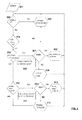
- Figure 3 describes the method for managing the traction and/or braking of the motors 1 and 2 by means of the electronic regulator 3.
- the numbers in brackets identify the relative blocks of the flowchart in fig. 3 .
- the delivered force measured by the loading cell is checked (304): if it is equal to zero, only the battery recharging is enabled, as in the previous case (303).
- the vehicle is either towing or braking.
- the accelerator pedal requires torque (306). If the vehicle ASR system (307) intervenes, the activation of the motor is excluded (308), in order to avoid wheel slipping.
- the electronic regulator 3 determines the delivery of the traction torque (309) by the motors 1 and 2, as described in the following.
- the vehicle is braking (force > 0): then the pressure on the brake pedal is checked. If it is pressed, braking torque is required by the brake and/or the retarder of the vehicle (311), and the intervention of the vehicle system ABS is checked (312). If it is intervening, the activation of the motors as braking torque is excluded (313), in order to avoid the wheel blocking.
- the electronic regulator 3 determines the delivery of braking torque by the motors 1 and 2 (314), as described in the following.
- the electronic regulator 3 calculates the traction or braking torque that has to be generated independently by each one of the motors 1 and 2, as a function of the percentage of traction or thrust force applied to the loading cell, and of the available energy from the batteries and from the supercapacitors, so that the performance of towing vehicle and towed element as a whole is potentially equivalent to, or at least approximate to, the performance of the vehicle without the towed element, so that said traction or thrust force are thus minimized.
- the method for managing the energy state of the traction batteries is described, such method being actuated by means of the electronic regulator 3, which includes a circuit controlling the charging level, which uses an already available circuit measuring the charging level.
- the circuit controlling the charging level is in standby mode (403), therefore only the charging state of the batteries is checked (404): if they are charged, no further operation is performed, otherwise the battery recharging is activated (407) by means of the external outlet 6, assuming that the solar panels 5 are always connected and able to provide charging energy.
- the circuit controlling the charging level is activated (405).
- a procedure controlling the charging level of the batteries is actuated with reference to a number of thresholds of charging percentage, in order to determine the percentage of the power supplied by the batteries with respect to the value required for generating the torque required to the motors.
- the charging level is between 30% and 60% (410), batteries are allowed to deliver a percentage of the available energy, for example 50% (412).
- state A batteries are disabled and the motors are not power supplied (417), enabling the recharging of the batteries (416).
- the transition between state A and B may occur (415, 418).
- the situation in which the motors 1 and 2 are deactivated for a long time may also occur, if the charging status of the batteries remains under 10%: in this case it may be necessary a stop of the vehicle for charging the batteries by external outlet or solar panels.
- the pressure on the brake pedal is checked (420): if the brake pedal is pressed, the delivery of braking torque is enabled according to the request (421), and the batteries are recharged by means of the motors 1 and 2 functioning as electrical generators (422).
Landscapes
- Engineering & Computer Science (AREA)
- Transportation (AREA)
- Mechanical Engineering (AREA)
- Life Sciences & Earth Sciences (AREA)
- Sustainable Development (AREA)
- Sustainable Energy (AREA)
- Power Engineering (AREA)
- Chemical & Material Sciences (AREA)
- Combustion & Propulsion (AREA)
- Electric Propulsion And Braking For Vehicles (AREA)
Abstract
Description
- The present invention relates to the field of auxiliary traction systems for vehicles, and more in particular to a vehicle trailer equipped with an additional traction system, and a vehicle with said trailer, and a method for managing the additional traction system.
- In the scope of the present invention the term trailer refers to any kind of towed element, such as a trailer or a semi-trailer provided with at least one axle with wheels equipped with tyres, towed by a motor vehicle such as an automobile, an industrial or commercial vehicle.
- At present a towed element is a passive element which does not contribute to the motion changes of the towing vehicle.
- Such towed element worsens the performance of the towing vehicle, the fuel consumption, the wear of the traction elements (engine and transmission) and of the braking elements (brakes, decelerators) as well as of the tyres which are forced to discharge more energy to the ground.
- Therefore the aim of the present invention is to overcome the drawbacks mentioned above and to provide a vehicle trailer equipped with its own additional traction system which actively contributes to the motion variations of towing vehicle and towed element as a whole, so that the whole system has the same performance as the vehicle without the towed element.
- The object of the present invention is, according to
claim 1, a motor vehicle with trailer comprising an additional traction system comprising: electric motors applied to the wheels of at least one axle of the trailer; at least a CAN vehicle data line; at least a loading cell suitable to measure the tractive or the thrust force exerted on the trailer by the vehicle; at least a group of traction batteries; an electronic regulator suitable to regulate the charge of said group of traction batteries and the power they supply and suitable to regulate the power supply to said motors; said electronic regulator receiving control signals from said vehicle data line and from said loading cell, and comprising means for controlling the independent activation of the motors providing traction or braking torque in order to minimize said tractive or thrust force, so that the vehicle's performance would be approximately the same as in the case wherein the trailer is absent, in case of traction torque by regulating the power supplied to said motors by at least said batteries, in case of braking torque by regulating the recharging of said batteries by means of said motors. - A further object of the present invention, according to
claim 5, is a method for managing the traction and/or braking of the electric engines applied to the wheels of at least one axle of the trailer, in a vehicle or trailer according toclaim 1, comprising a sequence of steps for: - controlling the independent activation of the motors providing traction torque or braking torque in order to minimize said tractive or thrust force so that the vehicle's performance would be approximately the same as in the case wherein the trailer is absent;
- control the management of the energy state of the batteries, in case of traction torque, by regulating the power supply to said motors from at least said batteries; in case of braking torque, by regulating the power supply of said braking torque and the recharging of said batteries by means of said motors.
- The object of this invention is in particular a trailer of a vehicle equipped with said additional traction system, a vehicle with said trailer, and a method for managing the additional traction system as described more fully in the claims, which are an integral part of this description.
- Further purposes and advantages of the present invention will become clear from the following detailed description of a preferred embodiment (and its alternative embodiments) and the drawings that are attached hereto, which are merely illustrative and non-limitative, in which:
-
figure 1 and2 show block diagrams of two alternative embodiments of the additional traction system that is object of the present invention; -
figures 3 and4 show flowcharts of the operations performed respectively by the method for managing the traction and/or braking of the motors of the traction system, and the method for managing the energy state of the traction batteries. - In the drawings the same reference numbers and letters identify the same elements or components.
- With reference to
figures 1 and2 , the trailer is equipped with at least one axle whose normal wheels are replaced by the so-called "wheel motors" 1 and 2, of the type known in the art, for example of the type already available and used in a lot of electric and hybrid applications in the motor vehicle field. Usually there is a pair of wheel motors, symmetrically applied on the two sides of the axle. - In the following there is the description of an embodiment wherein one single axle is equipped with wheel motors, but it is evident that the present invention may equivalently be applied in case of a trailer equipped with two or more driving axles.
- The wheel motor is formed by a wheel onto which an electric motor is keyed, the electric motor being of a three phase brushless outrunner type, characterized by a high efficiency, since it coverts the electric energy with very low losses.
- The brushless outrunner electric motor (in the following called motor) is of the type with external rotor, whose larger diameter allows the development of more torque, since it is equipped with a lot of external magnets with a large number of poles. It can develop a maximum torque of even 50 kw/h, already available at very low rpm, and it may function both as a motor and as an electrical generator recovering braking energy.
- The control of the
engine electronic regulator 3, which regulates rpm and torque in an independent way, substantially regulating the power supplied by a group of high-tension traction batteries 4, by means ofinverters - The
electronic regulator 3 regulates also the charging of the group of batteries, which may advantageously be charged by means of one or moresolar panels 5, for example placed on the roof of the trailer, or it may be charged by an external power supply by means of an appropriate connector 6. - The group of
traction batteries 4 may for example be advantageously realized by means of the LiFeP04 technology (lithium-iron phosphate) of the type known in the art, which provides a high power density, high safety, long life, and high power capacity. Such batteries are able to supply current also with very low charging levels (even < 10%) . - Preferably one or more supercapacitors or groups of
supercapacitors - During the passive phases or while braking they are rapidly charged, by means of the
batteries 4 and/or of themotors electronic regulator 3 has also the function to manage the charging and discharging of the supercapacitors. - More in particular, the alternative embodiment of
figure 1 shows a group of supercapacitors connected in parallel with each motor (9, 10), while the alternative embodiment offigure 2 shows one single group ofsupercapacitors 11. - The
solar panels 5 may be constantly connected to the batteries and contribute to their recharging both when the vehicle is stationary and when it is moving. The technology of the solar panel photovoltaic cells may be that of monocrystalline or polycrystalline silicon with a thin, light or flexible panel. - The trailer is usually connected to the towing vehicle by means of a mechanical joint in which a device of the type known called
loading cell 12 is advantageously inserted, suitable to control and measure the towing or braking force exerted on the trailer by the towing vehicle, according to both the direction and the sense of the force, with a vector processing on the horizontal travelling plane. - The loading cell is used to modulate the traction or braking contribution during the phases of acceleration, constant speed, deceleration, vehicle movement on a uphill, flat or downhill ground. By means of the measurement of the force exerted on the mechanical joint, the
electronic regulator 3 is able to determine the traction or braking torque required to each one or the twomotors - The
electronic regulator 3, by means of the CAN vehicle line, receives also data about vehicle braking or acceleration, for example activation of the accelerator and braking pedal, intervention of ABS or ASR or hydraulic retarder known in the art, and it uses also these data for controlling themotors -
Figure 3 describes the method for managing the traction and/or braking of themotors electronic regulator 3. The numbers in brackets identify the relative blocks of the flowchart infig. 3 . - At the beginning (301) the vehicle's speed is checked: if the vehicle is stationary (302, speed = 0), the only action allowed is battery recharging (303), by means of the
solar panels 5, and/or the external outlet. - If the vehicle's speed is different than zero, the delivered force measured by the loading cell is checked (304): if it is equal to zero, only the battery recharging is enabled, as in the previous case (303).
- If the delivered force measured by the loading cell is different than zero, than the vehicle is either towing or braking.
- If the vehicle is towing (305, delivered force measured by cell < 0), the accelerator pedal requires torque (306). If the vehicle ASR system (307) intervenes, the activation of the motor is excluded (308), in order to avoid wheel slipping.
- If the ASR system is not intervening, the
electronic regulator 3 determines the delivery of the traction torque (309) by themotors - If, on the contrary, the delivered force measured by the cell is higher than zero (305), the vehicle is braking (force > 0): then the pressure on the brake pedal is checked. If it is pressed, braking torque is required by the brake and/or the retarder of the vehicle (311), and the intervention of the vehicle system ABS is checked (312). If it is intervening, the activation of the motors as braking torque is excluded (313), in order to avoid the wheel blocking.
- On the contrary, if the ABS system is not intervening, the
electronic regulator 3 determines the delivery of braking torque by themotors 1 and 2 (314), as described in the following. - The
electronic regulator 3 calculates the traction or braking torque that has to be generated independently by each one of themotors - By independently controlling the motors, it is possible to obtain also a stability control of the vehicle, as described above.
- With reference to
figure 4 , the method for managing the energy state of the traction batteries is described, such method being actuated by means of theelectronic regulator 3, which includes a circuit controlling the charging level, which uses an already available circuit measuring the charging level. - The numbers in brackets identify the relative blocks of the flowchart in
fig. 4 . - At the beginning (401), if the vehicle is stationary (402, parked vehicle), the circuit controlling the charging level is in standby mode (403), therefore only the charging state of the batteries is checked (404): if they are charged, no further operation is performed, otherwise the battery recharging is activated (407) by means of the external outlet 6, assuming that the
solar panels 5 are always connected and able to provide charging energy. - If the vehicle is moving (406), the circuit controlling the charging level is activated (405).
- If a traction condition is detected at the loading cell and a determined traction torque is required to the
motors 1 and 2 (408), a procedure controlling the charging level of the batteries is actuated with reference to a number of thresholds of charging percentage, in order to determine the percentage of the power supplied by the batteries with respect to the value required for generating the torque required to the motors. - In the non limitative example described below, three percentages of battery charging level are taken as a reference, respectively high (60%), medium (30%) and low (10%).
- If the charging level is higher than 30% (409), and if it also higher than 60% (410), batteries are allowed to deliver the maximum of the available energy (411).
- If the charging level is between 30% and 60% (410), batteries are allowed to deliver a percentage of the available energy, for example 50% (412).
- If the charging level is lower than 30% (409), and between 30% and 10% (state B), batteries are allowed to deliver a lower percentage of the available energy, for example 25% (414).
- If the charging level is lower than 10% (state A), batteries are disabled and the motors are not power supplied (417), enabling the recharging of the batteries (416). The transition between state A and B may occur (415, 418). The situation in which the
motors - If a thrust condition is detected at the loading cell and braking torque is required to the
motors 1 and 2 (419), then the pressure on the brake pedal is checked (420): if the brake pedal is pressed, the delivery of braking torque is enabled according to the request (421), and the batteries are recharged by means of themotors - On the contrary, if there is no action on the brake pedal (420), the pressure on the accelerator pedal is checked (423): this control is necessary to verify the uphill travelling condition of the vehicle.
- If the accelerator pedal is released, the vehicle is not travelling on a uphill ground: therefore the procedure goes back to the previous situation which enables the delivery of braking torque if required (421).
- If, on the contrary, the accelerator pedal is not released, the vehicle is travelling on a uphill ground: therefore the control goes back to the initial condition (401).
- The methods described above for managing of the traction and/or braking of the
motors electronic regulator 3, which comprises program code means performing one or more steps of said method, when said program is run on a computer. For this reason the scope of the present patent is meant to cover also said computer program and the computer-readable means that comprises a recorded message, such computer-readable means comprising the program code means for performing one or more steps of such method, when such program is run on a computer. - It will be apparent to the person skilled in the art that other alternative and equivalent embodiments of the invention can be conceived and reduced to practice without departing from the scope of the invention.
- The advantages deriving from the use of this invention are evident.
- The main advantages or the system with respect to the conventional coupling tractor-trailer are the following:
- the use of wheel motors optimizes the ratio between performance improvement and increase of towed, weight, since they are not heavy, have a high efficiency, and do not need further mechanical devices for the transmission of the motion;
- optimal control strategy actuated with redundancy, using both the signals available on the CAN line and the signals generated by the loading cell.
- Lower fuel consumption.
- Improved performance,
- More torque and power to counter the additional weight,
- Higher stability of the system.
- Higher braking power and smaller stop distance.
- From the description set forth above it will be possible for the person skilled in the art to embody the invention with no need of describing further construction details.
Claims (11)
- Motor vehicle with trailer comprising an additional traction system comprising:- electric motors (1, 2) applied to the wheels of at least one axle of the trailer;- at least a vehicle data line (CAN);- at least one loading cell (12) suitable for measuring the traction or thrust force exerted on the trailer by the vehicle;- at least a group of traction batteries (4);- an electronic regulator (3) suitable for regulating the charging and the power supply of said group of traction batteries (4) and suitable for regulating the power supply to said motors;- said electronic regulator (3) receiving control signals from said vehicle data line (CAN) and from said loading cell (12), and comprising means for controlling the independent activation of the motors to provide traction torque or braking torque in order to minimize said traction or thrust force to approximate the performance of the vehicle to the situation wherein the trailer is absent, in the case of traction torque by regulating the power supply to said motors by at least said batteries, in the case of braking torque by regulating the recharging of said batteries by means of said motors.
- Motor vehicle with trailer as in claim 1, further comprising:- one or more solar panels (5) suitable to provide electric charging to said batteries (4), being controlled by said electronic regulator (3);- one or more supercapacitors (9, 10, 11) suitable to provide an additional source of energy to the motors, being controlled by said electronic regulator (3).
- Motor vehicle with trailer as in claim 1, wherein said vehicle data line (CAN) provides to said electronic regulator (3) data regarding at least the vehicle braking or acceleration, the activation of brake or accelerator pedal, the intervention of ABS or ASR or hydraulic retarder.
- Trailer of vehicle comprising said electric motors (1, 2) applied to the wheels of at least one axle of the trailer, at least part of said vehicle data line (CAN), and one or more of said: group of traction batteries (4), loading cell (12), electronic regulator (3), solar panels (5), supercapacitors (9, 10, 11) as in the previous claims.
- Method for managing the traction and/or braking of the electric engines (1, 2) applied to the wheels of at least one axle of the trailer, in a vehicle or trailer according to any of the previous claims, comprising a sequence of steps for:- controlling the independent activation of the motors providing traction torque or braking torque in order to minimize said tractive or thrust force to approximate the performance of the vehicle to the situation wherein the trailer is absent;- controlling the management of the energy state of the batteries, in case of traction torque, by regulating the power supply to said motors from at least said batteries; in case of braking torque, by regulating the power supply of said braking torque and the recharging of said batteries by means of said motors.
- Method as in claim 5, wherein said sequence of steps for controlling the independent activation of the motors comprises:- checking of the vehicle's speed, and/or of the force delivered and measured by the loading cell: if it is equal to zero allowing only the recharging of said group of traction batteries (4);- if the force delivered and measured by the loading cell is different than zero, and if it is tractive, it determines the activation of said motors to provide said traction torque, only if there is not intervention of said ASR device;- if the force delivered and measured by the loading cell is different than zero, and if it is a thrust force, it determines the activation of said motors to provide said braking torque, only if there is not intervention of said ABS device.
- Method as in claim 5, wherein said sequence of steps for controlling the management of the energy state of the batteries comprises, in case of traction torque, a control of the charging level of the batteries referred to a number of thresholds of charging percentage, in order to determine the percentage of the power supplied by the batteries with respect to the value required for generating the torque required to the motors.
- Method as in claim 7, wherein in case of three thresholds of charging percentage:- if the charging level of the batteries is higher than a high threshold (60%), the percentage of energy delivered by the batteries is maximum (100%);- if the charging level of the batteries is between a medium threshold (300) and said high threshold (60%), the percentage of energy delivered by the batteries is a first percentage (50%) of said maximum percentage;- if the charging level of the batteries is between said medium threshold (30%) and a low threshold (10%), the percentage of energy delivered by the batteries is a second percentage (25%) of said maximum percentage, lower than said first threshold;- if the charging level of the batteries is lower than said low threshold (10%), no energy is delivered by the batteries.
- Method as in claim 5, wherein said sequence of steps for controlling the management of the energy status of the batteries, in case of braking torque,
it comprises the checking of the activation of brake and accelerator, such that, if the brake is activated or is the accelerator is released, it regulates the delivery of said braking torque and the recharging of said batteries by means of said motors. - Computer program comprising program code means suitable for performing the steps of any claim from 5 to 9, when such program is run on a computer.
- Computer-readable means comprising a recorded program, said computer-readable means comprising program code means suitable for performing the steps according to the claims from 5 to 9, when said program is run on a computer.
Priority Applications (1)
| Application Number | Priority Date | Filing Date | Title |
|---|---|---|---|
| EP10425195.4A EP2394890B1 (en) | 2010-06-10 | 2010-06-10 | Vehicle trailer equipped with an additional traction system, vehicle with said trailer, and method for managing the additional traction system |
Applications Claiming Priority (1)
| Application Number | Priority Date | Filing Date | Title |
|---|---|---|---|
| EP10425195.4A EP2394890B1 (en) | 2010-06-10 | 2010-06-10 | Vehicle trailer equipped with an additional traction system, vehicle with said trailer, and method for managing the additional traction system |
Publications (2)
| Publication Number | Publication Date |
|---|---|
| EP2394890A1 true EP2394890A1 (en) | 2011-12-14 |
| EP2394890B1 EP2394890B1 (en) | 2018-05-30 |
Family
ID=42938414
Family Applications (1)
| Application Number | Title | Priority Date | Filing Date |
|---|---|---|---|
| EP10425195.4A Not-in-force EP2394890B1 (en) | 2010-06-10 | 2010-06-10 | Vehicle trailer equipped with an additional traction system, vehicle with said trailer, and method for managing the additional traction system |
Country Status (1)
| Country | Link |
|---|---|
| EP (1) | EP2394890B1 (en) |
Cited By (15)
| Publication number | Priority date | Publication date | Assignee | Title |
|---|---|---|---|---|
| CN104553743A (en) * | 2013-10-29 | 2015-04-29 | 迪尔公司 | Slip-responsive vehicle drive system |
| DE102016123350A1 (en) * | 2016-12-02 | 2018-06-07 | Saf-Holland Gmbh | Semitrailer, semitrailer and method for braking a semitrailer |
| GB2566494A (en) * | 2017-09-15 | 2019-03-20 | Jaguar Land Rover Ltd | System and method for a trailer towable by a vehicle |
| WO2020048725A1 (en) | 2018-09-03 | 2020-03-12 | Wabco Gmbh | Trailer brake control device, method and software for same, and trailer vehicle comprising same |
| US10670479B2 (en) | 2018-02-27 | 2020-06-02 | Methode Electronics, Inc. | Towing systems and methods using magnetic field sensing |
| US10696109B2 (en) | 2017-03-22 | 2020-06-30 | Methode Electronics Malta Ltd. | Magnetolastic based sensor assembly |
| FR3092811A1 (en) | 2019-02-18 | 2020-08-21 | Lohr Industrie | METHOD AND SYSTEM FOR DRIVING AN ELECTRIC AXLE OF A TRAILER OR SEMI-TRAILER |
| US11084342B2 (en) | 2018-02-27 | 2021-08-10 | Methode Electronics, Inc. | Towing systems and methods using magnetic field sensing |
| US11135882B2 (en) | 2018-02-27 | 2021-10-05 | Methode Electronics, Inc. | Towing systems and methods using magnetic field sensing |
| US11221262B2 (en) | 2018-02-27 | 2022-01-11 | Methode Electronics, Inc. | Towing systems and methods using magnetic field sensing |
| CN114379383A (en) * | 2020-10-22 | 2022-04-22 | 通用汽车环球科技运作有限责任公司 | Battery electric vehicle auxiliary traction |
| US11491832B2 (en) | 2018-02-27 | 2022-11-08 | Methode Electronics, Inc. | Towing systems and methods using magnetic field sensing |
| CN115339325A (en) * | 2021-05-12 | 2022-11-15 | 瑞维安知识产权控股有限责任公司 | System and method for free wheel traction |
| WO2024104589A1 (en) * | 2022-11-17 | 2024-05-23 | Volvo Truck Corporation | Power allocation in relation to a power demand for multi-unit vehicle combinations |
| EP3906177B1 (en) * | 2019-01-02 | 2024-10-09 | ZF CV Systems Europe BV | Trailer and brake control device for trailer and method and computer program product therefor |
Families Citing this family (4)
| Publication number | Priority date | Publication date | Assignee | Title |
|---|---|---|---|---|
| DE102021133760A1 (en) | 2021-12-17 | 2023-06-22 | Zf Cv Systems Global Gmbh | Method and device for drive control of a vehicle train |
| DE102022100252A1 (en) | 2022-01-06 | 2023-07-06 | Zf Cv Systems Global Gmbh | Method for controlling an electric drive of a vehicle and system and combination for carrying out the method |
| DE102023121759A1 (en) * | 2023-08-15 | 2025-02-20 | Zf Cv Systems Global Gmbh | Controlling a trailer with an electric drive unit |
| DE102024200360A1 (en) * | 2024-01-16 | 2025-01-23 | Zf Friedrichshafen Ag | Method and control device for controlling a vehicle trailer |
Citations (2)
| Publication number | Priority date | Publication date | Assignee | Title |
|---|---|---|---|---|
| DE10131935A1 (en) * | 2000-07-19 | 2002-03-07 | Meritor Heavy Vehicle Sys Ltd | Distributes drive system for semitrailer truck has second drive system, which is controlled in dependence on load signal and request signal |
| EP1234739A2 (en) * | 2000-09-28 | 2002-08-28 | Ford Global Technologies, Inc. | A system and method for braking a towed vehicle |
-
2010
- 2010-06-10 EP EP10425195.4A patent/EP2394890B1/en not_active Not-in-force
Patent Citations (2)
| Publication number | Priority date | Publication date | Assignee | Title |
|---|---|---|---|---|
| DE10131935A1 (en) * | 2000-07-19 | 2002-03-07 | Meritor Heavy Vehicle Sys Ltd | Distributes drive system for semitrailer truck has second drive system, which is controlled in dependence on load signal and request signal |
| EP1234739A2 (en) * | 2000-09-28 | 2002-08-28 | Ford Global Technologies, Inc. | A system and method for braking a towed vehicle |
Cited By (22)
| Publication number | Priority date | Publication date | Assignee | Title |
|---|---|---|---|---|
| EP2868518A3 (en) * | 2013-10-29 | 2015-08-19 | Deere & Company | Slip-responsive vehicle drive system |
| CN104553743B (en) * | 2013-10-29 | 2018-11-09 | 迪尔公司 | Trackslip response type vehicle drive system |
| CN104553743A (en) * | 2013-10-29 | 2015-04-29 | 迪尔公司 | Slip-responsive vehicle drive system |
| DE102016123350A1 (en) * | 2016-12-02 | 2018-06-07 | Saf-Holland Gmbh | Semitrailer, semitrailer and method for braking a semitrailer |
| US11453292B2 (en) | 2016-12-02 | 2022-09-27 | Saf-Holland Gmbh | Semi-trailer, semi-trailer truck and method for braking a semi-trailer |
| DE102016123350B4 (en) | 2016-12-02 | 2019-06-19 | Saf-Holland Gmbh | Semitrailer, semitrailer and method for braking a semitrailer |
| US10696109B2 (en) | 2017-03-22 | 2020-06-30 | Methode Electronics Malta Ltd. | Magnetolastic based sensor assembly |
| US10940726B2 (en) | 2017-03-22 | 2021-03-09 | Methode Electronics Malta Ltd. | Magnetoelastic based sensor assembly |
| GB2566494A (en) * | 2017-09-15 | 2019-03-20 | Jaguar Land Rover Ltd | System and method for a trailer towable by a vehicle |
| US10670479B2 (en) | 2018-02-27 | 2020-06-02 | Methode Electronics, Inc. | Towing systems and methods using magnetic field sensing |
| US11084342B2 (en) | 2018-02-27 | 2021-08-10 | Methode Electronics, Inc. | Towing systems and methods using magnetic field sensing |
| US11135882B2 (en) | 2018-02-27 | 2021-10-05 | Methode Electronics, Inc. | Towing systems and methods using magnetic field sensing |
| US11221262B2 (en) | 2018-02-27 | 2022-01-11 | Methode Electronics, Inc. | Towing systems and methods using magnetic field sensing |
| US11491832B2 (en) | 2018-02-27 | 2022-11-08 | Methode Electronics, Inc. | Towing systems and methods using magnetic field sensing |
| WO2020048725A1 (en) | 2018-09-03 | 2020-03-12 | Wabco Gmbh | Trailer brake control device, method and software for same, and trailer vehicle comprising same |
| EP3906177B1 (en) * | 2019-01-02 | 2024-10-09 | ZF CV Systems Europe BV | Trailer and brake control device for trailer and method and computer program product therefor |
| WO2020169919A1 (en) | 2019-02-18 | 2020-08-27 | Lohr Industrie | Method and system for steering an electric axle of a trailer or semitrailer |
| FR3092811A1 (en) | 2019-02-18 | 2020-08-21 | Lohr Industrie | METHOD AND SYSTEM FOR DRIVING AN ELECTRIC AXLE OF A TRAILER OR SEMI-TRAILER |
| CN114379383A (en) * | 2020-10-22 | 2022-04-22 | 通用汽车环球科技运作有限责任公司 | Battery electric vehicle auxiliary traction |
| CN114379383B (en) * | 2020-10-22 | 2023-09-15 | 通用汽车环球科技运作有限责任公司 | Battery electric vehicle assisted traction |
| CN115339325A (en) * | 2021-05-12 | 2022-11-15 | 瑞维安知识产权控股有限责任公司 | System and method for free wheel traction |
| WO2024104589A1 (en) * | 2022-11-17 | 2024-05-23 | Volvo Truck Corporation | Power allocation in relation to a power demand for multi-unit vehicle combinations |
Also Published As
| Publication number | Publication date |
|---|---|
| EP2394890B1 (en) | 2018-05-30 |
Similar Documents
| Publication | Publication Date | Title |
|---|---|---|
| EP2394890B1 (en) | Vehicle trailer equipped with an additional traction system, vehicle with said trailer, and method for managing the additional traction system | |
| EP2394889B1 (en) | Vehicle trailer equipped with an additional traction system, vehicle with said trailer, and method for managing the additional traction system | |
| US8712616B2 (en) | Regenerative braking control to mitigate powertrain oscillation | |
| KR102371248B1 (en) | Method for controlling e-4wd hybrid vehicle | |
| US9156358B2 (en) | Regenerative braking in the presence of an antilock braking system control event | |
| US10112613B2 (en) | Systems and methods for managing torque | |
| CN114248770A (en) | Uphill vehicle start in single-pedal driving mode | |
| US12116059B2 (en) | Trailer vehicle and trailer brake controller, and method and computer program product therefor | |
| US8311693B2 (en) | Energy management for hybrid electric vehicle during trailer sway | |
| EP2639098B1 (en) | Control apparatus for preventing rolling back of electrically driven vehicle upon start-up thereof | |
| US7441845B2 (en) | Method for operating multiple axle regenerative braking in an automotive vehicle | |
| KR102590731B1 (en) | Apparatus and method for failsafe in electric corner module system | |
| KR101714238B1 (en) | Braking control method for eco-friendly vehicle | |
| KR102585749B1 (en) | System and method for managing battery of eco-friendly vehicle and trailer connected thereto | |
| JP4998036B2 (en) | Vehicle control device | |
| US20230364999A1 (en) | Methods and system for controlling regenerative torque | |
| CN118991443A (en) | Vehicle braking energy recovery method, braking energy recovery system and vehicle | |
| JP5803594B2 (en) | Output characteristic control method | |
| JP2011229211A (en) | Regenerative controller | |
| JP6365067B2 (en) | Control device for electric four-wheel drive vehicle | |
| JP2017038470A (en) | Electric automobile brake control apparatus | |
| JP2001359202A (en) | Device for controlling braking of hybrid vehicle | |
| JP2013158200A (en) | Passive torque split four-wheel-drive vehicle | |
| KR20130127769A (en) | Unific linkage controll system of electric vehicle with mcu | |
| US12491776B2 (en) | Methods and system for balancing torque request during battery power control |
Legal Events
| Date | Code | Title | Description |
|---|---|---|---|
| AK | Designated contracting states |
Kind code of ref document: A1 Designated state(s): AL AT BE BG CH CY CZ DE DK EE ES FI FR GB GR HR HU IE IS IT LI LT LU LV MC MK MT NL NO PL PT RO SE SI SK SM TR |
|
| AX | Request for extension of the european patent |
Extension state: BA ME RS |
|
| PUAI | Public reference made under article 153(3) epc to a published international application that has entered the european phase |
Free format text: ORIGINAL CODE: 0009012 |
|
| 17P | Request for examination filed |
Effective date: 20120613 |
|
| GRAP | Despatch of communication of intention to grant a patent |
Free format text: ORIGINAL CODE: EPIDOSNIGR1 |
|
| INTG | Intention to grant announced |
Effective date: 20171207 |
|
| GRAS | Grant fee paid |
Free format text: ORIGINAL CODE: EPIDOSNIGR3 |
|
| GRAA | (expected) grant |
Free format text: ORIGINAL CODE: 0009210 |
|
| AK | Designated contracting states |
Kind code of ref document: B1 Designated state(s): AL AT BE BG CH CY CZ DE DK EE ES FI FR GB GR HR HU IE IS IT LI LT LU LV MC MK MT NL NO PL PT RO SE SI SK SM TR |
|
| REG | Reference to a national code |
Ref country code: GB Ref legal event code: FG4D |
|
| REG | Reference to a national code |
Ref country code: CH Ref legal event code: EP |
|
| REG | Reference to a national code |
Ref country code: AT Ref legal event code: REF Ref document number: 1003329 Country of ref document: AT Kind code of ref document: T Effective date: 20180615 |
|
| REG | Reference to a national code |
Ref country code: IE Ref legal event code: FG4D |
|
| REG | Reference to a national code |
Ref country code: DE Ref legal event code: R096 Ref document number: 602010050902 Country of ref document: DE |
|
| REG | Reference to a national code |
Ref country code: FR Ref legal event code: PLFP Year of fee payment: 9 |
|
| REG | Reference to a national code |
Ref country code: NL Ref legal event code: MP Effective date: 20180530 |
|
| REG | Reference to a national code |
Ref country code: LT Ref legal event code: MG4D |
|
| PG25 | Lapsed in a contracting state [announced via postgrant information from national office to epo] |
Ref country code: NO Free format text: LAPSE BECAUSE OF FAILURE TO SUBMIT A TRANSLATION OF THE DESCRIPTION OR TO PAY THE FEE WITHIN THE PRESCRIBED TIME-LIMIT Effective date: 20180830 Ref country code: FI Free format text: LAPSE BECAUSE OF FAILURE TO SUBMIT A TRANSLATION OF THE DESCRIPTION OR TO PAY THE FEE WITHIN THE PRESCRIBED TIME-LIMIT Effective date: 20180530 Ref country code: BG Free format text: LAPSE BECAUSE OF FAILURE TO SUBMIT A TRANSLATION OF THE DESCRIPTION OR TO PAY THE FEE WITHIN THE PRESCRIBED TIME-LIMIT Effective date: 20180830 Ref country code: SE Free format text: LAPSE BECAUSE OF FAILURE TO SUBMIT A TRANSLATION OF THE DESCRIPTION OR TO PAY THE FEE WITHIN THE PRESCRIBED TIME-LIMIT Effective date: 20180530 Ref country code: ES Free format text: LAPSE BECAUSE OF FAILURE TO SUBMIT A TRANSLATION OF THE DESCRIPTION OR TO PAY THE FEE WITHIN THE PRESCRIBED TIME-LIMIT Effective date: 20180530 Ref country code: LT Free format text: LAPSE BECAUSE OF FAILURE TO SUBMIT A TRANSLATION OF THE DESCRIPTION OR TO PAY THE FEE WITHIN THE PRESCRIBED TIME-LIMIT Effective date: 20180530 Ref country code: CY Free format text: LAPSE BECAUSE OF FAILURE TO SUBMIT A TRANSLATION OF THE DESCRIPTION OR TO PAY THE FEE WITHIN THE PRESCRIBED TIME-LIMIT Effective date: 20180530 |
|
| PGFP | Annual fee paid to national office [announced via postgrant information from national office to epo] |
Ref country code: IE Payment date: 20180911 Year of fee payment: 17 Ref country code: FR Payment date: 20180726 Year of fee payment: 9 |
|
| PG25 | Lapsed in a contracting state [announced via postgrant information from national office to epo] |
Ref country code: LV Free format text: LAPSE BECAUSE OF FAILURE TO SUBMIT A TRANSLATION OF THE DESCRIPTION OR TO PAY THE FEE WITHIN THE PRESCRIBED TIME-LIMIT Effective date: 20180530 Ref country code: GR Free format text: LAPSE BECAUSE OF FAILURE TO SUBMIT A TRANSLATION OF THE DESCRIPTION OR TO PAY THE FEE WITHIN THE PRESCRIBED TIME-LIMIT Effective date: 20180831 Ref country code: HR Free format text: LAPSE BECAUSE OF FAILURE TO SUBMIT A TRANSLATION OF THE DESCRIPTION OR TO PAY THE FEE WITHIN THE PRESCRIBED TIME-LIMIT Effective date: 20180530 |
|
| REG | Reference to a national code |
Ref country code: AT Ref legal event code: MK05 Ref document number: 1003329 Country of ref document: AT Kind code of ref document: T Effective date: 20180530 |
|
| PG25 | Lapsed in a contracting state [announced via postgrant information from national office to epo] |
Ref country code: NL Free format text: LAPSE BECAUSE OF FAILURE TO SUBMIT A TRANSLATION OF THE DESCRIPTION OR TO PAY THE FEE WITHIN THE PRESCRIBED TIME-LIMIT Effective date: 20180530 |
|
| PG25 | Lapsed in a contracting state [announced via postgrant information from national office to epo] |
Ref country code: DK Free format text: LAPSE BECAUSE OF FAILURE TO SUBMIT A TRANSLATION OF THE DESCRIPTION OR TO PAY THE FEE WITHIN THE PRESCRIBED TIME-LIMIT Effective date: 20180530 Ref country code: EE Free format text: LAPSE BECAUSE OF FAILURE TO SUBMIT A TRANSLATION OF THE DESCRIPTION OR TO PAY THE FEE WITHIN THE PRESCRIBED TIME-LIMIT Effective date: 20180530 Ref country code: AT Free format text: LAPSE BECAUSE OF FAILURE TO SUBMIT A TRANSLATION OF THE DESCRIPTION OR TO PAY THE FEE WITHIN THE PRESCRIBED TIME-LIMIT Effective date: 20180530 Ref country code: CZ Free format text: LAPSE BECAUSE OF FAILURE TO SUBMIT A TRANSLATION OF THE DESCRIPTION OR TO PAY THE FEE WITHIN THE PRESCRIBED TIME-LIMIT Effective date: 20180530 Ref country code: RO Free format text: LAPSE BECAUSE OF FAILURE TO SUBMIT A TRANSLATION OF THE DESCRIPTION OR TO PAY THE FEE WITHIN THE PRESCRIBED TIME-LIMIT Effective date: 20180530 Ref country code: SK Free format text: LAPSE BECAUSE OF FAILURE TO SUBMIT A TRANSLATION OF THE DESCRIPTION OR TO PAY THE FEE WITHIN THE PRESCRIBED TIME-LIMIT Effective date: 20180530 Ref country code: PL Free format text: LAPSE BECAUSE OF FAILURE TO SUBMIT A TRANSLATION OF THE DESCRIPTION OR TO PAY THE FEE WITHIN THE PRESCRIBED TIME-LIMIT Effective date: 20180530 |
|
| REG | Reference to a national code |
Ref country code: CH Ref legal event code: PK Free format text: RETTIFICHE Ref country code: CH Ref legal event code: PL |
|
| RIC2 | Information provided on ipc code assigned after grant |
Ipc: B60K 6/52 20071001ALI20101026BHEP Ipc: B62D 59/04 20060101AFI20101026BHEP |
|
| PG25 | Lapsed in a contracting state [announced via postgrant information from national office to epo] |
Ref country code: SM Free format text: LAPSE BECAUSE OF FAILURE TO SUBMIT A TRANSLATION OF THE DESCRIPTION OR TO PAY THE FEE WITHIN THE PRESCRIBED TIME-LIMIT Effective date: 20180530 |
|
| REG | Reference to a national code |
Ref country code: DE Ref legal event code: R097 Ref document number: 602010050902 Country of ref document: DE |
|
| REG | Reference to a national code |
Ref country code: BE Ref legal event code: MM Effective date: 20180630 |
|
| REG | Reference to a national code |
Ref country code: IE Ref legal event code: MM4A |
|
| PG25 | Lapsed in a contracting state [announced via postgrant information from national office to epo] |
Ref country code: LU Free format text: LAPSE BECAUSE OF NON-PAYMENT OF DUE FEES Effective date: 20180610 Ref country code: MC Free format text: LAPSE BECAUSE OF FAILURE TO SUBMIT A TRANSLATION OF THE DESCRIPTION OR TO PAY THE FEE WITHIN THE PRESCRIBED TIME-LIMIT Effective date: 20180530 |
|
| PLBE | No opposition filed within time limit |
Free format text: ORIGINAL CODE: 0009261 |
|
| STAA | Information on the status of an ep patent application or granted ep patent |
Free format text: STATUS: NO OPPOSITION FILED WITHIN TIME LIMIT |
|
| GBPC | Gb: european patent ceased through non-payment of renewal fee |
Effective date: 20180830 |
|
| PG25 | Lapsed in a contracting state [announced via postgrant information from national office to epo] |
Ref country code: CH Free format text: LAPSE BECAUSE OF NON-PAYMENT OF DUE FEES Effective date: 20180630 Ref country code: IE Free format text: LAPSE BECAUSE OF NON-PAYMENT OF DUE FEES Effective date: 20180610 Ref country code: LI Free format text: LAPSE BECAUSE OF NON-PAYMENT OF DUE FEES Effective date: 20180630 |
|
| 26N | No opposition filed |
Effective date: 20190301 |
|
| PG25 | Lapsed in a contracting state [announced via postgrant information from national office to epo] |
Ref country code: BE Free format text: LAPSE BECAUSE OF NON-PAYMENT OF DUE FEES Effective date: 20180630 Ref country code: SI Free format text: LAPSE BECAUSE OF FAILURE TO SUBMIT A TRANSLATION OF THE DESCRIPTION OR TO PAY THE FEE WITHIN THE PRESCRIBED TIME-LIMIT Effective date: 20180530 |
|
| PGFP | Annual fee paid to national office [announced via postgrant information from national office to epo] |
Ref country code: IT Payment date: 20190612 Year of fee payment: 10 |
|
| PG25 | Lapsed in a contracting state [announced via postgrant information from national office to epo] |
Ref country code: GB Free format text: LAPSE BECAUSE OF NON-PAYMENT OF DUE FEES Effective date: 20180830 |
|
| PG25 | Lapsed in a contracting state [announced via postgrant information from national office to epo] |
Ref country code: AL Free format text: LAPSE BECAUSE OF FAILURE TO SUBMIT A TRANSLATION OF THE DESCRIPTION OR TO PAY THE FEE WITHIN THE PRESCRIBED TIME-LIMIT Effective date: 20180530 |
|
| REG | Reference to a national code |
Ref country code: DE Ref legal event code: R119 Ref document number: 602010050902 Country of ref document: DE |
|
| PG25 | Lapsed in a contracting state [announced via postgrant information from national office to epo] |
Ref country code: MT Free format text: LAPSE BECAUSE OF NON-PAYMENT OF DUE FEES Effective date: 20180610 |
|
| PG25 | Lapsed in a contracting state [announced via postgrant information from national office to epo] |
Ref country code: TR Free format text: LAPSE BECAUSE OF FAILURE TO SUBMIT A TRANSLATION OF THE DESCRIPTION OR TO PAY THE FEE WITHIN THE PRESCRIBED TIME-LIMIT Effective date: 20180530 |
|
| PG25 | Lapsed in a contracting state [announced via postgrant information from national office to epo] |
Ref country code: DE Free format text: LAPSE BECAUSE OF NON-PAYMENT OF DUE FEES Effective date: 20200101 |
|
| PG25 | Lapsed in a contracting state [announced via postgrant information from national office to epo] |
Ref country code: PT Free format text: LAPSE BECAUSE OF FAILURE TO SUBMIT A TRANSLATION OF THE DESCRIPTION OR TO PAY THE FEE WITHIN THE PRESCRIBED TIME-LIMIT Effective date: 20180530 Ref country code: HU Free format text: LAPSE BECAUSE OF FAILURE TO SUBMIT A TRANSLATION OF THE DESCRIPTION OR TO PAY THE FEE WITHIN THE PRESCRIBED TIME-LIMIT; INVALID AB INITIO Effective date: 20100610 |
|
| PG25 | Lapsed in a contracting state [announced via postgrant information from national office to epo] |
Ref country code: FR Free format text: LAPSE BECAUSE OF NON-PAYMENT OF DUE FEES Effective date: 20190630 Ref country code: MK Free format text: LAPSE BECAUSE OF NON-PAYMENT OF DUE FEES Effective date: 20180530 |
|
| PG25 | Lapsed in a contracting state [announced via postgrant information from national office to epo] |
Ref country code: IS Free format text: LAPSE BECAUSE OF FAILURE TO SUBMIT A TRANSLATION OF THE DESCRIPTION OR TO PAY THE FEE WITHIN THE PRESCRIBED TIME-LIMIT Effective date: 20180930 |
|
| PG25 | Lapsed in a contracting state [announced via postgrant information from national office to epo] |
Ref country code: IT Free format text: LAPSE BECAUSE OF NON-PAYMENT OF DUE FEES Effective date: 20200610 |