EP2394833A1 - Outillage permettant le pivotement d'un pare-brise et procédé mettant en oeuvre un tel outillage - Google Patents
Outillage permettant le pivotement d'un pare-brise et procédé mettant en oeuvre un tel outillage Download PDFInfo
- Publication number
- EP2394833A1 EP2394833A1 EP11290262A EP11290262A EP2394833A1 EP 2394833 A1 EP2394833 A1 EP 2394833A1 EP 11290262 A EP11290262 A EP 11290262A EP 11290262 A EP11290262 A EP 11290262A EP 2394833 A1 EP2394833 A1 EP 2394833A1
- Authority
- EP
- European Patent Office
- Prior art keywords
- windshield
- vehicle
- tool
- pivoting
- secured
- Prior art date
- Legal status (The legal status is an assumption and is not a legal conclusion. Google has not performed a legal analysis and makes no representation as to the accuracy of the status listed.)
- Granted
Links
Images



Classifications
-
- F—MECHANICAL ENGINEERING; LIGHTING; HEATING; WEAPONS; BLASTING
- F41—WEAPONS
- F41H—ARMOUR; ARMOURED TURRETS; ARMOURED OR ARMED VEHICLES; MEANS OF ATTACK OR DEFENCE, e.g. CAMOUFLAGE, IN GENERAL
- F41H5/00—Armour; Armour plates
- F41H5/26—Peepholes; Windows; Loopholes
-
- B—PERFORMING OPERATIONS; TRANSPORTING
- B60—VEHICLES IN GENERAL
- B60J—WINDOWS, WINDSCREENS, NON-FIXED ROOFS, DOORS, OR SIMILAR DEVICES FOR VEHICLES; REMOVABLE EXTERNAL PROTECTIVE COVERINGS SPECIALLY ADAPTED FOR VEHICLES
- B60J1/00—Windows; Windscreens; Accessories therefor
- B60J1/004—Mounting of windows
- B60J1/005—Mounting of windows using positioning means during mounting
-
- B—PERFORMING OPERATIONS; TRANSPORTING
- B60—VEHICLES IN GENERAL
- B60J—WINDOWS, WINDSCREENS, NON-FIXED ROOFS, DOORS, OR SIMILAR DEVICES FOR VEHICLES; REMOVABLE EXTERNAL PROTECTIVE COVERINGS SPECIALLY ADAPTED FOR VEHICLES
- B60J1/00—Windows; Windscreens; Accessories therefor
- B60J1/004—Mounting of windows
- B60J1/007—Mounting of windows received in frames to be attached to vehicle
-
- F—MECHANICAL ENGINEERING; LIGHTING; HEATING; WEAPONS; BLASTING
- F41—WEAPONS
- F41H—ARMOUR; ARMOURED TURRETS; ARMOURED OR ARMED VEHICLES; MEANS OF ATTACK OR DEFENCE, e.g. CAMOUFLAGE, IN GENERAL
- F41H5/00—Armour; Armour plates
- F41H5/26—Peepholes; Windows; Loopholes
- F41H5/263—Mounting of transparent armoured panels, e.g. bulletproof windows on vehicles
Definitions
- the technical field of the invention is that of tools and methods for setting up and removing heavy windscreens on vehicles at the place of use of the vehicles and at the place of integration of the vehicles.
- Windshields being relatively fragile and cumbersome operation may require the use of several people and be difficult because of the lack of grip that offers a glass surface.
- the invention proposes to solve these various problems through a tool that is interfaced on the one hand on the windshield by rigid means and on the other hand on projecting elements of the vehicle as the mirrors.
- a method associated with the use of this tool allows to tilt the windshield or raise it in a controlled and safe manner by a single person through an actuator and a stop means.
- the invention thus advantageously makes it possible to easily maneuver a heavy windshield to leave it in the rotated position relative to the vehicle cabin.
- the tooling also makes it easier to disassemble the windshield in the absence of lifting means.
- Such disassembly will occur for example to mount the choice either a light windshield or a heavy windshield depending on the level of protection sought or simply to change a gradient windshield.
- the compactness of the tool allows to take it among the tools of edge of the vehicle and to be able to proceed to the operations of pivoting, installation or removal of the windshield in any place.
- the tool also allows the windshield to withstand transport requirements in lowered windshield mode such as for air transport.
- the invention relates to a tool allowing limited pivoting with respect to a vehicle of a heavy windshield by a single person, tooling characterized in that it comprises two amounts rigidly integral with the lateral edges of the windshield. breeze, each of the amounts being articulated by its lower end with a removable plate which is secured to the vehicle, the joints of the plates embodying a pivot axis of the windshield relative to the vehicle, at least a first amount being connected by an actuator to a means of removable interface which is attached to the vehicle near the top edge of the windshield, the actuator for controlling the pivoting of the windshield around the pivot axis and ensuring the maintenance of the windshield in a selected rotated position.
- a second upright is connected to a removable support secured to the vehicle near the top edge of the windshield by a rod which is sliding relative to this removable support and which cooperates with an abutment means integral with the vehicle and limiting the movement pivoting the windshield.
- the actuator comprises a screw secured to the interfacing means by a first pivot, the screw being engaged in a nut secured to the first upright by a second pivot.
- the screw is actuated in rotation by means of a crank.
- the sliding link is articulated with the second upright and comprises a light oriented in the direction of the length of the link, light in which circulates a retaining pin which is integral with the removable support.
- each amount comprises a stiffener.
- a military vehicle 100 having an armored cabin 103 has a shielded windshield 2 thick.
- This vehicle 100 carries a gun 104 which is likely to be positioned horizontally during air transport operations.
- the tube of the barrel 104 must then pass through the cabin through a passage 105 and it is necessary to allow this passage to tilt or pivot the windshield 2 to the front cover 106 of the cabin.
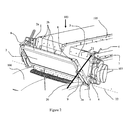
- the tool 1 secured to the vehicle 100 at the frame of each of the mirrors 101 and 102.
- the tool 1 comprises a screw 20 integral with a crank 4 and a stop means 3 securing the pivoting of the windshield as we will see in the following description.
- the windshield 2 is partially lowered towards the hood 106 of the vehicle 100. It is noted that the windshield 2 comprises a rectangular metal frame 2a which completely surrounds it and which ensures the maintenance of the glazed parts. This frame 2a is all around perimeter bores 2b for fixing by screwing the windshield 2 on the cabin 103.
- the tool 1 comprises a first upright 3 itself comprising a stiffener 3a.
- the first upright 1 is secured rigidly with an upper rim of the windshield (at the level of the frame 2a) by means of a screw 8 and it is positioned on the lateral rim of the frame 2a by means of lugs (not visible on the figure 2 , marked 19 on the figure 4 ).
- the first upright 3 and the stiffener 3a are articulated in their lower part by a pivot connection 5 with a removable plate 6. This removable plate 6 is secured to the lower part of the frame of the mirror 101.
- the tool 1 comprises a removable interface means 7 secured to the upper part of the frame of the mirror 101.
- the removable interface means 7 comprises a pivot connection for articulating with the screw 20 at the head of the latter formed by a crank 4.
- the screw 20 is hinged relative to the upright 3 and its stiffener through another pivot connection having a nut 9.
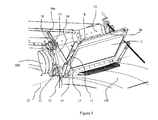
- the other end of the windshield 2 is rigidly secured to a second upright 10 by a screw 8 and lugs (pins not visible on the figure 4 , and spotted 19 on the figure 4 ).
- This second upright 10 comprises a second stiffener 11.
- the stiffener 11 and the upright 10 are articulated in their lower part with a second removable plate 12 thanks to a pivot connection 13.
- the second stiffener 11 comprises a pivot joint 15 with a rod 16.
- This rod 16 comprises a light 16a oriented in the direction of the length of the link 16.
- this light 16a circulates a retention pin 17 which is integral with a removable support 18.
- the rod 16 slides so relative to the removable support 18 and the retaining pin is a stop limiting the sliding of the link 16 and thereby the race of the windshield.
- the removable support 18 is secured to the upper part of the frame of the mirror 102.
- the joints of the plates materialize a pivot axis 22 of the windshield with respect to the vehicle.
- This axis 22 is positioned to allow maneuver windshield 2 without interference thereof with the cover 106.
- the skilled person will place the axis in the appropriate place such as for example for the present case where the axis 22 is placed horizontally in the vicinity of the hood 106 and in front of the windshield 2.
- the windshield stroke can be limited by placing a stop formed for example by a welded nut in the vicinity of the end of the screw 20 and which will limit the stroke of the nut 9 .
- the rotation of the crank 4 causes the displacement of the nut 9 along the screw 20.
- the pitch of the screw 2 is chosen small enough so that the weight of the windshield does not cause the rotation of the screw 2 thus allowing to keep the windshield in a position of intermediate pivoting allowing the passage of the tube of the weapon 104.
- the first part of the tool 1 comprising the screw 20 is assembled by means of the removable plate 6 and the removable interface means 7 on the bases of the mirror 101 (rear view mirror not visible on the figure).
- the studs 19 are engaged in orifices (not visible in the figure) arranged on the frame 2a of the windshield.
- the screw 8 is secured to the windshield 2.
- the second part of the tool 1 comprising the rod 16 is assembled by means of the removable plate 12 and the removable support 18 on the bases of the rearview mirror 102 (rearview mirror not visible in the figure).
- the studs 19 are engaged in orifices (not visible in the figure) of the frame 2a of the windshield 2.
- the screw 8 is secured to the windshield 2.
- the lengths of the screw 20 and the rod 16 are chosen so that it is possible to pivot the windshield 2 by a sufficient angle to allow the passage of the weapon tube 104 (visible on the figure 1 ) in a substantially horizontal position.
- the windshield 2 is then substantially in contact with the hood 106.
- the lumen 16 must have a length at least equal to the length of the thread traversed by the pivot nut 9 on the screw 20.
- attachment of the device 1 on the vehicle can be achieved by means of permanent arrangements on the vehicle for example by means of threaded bosses that can accommodate the removable plates 6 and 12 and the removable support 18 and the means of removable interface 7.
- the windshield 2 Once the windshield 2 is fully lowered, it can proceed to the disassembly of the tool 1 to be able to remove the windshield 2.
- the mounting of the windshield 2 of course involves reverse operations to those described above.
- the actuator may include a double-acting cylinder equipped with non-return valves to maintain the position of the windshield during the shutdown of the actuator.
- the stroke of the cylinder must be sufficient to allow the windshield to occupy all possible positions, from the position in support on the hood 106 to the setting in position on the cabin 103.
Landscapes
- Engineering & Computer Science (AREA)
- General Engineering & Computer Science (AREA)
- Mechanical Engineering (AREA)
- Automobile Manufacture Line, Endless Track Vehicle, Trailer (AREA)
- Body Structure For Vehicles (AREA)
Abstract
Description
- Le domaine technique de l'invention est celui des outillages et des procédés de mise en place et de retrait des pare-brise lourds sur des véhicules sur le lieu d'utilisation des véhicules et sur le lieu d'intégration des véhicules.
- La mise en place et le retrait d'un pare-brise est une opération délicate. L'opération est d'autant plus difficile qu'elle se déroule "hors atelier" où les moyens de levages classiques type pont roulant et palans sont absents. Les pare-brise étant relativement fragiles et encombrants l'opération peut nécessiter l'emploi de plusieurs personnes et se révéler malaisée du fait du peu de prise qu'offre une surface vitrée.
- Il est connu suivant le brevet
US-7610666 d'effectuer, sur le terrain, une opération de pose ou de dépose d'un pare-brise par une seule personne au moyen d'un outillage comportant des ventouses appliquées sur le pare-brise. Ces ventouses étant solidaires d'un bras articulé autour d'un support. Ce support étant lui-même solidaire d'une autre surface vitrée du véhicule au moyen d'autres ventouses. Une fois les ventouses appliquées, le pare-brise est désolidarisé du véhicule et l'on opère une rotation du bras pour amener le pare-brise dans une zone de dépose. - Compte tenu du mode de solidarisation de ce dispositif, celui ci présente comme inconvénient de ne pas pouvoir convenir pour la pose ou la dépose d'un pare-brise lourd tel que peut l'être un pare-brise blindé de forte épaisseur équipant un véhicule militaire ou de transport de fond par exemple. De tels pare-brise ont une masse de l'ordre de 150 kg.
- Par ailleurs il est nécessaire pour certains véhicules notamment militaires d'abaisser ponctuellement un pare-brise lors de certaines opérations. C'est le cas en particulier pour les artilleries montées sur camion porteur et pour lesquelles lors des phases de transport aérien il est nécessaire d'abaisser le tube du canon dans une position sensiblement horizontale ce qui entraîne un passage du canon au travers de la cabine qui ne peut se faire que si le pare-brise est basculé.
- Il est déjà connu pour des véhicules disposant de pare-brise non blindés de doter le bord inférieur de ces pare-brise d'une charnière permettant le basculement du pare-brise. Or les pare-brise lourds ne sont pas aisément basculables par une personne seule. De plus, l'épaisseur de ces pare-brise ne permet pas le positionnement d'une charnière sur son bord inférieur permettant le basculement du pare-brise d'un angle suffisant pour permettre le passage du tube du canon car la surépaisseur du pare-brise vient interférer avec le capot.
- L'invention se propose de résoudre ces différents problèmes au travers d'un outillage venant s'interfacer d'une part sur le pare-brise par des moyens rigides et d'autre part sur des éléments saillant du véhicule comme les rétroviseurs. Un procédé associé à l'usage de cet outillage permet de faire basculer le pare-brise ou de le relever de manière contrôlée et sûre par une personne seule grâce à un actionneur et un moyen de butée.
- L'invention permet ainsi avantageusement de pouvoir manoeuvrer aisément un pare-brise lourd pour le laisser en position pivotée par rapport à la cabine du véhicule. L'outillage permet également de faciliter le démontage du pare-brise en l'absence de moyens de levage.
- Un tel démontage interviendra par exemple pour monter au choix soit un pare-brise léger ou un pare-brise lourd suivant le niveau de protection recherché ou tout simplement pour changer un pare-brise dégradé.
- La compacité de l'outillage permet de l'emporter parmi les outillages de bord du véhicule et de pouvoir procéder aux opérations de pivotement, pose ou dépose du pare-brise en tout lieu. De plus, l'outillage permet aussi la tenue du pare-brise aux sollicitations de transport en mode pare-brise abaissé comme par exemple pour un transport aérien.
- Ainsi, l'invention à pour objet un outillage permettant un pivotement limité par rapport à un véhicule d'un pare-brise lourd par une seule personne, outillage caractérisé en ce qu'il comporte deux montants rigidement solidarisables avec les bords latéraux du pare-brise, chacun des montants étant articulé par son extrémité basse avec une platine amovible qui est rendue solidaire du véhicule, les articulations des platines matérialisant un axe de pivotement du pare-brise par rapport au véhicule, au moins un premier montant étant relié par un actionneur à un moyen d'interfaçage amovible qui est fixé au véhicule à proximité du rebord haut du pare-brise, l'actionneur permettant de commander le pivotement du pare-brise autour de l'axe de pivotement et assurant le maintien du pare-brise dans une position pivotée choisie.
- Avantageusement, un second montant est relié à un support amovible solidaire du véhicule à proximité du rebord haut du pare-brise par une biellette qui est coulissante par rapport à ce support amovible et qui coopère avec un moyen de butée solidaire du véhicule et limitant le mouvement de pivotement du pare-brise.
- Selon une caractéristique de l'invention, l'actionneur comporte une vis rendue solidaire du moyen d'interfaçage par un premier pivot, la vis étant engagée dans un écrou rendu solidaire du premier montant par un second pivot.
- Avantageusement, la vis est actionnée en rotation au moyen d'une manivelle.
- Selon une autre caractéristique de l'invention, la biellette coulissante est articulée avec le second montant et comporte une lumière orientée dans le sens de la longueur de la biellette, lumière dans laquelle circule un pion de retenue qui est solidaire du support amovible.
- Avantageusement, chaque montant comporte un raidisseur.
- L'invention à aussi pour objet un Procédé permettant le pivotement d'un pare-brise lourd pour véhicule et dans lequel on met en oeuvre un outillage selon une des revendications précédentes, procédé caractérisé en ce qu'il comporte les étapes suivantes:
- on solidarise les montants de l'outillage avec les bords latéraux du pare-brise,
- on solidarise les platines, le moyen d'interfaçage et le support amovible avec le véhicule,
- on désolidarise le pare-brise du véhicule,
- on active l'actionneur pour provoquer le basculement du pare-brise.
- L'invention sera mieux comprise à la lecture de la description des modes particuliers de réalisation du dispositif ainsi que des différentes étapes du procédé, description faite en référence aux dessins fournis en annexe et dans lesquels:
- la
figure 1 représente un véhicule militaire blindé équipé de l'outillage, - la
figure 2 représente en vue latérale avant droite un véhicule équipé de l'outillage avec le pare-brise partiellement abaissé, - la
figure 3 représente en vue latérale avant gauche un véhicule équipé de l'outillage avec le pare-brise partiellement abaissé, - la
figure 4 représente une vue de l'avant d'un véhicule lors de la mise en place de l'outillage, et - la
figure 5 représente une vue du véhicule équipé de l'outillage avec le pare-brise en position déposée. - Selon la
figure 1 et selon un mode de réalisation, un véhicule militaire 100 comportant une cabine blindée 103, dispose d'un pare-brise 2 blindé de forte épaisseur. Ce véhicule 100 transporte un canon 104 qui est susceptible de se positionner horizontalement lors d'opérations de transport aérien. Le tube du canon 104 doit alors traverser la cabine par un passage 105 et il est nécessaire pour permettre ce passage de faire basculer ou pivoter le pare-brise 2 vers le capot avant 106 de la cabine. - Sur ce véhicule 100 est monté à titre temporaire un outillage 1 solidarisé au véhicule 100 au niveau de l'armature de chacun des rétroviseurs 101 et 102. L'outillage 1 comporte une vis 20 solidaire d'une manivelle 4 et un moyen de butée 3 sécurisant le pivotement du pare-brise comme nous allons le voir dans la suite de la présente description.
- Selon la
figure 2 , le pare-brise 2 est partiellement abaissé vers le capot 106 du véhicule 100. On remarque que le pare-brise 2 comporte un cadre métallique rectangulaire 2a qui l'entoure complètement et qui assure le maintien des parties vitrées. Ce cadre 2a porte sur tout son pourtour des perçages 2b permettant la fixation par vissage du pare-brise 2 sur la cabine 103. - L'outillage 1 comporte un premier montant 3 comportant lui-même un raidisseur 3a. Le premier montant 1 est solidarisé rigidement avec un rebord supérieur du pare-brise (au niveau du cadre 2a) au moyen d'une vis 8 et il se positionne sur le rebord latéral du cadre 2a à l'aide d'ergots (non visibles sur la
figure 2 , repérés 19 sur lafigure 4 ). Le premier montant 3 et le raidisseur 3a sont articulés dans leur partie basse par une liaison pivot 5 avec une platine amovible 6. Cette platine amovible 6 est solidarisée avec la partie basse de l'armature du rétroviseur 101. - L'outillage 1 comporte un moyen d'interface amovible 7 solidarisé avec la partie haute de l'armature du rétroviseur 101. Le moyen d'interface amovible 7 comporte une liaison pivot permettant de s'articuler avec la vis 20 au niveau de la tête de celle ci formée par une manivelle 4. La vis 20 est articulée par rapport au montant 3 et à son raidisseur grâce à une autre liaison pivot comportant un écrou 9.
- Selon la
figure 3 , l'autre extrémité du pare-brise 2 est rigidement solidarisée avec un second montant 10 par une vis 8 et des ergots (ergots non visibles sur lafigure 4 , et repérés 19 sur lafigure 4 ). Ce second montant 10 comporte un second raidisseur 11. Le raidisseur 11 et le montant 10 sont articulés dans leur partie basse avec une seconde platine amovible 12 grâce à une liaison pivot 13. - Le second raidisseur 11 comporte une articulation par pivot 15 avec une biellette 16. Cette biellette 16 comporte une lumière 16a orientée dans le sens de la longueur de la biellette 16. Dans cette lumière 16a circule un pion de retenue 17 qui est solidaire d'un support amovible 18. La biellette 16 coulisse donc par rapport au support amovible 18 et le pion de retenue constitue une butée limitant le coulissement de la biellette 16 et par-là même la course du pare-brise. Le support amovible 18 est solidarisé avec la partie haute de l'armature du rétroviseur 102.
- Les articulations des platines (liaison pivot 5 et 13) matérialisent un axe de pivotement 22 du pare-brise par rapport au véhicule. Cet axe 22 est positionné de manière à permettre une manoeuvre du pare-brise 2 sans interférence de celui ci avec le capot 106. Suivant la configuration du véhicule, l'homme du métier placera l'axe à l'endroit approprié comme par exemple pour le cas présent où l'axe 22 est placé horizontalement au voisinage du capot 106 et en avant du pare-brise 2.
- Selon un autre mode de réalisation non représenté, la course du pare-brise peut être limitée en plaçant une butée formée par exemple par un écrou soudé au voisinage de l'extrémité de la vis 20 et qui viendra limiter la course de l'écrou 9.
- La rotation de la manivelle 4 provoque la translation de l'écrou 9 le long de la vis 20. Le pas de la vis 2 est choisi suffisamment faible pour que le poids du pare-brise ne provoque pas la rotation de la vis 2 permettant ainsi de garder le pare-brise dans une position de pivotement intermédiaire permettant le passage du tube de l'arme 104.
- Selon la
figure 4 et selon le procédé associé à l'invention, la première partie de l'outillage 1 comportant la vis 20 est assemblée au moyen de la platine amovible 6 et du moyen d'interface amovible 7 sur les embases du rétroviseur 101 (rétroviseur non visible sur la figure). Les goujons 19 sont engagés dans des orifices (non visibles sur la figure) aménagés sur le cadre 2a du pare-brise. La vis 8 est solidarisée au pare-brise 2. - La seconde partie de l'outillage 1 comportant la biellette 16 est assemblée au moyen de la platine amovible 12 et du support amovible 18 sur les embases du rétroviseur 102 (rétroviseur non visible sur la figure). Les goujons 19 sont engagés dans des orifices (non visibles sur la figure) du cadre 2a du pare-brise 2. La vis 8 est solidarisée au pare-brise 2.
- On procède alors au dévissage des vis 2b assurant la fixation du pare-brise sur la cabine. Une fois le pare-brise désolidarisé de la caisse du véhicule 100, il est possible de le basculer de l'angle souhaité par rapport au capot 106.
- Selon la
figure 5 et selon le procédé associé à l'invention, en tournant la manivelle 4 dans le sens d'un dévissage, l'outillage 1 va s'abaisser en entraînant le pare-brise 2 jusqu'à ce que le pion de retenue 17 arrive en butée à l'extrémité de la lumière 16a de la biellette 16. - Les longueurs de la vis 20 et de la biellette 16 sont choisies pour qu'il soit possible de faire pivoter le pare-brise 2 d'un angle suffisant pour permettre le passage du tube de l'arme 104 (visible sur la
figure 1 ) en position sensiblement horizontale. Le pare-brise 2 est alors pratiquement en contact avec le capot 106. - Une fois le pare-brise 2 en appui sur le capot il sera par ailleurs possible de le démonter de l'outillage 1 pour un remplacement éventuel du pare-brise.
- A l'inverse la rotation de la vis 20 dans le sens du vissage provoque une remontée du pare-brise 2 jusqu'à ce qu'il soit appliqué sur la cabine du véhicule 100. Il est alors possible de mettre en place les vis de fixation du pare-brise 2 sur la cabine (trous 2b sur le cadre 2a).
- On notera qu'une action sur les vis 8 de l'outillage permet dans une certaine mesure un réglage de la position verticale du pare-brise 2. On facilite ainsi le positionnement des trous 2b en regard des taraudages 21 de la cabine (voir
figures 2 ,3 et5 par exemple). Ceci facilite la fixation du pare-brise 2 sur la cabine pour un opérateur seul. - Il est à noter que la lumière 16 doit avoir une longueur au moins égale à la longueur du filetage parcouru par le pivot écrou 9 sur la vis 20.
- On notera également que la solidarisation du dispositif 1 sur le véhicule peut être réalisée au moyen d'aménagements permanent sur le véhicule par exemple au moyen de bossages taraudés pouvant accueillir les platines amovibles 6 et 12 ainsi que le support amovible 18 et le moyen d'interface amovible 7.
- Une fois le pare-brise 2 totalement abaissé, on peut procéder au démontage de l'outillage 1 pour pouvoir retirer le pare-brise 2.
- Le montage du pare-brise 2 implique bien entendu des opérations inverses à celles décrites précédemment.
- Selon un autre mode de réalisation non représenté, l'actionneur pourra comporter un vérin double effet équipé de clapets antiretour pour assurer un maintien en position du pare-brise lors de l'arrêt de l'actionneur. La course du vérin devra être suffisante pour permettre au pare-brise d'occuper toutes les positions possibles, de la position en appui sur le capot 106 jusqu'à la mise en position sur la cabine 103.
Claims (7)
- Outillage (1) permettant un pivotement limité par rapport à un véhicule (100) d'un pare-brise (2) lourd par une seule personne, outillage (1) caractérisé en ce qu'il comporte deux montants (3 et 10) rigidement solidarisables avec les bords latéraux du pare-brise (2), chacun des montants (3 et 10) étant articulé par son extrémité basse avec une platine amovible (6, 12) qui est rendue solidaire du véhicule (100), les articulations (13, 5) des platines (6 et 12) matérialisant un axe de pivotement (22) du pare-brise (2) par rapport au véhicule (100), au moins un premier montant (3) étant relié par un actionneur (20) à un moyen d'interfaçage amovible (7) qui est fixé au véhicule (100) à proximité du rebord haut du pare-brise (2), l'actionneur (20) permettant de commander le pivotement du pare-brise (2) autour de l'axe de pivotement (22) et assurant le maintien du pare-brise (2) dans une position pivotée choisie.
- Outillage (1) permettant le pivotement d'un pare-brise (2) selon la revendication 1 caractérisé en ce qu'un second montant (10) est relié à un support amovible (18) solidaire du véhicule (100) à proximité du rebord haut du pare-brise (2) par une biellette (16) qui est coulissante par rapport à ce support amovible (18) et qui coopère avec un moyen de butée (17) solidaire du véhicule (100) et limitant le mouvement de pivotement du pare-brise (2).
- Outillage (1) permettant le pivotement d'un pare-brise (2) selon une des revendications 1 ou 2, caractérisé en ce que l'actionneur (20) comporte une vis rendue solidaire du moyen d'interfaçage (7) par un premier pivot, la vis étant engagée dans un écrou (9) rendu solidaire du premier montant (3) par un second pivot.
- Outillage (1) permettant le pivotement d'un pare-brise (2) selon la revendication 3 caractérisé en ce que la vis (20) est actionnée en rotation au moyen d'une manivelle (4).
- Outillage (1) permettant le pivotement d'un pare-brise (2) selon la revendication 2 caractérisé en ce que la biellette (16) coulissante est articulée avec le second montant (10) et comporte une lumière (16a) orientée dans le sens de la longueur de la biellette (16), lumière (16a) dans laquelle circule un pion de retenue (17) qui est solidaire du support amovible (10).
- Outillage (1) permettant le pivotement d'un pare-brise (2) selon une des revendications 1 à 5, caractérisé en ce chaque montant (3 et 10)comporte un raidisseur (11, 3a).
- Procédé permettant le pivotement d'un pare-brise (2)lourd pour véhicule (100) et dans lequel on met en oeuvre un outillage (1) selon une des revendications précédentes, caractérisé en ce qu'il comporte les étapes suivantes:- on solidarise les montants (3, 10) de l'outillage (1) avec les bords latéraux du pare-brise (2),- on solidarise les platines (6, 12), le moyen d'interfaçage (7) et le support amovible (18) avec le véhicule (100),- on désolidarise le pare-brise (2) du véhicule (100),- on active l'actionneur (20) pour provoquer le basculement du pare-brise (2).
Priority Applications (1)
| Application Number | Priority Date | Filing Date | Title |
|---|---|---|---|
| PL11290262T PL2394833T3 (pl) | 2010-06-11 | 2011-06-08 | Przyrząd do obracania szyby przedniej oraz sposób stosujący ten przyrząd |
Applications Claiming Priority (1)
| Application Number | Priority Date | Filing Date | Title |
|---|---|---|---|
| FR1002490A FR2961129B1 (fr) | 2010-06-11 | 2010-06-11 | Outillage permettant le pivotement d'un pare-brise et procede mettant en oeuvre un tel outillage |
Publications (2)
| Publication Number | Publication Date |
|---|---|
| EP2394833A1 true EP2394833A1 (fr) | 2011-12-14 |
| EP2394833B1 EP2394833B1 (fr) | 2013-01-16 |
Family
ID=42829381
Family Applications (1)
| Application Number | Title | Priority Date | Filing Date |
|---|---|---|---|
| EP11290262A Active EP2394833B1 (fr) | 2010-06-11 | 2011-06-08 | Outillage permettant le pivotement d'un pare-brise et procédé mettant en oeuvre un tel outillage |
Country Status (3)
| Country | Link |
|---|---|
| EP (1) | EP2394833B1 (fr) |
| FR (1) | FR2961129B1 (fr) |
| PL (1) | PL2394833T3 (fr) |
Citations (4)
| Publication number | Priority date | Publication date | Assignee | Title |
|---|---|---|---|---|
| DK9700343U3 (da) * | 1997-09-16 | 1997-11-14 | Dan Glas A S | Rudepresser for montage af autoruder |
| DE20015339U1 (de) * | 2000-09-04 | 2000-12-07 | Reinert, Mario, 50226 Frechen | Montagevorrichtung für fest verglaste Scheiben von Kraftfahrzeugen |
| EP1849634A1 (fr) * | 2006-04-27 | 2007-10-31 | ProGlass GmbH | Dispositif et procédé de montage d'une fenêtre de véhicule |
| US7610666B2 (en) | 2005-11-14 | 2009-11-03 | Aegis Tools International, Inc. | Windshield installation device and method of use |
-
2010
- 2010-06-11 FR FR1002490A patent/FR2961129B1/fr not_active Expired - Fee Related
-
2011
- 2011-06-08 PL PL11290262T patent/PL2394833T3/pl unknown
- 2011-06-08 EP EP11290262A patent/EP2394833B1/fr active Active
Patent Citations (4)
| Publication number | Priority date | Publication date | Assignee | Title |
|---|---|---|---|---|
| DK9700343U3 (da) * | 1997-09-16 | 1997-11-14 | Dan Glas A S | Rudepresser for montage af autoruder |
| DE20015339U1 (de) * | 2000-09-04 | 2000-12-07 | Reinert, Mario, 50226 Frechen | Montagevorrichtung für fest verglaste Scheiben von Kraftfahrzeugen |
| US7610666B2 (en) | 2005-11-14 | 2009-11-03 | Aegis Tools International, Inc. | Windshield installation device and method of use |
| EP1849634A1 (fr) * | 2006-04-27 | 2007-10-31 | ProGlass GmbH | Dispositif et procédé de montage d'une fenêtre de véhicule |
Also Published As
| Publication number | Publication date |
|---|---|
| PL2394833T3 (pl) | 2013-06-28 |
| FR2961129A1 (fr) | 2011-12-16 |
| EP2394833B1 (fr) | 2013-01-16 |
| FR2961129B1 (fr) | 2012-06-01 |
Similar Documents
| Publication | Publication Date | Title |
|---|---|---|
| EP2501642B1 (fr) | Ensemble de manutention d'un module de moteur d'aeronef | |
| CA2974978C (fr) | Dispositif pour la pose ou la depose d'une vitre de vehicule automobile | |
| EP0023466A1 (fr) | Structure déployable formant abri adaptable sur le toit ou pavillon d'un véhicule automobile | |
| FR2846016A1 (fr) | Ensemble a fleche pour pelle retrocaveuse | |
| FR2887396A1 (fr) | Tondeuse a gazon autoportee ayant une unite de tondeuse frontale | |
| EP2394833B1 (fr) | Outillage permettant le pivotement d'un pare-brise et procédé mettant en oeuvre un tel outillage | |
| EP2431204B1 (fr) | Dispositif de basculement d'un pare-brise | |
| EP3815969B1 (fr) | Vehicule hydrocureur comportant une citerne de stockage optimisee | |
| FR2746253A1 (fr) | Appareil de deversement pour tondeuse a gazon | |
| FR2814330A1 (fr) | Tondeuse a organe basculant de retenue d'herbe | |
| EP1885627B1 (fr) | Dispositif de couverture pour contenant de type benne, conteneur ou remorque. | |
| FR2681024A1 (fr) | Structure de positionnement du cadre et des supports dans un dispositif d'essuyage de type modulaire. | |
| FR2877252A1 (fr) | Dispositif de manutention destine a la pose et a la depose d'un element de carrosserie automobile | |
| FR2646823A1 (fr) | Structure avant pour vehicule automobile et vehicule equipe de cette structure | |
| EP1953112A1 (fr) | Engin de levage | |
| EP1805050B1 (fr) | Vehicule a toit escamotable et a hayon arriere | |
| FR2695843A1 (fr) | Support universel de peinture, notamment pour éléments de carrosserie automobile. | |
| EP3888979B1 (fr) | Porte-vélo escamotable | |
| EP2716498B1 (fr) | Installation d'accès sécurisé à une partie supérieure d'un véhicule | |
| EP0065913B1 (fr) | Essuie-glace pour pare-brise rabattable | |
| FR3036157A1 (fr) | Caisson de protection pour un stabilisateur de camera avec systeme gyrostabilise sur trois axes | |
| EP1775157B1 (fr) | Ensemble de convoyage pour camion à benne | |
| FR2506360A1 (fr) | Balayeuse mobile | |
| FR2946671A1 (fr) | Dispositif aspirateur de dechets vegetaux ou autres equipe de moyens de fixation sur une ridelle de benne | |
| BE1003174A7 (fr) | Dispositif de taille d'accotement. |
Legal Events
| Date | Code | Title | Description |
|---|---|---|---|
| AK | Designated contracting states |
Kind code of ref document: A1 Designated state(s): AL AT BE BG CH CY CZ DE DK EE ES FI FR GB GR HR HU IE IS IT LI LT LU LV MC MK MT NL NO PL PT RO RS SE SI SK SM TR |
|
| AX | Request for extension of the european patent |
Extension state: BA ME |
|
| PUAI | Public reference made under article 153(3) epc to a published international application that has entered the european phase |
Free format text: ORIGINAL CODE: 0009012 |
|
| 17P | Request for examination filed |
Effective date: 20120606 |
|
| GRAP | Despatch of communication of intention to grant a patent |
Free format text: ORIGINAL CODE: EPIDOSNIGR1 |
|
| RIC1 | Information provided on ipc code assigned before grant |
Ipc: B60J 1/00 20060101AFI20120711BHEP Ipc: F41H 7/04 20060101ALI20120711BHEP Ipc: F41H 5/26 20060101ALI20120711BHEP |
|
| RIN1 | Information on inventor provided before grant (corrected) |
Inventor name: TIMMER, BERNARD Inventor name: GERMENOT, OLIVER |
|
| GRAS | Grant fee paid |
Free format text: ORIGINAL CODE: EPIDOSNIGR3 |
|
| GRAA | (expected) grant |
Free format text: ORIGINAL CODE: 0009210 |
|
| AK | Designated contracting states |
Kind code of ref document: B1 Designated state(s): AL AT BE BG CH CY CZ DE DK EE ES FI FR GB GR HR HU IE IS IT LI LT LU LV MC MK MT NL NO PL PT RO RS SE SI SK SM TR |
|
| REG | Reference to a national code |
Ref country code: GB Ref legal event code: FG4D Free format text: NOT ENGLISH |
|
| REG | Reference to a national code |
Ref country code: CH Ref legal event code: EP |
|
| REG | Reference to a national code |
Ref country code: IE Ref legal event code: FG4D Free format text: LANGUAGE OF EP DOCUMENT: FRENCH |
|
| REG | Reference to a national code |
Ref country code: CH Ref legal event code: EP Ref country code: AT Ref legal event code: REF Ref document number: 593686 Country of ref document: AT Kind code of ref document: T Effective date: 20130215 |
|
| REG | Reference to a national code |
Ref country code: DE Ref legal event code: R096 Ref document number: 602011000796 Country of ref document: DE Effective date: 20130314 |
|
| REG | Reference to a national code |
Ref country code: AT Ref legal event code: MK05 Ref document number: 593686 Country of ref document: AT Kind code of ref document: T Effective date: 20130116 |
|
| REG | Reference to a national code |
Ref country code: NL Ref legal event code: VDEP Effective date: 20130116 |
|
| REG | Reference to a national code |
Ref country code: LT Ref legal event code: MG4D |
|
| REG | Reference to a national code |
Ref country code: PL Ref legal event code: T3 |
|
| PG25 | Lapsed in a contracting state [announced via postgrant information from national office to epo] |
Ref country code: SE Free format text: LAPSE BECAUSE OF FAILURE TO SUBMIT A TRANSLATION OF THE DESCRIPTION OR TO PAY THE FEE WITHIN THE PRESCRIBED TIME-LIMIT Effective date: 20130116 Ref country code: NO Free format text: LAPSE BECAUSE OF FAILURE TO SUBMIT A TRANSLATION OF THE DESCRIPTION OR TO PAY THE FEE WITHIN THE PRESCRIBED TIME-LIMIT Effective date: 20130416 Ref country code: BG Free format text: LAPSE BECAUSE OF FAILURE TO SUBMIT A TRANSLATION OF THE DESCRIPTION OR TO PAY THE FEE WITHIN THE PRESCRIBED TIME-LIMIT Effective date: 20130416 Ref country code: AT Free format text: LAPSE BECAUSE OF FAILURE TO SUBMIT A TRANSLATION OF THE DESCRIPTION OR TO PAY THE FEE WITHIN THE PRESCRIBED TIME-LIMIT Effective date: 20130116 Ref country code: LT Free format text: LAPSE BECAUSE OF FAILURE TO SUBMIT A TRANSLATION OF THE DESCRIPTION OR TO PAY THE FEE WITHIN THE PRESCRIBED TIME-LIMIT Effective date: 20130116 Ref country code: ES Free format text: LAPSE BECAUSE OF FAILURE TO SUBMIT A TRANSLATION OF THE DESCRIPTION OR TO PAY THE FEE WITHIN THE PRESCRIBED TIME-LIMIT Effective date: 20130427 Ref country code: IS Free format text: LAPSE BECAUSE OF FAILURE TO SUBMIT A TRANSLATION OF THE DESCRIPTION OR TO PAY THE FEE WITHIN THE PRESCRIBED TIME-LIMIT Effective date: 20130516 |
|
| PG25 | Lapsed in a contracting state [announced via postgrant information from national office to epo] |
Ref country code: LV Free format text: LAPSE BECAUSE OF FAILURE TO SUBMIT A TRANSLATION OF THE DESCRIPTION OR TO PAY THE FEE WITHIN THE PRESCRIBED TIME-LIMIT Effective date: 20130116 Ref country code: SI Free format text: LAPSE BECAUSE OF FAILURE TO SUBMIT A TRANSLATION OF THE DESCRIPTION OR TO PAY THE FEE WITHIN THE PRESCRIBED TIME-LIMIT Effective date: 20130116 Ref country code: NL Free format text: LAPSE BECAUSE OF FAILURE TO SUBMIT A TRANSLATION OF THE DESCRIPTION OR TO PAY THE FEE WITHIN THE PRESCRIBED TIME-LIMIT Effective date: 20130116 Ref country code: FI Free format text: LAPSE BECAUSE OF FAILURE TO SUBMIT A TRANSLATION OF THE DESCRIPTION OR TO PAY THE FEE WITHIN THE PRESCRIBED TIME-LIMIT Effective date: 20130116 Ref country code: GR Free format text: LAPSE BECAUSE OF FAILURE TO SUBMIT A TRANSLATION OF THE DESCRIPTION OR TO PAY THE FEE WITHIN THE PRESCRIBED TIME-LIMIT Effective date: 20130417 Ref country code: PT Free format text: LAPSE BECAUSE OF FAILURE TO SUBMIT A TRANSLATION OF THE DESCRIPTION OR TO PAY THE FEE WITHIN THE PRESCRIBED TIME-LIMIT Effective date: 20130516 |
|
| PG25 | Lapsed in a contracting state [announced via postgrant information from national office to epo] |
Ref country code: HR Free format text: LAPSE BECAUSE OF FAILURE TO SUBMIT A TRANSLATION OF THE DESCRIPTION OR TO PAY THE FEE WITHIN THE PRESCRIBED TIME-LIMIT Effective date: 20130116 Ref country code: RS Free format text: LAPSE BECAUSE OF FAILURE TO SUBMIT A TRANSLATION OF THE DESCRIPTION OR TO PAY THE FEE WITHIN THE PRESCRIBED TIME-LIMIT Effective date: 20130116 |
|
| PG25 | Lapsed in a contracting state [announced via postgrant information from national office to epo] |
Ref country code: SK Free format text: LAPSE BECAUSE OF FAILURE TO SUBMIT A TRANSLATION OF THE DESCRIPTION OR TO PAY THE FEE WITHIN THE PRESCRIBED TIME-LIMIT Effective date: 20130116 Ref country code: EE Free format text: LAPSE BECAUSE OF FAILURE TO SUBMIT A TRANSLATION OF THE DESCRIPTION OR TO PAY THE FEE WITHIN THE PRESCRIBED TIME-LIMIT Effective date: 20130116 Ref country code: CZ Free format text: LAPSE BECAUSE OF FAILURE TO SUBMIT A TRANSLATION OF THE DESCRIPTION OR TO PAY THE FEE WITHIN THE PRESCRIBED TIME-LIMIT Effective date: 20130116 Ref country code: RO Free format text: LAPSE BECAUSE OF FAILURE TO SUBMIT A TRANSLATION OF THE DESCRIPTION OR TO PAY THE FEE WITHIN THE PRESCRIBED TIME-LIMIT Effective date: 20130116 Ref country code: DK Free format text: LAPSE BECAUSE OF FAILURE TO SUBMIT A TRANSLATION OF THE DESCRIPTION OR TO PAY THE FEE WITHIN THE PRESCRIBED TIME-LIMIT Effective date: 20130116 |
|
| PLBE | No opposition filed within time limit |
Free format text: ORIGINAL CODE: 0009261 |
|
| STAA | Information on the status of an ep patent application or granted ep patent |
Free format text: STATUS: NO OPPOSITION FILED WITHIN TIME LIMIT |
|
| PG25 | Lapsed in a contracting state [announced via postgrant information from national office to epo] |
Ref country code: CY Free format text: LAPSE BECAUSE OF FAILURE TO SUBMIT A TRANSLATION OF THE DESCRIPTION OR TO PAY THE FEE WITHIN THE PRESCRIBED TIME-LIMIT Effective date: 20130116 |
|
| 26N | No opposition filed |
Effective date: 20131017 |
|
| BERE | Be: lapsed |
Owner name: NEXTER SYSTEMS Effective date: 20130630 |
|
| PG25 | Lapsed in a contracting state [announced via postgrant information from national office to epo] |
Ref country code: IT Free format text: LAPSE BECAUSE OF FAILURE TO SUBMIT A TRANSLATION OF THE DESCRIPTION OR TO PAY THE FEE WITHIN THE PRESCRIBED TIME-LIMIT Effective date: 20130116 |
|
| REG | Reference to a national code |
Ref country code: DE Ref legal event code: R119 Ref document number: 602011000796 Country of ref document: DE |
|
| PG25 | Lapsed in a contracting state [announced via postgrant information from national office to epo] |
Ref country code: MC Free format text: LAPSE BECAUSE OF FAILURE TO SUBMIT A TRANSLATION OF THE DESCRIPTION OR TO PAY THE FEE WITHIN THE PRESCRIBED TIME-LIMIT Effective date: 20130116 |
|
| REG | Reference to a national code |
Ref country code: DE Ref legal event code: R097 Ref document number: 602011000796 Country of ref document: DE Effective date: 20131017 |
|
| REG | Reference to a national code |
Ref country code: DE Ref legal event code: R119 Ref document number: 602011000796 Country of ref document: DE Effective date: 20140101 |
|
| REG | Reference to a national code |
Ref country code: IE Ref legal event code: MM4A |
|
| PG25 | Lapsed in a contracting state [announced via postgrant information from national office to epo] |
Ref country code: BE Free format text: LAPSE BECAUSE OF NON-PAYMENT OF DUE FEES Effective date: 20130630 |
|
| PG25 | Lapsed in a contracting state [announced via postgrant information from national office to epo] |
Ref country code: IE Free format text: LAPSE BECAUSE OF NON-PAYMENT OF DUE FEES Effective date: 20130608 Ref country code: DE Free format text: LAPSE BECAUSE OF NON-PAYMENT OF DUE FEES Effective date: 20140101 |
|
| REG | Reference to a national code |
Ref country code: CH Ref legal event code: PL |
|
| PG25 | Lapsed in a contracting state [announced via postgrant information from national office to epo] |
Ref country code: MT Free format text: LAPSE BECAUSE OF FAILURE TO SUBMIT A TRANSLATION OF THE DESCRIPTION OR TO PAY THE FEE WITHIN THE PRESCRIBED TIME-LIMIT Effective date: 20130116 |
|
| PG25 | Lapsed in a contracting state [announced via postgrant information from national office to epo] |
Ref country code: LI Free format text: LAPSE BECAUSE OF NON-PAYMENT OF DUE FEES Effective date: 20140630 Ref country code: CH Free format text: LAPSE BECAUSE OF NON-PAYMENT OF DUE FEES Effective date: 20140630 |
|
| PG25 | Lapsed in a contracting state [announced via postgrant information from national office to epo] |
Ref country code: SM Free format text: LAPSE BECAUSE OF FAILURE TO SUBMIT A TRANSLATION OF THE DESCRIPTION OR TO PAY THE FEE WITHIN THE PRESCRIBED TIME-LIMIT Effective date: 20130116 |
|
| PG25 | Lapsed in a contracting state [announced via postgrant information from national office to epo] |
Ref country code: TR Free format text: LAPSE BECAUSE OF FAILURE TO SUBMIT A TRANSLATION OF THE DESCRIPTION OR TO PAY THE FEE WITHIN THE PRESCRIBED TIME-LIMIT Effective date: 20130116 |
|
| PG25 | Lapsed in a contracting state [announced via postgrant information from national office to epo] |
Ref country code: LU Free format text: LAPSE BECAUSE OF NON-PAYMENT OF DUE FEES Effective date: 20130608 Ref country code: MK Free format text: LAPSE BECAUSE OF FAILURE TO SUBMIT A TRANSLATION OF THE DESCRIPTION OR TO PAY THE FEE WITHIN THE PRESCRIBED TIME-LIMIT Effective date: 20130116 Ref country code: HU Free format text: LAPSE BECAUSE OF FAILURE TO SUBMIT A TRANSLATION OF THE DESCRIPTION OR TO PAY THE FEE WITHIN THE PRESCRIBED TIME-LIMIT; INVALID AB INITIO Effective date: 20110608 |
|
| GBPC | Gb: european patent ceased through non-payment of renewal fee |
Effective date: 20150608 |
|
| REG | Reference to a national code |
Ref country code: FR Ref legal event code: PLFP Year of fee payment: 6 |
|
| PG25 | Lapsed in a contracting state [announced via postgrant information from national office to epo] |
Ref country code: GB Free format text: LAPSE BECAUSE OF NON-PAYMENT OF DUE FEES Effective date: 20150608 |
|
| REG | Reference to a national code |
Ref country code: FR Ref legal event code: PLFP Year of fee payment: 7 |
|
| REG | Reference to a national code |
Ref country code: FR Ref legal event code: PLFP Year of fee payment: 8 |
|
| PG25 | Lapsed in a contracting state [announced via postgrant information from national office to epo] |
Ref country code: AL Free format text: LAPSE BECAUSE OF FAILURE TO SUBMIT A TRANSLATION OF THE DESCRIPTION OR TO PAY THE FEE WITHIN THE PRESCRIBED TIME-LIMIT Effective date: 20130116 |
|
| PGFP | Annual fee paid to national office [announced via postgrant information from national office to epo] |
Ref country code: PL Payment date: 20220526 Year of fee payment: 12 |
|
| PG25 | Lapsed in a contracting state [announced via postgrant information from national office to epo] |
Ref country code: PL Free format text: LAPSE BECAUSE OF FAILURE TO SUBMIT A TRANSLATION OF THE DESCRIPTION OR TO PAY THE FEE WITHIN THE PRESCRIBED TIME-LIMIT Effective date: 20230608 |
|
| PGFP | Annual fee paid to national office [announced via postgrant information from national office to epo] |
Ref country code: FR Payment date: 20250520 Year of fee payment: 15 |
|
| PG25 | Lapsed in a contracting state [announced via postgrant information from national office to epo] |
Ref country code: PL Free format text: LAPSE BECAUSE OF NON-PAYMENT OF DUE FEES Effective date: 20230608 |