EP2392606B1 - Preparation method of polylactic acid by catalysis of carbene derivatives - Google Patents
Preparation method of polylactic acid by catalysis of carbene derivatives Download PDFInfo
- Publication number
- EP2392606B1 EP2392606B1 EP09809270.3A EP09809270A EP2392606B1 EP 2392606 B1 EP2392606 B1 EP 2392606B1 EP 09809270 A EP09809270 A EP 09809270A EP 2392606 B1 EP2392606 B1 EP 2392606B1
- Authority
- EP
- European Patent Office
- Prior art keywords
- group
- carbon atoms
- halogen atom
- phenyl group
- chosen
- Prior art date
- Legal status (The legal status is an assumption and is not a legal conclusion. Google has not performed a legal analysis and makes no representation as to the accuracy of the status listed.)
- Not-in-force
Links
- 0 C*[n]1c(C(O)=O)[s+]c(*)c1* Chemical compound C*[n]1c(C(O)=O)[s+]c(*)c1* 0.000 description 1
Images
Classifications
-
- C—CHEMISTRY; METALLURGY
- C08—ORGANIC MACROMOLECULAR COMPOUNDS; THEIR PREPARATION OR CHEMICAL WORKING-UP; COMPOSITIONS BASED THEREON
- C08G—MACROMOLECULAR COMPOUNDS OBTAINED OTHERWISE THAN BY REACTIONS ONLY INVOLVING UNSATURATED CARBON-TO-CARBON BONDS
- C08G63/00—Macromolecular compounds obtained by reactions forming a carboxylic ester link in the main chain of the macromolecule
- C08G63/02—Polyesters derived from hydroxycarboxylic acids or from polycarboxylic acids and polyhydroxy compounds
- C08G63/06—Polyesters derived from hydroxycarboxylic acids or from polycarboxylic acids and polyhydroxy compounds derived from hydroxycarboxylic acids
- C08G63/08—Lactones or lactides
-
- C—CHEMISTRY; METALLURGY
- C08—ORGANIC MACROMOLECULAR COMPOUNDS; THEIR PREPARATION OR CHEMICAL WORKING-UP; COMPOSITIONS BASED THEREON
- C08G—MACROMOLECULAR COMPOUNDS OBTAINED OTHERWISE THAN BY REACTIONS ONLY INVOLVING UNSATURATED CARBON-TO-CARBON BONDS
- C08G63/00—Macromolecular compounds obtained by reactions forming a carboxylic ester link in the main chain of the macromolecule
- C08G63/78—Preparation processes
- C08G63/81—Preparation processes using solvents
-
- C—CHEMISTRY; METALLURGY
- C08—ORGANIC MACROMOLECULAR COMPOUNDS; THEIR PREPARATION OR CHEMICAL WORKING-UP; COMPOSITIONS BASED THEREON
- C08G—MACROMOLECULAR COMPOUNDS OBTAINED OTHERWISE THAN BY REACTIONS ONLY INVOLVING UNSATURATED CARBON-TO-CARBON BONDS
- C08G63/00—Macromolecular compounds obtained by reactions forming a carboxylic ester link in the main chain of the macromolecule
- C08G63/78—Preparation processes
- C08G63/82—Preparation processes characterised by the catalyst used
- C08G63/823—Preparation processes characterised by the catalyst used for the preparation of polylactones or polylactides
-
- B—PERFORMING OPERATIONS; TRANSPORTING
- B01—PHYSICAL OR CHEMICAL PROCESSES OR APPARATUS IN GENERAL
- B01J—CHEMICAL OR PHYSICAL PROCESSES, e.g. CATALYSIS OR COLLOID CHEMISTRY; THEIR RELEVANT APPARATUS
- B01J31/00—Catalysts comprising hydrides, coordination complexes or organic compounds
- B01J31/02—Catalysts comprising hydrides, coordination complexes or organic compounds containing organic compounds or metal hydrides
- B01J31/04—Catalysts comprising hydrides, coordination complexes or organic compounds containing organic compounds or metal hydrides containing carboxylic acids or their salts
-
- B—PERFORMING OPERATIONS; TRANSPORTING
- B01—PHYSICAL OR CHEMICAL PROCESSES OR APPARATUS IN GENERAL
- B01J—CHEMICAL OR PHYSICAL PROCESSES, e.g. CATALYSIS OR COLLOID CHEMISTRY; THEIR RELEVANT APPARATUS
- B01J31/00—Catalysts comprising hydrides, coordination complexes or organic compounds
- B01J31/40—Regeneration or reactivation
Definitions
- This invention is in the field of polymeric material, specifically involving the use of carbene derivatives - the CO 2 adducts of carbenes - as catalysts in preparing polylactic acid.
- Polylactic acid also known as polylactide, as a completely biodegradable material that derives from renewable resources of agricultural crops, has attracted world-wide attention and research efforts.
- N -heterocyclic carbene catalysts are their corresponding N -heterocyclic carbenes, which are strongly nucleophilic.
- the carbenes attack the lactide monomer, causing the opening of lactide's ring structure, and in the presence of an initiator induce polymerization to produce polylactic acid.
- the N- heterocyclic carbene is very active, and sensitive to air and water. It can only exist for a few seconds in the air. It is difficult to use it as the catalyst for the polymerization. Therefore, it is proposed to use N -heterocyclic carbene precursors or N -heterocyclic adducts, which can be activated to catalyze polymerization reaction.
- Connor, et al. ( Eric F. Connor, et al.. Journal of the American Chemical Society, 2002, 124, 914-915 ; Gregory W. Nyce, etc., Journal of the American Chemical Society, 2003, 125, 3046-3056 ) used imidazolium salt as the catalyst precursor, producing the corresponding N-heterocyclic carbenes in a strong base - potassium tert-butoxide, and then added the lactide monomer in the same system to carry out direct catalytic polymerization that produced polylactic acid.
- N-heterocyclic carbene complexes such as N- heterocyclic carbenes with small molecules H-CCl 3 , H-C 6 F 5 , H-OR, etc.
- H-CCl 3 , H-C 6 F 5 , H-OR and other small molecules can be removed so that N-heterocyclic carbenes are released, facilitating polymerization reaction.
- residue amount of the small molecule to be removed still exists in the reaction system. On the one hand, they interfere with the polymerization reaction, and on the other hand, they introduce impurities to the reaction system and the produced polylactic acid.
- the above mentioned polymerization is limited to be carried out in dilute solution. Therefore, this reaction is restricted in terms of large scale applications.
- Tudose et al. used the carbene metal complex as the catalyst for Suzuki-Miyaura coupling reaction, olefin metathesis, and cyclopropanation reactions ( A. Tudose et al., Tetrahedron Letters, 2006, 47, 8529-8533 ; A. Tudose et al., Journal of Organometallic Chemistry, 2006, 691, 5356-5365 ).
- the technical problem to be addressed by the invention disclosed herein is to provide a method that uses a new type of carbene complex as the catalyst in the preparation of polylactic acid.
- the terminal structure and the molecular weight can also be controlled. For example, adding an reagent having active hydrogen (R-O-H) as an initiator in the ring-opening polymerization reaction can achieve a narrow molecular weight distribution.
- the terminal structures of the obtained polylactic acid are R-O- and -OH, respectively. While the ratio of the lactide monomer and initiator determines the target molecular weight of the polylactic acid, when there is an initiator, N -heterocyclic carbene catalyzed ring-opening polymerization of lactide is a living polymerization, resulting in a polylactic acid with a relatively narrow molecular weight distribution.
- R 3 and R 4 are connected to form cycloalkyl or cycloalkenyl groups having 3 to 8 carbon atoms; or R 3 and R 4 are connected to form a benzene ring; or R 2 and R 3 are connected to form 5- or 6- N -heterocyclic compounds that do not have any substituent.
- R 1 and R 2 can be the same or different and are chosen from
- R 3 and R 4 are connected to form cycloalkenyl groups having 3 to 8 carbon atoms; or R 3 and R 4 are connected to form a benzene ring.
- R 1 and R 2 can be the same or different and are chosen from
- R 3 and R 4 are connected to form cycloalkyl groups having 3 to 8 carbon atoms.
- R 1 is chosen from
- R 3 and R 4 are connected to form cycloalkenyl groups having 3 to 8 carbon atoms; or R 3 and R 4 are connected to form a benzene ring.
- R 1 and R 2 can be the same or different and are chosen from
- R 2 and R 3 are connected to form 5- or 6- N -heterocyclics that do not have any substituent.
- the above-described substituted phenyl group can have one, two, or three substituents.
- the substituents can be the same or different, chosen from alkyl groups having 1-5 carbon atoms, alkyl groups having 1-5 carbon atoms and having one or more substituents chosen from halogen atoms, hydroxyl, phenyl, and cyano group, halogen atom, hydroxyl, alkoxy, and cyano.
- the above-described methods of making polylactic acid can be solution polymerization, specifically comprising mixing CO 2 adducts of carbenes, the initiator, and lactide monomer in an organic solvent according to a molar ratio of 1:0.2 to 5:2 to 10000, preferably of 1:0.5 to 3:100 to 500, more preferably of 1:0.5 to 2:100 to 300.
- the reaction temperature is -50 to 250 °C, preferably 50 °C to 180 °C, more preferably 60 °C to 150 °C.
- the reaction time ranges from 3 seconds to 120 hours, preferably 0.2 to 24 hours, more preferably 0.2 to 15 hours.
- the above-described method of preparing polylactic acid can also be bulk polymerization, specifically comprising mixing CO 2 adducts of carbenes, the initiator, and lactide monomer according to a molar ratio of 1:0.2 to 5:2 to 10000, preferably of 1:0.5 to 3:100 to 500, more preferably of 1:0.5 to 2:100 to 300.
- the reaction temperature is -50 to 250 °C, preferably 50 °C to 180 °C, more preferably 60 °C to 150 °C.
- the reaction time ranges from 3 seconds to 120 hours, preferably 0.2 to 24 hours, more preferably 0.2 to 15 hours.
- the above-described initiator can be alcohol compounds, such as methanol, ethanol, propanol, isopropanol, butanol, tert-butyl alcohol, benzyl alcohol, phenethyl alcohol, ethylene glycol, diethylene glycol, pentaerythritol, preferably n-butanol, benzyl alcohol, and phenethyl alcohol.
- the above-described lactide can be L-lactide, D-lactide, meso-lactide, or racemic lactide, or a mixture of any proportion between L-lactide and D-lactide.
- the step to terminate the reaction is to add weak acid (such as formic acid, acetic acid, hydrochloric acid, etc.), oxygen, water, CS 2 or CO 2 , preferably formic acid, acetic acid, water, or CS 2 .
- the organic solvent used can be cyclohexane, hexane, ethyl ether, acetone, cyclohexanone, dioxane, tetrahydrofuran, benzene, toluene, xylene, methylene chloride, chloroform, N,N -dimethylformamide, N,N -dimethylacetamide, or dimethyl sulfoxide, preferably acetone, tetrahydrofuran, toluene, xylene, methylene chloride, chloroform, more preferably tetrahydrofuran and toluene.
- the reaction can be carried out in an inert gas.
- the inert gas is preferably argon or nitrogen.
- the reaction product is preferred to be purified in an antisolvent, such as methanol, ethanol, or water.
- an antisolvent such as methanol, ethanol, or water.
- the reaction can be carried out in inert gas or under vacuum.
- the inert gas is preferably argon or nitrogen.
- the vacuum means that the pressure in the reactor is 4 to 20 mmHg.
- the reaction product is dissolved in a good solvent and then precipitated by adding an antisolvent, such as methanol, ethanol, or water.
- the good solvent can be dichloromethane, chloroform, toluene, benzene, acetone or tetrahydrofuran, preferably dichloromethane, chloroform, tetrahydrofuran.
- the invention also provides the use of CO 2 adducts of carbenes in the preparation of catalysts used in polylactic acid preparation.
- CO 2 adducts of carbenes having different substituents which are used as the catalyst, have different decarboxylation temperatures. Further, the rate of decarboxylation differs at different temperature. Therefore, one may select a CO 2 adduct of carbene that has a suitable decarboxylation temperature as the catalyst for ring-opening polymerization, so that to control the lactide ring-opening polymerization through controlling the decarboxylation temperature. The removed CO 2 is vented, leaving no pollutant in the polymerization system. This method is effective and environmentally friendly.
- CO 2 adducts of carbenes are structurally stable, can be stored under normal conditions, keeping their properties intact for a long period of time. They are also easy to use, without requiring operation under exacting reaction conditions.
- the catalytic reactivity is high in both a solution polymerization system and a bulk polymerization system.
- CO 2 adducts of carbenes used in the examples in this invention are shown in Table 1.
- Table 1 Carbon dioxide adducts of carbenes used in the examples No. Structure No. Structure No. Structure A B c D E F G H I J K L M N O P Q R S T
- the range of decarboxylation temperature in this invention was obtained using TGA analysis.
- the equipment and test conditions were: TG/DTA (NETZSCH STA 449 C), N 2 protection, heating rate 5 °C/min, temperature range 50 to 350 °C.
- TG/DTA NETZSCH STA 449 C
- N 2 protection N 2 protection
- heating rate 5 °C/min temperature range 50 to 350 °C.
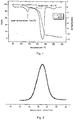
- TG/DTG graph is in Figure 1 .
- the reaction conversion is measured using 1 H-NMR.
- the equipment and test conditions were: NMR (Bruker DRX500), solvents were d -CHCl 3 , d -DMSO or d -CH 3 COCH 3 .
- the 1-butyl-3-methylimidazolium-2-carboxylic acid salt (O) (18.21 mg, 100 ⁇ mol), butanol (7.41 mg, 100 ⁇ mol), D-lactide (5.76 g, 40 mmol) were added into a reaction vessel.
- the reaction vessel was under vacuum at a pressure of 7 mmHg.
- the reaction was carried out at -50 °C for 60 hours.
- the reaction was terminated by adding hydrochloric acid.
- the reaction mixture was dissolved with dichloromethane, then added into ethanol.
- the precipitate was filtered and dried to a constant weight, obtaining 2.30 g of white solid.
- the conversion was 54 %.
- the number average molecular weight of the polylactic acid M n was 24,850.
- the polydispersity index PDI was 1.19.
- 1,3-dimethyl imidazole-2-carboxylic acid salt (N) (14.01 mg, 75 ⁇ mol), ethylene glycol (1.86 mg, 30 ⁇ mol), D, L-lactide (2.16 g, 15 mmol) were added into a reaction vessel. The mixture was heated under the protection of Ar to 96 °C. The reaction in the molten mixture was carried out for 2 hours. The reaction was terminated by adding CS 2 . The reaction mixture was dissolved in chloroform. The solution was then added into methanol. The precipitate was filtered and dried to a constant weight to obtain 2.10 g of white solid. The conversion was 99 %. The number average molecular weight of polylactic acid M n was 34,900. The polydispersity index PDI was 1.28.
- 1,3-bis(2,4,6-trimethyl-phenyl)imidazole-2-carboxylic acid salt (B) (32.6 mg, 75 ⁇ mol), isopropanol (9.01 mg, 150 ⁇ mol), D-lactide (1.44 g, 10 mmol) were dissolved in 5 mL of N,N- dimethylformamide. The solution was heated under the protection of Ar to 96 °C and reacted for 12 hours. The reaction was terminated by adding water. The reaction solution was added into methanol. The precipitate was filtered and dried to a constant weight to obtain 1.32 g of white solid. The conversion was 92 %. The number average molecular weight of polylactic acid M n was 8,580. The polydispersity index PDI was 1.11.
- 1,3-bis(2-butyl)imidazole-2-carboxylic acid salt (I) (16.81 mg, 75 ⁇ mol), benzyl alcohol (10.8 mg, 100 ⁇ mol), D-lactide (1.44 g, 10 mmol) were added into a reaction vessel. The mixture was heated under the protection of Ar to 120 °C. The reaction was carried out in the molten mixture for 2 hours. The reaction was terminated by adding CS 2 . The reaction mixture was dissolved in chloroform and the solution was then added into methanol. The precipitate was filtered and dried to a constant weight to obtain 1.15 g of white solid. The conversion was 97 %. The number average molecular weight of the polylactic acid M n was 14,210. The polydispersity index PDI was 1.32.
- 1,3-dicyclohexylimidazole-2-carboxylic acid salt (C) 27.62 mg, 100 ⁇ mol
- tert-butanol 14.81 mg, 200 ⁇ mol
- D, L-lactide 7.2 g, 50 mmol
- the reaction was terminated by adding acetic acid.
- the reaction solution was added into methanol.
- the precipitate was filtered and dried to a constant weight to obtain 6.02 g of white solid.
- the conversion was 85 %.
- the number average molecular weight of polylactic acid M n was 26,320.
- the polydispersity index PDI was 1.06.
- 1,3-di-tert-butyl-imidazole-2-carboxylic acid salt (P) (6.72 mg, 30 ⁇ mol), benzyl alcohol (16.21 mg, 150 ⁇ mol), D, L-lactide (3.46 g, 24 mmol) were added into a reaction vessel and heated under the protection of Ar to 200 °C. The reaction was carried out in the molten mixture for 3 seconds. The reaction was terminated by adding oxygen. The reaction mixture was cooled and dissolved in toluene and added into ethanol. The precipitate was filtered and dried to a constant weight to obtain 2.5 g of white solid. The conversion was 76 %. The number average molecular weight of the polylactic acid M n was 18,850. The polydispersity index PDI was 1.08.
- 1,3-bis(methylphenyl)imidazole-2-carboxylic acid salt (H) 29.21 mg, 100 ⁇ mol
- propanol 3.00 mg, 50 ⁇ mol
- D-lactide 43.2 g, 0.3 mol
- the reaction was terminated reaction by added CO 2 .
- the reaction mixture was added into methanol.
- the precipitate was filtered and dried to a constant weight to obtain 39.2g of white solid.
- the conversion was 94 %.
- the number average molecular weight of polylactic acid M n was 820.
- the polydispersity index PDI was 1.00.
- 1-ethyl-3-methylimidazolium-2-carboxylic acid salt (F) (15.4 mg, 100 ⁇ mol), propanol (3.00 mg, 50 ⁇ mol), D-lactide (1.44 g, 10 mmol) were dissolved in 1 mL of DMSO. The solution was heated under the protection of Ar to 20 °C and reacted for 24 hours. The reaction was terminated by adding CO 2 . The reaction mixture was added into methanol. The precipitate was filtered and dried to a constant weight to obtain 0.26 g of white solid. The conversion was 18 %. The number average molecular weight of the polylactic acid M n was 8,750. The polydispersity index PDI was 1.08.
- 1,3-bis(methylphenyl)imidazoline-2-carboxylic acid salt (K) 22.06 mg, 75 ⁇ mol
- methanol (12 mg, 375 ⁇ mol) L-lactide (0.72 g, 5 mmol) were added into a reaction vessel and dissolved in 30 mL of tetrahydrofuran.
- the solution was heated under the protection of Ar to 40 °C, stirred and let react for 48 hours.
- the reaction was terminated by adding benzoic acid.
- the reactant was condensed and added into methanol.
- the precipitate was filtered and dried to a constant weight to obtain 0.39 g of white solid.
- the conversion was 54 %.
- the number average molecular weight of the polylactic acid M n was 1,250.
- the polydispersity index PDI was 1.16.
- 1,3-butyl-3,4-dichloro-imidazole-2-carboxylic acid salt (L) 29.21 mg, 100 ⁇ mol
- butanol (7.41 mg, 100 ⁇ mol) D-lactide (5.76 g , 40 mmol) were added into a reaction vessel.
- the reaction vessel was under vacuum at a pressure of 7 mmHg.
- the reaction was carried out at 250 °C for 5 hours.
- the reaction was terminated by adding hydrochloric acid.
- the reaction mixture was dissolved in dichloromethane and then added into ethanol.
- the precipitate was filtered and dried to a constant weight to obtain 5.5 g of white solid.
- the conversion was 99 %.
- the number average molecular weight of the polylactic acid M n was 48,780.
- the polydispersity index PDI was 1.48.
- 1-(1-phenylethyl)thiazole-2-carboxylic acid salt (S) (17.5 mg, 75 ⁇ mol), benzyl alcohol (10.8 mg, 100 ⁇ mol), D-lactide (1.44 g, 10 mmol) were added into a reaction vessel and heated under the protection Ar to 120 °C. The reaction was carried out in the molten mixture for 2 hours. The reaction was terminated by adding CS 2 . The reactants were dissolved in chloroform and then added into methanol. The precipitate was filtered and dried to a constant weight to obtain 1.15 g of white solid. The conversion was 97 %. The number average molecular weight of the polylactic acid M n was 13,210. The polydispersity index PDI was 1.32.
Landscapes
- Chemical & Material Sciences (AREA)
- Health & Medical Sciences (AREA)
- Chemical Kinetics & Catalysis (AREA)
- Medicinal Chemistry (AREA)
- Polymers & Plastics (AREA)
- Organic Chemistry (AREA)
- Polyesters Or Polycarbonates (AREA)
- Biological Depolymerization Polymers (AREA)
- Compositions Of Macromolecular Compounds (AREA)
Description
- This invention is in the field of polymeric material, specifically involving the use of carbene derivatives - the CO2 adducts of carbenes - as catalysts in preparing polylactic acid.
- Polylactic acid, also known as polylactide, as a completely biodegradable material that derives from renewable resources of agricultural crops, has attracted world-wide attention and research efforts.
- Significant research efforts have been devoted to explore methods of preparing polylactic acid, among them the ring-opening lactide polymerization is a method more heavily studied. Regarding the catalysts used in the lactide ring-opening reactions, in the earlier days metal-containing catalysts were used, as disclosed in
CN1814644 ,CN1814645 , andUS5235031 ,US5357034 ,US4045418 ,US4057537 , andUS3736646 . However, these methods require relatively long reaction time. Furthermore, it is very difficult to remove residue metal from the polylactic acid prepared using these methods. Later, Connor, etc. (Fredrik Nederberg, etc., Angewandte Chemie International Edition, 2001, 40, 2712-2715) proposed to use only organic catalysts to carry out ring-opening polymerization, and tried tertiary amine as the catalyst. Subsequently, organic phosphine, bifunctional amine thiourea, guanidine, amidine type, and N-heterocyclic carbene catalysts emerged, among which N-heterocyclic carbene catalysts become the most actively studied class of organic catalysts. - Active intermediates of N-heterocyclic carbene catalysts are their corresponding N-heterocyclic carbenes, which are strongly nucleophilic. During the catalytic ring-opening polymerization, the carbenes attack the lactide monomer, causing the opening of lactide's ring structure, and in the presence of an initiator induce polymerization to produce polylactic acid. However, the N-heterocyclic carbene is very active, and sensitive to air and water. It can only exist for a few seconds in the air. It is difficult to use it as the catalyst for the polymerization. Therefore, it is proposed to use N-heterocyclic carbene precursors or N-heterocyclic adducts, which can be activated to catalyze polymerization reaction.
- For example, Connor, et al. (Eric F. Connor, et al.. Journal of the American Chemical Society, 2002, 124, 914-915; Gregory W. Nyce, etc., Journal of the American Chemical Society, 2003, 125, 3046-3056) used imidazolium salt as the catalyst precursor, producing the corresponding N-heterocyclic carbenes in a strong base - potassium tert-butoxide, and then added the lactide monomer in the same system to carry out direct catalytic polymerization that produced polylactic acid. Disadvantages of this approach are: Since N-heterocyclic carbenes are unstable and difficult to separate, when N-heterocyclic carbene formation and lactide ring-opening polymerization occur in the same system, the system's strong base will not only promote the formation of N-heterocyclic carbenes, but also cause ring-opening of cyclic compounds or the degradation of the polymer, consequently making the polymerization complex and difficult to control. The residual alkali and salt will have adverse effects on the property and appearance of the polymer and its material.
- To overcome the above drawbacks, stable N-heterocyclic carbene complexes, such as N-heterocyclic carbenes with small molecules H-CCl3, H-C6F5, H-OR, etc., have been prepared and used as catalysts for lactide ring-opening polymerization. By controlling the polymerization condition, H-CCl3, H-C6F5, H-OR and other small molecules can be removed so that N-heterocyclic carbenes are released, facilitating polymerization reaction. However, residue amount of the small molecule to be removed still exists in the reaction system. On the one hand, they interfere with the polymerization reaction, and on the other hand, they introduce impurities to the reaction system and the produced polylactic acid. Furthermore, the above mentioned polymerization is limited to be carried out in dilute solution. Therefore, this reaction is restricted in terms of large scale applications.
- To overcome these deficiencies, it is necessary to introduce catalysts that are structurally stable, easy to use, can readily control polymerization process, safe, and leave no residue. Synthesis of CO2 adducts of carbenes have been reported in recent years (J. D. Holbrey, et al., Chemical Communications, 2003, 28-29; H. A. Duong, et al., Chemical Communications, 2004, 112-113). Voutchkova (A. M. Voutchkova, et al., Journal of the American Chemical Society, 2005, 127, 17624 - 17625) reported a method for preparing a carbene-metal complex that uses disubstituted carbene CO2 adducts as the transfer reagent. That is to take advantage of the stability of the CO2 adducts of carbenes and its ability to release CO2 to prepare the complex of carbene and metal rhodium, ruthenium, and lead. Subsequently, Tudose et al. used the carbene metal complex as the catalyst for Suzuki-Miyaura coupling reaction, olefin metathesis, and cyclopropanation reactions (A. Tudose et al., Tetrahedron Letters, 2006, 47, 8529-8533; A. Tudose et al., Journal of Organometallic Chemistry, 2006, 691, 5356-5365). However, currently the literature only discloses using N-heterocyclic carbenes as the transfer reagent in the preparation of carbene metal complexes. There is no report as to using CO2 adducts of carbenes as a catalyst, much less using the adducts as the catalyst for ring-opening polymerization of lactide.
- A. P. Dove et al., Polymer 47 (2006), 4018-4025, disclose a study on N-heterocyclic carbenes as effective organic catalysts for living polymerization. O. Coulembier et al., Macromolecules 2006, 39, 5617-5628, disclose a study on alcohol adducts of N-heterocyclic carbenes as latent catalysts for the thermally controlled living polymerization of cyclic esters.
US 2008/0051608 A1 discloses a method for the preparation of alpha-hydroxy ketones via a carbene-catalyzed Umpolung-reaction of aldehydes. - The technical problem to be addressed by the invention disclosed herein is to provide a method that uses a new type of carbene complex as the catalyst in the preparation of polylactic acid.
- To solve the above problem, the disclosure of this invention is as follows:
- (1) new carbene derivatives - the temperature of decarboxylation at the second position (CO2 removal) varies in response to different substituents on the ring of the CO2 adducts of N-heterocyclic carbenes. Consequently, one can design carbene derivatives according to the temperature of in situ generation of carbene in the polymerization system, therefore controlling the decarboxylation temperature, and control the polymerization process by controlling the temperature;
- (2) carbon dioxide adducts of carbenes are heated and experience decarboxylation in the polymerization conditions to form the corresponding N-heterocyclic carbenes and CO2 is released from the reaction system. Other than the carbenes, there is no other compound in the system;
- (3) in the presence of alcohol initiators, N-heterocyclic carbenes catalyze the lactide ring-opening polymerization to obtain polylactic acid.
- Through research this invention also discovered that different substituents on the CO2 adducts of heterocyclic carbenes will affect the decarboxylation temperature on the 2-position of heterocyclic ring. While the appropriate decarboxylation temperature and its range are determined according to the property of the polymer and the process condition of the polymerization equipment, all CO2 adducts of heterocyclic carbenes have the appropriate decarboxylation temperature for lactide ring-opening polymerization. To ensure that the decarboxylation of CO2 adducts of carbenes occurs in the same temperature range of the ring-opening polymerization, so that to produce active catalyst to promote the catalytic reaction, thermal gravimetric analysis was conducted on CO2 adducts of carbenes having different substituents on the structure of carbenes. The temperature and rate of decarboxylation of CO2 adducts of carbenes of various structure were obtained. Among them, a group of suitable catalysts were chosen so that the decarboxylation temperature and the reaction temperature of lactide ring-opening polymerization can properly match. Under the suitable reaction temperature the catalytic ring-opening polymerization can be effectively carried out. Therefore, through controlling its reaction temperature, lactide ring-opening polymerization catalyzed by CO2 adducts of carbenes becomes controllable.
- The terminal structure and the molecular weight can also be controlled. For example, adding an reagent having active hydrogen (R-O-H) as an initiator in the ring-opening polymerization reaction can achieve a narrow molecular weight distribution. The terminal structures of the obtained polylactic acid are R-O- and -OH, respectively. While the ratio of the lactide monomer and initiator determines the target molecular weight of the polylactic acid, when there is an initiator, N-heterocyclic carbene catalyzed ring-opening polymerization of lactide is a living polymerization, resulting in a polylactic acid with a relatively narrow molecular weight distribution.
- The technical solution in this invention is as follows:
- A method of making polylactic acid using CO2 adducts of carbenes, wherein the adducts have a structure represented by formula (I):

- hydrogen,
- alkyl groups having 1 to 10 carbon atoms,
- alkyl groups having 1 to 10 carbon atoms and also having one or more substituents chosen from a halogen atom, a hydroxyl group, a phenyl group, and a cyano group,
- cycloalkyl groups having 3 to 6 carbon atoms,
- a halogen atom,
- an adamantyl group,
- a phenyl group, and
- a phenyl group having one or more substituents chosen from a halogen atom, a hydroxyl group, an alkyl group, and a cyano group;
- hydrogen,
- a halogen atom,
- a cyano group,
- a hydroxyl group,
- alkyl groups having 1 to 4 carbon atoms,
- alkyl groups having 1 to 4 carbon atoms and also having one or more substituents chosen from a halogen atom, a hydroxyl group, a phenyl group, and a cyano group,
- a phenyl group, and
- a substituted phenyl group.
- Alternatively, R3 and R4 are connected to form cycloalkyl or cycloalkenyl groups having 3 to 8 carbon atoms; or R3 and R4 are connected to form a benzene ring; or R2 and R3 are connected to form 5- or 6-N-heterocyclic compounds that do not have any substituent.
- Specific structures of CO2 adducts of carbenes of formula (I) can be represented as in formula (II), formula (III), formula (IV), or formula (V):

- In formula (II), R1 and R2 can be the same or different and are chosen from
- hydrogen,
- alkyl groups having 1 to 10 carbon atoms,
- alkyl groups having 1 to 10 carbon atoms and also having one or more substituents chosen from a halogen atom, a hydroxyl group, a phenyl group, and a cyano group,
- cycloalkyl groups having 3 to 6 carbon atoms,
- a halogen atom,
- an adamantyl group,
- a phenyl group, and
- a phenyl group having one or more substituents chosen from a halogen atom, a hydroxyl group, an alkyl group, and a cyano group;
- hydrogen,
- a halogen atom,
- a cyano group,
- a hydroxyl group,
- alkyl groups having 1 to 4 carbon atoms,
- alkyl groups having 1 to 4 carbon atoms and also having one or more substituents chosen from a halogen atom, a hydroxyl group, a phenyl group, and a cyano group,
- a phenyl group, and
- a substituted phenyl group.
- Alternatively, R3 and R4 are connected to form cycloalkenyl groups having 3 to 8 carbon atoms; or R3 and R4 are connected to form a benzene ring.
- In formula (III), R1 and R2 can be the same or different and are chosen from
- hydrogen,
- alkyl groups having 1 to 10 carbon atoms,
- alkyl groups having 1 to 10 carbon atoms and also having one or more substituents chosen from a halogen atom, a hydroxyl group, a phenyl group, and a cyano group,
- cycloalkyl groups having 3 to 6 carbon atoms,
- a halogen atom,
- an adamantyl group,
- a phenyl group, and
- a phenyl group having one or more substituents chosen from a halogen atom, a hydroxyl group, an alkyl group, and a cyano group;
- hydrogen,
- a halogen atom,
- a cyano group,
- a hydroxyl group,
- alkyl groups having 1 to 4 carbon atoms,
- alkyl groups having 1 to 4 carbon atoms and also having one or more substituents chosen from a halogen atom, a hydroxyl group, a phenyl group, and a cyano group,
- a phenyl group, and
- a substituted phenyl group.
- Alternatively, R3 and R4 are connected to form cycloalkyl groups having 3 to 8 carbon atoms.
- In formula (IV), R1 is chosen from
- hydrogen,
- alkyl groups having 1 to 10 carbon atoms,
- alkyl groups having 1 to 10 carbon atoms and also having one or more substituents chosen from a halogen atom, a hydroxyl group, a phenyl group, and a cyano group,
- cycloalkyl groups having 3 to 6 carbon atoms,
- a halogen atom,
- an adamantyl group,
- a phenyl group, and
- a phenyl group having one or more substituents chosen from a halogen atom, a hydroxyl group, an alkyl group, and a cyano group;
- hydrogen,
- a halogen atom,
- a cyano group,
- a hydroxyl group,
- alkyl groups having 1 to 4 carbon atoms,
- alkyl groups having 1 to 4 carbon atoms and also having one or more substituents chosen from a halogen atom, a hydroxyl group, a phenyl group, and a cyano group,
- a phenyl group, and
- a substituted phenyl group.
- Alternatively, R3 and R4 are connected to form cycloalkenyl groups having 3 to 8 carbon atoms; or R3 and R4 are connected to form a benzene ring.
- In formula (V), R1 and R2 can be the same or different and are chosen from
- hydrogen,
- alkyl groups having 1 to 10 carbon atoms,
- alkyl groups having 1 to 10 carbon atoms and also having one or more substituents chosen from a halogen atom, a hydroxyl group, a phenyl group, and a cyano group,
- cycloalkyl groups having 3 to 6 carbon atoms,
- a halogen atom,
- an adamantyl group,
- a phenyl group, and
- a phenyl group having one or more substituents chosen from a halogen atom, a hydroxyl group, an alkyl group, and a cyano group;
- hydrogen,
- a halogen atom,
- a cyano group,
- a hydroxyl group,
- alkyl groups having 1 to 4 carbon atoms,
- alkyl groups having 1 to 4 carbon atoms and also having one or more substituents chosen from a halogen atom, a hydroxyl group, a phenyl group, and a cyano group,
- a phenyl group, and
- a substituted phenyl group.
- Alternatively, R2 and R3 are connected to form 5- or 6-N-heterocyclics that do not have any substituent.
- The above-described substituted phenyl group can have one, two, or three substituents. The substituents can be the same or different, chosen from alkyl groups having 1-5 carbon atoms, alkyl groups having 1-5 carbon atoms and having one or more substituents chosen from halogen atoms, hydroxyl, phenyl, and cyano group, halogen atom, hydroxyl, alkoxy, and cyano.
- The above-described methods of making polylactic acid can be solution polymerization, specifically comprising mixing CO2 adducts of carbenes, the initiator, and lactide monomer in an organic solvent according to a molar ratio of 1:0.2 to 5:2 to 10000, preferably of 1:0.5 to 3:100 to 500, more preferably of 1:0.5 to 2:100 to 300. The reaction temperature is -50 to 250 °C, preferably 50 °C to 180 °C, more preferably 60 °C to 150 °C. The reaction time ranges from 3 seconds to 120 hours, preferably 0.2 to 24 hours, more preferably 0.2 to 15 hours.
- The above-described method of preparing polylactic acid can also be bulk polymerization, specifically comprising mixing CO2 adducts of carbenes, the initiator, and lactide monomer according to a molar ratio of 1:0.2 to 5:2 to 10000, preferably of 1:0.5 to 3:100 to 500, more preferably of 1:0.5 to 2:100 to 300. The reaction temperature is -50 to 250 °C, preferably 50 °C to 180 °C, more preferably 60 °C to 150 °C. The reaction time ranges from 3 seconds to 120 hours, preferably 0.2 to 24 hours, more preferably 0.2 to 15 hours.
- In the solution polymerization and bulk polymerization, the above-described initiator can be alcohol compounds, such as methanol, ethanol, propanol, isopropanol, butanol, tert-butyl alcohol, benzyl alcohol, phenethyl alcohol, ethylene glycol, diethylene glycol, pentaerythritol, preferably n-butanol, benzyl alcohol, and phenethyl alcohol. The above-described lactide can be L-lactide, D-lactide, meso-lactide, or racemic lactide, or a mixture of any proportion between L-lactide and D-lactide. The step to terminate the reaction is to add weak acid (such as formic acid, acetic acid, hydrochloric acid, etc.), oxygen, water, CS2 or CO2, preferably formic acid, acetic acid, water, or CS2.
- In solution polymerization, the organic solvent used can be cyclohexane, hexane, ethyl ether, acetone, cyclohexanone, dioxane, tetrahydrofuran, benzene, toluene, xylene, methylene chloride, chloroform, N,N-dimethylformamide, N,N-dimethylacetamide, or dimethyl sulfoxide, preferably acetone, tetrahydrofuran, toluene, xylene, methylene chloride, chloroform, more preferably tetrahydrofuran and toluene. The reaction can be carried out in an inert gas. The inert gas is preferably argon or nitrogen. The reaction product is preferred to be purified in an antisolvent, such as methanol, ethanol, or water.
In bulk polymerization, the reaction can be carried out in inert gas or under vacuum. The inert gas is preferably argon or nitrogen. The vacuum means that the pressure in the reactor is 4 to 20 mmHg. The reaction product is dissolved in a good solvent and then precipitated by adding an antisolvent, such as methanol, ethanol, or water. The good solvent can be dichloromethane, chloroform, toluene, benzene, acetone or tetrahydrofuran, preferably dichloromethane, chloroform, tetrahydrofuran. - The invention also provides the use of CO2 adducts of carbenes in the preparation of catalysts used in polylactic acid preparation.
- In the method of using carbene derivatives to catalyze polylactic acid preparation provided in this invention, CO2 adducts of carbenes having different substituents, which are used as the catalyst, have different decarboxylation temperatures. Further, the rate of decarboxylation differs at different temperature. Therefore, one may select a CO2 adduct of carbene that has a suitable decarboxylation temperature as the catalyst for ring-opening polymerization, so that to control the lactide ring-opening polymerization through controlling the decarboxylation temperature. The removed CO2 is vented, leaving no pollutant in the polymerization system. This method is effective and environmentally friendly. CO2 adducts of carbenes are structurally stable, can be stored under normal conditions, keeping their properties intact for a long period of time. They are also easy to use, without requiring operation under exacting reaction conditions. The catalytic reactivity is high in both a solution polymerization system and a bulk polymerization system.
- Examples of this invention are described in detail with reference to the drawings in the following.
-
Figure 1 : A TGA graph of a salt of 1,3-bis(2,6-diisopropyl-phenyl)imidazole-2-carboxylic acid; -
Figure 2 : A 1H-NMR spectrum of polylactic acid prepared using a salt of 1,3-bis(2,6-diisopropylphenyl)imidazole-2-carboxylic acid as the catalyst; -
Figure 3 : A chromatogram of size-exclusion chromatography of polylactic acid prepared using a salt of 1,3-bis(2,6-diisopropyl-phenyl)imidazole-2-carboxylic acid as the catalyst. - The following examples are used to further illustrate the present invention. These examples are for the purpose of illustration and in no way limit the invention. One of ordinary skill in the art would appreciate that these examples do not limit the present invention in any aspects, and that appropriate modification and adjustment of the parameters can be made without violating the essence of this invention and deviation from the scope of the present invention.
- CO2 adducts of carbenes used in the examples in this invention are shown in Table 1.
Table 1: Carbon dioxide adducts of carbenes used in the examples No. Structure No. Structure No. Structure A 
B 
c 
D 
E 
F 
G 
H 
I 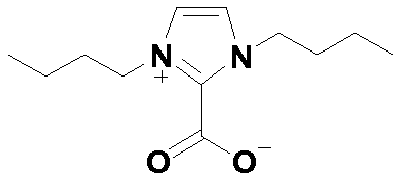
J 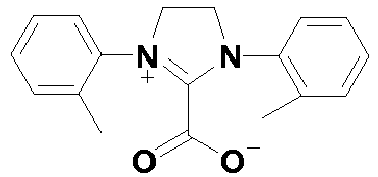
K 
L 
M 
N 
O 
P 
Q 
R 
S 
T 
- The range of decarboxylation temperature in this invention was obtained using TGA analysis. The equipment and test conditions were: TG/DTA (NETZSCH STA 449 C), N2 protection,
heating rate 5 °C/min,temperature range 50 to 350 °C. Using the salt of 1,3-bis(2,6-diisopropylphenyl)imidazole-2-carboxylic acid as an example, its TG/DTG graph is inFigure 1 . - The reaction conversion is measured using 1H-NMR. The equipment and test conditions were: NMR (Bruker DRX500), solvents were d-CHCl3, d-DMSO or d-CH3COCH3. The average molecular weight of polylactic acid and the dispersion were determined using size-exclusion chromatography (SEC), the test conditions are: column temperature: 25 °C, solvent: THF (HPLC), flow rate: 1 mL/min, HPLC Pump: Waters 515, Detector: RI (Wyatt Optilab rEX), column: HR3, HR4, and HR5 Styragel connected in series, standard sample: polystyrene (PS) Mw = 900 to 1.74 × 10⁶ g/mol, PDI <1.1.
- 1,3-bis(2,6-diisopropyl-phenyl)imidazole-2-carboxylic acid salt (A) (29 mg, 75 µmol), benzyl alcohol (5.4 mg, 50 µmol), L-lactide (1.44 g, 10 mmol) were dissolved in 10 mL of xylene. The solution was heated under the protection of N2 to 140 °C, and reacted for 30 minutes. The reaction was terminated by adding formic acid. The reaction solution was added into methanol. The precipitate was filtered and dried to a constant weight, obtaining 1.20 g of white solid. The conversion was 86 %. The number average molecular weight of the polylactic acid Mn was 18,460. The polydispersity index PDI was 1.05. The 1H-NMR spectrum and SEC chromatogram of the obtained polylactic acid are shown in
Figures 2 and3 , respectively. - 1,3-bis(o-methylphenyl)imidazoline-2-carboxylic acid salt (J) (73.54 mg, 250 µmol), benzyl alcohol (5.4 mg, 50 µmol), L-lactide (0.72 g, 12.5 mmol) were added into a reaction vessel and heated under the protection of Ar to 130 °C. The reaction in the molten mixture was carried out for 1 hour. The reaction was terminated by adding water. The reaction mixture was dissolved in chloroform and then added into ethanol. The precipitate was filtered and dried to a constant weight, obtaining 0.67 g of white solid. The conversion was 95 %. The number average molecular weight of the polylactic acid Mn was 32,780. The polydispersity index PDI was 1.16.
- The 1-butyl-3-methylimidazolium-2-carboxylic acid salt (O) (18.21 mg, 100 µmol), butanol (7.41 mg, 100 µmol), D-lactide (5.76 g, 40 mmol) were added into a reaction vessel. The reaction vessel was under vacuum at a pressure of 7 mmHg. The reaction was carried out at -50 °C for 60 hours. The reaction was terminated by adding hydrochloric acid. The reaction mixture was dissolved with dichloromethane, then added into ethanol. The precipitate was filtered and dried to a constant weight, obtaining 2.30 g of white solid. The conversion was 54 %. The number average molecular weight of the polylactic acid Mn was 24,850. The polydispersity index PDI was 1.19.
- 1,3-bis(2,6-diisopropyl-phenyl)imidazoline-2-carboxylic acid salt (D) (32.6 g, 75 mmol), methanol (1.6 g, 50 mmol), L-lactide (21.6 g, 150 mmol) were added into the reaction vessel and dissolved using 500 mL of THF. The solution was heated under the protection of Ar to 40 °C, stirred and let react for 48 hours. The reaction was terminated by adding benzoic acid. The reaction mixture was condensed and added into methanol. The precipitate was filtered and dried to a constant weight to obtain 13.58 g of white solid. The conversion was 63 %. The number average molecular weight of the polylactic acid Mn was 432. The polydispersity index was PDI 1.00.
- 1-phenyl-3-methylimidazolium-2-carboxylic acid salt (Q) (16.2 mg, 75 µmol), benzyl alcohol (10.8 mg, 100 µmol), D-lactide (2.88 g, 20 mmol) were added into a reaction vessel. The reaction vessel was under vacuum at a pressure of 7 mmHg. The reaction was carried out at 0 °C for 5 days. The reaction was terminated by adding water. The reaction mixture was dissolved in toluene. The solution was then added into ethanol. The precipitate was filtered and dried to a constant weight to obtain 1.3 g of white solid. The conversion was 49 %. The number average molecular weight of polylactic acid Mn was 18,750. The polydispersity index PDI was 1.08.
- 1,3-dimethyl imidazole-2-carboxylic acid salt (N) (14.01 mg, 75 µmol), ethylene glycol (1.86 mg, 30 µmol), D, L-lactide (2.16 g, 15 mmol) were added into a reaction vessel. The mixture was heated under the protection of Ar to 96 °C. The reaction in the molten mixture was carried out for 2 hours. The reaction was terminated by adding CS2. The reaction mixture was dissolved in chloroform. The solution was then added into methanol. The precipitate was filtered and dried to a constant weight to obtain 2.10 g of white solid. The conversion was 99 %. The number average molecular weight of polylactic acid Mn was 34,900. The polydispersity index PDI was 1.28.
- 1,3-bis(2,4,6-trimethyl-phenyl)imidazoline-2-carboxylic acid salt (E) (32.6 mg, 75 µmol), benzene, ethanol (9.16 mg, 75 µmol), D-lactide (1.44 g, 10 mmol) were added into a reaction vessel. The reaction vessel was under vacuum at a pressure of 4 mm Hg. The reaction was carried out at 130 °C for 1 hour. The reaction was terminated by adding oxygen. The reaction mixture was dissolved in chloroform and then added into ethanol. The precipitate was filtered and dried to a constant weight to obtain 1.2 g of white solid. The conversion was 97 %. The number average molecular weight Mn of polylactic acid was 18,600. The polydispersity index PDI was 1.35.
- 1,3-bis(2,4,6-trimethyl-phenyl)imidazole-2-carboxylic acid salt (B) (32.6 mg, 75 µmol), isopropanol (9.01 mg, 150 µmol), D-lactide (1.44 g, 10 mmol) were dissolved in 5 mL of N,N-dimethylformamide. The solution was heated under the protection of Ar to 96 °C and reacted for 12 hours. The reaction was terminated by adding water. The reaction solution was added into methanol. The precipitate was filtered and dried to a constant weight to obtain 1.32 g of white solid. The conversion was 92 %. The number average molecular weight of polylactic acid Mn was 8,580. The polydispersity index PDI was 1.11.
- 1-butyl-3-methyl benzimidazol-2-carboxylic acid salt (M) (17.41 mg, 75 µmol), ethanol (1.73 mg, 37.5 µmol), D-lactide (8.64 g, 60 mmol) were dissolved in 100 mL of tetrahydrofuran. The solution was heated under the protection of Ar to 50 °C and reacted for 30 hours. The reaction was terminated by adding hydrochloric acid. The reaction solution was condensed and added into methanol. The precipitate was filtered and dried to a constant weight to obtain 6.20 g of white solid. The conversion was 76 %. The number average molecular weight of polylactic acid Mn was 188,750. The polydispersity index PDI was 1.38.
- 1,3-bis(2-butyl)imidazole-2-carboxylic acid salt (I) (16.81 mg, 75 µmol), benzyl alcohol (10.8 mg, 100 µmol), D-lactide (1.44 g, 10 mmol) were added into a reaction vessel. The mixture was heated under the protection of Ar to 120 °C. The reaction was carried out in the molten mixture for 2 hours. The reaction was terminated by adding CS2. The reaction mixture was dissolved in chloroform and the solution was then added into methanol. The precipitate was filtered and dried to a constant weight to obtain 1.15 g of white solid. The conversion was 97 %. The number average molecular weight of the polylactic acid Mn was 14,210. The polydispersity index PDI was 1.32.
- 1,3-bis(o-methylphenyl)imidazole-2-carboxylic acid salt (G) (21.9 mg, 75 µmol), benzene, ethanol (12.21 mg, 100 µmol), L-lactide (1.44 g, 10 mmol) were added into a reaction vessel and heated under the protection of Ar to 250 °C. The reaction was carried out in the molten mixture for 20 min. The reaction was terminated by adding hydrochloric acid. The reaction mixture was dissolved in chloroform and added into ethanol. The precipitate was filtered and dried to a constant weight to obtain 1.1 g of white solid. The conversion was 89 %. The number average molecular weight of the polylactic acid Mn was 11,960. The polydispersity index was PDI 1.48.
- 1,3-dicyclohexylimidazole-2-carboxylic acid salt (C) (27.62 mg, 100 µmol), tert-butanol (14.81 mg, 200 µmol), D, L-lactide (7.2 g, 50 mmol) were dissolved in 50 mL of toluene. The solution was heated under the protection of Ar to 100 °C and reacted for 30 minutes.The reaction was terminated by adding acetic acid. The reaction solution was added into methanol. The precipitate was filtered and dried to a constant weight to obtain 6.02 g of white solid. The conversion was 85 %. The number average molecular weight of polylactic acid Mn was 26,320. The polydispersity index PDI was 1.06.
- 1,3-di-tert-butyl-imidazole-2-carboxylic acid salt (P) (6.72 mg, 30 µmol), benzyl alcohol (16.21 mg, 150 µmol), D, L-lactide (3.46 g, 24 mmol) were added into a reaction vessel and heated under the protection of Ar to 200 °C. The reaction was carried out in the molten mixture for 3 seconds. The reaction was terminated by adding oxygen. The reaction mixture was cooled and dissolved in toluene and added into ethanol. The precipitate was filtered and dried to a constant weight to obtain 2.5 g of white solid. The conversion was 76 %. The number average molecular weight of the polylactic acid Mn was 18,850. The polydispersity index PDI was 1.08.
- 1,3-bis(methylphenyl)imidazole-2-carboxylic acid salt (H) (29.21 mg, 100 µmol), propanol (3.00 mg, 50 µmol), D-lactide (43.2 g, 0.3 mol) were dissolved in 1000 mL of DMSO. The solution was heated under the protection of Ar to 80 °C and reacted for 30 minutes. The reaction was terminated reaction by added CO2. The reaction mixture was added into methanol. The precipitate was filtered and dried to a constant weight to obtain 39.2g of white solid. The conversion was 94 %. The number average molecular weight of polylactic acid Mn was 820. The polydispersity index PDI was 1.00.
- 1-ethyl-3-methylimidazolium-2-carboxylic acid salt (F) (15.4 mg, 100 µmol), propanol (3.00 mg, 50 µmol), D-lactide (1.44 g, 10 mmol) were dissolved in 1 mL of DMSO. The solution was heated under the protection of Ar to 20 °C and reacted for 24 hours. The reaction was terminated by adding CO2. The reaction mixture was added into methanol. The precipitate was filtered and dried to a constant weight to obtain 0.26 g of white solid. The conversion was 18 %. The number average molecular weight of the polylactic acid Mn was 8,750. The polydispersity index PDI was 1.08.
- 1,3-bis(methylphenyl)imidazoline-2-carboxylic acid salt (K) (22.06 mg, 75 µmol), methanol (12 mg, 375 µmol), L-lactide (0.72 g, 5 mmol) were added into a reaction vessel and dissolved in 30 mL of tetrahydrofuran. The solution was heated under the protection of Ar to 40 °C, stirred and let react for 48 hours. The reaction was terminated by adding benzoic acid. The reactant was condensed and added into methanol. The precipitate was filtered and dried to a constant weight to obtain 0.39 g of white solid. The conversion was 54 %. The number average molecular weight of the polylactic acid Mn was 1,250. The polydispersity index PDI was 1.16.
- 1,3-butyl-3,4-dichloro-imidazole-2-carboxylic acid salt (L) (29.21 mg, 100 µmol), butanol (7.41 mg, 100 µmol), D-lactide (5.76 g , 40 mmol) were added into a reaction vessel. The reaction vessel was under vacuum at a pressure of 7 mmHg. The reaction was carried out at 250 °C for 5 hours. The reaction was terminated by adding hydrochloric acid. The reaction mixture was dissolved in dichloromethane and then added into ethanol. The precipitate was filtered and dried to a constant weight to obtain 5.5 g of white solid. The conversion was 99 %. The number average molecular weight of the polylactic acid Mn was 48,780. The polydispersity index PDI was 1.48.
- 1-tert-butyl-4,5-dichloro-2-carboxylic acid salt (R) (7.6 mg, 30 µmol), benzyl alcohol (16.21 mg, 150 µmol), D, L-lactide (3.46 g, 24 mmol) were added into a reaction vessel. The mixture was heated under the protection of Ar to 200 °C. The reaction was carried out in the molten mixture for 3 seconds. The reaction was terminated by adding oxygen. The reaction mixture was cooled and dissolved in toluene. The solution was added into ethanol. The precipitate was filtered and dried to a constant weight to obtain 2.5 g of white solid. The conversion was 80 %. The number average molecular weight of the polylactic acid Mn was 18,800. The polydispersity index PDI was 1.28.
- 1-(1-phenylethyl)thiazole-2-carboxylic acid salt (S) (17.5 mg, 75 µmol), benzyl alcohol (10.8 mg, 100 µmol), D-lactide (1.44 g, 10 mmol) were added into a reaction vessel and heated under the protection Ar to 120 °C. The reaction was carried out in the molten mixture for 2 hours. The reaction was terminated by adding CS2. The reactants were dissolved in chloroform and then added into methanol. The precipitate was filtered and dried to a constant weight to obtain 1.15 g of white solid. The conversion was 97 %. The number average molecular weight of the polylactic acid Mn was 13,210. The polydispersity index PDI was 1.32.
- 2,4,5-triphenyl-1,2,4-triazole-3-carboxylic acid salt (T) (25.6 mg, 75 µmol), isopropanol (9.01 mg, 150 µmol), D-lactide (1.44 g, 10 mmol) were dissolved in 5 mL of N,N-dimethylformamide. The solution was heated under the protection of Ar to 96 °C and reacted for 12 hours. The reaction was terminated by adding water. The reaction solution was added into methanol. The precipitate was filtered and dried to a constant weight to obtain 1.32 g of white solid. The conversion was 92 %. The number average molecular weight of polylactic acid Mn was 8,560. The polydispersity index PDI was 1.11.
Claims (15)
- A method of making polylactic acid using carbon dioxide adducts of carbenes, characterized in that the adducts of carbenes have a structure represented by formula (I):
 X1 is chosen from S and N;X2 is chosen from C and N;R1 and R2 are the same or different and are chosen fromhydrogen,alkyl groups having 1 to 10 carbon atoms,alkyl groups having 1 to 10 carbon atoms and also having one or more substituents chosen from a halogen atom, a hydroxyl group, a phenyl group, and a cyano group,cycloalkyl groups having 3 to 6 carbon atoms,a halogen atom,an adamantyl group,a phenyl group, anda phenyl group having one or more substituents chosen from a halogen atom, a hydroxyl group, an alkyl group, and a cyano group;R3 and R4 are the same or different and are chosen fromhydrogen,a halogen atom,a cyano group,a hydroxyl group,alkyl groups having 1 to 4 carbon atoms,alkyl groups having 1 to 4 carbon atoms and also having one or more substituents chosen from a halogen atom, a hydroxyl group, a phenyl group, and a cyano group,a phenyl group, anda substituted phenyl group, andalternatively, R3 and R4 are connected to form cycloalkyl or cycloalkenyl rings having 3 to 8 carbon atoms; orR3 and R4 are connected to form a benzene ring; orR2 and R3 are connected to form 5-or 6-N-heterocyclic compounds that do not have any substituent.
 - The method of claim 1, characterized in that the structure of carbon dioxide adducts of carbenes is represented by formula (II)
 wherein R1 and R2 can be the same or different and are chosen fromhydrogen,alkyl groups having 1 to 10 carbon atoms,alkyl groups having 1 to 10 carbon atoms and also having one or more substituents chosen from a halogen atom, a hydroxyl group, a phenyl group, and a cyano group,cycloalkyl groups having 3 to 6 carbon atoms,a halogen atom,an adamantyl group,a phenyl group, anda phenyl group having one or ore substituents chosen from a halogen atom, a hydroxyl group, an alkyl group, and a cyano group;R3 and R4 can be the same or different and are chosen fromhydrogen,a halogen atom,a cyano group,a hydroxyl group,alkyl groups having 1 to 4 carbon atoms,alkyl groups having 1 to 4 carbon atoms and also having one or more substituents chosen from a halogen atom, a hydroxyl group, a phenyl group, and a cyano group,a phenyl group, anda substituted phenyl group, andalternatively, R3 and R4 are connected to form cycloalkyl or cycloalkenyl groups having 3 to 8 carbon atoms; orR3 and R4 are connected to form a benzene ring.
 - The method of claim 1, characterized in that the structure of carbon dioxide adducts of carbenes is represented by formula (III)
 wherein R1 and R2 are the same or different and are chosen fromhydrogen,alkyl groups having 1 to 10 carbon atoms,alkyl groups having 1 to 10 carbon atoms and also having one or more substituents chosen from a halogen atom, a hydroxyl group, a phenyl group, and a cyano group,cycloalkyl groups having 3 to 6 carbon atoms,a halogen atom,an adamantyl group,a phenyl group, anda phenyl group having one or more substituents chosen from a halogen atom, a hydroxyl group, an alkyl group, and a cyano group;R3 and R4 can be the same or different and are chosen fromhydrogen,a halogen atom,a cyano group,a hydroxyl group,alkyl groups having 1 to 4 carbon atoms,alkyl groups having 1 to 4 carbon atoms and also having one or more substituents chosen from a halogen atom, a hydroxyl group, a phenyl group, and a cyano group,a phenyl group, anda substituted phenyl group, andalternatively, R3 and R4 are connected to form cycloalkyl groups having 3 to 8 carbon atoms.
 - The method of claim 1, characterized in that the structure of carbon dioxide adducts of carbenes is represented by formula (IV)
 wherein R1 is chosen fromhydrogen,alkyl groups having 1 to 10 carbon atoms,alkyl groups having 1 to 10 carbon atoms and also having one or more substituents chosen from a halogen atom, a hydroxyl group, a phenyl group, and a cyano group,cycloalkyl groups having 3 to 6 carbon atoms,a halogen atom,an adamantyl group,a phenyl group, anda phenyl group having one or more substituents chosen from a halogen atom, a hydroxyl group, an alkyl group, and a cyano group;R3 and R4 are the same or different and are chosen fromhydrogen,a halogen atom,a cyano group,a hydroxyl group,alkyl groups having 1 to 4 carbon atoms,alkyl groups having 1 to 4 carbon atoms and also having one or more substituents chosen from a halogen atom, a hydroxyl group, a phenyl group, and a cyano group,a phenyl group, anda substituted phenyl group, andalternatively, R3 and R4 are connected to form cycloalkenyl groups having 3 to 8 carbon atoms;
orR3 and R4 are connected to form a benzene ring. - The method of claim 1, characterized in that the structure of the carbon dioxide adducts of carbenes is represented by formula (V)
 R1 and R2 are the same or different and are chosen fromhydrogen,alkyl groups having 1 to 10 carbon atoms,alkyl groups having 1 to 10 carbon atoms and also having one or more substituents chosen from a halogen atom, a hydroxyl group, a phenyl group, and a cyano group,cycloalkyl groups having 3 to 6 carbon atoms,a halogen atom,an adamantyl group,a phenyl group, anda phenyl group having one or more substituents chosen from a halogen atom, a hydroxyl group, an alkyl group, and a cyano group;R3 is chosen fromhydrogen,a halogen atom,a cyano group,a hydroxyl group,alkyl groups having 1 to 4 carbon atoms,alkyl groups having 1 to 4 carbon atoms and also having one or more substituents chosen from a halogen atom, a hydroxyl group, a phenyl group, and a cyano group,a phenyl group, anda substituted phenyl group, andalternatively, R2 and R3 are connected to form 5- or 6-N- heterocyclics that do not have any substituent.
 - The method of any one of claims 1 to 5, wherein the substituted phenyl group has one, two, or three substituents, wherein the substituents are the same or different, chosen from a halogen atom, a hydroxyl group, an alkoxy group, and a cyano group, alkyl groups having 1-5 carbon atoms, and alkyl groups having 1-5 carbon atoms with one or more substituents chosen from halogen atoms, a hydroxyl group, a phenyl group, and a cyano group.
- The method of any one of claims 1 to 5, wherein the method is a method of solution polymerization and wherein the carbon dioxide adduct of carbene, the initiator, and the lactide monomer have a molar ratio of 1:0.2 to 5:2 to 10000 in an organic solvent.
- The method of any one of claims 1 to 5, wherein the method is a method of solution polymerization and wherein the reaction temperature ranges from -50 °C to 250 °C.
- The method of claim 7, wherein the initiator is an alcohol chosen from methanol, ethanol, propanol, isopropanol, n-butanol, tert-butyl alcohol, benzyl alcohol, ethylene glycol, diethylene glycol, pentaerythritol, and phenethyl alcohol.
- The method of claim 7, wherein the organic solvent is chosen from cyclohexane, hexane, ethyl ether, acetone, cyclohexanone, dioxane, tetrahydrofuran, benzene, toluene, xylene, methylene chloride, chloroform, N,N-dimethylformamide, N,N-dimethylacetamide and dimethyl sulfoxide.
- The method of claim 7, wherein the lactide has an initial concentration ranging from 0.01 mol/L to 10 mol/L.
- The method of claim 7, wherein a weak acid is added to terminate the reaction, such as formic acid, acetic acid, hydrochloric acid, oxygen, water, CS2, or CO2, preferably by adding formic acid, acetic acid, water, or CS2.
- The method of claim 7, wherein the method further comprises the step of purifying a reaction product in an antisolvent, such as methanol, ethanol, or water.
- The method of any one of claims 1 to 5, wherein the method is a bulk polymerization.
- The method of claim 14, wherein the method further comprises purifying the reaction product, after it is dissolved in a good solvent, in an antisolvent, such as methanol, ethanol, or water, wherein the good solvent is dichloromethane, chloroform, toluene, benzene, acetone, or tetrahydrofuran, preferably dichloromethane, chloroform, or tetrahydrofuran.
Applications Claiming Priority (2)
| Application Number | Priority Date | Filing Date | Title |
|---|---|---|---|
| CN2008101466179A CN101665565B (en) | 2008-09-01 | 2008-09-01 | Method for preparing polylactic acid by catalysis of carbene derivative |
| PCT/CN2009/073677 WO2010022685A1 (en) | 2008-09-01 | 2009-09-02 | Preparation method of polylactic acid by catalysis of carbene derivatives |
Publications (3)
| Publication Number | Publication Date |
|---|---|
| EP2392606A1 EP2392606A1 (en) | 2011-12-07 |
| EP2392606A4 EP2392606A4 (en) | 2013-07-31 |
| EP2392606B1 true EP2392606B1 (en) | 2018-03-28 |
Family
ID=41720855
Family Applications (1)
| Application Number | Title | Priority Date | Filing Date |
|---|---|---|---|
| EP09809270.3A Not-in-force EP2392606B1 (en) | 2008-09-01 | 2009-09-02 | Preparation method of polylactic acid by catalysis of carbene derivatives |
Country Status (5)
| Country | Link |
|---|---|
| US (1) | US9029497B2 (en) |
| EP (1) | EP2392606B1 (en) |
| JP (1) | JP5481483B2 (en) |
| CN (1) | CN101665565B (en) |
| WO (1) | WO2010022685A1 (en) |
Families Citing this family (15)
| Publication number | Priority date | Publication date | Assignee | Title |
|---|---|---|---|---|
| EP2649083A1 (en) * | 2010-12-10 | 2013-10-16 | Clariant Finance (BVI) Limited | N-heterocyclic carbene based zirconium complexes for use in lactones ring opening polymerization |
| CN102167802A (en) * | 2011-01-13 | 2011-08-31 | 南京工业大学 | A kind of method that uses N-heterocyclic carbene to catalyze the preparation of polyalpha-hydroxy acid |
| EP2644636A1 (en) * | 2012-03-26 | 2013-10-02 | Basf Se | Method for manufacturing polyether polyols |
| CN103160380A (en) * | 2013-03-28 | 2013-06-19 | 南京工业大学 | Method for preparing biodiesel by catalyzing 1,2, 3-triazole carbene carbon dioxide adduct |
| CN104892916B (en) * | 2015-06-11 | 2017-01-11 | 南京大学 | Technology for controlled synthesis of polylactic acid through lactide activity ring-opening polymerization under catalytic action of organic guanidine-nontoxic alcohol |
| CN105273175B (en) * | 2015-10-21 | 2017-06-13 | 南京工业大学 | Preparation method of polylactide regulated and controlled by organic micromolecular catalyst |
| CN105327713B (en) * | 2015-11-16 | 2017-06-16 | 湖北大学 | A kind of adamantane support NHC Pd catalyst and its production and use |
| CN105218793A (en) * | 2015-11-17 | 2016-01-06 | 南京工业大学 | Method for preparing polyester polyol by catalysis of carbene derivative |
| US10072121B1 (en) | 2017-03-08 | 2018-09-11 | International Business Machines Corporation | Bottlebrush polymers derived from poly(methylidenelactide) |
| US10202489B2 (en) | 2017-03-08 | 2019-02-12 | International Business Machines Corporation | Lactide copolymers and ring-opened lactide copolymers |
| US10035877B1 (en) | 2017-03-08 | 2018-07-31 | International Business Machines Corporation | Matrix-bondable lactide monomors for polylactide synthesis |
| US10570252B2 (en) | 2017-03-08 | 2020-02-25 | International Business Machines Corporation | Flame retardant lactide monomors for polylactide synthesis |
| CN106947067B (en) * | 2017-04-28 | 2022-01-04 | 南京工业大学 | Preparation method of polyester |
| JP7090487B2 (en) * | 2018-06-25 | 2022-06-24 | 株式会社クラレ | Catalyst for polyester polymerization, polyester resin and its manufacturing method |
| CN111548480B (en) * | 2019-12-08 | 2022-04-22 | 南京工业大学 | A kind of synthetic method of furan ring-containing polymer |
Family Cites Families (29)
| Publication number | Priority date | Publication date | Assignee | Title |
|---|---|---|---|---|
| US3736646A (en) | 1971-10-18 | 1973-06-05 | American Cyanamid Co | Method of attaching surgical needles to multifilament polyglycolic acid absorbable sutures |
| US4057537A (en) | 1975-01-28 | 1977-11-08 | Gulf Oil Corporation | Copolymers of L-(-)-lactide and epsilon caprolactone |
| US4045418A (en) | 1975-01-28 | 1977-08-30 | Gulf Oil Corporation | Copolymers of D,L-lactide and epsilon caprolactone |
| US5235031A (en) | 1992-03-13 | 1993-08-10 | E. I. Du Pont De Nemours And Company | Polymerization of lactide |
| US5357034A (en) | 1992-09-08 | 1994-10-18 | Camelot Technologies Inc. | Lactide polymerization |
| JP2621813B2 (en) * | 1994-01-21 | 1997-06-18 | 株式会社島津製作所 | Polylactic acid production method |
| DE69509927T2 (en) * | 1994-01-21 | 2000-01-27 | Shimadzu Corp., Kyoto | Method of producing polylactic acid |
| JP2847617B2 (en) | 1994-05-10 | 1999-01-20 | 株式会社日本製鋼所 | Method for producing high molecular weight polylactic acid and molded article thereof |
| US5574129A (en) * | 1994-05-10 | 1996-11-12 | The Japan Steel Works, Ltd. | Process for producing lactic acid polymers and a process for the direct production of shaped articles from lactic acid polymers |
| JP2850101B2 (en) | 1994-09-09 | 1999-01-27 | 株式会社日本製鋼所 | Method for producing polylactic acid |
| US5696219A (en) * | 1997-01-21 | 1997-12-09 | Dow Corning Corporation | Silyl ester initiators for cyclosiloxane ring opening polymerization |
| DE10020898B4 (en) * | 2000-04-20 | 2004-02-05 | Inventa-Fischer Gmbh | Process for the production of polylactic acid and device therefor |
| EP1357119B1 (en) * | 2001-01-31 | 2011-05-11 | Toyota Jidosha Kabushiki Kaisha | Process for producing lactide and process for producing polylactic acid starting with fermented lactic acid |
| JP4048764B2 (en) | 2001-01-31 | 2008-02-20 | トヨタ自動車株式会社 | Method for producing lactide using fermented lactic acid as raw material and method for producing polylactic acid |
| CN1164639C (en) | 2001-06-29 | 2004-09-01 | 武汉大学 | A kind of method for preparing polylactic acid |
| CN1212343C (en) | 2003-11-27 | 2005-07-27 | 中国科学院长春应用化学研究所 | Cyclic ester ring-opening polymerization catalyst and preparation method |
| FR2864543B1 (en) * | 2003-12-30 | 2006-03-03 | Rhodia Chimie Sa | PROCESS FOR THE PREPARATION OF POLYORGANOSILOXANES (POS) BY POLYMERIZATION BY OPENING CYCLE (S) AND / OR REDISTRIBUTION OF POS, IN THE PRESENCE OF CARBENE (S) AND POS COMPOSITIONS IMPLEMENTED IN SAID METHOD |
| JP2008519895A (en) * | 2004-11-09 | 2008-06-12 | イー・アイ・デュポン・ドウ・ヌムール・アンド・カンパニー | Polymerization of macrocyclic polyester oligomers using N-heterocyclic carbene catalysts |
| WO2006053071A2 (en) * | 2004-11-09 | 2006-05-18 | E.I. Dupont De Nemours And Company | Ring opening polymerization of cyclic amides using n-heterocyclic carbene catalysts |
| JP4368289B2 (en) * | 2004-11-15 | 2009-11-18 | 独立行政法人科学技術振興機構 | Process for producing α-alkylidene-1,3-dioxolan-2-ones |
| CN1706878A (en) * | 2005-04-15 | 2005-12-14 | 浙江大学 | Metal-less N-heterocyclic carbone catalyst and its prepn process |
| CN1277859C (en) * | 2005-04-15 | 2006-10-04 | 浙江大学 | Method for preparing aliphatic polyester |
| CN100393771C (en) | 2006-03-03 | 2008-06-11 | 中国科学院长春应用化学研究所 | Schiff base aluminum catalyst for lactide ring-opening polymerization and its preparation method and usage |
| CN100406491C (en) | 2006-03-03 | 2008-07-30 | 中国科学院长春应用化学研究所 | A kind of enol type lactide ring-opening polymerization catalyst and its preparation method and usage |
| DE102006038934A1 (en) * | 2006-08-18 | 2008-02-21 | Evonik Degussa Gmbh | Preparation of α-hydroxyketones via carbene-catalyzed umpolung reaction of aldehydes |
| FR2910004A1 (en) * | 2006-12-14 | 2008-06-20 | Rhodia Recherches & Tech | Preparation of oligomers/polymers from monomers, comprises oligomerization or polymerization |
| CN101205242A (en) * | 2007-09-30 | 2008-06-25 | 埃沃尼克德古萨有限责任公司 | Ruthenium alkylidene complex containing N-heterocyclic carbenes and use thereof as high-activity high-selectivity catalyst in olefin duplex decomposition |
| CN101230076A (en) * | 2007-09-30 | 2008-07-30 | 赢创德固赛有限责任公司 | Ruthenium homonuclear bimetal and heteronuclear bimetal alkylidene complex containing N-heterocyclic carbenes |
| CN101665567B (en) * | 2008-09-01 | 2011-11-23 | 南京工业大学 | Method for controllable ring-opening polymerization of cyclic compound catalyzed by carbene derivative |
-
2008
- 2008-09-01 CN CN2008101466179A patent/CN101665565B/en active Active
-
2009
- 2009-09-02 EP EP09809270.3A patent/EP2392606B1/en not_active Not-in-force
- 2009-09-02 WO PCT/CN2009/073677 patent/WO2010022685A1/en not_active Ceased
- 2009-09-02 JP JP2011524173A patent/JP5481483B2/en not_active Expired - Fee Related
-
2011
- 2011-02-24 US US13/034,119 patent/US9029497B2/en active Active
Non-Patent Citations (1)
| Title |
|---|
| None * |
Also Published As
| Publication number | Publication date |
|---|---|
| US20110152493A1 (en) | 2011-06-23 |
| JP2012501360A (en) | 2012-01-19 |
| CN101665565B (en) | 2012-01-04 |
| EP2392606A4 (en) | 2013-07-31 |
| JP5481483B2 (en) | 2014-04-23 |
| EP2392606A1 (en) | 2011-12-07 |
| CN101665565A (en) | 2010-03-10 |
| WO2010022685A1 (en) | 2010-03-04 |
| US9029497B2 (en) | 2015-05-12 |
Similar Documents
| Publication | Publication Date | Title |
|---|---|---|
| EP2392606A1 (en) | Preparation method of polylactic acid by catalysis of carbene derivatives | |
| EP2327736B1 (en) | Method of adjustable and controllable ring-opening polymerization of cyclic compounds by catalysis of carbene derivatives | |
| US11015021B2 (en) | Method for preparation of a polyester | |
| CN102491874B (en) | Metallic alkoxy complex, catalyst composition and preparation method of poly-caprolactone or poly-lactide | |
| CN111704714B (en) | Benzo five-membered and six-membered cyclic (thio) urea catalyst and application thereof in ring-opening polymerization | |
| CN110003452B (en) | Catalyst composition and preparation method of polylactide | |
| CN110003455B (en) | Catalyst composition and preparation method of polylactide | |
| CN104311582B (en) | Schiff base zinc compound, preparation method of schiff base zinc compound, and preparation method of polylactic acid | |
| CN114605630A (en) | Rapid synthesis method of thermoplastic polycaprolactone | |
| CN109206604B (en) | Catalyst composition and preparation method of polylactide | |
| CN116375993B (en) | Simple method for preparing high molecular weight modifiable copolyester | |
| JP5081615B2 (en) | Use of catalyst system for (co) oligopolymerization of lactide and glycolide | |
| CN115477740B (en) | Catalyst composition and application thereof, polylactide and preparation method thereof | |
| CN112239534B (en) | Catalyst composition and preparation method of polylactide | |
| CN116813898A (en) | Ring-opening polymerization catalyst for cyclic lactone and preparation method thereof | |
| CN119101223B (en) | Catalyst compositions, polylactide, their preparation methods and applications | |
| CN119101222B (en) | Catalyst compositions and their applications, polylactide and its preparation methods | |
| CN119080658B (en) | A single-molecule bifunctional organic catalyst, its preparation method and application | |
| CN115260217B (en) | A type of bridged bisoxazoline rare earth metal catalyst, preparation method and application | |
| CN108191904A (en) | A kind of achirality aluminium compound and its synthetic method and polylactic acid synthetic method | |
| CN114106308B (en) | Catalyst composition and application thereof, polylactide and preparation method thereof | |
| CN119823153B (en) | Biguanide zinc complexes and their preparation methods, and methods for preparing polylactide. | |
| CN105175441A (en) | Aluminum compound based on cis-1,2-cyclohexane diamine derivative and preparation method and application | |
| CN119192066A (en) | Pyridine-phenol compound, polyester prepared therefrom, preparation method and application thereof | |
| CN121005878A (en) | Catalyst compositions and their applications, polylactide and its preparation methods |
Legal Events
| Date | Code | Title | Description |
|---|---|---|---|
| PUAI | Public reference made under article 153(3) epc to a published international application that has entered the european phase |
Free format text: ORIGINAL CODE: 0009012 |
|
| 17P | Request for examination filed |
Effective date: 20110331 |
|
| AK | Designated contracting states |
Kind code of ref document: A1 Designated state(s): AT BE BG CH CY CZ DE DK EE ES FI FR GB GR HR HU IE IS IT LI LT LU LV MC MK MT NL NO PL PT RO SE SI SK SM TR |
|
| A4 | Supplementary search report drawn up and despatched |
Effective date: 20130628 |
|
| RIC1 | Information provided on ipc code assigned before grant |
Ipc: C08G 63/82 20060101ALI20130624BHEP Ipc: B01J 31/04 20060101ALI20130624BHEP Ipc: C08G 63/87 20060101AFI20130624BHEP Ipc: C08G 63/81 20060101ALI20130624BHEP Ipc: C08G 63/08 20060101ALI20130624BHEP |
|
| 17Q | First examination report despatched |
Effective date: 20160111 |
|
| RIC1 | Information provided on ipc code assigned before grant |
Ipc: C08G 63/87 20060101AFI20170906BHEP Ipc: C08G 63/81 20060101ALI20170906BHEP Ipc: C08G 63/08 20060101ALI20170906BHEP Ipc: B01J 31/04 20060101ALN20170906BHEP Ipc: B01J 31/40 20060101ALN20170906BHEP Ipc: C08G 63/82 20060101ALI20170906BHEP |
|
| GRAP | Despatch of communication of intention to grant a patent |
Free format text: ORIGINAL CODE: EPIDOSNIGR1 |
|
| INTG | Intention to grant announced |
Effective date: 20171017 |
|
| GRAS | Grant fee paid |
Free format text: ORIGINAL CODE: EPIDOSNIGR3 |
|
| GRAA | (expected) grant |
Free format text: ORIGINAL CODE: 0009210 |
|
| AK | Designated contracting states |
Kind code of ref document: B1 Designated state(s): AT BE BG CH CY CZ DE DK EE ES FI FR GB GR HR HU IE IS IT LI LT LU LV MC MK MT NL NO PL PT RO SE SI SK SM TR |
|
| REG | Reference to a national code |
Ref country code: GB Ref legal event code: FG4D |
|
| REG | Reference to a national code |
Ref country code: CH Ref legal event code: EP |
|
| REG | Reference to a national code |
Ref country code: AT Ref legal event code: REF Ref document number: 983370 Country of ref document: AT Kind code of ref document: T Effective date: 20180415 |
|
| REG | Reference to a national code |
Ref country code: IE Ref legal event code: FG4D |
|
| REG | Reference to a national code |
Ref country code: DE Ref legal event code: R096 Ref document number: 602009051534 Country of ref document: DE |
|
| PG25 | Lapsed in a contracting state [announced via postgrant information from national office to epo] |
Ref country code: NO Free format text: LAPSE BECAUSE OF FAILURE TO SUBMIT A TRANSLATION OF THE DESCRIPTION OR TO PAY THE FEE WITHIN THE PRESCRIBED TIME-LIMIT Effective date: 20180628 Ref country code: FI Free format text: LAPSE BECAUSE OF FAILURE TO SUBMIT A TRANSLATION OF THE DESCRIPTION OR TO PAY THE FEE WITHIN THE PRESCRIBED TIME-LIMIT Effective date: 20180328 Ref country code: HR Free format text: LAPSE BECAUSE OF FAILURE TO SUBMIT A TRANSLATION OF THE DESCRIPTION OR TO PAY THE FEE WITHIN THE PRESCRIBED TIME-LIMIT Effective date: 20180328 Ref country code: LT Free format text: LAPSE BECAUSE OF FAILURE TO SUBMIT A TRANSLATION OF THE DESCRIPTION OR TO PAY THE FEE WITHIN THE PRESCRIBED TIME-LIMIT Effective date: 20180328 |
|
| REG | Reference to a national code |
Ref country code: NL Ref legal event code: MP Effective date: 20180328 |
|
| REG | Reference to a national code |
Ref country code: LT Ref legal event code: MG4D |
|
| PG25 | Lapsed in a contracting state [announced via postgrant information from national office to epo] |
Ref country code: BG Free format text: LAPSE BECAUSE OF FAILURE TO SUBMIT A TRANSLATION OF THE DESCRIPTION OR TO PAY THE FEE WITHIN THE PRESCRIBED TIME-LIMIT Effective date: 20180628 Ref country code: LV Free format text: LAPSE BECAUSE OF FAILURE TO SUBMIT A TRANSLATION OF THE DESCRIPTION OR TO PAY THE FEE WITHIN THE PRESCRIBED TIME-LIMIT Effective date: 20180328 Ref country code: SE Free format text: LAPSE BECAUSE OF FAILURE TO SUBMIT A TRANSLATION OF THE DESCRIPTION OR TO PAY THE FEE WITHIN THE PRESCRIBED TIME-LIMIT Effective date: 20180328 Ref country code: GR Free format text: LAPSE BECAUSE OF FAILURE TO SUBMIT A TRANSLATION OF THE DESCRIPTION OR TO PAY THE FEE WITHIN THE PRESCRIBED TIME-LIMIT Effective date: 20180629 |
|
| REG | Reference to a national code |
Ref country code: FR Ref legal event code: PLFP Year of fee payment: 10 |
|
| PG25 | Lapsed in a contracting state [announced via postgrant information from national office to epo] |
Ref country code: PL Free format text: LAPSE BECAUSE OF FAILURE TO SUBMIT A TRANSLATION OF THE DESCRIPTION OR TO PAY THE FEE WITHIN THE PRESCRIBED TIME-LIMIT Effective date: 20180328 Ref country code: EE Free format text: LAPSE BECAUSE OF FAILURE TO SUBMIT A TRANSLATION OF THE DESCRIPTION OR TO PAY THE FEE WITHIN THE PRESCRIBED TIME-LIMIT Effective date: 20180328 Ref country code: ES Free format text: LAPSE BECAUSE OF FAILURE TO SUBMIT A TRANSLATION OF THE DESCRIPTION OR TO PAY THE FEE WITHIN THE PRESCRIBED TIME-LIMIT Effective date: 20180328 Ref country code: NL Free format text: LAPSE BECAUSE OF FAILURE TO SUBMIT A TRANSLATION OF THE DESCRIPTION OR TO PAY THE FEE WITHIN THE PRESCRIBED TIME-LIMIT Effective date: 20180328 Ref country code: RO Free format text: LAPSE BECAUSE OF FAILURE TO SUBMIT A TRANSLATION OF THE DESCRIPTION OR TO PAY THE FEE WITHIN THE PRESCRIBED TIME-LIMIT Effective date: 20180328 Ref country code: IT Free format text: LAPSE BECAUSE OF FAILURE TO SUBMIT A TRANSLATION OF THE DESCRIPTION OR TO PAY THE FEE WITHIN THE PRESCRIBED TIME-LIMIT Effective date: 20180328 |
|
| PG25 | Lapsed in a contracting state [announced via postgrant information from national office to epo] |
Ref country code: SK Free format text: LAPSE BECAUSE OF FAILURE TO SUBMIT A TRANSLATION OF THE DESCRIPTION OR TO PAY THE FEE WITHIN THE PRESCRIBED TIME-LIMIT Effective date: 20180328 Ref country code: SM Free format text: LAPSE BECAUSE OF FAILURE TO SUBMIT A TRANSLATION OF THE DESCRIPTION OR TO PAY THE FEE WITHIN THE PRESCRIBED TIME-LIMIT Effective date: 20180328 Ref country code: CZ Free format text: LAPSE BECAUSE OF FAILURE TO SUBMIT A TRANSLATION OF THE DESCRIPTION OR TO PAY THE FEE WITHIN THE PRESCRIBED TIME-LIMIT Effective date: 20180328 |
|
| REG | Reference to a national code |
Ref country code: AT Ref legal event code: MK05 Ref document number: 983370 Country of ref document: AT Kind code of ref document: T Effective date: 20180328 |
|
| PG25 | Lapsed in a contracting state [announced via postgrant information from national office to epo] |
Ref country code: PT Free format text: LAPSE BECAUSE OF FAILURE TO SUBMIT A TRANSLATION OF THE DESCRIPTION OR TO PAY THE FEE WITHIN THE PRESCRIBED TIME-LIMIT Effective date: 20180730 |
|
| REG | Reference to a national code |
Ref country code: DE Ref legal event code: R097 Ref document number: 602009051534 Country of ref document: DE |
|
| PG25 | Lapsed in a contracting state [announced via postgrant information from national office to epo] |
Ref country code: DK Free format text: LAPSE BECAUSE OF FAILURE TO SUBMIT A TRANSLATION OF THE DESCRIPTION OR TO PAY THE FEE WITHIN THE PRESCRIBED TIME-LIMIT Effective date: 20180328 Ref country code: AT Free format text: LAPSE BECAUSE OF FAILURE TO SUBMIT A TRANSLATION OF THE DESCRIPTION OR TO PAY THE FEE WITHIN THE PRESCRIBED TIME-LIMIT Effective date: 20180328 |
|
| PLBE | No opposition filed within time limit |
Free format text: ORIGINAL CODE: 0009261 |
|
| STAA | Information on the status of an ep patent application or granted ep patent |
Free format text: STATUS: NO OPPOSITION FILED WITHIN TIME LIMIT |
|
| 26N | No opposition filed |
Effective date: 20190103 |
|
| PG25 | Lapsed in a contracting state [announced via postgrant information from national office to epo] |
Ref country code: MC Free format text: LAPSE BECAUSE OF FAILURE TO SUBMIT A TRANSLATION OF THE DESCRIPTION OR TO PAY THE FEE WITHIN THE PRESCRIBED TIME-LIMIT Effective date: 20180328 |
|
| REG | Reference to a national code |
Ref country code: CH Ref legal event code: PL |
|
| PG25 | Lapsed in a contracting state [announced via postgrant information from national office to epo] |
Ref country code: SI Free format text: LAPSE BECAUSE OF FAILURE TO SUBMIT A TRANSLATION OF THE DESCRIPTION OR TO PAY THE FEE WITHIN THE PRESCRIBED TIME-LIMIT Effective date: 20180328 |
|
| REG | Reference to a national code |
Ref country code: BE Ref legal event code: MM Effective date: 20180930 |
|
| REG | Reference to a national code |
Ref country code: IE Ref legal event code: MM4A |
|
| PG25 | Lapsed in a contracting state [announced via postgrant information from national office to epo] |
Ref country code: LU Free format text: LAPSE BECAUSE OF NON-PAYMENT OF DUE FEES Effective date: 20180902 |
|
| PG25 | Lapsed in a contracting state [announced via postgrant information from national office to epo] |
Ref country code: IE Free format text: LAPSE BECAUSE OF NON-PAYMENT OF DUE FEES Effective date: 20180902 |
|
| PG25 | Lapsed in a contracting state [announced via postgrant information from national office to epo] |
Ref country code: BE Free format text: LAPSE BECAUSE OF NON-PAYMENT OF DUE FEES Effective date: 20180930 Ref country code: LI Free format text: LAPSE BECAUSE OF NON-PAYMENT OF DUE FEES Effective date: 20180930 Ref country code: CH Free format text: LAPSE BECAUSE OF NON-PAYMENT OF DUE FEES Effective date: 20180930 |
|
| PG25 | Lapsed in a contracting state [announced via postgrant information from national office to epo] |
Ref country code: MT Free format text: LAPSE BECAUSE OF NON-PAYMENT OF DUE FEES Effective date: 20180902 |
|
| PG25 | Lapsed in a contracting state [announced via postgrant information from national office to epo] |
Ref country code: TR Free format text: LAPSE BECAUSE OF FAILURE TO SUBMIT A TRANSLATION OF THE DESCRIPTION OR TO PAY THE FEE WITHIN THE PRESCRIBED TIME-LIMIT Effective date: 20180328 |
|
| PG25 | Lapsed in a contracting state [announced via postgrant information from national office to epo] |
Ref country code: HU Free format text: LAPSE BECAUSE OF FAILURE TO SUBMIT A TRANSLATION OF THE DESCRIPTION OR TO PAY THE FEE WITHIN THE PRESCRIBED TIME-LIMIT; INVALID AB INITIO Effective date: 20090902 |
|
| PG25 | Lapsed in a contracting state [announced via postgrant information from national office to epo] |
Ref country code: CY Free format text: LAPSE BECAUSE OF FAILURE TO SUBMIT A TRANSLATION OF THE DESCRIPTION OR TO PAY THE FEE WITHIN THE PRESCRIBED TIME-LIMIT Effective date: 20180328 Ref country code: MK Free format text: LAPSE BECAUSE OF NON-PAYMENT OF DUE FEES Effective date: 20180328 |
|
| PG25 | Lapsed in a contracting state [announced via postgrant information from national office to epo] |
Ref country code: IS Free format text: LAPSE BECAUSE OF FAILURE TO SUBMIT A TRANSLATION OF THE DESCRIPTION OR TO PAY THE FEE WITHIN THE PRESCRIBED TIME-LIMIT Effective date: 20180728 |
|
| PGFP | Annual fee paid to national office [announced via postgrant information from national office to epo] |
Ref country code: FR Payment date: 20220923 Year of fee payment: 14 |
|
| PGFP | Annual fee paid to national office [announced via postgrant information from national office to epo] |
Ref country code: DE Payment date: 20221019 Year of fee payment: 14 |
|
| REG | Reference to a national code |
Ref country code: DE Ref legal event code: R082 Ref document number: 602009051534 Country of ref document: DE Representative=s name: ALPSPITZ IP ALLGAYER UND PARTNER PATENTANWAELT, DE |
|
| PGFP | Annual fee paid to national office [announced via postgrant information from national office to epo] |
Ref country code: GB Payment date: 20230915 Year of fee payment: 15 |
|
| REG | Reference to a national code |
Ref country code: DE Ref legal event code: R119 Ref document number: 602009051534 Country of ref document: DE |
|
| PG25 | Lapsed in a contracting state [announced via postgrant information from national office to epo] |
Ref country code: FR Free format text: LAPSE BECAUSE OF NON-PAYMENT OF DUE FEES Effective date: 20230930 Ref country code: DE Free format text: LAPSE BECAUSE OF NON-PAYMENT OF DUE FEES Effective date: 20240403 |
|
| GBPC | Gb: european patent ceased through non-payment of renewal fee |
Effective date: 20240902 |
|
| PG25 | Lapsed in a contracting state [announced via postgrant information from national office to epo] |
Ref country code: GB Free format text: LAPSE BECAUSE OF NON-PAYMENT OF DUE FEES Effective date: 20240902 |