EP2391600B1 - Intermediates in the enantioselective synthesis of 3-(aminomethyl)-5-methyl-hexanoic acid - Google Patents
Intermediates in the enantioselective synthesis of 3-(aminomethyl)-5-methyl-hexanoic acid Download PDFInfo
- Publication number
- EP2391600B1 EP2391600B1 EP10701391.4A EP10701391A EP2391600B1 EP 2391600 B1 EP2391600 B1 EP 2391600B1 EP 10701391 A EP10701391 A EP 10701391A EP 2391600 B1 EP2391600 B1 EP 2391600B1
- Authority
- EP
- European Patent Office
- Prior art keywords
- anhydride
- iso
- butylglutaric
- alkyl
- functional group
- Prior art date
- Legal status (The legal status is an assumption and is not a legal conclusion. Google has not performed a legal analysis and makes no representation as to the accuracy of the status listed.)
- Not-in-force
Links
- AYXYPKUFHZROOJ-UHFFFAOYSA-N 3-(azaniumylmethyl)-5-methylhexanoate Chemical compound CC(C)CC(CN)CC(O)=O AYXYPKUFHZROOJ-UHFFFAOYSA-N 0.000 title claims description 17
- 238000003786 synthesis reaction Methods 0.000 title claims description 14
- 230000015572 biosynthetic process Effects 0.000 title claims description 13
- 239000000543 intermediate Substances 0.000 title description 20
- XLSGYCWYKZCYCK-UHFFFAOYSA-N 4-(2-methylpropyl)oxane-2,6-dione Chemical compound CC(C)CC1CC(=O)OC(=O)C1 XLSGYCWYKZCYCK-UHFFFAOYSA-N 0.000 claims description 61
- 239000003054 catalyst Substances 0.000 claims description 54
- 238000000034 method Methods 0.000 claims description 48
- 125000006732 (C1-C15) alkyl group Chemical group 0.000 claims description 45
- 230000008569 process Effects 0.000 claims description 42
- 150000003573 thiols Chemical class 0.000 claims description 38
- 150000002148 esters Chemical class 0.000 claims description 37
- 125000000753 cycloalkyl group Chemical group 0.000 claims description 32
- 125000003118 aryl group Chemical group 0.000 claims description 29
- 150000001875 compounds Chemical class 0.000 claims description 29
- 150000007970 thio esters Chemical group 0.000 claims description 29
- 238000007079 thiolysis reaction Methods 0.000 claims description 28
- 150000001408 amides Chemical class 0.000 claims description 23
- 229910052736 halogen Inorganic materials 0.000 claims description 23
- 229910052760 oxygen Inorganic materials 0.000 claims description 19
- 229910052717 sulfur Inorganic materials 0.000 claims description 19
- 125000004093 cyano group Chemical group *C#N 0.000 claims description 17
- 150000002367 halogens Chemical class 0.000 claims description 17
- 150000002576 ketones Chemical class 0.000 claims description 17
- 150000003839 salts Chemical class 0.000 claims description 17
- 125000002023 trifluoromethyl group Chemical group FC(F)(F)* 0.000 claims description 17
- JCXJVPUVTGWSNB-UHFFFAOYSA-N Nitrogen dioxide Chemical compound O=[N]=O JCXJVPUVTGWSNB-UHFFFAOYSA-N 0.000 claims description 16
- 150000003457 sulfones Chemical class 0.000 claims description 16
- 150000003462 sulfoxides Chemical class 0.000 claims description 16
- 238000007098 aminolysis reaction Methods 0.000 claims description 14
- 238000011068 loading method Methods 0.000 claims description 14
- 238000002360 preparation method Methods 0.000 claims description 13
- 150000001412 amines Chemical class 0.000 claims description 11
- 238000007142 ring opening reaction Methods 0.000 claims description 7
- 238000007167 Hofmann rearrangement reaction Methods 0.000 claims description 6
- 239000012038 nucleophile Substances 0.000 claims description 5
- OKTJSMMVPCPJKN-UHFFFAOYSA-N Carbon Chemical group [C] OKTJSMMVPCPJKN-UHFFFAOYSA-N 0.000 claims description 4
- 239000012039 electrophile Substances 0.000 claims description 4
- 150000007517 lewis acids Chemical group 0.000 claims description 4
- 150000007527 lewis bases Chemical group 0.000 claims description 4
- 125000000592 heterocycloalkyl group Chemical group 0.000 claims 1
- BZLVMXJERCGZMT-UHFFFAOYSA-N Methyl tert-butyl ether Chemical compound COC(C)(C)C BZLVMXJERCGZMT-UHFFFAOYSA-N 0.000 description 36
- -1 3-propenyl Chemical group 0.000 description 23
- 238000006243 chemical reaction Methods 0.000 description 21
- 125000001316 cycloalkyl alkyl group Chemical group 0.000 description 16
- 239000000047 product Substances 0.000 description 15
- 238000006136 alcoholysis reaction Methods 0.000 description 14
- AYXYPKUFHZROOJ-ZETCQYMHSA-N pregabalin Chemical compound CC(C)C[C@H](CN)CC(O)=O AYXYPKUFHZROOJ-ZETCQYMHSA-N 0.000 description 14
- LFQSCWFLJHTTHZ-UHFFFAOYSA-N Ethanol Chemical compound CCO LFQSCWFLJHTTHZ-UHFFFAOYSA-N 0.000 description 13
- XKRFYHLGVUSROY-UHFFFAOYSA-N Argon Chemical compound [Ar] XKRFYHLGVUSROY-UHFFFAOYSA-N 0.000 description 10
- 125000006527 (C1-C5) alkyl group Chemical group 0.000 description 9
- OKKJLVBELUTLKV-UHFFFAOYSA-N Methanol Chemical compound OC OKKJLVBELUTLKV-UHFFFAOYSA-N 0.000 description 9
- QGZKDVFQNNGYKY-UHFFFAOYSA-N ammonia Natural products N QGZKDVFQNNGYKY-UHFFFAOYSA-N 0.000 description 9
- 125000001797 benzyl group Chemical group [H]C1=C([H])C([H])=C(C([H])=C1[H])C([H])([H])* 0.000 description 9
- 230000003197 catalytic effect Effects 0.000 description 9
- 229960001233 pregabalin Drugs 0.000 description 9
- 125000003352 4-tert-butyl benzyl group Chemical group [H]C1=C([H])C(=C([H])C([H])=C1C([H])([H])*)C(C([H])([H])[H])(C([H])([H])[H])C([H])([H])[H] 0.000 description 8
- YMWUJEATGCHHMB-UHFFFAOYSA-N Dichloromethane Chemical compound ClCCl YMWUJEATGCHHMB-UHFFFAOYSA-N 0.000 description 8
- XEKOWRVHYACXOJ-UHFFFAOYSA-N Ethyl acetate Chemical compound CCOC(C)=O XEKOWRVHYACXOJ-UHFFFAOYSA-N 0.000 description 8
- 125000000484 butyl group Chemical group [H]C([*])([H])C([H])([H])C([H])([H])C([H])([H])[H] 0.000 description 8
- 150000001721 carbon Chemical group 0.000 description 8
- 229910052799 carbon Inorganic materials 0.000 description 8
- 125000000113 cyclohexyl group Chemical group [H]C1([H])C([H])([H])C([H])([H])C([H])(*)C([H])([H])C1([H])[H] 0.000 description 8
- 125000001511 cyclopentyl group Chemical group [H]C1([H])C([H])([H])C([H])([H])C([H])(*)C1([H])[H] 0.000 description 8
- 125000001495 ethyl group Chemical group [H]C([H])([H])C([H])([H])* 0.000 description 8
- 125000001449 isopropyl group Chemical group [H]C([H])([H])C([H])(*)C([H])([H])[H] 0.000 description 8
- 125000001436 propyl group Chemical group [H]C([*])([H])C([H])([H])C([H])([H])[H] 0.000 description 8
- 239000002904 solvent Substances 0.000 description 8
- CMKBCTPCXZNQKX-UHFFFAOYSA-N cyclohexanethiol Chemical compound SC1CCCCC1 CMKBCTPCXZNQKX-UHFFFAOYSA-N 0.000 description 7
- RTZKZFJDLAIYFH-UHFFFAOYSA-N Diethyl ether Chemical compound CCOCC RTZKZFJDLAIYFH-UHFFFAOYSA-N 0.000 description 6
- CSNNHWWHGAXBCP-UHFFFAOYSA-L Magnesium sulfate Chemical compound [Mg+2].[O-][S+2]([O-])([O-])[O-] CSNNHWWHGAXBCP-UHFFFAOYSA-L 0.000 description 6
- 125000002015 acyclic group Chemical group 0.000 description 6
- 125000004122 cyclic group Chemical group 0.000 description 6
- 229940052303 ethers for general anesthesia Drugs 0.000 description 6
- 125000005843 halogen group Chemical group 0.000 description 6
- VLKZOEOYAKHREP-UHFFFAOYSA-N n-Hexane Chemical compound CCCCCC VLKZOEOYAKHREP-UHFFFAOYSA-N 0.000 description 6
- 238000003756 stirring Methods 0.000 description 6
- UMGDCJDMYOKAJW-UHFFFAOYSA-N thiourea Chemical compound NC(N)=S UMGDCJDMYOKAJW-UHFFFAOYSA-N 0.000 description 6
- SUSJNNRQDBLSKY-UHFFFAOYSA-N 3-(2-cyclohexylsulfanyl-2-oxoethyl)-5-methylhexanoic acid Chemical compound CC(C)CC(CC(O)=O)CC(=O)SC1CCCCC1 SUSJNNRQDBLSKY-UHFFFAOYSA-N 0.000 description 5
- 125000000217 alkyl group Chemical group 0.000 description 5
- 229910052786 argon Inorganic materials 0.000 description 5
- VHUUQVKOLVNVRT-UHFFFAOYSA-N Ammonium hydroxide Chemical compound [NH4+].[OH-] VHUUQVKOLVNVRT-UHFFFAOYSA-N 0.000 description 4
- 0 CC(C)CC[C@](C*)CC(N*)=O Chemical compound CC(C)CC[C@](C*)CC(N*)=O 0.000 description 4
- IAZDPXIOMUYVGZ-WFGJKAKNSA-N Dimethyl sulfoxide Chemical compound [2H]C([2H])([2H])S(=O)C([2H])([2H])[2H] IAZDPXIOMUYVGZ-WFGJKAKNSA-N 0.000 description 4
- LOUPRKONTZGTKE-WZBLMQSHSA-N Quinine Chemical compound C([C@H]([C@H](C1)C=C)C2)C[N@@]1[C@@H]2[C@H](O)C1=CC=NC2=CC=C(OC)C=C21 LOUPRKONTZGTKE-WZBLMQSHSA-N 0.000 description 4
- HEDRZPFGACZZDS-MICDWDOJSA-N Trichloro(2H)methane Chemical compound [2H]C(Cl)(Cl)Cl HEDRZPFGACZZDS-MICDWDOJSA-N 0.000 description 4
- XSQUKJJJFZCRTK-UHFFFAOYSA-N Urea Chemical compound NC(N)=O XSQUKJJJFZCRTK-UHFFFAOYSA-N 0.000 description 4
- 238000004458 analytical method Methods 0.000 description 4
- LOUPRKONTZGTKE-UHFFFAOYSA-N cinchonine Natural products C1C(C(C2)C=C)CCN2C1C(O)C1=CC=NC2=CC=C(OC)C=C21 LOUPRKONTZGTKE-UHFFFAOYSA-N 0.000 description 4
- 230000008030 elimination Effects 0.000 description 4
- 238000003379 elimination reaction Methods 0.000 description 4
- 235000019439 ethyl acetate Nutrition 0.000 description 4
- 125000001997 phenyl group Chemical group [H]C1=C([H])C([H])=C(*)C([H])=C1[H] 0.000 description 4
- LOUPRKONTZGTKE-LHHVKLHASA-N quinidine Chemical compound C([C@H]([C@H](C1)C=C)C2)C[N@@]1[C@H]2[C@@H](O)C1=CC=NC2=CC=C(OC)C=C21 LOUPRKONTZGTKE-LHHVKLHASA-N 0.000 description 4
- 239000011541 reaction mixture Substances 0.000 description 4
- IQUPABOKLQSFBK-UHFFFAOYSA-N 2-nitrophenol Chemical compound OC1=CC=CC=C1[N+]([O-])=O IQUPABOKLQSFBK-UHFFFAOYSA-N 0.000 description 3
- WVDDGKGOMKODPV-UHFFFAOYSA-N Benzyl alcohol Chemical compound OCC1=CC=CC=C1 WVDDGKGOMKODPV-UHFFFAOYSA-N 0.000 description 3
- 241000157855 Cinchona Species 0.000 description 3
- 230000009435 amidation Effects 0.000 description 3
- 238000007112 amidation reaction Methods 0.000 description 3
- 239000008346 aqueous phase Substances 0.000 description 3
- 238000004296 chiral HPLC Methods 0.000 description 3
- 150000002170 ethers Chemical class 0.000 description 3
- 238000003818 flash chromatography Methods 0.000 description 3
- 229910052943 magnesium sulfate Inorganic materials 0.000 description 3
- 239000012074 organic phase Substances 0.000 description 3
- 238000000746 purification Methods 0.000 description 3
- 238000006467 substitution reaction Methods 0.000 description 3
- RMVRSNDYEFQCLF-UHFFFAOYSA-N thiophenol Chemical compound SC1=CC=CC=C1 RMVRSNDYEFQCLF-UHFFFAOYSA-N 0.000 description 3
- RQEUFEKYXDPUSK-SSDOTTSWSA-N (1R)-1-phenylethanamine Chemical compound C[C@@H](N)C1=CC=CC=C1 RQEUFEKYXDPUSK-SSDOTTSWSA-N 0.000 description 2
- NPDKTSLVWGFPQG-SSDOTTSWSA-N (3r)-3-(2-amino-2-oxoethyl)-5-methylhexanoic acid Chemical compound CC(C)C[C@H](CC(N)=O)CC(O)=O NPDKTSLVWGFPQG-SSDOTTSWSA-N 0.000 description 2
- SUSJNNRQDBLSKY-LBPRGKRZSA-N (3s)-3-(2-cyclohexylsulfanyl-2-oxoethyl)-5-methylhexanoic acid Chemical compound CC(C)C[C@@H](CC(O)=O)CC(=O)SC1CCCCC1 SUSJNNRQDBLSKY-LBPRGKRZSA-N 0.000 description 2
- 238000005160 1H NMR spectroscopy Methods 0.000 description 2
- VHYFNPMBLIVWCW-UHFFFAOYSA-N 4-Dimethylaminopyridine Chemical compound CN(C)C1=CC=NC=C1 VHYFNPMBLIVWCW-UHFFFAOYSA-N 0.000 description 2
- CSCPPACGZOOCGX-UHFFFAOYSA-N Acetone Chemical compound CC(C)=O CSCPPACGZOOCGX-UHFFFAOYSA-N 0.000 description 2
- 235000001258 Cinchona calisaya Nutrition 0.000 description 2
- ZAFNJMIOTHYJRJ-UHFFFAOYSA-N Diisopropyl ether Chemical compound CC(C)OC(C)C ZAFNJMIOTHYJRJ-UHFFFAOYSA-N 0.000 description 2
- VYPSYNLAJGMNEJ-UHFFFAOYSA-N Silicium dioxide Chemical compound O=[Si]=O VYPSYNLAJGMNEJ-UHFFFAOYSA-N 0.000 description 2
- XXROGKLTLUQVRX-UHFFFAOYSA-N allyl alcohol Chemical compound OCC=C XXROGKLTLUQVRX-UHFFFAOYSA-N 0.000 description 2
- 229910021529 ammonia Inorganic materials 0.000 description 2
- 239000001961 anticonvulsive agent Substances 0.000 description 2
- 230000001588 bifunctional effect Effects 0.000 description 2
- 239000012455 biphasic mixture Substances 0.000 description 2
- 238000004587 chromatography analysis Methods 0.000 description 2
- 229960004132 diethyl ether Drugs 0.000 description 2
- 239000003814 drug Substances 0.000 description 2
- 230000002708 enhancing effect Effects 0.000 description 2
- 239000000706 filtrate Substances 0.000 description 2
- 238000001914 filtration Methods 0.000 description 2
- 125000001072 heteroaryl group Chemical group 0.000 description 2
- 229930195733 hydrocarbon Natural products 0.000 description 2
- 230000014759 maintenance of location Effects 0.000 description 2
- 230000001404 mediated effect Effects 0.000 description 2
- 150000002825 nitriles Chemical class 0.000 description 2
- 239000002244 precipitate Substances 0.000 description 2
- AYXYPKUFHZROOJ-SSDOTTSWSA-N pregabalin Chemical compound CC(C)C[C@@H](CN)CC(O)=O AYXYPKUFHZROOJ-SSDOTTSWSA-N 0.000 description 2
- 150000003140 primary amides Chemical class 0.000 description 2
- SUVIGLJNEAMWEG-UHFFFAOYSA-N propane-1-thiol Chemical compound CCCS SUVIGLJNEAMWEG-UHFFFAOYSA-N 0.000 description 2
- KJRCEJOSASVSRA-UHFFFAOYSA-N propane-2-thiol Chemical compound CC(C)S KJRCEJOSASVSRA-UHFFFAOYSA-N 0.000 description 2
- 229960001404 quinidine Drugs 0.000 description 2
- 229960000948 quinine Drugs 0.000 description 2
- 239000000376 reactant Substances 0.000 description 2
- 239000000741 silica gel Substances 0.000 description 2
- 229910002027 silica gel Inorganic materials 0.000 description 2
- 239000007858 starting material Substances 0.000 description 2
- 230000009466 transformation Effects 0.000 description 2
- 238000000825 ultraviolet detection Methods 0.000 description 2
- XLYOFNOQVPJJNP-UHFFFAOYSA-N water Substances O XLYOFNOQVPJJNP-UHFFFAOYSA-N 0.000 description 2
- QZZBJCFNHPYNKO-SSDOTTSWSA-N (1r)-1-phenylethanethiol Chemical compound C[C@@H](S)C1=CC=CC=C1 QZZBJCFNHPYNKO-SSDOTTSWSA-N 0.000 description 1
- HKMOXMVOWRRYLL-NWDGAFQWSA-N (1r,2s)-2-phenylcyclohexane-1-thiol Chemical compound S[C@@H]1CCCC[C@H]1C1=CC=CC=C1 HKMOXMVOWRRYLL-NWDGAFQWSA-N 0.000 description 1
- QZZBJCFNHPYNKO-ZETCQYMHSA-N (1s)-1-phenylethanethiol Chemical compound C[C@H](S)C1=CC=CC=C1 QZZBJCFNHPYNKO-ZETCQYMHSA-N 0.000 description 1
- HKMOXMVOWRRYLL-NEPJUHHUSA-N (1s,2r)-2-phenylcyclohexane-1-thiol Chemical compound S[C@H]1CCCC[C@@H]1C1=CC=CC=C1 HKMOXMVOWRRYLL-NEPJUHHUSA-N 0.000 description 1
- RKURAVRGGUYOLJ-SSDOTTSWSA-N (2R)-2-(2-amino-2-oxoethyl)-5-methylhexanoic acid Chemical compound C(N)(=O)C[C@H](C(=O)O)CCC(C)C RKURAVRGGUYOLJ-SSDOTTSWSA-N 0.000 description 1
- SUSJNNRQDBLSKY-GFCCVEGCSA-N (3r)-3-(2-cyclohexylsulfanyl-2-oxoethyl)-5-methylhexanoic acid Chemical compound CC(C)C[C@H](CC(O)=O)CC(=O)SC1CCCCC1 SUSJNNRQDBLSKY-GFCCVEGCSA-N 0.000 description 1
- NRXIYKWMCOQUTK-MRVPVSSYSA-N (3r)-3-(2-methoxy-2-oxoethyl)-5-methylhexanoic acid Chemical compound COC(=O)C[C@H](CC(C)C)CC(O)=O NRXIYKWMCOQUTK-MRVPVSSYSA-N 0.000 description 1
- NPDKTSLVWGFPQG-ZETCQYMHSA-N (3s)-3-(2-amino-2-oxoethyl)-5-methylhexanoic acid Chemical compound CC(C)C[C@@H](CC(N)=O)CC(O)=O NPDKTSLVWGFPQG-ZETCQYMHSA-N 0.000 description 1
- UIYKSYBJKIMANV-UHFFFAOYSA-N (4-tert-butylphenyl)methanethiol Chemical compound CC(C)(C)C1=CC=C(CS)C=C1 UIYKSYBJKIMANV-UHFFFAOYSA-N 0.000 description 1
- 125000000008 (C1-C10) alkyl group Chemical group 0.000 description 1
- ULIKDJVNUXNQHS-UHFFFAOYSA-N 2-Propene-1-thiol Chemical compound SCC=C ULIKDJVNUXNQHS-UHFFFAOYSA-N 0.000 description 1
- NPDKTSLVWGFPQG-UHFFFAOYSA-N 3-(2-amino-2-oxoethyl)-5-methylhexanoic acid Chemical compound CC(C)CC(CC(N)=O)CC(O)=O NPDKTSLVWGFPQG-UHFFFAOYSA-N 0.000 description 1
- NRXIYKWMCOQUTK-UHFFFAOYSA-N 3-(2-methoxy-2-oxoethyl)-5-methylhexanoic acid Chemical compound COC(=O)CC(CC(C)C)CC(O)=O NRXIYKWMCOQUTK-UHFFFAOYSA-N 0.000 description 1
- 229960000549 4-dimethylaminophenol Drugs 0.000 description 1
- 208000019901 Anxiety disease Diseases 0.000 description 1
- UGFAIRIUMAVXCW-UHFFFAOYSA-N Carbon monoxide Chemical compound [O+]#[C-] UGFAIRIUMAVXCW-UHFFFAOYSA-N 0.000 description 1
- 235000021513 Cinchona Nutrition 0.000 description 1
- WVDYBOADDMMFIY-UHFFFAOYSA-N Cyclopentanethiol Chemical compound SC1CCCC1 WVDYBOADDMMFIY-UHFFFAOYSA-N 0.000 description 1
- 208000001640 Fibromyalgia Diseases 0.000 description 1
- 208000002193 Pain Diseases 0.000 description 1
- 235000017848 Rubus fruticosus Nutrition 0.000 description 1
- 244000172730 Rubus fruticosus Species 0.000 description 1
- 230000002378 acidificating effect Effects 0.000 description 1
- 150000003797 alkaloid derivatives Chemical class 0.000 description 1
- 230000036506 anxiety Effects 0.000 description 1
- 150000004945 aromatic hydrocarbons Chemical class 0.000 description 1
- 235000019445 benzyl alcohol Nutrition 0.000 description 1
- UENWRTRMUIOCKN-UHFFFAOYSA-N benzyl thiol Chemical compound SCC1=CC=CC=C1 UENWRTRMUIOCKN-UHFFFAOYSA-N 0.000 description 1
- WQAQPCDUOCURKW-UHFFFAOYSA-N butanethiol Chemical compound CCCCS WQAQPCDUOCURKW-UHFFFAOYSA-N 0.000 description 1
- 239000004202 carbamide Substances 0.000 description 1
- 229910002091 carbon monoxide Inorganic materials 0.000 description 1
- 239000003153 chemical reaction reagent Substances 0.000 description 1
- 239000003795 chemical substances by application Substances 0.000 description 1
- 229940079593 drug Drugs 0.000 description 1
- KFGJUQRJVQDJHL-UHFFFAOYSA-N ethanethiol Chemical compound CCS.CCS KFGJUQRJVQDJHL-UHFFFAOYSA-N 0.000 description 1
- 229940093495 ethanethiol Drugs 0.000 description 1
- DNJIEGIFACGWOD-UHFFFAOYSA-N ethyl mercaptane Natural products CCS DNJIEGIFACGWOD-UHFFFAOYSA-N 0.000 description 1
- 238000002474 experimental method Methods 0.000 description 1
- 239000000284 extract Substances 0.000 description 1
- 125000005343 heterocyclic alkyl group Chemical group 0.000 description 1
- 150000004677 hydrates Chemical class 0.000 description 1
- 150000002430 hydrocarbons Chemical class 0.000 description 1
- 235000019341 magnesium sulphate Nutrition 0.000 description 1
- 238000012423 maintenance Methods 0.000 description 1
- 230000007246 mechanism Effects 0.000 description 1
- NJGIAKIPSDCYAC-LURJTMIESA-N methyl (2r)-2-[(2-methylpropan-2-yl)oxycarbonylamino]-3-sulfanylpropanoate Chemical compound COC(=O)[C@H](CS)NC(=O)OC(C)(C)C NJGIAKIPSDCYAC-LURJTMIESA-N 0.000 description 1
- NJGIAKIPSDCYAC-ZCFIWIBFSA-N methyl (2s)-2-[(2-methylpropan-2-yl)oxycarbonylamino]-3-sulfanylpropanoate Chemical compound COC(=O)[C@@H](CS)NC(=O)OC(C)(C)C NJGIAKIPSDCYAC-ZCFIWIBFSA-N 0.000 description 1
- 239000000203 mixture Substances 0.000 description 1
- 208000004296 neuralgia Diseases 0.000 description 1
- 208000021722 neuropathic pain Diseases 0.000 description 1
- 125000004433 nitrogen atom Chemical group N* 0.000 description 1
- 229910000069 nitrogen hydride Inorganic materials 0.000 description 1
- 230000000737 periodic effect Effects 0.000 description 1
- 230000001737 promoting effect Effects 0.000 description 1
- BDERNNFJNOPAEC-UHFFFAOYSA-N propan-1-ol Chemical compound CCCO BDERNNFJNOPAEC-UHFFFAOYSA-N 0.000 description 1
- 125000006239 protecting group Chemical group 0.000 description 1
- 238000010992 reflux Methods 0.000 description 1
- 238000006798 ring closing metathesis reaction Methods 0.000 description 1
- 238000013341 scale-up Methods 0.000 description 1
- 239000007787 solid Substances 0.000 description 1
- 239000012453 solvate Substances 0.000 description 1
- 125000001424 substituent group Chemical group 0.000 description 1
- 238000010189 synthetic method Methods 0.000 description 1
- 239000003039 volatile agent Substances 0.000 description 1
Images
Classifications
-
- C—CHEMISTRY; METALLURGY
- C07—ORGANIC CHEMISTRY
- C07C—ACYCLIC OR CARBOCYCLIC COMPOUNDS
- C07C327/00—Thiocarboxylic acids
- C07C327/20—Esters of monothiocarboxylic acids
- C07C327/22—Esters of monothiocarboxylic acids having carbon atoms of esterified thiocarboxyl groups bound to hydrogen atoms or to acyclic carbon atoms
-
- B—PERFORMING OPERATIONS; TRANSPORTING
- B01—PHYSICAL OR CHEMICAL PROCESSES OR APPARATUS IN GENERAL
- B01J—CHEMICAL OR PHYSICAL PROCESSES, e.g. CATALYSIS OR COLLOID CHEMISTRY; THEIR RELEVANT APPARATUS
- B01J31/00—Catalysts comprising hydrides, coordination complexes or organic compounds
- B01J31/02—Catalysts comprising hydrides, coordination complexes or organic compounds containing organic compounds or metal hydrides
- B01J31/0234—Nitrogen-, phosphorus-, arsenic- or antimony-containing compounds
- B01J31/0235—Nitrogen containing compounds
- B01J31/0237—Amines
-
- B—PERFORMING OPERATIONS; TRANSPORTING
- B01—PHYSICAL OR CHEMICAL PROCESSES OR APPARATUS IN GENERAL
- B01J—CHEMICAL OR PHYSICAL PROCESSES, e.g. CATALYSIS OR COLLOID CHEMISTRY; THEIR RELEVANT APPARATUS
- B01J31/00—Catalysts comprising hydrides, coordination complexes or organic compounds
- B01J31/02—Catalysts comprising hydrides, coordination complexes or organic compounds containing organic compounds or metal hydrides
- B01J31/0234—Nitrogen-, phosphorus-, arsenic- or antimony-containing compounds
- B01J31/0235—Nitrogen containing compounds
- B01J31/0244—Nitrogen containing compounds with nitrogen contained as ring member in aromatic compounds or moieties, e.g. pyridine
-
- B—PERFORMING OPERATIONS; TRANSPORTING
- B01—PHYSICAL OR CHEMICAL PROCESSES OR APPARATUS IN GENERAL
- B01J—CHEMICAL OR PHYSICAL PROCESSES, e.g. CATALYSIS OR COLLOID CHEMISTRY; THEIR RELEVANT APPARATUS
- B01J31/00—Catalysts comprising hydrides, coordination complexes or organic compounds
- B01J31/02—Catalysts comprising hydrides, coordination complexes or organic compounds containing organic compounds or metal hydrides
- B01J31/0234—Nitrogen-, phosphorus-, arsenic- or antimony-containing compounds
- B01J31/0235—Nitrogen containing compounds
- B01J31/0245—Nitrogen containing compounds being derivatives of carboxylic or carbonic acids
- B01J31/0249—Ureas (R2N-C(=O)-NR2)
-
- C—CHEMISTRY; METALLURGY
- C07—ORGANIC CHEMISTRY
- C07C—ACYCLIC OR CARBOCYCLIC COMPOUNDS
- C07C227/00—Preparation of compounds containing amino and carboxyl groups bound to the same carbon skeleton
- C07C227/30—Preparation of optical isomers
- C07C227/32—Preparation of optical isomers by stereospecific synthesis
-
- C—CHEMISTRY; METALLURGY
- C07—ORGANIC CHEMISTRY
- C07C—ACYCLIC OR CARBOCYCLIC COMPOUNDS
- C07C229/00—Compounds containing amino and carboxyl groups bound to the same carbon skeleton
- C07C229/02—Compounds containing amino and carboxyl groups bound to the same carbon skeleton having amino and carboxyl groups bound to acyclic carbon atoms of the same carbon skeleton
- C07C229/04—Compounds containing amino and carboxyl groups bound to the same carbon skeleton having amino and carboxyl groups bound to acyclic carbon atoms of the same carbon skeleton the carbon skeleton being acyclic and saturated
- C07C229/06—Compounds containing amino and carboxyl groups bound to the same carbon skeleton having amino and carboxyl groups bound to acyclic carbon atoms of the same carbon skeleton the carbon skeleton being acyclic and saturated having only one amino and one carboxyl group bound to the carbon skeleton
- C07C229/08—Compounds containing amino and carboxyl groups bound to the same carbon skeleton having amino and carboxyl groups bound to acyclic carbon atoms of the same carbon skeleton the carbon skeleton being acyclic and saturated having only one amino and one carboxyl group bound to the carbon skeleton the nitrogen atom of the amino group being further bound to hydrogen atoms
-
- C—CHEMISTRY; METALLURGY
- C07—ORGANIC CHEMISTRY
- C07C—ACYCLIC OR CARBOCYCLIC COMPOUNDS
- C07C231/00—Preparation of carboxylic acid amides
- C07C231/02—Preparation of carboxylic acid amides from carboxylic acids or from esters, anhydrides, or halides thereof by reaction with ammonia or amines
-
- C—CHEMISTRY; METALLURGY
- C07—ORGANIC CHEMISTRY
- C07C—ACYCLIC OR CARBOCYCLIC COMPOUNDS
- C07C231/00—Preparation of carboxylic acid amides
- C07C231/16—Preparation of optical isomers
- C07C231/18—Preparation of optical isomers by stereospecific synthesis
-
- C—CHEMISTRY; METALLURGY
- C07—ORGANIC CHEMISTRY
- C07C—ACYCLIC OR CARBOCYCLIC COMPOUNDS
- C07C67/00—Preparation of carboxylic acid esters
- C07C67/08—Preparation of carboxylic acid esters by reacting carboxylic acids or symmetrical anhydrides with the hydroxy or O-metal group of organic compounds
-
- B—PERFORMING OPERATIONS; TRANSPORTING
- B01—PHYSICAL OR CHEMICAL PROCESSES OR APPARATUS IN GENERAL
- B01J—CHEMICAL OR PHYSICAL PROCESSES, e.g. CATALYSIS OR COLLOID CHEMISTRY; THEIR RELEVANT APPARATUS
- B01J2231/00—Catalytic reactions performed with catalysts classified in B01J31/00
- B01J2231/40—Substitution reactions at carbon centres, e.g. C-C or C-X, i.e. carbon-hetero atom, cross-coupling, C-H activation or ring-opening reactions
- B01J2231/42—Catalytic cross-coupling, i.e. connection of previously not connected C-atoms or C- and X-atoms without rearrangement
-
- C—CHEMISTRY; METALLURGY
- C07—ORGANIC CHEMISTRY
- C07B—GENERAL METHODS OF ORGANIC CHEMISTRY; APPARATUS THEREFOR
- C07B2200/00—Indexing scheme relating to specific properties of organic compounds
- C07B2200/07—Optical isomers
Definitions
- the present invention relates to enantioselective methods for the preparation of 3-(aminomethyl)-5-methyl-hexanoic acid and salts and esters thereof.
- the present invention provides for a process for the preparation of ( S )-(+)-3-(aminomethyl)-5-methyl-hexanoic acid or ( S )-pregabalin and salts and esters thereof.
- the invention further relates to synthetic intermediates of the synthetic processes referred to above.
- ( S )-(+)-3-(aminomethyl)-5-methyl-hexanoic acid or ( S )-pregabalin (1) is an anticonvulsive drug manufactured and marketed by Pfizer. In its first full year on the market this drug achieved sales in excess of 1 billion US dollars.
- pregabalin has also been indicated as a medicament in the treatment of anxiety, neuropathic pain and pain in patients with fibromyalgia.
- U.S. Patent number 7,462,738 discloses the asymmetric alcoholysis of 3- iso butylglutaric anhydride to afford hemiester B.
- the overall synthetic strategy is outlined in Scheme 2.
- Enantioselective alcoholysis of 3- iso butylglutaric anhydride is obtained utilising either a chiral alcohol or an achiral alcohol in combination with a chiral amine.
- Amidation of enantioenriched hemiester B with aqueous ammonia yields ( R )-(-)-3-(carbamoylmethyl)-5-methyl hexanoic acid and a Hofmann rearrangement affords ( S )-pregabalin.
- Peschiulli et al J. Org. Chem. 2008, 73(16), 6409 ) describes the utility of bifunctional urea-based cinchona alkaloid derivatives in promoting highly efficient dynamic kinetic resolution reactions of azalactones using an alcohol or thiol nucleophile.
- the present invention provides for a thiol-based synthetic intermediate in the enantioselective synthesis of 3-(aminomethyl)-5-methyl-hexanoic acid.
- the invention further provides for a process for the enantioselective preparation of 3-(aminomethyl)-5-methyl-hexanoic acid utilising such intermediates.
- the present invention provides for a compound of the general formula (I), or a salt, or ester thereof, wherein R 1 is chosen as set out in claim 1.
- R 1 is chosen such that elimination of a thiol (R 1 -SH) to generate 3- iso butylglutaric anhydride is thermodynamically disfavoured.
- R 1 may be chosen such that the pK a (H 2 O) of R 1 -SH is greater than 4.
- R 1 may be chosen such that the pK a (H 2 O) of R 1 -SH is greater than 6.
- R 1 may be chosen such that the pK a (H 2 O) of R 1 -SH is greater than 8.
- R 1 may be selected from the group consisting of C 1 -C 15 alkyl, C 3 -C 15 cycloalkyl, C 5 -C 15 aromatic and combinations thereof. R 1 may be selected from C 1 -C 15 alkyl, C 3 -C 15 cycloalkyl or combinations thereof.
- C x -C y alkyl embraces C x -C y unbranched alkyl, C x -C y branched alkyl and combinations thereof.
- R 1 as defined above may comprise a primary or secondary carbon atom directly bonded to S. Desirably, R 1 does not comprise a tertiary carbon atom directly bonded to S.
- R 1 may be selected from ethyl, propyl, butyl, 3-propenyl, benzyl, 2-propyl, 4- tert butyl benzyl, cyclopentyl, cyclohexyl, or phenyl.
- R 1 may be ethyl, propyl, butyl, 3-propenyl, benzyl, 2-propyl, 4-tert butyl benzyl, cyclopentyl, or cyclohexyl.
- the compound (I) may find use as an intermediate in the synthesis of 3-(aminomethyl)-5-methyl-hexanoic acid.
- the compound of the present invention may be of the general formula (II) , or a salt, or ester thereof, wherein R 1 is chosen as set out in claim 2.
- R 1 is chosen such that elimination of a thiol (R 1 -SH) to generate 3- iso butylglutaric anhydride is thermodynamically disfavoured.
- R 1 may be chosen such that the pK a (H 2 O) of R 1 -SH is greater than 4.
- R 1 may be chosen such that the pK a (H 2 O) of R 1 -SH is greater than 6.
- R 1 may be chosen such that the pK a (H 2 O) of R 1 -SH is greater than 8.
- R 1 may be selected from the group consisting of C 1 -C 15 alkyl, C 3 -C 15 cycloalkyl, C 5 -C 15 aromatic and combinations thereof.
- R 1 may be selected from C 1 -C 15 alkyl, C 3 -C 15 cycloalkyl and combinations thereof.
- R 1 as defined above may comprise a primary or secondary carbon atom directly bonded to S. Desirably, R 1 does not comprise a tertiary carbon atom directly bonded to S.
- R 1 may be selected from ethyl, propyl, butyl, 3-propenyl, benzyl, 2-propyl, 4- tert butyl benzyl, cyclopentyl, cyclohexyl, or phenyl.
- R 1 may be ethyl, propyl, butyl, 3-propenyl, benzyl, 2-propyl, 4- tert butyl benzyl, cyclopentyl, or
- the absolute configuration of the chiral centre of the compound of the present invention is ( R ).
- Compound (II) may find utility as an intermediate in the enantioselective synthesis of ( R )-3-(aminomethyl)-5-methyl-hexanoic acid.
- the compound of the present invention may be of the general formula (III), or a salt, or ester thereof, wherein R 1 is chosen as set out in claim 3.
- R 1 is chosen such that elimination of a thiol (R 1 -SH) to generate 3- iso butylglutaric anhydride is thermodynamically disfavoured.
- R 1 may be chosen such that the pK a (H 2 O) of R 1 -SH is greater than 4.
- R 1 may be chosen such that the pK a (H 2 O) of R 1 -SH is greater than 6.
- R 1 may be chosen such that the pK a (H 2 O) of R 1 -SH is greater than 8.
- R 1 may be selected from the group consisting of C 1 -C 15 alkyl, C 3 -C 15 cycloalkyl, C 5 -C 15 aromatic and combinations thereof.
- R 1 may be selected from C 1 -C 15 alkyl, C 3 -C 15 cycloalkyl and combinations thereof.
- R 1 as defined above may comprise a primary or secondary carbon atom directly bonded to S. Desirably, R 1 does not comprise a tertiary carbon atom directly bonded to S.
- R 1 may be selected from ethyl, propyl, butyl, 3-propenyl, benzyl, 2-propyl, 4- tert butyl benzyl, cyclopentyl, cyclohexyl, or phenyl.
- R 1 may be ethyl, propyl, butyl, 3-propenyl, benzyl, 2-propyl, 4- tert butyl benzyl, cyclopentyl, or
- the absolute configuration of the chiral centre of the compound of the present invention is (S).
- Compound (III) may find utility as an intermediate in the enantioselective synthesis of ( S )-3-(aminomethyl)-5-methyl-hexanoic acid.
- enantioselective refers to a synthetic process that produces one enantiomer of a product in preference to the other enantiomer.
- the present invention further provides for a process for the preparation of a compound according to the present invention, or a salt, or ester thereof comprising thiolysis of 3- iso butylglutaric anhydride.
- Thiolysis of 3- iso butylglutaric anhydride will result in a thioester compound according to the present invention.
- a compound of the general formula (I) For example, a compound of the general formula (I).
- the present invention provides for a process for the enantioselective preparation of a compound according to the present invention, or a salt, or ester thereof comprising enantioselective thiolysis of 3- iso butylglutaric anhydride.
- a process for the enantioselective preparation of a compound according to the present invention or a salt, or ester thereof comprising enantioselective thiolysis of 3- iso butylglutaric anhydride.
- such an enantioselective process will produce one enantiomer of a compound according to the present invention in preference to the other.
- a compound of the general formula (II) in preference to a compound of the general formula (III) and vice versa.
- thiolysis of 3- iso butylglutaric anhydride comprises ring opening of the cyclic anhydride with a thiol, to yield a compound having a thioester functional group.
- the enantioselective thiolysis step may comprise ring opening 3- iso butylglutaric anhydride using a chiral thiol.
- Suitable chiral thiols may be selected from the group consisting of ( R )-1-phenylethanethiol, ( S )-1-phenylethanethiol, ( R )-1-(1)-naphtylethanethiol, ( S )-1-(1)-naphtylethanethiol, (1 S , 2 R )-2-phenylcyclohexanethiol, (1 R, 2 S )-2-phenylcyclohexanethiol, N -Boc-L-cysteine methyl ester, and N -Boc-D-cysteine methyl ester.
- Such a list is representative only and is by no means limiting on the scope of the invention.
- the enantioselective thiolysis step may comprise ring opening 3- iso butylglutaric anhydride using an achiral thiol and a chiral catalyst.
- the achiral thiol is chosen such that upon thiolysis of 3- iso butylglutaric anhydride, it is thermodynamically disfavoured for the thioester compound to eliminate a thiol (R 1 -SH) to re-generate 3- iso butylglutaric anhydride.
- the achiral thiol may be chosen such that the pK a (H 2 O) of R 1 -SH is greater than 4.
- the achiral thiol may be chosen such that the pK a (H 2 O) of R 1 -SH is greater than 6.
- the achiral thiol may be chosen such that the pK a (H 2 O) of R 1 -SH is greater than 8.
- the achiral thiol may be selected from the group consisting of C 1 -C 15 alkane thiols, C 3 -C 15 cycloalkyl thiols, C 5 -C 15 aromatic thiols and combinations thereof.
- the achiral thiol may be selected from C 1 -C 15 alkyl, C 3 -C 15 cycloalkyl and combinations thereof.
- the achiral thiol may comprise a primary or secondary thiol. Desirably, the achiral thiol does not comprise a tertiary thiol.
- the achiral thiol may be selected from the group comprising ethane thiol, propane thiol, butane thiol, propene-3-thiol, benzylmercaptan, 2-propane thiol, 4- tert butylbenzyl mercaptan, cyclopentane thiol, cyclohexane thiol, and thiophenol.
- catalyst refers to a molecule in the reaction mixture that enhances the rate of reaction and is used in sub-stoichiometric loading relative to the reactants.
- chiral catalyst refers to a chiral molecule in the reaction mixture, used in substoichiometric loading relative to the 3- iso butylglutaric anhydride. The chiral catalyst imparts a chiral influence on the reaction between the thiol and 3- iso butylglutaric anhydride to afford the chiral thioester product in high enantioselectivity.
- the (chiral) catalyst loading with respect to 3- iso butylglutaric anhydride may be 0.1 - 50 mol%, for example 0.1 - 25 mol%, such as 0.1 - 10 mol%. Desirably, the catalyst loading with respect to 3- iso butylglutaric anhydride is 0.5 - 2 mol%. This represents a highly economic and efficient catalyst loading.
- the chiral catalyst comprises:
- the catalyst greatly enhances the rate of reaction between both components.
- such catalysts are often termed bifunctional catalysts as they can activate the 3- iso butylglutaric anhydride electrophile and the achiral thiol nucleophile simultaneously, thereby facilitating reaction of both components in a chiral environment.
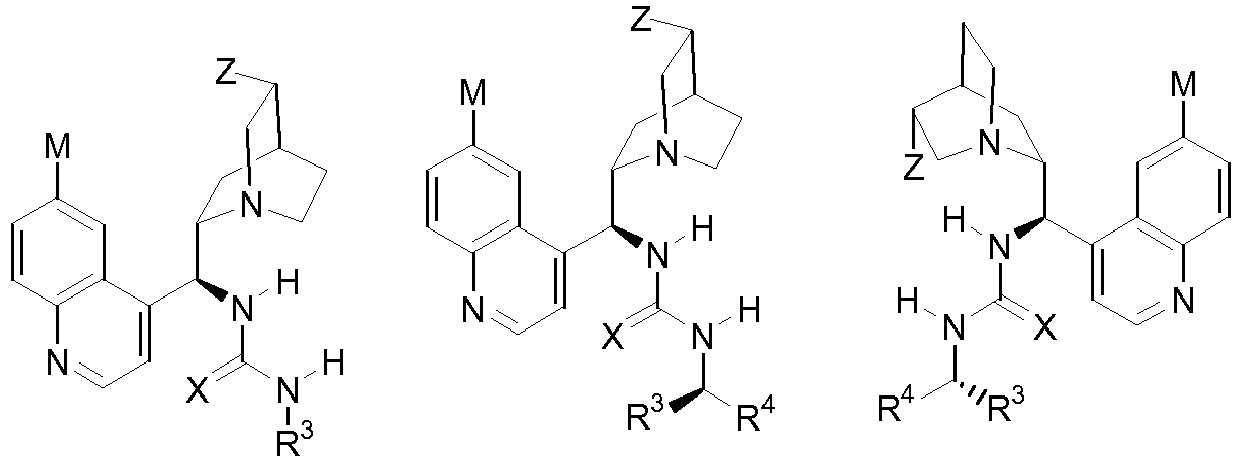
- the chiral catalyst may be selected from the group consisting of: wherein X can be O or S; Z can be a single or double bond; M can be H, OH, or OMe; R 1 and R 2 can be the same or different and may comprise C 1 -C 15 alkyl (optionally substituted with halogens or cycloalkyl groups), or R 1 and R 2 may together define a C 3 -C 15 cycloalkyl alkyl ring; and R 3 and R 4 can be the same or different and may comprise C 1 -C 15 alkyl (optionally substituted with halogens or cycloalkyl groups), or R 3 and R 4 may together define a C 3 -C 15 cycloalkyl alkyl ring or C 5 -C 15 aromatic ring.
- Z can be a single or double bond
- the statement "Z can be a single or double bond” indicates that the substituent Z can be a single or double bond ( i.e. not an element of the periodic table) and embraces the following non-limiting examples:
- R 1 and R 2 may together define a C 3 -C 15 cycloalkyl alkyl ring
- R 1 and R 2 may form an alkyl ring structure of which the N atom is an integral component of the ring structure, i.e. R 1 -N-R 2 define a heterocyclic alkyl ring.
- R 1 -N-R 2 define a heterocyclic alkyl ring.
- Bn takes its conventional meaning of "benzyl” in this specification.
- the chiral catalyst may be selected from the group consisting of: wherein X can be O or S; Z can be a C 1 to C 5 carbon chain optionally comprising at least one C-C unsaturated bond, and optionally substituted one or more times with at least one of a halogen, cyano, CF 3 , NO 2 , C 1 -C 5 ketone, C 1 -C 5 ester, C 1 -C 10 amide, C 1 -C 5 sulfone, C 1 -C 5 sulfoxide and combinations thereof; M can be H, OH, or OMe; R 1 and R 2 can be the same or different and may comprise C 1 -C 15 alkyl, or R 1 and R 2 may together define a C 3 -C 15 cycloalkyl ring, wherein each may be optionally substituted one or more times with at least one of a halogen, cyano, CF 3 , NO 2 , C 1 -C 5 ketone, C 1 -
- the chiral catalyst may be selected from the group comprising wherein X can be O or S; and Z can be a single or double bond.
- the chiral catalyst may be selected from the group comprising wherein X can be O or S; R 1 and R 2 can be the same or different and may comprise C 1 -C 15 alkyl, or R 1 and R 2 may together define a C 3 -C 15 cycloalkyl alkyl ring; and R 3 and R 4 can be the same or different and may comprise C 1 -C 15 alkyl, or R 3 and R 4 may together define a C 3 -C 15 cycloalkyl alkyl ring or C 5 -C 15 aromatic ring.
- the chiral catalyst may be selected from wherein X can be O or S; Z can be a single or double bond; M can be H, OH, or OMe; and R 3 and R 4 can be the same or different and may comprise C 1 -C 15 alkyl, or R 3 and R 4 may together define a C 3 -C 15 cycloalkyl alkyl ring or C 5 -C 15 aromatic ring.
- the chiral catalyst may be selected from the group comprising: wherein X can be O or S; Z can be a single or double bond; and M can be H, OH, or OMe.
- the chiral catalyst is selected from the group comprising: wherein Z can be a double or single bond.
- Z is a double bond.
- These catalysts are readily prepared from commercially available starting materials quinine or quinidine and conduct enantioselective thiolysis of 3- iso butylglutaric anhydride with excellent yield and enantioselectivity.
- Enantioselective thiolysis of 3- iso butylglutaric anhydride using an achiral thiol and a chiral catalyst affords the compound of the present invention in excellent yield and enantioselectivity at room temperature.
- the process of the present invention may be carried out in a solvent selected from the group consisting of C 5 -C 12 hydrocarbons, C 6 -C 12 aromatic hydrocarbons, C 3 -C 12 ketones (cyclic and acyclic), C 2 -C 12 ethers (cyclic and acyclic), C 2 to C 12 esters, C 2 -C 5 nitriles and combinations thereof.
- the solvent is ethereal.
- Suitable ethers may be selected from the group consisting of diethylether, THF, 2-methyl THF, diisopropylether, methyl tert butylether (MTBE) and combinations thereof.
- the solvent is methyl tert butylether (MTBE).
- Also described herein is a process for the enantioselective preparation of a compound of the general formula (IV) or (V), or a salt thereof, comprising: enantioselective alcoholysis of 3- iso butylglutaric anhydride to afford a compound having an ester functional group, wherein enantioselective alcoholysis of 3- iso butylglutaric anhydride comprises ring opening 3- iso butylglutaric anhydride using an achiral alcohol and a chiral catalyst selected from the group consisting of: wherein X can be O or S; Z can be a single or double bond; M can be H, OH, or OMe; R 1 and R 2 can be the same or different and may comprise C 1 -C 15 alkyl (optionally substituted with halogens or cycloalkyl groups), or R 1 and R 2 may together define a C 3 -C 15 cycloalkyl alkyl ring; and R 3 and R 4
- the chiral catalyst may be selected from the group consisting of: wherein X can be O or S; Z can be a C 1 to C 5 carbon chain optionally comprising at least one C-C unsaturated bond, and optionally substituted one or more times with at least one of a halogen, cyano, CF 3 , NO 2 , C 1 -C 5 ketone, C 1 -C 5 ester, C 1 -C 10 amide, C 1 -C 5 sulfone, C 1 -C 5 sulfoxide and combinations thereof; M can be H, OH, or OMe; R 1 and R 2 can be the same or different and may comprise C 1 -C 15 alkyl, or R 1 and R 2 may together define a C 3 -C 15 cycloalkyl ring, wherein each may be optionally substituted one or more times with at least one of a halogen, cyano, CF 3 , NO 2 , C 1 -C 5 ketone, C 1 -
- the chiral catalyst may be selected from the group comprising wherein X can be O or S; and Z can be a single or double bond.
- the chiral catalyst may be selected from the group comprising wherein X can be O or S; R 1 and R 2 can be the same or different and may comprise C 1 -C 15 alkyl, or R 1 and R 2 may together define a C 3 -C 15 cycloalkyl alkyl ring; and R 3 and R 4 can be the same or different and may comprise C 1 -C 15 alkyl, or R 3 and R 4 may together define a C 3 -C 15 cycloalkyl alkyl ring or C 5 -C 15 aromatic ring.
- the chiral catalyst may be selected from the group of: wherein X can be O or S; Z can be a single or double bond; M can be H, OH, or OMe; and R 3 and R 4 can be the same or different and may comprise C 1 -C 15 alkyl, or R 3 and R 4 may together define a C 3 -C 15 cycloalkyl alkyl ring or C 5 -C 15 aromatic ring.
- the chiral catalyst may be selected from the group comprising: wherein X can be O or S; Z can be a single or double bond; and M can be H, OH, or OMe.
- the chiral catalyst is selected from the group comprising: wherein Z can be a double or single bond.
- Z is a double bond
- the enantioselective alcoholysis process for producing products ( IV ) or (V) is the first example of a catalytic process with low catalyst loadings with respect to 3- iso butylglutaric anhydride.
- the catalyst loading may be 0.1 - 50 mol%, for example 0.1 - 25 mol%, such as 0.1 - 10 mol%.
- the catalyst loading with respect to 3- iso butylglutaric anhydride is 0.5 - 2 mol%. This represents a highly economic and efficient catalyst loading.
- the enantioselective alcoholysis process is the first example of an ambient temperature process capable of affording products (IV) or (V) in high enantioselectivity.
- the achiral alcohol may be selected from the group consisting of C 1 -C 15 alkyl alcohols, C 3 -C 15 cycloalkyl alcohols, C 5 -C 15 aromatic alcohols and combinations thereof.
- the achiral alcohol may be selected from the group consisting of C 1 -C 15 alkyl alcohols, C 3 -C 15 cycloalkyl alcohols and combinations thereof.
- the achiral alcohol may be a C 1 -C 10 alkyl alcohol.
- the achiral alcohol may be one of methanol, ethanol, propanol, benzyl alcohol or allyl alcohol.
- the product of the enantioselective alcholysis having an ester functional group may be of the general formula (IV), or a salt thereof, wherein R 2 is selected from the group consisting of C 1 -C 15 alkyl, C 3 -C 15 cycloalkyl, C 5 -C 15 aromatic and combinations thereof. R 2 may be selected from the group consisting of C 1 -C 15 alkyl alcohols, C 3 -C 15 cycloalkyl alcohols and combinations thereof.
- the product of the enantioselective alcoholysis having an ester functional group may be of the general formula (V), or a salt thereof, wherein R 2 is selected from the group consisting of C 1 -C 15 alkyl, C 3 -C 15 cycloalkyl, C 5 -C 15 aromatic and combinations thereof. R 2 may be selected from the group consisting of C 1 -C 15 alkyl alcohols, C 3 -C 15 cycloalkyl alcohols and combinations thereof.
- the above process may be carried out in a solvent selected from the group consisting of C 5 -C 8 hydrocarbons, C 6 -C 10 aromatic hydrocarbons, C 3 -C 10 ketones (cyclic and acyclic), C 2 -C 10 ethers (cyclic and acyclic), C 2 to C 10 esters, C 2 -C 5 nitriles and combinations thereof.
- the solvent is ethereal.
- Suitable ethers may be selected from the group consisting of diethylether, THF, 2-methyl THF, diisopropylether, methyl tert butylether (MTBE) and combinations thereof.
- the solvent is methyl tert butylether (MTBE).
- the solvent is methyl t e rt butylether (MTBE).
- the present invention further provides for a process for the preparation of 3-(aminomethyl)-5-methyl-hexanoic acid comprising:
- the present invention affords a process for the enantioselective preparation of 3-(aminomethyl)-5-methyl-hexanoic acid comprising:
- the chiral intermediate having a thioester functional group may be of the general formula (II) or (III), or a salt, or ester thereof, wherein R 1 is chosen as described in the claims, such that elimination of a thiol (R 1 -SH) to generate 3- iso butylglutaric anhydride is thermodynamically disfavoured.
- R 1 may be chosen such that the pK a (H 2 O) of R 1 -SH is greater than 4.
- R 1 may be chosen such that the pK a (H 2 O) of R 1 -SH is greater than 6.
- R 1 may be chosen such that the pK a (H 2 O) of R 1 -SH is greater than 8.
- R 1 may be selected from the group consisting of C 1 -C 15 alkyl, C 3 -C 15 cycloalkyl, C 5 -C 15 aromatic and combinations thereof.
- R 1 may be selected from C 1 -C 15 alkyl, C 3 -C 15 cycloalkyl and combinations thereof.
- R 1 as defined above may comprise a primary or secondary carbon atom directly bonded to S. Desirably, R 1 does not comprise a tertiary carbon atom directly bonded to S.
- R 1 may be selected from ethyl, propyl, butyl, 3-propenyl, benzyl, 2-propyl, 4- tert butyl benzyl, cyclopentyl, cyclohexyl, or phenyl.
- R 1 may be ethyl, propyl, butyl, 3-propenyl, benzyl, 2-propyl, 4- tert butyl benzyl, cyclopentyl, or
- the 3-(aminomethyl)-5-methyl-hexanoic acid produced is ( R )-3-(aminomethyl)-5-methyl-hexanoic acid.
- the 3-(aminomethyl)-5-methyl-hexanoic acid produced is ( S )-3-(aminomethyl)-5-methyl-hexanoic acid.
- the step of converting the thioester functional group into an amine may comprise:
- Aminolysis of the thioester functional group comprises treating the thioester with ammonia or an amine.
- aminolysis of the thioester functional group comprises treating the thioester with ammonia to yield a primary amide.
- the Hofmann rearrangement is an eminent synthetic transformation which converts an amide to an amine with the loss of carbon monoxide. All protocols for effecting this transformation are embraced by the present invention.
- the thiol utilised in the enantioselective thiolysis of 3- iso butylglutaric anhydride will be chosen such that aminolysis of the thioester intermediate does not result in racemisation of the product, as per Scheme 4 ( infra ).
- the thiol may be chosen such that the pK a (H 2 O) of R 1 -SH is greater than 4.
- the thiol may be chosen such that the pK a (H 2 O) of R 1 -SH is greater than 6.
- the thiol may be chosen such that the pK a (H 2 O) of R 1 -SH is greater than 8.
- the intermediate having a thioester functional group produced by the process of the present invention undergoes aminolysis more rapidly and under milder conditions that the corresponding ester intermediates.
- the process of the present invention allows for the synthesis of either enantiomer of 3-(aminomethyl)-5-methyl-hexanoic acid in excellent yield and enantiomeric excess at ambient temperature or just below.
- the inventive process of the present invention allows for very low catalyst loadings with no decrease in yield.
- the process of the present invention is highly efficient as it does not produce 50% of the unwanted enantiomer.
- the present invention provides for use of a chiral catalyst in substoichiometric loading relative to the reactants in a process for the enantioselective synthesis of 3-(aminomethyl)-5-methyl-hexanoic acid.
- the invention further provides for use of a chiral catalyst for enantioselective thiolysis of 3- iso butylglutaric anhydride; wherein the catalyst is in sub-stoichiometric loading relative to 3- iso butylglutaric anhydride, in a process for the enantioselective synthesis of 3-(aminomethyl)-5-methyl-hexanoic acid.
- Suitable catalysts may be selected from the group consisting of: wherein X can be O or S; Z can be a single or double bond; M can be H, OH, or OMe; R 1 and R 2 can be the same or different and may comprise C 1 -C 15 alkyl (optionally substituted with halogens or cycloalkyl groups), or R 1 and R 2 may together define a C 3 -C 15 cycloalkyl alkyl ring; and R 3 and R 4 can be the same or different and may comprise C 1 -C 15 alkyl (optionally substituted with halogens or cycloalkyl groups), or R 3 and R 4 may together define a C 3 -C 15 cycloalkyl alkyl ring or C 5 -C 15 aromatic ring.
- the chiral catalyst may be selected from the group consisting of: wherein X can be O or S; Z can be a C 1 to C 5 carbon chain optionally comprising at least one C-C unsaturated bond, and optionally substituted one or more times with at least one of a halogen, cyano, CF 3 , NO 2 , C 1 -C 5 ketone, C 1 -C 5 ester, C 1 -C 10 amide, C 1 -C 5 sulfone, C 1 -C 5 sulfoxide and combinations thereof; M can be H, OH, or OMe; R 1 and R 2 can be the same or different and may comprise C 1 -C 15 alkyl, or R 1 and R 2 may together define a C 3 -C 15 cycloalkyl ring, wherein each may be optionally substituted one or more times with at least one of a halogen, cyano, CF 3 , NO 2 , C 1 -C 5 ketone, C 1 -
- the electrophile may be 3- iso butylglutaric anhydride.
- the nucleophile may be a thiol.
- the chiral catalyst may be selected from the group comprising wherein X can be O or S; and Z can be a single or double bond.
- the chiral catalyst may be selected from the group comprising wherein X can be O or S; R 1 and R 2 can be the same or different and may comprise C 1 -C 15 alkyl, or R 1 and R 2 may together define a C 3 -C 15 cycloalkyl alkyl ring; and R 3 and R 4 can be the same or different and may comprise C 1 -C 15 alkyl, or R 3 and R 4 may together define a C 3 -C 15 cycloalkyl alkyl ring or C 5 -C 15 aromatic ring.
- the chiral catalyst may be selected from wherein X can be O or S; Z can be a single or double bond; M can be H, OH, or OMe; and R 3 and R 4 can be the same or different and may comprise C 1 -C 15 alkyl, or R 3 and R 4 may together define a C 3 -C 15 cycloalkyl alkyl ring or C 5 -C 15 aromatic ring.
- the chiral catalyst may be selected from the group consisting of: wherein X can be O or S; Z can be a single or double bond; and M can be H, OH or OMe.
- the chiral catalyst is selected from the group comprising: wherein Z can be a double or single bond.
- Z is a double bond
- C x -C y alkyl, C x -C y cycloalkyl, C x -C y aromatic, etc. presented herein embrace substitution of these chains/rings provided such substitutions do not interfere with the thiol mediated thiolysis or alcohol mediated alcoholysis of 3- iso butylglutaric anhydride. Unless otherwise indicated suitable substitutions may comprise halogens, cyano, CF 3 , and combinations thereof. As used herein, the terms aromatic/aryl encompass heteroaromatic/heteroaryl.
- the compounds of the present invention may be found or isolated in the form of esters, salts, hydrates or solvates - all of which are embraced by the present invention.
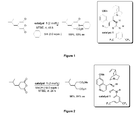
- FIG. 1 A schematic of the catalytic enantioselective thiolysis of 3- iso butylglutaric anhydride using cyclohexane thiol to afford ( R )-3-cyclohexylsulfanylcarbonylmethyl-5-methyl-hexanoic acid is provided in Figure 1 .
- Thiolysis of 3- iso butylglutaric anhydride in methyl tert butylether (MTBE), at room temperature (rt) in the presence of catalytic quantities of C1 affords 3-cyclohexylsulfanylcarbonylmethyl-5-methyl-hexanoic acid in quantitative yield with the ( R ) enantiomer obtained in 93% ee.
- MTBE methyl tert butylether
- Figure 2 depicts catalytic enantioselective alcoholysis of 3- iso butylglutaric anhydride using methanol.
- MTBE methyl tert butylether
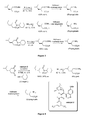
- Figure 4 demonstrates a room temperature enantioselective synthesis of ( S )-pregabalin in the presence of catalytic quantities of epimeric quinidine thiourea C2 .
- Thiolysis of 3 -iso butylglutaric anhydride with cyclohexane thiol in methyl tertb utylether (MTBE), at room temperature (rt) in the presence of catalytic quantities of C2 affords ( S )-3-cyclohexylsulfanylcarbonylmethyl-5-methyl-hexanoic acid in quantitative yield and in 92% ee (the ee increased to 94% when the reaction was carried out at 0 °C).
- the resulting biphasic mixture was transferred to a separating funnel and the aqueous phase was extracted with EtOAc (3 x 15 mL). The organic phases were combined, dried over MgSO 4 , and concentrated in vacuo to provide the desired hemithioester, after purification by flash-chromatography, in 94% ee.
- the resulting biphasic mixture was transferred to a separating funnel and the aqueous phase was extracted with EtOAc (3 x 15 mL). The organic phases were combined, dried over MgSO 4 and concentrated in vacuo to provide the desired hemithioester, after purification by flash-chromatography, in 94% ee.
- the enantioenriched product was transformed into the corresponding o-nitrophenoxy ester and analyzed by CSP-HPLC.
Landscapes
- Chemical & Material Sciences (AREA)
- Organic Chemistry (AREA)
- Chemical Kinetics & Catalysis (AREA)
- Engineering & Computer Science (AREA)
- Materials Engineering (AREA)
- Organic Low-Molecular-Weight Compounds And Preparation Thereof (AREA)
- Low-Molecular Organic Synthesis Reactions Using Catalysts (AREA)
- Acyclic And Carbocyclic Compounds In Medicinal Compositions (AREA)
Description
- The present invention relates to enantioselective methods for the preparation of 3-(aminomethyl)-5-methyl-hexanoic acid and salts and esters thereof. In particular, the present invention provides for a process for the preparation of (S)-(+)-3-(aminomethyl)-5-methyl-hexanoic acid or (S)-pregabalin and salts and esters thereof. The invention further relates to synthetic intermediates of the synthetic processes referred to above.
- (S)-(+)-3-(aminomethyl)-5-methyl-hexanoic acid or (S)-pregabalin (1) is an anticonvulsive drug manufactured and marketed by Pfizer. In its first full year on the market this drug achieved sales in excess of 1 billion US dollars.

- In addition to its use as an anticonvulsive agent, pregabalin has also been indicated as a medicament in the treatment of anxiety, neuropathic pain and pain in patients with fibromyalgia.
- Two existing syntheses of (S)-(+)-3-(aminomethyl)-5-methyl-hexanoic acid proceed through the meso-anhydride 3-isobutylglutaric anhydride (2).

-
U.S. Patent number 5,616,793 describes aminolysis of 2 with aqueous ammonia as illustrated inScheme 1. The resultant racemic amide (A) is resolved by reacting it with (R)-(+)-α-phenylethylamine to yield (R)-(-)-3-(carbamoylmethyl)-5-methyl hexanoic acid, which is in turn subjected to a Hofmann rearrangement to afford (S)-pregabalin. This process suffers in that it is wasteful as the unwanted enantiomer of intermediate A is discarded, and the chiral resolving agent (R)-(+)-α-phenylethylamine has to be employed is substantial quantities and subsequently removed from the reaction. -
U.S. Patent number 7,462,738 discloses the asymmetric alcoholysis of 3-isobutylglutaric anhydride to afford hemiester B. The overall synthetic strategy is outlined inScheme 2. Enantioselective alcoholysis of 3-isobutylglutaric anhydride is obtained utilising either a chiral alcohol or an achiral alcohol in combination with a chiral amine. Amidation of enantioenriched hemiester B with aqueous ammonia yields (R)-(-)-3-(carbamoylmethyl)-5-methyl hexanoic acid and a Hofmann rearrangement affords (S)-pregabalin.
- In order to achieve good enantioselectivity, the process of
U.S. 7,462,738 necessitates that the chiral alcohol or chiral amine/achiral alcohol combination employed in the alcoholysis step be utilised in an appreciable excess relative to the starting material 3-isobutylglutaric anhydride, i.e. greater than 1:1. In all cases the chiral amine must be employed in stoichiometric amounts. Such an approach is inefficient and costly. Furthermore, exceedingly low temperatures of -50 °C or -78 °C are required for acceptable enantioinduction in the alcoholysis step.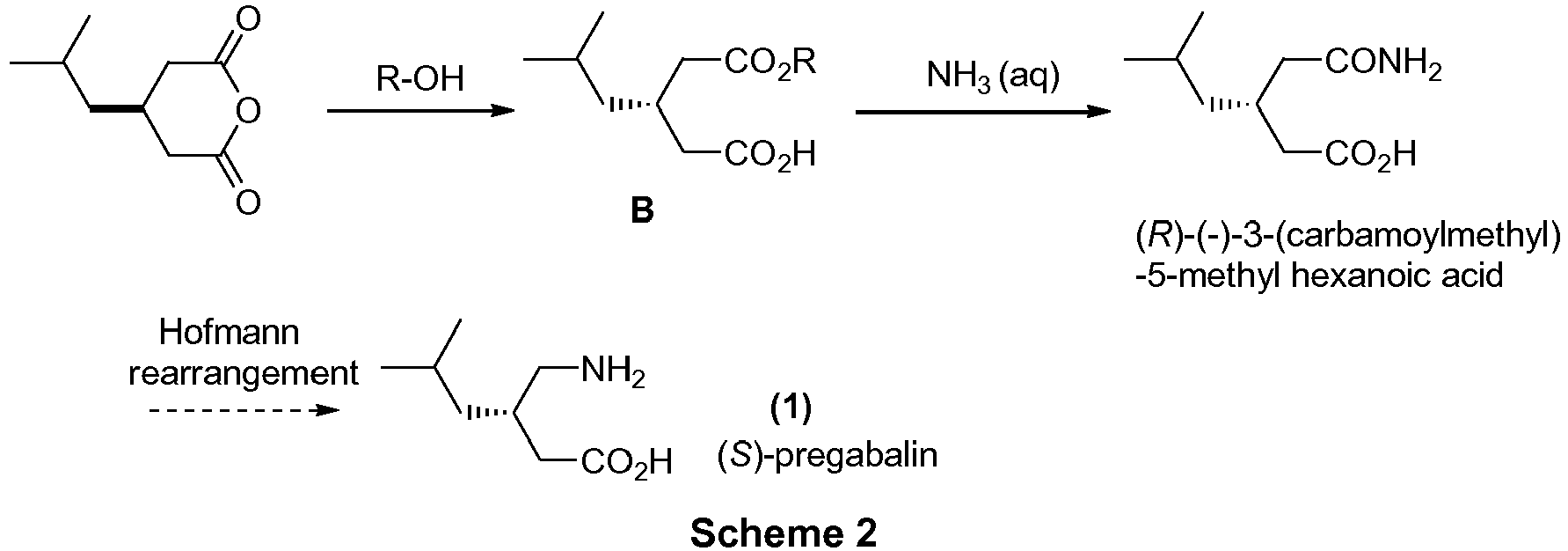
- Notwithstanding the state of the art it would still be desirable to provide alternative enantioselective synthetic methods for preparing 3-(aminomethyl)-5-methyl-hexanoic acid. Ideally, such methods would provide for high enantioselectivity at ambient temperature and enantioinduction would be achievable utilising a chiral catalyst in sub-stoichiometric quantities relative to the starting reagent, thereby affording an efficient and economic synthetic process.
- In
US20070293694 Hedvati describes process for the synthesis of R-(+)-2-(carbamoylmethyl)-5-methylhexanoic acid and salts thereof, intermediates in the synthesis of S-pregabalin. The processes described involve ring opening of 3-isobutylglutaric anhydride via amidation. - Peschiulli et al (J. Org. Chem. 2008, 73(16), 6409) describes the utility of bifunctional urea-based cinchona alkaloid derivatives in promoting highly efficient dynamic kinetic resolution reactions of azalactones using an alcohol or thiol nucleophile.
- Brimble et al describe rules for the abbreviation of protecting groups in their IUPAC Technical Report (Pure Appl. Chem. 2013, 85(1), 307).
- The present invention provides for a thiol-based synthetic intermediate in the enantioselective synthesis of 3-(aminomethyl)-5-methyl-hexanoic acid. The invention further provides for a process for the enantioselective preparation of 3-(aminomethyl)-5-methyl-hexanoic acid utilising such intermediates.
- In one aspect, the present invention provides for a compound of the general formula (I), or a salt, or ester thereof,

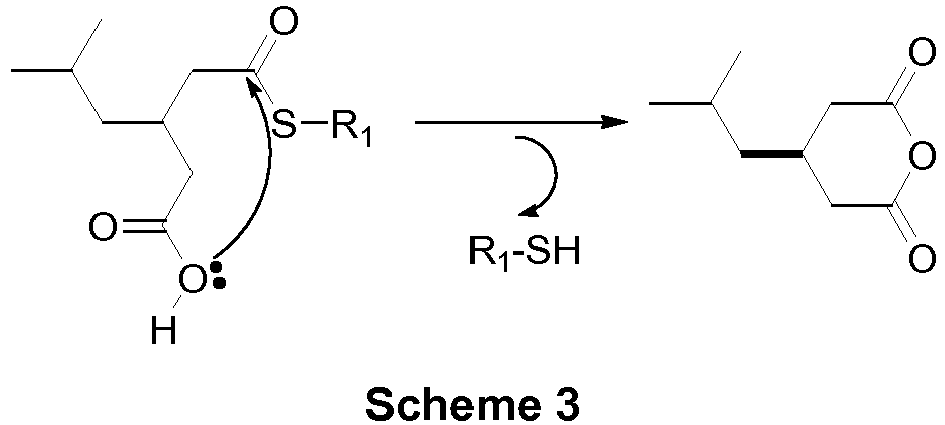
claim 1. R1 is chosen such that elimination of a thiol (R1-SH) to generate 3-isobutylglutaric anhydride is thermodynamically disfavoured. R1 may be chosen such that the pKa (H2O) of R1-SH is greater than 4. R1 may be chosen such that the pKa (H2O) of R1-SH is greater than 6. R1 may be chosen such that the pKa (H2O) of R1-SH is greater than 8. - The mechanism by which a thiol could be eliminated to generate 3-isobutylglutaric anhydride is detailed in Scheme 3 (infra). Accordingly, R1 is chosen such that the reaction shown is Scheme 3 does not proceed, i.e. the thioester product is thermodynamically more stable than separate thiol and 3-isobutylglutaric anhydride products.
- R1 may be selected from the group consisting of C1-C15 alkyl, C3-C15 cycloalkyl, C5-C15 aromatic and combinations thereof. R1 may be selected from C1-C15 alkyl, C3-C15 cycloalkyl or combinations thereof. As used herein, the term "Cx-Cy alkyl" embraces Cx-Cy unbranched alkyl, Cx-Cy branched alkyl and combinations thereof. R1 as defined above may comprise a primary or secondary carbon atom directly bonded to S. Desirably, R1 does not comprise a tertiary carbon atom directly bonded to S. R1 may be selected from ethyl, propyl, butyl, 3-propenyl, benzyl, 2-propyl, 4-tertbutyl benzyl, cyclopentyl, cyclohexyl, or phenyl. R1 may be ethyl, propyl, butyl, 3-propenyl, benzyl, 2-propyl, 4-tertbutyl benzyl, cyclopentyl, or cyclohexyl.
- The compound (I) may find use as an intermediate in the synthesis of 3-(aminomethyl)-5-methyl-hexanoic acid.
- The compound of the present invention may be of the general formula (II), or a salt, or ester thereof,

claim 2. R1 is chosen such that elimination of a thiol (R1-SH) to generate 3-isobutylglutaric anhydride is thermodynamically disfavoured. R1 may be chosen such that the pKa (H2O) of R1-SH is greater than 4. R1 may be chosen such that the pKa (H2O) of R1-SH is greater than 6. R1 may be chosen such that the pKa (H2O) of R1-SH is greater than 8. - R1 may be selected from the group consisting of C1-C15 alkyl, C3-C15 cycloalkyl, C5-C15 aromatic and combinations thereof. R1 may be selected from C1-C15 alkyl, C3-C15 cycloalkyl and combinations thereof. R1 as defined above may comprise a primary or secondary carbon atom directly bonded to S. Desirably, R1 does not comprise a tertiary carbon atom directly bonded to S. R1 may be selected from ethyl, propyl, butyl, 3-propenyl, benzyl, 2-propyl, 4-tertbutyl benzyl, cyclopentyl, cyclohexyl, or phenyl. R1 may be ethyl, propyl, butyl, 3-propenyl, benzyl, 2-propyl, 4-tertbutyl benzyl, cyclopentyl, or cyclohexyl.
- In the embodiment within formula (II), the absolute configuration of the chiral centre of the compound of the present invention is (R). Compound (II) may find utility as an intermediate in the enantioselective synthesis of (R)-3-(aminomethyl)-5-methyl-hexanoic acid.
- Alternatively, the compound of the present invention may be of the general formula (III), or a salt, or ester thereof,

- R1 may be selected from the group consisting of C1-C15 alkyl, C3-C15 cycloalkyl, C5-C15 aromatic and combinations thereof. R1 may be selected from C1-C15 alkyl, C3-C15 cycloalkyl and combinations thereof. R1 as defined above may comprise a primary or secondary carbon atom directly bonded to S. Desirably, R1 does not comprise a tertiary carbon atom directly bonded to S. R1 may be selected from ethyl, propyl, butyl, 3-propenyl, benzyl, 2-propyl, 4-tertbutyl benzyl, cyclopentyl, cyclohexyl, or phenyl. R1 may be ethyl, propyl, butyl, 3-propenyl, benzyl, 2-propyl, 4-tertbutyl benzyl, cyclopentyl, or cyclohexyl.
- In the embodiment within formula (III), the absolute configuration of the chiral centre of the compound of the present invention is (S). Compound (III) may find utility as an intermediate in the enantioselective synthesis of (S)-3-(aminomethyl)-5-methyl-hexanoic acid.
- Within the context of this specification, the term "enantioselective" refers to a synthetic process that produces one enantiomer of a product in preference to the other enantiomer.
- The present invention further provides for a process for the preparation of a compound according to the present invention, or a salt, or ester thereof comprising thiolysis of 3-isobutylglutaric anhydride. Thiolysis of 3-isobutylglutaric anhydride will result in a thioester compound according to the present invention. For example, a compound of the general formula (I).
- Desirably, the present invention provides for a process for the enantioselective preparation of a compound according to the present invention, or a salt, or ester thereof comprising enantioselective thiolysis of 3-isobutylglutaric anhydride. Advantageously, such an enantioselective process will produce one enantiomer of a compound according to the present invention in preference to the other. For example, a compound of the general formula (II) in preference to a compound of the general formula (III) and vice versa.
- As used herein, thiolysis of 3-isobutylglutaric anhydride comprises ring opening of the cyclic anhydride with a thiol, to yield a compound having a thioester functional group.
- The enantioselective thiolysis step may comprise ring opening 3-isobutylglutaric anhydride using a chiral thiol. Suitable chiral thiols may be selected from the group consisting of (R)-1-phenylethanethiol, (S)-1-phenylethanethiol, (R)-1-(1)-naphtylethanethiol, (S)-1-(1)-naphtylethanethiol, (1S, 2R)-2-phenylcyclohexanethiol, (1R, 2S)-2-phenylcyclohexanethiol, N-Boc-L-cysteine methyl ester, and N-Boc-D-cysteine methyl ester. Such a list is representative only and is by no means limiting on the scope of the invention.
- Alternatively, the enantioselective thiolysis step may comprise ring opening 3-isobutylglutaric anhydride using an achiral thiol and a chiral catalyst.
- The achiral thiol is chosen such that upon thiolysis of 3-isobutylglutaric anhydride, it is thermodynamically disfavoured for the thioester compound to eliminate a thiol (R1-SH) to re-generate 3-isobutylglutaric anhydride. The achiral thiol may be chosen such that the pKa (H2O) of R1-SH is greater than 4. The achiral thiol may be chosen such that the pKa (H2O) of R1-SH is greater than 6. The achiral thiol may be chosen such that the pKa (H2O) of R1-SH is greater than 8.
- The achiral thiol may be selected from the group consisting of C1-C15 alkane thiols, C3-C15 cycloalkyl thiols, C5-C15 aromatic thiols and combinations thereof. The achiral thiol may be selected from C1-C15 alkyl, C3-C15 cycloalkyl and combinations thereof. The achiral thiol may comprise a primary or secondary thiol. Desirably, the achiral thiol does not comprise a tertiary thiol. The achiral thiol may be selected from the group comprising ethane thiol, propane thiol, butane thiol, propene-3-thiol, benzylmercaptan, 2-propane thiol, 4-tertbutylbenzyl mercaptan, cyclopentane thiol, cyclohexane thiol, and thiophenol.
- The term "catalyst" refers to a molecule in the reaction mixture that enhances the rate of reaction and is used in sub-stoichiometric loading relative to the reactants. The term "chiral catalyst" refers to a chiral molecule in the reaction mixture, used in substoichiometric loading relative to the 3-isobutylglutaric anhydride. The chiral catalyst imparts a chiral influence on the reaction between the thiol and 3-isobutylglutaric anhydride to afford the chiral thioester product in high enantioselectivity.
- The (chiral) catalyst loading with respect to 3-isobutylglutaric anhydride may be 0.1 - 50 mol%, for example 0.1 - 25 mol%, such as 0.1 - 10 mol%. Desirably, the catalyst loading with respect to 3-isobutylglutaric anhydride is 0.5 - 2 mol%. This represents a highly economic and efficient catalyst loading.
- In one embodiment, the chiral catalyst comprises:
- i) a Lewis acid functional group to enhance the electrophilicity of 3-isobutylglutaric anhydride; and
- ii) a Lewis base functional group to enhance the nucleophilicity of the achiral thiol.
- By enhancing the nucleophilicity of a first reaction component and enhancing the electrophilicity of a second reaction component the catalyst greatly enhances the rate of reaction between both components. As will be appreciated by a person skilled in the art, such catalysts are often termed bifunctional catalysts as they can activate the 3-isobutylglutaric anhydride electrophile and the achiral thiol nucleophile simultaneously, thereby facilitating reaction of both components in a chiral environment.

- The chiral catalyst may be selected from the group consisting of:
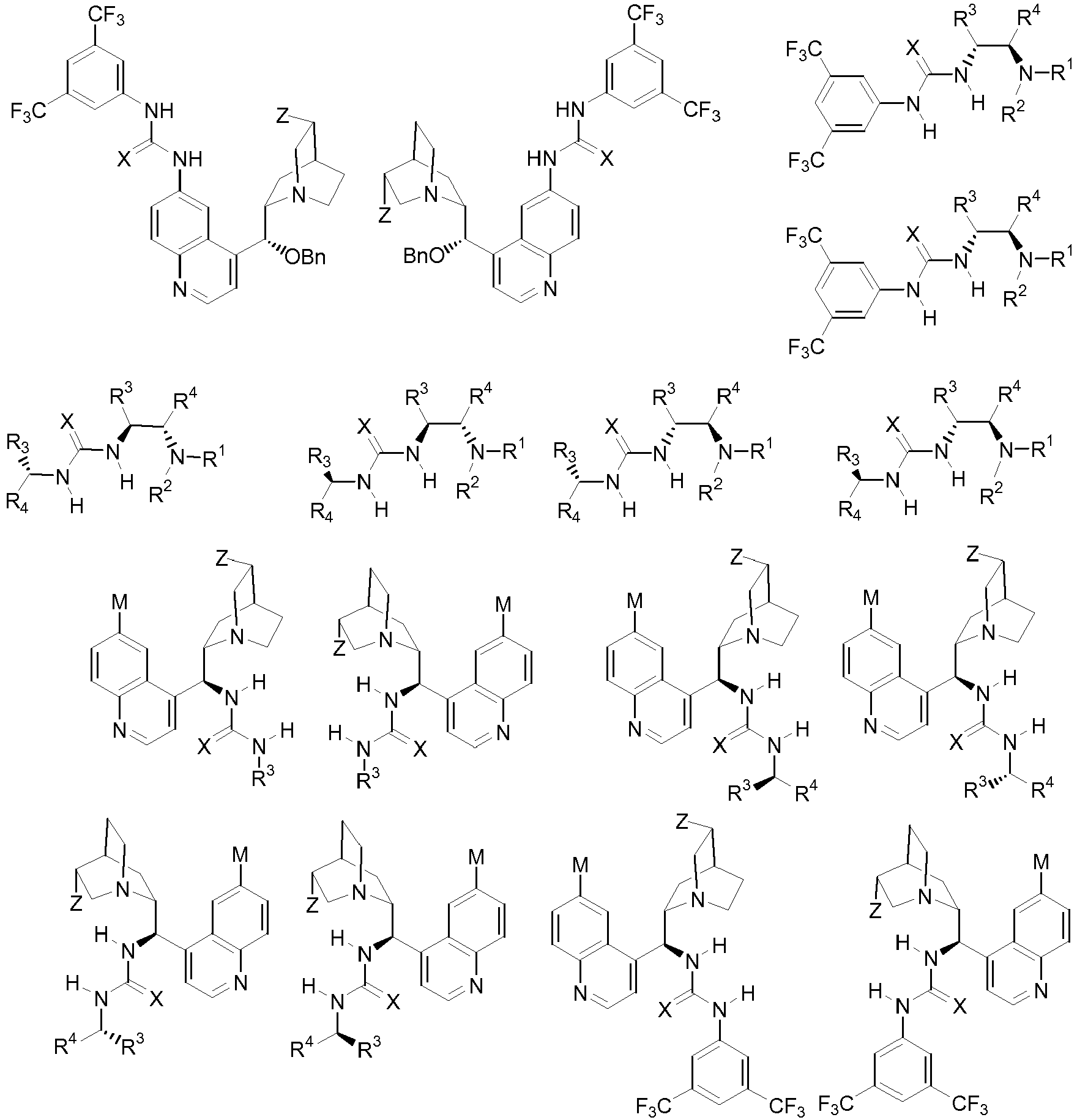
Z can be a single or double bond;
M can be H, OH, or OMe;
R1 and R2 can be the same or different and may comprise C1-C15 alkyl (optionally substituted with halogens or cycloalkyl groups), or R1 and R2 may together define a C3-C15 cycloalkyl alkyl ring; and
R3 and R4 can be the same or different and may comprise C1-C15 alkyl (optionally substituted with halogens or cycloalkyl groups), or R3 and R4 may together define a C3-C15 cycloalkyl alkyl ring or C5-C15 aromatic ring. - As used herein, the statement "Z can be a single or double bond" indicates that the substituent Z can be a single or double bond (i.e. not an element of the periodic table) and embraces the following non-limiting examples:

- As used herein, the statement "R1 and R2 may together define a C3-C15 cycloalkyl alkyl ring" indicates that R1 and R2 may form an alkyl ring structure of which the N atom is an integral component of the ring structure, i.e. R1-N-R2 define a heterocyclic alkyl ring. For the avoidance of any doubt, the shorthand "Bn" takes its conventional meaning of "benzyl" in this specification.
- The chiral catalyst may be selected from the group consisting of:




Z can be a C1 to C5 carbon chain optionally comprising at least one C-C unsaturated bond, and optionally substituted one or more times with at least one of a halogen, cyano, CF3, NO2, C1-C5 ketone, C1-C5 ester, C1-C10 amide, C1-C5 sulfone, C1-C5 sulfoxide and combinations thereof;
M can be H, OH, or OMe;
R1 and R2 can be the same or different and may comprise C1-C15 alkyl, or R1 and R2 may together define a C3-C15 cycloalkyl ring, wherein each may be optionally substituted one or more times with at least one of a halogen, cyano, CF3, NO2, C1-C5 ketone, C1-C5 ester, C1-C10 amide, C1-C5 sulfone, C1-C5 sulfoxide, C1-C5 alkyl and combinations thereof; and
R3 and R4 can be the same or different and may comprise C1-C15 alkyl, or R3 and R4 may together define a C3-C15 cycloalkyl ring or a C5-C15 aryl ring wherein each may be optionally substituted one or more times with at least one of a halogen, cyano, CF3, NO2, C1-C5 ketone, C1-C5 ester, C1-C10 amide, C1-C5 sulfone, C1-C5 sulfoxide, C1-C5 alkyl and combinations thereof; and
R5 and R6 can be the same or different and may comprise C1-C15 alkyl, or R5 and R6 may together define a C3-C15 cycloalkyl ring, or a C5-C15 aryl ring wherein each may be optionally substituted one or more times with at least one of a halogen, cyano, CF3, NO2, C1-C5 ketone, C1-C5 ester, C1-C10 amide, C1-C5 sulfone, C1-C5 sulfoxide, C1-C5 alkyl and combinations thereof. - The chiral catalyst may be selected from the group comprising

Z can be a single or double bond. - Alternatively, the chiral catalyst may be selected from the group comprising
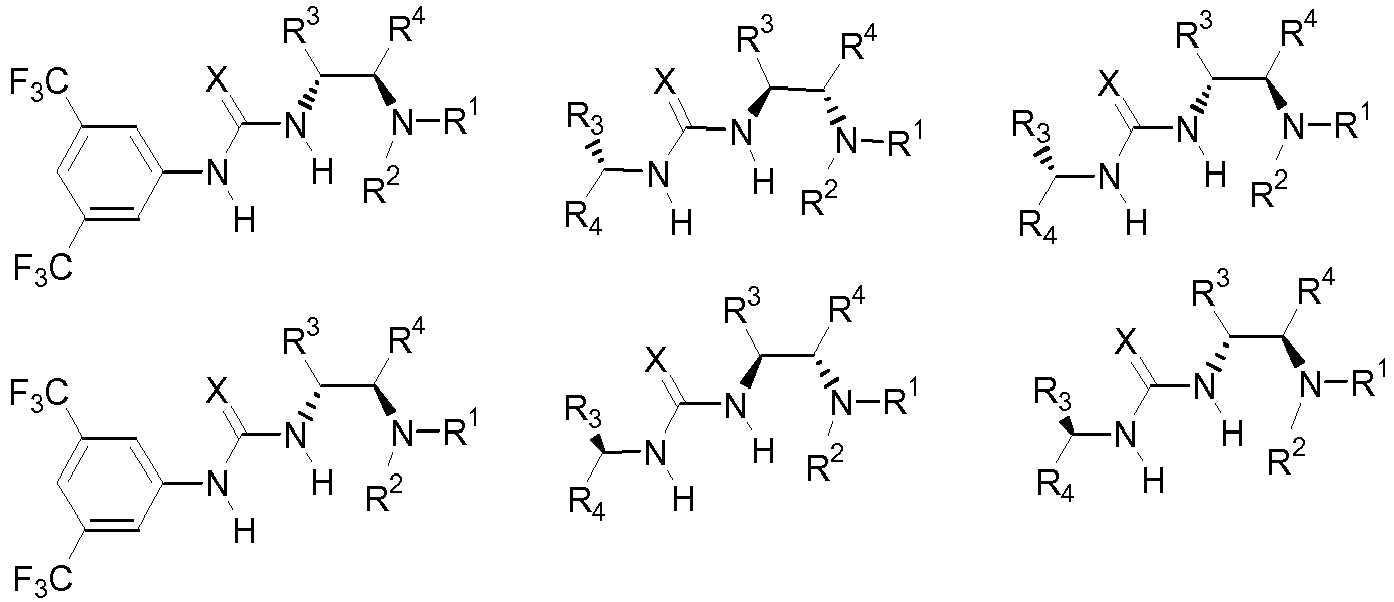
R1 and R2 can be the same or different and may comprise C1-C15 alkyl, or R1 and R2 may together define a C3-C15 cycloalkyl alkyl ring; and
R3 and R4 can be the same or different and may comprise C1-C15 alkyl, or R3 and R4 may together define a C3-C15 cycloalkyl alkyl ring or C5-C15 aromatic ring. - In yet a further alternative embodiment, the chiral catalyst may be selected from

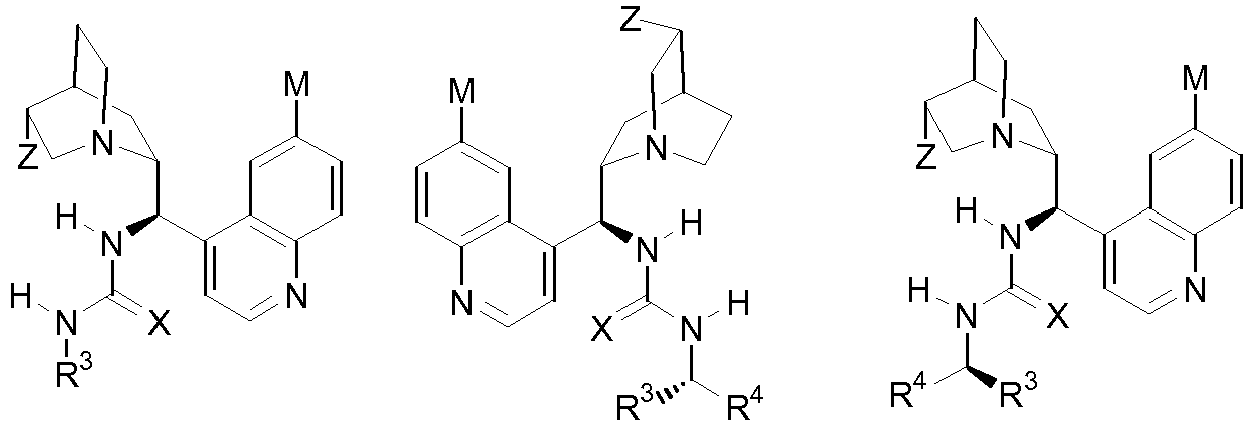
Z can be a single or double bond;
M can be H, OH, or OMe; and
R3 and R4 can be the same or different and may comprise C1-C15 alkyl, or R3 and R4 may together define a C3-C15 cycloalkyl alkyl ring or C5-C15 aromatic ring. - The chiral catalyst may be selected from the group comprising:

Z can be a single or double bond; and
M can be H, OH, or OMe. - Desirably, the chiral catalyst is selected from the group comprising:

- In one embodiment Z is a double bond. These catalysts are readily prepared from commercially available starting materials quinine or quinidine and conduct enantioselective thiolysis of 3-isobutylglutaric anhydride with excellent yield and enantioselectivity.
- Enantioselective thiolysis of 3-isobutylglutaric anhydride using an achiral thiol and a chiral catalyst affords the compound of the present invention in excellent yield and enantioselectivity at room temperature.
- The process of the present invention may be carried out in a solvent selected from the group consisting of C5-C12 hydrocarbons, C6-C12 aromatic hydrocarbons, C3-C12 ketones (cyclic and acyclic), C2-C12 ethers (cyclic and acyclic), C2 to C12 esters, C2-C5 nitriles and combinations thereof. Desirably, the solvent is ethereal. For example, C2-C12 ethers (cyclic and acyclic). Suitable ethers may be selected from the group consisting of diethylether, THF, 2-methyl THF, diisopropylether, methyltertbutylether (MTBE) and combinations thereof. In a preferred embodiment, the solvent is methyltertbutylether (MTBE).
- Also described herein is a process for the enantioselective preparation of a compound of the general formula (IV) or (V), or a salt thereof, comprising:

wherein enantioselective alcoholysis of 3-isobutylglutaric anhydride comprises ring opening 3-isobutylglutaric anhydride using an achiral alcohol and a chiral catalyst selected from the group consisting of:


Z can be a single or double bond;
M can be H, OH, or OMe;
R1 and R2 can be the same or different and may comprise C1-C15 alkyl (optionally substituted with halogens or cycloalkyl groups), or R1 and R2 may together define a C3-C15 cycloalkyl alkyl ring; and
R3 and R4 can be the same or different and may comprise C1-C15 alkyl (optionally substituted with halogens or cycloalkyl groups), or R3 and R4 may together define a C3-C15 cycloalkyl alkyl ring or C5-C15 aromatic ring. - The chiral catalyst may be selected from the group consisting of:


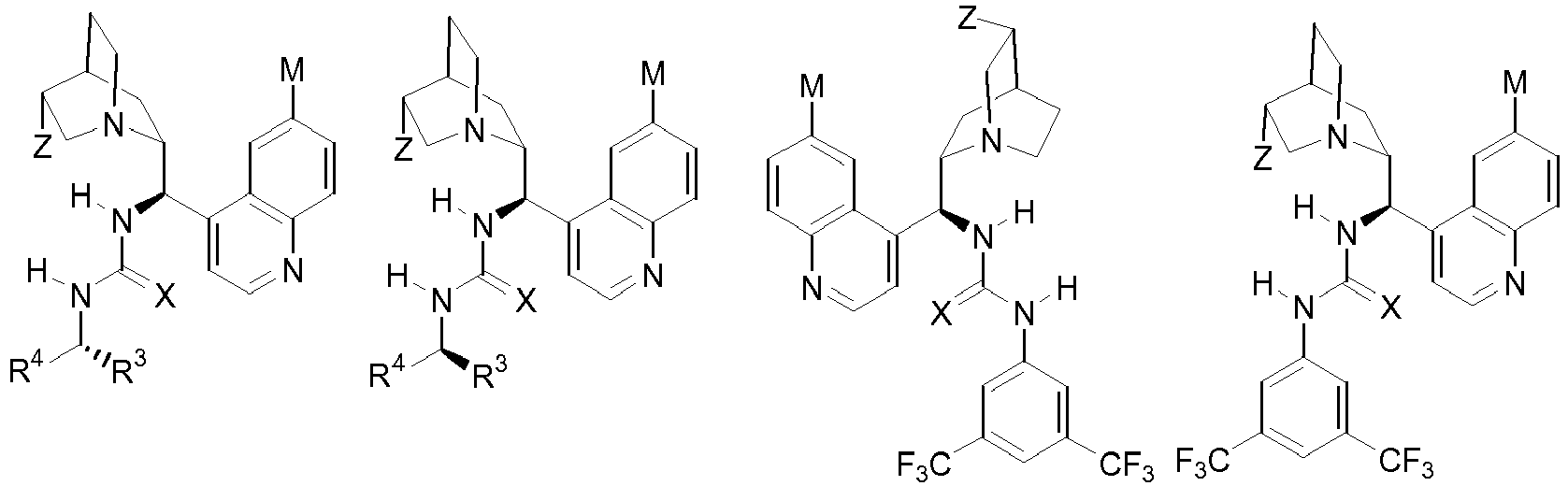
Z can be a C1 to C5 carbon chain optionally comprising at least one C-C unsaturated bond, and optionally substituted one or more times with at least one of a halogen, cyano, CF3, NO2, C1-C5 ketone, C1-C5 ester, C1-C10 amide, C1-C5 sulfone, C1-C5 sulfoxide and combinations thereof;
M can be H, OH, or OMe;
R1 and R2 can be the same or different and may comprise C1-C15 alkyl, or R1 and R2 may together define a C3-C15 cycloalkyl ring, wherein each may be optionally substituted one or more times with at least one of a halogen, cyano, CF3, NO2, C1-C5 ketone, C1-C5 ester, C1-C10 amide, C1-C5 sulfone, C1-C5 sulfoxide, C1-C5 alkyl and combinations thereof; and
R3 and R4 can be the same or different and may comprise C1-C15 alkyl, or R3 and R4 may together define a C3-C15 cycloalkyl ring or a C5-C15 aryl ring wherein each may be optionally substituted one or more times with at least one of a halogen, cyano, CF3, NO2, C1-C5 ketone, C1-C5 ester, C1-C10 amide, C1-C5 sulfone, C1-C5 sulfoxide, C1-C5 alkyl and combinations thereof; and
R5 and R6 can be the same or different and may comprise C1-C15 alkyl, or R5 and R6 may together define a C3-C15 cycloalkyl ring, or a C5-C15 aryl ring wherein each may be optionally substituted one or more times with at least one of a halogen, cyano, CF3, NO2, C1-C5 ketone, C1-C5 ester, C1-C10 amide, C1-C5 sulfone, C1-C5 sulfoxide, C1-C5 alkyl and combinations thereof. - The chiral catalyst may be selected from the group comprising

Z can be a single or double bond. - Alternatively, the chiral catalyst may be selected from the group comprising


R1 and R2 can be the same or different and may comprise C1-C15 alkyl, or R1 and R2 may together define a C3-C15 cycloalkyl alkyl ring; and
R3 and R4 can be the same or different and may comprise C1-C15 alkyl, or R3 and R4 may together define a C3-C15 cycloalkyl alkyl ring or C5-C15 aromatic ring. - The chiral catalyst may be selected from the group of:

Z can be a single or double bond;
M can be H, OH, or OMe; and
R3 and R4 can be the same or different and may comprise C1-C15 alkyl, or R3 and R4 may together define a C3-C15 cycloalkyl alkyl ring or C5-C15 aromatic ring. - The chiral catalyst may be selected from the group comprising:

Z can be a single or double bond; and
M can be H, OH, or OMe. - Desirably, the chiral catalyst is selected from the group comprising:

- In one embodiment Z is a double bond.
- Advantageously, the enantioselective alcoholysis process for producing products (IV) or (V) is the first example of a catalytic process with low catalyst loadings with respect to 3-isobutylglutaric anhydride. For example, the catalyst loading may be 0.1 - 50 mol%, for example 0.1 - 25 mol%, such as 0.1 - 10 mol%. Desirably, the catalyst loading with respect to 3-isobutylglutaric anhydride is 0.5 - 2 mol%. This represents a highly economic and efficient catalyst loading.
- In addition, the enantioselective alcoholysis process is the first example of an ambient temperature process capable of affording products (IV) or (V) in high enantioselectivity.
- The achiral alcohol may be selected from the group consisting of C1-C15 alkyl alcohols, C3-C15 cycloalkyl alcohols, C5-C15 aromatic alcohols and combinations thereof. The achiral alcohol may be selected from the group consisting of C1-C15 alkyl alcohols, C3-C15 cycloalkyl alcohols and combinations thereof. Suitably, the achiral alcohol may be a C1-C10 alkyl alcohol. For example, the achiral alcohol may be one of methanol, ethanol, propanol, benzyl alcohol or allyl alcohol.
- The product of the enantioselective alcholysis having an ester functional group may be of the general formula (IV), or a salt thereof,

- The product of the enantioselective alcoholysis having an ester functional group may be of the general formula (V), or a salt thereof,

- The above process may be carried out in a solvent selected from the group consisting of C5-C8 hydrocarbons, C6-C10 aromatic hydrocarbons, C3-C10 ketones (cyclic and acyclic), C2-C10 ethers (cyclic and acyclic), C2 to C10 esters, C2-C5 nitriles and combinations thereof. Desirably, the solvent is ethereal. For example, C2-C12 ethers (cyclic and acyclic). Suitable ethers may be selected from the group consisting of diethylether, THF, 2-methyl THF, diisopropylether, methyltertbutylether (MTBE) and combinations thereof. In a preferred embodiment, the solvent is methyltertbutylether (MTBE). In a preferred embodiment, the solvent is methyltertbutylether (MTBE).
- The present invention further provides for a process for the preparation of 3-(aminomethyl)-5-methyl-hexanoic acid comprising:
- i) thiolysis of 3-isobutylglutaric anhydride according to the process of the present invention to afford an intermediate having a thioester functional group; and
- ii) converting the thioester functional group into an amine.
- In a further aspect, the present invention affords a process for the enantioselective preparation of 3-(aminomethyl)-5-methyl-hexanoic acid comprising:
- i) enantioselective thiolysis of 3-isobutylglutaric anhydride according to the process of the present invention to afford a chiral intermediate having a thioester functional group; and
- ii) converting the thioester functional group into an amine.
- The chiral intermediate having a thioester functional group may be of the general formula (II) or (III), or a salt, or ester thereof,

- R1 may be selected from the group consisting of C1-C15 alkyl, C3-C15 cycloalkyl, C5-C15 aromatic and combinations thereof. R1 may be selected from C1-C15 alkyl, C3-C15 cycloalkyl and combinations thereof. R1 as defined above may comprise a primary or secondary carbon atom directly bonded to S. Desirably, R1 does not comprise a tertiary carbon atom directly bonded to S. R1 may be selected from ethyl, propyl, butyl, 3-propenyl, benzyl, 2-propyl, 4-tertbutyl benzyl, cyclopentyl, cyclohexyl, or phenyl. R1 may be ethyl, propyl, butyl, 3-propenyl, benzyl, 2-propyl, 4-tertbutyl benzyl, cyclopentyl, or cyclohexyl.
- In the embodiment within formula (II) the 3-(aminomethyl)-5-methyl-hexanoic acid produced is (R)-3-(aminomethyl)-5-methyl-hexanoic acid. In the embodiment within formula (III) the 3-(aminomethyl)-5-methyl-hexanoic acid produced is (S)-3-(aminomethyl)-5-methyl-hexanoic acid.
- The step of converting the thioester functional group into an amine may comprise:
- i) aminolysis of the thioester functional group to yield an amide; and
- ii) subjecting the amide product of step i) to a Hofmann rearrangement.
- Aminolysis of the thioester functional group comprises treating the thioester with ammonia or an amine. Preferably, aminolysis of the thioester functional group comprises treating the thioester with ammonia to yield a primary amide. The Hofmann rearrangement is an eminent synthetic transformation which converts an amide to an amine with the loss of carbon monoxide. All protocols for effecting this transformation are embraced by the present invention.
- As will be appreciated by a person skilled in the art, the thiol utilised in the enantioselective thiolysis of 3-isobutylglutaric anhydride will be chosen such that aminolysis of the thioester intermediate does not result in racemisation of the product, as per Scheme 4 (infra). The thiol may be chosen such that the pKa (H2O) of R1-SH is greater than 4. The thiol may be chosen such that the pKa (H2O) of R1-SH is greater than 6. The thiol may be chosen such that the pKa (H2O) of R1-SH is greater than 8.

- In particular, highly acidic thiols would be unsuitable in this regard as the resultant thioester is likely to be unstable, and ring closure to re-generate 3-isobutylglutaric anhydride could result in racemisation of the product.
- Advantageously, the intermediate having a thioester functional group produced by the process of the present invention undergoes aminolysis more rapidly and under milder conditions that the corresponding ester intermediates.
- Unlike prior art processes for the enantioselective preparation of 3-(aminomethyl)-5-methyl-hexanoic acid, the process of the present invention allows for the synthesis of either enantiomer of 3-(aminomethyl)-5-methyl-hexanoic acid in excellent yield and enantiomeric excess at ambient temperature or just below. In addition, the inventive process of the present invention allows for very low catalyst loadings with no decrease in yield. Furthermore, the process of the present invention is highly efficient as it does not produce 50% of the unwanted enantiomer. These advantages combine to make the process of the present invention very economic and amenable to industrial scale up.
- The skilled person will appreciate that the process for the preparation of compounds of the present invention can also be carried out at temperatures of 0 °C or below.
- In a further aspect, the present invention provides for use of a chiral catalyst in substoichiometric loading relative to the reactants in a process for the enantioselective synthesis of 3-(aminomethyl)-5-methyl-hexanoic acid.
- The invention further provides for use of a chiral catalyst for
enantioselective thiolysis of 3-isobutylglutaric anhydride; wherein the catalyst is in sub-stoichiometric loading relative to 3-isobutylglutaric anhydride,
in a process for the enantioselective synthesis of 3-(aminomethyl)-5-methyl-hexanoic acid. - In one embodiment the chiral catalyst comprises:
- i) a Lewis acid functional group to enhance the electrophilicity of an electrophile; and
- ii) a Lewis base functional group to enhance the nucleophilicity of a nucleophile.
- Suitable catalysts may be selected from the group consisting of:
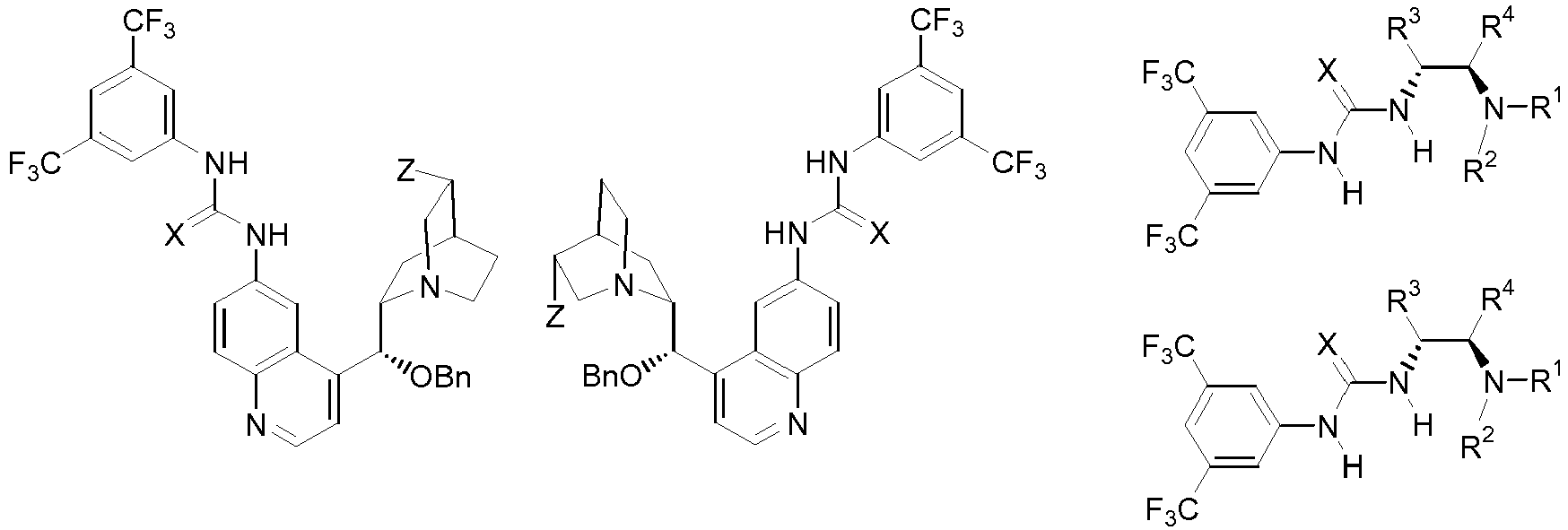

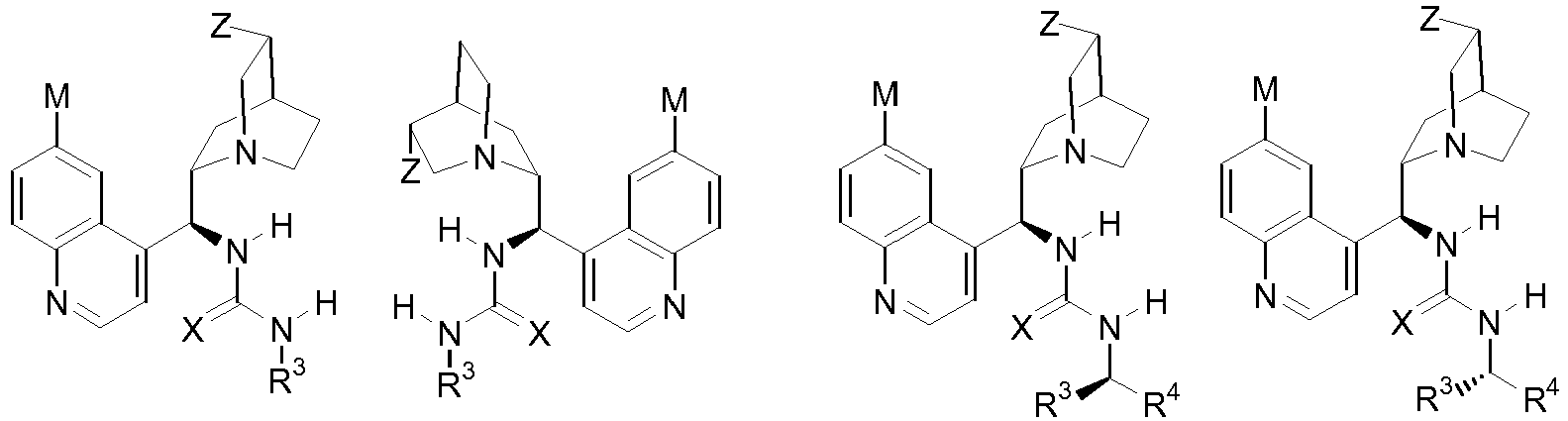

Z can be a single or double bond;
M can be H, OH, or OMe;
R1 and R2 can be the same or different and may comprise C1-C15 alkyl (optionally substituted with halogens or cycloalkyl groups), or R1 and R2 may together define a C3-C15 cycloalkyl alkyl ring; and
R3 and R4 can be the same or different and may comprise C1-C15 alkyl (optionally substituted with halogens or cycloalkyl groups), or R3 and R4 may together define a C3-C15 cycloalkyl alkyl ring or C5-C15 aromatic ring. - The chiral catalyst may be selected from the group consisting of:
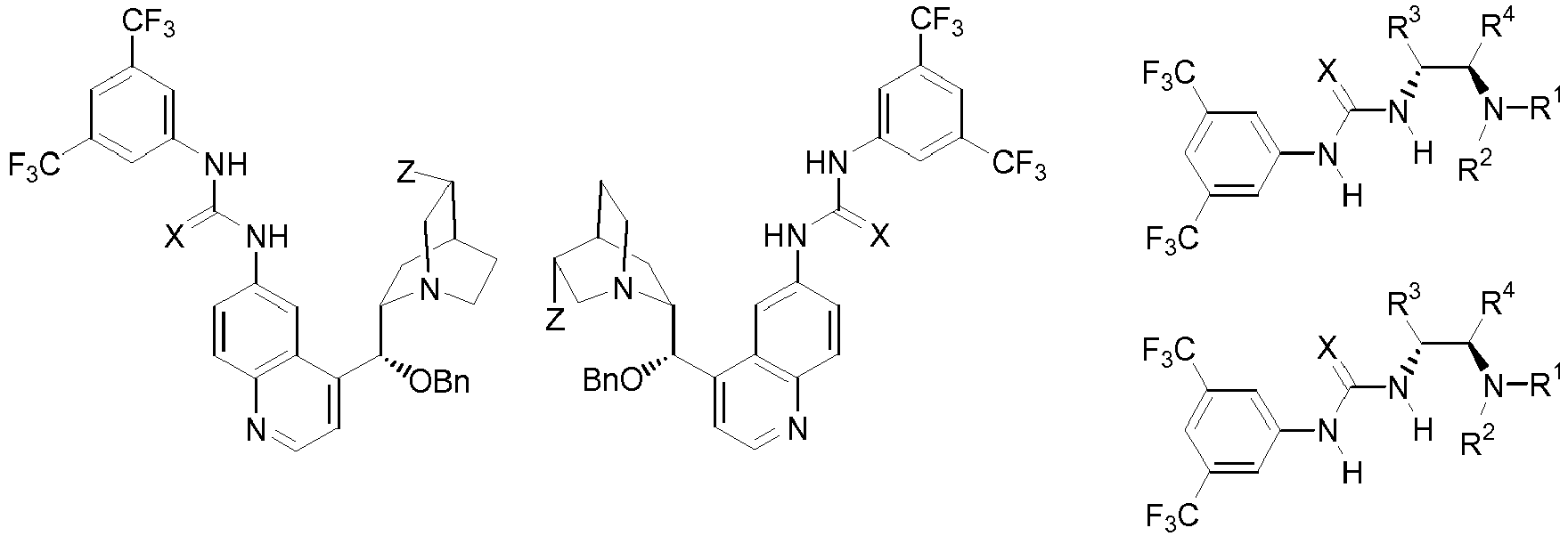



Z can be a C1 to C5 carbon chain optionally comprising at least one C-C unsaturated bond, and optionally substituted one or more times with at least one of a halogen, cyano, CF3, NO2, C1-C5 ketone, C1-C5 ester, C1-C10 amide, C1-C5 sulfone, C1-C5 sulfoxide and combinations thereof;
M can be H, OH, or OMe;
R1 and R2 can be the same or different and may comprise C1-C15 alkyl, or R1 and R2 may together define a C3-C15 cycloalkyl ring, wherein each may be optionally substituted one or more times with at least one of a halogen, cyano, CF3, NO2, C1-C5 ketone, C1-C5 ester, C1-C10 amide, C1-C5 sulfone, C1-C5 sulfoxide, C1-C5 alkyl and combinations thereof; and
R3 and R4 can be the same or different and may comprise C1-C15 alkyl, or R3 and R4 may together define a C3-C15 cycloalkyl ring or a C5-C15 aryl ring wherein each may be optionally substituted one or more times with at least one of a halogen, cyano, CF3, NO2, C1-C5 ketone, C1-C5 ester, C1-C10 amide, C1-C5 sulfone, C1-C5 sulfoxide, C1-C5 alkyl and combinations thereof; and
R5 and R6 can be the same or different and may comprise C1-C15 alkyl, or R5 and R6 may together define a C3-C15 cycloalkyl ring, or a C5-C15 aryl ring wherein each may be optionally substituted one or more times with at least one of a halogen, cyano, CF3, NO2, C1-C5 ketone, C1-C5 ester, C1-C10 amide, C1-C5 sulfone, C1-C5 sulfoxide, C1-C5 alkyl and combinations thereof. - The electrophile may be 3-isobutylglutaric anhydride. The nucleophile may be a thiol.
- The chiral catalyst may be selected from the group comprising

Z can be a single or double bond. - Alternatively, the chiral catalyst may be selected from the group comprising
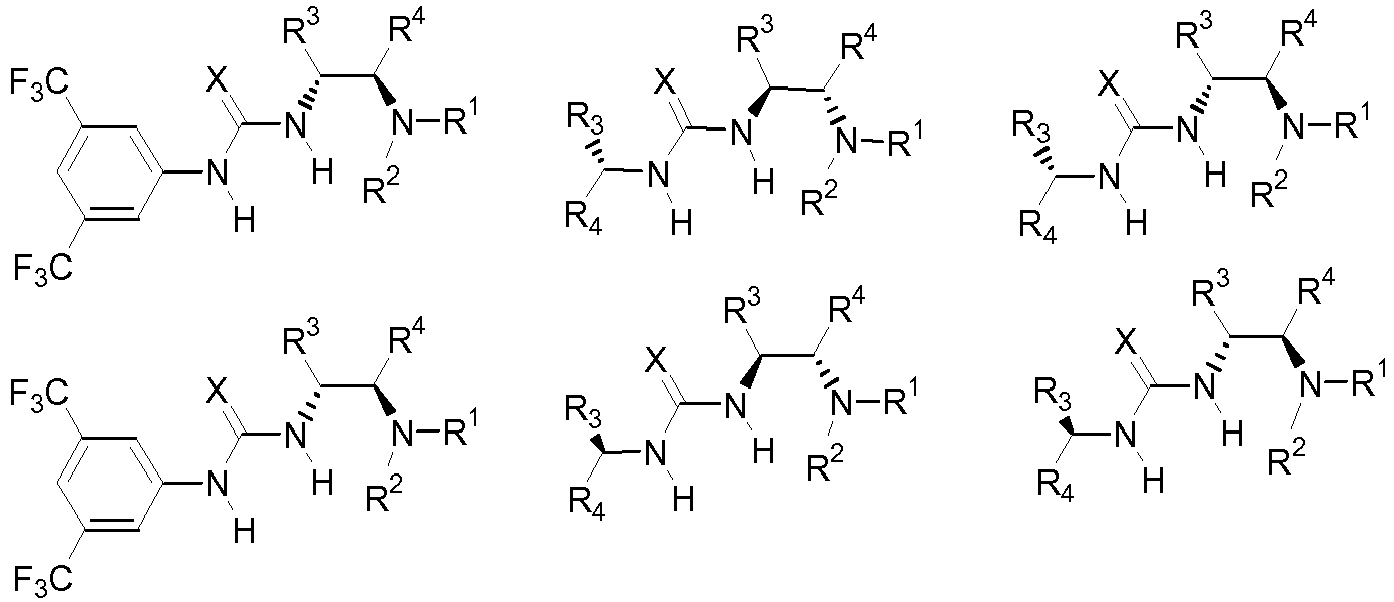
R1 and R2 can be the same or different and may comprise C1-C15 alkyl, or R1 and R2 may together define a C3-C15 cycloalkyl alkyl ring; and
R3 and R4 can be the same or different and may comprise C1-C15 alkyl, or R3 and R4 may together define a C3-C15 cycloalkyl alkyl ring or C5-C15 aromatic ring. - In yet a further alternative, the chiral catalyst may be selected from
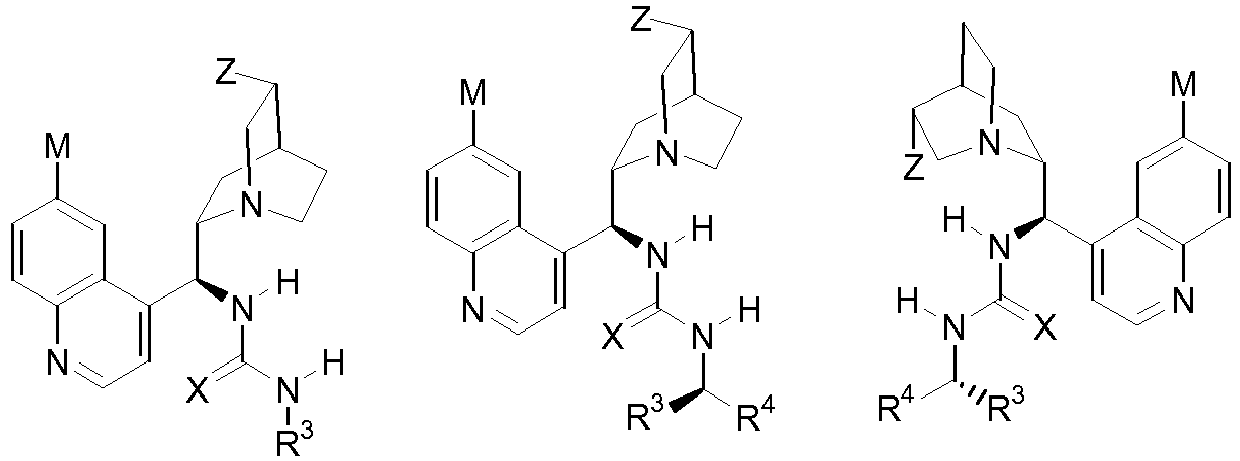

Z can be a single or double bond;
M can be H, OH, or OMe; and
R3 and R4 can be the same or different and may comprise C1-C15 alkyl, or R3 and R4 may together define a C3-C15 cycloalkyl alkyl ring or C5-C15 aromatic ring. - In one embodiment, the chiral catalyst may be selected from the group consisting of:

Z can be a single or double bond; and
M can be H, OH or OMe. - Desirably, the chiral catalyst is selected from the group comprising:

- In one embodiment Z is a double bond.
- As will be appreciated by a person skilled in the art, the definitions of Cx-Cy alkyl, Cx-Cy cycloalkyl, Cx-Cy aromatic, etc. presented herein embrace substitution of these chains/rings provided such substitutions do not interfere with the thiol mediated thiolysis or alcohol mediated alcoholysis of 3-isobutylglutaric anhydride. Unless otherwise indicated suitable substitutions may comprise halogens, cyano, CF3, and combinations thereof. As used herein, the terms aromatic/aryl encompass heteroaromatic/heteroaryl.
- The compounds of the present invention may be found or isolated in the form of esters, salts, hydrates or solvates - all of which are embraced by the present invention.
- Where suitable, it will be appreciated that all optional and/or preferred features of one embodiment of the invention may be combined with optional and/or preferred features of another/other embodiment(s) of the invention.
- Additional features and advantages of the present invention are described in, and will be apparent from, the detailed description of the invention and from the drawings in which:
-
Figure 1 illustrates catalytic enantioselective thiolysis of 3-isobutylglutaric anhydride using cyclohexane thiol according to the present invention; -
Figure 2 illustrates catalytic enantioselective alcoholysis of 3-isobutylglutaric anhydride using methanol; -
Figure 3 illustrates aminolysis of ester and thioester intermediates; and -
Figure 4 illustrates a synthesis of (S)-pregabalin according to the present invention. - It should be readily apparent to one of ordinary skill in the art that the examples disclosed herein below represent generalised examples only, and that other arrangements and methods capable of reproducing the invention are possible, and are embraced by the present invention.
- The abbreviations herein under will be adhered to for the remainder of this section:

- A schematic of the catalytic enantioselective thiolysis of 3-isobutylglutaric anhydride using cyclohexane thiol to afford (R)-3-cyclohexylsulfanylcarbonylmethyl-5-methyl-hexanoic acid is provided in
Figure 1 . Thiolysis of 3-isobutylglutaric anhydride in methyltertbutylether (MTBE), at room temperature (rt) in the presence of catalytic quantities of C1 affords 3-cyclohexylsulfanylcarbonylmethyl-5-methyl-hexanoic acid in quantitative yield with the (R) enantiomer obtained in 93% ee. - Similarly,
Figure 2 depicts catalytic enantioselective alcoholysis of 3-isobutylglutaric anhydride using methanol. Alcoholysis of 3-isobutylglutaric anhydride in methyltertbutylether (MTBE), at room temperature, in the presence of catalytic quantities epimeric quinine thiourea C1 affords 3-isobutyl-pentanedioic acid monomethyl ester in near quantitative yield with the (R) enantiomer obtained in 84% ee. - Both the alcoholysis and thiolysis reactions proceed highly efficiently and with excellent enantioselectivity with extremely low catalyst loadings of 2 mol% relative to 3-isobutylglutaric anhydride.
- Aminolysis of (R)-3-isobutyl-pentanedioic acid monomethyl ester and (R)-3-cyclohexylsulfanylcarbonylmethyl-5-methyl-hexanoic in aqueous ammonia is provided in
Figure 3 . Aminolysis of the thioester derivative occurs more rapidly (1.6 hours versus 40 hours) and under milder conditions that the corresponding ester intermediate. In fact, quantitative aminolysis of the thioester intermediate could be effected at room temperature over a period of 5 hours. -
Figure 4 demonstrates a room temperature enantioselective synthesis of (S)-pregabalin in the presence of catalytic quantities of epimeric quinidine thiourea C2. Thiolysis of 3-isobutylglutaric anhydride with cyclohexane thiol in methyltertbutylether (MTBE), at room temperature (rt) in the presence of catalytic quantities of C2 affords (S)-3-cyclohexylsulfanylcarbonylmethyl-5-methyl-hexanoic acid in quantitative yield and in 92% ee (the ee increased to 94% when the reaction was carried out at 0 °C). Aminolysis of resulting thioester intermediate at 40 °C over 1.6 h afforded (S)-3-Carbamoylmethyl-5-methyl-hexanoic acid in 88% yield. This primary amide intermediate was subjected to a Hofmann rearrangement to afford (S)-pregabalin. - A 60 mL reaction vial, charged with 3-isobutylglutaric anhydride (102.1 mg, 0.60 mmol) and C2 (7.1 mg, 0.012 mmol), was fitted with a septum and flushed with argon. MTBE (40 mL) was added followed by cyclohexyl mercaptan (368 µL, 3.0 mmol) in a dropwise manner via syringe. After 72 h stirring at room temperature, volatiles were removed under reduced pressure and the desired product (VI) obtained, after purification by flash chromatography, in 100% yield (164.0 mg) as a colourless oil. [α]D 20 = -5.9 (c 1.64, acetone).
- δH(400 MHz, CDCl3): 0.92 (app. d, J 6.5, 6H), 1.18-1.34 (m, 3H), 1.36-1.50 (m, 4H), 1.56-1.78 (m, 4H), 1.88-1.98 (m, 2H), 2.34-2.52 (m, 3H), 2.56-2.64 (m, 2H), 3.48-3.59 (m, 1 H). δC (100 MHz, CDCl3): 22.0, 22.1, 24.7, 25.0, 25.5, 30.0, 32.5, 32.6, 37.6, 41.9, 42.7, 47.5, 176.7, 198.2. HRMS (ESI): Found 285.1522 (M - H+) C15H25O3S requires 285.1524.
- 92% ee as determined by CSP-HPLC analysis of the corresponding o-nitrophenoxy ester prepared as below.

- A 5 mL reaction vial containing a stirring bar was charged with the appropriate hemi(thio)ester (0.10 mmol), 2-nitrophenol (20.9 mg, 0.15 mmol) and DMAP (1.2 mg). The vial was flushed with argon and the resulting mixture was dissolved in dry CH2Cl2 (0.5 mL). A solution of DCC (23.0 mg, 0.11 mmol) in dry CH2Cl2 (0.5 mL) was then added and the reaction mixture was stirred for 3 h at room temperature. After filtration of the resulting white precipitate, the filtrate was concentrated in vacuo and the residue was purified by chromatography on silica gel to afford the desired compound in quantitative yield.
- Chiralpak OD-H (4.6 mm x 25 cm), hexane/IPA: 90/10, 0.2 mL min-1, RT, UV detection at 220 nm, retention times: 30.3 min (minor enantiomer) and 32.0 (major enantiomer).
- A 40 mL reaction vial containing a stirring bar was charged with 3-isobutylglutaric anhydride (51.1 mg, 0.30 mmol) and C2 (3.6 mg, 0.006 mmol). The reaction vial was fitted with a septum and flushed with argon. MTBE (20 mL) was added and the solution was cooled to 0 °C. Cyclohexyl mercaptan (184 µL, 1.50 mmol) was added dropwise via syringe. After 72 h conversion to the desired product was determined to be 93% by H-NMR analysis. The reaction was then quenched by addition of HCl (1 N, 10 mL). The resulting biphasic mixture was transferred to a separating funnel and the aqueous phase was extracted with EtOAc (3 x 15 mL). The organic phases were combined, dried over MgSO4, and concentrated in vacuo to provide the desired hemithioester, after purification by flash-chromatography, in 94% ee.
- A 40 mL reaction vial containing a stirring bar was charged with 3-isobutylglutaric anhydride (51.1 mg, 0.30 mmol) and C2 (5.4 mg, 0.009 mmol). The reaction vial was fitted with a septum and flushed with argon. MTBE (20 mL) was added and the solution was cooled to 0 °C. Cyclohexyl mercaptan (184 µL, 1.50 mmol) was added dropwise via syringe. After 48 h, conversion into the desired product was determined to be 94% by H-NMR analysis. The reaction was then quenched by addition of HCl (1 N, 10 mL). The resulting biphasic mixture was transferred to a separating funnel and the aqueous phase was extracted with EtOAc (3 x 15 mL). The organic phases were combined, dried over MgSO4 and concentrated in vacuo to provide the desired hemithioester, after purification by flash-chromatography, in 94% ee.
- A 25 mL round bottom flask, charged with (-)-3-cyclohexylsulfanylcarbonylmethyl-5-methyl-hexanoic acid (VI) (164.0 mg, 0.60 mmol, 92% ee) and aqueous NH3 (35%, 6 mL), was equipped with a reflux condenser and heated to 40 °C. After 1.6 h stirring, the solution was concentrated in vacuo, water (10 mL) was added and the aqueous phase was washed twice with EtOAc (5 mL). The combined organic extracts were further washed with water (5 mL) and the combined aqueous layers were acidified by addition of HCl (1 N) and extracted with EtOAc (5 x 15 mL). The combined organic phases were then dried over magnesium sulphate and the solvent was removed under reduced pressure to afford the desired compound as a white solid (99.0 mg, 88% yield). M.p. 105-106 °C.
- δH (400 MHz, DMSO-d6): 0.81 (app d, J 6.6, 6H), 1.09 (app t, J 6.6, 2H), 1.51-1.66 (m, 1H), 1.91-2.22 (m, 5H), 6.74 (s, 1H), 7.27 (s, 1H), 12.0 (br s, 1H). δC (100 MHz, DMSO-d6): 23.1, 23.2, 25.0, 30.1, 39.2, 40.2, 43.6, 173.8, 174.3. HRMS (ESI): Found 210.1114 (M + Na+) C9H17NO3Na requires 210.1106.
- To confirm that no racemisation occurred during the aminolysis step, the enantioenriched product was transformed into the corresponding o-nitrophenoxy ester and analyzed by CSP-HPLC.

- A 5 mL reaction vial containing a stirring bar was charged with (+)-3-carbamoylmethyl-5-methyl-hexanoic acid (0.10 mmol) and 2-nitrophenol (27.8 mg, 0.20 mmol). The vial was flushed with argon and dry CH2Cl2 (0.5 mL) was added. A solution of DCC (23.0 mg, 0.11 mmol) in dry CH2Cl2 (0.5 mL) was then added via syringe and the reaction mixture was stirred for 12 h at room temperature. After filtration of the resulting white precipitate, the filtrate was concentrated in vacuo and the residue was purified by chromatography on silica gel to afford the desired compound in quantitative yield. 92% ee as determined by CSP-HPLC analysis. Chiralpak AD-H (4.6 mm x 25 cm), hexane/IPA: 90/10, 1.0 mL min-1, RT, UV detection at 220 nm, retention times: 13.5 min (major enantiomer) and 14.5 (minor enantiomer).
- The words "comprises/comprising" and the words "having/including" when used herein with reference to the present invention are used to specify the presence of stated features, integers, steps or components but do not preclude the presence or addition of one or more other features, integers, steps, components or groups thereof.
- It is appreciated that certain features of the invention, which are, for clarity, described in the context of separate embodiments, may also be provided in combination in a single embodiment. Conversely, various features of the invention which are, for brevity, described in the context of a single embodiment, may also be provided separately or in any suitable sub-combination.
Claims (13)
- A compound of the general formula (I), or a salt, or ester thereof,

- A compound according to Claim 1 of the general formula (II), or a salt, or ester thereof,
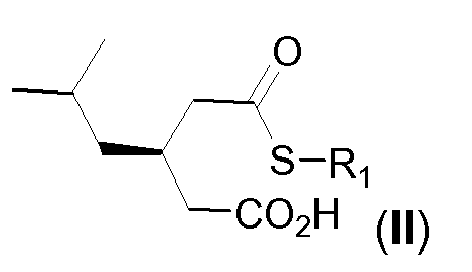
- A compound according to Claim 1 of the general formula (III), or a salt, or ester thereof,
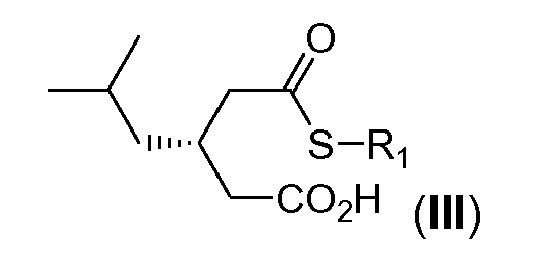
- A process for the preparation of a compound according to any one of Claims 2 or 3, or a salt, or ester thereof comprising thiolysis of 3-isobutylglutaric anhydride to afford a compound having a thioester functional group;
wherein the process is enantioselective and comprises enantioselective thiolysis of 3-isobutylglutaric anhydride to afford a compound having a thioester functional group. - A process according to Claim 4 wherein the enantioselective thiolysis step comprises ring opening 3-isobutylglutaric anhydride using a chiral thiol.
- A process according to Claim 4 wherein the enantioselective thiolysis step comprises ring opening 3-isobutylglutaric anhydride using an achiral thiol and a chiral catalyst.
- A process according to Claim 6 wherein the chiral catalyst comprises:i) a Lewis acid functional group to enhance the electrophilicity of 3-isobutylglutaric anhydride; andii) a Lewis base functional group to enhance the nucleophilicity of the achiral thiol.
- A process according to Claim 7 wherein the catalyst is selected from the group consisting of
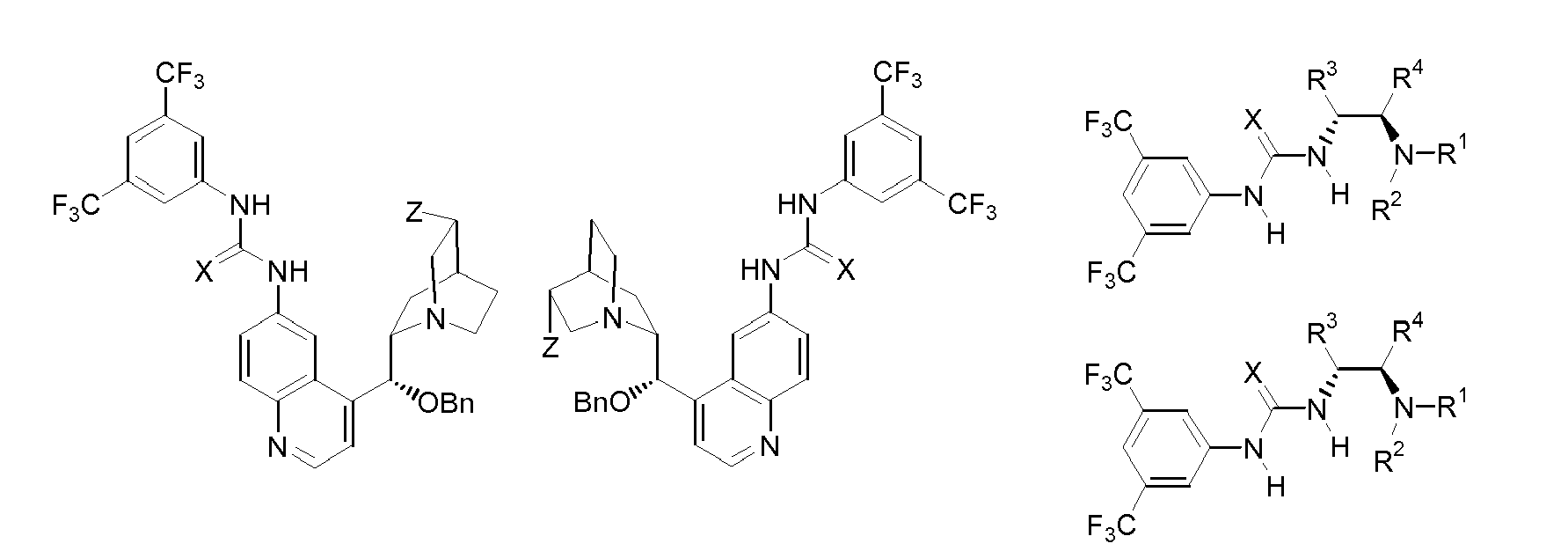



Z can be a C1 to C5 carbon chain optionally comprising at least one C-C unsaturated bond; and optionally substituted one or more times with at least one of a halogen, cyano, CF3, NO2, C1-C5 ketone, C1-C5 ester, C1-C10 amide, C1-C5 sulfone, C1-C5 sulfoxide and combinations thereof;
M can be H, OH, or OMe;
R1 and R2 can be the same or different and may comprise C1-C15 alkyl, or R1 and R2 together with the N to which they are attached may define a C3-C15 heterocycloalkyl ring wherein each may be optionally substituted one or more times with at least one of a halogen, cyano, CF3, NO2, C1-C5 ketone, C1-C5 ester, C1-C10 amide, C1-C5 sulfone, C1-C5 sulfoxide and combinations thereof; and
R3 and R4 can be the same or different and may comprise C1-C15 alkyl, or R3 and R4 may together define a C3-C15 cycloalkyl ring or C5-C15 aromatic ring wherein each may be optionally substituted one or more times with at least one of a halogen, cyano, CF3, NO2, C1-C5 ketone, C1-C5 ester, C1-C10 amide, C1-C5 sulfone, C1-C5 sulfoxide and combinations thereof; and
R5 and R6 can be the same or different and may comprise C1-C15 alkyl, or R5 and R6 may together define a C3-C15 cycloalkyl ring, or a C5-C15 aryl ring wherein each may be optionally substituted one or more times with at least one of a halogen, cyano, CF3, NO2, C1-C5 ketone, C1-C5 ester, C1-C10 amide, C1-C5 sulfone, C1-C5 sulfoxide and combinations thereof. - A process for the preparation of 3-(aminomethyl)-5-methyl-hexanoic acid comprising:i) thiolysis of 3-isobutylglutaric anhydride according to any one of Claims 4 to 8 to afford an intermediate having a thioester functional group; andii) converting the thioester functional group into an amine.
- A process for the enantioselective preparation of 3-(aminomethyl)-5-methyl-hexanoic acid comprising:i) enantioselective thiolysis of 3-isobutylglutaric anhydride according to any one of Claims 4 to 8 to afford an intermediate having a thioester functional group; andii) converting the thioester functional group into an amine.
- A process according to Claim 9 or 10 wherein the step of converting the thioester functional group into an amine comprises:i) aminolysis of the thioester functional group to yield an amide; andii) subjecting the amide product of step i) to a Hofmann rearrangement.
- Use of a chiral catalyst for
enantioselective thiolysis of 3-isobutylglutaric anhydride wherein the catalyst is in substoichiometric loading relative to 3-isobutylglutaric anhydride, in a process for the enantioselective synthesis of 3-(aminomethyl)-5-methyl-hexanoic acid. - Use of a chiral catalyst according to Claim 12 wherein the chiral catalyst comprises:i) a Lewis acid functional group to enhance the electrophilicity an electrophile; andii) a Lewis base functional group to enhance the nucleophilicity of a nucleophile.
Priority Applications (1)
| Application Number | Priority Date | Filing Date | Title |
|---|---|---|---|
| EP10701391.4A EP2391600B1 (en) | 2009-01-29 | 2010-01-29 | Intermediates in the enantioselective synthesis of 3-(aminomethyl)-5-methyl-hexanoic acid |
Applications Claiming Priority (3)
| Application Number | Priority Date | Filing Date | Title |
|---|---|---|---|
| EP09151679A EP2213659A1 (en) | 2009-01-29 | 2009-01-29 | Intermediates in the Enantioselective Synthesis of 3-(Aminomethyl)-5-Methyl-Hexanoic Acid |
| EP10701391.4A EP2391600B1 (en) | 2009-01-29 | 2010-01-29 | Intermediates in the enantioselective synthesis of 3-(aminomethyl)-5-methyl-hexanoic acid |
| PCT/EP2010/051133 WO2010086429A2 (en) | 2009-01-29 | 2010-01-29 | Intermediates in the enantioselective synthesis of 3-(aminomethyl)-5-methyl-hexanoic acid |
Publications (2)
| Publication Number | Publication Date |
|---|---|
| EP2391600A2 EP2391600A2 (en) | 2011-12-07 |
| EP2391600B1 true EP2391600B1 (en) | 2016-01-06 |
Family
ID=40677499
Family Applications (2)
| Application Number | Title | Priority Date | Filing Date |
|---|---|---|---|
| EP09151679A Withdrawn EP2213659A1 (en) | 2009-01-29 | 2009-01-29 | Intermediates in the Enantioselective Synthesis of 3-(Aminomethyl)-5-Methyl-Hexanoic Acid |
| EP10701391.4A Not-in-force EP2391600B1 (en) | 2009-01-29 | 2010-01-29 | Intermediates in the enantioselective synthesis of 3-(aminomethyl)-5-methyl-hexanoic acid |
Family Applications Before (1)
| Application Number | Title | Priority Date | Filing Date |
|---|---|---|---|
| EP09151679A Withdrawn EP2213659A1 (en) | 2009-01-29 | 2009-01-29 | Intermediates in the Enantioselective Synthesis of 3-(Aminomethyl)-5-Methyl-Hexanoic Acid |
Country Status (3)
| Country | Link |
|---|---|
| US (1) | US8476441B2 (en) |
| EP (2) | EP2213659A1 (en) |
| WO (1) | WO2010086429A2 (en) |
Families Citing this family (1)
| Publication number | Priority date | Publication date | Assignee | Title |
|---|---|---|---|---|
| EP2639212B1 (en) * | 2012-03-13 | 2016-03-09 | The Provost, Fellows, Foundation Scholars, & the other members of Board, of the College of the Holy & Undiv. Trinity of Queen Elizabeth near Dublin | Enantioselective organic anhydride reactions |
Family Cites Families (2)
| Publication number | Priority date | Publication date | Assignee | Title |
|---|---|---|---|---|
| US5616793A (en) | 1995-06-02 | 1997-04-01 | Warner-Lambert Company | Methods of making (S)-3-(aminomethyl)-5-methylhexanoic acid |
| WO2007139933A2 (en) | 2006-05-24 | 2007-12-06 | Teva Pharmaceutical Industries Ltd. | Processes for the preparation of r-(+)-3-(carbamoyl methyl)-5-methylhexanoic acid and salts thereof |
-
2009
- 2009-01-29 EP EP09151679A patent/EP2213659A1/en not_active Withdrawn
-
2010
- 2010-01-29 EP EP10701391.4A patent/EP2391600B1/en not_active Not-in-force
- 2010-01-29 US US13/146,491 patent/US8476441B2/en not_active Expired - Fee Related
- 2010-01-29 WO PCT/EP2010/051133 patent/WO2010086429A2/en not_active Ceased
Non-Patent Citations (1)
| Title |
|---|
| M.A. BRIMBLE, ET AL.: "Rules for abbreviation of protecting groups (IUPAC Technical Report)", PURE AND APPLIED CHEMISTRY, vol. 85, no. 1, 10 January 2012 (2012-01-10), XP055113613, ISSN: 0033-4545, DOI: 10.1351/PAC-REP-12-07-12 * |
Also Published As
| Publication number | Publication date |
|---|---|
| EP2391600A2 (en) | 2011-12-07 |
| EP2213659A1 (en) | 2010-08-04 |
| US8476441B2 (en) | 2013-07-02 |
| WO2010086429A3 (en) | 2010-10-07 |
| WO2010086429A2 (en) | 2010-08-05 |
| US20120046468A1 (en) | 2012-02-23 |
Similar Documents
| Publication | Publication Date | Title |
|---|---|---|
| SK283507B6 (en) | Method of making (+/-)-3-(aminomethyl)-5-methylhexanoic acid | |
| Garcia Ruano et al. | Highly diastereoselective hydrocyanation of. beta.-keto sulfoxides: synthesis of enantiomerically pure cyanohydrin derivatives | |
| EP3426391A1 (en) | Compositions and methods for acylating lactams | |
| US8299293B2 (en) | Process for preparing α-keto acids and derivatives thereof | |
| CN103833562B (en) | A kind of preparation method of asymmetric synthesis lyrica | |
| US9346755B2 (en) | Kinetic resolution | |
| EP2213659A1 (en) | Intermediates in the Enantioselective Synthesis of 3-(Aminomethyl)-5-Methyl-Hexanoic Acid | |
| Shen et al. | Enantioselective and diastereoselective Michael addition of ketone/aldehyde to trans‐nitroolefins catalyzed by a novel chiral pyrrolidine‐thiourea | |
| JP5622019B2 (en) | Asymmetric organic molecular catalyst having amino alcohol derivative salt structure and method for producing optically active compound using said asymmetric organic molecular catalyst | |
| WO2010021093A1 (en) | Asymmetric organic catalyst | |
| Younai et al. | Influence of chiral thiols on the diastereoselective synthesis of γ-lactams from cyclic anhydrides | |
| Kamimura et al. | Simple preparation of β-hydroxy-α-thiomethyl carbonyl compounds via stereoselective conjugate addition of thiol to Baylis–Hillman adducts | |
| US20030236429A1 (en) | Process for the production of chiral compounds | |
| KR20090008725A (en) | Method for efficiently preparing 3-hydroxy pyrrolidine and derivatives thereof | |
| JP4793976B2 (en) | Optically active hydrazine compound and method for producing optically active amine compound | |
| JP5856903B2 (en) | Trifluoromethyl group-containing optically active β-amino acid derivative and process for producing the same | |
| US20100249431A1 (en) | Process for manufacturing disulfonic acid compound, asymmetric mannich catalst, process for manufacturing beta-aminocarbonyl derivative, and novel disulfonate | |
| US7335781B2 (en) | Aminothiol compound | |
| JP4579174B2 (en) | Process for producing optically active α, β-diamino acid derivative | |
| JP2012508780A (en) | Enantioselective synthesis of γ-amino-α, β-unsaturated carboxylic acid derivatives | |
| 김병수 | Enantioselective synthesis of α-alkylthio-α-alkylmalonate via phase-transfer catalytic sulfenylation | |
| WO2019239341A1 (en) | Process for asymmetric synthesis of (r)-4-propyldihydrofuran-2 (3h)-one | |
| 이준영 | Part I: Reoptimized Phase-transfer Catalytic Alkylation of α-acetylthiomalonate Part II: Application and Confirm the Absolute Configuration of α-benzoxy-α-alkylmalonate | |
| WO2006106244A2 (en) | Method for preparing $g(b)-amino esters or $g(a)-, $g(b)-diamino esters derived from serine | |
| EP2110372A1 (en) | Intermediates for the preparation of Pregabalin and process for their preparation |
Legal Events
| Date | Code | Title | Description |
|---|---|---|---|
| PUAI | Public reference made under article 153(3) epc to a published international application that has entered the european phase |
Free format text: ORIGINAL CODE: 0009012 |
|
| 17P | Request for examination filed |
Effective date: 20110809 |
|
| AK | Designated contracting states |
Kind code of ref document: A2 Designated state(s): AT BE BG CH CY CZ DE DK EE ES FI FR GB GR HR HU IE IS IT LI LT LU LV MC MK MT NL NO PL PT RO SE SI SK SM TR |
|
| DAX | Request for extension of the european patent (deleted) | ||
| RAP1 | Party data changed (applicant data changed or rights of an application transferred) |
Owner name: THE PROVOST, FELLOWS, FOUNDATION SCHOLARS, & THE O |
|
| 17Q | First examination report despatched |
Effective date: 20130104 |
|
| GRAP | Despatch of communication of intention to grant a patent |
Free format text: ORIGINAL CODE: EPIDOSNIGR1 |
|
| GRAJ | Information related to disapproval of communication of intention to grant by the applicant or resumption of examination proceedings by the epo deleted |
Free format text: ORIGINAL CODE: EPIDOSDIGR1 |
|
| GRAP | Despatch of communication of intention to grant a patent |
Free format text: ORIGINAL CODE: EPIDOSNIGR1 |
|
| RIC1 | Information provided on ipc code assigned before grant |
Ipc: C07C 69/34 20060101ALI20150610BHEP Ipc: C07C 231/18 20060101ALI20150610BHEP Ipc: C07C 233/05 20060101ALI20150610BHEP Ipc: C07C 229/08 20060101ALI20150610BHEP Ipc: C07C 67/08 20060101ALI20150610BHEP Ipc: C07C 227/32 20060101ALI20150610BHEP Ipc: C07C 327/22 20060101AFI20150610BHEP Ipc: C07C 231/02 20060101ALI20150610BHEP |
|
| INTG | Intention to grant announced |
Effective date: 20150702 |
|
| INTG | Intention to grant announced |
Effective date: 20150714 |
|
| GRAS | Grant fee paid |
Free format text: ORIGINAL CODE: EPIDOSNIGR3 |
|
| GRAA | (expected) grant |
Free format text: ORIGINAL CODE: 0009210 |
|
| AK | Designated contracting states |
Kind code of ref document: B1 Designated state(s): AT BE BG CH CY CZ DE DK EE ES FI FR GB GR HR HU IE IS IT LI LT LU LV MC MK MT NL NO PL PT RO SE SI SK SM TR |
|
| REG | Reference to a national code |
Ref country code: GB Ref legal event code: FG4D |
|
| REG | Reference to a national code |
Ref country code: CH Ref legal event code: EP |
|
| REG | Reference to a national code |
Ref country code: FR Ref legal event code: PLFP Year of fee payment: 7 |
|
| REG | Reference to a national code |
Ref country code: IE Ref legal event code: FG4D |
|
| REG | Reference to a national code |
Ref country code: AT Ref legal event code: REF Ref document number: 768717 Country of ref document: AT Kind code of ref document: T Effective date: 20160215 |
|
| REG | Reference to a national code |
Ref country code: DE Ref legal event code: R096 Ref document number: 602010029870 Country of ref document: DE |
|
| REG | Reference to a national code |
Ref country code: LT Ref legal event code: MG4D |
|
| REG | Reference to a national code |
Ref country code: NL Ref legal event code: MP Effective date: 20160106 |
|
| REG | Reference to a national code |
Ref country code: AT Ref legal event code: MK05 Ref document number: 768717 Country of ref document: AT Kind code of ref document: T Effective date: 20160106 |
|
| PG25 | Lapsed in a contracting state [announced via postgrant information from national office to epo] |
Ref country code: BE Free format text: LAPSE BECAUSE OF NON-PAYMENT OF DUE FEES Effective date: 20160131 |
|
| PG25 | Lapsed in a contracting state [announced via postgrant information from national office to epo] |
Ref country code: NL Free format text: LAPSE BECAUSE OF FAILURE TO SUBMIT A TRANSLATION OF THE DESCRIPTION OR TO PAY THE FEE WITHIN THE PRESCRIBED TIME-LIMIT Effective date: 20160106 |
|
| PG25 | Lapsed in a contracting state [announced via postgrant information from national office to epo] |
Ref country code: HR Free format text: LAPSE BECAUSE OF FAILURE TO SUBMIT A TRANSLATION OF THE DESCRIPTION OR TO PAY THE FEE WITHIN THE PRESCRIBED TIME-LIMIT Effective date: 20160106 Ref country code: ES Free format text: LAPSE BECAUSE OF FAILURE TO SUBMIT A TRANSLATION OF THE DESCRIPTION OR TO PAY THE FEE WITHIN THE PRESCRIBED TIME-LIMIT Effective date: 20160106 Ref country code: GR Free format text: LAPSE BECAUSE OF FAILURE TO SUBMIT A TRANSLATION OF THE DESCRIPTION OR TO PAY THE FEE WITHIN THE PRESCRIBED TIME-LIMIT Effective date: 20160407 Ref country code: NO Free format text: LAPSE BECAUSE OF FAILURE TO SUBMIT A TRANSLATION OF THE DESCRIPTION OR TO PAY THE FEE WITHIN THE PRESCRIBED TIME-LIMIT Effective date: 20160406 Ref country code: IT Free format text: LAPSE BECAUSE OF FAILURE TO SUBMIT A TRANSLATION OF THE DESCRIPTION OR TO PAY THE FEE WITHIN THE PRESCRIBED TIME-LIMIT Effective date: 20160106 Ref country code: FI Free format text: LAPSE BECAUSE OF FAILURE TO SUBMIT A TRANSLATION OF THE DESCRIPTION OR TO PAY THE FEE WITHIN THE PRESCRIBED TIME-LIMIT Effective date: 20160106 |
|
| PG25 | Lapsed in a contracting state [announced via postgrant information from national office to epo] |
Ref country code: LT Free format text: LAPSE BECAUSE OF FAILURE TO SUBMIT A TRANSLATION OF THE DESCRIPTION OR TO PAY THE FEE WITHIN THE PRESCRIBED TIME-LIMIT Effective date: 20160106 Ref country code: IS Free format text: LAPSE BECAUSE OF FAILURE TO SUBMIT A TRANSLATION OF THE DESCRIPTION OR TO PAY THE FEE WITHIN THE PRESCRIBED TIME-LIMIT Effective date: 20160506 Ref country code: PL Free format text: LAPSE BECAUSE OF FAILURE TO SUBMIT A TRANSLATION OF THE DESCRIPTION OR TO PAY THE FEE WITHIN THE PRESCRIBED TIME-LIMIT Effective date: 20160106 Ref country code: SE Free format text: LAPSE BECAUSE OF FAILURE TO SUBMIT A TRANSLATION OF THE DESCRIPTION OR TO PAY THE FEE WITHIN THE PRESCRIBED TIME-LIMIT Effective date: 20160106 Ref country code: LV Free format text: LAPSE BECAUSE OF FAILURE TO SUBMIT A TRANSLATION OF THE DESCRIPTION OR TO PAY THE FEE WITHIN THE PRESCRIBED TIME-LIMIT Effective date: 20160106 Ref country code: PT Free format text: LAPSE BECAUSE OF FAILURE TO SUBMIT A TRANSLATION OF THE DESCRIPTION OR TO PAY THE FEE WITHIN THE PRESCRIBED TIME-LIMIT Effective date: 20160506 Ref country code: AT Free format text: LAPSE BECAUSE OF FAILURE TO SUBMIT A TRANSLATION OF THE DESCRIPTION OR TO PAY THE FEE WITHIN THE PRESCRIBED TIME-LIMIT Effective date: 20160106 |
|
| REG | Reference to a national code |
Ref country code: CH Ref legal event code: PL |
|
| REG | Reference to a national code |
Ref country code: DE Ref legal event code: R097 Ref document number: 602010029870 Country of ref document: DE |
|
| PG25 | Lapsed in a contracting state [announced via postgrant information from national office to epo] |
Ref country code: LI Free format text: LAPSE BECAUSE OF NON-PAYMENT OF DUE FEES Effective date: 20160131 Ref country code: DK Free format text: LAPSE BECAUSE OF FAILURE TO SUBMIT A TRANSLATION OF THE DESCRIPTION OR TO PAY THE FEE WITHIN THE PRESCRIBED TIME-LIMIT Effective date: 20160106 Ref country code: MC Free format text: LAPSE BECAUSE OF FAILURE TO SUBMIT A TRANSLATION OF THE DESCRIPTION OR TO PAY THE FEE WITHIN THE PRESCRIBED TIME-LIMIT Effective date: 20160106 Ref country code: EE Free format text: LAPSE BECAUSE OF FAILURE TO SUBMIT A TRANSLATION OF THE DESCRIPTION OR TO PAY THE FEE WITHIN THE PRESCRIBED TIME-LIMIT Effective date: 20160106 Ref country code: CH Free format text: LAPSE BECAUSE OF NON-PAYMENT OF DUE FEES Effective date: 20160131 |
|
| PLBE | No opposition filed within time limit |
Free format text: ORIGINAL CODE: 0009261 |
|
| STAA | Information on the status of an ep patent application or granted ep patent |
Free format text: STATUS: NO OPPOSITION FILED WITHIN TIME LIMIT |
|
| PG25 | Lapsed in a contracting state [announced via postgrant information from national office to epo] |
Ref country code: RO Free format text: LAPSE BECAUSE OF FAILURE TO SUBMIT A TRANSLATION OF THE DESCRIPTION OR TO PAY THE FEE WITHIN THE PRESCRIBED TIME-LIMIT Effective date: 20160106 Ref country code: CZ Free format text: LAPSE BECAUSE OF FAILURE TO SUBMIT A TRANSLATION OF THE DESCRIPTION OR TO PAY THE FEE WITHIN THE PRESCRIBED TIME-LIMIT Effective date: 20160106 Ref country code: SM Free format text: LAPSE BECAUSE OF FAILURE TO SUBMIT A TRANSLATION OF THE DESCRIPTION OR TO PAY THE FEE WITHIN THE PRESCRIBED TIME-LIMIT Effective date: 20160106 Ref country code: SK Free format text: LAPSE BECAUSE OF FAILURE TO SUBMIT A TRANSLATION OF THE DESCRIPTION OR TO PAY THE FEE WITHIN THE PRESCRIBED TIME-LIMIT Effective date: 20160106 |
|
| 26N | No opposition filed |
Effective date: 20161007 |
|
| PG25 | Lapsed in a contracting state [announced via postgrant information from national office to epo] |
Ref country code: BE Free format text: LAPSE BECAUSE OF FAILURE TO SUBMIT A TRANSLATION OF THE DESCRIPTION OR TO PAY THE FEE WITHIN THE PRESCRIBED TIME-LIMIT Effective date: 20160106 |
|
| REG | Reference to a national code |
Ref country code: FR Ref legal event code: PLFP Year of fee payment: 8 |
|
| PG25 | Lapsed in a contracting state [announced via postgrant information from national office to epo] |
Ref country code: BG Free format text: LAPSE BECAUSE OF FAILURE TO SUBMIT A TRANSLATION OF THE DESCRIPTION OR TO PAY THE FEE WITHIN THE PRESCRIBED TIME-LIMIT Effective date: 20160406 Ref country code: SI Free format text: LAPSE BECAUSE OF FAILURE TO SUBMIT A TRANSLATION OF THE DESCRIPTION OR TO PAY THE FEE WITHIN THE PRESCRIBED TIME-LIMIT Effective date: 20160106 |
|
| PGFP | Annual fee paid to national office [announced via postgrant information from national office to epo] |
Ref country code: FR Payment date: 20170120 Year of fee payment: 8 Ref country code: DE Payment date: 20170130 Year of fee payment: 8 |
|
| PGFP | Annual fee paid to national office [announced via postgrant information from national office to epo] |
Ref country code: IE Payment date: 20170120 Year of fee payment: 8 Ref country code: GB Payment date: 20170120 Year of fee payment: 8 |
|
| PG25 | Lapsed in a contracting state [announced via postgrant information from national office to epo] |
Ref country code: MT Free format text: LAPSE BECAUSE OF FAILURE TO SUBMIT A TRANSLATION OF THE DESCRIPTION OR TO PAY THE FEE WITHIN THE PRESCRIBED TIME-LIMIT Effective date: 20160106 |
|
| PG25 | Lapsed in a contracting state [announced via postgrant information from national office to epo] |
Ref country code: CY Free format text: LAPSE BECAUSE OF FAILURE TO SUBMIT A TRANSLATION OF THE DESCRIPTION OR TO PAY THE FEE WITHIN THE PRESCRIBED TIME-LIMIT Effective date: 20160106 Ref country code: HU Free format text: LAPSE BECAUSE OF FAILURE TO SUBMIT A TRANSLATION OF THE DESCRIPTION OR TO PAY THE FEE WITHIN THE PRESCRIBED TIME-LIMIT; INVALID AB INITIO Effective date: 20100129 |
|
| PG25 | Lapsed in a contracting state [announced via postgrant information from national office to epo] |
Ref country code: MK Free format text: LAPSE BECAUSE OF FAILURE TO SUBMIT A TRANSLATION OF THE DESCRIPTION OR TO PAY THE FEE WITHIN THE PRESCRIBED TIME-LIMIT Effective date: 20160106 Ref country code: TR Free format text: LAPSE BECAUSE OF FAILURE TO SUBMIT A TRANSLATION OF THE DESCRIPTION OR TO PAY THE FEE WITHIN THE PRESCRIBED TIME-LIMIT Effective date: 20160106 Ref country code: LU Free format text: LAPSE BECAUSE OF NON-PAYMENT OF DUE FEES Effective date: 20160129 Ref country code: MT Free format text: LAPSE BECAUSE OF FAILURE TO SUBMIT A TRANSLATION OF THE DESCRIPTION OR TO PAY THE FEE WITHIN THE PRESCRIBED TIME-LIMIT Effective date: 20160131 |
|
| REG | Reference to a national code |
Ref country code: DE Ref legal event code: R119 Ref document number: 602010029870 Country of ref document: DE |
|
| GBPC | Gb: european patent ceased through non-payment of renewal fee |
Effective date: 20180129 |
|
| PG25 | Lapsed in a contracting state [announced via postgrant information from national office to epo] |
Ref country code: DE Free format text: LAPSE BECAUSE OF NON-PAYMENT OF DUE FEES Effective date: 20180801 Ref country code: FR Free format text: LAPSE BECAUSE OF NON-PAYMENT OF DUE FEES Effective date: 20180131 |
|
| REG | Reference to a national code |
Ref country code: IE Ref legal event code: MM4A |
|
| REG | Reference to a national code |
Ref country code: FR Ref legal event code: ST Effective date: 20180928 |
|
| PG25 | Lapsed in a contracting state [announced via postgrant information from national office to epo] |
Ref country code: GB Free format text: LAPSE BECAUSE OF NON-PAYMENT OF DUE FEES Effective date: 20180129 |
|
| PG25 | Lapsed in a contracting state [announced via postgrant information from national office to epo] |
Ref country code: IE Free format text: LAPSE BECAUSE OF NON-PAYMENT OF DUE FEES Effective date: 20180129 |