EP2386587B1 - Process for production of thermoplastic cured epoxy resin with transparency to visible light, and thermoplastic epoxy resin composition - Google Patents
Process for production of thermoplastic cured epoxy resin with transparency to visible light, and thermoplastic epoxy resin composition Download PDFInfo
- Publication number
- EP2386587B1 EP2386587B1 EP10729252.6A EP10729252A EP2386587B1 EP 2386587 B1 EP2386587 B1 EP 2386587B1 EP 10729252 A EP10729252 A EP 10729252A EP 2386587 B1 EP2386587 B1 EP 2386587B1
- Authority
- EP
- European Patent Office
- Prior art keywords
- compound
- thermoplastic
- epoxy resin
- epoxy
- curing
- Prior art date
- Legal status (The legal status is an assumption and is not a legal conclusion. Google has not performed a legal analysis and makes no representation as to the accuracy of the status listed.)
- Not-in-force
Links
- 239000003822 epoxy resin Substances 0.000 title claims description 35
- 229920000647 polyepoxide Polymers 0.000 title claims description 35
- 229920001169 thermoplastic Polymers 0.000 title claims description 30
- 239000004416 thermosoftening plastic Substances 0.000 title claims description 29
- 239000000203 mixture Substances 0.000 title claims description 27
- 238000000034 method Methods 0.000 title claims description 19
- 238000004519 manufacturing process Methods 0.000 title description 2
- 150000001875 compounds Chemical class 0.000 claims description 74
- 239000004593 Epoxy Substances 0.000 claims description 31
- 125000002887 hydroxy group Chemical group [H]O* 0.000 claims description 26
- 125000004432 carbon atom Chemical group C* 0.000 claims description 15
- -1 2-heptyl Chemical group 0.000 claims description 10
- 125000003700 epoxy group Chemical group 0.000 claims description 10
- ISWSIDIOOBJBQZ-UHFFFAOYSA-N phenol group Chemical group C1(=CC=CC=C1)O ISWSIDIOOBJBQZ-UHFFFAOYSA-N 0.000 claims description 8
- 125000005270 trialkylamine group Chemical group 0.000 claims description 7
- 125000005265 dialkylamine group Chemical group 0.000 claims description 6
- DIAIBWNEUYXDNL-UHFFFAOYSA-N n,n-dihexylhexan-1-amine Chemical compound CCCCCCN(CCCCCC)CCCCCC DIAIBWNEUYXDNL-UHFFFAOYSA-N 0.000 claims description 6
- NJWMENBYMFZACG-UHFFFAOYSA-N n-heptylheptan-1-amine Chemical compound CCCCCCCNCCCCCCC NJWMENBYMFZACG-UHFFFAOYSA-N 0.000 claims description 4
- PXSXRABJBXYMFT-UHFFFAOYSA-N n-hexylhexan-1-amine Chemical compound CCCCCCNCCCCCC PXSXRABJBXYMFT-UHFFFAOYSA-N 0.000 claims description 4
- 229920006395 saturated elastomer Polymers 0.000 claims description 3
- 125000004491 isohexyl group Chemical group C(CCC(C)C)* 0.000 claims description 2
- 125000003136 n-heptyl group Chemical group [H]C([H])([H])C([H])([H])C([H])([H])C([H])([H])C([H])([H])C([H])([H])C([H])([H])* 0.000 claims description 2
- 125000001280 n-hexyl group Chemical group C(CCCCC)* 0.000 claims description 2
- 125000005244 neohexyl group Chemical group [H]C([H])([H])C(C([H])([H])[H])(C([H])([H])[H])C([H])([H])C([H])([H])* 0.000 claims description 2
- 125000001183 hydrocarbyl group Chemical group 0.000 claims 2
- 239000000047 product Substances 0.000 description 28
- IISBACLAFKSPIT-UHFFFAOYSA-N bisphenol A Chemical compound C=1C=C(O)C=CC=1C(C)(C)C1=CC=C(O)C=C1 IISBACLAFKSPIT-UHFFFAOYSA-N 0.000 description 19
- 230000000052 comparative effect Effects 0.000 description 15
- 239000002904 solvent Substances 0.000 description 15
- RIOQSEWOXXDEQQ-UHFFFAOYSA-N triphenylphosphine Chemical compound C1=CC=CC=C1P(C=1C=CC=CC=1)C1=CC=CC=C1 RIOQSEWOXXDEQQ-UHFFFAOYSA-N 0.000 description 15
- ZMANZCXQSJIPKH-UHFFFAOYSA-N Triethylamine Chemical compound CCN(CC)CC ZMANZCXQSJIPKH-UHFFFAOYSA-N 0.000 description 14
- 150000002430 hydrocarbons Chemical group 0.000 description 14
- 230000001588 bifunctional effect Effects 0.000 description 12
- 229930185605 Bisphenol Natural products 0.000 description 10
- IMFACGCPASFAPR-UHFFFAOYSA-N tributylamine Chemical compound CCCCN(CCCC)CCCC IMFACGCPASFAPR-UHFFFAOYSA-N 0.000 description 9
- LNEPOXFFQSENCJ-UHFFFAOYSA-N haloperidol Chemical compound C1CC(O)(C=2C=CC(Cl)=CC=2)CCN1CCCC(=O)C1=CC=C(F)C=C1 LNEPOXFFQSENCJ-UHFFFAOYSA-N 0.000 description 8
- 238000006243 chemical reaction Methods 0.000 description 7
- ZWEHNKRNPOVVGH-UHFFFAOYSA-N 2-Butanone Chemical compound CCC(C)=O ZWEHNKRNPOVVGH-UHFFFAOYSA-N 0.000 description 6
- WYURNTSHIVDZCO-UHFFFAOYSA-N Tetrahydrofuran Chemical compound C1CCOC1 WYURNTSHIVDZCO-UHFFFAOYSA-N 0.000 description 6
- NIHNNTQXNPWCJQ-UHFFFAOYSA-N fluorene Chemical compound C1=CC=C2CC3=CC=CC=C3C2=C1 NIHNNTQXNPWCJQ-UHFFFAOYSA-N 0.000 description 6
- OOHAUGDGCWURIT-UHFFFAOYSA-N n,n-dipentylpentan-1-amine Chemical compound CCCCCN(CCCCC)CCCCC OOHAUGDGCWURIT-UHFFFAOYSA-N 0.000 description 6
- COIOYMYWGDAQPM-UHFFFAOYSA-N tris(2-methylphenyl)phosphane Chemical compound CC1=CC=CC=C1P(C=1C(=CC=CC=1)C)C1=CC=CC=C1C COIOYMYWGDAQPM-UHFFFAOYSA-N 0.000 description 6
- RNIPJYFZGXJSDD-UHFFFAOYSA-N 2,4,5-triphenyl-1h-imidazole Chemical compound C1=CC=CC=C1C1=NC(C=2C=CC=CC=2)=C(C=2C=CC=CC=2)N1 RNIPJYFZGXJSDD-UHFFFAOYSA-N 0.000 description 5
- OAICVXFJPJFONN-UHFFFAOYSA-N Phosphorus Chemical compound [P] OAICVXFJPJFONN-UHFFFAOYSA-N 0.000 description 5
- GYZLOYUZLJXAJU-UHFFFAOYSA-N diglycidyl ether Chemical compound C1OC1COCC1CO1 GYZLOYUZLJXAJU-UHFFFAOYSA-N 0.000 description 5
- 229910052757 nitrogen Inorganic materials 0.000 description 5
- 125000004433 nitrogen atom Chemical group N* 0.000 description 5
- 229910052698 phosphorus Inorganic materials 0.000 description 5
- 239000011574 phosphorus Substances 0.000 description 5
- 229920000642 polymer Polymers 0.000 description 5
- CSCPPACGZOOCGX-UHFFFAOYSA-N Acetone Chemical compound CC(C)=O CSCPPACGZOOCGX-UHFFFAOYSA-N 0.000 description 4
- JGFZNNIVVJXRND-UHFFFAOYSA-N N,N-Diisopropylethylamine (DIPEA) Chemical compound CCN(C(C)C)C(C)C JGFZNNIVVJXRND-UHFFFAOYSA-N 0.000 description 4
- 238000004040 coloring Methods 0.000 description 4
- 238000010438 heat treatment Methods 0.000 description 4
- 239000007788 liquid Substances 0.000 description 4
- 230000000379 polymerizing effect Effects 0.000 description 4
- ODHXBMXNKOYIBV-UHFFFAOYSA-N triphenylamine Chemical compound C1=CC=CC=C1N(C=1C=CC=CC=1)C1=CC=CC=C1 ODHXBMXNKOYIBV-UHFFFAOYSA-N 0.000 description 4
- YFTHZRPMJXBUME-UHFFFAOYSA-N tripropylamine Chemical compound CCCN(CCC)CCC YFTHZRPMJXBUME-UHFFFAOYSA-N 0.000 description 4
- GSEJCLTVZPLZKY-UHFFFAOYSA-N Triethanolamine Chemical compound OCCN(CCO)CCO GSEJCLTVZPLZKY-UHFFFAOYSA-N 0.000 description 3
- 230000001476 alcoholic effect Effects 0.000 description 3
- 125000003118 aryl group Chemical group 0.000 description 3
- 238000005452 bending Methods 0.000 description 3
- 238000011156 evaluation Methods 0.000 description 3
- RAXXELZNTBOGNW-UHFFFAOYSA-N imidazole Natural products C1=CNC=N1 RAXXELZNTBOGNW-UHFFFAOYSA-N 0.000 description 3
- 238000005259 measurement Methods 0.000 description 3
- 229920005989 resin Polymers 0.000 description 3
- 239000011347 resin Substances 0.000 description 3
- 239000000126 substance Substances 0.000 description 3
- YLQBMQCUIZJEEH-UHFFFAOYSA-N tetrahydrofuran Natural products C=1C=COC=1 YLQBMQCUIZJEEH-UHFFFAOYSA-N 0.000 description 3
- HCNHNBLSNVSJTJ-UHFFFAOYSA-N 1,1-Bis(4-hydroxyphenyl)ethane Chemical compound C=1C=C(O)C=CC=1C(C)C1=CC=C(O)C=C1 HCNHNBLSNVSJTJ-UHFFFAOYSA-N 0.000 description 2
- QKVUSSUOYHTOFQ-UHFFFAOYSA-N 3-methyl-n,n-bis(3-methylbutyl)butan-1-amine Chemical compound CC(C)CCN(CCC(C)C)CCC(C)C QKVUSSUOYHTOFQ-UHFFFAOYSA-N 0.000 description 2
- NUDSREQIJYWLRA-UHFFFAOYSA-N 4-[9-(4-hydroxy-3-methylphenyl)fluoren-9-yl]-2-methylphenol Chemical compound C1=C(O)C(C)=CC(C2(C3=CC=CC=C3C3=CC=CC=C32)C=2C=C(C)C(O)=CC=2)=C1 NUDSREQIJYWLRA-UHFFFAOYSA-N 0.000 description 2
- RTZKZFJDLAIYFH-UHFFFAOYSA-N Diethyl ether Chemical compound CCOCC RTZKZFJDLAIYFH-UHFFFAOYSA-N 0.000 description 2
- UFHFLCQGNIYNRP-UHFFFAOYSA-N Hydrogen Chemical compound [H][H] UFHFLCQGNIYNRP-UHFFFAOYSA-N 0.000 description 2
- QIGBRXMKCJKVMJ-UHFFFAOYSA-N Hydroquinone Chemical compound OC1=CC=C(O)C=C1 QIGBRXMKCJKVMJ-UHFFFAOYSA-N 0.000 description 2
- NTIZESTWPVYFNL-UHFFFAOYSA-N Methyl isobutyl ketone Chemical compound CC(C)CC(C)=O NTIZESTWPVYFNL-UHFFFAOYSA-N 0.000 description 2
- UIHCLUNTQKBZGK-UHFFFAOYSA-N Methyl isobutyl ketone Natural products CCC(C)C(C)=O UIHCLUNTQKBZGK-UHFFFAOYSA-N 0.000 description 2
- 239000003963 antioxidant agent Substances 0.000 description 2
- 230000003078 antioxidant effect Effects 0.000 description 2
- PXKLMJQFEQBVLD-UHFFFAOYSA-N bisphenol F Chemical compound C1=CC(O)=CC=C1CC1=CC=C(O)C=C1 PXKLMJQFEQBVLD-UHFFFAOYSA-N 0.000 description 2
- YCIMNLLNPGFGHC-UHFFFAOYSA-N catechol Chemical compound OC1=CC=CC=C1O YCIMNLLNPGFGHC-UHFFFAOYSA-N 0.000 description 2
- JHIVVAPYMSGYDF-UHFFFAOYSA-N cyclohexanone Chemical compound O=C1CCCCC1 JHIVVAPYMSGYDF-UHFFFAOYSA-N 0.000 description 2
- ZUOUZKKEUPVFJK-UHFFFAOYSA-N diphenyl Chemical compound C1=CC=CC=C1C1=CC=CC=C1 ZUOUZKKEUPVFJK-UHFFFAOYSA-N 0.000 description 2
- 229910052739 hydrogen Inorganic materials 0.000 description 2
- 239000001257 hydrogen Substances 0.000 description 2
- 239000000463 material Substances 0.000 description 2
- VNWKTOKETHGBQD-UHFFFAOYSA-N methane Chemical compound C VNWKTOKETHGBQD-UHFFFAOYSA-N 0.000 description 2
- 238000002156 mixing Methods 0.000 description 2
- 150000002989 phenols Chemical class 0.000 description 2
- 125000001997 phenyl group Chemical group [H]C1=C([H])C([H])=C(*)C([H])=C1[H] 0.000 description 2
- XNGIFLGASWRNHJ-UHFFFAOYSA-N phthalic acid Chemical compound OC(=O)C1=CC=CC=C1C(O)=O XNGIFLGASWRNHJ-UHFFFAOYSA-N 0.000 description 2
- 230000000704 physical effect Effects 0.000 description 2
- 239000004033 plastic Substances 0.000 description 2
- 229920003023 plastic Polymers 0.000 description 2
- 238000006116 polymerization reaction Methods 0.000 description 2
- GHMLBKRAJCXXBS-UHFFFAOYSA-N resorcinol Chemical compound OC1=CC=CC(O)=C1 GHMLBKRAJCXXBS-UHFFFAOYSA-N 0.000 description 2
- 239000007787 solid Substances 0.000 description 2
- 238000006467 substitution reaction Methods 0.000 description 2
- CNHDIAIOKMXOLK-UHFFFAOYSA-N toluquinol Chemical compound CC1=CC(O)=CC=C1O CNHDIAIOKMXOLK-UHFFFAOYSA-N 0.000 description 2
- WBODDOZXDKQEFS-UHFFFAOYSA-N 1,2,3,4-tetramethyl-5-phenylbenzene Chemical group CC1=C(C)C(C)=CC(C=2C=CC=CC=2)=C1C WBODDOZXDKQEFS-UHFFFAOYSA-N 0.000 description 1
- GDXHBFHOEYVPED-UHFFFAOYSA-N 1-(2-butoxyethoxy)butane Chemical compound CCCCOCCOCCCC GDXHBFHOEYVPED-UHFFFAOYSA-N 0.000 description 1
- MQCPOLNSJCWPGT-UHFFFAOYSA-N 2,2'-Bisphenol F Chemical compound OC1=CC=CC=C1CC1=CC=CC=C1O MQCPOLNSJCWPGT-UHFFFAOYSA-N 0.000 description 1
- JZODKRWQWUWGCD-UHFFFAOYSA-N 2,5-di-tert-butylbenzene-1,4-diol Chemical compound CC(C)(C)C1=CC(O)=C(C(C)(C)C)C=C1O JZODKRWQWUWGCD-UHFFFAOYSA-N 0.000 description 1
- HZAXFHJVJLSVMW-UHFFFAOYSA-N 2-Aminoethan-1-ol Chemical compound NCCO HZAXFHJVJLSVMW-UHFFFAOYSA-N 0.000 description 1
- XNWFRZJHXBZDAG-UHFFFAOYSA-N 2-METHOXYETHANOL Chemical compound COCCO XNWFRZJHXBZDAG-UHFFFAOYSA-N 0.000 description 1
- IMJWYODDPLPNHC-UHFFFAOYSA-N 2-[[2,5-ditert-butyl-4-(oxiran-2-ylmethoxy)phenoxy]methyl]oxirane Chemical compound CC(C)(C)C=1C=C(OCC2OC2)C(C(C)(C)C)=CC=1OCC1CO1 IMJWYODDPLPNHC-UHFFFAOYSA-N 0.000 description 1
- NKANYVMWDXJHLE-UHFFFAOYSA-N 2-[[2-(oxiran-2-ylmethoxy)phenoxy]methyl]oxirane Chemical compound C1OC1COC1=CC=CC=C1OCC1CO1 NKANYVMWDXJHLE-UHFFFAOYSA-N 0.000 description 1
- LRVJEADXJYKWPQ-UHFFFAOYSA-N 2-[[2-methyl-4-(oxiran-2-ylmethoxy)phenoxy]methyl]oxirane Chemical compound C=1C=C(OCC2OC2)C(C)=CC=1OCC1CO1 LRVJEADXJYKWPQ-UHFFFAOYSA-N 0.000 description 1
- YCQOBQDGSRPAHQ-UHFFFAOYSA-N 2-[[2-tert-butyl-4-(oxiran-2-ylmethoxy)phenoxy]methyl]oxirane Chemical compound C=1C=C(OCC2OC2)C(C(C)(C)C)=CC=1OCC1CO1 YCQOBQDGSRPAHQ-UHFFFAOYSA-N 0.000 description 1
- FSYPIGPPWAJCJG-UHFFFAOYSA-N 2-[[4-(oxiran-2-ylmethoxy)phenoxy]methyl]oxirane Chemical compound C1OC1COC(C=C1)=CC=C1OCC1CO1 FSYPIGPPWAJCJG-UHFFFAOYSA-N 0.000 description 1
- GVNHOISKXMSMPX-UHFFFAOYSA-N 2-[butyl(2-hydroxyethyl)amino]ethanol Chemical compound CCCCN(CCO)CCO GVNHOISKXMSMPX-UHFFFAOYSA-N 0.000 description 1
- UUODQIKUTGWMPT-UHFFFAOYSA-N 2-fluoro-5-(trifluoromethyl)pyridine Chemical compound FC1=CC=C(C(F)(F)F)C=N1 UUODQIKUTGWMPT-UHFFFAOYSA-N 0.000 description 1
- IIFFFBSAXDNJHX-UHFFFAOYSA-N 2-methyl-n,n-bis(2-methylpropyl)propan-1-amine Chemical compound CC(C)CN(CC(C)C)CC(C)C IIFFFBSAXDNJHX-UHFFFAOYSA-N 0.000 description 1
- NJBCRXCAPCODGX-UHFFFAOYSA-N 2-methyl-n-(2-methylpropyl)propan-1-amine Chemical compound CC(C)CNCC(C)C NJBCRXCAPCODGX-UHFFFAOYSA-N 0.000 description 1
- 125000003903 2-propenyl group Chemical group [H]C([*])([H])C([H])=C([H])[H] 0.000 description 1
- SPVVMXMTSODFPU-UHFFFAOYSA-N 3-methyl-n-(3-methylbutyl)butan-1-amine Chemical compound CC(C)CCNCCC(C)C SPVVMXMTSODFPU-UHFFFAOYSA-N 0.000 description 1
- VPWNQTHUCYMVMZ-UHFFFAOYSA-N 4,4'-sulfonyldiphenol Chemical class C1=CC(O)=CC=C1S(=O)(=O)C1=CC=C(O)C=C1 VPWNQTHUCYMVMZ-UHFFFAOYSA-N 0.000 description 1
- WOCGGVRGNIEDSZ-UHFFFAOYSA-N 4-[2-(4-hydroxy-3-prop-2-enylphenyl)propan-2-yl]-2-prop-2-enylphenol Chemical compound C=1C=C(O)C(CC=C)=CC=1C(C)(C)C1=CC=C(O)C(CC=C)=C1 WOCGGVRGNIEDSZ-UHFFFAOYSA-N 0.000 description 1
- 125000004203 4-hydroxyphenyl group Chemical group [H]OC1=C([H])C([H])=C(*)C([H])=C1[H] 0.000 description 1
- RBHIUNHSNSQJNG-UHFFFAOYSA-N 6-methyl-3-(2-methyloxiran-2-yl)-7-oxabicyclo[4.1.0]heptane Chemical compound C1CC2(C)OC2CC1C1(C)CO1 RBHIUNHSNSQJNG-UHFFFAOYSA-N 0.000 description 1
- GRYZINPXJPRKAI-UHFFFAOYSA-N 7-oxabicyclo[4.1.0]hept-4-en-4-ylmethyl 7-oxabicyclo[4.1.0]hept-4-ene-4-carboxylate Chemical compound C=1C2OC2CCC=1C(=O)OCC(CC1)=CC2C1O2 GRYZINPXJPRKAI-UHFFFAOYSA-N 0.000 description 1
- SAIKULLUBZKPDA-UHFFFAOYSA-N Bis(2-ethylhexyl) amine Chemical compound CCCCC(CC)CNCC(CC)CCCC SAIKULLUBZKPDA-UHFFFAOYSA-N 0.000 description 1
- LCFVJGUPQDGYKZ-UHFFFAOYSA-N Bisphenol A diglycidyl ether Chemical compound C=1C=C(OCC2OC2)C=CC=1C(C)(C)C(C=C1)=CC=C1OCC1CO1 LCFVJGUPQDGYKZ-UHFFFAOYSA-N 0.000 description 1
- 0 C1*C[n]2c(cccc3)c3nc2CCNC1 Chemical compound C1*C[n]2c(cccc3)c3nc2CCNC1 0.000 description 1
- 239000004793 Polystyrene Substances 0.000 description 1
- BGNXCDMCOKJUMV-UHFFFAOYSA-N Tert-Butylhydroquinone Chemical compound CC(C)(C)C1=CC(O)=CC=C1O BGNXCDMCOKJUMV-UHFFFAOYSA-N 0.000 description 1
- SLINHMUFWFWBMU-UHFFFAOYSA-N Triisopropanolamine Chemical compound CC(O)CN(CC(C)O)CC(C)O SLINHMUFWFWBMU-UHFFFAOYSA-N 0.000 description 1
- ORLQHILJRHBSAY-UHFFFAOYSA-N [1-(hydroxymethyl)cyclohexyl]methanol Chemical compound OCC1(CO)CCCCC1 ORLQHILJRHBSAY-UHFFFAOYSA-N 0.000 description 1
- 239000006096 absorbing agent Substances 0.000 description 1
- 238000012644 addition polymerization Methods 0.000 description 1
- 239000000853 adhesive Substances 0.000 description 1
- 230000001070 adhesive effect Effects 0.000 description 1
- 125000002723 alicyclic group Chemical group 0.000 description 1
- 150000001339 alkali metal compounds Chemical class 0.000 description 1
- 229910052782 aluminium Inorganic materials 0.000 description 1
- XAGFODPZIPBFFR-UHFFFAOYSA-N aluminium Chemical compound [Al] XAGFODPZIPBFFR-UHFFFAOYSA-N 0.000 description 1
- 239000004305 biphenyl Substances 0.000 description 1
- 235000010290 biphenyl Nutrition 0.000 description 1
- XUCHXOAWJMEFLF-UHFFFAOYSA-N bisphenol F diglycidyl ether Chemical compound C1OC1COC(C=C1)=CC=C1CC(C=C1)=CC=C1OCC1CO1 XUCHXOAWJMEFLF-UHFFFAOYSA-N 0.000 description 1
- 239000003054 catalyst Substances 0.000 description 1
- 239000007795 chemical reaction product Substances 0.000 description 1
- 239000003795 chemical substances by application Substances 0.000 description 1
- 239000003086 colorant Substances 0.000 description 1
- 238000009833 condensation Methods 0.000 description 1
- 230000005494 condensation Effects 0.000 description 1
- ZBCBWPMODOFKDW-UHFFFAOYSA-N diethanolamine Chemical compound OCCNCCO ZBCBWPMODOFKDW-UHFFFAOYSA-N 0.000 description 1
- WEHWNAOGRSTTBQ-UHFFFAOYSA-N dipropylamine Chemical compound CCCNCCC WEHWNAOGRSTTBQ-UHFFFAOYSA-N 0.000 description 1
- 238000004090 dissolution Methods 0.000 description 1
- 230000000694 effects Effects 0.000 description 1
- 150000002170 ethers Chemical class 0.000 description 1
- 125000004435 hydrogen atom Chemical group [H]* 0.000 description 1
- NWVVVBRKAWDGAB-UHFFFAOYSA-N hydroquinone methyl ether Natural products COC1=CC=C(O)C=C1 NWVVVBRKAWDGAB-UHFFFAOYSA-N 0.000 description 1
- 150000002576 ketones Chemical class 0.000 description 1
- 239000004850 liquid epoxy resins (LERs) Substances 0.000 description 1
- 238000002844 melting Methods 0.000 description 1
- 230000008018 melting Effects 0.000 description 1
- YWWNNLPSZSEZNZ-UHFFFAOYSA-N n,n-dimethyldecan-1-amine Chemical compound CCCCCCCCCCN(C)C YWWNNLPSZSEZNZ-UHFFFAOYSA-N 0.000 description 1
- UQKAOOAFEFCDGT-UHFFFAOYSA-N n,n-dimethyloctan-1-amine Chemical compound CCCCCCCCN(C)C UQKAOOAFEFCDGT-UHFFFAOYSA-N 0.000 description 1
- OBYVIBDTOCAXSN-UHFFFAOYSA-N n-butan-2-ylbutan-2-amine Chemical compound CCC(C)NC(C)CC OBYVIBDTOCAXSN-UHFFFAOYSA-N 0.000 description 1
- WSTNFGAKGUERTC-UHFFFAOYSA-N n-ethylhexan-1-amine Chemical compound CCCCCCNCC WSTNFGAKGUERTC-UHFFFAOYSA-N 0.000 description 1
- JACMPVXHEARCBO-UHFFFAOYSA-N n-pentylpentan-1-amine Chemical compound CCCCCNCCCCC JACMPVXHEARCBO-UHFFFAOYSA-N 0.000 description 1
- QYNZYUUXSVZDJO-UHFFFAOYSA-N n-propylbutan-2-amine Chemical compound CCCNC(C)CC QYNZYUUXSVZDJO-UHFFFAOYSA-N 0.000 description 1
- NXPPAOGUKPJVDI-UHFFFAOYSA-N naphthalene-1,2-diol Chemical compound C1=CC=CC2=C(O)C(O)=CC=C21 NXPPAOGUKPJVDI-UHFFFAOYSA-N 0.000 description 1
- 230000003287 optical effect Effects 0.000 description 1
- 239000003973 paint Substances 0.000 description 1
- 230000035699 permeability Effects 0.000 description 1
- 239000004014 plasticizer Substances 0.000 description 1
- 238000013001 point bending Methods 0.000 description 1
- 239000002685 polymerization catalyst Substances 0.000 description 1
- 229920002223 polystyrene Polymers 0.000 description 1
- 238000002360 preparation method Methods 0.000 description 1
- 239000002994 raw material Substances 0.000 description 1
- 238000007142 ring opening reaction Methods 0.000 description 1
- 230000003068 static effect Effects 0.000 description 1
- 238000003860 storage Methods 0.000 description 1
- 229920005992 thermoplastic resin Polymers 0.000 description 1
- 229920001187 thermosetting polymer Polymers 0.000 description 1
- WJCNZQLZVWNLKY-UHFFFAOYSA-N thiabendazole Chemical compound S1C=NC(C=2NC3=CC=CC=C3N=2)=C1 WJCNZQLZVWNLKY-UHFFFAOYSA-N 0.000 description 1
- 239000012745 toughening agent Substances 0.000 description 1
- 230000000007 visual effect Effects 0.000 description 1
Images
Classifications
-
- C—CHEMISTRY; METALLURGY
- C08—ORGANIC MACROMOLECULAR COMPOUNDS; THEIR PREPARATION OR CHEMICAL WORKING-UP; COMPOSITIONS BASED THEREON
- C08G—MACROMOLECULAR COMPOUNDS OBTAINED OTHERWISE THAN BY REACTIONS ONLY INVOLVING UNSATURATED CARBON-TO-CARBON BONDS
- C08G59/00—Polycondensates containing more than one epoxy group per molecule; Macromolecules obtained by polymerising compounds containing more than one epoxy group per molecule using curing agents or catalysts which react with the epoxy groups
- C08G59/18—Macromolecules obtained by polymerising compounds containing more than one epoxy group per molecule using curing agents or catalysts which react with the epoxy groups ; e.g. general methods of curing
- C08G59/40—Macromolecules obtained by polymerising compounds containing more than one epoxy group per molecule using curing agents or catalysts which react with the epoxy groups ; e.g. general methods of curing characterised by the curing agents used
- C08G59/62—Alcohols or phenols
-
- C—CHEMISTRY; METALLURGY
- C08—ORGANIC MACROMOLECULAR COMPOUNDS; THEIR PREPARATION OR CHEMICAL WORKING-UP; COMPOSITIONS BASED THEREON
- C08G—MACROMOLECULAR COMPOUNDS OBTAINED OTHERWISE THAN BY REACTIONS ONLY INVOLVING UNSATURATED CARBON-TO-CARBON BONDS
- C08G59/00—Polycondensates containing more than one epoxy group per molecule; Macromolecules obtained by polymerising compounds containing more than one epoxy group per molecule using curing agents or catalysts which react with the epoxy groups
- C08G59/18—Macromolecules obtained by polymerising compounds containing more than one epoxy group per molecule using curing agents or catalysts which react with the epoxy groups ; e.g. general methods of curing
- C08G59/68—Macromolecules obtained by polymerising compounds containing more than one epoxy group per molecule using curing agents or catalysts which react with the epoxy groups ; e.g. general methods of curing characterised by the catalysts used
- C08G59/686—Macromolecules obtained by polymerising compounds containing more than one epoxy group per molecule using curing agents or catalysts which react with the epoxy groups ; e.g. general methods of curing characterised by the catalysts used containing nitrogen
-
- C—CHEMISTRY; METALLURGY
- C08—ORGANIC MACROMOLECULAR COMPOUNDS; THEIR PREPARATION OR CHEMICAL WORKING-UP; COMPOSITIONS BASED THEREON
- C08G—MACROMOLECULAR COMPOUNDS OBTAINED OTHERWISE THAN BY REACTIONS ONLY INVOLVING UNSATURATED CARBON-TO-CARBON BONDS
- C08G59/00—Polycondensates containing more than one epoxy group per molecule; Macromolecules obtained by polymerising compounds containing more than one epoxy group per molecule using curing agents or catalysts which react with the epoxy groups
- C08G59/18—Macromolecules obtained by polymerising compounds containing more than one epoxy group per molecule using curing agents or catalysts which react with the epoxy groups ; e.g. general methods of curing
- C08G59/40—Macromolecules obtained by polymerising compounds containing more than one epoxy group per molecule using curing agents or catalysts which react with the epoxy groups ; e.g. general methods of curing characterised by the curing agents used
- C08G59/50—Amines
-
- C—CHEMISTRY; METALLURGY
- C08—ORGANIC MACROMOLECULAR COMPOUNDS; THEIR PREPARATION OR CHEMICAL WORKING-UP; COMPOSITIONS BASED THEREON
- C08G—MACROMOLECULAR COMPOUNDS OBTAINED OTHERWISE THAN BY REACTIONS ONLY INVOLVING UNSATURATED CARBON-TO-CARBON BONDS
- C08G59/00—Polycondensates containing more than one epoxy group per molecule; Macromolecules obtained by polymerising compounds containing more than one epoxy group per molecule using curing agents or catalysts which react with the epoxy groups
- C08G59/18—Macromolecules obtained by polymerising compounds containing more than one epoxy group per molecule using curing agents or catalysts which react with the epoxy groups ; e.g. general methods of curing
- C08G59/40—Macromolecules obtained by polymerising compounds containing more than one epoxy group per molecule using curing agents or catalysts which react with the epoxy groups ; e.g. general methods of curing characterised by the curing agents used
- C08G59/50—Amines
- C08G59/504—Amines containing an atom other than nitrogen belonging to the amine group, carbon and hydrogen
-
- C—CHEMISTRY; METALLURGY
- C08—ORGANIC MACROMOLECULAR COMPOUNDS; THEIR PREPARATION OR CHEMICAL WORKING-UP; COMPOSITIONS BASED THEREON
- C08G—MACROMOLECULAR COMPOUNDS OBTAINED OTHERWISE THAN BY REACTIONS ONLY INVOLVING UNSATURATED CARBON-TO-CARBON BONDS
- C08G59/00—Polycondensates containing more than one epoxy group per molecule; Macromolecules obtained by polymerising compounds containing more than one epoxy group per molecule using curing agents or catalysts which react with the epoxy groups
- C08G59/18—Macromolecules obtained by polymerising compounds containing more than one epoxy group per molecule using curing agents or catalysts which react with the epoxy groups ; e.g. general methods of curing
- C08G59/40—Macromolecules obtained by polymerising compounds containing more than one epoxy group per molecule using curing agents or catalysts which react with the epoxy groups ; e.g. general methods of curing characterised by the curing agents used
- C08G59/62—Alcohols or phenols
- C08G59/621—Phenols
-
- C—CHEMISTRY; METALLURGY
- C08—ORGANIC MACROMOLECULAR COMPOUNDS; THEIR PREPARATION OR CHEMICAL WORKING-UP; COMPOSITIONS BASED THEREON
- C08G—MACROMOLECULAR COMPOUNDS OBTAINED OTHERWISE THAN BY REACTIONS ONLY INVOLVING UNSATURATED CARBON-TO-CARBON BONDS
- C08G59/00—Polycondensates containing more than one epoxy group per molecule; Macromolecules obtained by polymerising compounds containing more than one epoxy group per molecule using curing agents or catalysts which react with the epoxy groups
- C08G59/18—Macromolecules obtained by polymerising compounds containing more than one epoxy group per molecule using curing agents or catalysts which react with the epoxy groups ; e.g. general methods of curing
- C08G59/40—Macromolecules obtained by polymerising compounds containing more than one epoxy group per molecule using curing agents or catalysts which react with the epoxy groups ; e.g. general methods of curing characterised by the curing agents used
- C08G59/62—Alcohols or phenols
- C08G59/64—Amino alcohols
-
- C—CHEMISTRY; METALLURGY
- C08—ORGANIC MACROMOLECULAR COMPOUNDS; THEIR PREPARATION OR CHEMICAL WORKING-UP; COMPOSITIONS BASED THEREON
- C08L—COMPOSITIONS OF MACROMOLECULAR COMPOUNDS
- C08L63/00—Compositions of epoxy resins; Compositions of derivatives of epoxy resins
Definitions
- the present invention relates to a process for producing a thermoplastic cured epoxy resin by polymerizing a bifunctional epoxy compound and a bifunctional phenol compound. More particularly, it relates to a process for producing a thermoplastic cured epoxy resin with transparency to visible light and to a composition that is to be used for the process to afford a thermoplastic cured epoxy resin with transparency to visible light.
- thermoplastic epoxy resin which is a straight-chain, high-molecular-weight epoxy polymer, has recently been used for various applications because it can be melted by heating and it is superior in flexibility, processability, and adhesion property and therefore it becomes possible to allow reuse, recycle, and secondary fabrication, which have been impossible to do for conventional thermosetting epoxy resins (see, for example, Patent Documents 1 to 3).
- thermoplastic epoxy resin is a liner polymer that is formed through chain extension caused by addition polymerization of a bifunctional epoxy compound and a compound having two active hydrogen-containing groups, e.g., a bifunctional phenol compound, accompanied by ring-opening of an epoxy ring.
- a bifunctional epoxy compound with an active hydrogen-containing group e.g., a phenolic hydroxyl group
- a polymer with a branched chain structure is formed if the alcoholic hydroxyl group reacts on an epoxy group.
- Polymers having such a structure tend to become gelled and it is difficult to melt them by heating and they are poor in solubility in solvent, so that they fail to exert properties as thermoplastic resin.
- alkali metal compounds have been known as a polymerization catalyst for polymerizing a bifunctional epoxy compound and a bifunctional phenol compound.
- a curing accelerator for obtaining a thermoplastic polymer by polymerizing a bifunctional epoxy compound with a bifunctional phenol compound is an agent that restrains a reaction between one epoxy group and another epoxy group or a reaction between an epoxy group and an alcoholic hydroxyl group and instead causes a reaction between an epoxy group and a phenolic hydroxyl group.
- Phosphorus-based compounds and imidazole-based compounds have been suggested as such a curing accelerator, and especially, phosphorus-based curing accelerators, such as triphenyl phosphine (TPP) and tri-o-tolylphosphine (TOTP), have been used from the viewpoint of realizing good thermoplasticity of a cured product (see, for example, Patent Document 3).
- TPP triphenyl phosphine
- TOTP tri-o-tolylphosphine
- thermoplastic cured epoxy resin by polymerizing a bifunctional epoxy compound and a bifunctional phenol compound
- the following problem is known. That is, the use of such a compound causes a product to color in orange to red though the reason for this is unclear, so that the use or application of the product will be limited. This does not very often become a problem in the field of products which are less influenced by the coloring of a resin itself. Because of the coloring of a resin itself, however, conventional thermoplastic epoxy resin compositions cannot be used successfully for products with which the influence on appearance should be taken into consideration.
- JP10077329 discloses the use of triethylamine as curing catalyst in epoxy resin compositions.
- the object of the present invention is to provide a process for producing a thermoplastic cured epoxy resin that has transparency to visible light and realizes good thermoplasticity and a composition that is to be used for the process and affords a thermoplastic cured epoxy resin with transparency to visible light.
- the present inventor investigated earnestly in order to solve the above-mentioned problems and found that triphenylamine (TPA), which is similar in structure to a phosphorus-based curing accelerator TPP, could not cure a thermoplastic epoxy resin composition. It was also found that triethylamine could not be used as a curing accelerator. As a result of further study, it was also found that nitrilotrialkanols and a certain kind of trialkylamines were unexpectedly effective as curing accelerators of thermoplastic epoxy resin compositions and also found that the use of such a curing accelerator prevented a cured product from coloring. Further study on the basis of these findings led to the present invention.
- TPA triphenylamine
- the present invention is also directed to a thermoplastic epoxy resin composition
- a thermoplastic epoxy resin composition comprising (A) an epoxy compound having two epoxy groups in one molecule, (B) a compound having two phenolic hydroxyl groups in one molecule, and at least one compound selected from the group consisting of dihexylamine, diheptylamine, and trihexylamine as (C) a curing accelerator.
- the present invention is also directed to a thermoplastic cured epoxy resin with transparency to visible light obtainable by the process defined above or by curing the thermoplastic epoxy resin composition defined above.
- the present invention can obtain a thermoplastic cured epoxy resin with transparency to visible light.
- "to have transparency to visible light” means that when a cured product about 3 mm in thickness is observed visually under white light, it is observed as being colorless and transparent or no coloration is observed in transparency.
- Such cured products do not always have such colorlessness and transparency as that optical materials are required to have, but they have colorlessness and light permeability such that they actually do not influence the appearance of products due to coloration under white light.
- the strength of the cured product of the present invention a strength comparable to that achieved in the use of a phosphorus-based curing accelerator can be realized.
- the composition of the present invention can secure a curing rate that is high enough for practical use.
- the cured product of the present invention has good thermoplasticity.
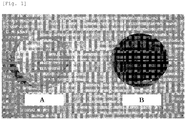
- FIG. 1 A photograph in substitution for a drawing, showing the appearance of the cured products of A (Example 1) and B (Comparative Example 4).
- Examples of the epoxy compound having two epoxy groups in one molecule (A) include low molecular weight diepoxy compounds, e.g., mononucleus aromatic diepoxy compounds having one benzene ring, such as catechol diglycidyl ether, resorcinol diglycidyl ether, tert-butylhydroquinone diglycidyl ether, and phthalic acid diglycidyl ether, alicyclic epoxy compounds, such as dimethylolcyclohexane diglycidyl ether, 3,4-epoxycyclohexenylmethyl-3,4-epoxycyclohexenyl carboxylate, and limonenedioxide, bisphenol type epoxy compounds, such as bis(4-hydroxyphenyl)methane diglycidyl ether, 1,1-bis(4-hydroxyphenyl)ethane diglycidyl ether, and 2,2-bis(4-hydroxyphenyl)propane diglycidyl ether, and
- the epoxy compound (A) may be a compound that exists in a liquid form at normal temperature (25°C). Even if it is a solid compound, it can be used in the form of a solution prepared using a solvent. Moreover, it can also be dissolved in a compound (B) in a liquid form. Therefore, although the upper limit of the molecular weight of the epoxy compound is not particularly defined, the weight average molecular weight of an oligomer is usually 200 to 1500.
- a phenolic hydroxyl group refers to a hydroxyl group substituted for a hydrogen atom on an aromatic ring.
- Examples of the aforementioned compound (B) include mononucleus aromatic dihydroxy compounds having one benzene ring, such as catechol, resorcinol, hydroquinone, methylhydroquinone, t-butylhydroquinone, and 2,5-di-t-butylhydroquinone, bisphenols, such as 2,2-bis(4-hydroxyphenyl)propane (bisphenol A), 1,1-bis(4-hydroxyphenyl)ethane (bisphenol AD), bis(hydroxyphenyl)methane (bisphenol F), bisphenol fluorene, and biscresol fluorene, compounds having fused rings, such as dihydroxynaphthalene, and bifunctional phenol compounds in which an allyl group has been introduced, such as diallylresorcinol,
- the above-mentioned compound (B) may be a compound that exists in a liquid form at normal temperature (25°C). Even if it is a solid compound, it can be used in the form of a solution prepared using a solvent. Moreover, it can also be dissolved in an epoxy compound (A) in a liquid form. Therefore, although the upper limit of the molecular weight of the compound (B) is not particularly defined, the upper limit is usually about 200 to about 500.
- the compounded amount of the epoxy compound (A) and the compound (B) is preferably 0.9 to 1.1 mol, more preferably 0.95 to 1.05 mol of the compound (B) relative to 1 mol of the epoxy compound (A).
- the epoxy compound (A) and the compound (B) can be polymerized in a straight chain form by a polyaddition reaction illustrated in the following scheme. Whether being a thermoplastic epoxy resin or not can be checked by the solubility of a cured product in a solvent, thermo melting property, and the like.
- At least one compound represented by the above general formula (1) is used.
- R in the above general formula (1) represents a hydrocarbon group having 2 to 10 carbon atoms (the hydrocarbon group may be a straight or branched chain when having 3 or more carbon atoms) and having a hydroxyl group at the ⁇ position with respect to the nitrogen atom are preferred, and compounds wherein R in the above general formula (1) represents a hydrocarbon group having 2 to 6 carbon atoms are more preferred.
- n is preferably 2 or 3, and n is more preferably 3.
- the curing accelerator is as defined in claim 1.
- the curing accelerator (C) is a compound wherein R in the above general formula (1) represents a straight- or branched-chain, preferably saturated, monovalent hydrocarbon group having 6 to 10 carbon atoms and having no hydroxyl group (e.g., n-hexyl, isohexyl, neohexyl, n-heptyl, 2-heptyl, and n-decyl).
- R in the above general formula (1) represents a straight- or branched-chain, preferably saturated, monovalent hydrocarbon group having 6 to 10 carbon atoms and having no hydroxyl group (e.g., n-hexyl, isohexyl, neohexyl, n-heptyl, 2-heptyl, and n-decyl).
- n is 2 or 3 and is preferably 3.
- Such compounds include straight-chain or branched-chain dialkylamines or trialkylamines.
- dialkylamines include diisobutylamine, di-sec-butylamine, diisopentylamine, N-sec-butylpropylamine, dipropylamine, dipentylamine and N-ethylhexylamine (reference examples), and examples of the trialkylamines include tripropylamine (straight chain; the same is applied hereinafter), tri-n-butylamine, triisobutylamine, tripentylamine (straight chain; the same is applied hereinafter) N,N-diisopropylethylamine, triisopentylamine, N,N-dimethyl-n-octylamine, and N,N-dimethyldecylamine (reference examples).
- dialkylamines useful according to the present invention include dihexylamine, diheptylamine, di(2-ethylhexyl)amine, and examples of the trialkylamines useful according to the present invention include trihexylamine (straight-chain; the same is applied hereinafter). These may be used solely or two or more of these may be used. Among these, tripropylamine, tri-n-butylamine, tripentylamine, or their combination is preferred, tri-n-butylamine, tripentylamine, or their combination is more preferred, and tri-n-butylamine is even more preferred (reference examples).
- R in the above general formula (1) represents a hydrocarbon group having 2 to 10 carbon atoms and having a hydroxyl group at the ⁇ position with respect to the nitrogen atom
- its use amount is preferably, from the viewpoint of achievement of a higher molecular weight, 0.5 to 10 parts by weight, more preferably 1. 5 to 6 parts by weight, and particularly preferably 1.5 to 3 parts by weight relative to 100 parts by weight of the aforementioned epoxy compound (A).
- R in the above general formula (1) represents a hydrocarbon group having 3 to 10 carbon atoms and having no hydroxyl group
- its use amount is preferably, from the viewpoint of achievement of a higher molecular weight, 0.01 to 10 parts by weight, more preferably 0.1 to 5 parts by weight, and and N,N-diisopropylethylamine, triisopentylamine (reference examples).
- Specific examples of the dialkylamines useful according to the present invention include dihexylamine, diheptylamine, and examples of the trialkylamines useful according to the present invention include trihexylamine (straight chain; the same is applied hereinafter).
- tripropylamine, tri-n-butylamine, tripentylamine, or their combination is preferred, tri-n-butylamine, tripentylamine, or their combination is more preferred, and tri-n-butylamine is even more preferred (reference examples).
- R in the above general formula (1) represents a hydrocarbon group having 6 to 10 carbon atoms and having no hydroxyl group
- its use amount is preferably, from the viewpoint of achievement of a higher molecular weight, 0.01 to 10 parts by weight, more preferably 0.1 to 5 parts by weight, and particularly preferably 1 to 3 parts by weight relative to 100 parts by weight of the aforementioned epoxy compound (A).
- the curing accelerator (C) may be a combination of a compound wherein R in the above general formula (1) represents a hydrocarbon group having 2 to 10 carbon atoms and having a hydroxyl group at the ⁇ position with respect to the nitrogen atom and a compound wherein R in the above general formula (1) represents a monovalent hydrocarbon group having 6 to 10 carbon atoms and having no hydroxyl group.
- the combination ratio, expressed in weight ratio, of the compound wherein R in the above general formula (1) represents a hydrocarbon group having 2 to 10 carbon atoms and having a hydroxyl group at the ⁇ position with respect to the nitrogen atom to the compound wherein R in the above general formula (1) represents a monovalent hydrocarbon group having 6 to 10 carbon atoms and having no hydroxyl group is preferably 1 to 100 : 100 to 1, more preferably 1 to 10 : 10 to 1.
- the sum total of the use amounts of the compound wherein R in the above general formula (1) represents a hydrocarbon group having 2 to 10 carbon atoms and having a hydroxyl group at the ⁇ position with respect to the nitrogen atom and the compound wherein R in the above general formula (1) represents a monovalent hydrocarbon group having 6 to 10 carbon atoms and having no hydroxyl group is preferably 0.01 to 10 parts by weight, more preferably 0.1 to 5 parts by weight, and particularly preferably 1 to 3 parts by weight relative to 100 parts by weight of the abovementioned epoxy compound (A).
- a solvent may be used for the purpose of viscosity adjustment or the like so long as the object of the present invention is not disturbed.
- the solvent include ketones, such as acetone, methyl ethyl ketone (MEK), methyl isobutyl ketone (MIBK), and cyclohexanone, and ethers, such as methylcellosolve, and ethylene glycol dibutyl ether.
- ketones such as acetone, methyl ethyl ketone (MEK), methyl isobutyl ketone (MIBK), and cyclohexanone
- ethers such as methylcellosolve, and ethylene glycol dibutyl ether.
- acetone is preferred because it vaporizes easily at the time of curing by heating.
- the use amount is preferably 0.1 to 15 parts by weight, and more preferably 4 to 8 parts by weight relative to 100 parts by weight of the resin component. If too little, phenols will be separated, and
- a colorant a UV absorber, an antioxidant for resistance to heat, an antioxidant for resistance to light, a toughening agent, a plasticizer, and the like may be blended if desired so long as the object of the present invention is not disturbed.
- the composition of the present invention can be obtained by combining and mixing the above-described components. At this time, it may be either a one-component composition or a two-component composition.
- the above-mentioned curing accelerator (C) may have been added to the epoxy compound (A), the compound (B), or both.
- the curing temperature is usually 120 to 180°C and the curing time is usually 5 minutes to about 24 hours.
- thermoplastic cured epoxy resin with transparency to visible light can be obtained by using the composition of the present invention.
- the cured product has thermomeltability, transparency, and solubility in solvent and it can have sufficient flexural strength.
- Thermoplastic epoxy resin compositions were obtained by mixing raw materials for use shown in the following Table 1 in parts by weight given in the table. The obtained compositions developed no polymerization reaction during their preparation and their storage at room temperature.
- the meanings of the codes in Table 1 are as follows.
- AER260 Bisphenol type liquid epoxy resin produced by Asahi Kasei Corporation (epoxy equivalent weight: 190 g/eq)
- BPA Bisphenol A (hydroxyl group equivalent: 114 g/eq) produced by Mitsui Chemicals, Inc.
- TOTP Tri-o-tolylphosphine (molecular weight: 304) produced by Hokko Chemical Industry Co., Ltd.
- TPP Triphenylphosphine (molecular weight: 262) produced by Hokko Chemical Industry Co., Ltd.
- compositions were each put in an aluminum pan 18 mm in diameter, and at 130°C the compositions with the use of triethanolamine, triisopropanolamine, monoethanolamine, or diethanolamine were each cured for 6 hours, the composition with the use of N-butyldiethanolamine was cured for 3 hours, and the compositions with the use of tri-n-propylamine, tri-n-butylamine, tripentylamine, trihexylamine, triethylamine, TPP, TOTP, TBZ, or triphenylimidazole were each cured for 1 hour.
- the example with trihexylamine is according to the present invention.
- the cured products were evaluated for their appearance, solubility in solvent, and molecular weight by the following methods.
- the obtained compositions were cured under the same condition by using a mold for producing a bending specimen, thereby producing bending specimens.
- the flexural strength was evaluated by the following method. The results were shown in Table 1. In Comparative Example 1 using triphenylamine, however, the curing time could not be shown in the table because no cured product was obtained. Moreover, performance evaluation was not carried out.
- a (Reference example 1) was transparent and B (Comparative Example 4) was colored in red.
- Solubility in solvent Whether the cured product was dissolved in tetrahydrofuran (evaluation ⁇ ) or not (evaluation ⁇ ) was observed.
- Dissolution condition: cured product/tetrahydrofuran 1/100 (weight ratio).
- Weight average molecular weight: A cured product was dissolved in tetrahydrofuran and then a molecular weight was measured in terms of polystyrene by GPC. Measurement conditions: 40°C, flow rate 1 ml/min.
- the cured products using the compositions of the present invention are those having physical properties as thermoplastic epoxy resins and also having transparency, they can be used for various applications, such as plastics for electronic parts, adhesive, paint, multilayer film, and plastic molded articles, and the degree of freedom of coloring increases because they have a transparent ground color.
Landscapes
- Chemical & Material Sciences (AREA)
- Health & Medical Sciences (AREA)
- Chemical Kinetics & Catalysis (AREA)
- Medicinal Chemistry (AREA)
- Polymers & Plastics (AREA)
- Organic Chemistry (AREA)
- Epoxy Resins (AREA)
Description
- The present invention relates to a process for producing a thermoplastic cured epoxy resin by polymerizing a bifunctional epoxy compound and a bifunctional phenol compound. More particularly, it relates to a process for producing a thermoplastic cured epoxy resin with transparency to visible light and to a composition that is to be used for the process to afford a thermoplastic cured epoxy resin with transparency to visible light.
- A thermoplastic epoxy resin, which is a straight-chain, high-molecular-weight epoxy polymer, has recently been used for various applications because it can be melted by heating and it is superior in flexibility, processability, and adhesion property and therefore it becomes possible to allow reuse, recycle, and secondary fabrication, which have been impossible to do for conventional thermosetting epoxy resins (see, for example, Patent Documents 1 to 3).
- A thermoplastic epoxy resin is a liner polymer that is formed through chain extension caused by addition polymerization of a bifunctional epoxy compound and a compound having two active hydrogen-containing groups, e.g., a bifunctional phenol compound, accompanied by ring-opening of an epoxy ring. However, since an alcoholic hydroxyl group is generated as a result of a reaction of a bifunctional epoxy compound with an active hydrogen-containing group, e.g., a phenolic hydroxyl group, a polymer with a branched chain structure is formed if the alcoholic hydroxyl group reacts on an epoxy group. Polymers having such a structure tend to become gelled and it is difficult to melt them by heating and they are poor in solubility in solvent, so that they fail to exert properties as thermoplastic resin.
- Conventionally, alkali metal compounds have been known as a polymerization catalyst for polymerizing a bifunctional epoxy compound and a bifunctional phenol compound. However, there is a problem that their reaction products are prone to gelate. Therefore, what is desirable as a curing accelerator for obtaining a thermoplastic polymer by polymerizing a bifunctional epoxy compound with a bifunctional phenol compound is an agent that restrains a reaction between one epoxy group and another epoxy group or a reaction between an epoxy group and an alcoholic hydroxyl group and instead causes a reaction between an epoxy group and a phenolic hydroxyl group. Phosphorus-based compounds and imidazole-based compounds have been suggested as such a curing accelerator, and especially, phosphorus-based curing accelerators, such as triphenyl phosphine (TPP) and tri-o-tolylphosphine (TOTP), have been used from the viewpoint of realizing good thermoplasticity of a cured product (see, for example, Patent Document 3).
- However, in the case of using such a curing accelerator when producing a thermoplastic cured epoxy resin by polymerizing a bifunctional epoxy compound and a bifunctional phenol compound, the following problem is known. That is, the use of such a compound causes a product to color in orange to red though the reason for this is unclear, so that the use or application of the product will be limited. This does not very often become a problem in the field of products which are less influenced by the coloring of a resin itself. Because of the coloring of a resin itself, however, conventional thermoplastic epoxy resin compositions cannot be used successfully for products with which the influence on appearance should be taken into consideration.
-
- Patent Document 1: Japanese Patent Application Laid-Open No.
2001-335617 - Patent Document 2: Japanese Patent Application Laid-Open No.
10-237271 - Patent Document 3: Japanese Patent Application Laid-Open No.
2006-321897 -
JP10077329 - In view of the above-described situation, the object of the present invention is to provide a process for producing a thermoplastic cured epoxy resin that has transparency to visible light and realizes good thermoplasticity and a composition that is to be used for the process and affords a thermoplastic cured epoxy resin with transparency to visible light.
- The present inventor investigated earnestly in order to solve the above-mentioned problems and found that triphenylamine (TPA), which is similar in structure to a phosphorus-based curing accelerator TPP, could not cure a thermoplastic epoxy resin composition. It was also found that triethylamine could not be used as a curing accelerator. As a result of further study, it was also found that nitrilotrialkanols and a certain kind of trialkylamines were unexpectedly effective as curing accelerators of thermoplastic epoxy resin compositions and also found that the use of such a curing accelerator prevented a cured product from coloring. Further study on the basis of these findings led to the present invention.
- That is the present invention is directed to a process for producing a thermoplastic cured epoxy resin with transparency to visible light, which comprises: curing (A) an epoxy compound having two epoxy groups in one molecule with (B) a compound having two phenolic hydroxyl groups in one molecule by means of at least one compound represented by the following general formula (1) as (C) a curing accelerator:
Rn-NHm (1)
wherein in formula (1), R represents a straight or branched, saturated monovalent hydrocarbon group having 6 to 10 carbon atoms and having no hydroxyl group; n is an integer of 2 to 3, m is an integer of 1 to 0, and n + m = 3; a plurality of Rs may be the same or different from each other, wherein the curing accelerator (C) is a dialkylamine or trialkylamine.
The present invention is also directed to a thermoplastic epoxy resin composition comprising (A) an epoxy compound having two epoxy groups in one molecule, (B) a compound having two phenolic hydroxyl groups in one molecule, and at least one compound selected from the group consisting of dihexylamine, diheptylamine, and trihexylamine as (C) a curing accelerator.
The present invention is also directed to a thermoplastic cured epoxy resin with transparency to visible light obtainable by the process defined above or by curing the thermoplastic epoxy resin composition defined above. - By the above-mentioned constitution, the present invention can obtain a thermoplastic cured epoxy resin with transparency to visible light. In the present invention, "to have transparency to visible light" means that when a cured product about 3 mm in thickness is observed visually under white light, it is observed as being colorless and transparent or no coloration is observed in transparency. Such cured products do not always have such colorlessness and transparency as that optical materials are required to have, but they have colorlessness and light permeability such that they actually do not influence the appearance of products due to coloration under white light. As to the strength of the cured product of the present invention, a strength comparable to that achieved in the use of a phosphorus-based curing accelerator can be realized. Moreover, the composition of the present invention can secure a curing rate that is high enough for practical use. The cured product of the present invention has good thermoplasticity.
- [
Fig. 1 ] A photograph in substitution for a drawing, showing the appearance of the cured products of A (Example 1) and B (Comparative Example 4). - Examples of the epoxy compound having two epoxy groups in one molecule (A) include low molecular weight diepoxy compounds, e.g., mononucleus aromatic diepoxy compounds having one benzene ring, such as catechol diglycidyl ether, resorcinol diglycidyl ether, tert-butylhydroquinone diglycidyl ether, and phthalic acid diglycidyl ether, alicyclic epoxy compounds, such as dimethylolcyclohexane diglycidyl ether, 3,4-epoxycyclohexenylmethyl-3,4-epoxycyclohexenyl carboxylate, and limonenedioxide, bisphenol type epoxy compounds, such as bis(4-hydroxyphenyl)methane diglycidyl ether, 1,1-bis(4-hydroxyphenyl)ethane diglycidyl ether, and 2,2-bis(4-hydroxyphenyl)propane diglycidyl ether, and oligomer mixtures (collectively, also called "bisphenol type epoxy resins") resulting from partial condensation of such bisphenol type epoxy compounds, 3,3',5,5'-tetramethylbis(4-hydroxyphenyl)methane diglycidyl ether, 3,3',5,5'-tetramethylbis(4-hydroxyphenyl) ether diglycidyl ether, hydroquinone diglycidyl ether, methylhydroquinone diglycidyl ether, 2, 5-di-tert-butylhydroquinone diglycidyl ether, biphenyl type or tetramethylbiphenyl type epoxy resins, and bisphenol fluorene type or biscresol fluorene type epoxy resins. These may be used solely or alternatively two or more of them may be used. Among these are preferred bisphenol type epoxy resins.
- The epoxy compound (A) may be a compound that exists in a liquid form at normal temperature (25°C). Even if it is a solid compound, it can be used in the form of a solution prepared using a solvent. Moreover, it can also be dissolved in a compound (B) in a liquid form. Therefore, although the upper limit of the molecular weight of the epoxy compound is not particularly defined, the weight average molecular weight of an oligomer is usually 200 to 1500.
- In the compound having two phenolic hydroxyl groups in one molecule (B), a phenolic hydroxyl group refers to a hydroxyl group substituted for a hydrogen atom on an aromatic ring. Examples of the aforementioned compound (B) include mononucleus aromatic dihydroxy compounds having one benzene ring, such as catechol, resorcinol, hydroquinone, methylhydroquinone, t-butylhydroquinone, and 2,5-di-t-butylhydroquinone, bisphenols, such as 2,2-bis(4-hydroxyphenyl)propane (bisphenol A), 1,1-bis(4-hydroxyphenyl)ethane (bisphenol AD), bis(hydroxyphenyl)methane (bisphenol F), bisphenol fluorene, and biscresol fluorene, compounds having fused rings, such as dihydroxynaphthalene, and bifunctional phenol compounds in which an allyl group has been introduced, such as diallylresorcinol, diallylbisphenol A, and triallyldihydroxybiphenyl. These may be used solely or alternatively two or more of them may be used. Among these are preferred bisphenol A and bisphenol fluorene.
- The above-mentioned compound (B) may be a compound that exists in a liquid form at normal temperature (25°C). Even if it is a solid compound, it can be used in the form of a solution prepared using a solvent. Moreover, it can also be dissolved in an epoxy compound (A) in a liquid form. Therefore, although the upper limit of the molecular weight of the compound (B) is not particularly defined, the upper limit is usually about 200 to about 500.
- The compounded amount of the epoxy compound (A) and the compound (B) is preferably 0.9 to 1.1 mol, more preferably 0.95 to 1.05 mol of the compound (B) relative to 1 mol of the epoxy compound (A).
- The epoxy compound (A) and the compound (B) can be polymerized in a straight chain form by a polyaddition reaction illustrated in the following scheme. Whether being a thermoplastic epoxy resin or not can be checked by the solubility of a cured product in a solvent, thermo melting property, and the like.


- As a curing accelerator (C), at least one compound represented by the above general formula (1) is used. Disclosed are compounds wherein R in the above general formula (1) represents a hydrocarbon group having 2 to 10 carbon atoms (the hydrocarbon group may be a straight or branched chain when having 3 or more carbon atoms) and having a hydroxyl group at the β position with respect to the nitrogen atom are preferred, and compounds wherein R in the above general formula (1) represents a hydrocarbon group having 2 to 6 carbon atoms are more preferred. In the above general formula (1), n is preferably 2 or 3, and n is more preferably 3. In the present invention the curing accelerator is as defined in claim 1.
- The curing accelerator (C) is a compound wherein R in the above general formula (1) represents a straight- or branched-chain, preferably saturated, monovalent hydrocarbon group having 6 to 10 carbon atoms
and having no hydroxyl group (e.g.,
n-hexyl, isohexyl, neohexyl, n-heptyl, 2-heptyl, and n-decyl). In the above general formula (1), n is 2 or 3 and is preferably 3. - Such compounds include straight-chain or branched-chain dialkylamines or trialkylamines. Specific examples of the dialkylamines include diisobutylamine, di-sec-butylamine, diisopentylamine, N-sec-butylpropylamine, dipropylamine, dipentylamine
and N-ethylhexylamine (reference examples), and examples of the trialkylamines include tripropylamine (straight chain; the same is applied hereinafter), tri-n-butylamine, triisobutylamine, tripentylamine (straight chain; the same is applied hereinafter)
N,N-diisopropylethylamine, triisopentylamine, N,N-dimethyl-n-octylamine, and N,N-dimethyldecylamine (reference examples). Specific examples of the dialkylamines useful according to the present invention include dihexylamine, diheptylamine, di(2-ethylhexyl)amine, and examples of the trialkylamines useful according to the present invention include trihexylamine (straight-chain; the same is applied hereinafter). These may be used solely or two or more
of these may be used. Among these, tripropylamine, tri-n-butylamine, tripentylamine, or their combination is preferred, tri-n-butylamine, tripentylamine, or their combination is more preferred, and tri-n-butylamine is even more preferred (reference examples). - When a compound wherein R in the above general formula (1) represents a hydrocarbon group having 2 to 10 carbon atoms and having a hydroxyl group at the β position with respect to the nitrogen atom is used as the curing accelerator (C), its use amount is preferably, from the viewpoint of achievement of a higher molecular weight, 0.5 to 10 parts by weight, more preferably 1. 5 to 6 parts by weight, and particularly preferably 1.5 to 3 parts by weight relative to 100 parts by weight of the aforementioned epoxy compound (A).
- When a compound wherein R in the above general formula (1) represents a hydrocarbon group having 3 to 10 carbon atoms and having no hydroxyl group is used as the curing accelerator (C), its use amount is preferably, from the viewpoint of achievement of a higher molecular weight, 0.01 to 10 parts by weight, more preferably 0.1 to 5 parts by weight, and and N,N-diisopropylethylamine, triisopentylamine (reference examples). Specific examples of the dialkylamines useful according to the present invention include dihexylamine, diheptylamine, and examples of the trialkylamines useful according to the present invention include trihexylamine (straight chain; the same is applied hereinafter). These may be used solely or two or more of these may be used. Among these, tripropylamine, tri-n-butylamine, tripentylamine, or their combination is preferred, tri-n-butylamine, tripentylamine, or their combination is more preferred, and tri-n-butylamine is even more preferred (reference examples).
- When a compound wherein R in the above general formula (1) represents a hydrocarbon group having 6 to 10 carbon atoms and having no hydroxyl group is used as the curing accelerator (C), its use amount is preferably, from the viewpoint of achievement of a higher molecular weight, 0.01 to 10 parts by weight, more preferably 0.1 to 5 parts by weight, and particularly preferably 1 to 3 parts by weight relative to 100 parts by weight of the aforementioned epoxy compound (A).
- In order to afford stable thermoplasticity and increase the rate of reaction, the curing accelerator (C) may be a combination of a compound wherein R in the above general formula (1) represents a hydrocarbon group having 2 to 10 carbon atoms and having a hydroxyl group at the β position with respect to the nitrogen atom and a compound wherein R in the above general formula (1) represents a monovalent hydrocarbon group having 6 to 10 carbon atoms and having no hydroxyl group. In this case, the combination ratio, expressed in weight ratio, of the compound wherein R in the above general formula (1) represents a hydrocarbon group having 2 to 10 carbon atoms and having a hydroxyl group at the β position with respect to the nitrogen atom to the compound wherein R in the above general formula (1) represents a monovalent hydrocarbon group having 6 to 10 carbon atoms and having no hydroxyl group is preferably 1 to 100 : 100 to 1, more preferably 1 to 10 : 10 to 1. The sum total of the use amounts of the compound wherein R in the above general formula (1) represents a hydrocarbon group having 2 to 10 carbon atoms and having a hydroxyl group at the β position with respect to the nitrogen atom and the compound wherein R in the above general formula (1) represents a monovalent hydrocarbon group having 6 to 10 carbon atoms and having no hydroxyl group is preferably 0.01 to 10 parts by weight, more preferably 0.1 to 5 parts by weight, and particularly preferably 1 to 3 parts by weight relative to 100 parts by weight of the abovementioned epoxy compound (A).
- Moreover, a solvent may be used for the purpose of viscosity adjustment or the like so long as the object of the present invention is not disturbed. Examples of the solvent include ketones, such as acetone, methyl ethyl ketone (MEK), methyl isobutyl ketone (MIBK), and cyclohexanone, and ethers, such as methylcellosolve, and ethylene glycol dibutyl ether. Among these, acetone is preferred because it vaporizes easily at the time of curing by heating. The use amount is preferably 0.1 to 15 parts by weight, and more preferably 4 to 8 parts by weight relative to 100 parts by weight of the resin component. If too little, phenols will be separated, and if too much, physical properties will deteriorate greatly due to the remaining of the solvent after polymerization.
- In addition, a colorant, a UV absorber, an antioxidant for resistance to heat, an antioxidant for resistance to light, a toughening agent, a plasticizer, and the like may be blended if desired so long as the object of the present invention is not disturbed.
- The composition of the present invention can be obtained by combining and mixing the above-described components. At this time, it may be either a one-component composition or a two-component composition. In this case, the above-mentioned curing accelerator (C) may have been added to the epoxy compound (A), the compound (B), or both.
- In the curing step in the process of the present invention, although the temperature range in which a curing reaction is caused varies with the kinds of the reactive compositions and the curing accelerator to be used, the curing temperature is usually 120 to 180°C and the curing time is usually 5 minutes to about 24 hours.
- In accordance with the present invention, a thermoplastic cured epoxy resin with transparency to visible light can be obtained by using the composition of the present invention. The cured product has thermomeltability, transparency, and solubility in solvent and it can have sufficient flexural strength.
- The present invention is described in more detail below with reference to Examples, but the following description is only for illustration and the invention is not limited to these Examples.
- Examples 1 to 9, Comparative Examples 1 to 6
- Thermoplastic epoxy resin compositions were obtained by mixing raw materials for use shown in the following Table 1 in parts by weight given in the table.
The obtained compositions developed no polymerization reaction during their preparation and their storage at room temperature. The meanings of the codes in Table 1 are as follows. AER260: Bisphenol type liquid epoxy resin produced by Asahi Kasei Corporation (epoxy equivalent weight: 190 g/eq)
BPA: Bisphenol A (hydroxyl group equivalent: 114 g/eq) produced by Mitsui Chemicals, Inc.
TOTP: Tri-o-tolylphosphine (molecular weight: 304) produced by Hokko Chemical Industry Co., Ltd.
TPP: Triphenylphosphine (molecular weight: 262) produced by Hokko Chemical Industry Co., Ltd.
Triphenylimidazole: 2,4,5-Triphenylimidazole TBZ: A compound represented by the following formula, wherein n = 3.

- The obtained compositions were each put in an aluminum pan 18 mm in diameter, and at 130°C the compositions with the use of triethanolamine, triisopropanolamine, monoethanolamine, or diethanolamine were each cured for 6 hours, the composition with the use of N-butyldiethanolamine was cured for 3 hours, and the compositions with the use of tri-n-propylamine, tri-n-butylamine, tripentylamine, trihexylamine, triethylamine, TPP, TOTP, TBZ, or triphenylimidazole were each cured for 1 hour. The example with trihexylamine is according to the present invention. The cured products were evaluated for their appearance, solubility in solvent, and molecular weight by the following methods. For reference Examples 1, 2 and 7 and Comparative Examples 3 and 4, the obtained compositions were cured under the same condition by using a mold for producing a bending specimen, thereby producing bending specimens. The flexural strength was evaluated by the following method. The results were shown in Table 1. In Comparative Example 1 using triphenylamine, however, the curing time could not be shown in the table because no cured product was obtained. Moreover, performance evaluation was not carried out.
- Since the obtained cured products were remelted by only heating for 1 minute at 150 to 200°C, it was successfully confirmed that they were capable of being bended easily and they were straight-chain polymer having no cross-linked structure.
- Flexural strength: The measurement of static flexural strength (MPa) (Reference examples 1, 2 and 7 and Comparative Examples 3 and 4) was conducted by a three-point bending test in accordance with ASTM D-790 using an INSTRON universal material tester. The shape of the specimen is defined by height h = 6 mm, width b = 13 mm, and length 1 = 120 mm, and the bending span is 100 mm. The measurement temperature is 25°C. Appearance: A cured product (18 mm in diameter and 3 mm in thickness) was placed on white paper, and its transparency was observed by visual observation under natural light. For Example 1 and Comparative Example 4, a photograph in substitution for a drawing showing the appearance of the cured products was shown in
Fig. 1 . A (Reference example 1) was transparent and B (Comparative Example 4) was colored in red. Solubility in solvent: Whether the cured product was dissolved in tetrahydrofuran (evaluation ○) or not (evaluation ×) was observed. Dissolution condition: cured product/tetrahydrofuran = 1/100 (weight ratio). Weight average molecular weight: A cured product was dissolved in tetrahydrofuran and then a molecular weight was measured in terms of polystyrene by GPC. Measurement conditions: 40°C, flow rate = 1 ml/min.[Table 1] Examples Comparative Examples 1 2 3 4 5 6 7 8 9 1 2 3 4 5 6 AER260 100 100 100 100 100 100 100 100 100 100 100 100 100 100 100 BPA 60 60 60 60 60 60 60 60 60 60 60 60 60 60 60 Triethanolamine 3 - - - - - - - - - - - - - - Triisopropanolamine - 3 - - - - - - - - - - - - - Monoethanolamine - - 3 - - - - - - - - - - - - Diethanolamine - - - 3 - - - - - - - - - - - N-Butyldiethanolamine - - - - 3 - - - - - - - - - - Tri-n-propylamine - - - - - 3 - - - - - - - - - Tri-n-butylamine - - - - - - 3 - - - - - - - - Tripentylamine - - - - - - - 3 - - - - - - - Trihexylamine - - - - - - - - 3 - - - - - - Triphenylamine - - - - - - - - - 4 - - - - - Triethylamine - - - - - - - - - - 3 - - - - TPP - - - - - - - - - - - 4 - - - TOTP - - - - - - - - - - - - 2 - - TBZ - - - - - - - - - - - - - 2 Triphenylimidazole - - - - - - - - - - - - - - 2 Curing time (h) 6 6 6 6 3 1 1 1 1 - 1 1 1 1 1 Appearance Transparent Transparent Transparent Transparent Transparent Transparent Transparent Transparent Transparent - Transparent Orange Red Red Pale yellow Solubility in solvent ○ ○ ○ ○ ○ ○ ○ ○ ○ - × ○ ○ × × Weight average molecular weight 23000 8200 12300 14700 35000 66000 64000 57100 53302 - - 140000 90000 - - Flexural strength (Mpa) 100 12 - - - - 100 - - - - 91 88 - - Remarks - - - - - - - - - Not cured - - - - - - These results clearly showed that the cured products obtained by the process of the present invention had thermomeltability and solubility in solvent and they were thermoplastic epoxy resins. Moreover, that they had transparency was shown. On the other hand, no cured product was obtained in the case of using triphenylamine (Comparative Example 1), and solubility in solvent was not shown in the case of using triethylamine (Comparative Example 2). The cured products using TPP (Comparative Example 3) or TOTP (Comparative Example 4) showed solubility in solvent and showed that thermoplastic epoxy resins were obtained, but they were colored. The cured products using TBZ (Comparative Example 5) or triphenylimidazole (Comparative Example 6) failed to have solubility in solvent.
- The cured products using triethanolamine or tri-n-butylamine (reference examples) showed values of flexural strength improved in comparison to the cases using conventional phosphorus-based curing accelerators (Comparative Examples 3 and 4).
- Since the cured products using the compositions of the present invention are those having physical properties as thermoplastic epoxy resins and also having transparency, they can be used for various applications, such as plastics for electronic parts, adhesive, paint, multilayer film, and plastic molded articles, and the degree of freedom of coloring increases because they have a transparent ground color.
Claims (9)
- A process for producing a thermoplastic cured epoxy resin with transparency to visible light, which comprises: curing (A) an epoxy compound having two epoxy groups in one molecule with (B) a compound having two phenolic hydroxyl groups in one molecule by means of at least one compound represented by the following general formula (1) as (C) a curing accelerator:
Rn-NHm (1)
wherein in formula (1), R represents a straight or branched, saturated monovalent hydrocarbon group having 6 to 10 carbon atoms and having no hydroxyl group; n is an integer of 2 or 3, m is an integer of 1 or 0, and n + m = 3; a plurality of Rs may be the same or different from each other, wherein the curing accelerator (C) is a dialkylamine or trialkylamine. - The process according to claim 1, wherein the compounded amount of the epoxy compound (A) and the compound (B) is 0.9 to 1.1 mol of the compound (B) relative to 1 mol of the epoxy compound (A).
- The process according to claim 1 or 2, wherein the curing accelerator (C) is used in an amount of 0.5 to 10 parts by weight relative to 100 parts by weight of the epoxy compound (A).
- The process according to any one of claims 1 to 3, wherein the hydrocarbon group R in the general formula (1) of the curing accelerator (C) is selected from the group consisting of n-hexyl, isohexyl, neohexyl, n-heptyl, 2-heptyl, and n-decyl.
- The process according to any one of claims 1 to 4, wherein the curing is performed at 120 to 180°C.
- The process according to claim 5, wherein the curing is performed for 5 minutes to 24 hours.
- A thermoplastic epoxy resin composition comprising (A) an epoxy compound having two epoxy groups in one molecule, (B) a compound having two phenolic hydroxyl groups in one molecule, and at least one compound selected from the group consisting of dihexylamine, diheptylamine, and trihexylamine as (C) a curing accelerator.
- The thermoplastic epoxy resin composition according to claim 7, wherein the curing accelerator (C) is contained in an amount of 0.01 to 10 parts by weight relative to 100 parts by weight of the epoxy compound (A).
- A thermoplastic cured epoxy resin with transparency to visible light obtainable by the process of any one of claims 1 to 6 or by curing the thermoplastic epoxy resin composition according to claim 7 or 8.
Priority Applications (1)
| Application Number | Priority Date | Filing Date | Title |
|---|---|---|---|
| EP16201175.3A EP3168249B1 (en) | 2009-01-09 | 2010-01-08 | Process for production of thermoplastic cured epoxy resin with transparency to visible light, and thermoplastic epoxy resin composition |
Applications Claiming Priority (2)
| Application Number | Priority Date | Filing Date | Title |
|---|---|---|---|
| JP2009003427 | 2009-01-09 | ||
| PCT/JP2010/050172 WO2010079832A1 (en) | 2009-01-09 | 2010-01-08 | Process for production of thermoplastic cured epoxy resin with transparency to visible light, and thermoplastic epoxy resin composition |
Related Child Applications (2)
| Application Number | Title | Priority Date | Filing Date |
|---|---|---|---|
| EP16201175.3A Division EP3168249B1 (en) | 2009-01-09 | 2010-01-08 | Process for production of thermoplastic cured epoxy resin with transparency to visible light, and thermoplastic epoxy resin composition |
| EP16201175.3A Division-Into EP3168249B1 (en) | 2009-01-09 | 2010-01-08 | Process for production of thermoplastic cured epoxy resin with transparency to visible light, and thermoplastic epoxy resin composition |
Publications (3)
| Publication Number | Publication Date |
|---|---|
| EP2386587A1 EP2386587A1 (en) | 2011-11-16 |
| EP2386587A4 EP2386587A4 (en) | 2013-08-14 |
| EP2386587B1 true EP2386587B1 (en) | 2017-07-12 |
Family
ID=42316597
Family Applications (2)
| Application Number | Title | Priority Date | Filing Date |
|---|---|---|---|
| EP10729252.6A Not-in-force EP2386587B1 (en) | 2009-01-09 | 2010-01-08 | Process for production of thermoplastic cured epoxy resin with transparency to visible light, and thermoplastic epoxy resin composition |
| EP16201175.3A Not-in-force EP3168249B1 (en) | 2009-01-09 | 2010-01-08 | Process for production of thermoplastic cured epoxy resin with transparency to visible light, and thermoplastic epoxy resin composition |
Family Applications After (1)
| Application Number | Title | Priority Date | Filing Date |
|---|---|---|---|
| EP16201175.3A Not-in-force EP3168249B1 (en) | 2009-01-09 | 2010-01-08 | Process for production of thermoplastic cured epoxy resin with transparency to visible light, and thermoplastic epoxy resin composition |
Country Status (7)
| Country | Link |
|---|---|
| US (1) | US20110288259A1 (en) |
| EP (2) | EP2386587B1 (en) |
| JP (1) | JP5633743B2 (en) |
| KR (1) | KR101648999B1 (en) |
| CN (1) | CN102272191B (en) |
| TW (2) | TWI527839B (en) |
| WO (1) | WO2010079832A1 (en) |
Families Citing this family (9)
| Publication number | Priority date | Publication date | Assignee | Title |
|---|---|---|---|---|
| WO2014196432A1 (en) * | 2013-06-05 | 2014-12-11 | 小松精練株式会社 | High-strength fiber composite, strand structure, and multi-strand structure |
| BR112016007339B1 (en) * | 2013-10-04 | 2021-11-03 | Zephyros, Inc | METHOD OF FIXING A COMPONENT TO A BEEHIVE-TYPE STRUCTURE |
| CN106117514A (en) * | 2015-05-04 | 2016-11-16 | 上纬企业股份有限公司 | Use of mixtures of difunctional epoxy resins and monofunctional primary amines and/or difunctional secondary amine hardeners as prepregs |
| WO2017094633A1 (en) * | 2015-12-01 | 2017-06-08 | 新日鉄住金マテリアルズ株式会社 | In situ polymerization type thermoplastic prepreg, thermoplastic composite and method for producing same |
| US10982041B2 (en) * | 2016-02-25 | 2021-04-20 | Swancor Advanced Materials Co., Ltd. | Epoxy resin oligomer |
| CN109486112B (en) * | 2018-11-07 | 2022-06-28 | 百思通新材料科技(武汉)有限公司 | A kind of thermoplastic polymer matrix composite material and preparation method thereof |
| CN112778697B (en) * | 2019-11-07 | 2022-08-02 | 万华化学集团股份有限公司 | Crystalline thermoplastic epoxy resin condensate and preparation method thereof |
| CN111057348A (en) * | 2019-12-14 | 2020-04-24 | 大连理工大学 | A toughened and modified resin matrix for liquid oxygen environment and preparation method thereof |
| TW202344544A (en) * | 2022-03-03 | 2023-11-16 | 日商日鐵化學材料股份有限公司 | Epoxy resin composition, reinforcing fiber-containing epoxy resin composition, prepreg and fiber-reinforced plastic using these, and thermoplastic epoxy resin |
Family Cites Families (17)
| Publication number | Priority date | Publication date | Assignee | Title |
|---|---|---|---|---|
| DE1643309U (en) * | 1952-02-11 | 1952-09-04 | Loewe Opta Ag | RECORD DEVICE WITH MEANS FOR THE OPERATION OF RECORDS OF DIFFERENT RUNNING SPEEDS. |
| US3350353A (en) * | 1965-03-25 | 1967-10-31 | Celanese Coatings Co | Epoxide resin process |
| US4105634A (en) * | 1976-08-11 | 1978-08-08 | Celanese Corporation | Production of thermosetting resinous polyepoxides |
| GB2032436B (en) * | 1978-10-19 | 1982-10-27 | Texaco Development Corp | Non-crystallizing epoxy resin accelerator |
| JP2788053B2 (en) * | 1989-04-07 | 1998-08-20 | 関西ペイント株式会社 | Cationic electrodeposition paint |
| JP3356302B2 (en) * | 1992-04-24 | 2002-12-16 | 関西ペイント株式会社 | Resin composition for water-based paint |
| JP3344228B2 (en) * | 1996-07-29 | 2002-11-11 | 松下電工株式会社 | Epoxy resin composition for laminated board |
| JPH1077329A (en) * | 1996-09-02 | 1998-03-24 | Toyo Ink Mfg Co Ltd | High molecular weight epoxy resin, production method thereof and use thereof |
| JPH10237271A (en) | 1997-02-27 | 1998-09-08 | Hitachi Chem Co Ltd | Thermosetting resin composition, film or sheet adhesive and adhesive-coated metal foil |
| KR100251388B1 (en) * | 1998-04-28 | 2000-04-15 | 김충섭 | Coating agents for transfer printing of prints or photographs |
| JP2001335617A (en) | 2000-05-26 | 2001-12-04 | Dainippon Ink & Chem Inc | Thermoplastic epoxy resin composition and method for producing the same |
| JP2001348419A (en) * | 2000-06-06 | 2001-12-18 | Nagase Chemtex Corp | Recyclable epoxy resin composition |
| JP2002327042A (en) * | 2001-04-27 | 2002-11-15 | Toyo Ink Mfg Co Ltd | Resin composition and metal sheet coated with plastic film using the resin composition |
| JP2006036801A (en) * | 2004-07-22 | 2006-02-09 | Japan Epoxy Resin Kk | High molecular weight epoxy resin composition, film using the composition, and cured product thereof |
| US20060135710A1 (en) * | 2004-12-17 | 2006-06-22 | Resolution Performance Products Llc | Epoxy resin compositions, methods of preparing and articles made therefrom |
| JP5074673B2 (en) | 2005-05-18 | 2012-11-14 | ナガセケムテックス株式会社 | Method for molding fiber reinforced thermoplastic resin |
| CN101338018B (en) * | 2007-07-06 | 2010-09-08 | 上海树脂厂有限公司 | Epoxy curing agent and method for preparing same |
-
2010
- 2010-01-08 KR KR1020117018101A patent/KR101648999B1/en not_active Expired - Fee Related
- 2010-01-08 EP EP10729252.6A patent/EP2386587B1/en not_active Not-in-force
- 2010-01-08 TW TW099100346A patent/TWI527839B/en not_active IP Right Cessation
- 2010-01-08 EP EP16201175.3A patent/EP3168249B1/en not_active Not-in-force
- 2010-01-08 US US13/143,856 patent/US20110288259A1/en not_active Abandoned
- 2010-01-08 TW TW105104900A patent/TWI571478B/en not_active IP Right Cessation
- 2010-01-08 WO PCT/JP2010/050172 patent/WO2010079832A1/en not_active Ceased
- 2010-01-08 CN CN201080004066.8A patent/CN102272191B/en not_active Expired - Fee Related
- 2010-01-08 JP JP2010545796A patent/JP5633743B2/en not_active Expired - Fee Related
Non-Patent Citations (1)
| Title |
|---|
| None * |
Also Published As
| Publication number | Publication date |
|---|---|
| CN102272191B (en) | 2014-12-31 |
| JPWO2010079832A1 (en) | 2012-06-28 |
| TWI527839B (en) | 2016-04-01 |
| US20110288259A1 (en) | 2011-11-24 |
| EP2386587A4 (en) | 2013-08-14 |
| WO2010079832A1 (en) | 2010-07-15 |
| TWI571478B (en) | 2017-02-21 |
| JP5633743B2 (en) | 2014-12-03 |
| TW201030047A (en) | 2010-08-16 |
| CN102272191A (en) | 2011-12-07 |
| EP2386587A1 (en) | 2011-11-16 |
| EP3168249A1 (en) | 2017-05-17 |
| KR101648999B1 (en) | 2016-08-17 |
| EP3168249B1 (en) | 2018-07-25 |
| TW201627346A (en) | 2016-08-01 |
| KR20110119682A (en) | 2011-11-02 |
Similar Documents
| Publication | Publication Date | Title |
|---|---|---|
| EP3168249B1 (en) | Process for production of thermoplastic cured epoxy resin with transparency to visible light, and thermoplastic epoxy resin composition | |
| EP2283093A1 (en) | Epoxy resin reactive diluent compositions | |
| JP5796502B2 (en) | Epoxy resin, method for producing epoxy resin, and epoxy resin composition | |
| EP3632951B1 (en) | Epoxy resin, epoxy resin-containing composition and cured product thereof | |
| US9745412B2 (en) | Process for production of thermoplastic cured epoxy resin with transparency to visible light, and thermoplastic epoxy resin composition | |
| WO2019102853A1 (en) | Epoxy resin composition, curable resin composition, and fiber-reinforced composite material | |
| US12060482B2 (en) | Curable resin composition, cured product, and sheet-like formed body | |
| WO2011103014A1 (en) | Divinylarene dioxide resin compositions | |
| JP5591176B2 (en) | Phosphorus and nitrogen containing epoxy resin | |
| JP4762659B2 (en) | Epoxy resin and epoxy resin composition | |
| JP4912617B2 (en) | Polymer having aromatic ether sulfone skeleton, process for producing the same and composition | |
| JP6772685B2 (en) | Epoxy compounds, methods for producing epoxy compounds, epoxy compound-containing compositions and cured products thereof | |
| US3898251A (en) | Epoxy resin curing agent | |
| JP2015124283A (en) | Curable epoxy resin composition and molded body | |
| JP2023127807A (en) | Epoxy resin, curable resin composition, photosensitive resin composition, paint, cured product, coating film | |
| WO2023223926A1 (en) | Glycidyl ether group-containing compound, curable resin composition, cured product, and laminate | |
| WO2023223927A1 (en) | Glycidyl ether group-containing compound, curable resin composition, cured product, and laminate | |
| JPWO2014034675A1 (en) | Method for producing cyanuric acid-modified phosphorus-containing epoxy resin, resin composition containing cyanuric acid-modified phosphorus-containing epoxy resin, and cured product thereof |
Legal Events
| Date | Code | Title | Description |
|---|---|---|---|
| PUAI | Public reference made under article 153(3) epc to a published international application that has entered the european phase |
Free format text: ORIGINAL CODE: 0009012 |
|
| 17P | Request for examination filed |
Effective date: 20110809 |
|
| AK | Designated contracting states |
Kind code of ref document: A1 Designated state(s): AT BE BG CH CY CZ DE DK EE ES FI FR GB GR HR HU IE IS IT LI LT LU LV MC MK MT NL NO PL PT RO SE SI SK SM TR |
|
| DAX | Request for extension of the european patent (deleted) | ||
| A4 | Supplementary search report drawn up and despatched |
Effective date: 20130716 |
|
| RIC1 | Information provided on ipc code assigned before grant |
Ipc: C08G 59/64 20060101ALI20130710BHEP Ipc: C08G 59/50 20060101ALI20130710BHEP Ipc: C08G 59/62 20060101AFI20130710BHEP |
|
| 17Q | First examination report despatched |
Effective date: 20140612 |
|
| GRAP | Despatch of communication of intention to grant a patent |
Free format text: ORIGINAL CODE: EPIDOSNIGR1 |
|
| INTG | Intention to grant announced |
Effective date: 20161214 |
|
| GRAS | Grant fee paid |
Free format text: ORIGINAL CODE: EPIDOSNIGR3 |
|
| GRAJ | Information related to disapproval of communication of intention to grant by the applicant or resumption of examination proceedings by the epo deleted |
Free format text: ORIGINAL CODE: EPIDOSDIGR1 |
|
| GRAL | Information related to payment of fee for publishing/printing deleted |
Free format text: ORIGINAL CODE: EPIDOSDIGR3 |
|
| GRAR | Information related to intention to grant a patent recorded |
Free format text: ORIGINAL CODE: EPIDOSNIGR71 |
|
| GRAA | (expected) grant |
Free format text: ORIGINAL CODE: 0009210 |
|
| INTC | Intention to grant announced (deleted) | ||
| RAP1 | Party data changed (applicant data changed or rights of an application transferred) |
Owner name: NAGASE CHEMTEX CORPORATION |
|
| AK | Designated contracting states |
Kind code of ref document: B1 Designated state(s): AT BE BG CH CY CZ DE DK EE ES FI FR GB GR HR HU IE IS IT LI LT LU LV MC MK MT NL NO PL PT RO SE SI SK SM TR |
|
| INTG | Intention to grant announced |
Effective date: 20170602 |
|
| REG | Reference to a national code |
Ref country code: GB Ref legal event code: FG4D |
|
| REG | Reference to a national code |
Ref country code: CH Ref legal event code: EP |
|
| REG | Reference to a national code |
Ref country code: AT Ref legal event code: REF Ref document number: 908251 Country of ref document: AT Kind code of ref document: T Effective date: 20170715 |
|
| REG | Reference to a national code |
Ref country code: IE Ref legal event code: FG4D |
|
| REG | Reference to a national code |
Ref country code: DE Ref legal event code: R096 Ref document number: 602010043564 Country of ref document: DE |
|
| REG | Reference to a national code |
Ref country code: NL Ref legal event code: MP Effective date: 20170712 |
|
| REG | Reference to a national code |
Ref country code: LT Ref legal event code: MG4D |
|
| REG | Reference to a national code |
Ref country code: AT Ref legal event code: MK05 Ref document number: 908251 Country of ref document: AT Kind code of ref document: T Effective date: 20170712 |
|
| REG | Reference to a national code |
Ref country code: FR Ref legal event code: PLFP Year of fee payment: 9 |
|
| PG25 | Lapsed in a contracting state [announced via postgrant information from national office to epo] |
Ref country code: NL Free format text: LAPSE BECAUSE OF FAILURE TO SUBMIT A TRANSLATION OF THE DESCRIPTION OR TO PAY THE FEE WITHIN THE PRESCRIBED TIME-LIMIT Effective date: 20170712 Ref country code: LT Free format text: LAPSE BECAUSE OF FAILURE TO SUBMIT A TRANSLATION OF THE DESCRIPTION OR TO PAY THE FEE WITHIN THE PRESCRIBED TIME-LIMIT Effective date: 20170712 Ref country code: FI Free format text: LAPSE BECAUSE OF FAILURE TO SUBMIT A TRANSLATION OF THE DESCRIPTION OR TO PAY THE FEE WITHIN THE PRESCRIBED TIME-LIMIT Effective date: 20170712 Ref country code: HR Free format text: LAPSE BECAUSE OF FAILURE TO SUBMIT A TRANSLATION OF THE DESCRIPTION OR TO PAY THE FEE WITHIN THE PRESCRIBED TIME-LIMIT Effective date: 20170712 Ref country code: SE Free format text: LAPSE BECAUSE OF FAILURE TO SUBMIT A TRANSLATION OF THE DESCRIPTION OR TO PAY THE FEE WITHIN THE PRESCRIBED TIME-LIMIT Effective date: 20170712 Ref country code: NO Free format text: LAPSE BECAUSE OF FAILURE TO SUBMIT A TRANSLATION OF THE DESCRIPTION OR TO PAY THE FEE WITHIN THE PRESCRIBED TIME-LIMIT Effective date: 20171012 Ref country code: AT Free format text: LAPSE BECAUSE OF FAILURE TO SUBMIT A TRANSLATION OF THE DESCRIPTION OR TO PAY THE FEE WITHIN THE PRESCRIBED TIME-LIMIT Effective date: 20170712 |
|
| PG25 | Lapsed in a contracting state [announced via postgrant information from national office to epo] |
Ref country code: GR Free format text: LAPSE BECAUSE OF FAILURE TO SUBMIT A TRANSLATION OF THE DESCRIPTION OR TO PAY THE FEE WITHIN THE PRESCRIBED TIME-LIMIT Effective date: 20171013 Ref country code: ES Free format text: LAPSE BECAUSE OF FAILURE TO SUBMIT A TRANSLATION OF THE DESCRIPTION OR TO PAY THE FEE WITHIN THE PRESCRIBED TIME-LIMIT Effective date: 20170712 Ref country code: IS Free format text: LAPSE BECAUSE OF FAILURE TO SUBMIT A TRANSLATION OF THE DESCRIPTION OR TO PAY THE FEE WITHIN THE PRESCRIBED TIME-LIMIT Effective date: 20171112 Ref country code: PL Free format text: LAPSE BECAUSE OF FAILURE TO SUBMIT A TRANSLATION OF THE DESCRIPTION OR TO PAY THE FEE WITHIN THE PRESCRIBED TIME-LIMIT Effective date: 20170712 Ref country code: BG Free format text: LAPSE BECAUSE OF FAILURE TO SUBMIT A TRANSLATION OF THE DESCRIPTION OR TO PAY THE FEE WITHIN THE PRESCRIBED TIME-LIMIT Effective date: 20171012 Ref country code: LV Free format text: LAPSE BECAUSE OF FAILURE TO SUBMIT A TRANSLATION OF THE DESCRIPTION OR TO PAY THE FEE WITHIN THE PRESCRIBED TIME-LIMIT Effective date: 20170712 |
|
| REG | Reference to a national code |
Ref country code: DE Ref legal event code: R097 Ref document number: 602010043564 Country of ref document: DE |
|
| PG25 | Lapsed in a contracting state [announced via postgrant information from national office to epo] |
Ref country code: RO Free format text: LAPSE BECAUSE OF FAILURE TO SUBMIT A TRANSLATION OF THE DESCRIPTION OR TO PAY THE FEE WITHIN THE PRESCRIBED TIME-LIMIT Effective date: 20170712 Ref country code: DK Free format text: LAPSE BECAUSE OF FAILURE TO SUBMIT A TRANSLATION OF THE DESCRIPTION OR TO PAY THE FEE WITHIN THE PRESCRIBED TIME-LIMIT Effective date: 20170712 Ref country code: CZ Free format text: LAPSE BECAUSE OF FAILURE TO SUBMIT A TRANSLATION OF THE DESCRIPTION OR TO PAY THE FEE WITHIN THE PRESCRIBED TIME-LIMIT Effective date: 20170712 |
|
| PLBE | No opposition filed within time limit |
Free format text: ORIGINAL CODE: 0009261 |
|
| STAA | Information on the status of an ep patent application or granted ep patent |
Free format text: STATUS: NO OPPOSITION FILED WITHIN TIME LIMIT |
|
| PG25 | Lapsed in a contracting state [announced via postgrant information from national office to epo] |
Ref country code: EE Free format text: LAPSE BECAUSE OF FAILURE TO SUBMIT A TRANSLATION OF THE DESCRIPTION OR TO PAY THE FEE WITHIN THE PRESCRIBED TIME-LIMIT Effective date: 20170712 Ref country code: SK Free format text: LAPSE BECAUSE OF FAILURE TO SUBMIT A TRANSLATION OF THE DESCRIPTION OR TO PAY THE FEE WITHIN THE PRESCRIBED TIME-LIMIT Effective date: 20170712 Ref country code: SM Free format text: LAPSE BECAUSE OF FAILURE TO SUBMIT A TRANSLATION OF THE DESCRIPTION OR TO PAY THE FEE WITHIN THE PRESCRIBED TIME-LIMIT Effective date: 20170712 |
|
| 26N | No opposition filed |
Effective date: 20180413 |
|
| PG25 | Lapsed in a contracting state [announced via postgrant information from national office to epo] |
Ref country code: SI Free format text: LAPSE BECAUSE OF FAILURE TO SUBMIT A TRANSLATION OF THE DESCRIPTION OR TO PAY THE FEE WITHIN THE PRESCRIBED TIME-LIMIT Effective date: 20170712 |
|
| REG | Reference to a national code |
Ref country code: CH Ref legal event code: PL |
|
| PG25 | Lapsed in a contracting state [announced via postgrant information from national office to epo] |
Ref country code: LU Free format text: LAPSE BECAUSE OF NON-PAYMENT OF DUE FEES Effective date: 20180108 |
|
| REG | Reference to a national code |
Ref country code: IE Ref legal event code: MM4A |
|
| REG | Reference to a national code |
Ref country code: BE Ref legal event code: MM Effective date: 20180131 |
|
| PG25 | Lapsed in a contracting state [announced via postgrant information from national office to epo] |
Ref country code: BE Free format text: LAPSE BECAUSE OF NON-PAYMENT OF DUE FEES Effective date: 20180131 Ref country code: LI Free format text: LAPSE BECAUSE OF NON-PAYMENT OF DUE FEES Effective date: 20180131 Ref country code: CH Free format text: LAPSE BECAUSE OF NON-PAYMENT OF DUE FEES Effective date: 20180131 |
|
| PG25 | Lapsed in a contracting state [announced via postgrant information from national office to epo] |
Ref country code: IE Free format text: LAPSE BECAUSE OF NON-PAYMENT OF DUE FEES Effective date: 20180108 |
|
| PG25 | Lapsed in a contracting state [announced via postgrant information from national office to epo] |
Ref country code: MC Free format text: LAPSE BECAUSE OF FAILURE TO SUBMIT A TRANSLATION OF THE DESCRIPTION OR TO PAY THE FEE WITHIN THE PRESCRIBED TIME-LIMIT Effective date: 20170712 |
|
| PG25 | Lapsed in a contracting state [announced via postgrant information from national office to epo] |
Ref country code: MT Free format text: LAPSE BECAUSE OF NON-PAYMENT OF DUE FEES Effective date: 20180108 |
|
| PGFP | Annual fee paid to national office [announced via postgrant information from national office to epo] |
Ref country code: FR Payment date: 20191216 Year of fee payment: 11 |
|
| PG25 | Lapsed in a contracting state [announced via postgrant information from national office to epo] |
Ref country code: TR Free format text: LAPSE BECAUSE OF FAILURE TO SUBMIT A TRANSLATION OF THE DESCRIPTION OR TO PAY THE FEE WITHIN THE PRESCRIBED TIME-LIMIT Effective date: 20170712 |
|
| PGFP | Annual fee paid to national office [announced via postgrant information from national office to epo] |
Ref country code: DE Payment date: 20191224 Year of fee payment: 11 Ref country code: GB Payment date: 20200102 Year of fee payment: 11 Ref country code: IT Payment date: 20200114 Year of fee payment: 11 |
|
| PG25 | Lapsed in a contracting state [announced via postgrant information from national office to epo] |
Ref country code: HU Free format text: LAPSE BECAUSE OF FAILURE TO SUBMIT A TRANSLATION OF THE DESCRIPTION OR TO PAY THE FEE WITHIN THE PRESCRIBED TIME-LIMIT; INVALID AB INITIO Effective date: 20100108 Ref country code: PT Free format text: LAPSE BECAUSE OF FAILURE TO SUBMIT A TRANSLATION OF THE DESCRIPTION OR TO PAY THE FEE WITHIN THE PRESCRIBED TIME-LIMIT Effective date: 20170712 |
|
| PG25 | Lapsed in a contracting state [announced via postgrant information from national office to epo] |
Ref country code: MK Free format text: LAPSE BECAUSE OF NON-PAYMENT OF DUE FEES Effective date: 20170712 Ref country code: CY Free format text: LAPSE BECAUSE OF FAILURE TO SUBMIT A TRANSLATION OF THE DESCRIPTION OR TO PAY THE FEE WITHIN THE PRESCRIBED TIME-LIMIT Effective date: 20170712 |
|
| REG | Reference to a national code |
Ref country code: DE Ref legal event code: R119 Ref document number: 602010043564 Country of ref document: DE |
|
| GBPC | Gb: european patent ceased through non-payment of renewal fee |
Effective date: 20210108 |
|
| PG25 | Lapsed in a contracting state [announced via postgrant information from national office to epo] |
Ref country code: FR Free format text: LAPSE BECAUSE OF NON-PAYMENT OF DUE FEES Effective date: 20210131 |
|
| PG25 | Lapsed in a contracting state [announced via postgrant information from national office to epo] |
Ref country code: DE Free format text: LAPSE BECAUSE OF NON-PAYMENT OF DUE FEES Effective date: 20210803 Ref country code: GB Free format text: LAPSE BECAUSE OF NON-PAYMENT OF DUE FEES Effective date: 20210108 |
|
| PG25 | Lapsed in a contracting state [announced via postgrant information from national office to epo] |
Ref country code: IT Free format text: LAPSE BECAUSE OF NON-PAYMENT OF DUE FEES Effective date: 20210108 |