EP2385084A1 - Silicone composition, release paper or film, and making method - Google Patents
Silicone composition, release paper or film, and making method Download PDFInfo
- Publication number
- EP2385084A1 EP2385084A1 EP11165202A EP11165202A EP2385084A1 EP 2385084 A1 EP2385084 A1 EP 2385084A1 EP 11165202 A EP11165202 A EP 11165202A EP 11165202 A EP11165202 A EP 11165202A EP 2385084 A1 EP2385084 A1 EP 2385084A1
- Authority
- EP
- European Patent Office
- Prior art keywords
- group
- alkenyl
- component
- integer
- bonded
- Prior art date
- Legal status (The legal status is an assumption and is not a legal conclusion. Google has not performed a legal analysis and makes no representation as to the accuracy of the status listed.)
- Granted
Links
- 229920001296 polysiloxane Polymers 0.000 title claims abstract description 64
- 239000000203 mixture Substances 0.000 title claims abstract description 63
- 238000000034 method Methods 0.000 title claims description 15
- 125000003342 alkenyl group Chemical group 0.000 claims abstract description 61
- 125000001424 substituent group Chemical group 0.000 claims abstract description 57
- 150000001875 compounds Chemical class 0.000 claims abstract description 27
- BASFCYQUMIYNBI-UHFFFAOYSA-N platinum Chemical compound [Pt] BASFCYQUMIYNBI-UHFFFAOYSA-N 0.000 claims abstract description 16
- 239000003054 catalyst Substances 0.000 claims abstract description 10
- 239000002318 adhesion promoter Substances 0.000 claims abstract description 8
- 229920006136 organohydrogenpolysiloxane Polymers 0.000 claims abstract description 8
- 238000013006 addition curing Methods 0.000 claims abstract description 3
- 239000000758 substrate Substances 0.000 claims description 55
- 239000011248 coating agent Substances 0.000 claims description 52
- 238000000576 coating method Methods 0.000 claims description 52
- -1 siloxane units Chemical group 0.000 claims description 33
- 125000004432 carbon atom Chemical group C* 0.000 claims description 26
- XUIMIQQOPSSXEZ-UHFFFAOYSA-N Silicon Chemical group [Si] XUIMIQQOPSSXEZ-UHFFFAOYSA-N 0.000 claims description 23
- 229910052710 silicon Inorganic materials 0.000 claims description 23
- 238000007259 addition reaction Methods 0.000 claims description 19
- 125000004435 hydrogen atom Chemical group [H]* 0.000 claims description 13
- 125000004122 cyclic group Chemical group 0.000 claims description 12
- 238000009281 ultraviolet germicidal irradiation Methods 0.000 claims description 10
- 239000002985 plastic film Substances 0.000 claims description 9
- 229920006255 plastic film Polymers 0.000 claims description 9
- 239000011203 carbon fibre reinforced carbon Substances 0.000 claims description 8
- 238000006482 condensation reaction Methods 0.000 claims description 8
- 239000003960 organic solvent Substances 0.000 claims description 8
- 238000006116 polymerization reaction Methods 0.000 claims description 8
- 230000005855 radiation Effects 0.000 claims description 8
- 238000010438 heat treatment Methods 0.000 claims description 7
- 229910052739 hydrogen Inorganic materials 0.000 claims description 7
- 125000004430 oxygen atom Chemical group O* 0.000 claims description 7
- 125000001931 aliphatic group Chemical group 0.000 claims description 5
- 125000003118 aryl group Chemical group 0.000 claims description 5
- 239000001257 hydrogen Substances 0.000 claims description 5
- CREMABGTGYGIQB-UHFFFAOYSA-N carbon carbon Chemical compound C.C CREMABGTGYGIQB-UHFFFAOYSA-N 0.000 claims description 4
- 125000000304 alkynyl group Chemical group 0.000 claims description 3
- 230000003197 catalytic effect Effects 0.000 claims description 3
- 229910052751 metal Inorganic materials 0.000 claims description 3
- 239000002184 metal Substances 0.000 claims description 3
- 229930195734 saturated hydrocarbon Natural products 0.000 claims description 3
- 125000001183 hydrocarbyl group Chemical group 0.000 claims 4
- 238000006243 chemical reaction Methods 0.000 abstract description 23
- 238000007348 radical reaction Methods 0.000 abstract description 23
- 125000000524 functional group Chemical group 0.000 abstract description 9
- 229910052697 platinum Inorganic materials 0.000 abstract description 6
- KPUWHANPEXNPJT-UHFFFAOYSA-N disiloxane Chemical group [SiH3]O[SiH3] KPUWHANPEXNPJT-UHFFFAOYSA-N 0.000 description 39
- 239000000123 paper Substances 0.000 description 27
- 239000010408 film Substances 0.000 description 24
- YXFVVABEGXRONW-UHFFFAOYSA-N Toluene Chemical compound CC1=CC=CC=C1 YXFVVABEGXRONW-UHFFFAOYSA-N 0.000 description 15
- 150000002430 hydrocarbons Chemical group 0.000 description 12
- 230000003993 interaction Effects 0.000 description 10
- 150000003254 radicals Chemical class 0.000 description 9
- 125000002496 methyl group Chemical group [H]C([H])([H])* 0.000 description 8
- 229920002799 BoPET Polymers 0.000 description 7
- 239000007822 coupling agent Substances 0.000 description 7
- 230000000694 effects Effects 0.000 description 7
- 238000002156 mixing Methods 0.000 description 7
- 125000000391 vinyl group Chemical group [H]C([*])=C([H])[H] 0.000 description 7
- 229920002554 vinyl polymer Polymers 0.000 description 7
- HSFWRNGVRCDJHI-UHFFFAOYSA-N alpha-acetylene Natural products C#C HSFWRNGVRCDJHI-UHFFFAOYSA-N 0.000 description 6
- 125000005375 organosiloxane group Chemical group 0.000 description 6
- 239000002904 solvent Substances 0.000 description 6
- 230000032683 aging Effects 0.000 description 5
- 125000002887 hydroxy group Chemical group [H]O* 0.000 description 5
- 239000000463 material Substances 0.000 description 5
- 125000003903 2-propenyl group Chemical group [H]C([*])([H])C([H])=C([H])[H] 0.000 description 4
- 238000013459 approach Methods 0.000 description 4
- 238000001723 curing Methods 0.000 description 4
- 238000011156 evaluation Methods 0.000 description 4
- 150000002894 organic compounds Chemical class 0.000 description 4
- 125000001997 phenyl group Chemical group [H]C1=C([H])C([H])=C(*)C([H])=C1[H] 0.000 description 4
- ZWEHNKRNPOVVGH-UHFFFAOYSA-N 2-Butanone Chemical compound CCC(C)=O ZWEHNKRNPOVVGH-UHFFFAOYSA-N 0.000 description 3
- CSCPPACGZOOCGX-UHFFFAOYSA-N Acetone Chemical compound CC(C)=O CSCPPACGZOOCGX-UHFFFAOYSA-N 0.000 description 3
- XDTMQSROBMDMFD-UHFFFAOYSA-N C1CCCCC1 Chemical compound C1CCCCC1 XDTMQSROBMDMFD-UHFFFAOYSA-N 0.000 description 3
- XEKOWRVHYACXOJ-UHFFFAOYSA-N Ethyl acetate Chemical compound CCOC(C)=O XEKOWRVHYACXOJ-UHFFFAOYSA-N 0.000 description 3
- 229910003849 O-Si Inorganic materials 0.000 description 3
- 229910003872 O—Si Inorganic materials 0.000 description 3
- 230000001464 adherent effect Effects 0.000 description 3
- 229920005601 base polymer Polymers 0.000 description 3
- 125000001495 ethyl group Chemical group [H]C([H])([H])C([H])([H])* 0.000 description 3
- 238000005227 gel permeation chromatography Methods 0.000 description 3
- VLKZOEOYAKHREP-UHFFFAOYSA-N n-Hexane Chemical compound CCCCCC VLKZOEOYAKHREP-UHFFFAOYSA-N 0.000 description 3
- 125000000962 organic group Chemical group 0.000 description 3
- 238000002360 preparation method Methods 0.000 description 3
- 125000001436 propyl group Chemical group [H]C([*])([H])C([H])([H])C([H])([H])[H] 0.000 description 3
- 239000007787 solid Substances 0.000 description 3
- 238000012360 testing method Methods 0.000 description 3
- QYLFHLNFIHBCPR-UHFFFAOYSA-N 1-ethynylcyclohexan-1-ol Chemical group C#CC1(O)CCCCC1 QYLFHLNFIHBCPR-UHFFFAOYSA-N 0.000 description 2
- 239000004606 Fillers/Extenders Substances 0.000 description 2
- IMNFDUFMRHMDMM-UHFFFAOYSA-N N-Heptane Chemical compound CCCCCCC IMNFDUFMRHMDMM-UHFFFAOYSA-N 0.000 description 2
- 239000004793 Polystyrene Substances 0.000 description 2
- 239000004820 Pressure-sensitive adhesive Substances 0.000 description 2
- 238000010521 absorption reaction Methods 0.000 description 2
- 239000000853 adhesive Substances 0.000 description 2
- 230000001070 adhesive effect Effects 0.000 description 2
- 125000000217 alkyl group Chemical group 0.000 description 2
- 238000010420 art technique Methods 0.000 description 2
- 125000000480 butynyl group Chemical group [*]C#CC([H])([H])C([H])([H])[H] 0.000 description 2
- HGCIXCUEYOPUTN-UHFFFAOYSA-N cyclohexene Chemical compound C1CCC=CC1 HGCIXCUEYOPUTN-UHFFFAOYSA-N 0.000 description 2
- 125000002534 ethynyl group Chemical group [H]C#C* 0.000 description 2
- 230000001771 impaired effect Effects 0.000 description 2
- 230000006872 improvement Effects 0.000 description 2
- 239000003112 inhibitor Substances 0.000 description 2
- 239000007788 liquid Substances 0.000 description 2
- 239000011368 organic material Substances 0.000 description 2
- 150000002978 peroxides Chemical class 0.000 description 2
- 239000003504 photosensitizing agent Substances 0.000 description 2
- 229920000139 polyethylene terephthalate Polymers 0.000 description 2
- 239000005020 polyethylene terephthalate Substances 0.000 description 2
- 229920002223 polystyrene Polymers 0.000 description 2
- 238000012545 processing Methods 0.000 description 2
- 230000001737 promoting effect Effects 0.000 description 2
- 125000002568 propynyl group Chemical group [*]C#CC([H])([H])[H] 0.000 description 2
- 229910052703 rhodium Inorganic materials 0.000 description 2
- 239000010948 rhodium Substances 0.000 description 2
- MHOVAHRLVXNVSD-UHFFFAOYSA-N rhodium atom Chemical compound [Rh] MHOVAHRLVXNVSD-UHFFFAOYSA-N 0.000 description 2
- 125000003944 tolyl group Chemical group 0.000 description 2
- 238000012546 transfer Methods 0.000 description 2
- NAWXUBYGYWOOIX-SFHVURJKSA-N (2s)-2-[[4-[2-(2,4-diaminoquinazolin-6-yl)ethyl]benzoyl]amino]-4-methylidenepentanedioic acid Chemical compound C1=CC2=NC(N)=NC(N)=C2C=C1CCC1=CC=C(C(=O)N[C@@H](CC(=C)C(O)=O)C(O)=O)C=C1 NAWXUBYGYWOOIX-SFHVURJKSA-N 0.000 description 1
- 125000004642 (C1-C12) alkoxy group Chemical group 0.000 description 1
- 125000004400 (C1-C12) alkyl group Chemical group 0.000 description 1
- 125000006736 (C6-C20) aryl group Chemical group 0.000 description 1
- 125000001731 2-cyanoethyl group Chemical group [H]C([H])(*)C([H])([H])C#N 0.000 description 1
- CEBKHWWANWSNTI-UHFFFAOYSA-N 2-methylbut-3-yn-2-ol Chemical compound CC(C)(O)C#C CEBKHWWANWSNTI-UHFFFAOYSA-N 0.000 description 1
- NECRQCBKTGZNMH-UHFFFAOYSA-N 3,5-dimethylhex-1-yn-3-ol Chemical compound CC(C)CC(C)(O)C#C NECRQCBKTGZNMH-UHFFFAOYSA-N 0.000 description 1
- UVJHQYIOXKWHFD-UHFFFAOYSA-N C1C=CCC=C1 Chemical compound C1C=CCC=C1 UVJHQYIOXKWHFD-UHFFFAOYSA-N 0.000 description 1
- UFHFLCQGNIYNRP-UHFFFAOYSA-N Hydrogen Chemical compound [H][H] UFHFLCQGNIYNRP-UHFFFAOYSA-N 0.000 description 1
- CTQNGGLPUBDAKN-UHFFFAOYSA-N O-Xylene Chemical compound CC1=CC=CC=C1C CTQNGGLPUBDAKN-UHFFFAOYSA-N 0.000 description 1
- 239000004698 Polyethylene Substances 0.000 description 1
- 239000004743 Polypropylene Substances 0.000 description 1
- 239000006087 Silane Coupling Agent Substances 0.000 description 1
- 239000002253 acid Substances 0.000 description 1
- NIXOWILDQLNWCW-UHFFFAOYSA-N acrylic acid group Chemical group C(C=C)(=O)O NIXOWILDQLNWCW-UHFFFAOYSA-N 0.000 description 1
- 230000009471 action Effects 0.000 description 1
- 239000000654 additive Substances 0.000 description 1
- 230000002411 adverse Effects 0.000 description 1
- 238000004873 anchoring Methods 0.000 description 1
- 125000003710 aryl alkyl group Chemical group 0.000 description 1
- 125000001797 benzyl group Chemical group [H]C1=C([H])C([H])=C(C([H])=C1[H])C([H])([H])* 0.000 description 1
- 238000009835 boiling Methods 0.000 description 1
- 238000006664 bond formation reaction Methods 0.000 description 1
- 125000004369 butenyl group Chemical group C(=CCC)* 0.000 description 1
- 125000000484 butyl group Chemical group [H]C([*])([H])C([H])([H])C([H])([H])C([H])([H])[H] 0.000 description 1
- 229910052799 carbon Inorganic materials 0.000 description 1
- 239000003795 chemical substances by application Substances 0.000 description 1
- 125000004218 chloromethyl group Chemical group [H]C([H])(Cl)* 0.000 description 1
- 239000004927 clay Substances 0.000 description 1
- 230000000052 comparative effect Effects 0.000 description 1
- 230000008878 coupling Effects 0.000 description 1
- 238000010168 coupling process Methods 0.000 description 1
- 238000005859 coupling reaction Methods 0.000 description 1
- 125000004093 cyano group Chemical group *C#N 0.000 description 1
- 125000006165 cyclic alkyl group Chemical group 0.000 description 1
- 125000000113 cyclohexyl group Chemical group [H]C1([H])C([H])([H])C([H])([H])C([H])(*)C([H])([H])C1([H])[H] 0.000 description 1
- 230000001627 detrimental effect Effects 0.000 description 1
- 238000007865 diluting Methods 0.000 description 1
- 238000009826 distribution Methods 0.000 description 1
- 238000009501 film coating Methods 0.000 description 1
- 230000004927 fusion Effects 0.000 description 1
- 239000011086 glassine Substances 0.000 description 1
- 125000003055 glycidyl group Chemical group C(C1CO1)* 0.000 description 1
- 229910052736 halogen Inorganic materials 0.000 description 1
- 125000005843 halogen group Chemical group 0.000 description 1
- 150000002367 halogens Chemical class 0.000 description 1
- 125000004051 hexyl group Chemical group [H]C([H])([H])C([H])([H])C([H])([H])C([H])([H])C([H])([H])C([H])([H])* 0.000 description 1
- 239000002655 kraft paper Substances 0.000 description 1
- QSHDDOUJBYECFT-UHFFFAOYSA-N mercury Chemical compound [Hg] QSHDDOUJBYECFT-UHFFFAOYSA-N 0.000 description 1
- 229910052753 mercury Inorganic materials 0.000 description 1
- 229910001507 metal halide Inorganic materials 0.000 description 1
- 150000005309 metal halides Chemical class 0.000 description 1
- 230000000116 mitigating effect Effects 0.000 description 1
- SJYNFBVQFBRSIB-UHFFFAOYSA-N norbornadiene Chemical compound C1=CC2C=CC1C2 SJYNFBVQFBRSIB-UHFFFAOYSA-N 0.000 description 1
- UMIPWJGWASORKV-UHFFFAOYSA-N oct-1-yne Chemical compound CCCCCCC#C UMIPWJGWASORKV-UHFFFAOYSA-N 0.000 description 1
- 229910052698 phosphorus Inorganic materials 0.000 description 1
- 239000000049 pigment Substances 0.000 description 1
- 229920000573 polyethylene Polymers 0.000 description 1
- 229920001155 polypropylene Polymers 0.000 description 1
- 239000004800 polyvinyl chloride Substances 0.000 description 1
- 229920000915 polyvinyl chloride Polymers 0.000 description 1
- 125000002572 propoxy group Chemical group [*]OC([H])([H])C(C([H])([H])[H])([H])[H] 0.000 description 1
- 238000010526 radical polymerization reaction Methods 0.000 description 1
- 230000009257 reactivity Effects 0.000 description 1
- 229920005989 resin Polymers 0.000 description 1
- 239000011347 resin Substances 0.000 description 1
- 230000000452 restraining effect Effects 0.000 description 1
- 238000005096 rolling process Methods 0.000 description 1
- 230000009291 secondary effect Effects 0.000 description 1
- 239000004447 silicone coating Substances 0.000 description 1
- 238000003860 storage Methods 0.000 description 1
- 229910052717 sulfur Inorganic materials 0.000 description 1
- 239000010409 thin film Substances 0.000 description 1
- 125000000725 trifluoropropyl group Chemical group [H]C([H])(*)C([H])([H])C(F)(F)F 0.000 description 1
- 239000008096 xylene Substances 0.000 description 1
Classifications
-
- C—CHEMISTRY; METALLURGY
- C08—ORGANIC MACROMOLECULAR COMPOUNDS; THEIR PREPARATION OR CHEMICAL WORKING-UP; COMPOSITIONS BASED THEREON
- C08L—COMPOSITIONS OF MACROMOLECULAR COMPOUNDS
- C08L83/00—Compositions of macromolecular compounds obtained by reactions forming in the main chain of the macromolecule a linkage containing silicon with or without sulfur, nitrogen, oxygen or carbon only; Compositions of derivatives of such polymers
- C08L83/04—Polysiloxanes
-
- C—CHEMISTRY; METALLURGY
- C09—DYES; PAINTS; POLISHES; NATURAL RESINS; ADHESIVES; COMPOSITIONS NOT OTHERWISE PROVIDED FOR; APPLICATIONS OF MATERIALS NOT OTHERWISE PROVIDED FOR
- C09J—ADHESIVES; NON-MECHANICAL ASPECTS OF ADHESIVE PROCESSES IN GENERAL; ADHESIVE PROCESSES NOT PROVIDED FOR ELSEWHERE; USE OF MATERIALS AS ADHESIVES
- C09J7/00—Adhesives in the form of films or foils
- C09J7/40—Adhesives in the form of films or foils characterised by release liners
- C09J7/401—Adhesives in the form of films or foils characterised by release liners characterised by the release coating composition
-
- B—PERFORMING OPERATIONS; TRANSPORTING
- B01—PHYSICAL OR CHEMICAL PROCESSES OR APPARATUS IN GENERAL
- B01J—CHEMICAL OR PHYSICAL PROCESSES, e.g. CATALYSIS OR COLLOID CHEMISTRY; THEIR RELEVANT APPARATUS
- B01J23/00—Catalysts comprising metals or metal oxides or hydroxides, not provided for in group B01J21/00
- B01J23/38—Catalysts comprising metals or metal oxides or hydroxides, not provided for in group B01J21/00 of noble metals
- B01J23/40—Catalysts comprising metals or metal oxides or hydroxides, not provided for in group B01J21/00 of noble metals of the platinum group metals
- B01J23/42—Platinum
-
- C—CHEMISTRY; METALLURGY
- C08—ORGANIC MACROMOLECULAR COMPOUNDS; THEIR PREPARATION OR CHEMICAL WORKING-UP; COMPOSITIONS BASED THEREON
- C08G—MACROMOLECULAR COMPOUNDS OBTAINED OTHERWISE THAN BY REACTIONS ONLY INVOLVING UNSATURATED CARBON-TO-CARBON BONDS
- C08G77/00—Macromolecular compounds obtained by reactions forming a linkage containing silicon with or without sulfur, nitrogen, oxygen or carbon in the main chain of the macromolecule
- C08G77/04—Polysiloxanes
- C08G77/20—Polysiloxanes containing silicon bound to unsaturated aliphatic groups
-
- C—CHEMISTRY; METALLURGY
- C09—DYES; PAINTS; POLISHES; NATURAL RESINS; ADHESIVES; COMPOSITIONS NOT OTHERWISE PROVIDED FOR; APPLICATIONS OF MATERIALS NOT OTHERWISE PROVIDED FOR
- C09D—COATING COMPOSITIONS, e.g. PAINTS, VARNISHES OR LACQUERS; FILLING PASTES; CHEMICAL PAINT OR INK REMOVERS; INKS; CORRECTING FLUIDS; WOODSTAINS; PASTES OR SOLIDS FOR COLOURING OR PRINTING; USE OF MATERIALS THEREFOR
- C09D183/00—Coating compositions based on macromolecular compounds obtained by reactions forming in the main chain of the macromolecule a linkage containing silicon, with or without sulfur, nitrogen, oxygen, or carbon only; Coating compositions based on derivatives of such polymers
- C09D183/04—Polysiloxanes
-
- C—CHEMISTRY; METALLURGY
- C08—ORGANIC MACROMOLECULAR COMPOUNDS; THEIR PREPARATION OR CHEMICAL WORKING-UP; COMPOSITIONS BASED THEREON
- C08G—MACROMOLECULAR COMPOUNDS OBTAINED OTHERWISE THAN BY REACTIONS ONLY INVOLVING UNSATURATED CARBON-TO-CARBON BONDS
- C08G77/00—Macromolecular compounds obtained by reactions forming a linkage containing silicon with or without sulfur, nitrogen, oxygen or carbon in the main chain of the macromolecule
- C08G77/04—Polysiloxanes
- C08G77/12—Polysiloxanes containing silicon bound to hydrogen
-
- C—CHEMISTRY; METALLURGY
- C09—DYES; PAINTS; POLISHES; NATURAL RESINS; ADHESIVES; COMPOSITIONS NOT OTHERWISE PROVIDED FOR; APPLICATIONS OF MATERIALS NOT OTHERWISE PROVIDED FOR
- C09J—ADHESIVES; NON-MECHANICAL ASPECTS OF ADHESIVE PROCESSES IN GENERAL; ADHESIVE PROCESSES NOT PROVIDED FOR ELSEWHERE; USE OF MATERIALS AS ADHESIVES
- C09J2400/00—Presence of inorganic and organic materials
- C09J2400/20—Presence of organic materials
- C09J2400/28—Presence of paper
- C09J2400/283—Presence of paper in the substrate
-
- C—CHEMISTRY; METALLURGY
- C09—DYES; PAINTS; POLISHES; NATURAL RESINS; ADHESIVES; COMPOSITIONS NOT OTHERWISE PROVIDED FOR; APPLICATIONS OF MATERIALS NOT OTHERWISE PROVIDED FOR
- C09J—ADHESIVES; NON-MECHANICAL ASPECTS OF ADHESIVE PROCESSES IN GENERAL; ADHESIVE PROCESSES NOT PROVIDED FOR ELSEWHERE; USE OF MATERIALS AS ADHESIVES
- C09J2483/00—Presence of polysiloxane
- C09J2483/005—Presence of polysiloxane in the release coating
-
- Y—GENERAL TAGGING OF NEW TECHNOLOGICAL DEVELOPMENTS; GENERAL TAGGING OF CROSS-SECTIONAL TECHNOLOGIES SPANNING OVER SEVERAL SECTIONS OF THE IPC; TECHNICAL SUBJECTS COVERED BY FORMER USPC CROSS-REFERENCE ART COLLECTIONS [XRACs] AND DIGESTS
- Y10—TECHNICAL SUBJECTS COVERED BY FORMER USPC
- Y10T—TECHNICAL SUBJECTS COVERED BY FORMER US CLASSIFICATION
- Y10T428/00—Stock material or miscellaneous articles
- Y10T428/31504—Composite [nonstructural laminate]
- Y10T428/31652—Of asbestos
- Y10T428/31663—As siloxane, silicone or silane
Definitions
- This invention relates to a silicone composition for release paper or film having improved adhesion to paper or plastic film substrates, a release paper or film having a cured coating of the composition, and a method for preparing the release paper or film.
- release liners having release properties relative to sticky materials typically pressure-sensitive adhesives are prepared by forming a cured coating having release properties on the surface of substrates such as paper, laminated paper and plastic film.
- substrates such as paper, laminated paper and plastic film.
- silicone compositions are silicone compositions.
- JP-A S62-86061 discloses a silicone composition comprising an alkenyl-containing organopolysiloxane, an organohydrogenpolysiloxane, and a platinum base compound.
- Silicone compositions of this type are still predominant at the present because of their cure behavior and pot life.
- a problem has been pointed out that the adhesion between the cured coating and the substrate is not regarded sufficient. This poses limitation on the type of substrate that can be coated and necessitates pretreatment of the substrate.
- Proposals for improving adhesion have also been made from the side of silicone compositions.
- one attempt to use more adhesive materials includes blending of organic resins and addition of silane coupling agents.
- Another method is to modify the base polymer structure of the silicone composition.
- Base polymers having a branched structure containing RSiO 3/2 units are disclosed in JP-A S63-251465 , JP-B H03-19267 , JP-A H09-78032 , and JP-A H11-193366 . This method is mainly intended for light release upon high-speed peeling and for effective cure while some improvement in adhesion is achieved as a secondary effect.
- JP-A 2000-169794 and JP-A 2000-177058 propose the combined use of a solvent type silicone composition and a solventless silicone composition, thereby achieving the effect of reducing peeling speed dependence without modifying the base polymer structure. With respect to adhesion, this proposal does not surpass the existing solvent type silicone compositions.
- An object herein is to provide new and useful silicone compositions which can be coated onto a surface of a substrate such as paper or plastic film to form a non-tacky coating tenaciously adherent to the substrate surface.
- Other aspects are to provide release papers or films having a cured coating of the composition formed on a substrate, and methods for preparing such release paper or film.
- the adhesion promoter is a compound which contains per molecule at least one substituent group having a functional group capable of radical reaction upon exposure to heat and/or UV, and at least one substituent group having a group capable of reaction with alkenyl and/or SiH group, is free of inhibitors S and P against platinum addition reaction, and is dissolvable or dispersible in the composition in a stable manner.
- the addition of the adhesion promoter can improve adhesion without substantial impact on release properties.
- the present invention provides a release paper or film-forming silicone composition, a release paper or film, and a method for preparing the release paper or film, as defined below.
- the invention provides an addition curing silicone composition for release paper or film, comprising
- component (B1) is an organopolysiloxane having an average degree of polymerization of 2 to 50.
- it is represented by the compositional formula (1) having a structure of the general formula (2).
- R 1 is an alkenyl-containing substituent group of 2 to 10 carbon atoms
- A is R 2 or a siloxane residue bonded via an oxygen atom and selected so as to meet formula (1)
- two A groups connected to one silicon atom may form a cyclic structure as -O(SiR 2 2 O) y -
- R 2 is a substituted or unsubstituted monovalent hydrocarbon group of 1 to 10 carbon atoms
- x is an integer of 0 to 3
- y is an integer selected such that the organopolysiloxane of formula (1) may have an average
- M, M A , D, D A , T, T A , and Q are siloxane units as defined below, O 1/2 denoting that adjacent siloxane units are linked via an oxygen atom,
- x in formula (2) is 0 or 1.
- component (B1) is a compound of linear or branched siloxane structure having the general formula (3) or (4).
- General formula (3) is as follows.
- R 1 and R 2 are as defined above
- Y is a group of the following formula (3a): wherein R 1 and R 2 are as defined above
- Y 1 is a group of the following formula (3b): wherein R 1 and R 2 are as defined above, a2, b2, ay, and by each are an integer of 0 to 48, c2 and cy each are an integer of 0 to 30, d2 and dy each are an integer of 0 to 20, formulae (3), (3a) and (3b) each denote a random structure and include at least one structure that two siloxane units in which the alkenyl-containing substituent group R 1 is bonded to silicon atom are linked directly or via up to 3 intervening siloxane units in which R 1 is not bonded to silicon atom.
- General formula (4) is as follows.
- R 1 and R 2 are as defined above
- Z is a group of the following formula (4a): wherein R 1 and R 2 are as defined above
- Z 1 is a group of the following formula (4b): wherein R 1 and R 2 are as defined above, a2, b2, ay, and by each are an integer of 0 to 48
- c2 and cy each are an integer of 0 to 30, d2 and dy each are an integer of 0 to 20
- formulae (4), (4a) and (4b) each denote a random structure and include at least one structure that two siloxane units in which the alkenyl-containing substituent group R 1 is bonded to silicon atom are linked directly or via up to 3 intervening siloxane units in which R 1 is not bonded to silicon atom.
- component (B1) is a compound of cyclic siloxane structure having the general formula (5).
- R 1 and R 2 are as defined above
- R 3 is a substituent group having an OH or SiH group as functionality or a substituted or unsubstituted monovalent hydrocarbon group of 1 to 10 carbon atoms free of aliphatic unsaturation
- a1 is 0 or 1
- b1 is an integer of 1 to 6
- c1 is an integer of 0 to 5
- a1+b1+c1 is an integer of at least 2.
- component (B2) is a compound containing a divalent structural unit having the general formula (6-1), a compound containing divalent structural units having the general formulae (6-2) and (6-3), a compound of cyclic structure having the general formula (7-1), or a compound of cyclic structure having the general formula (7-2).
- R 2 is a substituted or unsubstituted monovalent hydrocarbon group of 1 to 10 carbon atoms
- R 4 is a substituent group of 2 to 10 carbon atoms containing alkynyl, acryloyloxy or methacryloyloxy
- R 5 is a substituent group having an OH, SiH or alkenyl group as functionality
- R 6 is hydrogen, a saturated hydrocarbon group of 1 to 10 carbon atoms or aromatic group, the same group as R 4 , or the same group as R 5
- d is 4 to 10
- e+f is 3 to 9.
- the invention provides a method for preparing a release paper or film, comprising the steps of coating the silicone composition defined above directly onto a paper or plastic film substrate, and applying heat and/or UV radiation to cure the coating.
- the step of applying heat and/or UV radiation includes UV irradiation and subsequent heating to cure the coating.
- the invention provides a release paper or film comprising a cured coating of the silicone composition defined above.
- an adhesion promoter of specific structure into a conventional release paper or film-forming silicone composition, coating the composition onto a substrate, and applying heat and/or UV radiation to cure the composition, there is obtained a non-tacky cured coating which is tenaciously adherent to the substrate.
- Component (A) is an organopolysiloxane containing at least two alkenyl groups in a molecule and having an absolute viscosity of at least 0.04 Pa-s at 25°C, as measured by a rotational viscometer.
- the organopolysiloxane is of a structure having the general formula (8).
- R 7 is alkenyl
- R 8 is a monovalent organic group free of aliphatic unsaturation or a hydroxyl group
- X 1 is a group of formula (9): a3, b3, c3, d3, and e3 are such positive numbers that the organopolysiloxane may have a viscosity of at least 0.04 Pa-s at 25°C and a viscosity in 30 wt% toluene solution of up to 70 Pa-s at 25°C, b3, c3, d3, and e3 may be 0, ⁇ and ⁇ each are 0 or an integer of 1 to 3.
- R 7 is an alkenyl group, preferably of 2 to 6 carbon atoms, such as vinyl, allyl or butenyl.
- R 8 is selected from monovalent organic groups, typically monovalent hydrocarbon groups, preferably of 1 to 20 carbon atoms, more preferably of 1 to 8 carbon atoms, for example, C 1 -C 12 alkyl groups such as methyl, ethyl, propyl and butyl, C 4 -C 20 cycloalkyl groups such as cyclohexyl, C 6 -C 20 aryl groups such as phenyl and tolyl, and substituted forms of the foregoing in which some or all hydrogen atoms are replaced by halogen, cyano or the like, such as chloromethyl, trifluoropropyl, and cyanoethyl, as well as monovalent hydrocarbon groups containing C 1 -C 12 alkoxy groups (e.g., methoxy, ethoxy, propoxy and methoxyethoxy), hydroxy
- organopolysiloxane as component (A) should contain at least two alkenyl groups per molecule, the content of alkenyl is desirably 0.001 to 0.3 mole per 100 g of the organopolysiloxane.
- substituent group X 1 a3, b3, c3, d3, and e3 are selected such that the number of alkenyl groups per molecule: c3+b3 ⁇ (e3+ ⁇ )+2 ⁇ may fall in the range of 2 to 2,500.
- organopolysiloxane (A) is linear
- an organopolysiloxane containing a branched chain structure as shown by the formula wherein b3 is not equal to 0 may also be employed.
- Component (B) is a characteristic component for imparting adhesion to the composition. It functions like a coupling agent capable of coupling the substrate and a non-tacky cured coating of components (A) and (C), thereby improving adhesion. If only one type of reaction is utilized for reaction or interaction with the substrate and the non-tacky cured coating made of essentially different materials, the reaction tends to be biased to either one side whereby component (B) may not fully function as the coupling agent.
- radical reaction is assigned to the reaction or interaction with the substrate whereas addition or condensation reaction is assigned to the reaction or interaction with the non-tacky cured coatinq.
- Component (B) must serve such that a single molecule may accommodate these two different reactions.
- One approach to this goal is to provide one molecule solely with substituent groups of the same type containing only a functional group capable of both reactions. Reaction selectivity by the group is low but both reactions can proceed, without undue biasing, by appropriately selecting characteristics of the molecular structure.
- the organosiloxane corresponding to this approach is component (B1).
- Another approach is to provide one molecule with both a substituent group capable of radical reaction with the substrate rather than addition or condensation reaction, and another substituent group capable of addition or condensation reaction with the non-tacky cured coating of components (A) and (C) rather than radical reaction.
- the compound corresponding to this approach is component (B2).
- Component (B) may be component (B1) or (B2) or a mixture of components (B1) and (B2).
- Components (B1) and (B2) may be mixed preferably in a weight ratio (B1):(B2) from 100:0 to 100:100, more preferably from 100:0 to 100:90, although the mixing ratio may be suitably adjusted in accordance with the desired level of adhesion, the type of substrate, and curing conditions.
- the weight ratio (B1):(B2) preferably ranges from 100:5 to 100:100.
- component (B1) does not require that a plurality of different functional groups be incorporated within one molecule as in component (B2), it is easy to prepare and advantageous in availability and cost.
- component (B1) is a silicone compound similar to component (A) as the main component of the composition, it can be dissolved or dispersed in the composition in a stable manner, which is advantageous for the preparation and storage of the composition.
- component (B1) has an absolute viscosity of less than 0.04 Pa-s at 25°C as measured by a rotational viscometer, a low molecular weight corresponding to a low degree of siloxane polymerization, a high alkenyl content of 0.3 to 2.0 mol/100 g, preferably 0.3 to 1.3 mol/100 g, more preferably at least 0.4 mol/100 g, wherein two siloxane units in which an alkenyl-containing substituent group is bonded to silicon atom are mutually juxtaposed in vicinity, whereby the surrounding organic nature is enhanced to facilitate an access of alkenyl group to the substrate, thereby facilitating reaction or interaction via radical reaction.
- the lower limit of the absolute viscosity is usually
- Component (B1) is an organopolysiloxane having a structure that two siloxane units in which an alkenyl-containing substituent group is bonded to silicon atom are linked directly or via up to 3 intervening siloxane units in which the alkenyl-containing substituent group is not bonded to silicon atom.
- the organopolysiloxane as component (B1) may be represented by the compositional formula (1) having a structure of the general formula (2).
- R 1 is an alkenyl-containing substituent group of 2 to 10 carbon atoms
- A is R 2 or a siloxane residue bonded via an oxygen atom and selected so as to meet formula (1)
- two A groups connected to one silicon atom may form a cyclic structure as -O(SiR 2 2 O) y -
- R 2 is a substituted or unsubstituted monovalent hydrocarbon group of 1 to 10 carbon atoms
- x is an integer of 0 to 3
- y is an integer selected such that the organopolysiloxane of formula (1) may have an average degree of polymerization of 2 to 50.
- M, M A , D, D A , T, T A , and Q are siloxane units as defined below, O 1/2 denoting that adjacent siloxane units are linked via an oxygen atom.
- m1, m2, d1, d2, t1, t2, and q1 are numbers satisfying the equations: t ⁇ 1 + t ⁇ 2 + 2 ⁇ q ⁇ 1 ⁇ m ⁇ 1 + m ⁇ 2 ⁇ 2 + t ⁇ 1 + t ⁇ 2 + 2 ⁇ q ⁇ 1 0 ⁇ d ⁇ 1 + d ⁇ 2 ⁇ 48 , 0 ⁇ t ⁇ 1 + t ⁇ 2 ⁇ 30 , 0 ⁇ q ⁇ 1 ⁇ 20 , 0.25 ⁇ m ⁇ 2 + d ⁇ 2 + t ⁇ 2 / m ⁇ 1 + m ⁇ 2 + d ⁇ 1 + d ⁇ 2 + t ⁇ 1 + t ⁇ 2 + q ⁇ 1 ⁇ 1.
- alkenyl-containing substituent group represented by R 1 examples include alkenyl groups such as vinyl and allyl, and (meth)acryloyloxy-substituted alkyl groups such as acryloyloxypropyl and methacryloyloxypropyl.
- Suitable monovalent organic groups represented by R 2 include unsubstituted monovalent hydrocarbon groups, for example, straight, branched or cyclic alkyl groups such as methyl, ethyl, propyl and hexyl, aryl groups such as phenyl and tolyl, aralkyl groups such as benzyl, and alkenyl groups such as vinyl and allyl, and substituted forms of the foregoing monovalent hydrocarbon groups in which some or all hydrogen atoms are substituted by halogen atoms, and substituted forms of the alkyl groups in which a hydrogen atom is substituted by (meth)acryloyloxy, such as (meth)acryloyloxypropyl. Accordingly, R 2 may be R 1 .
- Two A groups connected to one silicon atom may form a cyclic structure as -O(SiR 2 2 O) y -wherein R 2 and y are as defined above. More specifically, may be a group of
- Component (B1) has an average degree of polymerization of 2 to 50, preferably 2 to 40, as measured by gel permeation chromatography (GPC) versus polystyrene standards.
- the subscript y is an integer selected such that the organopolysiloxane of formula (1) may have an average degree of polymerization within the range.
- y is preferably an integer of 0 to 10, more preferably 1 to 8.
- the organosiloxane as component (B1) has a structure that two -SiR 1 A- groups are linked via -O-(SiA 2 O) x - wherein x is 0 to 3, preferably 0 or 1. Namely, two -SiR 1 A- groups having a silicon-bonded alkenyl group are juxtaposed in vicinity. When A is alkenyl, such groups are juxtaposed in close vicinity as a matter of course. Even when A is an alkyl group such as methyl or an aryl group such as phenyl, two -SiR 1 A- groups are juxtaposed in vicinity.
- the subscript x representative of an extent of vicinity is at most 3, preferably 0 or 1, within which range the effect of the invention are achievable. If x is 4 or more, adhesion declines, failing to achieve the effect of improving adhesion without an impact on release performance.
- the organosiloxane preferably contains at least three alkenyl groups, more preferably at least four alkenyl groups per molecule so that all alkenyl groups may not be consumed solely by the radical reaction.
- a low molecular weight is advantageous for the organosiloxane to function as the coupling agent because more bond sites are available over a wide area.
- organosiloxane having the structure of formula (1) examples include linear or branched organopolysiloxanes having the following formula (3) or (4).
- R 1 and R 2 are as defined above
- Y is a group of the following formula (3a): wherein R 1 and R 2 are as defined above
- Y 1 is a group of the following formula (3b): wherein R 1 and R 2 are as defined above.
- a2, b2, ay, and by each are an integer of 0 to 48, preferably 0 to 45, more preferably 0 to 40, c2 and cy each are an integer of 0 to 30, preferably 0 to 25, more preferably 0 to 20, d2 and dy each are an integer of 0 to 20, preferably 0 to 18, more preferably 0 to 15.
- Formulae (3), (3a) and (3b) each denote a random structure and include at least one structure that two siloxane units in which the alkenyl-containing substituent group R 1 is bonded to silicon atom are linked directly or via up to 3 intervening siloxane units in which R 1 is not bonded to silicon atom.
- R 1 and R 2 are as defined above
- Z is a group of the following formula (4a): wherein R 1 and R 2 are as defined above.
- Z 1 is a group of the following formula (4b): wherein R 1 and R 2 are as defined above.
- a2, b2, ay, and by each are an integer of 0 to 48, preferably 0 to 45, more preferably 0 to 40, c2 and cy each are an integer of 0 to 30, preferably 0 to 25, more preferably 0 to 20, d2 and dy each are an integer of 0 to 20, preferably 0 to 18, more preferably 0 to 15.
- Formulae (4), (4a) and (4b) each denote a random structure and include at least one structure that two siloxane units in which the alkenyl-containing substituent group R 1 is bonded to silicon atom are linked directly or via up to 3 intervening siloxane units in which R 1 is not bonded to silicon atom.
- Illustrative structures as component (B1) include linear organopolysiloxanes having the following formula: wherein x is as defined above. Also included are organopolysiloxanes of branched structure having a backbone of tri- or tetra-functional siloxane units, of the following formulae.
- R 20 is R 2 or R 1
- R 0 is -O-(SiR 2 R 20 ) y6 -SiR 2 2 R 20
- y is as defined above
- y1+y2+y6 y
- y1 and y6 each are an integer of at least 1
- y2 is an integer of at least 1
- y3+y4 y
- y3 and y4 each are an integer of at least
- y5 y.
- Component (B1) may also be an organopolysiloxane of cyclic structure having the general formula (5).
- R 1 and R 2 are as defined above
- R 3 is a substituent group having an OH or SiH group as functionality or a substituted or unsubstituted monovalent hydrocarbon group of 1 to 10 carbon atoms free of aliphatic unsaturation
- a1 is 0 or 1
- b1 is an integer of 1 to 6
- c1 is an integer of 0 to 5
- a1+b1+c1 is an integer of at least 2.
- examples of the substituent group having an OH or SiH group as functionality, represented by R 3 include silicon-bonded hydroxyl, silicon-bonded hydrogen, -CH 2 CH 2 CH 2 -O-CH 2 CH 2 -OH, and the like.
- Examples of the monovalent hydrocarbon group represented by R 3 include those exemplified above for R 2 , with alkenyl groups being excluded.
- Component (B2) is a compound containing in a molecule at least one substituent group of 2 to 10 carbon atoms, preferably 2 to 8 carbon atoms, having a carbon-carbon unsaturated bond (double or triple bond) as functionality, and at least one substituent group having a group capable of addition reaction and/or condensation reaction with an alkenyl group and/or a silicon-bonded hydrogen atom (i.e., SiH group).
- the compound as component (B2) possesses at least one substituent group having a carbon-carbon unsaturated bond as functionality, which indicates a substituent group having a functional group capable of radical reaction upon exposure to heat and/or UV.
- the structure of this substituent group may be either linear or branched, or even a cyclic structure such as cyclohexene or norbornadiene may be used. Any substituent group having a functional group as commonly used in radical polymerization or radical reaction curing systems may be used.
- the substituent group should preferably be a substituent group having a carbon-carbon double bond such as methacryloyloxy or a carbon-carbon triple bond such as acetylene, propynyl or butynyl, especially for restraining consumption by addition reaction.
- component (B2) is an organic compound free of siloxane structure, it makes an easy access to the substrate and is advantageous for reaction or interaction with the substrate via radical reaction, allowing a choice of the substituent group from a wider range.
- a non-silicone compound having a higher molecular weight is less compatible with silicone so that it may become difficult to acquire a bond or interaction with the non-tacky cured coating, or is little dissolvable in the composition and thus useless. Therefore, the organic compound should preferably have a number average molecular weight of up to 1,000 as measured by GPC versus polystyrene standards. In order for the organic compound to function as a coupling agent more efficiently for improving adhesion, a lower molecular weight is desirable since more bond sites are available over a wide area.
- component (B2) the substituent group having a functional group capable of radical reaction upon exposure to heat and/or UV functions such that component (B2) is anchored to the substrate surface where the composition is coated, through radical reaction and/or interaction with a group created by radical reaction.
- Creation of radicals may be attained by heat or irradiation of energy ray such as UV.
- a radical generator such as peroxide or a photosensitizer may be added for the purpose of promoting radical creation insofar as the advantages of the invention are not impaired.
- the substrate is made of organic material, there are present on the substrate numerous structures capable of generating radicals upon exposure to heat or UV or numerous structures capable of reacting with radicals thus generated.
- the substrate has an extremely high rate of absorption of IR or UV radiation as the radical-generating energy source.
- radicals can be concentratedly generated on the substrate, which is apt to promote reaction with the substrate.
- the radical creation technique based on UV irradiation is advantageous in that the temperature of the film substrate is not so elevated.
- UV radiation the majority of which is absorbed by the film substrate surface, radicals can be concentratedly generated in proximity to the film substrate surface, which is desirable to promote reaction with the film substrate.
- the compound as component (B2) also possesses at least one second substituent group. It is a substituent group having a functional group capable of reaction with the alkenyl group in component (A) and/or the SiH group in component (C).
- the reactions involved herein are addition reaction with SiH group for the alkenyl group in component (A), and condensation reaction with OH group and addition reaction with carbon-carbon double bond for the SiH group in component (C).
- component (B2) functions such that component (B2) is anchored to the non-tacky cured coating through addition and condensation reactions different from the radical reaction of the first substituent group. With this combined with the action of the substituent group for radical reaction, component (B2) functions as a coupling agent of anchoring the non-tacky cured coating and the substrate to each other, thereby improving adhesion.
- component (B2) is an organic compound free of siloxane structure, it tends to be less compatible with the silicone component so that addition reaction may be retarded. If a substituent group having a carbon-carbon double bond as a functional group capable of reaction with the alkenyl group in component (A) and/or the SiH group in component (C) is selected, then it is consumed by radical reaction prior to addition reaction with the SiH group, with the risk of component (B2) failing to function as the coupling agent. To avoid such inconvenience, a SiH group or hydroxyl group unsusceptible to radical reaction is selected.
- the compound may be a molecular structure containing a divalent structure having the general formula (6-1), or two divalent structures having the general formulae (6-2) and (6-3).
- R 2 is as defined above
- R 4 is a substituent group of 2 to 10 carbon atoms, preferably 2 to 8 carbon atoms, containing alkynyl (e.g., acetylene, propynyl or butynyl), acryloyloxy or methacryloyloxy
- R 5 is a substituent group having an OH, SiH or alkenyl group as functionality.
- an industrially desirable example is HC ⁇ C-C(CH 3 ) 2 -OH.
- R 6 is hydrogen, a saturated hydrocarbon group of 1 to 10 carbon atoms, preferably 1 to 8 carbon atoms, or aromatic group, the same group as R 4 , or the same group as R 5 , d is 4 to 10, and e+f is 3 to 9.
- an industrially desirable example is ethynyl cyclohexanol.
- Both components (B1) and (B2) are commonly advantageous in that their molecular weight is low.
- a compound having a very low molecular weight has a risk that it will rapidly volatilize off the composition prior to any reaction when the composition is coated and heated on the substrate. It is thus desired that component (B) have such a molecular weight that its boiling point may be at least 80°C.
- UV irradiation is effective because the temperature is not elevated.
- component (B) blended is 0.1 to 10 parts by weight, preferably 0.2 to 9 parts by weight per 100 parts by weight of component (A). Outside the range, a less amount of component (B) achieves no improvement in adhesion whereas a larger amount may adversely affect cure.
- Component (C) is an organohydrogenpolysiloxane containing at least three silicon-bonded hydrogen atoms (i.e., SiH groups) in a molecule.
- it has the average compositional formula (10): R 8 f H g SiO (4-f-g)/2 (10) wherein R 8 is as defined above, f is 0 to 3, g is 0 to 3, and f+g is a positive number of 1 to 3.
- the molecular structure may be linear, branched or cyclic.
- the organohydrogenpolysiloxane has an absolute viscosity which may range from several mPa-s to several ten thousand mPa-s at 25°C as measured by a rotational viscometer. Illustrative examples of the organohydrogenpolysiloxane are given below.
- Me stands for methyl
- h, 1 and n each are a number of 3 to 500
- m p and s each are a number of 1 to 500
- i, j, k, o, q, r, t, u, v and w each are a number of 0 to 500.
- the organohydrogenpolysiloxane as component (C) is blended in such amounts that the moles of SiH group is 1 to 10 times the total moles of alkenyl group in component (A). If the moles of SiH group in component (C) is less than the lower limit relative to the total moles of alkenyl group in component (A), the composition may not fully cure. If the moles of SiH group in component (C) is more than the upper limit, no further increase in the desired effect is observed and the peeling force may become heavy. Generally speaking, an appropriate amount of component (C) blended is 0.1 to 20 parts by weight per 100 parts by weight of component (A).
- Component (D) is a platinum group metal-based catalyst which may be selected from prior art well-known catalysts for addition reaction.
- exemplary catalysts include platinum black, chloroplatinic acid, chloroplatinic acid-olefin complexes, chloroplatinic acid-alcohol coordination compounds, rhodium, and rhodium-olefin complexes.
- the catalyst may be added in a catalytic amount.
- the catalyst is added in such an amount as to provide 5 to 1,000 ppm of platinum or rhodium based on the total weight of components (A), (B) and (C), whereby a coating can be fully cured.
- the amount of the catalyst may be adjusted in accordance with the reactivity of the components or the desired cure rate.
- Component (E) is an organic solvent which is added to the composition for the purposes of improving the stability of processing bath and applicability to various substrates and adjusting the coating weight and viscosity of the composition.
- Suitable organic solvents include toluene, xylene, ethyl acetate, acetone, methyl ethyl ketone, and hexane. Any other organic solvents may be used as long as the components can be uniformly dissolved therein.
- the organic solvent is used in an amount of 100 to 9,900 parts by weight per 100 parts by weight of component (A).
- component (E) is optional. Absent component (E), the viscosity of components (A), (B), (C) and (D) is changed to adjust an overall viscosity such that the resulting composition may be effectively coated by an applicator.
- the stability of processing bath may be adjusted by adding a bath life extender or the like, if necessary.
- composition of the invention may be prepared simply by mixing components (A), (B), (C), (D) and (E) until uniform. To gain an appropriate pot life, component (D) should be added and mixed immediately before coating.
- component (E) or organic solvent one advantageous procedure is by dissolving components (A) and (B) in component (E) uniformly prior to mixing components (C) and (D) therewith.
- additives including a pigment, leveling agent, and bath life extender may be added to the composition.
- a radical generator such as peroxide or a photosensitizer may be added for the purpose of promoting reaction insofar as the advantages of the invention are not impaired.
- the composition is coated onto a substrate such as paper or plastic film directly or after diluting with a suitable organic solvent, by any well-known coating techniques, for example, using a bar coater, roll coater, reverse coater, gravure coater, air knife coater, or if thin-film coating is desired, a high-precision offset coater or multi-stage roll coater.
- a substrate such as paper or plastic film directly or after diluting with a suitable organic solvent
- the substrate include paper sheets such as glassine paper, polyethylene-laminated paper, kraft paper, clay-coated paper, and mirror-coated paper, and plastic films of polypropylene, polyethylene, polyethylene terephthalate (PET), polyvinyl chloride and the like.
- the coating weight of the composition on the substrate varies with the type of the substrate material.
- the preferred coating weight is in a range of 0.05 to 5 g/m 2 as solids.
- the substrate coated with the composition is heated at 80 to 150°C for 5 to 60 seconds to form a cured coating on the substrate surface, obtaining a release paper or film.
- the cure takes place by way of addition reaction between components (A), (B) and (C), and at the same time, heat-induced radical reaction enhances bond-formation and interaction between component (B) and the substrate.
- a silicone coating having good release properties, improved adhesion and film strength is formed on the paper or film substrate surface.
- UV radiation When UV radiation is additionally applied, radical reaction in proximity to the paper or film substrate surface can be efficiently promoted without an excess elevation of temperature, facilitating preparation of release paper or film featuring high adhesion.
- any commercially available lamps or bulbs such as mercury lamps, metal halide lamps and fusion lamps may be used. Since the film substrate has a high absorption coefficient at 300 nm or shorter, those lamps or bulbs having a wavelength distribution containing more fractions of 300 nm or shorter wavelength are effective.
- An integral dose is 10 to 500 mJ/cm 2 , which is obtained by irradiation, for example, from one or two 120-W lamps at a line speed of 10 to 100 m/min.
- component (B) contains a siloxane structure
- the procedure of UV irradiation followed by heating is often effective. An effective procedure may be selected in accordance with a particular situation.
- a composition was prepared by mixing the amounts indicated in Table 1 of components (A), (B), (C) and (E) and an amount of component (D) so as to provide 100 ppm of platinum based on the total weight of (A)+(B)+(C).
- a release film was manufactured and evaluated according to the evaluation method described later. Specifically the curing step included UV irradiation from two 80-W lamps at a line speed of 40 m/min in an integral dose of 50 mJ/cm 2 and subsequent heating in a hot air circulating dryer for a predetermined time until a cured coating was formed.
- a composition was prepared by mixing the amounts indicated in Table 1 of components (A), (B), (C) and (E) and an amount of component (D) so as to provide 100 ppm of platinum based on the total weight of (A)+(B)+(C).
- a release film was manufactured and evaluated according to the evaluation method described later. Specifically the curing step included heating in a hot air circulating dryer for a predetermined time and subsequent UV irradiation from two 120-W lamps at a line speed of 30 m/min in an integral dose of 100 mJ/cm 2 until a cured coating was formed.
- Solvent type compositions were coated onto a PET film of 40 ⁇ m thick to a coating weight of 0.5 g/m 2 as solids by means of a bar coater.
- the coating was UV irradiated under two 80-W or 120-W UV lamps at a line speed of 30 m/min or 40 m/min to an integral dose of 50 mJ/cm 2 or 100 mJ/cm 2 and heat treated in a hot air circulating dryer at 80°C for a predetermined time. A time passed until a completely cured coating was formed was measured.
- the coating being cured was examined by rubbing the coating surface with the finger and judged "completely cured" when the coating was not hazy on the surface or crumbled off.
- Solventless compositions were coated onto a PET film of 40 ⁇ m thick by means of an IR tester and dried in a hot air circulating dryer at 100°C. Otherwise, the coating was similarly treated and evaluated.
- the coating area was A4 size, and the transfer amount of coating liquid was 0.1 ⁇ L.
- Solvent type compositions were coated onto a PET film of 40 ⁇ m thick to a coating weight of 0.5 g/m 2 as solids by means of a bar coater.
- the coating was UV irradiated under two 80-W or 120-W UV lamps at a line speed of 30 m/min or 40 m/min to an integral dose of 50 mJ/cm 2 or 100 mJ/cm 2 and heat treated in a hot air circulating dryer at 100°C for 30 seconds until a cured coating was formed, obtaining a test separator.
- the separator was allowed to stand at 25°C and 50% RH for one day, after which a solvent type acrylic pressure-sensitive adhesive (Oribain BPS-5127, Toyo Ink Mfg. Co., Ltd.) was coated onto the cured coating surface and heat treated at 100°C for 3 minutes.
- a PET film of 40 ⁇ m was laid on the treated surface, pressed by rolling once back and forth a roller of 2 kg, and aged at 25°C for 20 hours.
- the sample was cut into a strip of 5 cm wide.
- Using a tensile tester the force (N) required to peel the overlying PET film from the separator at an angle of 180° and a pull rate of 0.3 m/min was measured as adhesive strength.
- the tester used was autograph DCS-500 (Shimadzu Mfg. Co., Ltd.).
- Solventless compositions were coated onto a PET film of 40 ⁇ m thick by means of an IR tester.
- the coating was UV irradiated under two 80-W UV lamps at a line speed of 40 m/min to an integral dose of 50 mJ/cm 2 and heat treated in a hot air circulating dryer at 120°C for 30 seconds until a cured coating was formed, obtaining a test separator. It was similarly evaluated. It is noted that the coating area was A4 size, and the transfer amount of coating liquid was 0.1 ⁇ L.
- a PET film (40 ⁇ m) substrate separator prepared as in (2) and another separator prepared as in (2) using a corona-treated OPP film (40 ⁇ m) as the substrate were aged under predetermined conditions. After a certain aging period (days), the separator was examined whether the coating surface became hazy and rubbed off when the surface of the cured coating was rubbed with the finger.
- the sample which showed haze or rub-off after aging at 40°C and 80% RH for one day was rated poor ( ⁇ ).
- the sample which showed haze or rub-off after aging at 40° C and 80% RH for 3 days was rated fair ( ⁇ ).
- the sample which did not show haze or rub-off even after aging at 40°C and 80% RH for one month was rated good ( ⁇ ).
- the sample which did not show haze or rub-off even after aging at 60°C and 90% RH for one month was rated excellent ( ⁇ ).
Landscapes
- Chemical & Material Sciences (AREA)
- Organic Chemistry (AREA)
- Chemical Kinetics & Catalysis (AREA)
- Engineering & Computer Science (AREA)
- Materials Engineering (AREA)
- Wood Science & Technology (AREA)
- Life Sciences & Earth Sciences (AREA)
- Health & Medical Sciences (AREA)
- Medicinal Chemistry (AREA)
- Polymers & Plastics (AREA)
- Compositions Of Macromolecular Compounds (AREA)
- Paints Or Removers (AREA)
- Laminated Bodies (AREA)
- Paper (AREA)
- Materials For Medical Uses (AREA)
Abstract
Description
- This invention relates to a silicone composition for release paper or film having improved adhesion to paper or plastic film substrates, a release paper or film having a cured coating of the composition, and a method for preparing the release paper or film.
- It is well known from the past that release liners having release properties relative to sticky materials, typically pressure-sensitive adhesives are prepared by forming a cured coating having release properties on the surface of substrates such as paper, laminated paper and plastic film. Among the materials used for forming a cured coating having release properties are silicone compositions. For example,
JP-A S62-86061 - Silicone compositions of this type are still predominant at the present because of their cure behavior and pot life. However, a problem has been pointed out that the adhesion between the cured coating and the substrate is not regarded sufficient. This poses limitation on the type of substrate that can be coated and necessitates pretreatment of the substrate.
- Under the recent trend of available substrates, the use of plastic film substrates is increasing because of uniform and stable quality, high smoothness, and film thinness. As a wide variety of substrates are now available in the market, the requirement to improve the adhesion of silicone compositions to substrates becomes more desirable than ever.
- Proposals for improving adhesion have also been made from the side of silicone compositions. For example, one attempt to use more adhesive materials includes blending of organic resins and addition of silane coupling agents. However, this attempt is utilized only under limited conditions because release properties are otherwise degraded. Another method is to modify the base polymer structure of the silicone composition. Base polymers having a branched structure containing RSiO3/2 units are disclosed in
JP-A S63-251465 JP-B H03-19267 JP-A H09-78032 JP-A H11-193366 JP-A 2000-169794 JP-A 2000-177058 - As discussed above, there is available in the art no appropriate technique capable of improving the adhesion of a silicone composition without affecting the release properties thereof.
-
- Patent Document 1:
JP-A S62-86061 - Patent Document 2:
JP-A S63-251465 - Patent Document 3:
JP-B H03-19267 - Patent Document 4:
JP-A H09-78032 - Patent Document 5:
JP-A H11-193366 - Patent Document 6:
JP-A 2000-169794 - Patent Document 7:
JP-A 2000-177058 - An object herein is to provide new and useful silicone compositions which can be coated onto a surface of a substrate such as paper or plastic film to form a non-tacky coating tenaciously adherent to the substrate surface. Other aspects are to provide release papers or films having a cured coating of the composition formed on a substrate, and methods for preparing such release paper or film.
- The inventors have found that when a specific adhesion promoter is added to a conventional release paper or film-forming silicone composition, a cured coating which is tenaciously adherent to a substrate can be formed from the composition. The adhesion promoter is a compound which contains per molecule at least one substituent group having a functional group capable of radical reaction upon exposure to heat and/or UV, and at least one substituent group having a group capable of reaction with alkenyl and/or SiH group, is free of inhibitors S and P against platinum addition reaction, and is dissolvable or dispersible in the composition in a stable manner. As opposed to the prior art techniques of improving adhesion at more or less sacrifice of release properties, the addition of the adhesion promoter can improve adhesion without substantial impact on release properties.
- The present invention provides a release paper or film-forming silicone composition, a release paper or film, and a method for preparing the release paper or film, as defined below.
- In one aspect, the invention provides an addition curing silicone composition for release paper or film, comprising
- (A) 100 parts by weight of an organopolysiloxane containing at least two alkenyl groups in a molecule and having a viscosity of at least 0.04 Pa-s at 25°C,
- (B) 0.1 to 10 parts by weight of an adhesion promoter which is (B1) an organopolysiloxane containing at least two silicon-bonded alkenyl-containing substituent groups in a molecule, having an alkenyl content of 0.3 to 2.0 mol/100 g, and having a structure that two siloxane units in which the alkenyl-containing substituent group is bonded to silicon atom are linked directly or via up to 3 intervening siloxane units in which said substituent group is not bonded to silicon atom, the organopolysiloxane having a viscosity of less than 0.04 Pa-s at 25°C, and/or (B2) a compound containing in a molecule at least one substituent group of 2 to 10 carbon atoms having a carbon-carbon unsaturated bond (double or triple bond) as functionality, and at least one substituent group having a group capable of addition reaction and/or condensation reaction with the alkenyl group in component (A) and/or a silicon-bonded hydrogen atom in component (C),
- (C) 0.1 to 20 parts by weight of an organohydrogenpolysiloxane containing at least three silicon-bonded hydrogen atoms in a molecule,
- (D) a catalytic amount of a platinum group metal base catalyst, and
- (E) an amount of an optional organic solvent.
- In a preferred embodiment, component (B1) is an organopolysiloxane having an average degree of polymerization of 2 to 50. Preferably it is represented by the compositional formula (1) having a structure of the general formula (2).
[M]m1[MA]m2[D]d1[DA]d2[T]t1[TA]t2[Q]q1 (1)

- M, MA, D, DA, T, TA, and Q are siloxane units as defined below, O1/2 denoting that adjacent siloxane units are linked via an oxygen atom,
- M and MA each are:

- with the proviso that at least one R2 in MA is R1,
- D and DA each are:

- with the proviso that at least one R2 in DA is R1,
- T and TA each are:

- with the proviso that R2 in TA is R1,
- Q is:

- m1, m2, d1, d2, t1, t2, and q1 are numbers satisfying the equations:


- In a preferred embodiment, x in formula (2) is 0 or 1.
- In a preferred embodiment, component (B1) is a compound of linear or branched siloxane structure having the general formula (3) or (4).
General formula (3) is as follows.


General formula (4) is as follows.


- In another preferred embodiment, component (B1) is a compound of cyclic siloxane structure having the general formula (5).

- In a preferred embodiment, component (B2) is a compound containing a divalent structural unit having the general formula (6-1), a compound containing divalent structural units having the general formulae (6-2) and (6-3), a compound of cyclic structure having the general formula (7-1), or a compound of cyclic structure having the general formula (7-2).


- In another aspect, the invention provides a method for preparing a release paper or film, comprising the steps of coating the silicone composition defined above directly onto a paper or plastic film substrate, and applying heat and/or UV radiation to cure the coating. Typically the step of applying heat and/or UV radiation includes UV irradiation and subsequent heating to cure the coating.
- In a further aspect, the invention provides a release paper or film comprising a cured coating of the silicone composition defined above.
- According to the invention, by incorporating an adhesion promoter of specific structure into a conventional release paper or film-forming silicone composition, coating the composition onto a substrate, and applying heat and/or UV radiation to cure the composition, there is obtained a non-tacky cured coating which is tenaciously adherent to the substrate.Relative to the prior art techniques of improving adhesion at more or less sacrifice of release properties, we find that these compositions can improve adhesion without substantial impact on release properties.
- Component (A) is an organopolysiloxane containing at least two alkenyl groups in a molecule and having an absolute viscosity of at least 0.04 Pa-s at 25°C, as measured by a rotational viscometer. Specifically, the organopolysiloxane is of a structure having the general formula (8).


- Specifically, R7 is an alkenyl group, preferably of 2 to 6 carbon atoms, such as vinyl, allyl or butenyl. R8 is selected from monovalent organic groups, typically monovalent hydrocarbon groups, preferably of 1 to 20 carbon atoms, more preferably of 1 to 8 carbon atoms, for example, C1-C12 alkyl groups such as methyl, ethyl, propyl and butyl, C4-C20 cycloalkyl groups such as cyclohexyl, C6-C20 aryl groups such as phenyl and tolyl, and substituted forms of the foregoing in which some or all hydrogen atoms are replaced by halogen, cyano or the like, such as chloromethyl, trifluoropropyl, and cyanoethyl, as well as monovalent hydrocarbon groups containing C1-C12 alkoxy groups (e.g., methoxy, ethoxy, propoxy and methoxyethoxy), hydroxyl, or C2-C20 epoxy groups, such as glycidyl, glycidyloxy, or epoxycyclohexyl-substituted alkyl groups. R8 is free of aliphatic unsaturation. From the industrial standpoint, R7 is preferably vinyl. It is preferred for preparation and properties that methyl account for at least 80 mol% of R8 in the overall organopolysiloxane as component (A).
- While the organopolysiloxane as component (A) should contain at least two alkenyl groups per molecule, the content of alkenyl is desirably 0.001 to 0.3 mole per 100 g of the organopolysiloxane. In formula (8) and substituent group X1, a3, b3, c3, d3, and e3 are selected such that the number of alkenyl groups per molecule: c3+b3×(e3+β)+2α may fall in the range of 2 to 2,500.
- Although the main skeleton structure of the organopolysiloxane (A) is linear, an organopolysiloxane containing a branched chain structure as shown by the formula wherein b3 is not equal to 0 may also be employed.
- Component (B) is a characteristic component for imparting adhesion to the composition. It functions like a coupling agent capable of coupling the substrate and a non-tacky cured coating of components (A) and (C), thereby improving adhesion. If only one type of reaction is utilized for reaction or interaction with the substrate and the non-tacky cured coating made of essentially different materials, the reaction tends to be biased to either one side whereby component (B) may not fully function as the coupling agent. Thus, according to the invention, radical reaction is assigned to the reaction or interaction with the substrate whereas addition or condensation reaction is assigned to the reaction or interaction with the non-tacky cured coatinq.
- Component (B) must serve such that a single molecule may accommodate these two different reactions. One approach to this goal is to provide one molecule solely with substituent groups of the same type containing only a functional group capable of both reactions. Reaction selectivity by the group is low but both reactions can proceed, without undue biasing, by appropriately selecting characteristics of the molecular structure. The organosiloxane corresponding to this approach is component (B1).
- Another approach is to provide one molecule with both a substituent group capable of radical reaction with the substrate rather than addition or condensation reaction, and another substituent group capable of addition or condensation reaction with the non-tacky cured coating of components (A) and (C) rather than radical reaction. The compound corresponding to this approach is component (B2).
- Component (B) may be component (B1) or (B2) or a mixture of components (B1) and (B2). Components (B1) and (B2) may be mixed preferably in a weight ratio (B1):(B2) from 100:0 to 100:100, more preferably from 100:0 to 100:90, although the mixing ratio may be suitably adjusted in accordance with the desired level of adhesion, the type of substrate, and curing conditions. When a mixture of components (B1) and (B2) is used, the weight ratio (B1):(B2) preferably ranges from 100:5 to 100:100.
- Since component (B1) does not require that a plurality of different functional groups be incorporated within one molecule as in component (B2), it is easy to prepare and advantageous in availability and cost. In addition, since component (B1) is a silicone compound similar to component (A) as the main component of the composition, it can be dissolved or dispersed in the composition in a stable manner, which is advantageous for the preparation and storage of the composition. These features, however, are detrimental to an access to the surface of a substrate of organic material, with the probability of reaction or interaction with the substrate taking place via radical reaction being reduced. For example, component (A), which possesses alkenyl groups capable of radical reaction, does not undergo reaction or interaction with the substrate that is effective for adhesion. The reason is that the low intermolecular force and inorganic nature of polysiloxane structure prohibit an access to the substrate surface, and most alkenyl groups are consumed by addition reaction with SiH groups in component (C) having an identical siloxane structure. Then component (B1) has an absolute viscosity of less than 0.04 Pa-s at 25°C as measured by a rotational viscometer, a low molecular weight corresponding to a low degree of siloxane polymerization, a high alkenyl content of 0.3 to 2.0 mol/100 g, preferably 0.3 to 1.3 mol/100 g, more preferably at least 0.4 mol/100 g, wherein two siloxane units in which an alkenyl-containing substituent group is bonded to silicon atom are mutually juxtaposed in vicinity, whereby the surrounding organic nature is enhanced to facilitate an access of alkenyl group to the substrate, thereby facilitating reaction or interaction via radical reaction. It is noted that the lower limit of the absolute viscosity is usually 0.1 mPa-s, though not critical.
- Component (B1) is an organopolysiloxane having a structure that two siloxane units in which an alkenyl-containing substituent group is bonded to silicon atom are linked directly or via up to 3 intervening siloxane units in which the alkenyl-containing substituent group is not bonded to silicon atom.
- Specifically, the organopolysiloxane as component (B1) may be represented by the compositional formula (1) having a structure of the general formula (2).
[M]m1[MA]m2[D]d1[DA]d2[T]t1[TA]t2[Q]q1 (1)

- M, MA, D, DA, T, TA, and Q are siloxane units as defined below, O1/2 denoting that adjacent siloxane units are linked via an oxygen atom.
- M and MA each are:

- with the proviso that at least one R2 in MA is R1.
- D and DA each are:

- with the proviso that at least one R2 in DA is R1.
- T and TA each are:

- with the proviso that R2 in TA is R1.
- Q is:

- The subscripts m1, m2, d1, d2, t1, t2, and q1 are numbers satisfying the equations:


- Examples of the alkenyl-containing substituent group represented by R1 include alkenyl groups such as vinyl and allyl, and (meth)acryloyloxy-substituted alkyl groups such as acryloyloxypropyl and methacryloyloxypropyl.
- Suitable monovalent organic groups represented by R2 include unsubstituted monovalent hydrocarbon groups, for example, straight, branched or cyclic alkyl groups such as methyl, ethyl, propyl and hexyl, aryl groups such as phenyl and tolyl, aralkyl groups such as benzyl, and alkenyl groups such as vinyl and allyl, and substituted forms of the foregoing monovalent hydrocarbon groups in which some or all hydrogen atoms are substituted by halogen atoms, and substituted forms of the alkyl groups in which a hydrogen atom is substituted by (meth)acryloyloxy, such as (meth)acryloyloxypropyl. Accordingly, R2 may be R1.
- A is R2 or a siloxane residue bonded via an oxygen atom and selected consistently with formula (1), for example, methyl, ethyl, propyl, vinyl, allyl, (meth)acryloxypropyl, -O-Si(CH3)2(CH)=(CH2), -O-Si(CH3)3, -O-Si(CH3)2(C6H5), methoxy, ethoxy, and propoxy groups. Two A groups connected to one silicon atom may form a cyclic structure as -O(SiR2 2O)y-wherein R2 and y are as defined above. More specifically,


- Component (B1) has an average degree of polymerization of 2 to 50, preferably 2 to 40, as measured by gel permeation chromatography (GPC) versus polystyrene standards. The subscript y is an integer selected such that the organopolysiloxane of formula (1) may have an average degree of polymerization within the range. Specifically, y is preferably an integer of 0 to 10, more preferably 1 to 8.
- As seen from formula (2), the organosiloxane as component (B1) has a structure that two -SiR1A- groups are linked via -O-(SiA2O)x- wherein x is 0 to 3, preferably 0 or 1. Namely, two -SiR1A- groups having a silicon-bonded alkenyl group are juxtaposed in vicinity. When A is alkenyl, such groups are juxtaposed in close vicinity as a matter of course. Even when A is an alkyl group such as methyl or an aryl group such as phenyl, two -SiR1A- groups are juxtaposed in vicinity. The subscript x representative of an extent of vicinity is at most 3, preferably 0 or 1, within which range the effect of the invention are achievable. If x is 4 or more, adhesion declines, failing to achieve the effect of improving adhesion without an impact on release performance.
- Another effect expectable from the vicinal juxtaposition of alkenyl groups is that radical reaction proceeds predominantly while addition reaction is retarded. This effect becomes more significant when x is 0 or 1. The reason why the vicinal juxtaposition of alkenyl groups retards addition reaction is analogized from the fact that a compound of the identical structure can be utilized as an inhibitor. Once one alkenyl group is altered by radical reaction, the remaining alkenyl group becomes available for addition reaction, whereby reaction with the non-tacky cured coating takes place. In this way, the organosiloxane fully functions as the coupling agent.
- If possible, the organosiloxane preferably contains at least three alkenyl groups, more preferably at least four alkenyl groups per molecule so that all alkenyl groups may not be consumed solely by the radical reaction. A low molecular weight is advantageous for the organosiloxane to function as the coupling agent because more bond sites are available over a wide area.
- Examples of the organosiloxane having the structure of formula (1) include linear or branched organopolysiloxanes having the following formula (3) or (4).


- The subscripts a2, b2, ay, and by each are an integer of 0 to 48, preferably 0 to 45, more preferably 0 to 40, c2 and cy each are an integer of 0 to 30, preferably 0 to 25, more preferably 0 to 20, d2 and dy each are an integer of 0 to 20, preferably 0 to 18, more preferably 0 to 15.
- Formulae (3), (3a) and (3b) each denote a random structure and include at least one structure that two siloxane units in which the alkenyl-containing substituent group R1 is bonded to silicon atom are linked directly or via up to 3 intervening siloxane units in which R1 is not bonded to silicon atom.


- The subscripts a2, b2, ay, and by each are an integer of 0 to 48, preferably 0 to 45, more preferably 0 to 40, c2 and cy each are an integer of 0 to 30, preferably 0 to 25, more preferably 0 to 20, d2 and dy each are an integer of 0 to 20, preferably 0 to 18, more preferably 0 to 15.
- Formulae (4), (4a) and (4b) each denote a random structure and include at least one structure that two siloxane units in which the alkenyl-containing substituent group R1 is bonded to silicon atom are linked directly or via up to 3 intervening siloxane units in which R1 is not bonded to silicon atom.
- Illustrative structures as component (B1) include linear organopolysiloxanes having the following formula:


- Examples of the siloxane residue A, Y, Z, and B are given below.


- More specific examples are given below.
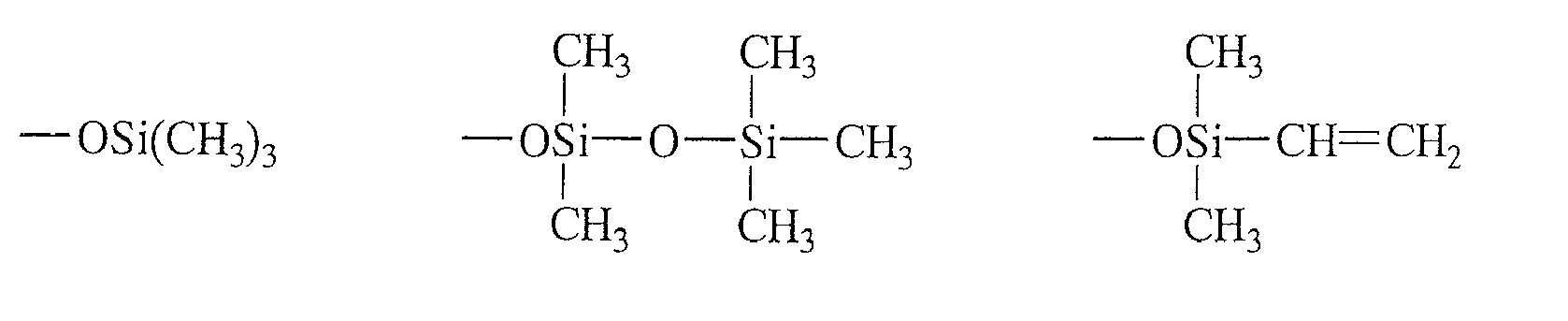

- Component (B1) may also be an organopolysiloxane of cyclic structure having the general formula (5).

- In formula (5), examples of the substituent group having an OH or SiH group as functionality, represented by R3, include silicon-bonded hydroxyl, silicon-bonded hydrogen, -CH2CH2CH2-O-CH2CH2-OH, and the like. Examples of the monovalent hydrocarbon group represented by R3 include those exemplified above for R2, with alkenyl groups being excluded.
- Industrially desirable as component (B1) are those siloxanes of formula (5) wherein R1 is vinyl, R2 is methyl, R3 is hydrogen, a1 is 0 to 1, b1 is 1 to 4, and c1 is 0 to 1, and more desirably a1=0, b1=2 to 4, and c1=0.
- Component (B2) is a compound containing in a molecule at least one substituent group of 2 to 10 carbon atoms, preferably 2 to 8 carbon atoms, having a carbon-carbon unsaturated bond (double or triple bond) as functionality, and at least one substituent group having a group capable of addition reaction and/or condensation reaction with an alkenyl group and/or a silicon-bonded hydrogen atom (i.e., SiH group).
- The compound as component (B2) possesses at least one substituent group having a carbon-carbon unsaturated bond as functionality, which indicates a substituent group having a functional group capable of radical reaction upon exposure to heat and/or UV. The structure of this substituent group may be either linear or branched, or even a cyclic structure such as cyclohexene or norbornadiene may be used. Any substituent group having a functional group as commonly used in radical polymerization or radical reaction curing systems may be used. Where component (B2) contains a siloxane structure, the substituent group should preferably be a substituent group having a carbon-carbon double bond such as methacryloyloxy or a carbon-carbon triple bond such as acetylene, propynyl or butynyl, especially for restraining consumption by addition reaction.
- Where component (B2) is an organic compound free of siloxane structure, it makes an easy access to the substrate and is advantageous for reaction or interaction with the substrate via radical reaction, allowing a choice of the substituent group from a wider range. However, a non-silicone compound having a higher molecular weight is less compatible with silicone so that it may become difficult to acquire a bond or interaction with the non-tacky cured coating, or is little dissolvable in the composition and thus useless. Therefore, the organic compound should preferably have a number average molecular weight of up to 1,000 as measured by GPC versus polystyrene standards. In order for the organic compound to function as a coupling agent more efficiently for improving adhesion, a lower molecular weight is desirable since more bond sites are available over a wide area.
- In component (B2), the substituent group having a functional group capable of radical reaction upon exposure to heat and/or UV functions such that component (B2) is anchored to the substrate surface where the composition is coated, through radical reaction and/or interaction with a group created by radical reaction. Creation of radicals may be attained by heat or irradiation of energy ray such as UV. Alternatively a radical generator such as peroxide or a photosensitizer may be added for the purpose of promoting radical creation insofar as the advantages of the invention are not impaired.
- Since the substrate is made of organic material, there are present on the substrate numerous structures capable of generating radicals upon exposure to heat or UV or numerous structures capable of reacting with radicals thus generated. In addition, the substrate has an extremely high rate of absorption of IR or UV radiation as the radical-generating energy source. Thus radicals can be concentratedly generated on the substrate, which is apt to promote reaction with the substrate.
- In the case of heat-sensitive substrates such as plastic film, the radical creation technique based on UV irradiation is advantageous in that the temperature of the film substrate is not so elevated. Using UV radiation, the majority of which is absorbed by the film substrate surface, radicals can be concentratedly generated in proximity to the film substrate surface, which is desirable to promote reaction with the film substrate.
- The compound as component (B2) also possesses at least one second substituent group. It is a substituent group having a functional group capable of reaction with the alkenyl group in component (A) and/or the SiH group in component (C). The reactions involved herein are addition reaction with SiH group for the alkenyl group in component (A), and condensation reaction with OH group and addition reaction with carbon-carbon double bond for the SiH group in component (C).
- The second substituent group in component (B2) functions such that component (B2) is anchored to the non-tacky cured coating through addition and condensation reactions different from the radical reaction of the first substituent group. With this combined with the action of the substituent group for radical reaction, component (B2) functions as a coupling agent of anchoring the non-tacky cured coating and the substrate to each other, thereby improving adhesion.
- Where component (B2) is an organic compound free of siloxane structure, it tends to be less compatible with the silicone component so that addition reaction may be retarded. If a substituent group having a carbon-carbon double bond as a functional group capable of reaction with the alkenyl group in component (A) and/or the SiH group in component (C) is selected, then it is consumed by radical reaction prior to addition reaction with the SiH group, with the risk of component (B2) failing to function as the coupling agent. To avoid such inconvenience, a SiH group or hydroxyl group unsusceptible to radical reaction is selected. For example, the compound may be a molecular structure containing a divalent structure having the general formula (6-1), or two divalent structures having the general formulae (6-2) and (6-3).

- Herein R2 is as defined above, R4 is a substituent group of 2 to 10 carbon atoms, preferably 2 to 8 carbon atoms, containing alkynyl (e.g., acetylene, propynyl or butynyl), acryloyloxy or methacryloyloxy, and R5 is a substituent group having an OH, SiH or alkenyl group as functionality. Of these structures, an industrially desirable example is HC≡C-C(CH3)2-OH.
- Also included are cyclic structures having the general formulae (7-1) and (7-2).

- Herein R4 and R5 as defined above, R6 is hydrogen, a saturated hydrocarbon group of 1 to 10 carbon atoms, preferably 1 to 8 carbon atoms, or aromatic group, the same group as R4, or the same group as R5, d is 4 to 10, and e+f is 3 to 9. Of these structures, an industrially desirable example is ethynyl cyclohexanol.
- Both components (B1) and (B2) are commonly advantageous in that their molecular weight is low. However, a compound having a very low molecular weight has a risk that it will rapidly volatilize off the composition prior to any reaction when the composition is coated and heated on the substrate. It is thus desired that component (B) have such a molecular weight that its boiling point may be at least 80°C. For mitigating thermal impact, UV irradiation is effective because the temperature is not elevated.
- An appropriate amount of component (B) blended is 0.1 to 10 parts by weight, preferably 0.2 to 9 parts by weight per 100 parts by weight of component (A). Outside the range, a less amount of component (B) achieves no improvement in adhesion whereas a larger amount may adversely affect cure.
- Component (C) is an organohydrogenpolysiloxane containing at least three silicon-bonded hydrogen atoms (i.e., SiH groups) in a molecule. Preferably it has the average compositional formula (10):
R8 fHgSiO(4-f-g)/2 (10)
wherein R8 is as defined above, f is 0 to 3, g is 0 to 3, and f+g is a positive number of 1 to 3. - The molecular structure may be linear, branched or cyclic. The organohydrogenpolysiloxane has an absolute viscosity which may range from several mPa-s to several ten thousand mPa-s at 25°C as measured by a rotational viscometer. Illustrative examples of the organohydrogenpolysiloxane are given below.


- Herein, Me stands for methyl, h, 1 and n each are a number of 3 to 500, m, p and s each are a number of 1 to 500, i, j, k, o, q, r, t, u, v and w each are a number of 0 to 500.
- The organohydrogenpolysiloxane as component (C) is blended in such amounts that the moles of SiH group is 1 to 10 times the total moles of alkenyl group in component (A). If the moles of SiH group in component (C) is less than the lower limit relative to the total moles of alkenyl group in component (A), the composition may not fully cure. If the moles of SiH group in component (C) is more than the upper limit, no further increase in the desired effect is observed and the peeling force may become heavy. Generally speaking, an appropriate amount of component (C) blended is 0.1 to 20 parts by weight per 100 parts by weight of component (A).
- Component (D) is a platinum group metal-based catalyst which may be selected from prior art well-known catalysts for addition reaction. Exemplary catalysts include platinum black, chloroplatinic acid, chloroplatinic acid-olefin complexes, chloroplatinic acid-alcohol coordination compounds, rhodium, and rhodium-olefin complexes. The catalyst may be added in a catalytic amount. Preferably the catalyst is added in such an amount as to provide 5 to 1,000 ppm of platinum or rhodium based on the total weight of components (A), (B) and (C), whereby a coating can be fully cured. The amount of the catalyst may be adjusted in accordance with the reactivity of the components or the desired cure rate.
- Component (E) is an organic solvent which is added to the composition for the purposes of improving the stability of processing bath and applicability to various substrates and adjusting the coating weight and viscosity of the composition. Suitable organic solvents include toluene, xylene, ethyl acetate, acetone, methyl ethyl ketone, and hexane. Any other organic solvents may be used as long as the components can be uniformly dissolved therein.
- When blended, the organic solvent is used in an amount of 100 to 9,900 parts by weight per 100 parts by weight of component (A).
- Note that component (E) is optional. Absent component (E), the viscosity of components (A), (B), (C) and (D) is changed to adjust an overall viscosity such that the resulting composition may be effectively coated by an applicator. The stability of processing bath may be adjusted by adding a bath life extender or the like, if necessary.
- The composition of the invention may be prepared simply by mixing components (A), (B), (C), (D) and (E) until uniform. To gain an appropriate pot life, component (D) should be added and mixed immediately before coating. When component (E) or organic solvent is used, one advantageous procedure is by dissolving components (A) and (B) in component (E) uniformly prior to mixing components (C) and (D) therewith.
- If desired, additives including a pigment, leveling agent, and bath life extender may be added to the composition. Also a radical generator such as peroxide or a photosensitizer may be added for the purpose of promoting reaction insofar as the advantages of the invention are not impaired.
- The composition is coated onto a substrate such as paper or plastic film directly or after diluting with a suitable organic solvent, by any well-known coating techniques, for example, using a bar coater, roll coater, reverse coater, gravure coater, air knife coater, or if thin-film coating is desired, a high-precision offset coater or multi-stage roll coater. Examples of the substrate include paper sheets such as glassine paper, polyethylene-laminated paper, kraft paper, clay-coated paper, and mirror-coated paper, and plastic films of polypropylene, polyethylene, polyethylene terephthalate (PET), polyvinyl chloride and the like.
- The coating weight of the composition on the substrate varies with the type of the substrate material. The preferred coating weight is in a range of 0.05 to 5 g/m2 as solids. The substrate coated with the composition is heated at 80 to 150°C for 5 to 60 seconds to form a cured coating on the substrate surface, obtaining a release paper or film. The cure takes place by way of addition reaction between components (A), (B) and (C), and at the same time, heat-induced radical reaction enhances bond-formation and interaction between component (B) and the substrate. As a result, a silicone coating having good release properties, improved adhesion and film strength is formed on the paper or film substrate surface. When UV radiation is additionally applied, radical reaction in proximity to the paper or film substrate surface can be efficiently promoted without an excess elevation of temperature, facilitating preparation of release paper or film featuring high adhesion. For UV irradiation, any commercially available lamps or bulbs such as mercury lamps, metal halide lamps and fusion lamps may be used. Since the film substrate has a high absorption coefficient at 300 nm or shorter, those lamps or bulbs having a wavelength distribution containing more fractions of 300 nm or shorter wavelength are effective. An integral dose is 10 to 500 mJ/cm2, which is obtained by irradiation, for example, from one or two 120-W lamps at a line speed of 10 to 100 m/min. Although heat and UV may be simultaneously applied, advantageously they are separately applied because a simple apparatus may be used. Depending on the structure of component (B) or the blending proportion of component (B) relative to other components, better results are obtained when heating is followed by UV irradiation, or when UV irradiation is followed by heating. Where component (B) contains a siloxane structure, the procedure of UV irradiation followed by heating is often effective. An effective procedure may be selected in accordance with a particular situation.
- Examples of the invention are given below by way of illustration and not by way of limitation. All parts are by weight. Me stands for methyl, and Vi for vinyl. The viscosity is an absolute viscosity measured at 25°C by a rotational viscometer.
- A composition was prepared by mixing the amounts indicated in Table 1 of components (A), (B), (C) and (E) and an amount of component (D) so as to provide 100 ppm of platinum based on the total weight of (A)+(B)+(C). Using the composition, a release film was manufactured and evaluated according to the evaluation method described later. Specifically the curing step included UV irradiation from two 80-W lamps at a line speed of 40 m/min in an integral dose of 50 mJ/cm2 and subsequent heating in a hot air circulating dryer for a predetermined time until a cured coating was formed.
- A composition was prepared by mixing the amounts indicated in Table 1 of components (A), (B), (C) and (E) and an amount of component (D) so as to provide 100 ppm of platinum based on the total weight of (A)+(B)+(C). Using the composition, a release film was manufactured and evaluated according to the evaluation method described later. Specifically the curing step included heating in a hot air circulating dryer for a predetermined time and subsequent UV irradiation from two 120-W lamps at a line speed of 30 m/min in an integral dose of 100 mJ/cm2 until a cured coating was formed.
- The components in Table 1 are identified below.
-
- (A-1) organopolysiloxane, viscosity at 25°C in 30 wt% toluene solution 10 Pa-s, Vi content 0.032 mol/100 g

- (A-2) organopolysiloxane, viscosity 0.2 Pa-s, Vi content 0.026 mol/100 g

- (A-3) organopolysiloxane, viscosity at 25°C in 30 wt% toluene solution 5 Pa-s, Vi content 0.035 mol/100 g


- (A-4) organopolysiloxane, viscosity 0.1 Pa-s, Vi content 0.043 mol/100 g

-
- (B1-1) siloxane, viscosity 5 mPa-s, Vi content 1.2 mol/100 g

- (B1-2) siloxane, viscosity 5 mPa-s, Vi content 0.63 mol/100 g

- (B1-3) siloxane, viscosity 10 mPa-s, Vi content 0.6 mol/100 g

- (B1-4) siloxane, viscosity 6 mPa-s, Vi content 0.7 mol/100 g

- (B1-5) siloxane, viscosity 0.02 Pa-s, alkenyl content 0.33 mol/100 g
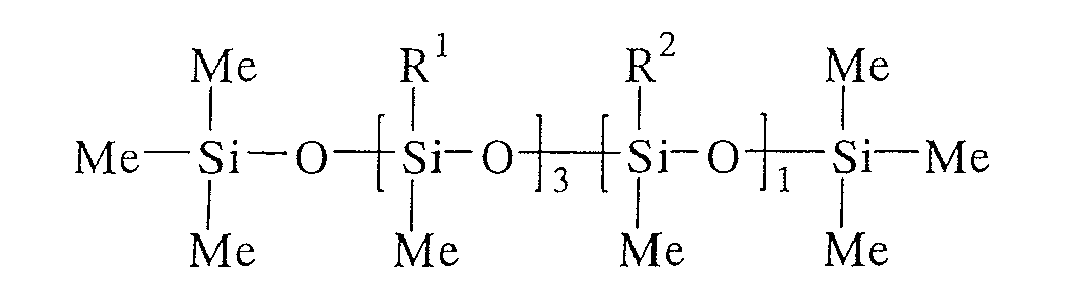
- R1 is -CH2CH2CH2-O-CO-(CH3)C=CH2 (127).
- R2 is -CH2CH2CH2-O-CH2CH2-OH (106).
- (B1-6) siloxane, viscosity 6 mPa-s, alkenyl content 0.49 mol/100 g

- (B1-7) siloxane, viscosity 5 mPa-s, Vi content 0.32 mol/100 g

- (B1-8) siloxane, viscosity 6 mPa-s, Vi content 0.32 mol/100 g

- (B1-9) siloxane, viscosity 0.05 Pa-s, Vi content 0.25 mol/100 g

- (B1-10) siloxane, viscosity 0.01 Pa-s, Vi content 0.70 mol/100 g

- (B2-1) acetylene alcohol, 3-methyl-1-butyn-3-ol
- (B2-2) acetylene alcohol, 3,5-dimethyl-1-hexyn-3-ol
- (B2-3) acetylene alcohol, 1-ethynyl-1-cyclohexanol
- (B2-4) acetylene compound, 1-octyne
-
- (C-1) methylhydrogenpolysiloxane, viscosity 25 mPa-s, H content 1.5 mol/100 g

- (C-2) methylhydrogenpolysiloxane, viscosity 60 mPa-s, H content 1.00 mol/100 g

-
- (D-1) catalyst, platinum-vinylsiloxane complex
-
- (E-1) solvent, 50/50 (weight ratio) toluene/heptane mixture
- Evaluation of test items and expression of results are as follows.
- Solvent type compositions were coated onto a PET film of 40 µm thick to a coating weight of 0.5 g/m2 as solids by means of a bar coater. The coating was UV irradiated under two 80-W or 120-W UV lamps at a line speed of 30 m/min or 40 m/min to an integral dose of 50 mJ/cm2 or 100 mJ/cm2 and heat treated in a hot air circulating dryer at 80°C for a predetermined time. A time passed until a completely cured coating was formed was measured. The coating being cured was examined by rubbing the coating surface with the finger and judged "completely cured" when the coating was not hazy on the surface or crumbled off.
- Solventless compositions were coated onto a PET film of 40 µm thick by means of an IR tester and dried in a hot air circulating dryer at 100°C. Otherwise, the coating was similarly treated and evaluated. The coating area was A4 size, and the transfer amount of coating liquid was 0.1 µL.
- Solvent type compositions were coated onto a PET film of 40 µm thick to a coating weight of 0.5 g/m2 as solids by means of a bar coater. The coating was UV irradiated under two 80-W or 120-W UV lamps at a line speed of 30 m/min or 40 m/min to an integral dose of 50 mJ/cm2 or 100 mJ/cm2 and heat treated in a hot air circulating dryer at 100°C for 30 seconds until a cured coating was formed, obtaining a test separator.
- The separator was allowed to stand at 25°C and 50% RH for one day, after which a solvent type acrylic pressure-sensitive adhesive (Oribain BPS-5127, Toyo Ink Mfg. Co., Ltd.) was coated onto the cured coating surface and heat treated at 100°C for 3 minutes. Next, a PET film of 40 µm was laid on the treated surface, pressed by rolling once back and forth a roller of 2 kg, and aged at 25°C for 20 hours. The sample was cut into a strip of 5 cm wide. Using a tensile tester, the force (N) required to peel the overlying PET film from the separator at an angle of 180° and a pull rate of 0.3 m/min was measured as adhesive strength. The tester used was autograph DCS-500 (Shimadzu Mfg. Co., Ltd.).
- Solventless compositions were coated onto a PET film of 40 µm thick by means of an IR tester. The coating was UV irradiated under two 80-W UV lamps at a line speed of 40 m/min to an integral dose of 50 mJ/cm2 and heat treated in a hot air circulating dryer at 120°C for 30 seconds until a cured coating was formed, obtaining a test separator. It was similarly evaluated. It is noted that the coating area was A4 size, and the transfer amount of coating liquid was 0.1 µL.
- A PET film (40 µm) substrate separator prepared as in (2) and another separator prepared as in (2) using a corona-treated OPP film (40 µm) as the substrate were aged under predetermined conditions. After a certain aging period (days), the separator was examined whether the coating surface became hazy and rubbed off when the surface of the cured coating was rubbed with the finger.
- The sample which showed haze or rub-off after aging at 40°C and 80% RH for one day was rated poor (×). The sample which showed haze or rub-off after aging at 40° C and 80% RH for 3 days was rated fair (Δ). The sample which did not show haze or rub-off even after aging at 40°C and 80% RH for one month was rated good (○). The sample which did not show haze or rub-off even after aging at 60°C and 90% RH for one month was rated excellent (⊚).
- In respect of numerical ranges disclosed in the present description it will of course be understood that in the normal way the technical criterion for the upper limit is different from the technical criterion for the lower limit, i.e. the upper and lower limits are intrinsically distinct proposals.

Claims (9)
- An addition curing silicone composition for release paper or film, comprising(A) 100 parts by weight of organopolysiloxane containing at least two alkenyl groups in the molecule and having a viscosity of at least 0.04 Pa-s at 25°C,(B) 0.1 to 10 parts by weight of adhesion promoter which is(B1) organopolysiloxane containing per molecule at least two silicon-bonded alkenyl-containing substituent groups, having an alkenyl content of 0.3 to 2.0 mol/100g, and having a structure in which two siloxane units having alkenyl-containing substituent group bonded to silicon atom are linked directly, or via not more than 3 intervening siloxane units not having alkenyl-containing substituent group bonded to silicon atom, the organopolysiloxane having a viscosity of less than 0.04 Pa-s at 25°C, and/or(B2) a compound containing per molecule at least one substituent group of 2 to 10 carbon atoms having a carbon-carbon unsaturated bond (double or triple bond) as functionality, and at least one substituent group having a group capable of addition reaction and/or condensation reaction with the alkenyl group in component (A) and/or a silicon-bonded hydrogen atom in component (C),(C) 0.1 to 20 parts by weight of an organohydrogenpolysiloxane containing at least three silicon-bonded hydrogen atoms in a molecule,(D) a catalytic amount of a platinum group metal base catalyst, and(E) an amount of an optional organic solvent.
- The silicone composition of claim 1 wherein component (B1) is an organopolysiloxane represented by the compositional formula (1) having a structure of the general formula (2), and having an average degree of polymerization of 2 to 50,
[M]m1[MA]m2[D]d1[DA]d2[T]t1[TA]t2[Q]q1 (1)
 wherein R1 is an alkenyl-containing substituent group of 2 to 10 carbon atoms, A is R2 or a siloxane residue bonded via an oxygen atom and selected so that the molecule satisfies formula (1), two A groups connected to one silicon atom may form a cyclic structure -O(SiR2 2O)y-, R2 is substituted or unsubstituted monovalent hydrocarbon group of 1 to 10 carbon atoms, x is an integer of 0 to 3, y is an integer selected such that the organopolysiloxane of formula (1) may have an average degree of polymerization of 2 to 50,M, MA, D, DA, T, TA, and Q are siloxane units as defined below, O1/2 denoting that adjacent siloxane units are linked via an oxygen atom,M and MA each are:
 MA being such a unit in which at least one R is R1,D and DA each are:
 DA being such a unit in which at least one R2 is R1,T and TA each are:
 TA being such a unit in which R2 is R1,Q is:
 m1, m2, d1, d2, t1, t2 and q1 are numbers satisfying the relationships:


- The silicone composition of claim 2 wherein x in formula (2) is 0 or 1.
- The silicone composition of claim 2 or 3 wherein component (B1) is a compound of linear or branched siloxane structure having the general formula (3) or (4):



a2, b2, ay, and by each are an integer of 0 to 48, c2 and cy each are an integer of 0 to 30, d2 and dy each are an integer of 0 to 20,
formulae (3), (3a) and (3b) each denote a random structure and include at least one structure that two siloxane units in which the alkenyl-containing substituent group R1 is bonded to silicon atom are linked directly or via up to 3 intervening siloxane units in which R1 is not bonded to silicon atom,


a2, b2, ay, and by each are an integer of 0 to 48, c2 and cy each are an integer of 0 to 30, d2 and dy each are an integer of 0 to 20,
formulae (4), (4a) and (4b) each denote a random structure and include at least one structure that two siloxane units in which the alkenyl-containing substituent group R1 is bonded to silicon atom are linked directly or via up to 3 intervening siloxane units in which R1 is not bonded to silicon atom. - The silicone composition of claim 2 or 3 wherein component (B1) is a compound of cyclic siloxane structure having the general formula (5):
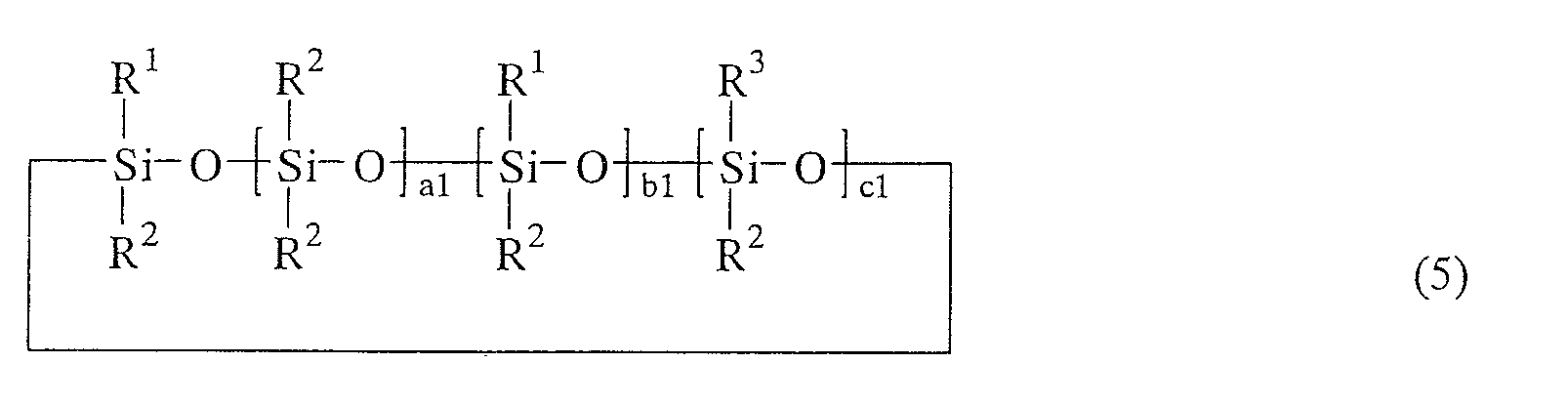
- The silicone composition of any one of claims 1 to 5 wherein component (B2) is a compound containing a divalent structural unit having the general formula (6-1), a compound containing divalent structural units having the general formulae (6-2) and (6-3), a compound of cyclic structure having the general formula (7-1), or a compound of cyclic structure having the general formula (7-2):
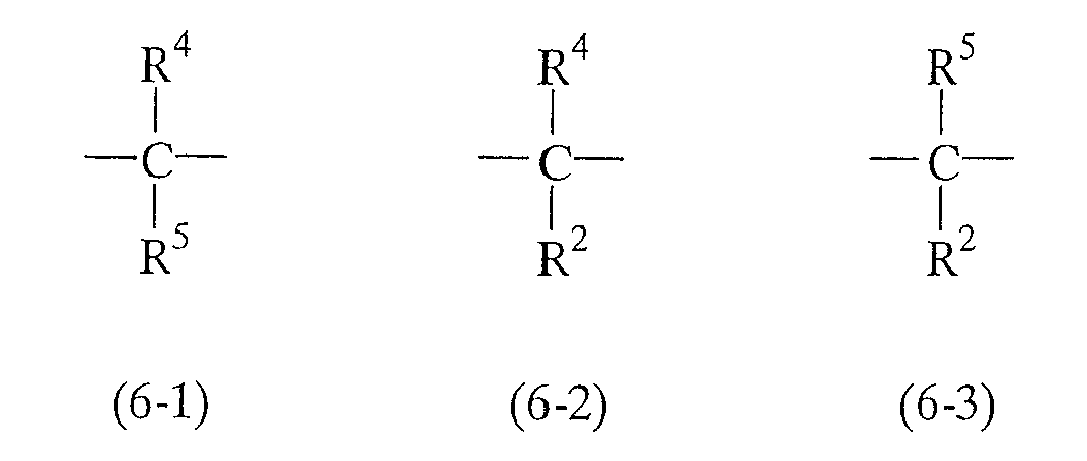

- A method for preparing a release paper or film, comprising the steps of
coating the silicone composition of any one of claims 1 to 6 directly onto a paper or plastic film substrate, and
applying heat and/or UV radiation to cure the coating. - The method of claim 7 wherein the step of applying heat and/or UV radiation includes UV irradiation and subsequent heating to cure the coating.
- A release paper or film comprising a cured coating of the silicone composition of any one of claims 1 to 6.
Priority Applications (1)
| Application Number | Priority Date | Filing Date | Title |
|---|---|---|---|
| EP12162407.6A EP2481783B1 (en) | 2010-05-07 | 2011-05-06 | Silicone Composition, Release Paper or Film, and Making Method |
Applications Claiming Priority (1)
| Application Number | Priority Date | Filing Date | Title |
|---|---|---|---|
| JP2010107206 | 2010-05-07 |
Related Child Applications (2)
| Application Number | Title | Priority Date | Filing Date |
|---|---|---|---|
| EP12162407.6A Division-Into EP2481783B1 (en) | 2010-05-07 | 2011-05-06 | Silicone Composition, Release Paper or Film, and Making Method |
| EP12162407.6A Division EP2481783B1 (en) | 2010-05-07 | 2011-05-06 | Silicone Composition, Release Paper or Film, and Making Method |
Publications (2)
| Publication Number | Publication Date |
|---|---|
| EP2385084A1 true EP2385084A1 (en) | 2011-11-09 |
| EP2385084B1 EP2385084B1 (en) | 2017-01-25 |
Family
ID=44461960
Family Applications (2)
| Application Number | Title | Priority Date | Filing Date |
|---|---|---|---|
| EP12162407.6A Ceased EP2481783B1 (en) | 2010-05-07 | 2011-05-06 | Silicone Composition, Release Paper or Film, and Making Method |
| EP11165202.0A Ceased EP2385084B1 (en) | 2010-05-07 | 2011-05-06 | Silicone composition, release paper or film, and making method |
Family Applications Before (1)
| Application Number | Title | Priority Date | Filing Date |
|---|---|---|---|
| EP12162407.6A Ceased EP2481783B1 (en) | 2010-05-07 | 2011-05-06 | Silicone Composition, Release Paper or Film, and Making Method |
Country Status (6)
| Country | Link |
|---|---|
| US (1) | US9365746B2 (en) |
| EP (2) | EP2481783B1 (en) |
| JP (1) | JP5626097B2 (en) |
| KR (1) | KR101708509B1 (en) |
| CN (1) | CN102352111B (en) |
| TW (1) | TWI494334B (en) |
Cited By (5)
| Publication number | Priority date | Publication date | Assignee | Title |
|---|---|---|---|---|
| WO2016036634A1 (en) * | 2014-09-02 | 2016-03-10 | 3M Innovative Properties Company | Acrylate adhesive with vinylsilane crosslinking agents |
| EP3305868A4 (en) * | 2015-06-08 | 2019-01-09 | Shin-Etsu Chemical Co., Ltd. | SILICONE COMPOSITION FOR DECOUPLING PAPER OR DECOLUTION FILM, DECOLUTION PAPER, AND DECOLUTION FILM |
| US10457841B2 (en) | 2014-09-12 | 2019-10-29 | 3M Innovative Properties Company | Allyl acrylate crosslinkers for PSAs |
| CN113845838A (en) * | 2021-08-30 | 2021-12-28 | 盖科(浙江)生物科技有限公司 | Amphiphilic siloxane gel and preparation method thereof |
| EP3973025A4 (en) * | 2019-05-21 | 2023-02-08 | Dow Silicones Corporation | POLYORGANOSILOXANE RELEASE COATING AND THEIR PREPARATION AND USE |
Families Citing this family (22)
| Publication number | Priority date | Publication date | Assignee | Title |
|---|---|---|---|---|
| JP5626238B2 (en) * | 2012-02-23 | 2014-11-19 | 信越化学工業株式会社 | Addition-curable silicone emulsion release composition and release film |
| JP5795984B2 (en) * | 2012-03-27 | 2015-10-14 | リンテック株式会社 | Release sheet |
| US9346195B2 (en) | 2013-07-18 | 2016-05-24 | Samsung Display Co., Ltd. | Flexible substrate, method of manufacturing flexible substrate, flexible display device, and method of flexible display device |
| JP6285778B2 (en) * | 2014-03-31 | 2018-02-28 | リンテック株式会社 | Release sheet and method for producing release sheet |
| US20150307759A1 (en) * | 2014-04-28 | 2015-10-29 | Ames Rubber Corporation | Solventless curable coating systems and uses thereof |
| JP6485262B2 (en) * | 2015-07-16 | 2019-03-20 | 信越化学工業株式会社 | Release paper or silicone composition for release film, release paper and release film |
| EP3184589B1 (en) | 2015-12-22 | 2019-05-01 | Shin-Etsu Chemical Co., Ltd. | Addition-curable silicone resin composition and a semiconductor device |
| JP6481646B2 (en) * | 2016-03-17 | 2019-03-13 | 信越化学工業株式会社 | Double-sided differential release paper or double-sided differential release film |
| WO2018012296A1 (en) | 2016-07-11 | 2018-01-18 | 信越化学工業株式会社 | Silicone composition, release paper and release film |
| JP6723934B2 (en) | 2017-01-25 | 2020-07-15 | 信越化学工業株式会社 | Silicone composition, release paper and release film |
| CN107266696B (en) * | 2017-06-12 | 2020-10-27 | 浙江洁美电子科技股份有限公司 | Manufacturing method of release film for chip component manufacturing process and release film manufactured by manufacturing method |
| JP6862334B2 (en) * | 2017-12-05 | 2021-04-21 | 信越化学工業株式会社 | Curable Silicone Release Agent Composition |
| EP3524582A1 (en) * | 2018-02-08 | 2019-08-14 | Surfix B.V. | Process for modification of a solid surface |
| CN109433551A (en) * | 2018-10-18 | 2019-03-08 | 厦门安德立科技有限公司 | A kind of painting silicon technology of velcro release film |
| CN109267422B (en) * | 2018-10-25 | 2020-11-03 | 广州旭太材料科技有限公司 | Water-based organic silicon drying cylinder stripping agent and preparation method thereof |
| JP7176990B2 (en) * | 2019-03-27 | 2022-11-22 | リンテック株式会社 | Coating liquid of release agent composition and method for producing release film for ceramic green sheet production process |
| JP7364031B2 (en) * | 2020-02-18 | 2023-10-18 | 信越化学工業株式会社 | Silicone composition for producing release paper or release film, and release paper or release film |
| KR20220154742A (en) * | 2020-03-16 | 2022-11-22 | 신에쓰 가가꾸 고교 가부시끼가이샤 | Organopolysiloxane composition for release paper or release film |
| TWI888567B (en) | 2020-06-12 | 2025-07-01 | 日商信越化學工業股份有限公司 | Addition reaction curing type organopolysiloxane composition, release paper and release film |
| CN113201280B (en) * | 2021-05-31 | 2022-03-25 | 惠州市永卓科技有限公司 | Release silicone oil capable of improving PEK substrate anchorage and preparation method thereof |
| WO2023283819A1 (en) * | 2021-07-14 | 2023-01-19 | Dow Silicones Corporation | Thermal conductive silicone composition |
| CN121195041A (en) | 2023-05-29 | 2025-12-23 | 信越化学工业株式会社 | Organosilicon composition for release sheets and release sheets |
Citations (9)
| Publication number | Priority date | Publication date | Assignee | Title |
|---|---|---|---|---|
| JPS63251465A (en) | 1987-04-09 | 1988-10-18 | Dow Corning Kk | Strippable composition |
| JPH0193366A (en) | 1987-10-06 | 1989-04-12 | Ricoh Co Ltd | Liquid jet recording head |
| JPH0319267B2 (en) | 1986-07-21 | 1991-03-14 | Shinetsu Chem Ind Co | |
| JPH06286061A (en) | 1993-03-31 | 1994-10-11 | Tokai Rubber Ind Ltd | Hose for automobile fuel tube |
| JPH0978032A (en) | 1995-07-11 | 1997-03-25 | Shin Etsu Chem Co Ltd | Curable silicone release agent composition and release paper |
| EP0764703A2 (en) * | 1995-09-21 | 1997-03-26 | Dow Corning Toray Silicone Company Ltd. | Silicone release coating compositions |
| JP2000169794A (en) | 1998-12-10 | 2000-06-20 | Tokuyama Corp | Coating liquid for giving release properties and release film |
| JP2000177058A (en) | 1998-12-16 | 2000-06-27 | Tokuyama Corp | Release film manufacturing method |
| US6277941B1 (en) * | 1997-09-12 | 2001-08-21 | Shin-Etsu Chemical Co., Ltd. | Organopolysiloxane composition |
Family Cites Families (9)
| Publication number | Priority date | Publication date | Assignee | Title |
|---|---|---|---|---|
| US4609574A (en) | 1985-10-03 | 1986-09-02 | Dow Corning Corporation | Silicone release coatings containing higher alkenyl functional siloxanes |
| JPH0319267A (en) | 1989-06-15 | 1991-01-28 | Matsushita Electron Corp | Semiconductor integrated circuit device |
| JP3040287B2 (en) * | 1993-09-30 | 2000-05-15 | 信越化学工業株式会社 | Organopolysiloxane composition |
| JP4492981B2 (en) * | 1997-05-21 | 2010-06-30 | 王子製紙株式会社 | Manufacturing method of adhesive sheet |
| US5932060A (en) | 1997-09-12 | 1999-08-03 | General Electric Company | Paper release laminates having improved release characteristics |
| US6908682B2 (en) * | 2002-09-12 | 2005-06-21 | 3M Innovative Properties Company | Photocured silicone sealant having improved adhesion to plastic |
| GB0227066D0 (en) * | 2002-11-20 | 2002-12-24 | Dow Corning | Silicone release coatings |
| JP4503271B2 (en) * | 2003-11-28 | 2010-07-14 | 東レ・ダウコーニング株式会社 | Method for producing silicone laminate |
| US20060058486A1 (en) * | 2004-09-16 | 2006-03-16 | Wacker-Chemie Gmbh | Alkenyl-functional organopolysiloxanes |
-
2011
- 2011-04-21 JP JP2011094887A patent/JP5626097B2/en not_active Expired - Fee Related
- 2011-05-06 EP EP12162407.6A patent/EP2481783B1/en not_active Ceased
- 2011-05-06 CN CN201110198655.0A patent/CN102352111B/en not_active Expired - Fee Related
- 2011-05-06 US US13/102,193 patent/US9365746B2/en not_active Expired - Fee Related
- 2011-05-06 EP EP11165202.0A patent/EP2385084B1/en not_active Ceased
- 2011-05-06 KR KR1020110042889A patent/KR101708509B1/en active Active
- 2011-05-06 TW TW100115964A patent/TWI494334B/en not_active IP Right Cessation
Patent Citations (9)
| Publication number | Priority date | Publication date | Assignee | Title |
|---|---|---|---|---|
| JPH0319267B2 (en) | 1986-07-21 | 1991-03-14 | Shinetsu Chem Ind Co | |
| JPS63251465A (en) | 1987-04-09 | 1988-10-18 | Dow Corning Kk | Strippable composition |
| JPH0193366A (en) | 1987-10-06 | 1989-04-12 | Ricoh Co Ltd | Liquid jet recording head |
| JPH06286061A (en) | 1993-03-31 | 1994-10-11 | Tokai Rubber Ind Ltd | Hose for automobile fuel tube |
| JPH0978032A (en) | 1995-07-11 | 1997-03-25 | Shin Etsu Chem Co Ltd | Curable silicone release agent composition and release paper |
| EP0764703A2 (en) * | 1995-09-21 | 1997-03-26 | Dow Corning Toray Silicone Company Ltd. | Silicone release coating compositions |
| US6277941B1 (en) * | 1997-09-12 | 2001-08-21 | Shin-Etsu Chemical Co., Ltd. | Organopolysiloxane composition |
| JP2000169794A (en) | 1998-12-10 | 2000-06-20 | Tokuyama Corp | Coating liquid for giving release properties and release film |
| JP2000177058A (en) | 1998-12-16 | 2000-06-27 | Tokuyama Corp | Release film manufacturing method |
Cited By (10)
| Publication number | Priority date | Publication date | Assignee | Title |
|---|---|---|---|---|
| WO2016036634A1 (en) * | 2014-09-02 | 2016-03-10 | 3M Innovative Properties Company | Acrylate adhesive with vinylsilane crosslinking agents |
| CN106661170A (en) * | 2014-09-02 | 2017-05-10 | 3M创新有限公司 | Acrylate adhesive with vinylsilane crosslinking agents |
| US10100237B2 (en) | 2014-09-02 | 2018-10-16 | 3M Innovative Properties Company | Acrylate adhesive with vinylsilane crosslinking agents |
| CN106661170B (en) * | 2014-09-02 | 2019-04-12 | 3M创新有限公司 | Acrylic ester adhesive with vinyl silanes crosslinking agent |
| US10457841B2 (en) | 2014-09-12 | 2019-10-29 | 3M Innovative Properties Company | Allyl acrylate crosslinkers for PSAs |
| EP3305868A4 (en) * | 2015-06-08 | 2019-01-09 | Shin-Etsu Chemical Co., Ltd. | SILICONE COMPOSITION FOR DECOUPLING PAPER OR DECOLUTION FILM, DECOLUTION PAPER, AND DECOLUTION FILM |
| US10435844B2 (en) | 2015-06-08 | 2019-10-08 | Shin-Etsu Chemical Co., Ltd. | Silicone composition for release paper or release film, release paper, and release film |
| EP3973025A4 (en) * | 2019-05-21 | 2023-02-08 | Dow Silicones Corporation | POLYORGANOSILOXANE RELEASE COATING AND THEIR PREPARATION AND USE |
| CN113845838A (en) * | 2021-08-30 | 2021-12-28 | 盖科(浙江)生物科技有限公司 | Amphiphilic siloxane gel and preparation method thereof |
| CN113845838B (en) * | 2021-08-30 | 2022-04-05 | 盖科(浙江)生物科技有限公司 | Amphiphilic siloxane gel and preparation method thereof |
Also Published As
| Publication number | Publication date |
|---|---|
| JP2011252142A (en) | 2011-12-15 |
| TW201211086A (en) | 2012-03-16 |
| EP2385084B1 (en) | 2017-01-25 |
| EP2481783A1 (en) | 2012-08-01 |
| KR101708509B1 (en) | 2017-02-20 |
| CN102352111A (en) | 2012-02-15 |
| JP5626097B2 (en) | 2014-11-19 |
| EP2481783B1 (en) | 2017-04-19 |
| TWI494334B (en) | 2015-08-01 |
| US20110274935A1 (en) | 2011-11-10 |
| KR20110123683A (en) | 2011-11-15 |
| CN102352111B (en) | 2015-03-25 |
| US9365746B2 (en) | 2016-06-14 |
Similar Documents
| Publication | Publication Date | Title |
|---|---|---|
| EP2385084B1 (en) | Silicone composition, release paper or film, and making method | |
| EP2444463B1 (en) | Silicone emulsion composition, release paper or film, and making method | |
| EP2385085B1 (en) | Primer silicone composition and treated paper or film for release paper or film | |
| US9562149B2 (en) | Silicone release coating compositions | |
| EP0837102B1 (en) | Photo-curable silicone compositions | |
| EP2671933B1 (en) | Addition Cure Silicone Emulsion Composition and Release Film | |
| EP3875542B1 (en) | Silicone emulsion composition | |
| EP1563024B1 (en) | Silicone release coatings | |
| EP3575364B1 (en) | Silicone composition, release paper, and release film | |
| JP2018012827A (en) | Silicone composition, release paper and release film | |
| JP3813467B2 (en) | Curable silicone release agent composition | |
| JP3891260B2 (en) | Curable silicone release agent composition and release paper | |
| JP5423651B2 (en) | Undercoat silicone emulsion composition for release paper or release film, and treated paper or treated film | |
| JP2007284685A (en) | Silicone release agent composition and release paper | |
| JP3945398B2 (en) | Solvent-type silicone composition for release paper | |
| WO2026009781A1 (en) | Organopolysiloxane composition for release sheet | |
| WO2024247069A1 (en) | Silicone composition for release sheet and release sheet | |
| JP2008013613A (en) | Silicone composition for forming peelable cured film and coated product thereof |
Legal Events
| Date | Code | Title | Description |
|---|---|---|---|
| AK | Designated contracting states |
Kind code of ref document: A1 Designated state(s): AL AT BE BG CH CY CZ DE DK EE ES FI FR GB GR HR HU IE IS IT LI LT LU LV MC MK MT NL NO PL PT RO RS SE SI SK SM TR |
|
| AX | Request for extension of the european patent |
Extension state: BA ME |
|
| PUAI | Public reference made under article 153(3) epc to a published international application that has entered the european phase |
Free format text: ORIGINAL CODE: 0009012 |
|
| 17P | Request for examination filed |
Effective date: 20120314 |
|
| 17Q | First examination report despatched |
Effective date: 20151009 |
|
| GRAP | Despatch of communication of intention to grant a patent |
Free format text: ORIGINAL CODE: EPIDOSNIGR1 |
|
| INTG | Intention to grant announced |
Effective date: 20160830 |
|
| GRAS | Grant fee paid |
Free format text: ORIGINAL CODE: EPIDOSNIGR3 |
|
| GRAA | (expected) grant |
Free format text: ORIGINAL CODE: 0009210 |
|
| RBV | Designated contracting states (corrected) |
Designated state(s): DE FI FR GB NL |
|
| AK | Designated contracting states |
Kind code of ref document: B1 Designated state(s): DE FI FR GB NL |
|
| REG | Reference to a national code |
Ref country code: GB Ref legal event code: FG4D |
|
| REG | Reference to a national code |
Ref country code: DE Ref legal event code: R096 Ref document number: 602011034599 Country of ref document: DE |
|
| REG | Reference to a national code |
Ref country code: FR Ref legal event code: PLFP Year of fee payment: 7 |
|
| REG | Reference to a national code |
Ref country code: NL Ref legal event code: FP |
|
| REG | Reference to a national code |
Ref country code: DE Ref legal event code: R097 Ref document number: 602011034599 Country of ref document: DE |
|
| PLBE | No opposition filed within time limit |
Free format text: ORIGINAL CODE: 0009261 |
|
| STAA | Information on the status of an ep patent application or granted ep patent |
Free format text: STATUS: NO OPPOSITION FILED WITHIN TIME LIMIT |
|
| 26N | No opposition filed |
Effective date: 20171026 |
|
| REG | Reference to a national code |
Ref country code: FR Ref legal event code: PLFP Year of fee payment: 8 |
|
| PGFP | Annual fee paid to national office [announced via postgrant information from national office to epo] |
Ref country code: FI Payment date: 20200511 Year of fee payment: 10 Ref country code: NL Payment date: 20200417 Year of fee payment: 10 Ref country code: FR Payment date: 20200414 Year of fee payment: 10 Ref country code: DE Payment date: 20200422 Year of fee payment: 10 |
|
| PGFP | Annual fee paid to national office [announced via postgrant information from national office to epo] |
Ref country code: GB Payment date: 20200430 Year of fee payment: 10 |
|
| REG | Reference to a national code |
Ref country code: DE Ref legal event code: R119 Ref document number: 602011034599 Country of ref document: DE |
|
| REG | Reference to a national code |
Ref country code: FI Ref legal event code: MAE |
|
| REG | Reference to a national code |
Ref country code: NL Ref legal event code: MM Effective date: 20210601 |
|
| GBPC | Gb: european patent ceased through non-payment of renewal fee |
Effective date: 20210506 |
|
| PG25 | Lapsed in a contracting state [announced via postgrant information from national office to epo] |
Ref country code: FI Free format text: LAPSE BECAUSE OF NON-PAYMENT OF DUE FEES Effective date: 20210506 |
|
| PG25 | Lapsed in a contracting state [announced via postgrant information from national office to epo] |
Ref country code: GB Free format text: LAPSE BECAUSE OF NON-PAYMENT OF DUE FEES Effective date: 20210506 Ref country code: DE Free format text: LAPSE BECAUSE OF NON-PAYMENT OF DUE FEES Effective date: 20211201 |
|
| PG25 | Lapsed in a contracting state [announced via postgrant information from national office to epo] |
Ref country code: NL Free format text: LAPSE BECAUSE OF NON-PAYMENT OF DUE FEES Effective date: 20210601 Ref country code: FR Free format text: LAPSE BECAUSE OF NON-PAYMENT OF DUE FEES Effective date: 20210531 |