EP2381797B2 - Animal feed additive and animal feed comprising alkyl esters of medium chain fatty acids, and their use in animal feed - Google Patents
Animal feed additive and animal feed comprising alkyl esters of medium chain fatty acids, and their use in animal feed Download PDFInfo
- Publication number
- EP2381797B2 EP2381797B2 EP10702358.2A EP10702358A EP2381797B2 EP 2381797 B2 EP2381797 B2 EP 2381797B2 EP 10702358 A EP10702358 A EP 10702358A EP 2381797 B2 EP2381797 B2 EP 2381797B2
- Authority
- EP
- European Patent Office
- Prior art keywords
- animal feed
- ester
- fatty acid
- acid
- ethyl
- Prior art date
- Legal status (The legal status is an assumption and is not a legal conclusion. Google has not performed a legal analysis and makes no representation as to the accuracy of the status listed.)
- Active
Links
Images


Classifications
-
- A—HUMAN NECESSITIES
- A23—FOODS OR FOODSTUFFS; TREATMENT THEREOF, NOT COVERED BY OTHER CLASSES
- A23K—FODDER
- A23K50/00—Feeding-stuffs specially adapted for particular animals
- A23K50/80—Feeding-stuffs specially adapted for particular animals for aquatic animals, e.g. fish, crustaceans or molluscs
-
- A—HUMAN NECESSITIES
- A23—FOODS OR FOODSTUFFS; TREATMENT THEREOF, NOT COVERED BY OTHER CLASSES
- A23K—FODDER
- A23K20/00—Accessory food factors for animal feeding-stuffs
- A23K20/10—Organic substances
- A23K20/158—Fatty acids; Fats; Products containing oils or fats
-
- A—HUMAN NECESSITIES
- A23—FOODS OR FOODSTUFFS; TREATMENT THEREOF, NOT COVERED BY OTHER CLASSES
- A23K—FODDER
- A23K50/00—Feeding-stuffs specially adapted for particular animals
- A23K50/30—Feeding-stuffs specially adapted for particular animals for swines
-
- A—HUMAN NECESSITIES
- A23—FOODS OR FOODSTUFFS; TREATMENT THEREOF, NOT COVERED BY OTHER CLASSES
- A23K—FODDER
- A23K50/00—Feeding-stuffs specially adapted for particular animals
- A23K50/70—Feeding-stuffs specially adapted for particular animals for birds
-
- A—HUMAN NECESSITIES
- A23—FOODS OR FOODSTUFFS; TREATMENT THEREOF, NOT COVERED BY OTHER CLASSES
- A23K—FODDER
- A23K50/00—Feeding-stuffs specially adapted for particular animals
- A23K50/70—Feeding-stuffs specially adapted for particular animals for birds
- A23K50/75—Feeding-stuffs specially adapted for particular animals for birds for poultry
-
- A—HUMAN NECESSITIES
- A61—MEDICAL OR VETERINARY SCIENCE; HYGIENE
- A61P—SPECIFIC THERAPEUTIC ACTIVITY OF CHEMICAL COMPOUNDS OR MEDICINAL PREPARATIONS
- A61P31/00—Antiinfectives, i.e. antibiotics, antiseptics, chemotherapeutics
- A61P31/04—Antibacterial agents
-
- A—HUMAN NECESSITIES
- A23—FOODS OR FOODSTUFFS; TREATMENT THEREOF, NOT COVERED BY OTHER CLASSES
- A23K—FODDER
- A23K20/00—Accessory food factors for animal feeding-stuffs
- A23K20/10—Organic substances
- A23K20/111—Aromatic compounds
-
- A—HUMAN NECESSITIES
- A23—FOODS OR FOODSTUFFS; TREATMENT THEREOF, NOT COVERED BY OTHER CLASSES
- A23K—FODDER
- A23K20/00—Accessory food factors for animal feeding-stuffs
- A23K20/10—Organic substances
- A23K20/153—Nucleic acids; Hydrolysis products or derivatives thereof
-
- A—HUMAN NECESSITIES
- A23—FOODS OR FOODSTUFFS; TREATMENT THEREOF, NOT COVERED BY OTHER CLASSES
- A23V—INDEXING SCHEME RELATING TO FOODS, FOODSTUFFS OR NON-ALCOHOLIC BEVERAGES AND LACTIC OR PROPIONIC ACID BACTERIA USED IN FOODSTUFFS OR FOOD PREPARATION
- A23V2002/00—Food compositions, function of food ingredients or processes for food or foodstuffs
Definitions
- the invention is directed to an animal feed and method for increasing feed efficiency and health in farming animals, including mammals, birds and fish.
- fatty acids as antimicrobial agents to inhibit growth of harmful microbes in living organisms has long been known in literature, see e.g. US-A-2 466 663 .
- a mixture of medium chain fatty acids (MCFAs) and organic acids is currently widely used to inhibit growth of pathogens in the gastrointestinal tract of animals.
- MCFAs medium chain fatty acids
- organic acids are currently widely used to inhibit growth of pathogens in the gastrointestinal tract of animals.
- the presence of such a mixture in animal feed results in a favorable composition of the gastrointestinal microbiota and an improved feed efficiency in animals.
- EP-A-I 059 041 discloses a feed supplement composition comprising at least one triglyceride containing MCFA and at least one exogenous lipolytic enzyme.
- the addition of this supplement to animal feed results in a physiological environment in the animal's gastrointestinal tract, including its stomach which regulates and stabilizes the gut microbiota and consequently results in improvement of growth in the animal.
- WO-A-01/97799 discloses the use in feed compositions of one or more C6 - C10 medium chain fatty acids, salts, derivatives or mixtures thereof for the inhibition of microbial contamination.
- C6 - C10 medium chain fatty acids, salts, derivatives or mixtures thereof for the inhibition of microbial contamination.
- alkyl esters of MCFAs as antimicrobial agents is not mentioned.
- US-A-4 526 798 discloses a mixture comprising the ethyl ester of 2- hydroxy-4-methylpentanoic acid, which mixture can be used in flavors that enhance the aroma or taste of tropical flavored foodstuffs.
- concentration of the mixture in such flavors ranges from 0.75% to 1.2% by weight of the flavor.
- the resulting dosage of the ethyl ester in the foodstuff is low, for example 3 - 8 ppm.
- the effect of the mixture as an antimicrobial agent is not described in this document.
- WO-2006/00297 discloses the use of MFCAs, derivatives thereof or mixtures for inhibiting the growth and/or for reducing the amount of microbial pathogens. This document also does not specifically mention alkyl esters of MCFAs and their effectiveness as an inhibitor of microbial pathogens.
- WO-A-01/52837 discloses the use of a fatty ester for preparing a composition designed to inhibit 5- ⁇ -reducase activity in pharmacology, dermatology, cosmetics and as a food additive.
- a disadvantage of the MCFAs and derivatives in animal feed of the prior art is that they are quickly absorbed in vivo in the proximal small intestinal tract. Consequently, they are not able to exert microbiota modulating properties in the distal small intestine and hind gut.
- Object of the present invention is to provide an animal feed that has strong antimicrobial and antipathogenic properties and results in a favorable composition of the gastrointestinal microbiota and improved feed efficiency in animals fed with said animal feed, and which overcomes at least in part one or more of the above-mentioned disadvantages of the prior art.
- this object is met by providing an animal feed suitable for feeding mammals, birds and fish, comprising an alkyl ester of a fatty acid, wherein said fatty acid has a chain length of 5 - 12 carbon atoms and said alkyl is methyl, ethyl, propyl, butyl or a combination thereof, and wherein the dosage of said ester in said animal feed is 50 ppm by weight or higher, based on the total weight of said animal feed, for use in decreasing the risk of Clostridium perfringens infections in an animal.
- a medium chain fatty acid is meant a fatty acid having a chain length of 5 - 12 carbon atoms, i.e. having a longest continuous chain of 5 - 12 carbon atoms.
- the animal feed of the invention comprises an MCFA having a chain length of 8 - 12 carbon atoms.
- a chain length longer than 12 carbon atoms is not desirable, because this will have a negative influence on the degree of hydrolysis of the ester.
- an MCFA having a chain length of x is sometimes referred to as Cx.
- octanoic acid may be referred to as C8.
- esters of MCFAs showed stronger antimicrobial activity than MCFAs and therefore provide stronger microbiota modulating properties inside the gut compared to MCFAs.
- the inventors further surprisingly found that the esterified forms of MCFA according to the invention have a prolonged activity in the gastrointestinal tract compared to non-esterified forms of MCFA.
- alkyl esters of MCFAs according to the present invention are even more anti- microbial than their non-esterified counterparts.
- a further advantage of the animal feed of the present invention is that alkyl esters of MCFAs are still relatively cheap, although they are more expensive than plain MCFAs (C8, C10 and/or C12).
- the alkyl in the ester in the animal feed of the invention is methyl, ethyl, propyl, butyl or a combination thereof.
- the MCFA in the ester in the animal feed of the invention is preferably octanoic acid, decanoic acid, dodecanoic acid or a combination thereof.
- the alkyl ester of MCFA in the animal feed of the invention is preferably methyl octanoate, methyl decanoate, methyl dodecanoate, ethyl octanoate, ethyl decanoate, ethyl dodecanoate, propyl octanoate, propyl decanoate, propyl dodecanoate, butyl octanoate, butyl decanoate, butyl dodecanoate or a combination thereof.
- the dosage of the alkyl ester of MCFA in the animal feed of the invention is 50 ppm by weight or higher, preferably 100 ppm by weight or higher, most preferably 200 ppm by weight or higher, based on the total weight of the animal feed.
- a dosage lower than 50 ppm by weight may result in an insufficient antimicrobial effect.
- the dosage of the alkyl ester of MCFA in the animal feed of the invention should preferably be less than 5000 ppm by weight, preferably less than 1000 ppm by weight, more preferably less than 500 ppm by weight, based on the total weight of the animal feed.
- a disadvantage of using dosages higher than 5000 ppm by weight is that such dosages may have an undesired effect on the microbiotic balance.
- a further disadvantage of using high dosages is the resulting high cost price.
- the gastrointestinal tract comprises the stomach, which has a pH of 3-4, the large intestine, which has a pH of 6-7, and the small intestine, which has a pH of about 7.
- Microorganisms both pathogens and neutral or beneficial microorganisms, are in particularly present in the large and the small intestine.
- the feed conversion ratio is a measure of an animal's efficiency in converting feed mass into increased body mass and can be defined as the mass of the food eaten divided by the body mass gain, all over a specified period of time.
- alkyl esters of MCFA may also be beneficial for the control of important potential enteric pathogens that are mainly situated in the distal intestinal tract.
- enteric pathogens are Clostridium perfringens, Streptococcus suis, Escherichia coli and Salmonella spp.
- Microorganisms can be divided into gram-negative and gram-positive microorganisms.
- An example of gram-negative microorganisms is Escherichia coli , which is the causative agent of diarrhea in pigs.
- An example of a gram-positive microorganism is Clostridium perfringens , which microorganism plays an important role in development of Necrotic Enteritis in the small intestine of broiler chickens.
- the balance in the gastrointestinal tract is very important for prevention and treatment of enteric infections in living organism. For example, it is important for the health of a living organism that each part of the gastrointestinal tract has a certain pH range and that there is a favorable composition of different microorganisms present in each part of the gastrointestinal tract.
- the balance in the gastrointestinal tract may be influenced by adding additives to the animal feed.
- Alkyl esters of MCFA have no significant effect on the pH in the intestines. Alkyl esters of MCFA act on the membrane of microorganisms of both pathogens and neutral and beneficial microorganisms, thus disabling and/or destroying the microorganisms.
- the animal feed according to the present invention works in two ways. In the first place, pathogens are inhibited by the antimicrobial property of the alkyl esters of MCFA, thereby decreasing the risk of infections. Furthermore, the decrease in microbial activity of microorganisms in general in the gastrointestinal tract results in a decrease in the feed conversion ratio (FCR), corresponding to an improved feed efficiency in the animal.
- FCR feed conversion ratio
- alkyl esters of MCFA are particularly suitable for inhibition of gram-positive bacteria, while organic acids are particularly suitable for inhibition of gram-negative bacteria.
- the mode of action on microbes of MCFA and organic acids differs.
- the combination of alkyl esters of MCFA and organic acids may have a synergistic effect on the inhibition of harmful microbes and on lowering the microbial activity in general.
- Alkyl esters of MCFA, in particular ethyl esters of MCFA disrupt the barrier properties of the membrane of the microbe, thereby enhancing the passage of organic acids into the microbial cell, which leads to inhibition of essential metabolic pathways. Therefore, it may be preferable to add one or more organic acids to the animal feed according to the present invention.
- preferable organic acids are one or more of valeric acid (pentanoic acid), caprylic acid (octanoic acid), capric acid (decanoic acid), formic acid, acetic acid, propionic acid, lactic acid, butyric acid, citric acid, malic acid, fumaric acid, benzoic acid, succinic acid, sorbic acid, tartaric acid, or sodium-, potassium-, ammonium-, or calcium salts thereof.
- valeric acid penentanoic acid
- caprylic acid octanoic acid
- capric acid decanoic acid
- formic acid acetic acid, propionic acid
- lactic acid butyric acid
- citric acid malic acid
- fumaric acid fumaric acid
- benzoic acid succinic acid
- sorbic acid tartaric acid
- tartaric acid or sodium-, potassium-, ammonium-, or calcium salts thereof.
- gallic acid or an alkyl ester of gallic acid may be added to the animal feed according to the invention.
- Gallic acid and alkyl ester of gallic acid also have antimicrobial properties. It was found that animal feed comprising an alkyl ester of MCFA in combination with gallic acid and/or an alkyl ester of gallic acid has a synergistic effect on the antimicrobial properties of these molecules in the gastrointestinal tract, thereby significantly improving the bioactivity of these molecules.
- particularly preferred alkyl esters of gallic acid that may be added to the animal feed of the invention are propylgallate, pentyl gallate, octyl gallate, and lauryl gallate.
- the animal feed according to the invention is suitable for all animals, including mammals, fish and birds. It is particularly suitable for animals having a single stomach, for example for pigs or poultry.
- the invention is furthermore directed to an ingredient, premix or supplement for an animal feed suitable for feeding mammals, birds and fish, comprising an alkyl ester of a fatty acid, wherein said fatty acid has a chain length of 5 - 12 carbon atoms and said alkyl is methyl, ethyl, propyl, butyl or a combination thereof, and wherein the dosage of said ester is 1 wt.% or higher, wherein said ingredient, premix or supplement further comprises vitamins, trace elements, minerals and organic acids.
- the invention is further directed to a method for increasing the feed efficiency in animals comprising feeding a mammal, bird or fish with an animal feed as defined in the claims.
- the invention is also directed to the use of an alkyl ester of a MCFA or an alkyl ester of an MCFA enriched product in an animal feed for the improvement of feed efficiency in an animal, wherein said MCFA has a chain length of 5-12 carbon atoms, wherein said alkyl is methyl, ethyl, propyl, butyl, or a combination thereof, and the dosage of said ester in said animal feed is 50 ppm by weight or higher, based on the total weight of said animal feed, and wherein said use is non-therapeutic.
- the invention is also directed to an alkyl ester of a fatty acid or alkyl ester of a fatty acid enriched product for use in an animal feed for decreasing the risk of Clostridium perfringens infections in an animal, wherein said fatty acid has a chain length of 5-12 carbon atoms, wherein said alkyl is methyl, ethyl, propyl, butyl or a combination thereof and the dosage of said ester in said animal feed is 50 ppm by weight or higher, based on the total weight of said animal feed.
- Example 1 Inhibition of Clostridium perfringens by various methyl and ethyl esters of Medium chain fatty acids.
- a spectrophotometer was used to measure growth of micro organisms in broth over time (8 hours) by means of optical density (OD) for broths inoculated with specific bacterial strains. The relative decrease of OD is a measure of inhibitory strength. Broths were treated with graded levels of potential inhibitory substances and incubated for 24 hours.
- Treatments used were the following methyl octanoate; ethyl octanoate; methyl decanoate; ethyl decanoate; ethyl dodecanoate.
- Example 2 Inhibition of Clostridium perfringens by Lauric acid (C12) and its ethyl ester (EL) either or not in combination with octanoic/decanoic acid (C8/C10).
- a spectrophotometer was used to measure growth of micro organisms in broth over time (8 hours) by means of optical density of broths inoculated with specific bacterial strains. The relative decrease of OD is a measure of inhibitory strength. Broths are treated with graded levels of potential inhibitory substances and incubated for 24 hours.
- Treatments used were the following: ethyl dodecanoate (ED); dodecanoic acid (C12); blend of octanoic/decanoic acid (C8/C10); combination of C8/C10 and ED (50/50); combination of C8/C10 and C12 (50/50).
- ED ethyl dodecanoate
- C12 dodecanoic acid
- C8/C10 blend of octanoic/decanoic acid
- combination of C8/C10 and ED 50/50
- combination of C8/C10 and C12 50/50.
- the ethyl ester has a higher inhibitory strength than the free fatty acid, but a comparable inhibitory effect to that of the combination of octanoic/decanoic acid and ethyl dodecanoate.
- Broilers were offered feed supplemented with 1000 ppm of either dodecanoic acid or ethyl dodecanoate throughout the trial.
- 12 birds per treatment were sacrificed and the content of the duodenum, jejunum and ileum was harvested and analysed for levels of ethyl dodecanoate and dodecanoic acid.
- the mean levels are depicted.
- Figure 3 shows that the level of the ethyl ester is higher than the free fatty acid in the jejunum. Therefore it can be concluded that the ethyl ester is not as quickly adsorbed through the intestinal wall as the free fatty acid.
- Broilers were housed in group pens and offered feed supplemented with 1000 ppm of ethyl dodecanoate or dodecanoic acid. Parallel trials were conducted, one with normal birds and one with birds which were inoculated with 10 8 CFU Clostridium perfringens at day 9 through 11 birds. At day 13 of age, Clostridium counts were measured in fresh chime taken in the jejunum (see table 1). It was found that the feed supplemented by ethyl ester of dodecanoic acid led to an overall significant reduction of Clostridium counts. The effect was largest when the broilers were stressed by Clostridium inoculation. Table 1 .
- Table 2 Growth, feed conversion and mortality of Clostridium perfringens infected broilers 0-42 day performance 1000 ppm Dodecanoic acid 1000 ppm Ethyl dodecanoate Weight gain, g/day 63.78 65.5 Feed intake, g/day 104.3 106.5 Feed conversion ratio 1.636 1.626 Mortality, % 8.333 4.621
- each piglet was visually scored for faecal consistency in the same period (20-27 days after weaning) to determine the diarrhoea score.
- Table 4 Microbiological counts of faeces and diarrhoea score of piglets infected with ⁇ -hemolytic E.coli Enterobacteria E.coli Lactobacillus Diarrhoea score 1. Control 6.7740 a 6.2431 a 7.7108 38.1% 2. MCFA and esters 5.4452 b 5.2044 b 7.9165 25.0% Standard deviation 1.4179 1.2158 0.8964 n.a. p value p ⁇ 0.10 p ⁇ 0.10 p > 0.10 p > 0.10
Landscapes
- Life Sciences & Earth Sciences (AREA)
- Chemical & Material Sciences (AREA)
- Polymers & Plastics (AREA)
- Birds (AREA)
- Animal Husbandry (AREA)
- Zoology (AREA)
- Engineering & Computer Science (AREA)
- Food Science & Technology (AREA)
- Health & Medical Sciences (AREA)
- Insects & Arthropods (AREA)
- Marine Sciences & Fisheries (AREA)
- Oncology (AREA)
- Pharmacology & Pharmacy (AREA)
- Chemical Kinetics & Catalysis (AREA)
- General Chemical & Material Sciences (AREA)
- Medicinal Chemistry (AREA)
- Nuclear Medicine, Radiotherapy & Molecular Imaging (AREA)
- Organic Chemistry (AREA)
- Communicable Diseases (AREA)
- Animal Behavior & Ethology (AREA)
- General Health & Medical Sciences (AREA)
- Public Health (AREA)
- Veterinary Medicine (AREA)
- Fodder In General (AREA)
- Acyclic And Carbocyclic Compounds In Medicinal Compositions (AREA)
- Feed For Specific Animals (AREA)
Description
- The invention is directed to an animal feed and method for increasing feed efficiency and health in farming animals, including mammals, birds and fish.
- The use of fatty acids as antimicrobial agents to inhibit growth of harmful microbes in living organisms has long been known in literature, see e.g.
US-A-2 466 663 . A mixture of medium chain fatty acids (MCFAs) and organic acids is currently widely used to inhibit growth of pathogens in the gastrointestinal tract of animals. The presence of such a mixture in animal feed results in a favorable composition of the gastrointestinal microbiota and an improved feed efficiency in animals. -
EP-A-I 059 041 -
WO-A-01/97799 -
US-A-4 526 798 discloses a mixture comprising the ethyl ester of 2- hydroxy-4-methylpentanoic acid, which mixture can be used in flavors that enhance the aroma or taste of tropical flavored foodstuffs. The concentration of the mixture in such flavors ranges from 0.75% to 1.2% by weight of the flavor. The resulting dosage of the ethyl ester in the foodstuff is low, for example 3 - 8 ppm. The effect of the mixture as an antimicrobial agent is not described in this document. -
WO-2006/00297 -
WO-A-01/52837 - Karbara J. J., American Oil Chemist's Society, pp. 1-14, 1 January 1978, discloses a review of fatty acids and derivatives as antimicrobial agents. However it does not specifically mention alkyl esters of MCFAs and their effectiveness as an antimicrobial agent.
- Karbara J. J., American Oil Chemist's Society pp. 15-24, 1 January 1978, discloses the combined effects on antibacterial activity of fatty acids and their esters with freezing or heating and the addition of chemicals such as citric acid against gram-negative bacteria. Further this review only discusses monoglycerides of MCFAs and not alkyl esters of MCFAs.
- A disadvantage of the MCFAs and derivatives in animal feed of the prior art is that they are quickly absorbed in vivo in the proximal small intestinal tract. Consequently, they are not able to exert microbiota modulating properties in the distal small intestine and hind gut.
- Other disadvantages of MCFAs are their corrosivity, their irritating odor and poor flavor. Ethyl esters and methyl esters are not corrosive, but esters based on the shorter chain MCFAs usually have a low flash point.
- Another disadvantage is that in many cases MCFAs showed less pathogen activity than their ester counterparts because the esters possess nonspecific activity of a surface- active agent (surfactant). Studies have demonstrated that the anti-bacterial, anti-fungal and anti-viral activities of the esters were due to their functions in disrupting cell membranes, see K. Nihei et al, J. Agric. Food Chem., 52 (2004) 5011-5020.
- Object of the present invention is to provide an animal feed that has strong antimicrobial and antipathogenic properties and results in a favorable composition of the gastrointestinal microbiota and improved feed efficiency in animals fed with said animal feed, and which overcomes at least in part one or more of the above-mentioned disadvantages of the prior art.
- In a first aspect, this object is met by providing an animal feed suitable for feeding mammals, birds and fish, comprising an alkyl ester of a fatty acid, wherein said fatty acid has a chain length of 5 - 12 carbon atoms and said alkyl is methyl, ethyl, propyl, butyl or a combination thereof, and wherein the dosage of said ester in said animal feed is 50 ppm by weight or higher, based on the total weight of said animal feed, for use in decreasing the risk of Clostridium perfringens infections in an animal.
- In the present application, with a medium chain fatty acid (MCFA) is meant a fatty acid having a chain length of 5 - 12 carbon atoms, i.e. having a longest continuous chain of 5 - 12 carbon atoms. Preferably, the animal feed of the invention comprises an MCFA having a chain length of 8 - 12 carbon atoms. A chain length longer than 12 carbon atoms is not desirable, because this will have a negative influence on the degree of hydrolysis of the ester. In the present application, an MCFA having a chain length of x is sometimes referred to as Cx. For example, octanoic acid may be referred to as C8.
- The inventors found that the esters of MCFAs showed stronger antimicrobial activity than MCFAs and therefore provide stronger microbiota modulating properties inside the gut compared to MCFAs.
- The inventors further surprisingly found that the esterified forms of MCFA according to the invention have a prolonged activity in the gastrointestinal tract compared to non-esterified forms of MCFA. In addition, it was found that alkyl esters of MCFAs according to the present invention are even more anti- microbial than their non-esterified counterparts. A further advantage of the animal feed of the present invention is that alkyl esters of MCFAs are still relatively cheap, although they are more expensive than plain MCFAs (C8, C10 and/or C12).
- The alkyl in the ester in the animal feed of the invention is methyl, ethyl, propyl, butyl or a combination thereof.
- The MCFA in the ester in the animal feed of the invention is preferably octanoic acid, decanoic acid, dodecanoic acid or a combination thereof.
- The alkyl ester of MCFA in the animal feed of the invention is preferably methyl octanoate, methyl decanoate, methyl dodecanoate, ethyl octanoate, ethyl decanoate, ethyl dodecanoate, propyl octanoate, propyl decanoate, propyl dodecanoate, butyl octanoate, butyl decanoate, butyl dodecanoate or a combination thereof.
- The dosage of the alkyl ester of MCFA in the animal feed of the invention is 50 ppm by weight or higher, preferably 100 ppm by weight or higher, most preferably 200 ppm by weight or higher, based on the total weight of the animal feed. A dosage lower than 50 ppm by weight may result in an insufficient antimicrobial effect. The dosage of the alkyl ester of MCFA in the animal feed of the invention should preferably be less than 5000 ppm by weight, preferably less than 1000 ppm by weight, more preferably less than 500 ppm by weight, based on the total weight of the animal feed. A disadvantage of using dosages higher than 5000 ppm by weight is that such dosages may have an undesired effect on the microbiotic balance. A further disadvantage of using high dosages is the resulting high cost price.
- The gastrointestinal tract comprises the stomach, which has a pH of 3-4, the large intestine, which has a pH of 6-7, and the small intestine, which has a pH of about 7. Microorganisms, both pathogens and neutral or beneficial microorganisms, are in particularly present in the large and the small intestine.
- Without wishing to be bound by theory, it is believed that the absorption of MCFAs is delayed by the esterified form according to the present invention. In this way the bioactive form of alkyl esters of MCFA will be able to express its bioactivity as far as the distal small intestinal tract, e.g. the distal end of the small intestines, which is crucial for modulating the local microbiota, resulting in improved efficiency of nutrient utilization (feed efficiency). The feed conversion ratio (FCR) is a measure of an animal's efficiency in converting feed mass into increased body mass and can be defined as the mass of the food eaten divided by the body mass gain, all over a specified period of time. The ability of alkyl esters of MCFA to express its bioactivity in the small intestine may also be beneficial for the control of important potential enteric pathogens that are mainly situated in the distal intestinal tract. Examples of such pathogens are Clostridium perfringens, Streptococcus suis, Escherichia coli and Salmonella spp.
- Microorganisms can be divided into gram-negative and gram-positive microorganisms. An example of gram-negative microorganisms is Escherichia coli, which is the causative agent of diarrhea in pigs. An example of a gram-positive microorganism is Clostridium perfringens, which microorganism plays an important role in development of Necrotic Enteritis in the small intestine of broiler chickens.
- The balance in the gastrointestinal tract is very important for prevention and treatment of enteric infections in living organism. For example, it is important for the health of a living organism that each part of the gastrointestinal tract has a certain pH range and that there is a favorable composition of different microorganisms present in each part of the gastrointestinal tract. The balance in the gastrointestinal tract may be influenced by adding additives to the animal feed.
- Alkyl esters of MCFA have no significant effect on the pH in the intestines. Alkyl esters of MCFA act on the membrane of microorganisms of both pathogens and neutral and beneficial microorganisms, thus disabling and/or destroying the microorganisms.
- The animal feed according to the present invention works in two ways. In the first place, pathogens are inhibited by the antimicrobial property of the alkyl esters of MCFA, thereby decreasing the risk of infections. Furthermore, the decrease in microbial activity of microorganisms in general in the gastrointestinal tract results in a decrease in the feed conversion ratio (FCR), corresponding to an improved feed efficiency in the animal.
- It was found that alkyl esters of MCFA are particularly suitable for inhibition of gram-positive bacteria, while organic acids are particularly suitable for inhibition of gram-negative bacteria. The mode of action on microbes of MCFA and organic acids differs. It was further found that the combination of alkyl esters of MCFA and organic acids may have a synergistic effect on the inhibition of harmful microbes and on lowering the microbial activity in general. Alkyl esters of MCFA, in particular ethyl esters of MCFA, disrupt the barrier properties of the membrane of the microbe, thereby enhancing the passage of organic acids into the microbial cell, which leads to inhibition of essential metabolic pathways. Therefore, it may be preferable to add one or more organic acids to the animal feed according to the present invention. Examples of preferable organic acids are one or more of valeric acid (pentanoic acid), caprylic acid (octanoic acid), capric acid (decanoic acid), formic acid, acetic acid, propionic acid, lactic acid, butyric acid, citric acid, malic acid, fumaric acid, benzoic acid, succinic acid, sorbic acid, tartaric acid, or sodium-, potassium-, ammonium-, or calcium salts thereof.
- Additionally, gallic acid or an alkyl ester of gallic acid may be added to the animal feed according to the invention. Gallic acid and alkyl ester of gallic acid also have antimicrobial properties. It was found that animal feed comprising an alkyl ester of MCFA in combination with gallic acid and/or an alkyl ester of gallic acid has a synergistic effect on the antimicrobial properties of these molecules in the gastrointestinal tract, thereby significantly improving the bioactivity of these molecules. Examples of particularly preferred alkyl esters of gallic acid that may be added to the animal feed of the invention are propylgallate, pentyl gallate, octyl gallate, and lauryl gallate.
- The animal feed according to the invention is suitable for all animals, including mammals, fish and birds. It is particularly suitable for animals having a single stomach, for example for pigs or poultry.
- The invention is furthermore directed to an ingredient, premix or supplement for an animal feed suitable for feeding mammals, birds and fish, comprising an alkyl ester of a fatty acid, wherein said fatty acid has a chain length of 5 - 12 carbon atoms and said alkyl is methyl, ethyl, propyl, butyl or a combination thereof, and wherein the dosage of said ester is 1 wt.% or higher, wherein said ingredient, premix or supplement further comprises vitamins, trace elements, minerals and organic acids.
- The invention is further directed to a method for increasing the feed efficiency in animals comprising feeding a mammal, bird or fish with an animal feed as defined in the claims.
- The invention is also directed to the use of an alkyl ester of a MCFA or an alkyl ester of an MCFA enriched product in an animal feed for the improvement of feed efficiency in an animal, wherein said MCFA has a chain length of 5-12 carbon atoms, wherein said alkyl is methyl, ethyl, propyl, butyl, or a combination thereof, and the dosage of said ester in said animal feed is 50 ppm by weight or higher, based on the total weight of said animal feed, and wherein said use is non-therapeutic.
- The invention is also directed to an alkyl ester of a fatty acid or alkyl ester of a fatty acid enriched product for use in an animal feed for decreasing the risk of Clostridium perfringens infections in an animal, wherein said fatty acid has a chain length of 5-12 carbon atoms, wherein said alkyl is methyl, ethyl, propyl, butyl or a combination thereof and the dosage of said ester in said animal feed is 50 ppm by weight or higher, based on the total weight of said animal feed.
- The invention is now elucidated on the basis of some examples, which are not intended to limit the scope of the invention.
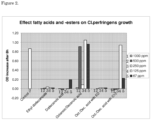
- A spectrophotometer was used to measure growth of micro organisms in broth over time (8 hours) by means of optical density (OD) for broths inoculated with specific bacterial strains. The relative decrease of OD is a measure of inhibitory strength. Broths were treated with graded levels of potential inhibitory substances and incubated for 24 hours.
- Treatments used were the following methyl octanoate; ethyl octanoate; methyl decanoate; ethyl decanoate; ethyl dodecanoate.
- The results are given in
figure 1 . Fromfigure 1 it can be seen that ethyl dodecanoate shows complete inhibition at all tested levels, while methyl octanoate shows nearly the same results. It can be concluded that from all the treatments used ethyl dodecanoate is the most effective inhibitor against Clostridium perfringens. - A spectrophotometer was used to measure growth of micro organisms in broth over time (8 hours) by means of optical density of broths inoculated with specific bacterial strains. The relative decrease of OD is a measure of inhibitory strength. Broths are treated with graded levels of potential inhibitory substances and incubated for 24 hours.
- Treatments used were the following: ethyl dodecanoate (ED); dodecanoic acid (C12); blend of octanoic/decanoic acid (C8/C10); combination of C8/C10 and ED (50/50); combination of C8/C10 and C12 (50/50).
- The results are given in
figure 2 . Fromfigure 2 it can be seen that ethyl ester of dodecanoic acid demonstrated complete inhibition of Clostridium perfringens even at the lowest inclusion level of treatment whereas dodecanoic acid was not as effective as effective at 67 ppm. The combination of octanoic/decanoic acid and ethyl dodecanoate also was effective in inhibiting Clostridium perfringens at all levels of treatment. - Therefore it can be concluded that the ethyl ester has a higher inhibitory strength than the free fatty acid, but a comparable inhibitory effect to that of the combination of octanoic/decanoic acid and ethyl dodecanoate.
- Broilers were offered feed supplemented with 1000 ppm of either dodecanoic acid or ethyl dodecanoate throughout the trial. At day 43 of age, 12 birds per treatment were sacrificed and the content of the duodenum, jejunum and ileum was harvested and analysed for levels of ethyl dodecanoate and dodecanoic acid. In
figure 3 the mean levels are depicted. -
Figure 3 shows that the level of the ethyl ester is higher than the free fatty acid in the jejunum. Therefore it can be concluded that the ethyl ester is not as quickly adsorbed through the intestinal wall as the free fatty acid. - Broilers were housed in group pens and offered feed supplemented with 1000 ppm of ethyl dodecanoate or dodecanoic acid. Parallel trials were conducted, one with normal birds and one with birds which were inoculated with 108 CFU Clostridium perfringens at day 9 through 11 birds. At day 13 of age, Clostridium counts were measured in fresh chime taken in the jejunum (see table 1). It was found that the feed supplemented by ethyl ester of dodecanoic acid led to an overall significant reduction of Clostridium counts. The effect was largest when the broilers were stressed by Clostridium inoculation.
Table 1. Clostridium perfringens counts in jejunum of infected and normal broilers on day 13 of age. Supplementation in feed P-level Animal model C12 free form C12 ethyl ester Non-challenged 1.418 1.048 p = 0.15 Challenged 2.122 0.977 p = 0.24 Overall 1.770 1.013 p = 0.08 - These results demonstrate that supplementation with ethyl dodecanoate provides a stronger inhibition of Clostridium perfringens in jejunum than supplementation with equal levels of dodecanoic acid. This effect can most probably be attributed to the higher residual levels of degradation product of ethyl dodecanoate (viz. dodecanoic acid) in the jejunum (see example 3,
figure 3 ). - In broilers infected at day 9-11 with Clostridium perfringens, weight gain, feed conversion ratio and mortality was followed for 6 weeks (42 days). The feed was either supplemented with ethyl dodecanoate or with dodecanoic acid at 1000 ppm. An overall improvement was shown for all the parameters measured in the group of ethyl dodecanoate (table 2) as compared to the free fatty acid.
Table 2: Growth, feed conversion and mortality of Clostridium perfringens infected broilers 0-42 day performance 1000 ppm Dodecanoic acid 1000 ppm Ethyl dodecanoate Weight gain, g/day 63.78 65.5 Feed intake, g/day 104.3 106.5 Feed conversion ratio 1.636 1.626 Mortality, % 8.333 4.621 - From table 2 it can be concluded that the ethyl ester of dodecanoic acid results in a better zootechnical performance than dodecanoic acid itself.
- A trial was conducted wherein the effect of 1000 ppm of dodecanoic acid or 1000 ppm ethyl dodecanoate on the feed of 108 weaned piglets housed in group pens (n=9 per treatment), was tested. The effect on average diarrhoea score (over the total period) per treatment is shown below in table 3:
Table 3: Diarrhoea score of weaned piglets fed with ethyl dodecanoate or dodecanoic acid supplements Days Treatment Overall Control C12 Ethyl-C12 mean std χ" P-value1 Diarrhoea score 49.84 a 46.64 ab 42-41 b 48.01 20.75 7.55 0.056 - From table 3, it can be seen that ethyl dodecanoate was able to significantly reduce diarrhoea whereas dodecanoic acid did not. Therefore it can be concluded that the effect on pathogenic bacteria in the intestinal tract of piglets of ethyl ester is stronger than of the related fatty acid.
- In a trial with 48 individually housed piglets the effect of a blend of medium chain fatty acids (octanoic, decanoic, dodecanoic acid) and ethyl dodecanoate in the
relative proportion 30% : 37% : 18% : 15% was tested. This blend was dosed at a total level of 1000 ppm in the weaner feed and was offered in the first 4 weeks after weaning. The piglets were infected with β- hemolytic E.coli (O149:K88acK91) at day 6 after weaning. At day 21 after weaning faeces samples were collected from 8 piglets per treatment and microbiological counts were measured. Further, each piglet was visually scored for faecal consistency in the same period (20-27 days after weaning) to determine the diarrhoea score.Table 4: Microbiological counts of faeces and diarrhoea score of piglets infected with β-hemolytic E.coli Enterobacteria E.coli Lactobacillus Diarrhoea score 1. Control 6.7740 a 6.2431 a 7.7108 38.1% 2. MCFA and esters 5.4452 b 5.2044 b 7.9165 25.0% Standard deviation 1.4179 1.2158 0.8964 n.a. p value p< 0.10 p <0.10 p > 0.10 p > 0.10 - From table 4 it can be seen that a blend of medium chain fatty acids and esters can reduce microbial contamination by pathogenic species like E. coli (part of the family of Enterobacteria) and indeed reduce the number of cases of diarrhoea. Moreover, commensal microbial species like Lactobacillus were not inhibited.
Claims (16)
- Animal feed suitable for feeding mammals, birds and fish, comprising an alkyl ester of a fatty acid, wherein said fatty acid has a chain length of 5-12 carbon atoms and said alkyl is methyl, ethyl, propyl, butyl or a combination thereof, and wherein the dosage of said ester in said animal feed is 50 ppm by weight or higher, based on the total weight of said animal feed, for use in decreasing the risk of Clostridium perfringens infections in an animal.
- Animal feed according to claim 1, wherein said fatty acid has a chain length of 8-12 carbon atoms.
- Animal feed according to claim 1 or claim 2, wherein said fatty acid is octanoic acid, decanoic acid, dodecanoic acid or a combination thereof.
- Animal feed according to any of the previous claims, wherein said ester is methyl octanoate, methyl decanoate, methyl dodecanoate, ethyl octanoate, ethyl decanoate, ethyl dodecanoate, propyl octanoate, propyl decanoate, propyl dodecanoate, butyl octanoate, butyl decanoate, butyl dodecanoate or a combination thereof.
- Animal feed according to any of the previous claims, wherein the dosage of said ester in said animal feed is 100 ppm by weight or higher, preferably 200 ppm by weight or higher, based on the total weight of said animal feed.
- Animal feed according to any of the previous claims, wherein the dosage of said ester in said animal feed is less than 5000 ppm by weight, preferably less than 1000 ppm by weight, based on the total weight of said animal feed.
- Animal feed according to any of the previous claims, further comprising organic acids and/or salts thereof.
- Animal feed according to claim 7, wherein said organic acid and/or said salt thereof is chosen from the group consisting of pentanoic, octanoic, decanoic, formic, acetic, propionic, lactic, butyric, citric, malic, fumaric, benzoic, succinic, sorbic, tartaric acid and/or salt and combinations thereof, wherein said salt is preferably the sodium, potassium, ammonium or calcium salt of said organic acids.
- Animal feed according to any of the previous claims, further comprising gallic acid or an alkyl ester of gallic acid.
- Animal feed according to claim 9, wherein said alkyl ester of gallic acid is propyl gallate, pentyl gallate, octyl gallate or lauryl gallate.
- Animal feed suitable for feeding mammals, birds and fish, comprising one or more organic acids and an alkyl ester of a fatty acid, wherein said alkyl is methyl, ethyl, propyl, butyl or a combination thereof, wherein said fatty acid has a chain length of 5-12 carbon atoms, wherein the dosage of said ester in said animal feed is 50 ppm by weight or higher, based on the total weight of said animal feed.
- Ingredient, premix or supplement for an animal feed suitable for feeding mammals, birds and fish, comprising an alkyl ester of a fatty acid, wherein said fatty acid has a chain length of 5-12 carbon atoms, wherein said alkyl is methyl, ethyl, propyl, butyl or a combination thereof, and wherein the dosage of said ester is 1 wt.% or higher, based on the total weight of said ingredient, premix or supplement, wherein said ingredient, premix or supplement further comprises vitamins, trace elements, minerals and organic acids.
- Ingredient, premix or supplement according to claim 12, for use in decreasing the risk of Clostridium perfringens infections in an animal.
- Method for increasing the feed efficiency in an animal, comprising feeding a mammal, bird or fish with the animal feed as defined in any of claims 1-11 or with the ingredient, premix or supplement according to claim 12.
- Use of an alkyl ester of a medium chain fatty acid or an alkyl ester of a medium chain fatty acid enriched product in an animal feed for the improvement of feed efficiency in an animal, wherein said fatty acid has a chain length of 5-12 carbon atoms, wherein said alkyl is methyl, ethyl, propyl, butyl or a combination thereof, and the dosage of said ester in said animal feed is 50 ppm by weight or higher, based on the total weight of said animal feed, and wherein said use is non-therapeutic.
- Alkyl ester of a fatty acid or alkyl ester of a fatty acid enriched product for use in an animal feed for decreasing the risk of Clostridium perfringens infections in an animal, wherein said fatty acid has a chain length of 5-12 carbon atoms, wherein said alkyl is methyl, ethyl, propyl, butyl or a combination thereof, and the dosage of said ester in said animal feed is 50 ppm by weight or higher, based on the total weight of said animal feed.
Priority Applications (1)
| Application Number | Priority Date | Filing Date | Title |
|---|---|---|---|
| EP10702358.2A EP2381797B2 (en) | 2009-01-23 | 2010-01-25 | Animal feed additive and animal feed comprising alkyl esters of medium chain fatty acids, and their use in animal feed |
Applications Claiming Priority (3)
| Application Number | Priority Date | Filing Date | Title |
|---|---|---|---|
| EP09151285A EP2215913A1 (en) | 2009-01-23 | 2009-01-23 | Animal feed additive and animal feed comprising alkyl esters of medium chain fatty acids, and their use in animal feed |
| EP10702358.2A EP2381797B2 (en) | 2009-01-23 | 2010-01-25 | Animal feed additive and animal feed comprising alkyl esters of medium chain fatty acids, and their use in animal feed |
| PCT/NL2010/050033 WO2010085149A1 (en) | 2009-01-23 | 2010-01-25 | Animal feed additive and animal feed comprising alkyl esters of medium chain fatty acids, and their use in animal feed |
Publications (3)
| Publication Number | Publication Date |
|---|---|
| EP2381797A1 EP2381797A1 (en) | 2011-11-02 |
| EP2381797B1 EP2381797B1 (en) | 2017-03-08 |
| EP2381797B2 true EP2381797B2 (en) | 2023-05-31 |
Family
ID=40545895
Family Applications (2)
| Application Number | Title | Priority Date | Filing Date |
|---|---|---|---|
| EP09151285A Withdrawn EP2215913A1 (en) | 2009-01-23 | 2009-01-23 | Animal feed additive and animal feed comprising alkyl esters of medium chain fatty acids, and their use in animal feed |
| EP10702358.2A Active EP2381797B2 (en) | 2009-01-23 | 2010-01-25 | Animal feed additive and animal feed comprising alkyl esters of medium chain fatty acids, and their use in animal feed |
Family Applications Before (1)
| Application Number | Title | Priority Date | Filing Date |
|---|---|---|---|
| EP09151285A Withdrawn EP2215913A1 (en) | 2009-01-23 | 2009-01-23 | Animal feed additive and animal feed comprising alkyl esters of medium chain fatty acids, and their use in animal feed |
Country Status (13)
| Country | Link |
|---|---|
| US (1) | US9861117B2 (en) |
| EP (2) | EP2215913A1 (en) |
| CN (1) | CN102291995B (en) |
| AU (1) | AU2010207071B2 (en) |
| CA (1) | CA2746821C (en) |
| DK (1) | DK2381797T4 (en) |
| ES (1) | ES2625469T5 (en) |
| HU (1) | HUE032330T2 (en) |
| MX (1) | MX337510B (en) |
| PL (1) | PL2381797T5 (en) |
| PT (1) | PT2381797T (en) |
| RU (2) | RU2635384C2 (en) |
| WO (1) | WO2010085149A1 (en) |
Families Citing this family (19)
| Publication number | Priority date | Publication date | Assignee | Title |
|---|---|---|---|---|
| EP2215913A1 (en) | 2009-01-23 | 2010-08-11 | Nutreco Nederland B.V. | Animal feed additive and animal feed comprising alkyl esters of medium chain fatty acids, and their use in animal feed |
| US8183227B1 (en) | 2011-07-07 | 2012-05-22 | Chemo S. A. France | Compositions, kits and methods for nutrition supplementation |
| US8168611B1 (en) | 2011-09-29 | 2012-05-01 | Chemo S.A. France | Compositions, kits and methods for nutrition supplementation |
| WO2014195039A1 (en) * | 2013-06-03 | 2014-12-11 | Basf Se | Compositions for use in controlling intestinal microflora |
| BE1021007B1 (en) * | 2013-10-09 | 2014-12-11 | Nutrition Sciences N.V. | COMPOSITION AND FOOD INCLUDING MEDIUM-LONG FATTY ACID CHAIN |
| CN105611840B (en) * | 2013-10-09 | 2021-02-09 | 营养科学股份有限公司 | Composition of medium-chain fatty acids and feed supplemented with the composition |
| PT3124021T (en) * | 2013-11-13 | 2020-09-22 | Hankkija Oy | FOOD SUPPLEMENT THAT UNDERSTAND RESINIC ACIDS |
| KR101914260B1 (en) * | 2014-04-22 | 2019-01-14 | 후아웨이 테크놀러지 컴퍼니 리미티드 | File management method and file system |
| CN104041669B (en) * | 2014-05-23 | 2017-06-23 | 广州英赛特生物技术有限公司 | Capric acid zinc as animal feed additive application |
| SE538436C2 (en) * | 2014-12-09 | 2016-06-28 | Perstorp Ab | Composition inhibiting gram-negative pathogens in galloanserans |
| SE539228C2 (en) * | 2015-03-27 | 2017-05-23 | Perstorp Ab | Composition inhibiting gram-positive bacteria |
| US10576052B2 (en) | 2015-11-13 | 2020-03-03 | Perstorp Ab | Composition preventing bacterial inflammation in monogastric animals |
| CN105724779A (en) * | 2016-02-23 | 2016-07-06 | 广州英赛特生物技术有限公司 | Compound feeding composition and application of compound feeding composition in preparation of animal feed additive |
| CN106107192B (en) * | 2016-06-23 | 2019-11-01 | 杭州康德权饲料有限公司 | One hatching egg feed additive for fowls and its application |
| KR101992707B1 (en) * | 2016-12-23 | 2019-09-30 | 주식회사 비제이바이오켐 | Animal Feed Additive composition |
| CN109503384A (en) * | 2017-09-15 | 2019-03-22 | 魏雪涛 | Gallate-fumaric acid derivatives and its application in terms of beasts, birds and aquatic products animal |
| WO2019092718A1 (en) * | 2017-11-08 | 2019-05-16 | The State Of Israel, Ministry Of Agriculture & Rural Development, Agricultural Research Organization (Aro) (Volcani Center) | Compositions and methods for aquaculturing |
| WO2020240014A1 (en) * | 2019-05-29 | 2020-12-03 | Nutreco Ip Assets B.V. | System and method of formulating an animal feed composition |
| CN110506864A (en) * | 2019-09-12 | 2019-11-29 | 华南农业大学 | One boar food replaces anti-additive and its application in pannage |
Citations (17)
| Publication number | Priority date | Publication date | Assignee | Title |
|---|---|---|---|---|
| US2466663A (en) † | 1944-10-20 | 1949-04-05 | Ward Baking Co | Fungicide containing caprylic acid and its salt |
| GB998638A (en) † | 1963-11-26 | 1965-07-21 | Robert Walser | Liquid animal feed mixture and production thereof |
| US4526798A (en) † | 1984-06-13 | 1985-07-02 | International Flavors & Fragrances Inc. | Mixtures of one or more C4 -C10 -n-alkanoic acids with the ethyl ester of 2-hydroxy-4-methyl pentanoic acid |
| WO2000036928A1 (en) † | 1998-12-22 | 2000-06-29 | Vitamex N.V. | Feed supplement composition |
| EP1059041A1 (en) † | 1999-06-07 | 2000-12-13 | Universiteit Gent | The combined use of triglycerides containing medium chain fatty acids and exogenous lipolytic enzymes as feed supplements |
| WO2001097791A2 (en) † | 2000-06-22 | 2001-12-27 | Institut Pasteur | Use of c4-c10 acids for preventing gram-negative bacterial infections |
| WO2003043441A1 (en) † | 2001-11-21 | 2003-05-30 | Nutrition Sciences N.V. | Antimicrobial composition for animals |
| WO2004007416A1 (en) † | 2002-07-12 | 2004-01-22 | Basf Aktiengesellschaft | Preparations containing diformates and short-chain carboxylic acids |
| WO2008062428A2 (en) † | 2006-08-06 | 2008-05-29 | Belle Kumar | Novel antimicrobial formulations incorporating alkyl esters of fatty acids and nanoemulsions thereof |
| WO2008090440A1 (en) † | 2007-01-22 | 2008-07-31 | Carlo Ghisalberti | Lipid-based gynaecologic suppository |
| WO2009131939A2 (en) † | 2008-04-21 | 2009-10-29 | Asha Lipid Sciences, Inc. | Lipid-containing compositions and methods of use thereof |
| EP2215913A1 (en) † | 2009-01-23 | 2010-08-11 | Nutreco Nederland B.V. | Animal feed additive and animal feed comprising alkyl esters of medium chain fatty acids, and their use in animal feed |
| US20100239712A1 (en) † | 2008-10-14 | 2010-09-23 | Solazyme, Inc. | Food Compositions of Microalgal Biomass |
| US20110300281A1 (en) † | 2008-10-22 | 2011-12-08 | Balchem Corporation | Method for Producing Fatty Acid Esters of Monovalent or Polyvalent Alcohols Using Special Hydroxy-Functional Quaternary Ammonium Compounds as Catalysts |
| US20110318434A1 (en) † | 2008-12-18 | 2011-12-29 | Guthery B Eugene | Acne Vulgaris Treatment Regimen |
| US8110670B2 (en) † | 2006-05-19 | 2012-02-07 | Ls9, Inc. | Enhanced production of fatty acid derivatives |
| US8318186B2 (en) † | 2000-01-18 | 2012-11-27 | Laboratoires Expanscience | Use of at least a fatty ester for preparing a composition designed to inhibit 5-α-reductase activity, in pharmacology, in particular dermatology, in cosmetics and as food additive |
Family Cites Families (4)
| Publication number | Priority date | Publication date | Assignee | Title |
|---|---|---|---|---|
| US20020176882A1 (en) * | 1997-06-23 | 2002-11-28 | Schur Jorg Peter | Additive the improvement and/or stabilization of the keeping quality of microbially perishable products |
| ES2234877T5 (en) | 2000-06-20 | 2010-10-18 | Nutrition Sciences | MEDIUM CHAIN FAT ACIDS USED AS ANTIMICROBIAL AGENTS. |
| DE102004031172A1 (en) | 2004-06-28 | 2006-01-12 | Eastman Kodak Co. | Device for handling a printing material |
| ES2523018T3 (en) * | 2004-06-30 | 2014-11-20 | Nutrition Sciences N.V./S.A. | Medium chain fatty acids applicable as anti-microbial agents |
-
2009
- 2009-01-23 EP EP09151285A patent/EP2215913A1/en not_active Withdrawn
-
2010
- 2010-01-25 HU HUE10702358A patent/HUE032330T2/en unknown
- 2010-01-25 CN CN201080005066.XA patent/CN102291995B/en active Active
- 2010-01-25 EP EP10702358.2A patent/EP2381797B2/en active Active
- 2010-01-25 CA CA2746821A patent/CA2746821C/en active Active
- 2010-01-25 US US13/133,140 patent/US9861117B2/en active Active
- 2010-01-25 RU RU2015126361A patent/RU2635384C2/en active
- 2010-01-25 RU RU2011135045/13A patent/RU2563687C2/en active
- 2010-01-25 PT PT107023582T patent/PT2381797T/en unknown
- 2010-01-25 ES ES10702358T patent/ES2625469T5/en active Active
- 2010-01-25 DK DK10702358.2T patent/DK2381797T4/en active
- 2010-01-25 AU AU2010207071A patent/AU2010207071B2/en active Active
- 2010-01-25 PL PL10702358.2T patent/PL2381797T5/en unknown
- 2010-01-25 WO PCT/NL2010/050033 patent/WO2010085149A1/en not_active Ceased
- 2010-01-25 MX MX2011007164A patent/MX337510B/en active IP Right Grant
Patent Citations (18)
| Publication number | Priority date | Publication date | Assignee | Title |
|---|---|---|---|---|
| US2466663A (en) † | 1944-10-20 | 1949-04-05 | Ward Baking Co | Fungicide containing caprylic acid and its salt |
| GB998638A (en) † | 1963-11-26 | 1965-07-21 | Robert Walser | Liquid animal feed mixture and production thereof |
| US4526798A (en) † | 1984-06-13 | 1985-07-02 | International Flavors & Fragrances Inc. | Mixtures of one or more C4 -C10 -n-alkanoic acids with the ethyl ester of 2-hydroxy-4-methyl pentanoic acid |
| WO2000036928A1 (en) † | 1998-12-22 | 2000-06-29 | Vitamex N.V. | Feed supplement composition |
| EP1059041A1 (en) † | 1999-06-07 | 2000-12-13 | Universiteit Gent | The combined use of triglycerides containing medium chain fatty acids and exogenous lipolytic enzymes as feed supplements |
| US8318186B2 (en) † | 2000-01-18 | 2012-11-27 | Laboratoires Expanscience | Use of at least a fatty ester for preparing a composition designed to inhibit 5-α-reductase activity, in pharmacology, in particular dermatology, in cosmetics and as food additive |
| US20040116523A1 (en) † | 2000-06-22 | 2004-06-17 | Popoff Michel Yvan | Use of c4-c10 acids for preventing gram-negative bacterial infections |
| WO2001097791A2 (en) † | 2000-06-22 | 2001-12-27 | Institut Pasteur | Use of c4-c10 acids for preventing gram-negative bacterial infections |
| WO2003043441A1 (en) † | 2001-11-21 | 2003-05-30 | Nutrition Sciences N.V. | Antimicrobial composition for animals |
| WO2004007416A1 (en) † | 2002-07-12 | 2004-01-22 | Basf Aktiengesellschaft | Preparations containing diformates and short-chain carboxylic acids |
| US8110670B2 (en) † | 2006-05-19 | 2012-02-07 | Ls9, Inc. | Enhanced production of fatty acid derivatives |
| WO2008062428A2 (en) † | 2006-08-06 | 2008-05-29 | Belle Kumar | Novel antimicrobial formulations incorporating alkyl esters of fatty acids and nanoemulsions thereof |
| WO2008090440A1 (en) † | 2007-01-22 | 2008-07-31 | Carlo Ghisalberti | Lipid-based gynaecologic suppository |
| WO2009131939A2 (en) † | 2008-04-21 | 2009-10-29 | Asha Lipid Sciences, Inc. | Lipid-containing compositions and methods of use thereof |
| US20100239712A1 (en) † | 2008-10-14 | 2010-09-23 | Solazyme, Inc. | Food Compositions of Microalgal Biomass |
| US20110300281A1 (en) † | 2008-10-22 | 2011-12-08 | Balchem Corporation | Method for Producing Fatty Acid Esters of Monovalent or Polyvalent Alcohols Using Special Hydroxy-Functional Quaternary Ammonium Compounds as Catalysts |
| US20110318434A1 (en) † | 2008-12-18 | 2011-12-29 | Guthery B Eugene | Acne Vulgaris Treatment Regimen |
| EP2215913A1 (en) † | 2009-01-23 | 2010-08-11 | Nutreco Nederland B.V. | Animal feed additive and animal feed comprising alkyl esters of medium chain fatty acids, and their use in animal feed |
Non-Patent Citations (2)
| Title |
|---|
| Additional experimental data of the Proprietor † |
| Anti-microbial activity of MCFAs and alkyl esters of MCFAs - Experimental data of the Opponent † |
Also Published As
| Publication number | Publication date |
|---|---|
| CA2746821C (en) | 2018-04-10 |
| BRPI1006957A8 (en) | 2017-10-31 |
| PL2381797T5 (en) | 2023-09-04 |
| ES2625469T5 (en) | 2023-11-10 |
| AU2010207071B2 (en) | 2014-05-29 |
| RU2563687C2 (en) | 2015-09-20 |
| US9861117B2 (en) | 2018-01-09 |
| US20120029077A1 (en) | 2012-02-02 |
| AU2010207071A1 (en) | 2011-06-30 |
| WO2010085149A1 (en) | 2010-07-29 |
| DK2381797T4 (en) | 2023-07-24 |
| EP2215913A1 (en) | 2010-08-11 |
| ES2625469T3 (en) | 2017-07-19 |
| EP2381797B1 (en) | 2017-03-08 |
| CA2746821A1 (en) | 2010-07-29 |
| BRPI1006957A2 (en) | 2016-10-18 |
| PL2381797T3 (en) | 2017-08-31 |
| CN102291995B (en) | 2018-01-02 |
| RU2635384C2 (en) | 2017-11-13 |
| HUE032330T2 (en) | 2017-09-28 |
| CN102291995A (en) | 2011-12-21 |
| DK2381797T3 (en) | 2017-06-26 |
| EP2381797A1 (en) | 2011-11-02 |
| RU2015126361A (en) | 2015-11-27 |
| MX337510B (en) | 2016-03-09 |
| RU2011135045A (en) | 2013-02-27 |
| MX2011007164A (en) | 2012-01-12 |
| PT2381797T (en) | 2017-06-23 |
Similar Documents
| Publication | Publication Date | Title |
|---|---|---|
| EP2381797B1 (en) | Animal feed additive and animal feed comprising alkyl esters of medium chain fatty acids, and their use in animal feed | |
| Haque et al. | Propionic acid is an alternative to antibiotics in poultry diet | |
| EP3054783B1 (en) | Composition of medium chain fatty acids and fodder supplemented with same | |
| EP2249824B1 (en) | Lactylates for the prevention and treatment of infections caused by gram-positive bacteria in animals | |
| EP3054784B2 (en) | Composition and fodder comprising medium chain fatty acids | |
| CN111867387B (en) | Animal feed material | |
| US8962683B2 (en) | Medium chain fatty acids applicable as anti-microbial agents | |
| Vinus et al. | Organic acids as alternatives to antibiotic growth promoters in poultry | |
| Banupriya et al. | Significance of feed acidification in poultry feed | |
| RU2832334C1 (en) | Method of feeding broilers under heat stress conditions | |
| BRPI1006957B1 (en) | ANIMAL FEED SUITABLE FOR FEEDING MAMMALS, POULTRY AND FISH, INGREDIENT, PREMIX OR SUPPLEMENT FOR AN ANIMAL FEED SUITABLE FOR FEEDING MAMMALS, POULTRY AND FISH, METHOD FOR INCREASING THE FEEDING EFFICIENCY OF A FARM ANIMAL, AND USE OF AN ALKYL ESTER OR A PRODUCT ENRICHED WITH AN ALKYL ESTER | |
| PARVEZ | USE OF DIETARY CITRIC ACID IN MAINTAINING EGG QUALITY AND PERFORMANCE OF LAYING HEN | |
| Schwarzer | The use of sodium butyrate in combination with free organic acids in poultry | |
| CN118556784A (en) | Tianti feed additive and pigeon breeding method | |
| Kampf et al. | Spore forming probiotic Bacillus subtilis C-3102 in pig and poultry diets | |
| CN102389049A (en) | Fatty acid-containing cattle feed additive with inhibitory effect on Escherichia coli O157:H7 | |
| Schwarzer | The role of organic acids and natural principles in animal health and performance | |
| Theobald | Control of E. coli, Salmonella and other potential pathogens | |
| CN102389050A (en) | Long chain fatty acld-containing cattle feed additive with inhibitory effect on Escherichia coli O157:H7 |
Legal Events
| Date | Code | Title | Description |
|---|---|---|---|
| PUAI | Public reference made under article 153(3) epc to a published international application that has entered the european phase |
Free format text: ORIGINAL CODE: 0009012 |
|
| 17P | Request for examination filed |
Effective date: 20110707 |
|
| AK | Designated contracting states |
Kind code of ref document: A1 Designated state(s): AT BE BG CH CY CZ DE DK EE ES FI FR GB GR HR HU IE IS IT LI LT LU LV MC MK MT NL NO PL PT RO SE SI SK SM TR |
|
| DAX | Request for extension of the european patent (deleted) | ||
| 17Q | First examination report despatched |
Effective date: 20140904 |
|
| REG | Reference to a national code |
Ref country code: DE Ref legal event code: R079 Ref document number: 602010040545 Country of ref document: DE Free format text: PREVIOUS MAIN CLASS: A23K0001160000 Ipc: A23K0020158000 |
|
| GRAP | Despatch of communication of intention to grant a patent |
Free format text: ORIGINAL CODE: EPIDOSNIGR1 |
|
| RIC1 | Information provided on ipc code assigned before grant |
Ipc: A23K 50/75 20160101ALI20160907BHEP Ipc: A23K 50/80 20160101ALI20160907BHEP Ipc: A23K 50/30 20160101ALI20160907BHEP Ipc: A23K 50/70 20160101ALI20160907BHEP Ipc: A23K 20/158 20160101AFI20160907BHEP |
|
| INTG | Intention to grant announced |
Effective date: 20160926 |
|
| GRAS | Grant fee paid |
Free format text: ORIGINAL CODE: EPIDOSNIGR3 |
|
| STAA | Information on the status of an ep patent application or granted ep patent |
Free format text: STATUS: GRANT OF PATENT IS INTENDED |
|
| GRAA | (expected) grant |
Free format text: ORIGINAL CODE: 0009210 |
|
| STAA | Information on the status of an ep patent application or granted ep patent |
Free format text: STATUS: THE PATENT HAS BEEN GRANTED |
|
| AK | Designated contracting states |
Kind code of ref document: B1 Designated state(s): AT BE BG CH CY CZ DE DK EE ES FI FR GB GR HR HU IE IS IT LI LT LU LV MC MK MT NL NO PL PT RO SE SI SK SM TR |
|
| REG | Reference to a national code |
Ref country code: GB Ref legal event code: FG4D |
|
| REG | Reference to a national code |
Ref country code: CH Ref legal event code: EP Ref country code: AT Ref legal event code: REF Ref document number: 872716 Country of ref document: AT Kind code of ref document: T Effective date: 20170315 |
|
| REG | Reference to a national code |
Ref country code: IE Ref legal event code: FG4D |
|
| REG | Reference to a national code |
Ref country code: NL Ref legal event code: FP |
|
| REG | Reference to a national code |
Ref country code: DE Ref legal event code: R096 Ref document number: 602010040545 Country of ref document: DE |
|
| REG | Reference to a national code |
Ref country code: SE Ref legal event code: TRGR |
|
| REG | Reference to a national code |
Ref country code: PT Ref legal event code: SC4A Ref document number: 2381797 Country of ref document: PT Date of ref document: 20170623 Kind code of ref document: T Free format text: AVAILABILITY OF NATIONAL TRANSLATION Effective date: 20170608 |
|
| REG | Reference to a national code |
Ref country code: DK Ref legal event code: T3 Effective date: 20170620 |
|
| REG | Reference to a national code |
Ref country code: LT Ref legal event code: MG4D |
|
| REG | Reference to a national code |
Ref country code: ES Ref legal event code: FG2A Ref document number: 2625469 Country of ref document: ES Kind code of ref document: T3 Effective date: 20170719 |
|
| REG | Reference to a national code |
Ref country code: NO Ref legal event code: T2 Effective date: 20170308 |
|
| PG25 | Lapsed in a contracting state [announced via postgrant information from national office to epo] |
Ref country code: FI Free format text: LAPSE BECAUSE OF FAILURE TO SUBMIT A TRANSLATION OF THE DESCRIPTION OR TO PAY THE FEE WITHIN THE PRESCRIBED TIME-LIMIT Effective date: 20170308 Ref country code: LT Free format text: LAPSE BECAUSE OF FAILURE TO SUBMIT A TRANSLATION OF THE DESCRIPTION OR TO PAY THE FEE WITHIN THE PRESCRIBED TIME-LIMIT Effective date: 20170308 Ref country code: HR Free format text: LAPSE BECAUSE OF FAILURE TO SUBMIT A TRANSLATION OF THE DESCRIPTION OR TO PAY THE FEE WITHIN THE PRESCRIBED TIME-LIMIT Effective date: 20170308 |
|
| PG25 | Lapsed in a contracting state [announced via postgrant information from national office to epo] |
Ref country code: BG Free format text: LAPSE BECAUSE OF FAILURE TO SUBMIT A TRANSLATION OF THE DESCRIPTION OR TO PAY THE FEE WITHIN THE PRESCRIBED TIME-LIMIT Effective date: 20170608 Ref country code: LV Free format text: LAPSE BECAUSE OF FAILURE TO SUBMIT A TRANSLATION OF THE DESCRIPTION OR TO PAY THE FEE WITHIN THE PRESCRIBED TIME-LIMIT Effective date: 20170308 |
|
| REG | Reference to a national code |
Ref country code: HU Ref legal event code: AG4A Ref document number: E032330 Country of ref document: HU |
|
| REG | Reference to a national code |
Ref country code: SK Ref legal event code: T3 Ref document number: E 24191 Country of ref document: SK |
|
| PG25 | Lapsed in a contracting state [announced via postgrant information from national office to epo] |
Ref country code: RO Free format text: LAPSE BECAUSE OF FAILURE TO SUBMIT A TRANSLATION OF THE DESCRIPTION OR TO PAY THE FEE WITHIN THE PRESCRIBED TIME-LIMIT Effective date: 20170308 Ref country code: EE Free format text: LAPSE BECAUSE OF FAILURE TO SUBMIT A TRANSLATION OF THE DESCRIPTION OR TO PAY THE FEE WITHIN THE PRESCRIBED TIME-LIMIT Effective date: 20170308 |
|
| REG | Reference to a national code |
Ref country code: GR Ref legal event code: EP Ref document number: 20170401441 Country of ref document: GR Effective date: 20171023 |
|
| PG25 | Lapsed in a contracting state [announced via postgrant information from national office to epo] |
Ref country code: SM Free format text: LAPSE BECAUSE OF FAILURE TO SUBMIT A TRANSLATION OF THE DESCRIPTION OR TO PAY THE FEE WITHIN THE PRESCRIBED TIME-LIMIT Effective date: 20170308 Ref country code: IS Free format text: LAPSE BECAUSE OF FAILURE TO SUBMIT A TRANSLATION OF THE DESCRIPTION OR TO PAY THE FEE WITHIN THE PRESCRIBED TIME-LIMIT Effective date: 20170708 |
|
| REG | Reference to a national code |
Ref country code: DE Ref legal event code: R026 Ref document number: 602010040545 Country of ref document: DE |
|
| PLBI | Opposition filed |
Free format text: ORIGINAL CODE: 0009260 |
|
| PLAX | Notice of opposition and request to file observation + time limit sent |
Free format text: ORIGINAL CODE: EPIDOSNOBS2 |
|
| 26 | Opposition filed |
Opponent name: NUTRITION SCIENCES N.V. Effective date: 20171206 |
|
| REG | Reference to a national code |
Ref country code: FR Ref legal event code: PLFP Year of fee payment: 9 |
|
| PG25 | Lapsed in a contracting state [announced via postgrant information from national office to epo] |
Ref country code: SI Free format text: LAPSE BECAUSE OF FAILURE TO SUBMIT A TRANSLATION OF THE DESCRIPTION OR TO PAY THE FEE WITHIN THE PRESCRIBED TIME-LIMIT Effective date: 20170308 |
|
| PLBB | Reply of patent proprietor to notice(s) of opposition received |
Free format text: ORIGINAL CODE: EPIDOSNOBS3 |
|
| REG | Reference to a national code |
Ref country code: CH Ref legal event code: PL |
|
| PG25 | Lapsed in a contracting state [announced via postgrant information from national office to epo] |
Ref country code: LU Free format text: LAPSE BECAUSE OF NON-PAYMENT OF DUE FEES Effective date: 20180125 |
|
| PG25 | Lapsed in a contracting state [announced via postgrant information from national office to epo] |
Ref country code: CH Free format text: LAPSE BECAUSE OF NON-PAYMENT OF DUE FEES Effective date: 20180131 Ref country code: LI Free format text: LAPSE BECAUSE OF NON-PAYMENT OF DUE FEES Effective date: 20180131 |
|
| PG25 | Lapsed in a contracting state [announced via postgrant information from national office to epo] |
Ref country code: MC Free format text: LAPSE BECAUSE OF FAILURE TO SUBMIT A TRANSLATION OF THE DESCRIPTION OR TO PAY THE FEE WITHIN THE PRESCRIBED TIME-LIMIT Effective date: 20170308 |
|
| APBM | Appeal reference recorded |
Free format text: ORIGINAL CODE: EPIDOSNREFNO |
|
| APBP | Date of receipt of notice of appeal recorded |
Free format text: ORIGINAL CODE: EPIDOSNNOA2O |
|
| APAH | Appeal reference modified |
Free format text: ORIGINAL CODE: EPIDOSCREFNO |
|
| APAW | Appeal reference deleted |
Free format text: ORIGINAL CODE: EPIDOSDREFNO |
|
| APBM | Appeal reference recorded |
Free format text: ORIGINAL CODE: EPIDOSNREFNO |
|
| APBP | Date of receipt of notice of appeal recorded |
Free format text: ORIGINAL CODE: EPIDOSNNOA2O |
|
| APBQ | Date of receipt of statement of grounds of appeal recorded |
Free format text: ORIGINAL CODE: EPIDOSNNOA3O |
|
| REG | Reference to a national code |
Ref country code: AT Ref legal event code: UEP Ref document number: 872716 Country of ref document: AT Kind code of ref document: T Effective date: 20170308 |
|
| APBY | Invitation to file observations in appeal sent |
Free format text: ORIGINAL CODE: EPIDOSNOBA2O |
|
| APCA | Receipt of observations in appeal recorded |
Free format text: ORIGINAL CODE: EPIDOSNOBA4O |
|
| PG25 | Lapsed in a contracting state [announced via postgrant information from national office to epo] |
Ref country code: MT Free format text: LAPSE BECAUSE OF NON-PAYMENT OF DUE FEES Effective date: 20180125 |
|
| PG25 | Lapsed in a contracting state [announced via postgrant information from national office to epo] |
Ref country code: CY Free format text: LAPSE BECAUSE OF FAILURE TO SUBMIT A TRANSLATION OF THE DESCRIPTION OR TO PAY THE FEE WITHIN THE PRESCRIBED TIME-LIMIT Effective date: 20170308 Ref country code: MK Free format text: LAPSE BECAUSE OF NON-PAYMENT OF DUE FEES Effective date: 20170308 |
|
| APBU | Appeal procedure closed |
Free format text: ORIGINAL CODE: EPIDOSNNOA9O |
|
| PUAH | Patent maintained in amended form |
Free format text: ORIGINAL CODE: 0009272 |
|
| STAA | Information on the status of an ep patent application or granted ep patent |
Free format text: STATUS: PATENT MAINTAINED AS AMENDED |
|
| 27A | Patent maintained in amended form |
Effective date: 20230531 |
|
| AK | Designated contracting states |
Kind code of ref document: B2 Designated state(s): AT BE BG CH CY CZ DE DK EE ES FI FR GB GR HR HU IE IS IT LI LT LU LV MC MK MT NL NO PL PT RO SE SI SK SM TR |
|
| REG | Reference to a national code |
Ref country code: DE Ref legal event code: R102 Ref document number: 602010040545 Country of ref document: DE |
|
| P01 | Opt-out of the competence of the unified patent court (upc) registered |
Effective date: 20230508 |
|
| REG | Reference to a national code |
Ref country code: DK Ref legal event code: T4 Effective date: 20230721 |
|
| REG | Reference to a national code |
Ref country code: NL Ref legal event code: FP |
|
| REG | Reference to a national code |
Ref country code: DE Ref legal event code: R082 Ref document number: 602010040545 Country of ref document: DE Representative=s name: DF-MP DOERRIES FRANK-MOLNIA & POHLMAN PATENTAN, DE Ref country code: DE Ref legal event code: R082 Ref document number: 602010040545 Country of ref document: DE Representative=s name: DF-MP PATENTANWAELTE RECHTSANWAELTE PARTG MBB, DE |
|
| REG | Reference to a national code |
Ref country code: SE Ref legal event code: RPEO |
|
| REG | Reference to a national code |
Ref country code: SK Ref legal event code: T5 Ref document number: E 24191 Country of ref document: SK |
|
| REG | Reference to a national code |
Ref country code: NO Ref legal event code: T2 Effective date: 20170308 |
|
| REG | Reference to a national code |
Ref country code: GR Ref legal event code: EP Ref document number: 20230401318 Country of ref document: GR Effective date: 20231010 |
|
| REG | Reference to a national code |
Ref country code: ES Ref legal event code: DC2A Ref document number: 2625469 Country of ref document: ES Kind code of ref document: T5 Effective date: 20231110 |
|
| REG | Reference to a national code |
Ref country code: AT Ref legal event code: UEP Ref document number: 872716 Country of ref document: AT Kind code of ref document: T Effective date: 20230531 |
|
| PGFP | Annual fee paid to national office [announced via postgrant information from national office to epo] |
Ref country code: NL Payment date: 20260126 Year of fee payment: 17 |
|
| PGFP | Annual fee paid to national office [announced via postgrant information from national office to epo] |
Ref country code: HU Payment date: 20260116 Year of fee payment: 17 |
|
| PGFP | Annual fee paid to national office [announced via postgrant information from national office to epo] |
Ref country code: SE Payment date: 20260121 Year of fee payment: 17 |
|
| PGFP | Annual fee paid to national office [announced via postgrant information from national office to epo] |
Ref country code: GB Payment date: 20260122 Year of fee payment: 17 |
|
| PGFP | Annual fee paid to national office [announced via postgrant information from national office to epo] |
Ref country code: ES Payment date: 20260217 Year of fee payment: 17 |
|
| PGFP | Annual fee paid to national office [announced via postgrant information from national office to epo] |
Ref country code: NO Payment date: 20260120 Year of fee payment: 17 Ref country code: DK Payment date: 20260115 Year of fee payment: 17 Ref country code: DE Payment date: 20260120 Year of fee payment: 17 Ref country code: IE Payment date: 20260121 Year of fee payment: 17 |
|
| PGFP | Annual fee paid to national office [announced via postgrant information from national office to epo] |
Ref country code: AT Payment date: 20260119 Year of fee payment: 17 |
|
| PGFP | Annual fee paid to national office [announced via postgrant information from national office to epo] |
Ref country code: BE Payment date: 20260126 Year of fee payment: 17 Ref country code: IT Payment date: 20260130 Year of fee payment: 17 |
|
| PGFP | Annual fee paid to national office [announced via postgrant information from national office to epo] |
Ref country code: FR Payment date: 20260128 Year of fee payment: 17 |
|
| PGFP | Annual fee paid to national office [announced via postgrant information from national office to epo] |
Ref country code: TR Payment date: 20260119 Year of fee payment: 17 |
|
| PGFP | Annual fee paid to national office [announced via postgrant information from national office to epo] |
Ref country code: PT Payment date: 20260120 Year of fee payment: 17 Ref country code: CZ Payment date: 20260113 Year of fee payment: 17 |
|
| PGFP | Annual fee paid to national office [announced via postgrant information from national office to epo] |
Ref country code: GR Payment date: 20260119 Year of fee payment: 17 Ref country code: PL Payment date: 20260109 Year of fee payment: 17 |
|
| PGFP | Annual fee paid to national office [announced via postgrant information from national office to epo] |
Ref country code: SK Payment date: 20260119 Year of fee payment: 17 |