EP2377894A2 - Ethylene-propylene-diene copolymer production method - Google Patents
Ethylene-propylene-diene copolymer production method Download PDFInfo
- Publication number
- EP2377894A2 EP2377894A2 EP09837667A EP09837667A EP2377894A2 EP 2377894 A2 EP2377894 A2 EP 2377894A2 EP 09837667 A EP09837667 A EP 09837667A EP 09837667 A EP09837667 A EP 09837667A EP 2377894 A2 EP2377894 A2 EP 2377894A2
- Authority
- EP
- European Patent Office
- Prior art keywords
- alkyl
- aryl
- ethylene
- propylene
- diene copolymer
- Prior art date
- Legal status (The legal status is an assumption and is not a legal conclusion. Google has not performed a legal analysis and makes no representation as to the accuracy of the status listed.)
- Granted
Links
Classifications
-
- C—CHEMISTRY; METALLURGY
- C08—ORGANIC MACROMOLECULAR COMPOUNDS; THEIR PREPARATION OR CHEMICAL WORKING-UP; COMPOSITIONS BASED THEREON
- C08F—MACROMOLECULAR COMPOUNDS OBTAINED BY REACTIONS ONLY INVOLVING CARBON-TO-CARBON UNSATURATED BONDS
- C08F10/00—Homopolymers and copolymers of unsaturated aliphatic hydrocarbons having only one carbon-to-carbon double bond
-
- C—CHEMISTRY; METALLURGY
- C08—ORGANIC MACROMOLECULAR COMPOUNDS; THEIR PREPARATION OR CHEMICAL WORKING-UP; COMPOSITIONS BASED THEREON
- C08F—MACROMOLECULAR COMPOUNDS OBTAINED BY REACTIONS ONLY INVOLVING CARBON-TO-CARBON UNSATURATED BONDS
- C08F210/00—Copolymers of unsaturated aliphatic hydrocarbons having only one carbon-to-carbon double bond
- C08F210/04—Monomers containing three or four carbon atoms
- C08F210/08—Butenes
- C08F210/10—Isobutene
- C08F210/12—Isobutene with conjugated diolefins, e.g. butyl rubber
-
- C—CHEMISTRY; METALLURGY
- C08—ORGANIC MACROMOLECULAR COMPOUNDS; THEIR PREPARATION OR CHEMICAL WORKING-UP; COMPOSITIONS BASED THEREON
- C08F—MACROMOLECULAR COMPOUNDS OBTAINED BY REACTIONS ONLY INVOLVING CARBON-TO-CARBON UNSATURATED BONDS
- C08F4/00—Polymerisation catalysts
- C08F4/42—Metals; Metal hydrides; Metallo-organic compounds; Use thereof as catalyst precursors
- C08F4/44—Metals; Metal hydrides; Metallo-organic compounds; Use thereof as catalyst precursors selected from light metals, zinc, cadmium, mercury, copper, silver, gold, boron, gallium, indium, thallium, rare earths or actinides
- C08F4/60—Metals; Metal hydrides; Metallo-organic compounds; Use thereof as catalyst precursors selected from light metals, zinc, cadmium, mercury, copper, silver, gold, boron, gallium, indium, thallium, rare earths or actinides together with refractory metals, iron group metals, platinum group metals, manganese, rhenium technetium or compounds thereof
- C08F4/62—Refractory metals or compounds thereof
- C08F4/64—Titanium, zirconium, hafnium or compounds thereof
- C08F4/659—Component covered by group C08F4/64 containing a transition metal-carbon bond
- C08F4/6592—Component covered by group C08F4/64 containing a transition metal-carbon bond containing at least one cyclopentadienyl ring, condensed or not, e.g. an indenyl or a fluorenyl ring
-
- C—CHEMISTRY; METALLURGY
- C08—ORGANIC MACROMOLECULAR COMPOUNDS; THEIR PREPARATION OR CHEMICAL WORKING-UP; COMPOSITIONS BASED THEREON
- C08F—MACROMOLECULAR COMPOUNDS OBTAINED BY REACTIONS ONLY INVOLVING CARBON-TO-CARBON UNSATURATED BONDS
- C08F210/00—Copolymers of unsaturated aliphatic hydrocarbons having only one carbon-to-carbon double bond
- C08F210/16—Copolymers of ethene with alpha-alkenes, e.g. EP rubbers
- C08F210/18—Copolymers of ethene with alpha-alkenes, e.g. EP rubbers with non-conjugated dienes, e.g. EPT rubbers
-
- C—CHEMISTRY; METALLURGY
- C08—ORGANIC MACROMOLECULAR COMPOUNDS; THEIR PREPARATION OR CHEMICAL WORKING-UP; COMPOSITIONS BASED THEREON
- C08F—MACROMOLECULAR COMPOUNDS OBTAINED BY REACTIONS ONLY INVOLVING CARBON-TO-CARBON UNSATURATED BONDS
- C08F2420/00—Metallocene catalysts
- C08F2420/04—Cp or analog not bridged to a non-Cp X ancillary anionic donor
-
- C—CHEMISTRY; METALLURGY
- C08—ORGANIC MACROMOLECULAR COMPOUNDS; THEIR PREPARATION OR CHEMICAL WORKING-UP; COMPOSITIONS BASED THEREON
- C08F—MACROMOLECULAR COMPOUNDS OBTAINED BY REACTIONS ONLY INVOLVING CARBON-TO-CARBON UNSATURATED BONDS
- C08F4/00—Polymerisation catalysts
- C08F4/42—Metals; Metal hydrides; Metallo-organic compounds; Use thereof as catalyst precursors
- C08F4/44—Metals; Metal hydrides; Metallo-organic compounds; Use thereof as catalyst precursors selected from light metals, zinc, cadmium, mercury, copper, silver, gold, boron, gallium, indium, thallium, rare earths or actinides
- C08F4/60—Metals; Metal hydrides; Metallo-organic compounds; Use thereof as catalyst precursors selected from light metals, zinc, cadmium, mercury, copper, silver, gold, boron, gallium, indium, thallium, rare earths or actinides together with refractory metals, iron group metals, platinum group metals, manganese, rhenium technetium or compounds thereof
- C08F4/62—Refractory metals or compounds thereof
- C08F4/64—Titanium, zirconium, hafnium or compounds thereof
- C08F4/659—Component covered by group C08F4/64 containing a transition metal-carbon bond
- C08F4/65908—Component covered by group C08F4/64 containing a transition metal-carbon bond in combination with an ionising compound other than alumoxane, e.g. (C6F5)4B-X+
-
- C—CHEMISTRY; METALLURGY
- C08—ORGANIC MACROMOLECULAR COMPOUNDS; THEIR PREPARATION OR CHEMICAL WORKING-UP; COMPOSITIONS BASED THEREON
- C08F—MACROMOLECULAR COMPOUNDS OBTAINED BY REACTIONS ONLY INVOLVING CARBON-TO-CARBON UNSATURATED BONDS
- C08F4/00—Polymerisation catalysts
- C08F4/42—Metals; Metal hydrides; Metallo-organic compounds; Use thereof as catalyst precursors
- C08F4/44—Metals; Metal hydrides; Metallo-organic compounds; Use thereof as catalyst precursors selected from light metals, zinc, cadmium, mercury, copper, silver, gold, boron, gallium, indium, thallium, rare earths or actinides
- C08F4/60—Metals; Metal hydrides; Metallo-organic compounds; Use thereof as catalyst precursors selected from light metals, zinc, cadmium, mercury, copper, silver, gold, boron, gallium, indium, thallium, rare earths or actinides together with refractory metals, iron group metals, platinum group metals, manganese, rhenium technetium or compounds thereof
- C08F4/62—Refractory metals or compounds thereof
- C08F4/64—Titanium, zirconium, hafnium or compounds thereof
- C08F4/659—Component covered by group C08F4/64 containing a transition metal-carbon bond
- C08F4/65912—Component covered by group C08F4/64 containing a transition metal-carbon bond in combination with an organoaluminium compound
-
- Y—GENERAL TAGGING OF NEW TECHNOLOGICAL DEVELOPMENTS; GENERAL TAGGING OF CROSS-SECTIONAL TECHNOLOGIES SPANNING OVER SEVERAL SECTIONS OF THE IPC; TECHNICAL SUBJECTS COVERED BY FORMER USPC CROSS-REFERENCE ART COLLECTIONS [XRACs] AND DIGESTS
- Y10—TECHNICAL SUBJECTS COVERED BY FORMER USPC
- Y10S—TECHNICAL SUBJECTS COVERED BY FORMER USPC CROSS-REFERENCE ART COLLECTIONS [XRACs] AND DIGESTS
- Y10S526/00—Synthetic resins or natural rubbers -- part of the class 520 series
- Y10S526/943—Polymerization with metallocene catalysts
Definitions
- the present invention relates to a method of producing an ethylene-propylene-diene copolymer, and more particularly, to a method of producing an ethylene-propylene-diene copolymer by using a metallocene compound found in the transition metal of the fourth group of the periodic table as a catalyst.
- thermostability Since the properties, such as thermostability, an antiweatherability, and an ozone resistance, of an ethylene-propylene-diene copolymer are superior to a styrene-butadiene rubber and a butadiene rubber, it is frequently used as a material in the fields of automobile, architecture, and industry.
- a so-called Ziegler-Natta catalyst system consisting of a vanadium compound as a main catalyst component and alkyl aluminum compound as a co-catalyst is in general use.
- a large quantity of catalyst should be used because the ability of the above catalyst is low.
- the stability of the catalyst at the reaction temperature of above 50 °C is deteriorated, and then the ability of the catalyst is rapidly decreased, so that there is a limit to the manufacturing process.
- the vanadium catalyst has multiple active sites according to the degree of the reduction by the alkyl aluminum co-catalyst, so that the composition distribution of the copolymer produced has not been uniform.
- the activity of the catalyst is rapidly decreased, or the product having high molecule weight is difficultly produced due to the transition reaction of polymer chain by hydrogen located in a beta site of polymer chain from a catalytic metal during the polymerization.
- a catalyst system using an activating agent of a compound of aluminium or boron, or aluminoxane together with a catalyst comprising at least one anionic ligand having an aryloxy group substituted with an aryl derivative in the ortho position and a cyclopentadiene derivative provides a highly active polymerization method with outstanding reactivity with respect to ethylene, propylene and diene compounds.
- an aspect of the present invention provides a method of producing an ethylene-propylene-diene copolymer by using the catalyst of single active site having high activity, in which the catalyst activity can be maintained by using the above catalyst component even in the state of solution polymerization of high temperature.
- the present invention relates to the method of producing the ethylene-butadiene-diene copolymer of which the ethylene content is from 30 wt.% to 80 wt.%, the propylene content is from 20 wt.% to 60 wt.% and the diene content is from more than 0 wt.% to 15 wt.%, under the present of a catalyst composition using an activating agent of a compound of aluminium or boron, or aluminoxane together with a catalyst comprising at least one anionic ligand having an aryloxy group substituted with an aryl derivative in the ortho position and a cyclopentadiene derivative around the transition metal of the fourth group of the central metal.
- the diene monomer available for the present invention has more than two double bonds, and the examples include 1,4-hexadiene, 1,5-hexadiene, 1,5-heptadiene, 1,6-heptadiene, 1,6-octadiene, 1,7-octadiene, 1,7-nonadiene, 1,8-nonadiene, 1,8-decadiene, 1,9-decadiene, 1,12-tetradecadiene, 1,13-tetradecadiene, 3-methyl-1,4-hexadiene, 3-methyl-1,5-hexadiene, 3-ethyl-1,4-hexadiene, 3-ethyl-1,5-hexadiene, 3,3-dimethyl-1,4-hexadiene, 3,3-dimethyl-1,5-hexadiene, 5-vinyl-2-norborene, 2,5-norbornadiene, 7-methyl-2,5-norbornadiene, 7-
- the diene monomer may be selected according to a processing property of the ethylene-propylene-diene copolymer and may be used with more than two diene monomers if need.
- M is the transition metal of the fourth group of the periodic table
- Cp may be ⁇ 5-bonded with the central metal, M, and substituted or unsubstituted fused ring with (C6-C30)ar(C1-C20)alkyl, (C2-C20)alkenyl, (C6-C30)aryl, (C1-C20)alkyl including cyclopentadienyl ring, cyclopentadienyl ring, or substituted or unsubstituted cyclopnedienyl anion with (C6-C30)ar(C1-C20)alkyl, (C2-C20)alkenyl, (C6-C30)aryl, (C1-C20)alkyl;
- R 1 to R 4 is independently hydrogen atom, halogen atom, (C1-C20)alkyl, (C3-C20)cycloalkyl, (C6-C30)aryl, (C6-C30)ar(C1-C10)alkyl, (C1-C20)alkoxy, (C3-C20)alkylsiloxy, (C6-C30)arylsiloxy, (C1-C20)alkylamino, (C6-C30)arylamino, (C1-C20) alkylthio, (C6-C30)arylthio, nitro, or R 1 to R 4 may form polycyclic aromatic ring or singlecyclic aromatic ring, and alicyclic ring by bonding (C3-C12) alkylene or (C3-C12) alkenyl with/without fused ring with adjacent substitutes;
- Ar 1 is (C6-C30)aryl, or (C3-C30)heteroaryl comprising at least one selected from the group consisting of N, O, and S;
- X 1 and X 2 are independently selected from the group consisting of halogen atom, (C1-C20) alkyl, (C3-C20) cyclo alkyl, (C6-C30)ar(C1-C20)alkyl, (C1-C20)alkoxy, (C3-C20)alkylsiloxy, (C6-C30)arylsiloxy, (C1-C20)alkylamino, (c6-c30)arylamino,(C1-C20)alkylthio, (C6-C30)arylthio, and
- R 11 , R 12 , R 13 , and R 14 are independently hydrogen atom, halogen atom, (C1-C20)alkyl, (C3-C20)cycloalkyl, (C6-C30)aryl, (C6-C30)ar(C1-C10)alkyl, (C1-C20)alkoxy, (C3-C20)alkylsiloxy, (C6-C30)arylsiloxy, (C1-C20)alkylamino, (C6-C30)arylamino, (C1-C20) alkylthio, (C6-C30)arylthio, nitro, or R 11 to R 14 may form polycyclic aromatic ring or singlecyclic aromatic ring, and alicyclic ring by bonding (C3-C12)alkylene or (C3-C12)alkenylene with/without fused ring with adjacent substitutes;
- Ar 11 is (C6-C30)aryl, or (C3-C30)heteroaryl comprising at least one selected from the group consisting of N, O, and S; and
- the alkyl, aryl, cycloalkyl, aralkyl, alkoxy, alkylsiloxy, arylsiloxy, alkylamino, arylamino, alkylthio, and arylthio of the R 1 to R 4 , R 11 to R 14 , and X 1 and X 2 , and the aryl or hetero aryl of Ar 1 and Ar 11 may be further substituted with hydrogen atom, (C1-C20)alkyl, (C3-C20)cycloalkyl, (C6-C30)aryl, (C6-C30)ar(C1-C10)alkyl, (C1-C20)alkoxy, (C3-C20)alkylsiloxy, (C6-C30)arylsiloxy, (C1-C20)alkylamino, (C6-C30)arylamino, (C1-C20)alkylthio, (C6-C30)arylthi
- the catalyst used for the present invention is the catalyst composition including the catalyst of transition metal represented by the following Chemical Formula 1, and the co-catalyst.
- the co-catalyst may be selected from a boron compound and an aluminum compound, or may include their mixture.
- Chemical Formula 1 includes at least one aryloxide ligand substituted with an aryl derivative in the ortho position and a cyclopentadiene derivative around the transition metal, and is a catalyst of transition metal of fourth group that is not crosslinked between ligands each other
- the central metal, M in the catalyst of transition metal of the above Chemical Formula 1 is the transition metal of the fourth group of the periodic table, and preferably titanium, zirconium, or hafnium.
- the Cp may be ⁇ 5-bonded with the central metal, M, and substituted or unsubstituted fused ring with (C6-C30)ar(C1-C20)alkyl, (C2-C20)alkenyl, (C6-C30)aryl, (C1-C20)alkyl including cyclopentadienyl ring, cyclopentadienyl ring, or substituted or unsubstituted cyclopnedienyl anion with (C6-C30)ar(C1-C20)alkyl, (C2-C20)alkenyl, (C6-C30)aryl, (C1-C20)alkyl.
- a specific example of substituted or unsubstituted fused ring derivative including cyclopentadiene ring or cyclopentadiene anion is cyclopentadienyl, tetramethylcyclopentadienyl, pentamethylcyclopentadienyl, methylcyclopentadienyl, dimethylcyclopentadienyl, butylcyclopentadienyl, sec-butylcyclopentadienyl, tert-butylmethylcyclopentadienyl, trimethylsilylcyclopentadienyl, indenyl, methylindenyl, dimethylindenyl, ethylindenyl, isopropylindenyl, fluorenyl, methylfluorenyl, dimethylfluorenyl, ethylfluorenyl, isopropylfluorenyl, and the like.
- R 1 to R 4 on arylpenoxide ligand of the above Chemical Formula 1 is independently hydrogen atom, halogen atom, (C1-C20)alkyl, (C3-C20)cycloalkyl, (C6-C30)aryl, (C6-C30)ar(C1-C10)alkyl, (C1-C20)alkoxy, (C3-C20)alkylsiloxy, (C6-C30)arylsiloxy, (C1-C20)alkylamino, (C6-C30)arylamino, (C1-C20)alkylthio, nitro, or R 1 to R 4 may form polycyclic aromatic ring or singlecyclic aromatic ring, and alicyclic ring by bonding (C3-C12)alkylene or (C3-C12)alkenylene with/without fused ring with adjacent substitutes;
- Ar 1 is (C6-C30)aryl, or (C3-C30)heteroaryl comprising at least one selected from the group consisting of N, O, and S;
- X 1 and X 2 are independently selected from the group consisting of halogen atom, (C1-C20) alkyl, (C3-C20) cyclo alkyl, (C6-C30)ar(C1-C20)alkyl, (C1-C20)alkoxy, (C3-C20)alkylsiloxy, (C6-C30)arylsiloxy, (C1-C20)alkylamino, (C6-C30)arylamino, (C1-C20)alkylthio, (C6-C30)arylthio, and
- R 11 , R 12 , R 13 , and R 14 are independently hydrogen atom, halogen atom, (C1-C20)alkyl, (C3-C20)cycloalkyl, (C6-C30)aryl, (C6-C30)ar(C1-C10)alkyl, (C1-C20)alkoxy, (C3-C20)alkylsiloxy, (C6-C30)arylsiloxy, (C1-C20)alkylamino, (C6-C30)arylamino, (C1-C20) alkylthio, nitro, or R 11 to R 14 may form polycyclic aromatic ring or singlecyclic aromatic ring, and alicyclic ring by bonding (C3-C12)alkylene or (C3-C12)alkenylene with/without fused ring with adjacent substitutes;
- Ar 11 is (C6-C30)aryl, or (C3-C30)heteroaryl comprising at least one selected from the group consisting of N, O, and S; and
- the alkyl, aryl, cycloalkyl, aralkyl, alkoxy, alkylsiloxy, arylsiloxy, alkylamino, arylamino, alkylthio, and arylthio of the R 1 to R 4 , R 11 to R 14 , and X 1 and X 2 , and the aryl or hetero aryl of Ar 1 and Ar 11 may be further substituted with hydrogen atom, (C1-C20)alkyl, (C3-C20)cycloalkyl, (C6-C30)aryl, (C6-C30)ar(C1-C10)alkyl, (C1-C20)alkoxy, (C3-C20)alkylsiloxy, (C6-C30)arylsiloxy, (C1-C20)alkylamino, (C6-C30)arylamino, (C1-C20)alkylthio, nitro or hydroxy.
- halogen atom may be fluorine, chlorine, bromine, or iodine atom
- An example of the (C1-C20)alkyl or (C3-C20)cycloalkyl is methyl, ethyl, n-propyl, isopropyl, n-butyl, sec-butyl, tert-butyl, n-pentyl, neopentyl, n-hexyl, n-octyl, n-decyl, n-dodecyl, n-pentadecyl, or n-eicocyl, and preferably methyl, ethyl, isopropyl, or tert-butyl; a example of (C6-C30) aryl may be penyl, naphthyl, anthracenyl, or fluorenyl; an example of (C6-C30)ar(C1-C20)alkyl group may be benzyl, (2-methylphenyl)methyl, (3-methylphenyl
- an example of (C1-C20)alkylamino or (C6-C30)arylamino may be dimethylamino, diethylamino, di-n-propylamino, diisopropylamino, di-n-butylamino, di-sec-butylamino, di- tert -butylamino, diisobutylamino, tert-butylisopropylamino, di-n-hexylamino, di-n-octylamino, di-n-decylamino, diphenylamino, dibenzylamino, methylethylamino, methylphenylamino, or benzylhexylamino, and preferably dimethylamino, diethylamino or diphenylamino; and an example of (C1-C20) alkylthio or (C6-C30) may be methylthio, eth,
- a specific example of the above Chemical Formula 1 may be selected from the group consisting of the following Chemical Formulas:
- R 21 to R 26 may be independently hydrogen atom, halogen atom, (C1-C20)alkyl, (C3-C20)cycloalkyl, (C6-C30)aryl, (C6-C30)ar(C1-C10)alkyl, (C1-C20)alkoxy, (C3-C20)alkylsiloxy, (C6-C30)arylsiloxy, (C1-C20)alkylamino, (C6-C30)arylamino, (C1-C20) alkylthio, (C6-C30) arylthio, or nitro, or R 21 to R 26 may form polycyclic aromatic ring or singlecyclic aromatic ring, and alicyclic ring by bonding (C3-C12)alkylene or (C3-C12)alkenylene with/without fused ring with adjacent substitutes; the alkyl, aryl, cycloalkyl, aralkyl, alkyl
- Cp may be ⁇ 5-bonded with the central metal, Ti, and substituted or unsubstituted fused ring with (C6-C30)ar(C1-C20)alkyl, (C2-C20)alkenyl, (C6-C30)aryl, (C1-C20)alkyl including cyclopentadienyl ring, cyclopentadienyl ring, or substituted or unsubstituted cyclopnedienyl anion with (C6-C30)ar(C1-C20)alkyl, (C2-C20)alkenyl, (C6-C30)aryl, (C1-C20)alkyl; and
- the X 1 and X 2 is methyl or Cl.
- the present invention provides a method of producing ethylene-propylene-diene copolymer, in which the catalyst of transition metal is selected from the following Chemical Formulas:
- Cp may be ⁇ 5-bonded with the central metal, Ti, and substituted or unsubstituted fused ring with (C6-C30)ar(C1-C20)alkyl, (C2-C20)alkenyl, (C6-C30)aryl, (C1-C20)alkyl including cyclopentadienyl ring, cyclopentadienyl ring and
- the X 1 and X 2 is methyl or Cl.
- the catalyst of transition metal having the above Chemical Formula 1 needs to use the aluminum compound or boron compound, or their mixture as the co-catalyst, in which the aluminum compound or the boron compound can act as a counter ion, i.e., anion, having a weak bonding force, while making the central ion to be cation by extracting X ligand from the compound of transition metal according to the present invention.
- used organic aluminum compound is to remove a trace polar material that acts as a catalytic poison in the reaction solvent, but may act as an alkylating agent when X ligand is halogen.
- the boron compound that can be used as the co-catalyst can be selected from the compounds represented by the following Chemical Formula 2, Chemical Formula 3 or Chemical Formula 4 as shown US Patent Application No. 5,198,401 .
- B is boron atom
- R 13 is phenyl, and the phenyl may be further substituted with 3 to 5 substituted group selected from the group consisting of substituted or unsubstituted (C1-C20) alkoxy by fluorine atom, substituted or unsubstituted (C1-C20) alkyl by fluorine atom, or fluorine atom
- R 32 is (C5-C7) cycloalkyl radical or (C1-C20) alkyl (C6-C20) aryl radical, (C6-C30)ar(C1-C20)alkyl radical, for example, triphenylmethyl radical
- Z is nitrogen or phosphorous atom
- R 33 is (C1-C20) alkyl radical or substituted anyilinium radical with two (C1-C4) alkyl groups together with nitrogen atom
- q is an integer of 2 or 3.
- a preferable example of the boron-based co-catalyst may be tris(pentafluorophenyl)borane, tris(2,3,5,6-tetrafluorophenyl)borane, tris(2,3,4,5-tetrafluorophenyl)borane, tris(3,4,5-trifluorophenyl)borane, tris(2,3,4-trifluorophenyl)borane, phenylbis(pentafluorophenyl)borane, tetrakis(pentafluorophenyl)borate, tetrakis(2,3,5,6-tetrafluorophenyl)borate, tetrakis(2,3,4,5-tetrafluorophenyl)borate, tetrakis(3,4,5-tetrafluorophenyl)borate, tetrakis(2,2,4-trifluorophenyl)borate, pheny
- an example of their specific combination may be ferrocerium tetrakis(pentafluorophenyl)borate, 1,1'-dimethylmerrocerium tetrakis(pentafluorophenyl)borate, silver tetrakis(pentafluorophenyl)borate, triphenylmethyl tetrakis(pentafluorophenyl)borate, triphenylmethyl tetrakis(3,5-bistrifluoromethylphenyl)borate, triethylamonium tetrakis(pentafluorophenyl)borate, triprophylamonium tetrakis(pentafluorophenyl)borate, tri(n-butyl)ammonium tetrakis(pentafluorophenyl)borate, tri(n-butyl)ammonium tetrakis(3,5-bistrifluoromethylphenyl)borate,
- the aluminoxane compound of Chemical Formula 5 or Chemical Formula 6 the organic aluminum compound of Chemical Formula 7, or the organic aluminum hydrocarbyloxide compound of Chemical Formula 8 or Chemical Formula 9 can be used.
- R 41 is linear or non-linear (C1-C20)alkyl, preferably methyl or isobutyl, and m and p are an integer of 5 to 20; R 42 and R 43 are (C1-C20)alkyl; E is hydrogen atom or halogen atom; r is an integer of 1 to 3; and R 44 may be selected from the group consisting of (C1-C20)alkyl or (C6-C30)aryl.
- a specific example used for the aluminum compound is methylaluminoxane, improved methylaluminoxane, and tetraisobutylaluminoxane as aluminoxane compound;
- an example of organic aluminum compound is trialkylaluminum comprising trimethylaluminum, triethylaluminum, tripropyl aluminum, triisobutylalumium, and trihexylaluminum; dialkylaluminumchloride comprising dimethylaluminumchloride, diethylaluminumchloride, dipropylaluminumchloride, diisobutylaluminumchloride, and dihexylaluminumchloride; alkylaluminumdichloride comprising methylaluminumdichloride, ethylaluminumdichloride, propylaluminumdichloride, isobutylaluminumchloride, and hexylaluminumdichloride; and
- the mole rate of the central metal M : aluminum atom is preferably 1:0.1 ⁇ 50:1 ⁇ 1,000, and more preferably 1:0.5 ⁇ 15:5 ⁇ 500.
- the ethylene-propylene-diene copolymer produced by the present invention is composed of at least above 30 wt.%, preferably above 40 wt.% ethylene content; at least above 19.9 wt.%, preferably above 30 wt.% propylene content; and more than 0 wt.%, preferably above 0.1 wt.% diene content, based on the sum of propylene content and ethylene content.
- the copolymer is composed of at most 80 wt.%, preferably less than 75 wt.% ethylene content; at most 60 wt.%, preferably less than 50 wt.% propylene content; and at most 15 wt.%, preferably less than 12 wt.% diene content, based on the sum of ethylene content and propylene content.
- the range of the weight average molecule weight (Mw/Mn) of the copolymer is 60, 000 to 600, 000, and the distribution of the molecular weight is 2.0 to 3.0.
- the pressure in the reactor is 1 ⁇ 1000 atmosphere, and more preferably 5 ⁇ 100 atmosphere.
- the temperature of the polymerization effectively is 30 ⁇ 300 °C , and preferable 50 ⁇ 250 °C .
- the deterioration and modification of the catalyst are generated by the increase of the temperature, so that the activity of the catalyst is decreased and the desired polymer having the desired properties is not obtained.
- the stability of the catalyst may be maintained, and more preferably in the range of 80 ⁇ 200 °C , the activity of the catalyst is maintained stable.
- the rate of the propylene relating to the ethylene among EPDM polymer is similar to the rate of Feed monomer as suggested in Example in the following Table 1, so that the reactivity of the propylene is superior. Also, there is scarcely an un-reacted diene, as compared to ENB conversion ratio (73.1%) of Exxon Mobil that is the company of producing metallocene EPDM as [SRI PEP Review 2005-8] document, so that the reactivity of the diene is superior.
- the method according to the present invention can have a high reaction efficiency, and can maintain a high productivity at high temperature of polymerization, as compared to the existed method of producing the ethylene-propylene-diene copolymer, so that the method according to the present invention is an economical method, and is very useful for industry.
- the copolymer produced by the method of the present invention has various molecular weights according to the conditions of the production.
- the molecular weight and the distribution of the molecular weight were measured through a gel chromatography including three-phase mix columns.
- the used solvent was 1,2,4-trichlorobenzene, and the measure temperature was 120 °C .
- a specimen of film state was prepared by using a press specimen-making machine, and the rate of ethylene and propylene and the content of diene in the specimen was weighted by using an infrared spectrometer.
- Example 2 The same method for Example 1 was used except that 4.1 g 5-ethylidene-2-nobonene (Sigma Adrich) that is a polyene monomer was injected to abtain 96 g polymer.
- the weight average molecular weight of the polymer was 70,000 (g/mol), and the distribution degree of the polymer was 2.55.
- the ethylene content in the polymer through the infrared spectrophotometer was 64 %, and ENB content was 4.5 %.
- Example 2 The same method for Example 2 was used except that the starting temperature of the polymerization was 120 °C , to obtain 90 g polymer.
- the weight average molecular weight of the polymer was 65, 000 (g/mol), and the distribution degree of the polymer was 2.8.
- the ethylene content in the polymer through the infrared spectrophotometer was 66 %, and ENB content was 4.2 %.
- Example 2 The same method for Example 2 was used except that (dichloro)(pentamethylcyclopentadienyl)(2-9',9"-dimethylfl uorene-2' yl) phenoxy) titanium (IV) was used as the main catalyst, to obtain 90 g polymer.
- the weight average molecular weight of the polymer was 100, 000 (g/mol), and the distribution degree of the polymer was 2.7.
- the ethylene content in the polymer through the infrared spectrophotometer was 60 %, and ENB content was 4.2 %.
- n-hexan 1L n-hexan was added to a stainless steel reactor having 2L volume, and then 2.3g 5-ethylene-2-nobonene (Sigma Adrich) and 400 umol improved ethylaluminumsesquichloride (Sigma Aldrich, EASC) were injected to the reactor. And then 4.60 of the weight rate of propylene/ethylene adjusting the initial composition was injected until the pressure of the reactor becomes 5kg/ cm 2 , and then the temperature of the reactor was heated up to 50 °C . The reaction was started by successively injecting 127 uM banadiumtrichloride (Sigma Aldrich).
Landscapes
- Chemical & Material Sciences (AREA)
- Health & Medical Sciences (AREA)
- Chemical Kinetics & Catalysis (AREA)
- Medicinal Chemistry (AREA)
- Polymers & Plastics (AREA)
- Organic Chemistry (AREA)
- Crystallography & Structural Chemistry (AREA)
- Engineering & Computer Science (AREA)
- Materials Engineering (AREA)
- Transition And Organic Metals Composition Catalysts For Addition Polymerization (AREA)
- Addition Polymer Or Copolymer, Post-Treatments, Or Chemical Modifications (AREA)
Abstract
Description
- The present invention relates to a method of producing an ethylene-propylene-diene copolymer, and more particularly, to a method of producing an ethylene-propylene-diene copolymer by using a metallocene compound found in the transition metal of the fourth group of the periodic table as a catalyst.
- Since the properties, such as thermostability, an antiweatherability, and an ozone resistance, of an ethylene-propylene-diene copolymer are superior to a styrene-butadiene rubber and a butadiene rubber, it is frequently used as a material in the fields of automobile, architecture, and industry. When conventionally producing the ethylene-propylene-diene compolymer, a so-called Ziegler-Natta catalyst system consisting of a vanadium compound as a main catalyst component and alkyl aluminum compound as a co-catalyst is in general use. When producing the ethylene-propylene-diene copolymer using the above method, a large quantity of catalyst should be used because the ability of the above catalyst is low. In addition, the stability of the catalyst at the reaction temperature of above 50 °C is deteriorated, and then the ability of the catalyst is rapidly decreased, so that there is a limit to the manufacturing process. In addition, the vanadium catalyst has multiple active sites according to the degree of the reduction by the alkyl aluminum co-catalyst, so that the composition distribution of the copolymer produced has not been uniform.
- Recently, there are many examples of producing a ethylene-propylene-unconjugated diene copolymer by using the metallocene catalyst having high activity. However, most examples showed the method for copolymerizing by activating the metallocene compound as the main catalyst with a methyl aluminoxane as the co-catalyst. However, when using the above catalyst system, a larger quantity of the co-catalyst should be used, so that economically, the methods are not suitable. In addition, when the polymerization temperature is above 140 °C, the activity of the catalyst is rapidly decreased, or the product having high molecule weight is difficultly produced due to the transition reaction of polymer chain by hydrogen located in a beta site of polymer chain from a catalytic metal during the polymerization.
- In order to solve the above mentioned problems, the inventors found that a catalyst system using an activating agent of a compound of aluminium or boron, or aluminoxane together with a catalyst comprising at least one anionic ligand having an aryloxy group substituted with an aryl derivative in the ortho position and a cyclopentadiene derivative provides a highly active polymerization method with outstanding reactivity with respect to ethylene, propylene and diene compounds.
- Therefore, an aspect of the present invention provides a method of producing an ethylene-propylene-diene copolymer by using the catalyst of single active site having high activity, in which the catalyst activity can be maintained by using the above catalyst component even in the state of solution polymerization of high temperature.
- Hereinafter, the present invention will be described in detail.
- The present invention relates to the method of producing the ethylene-butadiene-diene copolymer of which the ethylene content is from 30 wt.% to 80 wt.%, the propylene content is from 20 wt.% to 60 wt.% and the diene content is from more than 0 wt.% to 15 wt.%, under the present of a catalyst composition using an activating agent of a compound of aluminium or boron, or aluminoxane together with a catalyst comprising at least one anionic ligand having an aryloxy group substituted with an aryl derivative in the ortho position and a cyclopentadiene derivative around the transition metal of the fourth group of the central metal.
- The diene monomer available for the present invention has more than two double bonds, and the examples include 1,4-hexadiene, 1,5-hexadiene, 1,5-heptadiene, 1,6-heptadiene, 1,6-octadiene, 1,7-octadiene, 1,7-nonadiene, 1,8-nonadiene, 1,8-decadiene, 1,9-decadiene, 1,12-tetradecadiene, 1,13-tetradecadiene, 3-methyl-1,4-hexadiene, 3-methyl-1,5-hexadiene, 3-ethyl-1,4-hexadiene, 3-ethyl-1,5-hexadiene, 3,3-dimethyl-1,4-hexadiene, 3,3-dimethyl-1,5-hexadiene, 5-vinyl-2-norborene, 2,5-norbornadiene, 7-methyl-2,5-norbornadiene, 7-ethyl-2,5-norbornadiene, 7-propyl-2,5-norbornadiene, 7-butyl-2,5-norbornadiene, 7-phenyl-2,5-norbornadiene, 7-hexyl-2,5-norbornadiene, 7,7-dimethyl-2,5-norbornadiene, 7-methyl-7-ethyl-2,5-norbornadiene, 7-chloro-2,5-norbornadiene, 7-bromo-2,5-norbornadiene, 7-fluoro-2,5-norbornadiene, 7,7-dichloro-2,5-norbornadiene, 1-methyl-2,5-norbornadiene, 1-ethyl-2,5-norbornadiene, 1-propyl-2,5-norbornadiene, 1-butyl-2,5-norbornadiene, 1-chloro-2,5-norbornadiene, 1-bromo-2,5-norbornadiene, 5-isopropyl-2-norbornene, 1,4-cyclohexadiene, bicyclo(2,2,1)hepta-2,5-diene, 5-ethylidene-2-norbornene, 5-methylene-2-norbornene, bicyclo(2,2,2)octa-2,5-diene, 4-vinylcyclohexa-1-ene, bicyclo(2,2,2)octa-2,6-diene, 1,7,7-trimethylbicyclo-(2,2,1)heta-2,5-diene, dicyclopentadiene, fetiltetrahydroindene, 5-arylbicyclo(2,2,1)heta-2-ene, 1,5-cyclooctadiene, 1,4-diarylbenzene, butadiene, isoprene, 2,3-dimetylbutadiene-1,3, 1,2-butadiene-1,3, 4-methylpentadiene-1,3, 1,3-pentadiene, 3-methyl-1,3-pentadiene, 2,4-dimetyl-1,3-pentadiene, 3-ethyl-1,3-pentadiene, and the like, and most preferably, 5-ethylidene-2-norbornene and dicyclopentadiene.
- The diene monomer may be selected according to a processing property of the ethylene-propylene-diene copolymer and may be used with more than two diene monomers if need.
-

- wherein, M is the transition metal of the fourth group of the periodic table;
- Cp may be η5-bonded with the central metal, M, and substituted or unsubstituted fused ring with (C6-C30)ar(C1-C20)alkyl, (C2-C20)alkenyl, (C6-C30)aryl, (C1-C20)alkyl including cyclopentadienyl ring, cyclopentadienyl ring, or substituted or unsubstituted cyclopnedienyl anion with (C6-C30)ar(C1-C20)alkyl, (C2-C20)alkenyl, (C6-C30)aryl, (C1-C20)alkyl;
- R1 to R4 is independently hydrogen atom, halogen atom, (C1-C20)alkyl, (C3-C20)cycloalkyl, (C6-C30)aryl, (C6-C30)ar(C1-C10)alkyl, (C1-C20)alkoxy, (C3-C20)alkylsiloxy, (C6-C30)arylsiloxy, (C1-C20)alkylamino, (C6-C30)arylamino, (C1-C20) alkylthio, (C6-C30)arylthio, nitro, or R1 to R4 may form polycyclic aromatic ring or singlecyclic aromatic ring, and alicyclic ring by bonding (C3-C12) alkylene or (C3-C12) alkenyl with/without fused ring with adjacent substitutes;
- Ar1 is (C6-C30)aryl, or (C3-C30)heteroaryl comprising at least one selected from the group consisting of N, O, and S;
- X1 and X2 are independently selected from the group consisting of halogen atom, (C1-C20) alkyl, (C3-C20) cyclo alkyl, (C6-C30)ar(C1-C20)alkyl, (C1-C20)alkoxy, (C3-C20)alkylsiloxy, (C6-C30)arylsiloxy, (C1-C20)alkylamino, (c6-c30)arylamino,(C1-C20)alkylthio, (C6-C30)arylthio, and

- R11, R12, R13, and R14 are independently hydrogen atom, halogen atom, (C1-C20)alkyl, (C3-C20)cycloalkyl, (C6-C30)aryl, (C6-C30)ar(C1-C10)alkyl, (C1-C20)alkoxy, (C3-C20)alkylsiloxy, (C6-C30)arylsiloxy, (C1-C20)alkylamino, (C6-C30)arylamino, (C1-C20) alkylthio, (C6-C30)arylthio, nitro, or R11 to R14 may form polycyclic aromatic ring or singlecyclic aromatic ring, and alicyclic ring by bonding (C3-C12)alkylene or (C3-C12)alkenylene with/without fused ring with adjacent substitutes;
- Ar11 is (C6-C30)aryl, or (C3-C30)heteroaryl comprising at least one selected from the group consisting of N, O, and S; and
- the alkyl, aryl, cycloalkyl, aralkyl, alkoxy, alkylsiloxy, arylsiloxy, alkylamino, arylamino, alkylthio, and arylthio of the R1 to R4, R11 to R14, and X1 and X2, and the aryl or hetero aryl of Ar1 and Ar11 may be further substituted with hydrogen atom, (C1-C20)alkyl, (C3-C20)cycloalkyl, (C6-C30)aryl, (C6-C30)ar(C1-C10)alkyl, (C1-C20)alkoxy, (C3-C20)alkylsiloxy, (C6-C30)arylsiloxy, (C1-C20)alkylamino, (C6-C30)arylamino, (C1-C20)alkylthio, (C6-C30)arylthio, nitro or hydroxy.
- Hereinafter, the present invention will be described in more detail.
- The catalyst used for the present invention is the catalyst composition including the catalyst of transition metal represented by the following Chemical Formula 1, and the co-catalyst. The co-catalyst may be selected from a boron compound and an aluminum compound, or may include their mixture.
- Firstly, the following Chemical Formula 1 includes at least one aryloxide ligand substituted with an aryl derivative in the ortho position and a cyclopentadiene derivative around the transition metal, and is a catalyst of transition metal of fourth group that is not crosslinked between ligands each other
-

- The central metal, M in the catalyst of transition metal of the above Chemical Formula 1 is the transition metal of the fourth group of the periodic table, and preferably titanium, zirconium, or hafnium. In addition, the Cp may be η5-bonded with the central metal, M, and substituted or unsubstituted fused ring with (C6-C30)ar(C1-C20)alkyl, (C2-C20)alkenyl, (C6-C30)aryl, (C1-C20)alkyl including cyclopentadienyl ring, cyclopentadienyl ring, or substituted or unsubstituted cyclopnedienyl anion with (C6-C30)ar(C1-C20)alkyl, (C2-C20)alkenyl, (C6-C30)aryl, (C1-C20)alkyl. A specific example of substituted or unsubstituted fused ring derivative including cyclopentadiene ring or cyclopentadiene anion is cyclopentadienyl, tetramethylcyclopentadienyl, pentamethylcyclopentadienyl, methylcyclopentadienyl, dimethylcyclopentadienyl, butylcyclopentadienyl, sec-butylcyclopentadienyl, tert-butylmethylcyclopentadienyl, trimethylsilylcyclopentadienyl, indenyl, methylindenyl, dimethylindenyl, ethylindenyl, isopropylindenyl, fluorenyl, methylfluorenyl, dimethylfluorenyl, ethylfluorenyl, isopropylfluorenyl, and the like.
- R1 to R4 on arylpenoxide ligand of the above Chemical Formula 1 is independently hydrogen atom, halogen atom, (C1-C20)alkyl, (C3-C20)cycloalkyl, (C6-C30)aryl, (C6-C30)ar(C1-C10)alkyl, (C1-C20)alkoxy, (C3-C20)alkylsiloxy, (C6-C30)arylsiloxy, (C1-C20)alkylamino, (C6-C30)arylamino, (C1-C20)alkylthio, nitro, or R1 to R4 may form polycyclic aromatic ring or singlecyclic aromatic ring, and alicyclic ring by bonding (C3-C12)alkylene or (C3-C12)alkenylene with/without fused ring with adjacent substitutes;
- Ar1 is (C6-C30)aryl, or (C3-C30)heteroaryl comprising at least one selected from the group consisting of N, O, and S;
- X1 and X2 are independently selected from the group consisting of halogen atom, (C1-C20) alkyl, (C3-C20) cyclo alkyl, (C6-C30)ar(C1-C20)alkyl, (C1-C20)alkoxy, (C3-C20)alkylsiloxy, (C6-C30)arylsiloxy, (C1-C20)alkylamino, (C6-C30)arylamino, (C1-C20)alkylthio, (C6-C30)arylthio, and

- R11, R12, R13, and R14 are independently hydrogen atom, halogen atom, (C1-C20)alkyl, (C3-C20)cycloalkyl, (C6-C30)aryl, (C6-C30)ar(C1-C10)alkyl, (C1-C20)alkoxy, (C3-C20)alkylsiloxy, (C6-C30)arylsiloxy, (C1-C20)alkylamino, (C6-C30)arylamino, (C1-C20) alkylthio, nitro, or R11 to R14 may form polycyclic aromatic ring or singlecyclic aromatic ring, and alicyclic ring by bonding (C3-C12)alkylene or (C3-C12)alkenylene with/without fused ring with adjacent substitutes;
- Ar11 is (C6-C30)aryl, or (C3-C30)heteroaryl comprising at least one selected from the group consisting of N, O, and S; and
- the alkyl, aryl, cycloalkyl, aralkyl, alkoxy, alkylsiloxy, arylsiloxy, alkylamino, arylamino, alkylthio, and arylthio of the R1 to R4, R11 to R14, and X1 and X2, and the aryl or hetero aryl of Ar1 and Ar11 may be further substituted with hydrogen atom, (C1-C20)alkyl, (C3-C20)cycloalkyl, (C6-C30)aryl, (C6-C30)ar(C1-C10)alkyl, (C1-C20)alkoxy, (C3-C20)alkylsiloxy, (C6-C30)arylsiloxy, (C1-C20)alkylamino, (C6-C30)arylamino, (C1-C20)alkylthio, nitro or hydroxy.
- A example of the halogen atom may be fluorine, chlorine, bromine, or iodine atom;
- An example of the (C1-C20)alkyl or (C3-C20)cycloalkyl is methyl, ethyl, n-propyl, isopropyl, n-butyl, sec-butyl, tert-butyl, n-pentyl, neopentyl, n-hexyl, n-octyl, n-decyl, n-dodecyl, n-pentadecyl, or n-eicocyl, and preferably methyl, ethyl, isopropyl, or tert-butyl; a example of (C6-C30) aryl may be penyl, naphthyl, anthracenyl, or fluorenyl; an example of (C6-C30)ar(C1-C20)alkyl group may be benzyl, (2-methylphenyl)methyl, (3-methylphenyl)methyl, (4-methylphenyl)methyl, (2,3-dimethylphenyl)methyl, (2,4-dimethylphenyl)methyl, (2,5-dimethylphenyl)methyl, (2,6-dimethylphenyl)methyl, (3,4-dimethylphenyl)methyl, (4,6-dimethylphenyl)methyl, (2,3,4-trimethylphenyl)methyl, (2,3,5-trimethylphenyl)methyl, (2,3,6-trimethylphenyl)methyl, (3,4,5-trimethylphenyl)methyl, (2,4,6-trimethylphenyl)methyl, (2,3,4,5-tetramethylphenyl)methyl, (2,3,4,6-tetramethylphenyl)methyl, (2,3,5,6-tetramethylphenyl)methyl, (pentamethylphenyl)methyl, (ethylphenyl)methyl, (n-propylphenyl)methyl, (isopropylphenyl)methyl, (n-butylphenyl)methyl, (sec-butylphenyl)methyl, (n-tetradecylphenyl)methyl, triphenylmethyl, naphthylmethyl or anthracenylmethyl, and preferably benzyl or triphenylmethylp; an example of (C1-C20) alkoxy may be methoxy, ethoxyl, n-prophoxy, isoprophoxy, n-butoxy, sec-butoxy, tert-butoxy, n-penthoxy, neopenthoxy, n-hexoxy, n-octoxy, n-dodeoxy, n-pentadeoxy or n-eicosoxy, and preferably methoxy, ethoxy, isoprophoxy or tert-butoxyl; an example of (C3-C20)alkylsiloxy or (C6-C30)arylsiloxy may be trimethylsiloxy, triethylsiloxy, tri-n-propylsiloxy, triisopropylsiloxy, tri-n-butylsiloxy, tri-sec-butylsiloxy, tri-tert-butylsiloxy, tri-isobutylsiloxy, tert-butyldimethylsiloxy, tri-n-pentylsiloxy, tri-n-hexylsiloxy, tricyclohexylsiloxy, phenylsiloxy, diphenylsiloxy, or naphthysiloxy, and preferably trimethylsiloxy, tert-butyldimethylsiloxy or phenylsiloxy. In addition, an example of (C1-C20)alkylamino or (C6-C30)arylamino may be dimethylamino, diethylamino, di-n-propylamino, diisopropylamino, di-n-butylamino, di-sec-butylamino, di-tert-butylamino, diisobutylamino, tert-butylisopropylamino, di-n-hexylamino, di-n-octylamino, di-n-decylamino, diphenylamino, dibenzylamino, methylethylamino, methylphenylamino, or benzylhexylamino, and preferably dimethylamino, diethylamino or diphenylamino; and an example of (C1-C20) alkylthio or (C6-C30) may be methylthio, ethylthio, isopropylthio, phenylthio, or naphthylthio.
- A specific example of the above Chemical Formula 1 may be selected from the group consisting of the following Chemical Formulas:
-

-

-


-

-

-

-

-


-

-

-

-

-

-

- wherein, R21 to R26 may be independently hydrogen atom, halogen atom, (C1-C20)alkyl, (C3-C20)cycloalkyl, (C6-C30)aryl, (C6-C30)ar(C1-C10)alkyl, (C1-C20)alkoxy, (C3-C20)alkylsiloxy, (C6-C30)arylsiloxy, (C1-C20)alkylamino, (C6-C30)arylamino, (C1-C20) alkylthio, (C6-C30) arylthio, or nitro, or R21 to R26 may form polycyclic aromatic ring or singlecyclic aromatic ring, and alicyclic ring by bonding (C3-C12)alkylene or (C3-C12)alkenylene with/without fused ring with adjacent substitutes; the alkyl, aryl, cycloalkyl, aralkyl, alkoxy, alkylsiloxy, arylsiloxy, alkylamino, arylamino, alkylthio, and arylthio of the R21 to R26 may be further substituted with hydrogen atom, (C1-C20)alkyl, (C3-C20)cycloalkyl, (C6-C30)aryl, (C6-C30)ar(C1-C10)alkyl, (C1-C20)alkoxy, (C3-C20)alkylsiloxy, (C6-C30)arylsiloxy, (C1-C20)alkylamino, (C6-C30)arylamino, (C1-C20)alkylthio, (C6-C30)arylthio, nitro or hydroxy;
- Cp may be η5-bonded with the central metal, Ti, and substituted or unsubstituted fused ring with (C6-C30)ar(C1-C20)alkyl, (C2-C20)alkenyl, (C6-C30)aryl, (C1-C20)alkyl including cyclopentadienyl ring, cyclopentadienyl ring, or substituted or unsubstituted cyclopnedienyl anion with (C6-C30)ar(C1-C20)alkyl, (C2-C20)alkenyl, (C6-C30)aryl, (C1-C20)alkyl; and
- the X1 and X2 is methyl or Cl.
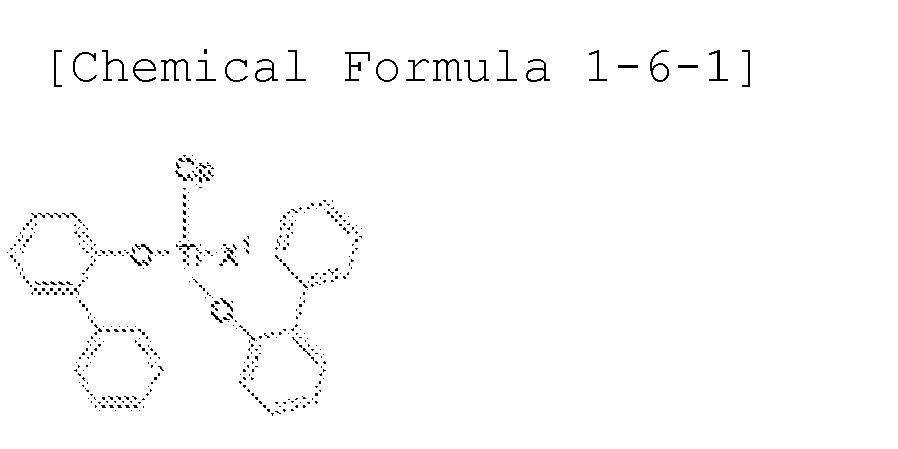
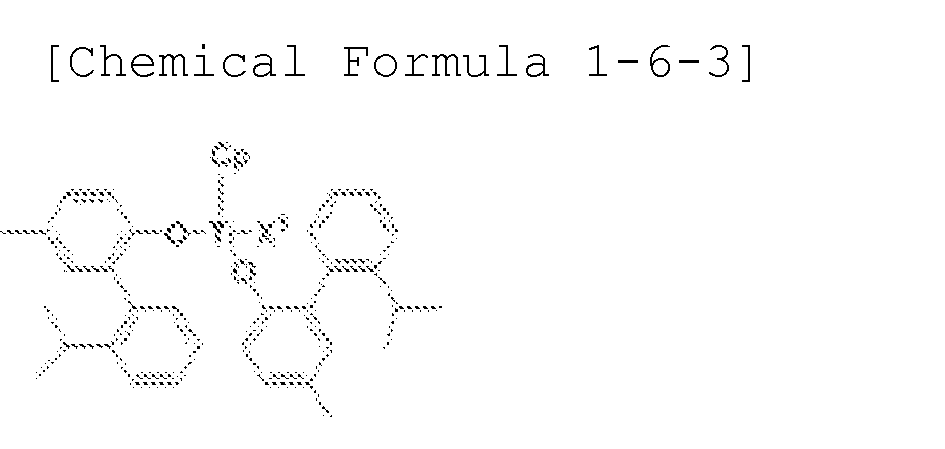
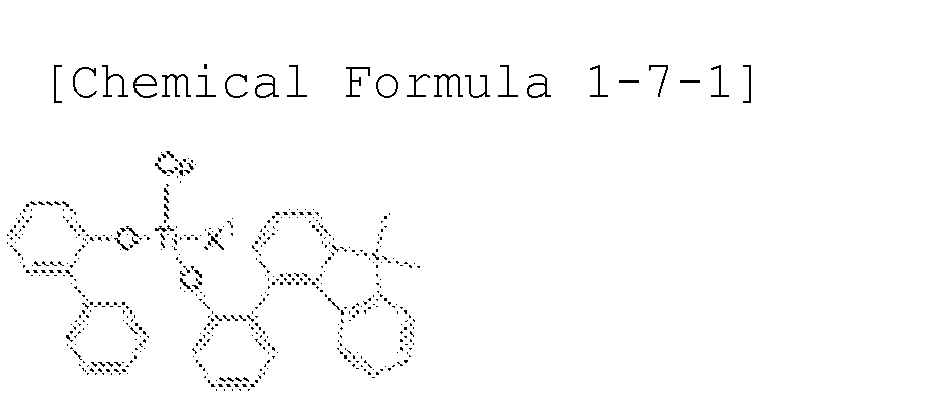
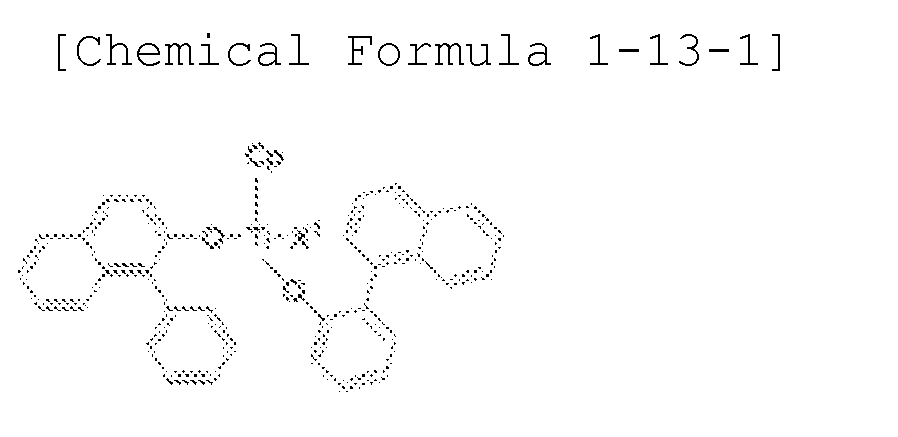
- More specifically, the present invention provides a method of producing ethylene-propylene-diene copolymer, in which the catalyst of transition metal is selected from the following Chemical Formulas:
-

-

-


-

-

-

-
-

-
-

-
-

-

-

-

-

-
-


- wherein, Cp may be η5-bonded with the central metal, Ti, and substituted or unsubstituted fused ring with (C6-C30)ar(C1-C20)alkyl, (C2-C20)alkenyl, (C6-C30)aryl, (C1-C20)alkyl including cyclopentadienyl ring, cyclopentadienyl ring and
- the X1 and X2 is methyl or Cl.
- In order to be an component of active catalyst that can be used for olefin polymerization, the catalyst of transition metal having the above Chemical Formula 1 needs to use the aluminum compound or boron compound, or their mixture as the co-catalyst, in which the aluminum compound or the boron compound can act as a counter ion, i.e., anion, having a weak bonding force, while making the central ion to be cation by extracting X ligand from the compound of transition metal according to the present invention. At this point, used organic aluminum compound is to remove a trace polar material that acts as a catalytic poison in the reaction solvent, but may act as an alkylating agent when X ligand is halogen.
- According to the present invention, the boron compound that can be used as the co-catalyst can be selected from the compounds represented by the following Chemical Formula 2, Chemical Formula 3 or Chemical Formula 4 as shown
US Patent Application No. 5,198,401 . -
[Chemical Formula 2] B(R31)3
-
[Chemical Formula 3] [R32]+[B(R31)4]-
-
[Chemical Formula 4] [(R33)qZH]+[B(R31)4]-
- For Chemical Formula 2 to 4, B is boron atom; R13 is phenyl, and the phenyl may be further substituted with 3 to 5 substituted group selected from the group consisting of substituted or unsubstituted (C1-C20) alkoxy by fluorine atom, substituted or unsubstituted (C1-C20) alkyl by fluorine atom, or fluorine atom; R32 is (C5-C7) cycloalkyl radical or (C1-C20) alkyl (C6-C20) aryl radical, (C6-C30)ar(C1-C20)alkyl radical, for example, triphenylmethyl radical; Z is nitrogen or phosphorous atom; R33 is (C1-C20) alkyl radical or substituted anyilinium radical with two (C1-C4) alkyl groups together with nitrogen atom; and q is an integer of 2 or 3.
- A preferable example of the boron-based co-catalyst may be tris(pentafluorophenyl)borane, tris(2,3,5,6-tetrafluorophenyl)borane, tris(2,3,4,5-tetrafluorophenyl)borane, tris(3,4,5-trifluorophenyl)borane, tris(2,3,4-trifluorophenyl)borane, phenylbis(pentafluorophenyl)borane, tetrakis(pentafluorophenyl)borate, tetrakis(2,3,5,6-tetrafluorophenyl)borate, tetrakis(2,3,4,5-tetrafluorophenyl)borate, tetrakis(3,4,5-tetrafluorophenyl)borate, tetrakis(2,2,4-trifluorophenyl)borate, phenybis(pentafluorophenyl)borate or tetrakis(3,5-bistrifluoromethylphenly)borate. In addition, an example of their specific combination may be ferrocerium tetrakis(pentafluorophenyl)borate, 1,1'-dimethylmerrocerium tetrakis(pentafluorophenyl)borate, silver tetrakis(pentafluorophenyl)borate, triphenylmethyl tetrakis(pentafluorophenyl)borate, triphenylmethyl tetrakis(3,5-bistrifluoromethylphenyl)borate, triethylamonium tetrakis(pentafluorophenyl)borate, triprophylamonium tetrakis(pentafluorophenyl)borate, tri(n-butyl)ammonium tetrakis(pentafluorophenyl)borate, tri(n-butyl)ammonium tetrakis(3,5-bistrifluoromethylphenyl)borate, N,N-dimethylanilinium tetrakis(pentafluorophenyl)borate, N,N-diethylanilinium tetrakis(pentafluorophenyl)borate, N,N-2,4,6-pentamethylanilinium tetrakis(pentafluorophenyl)borate, N,N-dimethylanilinium tetrakis(3,5-bistrifluoromethylphenyl)borate, diisopropylamonium tetrakis(pentafluorophenyl)borate, dicyclohexylamonium tetrakis(pentafluorophenyl)borate, triphenylphosphonium tetrakis(pentafluorophenyl)borate, tri(methylphenyl)phosphonium tetrakis(pentafluorophenyl)borate, or tri(dimethylphenyl)phosphonium tetrakis(pentafluorophenyl) borate, and preferably N,N-dimethylanilinium tetrakispentafluorophenylborate, triphenylmethylinium tetrakispentafluorophenylborate or trispentafluoroborane, and the mole rate of the central metal M : boron atom is preferably 1:0.1∼50, and more preferably 1:0.5∼15.
- As the aluminum compound used for the present invention, the aluminoxane compound of Chemical Formula 5 or Chemical Formula 6, the organic aluminum compound of Chemical Formula 7, or the organic aluminum hydrocarbyloxide compound of Chemical Formula 8 or Chemical Formula 9 can be used.
-
[Chemical Formula 5] (-Al(R41)-O-)m
-
[Chemical Formula 6] (R41)2Al-(-O(R41)-)p-(R41)2
-
[Chemical Formula 7] (R42)r,Al(E)3-r
-
[Chemical Formula 8] (R43)2AlOR44
-
[Chemical Formula 9] R43Al(OR44)2
- For Chemical Formula 5 to Chemical Formula 9, R41 is linear or non-linear (C1-C20)alkyl, preferably methyl or isobutyl, and m and p are an integer of 5 to 20; R42 and R43 are (C1-C20)alkyl; E is hydrogen atom or halogen atom; r is an integer of 1 to 3; and R44 may be selected from the group consisting of (C1-C20)alkyl or (C6-C30)aryl.
- A specific example used for the aluminum compound is methylaluminoxane, improved methylaluminoxane, and tetraisobutylaluminoxane as aluminoxane compound; an example of organic aluminum compound is trialkylaluminum comprising trimethylaluminum, triethylaluminum, tripropyl aluminum, triisobutylalumium, and trihexylaluminum; dialkylaluminumchloride comprising dimethylaluminumchloride, diethylaluminumchloride, dipropylaluminumchloride, diisobutylaluminumchloride, and dihexylaluminumchloride; alkylaluminumdichloride comprising methylaluminumdichloride, ethylaluminumdichloride, propylaluminumdichloride, isobutylaluminumchloride, and hexylaluminumdichloride; and dialkylaluminumhydride comprising dimethylaluminumhydride, diethylaluminumhydride, dipropylaluminumhydride, diisobutylaluminumhydride, and dihexylaluminumhydride, and preferably trialkylaluminum, more preferably triethylaluminum and triisobutylaluminum, and at this point, the mole rate of the central metal M : aluminum atom is preferably 1:1 to 1:2, 000, more preferably 1:5 to 1:1,000.
- In addition, the mole rate of the central metal M : aluminum atom is preferably 1:0.1∼50:1∼1,000, and more preferably 1:0.5∼15:5∼500.
- The ethylene-propylene-diene copolymer produced by the present invention is composed of at least above 30 wt.%, preferably above 40 wt.% ethylene content; at least above 19.9 wt.%, preferably above 30 wt.% propylene content; and more than 0 wt.%, preferably above 0.1 wt.% diene content, based on the sum of propylene content and ethylene content. In addition, the copolymer is composed of at most 80 wt.%, preferably less than 75 wt.% ethylene content; at most 60 wt.%, preferably less than 50 wt.% propylene content; and at most 15 wt.%, preferably less than 12 wt.% diene content, based on the sum of ethylene content and propylene content. The range of the weight average molecule weight (Mw/Mn) of the copolymer is 60, 000 to 600, 000, and the distribution of the molecular weight is 2.0 to 3.0.
- Specifically, when producing the ethylene-propylene-diene copolymer, the pressure in the reactor is 1∼1000 atmosphere, and more preferably 5∼100 atmosphere. In addition, the temperature of the polymerization effectively is 30∼300 °C, and preferable 50∼250 °C.
- Generally, when the solution polymerization is performed at high temperature as motioned above, the deterioration and modification of the catalyst are generated by the increase of the temperature, so that the activity of the catalyst is decreased and the desired polymer having the desired properties is not obtained. However, when producing the ethylene-propylene-diene copolymer according to the present invention, even thought the range of the temperature is 50∼250 °C, the stability of the catalyst may be maintained, and more preferably in the range of 80∼200 °C, the activity of the catalyst is maintained stable.
- As set forth above, according to exemplary embodiments of the invention, for the method of producing the ethylene-propylene-diene copolymer using the metallocene transition catalyst suggested in the present invention, the rate of the propylene relating to the ethylene among EPDM polymer is similar to the rate of Feed monomer as suggested in Example in the following Table 1, so that the reactivity of the propylene is superior. Also, there is scarcely an un-reacted diene, as compared to ENB conversion ratio (73.1%) of Exxon Mobil that is the company of producing metallocene EPDM as [SRI PEP Review 2005-8] document, so that the reactivity of the diene is superior. Therefore, the method according to the present invention can have a high reaction efficiency, and can maintain a high productivity at high temperature of polymerization, as compared to the existed method of producing the ethylene-propylene-diene copolymer, so that the method according to the present invention is an economical method, and is very useful for industry.
- Hereinafter, the present invention will be described in more detail in connection with the exemplary embodiments, but the range of the present invention will not be limited into the following exemplary embodiments.
- The copolymer produced by the method of the present invention has various molecular weights according to the conditions of the production. The molecular weight and the distribution of the molecular weight were measured through a gel chromatography including three-phase mix columns. The used solvent was 1,2,4-trichlorobenzene, and the measure temperature was 120 °C. In order to evaluate the composition of the copolymer, a specimen of film state was prepared by using a press specimen-making machine, and the rate of ethylene and propylene and the content of diene in the specimen was weighted by using an infrared spectrometer.
- [Example 1]
- 1L n-hexan was added to a stainless steel reactor having 2L volume, and then 1.4g improved methyl aluminoxane-7 (AKZO NOVEL, mMAO-7) was injected to the reactor. And then 0.76 of the weight rate of propylene/ethylene adjusting the initial composition was injected until the pressure of the reactor becomes 5kg/Cm2, and then the temperature of the reactor was heated up to 80 °C. The reaction was started by successively injecting 5 uM bis(2-penylphenoxy)(pentamethylcyclopentadienyl)titanium(IV ) methyl and 50 uM triphenyliumtetrakispentafluorophenylborate (99%, Boulder Scientific). When processing the reaction, ethylene and propylene were continuously supplied according to the initial composition, so that the pressure in the reactor was maintained at 5kg/cm 2. Above 20 °C of reaction temperature was increased due to the exothermic reaction when the reaction began to start, and after 15 minutes, the reaction was stopped by injecting oxygen. After the polymerized solution was precipitated in the sufficient acetone solvent, and then recovered, the vacuumed drying was performed for 12 hours at room temperature to yield 40 g polymer. The weight average molecular weight of the polymer was 70,000 (g/mol), and the distribution degree was 2.5. In addition, the ethylene content of the polymer through the infrared spectrometer was 63%.
- [Example 2]
- The same method for Example 1 was used except that 4.1 g 5-ethylidene-2-nobonene (Sigma Adrich) that is a polyene monomer was injected to abtain 96 g polymer. The weight average molecular weight of the polymer was 70,000 (g/mol), and the distribution degree of the polymer was 2.55. In addition, the ethylene content in the polymer through the infrared spectrophotometer was 64 %, and ENB content was 4.5 %.
- [Example 3]
- The same method for Example 2 was used except that the starting temperature of the polymerization was 120 °C, to obtain 90 g polymer. The weight average molecular weight of the polymer was 65, 000 (g/mol), and the distribution degree of the polymer was 2.8. In addition, the ethylene content in the polymer through the infrared spectrophotometer was 66 %, and ENB content was 4.2 %.
- [Example 4]
- The same method for Example 2 was used except that (dichloro)(pentamethylcyclopentadienyl)(2-9',9"-dimethylfl uorene-2' yl) phenoxy) titanium (IV) was used as the main catalyst, to obtain 90 g polymer. The weight average molecular weight of the polymer was 100, 000 (g/mol), and the distribution degree of the polymer was 2.7. In addition, the ethylene content in the polymer through the infrared spectrophotometer was 60 %, and ENB content was 4.2 %.
- [Comparative Example 1]
- 1L n-hexan was added to a stainless steel reactor having 2L volume, and then 2.3g 5-ethylene-2-nobonene (Sigma Adrich) and 400 umol improved ethylaluminumsesquichloride (Sigma Aldrich, EASC) were injected to the reactor. And then 4.60 of the weight rate of propylene/ethylene adjusting the initial composition was injected until the pressure of the reactor becomes 5kg/cm 2, and then the temperature of the reactor was heated up to 50 °C. The reaction was started by successively injecting 127 uM banadiumtrichloride (Sigma Aldrich). When processing the reaction, ethylene and propylene were continuously supplied according to the initial composition, so that the pressure in the reactor was maintained at 5kg/cm 2. Above 7 °C of reaction temperature was increased due to the exothermic reaction when the reaction began to start, and after 15 minutes, the reaction was stopped by injecting ethanol. After the polymerized solution was precipitated in the sufficient acetone solvent, and then recovered, the vacuumed drying was performed for 12 hours at room temperature to yield 13 g polymer. The weight average molecular weight of the polymer was 70, 000 (g/mol), and the distribution degree was 3. 8. In addition, the ethylene content in the polymer through the infrared spectrophotometer was 68 %, and ENB content was 6.5 %.
-
[Table 1] No. Feed monomer EPDM polymer C3/C2 Ratio ENB(g) C3/C2 Ratio ENB Conversion ratio (%) Com. Example 1 4.6 2.1 0.47 37 Example 1 0.76 0 0.59 ··· Example 2 0.76 4.2 0.56 94 Example 3 0.76 4.2 0.52 90 Example 4 0.76 4.2 0.67 90
Claims (12)
- A method of producing an ethylene-propylene-diene copolymer by using a catalyst composition comprising a metallocene catalyst of transition metal of the following Chemical Formula I:
 wherein, M is the transition metal of the fourth group of the periodic table;Cp may be η5-bonded with the central metal, M, and substituted or unsubstituted fused ring with (C6-C30)ar(C1-C20)alkyl, (C2-C20)alkenyl, (C6-C30)aryl, (C1-C20)alkyl including cyclopentadienyl ring, cyclopentadienyl ring, or substituted or unsubstituted cyclopnedienyl anion with (C6-C30)ar(C1-C20)alkyl, (C2-C20)alkenyl, (C6-C30)aryl, (C1-C20)alkyl;R1 to R4 is independently hydrogen atom, halogen atom, (C1-C20)alkyl, (C3-C20)cycloalkyl, (C6-C30)aryl, (C6-C30)ar(C1-C10)alkyl, (C1-C20)alkoxy, (C3-C20)alkylsiloxy, (C6-C30)arylsiloxy, (C1-C20)alkylamino, (C6-C30)arylamino, (C1-C20) alkylthio, (C6-C30)arylthio, nitro, or R1 to R4 may form polycyclic aromatic ring or singlecyclic aromatic ring, and alicyclic ring by bonding (C3-C12) alkylene or (C3-C12) alkenyl with/without fused ring with adjacent substitutes;Ar1 is (C6-C30)aryl, or (C3-C30)heteroaryl comprising at least one selected from the group consisting of N, O, and S;X1 and X2 are independently selected from the group consisting of halogen atom, (C1-C20) alkyl, (C3-C20) cyclo alkyl, (C6-C30)ar(C1-C20)alkyl, (C1-C20)alkoxy, (C3-C20)alkylsiloxy, (C6-C30)arylsiloxy, (C1-C20)alkylamino, (C6-C30)arylamino, (C1-C20)alkylthio, (C6-C30)arylthio, and
 R11, R12, R13, and R14 are independently hydrogen atom, halogen atom, (C1-C20)alkyl, (C3-C20)cycloalkyl, (C6-C30)aryl, (C6-C30)ar(C1-C10)alkyl, (C1-C20)alkoxy, (C3-C20)alkylsiloxy, (C6-C30)arylsiloxy, (C1-C20)alkylamino, (C6-C30)arylamino, (C1-C20) alkylthio, (C6-C30)arylthio, nitro, or R11 to R14 may form polycyclic aromatic ring or singlecyclic aromatic ring, and alicyclic ring by bonding (C3-C12)alkylene or (C3-C12)alkenylene with/without fused ring with adjacent substitutes;Ar11 is (C6-C30) aryl, or (C3-C30)heteroaryl comprising at least one selected from the group consisting of N, O, and S; andthe alkyl, aryl, cycloalkyl, aralkyl, alkoxy, alkylsiloxy, arylsiloxy, alkylamino, arylamino, alkylthio, and arylthio of the R1 to R4, R11 to R14, and X1 and X2, and the aryl or hetero aryl of Ar1 and Ar11 may be further substituted with hydrogen atom, (C1-C20)alkyl, (C3-C20)cycloalkyl, (C6-C30)aryl, (C6-C30)ar(C1-C10)alkyl, (C1-C20)alkoxy, (C3-C20)alkylsiloxy, (C6-C30)arylsiloxy, (C1-C20)alkylamino, (C6-C30)arylamino, (C1-C20)alkylthio, (C6-C30)arylthio, nitro or hydroxy.
 - The method of producing the ethylene-propylene-diene copolymer of claim 1, wherein M of the transition catalyst of the above Chemical Formula I is Ti, Zr or Hf.
- The method of producing the ethylene-propylene-diene copolymer of claim 2, wherein the catalyst of transition metal is selected from the group consisting of the following Chemical Formulas:


 wherein, R21 to R26 may be independently hydrogen atom, halogen atom, (C1-C20)alkyl, (C3-C20)cycloalkyl, (C6-C30)aryl, (C6-C30)ar(C1-C10)alkyl, (C1-C20)alkoxy, (C3-C20)alkylsiloxy, (C6-C30)arylsiloxy, (C1-C20)alkylamino, (C6-C30)arylamino, (C1-C20) alkylthio, (C6-C30) arylthio, or nitro, or R21 to R26 may form polycyclic aromatic ring or singlecyclic aromatic ring, and alicyclic ring by bonding (C3-C12)alkylene or (C3-C12)alkenylene with/without fused ring with adjacent substitutes; the alkyl, aryl, cycloalkyl, aralkyl, alkoxy, alkylsiloxy, arylsiloxy, alkylamino, arylamino, alkylthio, and arylthio of the R21 to R26 may be further substituted with hydrogen atom, (C1-C20)alkyl, (C3-C20)cycloalkyl, (C6-C30)aryl, (C6-C30)ar(C1-C10)alkyl, (C1-C20)alkoxy, (C3-C20)alkylsiloxy, (C6-C30)arylsiloxy, (C1-C20)alkylamino, (C6-C30)arylamino, (C1-C20)alkylthio, (C6-C30)arylthio, nitro or hydroxy;Cp may be η5-bonded with the central metal, Ti and substituted or unsubstituted fused ring with (C6-C30)ar(C1-C20)alkyl, (C2-C20)alkenyl, (C6-C30)aryl, (C1-C20)alkyl including cyclopentadienyl ring, cyclopentadienyl ring, or substituted or unsubstituted cyclopnedienyl anion with (C6-C30)ar(C1-C20)alkyl, (C2-C20)alkenyl, (C6-C30)aryl, (C1-C20)alkyl; andthe X1 and X2 is methyl or Cl.
 - The method of producing the ethylene-propylene-diene copolymer of claim 3, wherein the catalyst of transition metal is selected from the group consisting of the following Chemical Formulas:
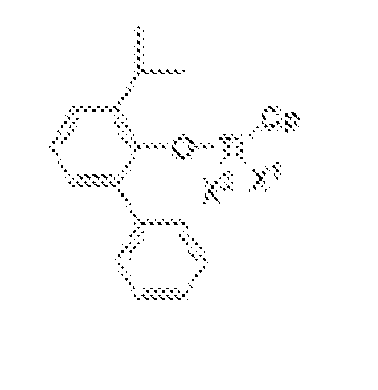


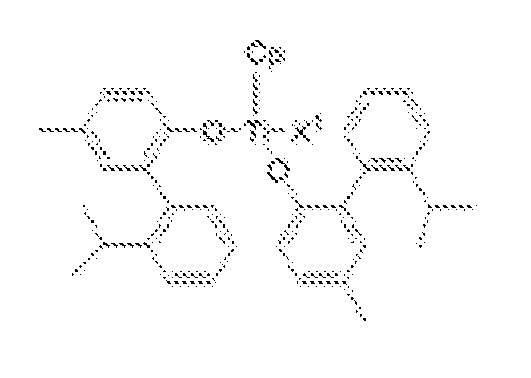


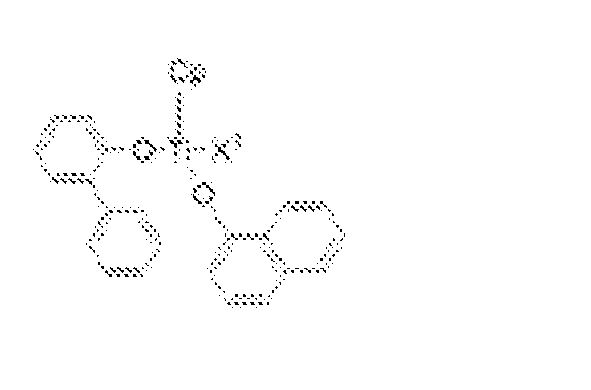


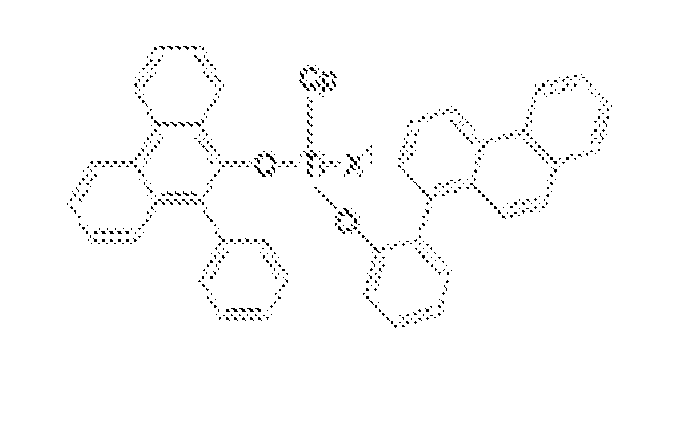 wherein, Cp may be η5-bonded with the central metal, Ti, and substituted or unsubstituted fused ring with (C6-C30)ar(C1-C20)alkyl, (C2-C20)alkenyl, (C6-C30)aryl, (C1-C20)alkyl including cyclopentadienyl ring, cyclopentadienyl ring, or substituted or unsubstituted cyclopnedienyl anion with (C6-C30)ar(C1-C20)alkyl, (C2-C20)alkenyl, (C6-C30)aryl, (C1-C20)alkyl; andthe X1 and X2 is methyl or Cl.
 - The method of producing the ethylene-propylene-diene copolymer of claim 3, wherein the ethylene content is 30∼80 wt.%.
- The method of producing the ethylene-propylene-diene copolymer of claim 3, wherein the propylene content is 19.9∼60 wt.%.
- The method of producing the ethylene-propylene-diene copolymer of claim 3, wherein the polyene content having a double bonding of non-resonance structure is above 0 to less than 15 wt.%.
- The method of producing the ethylene-propylene-diene copolymer of claim 7, wherein the polyene content having a double bonding of non-resonance structure is 0.1∼15 wt.%.
- The method of producing the ethylene-propylene-diene copolymer of claim 3, wherein the reaction pressure is 5∼100 atmosphere, and the temperature of polymerization is 50∼250 °C.
- The method of producing the ethylene-propylene-diene copolymer of claim 4, wherein the catalyst composition includes the metallocene catalyst of transition metal; and a co-polymer selected from the group consisting of aluminoxane compound, organic aluminum compound, boron compound, and their mixture.
- The method of producing the ethylene-propylene-diene copolymer of claim 10, wherein the ratio of the metallocene catalyst of transition metal and the co-polymer1:0.5∼15:5∼500 based on the mole ratio of the transition metal M : boron atom : aluminum atom.
- The method of producing the ethylene-propylene-diene copolymer of claim 4, wherein the weight average molecular weight of the copolymer is 60,000 to 600,000, and the distribution of the molecular weight (Mw/Mn) is 2.0 to 3.0.
Applications Claiming Priority (2)
| Application Number | Priority Date | Filing Date | Title |
|---|---|---|---|
| KR1020090000748A KR101149755B1 (en) | 2009-01-06 | 2009-01-06 | The Manufacture of Ethylene-Propylene-Diene Copolymer |
| PCT/KR2009/007643 WO2010079906A2 (en) | 2009-01-06 | 2009-12-21 | Ethylene-propylene-diene copolymer production method |
Publications (3)
| Publication Number | Publication Date |
|---|---|
| EP2377894A2 true EP2377894A2 (en) | 2011-10-19 |
| EP2377894A4 EP2377894A4 (en) | 2013-04-03 |
| EP2377894B1 EP2377894B1 (en) | 2015-08-19 |
Family
ID=42316946
Family Applications (1)
| Application Number | Title | Priority Date | Filing Date |
|---|---|---|---|
| EP09837667.6A Active EP2377894B1 (en) | 2009-01-06 | 2009-12-21 | Ethylene-propylene-diene copolymer production method |
Country Status (6)
| Country | Link |
|---|---|
| US (1) | US8222361B2 (en) |
| EP (1) | EP2377894B1 (en) |
| JP (1) | JP5372172B2 (en) |
| KR (1) | KR101149755B1 (en) |
| CN (1) | CN102046670B (en) |
| WO (1) | WO2010079906A2 (en) |
Families Citing this family (8)
| Publication number | Priority date | Publication date | Assignee | Title |
|---|---|---|---|---|
| US7929950B1 (en) | 1996-12-16 | 2011-04-19 | Ip Holdings, Inc. | Dynamically configurable IP based wireless device and wireless networks |
| KR101391692B1 (en) | 2012-11-14 | 2014-05-07 | 주식회사 엘지화학 | Elastic terpolymer and preparation method thereof |
| KR101585204B1 (en) * | 2013-06-28 | 2016-01-13 | 주식회사 엘지화학 | Elastic diene terpolymer and preparation method thereof |
| EP2883889A4 (en) | 2013-06-28 | 2016-06-01 | Lg Chemical Ltd | Trinary elastic copolymer comprising diene and method for preparing same |
| IN2015DN02232A (en) | 2013-06-28 | 2015-08-21 | Lg Chemical Ltd | |
| WO2014209084A1 (en) | 2013-06-28 | 2014-12-31 | 주식회사 엘지화학 | Trinary elastic copolymer comprising diene and method for preparing same |
| US9382361B2 (en) | 2014-03-21 | 2016-07-05 | Exxonmobil Chemical Patents Inc. | Process to produce ethylene propylene copolymers |
| KR20250117854A (en) | 2024-01-29 | 2025-08-05 | 에쓰대시오일 주식회사 | Half sandwich metallocene catalyst for polyolefin polymerization and method for preparing the same |
Family Cites Families (15)
| Publication number | Priority date | Publication date | Assignee | Title |
|---|---|---|---|---|
| US5198401A (en) | 1987-01-30 | 1993-03-30 | Exxon Chemical Patents Inc. | Ionic metallocene catalyst compositions |
| CA2208689C (en) * | 1994-12-26 | 2002-02-05 | Hidenari Nakahama | Chain polyene group-containing norbornene compound and unsaturated ethylene copolymer using the same |
| EP1498178B1 (en) * | 1995-07-14 | 2008-06-11 | Sumitomo Chemical Company, Limited | Transition metal complex and process for producing the same |
| DE69909757T2 (en) * | 1998-02-17 | 2004-04-15 | Exxonmobil Chemical Patents Inc., Baytown | ETHYLENCOPOLYMERISATIONSVERFAHREN |
| US6011128A (en) | 1998-06-17 | 2000-01-04 | Union Carbide Chemicals & Plastics Technology Corporation | Process for conditioning a gas-phase reactor to produce an ethylene-propylene or ethylene-propylene-diene rubber |
| JP2003231693A (en) * | 2002-02-04 | 2003-08-19 | Kanto Chem Co Inc | Method for producing aryloxymetallocene compound |
| JP4062929B2 (en) * | 2002-02-08 | 2008-03-19 | 住友化学株式会社 | Transition metal complex, ligand, catalyst for olefin polymerization, and method for producing olefin polymer |
| JP2005314504A (en) * | 2004-04-28 | 2005-11-10 | Asahi Kasei Chemicals Corp | Process for producing ethylene / α-olefins / non-conjugated diene copolymer |
| KR100639696B1 (en) * | 2005-07-01 | 2006-10-30 | 에스케이 주식회사 | Arylphenoxy Catalyst System for Making Ethylene Homopolymer or Copolymer with α-olefin |
| KR101141359B1 (en) * | 2005-09-09 | 2012-05-03 | 에스케이이노베이션 주식회사 | Homogeneous catalyst system for producing ethylene homopolymer or ethylene copolymers with ?-olefins |
| KR101060838B1 (en) * | 2006-04-24 | 2011-08-30 | 에스케이이노베이션 주식회사 | Bis-arylaryloxy catalyst system for preparing ethylene homopolymer or copolymer with α-olefin |
| US20070255022A1 (en) * | 2006-04-28 | 2007-11-01 | Fina Technology, Inc. | Fluorinated transition metal catalysts and formation thereof |
| EP2024402B2 (en) | 2006-05-17 | 2023-01-25 | Dow Global Technologies LLC | High temperature solution polymerization process |
| CN100475852C (en) * | 2006-05-23 | 2009-04-08 | 中国石油天然气股份有限公司 | Olefin polymerization method |
| JP5229636B2 (en) * | 2006-10-18 | 2013-07-03 | エスケー イノベーション カンパニー リミテッド | Arylphenoxy catalyst system for the production of ethylene homopolymers or copolymers of ethylene and α-olefins |
-
2009
- 2009-01-06 KR KR1020090000748A patent/KR101149755B1/en active Active
- 2009-12-21 EP EP09837667.6A patent/EP2377894B1/en active Active
- 2009-12-21 WO PCT/KR2009/007643 patent/WO2010079906A2/en not_active Ceased
- 2009-12-21 JP JP2011544359A patent/JP5372172B2/en active Active
- 2009-12-21 US US12/991,818 patent/US8222361B2/en active Active
- 2009-12-21 CN CN200980119987.6A patent/CN102046670B/en active Active
Also Published As
| Publication number | Publication date |
|---|---|
| JP2012514663A (en) | 2012-06-28 |
| US20110065877A1 (en) | 2011-03-17 |
| EP2377894A4 (en) | 2013-04-03 |
| CN102046670A (en) | 2011-05-04 |
| KR20100081485A (en) | 2010-07-15 |
| EP2377894B1 (en) | 2015-08-19 |
| WO2010079906A2 (en) | 2010-07-15 |
| KR101149755B1 (en) | 2012-06-01 |
| WO2010079906A3 (en) | 2010-08-26 |
| CN102046670B (en) | 2014-08-27 |
| US8222361B2 (en) | 2012-07-17 |
| JP5372172B2 (en) | 2013-12-18 |
Similar Documents
| Publication | Publication Date | Title |
|---|---|---|
| EP2377894B1 (en) | Ethylene-propylene-diene copolymer production method | |
| EP2344552B1 (en) | Method for preparing elastomeric copolymers of ethylene and alpha-olefins | |
| EP2516491B1 (en) | Ti catalyst system comprising substituted cyclopentadienyl, amidine and diene ligand | |
| EP2225251B1 (en) | Transition metal complexes, catalysts composition containing the same, and process for preparing ethylene homopolymers or copolymers of ethylene and alpha-olefins using the same | |
| KR101889978B1 (en) | new transition metal complex with annulated ring substituted arylphenoxy ligand, catalyst composition containing the same for olefin copolymerization and methods for preparing copolymers of ethylene and α-olefins or copolymers of ethylene and olefin-diene using the same | |
| EP3689884B1 (en) | Novel indene-based transition metal compound, transition metal catalyst composition comprising same, and method for preparing ethylene homopolymer or copolymer of ethylene and alpha-olefin by using same | |
| EP2077269B1 (en) | Transition metal complexes, catalyst compositions containing the same, and methods for preparing ethylene polymers using the same | |
| EP2087011B1 (en) | Transition metal catalytic systems and methods for preparing ethylene homopolymers or copolymers of ethylene and olefins using the same | |
| US20130066028A1 (en) | Borane activated ti catalyst system comprising amidine and diene ligand | |
| KR101142122B1 (en) | New transition metal catalytic systems and methods for preparing ethylene homopolymers or copolymers of ethylene and ?-olefins using the same | |
| JP5441407B2 (en) | Homogeneous catalyst system for ethylene homopolymer or ethylene and α-olefin copolymer production | |
| US8436113B2 (en) | Ethylene alpha olefin polymer formed by use of metallocene catalyst | |
| CA2621307A1 (en) | Homogeneous catalyst system for producing ethylene homopolymer or ethylene copolymers with alpha-olefins |
Legal Events
| Date | Code | Title | Description |
|---|---|---|---|
| PUAI | Public reference made under article 153(3) epc to a published international application that has entered the european phase |
Free format text: ORIGINAL CODE: 0009012 |
|
| 17P | Request for examination filed |
Effective date: 20110712 |
|
| AK | Designated contracting states |
Kind code of ref document: A2 Designated state(s): AT BE BG CH CY CZ DE DK EE ES FI FR GB GR HR HU IE IS IT LI LT LU LV MC MK MT NL NO PL PT RO SE SI SK SM TR |
|
| DAX | Request for extension of the european patent (deleted) | ||
| RAP1 | Party data changed (applicant data changed or rights of an application transferred) |
Owner name: SK GLOBAL CHEMICAL CO., LTD. Owner name: SK INNOVATION CO., LTD. |
|
| RAP1 | Party data changed (applicant data changed or rights of an application transferred) |
Owner name: SK GLOBAL CHEMICAL CO., LTD. Owner name: SK INNOVATION CO., LTD. |
|
| RIC1 | Information provided on ipc code assigned before grant |
Ipc: C08F 4/6592 20060101ALI20130221BHEP Ipc: C08F 210/12 20060101AFI20130221BHEP |
|
| A4 | Supplementary search report drawn up and despatched |
Effective date: 20130305 |
|
| 17Q | First examination report despatched |
Effective date: 20131030 |
|
| GRAP | Despatch of communication of intention to grant a patent |
Free format text: ORIGINAL CODE: EPIDOSNIGR1 |
|
| GRAJ | Information related to disapproval of communication of intention to grant by the applicant or resumption of examination proceedings by the epo deleted |
Free format text: ORIGINAL CODE: EPIDOSDIGR1 |
|
| GRAP | Despatch of communication of intention to grant a patent |
Free format text: ORIGINAL CODE: EPIDOSNIGR1 |
|
| INTG | Intention to grant announced |
Effective date: 20150305 |
|
| INTG | Intention to grant announced |
Effective date: 20150317 |
|
| GRAS | Grant fee paid |
Free format text: ORIGINAL CODE: EPIDOSNIGR3 |
|
| GRAA | (expected) grant |
Free format text: ORIGINAL CODE: 0009210 |
|
| AK | Designated contracting states |
Kind code of ref document: B1 Designated state(s): AT BE BG CH CY CZ DE DK EE ES FI FR GB GR HR HU IE IS IT LI LT LU LV MC MK MT NL NO PL PT RO SE SI SK SM TR |
|
| REG | Reference to a national code |
Ref country code: GB Ref legal event code: FG4D |
|
| REG | Reference to a national code |
Ref country code: CH Ref legal event code: EP |
|
| REG | Reference to a national code |
Ref country code: IE Ref legal event code: FG4D |
|
| REG | Reference to a national code |
Ref country code: AT Ref legal event code: REF Ref document number: 743780 Country of ref document: AT Kind code of ref document: T Effective date: 20150915 |
|
| REG | Reference to a national code |
Ref country code: DE Ref legal event code: R096 Ref document number: 602009033081 Country of ref document: DE |
|
| REG | Reference to a national code |
Ref country code: NL Ref legal event code: FP |
|
| REG | Reference to a national code |
Ref country code: FR Ref legal event code: PLFP Year of fee payment: 7 |
|
| REG | Reference to a national code |
Ref country code: AT Ref legal event code: MK05 Ref document number: 743780 Country of ref document: AT Kind code of ref document: T Effective date: 20150819 |
|
| REG | Reference to a national code |
Ref country code: LT Ref legal event code: MG4D |
|
| PG25 | Lapsed in a contracting state [announced via postgrant information from national office to epo] |
Ref country code: LV Free format text: LAPSE BECAUSE OF FAILURE TO SUBMIT A TRANSLATION OF THE DESCRIPTION OR TO PAY THE FEE WITHIN THE PRESCRIBED TIME-LIMIT Effective date: 20150819 Ref country code: GR Free format text: LAPSE BECAUSE OF FAILURE TO SUBMIT A TRANSLATION OF THE DESCRIPTION OR TO PAY THE FEE WITHIN THE PRESCRIBED TIME-LIMIT Effective date: 20151120 Ref country code: FI Free format text: LAPSE BECAUSE OF FAILURE TO SUBMIT A TRANSLATION OF THE DESCRIPTION OR TO PAY THE FEE WITHIN THE PRESCRIBED TIME-LIMIT Effective date: 20150819 Ref country code: LT Free format text: LAPSE BECAUSE OF FAILURE TO SUBMIT A TRANSLATION OF THE DESCRIPTION OR TO PAY THE FEE WITHIN THE PRESCRIBED TIME-LIMIT Effective date: 20150819 Ref country code: NO Free format text: LAPSE BECAUSE OF FAILURE TO SUBMIT A TRANSLATION OF THE DESCRIPTION OR TO PAY THE FEE WITHIN THE PRESCRIBED TIME-LIMIT Effective date: 20151119 |
|
| PG25 | Lapsed in a contracting state [announced via postgrant information from national office to epo] |
Ref country code: PT Free format text: LAPSE BECAUSE OF FAILURE TO SUBMIT A TRANSLATION OF THE DESCRIPTION OR TO PAY THE FEE WITHIN THE PRESCRIBED TIME-LIMIT Effective date: 20151221 Ref country code: PL Free format text: LAPSE BECAUSE OF FAILURE TO SUBMIT A TRANSLATION OF THE DESCRIPTION OR TO PAY THE FEE WITHIN THE PRESCRIBED TIME-LIMIT Effective date: 20150819 Ref country code: ES Free format text: LAPSE BECAUSE OF FAILURE TO SUBMIT A TRANSLATION OF THE DESCRIPTION OR TO PAY THE FEE WITHIN THE PRESCRIBED TIME-LIMIT Effective date: 20150819 Ref country code: AT Free format text: LAPSE BECAUSE OF FAILURE TO SUBMIT A TRANSLATION OF THE DESCRIPTION OR TO PAY THE FEE WITHIN THE PRESCRIBED TIME-LIMIT Effective date: 20150819 Ref country code: SE Free format text: LAPSE BECAUSE OF FAILURE TO SUBMIT A TRANSLATION OF THE DESCRIPTION OR TO PAY THE FEE WITHIN THE PRESCRIBED TIME-LIMIT Effective date: 20150819 Ref country code: IS Free format text: LAPSE BECAUSE OF FAILURE TO SUBMIT A TRANSLATION OF THE DESCRIPTION OR TO PAY THE FEE WITHIN THE PRESCRIBED TIME-LIMIT Effective date: 20151219 |
|
| PG25 | Lapsed in a contracting state [announced via postgrant information from national office to epo] |
Ref country code: DK Free format text: LAPSE BECAUSE OF FAILURE TO SUBMIT A TRANSLATION OF THE DESCRIPTION OR TO PAY THE FEE WITHIN THE PRESCRIBED TIME-LIMIT Effective date: 20150819 Ref country code: EE Free format text: LAPSE BECAUSE OF FAILURE TO SUBMIT A TRANSLATION OF THE DESCRIPTION OR TO PAY THE FEE WITHIN THE PRESCRIBED TIME-LIMIT Effective date: 20150819 Ref country code: CZ Free format text: LAPSE BECAUSE OF FAILURE TO SUBMIT A TRANSLATION OF THE DESCRIPTION OR TO PAY THE FEE WITHIN THE PRESCRIBED TIME-LIMIT Effective date: 20150819 Ref country code: SK Free format text: LAPSE BECAUSE OF FAILURE TO SUBMIT A TRANSLATION OF THE DESCRIPTION OR TO PAY THE FEE WITHIN THE PRESCRIBED TIME-LIMIT Effective date: 20150819 Ref country code: IT Free format text: LAPSE BECAUSE OF FAILURE TO SUBMIT A TRANSLATION OF THE DESCRIPTION OR TO PAY THE FEE WITHIN THE PRESCRIBED TIME-LIMIT Effective date: 20150819 |
|
| REG | Reference to a national code |
Ref country code: DE Ref legal event code: R097 Ref document number: 602009033081 Country of ref document: DE |
|
| PG25 | Lapsed in a contracting state [announced via postgrant information from national office to epo] |
Ref country code: BE Free format text: LAPSE BECAUSE OF NON-PAYMENT OF DUE FEES Effective date: 20151231 Ref country code: RO Free format text: LAPSE BECAUSE OF FAILURE TO SUBMIT A TRANSLATION OF THE DESCRIPTION OR TO PAY THE FEE WITHIN THE PRESCRIBED TIME-LIMIT Effective date: 20150819 |
|
| PLBE | No opposition filed within time limit |
Free format text: ORIGINAL CODE: 0009261 |
|
| STAA | Information on the status of an ep patent application or granted ep patent |
Free format text: STATUS: NO OPPOSITION FILED WITHIN TIME LIMIT |
|
| REG | Reference to a national code |
Ref country code: DE Ref legal event code: R119 Ref document number: 602009033081 Country of ref document: DE |
|
| 26N | No opposition filed |
Effective date: 20160520 |
|
| PG25 | Lapsed in a contracting state [announced via postgrant information from national office to epo] |
Ref country code: LU Free format text: LAPSE BECAUSE OF FAILURE TO SUBMIT A TRANSLATION OF THE DESCRIPTION OR TO PAY THE FEE WITHIN THE PRESCRIBED TIME-LIMIT Effective date: 20151221 Ref country code: MC Free format text: LAPSE BECAUSE OF FAILURE TO SUBMIT A TRANSLATION OF THE DESCRIPTION OR TO PAY THE FEE WITHIN THE PRESCRIBED TIME-LIMIT Effective date: 20150819 |
|
| REG | Reference to a national code |
Ref country code: CH Ref legal event code: PL |
|
| GBPC | Gb: european patent ceased through non-payment of renewal fee |
Effective date: 20151221 |
|
| PG25 | Lapsed in a contracting state [announced via postgrant information from national office to epo] |
Ref country code: SI Free format text: LAPSE BECAUSE OF FAILURE TO SUBMIT A TRANSLATION OF THE DESCRIPTION OR TO PAY THE FEE WITHIN THE PRESCRIBED TIME-LIMIT Effective date: 20150819 |
|
| REG | Reference to a national code |
Ref country code: IE Ref legal event code: MM4A |
|
| REG | Reference to a national code |
Ref country code: FR Ref legal event code: PLFP Year of fee payment: 8 |
|
| PG25 | Lapsed in a contracting state [announced via postgrant information from national office to epo] |
Ref country code: DE Free format text: LAPSE BECAUSE OF NON-PAYMENT OF DUE FEES Effective date: 20160701 Ref country code: GB Free format text: LAPSE BECAUSE OF NON-PAYMENT OF DUE FEES Effective date: 20151221 Ref country code: CH Free format text: LAPSE BECAUSE OF NON-PAYMENT OF DUE FEES Effective date: 20151231 Ref country code: IE Free format text: LAPSE BECAUSE OF NON-PAYMENT OF DUE FEES Effective date: 20151221 Ref country code: LI Free format text: LAPSE BECAUSE OF NON-PAYMENT OF DUE FEES Effective date: 20151231 |
|
| PG25 | Lapsed in a contracting state [announced via postgrant information from national office to epo] |
Ref country code: BE Free format text: LAPSE BECAUSE OF FAILURE TO SUBMIT A TRANSLATION OF THE DESCRIPTION OR TO PAY THE FEE WITHIN THE PRESCRIBED TIME-LIMIT Effective date: 20150819 |
|
| PG25 | Lapsed in a contracting state [announced via postgrant information from national office to epo] |
Ref country code: HU Free format text: LAPSE BECAUSE OF FAILURE TO SUBMIT A TRANSLATION OF THE DESCRIPTION OR TO PAY THE FEE WITHIN THE PRESCRIBED TIME-LIMIT; INVALID AB INITIO Effective date: 20091221 Ref country code: SM Free format text: LAPSE BECAUSE OF FAILURE TO SUBMIT A TRANSLATION OF THE DESCRIPTION OR TO PAY THE FEE WITHIN THE PRESCRIBED TIME-LIMIT Effective date: 20150819 Ref country code: BG Free format text: LAPSE BECAUSE OF FAILURE TO SUBMIT A TRANSLATION OF THE DESCRIPTION OR TO PAY THE FEE WITHIN THE PRESCRIBED TIME-LIMIT Effective date: 20150819 |
|
| PG25 | Lapsed in a contracting state [announced via postgrant information from national office to epo] |
Ref country code: CY Free format text: LAPSE BECAUSE OF FAILURE TO SUBMIT A TRANSLATION OF THE DESCRIPTION OR TO PAY THE FEE WITHIN THE PRESCRIBED TIME-LIMIT Effective date: 20150819 |
|
| PG25 | Lapsed in a contracting state [announced via postgrant information from national office to epo] |
Ref country code: HR Free format text: LAPSE BECAUSE OF FAILURE TO SUBMIT A TRANSLATION OF THE DESCRIPTION OR TO PAY THE FEE WITHIN THE PRESCRIBED TIME-LIMIT Effective date: 20150819 |
|
| PG25 | Lapsed in a contracting state [announced via postgrant information from national office to epo] |
Ref country code: MT Free format text: LAPSE BECAUSE OF FAILURE TO SUBMIT A TRANSLATION OF THE DESCRIPTION OR TO PAY THE FEE WITHIN THE PRESCRIBED TIME-LIMIT Effective date: 20150819 Ref country code: TR Free format text: LAPSE BECAUSE OF FAILURE TO SUBMIT A TRANSLATION OF THE DESCRIPTION OR TO PAY THE FEE WITHIN THE PRESCRIBED TIME-LIMIT Effective date: 20150819 |
|
| REG | Reference to a national code |
Ref country code: FR Ref legal event code: PLFP Year of fee payment: 9 |
|
| PG25 | Lapsed in a contracting state [announced via postgrant information from national office to epo] |
Ref country code: MK Free format text: LAPSE BECAUSE OF FAILURE TO SUBMIT A TRANSLATION OF THE DESCRIPTION OR TO PAY THE FEE WITHIN THE PRESCRIBED TIME-LIMIT Effective date: 20150819 |
|
| REG | Reference to a national code |
Ref country code: FR Ref legal event code: PLFP Year of fee payment: 10 |
|
| REG | Reference to a national code |
Ref country code: NL Ref legal event code: HC Owner name: SK GEO CENTRIC CO., LTD.; KR Free format text: DETAILS ASSIGNMENT: CHANGE OF OWNER(S), CHANGE OF OWNER(S) NAME; FORMER OWNER NAME: SK INNOVATION CO., LTD. Effective date: 20220729 |
|
| P01 | Opt-out of the competence of the unified patent court (upc) registered |
Effective date: 20230622 |
|
| PGFP | Annual fee paid to national office [announced via postgrant information from national office to epo] |
Ref country code: NL Payment date: 20251002 Year of fee payment: 17 |
|
| PGFP | Annual fee paid to national office [announced via postgrant information from national office to epo] |
Ref country code: FR Payment date: 20251001 Year of fee payment: 17 |