EP2377331B1 - Hörgerät-hörkapsel und verfahren zum herstellen einer hörgerät-hörkapsel - Google Patents
Hörgerät-hörkapsel und verfahren zum herstellen einer hörgerät-hörkapsel Download PDFInfo
- Publication number
- EP2377331B1 EP2377331B1 EP08875444.5A EP08875444A EP2377331B1 EP 2377331 B1 EP2377331 B1 EP 2377331B1 EP 08875444 A EP08875444 A EP 08875444A EP 2377331 B1 EP2377331 B1 EP 2377331B1
- Authority
- EP
- European Patent Office
- Prior art keywords
- hearing aid
- sound conduit
- sound
- earpiece
- aid earpiece
- Prior art date
- Legal status (The legal status is an assumption and is not a legal conclusion. Google has not performed a legal analysis and makes no representation as to the accuracy of the status listed.)
- Active
Links
Images


Classifications
-
- H—ELECTRICITY
- H04—ELECTRIC COMMUNICATION TECHNIQUE
- H04R—LOUDSPEAKERS, MICROPHONES, GRAMOPHONE PICK-UPS OR LIKE ACOUSTIC ELECTROMECHANICAL TRANSDUCERS; ELECTRIC HEARING AIDS; PUBLIC ADDRESS SYSTEMS
- H04R25/00—Electric hearing aids
-
- H—ELECTRICITY
- H04—ELECTRIC COMMUNICATION TECHNIQUE
- H04R—LOUDSPEAKERS, MICROPHONES, GRAMOPHONE PICK-UPS OR LIKE ACOUSTIC ELECTROMECHANICAL TRANSDUCERS; ELECTRIC HEARING AIDS; PUBLIC ADDRESS SYSTEMS
- H04R25/00—Electric hearing aids
- H04R25/65—Housing parts, e.g. shells, tips or moulds, or their manufacture
- H04R25/652—Ear tips; Ear moulds
-
- B—PERFORMING OPERATIONS; TRANSPORTING
- B33—ADDITIVE MANUFACTURING TECHNOLOGY
- B33Y—ADDITIVE MANUFACTURING, i.e. MANUFACTURING OF THREE-DIMENSIONAL [3D] OBJECTS BY ADDITIVE DEPOSITION, ADDITIVE AGGLOMERATION OR ADDITIVE LAYERING, e.g. BY 3D PRINTING, STEREOLITHOGRAPHY OR SELECTIVE LASER SINTERING
- B33Y10/00—Processes of additive manufacturing
-
- B—PERFORMING OPERATIONS; TRANSPORTING
- B33—ADDITIVE MANUFACTURING TECHNOLOGY
- B33Y—ADDITIVE MANUFACTURING, i.e. MANUFACTURING OF THREE-DIMENSIONAL [3D] OBJECTS BY ADDITIVE DEPOSITION, ADDITIVE AGGLOMERATION OR ADDITIVE LAYERING, e.g. BY 3D PRINTING, STEREOLITHOGRAPHY OR SELECTIVE LASER SINTERING
- B33Y50/00—Data acquisition or data processing for additive manufacturing
-
- B—PERFORMING OPERATIONS; TRANSPORTING
- B33—ADDITIVE MANUFACTURING TECHNOLOGY
- B33Y—ADDITIVE MANUFACTURING, i.e. MANUFACTURING OF THREE-DIMENSIONAL [3D] OBJECTS BY ADDITIVE DEPOSITION, ADDITIVE AGGLOMERATION OR ADDITIVE LAYERING, e.g. BY 3D PRINTING, STEREOLITHOGRAPHY OR SELECTIVE LASER SINTERING
- B33Y80/00—Products made by additive manufacturing
-
- H—ELECTRICITY
- H04—ELECTRIC COMMUNICATION TECHNIQUE
- H04R—LOUDSPEAKERS, MICROPHONES, GRAMOPHONE PICK-UPS OR LIKE ACOUSTIC ELECTROMECHANICAL TRANSDUCERS; ELECTRIC HEARING AIDS; PUBLIC ADDRESS SYSTEMS
- H04R25/00—Electric hearing aids
- H04R25/48—Electric hearing aids using constructional means for obtaining a desired frequency response
-
- H—ELECTRICITY
- H04—ELECTRIC COMMUNICATION TECHNIQUE
- H04R—LOUDSPEAKERS, MICROPHONES, GRAMOPHONE PICK-UPS OR LIKE ACOUSTIC ELECTROMECHANICAL TRANSDUCERS; ELECTRIC HEARING AIDS; PUBLIC ADDRESS SYSTEMS
- H04R25/00—Electric hearing aids
- H04R25/65—Housing parts, e.g. shells, tips or moulds, or their manufacture
- H04R25/658—Manufacture of housing parts
-
- H—ELECTRICITY
- H04—ELECTRIC COMMUNICATION TECHNIQUE
- H04R—LOUDSPEAKERS, MICROPHONES, GRAMOPHONE PICK-UPS OR LIKE ACOUSTIC ELECTROMECHANICAL TRANSDUCERS; ELECTRIC HEARING AIDS; PUBLIC ADDRESS SYSTEMS
- H04R31/00—Apparatus or processes specially adapted for the manufacture of transducers or diaphragms therefor
Definitions
- the present invention relates to hearing aids.
- the invention more specifically, relates to an earpiece for a hearing aid adapted for increasing the hearing aid output in at least one frequency range.
- the invention further relates to a method of making such an earpiece for a hearing aid.
- a hearing aid should be understood as a small, battery-powered, microelectronic device designed to be worn behind or in the human ear by a hearing-impaired user.
- the hearing aid Prior to use, the hearing aid is adjusted by a hearing aid fitter according to a prescription.
- the prescription is based on a hearing test, resulting in a so-called audiogram, of the performance of the hearing-impaired user's unaided hearing.
- the prescription is developed to reach a setting where the hearing aid will alleviate a hearing loss by amplifying sound at frequencies in those parts of the audible frequency range where the user suffers a hearing deficit.
- a hearing aid comprises one or more microphones, a battery, a microelectronic circuit comprising a signal processor, and an acoustic output transducer.
- the signal processor is preferably a digital signal processor.
- the hearing aid is enclosed in a casing suitable for fitting behind or in a human ear.
- BTE hearing aids are worn behind the ear.
- an electronics unit comprising a housing containing the major electronics parts thereof, is worn behind the ear.
- An earpiece for emitting sound to the hearing aid user is worn in the ear, e.g. in the concha or the ear canal.
- a sound tube is used because the output transducer, which in hearing aid terminology is normally referred to as the receiver, is located in the housing of the electronics unit.
- a conducting member comprising electrical conductors is used, because the receiver is placed in the earpiece in the ear.
- Such hearing aids are commonly referred to as Receiver-In-The-Ear (RITE) hearing aids.
- RITE Receiver-In-The-Ear
- RIC Receiver-In-Canal
- In-The-Ear (ITE) hearing aids are designed for arrangement in the ear, normally in the funnel-shaped outer part of the ear canal.
- This type of hearing aid requires a very compact design in order to allow it partly to be arranged in the ear canal, partly to house the components necessary for operation of the hearing aid, such as microphones, a battery, a microelectronic circuit comprising a signal processor, and an acoustic output transducer.
- DE-AS-1274658 discloses a receiver and a corresponding elastic casing, wherein the receiver sound output and the casing sound output are separated from each other, and a sound conduit between the two sound outputs are formed between the outer surface of the receiver housing and the inner surface of the corresponding elastic casing.
- the sound conduit is claimed to have sufficient length for increasing the low frequencies.
- US-3170046 discloses an ITE hearing aid with an electroformed metal housing. Inside the metal housing the transmission of sound is conveyed by a sound tube, that connects the receiver and the terminal end of the metal housing located in the ear canal.
- the sound tube is preferably made of thin-walled natural rubber or similar materials such as polyethylene or vinyl. It is further disclosed that the reduction of acoustic feedback may be improved by providing a tortuous path for the sound tube.
- EP-A1-1629806 discloses a hearing protection earplug with a resonance cavity, which is provided with an inner mechanical structure.
- a hearing protection earplug with a resonance cavity, which is provided with an inner mechanical structure.
- desired sound signals such as natural speech
- the outer ear and the ear canal of a person have an individual natural resonance around 2.5 kHz to 3 kHz so that natural speech for which significant information is carried in this frequency region is selected over other sound signals such as noise.
- any earplug worn in the ear canal will disturb this natural frequency of the ear canal.
- This problem is addressed by compensating the shortening of the ear canal by the earplug by correspondingly increasing the effective acoustic length within the earplug.
- the cavity of the earplug would be designed such that the effective acoustic length within the cavity is about double the geometrical length of the cavity.
- RITE, RIC or ITE hearing aids It may be difficult for RITE, RIC or ITE hearing aids to provide a very high output around 1 kHz.
- the invention in a first aspect, provides a hearing aid earpiece according to claim 1.
- This provides a hearing aid earpiece that is simple in manufacturing and allows the sound conduit length to be increased, relative to the sound conduit length provided by known hearing aid earpieces.
- the earpiece may accommodate all the components necessary for an ITE hearing aid.
- a heaving aid comprising such an earpiece.
- This provides a hearing aid that is simple in manufacturing and capable of increasing the hearing aid output in a specific frequency range.
- the invention in a further aspect, provides a method for manufacturing a hearing aid earpiece according to claim 14.
- This method has the advantage of automating an otherwise very complex manufacturing process.
- the length of the sound conduit that guides the sound from the hearing aid receiver and into the ear canal and towards the tympanic membrane of the user wearing the hearing aid, is in the range of 60 to 90 mm depending on the ear size and the specific characteristic of the BTE hearing aid. Due to wavelength resonance in the sound conduit a traditional BTE hearing aid will have resonance peaks around 1 kHz, 3 kHz and 5 kHz. These peaks will disappear in the frequency response of an ITE and a RITE hearing aid, because these hearing aid only comprise a short sound conduit, and be replaced by a more smooth frequency response typically with a smaller resonance peak around 2.5 kHz, that is a result of hearing aid receiver characteristics.
- the hearing aid output around 1 kHz being significantly lowered in the ITE and RITE hearing aids relative to the traditional BTE hearing aid. Consequently the ITE and RITE hearing aids may yield insufficient output for hearing impaired whose hearing losses require a high hearing aid output around 1 kHz.
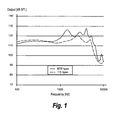
- Fig. 1 illustrates hearing aid output for respectively a traditional BTE (with the receiver in the BTE housing and a sound tube used for transmitting the sound into the ear canal of a hearing aid user) and an ITE hearing aid configured with the same receiver as the BTE.
- the outputs of both hearing aids have been measured according to IEC 118. Please note that in the present context the output of the ITE hearing aid will be similar to that of a RITE hearing aid.
- Fig. 1 illustrates that the frequency response of the traditional BTE hearing aid has resonance peaks at 1 kHz, 3 kHz and 5 kHz.
- the ITE hearing aid a single and smaller peak at around 2.5 kHz replaces these resonance peaks, thus leading to a more smooth frequency response.
- the output of the ITE hearing aid is significantly lowered and at 1.5 kHz the output is decreased by 11 dB. Therefore an ITE or RITE hearing aid may yield insufficient output for hearing impaired whose hearing dificit require a high hearing aid output around 1 kHz.
- the fundamental wavelength resonance of the sound conduit will be positioned at a frequency given by the velocity of sound divided by four times the length of the sound conduit.
- the higher order resonance frequencies are odd multiples of this fundamental resonance. Therefore the second order resonance frequency is three times the fundamental resonance frequency and the third order resonance frequency is five times the fundamental resonance frequency.
- the resonance peak height decreases with increasing order of resonance.
- the sound conduit could be designed to have a length in the range of 60 - 90 mm, preferably approximately 85 mm.
- a fundamental resonance frequency in the range 0.9 - 1.2 kHz, preferably approximately 1 kHz results.
- the sound conduit could be designed to have a length in the range of 90 - 105 mm.
- a fundamental resonance frequency in the range 0.8 - 0.9 kHz results.
- longer sound conduits could be considered if sufficient space is available in the earpiece.
- the combination of the inlet port diameter, outlet port diameter and length of the sound conduit affects the efficiency with which acoustical power is transmitted from receiver and to the tympanic membrane of the hearing aid user wearing the earpiece. This is well known from the theory of acoustic horns.
- the sound conduit diameter will be gradually increasing from the inlet port diameter towards the outlet port diameter.
- the sound conduit diameter may be linearly increasing or increasing according to some other function.
- the sound conduit according to the present invention could be designed with an inlet port diameter in the range of 1.0 - 1.7 mm, an outlet port diameter in the range of 2.0 - 4.0 mm and a length above 60 mm.
- an inlet port diameter of 1.3 mm combined with an outlet port diameter of 2.2 mm and a sound conduit length of 85 mm will result in an efficiency boost of around 5 dB for frequencies above around 0.7 kHz.
- Fig. 2 shows a RITE earpiece 1 according to a first embodiment of the invention.
- the earpiece 1 comprises a body that is custom fitted to the individual shape of the ear canal of the user wearing the hearing aid earpiece.
- the body comprises a sound conduit 3 adapted for conveying sound from a receiver 2 and towards the tympanic membrane of a hearing aid user wearing the earpiece, means for accommodating the receiver 2 within the body and holding means (not shown) adapted for providing an acoustical connection between the receiver and the sound conduit.
- the sound from the receiver is coupled to the sound conduit through the input port 5 and output through the sound conduit outlet port 4.
- the sound conduit 3 is looped in order to allow the sound conduit length to be increased relative to the sound conduit length provided by known hearing aid earpieces.
- One way of obtaining the looped sound conduit is by providing a number of sound conduit parts, that extend substantially along the general axis of the open ear canal of the intended user and are interconnected via a number of U-shaped or 180 degree bends.
- the sound conduit parts that extend substantially along the general axis of the open ear canal of the intended user may be approximately straight if the shape of the ear canal of the intended user so permits.
- the geometrical plane A is perpendicular to the general axis of the open ear canal of the intended user.
- a surface normal to the geometrical plane A is parallel to a tangent to the center axis of the ear canal of the intended user.
- the center axis is defined as the curved axis that follows the center of the ear canal.
- a numerical procedure may be used to extract this axis. This numerical procedure is further described in " Measurement and specification of the human ear canal geometry" by Michael R. Stinson, in The Journal of the Acoustical Society of America, November 1985, Volume 78, Issue S1, p. S12 .
- the earpiece will also accommodate a vent opening, that for reasons of clarity is not shown in the figure.
- Fig. 3 shows a cross sectional area of the earpiece 1 along a geometrical plane A.
- the looped sound conduit 3 intersects the geometrical plane A five times.
- the sound conduit such that it will intersect the geometrical plane A seven or even more times, where the maximum number of intersections is dependent on the size of the ear canal of the intended user.
- Fig. 4 shows a RITE earpiece 11 according to a second embodiment of the invention.
- the earpiece 11 comprises a body that is custom fitted to the individual shape of the ear canal of the user wearing the hearing aid earpiece.
- the body comprises a sound conduit 13 adapted for conveying sound from a receiver 12 and towards the tympanic membrane of a hearing aid user wearing the earpiece, means for accommodating the receiver 12 within the body and holding means (not shown) adapted for providing an acoustical connection between the receiver and the sound conduit.
- the sound from the receiver is coupled to the sound conduit through the input port 15 and output through the sound conduit outlet port 14.
- the sound conduit 13 is looped in order to allow the sound conduit length to be increased relative to the sound conduit length provided by known hearing aid earpieces.
- the geometrical plane B is one plane selected to include the general axis of the open ear canal of the intended user.
- Fig. 5 shows a cross sectional area of the earpiece 11 along the geometrical plane B.
- the sound conduit is given a helical shape that intersects the geometrical plane B five times.
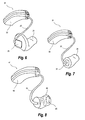
- Fig. 6 shows a hearing aid 21 according to a third embodiment of the invention.
- the hearing aid 21 comprises a BTE housing 22, a connector 23 and an earpiece 24.
- the connector serves to electrically connect the sound producing parts accommodated within the earpiece 24 with the BTE housing 22 and the electrical components therein.
- the earpiece 24 accommodates a receiver 25 and comprises a sound conduit (not shown) for conveying the sound from the receiver and towards the tympanic membrane of a hearing aid user wearing the earpiece.
- the earpiece will extend not only in the ear canal but also in part of the concha and the receiver is arranged in the part of the earpiece extending in the concha, where the space will be less restricted compared to the ear canal. This is especially advantageous for children.
- the sound conduit conveying sound from the receiver to the tympanic membrane of a hearing aid user wearing the earpiece may be circled in the concha part of the earpiece before continuing into the ear canal part of the earpiece.
- Fig. 7 shows a hearing aid 31 according to a fourth embodiment of the invention.
- the hearing aid 31 comprises a BTE housing 32, a connector 33 and an earpiece 34.
- the connector serves to electrically connect the sound producing parts of the earpiece 34 with the BTE housing 32 and the electrical components therein.
- the earpiece 34 accommodates a receiver 35 and comprises a sound conduit (not shown) for conveying the sound from the receiver and towards the tympanic membrane of a hearing aid user wearing the earpiece.
- the earpiece 34 is adapted for being fully inserted into the ear canal. Hereby a less conspicuous hearing aid results.
- Fig. 8 shows a hearing aid 41 according to fifth embodiment of the invention.
- the hearing aid 41 further comprises a BTE housing 42, a tube 43 and an earpiece 44.
- the BTE housing accommodates electronics, one or more microphones and a receiver, in order that it may to pick up sounds, amplify them and produce an amplified acoustic output signal.
- the tube provides a conduit for conveying the acoustic signal from the receiver inside the BTE housing to the earpiece 44, and the earpiece couples the acoustic energy from the tube into the ear canal and towards the tympanic membrane of a hearing aid user wearing the earpiece.
- the tube 43 is acoustically coupled to the sound conduit 45.
- the earpiece 44 therefore comprises holding means adapted for providing an acoustical connection between the tube 43 and the sound conduit 45.
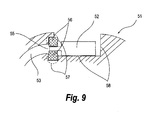
- Fig. 9 illustrates a vertical section of an earpiece 51 accommodating a receiver 52 according to a sixth embodiment of the invention.
- the receiver 52 is attached to the sound conduit 53 at the sound conduit inlet port 55 by a pibe stub of the receiver engaging an o-ring 56.
- the earpiece holding means 57 supports the o-ring.
- the holding means are U-shaped around the lower part of the o-ring and L-shaped around the upper part of the o-ring.
- the o-ring is preferably made of a resilient material, such as, for example, silicone rubber in order to allow the o-ring to be mounted in the holding means.
- the earpiece accommodating means 58 allows the receiver to be accommodated in the earpiece without the need for e.g. removing material in order to provide space for it.
- the earpiece comprises holding and accommodating means for all the components necessary for an ITE hearing aid.
- the integration of the holding and accommodating means in the earpiece body allows the earpiece manufacturing to be improved with respect to both speed and automatization.
- the method for manufacturing a hearing aid earpiece comprises the steps of making an impression of the ear, including the ear canal, of the hearing impaired person, performing a scanning of the ear impression in order to obtain data for a three dimensional computer model of a part of the ear including the ear canal, forming a three-dimensional computer model of the outer shape of the hearing aid earpiece based on the acquired data, forming a three-dimensional computer model of the shape of the sound conduit inside the hearing aid earpiece based on a predetermined sound conduit length and manufacturing the hearing aid earpiece in a rapid prototyping process based on said three-dimensional computer models.
- This method has the advantage of automating an otherwise very complex manufacturing process.
- the rapid prototyping process is Stereo Lithography (SLA), where a container of photosensitive resin contains a vertically-moving platform.
- SLA Stereo Lithography
- the hearing aid component under preparation is supported by the platform that moves down by decrements that determine the layer thickness for each layer.
- a laser beam traces out the shape of the intended specimen in a respective layer to harden the photosensitive resin along the trace. The process repeats until the hearing aid component is complete.
- a suitable material is a hard material, e.g. acrylic.
- the sound conduit walls according to the present invention could be designed with a minimum thickness in the range of 100 to 600 um. As an example the minimum wall thickness could be 500 um.
- the manufactured earpiece will have to accommodate at least one hearing aid component. Therefore, means for accommodating a hearing aid component within the earpiece and holding means adapted for providing an acoustical connection between a sound conveying hearing aid component and the sound conduit should be included in the manufacturing of the earpiece. These means should therefore also be part of the three-dimensional model of the earpiece.
- the holding means adapted for providing an acoustical connection between a sound conveying hearing aid component and the sound conduit may also need one or more separate components for securing or optimizing the acoustical connection.
- the means for accommodating a hearing aid component within the earpiece may comprise simple means adapted for providing space for the hearing aid component within the earpiece, means for more precise positioning of the hearing aid component within the earpiece using e.g. various alignment structures and means adapted for holding the hearing aid component fixed within the earpiece.
- the hearing aid earpiece comprises a part in contact with the ear canal manufactured from a resilient material, thereby obtaining the advantage of such a material in terms of e.g. increased user comfort.
Landscapes
- Engineering & Computer Science (AREA)
- Manufacturing & Machinery (AREA)
- Signal Processing (AREA)
- Acoustics & Sound (AREA)
- Physics & Mathematics (AREA)
- Otolaryngology (AREA)
- Health & Medical Sciences (AREA)
- Neurosurgery (AREA)
- General Health & Medical Sciences (AREA)
- Chemical & Material Sciences (AREA)
- Materials Engineering (AREA)
- Headphones And Earphones (AREA)
- Prostheses (AREA)
Claims (14)
- Hörhilfen-Ohrolive, die einen Körper umfasst, der speziell an die individuelle Form des Ohrkanals eines Benutzers angepasst wird, wobei der Körper in einem Rapid-Prototyping-Prozess hergestellt wird und eine Schallleitung (3, 13) umfasst, die zum Weiterleiten eines akustischen Signals von einem akustischen Einlassport (5, 15) zu einem akustischen Auslassport (4, 14) ausgelegt ist, wobei die Schallleitung in Schleifen gelegt ist, so dass mindestens eine geometrische Ebene die Schallleitung mindestens dreimal schneidet, wodurch für eine Länge der Schallleitung gesorgt wird, die die größte äußere Abmessung der Hörhilfen-Ohrolive übersteigt, und wobei die Schallleitung länger als 60 mm ist.
- Hörhilfen-Ohrolive nach Anspruch 1, wobei die geometrische Ebene senkrecht zur allgemeinen Achse des offenen Ohrkanals des vorgesehenen Benutzers ist.
- Hörhilfen-Ohrolive nach Anspruch 1, wobei die geometrische Ebene senkrecht zur Geraden ist, die den akustischen Einlassport und den akustischen Auslassport der Schallleitung verbindet.
- Hörhilfen-Ohrolive nach Anspruch 1, wobei die geometrische Ebene die allgemeine Achse des offenen Ohrkanals des vorgesehenen Benutzers umfasst.
- Hörhilfen-Ohrolive nach einem der Ansprüche 1 bis 4, wobei die geometrische Ebene die Schallleitung mindestens 5-mal schneidet.
- Hörhilfen-Ohrolive nach einem der Ansprüche 1 bis 4, wobei die geometrische Ebene die Schallleitung mindestens 7-mal schneidet.
- Hörhilfen-Ohrolive nach einem der vorherigen Ansprüche, wobei der Körper ferner ein Haltemittel umfasst, das zum Bereitstellen einer akustischen Verbindung einer Schall leitenden Hörhilfenkomponente für den akustischen Einlassport ausgelegt ist.
- Hörhilfen-Ohrolive nach einem der vorherigen Ansprüche, wobei der Körper Mittel umfasst, die zum Aufnehmen einer Schall leitenden Komponente in die Hörhilfen-Ohrolive ausgelegt sind.
- Hörhilfen-Ohrolive nach einem der vorherigen Ansprüche, wobei die Schallleitung länger als 80 mm ist.
- Hörhilfen-Ohrolive nach einem der vorherigen Ansprüche, wobei die Schallleitung so geformt ist, dass der Durchmesser der Schallleitung sich vom akustischen Einlassport zum akustischen Auslassport allmählich vergrößert.
- Hörhilfen-Ohrolive nach Anspruch 10, wobei der Durchmesser der Schallleitung über die Länge der Schallleitung variiert, so dass er das Intervall von 1,7 bis 2,0 mm überspannt.
- Hörhilfen-Ohrolive nach Anspruch 11, wobei der Durchmesser des Einlassports der Schallleitung im Bereich von 1,0 bis 1,7 mm variiert.
- Hörhilfen-Ohrolive nach einem der Ansprüche 11 bis 12, wobei der Durchmesser des Auslassports der Schallleitung im Bereich von 2,0 bis 4,0 mm variiert.
- Verfahren zum Herstellen einer Hörhilfen-Ohrolive, die einen Körper umfasst, der speziell an die individuelle Form des Ohrkanals eines Benutzers angepasst ist, und eine Schallleitung umfasst, die zum Weiterleiten eines akustischen Signals von einem akustischen Einlassport zu einem akustischen Auslassport ausgelegt ist, wobei die Schallleitung in Schleifen gelegt ist, so dass mindestens eine geometrische Ebene die Schallleitung mindestens dreimal schneidet, wodurch für eine Länge der Schallleitung gesorgt wird, die die größte äußere Abmessung der Hörhilfen-Ohrolive übersteigt, und wobei die Schallleitung länger als 60 mm ist, wobei das Verfahren die folgenden Schritte umfasst:- Erfassen von Daten, die die Form eines Teils des Ohrs einschließlich des Ohrkanals eines Hörhilfenbenutzers repräsentieren,- Bilden eines dreidimensionalen Computermodells der äußeren Form der Hörhilfenkomponente auf der Basis der erfassten Daten,- Bilden eines dreidimensionalen Computermodells der Form der Schallleitung in der Hörhilfen-Ohrolive auf der Basis einer vorgegebenen Länge der Schallleitung, und- Herstellen der Hörhilfen-Ohrolive in einem Rapid-Prototyping-Prozess auf der Basis der dreidimensionalen Computermodelle.
Applications Claiming Priority (1)
| Application Number | Priority Date | Filing Date | Title |
|---|---|---|---|
| PCT/EP2008/067323 WO2010066299A1 (en) | 2008-12-11 | 2008-12-11 | Hearing aid earpiece and a method of manufacturing a hearing aid earpiece |
Publications (2)
| Publication Number | Publication Date |
|---|---|
| EP2377331A1 EP2377331A1 (de) | 2011-10-19 |
| EP2377331B1 true EP2377331B1 (de) | 2013-08-07 |
Family
ID=40316875
Family Applications (1)
| Application Number | Title | Priority Date | Filing Date |
|---|---|---|---|
| EP08875444.5A Active EP2377331B1 (de) | 2008-12-11 | 2008-12-11 | Hörgerät-hörkapsel und verfahren zum herstellen einer hörgerät-hörkapsel |
Country Status (10)
| Country | Link |
|---|---|
| US (1) | US8625831B2 (de) |
| EP (1) | EP2377331B1 (de) |
| JP (1) | JP2012510222A (de) |
| KR (1) | KR20110073579A (de) |
| CN (1) | CN102239708A (de) |
| AU (1) | AU2008365121A1 (de) |
| CA (1) | CA2746142A1 (de) |
| DK (1) | DK2377331T3 (de) |
| SG (1) | SG171798A1 (de) |
| WO (1) | WO2010066299A1 (de) |
Families Citing this family (16)
| Publication number | Priority date | Publication date | Assignee | Title |
|---|---|---|---|---|
| EP2378792A1 (de) | 2010-04-14 | 2011-10-19 | GN Resound A/S | Hörgerät mit Schallschlauch |
| WO2010128169A1 (en) * | 2010-08-24 | 2010-11-11 | Phonak Ag | Receiver in concha |
| US8983103B2 (en) * | 2010-12-23 | 2015-03-17 | Think-A-Move Ltd. | Earpiece with hollow elongated member having a nonlinear portion |
| US9288565B2 (en) * | 2010-12-23 | 2016-03-15 | Cardas Audio Ltd. | Earphone system |
| US8616214B2 (en) | 2011-04-06 | 2013-12-31 | Kimberly-Clark Worldwide, Inc. | Earplug having a resilient core structure |
| WO2013053600A1 (de) * | 2011-10-11 | 2013-04-18 | Wolfgang Hinz | Ohrstöpsel für taucher |
| US8983101B2 (en) * | 2012-05-22 | 2015-03-17 | Shure Acquisition Holdings, Inc. | Earphone assembly |
| CN102883237A (zh) * | 2012-09-19 | 2013-01-16 | 丽声助听器(福州)有限公司 | 具有规则的内腔的定制式入耳耳机 |
| EP2753101A1 (de) * | 2013-01-07 | 2014-07-09 | Oticon A/s | Hörgerät mit einer im Ohr tragbaren Komponente |
| CN104378726B (zh) * | 2014-11-05 | 2018-03-20 | 丽声助听器(福州)有限公司 | 带物理导声模块助听器 |
| KR101831575B1 (ko) | 2015-01-19 | 2018-02-22 | 쓰리엠 이노베이티브 프로퍼티즈 캄파니 | 회선형 음향 혼을 가진 청력 보호 장치 |
| EP3314913B1 (de) | 2015-06-29 | 2022-03-02 | Hear-Wear Technologies, Llc | Wandlermodule für auditorische kommunikationsvorrichtung und auditorische kommunikationsvorrichtungen |
| CN108989933A (zh) * | 2018-07-16 | 2018-12-11 | 广州艺腾电子产品有限公司 | 耳机结构 |
| US11202157B2 (en) * | 2019-12-02 | 2021-12-14 | Gn Hearing A/S | Alignment between charging elements of a hearing device and a charger |
| CN111844756B (zh) * | 2020-06-09 | 2022-04-19 | 苏州海卡缔听力技术有限公司 | 一种基于3d打印技术制备软耳膜的方法 |
| CN116074727B (zh) * | 2023-03-13 | 2023-12-08 | 深圳市鑫正宇科技有限公司 | 一种3d打印助听器的制造方法 |
Family Cites Families (8)
| Publication number | Priority date | Publication date | Assignee | Title |
|---|---|---|---|---|
| USRE26174E (en) | 1961-12-05 | 1967-03-21 | Leale hearing aid | |
| DE1274658B (de) | 1966-05-14 | 1968-08-08 | Bosch Elektronik Photokino | Elektronisches Schwerhoerigengeraet |
| DE3023871A1 (de) | 1980-06-26 | 1982-01-14 | Robert Bosch Gmbh, 7000 Stuttgart | Hoergeraet |
| US4451709A (en) * | 1981-12-21 | 1984-05-29 | Beltone Electronics Corporation | Eye glass hearing aids |
| US7110562B1 (en) * | 2001-08-10 | 2006-09-19 | Hear-Wear Technologies, Llc | BTE/CIC auditory device and modular connector system therefor |
| DK1629806T3 (da) | 2004-08-25 | 2009-03-23 | Phonak Ag | Öreprop til höreværn og fremgangsmåde til fremstilling af denne |
| WO2006060486A2 (en) * | 2004-12-01 | 2006-06-08 | Synygis, Llc | Acoustically tailored hearing aid and method of manufacture |
| US20060171549A1 (en) * | 2005-02-02 | 2006-08-03 | Holmes David W | Hearing aid eartip coupler system and method |
-
2008
- 2008-12-11 JP JP2011537859A patent/JP2012510222A/ja not_active Abandoned
- 2008-12-11 DK DK08875444.5T patent/DK2377331T3/da active
- 2008-12-11 CN CN2008801321695A patent/CN102239708A/zh active Pending
- 2008-12-11 SG SG2011037280A patent/SG171798A1/en unknown
- 2008-12-11 WO PCT/EP2008/067323 patent/WO2010066299A1/en not_active Ceased
- 2008-12-11 EP EP08875444.5A patent/EP2377331B1/de active Active
- 2008-12-11 US US13/133,627 patent/US8625831B2/en not_active Expired - Fee Related
- 2008-12-11 KR KR1020117011088A patent/KR20110073579A/ko not_active Ceased
- 2008-12-11 CA CA2746142A patent/CA2746142A1/en not_active Abandoned
- 2008-12-11 AU AU2008365121A patent/AU2008365121A1/en not_active Abandoned
Also Published As
| Publication number | Publication date |
|---|---|
| CA2746142A1 (en) | 2010-06-17 |
| SG171798A1 (en) | 2011-07-28 |
| WO2010066299A1 (en) | 2010-06-17 |
| KR20110073579A (ko) | 2011-06-29 |
| AU2008365121A1 (en) | 2010-06-17 |
| EP2377331A1 (de) | 2011-10-19 |
| DK2377331T3 (da) | 2013-08-26 |
| US20110261985A1 (en) | 2011-10-27 |
| CN102239708A (zh) | 2011-11-09 |
| US8625831B2 (en) | 2014-01-07 |
| JP2012510222A (ja) | 2012-04-26 |
Similar Documents
| Publication | Publication Date | Title |
|---|---|---|
| US8625831B2 (en) | Hearing aid earpiece and a method of manufacturing a hearing aid earpiece | |
| CN103404173B (zh) | 具有音管的助听器 | |
| US5606621A (en) | Hybrid behind-the-ear and completely-in-canal hearing aid | |
| EP2432254B1 (de) | Hörgerät | |
| US20090252362A1 (en) | Hearing device to be carried in the auricle with an individual mold | |
| US9408004B2 (en) | Flex connector for a hearing assistance device | |
| EP2076064A1 (de) | Hörvorrichtung mit Hörgeräte-Otoplastik und Ausgangsmodul | |
| EP4604572A1 (de) | Im ohr tragbare elektronische vorrichtung mit akustischem filter | |
| US9020176B2 (en) | Apparatus for vented hearing assistance systems | |
| US11395077B2 (en) | Hearing device with vent | |
| CN110915229B (zh) | 耳塞式接收器 | |
| EP2663096A1 (de) | Verfahren zur akustischen Belastung des Empfängers einer Hörhilfevorrichtung | |
| US20250203262A1 (en) | Ear-wearable device including filter | |
| WO2009100559A2 (en) | Hearing instrument | |
| CN103517167A (zh) | 用于音响器具的外壳以及音响器具 | |
| HK40017738A (en) | In-ear receiver |
Legal Events
| Date | Code | Title | Description |
|---|---|---|---|
| PUAI | Public reference made under article 153(3) epc to a published international application that has entered the european phase |
Free format text: ORIGINAL CODE: 0009012 |
|
| 17P | Request for examination filed |
Effective date: 20110705 |
|
| AK | Designated contracting states |
Kind code of ref document: A1 Designated state(s): AT BE BG CH CY CZ DE DK EE ES FI FR GB GR HR HU IE IS IT LI LT LU LV MC MT NL NO PL PT RO SE SI SK TR |
|
| DAX | Request for extension of the european patent (deleted) | ||
| GRAP | Despatch of communication of intention to grant a patent |
Free format text: ORIGINAL CODE: EPIDOSNIGR1 |
|
| GRAS | Grant fee paid |
Free format text: ORIGINAL CODE: EPIDOSNIGR3 |
|
| GRAA | (expected) grant |
Free format text: ORIGINAL CODE: 0009210 |
|
| AK | Designated contracting states |
Kind code of ref document: B1 Designated state(s): AT BE BG CH CY CZ DE DK EE ES FI FR GB GR HR HU IE IS IT LI LT LU LV MC MT NL NO PL PT RO SE SI SK TR |
|
| REG | Reference to a national code |
Ref country code: GB Ref legal event code: FG4D |
|
| REG | Reference to a national code |
Ref country code: AT Ref legal event code: REF Ref document number: 626184 Country of ref document: AT Kind code of ref document: T Effective date: 20130815 Ref country code: CH Ref legal event code: EP |
|
| REG | Reference to a national code |
Ref country code: DK Ref legal event code: T3 |
|
| REG | Reference to a national code |
Ref country code: IE Ref legal event code: FG4D |
|
| REG | Reference to a national code |
Ref country code: DE Ref legal event code: R096 Ref document number: 602008026669 Country of ref document: DE Effective date: 20131002 |
|
| REG | Reference to a national code |
Ref country code: NL Ref legal event code: T3 |
|
| REG | Reference to a national code |
Ref country code: AT Ref legal event code: MK05 Ref document number: 626184 Country of ref document: AT Kind code of ref document: T Effective date: 20130807 |
|
| REG | Reference to a national code |
Ref country code: LT Ref legal event code: MG4D |
|
| PG25 | Lapsed in a contracting state [announced via postgrant information from national office to epo] |
Ref country code: CY Free format text: LAPSE BECAUSE OF FAILURE TO SUBMIT A TRANSLATION OF THE DESCRIPTION OR TO PAY THE FEE WITHIN THE PRESCRIBED TIME-LIMIT Effective date: 20130724 Ref country code: SE Free format text: LAPSE BECAUSE OF FAILURE TO SUBMIT A TRANSLATION OF THE DESCRIPTION OR TO PAY THE FEE WITHIN THE PRESCRIBED TIME-LIMIT Effective date: 20130807 Ref country code: IS Free format text: LAPSE BECAUSE OF FAILURE TO SUBMIT A TRANSLATION OF THE DESCRIPTION OR TO PAY THE FEE WITHIN THE PRESCRIBED TIME-LIMIT Effective date: 20131207 Ref country code: NO Free format text: LAPSE BECAUSE OF FAILURE TO SUBMIT A TRANSLATION OF THE DESCRIPTION OR TO PAY THE FEE WITHIN THE PRESCRIBED TIME-LIMIT Effective date: 20131107 Ref country code: LT Free format text: LAPSE BECAUSE OF FAILURE TO SUBMIT A TRANSLATION OF THE DESCRIPTION OR TO PAY THE FEE WITHIN THE PRESCRIBED TIME-LIMIT Effective date: 20130807 Ref country code: AT Free format text: LAPSE BECAUSE OF FAILURE TO SUBMIT A TRANSLATION OF THE DESCRIPTION OR TO PAY THE FEE WITHIN THE PRESCRIBED TIME-LIMIT Effective date: 20130807 Ref country code: HR Free format text: LAPSE BECAUSE OF FAILURE TO SUBMIT A TRANSLATION OF THE DESCRIPTION OR TO PAY THE FEE WITHIN THE PRESCRIBED TIME-LIMIT Effective date: 20130807 Ref country code: PT Free format text: LAPSE BECAUSE OF FAILURE TO SUBMIT A TRANSLATION OF THE DESCRIPTION OR TO PAY THE FEE WITHIN THE PRESCRIBED TIME-LIMIT Effective date: 20131209 |
|
| PGFP | Annual fee paid to national office [announced via postgrant information from national office to epo] |
Ref country code: GB Payment date: 20131211 Year of fee payment: 6 |
|
| PG25 | Lapsed in a contracting state [announced via postgrant information from national office to epo] |
Ref country code: PL Free format text: LAPSE BECAUSE OF FAILURE TO SUBMIT A TRANSLATION OF THE DESCRIPTION OR TO PAY THE FEE WITHIN THE PRESCRIBED TIME-LIMIT Effective date: 20130807 Ref country code: SI Free format text: LAPSE BECAUSE OF FAILURE TO SUBMIT A TRANSLATION OF THE DESCRIPTION OR TO PAY THE FEE WITHIN THE PRESCRIBED TIME-LIMIT Effective date: 20130807 Ref country code: FI Free format text: LAPSE BECAUSE OF FAILURE TO SUBMIT A TRANSLATION OF THE DESCRIPTION OR TO PAY THE FEE WITHIN THE PRESCRIBED TIME-LIMIT Effective date: 20130807 Ref country code: GR Free format text: LAPSE BECAUSE OF FAILURE TO SUBMIT A TRANSLATION OF THE DESCRIPTION OR TO PAY THE FEE WITHIN THE PRESCRIBED TIME-LIMIT Effective date: 20131108 Ref country code: BE Free format text: LAPSE BECAUSE OF FAILURE TO SUBMIT A TRANSLATION OF THE DESCRIPTION OR TO PAY THE FEE WITHIN THE PRESCRIBED TIME-LIMIT Effective date: 20130807 Ref country code: LV Free format text: LAPSE BECAUSE OF FAILURE TO SUBMIT A TRANSLATION OF THE DESCRIPTION OR TO PAY THE FEE WITHIN THE PRESCRIBED TIME-LIMIT Effective date: 20130807 |
|
| PGFP | Annual fee paid to national office [announced via postgrant information from national office to epo] |
Ref country code: NL Payment date: 20131210 Year of fee payment: 6 |
|
| PG25 | Lapsed in a contracting state [announced via postgrant information from national office to epo] |
Ref country code: CY Free format text: LAPSE BECAUSE OF FAILURE TO SUBMIT A TRANSLATION OF THE DESCRIPTION OR TO PAY THE FEE WITHIN THE PRESCRIBED TIME-LIMIT Effective date: 20130807 |
|
| PG25 | Lapsed in a contracting state [announced via postgrant information from national office to epo] |
Ref country code: EE Free format text: LAPSE BECAUSE OF FAILURE TO SUBMIT A TRANSLATION OF THE DESCRIPTION OR TO PAY THE FEE WITHIN THE PRESCRIBED TIME-LIMIT Effective date: 20130807 Ref country code: CZ Free format text: LAPSE BECAUSE OF FAILURE TO SUBMIT A TRANSLATION OF THE DESCRIPTION OR TO PAY THE FEE WITHIN THE PRESCRIBED TIME-LIMIT Effective date: 20130807 Ref country code: SK Free format text: LAPSE BECAUSE OF FAILURE TO SUBMIT A TRANSLATION OF THE DESCRIPTION OR TO PAY THE FEE WITHIN THE PRESCRIBED TIME-LIMIT Effective date: 20130807 Ref country code: RO Free format text: LAPSE BECAUSE OF FAILURE TO SUBMIT A TRANSLATION OF THE DESCRIPTION OR TO PAY THE FEE WITHIN THE PRESCRIBED TIME-LIMIT Effective date: 20130807 |
|
| PG25 | Lapsed in a contracting state [announced via postgrant information from national office to epo] |
Ref country code: ES Free format text: LAPSE BECAUSE OF FAILURE TO SUBMIT A TRANSLATION OF THE DESCRIPTION OR TO PAY THE FEE WITHIN THE PRESCRIBED TIME-LIMIT Effective date: 20130807 Ref country code: IT Free format text: LAPSE BECAUSE OF FAILURE TO SUBMIT A TRANSLATION OF THE DESCRIPTION OR TO PAY THE FEE WITHIN THE PRESCRIBED TIME-LIMIT Effective date: 20130807 |
|
| PLBE | No opposition filed within time limit |
Free format text: ORIGINAL CODE: 0009261 |
|
| STAA | Information on the status of an ep patent application or granted ep patent |
Free format text: STATUS: NO OPPOSITION FILED WITHIN TIME LIMIT |
|
| 26N | No opposition filed |
Effective date: 20140508 |
|
| REG | Reference to a national code |
Ref country code: DE Ref legal event code: R097 Ref document number: 602008026669 Country of ref document: DE Effective date: 20140508 |
|
| PG25 | Lapsed in a contracting state [announced via postgrant information from national office to epo] |
Ref country code: LU Free format text: LAPSE BECAUSE OF FAILURE TO SUBMIT A TRANSLATION OF THE DESCRIPTION OR TO PAY THE FEE WITHIN THE PRESCRIBED TIME-LIMIT Effective date: 20131211 |
|
| REG | Reference to a national code |
Ref country code: IE Ref legal event code: MM4A |
|
| REG | Reference to a national code |
Ref country code: FR Ref legal event code: ST Effective date: 20140829 |
|
| PG25 | Lapsed in a contracting state [announced via postgrant information from national office to epo] |
Ref country code: IE Free format text: LAPSE BECAUSE OF NON-PAYMENT OF DUE FEES Effective date: 20131211 |
|
| PG25 | Lapsed in a contracting state [announced via postgrant information from national office to epo] |
Ref country code: FR Free format text: LAPSE BECAUSE OF NON-PAYMENT OF DUE FEES Effective date: 20131231 |
|
| PG25 | Lapsed in a contracting state [announced via postgrant information from national office to epo] |
Ref country code: MC Free format text: LAPSE BECAUSE OF FAILURE TO SUBMIT A TRANSLATION OF THE DESCRIPTION OR TO PAY THE FEE WITHIN THE PRESCRIBED TIME-LIMIT Effective date: 20130807 |
|
| PG25 | Lapsed in a contracting state [announced via postgrant information from national office to epo] |
Ref country code: TR Free format text: LAPSE BECAUSE OF FAILURE TO SUBMIT A TRANSLATION OF THE DESCRIPTION OR TO PAY THE FEE WITHIN THE PRESCRIBED TIME-LIMIT Effective date: 20130807 |
|
| REG | Reference to a national code |
Ref country code: NL Ref legal event code: V1 Effective date: 20150701 |
|
| REG | Reference to a national code |
Ref country code: NL Ref legal event code: V1 Effective date: 20150701 |
|
| PG25 | Lapsed in a contracting state [announced via postgrant information from national office to epo] |
Ref country code: BG Free format text: LAPSE BECAUSE OF FAILURE TO SUBMIT A TRANSLATION OF THE DESCRIPTION OR TO PAY THE FEE WITHIN THE PRESCRIBED TIME-LIMIT Effective date: 20130807 Ref country code: HU Free format text: LAPSE BECAUSE OF FAILURE TO SUBMIT A TRANSLATION OF THE DESCRIPTION OR TO PAY THE FEE WITHIN THE PRESCRIBED TIME-LIMIT; INVALID AB INITIO Effective date: 20081211 |
|
| GBPC | Gb: european patent ceased through non-payment of renewal fee |
Effective date: 20141211 |
|
| PG25 | Lapsed in a contracting state [announced via postgrant information from national office to epo] |
Ref country code: MT Free format text: LAPSE BECAUSE OF FAILURE TO SUBMIT A TRANSLATION OF THE DESCRIPTION OR TO PAY THE FEE WITHIN THE PRESCRIBED TIME-LIMIT Effective date: 20130807 |
|
| PG25 | Lapsed in a contracting state [announced via postgrant information from national office to epo] |
Ref country code: NL Free format text: LAPSE BECAUSE OF NON-PAYMENT OF DUE FEES Effective date: 20150701 |
|
| PG25 | Lapsed in a contracting state [announced via postgrant information from national office to epo] |
Ref country code: GB Free format text: LAPSE BECAUSE OF NON-PAYMENT OF DUE FEES Effective date: 20141211 |
|
| PGFP | Annual fee paid to national office [announced via postgrant information from national office to epo] |
Ref country code: DK Payment date: 20231121 Year of fee payment: 16 Ref country code: DE Payment date: 20231121 Year of fee payment: 16 |
|
| PGFP | Annual fee paid to national office [announced via postgrant information from national office to epo] |
Ref country code: CH Payment date: 20240101 Year of fee payment: 16 |
|
| REG | Reference to a national code |
Ref country code: DE Ref legal event code: R119 Ref document number: 602008026669 Country of ref document: DE |
|
| REG | Reference to a national code |
Ref country code: DK Ref legal event code: EBP Effective date: 20241231 |
|
| REG | Reference to a national code |
Ref country code: CH Ref legal event code: PL |
|
| PG25 | Lapsed in a contracting state [announced via postgrant information from national office to epo] |
Ref country code: DE Free format text: LAPSE BECAUSE OF NON-PAYMENT OF DUE FEES Effective date: 20250701 |
|
| PG25 | Lapsed in a contracting state [announced via postgrant information from national office to epo] |
Ref country code: CH Free format text: LAPSE BECAUSE OF NON-PAYMENT OF DUE FEES Effective date: 20241231 |
|
| PG25 | Lapsed in a contracting state [announced via postgrant information from national office to epo] |
Ref country code: DK Free format text: LAPSE BECAUSE OF NON-PAYMENT OF DUE FEES Effective date: 20241231 |