EP2374906A1 - Magnesiumlegierung für die Raumtemperatur und Herstellungsverfahren dafür - Google Patents
Magnesiumlegierung für die Raumtemperatur und Herstellungsverfahren dafür Download PDFInfo
- Publication number
- EP2374906A1 EP2374906A1 EP11159573A EP11159573A EP2374906A1 EP 2374906 A1 EP2374906 A1 EP 2374906A1 EP 11159573 A EP11159573 A EP 11159573A EP 11159573 A EP11159573 A EP 11159573A EP 2374906 A1 EP2374906 A1 EP 2374906A1
- Authority
- EP
- European Patent Office
- Prior art keywords
- cao
- magnesium
- room
- alloy
- temperature
- Prior art date
- Legal status (The legal status is an assumption and is not a legal conclusion. Google has not performed a legal analysis and makes no representation as to the accuracy of the status listed.)
- Granted
Links
Images







Classifications
-
- C—CHEMISTRY; METALLURGY
- C22—METALLURGY; FERROUS OR NON-FERROUS ALLOYS; TREATMENT OF ALLOYS OR NON-FERROUS METALS
- C22C—ALLOYS
- C22C23/00—Alloys based on magnesium
- C22C23/02—Alloys based on magnesium with aluminium as the next major constituent
-
- B—PERFORMING OPERATIONS; TRANSPORTING
- B22—CASTING; POWDER METALLURGY
- B22D—CASTING OF METALS; CASTING OF OTHER SUBSTANCES BY THE SAME PROCESSES OR DEVICES
- B22D21/00—Casting non-ferrous metals or metallic compounds so far as their metallurgical properties are of importance for the casting procedure; Selection of compositions therefor
- B22D21/002—Castings of light metals
- B22D21/007—Castings of light metals with low melting point, e.g. Al 659 degrees C, Mg 650 degrees C
-
- C—CHEMISTRY; METALLURGY
- C22—METALLURGY; FERROUS OR NON-FERROUS ALLOYS; TREATMENT OF ALLOYS OR NON-FERROUS METALS
- C22C—ALLOYS
- C22C1/00—Making non-ferrous alloys
- C22C1/06—Making non-ferrous alloys with the use of special agents for refining or deoxidising
Definitions
- the present invention relates to a high-strength/high-elongation magnesium alloy for room temperature, and a manufacturing method thereof.
- Mg-Al based alloys are widely used in industries.
- Al aluminum
- Mg magnesium
- the strength of the Mg alloy is increased, the melting point is lowered, and flowability is improved because of solid-solution strengthening due to Al and grain boundary strengthening due to the formation of ⁇ -Mg 17 Al 12 phase. Therefore, Mg alloys with Al added are suitable for die casting applications.
- ductility is deteriorated due to the increase in ⁇ phases which are highly brittle.
- magnesium alloys To apply magnesium alloys to automobile parts, magnesium alloys should not be broken at once but endure an impact by absorbing impact energy even if the impact is exerted thereon. For this reason, magnesium alloys should have high ductility at room temperature. Improvement of ductility makes it possible to secure processability and product moldability as well.
- Mg-Al based alloys having high ductility in which an addition ratio of A1 should be maintained to a predetermined level or more.
- increasing ductility is in trade-off relation to strength. If an increase in ductility leads to a decrease in strength, this also provides a limitation to application fields of alloys and it is thus difficult to commercialize Mg alloys.
- the ductility and strength should be considered at the same time.
- the formation of highly brittle ⁇ phases should be suppressed by forming a new phase through addition of elements which are highly reactive with Mg or Al.
- An object of the present invention is to provide a magnesium alloy for room temperature obtained by adding an alkaline earth metal oxide (especially, calcium oxide) into molten magnesium or magnesium alloy, and a manufacturing method thereof.
- an alkaline earth metal oxide especially, calcium oxide
- Another object of the present invention is to provide a magnesium alloy for room temperature which is capable of improving ductility and strength at the same time by enhancing internal soundness of a casting, for example, reducing oxides, inclusions and pores, through the addition of CaO into a magnesium alloy, and a manufacturing method of the magnesium alloy for room temperature.
- a method of manufacturing a magnesium-based alloy includes: melting magnesium or magnesium alloy; adding 0.05 % to 1.2 % by weight of calcium oxide (CaO) onto a surface of a melt in which the magnesium or magnesium alloy is melted; exhausting the CaO through surface stirring to allow the CaO not to substantially remain in the magnesium or magnesium alloy through a sufficient reaction between the melt and the CaO; and allowing calcium (Ca) produced by the reaction to react with the melt such that the Ca does not substantially remain in the magnesium or magnesium alloy.
- CaO calcium oxide
- an added amount of the CaO may be in the range of 0.2 wt% to 0.9 wt%.
- An added amount of the CaO may be in the range of 0.3 wt% to 0.7 wt%.
- a compound produced due to the addition of Ca may include at least one of Mg 2 Ca, Al 2 Ca and (Mg, Al) 2 Ca.
- a magnesium-based alloy is characterized in that the magnesium-based alloy is manufactured by adding 0.05 % to 1.2 % by weight of CaO into a molten magnesium or magnesium alloy, and partially or wholly exhausting the CaO through a reduction reaction of the CaO with the molten magnesium or magnesium alloy, wherein the magnesium-based alloy contains a compound formed through combination of Ca with Mg or other alloying elements in the magnesium-based alloy to thereby have larger room-temperature mechanical properties than those of magnesium or magnesium alloys into which CaO is not added.
- the room-temperature mechanical properties are any one of room-temperature yield strength, room-temperature tensile strength, and room-temperature elongation.
- the room-temperature mechanical properties may increase as the added amount of CaO increases.
- the room-temperature yield strength or room-temperature tensile strength may increase at the same time with the room-temperature elongation as the added amount of CaO increases.
- the added amount of the CaO may be in the range of 0.2 wt% to 0.9 wt%, and the added amount of the CaO may be in the range of 0.3 wt% to 0.7 wt%.
- the compound produced due to the addition of Ca may include at least one of Mg 2 Ca, Al 2 Ca and (Mg, Al) 2 Ca.
- the microstructure of the magnesium alloy becomes finer in which Al 2 Ca phases or the like are formed. Furthermore, the addition of CaO prevents the formation of ⁇ -Mg 17 Al 12 phases which are highly brittle, and significantly reduces casting defects.
- a manufacturing method of a new alloy by adding CaO into molten magnesium and an alloy thereof are used to solve problems arising when calcium is added to magnesium and overcome limitations of physical properties.
- FIG. 1 is a flowchart illustrating a method of manufacturing a magnesium-based alloy according to the present invention.
- a method of manufacturing a magnesium-based alloy according to the present invention includes the steps of: forming a magnesium-based melt (step S1); adding alkaline earth metal oxide (CaO in the present invention) (step S2); stirring the magnesium-based melt (step S3); exhausting the alkaline earth metal oxide (step S4); allowing alkaline earth metal (Ca in the present invention) to react with the magnesium-based melt (step S5); casting (step S6); and solidifying (step S7).
- step S4 of exhausting the alkaline earth metal oxide and step S5 of allowing the alkaline earth metal to react with the magnesium-based melt are divided into the separate steps for convenience of description, two steps S4 and S5 occur almost at the same time. That is, when supplying of the alkaline earth metal starts in step 4, step S5 is initiated.
- step S1 of forming the magnesium-based melt magnesium or magnesium alloy is put into a crucible and heated at a temperature ranging from 400 °C to 800 °C under a protective gas atmosphere. Then, the magnesium alloy in the crucible is melted to form the magnesium-based melt.
- the temperature provided herein for melting magnesium or magnesium alloys means a melting temperature of pure magnesium or magnesium alloys.
- the melting temperature may vary with alloy type.
- CaO is added in the state where magnesium or the magnesium alloy is completely melted.
- a temperature at which a solid phase is sufficiently melted to exist in a complete liquid phase is enough for the melting temperature of magnesium or the magnesium alloy.
- work is necessary to maintain a molten magnesium in the temperature range with sufficient margin by considering the fact that the temperature of the molten magnesium is decreased due to the addition of CaO.
- the molten magnesium alloy when the temperature is less than 400 °C, the molten magnesium alloy is difficult to be formed. On the contrary, when the temperature is more than 800 °C, there is a risk that the magnesium-based melt may be ignited.
- a molten magnesium is generally formed at a temperature of 600 °C or more, whereas a molten magnesium alloy may be formed at a temperature ranging from 400 °C or more to 600 °C or less. In general, many cases in metallurgy show that a melting point decreases as alloying proceeds.
- the magnesium used in step S1 of forming the magnesium-based melt may be any one selected from pure magnesium, a magnesium alloy, and equivalents thereof.
- the magnesium alloy may be any one selected from AZ91D, AM20, AM30, AM50, AM60, AZ31, AS41, AS31, AS21X, AE42, AE44, AX51, AX52, AJ50X, AJ52X, AJ62X, MRI153, MRI230, AM-HP2, magnesium-Al, magnesium-Al-Re, magnesium-Al-Sn, magnesium-Zn-Sn, magnesium-Si, magnesium-Zn-Y, and equivalents thereof; however, the present invention is not limited thereto. Any magnesium alloy that is generally available in industries may be used.
- step S2 of adding the alkaline earth metal oxide CaO in the form of powder is added into the molten magnesium. It is preferable that CaO be powdered for accelerating the reaction with the magnesium alloy.
- CaO may be input for the reaction.
- CaO may be added in a powder state so as to increase a surface area for efficient reaction. If the additive is too fine, that is, less than 0.1 ⁇ m in size, the additive is liable to be scattered by vaporized magnesium or hot wind, thereby making it difficult to input the additive into a furnace.
- the additives are agglomerated each other, and thus clustered while not being easily mixed with liquid molten metal.
- the powder is too coarse, it is undesirable because a total surface area is not increased.
- an ideal particle size should not exceed 500 ⁇ m. More preferably, the particle size may be 200 ⁇ m or less.
- CaO was used as an alkaline earth metal oxide added into the molten magnesium.
- any one selected from strontium oxide (SrO), beryllium oxide (BeO), magnesium oxide (MgO), and equivalents thereof may be used as the alkaline earth metal oxide.
- the alkaline earth metal oxide which is used in step S2 of adding the alkaline earth metal oxide, may be generally added in the range of 0.001 wt% to 30 wt%.
- An input amount of the alkaline earth metal oxide is determined by a final target alloy composition. That is, an amount of CaO may be determined by performing a back-calculation according to a desired amount of Ca to be alloyed into a magnesium alloy. Physical properties of the magnesium alloy deviate from its original physical properties if the amount of Ca, which is indirectly alloyed into the magnesium alloy from the CaO, exceeds 21.4 wt% (30 wt% in the case of CaO), and therefore, it is preferable that the input amount of CaO should be adjusted to 30 wt% or less.
- the input amount of CaO used as the alkaline earth metal oxide is in the range of 0.05 wt% to 1.2 wt%.
- Excellent physical properties such as room-temperature high strengths (tensile strength/yield strength) and room-temperature elongation could be obtained when the input amount of CaO was 1.2 wt% or less. Improvement of the physical properties was not relatively large when the input amount was less than 0.05 wt%.
- the input amount of CaO is in the range of 0.2 wt% to 0.9 wt%. Much more preferably, the input amount of CaO is in the range of 0.3 wt% to 0.7 wt%. Excellent physical properties, i.e., excellent room-temperature high strength/high elongation could be obtained in the case where the input amount of CaO is in the range of 0.3 wt% to 0.7 wt%. Also, in the range of 0.3 wt% to 0.7 wt% of CaO, room-temperature mechanical properties (tensile strength, yield strength, elongation) were increased as the amount of CaO was increased.
- the molten magnesium is stirred for 1 second to 60 minutes per 0.1 wt% of the added CaO.
- the stirring time depends on the volume of the molten magnesium and the input amount of CaO.
- the oxide powders of a required amount may be input at once. However, to accelerate the reaction and reduce agglomeration possibility, it is preferable that the additive powders be re-input after a predetermined time elapses from a first input time, or the additive powders are grouped into several batches of appropriate amounts and the batches are input in sequence.
- the stirring may be generally performed by generating an electromagnetic field using a device capable of applying electromagnetic fields around the furnace holding the molten magnesium, thus enabling the convection of the molten magnesium to be induced.
- artificial stirring may be performed on the molten magnesium from the outside.
- the stirring may be performed in such a manner that the CaO powders are not agglomerated.
- the ultimate purpose of the stirring in the present invention is to induce the reduction reaction between the molten magnesium and added powders properly.
- the stirring time may vary with the temperature of a molten metal and the state (pre-heating state or the like) of powders added.
- the stirring may continue to be performed in principle until the powders are not observed on the surface of the molten magnesium. Since the powders are lower in specific gravity than the molten magnesium so that they float on the molten magnesium in a normal state, it can be indirectly determined that the powders and the molten magnesium sufficiently react when the powders are not observed on the molten magnesium any longer.
- the term 'sufficiently react' means that all of the CaO powders substantially react with the molten magnesium and are exhausted.
- the CaO powders are not observed on the molten magnesium, possibilities of existing in the molten magnesium may not be excluded. Therefore, the CaO powders that do not float yet should be observed for a predetermined holding time after the stirring time, and the holding time may be required to complete the reaction of the CaO powders that have not reacted with the molten magnesium yet.
- the stirring is effective when it is performed at the same time with the input of the oxide powders.
- the stirring may start after the oxide receives heat from the molten magnesium and reach a predetermined temperature or higher, which enables acceleration of the reaction.
- the stirring continues to be performed until the oxide powders are not observed on the surface of the molten magnesium. After CaO is completely exhausted through the reaction, the stirring is finished.
- the oxide inputted into the molten magnesium could not react and remained in the final material so that physical properties were deteriorated or it acted as the cause of defects. That is, when the reaction was induced inside the molten magnesium, not on the surface of the molten magnesium, there were relatively more cases where the calcium oxide remained in the final molten magnesium rather than reacted on the surface of the molten magnesium.
- the present invention therefore, it is important to create a reaction environment where an oxide reacts on the surface rather than inside the molten magnesium. To this end, it is important not to forcibly stir the oxide floating on the surface of the molten magnesium into the molten magnesium. It is important to uniformly spread the oxide floating on the molten magnesium surface exposed to air. More preferably, it is important to supply the oxide in such a way as to coat the entire surface of the molten magnesium with the oxide.
- the stirring inducing the foregoing surface reaction is denoted as surface stirring. That is, Ca, which is produced by a reduction reaction (surface reduction reaction) of the CaO added onto the surface of the molten Mg, acts as an alloying element of Mg or Mg alloys.
- the smallest residual amount of the calcium oxide was observed in the case of the stirring of only the upper layer portion, that is, the final residual amounts of the calcium oxide were 0.001 wt%, 0.002 wt% and 0.005 wt% as the calcium oxide was added 5 wt%, 10 wt% and 15 wt%, respectively.
- the oxygen component of CaO is substantially removed out from the top surface of the molten magnesium by stirring the upper layer portion of the molten magnesium. It is desirable that the stirring is performed at an upper layer portion of which a depth is about 20 % of a total depth of the molten magnesium from the surface. If the depth is beyond 20 %, the surface reaction according to a preferred example of the present invention is rarely generated.
- the stirring may be performed in an upper layer portion of which a depth is about 10 % of the total depth of the molten magnesium from the surface.
- the substantially floating CaO is induced to be positioned in an upper layer portion of which a depth is 10 % of an actual depth of the molten magnesium, thereby minimizing the turbulence of the molten magnesium.
- step S4 of exhausting the alkaline earth metal oxide through the reaction between the molten magnesium and the added calcium oxide, the calcium oxide is completely exhausted so as not to remain in the magnesium alloy at least partially or substantially. It is preferable that all the calcium oxide added in the present invention is exhausted by a sufficient reaction. However, even if some portions do not react and remain in the alloy, it is also effective if these do not largely affect physical properties.
- the exhausting of calcium oxide includes removing an oxygen component from the alkaline earth metal oxide.
- the oxygen component is removed in the form of oxygen gas (O 2 ) or in the form of dross or sludge through combination with magnesium or alloying components in the molten magnesium.
- Ca provided from the CaO is prone to be compounded with elements other than Mg in the magnesium alloy.
- the oxygen component is substantially removed out from the top surface of the molten magnesium by stirring the upper layer portion of the molten magnesium.
- FIG. 3 is a schematic view exemplarily showing dissociation of calcium oxide through stirring of an upper layer portion of molten magnesium according to the present invention.
- step S5 of allowing the alkaline earth metal to react with the molten magnesium calcium produced by the exhaustion of the calcium oxide reacts with the molten magnesium alloy so as not to at least partially or substantially remain in the magnesium alloy.
- Ca produced by the dissociation is compounded with at least one of magnesium, aluminum, and other alloying elements (components) in the magnesium alloy, and is thus not left remaining substantially.
- a compound collectively refers to an intermetallic compound obtained through bonding between metals.
- the added calcium oxide is partially or substantially exhausted by removing the oxygen component through the reaction with the magnesium alloy, i.e., the molten magnesium alloy, and the produced calcium makes a compound with at least one of magnesium, aluminum, and other alloying elements in the molten magnesium alloy.
- the magnesium alloy i.e., the molten magnesium alloy
- the produced calcium makes a compound with at least one of magnesium, aluminum, and other alloying elements in the molten magnesium alloy.
- calcium oxide does not remain in the alloy partially or substantially.
- step S5 of exhausting the alkaline earth metal oxide there occur many flint flashes during the reduction reaction of the alkaline earth metal oxide on the surface of the molten magnesium.
- the flint flashes may be used as an index for confirming whether the reduction reaction is completed or not.
- the alkaline earth metal oxide added may not be fully exhausted. That is, the tapping of the molten magnesium is performed after the flint flashes, which can be used as an index for indirectly measuring the reduction reaction, disappear.
- FIG. 2 is a flowchart illustrating dissociation of calcium oxide used to be added into a molten magnesium according to the present invention.
- casting is performed by putting the molten magnesium into a mold at room temperature or in a pre-heating state.
- the mold may include any one selected from a metallic mold, a ceramic mold, a graphite mold, and equivalents thereof.
- the casting method may include gravity casting, continuous casting, and equivalent methods thereof.
- the mold is cooled down to room temperature, and thereafter, the magnesium alloy (e.g., magnesium alloy ingot) is taken out from the mold.
- the magnesium alloy e.g., magnesium alloy ingot
- the magnesium-based alloy formed by the above-described manufacturing method may have hardness (HRF) of 40 to 80.
- HRF hardness
- the hardness value may change widely depending on processing methods and heat treatment or the like, and thus the magnesium-based alloy according to the present invention is not limited thereto.
- magnesium in the molten magnesium reacts with alkaline earth metal to thereby form a magnesium (alkaline earth metal) compound.
- the alkaline earth metal oxide is CaO
- Mg 2 Ca is formed.
- Oxygen constituting CaO is discharged out of the molten magnesium in the form of oxygen gas (O 2 ), or combines with Mg to be MgO and is then discharged in the form of dross (see Reaction Formula 1 below). (see Reaction Formula 1 below).
- Reaction Formula 1 Pure Mg + CaO ⁇ Mg (Matrix) + Mg 2 Ca ... [O 2 produced + MgO dross produced]
- magnesium in the molten magnesium alloy reacts with alkaline earth metal to thereby form a magnesium (alkaline earth metal) compound or an aluminum (alkaline earth metal) compound. Also, an alloying element reacts with alkaline earth metal to form a compound together with magnesium or aluminum.
- the alkaline earth metal oxide is CaO
- Mg 2 Ca, Al 2 Ca, or (Mg, Al, other alloying element) 2 Ca is formed.
- Oxygen constituting CaO is discharged out of the molten magnesium in the form of oxygen gas (O 2 ) as in the pure Mg case, or combines with Mg to be MgO, which is discharged in the form of dross (see Reaction Formula 2 below).
- Reaction Formula 2 Mg Alloy + CaO ⁇ Mg Alloy (Matrix) + ⁇ Mg 2 Ca + Al 2 Ca + (Mg, Al, other alloying element)2Ca ⁇ ... [O 2 produced + MgO dross produced]
- an alkaline earth metal e.g., Ca
- CaO alkaline earth metal oxide
- alloying is relatively easy by adding alkaline earth metal oxide into magnesium or magnesium alloy instead of adding alkaline earth metal.
- alloying effects equal to or greater than the case of directly adding alkaline earth metal can be achieved by adding the chemically stable alkaline earth metal oxide (e.g., CaO). That is, Ca, which is produced by the reduction reaction of the CaO added into the molten Mg, acts as an alloying element of Mg or Mg alloys.
- dissolution of the alkaline earth metal in the magnesium alloy occurs in a certain amount when the alkaline earth metal is directly input into magnesium or the magnesium alloy.
- dissolution is absent or extremely small during the addition of the alkaline earth metal oxide (CaO) when comparing degree of the dissolution with the case of directly adding the alkaline earth metal. It was confirmed that an intermetallic compound including an Al 2 Ca phase forms much easier when Ca is indirectly added through CaO as compared to the case of directly adding Ca.
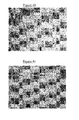
- FIG. 4a is an image showing the microstructure of a die-cast product using AZ91D according to a comparative example.
- FIGS. 4b and 4c are images showing microstructures of die-cast products of Mg alloys prepared by adding 0.3 % and 0.7 % by weight of CaO into AZ91D magnesium alloy, respectively, according to the present invention.
- CaO addition in the present invention implies that the reduction reaction process is undergone after the addition of the CaO.
- the images of microstructures are taken after performing cold chamber die casting.
- the magnesium alloy according to the present invention was finer and denser in microstructure than the magnesium alloy according to the comparative example. It can be understood that such a tendency significantly increases as the amount of CaO added into the Mg alloy increases. It is determined that this is due to Al 2 Ca or other phase formations (Mg 2 Ca, and (Mg, Al, other alloying elements) 2 Ca) which is(are) formed and distributed uniformly as the CaO is added.
- FIGS. 5a to 5d are images showing EDS compositional analysis of a magnesium alloy prepared by adding 0.45 % by weight of CaO into a molten AM60B alloy. As shown in FIGS. 5a to 5d , it can be observed that Al 2 Ca is formed and the formation of ⁇ -Mg 17 Al 12 phase is suppressed.
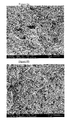
- FIGS. 6a is a SEM image showing a fractured surface of a tensile specimen of a commercially available AM60B alloy
- FIGS. 6b to 6d are SEM images showing fractured surfaces of tensile specimens of magnesium alloys prepared by making CaO react with AM60B according to the present invention.
- FIG. 7 is a graph showing room-temperature yield strength (TYS) when CaO is added into a magnesium alloy.
- a line indicates the room-temperature yield strength of the AM60B alloy in which CaO is not added.
- the experiments were performed by adding 0.2 wt% to 1.0 wt% of CaO into an AM60B magnesium alloy.
- the room-temperature yield strength is in the range of about 130 MPa to 137 MPa ; when 0.7 wt% of CaO is added into a magnesium alloy, the room-temperature yield strength is in the range of about 151 MPa to 168 MPa ; and when 0.9 wt% of CaO is added into a magnesium alloy, the room-temperature yield strength is in the range of about 156 MPa . As the added amount of CaO was increased within the range of 0.3 wt% to 0.7 wt%, the room-temperature yield strength was also increased.
- the yield strength according to the added amount (wt%) of CaO is presented in Table 2 below.
- Table 2 Alloy Added amount of CaO Yield strength [MPa]
- Magnesium alloy (AM60B) 0.2 ⁇ 0.3 wt% 123 ⁇ 137 0.3 ⁇ 0.4 wt% 131 ⁇ 138 0.4 ⁇ 0.5 wt% 137 ⁇ 142 0.5 ⁇ 0.6 wt% 141 ⁇ 161 0.6 ⁇ 0.7 wt% 143 ⁇ 166 0.7 ⁇ 0.8 wt% 149 ⁇ 170 0.8 ⁇ 0.9 wt% 148 ⁇ 160 0.9 ⁇ 1.0 wt% 148 ⁇ 158
- the room-temperature yield strength (TYS) is most excellent at around 0.7 wt% of CaO added into the magnesium alloy.
- FIG. 8 is a graph showing room-temperature tensile strength (UTS) when CaO is added into a magnesium alloy.
- a line indicates the room-temperature tensile strength of the AM60B alloy in which CaO is not added.
- the experiments were performed by adding 0.2 wt% to 1.0 wt% of CaO into an AM60B magnesium alloy.
- the room-temperature tensile strength is in the range of about 205 MPa to 230 MPa ; when 0.7 wt% of CaO is added into a magnesium alloy, the room-temperature tensile strength is in the range of about 240 MPa to 261 MPa ; and when 0.9 wt% of CaO is added into a magnesium alloy, the room-temperature tensile strength is in the range of about 245 MPa to 251 MPa . As the added amount of CaO was increased within the range of 0.3 wt% to 0.7 wt%, the room-temperature tensile strength was also increased.
- the tensile strength according to the added amount (wt%) of CaO is presented in Table 3 below.
- Table 3 Alloy Added amount of CaO
- the room-temperature tensile strength is most excellent when the added amount of CaO is in the range of 0.5 wt% to 0.8wt%.
- FIG. 9 is a graph showing the room-temperature elongation of a magnesium alloy into which CaO is added.
- a line indicates the room-temperature elongation of the AM60B alloy in which CaO is not added.
- the experiments were performed by adding 0.2 wt% to 1.0 wt% of CaO into an AM60B magnesium alloy.
- the room-temperature elongation is in the range of about 6 % to 10 %; when 0.7 wt% of CaO is added into a magnesium alloy, the room-temperature elongation is in the range of about 13 % to 15 %; and when 0.9 wt% of CaO is added into a magnesium alloy, the room-temperature elongation is in the range of about 13 % to 14 %.As the added amount of CaO was increased within the range of 0.3 wt% to 0.7 wt%, the room-temperature elongation was also increased.
- the room-temperature elongation according to the added amount (wt%) of CaO is presented in Table 4 below.
- Table 4 Alloy Added amount of CaO Elongation[%] Magnesium alloy (AM60B) 0.2 ⁇ 0.3 wt% 6 ⁇ 10 0.3 ⁇ 0.4 wt% 7 ⁇ 12 0.4 ⁇ 0.5 wt% 12 ⁇ 14 0.5 ⁇ 0.6 wt% 12 ⁇ 15 0.6 ⁇ 0.7 wt% 13 ⁇ 17 0.7 ⁇ 0.8 wt% 12 ⁇ 16 0.8 ⁇ 0.9 wt% 12 ⁇ 15 0.9 ⁇ 1.0 wt% 13 ⁇ 14
- the room-temperature elongation is most excellent when the added amount of CaO is in the range of 0.5 wt% to 0.8 wt%.
- Table 5 represents averages of mechanical properties of magnesium alloys prepared according to the present invention. Each data was obtained by averaging about 200 data measured in experiments. Table 5 YS(MPa) UTS(MPa) EL(%) AM60B 115 205 6 AM60B-0.3wt%CaO 130 220 9 AM60B-0.5wt%CaO 160 255 14 AM60B-0.7wt%CaO 165 260 14 AM60B-0.9wt%CaO 155 250 13
- magnesium alloys manufactured using the reduction reaction of CaO added into the molten magnesium were superior in room-temperature yield strength, room-temperature tensile strength and room-temperature elongation than Mg alloys into which CaO is not added.
- the room-temperature mechanical properties were more improved as the added amount of CaO was larger. Such a tendency was more prominent when the added amount of CaO was in the range of 0.3 wt% to 0.7 wt%. Why the room-temperature mechanical properties are improved is because compounds such as Mg 2 Ca, Al 2 Ca and (Mg, Al) 2 Ca are formed due to addition of CaO.
- FIG. 10 is a graph comparing room-temperature yield strengths and room-temperature elongations between magnesium-based alloys prepared according to the present invention and typical magnesium alloys.
- the room-temperature elongation increases as the room-temperature yield strength increases.
- the yield strength of an alloy decreases if the elongation increases, which is seen from distributions of circular points (Mg-Al-RE alloy) and triangular points (Mg-Al-Mn alloy) in FIG. 10 .
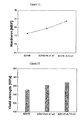
- FIG. 11 is a graph showing room-temperature hardness of Mg alloys prepared by adding 0.3 % and 0.7 % by weight of CaO into AZ91D, respectively, compared to hardness of an AZ91D Mg alloy into which CaO is not added. Rockwell hardness was measured after performing cold chamber die casting using the respective alloys.
- a CaO-added Mg alloy is higher in hardness than alloys into which CaO is not added. Also, it can be confirmed that room-temperature hardness increases as the added amount of CaO increases.
- the meaning of 'CaO addition' in the present invention implies that the reduction reaction process is undergone after the addition of the CaO.
- FIG. 12 is a graph showing room-temperature yield strengths of Mg alloys prepared by adding 0.3 % and 0.7 % by weight of CaO into AZ91 D, respectively, compared to a room-temperature yield strength of an AZ91D Mg alloy into which CaO is not added.
- Room-temperature yield strengths were measured after preparing specimens through hot chamber die casting. It can be confirmed that a CaO-added Mg alloys is higher in room-temperature yield strength than alloys into which CaO is not added.
- the room-temperature yield strength of the magnesium alloy with 0.7 wt% of CaO added is increased by about 15 %, when compared to magnesium alloys into which CaO is not added. Also, it can be confirmed that room-temperature yield strength increases as the added amount of CaO increases.
- FIG. 13 is a graph showing room-temperature tensile strengths of Mg alloys prepared by adding 0.3 % and 0.7 % by weight of CaO into AZ91D, respectively, compared to a room-temperature tensile strength of an AZ91 D Mg alloy into which CaO is not added. Room-temperature tensile strengths were measured after preparing specimens through hot chamber die casting.
- a CaO-added Mg alloys is higher in room-temperature tensile strength than alloys into which CaO is not added. It can also be understood that the room-temperature tensile strength of the magnesium alloy with 0.7 wt% of CaO added is increased by about 14 %, when compared to magnesium alloys into which CaO is not added. Moreover, it can be confirmed that room-temperature tensile strength increases as the added amount of CaO increases.
- FIG. 14 is a graph showing room-temperature elongations of Mg alloys prepared by adding 0.3 % and 0.7 % by weight of CaO into AZ91D, respectively, compared to a room-temperature elongation of an AZ91D Mg alloy into which CaO is not added. It can be confirmed that a CaO-added Mg alloys is higher in room-temperature elongation than alloys into which CaO is not added.
- the room-temperature elongation of the magnesium alloy with 0.7 wt% of CaO added is increased to about 3 times that of a magnesium alloy into which CaO is not added. Moreover, it can be confirmed that room-temperature elongation increases as the added amount of CaO increases.
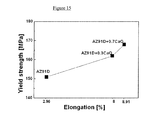
- FIG. 15 is a graph showing relations between room-temperature elongation and room-temperature yield strength in Mg alloys prepared by adding 0.3 % and 0.7 % by weight of CaO into AZ91D, respectively, compared to a relation between room-temperature elongation and room-temperature yield strength in an AZ91D Mg alloy without using CaO.
- the microstructure of the magnesium alloy becomes finer, and Mg 2 Ca, Al 2 Ca or (Mg, Al, other alloying elements) 2 Ca phases are formed. Furthermore, the addition of CaO prevents the formation of ⁇ -Mg 17 Al 12 phase which is highly brittle, and significantly reduces casting defects. Consequently, the addition of CaO enables Ca to be alloyed indirectly through a reduction reaction, thereby resulting in an increase in both of room-temperature strength and room-temperature elongation of a magnesium alloy at the same time.
Landscapes
- Chemical & Material Sciences (AREA)
- Engineering & Computer Science (AREA)
- Mechanical Engineering (AREA)
- Materials Engineering (AREA)
- Metallurgy (AREA)
- Organic Chemistry (AREA)
- Manufacture And Refinement Of Metals (AREA)
- Powder Metallurgy (AREA)
Priority Applications (1)
| Application Number | Priority Date | Filing Date | Title |
|---|---|---|---|
| PL11159573T PL2374906T3 (pl) | 2010-03-29 | 2011-03-24 | Sposób wytwarzania stopu magnezu do zastosowań w temperaturze pokojowej |
Applications Claiming Priority (2)
| Application Number | Priority Date | Filing Date | Title |
|---|---|---|---|
| KR1020100028151A KR101147655B1 (ko) | 2010-03-29 | 2010-03-29 | 상온용 마그네슘계 합금 및 그 제조 방법 |
| KR1020110001557A KR101367894B1 (ko) | 2011-01-06 | 2011-01-06 | 상온용 마그네슘 합금 |
Publications (2)
| Publication Number | Publication Date |
|---|---|
| EP2374906A1 true EP2374906A1 (de) | 2011-10-12 |
| EP2374906B1 EP2374906B1 (de) | 2017-03-15 |
Family
ID=44303340
Family Applications (1)
| Application Number | Title | Priority Date | Filing Date |
|---|---|---|---|
| EP11159573.2A Active EP2374906B1 (de) | 2010-03-29 | 2011-03-24 | Herstellungsverfaren einer magnesiumlegierung für anwendungen bei raumtemperatur |
Country Status (6)
| Country | Link |
|---|---|
| EP (1) | EP2374906B1 (de) |
| AU (1) | AU2011233968B2 (de) |
| CA (1) | CA2794897A1 (de) |
| PL (1) | PL2374906T3 (de) |
| RU (1) | RU2543574C2 (de) |
| TW (1) | TWI460280B (de) |
Cited By (1)
| Publication number | Priority date | Publication date | Assignee | Title |
|---|---|---|---|---|
| CN110541084A (zh) * | 2019-10-10 | 2019-12-06 | 黄继寨 | 一种铝合金熔炼造渣熔剂摊撒搅拌装置 |
Citations (1)
| Publication number | Priority date | Publication date | Assignee | Title |
|---|---|---|---|---|
| WO2010032893A1 (en) * | 2008-09-18 | 2010-03-25 | Korea Institute Of Industrial Technology | Magnesium alloy and manufacturing method thereof |
Family Cites Families (3)
| Publication number | Priority date | Publication date | Assignee | Title |
|---|---|---|---|---|
| US4705561A (en) * | 1986-01-27 | 1987-11-10 | The Dow Chemical Company | Magnesium calcium oxide composite |
| IL125681A (en) * | 1998-08-06 | 2001-06-14 | Dead Sea Magnesium Ltd | Magnesium alloy for high temperature applications |
| RU2215056C2 (ru) * | 2001-12-26 | 2003-10-27 | Открытое акционерное общество "АВИСМА титано-магниевый комбинат" | Сплав на основе магния и способ его получения |
-
2011
- 2011-03-23 RU RU2012140398/02A patent/RU2543574C2/ru active
- 2011-03-23 AU AU2011233968A patent/AU2011233968B2/en active Active
- 2011-03-23 CA CA2794897A patent/CA2794897A1/en not_active Abandoned
- 2011-03-24 PL PL11159573T patent/PL2374906T3/pl unknown
- 2011-03-24 EP EP11159573.2A patent/EP2374906B1/de active Active
- 2011-03-24 TW TW100110089A patent/TWI460280B/zh active
Patent Citations (1)
| Publication number | Priority date | Publication date | Assignee | Title |
|---|---|---|---|---|
| WO2010032893A1 (en) * | 2008-09-18 | 2010-03-25 | Korea Institute Of Industrial Technology | Magnesium alloy and manufacturing method thereof |
Cited By (2)
| Publication number | Priority date | Publication date | Assignee | Title |
|---|---|---|---|---|
| CN110541084A (zh) * | 2019-10-10 | 2019-12-06 | 黄继寨 | 一种铝合金熔炼造渣熔剂摊撒搅拌装置 |
| CN110541084B (zh) * | 2019-10-10 | 2020-06-30 | 海安宏宇合金材料有限公司 | 一种铝合金熔炼造渣熔剂摊撒搅拌装置 |
Also Published As
| Publication number | Publication date |
|---|---|
| PL2374906T3 (pl) | 2017-08-31 |
| CA2794897A1 (en) | 2011-10-06 |
| AU2011233968B2 (en) | 2014-10-16 |
| RU2543574C2 (ru) | 2015-03-10 |
| TW201202435A (en) | 2012-01-16 |
| AU2011233968A1 (en) | 2012-10-18 |
| EP2374906B1 (de) | 2017-03-15 |
| TWI460280B (zh) | 2014-11-11 |
| RU2012140398A (ru) | 2014-05-10 |
Similar Documents
| Publication | Publication Date | Title |
|---|---|---|
| US9085815B2 (en) | Magnesium alloy for room temperature and manufacturing method thereof | |
| US8808423B2 (en) | Magnesium-based alloy for high temperature and manufacturing method thereof | |
| EP2381002B1 (de) | Verfahren zur Herstellung einer Legierung auf Magnesiumbasis mit verbesserter Fluidität und Heiß-Reißfestigkeit | |
| KR101258470B1 (ko) | 고강도 고연성 난연성 마그네슘 합금 | |
| WO2005111251A1 (fr) | Alliage de magnesium coule de haute durete et de haute resistance et procede | |
| EP2369025A1 (de) | Magnesiumlegierung und magnesiumlegierungsguss | |
| KR101335010B1 (ko) | 실리콘화합물을 이용하여 제조된 마그네슘계 합금 및 그 제조 방법 | |
| EP2374905B1 (de) | Herstellungsverfahren einer magnesiumbasierte legierung für hohe temperaturen | |
| EP2374906B1 (de) | Herstellungsverfaren einer magnesiumlegierung für anwendungen bei raumtemperatur | |
| KR101335006B1 (ko) | 실리콘화합물과 칼슘화합물을 이용하여 제조된 마그네슘계 합금 및 그 제조 방법 | |
| KR101147650B1 (ko) | 고온용 마그네슘 합금 및 그 제조 방법 | |
| KR101147655B1 (ko) | 상온용 마그네슘계 합금 및 그 제조 방법 | |
| KR101147671B1 (ko) | 마그네슘계 합금 및 그 제조 방법 | |
| KR101400991B1 (ko) | 용탕 유동성과 내열간 균열성이 우수한 마그네슘 합금 |
Legal Events
| Date | Code | Title | Description |
|---|---|---|---|
| PUAI | Public reference made under article 153(3) epc to a published international application that has entered the european phase |
Free format text: ORIGINAL CODE: 0009012 |
|
| AK | Designated contracting states |
Kind code of ref document: A1 Designated state(s): AL AT BE BG CH CY CZ DE DK EE ES FI FR GB GR HR HU IE IS IT LI LT LU LV MC MK MT NL NO PL PT RO RS SE SI SK SM TR |
|
| AX | Request for extension of the european patent |
Extension state: BA ME |
|
| RAP1 | Party data changed (applicant data changed or rights of an application transferred) |
Owner name: KOREAN INSTITUTE OF INDUSTRIAL TECHNOLOGY |
|
| 17P | Request for examination filed |
Effective date: 20120412 |
|
| 17Q | First examination report despatched |
Effective date: 20151112 |
|
| GRAP | Despatch of communication of intention to grant a patent |
Free format text: ORIGINAL CODE: EPIDOSNIGR1 |
|
| RIN1 | Information on inventor provided before grant (corrected) |
Inventor name: KIM, SHAE K Inventor name: SEO, JUNG HO |
|
| RAP1 | Party data changed (applicant data changed or rights of an application transferred) |
Owner name: KOREA INSTITUTE OF INDUSTRIAL TECHNOLOGY |
|
| INTG | Intention to grant announced |
Effective date: 20161006 |
|
| RAP1 | Party data changed (applicant data changed or rights of an application transferred) |
Owner name: KOREA INSTITUTE OF INDUSTRIAL TECHNOLOGY Owner name: EMK CO., LTD. |
|
| GRAS | Grant fee paid |
Free format text: ORIGINAL CODE: EPIDOSNIGR3 |
|
| GRAA | (expected) grant |
Free format text: ORIGINAL CODE: 0009210 |
|
| AK | Designated contracting states |
Kind code of ref document: B1 Designated state(s): AL AT BE BG CH CY CZ DE DK EE ES FI FR GB GR HR HU IE IS IT LI LT LU LV MC MK MT NL NO PL PT RO RS SE SI SK SM TR |
|
| REG | Reference to a national code |
Ref country code: CH Ref legal event code: EP Ref country code: GB Ref legal event code: FG4D |
|
| REG | Reference to a national code |
Ref country code: IE Ref legal event code: FG4D |
|
| REG | Reference to a national code |
Ref country code: AT Ref legal event code: REF Ref document number: 875647 Country of ref document: AT Kind code of ref document: T Effective date: 20170415 |
|
| REG | Reference to a national code |
Ref country code: DE Ref legal event code: R096 Ref document number: 602011035872 Country of ref document: DE |
|
| REG | Reference to a national code |
Ref country code: NL Ref legal event code: MP Effective date: 20170315 |
|
| REG | Reference to a national code |
Ref country code: LT Ref legal event code: MG4D |
|
| PG25 | Lapsed in a contracting state [announced via postgrant information from national office to epo] |
Ref country code: GR Free format text: LAPSE BECAUSE OF FAILURE TO SUBMIT A TRANSLATION OF THE DESCRIPTION OR TO PAY THE FEE WITHIN THE PRESCRIBED TIME-LIMIT Effective date: 20170616 Ref country code: FI Free format text: LAPSE BECAUSE OF FAILURE TO SUBMIT A TRANSLATION OF THE DESCRIPTION OR TO PAY THE FEE WITHIN THE PRESCRIBED TIME-LIMIT Effective date: 20170315 Ref country code: LT Free format text: LAPSE BECAUSE OF FAILURE TO SUBMIT A TRANSLATION OF THE DESCRIPTION OR TO PAY THE FEE WITHIN THE PRESCRIBED TIME-LIMIT Effective date: 20170315 Ref country code: NO Free format text: LAPSE BECAUSE OF FAILURE TO SUBMIT A TRANSLATION OF THE DESCRIPTION OR TO PAY THE FEE WITHIN THE PRESCRIBED TIME-LIMIT Effective date: 20170615 Ref country code: HR Free format text: LAPSE BECAUSE OF FAILURE TO SUBMIT A TRANSLATION OF THE DESCRIPTION OR TO PAY THE FEE WITHIN THE PRESCRIBED TIME-LIMIT Effective date: 20170315 |
|
| REG | Reference to a national code |
Ref country code: AT Ref legal event code: MK05 Ref document number: 875647 Country of ref document: AT Kind code of ref document: T Effective date: 20170315 |
|
| PG25 | Lapsed in a contracting state [announced via postgrant information from national office to epo] |
Ref country code: LV Free format text: LAPSE BECAUSE OF FAILURE TO SUBMIT A TRANSLATION OF THE DESCRIPTION OR TO PAY THE FEE WITHIN THE PRESCRIBED TIME-LIMIT Effective date: 20170315 Ref country code: SE Free format text: LAPSE BECAUSE OF FAILURE TO SUBMIT A TRANSLATION OF THE DESCRIPTION OR TO PAY THE FEE WITHIN THE PRESCRIBED TIME-LIMIT Effective date: 20170315 Ref country code: RS Free format text: LAPSE BECAUSE OF FAILURE TO SUBMIT A TRANSLATION OF THE DESCRIPTION OR TO PAY THE FEE WITHIN THE PRESCRIBED TIME-LIMIT Effective date: 20170315 Ref country code: BG Free format text: LAPSE BECAUSE OF FAILURE TO SUBMIT A TRANSLATION OF THE DESCRIPTION OR TO PAY THE FEE WITHIN THE PRESCRIBED TIME-LIMIT Effective date: 20170615 |
|
| PG25 | Lapsed in a contracting state [announced via postgrant information from national office to epo] |
Ref country code: NL Free format text: LAPSE BECAUSE OF FAILURE TO SUBMIT A TRANSLATION OF THE DESCRIPTION OR TO PAY THE FEE WITHIN THE PRESCRIBED TIME-LIMIT Effective date: 20170315 |
|
| PG25 | Lapsed in a contracting state [announced via postgrant information from national office to epo] |
Ref country code: EE Free format text: LAPSE BECAUSE OF FAILURE TO SUBMIT A TRANSLATION OF THE DESCRIPTION OR TO PAY THE FEE WITHIN THE PRESCRIBED TIME-LIMIT Effective date: 20170315 Ref country code: RO Free format text: LAPSE BECAUSE OF FAILURE TO SUBMIT A TRANSLATION OF THE DESCRIPTION OR TO PAY THE FEE WITHIN THE PRESCRIBED TIME-LIMIT Effective date: 20170315 Ref country code: ES Free format text: LAPSE BECAUSE OF FAILURE TO SUBMIT A TRANSLATION OF THE DESCRIPTION OR TO PAY THE FEE WITHIN THE PRESCRIBED TIME-LIMIT Effective date: 20170315 Ref country code: CZ Free format text: LAPSE BECAUSE OF FAILURE TO SUBMIT A TRANSLATION OF THE DESCRIPTION OR TO PAY THE FEE WITHIN THE PRESCRIBED TIME-LIMIT Effective date: 20170315 Ref country code: IT Free format text: LAPSE BECAUSE OF FAILURE TO SUBMIT A TRANSLATION OF THE DESCRIPTION OR TO PAY THE FEE WITHIN THE PRESCRIBED TIME-LIMIT Effective date: 20170315 Ref country code: SK Free format text: LAPSE BECAUSE OF FAILURE TO SUBMIT A TRANSLATION OF THE DESCRIPTION OR TO PAY THE FEE WITHIN THE PRESCRIBED TIME-LIMIT Effective date: 20170315 Ref country code: AT Free format text: LAPSE BECAUSE OF FAILURE TO SUBMIT A TRANSLATION OF THE DESCRIPTION OR TO PAY THE FEE WITHIN THE PRESCRIBED TIME-LIMIT Effective date: 20170315 |
|
| REG | Reference to a national code |
Ref country code: CH Ref legal event code: PL |
|
| PG25 | Lapsed in a contracting state [announced via postgrant information from national office to epo] |
Ref country code: SM Free format text: LAPSE BECAUSE OF FAILURE TO SUBMIT A TRANSLATION OF THE DESCRIPTION OR TO PAY THE FEE WITHIN THE PRESCRIBED TIME-LIMIT Effective date: 20170315 Ref country code: IS Free format text: LAPSE BECAUSE OF FAILURE TO SUBMIT A TRANSLATION OF THE DESCRIPTION OR TO PAY THE FEE WITHIN THE PRESCRIBED TIME-LIMIT Effective date: 20170715 Ref country code: PT Free format text: LAPSE BECAUSE OF FAILURE TO SUBMIT A TRANSLATION OF THE DESCRIPTION OR TO PAY THE FEE WITHIN THE PRESCRIBED TIME-LIMIT Effective date: 20170717 |
|
| REG | Reference to a national code |
Ref country code: DE Ref legal event code: R097 Ref document number: 602011035872 Country of ref document: DE |
|
| REG | Reference to a national code |
Ref country code: IE Ref legal event code: MM4A |
|
| PLBE | No opposition filed within time limit |
Free format text: ORIGINAL CODE: 0009261 |
|
| STAA | Information on the status of an ep patent application or granted ep patent |
Free format text: STATUS: NO OPPOSITION FILED WITHIN TIME LIMIT |
|
| PG25 | Lapsed in a contracting state [announced via postgrant information from national office to epo] |
Ref country code: LU Free format text: LAPSE BECAUSE OF NON-PAYMENT OF DUE FEES Effective date: 20170324 Ref country code: MC Free format text: LAPSE BECAUSE OF FAILURE TO SUBMIT A TRANSLATION OF THE DESCRIPTION OR TO PAY THE FEE WITHIN THE PRESCRIBED TIME-LIMIT Effective date: 20170315 Ref country code: DK Free format text: LAPSE BECAUSE OF FAILURE TO SUBMIT A TRANSLATION OF THE DESCRIPTION OR TO PAY THE FEE WITHIN THE PRESCRIBED TIME-LIMIT Effective date: 20170315 |
|
| REG | Reference to a national code |
Ref country code: FR Ref legal event code: ST Effective date: 20171229 |
|
| 26N | No opposition filed |
Effective date: 20171218 |
|
| GBPC | Gb: european patent ceased through non-payment of renewal fee |
Effective date: 20170615 |
|
| PG25 | Lapsed in a contracting state [announced via postgrant information from national office to epo] |
Ref country code: SI Free format text: LAPSE BECAUSE OF FAILURE TO SUBMIT A TRANSLATION OF THE DESCRIPTION OR TO PAY THE FEE WITHIN THE PRESCRIBED TIME-LIMIT Effective date: 20170315 Ref country code: LI Free format text: LAPSE BECAUSE OF NON-PAYMENT OF DUE FEES Effective date: 20170331 Ref country code: IE Free format text: LAPSE BECAUSE OF NON-PAYMENT OF DUE FEES Effective date: 20170324 Ref country code: CH Free format text: LAPSE BECAUSE OF NON-PAYMENT OF DUE FEES Effective date: 20170331 |
|
| REG | Reference to a national code |
Ref country code: BE Ref legal event code: MM Effective date: 20170331 |
|
| PG25 | Lapsed in a contracting state [announced via postgrant information from national office to epo] |
Ref country code: GB Free format text: LAPSE BECAUSE OF NON-PAYMENT OF DUE FEES Effective date: 20170615 |
|
| PG25 | Lapsed in a contracting state [announced via postgrant information from national office to epo] |
Ref country code: BE Free format text: LAPSE BECAUSE OF NON-PAYMENT OF DUE FEES Effective date: 20170331 Ref country code: FR Free format text: LAPSE BECAUSE OF NON-PAYMENT OF DUE FEES Effective date: 20170515 |
|
| PG25 | Lapsed in a contracting state [announced via postgrant information from national office to epo] |
Ref country code: MT Free format text: LAPSE BECAUSE OF NON-PAYMENT OF DUE FEES Effective date: 20170324 |
|
| PG25 | Lapsed in a contracting state [announced via postgrant information from national office to epo] |
Ref country code: HU Free format text: LAPSE BECAUSE OF FAILURE TO SUBMIT A TRANSLATION OF THE DESCRIPTION OR TO PAY THE FEE WITHIN THE PRESCRIBED TIME-LIMIT; INVALID AB INITIO Effective date: 20110324 |
|
| PG25 | Lapsed in a contracting state [announced via postgrant information from national office to epo] |
Ref country code: CY Free format text: LAPSE BECAUSE OF NON-PAYMENT OF DUE FEES Effective date: 20170315 |
|
| PG25 | Lapsed in a contracting state [announced via postgrant information from national office to epo] |
Ref country code: MK Free format text: LAPSE BECAUSE OF FAILURE TO SUBMIT A TRANSLATION OF THE DESCRIPTION OR TO PAY THE FEE WITHIN THE PRESCRIBED TIME-LIMIT Effective date: 20170315 |
|
| PG25 | Lapsed in a contracting state [announced via postgrant information from national office to epo] |
Ref country code: TR Free format text: LAPSE BECAUSE OF FAILURE TO SUBMIT A TRANSLATION OF THE DESCRIPTION OR TO PAY THE FEE WITHIN THE PRESCRIBED TIME-LIMIT Effective date: 20170315 |
|
| PG25 | Lapsed in a contracting state [announced via postgrant information from national office to epo] |
Ref country code: AL Free format text: LAPSE BECAUSE OF FAILURE TO SUBMIT A TRANSLATION OF THE DESCRIPTION OR TO PAY THE FEE WITHIN THE PRESCRIBED TIME-LIMIT Effective date: 20170315 |
|
| PGFP | Annual fee paid to national office [announced via postgrant information from national office to epo] |
Ref country code: DE Payment date: 20260310 Year of fee payment: 16 |
|
| PGFP | Annual fee paid to national office [announced via postgrant information from national office to epo] |
Ref country code: PL Payment date: 20260320 Year of fee payment: 16 |