EP2371948A1 - Lipase variants - Google Patents
Lipase variants Download PDFInfo
- Publication number
- EP2371948A1 EP2371948A1 EP20100180288 EP10180288A EP2371948A1 EP 2371948 A1 EP2371948 A1 EP 2371948A1 EP 20100180288 EP20100180288 EP 20100180288 EP 10180288 A EP10180288 A EP 10180288A EP 2371948 A1 EP2371948 A1 EP 2371948A1
- Authority
- EP
- European Patent Office
- Prior art keywords
- lipase
- variant
- seq
- substitutions
- region
- Prior art date
- Legal status (The legal status is an assumption and is not a legal conclusion. Google has not performed a legal analysis and makes no representation as to the accuracy of the status listed.)
- Granted
Links
Images


Classifications
-
- C—CHEMISTRY; METALLURGY
- C12—BIOCHEMISTRY; BEER; SPIRITS; WINE; VINEGAR; MICROBIOLOGY; ENZYMOLOGY; MUTATION OR GENETIC ENGINEERING
- C12N—MICROORGANISMS OR ENZYMES; COMPOSITIONS THEREOF; PROPAGATING, PRESERVING, OR MAINTAINING MICROORGANISMS; MUTATION OR GENETIC ENGINEERING; CULTURE MEDIA
- C12N9/00—Enzymes; Proenzymes; Compositions thereof; Processes for preparing, activating, inhibiting, separating or purifying enzymes
- C12N9/14—Hydrolases (3)
- C12N9/16—Hydrolases (3) acting on ester bonds (3.1)
- C12N9/18—Carboxylic ester hydrolases (3.1.1)
- C12N9/20—Triglyceride splitting, e.g. by means of lipase
-
- C—CHEMISTRY; METALLURGY
- C12—BIOCHEMISTRY; BEER; SPIRITS; WINE; VINEGAR; MICROBIOLOGY; ENZYMOLOGY; MUTATION OR GENETIC ENGINEERING
- C12N—MICROORGANISMS OR ENZYMES; COMPOSITIONS THEREOF; PROPAGATING, PRESERVING, OR MAINTAINING MICROORGANISMS; MUTATION OR GENETIC ENGINEERING; CULTURE MEDIA
- C12N9/00—Enzymes; Proenzymes; Compositions thereof; Processes for preparing, activating, inhibiting, separating or purifying enzymes
- C12N9/14—Hydrolases (3)
- C12N9/16—Hydrolases (3) acting on ester bonds (3.1)
- C12N9/18—Carboxylic ester hydrolases (3.1.1)
Definitions
- the present invention relates to lipase variants.
- Lipases are useful, e.g., as detergent enzymes to remove lipid or fatty stains from clothes and other textiles, as additives to dough for bread and other baked products.
- a lipase derived from Thermomyces lanuginosus (synonym Humicola lanuginosa, EP 258 068 and EP 305 216 ) is sold for detergent use under the trade name Lipolase ® (product of Novo Nordisk A/S).
- WO 0060063 describes variants of the T. lanuginosus lipase with a particularly good first-wash performance in a detergent solution.
- WO 9704079 , WO 9707202 and WO 0032758 also disclose variants of the T. lanuginosus lipase.
- the inventors have found that by introducing mutations in certain regions/positions of a lipase it is possible to improve the properties or characteristics of the lipase.
- the present invention relates to lipases having improved properties for use in detergents.
- the invention provides variants with reduced tendency to odor generation obtained by introducing mutations in one or more regions identified in the parent lipase.
- the present invention provides lipase variants which, as compared to the parent lipase, have reduced potential for odor generation without the attachment of a C-terminal extension.
- the invention relates to a DNA sequence encoding the lipase variant of the invention, an expression vector harbouring said DNA sequence and a transformed host cell containing the DNA sequence or the expression vector.
- the invention provides a method of producing the lipase variant of the present invention.
- parent lipase may be any suitable parent lipase.
- the parent lipase may be a fungal lipase.
- the parent lipase may be a lipase with an amino acid sequence having at least 50%, 60%, 70%, 80%, 85%, 90%, 95%, 96%, 97%, 98%, 99% or even 100% homology as defined in the section "Homology and aligment" to the sequence of the T. lanuginosus lipase shown in SEQ ID NO: 2.
- the parent lipase may be a yeast polypeptide such as a Candida, Kluyveromyces, Pichia, Saccharomyces, Schizosaccharomyces, or Yarrowia polypeptide; or more preferably a filamentous fungal polypeptide such as an Acremonium, Aspergillus, Aureobasidium, Cryptococcus, Filobasidium, Fusarium, Humicola, Magnaporthe, Mucor, Myceliophthora, Neocallimastix, Neurospora, Paecilomyces, Penicillium, Piromyces, Schizophyllum, Talaromyces, Thermoascus, Thielavia, Tolypocladium, or Trichoderma polypeptide.
- yeast polypeptide such as a Candida, Kluyveromyces, Pichia, Saccharomyces, Schizosaccharomyces, or Yarrowia polypeptide
- a filamentous fungal polypeptide such as
- the parent lipase is a Saccharomyces carlsbergensis, Saccharomyces cerevisiae, Saccharomyces diastaticus, Saccharomyces douglasii, Saccharomyces kluyveri, Saccharomyces norbensis, or Saccharomyces oviformis polypeptide having lipase activity.
- the parent lipase is an Aspergillus aculeatus, Aspergillus awamori, Aspergillus fumigatus, Aspergillus foetidus, Aspergillus japonicus, Aspergillus nidulans, Aspergillus niger, Aspergillus oryzae, Aspergillus turbigensis, Fusarium bactridioides, Fusarium cerealis, Fusarium crookwellense, Fusarium culmorum, Fusarium graminearum, Fusarium graminum, Fusarium heterosporum, Fusarium negundi, Fusarium oxysporum, Fusarium reticulatum, Fusarium roseum, Fusarium sambucinum, Fusarium sarcochroum, Fusarium sporotrichioides, Fusarium sulphureum, Fusarium torul
- the parent lipase is a Thermomyces lipase.
- the parent lipase is a Thermomyces lanuginosus lipase. In an even more preferred embodiment the parent lipase is the lipase of SEQ ID NO: 2.
- the lipase variants of the present invention comprise, as compared to the parent lipase, at least three substitutions selected from the group consisting of:
- the variant lipase is a variant of a Thermomyces lipase, more preferably, a T. lanuginosus lipase, and even more preferably, the T. lanuginosus lipase shown in SEQ ID NO: 2.
- the variant lipase has at least 50%, 60%, 70%, 80%, 85%, 90%, 95%, 96%, 97%, 98% or 99% identity to SEQ ID NO:2.
- the variant lipase may be a variant of a parent lipase encoded by a gene derived/obtained from one of the following parent organisms: Candida, Kluyveromyces, Pichia, Saccharomyces, Schizosaccharomyces, or Yarrowia, Acremonium, Aspergillus, Aureobasidium, Cryptococcus, Filobasidium, Fusarium, Humicola, Magnaporthe, Mucor, Myceliophthora, Neocallimastix, Neurospora, Paecilomyces, Penicillium, Piromyces, Schizophyllum, Talaromyces, Thermoascus, Thielavia, Tolypocladium, or Trichoderma.
- Candida Kluyveromyces, Pichia, Saccharomyces, Schizosaccharomyces, or Yarrowia
- Acremonium Aspergillus, Aureobasidium, Cryptococcus, Fil
- the variant lipase has at least 50%, 60%, 70%, 80%, 85%, 90%, 95%, 96%, 97%, 98% or 99% identity to a parent lipase encoded by a gene derived/obtained from one of the following parent organisms: Candida, Kluyveromyces, Pichia, Saccharomyces, Schizosaccharomyces, or Yarrowia, Acremonium, Aspergillus, Aureobasidium, Cryptococcus, Filobasidium, Fusarium, Humicola, Magnaporthe, Mucor, Myceliophthora, Neocallimastix, Neurospora, Paecilomyces, Penicillium, Piromyces, Schizophyllum, Talaromyces, Thermoascus, Thielavia, Tolypocladium, or Trichoderma.
- Candida Kluyveromyces, Pichia, Saccharomyces, Schizosaccharomyces, or Yarrow
- the variant lipase is a variant Saccharomyces carlsbergensis, Saccharomyces cerevisiae, Saccharomyces diastaticus, Saccharomyces douglasii, Saccharomyces kluyveri, Saccharomyces norbensis, or Saccharomyces oviformis.
- the variant lipase has at least 50%, 60%, 70%, 80%, 85%, 90%, 95%, 96%, 97%, 98% or 99% identity to a parent lipase encoded by a gene derived/obtained from Saccharomyces carlsbergensis, Saccharomyces cerevisiae, Saccharomyces diastaticus, Saccharomyces douglasii, Saccharomyces kluyveri, Saccharomyces norbensis, or Saccharomyces oviformis.
- the variant lipase may be a variant of a parent lipase encoded by a gene derived/obtained from one of the following parent organisms: Aspergillus aculeatus, Aspergillus awamori, Aspergillus fumigatus, Aspergillus foetidus, Aspergillus japonicus, Aspergillus nidulans, Aspergillus niger, Aspergillus oryzae, Aspergillus turbigensis, Fusarium bactridioides, Fusarium cerealis, Fusarium crookwellense, Fusarium culmorum, Fusarium graminearum, Fusarium graminum, Fusarium heterosporum, Fusarium negundi, Fusarium oxysporum, Fusarium reticulatum, Fusarium roseum, Fusarium sambucinum, Fusarium sarcochroum,
- the variant lipase has at least 50%, 60%, 70%, 80%, 85%, 90%, 95%, 96%, 97%, 98% or 99% identity to a parent lipase encoded by a gene derived/obtained from one of the following parent organisms: Aspergillus aculeatus, Aspergillus awamori, Aspergillus fumigatus, Aspergillus foetidus, Aspergillus japonicus, Aspergillus nidulans, Aspergillus niger, Aspergillus oryzae, Aspergillus turbigensis, Fusarium bactridioides, Fusarium cerealis, Fusarium crookwellense, Fusarium culmorum, Fusarium graminearum, Fusarium graminum, Fusarium heterosporum, Fusarium negundi, Fusarium oxysporum, Fusarium reticul
- the variant is a variant of a Thermomyces lipase.
- the parent lipase is a Thermomyces lanuginosus lipase. In an even more preferred embodiment the parent lipase is the lipase of SEQ ID NO: 2.
- Region I through Region IV are the positions of the amino acid residues in SEQ ID NO:2.
- Region I consists of amino acid residues surrounding the N-terminal residue E1. In this region, it is preferred to substitute an amino acid of the parent lipase with a more positive amino acid.
- the lipase variant may comprise at least two substitutions in Region I, such as three, four, five or six substitutions in Region I.
- Amino acid residues corresponding to the following positions are comprised by Region I: 1, 2 to 11 and 223-239.
- the following positions are of particular interest: 1, 4, 8, 11, 223, 227, 229,231,233,234,236.
- the variant lipase has at least 80%, 85%, 90%, 95%, 96%, 97%, 98%, 99% identity to SEQ ID NO:2
- the variant lipase is a variant of the lipase having the aminio acid sequence of SEQ ID NO: 2.
- Region II consists of amino acid residues in contact with substrate on one side of the acyl chain and one side of the alcohol part. In this region it is preferred to substitute an amino acid of the parent lipase with a more positive amino acid or with a less hydrophobic amino acid.
- the lipase variant may comprise at least one substitution in Region II, such as two, three, four, five or six substitutions in Region II.
- Amino acid residues corresponding to the following positions are comprised by Region II: 202 to 211 and 249 to 269.
- the following positions are of particular interest : 202, 210, 211, 253,254,255,256.
- the variant lipase has at least 80%, 85%, 90%, 95%, 96%, 97%, 98% or 99% identity to SEQ ID NO:2
- the variant lipase is a variant of the lipase having the aminio acid sequence of SEQ ID NO: 2.
- Region III consists of amino acid residues that forms a flexible structure and thus allowing the substrate to get into the active site. In this region it is preferred to substitute an amino acid of the parent lipase with a more positive amino acid or a less hydrophobic amino acid.
- the lipase variant may comprise at least one substitution in Region III, such as two, three, four, five or six substitutions in Region III.
- Amino acid residues corresponding to the following positions are comprised by Region III: 82 to 102.
- the following positions are of particular interest: 83, 86, 87, 90, 91, 95, 96, 99.
- the variant lipase has at least 80%, 85%, 90%, 95%, 96%, 97%, 98% or 99% identity to SEQ ID NO:2
- the variant lipase is a variant of the lipase having the aminio acid sequence of SEQ ID NO: 2.
- Region IV consists of amino acid residues that binds electrostatically to a surface. In this region it is preferred to substitute an amino acid of the parent lipase with a more positive amino acid.
- the lipase variant may comprise at least one substitution in Region IV, such as two, three, four, five or six substitutions in Region IV.
- Amino acid residues corresponding to the following positions are comprised by Region IV: 27 and 54 to 62.
- the following positions are of particular interest: 27, 56, 57, 58, 60.
- the variant lipase has at least 80%, 85%, 90%, 95%, 96%, 97%, 98% or 99% identity to SEQ ID NO:2
- the variant lipase is a variant of the lipase having the aminio acid sequence of SEQ ID NO: 2.
- the parent lipase may optionally comprise additional alterations, e.g, substitution of other amino acids, particularly less than 10, less than 9, less than 8, less than 7, less than 6, less than 5 alterations as compared to a parent lipaase.
- additional alterations e.g, substitution of other amino acids, particularly less than 10, less than 9, less than 8, less than 7, less than 6, less than 5 alterations as compared to a parent lipaase.
- the at least one substitution is selected from the group consisting of X38R, X81Q/E, X143S/C/N/D/A, X147M/Y, X150G/K, X227G and X249R/I/L.
- the variant may comprise substitutions outside the defined Region I to IV; the number of substitutions outside the defined Region I to IV is preferably less than six, such as five, four, three, two or one substitution.
- substitutions may, e.g., be made according to principles known in the art, e.g. substitutions described in WO 92/05249 , WO 94/25577 , WO 95/22615 , WO 97/04079 and WO 97/07202 .
- Variant lipases include parent lipases having the substitutions listed below in table 1 (using SEQ ID NO:2 for numbering).
- Table 1 Region I Region II Region III Region IV Outside regions X4V + X227G + X231R +X233R X210K + X256K X83T + X86V X58A+X60S X150G X227G + X231R+X233R X256K X86V X58N + X60S X150G X231R+X233R X255Y X231R+X233R X202G X227G + X231 R + X233R X256K X86V X4V + X231 R + X233R X58N +X60S X231 R +X233R X90R X58N +X60S X231 R +X233R X255V X90A X227G + X231 R +
- the parent lipase is identical to SEQ ID NO:2, and the variants of Table 1 will thus be: Table 2: Some particular variants of SEQ ID NO:2 Region I Region II Region III Region IV Outside regions Q4V + L227G + T231R+N233R E210K + P256K S83T + 186V S58A + V60S A150G L227G + T231 R + N233R P256K 186V S58N + V60S A150G T231 R + N233R 1255Y T231 R + N233R 1202G L227G + T231 R + N233R P256K 186V Q4V + T231 R + N233R S58N + V60S T231 R + N233R 190R S58N + V60S T231 R + N233R 1255V 190A L227G + T231 R + N233R P256K I86V S58N + V60S A150G T231 R + N233R
- G195E substitution of glutamic acid for glycine in position 195
- G195* deletion of glycine in the same position
- G195GK insertion of an additional amino acid residue such as lysine
- R170Y+G195E Multiple mutations are separated by pluses, i.e.: R170Y+G195E, representing mutations in positions 170 and 195 substituting tyrosine and glutamic acid for arginine and glycine, respectively.
- X231 indicates the amino acid in a parent polypeptide corresponding to position 231, when applying the described alignment procedure.
- X231 R indicates that the amino acid is replaced with R.
- SEQ ID NO:2 X is T, and X231 R thus indicates a substitution of T in position 231 with R.
- the amino acid in a position e.g. 231
- amino acids are classified as negatively charged, positively charged or electrically neutral according to their electric charge at pH 10.
- negative amino acids are E, D, C (cysteine) and Y, particularly E and D.
- Positive amino acids are R, K and H, particularly R and K.
- Neutral amino acids are G, A, V, L, I, P, F, W, S, T, M, N, Q and C when forming part of a disulfide bridge.
- a substitution with another amino acid in the same group is termed a conservative substitution.
- the neutral amino acids may be divided into hydrophobic or non-polar (G, A, V, L, I, P, F, W and C as part of a disulfide bridge) and hydrophilic or polar (S, T, M, N, Q).
- the alignment of two amino acid sequences is determined by using the Needle program from the EMBOSS package (http://emboss.org) version 2.8.0.
- the Needle program implements the global alignment algorithm described in Needleman, S. B. and Wunsch, C. D. (1970) J. Mol. Biol. 48, 443-453 .
- the substitution matrix used is BLOSUM62, gap opening penalty is 10, and gap extension penalty is 0.5.
- invention sequence e.g. amino acids 1 to 269 of SEQ ID NO:2
- foreign sequence a different amino acid sequence
- the length of a sequence is the number of amino acid residues in the sequence (e.g. the length of SEQ ID NO:2 is 269).
- the degree of homology may be suitably determined by means of computer programs known in the art, such as GAP provided in the GCG program package (Program Manual for the Wisconsin Package, Version 8, August 1994, Genetics Computer Group, 575 Science Drive, Madison, Wisconsin, USA 53711) ( Needleman, S.B. and Wunsch, C.D., (1970), Journal of Molecular Biology, 48, 443-45 ), using GAP with the following settings for polypeptide sequence comparison: GAP creation penalty of 3.0 and GAP extension penalty of 0.1.
- the sequence of interest is aligned to the sequences shown in Figure 1 .
- the new sequence is aligned to the present alignment in Figure 1 by using the GAP alignment to the most homologous sequence found by the GAP program.
- GAP is provided in the GCG program package (Program Manual for the Wisconsin Package, Version 8, August 1994, Genetics Computer Group, 575 Science Drive, Madison, Wisconsin, USA 53711) ( Needleman, S.B. and Wunsch, C.D., (1970), Journal of Molecular Biology, 48, 443-45 ).
- the following settings are used for polypeptide se-quence comparison: GAP creation penalty of 3.0 and GAP extension penalty of 0.1.
- the present invention also relates to isolated polypeptides having lipase activity which are encoded by polynucleotides which hybridize under very low stringency conditions, preferably low stringency conditions, more preferably medium stringency conditions, more preferably medium-high stringency conditions, even more preferably high stringency conditions, and most preferably very high stringency conditions with (i) nucleotides 178 to 660 of SEQ ID NO: 1, (ii) the cDNA sequence contained in nucleotides 178 to 660 of SEQ ID NO: 1, (iii) a subsequence of (i) or (ii), or (iv) a complementary strand of (i), (ii), or (iii) ( J. Sambrook, E.F.
- a subsequence of SEQ ID NO: 1 contains at least 100 contiguous nucleotides or preferably at least 200 contiguous nucleotides. Moreover, the subsequence may encode a polypeptide fragment which has lipase activity.
- very low to very high stringency conditions are defined as prehybridization and hybridization at 42°C in 5X SSPE, 0.3% SDS, 200 ug/ml sheared and denatured salmon sperm DNA, and either 25% formamide for very low and low stringencies, 35% formamide for medium and medium-high stringencies, or 50% formamide for high and very high stringencies, following standard Southern blotting procedures for 12 to 24 hours optimally.
- the carrier material is finally washed three times each for 15 minutes using 2X SSC, 0.2% SDS preferably at least at 45°C (very low stringency), more preferably at least at 50°C (low stringency), more preferably at least at 55°C (medium stringency), more preferably at least at 60°C (medium-high stringency), even more preferably at least at 65°C (high stringency), and most preferably at least at 70°C (very high stringency).
- the invention provides a DNA sequence encoding the lipase of the invention, an expression vector harboring the DNA sequence, and a transformed host cell containing the DNA sequence or the expression vector. These may be obtained by methods known in the art.
- the invention also provides a method of producing the lipase by culturing the transformed host cell under conditions conducive for the production of the lipase and recovering the lipase from the resulting broth.
- the method may be practiced according to principles known in the art.
- a substrate for lipase is prepared by emulsifying tributyrin (glycerin tributyrate) using gum Arabic as emulsifier.
- tributyrin glycol tributyrate
- the hydrolysis of tributyrin at 30 °C at pH 7 or 9 is followed in a pH- stat titration experiment.
- One unit of lipase activity (1 LU) equals the amount of enzyme capable of releasing 1 micro mol butyric acid/min at pH 7.
- BR RP avg / R, as described below.
- Enzymes of the present invention may find industrial use, e.g. be included in detergent compositions for removing of fatty matter.
- Chemicals used as buffers and substrates were commercial products of at least reagent grade.
- a plasmid containing the gene encoding the lipase is constructed and transformed into a suitable host cell using standard methods of the art.
- Fermentation is carried out as a fed-batch fermentation using a constant medium temperature of 34°C and a start volume of 1.2 liter.
- the initial pH of the medium is set to 6.5. Once the pH has increased to 7.0 this value is maintained through addition of 10% H3PO4.
- the level of dissolved oxygen in the medium is controlled by varying the agitation rate and using a fixed aeration rate of 1.0 liter air per liter medium per minute.
- the feed addition rate is maintained at a constant level during the entire fed-batch phase.
- the batch medium contains maltose syrup as carbon source, urea and yeast extract as nitrogen source and a mixture of trace metals and salts.
- the feed added continuously during the fed-batch phase contains maltose syrup as carbon source whereas yeast extract and urea is added in order to assure a sufficient supply of nitrogen.
- Purification of the lipase may be done by use of standard methods known in the art, e.g. by filtering the fermentation supernatant and subsequent hydrophobic chromatography and ion exchange chromatography, e.g. as described in EP 0 851 913 EP, Example 3.
- the enzyme variants of the present application are tested using the Automatic Mechanical Stress Assay (AMSA).
- AMSA Automatic Mechanical Stress Assay
- the AMSA plate has a number of slots for test solutions and a lid firmly squeezing the textile swatch to be washed against all the slot openings. During the washing time, the plate, test solutions, textile and lid are vigorously shaken to bring the test solution in contact with the textile and apply mechanical stress.
- the containers which contain the detergent test solution, consist of cylindrical holes (6 mm diameter, 10 mm depth) in a metal plate.
- the stained fabric (test material) lies on the top of the metal plate and is used as a lid and seal on the containers. Another metal plate lies on the top of the stained fabric to avoid any spillage from each container.
- the two metal plate together with the stained fabric are vibrated up and down at a frequency of 30 Hz with an amplitude of 2 mm.
- Test solution 0.5 g/l LAS 0.52 g/l Na2CO3 1.07 g/l Zeolite A 0.52 g/l Na3Citrat Test solution volume 160 micro I pH As is ( ⁇ 9.9) Wash time 20 minutes Temperature 30°C Water hardness 15°dH Ratio of Ca 2+ /Mg 2+ /NaHCO 3 : 4:1:7.5 Enzyme concentration in test solution 0.125, 0.25, 0.50, 1.0 mg ep / I Drying Performance: After washing the textile pieces is immediately flushed in tap water and air-dried at 85C in 5 min Odor: After washing the textile pieces is immediately flushed in tap water and dried at room temperature (20°C) for 2 hours Test material Cream turmeric swatch as described below (EMPA221 used as cotton textile)
- Cream-turmeric swatches were prepared by mixing 5 g of turmeric (Santa Maria, Denmark) with 100 g cream (38% fat, Arla, Denmark) at 50°C, the mixture was left at this temperature for about 20 minutes and filtered (50°C) to remove any undissolved particles. The mixture is cooled to 20°C) woven cotton swatches, EMPA221, were immersed in the cream-turmeric mixture and afterwards allowed to dry at room temperature over night and frozen until use.
- the preparation of cream-turmeric swatches is disclosed in the patent application WO 2006/125437 .
- the performance of the enzyme variant is measured as the brightness of the colour of the textile samples washed with that specific enzyme variant. Brightness can also be expressed as the intensity of the light reflected from the textile sample when luminated with white light. When the textile is stained the intensity of the reflected light is lower, than that of a clean textile. Therefore the intensity of the reflected light can be used to measure wash performance of an enzyme variant.
- Color measurements are made with a professional flatbed scanner (PFU DL2400pro), which is used to capture an image of the washed textile samples.
- the scans are made with a resolution of 200 dpi and with an output color depth of 24 bits.
- the scanner is frequently calibrated with a Kodak reflective IT8 target.
- a special designed software application is used (Novozymes Color Vector Analyzer).
- the program retrieves the 24 bit pixel values from the image and converts them into values for red, green and blue (RGB).
- a relative performance score is given as the result of the AMSA wash in accordance with the definition:
- a variant is considered to exhibit improved wash performance, if it performs better than the reference.
- the reference enzyme is the lipase of SEQ ID NO:2 with the substitutions T231 R + N233R.
- the butyric acid release from the lipase washed swatches were measured by Solid Phase Micro Extraction Gas Chromatography (SPME-GC) using the following method.
- SPME-GC Solid Phase Micro Extraction Gas Chromatography
- GC Gas Chromatograph
- the samples were analysed on a Varian 3800 GC equipped with a Stabilwax- DA w/Integra-Guard column (30m, 0.32 mm ID and 0.25 micro-m df) and a Carboxen PDMS SPME fibre (75 micro-m).
- the Risk Performance Odour, R, of a lipase variant is the ratio between the amount of released butyric acid from the lipase variant washed swatch and the amount of released butyric acid from a swatch washed with the lipase of SEQ ID NO: 2 with the substitutions T231 R + N233R (reference enzyme), after both values have been corrected for the amount of released butyric acid from a non-lipase washed swatch.
- the activity of a lipase relative to the absorbance at 280 nm is determined by the following assay:
- the activity of the lipase is determined as described above in the section Lipase activity.
- the absorbance of the lipase at 280 nm is measured (A280) and the ratio LU/A280 is calculated.
- the relative LU/A280 is calculated as the LU/A280 of the variant divided by the LU/A280 of a reference enzyme.
- the reference enzyme is the lipase of SEQ ID NO:2 with the substitutions T231 R + N233R.
- BR RP avg / R
- a variant is considered to exhibit improved wash performance and reduced odor, if the BR factor is higher than 1.
- Table 4 Variant Mutations in SEQ ID NO: 2 Average RP (RP avg ) BR LU/A280 1 I202G + T231 R + N233R 0.84 1.41 not determined 2 186V + L227G + T231 R + N233R + P256K 1.08 1.52 1700 3 Q4V + S58N + V60S + T231 R + N233R 0.87 1.73 1950 4 S58N + V60S + 190R + T231 R + N233R 1.06 1.27 2250 5 1255Y + T231 R + N233R 1.19 1.17 3600 6 190A + T231 R + N233R + 1255V 1.13 1.14 2700 Reference T231 R + N233R 1
Landscapes
- Life Sciences & Earth Sciences (AREA)
- Chemical & Material Sciences (AREA)
- Health & Medical Sciences (AREA)
- Genetics & Genomics (AREA)
- Organic Chemistry (AREA)
- Zoology (AREA)
- Engineering & Computer Science (AREA)
- Bioinformatics & Cheminformatics (AREA)
- Wood Science & Technology (AREA)
- Microbiology (AREA)
- Medicinal Chemistry (AREA)
- Biomedical Technology (AREA)
- Molecular Biology (AREA)
- Biochemistry (AREA)
- General Engineering & Computer Science (AREA)
- General Health & Medical Sciences (AREA)
- Biotechnology (AREA)
- Enzymes And Modification Thereof (AREA)
- Micro-Organisms Or Cultivation Processes Thereof (AREA)
- Detergent Compositions (AREA)
- Beverage Vending Machines With Cups, And Gas Or Electricity Vending Machines (AREA)
- Slot Machines And Peripheral Devices (AREA)
- Developing Agents For Electrophotography (AREA)
Abstract
Description
- The present invention relates to lipase variants.
- Lipases are useful, e.g., as detergent enzymes to remove lipid or fatty stains from clothes and other textiles, as additives to dough for bread and other baked products. Thus, a lipase derived from Thermomyces lanuginosus (synonym Humicola lanuginosa,
EP 258 068 EP 305 216 WO 0060063 WO 9704079 WO 9707202 WO 0032758 - In some applications, it is of interest to minimize the formation of odor-generating short-chain fatty acids. Thus, it is known that laundry detergents with lipases may sometimes leave residual odors attached to cloth soiled with milk (
EP 430315 WO 02062973 - The inventors have found that by introducing mutations in certain regions/positions of a lipase it is possible to improve the properties or characteristics of the lipase.
- In a preferred embodiment, the present invention relates to lipases having improved properties for use in detergents. For example, the invention provides variants with reduced tendency to odor generation obtained by introducing mutations in one or more regions identified in the parent lipase. In another preferred embodiment, the present invention provides lipase variants which, as compared to the parent lipase, have reduced potential for odor generation without the attachment of a C-terminal extension.
- In a further aspect the invention relates to a DNA sequence encoding the lipase variant of the invention, an expression vector harbouring said DNA sequence and a transformed host cell containing the DNA sequence or the expression vector.
- In another aspect, the invention provides a method of producing the lipase variant of the present invention.
-
-
Figure 1 shows the alignment of lipases. -
- SEQ ID NO: 1 shows the DNA sequence encoding lipase from Thermomyces lanoginosus.
- SEQ ID NO: 2 shows the amino acid sequence of a lipase from Thermomyces lanoginosus.
- SEQ ID NO: 3 shows the amino acid sequence of a lipase from Absidia reflexa.
- SEQ ID NO: 4 shows the amino acid sequence of a lipase from Absidia corymbifera.
- SEQ ID NO: 5 shows the amino acid sequence of a lipase from Rhizomucor miehei.
- SEQ ID NO: 6 shows the amino acid sequence of a lipase from Rhizopus oryzae.
- SEQ ID NO: 7 shows the amino acid sequence of a lipase from Aspergillus niger.
- SEQ ID NO: 8 shows the amino acid sequence of a lipase from Aspergillus tubingensis.
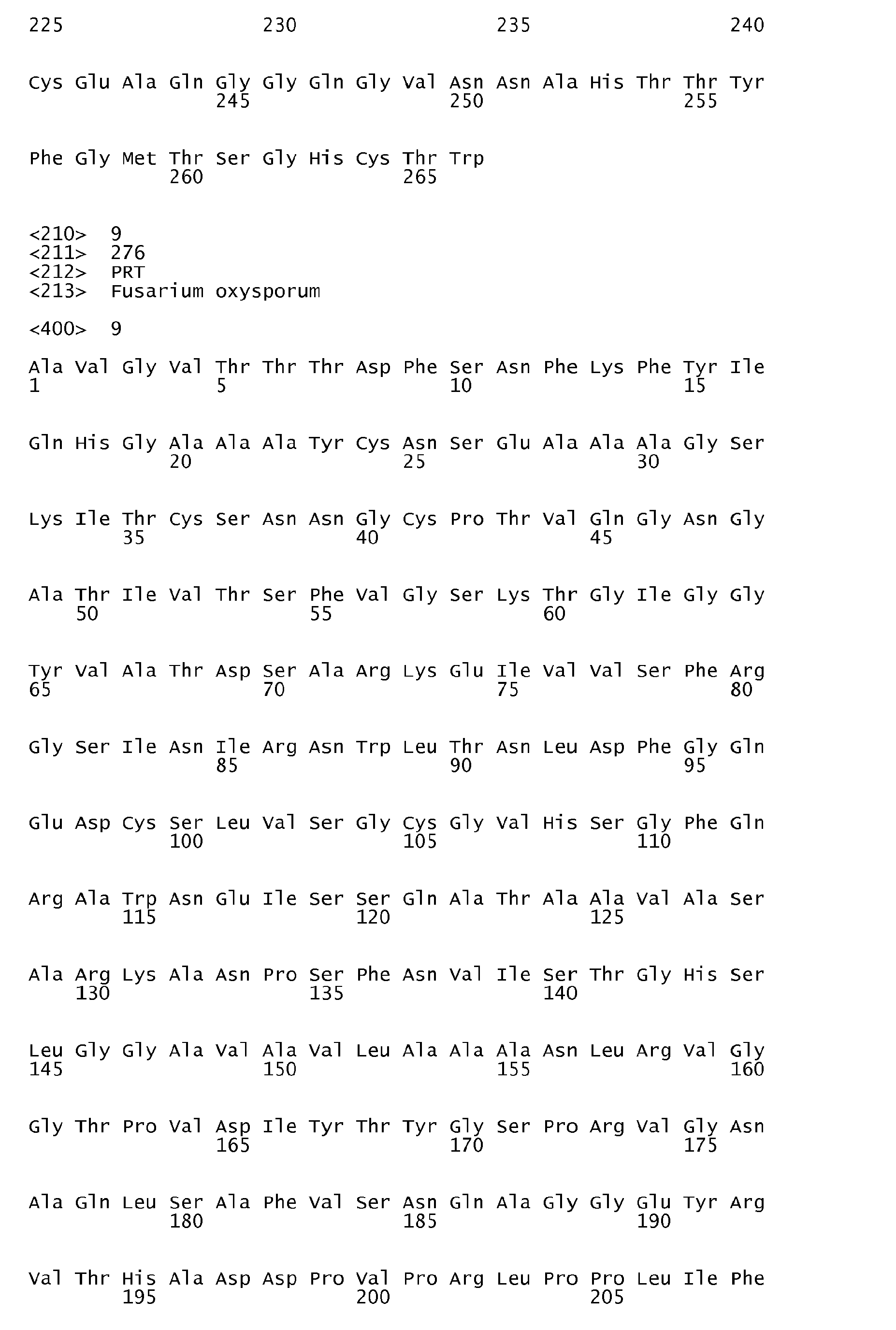
- SEQ ID NO: 9 shows the amino acid sequence of a lipase from Fusarium oxysporrum.
- SEQ ID NO: 10 shows the amino acid sequence of a lipase from Fusarium heterosporum.
- SEQ ID NO: 11 shows the amino acid sequence of a lipase from Aspergillus oryzae.
- SEQ ID NO: 12 shows the amino acid sequence of a lipase from Penicillium camemberti.
- SEQ ID NO: 13 shows the amino acid sequence of a lipase from Aspergillus foetidus.
- SEQ ID NO: 14 shows the amino acid sequence of a lipase from Aspergillus niger.
- SEQ ID NO: 15 shows the amino acid sequence of a lipase from Aspergillus oryzae.
- SEQ ID NO: 16 shows the amino acid sequence of a lipase from Landerina penisapora.
- Any suitable parent lipase may be used. In a preferred embodiment, the parent lipase may be a fungal lipase. In another preferred embodiment, the parent lipase may be a lipase with an amino acid sequence having at least 50%, 60%, 70%, 80%, 85%, 90%, 95%, 96%, 97%, 98%, 99% or even 100% homology as defined in the section "Homology and aligment" to the sequence of the T. lanuginosus lipase shown in SEQ ID NO: 2.
- The parent lipase may be a yeast polypeptide such as a Candida, Kluyveromyces, Pichia, Saccharomyces, Schizosaccharomyces, or Yarrowia polypeptide; or more preferably a filamentous fungal polypeptide such as an Acremonium, Aspergillus, Aureobasidium, Cryptococcus, Filobasidium, Fusarium, Humicola, Magnaporthe, Mucor, Myceliophthora, Neocallimastix, Neurospora, Paecilomyces, Penicillium, Piromyces, Schizophyllum, Talaromyces, Thermoascus, Thielavia, Tolypocladium, or Trichoderma polypeptide.
- In a preferred aspect, the parent lipase is a Saccharomyces carlsbergensis, Saccharomyces cerevisiae, Saccharomyces diastaticus, Saccharomyces douglasii, Saccharomyces kluyveri, Saccharomyces norbensis, or Saccharomyces oviformis polypeptide having lipase activity.
- In another preferred aspect, the parent lipase is an Aspergillus aculeatus, Aspergillus awamori, Aspergillus fumigatus, Aspergillus foetidus, Aspergillus japonicus, Aspergillus nidulans, Aspergillus niger, Aspergillus oryzae, Aspergillus turbigensis, Fusarium bactridioides, Fusarium cerealis, Fusarium crookwellense, Fusarium culmorum, Fusarium graminearum, Fusarium graminum, Fusarium heterosporum, Fusarium negundi, Fusarium oxysporum, Fusarium reticulatum, Fusarium roseum, Fusarium sambucinum, Fusarium sarcochroum, Fusarium sporotrichioides, Fusarium sulphureum, Fusarium torulosum, Fusarium trichothecioides, Fusarium venenatum, Humicola insolens, Thermomyces lanoginosus (synonym: Humicola lanuginose), Mucor miehei, Myceliophthora thermophila, Neurospora crassa, Penicillium purpurogenum, Trichoderma harzianum, Trichoderma koningii, Trichoderma longibrachiatum, Trichoderma reesei, or Trichoderma viride polypeptide.
- In another preferred aspect, the parent lipase is a Thermomyces lipase.
- In a more preferred aspect, the parent lipase is a Thermomyces lanuginosus lipase. In an even more preferred embodiment the parent lipase is the lipase of SEQ ID NO: 2.
- The lipase variants of the present invention comprise, as compared to the parent lipase, at least three substitutions selected from the group consisting of:
- a) at least two substitution in Region I, and
- b) at least one substitution in Region II, and
- c) at least one substitution in Region III, and
- d) at least one substitution in Region IV;'
- In a preferred embodiment. the variant lipase is a variant of a Thermomyces lipase, more preferably, a T. lanuginosus lipase, and even more preferably, the T. lanuginosus lipase shown in SEQ ID NO: 2. In a preferred embodiment. the variant lipase has at least 50%, 60%, 70%, 80%, 85%, 90%, 95%, 96%, 97%, 98% or 99% identity to SEQ ID NO:2.
- The variant lipase may be a variant of a parent lipase encoded by a gene derived/obtained from one of the following parent organisms: Candida, Kluyveromyces, Pichia, Saccharomyces, Schizosaccharomyces, or Yarrowia, Acremonium, Aspergillus, Aureobasidium, Cryptococcus, Filobasidium, Fusarium, Humicola, Magnaporthe, Mucor, Myceliophthora, Neocallimastix, Neurospora, Paecilomyces, Penicillium, Piromyces, Schizophyllum, Talaromyces, Thermoascus, Thielavia, Tolypocladium, or Trichoderma. In a preferred embodiment, the variant lipase has at least 50%, 60%, 70%, 80%, 85%, 90%, 95%, 96%, 97%, 98% or 99% identity to a parent lipase encoded by a gene derived/obtained from one of the following parent organisms: Candida, Kluyveromyces, Pichia, Saccharomyces, Schizosaccharomyces, or Yarrowia, Acremonium, Aspergillus, Aureobasidium, Cryptococcus, Filobasidium, Fusarium, Humicola, Magnaporthe, Mucor, Myceliophthora, Neocallimastix, Neurospora, Paecilomyces, Penicillium, Piromyces, Schizophyllum, Talaromyces, Thermoascus, Thielavia, Tolypocladium, or Trichoderma.
- In a preferred aspect, the variant lipase is a variant Saccharomyces carlsbergensis, Saccharomyces cerevisiae, Saccharomyces diastaticus, Saccharomyces douglasii, Saccharomyces kluyveri, Saccharomyces norbensis, or Saccharomyces oviformis. In a preferred embodiment, the variant lipase has at least 50%, 60%, 70%, 80%, 85%, 90%, 95%, 96%, 97%, 98% or 99% identity to a parent lipase encoded by a gene derived/obtained from Saccharomyces carlsbergensis, Saccharomyces cerevisiae, Saccharomyces diastaticus, Saccharomyces douglasii, Saccharomyces kluyveri, Saccharomyces norbensis, or Saccharomyces oviformis.
- The variant lipase may be a variant of a parent lipase encoded by a gene derived/obtained from one of the following parent organisms: Aspergillus aculeatus, Aspergillus awamori, Aspergillus fumigatus, Aspergillus foetidus, Aspergillus japonicus, Aspergillus nidulans, Aspergillus niger, Aspergillus oryzae, Aspergillus turbigensis, Fusarium bactridioides, Fusarium cerealis, Fusarium crookwellense, Fusarium culmorum, Fusarium graminearum, Fusarium graminum, Fusarium heterosporum, Fusarium negundi, Fusarium oxysporum, Fusarium reticulatum, Fusarium roseum, Fusarium sambucinum, Fusarium sarcochroum, Fusarium sporotrichioides, Fusarium sulphureum, Fusarium torulosum, Fusarium trichothecioides, Fusarium venenatum, Humicola insolens, Thermomyces lanoginosus (synonym: Humicola lanuginose), Mucor miehei, Myceliophthora thermophila, Neurospora crassa, Penicillium purpurogenum, Trichoderma harzianum, Trichoderma koningii, Trichoderma longibrachiatum, Trichoderma reesei, or Trichoderma viride. In a preferred embodiment, the variant lipase has at least 50%, 60%, 70%, 80%, 85%, 90%, 95%, 96%, 97%, 98% or 99% identity to a parent lipase encoded by a gene derived/obtained from one of the following parent organisms: Aspergillus aculeatus, Aspergillus awamori, Aspergillus fumigatus, Aspergillus foetidus, Aspergillus japonicus, Aspergillus nidulans, Aspergillus niger, Aspergillus oryzae, Aspergillus turbigensis, Fusarium bactridioides, Fusarium cerealis, Fusarium crookwellense, Fusarium culmorum, Fusarium graminearum, Fusarium graminum, Fusarium heterosporum, Fusarium negundi, Fusarium oxysporum, Fusarium reticulatum, Fusarium roseum, Fusarium sambucinum, Fusarium sarcochroum, Fusarium sporotrichioides, Fusarium sulphureum, Fusarium torulosum, Fusarium trichothecioides, Fusarium venenatum, Humicola insolens, Thermomyces lanoginosus (synonym: Humicola lanuginose), Mucor miehei, Myceliophthora thermophila, Neurospora crassa, Penicillium purpurogenum, Trichoderma harzianum, Trichoderma koningii, Trichoderma longibrachiatum, Trichoderma reesei, or Trichoderma viride.
- In another preferred aspect, the variant is a variant of a Thermomyces lipase.
- In a more preferred aspect, the parent lipase is a Thermomyces lanuginosus lipase. In an even more preferred embodiment the parent lipase is the lipase of SEQ ID NO: 2.
- The positions referred to in Region I through Region IV below are the positions of the amino acid residues in SEQ ID NO:2. To find the corresponding (or homologous) positions in a different lipase, the procedure described in "Homology and alignment" is used.
- Region I consists of amino acid residues surrounding the N-terminal residue E1. In this region, it is preferred to substitute an amino acid of the parent lipase with a more positive amino acid. The lipase variant may comprise at least two substitutions in Region I, such as three, four, five or six substitutions in Region I.
- Amino acid residues corresponding to the following positions are comprised by Region I: 1, 2 to 11 and 223-239. The following positions are of particular interest: 1, 4, 8, 11, 223, 227, 229,231,233,234,236.
- In particular the following substitutions have been identified: X1N/* X4V, X227G, X231 R and X233R.
- In a preferred embodiment the variant lipase has at least 80%, 85%, 90%, 95%, 96%, 97%, 98%, 99% identity to SEQ ID NO:2
- In a most preferred embodiment the variant lipase is a variant of the lipase having the aminio acid sequence of SEQ ID NO: 2.
- Region II consists of amino acid residues in contact with substrate on one side of the acyl chain and one side of the alcohol part. In this region it is preferred to substitute an amino acid of the parent lipase with a more positive amino acid or with a less hydrophobic amino acid.
- The lipase variant may comprise at least one substitution in Region II, such as two, three, four, five or six substitutions in Region II.
- Amino acid residues corresponding to the following positions are comprised by Region II: 202 to 211 and 249 to 269. The following positions are of particular interest : 202, 210, 211, 253,254,255,256.
- In particular the following substitutions have been identified: X202G, X210K/W/A, X255Y/V/A and X256K/R and X259G/M/Q/V.
- In a preferred embodiment the variant lipase has at least 80%, 85%, 90%, 95%, 96%, 97%, 98% or 99% identity to SEQ ID NO:2
- In a most preferred embodiment the variant lipase is a variant of the lipase having the aminio acid sequence of SEQ ID NO: 2.
- Region III consists of amino acid residues that forms a flexible structure and thus allowing the substrate to get into the active site. In this region it is preferred to substitute an amino acid of the parent lipase with a more positive amino acid or a less hydrophobic amino acid.
- The lipase variant may comprise at least one substitution in Region III, such as two, three, four, five or six substitutions in Region III.
- Amino acid residues corresponding to the following positions are comprised by Region III: 82 to 102. The following positions are of particular interest: 83, 86, 87, 90, 91, 95, 96, 99.
- In particular the following substitutions have been identified: X83T, X86V and X90A/R.
- In a preferred embodiment the variant lipase has at least 80%, 85%, 90%, 95%, 96%, 97%, 98% or 99% identity to SEQ ID NO:2
- In a most preferred embodiment the variant lipase is a variant of the lipase having the aminio acid sequence of SEQ ID NO: 2.
- Region IV consists of amino acid residues that binds electrostatically to a surface. In this region it is preferred to substitute an amino acid of the parent lipase with a more positive amino acid.
- The lipase variant may comprise at least one substitution in Region IV, such as two, three, four, five or six substitutions in Region IV.
- Amino acid residues corresponding to the following positions are comprised by Region IV: 27 and 54 to 62. The following positions are of particular interest: 27, 56, 57, 58, 60.
- In particular the following substitutions have been identified: X27R, X58N/AG/T/P and X60V/S/G/N/R/K/A/L.
- In a preferred embodiment the variant lipase has at least 80%, 85%, 90%, 95%, 96%, 97%, 98% or 99% identity to SEQ ID NO:2
- In a most preferred embodiment the variant lipase is a variant of the lipase having the aminio acid sequence of SEQ ID NO: 2.
- The parent lipase may optionally comprise additional alterations, e.g, substitution of other amino acids, particularly less than 10, less than 9, less than 8, less than 7, less than 6, less than 5 alterations as compared to a parent lipaase. Examples are substitutions corresponding to one or more of the positions 24, 37, 38, 46, 74, 81, 83, 115, 127, 131, 137, 143, 147, 150, 199, 200, 203, 206, 211, 263, 264, 265, 267 and 269 of the parent lipase. In a particular embodiment there is a substitution in at least one of the positions corresponding to position 81, 147, 150, 227 and 249. In a preferred embodiment the at least one substitution is selected from the group consisting of X38R, X81Q/E, X143S/C/N/D/A, X147M/Y, X150G/K, X227G and X249R/I/L.
- The variant may comprise substitutions outside the defined Region I to IV; the number of substitutions outside the defined Region I to IV is preferably less than six, such as five, four, three, two or one substitution.
- Further substitutions may, e.g., be made according to principles known in the art, e.g. substitutions described in
WO 92/05249 WO 94/25577 WO 95/22615 WO 97/04079 WO 97/07202 - Variant lipases include parent lipases having the substitutions listed below in table 1 (using SEQ ID NO:2 for numbering).
Table 1: Region I Region II Region III Region IV Outside regions X4V + X227G + X231R +X233R X210K + X256K X83T + X86V X58A+X60S X150G X227G + X231R+X233R X256K X86V X58N + X60S X150G X231R+X233R X255Y X231R+X233R X202G X227G + X231 R + X233R X256K X86V X4V + X231 R + X233R X58N +X60S X231 R +X233R X90R X58N +X60S X231 R +X233R X255V X90A X227G + X231 R + X233R X256K X86V X58N + X60S X150G X231R+X233R X211L X58N + X60S X147M X231R+X233R X150K - In a further particular embodiment, the parent lipase is identical to SEQ ID NO:2, and the variants of Table 1 will thus be:
Table 2: Some particular variants of SEQ ID NO:2 Region I Region II Region III Region IV Outside regions Q4V + L227G + T231R+N233R E210K + P256K S83T + 186V S58A + V60S A150G L227G + T231 R + N233R P256K 186V S58N + V60S A150G T231 R + N233R 1255Y T231 R + N233R 1202G L227G + T231 R + N233R P256K 186V Q4V + T231 R + N233R S58N + V60S T231 R + N233R 190R S58N + V60S T231 R + N233R 1255V 190A L227G + T231 R + N233R P256K I86V S58N + V60S A150G T231 R + N233R F211L S58N + V60S L147M T231 R + N233R A150K - In describing lipase variants according to the invention, the following nomenclature is used for ease of reference:
- Original amino acid(s):position(s):substituted amino acid(s)
- According to this nomenclature, for instance the substitution of glutamic acid for glycine in position 195 is shown as G195E. A deletion of glycine in the same position is shown as G195*, and insertion of an additional amino acid residue such as lysine is shown as G195GK.
- Where a specific lipase contains a "deletion" in comparison with other lipases and an insertion is made in such a position this is indicated as *36D for insertion of an aspartic acid in position 36.
- Multiple mutations are separated by pluses, i.e.: R170Y+G195E, representing mutations in positions 170 and 195 substituting tyrosine and glutamic acid for arginine and glycine, respectively.
- X231 indicates the amino acid in a parent polypeptide corresponding to position 231, when applying the described alignment procedure. X231 R indicates that the amino acid is replaced with R. For SEQ ID NO:2 X is T, and X231 R thus indicates a substitution of T in position 231 with R. Where the amino acid in a position (e.g. 231) may be substituted by another amino acid selected from a group of amino acids, e.g. the group consisting of R and P and Y, this will be indicated by X231 R/P/Y.
- In all cases, the accepted IUPAC single letter or triple letter amino acid abbreviation is employed.
- In this specification, amino acids are classified as negatively charged, positively charged or electrically neutral according to their electric charge at
pH 10. Thus, negative amino acids are E, D, C (cysteine) and Y, particularly E and D. Positive amino acids are R, K and H, particularly R and K. Neutral amino acids are G, A, V, L, I, P, F, W, S, T, M, N, Q and C when forming part of a disulfide bridge. A substitution with another amino acid in the same group (negative, positive or neutral) is termed a conservative substitution. - The neutral amino acids may be divided into hydrophobic or non-polar (G, A, V, L, I, P, F, W and C as part of a disulfide bridge) and hydrophilic or polar (S, T, M, N, Q).
- The relatedness between two amino acid sequences or between two nucleotide sequences is described by the parameter "identity".
- For purposes of the present invention, the alignment of two amino acid sequences is determined by using the Needle program from the EMBOSS package (http://emboss.org) version 2.8.0. The Needle program implements the global alignment algorithm described in Needleman, S. B. and Wunsch, C. D. (1970) J. Mol. Biol. 48, 443-453. The substitution matrix used is BLOSUM62, gap opening penalty is 10, and gap extension penalty is 0.5.
- The degree of identity between an amino acid sequence of the present invention ("invention sequence"; e.g.
amino acids 1 to 269 of SEQ ID NO:2) and a different amino acid sequence ("foreign sequence") is calculated as the number of exact matches in an alignment of the two sequences, divided by the length of the "invention sequence" or the length of the "foreign sequence", whichever is the shortest. The result is expressed in percent identity. - An exact match occurs when the "invention sequence" and the "foreign sequence" have identical amino acid residues in the same positions of the overlap. The length of a sequence is the number of amino acid residues in the sequence (e.g. the length of SEQ ID NO:2 is 269).
- The above procedure may be used for calculation of identity as well as homology and for alignment. In the context of the present invention homology and alignment has been calculated as described below.
- For purposes of the present invention, the degree of homology may be suitably determined by means of computer programs known in the art, such as GAP provided in the GCG program package (Program Manual for the Wisconsin Package,
Version 8, August 1994, Genetics Computer Group, 575 Science Drive, Madison, Wisconsin, USA 53711) (Needleman, S.B. and Wunsch, C.D., (1970), Journal of Molecular Biology, 48, 443-45), using GAP with the following settings for polypeptide sequence comparison: GAP creation penalty of 3.0 and GAP extension penalty of 0.1. - In the present invention, corresponding (or homologous) positions in the lipase sequences of Absidia reflexa, Absidia corymbefera, Rhizmucor miehei, Rhizopus delemar, Aspergillus niger, Aspergillus tubigensis, Fusarium oxysporum, Fusarium heterosporum, Aspergillus oryzea, Penicilium camembertii, Aspergillus foetidus, Aspergillus niger, Thermomyces lanoginosus (synonym: Humicola lanuginose) and Landerina penisapora are defined by the alignment shown in
Figure 1 . - To find the homologous positions in lipase sequences not shown in the alignment, the sequence of interest is aligned to the sequences shown in
Figure 1 . The new sequence is aligned to the present alignment inFigure 1 by using the GAP alignment to the most homologous sequence found by the GAP program. GAP is provided in the GCG program package (Program Manual for the Wisconsin Package,Version 8, August 1994, Genetics Computer Group, 575 Science Drive, Madison, Wisconsin, USA 53711) (Needleman, S.B. and Wunsch, C.D., (1970), Journal of Molecular Biology, 48, 443-45). The following settings are used for polypeptide se-quence comparison: GAP creation penalty of 3.0 and GAP extension penalty of 0.1. - The present invention also relates to isolated polypeptides having lipase activity which are encoded by polynucleotides which hybridize under very low stringency conditions, preferably low stringency conditions, more preferably medium stringency conditions, more preferably medium-high stringency conditions, even more preferably high stringency conditions, and most preferably very high stringency conditions with (i) nucleotides 178 to 660 of SEQ ID NO: 1, (ii) the cDNA sequence contained in nucleotides 178 to 660 of SEQ ID NO: 1, (iii) a subsequence of (i) or (ii), or (iv) a complementary strand of (i), (ii), or (iii) (J. Sambrook, E.F. Fritsch, and T. Maniatus, 1989, Molecular Cloning, A Laboratory Manual, 2d edition, Cold Spring Harbor, New York). A subsequence of SEQ ID NO: 1 contains at least 100 contiguous nucleotides or preferably at least 200 contiguous nucleotides. Moreover, the subsequence may encode a polypeptide fragment which has lipase activity.
- For long probes of at least 100 nucleotides in length, very low to very high stringency conditions are defined as prehybridization and hybridization at 42°C in 5X SSPE, 0.3% SDS, 200 ug/ml sheared and denatured salmon sperm DNA, and either 25% formamide for very low and low stringencies, 35% formamide for medium and medium-high stringencies, or 50% formamide for high and very high stringencies, following standard Southern blotting procedures for 12 to 24 hours optimally.
- For long probes of at least 100 nucleotides in length, the carrier material is finally washed three times each for 15 minutes using 2X SSC, 0.2% SDS preferably at least at 45°C (very low stringency), more preferably at least at 50°C (low stringency), more preferably at least at 55°C (medium stringency), more preferably at least at 60°C (medium-high stringency), even more preferably at least at 65°C (high stringency), and most preferably at least at 70°C (very high stringency).
- The invention provides a DNA sequence encoding the lipase of the invention, an expression vector harboring the DNA sequence, and a transformed host cell containing the DNA sequence or the expression vector. These may be obtained by methods known in the art.
- The invention also provides a method of producing the lipase by culturing the transformed host cell under conditions conducive for the production of the lipase and recovering the lipase from the resulting broth. The method may be practiced according to principles known in the art.
- A substrate for lipase is prepared by emulsifying tributyrin (glycerin tributyrate) using gum Arabic as emulsifier. The hydrolysis of tributyrin at 30 °C at
pH pH 7. - The Benefit Risk factor describing the performance compared to the reduced risk for odor smell is defined as: BR = RPavg / R, as described below.
- Enzymes of the present invention may find industrial use, e.g. be included in detergent compositions for removing of fatty matter.
-
- 1. A variant of a parent lipase, wherein the variant comprises at least three substitutions selected from the group consisting of (using SEQ ID NO:2 for numbering):
- a) at least two substitutions in Region I, and
- b) at least one substitution in Region II, and
- c) at least one substitution in Region III, and
- d) at least one substitution in Region IV;
and wherein the variant has lipase activity.
- 2. A lipase variant according to
embodiment 1, wherein the at least two substitutions in Region I of the parent lipase comprises substitutions of the amino acids at the positions corresponding to the positions 231 and 233 (using SEQ ID NO:2 for numbering). - 3. A lipase variant according to
embodiment 2, wherein the at least two substitutions in Region I of the parent lipase comprises substitutions of an R of the amino acids at the positions corresponding to the positions 231 and 233 (using SEQ ID NO:2 for numbering). - 4. A lipase variant according to
embodiment 1, wherein the variant lipase is at least 80%. 85%, 90%, 95%, 96%, 97%, 98%, 99% identical to SEQ ID NO:2. - 5. A lipase variant according to
embodiment 1, wherein the parent lipase is the lipase having the aminio acid sequence of SEQ ID NO:2. - 6. A lipase variant according to
embodiment 2, wherein the lipase comprises a further substitution in the position corresponding toposition 4 and/or position 227 of SEQ ID NO:2. - 7. A lipase variant according to
embodiment 6, wherein the lipase has a subsitution corresponding to X4V and X227G (using SEQ ID NO:2 for numbering). - 8. A lipase variant according to
embodiment 1, wherein the at least one substitution in Region II of the parent lipase comprises substitutions selected from the group consisting of substitutions in positions corresponding to the positions 202, 210, 211, 255 and 256 (using SEQ ID NO:2 for numbering). - 9. A lipase variant according to
embodiment 8, wherein the at least one substitution in the parent lipase is selected from the group consisting of X202G, X210K, X211 L, X255Y/V and X256K (using SEQ ID NO:2 for numbering). - 10. A lipase variant according to
embodiment 1, wherein the at least one substitution in Region III of the parent lipase comprises substitutions selected from the group consisting of substitutions in positions corresponding to the positions 83, 86 and 90 (using SEQ ID NO:2 for numbering). - 11. A lipase variant according to
embodiment 10, wherein the at least one substitution in the parent lipase is selected from the group consisting of X83T, X86V and X90A/R (using SEQ ID NO:2 for numbering). - 12. A lipase variant according to
embodiment 1, wherein the at least one substitution in Region IV of the parent lipase comprises substitutions selected from the group consisting of substitutions in positions corresponding to the positions 27, 58 and 60 (using SEQ ID NO:2 for numbering). - 13. A lipase variant according to
embodiment 1, wherein the at least one substitution in Region IV of the parent lipase comprises substitutions selected from the group consisting of X27R, X58N/A/G/P/T and X60S/V/G/N/R/K/A/L (using SEQ ID NO:2 for numbering). - 14. A lipase variant according to
embodiment 1, wherein the lipase variant further comprises at least one substitution in the parent lipase is selected from the group consisting of substitutions in positions corresponding to position 81, 147, 150, 227 and 249 (using SEQ ID NO:2 for numbering). - 15. A lipase variant according to
embodiment 1, wherein the lipase variant further comprises at least one substitution selected from the group consisting of X81Q/E, X147M/Y, X150G and X249R/I/L (using SEQ ID NO:2 for numbering). - 16. A lipase variant of
embodiment 1, wherein the lipase comprises a substitution selected from the following group of substitutions:- a) T231 R + N233R + 1255Y
- b) 1202G + T231 R + N233R
- c) 186V + L227G + T231 R + N233R + P256K
- d) Q4V + S58N + V60S + T231 R + N233R
- e) S58N + V60S + 190R + T231 R + N233R
- f) 190A + T231 R + N233R + 1255V
- g) S58N + V60S + 186V + A150G + L227G + T231 R + N233R + P256K
- h) S58N + V60S + L147M + F211 L + T231 R + N233R
- i) Q4V + S58A + V60S + S83T + 186V + A150G + E210K + L227G + T231 R + N233R + P256K
- j) S58N + V60S + 186V + A150G + L227G + T231 R + N233R + P256K
- 17. A DNA sequence encoding the lipase variant of embodiments 1-16.
- 18. An expression vector harbouring the DNA sequence of embodiment 17.
- 19. A transformed host cell containing the DNA sequence of embodiment 17.
- 20. A method of producing a lipase variant, which method comprises culturing the transformed host cell of embodiment 19 under conditions conducive for the production of the lipase variant and recovering the lipase variant from the resulting broth.
- 21. A variant of SEQ ID NO: 2 comprising at least one of the mutations Q4V, S58N/A/G/P/T, 190R or Q2491/L.
- Chemicals used as buffers and substrates were commercial products of at least reagent grade.
-
Product Tradename LAS: Surfac PS Zeolite A Wessalith P -
Product Supplier EMPA221 EMPA St. Gallen, Lerchfeldstrasse 5, CH-9014 St. Gallen, Switzerland - A plasmid containing the gene encoding the lipase is constructed and transformed into a suitable host cell using standard methods of the art.
- Fermentation is carried out as a fed-batch fermentation using a constant medium temperature of 34°C and a start volume of 1.2 liter. The initial pH of the medium is set to 6.5. Once the pH has increased to 7.0 this value is maintained through addition of 10% H3PO4. The level of dissolved oxygen in the medium is controlled by varying the agitation rate and using a fixed aeration rate of 1.0 liter air per liter medium per minute. The feed addition rate is maintained at a constant level during the entire fed-batch phase.
The batch medium contains maltose syrup as carbon source, urea and yeast extract as nitrogen source and a mixture of trace metals and salts. The feed added continuously during the fed-batch phase contains maltose syrup as carbon source whereas yeast extract and urea is added in order to assure a sufficient supply of nitrogen. Purification of the lipase may be done by use of standard methods known in the art, e.g. by filtering the fermentation supernatant and subsequent hydrophobic chromatography and ion exchange chromatography, e.g. as described inEP 0 851 913 EP, Example 3. - The enzyme variants of the present application are tested using the Automatic Mechanical Stress Assay (AMSA). With the AMSA test the wash performance of a large quantity of small volume enzyme-detergent solutions can be examined. The AMSA plate has a number of slots for test solutions and a lid firmly squeezing the textile swatch to be washed against all the slot openings. During the washing time, the plate, test solutions, textile and lid are vigorously shaken to bring the test solution in contact with the textile and apply mechanical stress. For further description see
WO 02/42740
The assay is conducted under the experimental conditions specified below:Table 3 Test solution 0.5 g/l LAS
0.52 g/l Na2CO3
1.07 g/l Zeolite A
0.52 g/l Na3CitratTest solution volume 160 micro I pH As is (≈9.9) Wash time 20 minutes Temperature 30° C Water hardness 15°dH Ratio of Ca2+/Mg2+/NaHCO3 : 4:1:7.5 Enzyme concentration in test solution 0.125, 0.25, 0.50, 1.0 mg ep / I Drying Performance: After washing the textile pieces is immediately flushed in tap water and air-dried at 85C in 5 min
Odor: After washing the textile pieces is immediately flushed in tap water and dried at room temperature (20°C) for 2 hoursTest material Cream turmeric swatch as described below (EMPA221 used as cotton textile) - Cream-turmeric swatches were prepared by mixing 5 g of turmeric (Santa Maria, Denmark) with 100 g cream (38% fat, Arla, Denmark) at 50°C, the mixture was left at this temperature for about 20 minutes and filtered (50°C) to remove any undissolved particles. The mixture is cooled to 20°C) woven cotton swatches, EMPA221, were immersed in the cream-turmeric mixture and afterwards allowed to dry at room temperature over night and frozen until use. The preparation of cream-turmeric swatches is disclosed in the patent application
WO 2006/125437 . - The performance of the enzyme variant is measured as the brightness of the colour of the textile samples washed with that specific enzyme variant. Brightness can also be expressed as the intensity of the light reflected from the textile sample when luminated with white light. When the textile is stained the intensity of the reflected light is lower, than that of a clean textile. Therefore the intensity of the reflected light can be used to measure wash performance of an enzyme variant.
- Color measurements are made with a professional flatbed scanner (PFU DL2400pro), which is used to capture an image of the washed textile samples. The scans are made with a resolution of 200 dpi and with an output color depth of 24 bits. In order to get accurate results, the scanner is frequently calibrated with a Kodak reflective IT8 target.
- To extract a value for the light intensity from the scanned images, a special designed software application is used (Novozymes Color Vector Analyzer). The program retrieves the 24 bit pixel values from the image and converts them into values for red, green and blue (RGB).
The intensity value (Int) is calculated by adding the RGB values together as vectors and then taking the length of the resulting vector:
- The wash performance (P) of the variants is calculated in accordance with the below formula:

where
Int(v) is the light intensity value of textile surface washed with enzyme, and
Int(r) is the light intensity value of textile surface washed without enzyme.
A relative performance score is given as the result of the AMSA wash in accordance with the definition: - Relative Performance scores (RP) are summing up the performances (P) of the tested enzyme variants against the reference enzyme:

- A variant is considered to exhibit improved wash performance, if it performs better than the reference.
In the context of the present invention the reference enzyme is the lipase of SEQ ID NO:2 with the substitutions T231 R + N233R. - The butyric acid release from the lipase washed swatches were measured by Solid Phase Micro Extraction Gas Chromatography (SPME-GC) using the following method. Four textile pieces (5 mm in diameter), washed in the specified solution in Table 3 containing 1 mg/l lipase, were transferred to a Gas Chromatograph (GC) vial. The samples were analysed on a Varian 3800 GC equipped with a Stabilwax- DA w/Integra-Guard column (30m, 0.32 mm ID and 0.25 micro-m df) and a Carboxen PDMS SPME fibre (75 micro-m). Each sample was preincubated for 10 min at 40°C followed by 20 min sampling with the SPME fibre in the head-space over the textile pieces. The sample was subsequently injected onto the column (injector temperature=250°C). Column flow = 2 ml Helium/min. Column oven temperature gradient: 0 min = 40°C, 2 min = 40°C, 22 min = 240°C, 32 min = 240°C. The butyric acid was detected by FID detection and the amount of butyric acid was calculated based on a butyric acid standard curve.
- The Risk Performance Odour, R, of a lipase variant is the ratio between the amount of released butyric acid from the lipase variant washed swatch and the amount of released butyric acid from a swatch washed with the lipase of SEQ ID NO: 2 with the substitutions T231 R + N233R (reference enzyme), after both values have been corrected for the amount of released butyric acid from a non-lipase washed swatch. The risk (R) of the variants is calculated in accordance with the below formula:



A variant is considered to exhibit reduced odor compared to the reference, if the R factor is lower than 1. - The activity of a lipase relative to the absorbance at 280 nm is determined by the following assay:
- The activity of the lipase is determined as described above in the section Lipase activity. The absorbance of the lipase at 280 nm is measured (A280) and the ratio LU/A280 is calculated. The relative LU/A280 is calculated as the LU/A280 of the variant divided by the LU/A280 of a reference enzyme. In the context of the present invention the reference enzyme is the lipase of SEQ ID NO:2 with the substitutions T231 R + N233R.
- The Benefit Risk factor describing the performance compared to the reduced risk for odour smell is thus defined as:

A variant is considered to exhibit improved wash performance and reduced odor, if the BR factor is higher than 1.
Applying the above methods the following results were obtained:Table 4 Variant Mutations in SEQ ID NO: 2 Average RP (RPavg) BR LU/ A280 1 I202G + T231 R + N233R 0.84 1.41 not determined 2 186V + L227G + T231 R + N233R + P256K 1.08 1.52 1700 3 Q4V + S58N + V60S + T231 R + N233R 0.87 1.73 1950 4 S58N + V60S + 190R + T231 R + N233R 1.06 1.27 2250 5 1255Y + T231 R + N233R 1.19 1.17 3600 6 190A + T231 R + N233R + 1255V 1.13 1.14 2700 Reference T231 R + N233R 1.00 1.00 3650 7 G91A + E99K + T231 R+N233R + Q249R + 270H + 271T + 272P + 273S + 274S + 275G + 276R + 277G + 278G + 279H + 280R 0.43 not determined 850 8 G91A + E99K + T231 R, N233R + Q249R + 270H + 271T + 272P + 273S + 274S + 275G + 276R + 277G + 278G 0.13 not determined 500 variants WO 2000/060063 . - The Benefit Risk was measured for the variants listed in Table 5. The Benefit Risk factor was measured in the same way as described in Example 5 and it was found to be above 1 for all the listed variants.
Table 5 Variant Mutations in SEQ ID NO: 2 Reference T231 R + N233 R 9 L97V+ T231 R+N233R 10 A150G+T231R+N233R 11 190R+T231 R+N233R 12 I202V+T231R+N233R 13 L227G+ T231 R+ N233R+ P256K 14 190A+ T231 R+ N233R 15 T231R+N233R+1255P 16 190V+1255V+T231 R+N233R 17 F211 L+ L227G+ T231 R+ N233R+ 1255L+ P256K 18 S58N+ V60S+ T231 R+ N233R+ Q249L 19 S58N+ V60S+ T231 R+ N233R+ Q2491 20 A150G+ L227G+ T231 R+ N233R+ P256K 21 K46L+ S58N+ V60S+ T231 R+ N233R+ Q249L+ D2541 22 Q4L+ E43T+ K461+ S58N+ V60S+ T231 R+ N233R+ Q249L+ D2541 23 Q4L+ S58N+ V60S+ T231 R+ N233R+ Q249L+ D2541 24 K461+ S58N+ V60S+ T231 R+ N233R+ Q249L+ D254L 25 K46L+ S58N+ V60S+ K2231+ T231 R+ N233R+ D2541 26 E43T+ K461+ S58N+ V60S+ T231 R+ N233R+ Q249L+ D2541 27 S58N+ V60S+ 186V+ A150G+ L227G+ T231 R+ N233R+ P256K 28 K24R+ K46R+ K74R+ 186V+ K98R+ K127R+ D137K+ A150G+ K223R+ T231 R+ N233R 29 S58A+V60A+186V+T231R+N233R 30 K24R+ K46R+ S58N+ V60S+ K74R+ 186V+ K98R+ K127R+ D137K+ K223R+ T231 R+ N233R 31 S58A+ V60A+ 186V+ A150G+ T231 R+ N233R 32 S58N+ V60V+ D62G+ T231 R+ N233R 33 Q4V+ S58N+ V60S+ 186V+ T231 R+ N233R+ Q249L 34 Q4V+ S58N+ V60S+ 186V+ A150G+ T231 R+ N233R+ 1255V 35 Q4V+ S58N+ V60S+ I90A+ A150G+ T231 R+ N233R+ 1255V 36 Y53A+ S58N+ V60S+ T231 R+ N233R+ P256L 37 I202L+ T231 R+ N233R+ I255A 38 S58A+ V60S+ 186V+ A150G+ L227G+ T231 R+ N233R+ P256K 39 D27R+ S58N+ V60S+ 186V+ A150G+ L227G+ T231 R+ N233R+ P256K 40 V60K+ 186V+ A150G+ L227G+ T231 R+ N233R+ P256K 41 Q4V+ S58A+ V60S+ S83T+ 186V+ A150G+ E210K+ L227G+ T231 R+ N233R+ P256K 42 Q4V+ V60K+ S83T+ 186V+ A150G+ L227G+ T231 R+ N233R+ P256K 43 D27R+ V60K+ 186V+ A150G+ L227G+ T231 R+ N233R+ P256K 44 Q4N+ L6S+ S58N+ V60S+ 186V+ A150G+ L227G+ T231 R+ N233R+ P256K 45 E1 N+ V60K+ 186V+ A150G+ L227G+ T231 R+ N233R+ P256K 46 V60K+ I86V+ A150G+ K223N+ G225S+ T231 R+ N233R+ P256K 47 E210V+ T231 R+ N233R+ Q249R 48 S58N+ V60S+ E210V+ T231 R+ N233R+ Q249R 49 Q4V+ V60K+ 190R+ T231 R+ N233R+ 1255V 50 Q4V+ V60K+ A150G+ T231 R+ N233R 51 V60K+ S83T+ T231 R+ N233R 52 V60K+ A150G+ T231 R+ N233R+ 1255V 53 T231 R+ N233G+ D234G 54 S58N+ V60S+ I86V+ A150G+ E210K+ L227G+ T231 R+ N233R+ Q249R+ P256K 55 S58N+ V60S+ I86V+ A150G+ E210K+ L227G+ T231 R+ N233R+ 1255A+ P256K 56 S58N+ V60S+ !86V+A150G+ G156R+ E210K+ L227G+ T231 R+ N233R+ 1255A+ P256K 57 S58T+ V60K+ 186V+ N94K+ A150G+ E210V+ L227G+ T231 R+ N233R+ P256K 58 S58T+ V60K+ 186V+ D102A+ A150G+ L227G+ T231 R+ N233R+ P256K 59 S58T+ V60K+ 186V+ D102A+ A150G+ E210V+ L227G+ T231 R+ N233R+ P256K 60 S58T+ V60K+ S83T+ I86V+ N94K+ A150G+ E210V+ L227G+ T231 R+ N233R+ P256K 61 S58A+ V60S+ 186V+ T143S+ A150G+ L227G+ T231 R+ N233R+ P256K 62 G91S+ D96V+ D254R 63 V60L+ G91 M+ T231 W+ Q249L 64 T37A+ D96A+ T231 R+ N233R+ Q249G 65 E56G+E87D+T231R+N233R+D254A 66 E210K+T231R+N233R 67 D27H+E87Q+D96N+T231 R+N233R+D254V 68 F181L+E210V+T231R+N233R 69 D27N+ D96G+ T231 R+ N233R 70 D96N+ T231 R+ N233R 71 T231 R+ N2331+ D234G 72 S58K+ V60L+ E210V+ Q249R 73 S58H+ V60L+ E210V+ Q249R 74 Q4V+ F55V+ 186V+ T231 R+ N233R+ 1255V 75 Q4V+ S58T+ V60K+ T199L+ N200A+ E210K+ T231 R+ N233R+ I255A+ P256K 76 Q4V+ D27N+ V60K+ T231 R+ N233R 77 I90F+ I202P+ T231 R+ N233R+ 1255L 78 S58N+ V60S+ D158N+ T231 R+ N233R 79 S58N+ V60S+ S115K+ T231 R+ N233R 80 S58N+ V60S+ L147M+ A150G+ F211L+ T231 R+ N233R 81 V60K+ A150G+ T231 R+ N233R 82 190V+L227G+T231 R+N233R+ P256K 83 T231 R+N233R+ 1255S 84 I86G+T231 R+N233R 85 V60K+ 1202V+ E210K+ T231 R+ N233R+ 1255A+ P256K 86 190G+ 1202L+ T231 R+ N233R+ 1255S 87 S58G+ V60G+ T231 R+ N233R WO 2000/060063 .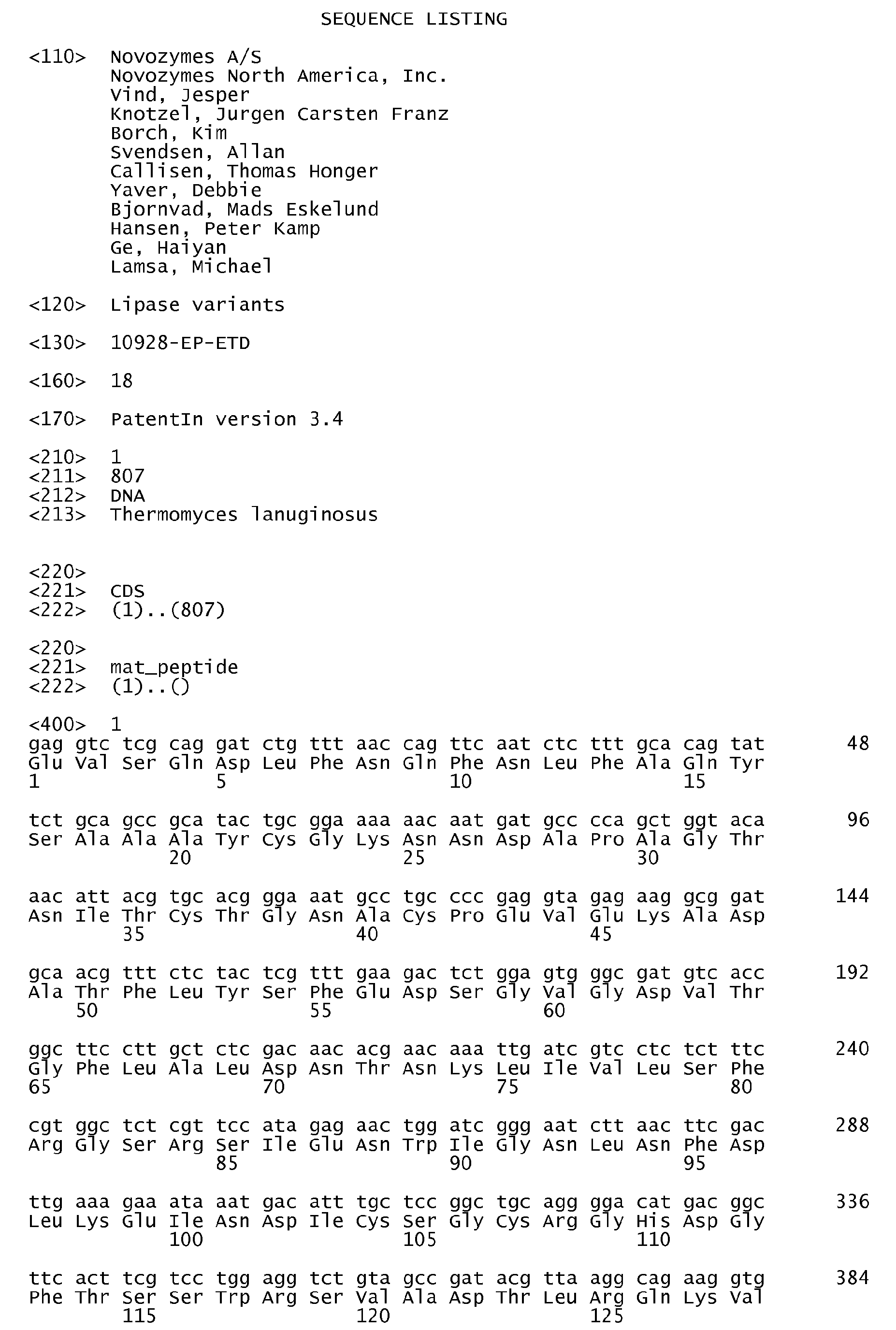




Claims (13)
- A variant of a parent lipase, wherein the variant comprises at least three substitutions selected from the group consisting of (using SEQ ID NO:2 for numbering):a) at least two substitutions in Region I, andb) at least one substitution in Region II, andc) at least one substitution in Region III, andd) at least one substitution in Region IV;and wherein the variant has lipase activity and comprises the substitutions S58N +V60S +186V +A150G +L227G +T231 R +N233R +P256K.
- A lipase variant according to claim 1, wherein the variant lipase is at least 80% identical to SEQ ID NO:2.
- A lipase variant according to claim 1, wherein the parent lipase is the lipase having the amino acid sequence of SEQ ID NO:2.
- A lipase variant according to claim 1, wherein the lipase comprises a further substitution in the position corresponding to position 4 of SEQ ID NO:2, preferably X4V.
- A lipase variant according to claim 1, wherein the at least one substitution in Region II of the parent lipase comprises substitutions selected from the group consisting of substitutions in positions corresponding to the positions 202, 210, 211, 255 and 256 (using SEQ ID NO:2 for numbering), preferably X202G, X210K, X211 L, X255Y/V and X256K.
- A lipase variant according to claim 1, wherein the at least one substitution in Region III of the parent lipase comprises substitutions selected from the group consisting of substitutions in positions corresponding to the positions 83, 86 and 90 (using SEQ ID NO:2 for numbering), preferably X83T, X86V and X90A/R.
- A lipase variant according to claim 1, wherein the at least one substitution in Region IV of the parent lipase comprises substitutions selected from the group consisting of substitutions in positions corresponding to the positions 27, 58 and 60 (using SEQ ID NO:2 for numbering), preferably X27R, X58N and X60S.
- A lipase variant according to claim 1, wherein the lipase variant further comprises at least one substitution in the parent lipase is selected from the group consisting of substitutions in positions corresponding to position 81, 147, 150, 227 and 249 (using SEQ ID NO:2 for numbering), preferably X81Q/E, X147M/Y, X150G and X249R/I/L.
- A lipase variant of claim 1-3, wherein the lipase comprises the following substitutions:S58N +V60S +186V +A150G +L227G +T231 R +N233R +P256K.
- A DNA sequence encoding the lipase variant of claims 1-9.
- An expression vector harbouring the DNA sequence of claim 10.
- A transformed host cell containing the DNA sequence of claim 10.
- A method of producing a lipase variant, which method comprises culturing the transformed host cell of claim 12 under conditions conducive for the production of the lipase variant and recovering the lipase variant from the resulting broth.
Applications Claiming Priority (3)
| Application Number | Priority Date | Filing Date | Title |
|---|---|---|---|
| US76110906P | 2006-01-23 | 2006-01-23 | |
| US85489106P | 2006-10-27 | 2006-10-27 | |
| EP07717346.6A EP1979477B1 (en) | 2006-01-23 | 2007-01-22 | Lipase variants |
Related Parent Applications (3)
| Application Number | Title | Priority Date | Filing Date |
|---|---|---|---|
| EP07717346.6A Division EP1979477B1 (en) | 2006-01-23 | 2007-01-22 | Lipase variants |
| EP07717346.6A Division-Into EP1979477B1 (en) | 2006-01-23 | 2007-01-22 | Lipase variants |
| EP07717346.6 Division | 2007-01-22 |
Publications (2)
| Publication Number | Publication Date |
|---|---|
| EP2371948A1 true EP2371948A1 (en) | 2011-10-05 |
| EP2371948B1 EP2371948B1 (en) | 2017-04-19 |
Family
ID=38179555
Family Applications (3)
| Application Number | Title | Priority Date | Filing Date |
|---|---|---|---|
| EP07717346.6A Active EP1979477B1 (en) | 2006-01-23 | 2007-01-22 | Lipase variants |
| EP10180288.2A Active EP2371948B1 (en) | 2006-01-23 | 2007-01-22 | Lipase variants |
| EP10180310.4A Active EP2371949B1 (en) | 2006-01-23 | 2007-01-22 | Lipase variants |
Family Applications Before (1)
| Application Number | Title | Priority Date | Filing Date |
|---|---|---|---|
| EP07717346.6A Active EP1979477B1 (en) | 2006-01-23 | 2007-01-22 | Lipase variants |
Family Applications After (1)
| Application Number | Title | Priority Date | Filing Date |
|---|---|---|---|
| EP10180310.4A Active EP2371949B1 (en) | 2006-01-23 | 2007-01-22 | Lipase variants |
Country Status (8)
| Country | Link |
|---|---|
| US (1) | US8187854B2 (en) |
| EP (3) | EP1979477B1 (en) |
| JP (1) | JP5133899B2 (en) |
| CN (2) | CN101370933B (en) |
| BR (1) | BRPI0707202A2 (en) |
| DK (3) | DK2371949T3 (en) |
| ES (3) | ES2629332T3 (en) |
| WO (1) | WO2007087508A2 (en) |
Families Citing this family (334)
| Publication number | Priority date | Publication date | Assignee | Title |
|---|---|---|---|---|
| ES2629332T3 (en) * | 2006-01-23 | 2017-08-08 | Novozymes A/S | Lipase variants |
| ES2601327T3 (en) * | 2006-01-23 | 2017-02-14 | Novozymes A/S | Polypeptides with lipase activity and polynucleotides encoding them |
| US20070179074A1 (en) * | 2006-01-23 | 2007-08-02 | Souter Philip F | Detergent compositions |
| AU2013203500B2 (en) * | 2006-12-21 | 2015-12-17 | Novozymes A/S | Lipase variants for pharmaceutical use |
| US8273348B2 (en) * | 2006-12-21 | 2012-09-25 | Novozymes A/S | Lipase variants for pharmaceutical use |
| EP2250259B1 (en) | 2008-02-29 | 2016-08-31 | Novozymes A/S | Polypeptides having lipase activity and polynucleotides encoding same |
| CN101990573B (en) * | 2008-02-29 | 2014-01-22 | 诺维信公司 | Lipolytic enzyme variant with improved stability and polynucleotides encoding same |
| EP2247720A2 (en) * | 2008-02-29 | 2010-11-10 | The Procter & Gamble Company | Detergent composition comprising lipase |
| MX2010009464A (en) | 2008-02-29 | 2010-09-22 | Dsm Ip Assets Bv | Lipases with high specificity towards short chain fatty acids and uses thereof. |
| EP2343310A1 (en) | 2010-01-08 | 2011-07-13 | Novozymes A/S | Serine hydrolase formulation |
| MX2012012096A (en) | 2010-04-26 | 2012-12-17 | Novozymes As | Enzyme granules. |
| DE102010028951A1 (en) | 2010-05-12 | 2011-11-17 | Henkel Ag & Co. Kgaa | Storage-stable liquid washing or cleaning agent containing protease and lipase |
| US8759044B2 (en) | 2011-03-23 | 2014-06-24 | Butamax Advanced Biofuels Llc | In situ expression of lipase for enzymatic production of alcohol esters during fermentation |
| US8765425B2 (en) | 2011-03-23 | 2014-07-01 | Butamax Advanced Biofuels Llc | In situ expression of lipase for enzymatic production of alcohol esters during fermentation |
| CN107475235B (en) | 2011-06-20 | 2022-09-13 | 诺维信公司 | Particulate composition |
| EP2723858B1 (en) | 2011-06-24 | 2017-04-12 | Novozymes A/S | Polypeptides having protease activity and polynucleotides encoding same |
| IN2014CN00700A (en) | 2011-07-01 | 2015-04-03 | Novozymes As | |
| CN102851263B (en) * | 2011-07-01 | 2015-04-01 | 丰益(上海)生物技术研发中心有限公司 | High-throughout screening method of lipase gene mutation database and lipase mutation gene |
| WO2013004635A1 (en) | 2011-07-01 | 2013-01-10 | Novozymes A/S | Liquid detergent composition |
| EP2732018B1 (en) | 2011-07-12 | 2017-01-04 | Novozymes A/S | Storage-stable enzyme granules |
| DK2734633T3 (en) | 2011-07-22 | 2019-06-11 | Novozymes North America Inc | PROCEDURES FOR PREPARING CELLULOSE MATERIALS AND IMPROVING HYDROLYSIS THEREOF |
| US9000138B2 (en) | 2011-08-15 | 2015-04-07 | Novozymes A/S | Expression constructs comprising a Terebella lapidaria nucleic acid encoding a cellulase, host cells, and methods of making the cellulase |
| ES2628190T3 (en) | 2011-09-22 | 2017-08-02 | Novozymes A/S | Polypeptides with protease activity and polynucleotides encoding them |
| CN102337253B (en) * | 2011-10-13 | 2017-08-22 | 浙江大学 | Polypeptide, polynucleotides, carrier and the host cell of separation |
| EP2782988A1 (en) | 2011-11-25 | 2014-10-01 | Novozymes A/S | Subtilase variants and polynucleotides encoding same |
| CN103957929B (en) | 2011-11-25 | 2017-06-30 | 诺维信公司 | Polypeptides having lysozyme activity and polynucleotides encoding said polypeptides |
| EP2607468A1 (en) | 2011-12-20 | 2013-06-26 | Henkel AG & Co. KGaA | Detergent compositions comprising subtilase variants |
| CN104011204A (en) | 2011-12-20 | 2014-08-27 | 诺维信公司 | Subtilase Variants And Polynucleotides Encoding Same |
| US9809787B2 (en) | 2011-12-29 | 2017-11-07 | Novozymes A/S | Detergent compositions comprising lipase |
| MX2014008764A (en) | 2012-01-26 | 2014-08-27 | Novozymes As | Use of polypeptides having protease activity in animal feed and detergents. |
| EP2814956B1 (en) | 2012-02-17 | 2017-05-10 | Novozymes A/S | Subtilisin variants and polynucleotides encoding same |
| EP2628785B1 (en) | 2012-02-17 | 2016-05-18 | Henkel AG & Co. KGaA | Detergent compositions comprising subtilase variants |
| EP2823026A1 (en) | 2012-03-07 | 2015-01-14 | Novozymes A/S | Detergent composition and substitution of optical brighteners in detergent compositions |
| US10087401B2 (en) | 2012-03-16 | 2018-10-02 | Monosol, Llc | Water soluble compositions incorporating enzymes, and method of making same |
| US20150291922A1 (en) | 2012-03-29 | 2015-10-15 | Novozymes A/S | Use of Enzymes For Preparing Water Soluble Films |
| WO2013149858A1 (en) | 2012-04-02 | 2013-10-10 | Novozymes A/S | Lipase variants and polynucleotides encoding same |
| US9394092B2 (en) | 2012-04-16 | 2016-07-19 | Monosol, Llc | Powdered pouch and method of making same |
| US9458441B2 (en) | 2012-05-07 | 2016-10-04 | Novozymes A/S | Polypeptides having xanthan degrading activity and polynucleotides encoding same |
| CN104302753A (en) | 2012-05-16 | 2015-01-21 | 诺维信公司 | Compositions comprising lipase and methods of use thereof |
| EP2861749A1 (en) | 2012-06-19 | 2015-04-22 | Novozymes Bioag A/S | Enzymatic reduction of hydroperoxides |
| BR112014031882A2 (en) | 2012-06-20 | 2017-08-01 | Novozymes As | use of an isolated polypeptide, polypeptide, composition, isolated polynucleotide, nucleic acid construct or expression vector, recombinant expression host cell, methods for producing a polypeptide, for enhancing the nutritional value of an animal feed, and for the treatment of protein, use of at least one polypeptide, animal feed additive, animal feed, and detergent composition |
| BR112014032865A2 (en) | 2012-07-18 | 2017-08-01 | Novozymes As | method for treating polyester textile, and, composition |
| EP2885405B1 (en) | 2012-08-16 | 2019-04-17 | Novozymes A/S | Method for treating textile with endoglucanase |
| US20150291656A1 (en) | 2012-11-01 | 2015-10-15 | Novozymes A/S | Method for removal of dna |
| WO2014087011A1 (en) | 2012-12-07 | 2014-06-12 | Novozymes A/S | Preventing adhesion of bacteria |
| WO2014090940A1 (en) | 2012-12-14 | 2014-06-19 | Novozymes A/S | Removal of skin-derived body soils |
| US9551042B2 (en) | 2012-12-21 | 2017-01-24 | Novozymes A/S | Polypeptides having protease activity and polynucleotides encoding same |
| US9902946B2 (en) | 2013-01-03 | 2018-02-27 | Novozymes A/S | Alpha-amylase variants and polynucleotides encoding same |
| JP5918702B2 (en) | 2013-01-18 | 2016-05-18 | 日立オートモティブシステムズ株式会社 | Engine control device |
| EP2970830B1 (en) | 2013-03-14 | 2017-12-13 | Novozymes A/S | Enzyme and inhibitor contained in water-soluble films |
| MX360759B (en) | 2013-03-21 | 2018-11-15 | Novozymes As | Polypeptides with lipase activity and polynucleotides encoding same. |
| EP3569611A1 (en) | 2013-04-23 | 2019-11-20 | Novozymes A/S | Liquid automatic dish washing detergent compositions with stabilised subtilisin |
| EP2992076B1 (en) | 2013-05-03 | 2018-10-24 | Novozymes A/S | Microencapsulation of detergent enzymes |
| MY192746A (en) | 2013-05-14 | 2022-09-06 | Novozymes As | Detergent compositions |
| WO2014183921A1 (en) | 2013-05-17 | 2014-11-20 | Novozymes A/S | Polypeptides having alpha amylase activity |
| DE102013210506A1 (en) | 2013-06-06 | 2014-12-11 | Henkel Ag & Co. Kgaa | Alcohol oxidase with activity for glycerol |
| US10538751B2 (en) | 2013-06-06 | 2020-01-21 | Novozymes A/S | Alpha-amylase variants and polynucleotides encoding same |
| US10378001B2 (en) | 2013-06-27 | 2019-08-13 | Novozymes A/S | Subtilase variants and compositions comprising same |
| EP3013955A1 (en) | 2013-06-27 | 2016-05-04 | Novozymes A/S | Subtilase variants and polynucleotides encoding same |
| RU2015156280A (en) | 2013-07-04 | 2017-08-09 | Новозимс А/С | POLYEPEPTIDES HAVING AN EFFECT AGAINST RESETITATION AND POLYNUCLEOTIDES CODING THEM |
| CN105339492A (en) | 2013-07-09 | 2016-02-17 | 诺维信公司 | Polypeptides having lipase activity and polynucleotides encoding them |
| EP3696264B1 (en) * | 2013-07-19 | 2023-06-28 | Danisco US Inc. | Compositions and methods comprising a lipolytic enzyme variant |
| US9926550B2 (en) | 2013-07-29 | 2018-03-27 | Novozymes A/S | Protease variants and polynucleotides encoding same |
| EP2832853A1 (en) | 2013-07-29 | 2015-02-04 | Henkel AG&Co. KGAA | Detergent composition comprising protease variants |
| CN117904081A (en) | 2013-07-29 | 2024-04-19 | 诺维信公司 | Protease variants and polynucleotides encoding the same |
| WO2015049370A1 (en) | 2013-10-03 | 2015-04-09 | Novozymes A/S | Detergent composition and use of detergent composition |
| CN105814200A (en) | 2013-12-20 | 2016-07-27 | 诺维信公司 | Polypeptides having protease activity and polynucleotides encoding same |
| WO2015109972A1 (en) | 2014-01-22 | 2015-07-30 | Novozymes A/S | Polypeptides with lipase activity and polynucleotides encoding same |
| US20160348035A1 (en) | 2014-03-05 | 2016-12-01 | Novozymes A/S | Compositions and Methods for Improving Properties of Non-Cellulosic Textile Materials with Xyloglucan Endotransglycosylase |
| EP3114272A1 (en) | 2014-03-05 | 2017-01-11 | Novozymes A/S | Compositions and methods for improving properties of cellulosic textile materials with xyloglucan endotransglycosylase |
| WO2015135464A1 (en) | 2014-03-12 | 2015-09-17 | Novozymes A/S | Polypeptides with lipase activity and polynucleotides encoding same |
| EP3126479A1 (en) | 2014-04-01 | 2017-02-08 | Novozymes A/S | Polypeptides having alpha amylase activity |
| RU2737535C2 (en) | 2014-04-11 | 2020-12-01 | Новозимс А/С | Detergent composition |
| EP3131921B1 (en) | 2014-04-15 | 2020-06-10 | Novozymes A/S | Polypeptides with lipase activity and polynucleotides encoding same |
| CN106459937B (en) | 2014-05-27 | 2024-09-10 | 诺维信公司 | Method for producing lipase |
| WO2015181119A2 (en) | 2014-05-27 | 2015-12-03 | Novozymes A/S | Lipase variants and polynucleotides encoding same |
| CN106414729A (en) | 2014-06-12 | 2017-02-15 | 诺维信公司 | Alpha-amylase variants and polynucleotides encoding same |
| WO2016001319A1 (en) | 2014-07-03 | 2016-01-07 | Novozymes A/S | Improved stabilization of non-protease enzyme |
| EP3739029A1 (en) | 2014-07-04 | 2020-11-18 | Novozymes A/S | Subtilase variants and polynucleotides encoding same |
| EP3140399B1 (en) | 2014-07-04 | 2018-03-28 | Novozymes A/S | Subtilase variants and polynucleotides encoding same |
| CN104293744B (en) * | 2014-08-19 | 2017-04-12 | 浙江工业大学 | Talaromyces thermophilus derived lipase mutant and application thereof |
| WO2016079110A2 (en) | 2014-11-19 | 2016-05-26 | Novozymes A/S | Use of enzyme for cleaning |
| WO2016079305A1 (en) | 2014-11-20 | 2016-05-26 | Novozymes A/S | Alicyclobacillus variants and polynucleotides encoding same |
| RU2710720C2 (en) | 2014-12-04 | 2020-01-10 | Новозимс А/С | Subtilase variants and polynucleotides encoding same |
| US10457921B2 (en) | 2014-12-05 | 2019-10-29 | Novozymes A/S | Lipase variants and polynucleotides encoding same |
| PL3608403T3 (en) | 2014-12-15 | 2025-06-23 | Henkel Ag & Co. Kgaa | Detergent composition comprising subtilase variants |
| CN107002049A (en) | 2014-12-16 | 2017-08-01 | 诺维信公司 | Polypeptide with N acerylglucosamine oxidase actives |
| WO2016097352A1 (en) | 2014-12-19 | 2016-06-23 | Novozymes A/S | Protease variants and polynucleotides encoding same |
| EP3234123B1 (en) | 2014-12-19 | 2020-06-03 | Novozymes A/S | Protease variants and polynucleotides encoding same |
| EP3242925A2 (en) | 2015-01-08 | 2017-11-15 | Stepan Company | Cold-water laundry detergents |
| WO2016160407A1 (en) | 2015-03-31 | 2016-10-06 | Stepan Company | Detergents based on alpha-sulfonated fatty ester surfactants |
| EP3280818A2 (en) | 2015-04-07 | 2018-02-14 | Novozymes A/S | Methods for selecting enzymes having lipase activity |
| CN107636134A (en) | 2015-04-10 | 2018-01-26 | 诺维信公司 | Detergent composition |
| EP3280791A1 (en) | 2015-04-10 | 2018-02-14 | Novozymes A/S | Laundry method, use of dnase and detergent composition |
| CN107835853B (en) | 2015-05-19 | 2021-04-20 | 诺维信公司 | Odor reduction |
| EP3287513A1 (en) | 2015-06-04 | 2018-02-28 | The Procter & Gamble Company | Hand dishwashing liquid detergent composition |
| ES2712459T3 (en) | 2015-06-04 | 2019-05-13 | Procter & Gamble | Liquid detergent composition for dishwashing by hand |
| EP3310908B1 (en) | 2015-06-16 | 2020-08-05 | Novozymes A/S | Polypeptides with lipase activity and polynucleotides encoding same |
| WO2016202785A1 (en) | 2015-06-17 | 2016-12-22 | Novozymes A/S | Container |
| EP3106508B1 (en) | 2015-06-18 | 2019-11-20 | Henkel AG & Co. KGaA | Detergent composition comprising subtilase variants |
| EP3310912B1 (en) | 2015-06-18 | 2021-01-27 | Novozymes A/S | Subtilase variants and polynucleotides encoding same |
| US20180171271A1 (en) | 2015-06-30 | 2018-06-21 | Novozymes A/S | Laundry detergent composition, method for washing and use of composition |
| CA3175255A1 (en) | 2015-07-01 | 2017-01-05 | Novozymes A/S | Methods of reducing odor |
| EP3320089B1 (en) | 2015-07-06 | 2021-06-16 | Novozymes A/S | Lipase variants and polynucleotides encoding same |
| WO2017046260A1 (en) | 2015-09-17 | 2017-03-23 | Novozymes A/S | Polypeptides having xanthan degrading activity and polynucleotides encoding same |
| ES2794837T3 (en) | 2015-09-17 | 2020-11-19 | Henkel Ag & Co Kgaa | Detergent Compositions Comprising Polypeptides Having Xanthan Degrading Activity |
| WO2017060475A2 (en) | 2015-10-07 | 2017-04-13 | Novozymes A/S | Polypeptides |
| CN108367251A (en) | 2015-10-14 | 2018-08-03 | 诺维信公司 | The cleaning of water filtration membrane |
| CN108291215A (en) | 2015-10-14 | 2018-07-17 | 诺维信公司 | Polypeptide with proteinase activity and encode their polynucleotides |
| EP3362556B1 (en) | 2015-10-14 | 2024-07-10 | Novozymes A/S | Polypeptide variants |
| MX388896B (en) | 2015-10-28 | 2025-03-20 | Novozymes As | DETERGENT COMPOSITION INCLUDING VARIANTS OF AMYLASE AND PROTEASE. |
| EP3380608A1 (en) | 2015-11-24 | 2018-10-03 | Novozymes A/S | Polypeptides having protease activity and polynucleotides encoding same |
| WO2017093318A1 (en) | 2015-12-01 | 2017-06-08 | Novozymes A/S | Methods for producing lipases |
| WO2017117089A1 (en) | 2015-12-28 | 2017-07-06 | Novozymes Bioag A/S | Heat priming of bacterial spores |
| BR112018069220A2 (en) | 2016-03-23 | 2019-01-22 | Novozymes As | use of polypeptide that has dnase activity for tissue treatment |
| CN109312270B (en) | 2016-04-08 | 2022-01-28 | 诺维信公司 | Detergent composition and use thereof |
| MX391044B (en) | 2016-04-29 | 2025-03-21 | Novozymes As | DETERGENT COMPOSITIONS AND THEIR USES. |
| EP3464538A1 (en) | 2016-05-31 | 2019-04-10 | Novozymes A/S | Stabilized liquid peroxide compositions |
| EP3464582A1 (en) | 2016-06-03 | 2019-04-10 | Novozymes A/S | Subtilase variants and polynucleotides encoding same |
| CN114381342A (en) | 2016-06-23 | 2022-04-22 | 诺维信公司 | Uses, compositions and methods for soil removal of enzymes |
| US11203732B2 (en) | 2016-06-30 | 2021-12-21 | Novozymes A/S | Lipase variants and compositions comprising surfactant and lipase variant |
| WO2018002261A1 (en) | 2016-07-01 | 2018-01-04 | Novozymes A/S | Detergent compositions |
| WO2018007573A1 (en) | 2016-07-08 | 2018-01-11 | Novozymes A/S | Detergent compositions with galactanase |
| WO2018011277A1 (en) | 2016-07-13 | 2018-01-18 | Novozymes A/S | Bacillus cibi dnase variants |
| WO2018015295A1 (en) | 2016-07-18 | 2018-01-25 | Novozymes A/S | Lipase variants, polynucleotides encoding same and the use thereof |
| EP3284805B1 (en) | 2016-08-17 | 2020-02-19 | The Procter & Gamble Company | Cleaning composition comprising enzymes |
| US11072765B2 (en) | 2016-08-24 | 2021-07-27 | Novozymes A/S | GH9 endoglucanase variants and polynucleotides encoding same |
| WO2018037061A1 (en) | 2016-08-24 | 2018-03-01 | Novozymes A/S | Xanthan lyase variants and polynucleotides encoding same |
| AU2017317563B8 (en) | 2016-08-24 | 2023-03-23 | Henkel Ag & Co. Kgaa | Detergent compositions comprising xanthan lyase variants I |
| WO2018037065A1 (en) | 2016-08-24 | 2018-03-01 | Henkel Ag & Co. Kgaa | Detergent composition comprising gh9 endoglucanase variants i |
| US20190284647A1 (en) | 2016-09-29 | 2019-09-19 | Novozymes A/S | Spore Containing Granule |
| CN110023474A (en) | 2016-09-29 | 2019-07-16 | 诺维信公司 | Purposes, washing methods and utensil washing composition of the enzyme for washing |
| WO2018077938A1 (en) | 2016-10-25 | 2018-05-03 | Novozymes A/S | Detergent compositions |
| US11753605B2 (en) | 2016-11-01 | 2023-09-12 | Novozymes A/S | Multi-core granules |
| MX2019006425A (en) | 2016-12-01 | 2019-08-14 | Basf Se | Stabilization of enzymes in compositions. |
| EP3551740B1 (en) | 2016-12-12 | 2021-08-11 | Novozymes A/S | Use of polypeptides |
| EP3601551A1 (en) | 2017-03-31 | 2020-02-05 | Novozymes A/S | Polypeptides having rnase activity |
| US11208639B2 (en) | 2017-03-31 | 2021-12-28 | Novozymes A/S | Polypeptides having DNase activity |
| WO2018177936A1 (en) | 2017-03-31 | 2018-10-04 | Novozymes A/S | Polypeptides having dnase activity |
| EP3601552A4 (en) | 2017-03-31 | 2022-01-12 | Novozymes A/S | POLYPEPTIDES EXHIBITING DNASE ACTIVITY |
| WO2018185150A1 (en) | 2017-04-04 | 2018-10-11 | Novozymes A/S | Polypeptides |
| US20200109352A1 (en) | 2017-04-04 | 2020-04-09 | Novozymes A/S | Polypeptide compositions and uses thereof |
| CN114480034A (en) | 2017-04-04 | 2022-05-13 | 诺维信公司 | Glycosyl hydrolase |
| EP3385362A1 (en) | 2017-04-05 | 2018-10-10 | Henkel AG & Co. KGaA | Detergent compositions comprising fungal mannanases |
| EP3385361B1 (en) | 2017-04-05 | 2019-03-27 | Henkel AG & Co. KGaA | Detergent compositions comprising bacterial mannanases |
| CN110651030B (en) | 2017-04-06 | 2023-10-13 | 诺维信公司 | Cleaning compositions and their uses |
| EP3967756B1 (en) | 2017-04-06 | 2025-03-05 | Novozymes A/S | Detergent compositions and uses thereof |
| DK3478811T3 (en) | 2017-04-06 | 2020-01-27 | Novozymes As | Cleaning compositions and uses thereof |
| EP3607042A1 (en) | 2017-04-06 | 2020-02-12 | Novozymes A/S | Cleaning compositions and uses thereof |
| CN110662829B (en) | 2017-04-06 | 2022-03-01 | 诺维信公司 | Cleaning compositions and their uses |
| EP3607037A1 (en) | 2017-04-06 | 2020-02-12 | Novozymes A/S | Cleaning compositions and uses thereof |
| EP3607043A1 (en) | 2017-04-06 | 2020-02-12 | Novozymes A/S | Cleaning compositions and uses thereof |
| WO2018184818A1 (en) | 2017-04-06 | 2018-10-11 | Novozymes A/S | Cleaning compositions and uses thereof |
| CN110651038B (en) | 2017-05-05 | 2025-02-18 | 诺维信公司 | Composition comprising lipase and sulfite |
| EP3401385A1 (en) | 2017-05-08 | 2018-11-14 | Henkel AG & Co. KGaA | Detergent composition comprising polypeptide comprising carbohydrate-binding domain |
| WO2018206535A1 (en) | 2017-05-08 | 2018-11-15 | Novozymes A/S | Carbohydrate-binding domain and polynucleotides encoding the same |
| EP3645692B1 (en) | 2017-06-30 | 2025-12-31 | Novozymes A/S | ENZYME SLUDGE COMPOSITION |
| US11624059B2 (en) | 2017-08-24 | 2023-04-11 | Henkel Ag & Co. Kgaa | Detergent compositions comprising GH9 endoglucanase variants II |
| WO2019038058A1 (en) | 2017-08-24 | 2019-02-28 | Novozymes A/S | Gh9 endoglucanase variants and polynucleotides encoding same |
| EP3673060A1 (en) | 2017-08-24 | 2020-07-01 | Henkel AG & Co. KGaA | Detergent composition comprising xanthan lyase variants ii |
| CA3071078A1 (en) | 2017-08-24 | 2019-02-28 | Novozymes A/S | Xanthan lyase variants and polynucleotides encoding same |
| EP3684897A1 (en) | 2017-09-20 | 2020-07-29 | Novozymes A/S | Use of enzymes for improving water absorption and/or whiteness |
| EP3684899A1 (en) | 2017-09-22 | 2020-07-29 | Novozymes A/S | Novel polypeptides |
| CA3073362A1 (en) | 2017-09-27 | 2019-04-04 | Novozymes A/S | Lipase variants and microcapsule compositions comprising such lipase variants |
| CA3072932C (en) | 2017-09-27 | 2023-09-26 | The Procter & Gamble Company | Detergent compositions comprising lipases |
| CN111542589A (en) | 2017-10-16 | 2020-08-14 | 诺维信公司 | Low powdering particles |
| WO2019076833A1 (en) | 2017-10-16 | 2019-04-25 | Novozymes A/S | Low dusting granules |
| WO2019076800A1 (en) | 2017-10-16 | 2019-04-25 | Novozymes A/S | Cleaning compositions and uses thereof |
| CN111542604A (en) | 2017-10-27 | 2020-08-14 | 诺维信公司 | DNase variants |
| PL3476936T3 (en) | 2017-10-27 | 2022-04-11 | The Procter & Gamble Company | Detergent compositions comprising polypeptide variants |
| DE102017125558A1 (en) | 2017-11-01 | 2019-05-02 | Henkel Ag & Co. Kgaa | CLEANING COMPOSITIONS CONTAINING DISPERSINE I |
| DE102017125559A1 (en) | 2017-11-01 | 2019-05-02 | Henkel Ag & Co. Kgaa | CLEANSING COMPOSITIONS CONTAINING DISPERSINE II |
| EP3704220B1 (en) | 2017-11-01 | 2026-04-15 | Novozymes A/S | Methods for cleaning medical devices |
| CN111479919A (en) | 2017-11-01 | 2020-07-31 | 诺维信公司 | Polypeptides and compositions comprising such polypeptides |
| DE102017125560A1 (en) | 2017-11-01 | 2019-05-02 | Henkel Ag & Co. Kgaa | CLEANSING COMPOSITIONS CONTAINING DISPERSINE III |
| BR112020008737A2 (en) | 2017-11-01 | 2020-10-13 | Novozymes A/S | polypeptides and compositions comprising such polypeptides |
| JP2021504541A (en) | 2017-11-29 | 2021-02-15 | ビーエイエスエフ・ソシエタス・エウロパエアBasf Se | Storage stability enzyme preparations, their production and methods of using them |
| US11725197B2 (en) | 2017-12-04 | 2023-08-15 | Novozymes A/S | Lipase variants and polynucleotides encoding same |
| CN109929820B (en) * | 2017-12-19 | 2022-10-11 | 丰益(上海)生物技术研发中心有限公司 | Novel glycerol mono-diacyl ester lipase |
| RU2020123786A (en) | 2017-12-20 | 2022-01-25 | Басф Се | LAUNDRY COMPOUND FOR REMOVING FATTY COMPOUNDS HAVING A MELTING POINT >30oC DEPOSITIONED ON TEXTILES |
| CN111757930A (en) | 2018-02-08 | 2020-10-09 | 诺维信公司 | Lipase variants and compositions thereof |
| EP3749761A1 (en) | 2018-02-08 | 2020-12-16 | Novozymes A/S | Lipases, lipase variants and compositions thereof |
| US20210102184A1 (en) | 2018-02-23 | 2021-04-08 | Henkel Ag & Co. Kgaa | Detergent composition comprising xanthan lyase and endoglucanase variants |
| US20210002588A1 (en) | 2018-03-13 | 2021-01-07 | Novozymes A/S | Microencapsulation Using Amino Sugar Oligomers |
| WO2019180111A1 (en) | 2018-03-23 | 2019-09-26 | Novozymes A/S | Subtilase variants and compositions comprising same |
| EP3781660A1 (en) | 2018-04-17 | 2021-02-24 | Novozymes A/S | Polypeptides comprising carbohydrate binding activity in detergent compositions and their use in reducing wrinkles in textile or fabric |
| EP3781659B1 (en) | 2018-04-19 | 2022-08-17 | Basf Se | Compositions and polymers useful for such compositions |
| CN118460512A (en) | 2018-04-19 | 2024-08-09 | 诺维信公司 | Stabilized cellulase variants |
| CN118530973A (en) | 2018-04-19 | 2024-08-23 | 诺维信公司 | Stabilized cellulase variants |
| WO2019227363A1 (en) * | 2018-05-31 | 2019-12-05 | 大连民族大学 | Culture medium for producing lipase by fermenting tolypocladium geodes and culture method therefor |
| WO2019238761A1 (en) | 2018-06-15 | 2019-12-19 | Basf Se | Water soluble multilayer films containing wash active chemicals and enzymes |
| EP3814472A1 (en) | 2018-06-28 | 2021-05-05 | Novozymes A/S | Detergent compositions and uses thereof |
| WO2020002255A1 (en) | 2018-06-29 | 2020-01-02 | Novozymes A/S | Subtilase variants and compositions comprising same |
| WO2020002608A1 (en) | 2018-06-29 | 2020-01-02 | Novozymes A/S | Detergent compositions and uses thereof |
| EP3818139A1 (en) | 2018-07-02 | 2021-05-12 | Novozymes A/S | Cleaning compositions and uses thereof |
| PL3818138T3 (en) | 2018-07-03 | 2025-11-03 | Henkel Ag & Co. Kgaa | Cleaning compositions and uses thereof |
| EP3818140A1 (en) | 2018-07-06 | 2021-05-12 | Novozymes A/S | Cleaning compositions and uses thereof |
| WO2020008024A1 (en) | 2018-07-06 | 2020-01-09 | Novozymes A/S | Cleaning compositions and uses thereof |
| WO2020030623A1 (en) | 2018-08-10 | 2020-02-13 | Basf Se | Packaging unit comprising a detergent composition containing an enzyme and at least one chelating agent |
| US20210340466A1 (en) | 2018-10-01 | 2021-11-04 | Novozymes A/S | Detergent compositions and uses thereof |
| WO2020070014A1 (en) | 2018-10-02 | 2020-04-09 | Novozymes A/S | Cleaning composition comprising anionic surfactant and a polypeptide having rnase activity |
| EP3861094A1 (en) | 2018-10-02 | 2021-08-11 | Novozymes A/S | Cleaning composition |
| WO2020070209A1 (en) | 2018-10-02 | 2020-04-09 | Novozymes A/S | Cleaning composition |
| CN113056476A (en) | 2018-10-03 | 2021-06-29 | 诺维信公司 | Polypeptides having alpha-mannan degrading activity and polynucleotides encoding same |
| WO2020070249A1 (en) | 2018-10-03 | 2020-04-09 | Novozymes A/S | Cleaning compositions |
| MX2021003932A (en) | 2018-10-05 | 2021-06-04 | Basf Se | Compounds stabilizing hydrolases in liquids. |
| BR112021006317A2 (en) | 2018-10-05 | 2021-07-06 | Basf Se | enzyme preparation, process for making a stable enzyme preparation, methods of reducing loss of amyolytic activity, of preparing a detergent formulation, of removing amylase sensitive stains, and of increasing the storage stability of a liquid detergent formulation, uses of a compound and enzyme preparation, and detergent formulation |
| EP3677676A1 (en) | 2019-01-03 | 2020-07-08 | Basf Se | Compounds stabilizing amylases in liquids |
| EP3861115A1 (en) | 2018-10-05 | 2021-08-11 | Basf Se | Compounds stabilizing hydrolases in liquids |
| US20220033739A1 (en) | 2018-10-11 | 2022-02-03 | Novozymes A/S | Cleaning compositions and uses thereof |
| EP3647397A1 (en) | 2018-10-31 | 2020-05-06 | Henkel AG & Co. KGaA | Cleaning compositions containing dispersins iv |
| ES2981999T3 (en) | 2018-10-31 | 2024-10-14 | Henkel Ag & Co Kgaa | Cleaning compositions containing dispersins V |
| WO2020104231A1 (en) | 2018-11-19 | 2020-05-28 | Basf Se | Powders and granules containing a chelating agent and an enzyme |
| WO2020114968A1 (en) | 2018-12-03 | 2020-06-11 | Novozymes A/S | Powder detergent compositions |
| WO2020114965A1 (en) | 2018-12-03 | 2020-06-11 | Novozymes A/S | LOW pH POWDER DETERGENT COMPOSITION |
| EP3898919A1 (en) | 2018-12-21 | 2021-10-27 | Novozymes A/S | Detergent pouch comprising metalloproteases |
| US11959111B2 (en) | 2018-12-21 | 2024-04-16 | Novozymes A/S | Polypeptides having peptidoglycan degrading activity and polynucleotides encoding same |
| EP3702452A1 (en) | 2019-03-01 | 2020-09-02 | Novozymes A/S | Detergent compositions comprising two proteases |
| US20220177808A1 (en) | 2019-03-08 | 2022-06-09 | Basf Se | Cationic surfactant and its use in laundry detergent compositions |
| CA3122942A1 (en) | 2019-03-21 | 2020-09-24 | Novozymes A/S | Alpha-amylase variants and polynucleotides encoding same |
| US20220169953A1 (en) | 2019-04-03 | 2022-06-02 | Novozymes A/S | Polypeptides having beta-glucanase activity, polynucleotides encoding same and uses thereof in cleaning and detergent compositions |
| EP3953462A1 (en) | 2019-04-10 | 2022-02-16 | Novozymes A/S | Polypeptide variants |
| MX2021012289A (en) | 2019-04-12 | 2021-11-12 | Novozymes As | Stabilized glycoside hydrolase variants. |
| WO2020229480A1 (en) | 2019-05-14 | 2020-11-19 | Basf Se | Compounds stabilizing hydrolases in liquids |
| EP3994148A1 (en) | 2019-07-01 | 2022-05-11 | Basf Se | Peptide acetals for stabilising enzymes |
| WO2021001400A1 (en) | 2019-07-02 | 2021-01-07 | Novozymes A/S | Lipase variants and compositions thereof |
| WO2021009067A1 (en) | 2019-07-12 | 2021-01-21 | Novozymes A/S | Enzymatic emulsions for detergents |
| WO2021037895A1 (en) | 2019-08-27 | 2021-03-04 | Novozymes A/S | Detergent composition |
| WO2021037878A1 (en) | 2019-08-27 | 2021-03-04 | Novozymes A/S | Composition comprising a lipase |
| US20220315866A1 (en) | 2019-09-19 | 2022-10-06 | Novozymes A/S | Detergent Composition |
| WO2021064068A1 (en) | 2019-10-03 | 2021-04-08 | Novozymes A/S | Polypeptides comprising at least two carbohydrate binding domains |
| US20240132808A1 (en) | 2019-10-18 | 2024-04-25 | Basf Se | Storage-Stable Hydrolase Containing Liquids |
| BR112021021050A2 (en) | 2019-11-29 | 2022-09-13 | Basf Se | COMPOSITION, USE OF A COMPOSITION, POLYMER, PROCESS FOR PREPARING POLYMERS, AND, METHOD FOR IMPROVING CLEANING PERFORMANCE OF A LIQUID DETERGENT COMPOSITION |
| WO2021115912A1 (en) | 2019-12-09 | 2021-06-17 | Basf Se | Formulations comprising a hydrophobically modified polyethyleneimine and one or more enzymes |
| EP4077656A2 (en) | 2019-12-20 | 2022-10-26 | Novozymes A/S | Polypeptides having proteolytic activity and use thereof |
| EP4077617B1 (en) | 2019-12-20 | 2026-03-18 | Novozymes A/S | Stabilized liquid boron-free enzyme compositions |
| AU2020404593B2 (en) | 2019-12-20 | 2026-05-14 | Henkel Ag & Co. Kgaa | Cleaning compositions comprising dispersins VI |
| KR20220119608A (en) | 2019-12-20 | 2022-08-30 | 헨켈 아게 운트 코. 카게아아 | Cleaning Composition Comprising Dispersin VIII |
| CN114829563A (en) | 2019-12-20 | 2022-07-29 | 汉高股份有限及两合公司 | Cleaning compositions comprising dispersed protein IX |
| KR20220121235A (en) | 2019-12-20 | 2022-08-31 | 헨켈 아게 운트 코. 카게아아 | Cleaning Composition Comprising Dispersin and Carbohydrase |
| CN113025595B (en) * | 2019-12-25 | 2025-07-25 | 丰益(上海)生物技术研发中心有限公司 | Acid-resistant lipase |
| CN113122520B (en) * | 2019-12-30 | 2025-07-22 | 丰益(上海)生物技术研发中心有限公司 | Novel glycerol mono-diacyl ester lipase |
| EP3892708A1 (en) | 2020-04-06 | 2021-10-13 | Henkel AG & Co. KGaA | Cleaning compositions comprising dispersin variants |
| EP4133066A1 (en) | 2020-04-08 | 2023-02-15 | Novozymes A/S | Carbohydrate binding module variants |
| US20230167384A1 (en) | 2020-04-21 | 2023-06-01 | Novozymes A/S | Cleaning compositions comprising polypeptides having fructan degrading activity |
| EP3907271A1 (en) | 2020-05-07 | 2021-11-10 | Novozymes A/S | Cleaning composition, use and method of cleaning |
| US20230212548A1 (en) | 2020-05-26 | 2023-07-06 | Novozymes A/S | Subtilase variants and compositions comprising same |
| EP4168523B1 (en) | 2020-06-18 | 2024-07-03 | Basf Se | Compositions and their use |
| WO2021259099A1 (en) | 2020-06-24 | 2021-12-30 | Novozymes A/S | Use of cellulases for removing dust mite from textile |
| EP3936593A1 (en) | 2020-07-08 | 2022-01-12 | Henkel AG & Co. KGaA | Cleaning compositions and uses thereof |
| CN115485360A (en) | 2020-07-09 | 2022-12-16 | 巴斯夫欧洲公司 | Composition and its application |
| WO2022008732A1 (en) | 2020-07-10 | 2022-01-13 | Basf Se | Enhancing the activity of antimicrobial preservatives |
| WO2022023250A1 (en) | 2020-07-27 | 2022-02-03 | Unilever Ip Holdings B.V. | Use of an enzyme and surfactant for inhibiting microorganisms |
| EP4204551B1 (en) | 2020-08-25 | 2025-09-17 | Novozymes A/S | Variants of a family 44 xyloglucanase |
| WO2022043563A1 (en) | 2020-08-28 | 2022-03-03 | Novozymes A/S | Polyester degrading protease variants |
| WO2022063699A1 (en) | 2020-09-22 | 2022-03-31 | Basf Se | Improved combination of protease and protease inhibitor with secondary enzyme |
| US20250346879A1 (en) | 2020-10-07 | 2025-11-13 | Novozymes A/S | Alpha-amylase variants |
| WO2022084303A2 (en) | 2020-10-20 | 2022-04-28 | Novozymes A/S | Use of polypeptides having dnase activity |
| WO2022083949A1 (en) | 2020-10-20 | 2022-04-28 | Basf Se | Compositions and their use |
| EP4237525A1 (en) * | 2020-10-28 | 2023-09-06 | Novozymes A/S | Use of lipoxygenase |
| US20240035005A1 (en) | 2020-10-29 | 2024-02-01 | Novozymes A/S | Lipase variants and compositions comprising such lipase variants |
| WO2022103725A1 (en) | 2020-11-13 | 2022-05-19 | Novozymes A/S | Detergent composition comprising a lipase |
| WO2022106400A1 (en) | 2020-11-18 | 2022-05-27 | Novozymes A/S | Combination of immunochemically different proteases |
| WO2022106404A1 (en) | 2020-11-18 | 2022-05-27 | Novozymes A/S | Combination of proteases |
| EP4032966A1 (en) | 2021-01-22 | 2022-07-27 | Novozymes A/S | Liquid enzyme composition with sulfite scavenger |
| EP4284905A1 (en) | 2021-01-28 | 2023-12-06 | Novozymes A/S | Lipase with low malodor generation |
| EP4039806A1 (en) | 2021-02-04 | 2022-08-10 | Henkel AG & Co. KGaA | Detergent composition comprising xanthan lyase and endoglucanase variants with im-proved stability |
| US20250075152A1 (en) | 2021-02-12 | 2025-03-06 | Novozymes A/S | Stabilized biological detergents |
| EP4291646A2 (en) | 2021-02-12 | 2023-12-20 | Novozymes A/S | Alpha-amylase variants |
| EP4047088A1 (en) | 2021-02-22 | 2022-08-24 | Basf Se | Amylase variants |
| EP4294917A1 (en) | 2021-02-22 | 2023-12-27 | Basf Se | Amylase variants |
| EP4305146A1 (en) | 2021-03-12 | 2024-01-17 | Novozymes A/S | Polypeptide variants |
| EP4060036A1 (en) | 2021-03-15 | 2022-09-21 | Novozymes A/S | Polypeptide variants |
| US20240060061A1 (en) | 2021-03-15 | 2024-02-22 | Novozymes A/S | Dnase variants |
| CN117083370A (en) | 2021-03-26 | 2023-11-17 | 诺维信公司 | Detergent compositions with reduced polymer content |
| EP4359518A1 (en) | 2021-06-23 | 2024-05-01 | Novozymes A/S | Alpha-amylase polypeptides |
| CN118202030A (en) | 2021-10-13 | 2024-06-14 | 巴斯夫欧洲公司 | Compositions comprising polymers, polymers and uses thereof |
| WO2023088777A1 (en) | 2021-11-22 | 2023-05-25 | Basf Se | Compositions comprising polymers, polymers, and their use |
| WO2023118015A1 (en) | 2021-12-21 | 2023-06-29 | Basf Se | Environmental attributes for care composition ingredients |
| EP4453160A1 (en) | 2021-12-21 | 2024-10-30 | Novozymes A/S | Composition comprising a lipase and a booster |
| EP4206309A1 (en) | 2021-12-30 | 2023-07-05 | Novozymes A/S | Protein particles with improved whiteness |
| EP4234664A1 (en) | 2022-02-24 | 2023-08-30 | Evonik Operations GmbH | Composition comprising glucolipids and enzymes |
| WO2023165507A1 (en) | 2022-03-02 | 2023-09-07 | Novozymes A/S | Use of xyloglucanase for improvement of sustainability of detergents |
| WO2023165950A1 (en) | 2022-03-04 | 2023-09-07 | Novozymes A/S | Dnase variants and compositions |
| JP2025511813A (en) | 2022-04-08 | 2025-04-16 | ノボザイムス アクティーゼルスカブ | Hexosaminidase variants and compositions |
| CN114807091A (en) * | 2022-04-14 | 2022-07-29 | 云南师范大学 | Thermomyces lanuginosus lipase with improved heat resistance and application thereof |
| US20250311734A1 (en) | 2022-05-14 | 2025-10-09 | Novozymes A/S | Compositions and Methods for Preventing, Treating, Suppressing and/or Eliminatting Phytopathogenic Infestations and Infections |
| DE102022205588A1 (en) | 2022-06-01 | 2023-12-07 | Henkel Ag & Co. Kgaa | DETERGENT AND CLEANING AGENTS WITH IMPROVED ENZYME STABILITY |
| DE102022205591A1 (en) | 2022-06-01 | 2023-12-07 | Henkel Ag & Co. Kgaa | DETERGENT AND CLEANING AGENTS WITH IMPROVED ENZYME STABILITY |
| DE102022205593A1 (en) | 2022-06-01 | 2023-12-07 | Henkel Ag & Co. Kgaa | DETERGENT AND CLEANING AGENTS WITH IMPROVED ENZYME STABILITY |
| US20250368924A1 (en) | 2022-06-24 | 2025-12-04 | Novozymes A/S | Lipase variants and compositions comprising such lipase variants |
| US20260055347A1 (en) | 2022-08-11 | 2026-02-26 | Basf Se | Amylase variants |
| WO2024033135A2 (en) | 2022-08-11 | 2024-02-15 | Basf Se | Amylase variants |
| JP2025526654A (en) | 2022-08-11 | 2025-08-15 | ビーエーエスエフ ソシエタス・ヨーロピア | Enzyme composition comprising a protease, a mannanase and/or a cellulase |
| JP2025526759A (en) | 2022-08-11 | 2025-08-15 | ビーエーエスエフ ソシエタス・ヨーロピア | Enzyme composition containing amylase |
| EP4324900A1 (en) | 2022-08-17 | 2024-02-21 | Henkel AG & Co. KGaA | Detergent composition comprising enzymes |
| CN115927250A (en) * | 2022-08-26 | 2023-04-07 | 云南师范大学 | Thermomyces lanuginosus lipase mutant with 256th site mutation and application thereof |
| WO2024083589A1 (en) | 2022-10-18 | 2024-04-25 | Basf Se | Detergent compositions, polymers and methods of manufacturing the same |
| WO2024094733A1 (en) | 2022-11-04 | 2024-05-10 | Basf Se | Polypeptides having protease activity for use in detergent compositions |
| CN120153068A (en) | 2022-11-04 | 2025-06-13 | 巴斯夫欧洲公司 | Polypeptides having protease activity for use in detergent compositions |
| CN120693402A (en) | 2022-11-04 | 2025-09-23 | 巴斯夫欧洲公司 | Polypeptides having protease activity for use in detergent compositions |
| DE102022131732A1 (en) | 2022-11-30 | 2024-06-06 | Henkel Ag & Co. Kgaa | Improved washing performance through the use of a protease fused with a special adhesion promoter peptide |
| JP2026508744A (en) | 2022-12-05 | 2026-03-12 | ノボザイムス アクティーゼルスカブ | Protease variants and the polynucleotides that encode them |
| CN120225643A (en) | 2022-12-05 | 2025-06-27 | 诺维信公司 | Compositions comprising lipase and peptide |
| EP4634355A1 (en) | 2022-12-14 | 2025-10-22 | Novozymes A/S | Improved lipase (gcl1) variants |
| EP4389864A1 (en) | 2022-12-20 | 2024-06-26 | Basf Se | Cutinases |
| JP2026501223A (en) | 2022-12-23 | 2026-01-14 | ノボザイムス アクティーゼルスカブ | Detergent composition containing catalase and amylase |
| EP4655371A1 (en) | 2023-01-23 | 2025-12-03 | Novozymes A/S | Cleaning compositions and uses thereof |
| WO2024183958A1 (en) | 2023-03-09 | 2024-09-12 | Norfalk Aps | Use of mono-ester glycolipids in laundry detergents |
| CN120882843A (en) | 2023-03-21 | 2025-10-31 | 诺维信公司 | Detergent compositions based on biosurfactants |
| WO2024213513A1 (en) | 2023-04-12 | 2024-10-17 | Novozymes A/S | Compositions comprising polypeptides having alkaline phosphatase activity |
| EP4461796A1 (en) | 2023-05-10 | 2024-11-13 | Novozymes A/S | Detergent composition comprising laccase |
| EP4461795A1 (en) | 2023-05-10 | 2024-11-13 | Novozymes A/S | Detergent composition comprising laccase |
| EP4709830A1 (en) | 2023-05-11 | 2026-03-18 | Novozymes A/S | Automatic dishwashing detergent compositions comprising a lipase |
| WO2025002934A1 (en) | 2023-06-28 | 2025-01-02 | Novozymes A/S | Detergent composition comprising lipases |
| WO2025036642A1 (en) | 2023-08-15 | 2025-02-20 | Evonik Operations Gmbh | Improved method for cleaning |
| WO2025088003A1 (en) | 2023-10-24 | 2025-05-01 | Novozymes A/S | Use of xyloglucanase for replacement of optical brightener |
| WO2025103765A1 (en) | 2023-11-17 | 2025-05-22 | Novozymes A/S | Lytic polysaccharide monooxygenases and their use in detergent |
| WO2025114053A1 (en) | 2023-11-30 | 2025-06-05 | Novozymes A/S | Biopolymers for use in detergent |
| WO2025132258A1 (en) | 2023-12-20 | 2025-06-26 | Basf Se | Stabilized enzyme composition comprising a protease |
| WO2025153046A1 (en) | 2024-01-19 | 2025-07-24 | Novozymes A/S | Detergent compositions and uses thereof |
| EP4624572A1 (en) | 2024-03-27 | 2025-10-01 | Basf Se | Polypeptides having protease activity for use in detergent compositions |
| WO2025202370A1 (en) | 2024-03-27 | 2025-10-02 | Basf Se | Polypeptides having protease activity for use in detergent compositions |
| WO2025202369A1 (en) | 2024-03-27 | 2025-10-02 | Basf Se | Polypeptides having protease activity for use in detergent compositions |
| WO2025202379A1 (en) | 2024-03-27 | 2025-10-02 | Basf Se | Polypeptides having protease activity for use in detergent compositions |
| WO2025202372A1 (en) | 2024-03-27 | 2025-10-02 | Basf Se | Polypeptides having protease activity for use in detergent compositions |
| WO2025202374A1 (en) | 2024-03-27 | 2025-10-02 | Basf Se | Polypeptides having protease activity for use in detergent compositions |
| WO2025257254A1 (en) | 2024-06-12 | 2025-12-18 | Novozymes A/S | Lipases and lipase variants and the use thereof |
| WO2026017636A1 (en) | 2024-07-17 | 2026-01-22 | Novozymes A/S | Compositions comprising combination of enzymes |
| WO2026032783A1 (en) | 2024-08-06 | 2026-02-12 | Evonik Operations Gmbh | Bacillus velezensis strains in cleaning and animal feeding |
| EP4692292A1 (en) | 2024-08-06 | 2026-02-11 | Evonik Operations GmbH | Improved method for germinating bacterial spores |
| WO2026046881A1 (en) | 2024-08-26 | 2026-03-05 | Novozymes A/S | Compositions comprising a hexosaminidase and a protease |
| WO2026068782A1 (en) | 2024-09-30 | 2026-04-02 | Novozymes A/S | Protease variants and polynucleotides encoding same |
| WO2026093440A1 (en) | 2024-11-04 | 2026-05-07 | Novozymes A/S | Protease variants and compositions comprising same |
Citations (15)
| Publication number | Priority date | Publication date | Assignee | Title |
|---|---|---|---|---|
| EP0258068A2 (en) | 1986-08-29 | 1988-03-02 | Novo Nordisk A/S | Enzymatic detergent additive |
| EP0305216A1 (en) | 1987-08-28 | 1989-03-01 | Novo Nordisk A/S | Recombinant Humicola lipase and process for the production of recombinant humicola lipases |
| EP0430315A2 (en) | 1989-09-29 | 1991-06-05 | Unilever N.V. | Perfumed laundry detergents |
| WO1992005249A1 (en) | 1990-09-13 | 1992-04-02 | Novo Nordisk A/S | Lipase variants |
| WO1994025577A1 (en) | 1993-04-23 | 1994-11-10 | Novo Nordisk A/S | Lipase variants |
| WO1995022615A1 (en) | 1994-02-22 | 1995-08-24 | Novo Nordisk A/S | A method of preparing a variant of a lipolytic enzyme |
| WO1997004079A1 (en) | 1995-07-14 | 1997-02-06 | Novo Nordisk A/S | A modified enzyme with lipolytic activity |
| WO1997007202A1 (en) | 1995-08-11 | 1997-02-27 | Novo Nordisk A/S | Novel lipolytic enzymes |
| US5892013A (en) * | 1990-09-13 | 1999-04-06 | Novo Nordisk A/S | Lipase variants |
| WO2000032758A1 (en) | 1998-11-27 | 2000-06-08 | Novozymes A/S | Lipolytic enzyme variants |
| WO2000060063A1 (en) | 1999-03-31 | 2000-10-12 | Novozymes A/S | Lipase variant |
| WO2002042740A1 (en) | 2000-11-27 | 2002-05-30 | Novozymes A/S | Automated mechanical stress assay for screening cleaning ingredients |
| WO2002062973A2 (en) | 2001-02-07 | 2002-08-15 | Novozymes A/S | Lipase variants |
| US6624129B1 (en) * | 1998-02-17 | 2003-09-23 | Novozymes A/S | Lipase variant |
| WO2006125437A2 (en) | 2005-05-27 | 2006-11-30 | Novozymes A/S | Swatch for testing the washing performance of an enzyme |
Family Cites Families (7)
| Publication number | Priority date | Publication date | Assignee | Title |
|---|---|---|---|---|
| ATE328070T1 (en) * | 1998-02-17 | 2006-06-15 | Novozymes As | LIPASE VARIANT |
| EP2278000A1 (en) * | 1999-03-31 | 2011-01-26 | Novozymes A/S | Lipase variant |
| CA2406621A1 (en) | 2000-04-28 | 2001-11-08 | Novozymes A/S | Protein variants having modified immunogenicity |
| CA2431972C (en) | 2001-01-10 | 2012-10-23 | Novozymes A/S | Thermostable lipolytic enzyme variant |
| JP2009523900A (en) * | 2006-01-23 | 2009-06-25 | ザ プロクター アンド ギャンブル カンパニー | Composition comprising lipase and bleach catalyst |
| ES2629332T3 (en) * | 2006-01-23 | 2017-08-08 | Novozymes A/S | Lipase variants |
| EP1976967A2 (en) * | 2006-01-23 | 2008-10-08 | The Procter and Gamble Company | Detergent compositions |
-
2007
- 2007-01-22 ES ES10180288.2T patent/ES2629332T3/en active Active
- 2007-01-22 EP EP07717346.6A patent/EP1979477B1/en active Active
- 2007-01-22 DK DK10180310.4T patent/DK2371949T3/en active
- 2007-01-22 US US12/161,582 patent/US8187854B2/en active Active
- 2007-01-22 CN CN200780002901.2A patent/CN101370933B/en active Active
- 2007-01-22 WO PCT/US2007/060841 patent/WO2007087508A2/en not_active Ceased
- 2007-01-22 ES ES10180310.4T patent/ES2629334T3/en active Active
- 2007-01-22 DK DK07717346.6T patent/DK1979477T3/en active
- 2007-01-22 DK DK10180288.2T patent/DK2371948T5/en active
- 2007-01-22 CN CN201510608345.XA patent/CN105296445B/en active Active
- 2007-01-22 EP EP10180288.2A patent/EP2371948B1/en active Active
- 2007-01-22 EP EP10180310.4A patent/EP2371949B1/en active Active
- 2007-01-22 ES ES07717346.6T patent/ES2628940T3/en active Active
- 2007-01-22 JP JP2008551567A patent/JP5133899B2/en active Active
- 2007-01-22 BR BRPI0707202-3A patent/BRPI0707202A2/en active IP Right Grant
Patent Citations (17)
| Publication number | Priority date | Publication date | Assignee | Title |
|---|---|---|---|---|
| EP0258068A2 (en) | 1986-08-29 | 1988-03-02 | Novo Nordisk A/S | Enzymatic detergent additive |
| EP0305216A1 (en) | 1987-08-28 | 1989-03-01 | Novo Nordisk A/S | Recombinant Humicola lipase and process for the production of recombinant humicola lipases |
| EP0430315A2 (en) | 1989-09-29 | 1991-06-05 | Unilever N.V. | Perfumed laundry detergents |
| WO1992005249A1 (en) | 1990-09-13 | 1992-04-02 | Novo Nordisk A/S | Lipase variants |
| US5892013A (en) * | 1990-09-13 | 1999-04-06 | Novo Nordisk A/S | Lipase variants |
| WO1994025577A1 (en) | 1993-04-23 | 1994-11-10 | Novo Nordisk A/S | Lipase variants |
| WO1995022615A1 (en) | 1994-02-22 | 1995-08-24 | Novo Nordisk A/S | A method of preparing a variant of a lipolytic enzyme |
| WO1997004079A1 (en) | 1995-07-14 | 1997-02-06 | Novo Nordisk A/S | A modified enzyme with lipolytic activity |
| EP0851913A1 (en) | 1995-08-11 | 1998-07-08 | Novo Nordisk A/S | Novel lipolytic enzymes |
| WO1997007202A1 (en) | 1995-08-11 | 1997-02-27 | Novo Nordisk A/S | Novel lipolytic enzymes |
| US6624129B1 (en) * | 1998-02-17 | 2003-09-23 | Novozymes A/S | Lipase variant |
| WO2000032758A1 (en) | 1998-11-27 | 2000-06-08 | Novozymes A/S | Lipolytic enzyme variants |
| WO2000060063A1 (en) | 1999-03-31 | 2000-10-12 | Novozymes A/S | Lipase variant |
| US6939702B1 (en) * | 1999-03-31 | 2005-09-06 | Novozymes A/S | Lipase variant |
| WO2002042740A1 (en) | 2000-11-27 | 2002-05-30 | Novozymes A/S | Automated mechanical stress assay for screening cleaning ingredients |
| WO2002062973A2 (en) | 2001-02-07 | 2002-08-15 | Novozymes A/S | Lipase variants |
| WO2006125437A2 (en) | 2005-05-27 | 2006-11-30 | Novozymes A/S | Swatch for testing the washing performance of an enzyme |
Non-Patent Citations (4)
| Title |
|---|
| "Program Manual for the Wisconsin Package", August 1994, GENETICS COMPUTER GROUP |
| J. SAMBROOK; E.F. FRITSCH; T. MANIATUS: "Molecular Cloning, A Laboratory Manual,2d edition,", 1989, COLD SPRING HARBOR |
| NEEDLEMAN, S. B.; WUNSCH, C. D., J. MOL. BIOL., vol. 48, 1970, pages 443 - 453 |
| NEEDLEMAN, S.B.; WUNSCH, C.D., JOURNAL OF MOLECULAR BIOLOGY, vol. 48, 1970, pages 443 - 45 |
Also Published As
| Publication number | Publication date |
|---|---|
| JP2009523455A (en) | 2009-06-25 |
| DK2371949T3 (en) | 2017-06-26 |
| CN101370933A (en) | 2009-02-18 |
| CN101370933B (en) | 2015-11-25 |
| WO2007087508A2 (en) | 2007-08-02 |
| EP2371949A1 (en) | 2011-10-05 |
| BRPI0707202A2 (en) | 2011-04-26 |
| DK2371948T5 (en) | 2017-07-24 |
| ES2629332T3 (en) | 2017-08-08 |
| WO2007087508A3 (en) | 2008-01-24 |
| ES2629334T3 (en) | 2017-08-08 |
| DK2371948T3 (en) | 2017-06-19 |
| EP2371948B1 (en) | 2017-04-19 |
| EP1979477B1 (en) | 2017-04-19 |
| US8187854B2 (en) | 2012-05-29 |
| EP2371949B1 (en) | 2017-04-19 |
| CN105296445B (en) | 2022-05-10 |
| DK1979477T3 (en) | 2017-06-26 |
| EP1979477A2 (en) | 2008-10-15 |
| ES2628940T3 (en) | 2017-08-04 |
| WO2007087508A8 (en) | 2009-07-30 |
| JP5133899B2 (en) | 2013-01-30 |
| CN105296445A (en) | 2016-02-03 |
| US20090029440A1 (en) | 2009-01-29 |
Similar Documents
| Publication | Publication Date | Title |
|---|---|---|
| EP1979477B1 (en) | Lipase variants | |
| CA2715829C (en) | Polypeptides having lipase activity and polynucleotides encoding same | |
| US8679813B2 (en) | Polypeptides having lipase activity and polynucleotides encoding same | |
| CN101990573B (en) | Lipolytic enzyme variant with improved stability and polynucleotides encoding same | |
| MX2008009207A (en) | Lipase variants | |
| MX2008008925A (en) | Polypeptides having lipase activity and polynucleotides encoding same | |
| BRPI0707202B1 (en) | VARIANT, DNA SEQUENCE, EXPRESSION VECTOR, TRANGENIC MICROORGANISM, AND METHOD OF PRODUCING A VARIANT OF LIPASE |
Legal Events
| Date | Code | Title | Description |
|---|---|---|---|
| PUAI | Public reference made under article 153(3) epc to a published international application that has entered the european phase |
Free format text: ORIGINAL CODE: 0009012 |
|
| 17P | Request for examination filed |
Effective date: 20100927 |
|
| AC | Divisional application: reference to earlier application |
Ref document number: 1979477 Country of ref document: EP Kind code of ref document: P |
|
| AK | Designated contracting states |
Kind code of ref document: A1 Designated state(s): AT BE BG CH CY CZ DE DK EE ES FI FR GB GR HU IE IS IT LI LT LU LV MC NL PL PT RO SE SI SK TR |
|
| AX | Request for extension of the european patent |
Extension state: AL BA HR MK RS |
|
| 17Q | First examination report despatched |
Effective date: 20150311 |
|
| GRAP | Despatch of communication of intention to grant a patent |
Free format text: ORIGINAL CODE: EPIDOSNIGR1 |
|
| INTG | Intention to grant announced |
Effective date: 20161111 |
|
| GRAS | Grant fee paid |
Free format text: ORIGINAL CODE: EPIDOSNIGR3 |
|
| GRAA | (expected) grant |
Free format text: ORIGINAL CODE: 0009210 |
|
| AC | Divisional application: reference to earlier application |
Ref document number: 1979477 Country of ref document: EP Kind code of ref document: P |
|
| AK | Designated contracting states |
Kind code of ref document: B1 Designated state(s): AT BE BG CH CY CZ DE DK EE ES FI FR GB GR HU IE IS IT LI LT LU LV MC NL PL PT RO SE SI SK TR |
|
| REG | Reference to a national code |
Ref country code: GB Ref legal event code: FG4D |
|
| REG | Reference to a national code |
Ref country code: CH Ref legal event code: EP |
|
| REG | Reference to a national code |
Ref country code: AT Ref legal event code: REF Ref document number: 885997 Country of ref document: AT Kind code of ref document: T Effective date: 20170515 |
|
| REG | Reference to a national code |
Ref country code: IE Ref legal event code: FG4D |
|
| REG | Reference to a national code |
Ref country code: DE Ref legal event code: R096 Ref document number: 602007050720 Country of ref document: DE |
|
| REG | Reference to a national code |
Ref country code: DK Ref legal event code: T3 Effective date: 20170613 |
|
| REG | Reference to a national code |
Ref country code: DK Ref legal event code: T5 Effective date: 20170710 |
|
| REG | Reference to a national code |
Ref country code: NL Ref legal event code: FP |
|
| REG | Reference to a national code |
Ref country code: ES Ref legal event code: FG2A Ref document number: 2629332 Country of ref document: ES Kind code of ref document: T3 Effective date: 20170808 |
|
| REG | Reference to a national code |
Ref country code: LT Ref legal event code: MG4D |
|
| REG | Reference to a national code |
Ref country code: AT Ref legal event code: MK05 Ref document number: 885997 Country of ref document: AT Kind code of ref document: T Effective date: 20170419 |
|
| PG25 | Lapsed in a contracting state [announced via postgrant information from national office to epo] |
Ref country code: LT Free format text: LAPSE BECAUSE OF FAILURE TO SUBMIT A TRANSLATION OF THE DESCRIPTION OR TO PAY THE FEE WITHIN THE PRESCRIBED TIME-LIMIT Effective date: 20170419 Ref country code: AT Free format text: LAPSE BECAUSE OF FAILURE TO SUBMIT A TRANSLATION OF THE DESCRIPTION OR TO PAY THE FEE WITHIN THE PRESCRIBED TIME-LIMIT Effective date: 20170419 Ref country code: GR Free format text: LAPSE BECAUSE OF FAILURE TO SUBMIT A TRANSLATION OF THE DESCRIPTION OR TO PAY THE FEE WITHIN THE PRESCRIBED TIME-LIMIT Effective date: 20170720 |
|
| PG25 | Lapsed in a contracting state [announced via postgrant information from national office to epo] |
Ref country code: IS Free format text: LAPSE BECAUSE OF FAILURE TO SUBMIT A TRANSLATION OF THE DESCRIPTION OR TO PAY THE FEE WITHIN THE PRESCRIBED TIME-LIMIT Effective date: 20170819 Ref country code: PL Free format text: LAPSE BECAUSE OF FAILURE TO SUBMIT A TRANSLATION OF THE DESCRIPTION OR TO PAY THE FEE WITHIN THE PRESCRIBED TIME-LIMIT Effective date: 20170419 Ref country code: BG Free format text: LAPSE BECAUSE OF FAILURE TO SUBMIT A TRANSLATION OF THE DESCRIPTION OR TO PAY THE FEE WITHIN THE PRESCRIBED TIME-LIMIT Effective date: 20170719 Ref country code: LV Free format text: LAPSE BECAUSE OF FAILURE TO SUBMIT A TRANSLATION OF THE DESCRIPTION OR TO PAY THE FEE WITHIN THE PRESCRIBED TIME-LIMIT Effective date: 20170419 Ref country code: SE Free format text: LAPSE BECAUSE OF FAILURE TO SUBMIT A TRANSLATION OF THE DESCRIPTION OR TO PAY THE FEE WITHIN THE PRESCRIBED TIME-LIMIT Effective date: 20170419 |
|
| REG | Reference to a national code |
Ref country code: FR Ref legal event code: PLFP Year of fee payment: 12 |
|
| REG | Reference to a national code |
Ref country code: DE Ref legal event code: R097 Ref document number: 602007050720 Country of ref document: DE |
|
| PG25 | Lapsed in a contracting state [announced via postgrant information from national office to epo] |
Ref country code: SK Free format text: LAPSE BECAUSE OF FAILURE TO SUBMIT A TRANSLATION OF THE DESCRIPTION OR TO PAY THE FEE WITHIN THE PRESCRIBED TIME-LIMIT Effective date: 20170419 Ref country code: EE Free format text: LAPSE BECAUSE OF FAILURE TO SUBMIT A TRANSLATION OF THE DESCRIPTION OR TO PAY THE FEE WITHIN THE PRESCRIBED TIME-LIMIT Effective date: 20170419 Ref country code: CZ Free format text: LAPSE BECAUSE OF FAILURE TO SUBMIT A TRANSLATION OF THE DESCRIPTION OR TO PAY THE FEE WITHIN THE PRESCRIBED TIME-LIMIT Effective date: 20170419 Ref country code: RO Free format text: LAPSE BECAUSE OF FAILURE TO SUBMIT A TRANSLATION OF THE DESCRIPTION OR TO PAY THE FEE WITHIN THE PRESCRIBED TIME-LIMIT Effective date: 20170419 |
|
| PLBE | No opposition filed within time limit |
Free format text: ORIGINAL CODE: 0009261 |
|
| STAA | Information on the status of an ep patent application or granted ep patent |
Free format text: STATUS: NO OPPOSITION FILED WITHIN TIME LIMIT |
|
| 26N | No opposition filed |
Effective date: 20180122 |
|
| PG25 | Lapsed in a contracting state [announced via postgrant information from national office to epo] |
Ref country code: SI Free format text: LAPSE BECAUSE OF FAILURE TO SUBMIT A TRANSLATION OF THE DESCRIPTION OR TO PAY THE FEE WITHIN THE PRESCRIBED TIME-LIMIT Effective date: 20170419 |
|
| REG | Reference to a national code |
Ref country code: CH Ref legal event code: PL |
|
| PG25 | Lapsed in a contracting state [announced via postgrant information from national office to epo] |
Ref country code: LU Free format text: LAPSE BECAUSE OF NON-PAYMENT OF DUE FEES Effective date: 20180122 |
|
| REG | Reference to a national code |
Ref country code: IE Ref legal event code: MM4A |
|
| PG25 | Lapsed in a contracting state [announced via postgrant information from national office to epo] |
Ref country code: CH Free format text: LAPSE BECAUSE OF NON-PAYMENT OF DUE FEES Effective date: 20180131 Ref country code: LI Free format text: LAPSE BECAUSE OF NON-PAYMENT OF DUE FEES Effective date: 20180131 |
|
| PG25 | Lapsed in a contracting state [announced via postgrant information from national office to epo] |
Ref country code: IE Free format text: LAPSE BECAUSE OF NON-PAYMENT OF DUE FEES Effective date: 20180122 |
|
| PG25 | Lapsed in a contracting state [announced via postgrant information from national office to epo] |
Ref country code: MC Free format text: LAPSE BECAUSE OF FAILURE TO SUBMIT A TRANSLATION OF THE DESCRIPTION OR TO PAY THE FEE WITHIN THE PRESCRIBED TIME-LIMIT Effective date: 20170419 |
|
| PG25 | Lapsed in a contracting state [announced via postgrant information from national office to epo] |
Ref country code: PT Free format text: LAPSE BECAUSE OF FAILURE TO SUBMIT A TRANSLATION OF THE DESCRIPTION OR TO PAY THE FEE WITHIN THE PRESCRIBED TIME-LIMIT Effective date: 20170419 Ref country code: HU Free format text: LAPSE BECAUSE OF FAILURE TO SUBMIT A TRANSLATION OF THE DESCRIPTION OR TO PAY THE FEE WITHIN THE PRESCRIBED TIME-LIMIT; INVALID AB INITIO Effective date: 20070122 |
|
| PG25 | Lapsed in a contracting state [announced via postgrant information from national office to epo] |
Ref country code: CY Free format text: LAPSE BECAUSE OF FAILURE TO SUBMIT A TRANSLATION OF THE DESCRIPTION OR TO PAY THE FEE WITHIN THE PRESCRIBED TIME-LIMIT Effective date: 20170419 |
|
| P01 | Opt-out of the competence of the unified patent court (upc) registered |
Effective date: 20230517 |
|
| PGFP | Annual fee paid to national office [announced via postgrant information from national office to epo] |
Ref country code: GB Payment date: 20251218 Year of fee payment: 20 |
|
| PGFP | Annual fee paid to national office [announced via postgrant information from national office to epo] |
Ref country code: FI Payment date: 20251230 Year of fee payment: 20 |
|
| PGFP | Annual fee paid to national office [announced via postgrant information from national office to epo] |
Ref country code: NL Payment date: 20251225 Year of fee payment: 20 Ref country code: FR Payment date: 20251222 Year of fee payment: 20 |
|
| PGFP | Annual fee paid to national office [announced via postgrant information from national office to epo] |
Ref country code: ES Payment date: 20260209 Year of fee payment: 20 |
|
| PGFP | Annual fee paid to national office [announced via postgrant information from national office to epo] |
Ref country code: DK Payment date: 20260113 Year of fee payment: 20 Ref country code: DE Payment date: 20251216 Year of fee payment: 20 |
|
| PGFP | Annual fee paid to national office [announced via postgrant information from national office to epo] |
Ref country code: BE Payment date: 20260106 Year of fee payment: 20 Ref country code: IT Payment date: 20251230 Year of fee payment: 20 |
|
| PGFP | Annual fee paid to national office [announced via postgrant information from national office to epo] |
Ref country code: TR Payment date: 20260120 Year of fee payment: 20 |