Technical Field
-
The present invention relates to a process for producing a conjugated diene polymer having a very high content of cis-1,4 structures by using a catalyst containing an yttrium compound.
Background Art
-
Conventionally, many proposals have been made for catalysts for polymerizing conjugated dienes such as 1,3-butadiene, isoprene, etc., and some of the proposals have been industrialized. For example, catalysts consisting of a combination of a transition metal compound such as titanium, cobalt, nickel, neodymium, etc., and an organic aluminum are often used for producing conjugated diene polymers having a high content of cis-1,4 structures.
-
Polymerization of a conjugated diene using an element of Group III of the periodic table as a catalyst is publicly-known, and various polymerization methods have been proposed so far. For example,
JPH7-268013A (Patent Document 1) discloses a catalytic system consisting of a rare-earth metal salt, an organic metal compound of an element of Group I to III of the periodic table, and a fluorine-containing organoboron compound.
JPH11-80222A (Patent Document 2) discloses a polymerization catalyst consisting of a compound of a metal of Group IIIB of the periodic table, an ionic compound of a non-coordinating anion and a cation, and an organic metal compound of an element of Group I to III of the periodic table.
-
As a polymerization catalyst using an yttrium compound, Pamphlet of International Publication No.
2006/049016 (Patent Document 3) discloses a catalytic system using an yttrium compound containing a bulky substituent group, and
JP2007-161918A (Patent Document 4) discloses a catalytic system using an yttrium compound containing bis (trimethylsilyl) amide as a ligand. The content of cis-1,4 structures in conjugated diene polymers obtained using such catalytic systems is generally 97 to 98.5%.
-
As a catalytic system by which a conjugated diene polymer having a very high content of cis-1,4 structures can be obtained,
JP2002-256012A (Patent Document 5),
JP2004-027179A (Patent Document 6), etc. disclose catalysts that contain a metallocene-type cation complex of a rare-earth metal compound. However, a metallocene-type complex is difficult to synthesize and isolate, and hard to handle because it is very sensitive to air, water, etc. There is another problem; a conjugated diene polymer having a very high content of cis-1,4 structures can be obtained only at a low polymerization temperature.
Conventional Art Document
Patent Document
-
- Patent Document 1: JPH7-70143A
- Patent Document 2: JPH7-268013A
- Patent Document 3: Pamphlet of International Publication No. 2006/049016
- Patent Document 4: JP2007-161918A
- Patent Document 5: JP2002-256012A
- Patent Document 6: JP2004-027179A
Disclosure of Invention
Problem to be Solved by the Invention
-
The present invention aims for providing a process for producing a conjugated diene polymer with a very high content of cis-1, 4 structures which particularly contains cis-1,4 structures at a ratio of 99% or higher, by using a catalyst that is relatively easy to handle and has a high activity.
Means for Solving the Problem
-
The present invention provides a process for producing a conjugated diene polymer, comprising polymerizing a conjugated diene at lower than 40°C in the presence of a catalyst consisting of (A) an yttrium compound represented by a general formula (1) indicated below, (B) an ionic compound consisting of a non-coordinating anion and a cation, and (C) an organoaluminum compound.
(where R
1 to R
3 represent hydrogen or a substituent group with 1 to 12 carbon atom/s, and Y represents an yttrium atom).
-
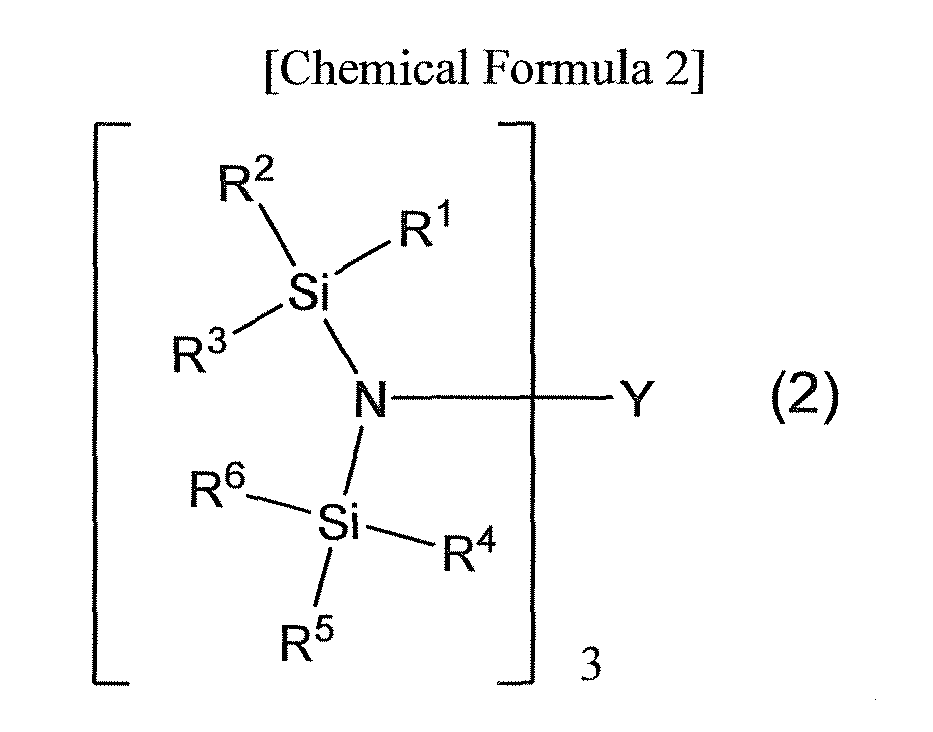
The present invention also provides a catalyst for producing a conjugated diene polymer, consisting of (A) an yttrium compound represented by a general formula (2) indicated below, (B) an ionic compound consisting of a non-coordinating anion and a cation, and (C) an organoaluminum hydride compound, wherein a molar ratio (C)/(A) between (C) and (A) is 5 to 50, and a process for producing a conjugated diene polymer using this catalyst.
(where R
1 to R
6 represent hydrogen or a substituent group with 1 to 12 carbon atom/s, and Y represents an yttrium atom).
Effect of the Invention
-
The present invention enables to highly efficiently produce a conjugated diene polymer containing cis-1,4 structures at a ratio of 99% or higher.
Best Mode for Carrying Out the Invention
-
Examples of an yttrium compound which is a component (A) of a catalytic system include: yttrium salt such as yttrium trichloride, yttrium tribromide, yttrium triiodide, yttrium nitrate, yttrium sulfate, yttrium trifluoromethanesulfonate, yttrium acetate, yttrium trifluoroacetate, yttrium malonate, yttrium octylate (ethylhexanoate), yttrium naphthenate, yttrium versatate, yttrium neodecanoate, etc.; alcoxide such as yttrium trimethoxide, yttrium triethoxide, yttrium triisopropoxide, yttrium tributoxide, yttrium triphenoxide, etc.; an organoyttrium compound such as tris acetylacetonato yttrium, tris (hexanedionato) yttrium, tris (heptanedionato) yttrium, tris (dimethylheptanedionato) yttrium, tris (tetramethylheptanedionato) yttrium, tris acetoacetato yttrium, cyclopentadienyl yttrium dichloride, dicyclopentadienyl yttrium chloride, tricyclopentadienyl yttrium, etc.; an organic base complex such as pyridine complex of yttrium salt, picoline complex of yttrium salt, etc.; yttrium salt hydrate; alcohol complex of yttrium salt; etc. Particularly, an yttrium compound represented by a general formula (1) or (2) indicated below is preferable.
(where R
1 to R
3 represent hydrogen or a substituent group with 1 to 12 carbon atom/s, and Y represents an yttrium atom.)
(where where R
1 to R
6 represent hydrogen or a substituent group with 1 to 12 carbon atom/s, and Y represents an yttrium atom.)
-
Specific examples of the above-described substituent group with 1 to 12 carbon atom/s include methyl group, ethyl group, vinyl group, n-propyl group, isopropyl group, 1-propenyl group, allyl group, n-butyl group, s-butyl group, isobutyl group, t-butyl group, n-pentyl group, 1-methylbutyl group, 2-methylbutyl group, 3-methylbutyl group, 1,1-dimethylpropyl group, 1,2-diemthylpropyl group, 2,2-dimethylpropyl group, hexyl group, heptyl group, octyl group, nonyl group, decyl group, undecyl group, dodecyl group, cyclohexyl group, methylcyclohexyl group, ethylcyclohexyl group, phenyl group, benzyl group, tolyl group, phenethyl group, etc. Examples further include these groups described above that have a hydroxyl group, carboxyl group, carbomethoxy group, carboethoxy group, amide group, amino group, alkoxy group, phenoxy group, etc. substituted at an arbitrary position. It is preferable that R1 to R6 be hydrogen or a hydrocarbon group with 1 to 12 carbon atom/s.
-
Specific examples of yttrium compounds represented by the general formula (1) indicated above include tris (acetylacetonato) yttrium, tris (hexanedionato) yttrium, tris (heptanedionato) yttrium, tris (dimethylheptanedionato) yttrium, tris (trimethylheptanedionato) yttrium, tris (tetramethylheptanedionato) yttrium, tris (pentamethylheptanedionato) yttrium, tris (hexamethylheptanedionato) yttrium, tris acetoacetato yttrium, etc.
-
Specific examples of yttrium compounds represented by the general formula (2) include tris [N,N-bis (trimethylsilyl) amide] yttrium, tris [N,N-bis (triethylsilyl) amide] yttrium, tris [N,N-bis (dimethylphenylsilyl) amide] yttrium, tris [N,N-bis (t-butyl) amide] yttrium, tris [N,N-bis (dimethylphenylmethyl) amide] yttrium, etc.
-
An ionic compound which is a component (B) of the catalytic system consists of a non-coordinating anion and a cation. The ionic compound may be any combination of a non-coordinating anion and a cation that are arbitrarily selected from publicly-known non-coordinating anions and cations respectively.
-
Examples of a non-coordinating anion include tetra (phenyl) borate, tetra (fluorophenyl) borate, tetrakis (difluorophenyl) borate, tetrakis (trifluorophenyl) borate, tetrakis (tetrafluorophenyl) borate, tetrakis (pentafluorophenyl) borate, tetrakis (3,5-bistrifluoromethylphenyl) borate, tetrakis (tetrafluoromethylphenyl) borate, tetra (tolyl) borate, tetra (xylyl) borate, triphenyl (pentafluorophenyl) borate, tris (pentafluorophenyl) (phenyl) borate, tridecahydride-7,8-dicarbaundecaborate, tetrafluoro borate, hexafluorophosphate, etc.
-
On the other hand, examples of a cation include carbonium cation, oxonium cation, ammonium cation, phosphonium cation, cycloheptatrienyl cation, ferrocenium cation, etc.
-
Specific examples of carbonium cation include tri-substituted carbonium cation such as triphenyl carbonium cation, tri-substituted phenylcarbonium cation, etc. Specific examples of tri-substituted phenylcarbonium cation include tri (methylphenyl) carbonium cation, tri (dimethylphenyl) carbonium cation, etc.
-
Specific examples of ammonium cation include: trialkyl ammonium cation such as trimethyl ammonium cation, triethyl ammonium cation, tripropyl ammonium cation, tributyl ammonium cation, tri (n-butyl) ammonium cation, etc.; N,N-dialkyl anilinium cation such as N,N-dimethyl anilinium cation, N,N-diethyl anilinium cation, N,N-2,4,6-pentamethyl anilinium cation, etc.; and dialkyl ammonium cation such as di (i-propyl) ammonium cation, dicyclohexyl ammonium cation, etc.
-
Specific examples of phosphonium cation include aryl phosphonium cation such as triphenyl phosphonium cation, tetraphenyl phosphonium cation, tri (methylphenyl) phosphonium cation, tetra (methylphenyl) phosphonium cation, tri (dimethylphenyl) phosphonium cation, tetra (dimethylphenyl) phosphonium cation, etc.
-
A preferable combination of a non-coordinating anion and a cation is a combination of a boron-containing compound and carbocation. Specific examples of ionic compounds include triphenyl carbonium tetrakis (pentafluorophenyl) borate, triphenyl carbonium tetrakis (fluorophenyl) borate, N,N-dimethyl anilinium tetrakis (pentafluorophenyl) borate, 1,1'-dimethyl ferrocenium tetrakis (pentafluorophenyl) borate, etc. These ionic compounds may be used singly or two or more kinds of ionic compounds may be used in combination.
-
Aluminoxane may be used instead of the ionic compound which is the component (B) and consists of a non-coordinating anion and a cation. Aluminoxane is obtained by bringing an organoaluminum compound into contact with a condensing agent, and examples thereof include a chain aluminoxane and a cyclic aluminoxane which are represented by a general formula (-Al(R')O-)n. (R' represents a hydrocarbon group with 1 to 10 carbon atom/s, and examples thereof include one that is partially substituted for by a halogen atom and/or an alkoxy group. n represents a degree of polymerization, and is 5 or higher, or preferably 10 or higher.) R' may be methyl, ethyl, propyl, isobutyl groups, etc., but a methyl group is preferable. An organoaluminum compound used as the material of aluminoxane may be, for example, trialkyl aluminum such as trimethyl aluminum, triethyl aluminum, triisobutyl aluminum, etc., and a mixture of these trialkyl aluminums.
-
Among them, an aluminoxane which utilizes a mixture of trimethyl aluminum and tributyl aluminum as a material can be used preferably.
-
A typical example of the condensing agent described above is water, but other than this, examples thereof include an arbitrary agent with which trialkyl aluminum can cause a condensation reaction, such as adsorbed water in an inorganic substance or the like, diol, etc.
-
Examples of an organoaluminum compound which is a component (C) of the catalytic system include trialkyl aluminum, and other than this, an organoaluminum halide compound such as dialkyl aluminum chloride, dialkyl aluminum bromide, alkyl aluminum sesquichloride, alkyl aluminum sesquibromide, alkyl aluminum dichloride, etc., an organoaluminum hydride compound such as dialkyl aluminum hydride, etc.
-
Specific examples of trialkyl aluminum include trimethyl aluminum, triethyl aluminum, triisobutyl aluminum, trihexyl aluminum, trioctyl aluminum, tridecyl aluminum, etc.
-
Specific examples of organoaluminum halide compounds include: dialkyl aluminum chloride such as dimethyl aluminum chloride, diethyl aluminum chloride, etc.; ethyl aluminum sesquichloride; ethyl aluminum dichloride; etc. Specific examples of organoaluminum hydride compounds include diethyl aluminum hydride, diisobutyl aluminum hydride, ethyl aluminum sesquihydride, etc.
-
These organoaluminum compounds may be used singly or two or more kinds of organoaluminum compounds may be used in combination.
-
When using an yttrium compound represented by the general formula (1) indicated above as the component (A), it is preferable to use trialkyl aluminum, especially triethyl aluminum (TEA), as the component (C).
-
The amounts of the catalyst components (A) to (C) and the ratio among them are adjusted as may be needed to impart an intended property to the polymer to be obtained. Normally, the amount of the component (A) is preferably 0.0001 to 0.5mmol and particularly preferably 0.0005 to 0.1 with respect to 100g of conjugated diene monomer. The molar ratio (A)/(B) between the component (A) and the component (B) is preferably 1/1.0 to 1/5.0 and particularly preferably 1/1.0 to 1/3.0. The molar ratio (A)/(C) between the component (A) and the component (C) is preferably 1/1 to 1/5000 and particularly preferably 1/10 to 1/2000.
-
When using an yttrium compound represented by the general formula (2) indicated above as the component (A), it is preferable to use an organoaluminum hydride, especially diethyl aluminum hydride (DEAH), as the component (C). In this case, the molar ratio (C)/(A) between the component (C) and the component (A) is preferably 5 to 50, more preferably 20 to 45, and particularly preferably 30 to 40.
-
The catalyst components may be mixed either in the presence of or in the absence of a conjugated diene to be polymerized. The mixing method is not particularly limited, but may be carried out as follows, for example.
- (1) To add the component (C) to an inert organic solvent and then add the component (A) and the component (B) in an arbitrary order.
- (2) To add the component (C) to an inert organic solvent and add a molecular weight modifier, and after this add the component (A) and the component (B) in an arbitrary order.
- (3) To add the component (A) to an inert organic solvent and add the component (C) and the molecular weight modifier described above in an arbitrary order, and after this add the component (B).
- (4) To add the component (B) to an inert organic solvent and add the component (C) and the molecular weight modifier described above in an arbitrary order, and after this add the component (A).
- (5) To add the component (C) to an inert organic solvent and add the component (A) and the component (B) in an arbitrary order, and after this add the molecular weight modifier described above.
-
Some of the components may be mixed and aged in advance. Particularly, it is preferable to mix and age the component (A) and the component (C) in advance.
-
When using an yttrium compound represented by the general formula (1) indicated above as the component (A), the aging temperature is preferably not lower than 0°C and lower than 50°C. A more preferable temperature range is 10 to 45°C, and a particularly preferable range is 20 to 40°C. The aging time is 5 to 300 minutes, but preferably 10 to 240 minutes, and particularly preferably 15 to 180 minutes.
-
When using an yttrium compound represented by the general formula (2) indicated above as the component (A), the aging temperature is -50°C to 80°C, and preferably -10 to 50°C, and the aging time is 0.01 to 24 hours, preferably 0.05 to 5 hours, and particularly preferably 0.1 to 1 hour.
-
The catalyst obtained in the way described above can also be used as supported on an inorganic compound, an organic polymer compound, etc.
-
The polymerization solvent is not limited and may be, for example, aliphatic hydrocarbon such as butane, pentane, hexane, heptane, etc., alicyclic hydrocarbon such as cyclopentane, cyclohexane, etc., aromatic hydrocarbon such as benzene, toluene, xylene, ethylbenzene, etc., an olefinic hydrocarbon such as the olefin compound described above, cis-2-butene, trans-2-butene, etc. Particularly, benzene, toluene, cyclohexane, or a mixture of cis-2-butene and trans-2-butene, etc. is preferable. Bulk polymerization in which a monomer itself is used as the polymerization solvent may also be employed.
-
The concentration of the conjugated diene monomer in solution polymerization is preferably 5 to 70% by weight and particularly preferably 10 to 50% by weight.
-
When using an yttrium compound represented by the general formula (1) indicated above as the component (A), the polymerization temperature range is preferably not lower than -10°C and lower than 40°C. A more preferable temperature range is 0 to 38°C, and a particularly preferable range is 5 to 35°C. The polymerization time is preferably 1 minute to 12 hours, and particularly preferably 5 minutes to 5 hours.
-
When using an yttrium compound represented by the general formula (2) indicated above, the polymerization temperature is preferably -30 to 150°C, more preferably -20 to 80°C, and particularly preferably 0 to 50°C.
-
Examples of conjugated dienes that can be polymerized include 1,3-butadiene, 2-methyl-1,3-butadiene (isoprene), 2,3-dimethyl-1,3-butadiene, 1,3-pentadiene (piperylene), 1,3-hexadiene, 1,3-cyclohexadiene, etc. These conjugated dienes may be used singly, or two or more kinds of conjugated dienes may be used in combination to obtain a copolymer. A preferable conjugated diene is 1,3-butadiene or isoprene.
-
When polymerizing a conjugated diene, it is possible to use hydrogen, a hydrogenated metal compound, or a hydrogenated organic metal compound as a molecular weight modifier. It is particularly preferable to regulate molecular weights by using hydrogen.
-
After polymerization is promoted for a certain time, pressure discharge is carried out in the polymerization tank if necessary, and aftertreatments such as washing, drying, etc. are carried out.
-
A conjugated diene polymer obtained according to the present invention contains cis-1,4 structures at a ratio of 99% or higher. The higher the content of cis-1,4 structures is, the better performance is exhibited in rubber properties such as impact resilience, abrasion resistance, breaking strength, etc.
Example
-
Examples based on the present invention will be described below specifically. Polymerization conditions and polymerization results are shown in Table 1 and Table 2 collectively.
-
Infrared absorption spectrometry was conducted to analyze a microstructure. A microstructure was calculated from the absorption intensity raito at cis 740cm-1, trans 967cm-1, vinyl 910cm-1.
-
Molecular weight and molecular weight distribution were evaluated based on weight-average molecular weight Mw and a ratio Mw/Mn between the weight-average molecular weight Mw and a number average molecular weight Mn which were obtained by GPC using polystyrene as a standard substance.
(Example 1)
-
An autoclave having an internal capacity of 1.5L was purged with nitrogen, and a solution consisting of 390ml of toluene and 210ml of butadiene was poured into the autoclave. After the temperature of the solution was set to 30°C, 1.5ml of a cyclohexane solution including triethyl aluminum (TEA) (2mol/L) was added, and the resulting solution was stirred for three minutes at 500 rpm. Next, 0.6ml of a toluene solution including yttrium (III) tris (2,2,6,6-tetramethyl-3,5-heptanedioate) (0.05mol/L) was added, and the resulting solution was aged at 30°C for two minutes. After this, 0.14ml of a toluene solution including triphenylcarbeniumtetrakis (pentafluorophenyl) borate (0.43mol/L) was added. Then, the resulting solution was polymerized at 30°C for 25 minutes. After this, 3ml of an ethanol solution containing an antioxidant was added to stop polymerization. After pressure discharge was carried out in the autoclave, ethanol was fed to the polymerized solution, and polybutadiene was collected. Then, the collected polybutadiene was dried at 80°C for three hours in a vacuum. The result of polymerization is shown in Table 1 and Table 2.
(Example 2)
-
Polymerization was promoted under the same conditions as Example 1, except that the polymerization temperature was 20°C. The result of polymerization is shown in Table 1 and Table 2.
(Example 3)
-
Polymerization was promoted under the same conditions as Example 1, except that the polymerization temperature was 10°C. The result of polymerization is shown in Table 1 and Table 2.
(Example 4)
-
An autoclave having an internal capacity of 1.5L was purged with nitrogen, and a solution consisting of 390ml of toluene and 210ml of butadiene was poured into the autoclave. Then, a hydrogen gas having 0.07MPa/cm2 was added. After the temperature of the solution was set to 30°C, 1.5ml of a cyclohexane solution including triethyl aluminum (TEA) (2mol/L) was added, and the resulting solution was stirred for three minutes at 500 rpm. Next, 0.6ml of a toluene solution including yttrium (III) tris (2,2,6,6-tetramethyl-3,5-heptanedioate) (0.05mol/L) was added, and the resulting solution was aged at 30°C for 30 minutes. After this, 0.14ml of a toluene solution including triphenylcarbeniumtetrakis (pentafluorophenyl) borate (0.43mol/L) was added. Then, the resulting solution was polymerized at 30°C for 30 minutes. After this, 3ml of an ethanol solution containing an antioxidant was added to stop polymerization. After pressure discharge was carried out in the autoclave, ethanol was fed to the polymerized solution, and polybutadiene was collected. Then, the collected butadiene was dried at 80°C for three hours in a vacuum. The result of polymerization is shown in Table 1 and Table 2.
(Example 5)
-
An autoclave having an internal capacity of 1.5L was purged with nitrogen, and a solution consisting of 390ml of toluene and 210ml of butadiene was poured into the autoclave. Then, a hydrogen gas having 0.07MPa/cm2 was added. After the temperature of the solution was set to 30°C, 1.2ml of a cyclohexane solution including triethyl aluminum (TEA) (2mol/L) was added, and the resulting solution was stirred for three minutes at 500 rpm. Next, the solution was elevated to 40°C, 0.48ml of a toluene solution including yttrium (III) tris (2,2,6,6-tetramethyl-3,5-heptanedioate) (0.05mol/L) was added, and the resulting solution was aged at 40°C for 60 minutes. Next, the solution was lowered to 30°C, and 0.11ml of a toluene solution including triphenylcarbeniumtetrakis (pentalfluorophenyl) borate (0.43mol/L) was added. Then, the resulting solution was polymerized at 30°C for 25 minutes. After this, 3ml of an ethanol solution containing an antioxidant was added to stop polymerization. After pressure discharge was carried out in the autoclave, ethanol was fed to the polymerized solution, and polybutadiene was collected. Then, the collected polybutadiene was dried at 80°C for three hours in a vacuum. The result of polymerization is shown in Table 1 and Table 2.
(Example 6)
-
An autoclave having an internal capacity of 1.5L was purged with nitrogen, and a solution consisting of 350ml of toluene and 250ml of butadiene was poured into the autoclave. Then, a hydrogen gas having 0.07MPa/cm2 was added. After the temperature of the solution was set to 30°C, 1.23ml of a cyclohexane solution including triethyl aluminum (TEA) (2mol/L) was added, and the resulting solution was stirred for three minutes at 500 rpm. Next, the solution was elevated to 40°C, 0.48ml of a toluene solution including yttrium (III) tris (2,2,6,6-tetramethyl-3,5-heptanedioate) (0.05mol/L) was added, and the resulting solution was aged at 40°C for 60 minutes. Next, the solution was lowered to 30°C, and 0.11ml of a toluene solution including triphenylcarbeniumtetrakis (pentafluorophenyl) borate (0.43mol/L) was added. Then, the resulting solution was polymerized at 30°C for 20 minutes. After this, 3ml of an ethanol solution containing an antioxidant was added to stop polymerization. After pressure discharge was carried out in the autoclave, ethanol was fed to the polymerized solution, and polybutadiene was collected. Then, the collected polybutadiene was dried at 80°C for three hours in a vacuum. The result of polymerization is shown in Table 1 and Table 2.
(Example 7)
-
An autoclave having an internal capacity of 1.5L was purged with nitrogen, and a solution consisting of 300ml of toluene and 300ml of butadiene was poured into the autoclave. Then, a hydrogen gas having 0.07MPa/cm2 was added. After the temperature of the solution was set to 30°C, 1.2ml of a cyclohexane solution including triethyl aluminum (TEA) (2mol/L) was added, and the resulting solution was stirred for three minutes at 500 rpm. Then, the solution was elevated to 40°C, 0.48ml of a toluene solution including yttrium (III) tris (2,2,6,6-tetramethyl-3,5-heptanedioate) (0.05mol/L) was added, and the resulting solution was aged at 40°C for 60 minutes. Next, the solution was lowered to 30°C, and 0.11ml of a toluene solution including triphenylcarbeniumtetrakis (pentafluorophenyl) borate (0.43mol/L) was added. Then, the resulting solution was polymerized at 30°C for 20 minutes. After this, 3ml of an ethanol solution containing an antioxidant was added to stop polymerization. After pressure discharge was carried out in the autoclave, ethanol was fed to the polymerized solution, and polybutadiene was collected. Then, the collected polybutadiene was dried at 80°C for three hours in a vacuum. The result of polymerization is shown in Table 1 and Table 2.
(Example 8)
-
An autoclave having an internal capacity of 1.5L was purged with nitrogen, and a solution consisting of 390ml of toluene and 210ml of butadiene was poured into the autoclave. After the temperature of the solution was set to 30°C, 3.0ml of a cyclohexane solution including triethyl aluminum (TEA) (2mol/L) was added, and the resulting solution was stirred for three minutes at 500 rpm. Next, 1.2ml of a toluene solution including yttrium (III) tris (2,2,6,6-tetramehtyl-3,5-heptanedioate) (0.05mol/L) was added, and the resulting solution was stirred at 30°C for 30 minutes. After this, the solution was cooled to 0°C. Next, 0.28ml of a toluene solution including triphenylcarbeniumtetrakis (pentafluorophenyl) borate (0.43mol/L) was added. Then, the resulting solution was polymerized at 0°C for 25 minutes. After this, 3ml of an ethanol solution containing an antioxidant was added to stop polymerization. After pressure discharge was carried out in the autoclave, ethanol was fed to the polymerized solution, and polybutadiene was collected. Then, the collected polybutadiene was dried at 80°C for three hours in a vacuum. The result of polymerization is shown in Table 1 and Table 2.
(Example 9)
-
An autoclave having an internal capacity of 1.5L was purged with nitrogen, and a solution consisting of 390ml of toluene and 210ml of butadiene was poured into the autoclave. After the temperature of the solution was set to 30°C, 3.0ml of a toluene solution including triethyl aluminum (TEA) (1mol/L) was added, and the resulting solution was stirred for three minutes at 500 rpm. Next, 1.5ml of a toluene solution including yttrium (III) tris (2,2,6,6-tetramethyl-3,5-heptanedioate) (0.02mol/L) was added, and the resulting solution was aged at 30°C for four minutes. After this, the solution was cooled to 10°C. Next, 0.14ml of a toluene solution including triphenylcarbeniumtetrakis (pentafluorophenyl) borate (0.43mol/L) was added. Then, the resulting solution was polymerized at 10°C for 30 minutes. After this, 5ml of an ethanol solution containing an antioxidant was added to stop polymerization. After pressure discharge was carried out in the autoclave, ethanol was fed to the polymerized solution, and polybutadiene was collected. Then, the collected polybutadiene was dried at 80°C for three hours in a vacuum. The result of polymerization is shown in Table 1 and Table 2.
(Example 10)
-
An autoclave having an internal capacity of 1.5L was purged with nitrogen, and a solution consisting of 390ml of toluene and 210ml of butadiene was poured into the autoclave. After the temperature of the solution was set to 30°C, 3.0ml of a toluene solution including triethyl aluminum (TEA) (1mol/L) was added, and the resulting solution was stirred for three minutes at 500 rpm. Next, 1.5ml of a toluene solution including yttrium (III) tris (2,2,6,6-tetramethyl-3,5-heptanedioate) (0.02mol/L) was added, and the resulting solution was aged at 30°C for 30 minutes. After this, the solution was cooled to 10°C. Next, 0.14ml of a toluene solution including triphenylcarbeniumtetrakis (pentafluorophenyl) borate (0.43mol/L) was added. Then, the resulting solution was polymerized at 10°C for 30 minutes. After this, 5ml of an ethanol solution containing an antioxidant was added to stop polymerization. After pressure discharge was carried out in the autoclave, ethanol was fed to the polymerized solution, and polybutadiene was collected. Then, the collected polybutadiene was dried at 80°C for three hours in a vacuum. The result of polymerization is shown in Table 1 and Table 2.
(Example 11)
-
An autoclave having an internal capacity of 1.5L was purged with nitrogen, and a solution consisting of 390ml of toluene and 210ml of butadiene was poured into the autoclave. Then, a hydrogen gas having 0.03MPa/cm2 was added. After the temperature of the solution was set to 30°C, 3.0ml of a toluene solution including triethyl aluminum (TEA) (1mol/L) was added, and the resulting solution was stirred for three minutes at 500 rpm. Next, 1.5ml of a toluene solution including yttrium (III) tris (2,2,6,6-tetramethyl-3,5-heptanedioate) (0.02mol/L) was added, and the resulting solution was aged at 30°C for 30 minutes. After this, the solution was cooled to 10°C. Next, 0.14ml of a toluene solution including triphenylcarbeniumtetrakis (pentafluorophenyl) borate (0.43mol/L) was added. Then, the resulting solution was polymerized at 10°C for 30 minutes. After this, 5ml of an ethanol solution containing an antioxidant was added to stop polymerization. After pressure discharge was carried out in the autoclave, ethanol was fed to the polymerized solution, and polybutadiene was collected. Then, the collected polybutadiene was dried at 80°C for three hours in a vacuum. The result of polymerization is shown in Table 1 and Table 2.
(Example 12)
-
Polymerization was promoted under the same conditions as Example 7, except that the pressure of a hydrogen gas was 0.05MPa/cm2. The result of polymerization is shown in Table 1 and Table 2.
(Example 13)
-
Polymerization was promoted under the same conditions as Example 7, except that the pressure of a hydrogen gas was 0.10MPa/cm2. The result of polymerization is shown in Table 1 and Table 2.
(Example 14)
-
Polymerization was promoted under the same conditions as Example 7, except that the pressure of a hydrogen gas was 0.15MPa/cm2. The result of polymerization is shown in Table 1 and Table 2.
(Example 15)
-
An autoclave having an internal capacity of 1.5L was purged with nitrogen, and a solution consisting of 390ml of toluene and 210ml of butadiene was poured into the autoclave. Then, a hydrogen gas having 0.10MPa/cm2 was added. After the temperature of the solution was set to 30°C, 3.0ml of a toluene solution including triethyl aluminum (TEA) (1mol/L) was added, and the resulting solution was stirred for three minutes at 500 rpm. Next, 3.0ml of a toluene solution including yttrium (III) tris (2,2,6,6-tetramethyl-3,5-heptanedioate) (0.02mol/L) was added, and the resulting solution was aged at 30°C for 30 minutes. After this, 0.28ml of a toluene solution including triphenylcarbeniumtetrakis (pentafluorophenyl) borate (0.43mol/L) was added. Then, the resulting solution was polymerized at 10°C for 30 minutes. After this, 5ml of an ethanol solution containing an antioxidant was added to stop polymerization. After pressure discharge was carried out in the autoclave, ethanol was fed to the polymerized solution, and polybutadiene was collected. Then, the collected polybutadiene was dried at 80°C for three hours in a vacuum. The result of polymerization is shown in Table 1 and Table 2.
(Example 16)
-
An autoclave having an internal capacity of 1.5L was purged with nitrogen, and a solution consisting of 390ml of toluene and 210ml of butadiene was poured into the autoclave. Then, a hydrogen gas having 0.055MPa/cm2 was added. After the temperature of the solution was set to 30°C, 4.5ml of a cyclohexane solution including triethyl aluminum (TEA) (1mol/L) was added, and the resulting solution was stirred for three minutes at 500 rpm. Next, 4.5ml of a toluene solution including yttrium (III) tris (2,2,6,6-tetramethyl-3,5-heptanedioate) (0.02mol/L) was added, and the resulting solution was aged at 30°C for 30 minutes. After this, the solution was cooled to 10°C. Next, 0.42ml of a toluene solution including triphenylcarbeniumtetrakis (pentafluorophenyl) borate (0.43mol/L) was added. Then, the resulting solution was polymerized at 10°C for 30 minutes. After this, 5ml of an ethanol solution containing an antioxidant was added to stop polymerization. After pressure discharge was carried out in the autoclave, ethanol was fed to the polymerized solution, and polybutadiene was collected. Then, the collected polybutadiene was dried at 80°C for three hours in a vacuum. The result of polymerization is shown in Table 1 and Table 2.
(Example 17)
-
An autoclave having an internal capacity of 1.5L was purged with nitrogen, and a solution consisting of 390ml of toluene and 210ml of butadiene was poured into the autoclave. After the temperature of the solution was set to 30°C, 3.0ml of a toluene solution including triethyl aluminum (TEA) (1mol/L) was added, and the resulting solution was stirred for three minutes at 500 rpm. Next, 1.5ml of a toluene solution including yttrium (III) tris (2,2,6,6-tetramethyl-3,5-heptanedioate) (0.02mol/L) was added, and the resulting solution was aged at 40°C for 30 minutes. After this, the solution was cooled to 10°C. Next, 0.14ml of a toluene solution including triphenylcarbeniumtetrakis (pentafluorophenyl) borate (0.43mol/L) was added. Then, the resulting solution was polymerized at 10°C for 30 minutes. After this, 5ml of an ethanol solution containing an antioxidant was added to stop polymerization. After pressure discharge was carried out in the autoclave, ethanol was fed to the polymerized solution, and polybutadiene was collected. Then, the collected polybutadiene was dried at 80°C for three hours in a vacuum. The result of polymerization is shown in Table 1 and Table 2.
(Example 18)
-
An autoclave having an internal capacity of 1.5L was purged with nitrogen, and a solution consisting of 390ml of toluene and 210ml of butadiene was poured into the autoclave. After the temperature of the solution was set to 30°C, 5.0ml of a cyclohexane solution including triethyl aluminum (TEA) (2mol/L) was added, and the resulting solution was stirred for three minutes at 500 rpm. Next, 1.0ml of a toluene solution including yttrium (III) tris (2,2,6,6-tetramethyl-3,5-heptanedioate) (0.05mol/L) was added, and the resulting solution was elevated to 60°C. After the solution was aged at 60°C for two minutes, it was cooled to 10°C. Next, 0.23ml of a toluene solution including triphenylcarbeniumtetrakis (pentafluorophenyl) borate (0.43mol/L) was added. Then, the resulting solution was polymerized at 10°C for 30 minutes. After this, 3ml of an ethanol solution containing an antioxidant was added to stop polymerization. After pressure discharge was carried out in the autoclave, ethanol was fed to the polymerized solution, and polybutadiene was collected. Then, the collected polybutadiene was dried at 80°C for three hours in a vacuum. The result of polymerization is shown in Table 1 and Table 2.
(Comparative Example 1)
-
An autoclave having an internal capacity of 1.5L was purged with nitrogen, and a solution consisting of 390ml of toluene and 210ml of butadiene was poured into the autoclave. After the temperature of the solution was set to 30°C, 1.5ml of a cyclohexane solution including triethyl aluminum (TEA) (2mol/L) was added, and the resulting solution was stirred for three minutes at 500 rpm. Next, 0.6ml of a toluene solution including yttrium (III) tris (2,2,6,6-tetramethyl-3,5-heptanedioate) (0.05mol/L) was added, and the resulting solution was heated to 40°C. After the solution was aged at 40°C for two minutes, 0.14ml of a toluene solution including triphenylcarbeniumtetrakis (pentafluorophenyl) borate (0.43mol/L) was added. Then, the resulting solution was polymerized at 40°C for 25 minutes. After this, 3ml of an ethanol solution containing an antioxidant was added to stop polymerization. After pressure discharge was carried out in the autoclave, the polymerized solution was fed to ethanol, and polybutadiene was collected. Then, the collected polybutadiene was dried at 80°C for three hours in a vacuum. The result of polymerization is shown in Table 1 and Table 2.
-
[Table 1]
| |
Butadiene Concentration (wt%) |
Catalyst Concentration (mM) |
Hydrogen Pressure (kgf/cm2) |
Aging Temperature (°C) |
Aging Time (min) |
Polymerization Temperature (°C) |
Polymerization Time (°C) |
Activity (g*mmol1--Y·h-1) |
| Example1 |
28 |
0.05 |
0.0 |
30 |
2 |
30 |
25 |
2310 |
| Example2 |
28 |
0.05 |
0.0 |
30 |
2 |
20 |
25 |
1360 |
| Example3 |
28 |
0.05 |
0.0 |
30 |
2 |
10 |
25 |
370 |
| Example4 |
28 |
0.05 |
0.7 |
30 |
30 |
30 |
30 |
4330 |
| Example5 |
28 |
0.05 |
0.7 |
40 |
60 |
30 |
25 |
6460 |
| Example6 |
34 |
0.05 |
0.7 |
40 |
60 |
30 |
20 |
7170 |
| Example7 |
42 |
0.05 |
0.7 |
40 |
60 |
30 |
20 |
7130 |
| Example8 |
28 |
0.10 |
0.0 |
30 |
30 |
0 |
25 |
30 |
| Example9 |
28 |
0.05 |
0.0 |
30 |
4 |
10 |
30 |
430 |
| Example10 |
28 |
0.05 |
0.0 |
30 |
30 |
10 |
30 |
1080 |
| Example11 |
28 |
0.05 |
0.3 |
30 |
30 |
10 |
30 |
1040 |
| Example12 |
28 |
0.05 |
0.5 |
30 |
30 |
10 |
30 |
950 |
| Example13 |
28 |
0.05 |
1.0 |
30 |
30 |
10 |
30 |
1010 |
| Example14 |
28 |
0.05 |
1.5 |
30 |
30 |
10 |
30 |
1010 |
| Example15 |
28 |
0.10 |
1.0 |
30 |
30 |
10 |
30 |
920 |
| Example16 |
28 |
0.15 |
0.55 |
30 |
30 |
10 |
30 |
730 |
| Example17 |
28 |
0.05 |
0.0 |
40 |
30 |
10 |
30 |
980 |
| Example18 |
28 |
0.08 |
0.0 |
60 |
2 |
10 |
30 |
1080 |
| Comparative Example1 |
28 |
0.05 |
0.0 |
30 |
2 |
40 |
25 |
3080 |
-
[Table 2]
| |
Microstructure (%) |
Mw |
Mn |
Mw/Mn |
| 1,4-cis |
1,4-trans |
vinyl |
(×104) |
(×104) |
|
| Example 1 |
99.1 |
0.5 |
0.4 |
31.0 |
97.0 |
3.1 |
| Example 2 |
99.2 |
0.6 |
0.2 |
37.0 |
114.3 |
3.1 |
| Example 3 |
99.6 |
0.2 |
0.2 |
38.0 |
134.6 |
3.5 |
| Example 4 |
99.4 |
0.3 |
0.3 |
23.5 |
55.2 |
2.4 |
| Example 5 |
99.3 |
0.2 |
0.4 |
30.9 |
78.6 |
2.5 |
| Example 6 |
99.3 |
0.2 |
0.4 |
39.2 |
100.6 |
2.6 |
| Example 7 |
99.2 |
0.2 |
0.4 |
45.7 |
122.2 |
2.7 |
| Example 8 |
99.5 |
0.4 |
0.1 |
41.5 |
106.7 |
2.6 |
| Example 9 |
99.3 |
0.4 |
0.3 |
- |
- |
- |
| Example 10 |
99.4 |
0.4 |
0.2 |
- |
- |
- |
| Example 11 |
99.2 |
0.6 |
0.2 |
50.9 |
132.5 |
2.6 |
| Example 12 |
99.3 |
0.5 |
0.2 |
37.9 |
95.9 |
2.5 |
| Example 13 |
99.2 |
0.5 |
0.3 |
22.8 |
49.6 |
2.2 |
| Example 14 |
99.2 |
0.6 |
0.2 |
16.7 |
34.5 |
2.1 |
| Example 15 |
99.2 |
0.6 |
0.2 |
- |
- |
- |
| Example 16 |
99.2 |
0.6 |
0.9 |
- |
- |
- |
| Example 17 |
99.3 |
0.4 |
0.3 |
- |
- |
- |
| Example 18 |
99.2 |
0.6 |
0.3 |
65.8 |
153.4 |
2.3 |
| Comparative Example 1 |
96.5 |
2.6 |
0.8 |
20.9 |
71.3 |
3.4 |
(Example 19)
-
An autoclave having an internal capacity of 2L was purged with nitrogen, a solution consisting of 390ml of toluene and 210ml of butadiene was poured into the autoclave, hydrogen was introduced under pressure into the autoclave at 25°C up to a gauge pressure of 1.0kgf/cm2, and the temperature of the solution was set to 30°C. After this, 0.25ml of a toluene solution including diethyl aluminum hydride (DEAH) (2mol/L) was added, and the resulting solution was stirred for three minutes at 550 rpm. Next, 0.6ml of a toluene solution including tris [N,N-bis (trimethylsilyl) amide] yttrium (20mmol/L) was added, and the resulting solution was stirred for four minutes. After this, the solution was elevated to 40°C and 0.06ml of a toluene solution including triphenylcarbeniumtetrakis pentafluorophenyl borate (0.43mol/L) was added to start polymerization. After the solution was polymerized at 40°C for 30 minutes, 5ml of an ethanol/heptane (1/1) solution containing an antioxidant was added to stop polymerization. After pressure discharge was carried out in the autoclave, the polymerized solution was fed to ethanol, and polybutadiene was collected. Then, the collected polybutadiene was dried at 80°C for three hours in a vacuum. The result of polymerization is shown in Table 3 and Table 4.
(Example 20)
-
An autoclave having an internal capacity of 2L was purged with nitrogen, and a solution consisting of 390ml of toluene and 210ml of butadiene was poured into the autoclave, hydrogen was introduced under pressure into the autoclave at 25°C up to a gauge pressure of 0.7kgf/cm2, and the temperature of the solution was set to 30°C. After this, 0.2ml of a toluene solution including diethyl aluminum hydride (DEAH) (2mol/L) was added, and the resulting solution was stirred for three minutes at 550 rpm. Next, 0.6ml of a toluene solution including tris [N,N-bis (trimethylsilyl) amide] yttrium (20mmol/L) was added, and the resulting solution was stirred for four minutes. After this, the solution was elevated to 40°C and 0.06ml of a toluene solution including triphenylcarbeniumtetrakis pentafluorophenyl borate (0.43mol/L) was added to start polymerization. After the solution was polymerized at 40°C for 30 minutes, 5ml of an ethanol/heptane (1/1) solution containing an antioxidant was added to stop polymerization. After pressure discharge was carried out in the autoclave, the polymerized solution was fed to ethanol, and polybutadiene was collected. Then, the collected polybutadiene was dried at 80°C for three hours in a vacuum. The result of polymerization is shown in Table 3 and Table 4.
(Example 21)
-
Polymerization was promoted under the same conditions as Example 20, except that hydrogen was introduced under pressure up to a gauge pressure of 1.0kgf/cm2. The result of polymerization is shown in Table 3 and Table 4.
(Example 22)
-
An autoclave having an internal capacity of 2L was purged with nitrogen, a solution consisting of 390ml of toluene and 210ml of butadiene was poured into the autoclave, and the temperature of the solution was set to 30°C. Then, after hydrogen was introduced under pressure up to a gauge pressure of 1.0kgf/cm2, 0.18ml of a toluene solution including diethyl aluminum hydride (DEAH) (2mol/L) was added, and the resulting solution was stirred for three minutes at 550 rpm. Next, 0.9ml of a toluene solution including tris [N,N-bis (trimethylsilyl) amide] yttrium (10mmol/L) was added, and the resulting solution was stirred for four minutes. After this, the solution was elevated to 40°C and 4.5ml of a toluene solution including triphenylcarbeniumtetrakis pentafluorophenyl borate (4mmol/L) was added to start polymerization. After the solution was polymerized at 40°C for 30 minutes, 5ml of an ethanol/heptane (1/1) solution containing an antioxidant was added to stop polymerization. After pressure discharge was carried out in the autoclave, the polymerized solution was fed to ethanol, and polybutadiene was collected. Then, the collected polybutadiene was dried at 80°C for three hours in a vacuum. The result of polymerization is shown in Table 3 and Table 4.
(Example 23)
-
Polymerization was promoted under the same conditions as Example 22, except that a solution consisting of 310ml of toluene and 290ml of butadiene was poured. The result of polymerization is shown in Table 3 and Table 4.
(Example 24)
-
An autoclave having an internal capacity of 2L was purged with nitrogen, a solution consisting of 390ml of toluene and 210ml of butadiene was poured into the autoclave, and the temperature of the solution was set to 30°C. After this, 0.2ml of a toluene solution including diethyl aluminum hydride (DEAH) (2mol/L) was added, and the resulting solution was stirred for three minutes at 550 rpm. Next, 0.6ml of a toluene solution including tris [N,N-bis (trimethylsilyl) amide] yttrium (20mmol/L) was added, and the resulting solution was stirred for four minutes. After this, the solution was cooled to 20°C and 0.06ml of a toluene solution including triphenylcarbeniumtetrakis pentafluorophenyl borate (0.43mol/L) was added to start polymerization. After the solution was polymerized at 20°C for 30 minutes, 5ml of an ethanol/heptane (1/1) solution containing an antioxidant was added to stop polymerization. After pressure discharge was carried out in the autoclave, the polymerized solution was fed to ethanol, and polybutadiene was collected. Then, the collected polybutadiene was dried at 80°C for three hours in a vacuum. The result of polymerization is shown in Table 3 and Table 4.
(Example 25)
-
An autoclave having an internal capacity of 2L was purged with nitrogen, a solution consisting of 390ml of toluene and 210ml of butadiene was poured into the autoclave, hydrogen was introduced under pressure into the autoclave at 25°C up to a gauge pressure of 1.0kgf/cm2, and the temperature of the solution was set to 30°C. After this, 0.18ml of a toluene solution including diethyl aluminum hydride (DEAH) (2mol/L) was added, and the resulting solution was stirred for three minutes at 550 rpm. Next, 0.6ml of a toluene solution including tris [N,N-bis (trimethylsilyl) amide] yttrium (20mmol/L) was added, and the resulting solution was stirred for four minutes. After this, the solution was cooled to 20°C and 0.06ml of a toluene solution including triphenylcarbeniumtetrakis pentafluorophenyl borate (0.43mol/L) was added to start polymerization. After the solution was polymerized at 20°C for 45 minutes, 5ml of an ethanol/heptane (1/1) solution containing an antioxidant was added to stop polymerization. After pressure discharge was carried out in the autoclave, the polymerized solution was fed to ethanol, and polybutadiene was collected. Then, the collected polybutadiene was dried at 80°C for three hours in a vacuum. The result of polymerization is shown in Table 3 and Table 4.
(Example 26)
-
An autoclave having an internal capacity of 2L was purged with nitrogen, a solution consisting of 390ml of toluene and 210ml of butadiene was poured into the autoclave, hydrogen was introduced under pressure into the autoclave at 25°C up to a gauge pressure of 1.0kgf/cm2, and the temperature of the solution was set to 30°C. After this, 0.24ml of a toluene solution including diethyl aluminum hydride (DEAH) (2mol/L) was added, and the resulting solution was stirred for three minutes at 550 rpm. Next, 1.5ml of a toluene solution including tris [N,N-bis (trimethylsilyl) amide] yttrium (20mmol/L) was added, and the resulting solution was stirred for four minutes. After this, the solution was cooled to 0°C and 0.14ml of a toluene solution including triphenylcarbeniumtetrakis pentafluorophenyl borate (0.43mol/L) was added to start polymerization. After the solution was polymerized at 0°C for 90 minutes, 5ml of an ethanol/heptane (1/1) solution containing an antioxidant was added to stop polymerization. After pressure discharge was carried out in the autoclave, the polymerized solution was fed to ethanol, and polybutadiene was collected. Then, the collected polybutadiene was dried at 80°C for three hours in a vacuum. The result of polymerization is shown in Table 3 and Table 4.
(Example 27)
-
An autoclave having an internal capacity of 2L was purged with nitrogen, a solution consisting of 390ml of toluene and 210ml of butadiene was poured into the autoclave, and the temperature of the solution was set to 30°C. Then, after hydrogen was introduced under pressure up to a gauge pressure of 0.5kgf/cm2, 0.27ml of a toluene solution including diethyl aluminum hydride (DEAH) (2mol/L) was added, and the resulting solution was stirred for three minutes at 550 rpm. Next, 3.0ml of a toluene solution including tris [N,N-bis (trimethylsilyl) amide] yttrium (20mmol/L) was added, and the resulting solution was stirred for four minutes. After this, the solution was cooled to -10°C and 0.28ml of a toluene solution including triphenylcarbeniumtetrakis pentafluorophenyl borate (0.43mol/L) was added to start polymerization. After the solution was polymerized at -10°C for 90 minutes, 5ml of an ethanol/heptane (1/1) solution containing an antioxidant was added to stop polymerization. After pressure discharge was carried out in the autoclave, the polymerized solution was fed to ethanol, and polybutadiene was collected. Then, the collected polybutadiene was dried at 80°C for three hours in a vacuum. The result of polymerization is shown in Table 3 and Table 4.
(Example 28)
-
An autoclave having an internal capacity of 2L was purged with nitrogen, a solution consisting of 390ml of toluene and 210ml of butadiene was poured into the autoclave, and the temperature of the solution was set to 30°C. Then, after hydrogen was introduced under pressure into the autoclave up to 0.5kgf/cm2, 1.5ml of a toluene solution including diethyl aluminum hydride (DEAH) (2mol/L) was added, and the resulting solution was stirred for three minutes at 550 rpm. Next, 6.0ml of a toluene solution including tris [N,N-bis (trimethylsilyl) amide] yttrium (50mmol/L) was added, and the resulting solution was stirred for four minutes. After this, the solution was cooled to -20°C and 1.4ml of a toluene solution including triphenylcarbeniumtetrakis pentafluorophenyl borate (0.43mol/L) was added to start polymerization. After the solution was polymerized at -20°C for 90 minutes, 5ml of an ethanol/heptane (1/1) solution containing an antioxidant was added to stop polymerization. After pressure discharge was carried out in the autoclave, the polymerized solution was fed to ethanol, and polybutadiene was collected. Then, the collected polybutadiene was dried at 80°C for three hours in a vacuum. The result of polymerization is shown in Table 3 and Table 4.
(Comparative Example 2)
-
An autoclave having an internal capacity of 2L was purged with nitrogen, a solution consisting of 260ml of toluene and 140ml of butadiene was poured into the autoclave, and the temperature of the solution was set to 30°C. After this, 2ml of a toluene solution including triethyl aluminum (TEA) (1mol/L) was added, and the resulting solution was stirred for three minutes at 500 rpm. Next, 1ml of a toluene solution including tris [N,N-bis (trimethylsilyl) amide] yttrium (20mmol/L) was added, and the resulting solution was heated to 40°C. Then, after the solution was stirred for four minutes and 0.1ml of a toluene solution including triphenylcarbeniumtetrakis pentafluorophenyl borate (0.4mol/L) was added to start polymerization. After the solution was polymerized at 40°C for 30 minutes, 5ml of an ethanol/heptane (1/1) solution containing an antioxidant was added to stop polymerization. After pressure discharge was carried out in the autoclave, the polymerized solution was fed to ethanol, and polybutadiene was collected. Then, the collected polybutadiene was dried at 70°C for six hours in a vacuum. The result of polymerization is shown in Table 3 and Table 4.
(Comparative Example 3)
-
Polymerization was promoted under the same conditions as Comparative Example 2, except that a toluene solution including diethyl aluminum hydride (DEAH) (1mol/L) was used instead of a toluene solution including triethyl aluminum (TEA) (1mol/L). The result of polymerization is shown in Table 3 and Table 4.
(Comparative Example 4)
-
An autoclave having an internal capacity of 2L was purged with nitrogen, a solution consisting of 390ml of toluene and 210ml of butadiene was poured into the autoclave, and the temperature of the solution was set to 30°C. After this, 0.9ml of a toluene solution including triethyl aluminum (TEA) (1mol/L) was added, and the resulting solution was stirred for three minutes at 550 rpm. Next, 1.5ml of a toluene solution including tris [N,N-bis (trimethylsilyl) amide] yttrium (20mmol/L) was added, and the resulting solution was stirred for four minutes. After this, the solution was elevated to 40°C and 0.14ml of a toluene solution including triphenylcarbeniumtetrakis pentafluorophenyl borate (0.43mol/L) was added to start polymerization. After the solution was polymerized at 40°C for 30 minutes, 5ml of an ethanol/heptane (1/1) solution containing an antioxidant was added to stop polymerization. After pressure discharge was carried out in the autoclave, the polymerized solution was fed to ethanol, and polybutadiene was collected. Then, the collected polybutadiene was dried at 80°C for three hours in a vacuum. The result of polymerization is shown in Table 3 and Table 4.
-
[Table 3]
| |
Butadiene Concentration (wt%) |
Catalyst Concentration (mM) |
Aluminum Compound |
Aluminum Concentration (mM) |
Al/Y (mol/mol) |
Hydrogen Pressure (kgf/cm2) |
Polymerization Temperature (°C) |
Activity (g*mmol1--Y·h-1) |
| Example19 |
28 |
0.02 |
DEAH |
0.8 |
40 |
1.0 |
40 |
10430 |
| Example20 |
28 |
0.02 |
DEAH |
0.7 |
35 |
0.7 |
40 |
9030 |
| Example21 |
28 |
0.02 |
DEAH |
0.7 |
35 |
1.0 |
40 |
9150 |
| Example22 |
28 |
0.015 |
DEAH |
0.6 |
40 |
1.0 |
40 |
7120 |
| Example23 |
40 |
0.015 |
DEAH |
0.6 |
40 |
1.0 |
40 |
6370 |
| Example24 |
28 |
0.02 |
DEAH |
0.7 |
35 |
0.0 |
20 |
2760 |
| Example25 |
28 |
0.02 |
DEAH |
0.6 |
30 |
1.0 |
20 |
2570 |
| Example26 |
28 |
0.05 |
DEAH |
0.8 |
15 |
1.0 |
0 |
344 |
| Example27 |
28 |
0.1 |
DEAH |
0.9 |
9 |
0.5 |
-10 |
27 |
| Example28 |
28 |
0.5 |
DEAH |
5.0 |
10 |
0.5 |
-20 |
9 |
| Comparative Example2 |
28 |
0.05 |
TEA |
5.0 |
100 |
0 |
40 |
2640 |
| Comparative Example3 |
28 |
0.05 |
DEAH |
5.0 |
100 |
0 |
40 |
500 |
| Comparative Example4 |
28 |
0.05 |
TEA |
1.5 |
30 |
0 |
40 |
2720 |
-
[Table 4]
| |
Microstructure (%) |
Mw |
Mn |
Mw/Mn |
| 1,4-cis |
1,4-trans |
vinyl |
(×104) |
(×104) |
|
| Example 19 |
99.0 |
0.3 |
0.7 |
68.5 |
26.3 |
2.6 |
| Example 20 |
99.1 |
0.5 |
0.4 |
78.4 |
29.2 |
2.7 |
| Example 21 |
99.1 |
0.5 |
0.4 |
56.7 |
22.7 |
2.5 |
| Example 22 |
99.0 |
0.4 |
0.6 |
67.8 |
25.4 |
2.7 |
| Example 23 |
99.1 |
0.2 |
0.7 |
111.6 |
36.1 |
3.1 |
| Example 24 |
99.3 |
0.4 |
0.3 |
- |
- |
- |
| Example 25 |
99.4 |
0.2 |
0.4 |
59.9 |
24.5 |
2.4 |
| Example 26 |
99.7 |
0.1 |
0.2 |
34.0 |
15.6 |
2.2 |
| Example 27 |
99.5 |
0.2 |
0.3 |
44.1 |
17.4 |
2.5 |
| Example 28 |
99.6 |
0.1 |
0.3 |
- |
- |
- |
| Comparative Example 2 |
97.2 |
2.1 |
0.7 |
98.2 |
26.5 |
3.7 |
| Comparative Example 3 |
90.4 |
7.1 |
2.5 |
5.4 |
2.2 |
2.5 |
| Comparative Example 4 |
98.9 |
0.7 |
0.4 |
- |
- |
- |