EP2371788A1 - Semiconductor ceramic and positive temperature coefficient thermistor - Google Patents
Semiconductor ceramic and positive temperature coefficient thermistor Download PDFInfo
- Publication number
- EP2371788A1 EP2371788A1 EP09831968A EP09831968A EP2371788A1 EP 2371788 A1 EP2371788 A1 EP 2371788A1 EP 09831968 A EP09831968 A EP 09831968A EP 09831968 A EP09831968 A EP 09831968A EP 2371788 A1 EP2371788 A1 EP 2371788A1
- Authority
- EP
- European Patent Office
- Prior art keywords
- semiconductor ceramic
- molar ratio
- alkali metal
- site
- metal element
- Prior art date
- Legal status (The legal status is an assumption and is not a legal conclusion. Google has not performed a legal analysis and makes no representation as to the accuracy of the status listed.)
- Withdrawn
Links
- 239000000919 ceramic Substances 0.000 title claims abstract description 41
- 239000004065 semiconductor Substances 0.000 title claims abstract description 41
- 239000000203 mixture Substances 0.000 claims abstract description 22
- 229910052783 alkali metal Inorganic materials 0.000 claims abstract description 19
- 150000001340 alkali metals Chemical class 0.000 claims abstract description 19
- 229910002113 barium titanate Inorganic materials 0.000 claims abstract description 12
- 229910052761 rare earth metal Inorganic materials 0.000 claims abstract description 12
- 229910052712 strontium Inorganic materials 0.000 claims abstract description 9
- 229910052708 sodium Inorganic materials 0.000 claims description 5
- 229910052700 potassium Inorganic materials 0.000 claims description 4
- 238000002845 discoloration Methods 0.000 abstract description 13
- 230000015556 catabolic process Effects 0.000 abstract description 3
- 238000006731 degradation reaction Methods 0.000 abstract description 3
- 230000008859 change Effects 0.000 description 15
- 230000003247 decreasing effect Effects 0.000 description 10
- 239000000843 powder Substances 0.000 description 9
- 229910010252 TiO3 Inorganic materials 0.000 description 8
- 238000000034 method Methods 0.000 description 8
- 239000002994 raw material Substances 0.000 description 8
- 239000011572 manganese Substances 0.000 description 6
- 150000001875 compounds Chemical class 0.000 description 5
- 229910002077 partially stabilized zirconia Inorganic materials 0.000 description 5
- LFQSCWFLJHTTHZ-UHFFFAOYSA-N Ethanol Chemical compound CCO LFQSCWFLJHTTHZ-UHFFFAOYSA-N 0.000 description 4
- 238000010304 firing Methods 0.000 description 4
- 238000000227 grinding Methods 0.000 description 4
- 239000011812 mixed powder Substances 0.000 description 4
- 239000012299 nitrogen atmosphere Substances 0.000 description 4
- 239000002002 slurry Substances 0.000 description 4
- 239000003795 chemical substances by application Substances 0.000 description 3
- 239000013078 crystal Substances 0.000 description 3
- 238000010586 diagram Methods 0.000 description 3
- 238000010438 heat treatment Methods 0.000 description 3
- 239000010410 layer Substances 0.000 description 3
- MIVBAHRSNUNMPP-UHFFFAOYSA-N manganese(2+);dinitrate Chemical compound [Mn+2].[O-][N+]([O-])=O.[O-][N+]([O-])=O MIVBAHRSNUNMPP-UHFFFAOYSA-N 0.000 description 3
- 238000005259 measurement Methods 0.000 description 3
- IJGRMHOSHXDMSA-UHFFFAOYSA-N Atomic nitrogen Chemical compound N#N IJGRMHOSHXDMSA-UHFFFAOYSA-N 0.000 description 2
- VTYYLEPIZMXCLO-UHFFFAOYSA-L Calcium carbonate Chemical compound [Ca+2].[O-]C([O-])=O VTYYLEPIZMXCLO-UHFFFAOYSA-L 0.000 description 2
- 229910052688 Gadolinium Inorganic materials 0.000 description 2
- CDBYLPFSWZWCQE-UHFFFAOYSA-L Sodium Carbonate Chemical compound [Na+].[Na+].[O-]C([O-])=O CDBYLPFSWZWCQE-UHFFFAOYSA-L 0.000 description 2
- GWEVSGVZZGPLCZ-UHFFFAOYSA-N Titan oxide Chemical compound O=[Ti]=O GWEVSGVZZGPLCZ-UHFFFAOYSA-N 0.000 description 2
- XTXRWKRVRITETP-UHFFFAOYSA-N Vinyl acetate Chemical compound CC(=O)OC=C XTXRWKRVRITETP-UHFFFAOYSA-N 0.000 description 2
- 229910045601 alloy Inorganic materials 0.000 description 2
- 239000000956 alloy Substances 0.000 description 2
- 239000012298 atmosphere Substances 0.000 description 2
- QVGXLLKOCUKJST-UHFFFAOYSA-N atomic oxygen Chemical compound [O] QVGXLLKOCUKJST-UHFFFAOYSA-N 0.000 description 2
- AYJRCSIUFZENHW-UHFFFAOYSA-L barium carbonate Chemical compound [Ba+2].[O-]C([O-])=O AYJRCSIUFZENHW-UHFFFAOYSA-L 0.000 description 2
- 239000011230 binding agent Substances 0.000 description 2
- WMWLMWRWZQELOS-UHFFFAOYSA-N bismuth(iii) oxide Chemical compound O=[Bi]O[Bi]=O WMWLMWRWZQELOS-UHFFFAOYSA-N 0.000 description 2
- 229910052802 copper Inorganic materials 0.000 description 2
- RKTYLMNFRDHKIL-UHFFFAOYSA-N copper;5,10,15,20-tetraphenylporphyrin-22,24-diide Chemical compound [Cu+2].C1=CC(C(=C2C=CC([N-]2)=C(C=2C=CC=CC=2)C=2C=CC(N=2)=C(C=2C=CC=CC=2)C2=CC=C3[N-]2)C=2C=CC=CC=2)=NC1=C3C1=CC=CC=C1 RKTYLMNFRDHKIL-UHFFFAOYSA-N 0.000 description 2
- 230000007423 decrease Effects 0.000 description 2
- 239000002270 dispersing agent Substances 0.000 description 2
- AMWRITDGCCNYAT-UHFFFAOYSA-L hydroxy(oxo)manganese;manganese Chemical compound [Mn].O[Mn]=O.O[Mn]=O AMWRITDGCCNYAT-UHFFFAOYSA-L 0.000 description 2
- 229910052745 lead Inorganic materials 0.000 description 2
- 229910052744 lithium Inorganic materials 0.000 description 2
- 238000004519 manufacturing process Methods 0.000 description 2
- 238000001000 micrograph Methods 0.000 description 2
- 239000003960 organic solvent Substances 0.000 description 2
- 239000001301 oxygen Substances 0.000 description 2
- 229910052760 oxygen Inorganic materials 0.000 description 2
- 238000007747 plating Methods 0.000 description 2
- BWHMMNNQKKPAPP-UHFFFAOYSA-L potassium carbonate Chemical compound [K+].[K+].[O-]C([O-])=O BWHMMNNQKKPAPP-UHFFFAOYSA-L 0.000 description 2
- 238000001878 scanning electron micrograph Methods 0.000 description 2
- 238000004513 sizing Methods 0.000 description 2
- 239000007787 solid Substances 0.000 description 2
- AREPHAPHABGCQP-UHFFFAOYSA-N 1-(dimethylamino)-3-[2-[2-(4-methoxyphenyl)ethyl]phenoxy]propan-2-ol Chemical compound C1=CC(OC)=CC=C1CCC1=CC=CC=C1OCC(O)CN(C)C AREPHAPHABGCQP-UHFFFAOYSA-N 0.000 description 1
- 229910052692 Dysprosium Inorganic materials 0.000 description 1
- 229910052693 Europium Inorganic materials 0.000 description 1
- 229910052779 Neodymium Inorganic materials 0.000 description 1
- 229910018054 Ni-Cu Inorganic materials 0.000 description 1
- 229910003322 NiCu Inorganic materials 0.000 description 1
- 229910018487 Ni—Cr Inorganic materials 0.000 description 1
- 229910018481 Ni—Cu Inorganic materials 0.000 description 1
- 229910052772 Samarium Inorganic materials 0.000 description 1
- 229910001413 alkali metal ion Inorganic materials 0.000 description 1
- 229910052782 aluminium Inorganic materials 0.000 description 1
- JRPBQTZRNDNNOP-UHFFFAOYSA-N barium titanate Chemical compound [Ba+2].[Ba+2].[O-][Ti]([O-])([O-])[O-] JRPBQTZRNDNNOP-UHFFFAOYSA-N 0.000 description 1
- 229910052797 bismuth Inorganic materials 0.000 description 1
- 229910000019 calcium carbonate Inorganic materials 0.000 description 1
- 229910052804 chromium Inorganic materials 0.000 description 1
- VNNRSPGTAMTISX-UHFFFAOYSA-N chromium nickel Chemical compound [Cr].[Ni] VNNRSPGTAMTISX-UHFFFAOYSA-N 0.000 description 1
- 239000004020 conductor Substances 0.000 description 1
- 238000010828 elution Methods 0.000 description 1
- 239000012535 impurity Substances 0.000 description 1
- 229910052742 iron Inorganic materials 0.000 description 1
- 150000002697 manganese compounds Chemical class 0.000 description 1
- 239000000463 material Substances 0.000 description 1
- 229910001120 nichrome Inorganic materials 0.000 description 1
- 229910052759 nickel Inorganic materials 0.000 description 1
- 229910052758 niobium Inorganic materials 0.000 description 1
- 229910052757 nitrogen Inorganic materials 0.000 description 1
- 230000001590 oxidative effect Effects 0.000 description 1
- 229920000642 polymer Polymers 0.000 description 1
- 229910000027 potassium carbonate Inorganic materials 0.000 description 1
- 230000008569 process Effects 0.000 description 1
- 230000005855 radiation Effects 0.000 description 1
- 229910052710 silicon Inorganic materials 0.000 description 1
- 239000002356 single layer Substances 0.000 description 1
- 238000005245 sintering Methods 0.000 description 1
- 229910000029 sodium carbonate Inorganic materials 0.000 description 1
- 229910001415 sodium ion Inorganic materials 0.000 description 1
- 239000002904 solvent Substances 0.000 description 1
- 238000004544 sputter deposition Methods 0.000 description 1
- 229910000018 strontium carbonate Inorganic materials 0.000 description 1
- LEDMRZGFZIAGGB-UHFFFAOYSA-L strontium carbonate Chemical compound [Sr+2].[O-]C([O-])=O LEDMRZGFZIAGGB-UHFFFAOYSA-L 0.000 description 1
- 239000000126 substance Substances 0.000 description 1
- 230000001629 suppression Effects 0.000 description 1
- 229910052715 tantalum Inorganic materials 0.000 description 1
- 230000007704 transition Effects 0.000 description 1
- XLYOFNOQVPJJNP-UHFFFAOYSA-N water Substances O XLYOFNOQVPJJNP-UHFFFAOYSA-N 0.000 description 1
- 229910052727 yttrium Inorganic materials 0.000 description 1
- RUDFQVOCFDJEEF-UHFFFAOYSA-N yttrium(III) oxide Inorganic materials [O-2].[O-2].[O-2].[Y+3].[Y+3] RUDFQVOCFDJEEF-UHFFFAOYSA-N 0.000 description 1
Images


Classifications
-
- C—CHEMISTRY; METALLURGY
- C04—CEMENTS; CONCRETE; ARTIFICIAL STONE; CERAMICS; REFRACTORIES
- C04B—LIME, MAGNESIA; SLAG; CEMENTS; COMPOSITIONS THEREOF, e.g. MORTARS, CONCRETE OR LIKE BUILDING MATERIALS; ARTIFICIAL STONE; CERAMICS; REFRACTORIES; TREATMENT OF NATURAL STONE
- C04B35/00—Shaped ceramic products characterised by their composition; Ceramics compositions; Processing powders of inorganic compounds preparatory to the manufacturing of ceramic products
- C04B35/01—Shaped ceramic products characterised by their composition; Ceramics compositions; Processing powders of inorganic compounds preparatory to the manufacturing of ceramic products based on oxide ceramics
- C04B35/46—Shaped ceramic products characterised by their composition; Ceramics compositions; Processing powders of inorganic compounds preparatory to the manufacturing of ceramic products based on oxide ceramics based on titanium oxides or titanates
-
- C—CHEMISTRY; METALLURGY
- C04—CEMENTS; CONCRETE; ARTIFICIAL STONE; CERAMICS; REFRACTORIES
- C04B—LIME, MAGNESIA; SLAG; CEMENTS; COMPOSITIONS THEREOF, e.g. MORTARS, CONCRETE OR LIKE BUILDING MATERIALS; ARTIFICIAL STONE; CERAMICS; REFRACTORIES; TREATMENT OF NATURAL STONE
- C04B35/00—Shaped ceramic products characterised by their composition; Ceramics compositions; Processing powders of inorganic compounds preparatory to the manufacturing of ceramic products
- C04B35/01—Shaped ceramic products characterised by their composition; Ceramics compositions; Processing powders of inorganic compounds preparatory to the manufacturing of ceramic products based on oxide ceramics
- C04B35/46—Shaped ceramic products characterised by their composition; Ceramics compositions; Processing powders of inorganic compounds preparatory to the manufacturing of ceramic products based on oxide ceramics based on titanium oxides or titanates
- C04B35/462—Shaped ceramic products characterised by their composition; Ceramics compositions; Processing powders of inorganic compounds preparatory to the manufacturing of ceramic products based on oxide ceramics based on titanium oxides or titanates based on titanates
- C04B35/465—Shaped ceramic products characterised by their composition; Ceramics compositions; Processing powders of inorganic compounds preparatory to the manufacturing of ceramic products based on oxide ceramics based on titanium oxides or titanates based on titanates based on alkaline earth metal titanates
- C04B35/468—Shaped ceramic products characterised by their composition; Ceramics compositions; Processing powders of inorganic compounds preparatory to the manufacturing of ceramic products based on oxide ceramics based on titanium oxides or titanates based on titanates based on alkaline earth metal titanates based on barium titanates
- C04B35/4682—Shaped ceramic products characterised by their composition; Ceramics compositions; Processing powders of inorganic compounds preparatory to the manufacturing of ceramic products based on oxide ceramics based on titanium oxides or titanates based on titanates based on alkaline earth metal titanates based on barium titanates based on BaTiO3 perovskite phase
-
- C—CHEMISTRY; METALLURGY
- C04—CEMENTS; CONCRETE; ARTIFICIAL STONE; CERAMICS; REFRACTORIES
- C04B—LIME, MAGNESIA; SLAG; CEMENTS; COMPOSITIONS THEREOF, e.g. MORTARS, CONCRETE OR LIKE BUILDING MATERIALS; ARTIFICIAL STONE; CERAMICS; REFRACTORIES; TREATMENT OF NATURAL STONE
- C04B35/00—Shaped ceramic products characterised by their composition; Ceramics compositions; Processing powders of inorganic compounds preparatory to the manufacturing of ceramic products
- C04B35/01—Shaped ceramic products characterised by their composition; Ceramics compositions; Processing powders of inorganic compounds preparatory to the manufacturing of ceramic products based on oxide ceramics
- C04B35/46—Shaped ceramic products characterised by their composition; Ceramics compositions; Processing powders of inorganic compounds preparatory to the manufacturing of ceramic products based on oxide ceramics based on titanium oxides or titanates
- C04B35/462—Shaped ceramic products characterised by their composition; Ceramics compositions; Processing powders of inorganic compounds preparatory to the manufacturing of ceramic products based on oxide ceramics based on titanium oxides or titanates based on titanates
- C04B35/465—Shaped ceramic products characterised by their composition; Ceramics compositions; Processing powders of inorganic compounds preparatory to the manufacturing of ceramic products based on oxide ceramics based on titanium oxides or titanates based on titanates based on alkaline earth metal titanates
- C04B35/468—Shaped ceramic products characterised by their composition; Ceramics compositions; Processing powders of inorganic compounds preparatory to the manufacturing of ceramic products based on oxide ceramics based on titanium oxides or titanates based on titanates based on alkaline earth metal titanates based on barium titanates
-
- C—CHEMISTRY; METALLURGY
- C04—CEMENTS; CONCRETE; ARTIFICIAL STONE; CERAMICS; REFRACTORIES
- C04B—LIME, MAGNESIA; SLAG; CEMENTS; COMPOSITIONS THEREOF, e.g. MORTARS, CONCRETE OR LIKE BUILDING MATERIALS; ARTIFICIAL STONE; CERAMICS; REFRACTORIES; TREATMENT OF NATURAL STONE
- C04B35/00—Shaped ceramic products characterised by their composition; Ceramics compositions; Processing powders of inorganic compounds preparatory to the manufacturing of ceramic products
- C04B35/622—Forming processes; Processing powders of inorganic compounds preparatory to the manufacturing of ceramic products
- C04B35/626—Preparing or treating the powders individually or as batches ; preparing or treating macroscopic reinforcing agents for ceramic products, e.g. fibres; mechanical aspects section B
- C04B35/63—Preparing or treating the powders individually or as batches ; preparing or treating macroscopic reinforcing agents for ceramic products, e.g. fibres; mechanical aspects section B using additives specially adapted for forming the products, e.g.. binder binders
- C04B35/638—Removal thereof
-
- H—ELECTRICITY
- H01—ELECTRIC ELEMENTS
- H01C—RESISTORS
- H01C7/00—Non-adjustable resistors formed as one or more layers or coatings; Non-adjustable resistors made from powdered conducting material or powdered semi-conducting material with or without insulating material
- H01C7/02—Non-adjustable resistors formed as one or more layers or coatings; Non-adjustable resistors made from powdered conducting material or powdered semi-conducting material with or without insulating material having positive temperature coefficient
-
- H—ELECTRICITY
- H01—ELECTRIC ELEMENTS
- H01C—RESISTORS
- H01C7/00—Non-adjustable resistors formed as one or more layers or coatings; Non-adjustable resistors made from powdered conducting material or powdered semi-conducting material with or without insulating material
- H01C7/02—Non-adjustable resistors formed as one or more layers or coatings; Non-adjustable resistors made from powdered conducting material or powdered semi-conducting material with or without insulating material having positive temperature coefficient
- H01C7/022—Non-adjustable resistors formed as one or more layers or coatings; Non-adjustable resistors made from powdered conducting material or powdered semi-conducting material with or without insulating material having positive temperature coefficient mainly consisting of non-metallic substances
- H01C7/023—Non-adjustable resistors formed as one or more layers or coatings; Non-adjustable resistors made from powdered conducting material or powdered semi-conducting material with or without insulating material having positive temperature coefficient mainly consisting of non-metallic substances containing oxides or oxidic compounds, e.g. ferrites
- H01C7/025—Perovskites, e.g. titanates
-
- C—CHEMISTRY; METALLURGY
- C04—CEMENTS; CONCRETE; ARTIFICIAL STONE; CERAMICS; REFRACTORIES
- C04B—LIME, MAGNESIA; SLAG; CEMENTS; COMPOSITIONS THEREOF, e.g. MORTARS, CONCRETE OR LIKE BUILDING MATERIALS; ARTIFICIAL STONE; CERAMICS; REFRACTORIES; TREATMENT OF NATURAL STONE
- C04B2235/00—Aspects relating to ceramic starting mixtures or sintered ceramic products
- C04B2235/02—Composition of constituents of the starting material or of secondary phases of the final product
- C04B2235/30—Constituents and secondary phases not being of a fibrous nature
- C04B2235/32—Metal oxides, mixed metal oxides, or oxide-forming salts thereof, e.g. carbonates, nitrates, (oxy)hydroxides, chlorides
- C04B2235/3201—Alkali metal oxides or oxide-forming salts thereof
-
- C—CHEMISTRY; METALLURGY
- C04—CEMENTS; CONCRETE; ARTIFICIAL STONE; CERAMICS; REFRACTORIES
- C04B—LIME, MAGNESIA; SLAG; CEMENTS; COMPOSITIONS THEREOF, e.g. MORTARS, CONCRETE OR LIKE BUILDING MATERIALS; ARTIFICIAL STONE; CERAMICS; REFRACTORIES; TREATMENT OF NATURAL STONE
- C04B2235/00—Aspects relating to ceramic starting mixtures or sintered ceramic products
- C04B2235/02—Composition of constituents of the starting material or of secondary phases of the final product
- C04B2235/30—Constituents and secondary phases not being of a fibrous nature
- C04B2235/32—Metal oxides, mixed metal oxides, or oxide-forming salts thereof, e.g. carbonates, nitrates, (oxy)hydroxides, chlorides
- C04B2235/3205—Alkaline earth oxides or oxide forming salts thereof, e.g. beryllium oxide
- C04B2235/3208—Calcium oxide or oxide-forming salts thereof, e.g. lime
-
- C—CHEMISTRY; METALLURGY
- C04—CEMENTS; CONCRETE; ARTIFICIAL STONE; CERAMICS; REFRACTORIES
- C04B—LIME, MAGNESIA; SLAG; CEMENTS; COMPOSITIONS THEREOF, e.g. MORTARS, CONCRETE OR LIKE BUILDING MATERIALS; ARTIFICIAL STONE; CERAMICS; REFRACTORIES; TREATMENT OF NATURAL STONE
- C04B2235/00—Aspects relating to ceramic starting mixtures or sintered ceramic products
- C04B2235/02—Composition of constituents of the starting material or of secondary phases of the final product
- C04B2235/30—Constituents and secondary phases not being of a fibrous nature
- C04B2235/32—Metal oxides, mixed metal oxides, or oxide-forming salts thereof, e.g. carbonates, nitrates, (oxy)hydroxides, chlorides
- C04B2235/3205—Alkaline earth oxides or oxide forming salts thereof, e.g. beryllium oxide
- C04B2235/3213—Strontium oxides or oxide-forming salts thereof
-
- C—CHEMISTRY; METALLURGY
- C04—CEMENTS; CONCRETE; ARTIFICIAL STONE; CERAMICS; REFRACTORIES
- C04B—LIME, MAGNESIA; SLAG; CEMENTS; COMPOSITIONS THEREOF, e.g. MORTARS, CONCRETE OR LIKE BUILDING MATERIALS; ARTIFICIAL STONE; CERAMICS; REFRACTORIES; TREATMENT OF NATURAL STONE
- C04B2235/00—Aspects relating to ceramic starting mixtures or sintered ceramic products
- C04B2235/02—Composition of constituents of the starting material or of secondary phases of the final product
- C04B2235/30—Constituents and secondary phases not being of a fibrous nature
- C04B2235/32—Metal oxides, mixed metal oxides, or oxide-forming salts thereof, e.g. carbonates, nitrates, (oxy)hydroxides, chlorides
- C04B2235/3224—Rare earth oxide or oxide forming salts thereof, e.g. scandium oxide
-
- C—CHEMISTRY; METALLURGY
- C04—CEMENTS; CONCRETE; ARTIFICIAL STONE; CERAMICS; REFRACTORIES
- C04B—LIME, MAGNESIA; SLAG; CEMENTS; COMPOSITIONS THEREOF, e.g. MORTARS, CONCRETE OR LIKE BUILDING MATERIALS; ARTIFICIAL STONE; CERAMICS; REFRACTORIES; TREATMENT OF NATURAL STONE
- C04B2235/00—Aspects relating to ceramic starting mixtures or sintered ceramic products
- C04B2235/02—Composition of constituents of the starting material or of secondary phases of the final product
- C04B2235/30—Constituents and secondary phases not being of a fibrous nature
- C04B2235/32—Metal oxides, mixed metal oxides, or oxide-forming salts thereof, e.g. carbonates, nitrates, (oxy)hydroxides, chlorides
- C04B2235/3224—Rare earth oxide or oxide forming salts thereof, e.g. scandium oxide
- C04B2235/3225—Yttrium oxide or oxide-forming salts thereof
-
- C—CHEMISTRY; METALLURGY
- C04—CEMENTS; CONCRETE; ARTIFICIAL STONE; CERAMICS; REFRACTORIES
- C04B—LIME, MAGNESIA; SLAG; CEMENTS; COMPOSITIONS THEREOF, e.g. MORTARS, CONCRETE OR LIKE BUILDING MATERIALS; ARTIFICIAL STONE; CERAMICS; REFRACTORIES; TREATMENT OF NATURAL STONE
- C04B2235/00—Aspects relating to ceramic starting mixtures or sintered ceramic products
- C04B2235/02—Composition of constituents of the starting material or of secondary phases of the final product
- C04B2235/30—Constituents and secondary phases not being of a fibrous nature
- C04B2235/32—Metal oxides, mixed metal oxides, or oxide-forming salts thereof, e.g. carbonates, nitrates, (oxy)hydroxides, chlorides
- C04B2235/3262—Manganese oxides, manganates, rhenium oxides or oxide-forming salts thereof, e.g. MnO
-
- C—CHEMISTRY; METALLURGY
- C04—CEMENTS; CONCRETE; ARTIFICIAL STONE; CERAMICS; REFRACTORIES
- C04B—LIME, MAGNESIA; SLAG; CEMENTS; COMPOSITIONS THEREOF, e.g. MORTARS, CONCRETE OR LIKE BUILDING MATERIALS; ARTIFICIAL STONE; CERAMICS; REFRACTORIES; TREATMENT OF NATURAL STONE
- C04B2235/00—Aspects relating to ceramic starting mixtures or sintered ceramic products
- C04B2235/02—Composition of constituents of the starting material or of secondary phases of the final product
- C04B2235/30—Constituents and secondary phases not being of a fibrous nature
- C04B2235/32—Metal oxides, mixed metal oxides, or oxide-forming salts thereof, e.g. carbonates, nitrates, (oxy)hydroxides, chlorides
- C04B2235/327—Iron group oxides, their mixed metal oxides, or oxide-forming salts thereof
- C04B2235/3272—Iron oxides or oxide forming salts thereof, e.g. hematite, magnetite
-
- C—CHEMISTRY; METALLURGY
- C04—CEMENTS; CONCRETE; ARTIFICIAL STONE; CERAMICS; REFRACTORIES
- C04B—LIME, MAGNESIA; SLAG; CEMENTS; COMPOSITIONS THEREOF, e.g. MORTARS, CONCRETE OR LIKE BUILDING MATERIALS; ARTIFICIAL STONE; CERAMICS; REFRACTORIES; TREATMENT OF NATURAL STONE
- C04B2235/00—Aspects relating to ceramic starting mixtures or sintered ceramic products
- C04B2235/02—Composition of constituents of the starting material or of secondary phases of the final product
- C04B2235/30—Constituents and secondary phases not being of a fibrous nature
- C04B2235/32—Metal oxides, mixed metal oxides, or oxide-forming salts thereof, e.g. carbonates, nitrates, (oxy)hydroxides, chlorides
- C04B2235/3281—Copper oxides, cuprates or oxide-forming salts thereof, e.g. CuO or Cu2O
-
- C—CHEMISTRY; METALLURGY
- C04—CEMENTS; CONCRETE; ARTIFICIAL STONE; CERAMICS; REFRACTORIES
- C04B—LIME, MAGNESIA; SLAG; CEMENTS; COMPOSITIONS THEREOF, e.g. MORTARS, CONCRETE OR LIKE BUILDING MATERIALS; ARTIFICIAL STONE; CERAMICS; REFRACTORIES; TREATMENT OF NATURAL STONE
- C04B2235/00—Aspects relating to ceramic starting mixtures or sintered ceramic products
- C04B2235/02—Composition of constituents of the starting material or of secondary phases of the final product
- C04B2235/30—Constituents and secondary phases not being of a fibrous nature
- C04B2235/32—Metal oxides, mixed metal oxides, or oxide-forming salts thereof, e.g. carbonates, nitrates, (oxy)hydroxides, chlorides
- C04B2235/3298—Bismuth oxides, bismuthates or oxide forming salts thereof, e.g. zinc bismuthate
-
- C—CHEMISTRY; METALLURGY
- C04—CEMENTS; CONCRETE; ARTIFICIAL STONE; CERAMICS; REFRACTORIES
- C04B—LIME, MAGNESIA; SLAG; CEMENTS; COMPOSITIONS THEREOF, e.g. MORTARS, CONCRETE OR LIKE BUILDING MATERIALS; ARTIFICIAL STONE; CERAMICS; REFRACTORIES; TREATMENT OF NATURAL STONE
- C04B2235/00—Aspects relating to ceramic starting mixtures or sintered ceramic products
- C04B2235/02—Composition of constituents of the starting material or of secondary phases of the final product
- C04B2235/30—Constituents and secondary phases not being of a fibrous nature
- C04B2235/34—Non-metal oxides, non-metal mixed oxides, or salts thereof that form the non-metal oxides upon heating, e.g. carbonates, nitrates, (oxy)hydroxides, chlorides
- C04B2235/3418—Silicon oxide, silicic acids or oxide forming salts thereof, e.g. silica sol, fused silica, silica fume, cristobalite, quartz or flint
-
- C—CHEMISTRY; METALLURGY
- C04—CEMENTS; CONCRETE; ARTIFICIAL STONE; CERAMICS; REFRACTORIES
- C04B—LIME, MAGNESIA; SLAG; CEMENTS; COMPOSITIONS THEREOF, e.g. MORTARS, CONCRETE OR LIKE BUILDING MATERIALS; ARTIFICIAL STONE; CERAMICS; REFRACTORIES; TREATMENT OF NATURAL STONE
- C04B2235/00—Aspects relating to ceramic starting mixtures or sintered ceramic products
- C04B2235/60—Aspects relating to the preparation, properties or mechanical treatment of green bodies or pre-forms
- C04B2235/604—Pressing at temperatures other than sintering temperatures
-
- C—CHEMISTRY; METALLURGY
- C04—CEMENTS; CONCRETE; ARTIFICIAL STONE; CERAMICS; REFRACTORIES
- C04B—LIME, MAGNESIA; SLAG; CEMENTS; COMPOSITIONS THEREOF, e.g. MORTARS, CONCRETE OR LIKE BUILDING MATERIALS; ARTIFICIAL STONE; CERAMICS; REFRACTORIES; TREATMENT OF NATURAL STONE
- C04B2235/00—Aspects relating to ceramic starting mixtures or sintered ceramic products
- C04B2235/65—Aspects relating to heat treatments of ceramic bodies such as green ceramics or pre-sintered ceramics, e.g. burning, sintering or melting processes
- C04B2235/658—Atmosphere during thermal treatment
- C04B2235/6583—Oxygen containing atmosphere, e.g. with changing oxygen pressures
- C04B2235/6584—Oxygen containing atmosphere, e.g. with changing oxygen pressures at an oxygen percentage below that of air
-
- C—CHEMISTRY; METALLURGY
- C04—CEMENTS; CONCRETE; ARTIFICIAL STONE; CERAMICS; REFRACTORIES
- C04B—LIME, MAGNESIA; SLAG; CEMENTS; COMPOSITIONS THEREOF, e.g. MORTARS, CONCRETE OR LIKE BUILDING MATERIALS; ARTIFICIAL STONE; CERAMICS; REFRACTORIES; TREATMENT OF NATURAL STONE
- C04B2235/00—Aspects relating to ceramic starting mixtures or sintered ceramic products
- C04B2235/70—Aspects relating to sintered or melt-casted ceramic products
- C04B2235/72—Products characterised by the absence or the low content of specific components, e.g. alkali metal free alumina ceramics
-
- C—CHEMISTRY; METALLURGY
- C04—CEMENTS; CONCRETE; ARTIFICIAL STONE; CERAMICS; REFRACTORIES
- C04B—LIME, MAGNESIA; SLAG; CEMENTS; COMPOSITIONS THEREOF, e.g. MORTARS, CONCRETE OR LIKE BUILDING MATERIALS; ARTIFICIAL STONE; CERAMICS; REFRACTORIES; TREATMENT OF NATURAL STONE
- C04B2235/00—Aspects relating to ceramic starting mixtures or sintered ceramic products
- C04B2235/70—Aspects relating to sintered or melt-casted ceramic products
- C04B2235/74—Physical characteristics
- C04B2235/79—Non-stoichiometric products, e.g. perovskites (ABO3) with an A/B-ratio other than 1
-
- C—CHEMISTRY; METALLURGY
- C04—CEMENTS; CONCRETE; ARTIFICIAL STONE; CERAMICS; REFRACTORIES
- C04B—LIME, MAGNESIA; SLAG; CEMENTS; COMPOSITIONS THEREOF, e.g. MORTARS, CONCRETE OR LIKE BUILDING MATERIALS; ARTIFICIAL STONE; CERAMICS; REFRACTORIES; TREATMENT OF NATURAL STONE
- C04B2235/00—Aspects relating to ceramic starting mixtures or sintered ceramic products
- C04B2235/70—Aspects relating to sintered or melt-casted ceramic products
- C04B2235/80—Phases present in the sintered or melt-cast ceramic products other than the main phase
- C04B2235/85—Intergranular or grain boundary phases
-
- C—CHEMISTRY; METALLURGY
- C04—CEMENTS; CONCRETE; ARTIFICIAL STONE; CERAMICS; REFRACTORIES
- C04B—LIME, MAGNESIA; SLAG; CEMENTS; COMPOSITIONS THEREOF, e.g. MORTARS, CONCRETE OR LIKE BUILDING MATERIALS; ARTIFICIAL STONE; CERAMICS; REFRACTORIES; TREATMENT OF NATURAL STONE
- C04B2235/00—Aspects relating to ceramic starting mixtures or sintered ceramic products
- C04B2235/70—Aspects relating to sintered or melt-casted ceramic products
- C04B2235/96—Properties of ceramic products, e.g. mechanical properties such as strength, toughness, wear resistance
- C04B2235/9646—Optical properties
- C04B2235/9661—Colour
-
- Y—GENERAL TAGGING OF NEW TECHNOLOGICAL DEVELOPMENTS; GENERAL TAGGING OF CROSS-SECTIONAL TECHNOLOGIES SPANNING OVER SEVERAL SECTIONS OF THE IPC; TECHNICAL SUBJECTS COVERED BY FORMER USPC CROSS-REFERENCE ART COLLECTIONS [XRACs] AND DIGESTS
- Y10—TECHNICAL SUBJECTS COVERED BY FORMER USPC
- Y10T—TECHNICAL SUBJECTS COVERED BY FORMER US CLASSIFICATION
- Y10T428/00—Stock material or miscellaneous articles
- Y10T428/29—Coated or structually defined flake, particle, cell, strand, strand portion, rod, filament, macroscopic fiber or mass thereof
- Y10T428/2982—Particulate matter [e.g., sphere, flake, etc.]
- Y10T428/2991—Coated
- Y10T428/2993—Silicic or refractory material containing [e.g., tungsten oxide, glass, cement, etc.]
Definitions
- a barium titanate (BaTiO 3 )-based semiconductor ceramic generates heat through the application of a voltage and has PTC characteristics in which the resistance value rapidly increases when the temperature exceeds the Curie temperature Tc at which phase transition is caused from a tetragonal crystal to a cubic crystal,
- the resistance value increases when the temperature exceeds the Curie temperature Tc because of the generation of heat caused by the application of a voltage. As a result, a current does not easily flow and the temperature is decreased. When the temperature is decreased and thus the resistance value is decreased, a current easily flows again and the temperature is increased. In such a semiconductor ceramic, by repeating the above-described process, the temperature or current is caused to converge to a certain temperature or current. Therefore, such a semiconductor ceramic is widely used as a thermistor for a heater or a motor starting device.
- the Curie temperature Tc Since a PTC thermistor used for a heater or the like is used at high temperature, the Curie temperature Tc is required to be high. Therefore, the Curie temperature Tc has been conventionally increased by replacing part of Ba of BaTiO 3 with Pb.
- Pb is an environmentally unfriendly substance and thus, in consideration of environment, the development of a lead-free semiconductor ceramic that substantially does not contain Pb has been demanded.
- Patent Document 1 discloses a method for producing a BaTiO 3 -based semiconductor ceramic, the method including adding at least one of Nb, Ta, and a rare-earth element to a structure of Ba 1-2x (BiNa) x TiO 3 (where 0 ⁇ x ⁇ 0.15) obtained by replacing part of Ba of BaTiO 3 with Bi-Na, sintering the structure in a nitrogen atmosphere, and performing heat treatment in an oxidizing atmosphere
- Patent Document 2 discloses a semiconductor ceramic composition whose composition formula is represented by [(Al 0.5 A2 0.5 ) x (Ba 1-y Q y ) 1-x ]TiO 3 (where A1 is at least one of Na, K, and Li, A2 is Bi, and Q is at least one of La, Dy, Eu, and Gd), wherein the x and y satisfy 0 ⁇ x ⁇ 0.2 and 0.002 ⁇ y ⁇ 0.01.
- Patent Document 2 there is provided a lead-free semiconductor ceramic composition having a Curie temperature Tc of 130°C or more.
- PTC thermistors containing an alkali metal element and Bi as described in Patent Documents 1 and 2 have problems in that the resistance value is significantly varied and degraded and the surface of a thermistor, particularly an outer electrode on the anode side, is discolored after the application of an electric current for a long time.
- a conventional PTC thermistor containing an alkali metal element and Bi in such a manner has insufficient reliability because the resistance value is degraded over time and the discoloration of a surface is caused after the application of an electric current for a long time.
- an object of the present invention is to provide a lead-free semiconductor ceramic with high reliability in which the discoloration of a surface is not caused and the degradation of resistance over time can be suppressed even after the application of an electric current for a long time even when an alkali metal element and Bi are contained, and a PTC thermistor that uses the semiconductor ceramic.
- the present invention is based on the finding described above.
- the semiconductor ceramic according to the present invention is a lead-free semiconductor ceramic that substantially does not contain lead, the semiconductor ceramic including a BaTiO 3 -based composition, as a main component, having a perovskite structure represented by general formula A m BO 3 , wherein part of Ba constituting an A site is replaced with an alkali metal element, Bi, Ca, Sr, and a rare-earth element; and, assuming that the molar ratio of the Ca is x and the molar ratio of the Sr is y, the contents of the Ca and the Sr when the total number of moles of the elements constituting the A site is 1 mole are determined so as to satisfy 0.05 ⁇ x ⁇ 0.20, 0.02 ⁇ y ⁇ 0.12, and 2x + 5y ⁇ 0.7.
- the phrase "substantially does not contain lead” means that Pb is not added intentionally.
- Such a composition system to which Pb is not added intentionally is referred to as a lead-free system in the present invention.
- the content of the Ca is determined so as to satisfy 0.125 ⁇ x ⁇ 0.175,
- the alkali metal element is at least one of Na and K.
- a PTC thermistor according to the present invention includes a component body and a pair of outer electrodes formed on the surfaces of the component body, wherein the component body is formed of the semiconductor ceramic, Advantages
- the semiconductor ceramic of the present invention includes a BaTiO 3 -based composition, as a main component, having a perovskite structure represented by general formula A m BO 3 , wherein part of Ba constituting an A site is replaced with an alkali metal element, Bi, Ca, Sr, and a rare-earth element; and, assuming that the molar ratio of the Ca is x and the molar ratio of the Sr is y, the contents of the Ca and the Sr in the A site are determined so as to satisfy 0.05 ⁇ x ⁇ 0.20, 0.02 ⁇ y ⁇ 0.12, and 2x + 5y ⁇ 0.7. Therefore, there can be provided a semiconductor ceramic with high reliability in which the discoloration of a surface is not caused and the variation of a resistance value is suppressed even after the application of an electric current for a long time.
- the PTC thermistor of the present invention includes a component body and a pair of outer electrodes formed on the surfaces of the component body, wherein the component body is formed of the semiconductor ceramic described above, Therefore, there can be provided a PTC thermistor with high reliability while ensuring desired PTC characteristics.
- the main component of a semiconductor ceramic according to an embodiment of the present invention has a perovskite structure represented by general formula (A).
- M1 is an alkali metal element represented by Li, Na, and K.
- Ln is a rare-earth element serving as a semiconductorizing agent.
- the rare-earth element Ln is not particularly limited as long as it serves as a semiconductorizing agent, and at least one selected from the group consisting of Y, Sm, Nd, Dy, and Gd can be preferably used.
- composition range of this embodiment is specified by a diagonally shaded area of Fig. 1 .
- the molar ratio x of Ca in the A site is less than 0.05, the content of Ca is excessively low. Therefore, even if Sr is contained, the crystallinity cannot be sufficiently improved, and thus the discoloration of the surface is caused and the resistance value may be significantly decreased after the application of an electric current for a long time.
- the solid solubility limit is exceeded. Therefore, hetero-phases are precipitated in the grain boundaries and the resistance value may be unfavorably significantly decreased after the application of an electric current for a long time.
- the crystallinity cannot be improved to crystallinity that achieves the suppression of the volatilization of Bi as in the case where only Ca is contained.
- the reliability for the application of an electric current for a long time cannot be improved.
- the Curie temperature Tc is unfavorably decreased to a Curie temperature lower than or equal to the Curie temperature (120°C) of BaTiO 3 ,
- the presence of Ca and Sr decreases a Curie temperature. Therefore, when 2x + 5y is more than 0.7, the Curie temperature Tc is unfavorably decreased to a Curie temperature lower than or equal to the Curie temperature of BaTiO 3 ;
- the semiconductor ceramic has a composition in which the molar ratio x of Ca and the molar ratio y of Sr in the A site satisfy 0.05 ⁇ x ⁇ 0.20, 0.02 ⁇ y ⁇ 0.12, and 2x + 5y ⁇ 0.7.
- the molar ratio x of Ca is preferably 0.125 ⁇ x ⁇ 0.175.
- the molar ratio m between the A site (Ba site) and B site (Ti site) is not particularly limited, and satisfactory PTC characteristics can be achieved when the molar ratio m is 0.992 to 1.004.
- the total molar ratio (u + v) of the alkali metal element M1 and Bi in the A site is preferably 0.02 to 0.20.
- the Curie temperature Tc is increased by replacing part of Ba with Na and Bi. Therefore, when the total molar ratio (u + v) is less than 0.02, the Curie temperature Tc cannot be sufficiently increased.
- the total molar ratio (u + v) is more than 0.20, the composition is easily shifted from a theoretical composition of a sintered body because the alkali metal element M1 and Bi are easily volatilized as described above.
- the molar ratio w of the rare-earth element Ln in the A site is preferably 0.0005 to 0.015. This is because although the rare-earth element Ln is added as a semiconductorizing agent, it is difficult to achieve semiconductorization if the molar ratio w is less than 0.0005 or more than 0.015,
- 0.0001 to 0.0020 parts of Mn is preferably added relative to 1 part of the main component represented by the general formula (A) on a molar basis,
- the semiconductor ceramic is represented by general formula (B),
- Mn functions as an acceptor. Therefore, by adding Mn within the range described above, an acceptor level is formed in the grain boundaries and thus the number of digits of PTC can be increased. As a result, the PTC characteristics can be further improved.
- the form of Mn added is not particularly limited, and any manganese compound such as sol or powder of manganese oxide or an aqueous manganese nitrate solution can be used.
- Fig, 1 is a perspective view schematically showing an embodiment of the PTC thermistor
- the PTC thermistor includes a component body 1 formed of the above-described semiconductor ceramic and a pair of outer electrodes 2a and 2b formed on both ends (surfaces) of the component body 1.
- the outer electrodes 2a and 2b have a single-layer structure or a multi-layer structure composed of a conductive material such as Cu, Ni, Al, Cr, a Ni-Cr alloy, or a Ni-Cu alloy,
- the external appearance has a columnar shape, but may have a disc-like shape or a rectangular parallelepiped shape.
- a Ba compound, a Ca compound, an M1 compound containing an alkali metal element M1, a Bi compound, and a Ln compound containing a predetermined rare-earth element Ln are prepared as raw materials.
- the raw materials are weighed and mixed to obtain a mixed powder so that the semiconductor ceramic has a predetermined composition ratio.
- an organic solvent and a polymer-basted dispersant are added to the mixed powder and thoroughly mixed and ground by a wet method in a ball mill using grinding media such as PSZ (partially stabilized zirconia) balls.
- the solvent is then dried and sizing is performed using a mesh having a predetermined opening.
- the mixture is subjected to heat treatment at 800 to 1000°C for 2 hours to obtain a calcined powder.
- a vinyl acetate-based organic binder and pure water and optionally a Mn compound are added to the calcined powder and again thoroughly mixed and ground by a wet method using grinding media to obtain a slurry.
- the slurry is dried to obtain a raw material powder.
- the raw material powder is then sized using a mesh having a predetermined opening and compression-molded using a press such as a uniaxial press to obtain a compact
- the compact is subjected to debinding treatment at 500 to 600°C in an air atmosphere, a nitrogen atmosphere, or a mixed stream of air and nitrogen. Subsequently, the compact is fired in a nitrogen atmosphere whose oxygen concentration is about 100 to 10000 ppm by volume at a temperature that achieves semiconductorization, e.g., at a maximum firing temperature of 1250 to 1450°C for a predetermined time to obtain a component body 1, which is a sintered body,
- Outer electrodes 2a and 2b are formed on both ends of the component body 1 by plating, sputtering, paste baking, or the like to produce a PTC thermistor.
- the semiconductor ceramic needs only to be mainly composed of Ba m TiO 3 and part of Ba needs only to be replaced with predetermined amounts of alkali metal element, Bi, Ca, Sr, and rare-earth element Even if incidental impurities are mixed, the characteristics are not affected. For example, about 0.2 to 0.3% by weight of the PSZ balls in total used as grinding media when mixing and grinding are performed by a wet method may be mixed, but this does not affect the characteristics. Similarly, trace amounts, such as about 10 ppm by weight, of Fe, Si, and Cu may be mixed in the raw materials, but this does not affect the characteristics.
- the semiconductor ceramic of the present invention is a lead-free semiconductor ceramic. As described in [Means for Solving the Problems], it is only required that the semiconductor ceramic substantially does not contain Pb, and Pb incidentally mixed in a concentration of about 10 ppm or less by weight is not necessarily excluded as long as it does not affect the characteristics.
- ethanol organic solvent
- a polymer-based dispersant were added to the mixed powder and mixed and ground by a wet method in a ball mill using PSZ balls for 24 hours.
- the ethanol was dried and sizing was performed using a mesh having an opening of 300 ⁇ m,
- the mixture was subjected to heat treatment at 800 to 1000°C for 2 hours to obtain a calcined powder.
- a vinyl acetate-based organic binder and an aqueous manganese nitrate solution were added to the calcined powder and again mixed and ground by a wet method in a ball mill using PSZ balls for 16 hours to obtain a slurry.
- the amount of the aqueous manganese nitrate solution added was adjusted to be 0.00025 parts by mole on a Mn basis relative to 1 part by mole of main component
- the slurry was dried and sized using a mesh having an opening of 300 ⁇ m to obtain a raw material powder.
- the raw material powder was compression-molded using a uniaxial press at a pressure of 9.8 ⁇ 10 7 Pa (1000 kgf/cm 2 ) to obtain a disc-shaped compact having a diameter of 14 mm and a thickness of 2.5 mm.
- sample Nos. 1 to 47 were prepared.
- the electrical resistivity ⁇ 0 at 25°C (room temperature), the number of digits of PTC ⁇ R, and the Curie temperature Tc were determined.
- the electrical resistivity ⁇ 0 was measured by a direct current four-terminal method through the application of a voltage of 1 V at 25°C.
- the number of digits of PTC ⁇ R indicates the performance of a PTC thermistor, and is defined by the logarithm of the ratio between the maximum value ⁇ max and the minimum value pmin of electrical resistivity as represented by mathematical formula (4).
- ⁇ -T characteristics log ⁇ max / ⁇ min Therefore, the characteristics (hereinafter referred to as " ⁇ -T characteristics") between temperature T and electrical resistivity p were measured, and the number of digits of PTC was determined using the maximum value and the minimum value.
- Samples having a Curie temperature of 120°C or more and a percentage change in resistivity ⁇ / ⁇ 0 of 30% or less were judged as good.
- the sample No. 1 had a high percentage change in resistivity ⁇ / ⁇ 0 of 628%. This may be because, since neither Ca nor Sr was contained in a composition, the crystallinity was poor and the volatilization of Bi was facilitated during firing.
- the section of the sample No. 2 was polished and observed with a microscope.
- Fig. 3 is a micrograph of the observation.
- the discolored portion was believed to have a high resistance value, the surface was observed with a low accelerating voltage scanning electron microscope (low accelerating voltage SEM).
- Fig. 4 is the SEM image.
- a white contrast was confirmed in the discolored portion. Since a SEM is an apparatus that images secondary electrons from a sample, a portion where a large number of electrons are stored is brightly seen due to a large amount of radiation of the secondary electrons. Therefore, it is believed that, in the sample No. 1, there was a high-resistance layer at the boundary between the discolored portion and the non-discolored portion, and a large number of electrons were present on the negative potential side with respect to the boundary. As a result, such a contrast was produced.
- each of Ca and Sr was contained in an amount within the scope of the present invention, but 2x + 5y was 0.80, which was more than 0.7.
- the Curie temperature Tc was less than 120°C.
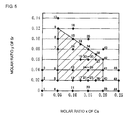
- Fig. 5 is a diagram in which the measurement points of the sample Nos. 1 to 46 are plotted.
- the horizontal axis indicates the molar ratio x of Ca and the vertical axis indicates the molar ratio y of Sr.
- the diagonally shaded area indicates the scope of the present invention.
Landscapes
- Engineering & Computer Science (AREA)
- Chemical & Material Sciences (AREA)
- Ceramic Engineering (AREA)
- Materials Engineering (AREA)
- Manufacturing & Machinery (AREA)
- Organic Chemistry (AREA)
- Structural Engineering (AREA)
- Microelectronics & Electronic Packaging (AREA)
- Physics & Mathematics (AREA)
- Electromagnetism (AREA)
- Inorganic Chemistry (AREA)
- Compositions Of Oxide Ceramics (AREA)
- Thermistors And Varistors (AREA)
Abstract
Description
- The present invention relates to a semiconductor ceramic and a positive temperature coefficient thermistor, and specifically to a semiconductor ceramic having a positive temperature coefficient (hereinafter referred to as "PTC characteristic and a positive temperature coefficient thermistor (hereinafter referred to as "PTC thermistors) used for a heater or the like.
- A barium titanate (BaTiO3)-based semiconductor ceramic generates heat through the application of a voltage and has PTC characteristics in which the resistance value rapidly increases when the temperature exceeds the Curie temperature Tc at which phase transition is caused from a tetragonal crystal to a cubic crystal,
- As described above, in such a semiconductor ceramic having PTC characteristics, the resistance value increases when the temperature exceeds the Curie temperature Tc because of the generation of heat caused by the application of a voltage. As a result, a current does not easily flow and the temperature is decreased. When the temperature is decreased and thus the resistance value is decreased, a current easily flows again and the temperature is increased. In such a semiconductor ceramic, by repeating the above-described process, the temperature or current is caused to converge to a certain temperature or current. Therefore, such a semiconductor ceramic is widely used as a thermistor for a heater or a motor starting device.
- Since a PTC thermistor used for a heater or the like is used at high temperature, the Curie temperature Tc is required to be high. Therefore, the Curie temperature Tc has been conventionally increased by replacing part of Ba of BaTiO3 with Pb.
- However, Pb is an environmentally unfriendly substance and thus, in consideration of environment, the development of a lead-free semiconductor ceramic that substantially does not contain Pb has been demanded.
- For example,
Patent Document 1 discloses a method for producing a BaTiO3-based semiconductor ceramic, the method including adding at least one of Nb, Ta, and a rare-earth element to a structure of Ba1-2x(BiNa)xTiO3 (where 0 < x ≤ 0.15) obtained by replacing part of Ba of BaTiO3 with Bi-Na, sintering the structure in a nitrogen atmosphere, and performing heat treatment in an oxidizing atmosphere - In
Patent Document 1, there is provided a lead-free BaTiO3-based semiconductor ceramic having a high Curie temperature Tc of 140 to 255°C and a temperature coefficient of resistance of 16 to 20 %/°C. -
Patent Document 2 discloses a semiconductor ceramic composition whose composition formula is represented by [(Al0.5A20.5)x(Ba1-yQy)1-x]TiO3 (where A1 is at least one of Na, K, and Li, A2 is Bi, and Q is at least one of La, Dy, Eu, and Gd), wherein the x and y satisfy 0 < x ≤ 0.2 and 0.002 ≤ y ≤ 0.01. - Also in
Patent Document 2, there is provided a lead-free semiconductor ceramic composition having a Curie temperature Tc of 130°C or more. -
- [Patent Document 1] Japanese Unexamined Patent Application Publication No.
56-169301 - [Patent Document 2] Japanese Unexamined Patent Application Publication No.
2005-255493 - However, PTC thermistors containing an alkali metal element and Bi as described in
Patent Documents - That is, in the semiconductor ceramics disclosed in
Patent Documents - A conventional PTC thermistor containing an alkali metal element and Bi in such a manner has insufficient reliability because the resistance value is degraded over time and the discoloration of a surface is caused after the application of an electric current for a long time.
- In view of the foregoing, an object of the present invention is to provide a lead-free semiconductor ceramic with high reliability in which the discoloration of a surface is not caused and the degradation of resistance over time can be suppressed even after the application of an electric current for a long time even when an alkali metal element and Bi are contained, and a PTC thermistor that uses the semiconductor ceramic.
- Through the intensive study of a {Ba, (M1, Bi) , Ca, Ln)}m TiO3 - based material (M1 is an alkali metal element and Ln is a rare-earth element) having a perovskite structure (general formula AmBO3), the inventors of the present invention have found that, by replacing part of Ba with Ca and also Sr and setting the molar ratios of Ca and Sr within a predetermined range, the discoloration of a surface can be prevented and the degradation of resistance can be suppressed even after the application of an electric current for a long time
- The present invention is based on the finding described above. The semiconductor ceramic according to the present invention is a lead-free semiconductor ceramic that substantially does not contain lead, the semiconductor ceramic including a BaTiO3-based composition, as a main component, having a perovskite structure represented by general formula AmBO3, wherein part of Ba constituting an A site is replaced with an alkali metal element, Bi, Ca, Sr, and a rare-earth element; and, assuming that the molar ratio of the Ca is x and the molar ratio of the Sr is y, the contents of the Ca and the Sr when the total number of moles of the elements constituting the A site is 1 mole are determined so as to satisfy 0.05 < x ≤ 0.20, 0.02 ≤ y ≤ 0.12, and 2x + 5y≤ 0.7.
- Herein, the phrase "substantially does not contain lead" means that Pb is not added intentionally. Such a composition system to which Pb is not added intentionally is referred to as a lead-free system in the present invention.
- The content of the Ca is determined so as to satisfy 0.125 ≤ x ≤ 0.175,
- In the semiconductor ceramic of the present invention, the alkali metal element is at least one of Na and K.
- A PTC thermistor according to the present invention includes a component body and a pair of outer electrodes formed on the surfaces of the component body, wherein the component body is formed of the semiconductor ceramic, Advantages
- The semiconductor ceramic of the present invention includes a BaTiO3-based composition, as a main component, having a perovskite structure represented by general formula AmBO3, wherein part of Ba constituting an A site is replaced with an alkali metal element, Bi, Ca, Sr, and a rare-earth element; and, assuming that the molar ratio of the Ca is x and the molar ratio of the Sr is y, the contents of the Ca and the Sr in the A site are determined so as to satisfy 0.05 ≤ x ≤ 0.20, 0.02 ≤ y ≤ 0.12, and 2x + 5y ≤ 0.7. Therefore, there can be provided a semiconductor ceramic with high reliability in which the discoloration of a surface is not caused and the variation of a resistance value is suppressed even after the application of an electric current for a long time.
- The PTC thermistor of the present invention includes a component body and a pair of outer electrodes formed on the surfaces of the component body, wherein the component body is formed of the semiconductor ceramic described above, Therefore, there can be provided a PTC thermistor with high reliability while ensuring desired PTC characteristics.
- Specifically, there can be provided a lead-free PTC thermistor having a Curie temperature of 120°C or more and high reliability. In the PTC thermistor, the discoloration of a surface is not caused and the percentage change in resistivity can be decreased to 30% or less even after a voltage that increases the temperature of the surface of a component body to 200°C is continuously applied for 1000 hours.
-
- [
Fig. 1] Fig. 1 is a diagram showing the composition range of the molar ratio x of Ca and the molar ratio y of Sr in the present invention. - [
Fig. 2] Fig. 2 is a perspective view showing an embodiment of a PTC thermistor according to the present invention. - [
Fig. 3] Fig. 3 is a micrograph of a sample No. 1. - [
Fig. 4] Fig. 4 is a SEM image of the sample No. 1. - [
Fig. 5] Fig. 5 is a diagram in which the measurement points of sample Nos, 1 to 46 are plotted and that shows the composition range of the present invention. - An embodiment of the present invention will now be described.
- The main component of a semiconductor ceramic according to an embodiment of the present invention has a perovskite structure represented by general formula (A).
-
{Bai-x-y-u-v-wMluBiyCaxSryLnw}mTiO3 (A)
M1 is an alkali metal element represented by Li, Na, and K. Ln is a rare-earth element serving as a semiconductorizing agent. The rare-earth element Ln is not particularly limited as long as it serves as a semiconductorizing agent, and at least one selected from the group consisting of Y, Sm, Nd, Dy, and Gd can be preferably used. - The molar ratio x of Ca and the molar ratio y of Sr in an A site satisfy mathematical formulas (1), (2), and (3)...
-


Fig. 1 . - By replacing part of Ba with Ca and Sr and setting the molar ratios x and y within the range specified by the mathematical formulas (1) to (3), high reliability can be achieved even after the application of an electric current for a long time. The reason is believed to be as follows
- By replacing part of Ba with Ca, the ratio of a c axis to an a axis among the crystallographic axes is increased, and thus the tetragonal crystallinity of the crystal is improved. However, by replacing part of Ba with Ca and also Sr, the crystallinity is improved and the volatilization of Bi is suppressed. As a result, the elution of unstable Na into grain boundaries is believed to be suppressed. Furthermore, by incorporating Sr in addition to Ca, the crystallinity is improved and the ionic conduction of alkali metal ions to the anode side is suppressed. As a result, the discoloration of the surface is not caused even if an electric current is applied for a long time, and thus a variation in resistance can be believed to be prevented.
- When the molar ratio x of Ca in the A site is less than 0.05, the content of Ca is excessively low. Therefore, even if Sr is contained, the crystallinity cannot be sufficiently improved, and thus the discoloration of the surface is caused and the resistance value may be significantly decreased after the application of an electric current for a long time.
- On the other hand, when the molar ratio x of Ca is more than 0.20, the solid solubility limit is exceeded. Therefore, hetero-phases are precipitated in the grain boundaries and the resistance value may be unfavorably significantly decreased after the application of an electric current for a long time.
- When the molar ratio y of Sr in the A site is less than 0.02, the crystallinity cannot be improved to crystallinity that achieves the suppression of the volatilization of Bi as in the case where only Ca is contained. Thus, the reliability for the application of an electric current for a long time cannot be improved.
- On the other hand, when the molar ratio x of Sr is more than 0.12, the Curie temperature Tc is unfavorably decreased to a Curie temperature lower than or equal to the Curie temperature (120°C) of BaTiO3,
- The presence of Ca and Sr decreases a Curie temperature. Therefore, when 2x + 5y is more than 0.7, the Curie temperature Tc is unfavorably decreased to a Curie temperature lower than or equal to the Curie temperature of BaTiO3 ;
- Accordingly, in this embodiment, as shown by a diagonally shaded area of
Fig. 1 , the semiconductor ceramic has a composition in which the molar ratio x of Ca and the molar ratio y of Sr in the A site satisfy 0.05 ≤ x ≤ 0.20, 0.02 ≤ y ≤ 0.12, and 2x + 5y ≤ 0.7. To further improve the reliability, the molar ratio x of Ca is preferably 0.125 ≤ x ≤ 0.175. - The molar ratio m between the A site (Ba site) and B site (Ti site) is not particularly limited, and satisfactory PTC characteristics can be achieved when the molar ratio m is 0.992 to 1.004.
- The total molar ratio (u + v) of the alkali metal element M1 and Bi in the A site is preferably 0.02 to 0.20. The Curie temperature Tc is increased by replacing part of Ba with Na and Bi. Therefore, when the total molar ratio (u + v) is less than 0.02, the Curie temperature Tc cannot be sufficiently increased. On the other hand, when the total molar ratio (u + v) is more than 0.20, the composition is easily shifted from a theoretical composition of a sintered body because the alkali metal element M1 and Bi are easily volatilized as described above.
- The molar ratio w of the rare-earth element Ln in the A site is preferably 0.0005 to 0.015. This is because although the rare-earth element Ln is added as a semiconductorizing agent, it is difficult to achieve semiconductorization if the molar ratio w is less than 0.0005 or more than 0.015,
- In the present invention, to improve PTC characteristics, 0.0001 to 0.0020 parts of Mn is preferably added relative to 1 part of the main component represented by the general formula (A) on a molar basis,
- In this case, the semiconductor ceramic is represented by general formula (B),
-
(Ba1-x-y-u-v-wMluBivCaxSryLnw)mTiO3+ nMn (B)
where n satisfies 0.0001 ≤ n ≤ 0.0020. - Mn functions as an acceptor. Therefore, by adding Mn within the range described above, an acceptor level is formed in the grain boundaries and thus the number of digits of PTC can be increased. As a result, the PTC characteristics can be further improved. The form of Mn added is not particularly limited, and any manganese compound such as sol or powder of manganese oxide or an aqueous manganese nitrate solution can be used.
- A PTC thermistor according to the present invention will now be specifically described.
-
Fig, 1 is a perspective view schematically showing an embodiment of the PTC thermistor - The PTC thermistor includes a
component body 1 formed of the above-described semiconductor ceramic and a pair ofouter electrodes component body 1. Theouter electrodes - In this embodiment, the external appearance has a columnar shape, but may have a disc-like shape or a rectangular parallelepiped shape.
- A method for producing the PTC thermistor will now be described.
- First a Ba compound, a Ca compound, an M1 compound containing an alkali metal element M1, a Bi compound, and a Ln compound containing a predetermined rare-earth element Ln are prepared as raw materials. The raw materials are weighed and mixed to obtain a mixed powder so that the semiconductor ceramic has a predetermined composition ratio.
- Subsequently, an organic solvent and a polymer-basted dispersant are added to the mixed powder and thoroughly mixed and ground by a wet method in a ball mill using grinding media such as PSZ (partially stabilized zirconia) balls. The solvent is then dried and sizing is performed using a mesh having a predetermined opening. The mixture is subjected to heat treatment at 800 to 1000°C for 2 hours to obtain a calcined powder. A vinyl acetate-based organic binder and pure water and optionally a Mn compound are added to the calcined powder and again thoroughly mixed and ground by a wet method using grinding media to obtain a slurry.
The slurry is dried to obtain a raw material powder. The raw material powder is then sized using a mesh having a predetermined opening and compression-molded using a press such as a uniaxial press to obtain a compact - The compact is subjected to debinding treatment at 500 to 600°C in an air atmosphere, a nitrogen atmosphere, or a mixed stream of air and nitrogen. Subsequently, the compact is fired in a nitrogen atmosphere whose oxygen concentration is about 100 to 10000 ppm by volume at a temperature that achieves semiconductorization, e.g., at a maximum firing temperature of 1250 to 1450°C for a predetermined time to obtain a
component body 1, which is a sintered body, -
Outer electrodes component body 1 by plating, sputtering, paste baking, or the like to produce a PTC thermistor. - The present invention is not limited to the above-described embodiment. For example, the semiconductor ceramic needs only to be mainly composed of BamTiO3 and part of Ba needs only to be replaced with predetermined amounts of alkali metal element, Bi, Ca, Sr, and rare-earth element Even if incidental impurities are mixed, the characteristics are not affected. For example, about 0.2 to 0.3% by weight of the PSZ balls in total used as grinding media when mixing and grinding are performed by a wet method may be mixed, but this does not affect the characteristics. Similarly, trace amounts, such as about 10 ppm by weight, of Fe, Si, and Cu may be mixed in the raw materials, but this does not affect the characteristics. The semiconductor ceramic of the present invention is a lead-free semiconductor ceramic. As described in [Means for Solving the Problems], it is only required that the semiconductor ceramic substantially does not contain Pb, and Pb incidentally mixed in a concentration of about 10 ppm or less by weight is not necessarily excluded as long as it does not affect the characteristics.
- Example of the present invention will now be specifically described.
- BaCO3 , CaCO3 , SrCO3, Na2CO3 , K2CO3, Bi2O3, TiO2 and Y2O3, which were raw materials of a main component, were prepared and then weighed and mixed to obtain a mixed powder so that the sintered body had the composition shown in Table 1.
- Subsequently, ethanol (organic solvent) and a polymer-based dispersant were added to the mixed powder and mixed and ground by a wet method in a ball mill using PSZ balls for 24 hours. The ethanol was dried and sizing was performed using a mesh having an opening of 300 µm, The mixture was subjected to heat treatment at 800 to 1000°C for 2 hours to obtain a calcined powder.
- A vinyl acetate-based organic binder and an aqueous manganese nitrate solution were added to the calcined powder and again mixed and ground by a wet method in a ball mill using PSZ balls for 16 hours to obtain a slurry. The amount of the aqueous manganese nitrate solution added was adjusted to be 0.00025 parts by mole on a Mn basis relative to 1 part by mole of main component
- The slurry was dried and sized using a mesh having an opening of 300 µm to obtain a raw material powder.
- The raw material powder was compression-molded using a uniaxial press at a pressure of 9.8 × 10⁷ Pa (1000 kgf/cm2) to obtain a disc-shaped compact having a diameter of 14 mm and a thickness of 2.5 mm.
- The disc-shaped compact was subjected to debinding treatment in the air at 600°C for 2 hours. The compact was fired in a nitrogen atmosphere whose oxygen concentration was 10000 ppm by volume at a maximum firing temperature of 1400°C for 2 hours to obtain sintered bodies (semiconductor ceramics) with a sample number of 1 to 47,
- Subsequently, the sintered bodies were lapped and then subjected to dry plating to form outer electrodes having a three-layer structure of NiCr/NiCu/Ag. Consequently, sample Nos. 1 to 47 were prepared.
- Regarding the sample Nos, 1 to 47, the electrical resistivity ρ0 at 25°C (room temperature), the number of digits of PTC ΔR, and the Curie temperature Tc were determined.
- The electrical resistivity ρ0 was measured by a direct current four-terminal method through the application of a voltage of 1 V at 25°C.
- The number of digits of PTC ΔR indicates the performance of a PTC thermistor, and is defined by the logarithm of the ratio between the maximum value ρmax and the minimum value pmin of electrical resistivity as represented by mathematical formula (4).
-

- The Curie temperature Tc was defined as a temperature at which the electrical resistivity ρ0 at 25°C was doubled, and determined from the p-T characteristics.
- Furthermore, an electric current applying test was performed to evaluate the reliability. That is, a direct-current voltage was applied so that the surface temperature of each of the samples was increased to 200°C, and the samples were left to stand for 1000 hours. The percentage change in resistivity ρ0 before the test and the percentage change in resistivity ρ1 after the test were measured at 25°C, and the difference Δρ (= ρ1- ρ0) was determined to calculate the percentage change in resistivity Δρ/ρ0. Thus, the electric current applying test was performed on five specimens for each of the samples to calculate the average value of the percentage change in resistivity Δρ/ρ0. Accordingly, the reliability was evaluated.
- Table 1 and Table 2 show the compositions and measurement results of the sample Nos. 1 to 47.
- Samples having a Curie temperature of 120°C or more and a percentage change in resistivity Δρ/ρ0 of 30% or less were judged as good.
-
[Table 1] Sample No. Composition formula (Ba1-x-y-y-u-v-wM1uBvCaxSryYm)mTiO3 +0.00025Mn M1 x y 2x+5y m u v w Electrical resistivity ρ0 (Ω-cm) Number of digits of PTC ΔR Curie temperature Tc(°C) Percentage change in resistivity Δρ/ρ0 (%) 1* Na 0 0 0 1.000 0.05 0.05 0.002 71 3.9 179 628 2* Na 0 0.02 0.10 1.000 0.05 0.05 0.002 42 3.7 165 157 3* Na 0 0.04 0.20 1.000 0.05 0.05 0.002 31 4.2 157 131 4* Na 0.05 0 0.10 1.000 0.05 0.05 0.002 37 3.8 172 107 5 Na 0.05 0.02 0.20 1.000 0.05 0.05 0.002 31 4.1 159 27 6 Na 0.05 0.04 0.30 1.000 0.05 0.05 0.002 27 4.3 148 21 7 Na 0.05 0.08 0.50 1.000 0.05 0.05 0.002 24 3.7 131 17 8 Na 0.05 0.10 0.60 1.000 0.05 0.05 0.002 32 3.8 126 18 9 Na 0.05 0.12 0,70 1.000 0.05 0.05 0.002 38 3.5 121 20 10* Na 0.05 0.14 0.80 1.000 0.05 0.05 0.002 35 3.4 117 22 11* Na 0.10 0 0.20 1.000 0.05 0.05 0.002 24 4.2 168 84 12 Na 0.10 0.02 0.30 1.000 0.05 0.05 0.002 22 4.7 153 21 13 Na 0.10 0.04 0.40 1.000 0.05 0.05 0.002 17 5 144 15 14 Na 0.10 0.08 0.60 1.000 0.05 0.05 0.002 21 4.5 127 12 15 Na 0.10 0.10 0.70 1.000 0.05 0.05 0.002 26 4.1 123 13 16* Na 0.10 0.12 0.80 1.000 0.05 0.05 0.002 32 4 117 9 17 Na 0.125 0.02 0.35 1.000 0.05 0.05 0.002 19 4.8 147 9 18 Na 0.125 0.06 0.55 1.000 0.05 0.05 0.002 15 4.9 132 5 19 Na 0.125 0.09 0.70 1.000 0.85 0.05 0.002 17 4.1 123 3 20* No 0.15 0 0.30 1.000 0.05 0.05 0.002 18 4.7 159 67 21 Na 0.15 0.02 0.40 0.992 0.05 0.05 0.082 15 5.5 140 9 22 Na 0.15 0.02 0.40 1.000 0.05 0.05 0.002 12 5.3 142 7 23 Na 0.15 0.02 0.40 1.004 0.05 0.05 0.002 9 4.8 143 6 * Outside the scope of the present invention -
[Table 2] Sample No Composition formula (Ba1-x-y-u-v-wM1uBiyCaxSryYw)mTiO3 + 0.00025Mn M1 x y 2x+5y m u v w Electrical (Ω·cm) Number of resistivity ρ0 ΔR Curie temperature Tc (°C) Percentage change in resistivity Δρ/ρ0 (%) 24 Na 0.15 0.04 0.50 1.000 0.10 0.10 0.002 28 5.8 148 4 25 Na 0.15 0.04 0.50 1.000 0.05 0.05 0.002 15 5.4 135 5 26 Na 0.15 0.04 0.50 1.000 0.0375 0.0375 0.002 17 5.1 132 8 27 Na 0.15 0.04 0.50 1.000 0.025 0.025 0.002 13 4.8 129 7 28 Na 0.15 0.04 0.50 1.000 0.01 0.01 0.002 11 4.3 121 9 29 Na 0.15 0.04 0.50 1.000 0.051 0.049 0.002 17 5.7 133 10 30 Na 0.15 0.06 0.60 1.000 0.05 0.05 0.0005 21 4.9 132 8 31 Na 0.15 0.06 0.60 1.000 0.05 0.05 0.002 14 5.1 129 7 32 Na 0.15 0.06 0.60 1.000 0.05 0.05 0.005 18 4.6 128 4 33 Na 0.15 0.06 0.60 1.000 0.05 M5 0.015 27 4.2 130 5 34 Na 0.15 0.08 0.70 1.000 0.05 0.05 0.002 17 4.7 123 3 35* Na 0.15 0.18 0.80 1.000 0.05 0.05 0.002 19 4.6 119 4 36 Na 0.175 0.02 0.45 1.000 0.05 0.05 0.002 18 5 136 7 37 Na 0.175 0.06 0.05 1.000 0.05 0.85 0.002 14 5.1 125 2 38 Na 0.175 0.07 0.70 1.000 0.05 0.05 0.002 17 4.7 121 5 39* Na 0.20 0 0.40 1.000 0.05 0.05. 0.002 35 5.1 145 71 40 Na 0.20 0.02 0.50 1.000 0.05 0.05 0.002 32 5.4 132 25 41 Na 0.20 0.04 0.60 1.000 0.05 0.05 0.002 29 5.1 126 12 42 Na 0.20 0.06 0.70 1.000 0.05 0.05 0.002 24 4.7 121 13 43* Na 0.20 0.013 0.80 1.000 0.05 0.05 0.002 21 4.8 117 11 44* Na 0.25 0 0.50 1.000 0.05 0.05 0.002 124 4.1 134 98 45* Na 0.25 0.02 0.60 1.000 0.05 0.05 0.002 98 3.9 126 76 46* Na 0.25 0.04 0.70 1.000 0.05 0.05 0.002 76 3.7 119 55 47 K 0.15 0.02 0.60 1.000 0.05 0.05 0.002 25 4.9 151 9 * Outside the scope of the present invention - The sample No. 1 had a high percentage change in resistivity Δρ/ρ0 of 628%. This may be because, since neither Ca nor Sr was contained in a composition, the crystallinity was poor and the volatilization of Bi was facilitated during firing.
- The section of the sample No. 2 was polished and observed with a microscope.
-
Fig. 3 is a micrograph of the observation. - As is clear from
Fig. 3 , discoloration was observed in the anode. - Since the discolored portion was believed to have a high resistance value, the surface was observed with a low accelerating voltage scanning electron microscope (low accelerating voltage SEM).
-
Fig. 4 is the SEM image. - As is clear from
Fig. 4 , a white contrast was confirmed in the discolored portion. Since a SEM is an apparatus that images secondary electrons from a sample, a portion where a large number of electrons are stored is brightly seen due to a large amount of radiation of the secondary electrons. Therefore, it is believed that, in the sample No. 1, there was a high-resistance layer at the boundary between the discolored portion and the non-discolored portion, and a large number of electrons were present on the negative potential side with respect to the boundary. As a result, such a contrast was produced. - It is also believed that the discoloration of the sample No. 1 was caused because Na ions were segregated by being moved to the anode side through the application of an electric current for a long time.
- In the sample Nos. 2 and 3, Sr was contained in an amount within the scope of the present invention, but Ca was not contained at all. Therefore, the crystallinity could not be sufficiently improved, and, as in the sample No. 1, the volatilization of Bi was facilitated and the percentage change in resistivity Δρ/ρ0 was increased to 130% or more. Furthermore, discoloration was slightly observed in the sample Nos. 2 and 3.
- As described above, it is believed that the discoloration of a surface and the decrease in reliability are closely related to each other.
- In the
sample Nos - In the sample Nos. 44 to 46, since the molar ratio x of Ca was 0.25, which was excessively high, Ca was precipitated in the grain boundaries as a result of exceeding of the solid solubility limit and the percentage change in resistivity Δρ/ρ0 was increased to 30% or more.
- In the sample Nos. 10, 16, 35, and 43, each of Ca and Sr was contained in an amount within the scope of the present invention, but 2x + 5y was 0.80, which was more than 0.7. Thus, the Curie temperature Tc was less than 120°C.
- In contrast, in the sample Nos. 5 to 9, 12 to 15, 17 to 19, 21 to 34, 36 to 38, 40 to 42, and 47, it was found that, since the molar ratio x of Ca and the molar ratio y of Sr were within the scope of the present invention, the Curie temperature Tc was 120°C or more and the percentage change in resistivity Δρ/ρ0 could be decreased to 30% or less. In particular, it was found that, when the molar ratio x of Ca was 0.125 to 0.175, the percentage change in resistivity Δρ/ρ0 could be decreased to 10% or less.
-
Fig. 5 is a diagram in which the measurement points of the sample Nos. 1 to 46 are plotted. The horizontal axis indicates the molar ratio x of Ca and the vertical axis indicates the molar ratio y of Sr. The diagonally shaded area indicates the scope of the present invention. - As described above, it was confirmed that a good product having a Curie temperature Tc of 120°C or more and a percentage change in resistivity Δρ/ρ0 of 30% or less could be obtained in the diagonally shaded area.
-
- 1
- component body
- 2a, 2b
- outer electrode
Claims (4)
- A lead-free semiconductor ceramic that substantially does not contain lead, the semiconductor ceramic comprising:a BaTiO3-based composition, as a main component, having a perovskite structure represented by general formula AmBO3,wherein part of Ba constituting an A site is replaced with an alkali metal element, Bi, Ca, Sr, and a rare-earth element, andassuming that the molar ratio of the Ca is x and the molar ratio of the Sr is y, the contents of the Ca and the Sr when the total number of moles of the elements constituting the A site is 1 mole are determined so as to satisfy 0.05 ≤ x ≤ 0.20, 0.02 ≤ y ≤ 0.12, and 2x + 5y ≤ 0.7.
- The semiconductor ceramic according to Claim 1, wherein the content of the Ca is determined so as to satisfy 0.125 ≤ x ≤ 0.175,
- The semiconductor ceramic according to Claim 1 or 2, wherein the alkali metal element is at least one of Na and K.
- A positive temperature coefficient thermistor comprising a component body and outer electrodes formed on both ends of the component body,
wherein the component body is formed of the semiconductor ceramic according to any one of Claims 1 to 3.
Applications Claiming Priority (2)
| Application Number | Priority Date | Filing Date | Title |
|---|---|---|---|
| JP2008317473 | 2008-12-12 | ||
| PCT/JP2009/070757 WO2010067865A1 (en) | 2008-12-12 | 2009-12-11 | Semiconductor ceramic and positive temperature coefficient thermistor |
Publications (2)
| Publication Number | Publication Date |
|---|---|
| EP2371788A1 true EP2371788A1 (en) | 2011-10-05 |
| EP2371788A4 EP2371788A4 (en) | 2012-07-04 |
Family
ID=42242850
Family Applications (1)
| Application Number | Title | Priority Date | Filing Date |
|---|---|---|---|
| EP09831968A Withdrawn EP2371788A4 (en) | 2008-12-12 | 2009-12-11 | Semiconductor ceramic and positive temperature coefficient thermistor |
Country Status (6)
| Country | Link |
|---|---|
| US (1) | US8228161B2 (en) |
| EP (1) | EP2371788A4 (en) |
| JP (1) | JP5327553B2 (en) |
| KR (1) | KR101178971B1 (en) |
| CN (1) | CN102245535A (en) |
| WO (1) | WO2010067865A1 (en) |
Cited By (2)
| Publication number | Priority date | Publication date | Assignee | Title |
|---|---|---|---|---|
| EP2377837A4 (en) * | 2008-12-12 | 2014-06-18 | Murata Manufacturing Co | SEMICONDUCTOR CERAMIC AND POSITIVE TEMPERATURE COEFFICIENT THERMISTOR |
| EP2377836A4 (en) * | 2008-12-12 | 2014-06-18 | Murata Manufacturing Co | SEMICONDUCTOR CERAMIC AND POSITIVE TEMPERATURE COEFFICIENT THERMISTOR |
Families Citing this family (13)
| Publication number | Priority date | Publication date | Assignee | Title |
|---|---|---|---|---|
| DE112011103112T5 (en) * | 2010-09-17 | 2013-06-27 | Murata Mfg. Co., Ltd. | Positive temperature coefficient thermistor and method of making a positive temperature coefficient thermistor |
| JP5500307B2 (en) * | 2011-02-24 | 2014-05-21 | 株式会社村田製作所 | Positive thermistor element |
| EP2695869B1 (en) * | 2011-03-30 | 2015-07-29 | Murata Manufacturing Co., Ltd. | Semiconductor ceramic, and positive temperature coefficient thermistor |
| KR101793895B1 (en) * | 2013-03-11 | 2017-11-06 | 티디케이가부시기가이샤 | Ptc thermistor ceramic composition and ptc thermistor element |
| WO2015011948A1 (en) * | 2013-07-26 | 2015-01-29 | 株式会社村田製作所 | Electronic component |
| JP6447841B2 (en) * | 2014-11-26 | 2019-01-09 | 株式会社村田製作所 | Barium titanate semiconductor ceramic, barium titanate semiconductor ceramic composition, and temperature sensitive positive temperature coefficient thermistor |
| JP2017143090A (en) * | 2016-02-08 | 2017-08-17 | Tdk株式会社 | Semiconductor ceramic composition and ptc thermistor |
| DE112019002039T5 (en) | 2018-04-17 | 2021-03-11 | Avx Corporation | Varistor with high temperature applications |
| TWI740261B (en) * | 2019-11-04 | 2021-09-21 | 興勤電子工業股份有限公司 | Use of ceramic composition, use of ceramic sintered body, and thermistor |
| DE102021213863A1 (en) | 2021-01-15 | 2022-07-21 | Ngk Insulators, Ltd. | CERAMIC BODY AND PROCESS OF PRODUCTION, HEATING ELEMENT, HEATING UNIT, HEATING SYSTEM AND CLEANING SYSTEM |
| JP7624942B2 (en) * | 2022-03-23 | 2025-01-31 | 日本碍子株式会社 | Ceramic body, honeycomb structure, method for manufacturing ceramic body, and heater element |
| CN114956804B (en) * | 2022-06-23 | 2023-03-14 | 中国民航大学 | Perovskite type high-entropy ceramic material and preparation method thereof |
| DE102023118776B9 (en) | 2023-07-14 | 2025-05-28 | Mahle International Gmbh | PTC semiconductor ceramic composition, method for producing the PTC semiconductor ceramic and PTC thermistor and use |
Family Cites Families (13)
| Publication number | Priority date | Publication date | Assignee | Title |
|---|---|---|---|---|
| JPS56169301A (en) | 1980-06-02 | 1981-12-26 | Tohoku Metal Ind Ltd | Method of producing barium titanate semiconductor porcelain |
| JP2558489B2 (en) * | 1988-03-01 | 1996-11-27 | 株式会社クラベ | Positive characteristic semiconductor porcelain |
| US5624707A (en) * | 1991-12-13 | 1997-04-29 | Symetrix Corporation | Method of forming ABO3 films with excess B-site modifiers |
| JPH05275203A (en) * | 1992-03-25 | 1993-10-22 | Chichibu Cement Co Ltd | Semiconductor ceramic composite |
| DE4221309A1 (en) * | 1992-06-29 | 1994-01-05 | Abb Research Ltd | Current limiting element |
| JPH07187770A (en) * | 1993-12-24 | 1995-07-25 | Sekisui Plastics Co Ltd | Barium titanate-based semiconductor ceramic and method for manufacturing the same |
| JPH10152372A (en) * | 1996-11-22 | 1998-06-09 | Matsushita Electric Ind Co Ltd | Barium titanate-based semiconductor porcelain and method of manufacturing the same |
| JP4080576B2 (en) * | 1997-09-05 | 2008-04-23 | Tdk株式会社 | Method for manufacturing positive characteristic semiconductor porcelain |
| JP3812268B2 (en) * | 1999-05-20 | 2006-08-23 | 株式会社村田製作所 | Multilayer semiconductor ceramic element |
| JP4765258B2 (en) | 2004-03-12 | 2011-09-07 | 日立金属株式会社 | Semiconductor porcelain composition |
| EP2067755A4 (en) * | 2006-09-28 | 2016-02-10 | Murata Manufacturing Co | Barium titanate semiconductor porcelain composition and ptc device utilizing the same |
| JP5152182B2 (en) * | 2007-06-14 | 2013-02-27 | 株式会社村田製作所 | Semiconductor ceramic material |
| CN101565305B (en) * | 2009-03-27 | 2013-04-17 | 郜长福 | High-temperature lead-free PTC material and production process thereof |
-
2009
- 2009-12-11 WO PCT/JP2009/070757 patent/WO2010067865A1/en not_active Ceased
- 2009-12-11 JP JP2010542134A patent/JP5327553B2/en active Active
- 2009-12-11 CN CN2009801497593A patent/CN102245535A/en active Pending
- 2009-12-11 EP EP09831968A patent/EP2371788A4/en not_active Withdrawn
- 2009-12-11 KR KR1020117012646A patent/KR101178971B1/en active Active
-
2011
- 2011-05-10 US US13/104,298 patent/US8228161B2/en active Active
Non-Patent Citations (2)
| Title |
|---|
| No further relevant documents disclosed * |
| See also references of WO2010067865A1 * |
Cited By (2)
| Publication number | Priority date | Publication date | Assignee | Title |
|---|---|---|---|---|
| EP2377837A4 (en) * | 2008-12-12 | 2014-06-18 | Murata Manufacturing Co | SEMICONDUCTOR CERAMIC AND POSITIVE TEMPERATURE COEFFICIENT THERMISTOR |
| EP2377836A4 (en) * | 2008-12-12 | 2014-06-18 | Murata Manufacturing Co | SEMICONDUCTOR CERAMIC AND POSITIVE TEMPERATURE COEFFICIENT THERMISTOR |
Also Published As
| Publication number | Publication date |
|---|---|
| US8228161B2 (en) | 2012-07-24 |
| JP5327553B2 (en) | 2013-10-30 |
| KR20110083702A (en) | 2011-07-20 |
| KR101178971B1 (en) | 2012-08-31 |
| EP2371788A4 (en) | 2012-07-04 |
| US20110210815A1 (en) | 2011-09-01 |
| JPWO2010067865A1 (en) | 2012-05-24 |
| CN102245535A (en) | 2011-11-16 |
| WO2010067865A1 (en) | 2010-06-17 |
Similar Documents
| Publication | Publication Date | Title |
|---|---|---|
| US8228161B2 (en) | Semiconductor ceramic and positive temperature coefficient thermistor | |
| EP2377837B1 (en) | Semiconductor ceramic and positive temperature coefficient thermistor | |
| EP2377836B1 (en) | Semiconductor ceramic and positive temperature coefficient thermistor | |
| EP2371789B1 (en) | Semiconductor ceramic and positive temperature coefficient thermistor | |
| US7764161B2 (en) | Barium titanate-based semiconductor porcelain composition and PTC element including the same | |
| EP2159205A1 (en) | Piezoelectric ceramic composition and piezoelectric-ceramic electronic part | |
| EP2966050B1 (en) | Semiconductor ceramic composition and ptc thermistor | |
| EP2546840B1 (en) | Surface-mountable negative-characteristic ceramic thermistor based on Mn, Co, Ni and Ti compounds | |
| EP2189430A1 (en) | Semiconductor ceramic material and ntc thermistor | |
| EP3202746A1 (en) | Semiconductor ceramic composition and ptc thermistor | |
| EP1772442B1 (en) | Piezoelectric ceramic composition and laminated piezoelectric element | |
| EP2450327A1 (en) | Semiconductor ceramic and positive-coefficient thermistor | |
| JP2010138044A (en) | Semiconductor ceramic and positive temperature coefficient thermistor |
Legal Events
| Date | Code | Title | Description |
|---|---|---|---|
| PUAI | Public reference made under article 153(3) epc to a published international application that has entered the european phase |
Free format text: ORIGINAL CODE: 0009012 |
|
| 17P | Request for examination filed |
Effective date: 20110418 |
|
| AK | Designated contracting states |
Kind code of ref document: A1 Designated state(s): AT BE BG CH CY CZ DE DK EE ES FI FR GB GR HR HU IE IS IT LI LT LU LV MC MK MT NL NO PL PT RO SE SI SK SM TR |
|
| DAX | Request for extension of the european patent (deleted) | ||
| A4 | Supplementary search report drawn up and despatched |
Effective date: 20120606 |
|
| RIC1 | Information provided on ipc code assigned before grant |
Ipc: H01C 7/02 20060101ALI20120531BHEP Ipc: C04B 35/46 20060101AFI20120531BHEP |
|
| 17Q | First examination report despatched |
Effective date: 20130130 |
|
| GRAP | Despatch of communication of intention to grant a patent |
Free format text: ORIGINAL CODE: EPIDOSNIGR1 |
|
| INTG | Intention to grant announced |
Effective date: 20160907 |
|
| STAA | Information on the status of an ep patent application or granted ep patent |
Free format text: STATUS: THE APPLICATION IS DEEMED TO BE WITHDRAWN |
|
| 18D | Application deemed to be withdrawn |
Effective date: 20170118 |