EP2369718A2 - Stromleitungswartungsüberwachung - Google Patents
Stromleitungswartungsüberwachung Download PDFInfo
- Publication number
- EP2369718A2 EP2369718A2 EP11159356A EP11159356A EP2369718A2 EP 2369718 A2 EP2369718 A2 EP 2369718A2 EP 11159356 A EP11159356 A EP 11159356A EP 11159356 A EP11159356 A EP 11159356A EP 2369718 A2 EP2369718 A2 EP 2369718A2
- Authority
- EP
- European Patent Office
- Prior art keywords
- status data
- collected
- components
- power line
- conductor
- Prior art date
- Legal status (The legal status is an assumption and is not a legal conclusion. Google has not performed a legal analysis and makes no representation as to the accuracy of the status listed.)
- Withdrawn
Links
Images


Classifications
-
- H—ELECTRICITY
- H02—GENERATION; CONVERSION OR DISTRIBUTION OF ELECTRIC POWER
- H02G—INSTALLATION OF ELECTRIC CABLES OR LINES, OR OF COMBINED OPTICAL AND ELECTRIC CABLES OR LINES
- H02G1/00—Methods or apparatus specially adapted for installing, maintaining, repairing or dismantling electric cables or lines
- H02G1/02—Methods or apparatus specially adapted for installing, maintaining, repairing or dismantling electric cables or lines for overhead lines or cables
-
- H—ELECTRICITY
- H02—GENERATION; CONVERSION OR DISTRIBUTION OF ELECTRIC POWER
- H02J—ELECTRIC POWER NETWORKS; CIRCUIT ARRANGEMENTS OR SYSTEMS FOR SUPPLYING OR DISTRIBUTING ELECTRIC POWER; SYSTEMS FOR STORING ELECTRIC ENERGY
- H02J13/00—Circuit arrangements for providing remote monitoring or remote control of equipment in a power distribution network
- H02J13/10—Circuit arrangements for providing remote monitoring or remote control of equipment in a power distribution network characterised by displaying of information or by user interaction, e.g. supervisory control and data acquisition [SCADA] systems
-
- H—ELECTRICITY
- H02—GENERATION; CONVERSION OR DISTRIBUTION OF ELECTRIC POWER
- H02J—ELECTRIC POWER NETWORKS; CIRCUIT ARRANGEMENTS OR SYSTEMS FOR SUPPLYING OR DISTRIBUTING ELECTRIC POWER; SYSTEMS FOR STORING ELECTRIC ENERGY
- H02J13/00—Circuit arrangements for providing remote monitoring or remote control of equipment in a power distribution network
- H02J13/12—Monitoring network conditions, e.g. electrical magnitudes or operational status
-
- H—ELECTRICITY
- H02—GENERATION; CONVERSION OR DISTRIBUTION OF ELECTRIC POWER
- H02J—ELECTRIC POWER NETWORKS; CIRCUIT ARRANGEMENTS OR SYSTEMS FOR SUPPLYING OR DISTRIBUTING ELECTRIC POWER; SYSTEMS FOR STORING ELECTRIC ENERGY
- H02J13/00—Circuit arrangements for providing remote monitoring or remote control of equipment in a power distribution network
- H02J13/13—Circuit arrangements for providing remote monitoring or remote control of equipment in a power distribution network characterised by the transmission of data to equipment in the power network
- H02J13/1321—Circuit arrangements for providing remote monitoring or remote control of equipment in a power distribution network characterised by the transmission of data to equipment in the power network using a wired telecommunication network or a data transmission bus
- H02J13/1323—Circuit arrangements for providing remote monitoring or remote control of equipment in a power distribution network characterised by the transmission of data to equipment in the power network using a wired telecommunication network or a data transmission bus using optical fibres
-
- H—ELECTRICITY
- H02—GENERATION; CONVERSION OR DISTRIBUTION OF ELECTRIC POWER
- H02J—ELECTRIC POWER NETWORKS; CIRCUIT ARRANGEMENTS OR SYSTEMS FOR SUPPLYING OR DISTRIBUTING ELECTRIC POWER; SYSTEMS FOR STORING ELECTRIC ENERGY
- H02J13/00—Circuit arrangements for providing remote monitoring or remote control of equipment in a power distribution network
- H02J13/18—Circuit arrangements for providing remote monitoring or remote control of equipment in a power distribution network characterised by the remotely-controlled equipment, e.g. converters or transformers
- H02J13/333—Circuit arrangements for providing remote monitoring or remote control of equipment in a power distribution network characterised by the remotely-controlled equipment, e.g. converters or transformers the equipment forming part of substations
-
- G—PHYSICS
- G01—MEASURING; TESTING
- G01R—MEASURING ELECTRIC VARIABLES; MEASURING MAGNETIC VARIABLES
- G01R15/00—Details of measuring arrangements of the types provided for in groups G01R17/00 - G01R29/00, G01R33/00 - G01R33/26 or G01R35/00
- G01R15/14—Adaptations providing voltage or current isolation, e.g. for high-voltage or high-current networks
- G01R15/142—Arrangements for simultaneous measurements of several parameters employing techniques covered by groups G01R15/14 - G01R15/26
-
- Y—GENERAL TAGGING OF NEW TECHNOLOGICAL DEVELOPMENTS; GENERAL TAGGING OF CROSS-SECTIONAL TECHNOLOGIES SPANNING OVER SEVERAL SECTIONS OF THE IPC; TECHNICAL SUBJECTS COVERED BY FORMER USPC CROSS-REFERENCE ART COLLECTIONS [XRACs] AND DIGESTS
- Y02—TECHNOLOGIES OR APPLICATIONS FOR MITIGATION OR ADAPTATION AGAINST CLIMATE CHANGE
- Y02E—REDUCTION OF GREENHOUSE GAS [GHG] EMISSIONS, RELATED TO ENERGY GENERATION, TRANSMISSION OR DISTRIBUTION
- Y02E60/00—Enabling technologies; Technologies with a potential or indirect contribution to GHG emissions mitigation
-
- Y—GENERAL TAGGING OF NEW TECHNOLOGICAL DEVELOPMENTS; GENERAL TAGGING OF CROSS-SECTIONAL TECHNOLOGIES SPANNING OVER SEVERAL SECTIONS OF THE IPC; TECHNICAL SUBJECTS COVERED BY FORMER USPC CROSS-REFERENCE ART COLLECTIONS [XRACs] AND DIGESTS
- Y04—INFORMATION OR COMMUNICATION TECHNOLOGIES HAVING AN IMPACT ON OTHER TECHNOLOGY AREAS
- Y04S—SYSTEMS INTEGRATING TECHNOLOGIES RELATED TO POWER NETWORK OPERATION, COMMUNICATION OR INFORMATION TECHNOLOGIES FOR IMPROVING THE ELECTRICAL POWER GENERATION, TRANSMISSION, DISTRIBUTION, MANAGEMENT OR USAGE, i.e. SMART GRIDS
- Y04S10/00—Systems supporting electrical power generation, transmission or distribution
-
- Y—GENERAL TAGGING OF NEW TECHNOLOGICAL DEVELOPMENTS; GENERAL TAGGING OF CROSS-SECTIONAL TECHNOLOGIES SPANNING OVER SEVERAL SECTIONS OF THE IPC; TECHNICAL SUBJECTS COVERED BY FORMER USPC CROSS-REFERENCE ART COLLECTIONS [XRACs] AND DIGESTS
- Y04—INFORMATION OR COMMUNICATION TECHNOLOGIES HAVING AN IMPACT ON OTHER TECHNOLOGY AREAS
- Y04S—SYSTEMS INTEGRATING TECHNOLOGIES RELATED TO POWER NETWORK OPERATION, COMMUNICATION OR INFORMATION TECHNOLOGIES FOR IMPROVING THE ELECTRICAL POWER GENERATION, TRANSMISSION, DISTRIBUTION, MANAGEMENT OR USAGE, i.e. SMART GRIDS
- Y04S10/00—Systems supporting electrical power generation, transmission or distribution
- Y04S10/30—State monitoring, e.g. fault, temperature monitoring, insulator monitoring, corona discharge
-
- Y—GENERAL TAGGING OF NEW TECHNOLOGICAL DEVELOPMENTS; GENERAL TAGGING OF CROSS-SECTIONAL TECHNOLOGIES SPANNING OVER SEVERAL SECTIONS OF THE IPC; TECHNICAL SUBJECTS COVERED BY FORMER USPC CROSS-REFERENCE ART COLLECTIONS [XRACs] AND DIGESTS
- Y04—INFORMATION OR COMMUNICATION TECHNOLOGIES HAVING AN IMPACT ON OTHER TECHNOLOGY AREAS
- Y04S—SYSTEMS INTEGRATING TECHNOLOGIES RELATED TO POWER NETWORK OPERATION, COMMUNICATION OR INFORMATION TECHNOLOGIES FOR IMPROVING THE ELECTRICAL POWER GENERATION, TRANSMISSION, DISTRIBUTION, MANAGEMENT OR USAGE, i.e. SMART GRIDS
- Y04S10/00—Systems supporting electrical power generation, transmission or distribution
- Y04S10/40—Display of information, e.g. of data or controls
Definitions
- a plurality of status data respectively corresponding to a plurality of components on a power line may be collected.
- the collected plurality of status data may be analyzed to determine when a one of the collected plurality of status data is outside of a normal operation range for a one of the plurality of components corresponding to the one of the collected plurality of status data.
- results of the collected data analysis may be displayed. The results may indicate that the one of the collected plurality of status data is outside of the normal operation range for the one of the plurality of components corresponding to the one of the collected plurality of status data.
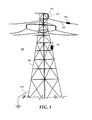
- FIG. 1 shows an operating environment
- FIG. 3 shows an operating environment for the power line monitor
- FIG. 4 shows a SCADA system
- a real-time power line maintenance monitoring system may provide a utility company with information on the status of a power line, the interpretation of this information, and display of this information in a manner that may allow the utility company to optimize the operation and maintenance of the power line. This may allow for increased power line reliability as the utility company may be able to determine if the power line is approaching its clearance limit or if a monitored component is failing.
- Embodiments of the invention may allow "continuous" monitoring of power line components. This continuous monitoring may reduce inspection expenses over conventional manual processes and provide earlier indication of potential component failure.
- FIG. 1 shows an operating environment 100 used to transmit or deliver electrical power.
- operating environment 100 may include a structure 102, a power line monitor 105, a conductor 110, an insulator string 115, an insulator string support 120, a conductor splice 125, and a structure ground 130.
- Structure 102 may support conductor 110. While structure 102 is shown in FIG. 1 as a galvanized steel lattice tower, structure 102 may comprise any structure configured to support conductor 110 such as a steel pole structure, a wooden pole structure, or a structure made of any material configured in any way.
- Conductor 110 may comprise any type conductor used to transmit electric power such as, but not limited to, Aluminum Conductor Steel Reinforced (ACSR).
- Conductor splice 125 may comprise any component configured to splice conductor 110.
- Insulator string 115 may comprise any component configured to insulate conductor 110 from structure 102.
- Insulator string support 120 many comprise any component configured to attach insulator string 115 to structure 102.
- Structure ground 130 may comprise any component that grounds structure 102 to the Earth, for example, a grounding rod(s) and a connector.
- Power line monitor 105 may also include a communications package 230 that may include and antenna 235 and may be connected to processing unit 210. Communications package 230 may transmit status data collected from power line monitor 105 and may receive other data including control data. Communications package 230 may communicate over a network (not shown).
- the network may comprise, for example, a local area network (LAN) or a wide area network (WAN).
- LAN local area network
- WAN wide area network
- a network interface located at power line monitor 105 may be used to interconnect any other processor on the network.
- power line monitor 105 may include an internal or external modem (not shown) or other means for establishing communications over the WAN. Further, in utilizing the network, data sent over the network may be encrypted to insure data security by using encryption/decryption techniques.
- a wireless communications system may be utilized as the network.
- Wireless may be defined as radio transmission via the airwaves.
- various other communication techniques can be used to provide wireless transmission, including infrared line of sight, cellular, microwave, satellite, packet radio, and spread spectrum radio.
- power line monitor 105 may communicate across a wireless interface such as, for example, a cellular interface (e.g., general packet radio system (GPRS), enhanced data rates for global evolution (EDGE), global system for mobile communications (GSM)), a wireless local area network interface (e.g., WLAN, IEEE 802), a bluetooth interface, WiFi, WiMax, another RF communication interface, and/or an optical interface.
- GPRS general packet radio system
- EDGE enhanced data rates for global evolution
- GSM global system for mobile communications
- WLAN wireless local area network interface
- Power line monitor 105 may communicate with a plurality of status transducers.
- the status transducers may include, but are not limited to, a splice temperature transducer 230, a conductor temperature transducer 235, a dead-end temperature transducer 240, a conductor motion transducer 245, a conductor vibration transducer 250, a support vibration transducer 255, a structure vibration transducer 260, a structure ground transducer 265, and an insulator breakdown transducer 270, an ambient air temperature transducer (not shown), all of which may collect and communicate status data to processing unit 210.
- the status transducers may communicate with processing unit 210 in any way.
- the status transducers may communicate with processing unit 210 either over a wire or wirelessly, directly or through the network, for example.
- All elements within power line monitor 105 may be supplied with power from a power supply 275. Because power line monitor 105 may be in close proximity to a power line (e.g. coupled to the power line,) power supply 275 may scavenge power from the power line using a current transformer (CT,) for example. Power supply 275 may also be a solar power supply.
- CT current transformer
- FIG. 3 shows an operating environment 300 for power line monitor 105 consistent with embodiments of the invention.
- a power line 305 (e.g. including conductor 110) may connect a first substation 310 and a second substation 315.
- Power line 305 may be tens or even hundreds of miles long.
- RUS BULLETIN 1724E-200 "DESIGN MANUAL FOR HIGH VOLTAGE TRANSMISSION LINES", published by the Electric Staff Division, Rural Utilities Service, U.S. Department of Agriculture shows how power lines may be designed.
- Sensor devices 105 may be placed on power line 305.
- Sensor devices 105 in environment 300 may include any one or more of a combination of the status transducers shown in FIG. 2 .
- Each of the sensor devices 105 may collect status data at a location (e.g. structure) where the sensor device is located on power line 305. After collection, each of the sensor devices 105 may transmit its collected status data to a central station 320.
- the received status data may be fed into a supervisory control and data acquisition (SCADA) system 400 as shown in more detail in FIG. 4 .
- SCADA supervisory control and data acquisition
- FIG. 4 shows SCADA system 400 in more detail.
- SCADA system 400 may include a processing unit 410 and a memory 415.
- Memory 415 may include a power line maintenance monitoring software module 420 and a database 425.
- power line maintenance monitoring software module 420 may perform, for example, processes for providing maintenance monitoring including, for example, any one or more of the stages of method 500 as described in greater detail below with respect to FIG. 5 .
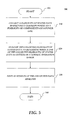
- FIG. 5 is a flow chart setting forth the general stages involved in a method 500 consistent with embodiments of the invention for providing maintenance monitoring.
- Method 500 may be implemented using power line monitor 105, SCADA system 400, or a combination of both power line monitor 105 and SCADA system 400. Ways to implement the stages of method 500 will be described in greater detail below.
- Method 500 may begin at starting block 505 and proceed to stage 510 where power line monitor 105 may collect a plurality of status data respectively corresponding to a plurality of components on a power line.
- the plurality of components may comprise, but are not limited to, a conductor dead-end, structure 102, conductor 110, insulator string 115, insulator string support 120, conductor splice 125, and structure ground 130.
- Conductor temperature transducer 235 may be placed at or near conductor 110, may be configured to measure the temperature of conductor 110, and send the measured conductor temperature reading back to power line monitor 105.
- Splice temperature transducer 230 may be placed at or near conductor splice 125, be configured to measure the temperature of conductor splice 125, and send the measured splice temperature reading back to power line monitor 105.
- Dead-end temperature transducer 240 may be placed at or near a conductor dead-end (not shown), be configured to measure the temperature of the conductor dead-end, and send the measured dead-end temperature reading back to power line monitor 105.
- Conductor vibration transducer 250 may be placed on conductor 110.
- Conductor vibration transducer 250 may be configured to measure the vibration of conductor 110 and send the vibration measurements (e.g. vibration profile) back to power line monitor 105.
- the vibration measurements may be used to determine if conductor 110 is experiencing excessive Aeolian vibration (e.g. torsional conductor movement and string vibration) which can lead to conductor fatigue failures.
- Aeolian vibration is described in RUS BULLETIN 1724E-200, "DESIGN MANUAL FOR HIGH VOLTAGE TRANSMISSION LINES", published by the Electric Staff Division, Rural Utilities Service, U.S. Department of Agriculture and is incorporated herein by reference.
- Support vibration transducer 255 may be placed at or near insulator string support 120, be configured to measure vibration of insulator string support 120, and send the measured vibration reading (e.g. vibration profile) of insulator string support 120 back to power line monitor 105. Moreover, support vibration transducer 255 may be configured to "ping" insulator string support 120 with a mechanical energy wave and measure the reflection of the mechanical energy wave in insulator string support 120 as the measured vibration reading.
- Structure vibration transducer 260 may be placed on or near structure 102, be configured to measure vibration of structure 102, and send the measured vibration reading (e.g. vibration profile) back to power line monitor 105. Moreover, structure vibration transducer 260 may be configured to "ping" structure 102 with a mechanical energy wave and measure the reflection of the mechanical energy wave in structure 102 as the measured vibration reading.
- Structure ground transducer 265 may be configured to "megger" structure ground 130.
- structure ground transducer 265 may be configured measure a ground impedance of structure ground 130 at structure 102.
- Structure ground transducer 265 may send the measured ground impedance reading back to power line monitor 105.
- Insulator electromagnetic transducer 270 may be placed on or near insulator string 115, be configured to measure an electromagnetic profile of insulator string 115, and send the measured electromagnetic profile back to power line monitor 105.
- method 500 may advance to stage 520 where power line monitor 105 (or SCADA 400) may analyze the collected plurality of status data to determine when a one of the collected plurality of status data is outside of a normal operation range for a one of the plurality of components corresponding to the one of the collected plurality of status data. Consistent with embodiments of the invention, the collected plurality of status data may be trended and interpreted.
- This may include, but is not limited to, providing: i) trending of component data; ii) heuristic algorithms specific to each monitored component type, which may interpret real-time and trended data to determine if the component is degrading; and iii) comparison of algorithm outputs to alarm set points to determine estimation of effects of conditions on remaining component life.
- conductor splices and conductor dead-ends may deteriorate over time and may eventually fail. As they approach their failure point, they become hotter and hotter. Consequently, the temperature of conductor splice 125 and/or the conductor deadened may be compared to the temperature of conductor 110. If the temperature of conductor splice 125 and/or the temperature of the conductor deadened is greater than the temperature of conductor 110 by a predetermined amount, then the temperature of conductor splice 125 and/or the temperature of the conductor deadened may be considered to be out side of the normal operation range for conductor splice 125 and/or the conductor deadened.
- conductor 110 may be prone to "galloping.”
- Conductor galloping (sometimes called dancing), is a phenomenon where power line conductors move with large amplitudes. Galloping usually occurs when an unsteady, high or gusty wind blows over a conductor covered by a layer of ice deposited by freezing rain, mist, or sleet.
- the coating may vary from a very thin glaze on one side to a solid three-inch cover giving the conductor an irregularly shaped profile. Consequently, this ice covering may give the conductor a slightly out-of-round, elliptical, or quasi-airfoil shape. Wind blowing over this irregularly shaped profile results in aerodynamic lift that causes the conductor to gallop.
- the wind can be anything between 5 to 45 miles-per-hour at an angle to the power line of 10 to 90 degrees.
- the wind may be unsteady in velocity or direction. Consequently, the movement profile of conductor 110 may be periodically analyzed by conductor motion transducer 245, power line monitor 105, or SCADA 400 to see if the motion of conductor 110 is consistent with the galloping conductor phenomenon.
- conductor 110 may be prone to damage through Aeolian vibration.
- Aeolian vibration is a high-frequency low-amplitude oscillation generated by a low velocity, comparatively steady wind blowing across a conductor. This steady wind creates air vortices or eddies on the lee side of the conductor. These vortices or eddies will detach at regular intervals from the top and bottom area of the conductor (i.e. "vortex shedding") creating a force on the conductor that is alternately impressed from above and below. If the frequency of the forces (i.e. expected excitation frequency) approximately corresponds to a frequency of a resonant vibration mode for a conductor span (i.e.
- the frequency of resonant vibration depends mainly on conductor size and wind velocity and is generally between 5 and 100 Hz for wind speeds within the range of 0 to 15 miles per hour.
- the peak-to-peak vibration amplitudes will cause alternating bending stresses great enough to produce fatigue failure in the conductor strands at the attachment points to the power line structure.
- Tensioned conductors in long spans are particularly subject to vibration fatigue. This vibration is generally more severe in flat open terrain where steady winds are more often encountered.
- the vibration profile of conductor 110 may be periodically analyzed by conductor vibration transducer 250, power line monitor 105, or SCADA 400 to see if the vibration of conductor 110 is greater than acceptable levels or significantly different than a vibration profile taken at a previous time (e.g. when the power line including structure 102 was first constructed).
- Insulator string 115 may be connected to structure 102 on insulator string support 120.
- Insulator string support 120 may weaken and loosen due to vibration. Damage to insulator string support 120 may be detectable through vibration or excessive motion. Consequently, the vibration profile of insulator string support 120 may be periodically analyzed by support vibration transducer 255, power line monitor 105, or SACADA 400 to see if the vibration of insulator string support 120 is greater than acceptable levels or significantly different than a vibration profile taken at a previous time (e.g. when the power line including structure 102 was first constructed).
- Power line structures may be made of concrete, wood, or steel. Regardless of the material, power line structures may deteriorate, for example, by rot, rust, corrode, or the bolts of a lattice structure may loosen. A level of deterioration can be determined by how structure 102 vibrates. Consequently, the vibration profile of structure 102 may be periodically analyzed by structure vibration transducer 260, power line monitor 105, or SCADA 400 to see if the vibration of structure 102 is greater than acceptable levels or significantly different than a vibration profile taken at a previous time (e.g. when the power line including structure 102 was first constructed).
- Structure 102 may be grounded through structure ground 130.
- Structure ground 130 may comprise a ground rod or a series of ground rods being driven into the earth near structure 102.
- the ground rod or a series of ground rods are connect to structure 102 by a wire. While an impedance of structure ground 130 may have been checked and found acceptable (e.g. between 20 ohms and 40 ohms) when structure 102 was built, the grounding of structure 102 may deteriorate over time.
- the impedance of structure ground 130 may be periodically analyzed by structure ground transducer 265, power line monitor 105, or SACADA 400 to see if the impedance of structure ground 130 is greater than a predetermined acceptable level or significantly different than an impedance of structure ground 130 taken at a previous time (e.g. when the power line including structure 102 was first constructed).
- Insulator strings e.g. insulator string 115
- Mechanical failures may be the result of physical damage to the "bells" or “core” of insulator string 115.
- Electrical failures may be the result of contamination and tracking that can be detected via corona or electromagnetic disruptions (e.g. like static on an AM radio). Accordingly, embodiments of the invention may use devices that measure corona or partial discharge that may detect insulator tracking.
- the electromagnetic profile of insulator string 115 may be periodically analyzed by insulator electromagnetic transducer 270, power line monitor 105, or SCADA 400 to see if the corona or electromagnetic disruptions of insulator string 115 is greater than acceptable levels or significantly different than an electromagnetic profile taken at a previous time (e.g. when the power line including structure 102 was first constructed).
- step 520 Once power line monitor 105 (or SCADA 400) analyzes the collected plurality of status data in stage 520, method 500 may continue to stage 530 where power line monitor 105 (or SCADA 400) may display results of the collected data analysis. The results may indicate that the one of the collected plurality of status data is outside of the normal operation range for the one of the plurality of components corresponding to the one of the collected plurality of status data as described above. After power line monitor 105 may display the results at stage 530, method 500 may then end at stage 540.
- Embodiment of the present invention may, for example, be implemented using a memory, a processing unit, and other components. Any suitable combination of hardware, software, and/or firmware may be used to implement the memory, processing unit, or other components.
- the processing unit may implement program modules.
- program modules may include routines, programs, components, data structures, and other types of structures that perform particular tasks or implement particular abstract data types.
- embodiments of the invention may be practiced with other computer system configurations, including hand-held devices, multiprocessor systems, microprocessor-based or programmable consumer electronics, minicomputers, mainframe computers, and the like.
- Embodiments of the invention may also be practiced in distributed computing environments where tasks are performed by remote processing devices that are linked through a communications network.
- program modules may be located in both local and remote memory storage devices.
- embodiments of the invention may be practiced in an electrical circuit comprising discrete electronic elements, packaged or integrated electronic chips containing logic gates, a circuit utilizing a microprocessor, or on a single chip containing electronic elements or microprocessors.
- Embodiments of the invention may also be practiced using other technologies capable of performing logical operations such as, for example, AND, OR, and NOT, including but not limited to mechanical, optical, fluidic, and quantum technologies.
- embodiments of the invention may be practiced within a general purpose computer or in any other circuits or systems.
- Embodiments of the invention may be implemented as a computer process (method), a computing system, or as an article of manufacture, such as a computer program product or computer readable media.
- the computer program product may be a computer storage media readable by a computer system and encoding a computer program of instructions for executing a computer process.
- the computer program product may also be a propagated signal on a carrier readable by a computing system and encoding a computer program of instructions for executing a computer process.
- the present invention may be embodied in hardware and/or in software (including firmware, resident software, micro-code, etc.).
- embodiments of the present invention may take the form of a computer program product on a computer-usable or computer-readable storage medium having computer-usable or computer-readable program code embodied in the medium for use by or in connection with an instruction execution system.
- a computer-usable or computer-readable medium may be any medium that can contain, store, communicate, propagate, or transport the program for use by or in connection with the instruction execution system, apparatus, or device.
- the computer-usable or computer-readable medium may be, for example but not limited to, an electronic, magnetic, optical, electromagnetic, infrared, or semiconductor system, apparatus, device, or propagation medium. More specific examples (a non-exhaustive list) of the computer-readable medium would include the following: an electrical connection having one or more wires, a portable computer diskette, a random access memory (RAM), a read-only memory (ROM), an erasable programmable read-only memory (EPROM or Flash memory), an optical fiber, and a portable compact disc read-only memory (CD-ROM).
- RAM random access memory
- ROM read-only memory
- EPROM or Flash memory erasable programmable read-only memory
- CD-ROM portable compact disc read-only memory
- the computer-usable or computer-readable medium could even be paper or another suitable medium upon which the program is printed, as the program can be electronically captured, via, for instance, optical scanning of the paper or other medium, then compiled, interpreted, or otherwise processed in a suitable manner, if necessary, and then stored in a computer memory.
- Embodiments of the present invention are described above with reference to block diagrams and/or operational illustrations of methods, systems, and computer program products according to embodiments of the invention. It is to be understood that the functions/acts noted in the blocks may occur out of the order noted in the operational illustrations. For example, two blocks shown in succession may in fact be executed substantially concurrently or the blocks may sometimes be executed in the reverse order, depending upon the functionality/acts involved.
Landscapes
- Engineering & Computer Science (AREA)
- Power Engineering (AREA)
- Electric Cable Installation (AREA)
- Testing And Monitoring For Control Systems (AREA)
- Management, Administration, Business Operations System, And Electronic Commerce (AREA)
- Remote Monitoring And Control Of Power-Distribution Networks (AREA)
Applications Claiming Priority (1)
| Application Number | Priority Date | Filing Date | Title |
|---|---|---|---|
| US12/729,319 US20110238374A1 (en) | 2010-03-23 | 2010-03-23 | Power Line Maintenance Monitoring |
Publications (2)
| Publication Number | Publication Date |
|---|---|
| EP2369718A2 true EP2369718A2 (de) | 2011-09-28 |
| EP2369718A3 EP2369718A3 (de) | 2017-09-27 |
Family
ID=44248160
Family Applications (1)
| Application Number | Title | Priority Date | Filing Date |
|---|---|---|---|
| EP11159356.2A Withdrawn EP2369718A3 (de) | 2010-03-23 | 2011-03-23 | Stromleitungswartungsüberwachung |
Country Status (4)
| Country | Link |
|---|---|
| US (1) | US20110238374A1 (de) |
| EP (1) | EP2369718A3 (de) |
| CA (1) | CA2735353C (de) |
| MX (1) | MX2011003141A (de) |
Cited By (5)
| Publication number | Priority date | Publication date | Assignee | Title |
|---|---|---|---|---|
| WO2014011760A1 (en) * | 2012-07-10 | 2014-01-16 | Mark Lancaster | Power line maintenance monitoring |
| US8744790B2 (en) | 2008-11-06 | 2014-06-03 | Southwire Company | Real-time power line rating |
| CN104501848A (zh) * | 2014-12-04 | 2015-04-08 | 国家电网公司 | 一种变电设备的数据接入方法及系统 |
| CN106409442A (zh) * | 2016-10-21 | 2017-02-15 | 国网新疆电力公司信息通信公司 | 复合悬挂绝缘子及其处理方法 |
| US10205307B2 (en) | 2010-03-23 | 2019-02-12 | Southwire Company, Llc | Power line maintenance monitoring |
Families Citing this family (14)
| Publication number | Priority date | Publication date | Assignee | Title |
|---|---|---|---|---|
| US9647454B2 (en) | 2011-08-31 | 2017-05-09 | Aclara Technologies Llc | Methods and apparatus for determining conditions of power lines |
| NO344206B1 (no) * | 2011-08-31 | 2019-10-14 | Heimdall Power As | Sensorsystem for overvåkning av temperaturbelastninger på elektriske forsyningsanlegg |
| WO2013123055A1 (en) | 2012-02-14 | 2013-08-22 | Tollgrade Communications, Inc. | Power line management system |
| US20140136140A1 (en) | 2012-11-13 | 2014-05-15 | Elwha Llc | Systems and methods for detecting overhead line motion |
| US20150021086A1 (en) * | 2013-07-19 | 2015-01-22 | San Diego Gas & Electric Company | Methods for dulling metallic surfaces and related products |
| CN103605767A (zh) * | 2013-11-26 | 2014-02-26 | 国家电网公司 | 一种输电线路的数据接入方法和系统 |
| WO2015153539A2 (en) | 2014-03-31 | 2015-10-08 | Tollgrade Communication, Inc. | Optical voltage sensing for underground medium voltage wires |
| US10203355B2 (en) | 2014-08-29 | 2019-02-12 | Aclara Technologies Llc | Power extraction for a medium voltage sensor using a capacitive voltage divider |
| AU2019211451B2 (en) | 2018-01-26 | 2024-10-03 | LineVision, Inc. | System and method for power transmission line monitoring |
| US10726582B2 (en) * | 2018-03-15 | 2020-07-28 | Sharper Shape Oy | Method and system for determining lone temperature of overhead power line |
| DE102019204307A1 (de) * | 2019-03-28 | 2020-10-01 | Siemens Aktiengesellschaft | Überwachungsverfahren einer Elektroenergieübertragungseinrichtung |
| CN111697694A (zh) * | 2020-06-02 | 2020-09-22 | 广西电网有限责任公司电力科学研究院 | 一种配电终端近端维护身份认证方法及系统 |
| CN113328376B (zh) * | 2021-07-01 | 2022-03-01 | 华能陕西定边电力有限公司 | 一种风力发电35kv集电线路故障巡检机器人 |
| CN114243869B (zh) * | 2022-02-22 | 2022-05-13 | 北京盈通恒信电力科技有限公司 | 用于输电线路监控的控制方法及装置、监控系统 |
Family Cites Families (36)
| Publication number | Priority date | Publication date | Assignee | Title |
|---|---|---|---|---|
| US3771356A (en) * | 1972-03-14 | 1973-11-13 | Saskatchewan Power Corp | Vibration measuring assemblies for energized and non-energized power line vibration measurements |
| US4384289A (en) * | 1981-01-23 | 1983-05-17 | General Electric Company | Transponder unit for measuring temperature and current on live transmission lines |
| US4808917A (en) * | 1983-04-13 | 1989-02-28 | Niagara Mohawk Power Corporation | Transmission line sensor apparatus operable with near zero current line conditions |
| US4827272A (en) * | 1984-06-04 | 1989-05-02 | Davis Murray W | Overhead power line clamp and antenna |
| US4886980A (en) * | 1985-11-05 | 1989-12-12 | Niagara Mohawk Power Corporation | Transmission line sensor apparatus operable with near zero current line conditions |
| JPH0727788Y2 (ja) * | 1986-05-23 | 1995-06-21 | 住友電気工業株式会社 | 架空送配電設備の監視装置 |
| US4786862A (en) * | 1986-06-09 | 1988-11-22 | Niagara Mohawk Power Corporation | Watchdog circuit for transmission line sensor module |
| US5006846A (en) * | 1987-11-12 | 1991-04-09 | Granville J Michael | Power transmission line monitoring system |
| JPH0738011B2 (ja) * | 1988-05-16 | 1995-04-26 | 株式会社日立製作所 | 高圧電力機器の異常診断システム |
| US5214595A (en) * | 1988-05-16 | 1993-05-25 | Hitachi, Ltd. | Abnormality diagnosing system and method for a high voltage power apparatus |
| US4891576A (en) * | 1988-08-22 | 1990-01-02 | The United States Of America As Represented By The Secretary Of The Interior | Ground-based transmission line conductor motion sensor |
| GB2241120B (en) * | 1990-02-14 | 1994-01-19 | Stc Plc | Deploying cables in pipelines |
| US5565783A (en) * | 1994-09-29 | 1996-10-15 | Pacific Gas And Electric Company | Fault sensor device with radio transceiver |
| US5933355A (en) * | 1995-05-04 | 1999-08-03 | Deb; Anjan Kumar | Object oriented expert power line ampacity system |
| US5821463A (en) * | 1996-06-14 | 1998-10-13 | The Whitaker Corporation | Mechanical connector splice for cable |
| US6677743B1 (en) * | 1999-03-05 | 2004-01-13 | Foster-Miller, Inc. | High voltage powerline sensor with a plurality of voltage sensing devices |
| US6633169B1 (en) * | 1999-04-08 | 2003-10-14 | Doble Engineering Company | Monitoring leakage currents from high-voltage devices |
| US7705747B2 (en) * | 2005-08-18 | 2010-04-27 | Terahop Networks, Inc. | Sensor networks for monitoring pipelines and power lines |
| US6735549B2 (en) * | 2001-03-28 | 2004-05-11 | Westinghouse Electric Co. Llc | Predictive maintenance display system |
| US20030014199A1 (en) * | 2001-07-12 | 2003-01-16 | Patrick Toomey | System and methods for detecting fault in structure |
| DE60119555T2 (de) * | 2001-12-21 | 2007-03-08 | Abb Schweiz Ag | Ermittlung der Betriebsgrenzwerte in einem Energieverteilungsnetz |
| EP1644705B1 (de) * | 2003-06-24 | 2016-10-12 | Cidra Corporate Services, Inc. | System und verfahren zum betreiben eines flussprozesses |
| US7164263B2 (en) * | 2004-01-16 | 2007-01-16 | Fieldmetrics, Inc. | Current sensor |
| US7188997B2 (en) * | 2005-01-21 | 2007-03-13 | Eaton Corporation | Apparatus and method for detecting hot spots in an electric power conductor |
| US8581723B2 (en) * | 2006-05-19 | 2013-11-12 | Schweitzer Engineering Laboratories Inc | Fault detection using phase comparison |
| US20080077336A1 (en) * | 2006-09-25 | 2008-03-27 | Roosevelt Fernandes | Power line universal monitor |
| US7620517B2 (en) * | 2007-02-05 | 2009-11-17 | Abb Research Ltd. | Real-time power-line sag monitoring using time-synchronized power system measurements |
| US20090015239A1 (en) * | 2007-03-01 | 2009-01-15 | Georgiou George E | Transmission Line Sensor |
| WO2010054072A1 (en) * | 2008-11-06 | 2010-05-14 | Mark Lancaster | Real-time power line rating |
| US8002592B2 (en) * | 2008-12-17 | 2011-08-23 | Hubbell Incorporated | Data collecting connection |
| IL201360A (en) * | 2009-10-11 | 2014-08-31 | Moshe Henig | Load control system and power grid detection for smart grid |
| WO2011100409A1 (en) * | 2010-02-10 | 2011-08-18 | Electric Power Research Institute, Inc. | Line inspection robot and system |
| US10205307B2 (en) * | 2010-03-23 | 2019-02-12 | Southwire Company, Llc | Power line maintenance monitoring |
| US20120299603A1 (en) * | 2011-05-25 | 2012-11-29 | Electric Power Research Institute, Inc. | On-line monitoring system of insulation losses for underground power cables |
| US9261414B2 (en) * | 2011-07-21 | 2016-02-16 | Electric Power Research Institute, Inc. | Overhead conductor sensor |
| US9647454B2 (en) * | 2011-08-31 | 2017-05-09 | Aclara Technologies Llc | Methods and apparatus for determining conditions of power lines |
-
2010
- 2010-03-23 US US12/729,319 patent/US20110238374A1/en not_active Abandoned
-
2011
- 2011-03-22 CA CA2735353A patent/CA2735353C/en not_active Expired - Fee Related
- 2011-03-23 MX MX2011003141A patent/MX2011003141A/es active IP Right Grant
- 2011-03-23 EP EP11159356.2A patent/EP2369718A3/de not_active Withdrawn
Non-Patent Citations (2)
Cited By (6)
| Publication number | Priority date | Publication date | Assignee | Title |
|---|---|---|---|---|
| US8744790B2 (en) | 2008-11-06 | 2014-06-03 | Southwire Company | Real-time power line rating |
| US10205307B2 (en) | 2010-03-23 | 2019-02-12 | Southwire Company, Llc | Power line maintenance monitoring |
| WO2014011760A1 (en) * | 2012-07-10 | 2014-01-16 | Mark Lancaster | Power line maintenance monitoring |
| CN104501848A (zh) * | 2014-12-04 | 2015-04-08 | 国家电网公司 | 一种变电设备的数据接入方法及系统 |
| CN106409442A (zh) * | 2016-10-21 | 2017-02-15 | 国网新疆电力公司信息通信公司 | 复合悬挂绝缘子及其处理方法 |
| CN106409442B (zh) * | 2016-10-21 | 2018-08-31 | 国网新疆电力公司信息通信公司 | 复合悬挂绝缘子及其处理方法、存储介质和处理器 |
Also Published As
| Publication number | Publication date |
|---|---|
| US20110238374A1 (en) | 2011-09-29 |
| MX2011003141A (es) | 2011-09-22 |
| CA2735353A1 (en) | 2011-09-23 |
| CA2735353C (en) | 2018-09-25 |
| EP2369718A3 (de) | 2017-09-27 |
Similar Documents
| Publication | Publication Date | Title |
|---|---|---|
| CA2735353C (en) | Power line maintenance monitoring | |
| US10205307B2 (en) | Power line maintenance monitoring | |
| US10209291B2 (en) | System and method for condition monitoring of electricity transmission structures | |
| US12249829B2 (en) | Methods and apparatus for determining conditions of power lines | |
| JP7523755B2 (ja) | 送電線監視のシステムおよび方法 | |
| US9377498B2 (en) | Fault prediction in electronic transmission networks | |
| US10041968B2 (en) | Power line management system | |
| EP2518521B1 (de) | System und vorrichtung zur erkennung von defekten in unterirdischen kabeln | |
| CN103998944B (zh) | 故障检测系统 | |
| Cloet et al. | Uprating Transmission Lines through the use of an innovative real-time monitoring system | |
| Li et al. | Condition monitoring and diagnosis of high-voltage equipment in China-recent progress | |
| US20240167909A1 (en) | Method and device for monitoring severity of vibration in overhead power lines | |
| CA2878674C (en) | Power line maintenance monitoring | |
| EP3249766A1 (de) | Verfahren und system zur messung/detektion von atmosphärischer eis- oder schneeansammlung auf freileitungen | |
| CN118294758B (zh) | 一种基于光传感和行波技术的输电线路异常状态监测分析方法及系统 | |
| CN104155568A (zh) | 一种雷击输电线路避雷线精确定位方法 | |
| CN104897958A (zh) | 一种输电线路雷击类型的辨识方法 | |
| Zhao et al. | A structural health monitoring system of the overhead transmission line conductor | |
| Hlalele et al. | Real time monitoring of high voltage transmission line conductor sag: The state-of-the-art | |
| CN107044388A (zh) | 风力发电机叶片健康状态监测系统及监测方法 | |
| Quaia et al. | Subtransmission overhead lines mechanical monitoring for fast detection of damaging events | |
| CN117232642A (zh) | 一种碳纤维导线舞动监测方法、装置及电子设备 | |
| Gal et al. | On-line monitoring of OHL conductor temperature; live-line installation | |
| EP4103949B1 (de) | Leistungsqualitätsanalysesystem und verfahren zur überwachung von ausserhalb von mehrleiterkabeln | |
| Farzaneh et al. | Systems for monitoring and predicting ice accretion and shedding |
Legal Events
| Date | Code | Title | Description |
|---|---|---|---|
| PUAI | Public reference made under article 153(3) epc to a published international application that has entered the european phase |
Free format text: ORIGINAL CODE: 0009012 |
|
| AK | Designated contracting states |
Kind code of ref document: A2 Designated state(s): AL AT BE BG CH CY CZ DE DK EE ES FI FR GB GR HR HU IE IS IT LI LT LU LV MC MK MT NL NO PL PT RO RS SE SI SK SM TR |
|
| AX | Request for extension of the european patent |
Extension state: BA ME |
|
| RAP1 | Party data changed (applicant data changed or rights of an application transferred) |
Owner name: SOUTHWIRE COMPANY, LLC |
|
| PUAL | Search report despatched |
Free format text: ORIGINAL CODE: 0009013 |
|
| AK | Designated contracting states |
Kind code of ref document: A3 Designated state(s): AL AT BE BG CH CY CZ DE DK EE ES FI FR GB GR HR HU IE IS IT LI LT LU LV MC MK MT NL NO PL PT RO RS SE SI SK SM TR |
|
| AX | Request for extension of the european patent |
Extension state: BA ME |
|
| RIC1 | Information provided on ipc code assigned before grant |
Ipc: H02G 1/02 20060101AFI20170823BHEP Ipc: H02J 13/00 20060101ALI20170823BHEP Ipc: G01R 15/14 20060101ALI20170823BHEP |
|
| 17P | Request for examination filed |
Effective date: 20180326 |
|
| RBV | Designated contracting states (corrected) |
Designated state(s): AL AT BE BG CH CY CZ DE DK EE ES FI FR GB GR HR HU IE IS IT LI LT LU LV MC MK MT NL NO PL PT RO RS SE SI SK SM TR |
|
| 17Q | First examination report despatched |
Effective date: 20180910 |
|
| STAA | Information on the status of an ep patent application or granted ep patent |
Free format text: STATUS: THE APPLICATION IS DEEMED TO BE WITHDRAWN |
|
| 18D | Application deemed to be withdrawn |
Effective date: 20191001 |