EP2368947A1 - Ink composition - Google Patents
Ink composition Download PDFInfo
- Publication number
- EP2368947A1 EP2368947A1 EP20110158978 EP11158978A EP2368947A1 EP 2368947 A1 EP2368947 A1 EP 2368947A1 EP 20110158978 EP20110158978 EP 20110158978 EP 11158978 A EP11158978 A EP 11158978A EP 2368947 A1 EP2368947 A1 EP 2368947A1
- Authority
- EP
- European Patent Office
- Prior art keywords
- group
- ink composition
- optionally substituted
- hydrogen
- formula
- Prior art date
- Legal status (The legal status is an assumption and is not a legal conclusion. Google has not performed a legal analysis and makes no representation as to the accuracy of the status listed.)
- Granted
Links
Classifications
-
- C—CHEMISTRY; METALLURGY
- C09—DYES; PAINTS; POLISHES; NATURAL RESINS; ADHESIVES; COMPOSITIONS NOT OTHERWISE PROVIDED FOR; APPLICATIONS OF MATERIALS NOT OTHERWISE PROVIDED FOR
- C09B—ORGANIC DYES OR CLOSELY-RELATED COMPOUNDS FOR PRODUCING DYES, e.g. PIGMENTS; MORDANTS; LAKES
- C09B5/00—Dyes with an anthracene nucleus condensed with one or more heterocyclic rings with or without carbocyclic rings
- C09B5/02—Dyes with an anthracene nucleus condensed with one or more heterocyclic rings with or without carbocyclic rings the heterocyclic ring being only condensed in peri position
- C09B5/14—Benz-azabenzanthrones (anthrapyridones)
-
- C—CHEMISTRY; METALLURGY
- C09—DYES; PAINTS; POLISHES; NATURAL RESINS; ADHESIVES; COMPOSITIONS NOT OTHERWISE PROVIDED FOR; APPLICATIONS OF MATERIALS NOT OTHERWISE PROVIDED FOR
- C09B—ORGANIC DYES OR CLOSELY-RELATED COMPOUNDS FOR PRODUCING DYES, e.g. PIGMENTS; MORDANTS; LAKES
- C09B67/00—Influencing the physical, e.g. the dyeing or printing properties of dyestuffs without chemical reactions, e.g. by treating with solvents grinding or grinding assistants, coating of pigments or dyes; Process features in the making of dyestuff preparations; Dyestuff preparations of a special physical nature, e.g. tablets, films
- C09B67/0033—Blends of pigments; Mixtured crystals; Solid solutions
-
- C—CHEMISTRY; METALLURGY
- C09—DYES; PAINTS; POLISHES; NATURAL RESINS; ADHESIVES; COMPOSITIONS NOT OTHERWISE PROVIDED FOR; APPLICATIONS OF MATERIALS NOT OTHERWISE PROVIDED FOR
- C09D—COATING COMPOSITIONS, e.g. PAINTS, VARNISHES OR LACQUERS; FILLING PASTES; CHEMICAL PAINT OR INK REMOVERS; INKS; CORRECTING FLUIDS; WOODSTAINS; PASTES OR SOLIDS FOR COLOURING OR PRINTING; USE OF MATERIALS THEREFOR
- C09D11/00—Inks
- C09D11/30—Inkjet printing inks
- C09D11/32—Inkjet printing inks characterised by colouring agents
- C09D11/328—Inkjet printing inks characterised by colouring agents characterised by dyes
Definitions
- the present invention relates to ink compositions, particularly, to an ink composition that allows formation of a recorded image with high color reproduction and light fastness.
- a color image is formed using three ink compositions, namely, a yellow ink composition, a magenta ink composition, and a cyan ink composition, or four ink compositions further including a black ink composition as desired.
- a color image is formed using six ink compositions including a light cyan ink composition and a light magenta ink composition in addition to the above four ink compositions, or seven ink compositions further including a dark yellow ink composition.
- ink sets Such combinations of two or more ink compositions are called ink sets.
- Ink compositions used for forming a color image are required, for example, to have good color vividness on their own, to show a good intermediate color when combined, and to produce a recorded material that does not discolor or fade during storage.
- magenta ink composition often has the lowest performance and determines the light fastness longevity of the entire ink set. Accordingly, improving the light fastness of the magenta ink composition is an effective way to improve the light fastness of a photographic image and prolonging the light fastness longevity of the ink set.
- printed materials produced using such ink compositions may be placed not only indoors, but also outdoors, and may therefore be exposed not only to indoor light, but also to sunlight. Accordingly, there is a need for ink compositions having high light fastness.
- the invention is based on this finding. It was thought in the related art that copper phthalocyanine dyes have a higher light fastness than anthrapyridone dyes.
- ink compositions containing both an anthrapyridone dye and a copper phthalocyanine dye in the related art were based on the concept that the copper phthalocyanine dye is responsible for the light fastness.
- the content of an anthrapyridone dye, which has a lower light fastness is higher than the content of a copper phthalocyanine dye, and the result is that the ink composition has significantly improved light fastness.
- the technical idea of employing such a proportion is opposite to the idea of the related art, and the effect is unexpected for those skilled in the art.
- an advantage of some aspects of the invention is that it provides an ink composition that allows formation of a recorded image with high color reproduction and light fastness.
- An ink composition according to an aspect of the invention contains an anthrapyridone dye and a copper phthalocyanine dye.
- the hue angle in the L*a*b* color system calculated from spectral characteristics of a 1,000-fold diluted solution of the ink composition in water is 270° to 360°.
- the content of the anthrapyridone dye is higher than the content of the copper phthalocyanine dye.
- the anthrapyridone dye is represented by formula (I): (wherein M 1 is hydrogen, NH 4 , or sodium; R 1 is hydrogen, an optionally substituted alkyl group, an optionally substituted aryl group, or an optionally substituted benzoyl group; R 2 is hydrogen or an optionally substituted alkyl group; R 3 is hydrogen, a halogen, or an optionally substituted alkyl group; R 4 is hydrogen, an optionally substituted NH 4 , or an optionally substituted sulfonic acid group; and R 5 is an acyl group or a group represented by formula (II): (wherein X and Y are each independently chlorine or a hydroxy, amino, monoethanolamino, diethanolamino, morpholino, anilino, or phenol group optionally substituted with one or more substituents)).
- an ink composition that allows formation of a recorded image with high color reproduction and light fastness can be provided.
- An ink composition according to an embodiment of the invention contains an anthrapyridone dye represented by formula (I) above and a copper phthalocyanine dye represented by formula (III) above.
- the hue angle in the L*a*b* color system calculated from the spectral characteristics of a 1,000-fold diluted solution of the ink composition in water is 270° to 360°.
- the content of the anthrapyridone dye is higher than the content of the copper phthalocyanine dye.
- the hue angle in the L*a*b* color system calculated from the spectral characteristics of a 1,000-fold diluted solution of the ink composition according to the embodiment of the invention in water is 270° to 360°.
- the hue angle is 320° to 350°. If the hue angle falls within this range, a recorded image with higher color reproduction and light fastness can be formed.
- the hue angle of the ink composition can be specified by the color difference method using the L*a*b* color system standardized by CIE (Commission International del'Eclairage) and employed by JIS (Japanese Industrial Standards) (namely, JIS Z 8729).
- the water used for dilution may be pure or ultrapure water such as ion exchange water, ultrafiltrated water, reverse
- the ink composition according to the embodiment of the invention contains an anthrapyridone dye represented by formula (I) above.
- anthrapyridone dyes preferred in the embodiment of the invention include compounds represented by formula (I) above wherein M 1 is NH 4 or sodium; R 1 is hydrogen or an optionally substituted benzoyl group (preferably, a benzoyl group substituted with a sulfonic acid group (the sulfonic acid group is optionally substituted with NH 4 or sodium)); R 2 is an optionally substituted alkyl group (preferably, an alkyl group having one to three carbon atoms, more preferably a methyl group); R 3 is hydrogen; R 4 is an optionally substituted sulfonic acid group (preferably, a sulfonic acid group substituted with NH 4 or sodium); and R 5 is a group represented by formula (II) above (preferably, in formula (II), X and Y are each independently a hydroxy, amino, anilino, or phenol group (more preferably, a phenol group substituted with a carboxyl group (the carboxyl group is optionally substituted with a
- the anthrapyridone dye represented by formula (I) above is preferably a mixture of a compound represented by formula (I) above wherein M 1 is NH 4 and a compound represented by formula (I) above wherein M 1 is sodium. More preferably, the anthrapyridone dye represented by formula (I) above is a mixture of a compound represented by formula (I) above wherein M 1 is NH 4 and a compound represented by formula (I) above wherein M 1 is sodium in a ratio (molar ratio) of 6:4 to 8:2.
- the anthrapyridone dye represented by formula (I) above is a mixture of a compound represented by formula (I) above wherein M 1 is NH 4 and a compound represented by formula (I) above wherein M 1 is sodium in a ratio (molar ratio) of 7:3.
- the anthrapyridone dye represented by formula (I) above is preferably a compound represented by formula (IV): (wherein M 2 is hydrogen, NH 4 , or sodium; R 6 is hydrogen, an optionally substituted alkyl group, an optionally substituted aryl group, or an optionally substituted benzoyl group; R 7 is hydrogen or an optionally substituted alkyl group; R 8 is hydrogen, a halogen, or an optionally substituted alkyl group; R 9 is hydrogen, an optionally substituted NH 4 , or an optionally substituted sulfonic acid group; A is an alkylene group, an alkylene group having a phenylene group, or a group represented by formula (V): (wherein R 10 is hydrogen or an alkyl group); and Z is chlorine or a hydroxy, amino, monoethanolamino, diethanolamino, morpholino, aniline, or phenol group optionally substituted with one or more substituents).
- M 2 is hydrogen, NH 4 ,
- anthrapyridone dyes preferred in the embodiment of the invention include compounds represented by formula (IV) above wherein M 2 is NH 4 or sodium; R 6 is an optionally substituted benzoyl group (preferably, a benzoyl group substituted with a sulfonic acid group (the sulfonic acid group is optionally substituted with NH 4 or sodium)); R 7 is an optionally substituted alkyl group (preferably, an alkyl group having one to three carbon atoms, more preferably a methyl group); R 8 is hydrogen; R 9 is an optionally substituted sulfonic acid group (preferably, a sulfonic acid group substituted with NH 4 or sodium); A is an alkylene group or a group represented by formula (V) above (preferably, wherein R 10 is hydrogen); and Z is an amino or phenol group (more preferably, a phenol group substituted with a carboxyl group (the carboxyl group is optionally substituted with NH 4 or sodium)) optionally substituted with one or
- the anthrapyridone dye contained in the ink composition is preferably a mixture of a compound represented by formula (IV) above wherein M 2 is NH 4 and a compound represented by formula (IV) above wherein M 2 is sodium. More preferably, the anthrapyridone dye contained in the ink composition is a mixture of a compound represented by formula (IV) above wherein M 2 is NH 4 and a compound represented by formula (IV) above wherein M 2 is sodium in a ratio (molar ratio) of 6:4 to 8:2.
- the anthrapyridone dye contained in the ink composition is a mixture of a compound represented by formula (IV) above wherein M 2 is NH 4 and a compound represented by formula (IV) above wherein M 2 is sodium in a ratio (molar ratio) of 7:3.
- the anthrapyridone dye represented by formula (I) or (IV) above is more preferably a compound represented by formula (VI): (wherein M 3 is hydrogen, NH 4 , or sodium; B is an alkylene group; and n is 1 or 2).
- the anthrapyridone dye contained in the ink composition is preferably a mixture of a compound represented by formula (VI) above wherein M 3 is NH 4 and a compound represented by formula (VI) above wherein M 3 is sodium. More preferably, the anthrapyridone dye contained in the ink composition is a mixture of a compound represented by formula (VI) above wherein M 3 is NH 4 and a compound represented by formula (VI) above wherein M 3 is sodium in a ratio (molar ratio) of 6:4 to 8:2.
- the anthrapyridone dye contained in the ink composition is a mixture of a compound represented by formula (VI) above wherein M 3 is NH 4 and a compound represented by formula (VI) above wherein M 3 is sodium in a ratio (molar ratio) of 7:3.
- the anthrapyridone dye represented by formula (I) above is preferably a compound of formula (VII): (wherein M 4 is hydrogen, NH 4 , or sodium). If the ink composition according to the embodiment of the invention contains the above compound, a recorded image with high color reproduction and light fastness can be formed.
- the anthrapyridone dye contained in the ink composition is preferably a mixture of a compound represented by formula (VII) above wherein M 4 is NH 4 and a compound represented by formula (VII) above wherein M 4 is sodium. More preferably, the anthrapyridone dye contained in the ink composition is a mixture of a compound represented by formula (VII) above wherein M 4 is NH 4 and a compound represented by formula (VII) above wherein M 4 is sodium in a ratio (molar ratio) of 6:4 to 8:2.
- the anthrapyridone dye contained in the ink composition is a mixture of a compound represented by formula (VII) above wherein M 4 is NH 4 and a compound represented by formula (VII) above wherein M 4 is sodium in a ratio (molar ratio) of 7:3.
- the anthrapyridone dye represented by formula (I) above is preferably a compound of formula (VIII): (wherein M 5 is hydrogen, NH 4 , or sodium). If the ink composition according to the embodiment of the invention contains the above compound, a recorded image with high color reproduction and light fastness can be formed.
- the anthrapyridone dye contained in the ink composition is preferably a mixture of a compound represented by formula (VIII) above wherein M 5 is NH 4 and a compound represented by formula (VIII) above wherein M 5 is sodium. More preferably, the anthrapyridone dye contained in the ink composition is a mixture of a compound represented by formula (VIII) above wherein M 5 is NH 4 and a compound represented by formula (VIII) above wherein M 5 is sodium in a ratio (molar ratio) of 6:4 to 8:2.
- the anthrapyridone dye contained in the ink composition is a mixture of a compound represented by formula (VIII) above wherein M 5 is NH 4 and a compound represented by formula (VIII) above wherein M 5 is sodium in a ratio (molar ratio) of 7:3.
- the anthrapyridone dye represented by formula (I) above is preferably a compound of formula (IX): If the ink composition according to the embodiment of the invention contains the above compound, a recorded image with high color reproduction and light fastness can be formed.
- the content of the anthrapyridone dye is not particularly limited as long as a recorded image with high color reproduction and light fastness can be formed.
- the content of the anthrapyridone dye is preferably 1% to 10% by mass, more preferably 4% to 10% by mass, of the ink composition. If the content of the anthrapyridone dye falls within such a range, a recorded image with higher color reproduction and light fastness can be formed.
- the content of the anthrapyridone dye in the ink composition according to the embodiment of the invention is higher than the content of the copper phthalocyanine dye, described below.
- the ratio (A/B) of the mass content of the anthrapyridone dye (A) to the mass content of the copper phthalocyanine dye (B) is 1.1 to 100, more preferably 2.5 to 100, and most preferably 10 to 100. If the ratio falls within such a range, a recorded image with higher color reproduction and light fastness can be formed.
- the ink composition according to the embodiment of the invention contains a copper phthalocyanine dye represented by formula (III) above.
- Examples of copper phthalocyanine dyes preferred in the embodiment of the invention include C.I. Direct Blue 199 and the compound of formula (X): (wherein Z1, Z2, Z3, and Z4 are as follows.) Z1 Z2 Z3 Z4 -(CH 2 ) 3 SO 3 Li -(CH 2 ) 3 SO 3 Li -(CH 2 ) 3 SO 3 Li -(CH 2 ) 3 SO 2 NHCH 2 CH(OH)CH 3 Of these, the compound of formula (X) is more preferable. If the ink composition according to the embodiment of the invention contains the above compound, a recorded image with higher color reproduction and light fastness can be formed.
- the content of the copper phthalocyanine dye in the ink composition is preferably 0.05% to 2.0% by mass, more preferably 0.05% to 1.0% by mass, of the ink composition. If the content of the copper phthalocyanine dye falls within such a range, a recorded image with higher color reproduction and light fastness can be formed.
- the ink composition according to the embodiment of the invention contains water or an aqueous medium containing water and a water-soluble organic solvent, contains the dyes represented by formulas (I) and (III) above as colorants, and optionally contains additives such as a humectant, a surfactant, a permeation enhancer, a viscosity modifier, and a pH adjustor.
- additives such as a humectant, a surfactant, a permeation enhancer, a viscosity modifier, and a pH adjustor.
- the ink composition according to the embodiment of the invention can be prepared by dissolving the above colorants (dyes) in an appropriate solvent.
- water or a mixture of water and a water-soluble organic solvent is preferably used as a main solvent for dissolving the colorants.
- the water used may be, for example, ion exchange water, ultrafiltrated water, reverse osmosis water, or distilled water.
- water subjected to ultraviolet irradiation or chemical sterilization treatment such as addition of hydrogen peroxide is preferably used.
- the content of water in the ink composition according to the embodiment of the invention is preferably 40% to 90% by mass, more preferably 50% to 80% by mass, of the ink composition.
- the ink composition according to the embodiment of the invention may contain a water-soluble organic solvent as a solvent together with water.
- the water-soluble organic solvent used is preferably one capable of dissolving the dyes and having a vapor pressure lower than that of pure water.
- water-soluble organic solvents used in the embodiment of the invention include, but are not limited to, polyalcohols such as ethylene glycol, propylene glycol, butanediol, pentanediol, 2-butene-1,4-diol, 2-methyl-2,4-pentanediol, glycerol, 1,2,6-hexanetriol, diethylene glycol, triethylene glycol, and dipropylene glycol; ketones such as acetonylacetone; esters such as ⁇ -butyrolactone and triethyl phosphate; and other solvents such as furfuryl alcohol, tetrahydrofurfuryl alcohol, and thiodiglycol.
- polyalcohols such as ethylene glycol, propylene glycol, butanediol, pentanediol, 2-butene-1,4-diol, 2-methyl-2,4-pentanediol, glycerol
- a water-soluble organic solvent as a solvent of the ink composition together with water allows various adjustments, such as improving the stability of the ejection of the ink composition from an ink head and decreasing the viscosity of the ink composition without substantially changing the other properties, to be readily performed.
- the ink composition according to the embodiment of the invention may contain at least one humectant selected from the group consisting of saccharides. If an ink composition containing a humectant is used for ink-jet recording, it inhibits evaporation of moisture from the ink to maintain moisture in the ink.
- saccharides preferred in the embodiment of the invention include maltitol, sorbitol, gluconolactone, and maltose.
- the water-soluble organic solvents described above may also serve as a humectant.
- the ink composition may contain the water-soluble organic solvent and/or the humectant in a total amount of 5% to 50% by mass, more preferably 5% to 30% by mass, and most preferably 5% to 20% by mass. If the content is 5% by mass or more, the ink composition has good moisture retention. In addition, if the content is 50% by mass or less, the ink composition has viscosity preferred for ink-jet recording.
- the surfactant contained in the ink composition according to the embodiment of the invention is preferably, but not limited to, a nonionic surfactant. If a nonionic surfactant is added to the ink composition, it has high permeability into a recording medium and can therefore be quickly fixed on a recording medium in printing. In addition, it is preferable that a dot of ink composition on a recording medium be as close to a perfect circle as possible; if the ink composition contains a nonionic surfactant, a dot image closer to a perfect circle can be formed, thus improving the quality of a recorded image.
- nonionic surfactants examples include acetylene glycol surfactants.
- examples of acetylene glycol surfactants include Surfynol 465 and 104 (available from Air Products and Chemicals Inc.) and Olfine E1010, PD001, and STG (available from Nissin Chemical Industry Co., Ltd.; trade names).
- the amount of nonionic surfactant added is preferably 0.1% to 5.0% by mass, more preferably 0.5% to 3.0% by mass. If the amount of nonionic surfactant added is 0.1% by mass or more, the ink composition has sufficient permeability. In addition, if the amount of nonionic surfactant added is 5.0% by mass or less, image blurring can be easily prevented.
- a glycol ether is added as a permeation enhancer to the ink composition in addition to a nonionic surfactant, it improves the permeability of the ink composition into a recording medium and reduces bleeding at boundaries between adjacent color inks in color printing, thus providing a very sharp image.
- a nonionic surfactant is preferably added to the ink composition according to the embodiment of the invention.
- glycol ethers preferred as a permeation enhancer in the embodiment of the invention include, but are not limited to, ethylene glycol monobutyl ether, diethylene glycol monobutyl ether, triethylene glycol monoethyl ether, propylene glycol monomethyl ether, dipropylene glycol monoethyl ether, propylene glycol monobutyl ether, dipropylene glycol monobutyl ether, and triethylene glycol monobutyl ether.
- the glycol ether is preferably contained in the ink composition in an amount of 3% to 30% by mass, more preferably 5% to 15% by mass. If the amount of glycol ether added is 3% by mass or more, bleeding between adjacent inks in color printing can be effectively prevented. In addition, if the amount of glycol ether added is 30% by mass or less, image blurring can be more readily prevented, and the storage stability of the ink can be improved.
- the ink composition according to the embodiment of the invention may optionally contain other materials, including pH adjusters such as triethanolamine and alkali metal hydroxides, water-soluble polymers such as sodium alginate, water-soluble resins, fluorocarbon surfactants, preservatives, fungicides, rust inhibitors, dissolution aids, antioxidants, and ultraviolet absorbers.
- pH adjusters such as triethanolamine and alkali metal hydroxides
- water-soluble polymers such as sodium alginate, water-soluble resins, fluorocarbon surfactants, preservatives, fungicides, rust inhibitors, dissolution aids, antioxidants, and ultraviolet absorbers.
- a dissolution aid is an additive for dissolving any insoluble residue in the ink composition to keep the ink composition homogeneous.
- dissolution aids include, but are not limited to, pyrrolidones such as N-methyl-2-pyrrolidone and 2-pyrrolidone; ureas such as urea, thiourea, and tetramethylurea; allophanates such as allophanate and methyl allophanate; biurets such as biuret, dimethyl biuret, and tetramethyl biuret.
- pyrrolidones such as N-methyl-2-pyrrolidone and 2-pyrrolidone
- ureas such as urea, thiourea, and tetramethylurea
- allophanates such as allophanate and methyl allophanate
- biurets such as biuret, dimethyl biuret, and tetramethyl biuret.
- antioxidants include, but are not limited to, L-ascorbic acid and salts thereof.
- preservatives and fungicides include, but are not limited to, sodium benzoate, sodium pentachlorophenol, sodium-2-pyridinethiol-1-oxide, sodium sorbate, sodium dehydroacetate, and 1,2-benzothiazolin-3-on (e.g., Proxel CRL, BDN, GXL, XL-2, and TN (trade names; available from Avecia Ltd.).
- pH adjusters include, but are not limited to, amines such as diethanolamine, triethanolamine, propanolamine, and morpholine and modified amines; metal hydroxides such as potassium hydroxide, sodium hydroxide, and lithium hydroxide; ammonium salts such as ammonium hydroxide and quaternary ammonium hydroxides (e.g., tetramethylammonium); carbonate salts such as potassium carbonate, sodium carbonate, and lithium carbonate; and phosphate salts.
- amines such as diethanolamine, triethanolamine, propanolamine, and morpholine and modified amines
- metal hydroxides such as potassium hydroxide, sodium hydroxide, and lithium hydroxide
- ammonium salts such as ammonium hydroxide and quaternary ammonium hydroxides (e.g., tetramethylammonium)
- carbonate salts such as potassium carbonate, sodium carbonate, and lithium carbonate
- phosphate salts include, but are
- the ink composition according to the embodiment of the invention is prepared using components appropriately selected from the above components, the ink composition preferably has a viscosity of less than 10 mPa ⁇ s at 20°C. In the embodiment of the invention, additionally, the ink composition preferably has a surface tension of 45 mN/m or less, more preferably 25 to 45 mN/m, at 20°C. If the viscosity and the surface tension are adjusted in this way, an ink composition having properties preferred for ink-jet recording can be achieved. The viscosity and the surface tension can be adjusted by appropriately selecting and adjusting the types and amounts of solvents and additives contained in the ink composition.
- the ink composition according to the embodiment of the invention preferably has a pH of 7.0 to 10.5, more preferably 7.5 to 10.0, at 20°C. If the pH is 7.0 or more at 20°C, it is possible to prevent peeling of eutectoid plating on an ink-jet head and to stabilize the ejection of the ink composition from an ink-jet head. In addition, if the pH is 10.5 or less at 20°C, it is possible to prevent degradation of various members that come into contact with the ink composition, including the components of an ink cartridge and an ink-jet head.
- the ink composition according to the embodiment of the invention can be prepared by, for example, sufficiently mixing and dissolving the components to be contained in the ink composition as homogeneously as possible, filtering the solution through a membrane filter having a pore size of 0.8 ⁇ m with pressure, and degassing the solution using a vacuum pump, although the method for preparing the ink composition is not limited thereto.
- Ink compositions were prepared by stirring the compositions shown in Tables 1 and 2 below at room temperature for one hour and filtering them through a 0.8 ⁇ m membrane filter.
- Tables 1 and 2 below the values indicate the contents (% by mass) of the individual components in the inks, and Olfine E1010 is available from Nissin Chemical Industry Co., Ltd.
- Table 1 (Unit: % by mass) Ref. 1 Ref. 2 Ref. 3 Ex. 1 Ex. 2 Ex. 3 Ex. 4 Ex. 5 Ex. 6 Ex. 7 Ex. 8 Ex.
- the spectral characteristics of diluted solutions of the ink compositions (Exs. 1 to 16 and Refs. 1 to 3) in water were measured using a spectrophotometer (the trade name U-3000, available from Hitachi, Ltd.).
- a spectrophotometer the trade name U-3000, available from Hitachi, Ltd.
- 1 mL of ink composition was diluted with ion exchange water to 1,000 mL and was charged into a quartz cell having an optical path length of 1 cm, and the measurement was carried out in a transmission mode.
- the L*, a*, and b* of the ink compositions were determined from the measured spectral characteristics using a color analysis program (included with U-3000). C* and the hue angle were determined as described above.
- the evaluation results are shown in Tables 3 and 4 below.
- Ink cartridges filled with the ink compositions (Exs. 1 to 16 and Refs. 1 to 3) were charged into a PM-G800 ink-jet printer (available from Seiko Epson Corporation) to perform printing on paper for evaluation (Premium Glossy Photo Paper CRISPIA, available from Seiko Epson Corporation).
- ink cartridges for PM-G800 were filled with the blue inks and were set to the position for ICLC32 on the carriage, a black ink cartridge for PM-G800 (ICBK32, available from Seiko Epson Corporation) and color ink cartridges for PM-G800 (ICC32, ICM32, and ICY32, available from Seiko Epson Corporation) were set to the respective positions on the carriage, and the required inks were supplied therefrom to the head. An empty ink cartridge was set to the position for ICLM32 on the carriage. For printing, a printer driver for blue inks was created and used.
- Solid printing (100% duty) of the individual colors (magenta alone for the magenta inks, light magenta alone for the light magenta inks, and blue alone for the blue inks) was performed on ink-jet photo paper (Photo Paper CRISPIA, available from Seiko Epson Corporation), and the printouts were visually evaluated for color vividness and hue on the basis of the following criteria:
- Each "ink containing a cyan dye" (Exs. 1 to 16) was evaluated as A if the light fastness thereof was at least two ranks higher than that of the "ink containing no cyan dye” (Refs. 1 to 5), was evaluated as B if the light fastness thereof was one rank higher, and was evaluated as C if the light fastness thereof was at the same rank or one rank lower.
- Ref. 1 was used as the "ink containing no cyan dye” to evaluate Exs. 1, 3, 5 to 8, 11, and 13.
- Ref. 2 was used as the "ink containing no cyan dye” to evaluate Exs. 2, 4, 12, and 14.
- Ref. 3 was used as the "ink containing no cyan dye” to evaluate Ex. 9. Ref.
Landscapes
- Chemical & Material Sciences (AREA)
- Organic Chemistry (AREA)
- Life Sciences & Earth Sciences (AREA)
- Engineering & Computer Science (AREA)
- Materials Engineering (AREA)
- Wood Science & Technology (AREA)
- Chemical Kinetics & Catalysis (AREA)
- Inks, Pencil-Leads, Or Crayons (AREA)
- Ink Jet Recording Methods And Recording Media Thereof (AREA)
- Ink Jet (AREA)
Abstract
Description
- The present invention relates to ink compositions, particularly, to an ink composition that allows formation of a recorded image with high color reproduction and light fastness.
- Recently, ink-jet recording with a plurality of color ink compositions has been employed to form a color image for production of a recorded material. Typically, a color image is formed using three ink compositions, namely, a yellow ink composition, a magenta ink composition, and a cyan ink composition, or four ink compositions further including a black ink composition as desired. In some cases, a color image is formed using six ink compositions including a light cyan ink composition and a light magenta ink composition in addition to the above four ink compositions, or seven ink compositions further including a dark yellow ink composition. Such combinations of two or more ink compositions are called ink sets.
- Ink compositions used for forming a color image are required, for example, to have good color vividness on their own, to show a good intermediate color when combined, and to produce a recorded material that does not discolor or fade during storage.
- In addition, recently, color ink-jet printers for "photo-quality" printing have been continuously improved in terms of printheads, ink compositions, recording systems, and media, and the quality thereof is comparable to "film photography." The storage stability of such recorded images has been improved with improvements in ink compositions and media. The light fastness, particularly, has been improved to a practically acceptable level (see
JP-A-2000-290559 JP-A-2001-288392 - In addition, printed materials produced using such ink compositions may be placed not only indoors, but also outdoors, and may therefore be exposed not only to indoor light, but also to sunlight. Accordingly, there is a need for ink compositions having high light fastness.
- As colorants with high light fastness, for example, compounds (azo dyes) disclosed in
JP-A-2002-371079 JP-A-2002-332419 JP-A-2005-105136 - The inventors found that a recorded image with high color reproduction and light fastness can be formed using an ink composition which contains a particular anthrapyridone dye and a particular copper phthalocyanine dye, in which the hue angle in the L*a*b* color system calculated from spectral characteristics of a 1,000-fold diluted solution of the ink composition in water is 270° to 360°, and in which the content (by mass) of the anthrapyridone dye is higher than the content (by mass) of the copper phthalocyanine dye. The invention is based on this finding. It was thought in the related art that copper phthalocyanine dyes have a higher light fastness than anthrapyridone dyes. Accordingly, ink compositions containing both an anthrapyridone dye and a copper phthalocyanine dye in the related art were based on the concept that the copper phthalocyanine dye is responsible for the light fastness. For an ink composition according to an aspect of the invention, on the other hand, the content of an anthrapyridone dye, which has a lower light fastness, is higher than the content of a copper phthalocyanine dye, and the result is that the ink composition has significantly improved light fastness. The technical idea of employing such a proportion is opposite to the idea of the related art, and the effect is unexpected for those skilled in the art.
- Accordingly, an advantage of some aspects of the invention is that it provides an ink composition that allows formation of a recorded image with high color reproduction and light fastness.
- An ink composition according to an aspect of the invention contains an anthrapyridone dye and a copper phthalocyanine dye. The hue angle in the L*a*b* color system calculated from spectral characteristics of a 1,000-fold diluted solution of the ink composition in water is 270° to 360°. The content of the anthrapyridone dye is higher than the content of the copper phthalocyanine dye. The anthrapyridone dye is represented by formula (I):


- According to the above aspect of the invention, an ink composition that allows formation of a recorded image with high color reproduction and light fastness can be provided.
- The substituent of the phrase "optionally substituted" in relation to any of the formulae of this application is (where nothing else is defined) preferably one or more groups selected from the following list:
- (1) a hydroxyl group,
- (2) a thiol group,
- (3) a nitro group,
- (4) a nitroso group,
- (5) a cyano group,
- (6) a carboxyl group,
- (7) a hydroxysulfonyl group,
- (8) a amino group,
- (9) a C1-22 alkyl group (for example, methyl group, ethyl group, n-propyl group, iso-propyl group, n-butyl group, isobutyl group, sec-butyl group and tert-butyl group), preferably a C1-6 alkyl group,
- (10) an unsaturated C2-22 alkyl group (for example, vinyl group, allyl group, 1-propenyl group, 2-propenyl group, isopropenyl group, ethynyl group, 1-propynyl group, 2-propynyl group, 1-butynyl group, 2-butynyl group and 3-butynyl group), preferably an unsaturated C2-6 alkyl group,
- (11) a C6-14 aryl group (for example, phenyl group, 1-naphthyl group and 2-naphthyl group),
- (12) a 5 to 14-membered heteroaryl group (for example, thienyl group, furyl group, pyridinyl group, pyridazinyl group, pyrimidinyl group and pyrazinyl group),
- (13) a 3 to 14-membered non-aromatic heterocyclic group (for example, aziridinyl group, azetidyl, group, pyrrolidinyl group, pyrrolyl group, piperidinyl group, piperazinyl group, homopiperidinyl group, homopiperazinyl group, imidazolyl group, pyrazolidinyl group, imidazolidinyl group, morpholinyl group, thiomorpholinyl group, imidazolinyl group, oxazolinyl group and quinuclidinyl group),
- (14) a C3-14 cycloalkyl group (for example, cyclopropyl group, cyclobutyl group, cyclopentyl group, cyclohexyl group, cycloheptyl group and cyclooctyl group),
- (15) a C1-22 alkoxy group (for example, methoxy group, ethoxy group, n-propoxy group, iso-propoxy group, sec-propoxy group, n-butoxy group, iso-butoxy group and tert-butoxy group), preferably a C1-6 alkoxy group,
- (16) an unsaturated C2-22 alkoxy group (for example, vinyloxy group, allyloxy group, 1-propenyloxy group, 2-propenyloxy group, isopropenyloxy group, ethynyloxy group, 1-propynyloxy group, 2-propynyloxy group, 1-butynyloxy group and 2-butynyloxy group), preferably an unsaturated C2-6 alkoxy group,
- (17) a C6-14 aryloxy group (for example, phenyloxy group, 1-naphthyloxy group and 2-naphthyloxy group),
- (18) a C7-22 aralkyloxy group (for example, benzyloxy group, phenethyloxy group, 3-phenylpropyloxy group, 4-phenylbutyloxy group, 1-naphthylmethyloxy group and 2-naphthylmethyloxy group),
- (19) a 5 to 14-membered heteroaralkyloxy group (for example, thienylmethyloxy group, furylmethyloxy group, pyridinylmethyloxy group, pyridazinylmethyloxy group, pyrimidinylmethyloxy group and pyrazinylmethyloxy group),
- (20) a 5 to 14-membered heteroaryloxy group (for example, thienyloxy group, furyloxy group, pyridinyloxy group, pyridazinyloxy group, pyrimidinyloxy group and pyrazinyloxy group),
- (21) an aliphatic C2-22 acyl group (for example, acetyl group, propionyl group, butyryl group, iso-butyryl group, valeryl group, iso-valeryl group, pivaloyl group, caproyl group, decanoyl group, lauroyl group, myristoyl group, palmitoyl group, stearoyl group, arachidoyl group, acryloyl group, propioloyl group, crotonoyl group, iso-crotonoyl group, olenoyl group and linolenoyl group),preferably an aliphatic C2-6 acyl group,
- (22) an aromatic C7-15 acyl group (for example, benzoyl group, 1-naphthoyl group and 2-naphthoyl group),
- (23) an aliphatic C2-22 acyloxy group (for example, acetoxy group, propionyloxy group and acryloxy group), preferably an aliphatic C2-6 acyloxy group,
- (24) a C2-22 alkoxycarbonyl group (for example, methoxycarbonyl group, ethoxycarbonyl group, n-propoxycarbonyl group, iso-propoxycarbonyl group, n-butoxycarbonyl group, iso-butoxycarbonyl group, sec-butoxycarbonyl group and tert-butoxycarbonyl group), preferably a C2-6 alkoxycarbonyl group,
- (25) an unsaturated C3-22 alkoxycarbonyl group (for example, vinyloxycarbonyl group, allyloxycarbonyl group, 1-propenyloxycarbonyl group, 2-propenyloxycarbonyl group, isopropenyloxycarbonyl group, propargyloxycarbonyl group and 2-butynyloxycarbonyl group), preferably an unsaturated C3-6 alkoxycarbonyl group,
- (26) a C1-22 alkylthio group (for example, methylthio group, ethylthio group, n-propylthio group and iso-propylthio group), preferably a C1-6 alkylthio group,
- (27) a C1-22 alkylsulfinyl group (for example, methanesulfinyl group, ethanesulfinyl group, n-propanesulfinyl group and iso-propanesulfinyl group), preferably a C1-6 alkylsulfinyl group,
- (28) a C1-22 alkylsulfonyl group (for example, methanesulfonyl group, ethanesulfonyl group, n-propanesulfonyl group and iso-propanesulfonyl group),preferably a C1-6 alkylsulfonyl group,
- (29) a C6-14 arylsulfonyl group (for example, benzenesulfonyl group, 1-naphthalenesulfonyl group and 2-naphthalenesulfonyl group),
- (30) a C1-22 alkylsulfonyloxy group (for example, methanesulfonyloxy group, ethanesulfonyloxy group, n-propanesulfonyloxy group and iso-propanesulfonyloxy group),preferably a C1-6 alkylsulfonyloxy group,
- (31) carbamoyl group, and
- (32) formyl group.
- In a preferred embodiment, the various groups defined as being "optionally substituted" are not substituted.
- An ink composition according to an embodiment of the invention contains an anthrapyridone dye represented by formula (I) above and a copper phthalocyanine dye represented by formula (III) above. The hue angle in the L*a*b* color system calculated from the spectral characteristics of a 1,000-fold diluted solution of the ink composition in water is 270° to 360°. The content of the anthrapyridone dye is higher than the content of the copper phthalocyanine dye. The ink composition according to the embodiment of the invention and the components contained therein will now be described.
- The hue angle in the L*a*b* color system calculated from the spectral characteristics of a 1,000-fold diluted solution of the ink composition according to the embodiment of the invention in water is 270° to 360°. Preferably, the hue angle is 320° to 350°. If the hue angle falls within this range, a recorded image with higher color reproduction and light fastness can be formed.
- In the embodiment of the invention, the hue angle of the ink composition can be specified by the color difference method using the L*a*b* color system standardized by CIE (Commission International del'Eclairage) and employed by JIS (Japanese Industrial Standards) (namely, JIS Z 8729).
- As used herein, the term "hue angle in the L*a*b* color system calculated from the spectral characteristics of a 1,000-fold diluted solution of the ink composition in water" refers to a hue angle determined by diluting the ink composition of interest 1,000-fold on a volume basis with water, subjecting the diluted solution to spectrometry using a spectrophotometer (cell used: quartz cell with optical path length of 1 cm), calculating the L* (lightness), a*, and b* of the diluted solution in the L*a*b* color system from the measurements, and substituting the a* and b* into the following equation:

The water used for dilution may be pure or ultrapure water such as ion exchange water, ultrafiltrated water, reverse osmosis water, or distilled water. - On the other hand, the chroma (C*), which indicates the distance from the origin ((a*,b*) = (0,0)), is calculated by equation (i):

- The ink composition according to the embodiment of the invention contains an anthrapyridone dye represented by formula (I) above.
- Examples of anthrapyridone dyes preferred in the embodiment of the invention include compounds represented by formula (I) above wherein M1 is NH4 or sodium; R1 is hydrogen or an optionally substituted benzoyl group (preferably, a benzoyl group substituted with a sulfonic acid group (the sulfonic acid group is optionally substituted with NH4 or sodium)); R2 is an optionally substituted alkyl group (preferably, an alkyl group having one to three carbon atoms, more preferably a methyl group); R3 is hydrogen; R4 is an optionally substituted sulfonic acid group (preferably, a sulfonic acid group substituted with NH4 or sodium); and R5 is a group represented by formula (II) above (preferably, in formula (II), X and Y are each independently a hydroxy, amino, anilino, or phenol group (more preferably, a phenol group substituted with a carboxyl group (the carboxyl group is optionally substituted with NH4 or sodium)) optionally substituted with one or more substituents).
- In the embodiment of the invention, the anthrapyridone dye represented by formula (I) above is preferably a mixture of a compound represented by formula (I) above wherein M1 is NH4 and a compound represented by formula (I) above wherein M1 is sodium. More preferably, the anthrapyridone dye represented by formula (I) above is a mixture of a compound represented by formula (I) above wherein M1 is NH4 and a compound represented by formula (I) above wherein M1 is sodium in a ratio (molar ratio) of 6:4 to 8:2. Most preferably, the anthrapyridone dye represented by formula (I) above is a mixture of a compound represented by formula (I) above wherein M1 is NH4 and a compound represented by formula (I) above wherein M1 is sodium in a ratio (molar ratio) of 7:3.
- In the embodiment of the invention, the anthrapyridone dye represented by formula (I) above is preferably a compound represented by formula (IV):


- Examples of anthrapyridone dyes preferred in the embodiment of the invention include compounds represented by formula (IV) above wherein M2 is NH4 or sodium; R6 is an optionally substituted benzoyl group (preferably, a benzoyl group substituted with a sulfonic acid group (the sulfonic acid group is optionally substituted with NH4 or sodium)); R7 is an optionally substituted alkyl group (preferably, an alkyl group having one to three carbon atoms, more preferably a methyl group); R8 is hydrogen; R9 is an optionally substituted sulfonic acid group (preferably, a sulfonic acid group substituted with NH4 or sodium); A is an alkylene group or a group represented by formula (V) above (preferably, wherein R10 is hydrogen); and Z is an amino or phenol group (more preferably, a phenol group substituted with a carboxyl group (the carboxyl group is optionally substituted with NH4 or sodium)) optionally substituted with one or more substituents).
- In the embodiment of the invention, the anthrapyridone dye contained in the ink composition is preferably a mixture of a compound represented by formula (IV) above wherein M2 is NH4 and a compound represented by formula (IV) above wherein M2 is sodium. More preferably, the anthrapyridone dye contained in the ink composition is a mixture of a compound represented by formula (IV) above wherein M2 is NH4 and a compound represented by formula (IV) above wherein M2 is sodium in a ratio (molar ratio) of 6:4 to 8:2. Most preferably, the anthrapyridone dye contained in the ink composition is a mixture of a compound represented by formula (IV) above wherein M2 is NH4 and a compound represented by formula (IV) above wherein M2 is sodium in a ratio (molar ratio) of 7:3.
- In the embodiment of the invention, the anthrapyridone dye represented by formula (I) or (IV) above is more preferably a compound represented by formula (VI):

- Examples of anthrapyridone dyes preferred in the embodiment of the invention include compounds represented by formula (VI) above wherein M3 is NH4 or sodium; B is an alkylene group (preferably, an ethylene group); and n = 2.
- In the embodiment of the invention, the anthrapyridone dye contained in the ink composition is preferably a mixture of a compound represented by formula (VI) above wherein M3 is NH4 and a compound represented by formula (VI) above wherein M3 is sodium. More preferably, the anthrapyridone dye contained in the ink composition is a mixture of a compound represented by formula (VI) above wherein M3 is NH4 and a compound represented by formula (VI) above wherein M3 is sodium in a ratio (molar ratio) of 6:4 to 8:2. Most preferably, the anthrapyridone dye contained in the ink composition is a mixture of a compound represented by formula (VI) above wherein M3 is NH4 and a compound represented by formula (VI) above wherein M3 is sodium in a ratio (molar ratio) of 7:3.
- In the embodiment of the invention, additionally, the anthrapyridone dye represented by formula (I) above is preferably a compound of formula (VII):

- In the embodiment of the invention, furthermore, the anthrapyridone dye contained in the ink composition is preferably a mixture of a compound represented by formula (VII) above wherein M4 is NH4 and a compound represented by formula (VII) above wherein M4 is sodium. More preferably, the anthrapyridone dye contained in the ink composition is a mixture of a compound represented by formula (VII) above wherein M4 is NH4 and a compound represented by formula (VII) above wherein M4 is sodium in a ratio (molar ratio) of 6:4 to 8:2. Most preferably, the anthrapyridone dye contained in the ink composition is a mixture of a compound represented by formula (VII) above wherein M4 is NH4 and a compound represented by formula (VII) above wherein M4 is sodium in a ratio (molar ratio) of 7:3.
- In the embodiment of the invention, additionally, the anthrapyridone dye represented by formula (I) above is preferably a compound of formula (VIII):
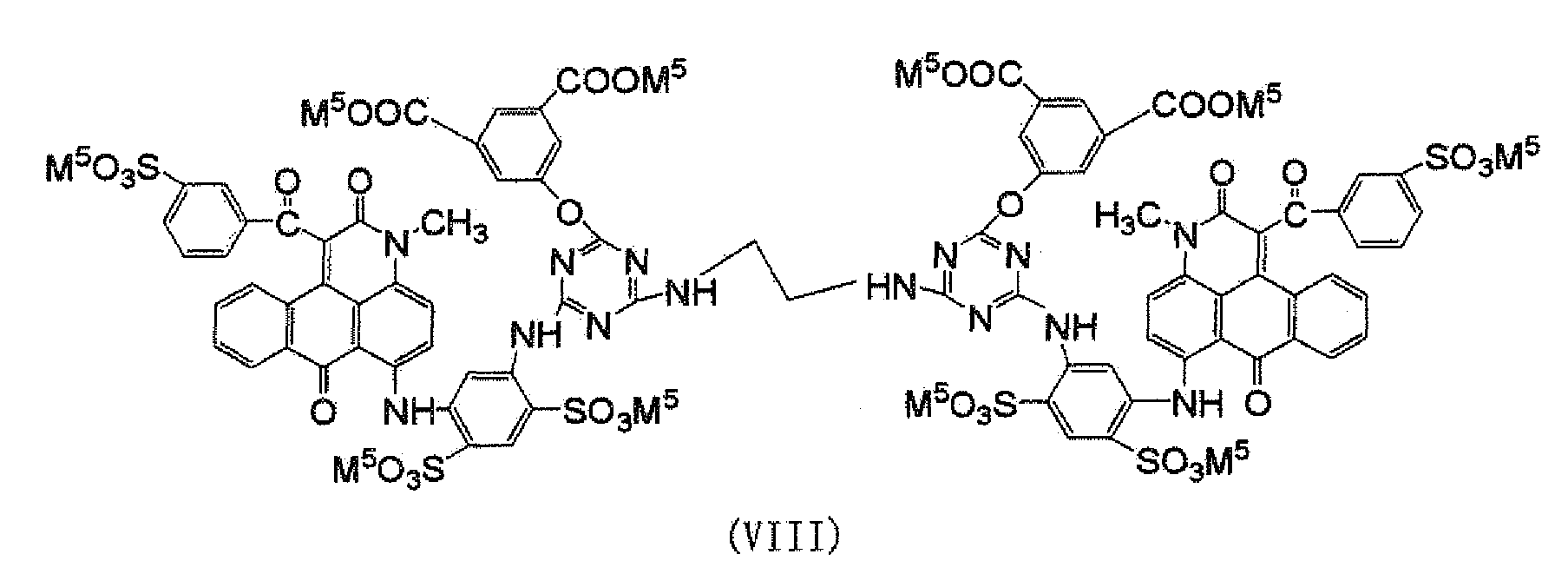
- In the embodiment of the invention, furthermore, the anthrapyridone dye contained in the ink composition is preferably a mixture of a compound represented by formula (VIII) above wherein M5 is NH4 and a compound represented by formula (VIII) above wherein M5 is sodium. More preferably, the anthrapyridone dye contained in the ink composition is a mixture of a compound represented by formula (VIII) above wherein M5 is NH4 and a compound represented by formula (VIII) above wherein M5 is sodium in a ratio (molar ratio) of 6:4 to 8:2. Most preferably, the anthrapyridone dye contained in the ink composition is a mixture of a compound represented by formula (VIII) above wherein M5 is NH4 and a compound represented by formula (VIII) above wherein M5 is sodium in a ratio (molar ratio) of 7:3.
- In the embodiment of the invention, additionally, the anthrapyridone dye represented by formula (I) above is preferably a compound of formula (IX):

- The content of the anthrapyridone dye is not particularly limited as long as a recorded image with high color reproduction and light fastness can be formed. The content of the anthrapyridone dye is preferably 1% to 10% by mass, more preferably 4% to 10% by mass, of the ink composition. If the content of the anthrapyridone dye falls within such a range, a recorded image with higher color reproduction and light fastness can be formed.
The content of the anthrapyridone dye in the ink composition according to the embodiment of the invention is higher than the content of the copper phthalocyanine dye, described below. Preferably, the ratio (A/B) of the mass content of the anthrapyridone dye (A) to the mass content of the copper phthalocyanine dye (B) (magenta dye content / cyan dye content) is 1.1 to 100, more preferably 2.5 to 100, and most preferably 10 to 100. If the ratio falls within such a range, a recorded image with higher color reproduction and light fastness can be formed. - The ink composition according to the embodiment of the invention contains a copper phthalocyanine dye represented by formula (III) above.
- Examples of copper phthalocyanine dyes preferred in the embodiment of the invention include C.I. Direct Blue 199 and the compound of formula (X):

Z1 Z2 Z3 Z4 -(CH2)3SO3Li -(CH2)3SO3Li -(CH2)3SO3Li -(CH2)3SO2NHCH2CH(OH)CH3 - In the embodiment of the invention, the content of the copper phthalocyanine dye in the ink composition is preferably 0.05% to 2.0% by mass, more preferably 0.05% to 1.0% by mass, of the ink composition. If the content of the copper phthalocyanine dye falls within such a range, a recorded image with higher color reproduction and light fastness can be formed.
- The ink composition according to the embodiment of the invention contains water or an aqueous medium containing water and a water-soluble organic solvent, contains the dyes represented by formulas (I) and (III) above as colorants, and optionally contains additives such as a humectant, a surfactant, a permeation enhancer, a viscosity modifier, and a pH adjustor.
- The ink composition according to the embodiment of the invention can be prepared by dissolving the above colorants (dyes) in an appropriate solvent. In the ink composition, water or a mixture of water and a water-soluble organic solvent is preferably used as a main solvent for dissolving the colorants. The water used may be, for example, ion exchange water, ultrafiltrated water, reverse osmosis water, or distilled water. For long-term preservation, water subjected to ultraviolet irradiation or chemical sterilization treatment such as addition of hydrogen peroxide is preferably used. The content of water in the ink composition according to the embodiment of the invention is preferably 40% to 90% by mass, more preferably 50% to 80% by mass, of the ink composition.
- The ink composition according to the embodiment of the invention, as described above, may contain a water-soluble organic solvent as a solvent together with water. The water-soluble organic solvent used is preferably one capable of dissolving the dyes and having a vapor pressure lower than that of pure water.
- Examples of water-soluble organic solvents used in the embodiment of the invention include, but are not limited to, polyalcohols such as ethylene glycol, propylene glycol, butanediol, pentanediol, 2-butene-1,4-diol, 2-methyl-2,4-pentanediol, glycerol, 1,2,6-hexanetriol, diethylene glycol, triethylene glycol, and dipropylene glycol; ketones such as acetonylacetone; esters such as γ-butyrolactone and triethyl phosphate; and other solvents such as furfuryl alcohol, tetrahydrofurfuryl alcohol, and thiodiglycol. The use of a water-soluble organic solvent as a solvent of the ink composition together with water allows various adjustments, such as improving the stability of the ejection of the ink composition from an ink head and decreasing the viscosity of the ink composition without substantially changing the other properties, to be readily performed.
- In addition, the ink composition according to the embodiment of the invention may contain at least one humectant selected from the group consisting of saccharides. If an ink composition containing a humectant is used for ink-jet recording, it inhibits evaporation of moisture from the ink to maintain moisture in the ink. Examples of saccharides preferred in the embodiment of the invention include maltitol, sorbitol, gluconolactone, and maltose. The water-soluble organic solvents described above may also serve as a humectant.
- The ink composition may contain the water-soluble organic solvent and/or the humectant in a total amount of 5% to 50% by mass, more preferably 5% to 30% by mass, and most preferably 5% to 20% by mass. If the content is 5% by mass or more, the ink composition has good moisture retention. In addition, if the content is 50% by mass or less, the ink composition has viscosity preferred for ink-jet recording.
- The surfactant contained in the ink composition according to the embodiment of the invention is preferably, but not limited to, a nonionic surfactant. If a nonionic surfactant is added to the ink composition, it has high permeability into a recording medium and can therefore be quickly fixed on a recording medium in printing. In addition, it is preferable that a dot of ink composition on a recording medium be as close to a perfect circle as possible; if the ink composition contains a nonionic surfactant, a dot image closer to a perfect circle can be formed, thus improving the quality of a recorded image.
- Examples of nonionic surfactants that can be used in the embodiment of the invention include acetylene glycol surfactants. Examples of acetylene glycol surfactants include Surfynol 465 and 104 (available from Air Products and Chemicals Inc.) and Olfine E1010, PD001, and STG (available from Nissin Chemical Industry Co., Ltd.; trade names). The amount of nonionic surfactant added is preferably 0.1% to 5.0% by mass, more preferably 0.5% to 3.0% by mass. If the amount of nonionic surfactant added is 0.1% by mass or more, the ink composition has sufficient permeability. In addition, if the amount of nonionic surfactant added is 5.0% by mass or less, image blurring can be easily prevented.
- If a glycol ether is added as a permeation enhancer to the ink composition in addition to a nonionic surfactant, it improves the permeability of the ink composition into a recording medium and reduces bleeding at boundaries between adjacent color inks in color printing, thus providing a very sharp image. Thus, a nonionic surfactant is preferably added to the ink composition according to the embodiment of the invention.
- Examples of glycol ethers preferred as a permeation enhancer in the embodiment of the invention include, but are not limited to, ethylene glycol monobutyl ether, diethylene glycol monobutyl ether, triethylene glycol monoethyl ether, propylene glycol monomethyl ether, dipropylene glycol monoethyl ether, propylene glycol monobutyl ether, dipropylene glycol monobutyl ether, and triethylene glycol monobutyl ether. The glycol ether is preferably contained in the ink composition in an amount of 3% to 30% by mass, more preferably 5% to 15% by mass. If the amount of glycol ether added is 3% by mass or more, bleeding between adjacent inks in color printing can be effectively prevented. In addition, if the amount of glycol ether added is 30% by mass or less, image blurring can be more readily prevented, and the storage stability of the ink can be improved.
- In addition, the ink composition according to the embodiment of the invention may optionally contain other materials, including pH adjusters such as triethanolamine and alkali metal hydroxides, water-soluble polymers such as sodium alginate, water-soluble resins, fluorocarbon surfactants, preservatives, fungicides, rust inhibitors, dissolution aids, antioxidants, and ultraviolet absorbers. These components may be used alone or as a mixture of two or more for each type of component, or may be omitted if unnecessary. Those skilled in the art can use preferred amounts of selected preferred additives without impairing the advantages of the embodiment of the invention. A dissolution aid is an additive for dissolving any insoluble residue in the ink composition to keep the ink composition homogeneous.
- Examples of dissolution aids include, but are not limited to, pyrrolidones such as N-methyl-2-pyrrolidone and 2-pyrrolidone; ureas such as urea, thiourea, and tetramethylurea; allophanates such as allophanate and methyl allophanate; biurets such as biuret, dimethyl biuret, and tetramethyl biuret. Examples of antioxidants include, but are not limited to, L-ascorbic acid and salts thereof.
- Examples of preservatives and fungicides include, but are not limited to, sodium benzoate, sodium pentachlorophenol, sodium-2-pyridinethiol-1-oxide, sodium sorbate, sodium dehydroacetate, and 1,2-benzothiazolin-3-on (e.g., Proxel CRL, BDN, GXL, XL-2, and TN (trade names; available from Avecia Ltd.).
- Examples of pH adjusters include, but are not limited to, amines such as diethanolamine, triethanolamine, propanolamine, and morpholine and modified amines; metal hydroxides such as potassium hydroxide, sodium hydroxide, and lithium hydroxide; ammonium salts such as ammonium hydroxide and quaternary ammonium hydroxides (e.g., tetramethylammonium); carbonate salts such as potassium carbonate, sodium carbonate, and lithium carbonate; and phosphate salts.
- Whereas the ink composition according to the embodiment of the invention is prepared using components appropriately selected from the above components, the ink composition preferably has a viscosity of less than 10 mPa·s at 20°C. In the embodiment of the invention, additionally, the ink composition preferably has a surface tension of 45 mN/m or less, more preferably 25 to 45 mN/m, at 20°C. If the viscosity and the surface tension are adjusted in this way, an ink composition having properties preferred for ink-jet recording can be achieved. The viscosity and the surface tension can be adjusted by appropriately selecting and adjusting the types and amounts of solvents and additives contained in the ink composition.
- The ink composition according to the embodiment of the invention preferably has a pH of 7.0 to 10.5, more preferably 7.5 to 10.0, at 20°C. If the pH is 7.0 or more at 20°C, it is possible to prevent peeling of eutectoid plating on an ink-jet head and to stabilize the ejection of the ink composition from an ink-jet head. In addition, if the pH is 10.5 or less at 20°C, it is possible to prevent degradation of various members that come into contact with the ink composition, including the components of an ink cartridge and an ink-jet head.
- The ink composition according to the embodiment of the invention can be prepared by, for example, sufficiently mixing and dissolving the components to be contained in the ink composition as homogeneously as possible, filtering the solution through a membrane filter having a pore size of 0.8 µm with pressure, and degassing the solution using a vacuum pump, although the method for preparing the ink composition is not limited thereto.
- The invention will now be described in greater detail in the following examples, although they are not intended to limit the invention.
- Ink compositions were prepared by stirring the compositions shown in Tables 1 and 2 below at room temperature for one hour and filtering them through a 0.8 µm membrane filter. In Tables 1 and 2 below, the values indicate the contents (% by mass) of the individual components in the inks, and Olfine E1010 is available from Nissin Chemical Industry Co., Ltd.
Table 1 (Unit: % by mass) Ref. 1 Ref. 2 Ref. 3 Ex. 1 Ex. 2 Ex. 3 Ex. 4 Ex. 5 Ex. 6 Ex. 7 Ex. 8 Ex. 9 Magenta Dye 1 (compound of formula (VIII))* 5 - - 5 - 5 - 5 5 5 5 - Magenta Dye 2 (compound of formula (IX)) - 5 - - 5 - 5 - - - - - Magenta Dye 3 (C.I. Acid Red 289) - - 5 - - - - - - - - 5 Cyan Dye 1 (compound of formula (X)) - - - 0.5 0.5 - - 0.03 0.8 1.5 - - Cyan Dye 2 (C.I. Direct Blue 199) - - - - - 0.5 0.5 - - - - 0.5 Cyan Dye 3 (C.I. Acid Blue 9) - - - - - - - - - - 0.5 - Triethylene glycol monobutyl ether 10 10 10 10 10 10 10 10 10 10 10 10 Glycerol 10 10 10 10 10 10 10 10 10 10 10 10 Triethylene glycol 6 6 6 6 6 6 6 6 6 6 6 6 Olefine E1010 2 2 2 2 2 2 2 2 2 2 2 2 Distilled water Balance Balance Balance Balance Balance Balance Balance Balance Balance Balance Balance Balance Total 100 100 100 100 100 100 100 100 100 100 100 100 *The compound of formula (VIII) is a mixture of a compound of formula (VIII) wherein M5 is NH4 and a compound of formula (VIII) wherein M5 is sodium in a ratio (molar ratio) of 7:3. Table 2 (Unit: % by mass) Ref. 4 Ref. 5 Ex. 10 Ex. 11 Ex. 12 Ex. 13 Ex. 14 Ex. 15 Ex. 16 Magenta Dye 1 (compound of formula (VIII))* 2 - 2 5 - 5 - 2 - Magenta Dye 2 (compound of formula (IX)) - - - - 5 - 5 - - Magenta Dye 3 (C.I. Acid Red 289) - 2 - - - - - - 2 Cyan Dye 1 (compound of formula (X)) - - 0.2 2 2 - - - - Cyan Dye 2 (C.I. Direct Blue 199) - - - - - 2 2 5 5 Cyan Dye 3 (C.I. Acid Blue 9) - - - - - - - - - Triethylene glycol monobutyl ether 10 10 10 10 10 10 10 10 10 Glycerol 10 10 10 10 10 10 10 10 10 Triethylene glycol 6 6 6 6 6 6 6 6 6 Olfine E1010 2 2 2 2 2 2 2 2 2 Distilled water Balance Balance Balance Balance Balance Balance Balance Balance Balance Total 100 100 100 100 100 100 100 100 100 *The compound of formula (VIII) is a mixture of a compound of formula (VIII) wherein M5 is NH4 and a compound of formula (VIII) wherein M5 is sodium in a ratio (molar ratio) of 7:3. - The spectral characteristics of diluted solutions of the ink compositions (Exs. 1 to 16 and Refs. 1 to 3) in water were measured using a spectrophotometer (the trade name U-3000, available from Hitachi, Ltd.). For the measurement, 1 mL of ink composition was diluted with ion exchange water to 1,000 mL and was charged into a quartz cell having an optical path length of 1 cm, and the measurement was carried out in a transmission mode. The L*, a*, and b* of the ink compositions were determined from the measured spectral characteristics using a color analysis program (included with U-3000). C* and the hue angle were determined as described above. The evaluation results are shown in Tables 3 and 4 below.
- Ink cartridges filled with the ink compositions (Exs. 1 to 16 and Refs. 1 to 3) were charged into a PM-G800 ink-jet printer (available from Seiko Epson Corporation) to perform printing on paper for evaluation (Premium Glossy Photo Paper CRISPIA, available from Seiko Epson Corporation). When the blue inks were used, ink cartridges for PM-G800 were filled with the blue inks and were set to the position for ICLC32 on the carriage, a black ink cartridge for PM-G800 (ICBK32, available from Seiko Epson Corporation) and color ink cartridges for PM-G800 (ICC32, ICM32, and ICY32, available from Seiko Epson Corporation) were set to the respective positions on the carriage, and the required inks were supplied therefrom to the head. An empty ink cartridge was set to the position for ICLM32 on the carriage. For printing, a printer driver for blue inks was created and used.
- Solid printing (100% duty) of the individual colors (magenta alone for the magenta inks, light magenta alone for the light magenta inks, and blue alone for the blue inks) was performed on ink-jet photo paper (Photo Paper CRISPIA, available from Seiko Epson Corporation), and the printouts were visually evaluated for color vividness and hue on the basis of the following criteria:
- A: Acceptable in terms of both color vividness and hue
- B: Acceptable in terms of either color vividness or hue
- C: Unacceptable in terms of both color vividness and hue
- The above printouts were exposed at a temperature of 24°C, a relative humidity of 60% RH, and an illuminance of 70,000 lux for 16, 18, and 20 days using the fluorescent lamp light fastness tester STF-11 (trade name; available from Suga Test Instruments Co., Ltd.). After the exposure, the optical density (OD) of each printout was measured using a reflection densitometer (the trade name "Spectrilino," available from Gretag Macbeth AG), and the relict optical density (ROD) was determined by the following equation:

- A: ROD of 80% or more after exposure for 20 days
- B: ROD of 80% or more after exposure for 18 days and ROD of less than 80% after exposure for 20 days
- C: ROD of 80% or more after exposure for 16 days and ROD of less than 80% after exposure for 18 days
- D: ROD of less than 80% after exposure for 16 days
- Each "ink containing a cyan dye" (Exs. 1 to 16) was evaluated as A if the light fastness thereof was at least two ranks higher than that of the "ink containing no cyan dye" (Refs. 1 to 5), was evaluated as B if the light fastness thereof was one rank higher, and was evaluated as C if the light fastness thereof was at the same rank or one rank lower. Ref. 1 was used as the "ink containing no cyan dye" to evaluate Exs. 1, 3, 5 to 8, 11, and 13. Ref. 2 was used as the "ink containing no cyan dye" to evaluate Exs. 2, 4, 12, and 14. Ref. 3 was used as the "ink containing no cyan dye" to evaluate Ex. 9. Ref. 4 was used as the "ink containing no cyan dye" to evaluate Exs. 10 and 15. Ref. 5 was used as the "ink containing no cyan dye" to evaluate Ex. 16. The evaluation results are shown in Tables 3 and 4 below.
Table 3 Ref. 1 Ref. 2 Ref. 3 Ex. 1 Ex. 2 Ex. 3 Ex. 4 ' Ex. 5 Ex. 6 Ex. 7 Ex. 8 Ex. 9 Hue angle 348 354 352 337 333 340 340 347 331 320 348 337 Magenta dye content / cyan dye content ∞ ∞ ∞ 10 10 10 10 167 6.25 3 10 10 Color reproduction A B A A B A B A B B A A Image light fastness C D D A B A B B A A D D Improvement in image light fastness - - - A A A A B A A C C Table 4 Ref. 4 Ref. 5 Ex. 10 Ex. 11 Ex. 12 Ex. 13 Ex. 14 Ex. 15 Ex. 16 Hue angle 346 352 336 313 319 309 315 267 314 Magenta dye content / cyan dye content ∞ ∞ 10 2.5 2.5 2.5 2.5 0.4 2.5 Color reproduction A A A B B B B C B Image light fastness B D A A B A B A C Improvement in image light fastness - - B A A A A B B
Claims (10)
- An ink composition comprising an anthrapyridone dye and a copper phthalocyanine dye, wherein the hue angle in the L*a*b* color system calculated from spectral characteristics of a 1,000-fold diluted solution of the ink composition in water is 270° to 360° and wherein the mass content of the anthrapyridone dye is higher than the mass content of the copper phthalocyanine dye,
the anthrapyridone dye being represented by formula (I) : m1 is hydrogen, NH4, or sodium;R1 is hydrogen, an optionally substituted alkyl group, an optionally substituted aryl group, or an optionally substituted, benzoyl group;R2 is hydrogen or an optionally substituted alkyl group;R3 is hydrogen, a halogen, or an optionally substituted alkyl group;R4 is hydrogen, an optionally substituted NH4, or an optionally substituted sulfonic acid group; andR5 is an acyl group or a group represented by formula (II):(wherein X and Y are each independently chlorine or a hydroxy, amino, monoethanolamino, diethanolamino, morpholino, anilino, or phenol group optionally substituted with one or more substituents), and
the copper phthalocyanine dye being represented by formula (III): Ra is hydrogen, an alkali metal, or NH4;Rb is an alkali metal or NH4;Rc is hydrogen, an optionally substituted alkyl group, or an optionally substituted aryl group;k, l, and n are each 0 to 3;m is a natural number of 1 to 4; andk + l + m + n = 4.
 - The ink composition according to Claim 1, wherein the anthrapyridone dye is a compound represented by formula (IV):
 M2 is hydrogen, NH4, or sodium;R6 is hydrogen, an optionally substituted alkyl group, an optionally substituted aryl group, or an optionally substituted benzoyl group;R7 is hydrogen or an optionally substituted alkyl group;R8 is hydrogen, a halogen, or an optionally substituted alkyl group;R9 is hydrogen, an optionally substituted NH4, or an optionally substituted sulfonic acid group;A is an alkylene group, an alkylene group having a phenylene group, or a group represented by formula (V):
 Z is chlorine or a hydroxy, amino, monoethanolamino, diethanolamino, morpholino, anilino, or phenol group optionally substituted with one or more substituents.
 - The ink composition according to Claim 1, wherein the anthrapyridone dye is a compound represented by formula (VI):
 M3 is hydrogen, NH4, or sodium;B is an alkylene group; andn is 1 or 2.
 - The ink composition according to Claim 1, wherein the content of the anthrapyridone dye is 1% to 10% by mass of the ink composition.
- The ink composition according to Claim 1, wherein the content of the anthrapyridone dye is 4% to 10% by mass of the ink composition.
- The ink composition according to Claim 1, wherein the content of the copper phthalocyanine dye is 0.05% to 2.0% by mass of the ink composition.
- The ink composition according to Claim 1, wherein the content of the copper phthalocyanine dye is 0.05% to 1.0% by mass of the ink composition.
- The ink composition according to Claim 1, wherein the ratio (A/B) of the mass content of the anthrapyridone dye (A) to the mass content of the copper phthalocyanine dye (B) is 1.1 to 100.
- The ink composition according to Claim 8, wherein the ratio is 2.5 to 100.
- The ink composition according to Claim 8, wherein the ratio is 10 to 100.
Applications Claiming Priority (1)
| Application Number | Priority Date | Filing Date | Title |
|---|---|---|---|
| JP2010066849A JP2011195784A (en) | 2010-03-23 | 2010-03-23 | Ink composition |
Publications (2)
| Publication Number | Publication Date |
|---|---|
| EP2368947A1 true EP2368947A1 (en) | 2011-09-28 |
| EP2368947B1 EP2368947B1 (en) | 2016-12-21 |
Family
ID=44026567
Family Applications (1)
| Application Number | Title | Priority Date | Filing Date |
|---|---|---|---|
| EP11158978.4A Active EP2368947B1 (en) | 2010-03-23 | 2011-03-21 | Ink composition |
Country Status (4)
| Country | Link |
|---|---|
| US (1) | US8496744B2 (en) |
| EP (1) | EP2368947B1 (en) |
| JP (1) | JP2011195784A (en) |
| CN (1) | CN102199379B (en) |
Families Citing this family (3)
| Publication number | Priority date | Publication date | Assignee | Title |
|---|---|---|---|---|
| EP2736978B1 (en) * | 2011-07-27 | 2015-12-09 | Canon Kabushiki Kaisha | Pigment dispersion, and resist composition for color filter and ink composition each using the pigment dispersion |
| WO2013075286A1 (en) * | 2011-11-22 | 2013-05-30 | 大连理工大学 | Binuclear anthracene pyridine sulphonic acid compound or salt thereof and preparation process and use thereof |
| WO2016042025A1 (en) * | 2014-09-16 | 2016-03-24 | Sicpa Holding Sa | Printing ink, its use for the authentication of articles, articles obtained thereby and authentication methods |
Citations (10)
| Publication number | Priority date | Publication date | Assignee | Title |
|---|---|---|---|---|
| JP2000290559A (en) | 1999-04-08 | 2000-10-17 | Seiko Epson Corp | Ink and inkjet recording method |
| JP2001288392A (en) | 2000-04-07 | 2001-10-16 | Seiko Epson Corp | Ink set |
| JP2002332419A (en) | 2001-05-09 | 2002-11-22 | Nippon Kayaku Co Ltd | New anthrapyridone compound, aqueous magenta ink composition and ink jet recording method |
| JP2002371079A (en) | 2001-04-09 | 2002-12-26 | Fuji Photo Film Co Ltd | Azo compound and method for producing the same |
| JP2005105136A (en) | 2003-09-30 | 2005-04-21 | Seiko Epson Corp | Magenta ink composition |
| JP2005120266A (en) * | 2003-10-17 | 2005-05-12 | Mitsui Chemicals Inc | Black ink |
| EP1700889A1 (en) * | 2005-03-11 | 2006-09-13 | Seiko Epson Corporation | Ink composition, ink cartridge, inkjet recording method, and recorded matter |
| JP2007277314A (en) * | 2006-04-03 | 2007-10-25 | Canon Inc | Inkjet ink |
| EP1988134A2 (en) * | 2007-05-01 | 2008-11-05 | Canon Kabushiki Kaisha | Ink jet ink, ink jet recording method, ink cartridge, recording unit and ink jet recording apparatus |
| US20090285990A1 (en) * | 2008-05-13 | 2009-11-19 | Canon Kabushiki Kaisha | Inkjet ink, method for producing the same, ink cartridge, and inkjet recording method |
Family Cites Families (15)
| Publication number | Priority date | Publication date | Assignee | Title |
|---|---|---|---|---|
| JP3767879B2 (en) * | 1998-03-25 | 2006-04-19 | 日本化薬株式会社 | Novel anthrapyridone compound, aqueous magenta ink composition and ink jet recording method |
| US6786571B2 (en) * | 2000-03-31 | 2004-09-07 | Seiko Epson Corporation | Ink set comprising dark yellow ink composition |
| EP1312653A4 (en) * | 2000-08-22 | 2005-06-29 | Seiko Epson Corp | INK SET WITH DARK INK INK COMPOSITION |
| AU2002243036A1 (en) * | 2001-04-09 | 2002-10-28 | Fuji Photo Film Co., Ltd. | Azo compounds and process of producing the same and novel intermediate compounds used in the process of producing azo compounds |
| JP2003221527A (en) * | 2002-01-30 | 2003-08-08 | Seiko Epson Corp | Ink set |
| JP2003286423A (en) * | 2002-03-28 | 2003-10-10 | Seiko Epson Corp | Ink set, recording method using the same, and recorded matter |
| JP3903938B2 (en) * | 2002-04-23 | 2007-04-11 | セイコーエプソン株式会社 | Ink composition, ink jet recording method using the same, and recorded matter |
| JP4411856B2 (en) * | 2002-04-23 | 2010-02-10 | セイコーエプソン株式会社 | Ink set |
| US7323045B2 (en) * | 2003-09-30 | 2008-01-29 | Seiko Epson Corporation | Magenta ink composition |
| JP4581364B2 (en) * | 2003-09-30 | 2010-11-17 | セイコーエプソン株式会社 | Ink composition, ink jet recording method, and recorded material |
| US7351277B2 (en) * | 2004-09-08 | 2008-04-01 | E. I. Du Pont De Nemours And Company | IR transparent cyan inkjet ink |
| JP4548398B2 (en) * | 2006-09-29 | 2010-09-22 | セイコーエプソン株式会社 | Ink set, ink cartridge, ink jet recording method and recorded matter |
| JP4873750B2 (en) * | 2007-05-01 | 2012-02-08 | キヤノン株式会社 | Ink jet ink, ink jet recording method, ink cartridge, recording unit, and ink jet recording apparatus |
| JP2011195783A (en) * | 2010-03-23 | 2011-10-06 | Seiko Epson Corp | Light blue ink composition |
| JP2012126830A (en) * | 2010-12-15 | 2012-07-05 | Sony Corp | Ink composition for inkjet, inkjet recording method, ink cartridge, recording unit, and inkjet recording apparatus |
-
2010
- 2010-03-23 JP JP2010066849A patent/JP2011195784A/en active Pending
-
2011
- 2011-03-21 EP EP11158978.4A patent/EP2368947B1/en active Active
- 2011-03-23 US US13/069,766 patent/US8496744B2/en active Active
- 2011-03-23 CN CN201110074660.0A patent/CN102199379B/en active Active
Patent Citations (10)
| Publication number | Priority date | Publication date | Assignee | Title |
|---|---|---|---|---|
| JP2000290559A (en) | 1999-04-08 | 2000-10-17 | Seiko Epson Corp | Ink and inkjet recording method |
| JP2001288392A (en) | 2000-04-07 | 2001-10-16 | Seiko Epson Corp | Ink set |
| JP2002371079A (en) | 2001-04-09 | 2002-12-26 | Fuji Photo Film Co Ltd | Azo compound and method for producing the same |
| JP2002332419A (en) | 2001-05-09 | 2002-11-22 | Nippon Kayaku Co Ltd | New anthrapyridone compound, aqueous magenta ink composition and ink jet recording method |
| JP2005105136A (en) | 2003-09-30 | 2005-04-21 | Seiko Epson Corp | Magenta ink composition |
| JP2005120266A (en) * | 2003-10-17 | 2005-05-12 | Mitsui Chemicals Inc | Black ink |
| EP1700889A1 (en) * | 2005-03-11 | 2006-09-13 | Seiko Epson Corporation | Ink composition, ink cartridge, inkjet recording method, and recorded matter |
| JP2007277314A (en) * | 2006-04-03 | 2007-10-25 | Canon Inc | Inkjet ink |
| EP1988134A2 (en) * | 2007-05-01 | 2008-11-05 | Canon Kabushiki Kaisha | Ink jet ink, ink jet recording method, ink cartridge, recording unit and ink jet recording apparatus |
| US20090285990A1 (en) * | 2008-05-13 | 2009-11-19 | Canon Kabushiki Kaisha | Inkjet ink, method for producing the same, ink cartridge, and inkjet recording method |
Also Published As
| Publication number | Publication date |
|---|---|
| EP2368947B1 (en) | 2016-12-21 |
| CN102199379A (en) | 2011-09-28 |
| US8496744B2 (en) | 2013-07-30 |
| US20110232526A1 (en) | 2011-09-29 |
| JP2011195784A (en) | 2011-10-06 |
| CN102199379B (en) | 2015-04-15 |
Similar Documents
| Publication | Publication Date | Title |
|---|---|---|
| CN101479354B (en) | Yellow ink composition, ink set, ink cartridge, inkjet-recording method, and recorded matter | |
| EP2022830B1 (en) | Magenta ink composition, ink set, ink cartridge, inkjet recording method and recorded matter | |
| EP1981942B1 (en) | Dye sets for inkjet imaging and ink sets using the same | |
| US6852154B2 (en) | Ink set | |
| EP1043370B1 (en) | Ink set | |
| EP1048705B1 (en) | Ink sets | |
| US8602544B2 (en) | Ink set, ink cartridge, ink jet recording method, and ink jet recording apparatus | |
| EP1577355A1 (en) | Ink composition, method of ink-jet recording, and print | |
| US8066808B2 (en) | Ink set for ink-jet recording | |
| EP2368947B1 (en) | Ink composition | |
| US8491714B2 (en) | Ink composition | |
| US7866808B2 (en) | Ink set for ink-jet recording and method for producing tetracomposite black image | |
| JP2011195783A (en) | Light blue ink composition | |
| JP4946024B2 (en) | Magenta ink composition, ink set, ink cartridge, ink jet recording method and recorded matter | |
| JP5871200B2 (en) | Ink composition | |
| JP5807526B2 (en) | Ink composition | |
| JP2003286423A (en) | Ink set, recording method using the same, and recorded matter | |
| JP5871199B2 (en) | Light blue ink composition | |
| JP5871198B2 (en) | Ink composition | |
| JP2004300169A (en) | Ink set |
Legal Events
| Date | Code | Title | Description |
|---|---|---|---|
| PUAI | Public reference made under article 153(3) epc to a published international application that has entered the european phase |
Free format text: ORIGINAL CODE: 0009012 |
|
| AK | Designated contracting states |
Kind code of ref document: A1 Designated state(s): AL AT BE BG CH CY CZ DE DK EE ES FI FR GB GR HR HU IE IS IT LI LT LU LV MC MK MT NL NO PL PT RO RS SE SI SK SM TR |
|
| AX | Request for extension of the european patent |
Extension state: BA ME |
|
| 17P | Request for examination filed |
Effective date: 20120328 |
|
| REG | Reference to a national code |
Ref country code: DE Ref legal event code: R079 Ref document number: 602011033541 Country of ref document: DE Free format text: PREVIOUS MAIN CLASS: C09D0011000000 Ipc: C09D0011328000 |
|
| GRAP | Despatch of communication of intention to grant a patent |
Free format text: ORIGINAL CODE: EPIDOSNIGR1 |
|
| RIC1 | Information provided on ipc code assigned before grant |
Ipc: C09D 11/328 20140101AFI20160629BHEP |
|
| INTG | Intention to grant announced |
Effective date: 20160721 |
|
| GRAS | Grant fee paid |
Free format text: ORIGINAL CODE: EPIDOSNIGR3 |
|
| GRAA | (expected) grant |
Free format text: ORIGINAL CODE: 0009210 |
|
| AK | Designated contracting states |
Kind code of ref document: B1 Designated state(s): AL AT BE BG CH CY CZ DE DK EE ES FI FR GB GR HR HU IE IS IT LI LT LU LV MC MK MT NL NO PL PT RO RS SE SI SK SM TR |
|
| REG | Reference to a national code |
Ref country code: GB Ref legal event code: FG4D |
|
| REG | Reference to a national code |
Ref country code: CH Ref legal event code: EP |
|
| REG | Reference to a national code |
Ref country code: IE Ref legal event code: FG4D |
|
| REG | Reference to a national code |
Ref country code: AT Ref legal event code: REF Ref document number: 855490 Country of ref document: AT Kind code of ref document: T Effective date: 20170115 |
|
| REG | Reference to a national code |
Ref country code: DE Ref legal event code: R096 Ref document number: 602011033541 Country of ref document: DE |
|
| PG25 | Lapsed in a contracting state [announced via postgrant information from national office to epo] |
Ref country code: LV Free format text: LAPSE BECAUSE OF FAILURE TO SUBMIT A TRANSLATION OF THE DESCRIPTION OR TO PAY THE FEE WITHIN THE PRESCRIBED TIME-LIMIT Effective date: 20161221 |
|
| REG | Reference to a national code |
Ref country code: LT Ref legal event code: MG4D |
|
| REG | Reference to a national code |
Ref country code: NL Ref legal event code: MP Effective date: 20161221 |
|
| PG25 | Lapsed in a contracting state [announced via postgrant information from national office to epo] |
Ref country code: LT Free format text: LAPSE BECAUSE OF FAILURE TO SUBMIT A TRANSLATION OF THE DESCRIPTION OR TO PAY THE FEE WITHIN THE PRESCRIBED TIME-LIMIT Effective date: 20161221 Ref country code: SE Free format text: LAPSE BECAUSE OF FAILURE TO SUBMIT A TRANSLATION OF THE DESCRIPTION OR TO PAY THE FEE WITHIN THE PRESCRIBED TIME-LIMIT Effective date: 20161221 Ref country code: NO Free format text: LAPSE BECAUSE OF FAILURE TO SUBMIT A TRANSLATION OF THE DESCRIPTION OR TO PAY THE FEE WITHIN THE PRESCRIBED TIME-LIMIT Effective date: 20170321 Ref country code: GR Free format text: LAPSE BECAUSE OF FAILURE TO SUBMIT A TRANSLATION OF THE DESCRIPTION OR TO PAY THE FEE WITHIN THE PRESCRIBED TIME-LIMIT Effective date: 20170322 |
|
| REG | Reference to a national code |
Ref country code: AT Ref legal event code: MK05 Ref document number: 855490 Country of ref document: AT Kind code of ref document: T Effective date: 20161221 |
|
| PG25 | Lapsed in a contracting state [announced via postgrant information from national office to epo] |
Ref country code: HR Free format text: LAPSE BECAUSE OF FAILURE TO SUBMIT A TRANSLATION OF THE DESCRIPTION OR TO PAY THE FEE WITHIN THE PRESCRIBED TIME-LIMIT Effective date: 20161221 Ref country code: FI Free format text: LAPSE BECAUSE OF FAILURE TO SUBMIT A TRANSLATION OF THE DESCRIPTION OR TO PAY THE FEE WITHIN THE PRESCRIBED TIME-LIMIT Effective date: 20161221 Ref country code: RS Free format text: LAPSE BECAUSE OF FAILURE TO SUBMIT A TRANSLATION OF THE DESCRIPTION OR TO PAY THE FEE WITHIN THE PRESCRIBED TIME-LIMIT Effective date: 20161221 |
|
| PG25 | Lapsed in a contracting state [announced via postgrant information from national office to epo] |
Ref country code: NL Free format text: LAPSE BECAUSE OF FAILURE TO SUBMIT A TRANSLATION OF THE DESCRIPTION OR TO PAY THE FEE WITHIN THE PRESCRIBED TIME-LIMIT Effective date: 20161221 |
|
| PG25 | Lapsed in a contracting state [announced via postgrant information from national office to epo] |
Ref country code: IS Free format text: LAPSE BECAUSE OF FAILURE TO SUBMIT A TRANSLATION OF THE DESCRIPTION OR TO PAY THE FEE WITHIN THE PRESCRIBED TIME-LIMIT Effective date: 20170421 Ref country code: CZ Free format text: LAPSE BECAUSE OF FAILURE TO SUBMIT A TRANSLATION OF THE DESCRIPTION OR TO PAY THE FEE WITHIN THE PRESCRIBED TIME-LIMIT Effective date: 20161221 Ref country code: RO Free format text: LAPSE BECAUSE OF FAILURE TO SUBMIT A TRANSLATION OF THE DESCRIPTION OR TO PAY THE FEE WITHIN THE PRESCRIBED TIME-LIMIT Effective date: 20161221 Ref country code: SK Free format text: LAPSE BECAUSE OF FAILURE TO SUBMIT A TRANSLATION OF THE DESCRIPTION OR TO PAY THE FEE WITHIN THE PRESCRIBED TIME-LIMIT Effective date: 20161221 Ref country code: EE Free format text: LAPSE BECAUSE OF FAILURE TO SUBMIT A TRANSLATION OF THE DESCRIPTION OR TO PAY THE FEE WITHIN THE PRESCRIBED TIME-LIMIT Effective date: 20161221 |
|
| PG25 | Lapsed in a contracting state [announced via postgrant information from national office to epo] |
Ref country code: ES Free format text: LAPSE BECAUSE OF FAILURE TO SUBMIT A TRANSLATION OF THE DESCRIPTION OR TO PAY THE FEE WITHIN THE PRESCRIBED TIME-LIMIT Effective date: 20161221 Ref country code: BG Free format text: LAPSE BECAUSE OF FAILURE TO SUBMIT A TRANSLATION OF THE DESCRIPTION OR TO PAY THE FEE WITHIN THE PRESCRIBED TIME-LIMIT Effective date: 20170321 Ref country code: PL Free format text: LAPSE BECAUSE OF FAILURE TO SUBMIT A TRANSLATION OF THE DESCRIPTION OR TO PAY THE FEE WITHIN THE PRESCRIBED TIME-LIMIT Effective date: 20161221 Ref country code: PT Free format text: LAPSE BECAUSE OF FAILURE TO SUBMIT A TRANSLATION OF THE DESCRIPTION OR TO PAY THE FEE WITHIN THE PRESCRIBED TIME-LIMIT Effective date: 20170421 Ref country code: BE Free format text: LAPSE BECAUSE OF FAILURE TO SUBMIT A TRANSLATION OF THE DESCRIPTION OR TO PAY THE FEE WITHIN THE PRESCRIBED TIME-LIMIT Effective date: 20161221 Ref country code: IT Free format text: LAPSE BECAUSE OF FAILURE TO SUBMIT A TRANSLATION OF THE DESCRIPTION OR TO PAY THE FEE WITHIN THE PRESCRIBED TIME-LIMIT Effective date: 20161221 Ref country code: AT Free format text: LAPSE BECAUSE OF FAILURE TO SUBMIT A TRANSLATION OF THE DESCRIPTION OR TO PAY THE FEE WITHIN THE PRESCRIBED TIME-LIMIT Effective date: 20161221 Ref country code: SM Free format text: LAPSE BECAUSE OF FAILURE TO SUBMIT A TRANSLATION OF THE DESCRIPTION OR TO PAY THE FEE WITHIN THE PRESCRIBED TIME-LIMIT Effective date: 20161221 |
|
| REG | Reference to a national code |
Ref country code: DE Ref legal event code: R097 Ref document number: 602011033541 Country of ref document: DE |
|
| PLBE | No opposition filed within time limit |
Free format text: ORIGINAL CODE: 0009261 |
|
| STAA | Information on the status of an ep patent application or granted ep patent |
Free format text: STATUS: NO OPPOSITION FILED WITHIN TIME LIMIT |
|
| REG | Reference to a national code |
Ref country code: CH Ref legal event code: PL |
|
| 26N | No opposition filed |
Effective date: 20170922 |
|
| GBPC | Gb: european patent ceased through non-payment of renewal fee |
Effective date: 20170321 |
|
| PG25 | Lapsed in a contracting state [announced via postgrant information from national office to epo] |
Ref country code: MC Free format text: LAPSE BECAUSE OF FAILURE TO SUBMIT A TRANSLATION OF THE DESCRIPTION OR TO PAY THE FEE WITHIN THE PRESCRIBED TIME-LIMIT Effective date: 20161221 Ref country code: DK Free format text: LAPSE BECAUSE OF FAILURE TO SUBMIT A TRANSLATION OF THE DESCRIPTION OR TO PAY THE FEE WITHIN THE PRESCRIBED TIME-LIMIT Effective date: 20161221 |
|
| REG | Reference to a national code |
Ref country code: IE Ref legal event code: MM4A |
|
| REG | Reference to a national code |
Ref country code: FR Ref legal event code: ST Effective date: 20171130 |
|
| PG25 | Lapsed in a contracting state [announced via postgrant information from national office to epo] |
Ref country code: LU Free format text: LAPSE BECAUSE OF NON-PAYMENT OF DUE FEES Effective date: 20170321 Ref country code: FR Free format text: LAPSE BECAUSE OF NON-PAYMENT OF DUE FEES Effective date: 20170331 |
|
| PG25 | Lapsed in a contracting state [announced via postgrant information from national office to epo] |
Ref country code: GB Free format text: LAPSE BECAUSE OF NON-PAYMENT OF DUE FEES Effective date: 20170321 Ref country code: IE Free format text: LAPSE BECAUSE OF NON-PAYMENT OF DUE FEES Effective date: 20170321 Ref country code: CH Free format text: LAPSE BECAUSE OF NON-PAYMENT OF DUE FEES Effective date: 20170331 Ref country code: SI Free format text: LAPSE BECAUSE OF FAILURE TO SUBMIT A TRANSLATION OF THE DESCRIPTION OR TO PAY THE FEE WITHIN THE PRESCRIBED TIME-LIMIT Effective date: 20161221 Ref country code: LI Free format text: LAPSE BECAUSE OF NON-PAYMENT OF DUE FEES Effective date: 20170331 |
|
| PG25 | Lapsed in a contracting state [announced via postgrant information from national office to epo] |
Ref country code: MT Free format text: LAPSE BECAUSE OF NON-PAYMENT OF DUE FEES Effective date: 20170321 |
|
| PG25 | Lapsed in a contracting state [announced via postgrant information from national office to epo] |
Ref country code: HU Free format text: LAPSE BECAUSE OF FAILURE TO SUBMIT A TRANSLATION OF THE DESCRIPTION OR TO PAY THE FEE WITHIN THE PRESCRIBED TIME-LIMIT; INVALID AB INITIO Effective date: 20110321 |
|
| PG25 | Lapsed in a contracting state [announced via postgrant information from national office to epo] |
Ref country code: CY Free format text: LAPSE BECAUSE OF NON-PAYMENT OF DUE FEES Effective date: 20161221 |
|
| PG25 | Lapsed in a contracting state [announced via postgrant information from national office to epo] |
Ref country code: MK Free format text: LAPSE BECAUSE OF FAILURE TO SUBMIT A TRANSLATION OF THE DESCRIPTION OR TO PAY THE FEE WITHIN THE PRESCRIBED TIME-LIMIT Effective date: 20161221 |
|
| PG25 | Lapsed in a contracting state [announced via postgrant information from national office to epo] |
Ref country code: TR Free format text: LAPSE BECAUSE OF FAILURE TO SUBMIT A TRANSLATION OF THE DESCRIPTION OR TO PAY THE FEE WITHIN THE PRESCRIBED TIME-LIMIT Effective date: 20161221 |
|
| PG25 | Lapsed in a contracting state [announced via postgrant information from national office to epo] |
Ref country code: AL Free format text: LAPSE BECAUSE OF FAILURE TO SUBMIT A TRANSLATION OF THE DESCRIPTION OR TO PAY THE FEE WITHIN THE PRESCRIBED TIME-LIMIT Effective date: 20161221 |
|
| PGFP | Annual fee paid to national office [announced via postgrant information from national office to epo] |
Ref country code: DE Payment date: 20260128 Year of fee payment: 16 |