EP2367230B1 - Electrolyte solution for rechargeable lithium battery, and rechargeable lithium battery including the same - Google Patents
Electrolyte solution for rechargeable lithium battery, and rechargeable lithium battery including the same Download PDFInfo
- Publication number
- EP2367230B1 EP2367230B1 EP11156912.5A EP11156912A EP2367230B1 EP 2367230 B1 EP2367230 B1 EP 2367230B1 EP 11156912 A EP11156912 A EP 11156912A EP 2367230 B1 EP2367230 B1 EP 2367230B1
- Authority
- EP
- European Patent Office
- Prior art keywords
- lithium battery
- rechargeable lithium
- electrolyte solution
- carbonate
- cyclic
- Prior art date
- Legal status (The legal status is an assumption and is not a legal conclusion. Google has not performed a legal analysis and makes no representation as to the accuracy of the status listed.)
- Active
Links
Images


Classifications
-
- H—ELECTRICITY
- H01—ELECTRIC ELEMENTS
- H01M—PROCESSES OR MEANS, e.g. BATTERIES, FOR THE DIRECT CONVERSION OF CHEMICAL ENERGY INTO ELECTRICAL ENERGY
- H01M10/00—Secondary cells; Manufacture thereof
- H01M10/05—Accumulators with non-aqueous electrolyte
- H01M10/056—Accumulators with non-aqueous electrolyte characterised by the materials used as electrolytes, e.g. mixed inorganic/organic electrolytes
- H01M10/0564—Accumulators with non-aqueous electrolyte characterised by the materials used as electrolytes, e.g. mixed inorganic/organic electrolytes the electrolyte being constituted of organic materials only
- H01M10/0566—Liquid materials
- H01M10/0567—Liquid materials characterised by the additives
-
- H—ELECTRICITY
- H01—ELECTRIC ELEMENTS
- H01M—PROCESSES OR MEANS, e.g. BATTERIES, FOR THE DIRECT CONVERSION OF CHEMICAL ENERGY INTO ELECTRICAL ENERGY
- H01M10/00—Secondary cells; Manufacture thereof
- H01M10/05—Accumulators with non-aqueous electrolyte
- H01M10/052—Li-accumulators
-
- H—ELECTRICITY
- H01—ELECTRIC ELEMENTS
- H01M—PROCESSES OR MEANS, e.g. BATTERIES, FOR THE DIRECT CONVERSION OF CHEMICAL ENERGY INTO ELECTRICAL ENERGY
- H01M6/00—Primary cells; Manufacture thereof
- H01M6/14—Cells with non-aqueous electrolyte
- H01M6/16—Cells with non-aqueous electrolyte with organic electrolyte
- H01M6/162—Cells with non-aqueous electrolyte with organic electrolyte characterised by the electrolyte
- H01M6/168—Cells with non-aqueous electrolyte with organic electrolyte characterised by the electrolyte by additives
-
- H—ELECTRICITY
- H01—ELECTRIC ELEMENTS
- H01M—PROCESSES OR MEANS, e.g. BATTERIES, FOR THE DIRECT CONVERSION OF CHEMICAL ENERGY INTO ELECTRICAL ENERGY
- H01M2300/00—Electrolytes
- H01M2300/0017—Non-aqueous electrolytes
- H01M2300/0025—Organic electrolyte
-
- Y—GENERAL TAGGING OF NEW TECHNOLOGICAL DEVELOPMENTS; GENERAL TAGGING OF CROSS-SECTIONAL TECHNOLOGIES SPANNING OVER SEVERAL SECTIONS OF THE IPC; TECHNICAL SUBJECTS COVERED BY FORMER USPC CROSS-REFERENCE ART COLLECTIONS [XRACs] AND DIGESTS
- Y02—TECHNOLOGIES OR APPLICATIONS FOR MITIGATION OR ADAPTATION AGAINST CLIMATE CHANGE
- Y02E—REDUCTION OF GREENHOUSE GAS [GHG] EMISSIONS, RELATED TO ENERGY GENERATION, TRANSMISSION OR DISTRIBUTION
- Y02E60/00—Enabling technologies; Technologies with a potential or indirect contribution to GHG emissions mitigation
- Y02E60/10—Energy storage using batteries
Definitions
- Embodiments relate to an electrolyte solution for a rechargeable lithium battery and a rechargeable lithium battery including the same.
- Rechargeable lithium batteries have recently drawn attention as a power source of small portable electronic devices.
- Rechargeable lithium batteries may use an organic electrolyte solution and may have more than twice the discharge voltage of a conventional battery using an alkali aqueous solution, and accordingly have high energy density.
- EP 2 237 359 discloses an electrolyte for a rechargeable lithium battery that includes a non-aqueous organic solvent, a lithium salt, and an electrolyte additive.
- Said electrolyte additive includes 2 to 6 wt% of succinonitrile, 2 to 6 wt% of alkane sultone, and 1 to 3 wt% of vinylethylene carbonate based on the total weight of the electrolyte.
- the electrolyte may further include vinylene carbonate and/or an ethylene carbonate-based compound of a disclosed chemical formula 2 in order to improve battery cycle-life.
- Said ethylene carbonate-based compound can include fluoroethylene carbonate.
- the electrolyte comprises 2 wt% of succinonitrile, 2% of 1,3-propane sultone, 1wt % of vinylethylene carbonate based on the total weight of the total weight of the electrolyte. No example shows the use of the four components as disclosed in claim 1 of the present invention.
- WO 2009/131419 discloses a non-aqueous electrolyte solution for a lithium secondary battery.
- This electrolyte solution includes 1 to 5 parts by weight of sultone-based compound having a carbon-carbon unsaturated bond in a cyclic structure; 1 to 5 parts by weight of cyclic carbonate compound with a vinyl group: 5 to 10 parts by weight of cyclic carbonate compound that is substituted with halogen; and 1 to 5 parts by weight of dinitrile-based compound.
- KR 10-2009-0039196A describes a non-aqueous electrolyte solution including lithium salt and organic solvent comprising additives such as 0.1-5 parts by weight of a sultone-based compound having a carbon-carbon unsaturated bond; 0.1-5 parts by weight of a cyclic carbonate compound having a vinyl group; and 0.1-5 parts by weight of a dinitrile-based compounds based on 100.0 parts by weight of the non-aqueous electrolyte solution.
- EP 2154 746 discloses a rechargeable battery comprising an anode, a cathode, a separator and an electrolyte comprising a lithium salt, a non-aqueous organic solvent, about 0.5 wt% to 5 wt% of succinonitrile, and at least one of about 1 wt% to 10 wt% of halogenated ethylene carbonate and about 1 wt% to 5 wt% of vinyl ethylene carbonate.
- Non-aqueous electrolyte compositions for rechargeable lithium batteries including a lithium salt, a non-aqueous organic solvent, a cyclic carbonate, optionally a linear carbonate, and a dinitrile-based compound.
- US 2006/228626 discloses an electrolytic solution for rechargeable lithium battery, said solution including a cyclic carbonate derivative having a halogen atom such as 4-fluoro-1,3-dioxolane-2-one (FEC) or 4-chloro-1,3-dioxolane-2-one and a cyclic imide salt.
- a cyclic carbonate derivative having a halogen atom such as 4-fluoro-1,3-dioxolane-2-one (FEC) or 4-chloro-1,3-dioxolane-2-one and a cyclic imide salt.
- an electrolyte solution for a rechargeable lithium battery including a lithium salt, a non-aqueous organic solvent, and an additive including fluoroethylene carbonate, a vinyl-containing carbonate, a substituted or unsubstituted cyclic sulfate or a substituted or unsubstituted cyclic sulfonate, and a nitrile-based compound represented by the following Chemical Formula 1: [Chemical Formula 1] N ⁇ C-R-C ⁇ N
- R may be a substituted or unsubstituted C1 to C20 alkylene group, and wherein the fluoroethylene carbonate is included in an amount of 1 wt % to 3 wt % based on the total weight of electrolyte solution.
- the vinyl-containing carbonate may include vinylene carbonate, vinylethylene carbonate, or a combination thereof.
- the cyclic sulfate may include 1,3-propanediol cyclic sulfate.
- the nitrile-based compound may include succinonitrile, glutaronitrile, adiponitrile, pimelonitrile, suberonitrile, or a combination thereof.
- the fluoroethylene carbonate is included in an amount of about 1 to about 3 wt% based on the total weight of the electrolyte solution.
- the vinyl-containing carbonate may be included in an amount of about 0.1 to about 3 wt% based on the total weight of the electrolyte solution.
- the cyclic sulfate or the cyclic sulfonate may be included in an amount of about 0.1 to about 10 wt% based on the total weight of the electrolyte solution.
- the nitrile-based compound may be included in an amount of about 0.1 to about 10 wt% based on the total weight of the electrolyte solution.
- a rechargeable lithium battery including a positive electrode, a negative electrode, and an electrolyte solution, the electrolyte solution including a lithium salt, a non-aqueous organic solvent, and an additive, the additive including fluoroethylene carbonate, a vinyl-containing carbonate, a substituted or unsubstituted cyclic sulfate or a substituted or unsubstituted cyclic sulfonate, and a nitrile-based compound represented by the following Chemical Formula 1: [Chemical Formula 1] N ⁇ C-R-C ⁇ N
- R may be a substituted or unsubstituted C1 to C20 alkylene group, and wherein the fluoroethylene carbonate is included in an amount of 1 wt % to 3 wt % based on the total weight of electrolyte solution.
- the cyclic sulfate may include 1,3-propanediol cyclic sulfate.
- the cyclic sulfonate may include 1,3-propane sultone, 1,3-propene sultone, or a combination thereof.
- the nitrile-based compound may include succinonitrile, glutaronitrile, adiponitrile, pimelonitrile, suberonitrile, or a combination thereof.
- the nitrile-based compound may be included in an amount of about 0.1 to about 10 wt% based on the total weight of the electrolyte solution.
- room temperature refers to a temperature ranging from about 23°C to about 27°C
- high temperature refers to a temperature ranging from about 40°C to about 100°C.
- An electrolyte solution for a rechargeable lithium battery may include a lithium salt, a non-aqueous organic solvent, and an additive.
- the additive may include fluoroethylene carbonate, a vinyl-containing carbonate, a substituted or unsubstituted C2 to C10 cyclic sulfate, and a nitrile-based compound.
- the vinyl-containing carbonate may include vinylene carbonate, vinylethylene carbonate, or a combination thereof.
- the cyclic sulfate or the cyclic sulfonate may be included in an amount of about 0.1 wt% to about 10 wt% based on the total amount of the electrolyte solution. According to an embodiment, the cyclic sulfate or the cyclic sulfonate may be included in an amount of about 0.1 wt% to about 3 wt%.
- the generation of a gas may be suppressed in the state of charge at a high temperature without deteriorating capacity and room temperature cycle-life characteristics. Since the OCV value may be prevented from being decreased in the state of discharge at a high temperature, excellent storage characteristics at a high temperature may be provided.
- the nitrile-based compound may be represented by the following Chemical Formula 1. [Chemical Formula 1] N ⁇ C-R-C ⁇ N
- R may be a substituted or unsubstituted C1 to C20 alkylene group.
- lithium salt examples include LiPF6, LiBF4, LiSbF6, LiAsF6, LiN (SO3C2F5)2, LiC4F9SO3, LiClO4, LiAlO2, LiAlCl4, LiN(CxF2x+1 SO2)(CyF2y+1SO2) (where x and y are natural numbers), LiCl, LiI, and LiB(C 2 O 4 ) 2 (lithium bisoxalate borate, LiBOB), or a combination thereof.
- the lithium salt may be used at a concentration ranging from about 0.1 to about 2.0 M. When the lithium salt is included at this concentration range, electrolyte performance and lithium ion mobility may be enhanced due to optimal electrolyte conductivity and viscosity.
- the non-aqueous organic solvent may serve as a medium for transmitting ions taking part in the electrochemical reaction of the battery.
- the non-aqueous organic solvent may include a carbonate-based, ester-based, ether-based, ketone-based, alcohol-based, or aprotic solvent.
- Examples of the carbonate-based solvent include dimethyl carbonate (DMC), diethyl carbonate (DEC), dipropyl carbonate (DPC), methylpropyl carbonate (MPC), ethylpropyl carbonate (EPC), methylethyl carbonate (MEC), ethylmethyl carbonate (EMC), ethylene carbonate (EC), propylene carbonate (PC), butylene carbonate (BC), and the like.
- DMC dimethyl carbonate
- DEC diethyl carbonate
- DPC dipropyl carbonate
- MPC methylpropyl carbonate
- EPC methylethylpropyl carbonate
- MEC methylethyl carbonate
- EMC ethylmethyl carbonate
- EMC ethylene carbonate
- PC propylene carbonate
- BC butylene carbonate
- the dielectric constant may increase and the viscosity may decrease.
- the cyclic carbonate compound and linear carbonate compound may be mixed together in a volume ratio of about 1:1 to about 1:9.
- ester-based solvent examples include methyl acetate, ethyl acetate, n-propyl acetate, methylpropionate, ethylpropionate, ⁇ -butyrolactone, decanolide, valerolactone, mevalonolactone, caprolactone, and the like.
- ether-based solvent examples include dibutylether, tetraglyme, diglyme, dimethoxyethane, 2-methyltetrahydrofuran, tetrahydrofuran, and the like
- examples of the ketone-based solvent include cyclohexanone and the like.
- the alcohol-based solvent examples include ethyl alcohol, isopropyl alcohol, and the like.
- the non-aqueous organic solvent may be used singularly or in a mixture.
- the mixture ratio may be controlled in accordance with a desirable battery performance.
- FIG. 1 A rechargeable lithium battery according to another embodiment is described referring to FIG. 1 .
- the rechargeable lithium battery of FIG. 1 is one example, but is not limited thereto.
- FIG. 1 illustrates a schematic view of a rechargeable lithium battery 100 according to an embodiment of the invention.
- the positive electrode 114 may include a current collector and a positive active material layer disposed on the current collector.
- the positive active material layer may include a positive active material and a binder.
- the positive active material layer may further include a conductive material.
- the current collector may be aluminum (A1), but is not limited thereto.
- the positive active material may include lithiated intercalation compounds that reversibly intercalate and deintercalate lithium ions.
- the positive active material may include a composite oxide including at least one of cobalt, manganese, and nickel, as well as lithium. In particular, at least one of the following lithium-containing compounds may be used.
- LiaA1-bBbD2 (wherein, in the chemical formula, 0.90 ⁇ a ⁇ 1.8 and 0 ⁇ b ⁇ 0.5); LiaE1-bBbO2-cDc (wherein, in the chemical formula, 0.90 ⁇ a ⁇ 1.8, 0 ⁇ b ⁇ 0.5, and 0 ⁇ c ⁇ 0.05); LiE2-bBbO4-cDc (wherein, in the chemical formula, 0 ⁇ b ⁇ 0.5 and 0 ⁇ c ⁇ 0.05); LiaNi1-b-cCobBcD ⁇ (wherein, in the chemical formula, 0.90 ⁇ a ⁇ 1.8, 0 ⁇ b ⁇ 0.5, 0 ⁇ c ⁇ 0.05, and 0 ⁇ ⁇ ⁇ 2); LiaNi1-b-cCobBcO2- ⁇ R ⁇ (wherein, in the chemical formula, 0.90 ⁇ a ⁇ 1.8, 0 ⁇ b ⁇
- the positive active material may include a compound having a coating layer on the surface of the above compound, or a mixture of the above compound and the compound having the coating layer on the surface thereof.
- the coating layer may include at least one coating element compound, which may be an oxide of a coating element, a hydroxide of a coating element, an oxyhydroxide of a coating element, an oxycarbonate of a coating element, or a hydroxyl carbonate of a coating element.
- the compounds for a coating layer can be amorphous or crystalline.
- the coating element for a coating layer may include Mg, Al, Co, K, Na, Ca, Si, Ti, V, Sn, Ge, Ga, B, As, Zr, or a mixture thereof.
- the coating layer may be formed in a method having no negative influence on properties of a positive active material by including these elements in the compound.
- the method may include a coating method such as spray coating, dipping, and the like, but is not illustrated in more detail, since it is well-known to those who work in the related field.
- the binder may be provided to improve binding properties of the positive active material particles to each other and to a current collector.
- the binder include polyvinyl alcohol, carboxylmethyl cellulose, hydroxypropyl cellulose, diacetyl cellulose, polyvinylchloride, carboxylated polyvinyl chloride, polyvinylfluoride, an ethylene oxide-containing polymer, polyvinylpyrrolidone, polyurethane, polytetrafluoroethylene, polyvinylidene fluoride, polyethylene, polypropylene, a styrene-butadiene rubber, an acrylated styrene-butadiene rubber, an epoxy resin, nylon, etc., and combinations thereof, but are not limited thereto.
- An electrically conductive material that does not cause a chemical change may be used as a conductive material.
- the conductive material include natural graphite, artificial graphite, carbon black, acetylene black, ketjen black, a carbon fiber, a metal powder or a metal fiber including copper, nickel, aluminum, silver, and so on, and a polyphenylene derivative.
- the negative electrode 112 may include a current collector and a negative active material layer disposed on the current collector, and the negative active material layer may include a negative active material.
- the current collector may include a copper foil, a nickel foil, a stainless steel foil, a titanium foil, a nickel foam, a copper foam, a polymer substrate coated with a conductive metal, or combinations thereof.
- the negative active material layer may include a binder.
- the negative active material layer may further include a conductive material.
- the negative active material may include a material that reversibly intercalates/deintercalates lithium ions, a lithium metal, a lithium metal alloy, a material being capable of doping and dedoping lithium, and/or a transition metal oxide.
- lithium metal alloy examples include compounds including lithium and at least a metal, which may be Na, K, Rb, Cs, Fr, Be, Mg, Ca, Sr, Si, Sb, Pb, In, Zn, Ba, Ra, Ge, Al, or Sn.
- a metal which may be Na, K, Rb, Cs, Fr, Be, Mg, Ca, Sr, Si, Sb, Pb, In, Zn, Ba, Ra, Ge, Al, or Sn.
- Examples of the material being capable of doping and dedoping lithium include Si, SiOx (0 ⁇ x ⁇ 2), a Si-Y alloy (where Y is an element, the element being an alkali metal, an alkaline-earth metal, a group 13 to a group 16 (IUPAC version) elements, a transition element, a rare earth element, or a combination thereof, and is not Si), Sn, SnO2, Sn-Y alloy (where Y is an element, the element being an alkali metal, an alkaline-earth metal, a group 13 to a group 16 elements, a group 14 element, a transition element, a rare earth element, or combinations thereof, and is not Sn), or mixtures thereof.
- the element Y may include Mg, Ca, Sr, Ba, Ra, Sc, Y, Ti, Zr, Hf, Rf, V, Nb, Ta, Db, Cr, Mo, W, Sg, Tc, Re, Bh, Fe, Pb, Ru, Os, Hs, Rh, Ir, Pd, Pt, Cu, Ag, Au, Zn, Cd, B, Al, Ga, Sn, In, Ti, Ge, P, As, Sb, Bi, S, Se, Te, Po, or combinations thereof.
- transition metal oxide examples include vanadium oxide, lithium vanadium oxide, and the like.
- the binder may be provided to improve binding properties of the negative active material particles to each other and to a current collector.
- the binder include polyvinyl alcohol, carboxylmethyl cellulose, hydroxypropyl cellulose, polyvinyl chloride, carboxylated polyvinylchloride, polyvinylfluoride, an ethylene oxide-containing polymer, polyvinylpyrrolidone, polyurethane, polytetrafluoroethylene, polyvinylidene fluoride, polyethylene, polypropylene, a styrene-butadiene rubber, an acrylated styrene-butadiene rubber, an epoxy resin, nylon, etc., and combinations thereof, but are not limited thereto.
- the positive electrode 114 and the negative electrode 112 may be manufactured by a method including mixing the active material, a conductive material, and a binder to provide an active material composition, and coating the composition on a current collector.
- the electrode manufacturing method is well known, and thus is not described in detail in the present specification.
- a solvent such as N-methylpyrrolidone may be used, but it is not limited thereto.
- the separator 113 may be formed as a single layer or a multilayer, and may be made of polyethylene, polypropylene, polyvinylidene fluoride, or a combination thereof.
- the electrolyte may include the electrolyte solution according to the invention described above.
- LiPF6 LiPF6 1.3 M of LiPF6 was dissolved in a solvent obtained by mixing ethylene carbonate (EC), ethylmethyl carbonate (EMC), and diethyl carbonate (DEC) in a volume ratio of 3:5:2.
- An electrolyte solution was prepared by adding fluoroethylene carbonate, vinylene carbonate, 1,3-propane sultone, and succinonitrile into the mixed solution as additives in the amounts presented in the following Tables 1 to 5, respectively.
- the amounts of the respective additive components were based on the total amount of the electrolyte solution.
- a positive active material layer composition was prepared by mixing LiCoO2 as a positive active material, polyvinylidene fluoride (PVDF) as a binder, and carbon black as a conductive material in the weight ratio of 96:2:2, respectively, and dispersing the mixture in N-methyl-2-pyrrolidone.
- a positive electrode was manufactured by coating a 20 ⁇ m-thick aluminum foil with the positive active material layer composition, drying it, and rolling it.
- a rechargeable lithium battery cell of a stacked structure was manufactured to have 1C capacity of about 1200 mAh by using the manufactured positive electrode and negative electrode, and a separator formed of a polyethylene material, and spiral-winding and compressing them.
- the electrolyte solutions prepared according to Examples 1 to 13 and Comparative Examples 1 to 7 were used.
- the thickness increase rate of a rechargeable lithium battery cell was evaluated by the thickness increase rate of a rechargeable lithium battery cell.
- the charge was performed at 0.5C in a CC/CV mode up to about 4.2 V and the charge was terminated when the current was 60 mAh, and the thickness increase rate (%) was measured using a vernier calipers in-situ after the rechargeable lithium battery cell was allowed to stand at about 60°C for about 15 days and about 30 days, respectively.
- the storage characteristics at a high temperature in the state of discharge were evaluated by an OCV value of a rechargeable lithium battery cell.
- the discharge was performed at about 0.5C in a CC mode, and the discharge was terminated at about 3.0 V.
- the OCV value (V) was measured using a HIOKI multimeter after the rechargeable lithium battery cell was allowed to stand at about 60°C for about 15 days and about 30 days, respectively.
- the capacity retention is a ratio of a capacity after the rechargeable lithium battery cell was allowed to stand for about 30 days to an initial capacity.
- Table 1 Ex. 1 Comp. Ex. 1 Comp. Ex. 2 Comp. Ex. 3 Comp. Ex. 4 Additive (wt%) Fluoroethylene carbonate 3 3 3 3 3 Vinylene carbonate 1 - - 1 - 1,3-propane sultone 1 - - - 1 Succinonitrile 1 - 1 1 1 Allowed to stand after charge Thickness increase rate (%) 15 days 2.2 1.6 3.6 1.9 2.1 30 days 6.7 23.8 11.8 15.6 7.5 Capacity retention (%) 92 90 90 92 92 Allowed to stand after discharge OCV (V) 15 days 2.69 2.52 1.56 2.54 2.10 30 days 2.28 2.03 0.00 2.08 0.74 Capacity retention (%) 97 98 77 98 83
- Table 2 Example 2 Comparative Example 5 Comparative Example 6 Comparative Example 7 Additive (wt%) Fluoroethylene carbonate 1 5
- the rechargeable lithium battery cells manufactured according to Examples 1 to 13 using fluoroethylene carbonate in an amount of 1 to 3 wt %, a vinyl-containing carbonate, cyclic sulfate, and a nitrile-based compound as additives to the electrolyte solution in appropriate amounts according to embodiments had excellent storage characteristics at a high temperature in both a state of charge and a state of discharge, compared with those manufactured according to Comparative Examples 1 to 7.
- the rechargeable lithium battery cell manufactured according to Comparative Example 1 using only fluoroethylene carbonate and the rechargeable lithium battery cell manufactured according to Comparative Example 3 that did not use cyclic sulfate or cyclic sulfonate had excellent high-temperature stability in the state of discharge, but the high-temperature stability was decreased in the state of charge.
- the rechargeable lithium battery cell manufactured according to Comparative Example 2 using only fluoroethylene carbonate and a nitrile-based compound, and the rechargeable lithium battery cell manufactured according to Comparative Example 4 that did not use a vinyl-containing carbonate had excellent high-temperature stability in the state of charge, but the high-temperature stability was decreased in the state of discharge.
- Table 2 shows cases of using fluoroethylene carbonate in diverse amounts. It may be seen from Table 2 that the rechargeable lithium battery cell manufactured according to Example 2 using fluoroethylene carbonate in an amount of about 1 wt% based on the total amount of electrolyte solution had excellent high-temperature stability in both a state of charge and a state of discharge.
- Table 3 shows cases of using a nitrile-based compound in diverse amounts. It may be seen from Table 3 that the rechargeable lithium battery cells manufactured according to Examples 3 to 8 using the nitrile-based compound in an amount of about 0.1 to about 10 wt% based on the total amount of the electrolyte solution had excellent high-temperature stability in both a state of charge and a state of discharge.
- Table 4 shows cases of using vinyl-containing carbonate in diverse amounts. It may be seen from Table 4 that the rechargeable lithium battery cells manufactured according to Examples 9 and 10 using the vinyl-containing carbonate in an amount of about 0.1 to about 3 wt% based on the total amount of the electrolyte solution had excellent high-temperature stability in both a state of charge and a state of discharge.
- Table 5 shows cases of using cyclic sulfate or cyclic sulfonate in diverse amounts. It may be seen from Table 5 that the rechargeable lithium battery cells manufactured according to Examples 11 to 13 using the cyclic sulfate or the cyclic sulfonate in an amount of about 0.1 to about 10 wt% based on the total amount of the electrolyte solution had excellent high-temperature stability in both a state of charge and a state of discharge.
- the charge was performed at 1C in a CC/CV mode up to about 4.2 V, and when the current was about 60 mA, the charge was paused for about 10 minutes, and the discharge was performed at 1C in a CC mode, and paused for about 10 minutes at about 3.2 V. This process was performed 200 times.
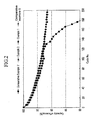
- FIG. 2 illustrates a graph of cycle-life of rechargeable lithium battery cells according to Examples 1 and 2 and Comparative Examples 5 and 7.
- the rechargeable lithium battery cell of Comparative Example 7 may have excellent high-temperature stability in both a state of charge and a state of discharge, the excellent high-temperature stability was accompanied by a deteriorated cycle-life characteristic.
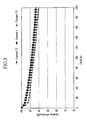
- FIG. 3 illustrates a graph of cycle-life of rechargeable lithium battery cells according to Examples 1, 12, and 13.
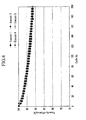
- FIG. 4 illustrates a graph of cycle-life of rechargeable lithium battery cells according to Examples 1 and 3 to 5.
- the cycle-life characteristics of the rechargeable lithium battery cells were maintained excellently.
- the rechargeable lithium battery cells manufactured according to Examples 1 to 13 using fluoroethylene carbonate, a vinyl-containing carbonate, cyclic sulfate, and a nitrile-based compound as additives of an electrolyte solution in appropriate amounts according to the invention showed excellent storage characteristics at a high temperature in both a state of charge and a state of discharge, without deteriorating battery cells characteristics such as capacity and room temperature cycle-life.
Landscapes
- Chemical & Material Sciences (AREA)
- Engineering & Computer Science (AREA)
- Manufacturing & Machinery (AREA)
- Chemical Kinetics & Catalysis (AREA)
- Electrochemistry (AREA)
- General Chemical & Material Sciences (AREA)
- Physics & Mathematics (AREA)
- Condensed Matter Physics & Semiconductors (AREA)
- General Physics & Mathematics (AREA)
- Inorganic Chemistry (AREA)
- Secondary Cells (AREA)
Description
- Embodiments relate to an electrolyte solution for a rechargeable lithium battery and a rechargeable lithium battery including the same.
- Rechargeable lithium batteries have recently drawn attention as a power source of small portable electronic devices. Rechargeable lithium batteries may use an organic electrolyte solution and may have more than twice the discharge voltage of a conventional battery using an alkali aqueous solution, and accordingly have high energy density.
- The rechargeable lithium battery may be formed by injecting an electrolyte into a battery cell including a positive electrode including a positive active material that can intercalate and deintercalate lithium, and including a negative electrode including a negative active material that can intercalate and deintercalate lithium.
- Some background art are briefly discussed hereafter.
-
EP 2 237 359 - In an embodiment disclosed on paragraphs [0032] to [0034] of said document, it is explained that the electrolyte may further include vinylene carbonate and/or an ethylene carbonate-based compound of a disclosed
chemical formula 2 in order to improve battery cycle-life. Said ethylene carbonate-based compound can include fluoroethylene carbonate. In the examples ofEP 2 237 359claim 1 of the present invention. -
WO 2009/131419 discloses a non-aqueous electrolyte solution for a lithium secondary battery. This electrolyte solution includes 1 to 5 parts by weight of sultone-based compound having a carbon-carbon unsaturated bond in a cyclic structure; 1 to 5 parts by weight of cyclic carbonate compound with a vinyl group: 5 to 10 parts by weight of cyclic carbonate compound that is substituted with halogen; and 1 to 5 parts by weight of dinitrile-based compound. - Example 1 of
WO 2009/131419 , on page 9 (paragraph [52]), discloses a solution comprising LiPF6 added to a solution of ethylene carbonate, diethyl carbonate and propylene carbonate, and an additive comprising 1 part by weight of 1,3-(1-propene)sultone, 1 part by weight of vinylethylene carbonate, 5.38 parts by weight of fluroethylene carbonate and 1 part by weight of succinonitrile. - The English abstract of
KR 10-2009-0039196A -
US 2004/0013946 discloses a non-aqueous electrolytic solution comprising a non-aqueous solvent and an electrolyte, which further contains a combination of a nitrile compound and a S=O group-containing compound (or a dinitrile compound) in an amount of 0.001 to 10 wt. %.EP 2154 746 discloses a rechargeable battery comprising an anode, a cathode, a separator and an electrolyte comprising a lithium salt, a non-aqueous organic solvent, about 0.5 wt% to 5 wt% of succinonitrile, and at least one of about 1 wt% to 10 wt% of halogenated ethylene carbonate and about 1 wt% to 5 wt% of vinyl ethylene carbonate. -
US 2008/220336 describes non-aqueous electrolyte compositions for rechargeable lithium batteries including a lithium salt, a non-aqueous organic solvent, a cyclic carbonate, optionally a linear carbonate, and a dinitrile-based compound. -
US 2008/248397 describes non aqueous electrolyte compositions for rechargeable lithium batteries including a lithium salt, a non-aqueous organic solvent, and an additive mixture comprising fluoroethylene carbonate and vinylene carbonate, and a dinitrile-based compound. -
WO 2007/094625 discloses a non-aqueous electrolyte comprising a lithium salt and a solvent, the electrolyte containing, based on the weight of the electrolyte, 1-10 wt% of a halogenated cyclic carbonate compound or its decomposition product, and 1-10 wt% of an aliphatic dinitrile compound, preferably succinonitrile. -
US 2006/228626 discloses an electrolytic solution for rechargeable lithium battery, said solution including a cyclic carbonate derivative having a halogen atom such as 4-fluoro-1,3-dioxolane-2-one (FEC) or 4-chloro-1,3-dioxolane-2-one and a cyclic imide salt. - It is a feature of an embodiment to provide an electrolyte solution for a rechargeable lithium battery having excellent storage characteristics at a high temperature without deteriorating battery characteristics such as capacity and room temperature cycle-life in both a state of charge and a state of discharge.
- It is another feature of an embodiment to provide a rechargeable lithium battery including the electrolyte solution.
- At least one of the above and other features and advantages may be realized by providing an electrolyte solution for a rechargeable lithium battery, including a lithium salt, a non-aqueous organic solvent, and an additive including fluoroethylene carbonate, a vinyl-containing carbonate, a substituted or unsubstituted cyclic sulfate or a substituted or unsubstituted cyclic sulfonate, and a nitrile-based compound represented by the following Chemical Formula 1:
[Chemical Formula 1] N≡C-R-C≡N
- wherein, in Chemical Formula 1, R may be a substituted or unsubstituted C1 to C20 alkylene group, and wherein the fluoroethylene carbonate is included in an amount of 1 wt % to 3 wt % based on the total weight of electrolyte solution.
- The vinyl-containing carbonate may include vinylene carbonate, vinylethylene carbonate, or a combination thereof.
- The cyclic sulfate may include 1,3-propanediol cyclic sulfate.
- The cyclic sulfonate may include 1,3-propane sultone, 1,3-propene sultone, or a combination thereof.
- The nitrile-based compound may include succinonitrile, glutaronitrile, adiponitrile, pimelonitrile, suberonitrile, or a combination thereof.
- According to the invention, the fluoroethylene carbonate is included in an amount of about 1 to about 3 wt% based on the total weight of the electrolyte solution.
- The vinyl-containing carbonate may be included in an amount of about 0.1 to about 3 wt% based on the total weight of the electrolyte solution.
- The cyclic sulfate or the cyclic sulfonate may be included in an amount of about 0.1 to about 10 wt% based on the total weight of the electrolyte solution.
- The nitrile-based compound may be included in an amount of about 0.1 to about 10 wt% based on the total weight of the electrolyte solution.
- At least one of the above and other features and advantages may also be realized by providing a rechargeable lithium battery, including a positive electrode, a negative electrode, and an electrolyte solution, the electrolyte solution including a lithium salt, a non-aqueous organic solvent, and an additive, the additive including fluoroethylene carbonate, a vinyl-containing carbonate, a substituted or unsubstituted cyclic sulfate or a substituted or unsubstituted cyclic sulfonate, and a nitrile-based compound represented by the following Chemical Formula 1:
[Chemical Formula 1] N≡C-R-C≡N
- wherein, in Chemical Formula 1, R may be a substituted or unsubstituted C1 to C20 alkylene group, and wherein the fluoroethylene carbonate is included in an amount of 1 wt % to 3 wt % based on the total weight of electrolyte solution.
- The vinyl-containing carbonate may include vinylene carbonate, vinylethylene carbonate, or a combination thereof.
- The cyclic sulfate may include 1,3-propanediol cyclic sulfate.
- The cyclic sulfonate may include 1,3-propane sultone, 1,3-propene sultone, or a combination thereof.
- The nitrile-based compound may include succinonitrile, glutaronitrile, adiponitrile, pimelonitrile, suberonitrile, or a combination thereof.
- According to the invention, the fluoroethylene carbonate is included in an amount of about 1 to about 3 wt% based on the total weight of the electrolyte solution.
- The vinyl-containing carbonate may be included in an amount of about 0.1 to about 3 wt% based on the total weight of the electrolyte solution.
- The cyclic sulfate or the cyclic sulfonate may be included in an amount of about 0.1 to about 10 wt% based on the total weight of the electrolyte solution.
- The nitrile-based compound may be included in an amount of about 0.1 to about 10 wt% based on the total weight of the electrolyte solution.
- The above and other features and advantages will become more apparent to those of skill in the art by describing in detail example embodiments with reference to the attached drawings, in which:
-
FIG. 1 illustrates a schematic view of a rechargeable lithium battery according to an embodiment of the invention. -
FIG. 2 illustrates a graph showing cycle-life of rechargeable lithium battery cells according to Examples 1 to 3 and Comparative Example 5. -
FIG. 3 illustrates a graph showing cycle-life of rechargeable lithium battery cells according to Examples 1, 14, and 15. -
FIG. 4 illustrates a graph showing cycle-life of rechargeable lithium battery cells according to Examples 1 and 5 to 7. -
FIG. 5 illustrates a graph showing cycle-life of rechargeable lithium battery cells according to Examples 1 and 12. - FIGS. 6-10 illustrate Tables 1-5, respectively.
- Example embodiments will now be described more fully hereinafter with reference to the accompanying drawings; however, they may be embodied in different forms and should not be construed as limited to the embodiments set forth herein. Rather, these embodiments are provided so that this disclosure will be thorough and complete, and will fully convey the scope of the invention to those skilled in the art.
- In the drawing figures, the dimensions of layers and regions may be exaggerated for clarity of illustration. Like reference numerals refer to like elements throughout.
- When a specific definition is not otherwise provided, the term "substituted" refers to an alkylene group substituted with a halogen, a C1 to C20 alkyl group, a C6 to C30 aryl group, or a C1 to C20 alkoxy group, instead of at least one hydrogen.
- When a specific definition is not otherwise provided, the term "room temperature" refers to a temperature ranging from about 23°C to about 27°C, and "high temperature" refers to a temperature ranging from about 40°C to about 100°C.
- An electrolyte solution for a rechargeable lithium battery according to an embodiment may include a lithium salt, a non-aqueous organic solvent, and an additive. The additive may include fluoroethylene carbonate, a vinyl-containing carbonate, a substituted or unsubstituted C2 to C10 cyclic sulfate, and a nitrile-based compound.
- The fluoroethylene carbonate is included in an amount of about 1 wt% to about 3 wt% based on the total weight of the electrolyte solution. When the fluoroethylene carbonate is included within this range, excellent storage characteristics at a high temperature may be provided without deteriorating capacity and room temperature cycle-life characteristics in both a state of charge and a state of discharge.
- The vinyl-containing carbonate may include vinylene carbonate, vinylethylene carbonate, or a combination thereof.
- The vinyl-containing carbonate may be included in an amount of about 0.1 wt% to about 3 wt% based on the total amount of the electrolyte solution. According to an embodiment, the vinyl-containing carbonate may be included in an amount of about 0.5 wt% to about 3 wt%. When the vinyl-containing carbonate is included within these ranges, the generation of a gas may be suppressed in the state of charge at a high temperature without deteriorating capacity and room temperature cycle-life characteristics, and since an open circuit voltage (OCV) value may be prevented from being decreased in the state of discharge at a high temperature, the storage characteristics at a high temperature may be excellent in both a state of charge and a state of discharge.
- The cyclic sulfate or the cyclic sulfonate may have a five-membered ring to a ten-membered ring.
- The cyclic sulfate or the cyclic sulfonate may be included in an amount of about 0.1 wt% to about 10 wt% based on the total amount of the electrolyte solution. According to an embodiment, the cyclic sulfate or the cyclic sulfonate may be included in an amount of about 0.1 wt% to about 3 wt%. When the cyclic sulfate or the cyclic sulfonate is included within these ranges, the generation of a gas may be suppressed in the state of charge at a high temperature without deteriorating capacity and room temperature cycle-life characteristics. Since the OCV value may be prevented from being decreased in the state of discharge at a high temperature, excellent storage characteristics at a high temperature may be provided.
- The nitrile-based compound may be represented by the following
Chemical Formula 1.
[Chemical Formula 1] N≡C-R-C≡N
- In
Chemical Formula 1, R may be a substituted or unsubstituted C1 to C20 alkylene group. - Examples of the nitrile-based compound include succinonitrile, glutaronitrile, adiponitrile, pimelonitrile, suberonitrile, or a combination thereof, and in an embodiment, succinonitrile is preferable.
- The nitrile-based compound may be included in an amount of about 0.1 wt% to about 10 wt% based on the total amount of the electrolyte solution. According to an embodiment, the nitrile-based compound may be included in an amount of about 0.1 wt% to about 3 wt%. When the nitrile-based compound is included within these ranges, the generation of a gas may be suppressed in the state of charge at a high temperature without deteriorating capacity and room temperature cycle-life characteristics, and since the OCV value may be prevented from being decreased in the state of discharge at a high temperature, the storage characteristics at a high temperature may be excellent in both a state of charge and a state of discharge.
- The lithium salt may supply lithium ions in the battery, perform a basic operation of a rechargeable lithium battery, and improve lithium ion transport between positive and negative electrodes.
- Examples of the lithium salt include LiPF6, LiBF4, LiSbF6, LiAsF6, LiN (SO3C2F5)2, LiC4F9SO3, LiClO4, LiAlO2, LiAlCl4, LiN(CxF2x+1 SO2)(CyF2y+1SO2) (where x and y are natural numbers), LiCl, LiI, and LiB(C2O4)2 (lithium bisoxalate borate, LiBOB), or a combination thereof.
- The lithium salt may be used at a concentration ranging from about 0.1 to about 2.0 M. When the lithium salt is included at this concentration range, electrolyte performance and lithium ion mobility may be enhanced due to optimal electrolyte conductivity and viscosity.
- The non-aqueous organic solvent may serve as a medium for transmitting ions taking part in the electrochemical reaction of the battery. The non-aqueous organic solvent may include a carbonate-based, ester-based, ether-based, ketone-based, alcohol-based, or aprotic solvent.
- Examples of the carbonate-based solvent include dimethyl carbonate (DMC), diethyl carbonate (DEC), dipropyl carbonate (DPC), methylpropyl carbonate (MPC), ethylpropyl carbonate (EPC), methylethyl carbonate (MEC), ethylmethyl carbonate (EMC), ethylene carbonate (EC), propylene carbonate (PC), butylene carbonate (BC), and the like.
- When a linear carbonate compound and a cyclic carbonate compound are mixed with each other, the dielectric constant may increase and the viscosity may decrease. The cyclic carbonate compound and linear carbonate compound may be mixed together in a volume ratio of about 1:1 to about 1:9.
- Examples of the ester-based solvent include methyl acetate, ethyl acetate, n-propyl acetate, methylpropionate, ethylpropionate, γ-butyrolactone, decanolide, valerolactone, mevalonolactone, caprolactone, and the like. Examples of the ether-based solvent include dibutylether, tetraglyme, diglyme, dimethoxyethane, 2-methyltetrahydrofuran, tetrahydrofuran, and the like, and examples of the ketone-based solvent include cyclohexanone and the like. Examples of the alcohol-based solvent include ethyl alcohol, isopropyl alcohol, and the like.
- The non-aqueous organic solvent may be used singularly or in a mixture. When the organic solvent is used in a mixture, the mixture ratio may be controlled in accordance with a desirable battery performance.
- A rechargeable lithium battery according to another embodiment is described referring to
FIG. 1 . The rechargeable lithium battery ofFIG. 1 is one example, but is not limited thereto. -
FIG. 1 illustrates a schematic view of arechargeable lithium battery 100 according to an embodiment of the invention. - The
rechargeable lithium battery 100 may include anegative electrode 112, apositive electrode 114, aseparator 113 interposed between thenegative electrode 112 and thepositive electrode 114, an electrolyte impregnating theseparator 113, abattery case 120, and a sealingmember 140 sealing thebattery case 120. - The
positive electrode 114 may include a current collector and a positive active material layer disposed on the current collector. The positive active material layer may include a positive active material and a binder. The positive active material layer may further include a conductive material. - The current collector may be aluminum (A1), but is not limited thereto.
- The positive active material may include lithiated intercalation compounds that reversibly intercalate and deintercalate lithium ions. The positive active material may include a composite oxide including at least one of cobalt, manganese, and nickel, as well as lithium. In particular, at least one of the following lithium-containing compounds may be used.
- LiaA1-bBbD2 (wherein, in the chemical formula, 0.90 ≤ a ≤ 1.8 and 0 ≤ b ≤ 0.5); LiaE1-bBbO2-cDc (wherein, in the chemical formula, 0.90 ≤ a ≤ 1.8, 0 ≤ b ≤ 0.5, and 0 ≤ c ≤ 0.05); LiE2-bBbO4-cDc (wherein, in the chemical formula, 0 ≤ b ≤ 0.5 and 0 ≤ c ≤ 0.05); LiaNi1-b-cCobBcDα (wherein, in the chemical formula, 0.90 ≤ a ≤ 1.8, 0 ≤ b ≤ 0.5, 0 ≤ c ≤ 0.05, and 0 < α ≤ 2); LiaNi1-b-cCobBcO2-αRα (wherein, in the chemical formula, 0.90 ≤ a ≤ 1.8, 0 ≤ b ≤ 0.5, 0 ≤ c ≤ 0.05, and 0 < α < 2); LiaNi1-b-cCobBcO2-αR2 (wherein, in the chemical formula, 0.90 ≤ a ≤ 1.8, 0 ≤ b ≤ 0.5, 0 ≤ c ≤ 0.05, and 0 < α < 2); LiaNi1-b-cMnbBcDα (wherein, in the chemical formula, 0.90 ≤ a ≤ 1.8, 0 ≤ b ≤ 0.5, 0 ≤ c ≤ 0.05, and 0 < α ≤ 2); LiaNi1-b-cMnbBcO2-αRα (wherein, in the chemical formula, 0.90 ≤ a ≤ 1.8, 0 ≤ b ≤ 0.5, 0 ≤ c ≤ 0.05, and 0 < α < 2); LiaNi1-b-cMnbBcO2-αR2 (wherein, in the chemical formula, 0.90 ≤ a ≤ 1.8, 0 ≤ b ≤ 0.5, 0 ≤ c ≤ 0.05, and 0 < α < 2); LiaNibEcGdO2 (wherein, in the chemical formula, 0.90 ≤ a ≤ 1.8, 0 ≤ b ≤ 0.9, 0 ≤ c ≤ 0.5, and 0.001 ≤ d ≤ 0.1); LiaNibCocMndGeO2 (wherein, in the chemical formula, 0.90 ≤ a ≤ 1.8, 0 ≤ b ≤ 0.9, 0 ≤ c ≤ 0.5, 0 ≤ d ≤0.5, and 0.001 ≤ e ≤ 0.1); LiaNiGbO2 (wherein, in the chemical formula, 0.90 ≤ a ≤ 1.8 and 0.001 ≤ b ≤ 0.1); LiaCoGbO2 (wherein, in the chemical formula, 0.90 ≤ a ≤ 1.8 and 0.001 ≤ b ≤ 0.1); LiaMnGbO2 (wherein, in the chemical formula, 0.90 ≤ a ≤ 1.8 and 0.001 ≤ b ≤ 0.1); LiaMn2GbO4 (wherein, in the chemical formula, 0.90 ≤ a ≤ 1.8 and 0.001 ≤ b ≤ 0.1); QS2; LiQS2; V2O5; LiV2O5; LiZO2; LiNiVO4; Li(3-f)J2(PO4)3 (0 ≤ f ≤ 2); Li(3-f)Fe2(PO4)3 (0 ≤ f ≤ 2); and LiFePO4.
- In the formulae, A may be Ni, Co, Mn, or a combination thereof; B may be Al, Ni, Co, Mn, Cr, Fe, Mg, Sr, V, a rare earth element, or a combination thereof; D may be O, F, S, P, or a combination thereof; E may be Co, Mn, or a combination thereof; R is F, S, P, or a combination thereof; G may be Al, Cr, Mn, Fe, Mg, La, Ce, Sr, V, or a combination thereof; Q may be Ti, Mo, Mn, or a combination thereof; Z may be Cr, V, Fe, Sc, Y, or a combination thereof; and J may be V, Cr, Mn, Co, Ni, Cu, or a combination thereof.
- The positive active material may include a compound having a coating layer on the surface of the above compound, or a mixture of the above compound and the compound having the coating layer on the surface thereof. The coating layer may include at least one coating element compound, which may be an oxide of a coating element, a hydroxide of a coating element, an oxyhydroxide of a coating element, an oxycarbonate of a coating element, or a hydroxyl carbonate of a coating element. The compounds for a coating layer can be amorphous or crystalline. The coating element for a coating layer may include Mg, Al, Co, K, Na, Ca, Si, Ti, V, Sn, Ge, Ga, B, As, Zr, or a mixture thereof. The coating layer may be formed in a method having no negative influence on properties of a positive active material by including these elements in the compound. For example, the method may include a coating method such as spray coating, dipping, and the like, but is not illustrated in more detail, since it is well-known to those who work in the related field.
- The binder may be provided to improve binding properties of the positive active material particles to each other and to a current collector. Examples of the binder include polyvinyl alcohol, carboxylmethyl cellulose, hydroxypropyl cellulose, diacetyl cellulose, polyvinylchloride, carboxylated polyvinyl chloride, polyvinylfluoride, an ethylene oxide-containing polymer, polyvinylpyrrolidone, polyurethane, polytetrafluoroethylene, polyvinylidene fluoride, polyethylene, polypropylene, a styrene-butadiene rubber, an acrylated styrene-butadiene rubber, an epoxy resin, nylon, etc., and combinations thereof, but are not limited thereto.
- An electrically conductive material that does not cause a chemical change may be used as a conductive material. Examples of the conductive material include natural graphite, artificial graphite, carbon black, acetylene black, ketjen black, a carbon fiber, a metal powder or a metal fiber including copper, nickel, aluminum, silver, and so on, and a polyphenylene derivative.
- The
negative electrode 112 may include a current collector and a negative active material layer disposed on the current collector, and the negative active material layer may include a negative active material. - The current collector may include a copper foil, a nickel foil, a stainless steel foil, a titanium foil, a nickel foam, a copper foam, a polymer substrate coated with a conductive metal, or combinations thereof.
- The negative active material layer may include a binder. The negative active material layer may further include a conductive material.
- The negative active material may include a material that reversibly intercalates/deintercalates lithium ions, a lithium metal, a lithium metal alloy, a material being capable of doping and dedoping lithium, and/or a transition metal oxide.
- The material that reversibly intercalates/deintercalates lithium ions may include carbon materials. The carbon material may be any generally-used carbon-based negative active material in a rechargeable lithium battery. Examples of the carbon material include crystalline carbon, amorphous carbon, and a mixture thereof. The crystalline carbon may be non-shaped, or sheet, flake, spherical, or fiber shaped natural graphite or artificial graphite. The amorphous carbon may be a soft carbon (carbon obtained by sintering at a low temperature), a hard carbon (carbon obtained by sintering at a high temperature), mesophase pitch carbide, fired coke, and the like.
- Examples of the lithium metal alloy are compounds including lithium and at least a metal, which may be Na, K, Rb, Cs, Fr, Be, Mg, Ca, Sr, Si, Sb, Pb, In, Zn, Ba, Ra, Ge, Al, or Sn.
- Examples of the material being capable of doping and dedoping lithium include Si, SiOx (0 < x < 2), a Si-Y alloy (where Y is an element, the element being an alkali metal, an alkaline-earth metal, a
group 13 to a group 16 (IUPAC version) elements, a transition element, a rare earth element, or a combination thereof, and is not Si), Sn, SnO2, Sn-Y alloy (where Y is an element, the element being an alkali metal, an alkaline-earth metal, agroup 13 to a group 16 elements, a group 14 element, a transition element, a rare earth element, or combinations thereof, and is not Sn), or mixtures thereof. At least one of these materials may be mixed with SiO2. The element Y may include Mg, Ca, Sr, Ba, Ra, Sc, Y, Ti, Zr, Hf, Rf, V, Nb, Ta, Db, Cr, Mo, W, Sg, Tc, Re, Bh, Fe, Pb, Ru, Os, Hs, Rh, Ir, Pd, Pt, Cu, Ag, Au, Zn, Cd, B, Al, Ga, Sn, In, Ti, Ge, P, As, Sb, Bi, S, Se, Te, Po, or combinations thereof. - Examples of the transition metal oxide include vanadium oxide, lithium vanadium oxide, and the like.
- The binder may be provided to improve binding properties of the negative active material particles to each other and to a current collector. Examples of the binder include polyvinyl alcohol, carboxylmethyl cellulose, hydroxypropyl cellulose, polyvinyl chloride, carboxylated polyvinylchloride, polyvinylfluoride, an ethylene oxide-containing polymer, polyvinylpyrrolidone, polyurethane, polytetrafluoroethylene, polyvinylidene fluoride, polyethylene, polypropylene, a styrene-butadiene rubber, an acrylated styrene-butadiene rubber, an epoxy resin, nylon, etc., and combinations thereof, but are not limited thereto.
- An electrically conductive material that does not cause a chemical change may be used as a conductive material. Examples of the conductive material include: carbon-based materials such as natural graphite, artificial graphite, carbon black, acetylene black, ketjen black, a carbon fiber, and the like; a metal-based material of a metal powder or a metal fiber including copper, nickel, aluminum, silver, and the like; a conductive polymer such as a polyphenylene derivative; and mixtures thereof.
- The
positive electrode 114 and thenegative electrode 112 may be manufactured by a method including mixing the active material, a conductive material, and a binder to provide an active material composition, and coating the composition on a current collector. The electrode manufacturing method is well known, and thus is not described in detail in the present specification. A solvent such as N-methylpyrrolidone may be used, but it is not limited thereto. - The
separator 113 may be formed as a single layer or a multilayer, and may be made of polyethylene, polypropylene, polyvinylidene fluoride, or a combination thereof. - The electrolyte may include the electrolyte solution according to the invention described above.
- The following Examples and Comparative Examples are provided in order to set forth particular details of one or more embodiments. However, it will be understood that the embodiments are not limited to the particular details described. Further, the Comparative Examples are set forth to highlight certain characteristics of certain embodiments, and are not to be construed as either limiting the scope of the invention as exemplified in the Examples or as necessarily being outside the scope of the invention in every respect. Furthermore, what is not described in this specification can be sufficiently understood by those who have knowledge in this field and will not be illustrated here.
- 1.3 M of LiPF6 was dissolved in a solvent obtained by mixing ethylene carbonate (EC), ethylmethyl carbonate (EMC), and diethyl carbonate (DEC) in a volume ratio of 3:5:2. An electrolyte solution was prepared by adding fluoroethylene carbonate, vinylene carbonate, 1,3-propane sultone, and succinonitrile into the mixed solution as additives in the amounts presented in the following Tables 1 to 5, respectively. The amounts of the respective additive components were based on the total amount of the electrolyte solution.
- A positive active material layer composition was prepared by mixing LiCoO2 as a positive active material, polyvinylidene fluoride (PVDF) as a binder, and carbon black as a conductive material in the weight ratio of 96:2:2, respectively, and dispersing the mixture in N-methyl-2-pyrrolidone. A positive electrode was manufactured by coating a 20 µm-thick aluminum foil with the positive active material layer composition, drying it, and rolling it.
- A negative active material layer composition was prepared by mixing a mixture of natural graphite and artificial graphite as a negative active material, styrene-butadiene rubber as a binder, and carboxylmethyl cellulose as a dispersing agent in the weight ratio of about 97.5:1.5:1, and dispersing the mixture in N-methyl-2-pyrrolidone. A negative electrode was manufactured by coating a 15 µm-thick copper foil with the negative active material layer composition, drying it, and rolling it.
- A rechargeable lithium battery cell of a stacked structure was manufactured to have 1C capacity of about 1200 mAh by using the manufactured positive electrode and negative electrode, and a separator formed of a polyethylene material, and spiral-winding and compressing them. Herein, the electrolyte solutions prepared according to Examples 1 to 13 and Comparative Examples 1 to 7 were used.
- Experimental Example 1: Evaluation of Storage Characteristics at High Temperature and Capability of Rechargeable Lithium Battery Cells in the State of Charge and the State of Discharge
- The storage characteristics at a high temperature and capacity of rechargeable lithium battery cells manufactured according to Examples 1 to 13 and Comparative Examples 1 to 7 were measured in the state of charge and the state of discharge, and the results are presented in the Tables 1 to 5. When the rechargeable lithium battery cells were stored at a high temperature in the state of charge, gas was continuously generated due to electrochemical and thermal decomposition of the electrolyte solution and solid electrolyte interface (SEI) film component, and this led to degradation. Thus, the thickness increase rate of a rechargeable lithium battery cell may be used as a standard for evaluating high-temperature stability in the state of charge. On the other hand, when the rechargeable lithium battery cells were stored at a high temperature in the state of discharge, an open circuit voltage (OCV) value was decreased. When the OCV value was brought down to a predetermined OCV value, the generation of gas was increased significantly. Thus, the OCV value of a rechargeable lithium battery cell may be used as a standard for evaluating high-temperature stability in the state of discharge.
- Therefore, storage characteristics at a high temperature in the state of charge were evaluated by the thickness increase rate of a rechargeable lithium battery cell. Herein, the charge was performed at 0.5C in a CC/CV mode up to about 4.2 V and the charge was terminated when the current was 60 mAh, and the thickness increase rate (%) was measured using a vernier calipers in-situ after the rechargeable lithium battery cell was allowed to stand at about 60°C for about 15 days and about 30 days, respectively.
- Also, the storage characteristics at a high temperature in the state of discharge were evaluated by an OCV value of a rechargeable lithium battery cell. Herein, the discharge was performed at about 0.5C in a CC mode, and the discharge was terminated at about 3.0 V. The OCV value (V) was measured using a HIOKI multimeter after the rechargeable lithium battery cell was allowed to stand at about 60°C for about 15 days and about 30 days, respectively.
- The capacity retention is a ratio of a capacity after the rechargeable lithium battery cell was allowed to stand for about 30 days to an initial capacity.
Table 1: Ex. 1 Comp. Ex. 1 Comp. Ex. 2 Comp. Ex. 3 Comp. Ex. 4 Additive (wt%) Fluoroethylene carbonate 3 3 3 3 3 Vinylene carbonate 1 - - 1 - 1,3-propane sultone 1 - - - 1 Succinonitrile 1 - 1 1 1 Allowed to stand after charge Thickness increase rate (%) 15 days 2.2 1.6 3.6 1.9 2.1 30 days 6.7 23.8 11.8 15.6 7.5 Capacity retention (%) 92 90 90 92 92 Allowed to stand after discharge OCV (V) 15 days 2.69 2.52 1.56 2.54 2.10 30 days 2.28 2.03 0.00 2.08 0.74 Capacity retention (%) 97 98 77 98 83 Table 2: Example 2 Comparative Example 5 Comparative Example 6 Comparative Example 7 Additive (wt%) Fluoroethylene carbonate 1 5 7 - Vinylene carbonate 1 1 1 1 1,3-propane sultone 1 1 1 1 Succinonitrile 1 1 1 1 Allowed to stand after charge Thickness increase rate (%) 15 days 2.1 4.0 2.4 2.4 30 days 5.2 26.7 20.4 4.5 Capacity retention (%) 92 92 91 90 Allowed to stand after discharge OCV (V) 15 days 2.65 2.65 2.64 2.67 30 days 2.26 2.20 2.19 2.23 Capacity retention (%) 97 97 97 97 Table 3: Example 3 Example 4 Example 5 Example 6 Example7 Example 8 Additive (wt%) Fluoroethylene carbonate 3 3 3 3 3 3 Vinylene carbonate 1 1 1 1 1 1 1,3-propane sultone 1 1 1 1 1 1 succinonitrile 0.1 0.5 3 5 7 10 Allowed to stand after charge Thickness increase rate (%) 15 days 1.3 2.2 2.0 2.4 2.8 2.6 30 days 12.8 8.8 4.1 4.3 4.9 4.7 Capacity retention (%) 92 92 92 92 91 91 Allowed to stand after discharge OCV (V) 15 days 2.79 2.72 2.55 2.37 2.29 2.27 30 days 2.53 2.36 2.07 1.86 1.73 1.63 Capacity retention (%) 97 97 97 96 96 95 Table 4: Example 9 Example 10 Additive (wt%) Fluoroethylene carbonate 3 3 Vinylene carbonate 0.1 0.5 1,3-propane sultone 1 1 Succinonitrile 1 1 Allowed to stand after charge Thickness increase rate (%) 15 days 2.4 2.2 30 days 7.8 6.6 Capacity retention (%) 92 92 Allowed to stand after discharge OCV (V) 15 days 2.21 2.50 30 days 1.54 2.01 Capacity retention (%) 96 97 Table 5: Example 11 Example 12 Example 13 Additive (wt%) Fluoroethylene carbonate 3 3 3 Vinylene carbonate 1 1 1 1,3-propane sultone 0.1 0.5 3 Succinonitrile 1 1 1 Allowed to stand after charge Thickness increase rate (%) 15 days 2.2 2.1 2.0 30 days 16.1 12.1 3.2 Capacity retention (%) 92 92 86 Allowed to stand after discharge OCV (V) 15 days 2.40 2.63 2.71 30 days 2.11 2.23 2.38 Capacity retention (%) 98 97 92 - It may be seen from Tables 1 to 5 that the rechargeable lithium battery cells manufactured according to Examples 1 to 13 using fluoroethylene carbonate in an amount of 1 to 3 wt %, a vinyl-containing carbonate, cyclic sulfate, and a nitrile-based compound as additives to the electrolyte solution in appropriate amounts according to embodiments, had excellent storage characteristics at a high temperature in both a state of charge and a state of discharge, compared with those manufactured according to Comparative Examples 1 to 7.
- Referring to Table 1, the rechargeable lithium battery cell manufactured according to Comparative Example 1 using only fluoroethylene carbonate and the rechargeable lithium battery cell manufactured according to Comparative Example 3 that did not use cyclic sulfate or cyclic sulfonate had excellent high-temperature stability in the state of discharge, but the high-temperature stability was decreased in the state of charge. Also, the rechargeable lithium battery cell manufactured according to Comparative Example 2 using only fluoroethylene carbonate and a nitrile-based compound, and the rechargeable lithium battery cell manufactured according to Comparative Example 4 that did not use a vinyl-containing carbonate, had excellent high-temperature stability in the state of charge, but the high-temperature stability was decreased in the state of discharge.
- Table 2 shows cases of using fluoroethylene carbonate in diverse amounts. It may be seen from Table 2 that the rechargeable lithium battery cell manufactured according to Example 2 using fluoroethylene carbonate in an amount of about 1 wt% based on the total amount of electrolyte solution had excellent high-temperature stability in both a state of charge and a state of discharge.
- Table 3 shows cases of using a nitrile-based compound in diverse amounts. It may be seen from Table 3 that the rechargeable lithium battery cells manufactured according to Examples 3 to 8 using the nitrile-based compound in an amount of about 0.1 to about 10 wt% based on the total amount of the electrolyte solution had excellent high-temperature stability in both a state of charge and a state of discharge.
- Table 4 shows cases of using vinyl-containing carbonate in diverse amounts. It may be seen from Table 4 that the rechargeable lithium battery cells manufactured according to Examples 9 and 10 using the vinyl-containing carbonate in an amount of about 0.1 to about 3 wt% based on the total amount of the electrolyte solution had excellent high-temperature stability in both a state of charge and a state of discharge.
- Table 5 shows cases of using cyclic sulfate or cyclic sulfonate in diverse amounts. It may be seen from Table 5 that the rechargeable lithium battery cells manufactured according to Examples 11 to 13 using the cyclic sulfate or the cyclic sulfonate in an amount of about 0.1 to about 10 wt% based on the total amount of the electrolyte solution had excellent high-temperature stability in both a state of charge and a state of discharge.
- The cycle-life characteristics of the rechargeable lithium battery cells manufactured according to Examples 1 and 2 and Comparative Examples 5 and 7 were evaluated and the results are presented in
FIG. 2 , and the cycle-life characteristics of the rechargeable lithium battery cells manufactured according to Examples 1, 12, and 13 were evaluated and the results are presented inFIG. 3 . Also, the cycle-life characteristics of the rechargeable lithium battery cells manufactured according to Examples 1 and 3 to 5 were evaluated and the results are presented inFIG. 4 , and the cycle-life characteristics of the rechargeable lithium battery cells manufactured according to Examples 1 and 10 were evaluated and the results are presented inFIG. 5 . - To evaluate the cycle-life characteristics, the charge was performed at 1C in a CC/CV mode up to about 4.2 V, and when the current was about 60 mA, the charge was paused for about 10 minutes, and the discharge was performed at 1C in a CC mode, and paused for about 10 minutes at about 3.2 V. This process was performed 200 times.
-
FIG. 2 illustrates a graph of cycle-life of rechargeable lithium battery cells according to Examples 1 and 2 and Comparative Examples 5 and 7. - Referring to
FIG. 2 , while the cycle-life characteristics were not greatly decreased in the rechargeable lithium battery cells of Examples 1 and 2 and Comparative Example 7 showing cases of using fluoroethylene carbonate in diverse amounts within a range of 1 to 7 wt %, the rechargeable lithium battery cell of Comparative Example 7 that did not use fluoroethylene carbonate showed a remarkable decrease in the cycle-life characteristic. In other words, although the rechargeable lithium battery cell of Comparative Example 7 may have excellent high-temperature stability in both a state of charge and a state of discharge, the excellent high-temperature stability was accompanied by a deteriorated cycle-life characteristic. -
FIG. 3 illustrates a graph of cycle-life of rechargeable lithium battery cells according to Examples 1, 12, and 13. - Referring to
FIG. 3 , the cycle-life characteristics of the rechargeable lithium battery cells manufactured according to Examples 1, 12 and 13, which show cases of using cyclic sulfate or cyclic sulfonate in diverse amounts within an appropriate range according to an embodiment, were all maintained excellently. -
FIG. 4 illustrates a graph of cycle-life of rechargeable lithium battery cells according to Examples 1 and 3 to 5. - Referring to
FIG. 4 , the cycle-life characteristics of the rechargeable lithium battery cells manufactured according to Examples 1 and 3 to 5, which show cases of using a nitrile-based compound in diverse amounts within an appropriate range according to an embodiment, were all maintained excellently. -
FIG. 5 illustrates a graph of cycle-life of rechargeable lithium battery cells according to Examples 1 and 10. - Referring to
FIG. 5 , in the rechargeable lithium battery cells manufactured according to Examples 1 and 10, showing examples where a vinyl-containing carbonate was used in diverse amounts within an appropriate range according to an embodiment, the cycle-life characteristics of the rechargeable lithium battery cells were maintained excellently. - As described above, the rechargeable lithium battery cells manufactured according to Examples 1 to 13 using fluoroethylene carbonate, a vinyl-containing carbonate, cyclic sulfate, and a nitrile-based compound as additives of an electrolyte solution in appropriate amounts according to the invention showed excellent storage characteristics at a high temperature in both a state of charge and a state of discharge, without deteriorating battery cells characteristics such as capacity and room temperature cycle-life.
- Improvement in storage characteristics of rechargeable lithium batteries at a high temperature are need, but to-date has not been adequate in improving the storage characteristics at a high temperature with respect to both state of charge (SOC = 100%) and state of discharge (SOC = 0%). Also, battery characteristics such as capacity and room temperature cycle-life may be deteriorated by general additives. However, when the electrolyte solution for a rechargeable lithium battery according to an embodiment is used, it may be possible to realize a rechargeable lithium battery having excellent storage characteristics at a high temperature without deteriorating battery characteristics such as capacity and room temperature cycle-life in both a state of charge and a state of discharge.
- Example embodiments have been disclosed herein, and although specific terms are employed, they are used and are to be interpreted in a generic and descriptive sense only and not for purpose of limitation. Accordingly, it will be understood by those of skill in the art that various changes in form and details may be made without departing from the scope of the present invention as set forth in the following claims.
Claims (9)
- An electrolyte solution for a rechargeable lithium battery, comprising:a lithium salt;a non-aqueous organic solvent; andan additive including fluoroethylene carbonate, a vinyl-containing carbonate, a substituted or unsubstituted cyclic sulfate or a substituted or unsubstituted cyclic sulfonate, and a nitrile-based compound represented by the following Chemical Formula 1:
[Chemical Formula 1] N≡C-R-C≡N
wherein, in Chemical Formula 1,R is a substituted or unsubstituted C1 to C20 alkylene group, wherein the fluoroethylene carbonate is included in an amount of 1 wt% to 3 wt%, based on the total weight of the electrolyte solution. - The electrolyte solution for a rechargeable lithium battery as claimed in claim 1, wherein the vinyl-containing carbonate includes vinylene carbonate, vinylethylene carbonate, or a combination thereof.
- The electrolyte solution for a rechargeable lithium battery as claimed in any one of claims 1 and 2, wherein the cyclic sulfate includes 1,3-propanediol cyclic sulfate.
- The electrolyte solution for a rechargeable lithium battery as claimed in any one of claims 1 to 3, wherein the cyclic sulfonate includes 1,3-propane sultone, 1,3-propene sultone, or a combination thereof.
- The electrolyte solution for a rechargeable lithium battery as claimed in any one of claims 1 to 4, wherein the nitrile-based compound includes succinonitrile, glutaronitrile, adiponitrile, pimelonitrile, suberonitrile, or a combination thereof.
- The electrolyte solution for a rechargeable lithium battery as claimed in any one of claims 1 to 5, wherein the vinyl-containing carbonate is included in an amount of 0.1 wt% to 3 wt%, preferably of 0.5 wt% to 3 wt%, based on the total weight of the electrolyte solution.
- The electrolyte solution for a rechargeable lithium battery as claimed in any one of claims 1 to 6, wherein the cyclic sulfate or the cyclic sulfonate is included in an amount of 0.1 wt% to 10 wt%, preferably of 0.1 wt% to 3 wt%, based on the total weight of the electrolyte solution.
- The electrolyte solution for a rechargeable lithium battery as claimed in any one of claims 1 to 7, wherein the nitrile-based compound is included in an amount of 0.1 wt% to 10 wt%, preferably of 0.1 wt% to 3 wt%, based on the total weight of the electrolyte solution.
- A rechargeable lithium battery (100), comprising:a positive electrode (114);a negative electrode (112); andan electrolyte solution according to any one of claims 1 to 8.
Applications Claiming Priority (1)
| Application Number | Priority Date | Filing Date | Title |
|---|---|---|---|
| KR1020100023507A KR101212203B1 (en) | 2010-03-16 | 2010-03-16 | Electrolyte for rechargeable lithium battery, and rechargeable lithium battery including the same |
Publications (2)
| Publication Number | Publication Date |
|---|---|
| EP2367230A1 EP2367230A1 (en) | 2011-09-21 |
| EP2367230B1 true EP2367230B1 (en) | 2014-12-03 |
Family
ID=43901655
Family Applications (1)
| Application Number | Title | Priority Date | Filing Date |
|---|---|---|---|
| EP11156912.5A Active EP2367230B1 (en) | 2010-03-16 | 2011-03-04 | Electrolyte solution for rechargeable lithium battery, and rechargeable lithium battery including the same |
Country Status (5)
| Country | Link |
|---|---|
| US (1) | US9196928B2 (en) |
| EP (1) | EP2367230B1 (en) |
| JP (1) | JP5414658B2 (en) |
| KR (1) | KR101212203B1 (en) |
| CN (1) | CN102195085B (en) |
Cited By (1)
| Publication number | Priority date | Publication date | Assignee | Title |
|---|---|---|---|---|
| EP3809506A4 (en) * | 2018-12-14 | 2021-10-06 | Contemporary Amperex Technology Co., Limited | LITHIUM BATTERY AND DEVICE |
Families Citing this family (40)
| Publication number | Priority date | Publication date | Assignee | Title |
|---|---|---|---|---|
| JPH065112Y2 (en) | 1990-05-11 | 1994-02-09 | 允 鈴木 | Nori bundle cutting device |
| JP5446612B2 (en) * | 2009-08-28 | 2014-03-19 | Tdk株式会社 | Lithium ion secondary battery |
| CN102394311A (en) * | 2011-11-28 | 2012-03-28 | 东莞新能源科技有限公司 | Lithium ion secondary battery with high energy density |
| CN102593513A (en) * | 2012-02-17 | 2012-07-18 | 深圳新宙邦科技股份有限公司 | Lithium ion secondary battery and electrolyte thereof |
| JP5664685B2 (en) | 2012-03-27 | 2015-02-04 | Tdk株式会社 | Nonaqueous electrolyte solution and lithium ion secondary battery |
| JP6019663B2 (en) * | 2012-03-28 | 2016-11-02 | 三菱化学株式会社 | Non-aqueous electrolyte and non-aqueous electrolyte battery using the same |
| CN103000944B (en) * | 2012-12-03 | 2015-02-25 | 湖州创亚动力电池材料有限公司 | Lithium ion battery electrolyte with high-temperature and low-temperature properties |
| CN103107355B (en) * | 2013-02-03 | 2015-12-09 | 宁德新能源科技有限公司 | Lithium ion battery and electrolyte thereof |
| KR101754608B1 (en) | 2013-02-27 | 2017-07-07 | 삼성에스디아이 주식회사 | Electrolyte and rechargeable lithium battery including the same |
| US9406974B2 (en) | 2013-04-25 | 2016-08-02 | Samsung Sdi Co., Ltd. | Additive for electrolyte of lithium battery, organic electrolytic solution comprising the same, and lithium battery using the organic electrolytic solution |
| KR101718061B1 (en) | 2013-05-15 | 2017-03-20 | 삼성에스디아이 주식회사 | Organic electrolytic solution and and Lithium battery comprising the solution |
| WO2015007554A1 (en) * | 2013-07-15 | 2015-01-22 | Basf Se | Maleonitrile derivatives as additives for electrolytes in lithium ion batteries |
| JP6208560B2 (en) * | 2013-11-26 | 2017-10-04 | 日立マクセル株式会社 | Lithium secondary battery |
| KR102164001B1 (en) * | 2014-01-09 | 2020-10-12 | 삼성에스디아이 주식회사 | Rechargeable lithium battery |
| JP6338913B2 (en) * | 2014-03-31 | 2018-06-06 | 三井化学株式会社 | Nonaqueous electrolyte for battery and lithium secondary battery |
| CN105322227A (en) * | 2014-07-09 | 2016-02-10 | 惠州Tcl金能电池有限公司 | Lithium ion battery electrolyte, preparation method thereof, and lithium ion battery |
| CN109346760A (en) * | 2014-09-29 | 2019-02-15 | 深圳新宙邦科技股份有限公司 | Electrolyte for high-voltage lithium-ion battery and high-voltage lithium-ion battery |
| CN104466247B (en) * | 2014-12-16 | 2018-05-08 | 东莞新能源科技有限公司 | A kind of lithium ion battery of nonaqueous electrolytic solution and the application electrolyte |
| EP3236528A4 (en) * | 2014-12-19 | 2018-06-13 | NEC Energy Devices, Ltd. | Lithium ion secondary battery |
| CN105789684A (en) * | 2014-12-22 | 2016-07-20 | 宁德时代新能源科技股份有限公司 | Lithium ion secondary battery and electrolyte thereof |
| US10541445B2 (en) | 2015-10-29 | 2020-01-21 | Lg Chem, Ltd. | Non-aqueous electrolyte solution for lithium secondary battery and lithium secondary battery comprising the same |
| CN105576283A (en) * | 2016-02-03 | 2016-05-11 | 东莞市凯欣电池材料有限公司 | High voltage electrolyte considering high and low temperature performance and lithium ion battery using the electrolyte |
| CN105789700A (en) * | 2016-03-29 | 2016-07-20 | 宁德时代新能源科技股份有限公司 | Electrolyte and lithium ion battery |
| CN108242557B (en) * | 2016-12-26 | 2020-08-28 | 宁德时代新能源科技股份有限公司 | Electrolyte and secondary battery |
| KR102117622B1 (en) | 2017-01-20 | 2020-06-02 | 주식회사 엘지화학 | Electrolyte for lithium secondary battery and lithium secondary battery comprising the same |
| KR102477644B1 (en) | 2017-07-03 | 2022-12-15 | 주식회사 엘지에너지솔루션 | Electrolyte additive and non-aqueous electrolyte solution for lithium secondary battery comprising the same |
| KR102449844B1 (en) | 2017-09-06 | 2022-09-29 | 삼성에스디아이 주식회사 | Rechargeable lithium battery and rechargeable lithium battery including same |
| KR20190027188A (en) | 2017-09-06 | 2019-03-14 | 삼성에스디아이 주식회사 | Non-electrolyte for rechargeable lithium battery and rechargeable lithium battery including same |
| EP3486991B1 (en) * | 2017-11-15 | 2025-04-16 | Samsung Electronics Co., Ltd. | Electrolyte additive for lithium battery, organic electrolyte solution including the same, and lithium battery including the same |
| KR102565048B1 (en) * | 2018-03-08 | 2023-08-08 | 주식회사 아모그린텍 | Electrolyte for secondary battery, battery and flexible battery comprising the same |
| KR102277754B1 (en) * | 2018-08-09 | 2021-07-16 | 동화일렉트로라이트 주식회사 | Electrolyte Solution for Secondary Battery and Secondary Battery Comprising the Same |
| CN111326733B (en) | 2018-12-14 | 2021-05-04 | 宁德时代新能源科技股份有限公司 | Lithium Ion Battery |
| CN109687021B (en) * | 2018-12-18 | 2020-12-11 | 东莞市杉杉电池材料有限公司 | High-temperature-resistant non-aqueous electrolyte for lithium ion battery |
| CN111933946B (en) * | 2019-03-18 | 2022-03-18 | 宁德新能源科技有限公司 | Electrochemical device and electronic device comprising same |
| EP4070396A1 (en) * | 2019-12-03 | 2022-10-12 | Solvay Sa | Electrolyte composition with fluorinated acyclic ester and fluorinated cyclic carbonate |
| JP7380841B2 (en) * | 2020-03-24 | 2023-11-15 | 株式会社村田製作所 | secondary battery |
| JP7850969B2 (en) * | 2021-02-26 | 2026-04-24 | パナソニックIpマネジメント株式会社 | Non-aqueous secondary battery |
| KR20240050130A (en) * | 2022-10-11 | 2024-04-18 | 삼성에스디아이 주식회사 | Rechargeable lithium battery |
| CN115882073A (en) * | 2022-12-28 | 2023-03-31 | 东莞新能源科技有限公司 | A kind of electrochemical device and electronic device |
| CN118073653B (en) * | 2024-04-19 | 2024-07-19 | 广州天赐高新材料股份有限公司 | Electrolyte additive, electrolyte and battery |
Family Cites Families (26)
| Publication number | Priority date | Publication date | Assignee | Title |
|---|---|---|---|---|
| JP4762411B2 (en) | 2000-06-26 | 2011-08-31 | パナソニック株式会社 | Non-aqueous electrolyte for secondary battery and non-aqueous electrolyte secondary battery using the same |
| CN101604770A (en) | 2002-07-15 | 2009-12-16 | 宇部兴产株式会社 | Non-aqueous electrolyte and lithium battery |
| US20040013946A1 (en) * | 2002-07-15 | 2004-01-22 | Ube Industries, Ltd. | Non-aqueous electrolytic solution and lithium battery |
| DE602004004956T2 (en) * | 2003-08-20 | 2007-11-08 | Samsung SDI Co., Ltd., Suwon | Electrolyte for rechargeable lithium battery and rechargeable lithium battery containing the same |
| KR100578873B1 (en) | 2004-01-29 | 2006-05-11 | 삼성에스디아이 주식회사 | Electrolyte for lithium secondary battery and lithium secondary battery comprising same |
| TWI302760B (en) * | 2004-01-15 | 2008-11-01 | Lg Chemical Ltd | Electrochemical device comprising aliphatic nitrile compound |
| WO2006070546A1 (en) | 2004-12-27 | 2006-07-06 | Ube Industries, Ltd. | Nonaqueous electrolyte solution and lithium secondary battery using same |
| JP5067522B2 (en) * | 2005-04-08 | 2012-11-07 | ソニー株式会社 | Secondary battery electrolyte and secondary battery |
| KR100833041B1 (en) | 2005-05-03 | 2008-05-27 | 주식회사 엘지화학 | Non-aqueous electrolyte and lithium secondary battery comprising the same to improve the performance |
| WO2007008006A1 (en) * | 2005-07-13 | 2007-01-18 | Lg Chem, Ltd. | Lithium secondary battery containing capsule for controlled-release of additives |
| TWI341605B (en) * | 2006-02-15 | 2011-05-01 | Lg Chemical Ltd | Non-aqueous electrolyte and electrochemical device with an improved safety |
| FR2898222B1 (en) * | 2006-03-01 | 2008-09-19 | Dav Sa | ELECTRICAL CONTROL DEVICE |
| KR101508788B1 (en) * | 2006-06-02 | 2015-04-06 | 미쓰비시 가가꾸 가부시키가이샤 | Nonaqueous electrolyte solution and nonaqueous electrolyte battery |
| JP4936440B2 (en) | 2006-10-26 | 2012-05-23 | 日立マクセルエナジー株式会社 | Non-aqueous secondary battery |
| KR20080082276A (en) * | 2007-03-08 | 2008-09-11 | 삼성에스디아이 주식회사 | Electrolyte for rechargeable lithium battery and rechargeable lithium battery comprising same |
| JP5217200B2 (en) * | 2007-03-20 | 2013-06-19 | 三菱化学株式会社 | Non-aqueous electrolyte and non-aqueous electrolyte battery |
| KR100814827B1 (en) * | 2007-04-05 | 2008-03-20 | 삼성에스디아이 주식회사 | Electrolyte for lithium secondary battery and lithium secondary battery comprising same |
| JP5217400B2 (en) * | 2007-06-28 | 2013-06-19 | 三菱化学株式会社 | Non-aqueous electrolyte for secondary battery and non-aqueous electrolyte secondary battery using the same |
| US20100266905A1 (en) * | 2007-09-19 | 2010-10-21 | Lg Chem, Ltd. | Non-aqueous electrolyte lithium secondary battery |
| KR100980207B1 (en) * | 2007-10-17 | 2010-09-03 | 주식회사 엘지화학 | Non-aqueous electrolyte solution for lithium secondary batteries and lithium secondary battery containing same |
| JP2009235381A (en) * | 2008-03-07 | 2009-10-15 | Fujifilm Corp | Azo pigment, pigment dispersion product, coloring composition, and ink for inkjet recording |
| US8697293B2 (en) * | 2008-04-25 | 2014-04-15 | Lg Chem, Ltd. | Non-aqueous electrolyte solution for lithium secondary battery and lithium secondary battery having the same |
| KR20090113215A (en) | 2008-04-25 | 2009-10-29 | 주식회사 엘지화학 | Non-aqueous electrolyte solution for lithium secondary batteries and lithium secondary battery containing same |
| KR101050333B1 (en) * | 2008-07-07 | 2011-07-19 | 삼성에스디아이 주식회사 | Lithium secondary battery |
| KR101056441B1 (en) * | 2009-04-01 | 2011-08-11 | 삼성에스디아이 주식회사 | Electrolyte for lithium secondary battery including additive and lithium secondary battery comprising same |
| KR101117699B1 (en) * | 2009-11-19 | 2012-02-24 | 삼성에스디아이 주식회사 | Electrolytic solution for lithium battery and lithium battery employing the same |
-
2010
- 2010-03-16 KR KR1020100023507A patent/KR101212203B1/en active Active
- 2010-12-08 JP JP2010274038A patent/JP5414658B2/en active Active
-
2011
- 2011-01-12 US US12/929,284 patent/US9196928B2/en active Active
- 2011-02-23 CN CN201110043229.XA patent/CN102195085B/en active Active
- 2011-03-04 EP EP11156912.5A patent/EP2367230B1/en active Active
Cited By (3)
| Publication number | Priority date | Publication date | Assignee | Title |
|---|---|---|---|---|
| EP3809506A4 (en) * | 2018-12-14 | 2021-10-06 | Contemporary Amperex Technology Co., Limited | LITHIUM BATTERY AND DEVICE |
| US11316198B2 (en) | 2018-12-14 | 2022-04-26 | Contemporary Amperex Technology Co., Limited | Lithium-ion battery and apparatus |
| US12166175B2 (en) | 2018-12-14 | 2024-12-10 | Contemporary Amperex Technology (Hong Kong) Limited | Lithium-ion battery and apparatus |
Also Published As
| Publication number | Publication date |
|---|---|
| US9196928B2 (en) | 2015-11-24 |
| JP2011192632A (en) | 2011-09-29 |
| EP2367230A1 (en) | 2011-09-21 |
| JP5414658B2 (en) | 2014-02-12 |
| KR20110104391A (en) | 2011-09-22 |
| CN102195085B (en) | 2014-07-02 |
| US20110229770A1 (en) | 2011-09-22 |
| KR101212203B1 (en) | 2012-12-13 |
| CN102195085A (en) | 2011-09-21 |
Similar Documents
| Publication | Publication Date | Title |
|---|---|---|
| EP2367230B1 (en) | Electrolyte solution for rechargeable lithium battery, and rechargeable lithium battery including the same | |
| KR102675258B1 (en) | Lithium secondary battery with improved high temperature storage property | |
| EP2224532B1 (en) | Flame retardant electrolyte for rechargeable lithium battery and rechargeable lithium battery including the same | |
| KR101201805B1 (en) | Electrolyte for lithium ion battery, and lithium ion battery including the same | |
| US9768471B2 (en) | Rechargeable lithium battery | |
| KR101735857B1 (en) | high voltage lithium rechargeable battery | |
| KR102108159B1 (en) | Non-aqueous electrolyte and lithium secondary battery comprising the same | |
| KR102152306B1 (en) | Electrolyte for rechargeable lithium battery and rechargeable lithium battery | |
| KR101297173B1 (en) | Lithium rechargeable battery | |
| KR20120109407A (en) | Electrode for lithium rechargeable battery, lithium rechargeable battery including the same, and method of manufacturing lithium rechargeable battery | |
| JP7469434B2 (en) | Nonaqueous electrolyte battery and method of manufacturing same | |
| CN105428712B (en) | Rechargeable lithium battery | |
| EP4220803A1 (en) | Electrolyte for rechargeable lithium battery and rechargeable lithium battery including same | |
| KR20140100290A (en) | Rechargeable lithium battery | |
| KR102152305B1 (en) | Electrolyte of rechargeable lithium battery and rechargeable lithium battery including same | |
| KR101297174B1 (en) | Lithium secondary battery | |
| KR102512120B1 (en) | Electrolyte for lithium secondary battery and lithium secondary battery comprising the same | |
| EP4492496B1 (en) | Rechargeable lithium battery | |
| KR102186402B1 (en) | Electrolyte for rechargeable lithium battery and rechargeable lithium battery including the same | |
| EP2866292A1 (en) | lithium battery comprising tricynoalkylborate electrolyte additive. | |
| KR20240131882A (en) | Electrolyte for lithium secondary battery and lithium secondary battery containing same | |
| US20250343280A1 (en) | Electrolytes for rechargeable lithium batteries and rechargeable lithium batteries including the same | |
| US20250337014A1 (en) | Electrolyte solution for rechargeable lithium battery and rechargeable lithium battery including the same | |
| US20250149633A1 (en) | Electrolyte for rechargeable lithium battery and rechargeable lithium battery including the same | |
| US20250372710A1 (en) | Electrolyte solution for rechargeable lithium battery and rechargeable lithium battery including the same |
Legal Events
| Date | Code | Title | Description |
|---|---|---|---|
| PUAI | Public reference made under article 153(3) epc to a published international application that has entered the european phase |
Free format text: ORIGINAL CODE: 0009012 |
|
| AK | Designated contracting states |
Kind code of ref document: A1 Designated state(s): AL AT BE BG CH CY CZ DE DK EE ES FI FR GB GR HR HU IE IS IT LI LT LU LV MC MK MT NL NO PL PT RO RS SE SI SK SM TR |
|
| AX | Request for extension of the european patent |
Extension state: BA ME |
|
| 17P | Request for examination filed |
Effective date: 20120123 |
|
| 17Q | First examination report despatched |
Effective date: 20130617 |
|
| GRAP | Despatch of communication of intention to grant a patent |
Free format text: ORIGINAL CODE: EPIDOSNIGR1 |
|
| INTG | Intention to grant announced |
Effective date: 20140221 |
|
| GRAS | Grant fee paid |
Free format text: ORIGINAL CODE: EPIDOSNIGR3 |
|
| GRAP | Despatch of communication of intention to grant a patent |
Free format text: ORIGINAL CODE: EPIDOSNIGR1 |
|
| INTG | Intention to grant announced |
Effective date: 20140704 |
|
| GRAA | (expected) grant |
Free format text: ORIGINAL CODE: 0009210 |
|
| AK | Designated contracting states |
Kind code of ref document: B1 Designated state(s): AL AT BE BG CH CY CZ DE DK EE ES FI FR GB GR HR HU IE IS IT LI LT LU LV MC MK MT NL NO PL PT RO RS SE SI SK SM TR |
|
| REG | Reference to a national code |
Ref country code: GB Ref legal event code: FG4D |
|
| REG | Reference to a national code |
Ref country code: AT Ref legal event code: REF Ref document number: 699834 Country of ref document: AT Kind code of ref document: T Effective date: 20141215 Ref country code: CH Ref legal event code: EP |
|
| REG | Reference to a national code |
Ref country code: IE Ref legal event code: FG4D |
|
| REG | Reference to a national code |
Ref country code: DE Ref legal event code: R096 Ref document number: 602011011835 Country of ref document: DE Effective date: 20150115 |
|
| REG | Reference to a national code |
Ref country code: NL Ref legal event code: VDEP Effective date: 20141203 |
|
| REG | Reference to a national code |
Ref country code: AT Ref legal event code: MK05 Ref document number: 699834 Country of ref document: AT Kind code of ref document: T Effective date: 20141203 |
|
| PG25 | Lapsed in a contracting state [announced via postgrant information from national office to epo] |
Ref country code: FI Free format text: LAPSE BECAUSE OF FAILURE TO SUBMIT A TRANSLATION OF THE DESCRIPTION OR TO PAY THE FEE WITHIN THE PRESCRIBED TIME-LIMIT Effective date: 20141203 Ref country code: LT Free format text: LAPSE BECAUSE OF FAILURE TO SUBMIT A TRANSLATION OF THE DESCRIPTION OR TO PAY THE FEE WITHIN THE PRESCRIBED TIME-LIMIT Effective date: 20141203 Ref country code: NO Free format text: LAPSE BECAUSE OF FAILURE TO SUBMIT A TRANSLATION OF THE DESCRIPTION OR TO PAY THE FEE WITHIN THE PRESCRIBED TIME-LIMIT Effective date: 20150303 Ref country code: NL Free format text: LAPSE BECAUSE OF FAILURE TO SUBMIT A TRANSLATION OF THE DESCRIPTION OR TO PAY THE FEE WITHIN THE PRESCRIBED TIME-LIMIT Effective date: 20141203 Ref country code: ES Free format text: LAPSE BECAUSE OF FAILURE TO SUBMIT A TRANSLATION OF THE DESCRIPTION OR TO PAY THE FEE WITHIN THE PRESCRIBED TIME-LIMIT Effective date: 20141203 |
|
| REG | Reference to a national code |
Ref country code: LT Ref legal event code: MG4D |
|
| PG25 | Lapsed in a contracting state [announced via postgrant information from national office to epo] |
Ref country code: AT Free format text: LAPSE BECAUSE OF FAILURE TO SUBMIT A TRANSLATION OF THE DESCRIPTION OR TO PAY THE FEE WITHIN THE PRESCRIBED TIME-LIMIT Effective date: 20141203 Ref country code: GR Free format text: LAPSE BECAUSE OF FAILURE TO SUBMIT A TRANSLATION OF THE DESCRIPTION OR TO PAY THE FEE WITHIN THE PRESCRIBED TIME-LIMIT Effective date: 20150304 Ref country code: HR Free format text: LAPSE BECAUSE OF FAILURE TO SUBMIT A TRANSLATION OF THE DESCRIPTION OR TO PAY THE FEE WITHIN THE PRESCRIBED TIME-LIMIT Effective date: 20141203 Ref country code: LV Free format text: LAPSE BECAUSE OF FAILURE TO SUBMIT A TRANSLATION OF THE DESCRIPTION OR TO PAY THE FEE WITHIN THE PRESCRIBED TIME-LIMIT Effective date: 20141203 Ref country code: CY Free format text: LAPSE BECAUSE OF FAILURE TO SUBMIT A TRANSLATION OF THE DESCRIPTION OR TO PAY THE FEE WITHIN THE PRESCRIBED TIME-LIMIT Effective date: 20141203 Ref country code: SE Free format text: LAPSE BECAUSE OF FAILURE TO SUBMIT A TRANSLATION OF THE DESCRIPTION OR TO PAY THE FEE WITHIN THE PRESCRIBED TIME-LIMIT Effective date: 20141203 Ref country code: RS Free format text: LAPSE BECAUSE OF FAILURE TO SUBMIT A TRANSLATION OF THE DESCRIPTION OR TO PAY THE FEE WITHIN THE PRESCRIBED TIME-LIMIT Effective date: 20141203 |
|
| PG25 | Lapsed in a contracting state [announced via postgrant information from national office to epo] |
Ref country code: EE Free format text: LAPSE BECAUSE OF FAILURE TO SUBMIT A TRANSLATION OF THE DESCRIPTION OR TO PAY THE FEE WITHIN THE PRESCRIBED TIME-LIMIT Effective date: 20141203 Ref country code: CZ Free format text: LAPSE BECAUSE OF FAILURE TO SUBMIT A TRANSLATION OF THE DESCRIPTION OR TO PAY THE FEE WITHIN THE PRESCRIBED TIME-LIMIT Effective date: 20141203 Ref country code: RO Free format text: LAPSE BECAUSE OF FAILURE TO SUBMIT A TRANSLATION OF THE DESCRIPTION OR TO PAY THE FEE WITHIN THE PRESCRIBED TIME-LIMIT Effective date: 20141203 Ref country code: SK Free format text: LAPSE BECAUSE OF FAILURE TO SUBMIT A TRANSLATION OF THE DESCRIPTION OR TO PAY THE FEE WITHIN THE PRESCRIBED TIME-LIMIT Effective date: 20141203 Ref country code: PT Free format text: LAPSE BECAUSE OF FAILURE TO SUBMIT A TRANSLATION OF THE DESCRIPTION OR TO PAY THE FEE WITHIN THE PRESCRIBED TIME-LIMIT Effective date: 20150403 |
|
| PG25 | Lapsed in a contracting state [announced via postgrant information from national office to epo] |
Ref country code: IS Free format text: LAPSE BECAUSE OF FAILURE TO SUBMIT A TRANSLATION OF THE DESCRIPTION OR TO PAY THE FEE WITHIN THE PRESCRIBED TIME-LIMIT Effective date: 20150403 Ref country code: PL Free format text: LAPSE BECAUSE OF FAILURE TO SUBMIT A TRANSLATION OF THE DESCRIPTION OR TO PAY THE FEE WITHIN THE PRESCRIBED TIME-LIMIT Effective date: 20141203 |
|
| REG | Reference to a national code |
Ref country code: DE Ref legal event code: R097 Ref document number: 602011011835 Country of ref document: DE |
|
| PLBE | No opposition filed within time limit |
Free format text: ORIGINAL CODE: 0009261 |
|
| STAA | Information on the status of an ep patent application or granted ep patent |
Free format text: STATUS: NO OPPOSITION FILED WITHIN TIME LIMIT |
|
| PG25 | Lapsed in a contracting state [announced via postgrant information from national office to epo] |
Ref country code: DK Free format text: LAPSE BECAUSE OF FAILURE TO SUBMIT A TRANSLATION OF THE DESCRIPTION OR TO PAY THE FEE WITHIN THE PRESCRIBED TIME-LIMIT Effective date: 20141203 Ref country code: LU Free format text: LAPSE BECAUSE OF FAILURE TO SUBMIT A TRANSLATION OF THE DESCRIPTION OR TO PAY THE FEE WITHIN THE PRESCRIBED TIME-LIMIT Effective date: 20150304 Ref country code: MC Free format text: LAPSE BECAUSE OF FAILURE TO SUBMIT A TRANSLATION OF THE DESCRIPTION OR TO PAY THE FEE WITHIN THE PRESCRIBED TIME-LIMIT Effective date: 20141203 |
|
| REG | Reference to a national code |
Ref country code: CH Ref legal event code: PL |
|
| 26N | No opposition filed |
Effective date: 20150904 |
|
| PG25 | Lapsed in a contracting state [announced via postgrant information from national office to epo] |
Ref country code: IT Free format text: LAPSE BECAUSE OF FAILURE TO SUBMIT A TRANSLATION OF THE DESCRIPTION OR TO PAY THE FEE WITHIN THE PRESCRIBED TIME-LIMIT Effective date: 20141203 |
|
| REG | Reference to a national code |
Ref country code: IE Ref legal event code: MM4A |
|
| PG25 | Lapsed in a contracting state [announced via postgrant information from national office to epo] |
Ref country code: LI Free format text: LAPSE BECAUSE OF NON-PAYMENT OF DUE FEES Effective date: 20150331 Ref country code: IE Free format text: LAPSE BECAUSE OF NON-PAYMENT OF DUE FEES Effective date: 20150304 Ref country code: CH Free format text: LAPSE BECAUSE OF NON-PAYMENT OF DUE FEES Effective date: 20150331 |
|
| REG | Reference to a national code |
Ref country code: FR Ref legal event code: PLFP Year of fee payment: 6 |
|
| PG25 | Lapsed in a contracting state [announced via postgrant information from national office to epo] |
Ref country code: SI Free format text: LAPSE BECAUSE OF FAILURE TO SUBMIT A TRANSLATION OF THE DESCRIPTION OR TO PAY THE FEE WITHIN THE PRESCRIBED TIME-LIMIT Effective date: 20141203 |
|
| PG25 | Lapsed in a contracting state [announced via postgrant information from national office to epo] |
Ref country code: BE Free format text: LAPSE BECAUSE OF FAILURE TO SUBMIT A TRANSLATION OF THE DESCRIPTION OR TO PAY THE FEE WITHIN THE PRESCRIBED TIME-LIMIT Effective date: 20141203 |
|
| PG25 | Lapsed in a contracting state [announced via postgrant information from national office to epo] |
Ref country code: MT Free format text: LAPSE BECAUSE OF FAILURE TO SUBMIT A TRANSLATION OF THE DESCRIPTION OR TO PAY THE FEE WITHIN THE PRESCRIBED TIME-LIMIT Effective date: 20141203 |
|
| REG | Reference to a national code |
Ref country code: FR Ref legal event code: PLFP Year of fee payment: 7 |
|
| PG25 | Lapsed in a contracting state [announced via postgrant information from national office to epo] |
Ref country code: BG Free format text: LAPSE BECAUSE OF FAILURE TO SUBMIT A TRANSLATION OF THE DESCRIPTION OR TO PAY THE FEE WITHIN THE PRESCRIBED TIME-LIMIT Effective date: 20141203 Ref country code: SM Free format text: LAPSE BECAUSE OF FAILURE TO SUBMIT A TRANSLATION OF THE DESCRIPTION OR TO PAY THE FEE WITHIN THE PRESCRIBED TIME-LIMIT Effective date: 20141203 Ref country code: HU Free format text: LAPSE BECAUSE OF FAILURE TO SUBMIT A TRANSLATION OF THE DESCRIPTION OR TO PAY THE FEE WITHIN THE PRESCRIBED TIME-LIMIT; INVALID AB INITIO Effective date: 20110304 |
|
| PG25 | Lapsed in a contracting state [announced via postgrant information from national office to epo] |
Ref country code: TR Free format text: LAPSE BECAUSE OF FAILURE TO SUBMIT A TRANSLATION OF THE DESCRIPTION OR TO PAY THE FEE WITHIN THE PRESCRIBED TIME-LIMIT Effective date: 20141203 |
|
| REG | Reference to a national code |
Ref country code: FR Ref legal event code: PLFP Year of fee payment: 8 |
|
| PG25 | Lapsed in a contracting state [announced via postgrant information from national office to epo] |
Ref country code: MK Free format text: LAPSE BECAUSE OF FAILURE TO SUBMIT A TRANSLATION OF THE DESCRIPTION OR TO PAY THE FEE WITHIN THE PRESCRIBED TIME-LIMIT Effective date: 20141203 |
|
| PG25 | Lapsed in a contracting state [announced via postgrant information from national office to epo] |
Ref country code: AL Free format text: LAPSE BECAUSE OF FAILURE TO SUBMIT A TRANSLATION OF THE DESCRIPTION OR TO PAY THE FEE WITHIN THE PRESCRIBED TIME-LIMIT Effective date: 20141203 |
|
| P01 | Opt-out of the competence of the unified patent court (upc) registered |
Effective date: 20230528 |
|
| PGFP | Annual fee paid to national office [announced via postgrant information from national office to epo] |
Ref country code: GB Payment date: 20260303 Year of fee payment: 16 |
|
| PGFP | Annual fee paid to national office [announced via postgrant information from national office to epo] |
Ref country code: DE Payment date: 20260305 Year of fee payment: 16 |
|
| PGFP | Annual fee paid to national office [announced via postgrant information from national office to epo] |
Ref country code: FR Payment date: 20260309 Year of fee payment: 16 |