EP2237359A2 - Electrolyte including additives, and rechargeable lithium battery including the same - Google Patents
Electrolyte including additives, and rechargeable lithium battery including the same Download PDFInfo
- Publication number
- EP2237359A2 EP2237359A2 EP09168334A EP09168334A EP2237359A2 EP 2237359 A2 EP2237359 A2 EP 2237359A2 EP 09168334 A EP09168334 A EP 09168334A EP 09168334 A EP09168334 A EP 09168334A EP 2237359 A2 EP2237359 A2 EP 2237359A2
- Authority
- EP
- European Patent Office
- Prior art keywords
- electrolyte
- lithium battery
- rechargeable lithium
- comparative
- preparation example
- Prior art date
- Legal status (The legal status is an assumption and is not a legal conclusion. Google has not performed a legal analysis and makes no representation as to the accuracy of the status listed.)
- Granted
Links
Images
Classifications
-
- H—ELECTRICITY
- H01—ELECTRIC ELEMENTS
- H01M—PROCESSES OR MEANS, e.g. BATTERIES, FOR THE DIRECT CONVERSION OF CHEMICAL ENERGY INTO ELECTRICAL ENERGY
- H01M10/00—Secondary cells; Manufacture thereof
- H01M10/05—Accumulators with non-aqueous electrolyte
-
- H—ELECTRICITY
- H01—ELECTRIC ELEMENTS
- H01M—PROCESSES OR MEANS, e.g. BATTERIES, FOR THE DIRECT CONVERSION OF CHEMICAL ENERGY INTO ELECTRICAL ENERGY
- H01M10/00—Secondary cells; Manufacture thereof
- H01M10/05—Accumulators with non-aqueous electrolyte
- H01M10/056—Accumulators with non-aqueous electrolyte characterised by the materials used as electrolytes, e.g. mixed inorganic/organic electrolytes
- H01M10/0564—Accumulators with non-aqueous electrolyte characterised by the materials used as electrolytes, e.g. mixed inorganic/organic electrolytes the electrolyte being constituted of organic materials only
- H01M10/0566—Liquid materials
- H01M10/0567—Liquid materials characterised by the additives
-
- H—ELECTRICITY
- H01—ELECTRIC ELEMENTS
- H01M—PROCESSES OR MEANS, e.g. BATTERIES, FOR THE DIRECT CONVERSION OF CHEMICAL ENERGY INTO ELECTRICAL ENERGY
- H01M10/00—Secondary cells; Manufacture thereof
- H01M10/05—Accumulators with non-aqueous electrolyte
- H01M10/052—Li-accumulators
- H01M10/0525—Rocking-chair batteries, i.e. batteries with lithium insertion or intercalation in both electrodes; Lithium-ion batteries
-
- H—ELECTRICITY
- H01—ELECTRIC ELEMENTS
- H01M—PROCESSES OR MEANS, e.g. BATTERIES, FOR THE DIRECT CONVERSION OF CHEMICAL ENERGY INTO ELECTRICAL ENERGY
- H01M10/00—Secondary cells; Manufacture thereof
- H01M10/42—Methods or arrangements for servicing or maintenance of secondary cells or secondary half-cells
- H01M10/44—Methods for charging or discharging
-
- H—ELECTRICITY
- H01—ELECTRIC ELEMENTS
- H01M—PROCESSES OR MEANS, e.g. BATTERIES, FOR THE DIRECT CONVERSION OF CHEMICAL ENERGY INTO ELECTRICAL ENERGY
- H01M4/00—Electrodes
- H01M4/02—Electrodes composed of, or comprising, active material
- H01M4/36—Selection of substances as active materials, active masses, active liquids
- H01M4/38—Selection of substances as active materials, active masses, active liquids of elements or alloys
-
- H—ELECTRICITY
- H01—ELECTRIC ELEMENTS
- H01M—PROCESSES OR MEANS, e.g. BATTERIES, FOR THE DIRECT CONVERSION OF CHEMICAL ENERGY INTO ELECTRICAL ENERGY
- H01M4/00—Electrodes
- H01M4/02—Electrodes composed of, or comprising, active material
- H01M4/36—Selection of substances as active materials, active masses, active liquids
- H01M4/48—Selection of substances as active materials, active masses, active liquids of inorganic oxides or hydroxides
-
- H—ELECTRICITY
- H01—ELECTRIC ELEMENTS
- H01M—PROCESSES OR MEANS, e.g. BATTERIES, FOR THE DIRECT CONVERSION OF CHEMICAL ENERGY INTO ELECTRICAL ENERGY
- H01M4/00—Electrodes
- H01M4/02—Electrodes composed of, or comprising, active material
- H01M4/36—Selection of substances as active materials, active masses, active liquids
- H01M4/48—Selection of substances as active materials, active masses, active liquids of inorganic oxides or hydroxides
- H01M4/485—Selection of substances as active materials, active masses, active liquids of inorganic oxides or hydroxides of mixed oxides or hydroxides for inserting or intercalating light metals, e.g. LiTi2O4 or LiTi2OxFy
-
- H—ELECTRICITY
- H01—ELECTRIC ELEMENTS
- H01M—PROCESSES OR MEANS, e.g. BATTERIES, FOR THE DIRECT CONVERSION OF CHEMICAL ENERGY INTO ELECTRICAL ENERGY
- H01M4/00—Electrodes
- H01M4/02—Electrodes composed of, or comprising, active material
- H01M4/36—Selection of substances as active materials, active masses, active liquids
- H01M4/48—Selection of substances as active materials, active masses, active liquids of inorganic oxides or hydroxides
- H01M4/50—Selection of substances as active materials, active masses, active liquids of inorganic oxides or hydroxides of manganese
- H01M4/505—Selection of substances as active materials, active masses, active liquids of inorganic oxides or hydroxides of manganese of mixed oxides or hydroxides containing manganese for inserting or intercalating light metals, e.g. LiMn2O4 or LiMn2OxFy
-
- H—ELECTRICITY
- H01—ELECTRIC ELEMENTS
- H01M—PROCESSES OR MEANS, e.g. BATTERIES, FOR THE DIRECT CONVERSION OF CHEMICAL ENERGY INTO ELECTRICAL ENERGY
- H01M4/00—Electrodes
- H01M4/02—Electrodes composed of, or comprising, active material
- H01M4/36—Selection of substances as active materials, active masses, active liquids
- H01M4/48—Selection of substances as active materials, active masses, active liquids of inorganic oxides or hydroxides
- H01M4/52—Selection of substances as active materials, active masses, active liquids of inorganic oxides or hydroxides of nickel, cobalt or iron
- H01M4/525—Selection of substances as active materials, active masses, active liquids of inorganic oxides or hydroxides of nickel, cobalt or iron of mixed oxides or hydroxides containing iron, cobalt or nickel for inserting or intercalating light metals, e.g. LiNiO2, LiCoO2 or LiCoOxFy
-
- H—ELECTRICITY
- H01—ELECTRIC ELEMENTS
- H01M—PROCESSES OR MEANS, e.g. BATTERIES, FOR THE DIRECT CONVERSION OF CHEMICAL ENERGY INTO ELECTRICAL ENERGY
- H01M2300/00—Electrolytes
- H01M2300/0017—Non-aqueous electrolytes
- H01M2300/0025—Organic electrolyte
-
- Y—GENERAL TAGGING OF NEW TECHNOLOGICAL DEVELOPMENTS; GENERAL TAGGING OF CROSS-SECTIONAL TECHNOLOGIES SPANNING OVER SEVERAL SECTIONS OF THE IPC; TECHNICAL SUBJECTS COVERED BY FORMER USPC CROSS-REFERENCE ART COLLECTIONS [XRACs] AND DIGESTS
- Y02—TECHNOLOGIES OR APPLICATIONS FOR MITIGATION OR ADAPTATION AGAINST CLIMATE CHANGE
- Y02E—REDUCTION OF GREENHOUSE GAS [GHG] EMISSIONS, RELATED TO ENERGY GENERATION, TRANSMISSION OR DISTRIBUTION
- Y02E60/00—Enabling technologies; Technologies with a potential or indirect contribution to GHG emissions mitigation
- Y02E60/10—Energy storage using batteries
Definitions
- the present invention relates to an electrolyte for a rechargeable lithium battery including an additive and a rechargeable lithium battery including the same.
- Lithium rechargeable batteries have recently drawn attention as a power source of small portable electronic devices. They use an organic electrolyte solution and thereby have twice the discharge voltage of a conventional battery using an alkali aqueous solution, and accordingly have high energy density.
- a lithium salt dissolved in a non-aqueous solvent including ethylene carbonate, dimethyl carbonate, diethyl carbonate, and the like has been used.
- lithium ions which are released from the lithium-transition metal oxide positive electrode of the battery, are transferred to a carbon negative electrode where the ions are intercalated into the carbon. Because of its high reactivity, lithium reacts with the carbon negative electrode to produce Li 2 CO 3 , LiO, LiOH, etc., thereby forming a thin film on the surface of the negative electrode.
- This film is referred to as an organic solid electrolyte interface (SEI) film.
- SEI organic solid electrolyte interface
- the organic SEI film formed during the initial charge not only blocks (or prevents) the reaction between lithium ions and the carbon negative electrode or other materials during charging and discharging, but it also acts as an ion tunnel, allowing the passage of only lithium ions.
- the ion tunnel blocks (or prevents) the disintegration of the structure of the carbon negative electrode, which causes organic solvents in an electrolyte with a high molecular weight to make solvate lithium ions, and the solvent and the solvated lithium ions co-intercalate into the carbon negative electrode.
- organic SEI film Once the organic SEI film is formed, lithium ions do not again react with the carbon electrode or other materials such that an amount of lithium ions is reversibly maintained.
- gases are generated inside the battery using carbonate-based organic solvents due to decomposition of a carbonate based organic solvent during the organic SEI film-forming reaction.
- gases include H 2 , CO, CO 2 , CH 4 , C 2 H 6 , C 3 H 8 , C 3 H 6 , etc. depending on the type of non-aqueous organic solvent and negative active material used.
- a SEI film is slowly disintegrated by electrochemical energy and heat energy, which increase with the passage of time when the fully charged battery is stored at high temperatures after it is charged, for example, if it is stored at 85 ⁇ for four days after a 100% charge at 4.2 V. Accordingly, a side reaction in which an exposed surface of the negative electrode reacts with surrounding electrolytes occurs continuously to generate gases. The internal pressure of the battery increases with this generation of gases.
- an electrolyte for a rechargeable lithium battery includes a non-aqueous organic solvent, a lithium salt, and an electrolyte additive.
- the electrolyte additive includes 2 to 6 wt% of succinonitrile, 2 to 6 wt% of alkane sultone, and 1 to 3 wt% of vinylethylene carbonate based on the total weight of the electrolyte.
- the electrolyte additive for the rechargeable lithium battery may include 35 to 300 parts by weight of the alkane sultone, 20 to 150 parts by weight of the vinylethylene carbonate based on 100 parts by weight of the succinonitrile.
- the alkane sultone may be one selected from the group consisting of 1,3-propane sultone, butane sultone, 1,3-(1-propene sultone) (prop-1-ene-1,3-sultone), and combinations thereof.
- a rechargeable lithium battery that includes a positive electrode including a positive active material, a negative electrode including a negative active material, and the electrolyte according to the first aspect of the present invention.
- the positive active material may be selected from the compounds represented by the following formulae: Li a A 1-b D b E 2 wherein, in the above formula, 0.90 ⁇ a ⁇ 1.8, and 0 ⁇ b ⁇ 0.5); Li a G 1-b D b O 2-c E c wherein, in the above formula, 0.90 ⁇ a ⁇ 1.8, 0 ⁇ b ⁇ 0.5, and 0 ⁇ c ⁇ 0.05); LiG 2-b D b O 4-c E c wherein, in the above formula, 0 ⁇ b ⁇ 0.5, and 0 ⁇ c ⁇ 0.05; Li a Ni 1-b-c Co b D c E ⁇ wherein, in the above formula, 0.90 ⁇ a ⁇ 1.8, 0 ⁇ b ⁇ 0.5, 0 ⁇ c ⁇ 0.05, and 0 ⁇ ⁇ ⁇ 2; Li a Ni 1-b-c Co b D c 0 2- ⁇ J ⁇ wherein, in the
- A is selected from the group consisting of Ni, Co, Mn, and combinations thereof
- D is selected from the group consisting of Al, Ni, Co, Mn, Cr, Fe, Mg, Sr, V, a rare earth element, and combinations thereof
- E is selected from the group consisting of O, F, S, P, and combinations thereof
- G is selected from the group consisting of Co, Mn, and combinations thereof
- J is selected from the group consisting of F, S, P, and combinations thereof
- L is selected from the group consisting of Mg, Ca, Sr, Ba, Ra, Sc, Y, Ti, Zr, Hf, Rf, V, Nb, Ta, Db, Cr, Mo, W, Sg, Tc, Re, Bh, Fe, Ru, Os, Hs, Rh, Ir, Pd, Pt, Cu, Ag, Au, Zn, Cd, B, Al, Ga, In, Tl, Si, Ge, Sn, P, As, Sb, Bi, S, Se, Te, Po
- the negative active material may include SiO x (0 ⁇ x ⁇ 2) or SiO x (0 ⁇ x ⁇ 2) coated with carbon.
- the rechargeable lithium battery may have a charge voltage of 4.3 V or higher. In one embodiment, the charge voltage may be between 4.3 V and 4.5 V.
- a method of preparing an electrolyte for a rechargeable lithium battery comprising: forming an electrolyte additive; and adding a lithium salt and the electrolyte additive to a non-aqueous organic solvent to form the electrolyte, wherein the electrolyte additive comprises 2 to 6 wt% of succinonitrile, 2 to 6 wt% of alkane sultone, and 1 to 3 wt% of vinylethylene carbonate based on the total weight of the electrolyte.
- an electrolyte additive comprising 2 to 6 wt% of succinonitrile, 2 to 6% of alkane sultone, and 1 to 3 % of vinylethylene carbonate based on the total weight of the electrolyte, in an electrolyte for a rechargeable lithium battery that includes a lithium salt and a non-aqueous organic solvent.
- the electrolyte for a rechargeable lithium battery including an electrolyte additive for a rechargeable lithium battery in accordance with the present invention may have improved storage characteristics at high voltage and high temperature, to thereby improve the storage characteristics of the rechargeable lithium battery at high voltage and high temperature.
- the electrolyte for a rechargeable lithium battery includes a non-aqueous organic solvent, a lithium salt, and an electrolyte additive.
- the electrolyte additive includes 2 to 6 wt% of succinonitrile, 2 to 6 wt% of alkane sultone, and 1 to 3 wt% of vinylethylene carbonate based on the total weight of the electrolyte.
- succinonitrile, alkane sultone and vinylethylene carbonate are included within the above amount ranges, the rechargeable lithium battery does not have any decrease in the standard capacity and has high capacity retention when it is stored at high pressure and high temperature.
- the electrolyte additive of the rechargeable lithium battery may include 35 to 300 parts by weight of the alkane sultone and 20 to 150 parts by weight of the vinylethylene carbonate based on the 100 parts by weight of succinonitrile.
- succinonitrile, alkane sultone and vinylethylene carbonate are included within the above ranges, the rechargeable lithium battery including them does not have any decrease in standard capacity and has high capacity retention when it is stored at high pressure and high temperature.
- the alkane sultone may be a material selected from the group consisting of 1,3-propane sultone, butane sultone, 1,3-(1-propene sultone) and combinations thereof but is not limited thereto.
- the non-aqueous organic solvent acts as a medium for transmitting ions taking part in the electrochemical reaction of the battery.
- the non-aqueous organic solvent may include a carbonate-based, ester-based, ether-based, ketone-based, alcohol-based, and/or aprotic solvent.
- Non-limiting examples of the carbonate-based solvent include dimethyl carbonate (DMC), diethyl carbonate (DEC), dipropyl carbonate (DPC), methylpropyl carbonate (MPC), ethylpropyl carbonate (EPC), methylethyl carbonate (MEC), ethylmethyl carbonate (EMC), ethylene carbonate (EC), propylene carbonate (PC), butylene carbonate(BC), and the like.
- Non-limiting examples of the ester-based solvent include methyl acetate, ethyl acetate, n-propyl acetate, dimethyl acetate, methyl propinonate, ethyl propinonate, ⁇ -butyrolactone, decanolide, valerolactone, mevalonolactone, caprolactone, and the like.
- Non-limiting examples of the ether-based solvent include dimethyl ether, dibutyl ether, tetraglyme, diglyme, dimethoxyethane, 2-methyltetrahydrofuran, tetrahydrofuran (THF), and the like.
- Non-limiting examples of the ketone-based solvent include cyclohexanone, and the like.
- Non-limiting examples of the alcohol-based solvent include ethyl alcohol, isopropyl alcohol, and the like.
- Non-limiting examples of the aprotic solvent include nitriles such as R-CN (wherein R is a C2 to C20 linear, branched, or cyclic hydrocarbon, and may include one or more double bonds, one or more aromatic rings, or one or more ether bonds), amides such as dimethylformamide, dimethylacetamide, dioxolanes such as 1,3-dioxolane, sulfolanes, cycloalkanes such as cyclohexane, and the like.
- R-CN wherein R is a C2 to C20 linear, branched, or cyclic hydrocarbon, and may include one or more double bonds, one or more aromatic rings, or one or more ether bonds
- amides such as dimethylformamide, dimethylacetamide, dioxolanes such as 1,3-dioxolane, sul
- the non-aqueous organic solvent may be used singularly or in a mixture.
- a mixture ratio can be controlled in accordance with a desirable battery performance.
- the carbonate-based solvent may include a mixture of a cyclic carbonate and a linear carbonate.
- the cyclic carbonate and the chain carbonate are mixed together in the volume ratio between 1 : 1 and 1 : 9, and when the mixture is used as an electrolyte, the electrolyte performance may be enhanced.
- the electrolyte of the present invention may further include mixtures of carbonate-based solvents and aromatic hydrocarbon-based solvents.
- the carbonate-based solvents and the aromatic hydrocarbon-based solvents are, in one embodiment of the present invention, mixed together in the volume ratio between 1 : 1 and 30 : 1.
- the aromatic hydrocarbon-based organic solvent may be represented by the following Chemical Formula 1.
- R 1 to R 6 are the same or different, and each independently hydrogen, a halogen, a C1 to C10 alkyl, a C1 to C10 haloalkyl, or combinations thereof.
- the aromatic hydrocarbon-based organic solvent may include, but is not limited to, a material selected from benzene, fluorobenzene, 1,2-difluorobenzene, 1,3-difluorobenzene, 1,4-difluorobenzene, 1,2,3-trifluorobenzene, 1,2,4-trifluorobenzene, chlorobenzene, 1,2-dichlorobenzene, 1,3-dichlorobenzene, 1,4-dichlorobenzene, 1,2,3-trichlorobenzene, 1,2,4-trichlorobenzene, iodobenzene, 1,2-diiodobenzene, 1,3-diiodobenzene, 1,4-diiodobenzene
- the electrolyte may further include vinylene carbonate and/or an ethylene carbonate-based compound of Chemical Formula 2 in order to improve battery cycle-life.
- R 7 and R 8 are the same or different, and can each independently be hydrogen; a halogen; a cyano (CN); a nitro (NO 2 ); and/or a C1 to C5 fluoroalkyl, provided that both R 7 and R 8 are not hydrogen.
- Non-limiting examples of the ethylene carbonate-based compound include difluoroethylene carbonate, chloroethylene carbonate, dichloroethylene carbonate, bromoethylene carbonate, dibromoethylene carbonate, nitroethylene carbonate, cyanoethylene carbonate, fluoroethylene carbonate, and combinations thereof.
- the use amount of the additive for improving cycle life may be adjusted within a suitable range.
- the lithium salt supplies lithium ions in the battery, and operates a basic operation of a rechargeable lithium battery and improves lithium ion transport between positive and negative electrodes.
- the lithium salt include a supporting salt selected from LiPF 6 , LiBF 4 , LiSbF 6 , LiAsF 6 , LiCF 3 SO 3 , LiN(SO 2 C 2 F 5 ) 2 , Li(CF 3 SO 2 ) 2 N, LiN(SO 3 C 2 F 5 ) 2 , LiC 4 F 9 SO 3 , LiClO 4 , LiAlO 4 , LiAlO 2 , LiAlCl 4 , LiN(C x F 2x+1 SO 2 (C y F 2y+1 +SO 2 ) where, x and y are natural numbers, LiCl, LiI, LiB(C 2 O 4 ) 2 (lithium bis(oxalato) borate, LiBOB), and combinations thereof.
- the lithium salt may be used at a 0.1 to 2.0M concentration, and in one embodiment, at a 0.5 to 2.0M concentration.
- electrolyte performance and lithium ion mobility may be enhanced due to improved electrolyte conductivity and viscosity.
- a rechargeable lithium battery includes a positive electrode including a positive active material, a negative electrode including a negative active material, and an electrolyte according to the previous aspect of the present invention.
- the positive electrode includes a current collector and a positive active material layer including a positive active material positioned on the current collector.
- the positive active material includes lithiated intercalation compounds that reversibly intercalate and deintercalate lithium ions.
- the positive active material may include a composite oxide including a material selected from the group consisting of cobalt, manganese, nickel, and combinations thereof, as well as lithium.
- the following lithium-containing compounds may be used, but are not limited thereto:
- A is selected from the group consisting of Ni, Co, Mn, and combinations thereof
- D is selected from the group consisting of Al, Ni, Co, Mn, Cr, Fe, Mg, Sr, V, a rare earth element, and combinations thereof
- E is selected from the group consisting of O, F, S, P, and combinations thereof
- G is selected from the group consisting of Co, Mn, and combinations thereof
- J is selected from the group consisting of F, S, P, and combinations thereof
- L is selected from the group consisting of Mg, Ca, Sr, Ba, Ra, Sc, Y, Ti, Zr, Hf, Rf, V, Nb, Ta, Db, Cr, Mo, W, Sg, Tc, Re, Bh, Fe, Ru, Os, Hs, Rh, Ir, Pd, Pt, Cu, Ag, Au, Zn, Cd, B, Al, Ga, In, Tl, Si, Ge, Sn, P, As, Sb, Bi, S, Se, Te, Po
- LiCoO 2 is preferable.
- the rechargeable lithium battery including an electrolyte additive may have more improved storage characteristics at high voltage and high temperature.
- the positive active material may include the positive active material with the coating layer, or a compound of the active material and the active material coated with the coating layer.
- the coating layer may include a coating element compound selected from the group consisting of an oxide of the coating element and a hydroxide of the coating element, an oxyhydroxide of the coating element, an oxycarbonate of the coating element, a hydroxycarbonate of the coating element, and combinations thereof.
- the compound for the coating layer may be either amorphous or crystalline.
- the coating element included in the coating layer may be selected from the group consisting of Mg, Al, Co, K, Na, Ca, Si, Ti, V, Sn, Ge, Ga, B, As, Zr, and combinations thereof.
- the coating process may include any suitable processes as long as it does not cause any side effects on the properties of the positive active material (e.g., spray coating, immersing), which is known to persons having ordinary skill in this art, so a detailed description thereof is not provided.
- the positive active material layer further includes a binder and a conductive material.
- the binder improves binding properties of the positive active material particles to each other and to a current collector.
- the binder include a material selected from the group consisting of polyvinyl alcohol, carboxylmethyl cellulose, hydroxypropyl cellulose, diacetyl cellulose, polyvinylchloride, carboxylated polyvinylchloride, polyvinylfluoride, an ethylene oxide-containing polymer, polyvinylpyrrolidone, polyurethane, polytetrafluoroethylene, polyvinylidenefluoride, polyethylene, polypropylene, styrene-butadiene rubber, acrylated styrene-butadiene rubber, an epoxy resin, nylon, and the like, and combinations thereof, but is not limited thereto.
- the conductive material improves electrical conductivity of a negative electrode.
- Any electrically conductive material can be used as a conductive agent unless it causes a chemical change.
- the conductive material include a material selected from natural graphite, artificial graphite, carbon black, Super-P (MMM company), acetylene black, ketjen black, hard carbon obtained through sintering at a high temperature), soft carbon (carbon obtained through sintering at a low temperature), carbon fiber, a metal powder or a metal fiber including copper, nickel, aluminum, silver, and the like, polyphenylene derivative, and the like, and combinations thereof.
- the current collector may be Al, but is not limited thereto.
- the negative electrode includes a current collector and a negative active material layer disposed thereon.
- the negative active material layer includes a negative active material.
- the negative active material includes a material that reversibly intercalates/deintercalates lithium ions, a lithium metal, a lithium metal alloy, a material capable of doping (and/or undoping) lithium, and/or a transition metal oxide.
- the material that can reversibly intercalate/deintercalate lithium ions includes a carbon material.
- the carbon material may be any suitable carbon-based negative active material in a lithium ion rechargeable battery. Examples of the carbon material include crystalline carbon, amorphous carbon, and mixtures thereof.
- the crystalline carbon may be non-shaped, or sheet, flake, spherical, or fiber shaped natural graphite or artificial graphite.
- the amorphous carbon may be a soft carbon, a hard carbon, mesophase pitch carbide, fired coke, and the like.
- lithium metal alloy examples include lithium and a metal selected from the group consisting of Na, K, Rb, Cs, Fr, Be, Mg, Ca, Sr, Si, Sb, Pb, In, Zn, Ba, Ra, Ge, Al, Sn, Ti, Ag, Cd, Ga, Bi, and combinations thereof.
- Examples of the material capable of doping lithium include Si, SiO x (0 ⁇ x ⁇ 2), a Si-Y alloy (where Y is an element selected from the group consisting of an alkali metal, an alkaline-earth metal, a group 13 element, a group 14 element, a transition element, a rare earth element, and combinations thereof, and is not Si), Sn, SnO 2 , a Sn-Y alloy (where Y is an element selected from the group consisting of an alkali metal, an alkaline-earth metal, a group 13 element, a group 14 element, a transition element, a rare earth element, and combinations thereof and is not Sn), or mixtures thereof. At least one of these materials may be mixed with SiO 2 .
- carbon may be further deposited on the surface of the material capable of doping lithium.
- Coating the surface of the above materials with carbon may be performed by decomposing such organic materials as ethylene, tetrahydrofuran (THF), and cyclohexanone at high temperature of 800°C or higher in vacuum in the presence of the above materials, but is not limited thereto.
- the element Y can be selected from the group consisting of Mg, Ca, Sr, Ba, Ra, Sc, Y, Ti, Zr, Hf, Rf, V, Nb, Ta, Db, Cr, Mo, W, Sg, Tc, Re, Bh, Fe, Pb, Ru, Os, Hs, Rh, Ir, Pd, Pt, Cu, Ag, Au, Zn, Cd, B, Al, Ga, Sn, In, Ti, Ge, P, As, Sb, Bi, S, Se, Te, Po, and combinations thereof.
- transition metal oxide examples include vanadium oxide, lithium vanadium oxide, and the like.
- the negative active material layer includes a binder, and optionally a conductive material.
- the binder improves binding properties of negative active material particles with one another and with a current collector.
- the binder include at least one selected from the group consisting of polyvinyl alcohol, carboxylmethyl cellulose, hydroxypropyl cellulose, polyvinyl chloride, carboxylated polyvinylchloride, polyvinylfluoride, an ethylene oxide-containing polymer, polyvinylpyrrolidone, polyurethane, polytetrafluoroethylene, polyvinylidene fluoride, polyethylene, polypropylene, a styrene-butadiene rubber, an acrylated styrene-butadiene rubber, an epoxy resin, nylon, and the like, but are not limited thereto.
- the conductive material is included to improve electrode conductivity. Any electrically conductive material may be used as a conductive material unless it causes a chemical change.
- the conductive material include carbon-based materials such as natural graphite, artificial graphite, carbon black, Super-P (MMM company), acetylene black, ketjen black, hard carbon, soft carbon, carbon fiber, and the like; metal-based materials of metal powder or metal fiber including copper, nickel, aluminum, silver, and the like; conductive polymers such as polyphenylene derivatives; or mixtures thereof.
- the current collector may be selected from the group consisting of a copper foil, a nickel foil, a stainless steel foil, a titanium foil, a nickel foam, a copper foam, a polymer substrate coated with a conductive metal, and combinations thereof.
- the positive and negative electrodes may be fabricated by a method including mixing the active material, a conductive material, and a binder into an active material composition and coating the composition on a current collector.
- the electrode manufacturing method is known, and thus is not described in more detail in the present specification.
- the solvent can be N-methylpyrrolidone but it is not limited thereto.
- the charge voltage of the rechargeable lithium battery may be equal to or higher than 4.3V. In one embodiment, it may be between 4.3V and 4.5V, but is not limited thereto.
- the rechargeable lithium battery including the electrolyte additive for a rechargeable lithium battery according to an embodiment of the present invention may efficiently operate at a high charge voltage of the above-mentioned range.
- the rechargeable lithium battery may further include a separator between a negative electrode and a positive electrode, as needed.
- suitable separator materials include polyethylene, polypropylene, polyvinylidene fluoride, and multi-layers thereof such as a polyethylene/polypropylene double-layered separator, a polyethylene/polypropylene/polyethylene triple-layered separator, and a polypropylene/polyethylene/polypropylene triple-layered separator.
- Rechargeable lithium batteries may be classified as lithium ion batteries, lithium ion polymer batteries, and lithium polymer batteries according to the presence of a separator and the kind of electrolyte used therein.
- the rechargeable lithium batteries may have a variety of shapes and sizes, and include cylindrical, prismatic, coin, or pouch-type batteries, and may be thin film batteries or may be rather bulky in size. Structures and fabricating methods for lithium ion batteries pertaining to the present invention are known in the art.
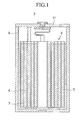
- FIGURE 1 is a schematic view of a representative structure of a rechargeable lithium battery.
- the rechargeable lithium battery 3 is a prismatic battery which includes an electrode assembly 4 in a battery case 8, an electrolyte implanted (or injected or filled) to the upper portion of the case 8, and a cap plate 11 sealing the case 8.
- the electrode assembly 4 includes a positive electrode 5, a negative electrode 6 and a separator 7 positioned between the positive electrode 5 and negative electrode 6.
- the rechargeable lithium battery of the present invention is not limited to a prismatic type of a rechargeable lithium battery, and it may be formed in diverse forms such as a cylindrical form, a coin-type form, a pouch form as long as it includes the electrolyte for a rechargeable lithium battery and operates as a battery.
- An electrolyte was prepared by mixing ethylene carbonate, ethylmethyl carbonate and diethyl carbonate in a weight ratio of 3:2:5 (ethylene carbonate:ethylmethyl carbonate:diethyl carbonate), adding 1.3M LiPF 6 , and also adding 2 wt% of succinonitrile (SN), 2 wt% of 1,3-propane sultone (1,3-PS), 1 wt% of vinylethylene carbonate (VEC) based on the total weight of the electrolyte as additives.
- SN succinonitrile
- 1,3-PS 1,3-propane sultone
- VEC vinylethylene carbonate
- An electrolyte was prepared according to the same method as Preparation Example 1, except that succinonitrile (SN), 1,3-propane sultone (1,3-PS), and vinylethylene carbonate (VEC) were added in the ratios shown in the following Table 1 based on the total weight of the electrolyte.
- succinonitrile SN
- 1,3-propane sultone 1,3-PS
- vinylethylene carbonate VEC
- An electrolyte was prepared by mixing ethylene carbonate, ethylmethyl carbonate and diethylcarbonate in a weight ratio of 3:2:5 (ethylene carbonate:ethylmethyl carbonate:diethyl carbonate), and adding 1.3M LiPF 6 .
- An electrolyte was prepared according to the same method as Comparative Preparation Example 1, except that succinonitrile (SN), 1,3-propanesultone (1,3-PS), and vinylethylene carbonate (VEC) were selectively added in the ratios shown in the following Table 2 based on the total weight of the electrolyte.
- succinonitrile SN
- 1,3-propanesultone 1,3-PS
- VEC vinylethylene carbonate
- a positive active material slurry was prepared by mixing a LiCoO 2 positive active material, a polyvinylidenefluoride binder, and Super-P (MMM company) conductive material in a weight ratio of 94:3:3 (LiCoO 2 :polyvinylidenefluoride:Super-P) in a N-methyl pyrrolidone solvent.
- the upper surface of a 12 ⁇ m-thick aluminum current collector was uniformly dried and compressed to thereby fabricate a positive electrode.
- PAI polyamideimide
- prismatic battery cells were fabricated in a suitable method by using the positive electrode and the negative electrode fabricated in the above and the electrolytes prepared according to Preparation Examples 1 to 27, respectively.
- the fabricated prismatic battery cells were sequentially referred to as Examples 1 to 27.
- 453450 prismatic battery cells were fabricated in a conventional method by using the positive electrodes and the negative electrodes fabricated in the Examples 1 to 27 and the electrolytes prepared according to Comparative Preparation Examples 1 to 98, respectively.
- the fabricated prismatic battery cells were sequentially referred to as Comparative Examples 1 to 98.
- Battery cells fabricated according to Examples 1 to 27 and Comparative Examples 1 to 98 were charged at 0.2 C and discharged at 0.2C one time, which is called a formation process, and charged at 0.5C and discharged at 0.2C one time, which is called a standard process.
- the standard capacities were the discharge capacities of the standard process and the measured standard capacities were as shown in the following Table 3.
- the battery cells fabricated according to Examples 1 to 27 and Comparative Examples 1 to 98 were charged at 0.5C at a charge potential of 4.35V and a discharge potential of 2.5V, stored in an oven at 60°C for 4 weeks, discharged at 0.2C, and then their capacity retention relative to standard capacity was measured. The results were shown in the following Table 3.
- Example 1 2 2 1400 85 Example 2 2 2 1400 87 Example 3 2 2 3 1400 83 Example 4 2 4 1 1400 84 Example 5 2 4 2 1400 88 Example 6 2 4 3 1400 86 Example 7 2 6 1 1400 84 Example 8 2 6 2 1400 85 Example 9 2 6 3 1400 83 Example 10 4 2 1 1400 82 Example 11 4 2 2 1400 88 Example 12 4 2 3 1400 86 Example 13 4 4 1 1400 88 Example 14 4 4 2 1400 89 Example 15 4 4 3 1400 85 Example 16 4 6 1 1400 81 Example 17 4 6 2 1400 83 Example 18 4 6 3 1400 83 Example 19 6 2 1 1400 83 Example 20 6 2 2 1400 84 Example 21 6 2 3 1400 85 Example 22 6 4 1 1400 85 Example 23 6 4 2 1400 84 Example 24 6 4 3 1400
- Table 3 shows that the battery cells of Comparative Examples 74 to 97, which included 8 wt% of succinonitrile, showed a decrease of standard capacity by 5mAh. Also, the battery cell of Comparative Example 98, which included 8wt% of succinonitrile, 8 wt% of 1,3-propane sultone, and 4 wt% of vinylethylene carbonate, showed a decrease of standard capacity by 10mAh. In contrast, the battery cells of Examples 1 to 27 all did not have their standard capacity decreased.
- the battery cells of Comparative Examples 1 to 98 had their capacity retention relative to standard capacity deteriorated from 50% to 65% after stored at 60°C for 4 weeks.
- the battery cells of Examples 1 to 27 had their capacity retention relative to standard capacity improved from 81% to 89% after stored at 60°C for 4 weeks.
- the rechargeable lithium battery does not have its standard capacity decreased and has high capacity retention when stored at high temperature, which are all desired rechargeable lithium battery performances.
Landscapes
- Chemical & Material Sciences (AREA)
- Chemical Kinetics & Catalysis (AREA)
- Electrochemistry (AREA)
- General Chemical & Material Sciences (AREA)
- Inorganic Chemistry (AREA)
- Engineering & Computer Science (AREA)
- Manufacturing & Machinery (AREA)
- General Physics & Mathematics (AREA)
- Condensed Matter Physics & Semiconductors (AREA)
- Physics & Mathematics (AREA)
- Materials Engineering (AREA)
- Secondary Cells (AREA)
- Battery Electrode And Active Subsutance (AREA)
Abstract
Description
- The present invention relates to an electrolyte for a rechargeable lithium battery including an additive and a rechargeable lithium battery including the same.
- Lithium rechargeable batteries have recently drawn attention as a power source of small portable electronic devices. They use an organic electrolyte solution and thereby have twice the discharge voltage of a conventional battery using an alkali aqueous solution, and accordingly have high energy density.
- As for negative active materials of a rechargeable lithium battery, various carbon-based materials such as artificial graphite, natural graphite, and hard carbon, which can all intercalate and deintercalate lithium ions, have been used.
- For positive active materials of a rechargeable lithium battery, compounds that are composite metal oxides such as LiCoO2, LiMn2O4, LiNiO2, LiNi1-xCoxO2 (0<x<1), LiMnO2, and the like have been researched.
- For an electrolyte, a lithium salt dissolved in a non-aqueous solvent including ethylene carbonate, dimethyl carbonate, diethyl carbonate, and the like has been used.
- During the initial charge of a rechargeable lithium battery, lithium ions, which are released from the lithium-transition metal oxide positive electrode of the battery, are transferred to a carbon negative electrode where the ions are intercalated into the carbon. Because of its high reactivity, lithium reacts with the carbon negative electrode to produce Li2CO3, LiO, LiOH, etc., thereby forming a thin film on the surface of the negative electrode. This film is referred to as an organic solid electrolyte interface (SEI) film. The organic SEI film formed during the initial charge not only blocks (or prevents) the reaction between lithium ions and the carbon negative electrode or other materials during charging and discharging, but it also acts as an ion tunnel, allowing the passage of only lithium ions. The ion tunnel blocks (or prevents) the disintegration of the structure of the carbon negative electrode, which causes organic solvents in an electrolyte with a high molecular weight to make solvate lithium ions, and the solvent and the solvated lithium ions co-intercalate into the carbon negative electrode. Once the organic SEI film is formed, lithium ions do not again react with the carbon electrode or other materials such that an amount of lithium ions is reversibly maintained.
- However, problems may occur in which gases are generated inside the battery using carbonate-based organic solvents due to decomposition of a carbonate based organic solvent during the organic SEI film-forming reaction. These gases include H2, CO, CO2, CH4, C2H6, C3H8, C3H6, etc. depending on the type of non-aqueous organic solvent and negative active material used. Due to gas generation inside the battery, battery may be expanded during charge. In addition, a SEI film is slowly disintegrated by electrochemical energy and heat energy, which increase with the passage of time when the fully charged battery is stored at high temperatures after it is charged, for example, if it is stored at 85□ for four days after a 100% charge at 4.2 V. Accordingly, a side reaction in which an exposed surface of the negative electrode reacts with surrounding electrolytes occurs continuously to generate gases. The internal pressure of the battery increases with this generation of gases.
- Therefore, there is a need to develop an electrolyte additive to suppress an internal pressure increase by preventing or reducing this generation of gases during SEI film-forming reactions, and also to improve capacity retention at a high temperature.
- According to a first aspect of the present invention, an electrolyte for a rechargeable lithium battery is provided that includes a non-aqueous organic solvent, a lithium salt, and an electrolyte additive. The electrolyte additive includes 2 to 6 wt% of succinonitrile, 2 to 6 wt% of alkane sultone, and 1 to 3 wt% of vinylethylene carbonate based on the total weight of the electrolyte.
- The electrolyte additive for the rechargeable lithium battery may include 35 to 300 parts by weight of the alkane sultone, 20 to 150 parts by weight of the vinylethylene carbonate based on 100 parts by weight of the succinonitrile.
- The alkane sultone may be one selected from the group consisting of 1,3-propane sultone, butane sultone, 1,3-(1-propene sultone) (prop-1-ene-1,3-sultone), and combinations thereof.
- According to a second aspect of the present invention, a rechargeable lithium battery is provided that includes a positive electrode including a positive active material, a negative electrode including a negative active material, and the electrolyte according to the first aspect of the present invention.
- The positive active material may be selected from the compounds represented by the following formulae:
LiaA1-bDbE2 wherein, in the above formula, 0.90 ≤ a ≤ 1.8, and 0 ≤ b ≤ 0.5); LiaG1-bDbO2-cEc wherein, in the above formula, 0.90 ≤ a ≤ 1.8, 0 ≤ b ≤ 0.5, and 0 ≤ c ≤ 0.05); LiG2-bDbO4-cEc wherein, in the above formula, 0 ≤ b ≤ 0.5, and 0 ≤ c ≤ 0.05; LiaNi1-b-cCobDcEα wherein, in the above formula, 0.90 ≤ a ≤1.8, 0 ≤ b ≤ 0.5, 0 ≤ c ≤ 0.05, and 0 < α ≤ 2; LiaNi1-b-cCobDc02-αJα wherein, in the above formula, 0.90 ≤ a ≤ 1.8, 0 ≤ b ≤ 0.5, 0 ≤ c ≤ 0.05, and 0 < α < 2; LiaNi1-b-cCobDcO2-αJ2 wherein, in the above formula, 0.90 ≤ a ≤ 1.8, 0 ≤ b ≤ 0.5, 0 ≤ c ≤ 0.05, and 0 < α < 2; LiaNi1-b-cMnbDcEα wherein, in the above formula, 0.90 ≤ a ≤ 1.8, 0 ≤ b v 0.5, 0 ≤ c ≤ 0.05, and 0 ≤ a ≤ 2; LiaNi1-b-cMnbDcO2-αJα wherein, in the above formula, 0.90 ≤ a ≤ 1.8, 0 ≤ b ≤ 0.5, 0 ≤ c ≤ 0.05, and 0 < α < 2; LiaNi1-b-cMnbDcO2-αJ2 wherein, in the above formula, 0.90 ≤ a ≤ 1.8, 0 ≤ b ≤ 0.5, 0 ≤ c ≤ 0.05, and 0 < α < 2; LiaNibGcLdO2 wherein, in the above formula, 0.90 ≤ a ≤ 1.8, 0 ≤ b ≤ 0.9, 0 ≤ c ≤ 0.5, and 0.001 ≤ d ≤ 0.2; LiaNibGcO2 wherein, in the above formula, 0.90 ≤ a ≤ 1.8, 0 ≤ b ≤ 0.9, and 0 ≤ c ≤ 0.5; LiaNibCoeMndLe02 wherein, in the above formula, 0.90 ≤ a ≤ 1.8, 0 ≤ b ≤ 0.9, 0 ≤ c ≤ 0.5, 0 ≤ d ≤0.5, and 0.001 ≤ e ≤ 0.2; LiaNibCocMndO2 wherein, in the above formula, 0.90 ≤ a ≤ 1.8, 0 ≤ b ≤ 0.9, 0 ≤ c ≤ 0.5, and 0 ≤ d ≤0.5; LiaNiLbO2 wherein, in the above formula, 0.90 ≤ a ≤ 1.8, and 0.001 ≤ b ≤ 0.2; LiaCoLbO2 wherein, in the above formula, 0.90 ≤ a ≤ 1.8, and 0.001 ≤ b ≤ 0.2; LiaMnLbO2 wherein, in the above formula, 0.90 ≤ a ≤ 1.8, and 0.001 ≤ b ≤ 0.2; LiaMn2LbO4 wherein, in the above formula, 0.90 ≤ a ≤ 1.8, and 0.001 ≤ b ≤ 0.2; LiaMn2O4 wherein, in the above formula, 0.90 ≤ a ≤ 1.8; MO2; MS2; LiMS2; V2O5; LiV2Os; LiQO2; LiNiVO4; Li(3-f)T2(PO4)3 wherein, in the above formula, 0 ≤ f ≤ 2; Li(3-f)Fe2(PO4)3 wherein, in the above formula, 0 ≤ f ≤ 2; and LiFePO4. - In the above chemical formulae, A is selected from the group consisting of Ni, Co, Mn, and combinations thereof, D is selected from the group consisting of Al, Ni, Co, Mn, Cr, Fe, Mg, Sr, V, a rare earth element, and combinations thereof, E is selected from the group consisting of O, F, S, P, and combinations thereof, G is selected from the group consisting of Co, Mn, and combinations thereof, J is selected from the group consisting of F, S, P, and combinations thereof, L is selected from the group consisting of Mg, Ca, Sr, Ba, Ra, Sc, Y, Ti, Zr, Hf, Rf, V, Nb, Ta, Db, Cr, Mo, W, Sg, Tc, Re, Bh, Fe, Ru, Os, Hs, Rh, Ir, Pd, Pt, Cu, Ag, Au, Zn, Cd, B, Al, Ga, In, Tl, Si, Ge, Sn, P, As, Sb, Bi, S, Se, Te, Po, Mn, La, Ce, and combinations thereof, M is selected from the group consisting of Ti, Mo, Mn, and combinations thereof, Q is selected from the group consisting of Cr, V, Fe, Sc, Ti, Y, and combinations thereof, and T is selected from the group consisting of V, Cr, Mn, Co, Ni, Cu, and combinations thereof. In one embodiment, for the positive active material, LiCoO2 is preferable.
- The negative active material may include SiOx (0<x<2) or SiOx (0<x<2) coated with carbon.
- The rechargeable lithium battery may have a charge voltage of 4.3 V or higher. In one embodiment, the charge voltage may be between 4.3 V and 4.5 V.
- According to a third aspect of the present invention, there is provided a method of preparing an electrolyte for a rechargeable lithium battery, the method comprising: forming an electrolyte additive; and adding a lithium salt and the electrolyte additive to a non-aqueous organic solvent to form the electrolyte, wherein the electrolyte additive comprises 2 to 6 wt% of succinonitrile, 2 to 6 wt% of alkane sultone, and 1 to 3 wt% of vinylethylene carbonate based on the total weight of the electrolyte.
- According to a fourth aspect of the present invention, there is provided the use of an electrolyte additive comprising 2 to 6 wt% of succinonitrile, 2 to 6% of alkane sultone, and 1 to 3 % of vinylethylene carbonate based on the total weight of the electrolyte, in an electrolyte for a rechargeable lithium battery that includes a lithium salt and a non-aqueous organic solvent.
- Further embodiments of the present invention in any of its various aspects are as described below or as defined in the sub-claims.
- The electrolyte for a rechargeable lithium battery including an electrolyte additive for a rechargeable lithium battery in accordance with the present invention may have improved storage characteristics at high voltage and high temperature, to thereby improve the storage characteristics of the rechargeable lithium battery at high voltage and high temperature.
- A more complete appreciation of the present invention, and many of the attendant advantages thereof, will be readily apparent as the same becomes better understood by reference to the following detailed description when considered in conjunction with the accompanying drawings, wherein:
-
FIGURE 1 is a schematic view of a rechargeable lithium battery according to an embodiment of the present invention. - The electrolyte for a rechargeable lithium battery according to one aspect of the present invention includes a non-aqueous organic solvent, a lithium salt, and an electrolyte additive. The electrolyte additive includes 2 to 6 wt% of succinonitrile, 2 to 6 wt% of alkane sultone, and 1 to 3 wt% of vinylethylene carbonate based on the total weight of the electrolyte. When succinonitrile, alkane sultone and vinylethylene carbonate are included within the above amount ranges, the rechargeable lithium battery does not have any decrease in the standard capacity and has high capacity retention when it is stored at high pressure and high temperature.
- Also, the electrolyte additive of the rechargeable lithium battery may include 35 to 300 parts by weight of the alkane sultone and 20 to 150 parts by weight of the vinylethylene carbonate based on the 100 parts by weight of succinonitrile. When the succinonitrile, alkane sultone and vinylethylene carbonate are included within the above ranges, the rechargeable lithium battery including them does not have any decrease in standard capacity and has high capacity retention when it is stored at high pressure and high temperature.
- The alkane sultone may be a material selected from the group consisting of 1,3-propane sultone, butane sultone, 1,3-(1-propene sultone) and combinations thereof but is not limited thereto.
- In the electrolyte of a rechargeable lithium battery, the non-aqueous organic solvent acts as a medium for transmitting ions taking part in the electrochemical reaction of the battery. The non-aqueous organic solvent may include a carbonate-based, ester-based, ether-based, ketone-based, alcohol-based, and/or aprotic solvent.
- Non-limiting examples of the carbonate-based solvent include dimethyl carbonate (DMC), diethyl carbonate (DEC), dipropyl carbonate (DPC), methylpropyl carbonate (MPC), ethylpropyl carbonate (EPC), methylethyl carbonate (MEC), ethylmethyl carbonate (EMC), ethylene carbonate (EC), propylene carbonate (PC), butylene carbonate(BC), and the like. Non-limiting examples of the ester-based solvent include methyl acetate, ethyl acetate, n-propyl acetate, dimethyl acetate, methyl propinonate, ethyl propinonate, γ-butyrolactone, decanolide, valerolactone, mevalonolactone, caprolactone, and the like. Non-limiting examples of the ether-based solvent include dimethyl ether, dibutyl ether, tetraglyme, diglyme, dimethoxyethane, 2-methyltetrahydrofuran, tetrahydrofuran (THF), and the like. Non-limiting examples of the ketone-based solvent include cyclohexanone, and the like. Non-limiting examples of the alcohol-based solvent include ethyl alcohol, isopropyl alcohol, and the like. Non-limiting examples of the aprotic solvent include nitriles such as R-CN (wherein R is a C2 to C20 linear, branched, or cyclic hydrocarbon, and may include one or more double bonds, one or more aromatic rings, or one or more ether bonds), amides such as dimethylformamide, dimethylacetamide, dioxolanes such as 1,3-dioxolane, sulfolanes, cycloalkanes such as cyclohexane, and the like.
- The non-aqueous organic solvent may be used singularly or in a mixture. When the organic solvent is used in a mixture, a mixture ratio can be controlled in accordance with a desirable battery performance.
- The carbonate-based solvent may include a mixture of a cyclic carbonate and a linear carbonate. The cyclic carbonate and the chain carbonate are mixed together in the volume ratio between 1 : 1 and 1 : 9, and when the mixture is used as an electrolyte, the electrolyte performance may be enhanced.
- In addition, the electrolyte of the present invention may further include mixtures of carbonate-based solvents and aromatic hydrocarbon-based solvents. The carbonate-based solvents and the aromatic hydrocarbon-based solvents are, in one embodiment of the present invention, mixed together in the volume ratio between 1 : 1 and 30 : 1.
- The aromatic hydrocarbon-based organic solvent may be represented by the following Chemical Formula 1.

- In Chemical Formula 1, R1 to R6 are the same or different, and each independently hydrogen, a halogen, a C1 to C10 alkyl, a C1 to C10 haloalkyl, or combinations thereof. The aromatic hydrocarbon-based organic solvent may include, but is not limited to, a material selected from benzene, fluorobenzene, 1,2-difluorobenzene, 1,3-difluorobenzene, 1,4-difluorobenzene, 1,2,3-trifluorobenzene, 1,2,4-trifluorobenzene, chlorobenzene, 1,2-dichlorobenzene, 1,3-dichlorobenzene, 1,4-dichlorobenzene, 1,2,3-trichlorobenzene, 1,2,4-trichlorobenzene, iodobenzene, 1,2-diiodobenzene, 1,3-diiodobenzene, 1,4-diiodobenzene, 1,2,3-triiodobenzene, 1,2,4-triiodobenzene, toluene, fluorotoluene, 1,2-difluorotoluene, 1,3-difluorotoluene, 1,4-difluorotoluene, 1,2,3-ttifluorotoluene, 1,2,4-trifluorotoluene, chlorotoluene, 1,2-dichlorotoluene, 1,3-dichlorotoluene, 1,4-dichlorotoluene, 1,2,3-trichlorotoluene, 1,2,4-trichlorotoluene, iodotoluene, 1,2-diiodotoluene, 1,3-diiodotoluene, 1,4-diiodotoluene, 1,2,3-triiodotoluene, 1,2,4-triiodotoluene, xylene, and combinations thereof.
- The electrolyte may further include vinylene carbonate and/or an ethylene carbonate-based compound of Chemical Formula 2 in order to improve battery cycle-life.

- In Chemical Formula 2, R7 and R8 are the same or different, and can each independently be hydrogen; a halogen; a cyano (CN); a nitro (NO2); and/or a C1 to C5 fluoroalkyl, provided that both R7 and R8 are not hydrogen.
- Non-limiting examples of the ethylene carbonate-based compound include difluoroethylene carbonate, chloroethylene carbonate, dichloroethylene carbonate, bromoethylene carbonate, dibromoethylene carbonate, nitroethylene carbonate, cyanoethylene carbonate, fluoroethylene carbonate, and combinations thereof. The use amount of the additive for improving cycle life may be adjusted within a suitable range.
- The lithium salt supplies lithium ions in the battery, and operates a basic operation of a rechargeable lithium battery and improves lithium ion transport between positive and negative electrodes. Non-limiting examples of the lithium salt include a supporting salt selected from LiPF6, LiBF4, LiSbF6, LiAsF6, LiCF3SO3, LiN(SO2C2F5)2, Li(CF3SO2)2N, LiN(SO3C2F5)2, LiC4F9SO3, LiClO4, LiAlO4, LiAlO2, LiAlCl4, LiN(CxF2x+1SO2(CyF2y+1+SO2) where, x and y are natural numbers, LiCl, LiI, LiB(C2O4)2 (lithium bis(oxalato) borate, LiBOB), and combinations thereof. The lithium salt may be used at a 0.1 to 2.0M concentration, and in one embodiment, at a 0.5 to 2.0M concentration. When the lithium salt is included at the above concentration range, electrolyte performance and lithium ion mobility may be enhanced due to improved electrolyte conductivity and viscosity.
- According to another aspect of the present invention, a rechargeable lithium battery is provided that includes a positive electrode including a positive active material, a negative electrode including a negative active material, and an electrolyte according to the previous aspect of the present invention.
- The positive electrode includes a current collector and a positive active material layer including a positive active material positioned on the current collector.
- The positive active material includes lithiated intercalation compounds that reversibly intercalate and deintercalate lithium ions. The positive active material may include a composite oxide including a material selected from the group consisting of cobalt, manganese, nickel, and combinations thereof, as well as lithium. In one embodiment, the following lithium-containing compounds may be used, but are not limited thereto:
- LiaA1-bDbE2 wherein, in the above formula, 0.90 ≤ a ≤ 1.8, and 0 ≤ b ≤ 0.5); LiaG1-bDbO2-cEc wherein, in the above formula, 0.90 ≤ a ≤ 1.8, 0 ≤ b ≤ 0.5, and 0 ≤ c ≤ 0.05); LiG2-bDbO4-cEc wherein, in the above formula, 0 ≤ b ≤ 0.5, and 0 ≤ c ≤ 0.05; LiaNi1-b-cCobDcEα wherein, in the above formula, 0.90 ≤ a ≤ 1.8, 0 ≤ b ≤ 0.5, 0 ≤ c ≤ 0.05, and 0 < α ≤ 2; LiaNi1-b-cCobDcO2-αJα wherein, in the above formula, 0.90 ≤ a ≤ 1.8, 0 ≤ b ≤ 0.5, 0 ≤ c ≤ 0.05, and 0 < α < 2; LiaNi1-b-cCobDcO2-αJ2 wherein, in the above formula, 0.90 ≤ a ≤ 1.8, 0 ≤ b ≤ 0.5, 0 ≤ c ≤ 0.05, and 0 < α < 2; LiaNi1-b-cMnbDcEα wherein, in the above formula, 0.90 ≤ a ≤ 1.8, 0 ≤ b ≤ 0.5, 0 ≤ c ≤ 0.05, and 0 < α ≤ 2; LiaNi1-b-cMnbDcO2-αJα wherein, in the above formula, 0.90 ≤ a ≤ 1.8, 0 ≤ b ≤ 0.5, 0 ≤ c ≤ 0.05, and 0 < α < 2; LiaNi1-b-cMnbDcO2-αJ2 wherein, in the above formula, 0.90 ≤ a ≤ 1.8, 0 ≤ b ≤ 0.5, 0 ≤ c ≤ 0.05, and 0 < α < 2; LiaNibGcLdO2 wherein, in the above formula, 0.90 ≤ a ≤ 1.8, 0 ≤ b ≤ 0.9, 0 ≤ c ≤ 0.5, and 0.001 ≤ d ≤ 0.2; LiaNibGcO2 wherein, in the above formula, 0.90 ≤ a ≤ 1.8, 0 ≤ b ≤ 0.9, and 0 ≤ c ≤ 0.5; LiaNibCocMndLeO2 wherein, in the above formula, 0.90 ≤ a ≤ 1.8, 0 ≤ b ≤ 0.9, 0 ≤ c ≤ 0.5, 0 ≤ d ≤0.5, and 0.001 ≤ e ≤ 0.2; LiaNibCocMndO2 wherein, in the above formula, 0.90 ≤ a ≤ 1.8, 0 ≤ b ≤ 0.9, 0 ≤ c ≤ 0.5, and 0 ≤ d ≤0.5; LiaNiLbO2 wherein, in the above formula, 0.90 ≤ a ≤ 1.8, and 0.001 ≤ b ≤ 0.2; LiaColbO2 wherein, in the above formula, 0.90 ≤ a ≤ 1.8, and 0.001 ≤ b ≤ 0.2; LiaMnLbO2 wherein, in the above formula, 0.90 ≤ a ≤ 1.8, and 0.001 ≤ b ≤ 0.2; LiaMn2LbO4 wherein, in the above formula, 0.90 ≤ a ≤ 1.8, and 0.001 ≤ b ≤ 0.2; LiaMn2O4 wherein, in the above formula, 0.90 ≤ a ≤ 1.8; MO2; MS2; LiMS2; V2O5; LiV2O5; LiQO2; LiNiVO4; Li(3-f)T2(PO4)3 wherein, in the above formula, 0 ≤ f ≤ 2; Li(3-f)Fe2(PO4)3 wherein, in the above formula, 0 ≤ f ≤ 2; and LiFePO4.
- In the above chemical formulae, A is selected from the group consisting of Ni, Co, Mn, and combinations thereof, D is selected from the group consisting of Al, Ni, Co, Mn, Cr, Fe, Mg, Sr, V, a rare earth element, and combinations thereof, E is selected from the group consisting of O, F, S, P, and combinations thereof, G is selected from the group consisting of Co, Mn, and combinations thereof, J is selected from the group consisting of F, S, P, and combinations thereof, L is selected from the group consisting of Mg, Ca, Sr, Ba, Ra, Sc, Y, Ti, Zr, Hf, Rf, V, Nb, Ta, Db, Cr, Mo, W, Sg, Tc, Re, Bh, Fe, Ru, Os, Hs, Rh, Ir, Pd, Pt, Cu, Ag, Au, Zn, Cd, B, Al, Ga, In, Tl, Si, Ge, Sn, P, As, Sb, Bi, S, Se, Te, Po, Mn, La, Ce, and combinations thereof, M is selected from the group consisting of Ti, Mo, Mn, and combinations thereof, Q is selected from the group consisting of Cr, V, Fe, Sc, Ti, Y, and combinations thereof, and T is selected from the group consisting of V, Cr, Mn, Co, Ni, Cu, and combinations thereof.
- In one embodiment, for the positive active material, LiCoO2 is preferable. When the positive active material includes LiCoO2, the rechargeable lithium battery including an electrolyte additive may have more improved storage characteristics at high voltage and high temperature.
- The positive active material may include the positive active material with the coating layer, or a compound of the active material and the active material coated with the coating layer. The coating layer may include a coating element compound selected from the group consisting of an oxide of the coating element and a hydroxide of the coating element, an oxyhydroxide of the coating element, an oxycarbonate of the coating element, a hydroxycarbonate of the coating element, and combinations thereof. The compound for the coating layer may be either amorphous or crystalline. The coating element included in the coating layer may be selected from the group consisting of Mg, Al, Co, K, Na, Ca, Si, Ti, V, Sn, Ge, Ga, B, As, Zr, and combinations thereof. The coating process may include any suitable processes as long as it does not cause any side effects on the properties of the positive active material (e.g., spray coating, immersing), which is known to persons having ordinary skill in this art, so a detailed description thereof is not provided.
- The positive active material layer further includes a binder and a conductive material.
- The binder improves binding properties of the positive active material particles to each other and to a current collector. Examples of the binder include a material selected from the group consisting of polyvinyl alcohol, carboxylmethyl cellulose, hydroxypropyl cellulose, diacetyl cellulose, polyvinylchloride, carboxylated polyvinylchloride, polyvinylfluoride, an ethylene oxide-containing polymer, polyvinylpyrrolidone, polyurethane, polytetrafluoroethylene, polyvinylidenefluoride, polyethylene, polypropylene, styrene-butadiene rubber, acrylated styrene-butadiene rubber, an epoxy resin, nylon, and the like, and combinations thereof, but is not limited thereto.
- The conductive material improves electrical conductivity of a negative electrode. Any electrically conductive material can be used as a conductive agent unless it causes a chemical change. Examples of the conductive material include a material selected from natural graphite, artificial graphite, carbon black, Super-P (MMM company), acetylene black, ketjen black, hard carbon obtained through sintering at a high temperature), soft carbon (carbon obtained through sintering at a low temperature), carbon fiber, a metal powder or a metal fiber including copper, nickel, aluminum, silver, and the like, polyphenylene derivative, and the like, and combinations thereof.
- The current collector may be Al, but is not limited thereto.
- The negative electrode includes a current collector and a negative active material layer disposed thereon. The negative active material layer includes a negative active material.
- The negative active material includes a material that reversibly intercalates/deintercalates lithium ions, a lithium metal, a lithium metal alloy, a material capable of doping (and/or undoping) lithium, and/or a transition metal oxide.
- The material that can reversibly intercalate/deintercalate lithium ions includes a carbon material. The carbon material may be any suitable carbon-based negative active material in a lithium ion rechargeable battery. Examples of the carbon material include crystalline carbon, amorphous carbon, and mixtures thereof. The crystalline carbon may be non-shaped, or sheet, flake, spherical, or fiber shaped natural graphite or artificial graphite. The amorphous carbon may be a soft carbon, a hard carbon, mesophase pitch carbide, fired coke, and the like.
- Examples of the lithium metal alloy include lithium and a metal selected from the group consisting of Na, K, Rb, Cs, Fr, Be, Mg, Ca, Sr, Si, Sb, Pb, In, Zn, Ba, Ra, Ge, Al, Sn, Ti, Ag, Cd, Ga, Bi, and combinations thereof.
- Examples of the material capable of doping lithium include Si, SiOx (0 < x < 2), a Si-Y alloy (where Y is an element selected from the group consisting of an alkali metal, an alkaline-earth metal, a group 13 element, a group 14 element, a transition element, a rare earth element, and combinations thereof, and is not Si), Sn, SnO2, a Sn-Y alloy (where Y is an element selected from the group consisting of an alkali metal, an alkaline-earth metal, a group 13 element, a group 14 element, a transition element, a rare earth element, and combinations thereof and is not Sn), or mixtures thereof. At least one of these materials may be mixed with SiO2. In addition, carbon may be further deposited on the surface of the material capable of doping lithium. Coating the surface of the above materials with carbon may be performed by decomposing such organic materials as ethylene, tetrahydrofuran (THF), and cyclohexanone at high temperature of 800°C or higher in vacuum in the presence of the above materials, but is not limited thereto. The element Y can be selected from the group consisting of Mg, Ca, Sr, Ba, Ra, Sc, Y, Ti, Zr, Hf, Rf, V, Nb, Ta, Db, Cr, Mo, W, Sg, Tc, Re, Bh, Fe, Pb, Ru, Os, Hs, Rh, Ir, Pd, Pt, Cu, Ag, Au, Zn, Cd, B, Al, Ga, Sn, In, Ti, Ge, P, As, Sb, Bi, S, Se, Te, Po, and combinations thereof.
- Examples of the transition metal oxide include vanadium oxide, lithium vanadium oxide, and the like.
- The negative active material layer includes a binder, and optionally a conductive material.
- The binder improves binding properties of negative active material particles with one another and with a current collector. Examples of the binder include at least one selected from the group consisting of polyvinyl alcohol, carboxylmethyl cellulose, hydroxypropyl cellulose, polyvinyl chloride, carboxylated polyvinylchloride, polyvinylfluoride, an ethylene oxide-containing polymer, polyvinylpyrrolidone, polyurethane, polytetrafluoroethylene, polyvinylidene fluoride, polyethylene, polypropylene, a styrene-butadiene rubber, an acrylated styrene-butadiene rubber, an epoxy resin, nylon, and the like, but are not limited thereto.
- The conductive material is included to improve electrode conductivity. Any electrically conductive material may be used as a conductive material unless it causes a chemical change. Examples of the conductive material include carbon-based materials such as natural graphite, artificial graphite, carbon black, Super-P (MMM company), acetylene black, ketjen black, hard carbon, soft carbon, carbon fiber, and the like; metal-based materials of metal powder or metal fiber including copper, nickel, aluminum, silver, and the like; conductive polymers such as polyphenylene derivatives; or mixtures thereof.
- The current collector may be selected from the group consisting of a copper foil, a nickel foil, a stainless steel foil, a titanium foil, a nickel foam, a copper foam, a polymer substrate coated with a conductive metal, and combinations thereof.
- The positive and negative electrodes may be fabricated by a method including mixing the active material, a conductive material, and a binder into an active material composition and coating the composition on a current collector. The electrode manufacturing method is known, and thus is not described in more detail in the present specification. The solvent can be N-methylpyrrolidone but it is not limited thereto.
- The charge voltage of the rechargeable lithium battery may be equal to or higher than 4.3V. In one embodiment, it may be between 4.3V and 4.5V, but is not limited thereto. The rechargeable lithium battery including the electrolyte additive for a rechargeable lithium battery according to an embodiment of the present invention may efficiently operate at a high charge voltage of the above-mentioned range.
- The rechargeable lithium battery may further include a separator between a negative electrode and a positive electrode, as needed. Non-limiting examples of suitable separator materials include polyethylene, polypropylene, polyvinylidene fluoride, and multi-layers thereof such as a polyethylene/polypropylene double-layered separator, a polyethylene/polypropylene/polyethylene triple-layered separator, and a polypropylene/polyethylene/polypropylene triple-layered separator.
- Rechargeable lithium batteries may be classified as lithium ion batteries, lithium ion polymer batteries, and lithium polymer batteries according to the presence of a separator and the kind of electrolyte used therein. The rechargeable lithium batteries may have a variety of shapes and sizes, and include cylindrical, prismatic, coin, or pouch-type batteries, and may be thin film batteries or may be rather bulky in size. Structures and fabricating methods for lithium ion batteries pertaining to the present invention are known in the art.
-
FIGURE 1 is a schematic view of a representative structure of a rechargeable lithium battery. - Referring to
FIGURE 1 , therechargeable lithium battery 3 is a prismatic battery which includes anelectrode assembly 4 in abattery case 8, an electrolyte implanted (or injected or filled) to the upper portion of thecase 8, and acap plate 11 sealing thecase 8. Theelectrode assembly 4 includes apositive electrode 5, a negative electrode 6 and aseparator 7 positioned between thepositive electrode 5 and negative electrode 6. The rechargeable lithium battery of the present invention is not limited to a prismatic type of a rechargeable lithium battery, and it may be formed in diverse forms such as a cylindrical form, a coin-type form, a pouch form as long as it includes the electrolyte for a rechargeable lithium battery and operates as a battery. - An electrolyte was prepared by mixing ethylene carbonate, ethylmethyl carbonate and diethyl carbonate in a weight ratio of 3:2:5 (ethylene carbonate:ethylmethyl carbonate:diethyl carbonate), adding 1.3M LiPF6, and also adding 2 wt% of succinonitrile (SN), 2 wt% of 1,3-propane sultone (1,3-PS), 1 wt% of vinylethylene carbonate (VEC) based on the total weight of the electrolyte as additives.
- An electrolyte was prepared according to the same method as Preparation Example 1, except that succinonitrile (SN), 1,3-propane sultone (1,3-PS), and vinylethylene carbonate (VEC) were added in the ratios shown in the following Table 1 based on the total weight of the electrolyte.
Table 1 SN
(wt%)1,3-PS
(wt%)VEC
(wt%)Preparation Example 1 2 2 1 Preparation Example 2 2 2 2 Preparation Example 3 2 2 3 Preparation Example 4 2 4 1 Preparation Example 5 2 4 2 Preparation Example 6 2 4 3 Preparation Example 7 2 6 1 Preparation Example 8 2 6 2 Preparation Example 9 2 6 3 Preparation Example 10 4 2 1 Preparation Example 11 4 2 2 Preparation Example 12 4 2 3 Preparation Example 13 4 4 1 Preparation Example 14 4 4 2 Preparation Example 15 4 4 3 Preparation Example 16 4 6 1 Preparation Example 17 4 6 2 Preparation Example 18 4 6 3 Preparation Example 19 6 2 1 Preparation Example 20 6 2 2 Preparation Example 21 6 2 3 Preparation Example 22 6 4 1 Preparation Example 23 6 4 2 Preparation Example 24 6 4 3 Preparation Example 25 6 6 1 Preparation Example 26 6 6 2 Preparation Example 27 6 6 3 - An electrolyte was prepared by mixing ethylene carbonate, ethylmethyl carbonate and diethylcarbonate in a weight ratio of 3:2:5 (ethylene carbonate:ethylmethyl carbonate:diethyl carbonate), and adding 1.3M LiPF6.
- An electrolyte was prepared according to the same method as Comparative Preparation Example 1, except that succinonitrile (SN), 1,3-propanesultone (1,3-PS), and vinylethylene carbonate (VEC) were selectively added in the ratios shown in the following Table 2 based on the total weight of the electrolyte.
Table 2 SN
(wt%)1,3-PS
(wt%)VEC
(wt%)Comparative Preparation Example 1 0 0 0 Comparative Preparation Example 2 0 0 1 Comparative Preparation Example 3 0 0 2 Comparative Preparation Example 4 0 0 3 Comparative Preparation Example 5 0 0 4 Comparative Preparation Example 6 0 2 0 Comparative Preparation Example 7 0 2 1 Comparative Preparation Example 8 0 2 2 Comparative Preparation Example 9 0 2 3 Comparative Preparation Example 10 0 2 4 Comparative Preparation Example 11 0 4 0 Comparative Preparation Example 12 0 4 1 Comparative Preparation Example 13 0 4 2 Comparative Preparation Example 14 0 4 3 Comparative Preparation Example 15 0 4 4 Comparative Preparation Example 16 0 6 0 Comparative Preparation Example 17 0 6 1 Comparative Preparation Example 18 0 6 2 Comparative Preparation Example 19 0 6 3 Comparative Preparation Example 20 0 6 4 Comparative Preparation Example 21 0 8 0 Comparative Preparation Example 22 0 8 1 Comparative Preparation Example 23 0 8 2 Comparative Preparation Example 24 0 8 3 Comparative Preparation Example 25 0 8 4 Comparative Preparation Example 26 2 0 0 Comparative Preparation Example 27 2 0 1 Comparative Preparation Example 28 2 0 2 Comparative Preparation Example 29 2 0 3 Comparative Preparation Example 30 2 0 4 Comparative Preparation Example 31 2 2 0 Comparative Preparation Example 32 2 2 4 Comparative Preparation Example 33 2 4 0 Comparative Preparation Example 34 2 4 4 Comparative Preparation Example 35 2 6 0 Comparative Preparation Example 36 2 6 4 Comparative Preparation Example 37 2 8 0 Comparative Preparation Example 38 2 8 1 Comparative Preparation Example 39 2 8 2 Comparative Preparation Example 40 2 8 3 Comparative Preparation Example 41 2 8 4 Comparative Preparation Example 42 4 0 0 Comparative Preparation Example 43 4 0 1 Comparative Preparation Example 44 4 0 2 Comparative Preparation Example 45 4 0 3 Comparative Preparation Example 46 4 0 4 Comparative Preparation Example 47 4 2 0 Comparative Preparation Example 48 4 2 4 Comparative Preparation Example 49 4 4 0 Comparative Preparation Example 50 4 4 4 Comparative Preparation Example 51 4 6 0 Comparative Preparation Example 52 4 6 4 Comparative Preparation Example 53 4 8 0 Comparative Preparation Example 54 4 8 1 Comparative Preparation Example 55 4 8 2 Comparative Preparation Example 56 4 8 3 Comparative Preparation Example 57 4 8 4 Comparative Preparation Example 58 6 0 0 Comparative Preparation Example 59 6 0 1 Comparative Preparation Example 60 6 0 2 Comparative Preparation Example 61 6 0 3 Comparative Preparation Example 62 6 0 4 Comparative Preparation Example 63 6 2 0 Comparative Preparation Example 64 6 2 4 Comparative Preparation Example 65 6 4 0 Comparative Preparation Example 66 6 4 4 Comparative Preparation Example 67 6 6 0 Comparative Preparation Example 68 6 6 4 Comparative Preparation Example 69 6 8 0 Comparative Preparation Example 70 6 8 1 Comparative Preparation Example 71 6 8 2 Comparative Preparation Example 72 6 8 3 Comparative Preparation Example 73 6 8 4 Comparative Preparation Example 74 8 0 0 Comparative Preparation Example 75 8 0 1 Comparative Preparation Example 76 8 0 2 Comparative Preparation Example 77 8 0 3 Comparative Preparation Example 78 8 0 4 Comparative Preparation Example 79 8 2 0 Comparative Preparation Example 80 8 2 1 Comparative Preparation Example 81 8 2 2 Comparative Preparation Example 82 8 2 3 Comparative Preparation Example 83 8 2 4 Comparative Preparation Example 84 8 4 0 Comparative Preparation Example 85 8 4 1 Comparative Preparation Example 86 8 4 2 Comparative Preparation Example 87 8 4 3 Comparative Preparation Example 88 8 4 4 Comparative Preparation Example 89 8 6 0 Comparative Preparation Example 90 8 6 1 Comparative Preparation Example 91 8 6 2 Comparative Preparation Example 92 8 6 3 Comparative Preparation Example 93 8 6 4 Comparative Preparation Example 94 8 8 0 Comparative Preparation Example 95 8 8 1 Comparative Preparation Example 96 8 8 2 Comparative Preparation Example 97 8 8 3 Comparative Preparation Example 98 8 8 4 - A positive active material slurry was prepared by mixing a LiCoO2 positive active material, a polyvinylidenefluoride binder, and Super-P (MMM company) conductive material in a weight ratio of 94:3:3 (LiCoO2:polyvinylidenefluoride:Super-P) in a N-methyl pyrrolidone solvent. The upper surface of a 12µm-thick aluminum current collector was uniformly dried and compressed to thereby fabricate a positive electrode.
- A negative active material was prepared by decomposing ethylene gas at a temperature of 900°C in vacuum in the presence of silicon oxide (SiOx, x=1) to thereby deposit carbon on the surface of the silicon oxide surface and coat the silicon oxide surface with the carbon. A negative active material slurry was prepared by mixing the silicon oxide (SiOx, x=1) negative active material coated with carbon with polyamideimide(PAI) binder in a weight ratio of 90:10 (silicon oxide coated with carbon:polyamideimide) in N-methylpyrrolidone solvent. A 12µm-thick copper current collector was uniformly coated with the negative active material slurry, dried, and compressed to thereby fabricate a negative electrode.
- 553450 prismatic battery cells were fabricated in a suitable method by using the positive electrode and the negative electrode fabricated in the above and the electrolytes prepared according to Preparation Examples 1 to 27, respectively. The fabricated prismatic battery cells were sequentially referred to as Examples 1 to 27.
- 553450 prismatic battery cells were fabricated in a conventional method by using the positive electrodes and the negative electrodes fabricated in the Examples 1 to 27 and the electrolytes prepared according to Comparative Preparation Examples 1 to 98, respectively. The fabricated prismatic battery cells were sequentially referred to as Comparative Examples 1 to 98.
- Battery cells fabricated according to Examples 1 to 27 and Comparative Examples 1 to 98 were charged at 0.2 C and discharged at 0.2C one time, which is called a formation process, and charged at 0.5C and discharged at 0.2C one time, which is called a standard process. The standard capacities were the discharge capacities of the standard process and the measured standard capacities were as shown in the following Table 3.
- The battery cells fabricated according to Examples 1 to 27 and Comparative Examples 1 to 98 were charged at 0.5C at a charge potential of 4.35V and a discharge potential of 2.5V, stored in an oven at 60°C for 4 weeks, discharged at 0.2C, and then their capacity retention relative to standard capacity was measured. The results were shown in the following Table 3.
Table 3 SN
(wt%)1,3-PS
(wt%)VEC
(wt%)Standard
capacity
(mAh)Capacity retention
after storage at 60°C
for 4 weeks relative
to standard capacity (%)Example 1 2 2 1 1400 85 Example 2 2 2 2 1400 87 Example 3 2 2 3 1400 83 Example 4 2 4 1 1400 84 Example 5 2 4 2 1400 88 Example 6 2 4 3 1400 86 Example 7 2 6 1 1400 84 Example 8 2 6 2 1400 85 Example 9 2 6 3 1400 83 Example 10 4 2 1 1400 82 Example 11 4 2 2 1400 88 Example 12 4 2 3 1400 86 Example 13 4 4 1 1400 88 Example 14 4 4 2 1400 89 Example 15 4 4 3 1400 85 Example 16 4 6 1 1400 81 Example 17 4 6 2 1400 83 Example 18 4 6 3 1400 83 Example 19 6 2 1 1400 83 Example 20 6 2 2 1400 84 Example 21 6 2 3 1400 85 Example 22 6 4 1 1400 85 Example 23 6 4 2 1400 84 Example 24 6 4 3 1400 82 Example 25 6 6 1 1400 84 Example 26 6 6 2 1400 87 Example 27 6 6 3 1400 81 Comparative Example 1 0 0 0 1400 50 Comparative Example 2 0 0 1 1400 51 Comparative Example 3 0 0 2 1400 50 Comparative Example 4 0 0 3 1400 53 Comparative Example 5 0 0 4 1400 51 Comparative Example 6 0 2 0 1400 53 Comparative Example 7 0 2 1 1400 54 Comparative Example 8 0 2 2 1400 51 Comparative Example 9 0 2 3 1400 53 Comparative Example 10 0 2 4 1400 51 Comparative Example 11 0 4 0 1400 55 Comparative Example 12 0 4 1 1400 54 Comparative Example 13 0 4 2 1400 56 Comparative Example 14 0 4 3 1400 58 Comparative Example 15 0 4 4 1400 60 Comparative Example 16 0 6 0 1400 63 Comparative Example 17 0 6 1 1400 64 Comparative Example 18 0 6 2 1400 62 Comparative Example 19 0 6 3 1400 65 Comparative Example 20 0 6 4 1400 61 Comparative Example 21 0 8 0 1395 62 Comparative Example 22 0 8 1 1395 60 Comparative Example 23 0 8 2 1395 61 Comparative Example 24 0 8 3 1395 59 Comparative Example 25 0 8 4 1395 58 Comparative Example 26 2 0 0 1400 55 Comparative Example 27 2 0 1 1400 56 Comparative Example 28 2 0 2 1400 52 Comparative Example 29 2 0 3 1400 57 Comparative Example 30 2 0 4 1400 56 Comparative Example 31 2 2 0 1400 59 Comparative Example 32 2 2 4 1400 58 Comparative Example 33 2 4 0 1400 62 Comparative Example 34 2 4 4 1400 60 Comparative Example 35 2 6 0 1400 63 Comparative Example 36 2 6 4 1400 60 Comparative Example 37 2 8 0 1395 58 Comparative Example 38 2 8 1 1395 59 Comparative Example 39 2 8 2 1395 61 Comparative Example 40 2 8 3 1395 60 Comparative Example 41 2 8 4 1395 58 Comparative Example 42 4 0 0 1400 57 Comparative Example 43 4 0 1 1400 61 Comparative Example 44 4 0 2 1400 62 Comparative Example 45 4 0 3 1400 59 Comparative Example 46 4 0 4 1400 57 Comparative Example 47 4 2 0 1400 60 Comparative Example 48 4 2 4 1400 64 Comparative Example 49 4 4 0 1400 62 Comparative Example 50 4 4 4 1400 64 Comparative Example 51 4 6 0 1400 63 Comparative Example 52 4 6 4 1400 65 Comparative Example 53 4 8 0 1395 63 Comparative Example 54 4 8 1 1395 62 Comparative Example 55 4 8 2 1395 61 Comparative Example 56 4 8 3 1395 65 Comparative Example 57 4 8 4 1395 64 Comparative Example 58 6 0 0 1400 58 Comparative Example 59 6 0 1 1400 56 Comparative Example 60 6 0 2 1400 54 Comparative Example 61 6 0 3 1400 52 Comparative Example 62 6 0 4 1400 51 Comparative Example 63 6 2 0 1400 58 Comparative Example 64 6 2 4 1400 51 Comparative Example 65 6 4 0 1400 54 Comparative Example 66 6 4 4 1400 54 Comparative Example 67 6 6 0 1400 55 Comparative Example 68 6 6 4 1400 52 Comparative Example 69 6 8 0 1395 54 Comparative Example 70 6 8 1 1395 57 Comparative Example 71 6 8 2 1395 58 Comparative Example 72 6 8 3 1395 54 Comparative Example 73 6 8 4 1395 59 Comparative Example 74 8 0 0 1395 59 Comparative Example 75 8 0 1 1395 59 Comparative Example 76 8 0 2 1395 58 Comparative Example 77 8 0 3 1395 52 Comparative Example 78 8 0 4 1395 51 Comparative Example 79 8 2 0 1395 53 Comparative Example 80 8 2 1 1395 55 Comparative Example 81 8 2 2 1395 54 Comparative Example 82 8 2 3 1395 54 Comparative Example 83 8 2 4 1395 58 Comparative Example 84 8 4 0 1395 57 Comparative Example 85 8 4 1 1395 54 Comparative 8 Example 86 8 4 2 1395 52 Comparative Example 87 8 4 3 1395 54 Comparative Example 88 8 4 4 1395 55 Comparative Example 89 8 6 0 1395 52 Comparative Example 90 8 6 1 1395 54 Comparative Example 91 8 6 2 1395 56 Comparative Example 92 8 6 3 1395 58 Comparative Example 93 8 6 4 1395 52 Comparative Example 94 8 8 0 1395 51 Comparative Example 95 8 8 1 1395 53 Comparative Example 96 8 8 2 1395 59 Comparative Example 97 8 8 3 1395 57 Comparative Example 98 8 8 4 1390 54 - Table 3 shows that the battery cells of Comparative Examples 74 to 97, which included 8 wt% of succinonitrile, showed a decrease of standard capacity by 5mAh. Also, the battery cell of Comparative Example 98, which included 8wt% of succinonitrile, 8 wt% of 1,3-propane sultone, and 4 wt% of vinylethylene carbonate, showed a decrease of standard capacity by 10mAh. In contrast, the battery cells of Examples 1 to 27 all did not have their standard capacity decreased.
- Also, the battery cells of Comparative Examples 1 to 98 had their capacity retention relative to standard capacity deteriorated from 50% to 65% after stored at 60°C for 4 weeks. On the other hand, the battery cells of Examples 1 to 27 had their capacity retention relative to standard capacity improved from 81% to 89% after stored at 60°C for 4 weeks.
- In consequence, it is confirmed that when a rechargeable lithium battery including 2 to 6 wt% of succinonitrile, 2 to 6 wt% of alkane sultone, and 1 to 3 wt% of vinylethylene carbonate as electrolyte additives for a rechargeable lithium battery based on the total weight of the electrolyte in accordance with the present invention, the rechargeable lithium battery does not have its standard capacity decreased and has high capacity retention when stored at high temperature, which are all desired rechargeable lithium battery performances.
- While the present invention has been described in connection with certain exemplary embodiments thereof, it is to be understood that the invention is not limited to the disclosed embodiments, but, on the contrary, is intended to cover various modifications and equivalent arrangements included within the spirit and scope of the appended claims.
Claims (14)
- An electrolyte for a rechargeable lithium battery, comprising:a non-aqueous organic solvent;a lithium salt; andan electrolyte additive,wherein the electrolyte additive comprises 2 to 6 wt% of succinonitrile, 2 to 6 wt% of alkane sultone, and 1 to 3 wt% of vinylethylene carbonate based on the total weight of the electrolyte.
- The electrolyte of claim 1, wherein the electrolyte additive of the rechargeable lithium battery includes 35 to 300 parts by weight of the alkane sultone and 20 to 150 parts by weight of the vinylethylene carbonate based on 100 parts by weight of the succinonitrile.
- The electrolyte of claims 1 or 2, wherein the alkane sultone is selected from the group consisting of 1,3-propanesultone, butane sultone, 1,3-(1-propene sultone), and combinations thereof.
- A rechargeable lithium battery comprising:a positive electrode comprising a positive active material;a negative electrode comprising a negative active material; andan electrolyte as claimed in any one of claims 1 to 3.
- The rechargeable lithium battery of claim 4, wherein the positive active material is selected from the group consisting of compounds represented by the following chemical formulae:LiaA1-bDbE2 wherein, in LiaA1-bDbE2, 0.90 ≤ a ≤ 1.8, and 0 ≤ b ≤ 0.5; LiaG1-bDbO2-cEc wherein, in LiaG1-bDb02-cEc, 0.90 ≤ a ≤ 1.8, 0 ≤ b ≤ 0.5, and 0 ≤ c ≤ 0.05; LiG2-bDbO4-cEc wherein, in LiG2-bDbO4-cEc, 0 ≤ b ≤ 0.5, and 0 ≤ c ≤ 0.05; LiaNi1-b-cCobDcEα wherein, in LiaNi1-b-cCobDcEα, 0.90 ≤ a ≤1.8, 0 ≤ b ≤ 0.5, 0 ≤ c ≤ 0.05, and 0 < α ≤ 2; LiaNi1-b-cCobDcO2-αJα wherein, in LiaNi1-b-cCobDc02-αJα, 0.90 ≤ a ≤ 1.8, 0 ≤ b ≤ 0.5, 0 ≤ c ≤ 0.05, and 0 < α < 2; LiaNi1-b-cCobDc02-αJ2 wherein, in LiaNi1-b-cCobDcO2-αJ2, 0.90 ≤ a ≤ 1.8, 0 ≤ b ≤ 0.5, 0 ≤ c ≤ 0.05, and 0 < α < 2; LiaNi1-b-cMnbDcEα wherein, in LiaNi1-b-cMnbDcEα, 0.90 ≤ a ≤ 1.8, 0 ≤ b ≤ 0.5, 0 ≤ c ≤ 0.05, and 0 < α ≤ 2; LiaNi1-b-cMnbDcO2-αJα wherein, in LiaNi1-b-cMnbDcO2-αJα, 0.90 ≤ a ≤ 1.8, 0 ≤ b ≤ 0.5, 0 ≤ c ≤ 0.05, and 0 < α < 2; LiaNi1-b-cMnbDcO2-αJ2 wherein, in LiaNi1-b-cMnbDc02-αJ2, 0.90 ≤ a ≤ 1.8, 0 ≤ b ≤ 0.5, 0 ≤ c ≤ 0.05, and 0 < α < 2; LiaNibGcLdO2 wherein, in LiaNibGcLdO2, 0.90 ≤ a ≤ 1.8, 0 ≤ b ≤ 0.9, 0 ≤ c ≤ 0.5, and 0.001 ≤ d ≤ 0.2; LiaNibGcO2 wherein, in LiaNibGcO2, 0.90 ≤ a ≤ 1.8, 0 ≤ b ≤ 0.9, and 0 ≤ c ≤ 0.5; LiaNibCocMndLeO2 wherein, in LiaNibCocMndLeO2, 0.90 ≤ a ≤ 1.8, 0 ≤ b ≤ 0.9, 0 ≤ c ≤ 0.5, 0 ≤ d ≤0.5, and 0.001 ≤ e ≤ 0.2; LiaNibCocMndO2 wherein, in LiaNibCocMndO2, 0.90 ≤ a ≤ 1.8, 0 ≤ b ≤ 0.9, 0 ≤ c ≤ 0.5, and 0 ≤ d <0.5; LiaNiLbO2 wherein, in LiaNiLbO2, 0.90 ≤ a ≤ 1.8, and 0.001 ≤ b ≤ 0.2; LiaCoLbO2 wherein, in LiaCoLbO2, 0.90 ≤ a ≤ 1.8, and 0.001 ≤ b ≤ 0.2; LiaMnLbO2 wherein, in LiaMnLbO2, 0.90 ≤ a ≤ 1.8, and 0.001 ≤ b ≤ 0.2; LiaMn2LbO4 wherein, in LiaMn2LbO4, 0.90 ≤ a ≤ 1.8, and 0.001 ≤ b ≤ 0.2; LiaMn2O4 wherein, in LiaMn2O4, 0.90 ≤ a ≤ 1.8; MO2; MS2; LiMS2; V2O5; LiV2O5; LiQO2; LiNiVO4; Li(3-f)T2(PO4)3 wherein, in LiNiVO4; Li(3-f)T2(PO4)3, 0 ≤ f ≤ 2; Li(3-f)Fe2(PO4)3 wherein, in Li(3-f)Fe2(PO4)3, 0 ≤ f ≤ 2; and LiFePO4,wherein in the above chemical formulae, A is selected from the group consisting of Ni, Co, Mn, and combinations thereof, D is selected from the group consisting of Al, Ni, Co, Mn, Cr, Fe, Mg, Sr, V, a rare earth element, and combinations thereof, E is selected from the group consisting of O, F, S, P, and combinations thereof, G is selected from the group consisting of Co, Mn, and combinations thereof, J is selected from the group consisting of F, S, P, and combinations thereof, L is selected from the group consisting of Mg, Ca, Sr, Ba, Ra, Sc, Y, Ti, Zr, Hf, Rf, V, Nb, Ta, Db, Cr, Mo, W, Sg, Tc, Re, Bh, Fe, Ru, Os, Hs, Rh, Ir, Pd, Pt, Cu, Ag, Au, Zn, Cd, B, Al, Ga, In, Tl, Si, Ge, Sn, P, As, Sb, Bi, S, Se, Te, Po, Mn, La, Ce, and combinations thereof, M is selected from the group consisting of Ti, Mo, Mn, and combinations thereof, Q is selected from the group consisting of Cr, V, Fe, Sc, Ti, Y, and combinations thereof, and T is selected from the group consisting of V, Cr, Mn, Co, Ni, Cu, and combinations thereof.
- The rechargeable lithium battery of claims 4 or 5, wherein the positive active material is LiCoO2.
- The rechargeable lithium battery of claims 4, 5 or 6, wherein the negative active material is SiOx wherein, in SiOx, 0<x<2.
- The rechargeable lithium battery of claims 4, 5 or 6, wherein the negative active material is SiOx coated with carbon wherein, in SiOx, 0<x<2.
- The rechargeable lithium battery of any one of claims 4 to 8, wherein the rechargeable lithium battery had a charge voltage of 4.3V or higher.
- The rechargeable lithium battery of claim 9, wherein the rechargeable lithium battery has a charge voltage between 4.3V and 4.5 V.
- A method of preparing an electrolyte for a rechargeable lithium battery, the method comprising:forming an electrolyte additive; andadding a lithium salt and the electrolyte additive to a non-aqueous organic solvent to form the electrolyte,wherein the electrolyte additive comprises 2 to 6 wt% of succinonitrile, 2 to 6 wt% of alkane sultone, and 1 to 3 wt% of vinylethylene carbonate based on the total weight of the electrolyte.
- The method of claim 11, wherein the forming of the electrolyte additive comprises forming the electrolyte additive to include 35 to 300 parts by weight of the alkane sultone and 20 to 150 parts by weight of the vinylethylene carbonate based on 100 parts by weight of the succinonitrile.
- The method of claims 11 or 12, wherein the forming of the electrolyte additive comprises selecting 1,3-propanesultone, butane sultone, and/or 1,3-(1-propene sultone) as the alkane sultone.
- Use of an electrolyte additive comprising 2 to 6 wt% of succinonitrile, 2 to 6% of alkane sultone, and 1 to 3 % of vinylethylene carbonate based on the total weight of the electrolyte, in an electrolyte for a rechargeable lithium battery that includes a lithium salt and a non-aqueous organic solvent.
Applications Claiming Priority (1)
| Application Number | Priority Date | Filing Date | Title |
|---|---|---|---|
| KR1020090028104A KR101056441B1 (en) | 2009-04-01 | 2009-04-01 | Electrolyte for lithium secondary battery including additive and lithium secondary battery comprising same |
Publications (3)
| Publication Number | Publication Date |
|---|---|
| EP2237359A2 true EP2237359A2 (en) | 2010-10-06 |
| EP2237359A3 EP2237359A3 (en) | 2011-08-31 |
| EP2237359B1 EP2237359B1 (en) | 2012-10-03 |
Family
ID=42239835
Family Applications (1)
| Application Number | Title | Priority Date | Filing Date |
|---|---|---|---|
| EP09168334A Active EP2237359B1 (en) | 2009-04-01 | 2009-08-20 | Electrolyte including additives, and rechargeable lithium battery including the same |
Country Status (5)
| Country | Link |
|---|---|
| US (1) | US8389162B2 (en) |
| EP (1) | EP2237359B1 (en) |
| JP (1) | JP5263787B2 (en) |
| KR (1) | KR101056441B1 (en) |
| CN (2) | CN104600361A (en) |
Cited By (3)
| Publication number | Priority date | Publication date | Assignee | Title |
|---|---|---|---|---|
| EP2367230A1 (en) * | 2010-03-16 | 2011-09-21 | Samsung SDI Co., Ltd. | Electrolyte solution for rechargeable lithium battery, and rechargeable lithium battery including the same |
| CN102332607A (en) * | 2011-03-22 | 2012-01-25 | 东莞新能源科技有限公司 | A kind of electrolyte solution for non-aqueous secondary lithium battery |
| DE102013219320A1 (en) | 2013-09-25 | 2015-03-26 | Robert Bosch Gmbh | Means in a cell to increase longevity and safety |
Families Citing this family (32)
| Publication number | Priority date | Publication date | Assignee | Title |
|---|---|---|---|---|
| JP6167470B2 (en) * | 2010-11-30 | 2017-07-26 | 三菱ケミカル株式会社 | Non-aqueous electrolyte battery |
| WO2012077021A1 (en) * | 2010-12-09 | 2012-06-14 | Koninklijke Philips Electronics N.V. | Lighting apparatus for generating light |
| KR101297174B1 (en) * | 2011-02-09 | 2013-08-21 | 삼성에스디아이 주식회사 | Lithium secondary battery |
| KR101288973B1 (en) | 2011-05-04 | 2013-07-24 | 삼성전자주식회사 | Electrode active material, preparation method thereof, and electrode and lithium battery containing the same |
| CN102244296B (en) * | 2011-06-14 | 2016-06-22 | 东莞新能源科技有限公司 | Lithium ion battery and electrolyte thereof |
| US8642214B2 (en) * | 2011-08-25 | 2014-02-04 | Uchicago Argonne, Llc | Silicon-carbonaceous encapsulated materials |
| JP2014211948A (en) * | 2011-08-31 | 2014-11-13 | 三洋電機株式会社 | Nonaqueous electrolyte secondary battery |
| JP6253411B2 (en) * | 2011-12-19 | 2017-12-27 | マクセルホールディングス株式会社 | Lithium secondary battery |
| CN102709588B (en) * | 2012-01-12 | 2016-04-27 | 宁德新能源科技有限公司 | A kind of lithium ion battery and electrolyte thereof |
| CN104364943B (en) * | 2012-07-09 | 2017-03-29 | 株式会社Lg化学 | High-voltage cathode active material and preparation method thereof |
| JP6031861B2 (en) * | 2012-07-18 | 2016-11-24 | 三菱化学株式会社 | Non-aqueous electrolyte and non-aqueous electrolyte battery using the same |
| CN103035946A (en) * | 2012-12-27 | 2013-04-10 | 天津力神电池股份有限公司 | Non-aqueous electrolyte and lithium-ion secondary battery |
| WO2014147648A1 (en) | 2013-03-19 | 2014-09-25 | Council Of Scientic & Industrial Reserach | High-ionic conductivity electrolyte compositions comprising semi-interpenetrating polymer networks and their composites |
| CN103413971B (en) * | 2013-08-23 | 2016-04-06 | 轻工业化学电源研究所 | A kind of lithium-ion battery electrolytes |
| CN103730685B (en) * | 2013-12-17 | 2016-02-24 | 珠海汉格能源科技有限公司 | A kind of high-rate polymer lithium ion battery for electronic cigarette |
| JP6262635B2 (en) * | 2014-11-10 | 2018-01-17 | 信越化学工業株式会社 | Negative electrode material for non-aqueous electrolyte secondary battery, method for producing the same, and non-aqueous electrolyte secondary battery |
| CN104466248B (en) * | 2014-12-17 | 2017-06-16 | 东莞新能源科技有限公司 | A kind of electrolyte and the lithium ion battery using the electrolyte |
| CN104900915A (en) * | 2015-05-25 | 2015-09-09 | 宁德时代新能源科技有限公司 | Lithium-ion battery electrolyte and lithium-ion battery using same |
| US20180083316A1 (en) * | 2015-07-09 | 2018-03-22 | Shenzhen Capchem Technology Co., Ltd | Non-aqueous electrolyte for lithium-ion battery, and lithium-ion battery |
| US10903483B2 (en) | 2015-08-27 | 2021-01-26 | Wildcat Discovery Technologies, Inc | High energy materials for a battery and methods for making and use |
| CN105428715B (en) | 2015-11-04 | 2018-06-08 | 深圳新宙邦科技股份有限公司 | A kind of non-aqueous electrolyte for lithium ion cell and lithium ion battery |
| CN105470519A (en) * | 2015-11-25 | 2016-04-06 | 天津市捷威动力工业有限公司 | Low-temperature type lithium ion battery with high voltage and high volume energy density |
| CN110247114A (en) | 2015-12-18 | 2019-09-17 | 深圳新宙邦科技股份有限公司 | A kind of electrolyte for lithium ion battery and lithium ion battery |
| KR102617727B1 (en) | 2016-04-22 | 2023-12-26 | 삼성에스디아이 주식회사 | Organic electrolytic solution and Lithium battery comprising organic electrolyte solution |
| KR102095508B1 (en) | 2016-11-22 | 2020-03-31 | 주식회사 엘지화학 | Positive Electrode Active Material Particle Comprising Core Having Lithium Cobalt Oxide and Shell Having Lithium Cobalt Phosphate and Method of Manufacturing the Same |
| JP7071732B2 (en) * | 2018-02-23 | 2022-05-19 | 国立研究開発法人産業技術総合研究所 | Laminated body and its manufacturing method |
| KR102287332B1 (en) * | 2018-08-07 | 2021-08-06 | 삼성에스디아이 주식회사 | Electrolyte for rechargeable lithium battery and rechargeable lithium battery |
| JP7850969B2 (en) * | 2021-02-26 | 2026-04-24 | パナソニックIpマネジメント株式会社 | Non-aqueous secondary battery |
| KR20230031009A (en) * | 2021-08-26 | 2023-03-07 | 삼성에스디아이 주식회사 | Rechargeable lithium battery |
| KR20240050130A (en) * | 2022-10-11 | 2024-04-18 | 삼성에스디아이 주식회사 | Rechargeable lithium battery |
| CN115832433A (en) * | 2022-10-18 | 2023-03-21 | 珠海冠宇电池股份有限公司 | Electrolyte and battery comprising same |
| CN119725735A (en) * | 2023-09-28 | 2025-03-28 | 东莞新能源科技有限公司 | Secondary battery and electronic device |
Citations (6)
| Publication number | Priority date | Publication date | Assignee | Title |
|---|---|---|---|---|
| EP1276165A1 (en) | 2001-07-12 | 2003-01-15 | Japan Storage Battery Co., Ltd. | Nonaqueous secondary cell |
| US20040013946A1 (en) | 2002-07-15 | 2004-01-22 | Ube Industries, Ltd. | Non-aqueous electrolytic solution and lithium battery |
| KR20060114919A (en) | 2005-05-03 | 2006-11-08 | 주식회사 엘지화학 | Non-aqueous electrolyte and lithium secondary battery comprising the same to improve the performance |
| US20080220336A1 (en) | 2007-03-08 | 2008-09-11 | Samsung Sdi Co., Ltd. | Electrolyte for rechargeable lithium battery and rechargeable lithium battery comprising same |
| KR20090006691A (en) | 2007-07-12 | 2009-01-15 | 주식회사 엘지화학 | Non-aqueous electrolyte solution for lithium secondary batteries and lithium secondary battery containing same |
| KR20090039196A (en) | 2007-10-17 | 2009-04-22 | 주식회사 엘지화학 | Non-aqueous electrolyte solution for lithium secondary batteries and lithium secondary battery containing same |
Family Cites Families (15)
| Publication number | Priority date | Publication date | Assignee | Title |
|---|---|---|---|---|
| JPH07176322A (en) | 1993-12-21 | 1995-07-14 | Mitsubishi Cable Ind Ltd | Electrolytic solution for li secondary battery |
| JP4151060B2 (en) | 2001-11-14 | 2008-09-17 | 株式会社ジーエス・ユアサコーポレーション | Non-aqueous secondary battery |
| CA2568519A1 (en) | 2004-05-28 | 2005-12-08 | Ube Industries, Ltd. | Nonaqueous electrolyte solution and lithium secondary battery |
| US20060024584A1 (en) | 2004-05-28 | 2006-02-02 | Kim Dong M | Additives for lithium secondary battery |
| JP5095098B2 (en) | 2004-11-19 | 2012-12-12 | パナソニック株式会社 | Nonaqueous electrolyte secondary battery |
| WO2006070546A1 (en) | 2004-12-27 | 2006-07-06 | Ube Industries, Ltd. | Nonaqueous electrolyte solution and lithium secondary battery using same |
| JP5067522B2 (en) | 2005-04-08 | 2012-11-07 | ソニー株式会社 | Secondary battery electrolyte and secondary battery |
| WO2007008006A1 (en) * | 2005-07-13 | 2007-01-18 | Lg Chem, Ltd. | Lithium secondary battery containing capsule for controlled-release of additives |
| JP5063948B2 (en) | 2005-07-21 | 2012-10-31 | パナソニック株式会社 | Non-aqueous electrolyte secondary battery and manufacturing method thereof |
| US20090142663A1 (en) | 2005-07-21 | 2009-06-04 | Takashi Takeuchi | Nonaqueous electrolyte secondary battery and method of producing the same |
| TWI341605B (en) | 2006-02-15 | 2011-05-01 | Lg Chemical Ltd | Non-aqueous electrolyte and electrochemical device with an improved safety |
| JP5369391B2 (en) * | 2006-06-02 | 2013-12-18 | 三菱化学株式会社 | Non-aqueous electrolyte, non-aqueous electrolyte battery, and non-aqueous electrolyte secondary battery |
| KR101508788B1 (en) | 2006-06-02 | 2015-04-06 | 미쓰비시 가가꾸 가부시키가이샤 | Nonaqueous electrolyte solution and nonaqueous electrolyte battery |
| JP4936440B2 (en) | 2006-10-26 | 2012-05-23 | 日立マクセルエナジー株式会社 | Non-aqueous secondary battery |
| US8697293B2 (en) * | 2008-04-25 | 2014-04-15 | Lg Chem, Ltd. | Non-aqueous electrolyte solution for lithium secondary battery and lithium secondary battery having the same |
-
2009
- 2009-04-01 KR KR1020090028104A patent/KR101056441B1/en active Active
- 2009-08-20 EP EP09168334A patent/EP2237359B1/en active Active
- 2009-09-07 JP JP2009206230A patent/JP5263787B2/en active Active
- 2009-09-15 US US12/560,351 patent/US8389162B2/en active Active
- 2009-09-24 CN CN201410753647.1A patent/CN104600361A/en active Pending
- 2009-09-24 CN CN200910177616A patent/CN101853965A/en active Pending
Patent Citations (6)
| Publication number | Priority date | Publication date | Assignee | Title |
|---|---|---|---|---|
| EP1276165A1 (en) | 2001-07-12 | 2003-01-15 | Japan Storage Battery Co., Ltd. | Nonaqueous secondary cell |
| US20040013946A1 (en) | 2002-07-15 | 2004-01-22 | Ube Industries, Ltd. | Non-aqueous electrolytic solution and lithium battery |
| KR20060114919A (en) | 2005-05-03 | 2006-11-08 | 주식회사 엘지화학 | Non-aqueous electrolyte and lithium secondary battery comprising the same to improve the performance |
| US20080220336A1 (en) | 2007-03-08 | 2008-09-11 | Samsung Sdi Co., Ltd. | Electrolyte for rechargeable lithium battery and rechargeable lithium battery comprising same |
| KR20090006691A (en) | 2007-07-12 | 2009-01-15 | 주식회사 엘지화학 | Non-aqueous electrolyte solution for lithium secondary batteries and lithium secondary battery containing same |
| KR20090039196A (en) | 2007-10-17 | 2009-04-22 | 주식회사 엘지화학 | Non-aqueous electrolyte solution for lithium secondary batteries and lithium secondary battery containing same |
Cited By (5)
| Publication number | Priority date | Publication date | Assignee | Title |
|---|---|---|---|---|
| EP2367230A1 (en) * | 2010-03-16 | 2011-09-21 | Samsung SDI Co., Ltd. | Electrolyte solution for rechargeable lithium battery, and rechargeable lithium battery including the same |
| US9196928B2 (en) | 2010-03-16 | 2015-11-24 | Samsung Sdi Co., Ltd. | Electrolyte solution for rechargeable lithium battery, and rechargeable lithium battery including the same |
| CN102332607A (en) * | 2011-03-22 | 2012-01-25 | 东莞新能源科技有限公司 | A kind of electrolyte solution for non-aqueous secondary lithium battery |
| DE102013219320A1 (en) | 2013-09-25 | 2015-03-26 | Robert Bosch Gmbh | Means in a cell to increase longevity and safety |
| WO2015043922A1 (en) | 2013-09-25 | 2015-04-02 | Robert Bosch Gmbh | Medium in a cell for increasing service life and safety |
Also Published As
| Publication number | Publication date |
|---|---|
| EP2237359A3 (en) | 2011-08-31 |
| KR20100109709A (en) | 2010-10-11 |
| US20100255369A1 (en) | 2010-10-07 |
| CN104600361A (en) | 2015-05-06 |
| KR101056441B1 (en) | 2011-08-11 |
| JP5263787B2 (en) | 2013-08-14 |
| US8389162B2 (en) | 2013-03-05 |
| JP2010245020A (en) | 2010-10-28 |
| EP2237359B1 (en) | 2012-10-03 |
| CN101853965A (en) | 2010-10-06 |
Similar Documents
| Publication | Publication Date | Title |
|---|---|---|
| EP2237359B1 (en) | Electrolyte including additives, and rechargeable lithium battery including the same | |
| EP2498329B1 (en) | Non-aqueous electrolyte for rechargeable lithium battery and rechargeable lithium battery including the same | |
| EP2503633B1 (en) | Electrolyte for rechargeable lithium battery and rechargeable lithium battery including the same | |
| US9209482B2 (en) | Positive active material for rechargeable lithium battery, method of manufacturing the same and rechargeable lithium battery using the same | |
| US20120045693A1 (en) | Negative active material for rechargeable lithium battery, method of preparing same, and rechargeable lithium battery including same | |
| US8435680B2 (en) | Rechargeable lithium battery | |
| US8802300B2 (en) | Rechargeable lithium battery | |
| US20120264009A1 (en) | Method for manufacturing positive active material for rechargeable lithium battery and rechargeable lithium battery using same | |
| US9590267B2 (en) | Electrolyte for rechargeable lithium battery and rechargeable lithium battery including same | |
| US10673071B2 (en) | Positive electrode active material for lithium secondary battery, method for preparing same and lithium secondary battery comprising same | |
| KR20140095810A (en) | Positive active material for lithium secondary battery and lithium secondary battery | |
| US8388856B2 (en) | Electrolyte for rechargeable lithium battery including additives, and rechargeable lithium battery including the same | |
| US20160028082A1 (en) | Cathode Active Material for Lithium Secondary Battery, and Lithium Secondary Battery Using Same | |
| US8877382B2 (en) | Method for manufacturing positive active material for rechargeable lithium battery and rechargeable lithium battery using same | |
| US11424485B2 (en) | Lithium secondary battery electrolyte and lithium secondary battery comprising same | |
| US8785056B2 (en) | Electrolyte for rechargeable lithium battery and rechargeable lithium battery including the same | |
| US9419272B2 (en) | Negative active material for rechargeable lithium battery, method of preparing same, and rechargeable lithium battery including same | |
| KR101135491B1 (en) | Positive electrode for rechargeable lithium and rechargeable lithium battery comprising same | |
| US20180026266A1 (en) | Positive Active Material For Lithium Secondary Battery, Method For Producing Same, And Lithium Secondary Battery Comprising Same | |
| US20130209895A1 (en) | Rechargeable lithium battery | |
| KR101849759B1 (en) | Positive active material for rechargeable lithium battery, method of preparing the same, and rechargeable lithium battery including the same |
Legal Events
| Date | Code | Title | Description |
|---|---|---|---|
| PUAI | Public reference made under article 153(3) epc to a published international application that has entered the european phase |
Free format text: ORIGINAL CODE: 0009012 |
|
| 17P | Request for examination filed |
Effective date: 20090820 |
|
| AK | Designated contracting states |
Kind code of ref document: A2 Designated state(s): AT BE BG CH CY CZ DE DK EE ES FI FR GB GR HR HU IE IS IT LI LT LU LV MC MK MT NL NO PL PT RO SE SI SK SM TR |
|
| PUAL | Search report despatched |
Free format text: ORIGINAL CODE: 0009013 |
|
| AK | Designated contracting states |
Kind code of ref document: A3 Designated state(s): AT BE BG CH CY CZ DE DK EE ES FI FR GB GR HR HU IE IS IT LI LT LU LV MC MK MT NL NO PL PT RO SE SI SK SM TR |
|
| RIC1 | Information provided on ipc code assigned before grant |
Ipc: H01M 4/505 20100101ALI20110726BHEP Ipc: H01M 4/525 20100101ALI20110726BHEP Ipc: H01M 10/0525 20100101ALI20110726BHEP Ipc: H01M 10/0567 20100101AFI20110726BHEP Ipc: H01M 4/485 20100101ALI20110726BHEP Ipc: H01M 4/48 20100101ALI20110726BHEP |
|
| REG | Reference to a national code |
Ref country code: DE Ref legal event code: R079 Ref document number: 602009010136 Country of ref document: DE Free format text: PREVIOUS MAIN CLASS: H01M0010052500 Ipc: H01M0010056700 |
|
| RIC1 | Information provided on ipc code assigned before grant |
Ipc: H01M 10/0525 20100101ALI20120330BHEP Ipc: H01M 4/48 20100101ALI20120330BHEP Ipc: H01M 10/0567 20100101AFI20120330BHEP Ipc: H01M 4/485 20100101ALI20120330BHEP Ipc: H01M 4/525 20100101ALI20120330BHEP Ipc: H01M 4/505 20100101ALI20120330BHEP |
|
| GRAP | Despatch of communication of intention to grant a patent |
Free format text: ORIGINAL CODE: EPIDOSNIGR1 |
|
| GRAS | Grant fee paid |
Free format text: ORIGINAL CODE: EPIDOSNIGR3 |
|
| GRAA | (expected) grant |
Free format text: ORIGINAL CODE: 0009210 |
|
| AK | Designated contracting states |
Kind code of ref document: B1 Designated state(s): AT BE BG CH CY CZ DE DK EE ES FI FR GB GR HR HU IE IS IT LI LT LU LV MC MK MT NL NO PL PT RO SE SI SK SM TR |
|
| REG | Reference to a national code |
Ref country code: GB Ref legal event code: FG4D |
|
| REG | Reference to a national code |
Ref country code: AT Ref legal event code: REF Ref document number: 578356 Country of ref document: AT Kind code of ref document: T Effective date: 20121015 Ref country code: CH Ref legal event code: EP |
|
| REG | Reference to a national code |
Ref country code: IE Ref legal event code: FG4D |
|
| REG | Reference to a national code |
Ref country code: DE Ref legal event code: R096 Ref document number: 602009010136 Country of ref document: DE Effective date: 20121129 |
|
| REG | Reference to a national code |
Ref country code: AT Ref legal event code: MK05 Ref document number: 578356 Country of ref document: AT Kind code of ref document: T Effective date: 20121003 |
|
| PG25 | Lapsed in a contracting state [announced via postgrant information from national office to epo] |
Ref country code: SI Free format text: LAPSE BECAUSE OF FAILURE TO SUBMIT A TRANSLATION OF THE DESCRIPTION OR TO PAY THE FEE WITHIN THE PRESCRIBED TIME-LIMIT Effective date: 20121003 |
|
| REG | Reference to a national code |
Ref country code: NL Ref legal event code: VDEP Effective date: 20121003 |
|
| REG | Reference to a national code |
Ref country code: LT Ref legal event code: MG4D |
|
| PG25 | Lapsed in a contracting state [announced via postgrant information from national office to epo] |
Ref country code: HR Free format text: LAPSE BECAUSE OF FAILURE TO SUBMIT A TRANSLATION OF THE DESCRIPTION OR TO PAY THE FEE WITHIN THE PRESCRIBED TIME-LIMIT Effective date: 20121003 Ref country code: IS Free format text: LAPSE BECAUSE OF FAILURE TO SUBMIT A TRANSLATION OF THE DESCRIPTION OR TO PAY THE FEE WITHIN THE PRESCRIBED TIME-LIMIT Effective date: 20130203 Ref country code: SE Free format text: LAPSE BECAUSE OF FAILURE TO SUBMIT A TRANSLATION OF THE DESCRIPTION OR TO PAY THE FEE WITHIN THE PRESCRIBED TIME-LIMIT Effective date: 20121003 Ref country code: NO Free format text: LAPSE BECAUSE OF FAILURE TO SUBMIT A TRANSLATION OF THE DESCRIPTION OR TO PAY THE FEE WITHIN THE PRESCRIBED TIME-LIMIT Effective date: 20130103 Ref country code: LT Free format text: LAPSE BECAUSE OF FAILURE TO SUBMIT A TRANSLATION OF THE DESCRIPTION OR TO PAY THE FEE WITHIN THE PRESCRIBED TIME-LIMIT Effective date: 20121003 Ref country code: ES Free format text: LAPSE BECAUSE OF FAILURE TO SUBMIT A TRANSLATION OF THE DESCRIPTION OR TO PAY THE FEE WITHIN THE PRESCRIBED TIME-LIMIT Effective date: 20130114 Ref country code: NL Free format text: LAPSE BECAUSE OF FAILURE TO SUBMIT A TRANSLATION OF THE DESCRIPTION OR TO PAY THE FEE WITHIN THE PRESCRIBED TIME-LIMIT Effective date: 20121003 Ref country code: FI Free format text: LAPSE BECAUSE OF FAILURE TO SUBMIT A TRANSLATION OF THE DESCRIPTION OR TO PAY THE FEE WITHIN THE PRESCRIBED TIME-LIMIT Effective date: 20121003 |
|
| PG25 | Lapsed in a contracting state [announced via postgrant information from national office to epo] |
Ref country code: PL Free format text: LAPSE BECAUSE OF FAILURE TO SUBMIT A TRANSLATION OF THE DESCRIPTION OR TO PAY THE FEE WITHIN THE PRESCRIBED TIME-LIMIT Effective date: 20121003 Ref country code: LV Free format text: LAPSE BECAUSE OF FAILURE TO SUBMIT A TRANSLATION OF THE DESCRIPTION OR TO PAY THE FEE WITHIN THE PRESCRIBED TIME-LIMIT Effective date: 20121003 Ref country code: BE Free format text: LAPSE BECAUSE OF FAILURE TO SUBMIT A TRANSLATION OF THE DESCRIPTION OR TO PAY THE FEE WITHIN THE PRESCRIBED TIME-LIMIT Effective date: 20121003 Ref country code: PT Free format text: LAPSE BECAUSE OF FAILURE TO SUBMIT A TRANSLATION OF THE DESCRIPTION OR TO PAY THE FEE WITHIN THE PRESCRIBED TIME-LIMIT Effective date: 20130204 Ref country code: GR Free format text: LAPSE BECAUSE OF FAILURE TO SUBMIT A TRANSLATION OF THE DESCRIPTION OR TO PAY THE FEE WITHIN THE PRESCRIBED TIME-LIMIT Effective date: 20130104 |
|
| PG25 | Lapsed in a contracting state [announced via postgrant information from national office to epo] |
Ref country code: AT Free format text: LAPSE BECAUSE OF FAILURE TO SUBMIT A TRANSLATION OF THE DESCRIPTION OR TO PAY THE FEE WITHIN THE PRESCRIBED TIME-LIMIT Effective date: 20121003 |
|
| PG25 | Lapsed in a contracting state [announced via postgrant information from national office to epo] |
Ref country code: CZ Free format text: LAPSE BECAUSE OF FAILURE TO SUBMIT A TRANSLATION OF THE DESCRIPTION OR TO PAY THE FEE WITHIN THE PRESCRIBED TIME-LIMIT Effective date: 20121003 Ref country code: DK Free format text: LAPSE BECAUSE OF FAILURE TO SUBMIT A TRANSLATION OF THE DESCRIPTION OR TO PAY THE FEE WITHIN THE PRESCRIBED TIME-LIMIT Effective date: 20121003 Ref country code: BG Free format text: LAPSE BECAUSE OF FAILURE TO SUBMIT A TRANSLATION OF THE DESCRIPTION OR TO PAY THE FEE WITHIN THE PRESCRIBED TIME-LIMIT Effective date: 20130103 Ref country code: SK Free format text: LAPSE BECAUSE OF FAILURE TO SUBMIT A TRANSLATION OF THE DESCRIPTION OR TO PAY THE FEE WITHIN THE PRESCRIBED TIME-LIMIT Effective date: 20121003 Ref country code: EE Free format text: LAPSE BECAUSE OF FAILURE TO SUBMIT A TRANSLATION OF THE DESCRIPTION OR TO PAY THE FEE WITHIN THE PRESCRIBED TIME-LIMIT Effective date: 20121003 |
|
| PLBE | No opposition filed within time limit |
Free format text: ORIGINAL CODE: 0009261 |
|
| STAA | Information on the status of an ep patent application or granted ep patent |
Free format text: STATUS: NO OPPOSITION FILED WITHIN TIME LIMIT |
|
| PG25 | Lapsed in a contracting state [announced via postgrant information from national office to epo] |
Ref country code: IT Free format text: LAPSE BECAUSE OF FAILURE TO SUBMIT A TRANSLATION OF THE DESCRIPTION OR TO PAY THE FEE WITHIN THE PRESCRIBED TIME-LIMIT Effective date: 20121003 Ref country code: RO Free format text: LAPSE BECAUSE OF FAILURE TO SUBMIT A TRANSLATION OF THE DESCRIPTION OR TO PAY THE FEE WITHIN THE PRESCRIBED TIME-LIMIT Effective date: 20121003 |
|
| 26N | No opposition filed |
Effective date: 20130704 |
|
| REG | Reference to a national code |
Ref country code: DE Ref legal event code: R097 Ref document number: 602009010136 Country of ref document: DE Effective date: 20130704 |
|
| PG25 | Lapsed in a contracting state [announced via postgrant information from national office to epo] |
Ref country code: CY Free format text: LAPSE BECAUSE OF FAILURE TO SUBMIT A TRANSLATION OF THE DESCRIPTION OR TO PAY THE FEE WITHIN THE PRESCRIBED TIME-LIMIT Effective date: 20121003 |
|
| REG | Reference to a national code |
Ref country code: CH Ref legal event code: PL |
|
| PG25 | Lapsed in a contracting state [announced via postgrant information from national office to epo] |
Ref country code: LI Free format text: LAPSE BECAUSE OF NON-PAYMENT OF DUE FEES Effective date: 20130831 Ref country code: CH Free format text: LAPSE BECAUSE OF NON-PAYMENT OF DUE FEES Effective date: 20130831 Ref country code: MC Free format text: LAPSE BECAUSE OF FAILURE TO SUBMIT A TRANSLATION OF THE DESCRIPTION OR TO PAY THE FEE WITHIN THE PRESCRIBED TIME-LIMIT Effective date: 20121003 |
|
| REG | Reference to a national code |
Ref country code: IE Ref legal event code: MM4A |
|
| PG25 | Lapsed in a contracting state [announced via postgrant information from national office to epo] |
Ref country code: IE Free format text: LAPSE BECAUSE OF NON-PAYMENT OF DUE FEES Effective date: 20130820 |
|
| PG25 | Lapsed in a contracting state [announced via postgrant information from national office to epo] |
Ref country code: SM Free format text: LAPSE BECAUSE OF FAILURE TO SUBMIT A TRANSLATION OF THE DESCRIPTION OR TO PAY THE FEE WITHIN THE PRESCRIBED TIME-LIMIT Effective date: 20121003 |
|
| PG25 | Lapsed in a contracting state [announced via postgrant information from national office to epo] |
Ref country code: TR Free format text: LAPSE BECAUSE OF FAILURE TO SUBMIT A TRANSLATION OF THE DESCRIPTION OR TO PAY THE FEE WITHIN THE PRESCRIBED TIME-LIMIT Effective date: 20121003 Ref country code: MT Free format text: LAPSE BECAUSE OF FAILURE TO SUBMIT A TRANSLATION OF THE DESCRIPTION OR TO PAY THE FEE WITHIN THE PRESCRIBED TIME-LIMIT Effective date: 20121003 |
|
| PG25 | Lapsed in a contracting state [announced via postgrant information from national office to epo] |
Ref country code: HU Free format text: LAPSE BECAUSE OF FAILURE TO SUBMIT A TRANSLATION OF THE DESCRIPTION OR TO PAY THE FEE WITHIN THE PRESCRIBED TIME-LIMIT; INVALID AB INITIO Effective date: 20090820 Ref country code: LU Free format text: LAPSE BECAUSE OF NON-PAYMENT OF DUE FEES Effective date: 20130820 Ref country code: MK Free format text: LAPSE BECAUSE OF FAILURE TO SUBMIT A TRANSLATION OF THE DESCRIPTION OR TO PAY THE FEE WITHIN THE PRESCRIBED TIME-LIMIT Effective date: 20121003 |
|
| REG | Reference to a national code |
Ref country code: FR Ref legal event code: PLFP Year of fee payment: 8 |
|
| REG | Reference to a national code |
Ref country code: FR Ref legal event code: PLFP Year of fee payment: 9 |
|
| REG | Reference to a national code |
Ref country code: FR Ref legal event code: PLFP Year of fee payment: 10 |
|
| P01 | Opt-out of the competence of the unified patent court (upc) registered |
Effective date: 20230528 |
|
| PGFP | Annual fee paid to national office [announced via postgrant information from national office to epo] |
Ref country code: DE Payment date: 20250805 Year of fee payment: 17 |
|
| PGFP | Annual fee paid to national office [announced via postgrant information from national office to epo] |
Ref country code: GB Payment date: 20250731 Year of fee payment: 17 |
|
| PGFP | Annual fee paid to national office [announced via postgrant information from national office to epo] |
Ref country code: FR Payment date: 20250808 Year of fee payment: 17 |