EP2365567A2 - Composition, method of preparing the composition, electrode including the composition, and fuel cell including the electrode - Google Patents
Composition, method of preparing the composition, electrode including the composition, and fuel cell including the electrode Download PDFInfo
- Publication number
- EP2365567A2 EP2365567A2 EP11156838A EP11156838A EP2365567A2 EP 2365567 A2 EP2365567 A2 EP 2365567A2 EP 11156838 A EP11156838 A EP 11156838A EP 11156838 A EP11156838 A EP 11156838A EP 2365567 A2 EP2365567 A2 EP 2365567A2
- Authority
- EP
- European Patent Office
- Prior art keywords
- group
- substituted
- unsubstituted
- formula
- halogenated
- Prior art date
- Legal status (The legal status is an assumption and is not a legal conclusion. Google has not performed a legal analysis and makes no representation as to the accuracy of the status listed.)
- Granted
Links
- 0 CCC*CC(C)O*(OC)(OC(CC1)C*(C2)C1=*C*2C1C=CC*CC1)OC=CCC*(O*1)=C(*C)C*1C1=CCCCCC1 Chemical compound CCC*CC(C)O*(OC)(OC(CC1)C*(C2)C1=*C*2C1C=CC*CC1)OC=CCC*(O*1)=C(*C)C*1C1=CCCCCC1 0.000 description 5
Images



Classifications
-
- H—ELECTRICITY
- H01—ELECTRIC ELEMENTS
- H01M—PROCESSES OR MEANS, e.g. BATTERIES, FOR THE DIRECT CONVERSION OF CHEMICAL ENERGY INTO ELECTRICAL ENERGY
- H01M4/00—Electrodes
- H01M4/86—Inert electrodes with catalytic activity, e.g. for fuel cells
- H01M4/8663—Selection of inactive substances as ingredients for catalytic active masses, e.g. binders, fillers
-
- C—CHEMISTRY; METALLURGY
- C08—ORGANIC MACROMOLECULAR COMPOUNDS; THEIR PREPARATION OR CHEMICAL WORKING-UP; COMPOSITIONS BASED THEREON
- C08G—MACROMOLECULAR COMPOUNDS OBTAINED OTHERWISE THAN BY REACTIONS ONLY INVOLVING UNSATURATED CARBON-TO-CARBON BONDS
- C08G73/00—Macromolecular compounds obtained by reactions forming a linkage containing nitrogen with or without oxygen or carbon in the main chain of the macromolecule, not provided for in groups C08G12/00 - C08G71/00
- C08G73/02—Polyamines
- C08G73/0233—Polyamines derived from (poly)oxazolines, (poly)oxazines or having pendant acyl groups
-
- C—CHEMISTRY; METALLURGY
- C08—ORGANIC MACROMOLECULAR COMPOUNDS; THEIR PREPARATION OR CHEMICAL WORKING-UP; COMPOSITIONS BASED THEREON
- C08G—MACROMOLECULAR COMPOUNDS OBTAINED OTHERWISE THAN BY REACTIONS ONLY INVOLVING UNSATURATED CARBON-TO-CARBON BONDS
- C08G73/00—Macromolecular compounds obtained by reactions forming a linkage containing nitrogen with or without oxygen or carbon in the main chain of the macromolecule, not provided for in groups C08G12/00 - C08G71/00
- C08G73/06—Polycondensates having nitrogen-containing heterocyclic rings in the main chain of the macromolecule
-
- C—CHEMISTRY; METALLURGY
- C08—ORGANIC MACROMOLECULAR COMPOUNDS; THEIR PREPARATION OR CHEMICAL WORKING-UP; COMPOSITIONS BASED THEREON
- C08L—COMPOSITIONS OF MACROMOLECULAR COMPOUNDS
- C08L79/00—Compositions of macromolecular compounds obtained by reactions forming in the main chain of the macromolecule a linkage containing nitrogen with or without oxygen or carbon only, not provided for in groups C08L61/00 - C08L77/00
- C08L79/02—Polyamines
-
- H—ELECTRICITY
- H01—ELECTRIC ELEMENTS
- H01M—PROCESSES OR MEANS, e.g. BATTERIES, FOR THE DIRECT CONVERSION OF CHEMICAL ENERGY INTO ELECTRICAL ENERGY
- H01M4/00—Electrodes
- H01M4/86—Inert electrodes with catalytic activity, e.g. for fuel cells
- H01M4/8663—Selection of inactive substances as ingredients for catalytic active masses, e.g. binders, fillers
- H01M4/8668—Binders
-
- H—ELECTRICITY
- H01—ELECTRIC ELEMENTS
- H01M—PROCESSES OR MEANS, e.g. BATTERIES, FOR THE DIRECT CONVERSION OF CHEMICAL ENERGY INTO ELECTRICAL ENERGY
- H01M4/00—Electrodes
- H01M4/86—Inert electrodes with catalytic activity, e.g. for fuel cells
- H01M4/88—Processes of manufacture
- H01M4/8825—Methods for deposition of the catalytic active composition
-
- H—ELECTRICITY
- H01—ELECTRIC ELEMENTS
- H01M—PROCESSES OR MEANS, e.g. BATTERIES, FOR THE DIRECT CONVERSION OF CHEMICAL ENERGY INTO ELECTRICAL ENERGY
- H01M4/00—Electrodes
- H01M4/86—Inert electrodes with catalytic activity, e.g. for fuel cells
- H01M4/88—Processes of manufacture
- H01M4/8825—Methods for deposition of the catalytic active composition
- H01M4/8828—Coating with slurry or ink
-
- H—ELECTRICITY
- H01—ELECTRIC ELEMENTS
- H01M—PROCESSES OR MEANS, e.g. BATTERIES, FOR THE DIRECT CONVERSION OF CHEMICAL ENERGY INTO ELECTRICAL ENERGY
- H01M4/00—Electrodes
- H01M4/86—Inert electrodes with catalytic activity, e.g. for fuel cells
- H01M4/88—Processes of manufacture
- H01M4/8825—Methods for deposition of the catalytic active composition
- H01M4/8828—Coating with slurry or ink
- H01M4/8835—Screen printing
-
- H—ELECTRICITY
- H01—ELECTRIC ELEMENTS
- H01M—PROCESSES OR MEANS, e.g. BATTERIES, FOR THE DIRECT CONVERSION OF CHEMICAL ENERGY INTO ELECTRICAL ENERGY
- H01M4/00—Electrodes
- H01M4/86—Inert electrodes with catalytic activity, e.g. for fuel cells
- H01M4/88—Processes of manufacture
- H01M4/8878—Treatment steps after deposition of the catalytic active composition or after shaping of the electrode being free-standing body
- H01M4/8882—Heat treatment, e.g. drying, baking
-
- H—ELECTRICITY
- H01—ELECTRIC ELEMENTS
- H01M—PROCESSES OR MEANS, e.g. BATTERIES, FOR THE DIRECT CONVERSION OF CHEMICAL ENERGY INTO ELECTRICAL ENERGY
- H01M4/00—Electrodes
- H01M4/86—Inert electrodes with catalytic activity, e.g. for fuel cells
- H01M4/88—Processes of manufacture
- H01M4/8878—Treatment steps after deposition of the catalytic active composition or after shaping of the electrode being free-standing body
- H01M4/8892—Impregnation or coating of the catalyst layer, e.g. by an ionomer
-
- H—ELECTRICITY
- H01—ELECTRIC ELEMENTS
- H01M—PROCESSES OR MEANS, e.g. BATTERIES, FOR THE DIRECT CONVERSION OF CHEMICAL ENERGY INTO ELECTRICAL ENERGY
- H01M4/00—Electrodes
- H01M4/86—Inert electrodes with catalytic activity, e.g. for fuel cells
- H01M4/90—Selection of catalytic material
- H01M4/92—Metals of platinum group
-
- H—ELECTRICITY
- H01—ELECTRIC ELEMENTS
- H01M—PROCESSES OR MEANS, e.g. BATTERIES, FOR THE DIRECT CONVERSION OF CHEMICAL ENERGY INTO ELECTRICAL ENERGY
- H01M4/00—Electrodes
- H01M4/86—Inert electrodes with catalytic activity, e.g. for fuel cells
- H01M4/90—Selection of catalytic material
- H01M4/92—Metals of platinum group
- H01M4/921—Alloys or mixtures with metallic elements
-
- H—ELECTRICITY
- H01—ELECTRIC ELEMENTS
- H01M—PROCESSES OR MEANS, e.g. BATTERIES, FOR THE DIRECT CONVERSION OF CHEMICAL ENERGY INTO ELECTRICAL ENERGY
- H01M8/00—Fuel cells; Manufacture thereof
- H01M8/02—Details
- H01M8/0202—Collectors; Separators, e.g. bipolar separators; Interconnectors
- H01M8/0204—Non-porous and characterised by the material
- H01M8/0221—Organic resins; Organic polymers
-
- H—ELECTRICITY
- H01—ELECTRIC ELEMENTS
- H01M—PROCESSES OR MEANS, e.g. BATTERIES, FOR THE DIRECT CONVERSION OF CHEMICAL ENERGY INTO ELECTRICAL ENERGY
- H01M8/00—Fuel cells; Manufacture thereof
- H01M8/10—Fuel cells with solid electrolytes
- H01M8/1004—Fuel cells with solid electrolytes characterised by membrane-electrode assemblies [MEA]
-
- H—ELECTRICITY
- H01—ELECTRIC ELEMENTS
- H01M—PROCESSES OR MEANS, e.g. BATTERIES, FOR THE DIRECT CONVERSION OF CHEMICAL ENERGY INTO ELECTRICAL ENERGY
- H01M8/00—Fuel cells; Manufacture thereof
- H01M8/10—Fuel cells with solid electrolytes
- H01M8/1007—Fuel cells with solid electrolytes with both reactants being gaseous or vaporised
-
- H—ELECTRICITY
- H01—ELECTRIC ELEMENTS
- H01M—PROCESSES OR MEANS, e.g. BATTERIES, FOR THE DIRECT CONVERSION OF CHEMICAL ENERGY INTO ELECTRICAL ENERGY
- H01M8/00—Fuel cells; Manufacture thereof
- H01M8/10—Fuel cells with solid electrolytes
- H01M8/1016—Fuel cells with solid electrolytes characterised by the electrolyte material
- H01M8/1018—Polymeric electrolyte materials
- H01M8/1041—Polymer electrolyte composites, mixtures or blends
- H01M8/1044—Mixtures of polymers, of which at least one is ionically conductive
-
- H—ELECTRICITY
- H01—ELECTRIC ELEMENTS
- H01M—PROCESSES OR MEANS, e.g. BATTERIES, FOR THE DIRECT CONVERSION OF CHEMICAL ENERGY INTO ELECTRICAL ENERGY
- H01M8/00—Fuel cells; Manufacture thereof
- H01M8/10—Fuel cells with solid electrolytes
- H01M2008/1095—Fuel cells with polymeric electrolytes
-
- H—ELECTRICITY
- H01—ELECTRIC ELEMENTS
- H01M—PROCESSES OR MEANS, e.g. BATTERIES, FOR THE DIRECT CONVERSION OF CHEMICAL ENERGY INTO ELECTRICAL ENERGY
- H01M8/00—Fuel cells; Manufacture thereof
- H01M8/08—Fuel cells with aqueous electrolytes
- H01M8/086—Phosphoric acid fuel cells [PAFC]
-
- Y—GENERAL TAGGING OF NEW TECHNOLOGICAL DEVELOPMENTS; GENERAL TAGGING OF CROSS-SECTIONAL TECHNOLOGIES SPANNING OVER SEVERAL SECTIONS OF THE IPC; TECHNICAL SUBJECTS COVERED BY FORMER USPC CROSS-REFERENCE ART COLLECTIONS [XRACs] AND DIGESTS
- Y02—TECHNOLOGIES OR APPLICATIONS FOR MITIGATION OR ADAPTATION AGAINST CLIMATE CHANGE
- Y02E—REDUCTION OF GREENHOUSE GAS [GHG] EMISSIONS, RELATED TO ENERGY GENERATION, TRANSMISSION OR DISTRIBUTION
- Y02E60/00—Enabling technologies; Technologies with a potential or indirect contribution to GHG emissions mitigation
- Y02E60/30—Hydrogen technology
- Y02E60/50—Fuel cells
-
- Y—GENERAL TAGGING OF NEW TECHNOLOGICAL DEVELOPMENTS; GENERAL TAGGING OF CROSS-SECTIONAL TECHNOLOGIES SPANNING OVER SEVERAL SECTIONS OF THE IPC; TECHNICAL SUBJECTS COVERED BY FORMER USPC CROSS-REFERENCE ART COLLECTIONS [XRACs] AND DIGESTS
- Y02—TECHNOLOGIES OR APPLICATIONS FOR MITIGATION OR ADAPTATION AGAINST CLIMATE CHANGE
- Y02P—CLIMATE CHANGE MITIGATION TECHNOLOGIES IN THE PRODUCTION OR PROCESSING OF GOODS
- Y02P70/00—Climate change mitigation technologies in the production process for final industrial or consumer products
- Y02P70/50—Manufacturing or production processes characterised by the final manufactured product
Definitions
- aspects of the present disclosure relate to a composition, a method of preparing the composition, an electrode including the composition, and a fuel cell including the electrode.
- Phosphoric acid fuel cells which operate at temperatures of from 150 to 200 °C, include phosphoric acid as an electrolyte.
- phosphoric acid as an electrolyte.
- an electrode catalyst layer including a mixture of a catalyst and polytetrafluoroethylene (PTFE) as a waterproof agent has been used in order to prevent fine pores in the electrodes from being clogged by the phosphoric acid.
- PTFE polytetrafluoroethylene
- High-temperature, non-humidified polymer electrolyte membrane fuel cells operate at a temperature of 150-200 °C.
- materials for electrodes should have long lifetime characteristics.
- a binder used to form an electrode plays an importance role in distributing phosphoric acid in the electrode, structuring the electrode, and maintaining performance of the electrode during operation of the fuel cell.
- a waterproof polymer such as polytetrafluoroethylene (PTFE) may be used as a binder for electrodes.
- aspects of the present invention provide a composition with good dispersibility, a method of preparing the composition, an electrode using the composition, and a fuel cell including the electrode.
- An aspect of the present invention provides a composition including a dispersion medium, and polyoxazine-based compound particles dispersed in the dispersion medium.
- Another aspect of the present invention provides a method of preparing the composition described above, which method includes: mixing an oxazine-based monomer and an acid to prepare an acid solution of the oxazine-based monomer; thermally treating the acid solution of the oxazine-based monomer to obtain a polymerization product; separating the polyoxazine-based compound from the polymerization product; and dispersing the polyoxazine-based compound in a dispersion medium.
- an electrode including: a support; and a catalyst layer disposed on the support, where the catalyst layer includes a coated product of the composition described above.
- Another aspect of the present invention provides a fuel cell including the electrode described above.
- An aspect of the present invention includes a composition including a dispersion medium, and polyoxazine-based compound particles dispersed in the dispersion medium.
- the polyoxazine-based compound particles in the composition are dispersed, not solubilized, in the dispersion medium.
- various kinds of dispersion mediums that may disperse, not solublize, the polyoxazine-based compound particles may be used.
- the dispersion medium for dispersing the polyoxazine-based compound particles may be an organic compound having a density of about 0.5 to about 2.0 mg/cm 3 .
- the polyoxazine-based compound particles may have good dispersibility.
- the dispersion medium may be at least one material selected from the group consisting of alcohol, water, acids, and hydrocarbonic solvents.
- hydrocarbonic solvents examples include N-methylpyrrolidine, dimethylacetamide, toluene, benzene, xylene, and the like.
- examples of the alcohol include methanol, ethanol, isopropanol, butanol, and the like.
- the acid may be a phosphoric acid-based material.
- Examples of the phosphoric acid-based material include polyphosphoric acid, phosphonic acid (H 3 PO 3 ), an organic phosphonic acid, ortho-phosphoric acid (H 3 PO 4 ), pyro-phosphoric acid (H 4 P 2 O 7 ), triphosphoric acid (H 5 P 3 O 10 ), meta-phosphoric acid, derivatives thereof, and the like.
- the concentration of the acid may be at least 80 wt%, 90 wt%, 95 wt%, or 98 wt%.
- the concentration of the acid may be in the range of about 80 to about 98 wt%.
- the amount of the polyoxazine-based compound particles in the polyoxazine-based compound composition may be in the range of about 1 to about 80 wt% based on the total weight of the polyoxazine-based compound composition.
- the composition may be used as a composition for forming an electrode catalyst layer, for example, of a fuel cell.
- a polyoxazine-based compound is obtained by polymerizing an oxazine-based monomer and has resistance to acid and heat.
- the polyoxazine-based compound is hard, and thus it is not easy to process the polyoxazine-based compound in powder form having a small particle diameter.
- the process of polymerizing the oxazine-based monomer to obtain the polyoxazine-based compound involves a process using acid as a catalyst to obtain a dispersion of the polymer having a small particle diameter.
- an oxazine-based monomer is dissolved in an acid to prepare an acid solution of the benzoxazine-based monomer.
- the oxazine-based monomer may be dissolved in the acid at a temperature of about 50 to about 100°C. When the oxazine-based monomer is dissolved in the acid within this temperature range, solubility of the oxazine-based monomer and polymerization yield are increased.
- the acid solution of the oxazine-based monomer is thermally treated for polymerization.
- the acid solution consists of an acid and water.
- the acid may be a phosphoric acid-based material.
- the phosphoric acid-based material include polyphosphoric acid, phosphonic acid (H 3 PO 3 ), an organic phosphonic acid, ortho-phosphoric acid (H 3 PO 4 ), pyro-phosphoric acid (H 4 P 2 O 7 ), triphosphoric acid (H 5 P 3 O 10 ), meta-phosphoric acid, derivatives thereof, and the like.
- polyphosphoric acid examples include known phosphoric acids, for example, available from Riedel-de Haen Inc.
- concentration of the polyphosphoric acid which is represented by H n+2 P n O 3n+1 (n>1), may be at least 85% when calculated based on P 2 O 5 by acidimetry.
- the concentration of the acid may be at least 80 wt%, 90 wt%, 95 wt%, or 98 wt%.
- the concentration of the acid may be in the range of about 80 to about 98 wt%.
- the amount of the acid in the acid solution may be in the range of about 1,000 to about 100,000 parts by weight, for example, about 6,000 to about 20,000 parts by weight, based on 100 parts by weight of the oxazine-based monomer. When the amount of the acid is within this range, reactivity of the polymerization of the oxazine-based monomer may be good.
- the thermal treatment may be performed at a temperature of about 150 to 250 °C, for example, at a temperature of about 150 to about 200 °C.
- the temperature of the thermal treatment is within this range, the polyoxazine-based compound composition may have a small particle size and a high yield.
- the polyoxazine-based compound is separated from the polymerized product through a work-up process.
- the work-up process involves, for example, adding water to the polymerized product to obtain a solution and centrifuging the solution to remove the acid component and separate the solid component from the polymerized product.
- the polyoxazine-based compound composition may contain about 1 to about 80 wt% of the polyoxazine-based compound.
- the polyoxazine-based compound may have an average particle diameter of about 0.5 to about 10 ⁇ m.
- the amount of the polyoxazine-based compound in the composition is within this range, dispersibility of the polyoxazine-based compound may be good.
- the average particle diameter of the polyoxazine-based compound in the composition is within this range, the polyoxazine-based compound may have good dispersibility in an electrode catalyst layer.
- the polyoxazine-based compound has excellent resistance to heat at up to about 300 °C.
- the polybenzoxazine-based compound is insoluble in an acid, such as phosphoric acid, at a temperature of about 150 to about 200 °C, for example, at about 180 °C.
- the polyoxazine-based compound has good ability to retain acid, such as phosphoric acid.
- unreacted oxazine-based monomers may remain as impurities in the electrode, thereby lowering performance of the electrode. However, this problem may be prevented when the oxazine-based compound prepared as described above according to aspects of the present invention are used.
- composition prepared as described above may be used as a binder for an electrode of a fuel cell.
- the oxazine-based monomer may be at least one selected from the group consisting of compounds represented by Formulae 1 through 6 below, but are not limited thereto.
- R 1 through R 4 are each, independently, a hydrogen atom, a substituted or unsubstituted C 1 -C 20 alkyl group, a substituted or unsubstituted C 1 -C 20 alkoxy group, a substituted or unsubstituted C 2 -C 20 alkenyl group, a substituted or unsubstituted C 2 -C 20 alkynyl group, a substituted or unsubstituted C 6 -C 20 aryl group, a substituted or unsubstituted C 6 -C 20 aryloxy group, a substituted or unsubstituted C 2 -C 20 heteroaryl group, a substituted or unsubstituted C 2 -C 20 heteroaryloxy group, a substituted or unsubstituted C 4 -C 20 carbocyclic group, a substituted or unsubstituted C 4 -C 20 carbocyclic oxy group, a substituted or unsubstit
- R 5 is a substituted or unsubstituted C 1 -C 20 alkyl group, a substituted or unsubstituted C 1 -C 20 alkoxy group, a substituted or unsubstituted C 2 -C 20 alkenyl group, a substituted or unsubstituted C 2 -C 20 alkynyl group, a substituted or unsubstituted C 6 -C 20 aryl group, a substituted or unsubstituted C 6 -C 20 aryloxy group, a substituted or unsubstituted C 7 -C 20 arylalkyl group, a substituted or unsubstituted C 2 -C 20 heteroaryl group, a substituted or unsubstituted C 2 -C 20 heteroaryloxy group, a substituted or unsubstituted C 2 -C 20 heteroarylalkyl group, a substituted or unsubstituted C 4 -C 20 carbocycl
- R 5 ' is a substituted or unsubstituted C 1 -C 20 alkyl group, a substituted or unsubstituted C 1 -C 20 alkoxy group, a substituted or unsubstituted C 2 -C 20 alkenyl group, a substituted or unsubstituted C 2 -C 20 alkynyl group, a substituted or unsubstituted C 6 -C 20 aryl group, a substituted or unsubstituted C 6 -C 20 aryloxy group, a substituted or unsubstituted C 7 -C 20 arylalkyl group, a substituted or unsubstituted C 2 -C 20 heteroaryl group, a substituted or unsubstituted C 2 -C 20 heteroaryloxy group, a substituted or unsubstituted C 2 -C 20 heteroarylalkyl group, a substituted or unsubstituted C 4 -C
- A, B, C, D and E are all carbon; or one or two of A, B, C, D and E is nitrogen and the others are carbon, and R 7 and R 8 may be linked to form a ring, wherein the ring is a C 6 -C 10 cycloalkyl group, a C 3 -C 10 heteroaryl group, a fused C 3 -C 10 heteroaryl group, a C 3 -C 10 heterocyclic group or a fused C 3 -C 10 heterocyclic group.
- A' is a substituted or unsubstituted C 1 -C 20 heterocyclic group, a substituted or unsubstituted C 4 -C 20 cycloalkyl group, or a substituted or unsubstituted C 1 -C 20 alkyl group, and
- R 9 through R 16 are each, independently, a hydrogen atom, a C 1 -C 20 alkyl group, a C 1 -C 20 alkoxy group, a C 6 -C 20 aryl group, a C 6 -C 20 aryloxy group, a C 1 -C 20 heteroaryl group, a C 1 -C 20 heteroaryloxy group, a C 4 -C 20 cycloalkyl group, a C 1 -C 20 heterocyclic group, a halogen atom, a cyano group, or a hydroxy group.
- R 17 and R 18 are each, independently, a C 1 -C 20 alkyl group, a C 1 -C 20 alkoxy group, a C 6 -C 20 aryl group, a C 6 -C 20 aryloxy group or a group represented by Formula 5A below.
- R 19 and R 19' are each, independently, a hydrogen atom, a C 1 -C 20 alkyl group, a C 1 -C 20 alkoxy group, a C 6 -C 20 aryl group, a C 6 -C 20 aryloxy group, a halogenated C 6 -C 20 aryl group, a halogenated C 6 -C 20 aryloxy group, a C 1 -C 20 heteroaryl group, a C 1 -C 20 heteroaryloxy group, a halogenated C 1 -C 20 heteroaryl group, a halogenated C 1 -C 20 heteroaryloxy group, a C 4 -C 20 cycloalkyl group, a halogenated C 4 -C 20 cycloalkyl group, a C 1 -C 20 heterocyclic group or a halogenated C 1 -C 20 heterocyclic group.
- At least two adjacent groups selected from among R 20 , R 21 and R 22 are linked to form a group represented by Formula 6A below, and the non-selected, remaining group is a hydrogen atom, a C 1 -C 20 alkyl group, a C 1 -C 20 alkoxy group, a C 6 -C 20 aryl group, a C 6 -C 20 aryloxy group, a halogenated C 6 -C 20 aryl group, a halogenated C 6 -C 20 aryloxy group, a C 1 -C 20 heteroaryl group, a C 1 -C 20 heteroaryloxy group, a halogenated C 1 -C 20 heteroaryl group, a halogenated C 1 -C 20 heteroaryloxy group, a C 4 -C 20 carbocyclic group, a halogenated C 4 -C 20 carbocyclic group, a C 1 -C 20 heterocyclic group or a halogenated C 1 -
- R 1 ' is a substituted or unsubstituted C 1 -C 20 alkyl group, a substituted or unsubstituted C 1 -C 20 alkoxy group, a substituted or unsubstituted C 2 -C 20 alkenyl group, a substituted or unsubstituted C 2 -C 20 alkynyl group, a substituted or unsubstituted C 6 -C 20 aryl group, a substituted or unsubstituted C 6 -C 20 aryloxy group, a substituted or unsubstituted C 7 -C 20 arylalkyl group, a substituted or unsubstituted C 2 -C 20 heteroaryl group, a substituted or unsubstituted C 2 -C 20 heteroaryloxy group, a substituted or unsubstituted C 2 -C 20 heteroarylalkyl group, a substituted or unsubstituted C 4 , a substitute
- Examples of the compound of Formula 1 may include compounds represented by Formulae 7-55 below.
- Examples of the compound of Formula 2 may include compounds represented by Formula 57-60 below.
- the compound of Formula 2 may be selected from the compounds represented by Formulae 62, 63, 64, 65, and 66:
- Examples of the compound of Formula 3 may include compounds represented by Formulae 67-70 below.
- R'" is a hydrogen atom or a C 1 -C 10 alkyl group
- Examples of the compound of Formula 3 may include compounds represented by Formulae 72-94 below.
- A' may be selected from the groups represented by Formulae 95 and 96 below.
- R 1 is a hydrogen atom, a C 1 -C 20 alkyl group, a C 1 -C 20 alkoxy group, a C 6 -C 20 aryl group, a C 6 -C 20 aryloxy group, a halogenated C 6 -C 20 aryl group, a halogenated C 6 -C 20 aryloxy group, a C 1 -C 20 heteroaryl group, a C 1 -C 20 heteroaryloxy group, a halogenated C 1 -C 20 heteroaryl group, a halogenated C 1 -C 20 heteroaryloxy group, a C 4 -C 20 carbocyclic group, a halogenated C 4 -C 20 carbocyclic group, a C 1 -C 20 heterocyclic group or a halogenated C 1 -C 20 heterocyclic group.
- Examples of the compound of Formula 4 include compounds represented by Formulae 97 and 98 below.
- R k is selected from the groups represented by Formulae 99 below.
- the compound of Formula 4 may be selected from the compounds represented by Formulae 100-105 below:
- Examples of the compound of Formula 5 include compounds represented by Formulae 107, 108, and 110 below.
- R 17 ' is a C 1 -C 10 alkyl group, a C 1 -C 10 alkoxy group, a C 6 -C 10 aryl group, or a C 6 -C 10 aryloxy group; and R 19 ' is selected from the groups represented by Formulae 109 below:
- R 17 ' is a C 6 -C 10 aryl group; and R 19 ' is selected from the groups represented by Formula 111 below:
- the compound of Formula 5 may be selected from the compounds represented by Formulae 112-118 below:
- Examples of the compound of Formula 6 include compounds represented by Formulae 119-121 below.
- R j is selected from the groups represented by Formulae 122 below.
- Examples of the compound of Formula 6 include compounds represented by Formulae 123-130 below:
- the polyoxazine-based compound in the composition may include at least one compound selected from among the compound of Formula 16 below, the compound (3,4-FPh4FA) of Formula 28, the compound of Formula 66 below, the compound of Formula 62 below, the compound of Formula 89 below, and the compound (PPO) of Formula 115 below.
- Another aspect of the present invention includes an electrode including a catalyst layer containing a coated product of the above-described composition.
- coated product of the composition indicates a product from coating the polyoxazine-based compound composition or a product from coating and thermally treating the polyoxazine-based compound composition.
- the coated product may be the pure polyoxazine-based compound, not containing the dispersion medium that is removed from the polyoxazine-based compound composition, or a cured product of the polyoxazine-based compound according to the temperature of coating and/or thermal treatment.
- the electrode may be used, for example, in a fuel cell.
- compositions, a catalyst and a solvent are mixed to prepare a composition for forming an electrode catalyst layer.
- the solvent examples include N-methylpyrrolidone (NMP), N,N-dimethylacetamide (DMAc), water, an acid, and the like.
- NMP N-methylpyrrolidone
- DMAc N,N-dimethylacetamide
- the amount of at least one of the compound of Formula 1 and the compound of Formula 2 may be in the range of about 0.001 to about 0.5 parts by weight based on 1 part by weight of the catalyst.
- the amount of at least one of the compound of Formula 1 and the compound of Formula 2 may be in the range of about 0.001 to about 0.1 parts by weight based on 1 part by weight of the catalyst.
- the electrode catalyst layer may have strong binding force to the support.
- the catalyst may be platinum (Pt), or an alloy or mixture of platinum (Pt) and at least one metal selected from the group consisting of gold (Au), palladium (Pd), rhodium (Rh), iridium (Ir), ruthenium (Ru), tin (Sn), molybdenum (Mo), cobalt (Co), and chromium (Cr).
- Pt platinum
- alloy or mixture of platinum
- Cr platinum
- the composition for forming the electrode catalyst layer is coated on a support and dried to form the electrode catalyst layer, thereby completing the manufacture of the electrode of a fuel cell.
- the amount of the polyoxazine-based compound in the composition may be in the range of about 0.001 to about 20 parts by weight based on 1 part by weight of the catalyst. When the amount of the polyoxazine-based compound is within this range, the electrode catalyst layer may have strong binding force to the support.
- the support may be fixed on a glass substrate to facilitate the coating.
- the method of coating the composition for forming the electrode catalyst layer is not particularly limited. Examples of the coating method include coating using a doctor blade, bar coating, screen printing, and the like.
- the resultant structure is dried at a temperature of from about 20 to about 150 °C to remove the solvent.
- the drying time may vary according to the drying temperature, and may be in the range of about 10 to about 60 minutes.
- the electrode may be impregnated with an acid.
- composition for forming the electrode catalyst layer may further include a cross-linkable compound.
- the cross-linkable compound may be any compound having a functional group that is cross-linkable with at least one of the compound of Formula 1 and the compound of Formula 2.
- the cross-linkable compound may be any nitrogen-containing aromatic compound.
- Non-limiting examples of the cross-linkable compound include a five-membered cyclic nitrogen-containing aromatic compound, and a six-membered cyclic nitrogen-containing aromatic compound, for example, polypyrimidine.
- the cross-linkable compound may be at least one polymer selected from the group consisting of polyazoles, polyimides, and polyoxazoles.
- the amount of the cross-linkable compound may be in the range of about 10 to about 500 parts by weight based on 100 parts by weight of the polyoxazine-based compound. When the amount of the cross-linkable compound is within this range, the resulting electrode may have good resistance to heat and good ability to retain phosphoric acid.
- a final product may be a graft copolymer obtained through graft polymerization of a polymer of at least one selected from among the compound of Formula 1 and the compound of Formula 1, and the polyazole-based material.
- a product of polymerization of at least one selected from among the compound of Formula 1 and the compound of Formula 2, and a polyazole-based material may be used to indicate a product of polymerization of at least one of the compounds of Formulae 1 and 2 and a polyazole-based material, or the graft copolymer described above.
- the polyazole-based material is a polymer having a repeating unit including at least one aryl ring having at least one nitrogen atom.
- the aryl ring may be a five-membered or six-membered atom ring with one to three nitrogen atoms which may be fused to another ring, for example, another aryl ring or heteroaryl ring.
- the nitrogen atoms may be substituted with an oxygen, phosphorus and/or sulfur atom.
- Non-limiting examples of the aryl ring include hexahydroindyl, indanyl, and tetrahydronaphthyl.
- the polyazole-based material may have at least one amino group in the repeating group described above.
- the at least one amino group may be a primary, secondary or tertiary amino group which is either part of the aryl ring or part of a substituent on the aryl unit.
- amino includes compounds wherein a nitrogen atom is covalently bonded to at least one carbon or heteroatom.
- amino also includes -NH 2 and also includes substituted moieties.
- alkyl amino wherein the nitrogen is bound to at least one additional alkyl group.
- arylamino and “diarylamino” groups wherein the nitrogen is bound to at least one or two independently selected aryl groups, respectively.
- the polyazole-based material may include an azole unit represented by Formulae 131-144 below.
- Ar o may be identical to or different from another Ar o , or any other Ar n (where n can be no superscript or 1 to 11),, and may be a divalent monocyclic or multicyclic C 6 -C 20 aryl group or C 2 -C 20 heteroaryl group.
- Ar may be identical to or different from another Ar, or any other Ar n (where n can be no superscript or 1 to 11),, and may be a tetravalent monocyclic or multicyclic C 6 -C 20 aryl group or C 2 -C 20 heteroaryl group; Ar 1 may be identical to or different from each other, and may be a bivalent monocyclic or multicyclic C 6 -C 20 aryl group or C 2 -C 20 heteroaryl group.
- Ar 2 may be identical to or different from another Ar 2 , or any other Ar n (where n can be no superscript or 1 to 11),, and may be a bivalent or trivalent monocyclic or multicyclic C 6 -C 20 aryl group or C 2 -C 20 heteroaryl group.
- Ar 3 may be identical to or different from another Ar 3 , or any other Ar n (where n can be no superscript or 1 to 11),, and may be a trivalent monocyclic or multicyclic C 6 -C 20 aryl group or C 2 -C 20 heteroaryl group.
- Ar 4 may be identical to or different from another Ar 4 , or any other Ar n (where n can be no superscript or 1 to 11),, and may be a trivalent monocyclic or multicyclic C 6 -C 20 aryl group or C 2 -C 20 heteroaryl group.
- Ar 5 may be identical to or different from another Ar 5 , or any other Ar n (where n can be no superscript or 1 to 11),, and may be a tetravalent monocyclic or multicyclic C 6 -C 20 aryl group or C 2 -C 20 heteroaryl group.
- Ar 6 may be identical to or different from another Ar 3 , or any other Ar n (where n can be no superscript or 1 to 11),, and may be a bivalent monocyclic or multicyclic C 6 -C 20 aryl group or C 2 -C 20 heteroaryl group.
- Ar 7 may be identical to or different from another Ar 7 , or any other Ar n (where n can be no superscript or 1 to 11),, and may be a bivalent monocyclic or multicyclic C 6 -C 20 aryl group or C 2 -C 20 heteroaryl group.
- Ar 8 may be identical to or different from another Ar 8 , or any other Ar n (where n can be no superscript or 1 to 11),, and may be a trivalent monocyclic or multicyclic C 6 -C 20 aryl group or C 2 -C 20 heteroaryl group.
- Ar 9 may be identical to or different from another Ar 9 , or any other Ar n (where n can be no superscript or 1 to 11),, and may be a bivalent, trivalent or tetravalent monocyclic or multicyclic C 6 -C 20 aryl group or C 2 -C 20 heteroaryl group.
- Ar 10 may be identical to or different from another Ar 10 , or any other Ar n (where n can be no superscript or 1 to 11),, and may be a bivalent or trivalent monocyclic or multicyclic C 6 -C 20 aryl group or C 2 -C 20 heteroaryl group.
- Ar 11 may be identical to or different from another Ar 11 , or any other Ar n (where n can be no superscript or 1 to 11),, and may be a bivalent monocyclic or multicyclic C 6 -C 20 aryl group or C 2 -C 20 heteroaryl group.
- X 3 to X 11 may be identical to or different from another X n , or any other X n (where n can be 3 to 11),, and may be an oxygen atom, a sulfur atom or -N(R'); and R' may be a hydrogen atom, a C 1 -C 20 alkyl group, a C 1 -C 20 alkoxy group or a C 6 -C 20 aryl group.
- R 9 may be a hydrogen atom, a C 1 -C 20 alkyl group or a C 6 -C 20 aryl group.
- n 0 , n 4 -n 16 , and m 2 are each, independently, an integer of about 10 or greater, and in other embodiments, may each be an integer of about 100 or greater, for example, in the range of about 100 to about 100,000.
- aryl or heteroaryl group examples include benzene, naphthalene, biphenyl, diphenylether, diphenylmethane, diphenyldimethylmethane, bisphenone, diphenylsulfone, quinoline, pyridine, bipyridine, pyridazine, pyrimidine, pyrazine, triazine, tetrazine, pyrrole, pyrazole, anthracene, benzopyrrole, benzotriazole, benzoxathiazole, benzoxadiazole, benzopyridine, benzopyrazine, benzopyrazidine, benzopyrimidine, benzotriazine, indolizine, quinolizine, pyridopyridine, imidazopyrimidine, pyrazinopyrimidine, carbazole, aziridine, phenazine, benzoquinoline, phenoxazine, phenothiazine,
- Ar 0 , Ar 1 , Ar 4 , Ar 6 , Ar 7 , Ar 8 , Ar 9 , Ar 10 , and Ar 11 defined above may have any substitutable pattern.
- Ar 0 , Ar 1 , Ar 4 , Ar 6 , Ar 7 , Ar 8 , Ar 9 , Ar 10 , and Ar 11 are phenylene
- Ar 0 , Ar 1 , Ar 4 , Ar 6 , Ar 7 , Ar 8 , Ar 9 , Ar 10 and Ar 11 may be ortho-phenylene, meta-phenylene or para-phenylene.
- the alkyl group may be a C 1 -C 4 short-chain alkyl group, such as methyl, ethyl, n-propyl, i-propyl or t-butyl.
- the aryl group may be, for example, a phenyl group or a naphthyl group.
- substituents examples include a halogen atom, such as fluorine, an amino group, a hydroxyl group, and a short-chain alkyl group, such as methyl or ethyl.
- polyazole-based material examples include polyimidazole, polybenzothiazole, polybenzoxazole, polyoxadiazole, polyquinoxaline, polythiadiazole, polypyridine, polypyrimidine, and polytetrazapyrene.
- the polyazole-based material may be a copolymer or blend including at least two units selected from the group consisting of units represented by Formulae 131-144 above.
- the polyazole-based material may be a block copolymer (di-block or tri-block), a random copolymer, a periodic copolymer or an alternating polymer including at least two units selected from the units of Formulae 131-144.
- a polyazole-based material including at least one of the units of Formulae 131 and 132 may be used.
- Non-limiting examples of the polyazole-based material include polymers represented by Formulae 145-171 below:
- I, n 17 -n 43 , and m 3 -m 7 are each independently an integer of about 10 or greater, and in some embodiments, may each be, independently, an integer of about 100 or greater.
- the polyazole-based material may be a compound (m-polybenzimidazole, m-PBI) represented by Formula 172 below, or compound (p-PBI) represented by Formula 173 below.
- n 1 is an integer of about 10 or greater.
- n 2 is an integer of about 10 or greater.
- the polymers of Formulae 172 and 173 may have a number average molecular weight of about 1,000,000 or less.
- the polyazole-based material may be a benzimidazole-based polymer represented by Formula 174 below.
- R 26 , and R 27 are each, independently, a hydrogen atom, an unsubstituted or substituted C 1 -C 20 alkyl group, an unsubstituted or substituted C 1 -C 20 alkoxy group, an unsubstituted or substituted C 6 -C 20 aryl group, an unsubstituted or substituted C 6 -C 20 aryloxy group, an unsubstituted or substituted C 3 -C 20 heteroaryl group, or an unsubstituted or substituted C 3 -C 20 heteroaryloxy group, or R 26 and R 27 may be linked to form a C 4 -C 20 carbocyclic ring or a C 3 -C 20 hetero ring.
- Ar 12 is a substituted or unsubstituted C 6 -C 20 aryl group or a substituted or unsubstituted C 3 -C 20 heteroaryl group.
- R 28 to R 30 are each independently a mono- or a multi-substituted substituent selected from the group consisting of a hydrogen atom, an unsubstituted or substituted C 1 -C 20 alkyl group, an unsubstituted or substituted C 1 -C 20 alkoxy group, an unsubstituted or substituted C 6 -C 20 aryl group, anunsubstituted or substituted C 6 -C 20 aryloxy group, an unsubstituted or substituted C 3 -C 20 heteroaryl group, and an unsubstituted or substituted C 3 -C 20 heteroaryloxy group.
- L represents a linker
- m 1 is a number from 0.01 to 1.
- a 1 is 0 or 1.
- n 3 is a number from 0 to 0.99.
- k is a number from about 10 to 250.
- the benzimidazole-based polymer may be a compound represented by Formula 175 below or a compound represented by Formula 176 below:
- k 1 which represents a degree of polymerization, may be a number from about 10 to 300.
- m 8 is a number from 0.01 to 1, for example, 1 or a number from 0.1 to 0.9; and n 44 is a number from 0 to 0.99, for example, 0 or a number from 0.1 to 0.9; and k 2 is a number from about 10 to 250.
- MEA membrane-electrode assembly
- a unit cell is manufactured using the MEA, and air and hydrogen fuel are injected into the unit cell to operate the fuel cell.
- the operating temperature of the fuel cell may be, for example, in the range of about 150 to about 180 °C.
- electrolyte membrane that is commonly used in fuel cells may be used.
- a polybenzimidazole electrolyte membrane a polybenzoxazine-polybenzimidazole copolymer electrolyte membrane, a porous polytetrafluoroethylene (PTFE) membrane, or the like may be used.
- the electrolyte membrane may include the polymer obtained from polymerization of the composition including at least one oxazine-based monomer selected from the compounds of Formulae 1 and 2.
- the electrolyte membrane may further be impregnated with a proton conductor.
- the proton conductor include polyphosphoric acid, phosphonic acid (H 3 PO 3 ), ortho-phosphoric acid (H 3 PO 4 ), pyro-phosphoric acid (H 4 P 2 O 7 ), triphosphoric acid (H 5 P 3 O 10 ), meta-phosphoric acid, and a derivative thereof.
- the concentration of the proton conductor may be at least 80 wt%, 90 wt%, 95 wt%, or 98 wt%.
- the electrolyte membrane may be prepared using a polymerization product of one or two different kinds of oxazine-based monomers according to a method disclosed in Korean Patent Publication No. 2009-0045655 .
- alkyl refers to a fully saturated branched or unbranched (or straight chain or linear) hydrocarbon moiety.
- alkyl group used herein examples include, but are not limited to, methyl, ethyl, n-propyl, iso-propyl, n-butyl, sec-butyl, iso-butyl, tert-butyl, n-pentyl, isopentyl, neopentyl, n-hexyl, 3-methylhexyl, 2,2-dimethylpentyl, 2,3-dimethylpentyl, and n-heptyl.
- At least one hydrogen atom of the alkyl group may be substituted with a halogen atom, a C 1 -C 20 alkyl group substituted with a halogen atom (for example, CCF 3 , CHCF 2 , CH 2 F and CCl 3 ), a C 1 -C 20 alkoxy, a C 2 -C 20 alkoxyalkyl, a hydroxy group, a nitro group, a cyano group, an amino group, an amidino group, a hydrazine, a hydrazone, a carboxyl group or a salt thereof, a sulfonyl group, a sulfamoyl, a sulfonic acid group or a salt thereof, a phosphoric acid or a salt thereof, a C 1 -C 20 alkyl group, a C 2 -C 20 alkenyl group, a C 2 -C 20 alkynyl group, a C 1 -C 20 hetero
- halogen atom refers to fluoro, bromo, chloro, or iodo.
- a C 1 -C 20 alkyl group substituted with a halogen atom refers to a C 1 -C 20 alkyl group that is substituted with one or more halo groups, and unlimited examples of a C 1 -C 20 alkyl group that is substituted with one or more halo groups are monohaloalkyl, dihaloalkyl, and polyhaloalkyl including perhaloalkyl.
- a monohaloalkyl has one iodo, bromo, chloro or fluoro within the alkyl group, and dihaloalky and polyhaloalkyl groups have two or more of the same halo atoms or a combination of different halo groups within the alkyl.
- alkoxy refers to alkyl-O-, wherein alkyl is defined herein above.
- alkoxy include, but are not limited to, methoxy, ethoxy, propoxy, 2-propoxy, butoxy, tert-butoxy, pentyloxy, hexyloxy, cyclopropyloxy-, cyclohexyloxy- and the like.
- At least one hydrogen atom of the alkoxy group may be substituted with the same substituent as described above in connection with the alkyl group.
- alkoxyalkyl refers to an alkyl group, as defined above, in which the alkyl group is substituted with alkoxy. At least one hydrogen atom of the alkoxyalkyl group may be substituted with the same substituent as described above in connection with the alkyl group.
- alkoxyalkyl includes a substituted alkoxyalkyl moiety.
- alkenyl refers to a branched or unbranched hydrocarbon having at least one carbon-carbon double bond. Examples of alkenyl are, but are not limited to, vinyl, allyl, butenyl, isopropenyl or isobutenyl. At least one hydrogen atom of the alkenyl group may be substituted with the same substituent as described above in connection with the alkyl group.
- alkynyl refers to a branched or unbranched hydrocarbon having at least one carbon-carbon triple bond. Examples of alkynyl are, but are not limited to, ethynyl, butynyl, isobutynyl or isopropynyl.
- At least one hydrogen atom of alkynyl may be substituted with the same substituent as described above in connection with the alkyl group.
- aryl is used alone or in combination, and refers to an aromatic hydrocarbon group having one or more rings.
- aryl also refers to a group in which an aromatic ring is fused to one or more cycloalkyl rings.
- aryl examples include phenyl, naphthyl, or tetrahydronaphthyl.
- At least one hydrogen atom of aryl may be substituted with the same substituent as described above in connection with the alkyl group.
- arylalkyl is an alkyl substituted with aryl.
- arylalkyl are benzyl or Phenyl-CH 2 CH 2 -.
- aryloxy includes an -O-aryl, wherein aryl is defined herein. Examples of aryloxy are phenoxy and the like. At least one hydrogen atom of aryloxy may be substituted with the same substituent as described above in connection with the alkyl group.
- heteroaryl refers to a monocyclic or bicyclic organic compound that contains one or more hetero atoms selected from N, O, P, and S, and the remaining ring atoms are carton atoms.
- the heteroaryl may include, for example, 1 to 5 hetero atoms, and 5 to 10 ring members.
- S or N may be oxidized to various oxidation states.
- Typical monocyclic heteroaryl groups include thienyl, furyl, pyrrolyl, imidazolyl, pyrazolyl, thiazolyl, isothiazolyl, 1,2,3-oxadiazolyl, 1,2,4-oxadiazolyl, 1,2,5-oxadiazolyl, 1,3,4-oxadiazolyl, 1,2,3-thiadiazolyl, 1,2,4-thiadiazolyl, 1,2,5-thiadiazolyl, 1,3,4-thiadiazolyl, isothiazol-3-yl, isothiazol-4-yl, isothiazol-5-yl, oxazol-2-yl, oxazol-4-yl, oxazol-5-yl, isooxazol-3-yl, isooxazol-4-yl, isooxazol-5-yl, 1,2,4-triazol-3-yl, 1,2,4-triazol-5-yl, 1,2,3
- heteroaryl also refer to a group in which a heteroaromatic ring is fused to one or more aryl, cycloaliphatic, or heterocyclic rings.
- bicyclic heteroaryl examples include indolyl, isoindolyl, indazolyl, indolizinyl, purinyl, quinolizinyl, quinolinyl, isoquinolinyl, cinnolinyl, phthalazinyl, naphthyridinyl, quinazolinyl, quinaxalinyl, phenanthridinyl, phenathrolinyl, phenazinyl, phenothiazinyl, phenoxazinyl, benzisoqinolinyl, thieno[2,3-b]furanyl, furo[3,2-b]-pyranyl, 5H-pyrido[2,3-d]-o-oxazinyl, 1H-pyrazolo[4,3-d]-oxazolyl, 4H-imidazo[4,5-d]thiazolyl, pyrazino[2,3-d]pyrid
- At least one hydrogen atom in the heteroaryl group may be substituted with the same substituent as described above in connection with the alkyl group.
- heteroarylakyl refers to alkyl substituted with heteroaryl.
- heteroaryloxy includes an -O-heteroaryl moiety. At least one hydrogen atom in heteroaryloxy may be substituted with the same substituent as described above in connection with the alkyl group.
- heteroaryloxyalkyl refers to an alkyl group that is substituted with heteroaryloxy. At least one hydrogen atom in heteraryloxyalkyl may be substituted with the same substituent as described above in connection with the alkyl group.
- carbocyclic refers to saturated or partially unsaturated but non-aromatic monocyclic, bicyclic or tricyclic hydrocarbon groups.
- Exemplary monocyclic hydrocarbon groups include cyclopentyl, cyclopentenyl, cyclohexyl and cyclohexenyl.
- bicyclic hydrocarbon groups include bornyl, decahydronaphthyl, bicyclo[2.1.1]hexyl, bicyclo[2.2.1]heptyl, bicyclo[2.2.1]heptenyl, and bicyclo[2.2.2]octyl.
- Exemplary tricyclic hydrocarbon groups include adamantyl.
- At least one hydrogen atom in carbocyclic may be substituted with the same substituent as described above in connection with the alkyl group.
- heterocyclic refers to a ring containing 5-10 ring atoms including a hetero atom such as N, S, P, or O, and an example of heterocyclic is pyridyl. At least one hydrogen atom in heterocyclic may be substituted with the same substituent as described above in connection with the alkyl group.
- heterocyclicoxy includes an -O-heterocydic, and at least one hydrogen atom in heterocyclicoxy may be substituted with the same substituent as described above in connection with the alkyl group.
- sulfonyl includes R"-SO 2 -, wherein R" is hydrogen, alkyl, aryl, heteroaryl, aryl-alkyl, heteroaryl-alkyl, alkoxy, aryloxy, cycloalkyl, or heterocyclic.
- sulfamoyl includes H 2 NS(O) 2 -, alkyl-NHS(O) 2 -, (alkyl) 2 NS(O) 2 -, aryl-NHS(O) 2 -, alkyl(aryl)-NS(O) 2 -, (aryl) 2 NS(O) 2 -, heteroaryl-NHS(O) 2 - (aryl-alkyl)-NHS(O) 2 -, or (heteroaryl-alkyl)-NHS(O) 2 -.
- At least one hydrogen atom in sulfamoyl may be substituted with the same substituent as described above in connection with the alkyl group.
- amino includes compounds wherein a nitrogen atom is covalently bonded to at least one carbon or heteroatom.
- amino also includes -NH 2 and also includes substituted moieties.
- alkylamino wherein the nitrogen is bound to at least one additional alkyl group.
- arylamino and “diarylamino” groups wherein the nitrogen is bound to at least one or two independently selected aryl groups, respectively.
- alkylene alkenylene, alkynylene, arylene, and “heteroarylene” are defined as described above, except that “alkyl”, “alkenyl”, “alkynyl”, “aryl”, and “heteroaryl”, which are mono-valent groups, are changed into divalent groups.
- At least one hydrogen atom in “alkylene”, “alkenylene”, “alkynylene”, “arylene”, and “heteroarylene” may be substituted with the same substituent as described above in connection with the alkyl group.
- Example 1 Preparation of polybenzoxazine-based compound composition using the compound of Formula 16.
- the polymerization product was centrifuged to remove the phosphoric acid. The remaining centrifuged product was washed with water, and water was added thereto to obtain a polybenzoxazine-based compound composition including about 3.4 wt% of polybenzoxazine-based compound particles.
- the particle diameter of the polybenzoxazine-based compound in the composition of Example 1 was measured using an optical microscope (ZEISS). The results are shown in FIG.
- the polybenzoxazine-based compound was found to have a particle diameter of about 1 ⁇ m.
- Example 2 Preparation of polybenzoxazine-based compound composition using the compound of Formula 62
- the polymerization product was centrifuged to remove the phosphoric acid. The remaining centrifuged product was washed with water, and water was added thereto to obtain a polybenzoxazine-based compound composition including about 3.4 wt% of polybenzoxazine-based compound particles.
- the polybenzoxazine-based compound in the composition was found to have a particle diameter of about 1 ⁇ m.
- the polymerization product was centrifuged to remove the phosphoric acid. The remaining centrifuged product was washed with water, and water was added thereto to obtain a polybenzoxazine-based compound composition including about 3.4 wt% of polybenzoxazine-based compound particles.
- the polybenzoxazine-based compound in the composition was found to have a particle diameter of about 1 ⁇ m.
- the polymerization product was centrifuged to remove the phosphoric acid. The remaining centrifuged product was washed with water, and water was added thereto to obtain a polybenzoxazine-based compound composition including about 3.4 wt% of a polybenzoxazine-based compound particles.
- thermogravimetric analyzer TGA analyzer
- the polybenzoxazine-based compounds of Examples 1, 3 and 4 had excellent thermal stabilities still at 300 °C.
- a 2 wt% polybenzoxazine-based compound composition was prepared from the polybenzoxazine-based compound composition prepared in Example 1. 0.5 g of the 2 wt% of the polybenzoxazine-based compound composition, 1 g of Pt/C, and 4 g of N-methylpyrrolidone were mixed to prepare a composition for forming a cathode catalyst layer.
- the composition for forming the cathode catalyst layer was coated on a carbon paper and dried at room temperature for one hour, at 80 °C for one hour, at 120°C for 30 minutes, and at 150°C for 15 minutes to manufacture a cathode (fuel electrode).
- the loading amount of platinum (Pt) in the cathode was 1.57 mg/cm 2 .
- An anode was manufactured as follows.
- n 1 may be about 130.
- the resultant was impregnated with 85 wt% of phosphoric acid at 80 °C for 4 hours or longer to form an electrolyte membrane.
- the amount of phosphoric acid was about 500 parts by weight based on 100 parts by weight of the electrolyte membrane.
- the electrolyte membrane was disposed between the cathode and the anode to manufacture a membrane-electrode assembly (MEA).
- MEA membrane-electrode assembly
- a PTFE membrane main-gasket having a thickness of 200 ⁇ m and a PTFE membrane sub-gasket having a thickness of 20 ⁇ m were joined and disposed between each of the anode and cathode, and the electrolyte membrane.
- the pressure applied to the MEA was adjusted using a torque wrench, and was stepwise increased using 1, 2, and 3 N-m Torque wrenches.
- Electricity was generated by supplying hydrogen to the anode (flow rate: about 100 ccm) and air to the cathode (flow rate: about 250 ccm), at 150 °C, without humidifying the electrolyte membrane, and characteristics of the fuel cell were measured.
- the electrolyte membrane doped with phosphoric acid was used, and thus, the performance of the fuel cell was improved over time.
- the fuel cell was activated until the operating voltage reached a peak voltage, and finally, the characteristics of the fuel cell were evaluated.
- the areas of the cathode and anode were fixed to 7.84 cm 2 (2.8 ⁇ 2.8), and the thicknesses of the cathode and the anode were about 430 ⁇ m and about 390 ⁇ m, respectively.
- Fuel cells were manufactured in the same manner as in Manufacture Example 1, except that the polybenzoxazine-based compound compositions of Examples 2-4, respectively, were used, instead of the polybenzoxazine-based compound composition of Example 1.
- a fuel cell was manufactured in the same manner as in Manufacture Example 1, except that 0.01 g of polyvinylidenefluoride was used, instead of 0.5 g of the polybenzoxazine-based compound composition, as a binder when manufacturing the cathode and the anode, and the loading amount of Pt in the cathode was 1.51 mg/cm 2 .
- Carbon paper was cut to a size of 4 ⁇ 7 cm 2 , fixed on a glass plate, and coated with the composition by using a doctor blade (Sheen Instruments Ltd) with a gap of about 850 ⁇ m.
- the composition for forming the cathode catalyst layer was coated on the carbon paper, which was coated with a microporous layer, by using a doctor blade and dried at room temperature for one hour, at 80 for one hour, at 120 for 30 minutes, and at 150 °C for 15 minutes to form a cathode.
- the loading amount of Pt in the cathode was 2.28 mg/cm 2 .
- An anode was manufactured as follows.
- n 1 may be about 130.
- the resultant was impregnated with 85 wt% of phosphoric acid to form an electrolyte membrane.
- the amount of phosphoric acid was about 500 parts by weight based on 100 parts by weight of the electrolyte membrane.
- the electrolyte membrane was disposed between the cathode and the anode to manufacture an MEA.
- the cathode and the anode were not impregnated with phosphoric acid.
- a PTFE membrane main-gasket having a thickness of 200 ⁇ m and a PTFE membrane sub-gasket having a thickness of 20 ⁇ m were joined and disposed between each of the anode and cathode, and the electrolyte membrane.
- the pressure applied to the MEA was adjusted using a torque wrench and was stepwise increased using 1, 2, and 3 N-m Torque wrenches.
- Electricity was generated by supplying hydrogen to the anode (flow rate: about 100 cc/min) and air to the cathode (flow rate: about 250 cc/min), at 150 °C, without humidifying the electrolyte membrane, and characteristics of the fuel cell were measured.
- the electrolyte membrane doped with phosphoric acid was used, and thus, the performance of the fuel cell was improved over time.
- the fuel cell was activated until an operating voltage reached a peak voltage, and finally, the characteristics of the fuel cell were evaluated.
- the areas of the cathode and the anode were fixed to 7.84 cm 2 (2.8 x 2.8).
- the thickness of the cathode was about 430 ⁇ m, and the thickness of the anode was about 390 ⁇ m.
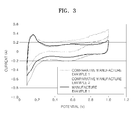
- the electrochemical surface area (ECSA) of a Pt catalyst involved in a cathode reaction of each of the fuel cells manufactured in Manufacture Example 1 and Comparative Manufacture Examples 1 and 2 was measured. The results are shown in FIG. 3 .
- the area of the Pt catalyst involved in the cathode reaction was measured by cyclic voltammetry.
- the anode and the cathode were purged with hydrogen and nitrogen, respectively, and the cathode was scanned at a voltage of about 0.08 V to about 1 V to detect a hydrogen desorption peak between 0.08 V and 0.4 V.
- the total area of peaks as a function of cycle is proportional to the area of the Pt catalyst.
- a contact area between Pt and phosphoric acid may be calculated.
- the utilization rate of Pt may be calculated from the contact area between Pt and phosphoric acid, calculated as described above, and the total amount of Pt used in the cathode.
- the Pt utilization rate of the cathode of Manufacture Example 1 was found to be higher (26%) than that of the cathodes of Comparative Manufacture Examples 1 and 2 (both 22%).
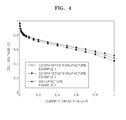
- the cell voltage characteristics of the fuel cell of Manufacture Example 1 were improved compared to those of the fuel cells of Comparative Manufacture Examples 1 and 2.
- the fuel cells of Manufacture Examples 2-4 are found to have better cell voltage characteristics than the fuel cell of Comparative Manufacture Example 1.
- a composition according to the one or more of the above embodiments of the present invention may be uniformly dispersible in an electrode catalyst layer, and may be used to manufacture an electrode with the improved ability to retain phosphoric acid and improved resistance to high temperatures and acid.
Landscapes
- Chemical & Material Sciences (AREA)
- Chemical Kinetics & Catalysis (AREA)
- Electrochemistry (AREA)
- General Chemical & Material Sciences (AREA)
- Engineering & Computer Science (AREA)
- Manufacturing & Machinery (AREA)
- Organic Chemistry (AREA)
- Polymers & Plastics (AREA)
- Medicinal Chemistry (AREA)
- Health & Medical Sciences (AREA)
- Sustainable Energy (AREA)
- Sustainable Development (AREA)
- Life Sciences & Earth Sciences (AREA)
- Materials Engineering (AREA)
- Physics & Mathematics (AREA)
- Thermal Sciences (AREA)
- Composite Materials (AREA)
- Inert Electrodes (AREA)
- Macromolecular Compounds Obtained By Forming Nitrogen-Containing Linkages In General (AREA)
- Compositions Of Macromolecular Compounds (AREA)
- Fuel Cell (AREA)
Abstract
Description
- Aspects of the present disclosure relate to a composition, a method of preparing the composition, an electrode including the composition, and a fuel cell including the electrode.
- Phosphoric acid fuel cells, which operate at temperatures of from 150 to 200 °C, include phosphoric acid as an electrolyte. However, a large amount of liquid phosphoric acid in electrodes hinders diffusion of gas into the electrodes. Therefore, an electrode catalyst layer including a mixture of a catalyst and polytetrafluoroethylene (PTFE) as a waterproof agent has been used in order to prevent fine pores in the electrodes from being clogged by the phosphoric acid.
- High-temperature, non-humidified polymer electrolyte membrane fuel cells operate at a temperature of 150-200 °C. In order to ensure such PEMFCs operate at high temperatures for a long duration, materials for electrodes should have long lifetime characteristics.
- A binder used to form an electrode plays an importance role in distributing phosphoric acid in the electrode, structuring the electrode, and maintaining performance of the electrode during operation of the fuel cell. A waterproof polymer such as polytetrafluoroethylene (PTFE) may be used as a binder for electrodes.
- However, currently known binders are not satisfactory in terms of resistance to phosphoric acid and heat resistance, and thus, there is still a demand for further improvement.
- Aspects of the present invention provide a composition with good dispersibility, a method of preparing the composition, an electrode using the composition, and a fuel cell including the electrode.
- An aspect of the present invention provides a composition including a dispersion medium, and polyoxazine-based compound particles dispersed in the dispersion medium.
- Another aspect of the present invention provides a method of preparing the composition described above, which method includes: mixing an oxazine-based monomer and an acid to prepare an acid solution of the oxazine-based monomer; thermally treating the acid solution of the oxazine-based monomer to obtain a polymerization product; separating the polyoxazine-based compound from the polymerization product; and dispersing the polyoxazine-based compound in a dispersion medium.
- Another aspect of the present invention provides an electrode including: a support; and a catalyst layer disposed on the support, where the catalyst layer includes a coated product of the composition described above.
- Another aspect of the present invention provides a fuel cell including the electrode described above.
- Additional aspects and/or advantages of the invention will be set forth in part in the description which follows and, in part, will be obvious from the description, or may be learned by practice of the invention.
- These and/or other aspects and advantages of the invention will become apparent and more readily appreciated from the following description of the embodiments, taken in conjunction with the accompanying drawings, of which:
-
FIG. 1 is an image showing a result of average particle diameter analysis on a polybenzoxazine-based compound prepared according to Example 1; -
FIG. 2 is a graph illustrating results of thermogravimetric analysis (TGA) on polybenzoxazine-based compounds of Examples 1, 3 and 4; -
FIG. 3 is a graph illustrating results of analyzing an area of a platinum (Pt) catalyst involved in a cathode reaction of each of the fuel cells of Manufacture Example 1 and Comparative Manufacture Examples 1 and 2; -
FIG. 4 is a graph illustrating cell voltage characteristics of the fuel cells of Manufacture Example 1 and Comparative Manufacture Examples 1 and 2 as a function of current density; and -
FIG. 5 is a graph of cell voltage characteristics as a function of current density in fuel cells manufactured according to Manufacture Examples 2-4 and Comparative Manufacture Example 1. - Reference will now be made in detail to the present embodiments of the present invention, examples of which are illustrated in the accompanying drawings. The embodiments are described below in order to explain the present invention by referring to the figures.
- An aspect of the present invention includes a composition including a dispersion medium, and polyoxazine-based compound particles dispersed in the dispersion medium.
- As described above, the polyoxazine-based compound particles in the composition are dispersed, not solubilized, in the dispersion medium. Thus, various kinds of dispersion mediums that may disperse, not solublize, the polyoxazine-based compound particles may be used.
- The dispersion medium for dispersing the polyoxazine-based compound particles may be an organic compound having a density of about 0.5 to about 2.0 mg/cm3.
- When the density of the dispersion medium is within this range, the polyoxazine-based compound particles may have good dispersibility.
- The dispersion medium may be at least one material selected from the group consisting of alcohol, water, acids, and hydrocarbonic solvents.
- Examples of hydrocarbonic solvents include N-methylpyrrolidine, dimethylacetamide, toluene, benzene, xylene, and the like. Examples of the alcohol include methanol, ethanol, isopropanol, butanol, and the like.
- For example, the acid may be a phosphoric acid-based material.
- Examples of the phosphoric acid-based material include polyphosphoric acid, phosphonic acid (H3PO3), an organic phosphonic acid, ortho-phosphoric acid (H3PO4), pyro-phosphoric acid (H4P2O7), triphosphoric acid (H5P3O10), meta-phosphoric acid, derivatives thereof, and the like.
- The concentration of the acid may be at least 80 wt%, 90 wt%, 95 wt%, or 98 wt%. For example, the concentration of the acid may be in the range of about 80 to about 98 wt%.
- The amount of the polyoxazine-based compound particles in the polyoxazine-based compound composition may be in the range of about 1 to about 80 wt% based on the total weight of the polyoxazine-based compound composition.
- The composition may be used as a composition for forming an electrode catalyst layer, for example, of a fuel cell.
- A method of preparing the composition will now be described below.
- A polyoxazine-based compound is obtained by polymerizing an oxazine-based monomer and has resistance to acid and heat. However, the polyoxazine-based compound is hard, and thus it is not easy to process the polyoxazine-based compound in powder form having a small particle diameter. The process of polymerizing the oxazine-based monomer to obtain the polyoxazine-based compound involves a process using acid as a catalyst to obtain a dispersion of the polymer having a small particle diameter.
- First, an oxazine-based monomer is dissolved in an acid to prepare an acid solution of the benzoxazine-based monomer.
- The oxazine-based monomer may be dissolved in the acid at a temperature of about 50 to about 100°C. When the oxazine-based monomer is dissolved in the acid within this temperature range, solubility of the oxazine-based monomer and polymerization yield are increased.
- Next, the acid solution of the oxazine-based monomer is thermally treated for polymerization.
- The acid solution consists of an acid and water. For example, the acid may be a phosphoric acid-based material. Examples of the phosphoric acid-based material include polyphosphoric acid, phosphonic acid (H3PO3), an organic phosphonic acid, ortho-phosphoric acid (H3PO4), pyro-phosphoric acid (H4P2O7), triphosphoric acid (H5P3O10), meta-phosphoric acid, derivatives thereof, and the like.
- Examples of the polyphosphoric acid include known phosphoric acids, for example, available from Riedel-de Haen Inc. The concentration of the polyphosphoric acid, which is represented by Hn+2PnO3n+1 (n>1), may be at least 85% when calculated based on P2O5 by acidimetry.
- The concentration of the acid may be at least 80 wt%, 90 wt%, 95 wt%, or 98 wt%. For example, the concentration of the acid may be in the range of about 80 to about 98 wt%.
- The amount of the acid in the acid solution may be in the range of about 1,000 to about 100,000 parts by weight, for example, about 6,000 to about 20,000 parts by weight, based on 100 parts by weight of the oxazine-based monomer. When the amount of the acid is within this range, reactivity of the polymerization of the oxazine-based monomer may be good.
- The thermal treatment may be performed at a temperature of about 150 to 250 °C, for example, at a temperature of about 150 to about 200 °C. When the temperature of the thermal treatment is within this range, the polyoxazine-based compound composition may have a small particle size and a high yield.
- The polyoxazine-based compound is separated from the polymerized product through a work-up process.
- The work-up process involves, for example, adding water to the polymerized product to obtain a solution and centrifuging the solution to remove the acid component and separate the solid component from the polymerized product.
- Next, water is added to the separated polyoxazine-based compound to obtain the polyoxazine-based compound composition.
- The polyoxazine-based compound composition may contain about 1 to about 80 wt% of the polyoxazine-based compound. The polyoxazine-based compound may have an average particle diameter of about 0.5 to about 10 µm.
- When the amount of the polyoxazine-based compound in the composition is within this range, dispersibility of the polyoxazine-based compound may be good. When the average particle diameter of the polyoxazine-based compound in the composition is within this range, the polyoxazine-based compound may have good dispersibility in an electrode catalyst layer.
- The polyoxazine-based compound has excellent resistance to heat at up to about 300 °C. The polybenzoxazine-based compound is insoluble in an acid, such as phosphoric acid, at a temperature of about 150 to about 200 °C, for example, at about 180 °C. The polyoxazine-based compound has good ability to retain acid, such as phosphoric acid. When general oxazine-based monomers are used to manufacture an electrode, unreacted oxazine-based monomers may remain as impurities in the electrode, thereby lowering performance of the electrode. However, this problem may be prevented when the oxazine-based compound prepared as described above according to aspects of the present invention are used.
- The composition prepared as described above may be used as a binder for an electrode of a fuel cell.
- The oxazine-based monomer may be at least one selected from the group consisting of compounds represented by
Formulae 1 through 6 below, but are not limited thereto.
- In
Formula 1, R1 through R4 are each, independently, a hydrogen atom, a substituted or unsubstituted C1-C20 alkyl group, a substituted or unsubstituted C1-C20 alkoxy group, a substituted or unsubstituted C2-C20 alkenyl group, a substituted or unsubstituted C2-C20 alkynyl group, a substituted or unsubstituted C6-C20 aryl group, a substituted or unsubstituted C6-C20 aryloxy group, a substituted or unsubstituted C2-C20 heteroaryl group, a substituted or unsubstituted C2-C20 heteroaryloxy group, a substituted or unsubstituted C4-C20 carbocyclic group, a substituted or unsubstituted C4-C20 carbocyclic oxy group, a substituted or unsubstituted C2-C20 heterocyclic group, a halogen atom, a hydroxyl group, or a cyano group, and - R5 is a substituted or unsubstituted C1-C20 alkyl group, a substituted or unsubstituted C1-C20 alkoxy group, a substituted or unsubstituted C2-C20 alkenyl group, a substituted or unsubstituted C2-C20 alkynyl group, a substituted or unsubstituted C6-C20 aryl group, a substituted or unsubstituted C6-C20 aryloxy group, a substituted or unsubstituted C7-C20 arylalkyl group, a substituted or unsubstituted C2-C20 heteroaryl group, a substituted or unsubstituted C2-C20 heteroaryloxy group, a substituted or unsubstituted C2-C20 heteroarylalkyl group, a substituted or unsubstituted C4-C20 carbocyclic group, a substituted or unsubstituted C4-C20 carbocyclic alkyl group, a substituted or unsubstituted C2-C20 heterocyclic group, or a substituted or unsubstituted C2-C20 heterocyclic alkyl group,

- In
Formula 2, R5' is a substituted or unsubstituted C1-C20 alkyl group, a substituted or unsubstituted C1-C20 alkoxy group, a substituted or unsubstituted C2-C20 alkenyl group, a substituted or unsubstituted C2-C20 alkynyl group, a substituted or unsubstituted C6-C20 aryl group, a substituted or unsubstituted C6-C20 aryloxy group, a substituted or unsubstituted C7-C20 arylalkyl group, a substituted or unsubstituted C2-C20 heteroaryl group, a substituted or unsubstituted C2-C20 heteroaryloxy group, a substituted or unsubstituted C2-C20 heteroarylalkyl group, a substituted or unsubstituted C4-C20 carbocyclic group, a substituted or unsubstituted C4-C20 carbocyclic alkyl group, a substituted or unsubstituted C2-C20 heterocyclic group, or a substituted or unsubstituted C2-C20 heterocyclic alkyl group, and - R6 is selected from the group consisting of a substituted or unsubstituted C1-C20 alkylene group, a substituted or unsubstituted C2-C20 alkenylene group, a substituted or unsubstituted C2-C20 alkynylene group, a substituted or unsubstituted C6-C20 arylene group, a substituted or unsubstituted C2-C20 heteroarylene group, -C(=O)-, and -SO2-.

- In
Formula 3, A, B, C, D and E are all carbon; or one or two of A, B, C, D and E is nitrogen and the others are carbon, and
R7 and R8 may be linked to form a ring,
wherein the ring is a C6-C10 cycloalkyl group, a C3-C10 heteroaryl group, a fused C3-C10 heteroaryl group, a C3-C10 heterocyclic group or a fused C3-C10 heterocyclic group.

- In
Formula 4, A' is a substituted or unsubstituted C1-C20 heterocyclic group, a substituted or unsubstituted C4-C20 cycloalkyl group, or a substituted or unsubstituted C1-C20 alkyl group, and - R9 through R16 are each, independently, a hydrogen atom, a C1-C20 alkyl group, a C1-C20 alkoxy group, a C6-C20 aryl group, a C6-C20 aryloxy group, a C1-C20 heteroaryl group, a C1-C20 heteroaryloxy group, a C4-C20 cycloalkyl group, a C1-C20 heterocyclic group, a halogen atom, a cyano group, or a hydroxy group.

- In Formula 5, R17 and R18 are each, independently, a C1-C20 alkyl group, a C1-C20 alkoxy group, a C6-C20 aryl group, a C6-C20 aryloxy group or a group represented by Formula 5A below.


- In Formulae 5 and 5A, R19 and R19' are each, independently, a hydrogen atom, a C1-C20 alkyl group, a C1-C20 alkoxy group, a C6-C20 aryl group, a C6-C20 aryloxy group, a halogenated C6-C20 aryl group, a halogenated C6-C20 aryloxy group, a C1-C20 heteroaryl group, a C1-C20 heteroaryloxy group, a halogenated C1-C20 heteroaryl group, a halogenated C1-C20 heteroaryloxy group, a C4-C20 cycloalkyl group, a halogenated C4-C20 cycloalkyl group, a C1-C20 heterocyclic group or a halogenated C1-C20 heterocyclic group.

- In Formula 6, at least two adjacent groups selected from among R20, R21 and R22 are linked to form a group represented by Formula 6A below, and the non-selected, remaining group is a hydrogen atom, a C1-C20 alkyl group, a C1-C20 alkoxy group, a C6-C20 aryl group, a C6-C20 aryloxy group, a halogenated C6-C20 aryl group, a halogenated C6-C20 aryloxy group, a C1-C20 heteroaryl group, a C1-C20 heteroaryloxy group, a halogenated C1-C20 heteroaryl group, a halogenated C1-C20 heteroaryloxy group, a C4-C20 carbocyclic group, a halogenated C4-C20 carbocyclic group, a C1-C20 heterocyclic group or a halogenated C1-C20 heterocyclic group, and at least two adjacent groups selected from among R23, R24 and R25 are linked to form the group represented by Formula 6A below, and the non-selected, remaining group is a C1-C20 alkyl group, a C1-C20 alkoxy group, a C6-C20 aryl group, a C6-C20 aryloxy group, a halogenated C6-C20 aryl group, a halogenated C6-C20 aryloxy group, a C1-C20 heteroaryl group, a C1-C20 heteroaryloxy group, a halogenated C1-C20 heteroaryl group, a halogenated C1-C20 heteroaryloxy group, a C4-C20 carbocyclic group, a halogenated C4-C20 carbocyclic group, a C1-C20 heterocyclic group, or a halogenated C1-C20 heterocyclic group.
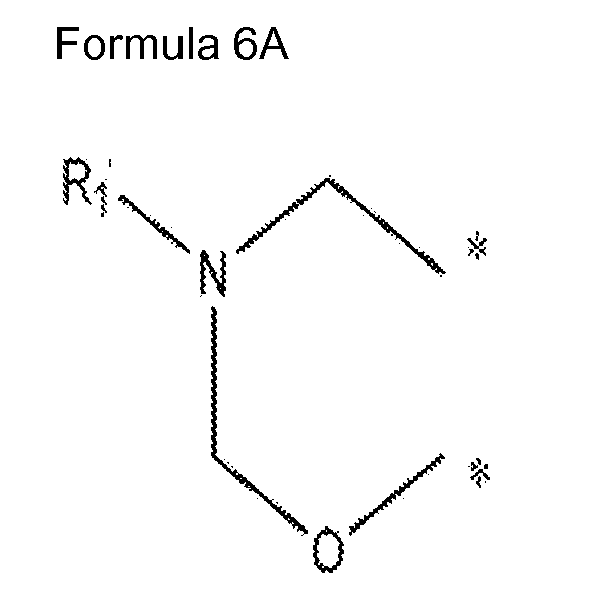
- In Formula 6A, R1' is a substituted or unsubstituted C1-C20 alkyl group, a substituted or unsubstituted C1-C20 alkoxy group, a substituted or unsubstituted C2-C20 alkenyl group, a substituted or unsubstituted C2-C20 alkynyl group, a substituted or unsubstituted C6-C20 aryl group, a substituted or unsubstituted C6-C20 aryloxy group, a substituted or unsubstituted C7-C20 arylalkyl group, a substituted or unsubstituted C2-C20 heteroaryl group, a substituted or unsubstituted C2-C20 heteroaryloxy group, a substituted or unsubstituted C2-C20 heteroarylalkyl group, a substituted or unsubstituted C4-C20 carbocyclic group, a substituted or unsubstituted C4-C20 carbocyclic alkyl group, a substituted or unsubstituted C2-C20 heterocyclic group, or a substituted or unsubstituted C2-C20 heterocyclic alkyl group, and
* denotes the sites at which the at least two adjacent groups selected from among R20, R21 and R22 of Formula 6 and the at least two adjacent groups selected from among R23, R24 and R25 are linked, respectively.
R1' in Formula 6A above may be selected from the groups represented by the following formulae.


- Examples of the compound of
Formula 1 may include compounds represented by Formulae 7-55 below.


- Examples of the compound of
Formula 2 may include compounds represented by Formula 57-60 below.


- In Formulae 56-60 above, R2 is 4-tert-butylphenyl, -CH2-CH=CH2, or one of the groups represented by Formulae 62 below:


- For example, the compound of
Formula 2 may be selected from the compounds represented by Formulae 62, 63, 64, 65, and 66: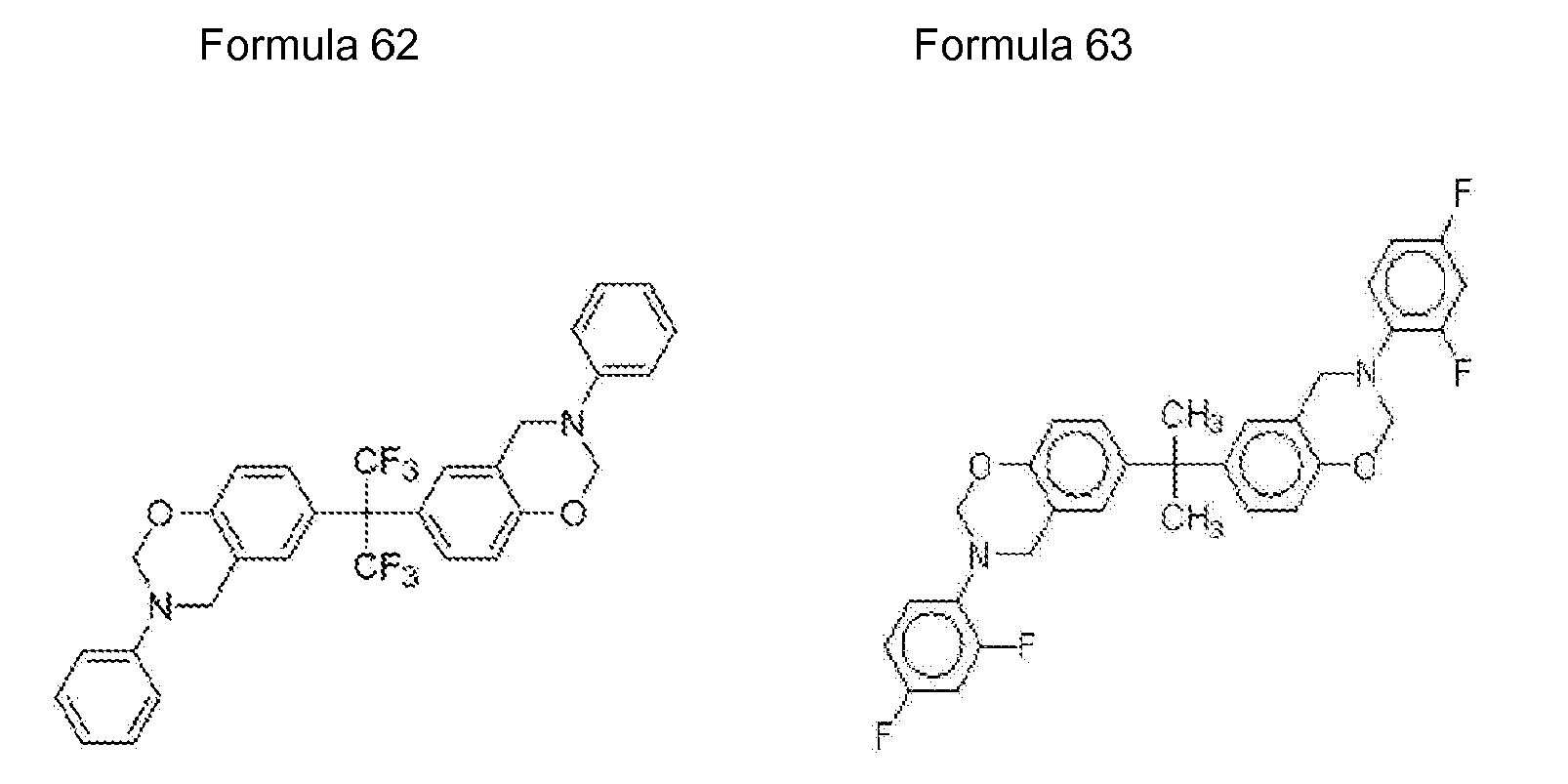


- Examples of the compound of
Formula 3 may include compounds represented by Formulae 67-70 below.
- In Formula 67, R'" is a hydrogen atom or a C1-C10 alkyl group, and


- In Formulae 67-70,


- Examples of the compound of
Formula 3 may include compounds represented by Formulae 72-94 below.


- In the compound of
Formula 4, A' may be selected from the groups represented by Formulae 95 and 96 below.
- In Formulae 95 and 96, R1 is a hydrogen atom, a C1-C20 alkyl group, a C1-C20 alkoxy group, a C6-C20 aryl group, a C6-C20 aryloxy group, a halogenated C6-C20 aryl group, a halogenated C6-C20 aryloxy group, a C1-C20 heteroaryl group, a C1-C20 heteroaryloxy group, a halogenated C1-C20 heteroaryl group, a halogenated C1-C20 heteroaryloxy group, a C4-C20 carbocyclic group, a halogenated C4-C20 carbocyclic group, a C1-C20 heterocyclic group or a halogenated C1-C20 heterocyclic group.
- Examples of the compound of
Formula 4 include compounds represented by Formulae 97 and 98 below.
- In Formulae 97 and 98, Rk is selected from the groups represented by Formulae 99 below.


- The compound of
Formula 4 may be selected from the compounds represented by Formulae 100-105 below:


- Examples of the compound of Formula 5 include compounds represented by Formulae 107, 108, and 110 below.


- In Formulae 107 and 108, R17' is a C1-C10 alkyl group, a C1-C10 alkoxy group, a C6-C10 aryl group, or a C6-C10 aryloxy group; and R19' is selected from the groups represented by Formulae 109 below:


- In Formula 110, R17' is a C6-C10 aryl group; and R19' is selected from the groups represented by Formula 111 below:


- The compound of Formula 5 may be selected from the compounds represented by Formulae 112-118 below:


- Examples of the compound of Formula 6 include compounds represented by Formulae 119-121 below.


- In Formulae 119-121, Rj is selected from the groups represented by Formulae 122 below.


- Examples of the compound of Formula 6 include compounds represented by Formulae 123-130 below:



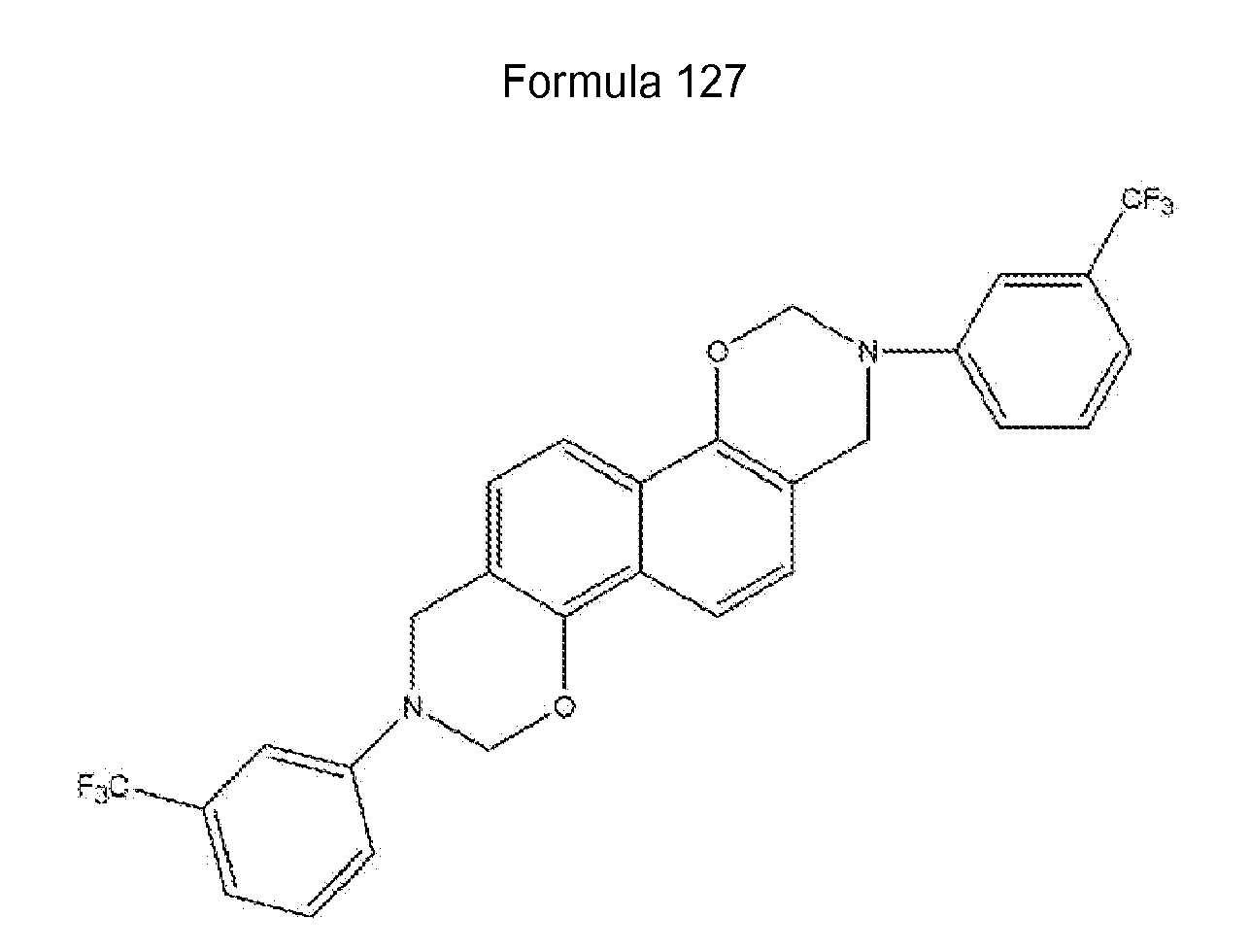
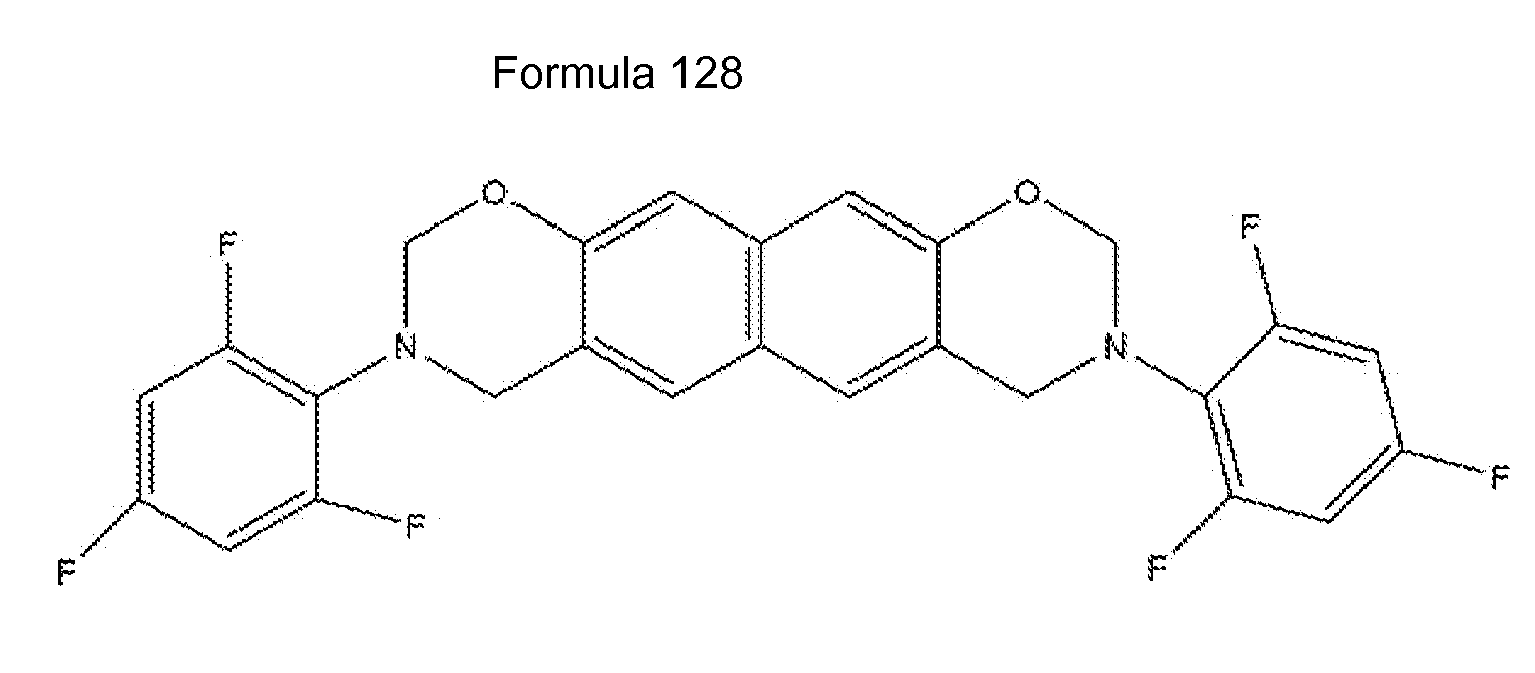


- The polyoxazine-based compound in the composition may include at least one compound selected from among the compound of Formula 16 below, the compound (3,4-FPh4FA) of Formula 28, the compound of Formula 66 below, the compound of Formula 62 below, the compound of Formula 89 below, and the compound (PPO) of Formula 115 below.


- Another aspect of the present invention includes an electrode including a catalyst layer containing a coated product of the above-described composition.
- The term "coated product of the composition" indicates a product from coating the polyoxazine-based compound composition or a product from coating and thermally treating the polyoxazine-based compound composition. The coated product may be the pure polyoxazine-based compound, not containing the dispersion medium that is removed from the polyoxazine-based compound composition, or a cured product of the polyoxazine-based compound according to the temperature of coating and/or thermal treatment.
- Hereinafter, a method of manufacturing an electrode by using the composition will be described.
- The electrode may be used, for example, in a fuel cell.
- The composition, a catalyst and a solvent are mixed to prepare a composition for forming an electrode catalyst layer.
- Examples of the solvent include N-methylpyrrolidone (NMP), N,N-dimethylacetamide (DMAc), water, an acid, and the like. The amount of at least one of the compound of
Formula 1 and the compound ofFormula 2 may be in the range of about 0.001 to about 0.5 parts by weight based on 1 part by weight of the catalyst. The amount of at least one of the compound ofFormula 1 and the compound ofFormula 2 may be in the range of about 0.001 to about 0.1 parts by weight based on 1 part by weight of the catalyst. When the amount of the at least one of the compound ofFormula 1 and the compound ofFormula 2 is within this range, the electrode catalyst layer may have strong binding force to the support. - The catalyst may be platinum (Pt), or an alloy or mixture of platinum (Pt) and at least one metal selected from the group consisting of gold (Au), palladium (Pd), rhodium (Rh), iridium (Ir), ruthenium (Ru), tin (Sn), molybdenum (Mo), cobalt (Co), and chromium (Cr). In this regard, the Pt, the alloy, or the mixture may be supported on a carbonaceous support.
- Next, the composition for forming the electrode catalyst layer is coated on a support and dried to form the electrode catalyst layer, thereby completing the manufacture of the electrode of a fuel cell.
- The amount of the polyoxazine-based compound in the composition may be in the range of about 0.001 to about 20 parts by weight based on 1 part by weight of the catalyst. When the amount of the polyoxazine-based compound is within this range, the electrode catalyst layer may have strong binding force to the support.
- The support may be fixed on a glass substrate to facilitate the coating. The method of coating the composition for forming the electrode catalyst layer is not particularly limited. Examples of the coating method include coating using a doctor blade, bar coating, screen printing, and the like.
- After coating the composition for forming the electrode catalyst layer on the surface of the carbon support, the resultant structure is dried at a temperature of from about 20 to about 150 °C to remove the solvent. The drying time may vary according to the drying temperature, and may be in the range of about 10 to about 60 minutes.
- Furthermore, the electrode may be impregnated with an acid.
- The composition for forming the electrode catalyst layer may further include a cross-linkable compound.
- The cross-linkable compound may be any compound having a functional group that is cross-linkable with at least one of the compound of
Formula 1 and the compound ofFormula 2. - For example, the cross-linkable compound may be any nitrogen-containing aromatic compound. Non-limiting examples of the cross-linkable compound include a five-membered cyclic nitrogen-containing aromatic compound, and a six-membered cyclic nitrogen-containing aromatic compound, for example, polypyrimidine.
- The cross-linkable compound may be at least one polymer selected from the group consisting of polyazoles, polyimides, and polyoxazoles.
- The amount of the cross-linkable compound may be in the range of about 10 to about 500 parts by weight based on 100 parts by weight of the polyoxazine-based compound. When the amount of the cross-linkable compound is within this range, the resulting electrode may have good resistance to heat and good ability to retain phosphoric acid.
- When a polyazole-based material is used as the cross-linkable compound, a final product may be a graft copolymer obtained through graft polymerization of a polymer of at least one selected from among the compound of
Formula 1 and the compound ofFormula 1, and the polyazole-based material. - As used herein, the term "a product of polymerization of at least one selected from among the compound of
Formula 1 and the compound ofFormula 2, and a polyazole-based material" may be used to indicate a product of polymerization of at least one of the compounds ofFormulae - The polyazole-based material is a polymer having a repeating unit including at least one aryl ring having at least one nitrogen atom.
- The aryl ring may be a five-membered or six-membered atom ring with one to three nitrogen atoms which may be fused to another ring, for example, another aryl ring or heteroaryl ring. In this regard, the nitrogen atoms may be substituted with an oxygen, phosphorus and/or sulfur atom. Non-limiting examples of the aryl ring include hexahydroindyl, indanyl, and tetrahydronaphthyl.
- The polyazole-based material may have at least one amino group in the repeating group described above. In this regard, the at least one amino group may be a primary, secondary or tertiary amino group which is either part of the aryl ring or part of a substituent on the aryl unit.
- The term "amino" includes compounds wherein a nitrogen atom is covalently bonded to at least one carbon or heteroatom. The term "amino" also includes -NH2 and also includes substituted moieties.
- The term also includes "alkyl amino" wherein the nitrogen is bound to at least one additional alkyl group. The term also includes "arylamino" and "diarylamino" groups wherein the nitrogen is bound to at least one or two independently selected aryl groups, respectively.
- Methods of preparing the polyazole-based material and a polymer film including the polyazole-based material are disclosed in
US 2005/256296A . - The polyazole-based material may include an azole unit represented by Formulae 131-144 below.


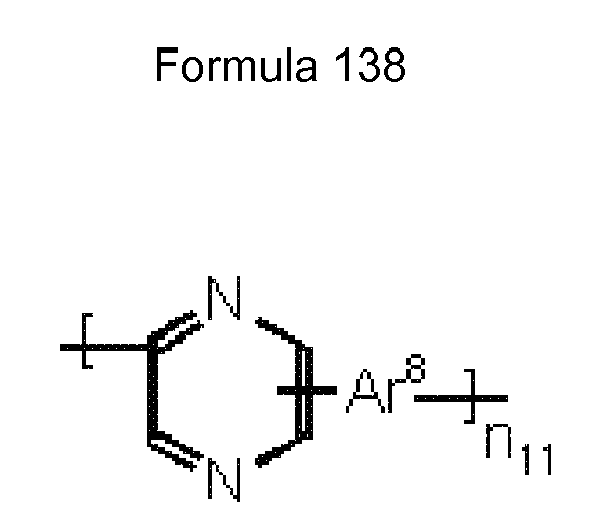


- In Formulae 131-144, Aro may be identical to or different from another Aro, or any other Arn (where n can be no superscript or 1 to 11),, and may be a divalent monocyclic or multicyclic C6-C20 aryl group or C2-C20 heteroaryl group.
- Ar may be identical to or different from another Ar, or any other Arn (where n can be no superscript or 1 to 11),, and may be a tetravalent monocyclic or multicyclic C6-C20 aryl group or C2-C20 heteroaryl group; Ar1 may be identical to or different from each other, and may be a bivalent monocyclic or multicyclic C6-C20 aryl group or C2-C20 heteroaryl group.
- Ar2 may be identical to or different from another Ar2, or any other Arn (where n can be no superscript or 1 to 11),, and may be a bivalent or trivalent monocyclic or multicyclic C6-C20 aryl group or C2-C20 heteroaryl group.
- Ar3 may be identical to or different from another Ar3, or any other Arn (where n can be no superscript or 1 to 11),, and may be a trivalent monocyclic or multicyclic C6-C20 aryl group or C2-C20 heteroaryl group.
- Ar4 may be identical to or different from another Ar4, or any other Arn (where n can be no superscript or 1 to 11),, and may be a trivalent monocyclic or multicyclic C6-C20 aryl group or C2-C20 heteroaryl group.
- Ar5 may be identical to or different from another Ar5, or any other Arn (where n can be no superscript or 1 to 11),, and may be a tetravalent monocyclic or multicyclic C6-C20 aryl group or C2-C20 heteroaryl group.
- Ar6 may be identical to or different from another Ar3, or any other Arn (where n can be no superscript or 1 to 11),, and may be a bivalent monocyclic or multicyclic C6-C20 aryl group or C2-C20 heteroaryl group.
- Ar7 may be identical to or different from another Ar7, or any other Arn (where n can be no superscript or 1 to 11),, and may be a bivalent monocyclic or multicyclic C6-C20 aryl group or C2-C20 heteroaryl group.
- Ar8 may be identical to or different from another Ar8, or any other Arn (where n can be no superscript or 1 to 11),, and may be a trivalent monocyclic or multicyclic C6-C20 aryl group or C2-C20 heteroaryl group.
- Ar9 may be identical to or different from another Ar9, or any other Arn (where n can be no superscript or 1 to 11),, and may be a bivalent, trivalent or tetravalent monocyclic or multicyclic C6-C20 aryl group or C2-C20 heteroaryl group.
- Ar10 may be identical to or different from another Ar10, or any other Arn (where n can be no superscript or 1 to 11),, and may be a bivalent or trivalent monocyclic or multicyclic C6-C20 aryl group or C2-C20 heteroaryl group.
- Ar11 may be identical to or different from another Ar11, or any other Arn (where n can be no superscript or 1 to 11),, and may be a bivalent monocyclic or multicyclic C6-C20 aryl group or C2-C20 heteroaryl group.
- X3 to X11 may be identical to or different from another Xn, or any other Xn (where n can be 3 to 11),, and may be an oxygen atom, a sulfur atom or -N(R'); and R' may be a hydrogen atom, a C1-C20 alkyl group, a C1-C20 alkoxy group or a C6-C20 aryl group.
- R9 may be a hydrogen atom, a C1-C20 alkyl group or a C6-C20 aryl group.
- n0, n4-n16, and m2 are each, independently, an integer of about 10 or greater, and in other embodiments, may each be an integer of about 100 or greater, for example, in the range of about 100 to about 100,000.
- Examples of the aryl or heteroaryl group include benzene, naphthalene, biphenyl, diphenylether, diphenylmethane, diphenyldimethylmethane, bisphenone, diphenylsulfone, quinoline, pyridine, bipyridine, pyridazine, pyrimidine, pyrazine, triazine, tetrazine, pyrrole, pyrazole, anthracene, benzopyrrole, benzotriazole, benzoxathiazole, benzoxadiazole, benzopyridine, benzopyrazine, benzopyrazidine, benzopyrimidine, benzotriazine, indolizine, quinolizine, pyridopyridine, imidazopyrimidine, pyrazinopyrimidine, carbazole, aziridine, phenazine, benzoquinoline, phenoxazine, phenothiazine, acridizine, benzopteridine, phenanthroline and phenanthrene, wherein these aryl or heteroaryl groups may have a substituent.
- Ar0, Ar1, Ar4, Ar6, Ar7, Ar8, Ar9, Ar10, and Ar11 defined above may have any substitutable pattern. For example, if Ar0, Ar1, Ar4, Ar6, Ar7, Ar8, Ar9, Ar10, and Ar11 are phenylene, Ar0, Ar1, Ar4, Ar6, Ar7, Ar8, Ar9, Ar10 and Ar11 may be ortho-phenylene, meta-phenylene or para-phenylene.
- The alkyl group may be a C1-C4 short-chain alkyl group, such as methyl, ethyl, n-propyl, i-propyl or t-butyl. The aryl group may be, for example, a phenyl group or a naphthyl group.
- Examples of the substituent include a halogen atom, such as fluorine, an amino group, a hydroxyl group, and a short-chain alkyl group, such as methyl or ethyl.
- Examples of the polyazole-based material include polyimidazole, polybenzothiazole, polybenzoxazole, polyoxadiazole, polyquinoxaline, polythiadiazole, polypyridine, polypyrimidine, and polytetrazapyrene.
- The polyazole-based material may be a copolymer or blend including at least two units selected from the group consisting of units represented by Formulae 131-144 above. The polyazole-based material may be a block copolymer (di-block or tri-block), a random copolymer, a periodic copolymer or an alternating polymer including at least two units selected from the units of Formulae 131-144.
- A polyazole-based material including at least one of the units of Formulae 131 and 132 may be used.
- Non-limiting examples of the polyazole-based material include polymers represented by Formulae 145-171 below:


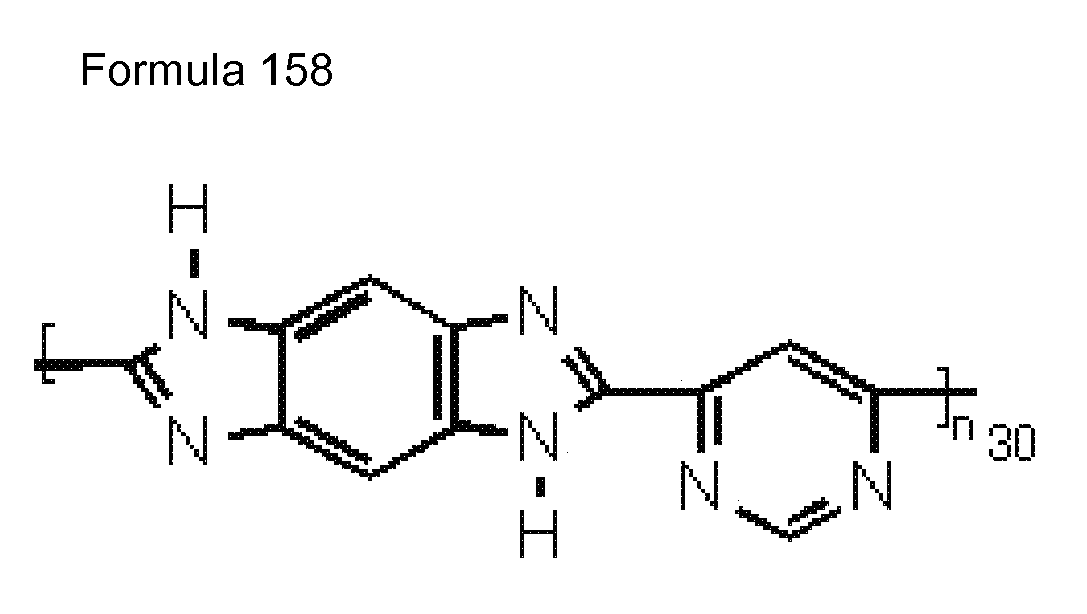


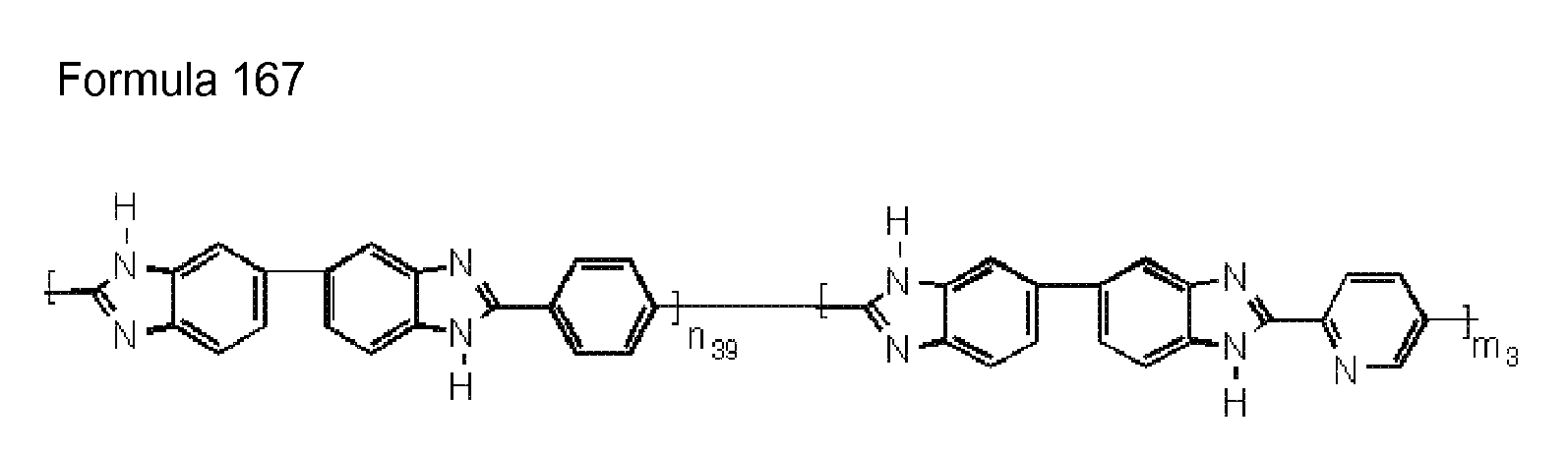


- In Formulae 145-171 above, I, n17-n43, and m3-m7 are each independently an integer of about 10 or greater, and in some embodiments, may each be, independently, an integer of about 100 or greater.
- z may be a chemical bond, -(CH2)S-, -C(=O)-, -SO2-, -C(CH3)2- , or -C(CF3)2- where s may be an integer from about 1 to 5.
- The polyazole-based material may be a compound (m-polybenzimidazole, m-PBI) represented by Formula 172 below, or compound (p-PBI) represented by Formula 173 below.

- In Formula 172, n1 is an integer of about 10 or greater.

- In Formula 173, n2 is an integer of about 10 or greater.
- The polymers of Formulae 172 and 173 may have a number average molecular weight of about 1,000,000 or less.
- For example, the polyazole-based material may be a benzimidazole-based polymer represented by Formula 174 below.

- In Formula 174, R26, and R27 are each, independently, a hydrogen atom, an unsubstituted or substituted C1-C20 alkyl group, an unsubstituted or substituted C1-C20 alkoxy group, an unsubstituted or substituted C6-C20 aryl group, an unsubstituted or substituted C6-C20 aryloxy group, an unsubstituted or substituted C3-C20 heteroaryl group, or an unsubstituted or substituted C3-C20 heteroaryloxy group, or R26 and R27 may be linked to form a C4-C20 carbocyclic ring or a C3-C20 hetero ring.
- Ar12 is a substituted or unsubstituted C6-C20 aryl group or a substituted or unsubstituted C3-C20 heteroaryl group.
- R28 to R30 are each independently a mono- or a multi-substituted substituent selected from the group consisting of a hydrogen atom, an unsubstituted or substituted C1-C20 alkyl group, an unsubstituted or substituted C1-C20 alkoxy group, an unsubstituted or substituted C6-C20 aryl group, anunsubstituted or substituted C6-C20 aryloxy group, an unsubstituted or substituted C3-C20 heteroaryl group, and an unsubstituted or substituted C3-C20 heteroaryloxy group.
- L represents a linker.
- m1 is a number from 0.01 to 1.
- a1 is 0 or 1.
- n3 is a number from 0 to 0.99.
- k is a number from about 10 to 250.
- The benzimidazole-based polymer may be a compound represented by Formula 175 below or a compound represented by Formula 176 below:

- In Formula 175, k1, which represents a degree of polymerization, may be a number from about 10 to 300.


- In Formula 176, m8 is a number from 0.01 to 1, for example, 1 or a number from 0.1 to 0.9; and n44 is a number from 0 to 0.99, for example, 0 or a number from 0.1 to 0.9; and
k2 is a number from about 10 to 250. - The electrode of the fuel cell manufactured as described above is combined with an electrolyte membrane to form a membrane-electrode assembly (MEA).
- A unit cell is manufactured using the MEA, and air and hydrogen fuel are injected into the unit cell to operate the fuel cell. The operating temperature of the fuel cell may be, for example, in the range of about 150 to about 180 °C.
- Any electrolyte membrane that is commonly used in fuel cells may be used. For example, a polybenzimidazole electrolyte membrane, a polybenzoxazine-polybenzimidazole copolymer electrolyte membrane, a porous polytetrafluoroethylene (PTFE) membrane, or the like may be used. In a similar way to the electrode, the electrolyte membrane may include the polymer obtained from polymerization of the composition including at least one oxazine-based monomer selected from the compounds of
Formulae - The electrolyte membrane may further be impregnated with a proton conductor. Examples of the proton conductor include polyphosphoric acid, phosphonic acid (H3PO3), ortho-phosphoric acid (H3PO4), pyro-phosphoric acid (H4P2O7), triphosphoric acid (H5P3O10), meta-phosphoric acid, and a derivative thereof. The concentration of the proton conductor may be at least 80 wt%, 90 wt%, 95 wt%, or 98 wt%.
- The electrolyte membrane may be prepared using a polymerization product of one or two different kinds of oxazine-based monomers according to a method disclosed in Korean Patent Publication No.
2009-0045655 - Substituents in the formulae above may be defined as follows.
- As used herein, the term "alkyl" refers to a fully saturated branched or unbranched (or straight chain or linear) hydrocarbon moiety.
- Examples of the alkyl group used herein include, but are not limited to, methyl, ethyl, n-propyl, iso-propyl, n-butyl, sec-butyl, iso-butyl, tert-butyl, n-pentyl, isopentyl, neopentyl, n-hexyl, 3-methylhexyl, 2,2-dimethylpentyl, 2,3-dimethylpentyl, and n-heptyl.
- At least one hydrogen atom of the alkyl group may be substituted with a halogen atom, a C1-C20 alkyl group substituted with a halogen atom (for example, CCF3, CHCF2, CH2F and CCl3), a C1-C20 alkoxy, a C2-C20 alkoxyalkyl, a hydroxy group, a nitro group, a cyano group, an amino group, an amidino group, a hydrazine, a hydrazone, a carboxyl group or a salt thereof, a sulfonyl group, a sulfamoyl, a sulfonic acid group or a salt thereof, a phosphoric acid or a salt thereof, a C1-C20 alkyl group, a C2-C20 alkenyl group, a C2-C20 alkynyl group, a C1-C20 heteroalkyl group, a C6-C20 aryl group, a C6-C20 arylalkyl group, a C6-C20 heteroaryl group, a C7-C20 heteroarylalkyl group, a C6-C20 heteroaryloxy group, a C6-C20 heteroaryloxyalkyl group, or a C6-C20 heteroarylalkyl group.
- As used herein, the term "halogen atom" refers to fluoro, bromo, chloro, or iodo.
- As used herein, the term "a C1-C20 alkyl group substituted with a halogen atom" refers to a C1-C20 alkyl group that is substituted with one or more halo groups, and unlimited examples of a C1-C20 alkyl group that is substituted with one or more halo groups are monohaloalkyl, dihaloalkyl, and polyhaloalkyl including perhaloalkyl.
- A monohaloalkyl has one iodo, bromo, chloro or fluoro within the alkyl group, and dihaloalky and polyhaloalkyl groups have two or more of the same halo atoms or a combination of different halo groups within the alkyl.
- As used herein, the term "alkoxy" refers to alkyl-O-, wherein alkyl is defined herein above. Examples of alkoxy include, but are not limited to, methoxy, ethoxy, propoxy, 2-propoxy, butoxy, tert-butoxy, pentyloxy, hexyloxy, cyclopropyloxy-, cyclohexyloxy- and the like. At least one hydrogen atom of the alkoxy group may be substituted with the same substituent as described above in connection with the alkyl group.
- The term "alkoxyalkyl" refers to an alkyl group, as defined above, in which the alkyl group is substituted with alkoxy. At least one hydrogen atom of the alkoxyalkyl group may be substituted with the same substituent as described above in connection with the alkyl group. The term alkoxyalkyl includes a substituted alkoxyalkyl moiety.
- The term "alkenyl" refers to a branched or unbranched hydrocarbon having at least one carbon-carbon double bond. Examples of alkenyl are, but are not limited to, vinyl, allyl, butenyl, isopropenyl or isobutenyl. At least one hydrogen atom of the alkenyl group may be substituted with the same substituent as described above in connection with the alkyl group.
- The term "alkynyl" refers to a branched or unbranched hydrocarbon having at least one carbon-carbon triple bond. Examples of alkynyl are, but are not limited to, ethynyl, butynyl, isobutynyl or isopropynyl.
- At least one hydrogen atom of alkynyl may be substituted with the same substituent as described above in connection with the alkyl group.
- The term "aryl" is used alone or in combination, and refers to an aromatic hydrocarbon group having one or more rings.
- The term "aryl" also refers to a group in which an aromatic ring is fused to one or more cycloalkyl rings.
- Examples of aryl are, but are not limited to, phenyl, naphthyl, or tetrahydronaphthyl.
- At least one hydrogen atom of aryl may be substituted with the same substituent as described above in connection with the alkyl group.
- The term "arylalkyl" is an alkyl substituted with aryl. Examples of arylalkyl are benzyl or Phenyl-CH 2CH 2-.
- The term "aryloxy" includes an -O-aryl, wherein aryl is defined herein. Examples of aryloxy are phenoxy and the like. At least one hydrogen atom of aryloxy may be substituted with the same substituent as described above in connection with the alkyl group.
- The term "heteroaryl" refers to a monocyclic or bicyclic organic compound that contains one or more hetero atoms selected from N, O, P, and S, and the remaining ring atoms are carton atoms. The heteroaryl may include, for example, 1 to 5 hetero atoms, and 5 to 10 ring members.
- S or N may be oxidized to various oxidation states.
- Typical monocyclic heteroaryl groups include thienyl, furyl, pyrrolyl, imidazolyl, pyrazolyl, thiazolyl, isothiazolyl, 1,2,3-oxadiazolyl, 1,2,4-oxadiazolyl, 1,2,5-oxadiazolyl, 1,3,4-oxadiazolyl, 1,2,3-thiadiazolyl, 1,2,4-thiadiazolyl, 1,2,5-thiadiazolyl, 1,3,4-thiadiazolyl, isothiazol-3-yl, isothiazol-4-yl, isothiazol-5-yl, oxazol-2-yl, oxazol-4-yl, oxazol-5-yl, isooxazol-3-yl, isooxazol-4-yl, isooxazol-5-yl, 1,2,4-triazol-3-yl, 1,2,4-triazol-5-yl, 1,2,3-triazol-4-yl, 1,2,3-triazol-5-yl, tetrazolyl, pyrid-2-yl, pyrid-3-yl, 2-pyrazin-2yl, pyrazin-4-yl, pyrazin-5-yl, 2-pyrimidin-2-yl, 4-pyrimidin-2-yl, and 5-pyrimidin-2-yl.
- The term "heteroaryl" also refer to a group in which a heteroaromatic ring is fused to one or more aryl, cycloaliphatic, or heterocyclic rings.
- Examples of bicyclic heteroaryl are indolyl, isoindolyl, indazolyl, indolizinyl, purinyl, quinolizinyl, quinolinyl, isoquinolinyl, cinnolinyl, phthalazinyl, naphthyridinyl, quinazolinyl, quinaxalinyl, phenanthridinyl, phenathrolinyl, phenazinyl, phenothiazinyl, phenoxazinyl, benzisoqinolinyl, thieno[2,3-b]furanyl, furo[3,2-b]-pyranyl, 5H-pyrido[2,3-d]-o-oxazinyl, 1H-pyrazolo[4,3-d]-oxazolyl, 4H-imidazo[4,5-d]thiazolyl, pyrazino[2,3-d]pyridazinyl, imidazo[2,1-b]thiazolyl, imidazo[1,2-b][1,2,4]triazinyl, 7-benzo[b]thienyl, benzoxazolyl, benzimidazolyl, benzothiazolyl, benzoxapinyl, benzoxazinyl, 1H-pyrrolo[1,2-b][2]benzazapinyl, benzofuryl, benzothiophenyl, benzotriazolyl, pyrrolo[2,3-b]pyridinyl, pyrrolo[3,2-c]pyridinyl, pyrrolo[3,2-b]pyridinyl, imidazo[4,5-b]pyridinyl, imidazo[4,5-c]pyridinyl, pyrazolo[4,3-d]pyridinyl, pyrazolo[4,3-c]pyridinyl, pyrazolo[3,4-c]pyridinyl, pyrazolo[3,4-d]pyridinyl, pyrazolo[3,4-b]pyridinyl, imidazo[1,2-a]pyridinyl, pyrazolo[1,5-a]pyridinyl, pyrrolo[1,2-b]pyridazinyl, imidazo[1,2-c]pyrimidinyl, pyrido[3,2-d]pyrimidinyl, pyrido[4,3-d]pyrimidinyl, pyrido[3,4-d]pyrimidinyl, pyrido[2,3-d]pyrimidinyl, pyrido[2,3-b]pyrazinyl, pyrido[3,4-b]pyrazinyl, pyrimido[5,4-d]pyrimidinyl, pyrazino[2,3-b]pyrazinyl, and pyrimido[4,5-d]pyrimidinyl.
- At least one hydrogen atom in the heteroaryl group may be substituted with the same substituent as described above in connection with the alkyl group.
- The term "heteroarylakyl" refers to alkyl substituted with heteroaryl.
- The term "heteroaryloxy" includes an -O-heteroaryl moiety. At least one hydrogen atom in heteroaryloxy may be substituted with the same substituent as described above in connection with the alkyl group.
- The term "heteraryloxyalkyl" refers to an alkyl group that is substituted with heteroaryloxy. At least one hydrogen atom in heteraryloxyalkyl may be substituted with the same substituent as described above in connection with the alkyl group.
- As used herein, the term "carbocyclic" refers to saturated or partially unsaturated but non-aromatic monocyclic, bicyclic or tricyclic hydrocarbon groups.
- Exemplary monocyclic hydrocarbon groups include cyclopentyl, cyclopentenyl, cyclohexyl and cyclohexenyl.
- Exemplary bicyclic hydrocarbon groups include bornyl, decahydronaphthyl, bicyclo[2.1.1]hexyl, bicyclo[2.2.1]heptyl, bicyclo[2.2.1]heptenyl, and bicyclo[2.2.2]octyl.
- Exemplary tricyclic hydrocarbon groups include adamantyl.
- At least one hydrogen atom in carbocyclic may be substituted with the same substituent as described above in connection with the alkyl group.
- The term "heterocyclic" refers to a ring containing 5-10 ring atoms including a hetero atom such as N, S, P, or O, and an example of heterocyclic is pyridyl. At least one hydrogen atom in heterocyclic may be substituted with the same substituent as described above in connection with the alkyl group.
- The term "heterocyclicoxy" includes an -O-heterocydic, and at least one hydrogen atom in heterocyclicoxy may be substituted with the same substituent as described above in connection with the alkyl group.
- The term "sulfonyl" includes R"-SO2-, wherein R" is hydrogen, alkyl, aryl, heteroaryl, aryl-alkyl, heteroaryl-alkyl, alkoxy, aryloxy, cycloalkyl, or heterocyclic.
- The term "sulfamoyl" includes H2NS(O)2-, alkyl-NHS(O)2-, (alkyl) 2NS(O)2-, aryl-NHS(O)2-, alkyl(aryl)-NS(O)2-, (aryl)2NS(O)2-, heteroaryl-NHS(O)2- (aryl-alkyl)-NHS(O) 2-, or (heteroaryl-alkyl)-NHS(O)2-.
- At least one hydrogen atom in sulfamoyl may be substituted with the same substituent as described above in connection with the alkyl group.
- The term "amino" includes compounds wherein a nitrogen atom is covalently bonded to at least one carbon or heteroatom. The term "amino" also includes -NH2 and also includes substituted moieties.
- The term also includes "alkylamino" wherein the nitrogen is bound to at least one additional alkyl group. The term also includes "arylamino" and "diarylamino" groups wherein the nitrogen is bound to at least one or two independently selected aryl groups, respectively.
- The term "alkylene", "alkenylene", "alkynylene", "arylene", and "heteroarylene" are defined as described above, except that "alkyl", "alkenyl", "alkynyl", "aryl", and "heteroaryl", which are mono-valent groups, are changed into divalent groups.
- At least one hydrogen atom in "alkylene", "alkenylene", "alkynylene", "arylene", and "heteroarylene" may be substituted with the same substituent as described above in connection with the alkyl group.
- Hereinafter, one or more embodiments of the present invention will be described in detail with reference to the following examples. These examples are not intended to limit the purpose and scope of the one or more embodiments of the present invention.
- 200 g of a 85 wt% phosphoric acid was added to 2 g of the compound of of Formula 16 and mixed at 80 °C for 1 hour to obtain a solution of the compound of Formula 16 in phosphoric acid. The solution was thermally treated at 160 °C for polymerization.
- The polymerization product was centrifuged to remove the phosphoric acid. The remaining centrifuged product was washed with water, and water was added thereto to obtain a polybenzoxazine-based compound composition including about 3.4 wt% of polybenzoxazine-based compound particles.
- The particle diameter of the polybenzoxazine-based compound in the composition of Example 1 was measured using an optical microscope (ZEISS). The results are shown in FIG.
- Referring to
FIG. 1 , the polybenzoxazine-based compound was found to have a particle diameter of about 1 µm. - 200 g of a 85 wt% phosphoric acid was added to 1 g of the compound (HF-a) of Formula 62 and mixed at 80 °C for 1 hour to obtain a solution of the compound of Formula 62 in phosphoric acid. The solution was thermally treated at 180 °C for 24 hours for polymerization.
- The polymerization product was centrifuged to remove the phosphoric acid. The remaining centrifuged product was washed with water, and water was added thereto to obtain a polybenzoxazine-based compound composition including about 3.4 wt% of polybenzoxazine-based compound particles. The polybenzoxazine-based compound in the composition was found to have a particle diameter of about 1 µm.
- 200 g of a 85 wt% phosphoric acid was added to 2 g of the compound of Formula 28 and mixed at 80 °C for 1 hour to obtain a solution of the compound of Formula 28 in phosphoric acid. The solution was thermally treated at 160 °C for 3 hours for polymerization.
- The polymerization product was centrifuged to remove the phosphoric acid. The remaining centrifuged product was washed with water, and water was added thereto to obtain a polybenzoxazine-based compound composition including about 3.4 wt% of polybenzoxazine-based compound particles. The polybenzoxazine-based compound in the composition was found to have a particle diameter of about 1 µm.
- 200 g of a 85 wt % phosphoric acid was added to 2 g of the compound of Formula 89 and mixed at 80 °C for 1 hour to obtain a solution of the compound of Formula 89 in phosphoric acid. The solution was thermally treated at180 °C for 24 hours for polymerization.
- The polymerization product was centrifuged to remove the phosphoric acid. The remaining centrifuged product was washed with water, and water was added thereto to obtain a polybenzoxazine-based compound composition including about 3.4 wt% of a polybenzoxazine-based compound particles.
- Thermogravimetric characteristics of the polybenzoxazine-based compounds of Example 1, 3 and 4 were evaluated using a thermogravimetric analyzer (TGA analyzer). The results are shown in
FIG. 2 . - Referring to
FIG. 2 , the polybenzoxazine-based compounds of Examples 1, 3 and 4 had excellent thermal stabilities still at 300 °C. - A 2 wt% polybenzoxazine-based compound composition was prepared from the polybenzoxazine-based compound composition prepared in Example 1. 0.5 g of the 2 wt% of the polybenzoxazine-based compound composition, 1 g of Pt/C, and 4 g of N-methylpyrrolidone were mixed to prepare a composition for forming a cathode catalyst layer.
- The composition for forming the cathode catalyst layer was coated on a carbon paper and dried at room temperature for one hour, at 80 °C for one hour, at 120°C for 30 minutes, and at 150°C for 15 minutes to manufacture a cathode (fuel electrode). The loading amount of platinum (Pt) in the cathode was 1.57 mg/cm2.
- An anode was manufactured as follows.
- 2 g of a Pt catalyst (50 wt% of Pt supported on carbon) and 9 g of N-methylpyrolidone (NMP) as a solvent were put into a stirring vessel, and stirred using a high-speed stirrer for two minutes. Then, a solution of 0.05 g of polyvinylidenefluoride dissolved in 0.95 g of NMP was added to the mixture, followed by stirring for two minutes to prepare a composition for forming an anode catalyst layer. The composition for forming the anode catalyst layer was coated on carbon paper, which was coated with a microporous layer, by using a bar coater to complete the manufacture of the anode. The loading amount of Pt in the anode was 0.9 mg/cm2.
- Meanwhile, 50 parts by weight of a compound (PPO) represented by Formula 115 below and 50 parts by weight of polybenzimidazole (m-PBI) of Formula 172 below were blended, and cured at a temperature of about 80 to about 220 °C.


- In Formula 172, n1 may be about 130.
- Subsequently, the resultant was impregnated with 85 wt% of phosphoric acid at 80 °C for 4 hours or longer to form an electrolyte membrane. Herein, the amount of phosphoric acid was about 500 parts by weight based on 100 parts by weight of the electrolyte membrane.
- The electrolyte membrane was disposed between the cathode and the anode to manufacture a membrane-electrode assembly (MEA). The cathode and the anode were not impregnated with phosphoric acid.
- To prevent gas permeation between the cathode and the anode, a PTFE membrane main-gasket having a thickness of 200 µm and a PTFE membrane sub-gasket having a thickness of 20 µm were joined and disposed between each of the anode and cathode, and the electrolyte membrane. The pressure applied to the MEA was adjusted using a torque wrench, and was stepwise increased using 1, 2, and 3 N-m Torque wrenches.
- Electricity was generated by supplying hydrogen to the anode (flow rate: about 100 ccm) and air to the cathode (flow rate: about 250 ccm), at 150 °C, without humidifying the electrolyte membrane, and characteristics of the fuel cell were measured. Herein, the electrolyte membrane doped with phosphoric acid was used, and thus, the performance of the fuel cell was improved over time. Thus, the fuel cell was activated until the operating voltage reached a peak voltage, and finally, the characteristics of the fuel cell were evaluated. In addition, the areas of the cathode and anode were fixed to 7.84 cm2 (2.8×2.8), and the thicknesses of the cathode and the anode were about 430 µm and about 390 µm, respectively.
- Fuel cells were manufactured in the same manner as in Manufacture Example 1, except that the polybenzoxazine-based compound compositions of Examples 2-4, respectively, were used, instead of the polybenzoxazine-based compound composition of Example 1.
- A fuel cell was manufactured in the same manner as in Manufacture Example 1, except that 0.01 g of polyvinylidenefluoride was used, instead of 0.5 g of the polybenzoxazine-based compound composition, as a binder when manufacturing the cathode and the anode, and the loading amount of Pt in the cathode was 1.51 mg/cm2.
- 2 g of a Pt/C catalyst and 9 g of NMP as a solvent were put into a stirring vessel and stirred using a high-speed stirrer for 2 minutes. A solution of 0.05 g of 4FPh2AP dissolved in 0.5 g of NMP was added thereto and stirred further for 2 minutes.
- Subsequently, a solution of 0.05 g of polyvinylidene fluoride dissolved in 0.95 g of NMP was added to the mixture and stirred further for 2 minutes to prepare a composition for forming a cathode catalyst layer.
- Carbon paper was cut to a size of 4×7 cm2, fixed on a glass plate, and coated with the composition by using a doctor blade (Sheen Instruments Ltd) with a gap of about 850 µm.
- The composition for forming the cathode catalyst layer was coated on the carbon paper, which was coated with a microporous layer, by using a doctor blade and dried at room temperature for one hour, at 80 for one hour, at 120 for 30 minutes, and at 150 °C for 15 minutes to form a cathode. The loading amount of Pt in the cathode was 2.28 mg/cm2.
- An anode was manufactured as follows.
- 2 g of a Pt catalyst and 9 g of NMP as a solvent were put into a stirring vessel, and stirred using a high-speed stirrer for 2 minutes. Then, a solution of 0.05 g of polyvinylidenefluoride dissolved in 0.95 g of NMP was added to the mixture, followed by stirring for two minutes to prepare a composition for forming an anode catalyst layer. The composition for forming the anode catalyst layer was coated on a carbon paper, which was coated with a microporous layer, by using a bar coater to complete the manufacture of the anode. The loading amount of Pt in the anode was 1.4 mg/cm2.
- Meanwhile, 50 parts by weight of a compound (PPO) represented by Formula 115 below and 50 parts by weight of polybenzimidazole (m-PBI) of Formula 172 below were blended, and cured at a temperature of about 80 to about 220 °C.


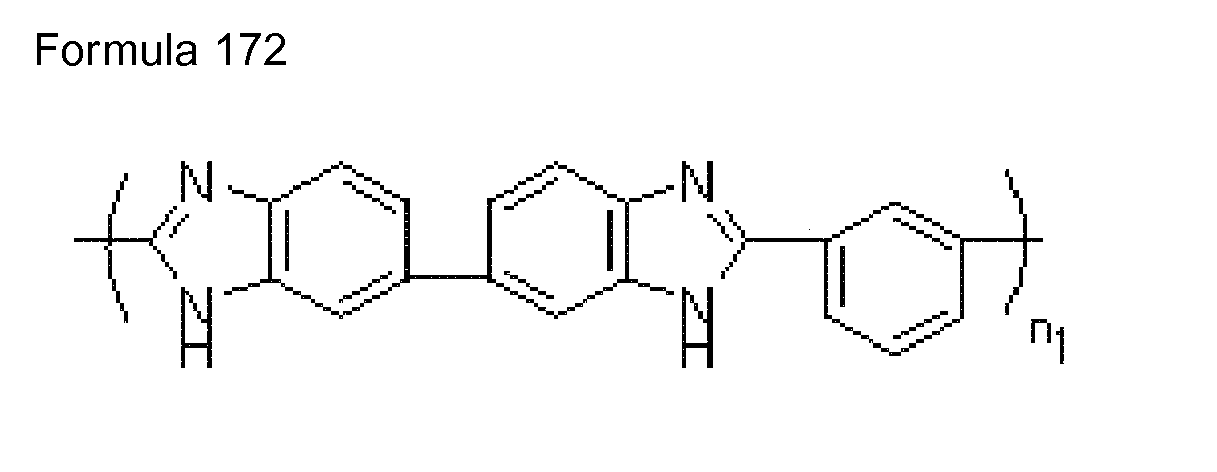
- In Formula 172, n1 may be about 130.
- Subsequently, the resultant was impregnated with 85 wt% of phosphoric acid to form an electrolyte membrane. Herein, the amount of phosphoric acid was about 500 parts by weight based on 100 parts by weight of the electrolyte membrane.
- The electrolyte membrane was disposed between the cathode and the anode to manufacture an MEA. The cathode and the anode were not impregnated with phosphoric acid.
- To prevent gas permeation between the cathode and the anode, a PTFE membrane main-gasket having a thickness of 200 µm and a PTFE membrane sub-gasket having a thickness of 20 µm were joined and disposed between each of the anode and cathode, and the electrolyte membrane. The pressure applied to the MEA was adjusted using a torque wrench and was stepwise increased using 1, 2, and 3 N-m Torque wrenches.
- Electricity was generated by supplying hydrogen to the anode (flow rate: about 100 cc/min) and air to the cathode (flow rate: about 250 cc/min), at 150 °C, without humidifying the electrolyte membrane, and characteristics of the fuel cell were measured. Herein, the electrolyte membrane doped with phosphoric acid was used, and thus, the performance of the fuel cell was improved over time. Thus, the fuel cell was activated until an operating voltage reached a peak voltage, and finally, the characteristics of the fuel cell were evaluated. In addition, the areas of the cathode and the anode were fixed to 7.84 cm2 (2.8 x 2.8). The thickness of the cathode was about 430 µm, and the thickness of the anode was about 390 µm.
- The electrochemical surface area (ECSA) of a Pt catalyst involved in a cathode reaction of each of the fuel cells manufactured in Manufacture Example 1 and Comparative Manufacture Examples 1 and 2 was measured. The results are shown in
FIG. 3 . The area of the Pt catalyst involved in the cathode reaction was measured by cyclic voltammetry. The anode and the cathode were purged with hydrogen and nitrogen, respectively, and the cathode was scanned at a voltage of about 0.08 V to about 1 V to detect a hydrogen desorption peak between 0.08 V and 0.4 V. The total area of peaks as a function of cycle is proportional to the area of the Pt catalyst. Thus, a contact area between Pt and phosphoric acid may be calculated. - The utilization rate of Pt may be calculated from the contact area between Pt and phosphoric acid, calculated as described above, and the total amount of Pt used in the cathode.
- The Pt utilization rate of the cathode of Manufacture Example 1 was found to be higher (26%) than that of the cathodes of Comparative Manufacture Examples 1 and 2 (both 22%).
- Cell voltage characteristics of the fuel cells of Manufacture Example 1 and Comparative Manufacture Examples 1 and 2 as a function of current density were measured. The results are shown in
FIG. 4 . - Referring to
FIG. 4 , the cell voltage characteristics of the fuel cell of Manufacture Example 1 were improved compared to those of the fuel cells of Comparative Manufacture Examples 1 and 2. - Cell voltage characteristics of the fuel cells of Manufacture Examples 2-4 and Comparative Manufacture Example 1 as a function of current density were measured. The results are shown in
FIG. 5 . - Referring to
FIG. 5 , the fuel cells of Manufacture Examples 2-4 are found to have better cell voltage characteristics than the fuel cell of Comparative Manufacture Example 1. - As described above, a composition according to the one or more of the above embodiments of the present invention, a uniform dispersion of polyoxazine-based compound particles having a small average particle diameter, may be uniformly dispersible in an electrode catalyst layer, and may be used to manufacture an electrode with the improved ability to retain phosphoric acid and improved resistance to high temperatures and acid.
- Although a few embodiments of the present invention have been shown and described, it would be appreciated by those skilled in the art that changes may be made in this embodiment without departing from the principles of the invention, the scope of which is defined in the claims and their equivalents.
Claims (15)
- A composition comprising a dispersion medium, and polyoxazine-based compound particles dispersed in the dispersion medium.
- The composition of claim 1, wherein the amount of the polyoxazine-based compound particles is in a range of 1 to 80 wt% based on the total weight of the composition.
- The composition of claim 1 or 2, wherein the dispersion medium comprises at least one material selected from the group consisting of alcohol, water, acids, and hydrocarbonic solvents.
- The composition of any of claims 1-3, wherein the polyoxazine-based compound particles have an average particle diameter of 0.5 to 10 µm.
- A method of preparing the composition of any of claims 1-4, the method comprising:mixing an oxazine-based monomer and an acid to prepare an acid solution of the oxazine-based monomer;thermally treating the acid solution of the oxazine-based monomer to obtain a polymerization product;separating the polyoxazine-based compound from the polymerization product; anddispersing the polyoxazine-based compound in a dispersion medium.
- The method of claim 5, wherein the acid comprises a phosphoric acid-based material.
- The method of claim 5 or 6, wherein the amount of the acid in the acid solution of the oxazine-based monomer is in a range of 1,000 to 100,000 parts by weight based on 100 parts by weight of the oxazine-based monomer.
- The method of any of claims 5-7, wherein the thermal treatment is performed at a temperature of 150 to 250 °C.
- The method of any of claims 5-8, wherein the separating of the polyoxazine-based compound from the polymerization product comprises:adding water to the polymerization product and centrifuging the polymerization product to which the water is added, to obtain a centrifuged product; andseparating the solid content from the centrifuged product.
- The method of any of claims 5-9, wherein the oxazine-based monomer comprises at least one compound selected from the compounds represented by Formulae 1 through 6 below:
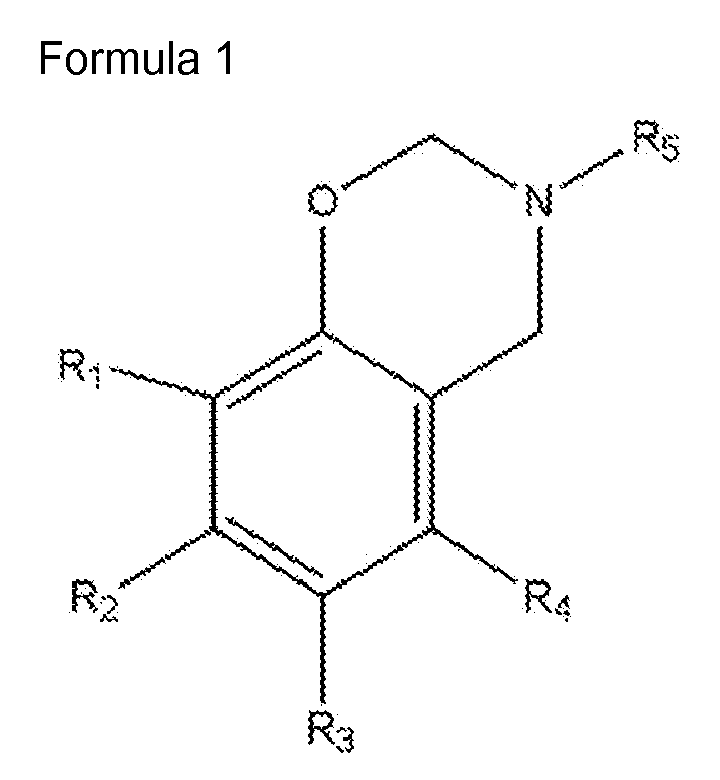
R5 is a substituted or unsubstituted C1-C20 alkyl group, a substituted or unsubstituted C1-C20 alkoxy group, a substituted or unsubstituted C2-C20 alkenyl group, a substituted or unsubstituted C2-C20 alkynyl group, a substituted or unsubstituted C6-C20 aryl group, a substituted or unsubstituted C6-C20 aryloxy group, a substituted or unsubstituted C7-C20 arylalkyl group, a substituted or unsubstituted C2-C20 heteroaryl group, a substituted or unsubstituted C2-C20 heteroaryloxy group, a substituted or unsubstituted C2-C20 heteroarylalkyl group, a substituted or unsubstituted C4-C20 carbocyclic group, a substituted or unsubstituted C4-C20 carbocyclic alkyl group, a substituted or unsubstituted C2-C20 heterocyclic group, or a substituted or unsubstituted C2-C20 heterocyclic alkyl group,
R6 is selected from the group consisting of a substituted or unsubstituted C1-C20 alkylene group, a substituted or unsubstituted C2-C20 alkenylene group, a substituted or unsubstituted C2-C20 alkynylene group, a substituted or unsubstituted C6-C20 arylene group, a substituted or unsubstituted C2-C20 heteroarylene group, -C(=O)-, and -SO2-,

R7 and R8 are linked to form a ring, wherein the ring is a C6-C10 cycloalkyl group, a C3-C10 heteroaryl group, a fused C3-C10 heteroaryl group, a C3-C10 heterocyclic group, or a fused C3-C10 heterocyclic group,
R9 to R16 are each, independently, a hydrogen atom, a C1-C20 alkyl group, a C1-C20 alkoxy group, a C6-C20 aryl group, a C6-C20 aryloxy group, a C1-C20 heteroaryl group, a C1-C20 heteroaryloxy group, a C4-C20 cycloalkyl group, a C1-C20 heterocyclic group, a halogen atom, a cyano group, or a hydroxy group,


at least two adjacent groups selected from among R23, R24 and R25 are linked to form the group represented by Formula 6A below, and the non-selected, remaining group is selected from among a C1-C20 alkyl group, a C1-C20 alkoxy group, a C6-C20 aryl group, a C6-C20 aryloxy group, a halogenated C6-C20 aryl group, a halogenated C6-C20 aryloxy group, a C1-C20 heteroaryl group, a C1-C20 heteroaryloxy group, a halogenated C1-C20 heteroaryl group, a halogenated C1-C20 heteroaryloxy group, a C4-C20 carbocyclic group, a halogenated C4-C20 carbocyclic group, a C1-C20 heterocyclic group, and a halogenated C1-C20 heterocyclic group,
* denotes the sites at which the at least two adjacent groups selected from among R20, R21 and R22 of Formula 6 and the at least two adjacent groups selected from among R23, R24 and R25 are linked, respectively. - The method of any of claims 5-9, wherein the oxazine-based monomer comprises at least one compound selected from among compound (4FPh3AP) represented by Formula 16 below, a compound (3,4-FPh4FA) represented by Formula 28 below, a compound represented by Formula 66 below, a compound (HF-a) represented by Formula 62 below, a compound (3HP2AP) represented by Formula 89 below, and a compound (PPO) represented by Formula 115 below :


- An electrode comprising:a support; anda catalyst layer disposed on the support, the catalyst layer comprising a coated product of the polyoxazine-based compound composition of any of claims 1-4.
- The electrode of claim 12, wherein the polyoxazine-based compound composition further comprises a cross-linkable compound.
- The electrode of claim 12 or 13, wherein the catalyst layer further comprises a catalyst, and
the amount of the polyoxazine-based compound in the catalyst layer is in a range of 0.001 to 20 parts by weight based on 1 part by weight of the catalyst. - A fuel cell comprising the electrode of any of claims 12-14.
Applications Claiming Priority (2)
| Application Number | Priority Date | Filing Date | Title |
|---|---|---|---|
| KR20100019027 | 2010-03-03 | ||
| KR1020110018011A KR101747863B1 (en) | 2010-03-03 | 2011-02-28 | Polybenzthiazole-based compound composition, preparing method thereof, electrode using the composition, and fuel cell employing the same |
Publications (3)
| Publication Number | Publication Date |
|---|---|
| EP2365567A2 true EP2365567A2 (en) | 2011-09-14 |
| EP2365567A3 EP2365567A3 (en) | 2013-01-23 |
| EP2365567B1 EP2365567B1 (en) | 2014-05-07 |
Family
ID=44202881
Family Applications (1)
| Application Number | Title | Priority Date | Filing Date |
|---|---|---|---|
| EP11156838.2A Not-in-force EP2365567B1 (en) | 2010-03-03 | 2011-03-03 | Composition, method of preparing the composition, electrode including the composition, and fuel cell including the electrode |
Country Status (4)
| Country | Link |
|---|---|
| US (2) | US9368803B2 (en) |
| EP (1) | EP2365567B1 (en) |
| JP (1) | JP5728252B2 (en) |
| WO (1) | WO2011108861A2 (en) |
Families Citing this family (1)
| Publication number | Priority date | Publication date | Assignee | Title |
|---|---|---|---|---|
| TWI656241B (en) * | 2014-11-10 | 2019-04-11 | Ineos Technologies Sa | Pad, device including the same, and related method |
Citations (2)
| Publication number | Priority date | Publication date | Assignee | Title |
|---|---|---|---|---|
| US20050256296A1 (en) | 2002-08-29 | 2005-11-17 | Joachim Kiefer | Polymer film based on polyazoles, and uses thereof |
| KR20090045655A (en) | 2007-11-02 | 2009-05-08 | 삼성전자주식회사 | Electrolyte membrane for fuel cell and fuel cell using same |
Family Cites Families (42)
| Publication number | Priority date | Publication date | Assignee | Title |
|---|---|---|---|---|
| WO1984001161A1 (en) | 1982-09-17 | 1984-03-29 | Stanford Res Inst Int | Liquid crystalline poly(2,6-benzothiazole) compositions, process and products |
| US4533692A (en) | 1982-09-17 | 1985-08-06 | Sri International | Liquid crystalline polymer compositions, process, and products |
| US4554119A (en) | 1983-04-11 | 1985-11-19 | Celanese Corporation | Process for heat treating shaped articles of poly {[benzo(1,2-d:4,5-d')bisthiazole-2,6-diyl]-1,4-phenylene}, its cis isomer or mixtures thereof |
| US4772678A (en) | 1983-09-15 | 1988-09-20 | Commtech International Management Corporation | Liquid crystalline polymer compositions, process, and products |
| US4557979A (en) * | 1984-02-17 | 1985-12-10 | Monsanto Company | Process for deposition of resin dispersions on metal substrates |
| DE3483002D1 (en) * | 1983-12-22 | 1990-09-20 | Monsanto Co | AQUEOUS DISPERSIONS OF POLYAMINES AND POLY (DIHYDROBENZOXAZINES). |
| US4507428A (en) | 1984-02-17 | 1985-03-26 | Monsanto Company | Aqueous dispersions of polyamines and poly(dihydrobenzoxazines) |
| DE4241150C1 (en) | 1992-12-07 | 1994-06-01 | Fraunhofer Ges Forschung | Electrode membrane composite, process for its production and its use |
| US5900447A (en) * | 1997-05-01 | 1999-05-04 | Edison Polymer Innovation Corporation | Composition for forming high thermal conductivity polybenzoxazine-based material and method |
| JPH1197011A (en) | 1997-09-17 | 1999-04-09 | Unitika Ltd | Nonaqueous lithium secondary battery |
| JP2000281819A (en) | 1999-01-27 | 2000-10-10 | Aventis Res & Technol Gmbh & Co Kg | Production of cross-linked polymer membrane and fuel cell |
| DE10052242A1 (en) | 2000-10-21 | 2002-05-02 | Celanese Ventures Gmbh | Acid-doped, single- or multi-layer plastic membrane with layers comprising polymer blends comprising polymers with repeating azole units, processes for producing such plastic membranes and their use |
| JP2002260682A (en) * | 2001-03-02 | 2002-09-13 | Nisshinbo Ind Inc | Composition for fuel cell separator, fuel cell separator, method for producing the same, and polymer electrolyte fuel cell |
| DE10110752A1 (en) | 2001-03-07 | 2002-09-19 | Celanese Ventures Gmbh | Process for the production of a membrane from bridged polymer and fuel cell |
| DE10117686A1 (en) | 2001-04-09 | 2002-10-24 | Celanese Ventures Gmbh | Proton-conducting membrane for use e.g. in fuel cells, is made by coating a support with a solution of aromatic tetra-amine and aromatic polycarboxylic acid in polyphosphoric acid and then heating the coating |
| JP2003255487A (en) | 2002-02-27 | 2003-09-10 | Konica Corp | Photothermographic imaging material |
| JP2003257491A (en) | 2002-03-06 | 2003-09-12 | Sanyo Chem Ind Ltd | Gel polymer electrolyte and electrochemical element using the same |
| JP4312550B2 (en) | 2003-09-09 | 2009-08-12 | 日本曹達株式会社 | Polymer solid electrolyte, solid electrolyte sheet, and method for producing solid electrolyte sheet |
| WO2005060444A2 (en) | 2003-12-03 | 2005-07-07 | Virginia Tech Intellectual Properties, Inc. | Hyperbranched segmented copolymers and methods of making same |
| DE10361833A1 (en) | 2003-12-30 | 2005-08-04 | Celanese Ventures Gmbh | Proton-conducting membrane and its use |
| US7985424B2 (en) * | 2004-04-20 | 2011-07-26 | Dendritic Nanotechnologies Inc. | Dendritic polymers with enhanced amplification and interior functionality |
| KR100542203B1 (en) | 2004-06-30 | 2006-01-10 | 삼성에스디아이 주식회사 | Binder composition for fuel cell, membrane-electrode assembly and method of manufacturing membrane-electrode assembly |
| KR100644856B1 (en) | 2005-03-17 | 2006-11-24 | 한국과학기술연구원 | Fuel cell membrane and its manufacturing method |
| KR100803189B1 (en) | 2005-04-14 | 2008-02-14 | 삼성에스디아이 주식회사 | An electrode, a manufacturing method thereof, a binder composition and a lithium battery employing these |
| WO2006132207A1 (en) * | 2005-06-09 | 2006-12-14 | Toyo Boseki Kabushiki Kaisha | Sulfonic acid group-containing polymer, method for producing same, resin composition containing such sulfonic acid group-containing polymer, polymer electrolyte membrane, polymer electrolyte membrane/electrode assembly, and fuel cell |
| EP1760110B1 (en) * | 2005-09-03 | 2011-11-02 | Samsung SDI Co., Ltd. | Polybenzoxazine-based compound, electrolyte membrane including the same, and fuel cell employing the electrolyte membrane |
| KR100818254B1 (en) | 2005-09-03 | 2008-03-31 | 삼성에스디아이 주식회사 | Polybenzoxazine Compounds, Electrolyte Membranes Containing the Same, and Fuel Cells Employing the Same |
| KR100818253B1 (en) | 2005-09-03 | 2008-04-01 | 삼성에스디아이 주식회사 | Polybenzoxazine Compounds, Electrolyte Membranes Containing the Same, and Fuel Cells Employing the Same |
| JP4632050B2 (en) | 2006-01-13 | 2011-02-16 | 信越化学工業株式会社 | Catalyst paste for polymer electrolyte fuel cell |
| KR100754374B1 (en) | 2006-02-07 | 2007-08-31 | 삼성에스디아이 주식회사 | Electrolyte Membrane Using Polybenzoxazine Compound and Its Manufacturing Method |
| KR101386162B1 (en) | 2006-07-21 | 2014-04-18 | 삼성에스디아이 주식회사 | Electrode for fuel cell and fuel cell employing the same |
| KR100893523B1 (en) | 2006-12-15 | 2009-04-17 | 삼성에스디아이 주식회사 | Fuel cell electrode, manufacturing method thereof and fuel cell employing the same |
| KR100829554B1 (en) | 2006-12-15 | 2008-05-14 | 삼성에스디아이 주식회사 | Fuel cell electrode and fuel cell having same |
| KR20090014604A (en) * | 2007-08-06 | 2009-02-11 | 삼성전자주식회사 | Proton conductor for fuel cell and fuel cell using same |
| JP2009057437A (en) * | 2007-08-31 | 2009-03-19 | Toyohashi Univ Of Technology | COMPOSITE MATERIAL COMPRISING POLYBENZOXAZINE RESIN AND ION LIQUID AND METHOD FOR PRODUCING THE SAME |
| EP2036912B1 (en) * | 2007-09-11 | 2012-08-08 | Samsung Electronics Co., Ltd. | Phosphorous containing benzoxazine-based monomer, polymer thererof, electrode for fuel cell including the same, electrolyte membrane for fuel cell including the same, and fuel cell employing the same |
| EP2036910B1 (en) * | 2007-09-11 | 2012-06-27 | Samsung Electronics Co., Ltd. | Benzoxazine-based monomer, polymer thereof, electrode for fuel cell including the same, electrolyte membrane for fuel cell includind the same, and fuel cell using the same |
| KR101366808B1 (en) | 2007-10-11 | 2014-02-25 | 삼성전자주식회사 | Polybenzimidazole-base complex, crosslinked material of polybenzoxazines formed thereof, and fuel cell using the same |
| US8188210B2 (en) | 2007-11-02 | 2012-05-29 | Samsung Electronics Co., Ltd. | Naphthoxazine benzoxazine-based monomer, polymer thereof, electrode for fuel cell including the polymer, electrolyte membrane for fuel cell including the polymer, and fuel cell using the electrode |
| EP2058321B1 (en) | 2007-11-02 | 2014-01-08 | Samsung Electronics Co., Ltd. | Phosphorous containing monomer, polymer thereof, electrode for fuel cell including the polymer, electrolyte membrane for fuel cell including the polymer, and fuel cell using the electrode |
| EP2062891B1 (en) | 2007-11-06 | 2012-08-08 | Samsung Electronics Co., Ltd. | Benzoxazine-based monomer, polymer thereof, electrode for fuel cell including the polymer, electrolyte membrane for fuel cell including the polymer, and fuel cell using the electrode |
| ATE543857T1 (en) | 2008-12-16 | 2012-02-15 | Samsung Electronics Co Ltd | HYPERBRANCHED POLYMER, ELECTRODE FOR FUEL CELLS WITH THE HYPERBRANCHED POLYMER, ELECTROLYTE MEMBRANE FOR FUEL CELLS WITH THE HYPERBRANCHED POLYMER AND FUEL CELL WITH AT LEAST ONE ELECTRODE AND THE ELECTROLYTE MEMBRANE |
-
2011
- 2011-03-03 JP JP2011046347A patent/JP5728252B2/en not_active Expired - Fee Related
- 2011-03-03 WO PCT/KR2011/001466 patent/WO2011108861A2/en not_active Ceased
- 2011-03-03 EP EP11156838.2A patent/EP2365567B1/en not_active Not-in-force
- 2011-03-03 US US13/039,745 patent/US9368803B2/en active Active
-
2016
- 2016-05-20 US US15/160,530 patent/US10355284B2/en active Active
Patent Citations (2)
| Publication number | Priority date | Publication date | Assignee | Title |
|---|---|---|---|---|
| US20050256296A1 (en) | 2002-08-29 | 2005-11-17 | Joachim Kiefer | Polymer film based on polyazoles, and uses thereof |
| KR20090045655A (en) | 2007-11-02 | 2009-05-08 | 삼성전자주식회사 | Electrolyte membrane for fuel cell and fuel cell using same |
Also Published As
| Publication number | Publication date |
|---|---|
| US20160268609A1 (en) | 2016-09-15 |
| JP5728252B2 (en) | 2015-06-03 |
| WO2011108861A2 (en) | 2011-09-09 |
| US9368803B2 (en) | 2016-06-14 |
| EP2365567B1 (en) | 2014-05-07 |
| US20110217627A1 (en) | 2011-09-08 |
| EP2365567A3 (en) | 2013-01-23 |
| WO2011108861A3 (en) | 2012-03-01 |
| JP2011178998A (en) | 2011-09-15 |
| US10355284B2 (en) | 2019-07-16 |
Similar Documents
| Publication | Publication Date | Title |
|---|---|---|
| US9484588B2 (en) | Compound, composition including compound, composite formed therefrom, electrode using composition or composite, composite membrane using composite, and fuel cell including at least one selected from electrode and composite membrane | |
| US20110189581A1 (en) | Compound, cross-linked material thereof, double cross-linked polymer thereof, and electrolyte membrane, electrode for fuel cell and fuel cell including same | |
| KR100983987B1 (en) | Method for producing a polymer electrolyte membrane | |
| KR101840817B1 (en) | Electrolyte membrane for fuel cell, electrode for fuel cell and fuel cell having the same | |
| EP2560227B1 (en) | Porous membrane, electrolyte membrane including same, methods of manufacturing both, and fuel cell including at least one of the membranes | |
| EP2595229B1 (en) | Composition, composite prepared from the composition, electrode using the composition or the composite, composite membrane including the composite, and fuel cell including the composite membrane | |
| US8936887B2 (en) | Composite electrolyte membrane for fuel cell, method of manufacturing the membrane, and fuel cell including the membrane | |
| EP2365567B1 (en) | Composition, method of preparing the composition, electrode including the composition, and fuel cell including the electrode | |
| JP5923291B2 (en) | COMPOUND HAVING CONDUCTIVE FUNCTIONAL GROUP, POLYMER THEREOF, FUEL CELL ELECTRODE CONTAINING THE SAME, ELECTROLYTE MEMBRANE FOR FUEL CELL CONTAINING THE SAME AND FUEL CELL USING THE SAME | |
| EP2466675B1 (en) | Conductive composition and method of preparation, polymer thereof, and electrode, electrolyte membrane and fuel cell including the composition or polymer | |
| US9680156B2 (en) | Composition, polymer thereof, electrode and electrolyte membrane for fuel cell, and fuel cell including the same | |
| US9178237B2 (en) | Conductive composition and method of preparation, polymer thereof, and electrode, electrolyte membrane and fuel cell including the composition or polymer | |
| CN102869726B (en) | Composition, method of preparing the composition, electrode including the composition, and fuel cell including the electrode | |
| KR101910574B1 (en) | Composition, composite formed therefrom, electrode for fuel cell using the same, electrolyte membrane for fuel cell using the same, preparing method of the electrolyte membrane for fuel cell, and fuel cell employing the same | |
| KR101791936B1 (en) | Compound, cross-linking material thereof, double crosslinked polymer thereof, electrolyte membrane for fuel cell including the same,electrode for fuel cell including the same, and fuel cell employing the same | |
| KR20110091446A (en) | Composition, polymer thereof, fuel cell electrode comprising same, electrolyte membrane for fuel cell and fuel cell employing same |
Legal Events
| Date | Code | Title | Description |
|---|---|---|---|
| PUAI | Public reference made under article 153(3) epc to a published international application that has entered the european phase |
Free format text: ORIGINAL CODE: 0009012 |
|
| AK | Designated contracting states |
Kind code of ref document: A2 Designated state(s): AL AT BE BG CH CY CZ DE DK EE ES FI FR GB GR HR HU IE IS IT LI LT LU LV MC MK MT NL NO PL PT RO RS SE SI SK SM TR |
|
| AX | Request for extension of the european patent |
Extension state: BA ME |
|
| RAP1 | Party data changed (applicant data changed or rights of an application transferred) |
Owner name: BASF SE Owner name: SAMSUNG ELECTRONICS CO., LTD. |
|
| PUAL | Search report despatched |
Free format text: ORIGINAL CODE: 0009013 |
|
| AK | Designated contracting states |
Kind code of ref document: A3 Designated state(s): AL AT BE BG CH CY CZ DE DK EE ES FI FR GB GR HR HU IE IS IT LI LT LU LV MC MK MT NL NO PL PT RO RS SE SI SK SM TR |
|
| AX | Request for extension of the european patent |
Extension state: BA ME |
|
| RIC1 | Information provided on ipc code assigned before grant |
Ipc: H01M 4/86 20060101ALI20121220BHEP Ipc: H01M 4/88 20060101ALI20121220BHEP Ipc: C08G 73/06 20060101ALI20121220BHEP Ipc: H01M 4/92 20060101AFI20121220BHEP Ipc: H01M 8/08 20060101ALN20121220BHEP Ipc: C08L 79/02 20060101ALI20121220BHEP Ipc: C08G 73/02 20060101ALI20121220BHEP Ipc: B01D 71/62 20060101ALI20121220BHEP Ipc: H01M 8/10 20060101ALN20121220BHEP |
|
| 17P | Request for examination filed |
Effective date: 20130723 |
|
| RBV | Designated contracting states (corrected) |
Designated state(s): AL AT BE BG CH CY CZ DE DK EE ES FI FR GB GR HR HU IE IS IT LI LT LU LV MC MK MT NL NO PL PT RO RS SE SI SK SM TR |
|
| RIC1 | Information provided on ipc code assigned before grant |
Ipc: H01M 8/10 20060101ALN20130821BHEP Ipc: H01M 4/92 20060101AFI20130821BHEP Ipc: C08G 73/02 20060101ALI20130821BHEP Ipc: C08L 79/02 20060101ALI20130821BHEP Ipc: B01D 71/62 20060101ALI20130821BHEP Ipc: H01M 4/88 20060101ALI20130821BHEP Ipc: H01M 4/86 20060101ALI20130821BHEP Ipc: C08G 73/06 20060101ALI20130821BHEP Ipc: H01M 8/08 20060101ALN20130821BHEP |
|
| GRAP | Despatch of communication of intention to grant a patent |
Free format text: ORIGINAL CODE: EPIDOSNIGR1 |
|
| INTG | Intention to grant announced |
Effective date: 20131011 |
|
| GRAS | Grant fee paid |
Free format text: ORIGINAL CODE: EPIDOSNIGR3 |
|
| GRAA | (expected) grant |
Free format text: ORIGINAL CODE: 0009210 |
|
| AK | Designated contracting states |
Kind code of ref document: B1 Designated state(s): AL AT BE BG CH CY CZ DE DK EE ES FI FR GB GR HR HU IE IS IT LI LT LU LV MC MK MT NL NO PL PT RO RS SE SI SK SM TR |
|
| REG | Reference to a national code |
Ref country code: GB Ref legal event code: FG4D |
|
| REG | Reference to a national code |
Ref country code: AT Ref legal event code: REF Ref document number: 667290 Country of ref document: AT Kind code of ref document: T Effective date: 20140515 |
|
| REG | Reference to a national code |
Ref country code: IE Ref legal event code: FG4D |
|
| REG | Reference to a national code |
Ref country code: DE Ref legal event code: R096 Ref document number: 602011006666 Country of ref document: DE Effective date: 20140626 |
|
| REG | Reference to a national code |
Ref country code: AT Ref legal event code: MK05 Ref document number: 667290 Country of ref document: AT Kind code of ref document: T Effective date: 20140507 |
|
| REG | Reference to a national code |
Ref country code: NL Ref legal event code: VDEP Effective date: 20140507 |
|
| REG | Reference to a national code |
Ref country code: LT Ref legal event code: MG4D |
|
| PG25 | Lapsed in a contracting state [announced via postgrant information from national office to epo] |
Ref country code: CY Free format text: LAPSE BECAUSE OF FAILURE TO SUBMIT A TRANSLATION OF THE DESCRIPTION OR TO PAY THE FEE WITHIN THE PRESCRIBED TIME-LIMIT Effective date: 20140507 Ref country code: NO Free format text: LAPSE BECAUSE OF FAILURE TO SUBMIT A TRANSLATION OF THE DESCRIPTION OR TO PAY THE FEE WITHIN THE PRESCRIBED TIME-LIMIT Effective date: 20140807 Ref country code: LT Free format text: LAPSE BECAUSE OF FAILURE TO SUBMIT A TRANSLATION OF THE DESCRIPTION OR TO PAY THE FEE WITHIN THE PRESCRIBED TIME-LIMIT Effective date: 20140507 Ref country code: GR Free format text: LAPSE BECAUSE OF FAILURE TO SUBMIT A TRANSLATION OF THE DESCRIPTION OR TO PAY THE FEE WITHIN THE PRESCRIBED TIME-LIMIT Effective date: 20140808 Ref country code: IS Free format text: LAPSE BECAUSE OF FAILURE TO SUBMIT A TRANSLATION OF THE DESCRIPTION OR TO PAY THE FEE WITHIN THE PRESCRIBED TIME-LIMIT Effective date: 20140907 Ref country code: FI Free format text: LAPSE BECAUSE OF FAILURE TO SUBMIT A TRANSLATION OF THE DESCRIPTION OR TO PAY THE FEE WITHIN THE PRESCRIBED TIME-LIMIT Effective date: 20140507 |
|
| PG25 | Lapsed in a contracting state [announced via postgrant information from national office to epo] |
Ref country code: AT Free format text: LAPSE BECAUSE OF FAILURE TO SUBMIT A TRANSLATION OF THE DESCRIPTION OR TO PAY THE FEE WITHIN THE PRESCRIBED TIME-LIMIT Effective date: 20140507 Ref country code: PL Free format text: LAPSE BECAUSE OF FAILURE TO SUBMIT A TRANSLATION OF THE DESCRIPTION OR TO PAY THE FEE WITHIN THE PRESCRIBED TIME-LIMIT Effective date: 20140507 Ref country code: HR Free format text: LAPSE BECAUSE OF FAILURE TO SUBMIT A TRANSLATION OF THE DESCRIPTION OR TO PAY THE FEE WITHIN THE PRESCRIBED TIME-LIMIT Effective date: 20140507 Ref country code: RS Free format text: LAPSE BECAUSE OF FAILURE TO SUBMIT A TRANSLATION OF THE DESCRIPTION OR TO PAY THE FEE WITHIN THE PRESCRIBED TIME-LIMIT Effective date: 20140507 Ref country code: LV Free format text: LAPSE BECAUSE OF FAILURE TO SUBMIT A TRANSLATION OF THE DESCRIPTION OR TO PAY THE FEE WITHIN THE PRESCRIBED TIME-LIMIT Effective date: 20140507 Ref country code: SE Free format text: LAPSE BECAUSE OF FAILURE TO SUBMIT A TRANSLATION OF THE DESCRIPTION OR TO PAY THE FEE WITHIN THE PRESCRIBED TIME-LIMIT Effective date: 20140507 Ref country code: ES Free format text: LAPSE BECAUSE OF FAILURE TO SUBMIT A TRANSLATION OF THE DESCRIPTION OR TO PAY THE FEE WITHIN THE PRESCRIBED TIME-LIMIT Effective date: 20140507 |
|
| PG25 | Lapsed in a contracting state [announced via postgrant information from national office to epo] |
Ref country code: PT Free format text: LAPSE BECAUSE OF FAILURE TO SUBMIT A TRANSLATION OF THE DESCRIPTION OR TO PAY THE FEE WITHIN THE PRESCRIBED TIME-LIMIT Effective date: 20140908 |
|
| PG25 | Lapsed in a contracting state [announced via postgrant information from national office to epo] |
Ref country code: SK Free format text: LAPSE BECAUSE OF FAILURE TO SUBMIT A TRANSLATION OF THE DESCRIPTION OR TO PAY THE FEE WITHIN THE PRESCRIBED TIME-LIMIT Effective date: 20140507 Ref country code: EE Free format text: LAPSE BECAUSE OF FAILURE TO SUBMIT A TRANSLATION OF THE DESCRIPTION OR TO PAY THE FEE WITHIN THE PRESCRIBED TIME-LIMIT Effective date: 20140507 Ref country code: CZ Free format text: LAPSE BECAUSE OF FAILURE TO SUBMIT A TRANSLATION OF THE DESCRIPTION OR TO PAY THE FEE WITHIN THE PRESCRIBED TIME-LIMIT Effective date: 20140507 Ref country code: BE Free format text: LAPSE BECAUSE OF FAILURE TO SUBMIT A TRANSLATION OF THE DESCRIPTION OR TO PAY THE FEE WITHIN THE PRESCRIBED TIME-LIMIT Effective date: 20140507 Ref country code: DK Free format text: LAPSE BECAUSE OF FAILURE TO SUBMIT A TRANSLATION OF THE DESCRIPTION OR TO PAY THE FEE WITHIN THE PRESCRIBED TIME-LIMIT Effective date: 20140507 Ref country code: RO Free format text: LAPSE BECAUSE OF FAILURE TO SUBMIT A TRANSLATION OF THE DESCRIPTION OR TO PAY THE FEE WITHIN THE PRESCRIBED TIME-LIMIT Effective date: 20140507 |
|
| REG | Reference to a national code |
Ref country code: DE Ref legal event code: R097 Ref document number: 602011006666 Country of ref document: DE |
|
| PG25 | Lapsed in a contracting state [announced via postgrant information from national office to epo] |
Ref country code: NL Free format text: LAPSE BECAUSE OF FAILURE TO SUBMIT A TRANSLATION OF THE DESCRIPTION OR TO PAY THE FEE WITHIN THE PRESCRIBED TIME-LIMIT Effective date: 20140507 |
|
| PLBE | No opposition filed within time limit |
Free format text: ORIGINAL CODE: 0009261 |
|
| STAA | Information on the status of an ep patent application or granted ep patent |
Free format text: STATUS: NO OPPOSITION FILED WITHIN TIME LIMIT |
|
| 26N | No opposition filed |
Effective date: 20150210 |
|
| PG25 | Lapsed in a contracting state [announced via postgrant information from national office to epo] |
Ref country code: IT Free format text: LAPSE BECAUSE OF FAILURE TO SUBMIT A TRANSLATION OF THE DESCRIPTION OR TO PAY THE FEE WITHIN THE PRESCRIBED TIME-LIMIT Effective date: 20140507 |
|
| REG | Reference to a national code |
Ref country code: DE Ref legal event code: R097 Ref document number: 602011006666 Country of ref document: DE Effective date: 20150210 |
|
| PG25 | Lapsed in a contracting state [announced via postgrant information from national office to epo] |
Ref country code: SI Free format text: LAPSE BECAUSE OF FAILURE TO SUBMIT A TRANSLATION OF THE DESCRIPTION OR TO PAY THE FEE WITHIN THE PRESCRIBED TIME-LIMIT Effective date: 20140507 |
|
| PG25 | Lapsed in a contracting state [announced via postgrant information from national office to epo] |
Ref country code: MC Free format text: LAPSE BECAUSE OF FAILURE TO SUBMIT A TRANSLATION OF THE DESCRIPTION OR TO PAY THE FEE WITHIN THE PRESCRIBED TIME-LIMIT Effective date: 20140507 Ref country code: LU Free format text: LAPSE BECAUSE OF FAILURE TO SUBMIT A TRANSLATION OF THE DESCRIPTION OR TO PAY THE FEE WITHIN THE PRESCRIBED TIME-LIMIT Effective date: 20150303 |
|
| REG | Reference to a national code |
Ref country code: CH Ref legal event code: PL |
|
| REG | Reference to a national code |
Ref country code: IE Ref legal event code: MM4A |
|
| PG25 | Lapsed in a contracting state [announced via postgrant information from national office to epo] |
Ref country code: LI Free format text: LAPSE BECAUSE OF NON-PAYMENT OF DUE FEES Effective date: 20150331 Ref country code: CH Free format text: LAPSE BECAUSE OF NON-PAYMENT OF DUE FEES Effective date: 20150331 Ref country code: IE Free format text: LAPSE BECAUSE OF NON-PAYMENT OF DUE FEES Effective date: 20150303 |
|
| REG | Reference to a national code |
Ref country code: DE Ref legal event code: R082 Ref document number: 602011006666 Country of ref document: DE Representative=s name: PATENTANWAELTE RUFF, WILHELM, BEIER, DAUSTER &, DE Ref country code: DE Ref legal event code: R081 Ref document number: 602011006666 Country of ref document: DE Owner name: SAMSUNG ELECTRONICS CO., LTD., SUWON-SI, KR Free format text: FORMER OWNERS: BASF SE, 67063 LUDWIGSHAFEN, DE; SAMSUNG ELECTRONICS CO., LTD., SUWON-SI, GYEONGGI-DO, KR |
|
| REG | Reference to a national code |
Ref country code: FR Ref legal event code: PLFP Year of fee payment: 6 |
|
| REG | Reference to a national code |
Ref country code: GB Ref legal event code: 732E Free format text: REGISTERED BETWEEN 20160218 AND 20160224 |
|
| REG | Reference to a national code |
Ref country code: FR Ref legal event code: TP Owner name: SAMSUNG ELECTRONICS CO., LTD., KR Effective date: 20160414 |
|
| PG25 | Lapsed in a contracting state [announced via postgrant information from national office to epo] |
Ref country code: MT Free format text: LAPSE BECAUSE OF FAILURE TO SUBMIT A TRANSLATION OF THE DESCRIPTION OR TO PAY THE FEE WITHIN THE PRESCRIBED TIME-LIMIT Effective date: 20140507 |
|
| REG | Reference to a national code |
Ref country code: FR Ref legal event code: PLFP Year of fee payment: 7 |
|
| PG25 | Lapsed in a contracting state [announced via postgrant information from national office to epo] |
Ref country code: BG Free format text: LAPSE BECAUSE OF FAILURE TO SUBMIT A TRANSLATION OF THE DESCRIPTION OR TO PAY THE FEE WITHIN THE PRESCRIBED TIME-LIMIT Effective date: 20140507 Ref country code: HU Free format text: LAPSE BECAUSE OF FAILURE TO SUBMIT A TRANSLATION OF THE DESCRIPTION OR TO PAY THE FEE WITHIN THE PRESCRIBED TIME-LIMIT; INVALID AB INITIO Effective date: 20110303 Ref country code: SM Free format text: LAPSE BECAUSE OF FAILURE TO SUBMIT A TRANSLATION OF THE DESCRIPTION OR TO PAY THE FEE WITHIN THE PRESCRIBED TIME-LIMIT Effective date: 20140507 |
|
| PG25 | Lapsed in a contracting state [announced via postgrant information from national office to epo] |
Ref country code: TR Free format text: LAPSE BECAUSE OF FAILURE TO SUBMIT A TRANSLATION OF THE DESCRIPTION OR TO PAY THE FEE WITHIN THE PRESCRIBED TIME-LIMIT Effective date: 20140507 |
|
| REG | Reference to a national code |
Ref country code: FR Ref legal event code: PLFP Year of fee payment: 8 |
|
| PG25 | Lapsed in a contracting state [announced via postgrant information from national office to epo] |
Ref country code: MK Free format text: LAPSE BECAUSE OF FAILURE TO SUBMIT A TRANSLATION OF THE DESCRIPTION OR TO PAY THE FEE WITHIN THE PRESCRIBED TIME-LIMIT Effective date: 20140507 |
|
| PG25 | Lapsed in a contracting state [announced via postgrant information from national office to epo] |
Ref country code: AL Free format text: LAPSE BECAUSE OF FAILURE TO SUBMIT A TRANSLATION OF THE DESCRIPTION OR TO PAY THE FEE WITHIN THE PRESCRIBED TIME-LIMIT Effective date: 20140507 |
|
| PGFP | Annual fee paid to national office [announced via postgrant information from national office to epo] |
Ref country code: FR Payment date: 20230221 Year of fee payment: 13 |
|
| PGFP | Annual fee paid to national office [announced via postgrant information from national office to epo] |
Ref country code: GB Payment date: 20230220 Year of fee payment: 13 Ref country code: DE Payment date: 20230220 Year of fee payment: 13 |
|
| REG | Reference to a national code |
Ref country code: DE Ref legal event code: R119 Ref document number: 602011006666 Country of ref document: DE |
|
| GBPC | Gb: european patent ceased through non-payment of renewal fee |
Effective date: 20240303 |
|
| PG25 | Lapsed in a contracting state [announced via postgrant information from national office to epo] |
Ref country code: DE Free format text: LAPSE BECAUSE OF NON-PAYMENT OF DUE FEES Effective date: 20241001 |
|
| PG25 | Lapsed in a contracting state [announced via postgrant information from national office to epo] |
Ref country code: GB Free format text: LAPSE BECAUSE OF NON-PAYMENT OF DUE FEES Effective date: 20240303 |
|
| PG25 | Lapsed in a contracting state [announced via postgrant information from national office to epo] |
Ref country code: FR Free format text: LAPSE BECAUSE OF NON-PAYMENT OF DUE FEES Effective date: 20240331 |
|
| PG25 | Lapsed in a contracting state [announced via postgrant information from national office to epo] |
Ref country code: GB Free format text: LAPSE BECAUSE OF NON-PAYMENT OF DUE FEES Effective date: 20240303 Ref country code: FR Free format text: LAPSE BECAUSE OF NON-PAYMENT OF DUE FEES Effective date: 20240331 Ref country code: DE Free format text: LAPSE BECAUSE OF NON-PAYMENT OF DUE FEES Effective date: 20241001 |