EP2365052A1 - pH tuneable-gellant for use in consumer product compositions - Google Patents
pH tuneable-gellant for use in consumer product compositions Download PDFInfo
- Publication number
- EP2365052A1 EP2365052A1 EP11157799A EP11157799A EP2365052A1 EP 2365052 A1 EP2365052 A1 EP 2365052A1 EP 11157799 A EP11157799 A EP 11157799A EP 11157799 A EP11157799 A EP 11157799A EP 2365052 A1 EP2365052 A1 EP 2365052A1
- Authority
- EP
- European Patent Office
- Prior art keywords
- methyl
- amino
- bis
- azanediyl
- diylbis
- Prior art date
- Legal status (The legal status is an assumption and is not a legal conclusion. Google has not performed a legal analysis and makes no representation as to the accuracy of the status listed.)
- Granted
Links
- 0 C*CCNC(C(*C(c1ccncc1)=O)=C(C)C)=O Chemical compound C*CCNC(C(*C(c1ccncc1)=O)=C(C)C)=O 0.000 description 1
- JYPHYLGXJNZRTL-JTQLQIEISA-N CC(C)[C@@H](C(NC)=O)NC(c1ccncc1)=O Chemical compound CC(C)[C@@H](C(NC)=O)NC(c1ccncc1)=O JYPHYLGXJNZRTL-JTQLQIEISA-N 0.000 description 1
- RHPIGNVHFYSEIH-AWEZNQCLSA-N CCCCCCCCCCCC(NCC(N[C@@H](C)C(O)=O)=O)=O Chemical compound CCCCCCCCCCCC(NCC(N[C@@H](C)C(O)=O)=O)=O RHPIGNVHFYSEIH-AWEZNQCLSA-N 0.000 description 1
- HXDOZKJGKXYMEW-UHFFFAOYSA-N CCc(cc1)ccc1O Chemical compound CCc(cc1)ccc1O HXDOZKJGKXYMEW-UHFFFAOYSA-N 0.000 description 1
- GOVXKUCVZUROAN-UHFFFAOYSA-N CCc1c[nH]c2ccccc12 Chemical compound CCc1c[nH]c2ccccc12 GOVXKUCVZUROAN-UHFFFAOYSA-N 0.000 description 1
Images


Classifications
-
- C—CHEMISTRY; METALLURGY
- C11—ANIMAL OR VEGETABLE OILS, FATS, FATTY SUBSTANCES OR WAXES; FATTY ACIDS THEREFROM; DETERGENTS; CANDLES
- C11D—DETERGENT COMPOSITIONS; USE OF SINGLE SUBSTANCES AS DETERGENTS; SOAP OR SOAP-MAKING; RESIN SOAPS; RECOVERY OF GLYCEROL
- C11D17/00—Detergent materials or soaps characterised by their shape or physical properties
- C11D17/0008—Detergent materials or soaps characterised by their shape or physical properties aqueous liquid non soap compositions
- C11D17/0026—Structured liquid compositions, e.g. liquid crystalline phases or network containing non-Newtonian phase
-
- C—CHEMISTRY; METALLURGY
- C07—ORGANIC CHEMISTRY
- C07C—ACYCLIC OR CARBOCYCLIC COMPOUNDS
- C07C237/00—Carboxylic acid amides, the carbon skeleton of the acid part being further substituted by amino groups
- C07C237/02—Carboxylic acid amides, the carbon skeleton of the acid part being further substituted by amino groups having the carbon atoms of the carboxamide groups bound to acyclic carbon atoms of the carbon skeleton
- C07C237/22—Carboxylic acid amides, the carbon skeleton of the acid part being further substituted by amino groups having the carbon atoms of the carboxamide groups bound to acyclic carbon atoms of the carbon skeleton having nitrogen atoms of amino groups bound to the carbon skeleton of the acid part, further acylated
-
- C—CHEMISTRY; METALLURGY
- C11—ANIMAL OR VEGETABLE OILS, FATS, FATTY SUBSTANCES OR WAXES; FATTY ACIDS THEREFROM; DETERGENTS; CANDLES
- C11D—DETERGENT COMPOSITIONS; USE OF SINGLE SUBSTANCES AS DETERGENTS; SOAP OR SOAP-MAKING; RESIN SOAPS; RECOVERY OF GLYCEROL
- C11D17/00—Detergent materials or soaps characterised by their shape or physical properties
- C11D17/0008—Detergent materials or soaps characterised by their shape or physical properties aqueous liquid non soap compositions
- C11D17/003—Colloidal solutions, e.g. gels; Thixotropic solutions or pastes
-
- C—CHEMISTRY; METALLURGY
- C11—ANIMAL OR VEGETABLE OILS, FATS, FATTY SUBSTANCES OR WAXES; FATTY ACIDS THEREFROM; DETERGENTS; CANDLES
- C11D—DETERGENT COMPOSITIONS; USE OF SINGLE SUBSTANCES AS DETERGENTS; SOAP OR SOAP-MAKING; RESIN SOAPS; RECOVERY OF GLYCEROL
- C11D3/00—Other compounding ingredients of detergent compositions covered in group C11D1/00
- C11D3/16—Organic compounds
- C11D3/26—Organic compounds containing nitrogen
- C11D3/32—Amides; Substituted amides
Definitions
- the present invention relates to structurants that are compatible with a broad range of detergent compositions and does not affect product clarity.
- External structurants for providing rheological benefits to consumer product compositions include those derived from castor oil, fatty acids, fatty esters, or fatty soap water-insoluble waxes.
- the required performance ingredients often complicate the addition of external structurants known in the art and may even be incompatible with them.
- performance ingredients such as enzymes, including protease and lipase (lipase hydrolyses ester bonds present in castor oil derivatives), which are desirable for improved low temperature cleaning. They are also often incompatible with low pH and peroxide bleaches.
- external structurants generally require the use of structurant premixes incorporating large amounts of water. Such structurant premixes are unsuitable for compact detergents and for unit-dose applications.
- Amido-gellants provide a solution for structuring consumer product compositions while also being compatible with a broad range of optional detergent ingredients, such as bleaches and/or enzymes. They also provide an aesthetically pleasing pour profile without negatively impacting the composition clarity. They can be formulated into structurant premixes that are entirely water-free. However, most amido-gellants require premixes that have to be heated to as high as 100°C to reduce the viscosity to a level where they can be easily mixed with a detergent composition. Since ingredients such as enzymes and perfumes start to degrade at temperatures as low as 50°C, they must be added after the amido-gellant, and after a cooling step.
- a need remains for a structurant for consumer product compositions, that is compatible with a broad range of ingredients (including heat-sensitive ingredients such as enzymes), while also being easy to incorporate in to the composition without requiring excessive heating.
- the present invention is to a pH tuneable amido-gellant having a formula selected from the group consisting of:
- Another aspect of the present invention relates to the use of such pH tuneable amido-gellant for structuring consumer product compositions, preferably fluid detergent compositions.
- consumer product means baby care, beauty care, fabric & home care, family care, feminine care, health care, snack and/or beverage products or devices intended to be used or consumed in the form in which it is sold, and not intended for subsequent commercial manufacture or modification.
- Such products include but are not limited to diapers, bibs, wipes; products for and/or methods relating to treating hair (human, dog, and/or cat), including, bleaching, coloring, dyeing, conditioning, shampooing, styling; deodorants and antiperspirants; personal cleansing; cosmetics; skin care including application of creams, lotions, and other topically applied products for consumer use; and shaving products, products for and/or methods relating to treating fabrics, hard surfaces and any other surfaces in the area of fabric and home care, including: air care, car care, dishwashing, fabric conditioning (including softening), laundry detergency, laundry and rinse additive and/or care, hard surface cleaning and/or treatment, and other cleaning for consumer or institutional use; products and/or methods relating to bath tissue, facial tissue, paper handkerchiefs, and/or paper towels; tampons, feminine napkins; products and/or methods relating to oral care including toothpastes, tooth gels, tooth rinses, denture adhesives, tooth whitening; over-the-counter health care including cough and cold remedies
- the pH-tuneable amido gellants are particularly useful for consumer product compositions having a fluid form, particularly liquid and gel forms.
- Such fluid forms also include fluid detergent compositions.
- Fluid detergent compositions as described herein include but are not limited to consumer products such as: shampoos; skin cleaners and exfolients; shaving liquids, foams and gels; products for treating fabrics, hard surfaces and any other surfaces in the area of fabric and home care, including: dishwashing, laundry cleaning, laundry and rinse additives, hard surface cleaning including floor and toilet bowl cleaners; products relating to oral care including toothpastes and gels and whiteners.
- a particularly preferred embodiment is a "fluid laundry detergent composition".
- "fluid laundry detergent composition” refers to any laundry treatment composition comprising a fluid capable of wetting and cleaning fabric e.g., clothing, in a domestic washing machine.
- the consumer product composition can include solids or gases in suitably subdivided form, but the overall composition excludes product forms which are non-fluid overall, such as tablets or granules.
- the consumer product compositions preferably have densities in the range from of 0.9 to 1.3 grams per cubic centimeter, more preferably from 1.00 to 1.10 grams per cubic centimeter, excluding any solid additives but including any bubbles, if present.
- the consumer product compositions may be opaque, semi-transparent or even clear.
- the consumer product composition has a turbidity of from 5 NTU to less than 3000 NTU, preferably less than 1000 NTU, more preferably less than 500 NTU and most preferably less than 100 NTU.
- the external structurant preferably imparts a shear thinning viscosity profile to the consumer product composition, independently from, or extrinsic from, any structuring effect of the detersive surfactants of the composition.
- Preferred external structurants include those which provide a pouring viscosity from 50 cps to 20,000 cps, more preferably from 200 cps to 10,000 cps, most preferably from 500 cps to 7,000 cps.
- the consumer product composition preferably has a resting viscosity of at least 1,500 cps, preferably at least 10,000 cps, more preferably at least 50,000 cps.
- This resting (low stress) viscosity represents the viscosity of the consumer product composition under gentle shaking in the package and during transportation.
- the consumer product composition may be a thixotropic gel.
- Such compositions may have a resting viscosity of from 10,000 cps to 500,000 cps, preferably from 100,000 cps to 400,000 cps, more preferably from 200,000 to 300,000.
- the preferred shear-thinning characteristics of the consumer product is defined as a ratio of low stress viscosity to pouring viscosity of at least 2, preferably at least 10, more preferably at least 100, up to 2000.
- the pouring viscosity is measured at a shear rate of 20 see -1 , which is a shear rate that the consumer product composition is typically exposed to during pouring.
- the resting (low stress) viscosity is determined under a constant stress of 0.1 Pa during a viscosity creep experiment over a 5 minute interval. Rheology measurements over the 5 minute interval are made after the composition has has rested at zero shear rate for at least 10 minutes, between loading the sample in the rheometer and running the test. The data over the last 3 minutes are used to fit a straight line, and from the slope of this line, the low stress viscosity is calculated.
- the viscosity is measured at 21°C using a TA AR 2000 (or AR G2) rheometer with a 40 mm stainless steel plate having a gap of 500 microns.
- the pH tuneable amido gellant provides the consumer product composition with a viscosity profile that is dependent on the pH of the composition.
- the pH tuneable amido gellants comprise at least one pH sensitive group.
- a pH tuneable amido gellant is added to a polar protic solvent such as water, it is believed that the nonionic species form the viscosity building network while the ionic species are soluble and do not form a viscosity building network.
- the amido gellant is either protonated or deprotonated.
- the solubility, and hence the viscosity building behaviour, of the amido gellant can be controlled.
- the pH-sensitive groups By careful selection of the pH-sensitive groups, the pKa of the amido gellant can be tailored. Hence, the choice of the pH-sensitive groups can be used to select the pH at which the amido gellant builds viscosity.
- the consumer product composition comprises from 0.01 wt% to 10 wt%, preferably from 0.05 wt% to 5 wt%, more preferably from 0.1 wt% to 2 wt%, most preferably from 0.4 wt% to 1 wt%, of a pH tuneable amido-gellant as an external structuring system.
- the consumer product composition comprises from 0.1 wt% to 0.5 wt% of the pH tuneable amido-gallant.
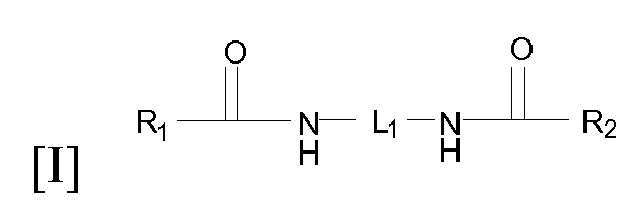
- the pH tuneable amido-gellant has a formula selected from the group consisting of: wherein R 1 and R 2 are aminofunctional end-groups; L 1 is a backbone moiety having molecular weight from 14 to 500 g/mol; and at least one of L 1 , R 1 or R 2 comprises a pH-sensitive group.
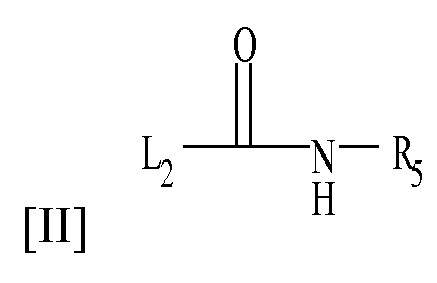
- R 5 is an aminofunctional moiety; L 2 is a backbone moiety having molecular weight from 14 to 500 g/mol; and at least one of L 2 or R 5 comprises a pH-sensitive group; and mixtures thereof; wherein the pH tuneable amido-gellant has a pKa of from 1 to 30, preferably a pKa of from 1.5 to 14.
- the pH tuneable amido gellant comprises at least one amido functional group, and further comprises at least one pH-sensitive group.
- the pH tuneable amido gellant has a molecular weight from 150 to 1500 g/mol, more preferably from 300 g/mol to 900 g/mol, most preferably from 400 g/mol to 700 g/mol.
- the pH tuneable amido gellant has the following structure [I]: wherein R 1 and R 2 are aminofunctional end-groups; L 1 is a backbone moiety having molecular weight from 14 to 500 g/mol; and at least one of L 1 , R 1 or R 2 comprises a pH-sensitive group.
- L 1 is selected from C2 to C20 hydrocarbyl chains, more preferably C6 to C12, most preferably C8 to C10.
- R 1 is R 3 or R 2 is R 4 or wherein each AA is independently selected from the group consisting of: and R 3 and R 4 independently have the formula: (L') o -(L") q -R, [IV] wherein: (o + q) is from 1 to 10; L' and L" are linking groups, independently selected from the same groups as A, B, C and D in equation [III]; and R, R' and R" are independently selected either from the pH-sensitive-groups consisting of: *the arrow indicates up to 4 substitutions in the positions indicated, n and m are integers from 1 to 20 or from the non-pH-sensitive groups consisting of: such that at least one of R, R' and R" comprises a pH-sensitive group.
- R comprises the pH-sensitive group.
- at least some of R, R' and R" are independently selected from the group of pH-sensitive molecules consisting of:
- the pH tuneable amido gellant having structure [I] is characterized in that: L 1 is an aliphatic linking group with a backbone chain of from 2 to 20 carbon atoms, preferably -(CH 2 ) n - wherein n is selected from 2 to 20, and both R 1 and R 2 have the structure: AA is preferably selected from the group consisting of: or from the group consisting of: and R is preferably selected from the pH-sensitive groups consisting of: or from the group:
- two or more of L 1 , L' and L" are the same group.
- the pH tuneable amido gellant molecule described in formula [I] can be symmetric with respect to the L 1 entity or can be asymmetric. Without intending to be bound by theory, it is believed that symmetric pH tuneable amido gellant molecules allow for more orderly structured networks to form, whereas compositions comprising one or more asymmetric pH tuneable amido gellant molecules can create disordered networks.
- Suitable pH tuneable amido gellants having structure [I] may be selected from table 1 and table 2, table 3, and mixtures thereof. More preferably, the pH tuneable amido gellants, having structure [I], are selected from table 2, and mixtures thereof. Alternatively, the pH tuneable amido gellants, having structure [I], are selected from table 3, and mixtures thereof.
- the pH tuneable amido gellant has the structure [II]: wherein R 5 is an aminofunctional moiety; L 2 is a backbone moiety having molecular weight from 14 to 500 g/mol; and at least one of L 2 or R 5 comprises a pH-sensitive group;
- L 2 is selected from C2 to C20 hydrocarbyl chains, more preferably C6 to C12, most preferably C8 to C10.
- R 5 preferably has the formula: wherein: AA is independently selected from the same group of AA as for structure [I]; (e+f+g) is from 0 to 20, more preferably from 1 to 3.
- At least one of AA, R or R"' comprises a pH sensitive group.
- R comprises the pH sensitive group.
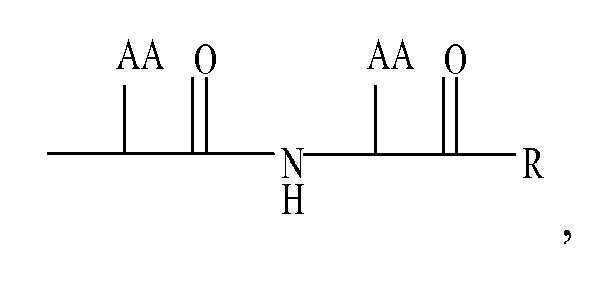
- the pH tuneable amido gellant having structure [II] is characterized in that: L 2 is an aliphatic linking group with a backbone chain of from 2 to 20 carbon atoms, preferably -(CH 2 ) n -CH 3 wherein n is selected from 2 to 20, and R 5 has the structure: wherein: each AA is independently selected from the group consisting of: or from the group consisting of: and R is selected from the pH-sensitive groups consisting of: or from the group:
- Suitable pH tuneable amido gellants having structure [II] include the structures selected from Table 4, and mixtures thereof.
- pH tuneable amido gellant examples of the present invention are pH tuneable amido gellant examples of the present invention.
- AA comprises at least one of: Alanine, ß-Alanine and substituted Alanines; Linear Amino-Alkyl Carboxylic Acid; Cyclic Amino-Alkyl Carboxylic Acid; Aminobenzoic Acid Derivatives; Aminobutyric Acid Derivatives; Arginine and Homologues; Asparagine; Aspartic Acid; p-Benzoyl-Phenylalanine; Biphenylalanine; Citrulline; Cyclopropylalanine; Cyclopentylalanine; Cyclohexylalanine; Cysteine, Cystine and Derivatives; Diaminobutyric Acid Derivatives; Diaminopropionic Acid; Glutamic Acid Derivatives; Glutamine; Glycine; Substituted Glycines; Histidine; Homoserine; Indole Derivatives; Isoleucine; Leucine and
- the pH tuneable amido gellant molecule may also comprise protective groups, preferably from 1 to 2 protective groups, preferably two protective groups.
- protective groups preferably from 1 to 2 protective groups, preferably two protective groups. Examples of suitable protective groups are provided in " Protecting Groups”, P.J. Kocienski, ISBN 313 135601 4, Georg Thieme Verlag, Stutgart ; and " Protective Groups in Organic Chemistry", T.W. Greene, P.G.M. Wuts, ISBN 0-471-62301-6, John Wiley& Sons, Inc, New York .
- the pH tuneable amido gellant preferably has a minimum gelling concentration (MGC) of from 0.1 to 100 mg/mL in the consumer product composition, at the target pH of the composition, preferably from 0.1 to 25 mg/mL, more preferred from 0.5 to 10mg/mL in accordance with the MGC Test Method.
- MGC minimum gelling concentration
- the MGC as used herein can be represented as mg/ml or as a wt %, where wt% is calculated as the MGC in mg/ml divided by 10.
- the MGC when measured in the consumer product composition, is from 0.1 to 100 mg/mL, preferably from 0.1 to 25 mg/mL of said pH tuneable amido gellant, more preferably from 0.5 to 10 mg/mL, or at least 0.1 mg/mL, at least 0.3 mg/mL, at least 0.5 mg/mL, at least 1.0 mg/mL, at least 2.0 mg/mL, at least 5.0 mg/mL of pH tuneable amido gellant. While consumer product compositions may have a pH tuneable amido gellant concentration either above or below the MGC, the pH tuneable amido gellants result in particularly useful rheologies below the MGC.
- the consumer product composition may be dilute or concentrated aqueous liquids. Alternatively, the consumer product composition may be almost entirely non-aqueous, and comprising a non-aminofunctional organic solvent. Such consumer product compositions may comprise very little water, for instance, that may be introduced with other raw materials. Preferably, the consumer product composition comprises from 1% to 95 % by weight of water and/or non-aminofunctional organic solvent. For concentrated detergents, the composition comprises preferably from 5% to 70%, more preferably from 10% to 50%, most preferably from 15% to 45% by weight, water and/or non-aminofunctional organic solvent.
- non-aminofunctional organic solvent refers to any organic solvent which contains no amino functional groups.
- Preferred non-aminofunctional organic solvents include monohydric alcohols, dihydric alcohols, polyhydric alcohols, glycerol, glycols, polyalkylene glycols such as polyethylene glycol, and mixtures thereof. Highly preferred are mixtures of solvents, especially mixtures of two or more of the following: lower aliphatic alcohols such as ethanol, propanol, butanol, isopropanol; diols such as 1,2-propanediol or 1,3-propanediol; and glycerol. Also preferred are propanediol and mixtures thereof with diethylene glycol where the mixture contains no methanol or ethanol. Thus embodiments of consumer product compositions may include embodiments in which propanediols are used but methanol and ethanol are not used.
- Preferable non-aminofunctional organic solvents are liquid at ambient temperature and pressure (i.e. 21°C and 1 atmosphere), and comprise carbon, hydrogen and oxygen.
- (2S)-2-[[2-(dodecanoylamino)acetyl]amino]propanoic acid is obtained by preparing a first solution by dissolving H-Gly-Ala-OH (30 mmol) in Sodium hydroxide (0.105 M, 300 mL). This first solution is placed in a round bottomed flask with an efficient magnetic stirrer. The flask is completely immersed in an ice bath and during the reaction and the magnetic stirrer is set at 1800rpm. Lauroyl chloride (9.84 grams, 45 mmol) and sodium hydroxide (3M, 15mL) are drop wise added to this first solution at the same rate in such a way that the pH of the reaction mixture does not decrease below 10.
- (2S)-2-[[2-(hexadecanoylamino)acetyl]amino]propanoic acid is obtained by preparing a first solution by dissolving Glycyl-L-alanine (30 mmol) in Sodium hydroxide (0.105 M, 300 mL). This first solution is placed in a round bottomed flask with an efficient magnetic stirrer. The flask is completely immersed in an ice bath and during the reaction and the magnetic stirrer is set at 1800rpm. Palmitoyl chloride (12.37 grams, 45 mmol) and sodium hydroxide (3M, 15mL) are drop wise added to this first solution at the same rate in such a way that the pH of the reaction mixture does not decrease below 10.
- Turbidity (measured in NTU: Nephelometric Turbidity Units) according to the present invention is measured using a Hach 2100P turbidity meter calibrated according to the procedure provided by the manufacture.
- the sample vials are filled with 15ml of representative sample and capped and cleaned according to the operating instructions. If necessary, the samples are degassed to remove any bubbles either by applying a vacuum or using an ultrasonic bath (see operating manual for procedure).
- the turbidity is measured using the automatic range selection.
- MGC is calculated by a tube inversion method based on R.G. Weiss, P. Terech; "Molecular Gels: Materials with self-assembled fibrillar structures” 2006 springer, p 243. In order to determine the MGC, three screenings are done:
- samples are prepared and treated as follows: 8mL vials (Borosilacate glass with Teflon cap, ref. B7857D, Fisher Scientific Bioblock) are filled with 2.0000 ⁇ 0.0005 g (KERN ALJ 120-4 analytical balance with ⁇ 0.1mg precision) of the fluid (comprising the consumer product composition and pH tuneable amido gellant) for which we want to determine the MGC.
- the vial is sealed with the screw cap and left for 10 minutes in an ultrasound bath (Elma Transsonic T 710 DH, 40 kHz, 9.5L, at 25 °C and operating at 100% power) in order to disperse the solid in the liquid.
- vapours may be formed, and upon cooling down the samples, these vapours can condense on top of the gel. When the vial is inverted, this condensed vapour will flow. This is discounted during the observation period. If no gels are obtained in the concentration interval, higher concentrations must be evaluated.
- pH measurement of a liquid detergent composition may be measured using test method EN 1262. 4.
- Rheology An AR-G2 rheometer from TA Instruments is used for rheological measurements. Plate: 40mm standard steel parallel plate, 300 ⁇ m gap.
- Example 1 A liquid laundry detergent composition is prepared as follows: Step 1: A structurant premix A1 is prepared by dissolving 0.20 grams N,N '-(25,2'S)-1,1'-(hexane-1,6-diylbis(azanediyl))bis(3-methyl-1-oxobutane-2,1-diyl)diisonicotinamide in 12.0 grams of 50% citric acid aqueous solution (prepared by dissolving 6.0 grams of citric acid solid in 6.0 grams deionized water) at 25°C.
- Step 2 A detergent feed B 1 having the composition described in Table 5 is prepared.
- Table 5 Composition of detergent feed B1
- Ingredient Detergent Feed B1 Grams Linear Alkylbenzene sulfonic acid (LAS) 12.0 C12-14 alkyl ethoxy 3 sulfate Mono Ethanol Amine salt 9.3 C12-14 alkyl 7-ethoxylate 8.0 1,2-propanediol 9.8 C12-18 Fatty Acid 10.0 Grease Cleaning Alkoxylated Polyalkylenimine Polymer 1 0.9 PEG PVAc Polymer 2 0.9 Soil Suspending Alkoxylated Polyalkylenimine 2.2 Polymer 3 Hydroxyethane diphosphonic acid 1.6 FWA 0.23 Ethanol 1.5 Boric acid 0.5 MEA Up to pH8 Water up to 66 grams 1 600 g/mol molecular weight polyethylenimine core with 24 ethoxylate groups per -NH and 16 propoxylate groups per -NH.
- LAS Linear Alkylbenzene sulfonic acid
- Mono Ethanol Amine salt 9.3
- 2 PEG-PVA graft copolymer is a polyvinyl acetate grafted polyethylene oxide copolymer having a polyethylene oxide backbone and multiple polyvinyl acetate side chains.
- the molecular weight of the polyethylene oxide backbone is 6000 and the weight ratio of the polyethylene oxide to polyvinyl acetate is 40 to 60 and no more than 1 grafting point per 50 ethylene oxide units.
- Step 3: 12.4 grams of structurant premix A1 is mixed with 66 grams of detergent feed B1 at 600rpm for 10 min, at 25°C, and the resulting mixture is adjusted to pH 8 with MEA.
- Step 4 The pH sensitive ingredients (1.5 grams protease, 0.7 grams amylase, 0.1 grams mannanase, 0.1 grams xyloglucanase, 0.4 grams pectate lyase and 1.7 grams of perfume) and deionized water (to bring the final weight up to 100 grams) are added under gentle stirring, at 500-600rpm for 10 min.
- a laundry unit dose comprising the fluid detergent composition is prepared as follows: Step 1: A structurant premix A2 is prepared by fully dissolving 0.20 grams N,N '-(25,2'S)-1,1'-(octane-1,8-diylbis(azanediyl))bis(3-methyl-1-oxobutane-2,1-diyl)diisonicotinamide in 1.0 grams of citric acid and 3 grams of deionized water at 25°C. Step 2: A detergent feed B2 having the composition described in Table 6 is prepared.
- Table 6 Composition of detergent feed B2 Ingredient Detergent Feed B2 % of base @100% active 1,2-Propanediol 15 MEA 10 Glycerol 5 Hydroxyethane diphosphonic acid 1 Potassium sulfite 0.2 C12-45 alkyl 7-ethoxylate 20 Linear Alkylbenzene sulfonic acid 24.5 FWA 0.2 C12-18 Fatty Acid 16 Ethoxysulfated Hexamethylene Diamine Dimethyl Quat 2.9 Soil Suspending Alkoxylated Polyalkylenimine Polymer 3 1 MgCl 2 0.2 Water and minors Up to 100% Step 3: 4.2 grams of structurant premix A2 are mixed with 34.5 grams of detergent feed B2 at 600rpm for 10 min, at 25°C, for 5 minutes.
- the fluid detergent composition is then packed into a polyvinyl alcohol pouch.
- Examples 3A to 3E Fluid Detergent Fabric Care Compositions comprising amido-gellants:
- Step 1 A structurant premix A3 is prepared by dissolving 5 grams N,N' -(25,2'S)-1,1'-(dodecane-1,12-diylbis(azanediyl))bis(3-methyl-1-oxobutane-2,1-diyl)diisonicotinamide in 95 grams of 25% sulfuric acid aqueous solution (Sigma-Aldrich) at 25°C.
- Step 2 A detergent feed B3A to B3E having the composition described in Table 8 is prepared.
- Table 8 Composition of detergent feed B3A to B3E
- PEG-PVA graft copolymer is a polyvinyl acetate grafted polyethylene oxide copolymer having a polyethylene oxide backbone and multiple polyvinyl acetate side chains.
- the molecular weight of the polyethylene oxide backbone is about 6000 and the weight ratio of the polyethylene oxide to polyvinyl acetate is about 40 to 60 and no more than 1 grafting point per 50 ethylene oxide units. Available from BASF (Ludwigshafen, Germany).
- Step 3 Structurant premix A3 (amounts listed in Table 9) is mixed with 70 grams of detergent feeds B3A to B3E at 400rpm for 10 min, at 35°C. Table 9: addition of premix A3 Ingredient 3A 3B 3C 3D 3E grams grams grams grams grams grams grams grams grams grams grams grams grams grams grams grams grams grams grams grams grams grams grams grams grams grams grams grams grams grams grams grams grams grams grams grams grams grams grams grams grams grams grams grams grams grams grams grams grams grams grams grams grams grams grams grams grams grams grams grams grams grams grams grams grams grams grams grams grams grams grams grams grams grams grams grams grams grams grams grams grams grams grams grams grams grams grams grams grams grams grams grams grams grams grams grams grams grams grams grams grams grams grams grams grams grams grams grams grams grams grams grams grams grams grams
- Perfume microcapsules can be prepared as follows: 25 grams of butyl acrylate-acrylic acid copolymer emulsifier (Colloid C351, 25% solids, pka 4.5-4.7, Kemira Chemicals, Inc. Kennesaw, Georgia U.S.A.) is dissolved and mixed in 200 grams deionized water. The pH of the solution is adjusted to pH of 4.0 with sodium hydroxide solution. 8 grams of partially methylated methylol melamine resin (Cymel 385, 80% solids, Cytec Industries West Paterson , New Jersey, U.S.A.) is added to the emulsifier solution.
- Hand-dish washing fluid detergent compositions comprising amido-gellants.
- Hand-dish washing liquid detergent compositions may be prepared by mixing together the ingredients listed in the proportions shown: Table 11: Hand-dish washing fluid detergent compositions comprising amido-gellants Ex 4A Ex 4B Ex 4C Ex 4D Ex 4E Ex 4F Alkyl Ethoxy Sulfate AE0.6S 22.0 19.0 27.0 20.0 22.0 22.0 Linear C12-C14 Amine oxide 6.0 4.5 - - 6.0 5.0 C9-C11 alkyl EO8 ethoxylate 7.0 - - - - - L-Glutamic acid-N,N-di(acetic acid) tetrasodium salt 1.0 - - 0.1 - - Sodium Citrate - 1.0 - 0.5 0.8 - Solvent: ethanol, isopropylalcohol,..
- N,N '-(2S,2'S)-1,1'-(dodecane-1,12-diylbis(azanediyl))bis(3-methyl-1-oxobutane-2,1-diyl)diisonicotinamide has been added as Premix A3 prepared in example 3. Afterwards, pH was adjusted with 20% sodium hydroxide aqueous solution to pH 9 (for examples 4A to 4J) and pH 8 (examples 4K to 4S).
- Examples 5A, 5B and 5C compacted laundry fluid detergent compositions (25mL dosage) comprising amido-gellants:
- Step 1 A structurant premix A5 is prepared by dissolving 10 grams N,N '-(2S,2'S)-1,1'-(dodecane-1,12-diylbis(azanediyl))bis(3-methyl-1-oxobutane-2,1-diyl)diisonicotinamide in 90 grams 20% C 11-8 HLAS in 1,2-propanediol solution (prepared by adding 20 grams C 11-8 HLAS to 80 grams 1,2-propanediol at 50°C) at 45°C.
- Step 2 Detergent feeds B5A and B5B having the composition described in Table 15 are prepared.
- Table 15 Composition of detergent feeds B5A, B5B, B5C 5A 5B 5C Ingredients Weight% Monoethanolamine: C 12-15 EO ⁇ 3 ⁇ SO 3 H 40.5 43.3 41.5 Monoethanolamine: C 16-17 highly soluble alkyl sulfate 6.5 7.4 7.0 C 12-14 dimethylamine-N-oxide 1.9 2.1 2.0 Ethoxylated Polyethyleneimine 1 4.3 4.9 4.3 Citric acid - 2.5 1.0 Amphiphilic alkoxylated grease cleaning polymer 2 4.3 3.1 4.3 C 12-18 Fatty acid 3.3 - 3.3 Suds suppression polymer 0.1 0.1 0.1 C 11-8 HLAS 14.7 12.4 13.0 Hydroxy Ethylidene 1,1 Di Phosphonic acid - 1.2 - Tiron 2.2 - 2.2 Brightener 0.1 0.2 0.1 Water 5.1 6.2 4.8 Minors (antioxidant, sulfite, aesthetics,...) 1.6 1.9 2.0 Buffers (monoethanolamine) To pH 8.0 Solvents (1,
- Examples 6A and 6B laundry fluid detergent composition comprising amido-gellants: Detergent feeds 6A and 6B, having the compositions described in Table 17, are prepared. Then A3 premix is added and pH is adjusted to 8 with sodium hydroxide 20%.
- Table 17 laundry fluid detergent composition comprising amido-gellants Ingredient 6A 6B Wt% Wt% C12-14 alkyl polyethoxylate (3.0) sulfate 3.8 3.5 C 11-8 HLAS 3.7 4.0 C12-14 alkyl 7-ethoxylate 1.4 1.4 1,2 Propane diol 0.18 0.25 Glycerine 2.00 2.00 Diethylene triamine penta acetate 0.48 0.48 Phenoxyethanol 0.1 0.1 Citric acid 1.70 2.5 Fluorescent Whitening Agent 0.057 - Dodecyldimethylamine N-oxide 0.4 0.4 Zwitterionic ethoxylated quaternized sulfated hexamethylene diamine 1 0.25 0.25 Perfume 0.43 0.30
- Hand-dish washing fluid detergent compositions comprising amido-gellant.
- Hand-dish washing liquid detergent compositions may be prepared by mixing together the ingredients listed in the proportions shown: Table 18: Hand-dish washing fluid detergent compositions comprising amido-gellant 7 Alkyl Ethoxy Sulfate AE2.0S 18.0 Coco amido propyl Betaine 5.0 Polypropylene glycol MW2000 0.5 N,N' -(2 S ,2' S )-1,1'-(octane-1,8-diylbis(azanediyl))bis(3-methyl-1-oxobutane-2,1-diyl)bis(4-hydroxybenzamide) 0.25 Minors, citric acid and Balance with water up to 100% and pH 5.5.
- Example 8 A liquid laundry detergent composition is prepared as follows: Step 1: A structurant premix A1 is prepared by dissolving 0.20 grams N,N '-(2S,2'S)-1,1'-(dodecane-1,12-diylbis(azanediyl))bis(3-methyl-1-oxobutane-2,1-diyl)diisonicotinamide in 12.0 grams of 50% citric acid aqueous solution (prepared by dissolving 6.0 grams of citric acid solid in 6.0 grams deionized water) at 25°C.
- Step 2 A detergent feed B1 having the composition described in Table 19 is prepared.
- Table 19 Composition of detergent feed B1
- Ingredient Detergent Feed B1 Grams Linear Alkylbenzene sulfonic acid (LAS) 12.0 C12-14 alkyl ethoxy 3 sulfate Mono Ethanol Amine salt 9.3 C12-14 alkyl 7-ethoxylate 8.0 1,2-propanediol 9.8 C12-18 Fatty Acid 10.0 Grease Cleaning Alkoxylated Polyalkylenimine Polymer 1 0.9 PEG PVAc Polymer 2 0.9 Soil Suspending Alkoxylated Polyalkylenimine Polymer 3 2.2 Hydroxyethane diphosphonic acid 1.6 FWA 0.23 Ethanol 1.5 Boric acid 0.5 MEA Up to pH 8 Water up to 66 grams 1 600 g/mol molecular weight polyethylenimine core with 24 ethoxylate groups per -NH and 16 propoxylate groups per -NH.
- LAS Linear Alkylbenzene sulfonic acid
- Mono Ethanol Amine salt 9.3
- 2 PEG-PVA graft copolymer is a polyvinyl acetate grafted polyethylene oxide copolymer having a polyethylene oxide backbone and multiple polyvinyl acetate side chains.
- the molecular weight of the polyethylene oxide backbone is 6000 and the weight ratio of the polyethylene oxide to polyvinyl acetate is 40 to 60 and no more than 1 grafting point per 50 ethylene oxide units.
- Step 3: 12.4 grams of structurant premix A1 is mixed with 66 grams of detergent feed B1 at 600rpm for 10 min, at 25°C, and the resulting mixture is adjusted to pH 8 with MEA.
- Step 4 The pH sensitive ingredients (1.5 grams protease, 0.7 grams amylase, 0.1 grams mannanase, 0.1 grams xyloglucanase, 0.4 grams pectate lyase and 1.7 grams of perfume) and deionized water (to bring the final weight up to 100 grams) are added under gentle stirring, at 500-600rpm for 10 min.
Landscapes
- Chemical & Material Sciences (AREA)
- Organic Chemistry (AREA)
- Chemical Kinetics & Catalysis (AREA)
- Life Sciences & Earth Sciences (AREA)
- Oil, Petroleum & Natural Gas (AREA)
- Wood Science & Technology (AREA)
- Engineering & Computer Science (AREA)
- Dispersion Chemistry (AREA)
- Crystallography & Structural Chemistry (AREA)
- Detergent Compositions (AREA)
- Cosmetics (AREA)
- Pharmaceuticals Containing Other Organic And Inorganic Compounds (AREA)
- Polysaccharides And Polysaccharide Derivatives (AREA)
- Jellies, Jams, And Syrups (AREA)
Abstract
Description
- The present invention relates to structurants that are compatible with a broad range of detergent compositions and does not affect product clarity.
- Today's consumers desire high performance liquid detergent compositions having sufficient structuring to give a rich impression and stabilize performance ingredients. External structurants for providing rheological benefits to consumer product compositions include those derived from castor oil, fatty acids, fatty esters, or fatty soap water-insoluble waxes. However, the required performance ingredients often complicate the addition of external structurants known in the art and may even be incompatible with them. For instance, many external structurants are degraded by performance ingredients, such as enzymes, including protease and lipase (lipase hydrolyses ester bonds present in castor oil derivatives), which are desirable for improved low temperature cleaning. They are also often incompatible with low pH and peroxide bleaches. In addition, external structurants generally require the use of structurant premixes incorporating large amounts of water. Such structurant premixes are unsuitable for compact detergents and for unit-dose applications.
- Amido-gellants provide a solution for structuring consumer product compositions while also being compatible with a broad range of optional detergent ingredients, such as bleaches and/or enzymes. They also provide an aesthetically pleasing pour profile without negatively impacting the composition clarity. They can be formulated into structurant premixes that are entirely water-free. However, most amido-gellants require premixes that have to be heated to as high as 100°C to reduce the viscosity to a level where they can be easily mixed with a detergent composition. Since ingredients such as enzymes and perfumes start to degrade at temperatures as low as 50°C, they must be added after the amido-gellant, and after a cooling step.
- As such, a need remains for a structurant for consumer product compositions, that is compatible with a broad range of ingredients (including heat-sensitive ingredients such as enzymes), while also being easy to incorporate in to the composition without requiring excessive heating.
- The present invention is to a pH tuneable amido-gellant having a formula selected from the group consisting of:
-
-

and mixtures thereof;
wherein the pH tuneable amido-gellant has a pKa of from 1 to 30, and with the exclusion that the di-amido gellant is not a protein. - Another aspect of the present invention relates to the use of such pH tuneable amido-gellant for structuring consumer product compositions, preferably fluid detergent compositions.
-
-
Figure 1 details G' and G" within the linear viscoelastic region and the oscillation stress at the point where G' and G" cross over as a measure for gel strength. -
Figure 2 details G' and G" cross over as a measure of restructuring kinetics. - As used herein "consumer product" means baby care, beauty care, fabric & home care, family care, feminine care, health care, snack and/or beverage products or devices intended to be used or consumed in the form in which it is sold, and not intended for subsequent commercial manufacture or modification. Such products include but are not limited to diapers, bibs, wipes; products for and/or methods relating to treating hair (human, dog, and/or cat), including, bleaching, coloring, dyeing, conditioning, shampooing, styling; deodorants and antiperspirants; personal cleansing; cosmetics; skin care including application of creams, lotions, and other topically applied products for consumer use; and shaving products, products for and/or methods relating to treating fabrics, hard surfaces and any other surfaces in the area of fabric and home care, including: air care, car care, dishwashing, fabric conditioning (including softening), laundry detergency, laundry and rinse additive and/or care, hard surface cleaning and/or treatment, and other cleaning for consumer or institutional use; products and/or methods relating to bath tissue, facial tissue, paper handkerchiefs, and/or paper towels; tampons, feminine napkins; products and/or methods relating to oral care including toothpastes, tooth gels, tooth rinses, denture adhesives, tooth whitening; over-the-counter health care including cough and cold remedies, pain relievers, RX pharmaceuticals, pet health and nutrition, and water purification; processed food products intended primarily for consumption between customary meals or as a meal accompaniment (non-limiting examples include potato chips, tortilla chips, popcorn, pretzels, corn chips, cereal bars, vegetable chips or crisps, snack mixes, party mixes, multigrain chips, snack crackers, cheese snacks, pork rinds, corn snacks, pellet snacks, extruded snacks and bagel chips); and coffee.
- The pH-tuneable amido gellants are particularly useful for consumer product compositions having a fluid form, particularly liquid and gel forms. Such fluid forms also include fluid detergent compositions. Fluid detergent compositions as described herein include but are not limited to consumer products such as: shampoos; skin cleaners and exfolients; shaving liquids, foams and gels; products for treating fabrics, hard surfaces and any other surfaces in the area of fabric and home care, including: dishwashing, laundry cleaning, laundry and rinse additives, hard surface cleaning including floor and toilet bowl cleaners; products relating to oral care including toothpastes and gels and whiteners. A particularly preferred embodiment is a "fluid laundry detergent composition". As used herein, "fluid laundry detergent composition" refers to any laundry treatment composition comprising a fluid capable of wetting and cleaning fabric e.g., clothing, in a domestic washing machine.
- The consumer product composition can include solids or gases in suitably subdivided form, but the overall composition excludes product forms which are non-fluid overall, such as tablets or granules. The consumer product compositions preferably have densities in the range from of 0.9 to 1.3 grams per cubic centimeter, more preferably from 1.00 to 1.10 grams per cubic centimeter, excluding any solid additives but including any bubbles, if present.
- The consumer product compositions may be opaque, semi-transparent or even clear. When clarity of the consumer product composition is desired, the consumer product composition has a turbidity of from 5 NTU to less than 3000 NTU, preferably less than 1000 NTU, more preferably less than 500 NTU and most preferably less than 100 NTU.
- All percentages, ratios and proportions used herein are by weight percent of the composition, unless otherwise specified. All average values are calculated "by weight" of the composition or components thereof, unless otherwise expressly indicated.
- The external structurant preferably imparts a shear thinning viscosity profile to the consumer product composition, independently from, or extrinsic from, any structuring effect of the detersive surfactants of the composition. Preferred external structurants include those which provide a pouring viscosity from 50 cps to 20,000 cps, more preferably from 200 cps to 10,000 cps, most preferably from 500 cps to 7,000 cps. The consumer product composition preferably has a resting viscosity of at least 1,500 cps, preferably at least 10,000 cps, more preferably at least 50,000 cps. This resting (low stress) viscosity represents the viscosity of the consumer product composition under gentle shaking in the package and during transportation. Alternatively, the consumer product composition may be a thixotropic gel. Such compositions may have a resting viscosity of from 10,000 cps to 500,000 cps, preferably from 100,000 cps to 400,000 cps, more preferably from 200,000 to 300,000. The preferred shear-thinning characteristics of the consumer product is defined as a ratio of low stress viscosity to pouring viscosity of at least 2, preferably at least 10, more preferably at least 100, up to 2000.
- The pouring viscosity is measured at a shear rate of 20 see-1, which is a shear rate that the consumer product composition is typically exposed to during pouring. The resting (low stress) viscosity is determined under a constant stress of 0.1 Pa during a viscosity creep experiment over a 5 minute interval. Rheology measurements over the 5 minute interval are made after the composition has has rested at zero shear rate for at least 10 minutes, between loading the sample in the rheometer and running the test. The data over the last 3 minutes are used to fit a straight line, and from the slope of this line, the low stress viscosity is calculated. The viscosity is measured at 21°C using a TA AR 2000 (or AR G2) rheometer with a 40 mm stainless steel plate having a gap of 500 microns.
- The pH tuneable amido gellant provides the consumer product composition with a viscosity profile that is dependent on the pH of the composition. The pH tuneable amido gellants comprise at least one pH sensitive group. When a pH tuneable amido gellant is added to a polar protic solvent such as water, it is believed that the nonionic species form the viscosity building network while the ionic species are soluble and do not form a viscosity building network. By increasing or decreasing the pH (depending on the selection of the pH-sensitive groups) the amido gellant is either protonated or deprotonated. Thus, by changing the pH of the solution, the solubility, and hence the viscosity building behaviour, of the amido gellant can be controlled. By careful selection of the pH-sensitive groups, the pKa of the amido gellant can be tailored. Hence, the choice of the pH-sensitive groups can be used to select the pH at which the amido gellant builds viscosity.
- The consumer product composition comprises from 0.01 wt% to 10 wt%, preferably from 0.05 wt% to 5 wt%, more preferably from 0.1 wt% to 2 wt%, most preferably from 0.4 wt% to 1 wt%, of a pH tuneable amido-gellant as an external structuring system. In an alternative embodiment, the consumer product composition comprises from 0.1 wt% to 0.5 wt% of the pH tuneable amido-gallant. The pH tuneable amido-gellant has a formula selected from the group consisting of:

and mixtures thereof;
wherein the pH tuneable amido-gellant has a pKa of from 1 to 30, preferably a pKa of from 1.5 to 14. - The pH tuneable amido gellant comprises at least one amido functional group, and further comprises at least one pH-sensitive group. Preferably, the pH tuneable amido gellant has a molecular weight from 150 to 1500 g/mol, more preferably from 300 g/mol to 900 g/mol, most preferably from 400 g/mol to 700 g/mol.
- In one embodiment, the pH tuneable amido gellant has the following structure [I]:

- L1 preferably has the formula:
L1 = Aa-Bb-Cc-Dd, [III]
wherein: (a+b+c+d) is from 1 to 20; and A, B, C and D are independently selected from the linking groups consisting of:


Preferably, L1 is selected from C2 to C20 hydrocarbyl chains, more preferably C6 to C12, most preferably C8 to C10. - In a preferred embodiment: R1 is R3 or


(L')o-(L")q-R, [IV]
wherein: (o + q) is from 1 to 10; L' and L" are linking groups, independently selected from the same groups as A, B, C and D in equation [III]; and R, R' and R" are independently selected either from the pH-sensitive-groups consisting of:
or from the non-pH-sensitive groups consisting of:
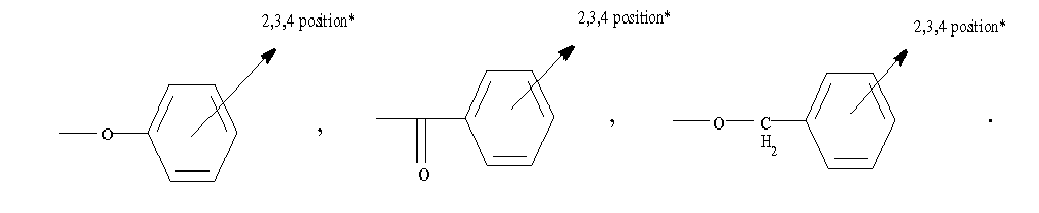
In other embodiments, at least some of R, R' and R" are independently selected from the group of pH-sensitive molecules consisting of:

- In a preferred embodiment, the pH tuneable amido gellant having structure [I] is characterized in that: L1 is an aliphatic linking group with a backbone chain of from 2 to 20 carbon atoms, preferably -(CH2)n- wherein n is selected from 2 to 20, and both R1 and R2 have the structure:


- In another embodiment, two or more of L1, L' and L" are the same group.
- The pH tuneable amido gellant molecule described in formula [I] can be symmetric with respect to the L1 entity or can be asymmetric. Without intending to be bound by theory, it is believed that symmetric pH tuneable amido gellant molecules allow for more orderly structured networks to form, whereas compositions comprising one or more asymmetric pH tuneable amido gellant molecules can create disordered networks.
- Suitable pH tuneable amido gellants having structure [I] may be selected from table 1 and table 2, table 3, and mixtures thereof. More preferably, the pH tuneable amido gellants, having structure [I], are selected from table 2, and mixtures thereof. Alternatively, the pH tuneable amido gellants, having structure [I], are selected from table 3, and mixtures thereof.
- In another embodiment, the pH tuneable amido gellant has the structure [II]:

- L2 preferably has the formula:
L2 = Aa-Bb-Cc-Dd-Rn"', [V]
wherein: (a+b+c+d) is from 1 to 20; and R"' is either a pH-sensitive group or a non-pH-sensitive groups (selected from the same groups as R, R' and R" for structure [I]). - Preferably, L2 is selected from C2 to C20 hydrocarbyl chains, more preferably C6 to C12, most preferably C8 to C10.
- R5 preferably has the formula:

- At least one of AA, R or R"' comprises a pH sensitive group. Preferably, R comprises the pH sensitive group.
- In a preferred embodiment, the pH tuneable amido gellant having structure [II] is characterized in that: L2 is an aliphatic linking group with a backbone chain of from 2 to 20 carbon atoms, preferably -(CH2)n-CH3 wherein n is selected from 2 to 20, and R5 has the structure:


- Suitable pH tuneable amido gellants having structure [II] include the structures selected from Table 4, and mixtures thereof.
-
Table 1: Non-limiting examples of pH tuneable amido gellants having structure [I]: 
N,N'-(2S,2'S)-1,1'-(ethane-1,2-diylbis(azanediyl))bis(3-methyl-1-oxobutane-2,1-diyl)diisonicotinamide N,N'-(2S,2'S)-1,1'-(propane-1,3-diylbis(azanediyl))bis(3-methyl-1-oxobutane-2,1-diyl)diisonicotinamide N,N'-(2S,2'S)-1,1'-(butane-1,4-diylbis(azanediyl))bis(3-methyl-1-oxobutane-2,1-diyl)diisonicotinamide N,N'-(2S,2'S)-1,1'-(pentane-1,5-diylbis(azanediyl))bis(3-methyl-1-oxobutane-2,1-diyl)diisonicotinamide N,N'-(2S,2'S)-1,1'-(hexane-1,6-diylbis(azanediyl))bis(3-methyl-1-oxobutane-2,1-diyl)diisonicotinamide N,N'-(2S,2'S)-1,1'-(heptane-1,7-diylbis(azanediyl))bis(3-methyl-1-oxobutane-2,1-diyl)diisonicotinamide N,N'-(2S,2'S)-1,1'-(octane-1,8-diylbis(azanediyl))bis(3-methyl-1-oxobutane-2,1-diyl)diisonicotinamide 
(6S,13S)-6,13-diisopropyl-4,7,12,15-tetraoxo-5,8,11,14-tetraazaoctadecane-1,18-dioic acid (6S,14S)-6,14-diisopropyl-4,7,13,16-tetraoxo-5,8,12,15-tetraazanonadecane-1,19-dioic acid (6S,15S)-6,15-diisopropyl-4,7,14,17-tetraoxo-5,8,13,16-tetraazaeicosane-1,20-dioic acid (6S,16S)-6,16-diisopropyl-4,7,15,18-tetraoxo-5,8,14,17-tetraazaheneicosane-1,21-dioic acid (6S,17S)-6,17-diisopropyl-4,7,16,19-tetraoxo-5,8,15,18-tetraazadocosane-1,22-dioic acid (6S,18S)-6,18-diisopropyl-4,7,17,20-tetraoxo-5,8,16,19-tetraazatricosane-1,23-dioic acid (6S,19S)-6,19-diisopropyl-4,7,18,21-tetraoxo-5,8,17,20-tetraazatetracosane-1,24-dioic acid (6S,20S)-6,20-diisopropyl-4,7,19,22-tetraoxo-5,8,18,21-tetraazapentacosane-1,25-dioic acid (6S,21S)-6,21-diisopropyl-4,7,20,23-tetraoxo-5,8,19,22-tetraazahexacosane-1,26-dioic acid (6S,22S)-6,22-diisopropyl-4,7,21,24-tetraoxo-5,8,20,23-tetraazaheptacosane-1,27-dioic acid (6S,23S)-6,23-diisopropyl-4,7,22,25-tetraoxo-5,8,21,24-tetraazaoctacosane-1,28-dioic acid 
N,N'-(2S,2'S)-1,1'-(ethane-1,2-diylbis(azanediyl))bis(3-methyl-1-oxobutane-2,1-diyl)bis(4-(1H-imidazol-5-yl)benzamide) N,N'-(2S,2'S)-1,1'-(propane-1,3-diylbis(azanediyl))bis(3-methyl-1-oxobutane-2,1-diyl)bis(4-(1H-imidazol-5-yl)benzamide) N,N'-(2S,2'S)-1,1'-(butane-1,4-diylbis(azanediyl))bis(3-methyl-1-oxobutane-2,1-diyl)bis(4-(1H-imidazol-5-yl)benzamide) N,N'-(2S,2'S)-1,1-(pentane-1,5-diylbis(azanediyl))bis(3-methyl-1-oxobutane-2,1-diyl)bis(4-(1H-imidazol-5-yl)benzamide) N,N'-(2S,2'S)-1,1'-(hexane-1,6-diylbis(azanediyl))bis(3-methyl-1-oxobutane-2,1-diyl)bis(4-(1H-imidazol-5-yl)benzamide) N,N'-(2S,2'S)-1,1'-(heptane-1,7-diylbis(azanediyl))bis(3-methyl-1-oxobutane-2,1-diyl)bis(4-(1H-imidazol-5-yl)benzamide) N,N'-(2S,2'S)-1,1'-(octane-1,8-diylbis(azanediyl))bis(3-methyl-1-oxobutane-2,1-diyl)bis(4-(1H-imidazol-5-yl)benzamide) N,N'-(2S,2'S)-1,1'-(nonance-1,9-diylbis(azanediyl))bis(3-methyl-1-oxobutane-2,1-diyl)bis(4-(1H-imidazol-5-yl)benzamide) N,N'-(2S,2'S)-1,1'-(decane-1,10-diylbis(azanediyl))bis(3-methyl-1-oxobutane-2,1-diyl)bis(4-(1H-imidazol-5-yl)benzamide) N,N'-(2S,2'S)-1,1'-(undecane-1,11-diylbis(azanediyl))bis(3-methyl-1-oxobutane-2,1-diyl)bis(4-(1H-imidazol-5-yl)benzamide) N,N'-(2S,2'S)-1,1'-(dodecane-1,12-diylbis(azanediyl))bis(3-methyl-1-oxobutane-2,1-diyl)bis(4-(1H-imidazol-5-yl)benzamide) Table 2: Non-limiting examples of pH tuneable amido gellants having structure [I]: 
N,N'-(2S,2'S)-1,1'-(nonane-1,9-diylbis(azanediyl))bis(3-methyl-1-oxobutane-2,1-diyl)diisonicotinamide N,N'-(2S,2'S)-1,1'-(decane-1,10-diylbis(azanediyl))bis(3-methyl-1-oxobutane-2,1-diyl)diisonicotinamide N,N'-(2S,2'S)-1,1'-(undecane-1,11-diylbis(azanediyl))bis(3-methyl-1-oxobutane-2,1-diyl)diisonicotinamide N,N'-(2S,2'S)-1,1'-(dodecane-1,12-diylbis(azanediyl))bis(3-methyl-1-oxobutane-2,1-diyl)diisonicotinamide N,N'-(2S,2'S)-1,1'-(tridecane-1,13-diylbis(azanediyl))bis(3-methyl-1-oxobutane-2,1-diyl)diisonicotinamide N,N'-(2S,2'S)-1,1'-(tetradecane-1,14-diylbis(azanediyl))bis(3-methyl-1-oxobutane-2,1-diyl)diisonicotinamide N,N'-(2S,2'S)-1,1'-(hexadecane-1,16-diylbis(azanediyl))bis(3-methyl-1-oxobutane-2,1-diyl)diisonicotinamide N,N'-(2S,2'S)-1,1'-(octadecane-1,18-diylbis(azanediyl))bis(3-methyl-1-oxobutane-2,1-diyl)diisonicotinamide 
N,N'-(2S,2'S)-1,1'-(ethane-1,2-diylbis(azanediyl))bis(1-oxopropane-2,1-diyl)diisonicotinamide N,N'-(2S,2'S)-1,1'-(propane-1,3-diylbis(azanediyl))bis(1-oxopropane-2,1-diyl)diisonicotinamide N,N'-(2S,2'S)-1,1'-(butane-1,4-diylbis(azanediyl))bis(1-oxopropane-2,1-diyl)diisonicotinamide N,N'-(2S,2'S)-1,1'-(pentane-1,5-diylbis(azanediyl))bis(1-oxopropane-2,1-diyl)diisonicotinamide N,N'-(2S,2'S)-1,1'-(hexane-1,6-diylbis(azanediyl))bis(1-oxopropane-2,1-diyl)diisonicotinamide N,N'-(2S,2'S)-1,1'-(heptane-1,7-diylbis(azanediyl))bis(1-oxopropane-2,1-diyl)diisonicotinamide N,N'-(2S,2'S)-1,1'-(octane-1,8-diylbis(azanediyl))bis(1-oxopropane-2,1-diyl)diisonicotinamide N,N'-(2S,2'S)-1,1'-(nonane-1,9-diylbis(azanediyl))bis(1-oxopropane-2,1-diyl)diisonicotinamide N,N'-(2S,2'S)-1,1'-(decane-1,10-diylbis(azanediyl))bis(1-oxopropane-2,1-diyl)diisonicotinamide N,N'-(2S,2'S)-1,1'-(undecane-1,11-diylbis(azanediyl))bis(1-oxopropane-2,1-diyl)diisonicotinamide N,N'-(2S,2'S)-1,1'-(dodecane-1,12-diylbis(azanediyl))bis(1-oxopropane-2,1-diyl)diisonicotinamide N,N'-(2S,2'S)-1,1'-(tridecane-1,13-diylbis(azanediyl))bis(1-oxopropane-2,1-diyl)diisonicotinamide N,N'-(2S,2'S)-1,1'-(tetradecane-1,14-diylbis(azanediyl))bis(1-oxopropane-2,1-diyl)diisonicotinamide N,N'-(2S,2'S)-1,1'-(hexadecane-1,16-diylbis(azanediyl))bis(1-oxopropane-2,1-diyl)diisonicotinamide N,N'-(2S,2'S)-1,1'-(octadecane-1,18-diylbis(azanediyl))bis(1-oxopropane-2,1-diyl)diisonicotinamide 
N,N'-(2S,2'S)-1,1'-(ethane-1,2-diylbis(azanediyl))bis(1-oxo-3-phenylpropane-2,1-diyl)diisonicotinamide N,N'-(2S,2'S)-1,1'-(propane-1,3-diylbis(azanediyl))bis(1-oxo-3-phenylpropane-2,1-diyl)diisonicotinamide N,N'-(2S,2'S)-1,1'-(butane-1,4-diylbis(azanediyl))bis(1-oxo-3-phenylpropane-2,1-diyl)diisonicotinamide N,N'-(2S,2'S)-1,1'-(pentane-1,5-diylbis(azanediyl))bis(1-oxo-3-phenylpropane-2,1-diyl)diisonicotinamide N,N'-(2S,2'S)-1,1'-(hexane-1,6-diylbis(azanediyl))bis(1-oxo-3-phenylpropane-2,1-diyl)diisonicotinamide N,N'-(2S,2'S)-1,1'-(heptane-1,7-diylbis(azanediyl))bis(1-oxo-3-phenylpropane-2,1-diyl)diisonicotinamide N,N'-(2S,2'S)-1,1'-(octane-1,8-diylbis(azanediyl))bis(1-oxo-3-phenylpropane-2,1-diyl)diisonicotinamide N,N'-(2S,2'S)-1,1'-(nonane-1,9-diylbis(azanediyl))bis(1-oxo-3-phenylpropane-2,1-diyl)diisonicotinamide N,N'-(2S,2'S)-1,1'-(decane-1,10-diylbis(azanediyl))bis(1-oxo-3-phenylpropane-2,1-diyl)diisonicotinamide N,N'-(2S,2'S)-1,1'-(undecane-1,11-diylbis(azanediyl))bis(1-oxo-3-phenylpropane-2,1-diyl)diisonicotinamide N,N'-(2S,2'S)-1,1'-(dodecane-1,12-diylbis(azanediyl))bis(1-oxo-3-phenylpropane-2,1-diyl)diisonicotinamide N,N'-(2S,2'S)-1,1'-(tridecane-1,13-diylbis(azanediyl))bis(1-oxo-3-phenylpropane-2,1-diyl)diisonicotinamide N,N'-(2S,2'S)-1,1'-(tetradecane-1,14-diylbis(azanediyl))bis(1-oxo-3-phenylpropane-2,1-diyl)diisonicotinamide N,N'-(2S,2'S)-1,1'-(hexadecane-1,16-diylbis(azanediyl))bis(1-oxo-3-phenylpropane-2,1-diyl)diisonicotinamide N,N'-(2S,2'S)-1,1'-(octadecane-1,18-diylbis(azanediyl))bis(1-oxo-3-phenylpropane-2,1-diyl)diisonicotinamide Table 3: Non-limiting examples of other pH tuneable amido gellants having structure [I]: 
[1-{2-[2-Benzyloxycarbonylamino-3-(1H-indol-3-yl)-propionylamino]-ethylcarbamoyl}-2-(1H-indol-3-yl)-ethyl]-carbamic acid benzyl ester [1-{8-[2-Benzyloxycarbonylamino-3-(1H-indol-3-yl)-propionylamino]-octylcarbamoyl}-2-(1H-indol-3-yl)-ethyl]-carbamic acid benzyl ester [1-{3-[2-Benzyloxycarbonylamino-3-(1H-indol-3-yl)-propionylamino]-propylcarbamoyl}-2-(1H-indol-3-yl)-ethyl]-carbamic acid benzyl ester [1-{9-[2-Benzyloxycarbonylamino-3-(1H-indol-3-yl)-propionylamino]-nonylcarbamoyl}-2-(1H-indol-3-yl)-ethyl]-carbamic acid benzyl ester [1-{4-[2-Benzyloxycarbonylamino-3-(1H-indol-3-yl)-propionylamino]-butylcarbamoyl}-2-(1H-indol-3-yl)-ethyl]-carbamic acid benzyl ester [1-{10-[2-Benzyloxycarbonylamino-3-(1H-indol-3-yl)-propionylamino]-decylcarbamoyl}-2-(1H-indol-3-yl)-ethyl]-carbamic acid benzyl ester [1-{5-[2-Benzyloxycarbonylamino-3-(1H-indol-3-yl)-propionylamino]-pentylcarbamoyl}-2-(1H-indol-3-yl)-ethyl]-carbamic acid benzyl ester [1-{11-[2-Benzyloxycarbonylamino-3-(1H-indol-3-yl)-propionylamino]-undecylcarbamoyl}-2-(1H-indol-3-yl)-ethyl]-carbamic acid benzyl ester [1-{6-[2-Benzyloxycarbonylamino-3-(1H-indol-3-yl)-propionylamino]-hexylcarbamoyl}-2-(1H-indol-3-yl)-ethyl]-carbamic acid benzyl ester [1-{12-[2-Benzyloxycarbonylamino-3-(1H-indol-3-yl)-propionylamino]-dodecylylcarbamoyl}-2-(1H-indol-3-yl)-ethyl]-carbamic acid benzyl ester [1-{7-[2-Benzyloxycarbonylamino-3-(1H-indol-3-yl)-propionylamino]-heptylcarbamoyl}-2-(1H-indol-3-yl)-ethyl]-carbamic acid benzyl ester 
N-[(1S)-2-methyl-l-[2-[[(2S)-3-methyl-2-(pyridine-4-carbonylamino)pentanoyl] amino] ethylcarbamoyl ]butyl]pyridine-4-carboxamide N-[(1S)-2-methyl-1-[8-[[(2S)-3-methyl-2-(pyridine-4-carbonylamino)pentanoyl] amino ]octylcarbamo yl]butyl]pyridine-4-carboxamide N-[(1S)-2-methyl-1-[3-[[(2S)-3-methyl-2-(pyridine-4-carbonylamino)pentanoyl]amino]propylcarbamo yl]butyl]pyridine-4-carboxamide N-[(1S)-2-methyl-1-[9-[[(2S)-3-methyl-2-(pyridine-4-carbonylamino)pentanoyl]amino]nonylcarbam oyl]butyl]pyridine-4-carboxamide N-[(1S)-2-methyl-1-[4-[[(2S)-3-methyl-2-(pyridine-4-carbonylamino)pentanoyl]amino]butylcarbamoyl ]butyl]pyridine-4-carboxamide N-[(1S)-2-methyl-1-[10-[[(2S)-3-methyl-2-(pyridine-4-carbonylamino)pentanoyl]amino]decylcarbamoyl]butyl]pyridine-4-carboxamide N-[(1S)-2-methyl-1-[5-[[(2S)-3-methyl-2-(pyridine-4-carbonylamino)pentanoyl]amino]pentylcarbamoy 1]butyl]pyridine-4-carboxamide N-[(1S)-2-methyl-1-[11-[[(2S)-3-methyl-2-(pyridine-4-carbonylamino)pentanoyl]amino]undecylcarba moyl]butyl]pyridine-4-carboxamide N-[(1S)-2-methyl-1-[6-[[(2S)-3-methyl-2-(pyridine-4-carbonylamino)pentanoyl]amino]hexylcarbamoyl ]butyl]pyridine-4-carboxamide N-[(1S)-2-methyl-1-[12-[[(2S)-3-methyl-2-(pyridine-4-carbonylamino)pentanoyl]amino]dodecylcarba moyl]butyl]pyridine-4-carboxamide N-[(1S)-2-methyl-1-[7-[[(2S)-3-methyl-2-(pyridine-4-carbonylamino)pentanoyl]amino]heptylcarbamoy 1]butyl]pyridine-4-carboxamide 
4-(1H-imidazol-5-yl)-N-[(1S)-1-[2-[[(2S)-2-[[4-(1H-imidazol-5-yl)benzoyl]amino]-3-methyl-pentanoyl]amino]ethylcarbamoyl]-2-methyl-butyl]benzamide 4-(1H-imidazol-5-yl)-N-[(1S)-1-[8-[[(2S)-2-[ [4-(1H-imidazol-5-yl)benzoyl]amino]-3-methyl-pentanoyl]amino]octylcarbamoyl]-2-methyl-butyl]benzamide 4-(1H-imidazol-5-yl)-N-[(1S)-1-[3-[[(2S)-2-[[4-(1H-imidazol-5-yl)benzoyl]amino]-3-methyl-pentanoyl]amino]propylcarbamoyl]-2-methyl-butyl]benzamide 4-(1H-imidazol-5-yl)-N-[(1S)-1-[9-[[(2S)-2-[[4-(1H-imidazol-5-yl)benzoyl]amino]-3-methyl-pentanoyl]amino]nonylcarbamoyl]-2-methyl-butyl]benzamide 4-(1H-imidazol-5-yl)-N-[(1S)-1-[4-[[(2S)-2-[[4-(1H-imidazol-5-yl)benzoyl]amino]-3-methyl-pentanoyl]amino]butylcarbamoyl]-2-methyl-butyl]benzamide 4-(1H-imidazol-5-yl)-N-[(1S)-1-[10-[[(2S)-2-[[4-(1H-imidazol-5-yl)benzoyl]amino]-3-methyl-pentanoyl]amino]decylcarbamoyl]-2-methyl-butyl]benzamide 4-(1H-imidazol-5-yl)-N-[(1S)-1-[5-[[(2S)-2-[[4-(1H-imidazol-5-yl)benzoyl]amino]-3-methyl-pentanoyl]amino]pentylcarbamoyl]-2-methyl-butyl]benzamide 4-(1H-imidazol-5-yl)-N-[(1S)-1-[11-[[(2S)-2-[[4-(1H-imidazol-5-yl)benzoyl]amino]-3-methyl-pentanoyl]amino]undecylcarbamoyl]-2-methyl-butyl]benzamide 4-(1H-imidazol-5-yl)-N-[(1S)-1-[6-[[(2S)-2-[[4-(1H-imidazol-5-yl)benzoyl]amino]-3-methyl-pentanoyl]amino]hexylcarbamoyl]-2-methyl-butyl]benzamide 4-(1H-imidazol-5-yl)-N-[(1S)-1-[12-[[(2S)-2-[[4-(1H-imidazol-5-yl)benzoyl]amino]-3-methyl-pentanoyl]amino]dodecylcarbamoyl]-2-methyl-butyl]benzamide 4-(1H-imidazol-5-yl)-N-[(1S)-1-[7-[[(2S)-2-[[4-(1H-imidazol-5-yl)benzoyl]amino]-3-methyl-pentanoyl]amino]heptylcarbamoyl]-2-methyl-butyl]benzamide 
N-[(1S)-2-[[(1S)-1-[[[(2R)-2-[[(2R)-2-benzamido-3-(1H-imidazol-5-yl)propanoyl] amino]-3-methyl-pentanoyl]amino]methylcarbamoyl]-2-methyl-butyl] amino]-1-(1H-imidazol-5-ylmethyl)-2-oxo-ethyl]benzamide N-[(1R)-2-[[(1R)-1-[8-[[(2S)-2-[[(2S)-2-benzamido-3-(1H-imidazol-5-yl)propanoyl]amino]-3-methyl-pentanoyl]amino]octylcarbamoyl]-2-methyl-butyl]amino]-1-(1H-imidazol-5-ylmethyl)-2-oxo-ethyl]benzamide N-[(1R)-2-[[(1R)-1-[3-[[(2S)-2-[[(2S)-2-benzamido-3-(1H-imidazol-5-yl)propanoyl]amino]-3-methyl-pentanoyl]amino]propylcarbamoyl]-2-methyl-butyl]amino]-1-(1H-imidazol-5-ylmethyl)-2-oxo-ethyl]benzamide N-[(1R)-2-[[(1R)-1-[9-[[(2S)-2-[[(2S)-2-benzamido-3-(1H-imidazol-5-yl)propanoyl]amino]-3-methyl-pentanoyl]amino]nonylcarbamoyl]-2-methyl-butyl]amino]-1-(1H-imidazol-5-ylmethyl)-2-oxo-ethyl]benzamide N-[(1R)-2-[[(1R)-1-[4-[[(2S)-2-[[(2S)-2-benzamido-3-(1H-imidazol-5-yl)propanoyl]amino]-3-methyl-pentanoyl]amino]butylcarbamoyl]-2-methyl-butyl]amino]-1-(1H-imidazol-5-ylmethyl)-2-oxo-ethyl]benzamide N-[(1R)-2-[[(1R)-1-[10-[[(2S)-2-[[(2S)-2-benzamido-3-(1H-imidazol-5-yl)propanoyl]amino]-3-methyl-pentanoyl]amino]decylcarbamoyl]-2-methyl-butyl]amino]-1-(1H-imidazol-5-ylmethyl)-2-oxo-ethyl]benzamide N-[(1R)-2-[[(1R)-1-[5-[[(2S)-2-[[(2S)-2-benzamido-3-(1H-imidazol-5-yl)propanoyl]amino]-3-methyl-pentanoyl]amino]pentylcarbamoyl]-2-methyl-butyl]amino]-1-(1H-imidazol-5-ylmethyl)-2-oxo-ethyl]benzamide N-[(1R)-2-[[(1R)-1-[11-[[(2S)-2-[[(2S)-2-benzamido-3-(1H-imidazol-5-yl)propanoyl] amino]-3-methyl-pentanoyl]amino]undecylcarbamoyl]-2-methyl-butyl] amino]-1-(1H-imidazol-5-ylmethyl)-2-oxo-ethyl]benzamide N-[(1R)-2-[[(1R)-1-[6-[[(2S)-2-[[(2S)-2-benzamido-3-(1H-imidazol-5-yl)propanoyl]amino]-3-methyl-pentanoyl]amino]hexylcarbamoyl]-2-methyl-butyl]amino]-1-(1H-imidazol-5-ylmethyl)-2-oxo-ethyl]benzamide N-[(1R)-2-[[(1R)-1-[12-[[(2S)-2-[[(2S)-2-benzamido-3-(1H-imidazol-5-yl)propanoyl]amino]-3-methyl-pentanoyl]amino]dodecylcarbamoyl]-2-methyl-butyl]amino]-1-(1H-imidazol-5-ylmethyl)-2-oxo-ethyl]benzamide N-[(1R)-2-[[(1R)-1-[7-[[(2S)-2-[[(2S)-2-benzamido-3-(1H-imidazol-5-yl)propanoyl]amino]-3-methyl-pentanoyl]amino]heptylcarbamoyl]-2-methyl-butyl]amino]-1-(1H-imidazol-5-ylmethyl)-2-oxo-ethyl]benzamide Table 4: Non-limiting examples of pH tuneable amido gellants having structure [I]: (2S)-2-[[2-(dodecanoylamino)acetyl]amino]propanoic acid (2S)-2-[[2-[[2-(dodecanoylamino)acetyl]amino]acetyl]amino ]propanoic acid 

(2S)-2-[[2-(dodecanoylamino)acetyl] amino] -2-phenyl-acetic acid (2S)-2-[[2-(dodecanoylamino)acetyl]amino]-3-methyl-butanoic acid 

(2S)-2-[[2-(dodecanoylamino)acetyl]amino]acetic acid (2S)-2-[[2-(hexadecanoylamino)acetyl]amino]propanoic acid 

- In certain embodiments of both types of pH tuneable amido gellant structures, AA comprises at least one of: Alanine, ß-Alanine and substituted Alanines; Linear Amino-Alkyl Carboxylic Acid; Cyclic Amino-Alkyl Carboxylic Acid; Aminobenzoic Acid Derivatives; Aminobutyric Acid Derivatives; Arginine and Homologues; Asparagine; Aspartic Acid; p-Benzoyl-Phenylalanine; Biphenylalanine; Citrulline; Cyclopropylalanine; Cyclopentylalanine; Cyclohexylalanine; Cysteine, Cystine and Derivatives; Diaminobutyric Acid Derivatives; Diaminopropionic Acid; Glutamic Acid Derivatives; Glutamine; Glycine; Substituted Glycines; Histidine; Homoserine; Indole Derivatives; Isoleucine; Leucine and Derivatives; Lysine; Methionine; Naphthylalanine; Norleucine; Norvaline; Ornithine; Phenylalanine; Ring-Substituted Phenylalanines; Phenylglycine; Pipecolic Acid, Nipecotic Acid and Isonipecotic Acid; Proline; Hydroxyproline; Thiazolidine; Pyridylalanine; Serine; Statine and Analogues; Threonine; Tetrahydronorharman-3-carboxylic Acid; 1,2,3,4-Tetrahydroisoquinoline; Tryptophane; Tyrosine; Valine; and combinations thereof.
- The pH tuneable amido gellant molecule may also comprise protective groups, preferably from 1 to 2 protective groups, preferably two protective groups. Examples of suitable protective groups are provided in "Protecting Groups", P.J. Kocienski, ISBN 313 135601 4, Georg Thieme Verlag, Stutgart; and "Protective Groups in Organic Chemistry", T.W. Greene, P.G.M. Wuts, ISBN 0-471-62301-6, John Wiley& Sons, Inc, New York.
- The pH tuneable amido gellant preferably has a minimum gelling concentration (MGC) of from 0.1 to 100 mg/mL in the consumer product composition, at the target pH of the composition, preferably from 0.1 to 25 mg/mL, more preferred from 0.5 to 10mg/mL in accordance with the MGC Test Method. The MGC as used herein can be represented as mg/ml or as a wt %, where wt% is calculated as the MGC in mg/ml divided by 10. In one embodiment, when measured in the consumer product composition, the MGC is from 0.1 to 100 mg/mL, preferably from 0.1 to 25 mg/mL of said pH tuneable amido gellant, more preferably from 0.5 to 10 mg/mL, or at least 0.1 mg/mL, at least 0.3 mg/mL, at least 0.5 mg/mL, at least 1.0 mg/mL, at least 2.0 mg/mL, at least 5.0 mg/mL of pH tuneable amido gellant. While consumer product compositions may have a pH tuneable amido gellant concentration either above or below the MGC, the pH tuneable amido gellants result in particularly useful rheologies below the MGC.
- The consumer product composition may be dilute or concentrated aqueous liquids. Alternatively, the consumer product composition may be almost entirely non-aqueous, and comprising a non-aminofunctional organic solvent. Such consumer product compositions may comprise very little water, for instance, that may be introduced with other raw materials. Preferably, the consumer product composition comprises from 1% to 95 % by weight of water and/or non-aminofunctional organic solvent. For concentrated detergents, the composition comprises preferably from 5% to 70%, more preferably from 10% to 50%, most preferably from 15% to 45% by weight, water and/or non-aminofunctional organic solvent.
- As used herein, "non-aminofunctional organic solvent" refers to any organic solvent which contains no amino functional groups. Preferred non-aminofunctional organic solvents include monohydric alcohols, dihydric alcohols, polyhydric alcohols, glycerol, glycols, polyalkylene glycols such as polyethylene glycol, and mixtures thereof. Highly preferred are mixtures of solvents, especially mixtures of two or more of the following: lower aliphatic alcohols such as ethanol, propanol, butanol, isopropanol; diols such as 1,2-propanediol or 1,3-propanediol; and glycerol. Also preferred are propanediol and mixtures thereof with diethylene glycol where the mixture contains no methanol or ethanol. Thus embodiments of consumer product compositions may include embodiments in which propanediols are used but methanol and ethanol are not used.
- Preferable non-aminofunctional organic solvents are liquid at ambient temperature and pressure (i.e. 21°C and 1 atmosphere), and comprise carbon, hydrogen and oxygen.
- Materials can be bought from Iris Biotech GmbH, Waldershofer Str. 49-51, 95615 Marktredwitz, Germany; Bachem Holding AG, Hauptstrasse 144, 4416 Bubendorf, Switzerland; Sigma Aldrich NV/SA, Kardinaal Cardijnplein 8, 2880 Bornem, Belgium;
-

- (2S)-2-[[2-(dodecanoylamino)acetyl]amino]propanoic acid is obtained by preparing a first solution by dissolving H-Gly-Ala-OH (30 mmol) in Sodium hydroxide (0.105 M, 300 mL). This first solution is placed in a round bottomed flask with an efficient magnetic stirrer. The flask is completely immersed in an ice bath and during the reaction and the magnetic stirrer is set at 1800rpm. Lauroyl chloride (9.84 grams, 45 mmol) and sodium hydroxide (3M, 15mL) are drop wise added to this first solution at the same rate in such a way that the pH of the reaction mixture does not decrease below 10. When the reaction is completed, the suspension is acidified carefully with chloride acid 2M. The residue obtained after filtration (filtering plate n°3) is extracted with petroleum ether to remove the fatty acid. The resulting white solid is dried under vacuum oven (PSelecta) at 60°C for 24h. The yield obtained is 89%.
-

- (2S)-2-[[2-(hexadecanoylamino)acetyl]amino]propanoic acid is obtained by preparing a first solution by dissolving Glycyl-L-alanine (30 mmol) in Sodium hydroxide (0.105 M, 300 mL). This first solution is placed in a round bottomed flask with an efficient magnetic stirrer. The flask is completely immersed in an ice bath and during the reaction and the magnetic stirrer is set at 1800rpm. Palmitoyl chloride (12.37 grams, 45 mmol) and sodium hydroxide (3M, 15mL) are drop wise added to this first solution at the same rate in such a way that the pH of the reaction mixture does not decrease below 10. When the reaction is completed, the suspension is acidified carefully with chloride acid 2M. The residue obtained after filtration (filtering plate n°3) is extracted with petroleum ether to remove the fatty acid. The resulting white solid is dried under vacuum oven (PSelecta) at 60°C for 24h. The yield obtained is 94%. (2S)-2-[[2-(hexadecanoylamino)acetyl]amino]propanoic acid is characterize using infrared, 1H NMR and 13C NMR obtaining following results:
- IR (KBr): 3379, 3290, 2916, 2849, 1728, 1651, 1625, 1537 cm-1.
- 1H NMR (300 MHz, [D6]DMSO, 30 °C): δ 12.33 (s, 1H), 8.03 (d, J= 6.8 Hz, 1H), 7.93 (m, 1H), 4.26 - 4.11 (m, 1H), 3.77 - 3.59 (m, 2H), 2.13 (dt, J= 20.2, 7.0 Hz, 2H), 1.46 (m, 5H), 1.22 (m, 24H), 0.84 (m, 3H) ppm.
- 13CNMR (75 MHz, [D6]DMSO, 30 °C): δ=174.63, 173.16, 169.40, 48.10, 42.31, 35.87, 31.99, 29.76, 29.55, 29.41, 25.87, 22.78, 17.99, 14.56 ppm.
- HRMS (ESI-TOF+): calcd. for C21H40N2O4 +[M+H]+=385.3066; found 385.3071 (Δ = 1.3 ppm).
- Turbidity (measured in NTU: Nephelometric Turbidity Units) according to the present invention is measured using a Hach 2100P turbidity meter calibrated according to the procedure provided by the manufacture. The sample vials are filled with 15ml of representative sample and capped and cleaned according to the operating instructions. If necessary, the samples are degassed to remove any bubbles either by applying a vacuum or using an ultrasonic bath (see operating manual for procedure). The turbidity is measured using the automatic range selection.
- MGC is calculated by a tube inversion method based on R.G. Weiss, P. Terech; "Molecular Gels: Materials with self-assembled fibrillar structures" 2006 springer, p 243. In order to determine the MGC, three screenings are done:
- a) First screening: prepare several vials increasing the pH tuneable amido gellant concentration from 0.5 % to 5.0 weight % in 0.5% steps, at the target pH.
- b) Determine in which interval the gel is formed (one inverted sample still flowing and the next one is already a strong gel). In case no gel is formed at 5%, higher concentrations are used.
- c) Second screening: prepare several vials increasing the pH tuneable amido gellant concentration in 0.1 weight % steps in the interval determined in the first screening, at the target pH.
- d) Determine in which interval the gel is formed (one inverted sample still flowing and the next one is already a strong gel)
- e) Third screening: in order to have a very precise percentage of the MGC, run a third screening in 0.025 weight % steps in the interval determined in the second screening, at the target pH.
- f) The Minimum Gelling Concentration (MGC) is the lowest concentration which forms a gel in the third screening (does not flow on inversion of the sample).
- For each screening, samples are prepared and treated as follows: 8mL vials (Borosilacate glass with Teflon cap, ref. B7857D, Fisher Scientific Bioblock) are filled with 2.0000±0.0005 g (KERN ALJ 120-4 analytical balance with ± 0.1mg precision) of the fluid (comprising the consumer product composition and pH tuneable amido gellant) for which we want to determine the MGC. The vial is sealed with the screw cap and left for 10 minutes in an ultrasound bath (Elma Transsonic T 710 DH, 40 kHz, 9.5L, at 25 °C and operating at 100% power) in order to disperse the solid in the liquid. Complete dissolution is then achieved by heating, using a heating gun (Bosch PHG-2), and gentle mechanical stirring of the vials. It is crucial to observe a completely clear solution. Handle vials with care. While they are manufactured to resist high temperatures, a high solvent pressure may cause the vials to explode. Vials are cooled to 25°C, for 10min in a thermostatic bath (Compatible Control Thermostats with controller CC2, D77656, Huber). Vials are inverted, left inverted for 1 minute, and then observed for which samples do not flow. After the third screening, the concentration of the sample that does not flow after this time is the MGC. For those skilled in the art, it is obvious that during heating solvent vapours may be formed, and upon cooling down the samples, these vapours can condense on top of the gel. When the vial is inverted, this condensed vapour will flow. This is discounted during the observation period. If no gels are obtained in the concentration interval, higher concentrations must be evaluated.
- pH measurement of a liquid detergent composition may be measured using test method EN 1262. 4. Rheology
An AR-G2 rheometer from TA Instruments is used for rheological measurements.
Plate: 40mm standard steel parallel plate, 300µm gap. - 1. Gel strength: The gel strength is measured using a stress sweep test whereby the oscillation stress is increased from 0.001Pa to 10Pa, taking 10 points per decade at 20°C and at a frequency of 1Hz. We use G' and G" within the linear viscoelastic region and the oscillation stress at the point where G' and G" cross over as a measure for the gel strength, as shown in
Figure 1 . - 2. Recovery of structure: first we apply a pre-shear of 30s-1 at 20°C for 60s, after which we follow how the structure recovers applying a time sweep test with an oscillation stress of 0.02Pa and a single frequency of 1Hz at 20°C for 10 minutes. As a measure of the restructuring kinetics, we use G' and G" cross over, as shown in the
Figure 2 . - Example 1: A liquid laundry detergent composition is prepared as follows:
Step 1: A structurant premix A1 is prepared by dissolving 0.20 grams N,N'-(25,2'S)-1,1'-(hexane-1,6-diylbis(azanediyl))bis(3-methyl-1-oxobutane-2,1-diyl)diisonicotinamide in 12.0 grams of 50% citric acid aqueous solution (prepared by dissolving 6.0 grams of citric acid solid in 6.0 grams deionized water) at 25°C.
Step 2: A detergent feed B 1 having the composition described in Table 5 is prepared.Table 5: Composition of detergent feed B1 Ingredient Detergent Feed B1 Grams Linear Alkylbenzene sulfonic acid (LAS) 12.0 C12-14 alkyl ethoxy 3 sulfate Mono Ethanol Amine salt 9.3 C12-14 alkyl 7-ethoxylate 8.0 1,2-propanediol 9.8 C12-18 Fatty Acid 10.0 Grease Cleaning Alkoxylated Polyalkylenimine Polymer1 0.9 PEG PVAc Polymer2 0.9 Soil Suspending Alkoxylated Polyalkylenimine 2.2 Polymer3 Hydroxyethane diphosphonic acid 1.6 FWA 0.23 Ethanol 1.5 Boric acid 0.5 MEA Up to pH8 Water up to 66 grams 1 600 g/mol molecular weight polyethylenimine core with 24 ethoxylate groups per -NH and 16 propoxylate groups per -NH.
2 PEG-PVA graft copolymer is a polyvinyl acetate grafted polyethylene oxide copolymer having a polyethylene oxide backbone and multiple polyvinyl acetate side chains. The molecular weight of the polyethylene oxide backbone is 6000 and the weight ratio of the polyethylene oxide to polyvinyl acetate is 40 to 60 and no more than 1 grafting point per 50 ethylene oxide units.
3 600 g/mol molecular weight polyethylenimine core with 20 ethoxylate groups per -NH.
Step 4: The pH sensitive ingredients (1.5 grams protease, 0.7 grams amylase, 0.1 grams mannanase, 0.1 grams xyloglucanase, 0.4 grams pectate lyase and 1.7 grams of perfume) and deionized water (to bring the final weight up to 100 grams) are added under gentle stirring, at 500-600rpm for 10 min. - A laundry unit dose comprising the fluid detergent composition is prepared as follows:
Step 1: A structurant premix A2 is prepared by fully dissolving 0.20 grams N,N'-(25,2'S)-1,1'-(octane-1,8-diylbis(azanediyl))bis(3-methyl-1-oxobutane-2,1-diyl)diisonicotinamide in 1.0 grams of citric acid and 3 grams of deionized water at 25°C.
Step 2: A detergent feed B2 having the composition described in Table 6 is prepared.Table 6: Composition of detergent feed B2 Ingredient Detergent Feed B2 % of base @100% active 1,2-Propanediol 15 MEA 10 Glycerol 5 Hydroxyethane diphosphonic acid 1 Potassium sulfite 0.2 C12-45 alkyl 7-ethoxylate 20 Linear Alkylbenzene sulfonic acid 24.5 FWA 0.2 C12-18 Fatty Acid 16 Ethoxysulfated Hexamethylene Diamine Dimethyl Quat 2.9 Soil Suspending Alkoxylated Polyalkylenimine Polymer3 1 MgCl2 0.2 Water and minors Up to 100% Table 7: pH sensitive ingredients. Ingredient % of base @100% active Protease enzyme 1.4 Mannanase enzyme 0.1 Amylase enzyme 0.2 - The fluid detergent composition is then packed into a polyvinyl alcohol pouch.
- Examples 3A to 3E: Fluid Detergent Fabric Care Compositions comprising amido-gellants:
Step 1: A structurant premix A3 is prepared by dissolving 5 grams N,N'-(25,2'S)-1,1'-(dodecane-1,12-diylbis(azanediyl))bis(3-methyl-1-oxobutane-2,1-diyl)diisonicotinamide in 95 grams of 25% sulfuric acid aqueous solution (Sigma-Aldrich) at 25°C.
Step 2: A detergent feed B3A to B3E having the composition described in Table 8 is prepared.Table 8: Composition of detergent feed B3A to B3E Ingredient B3A B3B B3C B3D B3E Wt% Wt% Wt% Wt% Wt% C12-15 alkyl polyethoxylate (3.0) sulfate 6.7 6.5 7.8 6.4 5.7 C11.8 linear alkylbenzene sulfonc acid 19.4 18.9 19.0 14.6 16.4 C14-15 alkyl 7-ethoxylate 11.8 11.5 3.9 4.8 16.4 C12-14 alkyl 7-ethoxylate - 0.9 1.0 1.1 0.9 1,2 Propane diol 7.0 5.2 8.2 9.1 6.9 Ethanol 1.8 1.7 2.0 2.3 1.7 Di Ethylene Glycol - 3.4 - - - Na Cumene Sulfonate 5.3 5.2 6.1 6.8 5.2 C12-18 Fatty Acid 4.6 4.5 6.7 5.9 4.5 Citric acid 4.6 4.5 7.6 9.8 4.5 Fluorescent Whitening Agent 0.18 - 0.20 0.23 0.17 Diethylene Triamine Penta Acetic acid - 0.860 - - - Diethylene Triamine Penta Methylene Phosphonic acid 0.53 0.17 0.61 0.68 0.52 Soil Suspending Alkoxylated Polyalkylenimine Polymer1 1.4 0.9 - - 1.4 Zwitterionic ethoxylated quaternized sulfated hexamethylene diamine2 1.8 1.7 1.8 2.3 1.7 Grease Cleaning Alkoxylated Polyalkylenimine Polymer3 0.7 0.7 - 0.5 - PEG-PVAc Polymer4 - 0.9 - - - Monoethanolamine Borate 3.5 1.7 4.1 4.6 3.4 4 - Formyl Phenyl Boronic Acid - 0.05 - - - Sodium formate 0.7 0.7 0.8 0.9 0.7 Calcium chloride 0.09 0.09 0.10 0.11 0.09 Acticide MBS 2550 0.010 0.010 0.010 0.010 0.010 Water up to 100% up to 100% up to 100% up to 100% up to 100% 1 600 g/mol molecular weight polyethylenimine core with 20 ethoxylate groups per -NH. Available from BASF (Ludwigshafen, Germany)
2 Described inWO 01/05874
3 600 g/mol molecular weight polyethylenimine core with 24 ethoxylate groups per -NH and 16 propoxylate groups per -NH. Available from BASF (Ludwigshafen, Germany).
4 PEG-PVA graft copolymer is a polyvinyl acetate grafted polyethylene oxide copolymer having a polyethylene oxide backbone and multiple polyvinyl acetate side chains. The molecular weight of the polyethylene oxide backbone is about 6000 and the weight ratio of the polyethylene oxide to polyvinyl acetate is about 40 to 60 and no more than 1 grafting point per 50 ethylene oxide units. Available from BASF (Ludwigshafen, Germany).Table 9: addition of premix A3 Ingredient 3A 3B 3C 3D 3E grams grams grams grams grams Premix A3 5 3 4 6 3.6 - The resulting mixture is adjusted to pH 8 with sodium hydroxide 20% and pH sensitive ingredients listed in Table 10 are added at 600rpm, 25°C, and mixed for 5 minutes.
Table 10: pH sensitive ingredients. Ingredient 3A 3B 3C 3D 3E Wt% Wt% Wt% Wt% Wt% Protease (40.6mg/g/)1 0.5 0.5 0.5 0.5 0.5 Natalase 200L (29.26mg/g)2 0.1 0.1 0.1 0.1 0.1 Termamyl Ultra (25.1mg/g)2 0.05 0.05 0.05 0.05 0.05 Mannaway 25L (25 mg/g)2 0.05 0.05 0.05 0.05 0.05 Lipase (16.91 mg/g)2 0.5 - 0.25 - 0.5 Lipolex®2 - 0.2 - - - Lipex®2 - - - 0.25 - Whitezyme (20mg/g)2 0.05 0.05 0.05 0.05 0.05 Perfume Microcapsules3 - - - 0.2 - Mica - - - - 0.05 Silicone suds suppressor - 0.1 - - - Water, perfumes, dyes, neutralizers, and other optional components (pH to 8.0-8.2) to 100% to 100% to 100% to 100% to 100% 1 Available from Genencor International, South San Francisco, CA.
2 Available from Novozymes, Denmark.
3 Perfume microcapsules can be prepared as follows: 25 grams of butyl acrylate-acrylic acid copolymer emulsifier (Colloid C351, 25% solids, pka 4.5-4.7, Kemira Chemicals, Inc. Kennesaw, Georgia U.S.A.) is dissolved and mixed in 200 grams deionized water. The pH of the solution is adjusted to pH of 4.0 with sodium hydroxide solution. 8 grams of partially methylated methylol melamine resin (Cymel 385, 80% solids, Cytec Industries West Paterson , New Jersey, U.S.A.) is added to the emulsifier solution. 200 grams of perfume oil is added to the previous mixture under mechanical agitation and the temperature is raised to 50°C. After mixing at higher speed until a stable emulsion is obtained, the second solution and 4 grams of sodium sulfate salt are added to the emulsion. This second solution contains 10 grams of butyl acrylate-acrylic acid copolymer emulsifier (Colloid C351, 25% solids, pka 4.5-4.7, Kemira), 120 grams of distilled water, sodium hydroxide solution to adjust pH to 4.8, 25 grams of partially methylated methylol melamine resin (Cymel 385, 80% solids, Cytec). This mixture is heated to 70°C and maintained overnight with continuous stirring to complete the encapsulation process. 23 grams of acetoacetamide (Sigma-Aldrich, Saint Louis, Missouri, U.S.A.) is added to the suspension. - Examples 4A to 4S: Hand-dish washing fluid detergent compositions comprising amido-gellants. Hand-dish washing liquid detergent compositions may be prepared by mixing together the ingredients listed in the proportions shown:
Table 11: Hand-dish washing fluid detergent compositions comprising amido-gellants Ex 4A Ex 4B Ex 4C Ex 4D Ex 4E Ex 4F Alkyl Ethoxy Sulfate AE0.6S 22.0 19.0 27.0 20.0 22.0 22.0 Linear C12-C14 Amine oxide 6.0 4.5 - - 6.0 5.0 C9-C11 alkyl EO8 ethoxylate 7.0 - - - - - L-Glutamic acid-N,N-di(acetic acid) tetrasodium salt 1.0 - - 0.1 - - Sodium Citrate - 1.0 - 0.5 0.8 - Solvent: ethanol, isopropylalcohol,.. 2.5 4.0 3.0 2.0 3.0 2.5 Polypropylene glycol Mw2000 1.0 0.5 1.0 - 2.0 1.0 Sodium Chloride 0.5 1.0 1.0 0.5 0.5 0.5 N,N'-(2S,2'S)-1,1'-(dodecane-1,12-diylbis(azanediyl))bis(3-methyl-1-oxobutane-2,1-diyl)diisonicotinamide 0.05 0.20 0.10 0.15 0.25 0.20 Minors and Balance with water up to 100% Table 12: Hand-dish washing fluid detergent compositions comprising amido-gellants Ex 4G Ex 4H Ex 4I Ex 4J Alkyl Ethoxy Sulfate AE1.0S 13 16 17 20 C12-C14 Amine oxide 4.5 5.5 4.0 4.5 C9-C11 alkyl EO8 ethoxylate 4 4 - - L-Glutamic acid-N,N-di(acetic acid) tetrasodium salt 0.7 - - - Sodium Citrate - - 0.2 - Solvent: ethanol, isopropylalcohol,.. 2.0 2.0 2.0 1.5 Polypropylene glycol Mw2000 0.5 0.3 0.5 0.8 Sodium Chloride 0.5 0.8 0.4 0.5 N,N'-(2S,2'S)-1,1'-(dodecane-1,12-diylbis(azanediyl))bis(3-methyl-1-oxobutane-2,1-diyl)diisonicotinamide 0.30 0.20 0.50 0.25 Minors and Balance with water up to 100% Table 13: Hand-dish washing fluid detergent compositions comprising amido-gellants Ex 4K Ex 4L Ex 4M Ex 4N Ex 4O Linear Alkylbenzene Sulfonate 21.0 21.0 12.0 13.0 - Alkyl Ethoxy Sulfate AE1.0S - - 14.0 5.0 17.0 C12-14 alpha olefin sulfonate - - - - 6.0 Coco amido propyl Amine Oxide - - - 1.0 5.0 alkylpolyglucoside - 2.0 - - - C9-C11 alkyl EO8 ethoxylate 5.0 4.0 8.0 4.0 3.0 L-Glutamic acid-N,N-di(acetic acid) tetrasodium salt 0.5 - - - - N,N'-(2S,2'S)-1,1'-(dodecane-1,12-diylbis(azanediyl))bis(3-methyl-1- oxobutane-2,1-diyl)diisonicotinamide 0.15 0.15 0.10 0.20 0.10 Minors and Balance with water up to 100% Table 14: Hand-dish washing fluid detergent compositions comprising amido-gellants Ex 4P Ex 4Q Ex 4R Ex 4S Alkyl Ethoxy Sulfate AE2.0S 17.0 12.0 24.0 29.0 C12-14 alpha olefin sulfonate - - 1.0 - Paraffin Sulfonate (C15) 9.0 1.0 1.0 - Coco amido propyl amine oxide - 6.0 - 1.0 C12-C14 Akylpolyglucoside - 3.0 2.0 - C9-C11 alkyl EO8 ethoxylate 8.0 2.0 - - L-Glutamic acid-N,N-di(acetic acid) tetrasodium salt 0.5 - 0.5 - Polypropylene glycol MW2000 1.0 1.0 - 0.5 N,N'-(2S,2'S)-1,1'-(dodecane-1,12-diylbis(azanediyl))bis(3-methyl-1-oxobutane-2,1-diyl)diisonicotinamide 0.10 0.25 0.10 0.15 Minors and Balance with water up to 100% - N,N'-(2S,2'S)-1,1'-(dodecane-1,12-diylbis(azanediyl))bis(3-methyl-1-oxobutane-2,1-diyl)diisonicotinamide has been added as Premix A3 prepared in example 3. Afterwards, pH was adjusted with 20% sodium hydroxide aqueous solution to pH 9 (for examples 4A to 4J) and pH 8 (examples 4K to 4S).
- Step 1: A structurant premix A5 is prepared by dissolving 10 grams N,N'-(2S,2'S)-1,1'-(dodecane-1,12-diylbis(azanediyl))bis(3-methyl-1-oxobutane-2,1-diyl)diisonicotinamide in 90 grams 20% C11-8 HLAS in 1,2-propanediol solution (prepared by adding 20 grams C11-8 HLAS to 80 grams 1,2-propanediol at 50°C) at 45°C.
Step 2: Detergent feeds B5A and B5B having the composition described in Table 15 are prepared.Table 15: Composition of detergent feeds B5A, B5B, B5C 5A 5B 5C Ingredients Weight% Monoethanolamine: C12-15 EO·3·SO3H 40.5 43.3 41.5 Monoethanolamine: C16-17 highly soluble alkyl sulfate 6.5 7.4 7.0 C12-14 dimethylamine-N-oxide 1.9 2.1 2.0 Ethoxylated Polyethyleneimine1 4.3 4.9 4.3 Citric acid - 2.5 1.0 Amphiphilic alkoxylated grease cleaning polymer2 4.3 3.1 4.3 C12-18 Fatty acid 3.3 - 3.3 Suds suppression polymer 0.1 0.1 0.1 C11-8 HLAS 14.7 12.4 13.0 Hydroxy Ethylidene 1,1 Di Phosphonic acid - 1.2 - Tiron 2.2 - 2.2 Brightener 0.1 0.2 0.1 Water 5.1 6.2 4.8 Minors (antioxidant, sulfite, aesthetics,...) 1.6 1.9 2.0 Buffers (monoethanolamine) To pH 8.0 Solvents (1,2 propanediol, ethanol) To 100 parts 1 Polyethyleneimine (MW=600grams/mol) with 20 ethoxylate groups per -NH (BASF, Germany)
2 PG617 or PG640 (BASF, Germany)Table 16: addition of premix A5 and formula finishing 5A 5B 5C Ingredients Weight% Detergent feed 75 75 75 Premix A5 2.5 3.0 6.0 Monoethanolamine To pH 8.0 Perfume 1.5 1.7 1.3 Perfume microcapsules1 2.3 - 1.5 Solvents (1,2 propanediol) To 100 parts 1 as described in example 3 - Examples 6A and 6B: laundry fluid detergent composition comprising amido-gellants: Detergent feeds 6A and 6B, having the compositions described in Table 17, are prepared. Then A3 premix is added and pH is adjusted to 8 with sodium hydroxide 20%.
Table 17: laundry fluid detergent composition comprising amido-gellants Ingredient 6A 6B Wt% Wt% C12-14 alkyl polyethoxylate (3.0) sulfate 3.8 3.5 C11-8 HLAS 3.7 4.0 C12-14 alkyl 7-ethoxylate 1.4 1.4 1,2 Propane diol 0.18 0.25 Glycerine 2.00 2.00 Diethylene triamine penta acetate 0.48 0.48 Phenoxyethanol 0.1 0.1 Citric acid 1.70 2.5 Fluorescent Whitening Agent 0.057 - Dodecyldimethylamine N-oxide 0.4 0.4 Zwitterionic ethoxylated quaternized sulfated hexamethylene diamine1 0.25 0.25 Perfume 0.43 0.30 PEG-PVAc Polymer2 0.5 0.5 Silicone suds supressor 0.0025 0.0025 Boric Acid 1.20 1.20 Calcium chloride 0.06 0.06 Acticide MBS 2550 0.01 0.01 Premix A3 5.0 10.0 Sodium hydroxide 20% To pH 8 To pH 8 Water up to 100% up to 100% 1 Described in WO 01/05874
2 PEG-PVA graft copolymer is a polyvinyl acetate grafted polyethylene oxide copolymer having a polyethylene oxide backbone and multiple polyvinyl acetate side chains. The molecular weight of the polyethylene oxide backbone is 6000 and the weight ratio of the polyethylene oxide to polyvinyl acetate is 40 to 60 and no more than 1 grafting point per 50 ethylene oxide units. - Example 7: Hand-dish washing fluid detergent compositions comprising amido-gellant. Hand-dish washing liquid detergent compositions may be prepared by mixing together the ingredients listed in the proportions shown:
Table 18: Hand-dish washing fluid detergent compositions comprising amido-gellant 7 Alkyl Ethoxy Sulfate AE2.0S 18.0 Coco amido propyl Betaine 5.0 Polypropylene glycol MW2000 0.5 N,N'-(2S,2'S)-1,1'-(octane-1,8-diylbis(azanediyl))bis(3-methyl-1-oxobutane-2,1-diyl)bis(4-hydroxybenzamide) 0.25 Minors, citric acid and Balance with water up to 100% and pH 5.5. - Example 8: A liquid laundry detergent composition is prepared as follows:
Step 1: A structurant premix A1 is prepared by dissolving 0.20 grams N,N'-(2S,2'S)-1,1'-(dodecane-1,12-diylbis(azanediyl))bis(3-methyl-1-oxobutane-2,1-diyl)diisonicotinamide in 12.0 grams of 50% citric acid aqueous solution (prepared by dissolving 6.0 grams of citric acid solid in 6.0 grams deionized water) at 25°C.
Step 2: A detergent feed B1 having the composition described in Table 19 is prepared.Table 19: Composition of detergent feed B1 Ingredient Detergent Feed B1 Grams Linear Alkylbenzene sulfonic acid (LAS) 12.0 C12-14 alkyl ethoxy 3 sulfate Mono Ethanol Amine salt 9.3 C12-14 alkyl 7-ethoxylate 8.0 1,2-propanediol 9.8 C12-18 Fatty Acid 10.0 Grease Cleaning Alkoxylated Polyalkylenimine Polymer1 0.9 PEG PVAc Polymer2 0.9 Soil Suspending Alkoxylated Polyalkylenimine Polymer3 2.2 Hydroxyethane diphosphonic acid 1.6 FWA 0.23 Ethanol 1.5 Boric acid 0.5 MEA Up to pH 8 Water up to 66 grams 1 600 g/mol molecular weight polyethylenimine core with 24 ethoxylate groups per -NH and 16 propoxylate groups per -NH.
2 PEG-PVA graft copolymer is a polyvinyl acetate grafted polyethylene oxide copolymer having a polyethylene oxide backbone and multiple polyvinyl acetate side chains. The molecular weight of the polyethylene oxide backbone is 6000 and the weight ratio of the polyethylene oxide to polyvinyl acetate is 40 to 60 and no more than 1 grafting point per 50 ethylene oxide units.
3 600 g/mol molecular weight polyethylenimine core with 20 ethoxylate groups per -NH.
Step 4: The pH sensitive ingredients (1.5 grams protease, 0.7 grams amylase, 0.1 grams mannanase, 0.1 grams xyloglucanase, 0.4 grams pectate lyase and 1.7 grams of perfume) and deionized water (to bring the final weight up to 100 grams) are added under gentle stirring, at 500-600rpm for 10 min. - Rheology Data
Example n. Gel strength Recovery G' (Pa) G" (Pa) Oscillation stress (Pa) Time (s) 1 90 27 6.3 <6 5A 70 40 6.3 52 5C 8140 1540 >10 <6 6A 60 25 1.3 <6 6B 3030 730 8 <6 8 45 5 >10 <6 - The dimensions and values disclosed herein are not to be understood as being strictly limited to the exact numerical values recited. Instead, unless otherwise specified, each such dimension is intended to mean both the recited value and a functionally equivalent range surrounding that value. For example, a dimension disclosed as "40 mm" is intended to mean "about 40 mm".
Claims (6)
- A pH tuneable amido-gellant having a formula selected from the group consisting of:


and mixtures thereof;
wherein the pH tuneable amido-gellant has a pKa of from 1 to 30, and with the exclusion that the di-amido gellant is not a protein. - A pH tuneable amido-gellant, wherein the pH tuneable amido-gellant has a pKa of from 1.5 to 14.
- A pH tuneable amido-gellant, wherein the pH tuneable amido-gellant has a molecular weight from 150 to 1500 g/mol.
- A pH tuneable amido-gellant, wherein the pH tuneable amido-gellant has a minimum gelling concentration (MGC) of from 0.1 to 100mg/mL, at the pH of the composition.
- A pH tuneable amido-gellant, wherein the pH tuneable amido gellant is selected from the group: N,N'-(2S,2'S)-1,1'-(ethane-1,2-diylbis(azanediyl))bis(3-methyl-1-oxobutane-2,1-diyl)diisonicotinamide; N,N'-(2S,2'S)-1,1'-(propane-1,3-diylbis(azanediyl))bis(3-methyl-1-oxobutane-2,1-diyl)diisonicotinamide; N,N'-(2S,2'S)-1,1'-(butane-1,4-diylbis(azanediyl))bis(3-methyl-1-oxobutane-2,1-diyl)diisonicotinamide; N,N'-(2S,2'S)-1,1'-(pentane-1,5-diylbis(azanediyl))bis(3-methyl-1-oxobutane-2,1-diyl)diisonicotinamide; N,N'-(2S,2'S)-1,1'-(hexane-1,6-diylbis(azanediyl))bis(3-methyl-1-oxobutane-2,1-diyl)diisonicotinamide; N,N'-(2S,2'S)-1,1'-(heptane-1,7-diylbis(azanediyl))bis(3-methyl-1-oxobutane-2,1-diyl)diisonicotinamide; N,N'-(2S,2'S)-1,1'-(octane-1,8-diylbis(azanediyl))bis(3-methyl-1-oxobutane-2,1-diyl)diisonicotinamide; (6S,13S')-6,13-diisopropyl-4,7,12,15-tetraoxo-5,8,11,14-tetraazaoctadecane-1,18-dioic acid; (6S,14S')-6,14-diisopropyl-4,7,13,16-tetraoxo-5,8,12,15-tetraazanonadecane-1,19-dioic acid; (6S,15S')-6,15-diisopropyl-4,7,14,17-tetraoxo-5,8,13,16-tetraazaeicosane-1,20-dioic acid; (6S,16S')-6,16-diisopropyl-4,7,15,18-tetraoxo-5,8,14,17-tetraazaheneicosane-1,21-dioic acid; (6S,17S')-6,17-diisopropyl-4,7,16,19-tetraoxo-5,8,15,18-tetraazadocosane-1,22-dioic acid; (6S,18S')-6,18-diisopropyl-4,7,17,20-tetraoxo-5,8,16,19-tetraazatricosane-1,23-dioic acid; (6S,19S')-6,19-diisopropyl-4,7,18,21-tetraoxo-5,8,17,20-tetraazatetracosane-1,24-dioic acid; (6S,20S')-6,20-diisopropyl-4,7,19,22-tetraoxo-5,8,18,21-tetraazapentacosane-1,25-dioic acid; (6S,21S')-6,21-diisopropyl-4,7,20,23-tetraoxo-5,8,19,22-tetraazahexacosane-1,26-dioic acid; (6S,22S')-6,22-diisopropyl-4,7,21,24-tetraoxo-5,8,20,23-tetraazaheptacosane-1,27-dioic acid; (6S,23S')-6,23-diisopropyl-4,7,22,25-tetraoxo-5,8,21,24-tetraazaoctacosane-1,28-dioic acid; N,N'-(2S,2'S)-1,1'-(ethane-1,2-diylbis(azanediyl))bis(3-methyl-1-oxobutane-2,1-diyl)bis(4-(1H-imidazol-5-yl)benzamide); N,N'-(2S,2'S)-1,1'-(propane-1,3-diylbis(azanediyl))bis(3-methyl-1-oxobutane-2,1-diyl)bis(4-(1H-imidazol-5-yl)benzamide N,N'-(2S,2'S)-1,1'-(butane-1,4-diylbis(azanediyl))bis(3-methyl-1-oxobutane-2,1-diyl)bis(4-(1H-imidazol-5-yl)benzamide); N,N'-(2S,2'S)--1,1'-(pentane-1,5-diylbis(azanediyl))bis(3-methyl-1-oxobutane-2,1-diyl)bis(4-(1H-imidazol-5-yl)benzamide); N,N'-(2S,2'S)-1,1'-(hexane-1,6-diylbis(azanediyl))bis(3-methyl-1-oxobutane-2,1-diyl)bis(4-(1H-imidazol-5-yl)benzamide); N,N'-(2S,2'S)--1,1'-(heptane-1,7-diylbis(azanediyl))bis(3-methyl-1-oxobutane-2,1-diyl)bis(4-(1H-imidazol-5-yl)benzamide); N,N'-(2S,2'S)-1,1'-(octane-1,8-diylbis(azanediyl))bis(3-methyl-1-oxobutane-2,1-diyl)bis(4-(1H-imidazol-5-yl)benzamide); N,N'-(2S,2'S)-1,1'-(nonane-1,9-diylbis(azanediyl))bis(3-methyl-1-oxobutane-2,1-diyl)bis(4-(1H-imidazol-5-yl)benzamide); N,N'-(2S,2'S)-1,1'-(decane-1,10-diylbis(azanediyl))bis(3-methyl-1-oxobutane-2,1-diyl)bis(4-(1H-imidazol-5-yl)benzamide); N,N'-(2S,2'S)-1,1'-(undecane-1,11-diylbis(azanediyl))bis(3-methyl-1-oxobutane-2,1-diyl)bis(4-(1H-imidazol-5-yl)benzamide); N,N'-(2S,2'S)-1,1'-(dodecane-1,12-diylbis(azanediyl))bis(3-methyl-1-oxobutane-2,1-diyl)bis(4-(1H-imidazol-5-yl)benzamide); N,N'-(2S,2'S)-1,1'-(nonane-1,9-diylbis(azanediyl))bis(3-methyl-1-oxobutane-2,1-diyl)diisonicotinamide; N,N'-(2S,2'S)-1,1'-(decane-1,10-diylbis(azanediyl))bis(3-methyl-1-oxobutane-2,1-diyl)diisonicotinamide; N,N'-(2S,2'S)-1,1'-(undecane-1,11-diylbis(azanediyl))bis(3-methyl-1-oxobutane-2,1-diyl)diisonicotinamide; N,N'-(2S,2'S)-1,1'-(dodecane-1,12-diylbis(azanediyl))bis(3-methyl-1-oxobutane-2,1-diyl)diisonicotinamide; N,N'-(2S,2'S)-1,1'-(tridecane-1,13-diylbis(azanediyl))bis(3-methyl-1-oxobutane-2,1-diyl)diisonicotinamide; N,N'-(2S,2'S)-1,1'-(tetradecane-1,14-diylbis(azanediyl))bis(3-methyl-1-oxobutane-2,1-diyl)diisonicotinamide; N,N'-(2S,2'S)-1,1'-(hexadecane-1,16-diylbis(azanediyl))bis(3-methyl-1-oxobutane-2,1-diyl)diisonicotinamide; N,N'-(2S,2'S)-1,1'-(octadecane-1,18-diylbis(azanediyl))bis(3-methyl-1-oxobutane-2,1-diyl)diisonicotinamide; N,N'-(2S,2'S)-1,1'-(ethane-1,2-diylbis(azanediyl))bis(1-oxopropane-2,1-diyl)diisonicotinamide; N,N'-(2S,2'S)-1,1'-(propane-1,3-diylbis(azanediyl))bis(1-oxopropane-2,1-diyl)diisonicotinamide; N,N'-(2S,2'S)-1,1'-(butane-1,4-diylbis(azanediyl))bis(1-oxopropane-2,1-diyl)diisonicotinamide; N,N'-(2S,2'S)-1,1'-(pentane-1,5-diylbis(azanediyl))bis(1-oxopropane-2,1-diyl)diisonicotinamide; N,N'-(2S,2'S)-1,1'-(hexane-1,6-diylbis(azanediyl))bis(1-oxopropane-2,1-diyl)diisonicotinamide; N,N'-(2S,2'S)-1,1'-(heptane-1,7-diylbis(azanediyl))bis(1-oxopropane-2,1-diyl)diisonicotinamide; N,N'-(2S,2'S)-1,1'-(octane-1,8-diylbis(azanediyl))bis(1-oxopropane-2,1-diyl)diisonicotinamide; N,N'-(2S,2'S)-1,1'-(nonane-1,9-diylbis(azanediyl))bis(1-oxopropane-2,1-diyl)diisonicotinamide; N,N'-(2S,2'S)-1,1'-(decane-1,10-diylbis(azanediyl))bis(1-oxopropane-2,1-diyl)diisonicotinamide; N,N'-(2S,2'S)-1,1'-(undecane-1,11-diylbis(azanediyl))bis(1-oxopropane-2,1-diyl)diisonicotinamide; N,N'-(2S,2'S)-1,1'-(dodecane-1,12-diylbis(azanediyl))bis(1-oxopropane-2,1-diyl)diisonicotinamide; N,N'-(2S,2'S)-1,1'-(tridecane-1,13-diylbis(azanediyl))bis(1-oxopropane-2,1-diyl)diisonicotinamide; N,N'-(2S,2'S)-1,1'-(tetradecane-1,14-diylbis(azanediyl))bis(1-oxopropane-2,1-diyl)diisonicotinamide; N,N'-(2S,2'S)-1,1'-(hexadecane-1,16-diylbis(azanediyl))bis(1-oxopropane-2,1-diyl)diisonicotinamide; N,N'-(2S,2'S)-1,1'-(octadecane-1,18-diylbis(azanediyl))bis(1-oxopropane-2,1-diyl)diisonicotinamide; N,N'-(2S,2'S)-1,1'-(ethane-1,2-diylbis(azanediyl))bis(1-oxo-3-phenylpropane-2,1-diyl)diisonicotinamide; N,N'-(2S,2'S)-1,1'-(propane-1,3-diylbis(azanediyl))bis(1-oxo-3-phenylpropane-2,1-diyl)diisonicotinamide; N,N'-(2S,2'S)-1,1'-(butane-1,4-diylbis(azanediyl))bis(1-oxo-3-phenylpropane-2,1-diyl)diisonicotinamide; N,N'-(2S,2'S)-1,1'-(pentane-1,5-diylbis(azanediyl))bis(1-oxo-3-phenylpropane-2,1-diyl)diisonicotinamide; N,N'-(2S,2'S)-1,1'-(hexane-1,6-diylbis(azanediyl))bis(1-oxo-3-phenylpropane-2,1-diyl)diisonicotinamide N,N'-(2S,2'S)-1,1'-(heptane-1,7-diylbis(azanediyl))bis(1-oxo-3-phenylpropane-2,1-diyl)diisonicotinamide; N,N'-(2S,2'S)-1,1'-(octane-1,8-diylbis(azanediyl))bis(1-oxo-3-phenylpropane-2,1-diyl)diisonicotinamide; N,N'-(2S,2'S)-1,1'-(nonane-1,9-diylbis(azanediyl))bis(1-oxo-3-phenylpropane-2,1-diyl)diisonicotinamide; N,N'-(2S,2'S)-1,1'-(decane-1,10-diylbis(azanediyl))bis(1-oxo-3-phenylpropane-2,1-diyl)diisonicotinamide; N,N'-(2S,2'S)-1,1'-(undecane-1,11-diylbis(azanediyl))bis(1-oxo-3-phenylpropane-2,1-diyl)diisonicotinamide; N,N'-(2S,2'S)-1,1'-(dodecane-1,12-diylbis(azanediyl))bis(1-oxo-3-phenylpropane-2,1-diyl)diisonicotinamide; N,N'-(2S,2'S)-1,1'-(tridecane-1,13-diylbis(azanediyl))bis(1-oxo-3-phenylpropane-2,1-diyl)diisonicotinamide; N,N'-(2S,2'S)-1,1'-(tetradecane-1,14-diylbis(azanediyl))bis(1-oxo-3-phenylpropane-2,1-diyl)diisonicotinamide; N,N'-(2S,2'S)-1,1'-(hexadecane-1,16-diylbis(azanediyl))bis(1-oxo-3-phenylpropane-2,1-diyl)diisonicotinamide; N,N'-(2S,2'S)-1,1'-(octadecane-1,18-diylbis(azanediyl))bis(1-oxo-3-phenylpropane-2,1-diyl)diisonicotinamide; (2S)-2-[[2-(dodecanoylamino)acetyl]amino]propanoic acid; (2S)-2-[[2-[[2-(dodecanoylamino)acetyl] amino] acetyl] amino]propanoic acid; (2S)-2-[[2-(dodecanoylamino)acetyl]amino]-2-phenyl-acetic acid; (2S)-2-[[2-(dodecanoylamino)acetyl]amino]-3-methyl-butanoic acid; 2-[[2-(dodecanoylamino)acetyl]amino]acetic acid; (2S)-2-[[2-(hexadecanoylamino)acetyl]amino]propanoic acid; [1-{2-[2-Benzyloxycarbonylamino-3-(1H-indol-3-yl)-propionylamino]-ethylcarbamoyl}-2-(1H-indol-3-yl)-ethyl]-carbamic acid benzyl ester; [1-{8-[2-Benzyloxycarbonylamino-3-(1H-indol-3-yl)-propionylamino]-octylcarbamoyl}-2-(1H-indol-3-yl)-ethyl]-carbamic acid benzyl ester; [1-{3-[2-Benzyloxycarbonylamino-3-(1H-indol-3-yl)-propionylamino]-propylcarbamoyl}-2-(1H-indol-3-yl)-ethyl]-carbamic acid benzyl ester; [1-{9-[2-Benzyloxycarbonylamino-3-(1H-indol-3-yl)-propionylamino]-nonylcarbamoyl}-2-(1H-indol-3-yl)-ethyl]-carbamic acid benzyl ester; [1-{4-[2-Benzyloxycarbonylamino-3-(1H-indol-3-yl)-propionylamino]-butylcarbamoyl}-2-(1H-indol-3-yl)-ethyl]-carbamic acid benzyl ester; [1-{10-[2-Benzyloxycarbonylamino-3-(1H-indol-3-yl)-propionylamino]-decylcarbamoyl}-2-(1H-indol-3-yl)-ethyl]-carbamic acid benzyl ester; [1-{5-[2-Benzyloxycarbonylamino-3-(1H-indol-3-yl)-propionylamino]-pentylcarbamoyl}-2-(1H-indol-3-yl)-ethyl]-carbamic acid benzyl ester; [1-{11-[2-Benzyloxycarbonylamino-3-(1H-indol-3-yl)-propionylamino]-undecylcarbamoyl}-2-(1H-indol-3-yl)-ethyl]-carbamic acid benzyl ester; [1-{6-[2-Benzyloxycarbonylamino-3-(1H-indol-3-yl)-propionylamino]-hexylcarbamoyl}-2-(1H-indol-3-yl)-ethyl]-carbamic acid benzyl ester; [1-{12-[2-Benzyloxycarbonylamino-3-(1H-indol-3-yl)-propionylamino]-dodecylylcarbamoyl}-2-(1H-indol-3-yl)-ethyl]-carbamic acid benzyl ester; [1-{7-[2-Benzyloxycarbonylamino-3-(1H-indol-3-yl)-propionylamino]-heptylcarbamoyl}-2-(1H-indol-3-yl)-ethyl]-carbamic acid benzyl ester; N-[(1S)-2-methyl-1-[2-[[(2S)-3-methyl-2-(pyridine-4-carbonylamino)pentanoyl]amino]ethylcarbamoyl]butyl]pyridine-4-carboxamide; N-[(1S)-2-methyl-1-[8-[[(2S)-3-methyl-2-(pyridine-4-carbonylamino)pentanoyl]amino]octylcarbamoyl]butyl]pyridine-4-carboxamide; N-[(1S)-2-methyl-1-[3-[[(2S)-3-methyl-2-(pyridine-4-carbonylamino)pentanoyl]amino]propylcarbamoyl]butyl]pyridine-4-carboxamide; N-[(1S)-2-methyl-1-[9-[[(2S)-3-methyl-2-(pyridine-4-carbonylamino)pentanoyl]amino]nonylcarbamoyl]butyl]pyridine-4-carboxamide; N-[(1S)-2-methyl-1-[4-[[(2S)-3-methyl-2-(pyridine-4-carbonylamino)pentanoyl]amino]butylcarbamoyl]butyl]pyridine-4-carboxamide; N-[(1S)-2-methyl-1-[10-[[(2S)-3-methyl-2-(pyridine-4-carbonylamino)pentanoyl] amino] decylcarbamoyl]butyl]pyridine-4-carboxamide; N-[(1S)-2-methyl-1-[5-[[(2S)-3-methyl-2-(pyridine-4-carbonylamino)pentanoyl]amino]pentylcarbamoyl]butyl]pyridine-4-carboxamide; N-[(1S)-2-methyl-1-[11-[[(2S)-3-methyl-2-(pyridine-4-carbonylamino)pentanoyl]amino]undecylcarbamoyl]butyl]pyridine-4-carboxamide; N-[(1S)-2-methyl-1-[6-[[(2S)-3-methyl-2-(pyridine-4-carbonylamino)pentanoyl]amino]hexylcarbamoyl]butyl]pyridine-4-carboxamide; N-[(1S)-2-methyl-1-[ 12-[[(2S)-3-methyl-2-(pyridine-4-carbonylamino)pentanoyl]amino]dodecylcarbamoyl]butyl]pyridine-4-carboxamide; N-[(1S)-2-methyl-1-[7-[[(2S)-3-methyl-2-(pyridine-4-carbonylamino)pentanoyl]amino]heptylcarbamoyl]butyl]pyridine-4-carboxamide; 4-(1H-imidazol-5-yl)-N-[(1S)-1-[2-[[(2S)-2-[[4-(1H-imidazol-5-yl)benzoyl]amino]-3-methyl-pentanoyl]amino]ethylcarbamoyl]-2-methyl-butyl]benzamide; 4-(1H-imidazol-5-yl)-N-[(1S)-1-[8-[[(2S)-2-[[4-(1H-imidazol-5-yl)benzoyl]amino]-3-methyl-pentanoyl]amino]octylcarbamoyl]-2-methyl-butyl]benzamide; 4-(1H-imidazol-5-yl)-N-[(1S)-1-[3-[[(2S)-2-[[4-(1H-imidazol-5-yl)benzoyl]amino]-3-methyl-pentanoyl]amino]propylcarbamoyl]-2-methyl-butyl]benzamide; 4-(1H-imidazol-5-yl)-N-[(1S)-1-[9-[[(2S)-2-[[4-(1H-imidazol-5-yl)benzoyl]amino]-3-methyl-pentanoyl]amino]nonylcarbamoyl]-2-methyl-butyl]benzamide; 4-(1H-imidazol-5-yl)-N-[(1S)-1-[4-[[(2S)-2-[[4-(1H-imidazol-5-yl)benzoyl]amino]-3-methyl-pentanoyl]amino]butylcarbamoyl]-2-methyl-butyl]benzamide; 4-(1H-imidazol-5-yl)-N-[(1S)-1-[10-[[(2S)-2-[[4-(1H-imidazol-5-yl)benzoyl]amino]-3-methyl-pentanoyl]amino]decylcarbamoyl]-2-methyl-butyl]benzamide; 4-(1H-imidazol-5-yl)-N-[(1S)-1-[5-[[(2S)-2-[[4-(1H-imidazol-5-yl)benzoyl]amino]-3-methyl-pentanoyl]amino]pentylcarbamoyl]-2-methyl-butyl]benzamide; 4-(1H-imidazol-5-yl)-N-[(1S)-1-[11-[[(2S)-2-[[4-(1H-imidazol-5-yl)benzoyl]amino]-3-methyl-pentanoyl]amino]undecylcarbamoyl]-2-methyl-butyl]benzamide; 4-(1H-imidazol-5-yl)-N-[(1S)-1-[6-[[(2S)-2-[[4-(1H-imidazol-5-yl)benzoyl] amino]-3-methyl-pentanoyl]amino]hexylcarbamoyl]-2-methyl-butyl]benzamide; 4-(1H-imidazol-5-yl)-N-[(1S)-1-[12-[[(2S)-2-[[4-(1H-imidazol-5-yl)benzoyl]amino]-3-methyl-pentanoyl]amino]dodecylcarbamoyl]-2-methyl-butyl]benzamide; 4-(1H-imidazol-5-yl)-N-[(1S)-1-[7-[[(2S)-2-[[4-(1H-imidazol-5-yl)benzoyl]amino]-3-methyl-pentanoyl]amino]heptylcarbamoyl]-2-methyl-butyl]benzamide; N-[(1S)-2-[[(1S)-1-[ [ [(2R)-2-[[(2R)-2-benzamido-3-(1H-imidazol-5-yl)propanoyl]amino]-3 -methyl-pentanoyl]amino]methylcarbamoyl]-2-methyl-butyl]amino]-1-(1H-imidazol-5-ylmethyl)-2-oxo-ethyl]benzamide; N-[(1R)-2-[[(1R)-1-[8-[[(2S)-2-[[(2S)-2-benzamido-3-(1H-imidazol-5-yl)propanoyl]amino]-3-methyl-pentanoyl]amino]octylcarbamoyl]-2-methylbutyl] amino]-1-(1H-imidazol-5-ylmethyl)-2-oxo-ethyl]benzamide; N-[(1R)-2-[[(1R)-1-[3-[ [(2S)-2-[[(2S)-2-benzamido-3-(1H-imidazol-5-yl)propanoyl]amino]-3-methyl-pentanoyl]amino]propylcarbamoyl]-2-methyl-butyl]amino]-1-(1H-imidazol-5-ylmethyl)-2-oxo-ethyl]benzamide; N-[(1R)-2-[[(1R)-1-[9-[[(2S)-2-[[(2S)-2-benzamido-3-(1H-imidazol-5-yl)propanoyl]amino]-3-methyl-pentanoyl]amino]nonylcarbamoyl]-2-methylbutyl] amino]-1-(1H-imidazol-5-ylmethyl)-2-oxo-ethyl]benzamide; N-[(1R)-2-[[(1R)-1-[4-[[(2S)-2-[[(2S)-2-benzamido-3-(1H-imidazol-5-yl)propanoyl]amino]-3-methyl-pentanoyl]amino]butylcarbamoyl]-2-methyl-butyl]amino]-1-(1H-imidazol-5-ylmethyl)-2-oxo-ethyl]benzamide; N-[(1R)-2-[[(1R)-1-[10-[[(2S)-2-[[(2S)-2-benzamido-3-(1H-imidazol-5-yl)propanoyl]amino]-3-methyl-pentanoyl]amino]decylcarbamoyl]-2-methylbutyl] amino]-1-(1H-imidazol-5-ylmethyl)-2-oxo-ethyl]benzamide; N-[(1R)-2-[[(1R)-1-[5-[[(2S)-2-[[(2S)-2-benzamido-3-(1H-imidazol-5-yl)propanoyl]amino]-3-methyl-pentanoyl]amino]pentylcarbamoyl]-2-methyl-butyl]amino]-1-(1H-imidazol-5-ylmethyl)-2-oxo-ethyl]benzamide; N-[(1R)-2-[[(1R)-1-[11-[[(2S)-2-[[(2S)-2-benzamido-3-(1H-imidazol-5-yl)propanoyl]amino]-3-methyl-pentanoyl]amino]undecylcarbamoyl]-2-methylbutyl] amino]-1-(1H-imidazol-5-ylmethyl)-2-oxo-ethyl]benzamide; N-[(1R)-2-[[(1R)-1-[6-[[(2S)-2-[[(2S)-2-benzamido-3-(1H-imidazol-5-yl)propanoyl]amino]-3-methyl-pentanoyl]amino]hexylcarbamoyl]-2-methyl-butyl]amino]-1-(1H-imidazol-5-ylmethyl)-2-oxo-ethyl]benzamide; N-[(1R)-2-[[(1R)-1-[12-[[(2S)-2-[[(2S)-2-benzamido-3-(1H-imidazol-5-yl)propanoyl]amino]-3-methyl-pentanoyl]amino]dodecylcarbamoyl]-2-methylbutyl] amino]-1-(1H-imidazol-5-ylmethyl)-2-oxo-ethyl]benzamide; N-[(1R)-2-[[(1R)-1-[7-[[(2S)-2-[[(2S)-2-benzamido-3-(1H-imidazol-5-yl)propanoyl]amino]-3-methyl-pentanoyl]amino]heptylcarbamoyl]-2-methyl-butyl]amino]-1-(1H-imidazol-5-ylmethyl)-2-oxo-ethyl]benzamide; and mixtures thereof.
- The use of a pH tuneable amido-gellant according to any preceding claim, for structuring a consumer product composition, preferably a fluid detergent composition.
Priority Applications (1)
| Application Number | Priority Date | Filing Date | Title |
|---|---|---|---|
| EP11157799.5A EP2365052B1 (en) | 2010-03-12 | 2011-03-11 | pH tuneable-gellant for use in consumer product compositions |
Applications Claiming Priority (2)
| Application Number | Priority Date | Filing Date | Title |
|---|---|---|---|
| EP10156369 | 2010-03-12 | ||
| EP11157799.5A EP2365052B1 (en) | 2010-03-12 | 2011-03-11 | pH tuneable-gellant for use in consumer product compositions |
Publications (2)
| Publication Number | Publication Date |
|---|---|
| EP2365052A1 true EP2365052A1 (en) | 2011-09-14 |
| EP2365052B1 EP2365052B1 (en) | 2016-07-13 |
Family
ID=42237052
Family Applications (2)
| Application Number | Title | Priority Date | Filing Date |
|---|---|---|---|
| EP11157799.5A Active EP2365052B1 (en) | 2010-03-12 | 2011-03-11 | pH tuneable-gellant for use in consumer product compositions |
| EP11157801.9A Active EP2365053B1 (en) | 2010-03-12 | 2011-03-11 | Liquid detergent compositions comprising pH tuneable amido-gellants, and processes for making |
Family Applications After (1)
| Application Number | Title | Priority Date | Filing Date |
|---|---|---|---|
| EP11157801.9A Active EP2365053B1 (en) | 2010-03-12 | 2011-03-11 | Liquid detergent compositions comprising pH tuneable amido-gellants, and processes for making |
Country Status (8)
| Country | Link |
|---|---|
| US (2) | US8222197B2 (en) |
| EP (2) | EP2365052B1 (en) |
| JP (2) | JP5758413B2 (en) |
| AR (1) | AR080506A1 (en) |
| BR (2) | BR112012023055A2 (en) |
| CA (2) | CA2792759C (en) |
| MX (2) | MX2012010574A (en) |
| WO (2) | WO2011112910A1 (en) |
Cited By (7)
| Publication number | Priority date | Publication date | Assignee | Title |
|---|---|---|---|---|
| WO2013039963A1 (en) * | 2011-09-13 | 2013-03-21 | The Procter & Gamble Company | Microcapsule compositions comprising ph tuneable di-amido gellants |
| WO2013050201A1 (en) * | 2011-10-04 | 2013-04-11 | Henkel Ag & Co. Kgaa | Washing or cleaning agent comprising a hydrogel former |
| EP2746377A1 (en) | 2012-12-20 | 2014-06-25 | The Procter & Gamble Company | Improved structuring using an external structurant and a cosmotrope |
| EP3109306A1 (en) * | 2015-06-22 | 2016-12-28 | The Procter and Gamble Company | Low solvent liquid detergent compositions |
| EP3109310A1 (en) * | 2015-06-22 | 2016-12-28 | The Procter and Gamble Company | Processes for making liquid detergent compositions comprising a liquid crystalline phase |
| EP2756065B1 (en) * | 2011-09-13 | 2018-10-24 | The Procter and Gamble Company | Encapsulates |
| WO2020125926A1 (en) * | 2018-12-17 | 2020-06-25 | Rudjer Boskovic Institute | Composition comprising oxalamide gelators and vegetable oil |
Families Citing this family (29)
| Publication number | Priority date | Publication date | Assignee | Title |
|---|---|---|---|---|
| MX2012010571A (en) * | 2010-03-12 | 2012-10-09 | Procter & Gamble | Fluid detergent compositions comprising a di-amido gellant, and processes for making. |
| EP2717967A2 (en) * | 2011-06-13 | 2014-04-16 | The Procter & Gamble Company | PERSONAL CARE COMPOSITIONS COMPRISING A pH TUNEABLE GELLANT AND METHODS OF USING |
| EP2737043B1 (en) * | 2011-07-25 | 2017-01-04 | The Procter and Gamble Company | Detergents having acceptable color |
| ES2529502T3 (en) * | 2011-09-13 | 2015-02-20 | The Procter & Gamble Company | Water-stable unit dose stable items |
| US8835373B2 (en) | 2011-09-13 | 2014-09-16 | The Procter & Gamble Company | Fluid fabric enhancer compositions |
| CN103130675A (en) * | 2011-11-23 | 2013-06-05 | 苏州维美生物科技有限公司 | Industrial production method of high-purity N-lauroyl-L-alanine surfactant |
| US8853142B2 (en) * | 2012-02-27 | 2014-10-07 | The Procter & Gamble Company | Methods for producing liquid detergent products |
| PT2855423T (en) | 2012-06-01 | 2016-10-04 | Evonik Technochemie Gmbh | Synthesis of diamido gellants by using amino acid n-carboxyanhydrides |
| CN104364229B (en) * | 2012-06-01 | 2016-07-06 | 赢创工业化学有限公司 | Synthesis of diamide-based gelling agents by using Deng's salts of amino acids |
| US9271912B2 (en) * | 2012-06-13 | 2016-03-01 | The Procter & Gamble Company | Personal care compositions comprising a pH tuneable gellant and methods of using |
| US9745543B2 (en) | 2012-09-10 | 2017-08-29 | Ecolab Usa Inc. | Stable liquid manual dishwashing compositions containing enzymes |
| EP2914734A1 (en) | 2012-11-01 | 2015-09-09 | Evonik Degussa GmbH | Process for the enzymatic formation of amide bonds |
| WO2014067747A1 (en) | 2012-11-02 | 2014-05-08 | Evonik Industries Ag | Process for acylating amines |
| EP2770044A1 (en) | 2013-02-20 | 2014-08-27 | Unilever PLC | Lamellar gel with amine oxide |
| HUE042647T2 (en) * | 2014-08-07 | 2019-07-29 | Procter & Gamble | Detergent Composition |
| EP3109233A1 (en) | 2015-06-22 | 2016-12-28 | The Procter and Gamble Company | Urea gellants |
| HRP20250066T1 (en) * | 2016-05-12 | 2025-03-14 | Rudjer Boskovic Institute | LOW MOLECULAR WEIGHT ORGANIC VEGETABLE OIL GELATORS |
| WO2017223098A1 (en) | 2016-06-21 | 2017-12-28 | The Curators Of The University Of Missouri | Bis-amino acid based compound and use thereof |
| DE102017216885A1 (en) | 2017-09-25 | 2019-03-28 | Henkel Ag & Co. Kgaa | Liquid detergent or cleaning composition with yield point |
| JP7102724B2 (en) * | 2017-12-19 | 2022-07-20 | 株式会社リコー | Manufacturing method of electrodes, non-aqueous power storage elements, coating liquids and electrodes |
| MX2021012399A (en) | 2019-04-12 | 2021-12-10 | Ecolab Usa Inc | MULTIPURPOSE ANTIMICROBIAL CLEANER AND METHODS OF MANUFACTURE AND USE THEREOF. |
| WO2020227512A1 (en) | 2019-05-08 | 2020-11-12 | Gamot Global Pte. Ltd. | Use of isothiocyanate in smokeless tobacco products |
| DE102019210893A1 (en) * | 2019-07-23 | 2021-01-28 | Henkel Ag & Co. Kgaa | Multi-phase moldings and processes for their production |
| CN111117813B (en) * | 2019-12-25 | 2021-06-22 | 广州立白企业集团有限公司 | Liquid detergent composition and method of making the same |
| CN111088123B (en) * | 2019-12-25 | 2021-06-25 | 广州立白企业集团有限公司 | Concentrated liquid detergent composition and preparation method thereof |
| US11203712B1 (en) * | 2020-06-08 | 2021-12-21 | Saudi Arabian Oil Company | Methods and compositions of using viscoelastic surfactants as diversion agents |
| DE102020212099A1 (en) | 2020-09-25 | 2022-03-31 | Henkel Ag & Co. Kgaa | Concentrated flowable detergent preparation with improved properties |
| US11873466B2 (en) * | 2020-10-29 | 2024-01-16 | Henkel Ag & Co. Kgaa | Opacified liquid detergent composition comprising a fatty acid/calcium salt mixture |
| USD1088343S1 (en) | 2022-05-11 | 2025-08-12 | People Against Dirty Holdings Limited | Packet |
Citations (8)
| Publication number | Priority date | Publication date | Assignee | Title |
|---|---|---|---|---|
| EP0077674A2 (en) * | 1981-10-19 | 1983-04-27 | Unilever Plc | Viscous compositions containing amidobetaines and salts |
| WO1997017963A1 (en) * | 1995-11-13 | 1997-05-22 | Smithkline Beecham Corporation | Hemoregulatory compounds |
| WO1997040133A1 (en) * | 1996-04-24 | 1997-10-30 | Colgate-Palmolive Company | Thickened acid composition |
| WO1999015610A1 (en) * | 1997-09-25 | 1999-04-01 | Cognis Deutschland Gmbh | Application of unsaturated betain tensides as thickening agents |
| WO2002088298A1 (en) * | 2001-04-27 | 2002-11-07 | The Procter & Gamble Company | Compounds, compositions, and methods for controlling biofilms |
| WO2005047231A1 (en) * | 2003-11-12 | 2005-05-26 | Applied Nanosystems B.V. | Non-symmetrical gelling agent |
| US20060089416A1 (en) * | 2004-10-26 | 2006-04-27 | North Pass Ventures. | Thermoreversible organogelators, compositions and methods of making thereof |
| WO2008102127A2 (en) * | 2007-02-21 | 2008-08-28 | Pliva Hrvatska D.O.O. | Gel forming compounds |
Family Cites Families (78)
| Publication number | Priority date | Publication date | Assignee | Title |
|---|---|---|---|---|
| US2438091A (en) | 1943-09-06 | 1948-03-16 | American Cyanamid Co | Aspartic acid esters and their preparation |
| US2528378A (en) | 1947-09-20 | 1950-10-31 | John J Mccabe Jr | Metal salts of substituted quaternary hydroxy cycloimidinic acid metal alcoholates and process for preparation of same |
| US2658072A (en) | 1951-05-17 | 1953-11-03 | Monsanto Chemicals | Process of preparing amine sulfonates and products obtained thereof |
| DE2043088A1 (en) | 1970-08-31 | 1972-03-02 | Henkel & Cie GmbH, 4000 Dusseldorf | Low-foaming washing, cleaning and softening agent |
| CA995092A (en) | 1972-07-03 | 1976-08-17 | Rodney M. Wise | Sulfated alkyl ethoxylate-containing detergent composition |
| US3929678A (en) | 1974-08-01 | 1975-12-30 | Procter & Gamble | Detergent composition having enhanced particulate soil removal performance |
| GB1590432A (en) | 1976-07-07 | 1981-06-03 | Novo Industri As | Process for the production of an enzyme granulate and the enzyme granuate thus produced |
| GB1603640A (en) | 1977-07-20 | 1981-11-25 | Gist Brocades Nv | Enzyme particles |
| GR76237B (en) | 1981-08-08 | 1984-08-04 | Procter & Gamble | |
| US4565647B1 (en) | 1982-04-26 | 1994-04-05 | Procter & Gamble | Foaming surfactant compositions |
| JPS5984994A (en) * | 1982-11-06 | 1984-05-16 | 川研ファインケミカル株式会社 | Liquid detergent composition containing dipeptide compound |
| DE3412090A1 (en) * | 1984-03-31 | 1985-10-24 | Henkel KGaA, 4000 Düsseldorf | USE OF FATTY ACID / HYDROXYALKYLPOLYAMINE CONDENSATION PRODUCTS IN LIQUID TENSIDIC COMPOSITIONS |
| US4689297A (en) | 1985-03-05 | 1987-08-25 | Miles Laboratories, Inc. | Dust free particulate enzyme formulation |
| EG18543A (en) | 1986-02-20 | 1993-07-30 | Albright & Wilson | Protected enzyme systems |
| US5942217A (en) | 1997-06-09 | 1999-08-24 | The Procter & Gamble Company | Uncomplexed cyclodextrin compositions for odor control |
| US4963655A (en) | 1988-05-27 | 1990-10-16 | Mayo Foundation For Medical Education And Research | Boron analogs of amino acid/peptide protease inhibitors |
| US5159060A (en) | 1988-05-27 | 1992-10-27 | Mayo Foundation For Medical Education And Research | Cytotoxic boronic acid peptide analogs |
| US5104646A (en) | 1989-08-07 | 1992-04-14 | The Procter & Gamble Company | Vehicle systems for use in cosmetic compositions |
| US5106609A (en) | 1990-05-01 | 1992-04-21 | The Procter & Gamble Company | Vehicle systems for use in cosmetic compositions |
| DE4009616A1 (en) * | 1990-03-26 | 1991-10-02 | Henkel Kgaa | LIQUID BODY CLEANER |
| CZ230593A3 (en) | 1991-04-30 | 1994-04-13 | Procter & Gamble | Liquid detergents with arylboric acid |
| US5324649A (en) | 1991-10-07 | 1994-06-28 | Genencor International, Inc. | Enzyme-containing granules coated with hydrolyzed polyvinyl alcohol or copolymer thereof |
| EP0583536B1 (en) | 1992-08-14 | 1997-03-05 | The Procter & Gamble Company | Liquid detergents containing an alpha-amino boronic acid |
| US5354491A (en) | 1992-08-14 | 1994-10-11 | The Procter & Gamble Company | Liquid detergent compositions containing protease and certain β-aminoalkylboronic acids and esters |
| US5442100A (en) | 1992-08-14 | 1995-08-15 | The Procter & Gamble Company | β-aminoalkyl and β-N-peptidylaminoalkyl boronic acids |
| US5431842A (en) | 1993-11-05 | 1995-07-11 | The Procter & Gamble Company | Liquid detergents with ortho-substituted phenylboronic acids for inhibition of proteolytic enzyme |
| WO1995013353A1 (en) | 1993-11-12 | 1995-05-18 | Unilever N.V. | Activation of bleach precursors with imine quaternary salts |
| US5360569A (en) | 1993-11-12 | 1994-11-01 | Lever Brothers Company, Division Of Conopco, Inc. | Activation of bleach precursors with catalytic imine quaternary salts |
| US5370826A (en) | 1993-11-12 | 1994-12-06 | Lever Brothers Company, Division Of Conopco, Inc. | Quaternay oxaziridinium salts as bleaching compounds |
| US5360568A (en) | 1993-11-12 | 1994-11-01 | Lever Brothers Company, Division Of Conopco, Inc. | Imine quaternary salts as bleach catalysts |
| EP0728182B1 (en) | 1993-11-12 | 1997-09-03 | Unilever N.V. | Imine salts as bleach catalysts |
| US5834415A (en) | 1994-04-26 | 1998-11-10 | Novo Nordisk A/S | Naphthalene boronic acids |
| EP0686691B1 (en) | 1994-06-10 | 2001-08-08 | The Procter & Gamble Company | Aqueous emulsions with brighteners |
| US5523434A (en) | 1995-03-15 | 1996-06-04 | The Procter & Gamble Company | Synthesis of bleach activators |
| CN1103810C (en) | 1995-06-13 | 2003-03-26 | 诺沃奇梅兹有限公司 | 4-substituted-phenyl-boronic acids as enzyme stabilizers |
| US5576282A (en) | 1995-09-11 | 1996-11-19 | The Procter & Gamble Company | Color-safe bleach boosters, compositions and laundry methods employing same |
| PT876205E (en) | 1995-12-29 | 2002-09-30 | Ciba Spec Chem Water Treat Ltd | PARTICLES THAT MAY HAVE A POLYMERIC SHELL AND ITS PRODUCTION |
| JP2000503051A (en) | 1995-12-29 | 2000-03-14 | アライド コロイド リミテッド | Enzyme-containing particles and concentrated liquid detergent |
| US5817614A (en) | 1996-08-29 | 1998-10-06 | Procter & Gamble Company | Color-safe bleach boosters, compositions and laundry methods employing same |
| EP0929639B1 (en) | 1996-09-24 | 2002-11-13 | The Procter & Gamble Company | Liquid detergents containing proteolytic enzyme, peptide aldehyde and calcium ions |
| BR9713470A (en) | 1996-09-24 | 2000-04-11 | Procter & Gamble | Liquid detergents containing proteolytically enzyme and protease inhibitors |
| US6165966A (en) | 1996-09-24 | 2000-12-26 | The Procter & Gamble Company | Liquid detergents containing proteolytic enzyme and protease inhibitors |
| US6190673B1 (en) * | 1996-12-20 | 2001-02-20 | The Procter & Gamble Company | Gel compositions containing gellants in the form of alkyl amides of tri-carboxylic acids |
| GB9713804D0 (en) | 1997-06-30 | 1997-09-03 | Novo Nordisk As | Particulate polymeric materials and their use |
| AU2610500A (en) | 1999-01-14 | 2000-08-01 | Procter & Gamble Company, The | Detergent compositions comprising a pectate lyase and a bleach system |
| KR100727345B1 (en) * | 1999-04-20 | 2007-06-13 | 칼곤 코포레이션 | Compositions and methods for washing and removing contaminants from hair |
| EP1206513A2 (en) | 1999-08-27 | 2002-05-22 | The Procter & Gamble Company | Controlled availability of formulation components, compositions and laundry methods employing same |
| MXPA02008192A (en) | 2000-02-23 | 2002-11-29 | Procter & Gamble | Liquid laundry detergent compositions having enhanced clay removal benefits. |
| BR0114910B1 (en) | 2000-10-27 | 2013-05-28 | stabilized aqueous liquid detergent composition. | |
| ES2266150T3 (en) * | 2001-05-22 | 2007-03-01 | THE PROCTER & GAMBLE COMPANY | BAGGED COMPOSITIONS. |
| US7041488B2 (en) | 2001-06-06 | 2006-05-09 | Novozymes A/S | Endo-beta-1,4-glucanase from bacillus |
| WO2003000625A2 (en) | 2001-06-22 | 2003-01-03 | Genencor International, Inc. | Highly impact-resistant granules |
| DE10136950A1 (en) | 2001-07-28 | 2003-02-06 | Dirk Edelmann | Use of hydrophobically modified peptide thickening agents in aqueous systems comprising water-dilutable motor vehicle and industrial paints, plaster- and paints, printing ink and textile dyes |
| DE10157755A1 (en) | 2001-11-27 | 2003-06-12 | Henkel Kgaa | Gel capsules containing active ingredient and their use |
| US6737394B2 (en) * | 2002-03-04 | 2004-05-18 | Unilever Home & Personal Care Usa, Division Of Conopco, Inc. | Isotropic cleansing composition with benefit agent particles |
| JP3947483B2 (en) * | 2003-02-28 | 2007-07-18 | 財団法人野口研究所 | Diamide type gelling agent |
| GB0310771D0 (en) * | 2003-05-10 | 2003-06-18 | Unilever Plc | Stick compositions |
| ATE547125T1 (en) | 2003-06-12 | 2012-03-15 | Firmenich & Cie | GEL FOR THE RELEASE OF VOLATILE ACTIVE SUBSTANCES |
| EP1502645A1 (en) | 2003-08-01 | 2005-02-02 | The Procter & Gamble Company | Microcapsules |
| WO2005028603A1 (en) | 2003-09-19 | 2005-03-31 | Genencor International, Inc. | Silicate derived sol-gels sensitive to water content change |
| WO2005028604A1 (en) | 2003-09-19 | 2005-03-31 | Genencor International, Inc. | Silica derived sol-gels sensitive to water content change |
| JP2005325188A (en) * | 2004-05-13 | 2005-11-24 | Asahi Kasei Chemicals Corp | Cleaning composition |
| JP2005325204A (en) * | 2004-05-13 | 2005-11-24 | Asahi Kasei Chemicals Corp | Cleaning composition |
| JP2005325187A (en) * | 2004-05-13 | 2005-11-24 | Asahi Kasei Chemicals Corp | Cleaning composition |
| JP4864296B2 (en) * | 2004-07-01 | 2012-02-01 | 協同油脂株式会社 | Grease composition for constant velocity joint and constant velocity joint enclosing it |
| EP1841851B1 (en) * | 2004-12-23 | 2009-06-03 | Unilever PLC | Liquid detergent compositions and their use |
| ATE459634T1 (en) * | 2005-03-24 | 2010-03-15 | Firmenich & Cie | HYDROGELS FOR THE CONTROLLED RELEASE OF BIOLOGICALLY ACTIVE MATERIALS |
| US20070027108A1 (en) | 2005-05-23 | 2007-02-01 | Zhi-Fa Yang | Method of producing effective bacterial cellulose-containing formulations |
| JP2006348101A (en) * | 2005-06-14 | 2006-12-28 | Asahi Kasei Chemicals Corp | Detergent composition with improved thickening |
| JP4837733B2 (en) | 2005-06-17 | 2011-12-14 | ザ プロクター アンド ギャンブル カンパニー | Organocatalysts with enhanced enzyme compatibility |
| US7625956B2 (en) * | 2005-11-30 | 2009-12-01 | Xerox Corporation | Phase change inks containing photoinitiator with phase change properties and gellant affinity |
| US20070202063A1 (en) | 2006-02-28 | 2007-08-30 | Dihora Jiten O | Benefit agent containing delivery particle |
| EP2383330A1 (en) | 2006-03-31 | 2011-11-02 | Novozymes A/S | A stabilized liquid enzyme composition |
| JP5064045B2 (en) * | 2007-01-29 | 2012-10-31 | 花王株式会社 | Liquid detergent composition for automatic dishwashers |
| EP2225355B1 (en) | 2007-11-09 | 2016-05-11 | The Procter & Gamble Company | Cleaning compositions comprising a multi-polymer system comprising at least one alkoxylated grease cleaning polymer |
| US20110034367A1 (en) | 2008-02-01 | 2011-02-10 | Novozymes A/S | Liquid Enzyme Composition |
| JP2010047711A (en) * | 2008-08-22 | 2010-03-04 | Asahi Kasei Chemicals Corp | Detergent |
| US20110021408A1 (en) | 2009-07-10 | 2011-01-27 | Michelle Meek | Compositions containing benefit agent delivery particles |
-
2011
- 2011-03-11 WO PCT/US2011/028065 patent/WO2011112910A1/en not_active Ceased
- 2011-03-11 EP EP11157799.5A patent/EP2365052B1/en active Active
- 2011-03-11 EP EP11157801.9A patent/EP2365053B1/en active Active
- 2011-03-11 JP JP2012557272A patent/JP5758413B2/en active Active
- 2011-03-11 CA CA2792759A patent/CA2792759C/en not_active Expired - Fee Related
- 2011-03-11 WO PCT/US2011/028067 patent/WO2011112912A1/en not_active Ceased
- 2011-03-11 US US13/045,749 patent/US8222197B2/en active Active
- 2011-03-11 CA CA2792767A patent/CA2792767C/en active Active
- 2011-03-11 MX MX2012010574A patent/MX2012010574A/en active IP Right Grant
- 2011-03-11 AR ARP110100783A patent/AR080506A1/en unknown
- 2011-03-11 US US13/045,768 patent/US8236748B2/en active Active
- 2011-03-11 BR BR112012023055A patent/BR112012023055A2/en not_active IP Right Cessation
- 2011-03-11 MX MX2012010575A patent/MX2012010575A/en active IP Right Grant
- 2011-03-11 BR BR112012023054A patent/BR112012023054A2/en not_active IP Right Cessation
- 2011-03-11 JP JP2012557271A patent/JP5571203B2/en not_active Expired - Fee Related
Patent Citations (8)
| Publication number | Priority date | Publication date | Assignee | Title |
|---|---|---|---|---|
| EP0077674A2 (en) * | 1981-10-19 | 1983-04-27 | Unilever Plc | Viscous compositions containing amidobetaines and salts |
| WO1997017963A1 (en) * | 1995-11-13 | 1997-05-22 | Smithkline Beecham Corporation | Hemoregulatory compounds |
| WO1997040133A1 (en) * | 1996-04-24 | 1997-10-30 | Colgate-Palmolive Company | Thickened acid composition |
| WO1999015610A1 (en) * | 1997-09-25 | 1999-04-01 | Cognis Deutschland Gmbh | Application of unsaturated betain tensides as thickening agents |
| WO2002088298A1 (en) * | 2001-04-27 | 2002-11-07 | The Procter & Gamble Company | Compounds, compositions, and methods for controlling biofilms |
| WO2005047231A1 (en) * | 2003-11-12 | 2005-05-26 | Applied Nanosystems B.V. | Non-symmetrical gelling agent |
| US20060089416A1 (en) * | 2004-10-26 | 2006-04-27 | North Pass Ventures. | Thermoreversible organogelators, compositions and methods of making thereof |
| WO2008102127A2 (en) * | 2007-02-21 | 2008-08-28 | Pliva Hrvatska D.O.O. | Gel forming compounds |
Non-Patent Citations (6)
| Title |
|---|
| DATABASE Chemical Abstracts, Chemi [Online] 12 May 1969 (1969-05-12), MOLL ET AL: "Synthesis of quinaldine derivatives. I. N,N'- polymethylenebis(quinaldamides) and -(4-hydroxyquinaldamides)", XP002088706, retrieved from CHEMICAL Database accession no. 87512k * |
| DATABASE Chemical Abstracts, Chemi [Online] 23 October 1978 (1978-10-23), BARNES D J ET AL: "Synthesis of novel bis(amides) by means of triphenyl phosphite intermediates", XP002083715, retrieved from CHEMICAL Database accession no. 146722w * |
| ESTROFF L A ET AL: "WATER GELATION BY SMALL ORGANIC MOLECULES", CHEMICAL REVIEWS, ACS,WASHINGTON, DC, US, vol. 104, no. 3, 1 January 2004 (2004-01-01), pages 1201 - 1218, XP003016413, ISSN: 0009-2665, DOI: 10.1021/CR0302049 * |
| P.J. KOCIENSKI: "Protecting Groups", GEORG THIEME VERLAG |
| SUZUKI M ET AL: "New l-valine-based hydrogelators: formation of supramolecular hydrogels", TETRAHEDRON LETTERS, ELSEVIER, AMSTERDAM, NL, vol. 45, no. 28, 5 July 2004 (2004-07-05), pages 5399 - 5402, XP004518889, ISSN: 0040-4039, DOI: 10.1016/J.TETLET.2004.05.056 * |
| T.W. GREENE; P.G.M. WUTS: "Protective Groups in Organic Chemistry", JOHN WILEY& SONS, INC |
Cited By (15)
| Publication number | Priority date | Publication date | Assignee | Title |
|---|---|---|---|---|
| EP2756065B1 (en) * | 2011-09-13 | 2018-10-24 | The Procter and Gamble Company | Encapsulates |
| WO2013039963A1 (en) * | 2011-09-13 | 2013-03-21 | The Procter & Gamble Company | Microcapsule compositions comprising ph tuneable di-amido gellants |
| WO2013050201A1 (en) * | 2011-10-04 | 2013-04-11 | Henkel Ag & Co. Kgaa | Washing or cleaning agent comprising a hydrogel former |
| KR20140080520A (en) * | 2011-10-04 | 2014-06-30 | 헨켈 아게 운트 코. 카게아아 | Washing or cleaning agent comprising a hydrogel former |
| US9217124B2 (en) | 2011-10-04 | 2015-12-22 | Henkel Ag & Co. Kgaa | Washing or cleaning agent comprising a hydrogel former |
| KR102047144B1 (en) | 2011-10-04 | 2019-11-20 | 헨켈 아게 운트 코. 카게아아 | Washing or cleaning agent comprising a hydrogel former |
| EP2746377A1 (en) | 2012-12-20 | 2014-06-25 | The Procter & Gamble Company | Improved structuring using an external structurant and a cosmotrope |
| WO2014099852A1 (en) | 2012-12-20 | 2014-06-26 | The Procter & Gamble Company | Improved structuring using an external structurant and a cosmotrope |
| EP3109306A1 (en) * | 2015-06-22 | 2016-12-28 | The Procter and Gamble Company | Low solvent liquid detergent compositions |
| WO2016209783A1 (en) * | 2015-06-22 | 2016-12-29 | The Procter & Gamble Company | Processes for making liquid detergent compositions comprising a liquid crystalline phase |
| CN107735488A (en) * | 2015-06-22 | 2018-02-23 | 宝洁公司 | Low solvent liquid detergent composition |
| WO2016209784A1 (en) * | 2015-06-22 | 2016-12-29 | The Procter & Gamble Company | Low solvent liquid detergent compositions |
| EP3109310A1 (en) * | 2015-06-22 | 2016-12-28 | The Procter and Gamble Company | Processes for making liquid detergent compositions comprising a liquid crystalline phase |
| EP4450606A3 (en) * | 2015-06-22 | 2025-01-15 | The Procter & Gamble Company | Processes for making liquid detergent compositions comprising a liquid crystalline phase |
| WO2020125926A1 (en) * | 2018-12-17 | 2020-06-25 | Rudjer Boskovic Institute | Composition comprising oxalamide gelators and vegetable oil |
Also Published As
| Publication number | Publication date |
|---|---|
| MX2012010574A (en) | 2012-10-09 |
| AR080506A1 (en) | 2012-04-11 |
| EP2365053A9 (en) | 2013-05-15 |
| WO2011112912A1 (en) | 2011-09-15 |
| EP2365053A1 (en) | 2011-09-14 |
| JP5758413B2 (en) | 2015-08-05 |
| CA2792767A1 (en) | 2011-09-15 |
| CA2792759A1 (en) | 2011-09-15 |
| US8222197B2 (en) | 2012-07-17 |
| US8236748B2 (en) | 2012-08-07 |
| CA2792767C (en) | 2014-07-08 |
| JP5571203B2 (en) | 2014-08-13 |
| JP2013521403A (en) | 2013-06-10 |
| JP2013521404A (en) | 2013-06-10 |
| BR112012023054A2 (en) | 2017-07-25 |
| CA2792759C (en) | 2014-07-08 |
| BR112012023055A2 (en) | 2017-07-25 |
| WO2011112910A1 (en) | 2011-09-15 |
| EP2365052B1 (en) | 2016-07-13 |
| EP2365053B1 (en) | 2016-04-27 |
| MX2012010575A (en) | 2012-10-09 |
| US20110220537A1 (en) | 2011-09-15 |
| US20110224124A1 (en) | 2011-09-15 |
Similar Documents
| Publication | Publication Date | Title |
|---|---|---|
| EP2365052B1 (en) | pH tuneable-gellant for use in consumer product compositions | |
| US8207107B2 (en) | Di-amido gellant for use in consumer product compositions | |
| JP5886432B2 (en) | Microcapsule composition containing pH-adjustable diamide gelling agent | |
| JP5890025B2 (en) | Stable water-soluble unit dose article | |
| US9334465B2 (en) | Structuring using an external structurant and a cosmotrope | |
| US10184096B2 (en) | Urea gellant |
Legal Events
| Date | Code | Title | Description |
|---|---|---|---|
| PUAI | Public reference made under article 153(3) epc to a published international application that has entered the european phase |
Free format text: ORIGINAL CODE: 0009012 |
|
| AK | Designated contracting states |
Kind code of ref document: A1 Designated state(s): AL AT BE BG CH CY CZ DE DK EE ES FI FR GB GR HR HU IE IS IT LI LT LU LV MC MK MT NL NO PL PT RO RS SE SI SK SM TR |
|
| AX | Request for extension of the european patent |
Extension state: BA ME |
|
| 17P | Request for examination filed |
Effective date: 20120308 |
|
| 17Q | First examination report despatched |
Effective date: 20150522 |
|
| GRAP | Despatch of communication of intention to grant a patent |
Free format text: ORIGINAL CODE: EPIDOSNIGR1 |
|
| RIC1 | Information provided on ipc code assigned before grant |
Ipc: C11D 1/32 20060101AFI20160201BHEP Ipc: C07C 271/22 20060101ALI20160201BHEP Ipc: C11D 3/32 20060101ALI20160201BHEP Ipc: C11D 17/00 20060101ALI20160201BHEP Ipc: C07C 237/22 20060101ALI20160201BHEP |
|
| INTG | Intention to grant announced |
Effective date: 20160304 |
|
| GRAS | Grant fee paid |
Free format text: ORIGINAL CODE: EPIDOSNIGR3 |
|
| GRAA | (expected) grant |
Free format text: ORIGINAL CODE: 0009210 |
|
| AK | Designated contracting states |
Kind code of ref document: B1 Designated state(s): AL AT BE BG CH CY CZ DE DK EE ES FI FR GB GR HR HU IE IS IT LI LT LU LV MC MK MT NL NO PL PT RO RS SE SI SK SM TR |
|
| REG | Reference to a national code |
Ref country code: GB Ref legal event code: FG4D |
|
| REG | Reference to a national code |
Ref country code: AT Ref legal event code: REF Ref document number: 812351 Country of ref document: AT Kind code of ref document: T Effective date: 20160715 Ref country code: CH Ref legal event code: EP |
|
| REG | Reference to a national code |
Ref country code: IE Ref legal event code: FG4D |
|
| REG | Reference to a national code |
Ref country code: DE Ref legal event code: R096 Ref document number: 602011028045 Country of ref document: DE |
|
| REG | Reference to a national code |
Ref country code: LT Ref legal event code: MG4D |
|
| REG | Reference to a national code |
Ref country code: NL Ref legal event code: MP Effective date: 20160713 |
|
| REG | Reference to a national code |
Ref country code: AT Ref legal event code: MK05 Ref document number: 812351 Country of ref document: AT Kind code of ref document: T Effective date: 20160713 |
|
| PG25 | Lapsed in a contracting state [announced via postgrant information from national office to epo] |
Ref country code: LT Free format text: LAPSE BECAUSE OF FAILURE TO SUBMIT A TRANSLATION OF THE DESCRIPTION OR TO PAY THE FEE WITHIN THE PRESCRIBED TIME-LIMIT Effective date: 20160713 Ref country code: NL Free format text: LAPSE BECAUSE OF FAILURE TO SUBMIT A TRANSLATION OF THE DESCRIPTION OR TO PAY THE FEE WITHIN THE PRESCRIBED TIME-LIMIT Effective date: 20160713 Ref country code: IS Free format text: LAPSE BECAUSE OF FAILURE TO SUBMIT A TRANSLATION OF THE DESCRIPTION OR TO PAY THE FEE WITHIN THE PRESCRIBED TIME-LIMIT Effective date: 20161113 Ref country code: HR Free format text: LAPSE BECAUSE OF FAILURE TO SUBMIT A TRANSLATION OF THE DESCRIPTION OR TO PAY THE FEE WITHIN THE PRESCRIBED TIME-LIMIT Effective date: 20160713 Ref country code: RS Free format text: LAPSE BECAUSE OF FAILURE TO SUBMIT A TRANSLATION OF THE DESCRIPTION OR TO PAY THE FEE WITHIN THE PRESCRIBED TIME-LIMIT Effective date: 20160713 Ref country code: FI Free format text: LAPSE BECAUSE OF FAILURE TO SUBMIT A TRANSLATION OF THE DESCRIPTION OR TO PAY THE FEE WITHIN THE PRESCRIBED TIME-LIMIT Effective date: 20160713 Ref country code: IT Free format text: LAPSE BECAUSE OF FAILURE TO SUBMIT A TRANSLATION OF THE DESCRIPTION OR TO PAY THE FEE WITHIN THE PRESCRIBED TIME-LIMIT Effective date: 20160713 Ref country code: NO Free format text: LAPSE BECAUSE OF FAILURE TO SUBMIT A TRANSLATION OF THE DESCRIPTION OR TO PAY THE FEE WITHIN THE PRESCRIBED TIME-LIMIT Effective date: 20161013 |
|
| PG25 | Lapsed in a contracting state [announced via postgrant information from national office to epo] |
Ref country code: AT Free format text: LAPSE BECAUSE OF FAILURE TO SUBMIT A TRANSLATION OF THE DESCRIPTION OR TO PAY THE FEE WITHIN THE PRESCRIBED TIME-LIMIT Effective date: 20160713 Ref country code: BE Free format text: LAPSE BECAUSE OF FAILURE TO SUBMIT A TRANSLATION OF THE DESCRIPTION OR TO PAY THE FEE WITHIN THE PRESCRIBED TIME-LIMIT Effective date: 20160713 Ref country code: PL Free format text: LAPSE BECAUSE OF FAILURE TO SUBMIT A TRANSLATION OF THE DESCRIPTION OR TO PAY THE FEE WITHIN THE PRESCRIBED TIME-LIMIT Effective date: 20160713 Ref country code: SE Free format text: LAPSE BECAUSE OF FAILURE TO SUBMIT A TRANSLATION OF THE DESCRIPTION OR TO PAY THE FEE WITHIN THE PRESCRIBED TIME-LIMIT Effective date: 20160713 Ref country code: ES Free format text: LAPSE BECAUSE OF FAILURE TO SUBMIT A TRANSLATION OF THE DESCRIPTION OR TO PAY THE FEE WITHIN THE PRESCRIBED TIME-LIMIT Effective date: 20160713 Ref country code: LV Free format text: LAPSE BECAUSE OF FAILURE TO SUBMIT A TRANSLATION OF THE DESCRIPTION OR TO PAY THE FEE WITHIN THE PRESCRIBED TIME-LIMIT Effective date: 20160713 Ref country code: PT Free format text: LAPSE BECAUSE OF FAILURE TO SUBMIT A TRANSLATION OF THE DESCRIPTION OR TO PAY THE FEE WITHIN THE PRESCRIBED TIME-LIMIT Effective date: 20161114 |
|
| REG | Reference to a national code |
Ref country code: DE Ref legal event code: R097 Ref document number: 602011028045 Country of ref document: DE |
|
| PG25 | Lapsed in a contracting state [announced via postgrant information from national office to epo] |
Ref country code: EE Free format text: LAPSE BECAUSE OF FAILURE TO SUBMIT A TRANSLATION OF THE DESCRIPTION OR TO PAY THE FEE WITHIN THE PRESCRIBED TIME-LIMIT Effective date: 20160713 Ref country code: RO Free format text: LAPSE BECAUSE OF FAILURE TO SUBMIT A TRANSLATION OF THE DESCRIPTION OR TO PAY THE FEE WITHIN THE PRESCRIBED TIME-LIMIT Effective date: 20160713 |
|
| PLBE | No opposition filed within time limit |
Free format text: ORIGINAL CODE: 0009261 |
|
| STAA | Information on the status of an ep patent application or granted ep patent |
Free format text: STATUS: NO OPPOSITION FILED WITHIN TIME LIMIT |
|
| PG25 | Lapsed in a contracting state [announced via postgrant information from national office to epo] |
Ref country code: SK Free format text: LAPSE BECAUSE OF FAILURE TO SUBMIT A TRANSLATION OF THE DESCRIPTION OR TO PAY THE FEE WITHIN THE PRESCRIBED TIME-LIMIT Effective date: 20160713 Ref country code: SM Free format text: LAPSE BECAUSE OF FAILURE TO SUBMIT A TRANSLATION OF THE DESCRIPTION OR TO PAY THE FEE WITHIN THE PRESCRIBED TIME-LIMIT Effective date: 20160713 Ref country code: DK Free format text: LAPSE BECAUSE OF FAILURE TO SUBMIT A TRANSLATION OF THE DESCRIPTION OR TO PAY THE FEE WITHIN THE PRESCRIBED TIME-LIMIT Effective date: 20160713 Ref country code: CZ Free format text: LAPSE BECAUSE OF FAILURE TO SUBMIT A TRANSLATION OF THE DESCRIPTION OR TO PAY THE FEE WITHIN THE PRESCRIBED TIME-LIMIT Effective date: 20160713 Ref country code: BG Free format text: LAPSE BECAUSE OF FAILURE TO SUBMIT A TRANSLATION OF THE DESCRIPTION OR TO PAY THE FEE WITHIN THE PRESCRIBED TIME-LIMIT Effective date: 20161013 |
|
| 26N | No opposition filed |
Effective date: 20170418 |
|
| PG25 | Lapsed in a contracting state [announced via postgrant information from national office to epo] |
Ref country code: SI Free format text: LAPSE BECAUSE OF FAILURE TO SUBMIT A TRANSLATION OF THE DESCRIPTION OR TO PAY THE FEE WITHIN THE PRESCRIBED TIME-LIMIT Effective date: 20160713 |
|
| REG | Reference to a national code |
Ref country code: CH Ref legal event code: PL |
|
| PG25 | Lapsed in a contracting state [announced via postgrant information from national office to epo] |
Ref country code: MC Free format text: LAPSE BECAUSE OF FAILURE TO SUBMIT A TRANSLATION OF THE DESCRIPTION OR TO PAY THE FEE WITHIN THE PRESCRIBED TIME-LIMIT Effective date: 20160713 |
|
| REG | Reference to a national code |
Ref country code: IE Ref legal event code: MM4A |
|
| REG | Reference to a national code |
Ref country code: FR Ref legal event code: ST Effective date: 20171130 |
|
| PG25 | Lapsed in a contracting state [announced via postgrant information from national office to epo] |
Ref country code: FR Free format text: LAPSE BECAUSE OF NON-PAYMENT OF DUE FEES Effective date: 20170331 Ref country code: LU Free format text: LAPSE BECAUSE OF NON-PAYMENT OF DUE FEES Effective date: 20170311 |
|
| PG25 | Lapsed in a contracting state [announced via postgrant information from national office to epo] |
Ref country code: LI Free format text: LAPSE BECAUSE OF NON-PAYMENT OF DUE FEES Effective date: 20170331 Ref country code: IE Free format text: LAPSE BECAUSE OF NON-PAYMENT OF DUE FEES Effective date: 20170311 Ref country code: CH Free format text: LAPSE BECAUSE OF NON-PAYMENT OF DUE FEES Effective date: 20170331 |
|
| PG25 | Lapsed in a contracting state [announced via postgrant information from national office to epo] |
Ref country code: MT Free format text: LAPSE BECAUSE OF NON-PAYMENT OF DUE FEES Effective date: 20170311 |
|
| PG25 | Lapsed in a contracting state [announced via postgrant information from national office to epo] |
Ref country code: AL Free format text: LAPSE BECAUSE OF FAILURE TO SUBMIT A TRANSLATION OF THE DESCRIPTION OR TO PAY THE FEE WITHIN THE PRESCRIBED TIME-LIMIT Effective date: 20160713 |
|
| PG25 | Lapsed in a contracting state [announced via postgrant information from national office to epo] |
Ref country code: HU Free format text: LAPSE BECAUSE OF FAILURE TO SUBMIT A TRANSLATION OF THE DESCRIPTION OR TO PAY THE FEE WITHIN THE PRESCRIBED TIME-LIMIT; INVALID AB INITIO Effective date: 20110311 |
|
| PG25 | Lapsed in a contracting state [announced via postgrant information from national office to epo] |
Ref country code: CY Free format text: LAPSE BECAUSE OF NON-PAYMENT OF DUE FEES Effective date: 20160713 |
|
| PG25 | Lapsed in a contracting state [announced via postgrant information from national office to epo] |
Ref country code: MK Free format text: LAPSE BECAUSE OF FAILURE TO SUBMIT A TRANSLATION OF THE DESCRIPTION OR TO PAY THE FEE WITHIN THE PRESCRIBED TIME-LIMIT Effective date: 20160713 |
|
| PG25 | Lapsed in a contracting state [announced via postgrant information from national office to epo] |
Ref country code: TR Free format text: LAPSE BECAUSE OF FAILURE TO SUBMIT A TRANSLATION OF THE DESCRIPTION OR TO PAY THE FEE WITHIN THE PRESCRIBED TIME-LIMIT Effective date: 20160713 |
|
| PG25 | Lapsed in a contracting state [announced via postgrant information from national office to epo] |
Ref country code: GR Free format text: LAPSE BECAUSE OF FAILURE TO SUBMIT A TRANSLATION OF THE DESCRIPTION OR TO PAY THE FEE WITHIN THE PRESCRIBED TIME-LIMIT Effective date: 20160713 |
|
| P01 | Opt-out of the competence of the unified patent court (upc) registered |
Effective date: 20230429 |
|
| PGFP | Annual fee paid to national office [announced via postgrant information from national office to epo] |
Ref country code: DE Payment date: 20250204 Year of fee payment: 15 |
|
| PGFP | Annual fee paid to national office [announced via postgrant information from national office to epo] |
Ref country code: GB Payment date: 20250130 Year of fee payment: 15 |