EP2364467B1 - Verfahren zum erkennen von sequentiellen mustern für ein verfahren zur fehlernachrichtenverarbeitung - Google Patents
Verfahren zum erkennen von sequentiellen mustern für ein verfahren zur fehlernachrichtenverarbeitung Download PDFInfo
- Publication number
- EP2364467B1 EP2364467B1 EP09756297.9A EP09756297A EP2364467B1 EP 2364467 B1 EP2364467 B1 EP 2364467B1 EP 09756297 A EP09756297 A EP 09756297A EP 2364467 B1 EP2364467 B1 EP 2364467B1
- Authority
- EP
- European Patent Office
- Prior art keywords
- fault
- sequential
- patterns
- messages
- model
- Prior art date
- Legal status (The legal status is an assumption and is not a legal conclusion. Google has not performed a legal analysis and makes no representation as to the accuracy of the status listed.)
- Active
Links
Images

Classifications
-
- G—PHYSICS
- G05—CONTROLLING; REGULATING
- G05B—CONTROL OR REGULATING SYSTEMS IN GENERAL; FUNCTIONAL ELEMENTS OF SUCH SYSTEMS; MONITORING OR TESTING ARRANGEMENTS FOR SUCH SYSTEMS OR ELEMENTS
- G05B23/00—Testing or monitoring of control systems or parts thereof
- G05B23/02—Electric testing or monitoring
- G05B23/0205—Electric testing or monitoring by means of a monitoring system capable of detecting and responding to faults
- G05B23/0218—Electric testing or monitoring by means of a monitoring system capable of detecting and responding to faults characterised by the fault detection method dealing with either existing or incipient faults
- G05B23/0224—Process history based detection method, e.g. whereby history implies the availability of large amounts of data
- G05B23/0227—Qualitative history assessment, whereby the type of data acted upon, e.g. waveforms, images or patterns, is not relevant, e.g. rule based assessment; if-then decisions
- G05B23/0229—Qualitative history assessment, whereby the type of data acted upon, e.g. waveforms, images or patterns, is not relevant, e.g. rule based assessment; if-then decisions knowledge based, e.g. expert systems; genetic algorithms
-
- G—PHYSICS
- G05—CONTROLLING; REGULATING
- G05B—CONTROL OR REGULATING SYSTEMS IN GENERAL; FUNCTIONAL ELEMENTS OF SUCH SYSTEMS; MONITORING OR TESTING ARRANGEMENTS FOR SUCH SYSTEMS OR ELEMENTS
- G05B23/00—Testing or monitoring of control systems or parts thereof
- G05B23/02—Electric testing or monitoring
- G05B23/0205—Electric testing or monitoring by means of a monitoring system capable of detecting and responding to faults
- G05B23/0259—Electric testing or monitoring by means of a monitoring system capable of detecting and responding to faults characterized by the response to fault detection
- G05B23/0262—Confirmation of fault detection, e.g. extra checks to confirm that a failure has indeed occurred
-
- G—PHYSICS
- G06—COMPUTING OR CALCULATING; COUNTING
- G06Q—INFORMATION AND COMMUNICATION TECHNOLOGY [ICT] SPECIALLY ADAPTED FOR ADMINISTRATIVE, COMMERCIAL, FINANCIAL, MANAGERIAL OR SUPERVISORY PURPOSES; SYSTEMS OR METHODS SPECIALLY ADAPTED FOR ADMINISTRATIVE, COMMERCIAL, FINANCIAL, MANAGERIAL OR SUPERVISORY PURPOSES, NOT OTHERWISE PROVIDED FOR
- G06Q10/00—Administration; Management
- G06Q10/20—Administration of product repair or maintenance
Definitions
- the present invention relates to the field of maintenance of complex systems, and typically aeronautical. It relates more particularly to the field of equipment failure diagnosis. It relates specifically to the classification, analysis and filtering of fault messages and the reduction of false fault messages known as “no fault found”.
- model-based approach The principle consists in building the "model" of the systems that one wishes to diagnose and detect a failure by observing the differences between the theoretical and real incoming and outgoing events. On this basis, interaction calculations are carried out in order to target as well as possible the incriminated element or elements.
- hybrid systems have been refined by reasoning capacities such as case-based reasoning, Markov chains, etc. These approaches then make it possible to diagnose systems whose behavior is not known or to manage fault detection. intermittent for example.
- the document EP1122694 describes an improved alert generation system (20) and a method for analyzing trend performance.
- a dictionary-based scanning chain fault detector comprising a dictionary with calculated fault signatures for scanning cells in a scanning chain is described in the document US2008 / 250284 .
- the document US2005 / 212523 presents a diagnostic methodology and an on-board electronic system that allows optimized sampling of low frequency data for the electromechanical servomotor subsystems in a vehicle in service.
- the object of the present invention is therefore to improve the diagnostic and isolation capabilities of faults in a complex system, the model of which is not completely known, by increasing the efficiency of the process for processing these fault messages in order to minimize unnecessary and costly maintenance actions.
- the objective therefore is to be able to spot these spurious messages with sufficient confidence and expertise not to carry out maintenance actions.
- Another goal is to increase the knowledge underlying the generation of fault messages in order to be able to analyze the dependencies between systems, the chain reactions of messages always with a view to optimizing maintenance actions.
- the invention relates to a method according to claim 1.
- the on-board process filters the failure messages in order to keep only the actual failures.
- the ground process analyzes past fault messages. It is a data mining process (knowledge extraction from data, ECD) which analyzes the history in order to extract information. It analyzes "a priori" the messages of past flight failures to build a model which will be used in the on-board process. According to an advantageous implementation, the ground process includes a step of analyzing fault messages by a technique of searching for sequential patterns.
- ECD knowledge extraction from data
- This arrangement allows the creation of a model from the database of sequential fault patterns.
- This model can then be in the form of a weighted graph, a multiplicity or deterministic automaton, in the form of decision trees or Bayesian networks.
- the ground method comprises a step of construction, from the basis of sequential patterns, of a model of the parasitic failure messages in the form of a deterministic finite automaton.
- the ground method comprises a step of construction, from the base of sequential patterns, of a model of the parasitic fault messages in the form of a deterministic weighted graph representing the sequencing of the fault messages found.
- the ground method uses among its inputs a model of knowledge of the systems of the device updated by the search for sequential patterns and a step of feedback from users.
- the knowledge model is built on a rule-based architecture.
- the knowledge model is constituted on an architecture based on Bayesian networks.
- the ground process knowledge model uses, among its data sources, the known dependency between the systems of the device, which explains cascading failures, and the feedback from the maintenance teams.
- the model can here be a weighted graph, or any other model chosen, depending on the type of messages to be processed or their complexity.
- the diagnostic tool is a model in the form of an aircraft graph copied from the weighted graph, making it possible to recognize, according to calculated thresholds beforehand, if a fault reason can be treated as plausible, ignored as a probable parasitic fault, or put on hold in an undetermined case and awaiting more data.
- the thresholds can be fixed initially, or be deduced by statistical calculations, or even learned according to the accumulated data. We then have a progressive learning process.
- the method according to the invention is intended to be implemented by means of a first software run by a computer on board an aircraft for a real-time analysis of fault messages, then in a second time by a second software executed by a ground computer (possibly confused with the previous computer), for an a posteriori analysis, typically after the flight having generated failure messages, for example during the maintenance of the aircraft following these failure messages.
- this process aims to filter the messages of failures in real time. It is also used by a software technician between certain flights.
- the on-board computer is of known type. In the present example, it is not limiting, and most often in practice, pre-existing in the aircraft. It receives data from failure messages from aircraft systems in real time via an equally known and pre-existing network.
- This calculator is provided with sufficient processing capacities to implement the algorithm of the real time part of the method according to the invention, and also sufficient memory space, on the one hand, for storing at least part of the corresponding software. to the method according to the invention, and, on the other hand, to store all the calculation parameters and the detailed history of the failure messages received, with a view to their subsequent analysis on the ground by a second software.
- This computer also has an interface of known type of data loading allowing regular updating of the software.
- the ground computer is of known type, for example of PC type. It has sufficient processing capacities to implement the algorithm of the ground part of the method according to the invention, and sufficient memory space, on the one hand, to store at least part of the software corresponding to the method according to the invention, and, on the other hand, to store all the calculation parameters and the detailed history of the fault messages received.
- This ground computer is also provided with a known type of data loading interface for recovering the data from the on-board computer, and for saving the analysis results and the new flight software parameters, with a view to updating the software. on the on-board computer.
- the on-board computer is possibly confronted with one or a succession of fault messages.
- This succession of fault messages is processed in real time by software implementing the process, which extracts the most probable real faults from it, and eliminates the faults which it considers probably indirect.
- the maintenance team will make decisions based on these most likely actual failures.
- the global process uses a new succession of algorithms known per se in other applications (consumer habits, web browsing), to deal with the problem of false fault messages appearing in complex real-time systems such as airplanes.
- the ground method 200 comprises a step 201 of analysis of the failure messages by a technique, known per se, of searching for sequential patterns.
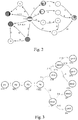
- the ground method 200 comprises a step 202 of construction of a model of the parasitic failure messages, for example in the form of a weighted graph 208, of a type also known (and for example illustrated figure 3 ).
- This ground process 200 uses as inputs a partial knowledge model 203 of the aircraft systems, initially built by the designers of the aircraft, and updated by the search for sequential patterns 201 and feedback from actions 204 of maintenance.
- the “knowledge model” 203 makes it possible to exploit and store incrementally the partial knowledge on the systems of the aircraft and on the generation of fault messages.
- the “feedback” 204 allows the system to evolve automatically and to be able to check the relevance of the results (for example: did such a failure or such reason for failures really require a maintenance procedure?).
- the search for sequential patterns 201 is the heart of the ground analysis method 200.
- failure messages being generated one after the other during the flight of an airplane with an anomaly, specific reasons for successions of these failure messages may emerge as appearing more frequently, and the aim is to be able to identify them. This is precisely the aim of known techniques for searching for sequential patterns.
- Such techniques are used for example for the analysis of consumer behavior or the prediction of malicious acts, for the analysis of meteorological data, or even for the analysis of stock market data. It is known that the extraction of long patterns is complex, and requires powerful computing means.
- This configuration 206 makes it possible to adapt to the inherent constraints of an application case and is valid throughout the scenario (unlike the knowledge model 203 which can interact more dynamically with the system).
- the search for sequential patterns 201 generates a database 207, no longer of failure messages, but of failure patterns, which constitutes a fundamental difference in approach.
- the purpose of the knowledge model 203 is to make the algorithm for finding sequential patterns 201 more relevant and to guide the creation and updating of the graph 208 which results therefrom.
- This knowledge model 203 uses as data sources: the knowledge of experts (aircraft designers and specialists in sequential patterns of aircraft failures), the known dependence between aircraft systems, which explains cascaded failures, and the return of 204 experience of maintenance teams, in order to build and develop their knowledge.
- the knowledge model 203 can directly act on the search for sequential patterns 201 by adding, deleting or modifying patterns in the base of sequential patterns 207. It also has an action for classifying fault messages (real, irrelevant or other according to the context and the application domain) ; indeed, through his knowledge of systems and feedback, he can, in the long term, classify the sequential patterns extracted by the algorithm for searching for sequential patterns 201 and stored in the base of sequential patterns 207.
- the knowledge model 203 can influence the graph 208 (or any other model used) created from the sequential patterns by adding, deleting or modifying states, links or weights of the graph.
- This knowledge model 203 therefore serves to capitalize on known and extracted knowledge.
- the way to model it can be multiple and depends essentially on the application case.
- the knowledge model 203 is constituted on a rule-based architecture for relatively uncomplicated systems, or on a more complex architecture such as Bayesian networks, which here constitutes the preferred approach.
- Bayesian networks are both models of knowledge representation, and means of calculating conditional probabilities.
- the rule relations (cause and effect relationship) are probabilized instead of being deterministic.
- this knowledge model 203 is initialized by the knowledge of experts and evolves with the data and knowledge extracted from feedback 204 and from the search for sequential patterns 201.
- the algorithm for searching for sequential patterns 201 is designed so that it is possible to deduce therefrom a weighted graph 208. In fact, one integrates into the execution of the algorithm for searching for sequential patterns 201 several calculations which subsequently make it possible to construct a graph.
- the airplane method 100 for real-time diagnostic support uses the model in the form of an airplane graph 103 to process the fault messages 101 generated in real time by the aircraft. These fault messages 101 are stored in a database 102, in conjunction with time data and other parameters intended to characterize the messages, with a view to their subsequent recovery by the ground method 200.
- the aircraft graph 103 then makes it possible to recognize if parasitic failure patterns are present and to delete them if necessary.
- the aircraft graph 103 can, for example, classify a series of fault messages 101 generated by the aircraft as being 60% irrelevant (a sequence of messages 101 generated by the aircraft is 60% recognizable by an identified sequential pattern. as "no fault found" in the sequential pattern database 207).
- this fault pattern 101 can be treated as plausible, ignored as a probable parasitic failure, or put on hold in a case not determined and awaiting more data ...
- Feedback 204 makes it possible to ensure that the results found by the ground process 200 and modeled in the weighted graph 208 coincide well with their real application in the context of the airplane process 100, in the form of real and false failures correctly predicted.
- the data from the maintenance operations serve to update the weighted graph 208 by modifying certain states, links or weights in the graph, in a known manner and not detailed here.
- the experience feedback 204 adds this event to the graph 208 (if the search for sequential patterns 201 did not do so before).
- This feedback 204 is very important, because in addition to ensuring the consistency of the results, it creates a feedback loop which allows the entire process to improve itself.
- the process as a whole, once implemented, forms a continuous learning cycle, allowing it to adapt to new situations and refine its filtering and analysis of fault messages from the data actually observed and from feedback 204.
- the method for processing sequences of fault messages according to the invention has several advantages. It could be used by many aircraft and helicopter manufacturers to improve their analysis and understanding of the generation of fault messages and to improve fault diagnosis and isolation.
- This process would allow them to reduce the display by maintenance support systems and the handling of parasitic faults by maintenance teams, and thus avoid unnecessary, costly and time-consuming maintenance actions (especially during aircraft rotation times on the ground). It also makes it possible to provide information as to the confidence, probability and relevance of fault messages and to be able to target the necessary maintenance actions more securely and quickly.
- the main innovation and therefore one of the main advantages compared to other approaches to this process is to provide a system which fully exploits feedback and general knowledge about the aircraft systems and their failure.
- the system adapts to new failures and improves automatically as faults appear and knowledge evolves.
- this approach makes it possible to have an explicit model on the triggering of failures and the generation of associated messages, in the form of an easily analyzable graph, which can also give avenues for improvement when designing systems for a new device.
- the knowledge model is specific to each aircraft family, and takes into account the breakdown history.
- model 208 either a deterministic weighted graph or a deterministic automaton. It should be noted that the present method is not limited to these two types of models to represent the sequencing of failures. Many other models can be envisaged depending on the type of messages to be processed and their complexity.
Landscapes
- Engineering & Computer Science (AREA)
- Physics & Mathematics (AREA)
- General Physics & Mathematics (AREA)
- Business, Economics & Management (AREA)
- Automation & Control Theory (AREA)
- Human Resources & Organizations (AREA)
- Life Sciences & Earth Sciences (AREA)
- Bioinformatics & Cheminformatics (AREA)
- Evolutionary Biology (AREA)
- Bioinformatics & Computational Biology (AREA)
- Operations Research (AREA)
- General Business, Economics & Management (AREA)
- Marketing (AREA)
- Theoretical Computer Science (AREA)
- Entrepreneurship & Innovation (AREA)
- Economics (AREA)
- Quality & Reliability (AREA)
- Tourism & Hospitality (AREA)
- Strategic Management (AREA)
- Information Retrieval, Db Structures And Fs Structures Therefor (AREA)
- Management, Administration, Business Operations System, And Electronic Commerce (AREA)
Claims (11)
- Verfahren zur Verarbeitung wenigstens einer Folge von Fehlermeldungen, die in einem Luftfahrtgerät auftreten, das zahlreiche bordeigene Systeme und wenigstens einen Bordcomputer umfasst, welches es ermöglicht, zwischen Fehlermeldungen, die durch einen tatsächlichen Ausfall eines der bordeigenen Systeme hervorgerufen werden, und Fehlermeldungen ohne tatsächlichen Fehler, die von einem der bordeigenen Systeme erzeugt werden, zu unterscheiden,
wobei das Verfahren die folgenden Schritte aufweist:- Erstellung eines wissensbasierten Modells (203), das von dem Bordcomputer vor dem ersten Einsatz während des Fluges verwendet werden kann,- Ausführung, während des Fluges und in Echtzeit, eines bordgestützten Verfahrens (100) zum Registrieren von Daten von Fehlermeldungen (101), welche Folgen bilden, die in einer Fehlerdatenbank (102) des Bordcomputers gespeichert werden, und zum Unterstützen der sofortigen Diagnose unter Verwendung eines Diagnosetools (103), um unter den Fehlermeldungen diejenigen zu bestimmen, die durch einen tatsächlichen Ausfall hervorgerufen werden,- und Durchführung, durch einen Bodencomputer, eines bodengestützten Verfahrens (200) zur A-Posteriori-Analyse der Daten von Fehlerfolgen der Fehlerdatenbank (102), wobei das bodengestützte Verfahren (200) einen Schritt der Verbesserung des bei dem bordgestützten Verfahren (100) verwendeten Diagnosetools (103) für eine spätere Verwendung des Tools (103) während des Fluges umfasst. - Verfahren nach Anspruch 1, dadurch gekennzeichnet, dass das bodengestützte Verfahren (200) einen Schritt (201) der Analyse der Fehlermeldungen mittels eines Verfahrens zur Suche nach sequentiellen Mustern umfasst.
- Verfahren nach Anspruch 2, dadurch gekennzeichnet, dass das bodengestützte Verfahren (200) einen Schritt der Erzeugung einer Basis sequentieller Muster (207) von Fehlern umfasst, und dadurch, dass im Schritt der Suche nach sequentiellen Mustern (201) für jedes gefundene sequentielle Muster berechnet werden:a) sein Träger: die Anzahl, wie oft dieses sequentielle Muster in der Basis gefundener sequentieller Muster (207) erscheint,b) der normierte Wert des Trägers für alle Muster derselben Größe,c) eine Wahrscheinlichkeit, welche dem Wahrscheinlichkeitswert entspricht, dass das letzte Element des Musters erzeugt wird.
- Verfahren nach Anspruch 3, dadurch gekennzeichnet, dass das bodengestützte Verfahren (200) einen Schritt (202) der Erstellung, anhand der Basis sequentieller Muster (207), eines Modells der unechten Fehlermeldungen in Form eines deterministischen endlichen Automaten (208) umfasst.
- Verfahren nach Anspruch 3, dadurch gekennzeichnet, dass das bodengestützte Verfahren (200) einen Schritt (202) der Erstellung, anhand der Basis sequentieller Muster (207), eines Modells der unechten Fehlermeldungen in Form eines deterministischen gewichteten Graphen (208) umfasst, welcher die Abfolge der gefundenen Fehlermeldungen darstellt.
- Verfahren nach einem der Ansprüche 2 bis 5, dadurch gekennzeichnet, dass das bodengestützte Verfahren (200) als eine seiner Eingangsgrößen ein wissensbasiertes Modell (203) der Systeme des Luftfahrtgeräts verwendet, das durch die Suche nach sequentiellen Mustern (201) und einen Schritt der Einbringung von Erfahrungen (204) der Benutzer aktualisiert wird.
- Verfahren nach Anspruch 6, dadurch gekennzeichnet, dass das wissensbasierte Modell (203) gemäß einer Architektur auf der Basis von Regeln erstellt wird.
- Verfahren nach Anspruch 6, dadurch gekennzeichnet, dass das wissensbasierte Modell (203) gemäß einer Architektur auf der Basis von Bayesschen Netzen erstellt wird.
- Verfahren nach einem der Ansprüche 6 bis 8, dadurch gekennzeichnet, dass das wissensbasierte Modell (203) als eine seiner Datenquellen die bekannte Abhängigkeit zwischen den Systemen des Luftfahrtgeräts, welche Kaskaden von Fehlern erklärt, und die Einbringung von Erfahrungen (204) der Wartungsteams verwendet.
- Verfahren nach Anspruch 5 und einem der Ansprüche 6 bis 9, dadurch gekennzeichnet, dass das bodengestützte Verfahren (200) Schritte der Berücksichtigung des wissensbasierten Modells (203) umfasst, um:auf die Suche nach sequentiellen Mustern (201) durch Hinzufügen, Weglassen oder Modifizieren von Mustern in der Basis sequentieller Muster (207) einzuwirken,auf die Klassifizierung der sequentiellen Muster von Fehlern einzuwirken, die durch den Algorithmus der Suche nach sequentiellen Mustern (201) extrahiert wurden,das aus den sequentiellen Mustern erzeugte Modell (208) durch Hinzufügen, Weglassen oder Modifizieren von Zuständen, Verbindungen oder Gewichten des Graphen zu beeinflussen.
- Verfahren nach einem der Ansprüche 5 bis 10, dadurch gekennzeichnet, dass bei dem bordgestützten Verfahren (100) zur Unterstützung der Diagnose in Echtzeit das Diagnosetool ein Modell in Form eines Flugzeug-Graphen (103) ist, das anhand des gewichteten Graphen (208) kopiert wurde und es ermöglicht, in einem Schritt (104) mithilfe zuvor berechneter Schwellenwerte zu erkennen, ob ein Fehlermuster (101) als plausibel behandelt, als wahrscheinlicher unechter Fehler ignoriert oder in einem unbestimmten Fall in Erwartung von mehr Daten in eine Wartestellung versetzt werden kann.
Applications Claiming Priority (2)
| Application Number | Priority Date | Filing Date | Title |
|---|---|---|---|
| FR0857816A FR2938676B1 (fr) | 2008-11-18 | 2008-11-18 | Procede de reconnaissance de motifs sequentiels pour procede de traitement des messages de pannes |
| PCT/EP2009/065215 WO2010057846A1 (fr) | 2008-11-18 | 2009-11-16 | Procédé de reconnaissance de motifs séquentiels pour procédé de traitement des messages de pannes |
Publications (2)
| Publication Number | Publication Date |
|---|---|
| EP2364467A1 EP2364467A1 (de) | 2011-09-14 |
| EP2364467B1 true EP2364467B1 (de) | 2020-01-01 |
Family
ID=40600292
Family Applications (1)
| Application Number | Title | Priority Date | Filing Date |
|---|---|---|---|
| EP09756297.9A Active EP2364467B1 (de) | 2008-11-18 | 2009-11-16 | Verfahren zum erkennen von sequentiellen mustern für ein verfahren zur fehlernachrichtenverarbeitung |
Country Status (4)
| Country | Link |
|---|---|
| US (1) | US9052711B2 (de) |
| EP (1) | EP2364467B1 (de) |
| FR (1) | FR2938676B1 (de) |
| WO (1) | WO2010057846A1 (de) |
Families Citing this family (22)
| Publication number | Priority date | Publication date | Assignee | Title |
|---|---|---|---|---|
| US8726255B2 (en) | 2012-05-01 | 2014-05-13 | Concurix Corporation | Recompiling with generic to specific replacement |
| US9575813B2 (en) | 2012-07-17 | 2017-02-21 | Microsoft Technology Licensing, Llc | Pattern matching process scheduler with upstream optimization |
| US8793669B2 (en) | 2012-07-17 | 2014-07-29 | Concurix Corporation | Pattern extraction from executable code in message passing environments |
| WO2014022154A1 (en) * | 2012-08-02 | 2014-02-06 | Siemens Corporation | Building a failure-predictive model from message sequences |
| WO2014048636A1 (en) * | 2012-09-25 | 2014-04-03 | Siemens Aktiengesellschaft | A system and a method for processing events occurring in an environment |
| WO2014075270A1 (zh) * | 2012-11-15 | 2014-05-22 | 华为技术有限公司 | 信息传输的方法、基站和用户设备 |
| US8914678B2 (en) * | 2012-12-20 | 2014-12-16 | Intel Mobile Communications GmbH | Systems and methods for debugging model based message sequences |
| GB2514108B (en) | 2013-05-13 | 2015-06-24 | Ge Aviat Systems Ltd | Method for diagnosing a bleed air system fault |
| FR3009396B1 (fr) * | 2013-07-31 | 2017-03-17 | Airbus Operations Sas | Procede et programme d'ordinateur d'aide a la maintenance d'equipements d'un aeronef |
| FR3011105B1 (fr) | 2013-09-20 | 2017-01-27 | Airbus Operations Sas | Procede d'identification d'un equipement defaillant dans un aeronef. |
| WO2015198213A1 (en) * | 2014-06-26 | 2015-12-30 | Bombardier Inc. | Methods and apparatus for assisting in the maintenance of aircraft and other mobile platforms |
| US9542655B1 (en) * | 2015-12-09 | 2017-01-10 | International Business Machines Corporation | Generating streaming analytics applications using a glossary |
| US10776409B2 (en) * | 2017-06-21 | 2020-09-15 | International Business Machines Corporation | Recommending responses to emergent conditions |
| CN107391727B (zh) * | 2017-08-01 | 2020-03-06 | 北京航空航天大学 | 设备故障序列模式的挖掘方法及装置 |
| EP3340250B1 (de) * | 2017-10-24 | 2020-08-05 | Siemens Healthcare GmbH | Bauteilidentifikation bei der fehlerbehandlung von medizinischen geräten |
| FR3076632B1 (fr) * | 2018-01-05 | 2020-10-09 | Dassault Aviat | Procede d'analyse de messages de maintenance generes par au moins une plateforme, et systeme associe |
| US10719359B2 (en) * | 2018-05-02 | 2020-07-21 | Servicenow, Inc. | Periodic task execution in an automated context |
| FR3086083A1 (fr) * | 2018-09-18 | 2020-03-20 | Thales | Procede d'analyse des dysfonctionnements d'un systeme et dispositifs associes |
| US11354320B2 (en) * | 2018-10-11 | 2022-06-07 | International Business Machines Corporation | Determining causes of events in data |
| CA3162087A1 (en) * | 2019-12-30 | 2021-07-08 | Jay William STRATER | Wireless extender with on-boarding ssid for simple and extensible onboarding |
| US12134484B2 (en) * | 2021-06-02 | 2024-11-05 | The Boeing Company | System and method for contextually-informed fault diagnostics using structural-temporal analysis of fault propagation graphs |
| CN115994187A (zh) * | 2023-02-08 | 2023-04-21 | 国网河南省电力公司郑州供电公司 | 基于分布式协作的隐患链路式全周期安全管理方法及系统 |
Citations (2)
| Publication number | Priority date | Publication date | Assignee | Title |
|---|---|---|---|---|
| US20050212523A1 (en) * | 2004-03-23 | 2005-09-29 | The Boeing Company | Variable-structure diagnostics approach achieving optimized low-frequency data sampling for EMA motoring subsystem |
| US20080250284A1 (en) * | 2007-04-04 | 2008-10-09 | Mentor Graphics Corporation | Fault dictionary-based scan chain failure diagnosis |
Family Cites Families (9)
| Publication number | Priority date | Publication date | Assignee | Title |
|---|---|---|---|---|
| US3978454A (en) * | 1974-06-20 | 1976-08-31 | Westinghouse Electric Corporation | System and method for programmable sequence control |
| US5867489A (en) * | 1996-05-29 | 1999-02-02 | Lockheed Martin Corp. | Method and apparatus for TDMA slot synchronization with precision ranging |
| US6408259B1 (en) * | 2000-02-01 | 2002-06-18 | General Electric Company | Alert generation for trend performance analysis |
| US6622972B2 (en) * | 2001-10-31 | 2003-09-23 | The Boeing Company | Method and system for in-flight fault monitoring of flight control actuators |
| US20070022142A1 (en) * | 2005-07-20 | 2007-01-25 | International Business Machines Corporation | System and method to generate domain knowledge for automated system management by combining designer specifications with data mining activity |
| CN101405609B (zh) * | 2006-02-17 | 2012-11-14 | 明导公司 | 多级测试响应压缩器 |
| US7840862B2 (en) * | 2006-02-17 | 2010-11-23 | Mentor Graphics Corporation | Enhanced diagnosis with limited failure cycles |
| WO2007109322A2 (en) * | 2006-03-20 | 2007-09-27 | Mentor Graphics Corporation | Speeding up defect diagnosis techniques |
| US8335601B2 (en) * | 2009-06-09 | 2012-12-18 | Honeywell International Inc. | System and method of automated fault analysis and diagnostic testing of an aircraft |
-
2008
- 2008-11-18 FR FR0857816A patent/FR2938676B1/fr not_active Expired - Fee Related
-
2009
- 2009-11-16 US US13/129,673 patent/US9052711B2/en active Active
- 2009-11-16 EP EP09756297.9A patent/EP2364467B1/de active Active
- 2009-11-16 WO PCT/EP2009/065215 patent/WO2010057846A1/fr not_active Ceased
Patent Citations (2)
| Publication number | Priority date | Publication date | Assignee | Title |
|---|---|---|---|---|
| US20050212523A1 (en) * | 2004-03-23 | 2005-09-29 | The Boeing Company | Variable-structure diagnostics approach achieving optimized low-frequency data sampling for EMA motoring subsystem |
| US20080250284A1 (en) * | 2007-04-04 | 2008-10-09 | Mentor Graphics Corporation | Fault dictionary-based scan chain failure diagnosis |
Also Published As
| Publication number | Publication date |
|---|---|
| FR2938676A1 (fr) | 2010-05-21 |
| US9052711B2 (en) | 2015-06-09 |
| FR2938676B1 (fr) | 2011-01-21 |
| EP2364467A1 (de) | 2011-09-14 |
| US20110276832A1 (en) | 2011-11-10 |
| WO2010057846A1 (fr) | 2010-05-27 |
Similar Documents
| Publication | Publication Date | Title |
|---|---|---|
| EP2364467B1 (de) | Verfahren zum erkennen von sequentiellen mustern für ein verfahren zur fehlernachrichtenverarbeitung | |
| KR102226687B1 (ko) | 딥러닝을 활용한 시계열 예측 기반의 정비 주기 예측 장치 및 방법 | |
| CN114830091B (zh) | 整块应用的微服务分解策略 | |
| EP3483797A1 (de) | Training, validierung und überwachung von modellen der künstlichen intelligenz und des maschinellen lernens | |
| US20190147371A1 (en) | Training, validating, and monitoring artificial intelligence and machine learning models | |
| EP3871078B1 (de) | Computing-system zur überwachung von flugtriebwerken | |
| EP3588301B1 (de) | Automatische und selbstoptimierte bestimmung der ausführungsparameter einer softwareanwendung auf einer informationsverarbeitungsplattform | |
| FR2989499A1 (fr) | Procede, dispositifs et programme d'ordinateur d'aide au diagnostic preventif d'un systeme d'un aeronef, utilisant des graphes d'evenements redoutes | |
| FR2989500A1 (fr) | Procede, dispositifs et programme d'ordinateur d'aide a l'analyse de la tolerance aux pannes d'un systeme d'un aeronef, utilisant des graphes d'evenements redoutes | |
| WO2018080781A1 (en) | Systems and methods for monitoring and analyzing computer and network activity | |
| FR3009396A1 (fr) | Procede et programme d'ordinateur d'aide a la maintenance d'equipements d'un aeronef | |
| CN120745841B (zh) | 基于大语言模型的故障推理分析方法及系统 | |
| WO2016075409A1 (fr) | Procédé de surveillance d'un moteur d'aéronef en fonctionnement dans un environnement donné | |
| FR2927435A1 (fr) | Procede et dispositif ameliores pour les operations de diagnostic et de maintenance d'aeronefs | |
| CN118133207B (zh) | 跨领域日志异常检测模型构建方法、装置、设备及介质 | |
| CN120743862A (zh) | 日志监控方法、装置、设备、介质和程序产品 | |
| CN118193274A (zh) | 分布式系统的异常处理方法、装置、设备及可读介质 | |
| FR2970796A1 (fr) | Procede de traitement de messages de pannes generes dans un appareil a systemes complexes | |
| FR2973131A1 (fr) | Procede et dispositif de detection d'incompatibilites d'interfaces logiques d'equipements de systemes embarques | |
| FR2954537A1 (fr) | Procede et dispositif pour la realisation d'une fonction de maintenance. | |
| Behera et al. | Root cause analysis bot using machine learning techniques | |
| EP4033361B1 (de) | Verfahren und vorrichtung zur bestimmung mindestens einer maschine, die an einer in einer komplexen it-infrastruktur entdeckten anomalie beteiligt ist | |
| WO2022135964A1 (fr) | Procédé de partitionnement de séries temporelles | |
| Aussel | Real-time anomaly detection with in-flight data: streaming anomaly detection with heterogeneous communicating agents | |
| EP4078416B1 (de) | Verfahren zur überwachung eines elektronischen systems mit low-level-leistungszählern und mit mindestens einem satz unkontrollierter softwareanwendungen, die auf einem prozessor ausgeführt werden, und eine überwachungseinrichtung |
Legal Events
| Date | Code | Title | Description |
|---|---|---|---|
| PUAI | Public reference made under article 153(3) epc to a published international application that has entered the european phase |
Free format text: ORIGINAL CODE: 0009012 |
|
| 17P | Request for examination filed |
Effective date: 20110609 |
|
| AK | Designated contracting states |
Kind code of ref document: A1 Designated state(s): AT BE BG CH CY CZ DE DK EE ES FI FR GB GR HR HU IE IS IT LI LT LU LV MC MK MT NL NO PL PT RO SE SI SK SM TR |
|
| DAX | Request for extension of the european patent (deleted) | ||
| RAP1 | Party data changed (applicant data changed or rights of an application transferred) |
Owner name: AIRBUS GROUP SAS |
|
| RAP1 | Party data changed (applicant data changed or rights of an application transferred) |
Owner name: AIRBUS (SAS) |
|
| STAA | Information on the status of an ep patent application or granted ep patent |
Free format text: STATUS: EXAMINATION IS IN PROGRESS |
|
| 17Q | First examination report despatched |
Effective date: 20181211 |
|
| GRAP | Despatch of communication of intention to grant a patent |
Free format text: ORIGINAL CODE: EPIDOSNIGR1 |
|
| STAA | Information on the status of an ep patent application or granted ep patent |
Free format text: STATUS: GRANT OF PATENT IS INTENDED |
|
| INTG | Intention to grant announced |
Effective date: 20190626 |
|
| GRAS | Grant fee paid |
Free format text: ORIGINAL CODE: EPIDOSNIGR3 |
|
| GRAA | (expected) grant |
Free format text: ORIGINAL CODE: 0009210 |
|
| STAA | Information on the status of an ep patent application or granted ep patent |
Free format text: STATUS: THE PATENT HAS BEEN GRANTED |
|
| AK | Designated contracting states |
Kind code of ref document: B1 Designated state(s): AT BE BG CH CY CZ DE DK EE ES FI FR GB GR HR HU IE IS IT LI LT LU LV MC MK MT NL NO PL PT RO SE SI SK SM TR |
|
| REG | Reference to a national code |
Ref country code: GB Ref legal event code: FG4D Free format text: NOT ENGLISH |
|
| REG | Reference to a national code |
Ref country code: CH Ref legal event code: EP Ref country code: AT Ref legal event code: REF Ref document number: 1220569 Country of ref document: AT Kind code of ref document: T Effective date: 20200115 |
|
| REG | Reference to a national code |
Ref country code: IE Ref legal event code: FG4D Free format text: LANGUAGE OF EP DOCUMENT: FRENCH |
|
| REG | Reference to a national code |
Ref country code: DE Ref legal event code: R096 Ref document number: 602009060880 Country of ref document: DE |
|
| REG | Reference to a national code |
Ref country code: NL Ref legal event code: MP Effective date: 20200101 |
|
| REG | Reference to a national code |
Ref country code: LT Ref legal event code: MG4D |
|
| PG25 | Lapsed in a contracting state [announced via postgrant information from national office to epo] |
Ref country code: FI Free format text: LAPSE BECAUSE OF FAILURE TO SUBMIT A TRANSLATION OF THE DESCRIPTION OR TO PAY THE FEE WITHIN THE PRESCRIBED TIME-LIMIT Effective date: 20200101 Ref country code: NO Free format text: LAPSE BECAUSE OF FAILURE TO SUBMIT A TRANSLATION OF THE DESCRIPTION OR TO PAY THE FEE WITHIN THE PRESCRIBED TIME-LIMIT Effective date: 20200401 Ref country code: LT Free format text: LAPSE BECAUSE OF FAILURE TO SUBMIT A TRANSLATION OF THE DESCRIPTION OR TO PAY THE FEE WITHIN THE PRESCRIBED TIME-LIMIT Effective date: 20200101 Ref country code: NL Free format text: LAPSE BECAUSE OF FAILURE TO SUBMIT A TRANSLATION OF THE DESCRIPTION OR TO PAY THE FEE WITHIN THE PRESCRIBED TIME-LIMIT Effective date: 20200101 Ref country code: CZ Free format text: LAPSE BECAUSE OF FAILURE TO SUBMIT A TRANSLATION OF THE DESCRIPTION OR TO PAY THE FEE WITHIN THE PRESCRIBED TIME-LIMIT Effective date: 20200101 Ref country code: PT Free format text: LAPSE BECAUSE OF FAILURE TO SUBMIT A TRANSLATION OF THE DESCRIPTION OR TO PAY THE FEE WITHIN THE PRESCRIBED TIME-LIMIT Effective date: 20200527 |
|
| PG25 | Lapsed in a contracting state [announced via postgrant information from national office to epo] |
Ref country code: GR Free format text: LAPSE BECAUSE OF FAILURE TO SUBMIT A TRANSLATION OF THE DESCRIPTION OR TO PAY THE FEE WITHIN THE PRESCRIBED TIME-LIMIT Effective date: 20200402 Ref country code: HR Free format text: LAPSE BECAUSE OF FAILURE TO SUBMIT A TRANSLATION OF THE DESCRIPTION OR TO PAY THE FEE WITHIN THE PRESCRIBED TIME-LIMIT Effective date: 20200101 Ref country code: LV Free format text: LAPSE BECAUSE OF FAILURE TO SUBMIT A TRANSLATION OF THE DESCRIPTION OR TO PAY THE FEE WITHIN THE PRESCRIBED TIME-LIMIT Effective date: 20200101 Ref country code: IS Free format text: LAPSE BECAUSE OF FAILURE TO SUBMIT A TRANSLATION OF THE DESCRIPTION OR TO PAY THE FEE WITHIN THE PRESCRIBED TIME-LIMIT Effective date: 20200501 Ref country code: SE Free format text: LAPSE BECAUSE OF FAILURE TO SUBMIT A TRANSLATION OF THE DESCRIPTION OR TO PAY THE FEE WITHIN THE PRESCRIBED TIME-LIMIT Effective date: 20200101 Ref country code: BG Free format text: LAPSE BECAUSE OF FAILURE TO SUBMIT A TRANSLATION OF THE DESCRIPTION OR TO PAY THE FEE WITHIN THE PRESCRIBED TIME-LIMIT Effective date: 20200401 |
|
| REG | Reference to a national code |
Ref country code: DE Ref legal event code: R097 Ref document number: 602009060880 Country of ref document: DE |
|
| PG25 | Lapsed in a contracting state [announced via postgrant information from national office to epo] |
Ref country code: ES Free format text: LAPSE BECAUSE OF FAILURE TO SUBMIT A TRANSLATION OF THE DESCRIPTION OR TO PAY THE FEE WITHIN THE PRESCRIBED TIME-LIMIT Effective date: 20200101 Ref country code: RO Free format text: LAPSE BECAUSE OF FAILURE TO SUBMIT A TRANSLATION OF THE DESCRIPTION OR TO PAY THE FEE WITHIN THE PRESCRIBED TIME-LIMIT Effective date: 20200101 Ref country code: SM Free format text: LAPSE BECAUSE OF FAILURE TO SUBMIT A TRANSLATION OF THE DESCRIPTION OR TO PAY THE FEE WITHIN THE PRESCRIBED TIME-LIMIT Effective date: 20200101 Ref country code: EE Free format text: LAPSE BECAUSE OF FAILURE TO SUBMIT A TRANSLATION OF THE DESCRIPTION OR TO PAY THE FEE WITHIN THE PRESCRIBED TIME-LIMIT Effective date: 20200101 Ref country code: DK Free format text: LAPSE BECAUSE OF FAILURE TO SUBMIT A TRANSLATION OF THE DESCRIPTION OR TO PAY THE FEE WITHIN THE PRESCRIBED TIME-LIMIT Effective date: 20200101 Ref country code: SK Free format text: LAPSE BECAUSE OF FAILURE TO SUBMIT A TRANSLATION OF THE DESCRIPTION OR TO PAY THE FEE WITHIN THE PRESCRIBED TIME-LIMIT Effective date: 20200101 |
|
| PLBE | No opposition filed within time limit |
Free format text: ORIGINAL CODE: 0009261 |
|
| STAA | Information on the status of an ep patent application or granted ep patent |
Free format text: STATUS: NO OPPOSITION FILED WITHIN TIME LIMIT |
|
| REG | Reference to a national code |
Ref country code: AT Ref legal event code: MK05 Ref document number: 1220569 Country of ref document: AT Kind code of ref document: T Effective date: 20200101 |
|
| 26N | No opposition filed |
Effective date: 20201002 |
|
| PG25 | Lapsed in a contracting state [announced via postgrant information from national office to epo] |
Ref country code: AT Free format text: LAPSE BECAUSE OF FAILURE TO SUBMIT A TRANSLATION OF THE DESCRIPTION OR TO PAY THE FEE WITHIN THE PRESCRIBED TIME-LIMIT Effective date: 20200101 Ref country code: IT Free format text: LAPSE BECAUSE OF FAILURE TO SUBMIT A TRANSLATION OF THE DESCRIPTION OR TO PAY THE FEE WITHIN THE PRESCRIBED TIME-LIMIT Effective date: 20200101 |
|
| PG25 | Lapsed in a contracting state [announced via postgrant information from national office to epo] |
Ref country code: PL Free format text: LAPSE BECAUSE OF FAILURE TO SUBMIT A TRANSLATION OF THE DESCRIPTION OR TO PAY THE FEE WITHIN THE PRESCRIBED TIME-LIMIT Effective date: 20200101 Ref country code: SI Free format text: LAPSE BECAUSE OF FAILURE TO SUBMIT A TRANSLATION OF THE DESCRIPTION OR TO PAY THE FEE WITHIN THE PRESCRIBED TIME-LIMIT Effective date: 20200101 |
|
| REG | Reference to a national code |
Ref country code: DE Ref legal event code: R119 Ref document number: 602009060880 Country of ref document: DE |
|
| PG25 | Lapsed in a contracting state [announced via postgrant information from national office to epo] |
Ref country code: MC Free format text: LAPSE BECAUSE OF FAILURE TO SUBMIT A TRANSLATION OF THE DESCRIPTION OR TO PAY THE FEE WITHIN THE PRESCRIBED TIME-LIMIT Effective date: 20200101 |
|
| REG | Reference to a national code |
Ref country code: CH Ref legal event code: PL |
|
| PG25 | Lapsed in a contracting state [announced via postgrant information from national office to epo] |
Ref country code: LU Free format text: LAPSE BECAUSE OF NON-PAYMENT OF DUE FEES Effective date: 20201116 |
|
| REG | Reference to a national code |
Ref country code: BE Ref legal event code: MM Effective date: 20201130 |
|
| PG25 | Lapsed in a contracting state [announced via postgrant information from national office to epo] |
Ref country code: CH Free format text: LAPSE BECAUSE OF NON-PAYMENT OF DUE FEES Effective date: 20201130 Ref country code: LI Free format text: LAPSE BECAUSE OF NON-PAYMENT OF DUE FEES Effective date: 20201130 |
|
| PG25 | Lapsed in a contracting state [announced via postgrant information from national office to epo] |
Ref country code: IE Free format text: LAPSE BECAUSE OF NON-PAYMENT OF DUE FEES Effective date: 20201116 |
|
| PG25 | Lapsed in a contracting state [announced via postgrant information from national office to epo] |
Ref country code: DE Free format text: LAPSE BECAUSE OF NON-PAYMENT OF DUE FEES Effective date: 20210601 |
|
| PGFP | Annual fee paid to national office [announced via postgrant information from national office to epo] |
Ref country code: GB Payment date: 20211119 Year of fee payment: 13 Ref country code: FR Payment date: 20211122 Year of fee payment: 13 |
|
| PG25 | Lapsed in a contracting state [announced via postgrant information from national office to epo] |
Ref country code: TR Free format text: LAPSE BECAUSE OF FAILURE TO SUBMIT A TRANSLATION OF THE DESCRIPTION OR TO PAY THE FEE WITHIN THE PRESCRIBED TIME-LIMIT Effective date: 20200101 Ref country code: MT Free format text: LAPSE BECAUSE OF FAILURE TO SUBMIT A TRANSLATION OF THE DESCRIPTION OR TO PAY THE FEE WITHIN THE PRESCRIBED TIME-LIMIT Effective date: 20200101 Ref country code: CY Free format text: LAPSE BECAUSE OF FAILURE TO SUBMIT A TRANSLATION OF THE DESCRIPTION OR TO PAY THE FEE WITHIN THE PRESCRIBED TIME-LIMIT Effective date: 20200101 |
|
| PG25 | Lapsed in a contracting state [announced via postgrant information from national office to epo] |
Ref country code: MK Free format text: LAPSE BECAUSE OF FAILURE TO SUBMIT A TRANSLATION OF THE DESCRIPTION OR TO PAY THE FEE WITHIN THE PRESCRIBED TIME-LIMIT Effective date: 20200101 |
|
| PG25 | Lapsed in a contracting state [announced via postgrant information from national office to epo] |
Ref country code: BE Free format text: LAPSE BECAUSE OF NON-PAYMENT OF DUE FEES Effective date: 20201130 |
|
| GBPC | Gb: european patent ceased through non-payment of renewal fee |
Effective date: 20221116 |
|
| PG25 | Lapsed in a contracting state [announced via postgrant information from national office to epo] |
Ref country code: GB Free format text: LAPSE BECAUSE OF NON-PAYMENT OF DUE FEES Effective date: 20221116 |
|
| PG25 | Lapsed in a contracting state [announced via postgrant information from national office to epo] |
Ref country code: FR Free format text: LAPSE BECAUSE OF NON-PAYMENT OF DUE FEES Effective date: 20221130 |