EP2363423A1 - 9-aryl and bisaryl subtituted polyfluorenes - Google Patents
9-aryl and bisaryl subtituted polyfluorenes Download PDFInfo
- Publication number
- EP2363423A1 EP2363423A1 EP10184752A EP10184752A EP2363423A1 EP 2363423 A1 EP2363423 A1 EP 2363423A1 EP 10184752 A EP10184752 A EP 10184752A EP 10184752 A EP10184752 A EP 10184752A EP 2363423 A1 EP2363423 A1 EP 2363423A1
- Authority
- EP
- European Patent Office
- Prior art keywords
- group
- electron withdrawing
- monomer
- groups
- polymer
- Prior art date
- Legal status (The legal status is an assumption and is not a legal conclusion. Google has not performed a legal analysis and makes no representation as to the accuracy of the status listed.)
- Withdrawn
Links
- 0 CCC(C)(C)c1c(*)c(*)c(C(C)(C)*)c(*)c1* Chemical compound CCC(C)(C)c1c(*)c(*)c(C(C)(C)*)c(*)c1* 0.000 description 4
Classifications
-
- H—ELECTRICITY
- H05—ELECTRIC TECHNIQUES NOT OTHERWISE PROVIDED FOR
- H05B—ELECTRIC HEATING; ELECTRIC LIGHT SOURCES NOT OTHERWISE PROVIDED FOR; CIRCUIT ARRANGEMENTS FOR ELECTRIC LIGHT SOURCES, IN GENERAL
- H05B33/00—Electroluminescent light sources
- H05B33/12—Light sources with substantially two-dimensional [2D] radiating surfaces
- H05B33/14—Light sources with substantially two-dimensional [2D] radiating surfaces characterised by the chemical or physical composition or the arrangement of the electroluminescent material, or by the simultaneous addition of the electroluminescent material in or onto the light source
-
- C—CHEMISTRY; METALLURGY
- C08—ORGANIC MACROMOLECULAR COMPOUNDS; THEIR PREPARATION OR CHEMICAL WORKING-UP; COMPOSITIONS BASED THEREON
- C08G—MACROMOLECULAR COMPOUNDS OBTAINED OTHERWISE THAN BY REACTIONS ONLY INVOLVING UNSATURATED CARBON-TO-CARBON BONDS
- C08G61/00—Macromolecular compounds obtained by reactions forming a carbon-to-carbon link in the main chain of the macromolecule
-
- C—CHEMISTRY; METALLURGY
- C08—ORGANIC MACROMOLECULAR COMPOUNDS; THEIR PREPARATION OR CHEMICAL WORKING-UP; COMPOSITIONS BASED THEREON
- C08G—MACROMOLECULAR COMPOUNDS OBTAINED OTHERWISE THAN BY REACTIONS ONLY INVOLVING UNSATURATED CARBON-TO-CARBON BONDS
- C08G61/00—Macromolecular compounds obtained by reactions forming a carbon-to-carbon link in the main chain of the macromolecule
- C08G61/02—Macromolecular compounds containing only carbon atoms in the main chain of the macromolecule, e.g. polyxylylenes
-
- C—CHEMISTRY; METALLURGY
- C09—DYES; PAINTS; POLISHES; NATURAL RESINS; ADHESIVES; COMPOSITIONS NOT OTHERWISE PROVIDED FOR; APPLICATIONS OF MATERIALS NOT OTHERWISE PROVIDED FOR
- C09K—MATERIALS FOR MISCELLANEOUS APPLICATIONS, NOT PROVIDED FOR ELSEWHERE
- C09K11/00—Luminescent materials, e.g. electroluminescent or chemiluminescent
- C09K11/06—Luminescent materials, e.g. electroluminescent or chemiluminescent containing organic luminescent materials
-
- G—PHYSICS
- G02—OPTICS
- G02B—OPTICAL ELEMENTS, SYSTEMS OR APPARATUS
- G02B1/00—Optical elements characterised by the material of which they are made; Optical coatings for optical elements
- G02B1/04—Optical elements characterised by the material of which they are made; Optical coatings for optical elements made of organic materials, e.g. plastics
-
- H—ELECTRICITY
- H10—SEMICONDUCTOR DEVICES; ELECTRIC SOLID-STATE DEVICES NOT OTHERWISE PROVIDED FOR
- H10K—ORGANIC ELECTRIC SOLID-STATE DEVICES
- H10K50/00—Organic light-emitting devices
- H10K50/10—OLEDs or polymer light-emitting diodes [PLED]
-
- H—ELECTRICITY
- H10—SEMICONDUCTOR DEVICES; ELECTRIC SOLID-STATE DEVICES NOT OTHERWISE PROVIDED FOR
- H10K—ORGANIC ELECTRIC SOLID-STATE DEVICES
- H10K85/00—Organic materials used in the body or electrodes of devices covered by this subclass
- H10K85/10—Organic polymers or oligomers
- H10K85/111—Organic polymers or oligomers comprising aromatic, heteroaromatic, or aryl chains, e.g. polyaniline, polyphenylene or polyphenylene vinylene
- H10K85/115—Polyfluorene; Derivatives thereof
-
- C—CHEMISTRY; METALLURGY
- C08—ORGANIC MACROMOLECULAR COMPOUNDS; THEIR PREPARATION OR CHEMICAL WORKING-UP; COMPOSITIONS BASED THEREON
- C08G—MACROMOLECULAR COMPOUNDS OBTAINED OTHERWISE THAN BY REACTIONS ONLY INVOLVING UNSATURATED CARBON-TO-CARBON BONDS
- C08G2261/00—Macromolecular compounds obtained by reactions forming a carbon-to-carbon link in the main chain of the macromolecule
- C08G2261/10—Definition of the polymer structure
- C08G2261/12—Copolymers
- C08G2261/124—Copolymers alternating
-
- C—CHEMISTRY; METALLURGY
- C08—ORGANIC MACROMOLECULAR COMPOUNDS; THEIR PREPARATION OR CHEMICAL WORKING-UP; COMPOSITIONS BASED THEREON
- C08G—MACROMOLECULAR COMPOUNDS OBTAINED OTHERWISE THAN BY REACTIONS ONLY INVOLVING UNSATURATED CARBON-TO-CARBON BONDS
- C08G2261/00—Macromolecular compounds obtained by reactions forming a carbon-to-carbon link in the main chain of the macromolecule
- C08G2261/10—Definition of the polymer structure
- C08G2261/14—Side-groups
- C08G2261/146—Side-chains containing halogens
-
- C—CHEMISTRY; METALLURGY
- C08—ORGANIC MACROMOLECULAR COMPOUNDS; THEIR PREPARATION OR CHEMICAL WORKING-UP; COMPOSITIONS BASED THEREON
- C08G—MACROMOLECULAR COMPOUNDS OBTAINED OTHERWISE THAN BY REACTIONS ONLY INVOLVING UNSATURATED CARBON-TO-CARBON BONDS
- C08G2261/00—Macromolecular compounds obtained by reactions forming a carbon-to-carbon link in the main chain of the macromolecule
- C08G2261/10—Definition of the polymer structure
- C08G2261/14—Side-groups
- C08G2261/148—Side-chains having aromatic units
-
- C—CHEMISTRY; METALLURGY
- C08—ORGANIC MACROMOLECULAR COMPOUNDS; THEIR PREPARATION OR CHEMICAL WORKING-UP; COMPOSITIONS BASED THEREON
- C08G—MACROMOLECULAR COMPOUNDS OBTAINED OTHERWISE THAN BY REACTIONS ONLY INVOLVING UNSATURATED CARBON-TO-CARBON BONDS
- C08G2261/00—Macromolecular compounds obtained by reactions forming a carbon-to-carbon link in the main chain of the macromolecule
- C08G2261/10—Definition of the polymer structure
- C08G2261/14—Side-groups
- C08G2261/149—Side-chains having heteroaromatic units
-
- C—CHEMISTRY; METALLURGY
- C08—ORGANIC MACROMOLECULAR COMPOUNDS; THEIR PREPARATION OR CHEMICAL WORKING-UP; COMPOSITIONS BASED THEREON
- C08G—MACROMOLECULAR COMPOUNDS OBTAINED OTHERWISE THAN BY REACTIONS ONLY INVOLVING UNSATURATED CARBON-TO-CARBON BONDS
- C08G2261/00—Macromolecular compounds obtained by reactions forming a carbon-to-carbon link in the main chain of the macromolecule
- C08G2261/50—Physical properties
- C08G2261/51—Charge transport
- C08G2261/514—Electron transport
-
- C—CHEMISTRY; METALLURGY
- C08—ORGANIC MACROMOLECULAR COMPOUNDS; THEIR PREPARATION OR CHEMICAL WORKING-UP; COMPOSITIONS BASED THEREON
- C08G—MACROMOLECULAR COMPOUNDS OBTAINED OTHERWISE THAN BY REACTIONS ONLY INVOLVING UNSATURATED CARBON-TO-CARBON BONDS
- C08G2261/00—Macromolecular compounds obtained by reactions forming a carbon-to-carbon link in the main chain of the macromolecule
- C08G2261/50—Physical properties
- C08G2261/52—Luminescence
- C08G2261/522—Luminescence fluorescent
- C08G2261/5222—Luminescence fluorescent electrofluorescent
-
- C—CHEMISTRY; METALLURGY
- C09—DYES; PAINTS; POLISHES; NATURAL RESINS; ADHESIVES; COMPOSITIONS NOT OTHERWISE PROVIDED FOR; APPLICATIONS OF MATERIALS NOT OTHERWISE PROVIDED FOR
- C09K—MATERIALS FOR MISCELLANEOUS APPLICATIONS, NOT PROVIDED FOR ELSEWHERE
- C09K2211/00—Chemical nature of organic luminescent or tenebrescent compounds
- C09K2211/14—Macromolecular compounds
- C09K2211/1408—Carbocyclic compounds
- C09K2211/1416—Condensed systems
-
- C—CHEMISTRY; METALLURGY
- C09—DYES; PAINTS; POLISHES; NATURAL RESINS; ADHESIVES; COMPOSITIONS NOT OTHERWISE PROVIDED FOR; APPLICATIONS OF MATERIALS NOT OTHERWISE PROVIDED FOR
- C09K—MATERIALS FOR MISCELLANEOUS APPLICATIONS, NOT PROVIDED FOR ELSEWHERE
- C09K2211/00—Chemical nature of organic luminescent or tenebrescent compounds
- C09K2211/14—Macromolecular compounds
- C09K2211/1408—Carbocyclic compounds
- C09K2211/1425—Non-condensed systems
-
- C—CHEMISTRY; METALLURGY
- C09—DYES; PAINTS; POLISHES; NATURAL RESINS; ADHESIVES; COMPOSITIONS NOT OTHERWISE PROVIDED FOR; APPLICATIONS OF MATERIALS NOT OTHERWISE PROVIDED FOR
- C09K—MATERIALS FOR MISCELLANEOUS APPLICATIONS, NOT PROVIDED FOR ELSEWHERE
- C09K2211/00—Chemical nature of organic luminescent or tenebrescent compounds
- C09K2211/14—Macromolecular compounds
- C09K2211/1408—Carbocyclic compounds
- C09K2211/1433—Carbocyclic compounds bridged by heteroatoms, e.g. N, P, Si or B
-
- H—ELECTRICITY
- H10—SEMICONDUCTOR DEVICES; ELECTRIC SOLID-STATE DEVICES NOT OTHERWISE PROVIDED FOR
- H10K—ORGANIC ELECTRIC SOLID-STATE DEVICES
- H10K50/00—Organic light-emitting devices
-
- H—ELECTRICITY
- H10—SEMICONDUCTOR DEVICES; ELECTRIC SOLID-STATE DEVICES NOT OTHERWISE PROVIDED FOR
- H10K—ORGANIC ELECTRIC SOLID-STATE DEVICES
- H10K85/00—Organic materials used in the body or electrodes of devices covered by this subclass
- H10K85/10—Organic polymers or oligomers
- H10K85/151—Copolymers
-
- H—ELECTRICITY
- H10—SEMICONDUCTOR DEVICES; ELECTRIC SOLID-STATE DEVICES NOT OTHERWISE PROVIDED FOR
- H10K—ORGANIC ELECTRIC SOLID-STATE DEVICES
- H10K85/00—Organic materials used in the body or electrodes of devices covered by this subclass
- H10K85/60—Organic compounds having low molecular weight
- H10K85/631—Amine compounds having at least two aryl rest on at least one amine-nitrogen atom, e.g. triphenylamine
-
- Y—GENERAL TAGGING OF NEW TECHNOLOGICAL DEVELOPMENTS; GENERAL TAGGING OF CROSS-SECTIONAL TECHNOLOGIES SPANNING OVER SEVERAL SECTIONS OF THE IPC; TECHNICAL SUBJECTS COVERED BY FORMER USPC CROSS-REFERENCE ART COLLECTIONS [XRACs] AND DIGESTS
- Y10—TECHNICAL SUBJECTS COVERED BY FORMER USPC
- Y10S—TECHNICAL SUBJECTS COVERED BY FORMER USPC CROSS-REFERENCE ART COLLECTIONS [XRACs] AND DIGESTS
- Y10S428/00—Stock material or miscellaneous articles
- Y10S428/917—Electroluminescent
Definitions
- This invention relates to semiconductive polymers, their synthesis and use in optical devices.
- Electroactive polymers are now frequently used in a number of optical devices such as in polymeric light emitting diodes ("PLEDs") as disclosed In WO 90/13148 , photovoltaic devices as disclosed in WO 96/16449 and photodetectors as disclosed in US 5523555 .
- PLEDs polymeric light emitting diodes
- a typical PLED comprises an organic electroluminescent layer located between an anode and a cathode.
- holes are injected into the device through the anode and electrons are injected into the device through the cathode.
- Holes enter the highest occupied molecular orbital ("HOMO") of the electroluminescent polymer and electrons enter the lowest unoccupied molecular orbital (“LUMO”) and then combine to form an exciton which undergoes radiative decay to give light.
- HOMO highest occupied molecular orbital
- LUMO lowest unoccupied molecular orbital
- the colour of light emitted from the electroluminescent polymer depends on its HOMO-LUMO bandgap.
- An electron transport material is commonly used to assist in transport of electrons from the cathode to the LUMO of the electroluminescent polymer and thus increase device efficiency.
- Suitable electron transport materials are those having a LUMO level falling between the LUMO level of the electroluminescent polymer and the workfunction of the cathode.
- a hole transporting material having a HOMO level falling between the workfunction of the anode and the HOMO level of the emissive material is commonly used.
- WO 99/48160 discloses a blend of a hole transporting polymer, an electron transporting polymer and an electroluminescent polymer.
- the electron transporting functionality and the emissive functionality may be provided by different blocks of a block copolymer as disclosed in WO 00/55927 .
- a difficulty encountered with blue electroluminescent polymers is that their lifetime (i.e. the time taken for brightness to halve from a given starting brightness at fixed current) tends to be shorter than that of corresponding red or green materials.
- One of the factors that has been proposed as contributing to the more rapid degradation of blue materials is that their LUMO levels, and consequently the energy level of the charged state following injection of an electron into the LUMO, tends to be less deep than those of corresponding red or green materials. It is therefore possible that materials comprising these lower electron affinities are less electrochemically stable and therefore more prone to degradation.
- a full colour display will preferably have the same cathode material for all three electroluminescent materials. This results in the further problem that the energy gap between the LUMO and the workfunction of the cathode for a typical blue electroluminescent polymer is greater than that for a typical red or green electroluminescent polymer. This may contribute to lower efficiency.
- Chains of fluorene repeat units may be used as electron transporting materials.
- polyfluorenes have the advantages of being soluble in conventional organic solvents and have good film forming properties.
- fluorene monomers are amenable to Yamamoto polymerisation or Suzuki polymerisation which enables a high degree of control over the regioregularity of the resultant polymer.
- chains of dioctylfluorene function as the electron transport material; the triphenylamine denoted as TFB functions as the hole transport material and the bis(diphenylamino)benzene derivative denoted as PFB functions as the emissive material.
- WO 94/29883 discloses use of electron withdrawing groups, particularly nitrile groups, as substituents on electroluminescent polymers for the purpose of reducing the barrier to electron injection between a high workfunction electrode and the electroluminescent polymer. This document only teaches use of such substituents on poly(arylene vinylenes).
- This disclosure describes use of fluorinated sidechains as a means of decreasing interchain interactions that have been reported to cause aggregation of polyfluorenes and contains no discussion of using such electron deficient substituents as a means to increase electron affinity.
- This polymer is disclosed as showing no photoluminescence.
- WO 00/22026 discloses a homopolymer having a repeat unit of formula (c):
- copolymers of (c) with dialkylfluorene repeat units and with triarylamine repeat units are also disclosed in this document.
- Asymmetric substitution of the 9-position of fluorene is described for the purpose of avoiding polymer aggregation; this document contains no teaching of 9-substituents used for the purpose of enhanced electron injection of the fluorene backbone.
- WO 99/20675 discloses a 1:1 copolymer of 9,9-di-n-octylfluorene and 9,9-di(4-methoxyphenyl)fluorene
- WO 01/62822 discloses a polyfluorene with triarylamine 9-substituents.
- JP 10095972 discloses a molecule of formula (e):
- a high electron affinity material that is capable of functioning as an electron transport material for a blue electroluminescent material.
- such a material would also be capable of functioning as an electron transport material for a red or green material.
- such material may, as a result of its large HOMO-LUMO bandgap, be used as a blue electroluminescent material.
- the present inventors have determined that improved electron injection, and therefore improved PLED performance, may be accomplished by increasing the electron affinity of known polyfluorenes.
- the invention provides a polymer comprising optionally substituted first repeat units of formula (I): wherein Ar is selected from:
- the polymer comprises repeat units of formula (II): wherein each Ar is independently selected from:
- Preferred Ar groups according to (a) are independently selected from units of formula (III): wherein n is from 1-3 and R 1 -R 5 are independently selected from:
- Ar groups according to (a) are fused aromatic hydrocarbons such as naphthalene and anthracene.
- the electron withdrawing group is selected from: groups comprising fluorine, cyano, nitro, carboxyl, amides, ketones, phosphinoyl, phosphonates, sulfones and esters. More preferably, the at least one electron withdrawing group is selected from fluorine atoms, fluoroalkyl, fluoroaryl and fluoroheteroaryl.
- Preferred electron withdrawing heteroaryls according to (b) are optionally substituted N-containing heteroaryls, In particular optionally substituted pyridines, most particularly pyridine-4-yl; pyrazines; pyrimidines; pyridazines; triazines, most particularly 1,3,5-triazine-2-yl and oxadiazoles.
- the electron withdrawing heteroaryl may be substituted with electron withdrawing groups as outlined above to further increase its electron withdrawing effect.
- the polymer according to the Invention comprises a second repeat unit. More preferably the second repeat unit is selected from triarylamines and heteroaromatics.
- the polymer according to the invention is capable of transporting electrons.
- the polymer preferably has at least one segment capable of hole transport and / or emission. Two or more functions of hole transport, electron transport and emission may be provided by the same segment. In particular, a single segment may function as both an electron transporter and an emitter.
- the invention provides an optical device, preferably an electroluminescent device, comprising a polymer as described above.
- the emissive material within the emissive layer may be the polymer according to the first aspect of the invention or another material, preferably another polymer, blended with the polymer according to the first aspect of the invention.
- the polymer according to the first aspect of the invention is capable of transporting electrons In this device.
- the invention provides a monomer comprising an optionally substituted compound of formula (IV): wherein each P independently represents a polymerisable group and Ar is as defined above.
- the monomer comprises an optionally substituted compound of formula (V):
- each P I is independently selected from a reactive boron derivative group selected from a boronic acid group, a boronic ester group and a borane group and a reactive halide group.
- the invention provides a process for preparing a polymer comprising a step of reacting a first monomer as described above with a second monomer that may be the same or different from the first monomer under conditions so as to polymerise the monomers.
- the process comprises polymerising in a reaction mixture:
- polymers according to the invention function effectively as electron transporting materials for red, green or blue electroluminescent polymers without adversely affecting device properties as has been found for systems having aliphatic electron withdrawing 9-substituents such as perfluoroalkyl.
- the polymers prepared using monomers according to the invention may be homopolymers or copolymers.
- a wide range of co-monomers for polymerisation with the monomers of the invention will be apparent to the skilled person.
- Examples of comonomers include triarylamines as disclosed in, for example, WO 99/54385 and heteroaryl units as disclosed In, for example, WO 00/46321 and WO 00/55927 .
- triarylamine repeat units for such copolymers include units of formulae 1-6:
- X and Y may be the same or different and are substituent groups.
- A, B, C and D may be the same or different and are substituent groups. It is preferred that one or more of X, Y, A, B, C and D is independently selected from the group consisting of alkyl, aryl, perfluoroalkyl, thioalkyl, cyano, alkoxy, heteroaryl, alkylaryl and arylalkyl groups.
- One or more of X, Y, A, B, C and D also may be hydrogen.
- one or more of X, Y, A, B, C and D is Independently an unsubstituted, isobutyl group, an n-alkyl, an n-alkoxy or a trifluoromethyl group because they are suitable for helping to select the HOMO level and/or for improving solubility of the polymer.
- heteroaryl repeat units for such copolymers include units of formulate 7-21: wherein R 6 and R 7 are the same or different and are each independently a substituent group, Preferably, one or both of R 6 and R 7 may be selected from hydrogen, alkyl, aryl, perfluoroalkyl, thioalkyl, cyano, alkoxy, heteroaryl, alkylaryl, or arylalkyl. These groups are preferred for the same reasons as discussed in relation to X, Y, A, B, C and D above.
- R 6 and R 7 are the same. More preferably, they are the same and are each a phenyl group.
- Electron withdrawing groups / heteroaryls suitable for monomers and repeat units of formula (I) according to the invention will be apparent to the skilled person.
- those substituents / heteroaryls having a positive Hammett sigma constant may be suitable.
- the electron withdrawing groups / heteroaryls should preferably be selected to avoid Interference with the polymerization of the monomer, e.g. by steric hindrance.
- Electron withdrawing groups Ar according to (a) or (b) may be provided with solubilising groups.
- Particularly preferred as solubilising groups are optionally substituted, branched or linear C 1-20 alkyl or alkoxy, more preferably C 4-10 alkyl.
- the polymer according to the invention may be a homopolymer or a copolymer. Where it is a copolymer, it may be a 1:1 copolymer, random or block copolymer.
- a block copolymer according to the invention may comprise at least two regions selected from:
- charge transport and emission may be provided by a range of moieties which will be apparent to the skilled person, as described in, for example, WO 00/55927 or US 6353083 .
- Preferred methods for polymerisation of the monomers according to the invention are Suzuki polymerisation as described in, for example, WO 00/53656 and Yamamoto polymerisation as described in, for example, T. Yamamoto, “Electrically Conducting And Thermally Stable ⁇ -Conjugated Poly(arylene)s Prepared by Organometallic Processes", Progress in Polymer Science 1993, 17, 1153-1205 .
- Monomers according to the invention may be prepared in accordance with the following scheme:
- the polymer may function as a blue electroluminescent polymer as described in WO 00/55927 .
- the polymer may be a block copolymer with hole and electron transporting segments (example 2) or a 1:1 regioregular hole transporting copolymer (example 3). It may also show blue electroluminescence.
- the polymer may be used as an electron transporting polymer for a red, green or blue electroluminescent material (examples 4 and 5).
- a device according to the invention was prepared as follows:
Landscapes
- Chemical & Material Sciences (AREA)
- Organic Chemistry (AREA)
- Physics & Mathematics (AREA)
- Optics & Photonics (AREA)
- Materials Engineering (AREA)
- Engineering & Computer Science (AREA)
- Health & Medical Sciences (AREA)
- Polymers & Plastics (AREA)
- Medicinal Chemistry (AREA)
- Chemical Kinetics & Catalysis (AREA)
- General Physics & Mathematics (AREA)
- Electroluminescent Light Sources (AREA)
- Polyoxymethylene Polymers And Polymers With Carbon-To-Carbon Bonds (AREA)
- Polyesters Or Polycarbonates (AREA)
- Addition Polymer Or Copolymer, Post-Treatments, Or Chemical Modifications (AREA)
Abstract
Description
- This invention relates to semiconductive polymers, their synthesis and use in optical devices.
- Electroactive polymers are now frequently used in a number of optical devices such as in polymeric light emitting diodes ("PLEDs") as disclosed In
WO 90/13148 WO 96/16449 US 5523555 . - A typical PLED comprises an organic electroluminescent layer located between an anode and a cathode. In operation, holes are injected into the device through the anode and electrons are injected into the device through the cathode. Holes enter the highest occupied molecular orbital ("HOMO") of the electroluminescent polymer and electrons enter the lowest unoccupied molecular orbital ("LUMO") and then combine to form an exciton which undergoes radiative decay to give light. The colour of light emitted from the electroluminescent polymer depends on its HOMO-LUMO bandgap.
- An electron transport material is commonly used to assist in transport of electrons from the cathode to the LUMO of the electroluminescent polymer and thus increase device efficiency. Suitable electron transport materials are those having a LUMO level falling between the LUMO level of the electroluminescent polymer and the workfunction of the cathode. Similarly, a hole transporting material having a HOMO level falling between the workfunction of the anode and the HOMO level of the emissive material is commonly used. For example,
WO 99/48160 WO 00/55927 - A focus In the field of PLEDs has been the development of full colour displays for which red, green and blue electroluminescent polymers are required - see for example Synthetic Metals 111-112 (2000), 125-128. To this end, a large body of work has been reported in the development of electroluminescent polymers for each of these three colours with red, green and blue emission as defined by PAL standard 1931 CIE coordinates.
- A difficulty encountered with blue electroluminescent polymers is that their lifetime (i.e. the time taken for brightness to halve from a given starting brightness at fixed current) tends to be shorter than that of corresponding red or green materials. One of the factors that has been proposed as contributing to the more rapid degradation of blue materials is that their LUMO levels, and consequently the energy level of the charged state following injection of an electron into the LUMO, tends to be less deep than those of corresponding red or green materials. It is therefore possible that materials comprising these lower electron affinities are less electrochemically stable and therefore more prone to degradation.
- For simplicity, a full colour display will preferably have the same cathode material for all three electroluminescent materials. This results in the further problem that the energy gap between the LUMO and the workfunction of the cathode for a typical blue electroluminescent polymer is greater than that for a typical red or green electroluminescent polymer. This may contribute to lower efficiency.
- Clearly, assisted electron injection into blue electroluminescent polymers is desirable, however the choice of electron transporting material is constrained by the fact that the emissive material is generally that with the smallest bandgap. This limitation is particularly restrictive in the case of blue electroluminescent polymers since the bandgap required for blue emission is the largest of red, green and blue.
- Chains of fluorene repeat units, such as homopolymers or block copolymers comprising dialkylfluorene repeat units, may be used as electron transporting materials. In addition to their electron transporting properties, polyfluorenes have the advantages of being soluble in conventional organic solvents and have good film forming properties. Furthermore, fluorene monomers are amenable to Yamamoto polymerisation or Suzuki polymerisation which enables a high degree of control over the regioregularity of the resultant polymer.
- One example of a polyfluorene based polymer is a blue electroluminescent polymer of formula (a) disclosed in
WO 00/55927 
- In this polymer, chains of dioctylfluorene, denoted as F8, function as the electron transport material; the triphenylamine denoted as TFB functions as the hole transport material and the bis(diphenylamino)benzene derivative denoted as PFB functions as the emissive material.
-
WO 94/29883 - J. Poly. Sci. Part A: Polym. Chem. Vol, 39 (2001) discloses a polymer of repeat units of formula (b):

- This disclosure describes use of fluorinated sidechains as a means of decreasing interchain interactions that have been reported to cause aggregation of polyfluorenes and contains no discussion of using such electron deficient substituents as a means to increase electron affinity. This polymer is disclosed as showing no photoluminescence.
- There are disclosures of diphenylfluorenes wherein the phenyl group carries substituents, however these substituents are electron donating as measured by their Hammett sigma constants. For example,
WO 00/22026 
- Also disclosed in this document are copolymers of (c) with dialkylfluorene repeat units and with triarylamine repeat units. Asymmetric substitution of the 9-position of fluorene is described for the purpose of avoiding polymer aggregation; this document contains no teaching of 9-substituents used for the purpose of enhanced electron injection of the fluorene backbone. Similarly,
WO 99/20675 WO 01/62822 -
JP 10095972 
- This is disclosed as an emissive material of the type known as "small molecules" rather than polymers as described hereinbefore. This molecule is used In conjunction with a separate, electron transporting molecule. The use of fluorine substituents on the phenyl ring is not described for the purpose of increasing electron affinity of the fluorene ring; fluorine substituents are merely one of a large number of possible substituents for the phenyl ring disclosed in this document.
- It is an object of the invention to provide a high electron affinity material that is capable of functioning as an electron transport material for a blue electroluminescent material. For the reasons explained above, such a material would also be capable of functioning as an electron transport material for a red or green material. Furthermore, such material may, as a result of its large HOMO-LUMO bandgap, be used as a blue electroluminescent material.
- The present inventors have determined that improved electron injection, and therefore improved PLED performance, may be accomplished by increasing the electron affinity of known polyfluorenes.
- Accordingly, in a first aspect the invention provides a polymer comprising optionally substituted first repeat units of formula (I):

- (a) aromatic hydrocarbon substituted with at least one electron withdrawing group or
- (b) electron withdrawing heteroaryl.
- Preferably, the polymer comprises repeat units of formula (II):

- (a) aromatic hydrocarbon substituted with at least one electron withdrawing group or
- (b) electron withdrawing heteroaryl.
- Preferred Ar groups according to (a) are independently selected from units of formula (III):

- hydrogen;
- solubilising groups selected from alkyl, alkoxy, arylalkyl and heteroarylalkyl; and
- electron withdrawing groups
- Another preferred set of Ar groups according to (a) are fused aromatic hydrocarbons such as naphthalene and anthracene.
- Preferably, the electron withdrawing group is selected from: groups comprising fluorine, cyano, nitro, carboxyl, amides, ketones, phosphinoyl, phosphonates, sulfones and esters. More preferably, the at least one electron withdrawing group is selected from fluorine atoms, fluoroalkyl, fluoroaryl and fluoroheteroaryl.
- Preferred electron withdrawing heteroaryls according to (b) are optionally substituted N-containing heteroaryls, In particular optionally substituted pyridines, most particularly pyridine-4-yl; pyrazines; pyrimidines; pyridazines; triazines, most particularly 1,3,5-triazine-2-yl and oxadiazoles. The electron withdrawing heteroaryl may be substituted with electron withdrawing groups as outlined above to further increase its electron withdrawing effect.
- Preferably, the polymer according to the Invention comprises a second repeat unit. More preferably the second repeat unit is selected from triarylamines and heteroaromatics.
- Preferably, the polymer according to the invention is capable of transporting electrons. In addition, the polymer preferably has at least one segment capable of hole transport and / or emission. Two or more functions of hole transport, electron transport and emission may be provided by the same segment. In particular, a single segment may function as both an electron transporter and an emitter.
- In a second aspect, the invention provides an optical device, preferably an electroluminescent device, comprising a polymer as described above.
- In one embodiment of the second aspect is provided an electroluminescent device comprising:
- a first electrode for injecting charge carriers of a first type;
- a second electrode for injecting charge carriers of a second type; and
- an emissive layer comprising a polymer according to the first aspect of the invention between the first and second electrodes.
- The emissive material within the emissive layer may be the polymer according to the first aspect of the invention or another material, preferably another polymer, blended with the polymer according to the first aspect of the invention. Preferably, the polymer according to the first aspect of the invention is capable of transporting electrons In this device.
- In a third aspect, the invention provides a monomer comprising an optionally substituted compound of formula (IV):

- Preferably, the monomer comprises an optionally substituted compound of formula (V):

- Preferably, each P Is independently selected from a reactive boron derivative group selected from a boronic acid group, a boronic ester group and a borane group and a reactive halide group.
- In a fourth aspect, the invention provides a process for preparing a polymer comprising a step of reacting a first monomer as described above with a second monomer that may be the same or different from the first monomer under conditions so as to polymerise the monomers.
- Preferably, the process comprises polymerising in a reaction mixture:
- (a) a monomer according to the third aspect of the invention wherein each P is a boron derivative functional group selected from a boronic acid group, a boronic ester group and a borane group, and an aromatic monomer having at least two reactive halide functional groups; or
- (b) a monomer according to the third aspect of the invention wherein each P is a reactive halide functional group, and an aromatic monomer having at least two boron derivative functional groups selected from boronic acid groups, boronic ester groups and borane groups; or
- (c) a monomer according to the third aspect of the Invention wherein one P is a reactive halide functional group and one P is a boron derivative functional group selected from a boronic acid group, a boronic ester group and a borane group,
- The inventors have found that polymers according to the invention function effectively as electron transporting materials for red, green or blue electroluminescent polymers without adversely affecting device properties as has been found for systems having aliphatic electron withdrawing 9-substituents such as perfluoroalkyl.
- The polymers prepared using monomers according to the invention may be homopolymers or copolymers. A wide range of co-monomers for polymerisation with the monomers of the invention will be apparent to the skilled person. Examples of comonomers include triarylamines as disclosed in, for example,
WO 99/54385 WO 00/46321 WO 00/55927 - Particularly preferred triarylamine repeat units for such copolymers include units of formulae 1-6:
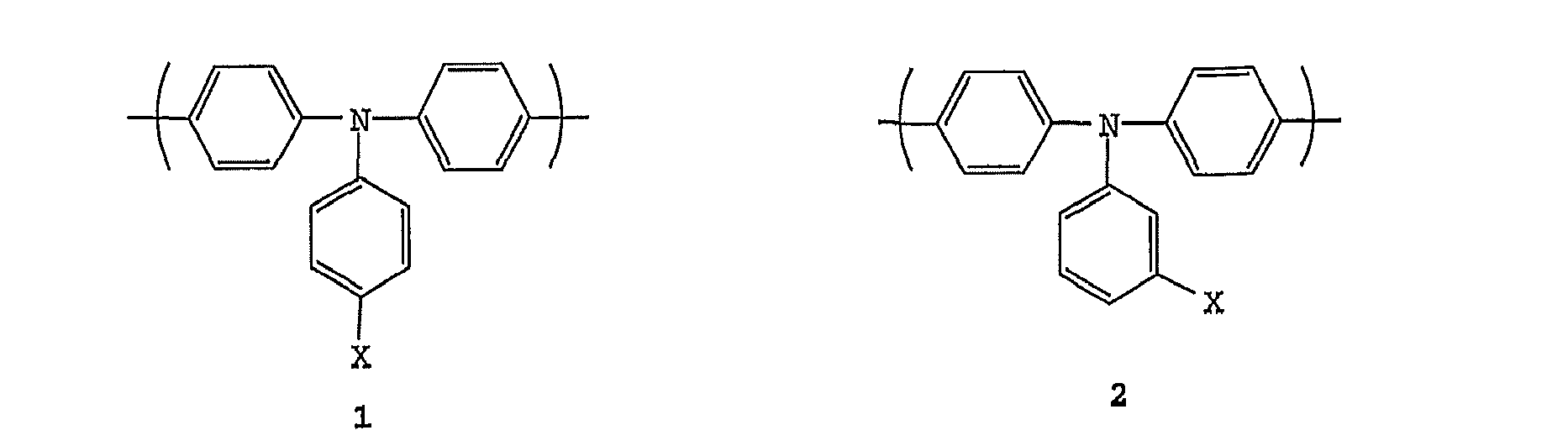


- X and Y may be the same or different and are substituent groups. A, B, C and D may be the same or different and are substituent groups. It is preferred that one or more of X, Y, A, B, C and D is independently selected from the group consisting of alkyl, aryl, perfluoroalkyl, thioalkyl, cyano, alkoxy, heteroaryl, alkylaryl and arylalkyl groups. One or more of X, Y, A, B, C and D also may be hydrogen. It is preferred that one or more of X, Y, A, B, C and D is Independently an unsubstituted, isobutyl group, an n-alkyl, an n-alkoxy or a trifluoromethyl group because they are suitable for helping to select the HOMO level and/or for improving solubility of the polymer.
- Particularly preferred heteroaryl repeat units for such copolymers include units of formulate 7-21:


- Electron withdrawing groups / heteroaryls suitable for monomers and repeat units of formula (I) according to the invention will be apparent to the skilled person. In particular, those substituents / heteroaryls having a positive Hammett sigma constant may be suitable. The electron withdrawing groups / heteroaryls should preferably be selected to avoid Interference with the polymerization of the monomer, e.g. by steric hindrance.
- Electron withdrawing groups Ar according to (a) or (b) may be provided with solubilising groups. Particularly preferred as solubilising groups are optionally substituted, branched or linear C1-20 alkyl or alkoxy, more preferably C4-10 alkyl.
- The polymer according to the invention may be a homopolymer or a copolymer. Where it is a copolymer, it may be a 1:1 copolymer, random or block copolymer. A block copolymer according to the invention may comprise at least two regions selected from:
- a hole transporting region
- an electron transporting region
- an emissive region.
- The functions of charge transport and emission may be provided by a range of moieties which will be apparent to the skilled person, as described in, for example,
WO 00/55927 US 6353083 . - Preferred methods for polymerisation of the monomers according to the invention are Suzuki polymerisation as described in, for example,
WO 00/53656 - Monomers according to the invention may be prepared in accordance with the following scheme:

- The effect of appending various groups to the phenyl rings of 9,9-diphenylfluorene repeat unit HOMO and LUMO levels was calculated using AM1 from the AMPAC software package (1) and ZINDO calculations from the Gaussian software package (2).
- 1) AM1 in Ampac program package
Ampac 5.0 User's Manual, © 1994 Semichem, 7128 Summit, Shawnee, KS 66216 - 2) ZINDO from Gaussian software:
- Gaussian 98, Revision A.9,
- M. J. Frisch, G. W. Trucks, H. B. Schlegel, G. E. Scuseria,
- M. A. Robb, J. R. Cheeseman, V. G. Zakrzewski, J. A. Montgomery, Jr.,
- R. E. Stratmann, J. C. Burant, S. Dapprich, J. M. Millam,
- A. D. Daniels, K. N. Kudin, M. C. Strain, O. Farkas, J. Tomasi,
- V. Barone, M. Cossi, R. Cammi, B. Mennucci, C. Pomelli, C. Adamo,
- S. Clifford, J. Ochterski, G. A. Petersson, P. Y. Ayala, Q. Cui,
- K. Morokuma, D. K. Malick, A. D. Rabuck, K. Raghavachari,
- J. B. Foresman, J. Cioslowski, J. V. Ortiz, A. G. Baboul,
- B. B. Stefanov, G. Liu, A. Liashenko, P. Piskorz, I. Komaromi,
- R. Gomperts, R. L. Martin, D. J. Fox, T. Keith, M. A. Al-Laham,
- C. Y. Peng, A. Nanayakkara, M. Challacombe, P. M. W. Gill,
- B. Johnson, W. Chen, M. W. Wong, J. L. Andres, C. Gonzalez,
- M. Head-Gordon, E. S. Replogle, and J. A. Pople,
- Gaussian, Inc., Pittsburgh PA, 1998.
- The results are summarised In the table below:
Structure Name HOMO (eV) LUMO (eV) 
F8 -7.84 0.04 
dpf -7.79 -0.06 
pdpf -8.16 -0.40 
mdpf -8.08 -0.30 
dmdpf -8.36 -0.72 
fldpf -8.25 -1.10 
Cldpf -7.70 -0.01 
C8dpf -7.68 0.00 
hadpf -7.69 0.04 - As can be seen from these examples, replacement of octyl with phenyl has a relatively small effect on LUMO level, however a significant change is only effected by substitution by electron withdrawing groups such as fluorine or perfluoroalkyl. By comparison with unsubstituted diphenylfluorene, it can be seen that alkoxy groups substituted in the para position, as per the prior art, are not predicted to show any electron withdrawing character. This is consistent with known electron withdrawing properties of such substituents, in particular their negative Hammett sigma constants.
- Polymers according to the invention having formula P1 were prepared by Suzuki polymerisation in accordance with the process described in
WO 00/53656 - 2,7-dioxalaborane-9,9-di-(n-octyl)fluorene
- 2,7-dioxalaborane-9,9-di-(4-trifluoromethylphenyl)fluorene
- N,N-di(4-bromophenyl)-N-(4-sec-butylphenyl)amine (to produce the "TFB" repeat unit shown below)
- Di [N-(4-bromophenyl)-N-(4-n-butylphenyl)]-phenylene-1,4-diamine (to produce the "PFB" repeat unit shown below)

- Particular embodiments are as follows:
Example w x y z 1 50 10 10 30 2 50 0 10 40 3 0 0 50 50 4 0 0 0 100 5 50 0 0 50 - Where TFB and PFB are present, as in example 1, the polymer may function as a blue electroluminescent polymer as described in
WO 00/55927 - Where TFB is present and PFB is absent the polymer may be a block copolymer with hole and electron transporting segments (example 2) or a 1:1 regioregular hole transporting copolymer (example 3). It may also show blue electroluminescence.
- Where TFB and PFB are absent, the polymer may be used as an electron transporting polymer for a red, green or blue electroluminescent material (examples 4 and 5).
- A device according to the invention was prepared as follows:
- 1) Depositing poly(ethylenedioxythiophene) / polystyrene sulfonate (PEDT / PSS), available from Bayer® as Baytron P ®, by spin coating onto an indium tin oxide anode supported on a glass substrate (available from Applied Films, Colorado, USA).
- 2) Depositing polymer P1 onto the PEDT / PSS by spin coating from xylene solution having a concentration of 2 % w / v.
- 3) Depositing a cathode comprising a first layer of calcium and a second layer of aluminium by evaporation onto the polymer P1.
- Although the present invention has been described in terms of specific exemplary embodiments, it will be appreciated that various modifications, alterations and / or combinations of features disclosed herein will be apparent to those skilled in the art without departing from the spirit and scope of the invention as set forth in the following claims.
Claims (18)
- A polymer comprising optionally substituted first repeat units of formula (I):
 (a) aromatic hydrocarbon substituted with at least one electron withdrawing group or(b) electron withdrawing heteroaryl.
 - A polymer according to claim 1 comprising repeat units of formula (II):
 (c) aromatic hydrocarbon substituted with at least one electron withdrawing group or(d) electron withdrawing heteroaryl.
 - A polymer according to claim 1 or 2 wherein each Ar is independently selected from units of formula (III):
 - hydrogen;- solubilising groups selected from alkyl, alkoxy, arylalkyl and heteroarylalkyl; and- electron withdrawing groupssuch that at least one of R1-R5 is an electron withdrawing group.
 - A polymer according to any preceding claim wherein Ar is phenyl or oligophenyl substituted with at least one electron withdrawing group and the at least one electron withdrawing group is selected from: groups comprising fluorine, cyano and nitro.
- A polymer according to claim 4 wherein the at least one electron withdrawing group is selected from fluorine atoms, fluoroalkyl, fluoroaryl and fluoroheteroaryl.
- A polymer according to claim 1 or 2 wherein Ar is an electron withdrawing heteroaryl selected from optionally substituted pyridines and triazines.
- A polymer according to any preceding claim comprising a second repeat unit.
- A polymer according to claim 7 wherein the second repeat unit is selected from triarylamines and heteroaromatics.
- A polymer according to any preceding claim that is capable of transporting electrons.
- A polymer according to claim 9 that comprises at least one segment capable of hole transport and / or emission.
- An optical device comprising a polymer according to any one of claims 1 to 10.
- An optical device according to claim 11 that is an electroluminescent device.
- An electroluminescent device comprising:- a first electrode for injecting charge carriers of a first type;- a second electrode for injecting charge carriers of a second type; and- an emissive layer comprising a polymer according to any one of claims 1-8 between the first and second electrodes.
- A monomer comprising an optionally substituted compound of formula (IV):

- A monomer according to claim 14 comprising an optionally substituted compound of formula (V):

- A monomer according to claim 14 or 15 wherein each P is independently selected from a reactive boron derivative group selected from a boronic acid group, a boronic ester group and a borane group and a reactive halide group.
- A process for preparing a polymer comprising a step of reacting a first monomer as defined In any one of claims 14-16 with a second monomer that may be the same or different from the first monomer under conditions so as to polymerise the monomers.
- A process for preparing a polymer according to claim 17 which comprises polymerising in a reaction mixture:(a) a monomer according to claim 16 wherein each P is a boron derivative functional group selected from a boronic acid group, a boronic ester group and a borane group, and an aromatic monomer having at least two reactive halide functional groups; or(b) a monomer according to claim 16 wherein each P is a reactive halide functional group, and an aromatic monomer having at least two boron derivative functional groups selected from boronic acid groups, boronic ester groups and borane groups; or(c) a monomer according to claim 16 wherein one P is a reactive halide functional group and one P is a boron derivative functional group selected from a boronic acid group, a boronic ester group and a borane group,
wherein the reaction mixture comprises a catalytic amount of a catalyst suitable for catalysing the polymerisation of the aromatic monomers, and a base in an amount sufficient to convert the boron derivative functional groups into boronate anionic groups.
Applications Claiming Priority (2)
| Application Number | Priority Date | Filing Date | Title |
|---|---|---|---|
| GBGB0225869.7A GB0225869D0 (en) | 2002-11-06 | 2002-11-06 | Polymer |
| EP03778486A EP1569980B1 (en) | 2002-11-06 | 2003-11-04 | 9-aryl and bisaryl substituted polyfluorenes |
Related Parent Applications (1)
| Application Number | Title | Priority Date | Filing Date |
|---|---|---|---|
| EP03778486.5 Division | 2003-11-04 |
Publications (1)
| Publication Number | Publication Date |
|---|---|
| EP2363423A1 true EP2363423A1 (en) | 2011-09-07 |
Family
ID=9947307
Family Applications (2)
| Application Number | Title | Priority Date | Filing Date |
|---|---|---|---|
| EP03778486A Expired - Lifetime EP1569980B1 (en) | 2002-11-06 | 2003-11-04 | 9-aryl and bisaryl substituted polyfluorenes |
| EP10184752A Withdrawn EP2363423A1 (en) | 2002-11-06 | 2003-11-04 | 9-aryl and bisaryl subtituted polyfluorenes |
Family Applications Before (1)
| Application Number | Title | Priority Date | Filing Date |
|---|---|---|---|
| EP03778486A Expired - Lifetime EP1569980B1 (en) | 2002-11-06 | 2003-11-04 | 9-aryl and bisaryl substituted polyfluorenes |
Country Status (9)
| Country | Link |
|---|---|
| US (2) | US7494720B2 (en) |
| EP (2) | EP1569980B1 (en) |
| JP (2) | JP4293991B2 (en) |
| KR (1) | KR100604500B1 (en) |
| CN (3) | CN101870765B (en) |
| AT (1) | ATE554121T1 (en) |
| AU (1) | AU2003285484A1 (en) |
| GB (1) | GB0225869D0 (en) |
| WO (1) | WO2004041902A2 (en) |
Families Citing this family (23)
| Publication number | Priority date | Publication date | Assignee | Title |
|---|---|---|---|---|
| GB0225869D0 (en) * | 2002-11-06 | 2002-12-11 | Cambridge Display Tech Ltd | Polymer |
| CN100556224C (en) | 2003-07-08 | 2009-10-28 | 柯尼卡美能达控股株式会社 | Organic electroluminescent element, lighting device and display device |
| CN101838387B (en) * | 2004-12-03 | 2012-02-29 | 住友化学株式会社 | Salicylate substituted conjugated polymers and devices |
| US20060121314A1 (en) * | 2004-12-06 | 2006-06-08 | Sk Corporation | Electroluminescent polymer having 9-fluoren-2-yl-9-aryl-2,7-fluorenyl unit and electroluminescent device manufactured using the same |
| KR101249640B1 (en) * | 2004-12-06 | 2013-04-01 | 에스케이이노베이션 주식회사 | Electroluminescent Polymers having 9-fluoren-2-yl-9-aryl-2,7-fluorenyl Unit and the Electroluminescent Device Prepared Using the Same |
| GB2440934B (en) | 2006-04-28 | 2009-12-16 | Cdt Oxford Ltd | Opto-electrical polymers and devices |
| EP2048176A4 (en) | 2006-08-01 | 2010-04-28 | Sumitomo Chemical Co | POLYMER COMPOUND AND LUMINESCENT POLYMER DEVICE |
| EP2070965A4 (en) * | 2006-09-13 | 2010-11-10 | Sumitomo Chemical Co | POLYMER COMPOUND AND POLYMER DEVICE EMITTING LIGHT |
| EP2203944B1 (en) * | 2007-10-24 | 2014-04-16 | Merck Patent GmbH | Optoelectronic device |
| GB2454890B (en) * | 2007-11-21 | 2010-08-25 | Limited Cambridge Display Technology | Light-emitting device and materials therefor |
| CN101591219B (en) * | 2008-05-29 | 2012-08-08 | 中国科学院化学研究所 | Functional polyfluorene compound and intermediate and application thereof |
| DE102008045663A1 (en) * | 2008-09-03 | 2010-03-04 | Merck Patent Gmbh | Fluorine-bridged associates for opto-electronic applications |
| DE102009034194A1 (en) * | 2009-07-22 | 2011-01-27 | Merck Patent Gmbh | Materials for electronic devices |
| US20110077373A1 (en) * | 2009-09-29 | 2011-03-31 | General Electric Company | Polymer and optoelectronic device comprising the same |
| TWI401274B (en) * | 2009-10-16 | 2013-07-11 | Univ Nat Taiwan Science Tech | Novel high polymer and copolymer and method of making the same |
| KR101663185B1 (en) * | 2009-11-20 | 2016-10-06 | 삼성전자주식회사 | Fluoro group-containing polymer, organic light emitting device comprising the polymer and method for manufacturing the device |
| KR101769173B1 (en) * | 2010-01-28 | 2017-08-17 | 스미또모 가가꾸 가부시키가이샤 | Polymer compound and light-emitting device using same |
| US8617724B2 (en) | 2010-01-28 | 2013-12-31 | Sumitomo Chemical Company, Limited | Polymer compound and light emitting device using the same |
| DE102010033080A1 (en) * | 2010-08-02 | 2012-02-02 | Merck Patent Gmbh | Polymers with structural units that have electron transport properties |
| JP5750247B2 (en) * | 2010-08-31 | 2015-07-15 | 住友化学株式会社 | Organic thin film transistor and manufacturing method thereof |
| GB2483269A (en) * | 2010-09-02 | 2012-03-07 | Cambridge Display Tech Ltd | Organic Electroluminescent Device containing Fluorinated Compounds |
| JP5883570B2 (en) * | 2011-03-25 | 2016-03-15 | 国立大学法人横浜国立大学 | Laminated structure |
| KR20140090144A (en) * | 2011-09-30 | 2014-07-16 | 미쯔비시 가스 케미칼 컴파니, 인코포레이티드 | Resin having fluorene structure and underlayer film-forming material for lithography |
Citations (15)
| Publication number | Priority date | Publication date | Assignee | Title |
|---|---|---|---|---|
| WO1990013148A1 (en) | 1989-04-20 | 1990-11-01 | Cambridge Research And Innovation Limited | Electroluminescent devices |
| WO1994029883A1 (en) | 1993-06-10 | 1994-12-22 | Cambridge Display Technology Limited | Polymers for optical devices |
| WO1996016449A1 (en) | 1994-11-23 | 1996-05-30 | Philips Electronics N.V. | A photoresponsive device |
| US5523555A (en) | 1994-09-14 | 1996-06-04 | Cambridge Display Technology | Photodetector device having a semiconductive conjugated polymer |
| WO1997005184A1 (en) * | 1995-07-28 | 1997-02-13 | The Dow Chemical Company | 2,7-aryl-9-substituted fluorenes and 9-substituted fluorene oligomers and polymers |
| JPH1095972A (en) | 1996-08-02 | 1998-04-14 | Mitsui Petrochem Ind Ltd | Organic electroluminescent device |
| US5807974A (en) * | 1996-05-16 | 1998-09-15 | Korea Institute Of Science And Technology | Fluorene-based alternating copolymers for electroluminescence element and electroluminescence element using such copolymers as light emitting materials |
| WO1999020675A1 (en) | 1997-10-23 | 1999-04-29 | The Dow Chemical Company | Process for preparing conjugated polymers |
| WO1999048160A1 (en) | 1998-03-13 | 1999-09-23 | Cambridge Display Technology Ltd. | Electroluminescent devices |
| WO1999054385A1 (en) | 1998-04-21 | 1999-10-28 | The Dow Chemical Company | Fluorene-containing polymers and electroluminescent devices therefrom |
| WO2000022026A1 (en) | 1998-10-10 | 2000-04-20 | Celanese Ventures Gmbh | Conjugated polymers containing special fluorene structural elements with improved properties |
| WO2000046321A1 (en) | 1999-02-04 | 2000-08-10 | The Dow Chemical Company | Fluorene copolymers and devices made therefrom |
| WO2000053656A1 (en) | 1999-03-05 | 2000-09-14 | Cambridge Display Technology Limited | Polymer preparation |
| WO2000055927A1 (en) | 1999-03-12 | 2000-09-21 | Cambridge Display Technology Limited | Polymers, their preparation and uses |
| WO2001062822A1 (en) | 2000-02-25 | 2001-08-30 | Cambridge Display Technology Limited | Electro-luminiscent polymers, their preparation and uses |
Family Cites Families (9)
| Publication number | Priority date | Publication date | Assignee | Title |
|---|---|---|---|---|
| DE19846768A1 (en) * | 1998-10-10 | 2000-04-20 | Aventis Res & Tech Gmbh & Co | A conjugated polymer useful as an organic semiconductor, an electroluminescence material, and for display elements in television monitor and illumination technology contains fluorene building units |
| KR100354500B1 (en) * | 2000-09-05 | 2002-09-30 | 한화석유화학 주식회사 | Fluorene based polymers and light emitting diodes fabricated with the same as light emitting material |
| DE60134618D1 (en) * | 2000-12-28 | 2008-08-14 | Toshiba Kk | Organic electroluminescent device and display device |
| JP3972588B2 (en) * | 2001-02-26 | 2007-09-05 | 淳二 城戸 | Organic electroluminescence device |
| WO2002077060A1 (en) * | 2001-03-24 | 2002-10-03 | Covion Organic Semiconductors Gmbh | Conjugated polymers containing spirobifluorene units and fluorene units, and the use thereof |
| GB0111549D0 (en) * | 2001-05-11 | 2001-07-04 | Cambridge Display Tech Ltd | Polymers, their preparation and uses |
| KR100453809B1 (en) * | 2001-07-21 | 2004-10-20 | 한국전자통신연구원 | Spirobifluorene compounds, electroluminescence polymer and electroluminescence element having the same |
| EP1416028A1 (en) * | 2002-10-30 | 2004-05-06 | Covion Organic Semiconductors GmbH | New method for the production of monomers useful in the manufacture of semiconductive polymers |
| GB0225869D0 (en) * | 2002-11-06 | 2002-12-11 | Cambridge Display Tech Ltd | Polymer |
-
2002
- 2002-11-06 GB GBGB0225869.7A patent/GB0225869D0/en not_active Ceased
-
2003
- 2003-11-04 KR KR1020057008051A patent/KR100604500B1/en not_active Expired - Fee Related
- 2003-11-04 AT AT03778486T patent/ATE554121T1/en active
- 2003-11-04 CN CN201010213318.XA patent/CN101870765B/en not_active Expired - Fee Related
- 2003-11-04 AU AU2003285484A patent/AU2003285484A1/en not_active Abandoned
- 2003-11-04 EP EP03778486A patent/EP1569980B1/en not_active Expired - Lifetime
- 2003-11-04 EP EP10184752A patent/EP2363423A1/en not_active Withdrawn
- 2003-11-04 CN CN200910140587A patent/CN101696220A/en active Pending
- 2003-11-04 US US10/533,989 patent/US7494720B2/en not_active Expired - Lifetime
- 2003-11-04 JP JP2004549336A patent/JP4293991B2/en not_active Expired - Lifetime
- 2003-11-04 CN CNA2003801057632A patent/CN1726243A/en active Pending
- 2003-11-04 WO PCT/GB2003/004753 patent/WO2004041902A2/en not_active Ceased
-
2008
- 2008-10-27 JP JP2008275027A patent/JP5283479B2/en not_active Expired - Fee Related
- 2008-12-31 US US12/347,790 patent/US20090167170A1/en not_active Abandoned
Patent Citations (16)
| Publication number | Priority date | Publication date | Assignee | Title |
|---|---|---|---|---|
| WO1990013148A1 (en) | 1989-04-20 | 1990-11-01 | Cambridge Research And Innovation Limited | Electroluminescent devices |
| WO1994029883A1 (en) | 1993-06-10 | 1994-12-22 | Cambridge Display Technology Limited | Polymers for optical devices |
| US5523555A (en) | 1994-09-14 | 1996-06-04 | Cambridge Display Technology | Photodetector device having a semiconductive conjugated polymer |
| WO1996016449A1 (en) | 1994-11-23 | 1996-05-30 | Philips Electronics N.V. | A photoresponsive device |
| WO1997005184A1 (en) * | 1995-07-28 | 1997-02-13 | The Dow Chemical Company | 2,7-aryl-9-substituted fluorenes and 9-substituted fluorene oligomers and polymers |
| US5807974A (en) * | 1996-05-16 | 1998-09-15 | Korea Institute Of Science And Technology | Fluorene-based alternating copolymers for electroluminescence element and electroluminescence element using such copolymers as light emitting materials |
| JPH1095972A (en) | 1996-08-02 | 1998-04-14 | Mitsui Petrochem Ind Ltd | Organic electroluminescent device |
| WO1999020675A1 (en) | 1997-10-23 | 1999-04-29 | The Dow Chemical Company | Process for preparing conjugated polymers |
| WO1999048160A1 (en) | 1998-03-13 | 1999-09-23 | Cambridge Display Technology Ltd. | Electroluminescent devices |
| WO1999054385A1 (en) | 1998-04-21 | 1999-10-28 | The Dow Chemical Company | Fluorene-containing polymers and electroluminescent devices therefrom |
| WO2000022026A1 (en) | 1998-10-10 | 2000-04-20 | Celanese Ventures Gmbh | Conjugated polymers containing special fluorene structural elements with improved properties |
| WO2000046321A1 (en) | 1999-02-04 | 2000-08-10 | The Dow Chemical Company | Fluorene copolymers and devices made therefrom |
| US6353083B1 (en) | 1999-02-04 | 2002-03-05 | The Dow Chemical Company | Fluorene copolymers and devices made therefrom |
| WO2000053656A1 (en) | 1999-03-05 | 2000-09-14 | Cambridge Display Technology Limited | Polymer preparation |
| WO2000055927A1 (en) | 1999-03-12 | 2000-09-21 | Cambridge Display Technology Limited | Polymers, their preparation and uses |
| WO2001062822A1 (en) | 2000-02-25 | 2001-08-30 | Cambridge Display Technology Limited | Electro-luminiscent polymers, their preparation and uses |
Non-Patent Citations (2)
| Title |
|---|
| EGO C ET AL: "TRIPHENYLAMINE-SUBSTITUTED POLYFLUORENE-A STABLE BLUE-EMITTER WITH IMPROVED CHARGE INJECTION FOR LIGHT-EMITTING DIODES", ADVANCED MATERIALS, VCH VERLAGSGESELLSCHAFT, WEINHEIM, DE, vol. 14, no. 11, 5 June 2002 (2002-06-05), pages 809 - 811, XP001130205, ISSN: 0935-9648 * |
| J. POLY. SCI. PART A: POLYM. CHEM., vol. 39, 2001 |
Also Published As
| Publication number | Publication date |
|---|---|
| GB0225869D0 (en) | 2002-12-11 |
| US20060228576A1 (en) | 2006-10-12 |
| WO2004041902A2 (en) | 2004-05-21 |
| AU2003285484A1 (en) | 2004-06-07 |
| US7494720B2 (en) | 2009-02-24 |
| WO2004041902A3 (en) | 2004-08-12 |
| CN101870765A (en) | 2010-10-27 |
| KR100604500B1 (en) | 2006-07-25 |
| EP1569980B1 (en) | 2012-04-18 |
| ATE554121T1 (en) | 2012-05-15 |
| US20090167170A1 (en) | 2009-07-02 |
| CN101870765B (en) | 2015-06-24 |
| CN101696220A (en) | 2010-04-21 |
| EP1569980A2 (en) | 2005-09-07 |
| CN1726243A (en) | 2006-01-25 |
| JP2006505647A (en) | 2006-02-16 |
| AU2003285484A8 (en) | 2004-06-07 |
| JP4293991B2 (en) | 2009-07-08 |
| JP2009097016A (en) | 2009-05-07 |
| JP5283479B2 (en) | 2013-09-04 |
| KR20060011819A (en) | 2006-02-03 |
Similar Documents
| Publication | Publication Date | Title |
|---|---|---|
| EP1569980B1 (en) | 9-aryl and bisaryl substituted polyfluorenes | |
| JP5704729B2 (en) | Hard amine | |
| JP4620466B2 (en) | Conjugated polymers containing arylamine units and their preparation and use | |
| TWI386478B (en) | Halogenated bis-diarylamine polycyclic aromatic compound and polymer thereof | |
| EP1562997B1 (en) | Aryl-substituted polyindenofluorenes for use in organic electroluminiscent devices | |
| EP1504075B1 (en) | Polymers their preparation and uses | |
| US20040127666A1 (en) | Tricyclic arylamine containing polymers and electronic devices therefrom | |
| KR20070011229A (en) | White-luminescent copolymers, their preparation and use | |
| JP2008525608A5 (en) | ||
| KR100733177B1 (en) | Polymers, their preparation and uses | |
| JP4218340B2 (en) | Method for producing polymer compound | |
| CN101184811B (en) | Polymer composition and polymer light-emitting element | |
| WO2006070184A1 (en) | Blue-shifted triarylamine polymer |
Legal Events
| Date | Code | Title | Description |
|---|---|---|---|
| PUAI | Public reference made under article 153(3) epc to a published international application that has entered the european phase |
Free format text: ORIGINAL CODE: 0009012 |
|
| AC | Divisional application: reference to earlier application |
Ref document number: 1569980 Country of ref document: EP Kind code of ref document: P |
|
| AK | Designated contracting states |
Kind code of ref document: A1 Designated state(s): AT BE BG CH CY CZ DE DK EE ES FI FR GB GR HU IE IT LI LU MC NL PT RO SE SI SK TR |
|
| STAA | Information on the status of an ep patent application or granted ep patent |
Free format text: STATUS: THE APPLICATION IS DEEMED TO BE WITHDRAWN |
|
| 18D | Application deemed to be withdrawn |
Effective date: 20120308 |