EP2359931B1 - Polymer filler for preprocessing column - Google Patents
Polymer filler for preprocessing column Download PDFInfo
- Publication number
- EP2359931B1 EP2359931B1 EP11166380.3A EP11166380A EP2359931B1 EP 2359931 B1 EP2359931 B1 EP 2359931B1 EP 11166380 A EP11166380 A EP 11166380A EP 2359931 B1 EP2359931 B1 EP 2359931B1
- Authority
- EP
- European Patent Office
- Prior art keywords
- general formula
- group
- polymer
- compound represented
- drug
- Prior art date
- Legal status (The legal status is an assumption and is not a legal conclusion. Google has not performed a legal analysis and makes no representation as to the accuracy of the status listed.)
- Not-in-force
Links
- 229920000642 polymer Polymers 0.000 title claims description 73
- 239000000945 filler Substances 0.000 title claims description 44
- 238000007781 pre-processing Methods 0.000 title claims description 14
- 239000003814 drug Substances 0.000 claims description 87
- 229940079593 drug Drugs 0.000 claims description 84
- 150000001875 compounds Chemical class 0.000 claims description 68
- MYRTYDVEIRVNKP-UHFFFAOYSA-N 1,2-Divinylbenzene Chemical compound C=CC1=CC=CC=C1C=C MYRTYDVEIRVNKP-UHFFFAOYSA-N 0.000 claims description 38
- 238000000034 method Methods 0.000 claims description 37
- 239000000178 monomer Substances 0.000 claims description 31
- 125000004432 carbon atom Chemical group C* 0.000 claims description 27
- 150000001450 anions Chemical class 0.000 claims description 25
- 125000000217 alkyl group Chemical group 0.000 claims description 20
- 125000002496 methyl group Chemical group [H]C([H])([H])* 0.000 claims description 15
- 125000004435 hydrogen atom Chemical group [H]* 0.000 claims description 12
- 125000005843 halogen group Chemical group 0.000 claims description 10
- 125000003055 glycidyl group Chemical group C(C1CO1)* 0.000 claims description 8
- 125000001495 ethyl group Chemical group [H]C([H])([H])C([H])([H])* 0.000 claims description 7
- 125000002947 alkylene group Chemical group 0.000 claims description 6
- QGZKDVFQNNGYKY-UHFFFAOYSA-O ammonium group Chemical group [NH4+] QGZKDVFQNNGYKY-UHFFFAOYSA-O 0.000 claims description 6
- 125000001570 methylene group Chemical group [H]C([H])([*:1])[*:2] 0.000 claims description 5
- 230000000379 polymerizing effect Effects 0.000 claims description 5
- 125000001997 phenyl group Chemical group [H]C1=C([H])C([H])=C(*)C([H])=C1[H] 0.000 claims description 3
- OKKJLVBELUTLKV-UHFFFAOYSA-N Methanol Chemical compound OC OKKJLVBELUTLKV-UHFFFAOYSA-N 0.000 description 69
- 239000002245 particle Substances 0.000 description 25
- 239000003960 organic solvent Substances 0.000 description 23
- 230000002378 acidificating effect Effects 0.000 description 21
- XLYOFNOQVPJJNP-UHFFFAOYSA-N water Substances O XLYOFNOQVPJJNP-UHFFFAOYSA-N 0.000 description 21
- YXFVVABEGXRONW-UHFFFAOYSA-N Toluene Chemical compound CC1=CC=CC=C1 YXFVVABEGXRONW-UHFFFAOYSA-N 0.000 description 18
- -1 Perfluoro compounds Chemical class 0.000 description 17
- 239000007864 aqueous solution Substances 0.000 description 16
- 230000007935 neutral effect Effects 0.000 description 16
- 238000011084 recovery Methods 0.000 description 16
- 239000000523 sample Substances 0.000 description 15
- 239000000126 substance Substances 0.000 description 15
- KFZMGEQAYNKOFK-UHFFFAOYSA-N Isopropanol Chemical compound CC(C)O KFZMGEQAYNKOFK-UHFFFAOYSA-N 0.000 description 14
- 150000007513 acids Chemical class 0.000 description 14
- DAZXVJBJRMWXJP-UHFFFAOYSA-N n,n-dimethylethylamine Chemical group CCN(C)C DAZXVJBJRMWXJP-UHFFFAOYSA-N 0.000 description 14
- YGSDEFSMJLZEOE-UHFFFAOYSA-N salicylic acid Chemical compound OC(=O)C1=CC=CC=C1O YGSDEFSMJLZEOE-UHFFFAOYSA-N 0.000 description 14
- VOZRXNHHFUQHIL-UHFFFAOYSA-N glycidyl methacrylate Chemical compound CC(=C)C(=O)OCC1CO1 VOZRXNHHFUQHIL-UHFFFAOYSA-N 0.000 description 13
- WEVYAHXRMPXWCK-UHFFFAOYSA-N Acetonitrile Chemical compound CC#N WEVYAHXRMPXWCK-UHFFFAOYSA-N 0.000 description 12
- 230000000052 comparative effect Effects 0.000 description 12
- ZFXYFBGIUFBOJW-UHFFFAOYSA-N theophylline Chemical compound O=C1N(C)C(=O)N(C)C2=C1NC=N2 ZFXYFBGIUFBOJW-UHFFFAOYSA-N 0.000 description 12
- 239000000243 solution Substances 0.000 description 11
- BDAGIHXWWSANSR-UHFFFAOYSA-N methanoic acid Natural products OC=O BDAGIHXWWSANSR-UHFFFAOYSA-N 0.000 description 10
- CSCPPACGZOOCGX-UHFFFAOYSA-N Acetone Chemical compound CC(C)=O CSCPPACGZOOCGX-UHFFFAOYSA-N 0.000 description 9
- YMWUJEATGCHHMB-UHFFFAOYSA-N Dichloromethane Chemical compound ClCCl YMWUJEATGCHHMB-UHFFFAOYSA-N 0.000 description 9
- LFQSCWFLJHTTHZ-UHFFFAOYSA-N Ethanol Chemical compound CCO LFQSCWFLJHTTHZ-UHFFFAOYSA-N 0.000 description 9
- 239000007853 buffer solution Substances 0.000 description 9
- OZAIFHULBGXAKX-UHFFFAOYSA-N 2-(2-cyanopropan-2-yldiazenyl)-2-methylpropanenitrile Chemical compound N#CC(C)(C)N=NC(C)(C)C#N OZAIFHULBGXAKX-UHFFFAOYSA-N 0.000 description 8
- FTOAOBMCPZCFFF-UHFFFAOYSA-N 5,5-diethylbarbituric acid Chemical compound CCC1(CC)C(=O)NC(=O)NC1=O FTOAOBMCPZCFFF-UHFFFAOYSA-N 0.000 description 8
- RYYVLZVUVIJVGH-UHFFFAOYSA-N caffeine Chemical compound CN1C(=O)N(C)C(=O)C2=C1N=CN2C RYYVLZVUVIJVGH-UHFFFAOYSA-N 0.000 description 8
- 238000006243 chemical reaction Methods 0.000 description 8
- 238000004128 high performance liquid chromatography Methods 0.000 description 8
- CMWTZPSULFXXJA-UHFFFAOYSA-N Naproxen Natural products C1=C(C(C)C(O)=O)C=CC2=CC(OC)=CC=C21 CMWTZPSULFXXJA-UHFFFAOYSA-N 0.000 description 7
- 229920001577 copolymer Polymers 0.000 description 7
- 238000005342 ion exchange Methods 0.000 description 7
- 229960002009 naproxen Drugs 0.000 description 7
- CMWTZPSULFXXJA-VIFPVBQESA-N naproxen Chemical compound C1=C([C@H](C)C(O)=O)C=CC2=CC(OC)=CC=C21 CMWTZPSULFXXJA-VIFPVBQESA-N 0.000 description 7
- FJKROLUGYXJWQN-UHFFFAOYSA-N papa-hydroxy-benzoic acid Natural products OC(=O)C1=CC=C(O)C=C1 FJKROLUGYXJWQN-UHFFFAOYSA-N 0.000 description 7
- 239000003505 polymerization initiator Substances 0.000 description 7
- 238000006116 polymerization reaction Methods 0.000 description 7
- 229960004889 salicylic acid Drugs 0.000 description 7
- 238000005406 washing Methods 0.000 description 7
- XEKOWRVHYACXOJ-UHFFFAOYSA-N Ethyl acetate Chemical compound CCOC(C)=O XEKOWRVHYACXOJ-UHFFFAOYSA-N 0.000 description 6
- VMHLLURERBWHNL-UHFFFAOYSA-M Sodium acetate Chemical compound [Na+].CC([O-])=O VMHLLURERBWHNL-UHFFFAOYSA-M 0.000 description 6
- 239000007788 liquid Substances 0.000 description 6
- 125000004123 n-propyl group Chemical group [H]C([H])([H])C([H])([H])C([H])([H])* 0.000 description 6
- 238000002414 normal-phase solid-phase extraction Methods 0.000 description 6
- 239000001632 sodium acetate Substances 0.000 description 6
- 235000017281 sodium acetate Nutrition 0.000 description 6
- 229960000278 theophylline Drugs 0.000 description 6
- KOMNUTZXSVSERR-UHFFFAOYSA-N 1,3,5-tris(prop-2-enyl)-1,3,5-triazinane-2,4,6-trione Chemical compound C=CCN1C(=O)N(CC=C)C(=O)N(CC=C)C1=O KOMNUTZXSVSERR-UHFFFAOYSA-N 0.000 description 5
- OSWFIVFLDKOXQC-UHFFFAOYSA-N 4-(3-methoxyphenyl)aniline Chemical compound COC1=CC=CC(C=2C=CC(N)=CC=2)=C1 OSWFIVFLDKOXQC-UHFFFAOYSA-N 0.000 description 5
- 238000005576 amination reaction Methods 0.000 description 5
- 235000019253 formic acid Nutrition 0.000 description 5
- 230000002209 hydrophobic effect Effects 0.000 description 5
- 230000014759 maintenance of location Effects 0.000 description 5
- 229920000609 methyl cellulose Polymers 0.000 description 5
- 239000001923 methylcellulose Substances 0.000 description 5
- 235000010981 methylcellulose Nutrition 0.000 description 5
- 239000011259 mixed solution Substances 0.000 description 5
- 238000001179 sorption measurement Methods 0.000 description 5
- WHNPOQXWAMXPTA-UHFFFAOYSA-N 3-methylbut-2-enamide Chemical compound CC(C)=CC(N)=O WHNPOQXWAMXPTA-UHFFFAOYSA-N 0.000 description 4
- LPHGQDQBBGAPDZ-UHFFFAOYSA-N Isocaffeine Natural products CN1C(=O)N(C)C(=O)C2=C1N(C)C=N2 LPHGQDQBBGAPDZ-UHFFFAOYSA-N 0.000 description 4
- 229910000831 Steel Inorganic materials 0.000 description 4
- 229960002319 barbital Drugs 0.000 description 4
- 150000007514 bases Chemical class 0.000 description 4
- 229960001948 caffeine Drugs 0.000 description 4
- VJEONQKOZGKCAK-UHFFFAOYSA-N caffeine Natural products CN1C(=O)N(C)C(=O)C2=C1C=CN2C VJEONQKOZGKCAK-UHFFFAOYSA-N 0.000 description 4
- LQZZUXJYWNFBMV-UHFFFAOYSA-N dodecan-1-ol Chemical compound CCCCCCCCCCCCO LQZZUXJYWNFBMV-UHFFFAOYSA-N 0.000 description 4
- 125000001453 quaternary ammonium group Chemical group 0.000 description 4
- 239000010959 steel Substances 0.000 description 4
- 238000004448 titration Methods 0.000 description 4
- GETQZCLCWQTVFV-UHFFFAOYSA-N trimethylamine Chemical group CN(C)C GETQZCLCWQTVFV-UHFFFAOYSA-N 0.000 description 4
- ZCYVEMRRCGMTRW-UHFFFAOYSA-N 7553-56-2 Chemical group [I] ZCYVEMRRCGMTRW-UHFFFAOYSA-N 0.000 description 3
- QTBSBXVTEAMEQO-UHFFFAOYSA-N Acetic acid Chemical compound CC(O)=O QTBSBXVTEAMEQO-UHFFFAOYSA-N 0.000 description 3
- WKBOTKDWSSQWDR-UHFFFAOYSA-N Bromine atom Chemical group [Br] WKBOTKDWSSQWDR-UHFFFAOYSA-N 0.000 description 3
- 0 C*(*)c1ccccc1 Chemical compound C*(*)c1ccccc1 0.000 description 3
- ZMXDDKWLCZADIW-UHFFFAOYSA-N N,N-Dimethylformamide Chemical compound CN(C)C=O ZMXDDKWLCZADIW-UHFFFAOYSA-N 0.000 description 3
- HOBWAPHTEJGALG-JKCMADFCSA-N [(1r,5s)-8-methyl-8-azoniabicyclo[3.2.1]octan-3-yl] 3-hydroxy-2-phenylpropanoate;sulfate Chemical compound [O-]S([O-])(=O)=O.C([C@H]1CC[C@@H](C2)[NH+]1C)C2OC(=O)C(CO)C1=CC=CC=C1.C([C@H]1CC[C@@H](C2)[NH+]1C)C2OC(=O)C(CO)C1=CC=CC=C1 HOBWAPHTEJGALG-JKCMADFCSA-N 0.000 description 3
- 229960002028 atropine sulfate Drugs 0.000 description 3
- 230000015572 biosynthetic process Effects 0.000 description 3
- 239000003153 chemical reaction reagent Substances 0.000 description 3
- 229910052801 chlorine Inorganic materials 0.000 description 3
- 125000001309 chloro group Chemical group Cl* 0.000 description 3
- 229910052731 fluorine Inorganic materials 0.000 description 3
- 125000001153 fluoro group Chemical group F* 0.000 description 3
- 229910052740 iodine Inorganic materials 0.000 description 3
- 239000000463 material Substances 0.000 description 3
- BDERNNFJNOPAEC-UHFFFAOYSA-N propan-1-ol Chemical compound CCCO BDERNNFJNOPAEC-UHFFFAOYSA-N 0.000 description 3
- 229960004499 scopolamine hydrobromide Drugs 0.000 description 3
- 238000004086 separation measurement method Methods 0.000 description 3
- 238000000926 separation method Methods 0.000 description 3
- 239000007790 solid phase Substances 0.000 description 3
- 239000012086 standard solution Substances 0.000 description 3
- 238000003756 stirring Methods 0.000 description 3
- 238000003786 synthesis reaction Methods 0.000 description 3
- 238000010189 synthetic method Methods 0.000 description 3
- 239000013076 target substance Substances 0.000 description 3
- 239000012085 test solution Substances 0.000 description 3
- IWTYTFSSTWXZFU-UHFFFAOYSA-N 3-chloroprop-1-enylbenzene Chemical compound ClCC=CC1=CC=CC=C1 IWTYTFSSTWXZFU-UHFFFAOYSA-N 0.000 description 2
- 229930000680 A04AD01 - Scopolamine Natural products 0.000 description 2
- 241000777300 Congiopodidae Species 0.000 description 2
- IAZDPXIOMUYVGZ-UHFFFAOYSA-N Dimethylsulphoxide Chemical compound CS(C)=O IAZDPXIOMUYVGZ-UHFFFAOYSA-N 0.000 description 2
- YNQLUTRBYVCPMQ-UHFFFAOYSA-N Ethylbenzene Chemical compound CCC1=CC=CC=C1 YNQLUTRBYVCPMQ-UHFFFAOYSA-N 0.000 description 2
- VEXZGXHMUGYJMC-UHFFFAOYSA-N Hydrochloric acid Chemical compound Cl VEXZGXHMUGYJMC-UHFFFAOYSA-N 0.000 description 2
- STECJAGHUSJQJN-GAUPFVANSA-N Hyoscine Natural products C1([C@H](CO)C(=O)OC2C[C@@H]3N([C@H](C2)[C@@H]2[C@H]3O2)C)=CC=CC=C1 STECJAGHUSJQJN-GAUPFVANSA-N 0.000 description 2
- STECJAGHUSJQJN-UHFFFAOYSA-N N-Methyl-scopolamin Natural products C1C(C2C3O2)N(C)C3CC1OC(=O)C(CO)C1=CC=CC=C1 STECJAGHUSJQJN-UHFFFAOYSA-N 0.000 description 2
- SHAYBENGXDALFF-UHFFFAOYSA-N Nortriptyline hydrochloride Chemical compound [Cl-].C1CC2=CC=CC=C2C(=CCC[NH2+]C)C2=CC=CC=C21 SHAYBENGXDALFF-UHFFFAOYSA-N 0.000 description 2
- NBIIXXVUZAFLBC-UHFFFAOYSA-N Phosphoric acid Chemical compound OP(O)(O)=O NBIIXXVUZAFLBC-UHFFFAOYSA-N 0.000 description 2
- WYURNTSHIVDZCO-UHFFFAOYSA-N Tetrahydrofuran Chemical compound C1CCOC1 WYURNTSHIVDZCO-UHFFFAOYSA-N 0.000 description 2
- 238000010521 absorption reaction Methods 0.000 description 2
- VIROVYVQCGLCII-UHFFFAOYSA-N amobarbital Chemical compound CC(C)CCC1(CC)C(=O)NC(=O)NC1=O VIROVYVQCGLCII-UHFFFAOYSA-N 0.000 description 2
- 238000004458 analytical method Methods 0.000 description 2
- 239000007795 chemical reaction product Substances 0.000 description 2
- ZPUCINDJVBIVPJ-LJISPDSOSA-N cocaine Chemical compound O([C@H]1C[C@@H]2CC[C@@H](N2C)[C@H]1C(=O)OC)C(=O)C1=CC=CC=C1 ZPUCINDJVBIVPJ-LJISPDSOSA-N 0.000 description 2
- 238000011161 development Methods 0.000 description 2
- SNRUBQQJIBEYMU-UHFFFAOYSA-N dodecane Chemical compound CCCCCCCCCCCC SNRUBQQJIBEYMU-UHFFFAOYSA-N 0.000 description 2
- 238000003255 drug test Methods 0.000 description 2
- 230000000694 effects Effects 0.000 description 2
- 238000003912 environmental pollution Methods 0.000 description 2
- 125000000816 ethylene group Chemical group [H]C([H])([*:1])C([H])([H])[*:2] 0.000 description 2
- 238000000105 evaporative light scattering detection Methods 0.000 description 2
- 238000002474 experimental method Methods 0.000 description 2
- 238000004817 gas chromatography Methods 0.000 description 2
- 239000012535 impurity Substances 0.000 description 2
- 238000005259 measurement Methods 0.000 description 2
- 239000000203 mixture Substances 0.000 description 2
- 125000004108 n-butyl group Chemical group [H]C([H])([H])C([H])([H])C([H])([H])C([H])([H])* 0.000 description 2
- 125000001280 n-hexyl group Chemical group C(CCCCC)* 0.000 description 2
- 125000000740 n-pentyl group Chemical group [H]C([H])([H])C([H])([H])C([H])([H])C([H])([H])C([H])([H])* 0.000 description 2
- 238000010979 pH adjustment Methods 0.000 description 2
- WEXRUCMBJFQVBZ-UHFFFAOYSA-N pentobarbital Chemical compound CCCC(C)C1(CC)C(=O)NC(=O)NC1=O WEXRUCMBJFQVBZ-UHFFFAOYSA-N 0.000 description 2
- YFSUTJLHUFNCNZ-UHFFFAOYSA-N perfluorooctane-1-sulfonic acid Chemical compound OS(=O)(=O)C(F)(F)C(F)(F)C(F)(F)C(F)(F)C(F)(F)C(F)(F)C(F)(F)C(F)(F)F YFSUTJLHUFNCNZ-UHFFFAOYSA-N 0.000 description 2
- SNGREZUHAYWORS-UHFFFAOYSA-N perfluorooctanoic acid Chemical compound OC(=O)C(F)(F)C(F)(F)C(F)(F)C(F)(F)C(F)(F)C(F)(F)C(F)(F)F SNGREZUHAYWORS-UHFFFAOYSA-N 0.000 description 2
- CPJSUEIXXCENMM-UHFFFAOYSA-N phenacetin Chemical compound CCOC1=CC=C(NC(C)=O)C=C1 CPJSUEIXXCENMM-UHFFFAOYSA-N 0.000 description 2
- 239000008213 purified water Substances 0.000 description 2
- 238000011160 research Methods 0.000 description 2
- 239000011347 resin Substances 0.000 description 2
- 229920005989 resin Polymers 0.000 description 2
- 229960002646 scopolamine Drugs 0.000 description 2
- STECJAGHUSJQJN-FWXGHANASA-N scopolamine Chemical compound C1([C@@H](CO)C(=O)O[C@H]2C[C@@H]3N([C@H](C2)[C@@H]2[C@H]3O2)C)=CC=CC=C1 STECJAGHUSJQJN-FWXGHANASA-N 0.000 description 2
- WTGQALLALWYDJH-MOUKNHLCSA-N scopolamine hydrobromide (anhydrous) Chemical compound Br.C1([C@@H](CO)C(=O)O[C@H]2C[C@@H]3N([C@H](C2)[C@@H]2[C@H]3O2)C)=CC=CC=C1 WTGQALLALWYDJH-MOUKNHLCSA-N 0.000 description 2
- 239000002002 slurry Substances 0.000 description 2
- 239000003381 stabilizer Substances 0.000 description 2
- 238000010557 suspension polymerization reaction Methods 0.000 description 2
- 230000008685 targeting Effects 0.000 description 2
- 238000012360 testing method Methods 0.000 description 2
- SNICXCGAKADSCV-JTQLQIEISA-N (-)-Nicotine Chemical compound CN1CCC[C@H]1C1=CC=CN=C1 SNICXCGAKADSCV-JTQLQIEISA-N 0.000 description 1
- AKNNEGZIBPJZJG-MSOLQXFVSA-N (-)-noscapine Chemical compound CN1CCC2=CC=3OCOC=3C(OC)=C2[C@@H]1[C@@H]1C2=CC=C(OC)C(OC)=C2C(=O)O1 AKNNEGZIBPJZJG-MSOLQXFVSA-N 0.000 description 1
- FMCGSUUBYTWNDP-ONGXEEELSA-N (1R,2S)-2-(dimethylamino)-1-phenyl-1-propanol Chemical compound CN(C)[C@@H](C)[C@H](O)C1=CC=CC=C1 FMCGSUUBYTWNDP-ONGXEEELSA-N 0.000 description 1
- RYHBNJHYFVUHQT-UHFFFAOYSA-N 1,4-Dioxane Chemical compound C1COCCO1 RYHBNJHYFVUHQT-UHFFFAOYSA-N 0.000 description 1
- JLDHHLBFGIBRGN-UHFFFAOYSA-N 1,5-dimethyl-5-(3-oxocyclohexen-1-yl)-1,3-diazinane-2,4,6-trione Chemical compound O=C1N(C)C(=O)NC(=O)C1(C)C1=CC(=O)CCC1 JLDHHLBFGIBRGN-UHFFFAOYSA-N 0.000 description 1
- KBPLFHHGFOOTCA-UHFFFAOYSA-N 1-Octanol Chemical compound CCCCCCCCO KBPLFHHGFOOTCA-UHFFFAOYSA-N 0.000 description 1
- AVTLBBWTUPQRAY-UHFFFAOYSA-N 2-(2-cyanobutan-2-yldiazenyl)-2-methylbutanenitrile Chemical compound CCC(C)(C#N)N=NC(C)(CC)C#N AVTLBBWTUPQRAY-UHFFFAOYSA-N 0.000 description 1
- WYGWHHGCAGTUCH-UHFFFAOYSA-N 2-[(2-cyano-4-methylpentan-2-yl)diazenyl]-2,4-dimethylpentanenitrile Chemical compound CC(C)CC(C)(C#N)N=NC(C)(C#N)CC(C)C WYGWHHGCAGTUCH-UHFFFAOYSA-N 0.000 description 1
- YHCGILGEMWNROZ-UHFFFAOYSA-N 3'-hydroxyhexobarbital Chemical compound O=C1N(C)C(=O)NC(=O)C1(C)C1=CC(O)CCC1 YHCGILGEMWNROZ-UHFFFAOYSA-N 0.000 description 1
- QEPPAOXKZOTMPM-UHFFFAOYSA-N 3-(2-chloro-5-oxo-10-phenothiazinyl)-N,N-dimethyl-1-propanamine Chemical compound C1=C(Cl)C=C2N(CCCN(C)C)C3=CC=CC=C3S(=O)C2=C1 QEPPAOXKZOTMPM-UHFFFAOYSA-N 0.000 description 1
- AIAORTASLOWFGX-UHFFFAOYSA-N 4-(dibenzo[1,2-a:1',2'-e][7]annulen-11-ylidene)-1-methyl-1-oxidopiperidin-1-ium Chemical compound C1C[N+](C)([O-])CCC1=C1C2=CC=CC=C2C=CC2=CC=CC=C21 AIAORTASLOWFGX-UHFFFAOYSA-N 0.000 description 1
- HHAGSGQWTHDGEC-UHFFFAOYSA-N 5-(4-hydroxybutan-2-yl)-5-prop-2-enyl-1,3-diazinane-2,4,6-trione Chemical compound OCCC(C)C1(CC=C)C(=O)NC(=O)NC1=O HHAGSGQWTHDGEC-UHFFFAOYSA-N 0.000 description 1
- PUVZPWLDMBLALZ-UHFFFAOYSA-N 5-ethyl-5-(3-hydroxy-3-methylbutyl)-1,3-diazinane-2,4,6-trione Chemical compound CC(O)(C)CCC1(CC)C(=O)NC(=O)NC1=O PUVZPWLDMBLALZ-UHFFFAOYSA-N 0.000 description 1
- NWPRCRWQMGIBOT-UHFFFAOYSA-N 7-(2-hydroxyethyl)-1,3-dimethylpurine-2,6-dione Chemical compound O=C1N(C)C(=O)N(C)C2=C1N(CCO)C=N2 NWPRCRWQMGIBOT-UHFFFAOYSA-N 0.000 description 1
- FDQGNLOWMMVRQL-UHFFFAOYSA-N Allobarbital Chemical compound C=CCC1(CC=C)C(=O)NC(=O)NC1=O FDQGNLOWMMVRQL-UHFFFAOYSA-N 0.000 description 1
- RLFWWDJHLFCNIJ-UHFFFAOYSA-N Aminoantipyrine Natural products CN1C(C)=C(N)C(=O)N1C1=CC=CC=C1 RLFWWDJHLFCNIJ-UHFFFAOYSA-N 0.000 description 1
- 239000004342 Benzoyl peroxide Substances 0.000 description 1
- OMPJBNCRMGITSC-UHFFFAOYSA-N Benzoylperoxide Chemical compound C=1C=CC=CC=1C(=O)OOC(=O)C1=CC=CC=C1 OMPJBNCRMGITSC-UHFFFAOYSA-N 0.000 description 1
- DKPFZGUDAPQIHT-UHFFFAOYSA-N Butyl acetate Natural products CCCCOC(C)=O DKPFZGUDAPQIHT-UHFFFAOYSA-N 0.000 description 1
- XCYJPXQACVEIOS-UHFFFAOYSA-N CC(C)c1cccc(C)c1 Chemical compound CC(C)c1cccc(C)c1 XCYJPXQACVEIOS-UHFFFAOYSA-N 0.000 description 1
- XYOPMDJVSWQZTM-UHFFFAOYSA-N Hydroxypentobarbital Chemical compound CC(O)CC(C)C1(CC)C(=O)NC(=O)NC1=O XYOPMDJVSWQZTM-UHFFFAOYSA-N 0.000 description 1
- YIVJZNGAASQVEM-UHFFFAOYSA-N Lauroyl peroxide Chemical compound CCCCCCCCCCCC(=O)OOC(=O)CCCCCCCCCCC YIVJZNGAASQVEM-UHFFFAOYSA-N 0.000 description 1
- NNJVILVZKWQKPM-UHFFFAOYSA-N Lidocaine Chemical compound CCN(CC)CC(=O)NC1=C(C)C=CC=C1C NNJVILVZKWQKPM-UHFFFAOYSA-N 0.000 description 1
- FWJKNZONDWOGMI-UHFFFAOYSA-N Metharbital Chemical compound CCC1(CC)C(=O)NC(=O)N(C)C1=O FWJKNZONDWOGMI-UHFFFAOYSA-N 0.000 description 1
- DUGOZIWVEXMGBE-UHFFFAOYSA-N Methylphenidate Chemical compound C=1C=CC=CC=1C(C(=O)OC)C1CCCCN1 DUGOZIWVEXMGBE-UHFFFAOYSA-N 0.000 description 1
- DJEQZVQFEPKLOY-UHFFFAOYSA-N N,N-dimethylbutylamine Chemical group CCCCN(C)C DJEQZVQFEPKLOY-UHFFFAOYSA-N 0.000 description 1
- FMCGSUUBYTWNDP-UHFFFAOYSA-N N-Methylephedrine Natural products CN(C)C(C)C(O)C1=CC=CC=C1 FMCGSUUBYTWNDP-UHFFFAOYSA-N 0.000 description 1
- GRYLNZFGIOXLOG-UHFFFAOYSA-N Nitric acid Chemical compound O[N+]([O-])=O GRYLNZFGIOXLOG-UHFFFAOYSA-N 0.000 description 1
- QMGVPVSNSZLJIA-UHFFFAOYSA-N Nux Vomica Natural products C1C2C3C4N(C=5C6=CC=CC=5)C(=O)CC3OCC=C2CN2C1C46CC2 QMGVPVSNSZLJIA-UHFFFAOYSA-N 0.000 description 1
- CWRVKFFCRWGWCS-UHFFFAOYSA-N Pentrazole Chemical compound C1CCCCC2=NN=NN21 CWRVKFFCRWGWCS-UHFFFAOYSA-N 0.000 description 1
- JFZHPFOXAAIUMB-UHFFFAOYSA-N Phenylethylmalonamide Chemical compound CCC(C(N)=O)(C(N)=O)C1=CC=CC=C1 JFZHPFOXAAIUMB-UHFFFAOYSA-N 0.000 description 1
- 239000004372 Polyvinyl alcohol Substances 0.000 description 1
- ZGUGWUXLJSTTMA-UHFFFAOYSA-N Promazinum Chemical compound C1=CC=C2N(CCCN(C)C)C3=CC=CC=C3SC2=C1 ZGUGWUXLJSTTMA-UHFFFAOYSA-N 0.000 description 1
- KYHQZNGJUGFTGR-UHFFFAOYSA-N Proxyphylline Chemical compound CN1C(=O)N(C)C(=O)C2=C1N=CN2CC(O)C KYHQZNGJUGFTGR-UHFFFAOYSA-N 0.000 description 1
- ZMANZCXQSJIPKH-UHFFFAOYSA-N Triethylamine Chemical group CCN(CC)CC ZMANZCXQSJIPKH-UHFFFAOYSA-N 0.000 description 1
- 229960000880 allobarbital Drugs 0.000 description 1
- AKNNEGZIBPJZJG-UHFFFAOYSA-N alpha-noscapine Natural products CN1CCC2=CC=3OCOC=3C(OC)=C2C1C1C2=CC=C(OC)C(OC)=C2C(=O)O1 AKNNEGZIBPJZJG-UHFFFAOYSA-N 0.000 description 1
- 229910000147 aluminium phosphate Inorganic materials 0.000 description 1
- 229960001301 amobarbital Drugs 0.000 description 1
- 229940072049 amyl acetate Drugs 0.000 description 1
- 239000002269 analeptic agent Substances 0.000 description 1
- PGMYKACGEOXYJE-UHFFFAOYSA-N anhydrous amyl acetate Natural products CCCCCOC(C)=O PGMYKACGEOXYJE-UHFFFAOYSA-N 0.000 description 1
- VEQOALNAAJBPNY-UHFFFAOYSA-N antipyrine Chemical compound CN1C(C)=CC(=O)N1C1=CC=CC=C1 VEQOALNAAJBPNY-UHFFFAOYSA-N 0.000 description 1
- 235000019400 benzoyl peroxide Nutrition 0.000 description 1
- 239000002876 beta blocker Substances 0.000 description 1
- 229940097320 beta blocking agent Drugs 0.000 description 1
- 239000012472 biological sample Substances 0.000 description 1
- ZPEIMTDSQAKGNT-UHFFFAOYSA-N chlorpromazine Chemical compound C1=C(Cl)C=C2N(CCCN(C)C)C3=CC=CC=C3SC2=C1 ZPEIMTDSQAKGNT-UHFFFAOYSA-N 0.000 description 1
- 229960001076 chlorpromazine Drugs 0.000 description 1
- 238000004587 chromatography analysis Methods 0.000 description 1
- 229960001747 cinchocaine Drugs 0.000 description 1
- PUFQVTATUTYEAL-UHFFFAOYSA-N cinchocaine Chemical compound C1=CC=CC2=NC(OCCCC)=CC(C(=O)NCCN(CC)CC)=C21 PUFQVTATUTYEAL-UHFFFAOYSA-N 0.000 description 1
- 229960003920 cocaine Drugs 0.000 description 1
- 230000003750 conditioning effect Effects 0.000 description 1
- 239000004035 construction material Substances 0.000 description 1
- 229960004138 cyclobarbital Drugs 0.000 description 1
- WTYGAUXICFETTC-UHFFFAOYSA-N cyclobarbital Chemical compound C=1CCCCC=1C1(CC)C(=O)NC(=O)NC1=O WTYGAUXICFETTC-UHFFFAOYSA-N 0.000 description 1
- 229960001140 cyproheptadine Drugs 0.000 description 1
- JJCFRYNCJDLXIK-UHFFFAOYSA-N cyproheptadine Chemical compound C1CN(C)CCC1=C1C2=CC=CC=C2C=CC2=CC=CC=C21 JJCFRYNCJDLXIK-UHFFFAOYSA-N 0.000 description 1
- 230000003247 decreasing effect Effects 0.000 description 1
- 238000001514 detection method Methods 0.000 description 1
- 125000000049 diethylmethylammonium substituent group Chemical group [H]C([H])([H])C([H])([H])[N+](*)(C([H])([H])[H])C([H])([H])C([H])([H])[H] 0.000 description 1
- 239000002934 diuretic Substances 0.000 description 1
- 230000001882 diuretic effect Effects 0.000 description 1
- 238000001962 electrophoresis Methods 0.000 description 1
- 238000010828 elution Methods 0.000 description 1
- 230000007613 environmental effect Effects 0.000 description 1
- 229960005387 etofylline Drugs 0.000 description 1
- 238000000605 extraction Methods 0.000 description 1
- 238000001917 fluorescence detection Methods 0.000 description 1
- 150000002222 fluorine compounds Chemical class 0.000 description 1
- MNWFXJYAOYHMED-UHFFFAOYSA-M heptanoate Chemical compound CCCCCCC([O-])=O MNWFXJYAOYHMED-UHFFFAOYSA-M 0.000 description 1
- FUZZWVXGSFPDMH-UHFFFAOYSA-N hexanoic acid Chemical compound CCCCCC(O)=O FUZZWVXGSFPDMH-UHFFFAOYSA-N 0.000 description 1
- 229960002456 hexobarbital Drugs 0.000 description 1
- UYXAWHWODHRRMR-UHFFFAOYSA-N hexobarbital Chemical compound O=C1N(C)C(=O)NC(=O)C1(C)C1=CCCCC1 UYXAWHWODHRRMR-UHFFFAOYSA-N 0.000 description 1
- 238000002347 injection Methods 0.000 description 1
- 239000007924 injection Substances 0.000 description 1
- 238000007689 inspection Methods 0.000 description 1
- 229960004194 lidocaine Drugs 0.000 description 1
- 238000004811 liquid chromatography Methods 0.000 description 1
- 238000001294 liquid chromatography-tandem mass spectrometry Methods 0.000 description 1
- 238000004519 manufacturing process Methods 0.000 description 1
- 238000000691 measurement method Methods 0.000 description 1
- 230000007721 medicinal effect Effects 0.000 description 1
- ALARQZQTBTVLJV-UHFFFAOYSA-N mephobarbital Chemical compound C=1C=CC=CC=1C1(CC)C(=O)NC(=O)N(C)C1=O ALARQZQTBTVLJV-UHFFFAOYSA-N 0.000 description 1
- MYWUZJCMWCOHBA-VIFPVBQESA-N methamphetamine Chemical compound CN[C@@H](C)CC1=CC=CC=C1 MYWUZJCMWCOHBA-VIFPVBQESA-N 0.000 description 1
- 229960001252 methamphetamine Drugs 0.000 description 1
- HNJJXZKZRAWDPF-UHFFFAOYSA-N methapyrilene Chemical compound C=1C=CC=NC=1N(CCN(C)C)CC1=CC=CS1 HNJJXZKZRAWDPF-UHFFFAOYSA-N 0.000 description 1
- 229960001869 methapyrilene Drugs 0.000 description 1
- 229960002057 metharbital Drugs 0.000 description 1
- OEHAYUOVELTAPG-UHFFFAOYSA-N methoxyphenamine Chemical compound CNC(C)CC1=CC=CC=C1OC OEHAYUOVELTAPG-UHFFFAOYSA-N 0.000 description 1
- 229960005405 methoxyphenamine Drugs 0.000 description 1
- 229960002221 methylephedrine Drugs 0.000 description 1
- 229960001344 methylphenidate Drugs 0.000 description 1
- 229960001703 methylphenobarbital Drugs 0.000 description 1
- WRMRXPASUROZGT-UHFFFAOYSA-N monoethylglycinexylidide Chemical compound CCNCC(=O)NC1=C(C)C=CC=C1C WRMRXPASUROZGT-UHFFFAOYSA-N 0.000 description 1
- QMHNQZGXPNCMCO-UHFFFAOYSA-N n,n-dimethylhexan-1-amine Chemical group CCCCCCN(C)C QMHNQZGXPNCMCO-UHFFFAOYSA-N 0.000 description 1
- IDFANOPDMXWIOP-UHFFFAOYSA-N n,n-dimethylpentan-1-amine Chemical group CCCCCN(C)C IDFANOPDMXWIOP-UHFFFAOYSA-N 0.000 description 1
- ZUHZZVMEUAUWHY-UHFFFAOYSA-N n,n-dimethylpropan-1-amine Chemical group CCCN(C)C ZUHZZVMEUAUWHY-UHFFFAOYSA-N 0.000 description 1
- QYZFTMMPKCOTAN-UHFFFAOYSA-N n-[2-(2-hydroxyethylamino)ethyl]-2-[[1-[2-(2-hydroxyethylamino)ethylamino]-2-methyl-1-oxopropan-2-yl]diazenyl]-2-methylpropanamide Chemical compound OCCNCCNC(=O)C(C)(C)N=NC(C)(C)C(=O)NCCNCCO QYZFTMMPKCOTAN-UHFFFAOYSA-N 0.000 description 1
- 230000003533 narcotic effect Effects 0.000 description 1
- PLPRGLOFPNJOTN-UHFFFAOYSA-N narcotine Natural products COc1ccc2C(OC(=O)c2c1OC)C3Cc4c(CN3C)cc5OCOc5c4OC PLPRGLOFPNJOTN-UHFFFAOYSA-N 0.000 description 1
- 238000006386 neutralization reaction Methods 0.000 description 1
- 229960002715 nicotine Drugs 0.000 description 1
- SNICXCGAKADSCV-UHFFFAOYSA-N nicotine Natural products CN1CCCC1C1=CC=CN=C1 SNICXCGAKADSCV-UHFFFAOYSA-N 0.000 description 1
- NCYVXEGFNDZQCU-UHFFFAOYSA-N nikethamide Chemical compound CCN(CC)C(=O)C1=CC=CN=C1 NCYVXEGFNDZQCU-UHFFFAOYSA-N 0.000 description 1
- 229960003226 nikethamide Drugs 0.000 description 1
- 229910017604 nitric acid Inorganic materials 0.000 description 1
- 229960004708 noscapine Drugs 0.000 description 1
- TVMXDCGIABBOFY-UHFFFAOYSA-N octane Chemical compound CCCCCCCC TVMXDCGIABBOFY-UHFFFAOYSA-N 0.000 description 1
- XULSCZPZVQIMFM-IPZQJPLYSA-N odevixibat Chemical compound C12=CC(SC)=C(OCC(=O)N[C@@H](C(=O)N[C@@H](CC)C(O)=O)C=3C=CC(O)=CC=3)C=C2S(=O)(=O)NC(CCCC)(CCCC)CN1C1=CC=CC=C1 XULSCZPZVQIMFM-IPZQJPLYSA-N 0.000 description 1
- 229920000620 organic polymer Polymers 0.000 description 1
- 229960005301 pentazocine Drugs 0.000 description 1
- VOKSWYLNZZRQPF-GDIGMMSISA-N pentazocine Chemical compound C1C2=CC=C(O)C=C2[C@@]2(C)[C@@H](C)[C@@H]1N(CC=C(C)C)CC2 VOKSWYLNZZRQPF-GDIGMMSISA-N 0.000 description 1
- 229960005152 pentetrazol Drugs 0.000 description 1
- 229960001412 pentobarbital Drugs 0.000 description 1
- 230000002085 persistent effect Effects 0.000 description 1
- 229960003893 phenacetin Drugs 0.000 description 1
- 229960005222 phenazone Drugs 0.000 description 1
- 229960002695 phenobarbital Drugs 0.000 description 1
- DDBREPKUVSBGFI-UHFFFAOYSA-N phenobarbital Chemical compound C=1C=CC=CC=1C1(CC)C(=O)NC(=O)NC1=O DDBREPKUVSBGFI-UHFFFAOYSA-N 0.000 description 1
- 229960002895 phenylbutazone Drugs 0.000 description 1
- VYMDGNCVAMGZFE-UHFFFAOYSA-N phenylbutazonum Chemical compound O=C1C(CCCC)C(=O)N(C=2C=CC=CC=2)N1C1=CC=CC=C1 VYMDGNCVAMGZFE-UHFFFAOYSA-N 0.000 description 1
- XSWHNYGMWWVAIE-UHFFFAOYSA-N pipradrol Chemical compound C=1C=CC=CC=1C(C=1C=CC=CC=1)(O)C1CCCCN1 XSWHNYGMWWVAIE-UHFFFAOYSA-N 0.000 description 1
- 229960000753 pipradrol Drugs 0.000 description 1
- 229920002451 polyvinyl alcohol Polymers 0.000 description 1
- 229960002393 primidone Drugs 0.000 description 1
- DQMZLTXERSFNPB-UHFFFAOYSA-N primidone Chemical compound C=1C=CC=CC=1C1(CC)C(=O)NCNC1=O DQMZLTXERSFNPB-UHFFFAOYSA-N 0.000 description 1
- MFDFERRIHVXMIY-UHFFFAOYSA-N procaine Chemical compound CCN(CC)CCOC(=O)C1=CC=C(N)C=C1 MFDFERRIHVXMIY-UHFFFAOYSA-N 0.000 description 1
- 229960004919 procaine Drugs 0.000 description 1
- 238000012545 processing Methods 0.000 description 1
- 239000000047 product Substances 0.000 description 1
- 229960003598 promazine Drugs 0.000 description 1
- 229960004767 proxyphylline Drugs 0.000 description 1
- 230000035484 reaction time Effects 0.000 description 1
- 238000010079 rubber tapping Methods 0.000 description 1
- 239000013535 sea water Substances 0.000 description 1
- 229960002060 secobarbital Drugs 0.000 description 1
- KQPKPCNLIDLUMF-UHFFFAOYSA-N secobarbital Chemical compound CCCC(C)C1(CC=C)C(=O)NC(=O)NC1=O KQPKPCNLIDLUMF-UHFFFAOYSA-N 0.000 description 1
- 239000004065 semiconductor Substances 0.000 description 1
- 238000010334 sieve classification Methods 0.000 description 1
- 238000007613 slurry method Methods 0.000 description 1
- 239000002904 solvent Substances 0.000 description 1
- 239000000725 suspension Substances 0.000 description 1
- 238000004885 tandem mass spectrometry Methods 0.000 description 1
- 229960002372 tetracaine Drugs 0.000 description 1
- GKCBAIGFKIBETG-UHFFFAOYSA-N tetracaine Chemical compound CCCCNC1=CC=C(C(=O)OCCN(C)C)C=C1 GKCBAIGFKIBETG-UHFFFAOYSA-N 0.000 description 1
- YLQBMQCUIZJEEH-UHFFFAOYSA-N tetrahydrofuran Natural products C=1C=COC=1 YLQBMQCUIZJEEH-UHFFFAOYSA-N 0.000 description 1
- 238000000825 ultraviolet detection Methods 0.000 description 1
Classifications
-
- C—CHEMISTRY; METALLURGY
- C08—ORGANIC MACROMOLECULAR COMPOUNDS; THEIR PREPARATION OR CHEMICAL WORKING-UP; COMPOSITIONS BASED THEREON
- C08F—MACROMOLECULAR COMPOUNDS OBTAINED BY REACTIONS ONLY INVOLVING CARBON-TO-CARBON UNSATURATED BONDS
- C08F8/00—Chemical modification by after-treatment
- C08F8/30—Introducing nitrogen atoms or nitrogen-containing groups
-
- B—PERFORMING OPERATIONS; TRANSPORTING
- B01—PHYSICAL OR CHEMICAL PROCESSES OR APPARATUS IN GENERAL
- B01J—CHEMICAL OR PHYSICAL PROCESSES, e.g. CATALYSIS OR COLLOID CHEMISTRY; THEIR RELEVANT APPARATUS
- B01J41/00—Anion exchange; Use of material as anion exchangers; Treatment of material for improving the anion exchange properties
- B01J41/08—Use of material as anion exchangers; Treatment of material for improving the anion exchange properties
- B01J41/12—Macromolecular compounds
- B01J41/14—Macromolecular compounds obtained by reactions only involving unsaturated carbon-to-carbon bonds
-
- B—PERFORMING OPERATIONS; TRANSPORTING
- B01—PHYSICAL OR CHEMICAL PROCESSES OR APPARATUS IN GENERAL
- B01J—CHEMICAL OR PHYSICAL PROCESSES, e.g. CATALYSIS OR COLLOID CHEMISTRY; THEIR RELEVANT APPARATUS
- B01J41/00—Anion exchange; Use of material as anion exchangers; Treatment of material for improving the anion exchange properties
- B01J41/20—Anion exchangers for chromatographic processes
-
- C—CHEMISTRY; METALLURGY
- C08—ORGANIC MACROMOLECULAR COMPOUNDS; THEIR PREPARATION OR CHEMICAL WORKING-UP; COMPOSITIONS BASED THEREON
- C08F—MACROMOLECULAR COMPOUNDS OBTAINED BY REACTIONS ONLY INVOLVING CARBON-TO-CARBON UNSATURATED BONDS
- C08F224/00—Copolymers of compounds having one or more unsaturated aliphatic radicals, each having only one carbon-to-carbon double bond, and at least one being terminated by a heterocyclic ring containing oxygen
-
- C—CHEMISTRY; METALLURGY
- C08—ORGANIC MACROMOLECULAR COMPOUNDS; THEIR PREPARATION OR CHEMICAL WORKING-UP; COMPOSITIONS BASED THEREON
- C08F—MACROMOLECULAR COMPOUNDS OBTAINED BY REACTIONS ONLY INVOLVING CARBON-TO-CARBON UNSATURATED BONDS
- C08F236/00—Copolymers of compounds having one or more unsaturated aliphatic radicals, at least one having two or more carbon-to-carbon double bonds
- C08F236/02—Copolymers of compounds having one or more unsaturated aliphatic radicals, at least one having two or more carbon-to-carbon double bonds the radical having only two carbon-to-carbon double bonds
- C08F236/20—Copolymers of compounds having one or more unsaturated aliphatic radicals, at least one having two or more carbon-to-carbon double bonds the radical having only two carbon-to-carbon double bonds unconjugated
-
- C—CHEMISTRY; METALLURGY
- C08—ORGANIC MACROMOLECULAR COMPOUNDS; THEIR PREPARATION OR CHEMICAL WORKING-UP; COMPOSITIONS BASED THEREON
- C08F—MACROMOLECULAR COMPOUNDS OBTAINED BY REACTIONS ONLY INVOLVING CARBON-TO-CARBON UNSATURATED BONDS
- C08F236/00—Copolymers of compounds having one or more unsaturated aliphatic radicals, at least one having two or more carbon-to-carbon double bonds
- C08F236/22—Copolymers of compounds having one or more unsaturated aliphatic radicals, at least one having two or more carbon-to-carbon double bonds the radical having three or more carbon-to-carbon double bonds
-
- C—CHEMISTRY; METALLURGY
- C08—ORGANIC MACROMOLECULAR COMPOUNDS; THEIR PREPARATION OR CHEMICAL WORKING-UP; COMPOSITIONS BASED THEREON
- C08F—MACROMOLECULAR COMPOUNDS OBTAINED BY REACTIONS ONLY INVOLVING CARBON-TO-CARBON UNSATURATED BONDS
- C08F8/00—Chemical modification by after-treatment
- C08F8/30—Introducing nitrogen atoms or nitrogen-containing groups
- C08F8/32—Introducing nitrogen atoms or nitrogen-containing groups by reaction with amines
-
- G—PHYSICS
- G01—MEASURING; TESTING
- G01N—INVESTIGATING OR ANALYSING MATERIALS BY DETERMINING THEIR CHEMICAL OR PHYSICAL PROPERTIES
- G01N30/00—Investigating or analysing materials by separation into components using adsorption, absorption or similar phenomena or using ion-exchange, e.g. chromatography or field flow fractionation
- G01N30/96—Investigating or analysing materials by separation into components using adsorption, absorption or similar phenomena or using ion-exchange, e.g. chromatography or field flow fractionation using ion-exchange
-
- B—PERFORMING OPERATIONS; TRANSPORTING
- B01—PHYSICAL OR CHEMICAL PROCESSES OR APPARATUS IN GENERAL
- B01D—SEPARATION
- B01D15/00—Separating processes involving the treatment of liquids with solid sorbents; Apparatus therefor
- B01D15/08—Selective adsorption, e.g. chromatography
- B01D15/26—Selective adsorption, e.g. chromatography characterised by the separation mechanism
- B01D15/36—Selective adsorption, e.g. chromatography characterised by the separation mechanism involving ionic interaction, e.g. ion-exchange, ion-pair, ion-suppression or ion-exclusion
- B01D15/361—Ion-exchange
- B01D15/363—Anion-exchange
-
- B—PERFORMING OPERATIONS; TRANSPORTING
- B01—PHYSICAL OR CHEMICAL PROCESSES OR APPARATUS IN GENERAL
- B01J—CHEMICAL OR PHYSICAL PROCESSES, e.g. CATALYSIS OR COLLOID CHEMISTRY; THEIR RELEVANT APPARATUS
- B01J2220/00—Aspects relating to sorbent materials
- B01J2220/50—Aspects relating to the use of sorbent or filter aid materials
- B01J2220/54—Sorbents specially adapted for analytical or investigative chromatography
-
- C—CHEMISTRY; METALLURGY
- C08—ORGANIC MACROMOLECULAR COMPOUNDS; THEIR PREPARATION OR CHEMICAL WORKING-UP; COMPOSITIONS BASED THEREON
- C08F—MACROMOLECULAR COMPOUNDS OBTAINED BY REACTIONS ONLY INVOLVING CARBON-TO-CARBON UNSATURATED BONDS
- C08F220/00—Copolymers of compounds having one or more unsaturated aliphatic radicals, each having only one carbon-to-carbon double bond, and only one being terminated by only one carboxyl radical or a salt, anhydride ester, amide, imide or nitrile thereof
- C08F220/02—Monocarboxylic acids having less than ten carbon atoms; Derivatives thereof
- C08F220/10—Esters
- C08F220/26—Esters containing oxygen in addition to the carboxy oxygen
- C08F220/32—Esters containing oxygen in addition to the carboxy oxygen containing epoxy radicals
- C08F220/325—Esters containing oxygen in addition to the carboxy oxygen containing epoxy radicals containing glycidyl radical, e.g. glycidyl (meth)acrylate
-
- G—PHYSICS
- G01—MEASURING; TESTING
- G01N—INVESTIGATING OR ANALYSING MATERIALS BY DETERMINING THEIR CHEMICAL OR PHYSICAL PROPERTIES
- G01N30/00—Investigating or analysing materials by separation into components using adsorption, absorption or similar phenomena or using ion-exchange, e.g. chromatography or field flow fractionation
- G01N30/02—Column chromatography
-
- Y—GENERAL TAGGING OF NEW TECHNOLOGICAL DEVELOPMENTS; GENERAL TAGGING OF CROSS-SECTIONAL TECHNOLOGIES SPANNING OVER SEVERAL SECTIONS OF THE IPC; TECHNICAL SUBJECTS COVERED BY FORMER USPC CROSS-REFERENCE ART COLLECTIONS [XRACs] AND DIGESTS
- Y10—TECHNICAL SUBJECTS COVERED BY FORMER USPC
- Y10T—TECHNICAL SUBJECTS COVERED BY FORMER US CLASSIFICATION
- Y10T436/00—Chemistry: analytical and immunological testing
- Y10T436/14—Heterocyclic carbon compound [i.e., O, S, N, Se, Te, as only ring hetero atom]
- Y10T436/141111—Diverse hetero atoms in same or different rings [e.g., alkaloids, opiates, etc.]
-
- Y—GENERAL TAGGING OF NEW TECHNOLOGICAL DEVELOPMENTS; GENERAL TAGGING OF CROSS-SECTIONAL TECHNOLOGIES SPANNING OVER SEVERAL SECTIONS OF THE IPC; TECHNICAL SUBJECTS COVERED BY FORMER USPC CROSS-REFERENCE ART COLLECTIONS [XRACs] AND DIGESTS
- Y10—TECHNICAL SUBJECTS COVERED BY FORMER USPC
- Y10T—TECHNICAL SUBJECTS COVERED BY FORMER US CLASSIFICATION
- Y10T436/00—Chemistry: analytical and immunological testing
- Y10T436/14—Heterocyclic carbon compound [i.e., O, S, N, Se, Te, as only ring hetero atom]
- Y10T436/145555—Hetero-N
-
- Y—GENERAL TAGGING OF NEW TECHNOLOGICAL DEVELOPMENTS; GENERAL TAGGING OF CROSS-SECTIONAL TECHNOLOGIES SPANNING OVER SEVERAL SECTIONS OF THE IPC; TECHNICAL SUBJECTS COVERED BY FORMER USPC CROSS-REFERENCE ART COLLECTIONS [XRACs] AND DIGESTS
- Y10—TECHNICAL SUBJECTS COVERED BY FORMER USPC
- Y10T—TECHNICAL SUBJECTS COVERED BY FORMER US CLASSIFICATION
- Y10T436/00—Chemistry: analytical and immunological testing
- Y10T436/14—Heterocyclic carbon compound [i.e., O, S, N, Se, Te, as only ring hetero atom]
- Y10T436/145555—Hetero-N
- Y10T436/147777—Plural nitrogen in the same ring [e.g., barbituates, creatinine, etc.]
-
- Y—GENERAL TAGGING OF NEW TECHNOLOGICAL DEVELOPMENTS; GENERAL TAGGING OF CROSS-SECTIONAL TECHNOLOGIES SPANNING OVER SEVERAL SECTIONS OF THE IPC; TECHNICAL SUBJECTS COVERED BY FORMER USPC CROSS-REFERENCE ART COLLECTIONS [XRACs] AND DIGESTS
- Y10—TECHNICAL SUBJECTS COVERED BY FORMER USPC
- Y10T—TECHNICAL SUBJECTS COVERED BY FORMER US CLASSIFICATION
- Y10T436/00—Chemistry: analytical and immunological testing
- Y10T436/17—Nitrogen containing
- Y10T436/173845—Amine and quaternary ammonium
-
- Y—GENERAL TAGGING OF NEW TECHNOLOGICAL DEVELOPMENTS; GENERAL TAGGING OF CROSS-SECTIONAL TECHNOLOGIES SPANNING OVER SEVERAL SECTIONS OF THE IPC; TECHNICAL SUBJECTS COVERED BY FORMER USPC CROSS-REFERENCE ART COLLECTIONS [XRACs] AND DIGESTS
- Y10—TECHNICAL SUBJECTS COVERED BY FORMER USPC
- Y10T—TECHNICAL SUBJECTS COVERED BY FORMER US CLASSIFICATION
- Y10T436/00—Chemistry: analytical and immunological testing
- Y10T436/18—Sulfur containing
- Y10T436/182—Organic or sulfhydryl containing [e.g., mercaptan, hydrogen, sulfide, etc.]
-
- Y—GENERAL TAGGING OF NEW TECHNOLOGICAL DEVELOPMENTS; GENERAL TAGGING OF CROSS-SECTIONAL TECHNOLOGIES SPANNING OVER SEVERAL SECTIONS OF THE IPC; TECHNICAL SUBJECTS COVERED BY FORMER USPC CROSS-REFERENCE ART COLLECTIONS [XRACs] AND DIGESTS
- Y10—TECHNICAL SUBJECTS COVERED BY FORMER USPC
- Y10T—TECHNICAL SUBJECTS COVERED BY FORMER US CLASSIFICATION
- Y10T436/00—Chemistry: analytical and immunological testing
- Y10T436/19—Halogen containing
- Y10T436/193333—In aqueous solution
-
- Y—GENERAL TAGGING OF NEW TECHNOLOGICAL DEVELOPMENTS; GENERAL TAGGING OF CROSS-SECTIONAL TECHNOLOGIES SPANNING OVER SEVERAL SECTIONS OF THE IPC; TECHNICAL SUBJECTS COVERED BY FORMER USPC CROSS-REFERENCE ART COLLECTIONS [XRACs] AND DIGESTS
- Y10—TECHNICAL SUBJECTS COVERED BY FORMER USPC
- Y10T—TECHNICAL SUBJECTS COVERED BY FORMER US CLASSIFICATION
- Y10T436/00—Chemistry: analytical and immunological testing
- Y10T436/20—Oxygen containing
- Y10T436/200833—Carbonyl, ether, aldehyde or ketone containing
- Y10T436/201666—Carboxylic acid
Definitions
- the present invention relates to a novel polymer as well as a filler for measuring a drug which comprises the above-described polymer; a column filled with said filler; and a measuring method for a drug by using said column.
- Perfluoro compounds having acidic groups at terminal such as perfluorooctane sulfonic acid(PFOS) and perfluorooctanoic acid(PFOA), which are perfluorinated fluorine compounds, have been widely used for various industrial products such as household articles, construction materials, semiconductors because of having excellent properties of heat resistance, chemical resistance, weathering resistance and the like.
- PFOS perfluorooctane sulfonic acid
- PFOA perfluorooctanoic acid
- patent reference 1 describes the porous resin compound having an ion-exchanging group, a hydrophobic component and a hydrophilic component as a column (filler) having such a wide adsorption target.
- a column filler
- Patent Reference 1 JP-A-2002-517574 ;
- NON-Patent Reference 1 Journal of Chromatography A, 19093 (2005) 89-97 ;
- Document US2002/0004561 discloses a polymer obtained by introducing an anion exchanging ammonium group to a polymer obtained by polymerizing a divinylbenzene and an hydrophilic co-monomer. This polymer is used as filler of a column in order to measure the concentration of drugs.
- Document US4772635 discloses a polymer obtained by polymerizing a divinylbenzene with a glycidyl methacrylate and introducing an anion exchanging ammonium group to the glycidyl group.
- the filler comprising the above-described polymer can efficiently adsorb any one of the basic, neutral, or/and acidic compound.
- the present invention has been completed. It is a subject of the present invention to provide a novel polymer as well as a filler which can efficiently adsorb the basic, neutral or/and acidic drugs; and a measuring method for the drugs by using said filler.
- the present invention relates to:
- the filler comprising the polymer of the present invention can adsorb the target substances of the basic, neutral or/and acidic compound and the like equally or more efficiently comparing with the conventional filler for the preprocessing column having broad scope. Therefore, a plurality of targeting substances can be simultaneously and efficiently separated by concentration by means of one time pretreatment. Particularly, when drugs are provided as the target substances, the column is very useful as the preprocessing column for measuring the drugs because of capability of efficient adsorption. Furthermore, the adsorbed basic, neutral, or/and acidic compounds can be separately eluted as basic and neutral compounds and acidic compounds. Therefore, this method also gives the effect that separation analysis becomes easy for the many target substances.
- Alkyl groups having 1 to 3 carbon atoms in R 1 and R 2 of the general formula [1] include, specifically, for example, a methyl group, an ethyl group, an n-propyl group and the like, and a methyl group is preferable.
- Halogen atoms in R 1 and R 2 of the general formula [1] include a fluorine atom, a chlorine atom, a bromine atom, an iodine atom and the like.
- the compounds represented by the general formula [1] include, specifically, for example, and the like. are preferable, and among them, is particularly preferable.
- Linear alkyl groups having 1 to 3 carbon atoms in R 9 of the general formula [2] include, specifically, for example, a methyl group, an ethyl group, an n-propyl group and the like, and a methyl group is preferable.
- Halogen atoms in R 9 of the general formula [2] include a fluorine atom, a chlorine atom, a bromine atom, an iodine atom and the like.
- Linear alkylene groups having 1 to 3 carbon atoms in R 10 of the general formula [2] include, for example, a methylene group, an ethylene group, an n-propylene group and the like, and a methylene group is preferable.
- Linear alkyl groups having 1 to 6 carbon atoms in R 11 and R 12 of the general formula [2] include, for example, a methyl group, an ethyl group, an n-propyl group, an n-butyl group, an n-pentyl group, an n-hexyl group and the like. Among them, a methyl group is preferable.
- Specific examples of the general formula [2] include, for example, and the like. and the like are preferable. Among them, is particularly preferable.
- Quaternary ammonium groups include the group represented by the following formula [3] : wherein each of R 3 independently represents a linear alkyl group having 1 to 3 carbon atoms, and R 4 represents a linear alkyl group having 1 to 6 carbon atoms.
- a quaternary ammonium group is used when polymer is used as the filler for measuring the drugs.
- Linear alkyl groups having 1 to 3 carbon atoms in R 3 of quaternary ammonium groups represented by the general formula [3] include, specifically, for example, a methyl group, an ethyl group, an n-propyl group and the like, and a methyl group is preferable.
- Linear alkyl groups having 1 to 6 carbon atoms in R 4 of quaternary ammonium groups represented by the general formula [3] include, for example, a methyl group, an ethyl group, an n-propyl group, an n-butyl group, an n-pentyl group, an n-hexyl group and the like, and among them, a methyl group is preferable.
- Ammonium groups represented by the general formula [3] include, specifically, for example, a trimethylammonium group, an ethyldimethylammonium group, a dimethyl-n-propylammonium group, an n-butyldimethylammonium group, a dimethyl-n-pentylammonium group, a dimethyl-n-hexylammonium group, a diethylmethylammonium group, a triethylammonium group, a tri-n-ammonium group and the like, and among them, a trimethylammonium group, an ethyldimethylammonium group are preferable, and an ethyldimethylammonium group is particularly preferable.
- Linear alkylene groups having 1 to 3 carbon atoms in R 15 of the general formula [4] include, for example, a methylene group, an ethylene group, an n-propylene group and the like, and a methylene group is preferable.
- Linear alkyl groups having 1 to 3 carbon atoms in R 16 of the general formula [4] include, for example, a methyl group, an ethyl group, an n-propyl group and the like, and a methyl group is preferable.
- halogen atoms in R 16 include a fluorine atom, a chlorine atom, a bromine atom, an iodine atom and the like.
- Compounds represented by the general formula [4] include, specifically, for example, and the like, and among them, is preferable.
- the polymers obtained by introducing the anion exchanging group into glycidyl group of the polymer (hereinafter, this polymer may be abbreviated as the polymer of the present invention) obtained by polymerization of the compound represented by the general formula [1] and the compound represented by the general formula [2] (hereinafter, this polymer may be abbreviated as the prepolymer relevant to the present invention) include, for example, the following general formula [3]: wherein R 1 , R 2 , R 9 , R 10 , R 11 and R 12 are as above-described.
- A represents the anion exchanging group relevant to the present invention, specifically, for example, and the like.
- the polymer is used as the filler for measuring drugs, and the like are preferable.
- the polymers of the present invention also include the polymer obtained by introducing an ammonium group represented by the general formula [3] into a glycidyl group of the polymer obtained by polymerization of the monomers containing the compound represented by the general formula [1] and the compound represented by the general formula [2], and further the compound represented by the general formula [4], and are specifically represented by, for example, the following general formula [6] : wherein R 1 , R 2 , R 3 , R 4 , R 9 , R 10 , R 11 , R 12 , R 15 and R 16 are as above-described. Said polymer is preferable for the filler for measuring the drug. Specific examples of said general formula [6] are, for example, and the like, and among them, is preferable.
- Average particle diameter of the polymer of the present invention is normally 10 to 100 ⁇ m, preferably 20 to 100 ⁇ m, more preferably 30 to 70 ⁇ m, and micropore diameter is normally 3 to 15 nm.
- 3 to 5 nm is preferable.
- Specific surface area of the polymer is normally 200 to 1000 m 2 /g, preferably 300 to 700 m 2 /g.
- 300 to 500 m 2 /g is particularly preferable.
- molar ratio of the compound represented by the general formula [1] and the compound represented by the general formula [2] is 60 to 90 : 10 to 40, preferable range is 70 to 85 : 15 to 30.
- the polymer of the present invention is synthesized from the monomers containing the compound represented by the general formula [1], the compound represented by the general formula [2] and the compound represented by the general formula [4], molar ratio of the compound represented by the general formula [1], the compound represented by the general formula [2] and the compound represented by the general formula [4] is 60 to 85 : 14 to 30 : 1 to 10, preferable range is 70 to 80 : 18 to 25 : 2 to 5.
- the polymer of the present invention is the one in which anion exchanging group is contained normally 0.1 to 1.0 mmol in 1g of said polymer, preferable range is 0.2 to 0.6 mmol.
- Synthetic method of the present invention may be carried out by polymerizing the monomers containing the compound represented by the general formula [1] and the compound represented by the general formula [2], or the monomers (hereinafter, these monomers may be abbreviated as the monomer group relevant to the present invention) containing the compound represented by the general formula [1] and the compound represented by the general formula [2] and the compound represented by the general formula [4] by the known polymerization method, and by introducing the anion exchanging group into glycidyl group at terminal of the obtained polymer (hereinafter, the polymer may be abbreviated as prepolymer relevant to the present invention) by the known method (for example, amination reaction and the like).
- the monomer group relevant to the present invention and polymerization initiator are dissolved in the organic solvent which can dissolve these monomer group and polymerization initiator but is insoluble in water
- suspension polymerization is carried out in the water by adding said organic solvent to water, and then, the prepolymer relevant to the present invention is obtained.
- molar ratio of the compound represented by the general formula [1] and the compound represented by the general formula [2] is 60 to 90 : 10 to 40, preferable range is 70 to 85 : 15 to 30.
- molar ratio of the compound represented by the general formula [1] and the compound represented by the general formula [2] and the compound represented by the general formula [4] is 60 to 85 : 14 to 30 : 1 to 10, preferable range is 70 to 80 : 18 to 25 : 2 to 5.
- any one can be used as long as it is well-known itself, and includes, for example, azoisobutyronitrile, 2,2'-azobis(2,4-dimethylvaleronitrile), 2,2'-azobis(methyl 2-methypropionate), 2,2'-azobis(2-methylbutyronitrile), benzoyl peroxide, lauroyl peroxide and the like.
- Amount of use of the polymerization initiator is 0.1 to 3% by weight relative to total weight of the monomer group relevant to the present invention.
- organic solvents to be used here include, for example, toluene, ethylbenzene, butyl acetate, amyl acetate, octylalcohol, dodecylalcohol, octane, dodecane and the like.
- Amount of use of the solvent is 0.5 to 2 times weight of total weight of monomers relevant to the present invention.
- Amount of water to be used here is normally 1 to 10 times weight relative to sum of the weight of monomer group relevant to the present invention and the weight of the above-described organic solvent.
- aqueous organic polymer such as polyvinyl alcohol and methylcellulose as a suspension stabilizer known in itself are preferably dissolved in said water, and amount of stabilizer is normally 0.01 to 1% by weight in the water.
- Suspension polymerization reaction is carried out normally at 60 to 90 °C, for 4 to 20 hours.
- the prepolymer relevant to the present invention can be obtained by treating according to common procedure of obtaining the polymer.
- the obtained prepolymer relevant to the present invention is preferably classified by using sieves in order to obtain the prepolymer having the particle diameter suitable for filler, and also, to obtain the prepolymer having uniform largeness for performing the excellent capability of adsorption.
- Particle diameter of the prepolymer relevant to the present invention obtained by sieve classification is normally 10 to 100 ⁇ m, preferable range is 20 to 100 ⁇ m, more preferable range is 30 to 70 ⁇ m.
- operation of said classification may be carried out after obtaining the polymer of the present invention.
- the obtained prepolymer relevant to the present invention is suspended or swelled in suitable organic solvent or the mixed aqueous solution of said organic solvent and water, and the compound which contains the anion exchanging group (the anion exchanging group containing compound) is added to said solution to perform amination reaction, and thus, the polymer of the present invention can be obtained.
- suitable organic solvents include 1,4-dioxane, tetrahydrofuran, isopropanol, N,N-dimethylformamide, dimethylsulfoxide and the like.
- amount of water is normally 10 to 60% as an amount in the mixed aqueous solution, and preferable range is 20 to 50%.
- the amount of the above-described organic solvent or mixed aqueous solution of organic solvent and water is 1 to 10 times weight relative to the weight of the prepolymer relevant to the present invention.
- the anion exchanging group containing compound is the one which contains the above-described anion exchanging group, and by which the desired polymer can be obtained, it is not particularly limited thereto.
- the polymer in which hydrogen atom or methyl group and the like is bounded to terminal of the above-described anion exchanging group is exemplified, and amount of use of the polymer is normally 0.001 to 0.05 mole relative to 1 kg of prepolymer relevant to the present invention, preferable range is 0.002 to 0.025 mole.
- Amination reaction is carried out at room temperature to 60 °C, normally for 4 to 30 hours, preferably for 10 to 20 hours, while stirring if necessary.
- the polymer of the present invention is obtained by this reaction.
- the resultant polymer relevant to the present invention is washed with water or methanol if necessary. Subsequently, 10 g of prepolymer relevant to the present invention is suspended in 50 to 100mL of 20 to 50% by volume of 2-propanol aqueous solution, 10 to 50 g of N,N-dimethylaminoethane (0.1 to 0.5 mol) is added, and the organic solution is reacted at 40 to 60 °C for 10 to 20 hours while stirring. Then, the polymer of the present invention can be obtained.
- organic solvent such as toluene, 85 to 70 g of divinylbenzene (0.2 to 0.6 mol as an amount of pure divinylbenzene), and 10 to 20 g of glycidyl methacrylate (0.05 to 0.2 mol) and 5 to 10g of triallyl isocyanurate (0.02 to 0.04 mol)
- 1 to 3 g of polymerization initiator such as azobisisobutyronitrile
- the prepolymer relevant to the present invention can be obtained.
- the resultant polymer relevant to the present invention is washed with water or methanol if necessary.
- 10 g of prepolymer relevant to the present invention is suspended in 50 to 100 mL of 20 to 50% by volume of 2-propanol aqueous solution, and 10 to 50 g of N,N-dimethylaminoethane (0.1 to 0.5 mol) is added, and the organic solution is reacted at 40 to 60 °C for 10 to 20 hours while stirring. Then, the polymer of the present invention can be obtained.
- the drugs relevant to the present invention include all the materials having medicinal properties, and the doping substance such as diuretic and the other concealment drug, stimulant drug, narcotic, ⁇ -blocker, specific material listed in The 2008 Prohibited List International Standard (World Anti-Doping Code), 2008 Monitoring Program and the like, and the medicament or drug, which can temporally heighten or lessen the racing performance of race-horse, described in the Attached Table (2) in Ordinance for Enforcement of Horse Racing of The Japan Racing Association of the Japan Racing Association Rule No. 2 effective in Heisei 19 year(2007).
- the medicament or drug which can temporally heighten or lessen the racing performance of race-horse, are preferable, specifically, for example, Atoropine, Amobarbital, Allobarbital, Antipyrine, Oxyethyltheophylline, Oxypropyltheophylline, 3'-Oxohexobarbital, Caffeine, Chlorpromazine, Cocaine, Cyclobarbital, ⁇ , ⁇ -Dihydroxydibucaine, Dibucaine, Cyproheptadine, Cyproheptadine-N-oxide, Dimorphoramine, Scopolamine, Strychnine, Secobarbital, Theophylline, Tetracaine, Nikethamide, Nicotine, Noscapine, Barbital, 3'-Hydroxyamobarbital, ⁇ -Hydroxydimorphoramine, 3'-Hydroxysecobarbital, 3'-Hydroxyhexobarbit
- the filler for measuring the drug of the present invention is the one containing the polymer of the present invention obtained as described above.
- the preprocessing column for measuring the drugs of the present invention is the one filled with the above-described filler for measuring the drug of the present invention.
- Filling method and the like is not particularly limited, the above-described filler may be filled into the column container conventionally used in this field, according to the known method, for example, slurry method, dry type-tapping method and the like.
- the amount of filler in the column may be determined according to the amount of sample to be used, for example, when 10 mL of the sample having 0.001 to 50 ⁇ g/mL, preferably 0.05 to 10 ⁇ g/mL of drug is passed through column to adsorb the drug, the amount of the sample is normally 10 to 1000 mg, preferably 50 to 200 mg, more preferably 50 to 100 mg. Column volume may be appropriately selected according to the amount of filler.
- Measuring method of the drugs using the preprocessing column for measuring the drugs of the present invention may be carried out by the following steps:
- treatment such as washing may be carried out after adsorbing the drugs in order to remove these impurities from the preprocessing column for measuring the drugs of the present invention.
- the measurement method is carried out as follows. That is, for example, when 10 mL of the sample having 1 to 10 ⁇ g/mL of drugs is used, the column filled with 50 to 100 mg of the filler for measuring the drug of the present invention is used. 2 to 5 mL of aqueous organic solvent such as methanol, 2 to 5 ml of purified water, and 2 to 5 mL of buffer solution of sodium acetate having pH 6 to 8 are sequentially passed through said column, and thus, column condition is adjusted. Next, 10 mL of the sample is passed through the column. Then, it is washed by passing 1 to 3 mL of the buffer solution of 0.1 to 1 mol/L of sodium acetate having 5 to 10% of methanol.
- aqueous organic solvent such as methanol
- 2 to 5 ml of purified water 2 to 5 mL of purified water
- buffer solution of sodium acetate having pH 6 to 8 are sequentially passed through said column, and thus, column condition is adjusted.
- a hydrophobic monomer 85.0 g of divinylbenzene (produced by Nippon Steel Chemical Co. , Ltd: purity:57%)(contained 0.37 mol of pure divinylbenzene), as a polar monomer (monomer in which ion exchanging group can be introduced), 15.0 g of glycidyl methacrylate (containing 0.106 mol of glycidyl methacrylate) (produced by Wako Pure Chemical Industries, Ltd) were used, and 100 g of toluene was used as a water-insoluble organic solvent. After 1.0 g of azobisisobutyronitrile (produced by Wako Pure Chemical Industries, Ltd.) was added to this mixture and dissolved.
- the resultant cross-linked porous copolymerized particles had 4.0 nm of average micropore diameter and 429 m 2 /g of specific surface area. Said particles were classified with 32 ⁇ m and 63 ⁇ m sieves to obtain 37 g of particles having about 40 ⁇ m of average particle diameter.
- the cross-linked porous copolymeric particles were obtained by using the reagent and the procedure similar to Example 5 except that as a hydrophobic monomer, 80.0 g of divinylbenzene (produced by Nippon Steel Chemical Co., Ltd, purity:577%) (contained 0.37 mol of pure divinylbenzene), as a polar monomer (monomer in which ion exchanging group can be introduced), 15.0 g of glycidyl methacrylate(contained 0.106 mol of glycidyl methacrylate) (produced by Wako Pure Chemical Industries, Ltd) and triallyl isocyanurate (produced by Tokyo Chemical Industry Co., Ltd) (contained 0.02 mol of triallyl isocyanurate) were used.
- a hydrophobic monomer 80.0 g of divinylbenzene (produced by Nippon Steel Chemical Co., Ltd, purity:577%) (contained 0.37 mol of pure divinylbenzene), as a polar monomer (mon
- cross-linked porous copolymeric particles were washed by the similar way, then dried. These cross-linked porous copolymeric particles had 3.9 nm of average micropore diameter and 380 m 2 /g of specific surface area. After these particles were classified by using 32 ⁇ m and 63 ⁇ m sieves, ethyldimethylammonium group was introduced by the method similar to Example-5, and polymer-4 of the present invention was obtained. Content of the introduced ethyldimethylammonium group (anion exchanging group) was determined by reverse titration method, and amount of this group was 0.30 meq/g gel dry. It should be noted that, structure of polymer-4 of the present invention was shown as follows.
- the cross-linked porous copolymeric particles were obtained by using the reagent and the procedure similar to Example 5 except that as a hydrophobic monomer, 65.0 g of divinylbenzene (produced by Nippon Steel Chemical Co., Ltd, purity:57%)(contained 0.28 mol of pure divinylbenzene), as a polar monomer (monomer in which ion exchanging group can be introduced), 30.0 g of glycidyl methacrylate (produced by Wako Pure Chemical Industries, Ltd) (contained 0.21 mol of glycidyl methacrylate) and 5 g of dimethylacrylamide (produced by Wako Pure Chemical Industries, Ltd) (contained 0.05 mol of dimethylacrylamide), as a water-insoluble organic solvent, 60 g of toluene, and 40g of lauryl alcohol were used.
- a hydrophobic monomer 65.0 g of divinylbenzene (produced by Nippon Steel Chemical Co., Ltd, purity:57%)(con
- hydrophobic monomer 70.0 g of divinylbenzene (produced by Nippon Steel Chemical Co., Ltd, purity:57%) (contained 0.306 mol of pure divinylbenzene), as a polar monomer (monomer in which ion exchanging group can be introduced), 20.0 g of chloromethylstyrene (produced by Tokyo Chemical Industry Co., Ltd, purity:90%)(contained 0.146 mol of pure chloromethylstyrene), as a polar monomer, 10.0 g of dimethylacrylamide (produced by Wako Pure Chemical Industries, Ltd)(contained 0.1 mol of dimethylacrylamide) were used.
- a water-insoluble organic solvent 60g of toluene, 40g of lauryl alcohol were used.
- polymerization initiator 1.0 g of azobisisobutyronitrile (produced by Wako Pure Chemical Industries, Ltd) was dissolved in this mixture, and then, mixed solution was suspended in 0.8 L of aqueous solution having 0.2% by weight of methylcellulose, and stirred at high speed to adjust the average diameter of oil droplet to about 40 ⁇ m. Then, mixed solution was transferred to polymerization apparatus equipped with stirrer, and reacted at 80°C for 6 hours to obtain the cross-linked porous copolymerized particles.
- the cross-linked porous copolymeric particles obtained by such method had 3.8 nm of average micropore diameter and 96 m 2 /g of specific surface area. Said particles were classified by using 32 ⁇ m and 63 ⁇ m of sieves, and 35 g of particles having about 40 ⁇ m of average particle diameter were obtained.
- fillers polymer-3, 4 of the present invention, comparative polymer-1, 2, and Oasis MAX were used, and these fillers were filled into the syringe type cartridges having 4 mL of inner volume by 60 mg respectively. These cartridges were defined as solid-phase extraction cartridges.
- Addition and recovery experiments were carried out as follows. That is, first, to the solid-phase extraction cartridge, 2 mL of methanol, 2 mL of purified water and 1mL of buffer solution having 2 mol/L of sodium acetate adjusted to pH 7 were passed, and then, total volume of the above-described test solution was poured. Subsequently, 2 mL of mixed solution of 95 mL of buffer solution having 0.1 mol/lL of sodium acetate adjusted to pH 7 and 5 mL of methanol were passed to the same cartridge to wash. Then, 2 mL of methanol was passed through solid-phase extraction cartridge to elute the adsorbed materials adsorbed on solid-phase.
- Polymer-2 Oasis MAX Recovery rate(%) Neutral Compound Theophylline 5 97.1 92.2 13.3 29.4 75.5 caffeine 5 101.7 98.5 22.6 97.4 92.7 Barbital 10 102.7 99.1 38.0 86.4 93.5
- comparative polymer-1 having similar structure in part to polymer-3 and 4 of the present invention has shown as low recovery rate in any of neutral compound, basic compound.
- comparative polymer-2 having similar structure in part to polymr-3 and 4 of the present invention has been shown as low recovery rate in Theophylline, Scopolamine hydrobromide. It is estimated that retention capability of neutral and basic compounds is greatly affected depending on the structure of polymer.
- polymer structure comprising divinylbenzene and glycidyl methacrylate and the polymer structure comprising divinylbenzene, triallyl isocyanurate and glycidyl methacrylate, like polymer-3 and polymer-4 of the present invention, have contributed to high retention capability of neutral and basic compound.
- the present invention relates to provide the novel polymer, and the filler comprising said polymer.
- fillers comprising the above-described polymer can efficiently adsorb the drugs, and by solid-phase extraction method using said fillers, acidic, basic or/and neutral compounds can be efficiently measured.
Landscapes
- Chemical & Material Sciences (AREA)
- Chemical Kinetics & Catalysis (AREA)
- Organic Chemistry (AREA)
- Health & Medical Sciences (AREA)
- Medicinal Chemistry (AREA)
- Polymers & Plastics (AREA)
- General Chemical & Material Sciences (AREA)
- Analytical Chemistry (AREA)
- Physics & Mathematics (AREA)
- Life Sciences & Earth Sciences (AREA)
- Biochemistry (AREA)
- General Health & Medical Sciences (AREA)
- General Physics & Mathematics (AREA)
- Immunology (AREA)
- Pathology (AREA)
- Addition Polymer Or Copolymer, Post-Treatments, Or Chemical Modifications (AREA)
- Organic Low-Molecular-Weight Compounds And Preparation Thereof (AREA)
- Solid-Sorbent Or Filter-Aiding Compositions (AREA)
Description
- The present invention relates to a novel polymer as well as a filler for measuring a drug which comprises the above-described polymer; a column filled with said filler; and a measuring method for a drug by using said column.
- Perfluoro compounds having acidic groups at terminal such as perfluorooctane sulfonic acid(PFOS) and perfluorooctanoic acid(PFOA), which are perfluorinated fluorine compounds, have been widely used for various industrial products such as household articles, construction materials, semiconductors because of having excellent properties of heat resistance, chemical resistance, weathering resistance and the like. However, it has been recently found that such perfluoro compounds containing acidic group have remained in water of river, lake, seawater etc., and have been accumulating in the body of human and living organism because these compounds tend to migrate into water environment due to water-solubility, and are chemically very stable and persistent. Therefore, these compounds have been attracting the attention as the items to be monitored of the global environmental pollution, and the nationwide research on the environmental pollution by perfluoro compounds having acidic groups at terminal has been carried out. And as a micro-analytical method for perfluoro compound contained in the environmental water in this research, the method for analyzing the samples pretreated by using a solid-phase extraction column with LC/MS/MS and the like is employed. For example, the method for analyzing perfluoro compounds having acidic groups at terminal by using the solid-phase extraction method used with a processing column is described in non-patent reference 1 and the like. However, 10 to 20 kinds of perfluoro compounds having acidic groups at terminal are present depending on the difference of acidic groups at terminal and the number of carbon atoms thereof, and we have confirmed that all perfluoro compounds having acidic groups at terminal cannot be simultaneously analyzed by using the measuring method being carried out in the above-described reference. Therefore, the development of the method by which perfluoro compounds having acidic groups at terminal can be simultaneously and efficiently analyzed, has been desired.
- On the other hand, need of the test of medicaments (drugs) contained in biological samples is recently increasing. In particular, doping test in the sports world needs to inspect various drugs, and needs to bring about no inspection mistake even when it is a trace amount. Usually, this drug test is carried out by solid-phase extracting with the preprocessing column, and further analyzing and detecting the obtained extraction liquid by using high-performance liquid chromatography or gas chromatography. However, since the above-described drug test is carried out by targeting the various drugs, the development of the preprocessing column which can adsorb any type of the basic, neutral, or acidic compounds, has been desired. On the other hand, patent reference 1 describes the porous resin compound having an ion-exchanging group, a hydrophobic component and a hydrophilic component as a column (filler) having such a wide adsorption target. However, even these compounds, they cannot efficiently adsorb all of the above-described target components. Therefore, further improvement has been needed.
- Patent Reference 1:
JP-A-2002-517574 - NON-Patent Reference 1: Journal of Chromatography A, 19093 (2005) 89-97;
- Document
US2002/0004561 discloses a polymer obtained by introducing an anion exchanging ammonium group to a polymer obtained by polymerizing a divinylbenzene and an hydrophilic co-monomer. This polymer is used as filler of a column in order to measure the concentration of drugs. - Document
US4772635 discloses a polymer obtained by polymerizing a divinylbenzene with a glycidyl methacrylate and introducing an anion exchanging ammonium group to the glycidyl group. - Considering the above-described situation, the present inventors have extensively studied a way to attain the above-described object, and consequently, have found that a polymer obtained by introducing an anion-exchanging group into a glycidyl group in the polymer obtained by polymerization of the compound represented by the following general formula [1] :


- The present invention relates to:
- (1) a polymer obtained by introducing an anion exchanging group into a glycidyl group in the polymer obtained by polymerization of the compound represented by the following general formula [1]:


- (5) a filler comprising the above-described polymer for measuring a drug;
- (6) the use of the filler and a preprocessing column filled with said filler for measuring a drug; and
- (7) a measuring method for a drug characterized in using said column.
- The filler comprising the polymer of the present invention can adsorb the target substances of the basic, neutral or/and acidic compound and the like equally or more efficiently comparing with the conventional filler for the preprocessing column having broad scope. Therefore, a plurality of targeting substances can be simultaneously and efficiently separated by concentration by means of one time pretreatment. Particularly, when drugs are provided as the target substances, the column is very useful as the preprocessing column for measuring the drugs because of capability of efficient adsorption. Furthermore, the adsorbed basic, neutral, or/and acidic compounds can be separately eluted as basic and neutral compounds and acidic compounds. Therefore, this method also gives the effect that separation analysis becomes easy for the many target substances.
- Alkyl groups having 1 to 3 carbon atoms in R1 and R2 of the general formula [1] include, specifically, for example, a methyl group, an ethyl group, an n-propyl group and the like, and a methyl group is preferable.
- Halogen atoms in R1 and R2 of the general formula [1] include a fluorine atom, a chlorine atom, a bromine atom, an iodine atom and the like.
- The compounds represented by the general formula [1] include, specifically, for example,


- Linear alkyl groups having 1 to 3 carbon atoms in R9 of the general formula [2] include, specifically, for example, a methyl group, an ethyl group, an n-propyl group and the like, and a methyl group is preferable.
- Halogen atoms in R9 of the general formula [2] include a fluorine atom, a chlorine atom, a bromine atom, an iodine atom and the like.
- Linear alkylene groups having 1 to 3 carbon atoms in R10 of the general formula [2] include, for example, a methylene group, an ethylene group, an n-propylene group and the like, and a methylene group is preferable.
- Linear alkyl groups having 1 to 6 carbon atoms in R11 and R12 of the general formula [2] include, for example, a methyl group, an ethyl group, an n-propyl group, an n-butyl group, an n-pentyl group, an n-hexyl group and the like. Among them, a methyl group is preferable.
- Specific examples of the general formula [2] include, for example,


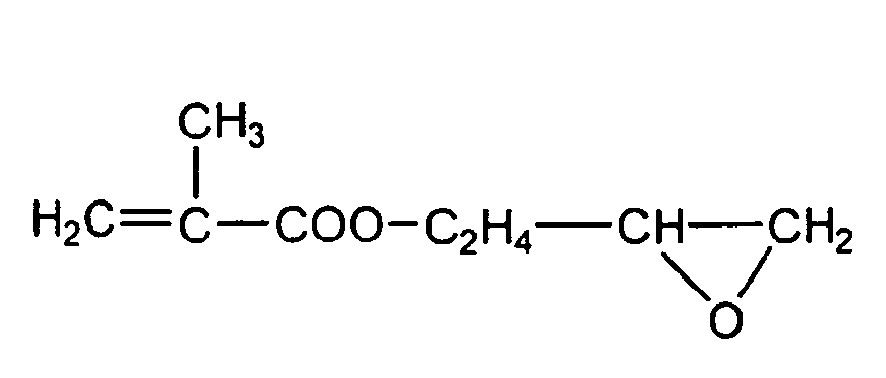


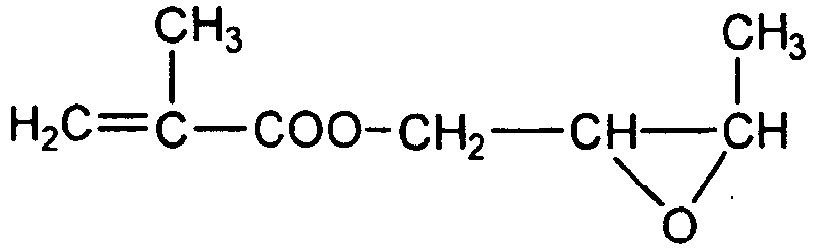


- Anion exchanging groups relevant to the present invention include, Quaternary ammonium groups include the group represented by the following formula [3] :

- Linear alkyl groups having 1 to 3 carbon atoms in R3 of quaternary ammonium groups represented by the general formula [3] include, specifically, for example, a methyl group, an ethyl group, an n-propyl group and the like, and a methyl group is preferable.
- Linear alkyl groups having 1 to 6 carbon atoms in R4 of quaternary ammonium groups represented by the general formula [3] include, for example, a methyl group, an ethyl group, an n-propyl group, an n-butyl group, an n-pentyl group, an n-hexyl group and the like, and among them, a methyl group is preferable.
- Ammonium groups represented by the general formula [3] include, specifically, for example, a trimethylammonium group, an ethyldimethylammonium group, a dimethyl-n-propylammonium group, an n-butyldimethylammonium group, a dimethyl-n-pentylammonium group, a dimethyl-n-hexylammonium group, a diethylmethylammonium group, a triethylammonium group, a tri-n-ammonium group and the like, and among them, a trimethylammonium group, an ethyldimethylammonium group are preferable, and an ethyldimethylammonium group is particularly preferable.
- Linear alkylene groups having 1 to 3 carbon atoms in R15 of the general formula [4] include, for example, a methylene group, an ethylene group, an n-propylene group and the like, and a methylene group is preferable.
- Linear alkyl groups having 1 to 3 carbon atoms in R16 of the general formula [4] include, for example, a methyl group, an ethyl group, an n-propyl group and the like, and a methyl group is preferable. In addition, halogen atoms in R16 include a fluorine atom, a chlorine atom, a bromine atom, an iodine atom and the like.
- Compounds represented by the general formula [4] include, specifically, for example,


- The polymers obtained by introducing the anion exchanging group into glycidyl group of the polymer (hereinafter, this polymer may be abbreviated as the polymer of the present invention) obtained by polymerization of the compound represented by the general formula [1] and the compound represented by the general formula [2] (hereinafter, this polymer may be abbreviated as the prepolymer relevant to the present invention) include, for example, the following general formula [3]:


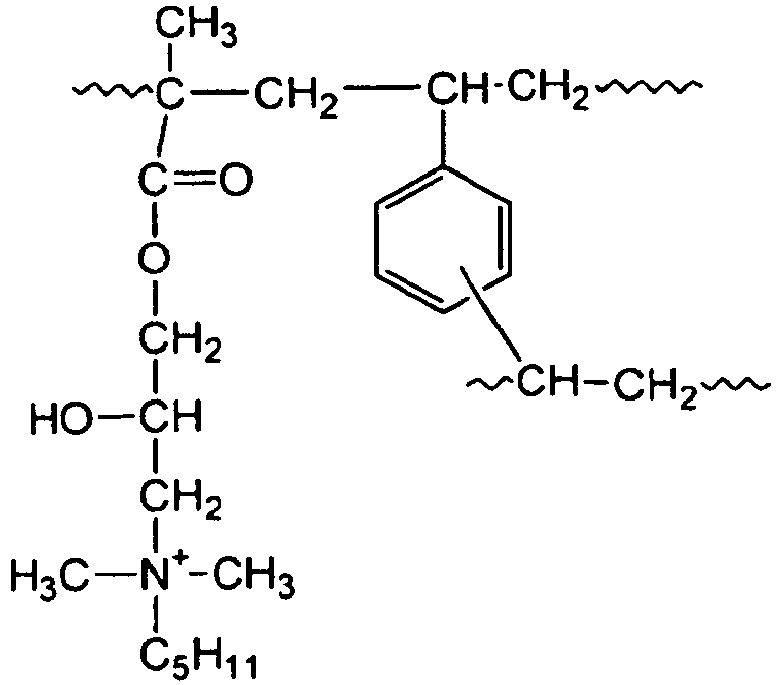

- . When the polymer is used as the filler for measuring drugs,

- In addition, the polymers of the present invention also include the polymer obtained by introducing an ammonium group represented by the general formula [3] into a glycidyl group of the polymer obtained by polymerization of the monomers containing the compound represented by the general formula [1] and the compound represented by the general formula [2], and further the compound represented by the general formula [4], and are specifically represented by, for example, the following general formula [6] :

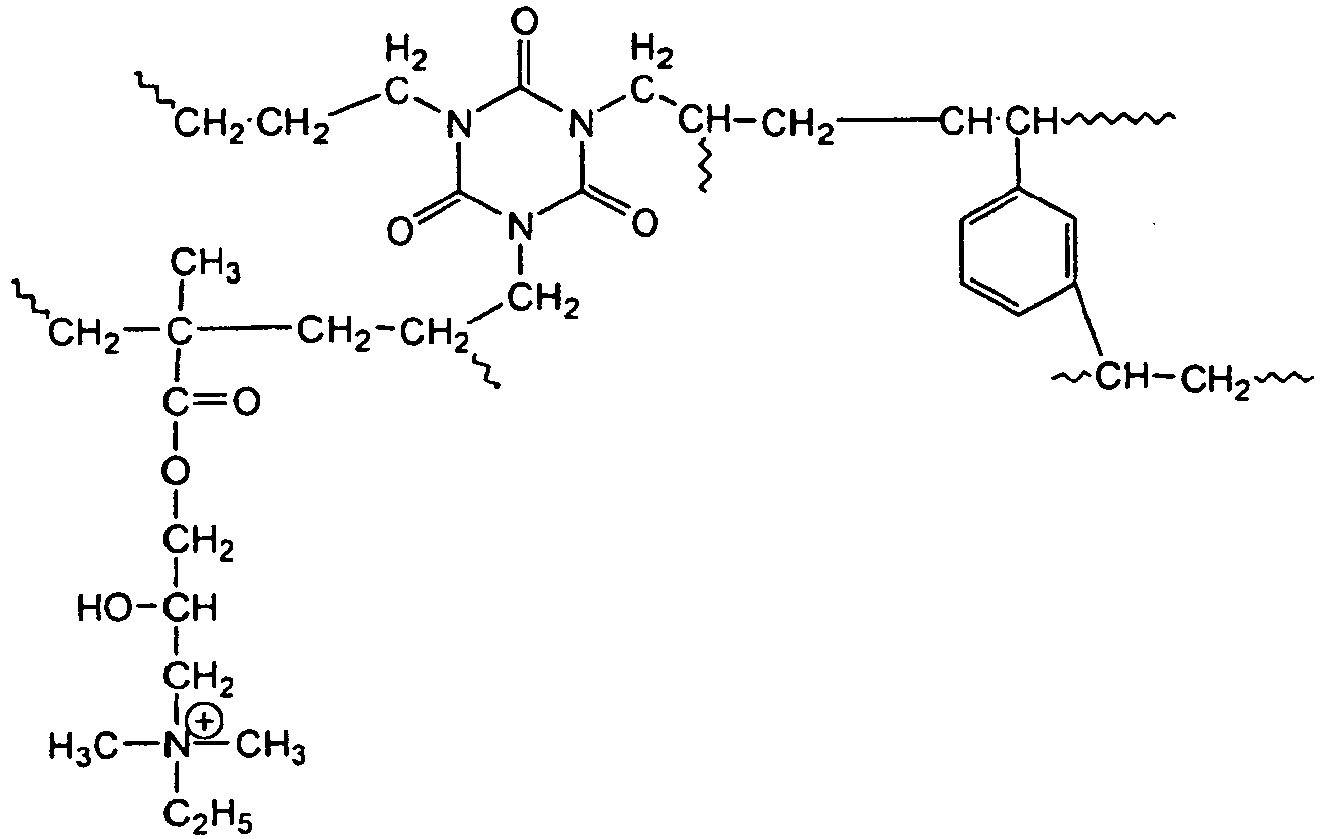

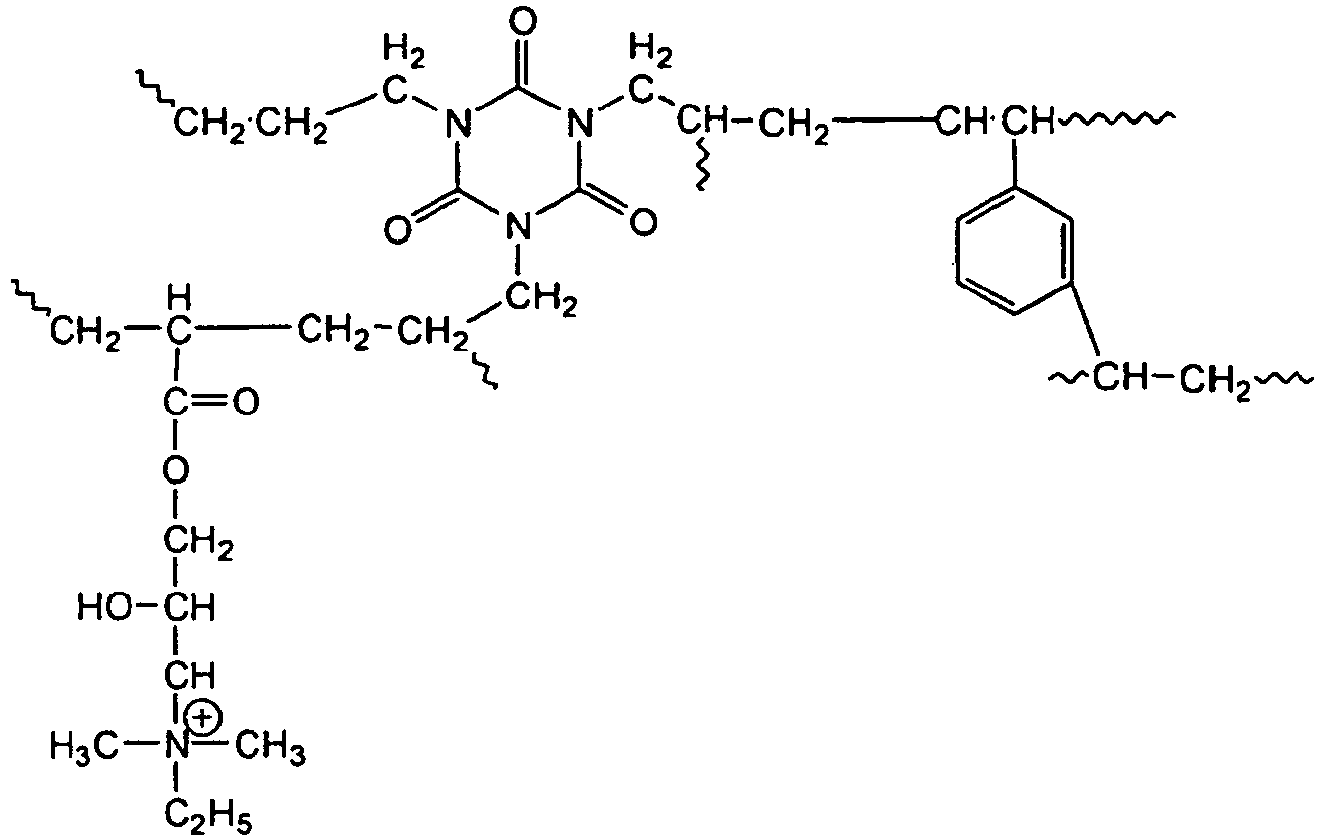
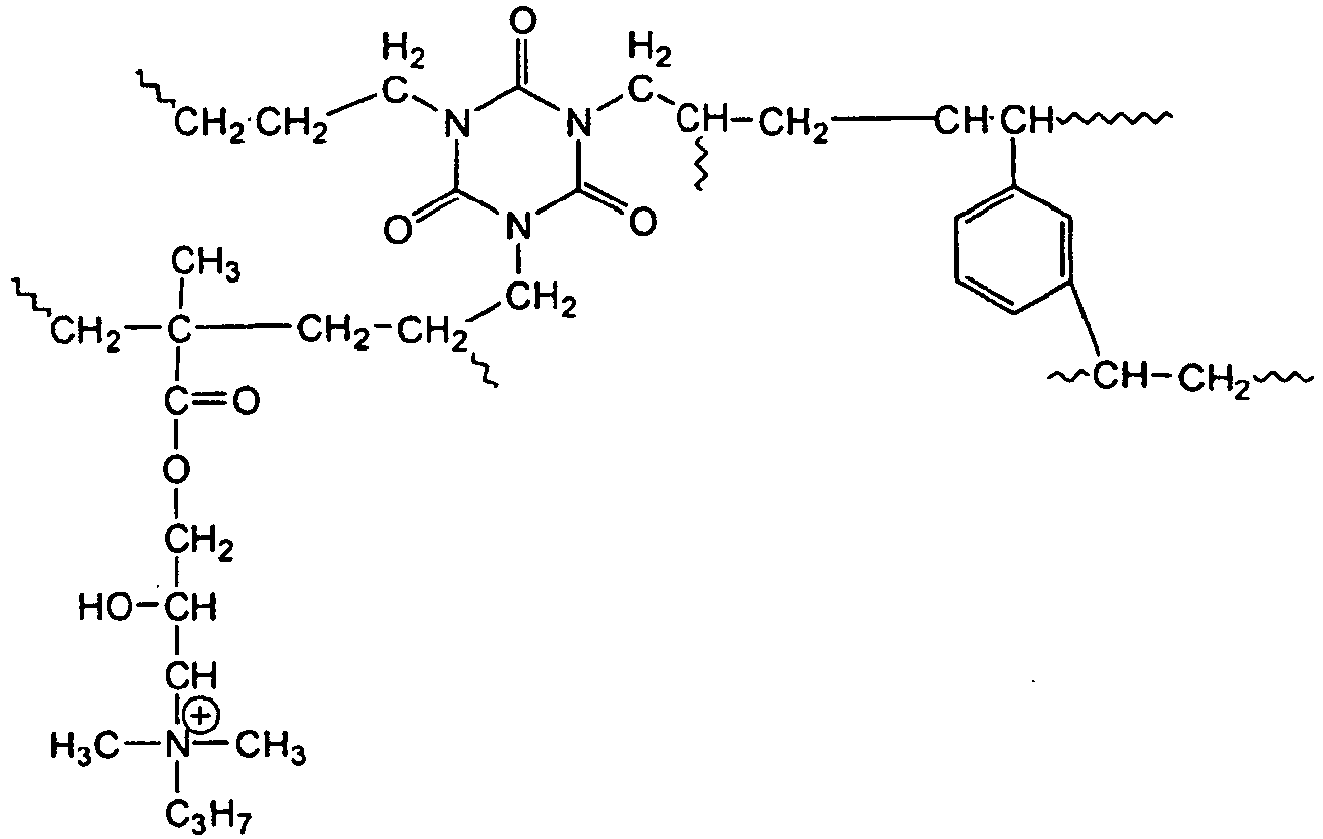
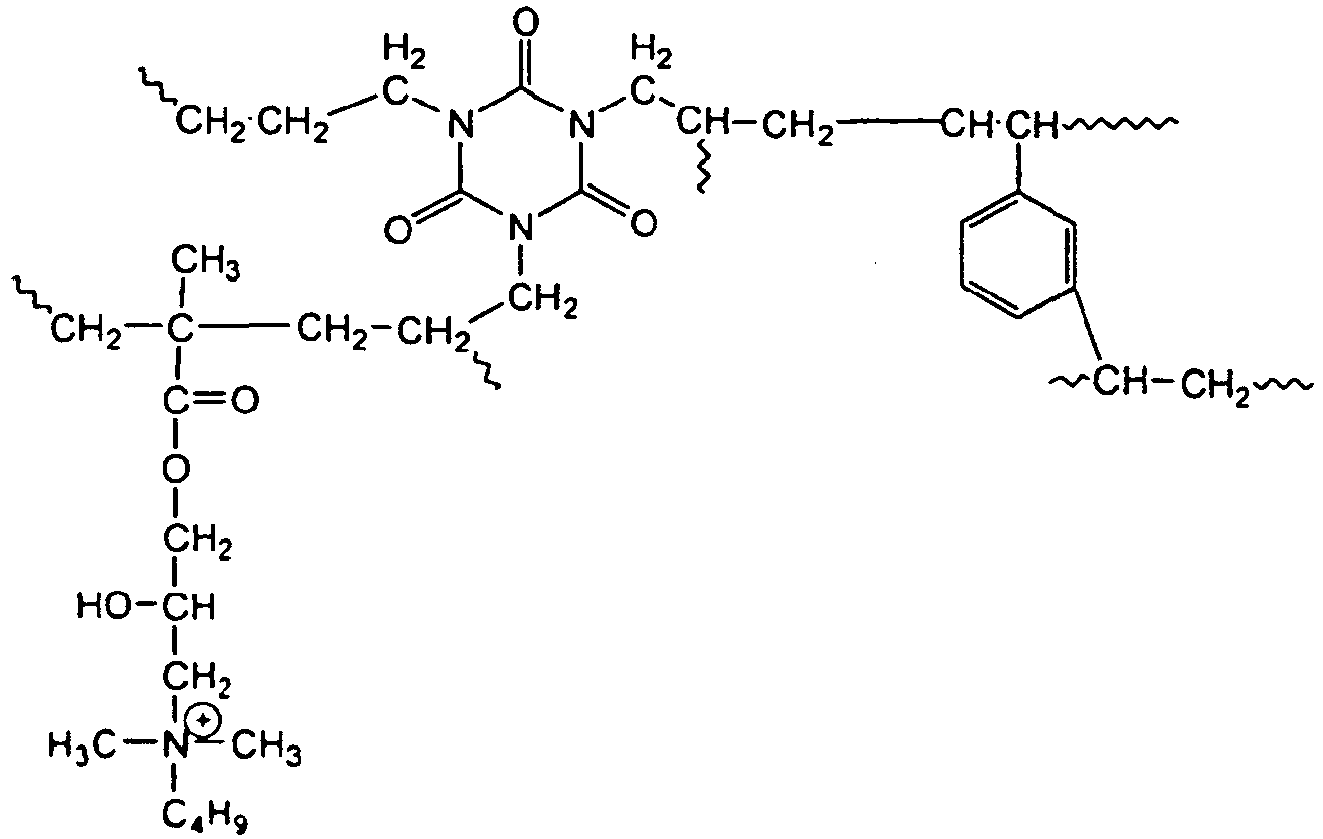


- Average particle diameter of the polymer of the present invention is normally 10 to 100 µm, preferably 20 to 100 µm, more preferably 30 to 70 µm, and micropore diameter is normally 3 to 15 nm. When the polymer is used as the filler for measuring the drugs, 3 to 5 nm is preferable. Specific surface area of the polymer is normally 200 to 1000 m2/g, preferably 300 to 700 m2/g. When polymer is used as the filler for measuring drugs, 300 to 500 m2/g is particularly preferable. When the polymer of the present invention is synthesized from the monomers containing the compound represented by the general formula [1] and the compound represented by the general formula [2], molar ratio of the compound represented by the general formula [1] and the compound represented by the general formula [2] is 60 to 90 : 10 to 40, preferable range is 70 to 85 : 15 to 30. In addition, when the polymer of the present invention is synthesized from the monomers containing the compound represented by the general formula [1], the compound represented by the general formula [2] and the compound represented by the general formula [4], molar ratio of the compound represented by the general formula [1], the compound represented by the general formula [2] and the compound represented by the general formula [4] is 60 to 85 : 14 to 30 : 1 to 10, preferable range is 70 to 80 : 18 to 25 : 2 to 5. The polymer of the present invention is the one in which anion exchanging group is contained normally 0.1 to 1.0 mmol in 1g of said polymer, preferable range is 0.2 to 0.6 mmol.
- Synthetic method of the present invention may be carried out by polymerizing the monomers containing the compound represented by the general formula [1] and the compound represented by the general formula [2], or the monomers (hereinafter, these monomers may be abbreviated as the monomer group relevant to the present invention) containing the compound represented by the general formula [1] and the compound represented by the general formula [2] and the compound represented by the general formula [4] by the known polymerization method, and by introducing the anion exchanging group into glycidyl group at terminal of the obtained polymer (hereinafter, the polymer may be abbreviated as prepolymer relevant to the present invention) by the known method (for example, amination reaction and the like).
- Specifically, for example, after the monomer group relevant to the present invention and polymerization initiator are dissolved in the organic solvent which can dissolve these monomer group and polymerization initiator but is insoluble in water, suspension polymerization is carried out in the water by adding said organic solvent to water, and then, the prepolymer relevant to the present invention is obtained. When the monomers having the compound represented by the general formula [1] and the compound represented by the general formula [2] are used as the monomer group relevant to the present invention, molar ratio of the compound represented by the general formula [1] and the compound represented by the general formula [2] is 60 to 90 : 10 to 40, preferable range is 70 to 85 : 15 to 30. In addition, when the monomers containing the compound represented by the general formula [1] and the compound represented by the general formula [2] and the compound represented by the general formula [4] are used as the monomer group relevant to the present invention, molar ratio of the compound represented by the general formula [1] and the compound represented by the general formula [2] and the compound represented by the general formula [4] is 60 to 85 : 14 to 30 : 1 to 10, preferable range is 70 to 80 : 18 to 25 : 2 to 5. As a polymerization initiator, any one can be used as long as it is well-known itself, and includes, for example, azoisobutyronitrile, 2,2'-azobis(2,4-dimethylvaleronitrile), 2,2'-azobis(methyl 2-methypropionate), 2,2'-azobis(2-methylbutyronitrile), benzoyl peroxide, lauroyl peroxide and the like. Amount of use of the polymerization initiator is 0.1 to 3% by weight relative to total weight of the monomer group relevant to the present invention. In addition, organic solvents to be used here include, for example, toluene, ethylbenzene, butyl acetate, amyl acetate, octylalcohol, dodecylalcohol, octane, dodecane and the like. Amount of use of the solvent is 0.5 to 2 times weight of total weight of monomers relevant to the present invention. Amount of water to be used here is normally 1 to 10 times weight relative to sum of the weight of monomer group relevant to the present invention and the weight of the above-described organic solvent. In addition, aqueous organic polymer such as polyvinyl alcohol and methylcellulose as a suspension stabilizer known in itself are preferably dissolved in said water, and amount of stabilizer is normally 0.01 to 1% by weight in the water. Suspension polymerization reaction is carried out normally at 60 to 90 °C, for 4 to 20 hours. After the reaction, the prepolymer relevant to the present invention can be obtained by treating according to common procedure of obtaining the polymer. The obtained prepolymer relevant to the present invention is preferably classified by using sieves in order to obtain the prepolymer having the particle diameter suitable for filler, and also, to obtain the prepolymer having uniform largeness for performing the excellent capability of adsorption. Particle diameter of the prepolymer relevant to the present invention obtained by sieve classification is normally 10 to 100 µm, preferable range is 20 to 100 µm, more preferable range is 30 to 70 µm. In addition, operation of said classification may be carried out after obtaining the polymer of the present invention.
- Subsequently, the obtained prepolymer relevant to the present invention is suspended or swelled in suitable organic solvent or the mixed aqueous solution of said organic solvent and water, and the compound which contains the anion exchanging group (the anion exchanging group containing compound) is added to said solution to perform amination reaction, and thus, the polymer of the present invention can be obtained. The above-described organic solvents include 1,4-dioxane, tetrahydrofuran, isopropanol, N,N-dimethylformamide, dimethylsulfoxide and the like. When mixed aqueous solution of organic solvent and water is used, amount of water is normally 10 to 60% as an amount in the mixed aqueous solution, and preferable range is 20 to 50%. The amount of the above-described organic solvent or mixed aqueous solution of organic solvent and water is 1 to 10 times weight relative to the weight of the prepolymer relevant to the present invention. If the anion exchanging group containing compound is the one which contains the above-described anion exchanging group, and by which the desired polymer can be obtained, it is not particularly limited thereto. For example, and the polymer in which hydrogen atom or methyl group and the like is bounded to terminal of the above-described anion exchanging group is exemplified, and amount of use of the polymer is normally 0.001 to 0.05 mole relative to 1 kg of prepolymer relevant to the present invention, preferable range is 0.002 to 0.025 mole. Amination reaction is carried out at room temperature to 60 °C, normally for 4 to 30 hours, preferably for 10 to 20 hours, while stirring if necessary. The polymer of the present invention is obtained by this reaction.
- The case of employing divinylbenzene as a compound represented by the general formula [1], glycidyl methacrylate as a compound represented by the general formula [2], and N,N-dimethylaminoethane as the anion exchanging group containing compound is taken for an example, and synthetic method of the polymer of the present invention is described below. It should be noted that, said polymer is preferable as the filler for measuring the drugs.
- That is, for example, in 100g of organic solvent such as toluene, 75 to 90 g of divinylbenzene (0.2 to 0.6 mol as an amount of pure divinylbenzene), and 10 to 25g of glycidyl methacrylate (0.05 to 0.2 mol) and 1 to 3 g of polymerization initiator such as azobisisobutyronitrile are mixed, and the resultant organic solvent is suspended in 500 to 1000 mL of 0.01 to 1.0% by weight of methyl cellulose aqueous solution, and is reacted at 60 to 80 °C for 5 to 10 hours. By this method, the prepolymer relevant to the present invention can be obtained. After the reaction, the resultant polymer relevant to the present invention is washed with water or methanol if necessary. Subsequently, 10 g of prepolymer relevant to the present invention is suspended in 50 to 100mL of 20 to 50% by volume of 2-propanol aqueous solution, 10 to 50 g of N,N-dimethylaminoethane (0.1 to 0.5 mol) is added, and the organic solution is reacted at 40 to 60 °C for 10 to 20 hours while stirring. Then, the polymer of the present invention can be obtained.
- The case of employing divinylbenzene as a compound represented by the general formula [1], glycidyl methacrylate as a compound represented by the general formula [2], triallyl isocyanurate as a compound represented by the general formula [4], and N,N-dimethylaminoethane as the anion exchanging group containing compound is taken for an example, and synthetic method of the polymer of the present invention is described below. It should be noted that, said polymer is preferable as the filler for measuring the drugs.
- That is, for example, in 100g of organic solvent such as toluene, 85 to 70 g of divinylbenzene (0.2 to 0.6 mol as an amount of pure divinylbenzene), and 10 to 20 g of glycidyl methacrylate (0.05 to 0.2 mol) and 5 to 10g of triallyl isocyanurate (0.02 to 0.04 mol), 1 to 3 g of polymerization initiator such as azobisisobutyronitrile are mixed, and the resultant organic solvent is suspended in 500 to 1000 mL of 0.01 to 1.0% by weight of methyl cellulose aqueous solution, and is reacted at 60 to 80°C for 5 to 10 hours. By this method, the prepolymer relevant to the present invention can be obtained. After the reaction, the resultant polymer relevant to the present invention is washed with water or methanol if necessary. Subsequently, 10 g of prepolymer relevant to the present invention is suspended in 50 to 100 mL of 20 to 50% by volume of 2-propanol aqueous solution, and 10 to 50 g of N,N-dimethylaminoethane (0.1 to 0.5 mol) is added, and the organic solution is reacted at 40 to 60 °C for 10 to 20 hours while stirring. Then, the polymer of the present invention can be obtained.
- The drugs relevant to the present invention include all the materials having medicinal properties, and the doping substance such as diuretic and the other concealment drug, stimulant drug, narcotic, β-blocker, specific material listed in The 2008 Prohibited List International Standard (World Anti-Doping Code), 2008 Monitoring Program and the like, and the medicament or drug, which can temporally heighten or lessen the racing performance of race-horse, described in the Attached Table (2) in Ordinance for Enforcement of Horse Racing of The Japan Racing Association of the Japan Racing Association Rule No. 2 effective in Heisei 19 year(2007). Among them, the medicament or drug, which can temporally heighten or lessen the racing performance of race-horse, are preferable, specifically, for example, Atoropine, Amobarbital, Allobarbital, Antipyrine, Oxyethyltheophylline, Oxypropyltheophylline, 3'-Oxohexobarbital, Caffeine, Chlorpromazine, Cocaine, Cyclobarbital, β,γ-Dihydroxydibucaine, Dibucaine, Cyproheptadine, Cyproheptadine-N-oxide, Dimorphoramine, Scopolamine, Strychnine, Secobarbital, Theophylline, Tetracaine, Nikethamide, Nicotine, Noscapine, Barbital, 3'-Hydroxyamobarbital, γ-Hydroxydimorphoramine, 3'-Hydroxysecobarbital, 3'-Hydroxyhexobarbital, 3'-Hydroxypentobarbital, Pipradrol, Phenacetin, Phenylethylmalondiamide, Phenylbutazone, Phenobarbital, Primidone, Brucaine, Procaine, Promazine, Hexobarbital, Pentazocine, Pentetrazol, Pentobarbital, Methapyrilene, Methamphetamine, Metharbital, Methylephedrine, Methylphenidate, Methoxyphenamine, Mephobarbital, Monoethylglycinexylidide, Lidocaine, Chlorpromazine sulfoxide, Nortriptylin, Salicylic acid, Naproxen, and the like. Among them, Theophylline, Scopolamine, Caffeine, Atoropine, Barbital, Nortriptylin, Salicylic acid, Naproxen and the like are preferable.
- The filler for measuring the drug of the present invention is the one containing the polymer of the present invention obtained as described above.
- The preprocessing column for measuring the drugs of the present invention is the one filled with the above-described filler for measuring the drug of the present invention. Filling method and the like is not particularly limited, the above-described filler may be filled into the column container conventionally used in this field, according to the known method, for example, slurry method, dry type-tapping method and the like. The amount of filler in the column may be determined according to the amount of sample to be used, for example, when 10 mL of the sample having 0.001 to 50 µg/mL, preferably 0.05 to 10µg/mL of drug is passed through column to adsorb the drug, the amount of the sample is normally 10 to 1000 mg, preferably 50 to 200 mg, more preferably 50 to 100 mg. Column volume may be appropriately selected according to the amount of filler.
- Measuring method of the drugs using the preprocessing column for measuring the drugs of the present invention may be carried out by the following steps:
- (1) a step of passing the sample containing the drugs through the preprocessing column for measuring drugs of the present invention to adsorb the drugs;
- (2) a step of eluting the drugs by eluate; and
- (3) a step of measuring the eluted drugs.
- In addition, in case of the sample having much impurities, treatment such as washing may be carried out after adsorbing the drugs in order to remove these impurities from the preprocessing column for measuring the drugs of the present invention.
- Detail of the measuring method of the drug using the preprocessing column for measuring the drug of the present invention is specifically described as follows. That is, first, after adjusting the conditioning of the column by the known method,
- (1) The sample containing the drug is passed through the preprocessing column for measuring the drug of the present invention to adsorb the drug onto the column (filler). Method of passing the liquid may be free fall, or may be carried out by pressurization or depressurization, and pressurization or depressurization method is preferable. When pressurization or depressurization method is employed, adsorption rate is decreased when flow rates of the sample become too high. Therefore, flow rates of the sample are determined normally at 1 to 30 mL/min, preferably at 10 to 30 mL/min, more preferably at 10 to 20 mL/min. It should be noted that, when pH of the sample having the acidic drug is 8 or more, it is preferable to pass the liquid after adjusting pH of the sample to 7 or less by the known neutralization reaction. That is, it is considered that the acidic drugs are held by ion exchange capacity of the anion exchanging group in the polymer of the present invention, and therefore, in order to prevent the reduction of adsorption rate, pH of the sample is preferably adjusted to 7 or less. When washing is carried out after operation of (1), washing solution may be passed through column. As the washing solution, buffer solution having of pH 6 to 8 is used, and said buffer solution may be the one having 5 to 10% of aqueous organic solvent such as methanol, ethanol, propanol, acetonitrile, acetone, dichloromethane. The liquid amount of washing solution may be appropriately determined according to the amount of the filler, and it is normally 0.5 to 10 mL, preferably 0.5 to 5 mL relative to 10 mg of filler. It should be noted that, pH adjustment of washing solution may be carried out according to the method normally used in this field. Method of passing the liquid may be free fall, or may be carried out by pressurization or depressurization, and passing the liquid by pressurization or depressurization is preferable because the washing solution can be removed perfectly.
- Next,
- (2) when the drugs adsorbed onto column are eluted by eluate, the neutral and basic drugs are eluted by the aqueous organic solvent such as methanol, ethanol, propanol, acetonitrile, acetone, dichloromethane, and acidic drug is eluted by the acidic aqueous solution or the acidified aqueous organic solvent such as methanol, ethanol, propanol, acetonitrile, acetone, dichloromethane having normally pH 1 to 3, preferably pH 1 to 2, and the like. pH adjustment of said acidic aqueous solution or acidic aqueous organic solvent is not particularly limited, as long as it is carried out by the method using the acidic compound normally used in this field. Said acidic compounds include, preferably, for example, hydrochloric acid, nitric acid, acetic acid, formic acid and the like. A specific adjusting method is carried out as follows. For example, when pH is adjusted to 1 to 2 by using formic acid, the acidic aqueous solution or the acidic aqueous organic solvent may be adjusted so that formic acid may contain normally 1 to 5 w/w%, preferably 1 to 2 w/w% as a concentration in the eluate. Amount of the eluate in the elution of the above-described (2) may be appropriately determined according to the amount of filler, and it is normally 0.3 to 100 mL, preferably 0.3 to 10 mL, more preferably 0.3 to 1 mL relative to 10 mg of the filler.
- Further,
- (3) by measuring the eluate containing the eluted drugs with the known separation measurement method, amount or concentration of the drug in the sample can be obtained. If necessary, after the eluate containing the drug, which is used in separation measurement, is condensed by the known method, the elute may be provided with the separation measurement method. The separation measurement methods include, for example, liquid chromatography method, gas chromatography method, electrophoretic method and the like, and as detection tool, UV detection, fluorescence detection, MS, MS/MS, evaporative light scattering detection (ELSD) and the like known in itself may be used, and measurement condition and the like may be determined according to the one which is normally employed in this field.
- More specifically, for example, the measurement method is carried out as follows. That is, for example, when 10 mL of the sample having 1 to 10 µg/mL of drugs is used, the column filled with 50 to 100 mg of the filler for measuring the drug of the present invention is used. 2 to 5 mL of aqueous organic solvent such as methanol, 2 to 5 ml of purified water, and 2 to 5 mL of buffer solution of sodium acetate having pH 6 to 8 are sequentially passed through said column, and thus, column condition is adjusted. Next, 10 mL of the sample is passed through the column. Then, it is washed by passing 1 to 3 mL of the buffer solution of 0.1 to 1 mol/L of sodium acetate having 5 to 10% of methanol. Next, 2 to 5 mL of methanol is passed to elute the neutral and basic target drug. Further, 2 to 5 mL of methanol having pH 1 to 2 is passed through to elute the acidic target drugs. Each of the obtained eluates is separated with HPLC at the setting condition which is normally carried out in this field, and the target drugs are measured by UV, fluorescent detector and the like, and therefore, the amount of the target drug in the sample is obtained. It should be noted that, the acidic drugs, and the neutral and basic target drugs may be eluted into one container, and the acidic, neutral and basic drugs may be simultaneously analyzed by separation.
- Next, the present invention is described in more detail by the Examples. However the present invention is not limited by these Examples.
- As a hydrophobic monomer, 85.0 g of divinylbenzene (produced by Nippon Steel Chemical Co. , Ltd: purity:57%)(contained 0.37 mol of pure divinylbenzene), as a polar monomer (monomer in which ion exchanging group can be introduced), 15.0 g of glycidyl methacrylate (containing 0.106 mol of glycidyl methacrylate) (produced by Wako Pure Chemical Industries, Ltd) were used, and 100 g of toluene was used as a water-insoluble organic solvent. After 1.0 g of azobisisobutyronitrile (produced by Wako Pure Chemical Industries, Ltd.) was added to this mixture and dissolved. Mixed solution was suspended in 0.8 L of aqueous solution having 0.2% by weight of methylcellulose, and was stirred at high speed to adjust the average diameter of oil droplet at about 60 µm. Then, mixed solution was transferred to polymerization apparatus equipped with stirrer and reacted at 80°C for 6 hours to obtain the cross-linked porous copolymerized particles. These particles were filtered, and were further washed with 2L of water and 2L of methanol, and were dipped in ethyl acetate overnight. Then, these particles were washed with 2L of methanol and dried. It should be noted that, the resultant cross-linked porous copolymerized particles had 4.0 nm of average micropore diameter and 429 m2/g of specific surface area. Said particles were classified with 32 µm and 63 µm sieves to obtain 37 g of particles having about 40 µm of average particle diameter.
- After classification, 10.0 g of the obtained porous copolymer was dispersed in 50 mL of aqueous solution having 50% of 2-propanol to provide homogeneous slurry, and was transferred to the reaction apparatus equipped with stirrer, and amination reaction was carried out by adding 15 g(0.17 mol) of N,N-dimethylaminoethane (produced by Wako Pure Chemical Industries, Ltd) at 40°C for 20 hours. After the reaction completed, reaction product was sequentially washed with water and methanol, and dried, and thus, polymer-3 of the present invention was obtained. Content of introduced ethyldimethyl ammonium group (anion exchanging group) was determined by reverse titration method, and then amount of this group was shown as 0.34meq/g gel dry. It should be noted that, structure of polymer-3 of the present invention is shown as follows.

- The cross-linked porous copolymeric particles were obtained by using the reagent and the procedure similar to Example 5 except that as a hydrophobic monomer, 80.0 g of divinylbenzene (produced by Nippon Steel Chemical Co., Ltd, purity:577%) (contained 0.37 mol of pure divinylbenzene), as a polar monomer (monomer in which ion exchanging group can be introduced), 15.0 g of glycidyl methacrylate(contained 0.106 mol of glycidyl methacrylate) (produced by Wako Pure Chemical Industries, Ltd) and triallyl isocyanurate (produced by Tokyo Chemical Industry Co., Ltd) (contained 0.02 mol of triallyl isocyanurate) were used. The cross-linked porous copolymeric particles were washed by the similar way, then dried. These cross-linked porous copolymeric particles had 3.9 nm of average micropore diameter and 380 m2/g of specific surface area. After these particles were classified by using 32 µm and 63 µm sieves, ethyldimethylammonium group was introduced by the method similar to Example-5, and polymer-4 of the present invention was obtained. Content of the introduced ethyldimethylammonium group (anion exchanging group) was determined by reverse titration method, and amount of this group was 0.30 meq/g gel dry. It should be noted that, structure of polymer-4 of the present invention was shown as follows.

- The cross-linked porous copolymeric particles were obtained by using the reagent and the procedure similar to Example 5 except that as a hydrophobic monomer, 65.0 g of divinylbenzene (produced by Nippon Steel Chemical Co., Ltd, purity:57%)(contained 0.28 mol of pure divinylbenzene), as a polar monomer (monomer in which ion exchanging group can be introduced), 30.0 g of glycidyl methacrylate (produced by Wako Pure Chemical Industries, Ltd) (contained 0.21 mol of glycidyl methacrylate) and 5 g of dimethylacrylamide (produced by Wako Pure Chemical Industries, Ltd) (contained 0.05 mol of dimethylacrylamide), as a water-insoluble organic solvent, 60 g of toluene, and 40g of lauryl alcohol were used. These resin particles were washed by the similar way, then dried. These cross-linked porous copolymerized particles had 29.8 nm of average micropore diameter and 260 m2/g of specific surface area. After classification of these particles with 32 µm and 63 µm sieves, trimethylamino group was introduced by using the reagent and the procedure similar to Example 5 except that reaction time is 6 hours, and 40 g of trimethylamine (produced by Wako Pure Chemical Industries, Ltd, 30% of aqueous solution) instead of N,N-dimethylethaneamine was used, and comparative polymer-1 was obtained. Amount of the introduced anion exchanging group was determined by reverse titration method, and it was 0.29 meq/g gel dry. It should be noted that, structure of comparative polymer-1 was shown as follows.

- As a hydrophobic monomer, 70.0 g of divinylbenzene (produced by Nippon Steel Chemical Co., Ltd, purity:57%) (contained 0.306 mol of pure divinylbenzene), as a polar monomer (monomer in which ion exchanging group can be introduced), 20.0 g of chloromethylstyrene (produced by Tokyo Chemical Industry Co., Ltd, purity:90%)(contained 0.146 mol of pure chloromethylstyrene), as a polar monomer, 10.0 g of dimethylacrylamide (produced by Wako Pure Chemical Industries, Ltd)(contained 0.1 mol of dimethylacrylamide) were used. As a water-insoluble organic solvent, 60g of toluene, 40g of lauryl alcohol were used. As polymerization initiator, 1.0 g of azobisisobutyronitrile (produced by Wako Pure Chemical Industries, Ltd) was dissolved in this mixture, and then, mixed solution was suspended in 0.8 L of aqueous solution having 0.2% by weight of methylcellulose, and stirred at high speed to adjust the average diameter of oil droplet to about 40 µm. Then, mixed solution was transferred to polymerization apparatus equipped with stirrer, and reacted at 80°C for 6 hours to obtain the cross-linked porous copolymerized particles. These particles were filtered, and further washed with 2 L of water and 2 L of methanol, and dipped in ethyl acetate overnight. Subsequently, these particles were washed with 2 L of methanol, and dried. It should be noted that, the cross-linked porous copolymeric particles obtained by such method had 3.8 nm of average micropore diameter and 96 m2/g of specific surface area. Said particles were classified by using 32 µm and 63 µm of sieves, and 35 g of particles having about 40 µm of average particle diameter were obtained.
- 10.0 g of the obtained porous copolymer after classification was dispersed in 50 mL of aqueous solution having 50% of 2-propanol to provide homogeneous slurry, and transferred to the reaction apparatus equipped with stirrer, and amination reaction was carried out by adding 15 g of N,N-dimethylaminoethane (produced by Wako Pure Chemical Industries, Ltd) at 40 °C for 8 hours. After the reaction completed, reaction product was sequentially washed with water and methanol, and dried, and thus, comparative polymer-2 was obtained. Amount of the introduced anion exchanging group was determined by reverse titration method, and it was 0.34 meq/g gel dry. It should be noted that, structure of comparative polymer-2 was shown as follows.

- To 6 mL of buffer solution of 2 mol/L of sodium acetate adjusted at pH 7, all the 8 kinds of drugs shown as Table-5 were added to prepare the test solutions containing the amount of drugs shown in the table. It should be noted that, as for the drug poorly soluble in the buffer solution of sodium acetate, once the drug of amounts in the table were dissolved in methanol, then said methanol was added to buffer solution.
- In addition, into 2mL of methanol, the amounts of 8 kinds of the drugs described in the right column of in Table-1 were added, and thus, the standard solution was prepared.
[Tabble-5] Drug Amount of Drug in Test solution (µg) Amount of Drug in Standard Solution (µg) Theophylline 5 5 Scopolamine hydrobromide 25 25 caffeine 5 5 Atropine sulfate 25 25 Barbital 10 10 Nortriptylin 10 10 Salicylic acid 20 10 Naproxen 20 10 - As fillers, polymer-3, 4 of the present invention, comparative polymer-1, 2, and Oasis MAX were used, and these fillers were filled into the syringe type cartridges having 4 mL of inner volume by 60 mg respectively. These cartridges were defined as solid-phase extraction cartridges.
- Addition and recovery experiments were carried out as follows. That is, first, to the solid-phase extraction cartridge, 2 mL of methanol, 2 mL of purified water and 1mL of buffer solution having 2 mol/L of sodium acetate adjusted to pH 7 were passed, and then, total volume of the above-described test solution was poured. Subsequently, 2 mL of mixed solution of 95 mL of buffer solution having 0.1 mol/lL of sodium acetate adjusted to pH 7 and 5 mL of methanol were passed to the same cartridge to wash. Then, 2 mL of methanol was passed through solid-phase extraction cartridge to elute the adsorbed materials adsorbed on solid-phase. 2 mL of recovered solution was separated with HPLC, and by measuring UV absorption thereof, and recovery rates were determined. The obtained recovery rates (%) are shown in Table-6. It should be noted that, value of UV absorption for which the standard solution was directly separated and measured by HPLC at the same condition was specified as standard value (100%), and the recovery rate was calculated from the standard value (hereinafter, same). In addition, HPLC condition was as follows.
-
- Column: Wakopak Wakosil-II 5C18 HG, 4.6x150mm;
- Eluate: A) 0.1% of phosphoric acid B) acetonitrile;
- Gradient: 0-15 min, B: 5-85%, 15-25 min: B: 5%;
- Flow rates: 1.0 mL/min at 40°C;
- Amount of injection: 5 µl;
- Apparatus: HPLC : Prominence system (Shimadzu);
- Further, in order to elute the acidic compounds, 4 mL of methanolic solution containing 2% of formic acid was passed through. 4 mL of recovery solution eluted from the solid-phase cartridge was separated by HPLC at the above-described condition, and UV value thereof was measured, and then, recovery rates were determined. The obtained recovery rates (%) are shown in Table-7.
[Table-6] Drug Addition Amount (µg/Column) Filler Polymer-3 Polymer-4 Comp. Polymer-1 Comp. Polymer-2 Oasis MAX Recovery rate(%) Neutral Compound Theophylline 5 97.1 92.2 13.3 29.4 75.5 caffeine 5 101.7 98.5 22.6 97.4 92.7 Barbital 10 102.7 99.1 38.0 86.4 93.5 Basic compound Scopolamine hydrobromide 25 106.6 103.0 50.7 58.7 94.0 Atropine sulfate 25 108.0 105.7 11.9 96.6 67.5 Nortriptylin hydrochloride 10 103.5 100.5 -- 101.0 87.0 Acidic Compound Salicylic acid 20 0 0 -- 0 0 Naproxen 20 0 0 -- 0 0 [Table-7] Drug Addition Amount (µg/ Column) Filler Polymer-3 Polymer-4 Comp. Polymer-1 Comp. Polymerr-2 Oasis MAX Recovery rate(%) Acidic Compound Salicylic acid 20 106.8 104.6 -- 67.5 103.4 Naproxen 20 83.9 86.9 -- 67.0 86.3 - From the result of Table-6, it was found that by using polymer-3 and polymer-4 of the present invention, even Theophylline, Atropine sulfate, Nortriptylin hydrochloride and the like which have shown low recovery rate when Oasis MAX was used, can be recovered by almost 100% of recovery rate.
- On the other hand, comparative polymer-1 having similar structure in part to polymer-3 and 4 of the present invention has shown as low recovery rate in any of neutral compound, basic compound. Similarly, comparative polymer-2 having similar structure in part to polymr-3 and 4 of the present invention has been shown as low recovery rate in Theophylline, Scopolamine hydrobromide. It is estimated that retention capability of neutral and basic compounds is greatly affected depending on the structure of polymer. Therefore, it was understood that the polymer structure comprising divinylbenzene and glycidyl methacrylate and the polymer structure comprising divinylbenzene, triallyl isocyanurate and glycidyl methacrylate, like polymer-3 and polymer-4 of the present invention, have contributed to high retention capability of neutral and basic compound.
- Though salicylic acid and Naproxen of acidic compound were not eluted with methanol, as apparent from results of Table-7, these compounds can be eluted by methanol containing 2% of formic acid. According to these results, it was found that polymer-3 and 4 of the present invention have almost same recovery rate as Oasis MAX. Comparative polymer-2 has less than 70% of recovery rate in both salicylic acid and Naproxen, and it showed low value. Though retention capability of acidic compound was estimated to depend mainly on the anion exchanging group, according to this result, it was found that even when the same ion exchanging group (ethyldimethylammonium group) has been contained, retention capability of acidic compound may vary depending on the different structure of fundamental polymer structure. Therefore, it was found that by introducing the anion exchanging group to the polymer like polymer-3 and polymer-4 of the present invention, these polymers have excellent retention capability for neutral and basic compounds, as well as acidic compounds.
- The present invention relates to provide the novel polymer, and the filler comprising said polymer. In addition, fillers comprising the above-described polymer can efficiently adsorb the drugs, and by solid-phase extraction method using said fillers, acidic, basic or/and neutral compounds can be efficiently measured.
Claims (10)
- A polymer obtained by introducing an anion exchanging group to a glycidyl group of a polymer obtained by polymerizing a compound represented by the following general formula [1] :


wherein the anion exchanging group is an ammonium group represented by the following general formula [3]:
- The polymer according to claim 1, wherein R3 represents a methyl group and R4 represents an ethyl group in the general formula [3].
- The polymer according to claim 1, wherein said polymer is obtained by introducing the ammonium group represented by the general formula [3] to the glycidyl group in the polymer obtained by polymerizing monomers containing the compound represented by the general formula [1] and the compound represented by the general formula [2] and further the compound represented by the following general formula [4]:

- The polymer according to claim 3, wherein R15 in the general formula [4] is a methylene group and R16 is a hydrogen atom.
- The polymer according to any one of claims 1 to 4, wherein the compound represented by the general formula [1] is divinylbenzene.
- The polymer according to any one of claims 1 to 5, wherein the compound represented by the general formula [2] is the compound represented by the following general formula [2']:

- A filler for measuring drugs for obtaining amount or concentration of the drugs which comprises the polymer according to any one of claims 1 to 6.
- Use of a filler comprising the polymer according to any one of claims 1 to 6 for measuring a drug for obtaining amount or concentration of the drug.
- Use of a preprocessing column filled with the filler according to claim 7 for measuring the drug for obtaining amount or concentration of the drug.
- A measuring method of a drug comprising a step for adsorbing said drug by passing the sample containing said drug to a preprocessing column filled with the filler according to claim 7; a step for eluting said drug by eluate; and a step for measuring the eluted drug for obtaining amount or concentration of the eluted drug.
Applications Claiming Priority (3)
| Application Number | Priority Date | Filing Date | Title |
|---|---|---|---|
| JP2008207879 | 2008-08-12 | ||
| JP2008301822 | 2008-11-27 | ||
| EP09806701.0A EP2314635B1 (en) | 2008-08-12 | 2009-08-10 | Method for measuring a perfluoro compound with a filler |
Related Parent Applications (3)
| Application Number | Title | Priority Date | Filing Date |
|---|---|---|---|
| EP09806701.0A Division EP2314635B1 (en) | 2008-08-12 | 2009-08-10 | Method for measuring a perfluoro compound with a filler |
| EP09806701.0A Division-Into EP2314635B1 (en) | 2008-08-12 | 2009-08-10 | Method for measuring a perfluoro compound with a filler |
| EP09806701.0 Division | 2009-08-10 |
Publications (3)
| Publication Number | Publication Date |
|---|---|
| EP2359931A2 EP2359931A2 (en) | 2011-08-24 |
| EP2359931A3 EP2359931A3 (en) | 2012-01-04 |
| EP2359931B1 true EP2359931B1 (en) | 2016-04-20 |
Family
ID=41668954
Family Applications (2)
| Application Number | Title | Priority Date | Filing Date |
|---|---|---|---|
| EP11166380.3A Not-in-force EP2359931B1 (en) | 2008-08-12 | 2009-08-10 | Polymer filler for preprocessing column |
| EP09806701.0A Not-in-force EP2314635B1 (en) | 2008-08-12 | 2009-08-10 | Method for measuring a perfluoro compound with a filler |
Family Applications After (1)
| Application Number | Title | Priority Date | Filing Date |
|---|---|---|---|
| EP09806701.0A Not-in-force EP2314635B1 (en) | 2008-08-12 | 2009-08-10 | Method for measuring a perfluoro compound with a filler |
Country Status (5)
| Country | Link |
|---|---|
| US (2) | US20110138935A1 (en) |
| EP (2) | EP2359931B1 (en) |
| JP (1) | JP5492084B2 (en) |
| CN (1) | CN102119179B (en) |
| WO (1) | WO2010018810A1 (en) |
Families Citing this family (8)
| Publication number | Priority date | Publication date | Assignee | Title |
|---|---|---|---|---|
| US20130048853A1 (en) * | 2010-04-28 | 2013-02-28 | Hitachi High-Technologies Corporation | Adsorbent and Method for Producing Same |
| ITBO20120066A1 (en) * | 2012-02-10 | 2013-08-11 | Consiglio Nazionale Ricerche | PROCEDURE FOR THE TREATMENT OF A POLYMER |
| JP6004516B2 (en) * | 2012-03-22 | 2016-10-12 | 積水メディカル株式会社 | Column packing material for separating hemoglobins and method for producing the same |
| CN109661269A (en) * | 2016-08-30 | 2019-04-19 | 罗门哈斯公司 | Low sodium resin |
| JP6648656B2 (en) * | 2016-08-31 | 2020-02-14 | 三菱マテリアル株式会社 | Sample analysis method |
| JP2021128005A (en) * | 2020-02-12 | 2021-09-02 | 株式会社島津製作所 | Blood pretreatment method and examination method |
| CN111307997B (en) * | 2020-04-01 | 2024-06-28 | 上海市农业科学院 | Pretreatment rapid purification column for detecting perfluorinated compounds, and manufacturing method and application thereof |
| CN111505146A (en) * | 2020-04-28 | 2020-08-07 | 中山永恒检测科技有限公司 | Detection method of residual amount of potassium perfluorobutylsulfonate |
Family Cites Families (15)
| Publication number | Priority date | Publication date | Assignee | Title |
|---|---|---|---|---|
| GB718168A (en) * | 1951-10-05 | 1954-11-10 | Rohm & Haas | Improvements in or relating to the preparation of weakly basic anion-exchange resins |
| GB717305A (en) * | 1951-10-05 | 1954-10-27 | Rohm & Haas | Improvements in or relating to the preparation of resinous quaternary ammonium hydroxides and alkoxides |
| US2630429A (en) * | 1951-10-05 | 1953-03-03 | Rohm & Haas | Preparation of weakly basic anion-exchange resins |
| GB1314607A (en) * | 1969-09-12 | 1973-04-26 | Kureha Chemical Ind Co Ltd | Method for recovering perfluorinated emulsifiers |
| CS188619B1 (en) * | 1977-01-19 | 1979-03-30 | Jaromir Lukas | Polar polymere sorbent based on glycidylic esters for gas and liquid chromatography |
| EP0008407B1 (en) | 1978-08-17 | 1983-10-26 | Heyl Chemisch-pharmazeutische Fabrik GmbH & Co. KG | Polymeric hydrogenation catalysts, process for preparing these catalysts and their use for catalytic hydrogenations |
| JPS59139941A (en) * | 1983-01-31 | 1984-08-11 | Mitsubishi Chem Ind Ltd | Surface functional type anion exchange resin and preparation thereof |
| DE3543348A1 (en) * | 1985-12-07 | 1987-06-11 | Bayer Ag | PEARL-SHAPED CROSS-NETWORKED MIXED POLYMERS WITH EPOXY AND BASIC AMINO GROUPS, METHOD FOR THE PRODUCTION THEREOF AND THEIR USE |
| NZ516848A (en) * | 1997-06-20 | 2004-03-26 | Ciphergen Biosystems Inc | Retentate chromatography apparatus with applications in biology and medicine |
| JP4883837B2 (en) | 1998-06-12 | 2012-02-22 | ウォーターズ・テクノロジーズ・コーポレーション | A novel ion-exchange porous resin for solid-phase extraction and chromatography |
| DE19953285A1 (en) * | 1999-11-05 | 2001-05-10 | Dyneon Gmbh | Process for the recovery of fluorinated emulsifiers |
| US6759442B2 (en) * | 2000-06-02 | 2004-07-06 | Showa Denko Kabushiki Kaisha | Packing material for solid phase extraction and solid phase extraction method |
| BR0113541B1 (en) * | 2000-08-29 | 2011-02-08 | functionalized polymer beads, processes for preparing same and processes for separating an analyte from a solution and a mixture. | |
| JP2003220393A (en) * | 2001-11-22 | 2003-08-05 | Asahi Glass Co Ltd | Adsorption and recovery method of fluorine-containing emulsifier |
| AU2006256011B2 (en) * | 2005-06-09 | 2011-09-01 | Tosoh Corporation | Novel packing material with excellent hydrophilicity and process for producing the same |
-
2009
- 2009-08-10 US US13/058,844 patent/US20110138935A1/en not_active Abandoned
- 2009-08-10 JP JP2010524725A patent/JP5492084B2/en not_active Expired - Fee Related
- 2009-08-10 EP EP11166380.3A patent/EP2359931B1/en not_active Not-in-force
- 2009-08-10 CN CN2009801312718A patent/CN102119179B/en not_active Expired - Fee Related
- 2009-08-10 EP EP09806701.0A patent/EP2314635B1/en not_active Not-in-force
- 2009-08-10 WO PCT/JP2009/064128 patent/WO2010018810A1/en not_active Ceased
-
2013
- 2013-07-24 US US13/950,013 patent/US9110087B2/en not_active Expired - Fee Related
Also Published As
| Publication number | Publication date |
|---|---|
| WO2010018810A1 (en) | 2010-02-18 |
| JP5492084B2 (en) | 2014-05-14 |
| US9110087B2 (en) | 2015-08-18 |
| CN102119179B (en) | 2013-10-30 |
| JPWO2010018810A1 (en) | 2012-01-26 |
| EP2314635A4 (en) | 2012-01-04 |
| US20130309775A1 (en) | 2013-11-21 |
| EP2359931A3 (en) | 2012-01-04 |
| CN102119179A (en) | 2011-07-06 |
| US20110138935A1 (en) | 2011-06-16 |
| EP2359931A2 (en) | 2011-08-24 |
| EP2314635B1 (en) | 2017-12-20 |
| EP2314635A1 (en) | 2011-04-27 |
Similar Documents
| Publication | Publication Date | Title |
|---|---|---|
| US9110087B2 (en) | Polymer for filler for preprocessing column | |
| US7442299B2 (en) | Ion exchange porous resins for solid phase extraction and chromatography | |
| Tabandeh et al. | Computational design and synthesis of molecular imprinted polymers for selective extraction of allopurinol from human plasma | |
| Venn et al. | Synthesis and properties of molecular imprints of darifenacin: the potential of molecular imprinting for bioanalysis | |
| Wang et al. | Hydrophilization of porous polystyrene-based continuous rod column | |
| Yan et al. | Water-compatible molecularly imprinted polymers for selective extraction of ciprofloxacin from human urine | |
| US11448626B2 (en) | Ion exchange chromatography column, method, and system thereof | |
| EP3851189A1 (en) | Porous materials for solid phase extraction and chromatography | |
| Nakamura et al. | Preparation of molecularly imprinted polymers for warfarin and coumachlor by multi-step swelling and polymerization method and their imprinting effects | |
| EP3257583B1 (en) | Charge reversible ion exchange resins, chromatography column, method, and system thereof | |
| Sanbe et al. | Preparation of uniformly sized molecularly imprinted polymers for phenolic compounds and their application to the assay of bisphenol A in river water | |
| EP3124117A1 (en) | An ion-exchange composition comprising a complex of support particles, dispersant, and electrostatically bound layering particles | |
| Wen et al. | Extraction of clenbuterol from urine using hydroxylated poly (glycidyl methacrylate‐co‐ethylene dimethacrylate) monolith microextraction followed by high‐performance liquid chromatography determination | |
| Neagu et al. | Adsorption studies of some inorganic and organic salts on new zwitterionic ion exchangers with carboxybetaine moieties | |
| EP3586958B1 (en) | Packing material for size exclusion chromatography and method for producing the same | |
| LeJeune et al. | Analyte separation by OMNiMIPs imprinted with multiple templates | |
| Kolarz et al. | Influence of the structure of chelating resins with guanidyl groups on gold sorption | |
| JP2010100708A (en) | Molecularly imprinted polymer and method for preparing the same | |
| US7232520B1 (en) | Ion exchange porous resins for solid phase extraction and chromatography | |
| Caban et al. | Comparison of the Usefulness of SPE Cartridges for the Determination of β‐Blockers and β‐Agonists (Basic Drugs) in Environmental Aqueous Samples | |
| EP1160260B1 (en) | Porous polymer particle, anion exchanger, producing method thereof, column for ion chromatography, and method for measuring anions | |
| Zazouli et al. | On-line extraction and determination of residual sulfathiazole in pharmaceutical wastewater with molecularly imprinted polymers in a packed cartridge coupled with high-performance liquid chromatography | |
| JP4074393B2 (en) | Packing for liquid chromatography | |
| WO2006067431A1 (en) | Rationally designed selective binding polymers | |
| Simon | Molecular recognition and its underlying mechanisms in molecularly imprinted polymers |
Legal Events
| Date | Code | Title | Description |
|---|---|---|---|
| PUAI | Public reference made under article 153(3) epc to a published international application that has entered the european phase |
Free format text: ORIGINAL CODE: 0009012 |
|
| AC | Divisional application: reference to earlier application |
Ref document number: 2314635 Country of ref document: EP Kind code of ref document: P |
|
| AK | Designated contracting states |
Kind code of ref document: A2 Designated state(s): AT BE BG CH CY CZ DE DK EE ES FI FR GB GR HR HU IE IS IT LI LT LU LV MC MK MT NL NO PL PT RO SE SI SK SM TR |
|
| AX | Request for extension of the european patent |
Extension state: AL BA RS |
|
| PUAL | Search report despatched |
Free format text: ORIGINAL CODE: 0009013 |
|
| AK | Designated contracting states |
Kind code of ref document: A3 Designated state(s): AT BE BG CH CY CZ DE DK EE ES FI FR GB GR HR HU IE IS IT LI LT LU LV MC MK MT NL NO PL PT RO SE SI SK SM TR |
|
| AX | Request for extension of the european patent |
Extension state: AL BA RS |
|
| RIC1 | Information provided on ipc code assigned before grant |
Ipc: B01D 15/36 20060101ALI20111129BHEP Ipc: G01N 30/96 20060101ALI20111129BHEP Ipc: B01J 41/20 20060101ALI20111129BHEP Ipc: C08F 220/32 20060101ALI20111129BHEP Ipc: G01N 30/06 20060101ALI20111129BHEP Ipc: C08F 220/36 20060101ALI20111129BHEP Ipc: C08F 8/30 20060101ALI20111129BHEP Ipc: B01J 41/14 20060101AFI20111129BHEP |
|
| 17P | Request for examination filed |
Effective date: 20120704 |
|
| GRAP | Despatch of communication of intention to grant a patent |
Free format text: ORIGINAL CODE: EPIDOSNIGR1 |
|
| INTG | Intention to grant announced |
Effective date: 20151023 |
|
| GRAS | Grant fee paid |
Free format text: ORIGINAL CODE: EPIDOSNIGR3 |
|
| GRAA | (expected) grant |
Free format text: ORIGINAL CODE: 0009210 |
|
| RIN1 | Information on inventor provided before grant (corrected) |
Inventor name: INOUE, YOSHINORI Inventor name: YOSHIDA, KIMIKO Inventor name: UEMORI, HITOSHI Inventor name: KUBOTA, MAMORU |
|
| AC | Divisional application: reference to earlier application |
Ref document number: 2314635 Country of ref document: EP Kind code of ref document: P |
|
| AK | Designated contracting states |
Kind code of ref document: B1 Designated state(s): AT BE BG CH CY CZ DE DK EE ES FI FR GB GR HR HU IE IS IT LI LT LU LV MC MK MT NL NO PL PT RO SE SI SK SM TR |
|
| REG | Reference to a national code |
Ref country code: GB Ref legal event code: FG4D |
|
| REG | Reference to a national code |
Ref country code: CH Ref legal event code: EP |
|
| REG | Reference to a national code |
Ref country code: AT Ref legal event code: REF Ref document number: 791801 Country of ref document: AT Kind code of ref document: T Effective date: 20160515 |
|
| REG | Reference to a national code |
Ref country code: IE Ref legal event code: FG4D |
|
| REG | Reference to a national code |
Ref country code: DE Ref legal event code: R096 Ref document number: 602009038140 Country of ref document: DE |
|
| REG | Reference to a national code |
Ref country code: FR Ref legal event code: PLFP Year of fee payment: 8 |
|
| REG | Reference to a national code |
Ref country code: LT Ref legal event code: MG4D |
|
| REG | Reference to a national code |
Ref country code: AT Ref legal event code: MK05 Ref document number: 791801 Country of ref document: AT Kind code of ref document: T Effective date: 20160420 |
|
| REG | Reference to a national code |
Ref country code: NL Ref legal event code: MP Effective date: 20160420 |
|
| PG25 | Lapsed in a contracting state [announced via postgrant information from national office to epo] |
Ref country code: NO Free format text: LAPSE BECAUSE OF FAILURE TO SUBMIT A TRANSLATION OF THE DESCRIPTION OR TO PAY THE FEE WITHIN THE PRESCRIBED TIME-LIMIT Effective date: 20160720 Ref country code: FI Free format text: LAPSE BECAUSE OF FAILURE TO SUBMIT A TRANSLATION OF THE DESCRIPTION OR TO PAY THE FEE WITHIN THE PRESCRIBED TIME-LIMIT Effective date: 20160420 Ref country code: NL Free format text: LAPSE BECAUSE OF FAILURE TO SUBMIT A TRANSLATION OF THE DESCRIPTION OR TO PAY THE FEE WITHIN THE PRESCRIBED TIME-LIMIT Effective date: 20160420 Ref country code: PL Free format text: LAPSE BECAUSE OF FAILURE TO SUBMIT A TRANSLATION OF THE DESCRIPTION OR TO PAY THE FEE WITHIN THE PRESCRIBED TIME-LIMIT Effective date: 20160420 Ref country code: LT Free format text: LAPSE BECAUSE OF FAILURE TO SUBMIT A TRANSLATION OF THE DESCRIPTION OR TO PAY THE FEE WITHIN THE PRESCRIBED TIME-LIMIT Effective date: 20160420 |
|
| PG25 | Lapsed in a contracting state [announced via postgrant information from national office to epo] |
Ref country code: AT Free format text: LAPSE BECAUSE OF FAILURE TO SUBMIT A TRANSLATION OF THE DESCRIPTION OR TO PAY THE FEE WITHIN THE PRESCRIBED TIME-LIMIT Effective date: 20160420 Ref country code: PT Free format text: LAPSE BECAUSE OF FAILURE TO SUBMIT A TRANSLATION OF THE DESCRIPTION OR TO PAY THE FEE WITHIN THE PRESCRIBED TIME-LIMIT Effective date: 20160822 Ref country code: SE Free format text: LAPSE BECAUSE OF FAILURE TO SUBMIT A TRANSLATION OF THE DESCRIPTION OR TO PAY THE FEE WITHIN THE PRESCRIBED TIME-LIMIT Effective date: 20160420 Ref country code: HR Free format text: LAPSE BECAUSE OF FAILURE TO SUBMIT A TRANSLATION OF THE DESCRIPTION OR TO PAY THE FEE WITHIN THE PRESCRIBED TIME-LIMIT Effective date: 20160420 Ref country code: ES Free format text: LAPSE BECAUSE OF FAILURE TO SUBMIT A TRANSLATION OF THE DESCRIPTION OR TO PAY THE FEE WITHIN THE PRESCRIBED TIME-LIMIT Effective date: 20160420 Ref country code: GR Free format text: LAPSE BECAUSE OF FAILURE TO SUBMIT A TRANSLATION OF THE DESCRIPTION OR TO PAY THE FEE WITHIN THE PRESCRIBED TIME-LIMIT Effective date: 20160721 Ref country code: LV Free format text: LAPSE BECAUSE OF FAILURE TO SUBMIT A TRANSLATION OF THE DESCRIPTION OR TO PAY THE FEE WITHIN THE PRESCRIBED TIME-LIMIT Effective date: 20160420 |
|
| PG25 | Lapsed in a contracting state [announced via postgrant information from national office to epo] |
Ref country code: IT Free format text: LAPSE BECAUSE OF FAILURE TO SUBMIT A TRANSLATION OF THE DESCRIPTION OR TO PAY THE FEE WITHIN THE PRESCRIBED TIME-LIMIT Effective date: 20160420 Ref country code: BE Free format text: LAPSE BECAUSE OF FAILURE TO SUBMIT A TRANSLATION OF THE DESCRIPTION OR TO PAY THE FEE WITHIN THE PRESCRIBED TIME-LIMIT Effective date: 20160420 |
|
| REG | Reference to a national code |
Ref country code: DE Ref legal event code: R097 Ref document number: 602009038140 Country of ref document: DE |
|
| PG25 | Lapsed in a contracting state [announced via postgrant information from national office to epo] |
Ref country code: RO Free format text: LAPSE BECAUSE OF FAILURE TO SUBMIT A TRANSLATION OF THE DESCRIPTION OR TO PAY THE FEE WITHIN THE PRESCRIBED TIME-LIMIT Effective date: 20160420 Ref country code: EE Free format text: LAPSE BECAUSE OF FAILURE TO SUBMIT A TRANSLATION OF THE DESCRIPTION OR TO PAY THE FEE WITHIN THE PRESCRIBED TIME-LIMIT Effective date: 20160420 Ref country code: DK Free format text: LAPSE BECAUSE OF FAILURE TO SUBMIT A TRANSLATION OF THE DESCRIPTION OR TO PAY THE FEE WITHIN THE PRESCRIBED TIME-LIMIT Effective date: 20160420 Ref country code: CZ Free format text: LAPSE BECAUSE OF FAILURE TO SUBMIT A TRANSLATION OF THE DESCRIPTION OR TO PAY THE FEE WITHIN THE PRESCRIBED TIME-LIMIT Effective date: 20160420 Ref country code: SK Free format text: LAPSE BECAUSE OF FAILURE TO SUBMIT A TRANSLATION OF THE DESCRIPTION OR TO PAY THE FEE WITHIN THE PRESCRIBED TIME-LIMIT Effective date: 20160420 |
|
| PLBE | No opposition filed within time limit |
Free format text: ORIGINAL CODE: 0009261 |
|
| STAA | Information on the status of an ep patent application or granted ep patent |
Free format text: STATUS: NO OPPOSITION FILED WITHIN TIME LIMIT |
|
| PG25 | Lapsed in a contracting state [announced via postgrant information from national office to epo] |
Ref country code: SM Free format text: LAPSE BECAUSE OF FAILURE TO SUBMIT A TRANSLATION OF THE DESCRIPTION OR TO PAY THE FEE WITHIN THE PRESCRIBED TIME-LIMIT Effective date: 20160420 |
|
| REG | Reference to a national code |
Ref country code: DE Ref legal event code: R119 Ref document number: 602009038140 Country of ref document: DE |
|
| 26N | No opposition filed |
Effective date: 20170123 |
|
| PG25 | Lapsed in a contracting state [announced via postgrant information from national office to epo] |
Ref country code: MC Free format text: LAPSE BECAUSE OF FAILURE TO SUBMIT A TRANSLATION OF THE DESCRIPTION OR TO PAY THE FEE WITHIN THE PRESCRIBED TIME-LIMIT Effective date: 20160420 |
|
| REG | Reference to a national code |
Ref country code: CH Ref legal event code: PL |
|
| PG25 | Lapsed in a contracting state [announced via postgrant information from national office to epo] |
Ref country code: CH Free format text: LAPSE BECAUSE OF NON-PAYMENT OF DUE FEES Effective date: 20160831 Ref country code: LI Free format text: LAPSE BECAUSE OF NON-PAYMENT OF DUE FEES Effective date: 20160831 |
|
| PG25 | Lapsed in a contracting state [announced via postgrant information from national office to epo] |
Ref country code: SI Free format text: LAPSE BECAUSE OF FAILURE TO SUBMIT A TRANSLATION OF THE DESCRIPTION OR TO PAY THE FEE WITHIN THE PRESCRIBED TIME-LIMIT Effective date: 20160420 |
|
| REG | Reference to a national code |
Ref country code: IE Ref legal event code: MM4A |
|
| REG | Reference to a national code |
Ref country code: FR Ref legal event code: PLFP Year of fee payment: 9 |
|
| PG25 | Lapsed in a contracting state [announced via postgrant information from national office to epo] |
Ref country code: IE Free format text: LAPSE BECAUSE OF NON-PAYMENT OF DUE FEES Effective date: 20160810 Ref country code: DE Free format text: LAPSE BECAUSE OF NON-PAYMENT OF DUE FEES Effective date: 20170301 |
|
| PG25 | Lapsed in a contracting state [announced via postgrant information from national office to epo] |
Ref country code: LU Free format text: LAPSE BECAUSE OF NON-PAYMENT OF DUE FEES Effective date: 20160810 |
|
| PG25 | Lapsed in a contracting state [announced via postgrant information from national office to epo] |
Ref country code: CY Free format text: LAPSE BECAUSE OF FAILURE TO SUBMIT A TRANSLATION OF THE DESCRIPTION OR TO PAY THE FEE WITHIN THE PRESCRIBED TIME-LIMIT Effective date: 20160420 Ref country code: HU Free format text: LAPSE BECAUSE OF FAILURE TO SUBMIT A TRANSLATION OF THE DESCRIPTION OR TO PAY THE FEE WITHIN THE PRESCRIBED TIME-LIMIT; INVALID AB INITIO Effective date: 20090810 |
|
| PG25 | Lapsed in a contracting state [announced via postgrant information from national office to epo] |
Ref country code: MT Free format text: LAPSE BECAUSE OF NON-PAYMENT OF DUE FEES Effective date: 20160831 Ref country code: TR Free format text: LAPSE BECAUSE OF FAILURE TO SUBMIT A TRANSLATION OF THE DESCRIPTION OR TO PAY THE FEE WITHIN THE PRESCRIBED TIME-LIMIT Effective date: 20160420 Ref country code: MK Free format text: LAPSE BECAUSE OF FAILURE TO SUBMIT A TRANSLATION OF THE DESCRIPTION OR TO PAY THE FEE WITHIN THE PRESCRIBED TIME-LIMIT Effective date: 20160420 Ref country code: IS Free format text: LAPSE BECAUSE OF FAILURE TO SUBMIT A TRANSLATION OF THE DESCRIPTION OR TO PAY THE FEE WITHIN THE PRESCRIBED TIME-LIMIT Effective date: 20160420 |
|
| REG | Reference to a national code |
Ref country code: FR Ref legal event code: PLFP Year of fee payment: 10 |
|
| REG | Reference to a national code |
Ref country code: GB Ref legal event code: 732E Free format text: REGISTERED BETWEEN 20180628 AND 20180706 |
|
| PG25 | Lapsed in a contracting state [announced via postgrant information from national office to epo] |
Ref country code: BG Free format text: LAPSE BECAUSE OF FAILURE TO SUBMIT A TRANSLATION OF THE DESCRIPTION OR TO PAY THE FEE WITHIN THE PRESCRIBED TIME-LIMIT Effective date: 20160420 |
|
| PGFP | Annual fee paid to national office [announced via postgrant information from national office to epo] |
Ref country code: FR Payment date: 20210715 Year of fee payment: 13 |
|
| PGFP | Annual fee paid to national office [announced via postgrant information from national office to epo] |
Ref country code: GB Payment date: 20210701 Year of fee payment: 13 |
|
| GBPC | Gb: european patent ceased through non-payment of renewal fee |
Effective date: 20220810 |
|
| PG25 | Lapsed in a contracting state [announced via postgrant information from national office to epo] |
Ref country code: FR Free format text: LAPSE BECAUSE OF NON-PAYMENT OF DUE FEES Effective date: 20220831 |
|
| PG25 | Lapsed in a contracting state [announced via postgrant information from national office to epo] |
Ref country code: GB Free format text: LAPSE BECAUSE OF NON-PAYMENT OF DUE FEES Effective date: 20220810 |